Although I manage to attend an awful lot of car events, I am only really scratching the edge of the surface of those that take place. I see photos online from many more than I can attend and although all are interesting, some catch my eye a lot more than others, either for the cars that were there or the venue or both. In some cases they are so impressive that I look to see where precisely they were, or who organised them, making mental note that I might try to attend should the event be repeated the following year. This is one of those. Pictures of a whole load of Abarths on the recreated streets of the Beamish museum looked amazing. I’ve been to Beamish, but not since I was a student in the North East and it was clear then that there were ambitious plans for this open-air museum to recreate what it was like living in the North East at various points in history but it would take a long time and lot of funding to be able to fulfill the vision completely. Those pictures showed that a lot had been added to the site, so when I learned that there would be a repeat of the event in 2025, I added it to my diary. Beamish is an awfully long way from my home in Bristol, but it did help that the day before this event I would be at the Fiats and Friends day at Gaydon, so would have done the first 100 miles of a 300 mile one-way early in the morning. Sadly, on the morning of the event, it was drizzly rain which I was sure would be a deterrent to many from attending, though of course Abarth owners are a fairly hardy breed and turn out in all weathers. It was important to make an early decision, as we were advised that the parking area was inside the venue and that once the gate was shut, it would stay that way until 4pm, so no late arrivals and no early departures. By mid morning, the rain had ceased and the skies got progressively sunnier, meaning that there were plenty of opportunities to get good photos of much of the site – well, as much of it as I managed to see, which was far from all of it, as it is now so vast – as well as the cars. Here are the cars:
ABARTH
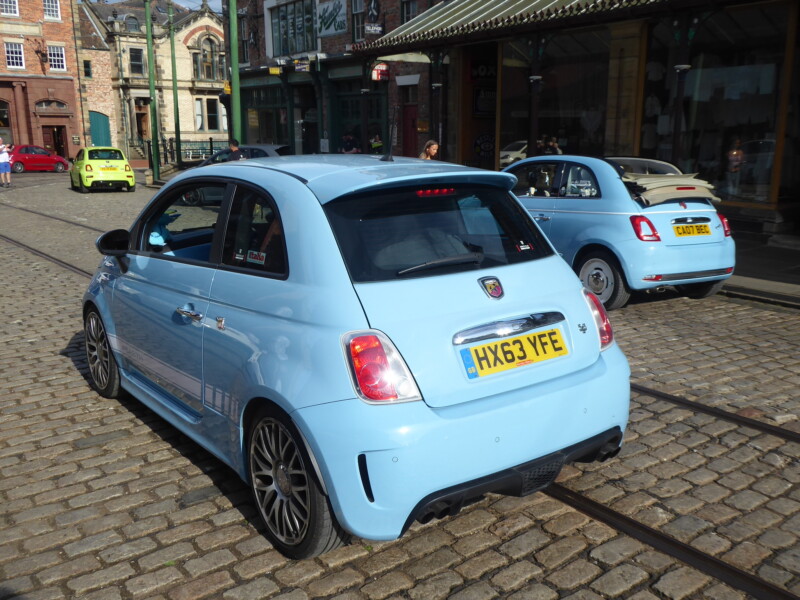
The vast majority of cars here were the 500-based models which have been on sale now since the end of 2008, following a launch at the Paris Show that year. Since that time there have been a number of detailed changes to the standard cars and a lot of limited editions. Those who really know the marque can spot most of them, but some are so subtle that unless there is a badge you can see, you will not be quite sure which version you are looking at. It used to be relatively easy, when the model was first launched, as there was only one version as shipped ex works called the 500. It had a 135 bhp 1.4 litre turbo-charged engine coupled to a five speed manual gearbox, with 16″ alloys as standard, and the option of 17″ wheels, and a colour palette comprising of two whites (BossaNova White, the standard colour, or the pearlescent Funk White), Red (Pasadoble), Pale Grey (Campovolo) or Black. If you wanted more power – 160 bhp – then you could order an Esseesse kit, which came in a large wooden crate, containing new wheels, springs, an ECU upgrade, the Monza exhaust system and badging. It was dealer fitted and could be applied at any time within the first 12 months or 10,000 miles from registration. Needless to say, it proved popular. As were many of the optional extras, with stickers for the sides, a large scorpion for the bonnet and even a chequered pattern for the roof among the personalisation options offered.

Whilst a sliding glass sunroof (Skydome in Fiat/Abarth parlance) was an option from inception, fans of open air motoring had to wait until Geneva 2010 for the launch of the 500C models, with a roll-back roof which provided the best of open-topped motoring and yet still with the rigidity of the regular body style. The C bodystyle has been offered ever since, and has sold steadily, though in relatively small numbers relative to the fixed roof car. For the first few months these cars only came with the robotised manual gearbox, which limited the appeal in the eyes of some, but they also introduced us to the “bi-colore”, a series of two tone cars, with upper and lower halves of the body painted in different colours. It took us a while to get used to this, as no other production road cars had been painted like this for some time, but now this is seen as yet another of those marque defining attributes, and (perhaps with the exception of the rarely seen Rally Beige and Officina Red combination that would come for 2014) in the eyes of many this distinctive look enhances the appeal of the cars still further.


Having used the legendary 695 badging from the 1960s on the Tributo cars, at the 2012 Geneva Show, Abarth dusted off the 595 name that had been used on the less powerful of the Nuova 500 based cars of the same generation, and created two new versions which we should think of as Series 2 cars, the 595 Turismo and Competizione, both of which could be bought in either closed or open top C guise, with either the 5 speed manual or robotised automated gearshifts. Both models had the 160 bhp engine as standard. Effectively they were a replacement for the Esseesse kit, and it meant that the cars were produced complete at the factory, rather than needing the dealer to undertake the upgrade (and the associated paperwork), though Abarth did not withdraw the Esseesse kits from the market for some while. Turismo, as the name suggests was aimed slightly less extreme in intent, featuring standard leather upholstery, upgraded dampers and climate control, Xenon headlights and Alutex interior details. The sportier Abarth 595 Competizione replaced the leather seats with Sabelt cloth sport seats and Alutex with aluminium, while adding p-cross-drilled brakes and the Record Monza dual-mode exhaust.


Rumours started to circulate towards the end of 2014 that Abarth were going to upgrade the Competizione model, so as better to bridge the gap between the Turismo and the 190 bhp 695 Biposto that had been added to the range earlier in the year. It was Geneva 2015 when the result was finally shown to an expectant fan base. Most exciting news was that thanks to a bigger Garrett Turbo, the engine had been tweaked to 180 bhp, and with reduced CO2 emissions. A standard spec that included Koni Dampers, Brembo brakes, Xenon lights, Sabelt seats, Climate Control, parking sensors as well as other refinements that had been added like the TFT instrument display all proved very compelling, so not long after the first cars reached the UK in June of 2015, I found temptation too hard to resist, and as is well documented here, swapped my 2010 car for one of these. At the time I ordered it, Cordolo Red, a tri-coat pearlescent paint which shimmers in bright sunlight looked set to become one of the most popular colours of the lot, even though it is a cost option. Indeed, the Launch Edition models were all offered either in this colour or Scorpion Black, with black wheels. Surprisingly, the colour was not carried over to the Series 4 cars.


What is known as the Series 4 version of the familiar 595 reached the markets in the middle of 2016. After rumours had circulated all winter following the launch of the facelifted Fiat 500 last year, Abarth finally unveiled the Series 4 at the end of May 2016. Initially, we were told that the cars would not be available in the UK until September, but that came forward somewhat, with dealers all receiving demo cars in June, and the first customers taking delivery in July. Three regular production versions of both the closed car and the open-topped C were initially available, all badged 595, and called Custom, Turismo and Competizione, as before, though numerous limited edition models have since appeared and in most case disappeared. The most significant changes with the Series 4 are visual, with a couple of new colours, including the much asked for Modena Yellow and a different red, called Abarth Red, which replaces both the non-metallic Officina and – slightly surprisingly – the tri-coat pearlescent Cordolo Red. as well as styling changes front and rear. The jury is still out on these, with many, me included, remaining to be convinced. At the front, the new air intake does apparently allow around 15 – 20 % more air in and out, which will be welcome, as these cars do generate quite a lot of heat under the bonnet. Competizione models for the UK retain the old style headlights, as they have Xenon lights as standard, whereas the Custom and Turismo cars have reshaped units. At the back, there are new light clusters and a new rear bumper and diffuser. Inside, the most notable change is the replacement of the Blue & Me system with a more modern uConnect Audio set up, which brings a new colour screen to the dash. Mechanically, there is an additional 5 bhp on the Custom (now 145) and Turismo (now 165 bhp) and the option of a Limited Slip Diff for the Competizione, which is likely to prove a popular option. Details of the interior trim have changed, with a filled-in glovebox like the US market cars have always had, and electric windows switches that are like the US ones, as well as a part Alcantara trim to the steering wheel in Competizione cars. These cars have now been on offer for around eight years and with it Abarth sales rose considerably so it was no surprise that they were particularly well represented here.


The Abarth Grande Punto debuted at the 2007 Frankfurt IAA Show, going on sale in the UK in late summer of 2008. Offering 155 bhp from its 1.4 litre T-Jet engine, coupled to a six speed gearbox, and riding on 45 profile 17″ alloys, the standard car got rave reviews from the journalists when they first tried it, and they were even more impressed by the changes wrought by the optional Esseesse kit. This increased power to 177 bhp, brought 18″ OZ lower profile wheels, whilst new springs lowered the ride height by 15-20mm, and high-performance front brake pads and cross-drilled front disc brakes helped the car to stop more quickly. The most distinctive feature of the car were the white alloy wheels, though, as owners found, keeping these clean is not a job for the uncommitted, and many have a second set of wheels that they use for grubbier conditions. Despite the positive press at launch, the car entered a very competitive sector of the market, and the combination of being relatively unknown, a limited number of dealers and the existence of established rivals from Renault and others meant that this always remained a left-field choice. The owners loved them, though, and they still do. The oldest cars have now had their 16th birthdays, and some have amassed relatively big mileages, but they are still a car for the cognoscenti.


The Punto Evo was launched at the 2010 Geneva Show, with the cars reaching UK buyers in the summer of that year, and it incorporated many of the changes which had been seen a few months earlier on the associated Fiat models, the visual alterations being the most obvious, with the car taking on the nose of the associated Fiat, but adapted to make it distinctively Abarth, new rear lights and new badging. There was more to it than this, though, as under the bonnet, the T-Jet unit was swapped for the 1.4 litre Multi-Air, coupled to a 6 speed gearbox, which meant that the car now had 165 bhp at its disposal. Eventually, Abarth offered an Esseesse kit for these cars, though these are exceedingly rare. Part of the Punto Evo family is the SuperSport, usually identified by the distinctive black bonnet, though not all cars feature it. Just 199 of the SuperSport versions were built, of which around 120 are registered on UK roads. These cars had many of the options from the Punto Evo included as standard. Power came from the 1.4-litre MultiAir turbo engine, tuned to produce 178bhp and 199lb ft of torque, up from 165 of the standard Punto Evo, giving the SuperSport a 0-62 time of 7.5 seconds and a top speed of over 132mph. To help put the power down, the SuperSport was fitted with wider 18″ wheels and optional Koni FSD dampers. Standard equipment included the Blue&Me infotainment system with steering wheel controls, automatic climate control and a popular option was the ‘Abarth Corsa by Sabelt’ sports leather seats. The SuperSport was available in the same colours as the regular Punto Evo, which means white, grey, black and red.


ALFA ROMEO
Oldest of the Alfa designs here was this rather fabulous Series 3 AlfaSud. These characterful small cars evoke a very positive reaction, with many people wistfully recollecting one that they, or their parents, owned back in the 1970s, but observing that the car, whilst divine to drive, simply rusted away almost before your very eyes. There are a lot more of these cars left in the UK than you might imagine, but most of them are on SORN, needing massive restorations that may or may not ever happen. That should not detract from the splendour of the models on show at this event. Alfa Romeo had explored building a smaller front wheel drive car in the 1950s but it was not until 1967 that firm plans were laid down for an all-new model to fit in below the existing Alfa Romeo range. It was developed by Austrian Rudolf Hruska, who created a unique engineering package, clothed in a body styled by Giorgetto Giugiaro of ItalDesign. The car was built at a new factory at Pomigliano d’Arco in southern Italy, hence the car’s name, Alfa Sud (Alfa South). January 18, 1968, saw the registration at Naples of a new company named “Industria Napoletana Costruzioni Autoveicoli Alfa Romeo-Alfasud S.p.A.”. 90% of the share capital was subscribed by Alfa Romeo and 10% by Finmeccanica, at that time the financial arm of the government controlled IRI. Construction work on the company’s new state sponsored plant at nearby Pomigliano d’Arco began in April 1968, on the site of an aircraft engine factory used by Alfa Romeo during the war. The Alfasud was shown at the Turin Motor Show three years later in 1971 and was immediately praised by journalists for its styling. The four-door saloon featured an 1,186 cc Boxer water-cooled engine with a belt-driven overhead camshaft on each cylinder head. It also featured an elaborate suspension setup for a car in its class (MacPherson struts at the front and a beam axle with Watt’s linkage at the rear). Other unusual features for this size of car were four-wheel disc brakes (with the front ones being inboard) and rack and pinion steering. The engine design allowed the Alfasud a low bonnet line, making it very aerodynamic (for its day), and in addition gave it a low centre of gravity. As a result of these design features, the car had excellent performance for its engine size, and levels of roadholding and handling that would not be equaled in its class for another ten years. Despite its two-box shape, the Alfasud did not initially have a hatchback. Some of the controls were unorthodox, the lights, turn indicators, horn, wipers and heater fan all being operated by pulling, turning or pushing the two column stalks. In November 1973 the first sport model joined the range, the two-door Alfasud ti—(Turismo Internazionale, or Touring International).Along with a 5-speed gearbox, it featured a more powerful version of the 1.2 engine, brought to 67 hp by adopting a Weber twin-choke carburettor; the small saloon could reach 160 km/h. Quad round halogen headlamps, special wheels, a front body-colour spoiler beneath the bumper and rear black one around the tail distinguished the “ti”, while inside there were a three-spoke steering wheel, auxiliary gauges, leatherette/cloth seats, and carpets in place of rubber mats. In 1974, Alfa Romeo launched a more upscale model, the Alfasud SE. The SE was replaced by the Alfasud L (Lusso) model introduced at the Bruxelles Motor Show in January 1975. Recognisable by its bumper overriders and chrome strips on the door sills and on the tail, the Lusso was better appointed than the standard Alfasud (now known as “normale”), with such features as cloth upholstery, headrests, padded dashboard with glove compartment and optional tachometer. A three-door estate model called the Alfasud Giardinetta was introduced in May 1975. It had the same equipment of the Alfasud “L”. It was never sold in the UK and these models are particularly rare now. The Lusso model was produced until 1976, by then it was replaced with the new Alfasud 5m (5 marce, five speed) model, the first four-door Alfasud with a five-speed gearbox. Presented at the March 1976 Geneva Motor Show, it was equipped like the Lusso it replaced. In late 1977 the Alfasud Super replaced the range topping four-door “5m”; it was available with both the 1.2- and 1.3-litre engines from the “ti”, though both equipped with a single-choke carburettor.The Super introduced improvements both outside, with new bumpers including large plastic strips, and inside, with a revised dashboard, new door cards and two-tone cloth seats. Similar upgrades were applied to the Giardinetta. In May 1978 the Sprint and “ti” got new engines, a 78 hp 1.3 (1,350 cc) and a 84 hp 1.5 (1,490 cc), both with a twin-choke carburettor. At the same time the Alfasud ti received cosmetic updates (bumpers from the Super, new rear spoiler on the boot lid, black wheel arch extensions and black front spoiler) and was upgraded to the revised interior of the Super. The 1.3 and 1.5 engines were soon made available alongside the 1.2 on the Giardinetta and Super, with a slightly lower output compared to the sport models due to a single-choke carburettor. All Alfasuds were upgraded in 1980 with plastic bumpers, new instrument panel, headlamps and rear lights as well as other revisions. The Ti version was now fitted with a twin-carburettor version of the 1490 cc engine that had been fitted to the Sprint the previous year, developing 95 bhp A three-door hatchback was added to the range in 1981 in either SC or Ti trim and the two-door Ti and Giardinetta were deleted from most markets around this time. Belatedly in 1982 the four-door cars were replaced by five-door versions as by now, most of its competitors were producing a hatchback of this size, although some also produced a saloon alternative. The range was topped by the five-door Gold Cloverleaf, featuring the 94 hp engine from the Ti and enhanced interior trim. In 1983 an attempt to keep pace with the hot hatchback market, the final version of the Alfasud Ti received a tuned 1490 cc engine developing 105 PS Now named Quadrifoglio Verde (Green Cloverleaf) this model was also fitted with Michelin low profile TRX tyres on metric rims as well as an enhanced level of equipment. The five-door Alfasud saloons were replaced by the 33 models in 1983. The 33 was an evolution of the AlfaSud’s floorpan and running gear, including minor suspension changes and a change from four-wheel disc brakes to front disc and rear drum brakes to reduce costs. The three-door versions continued for a further year before being replaced by the unsuccessful Alfa Romeo Arna a joint venture between Alfa Romeo and Nissan.


The Alfa Romeo 90 (Type 162A) is an executive car produced between 1984 and 1987. Designed by Bertone and introduced at the 1984 Turin Motor Show, the 90 was pitched between the Alfa Romeo Giulietta (nuova) and the Alfa Romeo Alfa 6, both of which were soon discontinued after the 90’s launch. The car used the Alfetta chassis (including its rear mounted transaxle) and took its engines from the larger Alfa 6. The bodywork was similar to both, albeit modernised. One notable feature of the 90’s design was a small chin spoiler which extended above a certain speed to aid engine cooling. Its angular lines with integrated bumpers gave the car a neat look consistent with the period, however the aerodynamics suffered with a drag coefficient of Cd=0.37. The cars design was conservative, inside and out, with perhaps the only unusual element being the U-shaped parking brake lever. The 90 was well equipped, including electric front windows and electrically adjustable seats as standard. The luxurious Gold Cloverleaf (Quadrifoglio Oro) model had electric rear windows, a trip computer, power steering, central locking, metallic paint and a digital instrument panel as standard. The passenger fascia included a slot for an optional briefcase, made by Valextra. The external finish was very similar across the board, it being near impossible to tell the different models apart from appearance alone. The 90 was made only as a sedan but in 1985 Carrozzeria Marazzi developed an Alfa 90 Station Wagon prototype at the behest of Italian motoring magazine Auto Capital; only two cars were made. The Alfa 90 has a longitudinal front engine, a rear mounted gearbox with differential lock and independent front suspension wishbones with torsion bar springs and rear De Dion tube. It has disc brakes on all four wheels, the rear brakes are mounted inboard. Five engines were available: two Alfa Romeo Twin Cam engines; 1,779 cc and 1,962 cc and two fuel injected Alfa Romeo V6 engines: 1,996 cc or 2,492 cc, and finally a 2,393 cc turbodiesel made by VM Motori. The carburettor fours have twin Dell’Ortos with manual chokes, while the 1,962 cc was also available in a fuel injected model which also incorporated a novel variable valve timing system. The fuel injected engine has the same maximum power but offered somewhat less torque; this was perhaps more than made up for with a 20 percent improvement in fuel economy. The 2.0 V6 version was dedicated to the Italian market, where up to 1993 cars with engines over 2.0-litres were subjected to a doubled 38% VAT. It was equipped with an innovative engine control unit and electronic injection system named CEM (Controllo Elettronico del Motore), developed by Alfa Romeo subsidiary SPICA. It manages the opening time of the injectors and the ignition depending on the angle of the butterfly valves, with one throttle body per cylinder unlike on the Bosch L-Jetronic used on the 2.5 V6. V6 cars receive a double-plate clutch while the four-cylinders rely on a single-plate unit. The 90 was revamped in 1986 with many minor changes throughout, the most obvious exterior change being a new grille with smaller horizontal slants. A total of 56,428 cars were sold over the four years of production. It is believed that just 10 of these cars remain in the UK and at any one time, most of them are on SORN so they are a very rare sighting indeed.


I was delighted to see that the 164 was also represented here, as I had the pleasure of driving one for 4 years and 160,000 miles and to this day, it is the car I regret parting with more than any other of the fleet that I have owned over the years. When I bought mine, Alfa were selling a very small number of cars per month in the UK, so they were never that common, and sadly, survival rates are very low. Most people who know anything about the history of the 164 will be aware that this is one of the four so-called Type 4 cars, a joint venture involving Alfa Romeo, Fiat, Lancia and Saab. In 1978 these four marques agreed to each develop an executive saloon based on a shared platform to compete against the likes of the Ford Granada and Opel Rekord (Vauxhall Carlton) as well as more premium saloons by BMW and Mercedes-Benz in the form of the 5-Series and E-Class, respectively. Alfa’s Project 164 started life as Project 154 and was completed in 1981, then still under Alfa Romeo. A year later, that project morphed into the 164 based on the Type Four platform. This new model was designed by Enrico Fumia of Pininfarina, with a wedge shape that afforded it a leading drag coefficient of Cd=0.30. The design would later influence the rest of the Alfa Romeo range starting in 1990 with the major redesign of the 33 and culminating with the 155, and Pininfarina also adapted it (much to the maker’s chagrin) for the 1987 Peugeot 405 and the 1989 Peugeot 605 saloons. Initial testing of the 164’s dynamic elements (engine and drivetrain) began in 1984, where mules based on the then contemporary Giulietta were used. In 1985, the first pre-production 164’s were put through their paces on the road. Heavily disguised, with many false panels and even a false nose design (borrowing heavily from the then equally undeveloped 155), sporting 4 round headlamps, these vehicle mules served to test the 164 for the gruelling 1 million kilometre static and road testing demanded of the design. In 1986 and 1987, the first 150 164’s were given their pre-production testing. In terms of engineering demands, these exceeded every Alfa before, and by quite a substantial margin. In Morocco, desert testing saw 5 grey 164 Twinsparks and V6’s undergo the equivalent of the Paris-Dakar rally. Road conditions varied from good tarmac to off-road conditions, and accelerometers confirmed the superiority of the 164 in terms of passenger comfort. This data was cross-confirmed in the engineering laboratory with a sophisticated dummy in the driver’s seat, with accelerometers both in its seat, and in its ears to mimic that of the semi-circular canals of the ear. The Twinspark and the V6 underwent handling trials at Arese. The Twinspark displayed very mature driving manners at the limit, with minimal skid. The V6 displayed a 25% increase in at-the-limit skid, a natural consequence of its greater nose weight. ABS testing confirmed that the Twinspark has superior braking to the V6. Brake linings of the 164’s were run at maximum braking until they literally glowed with heat, and displayed no deviation in form. The 164 was the first Alfa to feature slotted double-walled disc brakes. At no point were the discs drilled to release excess heat, the original design being demonstrated to be excellent. Sound production was tested in an anechoic chamber, the car being subjected to stress and road noise testing, with instruments and with live subjects at the wheel, on a specially designed rig. Electromagnetic stability of the complex electronic system was also tested, in an anechoic chamber equipped with EM emitters (radar). The 164 engines were run to destruction, the Twinspark proving to be the most robust, and with the longest possible engine life. The V6 displayed only 10% shorter overall engine life. All this testing meant that by the time the production car, called the 164 was unveiled at the 1987 Frankfurt Motor Show – the last model to be developed while the Alfa Romeo was still a fully independent company, even though the launch was a few months after the takeover by Fiat – that the car was far more thoroughly developed and tested than any Alfa preceding it. There were plenty of innovations in the build, too, thanks to the extensive use of galvanised steel for the frame and various body panels for the first time in the brand’s history. Moreover, the car featured advanced electronics thanks to the most complex wiring harness fitted to any Alfa Romeo. For example: it had three onboard computers (one for air conditioning, one for instrumentation, and one for the engine management); air conditioning and instrument functions shared a multiple-mode coded Zilog Z80-class microcontroller for dashboard functioning). The instrumentation included a full range of gauges including an advanced check-panel.. The car was a sensation at launch. For a start, it looked fantastic thanks to Enrico Fumia of Pininfarina’ design. The first 1:1 scale model of the car had been produced in 1982 and design cues had been publicly revealed on the Alfa Romeo Vivace concept car, which was exhibited at the 1986 Turin Motorshow that went on to influence the design of the Alfa Romeo GTV and Spider (916 series) launched in 1993, but the result was distinctive and elegant and very different from any of its rivals, or indeed any of the other Tipo 4 cars. The 164 became the first Alfa to benefit from extensive use of computer aided design, used to calculate structural stresses that resulted in a very rigid but still relatively lightweight chassis. Although sharing the same platform as that of the Lancia Thema, Fiat Croma and Saab 9000, by virtue of the fact that it was the last of the four to enter production, it featured unique front suspension geometry and the most distinctive styling of the lot. In fact, for example, the other cars all shared identical side door panels. Though still voluminous, the 164 had the tightest aperture to the boot, which had a 510-Litre capacity. The interior was spacious and modern, available with standard velour seating or leather trim depending on the model. Its dashboard continued the avantgarde design of the exterior with a centre dashboard that was dominated by a large number of seemingly identical buttons arranged in rows. Air-direction within the ventilation system was controlled by a pair of servomechanisms, which were constructed using notoriously fragile plastic gears that were prone to failure. Depending on the model, the 164 could feature automatic climate control and electronically controlled damping suspension – the latter, for example, in the sports-oriented Quadrifoglio Verde (“Green Cloverleaf “) and 164S models. This suspension actively reduced damping in response to conditions to provide a dynamic compromise between road holding and comfort. At launch, the original 164 range comprised three models: a 148 bhp 2.0 Twin Spark, the 192 bhp 3.0i V6 12-valve and a 2.5 Turbodiesel (badged “TD”). It took a year before the first cars reached the UK and the first eighteen months saw only the 3 litre model offered. The bigger selling 2.0 TS arrived in the summer of 1990, just before the range was expanded by the 4-cylinder 2.0i Turbo, the sports-oriented 3.0i V6 Quadrifoglio Verde (badged “QV” or “S”) and North American export versions that included the luxury-oriented 164 L (“L” for Lusso) and the 164 S (in essence, the “QV”). Apart from minor running production upgrades, the next change came in 1993 with the launch of the 164 Super. Key differences on the outside consisted of larger bumpers with chrome trimmings added to the upper edge and revised headlights with a slimmer profile. Inside, there were revised instruments and a centre console that featured more delineated switchgear. The range was now also bolstered by a 3.0 V6 24V with a 24-valve engine upgrade and the 3.0 V6 Quadrifoglio 4 (badged “Q4”), which was the most powerful and sole all wheel drive variant built. Production ended in late 1997, with a gap of nearly two years before the replacement model would go on sale.


Alfa followed the 156 a couple of years later, in late 1998, with a larger saloon, the 166, hoping to receive the same sort of acclaim with this executive car which was a direct replacement for the 164. It was not forthcoming. For a start, the styling with its drooping and very small headlamps and pointed nose was quite unlike anything else on the market at the time. Part of the difficulty came from the fat that the car had been designed some years before its launch and then put on the back burner as the 156 was given priority. The 166 was initially available with a 155 PS 2.0-litre Twin Spark, a 190 PS 2.5 V6, a 220 PS 3.0 V6 and in some markets a 205 PS V6 2.0 Turbo petrol engine along with a diesel powered L5 2.4 10v common rail turbodiesel version with 136 PS, 140 PS and 150 PS (148 hp) output. The 2.0 TS model used a 5-speed manual gearbox, whilst the 2.5 and 3.0 had the option of a Sportronic automatic gearbox. The 3.0 V6, L5 2.4 and V6 Turbo were otherwise supplied with a six-speed manual gearbox. The top models were named “Super”, and included MOMO leather interior, 17″ alloy wheels, rain sensitive wipers, cruise control, climate control and ICS (Integrated Control System) with colour screen. Options included xenon headlamps, GSM connectivity and satellite navigation. Suspension systems comprised double wishbones at the front and a multi-link setup for the rear. Though the car’s handling characteristics, engine range and elegant exterior design received praise from many, including Top Gear’s Jeremy Clarkson, it did not become a strong seller to rival the dominant German brands, in the European executive car sector. In September 2003, the 166 underwent a substantial revamp, with the début at the Frankfurt Motor Show. As well as upgrades to the chassis, interior, and the engine range, the styling was substantially altered. The new front end resembled the also recently revamped 156, and lost its famous drooping headlights. The 2.0 V6 Turbo model was dropped because of marketing problems, the V6 2.5 was re-rated at 188 PS and a 3.2 litre V6 with 240 PS was introduced. Both the 3.2 litre and the 2.0 Twin Spark models now featured the six-speed manual gearbox, whilst the 3.0 model was retained, but made available only in Sportronic form. In the diesel sector, the L5 2.4 was re-engineered with Multi-Jet technology which allows up to 5 injections per cycle, second stage common rail, with maximum injection pressure of 1400 bar and 4 valves per cylinder, to output a class leading 175 PS, but these changes made little impact on sales volumes. In October 2005, the Alfa Romeo 166 was officially withdrawn from sale in markets for RHD. Sales of the 166 never grew as Alfa had hoped, following the facelift in September 2003, and the additional lack of a diesel engine in the United Kingdom, Australian, and Irish markets limited its reach into company car sectors. In June 2007, production of the 166 effectively ended, with no direct successor. In September 2008, the platform was sold to the Chinese state run manufacturer GAC Group. In total, less than 100,000 units were made.


The 166 may have failed to hit the jackpot, but the next Alfa certainly did. This was the 147, launched at the 2000 Turin Motor Show as a replacement for the 145 and 146 hatchbacks, and based on the running gear of the larger 156 saloon. Designed by Walter de’Silva and Wolfgang Egger, the 147 received considerable praise for its styling on launch, later it was awarded with some styling awards. It was available initially with 1.6, 2.0, petrol engines and a 1.9-litre diesel engine. A sequential, paddle operated ‘Selespeed’ transmission was available from launch. Two trim levels were available, Turismo and Lusso. The 147 was the first Alfa Romeo to feature dual-zone climate control and electronic traction control. Although some thought the car had lost of some of the Alfa magic, it was well received and was awarded the Car of the Year trophy a few weeks after launch. The entire 147 range was revamped in 2004, with the exterior styling changed considerably to be more reminiscent of the new 159 and Brera models, and Alfa Romeo Visconti concept car, most notably for its more aggressive look, with a new front grille, new headlights, new rear lights and the interior was updated on all models besides the GTA version. A new more powerful diesel engine arrived and suspension was also tweaked. In 2006, the 147 1.9 JTD Q2 version was launched, which featured a front Torsen limited slip differential. Alfa Romeo presented a new limited edition 147 called Ducati Corse at the 2007 Bologna Motor Show. The car came equipped with a 170 PS (68 hp) JTD diesel engine and Q2, a front Torsen limited slip differential. The 147 was in production for ten years, making it one of the oldest small family cars on sale in Europe at the time of its replacement by the Alfa Romeo Giulietta in late May 2010. In total around 580,000 cars were made.

Replacing the 147, the Alfa Romeo Giulietta (Type 940) is a five door hatchback positioned as a sporty and luxury car. Production started near the end of 2009 and the model was introduced at the March 2010 Geneva Motor Show. The Giulietta was placed second in the 2011 European Car of the Year awards. The platform used in the Fiat Group’s Compact, successor of the C-platform (base for Fiat Stilo, Fiat Bravo and Lancia Delta). Practically this was an all-new modular platform, only the central front part coming from the previous C-platform, but that part is modified also. Fiat Group used around 100 million euros to developing it. Mistakenly the journalists called the C-Evo platform, but Fiat never called on this name. It has a longer wheelbase, shorter overhangs and an advanced new type of MacPherson strut front suspension and multi-link rear suspension. Depending on the market and trim level, 16, 17, or 18-inch wheels are available. Available tire sizes are 205/55 R16, 225/45 R17, and 225/40 R18. The wheels use a 5-hole pattern with a 110 mm bolt circle. The length of the Giulietta is around 4.3 metres (14 ft). Only a five-door body is available for sale. In a viability plan forwarded to the US Government in February 2009, Chrysler (a partner of Alfa Romeo parent company Fiat) reported that the 147 replacement would come to market as the Milano and that it could be built in the USA. However, as of early 2010 Fiat was instead planning to concentrate on bringing larger models to the US, such as the Giulia. At the 2013 Frankfurt International Motor Show Alfa Romeo presented an updated Giulietta. Trim changes include a new Uconnect infotainment system with 5″ or 6.5″ Radionav touchscreen, a new front grille, a chrome-plated frame for the fog lights, a new and more supportive seat design, new wheels (16, 17 and 18-inch), as well as new exterior colours: Moonlight Pearl, Anodizzato Blue and Bronze. A new diesel engine variant has also arrived, the two-litre JTDM 2, developing 150 PS (148 bhp) and 380 Nm (280 lb/ft). In the 2014 range, all engines comply with Euro 5+ (Euro 6-ready) emission standards. Debuting at 2016 Geneva Motor Show, New Giulietta with facelifted front resembling Giulia and with new updated brand logo and new lettering. Trim line up will be changed to Giulietta, Giulietta Super and Giulietta Veloce. New body colour, new rims designs. Previous Giulietta QV will now be changed into sporty Veloce trim available with 240 PS (237 bhp) engine and TCT transmission. Also debuting was a new 1.6 JTDm 120 PS (118 bhp) TCT diesel engine. For 2019, the Giulietta had updated engines, all Euro 6 D: a 1.4-litre 120 PS turbo petrol, a 1.6-litre 120 PS Multijet with manual or Alfa TCT automatic transmission, and a 2.0-litre 170 PS Multijet with Alfa TCT. The top of the range model was a version with 1,742 cc turbocharged TBi engine rated 235 PS (232 bhp), lowered ride height (15 mm (0.6 in) at the front and 10 mm (0.4 in) at the rear), 18-inch Spoke design alloy wheels with dark titanium finish and 225/40 R18 tyres plus 18-inch 5 hole design alloy wheels as an option; an enhanced braking system (330 mm (13.0 in) front, 278 mm (10.9 in) rear) with calipers painted Alfa red; dark tinted windows, sports kick plates, cloverleaf badges, leather and microfibre seats plus sports leather seats as an option; dark brushed aluminium dashboard. 1750 is an engine size which has its roots in Alfa Romeo’s history, with 1.75 L engines being used to power some of Alfa Romeo’s first cars. The UK version was originally marketed as the Giulietta Cloverleaf, then Quadrifoglio Verde through ’14-’15 before finally being renamed to the Veloce in 2016 until the end of production. At the 2014 Geneva Motor Show, Alfa Romeo introduced a new Quadrifoglio Verde, it has new 1,742 cc Turbo direct injection aluminium-block Inline-four engine now upgraded to 240 PS (237 bhp) at 5750 rpm and 340 Nm (251 lb/ft) at 2000 rpm of torque and Alfa TCT 6-speed twin dry clutch transmission borrowed from the Alfa Romeo 4C. With new engine the Giulietta’s flagship can exceed 240 km/h (149 mph) and accelerate from 0 to 100 km/h (62 mph) in only 6.0 seconds. This new facelifted version was premiered with a limited ‘Launch Edition’, recognizable by the black-finish on the sills all round. Available in new matt Grigio Magnesio Opaco along with Rosso Alfa and Rosso Competizione. Each car has its own numbered plaque. Around 700 units were made. Between 2010 and 2019, production reached over 400,000. In 2020, Alfa Romeo announced that they were going to axe the Giulietta and production ended on 22 December 2020 spanning 10 years of sales from a period of 2010 to 2020. In total 469,067 examples were produced until 2020.

The Alfa Romeo Giulia is a compact executive car. Known internally as the Type 952, it was unveiled in June 2015, with market launch scheduled for February 2016, and it is the first saloon offered by Alfa Romeo after the production of the 159 ended in 2011. The Giulia is also the first mass-market Alfa Romeo vehicle in over two decades to use a longitudinal rear-wheel drive platform, since the 75 which was discontinued in 1992. The Giulia was second in 2017 European Car of the Year voting and was named Motor Trend Car of the Year for 2018. In 2018, Giulia was awarded the Compasso d’Oro industrial design award. In 2013 Fiat Chrysler Automobiles CEO Sergio Marchionne requested a clean-sheet design for the next Alfa Romeo—a rear-wheel drive sports saloon to help return the company to its roots. He appointed former technical director at Ferrari and chassis engineer for the 458 Speciale Philippe Krief as chief engineer for the Giulia, and asked him to assemble a team of ten to create the Giulia, to be designed and built in two and a half years. Krief oversaw the development of the Giulia, along with the platform that underpins it—Giorgio. This is an all-new, longitudinal-engine, rear-wheel drive platform developed by Alfa Romeo. Marco Tencone of Centro Stile Alfa Romeo at the Fiat Mirafiori factory in Turin headed the design team, with oversight from Lorenzo Ramaciotti. The Giulia had a long gestation and delayed launch due to Marchionne sending its design back to the drawing board. The new Giulia was unveiled to the press at the Museo Storico Alfa Romeo in Arese, on 24 June 2015, at an event which involved only the top-of-the-range Quadrifoglio variant and a rendition of “Nessun dorma” by Italian tenor Andrea Bocelli. The occasion coincided with the company’s 105th anniversary, and also saw the company debut a restyled logo for all future Alfa Romeo models. The Giulia uses a front-engine, rear-wheel-drive layout, targeting an even 50% front and 50% rear weight distribution. Suspension is independent all-around—double wishbone with a semi-virtual steering axis front and multilink rear. All Giulia models employ a carbon-fibre drive shaft made by Hitachi Automotive Systems, as well as aluminium alloy shock towers, suspension components, front wings, and doors. All-wheel drive is offered in non-Quadrifoglio models. The Giulia has a drag coefficient of Cd=0.28. The base Giulia, mid-level Super, and fully loaded Speciale are powered by a 200 PS (197 hp) 2-litre petrol engine, or the choice of 136 PS, 150 PS or 180 PS 2.2-litre turbo diesel engine. The base model comes with 16-inch alloys, the Super can be distinguished with 17-inch alloys and dual chrome exhaust tip for the diesel model. The Speciale has 18-inch alloys, black brake calipers, as well as leather sports seats and sporty bumpers from the Veloce. Fixed rear seat is standard on the base and Super, while the Speciale has folding rear seat. The Giulia Sprint is positioned above the base and Super model grades, but below the Ti and Veloce. In Europe, the early Giulia Sprint was powered by either the base 2.0 gasoline engine, or 180 PS 2.2-litre diesel engine. For 2020, the Sprint got the updated diesel engine with 190 PS. In North America, the Giulia Sprint was new for 2021 model year. It is the entry-level model although motored by the same engine as the Veloce. The diesel-powered Sprint was never offered in North America. The Giulia Veloce was presented at the 2016 Paris International Motor Show held in October. The Veloce offers the choice of two engines: the 2.0-litre turbo petrol and the 2.2-litre diesel inline-4 engines, both equipped with an 8-speed automatic transmission and Alfa Q4 all-wheel drive system (rear-wheel-drive in the UK). The Veloce has specific bumpers and a glossy black door trim; it has also various performance components like special rear extractor with double exhaust pipes and optional 5-spoke 19-inch alloy wheels (the 19-inch option is not available in the UK). On the interior, it has black, red or tan leather sport seats and a sports steering wheel with a suede grip, aluminium inserts on the dashboard, central tunnel, door panels and Xenon headlights. The new four-cylinder petrol engine is rated at a maximum power output of 280 PS (276 hp) at 5,250 rpm and a maximum torque of 400 Nm (295 lb/ft) at 2,250 rpm. It has MultiAir electro-hydraulic valve activation system along with “2-in-1″ ” turbocharger system and direct injection with a 200-bar high pressure system. The 210 PS (207 hp) diesel all aluminium straight-4 engine comes with MultiJet II technology and electrically operated variable geometry turbocharger. The Alfa Q4 all wheel drive system behaves like a rear-wheel drive vehicle: 100% of torque is distributed to the rear axle. As it reaches the wheel adherence limit, the system transfers up to 60% of the torque to the front axle. To ensure maximum speed of response in re-distributing torque, the system exploits a high mechanical over slippage (up to 2.5%) between the two axles, which translates into segment-beating vehicle control in terms of traction and directional stability on bends. Meanwhile, the Giulia Ti is the luxury-oriented version. It has chrome grille and window surrounds, heated steering wheel and front seats, wood panel interior, 18-inch alloy wheels, and headlight washers. Basically, it came with more features than the Sprint, but without paddle shift like in a Veloce. The North American Ti is powered by the 280 hp gasoline engine, while the European Ti was also offered with the 187 hp diesel engine. The Ti was also available with Lusso package which consists of Cannelloni leather interior, heated rear seat, and the choice of multi-spoke or optional “Y” shape 18-inch alloy wheels. With paddle shift, 19-inch 5-hole alloy wheels, sportier front and rear bumpers, the North American Ti Sport was roughly the equivalent of the Veloce, before it was officially called the Veloce for 2022 model year. The American Ti Sport Carbon or European Veloce Ti is basically the Veloce with carbon fibre mirror caps and body kits. Based on the Veloce, the Estrema was released in 2022 for 2023 model year. It came with standard active suspension, 19-inch alloy wheels, “Estrema” side emblems, Alcantara with red stitching seats, dashboard, steering wheel and shift knob, and 14-speakers Harman Kardon sound system. The Giulia Estrema is offered with either 280 PS gasoline engine, or 210 PS diesel engine matched to 8-speed automatic gearbox and Q4 all-wheel-drive system. The top-of-the-line Giulia Quadrifoglio (Italian for “four-leaf clover”) was the first model in the new Giulia range. It was unveiled in Italy in June 2015. It made its official international debut at the 2015 Frankfurt Motor Show. The Quadrifoglio is powered by an all-aluminium alloy, twin-turbocharged gasoline direct injection 90° 690T V6 engine, with a single-cylinder displacement of just under half a litre, for a total of 2,891 cc. This engine was developed for the Quadrifoglio by engineers with Ferrari background and is derived from Ferrari’s own twin-turbocharged F154 CB V8 engine, sharing the California T’s bore x stroke of 86.5 mm × 82 mm. The engine has a maximum power output of 510 PS (503 hp) at 6,500 rpm, and 600 Nm (443 lb/ft) of torque between 2,500 and 5,000 rpm. The turbochargers are single-scroll compressor IHI units integrated into the manifold, with water-charge air coolers. It has side-mounted direct and port fuel injection, and the peak turbo boost reaches up to 1.4 bar (20 psi) relative pressure. From the front, the Quadrifoglio distinguishes itself from the rest of the range by a specific front bumper — with a carbon fibre splitter and enlarged air intakes for the added radiators (additional air-to-water intercooler on the right and additional engine cooling radiator on the left) and for the brakes — and by a bonnet featuring two cooling outlets for the engine bay. The front fenders have air vents and bear Quadrifoglio badges; the side skirts are specific to the model, as are the 19-inch cast or forged alloy wheels. At the rear, a low-profile carbon fibre lip-spoiler is applied to the boot lid, and a rear diffuser makes up the lower half of the bumper, flanked by quadruple exhaust tips. Working in conjunction with the faired-in underside, the diffuser is fully functional in generating downforce — as at the front is the “Active Aero Splitter”, which lowers by 10 degrees between 100 and 230 km/h (62 and 143 mph) in Dynamic or Race modes. The manufacturer claims these active aero elements are the firsts in the Giulia’s market segment and are able to generate up to 100 kp (1 kN; 220 lbf) of downforce at 186 mph (300 km/h). The Giulia Quadrifoglio has a drag coefficient of Cd=0.31. Mechanically, this model was fitted with a torque-vectoring rear differential able to send 100% of the torque to each wheel, and an 8-speed automatic transmission manufactured by ZF, with a ZF six-speed manual transmission available as an option in European markets. A dual-clutch transmission was initially announced] but was rejected. The differential was changed to a mechanical limited slip for the 2024 model year. The braking system has the option of Ceramic Composite Material (CCM) carbon-ceramic rotors, 390 mm (15 in) front and 360 mm (14 in) rear. On the interior, the dashboard is part-trimmed in leather and carbon fibre, and the engine start button is located on the multi-function steering wheel. In addition, the driver is offered the Alfa Romeo DNA [it] control selector, placed on the centre console. Driving modes include “Dynamic”, “Natural”, and “Advanced Efficiency”, and “Race” (for high performance — with louder exhaust note and all electronic stability control systems turned off). Sales have been steady but not spectacular but after nearly ten years on the market, there are quite a number on British roads now.


FIAT
The X1/9 followed a 1969 show concept car called the Autobianchi Runabout, with styling by Bertone under chief designer Marcello Gandini. The Runabout was powered by the same engine as the Autobianchi A112. Designed around the all-new 128 SOHC engine and with the gearbox (transmission) from the front wheel drive Fiat 128, the X1/9 relocated the transverse drive train and suspension assembly from the front of the 128 to the rear of the passenger cabin, directly in front of the rear axle, giving a mid-engined layout. The layout also located the fuel tank and spare wheel side by side ahead of the engine, directly behind the seats — optimising the proportion of the car’s weight falling within its wheelbase for more effective handling and also enabling cargo areas front and rear. Unlike Fiat’s marketing nomenclature at the time which used a numerical system (e.g., 127, 128, 124, 131) denoting relative position in the model range, the X1/9 retained its prototype code as its marketing name. Fiat’s prototype coding used X0 for engines, X1 for passenger vehicles and X2 for commercial vehicles. The X1/9 was thus the ninth passenger car developed using the nomenclature. The prototype car featured a distinctive wedge shape and took many styling cues from contemporary power-boat design. Though the more extreme features of the Runabout such as the C pillar mounted headlights and the small wind-deflector windscreen were lost for the production car, many aesthetic features of the Autobianchi Runabout are readily identifiable on the X1/9. The long flat bonnet with central indentation, the large front obbbbbbverhang, the wedge shape with prominent C pillar roll-over hoop and the car-length indented plimsoll-line all made the successful transition to the X1/9, giving it a highly distinctive appearance. Once developed for production, the two-seater featured sharp-edged styling with a wedge shape, pop-up headlights and a removable hard top roof panel (targa top). The removable hardtop stores in the front luggage compartment, below the front hood, only slightly reducing the space available for cargo. An aftermarket company offered a top made of lightweight clear-smoked polycarbonate. The car was developed for release for European sales in 1972 to replace the 850 spider by Bertone. It was not intended as a replacement for the 124 Sport spider and production of the 124 spider and X1/9 continued in parallel for much of the X1/9’s life. The car’s monocoque body was produced at the Bertone factory in Torino and then transported to the Fiat’s Lingotto factory for final assembly. In 1982, shortly after the introduction of the 1500 model, complete production was assumed by Bertone with models subsequently badged as the “Bertone” X1/9. Bertone models featured revised footwells redesigned to enhance legroom and sitting comfort for persons taller than the original design’s target. The first models featured a 75 bhp 1290 cc single overhead cam engine with an aluminium head. In 1978 the more powerful 85bhp 1500cc unit found its way into the engine bay which necessitated a raised engine cover to provide the clearance. Larger bumpers were fitted at this time. Fiat made few other changes for many years, as if they lost interest in the car. The last production models were named the Gran Finale and sold over the 1989/1990 period. They were a dealer modification of the special edition (commonly abbreviated to SE) of 1988/1989, with the addition of a rear spoiler and “gran finale” badges.


Developed as the Tipo 175, the Coupe was introduced at the Brussels Motor Show in 1993. It is perhaps best remembered for its distinctive, angular design, with unique scalloped side panels. The body was designed by Chris Bangle from Centro Stile Fiat, while the interior was designed by Pininfarina, and the car media headlines in auto magazines during 1992 after several spy shots were taken revealing the car on test. On its launch in 1993, the Coupé was available with a four-cylinder, 2.0 litre 16V engine, in both turbo (190 PS) and normally aspirated (139 PS) versions. Both engines were later versions of Fiat’s twin-cam design and inherited from the Lancia Delta Integrale. 1996 brought in a 1.8 litre 131 PS 16V engine (not available in the UK), along with a 2.0-litre 5-cylinder 20V (147 PS), and a 5-cylinder 2.0-litre 20V turbo (220 PS). The turbocharged 16 and 20 valve versions were equipped with a very efficient Viscodrive limited-slip differential to counter the understeer that plagues most powerful front wheel drive cars. Additionally, the coupe featured independent suspension all round: at the front MacPherson struts and lower wishbones anchored to an auxiliary crossbeam, offset coil springs and anti-roll bar; at the rear, trailing arms mounted on an auxiliary subframe, coil springs and an anti-roll bar. The car was well received at launch, and the 5 cylinder engines just made it even better, with sales increasing slightly for a couple of years, but then they started to drop off, as Coupe models in general fell from favour. 1998 saw the release of the Limited Edition which featured red Brembo brake calipers at the front and standard red calipers at the back, a body kit, push-button start, six-speed gearbox, strut brace to make the chassis more rigid and Recaro seats with red leather inserts which offered better support than the standard 20VT seats. The LE was produced in Black, Red, Vinci Grey (metallic), Crono Grey and Steel Grey (metallic). The bodywork of the LE also benefited from titanium coloured insert around the light bezels and the wing mirrors. Each Limited Edition (‘LE’) Coupé was manufactured with a badge located by the rear-view mirror which contained that car’s unique number (it is rumoured that Michael Schumacher was the original owner of LE No. 0001, however when the question was raised to him personally he confirmed he had owned one, but a red one, while LE No. 0001 is a Crono Grey one). Originally a spokesman from Fiat stated only approximately 300 Limited Editions would be built. The final number was much higher, perhaps as many as 1400. This angered many of the owners of the original 300 cars and almost certainly impacted residual values. The original number however was quoted by a Fiat UK spokesman, so probably that number only applied to the UK market. The numbered plaque on every Coupe features enough space for 4 numbers. In 1998 the 2.0-litre 5-cylinder 20V got a Variable Inlet System which brought the power to 154 PS. The 2.0-litre 5-cylinder 20V Turbo received a 6-speed gearbox and a large, satin gloss push starter button. In addition, the sills of the Turbo version were colour matched with the body paintwork. Fiat also released the 2.0 litre 5 cylinder Turbo ‘Plus’. This model came with an option kit that made it virtually identical to the LE, except for minor interior design changes and without the unique identification badge of the LE. In 2000 Fiat released another special version of the Fiat Coupé. Featuring the 1.8-litre engine, it was only available throughout mainland Europe and marketed as an elegant and affordable edition. Fiat also made changes throughout the rest of the range: new seats, side skirts and wheels for the 2.0-litre 20V model, ‘Plus’ edition wheels on turbo models and Fiat manufactured seats on the ‘Plus’ that were virtually identical to the original Plus Recaro seats with the addition of extra airbags. The 2.0-litre 20V Turbo model is capable of accelerating from 0–100 km/h (0 to 62 mph) in 6.5 seconds and 6.3 seconds for the 20v Turbo Plus, with a top speed of 240 km/h (149 mph) or 250 km/h (155 mph) with later 6-speed gearbox. When production finally stopped in September 2000, a total number of 72,762 units had been produced. There are still well over 1000 units in the UK, so this is a Fiat which has proved durable as well as good to drive, and to look at.

There were a number of examples of the modern 500 here. This has been offered in a bewildering array of different versions and limited edition cars over the years.

This is a special edition of the facelift Fiat 500 that showcases the Riva yacht brand, which is owned by the Ferretti Group. It features special Sera Blue paint with a contrasting double aquamarine line running around the waist of the car. The interior continues the luxury yacht theme, with ivory leather seats complemented by mahogany wood trim running across the dashboard. The Riva special edition is available in both hatchback and 500C convertible variants.


This one is the 500 Spiaggina 58, a limited-edition convertible released by Fiat in July 2018 to celebrate the 60th anniversary of the original 1958 Fiat 500 Jolly “Spiaggina” created by Carrozzeria Ghia. Production was limited to 1,958 units worldwide to honour the birth year. All the cars were painted in Azzurro Volare (pastel light blue) with a white waistline moulding, equipped with a beige soft-top roof and featuring 16-inch vintage alloy wheels with white accents (“disco”), chrome mirror caps, vintage Fiat badges, and cursive “Spiaggina ’58” rear lettering. Inside there was a light blue dashboard painted to match the exterior, two-tone seats with grey striped centrr inserts and ivory upper/side sections, plus retro-styled floor mats and a cream-colored steering wheel with a vintage logo. Mechanically it had the standard 69 bhp 1.2 litre T-Jet engine.


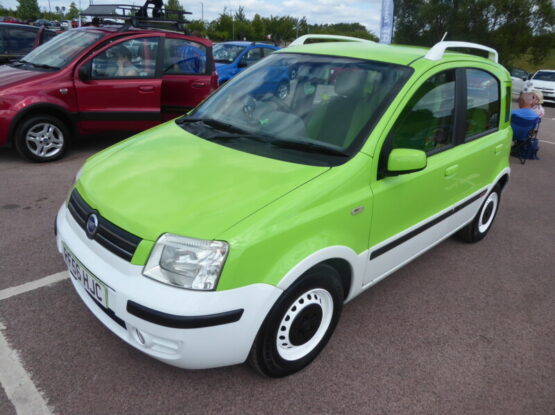
Final Fiat here was an example of the third generation Panda in Panda Cross form. Launched at the 2014 Geneva Motor Show, this is the range-topping, offroad-styled Panda. Mechanically it is based on the Panda 4×4, offering the same choice of powertrains. As in the previous generation the Cross is recognizable by its wider 185/65 tyres on specific alloy wheels, new fascias with prominent skid plates and unique broken up head- and taillights arrangement. The new bumpers, together with an increased ground clearance, give the car better approach and departure angles

MASERATI
The Maserati GranTurismo and GranCabrio (Tipo M145) are a series of a grand tourers produced from 2007 to 2019. They succeeded the 2-door V8 grand tourers offered by the company, the Maserati Coupé, and Spyder. The GranTurismo set a record for the most quickly developed car in the auto industry, going from design to production stage in just nine months. The reason being that Ferrari, after selling off Maserati to the Fiat Chrysler Group, took the designs of the proposed replacement of the Maserati Coupé and after some modifications, launched it as the Ferrari California. Unveiled at the 2007 Geneva Motor Show, the GranTurismo has a drag coefficient of 0.33. The model was initially equipped with a 4.2-litre V8 engine developed in conjunction with Ferrari. The engine generates a maximum power output of 405 PS and is equipped with a 6-speed ZF automatic transmission. The 2+2 body was derived from the Maserati M139 platform, also shared with the Maserati Quattroporte V, with double-wishbone front suspension and a multilink rear suspension. The grand tourer emphasises comfort in harmony with speed and driver-enjoyment. The better equipped S variant was unveiled at the 2008 Geneva Motor Show and features the enlarged 4.7-litre V8 engine shared with the Alfa Romeo 8C Competizione, rated at 440 PS at 7,000 rpm and 490 Nm (361 lb/ft) of torque at 4,750 rpm. At the time of its introduction, it was the most powerful road-legal Maserati offered for sale (excluding the homologation special MC12). The engine is mated to the 6-speed automated manual shared with the Ferrari F430. With the transaxle layout weight distribution improved to 47% front and 53% rear. The standard suspension set-up is fixed-setting steel dampers, with the Skyhook adaptive suspension available as an option along with a new exhaust system, and upgraded Brembo brakes. The seats were also offered with various leather and Alcantara trim options. The upgrades were made to make the car more powerful and more appealing to the buyers while increasing performance, with acceleration from 0–100 km/h (0–62 mph) happening in 4.9 seconds and a maximum speed of 295 km/h (183 mph). Aside from the power upgrades, the car featured new side skirts, unique 20-inch wheels unavailable on the standard car, a small boot lip spoiler, and black headlight clusters in place of the original silver. The variant was available in the North American market only for MY2009 with only 300 units offered for sale. The GranTurismo MC is the racing version of the GranTurismo S developed to compete in the FIA GT4 European Cup and is based on the Maserati MC concept. The car included a 6-point racing harness, 120 litre fuel tank, 380 mm (15.0 in) front and 326 mm (12.8 in) rear brake discs with 6-piston calipers at the front and 4-piston calipers at the rear, 18-inch racing wheels with 305/645/18 front and 305/680/18 rear tyres, carbon fibre bodywork and lexan windows throughout along with a race interior. All the weight-saving measures lower the weight to about 3,000 lb (1,361 kg). The car shares the 4.7-litre V8 engine from the GranTurismo S but is tuned to generate a maximum power output of 450 PS along with the 6-speed automated manual transmission. The GranTurismo MC was unveiled at the Paul Ricard Circuit in France. It went on sale in October, 2009 through the Maserati Corse programme. 15 GranTurismo MC racecars were developed, homologated for the European Cup and National Endurance Series, one of which was taken to be raced by GT motorsport organization Cool Victory in Dubai in January, 2010. Introduced in 2008, the GranTurismo MC Sport Line is a customisation programme based on the GranTurismo MC concept. Changes include front and rear carbon-fibre spoilers, carbon-fibre mirror housings and door handles, 20-inch wheels, carbon-fibre interior (steering wheel rim, paddle shifters, instrument panel, dashboard, door panels), stiffer springs, shock absorbers and anti-roll bars with custom Maserati Stability Programme software and 10 mm (0.4 in) lower height than GranTurismo S. The programme was initially offered for the GranTurismo S only, with the product line expanded to all GranTurismo variants and eventually all Maserati vehicles in 2009. Replacing both the GranTurismo S and S Automatic, the Granturismo Sport was unveiled in March 2012 at the Geneva Motor Show. The revised 4.7L engine is rated at 460 PS. The Sport features a unique MC Stradale-inspired front fascia, new headlights and new, sportier steering wheel and seats. The ZF six-speed automatic gearbox is now standard, while the six-speed automated manual transaxle is available as an option. The latter has steering column-mounted paddle-shifters, a feature that’s optional with the automatic gearbox. New redesigned front bumper and air splitter lowers drag coefficient from Cd=0.33 to 0.32. In September 2010, Maserati announced plans to unveil a new version of the GranTurismo – the MC Stradale – at the 2010 Paris Motor Show. The strictly two-seat MC Stradale is more powerful than the GranTurismo at 450 PS, friction reduction accounts for the increase, says Maserati, due to the strategic use of “diamond-like coating”, an antifriction technology derived from Formula 1, on wear parts such as the cams and followers. It is also 110 kg lighter (1,670 kg dry weight) from the GranTurismo, and more aerodynamic than any previous GranTurismo model – all with the same fuel consumption as the regular GranTurismo. In addition to two air intakes in the bonnet, the MC Stradale also receives a new front splitter and rear air dam for better aerodynamics, downforce, and improved cooling of carbon-ceramic brakes and engine. The body modifications make the car 48 mm (2 in) longer. The MC Race Shift 6-speed robotised manual gearbox (which shares its electronics and some of its hardware from the Ferrari 599 GTO) usually operates in an “auto” mode, but the driver can switch this to ‘sport’ or ‘race’ (shifting happening in 60 milliseconds in ‘race’ mode), which affects gearbox operations, suspension, traction control, and even the sound of the engine. The MC Stradale is the first GranTurismo to break the 300 km/h (186 mph) barrier, with a claimed top speed of 303 km/h (188 mph). The push for the Maserati GranTurismo MC Stradale came from existing Maserati customers who wanted a road-legal super sports car that looked and felt like the GT4, GTD, and Trofeo race cars. It has been confirmed by the Maserati head office that only 497 units of 2-seater MC Stradales were built in total from 2011 to 2013 in the world, Europe: 225 units, China: 45 units, Hong Kong: 12, Taiwan: 23 units, Japan: 33 units, Oceania: 15 units and 144 units in other countries. US market MC’s do not have the “Stradale” part of the name, and they are sold with a fully automatic six-speed transmission rather than the one available in the rest of the world. US market cars also do not come with carbon fibre lightweight seats like the rest of the world. The MC Stradale’s suspension is 8% stiffer and the car rides slightly lower than the GranTurismo S following feedback from racing drivers who appreciated the better grip and intuitive driving feel of the lower profile. Pirelli has custom-designed extra-wide 20-inch P Zero Corsa tyres to fit new flow-formed alloy wheels. The Brembo braking system with carbon-ceramic discs weighs around 60% less than the traditional system with steel discs. The front is equipped with 380 x 34 mm ventilated discs, operated by a 6 piston caliper. The rear discs measure 360 x 32 mm with four-piston calipers. The stopping distance is 33 m at 100 km/h (62 mph) with an average deceleration of 1.2g. At the 2013 Geneva Motor Show, an update to the GranTurismo MC Stradale was unveiled. It features an updated 4.7 litre V8 engine rated at 460 PS at 7,000 rpm and 520 Nm (384 lb/ft) of torque at 4,750 rpm, as well as the MC Race Shift 6-speed robotized manual gearbox which shifts in 60 milliseconds in ‘race’ mode. The top speed is 303 km/h (188 mph). All models were built at the historic factory in viale Ciro Menotti in Modena. A total of 28,805 GranTurismos and 11,715 units of the convertible were produced. The final production example of the GranTurismo, called Zéda, was presented painted in a gradient of blue, black and white colours.


The Maserati Levante (Tipo M161) is an executive crossover SUV produced by Italian manufacturer Maserati at the Mirafiori factory in Turin from 2016. The Levante went on sale in Europe in May 2016, and in North America in September 2016. Production of the Levante ended in 2024, commemorated with the release of a top-spec 424BHP special edition. The Levante was named after a warm, easterly wind that blows in the western Mediterranean Sea, southern France, down to the Strait of Gibraltar. The name of the wind, in turn, comes from the Latin word “levare”, which means “to rise”. Its design is based on the Kubang concept car that debuted at the 2011 Frankfurt Auto Show. The concept that led to the Levante, the Maserati Kubang, was unveiled in 2011 at the Frankfurt Auto Show. The Levante was first unveiled at the Geneva Motor Show on 1 March 2016, followed by a 2016 New York Auto Show. Production began in March 2016. Models for the United States went on sale in April 2016. Early models included Levante (350 PS) and Levante S (430 PS). Canada models went on sale in September 2016. Early models included Levante (350 PS) and Levante S (430 PS). The Maserati Levante Trofeo was unveiled at the 2018 New York International Auto Show. The Trofeo has 3.8 litre twin turbo V8 engine and Q4 all wheel drive, with 590 PS (582 bhp) and 730 Nm (538 lb/ft) peak torque. The Levante initially featured Ferrari’s 3.0L V6 engine, in two states of tune. A diesel model is also offered, which served as the only engine offering for right hand drive markets from 2016 to the end of 2017, until the official announcement and deployment of gasoline RHD models in the middle of 2017, starting with the Levante S and subsequently the base Levante sometime in 2018. Levante has a drag coefficient of Cd=0.33. By 2018, a 560 bhp V8 was planned to be added. Subsequently, two V8 models were announced in 2018: the 590 bhp Trofeo, followed by the 550 bhp GTS. The Levante gains an eight speed ZF automatic transmission from the sixth generation Maserati Quattroporte. The vehicle’s drivetrain is four-wheel-drive only, and like other Maserati models (Quattroporte and Ghibli in both rear and all wheel drive), comes standard with a rear limited-slip differential. The Levante also features Maserati Touch Control with a full colour 8.1-inch (210 mm) TFT touchscreen display, as well as a reconfigurable TFT gauge cluster with full colour. Near the end of 2023, there was speculation that Maserati would be ending production of the Levante with the 2024 or 2025 model year.] In early 2024, it was confirmed that 2024 would be the last model year for the Levante.


And final Maserati here was the Grecale Trofeo of Richard Warren, leader of the Maserati Club UK group.


AFTER HOURS
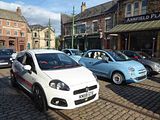
What had attracted me to this event, above all else, was seeing photos of the cars in among the venue itself and so I was hoping that this would be possible again in 2025. Thankfully, it was. It was a case of waiting until the site had closed to the public and everyone was out, which took quite a while after closing time, but eventually the signal was given and we were authorised to move the cars up from the grassy area where they had been all day and to take them into the recreated streets. The photographic possibilities were endless.


As you can see, some took it very seriously!


The highlight, of course, was the all-important group shot. Trying to get all the cars into a position where they could all be seen took quite a while, and then it was a question of getting the height for a picture showing them all. Logistics meant that only one person could actually go upstairs in on the restored buildings and do the photographic job for us all.




And then it was all over, and I realised that even though I was not going all the way home, I still had an extremely long journey ahead of me. Beamish really is a long way north but it is easy enough to get as it is only a few miles to the A1M, and from there it was motorway all the way back to my hotel in Coventry. Even so, it was well into the evening, and I was tired when I finally arrived. But what a day! Bring on the 2026 edition!