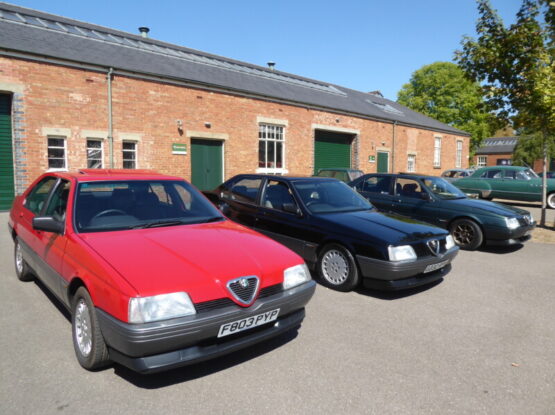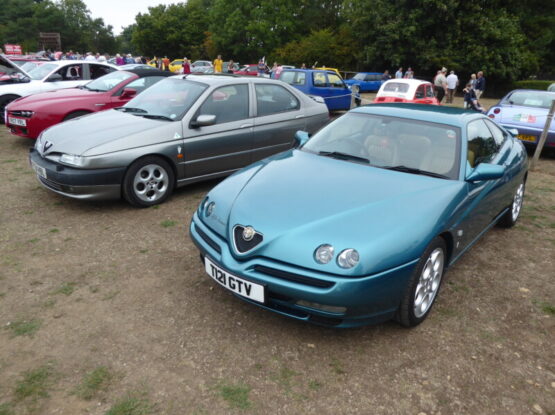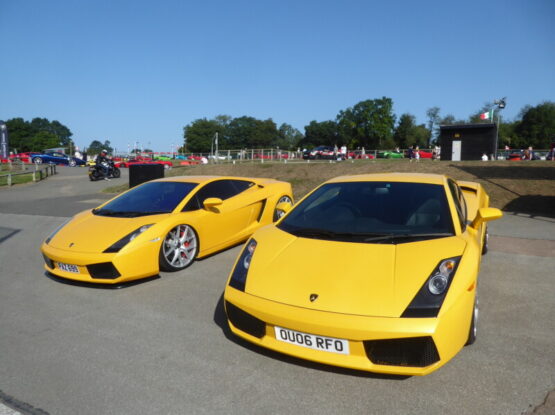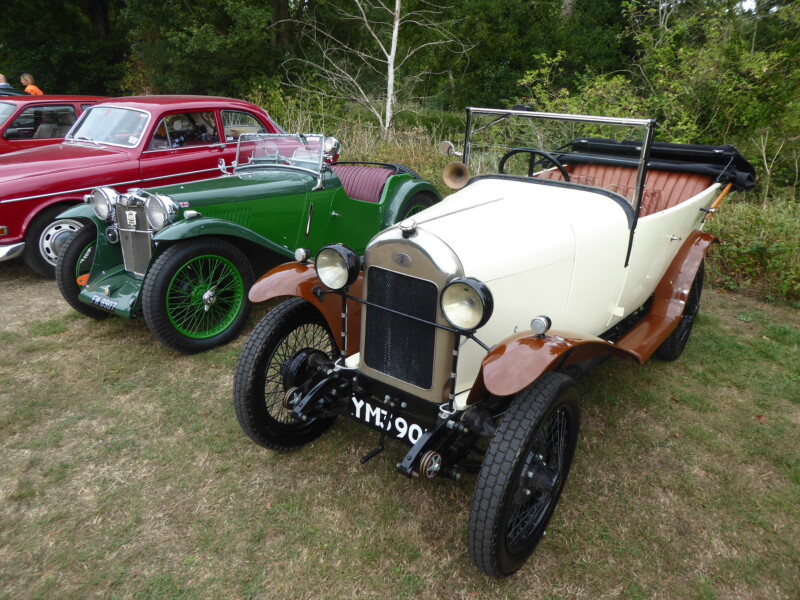
Here’s yet another evening event that I’d not previously visited. The Mill in question is at a country pub in the village of Rode, a small Somerset village located just a couple of miles off the A36 between Bath and Warminster. I’ve seen photos from events there in the past, usually, after the fact, not knowing that there was an event I could have attended. This is perhaps because unlike most of the mid-week summer evening meets, this one does not happen on a regular monthly basis, but on what the internet describes as a “periodic basis”. Anyway, I spotted this time, and was free to attend, so off I went. I had seen that it may prove necessary for those with modern cars to park in the village, as space at the venue is limited and some of it is reserved for those simply visiting the pub, so I heeded this, thankful that I had taken the Abarth, as space on the village streets was somewhat at a premium. I made the short walk down to the pub and these are the cars I found:


BENTLEY
The Continental GT was the car that really changed Bentley, selling in numbers never experienced before by the marque. With production running for over 20 years, these cars are quite a common sight at events. There was one here.

BMW
The M3 model of the E36 3 Series was released in November 1992 and was initially available as a coupé only, with a convertible version added in 1994. A sedan version was also added in December 1994, to fill in the gap caused by the lack of the M5 sedan model between the end of E34 M5 production in 1995 and the launch of the E39 M5 in 1998. In September 1995, a facelift version of the coupé was introduced. Changes included the engine displacement increasing to 3.2 L, the manual transmission upgrading from a 5-speed to a 6-speed, different wheels and clear indicator lenses. The facelift changes were applied to the sedan model in November 1995 and the convertible model in February 1996. The kerb weight of the 1996 M3 coupe in European specification is 1,515 kg (3,340 lb). The facelift also saw the introduction of a 6-speed “SMG” automated manual transmission, the first time an automated transmission was available on an M3 outside the United States. The SMG transmission was praised for its fast shift times and operation in performance situations, but criticized for behaviour in everyday driving situations. The M3 Evolution Imola Individual is a limited-edition variant of the M3 (50 for the United Kingdom). The engine and performance characteristics of the car were unchanged from the 1996 European M3, and a special exterior and interior colour combination was chosen by BMW UK: “Imola Red” (405) paint with Nappa leather seats in Imola Red and Amaretta suede bolsters in anthracite. It also included side airbags, the M3 GT Class II rear spoiler, front class II corner splitter extensions, electric seats, and double-spoke polished alloy wheels.

BUGATTI
Replacing the Type 30, the Type 38 was a road-tourer featuring a second generation straight-eight, two-litre engine. The first inline-eights had built up a great reputation with the Type 30. As such many components remained the same including the crankshaft. Compared to the Type 30, the Type 38 introduced a longer wheelbase and a wider track. The engine was very similar to the Type 35A unit, having a triple ball-bearing crankshaft. A select few Type 38s received the supercharger off the four-cylinder Type 37A. These car were correspondingly called the Type 38A. Type 38s were produced for a short period from 1926, until 1927, when they were replaced by the Type 43. A few type 38s were built after 1927, but only in limited numbers. Total production to 385 Type 38s were made, with 39 having superchargers.


CITROEN
The C15 was based on the Citroën Visa (discontinued 1988), and mainly used a 1769 cc XUD or 1868 cc (DW8 on late models), naturally aspirated (non turbo) diesel engine. Until the early 1990s, it was also available with a petrol PSA TU engine. At the time of introduction, the engines were the 60 PS XUD (C15D) or the 47 PS 1124 cc petrol TU1 (C15E). The diesel engines also powered vehicles several classes larger. Both Bosch and Lucas/CAV/Roto diesel injection systems were used. The TU petrol-engined versions were sold until the beginning of the 1990s. The engines and drivetrains were taken from the Citroën Visa lineup. While the car was mostly the same as a regular Citroën Visa ahead of the B-pillar, the cargo area was unique. The C15 had a lengthened wheelbase, and a sturdier rear axle shared with the Peugeot 305 Break and Citroën BX since it had to carry heavier loads than the Visa. The very curved sides of the windscreen, enabled the use of a very large single wiper on the long narrow windscreen, without it catching the windscreen seal. The shape of the bumper and plastic trim on the front of the van, like those of the Visa car, were designed to aerodynamically reduce the deposition of dirt on the headlights, and to reduce the risk of stone chips to the headlights, bonnet and windscreen. The heating and ventilation system, (even though it used only a water control valve for temperature control and not air mixing), could provide cold air from fascia side vents, to the face while warming the car. The central directable fascia vents could be pointed directly at the windscreen in front of the driver, to blow hot air to keep it clear in extreme misting conditions. There was also an additional mid-level vent. The C15 also had height adjustable halogen headlights, and multi speed/intermittent front wipers, which was better than most commercial vehicles of the time. As well as standard van configuration, the vehicle later became available with rear side windows and a rear seat, (a layout which had been pioneered in the 2CV), which can be seen as a forerunner to today’s compact utility vehicles such as the Ford Transit Connect, Opel/Vauxhall Combo, Peugeot Partner/Citroën Berlingo and Renault Kangoo. The C15 was also available without the rear bodywork, as a chassis only model. This encouraged various conversions such as the campervan called the RomaHome built by British company Island Plastics. This small camper was suitable for two people. Rare pickup truck versions were also made. By December 2005, when it was discontinued in most countries, production had reached 1,181,471


CLAN
The Clan Crusader is a fibreglass monocoque British sports car based on running gear from the Hillman Imp Sport, including its Coventry Climax derived, rear-mounted 875 cc engine. It was first made in Washington, Co Durham, England between 1971 and 1974, but since then several efforts have been made to bring the car back to production. Plans were made by Martin Phaff (of previous Ginetta fame) to re-resurrect the Clan in 2009, but nothing seems to have come of the project so far. The car was designed by a group of ex-Lotus engineers led by Paul Haussauer with styling by John Frayling. The company was set up in 1969, and small-scale production began in July 1971. From September, official production began at a new factory in Washington set up with the aid of a government grant. Engineer Brian Luff, one of the brains behind the all-conquering Lotus 72, created “a remarkably strong, yet ultra-lightweight, monocoque.” Aside from the engine, front and rear suspensions were also lifted from the donor Imp. Handling was described as both agile and tenacious, and more power would not have proved a problem. Design was distinct rather than pretty, with debatable protruding headlights and slablike sides. The black plastic engine lid opened sideways, to the left. The car was available in either kit or fully built versions. With the 51 hp at 6,100 rpm Imp Sport engine and four-speed manual transmission, top speed was 99 mph (159 km/h) Although the little car received good reviews and achieved some competition success, it was expensive at £1400 (£1123 in kit form) when compared with rivals. With little financial backing, constant industrial action, the fuel crisis, and the imposition of VAT on kit cars in 1973 meant that Clan soon met its end despite passing MIRA crash testing in 1972. Particularly troublesome was when Chrysler went on strike and deliveries of running gear stalled. The company shut down in November 1973. Total production in this first phase was 315, although a number were later finished from incomplete cars sold by the receivers. After closure the body moulds were bought by Andreas Kaisis, a businessman from Cyprus and owner of the Kaisis Motor Company. Just as production was about to begin, Turkey invaded Cyprus and plans were shelved. These moulds remained under cover until brought back to Britain a few years later. Meanwhile, about a dozen or so replica body shells made by copying an existing car were sold by Brian Luff. In 1982, Clan-fan Peter McCandless bought these moulds and intended to revive the car. At the same time, original founder Haussauer had the same idea and a period of recriminations occurred. In 1982 some “unofficial” body moulds were bought by Peter McCandless who started a new company Clan Cars Ltd in Newtownards, Northern Ireland, and built about 120 road cars and 10 competition cars over the next four years. The Crusader name was not used for these cars. Contemporary advertisements give an amazing price range of from £1,200 for a basic kit to £10,000 for a complete road ready car with new engine. The car, with a 998 cc Imp engine, was improved with disc brakes (from the MGB). Other differences were its pop-up lights, heavier bumpers, chin spoiler, 13-inch wheels and a dashboard from the Ford Fiesta. The Clan also had standard front disc brakes and Pirelli P6 tyres. The car was available in two specifications, Clan E and Clan S. The E has 68 hp while the more powerful S has 78 hp, enough for a top speed of about 180 km/h (110 mph). According to Clan themselves, it would only take 30 hours to assemble a kit. After Clan cars closed the body moulds were purchased by members of the Clan Owner’s Club to use to make replacement panels. In 1985 Clan Cars developed a new, mid-engined version called the Clan Clover. It used a 1,490 cc, 105 hp Alfa Romeo Flat-4 engine and gearbox. It also received new glass, a rear spoiler, and blistered arches. It is believed that approximately 26 cars were made (twenty road cars and six racing versions). After well-publicized quality issues, Clan Cars ran into financial difficulties and went into receivership and ceased trading in June 1987.


FORD
In the late 1960s, Ford set about developing the third-generation Cortina,the Mark III, which would be produced in higher volumes than before, following the recent merger of Ford of Britain and Ford of Germany into the modern-day Ford of Europe. The car marked the convergence of the German Taunus and British Cortina platforms with only minor differences between the two, hence the car’s internal name TC1, standing for Taunus-Cortina. It was also the last European car engineered by Harley Copp as Vice President Engineering and head of Brentwood, before he returned to Detroit. Ford UK originally wanted to call it something other than Cortina, but the name stuck. Although the Mark III looked significantly larger than the boxier Mark II Cortina, it was actually the same overall length, but 4 inches wider. Within the overall length, a wheelbase lengthened by more than 3 inches (76 mm) also contributed to the slightly more spacious interior. The Mark III Cortina was inspired by the contemporary “coke bottle” design language which had emanated from Detroit – the car sported similar fluted bonnet and beltline design elements to the North American Mercury Montego and Ford LTD of the same era. It replaced both the Mark II Cortina and the larger, more expensive Ford Corsair, offering more trim levels and the option of larger engines than the Mark II Cortina. The Mark III’s continental European sister car – the Taunus TC – was subtly different in appearance, with longer front indicators, different door skins and rear wing pressings that toned down the drooping beltline in order to lose the “coke-bottle” appearance of the Cortina. The MacPherson strut front suspension was replaced with more conventional double A-arm suspension which gave the Mark III a much softer ride on the road’ but did give the larger engines distinct understeer. Trim levels for the Mark III Cortina were Base, L, XL , GT and GXL. The early Mark III Cortinas came with the same 1,300 and 1,600 cc engines as the Mark II Cortinas, except for the 1,600 cc GXL. These engines are known as the Kent, crossflow engine or OHV engine. There was also the introduction of the 2000 cc engine, the single overhead cam engine, now known as the pinto engine. SOHC. The OHV Kent unit was fitted with a single choke carburettor and was used for the early models up to GT trim, the SOHC twin choke carburettor Pinto unit was used for the GT and GXL models. The GXL was also offered in 1,600 in the later Cortina Mark IIIs. In left-hand drive markets, the 1,600 cc OHC was replaced by a twin-carb OHV (Kent) unit not offered in the home market, in order to distinguish it from the competing Taunus which only came with the OHC Pinto engine. 2.0 litre variants used a larger version of the 1,600 cc Pinto unit and were available in all trim levels except base. Base, L and XL versions were available as a five-door estate. Although no longer than its predecessor, the Mark III was a heavier car, reflecting a trend towards improving secondary safety by making car bodies more substantial. Weight was also increased by the stout cross-member incorporated into the new simplified front suspension set-up, and by the inclusion of far more sound deadening material which insulated the cabin from engine and exhaust noise, making the car usefully quieter than its predecessor, though on many cars the benefit was diminished by high levels of wind noise apparently resulting from poor door fit around the windows. Four-speed manual transmissions were by now almost universally offered in the UK for this class of car, and contemporary road tests commented on the rather large gap between second and third gear, and the resulting temptation to slip the clutch when accelerating through the gears in the smaller-engined cars: it was presumably in tacit acknowledgment of the car’s marginal power-to-weight ratio that Ford no longer offered the automatic transmission option with the smallest 1,298 cc-engined Cortina. Four headlights and Rostyle wheels marked out the GT and GXL versions, while the GXL also had bodyside rub strips, a vinyl roof and a brushed aluminium and black boot lid panel on the GXLs, while the GTs had a black painted section of the boot with a chrome trim at either site sloping dashboard with deeply recessed dials and all coil suspension all round. In general styling and technical make up, many observed that the Mark III Cortina aped the Vauxhall Victor FD of 1967. The Cortina went on sale on 23 October 1970, but sales got off to a particularly slow start because of production difficulties that culminated with a ten-week strike at Ford’s plant between April and June 1971, which was at the time reported to have cost production of 100,000 vehicles, equivalent to almost a quarter of the output for a full year. During 1971 the spring rates and damper settings were altered along with the front suspension bushes which reduced the bounciness of the ride and low speed ride harshness which had generated press criticism at the time of the Cortina Mark III’s launch. Volumes recovered, and with the ageing Austin/Morris 1100/1300 now losing out to various newer models, the Cortina was Britain’s top selling car in 1972, closely followed by the Escort. It remained the UK’s top selling car until 1976 when it overtaken by the Mk2 Escort. In late 1973 the Cortina Mark III was given a facelift. The main difference was the dashboard and clocks, no longer did it slope away from the driver’s line of sight. But shared the same dash and clocks as the later Mark IV and Mark V Cortinas, upgraded trim levels and revised grilles, rectangular headlights for the XL, GT and the new 2000E (the “E” standing for executive), which replaced the GXL. The 1.3 litre Kent engine was carried over but now, 1.6 litre models all used the more modern 1.6 litre SOHC engine. Whilst the TD Cortina still had double A-arm suspension with coils at the front and a four-link system at the rear, handling was improved. The 2000E reverted to the classy treatment offered by the 1600E and later Mark IV/V Ghia models instead of the faux wood-grain trim offered by the GXL. The 2000E was also available as an estate version. The cars were replaced by the Mark IV in the autumn of 1976.


A sporting version of Ford’s front wheel drive Escort was announced at the same time as the “cooking” 1.1, 1.,3 and 1,6 litre cars in October 1980. This was the XR3, and it came initially with a carb fed 1.6 litre engine generating 105 bhp and had a four speed gearbox. Fuel injection finally arrived in October 1982 (creating the XR3i), eight months behind the limited edition (8,659 examples), racetrack-influenced RS 1600i. The Cologne-developed RS received a more powerful engine with 115 PS, thanks to computerised ignition and a modified head as well as the fuel injection. For 1983, the XR3i was upgraded to 115bhp thanks to the use of fuel injection and a five speed transmission had been standardised. Both variants proved very popular, getting a significant percentage of Escort sales and also as a slightly more affordable alternative to a Golf GTi. For those for whom the performance was not quite enough, Ford had an answer, with the the RS Turbo. This 132 PS car was shown in October 1984, as a top of the range car, offering more power than the big-selling XR3i and the limited production RS1600i. Going on sale in the spring of 1985, it proved to be somewhat of a disappointment, with the chassis coming in for severe criticism. The RS Turbo Series 1 was only marketed in a few European nations as production was limited to 5,000 examples, all in white. They were well equipped, with the alloy wheels from the limited production RS 1600i, Recaro seats, and a limited slip differential.


A completely new Fiesta, codenamed BE-13 was unveiled at the end of 1988 and officially went on sale in February 1989. The car was based on a new platform ditching the old car’s rear beam axle for a semi-independent torsion beam arrangement and looked radically different, addressing the principal weakness of the previous generation – the lack of a 5-door derivative, something that was by then available in its major rivals such as the Fiat Uno, Peugeot 205 and 106 and Opel Corsa/Vauxhall Nova. The other main change was to the running gear – the improved HCS (High Compression Swirl) version of the Kent/Valencia powerplant. The CVH units from the second generation were carried over largely unmodified. The diesel engine was enlarged to a 1.8L capacity. As for sports models, the XR2i was launched in August 1989 with an eight-valve CVH (standing for “compound valve-angle hemispherical combustion chamber”) engine with 104 PS. This was the first Fiesta to have a fuel-injected engine. This was then replaced by a Zetec 16 valve version in 1992, which also saw the RS Turbo being supplanted by the RS1800 as the CVH engine was being phased out. The RS1800 shared its 1.8 litre Zetec fuel-injected engine with the 130 bhp version of the then current Ford Escort XR3i and had a top speed of 125 mph. The XR2i name was also dropped in early 1994, and the insurance-friendly “Si” badge appeared in its place on a slightly less sporty-looking model with either the 1.4 L PTE (a development of the CVH) or the 1.6 L Zetec engine.


For 1968, Ford redesigned its intermediate Fairlane line and introduced a new premium subseries model, the Torino, named after the city of Turin (Torino, in Italian), considered “the Italian Detroit”. The name had been one of several originally proposed for the Mustang while in development. The 1968 Fairlane and Torino used the same wheelbases as its 1967 predecessor: 116 in (2,946 mm) on 2- and 4-door models, and 113 in (2,870 mm) for station wagon models. Styling was drastically changed from the 1967 Fairlane models, boosting size and weight. The front fascia had a full-width recessed grille, with horizontal quad headlights placed at the outer edges. Some models had horizontal dividing bars in the grille. To meet new regulations introduced in 1968, parking lights were placed at the outer edge of the front fenders and wrapped around the corner to also act as side marker lights. The body sides were smooth with one horizontal body crease running just below the beltline from front to back. The rectangular taillights were vertically situated in the rear panel above the rear bumper. Reverse lights sat in the middle of the taillights, and reflectors were on the rear edge of the quarter panel. A new addition for 1968 was the two-door hardtop fastback “SportsRoof” bodystyle. Similar to Mustang fastback models, it featured a gently sloped roof line that extended to the edge of the trunk lid and a unique concave taillamp panel. This new fastback body style gave the Fairlane and the Torino excellent aerodynamics that would later prove to be advantageous on the race track. Ford had 14 models in its intermediate line for 1968. The base model was the “Fairlane”, which was available in a 2-door hardtop, a 4-door sedan, and a 4-door station wagon. Next was the mid level “Fairlane 500”, which was available as a 2-door hardtop, 2-door SportsRoof, convertible, and a 4-door sedan and station wagon. This was followed by the top level “Torino” series, which consisted of a 2-door formal(notchback) hardtop, a 4-door sedan, and the Squire station wagon that featured wood grained applique. Finally, the “Torino GT”, the sporty version of the Fairlane 500 series, included the formal hardtop, the SportsRoof hardtop, and a convertible. The 1968 Fairlane/Torino was constructed with unibody chassis using the same platform as the 1966–67 models. The front suspension consisted of short/long control arms with coil springs mounted on an upper control arm and a strut stabilized lower control arm. Rear suspension consisted of long semi-elliptical leaf springs on a solid axle. A heavy-duty suspension option was available for V8 powered cars, and included extra-heavy-duty springs and shocks. Steering was recirculating ball system, with power steering optional. All cars came standard with four-wheel drum brakes, although front disc brakes and power assist were options. The interior on the Fairlane/Torino was all new for 1968. A new dashboard featured four equally sized round pods centred around the steering wheel. However, the pods did not contain a full set of gauges; rather an assortment of warning lights along with the speedometer and fuel gauge. The fuel gauge and temperature warning lights were in the first pod, a 120 mph (190 km/h) speedometer was located in the second pod from the left, alternator and oil pressure warning lights were in the third pod from the left and the fourth pod was blank. An optional tachometer was available, which would be located in the third pod, and an optional clock occupied the fourth pod. Ford offered many upholstery options, including a knitted vinyl option, called “comfortweave.” This unique option allowed the vinyl to “breathe” unlike conventional vinyl, offering more comfort in hot weather. Conforming to U.S. safety standards, there was much padding inside the Torino’s interior, which also featured shoulder belts for front outboard passengers on all cars built after December 31, 1967. All Torinos included full color-keyed carpeting, additional exterior and interior trim over a Fairlane, and Torino crests on the ‘C’ pillar. The Torino GT’s standard features included special name plaques and exterior trim, GT markings on wheel covers and courtesy lights on the inside door panels. Initial sales literature showed that bucket seats were standard equipment. However, due to a six-week UAW strike, the GT’s standard seating was changed to a bench seat. The Torino GT was available with a GT handling suspension package, which included extra-heavy-duty springs and shocks, and a heavy-duty front anti-sway bar. Of note, when the 428 CJ engine was installed, the suspensions used the stiffest springs and largest front sway bar compared to other Torinos with the heavy-duty suspension. Four-speed equipped cars used staggered rear shocks which helped resist axle hop. GTs were available with a stripe option, which started as a ‘C’ shape at the edge of the front fender, and two body stripes extended the length of the car. Ford had quite a variety of engine options for its intermediate line. All models other than the Torino GT came standard with a 200 cu in (3.3 L) six-cylinder engine. Torino GT models came standard with a 302 cu in (4.9 L)-2V small block V8 and this was also the base V8 engine optional on other models. Other available engines included a 390 cu in (6.4 L)-2V FE engine, 390 cu in (6.4 L)-4V FE engine and a 427 cu in (7.0 L)-4V FE engine. About one month within the beginning of the 1968 model year production, a six-week UAW strike against Ford occurred. This resulted in a cost-cutting measure of making a 289 cu in (4.7 L)-2V small block V8 the base V8 engine and the standard engine on the Torino GT. Ford did not change any of its factory sales literature to reflect this change.[4] While the 427 cu in (7.0 L)-4V FE engine was initially listed as an engine option for 1968 in factory literature, no Fairlanes or Torinos were actually produced with this engine during 1968. Introduced on April 1, 1968, the 428 cu in (7.0 L)-4V CJ (Cobra-Jet) FE engine became available as an engine option, but due to its mid-year introduction these engines are very rare. The 428-4V Cobra-Jet was the most potent engine available for 1968, and is general believed to be under-rated at 335 hp. The cars equipped with the 428 Cobra Jets had emblems borrowed from the full-sized Fords (a red-and-chrome badge reading “428”) mounted on the fenders behind the parking lamps. All models came standard with a three-speed manual transmission. Two Cruise-O-Matic automatics and a four-speed manual were optional. The C4 automatic was installed on smaller displacement engines up to the 302 V8, and C6 automatic was installed on all other larger displacement engines. According to contemporary reviews, when equipped properly the Torino GT offered a good combination of power and handling. In Car Life magazine’s test of a 1968 Torino GT SportsRoof equipped with a 390-4V, C-6, and 3.25:1 axle, they recorded a 0 – 60 mph (97 km/h) time of 7.7 seconds, and the quarter-mile (402 m) dragstrip time of 15.8 seconds at 90 mph (140 km/h). Motor Trend magazine wrote “Putting the car through quick and/or tight corners isn’t a matter of practiced art – it’s more like second nature for the GT” in their test of a 1968 Torino GT. Car and Driver magazine tested a 1968 Ford Torino GT equipped with the 428 CJ with Ram Air induction, C-6 Cruise-O-Matic, and 3.91:1 gears and recorded a quarter-mile time of 14.2 seconds at 98.9 mph (159.2 km/h). Car and Driver wrote the Torino had “a 1–2 shift that broke the Wide-Ovals loose for at least a length. With a price tag of $306 for the Cobra-Jet option, Ford lovers have a reason to rejoice.” Station wagons came in three different models: “Fairlane”, “Fairlane 500”, and “Torino Squire.” All wagons came equipped with Ford’s “Magic Doorgate” two-way tailgate, and were available with an optional rear-facing third seat which increased the car’s carrying capacity from 6 to 8 people. Torino Squire models came standard with simulated woodgrain side panels, and had the more refined trim and upholstery of the Torino sedans. Unique station wagon options included a chrome roof rack and a power rear window. 1968 was a successful year for Torino with 172,083 units produced. Including Fairlane production, 371,787 cars were produced. The Torino was well received by the automotive press and a 1968 Torino GT convertible was selected as the 1968 Indianapolis 500 pace car.


There were also a number of examples of the Mustang here.

FRAZER NASH
It was in 1922 that Archibald Frazer Nash left GN, the company he had co-founded with Henry Godfrey, and established his own eponymous venture in Kingston upon Thames. The initial chain drive offerings were a logical development of the GN models. However, within five years the business was in trouble and entered receivership, re-emerging as AFN Ltd. By 1929, H. J. Aldington had become its major shareholder and was running the company with his brothers Donald and William. During 1934 it became the UK importer and assembler of the BMW marque, the results of which were sold as Frazer Nash-BMWs. Following WWII, the company created a number of new models including the High Speed, Mille Miglia, Targa Florio, Le Mans Coupe and the Sebring, all of which were in essence evolutions of the BMW 328. As its name suggests, the High Speed was a no-nonsense lightweight competition version that featured minimal bodywork and cycle wings. It was powered by the 1971cc straight-six BMW unit that had been developed by Bristol under licence from AFN. This was mated to a Bristol four-speed manual gearbox. Suspension was independent at the front by transverse leaf spring and by live axle and torsion bars at the rear. With some 125bhp powering a two-seater of just 635kg, the performance was predictably impressive, and the High Speed was capable of achieving the 0-60mph sprint in around 8.8 seconds and powering on to a terminal speed of some 110mph. It was a High Speed that AFN entered for the first post-WW2 Le Mans 24 Hours race, which was held in 1949. The result was memorable, with H. J. Aldington and co-driver Norman Culpan finishing a magnificent third overall. This prompted the company to rebrand the High Speed as a Le Mans Replica – thereby resurrecting a type of nomenclature from its past. The model was immortalised at the hands of such racing legends as Stirling Moss, Roy Salvadori, Tony Brooks and Tony Crook of Bristol Cars fame. And, bearing in mind a total of just 34 examples of the High Speed/Le Mans Replica were built before production ceased in 1953, these cars are now highly prized by collectors. Moreover, with demand falling some way short of supply, a market for quality evocations of the Le Mans Replica has understandably evolved over the years. A small batch was constructed by the renowned restorers Crosthwaite & Gardiner, followed by a series of some 11 cars in circa 1989/1990 by engineer and Stafford-based classic car dealer Werner Oswald. They were copied directly from an original MKI example owned at the time by another well-known motor trader and BRDC racer Frank Sytner. Never offered in fully assembled form, they were sold as kits, leading to them being known as WOKs – i.e. Werner Oswald Kits. During the production phase it was discovered that the name Frazer Nash Cars had remained dormant for a number of years, so was duly purchased by the company in order to legitimately allow its products to be advertised as `Made by Frazer Nash Cars’.


GWYNNE
Gwynnes Limited was a City of London England engineering business, iron founders and pump makers founded in 1849 to capitalise on the centrifugal pump invented by James Gwynne (1804–1850). In 1856 his eldest son, James Eglinton Anderson Gwynne (1832–1915), of Essex Street Wharves on the south side of The Strand was awarded a patent for the manufacture of carbon or charcoal powder. Their Strand site became part of the Victoria Embankment built between 1865 and 1867 and Gwynne profited from judicious investment in the reclaimed land. Their Crisp Road, Hammersmith Ironworks and works at Church Wharf, Chiswick, London, were established in 1867 to specialise in the manufacture of these centrifugal pumps and pumping engines This machinery was for use in practically all purposes where large or small quantities of liquid were required to be lifted and dealt with for low or high heads. A limited liability company was formed in May 1897 to own the business. On 1 January 1920 Gwynnes bought the limited liability company, Adam, Grimaldi & Co Limited, who made cars under the Albert name, with their freehold Albert Works on the Albert Embankment at Glasshouse Street Vauxhall SE13. They took W F Adam MIMechE MIAE with them to manage the bodybuilding and moved production to Gwynnes’ Chiswick works now at the end of Pumping Station Road. In 1923 the name of the car was changed to Gwynne-Albert and the engine enlarged to 14 hp. In 1922 Gwynnes Limited started to make a small car, the Gwynne Eight, based on the design of the Spanish Victoria car. This had a 950 cc 4-cylinder overhead valve engine producing 24 bhp. Financial problems arose in 1923 and a receiver was appointed, but production continued. About 2,250 examples of the Eight were made. A larger model of car, the Gwynne Ten, was offered from 1927. About 600 were made before production ceased. A receiver and manager was appointed in July 1923. The company was compulsorily wound up by the Official Receiver in 1927. The Hammersmith Borough Council bought the former Gwynnes Wharf.


LOTUS
The silver Italdesign concept that eventually became the Esprit was unveiled at the Turin Motor Show in 1972 as a concept car, and was a development of a stretched Lotus Europa chassis. It was among the first of designer Giorgetto Giugiaro’s polygonal “folded paper” designs. Originally, the name Kiwi was proposed, but in keeping with the Lotus tradition of having all car model names start with the letter “E”, the name became Esprit. The production Esprit was launched in October 1975 at the Paris Auto Show, and went into production in June 1976, replacing the Europa in the Lotus model lineup. These first cars eventually became known as S1 Esprits. With a steel backbone chassis and a fibreglass body, the Esprit was powered by the Lotus 907 4-cylinder engine, as previously used in the Jensen Healey. This engine displaced 2.0 litre, produced 160 bhp in European trim 140 bhp in US/Federal trim, and was mounted longitudinally behind the passengers, as in its predecessor. The transaxle gearbox was a 5-speed manual unit, previously used in the Citroën SM and Maserati Merak; it featured inboard rear brakes, as was racing practice at the time. The Series 1 embodied Lotus’ performance through light weight mantra, weighing less than 1,000 kg (2,205 lb). The original Esprit was lauded for its handling and is said to have the best steering of any Esprit. However, it was generally regarded as lacking power, especially in markets such as the United States where the engine was down-rated for emissions purposes. Lotus’ claim of 0-60 mph in 6.8 seconds and a top speed of 138 mph may be thought of as optimistic – actual road test times indicated 0-60 mph in 8 seconds and a top speed of around 133 mph. The S1 Esprit can be distinguished from later Esprits by a shovel-style front air dam, Fiat X1/9 tail lights, lack of body-side ducting, and Wolfrace alloy wheels. Inside the car, the most obvious indication of an S1 Esprit is a one-piece instrument cluster with green-faced Veglia gauges. The car gained fame through its appearance in the James Bond film The Spy Who Loved Me (1977) where a fictionally-modified version was featured in a long action sequence. Bond’s Esprit car is first chased on road, by a motorcycle, then by another car, and then a helicopter, then converts into a submarine for an undersea battle. A series of improvements made to the Esprit during its initial run culminated in the S2 Esprit, which was introduced in 1978. The most obvious of these changes are intake and cooling duct “ears” located behind the rear quarter window, tail lights from the Rover SD1, and an integrated front spoiler. S2 Esprits also used 14-inch Speedline alloy wheels designed specifically for Lotus. Other changes included relocating the battery from above the right side fuel tank (under the rear quarter window) to the rear of the car, adding an access door to the engine cover, as well as replacing the instrument cluster made by Veglia with individual gauges made by Smiths and using different style of switches on the dashboard. During this era, a special edition car was released to commemorate Lotus’s racing victories and their victory in the 1978 F1 World Championship. Sharing the black and gold colour scheme of Lotus’ then F1 sponsor, John Player & Sons, these cars are commonly known as the John Player Special (JPS) Esprits. The “JPS” Esprit has the same mechanicals as the regular two-litre S2. According to Lotus themselves a limited series of 300 was built, but most likely the total was considerably lower. Lotus’ records of production figures are notoriously vague, but best estimates suggest that 149 JPS Esprits were produced. The S2.2 was produced as a stop-gap model from May 1980, almost identical to the S2 but with an enlarged (2.2 litre) type 912 engine used. This kept horsepower the same, but bumped up torque from 140 lb·ft to 160 lb·ft. Importantly, the S2.2 also introduced the use of a galvanised chassis, although it did not benefit from the succeeding S3’s chassis improvements. These cars are extremely rare even among Esprits: according to Lotus themselves, only 88 were produced in its thirteen-month production span. In 1980 the first factory turbocharged Esprit was launched. Initially, this was another special edition model commemorating F1 ties and reflecting current sponsorship, this time in the blue, red and chrome livery of Essex Petroleum, and is therefore known as the Essex Esprit. The new turbocharged dry-sump type 910 engine produced 210 hp and 200 lb·ft of torque. 0-60 mph could be achieved in 6.1 seconds, with a top speed of 150 mph. These performance improvements were coupled to a redesign and strengthening of the chassis and rear suspension, where an upper link was added to alleviate strain on the driveshafts, along with brake improvements. The Essex cars introduced a Giugiaro-designed aerodynamic body kit with a rear lip spoiler, prominent louvered rear hatch, more substantial bumpers, a deeper front airdam, and air ducts in the sills just ahead of the rear wheels, which were 15″ Compomotive three piece items. Internally, scarlet leather, combined with a roof-mounted Panasonic stereo, made for a dramatic environment. 45 Essex Esprits were built, interspersed and followed by a number of non Essex-liveried but otherwise identical specification dry-sump turbo cars. Two Essex-spec Turbo Esprits – one in white and the other in copper – were featured in the James Bond film For Your Eyes Only (1981), although these were scripted as the same vehicle – the white one was destroyed by an anti-burglar explosion system in Spain, while the copper red one was a “rebuild” of the original (actually a joke between Bond and Q in the latter’s laboratory), and was fully functional (the copper exterior paint colour for the replacement car was chosen to make the car stand out more in filming against the snowy background of Cortina, Italy, the only locale in which it appears). By the close of 1980, Lotus was effectively building three different models of Esprit, with distinct chassis designs and body moulds – the Domestic S2.2, the Export S2.2, and the dry-sump Turbo Esprit. Introduced in April 1981, the Turbo Esprit and S3 Esprits marked a necessary consolidation: both new models had a common chassis, inheriting much of the configuration of the Essex cars, whilst body production was based on a single common set of moulds. The S3 continued to use the 2.2 litre type 912 engine of the S2.2, whilst the Turbo Esprit reverted to a less complex wet-sump lubrication system, retaining the power and torque outputs of its dry-sump predecessor. The interior for both cars was revised and featured new trim; combined with changes to the body moulds this resulted in more headroom and an enlarged footwell. Externally, the Turbo Esprit retained the full aerodynamic body kit of the Essex cars, and featured prominent ‘turbo esprit’ decals on the nose and sides; the S3 gained the more substantial bumpers, yet retained the simpler sill line and glazed rear hatch of the S2.2 body style. Both models were supplied with 15″ BBS alloy wheels. For the 1985 model year, the S3 and Turbo underwent some slight alterations to the bodywork and to the front suspension. In April 1986, the final incarnations of the Giugiaro-styled Esprit were announced, with raised engine compression giving rise to the ‘HC’ moniker. This increased the output of the naturally aspirated engine to 172 hp and 160 lb/ft for the Esprit HC, and to 215 hp and 220 lb/ft for the Turbo Esprit HC, with the increased torque available at a lower rpm. For markets with stringent emissions requirements (mainly the United States), Lotus introduced the HCi variant, teaming the higher compression engine with Bosch KE-Jetronic fuel injection and a catalytic converter- the first fuel-injected Esprits. This engine had the same peak power as the carburettor version, but at a somewhat higher engine speed, and torque dropped to 202 lb/ft.


MARCOS
Designed by brothers Dennis and Peter Adams, this well-known car caused something of a sensation when it was shown at the 1964 Racing Car Show. Known as the Marcos 1800, it had a glassfibre body, with a wooden chassis and was offered for sale fully built or in kit form. This was to be the design that would become familiar to sports car enthusiasts for more than 30 years, even though the original plywood chassis would later be replaced by a steel chassis and the futuristic scalloped dashboard also vanished after a few years. The plywood chassis was glued together from 386 separate pieces and was not only light and strong, but also required a minimum up front investment to construct. The extremely low Marcos required a nearly supine driving position and fixed seats, mounted lower than the floor of the car. In return, the entire pedal set could be moved fore and aft with a knob on the dashboard. If this proved not to be enough Marcos also offered optional booster pillows. This setup, with the fixed seats, remained until the end of Marcos production in late 2007. The original Marcos 1800 had a two-spoke steering wheel and a novel dash with a prominent centre console, a rather expensive design which did not survive onto the Ford-engined cars. The entire nose portion, of a long and tapered design, was hinged at the front and was held down by latches behind the front wheelwells. It used the cast-iron four-cylinder 96 hp Volvo 1778 cc B18 unit with overdrive gearbox from the Volvo P1800S enough for a 116 mph top speed and a 0-60 mph time of 8.2 seconds. Successful in competition, the rather expensive 1800 sold very slowly, and after the first 33 cars the de Dion rear suspension was replaced by a live Ford axle. The price was dropped from ₤1500 to ₤1340, but it was not enough to make the car profitable. Cars were stockpiling in 1966, and after 106 (or 99) had been built, the 1800 was replaced by the Ford-engined 1500. Normally fitted with a four-speed manual transmission a five-speed one was also available, allowing for a higher top speed. According to some sources, a few of the last cars built had the 2 litre Volvo B20 engine fitted, as did some of the racing cars. The 1800 is the only Marcos that is eligible for historic racing and as such is considerably more valuable today than later models. In 1966 the GT was changed to a pushrod inline-four Ford Kent engine of 1500 cc, in order to lower costs as the 1800 had been rather too expensive to market. The complex dash was also replaced with a flat polished wood unit, which was soon downgraded further yet to a mass-produced “wood-effect” one. Power and performance were both down on the 1800, but sales increased considerably. To hide the fact that a common Ford engine was used, Marsh replaced the rocker covers with Marcos ones and switched from Weber to Stromberg carburettors. An overbored Lawrencetune 1650 cc version was made available in 1967 (32 built) to ameliorate the power shortage, for the Marcos 1650 GT. The 1650 also had bigger disc brakes and a standard Webasto sunroof, but proved somewhat less than reliable It and the 1500 were both replaced by Ford’s new Crossflow four not much later, in late 1967. The 1600 proved to be the most popular model yet, with 192 cars built until early 1969. Weight was 740 kg (1,631 lb) and disc brakes up front were standard, although power assist was an optional extra. Production ended in October 1969 as the new steel chassis was not well suited for the crossflow engine. A new model, the 2 litre, appeared at the January 1969 London Show with the engine changed to the Ford Essex V4 engine from the Ford Corsair – while a V6 engine had already appeared at the top of the lineup in 1968. Also in 1969, the plywood chassis was gradually replaced by a square section steel one, which shortened production time and saved on cost. These steel framed cars required a lower sill panel and have reshaped rear bumpers, as well as some subtle interior differences. The wooden chassis had also begun to meet a certain amount of resistance from buyers. There seem to have been no V4-engined wooden cars made, although there is a few months overlap between the introduction dates. The V4 received most of the same standard and optional equipment (except the overdrive) and the same central bonnet bulge as did the V6 models; very few of the Marcos 2 litres still have their V4 engines, as a V6 swap is a rather quick job and makes for a much faster car than the original’s 85 hp. It was not exactly a success story, 78 2 litres were most likely built, although numbers as low as 40 have also been mentioned. New at the October 1968 London Show was the more powerful Marcos 3 litre. Fitted with the double-carb Ford Essex V6 engine and transmission from the Ford Zodiac, production beginning in January 1969. Max power was 140 bhp and aside from the badging, this car is most easily recognised by the large, central bonnet bulge necessary to clear the larger engine. The 3 litre had a four-speed manual with a Laycock-de-Normanville Overdrive for the third and fourth gears fitted. In December 1969 a twin-carburetted 3-litre Volvo B30 straight-six became available (initially only for the US), and in 1971 eleven or twelve cars were fitted with the 150 bhp Triumph 2.5-litre straight-six. These were called the Marcos 2½ litre. As the bonnet was a close fit over the various larger engines, this resulted in a corresponding variation in the bonnet design as regards changes designed to clear engine air intakes, often the only external sign of the type of engine fitted. All inline-sixes required a rather angular bulge right of centre on the bonnet to clear the carburettors. Around this time, some V6 cars begun sporting single rectangular headlights (not on US-market cars), borrowed from the Vauxhall Viva HB. Later in 1969 the six-cylinder cars, as with their four-cylinder counterparts, received the new steel chassis. Either 100 or 119 of the wood-chassied V6 cars were built. The Ford V6 version achieved over 120 mph on test and the Volvo-engined model was not far behind it, but the heavy cast-iron engines increased nose-heaviness in comparison to the four-cylinder variants. With US sales going strong, Marcos production was up to three per week and they had to invest in a bigger space in 1969. Cars for the North Americas market had Volvo’s inline-six cylinder, 3 litre engines with a standard Borg-Warner Type 35 automatic transmissions. They sat on tubular steel space frames, have a higher ride height, and no headlight covers – all of this was in order to get US road certification. Air conditioning was also listed as an option by New York-based importers Marcos International Inc. Delays and problems with the federalised cars were beginning to mount. In 1970, 27 exported cars were impounded by US Customs for supposedly not meeting federal law, causing Marcos to withdraw entirely from the US market. Together with the development costs of the Mantis and the introduction of VAT on kit cars on the horizon, Marcos had to close its doors for what turned out to be the first time. About sixty US market cars were built, some of which were brought back after the US market dried up in 1970 and converted to RHD for sale in the home market. Production of the Volvo 3 litre continued for the rest of the world, with these cars fitted with a four-speed manual transmission. Either 80 or 172 of the Volvo I6-engined Marcos were built until early 1972, with the final one destined to become the last Marcos built for the next ten years. After Marcos had run out of money the company was sold to Hebron & Medlock Bath Engineering in mid-1971. They themselves had to call in the receivers only six months later. The Rob Walker Garage Group bought the factory only to sell off everything, including some finished cars such as all six Mark 2 1600s built. Jem Marsh bought up spares and other parts at the liquidation sale and proceeded to run a company servicing existing Marcos, until he resumed production of Marcos kits in 1981. The original GT continued to be built until 1989 or 1990, being developed into its altered Mantula form. This was further developed into more powerful and aggressively-styled designs, culminating in the 1994 LM600 (which competed in the 1995 Le Mans 24-hour race).

MG
Replacing the J series cars was the 1934 PA. The PA and later PB replaced the J Type Midget. These 2-door sports cars used an updated version of the overhead camshaft, crossflow engine that was also used in the 1928 Morris Minor and Wolseley 10 as well as the J-type Midget of 1932 to 1934. It drove the rear wheels through a four-speed non-synchromesh gearbox. The chassis was a strengthened and slightly longer version of that used in the J-type with suspension by half-elliptic springs all round with rigid front and rear axles. Steering was initially by a Marles Weller and later a Bishop Cam system. The two-seat car had a wheelbase of 87″ and a track of 42″. Most cars were open two seaters, but streamlined Airline coupé bodies were also made. The P-type was also available as a four-seater, a car that suffered from a lack of power and poor rear ground clearance. Whereas J, K and L-type MGs differentiated between versions with the use of numbers, with 1 indicating a four-seater (the J1) and 2 a two-seater (the J2), this was not the case with the P-type (or its six-cylinder sister, the N-type Magnette), and there is no clue to the type in the name. The first version, the PA used an 847 cc engine similar to the one on the J-Type, but now with a 3-bearing crankshaft, larger camshaft and twin SU carburettors. It produced 36 bhp at 5,500 rpm. In 1935, a PA open two-seater cost £222. Around 2,000 PAs were made. In late 1936 the PA was replaced by the PB, which had a larger 939cc 43bhp engine and which is distinguished by a grille of vertical slats as opposed to the honeycomb pattern of the PA. 526 examples of the PB were made.


Sitting alongside the MGB in the MG range was the smaller Midget, and there were a couple of these cars here, a Series 3 model and one of the later rubber-bumpered cars. The 1961 Midget resurrected the name that was used by MG for their smallest car, the M Type, in the late 20s, was the Midget announced in 1961, and was essentially a slightly more expensive badge-engineered version of the MkII Austin-Healey Sprite. The original ‘Frogeye’ Sprite had been introduced specifically to fill the gap in the market left by the end of production of the MG T-type Midget as its replacement, the MGA had been a significantly larger and more expensive car with greater performance. Many existing MG enthusiast and buyers turned to the Sprite to provide a modern low-cost sports car and so a badge-engineered MG version reusing the Midget name made sense. The new Midget differed from the Sprite only in its grille design, badging, colour options and having both leather seats and more external chrome trim as standard to justify its higher purchase price. Mechanically the car was identical to its Austin-Healey counterpart, retaining the rear suspension using quarter-elliptic leaf springs and trailing arms from the ‘Frogeye’. The engine was initially a 948 cc A-Series with twin SU carburettors producing 46 hp at 5500 rpm and 53 lb/ft at 3000 rpm. Brakes were 7″ drums all round. A hard top, heater, radio and luggage rack were available as factory-fitted extras. In October 1962 the engine was increased to 1098 cc, raising the output to 56 hp at 5500 rpm and 62 lb/ft at 3250 rpm, and disc brakes replaced the drums at the front. Wire spoked wheels became available. The doors had no external handles or locks and the windows were sliding Perspex side-screens. A heater was still an optional extra. The car sold well, with 16,080 of the small-engined version and 9601 of the 1098 being made before the arrival in 1964 of the Mark II. Externally the main changes were to the doors, which gained wind-up windows, swivelling quarter lights, external handles and separate locks. The windscreen also gained a slight curvature and was retained in a more substantial frame. The hood, though modified, continued to have a removable frame that had to be erected before the cover was put on. The rear springs were replaced by more conventional semi-elliptic types which gave a better ride. The engine block was strengthened and larger main bearings were fitted, increasing the power to 59 hp at 5750 rpm and torque to 65 lbf·ft at 3500 rpm. A total of 26,601 were made. 1967 saw the arrival of the Mark III. The engine now grew to 1275 cc using the development seen on the Mini-Cooper ‘S’. Enthusiasts were disappointed that this was a detuned version of the 76-bhp Cooper ‘S’ engine, giving only 65 hp at 6000 rpm and 72 lbf·ft at 3000 rpm. A reduced compression ratio of 8.8:1 was used instead of the 9.75:1 employed on the Cooper S engine. The Midget used the 12G940 cylinder head casting that was common to other BMC 1300 cars, whereas the Cooper ‘S’ had a special head with not only larger inlet, but also larger exhaust valves; however, these exhaust valves caused many ‘S’ heads to fail through cracking between the valve seats. The detuned engine was used for reasons of model range placement – with the Cooper ‘S’ spec engine, the Midget would have been faster than the more expensive MGB. The hydraulic system gained a separate master cylinder for the clutch. The hood was now permanently attached to the car, with an improved mechanism making it much easier to use. Minor facelift changes were made to the body trim in late 1969 with the sills painted black, a revised recessed black grille, and squared off taillights as on the MGB. The 13″ “Rostyle” wheels were standardised, but wire-spoked ones remained an option. The square-shaped rear wheel arches became rounded in January 1972 and later that year a Triumph steering rack was fitted, giving a gearing that was somewhat lower than earlier Midgets. A second exhaust silencer was also added in 1972. Alternators were fitted instead of dynamos from 1973 onwards. Many consider the round-arch Midgets with chrome bumpers produced for model years 1972 and 1974 to be the most desirable. These round-arch cars started leaving the Abingdon factory in late 1971. Between 1966 and the 1969 face lift, 22,415 were made, and a further 77,831 up to 1974. In late 1974, to meet US federal regulations, large black plastic bumpers (usually called rubber bumpers, despite not actually being rubber) were added to the front and rear and the ride height was increased. The increased ride height affected handling, and an anti-roll bar was added to help with higher centre of gravity. The A-Series engine was replaced by the 1493 cc unit from the Triumph Spitfire with a modified Morris Marina gearbox with synchromesh on all four gears. The increased displacement of the new engine was better able to cope with the increasing emission regulations. Although the horsepower ratings were similar, at 65 bhp, the 1493 cc engine produced more torque. The increased output combined with taller gear ratios resulted in faster acceleration and a top speed of just over 100 mph. In the US market British Leyland struggled to keep engine power at acceptable levels, as the engines were loaded with air pumps, EGR valves and catalytic converters to keep up with new US and California exhaust emission control regulations. The home market’s dual SU HS4 carbs were swapped for a single Zenith-Stromberg 150 CD4 unit, and the power fell to 50 bhp at 5000 rpm and 67 lb-ft of torque at 2500 rpm. The round rear-wheel arches were now square again, to increase the body strength. The last car was made on 7 December 1979, after 73,899 of the 1500 model had been made, with the last 500 home-market cars painted black.

During 1981, British Leyland confirmed that the Metro range would soon be expanded with more luxurious and high performance versions. The Metro range was expanded in May 1982 to include the luxury Vanden Plas and higher performance MG versions; the MG Metro marked a quick comeback for the marque previously used on sports cars until the Abingdon plant making the MG B closed in 1980. The Vanden Plas featured higher levels of luxury and equipment, while the slightly more powerful MG Metro 1.3 sold as a sports model (0–60 mph in 10.9 seconds, top speed 103 mph). The Vanden Plas variant received the same MG engine from 1984 onwards (with the exception of the VP Automatic, which retained the 63 bhp 1275 cc unit). The luxury fittings marking out the Metro Vanden Plas took the form of a radio-cassette player, electric front windows, an improved instrument panel with tachometer, and a variety of optional extras such as trip computer, leather trim, remote boot release, and front fog lamps. The changes between the MG engine (taken directly from the Mini Cooper) and the standard 1275 included a modified cylinder head, with larger valves and improved porting, altered cam profile and larger carburettor leading to a 20% increase in BHP to 72 bhp. At the October 1982 Birmingham Motor Show the MG Metro Turbo variant was first shown. With a quoted bhp of 93, 0–60 mph in 9.9 seconds, and top speed of 112 mph (180 km/h) this car had few direct competitors at the time, although the growing demand for “hot hatches” meant that it soon had a host of competitors including the Ford Fiesta XR2, Peugeot 205 GTI and Renault 5 GT Turbo. This model had a few addition modifications bolted on over the normally aspirated MG model to give an additional 21 bhp. Aside from the turbocharger and exhaust system itself, and what was (at the time) a relatively sophisticated boost delivery and control system, the MG Turbo variant incorporated stiffer suspension (purportedly with engineering input from Lotus), and an uprated crankshaft of nitrided steel and sodium-cooled exhaust valves. Both MG variants were given a “sporty” interior with red seat belts, red carpets and a sports-style steering wheel. The Turbo also benefitted from an LCD boost pressure gauge. The Turbo also received alloy wheels, black wheel arch extensions, blacked out trim, a rear spoiler surrounding the windshield, and prominent “TURBO” decals. While it retained rear drums, the front disc brakes were changed to ventilated units. The later MG variants were emblazoned with the MG logo both inside and out, which only served to fuel claims of badge engineering from some of the more steadfast MG enthusiasts. Others believed that this sentiment was unfounded, particularly in the case of the turbo variant, due to the undeniably increased performance and handling when compared to the non-MG models. From 1983, the MG badge also found its way onto higher performance versions of the Maestro, and shortly afterwards it was adopted for higher-performance versions of the Montego. Both models proved popular, and sold strongly until they were deleted in 1990 when Rover-badged performance versions took over, but there are surprisingly few survivors.


MITSUBISHI
The Mitsubishi Lancer Evolution VIII appeared in 2003, this time sporting 17-inch grey Enkei wheels, Brembo brakes and Bilstein shocks to handle traction and a 5-speed manual gearbox with 280 PS (276 hp) (approx. 234 bhp to the wheels). Originally a one-off model, sales were so successful in the U.S. that by 2005 it was available in four trims. The standard GSR model was available in Japan. The RS model was provided with a 5-speed manual gearbox and standard wheels (lacking excess components, such as interior map lights, power windows/doors, and radio). The SSL trim package came with a sunroof, trunk mounted subwoofer, and leather seats. All of these trim levels also included chrome headlight and taillight housings. To round out the lineup, the MR came with a revised front limited-slip differential, aluminum MR shift knob, handbrake with carbon fibre handle, 17-inch BBS wheels, aluminum roof, and a 6-speed manual gearbox. Additionally, the Evolution MR’s taillights and headlights sported a new black housing. The Mitsubishi Lancer Evolution VIII MR used slick-response Bilstein shocks for improved handling. The aluminium roof panel and other reductions in body weight lowered the centre of gravity to produce more natural roll characteristics. Detail improvements have also been made to Mitsubishi’s own electronic four-wheel drive, to the active center differential (ACD) 5 + Super AYC 6 traction control, and to the Sports ABS systems. The Lancer Evolution VIII displayed at the 2003 Tokyo Motor Show took the MR designation traditionally reserved for Mitsubishi Motors high-performance models (first used for the Galant GTO). Other parts on the MR include BBS alloy wheels, the aforementioned Bilstein shocks, and an aluminium roof. In the United Kingdom, many special Evolutions were introduced, including the 260, FQ300, FQ320, FQ340, and FQ400 variants. They came with 260, 305, 325, 345, and 405 hp, respectively. The FQ-400, sold through Ralliart UK, produced 411 PS (405 hp) at 6,400 rpm and maximum torque of 481 Nm (355 lb/ft) at 5,500 rpm, from its 1,997 cc 4G63 inline-four engine, the result of special modifications by United Kingdom tuning firms Rampage Tuning, Owen Developments, and Flow Race Engines. The “FQ” name stands for F—ing Quick, although it is not officially recognized by Mitsubishi due to the vulgarity behind the abbreviation. At 202.8 hp per litre, it has one of the highest specific outputs per litre of any road car engine. With a curb weight of 1,450 kg (3,197 lb), it achieves 0–60 mph (97 km/h) in 3.5 seconds, 0–100 mph (161 km/h) in 9.1 seconds, 1⁄4 mile (402 m) in 12.1 seconds at 117 mph (188 km/h), and a top speed of 175 mph (282 km/h) while costing £48,000. BBC’s television series Top Gear demonstrated that the stock FQ-400 could keep up with a Lamborghini Murciélago around a test track. The Stig recorded a Top Gear Power Lap Time of 1 minute and 24.8 seconds (damp track), 1.1 seconds slower than the Murciélago’s time of 1 minute 23.7 seconds (dry track). In a similar test conducted by Evo magazine, the Evolution was able to lap the Bedford Autodrome faster than an Audi RS4 and a Porsche 911 Carrera 4S. The Lancer Evolution VIII was also the first Evolution to be sold in the United States, spurred by the success of the Subaru Impreza WRX which had been released there just the year prior. The Evolution VIII found its true competition in the Subaru Impreza WRX STI model the same year as the Evolution VIII’s US introduction. With its 2.0 litre, 271 hp engine, the 2003 Evolution VIII was capable of achieving a 0–100 km/h (62 mph) time of 5.1 seconds. However, the internal components for the American versions were largely stripped-down versions of the specifications for the Japanese Lancer Evolution VIII. No US-spec Evolution model prior to the Evo X has active yaw control, including the 2006 Evolution IX. The American 2003 and 2004 GSRs are without the helical limited-slip front differential and 6-speed manual transmission. The 2004 US spec RS models, however, do have a front helical limited-slip differential. All 2003, 2004 and 2005 RS and GSR models have the Japanese Evolution VII’s 5-speed transmission. The MR edition was introduced to the US in 2005, with ACD and the only model with a 6-speed manual transmission. The 2005 US spec RS and GSR have the ACD standard, and the front helical limited-slip differential is now standard on all models. The boost, timing, and tuning are also significantly lower than its Japanese counterpart, allowing it to adhere to the strict emissions regulations of the United States. Starting in 2005, the US model Evolutions were also fitted with a 5,500 rpm limit on launching in first gear to protect the drivetrain. Most Evolution VIIIs have a carbon fiber rear spoiler with matching body-colour endplates. Furthermore, the US versions of the Lancer Evolution VIII 2003–2005 were given bulkier rear bumpers than their Japanese counterparts to accommodate US safety laws in the form of the metal rear crash bar. All Evolutions have lightweight aluminum front fenders and hoods. The Evolution VIII RS does not come with power windows, locks, or mirrors, an audio system, rear wing, sound deadening material, map lamps or an anti-lock braking system. All Evolution VIII RS models sold in the US are equipped with air conditioning. The 2005 MR/RS editions came with an aluminum roof. Additionally, Evolution VIII MR Editions come equipped with a 6-speed manual transmission, Bilstein shocks, optional graphite grey color (unique to the Evolution VIII MR), optional BBS wheels and an optional vortex generator. The MR Edition also received engine updates and reliability changes, the engine updates include larger turbo diameter mouth, updated cam profiles, lighter balance shafts and changed from single wastegate solenoid to dual solenoid. Exterior changes included HID headlights, updated taillights, and MR rear badging. Interior updates included black suede Recaro seats with higher side bolsters, carbon-look dash trim, and MR badging on centre console. Mechanical changes saw S-AWC rear diff changes, a larger oil cooler core, ion-coated piston rings, reinforced cylinder head and 5-layer head gasket compared to the 3 layer. According to Mitsubishi Motors of North America (info from evolutionm.net) the total production sales in the U.S. for the Evolution VIII (2003–2005) was 12,846. In 2003, the production sales for the GSR was 7,167 which was the only 2003 model year. In 2004, production sales for the GSR was 1,254 and for the RS was 263 for a total of 1,517 for the 2004 model year. In 2005 production sales for the GSR was 2,880, for the RS was 282, and for the MR was 1000 for a total of 4,162 for the 2005 model year.

MORRIS
The “bullnose” Morris Oxford is a series of motor car models produced by British manufacturer Morris from 1913 to 1926. It was named by W R Morris after the city in which he grew up and which his cars were to industrialise. William Morris’s first car was called Oxford in recognition of its home city. It was announced in The Autocar magazine in October 1912 and production began in March 1913. Because he had a limited amount of capital and was unwilling to share ownership of his business little was made in-house. Virtually all components were bought-in and assembled by Morris. It was a small car with a 1018 cc four-cylinder side-valve engine with fixed cylinder head from White & Poppe. Ignition was by a Bosch magneto. The chassis made by Rubery Owen was of pressed-steel construction and suspension was by leaf springs, semi-elliptic at the front and longer three-quarter elliptic at the rear slung above the axle. The welded single piece banjo rear axle with splined half shafts was driven by a Wrigley Worm. The front axle was of forged steel and, like the back axle assembly and the steering, was made by Wrigley. The brakes, on the rear wheels only, were the external contracting type, metal to metal, using four shoes in each drum. A White & Poppe three-forward and reverse gearbox was fitted. The Powell & Hanmer headlamps were acetylene and the side and tail lamps oil. The windscreen, by Auster Limited of Barford Street, Birmingham, like the lamps was classed as an accessory. The car got its popular name, Bullnose, from its distinctive round-topped radiator at first called the bullet nose. Most bodies, made by Raworth of Oxford, were of the two-seat open-tourer type. There was also a van version, but the chassis did not allow four-seat bodies to be fitted, as it was not strong enough and too short. It was first displayed at the Olympia Motor Show which opened 7 November 1913. The standard model remained in production unchanged. The new de luxe had a longer wheelbase, 90 in (2,300 mm), and track was now 45 in (1,100 mm). The range of bodies was now expanded from the simple two-seater to include even a limousine and a sporting car which, like the vans, had no windscreen or doors but was provided with a speedometer as a standard fitting. Its front axle and steering had been re-designed to reduce “bump-steer” and its radiator capacity increased. Grooved tyres were now supplied at the rear. The banjo back axle was no longer welded but built up from three pieces and its springs were now slung below it. The 1919 Oxford (advertised as early as September 1918) was assembled from locally made components and now took on the rather more substantial aspect of 1915’s Cowley. Longer and stronger than the old Oxford, enough to carry five passengers, the new Oxford retained the pre-war Bullnose radiator style in its larger version. From August 1919, the Cowley became the downmarket “no frills” variant with only a 2-seater body and lighter smaller tyres. The Oxford had a self-starter (an extra for the Cowley) and a better electrical system and the Oxford took and kept the Cowley’s leather upholstery. The new car’s 11.9 fiscal horsepower 1548 cc engine was made under licence in Coventry for Morris by a British branch of Hotchkiss the French ordnance company which was turning away from guns to the motor industry. The Hotchkiss engine used the Cowley’s Detroit USA Continental Motors Company design. Hotchkiss prices well undercut White and Poppe who had made Oxford engines up to that time. Morris bought Hotchkiss’s British factory in May 1923 and named it Morris Engines. When it was shown at the Scottish Motor Show in January 1920 it drew large crowds of enthusiasts all day. The chassis alone was shown and was genuinely admired for the way all transmission, everything revolving, was fully enclosed in what amounts to an oil bath, everything but the fan belt. A few weeks later after a lengthy trial of the new car The Times’ motoring reporter wrote that the car represents “a very decided advance in light car construction”. The common sense of the designers is shown in many small details but “its greatest charm is in the engine’s steam-like flexibility” and liveliness. In these respects it was the best engine the writer had ever encountered. This one has been had most of the bodywork removed.

NISSAN
This is an R34 generation Skyline GT-R. The GF-BNR34 (R34) Skyline GT-R, GT-R V·Spec and GT-R V·Spec N1 models were introduced in January 1999. The R34 GT-R was shorter (from front to rear), and the front overhang was reduced as compared to its predecessor. The valve covers were painted glossy red (colour code Cherry Red Effect Z24 or X1020), as opposed to black in previous models. A new feature on the R34 GT-R is a 5.8″ LCD multifunction display on the center of the dashboard, which shows seven different live readings of engine and vehicle statistics such as turbocharger pressure (1.2 bar max), oil and water temperature, among others. The GT-R V·Spec model added two extra features to the display: intake and exhaust gas temperatures. Nismo Multi-function Displays (MFD) could be bought at an extra cost, they included a lap timer, G-Force meter and an increase in boost pressure measurement to 2 bar. The R34 GT-R was made shorter in response to customer concerns who thought the R33 was too bulky. Like the R33, the new R34 GT-R V·Spec (Victory Specification) models come equipped with the ATTESA E-TS Pro system and an Active LSD at the rear, while standard GT-R models come with the non-Pro system and a conventional mechanical differential. The V·Spec model also had firmer suspension and lower ground clearance, thanks to front and side splitters, as well as a rear carbon fibre air diffuser, designed to keep air flowing smoothly under the car. At the time of the R34’s introduction, like the R32 and R33, Nissan introduced an R34 V·Spec N1 model. The R34 V·Spec N1 was equipped similar to the R32 and R33 N1 models – a homologation special. It was sold without air conditioning, audio equipment, rear wiper, or boot lining, but ABS remained. The new R34 N1 was also given the new R34 N1 engine. Only 38 known R34 V·Spec N1 models were produced from the factory, 12 of which Nismo used for Super Taikyu racing. The rest were sold to various customers, mostly racing teams and tuning garages. The V·Spec version was also imported into the UK with a number of modifications carried out on these 80 cars. These included 3 additional oil coolers, revised ECU map, full Connolly leather interior, underbody diffusers, stiffer suspension, active rear limited slip differential, extra display feature on the in car display. In additional to the UK, 10 were sold to Hong Kong and Singapore, and 5 to New Zealand although with different changes for their respective markets. In October 2000, Nissan introduced the V·Spec II, replacing the V·Spec. The V·Spec II has increased stiffness in the suspension (even stiffer than the original V·Spec) and had larger rear brake rotors. It also comes equipped with a carbon fibre bonnet equipped with a NACA duct, which is lighter than the aluminium that all other GT-R bonnets are made from. Also different on the V·Spec II was an iridium center console and aluminium pedals. The seats were upholstered with black cloth rather than the gray cloth used on previous R34 GT-R models, and the amber turn lenses were replaced with white versions. With the exception of the carbon fibre bonnet, the standard trim level GT-R also received these updates. A total of 18 V·Spec II N1 were built. A total of 1855 V·Spec II were built for Japan, with an additional 2 being sold for the New Zealand market. The V·Spec N1 was replaced with the V·Spec II N1. The same changes applied to the V·Spec N1 were applied to the V·Spec II N1, with the exception of the V·Spec II carbon bonnet which was now unpainted. In May 2001, the M·Spec was introduced. It was based on the V-Spec II, but had special “Ripple control” dampers, revised suspension set up, stiffer rear sway bar and a leather interior with heated front seats. The ‘M’ on the M·Spec stood for Mizuno who is the chief engineer of Nissan. The only other change was the removal of the carbon fibre bonnet which was replaced with the standard aluminium bonnet. In February 2002, Nissan launched a final production model of the R34 GT-R called the Skyline GT-R V·Spec II Nür and the Skyline GT-R M·Spec Nür. The Nür was named after the famous German Nürburgring racetrack, where the Skyline was developed. In total 1,003 units R34 GT-R Nür(s) were produced, 718 were V·Spec II Nürs’ and 285 were M·Spec Nürs’. The Nür model featured an improved RB26DETT based on the N1 racing engine. The standard turbochargers were upgraded to larger versions with a slight increase in boost and the ceramic blades were replaced with steel versions. This has increased lag, but the turbo’s durability was improved while being able to handle a bigger boost increase. The V·Spec II Nür is based on the regular V·Spec II model, and the M·Spec Nür was based on the regular M·Spec model. Other than the addition of the Nür engine, the Nür models also included a different colour of stitching on the interior trim, as well as a speedometer reading up to 300 km/h (186 mph), gold valve covers instead of red and a gold VIN plate instead of silver. Due to Japanese car industry norms at the time, the car was advertised as having 276 bhp but it actually had over 330 bhp when it left the factory. In 1999, during Nissan’s testing session at the Nürburgring Nordscheleife. Unofficially the GT-R R34 ran a 7:52 minute lap around the track, driven by Nissan’s test driver Kazuo Shimizu. The car broke the GT-R R33’s record which was the fastest road-legal series production vehicle and second fastest road-legal production vehicle around the track at the time.

PONTIAC
Pontiac introduced the Firebird in 1967, at the same time as the Chevrolet Camaro, a car whose underpinnings it shared. Although the bodystyles of the two cars were different in detail, the relationship remained obvious through the four generations of the two models, and the pair would evolve in parallel, as direct rivals to Ford’s Mustang, the car from which they took their inspiration. The first generation Firebirds had a characteristic Coke bottle styling. Unlike its cousin the Chevrolet Camaro, the Firebird’s bumpers were integrated into the design of the front end. The Firebird’s rear “slit” taillights were inspired by the Pontiac GTO. Both a two-door hardtop and a convertible were offered through the 1969 model year. Originally, the car was a “consolation prize” for Pontiac, who had wished to produce a two-seat sports car of its own design, based on the original Banshee concept car. However, GM feared such a vehicle would directly compete with Chevrolet’s Corvette, and the decision was made to give Pontiac a piece of the pony car market by having them share the F-body platform with Chevrolet. The base model Firebird came equipped with the OHC inline-6 and a single-barrel carburettor. The next model, the Sprint, had a four-barrel carburettor, developing 215 hp Most buyers opted for one of the V8 engines: the 326 CID (5.3 litre) with a two-barrel carburettor producing 250 hp; the “H.O.” (High Output) engine of the same displacement, but with a four-barrel carburettor and producing 285 hp; or the 400 CID (6.6 litre) from the GTO with 325 hp. A “Ram Air” option was also available in 1968, providing functional hood scoops, higher flow heads with stronger valve springs, and a different camshaft. Power for the Ram Air package was the same as the conventional 400 H.O., but the engine peaked at a higher RPM. The 230 CID (3.8 litre) engines were subsequently replaced by 250 CID (4.1 litre) engines, the first developing 175 hp using a single-barrel carburettor, and the other 215 hp with a four-barrel carburettor. Also for the 1968 model, the 326 CID (5.3 litre) engine was replaced by one with a displacement of 350 cubic inches (5.7 litre). An “H.O.” version of the 350 CID with a revised cam was also offered starting in that year, which developed 320 hp. Power output of the other engines was increased marginally. In 1969, a $725 optional handling package called the “Trans Am Performance and Appearance Package,”, named after the Trans Am Series, which included a rear spoiler, was introduced. Of these first “Trans Ams,” only 689 hardtops and eight convertibles were made. There was an additional Ram Air IV option for the 400 CID engine during that year, complementing the Ram Air III; these generated 345 and 335 hp respectively. The 350 “H.O.” engine was revised again with a different cam and cylinder heads resulting in 330 hp. During 1969 a special 303 cu in (5.0 litre) engine was designed for SCCA road racing applications that was not available in production cars. The styling difference from the 1967 to the 1968 model was the addition of Federally-mandated side marker lights: for the front of the car, the turn signals were made larger and extended to wrap around the front edges of the car, and on the rear, the Pontiac (V-shaped) Arrowhead logo was added to each side. The front door vent-windows were replaced with a single pane of glass. The 1969 model received a major facelift with a new front end design but unlike its big brother the GTO, it did not have the Endura bumper. The instrument panel and steering wheel were revised. The ignition switch was moved from the dashboard to the steering column with the introduction of GM’s new locking ignition switch/steering wheel. Due to engineering problems that delayed the introduction of the all-new 1970 Firebird beyond the usual autumn debut, Pontiac continued production of 1969 model Firebirds into the early months of the 1970 model year.


RILEY
The Elf was one of a pair of Mini based models which BMC launched in 1961, the other being the Wolseley Hornet. Both had longer, slightly finned rear wings and larger boots that gave the cars a more traditional three-box design. Wheelbase of the Elf and Hornet remained at 2.036 m (6.68 ft), whereas the overall length was increased to 3.27 m (10.7 ft). This resulted in a dry weight of 638 kg for the Elf and 618 kg for the Hornet. Front-end treatment, which incorporated each marque’s traditional upright grille design (the Hornet’s grille with a lit “Wolseley” badge), also contributed to a less utilitarian appearance. The cars had larger-diameter chrome hubcaps than the Austin and Morris Minis, and additional chrome accents, bumper overriders and wood-veneer dashboards. The Riley was the more expensive of the two cars. The name “Wolseley Hornet” was first used on 1930s saloon, coupé, sports and racing cars, while the name “Elf” recalled the Riley Sprite and Imp sports cars, also of the 1930s (Riley’s first choice of name “Imp” could not be used as Hillman had registered it). The full-width dashboard was a differentiator between the Elf and Hornet. This dashboard was the idea of Christopher Milner the Sales Manager for Riley. Both the Riley Elf’s and Wolseley Hornet’s bodies were built at Fisher & Ludlow under their “Fisholow” brandname. Plates in the engine compartment on the right side fitch plate bear evidence of this speciality. Very early Mark I versions of both cars had no overriders on the bumpers and a single piece front wing (A-panel and wing in one piece, no outside seam below scuttle panel) that was soon given up again, allegedly due to cost. The Elf’s and Hornet’s special bumper overriders first appeared in 1962. Early production Mark I’s also had a combination of leather and cloth seats whereas all later models had full leather seats. Mark I models were equipped with single leading shoe brakes on the front. Both the Elf and the Hornet went through three engine versions. Initially, they used the 848 cc 34 bhp engine with a single HS2 carburettor, changing to a single HS2 carburettor 38 bhp version of the Cooper’s 998 cc power unit in the Mark II in 1963. This increased the car’s top speed from 71 to 77 mph . Therefore, Mark II cars also came with increased braking power in the form of front drum brakes with twin leading shoes to cope with the increased power output. Both Mark I and Mark II featured four-speed gearboxes (three synchromesh gears) with rod gear change, a.k.a. “magic wand” type. Automatic gearboxes became available on the Mark II in 1965 as an option. The Mark III facelift of 1966 brought wind-up windows and fresh-air fascia vents. Concealed door hinges were introduced two years before these were seen on the mainstream Mini. The gear selecting mechanism was updated to the rod type, as seen on all later Mini type cars. Automatic gearboxes were available to the Mark III in 1967 again. Full-four synchromesh gearing was eventually introduced during 1968. 30,912 Riley Elfs and 28,455 Wolseley Hornets were built. Production of both models ceased in late 1969.


SINGER
The Singer Bantam is a car which was produced by Singer from 1936 to 1939. It was the first model from Singer to have an all-steel body, by Pressed Steel Company. It was offered as a new economy model at the 1935 Motor Show in London, replacing the earlier Singer Nine series. Derived from the Singer Nine, with styling a close copy of the Ford Model Y, it debuted with two models and two trim levels: 2- and 4-door, either Popular or De-Luxe. All four shared the same basic bodyshell but, whereas the De-Luxe models had a sliding sunroof, the Popular version had a fixed panel in the roof. Other features of the De-Luxe model were leather seats, chrome bumpers, and a rear luggage rack. The Bantam re-used many existing components from the Singer parts bin. It used the Le Mans’ underslung chassis and 972 cc overhead cam engine, although with a lower compression ratio and single Solex carburettor. Power transmission was through a three-speed manual gearbox with synchromesh on third gear. Early models were equipped with wire wheels, while the optional easyclene wheels became standard from 1937. A chromed mascot portraying a flying Bantam chicken was mounted on the radiator surround until this was outlawed by new legislation in 1937. For 1937 a Tourer model was announced, although few were made and very few survive. The Saloon got an upgrade in 1937 for the 1938 model year. The chassis and suspension were strengthened to take the larger 1074 cc inline-four engine with a stated 30 hp of output, and the brakes were converted to a cable system. The bodyshell remained the same apart from an extra chrome trim strip across the doors and changes to the bonnet louvres. Many Bantams survive in Australia and New Zealand. Singer exported these vehicles as rolling chassis with complete powertrain. They were mainly bodied by the Flood company in Australia as tourers and roadsters, and this seems to have prompted the development of the roadster model by Singer in 1939, based on the Bantam chassis and engine.


SUBARU
Subaru introduced the “New Age” Impreza, the second generation car, to Japan in August 2000, and it arrived in Europe towards the end of that year. Larger in size compared to the previous iteration, the sedan increased its width by 40 millimetres (1.6 in), while the wagon notably increased by just 5 millimetres (0.2 in)—placing the two variants in different Japanese classification categories. The coupe body style from the first generation did not reappear for the new series, and the off-road appearance package that included contrasting-coloured bumpers did carry over forward. Marketed as a separate model line, this North America-only variant was, as before, badged the Outback Sport. Naturally aspirated flat-four (boxer) engines comprised the 1.5-litre EJ15, the 1.6-litre EJ16, the 2.0-litre EJ20, and the 2.5-litre EJ25. Turbocharged versions of the 2.0- and 2.5-litre engines were offered in the WRX and WRX STI models. STI models featured a more powerful 2.0-litre (2.5-litre outside of the Japanese market) turbocharged engine. WRX models featured a 2.0-litre turbocharged boxer engine until 2005, after which they switched to the 2.5-litre turbocharged engine. As with the first generation, the turbocharged STI variants were available in numerous specifications with a myriad of limited edition variants sold. The bug-eyed styling was not well received, and Subaru had two further attempts at the front end, neither of which was entirely successful, either, but enthusiasts were happy to overlook the gawky looks because the way the car drove. Subaru issued yearly updates to the STI, tweaking cosmetics and equipment levels, and also improving performance and handling. The car was replaced in 2007 by the third generation Impreza, widely regarded as inferior in many ways to this version.

TOYOTA
Displayed at the October 1970 Tokyo Motor Show and marketed from December of the same year, the Celica was a two-door hardtop coupe that emphasised styling and driving enjoyment based on a platform shared with the Toyota Carina sedan which is one size above the Toyota Corolla. This car was aimed at the North American market and was Toyota’s response to the 1964 Ford Mustang (Pony car) which also was a standard sedan (Ford Falcon) with stylised 2+2 bodywork. In Europe, where it arrived in 1971, it was aimed at the successful Ford Capri. For export markets the Celica was available in three different levels of trim; LT, ST, GT, all with the same 1.6 litre 4 cylinder engine, though the LT had a single carburettor and the ST and GT had twin carbs. At its introduction the Celica was only available as a pillarless hardtop notchback coupe, adopting “coke bottle styling”. The prototype SV-1 liftback was shown as a concept car at the 1971 Tokyo Motor Show & with slight modifications this was introduced in Japan in April 1973 and this arrived in Europe in 1974. Minor styling changes were made during the car’s life before it was replaced by a second generation car in late 1977.


This is an example of the J40 series of the long-lived Land Cruiser. The Toyota Land Cruiser (J40), is a series of Land Cruisers made by Toyota from 1960 until 2001. Traditional body on frame, most 40 series Land Cruisers were built as 2-door models with slightly larger dimensions than the similar Jeep CJ. The model was available in short (J40/41/42), medium (J43/44/46) and long (J45/47) wheelbase versions, with petrol and diesel engines. The 20 Series was upgraded to the now classic 40 Series. Toyota made many production changes by buying new steel presses. Mechanically, the FJ40 was given a new 126 PS/125 hp, 3.9 L F engine and the Land Cruiser finally received low-range gearing, but continued the three-speed main gearbox. In 1965, global production surpassed 50,000 vehicles. The Land Cruiser was the best selling Toyota vehicle in the United States. By 1968 the 100,000th Land Cruiser was sold worldwide. Brazilian J40 production, as the Bandeirante, commenced in September. The Bandeirante has a Mercedes-Benz built diesel engine generating a power output of 78 bhp. In 1972, the 200,000th Land Cruiser was sold. In 1973 the 300,000th Land Cruiser was sold. The first diesel Land Cruiser was introduced for export based on a long wheelbase with a six-cylinder H engine. For 1974 a four-cylinder 3.0 L B diesel engine was offered. The introduction of this engine boosted sales in Japan by putting the Land Cruiser in a lower tax compact freight-car category as compared to the 3.9 L petrol version. In 1975 the 3.9 L petrol engine was replaced by a larger, more powerful 4.2 L 2F unit and the FJ55 received front disc brakes. The 3.6 L H diesel engine was optional in some markets in the HJ45. Changes continued to be incremental For 1976 the FJ40 Land Cruiser (United States version) received front disc brakes like the FJ55. The Toyota Land Cruiser Association was founded in California. In 1977 the Irish Army took delivery of the first of 77 FJ45 Land Cruisers. Although fast, reliable, and with good off-road performance, the vehicle tended to rust excessively in the wet Irish climate. A few which did not succumb to the effects of weather were repainted in gloss olive green and survive as ceremonial gun tractors at military funerals. In 1978 the first BJ/FJ40 and FJ55 models were officially sold in West Germany with both diesel (BJ40) and petrol engines (FJ40/55). In 1979 the J40 (United States-version) was updated this year with a new wider, square bezel surrounding the headlights. Power steering and cooler were offered in FJ40 for the first time. The diesel engine was improved, evolving into the 3.2 L 2B unit but only in Japanese markets. In 1980 the H diesel engine (HJ45) was replaced by the 4.0 L 2H engine (now with chassis code HJ47). For 1981 the Diesel version received front disc brakes and the more powerful 3.4 L 3B engine, and the LWB BJ45 with 3B engine was added to the range. In 1983 the last FJ40s imported to the U.S. were 1983 models (mid-1982 to mid-1983). It is unknown how many were imported by Toyota, but many guess the number to be around 300. The 1983 FJ40s typically bring a premium for their rarity, though they are not much different from 1982 models (mid-1981 to mid-1982). For 1984, the North American market was limited to Canada with the BJ42, which had a 5-speed (overdrive) transmission that was widely sought. The original cost was around CA$14,000


VOLKSWAGEN
Even though European production ceased more than 45 years ago, there are still plenty of the classic Beetle out there and there was a good example of the model Beetle here.

The first generation of the Volkswagen Type 2 with the split windshield, informally called the Microbus, Splitscreen, or Splittie among modern fans, was produced from 8 March 1950 through the end of the 1967 model year. From 1950 to 1956, the T1 (not called that at the time) was built in Wolfsburg; from 1956, it was built at the completely new Transporter factory in Hanover. Like the Beetle, the first Transporters used the 1100 Volkswagen air-cooled engine, an 1,131 cc 24 bhp, air-cooled flat-four-cylinder ‘boxer’ engine mounted in the rear. This was upgraded to the 1200 – an 1,192 cc 30 bhp in 1953. A higher compression ratio became standard in 1955; while an unusual early version of the 40 bhp engine debuted exclusively on the Type 2 in 1959. Any 1959 models that retain that early engine today are true survivors. Since the engine was totally discontinued at the outset, no parts were ever made available. The early versions of the T1 until 1955 were often called the “Barndoor” (retrospectively called T1a since the 1990s), owing to the enormous rear engine cover, while the later versions with a slightly modified body (the roofline above the windshield is extended), smaller engine bay, and 15″ roadwheels instead of the original 16″ ones are nowadays called the T1b (again, only called this since the 1990s, based on VW’s retrospective T1,2,3,4 etc. naming system.). From the 1964 model year, when the rear door was made wider (same as on the bay-window or T2), the vehicle could be referred to as the T1c. 1964 also saw the introduction of an optional sliding door for the passenger/cargo area instead of the outwardly hinged doors typical of cargo vans. In 1962, a heavy-duty Transporter was introduced as a factory option. It featured a cargo capacity of 1,000 kg (2,205 lb) instead of the previous 750 kg (1,653 lb), smaller but wider 14″ roadwheels, and a 1.5 litre 42 bhp DIN engine. This was so successful that only a year later, the 750 kg, 1.2 L Transporter was discontinued. The 1963 model year introduced the 1500 engine – 1,493 cc as standard equipment to the US market at 51 bhp DIN with an 83 mm bore, 69 mm stroke, and 7.8:1 compression ratio. When the Beetle received the 1.5 litre engine for the 1967 model year, its power was increased to 54 bhp DIN. German production stopped after the 1967 model year; however, the T1 still was made in Brazil until 1975, when it was modified with a 1968–79 T2-style front end, and big 1972-vintage taillights into the so-called “T1.5” and produced until 1996. The Brazilian T1s were not identical to the last German models (the T1.5 was locally produced in Brazil using the 1950s and 1960s-era stamping dies to cut down on retooling, alongside the Beetle/Fusca, where the pre-1965 body style was retained), though they sported some characteristic features of the T1a, such as the cargo doors and five-stud 205 mm (8.1 in) Pitch Circle Diameter rims. Wheel tracks varied between German and Brazilian production and with 14-inch, 15-inch and 16-inch wheel variants but commonly front track varied from 1290 mm to 1310 mm and rear track from 1370 mm to 1390 mm. Among American enthusiasts, it is common to refer to the different models by the number of their windows. The basic Kombi or Bus is the 11-window (a.k.a. three-window bus because of three side windows) with a split windshield, two front cabin door windows, six rear side windows, and one rear window. The DeLuxe model featured eight rear side windows and two rear corner windows, making it the 15-window (not available in Europe). Meanwhile, the sunroof DeLuxe with its additional eight small skylight windows is, accordingly, the 23-window. From the 1964 model year, with its wider rear door, the rear corner windows were discontinued, making the latter two the 13-window and 21-window respectively. The 23- and later 21-window variants each carry the nickname “Samba” or in Australia, officially “Alpine”. The Volkswagen Samba, in the United States also known as Sunroof Deluxe, was the most luxurious version of the T1. Volkswagen started producing Sambas in 1951. In the USA Volkswagen vans were informally classified according to the number of windows they had. This particular model had 23 and later 21 windows including eight panoramic windows in the roof (the 23 window version had additional curved windows in the rear corners). To distinguish it from the normal Volkswagen van the name Samba was coined. Instead of a sliding door at the side the Samba had two pivot doors. In addition the Samba had a fabric sunroof. At that time Volkswagen advertised with the idea of using the Samba to make tourist trips through the Alps. Sambas were painted standard in two colours. Usually, the upper part was coloured white. The two colored sections were separated by a decorative strip. Further the bus had a so-called “hat”: at the front of the van the roof was just a little longer than the car itself to block the sun for the driver. The windows had chrome tables and the van had a more comprehensive dashboard than the normal T1. When Volkswagen started producing the successor of the T1 (the T2) the company also stopped producing the Samba so there are no Sambas in later versions of the Transporter.

VOLVO
Although costly when new, thanks to the UK’s Import Duty which applied to foreign car imports at the time, the Volvo of this era was surprisingly popular with UK buyers. The cars were tough, as strong success in rallying evidenced, but not that many have survived. There’s a complex history to this model, with lots of different numbers applied to the car during a 13 year production run. When introduced, the car was named the Amason (with an ‘s’), deriving from the fierce female warriors of Greek mythology, the Amazons. German motorcycle manufacturer Kreidler had already registered the name, and the two companies finally agreed that Volvo could only use the name domestically (i.e., within Sweden), modifying the spelling to Amazon. Subsequently, Volvo began its tri-digit nomenclature and the line became known as the 120 Series. Under prototype designation 1200, following the PV444’s internal designation as the 1100, the Amazon was released in the press in February 1956, with production initially set to begin in July of the same year, and deliveries commenced in August 1956 — under the now modified internal designation 120 series. The Amazon sedan’s ponton genre, three-box styling was inspired by US cars of the early 1950s, strongly resembling the Chrysler New Yorker sedan and the Chrysler 300C hardtop Coupe. According to designer Jan Wilsgaard, the Amazon’s styling was inspired by a Kaiser he saw at the Gothenburg harbour. The Amazon featured strong articulation front to rear, pronounced “shoulders”, and slight but visible tailfins. These features became inspiration for Peter Horbury when reconceiving Volvo’s design direction with the V70 after decades of rectilinear, slab-sided, boxy designs. The Amazon’s bodywork was constructed of phosphate-treated steel (to improve paint adhesion) and with heavy use of undercoating and anti-corrosive oil treatment. The Amazon shared the wheelbase, tall posture and high H-point seating of its predecessor, the PV. In 1959 Volvo became the world’s first manufacturer to provide front seat belts as standard equipment — by providing them on all Amazon models, including the export models — and later becoming the first car featuring three-point seat belts as standard equipment. The Amazon’s handbrake location, outboard of the driver’s seat, was intended to accommodate subsequent bench seat models with column shift transmissions — which never materialised. Buyers began to receive the first cars in February 1957, and initial models were two-tone red and black with light grey roof, light grey with a black roof, followed by a dark blue with grey roof in 1958. Further iterations included the 121, the base model with a single carburettor 66 bhp engine, the 122S introduced in 1958 as a performance model equipped with a dual carburettor 85 bhp engine. The estate version was introduced at the 1962 Stockholm Auto Show, and Volvo manufactured 73,000 examples between 1962 and 1969. The Amazon estate featured a two-piece tailgate, with the lower section folding down to provide a load surface and the upper section that hinged overhead. The vehicle’s rear licence plate, attached to the lower tailgate, could fold “up” such that when the tailgate was lowered and the vehicle in use, the plate was still visible. This idea was used by the original 1959 Mini. In recent years a similar arrangement was used on the tailgate of the Subaru Baja. In 1966 the Volvo PV ended production, replaced by the Amazon Favorit, a less expensive version of the Amazon, without exterior chrome trim, a passenger-side sun visor or cigarette lighter, and with a three-speed rather than four-speed transmission — available in black with red interior and later white or black with red interior. The newer Volvo 140 was becoming the company’s mainstream model, and the last of the four-door 120 saloons were produced in 1967, the year which saw the launch of the 123GT, which was a Model 130 with high-compression four-cylinder B18B engine (from the Volvo P1800), M41 gearbox, fully reclining seats, front fog and driving lights (on some markets), alternator, fender mounted mirrors, special steering wheel, dash with a shelf and tachometer, and other cosmetic upgrades. In 1969 the displacement of the old B18 engine was increased and the engine was called the B20. The last Amazon was manufactured on 3 July 1970. By the end of production, 234,653 four-door models, 359,917 two-door models and 73,220 station wagons had been produced, of which 60% were exported; a total of 667,791 vehicles.


Whilst not the largest of events, as space is relatively limited, this was still enjoyable. The setting is fabulous, and would make a nice place to visit even when there was not a car show going on. It took a little longer to get to than I was expecting, thanks to evening traffic, but is still very do-able, so I shall be keeping an eye to see when further events here are announced.