

A few weeks ago, I was able to secure what is known as a 7.5 generation Golf GTi for a day as a rental in Los Angeles, and I absolutely loved it. Perfectly sized for Europe, if a little on the small side for Americans, the car drove beautifully, with a punchy engine, outstanding steering and handling, a ride that whilst firm was one you could live with, an interior that was finished to a high standard from quality materials, and ample space for four people and their luggage. In the “real world”, this, like so many of its predecessors, had to be close to “Best Car” you can buy. So when I got the rather surprising allocation of an eighth generation Golf as a service loaner whilst my car was in for a service, my expectations should have been very high. Except – and this may be a good thing – they were not. I have read lots about Golf 8, and the general conclusion is that the car is a disappointment. Evident cost cutting, a much castigated touch screen and a driving experience that is not quite where it used to have all meant that no-one has seriously suggested you should buy an early Golf 8 if you could have a late Golf 7.5 instead. The car I received was a Golf GTE, and I believe – from all the stuff in it – that was actually a staff company car which had been purloined for the day as the regular courtesy car fleet was all out with other customers. Whilst I was, of course, respectful of this, knowing someone would need the car to go home in once I had returned it, I did in all other respects try to test it as I would any other car that comes my way.


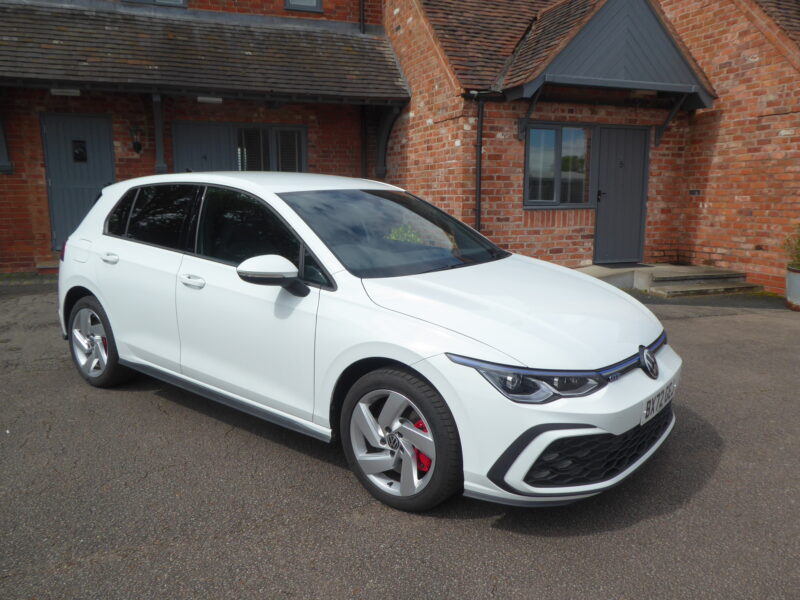
The Golf GTE is a stand-alone model in a complex range which includes a variety of engine technologies and power outputs. There’s no longer an all-electric model as the place for that has been taken by the ID3, but otherwise you can have a pure petrol, a pure diesel, a sporty GTi a super sporty R or this, a model which, like its predecessor, tries to combine the sportiness of a GTi with the efficiency, both in terms of energy consumption and fiscally, of the plug-in hybrid that powers it. So it looks not unlike a regular GTi, bar some subtly different badging and it has the same power output, 245 PS, though the way it achieves it is quite different. There is a 13kWh battery giving it a theoretical 40 mile range on electric energy alone, which combines with a 1.4-litre turbo petrol engine. That gives you the 245 PS or 242hp and 0-62mph in 6.7secs. Not as fast as a GTI (blame the extra weight of the battery) but still brisk, and you could easily get it to average better than 60mpg with only a little bit of charging. On paper, then, it all sounds quite promising, and whilst you may or may not like the look of Golf 8 (personally, I prefer its predecessors), there is no denying the lift of the sporting touches applied. These include a large honeycomb grille with a blue accent and an LED light strip positioned below, a black lower bumper trim, and an integrated background exterior light. The rear has a diffuser-style rear bumper. The roof spoiler is also different, with wider side sill panels, larger wheels, and red brake calipers.


First impressions were quite good. The car starts on the battery, even if there is very little charge, and at some point once you are underway, the petrol engine cuts in. Very smoothly. There is the same sort of purposeful roar that you get in a GTi, which most enthusiasts will find very pleasing, as whilst you can definitely hear it, it is by no means obtrusive. As I travelled on the variety of roads between the dealer and my office, my over-riding impression was more of smoothness than speed. If the battery is not much charged, then of course there is not really 242bhp available, as only 150 bhp comes from the petrol engine, which, along with the significant weight penalty of the batteries, is why this car never really felt that fast. It is certainly brisk enough for most purposes, but it is never going to beat a Golf GTi on a consistent basis. The GTE has a six speed DSG automatic transmission and it is well matched to the powerplant, giving smooth gearchanges and rarely getting caught out. Whilst the engine is quiet at cruising speeds, I did also note that there is fairly significant road noise which might just be a little wearing on a longer journey. There are five specific driving modes, bespoke to the Volkswagen Golf GTE and accessible through the driver profile selection. These include the ability to drive on electric power only. I could not use that, as the battery did not have much charge in it. The car did come with “some” fuel in it, and I was asked to return it at the same level, which I did, but it does mean I can’t really give any meaningful fuel consumption figures from this test, sadly. Were I to have kept it longer, I would have wanted to charge the battery as well, but there was not time for that. I did note that there is a separate pull-release for the fuel filler by the door which was a little surprising.


The styling features and VW’s marketing team want to you to think of this as a sporty Golf. It really is not. The steering is the biggest problem. In normal mode (and there are 5 driving modes available), it is very light and lacks any feel. Whilst this does make the car easy to manoeuvre, it really does not give you any sensation of where the steered wheels are truly pointing when you get to the twisty roads. And that really does matter as the Lane Keep Assist feature on the car was one of the most aggressive I have come across, seemingly wanting to steer into the nearest hedge on too many occasions. It got particularly confused by the hatchings that go across a road as you enter or exit a village. Somewhere in the cursed touchscreen that will come to is the means of turning it off. Handling and grip were fine, but nowhere near as impressive as what I had experience in that Golf GTi. I was not impressed by the brakes, either, which needed a rather harder shove on the pedal than you might expect. That is almost certainly a consequence of the regenerative braking which is included, giving the potential to top-up the batteries while driving. In normal use it is fairly innocuous, although engaging Sport mode makes the deceleration effect more obvious. In either setting, it results in an artificial feel to the brake pedal, although this is common to many hybrid cars. The Golf GTE comes on 225/45 R 17 wheels and stiffened suspension, but this is one thing VW do seem to have got right, as whilst on the firm side it was always comfortable. The start of the time with this Golf was wet and that is when I found that, like all its predecessors, it really sucks rain and dirt on to the back in a worse way than most other cars. That said, visibility was generally as good as you get with cars in the 2020s and the parking sensors, rear-view camera and generally compact dimensions made it quite easy to park.


And now we get to the really challenging bits. VW have long been renowned for the quality of the interiors, and indeed it is often repeated that the Golf 4 so shocked Ford that they had to rethink their new Focus to ensure that they were not completely out-classed. No-one need worry about this one beating them hands down. More evident here than in any other visible aspect, VW have clearly looked to take cost out and figured they could get away with and that no-one would notice. Or care. Well they have noticed and they do care. In fact the overall quality when you really get to poke and prod at it as better than it looks. The angular design does not help, but it would seem that VW prioritised trendy features over innate quality here. And there are loads of those and that also means that what you get is far more complex than what has gone before. You can’t just get in this car, adjust the seats and mirrors and drive off. It took me a long time to try to figure things out, and setting some things, like climate control and audio, well, yes, that was definitely not easy. Many words have been written about Volkswagen’s Innovision multimedia system, next to none of them positive, and I am not going to go against the trenchant criticism of others, as truly this system really is as user-hostile as everyone says. It combines a 10.0-inch central multimedia touchscreen with a 10.25-inch digital dashboard display, then throws in plenty of frustration for good measure. The touchscreen controls almost every interior function, save for a handful of items operated by touch-sensitive sliders and buttons. Having to navigate through multiple menus to change even simple settings is hugely annoying, and familiarity does not make things much easier. In gaining the same sports steering wheel as the Golf GTI, the Volkswagen Golf GTE also inherits the bizarre haptic feedback controls fitted to it. This makes even adjusting the radio volume a needlessly difficult task. The Golf’s infotainment system includes DAB radio, satellite navigation and Apple CarPlay and Android Auto smartphone connectivity. Optional voice commands can be used to try and avoid battling with the touchscreen. Not only is it almost impossible to use the screen for anything of any consequence when you driving, the well-publicised absence of any lighting means that after dark, most of those haptic controls are pure guess work, and you almost certainly won’t guess right, certainly not until you are very familiar with the car, which I was not going to be in one day. The instrument cluster is all digital. There is a very speedometer dial on the right and on the left there is a combined rev counter and energy meter. There is a tiny fuel gauge of the sort with bars that go out as the tank empties. Everything you need is there and is relatively easy to assimilate as you drive. The corporate standard pair of column stalks are used and these have rather hard edges to them and are not nice to touch like they used to be. The lights now operate from a pod to the right of the instrument cluster, by a series of touch pads rather than the simple rotary control you used to find on the dash. And then there are those touch pads on the steering wheel. These are far too easy to activate when you do not intend to, and surprisingly difficult to use when you do. Further evidence of trying to be trendy for no good reason comes from the tiny little gear switch, and even this is awkward to use, with a separate park button.


Thankfully, the rest of the interior is much more up to par. There is a pleasant blue tartan cloth covering for the seats. They have a wide range of manual adjustment, and even though you do sit quite high on their lowest setting, there is ample headroom. I found the seats to be very comfortable and there is plenty of side support. There are height adjustable seat belts. The headrests are integrated into the seat back, but this was fine for me.


The tape measure will tell you that the Golf is within a centimetre or two of all its rivals as regards space in the back. That means that is better suited for two than three, though the car is wide enough that kids would be fine and three adults would fit. The relatively straight-sided styling means that headroom is not just sufficient in the middle of the car but should also be fine for those three adults. There is a drop-down armrest with cup holders in the upper surface, and there are map pockets on the back of the front seats. You also get two USB ports here.


One consequence of the hybrid system is that the boot, which is not the largest in class even in a regular Golf loses quite a bit of capacity to accommodate the batteries. The official figures say 273 litres as opposed to 374 of the non-hybrid cars. Suffice to say that my squash bag barely fitted in it, and there are relatively few cars these days where that is the case. Also, you need somewhere to store the cables, and as there is no space under the floor, they have to go in the boot as well. There is a ski flap so you could accommodate two rear passengers and long items, such as skis, or you can just drop the asymmetrically split rear seat backrests down to create a much larger and flat load area. Inside the cabin, things are a little better. There is a modestly sized glovebox, and there are bons on the doors as well as a central armrest cubby along with a pair of cupholders in the centre console.


As part of Volkswagen’s performance range, the Volkswagen Golf GTE gains a host of special features. It builds upon the already generously equipped R-Line version, and shares many features with the GTI and GTD models. Standard exterior specification includes bespoke Volkswagen Golf GTE styling, with unique front and rear bumpers that are inset with honeycomb detailing. GTE badging and blue trim above the IQ. Light adaptive LED headlights, also help mark out this plug-in hybrid model from the GTI and GTD. Volkswagen fits the GTE with 17-inch ‘Richmond’ alloy wheels as standard. Many buyers will be drawn to the more visually alluring 18-inch ‘Bakersfield’ wheel option, which adds just over £600 to the Volkswagen Golf GTE’s list price. Be aware that larger wheels will increase fuel consumption, though. Upgraded brakes hide behind the alloys, with a sporty red finish used for the callipers. More LED lighting is used for the front fog lights, which have a honeycomb pattern, along with rear lights that feature dynamic sequential indicators. The front grille is illuminated for good measure. Moving inside, the Golf GTE’s main identifying feature is the use of blue ‘Jacara’ tartan-style upholstery for the sports seats. This is similar in design to the red patterned trim used in the GTI, and is a nod to classic Volkswagen hot hatches. The high-backed sports seats have headrests incorporated into them, and come with height and lumbar adjustment. A sports steering wheel with blue stitching, a black headlining, ‘black metal chrome’ interior details and a GTE-branded gear selector are all part of the package, too. All Volkswagen Golf GTEs come fitted with three-zone climate control air-con, keyless entry, and side mirrors that fold and dim automatically. The 10.0-inch Innovision multimedia touchscreen is combined with a 10.25-inch digital dashboard, and incorporates satellite navigation and DAB radio. Volkswagen supplies the Volkswagen Golf GTE with a pair of Type 2 AC charging cables. Both of these are six metres in length, and give the option of using a wallbox or conventional mains socket for charging the car’s batteries.


It is fair to say that I was not impressed with this car at all. It struck me as being one of a growing list of cars which in many ways is considerably worse than its predecessor. Strip away the awful tech, especially the truly terrible touchscreen, and nobble the irritating to the point of almost dangerous ADAS features and you’d actually have something that was decent, but far from a clear class leader. The cheapened interior quality alone makes one question the value of paying extra for a Golf compared to other brands, and the rather uninspiring driving dynamics don’t help the cause, either. I suspect that there is an essentially sound car under all the frustrations and irritations, but I am not sure you can buy one without at least some of the disappointments. And that is a shame, as that seventh generation Golf GTi I drove a few weeks ago and the regular 1.5 TSi I sampled in America a few years ago were so impressive. Worryingly, my disappointments would apply equally across the whole range, so it is not really the case of saying that the tax-efficient GTE is a car to avoid, but mor that the eight generation Golf is a car I simply could not recommend let alone own. I hope that some serious rethinking is going on in Wolfsburg to try to fix this one as best they can. It needs it.