Caffeine & Machine is a year-round venue, and whilst in the summer months, when the weather is generally good and there a long hours of daylight, the venue often sell out of available tickets on weekend slots, in winter, attendance drops quite noticeably. To try to encourage a few more people to stop by they have a series of themed days and weekends. Despite repeated requests by clubs, including the various Abarth ones that they work with us and give us more notice, as this would probably get more people to come along, these are often only announced at relatively short notice and only on their own social media sites. My plans for the last weekend before Christmas were to head up to Yorkshire for an event at The Motorist, a venue not unlike Caffeine & Machine in concept, but when I spotted that there was an Italian themed weekend planned for Caffeine & Machine’s original location, the one known as The Hill, I decided it would be nice to break my journey and call in. Here is what I found on a rather dreary and damp Saturday:
ABARTH
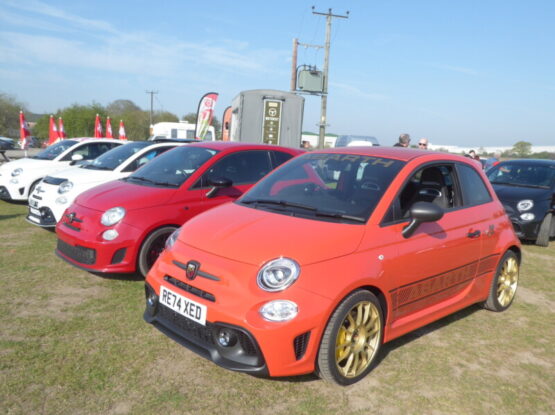
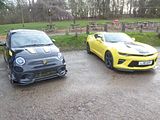
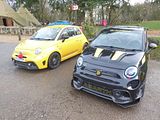
Having used the legendary 695 badging from the 1960s on the Tributo cars, at the 2012 Geneva Show, Abarth dusted off the 595 name that had been used on the less powerful of the Nuova 500 based cars of the same generation, and created two new versions which we should think of as Series 2 cars, the 595 Turismo and Competizione, both of which could be bought in either closed or open top C guise, with either the 5 speed manual or robotised automated gearshifts. Both models had the 160 bhp engine as standard. Effectively they were a replacement for the Esseesse kit, and it meant that the cars were produced complete at the factory, rather than needing the dealer to undertake the upgrade (and the associated paperwork), though Abarth did not withdraw the Esseesse kits from the market for some while. Turismo, as the name suggests was aimed slightly less extreme in intent, featuring standard leather upholstery, upgraded dampers and climate control, Xenon headlights and Alutex interior details. The sportier Abarth 595 Competizione replaced the leather seats with Sabelt cloth sport seats and Alutex with aluminium, while adding p-cross-drilled brakes and the Record Monza dual-mode exhaust.
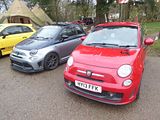
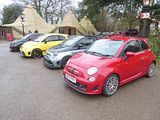
What is known as the Series 4 version of the familiar 595 reached the markets in the middle of 2016. After rumours had circulated all winter following the launch of the facelifted Fiat 500 last year, Abarth finally unveiled the Series 4 at the end of May 2016. Initially, we were told that the cars would not be available in the UK until September, but that came forward somewhat, with dealers all receiving demo cars in June, and the first customers taking delivery in July. Three regular production versions of both the closed car and the open-topped C were initially available, all badged 595, and called Custom, Turismo and Competizione, as before, though numerous limited edition models have since appeared and in most case disappeared. The most significant changes with the Series 4 are visual, with a couple of new colours, including the much asked for Modena Yellow and a different red, called Abarth Red, which replaces both the non-metallic Officina and – slightly surprisingly – the tri-coat pearlescent Cordolo Red. as well as styling changes front and rear. The jury is still out on these, with many, me included, remaining to be convinced. At the front, the new air intake does apparently allow around 15 – 20 % more air in and out, which will be welcome, as these cars do generate quite a lot of heat under the bonnet. Competizione models for the UK retain the old style headlights, as they have Xenon lights as standard, whereas the Custom and Turismo cars have reshaped units. At the back, there are new light clusters and a new rear bumper and diffuser. Inside, the most notable change is the replacement of the Blue & Me system with a more modern uConnect Audio set up, which brings a new colour screen to the dash. Mechanically, there is an additional 5 bhp on the Custom (now 145) and Turismo (now 165 bhp) and the option of a Limited Slip Diff for the Competizione, which is likely to prove a popular option. Details of the interior trim have changed, with a filled-in glovebox like the US market cars have always had, and electric windows switches that are like the US ones, as well as a part Alcantara trim to the steering wheel in Competizione cars.
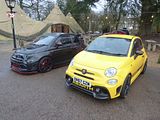
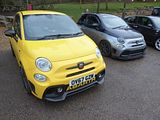
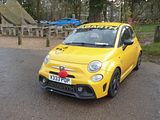
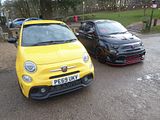
More recently, Abarth have produced the 695 Rivale, a celebration of Fiat’s partnership with Riva, which has already seen a special Riva version of the 500,. Described as being “the most sophisticated Abarth ever”, it is available either as a hatch or a cabriolet, with both of them featuring a two-tone Riva Sera Blue and Shark Grey paintwork. The Rivale is adorned with an aquamarine double stripe, satin chrome finish on the door handles and satin chrome moulding on the tailgate, various aesthetic elements inspired by the Riva 56 Rivale yachts and ‘695 Rivale’ logos, joined by Brembo Brakes, Koni suspension, and 17-inch Supersport alloy wheels. Enhancing the nautical theme the new 695 Rivale features either a carbon fibre or mahogany dashboard, black mats with blue inserts, blue leather seats and door panels, carbon fibre kick plates, special steering wheel wrapped in blue and black leather and with a mahogany badge, blue leather instrument panel cover, and mahogany gear lever knob and kick plate. These are joined by the standard Uconnect infotainment with a 7-inch display, which is compatible with Android Auto and Apple CarPlay, and there is also a hand-written numbered plate that can be customised with the mane of the customer’s yacht on request. Powering the 695 Rivale is the same 1.4-litre turbocharged engine that makes 180PS (177hp) and 184lb/ft of torque, that features in the 595 Competizione, allowing it to go from rest to 100km/h (62mph) in 6.7 seconds and up to a top speed of 225km/h (140mph). This is a regular model in the range, but confusingly, there is also the Abarth 695 Rivale 175 Anniversary, created to celebrate 175 years of the Riva brand. Just 350 of these were produced, half of them the hatch and the other half cabriolets. These featured 17-inch alloy wheels with a special pattern, celebratory badge on the outside, hand-crafted details such as the two-tone colour – blue and black hand-stitched leather seats with a celebratory logo stitched onto the headrest, carbon dashboard silk screen printed with special logo, numbered plate. Standard Rivale cars arrived in the UK in April 2018, and quite a few have been sold. They always attract lots of interest when they do appear.
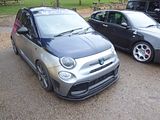
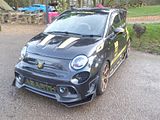
There were also a couple of even more heavily modified cars, both well known in the community, belonging to Mark Rosales (The Black Bee) and Chris Parmentier (Bella Abarth).
ALFA ROMEO
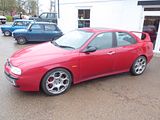
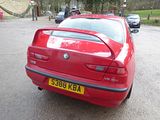
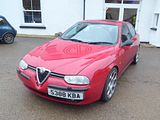
When the 156 was launched in 1997, things looked very bright for Alfa. Striking good looks were matched by a driving experience that the press reckoned was better than any of its rivals. The car picked up the Car of the Year award at the end of the year. and when it went on sale in the UK in early 1998, waiting lists soon stretched out more than 12 months. Reflecting the way the market was going, Alfa put a diesel engine under the bonnet, launched a (not very good, it has to be admitted) automated transmission with the SeleSpeed, added a very pretty if not that commodious an estate model they called Sport Wagon and then added a top spec 3.2 litre GTA with its 250 bhp engine giving it a performance to outrun all its rivals. And yet, it did not take long before the press turned on the car, seduced by the latest 3 Series once more, citing build quality issues which were in fact far from universal. The 156 received a very minor facelift in 2002 and a more significant one in late 2003 with a new front end that was a clue to what would come with the car’s successor. Production ceased in 2005. These cars are getting quite rare at events now
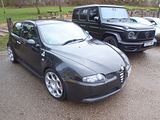
Having a rather short production life was the GTA version of the 147. Launched in 2002. this car was intended to compete with the most sporting Golf and Focus models of the day. as well as injecting more potency into a range which always seemed like it needed more power. Fitted with a 3.2 V6 engine which produced 247 bhp, the 147GTA was the most powerful hot hatch available at the time, and the modifications to the body, including lower sills and wider wheel arches, if anything, made it look even better rather than endowing it with the sort of “after market look” that can afflict some high end performance versions of regular family cars. Performance figures were impressive, with the car able to achieve a top speed of 153 mph. It had a widened body by 15 mm at each side to accommodate the 225/45R17 tyres. Most models had a 6-speed manual transmissions; whilst a smaller number of other models used the semi automatic Selespeed system. Production ran through to 2004 and in total 5,029 147 GTAs were built, 1004 of which were Selespeeds. Only around 300 came to the UK, so this was never a common sighting on British roads.
BMW
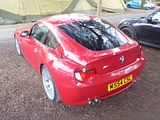
BMW unveiled a concept coupé version of the Z4 at the 2005 Frankfurt Motor Show. The design of the Z4 and Z4 coupé has variously been ascribed to Anders Warming, Chris Bangle, the controversial former BMW Head of Design, and Adrian van Hooydonk, former BMW chief designer, and BMW designer Tomasz Sycha. The design was approved in Summer of 2004 and frozen in December 2004. The company announced in 2005 that the two-door coupé would be available for production including the return of the M Coupé. The production car was introduced at the New York Auto Show in April 2006 and was available for sale in late May 2006. Thanks to its hatch design, the Z4 Coupé offers 10.1 cu ft (0.29 m3) of trunk space, compared with 8.5 cu ft (0.24 m3) for the roadster. The Coupe’s fixed roof increases torsional rigidity, resulting in a stiffness of 32,000 N⋅m (24,000 lb⋅ft) per degree of body twist on the coupe (compared to 14,500 N⋅m (10,700 lb⋅ft) per degree on the roadster), which improves turn-in and overall handling response. The roof has a “double-bubble” contour which serves as an aerodynamic aid and offers more headroom than the roadster with the soft top closed. The Coupé has a sleek fastback rear window that slopes down to an integrated spoiler which is shaped to deliver downforce to the rear axle at high-speed. The model range for the Coupé was more limited than the roadster, and consisted of the six-cylinder 3.0si and Z4 M model only. Transmission choices were a 6-speed manual and a 6-speed automatic with shift paddles mounted on the steering column.
CHEVROLET
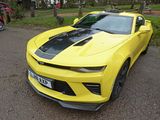
Never officially sold new in the UK, this is an example of the most recent Camaro SS.
FERRARI
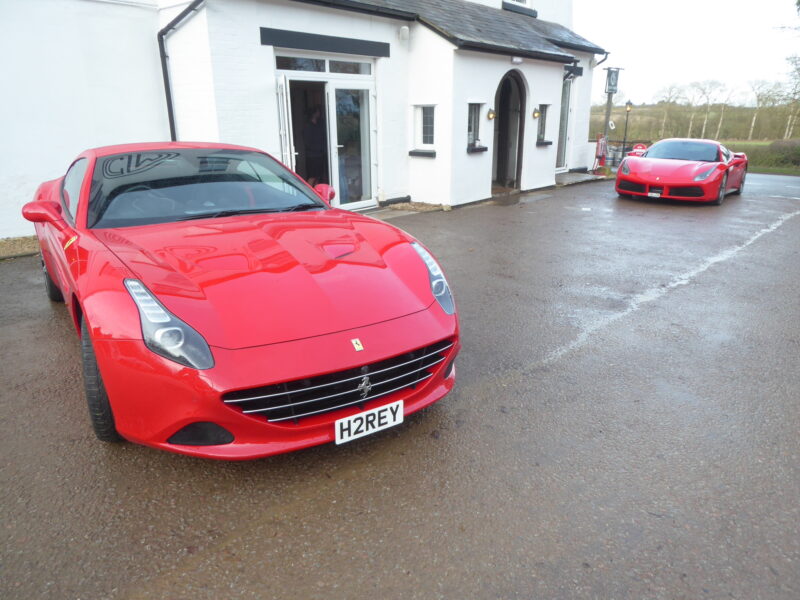
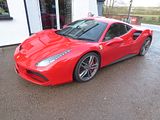
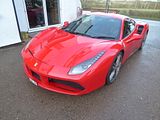
Launched at the 2015 Geneva Show, the 488GTB followed the lead set by the California T in bringing turbocharging into a modern-day, mid-engined V8 Ferrari supercar for the first time. The engine is completely new when compared with its V8 stablemate, not only in components but also in feel and character. It is a twin-turbocharged 3902cc unit whilst that in the California T is 3855cc. In the 488 GTB, it produces 660bhp at 8000rpm and 560lb ft at 3000rpm. Both outputs are significant increases over the normally aspirated 4.5-litre V8 used in the 562 bhp 458 Italia and 597 bhp 458 Speciale, and also greater than the car’s biggest rival, the McLaren 650S. The torque figure of the 488 GTB is such that it also exceeds the 509lb ft at 6000rpm of the normally aspirated V12 used in the range-topping Ferrari F12 Berlinetta. The mighty new engine in the 488 GTB drives the rear wheels through a revised seven-speed dual-clutch automatic gearbox derived from the 458. It features a new ‘Variable Torque Management’ system which, Ferrari says, “unleashes the engine’s massive torque smoothly and powerfully right across the rev range”. The gear ratios are also tuned to “deliver incredibly progressive acceleration when the driver floors the throttle”. The 488 GTB can crack 0-62mph in just 3.0sec, 0-124mph in 8.4sec and reach a top speed of 205mph. Its 0-62mph and 0-124mph times match the McLaren 650S’s, but the Woking car’s top speed is slightly higher at 207mph. The engine also accounts for the ‘488’ element of the car’s name, because each of the engine’s eight cylinders is 488cc in capacity when rounded up. The GTB suffix, standing for Gran Turismo Berlinetta, is a hallmark of previous mid-engined V8 Ferraris such as the 308 GTB. Not only is the new turbo engine more potent than the 4.5-litre V8 from the 458 Italia, but it is also more economical. Combined fuel economy is rated at 24.8mpg, compared with 21.2mpg in the 458 Italia, and CO2 emissions are 260g/km – a 47g/km improvement. Ferrari’s HELE engine stop-start system features on the 488 GTB. Developments on the dynamic side include a second generation of the Side Slip Angle Control system, called SSC2. This allows the driver to oversteer without intruding, unless it detects a loss of control. The SSC2 now controls the active dampers, in addition to the F1-Trac traction control system and E-Diff electronic differential. Ferrari says the result is “more precise and less invasive, providing greater longitudinal acceleration out of corners” and flatter, more stable behaviour during “complex manoeuvres”. Learnings from the Ferrari XX programme have also been incorporated into the 488 GTB, something that Ferrari says allows all drivers and not just professionals, to make the most of its electronic and vehicle control systems. It also claims the 488 GTB is “the most responsive production model there is”, with responses comparable to a track car. The 488 GTB has lapped Ferrari’s Fiorano test track in 1min 23sec – two seconds faster than the 458 Italia, and half a second quicker than the 458 Speciale. The dimensions of the 488 GTB – it is 4568mm in length, 1952mm in width and 1213mm in height – closely match the 458 Italia from which it has evolved. Its dry weight is 1370kg when equipped with lightweight options – 40kg more than the McLaren 650S. The new look, styled at the Ferrari Styling Centre, features several new aerodynamic features that improve downforce and reduce drag. Most notable is the addition of active aerodynamics at the rear through a ‘blown’ rear spoiler, where air is channelled from the base of the glass engine cover under the spoiler. This contributes to the 50% increase in downforce over the 458 Italia. Also new is a double front spoiler, an aerodynamic underbody, a large air intake at the front that references the 308 GTB, a diffuser with active flaps, new positioning for the exhaust flaps and new-look lights. The interior has been redesigned to be made more usable, including new switchgear, air vents and instrument panel. The multi-function steering wheel remains, while the infotainment system gets a new interface and graphics. The Spider followed the closed coupe model six months later.
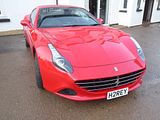
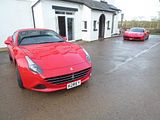
The Ferrari California T (Type 149M) is an updated design of the California model featuring new sheetmetal and revised body features; a new interior, a revised chassis and a new turbocharged powertrain. First unveiled on the web on February 12, 2014, subsequently, the car debuted at the Geneva Motor Show. The T in the moniker stands for Turbo, a technology Ferrari last used on the F40 roadcar. The car utilizes a new 3,855 cc twin-turbocharged V8 engine that produces 560 PS (553 bhp) at 7,500 rpm and 755 Nm (557 lb/ft) at 4,750 rpm as well as a 7-speed dual clutch transmission with different gear ratios, a revised MagneRide adaptive suspension, as well as a new F1 Trac system. The car can accelerate from 0–100 km/h (0–62 mph) in 3.6 seconds and attain a top speed of 315 km/h (196 mph). The car also features a new front fascia that was influenced by the F12, a revised rear section and a revised interior. The revised rear end replaced the two sets of two vertically stacked exhaust pipes with four horizontally aligned pipes. Another improvement to the car is the reduction of emission pollution by 15% compared to its naturally aspirated predecessor. The car also utilises small turbo chargers and a variable boost management system to reduce turbo lag. It is also the first Ferrari road car debuting the new Apple CarPlay functionality into its built-in infotainment system – Apple confirmed at the launch of the Geneva Motor Show that Ferrari, Mercedes-Benz and Volvo would be among the first car manufacturers to bring CarPlay compatible models to the market. Similarly to the previous generation, a Handling Speciale (HS) package was made available for the California T, providing sportier handling at the expense of a stiffer ride. The Handling Speciale includes stiffer springs front and aft, retuned magnetorheological dampers, faster gear shifts when in Sport mode, a reprogrammed F1-Trac stability control, and a new sport exhaust system. Visually, the HS package-equipped cars are distinguished by a matte grey grille and rear diffuser, matte black diffuser fences and matte black exhaust tips.The California T Handling Speciale was unveiled at the March 2016 Geneva Motor Show. Through the Tailor Made programme, the California T was produced in several special editions and could also be customised to suit individual customers. For Ferrari’s 70th anniversary in 2017, this included 70 liveries inspired by the company’s iconic cars of the past such as the 250 GT Berlinetta SWB and Steve McQueen’s 1963 250 GT Berlinetta lusso. The California T Tailor Made liveries were unveiled at the March 2016 Geneva Motor Show and also shown at other subsequent motor shows such as the October 2016 Paris Motor Show. Production ceased in 2019 when the car was replaced by the Portofino.
FIAT
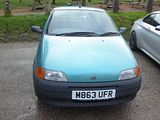
Follow on to the Uno was the Punto, first appearing in 1993 and proving an immediate hit. Internally codenamed Project 176, the Punto was announced in September 1993 as a replacement for the ageing Fiat Uno and launched in the end of 1993 or the beginning of 1994, depending on the market. The Fiat Punto was voted European Car of the Year for 1995, defeating rival Volkswagen Polo by only 78 points. The Punto was designed by Giorgetto Giugiaro and was available as a three-door or five door hatchback, a two-door cabriolet and a three-door panel van. As with the majority of the new Fiat group models, suspension was all independent, composed of MacPherson struts at the front and trailing arms at the rear. Entry level in the Punto range were the 1.1 and 1.2 L petrol engines and the 1.7 diesel engine. The 1.2 engine’s actual capacity is 1242 cc, available in three versions. The first, was fitted in the Punto ELX 75 and produced 75 hp at 6000 rpm while the second, fitted to Punto ELX 85 produced 86 hp at 6000 rpm. The third was a 60 hp engine which eventually replaced the 1.1 54 hp engine. A Sporting model was also available with a 1.6 8v updated 128 SOHC engine, producing 88 hp, later replaced in 1997 by the 1.2 16v FIRE engine used in the 85 ELX, and a power drop to 86 hp. The top of the range model was the 136 PS 1.4 GT, using an evolution of the turbocharged 128 SOHC engine originally found in the Fiat Uno Turbo Mk II – capable of running over 200 km/h (120 mph) and reaching 100 km/h (62 mph) in 7.9 seconds, which came fitted with a five speed manual gearbox. During the years the GT was made in three different “series” with power 136 PS (1993–1995),133 PS (1995–1997) and 130 PS (1997–1999).
FORD
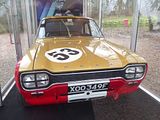
There are now a couple of enclosed boxes that are used for special display cars on site. The combination of their siting, construction and reflections from the glass mean that the cars in them are all but impossible to photograph, but I did manage to get this picture of this recreation of the famous Escort Alan Mann Racing Ford Escort. The Alan Mann 68 Edition continues a racing story that began in 1968 – when Alan Mann Racing and Ford developed the Escort Mk1 that would win the British Touring Car Championship and redefine the limits of saloon car competition. That car, XOO 349F, became a benchmark for balance, control, and competitive engineering. This continuation model extends that legacy, just like the original each car is a genuine Ford Escort, engineered by DRVN and assembled by Alan Mann Racing. Developed from the exact geometry of the championship-winning car, it represents a direct link to the chassis, the philosophy, and the purpose that shaped the original. It’s the next in a championship-winning lineage – built by the team that created it. The Alan Mann 68 Edition is an officially licensed Ford Motor Company product – developed in close collaboration with Ford’s heritage and motorsport programmes. This formal collaboration affirms the car’s authenticity, engineering integrity, and position within the Ford legacy. This provides each 68 Edition with an official Ford chassis number, and represents a direct link to the combined Ford & Alan Mann effort that shaped the original works cars. It affirms each car’s status as a Ford-endorsed continuation.
HONDA
In September 2012, there were rumours about the confirmation of the next-generation of the Honda Civic Type R at the Paris Motor Show. A preview took place at the Geneva Motor Show in March 2014. In January 2015, Honda announced that the production-ready model of the fourth generation of the Civic Type R (called the FK2) would debut at the 85th Geneva Motor Show held in March alongside the European debut of the NSX. It is the first factory turbocharged Civic Type R. The FK2 Civic Type R is powered by the K20C1 Direct Fuel Injection 1,996 cc turbocharged inline-four engine with Earth Dreams Technology, having a power output of 310 PS (306 bhp) at 6,500 rpm and maximum torque of 400 Nm (295 lbft) at 2,500–4,500 rpm. The engine is mated to a 6-speed manual transmission with a factory equipped plate-style limited-slip differential. Honda claimed that the Type R can accelerate from 0–100 km/h (62 mph) in 5.7 seconds. The engine is manufactured at Honda’s Anna Engine Plant in Ohio before being exported to the UK. The fuel tank has a capacity of 50 L (13 US gal) and fuel consumption is 30.1/46.3 mpg (5 L/100km-7.81 L/100km) and 38.7 mpg (6 L/100km) (combined). Combined CO2 emission is 170g/km and the car has achieved Euro 6 Emission Standard. The Civic Type R is equipped with dual front airbags, front side airbags and front and rear side curtain airbags. Larger brakes are fitted for improved stopping power with front brakes having 351 mm (13.8 in) ventilated and drilled discs and rear brakes having 305 mm (12 in) solid discs. The anti-lock braking system, electronic brake-force distribution, hill start assist, and vehicle stability assist are standard. The British were able to purchase the FK2 as of July 2015 with two variants: the base Type R model and the Type R GT model. Although they both were priced differently, differences are limited to additional equipment and amenities. Key specifications related to power figures remain the same for both variants. In July 2015, Swindon, England (HUM) started exporting the FK2 Civic Type R to Japan, making it the third Civic Type R to be exported there. However, only 750 units were exported
LANCIA
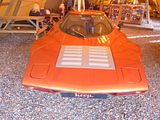
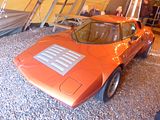
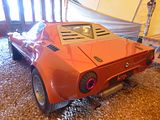
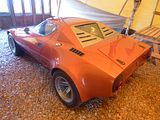
Needing little in the way of an introduction is this Stratos. Sadly not an original car (which are extremely rare these days), it is a well-produced replica, but is still rather splendid, and it was attracting lots of interest. A Bertone-designed concept car called the Lancia Stratos Zero was shown to the public in 1970, but shares little but the name and mid-engined layout with the Stratos HF version. A new car called the New Stratos was announced in 2010 which was heavily influenced by the design of the original Stratos, but was based on a Ferrari chassis and engine. Bertone had no previous business with Lancia, who were traditionally linked with Pininfarina, and he wanted to come into conversation with them. Bertone knew that Lancia was looking for a replacement for the ageing Fulvia for use in rally sports and so he designed an eye-catcher to show to Lancia. Bertone used the running gear of the Fulvia Coupé of one of his personal friends and built a running showpiece around it. When Bertone himself appeared at the Lancia factory gates with the Stratos Zero he passed underneath the barrier and got great applause from the Lancia workers. After that a co-operation between Lancia and Bertone was formed to develop a new rally car based on ideas of Bertone’s designer Marcello Gandini who already had designed the Lamborghini Miura and Countach. Lancia presented the Bertone-designed Lancia Stratos HF prototype at the 1971 Turin Motor Show, a year after the announcement of the Stratos Zero concept car. The prototype Stratos HF (Chassis 1240) was fluorescent red in colour and featured a distinctive crescent-shaped-wrap-around windshield providing maximum forward visibility with almost no rear visibility. The prototype had three different engines in its early development life: the Lancia Fulvia engine, the Lancia Beta engine and finally for the 1971 public announcement, the mid-mounted Dino Ferrari V6 producing 190 hp. The use of the Dino V6 was planned right from the beginning of the project, but Enzo Ferrari was reluctant to sign off the use of this engine in a car he saw as a competitor to his own Dino V6. After the production of the Dino car had ended the “Commendatore” (a popular nickname for Enzo Ferrari) agreed on delivering the engines for the Stratos, and Lancia then suddenly received 500 units. The Stratos was a very successful rally car during the 1970s and early 1980s. It started a new era in rallying as it was the first car designed from scratch for this kind of competition. The three leading men behind the entire rallying project were Lancia team manager Cesare Fiorio, British racer/engineer Mike Parkes and factory rally driver Sandro Munari with Bertone’s Designer Marcello Gandini taking a very personal interest in designing and producing the bodywork. Lancia did extensive testing with the Stratos and raced the car in several racing events where Group 5 prototypes were allowed during the 1972 and 1973 seasons. Production of the 500 cars required for homologation in Group 4 commenced in 1973 and the Stratos was homologated for the 1974 World Rally Championship season. The Ferrari Dino V6 engine was phased out in 1974, but 500 engines among the last built were delivered to Lancia. Production ended in 1975 when it was thought that only 492 were made (for the 1976 season, the Group 4 production requirement was reduced to 400 in 24 months. Manufacturer of the car was Bertone in Turin, with final assembly by Lancia at the Chivasso plant. Powered by the Dino 2.4 litreV6 engine that was also fitted to the rallying versions, but in a lower state of tune, it resulted in a power output of 190 hp, giving the road car a 0–100 km/h time of 6.8 seconds, and a top speed of 232 km/h (144 mph). The Stratos weighed between 900 and 950 kilograms, depending on configuration. Power output was around 275 hp for the original 12 valve version and 320 hp for the 24 valve version. Beginning with the 1978 season the 24 valve heads were banned from competition by a change to the FIA rules. Even with this perceived power deficit the Stratos was the car to beat in competition and when it did not suffer an accident or premature transmission failure (of the latter there were many) it had great chances to win. Despite the fact that the Stratos was never intended to be a race car, there were two Group 5 racing cars built with 560 hp, using a single KKK turbocharger. The car won the 1974, 1975 and 1976 championship titles in the hands of Sandro Munari and Björn Waldegård, and might have gone on to win more had not internal politics within the Fiat group placed rallying responsibility on the Fiat 131 Abarths. As well as victories on the 1975, 1976 and 1977 Monte Carlo Rally, all courtesy of Munari, the Stratos won the event with the private Chardonnet Team as late as 1979. Without support from Fiat, and despite new regulations that restricted engine power, the car would remain a serious competitor and proved able to beat works cars in several occasions when entered by an experienced private team with a talented driver. The last victory of the Stratos was in 1981, at the Tour de Corse Automobile, another World Rally Championship event, with a victory by longtime Stratos privateer Bernard Darniche. When the Fiat group favoured the Fiat 131 for rallying Lancia also built two Group 5 turbocharged ‘silhouette’ Stratos for closed-track endurance racing. These cars failed against the Porsche 935s on closed tracks but proved successful in hybrid events. While they failed in the Tour de France Automobile, one of these cars won the 1976 Giro d’Italia Automobilistico, an Italian counterpart of the Tour de France Automobile. One of the cars was destroyed in Zeltweg, when it caught fire due to overheating problems. The last surviving car would win the Giro d’Italia event again before it was shipped to Japan to compete in the Fuji Speedway based Formula Silhouette series, which was never raced. The car would then be sold and reside in the Matsuda Collection before then being sold to the renowned collector of Stratos’, Christian Hrabalek, a car designer and the founder of Fenomenon Ltd, who has the largest Lancia Stratos Collection in the world, 11 unique Lancia Stratos cars, including the fluorescent red 1971 factory prototype and the 1977 Safari Rally car. His interest in the car led to the development of the Fenomenon Stratos in 2005. The Stratos also gained limited success in 24 Hours of Le Mans, with a car, driven by Christine Dacremont and Lella Lombardi, finishing 20th in 1976
MASERATI
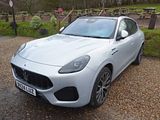
And finally from the Italian car community were a couple of Maserati models. One of them was my Grecale.
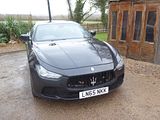
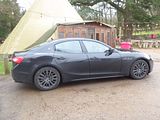
The Ghibli marked Maserati’s comeback in the mid-size luxury car segment after two decades of absence, since the last of the Biturbo family saloons went out of production in 1994; it served as a key model in Maserati’s plan of expanding its lineup to cover all segments in the luxury car market. Assembly of the Ghibli took place alongside that of the Quattroporte VI at the new Giovanni Agnelli Plant in Grugliasco near Turin, Italy. On September 24, 2019, the 100,000th Ghibli rolled off the production line as announced by Maserati. The Ghibli was introduced at the 2013 Shanghai Auto Show and marked Maserati’s entry into the mid-size executive car market as being positioned below the Quattroporte. The Ghibli is the first car to be underpinned by the Maserati M156 platform and was the company’s best seller until the Levante crossover SUV was launched. The company sold 6,000 units of the car in its first year into the market, which alone exceeded the best sales figures for Maserati for 2008, which was 9,000 cars sold in total consisting of different models. The number increased to 22,500 in 2013 and 36,448 in 2014. It continued to increase in 2015 due to the delay in the Levante’s launch. The Ghibli also marks the return of the name in the US market as the Biturbo based Ghibli (AM336) was not available for sale there. The Ghibli, which is based on a shorter wheelbase than the flagship Quattroporte, uses a steel monocoque chassis with additional subframes with the front subframe made of aluminium. Tested weight distribution for the diesel version stands at 51/49 front/rear. The diesel engine in the Ghibli, developed under Ferrari engine specialist Paulo Martinelli, is based on the V6 diesel unit found in the Jeep Grand Cherokee. The engine is exclusive to the European market only. A ZF 8HP transmission powers the rear wheels as used by all the major competition except Mercedes-Benz. Both the Ghibli and the Quattroporte share the same suspension although the Skyhook suspension is optional on the former. An optional Koni adaptive sport suspension is also available. From the 2018 model year, the Ghibli can be optioned with one of two new trims, namely GranSport and GranLusso, all of which relate to the interior of the car with the GranSport trim featuring an aggressive front bumper. A facelifted Maserati Ghibli and new, hybrid version were unveiled online on 16 July 2020. Production was phased out earlier this year.
MINI
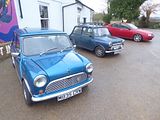
With the larger Metro being redesigned in 1990 to take the new K-Series engine, the Mini became the sole recipient of the classic A-Series engine with transmission-in-sump layout. The engine mounting points were moved forward to take 1275 cc power units, and includes the later Horizontal Integral Float version of the SU carb, and also the single-point fuel-injection version, which came out in November 1991. The 998 cc power units were discontinued. Early, carburetted Coopers had a catalytic converter and produce 60 hp/61 PS at 5500 rpm. Power crept up to 62 hp/63 PS at 5700 rpm for the fuel injected model. An internal bonnet release was fitted from 1992. By 1991, the Cooper represented forty percent of Mini sales in the home market; the main export market was Japan. Production ended in August 1996 as the Mark VII replaced it. As well as the standard cars there were numerous special edition models produced during this period.
TOYOTA
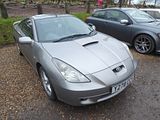
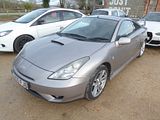
In July 1999, Toyota began production of the seventh-generation Celica, with European sales beginning late that year. It closely resembled the XYR concept with the exception of the front bumper and rear spoiler, while omitting the previously available coupe body style. The 2000 model year Celica was an element of Toyota Project Genesis, an effort to bring younger buyers to the marque in the United States. Toyota took time to lighten the car and lower cost wherever possible. Power window and door lock controls were placed in the center console so only 1 set was necessary for both doors. Initial sunroofs were made of polymer plastic instead of the traditional glass. This generation was assembled by Kanto Auto Works at its Higashi-Fuji plant in Susono, Shizuoka Prefecture, Japan. The Celica came in only one Liftback body style with the choice of two different engines. The ZZT230 was powered by a relatively economical 1.8 L 4-cylinder 140 hp 1ZZ-FE engine and the ZZT231 powered by a higher-performance 1.8 L 4-cylinder 192 hp (in Europe and Japan) 2ZZ-GE version, co-developed with Yamaha, the latter featuring a two-step variable valve lift control in conjunction with its variable valve timing. In 2004, CNNMoney.com rated the Celica as one of the best cars to purchase for fuel economy. Exporting of the Celica ceased in July 2005. However, until mid-May, customers could still order one, although it was advised they took action before that time ended. The last Celica was rolled off production line on 21 April 2006, after 36 years and seven generations. In its last year, the Celica was only officially sold in Japan. There has been no direct successor to the Celica, however, the Scion tC (exclusive to North America) is seen by some people as the spiritual successor to the Celica.
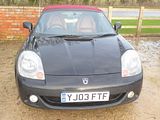
The third-generation MR2 was marketed as the Toyota MR-S in Japan, Toyota MR2 Spyder in the US, and the Toyota MR2 Roadster in Europe. Also known as the Midship Runabout-Sports, the newest MR2 took a different approach than its predecessor, most obviously becoming a convertible and receiving the ‘Spyder’ marketing nomenclature. The first prototype of MR-S appeared in 1997 at the Tokyo Motor Show. The MR2 Spyder chief engineer Harunori Shiratori said, “First, we wanted true driver enjoyment, blending good movement, low inertia and light weight. Then, a long wheelbase to achieve high stability and fresh new styling; a mid-engine design to create excellent handling and steering without the weight of the engine up front; a body structure as simple as possible to allow for easy customizing, and low cost to the consumer.” The only engine available for the ZZW30 was the all-aluminium alloy 1ZZ-FED, a 1.8 litre Inline-four engine. Like its predecessors, it used DOHC and 4 valves per cylinder. The intake camshaft timing was adjustable via the VVT-i system, which was introduced earlier on the 1998 MR2 in some markets. Unlike its predecessors, however, the engine was placed onto the car the other way round, with the exhaust manifold towards the rear of the car instead of towards the front. The maximum power of 138 bhp at 6,400 rpm and 126 lb/ft (171 Nm) of torque at 4,400 rpm was quite a drop from the previous generation, but thanks to the lightness of the car it could still move quite quickly, accelerating from 0 to 100 km/h (62 mph) in 6.8 to 8.7 seconds depending on the transmission option, the Sequential Manual being unable to launch and shift as quickly as the clutch operated manual. Curb weight is 996 kg (2,195 lb) for manual transmission models. In addition to the 5-speed manual transmission, a 6-speed manual or 5-speed Sequential Manual Transmission (SMT) was also available starting in 2002. The SMT was a standard feature in Australian market; however, air conditioning was optional. After 2003, a 6-speed SMT was an option. The SMT had no conventional H-pattern shift lever or clutch pedal. The driver could shift gears by tapping the shift lever forward or backward or by pressing steering-wheel mounted buttons. Clutch engagement is automatic, and the car will automatically shift to second and then first gear when stopping. Cruise control was never offered with the manual transmission, but was standard for SMT-equipped cars. The MR2 Spyder featured a heated glass rear window. A hard top was also available from Toyota in Japan and Europe. Production ended in 2007 and there was no direct successor.
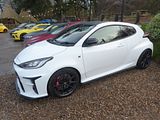
Needless to say, there was at least one example of the Yaris GR here.
So, a very pleasant stop off even if the venue was far from busy. But what do you expect on a rainy Saturday, the weekend before Christmas? I look forward to more visits, hopefully accompanied by better weather during 2025.