

Italian brand Maserati has been responsible for producing some of the most beautiful cars of all time. Although founded as a company in 1914, it was only in 1926 that the first car was produced, the Tipo 26, a race car which was the start of an amazing racing heritage that unfolded over the next 40 years. Post war, the firm diversified into producing road cars, initially very expensive coachbuilt grand tourers in coupe and convertible format, with the first saloon, called the Quattroporte, appearing in 1963. The company has had its challenges with a number of periods of difficulty ranging from the ousting of the founding brothers, to the financial challenges that saw the company acquired by Citroen in the late 1960s, de Tomaso in the mid 1970s and finally the massive Fiat empire in the late 1990s. Leveraging Fiat Group’s money and Ferrari’s expertise, Maserati entered the twentyfirst century on probably the soundest footing it has ever enjoyed, so it was perhaps no surprise that in the following years, there was an announcement of a bold plan to grow sales from a few thousand cars a year to in excess of 50,000 units a year. Key to achieving that was not just the planned sixth generation Quattroporte but a slightly smaller luxury saloon, which would take on the revered Ghibli name, and which would be positioned as an alternative to the German trio of A6, 5 and E, with executive company car users in mind. It certainly worked for me, as I loved the idea of switching from an Audi to a Maserati, and have never regretted the decision, but whilst sales of the Ghibli have been decent, they’ve never got close to that 50,000 a year target. Just as this was all happening, of course, the market’s inexorable move to SUVs and Crossovers was still in full swing, so it was to the surprise of no-one that Maserati’s next new car, in 2016, was their entrant into this sector, the Levante. Whilst it undoubtedly did deliver some more conquest sales to the brand, it also probably shifted sales from the saloon models in its favour instead. The Levante is, in my opinion, a very nice car, but apparently, there were plenty of markets (not in Europe) who said it was not big enough, as they really wanted a three-row vehicle to take aim at the BMW X7 and Mercedes GLS. So it is perhaps no surprise that the next long term plan that was announced was for Levante 2 and Quattroporte 7 to grow in size, which would leave room for a slightly smaller SUV to be added to the range. With access to the much praised Giorgio platform from stable-mate Alfa Romeo, this was the car that got prioritised and the result appeared in 2023, with Maserati finding another wind to use for its name, the Grecale.


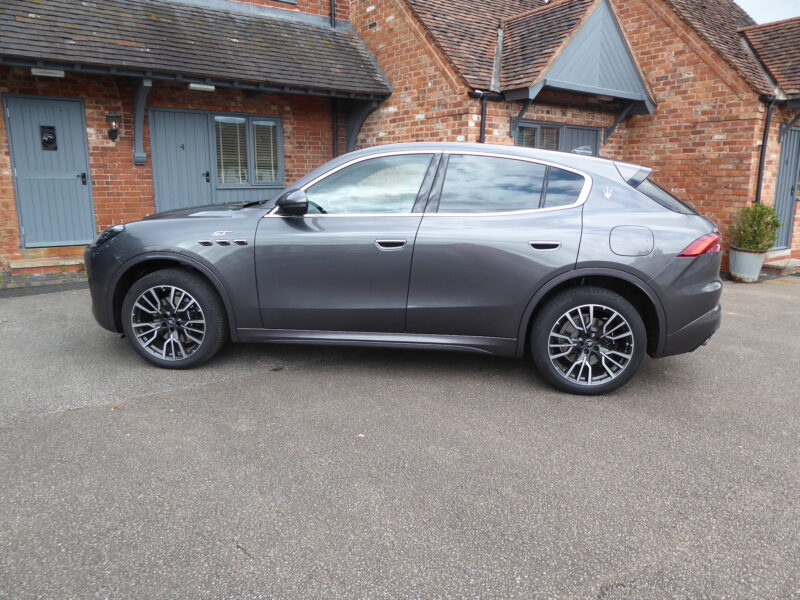
Beauty, as they say, is in the eye of the beholder, and what one person finds ugly, others either do not mind, or even quite like. Clearly designers these days have some very different opinions from the buying public, as many of them have to defend their latest creations when there is an overwhelming condemnation of what they have produced (even if sales do not appear to be as hared as you might expect), but there are some cars (very few at present) which gain more or less universal approval for their appearance. The Grecale is probably one of those cars. Certainly to my eyes, it joins the Alfa Stelvio and the Jaguar F Pace on my list of the only good looking large SUVs. There are some obvious styling links to other Maserati models here even if I do struggle to associate the rear lights with those boomerang units on the 3200GT. If the car is as good to drive as I suspected it would be, it is a clear contender to replace my Ghibli when the time comes, and of course, these words kind of came out of mouth when talking with the staff at Graypaul Maserati, so it is perhaps not a surprise that to try to tempt me further, they ensured that a Grecale was available for me to drive when my car was in for a service. Well, that was the plan, but it did not work a few weeks ago, as the previous driver of the loaner had not brought it back (I gather it had gone over the road to Ferrari) and I ended up with the rather unlovable Golf GTE. But it was a case of second time lucky and this time, there was a Grecale available for me to sample for the day.


The 2.0 litre (very) mild hybrid with which I am very familiar from my current Ghibli is used in two of the three Grecale models, too. It is offered here in two states of tune, The entry level GT, which was the spec of the car I was driving, has 300 bhp, whilst the Modena has 330 bhp, which is the same as the Ghibli offers. Even though I was around 100% down in power compared to the Ghibli and in a heavier car, the Grecale GT still goes well. Just like the Ghibli there is a pleasant sort of noise that you get on start up and if the harder you push the car the more of an agreeable growl you get. Of course, in modern traffic, you probably won’t need to push the car at all hard, so instead you can enjoy the smoothness of it all. There is an 8 speed automatic transmission and it is very well matched with the engine, making almost imperceptible gear changes. Rather than a traditional gearlever, the Grecale has a row of push buttons on the dash, below the lower touch screen. I found that you needed to press them quite deliberately, especially the Reverse one, to be sure they had engaged. One consequence of this is that the only way to change gear manually is to use the paddles, which are standard on all models of the Grecale. These are absolutely massive, far bigger than I would like, really. So whilst they are easy to reach, their size does mean it is a bit of a reach around them to get to the indicators and wipers, especially if you don’t have big hands. No doubt this is something that you would get used to with familiarity, but I marked it down as a demerit compared to the Ghibli. I thought that the Grecale was a little noisier than the Ghibli, but even so this is a refined car. Certainly on the dual carriageway or motorway, there is just a whisper of wind noise, but otherwise this is a very refined machine indeed and would be a very relaxing cruiser over long distances.


The steering is on the light side, which does mean that this large and relatively heavy car (as are all of its competitors, let’s be honest) is easy to drive and also not hard to park up, but a bit more feel would at times be welcome. My testing was a mix of a bit of motorway and some cross-country A and B roads, so there were a few bends to take in, and the car seemed quite at ease with them, with plenty of grip, as you would expect from the standard all-wheel drive set up and the handling prowess that comes from the Giorgio platform on which the car is built. It rode well, proving comfortable on all surfaces. This one had the smallest available wheels, 255/45 R20. Larger ones are available, depending on choice of wheel trim, as you might expect. The brakes were very effective, needing only a gentle touch in ordinary circumstances. The electronic parking brake is low on the dash over the driver’s knee. It is not very obvious, and I did need it when manoeuvering, as sometimes it did not disengage automatically, probably for safety reasons. Visibility is about par for the course these days, with a decent field of view from the mirrors and the rear camera is helpful when parking. Some of the additional features you might expect though are on the options pages. You might not miss Lane Keep Assist and other annoying ones, but some like Blind Spot Warning would be useful.


You will be in no doubt that you are looking at a Maserati when you open the door, not least because of the slightly elliptical clock which is mounted in the top centre of the dash, which still retains two hands to show you the time, even though the system is set automatically for you and it is actually a digital item, but also because of the overall quality of the interior. Whilst there is a more modern appearance to it, thanks to the presence of two touch screens in the centre of the dash, the Maserati style is still very obvious and although in the entry level GT you don’t get lashings of leather on the dash and doors like you do in a Modena or Trofeo, the materials used are still quality to look at and soft and pleasing to touch. That is true of the inlays, too, of which there are several choices available when you come to configure a car and of course there is a leather-wrapped wheel which is just the right thickness to make it good to hold. The instruments are different from those in the Ghibli, electronically generated, of course and they have nice crisp graphics. There are two large dials for speedo and rev counter, with smaller water temperature and fuel level inset in the lower portion of the big dials. The area between them, that used to be used for a series of trip computer and info displays is now available for a projection of the navigation data, as all that trip stuff is now somewhere in the touchscreen, a regrettable move, to my mind, but this is common these days, as is the fact that the odometer does not show when you are driving along. There are no fewer than 30 buttons on the steering wheel, including a large one to the lower left to start and stop the engine, with others controlling cruise control and some audio repeater functions. Some of these also operate from buttons on the back of the wheel. One welcome change over the Ghibli is that you get two column stalks, rather than the one, though I thought the new noise that goes with the indicators was not an improvement! The lights are set on the touch screen, so putting them into Auto mode is important. Controlled by Maserati Connect, the 12.3” upper touchscreen – the largest ever seen in a Maserati to date – has different software to the set-up in my current Ghibli though there are enough similarities that I was able to do what I wanted to without much of a learning curve. You get all the features you would expect including DAB radio, Apple Car Play, Android Auto and navigation. There is a Sonus Faber sound system with 14 speakers. The lower 8.8” screen is used for the dual zone automated climate control system. It is not as easy to use as the old buttons were but this seems to be the way every manufacturer is going.


Access into the Grecale is through relatively small doors which have electric releases on both inside and out. First impressions are good, as this is light and airy thanks to an expansive panoramic glass roof and a relatively uncluttered design. The two seats seem well apart thanks to quite a wide console, just as you get in the Ghibli and Levante. They are 10-way electrically adjustable in the GT (and 14-way in the Modena and Trofeo models) and the steering column is also electrically adjusted. There are three memory settings and you do need to use these, as the seat powers back when you cut the ignition, to aid exit and entry. Like all Maserati models, the quality of the leather that trims them is exemplary, which, combined with the tasteful interior décor really does make you feel like you are in a luxury product. The seats also proved supremely comfortable. Add in the refinement on the motorway and this truly would be a superb way to traverse a county or two in comfort, style and leaving you feeling relaxed at journey’s end.


The rear space is certainly good enough for two adults to travel in comfort, and they will find a USB and a USB-C socket to share between them, as well as a vent each, with a separate rear climate control setting on the Modena and Trofeo cars. Those rear passengers will find they can easily slide their feet under the front seats, and headroom is decent. What they won’t want is another person sat between them, and the person in the middle will certainly be the least happy of the three. The centre console extends well back and the transmission tunnel is pretty wide, so their feet will be straddling it, but at least there’s no lump in the middle so they’ll be on a flat bench seat. Stick with two rear occupants and they can drop the central armrest, which reveals a pair of cupholders, as well as a through-load hatch. The rear door bins are, like the ones in the front, smaller than many other similar cars, again thanks to the hefty speaker embedded into the door and in GT guise there are no map pockets on the back of the front seats, something you do get in the posher trims. If you’re putting child seats in the back, there’s enough space once they’re in, but the rear doors don’t open particularly wide and the ISOFIX fixings aren’t the most accessible, so it’s a bit of a faff if you’re moving seats in and out of the car.


The Grecale stacks up pretty well for boot space. The top-spec Trofeo has an extra 35 litres of space thanks to it being the only car that doesn’t have additional batteries for a hybrid system, but the GT and Modena still boast 535 litres, which beats the BMW X4’s 525 litres and the 500 of the Porsche Macan. It’s a big square shape. There’s no under-floor stowage or moveable boot floor, beyond space for some tyre foam and a repair kit, but a 12-volt power socket, a pair of bag hooks, four tie-down points and an elasticated belt for securing small items are all present. Drop the asymmetrically split rear seats, which fold at the touch of a button in the boot, and it’s an easy slide of lengthy items through the luggage area, as the seats fold flat to the boot floor. There is also a ski flap. There is electric closing for the rather large tailgate. Inside the passenger compartment, there are a pair of decent-sized cupholders and a very deep under-armrest storage, cubby which is countered by a modest glovebox and below-average door bins, the latter hampered by the hefty speakers in the doors.

The Maserati Grecale GT comes with black leather upholstery (with 10-way power adjustment for the driver), a 12.3-inch touchscreen navigation display (with Apple CarPlay and Android Auto), Amazon Alexa and Google Assistant. It also features selectable drive modes as well as an eight-speed automatic gearbox and mild-hybrid electrical assistance. The Grecale GT comes with 19-inch alloy wheels as standard. Almost all of the convenience features that you might reasonably expect for a car of this price are included, from dual-zone climate control, auto lights and wipers, to leather seats, an electrically assisted tailgate, a 14 speaker 3D Sonus Baber sound system, navigation and plenty more. The slightly sportier Modena version of the Grecale gets more power – 330 bhp as opposed to 300 – than the GT, and has the quad exhaust tips to show it. There’s also three-zone climate control, 14-way electric adjustment for both front seats, a head-up display, an extra 8.8-inch touchscreen control panel for the air conditioning system, 20-inch alloy wheels, black brake callipers, contrast stitching for the leather seats, and open-pore wood trim. The Trofeo is the most powerful version of the Grecale, with its 530hp V6 engine. It comes as standard with 21-inch alloy wheels, red painted brake callipers, adaptive ‘Skyhook’ suspension, carbon-fibre body kit, black premium leather with contrast red stitching, and carbon-fibre cabin trim as well as an upgraded 21 speaker sound system. A lot of what you will either think of as invaluable safety tech or a suite of annoying features many of which you want to disable, are optional in one of two Driver Assistance packs – even on the top-spec £100,000 Trofeo. The basic driver assistance pack adds adaptive cruise control, lane keeping and blind spot assist systems, full LED matrix headlights, driver drowsiness protection and auto-dimming rear view mirrors, much of which it’s a little surprising to find isn’t standard. The Advanced Driver Assistance Plus Pack adds traffic sign recognition, intelligent speed assist, intersection collision assistant and active driving assistant safety systems, although it costs in the region of £5,000, almost double the basic package.


Although I had the Grecale for a day, I did not get to do as many miles as I would like, but from what I experienced, there was lots to like here and not much that I did not. Those large paddles are bit irksome, and the move to putting everything in the touchscreen is not welcome, but follows industry trends, but otherwise, this is an appealing car. It is definitely on the short list when it comes to Ghibli replacement time.