



































Needing a car to try to change Kia’s image from a producer of ever more competent but still relatively unexciting saloons, hatches and crossovers, this Korean automotive giant showed us a concept at the 2006 North American International Auto Show in Detroit. Well received, Kia then announced plans to put the car into production, which took a couple of years. Pleasingly, when the production model made its debut at the 2008 Paris Show, it looked very similar to that concept. Although launched in Europe, Kia were fairly clear that the prime market for the car was North America and they were targeting buyers in the age range 18 – 35. For those looking for an affordable and relatively entry level car, in America at least, it became the trendy option and sales took off. Europeans were more guarded and the car never really found that much success, even though Kia have persisted with the model in their range. The Koreans tend to have relatively short model cycles, so it was not long before a second generation arrived. With looks that were closely related to the first Soul, it offered the latest mechanical components as well as upgraded trim and a wider range of standard features. At the 2018 Los Angeles Show, Kia showed us a third generation Soul which was slated to go on sale in 2019 as a 2020 model year car. Still clearly a Soul, again this represented more of a considered evolution as opposed to a rethink. New slimline headlights at the front and revised rear styling were easy recognition points and the car boasts more in the way of tech and safety equipment as is the case with all cars these days.

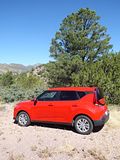




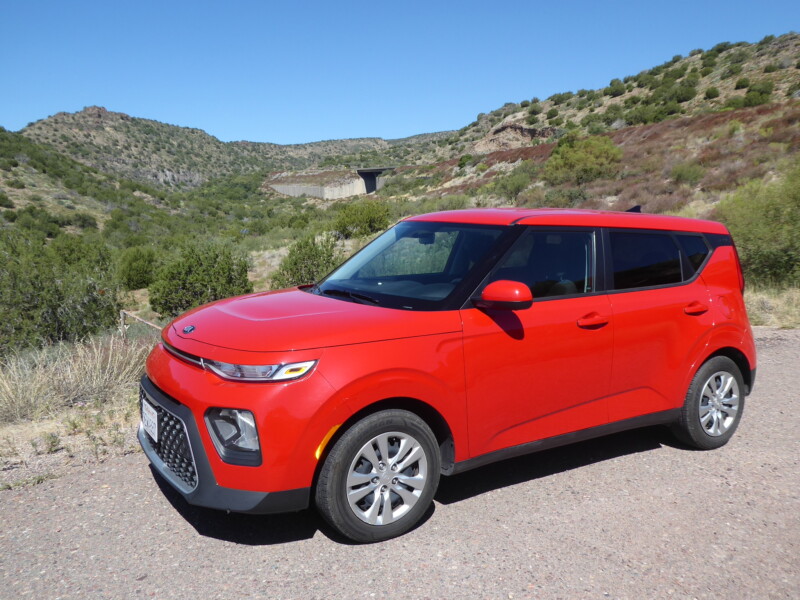
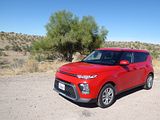
I have to admit to that first Soul being one of my automotive guilty pleasures, finding something quite appealing about its boxy styling. I drove a couple of them, one in the UK and later a US market car and found them just as appealing on the road as they were to look at. I got to sample a second generation car back in 2014 which was so new that it had a piece of paper stuck in the rear window with a temporary licence plate number on it. So I was of course eager to try the third generation car. Like many cars launched in the immediate pre-Covid era it has taken time for them to build up in the rental fleets, with plenty of the older cars still clinging on for duty, but they are there now. I spotted a bright red one parked up at the Phoenix Sky Harbor airport on my second night in the city, so saw this as my opportunity to test the car out. When I got the chance to look at the test car in detail, I found that it was in fact built in July 2019, so probably one of the very first of the third generation cars. It had covered a not inconsiderable 51,600 miles but was actually in excellent condition. How would this translate to the experience on the road? Read on.





Like all but the very top spec third generation Soul models, the test car had a 147 bhp 2.0 litre four cylinder engine coupled to a CVT transmission. Overall impressions are that the engine is smooth and refined, but you do need to work it quite hard to get strong acceleration. This is definitely one of the better CVTs, though, lacking the rather annoying drone that you get with some of the genre. Whilst engine noise is well suppressed, there was notable road noise on some surfaces. I covered a total of 208 miles during my time with the Soul and it needed 6.3 gallons to fill it which works out at 33.01 mpg US or 39.44 mpg Imperial, a decent result.










The other driving characteristics are surprisingly good. The steering is on the light side but there is some feel. The Soul is only available with front wheel drive and it handles as you would expect, with plenty of grip, though there is more body roll than you might be used to if you tackle corners with some gusto. I actually found it surprisingly fun to drive, especially given its shape and stance. The brakes worked well. You still get a conventional pull-up handbrake between the seats, an increasing rarity these days. The ride, on relatively small and high profile 205/60 R16 tyres was pretty decent. The boxy styling certainly helps with the visibility, and the Soul is particularly easy to park up, though the up-turned third side window can limit your rear view at oblique junctions.





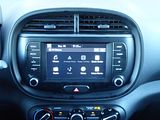
Even without considering the fact that the Soul is a budget car, the interior is nicely done, with both decent quality materials and some effort made in choosing some textures and colours to liven things up a bit. There are textured and shaped aluminium-look effects on the doors and air vent surrounds. You do get a plastic moulded wheel in this trim level, but it was perfectly acceptable. The instrument cluster comprises two large dials for speedometer and rev counter with smaller fuel level and water temperature gauges inset. Everything here is pretty conventional. There are two column stalks which include an auto lights function on the left hand one. The 7” colour touch infotainment screen set high in the centre of the dash is pretty basic in function, with only really an AM/FM radio of note. Apple Car Play and Android Auto are included as is a Bluetooth connection. Posher versions of the Soul add more function, of course. There are six audio speakers and sound quality was perfectly acceptable. You might think the provision of just one USB port a bit mean these days, but that is all you get. Thankfully you also get a good number of buttons for some of the commonly used audio functions, so there is no need to scroll through menu son the screen for a lot of what you will want to be doing. Beneath this unit are three rotary dials for the air conditioning system which coped well with some high temperatures on my test day.









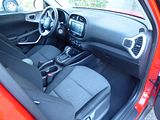
The doors open wide and there is a real feeling of space here, thanks largely due to the tall styling. The seats are cloth upholstered and have manual adjustment. Only the driver gets a height adjuster. The steering column telescopes in/out as well as up/down over quite a wide range, so getting a good driving position was easy, and I found the seat to be very comfortable.




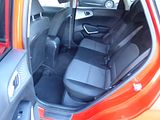
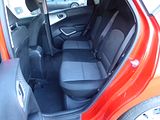
There is lots of space in the back, and again access is good. Headroom is particularly generous, and with a flat floor, a middle seat occupant will have no problems in finding somewhere for the feet. Even with the front seats set well back there is a surprising among of space. S trim means that you get neither an armrest nor map pockets but there are bins on the doors for any bits and pieces that occupants here would want to stow.



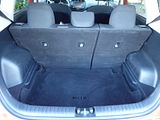
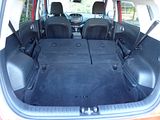
Another consequence of the boxy styling is that you get a good-sized boot for a car with relatively small external dimensions. In particular, the load space is very deep. It is a nice regular shape and can be extended by dropping down the split folding rear seats, which results in a completely flat much longer load area. Disappointingly there is no load cover, but this is quite normal on US market cars. Inside the cabin, there are plenty of places for odds and ends, with a massive glovebox, a big recess in front of the gearlever as well as an armrest cubby and door bins.


The 2020 Kia Soul comes in six trims: LX, S, X-Line, EX, GT-Line, and GT-Line Turbo. Nearly all trims come standard with a 147 bhp four-cylinder engine; the GT-Line Turbo is the sole trim to have a 201 bhp turbocharged engine. The base LX model is available with a six-speed manual or a continuously variable automatic transmission (CVT); most other trims come standard with the CVT, but the GT-Line Turbo has a seven-speed dual-clutch automatic. Standard features in the 2020 Kia Soul LX include cloth upholstery, a six-way manually adjustable driver’s seat, a rearview camera, and a 7-inch touch-screen infotainment system with Android Auto, Apple CarPlay, a six-speaker stereo, a USB port, and Bluetooth. The Kia Soul S comes with alloy wheels, premium cloth upholstery, and numerous additional active safety features including forward collision warning, automatic emergency braking, lane departure warning, lane keep assist, driver attention monitoring, blind spot monitoring, and rear cross traffic alert. The Kia Soul X-Line has unique appearance attributes as well as fog lights and a leather-wrapped steering wheel and shift knob. The Kia Soul EX adds a 10.25-inch touch screen, HD Radio, satellite radio, navigation, wireless device charging, voice recognition, and two additional USB ports. This trim also comes standard with an eight-way power-adjustable driver’s seat, heated front seats, dual-zone automatic climate control, proximity keyless entry, push-button start, heated outside mirrors, and a rear centre armrest. The Kia Soul GT-Line closely mimics the features list of the Soul S, but it adds unique sporty exterior design elements. And finally, the range-topping Kia Soul GT-Line Turbo features LED headlights, a sunroof, a 10-way power-adjustable driver’s seat, combination cloth and synthetic leather upholstery, a heated steering wheel, a Harman Kardon premium stereo, pedestrian detection, adaptive cruise control, and a head-up display.









Provided you get on with the distinctive styling – and not everyone does – then the Soul is a very likeable car. There is lots of room in it for people and luggage, it is nicely finished and it drives pretty well. It is no wonder that when you add in an affordable purchase price and generous warranty terms then this car has deservedly sold well in America. The appeal is not just as a first car for college kids – though that is where plenty of the sales do come from – but to others who want something that does not shout “poverty special” to the rest of the world. The Soul has also long been a popular car in the rental fleets and as a number of manufacturers decide not to replace their low-end offerings, then I can only see the Soul becoming the car that you are ever more likely to receive, and that would be no bad outcome.