March is the month when the popular monthly Queen Square Breakfast Club meets revert from their winter location of Easter Compton Farm Shop to the very attractive Eastwood Park, a large country house situated just off junction 14 of the M5, a few miles north of Bristol. The thinking is that spring will already be in evidence or close enough that there is less need for the covered display areas of Easter Compton, and with luck, the grass areas will be dry enough to be used for parking, giving a far greater capacity as well as a nice setting. In 2024, the spring was slow to arrive and the grass was not dry enough for many venues, including this one until the end of April, but 2025 has been much drier in the early weeks of the year, and so all was fine with the grass areas. On the day of this event, the second Sunday of the month, as is customary, the weather was pleasingly spring like and cars turned out in massive numbers. In fact, on a scale never seen before. Usually things get a bit quieter for the marshalls between 9 and 9:30, but not this time, with a constant procession of cars arriving, until it was clear that the site was absolutely. Unbeknown to everyone who had got into the event, the queue for entry stretched not just down the long approach road to the site, but back on the main road and at its worst as far as the motorway. After waiting for well over an hour, many turned round and went home. Some did get in as once cars started to leave there was some space freed up, but no question, this was a very busy event. The nice weather had encouraged some owners to get cars out of the garage and off SORN, though there was still a preponderance of more recent machinery here. Even so, there was plenty to look at, along with an awful lot of modern enthusiast (and generally modified) machinery less to my taste and not deemed worthy of photos. So are the highlights for me:
ABARTH
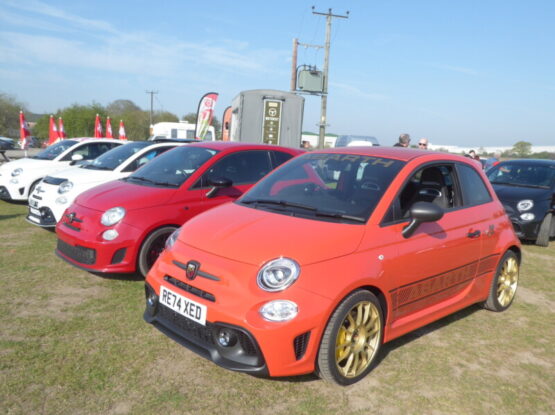
What is known as the Series 4 version of the familiar 595 reached the markets in the middle of 2016. After rumours had circulated all winter following the launch of the facelifted Fiat 500 last year, Abarth finally unveiled the Series 4 at the end of May 2016. Initially, we were told that the cars would not be available in the UK until September, but that came forward somewhat, with dealers all receiving demo cars in June, and the first customers taking delivery in July. Three regular production versions of both the closed car and the open-topped C were initially available, all badged 595, and called Custom, Turismo and Competizione, as before, though numerous limited edition models have since appeared and in most case disappeared. The most significant changes with the Series 4 are visual, with a couple of new colours, including the much asked for Modena Yellow and a different red, called Abarth Red, which replaces both the non-metallic Officina and – slightly surprisingly – the tri-coat pearlescent Cordolo Red. as well as styling changes front and rear. The jury is still out on these, with many, me included, remaining to be convinced. At the front, the new air intake does apparently allow around 15 – 20 % more air in and out, which will be welcome, as these cars do generate quite a lot of heat under the bonnet. Competizione models for the UK retain the old style headlights, as they have Xenon lights as standard, whereas the Custom and Turismo cars have reshaped units. At the back, there are new light clusters and a new rear bumper and diffuser. Inside, the most notable change is the replacement of the Blue & Me system with a more modern uConnect Audio set up, which brings a new colour screen to the dash. Mechanically, there is an additional 5 bhp on the Custom (now 145) and Turismo (now 165 bhp) and the option of a Limited Slip Diff for the Competizione, which is likely to prove a popular option. Details of the interior trim have changed, with a filled-in glovebox like the US market cars have always had, and electric windows switches that are like the US ones, as well as a part Alcantara trim to the steering wheel in Competizione cars.

A top of the range 595 Esseesse model was added in early 2019. These cars have only sold in quite small numbers, so you don’t see them that often. The most obvious change externally is the adoption of the neat white painted 17inch multi-spoke alloy wheels that are an Esseesse trademark, while elsewhere it gets the same recently reprofiled bumpers as the standard 595. Inside, there’s a pair of bespoke figure-hugging Sabelt high-backed seats with a carbonfibre shell and some natty red stitching, while carbonfibre trim also covers the pedals and the dashboard. Under the bonnet is the familiar 178bhp turbocharged 1.4-litre engine, but here it breathes in through a BMC filter and exhales from a switchable carbonfibre-tipped Akrapovič twin exit exhaust. There’s no more power than the old Competizione, but the Esseesse gets that model’s Brembo callipers for its 305mm front discs, plus a limited-slip differential. The suspension is largely carried over, including Koni’s frequency selective dampers. All this comes at a price though, and so this has remained a relatively rare sighting compared to the Competizione which many still feel offers rather better value for money. For 2022, the badging was changed so the Esseesse is now branded a 695 rather than a 595 and there were minor spec changes.


The Punto Evo was launched at the 2010 Geneva Show, with the cars reaching UK buyers in the summer of that year, and it incorporated many of the changes which had been seen a few months earlier on the associated Fiat models, the visual alterations being the most obvious, with the car taking on the nose of the associated Fiat, but adapted to make it distinctively Abarth, new rear lights and new badging. There was more to it than this, though, as under the bonnet, the T-Jet unit was swapped for the 1.4 litre Multi-Air, coupled to a 6 speed gearbox, which meant that the car now had 165 bhp at its disposal. Eventually, Abarth offered an Esseesse kit for these cars, though these are exceedingly rare. Part of the Punto Evo family is the SuperSport, usually identified by the distinctive black bonnet, though not all cars feature it. Just 199 of the SuperSport versions were built, of which around 120 are registered on UK roads. These cars had many of the options from the Punto Evo included as standard. Power came from the the 1.4-litre MultiAir turbo engine, tuned to produce 178bhp and 199lb ft of torque, up from 165 of the standard Punto Evo, giving the SuperSport a 0-62 time of 7.5 seconds and a top speed of over 132mph. To help put the power down, the SuperSport was fitted with wider 18″ wheels and optional Koni FSD dampers. Standard equipment included the Blue&Me infotainment system with steering wheel controls, automatic climate control and a popular option was the ‘Abarth Corsa by Sabelt’ sports leather seats. The SuperSport was available in the same colours as the regular Punto Evo, which means white, grey, black and red.

ALFA ROMEO
The 916 Series cars were conceived to replace two very different models in the Alfa range. First of these was the open topped 105 Series Spider which had been in production since 1966 and by the 1990s was long overdue a replacement. Alfa decided to combine a follow on to the Alfetta GTV, long out of production, with a new Spider model, and first work started in the late 1980s. The task was handed to Pininfarina, and Enrico Fumia’s initial renderings were produced in September 1987, with the first clay models to complete 1:1 scale model made in July 1988. Fumia produced something rather special. Clearly an Italian design, with the Alfa Romeo grille with dual round headlights, recalling the Audi-based Pininfarina Quartz, another design produced by Enrico Fumia back in 1981, the proposal was for a car that was low-slung, wedge-shaped with a low nose and high kicked up tail. The back of the car is “cut-off” with a “Kamm tail” giving improved aerodynamics. The Spider would share these traits with the GTV except that the rear is rounded, and would feature a folding soft-top with five hoop frame, which would completely disappear from sight under a flush fitting cover. An electric folding mechanism would be fitted as an option. Details included a one-piece rear lamp/foglamp/indicator strip across the rear of the body, the minor instruments in the centre console angled towards the driver. The exterior design was finished in July 1988. After Vittorio Ghidella, Fiat’s CEO, accepted the design, Alfa Romeo Centro Stile under Walter de Silva was made responsible for the completion of the detail work and also for the design of the interiors, as Pininfarina’s proposal was not accepted. The Spider and GTV were to be based on the then-current Fiat Group platform, called Tipo Due, in this case a heavily modified version with an all new multilink rear suspension. The front suspension and drivetrain was based on the 1992 Alfa Romeo 155 saloon. Chief engineer at that time was Bruno Cena. Drag coefficient was 0.33 for the GTV and 0.38 for the Spider. Production began in late 1993 with four cars, all 3.0 V6 Spiders, assembled at the Alfa Romeo Arese Plant in Milan. In early 1994 the first GTV was produced, with 2.0 Twin Spark engine. The first premiere was then held at the Paris Motor Show in 1994. The GTV and Spider were officially launched at the Geneva Motor Show in March 1995 and sales began the same year. The cars were well received. At launch, many journalists commented that Alfa had improved overall build quality considerably and that it came very close to equalling its German rivals. I can vouch for that, as I owned an early GTV for eighteen months, and it was a well built and reliable car. In 1997 a new engine, a 24-valve 3.0 litre V6, was available for the GTV along with bigger, 12.0 inch brakes and red four-pot calipers from Brembo. The console knobs were changed from round central to rectangle ones and to a three-spoke steering wheel. Some versions were upgraded with different front bumper mesh to bring the wind noise down to 74 dBA. In May 1998 the cars were revamped for the first time, creating the Phase 2 models. Most of the alterations were inside. The interior was changed with new centre console, painted letters on skirt seals, changed controls and switches arrangement and different instrument cluster. Outside, the main changes included chrome frame around the grille and colour-coded side skirts and bumpers. A new engine was introduced, the 142 hp 1.8 Twin Spark, and others were changed: the 2.0 Twin Spark was updated with a modular intake manifold with different length intakes and a different plastic cover. Power output of the 2.0 TS was raised to 153 hp. Engines changed engine management units and have a nomenclature of CF2. The dashboard was available in two new colours in addition to the standard black: Red Style and Blue Style, and with it new colour-coded upholstery and carpets. The 3.0 24V got a six-speed manual gearbox as standard and the 2.0 V6 TB engine was now also available for the Spider. August 2000 saw the revamp of engines to comply with new emission regulations, Euro3. The new engines were slightly detuned, and have a new identification code: CF3. 3.0 V6 12V was discontinued for the Spider and replaced with 24V Euro3 version from the GTV. 2.0 V6 Turbo and 1.8 T.Spark were discontinued as they did not comply with Euro3 emissions. By the 2001-2002 model year, only 2 engines were left, the 2.0 Twin.Spark and 3.0 V6 24V, until the Phase 3 engine range arrived. The Arese plant, where the cars had been built, was closing and, in October 2000, the production of GTV/Spider was transferred to Pininfarina Plant in San Giorgio Canavese in Turin. In 2003 there was another and final revamp, creating the Phase 3, also designed in Pininfarina but not by Enrico Fumia. The main changes were focused on the front with new 147-style grille and different front bumpers with offset numberplate holder. Change to the interior was minimal with different centre console and upholstery pattern and colours available. Instrument illumination colour was changed from green to red. Main specification change is an ASR traction control, not available for 2.0 TS Base model. New engines were introduced: 163 hp 2.0 JTS with direct petrol injection and 237 hp 3.2 V6 24V allowing a 158 mph top speed. Production ceased in late 2004, though some cars were still available for purchase till 2006. A total of 80,747 cars were made, and sales of the GTV and Spider were roughly equal. More V6 engined GTVs than Spiders were made, but in 2.0 guise, it was the other way round with the open model proving marginally more popular.


The Alfa Romeo 4C is a two-seater, rear-wheel drive coupé with technology and materials derived from the Alfa Romeo 8C Competizione, with a 1750 cc turbo petrol engine with direct injection, the “Alfa TCT” twin dry clutch transmission, and the Alfa DNA dynamic control selector. The 4C concept version was unveiled in the 81st Geneva Motor Show in March 2011, followed by the Mille Miglia 2011 parade, Goodwood Festival of Speed 2011,2011 Frankfurt Motor Show. It was displayed for the first time outside in Concorso d’Eleganza Villa d’Este in 2012. Compared to the production version, it is very similar, with the biggest differences being front lights, side vents and mirrors. The Alfa Romeo 4C Concept was voted the ‘Most Beautiful Concept Car of the Year’ award by the readers of German magazine Auto Bild, and won the Auto Bild Design Award 2011. It was awarded the “Design Award for Concept Cars & Prototypes” by referendum of the public in Villa d’Este. The production car was unveiled at the 2013 Geneva Motor Show, followed by 2013 Essen ‘Techno Classica’, Goodwood Festival of Speed 2013, Moscow Raceway, 2013 Frankfurt Motor Show. The bare ‘4C000’ chassis was also shown at the 2013 Geneva Motor Show. Ordering of European models began in October 2013 at Alfa Romeo dealerships in Europe. As part of the Alfa Romeo 4C launch, Alfa Romeo Style Centre and Compagnia Ducale designed a 4C IFD (Innovative Frame Design) Bicycle, inspired by the Alfa Romeo 4C coupé. The vehicle went on sale in December 2013 and marketed in Europe, Asia and America. Production of the 4C began May 2013 at Maserati’s plant in Modena, with an expected production of up to 2500 units per year. It was the first mass-produced Alfa Romeo model to be sold in the US market since 1995 when the 164 sedan stopped being sold in the US. Production of the Alfa Romeo 4C was originally estimated to be over 1000 units per year, with an upper limit of 3500 units per year, depending on the quantity of carbon fibre chassis that can be built by the supplier Adler Plastic. Within the 3,500-unit quota, 1,000 units are earmarked for Europe. Delivery of the European Alfa Romeo 4C Launch Edition took place at Balocco (Vercelli, Italy) Test Centre. In 2018, the 4C coupe was discontinued for the North American market. The 4C Spider, however continued to be sold there for model year 2019 and model year 2020. In other markets, such as Australia and Japan, both the coupe and Spider continued. In late 2020, a new tribute-edition named the 4C Spider 33 Stradale Tributo was announced. The car was designed by Centro Stile Alfa Romeo (Style Centre) and developed by Alfa Romeo. The chassis is composed of a central carbon fibre tub, with aluminium subframes front and rear. The carbon fibre tub is produced by TTA (Tecno Tessile Adler) in Airola, as a joint venture between Adler Plastic and Lavorazione Materiali Compositi. The carbon fibre components that make up the chassis are cut using CNC technology. The entire carbon-fibre monocoque chassis (“tub”) of the car weighs 143 pounds (65 kg). Front and rear aluminium subframes combine with the tub, roof reinforcements and engine mounting to comprise the 4C chassis giving the vehicle a total chassis weight of 236 lb (107 kg) and a total vehicle curb weight of just 2,465 lb (1,118 kg). The 4C has a single carbon fibre body, similar to the body of many supercars. The outer body is made of a composite material (SMC for Sheet Moulding Compound) which is 20% lighter than steel. The stability is comparable to steel and better than aluminium. The 4C employs double wishbone suspensions at the front and MacPherson struts at the rear. The resultant weight distribution is 38% on the front and 62% on the rear axle. Wheels and tyres have different diameters and widths front and rear: 205/45 R17 front and 235/40 R18 back as standard, with optional 205/40 R18 and 235/35 R19. Both wheel options come equipped with Pirelli P Zero tyres. The 4C uses vented disc brakes on all wheels; Brembo 305 millimetres (12.0 in) on the front and 292 millimetres (11.5 in) on the rear. The car can stop from 100 km/h (62 mph) in 36 metres. To save weight and increase steering feel, the 4C has no power steering. Its center of gravity height, at 40 centimetres (16 in) off the ground, is 7 centimetres (2.8 in) lower than that of the Lotus Elise. The 4C uses a new all-aluminium 1,742 cc inline 4 cylinder turbocharged engine producing 240 PS at 6000 rpm. The engine has been designed for minimum weight. The engine’s combined fuel consumption 6.8 l/100 km (42 mpg‑imp; 35 mpg‑US).[4] 0–62 mph (0–100 km/h) acceleration is achieved in 4.5 seconds and the top speed is 258 km/h (160 mph), the power-to-weight-ratio being just 0.267 hp/kg (8.22 lb/hp) A journalist from Quattroruote car magazine demonstrated how the 4C accelerates from 0–100 km/h (0–62 mph) faster than 4.5 seconds. In race mode, with left foot on the brake pedal, if you pull the right shift paddle the engine will rev to 3500 rpm, but if you also pull the left paddle the engine will rev to 6000 rpm and 0–100 km/h (0–62 mph) time will go down to 4.2 seconds. Italian car magazine Quattroruote published the lap time of 4C around Nürburgring. It lapped the ring in 8:04. The 4C is equipped with a six speed Alfa TCT Dual Dry Clutch Transmission, and can be operated via gearshift paddles on the steering wheel. It also has an Alfa ‘DNA’ dynamic control selector which controls the behaviour of engine, brakes, throttle response, suspension and gearbox. In addition to the modes already seen in Giulietta, the 4C has a new “Race” mode. The U.S. version of the 4C was introduced in the 2014 New York International Auto Show with the first 100 4C’s being shipped to the U.S. early July, with a total of 850 being shipped by the end of 2014. The U.S. model includes extra bracing and strengthening required to meet U.S. crash regulations (including aluminium inserts in the carbon fibre chassis), resulting in 100 kg (220 lb) of weight increase. This version also has new headlamps similar to those seen before in the 4C Spider version. In 2018, the 4C coupe was discontinued for the North American market due to US DOT NHTSA FMVSS 226 Ejection Mitigation. The regulation called for a progressive compliance date based on volume and, due to low volume, the 4C was allowed to continue until the last compliance date of 9/1/2017, thus all 2018 4C coupes in North America have build dates of 8/2017 or earlier. The 4C Spider, however continued to be sold in North America for model year 2019 and model year 2020. The Spider version of the 4C was previewed showing a pre-production prototype at the 2014 Geneva Motor Show. Sharing its engine with the Coupé version, the 4C Spider has different external parts such as the headlights, exhaust and engine hood, as well as a different roof section that features a removable roof panel. The North American spec 4C reflects a weight difference of only 22 lb (10 kg) (2,465 lbs vs. 2,487 lbs) for the Spider variant. Top speed is quoted at 257 km/h (160 mph) and acceleration from 0 to 100 km/h (62 mph) at 4.5 seconds. The 4C Launch Edition was a limited and numbered edition, unveiled at the vehicle’s launch at the 2013 Geneva Motor Show. The vehicle came in a choice of four paint colours (Rosso Alfa, Rosso Competizione tri-coat, Madreperla White tri-coat or Carrara White matte). 500 examples were reserved for Europe/ROW, 500 for North America, 88 for Australia (Rosso Alfa and Madreperla White only), 200 to Japan and 100 for the Middle East. Note that the original press release cited 500 for North America, 400 Europe, and 100 ROW; however, the plaques on actual cars suggest that more were built and are the numbers referenced above. Distinguishing features of the Launch Edition were carbon fiber trim (including headlight housings, spoiler and door mirror caps), rear aluminium extractor with dark finishing, Bi-LED headlights, dark painted 18-inch front and 19-inch rear alloy wheels, additional air intakes on the front fascia, red brake calipers, racing exhaust system, BMC air cleaner, specific calibration for shock absorbers and rear anti-roll bar, leather/fabric sports seats with parts in Alcantara and a numbered plaque. Alfa Red coloured cars got matching red stitching on the steering wheel, handbrake, mats, handles and sports seats. In Europe the vehicle went on sale for 60,000 euros including VAT. The 4C Competizione is a limited edition version of the 4C introduced in the 2018 Geneva Motor Show, finished in matte Vesuvio Grey, with carbon details on the roof, rear spoiler, mirror caps, side air vents and headlight moulding. The run reportedly consisted of 108 units. The Japanese market received 25 units, and 10 units were assigned to Australia. The US-market received no Competizione editions. The car had a very mixed reaction. The UK press hated it at launch, but owners generally disagreed and loved it. A total of 9117 were built before production ceased in 2020.

Preceded by Alfa Romeo’s first off-roader, the Matta, in the 1950s and the Kamal concept car in March 2003, the Stelvio is Alfa Romeo’s first production SUV. The high-performance trim of the Stelvio, the Quadrifoglio, was unveiled on 16 November 2016 at the Los Angeles Auto Show. The European versions of the Stelvio were presented at the Geneva Motor Show in March 2017. On January 18, 2017, Alfa Romeo began accepting orders for the Stelvio First Edition in the EMEA region. On November 2, 2017, the Stelvio Quadrifoglio went on sale in Italy. The Stelvio uses the same Giorgio platform already used by the Giulia, but slightly modified and raised by 22 cm (8.7 in). The Stelvio also shares the same engines and most of the mechanics, including a carbon-fibre driveshaft. In addition, its track width has increased by 2.9 cm (1.1 in) in the rear and 5.4 cm (2.1 in) in the front. It has a boot capacity of 525 L (18.5 cu ft). The boot sill is aligned with the rear bumper and cargo does not need to be lifted over a lip when being removed. There are large vehicle blind spots behind the car’s pillars. It has a 50/50 weight distribution and a drag coefficient of 0.32 (Cd). Euro NCAP classify it as a large off-road car. In order to reduce the weight of the car, aluminium is used for body panels, as well as for mechanical parts such as the suspension, brakes, and engine. The suspension, called AlfaLink, implements double wishbones in the front, and an aluminium multi-link configuration in the rear. The springs are longer than those in the Giulia, but stiffer to account for the extra weight and ride height. The driver sits nearly 20 cm (7.9 in) higher from the road than in the Giulia.[15] The suspension is tuned for improved handling and driving dynamics, which can compromise ride quality if optional larger-diameter wheels are fitted. Rear-wheel drive as standard, the Stelvio can be optioned with an Alfa Romeo “Q4” all-wheel drive system, which can send up to 50% of power to the front in low-grip conditions. The Stelvio weighs 1,660 kg (3,660 lb) with all fluids, 145 kg (320 lb) less than an equivalent BMW X3 and 110 kg (243 lb) less than a four-cylinder Porsche Macan. The car’s braking system is designed to be less-susceptible to brake fade, which can take time for unfamiliar drivers to get used to. All models feature an 8.8-inch infotainment system with Apple Car Play and Android Auto as standard, while small tweaks have been made throughout the ranges. The car’s engine lineup is similar to that of the Giulia’s, with a turbocharged 2.0-litre inline-four and a 2.2-litre diesel inline-four. The Quadrifoglio trim level offers a 2.9 litre 690T twin-turbo 90° V6 rated at 510 PS (503 bhp), developed for Alfa Romeo by Ferrari. In Europe, consumption standards use the WLTP measuring system, which increases accuracy for consumption and emission figures. On 29 September 2017, a Quadrifoglio model set a Nürburgring lap time of 7 minutes, 51.7 seconds, the fastest for a production SUV. For the 2019 model year, diesel engines of the Stelvio were updated to meet the Euro 6d emissions standards, with AdBlue technology introduced to tackle particulates in the exhaust. Both the 150 PS (148 bhp) and 180 PS (178 bhp) versions got 10 PS (10 bhp) more from this change. In addition, Alfa Romeo introduced a new trim level for Europe: the Ti (Turismo Internazionale). Slightly different than the similarly named Stelvio Ti on sale in the United States, the Euro-spec Ti is fitted with the TBI-M 2.0-litre inline-four, mated to an eight-speed automatic transmission, with power sent to all four wheels through Alfa Romeo’s Q4 all-wheel drive system. In 2020, Alfa Romeo introduced the newly updated Stelvio in China, with both the Giulia and the Stelvio featuring updated interiors, a new 8.8-inch touchscreen for the infotainment system, which now offers a WiFi hotspot, over-the-air software upgrades, integrated emergency call function, and call assistant function. There is the new leather-wrapped multi-function steering wheel and gear lever, with revised dashboard materials. The debut for North America was in the 2019 LA Auto Show. As of 2022 in North America, the Stelvio has four distinct models. Starting with the base model Sprint, the Ti, the Veloce and the top-of-the-line Quadrifoglio. In light of the Alfa Romeo Tonale’s release, Stelvio’s range of models was condensed from seven to four. The Stelvio has been Alfa’s best-selling model in Europe for the past few years though in the UK, the Giulia has done slightly better.

Also here was an example of the much-lauded but still slow-selling Giulia.

ALPINE
The Alpine A110 R (which stands for “Radical”) is a track-focused version that debuted on 4 October 2022, featuring a redesigned body kit and a more aggressive chassis setup. It has been lightened and received performance upgrades, which helps it accelerate from 0 to 100 km/h in 3.9 seconds and can reach a top speed of 285 km/h. The A110 R features a generous use of carbon fibre components, contributing to a weight reduction of 34 kilograms (75 pounds) and bringing the total weight down to 1,082 kilograms (2,385 pounds). Among the carbon fibre components are the hood with dual air ducts, the 18-inch wheels, the engine cover, and the Sabelt Track monocoque seats. Performance improvements include a 0 to 62 mph (100 km/h) sprint time of 3.9 seconds, which is three-tenths of a second faster than the A110 S, and a top speed of 177 mph (285 km/h). Additionally, the A110 R features a stiffer suspension setup with adjustable dampers, allowing the ground clearance to be lowered by 10 millimeters (0.4 inches), and Brembo brakes with improved cooling. The dual exhaust system has been upgraded with a double wall produced using 3D printing to better isolate exhaust gases. It does not come cheap – the starting price is £91,000.

ARIEL
The Ariel Atom is a road-legal high performance open-wheel car made by the British Ariel Motor Company based in Crewkerne, Somerset, England, and under license in North America by TMI Autotech, Inc. at Virginia International Raceway in Alton, Virginia. The Atom began as a student project by Coventry University transport design student Niki Smart. Known then as the LSC (Lightweight Sports Car), it was developed at the university in 1996 with input and funding from various automotive industry members, including British Steel and TWR. Ariel Motor Company boss Simon Saunders was a senior lecturer whose responsibility for the project was primarily as financial manager and design critic for Smart, whom he described as “The best all-round design student I’ve ever seen.” The car was first shown publicly at the British International Motor Show at the NEC in Birmingham in October 1996. The Ariel Atom features a prominently visible chassis (i.e., an exoskeleton, no roof or windows, a small optional windscreen) and a drag coefficient of 0.40 There have been eight Ariel Atom generations to date: Ariel Atom, Ariel Atom 2, Ariel Atom 3 (including the Ariel Atom 3 Mugen Limited Edition and Honda Racing Edition – of which only one was made) Ariel Atom 3.5, Ariel Atom 3S, Ariel Spec:Race Atom, Ariel Atom 500 V8 Limited Edition (only 25 to be made), and the Ariel Atom 4. The limited production Ariel Atom 500 V8 featured a 500 bhp V8 engine. The Ariel Atom 4 uses a turbocharged 2.0 litre engine, also used in the Honda Civic Type R, with 3-stage boost.


ASTON MARTIN
Following the unveiling of the AMV8 Vantage concept car in 2003 at the North American International Auto Show designed by Henrik Fisker, the production version, known as the V8 Vantage was introduced at the Geneva Motor Show in 2005. The two seat, two-door coupé had a bonded aluminium structure for strength and lightness. The 172.5 inch (4.38 m) long car featured a hatchback-style tailgate for practicality, with a large luggage shelf behind the seats. In addition to the coupé, a convertible, known as the V8 Vantage Roadster, was introduced later in that year. The V8 Vantage was initially powered by a 4.3 litre quad-cam 32-valve V8 which produced 380 bhp at 7,300 rpm and 409 Nm (302 lb/ft) at 5,000 rpm. However, models produced after 2008 had a 4.7-litre V8 with 420 bhp and 470 Nm (347 lb/ft) of torque. Though based loosely on Jaguar’s AJ-V8 engine architecture, this engine was unique to Aston Martin and featured race-style dry-sump lubrication, which enabled it to be mounted low in the chassis for an improved centre of gravity. The cylinder block and heads, crankshaft, connecting rods, pistons, camshafts, inlet and exhaust manifolds, lubrication system and engine management were all designed in house by Aston Martin and the engine was assembled by hand at the AM facility in Cologne, Germany, which also built the V12 engine for the DB9 and Vanquish. The engine was front mid-mounted with a rear-mounted transaxle, giving a 49/51 front/rear weight distribution. Slotted Brembo brakes were also standard. The original V8 Vantage could accelerate from 0 to 60 mph in 4.8 seconds before topping out at 175 mph. In 2008, Aston Martin introduced an aftermarket dealer approved upgrade package for power and handling of the 4.3-litre variants that maintained the warranty with the company. The power upgrade was called the V8 Vantage Power Upgrade, creating a more potent version of the Aston Martin 4.3-litre V8 engine with an increase in peak power of 20 bhp to 400 bhp while peak torque increased by 10 Nm to 420 Nm (310 lb/ft). This consists of the fitting of the following revised components; manifold assembly (painted Crackle Black), valved air box, right and left hand side vacuum hose assemblies, engine bay fuse box link lead (ECU to fuse box), throttle body to manifold gasket, intake manifold gasket, fuel injector to manifold seal and a manifold badge. The V8 Vantage had a retail price of GB£79,000, US$110,000, or €104,000 in 2006, Aston Martin planned to build up to 3,000 per year. Included was a 6-speed manual transmission and leather-upholstery for the seats, dash board, steering-wheel, and shift-knob. A new 6-speed sequential manual transmission, similar to those produced by Ferrari and Lamborghini, called Sportshift was introduced later as an option. An open-topped model was added to the range in 2006 and then in the quest for more power a V12 Vantage joined the range not long after. All told, Aston produced 18 different versions of the model in a production run which continued until 2018, with a number of limited edition cars swelling the ranks.


This version of the Vanquish started life as the Project AM310 Concept that was unveiled at the 2012 Concorso D’Eleganza at Villa D’Este on the shores of Lake Como, Italy. The concept car was based on the fourth generation VH platform. It included a tweaked version of Aston Martin’s familiar grille and headlight design and a more pronounced bulge in the bonnet – with the real One-77-inspired flourishes saved for the sides and the rear, the side vents run almost to the door handles (from One-77), new rear light design from One-77, and a 5.9-litre V12 engine that produced 550 PS. Aston Martin later announced that the concept would be put into production as the all new Aston Martin Vanquish. The exterior styling of the Vanquish is an evolution of the DBS with many styling cues such as the elongated side strakes being inspired by the Aston Martin One-77. The boot lid included an integrated rear spoiler designed to look as if it is impossible to make; this was done on the orders of Aston Martin Chief Executive, Dr. Ulrich Bez. The car has an exposed carbon fibre side skirt showing its all carbon fibre body. The Vanquish uses the new VH Generation IV platform which is lighter and uses more carbon fibre components than the VH Generation II platform used in the DBS. The car featured an all new interior based on the one found in the exclusive One-77. The standard interior was trimmed in hand stitched leather and alcantara and was available in a range of colours. The centre console features an revised infotainment system over the one found in the DBS. The car was available as either a 2-seater or 2+2. The Vanquish used an upgraded version of Aston Martin’s flagship 5.9-litre AM11 V12 engine called the AM28 with a power output of 565 bhp at 6,750 rpm and torque of 457 lb/ft at 5,500 rpm. The Vanquish can accelerate from 0 to 100 km/h (62 mph) in 4.1 seconds, and has a top speed of 295 km/h (183 mph). Like most Aston Martins, the engine is front mid-mounted for better weight distribution, with the power going to the rear wheels. The Vanquish has 51/49 front/rear weight distribution, and a kerb weight of 1,739 kg (3,834 lb). It uses a fully catalysed stainless steel exhaust system with active bypass valves. The Vanquish uses an updated Touchtronic II six-speed automatic gearbox. It was the first Aston Martin model to be available with launch control. The combined space of cabin and a boot that, at 368 litres, is more than 60% larger than that of the DBS. The brakes are ventilated carbon ceramic discs, 398 mm (15.7 in) six-piston callipers in the front and 360 mm (14.2 in) four-piston callipers in the rear. The suspension is a lightweight aluminium front subframe with hollow castings with independent double wishbones incorporating anti-dive geometry, coil springs, anti-roll bar, and monotube adaptive dampers in the front and independent double wishbones with anti-squat and anti-lift geometry, coil springs, anti-roll bar, and monotube adaptive dampers in the rear. It has a three-stage adjustable adaptive damping system including normal, sport and track modes. The tyres are Pirelli P Zeros, 255/ZR20 in the front and 305/30 ZR20 in the rear. The vehicle was unveiled in the London Film Museum, Covent Garden, followed by 2012 Monterey Car Week. Deliveries to UK and Continental Europe began in late 2012. In August 2014, Aston Martin revealed technical modifications to the Vanquish. The changes include a new eight-speed Touchtronic III gearbox and upgraded AM29 V12 engine that produces 568 bhp and torque of 465 lb/ft. The changes greatly enhanced performance, with an acceleration of 0 to 100 km/h (62 mph) in 3.6 seconds, and a top speed of 324 km/h (201 mph). In 2013, Aston Martin unveiled a convertible version of the Vanquish, called Volante. The Volante includes a full carbon fibre body, triple-skin lightweight fabric roof, 50% larger boot than its predecessor and the third generation Brembo 398 mm × 36 mm front and 360 mm × 32 mm CCM rear Carbon Ceramic Matrix (CCM) brake discs with six-piston front and four-piston rear brake callipers (from the One-77). The Vanquish Volante is 13% torsionally stiffer than the outgoing DBS Volante. The carbon fibre-skin of the Vanquish Volante was created by the engineering team at Aston Martin. The vehicle was unveiled at the 2013 Pebble Beach Concours d’Elegance. Deliveries to Europe began in late 2013. On 16 November 2016, Aston Martin announced the new Vanquish S model. The Vanquish S features the same AM29 V12 engine, with power now increased to 595 bhp, and a new aerodynamic package. The Vanquish S can accelerate from 0 to 100 km/h (62 mph) in 3.5 seconds, and the top speed remains unchanged at 201 mph (324 km/h). The starting price at launch was £199,950 and deliveries started in December 2016. Aston Martin also unveiled a convertible version of the Vanquish S called the Vanquish S Volante in 2017.


The Aston Martin DBS Superleggera, also sold as the Aston Martin DBS, is a grand touring car produced from 2018 to 2024. In June 2018, Aston Martin unveiled the car as a replacement to the second-generation Vanquish. It is based on the DB11 V12, but featuring modifications that differentiate it from the DB11 lineage. The DBS name was previously used for a model built from 1967 to 1972 and for the DB9-based DBS between 2007 and 2012. In addition, the car also uses the Superleggera name which is a reference to Carrozzeria Touring Superleggera, who helped Aston Martin develop their lightest grand tourers in the 1960s and 1970s. In September 2024, Aston Martin announced the third-generation Vanquish as the successor of the DBS Superleggera. The front of the DBS features a new front bumper, with a larger centre grille compared to the DB11, for improved engine cooling, along with two air extractors on the sides to cool the brakes and two vents on the hood that aid in the engine cooling process. The 5.2-litre twin-turbocharged V12 engine, which is cast and manufactured at Grainger & Worrall in the United Kingdom before being shipped to the Aston Martin engine plant in Cologne for assembly, is rated at 725 PS at 6,500 rpm and 900 Nm (664 lb/ft) of torque from 1,800–5,000 rpm. In order to optimise the centre of gravity and weight distribution, the engine has been positioned as low and as far back in the chassis as possible. The DBS Superleggera features the new ZF 8HP95 transmission with a shorter final-drive ratio of 2.93:1, in contrast to the DB11’s 2.70:1. Chassis-wise, it also comes with torque vectoring and a mechanical limited slip differential for more focused track performance. The car also features many of the same aerodynamic features first seen on the DB11, including Aston Martin’s Aeroblade system, but refines aerodynamics with an F1-inspired double-diffuser that helps the car generate 397 lb (180 kg) of downforce – the highest figure ever for a series production Aston Martin. A new quad-pipe titanium exhaust system improves engine sound, while the usage of carbon fibre in major areas of the car lowers the weight down to 1,693 kg (3,732 lb). The DBS Superleggera can accelerate from 0–100 km/h (62 mph) in 3.4 seconds, and 0–161 km/h (100 mph) in 6.4 seconds. The car can also accelerate from 80–161 km/h (50–100 mph) in 4.2 seconds at fourth gear and can attain a top speed of 340 km/h (211 mph). Three driving modes are available: GT, Sport, and Sport Plus which adjust the car’s responsiveness. A Volante (convertible) model of the DBS was unveiled in April 2019. It has nearly identical performance and the same engine and transmission as the coupé but comes with an eight-layer soft top with eight colour options. For the first time on an Aston Martin automobile, the windshield surround is available in carbon fibre as well as the rear tonneau cover. There were a number of limited edition versions produced, too, in very small quantities.


The latest and still current Aston Martin Vantage was unveiled on 21 November 2017 with production starting in June 2018, replacing the previous model which had been in production for 12 years. It introduced a new styling direction but this was not universally well received and the car had a hefty price increase over its predecessor. Muted press enthusiasm did not help and sales have been disappointing. Aston Martin have continued to develop the model with a number of new versions introduced, to try to improve demand. The Vantage AMR is a track-focused variant of the Vantage. The main highlight of the model is the replacement of the ZF 8-speed automatic transmission with a dog-leg Graziano Trasmissioni 7-speed manual transmission previously used on the V12 Vantage S. The AMR also comes with a driver-selectable AMSHIFT system which controls the throttle during gear shifting. A new limited-slip differential ensures linear delivery of power. The power-band of the engine is wider and the unit is designed to deliver 625 Nm (461 lb/ft) of torque from 2,000 rpm to 5,000 rpm. The use of a manual transmission and carbon-ceramic brakes reduce the weight by 95 kg (209 lb). New adaptive dampers with the section of Sport, Sport + and Track modes improve handling. Performance figures include a 0–97 km/h (60 mph) acceleration time of 3.9 seconds, half a second more than the standard Vantage while the top speed remains the same as the standard model. Visual changes include 20-inch forged wheels as available on the Rapide AMR, new carbon fibre side vents and cooling vents present on the hood a sports exhaust system with quad tailpipes and racing bucket seats. Production of the AMR will be limited to 200 units worldwide. Available exterior colours for the AMR include Sabiro Blue, Pnyx Black, China Grey and White Stone. The final 59 cars will be finished in a Sterling Green exterior colour with Lime accents and will pay homage to the 1959 24 Hours of LeMans victory of Aston Martin. Once the production of the AMR ceases, the 7-speed manual transmission will become available on the standard Vantage. The vehicle went on sale in May 2019, with delivery set to begin in Q4 2019. Revealed in February 2020, the Vantage Roadster is a convertible version of the V8 Coupe with a fabric roof. The roof claimed to be the fastest of any automotive automatic convertible system, takes 6.7 seconds to lower and 6.8 seconds to raise and can be operated at speeds of up to 50 km/h (31 mph). The Vantage Roadster has a dry weight of 1,628 kg (3,589 lb). The F1 Edition is a version of the V8 Coupe and V8 Roadster commemorating Aston Martin’s return to Formula One after 61 years. The car features a fixed rear wing at the back, increased engine power to 535 PS (528 bhp), a top speed of 314 km/h (195 mph), new 21-inch wheel rims, and a 0–100 km/h (0–62 mph) acceleration time of 3.5 seconds. The car is available in three colours: Aston Martin Racing Green, Jet Black, and Lunar White. A convertible version called the Roadster is also available. Delivery began in May 2021.

AUDI
This model debuted in Europe in 1972 as the Audi 80, and in 1973 in Australia and North America (Canada and the USA) as the Audi Fox, and was available as either a two-door or a four-door saloon (sedan). It effectively took the place of several models that Audi had discontinued (the F103 series, which included the first model designated as an “Audi 80”), and provided the company with a viable rival to the Opel Ascona and the Ford Taunus (Ford Cortina in the UK), as well as more upmarket offerings including the Alfa Romeo Alfetta and Triumph Dolomite. The Audi 80 B1 was only the second modern-era Audi product to be developed entirely under Volkswagen ownership – Audi chief engineer Ludwig Kraus had famously been disparaging about the outgoing F103 series, referring to it as the “bastard”, owing to its Auto Union/DKW bodyshell and Mercedes-Benz engine. The B1 was a clean break from the Auto Union era, being equipped with a range of brand new 1.3- and 1.5-litre SOHC inline-four petrol engines – the first appearance of the now legendary EA827 series of engines, whose descendants are still used in VW Group vehicles to the present day. The internal combustion engines were available in various rated power outputs. For the 1.3-litre engines, (identification code: ZA) was rated at 55 PS, code: ZF was rated at 60 PS. The 1.5-litre (codes: ZB, ZC) at 75 PS for the ZB and 85 PS for the ZC. On the home market, two-door and four-door saloons were available in base trim (55 or 60 PS, called simply Audi 80 and 80 S, respectively), as L models (LS with 75 PS engine) or as a more luxurious GL (85 PS only). In September 1973, Audi added the sporty 80 GT (two-door only) featuring a carburettor 1.6-litre engine (code: XX) rated at 100 PS. The Audi 80 had a MacPherson strut front suspension, and a C-section beam rear axle located by trailing arms and a Panhard rod, and using coil springs and telescopic dampers. Audi’s design and development efforts paid off during the 1973 European Car of the Year competition where the 80 won ahead of the Renault 5 and the Alfa Romeo Alfetta. A facelift in autumn 1976 brought about a revised front end in the style of the newly introduced Audi 100 C2 with square instead of round headlights, 1.6- instead of 1.5-litre engines (still of 75/85 PS) and a new 80 GTE model with a fuel-injected version of the 1.6-litre (110 PS/108 bhp)) replacing the former 80 GT. In certain markets a five-door “Avant” (Audi’s name for an estate/wagon) variant was offered — effectively a rebadged Volkswagen Passat with Audi front panels. This version, first seen in mid-1975, appeared in the United States, South Africa, and several other markets. The Fox originally had a 1.5 litre engine rated at 55 hp, attached to a four-speed manual transmission. Subsequent versions came with 1.6-litre engines rated at 83 hp. By 1978, ever more stringent emissions rules meant that this had dropped to 78 hp. Four-speed manuals or three-speed automatics were on offer, in all three bodystyles. Aside from the required larger bumpers, early models looked very similar to their European counterparts, while facelift versions (model year 1977) received a large black grille with double, round headlights, without the wraparound turn signals used elsewhere. There was also a sporting GTi package on offer in later years. The B1 platform was dropped from the European market in 1978, although it was sold into the 1979 model year in North America.


The Audi Coupé (B2, Typ 81/85) was produced from 1980 to 1988, as a less expensive version of its turbocharged, permanent four-wheel drive Audi Quattro without turbocharger(s) or four wheel drive. Later, quattro was added as an option (Typ 85). Typ 81 was the internal model code for front-wheel drive Audi Coupés. The Coupé, first displayed at the Paris Salon 1980, featured a similar body shape to the Quattro, but without the knife-edged fender flares of the more expensive car. Mechanically, the biggest changes from the Quattro to the Coupé were the use of a naturally aspirated 1.9-litre carburettor petrol engine, 2.0-litre, 2.1-, 2.2-, or 2.3-litre fuel injected inline five-cylinder engine and a front-wheel drive drivetrain. Some lesser Coupés were also fitted with a 1.8-litre inline four-cylinder engine, injected or carburetted, and for the very first year of production a 1.6-litre “YN” 75 PS engine was available. The short-lived 1.6 was the only Coupé not to be fitted with a black rear spoiler. The Coupé was available as just plain “Coupé” or GL (four-cylinders only), “Coupé GT”, and “Coupé quattro” (without the GT tag). From 1986 until the end of production in late 1988, the Coupé GT was also available with the 110–112 PS 1.8-litre PV/DZ inline-four best known from the Golf GTi. For the last model year, the new 2,309 cc “NG” five cylinder was available, offering 136 PS at 5,600 rpm. This engine became available during 1987 for the last of the Audi Coupés sold in the US, where it produced 130 hp at 5,700 rpm as opposed to the 110 hp at 5,500 rpm available from the 2.2-litre five which had been used since the facelift for model year 1985. The Coupé had originally gone on sale in the US late in model year 1981 with the 100 hp 2,144 cc five-cylinder also used in the 5000 (Audi 100). The updated Coupé, introduced after the German industrial holidays in the autumn of 1984, was given new, slightly sloped radiator grille and headlights, a large wrap-around bumper with integrated spotlights and turn signals, plastic sill covers, and the large rear spoiler from the Audi Quattro. These changes brought the drag coefficient down to 0.36. A new dashboard was also introduced, as was a new interior. GL and standard versions were cancelled for model year 1987 and all FWD Coupés were from then referred to as “Coupé GT”. For the 1986 model year, the Coupés (as with all Audis) were available with more catalysed engine options. Also, the entire B2 range (Audi 80/90/Coupé) received stainless steel exhausts (for European markets at least). Also in September 1984, Audi made available the option of the quattro permanent four-wheel drive system to produce the Audi Coupé quattro, a model which was rarer than the turbocharged Quattro model. While most common with the 2.2-litre engine (also 2.3 for the last year, introduced 1987 for the US), in some markets the 1.8-litre four-cylinder models (90 and 112 PS engines) were also available with four-wheel drive. The Coupé and Coupé quattro models appear almost identical from the outside except for a few minor “quattro” specifics. While the GT had “COUPE GT” on the rear side windows, the CQ had the “quattro” decal as used on the Ur-Quattro. Similarly at the rear, the badging was “GT” and “quattro” respectively. The quattro versions also used the Ur-Quattro rear windscreen with “quattro” written into the heater elements (very obviously so on a cold and frosty morning), and the front grille was also adorned with the “quattro” badge from the Ur-Q. Inside, the cabin was identical except that the centre console received a differential lock switch, and LED bargraph displays in place of the GT’s three analogue-style gauges. Some Coupé quattros were distinguished by a body-coloured rear spoiler. Mechanically, the Coupé quattro depended on a combination of components from the GT and the Audi 80 quattro. The quattro permanent four-wheel drive drivetrain was almost identical to that used on the Ur-Quattro – the main differences being the use of the Coupé GT front struts, smaller 256 mm (10 in) diameter front brake disks, and lower ratios in the gearbox and rear differential. The damper and spring rates were also different from the Ur-Q. It was thus largely identical to the Audi 90 quattro and the North American Audi 4000 quattro. Wheels were 6.0Jx14″, with steel or aluminium alloy rims dependent on the market. 7.0Jx15″ Ronals, almost identical to the Ur-Quattro wheels, were also available. The CQ/90Q/4000Q also received their own exhaust manifold and downpipe. From September 1980 to September 1987, 174,687 Typ 81 Coupés were built. Quattro production ran from late 1984 to 1988, and was in the total region of 8,000 cars.

The B5 generation RS4 was a rather special car. This dates from an era when Audi only produced one RS model at a time, meaning that the variant had quite a short production life. Introduced by Audi in late 1999, for main production and sale from 2000, this was effectively the successor to the Porsche / quattro GmbH joint venture-developed Audi RS2 Avant that was sold in the mid 1990s. Like its RS2 predecessor, it was available only as an Avant. Although related to the Audi B5 S4, many of the outer body panels were altered, with wider front and rear wheel arches, to allow for the wider axle track on the RS 4. With unique front and rear bumpers and side sills, and the rear spoiler from the S4 Avant, the aerodynamic modifications achieved a drag coefficient of Cd 0.34 and a very purposeful look, especially when finished in a sober colour such as the two examples seen here. It was the mechanical changes, though, which had the huge difference. The engine was developed from the 2.7 litre V6 ‘biturbo’ used in the B5 S4, and retained the same 2,671 cc capacity, but much was changed. Developed and manufactured in the UK by Cosworth Technology, it featured enlarged intake and smaller exhaust ports on the two Cosworth cast aluminium alloy cylinder heads, two parallel BorgWarner turbochargers, two larger side-mounted intercoolers, dished piston crowns, stronger connecting rods, larger intake ducting, enlarged exhaust system, and a re-calibrated engine management system. The modifications increased the engine’s output from 265 bhp to 375 bhp at 7,000 rpm, and with 325 lb/f·ft of torque. The engine was controlled by a Bosch Motronic ME 7.1 electronic engine control unit (ECU), using a Bosch ‘E-Gas’ electronic drive by wire throttle. The engine had multipoint sequential fuel injection, a MAF, six individual single-spark coils and NGK longlife spark plugs. The engine oil was cooled by a dual oil:water cooler and an oil:air cooler. There was a 6 speed manual transmission and Audi’s Torsen-based quattro system. Even with a kerb weight of 1,620 kilograms (3,571 lb), the RS 4’s powerful engine gave it the performance of a sports car. 100 km/h could be reached from rest in 4.9 seconds, 160 km/h in 11.3 seconds, and 200 km/h in 17.0 seconds. Top speed was electronically limited to 262 km/h(162.8 mph) Audi produced 6,030 units between 1999 and 2001. Many have suggested that these B5 generation Audis are a future classic and maybe that time is now here.

The Audi R8, based on the Audi Le Mans quattro concept car (designed by Frank Lamberty and Julian Hoenig) first appeared at the 2003 International Geneva Motor Show and the 2003 Frankfurt International Motor Show. The R8 road car was officially launched at the Paris Auto Show on 30 September 2006. There was some confusion with the name, which the car shares with the 24 Hours of Le Mans winning R8 Le Mans Prototype (LMP). Initial models included the R8 4.2 FSI coupé (with a V8 engine) and R8 5.2 FSI coupé (with a V10 engine). Convertible models, called the Spyder by the manufacturer, were introduced in 2008, followed by the high-performance GT model introduced in 2011. The Motorsport variants of the R8 were also subsequently introduced from 2008 onwards. An all-electric version called the e-Tron started development but would only reach production stage when the second generation model would be introduced. 6-time 24 Hours of Le Mans winner Jacky Ickx described the R8 as “the best handling road car today” and the car was well received by everyone who drove it. The car received a facelift in 2012 and a new model called the V10 Plus was now added to the range. Production of the Type 42 ended in August 2015


This is the second generation R8. Launched at the 2015 Geneva Motor Show and is based on the Modular Sports System platform shared with the Lamborghini Huracan. The development of the Type 4S commenced in late 2013 and was completed in late 2014. Initial models included the all-electric e-Tron and the V10 5.2 FSI along with the V10 plus. Unlike its predecessor, there was no manual transmission available and the entry-level V8 trim was also dropped. In 2016, the convertible (Spyder) variant was added to the line up which was initially available in the base V10 trim. In mid-2017, the high performance V10 plus Spyder was added to the range. A rear-wheel-drive model called the R8 RWS was introduced. In 2018, the R8 received a mid-cycle refresh with mechanical and exterior changes. The newer and more aggressive design language carried over from famous Audi models of the past and its appearance is slightly more angular up front. Some of the aerodynamic features such as the front aeroblades are shared with the Lamborghini Huracàn. The refreshed model had substantial performance improvements over its predecessor. The base R8 got a power boost from 532 hp to 562 hp, while the V10 Plus was renamed V10 Performance Quattro and the engine saw a power increase by 10 hp, now up to 612 hp.


AUSTIN HEALEY
Known officially as the Sprite, it was announced to the press in Monte Carlo by the British Motor Corporation on 20 May 1958, just before that year’s Monaco Grand Prix. It was intended to be a low-cost model that “a chap could keep in his bike shed”, yet be the successor to the sporting versions of the pre-war Austin Seven. The Sprite was designed by the Donald Healey Motor Company, with production being undertaken at the MG factory at Abingdon. It first went on sale at a price of £669, using a tuned version of the Austin A-Series engine and as many other components from existing cars as possible to keep costs down. It was produced for a little over 3 years before being replaced by a Mark 2 version, which was then joined by a badge-engineered MG version, the Midget, reviving a model name used by MG from the late 1920s through to the mid 1950s. Enthusiasts often refer to Sprites and the later Midgets collectively as “Spridgets.” The first Sprite quickly became affectionately known as the “frogeye” in the UK and the “bugeye” in the US, because its headlights were prominently mounted on top of the bonnet, inboard of the front wings. The car’s designers had intended that the headlights could be retracted, with the lenses facing skyward when not in use; a similar arrangement was used many years later on the Porsche 928. But cost cutting by BMC led to the flip-up mechanism being deleted, therefore the headlights were simply fixed in a permanently upright position, giving the car its most distinctive feature. The body was styled by Gerry Coker, with subsequent alterations by Les Ireland following Coker’s emigration to the US in 1957. The car’s distinctive frontal styling bore a strong resemblance to the defunct American 1951 Crosley Super Sport. The problem of providing a rigid structure to an open-topped sports car was resolved by Barry Bilbie, Healey’s chassis designer, who adapted the idea provided by the Jaguar D-type, with rear suspension forces routed through the bodyshell’s floor pan. The Sprite’s chassis design was the world’s first volume-production sports car to use unitary construction, where the sheet metal body panels (apart from the bonnet) take many of the structural stresses. The original metal gauge (thickness of steel) of the rear structure specified by Bilbie was reduced by the Austin Design Office during prototype build, however during testing at MIRA (Motor Industry Research Association) distortion and deformation of the rear structure occurred and the original specification was reinstated. The two front chassis legs projecting forward from the passenger compartment mean the shell is not a full monocoque. The front sheet-metal assembly, including the bonnet (hood) and wings, was a one-piece unit, hinged from the back, that swung up to allow access to the engine compartment. The 43 bhp, 948 cc OHV engine (coded 9CC) was derived from the Austin A35 and Morris Minor 1000 models, also BMC products, but upgraded with twin 11⁄8 inch SU carburettors which gave it 43 hp at 5200 rpm and 52 lb/ft at 3300 rpm. When tested by “The Motor” magazine in 1958. It had a top speed of 82.9 mph and could accelerate from 0-60 mph in 20.5 seconds. Fuel consumption of 43 mpg was recorded. The rack and pinion steering was derived from the Morris Minor 1000 and the front suspension from the Austin A35. The front suspension was a coil spring and wishbone arrangement, with the arm of the Armstrong lever shock absorber serving as the top suspension link. The rear axle was both located and sprung by quarter-elliptic leaf springs, again with lever-arm shock absorbers and top links. There were no exterior door handles; the driver and passenger were required to reach inside to open the door. There was also no boot lid, owing to the need to retain as much structural integrity as possible, and access to the spare wheel and luggage compartment was achieved by tilting the seat-backs forward and reaching under the rear deck, a process likened to potholing by many owners, but which resulted in a large space available to store soft baggage. The BMC Competition Department entered Austin Healey Sprites in major international races and rallies, their first major success coming when John Sprinzel and Willy Cave won their class on the 1958 Alpine Rally. Private competitors also competed with much success in Sprites. Because of its affordability and practicality, the Austin Healey Sprite was developed into a formidable competition car, assuming many variants by John Sprinzel, Speedwell and WSM. The Sebring Sprite became the most iconic of the racing breed of Austin Healey Sprites. Many owners use their Austin Healey Sprites in competition today, sixty years after its introduction. 48,987 “frogeye” Sprites were made and the car remains popular to this day.

BENTLEY
Displayed by the local dealer was the latest example of the Flying Spur.


BMW
This is a 3.0 CSL, known as the E9 in BMW development speak. These two-door coupés were built for BMW by Karmann from 1968 to 1975 and were developed from the New Class-based BMW 2000 CS coupé. The first of the E9 coupés, the 2800 CS, replaced the 2000 C and 2000 CS in 1968. The wheelbase and length were increased to allow the engine bay to be long enough to accommodate the new straight-six engine code-named M30, and the front of the car was restyled to resemble the E3 saloon. The rear axle, however, remained the same as that used in the lesser “Neue Klasse” models and the rear brakes were initially drums – meaning that the 2800 saloon was a better performing car, as it was also lighter. The CS’ advantages were thus strictly optical to begin with The 2800 CS used the 2,788 cc version of the engine used in the E3 2800 saloon. The engine produced 170 bhp. The 2800CS was replaced by the 3.0 CS and 3.0 CSi in 1971. The engine had been bored out to give a displacement of 2,986 cc, and was offered with a 9.0:1 compression ratio, twin carburettors, and 180 hp in the 3.0 CS or a 9.5:1 compression ratio, Bosch D-Jetronic fuel injection, and 200 hp in the 3.0 CSi. There was a 4 speed manual and an automatic transmission variant. Introduced in May 1972, the 3.0 CSL was a homologation special built to make the car eligible for racing in the European Touring Car Championship. 1,265 were built. The “L” in the designation meant leicht (light), unlike in other BMW designations, where it meant lang (long). The lightness was achieved by using thinner steel to build the unit body, deleting the trim and soundproofing, using aluminium alloy doors, bonnet, and boot lid, and using Perspex side windows. The five hundred 3.0 CSLs exported to the United Kingdom were not quite as light as the others, as the importer had insisted on retaining the soundproofing, electric windows, and stock E9 bumpers on these cars. Initially using the same engine as the 3.0 CS, the 3.0 CSL was given a very small increase in displacement to 3,003 cc by increasing the engine bore by one quarter of a millimetre. This was done in August 1972 to allow the CSL to be raced in the “over three litre” racing category, allowing for some increase in displacement in the racing cars. In 1973,the engine in the 3.0 CSL was given another, more substantial increase in displacement to 3,153 cc by increasing the stroke to 84 mm. This final version of the 3.0 CSL was homologated in July 1973 along with an aerodynamic package including a large air dam, short fins running along the front fenders, a spoiler above and behind the trailing edge of the roof, and a tall rear wing. The rear wings were not installed at the factory, but were left in the boot for installation after purchase. This was done because the wings were illegal for use on German roads. The full aero package earned the racing CSLs the nickname “Batmobile”. In 1973, Toine Hezemans won the European Touring Car Championship in a 3.0 CSL and co-drove a 3.0 CSL with Dieter Quester to a class victory at Le Mans. Hezemans and Quester had driven to second place at the 1973 German Touring Car Grand Prix at Nürburgring, being beaten only by Chris Amon and Hans-Joachim Stuck in another 3.0 CSL 3.0 CSLs would win the European Touring Car Championship again in every year from 1975 to 1979. The 3.0 CSL was raced in the IMSA GT Championship in 1975, with Sam Posey, Brian Redman, and Ronnie Peterson winning races during the season. The first two BMW Art Cars were 3.0 CSLs; the first was painted by Alexander Calder and the second by Frank Stella.

BMW E21 is the first generation of the BMW 3 Series compact executive car, produced by from 1975 to 1981. Most E21s were sold as 2-door compact sedans, however a Baur cabriolet was also available. Under the direction of its 51% percent shareholder, Herbert Quandt, BMW decided upon a replacement for their aging 02 Series. Paul Bracq, Director of Design at BMW from 1970 to 1974, is credited with setting the design direction of the E21. In July 1975, BMW’s Board of Management first presented this new model series in the Munich Olympic Stadium for public appraisal. The frontal view of the new car was dominated by the BMW trademark kidney grille standing out clearly from the radiator cover. The styling of the new car bore a resemblance to the BMW E12 5 Series. The wedge shape of the two-door model was distinctive, extending all the way to the unusually high rear end. In response to criticism of the tail design, a black plastic trim panel between the tail lights was added. Like many other BMW models, the C-pillar of the E21 features a Hofmeister kink. The cockpit design of the E21 marked the introduction of a new design concept, with the centre console and central dashboard area angled towards the driver. This feature has become part of BMW’s interior design philosophy for many years. As a sign of passive safety, all edges and control elements within the interior were rounded off and padded. The suspension incorporated rack and pinion steering and MacPherson strut suspension at the front, and semi-trailing arm type independent suspension at the rear. The rear suspension design causes camber changes, which can introduce “snap oversteer” at the handling limits, and the car was castigated repeatedly for this (now, of course, the press would shout in joy about such an attribute! The power assisted brakes were discs on the front wheels, while the rear wheels had drum brakes. Initially, a Getrag four-speed manual was the standard transmission fitment. Five-speed overdrive Getrag gearboxes were fitted as standard in 1980, but close ratio ‘sport’ gearboxes were available at the car’s release as an option. Alternatively, purchasers could opt for the ZF 3 HP-22 three-speed automatic transmission. At the E21’s release, three models were available: with 316 (1.6-litre), 318 (1.8-litre) and 320 (2.0-litre) versions of the BMW M10 4-cylinder engine. To differentiate between models, the 320 model came with dual headlights, while the 316 and 318 had single headlights. The fuel-injected 320i was introduced at the end of 1975. It featured the M10 4-cylinder engine with Bosch K-Jetronic fuel injection, and a limited slip differential was available as an option. At the 1977 International Auto Show in Frankfurt, BMW unveiled its new variants of the E21, featuring the new straight-6 M20 engines (which were initially called “M60”). BMW had invested DM 110 million the M20 engine series. The 4-cylinder 320 model was replaced with the 320/6, featuring a 2.0 version of the M20 engine. The 323i model was introduced, featuring 2.3 litre with 141 hp, which gave the 323i a top speed of 200 km/h (124 mph). The braking system was also upgraded, with the 323i featuring disc brakes on all wheels. Options include power steering, a 5-speed close-ratio ‘dogleg’ sport gearbox, and 25% limited slip differential. For the 1980 model year, the four-cylinder models were upgraded: the 1.8 litre carburetted M10 unit was revised to produce 89 hp and entered the market in the updated 316, while a fuel-injected version of the 1.8 litre M10 was introduced in the 318i model (which replaced the carburetted 318 as the mid-range model). The 320is model (USA only) was released in 1980 using a 1.8 litre version of the M10. The “S Package” featured Recaro sport seats, a modified dash with no air conditioning (A/C could be added by the dealer), upgraded suspension components that included a rear anti-roll bar and a larger front anti-roll bar, a 5-speed transmission and limited-slip differential, cross-spoke alloy wheels, an upgraded tool kit, a dual operation manual sunroof, an AM/FM Blaupunkt radio with cassette player, fog lights, a 3-spoke leather-wrapped steering wheel and leather shift knob, a front air dam, a “delete” of the alphanumeric 320i markers on the rear boot lid and a limited colour palate of white, silver or black. Just 2,500 320is were produced. In 1981, the economy model 315 was introduced as a reaction to the second “oil crisis” in late 1979. More spartan than the other E21 models, it was the last E21 to be built and shared production with the E30.


The BMW E28 was produced from 1981 to 1988 and replaced the E12 5 Series. The E28 has a self-supporting body that is welded to the body platform. The passenger cell is a safety passenger cell with deformation elements both in the front and rear of the vehicle. Unlike its E12 predecessor and E34 successor, the E28 has a rear-hinged bonnet. The boot has a volume of 460 litres. Most models have a fuel tank capacity of 70 L with some models having a smaller tank of 63 litres. The kerb weight is 1,140–1,410 kg (2,513–3,109 lb). Cruise control, an ‘on-board computer’ (to display trip information) and a “check control” panel (to alert the driver about fluid levels and lighting faults) were introduced to the 5 Series on the E28. The glazing is made of single-pane safety glass, the windscreen has laminated glass. As part of developing the air-conditioning system for the E28, several of the BMW engineers in charge of this program drove a previous generation E12 5 Series during the middle of summer in Texas. The E12 528i was painted black with a black interior, and driven 500 mi (805 km) in one day.The styling was developed under BMW’s chief designer Claus Luthe, with development of the E28 beginning in 1975. At the time that BMW was designing the E28, the company had only one computer, which was used for payroll management and spare parts logistics. Wolfgang Matschinsky and his team borrowed that computer to perform the calculations necessary to develop the new drivetrain and chassis. This was due to the fact that the addition of an ABS system necessitated a redesign from the previous model due to excessive vibrations under heavy braking. The four models available at the launch of the E28 were the 518, 520i, 525i and 528i, with the 518 using a straight-four petrol engine and the other three models using a straight-six petrol engine. Over the course of the E28 model, the following models were added: the 524d and 524td using diesel engines, the 518i (a fuel-injected version of the 518), the 525e/528e as fuel-economy models, and the upper-specification 533i, 535i, M535i, and M5 models. Production ceased at the end of 1987 in readiness for the E34 generation. A total of 722,328 cars were built.

The BMW E30 is the second generation of BMW 3 Series, which was produced from 1982 to 1994 and replaced the E21 3 Series, and was the car which really saw the popularity of the 3 Series increase dramatically. . Development of the E30 3 Series began in July 1976, with styling being developed under chief designer Claus Luthe with exterior styling led by Boyke Boyer. In 1978, the final design was approved, with design freeze (cubing process) being completed in 1979. BMW’s launch film for the E30 shows the design process including Computer-aided design (CAD), crash testing and wind-tunnel testing. The car was released at the end of November 1982. Externally, the E30’s appearance is very similar to twin headlight versions of its E21 predecessor, however there are various detail changes in styling to the E30. Major differences to the E21 include the interior and a revised suspension, the latter to reduce the oversteer for which the E21 was criticised. At launch, the car had a 2 door style like its predecessor and just four engines, all of them petrol: the 316 and 318 four cylinder units and the 320 and 323i 6 cylinders. This last was soon upgraded to a 2.5 litre unit. Diesel models were added during the 80s and there was an all-wheel drive 325iX option for continental European markets. In addition to the 2 door saloon and Baur convertible body styles of its E21 predecessors, the E30 became available by early 1984 as a four-door sedan and later a five-door station wagon (marketed as “Touring”). The Touring body style began life as a prototype built by BMW engineer Max Reisböck in his friend’s garage in 1984 and began production in 1987. The factory convertible version began production in 1985, with the Baur convertible conversions remaining available alongside it. Following the launch of the E36 3 Series in 1990, the E30 began to be phased out.

Development of the E36 began in 1981 and the exterior design was heavily influenced by aerodynamics, specifically the overall wedge shape, headlight covers and smaller wing mirrors. The lead designers were Pinky Lai and Boyke Boyer. The production version of the E36 was launched in October 1990, with press release in November and market launch in early 1991. The initial models were of the four-door sedan body style, and these were soon followed by the coupe, convertible and Touring, to replace their equivalent E30 generation cars. The early models had a mixed reception, with many feeling that the build quality was not as good as previously and the grey plastic bumpers drew particular criticism, but BMW steadily evolved the car to make among the best available in its class and sales rocketed still further beyond E30 levels. The number of engines offered during the model’s life was greater than ever before, and this was the first 3 Series to be available with a six-speed manual transmission (in the 1996 M3), a five-speed automatic transmission and a four-cylinder diesel engine. The multi-link rear suspension was also a significant upgrade as compared to the previous generations of the 3 Series. All-wheel drive was not available for the E36, unlike the previous (E30) and successive (E46) generations. Following the introduction of its successor, the E46 3 Series in 1998, the E36 began to be phased out and was eventually replaced in 1999.


The M3 model of the E36 3 Series was released in November 1992 and was initially available as a coupé only, with a convertible version added in 1994. A sedan version was also added in December 1994, to fill in the gap caused by the lack of the M5 sedan model between the end of E34 M5 production in 1995 and the launch of the E39 M5 in 1998. In September 1995, a facelift version of the coupé was introduced. Changes included the engine displacement increasing to 3.2 L, the manual transmission upgrading from a 5-speed to a 6-speed, different wheels and clear indicator lenses. The facelift changes were applied to the sedan model in November 1995 and the convertible model in February 1996. The kerb weight of the 1996 M3 coupe in European specification is 1,515 kg (3,340 lb). The facelift also saw the introduction of a 6-speed “SMG” automated manual transmission, the first time an automated transmission was available on an M3 outside the United States. The SMG transmission was praised for its fast shift times and operation in performance situations, but criticized for behaviour in everyday driving situations. The M3 Evolution Imola Individual is a limited-edition variant of the M3 (50 for the United Kingdom). The engine and performance characteristics of the car were unchanged from the 1996 European M3, and a special exterior and interior colour combination was chosen by BMW UK: “Imola Red” (405) paint with Nappa leather seats in Imola Red and Amaretta suede bolsters in anthracite. It also included side airbags, the M3 GT Class II rear spoiler, front class II corner splitter extensions, electric seats, and double-spoke polished alloy wheels.

The M3 model of the E90/E92/E93 3 Series range was powered by the BMW S65 V8 engine and was produced in sedan, convertible and coupé body styles. The E9x is the first and only standard production M3 powered by a V8 engine as its successor would revert to using a straight 6 engine. In the standard M3, the S65 engine rated at 420 PS (414 bhp) at 8,300 rpm and 400 Nm (295 lb/ft) at 3,900 rpm. Initially, the M3 was produced with a 6-speed manual transmission. In April 2008, the E90/E92/E93 M3 became the first BMW to be available with a dual-clutch transmission when the 7-speed Getrag “M-DCT” transmission was introduced as an option. The official 0 to 100 km/h (62 mph) acceleration times for the coupé and sedan are 4.6 seconds with the DCT transmission (4.8 seconds with the manual transmission) and 5.1 seconds for the convertible. The E90 and E92 versions received many positive reviews, including “the greatest all-around car in the world”, “the finest car on the market, period” and “the best, most complete car in the world”. The first body style to be introduced was the coupé, which was previewed at the 2007 Geneva Motor Show and introduced in production form at the 2007 Frankfurt Motor Show on 12 September. The coupé version uses a carbon fibre roof to reduce weight and lower the centre of gravity. In 2010, the coupé and convertible versions received a minor facelift, which included revised LED tail-lights and minor interior trim pieces but it did not get the updated headlights from the regular series. The E93 convertible version was introduced shortly after the coupé and uses a power retractable hardtop. The leather seats in the convertible version are treated with a coating to reflect sunlight, in order to reduce their tendency to become uncomfortably hot with the top down. A sedan version was introduced in 2008 and was the second (along with the E36) M3 by generation to be produced in a 4-door body style. The sedan has the same drivetrain and similar external styling as the coupé, however the lack of a carbon fibre roof contributes to a weight increase of 10 kg (22 lb) compared to an identically equipped coupé. The official kerb weights for the 2008 European-specification models (with manual transmission) are 1,580 kg (3,483 lb) for the coupé, 1,605 kg (3,538 lb) for the sedan and 1,810 kg (3,990 lb) for the convertible. Total production of the E9x M3 was 40,092 coupés, 16,219 convertibles and 9,674 sedans. Production of sedan models finished in 2011, with coupés remaining in production until July 5, 2013.


On 25 September 2013, BMW released the technical specifications of the M4. It is powered by the S55B30 engine, which is developed and engineered by BMW M GmbH. This 3.0-litre inline-6 engine has been built specifically for the new M4/M3, having a redline of 7,600 rpm with the rev limiter actuated at 7,300 rpm. The engine uses two mono-scroll turbochargers with a peak boost pressure of 18.1 psi (1.2 bar). The power is rated at 431 PS/425 hp, however this is achieved not at a specific engine speed, but is instead rated throughout the range of 5,500–7,300 rpm. The engine’s torque is rated at 550 Nm (406 lb/ft) throughout the range of 1,850–5,500. Two transmission choices are available, the 6-speed manual and the 7-speed M-DCT transmissions. The 7-speed M-DCT transmission accelerates the car from 0 to 100 km/h (62 mph) in 4.1 seconds) and the 6-speed manual transmission from 0 to 100 km/h (62 mph) in 4.3 seconds. The weight of the European specification M4 equipped with a manual transmission is 1,572 kg (3,466 lb) and with the M-DCT dual-clutch transmission, the car is some 40 kg (88 lb) heavier, losing some 80 kg (176 lb) as compared to the E92 M3. As per its E92 predecessor, the roof of the coupe model is constructed from carbon fibre (except if the optional sunroof is fitted). Carbon fibre is also used for the bootlid and engine brace. For the first time in a M3/M4 model, an electric power steering unit is used. The steering system is specifically tuned for both the M3 and M4, however it has been criticized for lacking in feel. The 18 inches (460 mm) and 19 inches (480 mm) wheel options are available with lightweight forged alloy wheels being standard. The M compound brakes come standard (with blue brake calipers), while carbon ceramic brakes (with gold brake calipers) are available as an option. The M4 features Active Sound, live amplification of the engine’s natural sound inducted into the passenger cabin via speakers in the car. BMW claims this technology has been used so that the well insulated cabin can reduce road/wind noise but still provide the driver with the sporty sound of the M powered engine. There are no artificial sound or any pre-recorded track in the system. This system was first implemented in the M5. The M4 is based on the F32 4 Series however 50 percent of its components are unique as compared to the 4 Series. The convertible variant of the M4 was announced along with its coupe sibling, also internally known as F82 or F83 M4. It shares almost everything with the coupé version, but weighs more due to its folding metal roof. The convertible weighs 1,750 kg (3,858 lb) (manual), 1,691 kg (3,728 lb) (M-DCT). The three-piece retractable hardtop folds in 20 seconds. The only significant difference between the two is the weight due to its retractable hardtop. Like its hardtop counterpart, the F83 M4 uses carbon fibre reinforced plastic to lighten and stiffen the car. Because of its extra weight it accelerates slower, taking it 0.3 seconds longer to 100 km/h (62 mph); 4.6 seconds with the manual and 4.3 seconds with the M-DCT transmission. The dynamic differences between the two variants are marginally small. Starting from the 2019 model year (production from 07/2018 onward) BMW removed the carbon fibre driveshaft so as to be able to fit an Otto Particulate Filter (OPF), necessary to comply with WLTP emissions regulations and this also meant that the M Performance Exhaust was no longer able to be offered on these cars by BMW. In February 2016, BMW announced the M4 Competition Package. The M4 Competition Package increases power output by 19 PS to 450 PS/444 hp and has a revised suspension for better handling. New springs, dampers and anti-roll bars complement the included Adaptive M Suspension. BMW also re-tuned the electronic differential and the Dynamic Stability Control to match the upgraded hardware. The interior remains largely unchanged, but Competition Package cars get new lightweight sport seats along with the M-striped woven seat belts. The exterior includes the M Sport exhaust with black chrome tailpipes and high gloss Shadow Line exterior trim. Gloss black trim is added to the kidney grille, side gills, and model badge on the trunk. With the Competition Package, the coupe version accelerates from standstill to 100 km/h (62 mph) in 4.0 seconds. There is a convertible version, and that does the run in 4.2 seconds, both coupe and convertible forms using the dual-clutch transmission.

The M2 was first revealed in Need for Speed: No Limits on November 2015, before later premiering at the North American International Auto Show in January 2016. Production commenced in October 2015 and is only available as a rear-wheel drive coupé. The M2 is powered by the turbocharged 3.0-litre N55B30T0 straight-six engine producing 365 bhp at 6,500 rpm and 465 Nm (343 lb/ft) between 1,450–4,750 rpm, while an overboost function temporarily increases torque to 500 N⋅m (369 lb⋅ft). The M2 features pistons from the F80 M3 and F82 M4, and has lighter aluminium front and rear suspension components resulting in a 5 kg (11 lb) weight reduction. The M2 is available with a 6-speed manual or with a 7-speed dual-clutch transmission which features a ‘Smokey Burnout’ mode. 0-100 km/h acceleration times are 4.5 seconds manual transmission models and 4.3 seconds for models equipped with the 7-speed dual clutch transmission. Top speed is limited to 250 km/h (155 mph) but can be extended to 270 km/h (168 mph) with the optional M Driver’s package. The M2 Competition was introduced at the 2018 Beijing Auto Show and succeeded the standard M2 Coupé. Production began in July 2018. The M2 Competition uses the high performance S55 engine which is a variant of the 3.0-litre twin turbocharged straight six engine found in the F80 M3 and F82 M4. The engine features a redesigned oil supply system and modified cooling system from the BMW M4 with the Competition Package, and also features a gasoline particulate filter in certain European Union countries to reduce emissions. Compared to the standard M2, the S55 produces an additional 30 kW (40 hp) and 85 Nm (63 lb/ft), resulting in a larger and more sustained power output of 405 bhp between 5,370–7,200 rpm, and 550 N⋅m (406 lb⋅ft) at 2,350–5,230 rpm. The 0-100 km/h acceleration time is 4.4 seconds for six-speed manual transmission models, and 4.2 seconds for models with the 7-speed dual clutch transmission. Top speed is electronically limited to 250 km/h (155 mph), but the M Driver’s package can extend the limit to 280 km/h (174 mph) which is 10 km/h (6 mph) further than in the M2. The M2 Competition also has a carbon-fibre reinforced plastic strut bar, enlarged kidney grilles, and larger brake discs of 400 mm (15.7 in) in the front axle and 380 mm (15.0 in) in the rear axle. Because of the new engine and cooling system, the M2 Competition is 55 kg (121 lb) heavier than the standard M2 at 1,550 kg (3,417 lb) for manual transmission models and 1,575 kg (3,472 lb) for dual-clutch transmission models. Production ended in late 2022 in anticipation of the next generation car.

There were countless other BMW models here – numerically, very possibly more than any other marque.

CHEVROLET
The story of these cars starts in 1955, when Chevrolet replaced the entire range of cars, producing what are sometimes referred to as the “Tri-Five” range, which would live for three years. Revolutionary in their day, they spawned a cult following that exists in clubs, website and even entire businesses that exclusively cater to the enthusiasts of the Tri Five automobiles. All featured a front-engine, rear-wheel-drive layout. 1955-1957 were watershed years for Chevrolet, who spent a million dollars in 1956 alone for retooling, in order to make their less expensive Bel Air models look more like a Cadillac, culminating in 1957 with their most extravagant tailfins and Cadillac inspired bumper guards. In 1955, Americans purchased 7.1 million new automobiles, including 1.7 million Chevrolets, giving the company fully 44% of the low-price market and surpassing Ford in total unit sales by 250,000. The Bel Air was an instant hit with consumers, with Base One-Fifty models starting under $1600 and featuring a six cylinder engine. The introduction of the new optional 170 hp 265ci V8, coupled with the Powerglide automatic transmission quickly earned the model the nickname “The Hot One”. In the first year of production, the oil filter was considered an option, although not having it led to significantly shorter engine life. With three basic model lines of 150, 210 and Bel Air and a range of body styles from 2 and 4 door Sedans to Coupes, Convertibles and Wagons, there were as many as 19 different Tri-five models available. The 1956 cars saw minor changes to the grille, trim and other accessories. It meant huge gains in sales for Chevrolet, who sold 104,849 Bel Air models, due in part to the new V8 engine introduced a year before. By this time, their 265cid V8 had gained popularity with hot rodders who found the engine easy to modify for horsepower gains. This wasn’t lost on Chevrolet’s engineers, who managed to up the horsepower in 1956 from 170 hp to 225 hp with optional add-ons. The average two door Bel Air in 1956 sold for $2100, which was considered a good value at the time. Prices ranging from $1665 for the 150 sedan with six cylinder engine to $2443 for the V8 equipped convertible, with Nomad models running slightly higher. Bigger changes came for 1957, including the large tailfins, “twin rocket” bonnet design, even more chrome, tri-colour paint and a choice from no less than seven different V8 engines. While in 1957, Ford outsold Chevrolet for the first time in a great while, years later the used 1957 Chevrolets would sell for hundreds more than their Ford counterparts. As the horsepower race continued, Chevrolet introduced a new version of their small block, with 283 cubic inches of displacement and 245 hp. They also introduced a limited number of Rochester fuel injected 283 engines that produced 283 hp, the first production engine to achieve 1 hp per cubic inch. For all intent and purposes, this made the 1957 Bel Air a “hot rod”, right off the production line. It was available with manual transmission only. The base 265cid engine saw an increase from 170 to 185 hp as well. While not as popular as the previous year’s offering, Chevrolet still managed to sell 1.5 million cars in 1957.


The third-generation C/K was introduced for the 1973 model year. Designated the “Rounded Line” generation by General Motors, the C/K grew in size inside and out. As pickup trucks increased in use as personal vehicles, cab features and options moved closer in line with GM sedans (with power windows and power door locks becoming options). To further expand its practicality, a four-door crew cab body was introduced (offering 6-passenger seating). While relatively straight-lined and boxy in appearance (leading to their “square-body” nickname from the public) the Rounded Line trucks were the first generation of the C/K to be designed with the use of computers and wind tunnels, optimizing the exterior shape for lower drag and improved fuel economy. The chassis was an all-new design (with all trucks receiving a leaf-spring rear suspension); K-Series trucks moved to all-wheel drive (shift-on-the-fly 4×4 was introduced for 1981). Alongside the introduction of the four-door crew cab, the third generation C/K marked the introduction of a dual rear-wheel pickup truck (“Big Dooley”). For 1978, the C/K became the first American full-size pickup truck sold with a diesel engine (a 5.7L Oldsmobile diesel V8); a 6.2L diesel V8 was introduced for 1982. This generation also marks the first use of the Chevrolet Silverado nameplate (in use for Chevrolet full-size trucks today). The Rounded Line generation is the longest-produced version of the C/K model line, produced for 18 model years. For 1987, it was renamed the R/V series (to accommodate the fourth-generation C/K marketed alongside it) and was gradually phased out through the 1991 model year.

Also here was the latest and now mid-engined Corvette, the eight generation of Chevrolet’s long-running sports car.

CITROEN
There is a long history to this car, but it was only really with the relaunch of the model to the UK market in 1974 when interest here took off. Sales of the 2CV were reinvigorated by the 1974 oil crisis. The 2CV after this time became as much a youth lifestyle statement as a basic functional form of transport. This renewed popularity was encouraged by the Citroën “Raid” intercontinental endurance rallies of the 1970s where customers could participate by buying a new 2CV, fitted with a “P.O.” kit (Pays d’Outre-mer—overseas countries), to cope with thousands of miles of very poor or off-road routes. Because of new emission standards, in 1975 power was reduced from 28 hp to 25 hp. The round headlights were replaced by square ones, adjustable in height. A new plastic grille was fitted. In July 1975, a base model called the 2CV Spécial was introduced with the 435 cc engine. Between 1975 and 1990 under the name of AZKB “2CV Spécial” a drastically reduced trim basic version was sold, at first only in yellow and with an untreated black roof. Slimmer bumpers with stick-on tape rather than plastic strips and no overriders were fitted. It also had the earlier round headlights, last fitted in 1974. In order to keep the price as low as possible, Citroën removed the third side window, the ashtray, and virtually all trim from the car, while that which remained was greatly simplified, such as simple vinyl-clad door cards and exposed door catches rather than the plastic moulded trims found on the 2CV Club. Other 2CVs shared their instruments with the Dyane and H-Van but the Spécial had a much smaller square speedometer also incorporating the fuel gauge, originally fitted to the 2CV in the mid-1960s and then discontinued. The model also had a revised (and cheaper-to-make) plastic version of the 1960s two-spoke steering wheel instead of the one-spoke item from the Dyane, as found on the Club. From the 1978 Paris Motor Show the Spécial regained third side windows, and was available in red and white; beginning in mid-1979 the 602 cc engine was installed. In June 1981 the Spécial E arrived; this model had a standard centrifugal clutch and particularly low urban fuel consumption. By 1980 the boost to 2CV sales across Europe delivered by the 1973 Energy Crisis had begun to wear off and there was a whole new generation of superminis and economy cars available from European and Japanese manufacturers. Citroën itself now had the Visa available. Peak annual production for 2CVs was reached in 1974 (163,143 cars) but by 1980 this had dropped to 89,994 and by 1983 would stand at just 59,673. Nonetheless the car remained profitable for PSA to produce on account of its tooling and set-up costs being amortised many years before and it could share major parts with more popular or profitable models such as the Visa and Acadiane. As part of this rationalisation in 1981 the Spécial was fitted as standard with the 602 cc engine, although the 435 cc version remained available to special order in some European countries until stocks were used up. Also in 1981 a yellow 2CV6 was driven by James Bond (Roger Moore) in the 1981 film For Your Eyes Only. The car in the film was fitted with the flat-4 engine from a Citroën GS which more than doubled the power. In one scene the ultra light 2CV tips over and is quickly righted by hand. Citroën launched a special edition 2CV “007” to coincide with the film; it was fitted with the standard engine and painted yellow with “007” on the front doors and fake bullet hole stickers. In 1982 all 2CV models got inboard front disc brakes, which also used LHM fluid instead of conventional brake fluid—the same as was found in the larger Citroën models with hydropneumatic suspension. In late 1986 Citroën introduced the Visa’s replacement, the AX. This was widely regarded as a superior car to the Visa and took many of the remaining 2CV sales in France following its introduction. From 1986 to 1987 2CV production fell by 20 per cent to just 43,255 cars. Of that total over 12,500 went to West Germany and 7212 went to the UK. France was now the third-largest market for 2CVs, taking 7045 cars that year. It was estimated that Citroën was now selling the 2CV at a loss in the French market, but that it was still profitable in other European countries. The peak of 2CV sales in the United Kingdom would be reached in 1986, thanks to the introduction of the popular Dolly special edition (see below)—7520 new 2CVs were registered in Britain that year. This year saw the discontinuation of the Club, which was by then the only 2CV model to retain the rectangular headlamps. This left the Spécial as the only regular 2CV model, alongside the more fashion-orientated Dolly, Charleston and the other special editions. In 1988, production ended in France after 40 years. The factory at Levallois-Perret had been the global centre for 2CV production since 1948 but was outdated, inefficient and widely criticised for its poor working conditions. The last French-built 2CV was made on February 25. In recognition of the event, the last 2CV built at Levallois was a basic Spécial in a non-standard grey colour—the same shade as worn by the very first 2CVs. Production of the 2CV would continue at the smaller-capacity but more modern Mangualde plant in Portugal. In 1989 the first European emission standards were introduced voluntarily by a number of European nations, ahead of the legal deadline of July 1992. This meant that the 2CV was withdrawn from sale in Austria, Denmark, Italy, Spain, Sweden, Switzerland and The Netherlands—the latter one of the car’s largest remaining markets. That year the three leading markets for the 2CV were West Germany (7866), France (5231) and the UK (3200). The last 2CV was built at Mangualde on 27 July 1990—it was a specially-prepared Charleston model. Only 42,365 2CVs were built in Portugal in the two years following the end of French production. Portuguese-built cars, especially those from when production was winding down, have a reputation in the UK for being much less well made and more prone to corrosion than those made in France. According to Citroën, the Portuguese plant was more up-to-date than the one in Levallois near Paris, and Portuguese 2CV manufacturing was to higher quality standards.


FERRARI
It was with the 360 Modena that sales of Ferrari models really took off, with unprecedented volumes of the car being sold. The 360 Modena was launched in 1999, named after the town of Modena, the birthplace of Enzo Ferrari. A major innovation in this all new model came from Ferrari’s partnership with Alcoa which resulted in an entirely new all-aluminium space-frame chassis that was 40% stiffer than the F355 which had utilised steel. The design was 28% lighter despite a 10% increase in overall dimensions. Along with a lightweight frame the new Pininfarina body styling deviated from traditions of the previous decade’s sharp angles and flip-up headlights. The new V8 engine, common to all versions, was of 3.6 litre capacity with a flat plane crankshaft, titanium connecting rods and generates 400 bhp Despite what looks like on paper modest gains in reality the power to weight ratio was significantly improved on over the F355, this was due to the combination of both a lighter car and more power. The 0 to 100 km/h acceleration performance improved from 4.6 to 4.3 seconds. The first model to be rolled out was the 360 Modena, available as a manual, or an F1 electrohydraulic manual. Next up was an open car. The 360 was designed with a Spider variant in mind; since removing the roof of a coupe reduces the torsional rigidity, the 360 was built for strength in other areas. Ferrari designers strengthened the sills, stiffened the front of the floorpan and redesigned the windscreen frame. The rear bulkhead had to be stiffened to cut out engine noise from the cabin. The convertible’s necessary dynamic rigidity is provided by additional side reinforcements and a cross brace in front of the engine. Passenger safety is ensured by a strengthened windscreen frame and roll bars. The 360 Spider displays a curvilinear waistline. The fairings imply the start of a roof, and stable roll bars are embedded in these elevations. Due to use of light aluminium construction throughout, the Spider weighs in only 60 kg heavier than the coupé. As with the Modena version, its 3.6 litre V8 with 400 bhp is on display under a glass cover. The engine — confined in space by the convertible’s top’s storage area — acquires additional air supply through especially large side grills. The intake manifolds were moved toward the centre of the engine between the air supply conduits in the Spider engine compartment, as opposed to lying apart as with the Modena. In terms of performance, the 0-60 mph time was slightly slower at 4.4 seconds due to the slight weight increase, and the top speed was reduced from 189 to 180 mph. Despite the car’s mid-mounted V8 engine, the electrically operated top is able to stow into the compartment when not in use. The convertible top was available in black, blue, grey and beige. The transformation from a closed top to an open-air convertible is a two-stage folding-action that has been dubbed “a stunning 20 second mechanical symphony”. The interior of the Spider is identical to that of the coupé.


Effectively a mid-life update to the 360 Modena, the F430 debuted at the 2004 Paris Motor Show. Designed by Pininfarina, under the guidance of Frank Stephenson, the body styling of the F430 was revised from the 360 Modena, to improve its aerodynamic efficiency. Although the drag coefficient remained the same, downforce was greatly enhanced. Despite sharing the same basic Alcoa Aluminium chassis, roof line, doors and glass, the car looked significantly different from the 360. A great deal of Ferrari heritage was included in the exterior design. At the rear, the Enzo’s tail lights and interior vents were added. The car’s name was etched into the Testarossa-styled driver’s side mirror. The large oval openings in the front bumper are reminiscent of Ferrari racing models from the 60s, specifically the 156 “sharknose” Formula One car and 250 TR61 Le Mans cars of Phil Hill. Designed with soft-top-convertible. The F430 featured a 4.3 litre V8 petrol engine of the “Ferrari-Maserati” F136 family. This new power plant was a significant departure for Ferrari, as all previous Ferrari V8’s were descendants of the Dino racing program of the 1950s. This fifty-year development cycle came to an end with the entirely new unit. The engine’s output was 490 hp at 8500 rpm and 343 lb/ft of torque at 5250 rpm, 80% of which was available below 3500rpm. Despite a 20% increase in displacement, engine weight grew by only 4 kg and engine dimensions were decreased, for easier packaging. The connecting rods, pistons and crankshaft were all entirely new, while the four-valve cylinder head, valves and intake trumpets were copied directly from Formula 1 engines, for ideal volumetric efficiency. The F430 has a top speed in excess of 196 mph and could accelerate from 0 to 100 km/h in 3.9 seconds, 0.6 seconds quicker than the old model. The brakes on the F430 were designed in close cooperation with Brembo (who did the calipers and discs) and Bosch (who did the electronics package),resulting in a new cast-iron alloy for the discs. The new alloy includes molybdenum which has better heat dissipation performance. The F430 was also available with the optional Carbon fibre-reinforced Silicon Carbide (C/SiC) ceramic composite brake package. Ferrari claims the carbon ceramic brakes will not fade even after 300-360 laps at their test track. The F430 featured the E-Diff, a computer-controlled limited slip active differential which can vary the distribution of torque based on inputs such as steering angle and lateral acceleration. Other notable features include the first application of Ferrari’s manettino steering wheel-mounted control knob. Drivers can select from five different settings which modify the vehicle’s ESC system, “Skyhook” electronic suspension, transmission behaviour, throttle response, and E-Diff. The feature is similar to Land Rover’s “Terrain Response” system. The Ferrari F430 was also released with exclusive Goodyear Eagle F1 GSD3 EMT tyres, which have a V-shaped tread design, run-flat capability, and OneTRED technology. The F430 Spider, Ferrari’s 21st road going convertible, made its world premiere at the 2005 Geneva Motor Show. The car was designed by Pininfarina with aerodynamic simulation programs also used for Formula 1 cars. The roof panel automatically folds away inside a space above the engine bay. The conversion from a closed top to an open-air convertible is a two-stage folding-action. The interior of the Spider is identical to that of the coupé. Serving as the successor to the Challenge Stradale, the 430 Scuderia was unveiled by Michael Schumacher at the 2007 Frankfurt Auto Show. Aimed to compete with cars like the Porsche RS-models and the Lamborghini Gallardo Superleggera it was lighter by 100 kg/220 lb and more powerful (510 PS) than the standard F430. Increased power came from a revised intake, exhaust, and an ion-sensing knock-detection system that allows for a higher compression ratio. Thus the weight-to-power ratio was reduced from 2.96 kg/hp to 2.5 kg/hp. In addition to the weight saving measures, the Scuderia semi-automatic transmission gained improved “Superfast”, known as “Superfast2”, software for faster 60 millisecond shift-times. A new traction control system combined the F1-Trac traction and stability control with the E-Diff electronic differential. The Ferrari 430 Scuderia accelerates from 0-100 km/h in 3.6 seconds, with a top speed of 202 miles per hour. Ferrari claimed that around their test track, Fiorano Circuit, it matched the Ferrari Enzo, and the Ferrari F430’s successor, the Ferrari 458. To commemorate Ferrari’s 16th victory in the Formula 1 Constructor’s World Championship in 2008, Ferrari unveiled the Scuderia Spider 16M at World Finals in Mugello. It is effectively a convertible version of the 430 Scuderia. The engine produces 510 PS at 8500 rpm. The car has a dry weight of 1,340 kg, making it 80 kg lighter than the F430 Spider, at a curb weight of 1,440 kg (3,175 lb). The chassis was stiffened to cope with the extra performance available and the car featured many carbon fibre parts as standard. Specially lightened front and rear bumpers (compared to the 430 Scuderia) were a further sign of the efforts Ferrari was putting into this convertible track car for the road. Unique 5-spoke forged wheels were produced for the 16M’s launch and helped to considerably reduce unsprung weight with larger front brakes and callipers added for extra stopping power (also featured on 430 Scuderia). It accelerates from 0-100 km/h in 3.7 seconds, with a top speed of 315 km/h (196 mph). 499 vehicles were released beginning early 2009 and all were pre-sold to select clients.


After a gap of some years, Ferrari added a 4 seater V8 model to the range at the 2008 Paris Motor Show, with the California. According to industry rumours, the California originally started as a concept for a new Maserati, but the resulting expense to produce the car led the Fiat Group to badge it as a Ferrari in order to justify the high cost of purchase; the company denies this, however. The California heralded a number of firsts for Ferrari: the first front engined Ferrari with a V8; the first to feature a 7-speed dual-clutch transmission; the first with a folding metal roof; the first with multi-link rear suspension; and the first with direct petrol injection. Bosch produced the direct injection system. The engine displaces 4,297 cc, and used direct injection. It delivered 453 bhp at 7,750 rpm; its maximum torque produced was 358 lbf·ft at 5,000 rpm. The resulting 106 bhp per litre of engine displacement is one of the highest for a naturally aspirated engine, as other manufacturers have used supercharging or turbocharging to reach similar power levels. Ferrari spent over 1,000 hours in the wind tunnel with a one-third-scale model of the California perfecting its aerodynamics. With the top up, the California has a drag coefficient of Cd=0.32, making it the most aerodynamic Ferrari ever made until the introduction of the Ferrari F12 Berlinetta. Throughout the California’s production, only 3 cars were built with manual transmission, including one order from the UK. On 15 February 2012, Ferrari announced an upgrade, which was lighter and more powerful. Changes include reducing body weight by 30 kg (66 lb), increased power by output of 30 PS and 11 lbf·ft, acceleration from 0–100 km/h (62 mph) time reduced to 3.8 seconds, introduction of Handling Speciale package and elimination of the manual transmission option. The car was released at the 2012 Geneva Motor Show as a 2012 model in Europe. To give the clients a more dynamic driving experience, an optional HS (Handling Speciale) package was developed as part of the update. It can be recognised by a silver coloured grille and ventilation blisters behind the front wheel wells. The HS package includes Delphi MagneRide magnetorheological dampers controlled by an ECU with 50% faster response time running patented Ferrari software, stiffer springs for more precise body control and a steering rack with a 9 per cent quicker steering ratio (2.3 turns lock to lock as opposed to the standard rack’s 2.5). A more substantive update came in 2014, with the launch of the California T. It featured new sheetmetal, a new interior, a revised chassis and a new turbocharged powertrain.


An all new design, the 458 Italia was first officially unveiled at the 2009 Frankfurt Motor Show. Once more, Ferrari advised that the model incorporated technologies developed from the company’s experience in Formula 1. The body computer system was developed by Magneti Marelli Automotive Lighting. The 458 came with a 4,499 cc V8 engine of the “Ferrari/Maserati” F136 engine family, producing 570 PS ( 562 hp) at 9,000 rpm and 540 Nm (398 lb/ft) at 6,000 rpm with 80% torque available at 3,250 rpm. The engine featured direct fuel injection, a first for Ferrari mid-engine setups in its road cars. The only transmission available was a dual-clutch 7-speed Getrag gearbox, in a different state of tune shared with the Mercedes-Benz SLS AMG. There was no traditional manual option, making this the fourth road-car after the Enzo, Challenge Stradale and 430 Scuderia not to be offered with Ferrari’s classic gated manual. The car’s suspension featured double wishbones at the front and a multi-link setup at the rear, coupled with E-Diff and F1-Trac traction control systems, designed to improve the car’s cornering and longitudinal acceleration by 32% when compared with its predecessors. The brakes included a prefill function whereby the pistons in the calipers move the pads into contact with the discs on lift off to minimise delay in the brakes being applied. This combined with the ABS and standard Carbon Ceramic brakes caused a reduction in stopping distance from 100–0 km/h to 32.5 metres. Ferrari’s official 0–100 km/h (62 mph) acceleration time was quoted as 2.9–3.0 seconds with a top speed of 340 km/h (210 mph). In keeping with Ferrari tradition the body was designed by Pininfarina under the leadership of Donato Coco, the Ferrari design director. The interior design of Ferrari 458 Italia was designed by Bertrand Rapatel, a French automobile designer. The car’s exterior styling and features were designed for aerodynamic efficiency, producing a downforce of 140 kg (309 lb) at 200 km/h. In particular, the front grille features deformable winglets that lower at high speeds, in order to offer reduced drag. The car’s interior was designed using input from former Ferrari Formula 1 driver Michael Schumacher; in a layout common to racing cars, the new steering wheel incorporates many controls normally located on the dashboard or on stalks, such as turning signals or high beams. At launch the car was widely praised as being pretty much near perfect in every regard. It did lack a fresh air version, though, but that was addressed with the launch of the 458 Spider at the 2011 Frankfurt Motor Show. This convertible variant of the 458 Italia featured an aluminium retractable hardtop which, according to Ferrari, weighs 25 kilograms (55 lb) less than a soft roof such as the one found on the Ferrari F430 Spider, and can be opened in 14 seconds The engine cover was redesigned to accommodate the retractable roof system. It had the same 0–100 km/h time as the hard-top but a lower top speed of 199 mph. It quickly became the better seller of the two versions.


The Ferrari California T (Type 149M) is an updated design of the California model featuring new sheetmetal and revised body features; a new interior, a revised chassis and a new turbocharged powertrain. First unveiled on the web on February 12, 2014, subsequently, the car debuted at the Geneva Motor Show. The T in the moniker stands for Turbo, a technology Ferrari last used on the F40 roadcar. The car utilizes a new 3,855 cc twin-turbocharged V8 engine that produces 560 PS (553 bhp) at 7,500 rpm and 755 Nm (557 lb/ft) at 4,750 rpm as well as a 7-speed dual clutch transmission with different gear ratios, a revised MagneRide adaptive suspension, as well as a new F1 Trac system. The car can accelerate from 0–100 km/h (0–62 mph) in 3.6 seconds and attain a top speed of 315 km/h (196 mph). The car also features a new front fascia that was influenced by the F12, a revised rear section and a revised interior. The revised rear end replaced the two sets of two vertically stacked exhaust pipes with four horizontally aligned pipes. Another improvement to the car is the reduction of emission pollution by 15% compared to its naturally aspirated predecessor. The car also utilises small turbo chargers and a variable boost management system to reduce turbo lag. It is also the first Ferrari road car debuting the new Apple CarPlay functionality into its built-in infotainment system – Apple confirmed at the launch of the Geneva Motor Show that Ferrari, Mercedes-Benz and Volvo would be among the first car manufacturers to bring CarPlay compatible models to the market. Similarly to the previous generation, a Handling Speciale (HS) package was made available for the California T, providing sportier handling at the expense of a stiffer ride. The Handling Speciale includes stiffer springs front and aft, retuned magnetorheological dampers, faster gear shifts when in Sport mode, a reprogrammed F1-Trac stability control, and a new sport exhaust system. Visually, the HS package-equipped cars are distinguished by a matte grey grille and rear diffuser, matte black diffuser fences and matte black exhaust tips.The California T Handling Speciale was unveiled at the March 2016 Geneva Motor Show. Through the Tailor Made programme, the California T was produced in several special editions and could also be customised to suit individual customers. For Ferrari’s 70th anniversary in 2017, this included 70 liveries inspired by the company’s iconic cars of the past such as the 250 GT Berlinetta SWB and Steve McQueen’s 1963 250 GT Berlinetta lusso. The California T Tailor Made liveries were unveiled at the March 2016 Geneva Motor Show and also shown at other subsequent motor shows such as the October 2016 Paris Motor Show. Production ceased in 2019 when the car was replaced by the Portofino.

Known internally as the Type F152M, this is a front mid-engine, rear-wheel-drive grand tourer that made its debut at the 2017 Geneva Motor Show. The 812 Superfast is the successor to the F12berlinetta. The 812 Superfast has a 6,496 cc F140 GA V12, an enlarged version of the 6.3-litre engine used in the F12berlinetta. It generates a power output of 800 PS (789 bhp) at 8,500 rpm and 718 Nm (530 lb/ft) of torque at 7,000 rpm. According to Ferrari in 2018, the 812 Superfast’s engine was, at the time, the most powerful naturally aspirated production car engine ever made. It does not feature turbocharging or hybrid technology.


The Ferrari FF (FF meaning “Ferrari Four”, for four seats and four-wheel drive, the Type F151) is a grand tourer presented by Ferrari on March 1, 2011 at the Geneva Motor Show as a successor to the 612 Scaglietti and is Ferrari’s first production four-wheel drive model. The body style has been described as a shooting-brake, a type of sporting hatchback/estate car with two doors. With a top speed of f 335 km/h (208 mph) and it accelerates from 0 to 100 km/h (62 mph) in 3.7 seconds, Ferrari stated that the FF was the world’s fastest four-seat automobile upon its release to the public. At the time of its reveal, the Ferrari FF had the largest road-going Ferrari engine ever produced: an F140 EB 6,262 cc naturally aspirated direct injected 65° V12, which produced 660 PS (485 kW; 651 hp) at 8,000 rpm and 683 N⋅m (504 lb⋅ft) of torque at 6000 rpm. The FF is equipped with a 7-speed dual-clutch transmission and paddle shift system similar to the California, the 458 Italia, and the Ferrari F12berlinetta. The new four-wheel drive system, engineered and patented by Ferrari, is called 4RM: it is around 50% lighter than a conventional system, and provides power intelligently to each of the four wheels as needed. It functions only when the manettino dial on the steering wheel is in the “comfort” or “snow” positions, leaving the car most often in the traditional rear wheel drive layout. Ferrari’s first use of 4RM was in a prototype created in the end of the 80s, called 408 4RM (abbreviation of “4.0 litre, 8 cylinder, 4 Ruote Motrici”, meaning “four-wheel drive”). This system is based around a second, simple, gearbox (gears and other components built by Carraro Engineering), taking power from the front of the engine. This gearbox (designated “power take off unit”, or PTU) has only two forward gears (2nd and 4th) plus reverse (with gear ratios 6% taller than the corresponding ratios in the main gearbox), so the system is only active in 1st to 4th gears. The connection between this gearbox and each front wheel is via independent Haldex-type clutches, without a differential. Due to the difference in ratios “the clutches continually slip” and only transmit, at most, 20% of the engine’s torque. A detailed description of the system (based on a conversation with Roberto Fedeli, Ferrari’s technical director) has been published. The FF shares the design language of contemporary Ferraris, including the pulled-back headlights of the 458 Italia, and the twin circular taillights seen on the 458 as well as the 599 GTB Fiorano. Designed under the direction of Lowie Vermeersch, former Design Director at Pininfarina, and Flavio Manzoni, Ferrari’s Styling Centre, work on the shooting brake concept initially started following the creation of the Sintesi show car of 2007. Distinctive styling elements inclubde a large egg-crate grille, defined side skirts, and four exhaust tips. The shooting brake configuration is a departure from the conventional wedge shape of modern Ferraris, and the FF has been likened to the similarly-shaped 1962 Ferrari 250 GT SWB Drogo race car. The combination of hatchback-like shooting-brake design and collapsible rear seats gives the Ferrari FF a boot capacity of between 16 and 28 cu ft. Luxury is the main element of the interior and the use of Leather is incorporated throughout, just like the predecessors of the FF. Creature comforts like premium air conditioning, GPS navigation system, carpeting and sound system are also used. An updated version. called the GTC4 Lusso was launched in 2016 by which 2291 examples had been built.

Launched at the 2015 Geneva Show, the 488GTB followed the lead set by the California T in bringing turbocharging into a modern-day, mid-engined V8 Ferrari supercar for the first time. The engine is completely new when compared with its V8 stablemate, not only in components but also in feel and character. It is a twin-turbocharged 3902cc unit whilst that in the California T is 3855cc. In the 488 GTB, it produces 660bhp at 8000rpm and 560lb ft at 3000rpm. Both outputs are significant increases over the normally aspirated 4.5-litre V8 used in the 562 bhp 458 Italia and 597 bhp 458 Speciale, and also greater than the car’s biggest rival, the McLaren 650S. The torque figure of the 488 GTB is such that it also exceeds the 509lb ft at 6000rpm of the normally aspirated V12 used in the range-topping Ferrari F12 Berlinetta. The mighty new engine in the 488 GTB drives the rear wheels through a revised seven-speed dual-clutch automatic gearbox derived from the 458. It features a new ‘Variable Torque Management’ system which, Ferrari says, “unleashes the engine’s massive torque smoothly and powerfully right across the rev range”. The gear ratios are also tuned to “deliver incredibly progressive acceleration when the driver floors the throttle”. The 488 GTB can crack 0-62mph in just 3.0sec, 0-124mph in 8.4sec and reach a top speed of 205mph. Its 0-62mph and 0-124mph times match the McLaren 650S’s, but the Woking car’s top speed is slightly higher at 207mph. The engine also accounts for the ‘488’ element of the car’s name, because each of the engine’s eight cylinders is 488cc in capacity when rounded up. The GTB suffix, standing for Gran Turismo Berlinetta, is a hallmark of previous mid-engined V8 Ferraris such as the 308 GTB. Not only is the new turbo engine more potent than the 4.5-litre V8 from the 458 Italia, but it is also more economical. Combined fuel economy is rated at 24.8mpg, compared with 21.2mpg in the 458 Italia, and CO2 emissions are 260g/km – a 47g/km improvement. Ferrari’s HELE engine stop-start system features on the 488 GTB. Developments on the dynamic side include a second generation of the Side Slip Angle Control system, called SSC2. This allows the driver to oversteer without intruding, unless it detects a loss of control. The SSC2 now controls the active dampers, in addition to the F1-Trac traction control system and E-Diff electronic differential. Ferrari says the result is “more precise and less invasive, providing greater longitudinal acceleration out of corners” and flatter, more stable behaviour during “complex manoeuvres”. Learnings from the Ferrari XX programme have also been incorporated into the 488 GTB, something that Ferrari says allows all drivers and not just professionals, to make the most of its electronic and vehicle control systems. It also claims the 488 GTB is “the most responsive production model there is”, with responses comparable to a track car. The 488 GTB has lapped Ferrari’s Fiorano test track in 1min 23sec – two seconds faster than the 458 Italia, and half a second quicker than the 458 Speciale. The dimensions of the 488 GTB – it is 4568mm in length, 1952mm in width and 1213mm in height – closely match the 458 Italia from which it has evolved. Its dry weight is 1370kg when equipped with lightweight options – 40kg more than the McLaren 650S. The new look, styled at the Ferrari Styling Centre, features several new aerodynamic features that improve downforce and reduce drag. Most notable is the addition of active aerodynamics at the rear through a ‘blown’ rear spoiler, where air is channelled from the base of the glass engine cover under the spoiler. This contributes to the 50% increase in downforce over the 458 Italia. Also new is a double front spoiler, an aerodynamic underbody, a large air intake at the front that references the 308 GTB, a diffuser with active flaps, new positioning for the exhaust flaps and new-look lights. The interior has been redesigned to be made more usable, including new switchgear, air vents and instrument panel. The multi-function steering wheel remains, while the infotainment system gets a new interface and graphics. The Spider followed the closed coupe model six months later,


The 488 Pista was launched at the 2018 Geneva Show but it has taken until now before UK customers have got their hands on the cars they ordered all that time ago. Compared to the regular Ferrari 488 GTB, the 488 Pista is 90 kg lighter at 1280kg dry, features a 20 percent improved aerodynamic efficiency and makes 49hp more from its twin-turbo V8 that now produces 711hp (720PS). These are some stunning specs to be honest, especially when you consider just how good the car it’s based upon is. Ferrari claims a 0-62mph (100km/h) in 2.85 seconds, 0-124mph (200km/h) in 7.6 seconds and a top speed of over 211mph (340km/h). Ferrari has opted to call the new special series sports car “Pista”, which is Italian for ‘track’, joining a celebrated lineup of hardcore models that includes the Challenge Stradale, the 430 Scuderia and the 458 Speciale. The whole bodywork has been reshaped, with the designers using innovations such as the S-Duct at the front and the unique edges of the front bumper and side sills that guide the air flow in -apparently- all the right places. The 3.9-litre V8 engine is essentially the same unit found in the Challenge race car and features specific valves and springs, a new cam profile, strengthened pistons and cylinder heads shorter inlet ducts, radiators with an inverted rake, a larger intercooler and more. It’s also 18kg lighter than the standard engine. For the first time ever in a Ferrari, the new 488 Pista can be fitted with a set of optional single-piece carbon-fibre wheels that are around 40 percent lighter than the GTB’s standard rims. A new generation of Ferrari’s Side Slip Control System is also present (SSC 6.0) because who doesn’t like to slide around a Ferrari with some help from the gods of Maranello. The 488 Pista is not a limited production model and was offered alongside the regular 488 GTB until it went out of production.

The F8 Tributo was a surprise newcomer at the 2019 Geneva Show, and the successor to the 488 GTB and the most powerful mid-engined V8 berlinetta in the history of the brand. The new Ferrari F8 Tributo is powered by the company’s twin-turbo 3.9-litre V8 engine, here tuned to produce 710 bhp and 568lb/ft (770Nm) of peak torque. The numbers are the exact same with the special 488 Pista. Ferrari claims that the new F8 Tributo is capable of a 0-62mph (100km/h) in 2.9 seconds, with 0-124mph (200km/h) in 7.8 seconds before hitting a top speed of 211mph (340km/h). It’s not a secret that the new F8 Tributo is the latest evolution of the aluminium 458 platform, with Ferrari saying that their latest mid-engine berlinetta is “a bridge to a new design language”. The new supercar blends in new design elements with aero features such as an S-Duct at the front, which on its own increases downforce by 15 percent compared to a standard 488 GTB. The rear end of Ferrari’s McLaren 720S rival marks the return of the classic Ferrari twin light clusters, while the engine cover is now made out of Lexan and features louvres to extract hot air and remind us of the iconic F40. The chassis of the new F8 Tributo employs Ferrari’s latest version of the Side Slip Angle Control traction management system, which aims to make sliding the car around manageable even for the less experienced drivers. The changes over the 488 GTB are less prominent once you look inside the cabin; the layout of the redesigned dashboard remains the same as before, only now there are completely new door panels and a centre console, as well as a new steering wheel design. The passenger gets a 7-inch touchscreen display. First deliveries of the new Ferrari F8 Tributo started earlier in 2020 .


FIAT
Developed as the Tipo 175, the Coupe was introduced at the Brussels Motor Show in 1993. It is perhaps best remembered for its distinctive, angular design, with unique scalloped side panels. The body was designed by Chris Bangle from Centro Stile Fiat, while the interior was designed by Pininfarina, and the car media headlines in auto magazines during 1992 after several spy shots were taken revealing the car on test. On its launch in 1993, the Coupé was available with a four-cylinder, 2.0 litre 16V engine, in both turbo (190 PS) and normally aspirated (139 PS) versions. Both engines were later versions of Fiat’s twin-cam design and inherited from the Lancia Delta Integrale. 1996 brought in a 1.8 litre 131 PS 16V engine (not available in the UK), along with a 2.0-litre 5-cylinder 20V (147 PS), and a 5-cylinder 2.0-litre 20V turbo (220 PS). The turbocharged 16 and 20 valve versions were equipped with a very efficient Viscodrive limited-slip differential to counter the understeer that plagues most powerful front wheel drive cars. Additionally, the coupe featured independent suspension all round: at the front MacPherson struts and lower wishbones anchored to an auxiliary crossbeam, offset coil springs and anti-roll bar; at the rear, trailing arms mounted on an auxiliary subframe, coil springs and an anti-roll bar. The car was well received at launch, and the 5 cylinder engines just made it even better, with sales increasing slightly for a couple of years, but then they started to drop off, as Coupe models in general fell from favour. 1998 saw the release of the Limited Edition which featured red Brembo brake calipers at the front and standard red calipers at the back, a body kit, push-button start, six-speed gearbox, strut brace to make the chassis more rigid and Recaro seats with red leather inserts which offered better support than the standard 20VT seats. The LE was produced in Black, Red, Vinci Grey (metallic), Crono Grey and Steel Grey (metallic). The bodywork of the LE also benefited from titanium coloured insert around the light bezels and the wing mirrors. Each Limited Edition (‘LE’) Coupé was manufactured with a badge located by the rear-view mirror which contained that car’s unique number (it is rumoured that Michael Schumacher was the original owner of LE No. 0001, however when the question was raised to him personally he confirmed he had owned one, but a red one, while LE No. 0001 is a Crono Grey one). Originally a spokesman from Fiat stated only approximately 300 Limited Editions would be built. The final number was much higher, perhaps as many as 1400. This angered many of the owners of the original 300 cars and almost certainly impacted residual values. The original number however was quoted by a Fiat UK spokesman, so probably that number only applied to the UK market. The numbered plaque on every Coupe features enough space for 4 numbers. In 1998 the 2.0-litre 5-cylinder 20V got a Variable Inlet System which brought the power to 154 PS. The 2.0-litre 5-cylinder 20V Turbo received a 6-speed gearbox and a large, satin gloss push starter button. In addition, the sills of the Turbo version were colour matched with the body paintwork. Fiat also released the 2.0 litre 5 cylinder Turbo ‘Plus’. This model came with an option kit that made it virtually identical to the LE, except for minor interior design changes and without the unique identification badge of the LE. In 2000 Fiat released another special version of the Fiat Coupé. Featuring the 1.8-litre engine, it was only available throughout mainland Europe and marketed as an elegant and affordable edition. Fiat also made changes throughout the rest of the range: new seats, side skirts and wheels for the 2.0-litre 20V model, ‘Plus’ edition wheels on turbo models and Fiat manufactured seats on the ‘Plus’ that were virtually identical to the original Plus Recaro seats with the addition of extra airbags. The 2.0-litre 20V Turbo model is capable of accelerating from 0–100 km/h (0 to 62 mph) in 6.5 seconds and 6.3 seconds for the 20v Turbo Plus, with a top speed of 240 km/h (149 mph) or 250 km/h (155 mph) with later 6-speed gearbox. When production finally stopped in September 2000, a total number of 72,762 units had been produced. There are still well over 1000 units in the UK, so this is a Fiat which has proved durable as well as good to drive, and to look at.

FORD
From July 1971, a locally designed pick-up truck version (known in Afrikaans as a “bakkie”) was also offered, and this remained in production even after the Cortina was replaced by the Sierra. The Mark V-based Cortina Pickup was exported to the UK, in a lengthened wheelbase form, as the Ford P100. This pick-up was launched in the UK in 1982, the year that the standard Cortina was being replaced by the Sierra. This version of the P100 was sold until 1988, when Ford divested from South Africa, and a Portuguese-built Sierra pick-up was introduced in its place, still using the P100 name.


The squarer-styled Mark II Escort appeared in January 1975. The first production models had rolled off the production lines on 2 December 1974. Unlike the first Escort (which was developed by Ford of Britain), the second generation was developed jointly between the UK and Ford of Germany. Codenamed “Brenda” during its development, it used the same mechanical components as the Mark I. The 940 cc engine was still offered in Italy where the smaller engine attracted tax advantages, but in the other larger European markets in Europe it was unavailable. The estate and van versions used the same panelwork as the Mark I, but with the Mark II front end and interior. The car used a revised underbody, which had been introduced as a running change during the last six months production of the Mark I. Rear suspension still sat on leaf springs though some contemporaries such as the Hillman Avenger had moved on to coil springs. The car came in for criticism for its lack of oddments space, with a glove compartment only available on higher end models, and its stalk-mounted horn. The “L” and “GL” models (2-door, 4-door, estate) were in the mainstream private sector, the “Sport”, “RS Mexico”, and “RS2000” in the performance market, the “Ghia” (2-door, 4-door) for a hitherto untapped small car luxury market, and “base / Popular” models for the bottom end. Panel-van versions catered to the commercial sector. The 1598 cc engine in the 1975 1.6 Ghia produced 84 hp with 92 lb/ft torque and weighed 955 kg (2105 lb). A cosmetic update was given in 1978 with L models gaining the square headlights (previously exclusive to the GL and Ghia variants) and there was an upgrade in interior and exterior specification for some models. Underneath a wider front track was given. In 1979 and 1980 three special edition Escorts were launched: the Linnet, Harrier and Goldcrest. Production ended in Britain in August 1980, other countries following soon after. Spotted here were a rather nice RS2000 and the now seldom seen Van.


The Capri Mk III was referred to internally as “Project Carla”, and although little more than a substantial update of the Capri II, it was often referred to as the Mk III. The first cars were available in March 1978, but failed to halt a terminal decline in sales. The concept of a heavily facelifted Capri II was shown at the 1976 Geneva show: a Capri II with a front very similar to the Escort RS2000 (with four headlamps and black slatted grille), and with a rear spoiler, essentially previewed the model some time before launch. The new styling cues, most notably the black “Aeroflow” grille (first used on the Mk I Fiesta) and the “sawtooth” rear lamp lenses echoed the new design language being introduced at that time by Ford of Europe’s chief stylist Uwe Bahnsen across the entire range. Similar styling elements were subsequently introduced in the 1979 Cortina 80, 1980 Escort Mk III and the 1981 Granada Mk IIb. In addition, the Mk III featured improved aerodynamics, leading to improved performance and economy over the Mk II and the trademark quad headlamps were introduced. At launch the existing engine and transmission combinations of the Capri II were carried over, with the 3.0 S model regarded as the most desirable model although the softer, more luxurious Ghia derivative with automatic, rather than manual transmission, was the bigger seller of the two V6-engined models. Ford began to focus their attention on the UK Capri market as sales declined, realising the car had something of a cult following there. Unlike sales of the contemporary 4-door Cortina, Capri sales in Britain were to private buyers who would demand less discounts than fleet buyers allowing higher margins with the coupé. Ford tried to maintain interest in 1977 with Ford Rallye Sport, Series X, “X Pack” options from the performance oriented RS parts range. Although expensive and slow selling these proved that the press would enthusiastically cover more developed Capris with higher performance. In early 1982, the Essex 3.0 V6 which had been the range topper since September 1969 was dropped, while a new sporty version debuted at the Geneva Motor Show, called the 2.8 Injection. The new model was the first regular model since the RS2600 to use fuel injection. Power rose to a claimed 160 PS, even though tests showed the real figure was closer to 150 PS, giving a top speed of 210 km/h (130 mph), but the car still had a standard four-speed gearbox. The Capri 2.8 Injection breathed new life into the range and kept the car in production 2–3 years longer than Ford had planned. The four-speed gearbox was replaced with a five-speed unit early on – at the same time Ford swapped the dated looking chequered seats for more luxurious looking velour trim. A more substantial upgrade was introduced in 1984 with the Capri Injection Special. This development used half leather seating and included a limited slip differential. Externally the car could be easily distinguished by seven spoke RS wheels (without the customary “RS” logo since this was not an RS vehicle) and colour-coded grille and headlamp surrounds. At the same time the 2.0 Capri was rationalised to one model, the 2.0 S, which simultaneously adopted a mildly modified suspension from the Capri Injection. The 1.6 model was also reduced to a single model, the 1.6 LS. The car was finally deleted at the end of 1986, 1.9 million cars having been made over 18 years, and having been sold only in the UK for the final months of production.


Ford introduced a new Granada in 1977 and it was produced until April 1985 following a mild facelift which paid attention to drivetrain noise, vibration, and harshness in 1982. It was a development of the previous car, the main differences being the use of the “Cologne” V6 engine in 2.0, 2.3, and 2.8 ltire forms replacing the older “Essex” unit (which had never been offered in the Cologne-built Granadas), and the introduction of features such as air conditioning and, for the top-priced 2.8-litre versions, fuel-injection. In mainland Europe, a 1.7 litre V4 was originally available. By the time of its introduction, UK Granada production had been quietly abandoned “for some time”; UK market Granada IIs were imported from Germany. A relatively small number of vehicles were also produced with an Indenor four-cylinder diesel engine in 1.9-, 2.1- and 2.5-litre capacities. Most of these went to taxi operators, and few survive. The smallest 1.9 was quite underpowered and was soon replaced by the somewhat more powerful 2.1, which was presented as the “Granada GLD” in March 1979 at Geneva. By 1982, this was replaced by the more capable 2.5. Fuel-injected 2.8 models were originally offered with an ‘S’ pack or GL trim. In 1979, both versions were replaced by the 2.8i GLS. Today early injection models are particularly rare. The UK only received four door saloons and a commodious estate, but there was a two door saloon as well, offered to those markets who still wanted such a configuration. Although most surviving Granada Mark IIs feature the body-coloured post-facelift (1981) grille, the earlier cars came with a simple black grille regardless of body colour. There were examples of both the pre 1981 and post 1981 facelift cars.


With over 16 million units sold, the Fiesta has been an undoubted success for Ford, vindicating the decision that was taken back in the early 1970s that they really did need a car in this class, one that they were frankly late in joining. Originally developed under the project name “Bobcat” (not to be confused with the subsequent rebadged Mercury variant of the Ford Pinto) and approved for development by Henry Ford II in September 1972, just after the launch of two comparable cars – the Fiat 127 and Renault 5, the Fiesta was an all new car in the supermini segment, and was at the time the smallest car ever made by Ford. Development targets indicated a production cost US$100 less than the current Escort. The car was to have a wheelbase longer than that of the Fiat 127, but with overall length shorter than that of Ford’s Escort. The final proposal was developed by Tom Tjaarda at Ghia. The project was approved for production in late 1973, with Ford’s engineering centres in Cologne and Dunton (Essex) collaborating. Ford estimated that 500,000 Fiestas a year would be produced, and built an all-new factory near Valencia, Spain; a trans-axle factory near Bordeaux, France; factory extensions for the assembly plants in Dagenham, UK. Final assembly also took place in Valencia. The name Fiesta belonged to General Motors, used as a trim level on Oldsmobile estate models, when the car was designed but it was freely given for Ford to use on their new B-class car. After years of speculation by the motoring press about Ford’s new car, it was subject to a succession of carefully crafted press leaks from the end of 1975. A Fiesta was on display at the Le Mans 24 Hour Race in June 1976, and the car went on sale in France and Germany in September 1976; to the frustration of UK dealerships, right hand drive versions only began to appear in January 1977. Its initial competitors in Europe, apart from the Fiat 127 and Renault 5, included the Volkswagen Polo and Vauxhall Chevette. Chrysler UK were also about to launch the Sunbeam by this stage, and British Leyland was working on a new supermini which was eventually launched as the Austin Metro in 1980. The Fiesta was initially available in Europe with the Valencia 957 cc with high compression and low compression options, and 1,117 cc engines in Base, Popular, L, GL (1978 onward), Ghia and S trim, as well as a van. A sporting derivative, the 1.3 Supersport was offered for the 1980 model year, using the 1.3 litre Kent Crossflow engine, effectively to test the market for the similar XR2 introduced a year later, which featured a 1.6 litre version of the same engine. Black plastic trim was added to the exterior and interior. The small square headlights were replaced with larger circular ones, with the front indicators being moved into the bumper to accommodate the change. With a quoted performance of 0–60 mph in 9.3 seconds and 105 mph top speed, the XR2 hot hatch became a cult car beloved of boy racers throughout the 1980s. Minor revisions appeared across the range in late 1981, with larger bumpers to meet crash worthiness regulations and other small improvements in a bid to maintain showroom appeal ahead of the forthcoming second generation. Rust claimed almost all the original Fiestas, so they are a rare sight today.


A sporting version of Ford’s front wheel drive Escort was announced at the same time as the “cooking” 1.1, 1.,3 and 1,6 litre cars in October 1980. This was the XR3, and it came initially with a carb fed 1.6 litre engine generating 105 bhp and had a four speed gearbox. Fuel injection finally arrived in October 1982 (creating the XR3i), eight months behind the limited edition (8,659 examples), racetrack-influenced RS 1600i. The Cologne-developed RS received a more powerful engine with 115 PS, thanks to computerised ignition and a modified head as well as the fuel injection. For 1983, the XR3i was upgraded to 115bhp thanks to the use of fuel injection and a five speed transmission had been standardised. Both variants proved very popular, getting a significant percentage of Escort sales and also as a slightly more affordable alternative to a Golf GTi. For those for whom the performance was not quite enough, Ford had an answer, with the the RS Turbo. This 132 PS car was shown in October 1984, as a top of the range car, offering more power than the big-selling XR3i and the limited production RS1600i. Going on sale in the spring of 1985, it proved to be somewhat of a disappointment, with the chassis coming in for severe criticism. The RS Turbo Series 1 was only marketed in a few European nations as production was limited to 5,000 examples, all in white. They were well equipped, with the alloy wheels from the limited production RS 1600i, Recaro seats, and a limited slip differential.

The Ford Sierra is a mid-size car or large family car that was built by Ford Europe from 1982 to 1993. It was designed by Uwe Bahnsen, Robert Lutz and Patrick le Quément. The code used during development was “Project Toni”. Its name came from the Spanish word for mountain range. The Ford Sierra was first unveiled on 22 September 1982 at the British International Motor Show hosted at the NEC in Birmingham, shortly followed by the Salon de l’Automobile in Paris on 30 September 1982. Sales started on 15 October 1982, replacing the Ford Taunus TC3 (UK: Ford Cortina Mark V). Its aerodynamic styling was ahead of its time and as such, many conservative buyers (including company car drivers) did not take fondly to the Taunus’s/Cortina’s replacement. This was also due to the fact that the Sierra was not available as a saloon, in contrast to the Taunus/Cortina. A saloon model debuted in 1987 with the introduction of the facelifted Sierra. It was mainly manufactured in Germany, Belgium, and the United Kingdom, although Sierras were also assembled in Ireland, Argentina, Venezuela, South Africa and New Zealand. By 1978, Ford Europe was working on a new mid-range model to replace the Cortina/Taunus during the early 1980s, working under the codename “Project Toni”. Although still popular with buyers, the outgoing Cortina/Taunus was essentially a 12-year old design by the time of the Sierra’s launch; despite the TC2 shape launching in 1976, and the mildly reworked TC3/Mk5 three years later, both were merely a reskinned version of the 1970 TC/Mk3 with few major mechanical changes in that time. Ford’s future model policy and styling direction had already been shown with the Escort III two years earlier, in that its conventionally styled saloons of the 1970s would be replaced by hatchbacks with advanced aerodynamic styling. Ford had confirmed during 1981, a year before the Sierra’s official launch, that its new mid-range car would carry the Sierra name, signalling the end of the Taunus and Cortina nameplates after 43 years and nine generations respectively 20 years and five generations. In September that year, it had unveiled the Probe III concept car at the Frankfurt Motor Show, hinting at what the new car would look like when the final product was unveiled 12 months later. At first, many found the design blob-like and difficult to accept after being used to the sharp-edged, straight-line three-box styling of the Taunus/Cortina, and it was nicknamed “the jellymould”. The shape served a purpose though, producing a drag coefficient of 0.34, a significant improvement over the boxy outgoing Taunus’s/Cortina’s 0.45. This aerodynamic design was key for reducing fuel consumption according to Ford, and was even used as compensation for the V6-engines. The interior was more conventional, although Ford took a page from BMW by angling the centre of the dashboard towards the driver. Sales were slow in the first months – the situation being exacerbated by heavy discounting by Ford dealers of surplus Cortina stock from the autumn of 1982 onwards, with more than 11,000 new Cortinas being registered in 1983. However in 1983, its first full year of sales, the Sierra managed nearly 160,000 sales in Britain, outsold only by the smaller Escort. Ford had also launched the more conservatively designed Escort-based Orion saloon that year, which found favour with buyers who would otherwise have been the Sierra’s target customers. In West Germany, it was proving very popular from an early stage; within months of its launch, it was reportedly achieving treble the number of sales that the Taunus had been attaining – though in West Germany, the Taunus had not been quite as popular or iconic as its Cortina equivalent had been in Britain. It was later in the Sierra’s life that the styling began to pay off; ten years after its introduction, the Sierra’s styling was not nearly as outdated as its contemporaries, even though all major competitors were newer designs, though the Sierra had been tweaked on several occasions and many new engines had been added. The most notable changes came at the autumn of 1987, with a major facelift and the addition of a 4-door saloon (UK: Sapphire). As other manufacturers adopted similar aerodynamic styling, the Sierra looked more normal. At its peak, it was Britain’s second best selling car in 1983, 1988 and 1989, and was still Britain’s fifth best selling car in 1992. Its best year was 1989, when more than 175,000 were sold. However, it was outsold by the Vauxhall Cavalier in MK2 form during 1984 and 1985, and then from 1990 until its demise by the MK3 Cavalier. Nevertheless, it comfortably outsold its second key rival, the Austin Montego, which was launched in April 1984. Between 1985 and 1988, the Sierra faced fresh competition in Europe from the likes of the Renault 21 and Peugeot 405, while Japanese carmaker Nissan was producing its Bluebird model in Britain from 1986. Early versions suffered from crosswind stability problems, which were addressed in 1985 with the addition of “strakes” (small spoilers) on the rear edge of the rubber seals of the rear-most side windows. These shortcomings saw a lot of press attention, and contributed to early slow sales, when it was outsold by its key rival the Vauxhall Cavalier in 1984 and 1985. Other rumours that the car hid major crash damage (in part true, as the new bumper design sprung back after minor impact and couldn’t be “read” to interpret major damage) also harmed the car’s reputation. This reached near-hysterical heights in its early months on sale, with UK press making a report that Ford would reintroduce the previous Cortina model out of desperation. These reports were swiftly denied by Ford. However, sales began to rise during 1983, and it finished as Britain’s second best selling car behind the Escort. After being outsold by the Cavalier for the next two years, it regained its lead of the market sector in Britain during 1986, and a refreshed range (with more engine options as well as the introduction of a saloon) enjoyed a surge in sales from 1987, though the MK3 Cavalier finally outsold it in 1990. Even in 1992, the Sierra was still Britain’s fifth best selling car. It was nicknamed “the salesman’s spaceship” on account of its status as a popular fleet car in Britain. In contrast to the Sierra’s groundbreaking exterior design, its drivetrain was conservatively engineered, retaining rear-wheel drive and the same engines and transmissions as the Cortina/Taunus which were effectively 12 years old as they were first used on the TC1/MkIII generation in 1970. Much of this was done to appease the important fleet market which was wary of complexity. However, there was much modification; for example the engines were fitted with breakerless ignition, improved carburettors and the option of fuel injection, whilst 5-speed transmissions were now available. Most competitors were already switched to front-wheel drive around that time. Ford claimed however this set-up was required to offer V6-engines, which had to contribute to the Sierra’s driving comfort. New for the Sierra was a diesel engine, although the engine itself wasn’t new at all. Similar to the Ford Granada, Ford used an “Indenor”-engine which was designed by Peugeot in the 1950s. While the Granada was offered with 1.9, 2.1 and 2.5 diesels, the Sierra unit had a displacement of 2.3 litre. This engine was replaced only in 1989 by an all-new 1.8 litre turbodiesel, developed by Ford itself. The Sierra had a four-speed manual gearbox as standard, with a five-speed as option but standard on the 2.3D and 2.3 V6. At a time when the rival Vauxhall Cavalier was offered with a five-speed, this led to some critics commenting that the Sierra was somewhat underpowered. In the mid-1980s, many smaller cars (some even two segments smaller) featured five-speed gearboxes as standard. The chassis, however, was more sophisticated than the Cortina/Taunus, with fully independent suspension on both axles. The rear suspension was essentially carried over from the Granada, with trailing arms and coil springs mounted on a tubular sub-frame which also provided location for the final drive/differential housing driving the axle shafts. The front suspension dispensed with the Cortina/Taunus’ double wishbones in favour of a scaled-up version of the Fiesta and Escort/Orion’s layout with MacPherson struts, lower locating arms and anti-roll bars. One of the most striking design features of the Sierra was its closed front panel instead of a grille, which was later also to be found on the 1985 Ford Taurus. The air intake was situated below the front bumper, making the Sierra a so-called ‘bottom breather’. The headlights were integrated in this front panel while the indicators were mounted in the bumper within a combined unit with the foglights. However, this set-up was only present on the top-of-the-line “Ghia”-trim as well on the later introduced XR4i sport model. The other Sierra models had a more traditional front end with a two-bar grille between the headlights, being unpainted on the base model. These models had the indicators in the bumper as well, although being slimmer but wider and without the foglights. Both the Ghia and XR4i had wide headlights with two lenses while the other models had smaller lights with a single lens. For the 1985 model year, all the lower-spec models, except the base model, adopted the Ghia and XR4i’s front grille and headlight treatment. However, the second lens of the lower-spec models had no actual light within it. On the Ghia and XR4i this lens contained additional high beam lamps. The South-African XR8 model’s front end was similar to the XR4i’s but featured a small grille between the headlights. The rear lights of the Ghia, as well as the very early XR4i’s, were the same shape and layout as other models, but featured tiny horizontal black strakes on the lenses to give the impression that they were smoked. The car was replaced by the Mondeo in Europe in April 1993, though stocks lasted for about two years afterwards. The Sierra remained a popular second-hand buy and common sight on British roads until well beyond the year 2000.

The Sierra RS Cosworth model. a very sporting version of Ford’s upper-medium sized family car, was built by Ford Europe from 1986 to 1992, the result of a Ford Motorsport project with the purpose of producing an outright winner for Group A racing in Europe. The project was defined in the spring of 1983 by Stuart Turner, then recently appointed head of Ford Motorsport in Europe, who had realised right away that Ford was no longer competitive in this area. Turner got in touch with Walter Hayes, at the time the vice-president of public relations at Ford, to get support for the project. Hayes had earlier been the driving force behind the development of the Ford GT40 that won Le Mans in 1966, and the Cosworth DFV engine that brought Ford 154 victories and 12 world championships in Formula One during the 1960s and 1970s. Hayes found the project very appealing and promised his full support. Turner then invited Ken Kohrs, vice-president of development, to visit Ford’s longtime partner, the automotive company Cosworth, where they were presented a project developed on Cosworth’s own initiative, the YAA engine. This was a twin cam, 16-valve engine based on Ford’s own T88 engine block, better known as the Pinto. This prototype proved an almost ideal basis for the engine Turner needed to power his Group A winner. Therefore, an official request for a turbocharged version (designated Cosworth YBB) capable of 180 HP on the street and 300 HP in race trim, was placed. Cosworth answered positively, but they put up two conditions: the engine would produce not less than 204 HP in the street version, and Ford had to accept no fewer than 15,000 engines. Turner’s project would only need about 5,000 engines, but Ford nevertheless accepted the conditions. The extra 10,000 engines would later become one of the reasons Ford also chose to develop a four door, second generation Sierra RS Cosworth. To find a suitable gearbox proved more challenging. The Borg-Warner T5, also used in the Ford Mustang, was chosen, but the higher revving nature of the Sierra caused some problems. Eventually Borg-Warner had to set up a dedicated production line for the gearboxes to be used in the Sierra RS Cosworth. Many of the suspension differences between the standard Sierra and the Cosworth attributed their development to what was learned from racing the turbocharged Jack Roush IMSA Merkur XR4Ti in America and Andy Rouse’s successful campaign of the 1985 British Saloon Car Championship. Much of Ford’s external documentation for customer race preparation indicated “developed for the XR4Ti” when describing parts that were Sierra Cosworth specific. Roush’s suspension and aerodynamics engineering for the IMSA cars was excellent feedback for Ford. Some production parts from the XR4Ti made their way into the Cosworth such as the speedometer with integral boost gauge and the motorsport 909 chassis stiffening plates. In April 1983, Turner’s team decided on the recently launched Sierra as a basis for their project. The Sierra filled the requirements for rear wheel drive and decent aerodynamic drag. A racing version could also help to improve the unfortunate, and somewhat undeserved, reputation that Sierra had earned since the introduction in 1982. Lothar Pinske, responsible for the car’s bodywork, demanded carte blanche when it came to appearance in order to make the car stable at high speed. Experience had shown that the Sierra hatchback body generated significant aerodynamic lift even at relatively moderate speed. After extensive wind tunnel testing and test runs at the Nardò circuit in Italy, a prototype was presented to the project management. This was based on an XR4i body with provisional body modifications in fibreglass and aluminium. The car’s appearance raised little enthusiasm. The large rear wing caused particular reluctance. Pinske insisted however that the modifications were necessary to make the project successful. The rear wing was essential to retain ground contact at 300 km/h, the opening between the headlights was needed to feed air to the intercooler and the wheel arch extensions had to be there to house wheels 10” wide on the racing version. Eventually, the Ford designers agreed to try to make a production version based on the prototype. In 1984, Walter Hayes paid visits to many European Ford dealers in order to survey the sales potential for the Sierra RS Cosworth. A requirement for participation in Group A was that 5,000 cars were built and sold. The feedback was not encouraging. The dealers estimated they could sell approximately 1,500 cars. Hayes did not give up, however, and continued his passionate internal marketing of the project. As prototypes started to emerge, dealers were invited to test drive sessions, and this increased the enthusiasm for the new car. In addition, Ford took some radical measures to reduce the price on the car. As an example, the car was only offered in three exterior colours (black, white and moonstone blue) and one interior colour (grey). There were also just two equipment options: with or without central locking and electric window lifts. The Sierra RS Cosworth was first presented to the public at the Geneva Motor Show in March 1985, with plans to release it for sale in September and closing production of the 5,000 cars in the summer of 1986. In practice, it was launched in July 1986. 5545 were manufactured in total of which 500 were sent to Tickford for conversion to the Sierra three-door RS500 Cosworth. The vehicles were manufactured in right hand drive only, and were made in Ford’s Genk factory in Belgium. Exactly 500 RS500s were produced, all of them RHD for sale in the UK only – the biggest market for this kind of Ford car. It was originally intended that all 500 would be black, but in practice 56 white and 52 moonstone blue cars were produced.To broaden the sales appeal, the second generation model was based on the 4 door Sierra Sapphire body. It was launched in 1988, and was assembled in Genk, Belgium, with the UK-built Ford-Cosworth YBB engine. Cylinder heads on this car were early spec 2wd heads and also the “later” 2wd head which had some improvements which made their way to the 4X4 head. Suspension was essentially the same with some minor changes in geometry to suit a less aggressive driving style and favour ride over handling. Spindles, wheel offset and other changes were responsible for this effect. Approximately 13,140 examples were produced during 1988-1989 and were the most numerous and lightest of all Sierra Cosworth models. Specifically the LHD models which saved weight with a lesser trim level such as manual rear windows and no air conditioning. In the UK, the RHD 1988-1989 Sierra Sapphire RS Cosworth is badged as such with a small “Sapphire” badge on the rear door window trims. All 1988-1989 LHD models are badged and registered as a Sierra RS Cosworth with no Sapphire nomenclature at all. “Sapphire” being viewed as a Ghia trim level that saw power rear windows, air conditioning and other minor options. Enthusiasts of the marque are mindful of this and will describe the LHD cars by their body shell configuration, 3 door or 4 door. As the Sapphire Cosworth was based on a different shell to the original three-door Cosworth, along with its more discreet rear wing, recorded a drag co-efficient of 0.33, it registered slightly better performance figures, with a top speed of 150 mph and 0-60 of 6.1 seconds, compared to the original Cosworth. In January 1990, the third generation Sierra RS Cosworth was launched, this time with four wheel drive. As early as 1987, Mike Moreton and Ford Motorsport had been talking about a four wheel drive Sierra RS Cosworth that could make Ford competitive in the World Rally Championship. The Ferguson MT75 gearbox that was considered an essential part of the project wasn’t available until late 1989 however. Ford Motorsport’s desire for a 3-door “Motorsport Special” equivalent to the original Sierra RS Cosworth was not embraced. The more discreet 4-door version was considered to have a better market potential. It was therefore decided that the new car should be a natural development of the second generation, to be launched in conjunction with the face lift scheduled for the entire Sierra line in 1990. The waiting time gave Ford Motorsport a good opportunity to conduct extensive testing and demand improvements. One example was the return of the bonnet louvres. According to Ford’s own publicity material, 80% of the engine parts were also modified. The improved engine was designated YBJ for cars without a catalyst and YBG for cars with a catalyst. The latter had the red valve cover replaced by a green one, to emphasise the environmental friendliness. Four wheel drive and an increasing amount of equipment had raised the weight by 100 kg, and the power was therefore increased to just about compensate for this. The Sierra RS Cosworth 4×4 received, if possible, an even more flattering response than its predecessors and production continued until the end of 1992, when the Sierra was replaced by the Mondeo. The replacement for the Sierra RS Cosworth was not a Mondeo however, but the Escort RS Cosworth. This was to some extent a Sierra RS Cosworth clad in an “Escort-like” body. The car went on sale in May 1992, more than a year after the first pre-production examples were shown to the public, and was homologated for Group A rally in December, just as the Sierra RS Cosworth was retired. It continued in production until 1996. The Sierra and Sapphire Cosworths were undoubted performance bargains when new, but they also gained a reputation both for suffering a lot of accidents in the hands of the unskilled and also for being among the most frequently stole cars of their generation. These days, though, there are some lovely and treasured examples around and indeed you are far more likely to see a Cosworth version of the Sierra than one of the volume selling models.

The Ford Escort RS Cosworth is a sports derivative and rally homologation special of the fifth generation European Ford Escort. It was designed to qualify as a Group A car for the World Rally Championship, in which it competed between 1993 and 1998. It was available as a road car from 1992–96 in very limited numbers. Ford developed the car around the chassis and mechanicals of its spiritual predecessor, the Sierra Cosworth to accommodate the larger Cosworth engine and transmission, whilst clothing it in Escort body panels to make it resemble the standard car. Designed under the guidance of Rod Mansfield and John Wheeler of Ford’s SVO department, the styling was carried out during 1989, a year before the standard Escort was launched, by Stephen Harper at MGA Developments in Coventry. The spoiler was added by Frank Stephenson, who originally proposed a three-deck piece. The body tooling was created by coachbuilders Karmann at their facility in Rheine, Germany, where the cars were manufactured. Changes were made to the engine management system and a new turbocharger was fitted. Permanent four wheel drive with a 34/66% front/rear split came courtesy of an uprated five speed gearbox as used in the Sierra Cosworth. Recaro sports seats came as a standard fitment. Later production models were available without the oversize tail spoiler although by far the majority were still ordered with it. Like its Sierra predecessor, they are commonly nicknamed “Cossie” by enthusiasts. The car’s top speed was 150 mph, which rivalled lower-end supercars including the Audi Quattro, BMW M3, Nissan 300ZX and Toyota Supra, and comfortably outperformed traditional “hot hatchbacks” like the Volkswagen Golf GTI. It was much faster than the 126 mph which the Escort RS2000 and earlier Escort RS Turbo were capable of. Two versions were produced. The initial 2,500 units were “homologation specials” used to get the FIA accreditation for entry into the World Rally Championship. They were fitted with a Garrett T3/T04B turbocharger. Among these initial units, a handful were badged as Motorsport versions, these lacked certain refinements such as a sunroof and sound deadening. The initial cars included features that, although they made the Cosworth a more effective car, did not enhance it as a road vehicle, and once the rules were satisfied Ford attempted to make the car less temperamental and easier to drive under normal conditions. The second generation, starting production from late 1994, were fitted with a Garrett T25 turbocharger, a smaller unit which reduced turbo lag and increased usability in everyday driving situations. With these later models, the ‘whale tail’ spoiler became a delete option. . The Escort Cosworth was a rare car, with 7,145 vehicles produced from the start of production on 19 February 1992 until the last car rolled out of the factory on 12 January 1996.

Ford played much the same guessing game about whether there would be an RS version of the third generation Focus as they had done with the earlier versions. Production of the regular cars started in late 2010, but it was not until the 2015 Geneva Motor Show before the production ready MKIII Ford Focus RS was unveiled. It came packing the turbocharged 2.3-litre inline-four engine found in the Mustang EcoBoost. In the Focus RS, the engine itself produces 350 hp. Power is sent to all four wheels via Ford’s all-new Torque-Vectoring All-Wheel-Drive system with a rear drive unit designed by GKN, as well as upgraded suspension and brakes. As well as that, the new Focus RS will be fitted with Drive Modes – including an industry-first Drift Mode that allows controlled oversteer drifts – and Launch Control. The RS will boast a model specific aerodynamic package that helps to differentiate it from other Focus models. The RS is capable of accelerating to 100 km/h (62 mph) in 4.7 seconds. Sales finally started in mid 2016, with long waiting lists having been created, though Ford did eventually catch up with expanded production levels allowing them to meet the demand.

Original GT40 cars are rare indeed, but almost since their production ended, there have been many companies offering replica versions, and there was one of these here, a GTD 40, one of many different replica versions of the original Ford GT40 of the mid 1960s. As with many of these specialist manufacturers, there is quite a complex story behind the marque. G T Racing has a history dating back to 1985 for specialist vehicle design and builds, starting with high quality customer vehicles to specific chassis and body designs. Working for another quality GT40 car manufacturer, G T Developments between 1988-1994 built over 380 built cars. Forming MDA in 1994 the customer list grew for individual car builds with more demanding levels of accuracy and design improvement. MDA GT40 LTD was started in 2003 and many more cars were produced. As a result of the 2008 recession, MDA GT40 LTD closed its doors due to economic pressure. Since then the company has still supplied GT40 parts to existing customers and owners of other GT40 models and other Race car owners under the name of G T Racing.


HONDA
The Honda CR-X was completely redesigned by late 1987 for the 1988 model year. The wheelbase increased 4 in (102 mm) overall, length increased by 3.2 in (81 mm) and width is nearly 2 in (51 mm) wider from the previous model. The suspension was completely redesigned. Honda abandoned the original torsion bar in the front and beam axle and trailing link in the rear to a 4-wheel double-wishbone suspension. The larger design and revised suspension brought improvements in handling as well passenger and cargo space versus the previous generation. The CR-X received a mild refresh for the 1990 model year. The VTEC equipped models also received a makeover, with updated bumpers, lights, hood, brakes, suspension and dashboard design amongst other features. Additionally, some of these design changes were added to the concurrent non-VTEC models. One of the options for the Japanese Domestic Market (JDM) CR-X was a glass roof, a fixed glass panel which stretched from the top of the windshield to the top of the hatch opening. Relatively common in Japan, these are sought-after models in other markets. A rather different looking third generation model was launched in late 1991.


This is an Integra type R and is from the fourth and final generation of the car, often referred to as the DC5, which is the Honda internal reference fro the car. The fourth generation Integra was introduced in Japan on April 13, 2001 and produced from July 2001 to July 2006. For North America (United States and Canada), it was introduced as the Acura RSX in accordance with Acura’s new alphabetical naming scheme. It also had an entirely new engine, the K-series. The Integra came in two models in the United States, the RSX and the RSX Type-S boasting the K20A2 engine from 2002 to 2004, while the 2005 and 2006 RSX-S came with a K20Z1. The RSX was sold as a Honda Integra in Japan and Australia, markets where Acura did not exist. In March 2006, Honda announced that the Integra would be discontinued in June after its final 300 cars were sold, due to the shrinkage of the coupe market. The reaction of the consumers towards the discontinuation, however, forced Honda to extend production until July 2006 and produce 150 more Integras. The Acura RSX was discontinued as well, as the RSX did not fit within the confines of Acura’s re-structured market strategy. This left the Acura TSX as Acura’s entry-level vehicle. Also, the introduction of the similarly powerful and less expensive 2006 model-year Honda Civic Si was there to fill in the gap left by the RSX. The DC5 Type R (Japanese market only) comes standard with a K20A 220 hp 2.0 litre DOHC i-VTEC four-cylinder engine. The “i” in i-VTEC stands for intelligent VTEC, which employs VTC (Variable Timing Control) to advance or retard the intake cam timing within a 50 degree range. The Integra Type R comes equipped with Recaro seats, four-piston Brembo front brakes, a close ratio six-speed manual transmission, a limited-slip differential, variable back-pressure exhaust system, and a stiffer suspension

The S2000 was first alluded to at the 1995 Tokyo Motor Show, with the Honda Sport Study Model (SSM) concept car, a rear-wheel-drive roadster powered by a 2.0 litre inline 4-cylinder engine and featuring a rigid ‘high X-bone frame’ which Honda claimed improved the vehicle’s rigidity and collision safety. The concept car was constructed with aluminium body panels and featured a 50:50 weight distribution. The SSM appeared at many automotive shows for several years afterwards, hinting at the possibility of a production version, which Honda finally announced in 1999. It featured a front mid-engine, rear-wheel-drive layout with power being delivered by a 1,997 cc inline 4-cylinder DOHC-VTEC engine. The engine produced outputs of 237–247 hp, and 153–161 lb/ft depending on the target market., and it was mated to a six-speed manual transmission and Torsen limited slip differential. The S2000 achieved what Honda claimed as “the world’s top level, high performance 4-cylinder naturally aspirated engine”. Features included independent double wishbone suspension, electrically assisted steering and integrated roll hoops. The compact and lightweight engine, mounted entirely behind the front axle, allowed the S2000 to achieve a 50:50 front/rear weight distribution and lower rotational inertia. An electrically powered vinyl top with internal cloth lining was standard, with an aluminium hardtop available as an optional extra. Although the S2000 changed little visually during its production run, there were some alterations, especially in 2004, at which point production of the S2000 moved to Suzuka. The facelifted car introduced 17 in wheels and Bridgestone RE-050 tyres along with a retuned suspension to reduce oversteer. The spring rates and shock absorber damping were altered and the suspension geometry modified to improve stability by reducing toe-in changes under cornering loads. The subframe has also received a revision in design to achieve a high rigidity. In the gearbox the brass synchronisers were replaced with carbon fibre. In addition, cosmetic changes were made to the exterior with new front and rear bumpers, revised headlight assemblies, new LED tail-lights, and oval-tipped exhausts. Although all the cosmetic, suspension and most drivetrain upgrades were included on the Japanese and European S2000s, they retained the 2.0l F20C engine and remained designated as an AP1. A number of special editions were made, such as the more track-oriented Club Racer version offered in the US in 2007/8 and the Type S for Japan in 2008/9. The UK received a GT for 2009, which featured a removable hard-top and an outside temperature gauge. The S2000 Ultimate Edition (continental Europe) and GT Edition 100 (UK) were limited versions of the S2000 released to commemorate the end of production. Both included Grand Prix White body colour, removable hard top, graphite-coloured alloy wheels, red leather interior with red colouring for stitching on the gear lever gaiter. The Ultimate Edition was unveiled at the 2009 Geneva Motor Show and went on sale in March 2009. The GT Edition 100 was a limited run of 100 units released for the UK market. In addition to the Ultimate Edition’s specification, it featured a black S2000 badge and a numbered plaque on the kick-plate indicating which vehicle in the series it was. The car was never replaced, as Honda decided to head off in the same direction as Toyota, producing a series of very dull appliance-like cars that focused on low emissions and dependability but of no appeal to the sort of enthusiast who bought (and probably kept!) an S2000.


This Fit RS is a JDM car that belongs to my friend and colleague Stephen Porton, and is certainly something a bit different.

Also a JDM car is this Odyssey. Sales of the fourth-generation Odyssey in the Japanese market began on 17 October 2008, and it was initially available in M, L, Li and Absolute grade levels. The engine and transmission has fundamentally remained the same as the third-generation, adding more power and better fuel economy. It is equipped with a 2.4-litre engine and CVT with a torque converter for the FWD, and 5-speed automatic transmission for 4WD and high-output 206 hp Absolute grade. Two engines are offered in Japan: one with 173 PS output (i-VTEC is only for intake camshaft) and the other one with 206 PS output in Absolute grade (i-VTEC is for both camshafts). On 3 September 2009, the M Fine Spirit grade has been added, positioned below the M grade. At the same time, the Aero Package is also available for M Fine Spirit and M grades with the same bumper as the Absolute grade. The Odyssey received a facelift with a redesigned grille on 6 October 2011. The M Fine Spirit grade was replaced by the M-S grade, and the L grade was discontinued. On 5 July 2012, the MX grade was added and is also available with the Aero Package. The MX grade is positioned above the M grade and below the Li grade. One of the biggest changes to this generation of Odyssey was the inclusion of electronic stability control and standard curtain airbags on all grades. In many markets outside Japan such as Australia and Indonesia, the Odyssey is also equipped with a 5-speed automatic transmission. In Australia, the Odyssey was the best-selling people mover among private buyers. A fifth generation model was launched in 2013.


The Honda S660 is a sports car in the kei class manufactured by the Japanese company Honda from 2015 until 2022. It is a two-seater with a targa top and a transverse mid-engine and rear-wheel-drive layout. It is the successor to the Honda Beat (with regard to segment), and the Honda S2000 (with regard to nomenclature, as it also belongs to Honda’s family of “S” models). The S660 is a lightweight mid-engined roadster with a targa roof. Its dimensions, due to kei car size restrictions, are nearly identical to the 1990s Beat. It is sold with either a 6-speed manual transmission or a 7-speed CVT with sports paddle shifters, both options being offered on the two trims available (Alpha and Beta). The S660 weighs approximately 830 kg with the manual transmission and 850 kg with the CVT, and have a front/rear weight balance of 45/55. The naming convention of using the letter “S” followed by the engine displacement is a long-held Honda tradition going back to Honda’s second production car, the Honda S500 (from which the S660 draws inspiration). The S660 is powered by the same turbocharged 658 cc S07A Turbo engine used in the N-One with some minor mechanical improvements. In the S660, this engine is mid-mounted and produces 64 PS at 6,000 rpm and 104 Nm (77 lb/ft) of torque at 2,600 rpm with a redline of 7,700 rpm for the manual transmission and 7,000 rpm for the CVT. The development team of the S660 was led by Ryo Mukumoto, who beat out 400 other participants in Honda’s in-house competition at the age of 22. Honda made him the youngest lead engineer in the company’s history in spite of his lack of engineering experience, and he was given 5 years to develop the S660. A prototype was shown at the November 2013 Tokyo Motor Show. The prototype and proposed production announcement were widely covered in auto enthusiast news sites and blogs. Initial reactions to the concept were favourable. The prototype S660 was photographed by car enthusiasts at a wintertime car event in early 2015 and published in the Japanese car enthusiast magazine Mag-X, and subsequently republished in the US car blog The Truth About Cars. The pictures included several exterior photos and one of the opened engine compartments. After the S660 entered the market, its first driving review was in June 2015 of a Japanese-market prototype driven by Top Gear in Tokyo. The author concluded that the car was “supremely manoeuvrable” but lacked power, something he hoped an export model with a larger motor would amend and felt that such an export model might be a potential Mazda MX-5 competitor. Production of the S660 ended in March 2022.


HYUNDAI
The Ioniq 5 N was introduced on 14 July 2023 during the Goodwood Festival of Speed. The variant is the top-of-the-line model, marketed under the Hyundai N performance sub-brand. The exterior changes include a revised front end with larger air intakes, with additional air curtains and air flaps for improved cooling. The rear portion gained a rear wiper, wing-type spoiler integrated with a triangular third brake light, and a rear diffuser. With extended wheel arches and wider track, the Ioniq 5 N is 50 mm (2.0 in) wider than the standard model and also 20 mm (0.8 in) lower. The larger front motor and front external speaker mean the Ioniq 5 N loses the front boot / trunk present in other Ioniq models. The body in white structure of the Ioniq 5 N gains 42 additional welding points and 2.1 m (83 in) of additional adhesives for improved rigidity. The motor and battery mountings were also reinforced, while the subframes were enhanced for lateral rigidity. Its power steering has a higher ratio and improved torque feedback. The vehicle is equipped with two electric motors, providing a total of 448 kW (609 PS; 601 hp) and 740 Nm (546 lb/ft) of torque. Hyundai equipped the Ioniq 5 N with an N Grin Boost mode, allowing a maximum output of 478 kW (650 PS; 641 hp) and 770 N⋅m (568 lb/ft) of torque being released for 10 seconds. Hyundai claimed a 0–100 km/h (0–62 mph) acceleration figure of 3.5 seconds, or 3.4 seconds with launch control or with N Grin Boost mode activated. The lithium-ion battery for this variant is also extended to 84 kWh. Several aspects were conceived to simulate an internal combustion vehicle. An N e-shift function emulates the feel of an 8-speed dual-clutch automatic transmission, by controlling motor torque to simulate the jolt between shifts. A similar system is utilised to simulate a clutch kick to initiate sliding when in N Drift Optimiser Pro mode. A system called N Active Sound+ uses eight interior and two exterior speakers to play three different sound themes based on throttle position, such as a 2.0-liter turbocharged petrol engine from other Hyundai N cars, futuristic EV themes and twin-engine fighter jet sounds. The car has ben widely praised as one of the most fun EVs yet produced.

JAGUAR
The Series 1 E Type was introduced, initially for export only, in March 1961. The domestic market launch came four months later in July 1961. The cars at this time used the triple SU carburetted 3.8-litre six-cylinder Jaguar XK6 engine from the XK150S. Earlier built cars utilised external bonnet latches which required a tool to open and had a flat floor design. These cars are rare and more valuable. After that, the floors were dished to provide more leg room and the twin bonnet latches moved to inside the car. The 3.8-litre engine was increased to 4,235 cc in October 1964. The 4.2-litre engine produced the same power as the 3.8-litre (265 bhp) and same top speed (150 mph), but increased torque approximately 10% from 240 to 283 lb/ft. Acceleration remained pretty much the same and 0 to 60 mph times were around 6.4 seconds for both engines, but maximum power was now reached at 5,400 rpm instead of 5,500 rpm on the 3.8-litre. That all meant better throttle response for drivers that did not want to shift down gears. The 4.2-litre’s block was completely redesigned, made longer to accommodate 5 mm (0.20 in) larger bores, and the crankshaft modified to use newer bearings. Other engine upgrades included a new alternator/generator and an electric cooling fan for the radiator. Autocar road tested a UK spec E-Type 4.2 fixed head coupé in May 1965. The maximum speed was 153 mph, the 0–60 mph time was 7.6 seconds and the 1⁄4 mile from a standing start took 15.1 seconds. They summarised it as “In its 4.2 guise the E-Type is a fast car (the fastest we have ever tested) and offers just about the easiest way to travel quickly by road.”. Motor magazine road tested a UK spec E-Type 4.2 fixed head coupé in Oct 1964. The maximum speed was 150 mph, the 0–60 mph time was 7 seconds and the 1⁄4 mile time was 14.9 seconds. They summarised it as “The new 4.2 supersedes the early 3.8 as the fastest car Motor has tested. The absurd ease which 100 mph can be exceeded in a 1⁄4 mile never failed to astonish. 3,000 miles (4,828 km) of testing confirms that this is still one of the world’s outstanding cars”. All E-Types featured independent coil spring rear suspension designed and developed by R J Knight with torsion bar front ends, and four wheel disc brakes, in-board at the rear, all were power-assisted. The Coventry engineers spared nothing with regards to high automotive technology in braking. Like several British car builders of the middle and late 1950s, the four-wheel disc brakes were also used in that era by Austin-Healey, MG,putting the British far ahead of Ferrari, Maserati, Alfa Romeo, Porsche, and Mercedes-Benz. Even Lanchester tried an abortive attempt to use copper disc brakes in 1902. Jaguar was one of the first vehicle manufacturers to equip production cars with 4 wheel disc brakes as standard from the XK150 in 1958. The Series 1 (except for late 1967 models) can be recognised by glass-covered headlights (up to 1967), small “mouth” opening at the front, signal lights and tail-lights above bumpers and exhaust tips under the number plate in the rear. 3.8-litre cars have leather-upholstered bucket seats, an aluminium-trimmed centre instrument panel and console (changed to vinyl and leather in 1963), and a Moss four-speed gearbox that lacks synchromesh for first gear (“Moss box”) on all except very last cars. 4.2-litre cars have more comfortable seats, improved brakes and electrical systems, and, obviously, an all-synchromesh Jaguar designed four-speed gearbox. 4.2-litre cars also have a badge on the boot proclaiming “Jaguar 4.2 Litre E-Type” (3.8 cars have a simple “Jaguar” badge). Optional extras included chrome spoked wheels and a detachable hard top for the OTS. When leaving the factory the car was originally fitted with Dunlop 6.40 × 15-inch RS5 tyres on 15 × 5K wire wheels (with the rear fitting 15 × 5K½ wheels supplied with 6.50 X15 Dunlop Racing R5 tyres in mind of competition). Later Series One cars were fitted with Dunlop 185 – 15 SP41 or 185 VR 15 Pirelli Cinturato as radial ply tyres. A 2+2 version of the fastback coupé was added in 1966. The 2+2 offered the option of an automatic transmission. The body is 9 in (229 mm) longer and the roof angles are different. The roadster and the non 2+2 FHC (Fixed Head Coupé) remained as two-seaters. Less widely known, right at the end of Series 1 production, but prior to the transitional “Series 1½” referred to below, a small number of Series 1 cars were produced with open headlights. These Series 1 cars had their headlights modified by removing the covers and altering the scoops they sit in, but these Series 1 headlights differ in several respects from those later used in the Series 1½ (or 1.5), the main being they are shorter at 143 mm from the Series 1½ at 160 mm. Production dates on these machines vary but in right-hand drive form production has been verified as late as July 1968. They are not “rare” in the sense of the build of the twelve lightweights, but they are certainly uncommon; they were not produced until January 1967 and given the foregoing information that they were produced as late as July 1968, it appears that there must have been an overlap with the Series 1.5 production, which began in August 1967 as model year 1968 models. These calendar year/model year Series 1 E-Types are identical to other 4.2-litre Series 1 examples in every respect except for the open headlights; all other component areas, including the exterior, the interior, and the engine compartment are the same, with the same three SU carburettors, polished aluminium cam covers, center dash toggle switches, etc. Following the Series 1 there was a transitional series of cars built in 1967–68 as model year 1968 cars, unofficially called “Series 1½.” Due to American pressure the new features were not just open headlights, but also different switches (black rocker switches as opposed to the Series 1 toggle switches), de-tuning for emissions (using two Zenith-Stromberg carburettors instead of the original three SUs) for US models, ribbed cam covers painted black except for the top brushed aluminium ribbing, bonnet frames on the OTS that have two bows, and other changes. Series 1½ cars also have twin cooling fans and adjustable seat backs. The biggest change between 1961–1967 Series 1 E-Types and the 1968 Series 1.5 was the reduction in the number of carburettors from 3 to just 2 (North America), resulting in a loss in horsepower. Series 2 features were gradually introduced into the Series 1, creating the unofficial Series 1½ cars, but always with the Series 1 body style. A United States federal safety law affecting 1968 model year cars sold in the US was the reason for the lack of headlight covers and change in dash switch design in the “Series 1.5” of 1968. An often overlooked change, one that is often “modified back” to the older style, is the wheel knock-off “nut.” US safety law for 1968 models also forbade the winged-spinner knockoff, and any 1968 model year sold in the US (or earlier German delivery cars) should have a hexagonal knockoff nut, to be hammered on and off with the assistance of a special “socket” included with the car from the factory. This hexagonal nut carried on into the later Series 2 and 3. The engine configuration of the US Series 1.5s was the same as is found in the Series 2. An open 3.8-litre car, actually the first such production car to be completed, was tested by the British magazine Motor in 1961 and had a top speed of 149.1 mph and could accelerate from 0 to 60 mph in 7.1 seconds. A fuel consumption of 21.3 mpg was recorded. The test car cost £2,097 including taxes.The cars submitted for road test by the motoring journals of the time (1961) such as Motor, Autocar and Autosport magazines were prepared by the Jaguar works. This work entailed engine balancing and subtle tuning work such as gas-flowing checking the cylinder heads but otherwise production built engines. Both of the well-known 1961 road test cars: the E-Type coupé Reg. No. 9600 HP and E-Type Convertible Reg. No. 77 RW, were fitted with Dunlop Racing Tyres on test, which had a larger rolling diameter and lower drag coefficient. This goes some way to explaining the 150 mph (240 km/h) maximum speeds that were obtained under ideal test conditions. The maximum safe rev limit for standard 6-cylinder 3.8-litre E-Type engines is 5,500 rpm. The later 4.2-Litre units had a red marking on the rev counter from just 5,000 rpm. Both 3.8 test cars may have approached 6,000 rpm in top gear when on road test, depending on final drive ratio. Production numbers were as follows: 15,490 of the 3.8s, 17,320 of the 4.2s and 10,930 of the 2+2s. And by body style there were 15,442 of the FHC, 17,378 of the OTS and 5,500 of the 2+2, making a total of 38,419 of the Series 1 car.

Few would have guessed that the XJS would run for over 20 years, but eventually it came time for its replacement, and the car charged with so doing was the XK8. Development began in 1992, with design work having starting earlier, in late 1991. By October 1992 a design was chosen and later frozen for production in 1993. Prototypes were built from December 1993 after the X100 was given formal approval and design patents were filed in June 1994. Development concluded in 1996, at which point the car was launched. The first-generation XK series shares its platform with the Aston Martin DB7, and both cars are derived from the Jaguar XJS, though the platform has been extensively changed. One of the revisions is the use of the second generation of Jaguar’s independent rear suspension unit, taken from the XJ40. The XK8 was available in coupé or convertible body styles and with the then new 4.0-litre Jaguar AJ-V8 engine. In 1998 the XKR was introduced with a supercharged version of the engine. 2003 the engines were replaced by the 4.2-litre AJ34 engines in both the normally aspirated and supercharged versions. Equipment levels were generous and there was a high standard of fit and finish. Both models came with all-leather interior, burl walnut trim, and side airbags. Jeremy Clarkson, during a Top Gear test-drive, likened the interior of the original XK8 to sitting inside Blenheim Palace. The model ran for 10 years before being replaced by the X150 model XK.


The “X300” model was the first XJ produced entirely under Ford ownership, and can be considered an evolution of the outgoing XJ40 generation. Like all previous XJ generations, it featured the Jaguar independent rear suspension arrangement. The design of the X300 placed emphasis on improved build quality, improved reliability, and a return to traditional Jaguar styling elements. At the car’s launch in October 1994 at the Paris Motor Show, Jaguar marketing material made use of the phrase “New Series XJ” to describe the X300 models. The X300 series represented the result of a £200 million facilities renewal program by Ford. which included the introduction of state-of-the-art automated body welding robots manufactured by Nissan. Aesthetically, the X300 received several updates in the design refresh led by Geoff Lawson in 1991. The mostly flat bonnet of the XJ40 was replaced with a fluted, curvaceous design that accentuated the four separate round headlamps. Rear wings were reshaped to accommodate the new wrap-around rear light clusters. Also, the separate black-rubber bumper bar of the XJ40 were replaced with a fully integrated body-coloured bumper. The interior of the X300 was similar to that found in the XJ40, with some revisions. The seats were updated to have a more rounded profile, wood trim was updated with bevelled edges, and the steering wheel was redesigned. Jaguar’s V12 engine and AJ6 inline-six (AJ16) engine were both available in various X300 models, although they received significant updates. Both engines were fitted with distributorless electronic engine management systems. The Jaguar X308 first appeared in 1997 and was produced until 2003. It was an evolution of the outgoing X300 platform, and the exterior styling is nearly identical between the two generations, though there are quite a few detailed differences if you know what to look for. The major change was the under the bonnet. Having discontinued production of both the AJ16 inline-six and V12 engines, Jaguar offered only its newly designed V8 engine (named the AJ-V8.) It was available in either 3.2 or 4.0 litre forms, although certain markets, such as the United States, only received cars powered by the 4.0 litre version. The 4.0 litre version was also supercharged in certain models. Equipment levels were notably more generous than had previously been the case.

Also here was the true spiritual successor, the F Type, Jaguar’s oh-so-pretty sports that arrived in 2013 and which has only recently ceased production, sadly without any successor in prospect

LAMBORGHINI
The Lamborghini Gallardo is a sports car built by the Italian automotive manufacturer Lamborghini from 2003 to 2013. Named after a famous breed of fighting bull, the V10 powered Gallardo has been Lamborghini’s sales leader and stable-mate to a succession of V12 flagship models—first to the Murciélago (4,099 built between 2001 and 2010), then to the current flagship, the Aventador. The first generation of the Gallardo was powered with an even firing 4,961 cc (5.0 L) 90 degree V10 engine generating a maximum power output of 500 PS at 7500 rpm and 510 Nm (376 lb/ft) of torque at 4500 rpm. The Gallardo was offered with two choices of transmission; a conventional (H-pattern) six-speed manual transmission, and a six-speed electro-hydraulically actuated single-clutch automated manual transmission that Lamborghini called “E-gear”. The “E-gear” transmission provides gear changes more quickly than could be achieved through a manual shift. The driver shifts up and down via paddles behind the steering wheel, but can also change to an automatic mode via the gear selector located in place of the gear shift lever. The vehicle was designed by Luc Donckerwolke and was based on the 1995 Calà prototype designed by Italdesign Giugiaro. For the 2006 model year (launched in late 2005), Lamborghini introduced many changes to the car to counter some criticisms garnered from the press and owners. The exhaust system was changed to a more sporty one (including a flap to make it quieter during city driving), the suspension was revised, a new steering rack was fitted, the engine power was increased by 20 PS to a maximum of 520 PS and the biggest change was overall lower gearing ratios, especially in 1st to 5th gear. These changes gave the car a much better performance than the original and were also included in the limited edition Gallardo SE. The convertible variant of the Gallardo, called the Gallardo Spyder, was unveiled at the Los Angeles Auto Show in January 2006. It was considered by the company to be an entirely new model, with the engine having a power output of 520 PS (382 kW; 513 hp) and a low-ratio six-speed manual transmission. The Spyder has a retractable soft-top. At the 2007 Geneva Auto Show, Lamborghini unveiled the Gallardo Superleggera. The name paid tribute to the construction style of the first Lamborghini production model, the 350 GT, designed and built by Carrozzeria Touring and its emphasis on weight reduction. The Superleggera is lighter than the base model by 100 kg (220 lb) due to the use of carbon fibre panels for the rear diffuser, undertray, the rearview-mirror housings, the interior door panels, the central tunnel, engine cover; titanium wheel nuts and carbon fibre sports seats. The engine power was uprated by 10 PS courtesy of an improved intake, exhaust and ECU for a total power output of 530 PS. The 6-speed E-Gear transmission was standard on US spec models with the 6-speed manual transmission offered as a no cost option. Production of the Superleggera amounted to 618 units worldwide. Presented at the 2008 Geneva Motor Show, the Gallardo LP 560-4 was a significant update of the Gallardo, powered by a new, uneven firing5,200 cc V10 engine that produces 560 PS at 8,000 rpm and 540 Nm (398 lb/ft) of torque at 6,500 rpm. Featuring “Iniezione Diretta Stratificata” direct fuel injection system to improve efficiency; fuel consumption and CO2 emissions have been reduced by 18% despite the increase in performance. The car was redesigned, inspired by the Murciélago LP 640 and Reventón. The new engine, 40 PS more powerful than in the previous car, comes with two transmission choices: a 6-speed manual or 6-speed E-gear, the latter of which was revised to offer a Corsa mode which makes 40% quicker shifts than before and decreases traction control restrictions, a Thrust Mode launch control system was also added. Accompanied with a 20 kg (44 lb) weight reduction. All the improvements add up to a claimed performance of 0-100 km/h (62 mph) in 3.7 seconds, 0-200 km/h (124 mph) of 11.8 and a top speed of 325 km/h (202 mph). The MSRP base price was $198,000 in the US and £147,330 (including NavTrak vehicle tracking system and delivery package) in the UK. The first US car was sold in the 16th Annual Race to Erase MS charity auction for $198,000 to former True Religion Jeans co-founder/co-creator Kymberly Gold and music producer Victor Newman. The Lamborghini Gallardo LP 560-4 Spyder was unveiled at the 2008 LA Auto Show.as the replacement for the previous Gallardo Spyder. It is the convertible model of the Gallardo LP 560-4 and as such possess all of its features like the new uneven firing 5.2 L V10 engine, improved E-gear transmission and 20 kg (44 lb) weight reduction. Performance has been improved to 0-100 km/h (62 mph) in 3.8 seconds, 0-200 km/h (124 mph) of 13.1 and a top speed of 324 km/h (201 mph) In March 2010, Lamborghini announced the release of the Gallardo LP 570-4 Superleggera, a lightweight and more powerful version of the Gallardo LP 560–4 in the same vein as the previous Superleggera. With carbon fibre used extensively inside and out to reduce weight to just 1,340 kg (2,954 lb) making it the lightest road-going Lamborghini in the range. The odd firing 5.2 L V10 on the LP 570-4 gets a power bump over the standard Gallardo to 570 PS at 8,000 rpm and 540 Nm (398 lb/ft) at 6,500 rpm of torque. Performance has been improved to 0-100 km/h (62 mph) in 3.2 seconds, and a 329 km/h (204 mph) top speed. The Gallardo became Lamborghini’s best-selling model with 14,022 built throughout its production run. On 25 November 2013, the last Gallardo was rolled off the production line. The Gallardo was replaced by the Huracán in 2014

The Lamborghini Huracán (Spanish for “hurricane”; [uɾaˈkan]) is a sports car replacing the previous V10 offering, the Gallardo. The Huracán was revealed online in December 2013, making its worldwide debut at the 2014 Geneva Auto Show, and was released in the market in the second quarter of 2014. The Huracán’s name (huracán being the Spanish word for hurricane) is inspired by a Spanish fighting bull. Historic Spanish fighting bulls have traditionally provided the names of most Lamborghini car models. Huracán was a bull known for its courage that fought in 1879. The Huracán maintains the 5.2-litre naturally aspirated Audi/Lamborghini V10 engine with an additional 0.2 litres, compared to the Gallardo, tuned to generate a maximum power output of 602 bhp/610 PS. To ensure its balance and performance, the car is mid-engined. The engine has both direct fuel injection and multi-point fuel injection. It combines the benefits of both of these systems; it is the first time this combination is used in a V10 engine. To increase its efficiency, the Huracán’s engine also includes a start-stop system. The firing order of the engine is 1, 6, 5, 10, 2, 7, 3, 8, 4, 9. This is printed on a metal plate on the top of the engine, as with all other Lamborghini models. The drag coefficient of Cd=0.39 was undisclosed until 2021. The LP 610-4 designation comes from the car having 610 PS and four-wheel drive, while LP stands for “Longitudinale Posteriore”, which refers to the longitudinal mid-rear engine position. Changes from the Gallardo include full LED illumination, a 12.3 inch full-colour TFT instrument panel, fine napa leather and Alcantara interior upholstery, redesigned dashboard and central tunnel, Iniezione Diretta Stratificata (IDS, essentially an adapted version of parent Audi’s Fuel Stratified Injection) direct and indirect gasoline injections, engine Stop & Start technology, EU6 emissions regulation compliance, Lamborghini Doppia Frizione (LDF) 7-speed dual-clutch transmission with 3 modes (STRADA, SPORT and CORSA), 20-inch wheels, carbon-ceramic braking system, optional Lamborghini Dynamic Steering variable steering system and MagneRide electromagnetic damper control. The main competitors of the Huracán include the McLaren 650S (as well as the 720S), the Audi R8, the Ferrari 458 Speciale and the 488 GTB. Extra options that increase the price of the car include interior enhancements, special paint schemes, improved suspension, and a lifting system, as well as multiple components optionally available in carbon fibre, rather than aluminium. The convertible variant of the Huracán LP 610-4 was revealed at the Frankfurt Motor Show on 14 September 2015. The 5.2-litre naturally-aspirated V10 engine is the same as the coupé and generates a maximum power output of 602 bhp/610 PS. Acceleration from 0 to 100 km/h (62 mph) takes 3.4 seconds and the top speed is 323 km/h (201 mph). It has the same 7-speed Lamborghini Doppia Frizione (LDF) dual-clutch transmission as that of the coupé. The Spyder has a dry weight of 1,542 kg (3,400 lb) which is 120 kg (265 lb) more than the coupé due to chassis reinforcing components. The Spyder has a CO2 emission of about 280 g/km. Unveiled at the 2016 Geneva Motor Show, the Huracán LP 580-2 is a lower cost derivative of the Huracán LP 610-4 that differs mostly in having the 5.2 L V10 engine detuned to 572 bhp/580 PS and 533 Nm (393 lb/ft) of torque along with having a rear wheel drive drivetrain instead of the all-wheel drive drivetrain found in the standard Huracán. Lamborghini claims the car will accelerate from 0–100 km/h (0–62 mph) in 3.4 seconds and 0–200 km/h (0–124 mph) in 10.1 seconds. The top speed is claimed to be as high as 320 km/h (199 mph). It also features slight visual differences to the standard variant of the car – with a different front fascia and larger air vents at the rear of the car for improved brake cooling. The seven-speed dual-clutch transmission is the same as used in the standard LP 610–4. The base level LP 580-2 costs US$201,100, about US$40,000 less than the base level LP 610–4. A convertible variant of the Huracán LP 580-2 was unveiled at the Los Angeles Auto Show on 16 November 2016. The 5.2-litre naturally-aspirated V10 engine is the same as in the coupé, and generates a maximum power output of 572 bhp/580 PS. 0 to 100 km/h (62 mph) takes 3.6 seconds and the top speed is 320 km/h (199 mph). A track oriented variant of the Huracán, called the Performante, was unveiled at the 2017 Geneva Motor Show. The Performante underwent various exterior changes with the most noticeable being the front and rear bumpers. Carbon fibre is used for the bumpers and the side skirts. An adjustable carbon fibre rear wing has been added to increase downforce. The position of the exhaust has also been changed, and is now just a bit above the rear diffuser. The interior also underwent noticeable changes, now sporting new seats and a new digital speedometer (similar to that of the Aventador SV’s speedometer). The Performante’s 5.2-litre V10 has been tuned to have a power output of 631 bhp/640 PS at 8,000 rpm and 601 Nm (443 lb/ft) of torque at 6,500 rpm. The weight has also decreased by 40 kg (88 lb), courtesy of the forged aluminium and forged carbon fibre body components (first used in the construction of the Sesto Elemento). All the new aero components on the car have active aerodynamic capability and help keep the car stable at high speeds. The Performante is capable of accelerating from 0–100 km/h (0–62 mph) in 2.9 seconds, 0–200 km/h (0–124 mph) in 8.9 seconds. It also has a theoretical top speed of 325 km/h (200 mph). The car has been stiffened by 10% with new springs, roll bars, and radial axial arm bushings. The magnetorheological suspension has been reworked to give a driver a serious track experience. The Lamborghini Dynamic Steering has been re-calibrated. The Performante utilises Lamborghini’s new ALA (Aerodinamica Lamborghini Attiva) system, which is said to be 80% lighter than regular sports car hydraulic systems. According to Lamborghini, ALA is also said to provide 750% more downforce than the standard Huracán. The Lamborghini Huracán Performante Spyder was unveiled at the 2018 Geneva Motor Show. It takes much of the styling inspiration from the coupé and the outgoing LP 610-4 Spyder. The Spyder is identical to the coupé from performance and technological standpoint, but the acceleration time from 0–60 mph has risen by one-tenth of a second and stands at 3.1 seconds while the 0–200 km/h (0–124 mph) has risen by four-tenths of a second and stands at 9.3 seconds. Due to the loss of the roof, the Spyder weighs 125 kg (276 lb) more than the coupé due to chassis reinforcing components. Top speed remains the same as well and stands at 325 km/h (202 mph). Deliveries of the Spyder began in the fourth quarter of 2018. The Huracán received a mid-cycle update in 2019, now being called the Huracán Evo. It now shares its engine and some of the technology with the Performante variant. The updated version of the Huracán has a more aggressive design language, the new front bumper has integrated aeroblades for improved downforce along with the rear styling inspired by the Performante variant, having the same rear diffuser, exhaust pipe position and radiators. A new ducktail spoiler improves downforce by 5 times as compared to the outgoing model. The engine is shared with the Performante and generates 631 bhp/640 PS at 8,000 rpm and 601 Nm (443 lb/ft) of torque at 6,500 rpm. The exhaust system is more refined and has titanium intake valves. This allows the car to achieve a 0–60 mph) acceleration time of 2.9 seconds, 0–200 km/h (0–124 mph) acceleration time of 9 seconds and a top speed of 325 km/h (202 mph). The car has a braking distance from 100–0 km/h (62–0 mph) of 104 ft (32 m). The Huracán Evo has a rear-wheel steering system for improved handling and a torque vectoring system. A new central processing unit controls the various functions of the car and monitors various settings. The control system is controlled by the new infotainment system (via an 8.4 inch touchscreen) dubbed the Lamborghini Dinamica Veicolo Integrata which has integrated both Apple CarPlay and Android Auto. The infotainment system predicts the driving modes by a feed forward logic. The feed forward logic works by sensors monitoring the lateral, longitudinal and vertical accelerations, as well as roll, pitch and yaw rate to predict the best possible driving mode for the driver. The magnetorheological suspension is also revised and now uses electromagnetic current to adjust the suspension system in accordance with the driving mode. The transmission system from the outgoing model is retained which transfers power to all four wheels. A new Ego mode allows the driver to change driving settings to their own preference. The Huracán Evo Spyder was introduced online in February 2019. The Spyder has the same enhancements as the coupé but is 100 kg (220 lb) heavier due to the addition of chassis reinforcement components owing to the loss of the roof. The car has the same canvas folding soft top as the outgoing model which takes 17 seconds for operation and is operable at speeds up to 50 km/h (31 mph). The Spyder can accelerate to 100 km/h (62 mph) in 3.1 seconds from a standstill, to 200 km/h (124 mph) in 9.3 seconds and can attain a top speed of 325 km/h (202 mph). A rear-wheel drive variant of the Evo debuted in January 2020, replacing the LP 580–2. The front splitter has been reshaped and generates more airflow, which is directed to the revised diffuser. Unique to the RWD model is P-TCS (Performance Traction Control System) that ensures that torque is not cut off abruptly; Lamborghini claims this increases oversteer by 30 percent compared to the LP 580–2. The engine is detuned and is now rated at 602 bhp/610 PS. Due to the detuned engine, the car is slower than the standard Huracán Evo accelerating to 100 km/h (62 mph) in 3.3 seconds while having the same top speed. The car also receives a unique paint option, Giallo Belenus, along with a matching interior upholstered in leather and microsuede. A convertible version of the rear-wheel drive variant of the Evo was showcased in May 2020, replacing the LP 580-2 Spyder. Like the Coupé variant, the convertible has a power output of 602 bhp/610 PS. The convertible has a 0– 60 mph acceleration time of 3.5 seconds and has a claimed top speed of 323 km/h (201 mph). Unveiled on April 12, 2022, The Huracán Tecnica sits between the EVO RWD and the track-focused STO. It is 6.1 cm (2.4 in) longer than the EVO, but is the same height and width. It uses the naturally-aspirated V10 engine from the STO and has a top speed of 325 km/h (202 mph) and an acceleration time of 0–100 km/h (0–62 mph) in 3.2 seconds. According to Lamborghini, the Tecnica’s aerodynamic changes increase downforce 35 percent and reduce drag by 20 percent compared to the EVO. It is expected that production will end in 2024.


In June 2019, Lamborghini introduced an off-road concept sports car based on the Huracán Evo called the Huracán Sterrato. The ground clearance of the car was increased by 47 mm (2 in) with the car’s front approach improved by 1% and the departure angle enhanced by 6.5%. The wheel track is also increased by 30 mm (1 in) and the Sterrato has new wide body fender flares with integrated air-intakes for improved airflow for the brakes. The car is fitted with 20-inch wheels with special tyres for increased grip during off-roading. The car also comes with a reinforced frame and integrated skidpads for protection against debris. Fog lights fitted at the front and a roof rack complete the aggressive exterior appearance. The engine is shared with the Huracán Evo and has the same output as the Evo. The LDVI (Lamborghini Dinamica Veicolo Integrata) system is modified and now comes with predictive logic, conceived as a sophisticated central processing unit that controls every aspect of the car’s behaviour, perfectly integrating dynamic systems to anticipate driver actions and needs, translating them into a perfect driving dynamic. The production version of the Huracán Sterrato was unveiled at Art Basel in Miami on 30 November 2022. It is an all-terrain variant of the Hurácan. Changes over other variants include a 1.7-inch higher ground clearance, revamped suspension with greater travel, widened front and rear track, LED lights mounted to the front bumper, additional protective underbody sills, and Bridgestone all-terrain tires. In addition, it features a unique Rally mode, which optimizes the suspension and all-wheel drive system for driving on gravel, dirt, and sand. In November 2022, Lamborghini confirmed that the Hurácan Sterrato will be the last non-hybrid model to be launched. Special versions of the Sterrato are the Alpha, limited to 50 units (2023), and the Sterrato All-Terrain Ad Personam (revealed in April 2024 at the Milan Design Week), which was limited to 12 units in four different finishes: NEVE (snow), SABBIA (sand), BOSCO (green track), and TERRA (gravel). All have a matte black look for the roof and rear bonnet, along with the roof rails and cross bars. The total production of Sterratos was 1,499 examples.


The Lamborghini Urus is a high performance luxury SUV manufactured by Italian automobile manufacturer Lamborghini. It was introduced in December 2017 as a 2018 model year production vehicle. The Urus is the first Lamborghini SUV and five-door vehicle in the modern era (under the ownership of Volkswagen Group), and the second SUV in the brand’s history after the LM002, which was produced between 1986 and 1993. Built on the Volkswagen Group MLB Evo platform, the Urus shares many components with other Volkswagen Group luxury SUVs, such as the Audi Q7, Bentley Bentayga, Porsche Cayenne, and Volkswagen Touareg. With a top speed of 312 km/h (194 mph), the Urus SE is the fastest production SUV in the world. The name comes from the urus, the ancestor of modern domestic cattle, also known as the aurochs. The Lamborghini Urus concept was unveiled at the 2012 Beijing Auto Show on 23 April 2012. Later, the SUV was also shown at Pebble Beach in 2012. Powered by a 5.2-litre V10 engine shared with the Gallardo, the engine generated a theoretical maximum power output of 600 PS (592 bhp) and was accompanied with an all-wheel-drive system. The sharp-lined exterior design of the SUV takes heavy influence from the company’s V12 flagship, the Aventador. Previously, Lamborghini had trademarked the name “Urus” before the introduction of the Lamborghini Estoque at the 2008 Paris Motor Show, and automotive news blogs Jalopnik and Autoblog believed that the name would be applied to what was eventually found to be the Estoque. On 4 December 2017, the Urus was unveiled at Lamborghini’s Sant’Agata Bolognese headquarters, making it the brand’s first SUV since the LM002. The production version of the SUV received major changes to the exterior and featured a different powertrain than that of the concept. Production of the new Urus started at Lamborghini’s refreshed Sant’Agata facility, ahead of first deliveries in early 2018 with a targeted sales volume of around 3,500 a year. However, Lamborghini had to expand their factory in Sant’Agata Bolognese to meet the higher demand. In July 2020, the company announced the 10,000th unit of the Urus. In 2022, Lamborghini hit a major milestone by producing 20,000 of these SUVs, making the Urus the company’s best-selling model in the shortest time.


LAND ROVER
The Series III had the same body and engine options as the preceding IIa, including station wagons and the One-Ton versions. Little changed cosmetically from the IIA to the Series III. The series III is the most common series vehicle, with 440,000 of the type built from 1971 to 1985. The headlights were moved to the wings on late production IIA models from 1968/9 onward (ostensibly to comply with Australian, American and Dutch lighting regulations) and remained in this position for the series III. The traditional metal grille, featured on the series I, II and IIA, was replaced with a plastic one for the series-III model. The 2.25-litre engine had its compression raised from 7:1 to 8:1, increasing the power slightly (the high compression engine had been an optional fit on the IIa model for several years). During the series-III production run from 1971 until 1985, the 1,000,000th Land Rover rolled off the production line in 1976. For many years, a SWB Land Rover was the shortest 7-seat vehicle available in Europe. The series III saw many changes in the later part of its life as Land Rover updated the design to meet increased competition. This was the first model to feature synchromesh on all four gears, although some late H-suffix SIIA models (mainly the more expensive Station Wagons) had used the all-synchro box. In keeping with early 1970s trends in automotive interior design, both in safety and use of more advanced materials, the simple metal dashboard of earlier models was redesigned to accept a new moulded plastic dash. The instrument cluster, which was previously centrally located, was moved to the driver’s side. Long-wheelbase Series-III vehicles had the Salisbury rear axle (the differential housing and axle case are one piece)[clarification needed] as standard, although some late SIIA 109-inch vehicles had them too. In 1980, the 2.25-litre petrol and diesel engines received five main bearing crankshafts to increase rigidity and the transmission, and axles and wheel hubs were strengthened. This was the culmination of a series of updates to the transmission that had been made since the 1960s to combat the all-too-common problem of the rear axle half-shafts breaking in heavy usage. This problem was partly due to the design of the shafts themselves. Due to the fully floating design of the rear wheel hubs, the half shafts can be removed very quickly without even having to jack the vehicle off the ground. The tendency for commercial operators to overload their vehicles exacerbated this flaw which blighted the series Land Rovers in many of their export markets and established a reputation that continues in many markets to the present day. This is despite the 1982 re-design (mainly the increase of driving-splines from 10 to 24 to reduce stress) that all but solved the problem. Also, new trim options were introduced to make the interior more comfortable if the buyer so wished (many farmers and commercial users preferred the original, non-trimmed interior). These changes culminated in April 1982 with the introduction of the “County” spec. Station Wagon Land Rovers, available in both 88-inch and 109-inch types. These had all-new cloth seats from the Leyland T-45 Lorry, soundproofing kits, tinted glass and other “soft” options designed to appeal to the leisure owner/user. Of more interest was the introduction of the High Capacity Pick Up to the 109-inch chassis. This was a pick-up truck load bay that offered 25% more cubic capacity than the standard pick-up style. The HCPU came with heavy-duty suspension and was popular with public utility companies and building contractors.

LOTUS
The silver Italdesign concept that eventually became the Esprit was unveiled at the Turin Motor Show in 1972 as a concept car, and was a development of a stretched Lotus Europa chassis. It was among the first of designer Giorgetto Giugiaro’s polygonal “folded paper” designs. Originally, the name Kiwi was proposed, but in keeping with the Lotus tradition of having all car model names start with the letter “E”, the name became Esprit. The production Esprit was launched in October 1975 at the Paris Auto Show, and went into production in June 1976, replacing the Europa in the Lotus model lineup. These first cars eventually became known as S1 Esprits. With a steel backbone chassis and a fibreglass body, the Esprit was powered by the Lotus 907 4-cylinder engine, as previously used in the Jensen Healey. This engine displaced 2.0 litre, produced 160 bhp in European trim 140 bhp in US/Federal trim, and was mounted longitudinally behind the passengers, as in its predecessor. The transaxle gearbox was a 5-speed manual unit, previously used in the Citroën SM and Maserati Merak; it featured inboard rear brakes, as was racing practice at the time. The Series 1 embodied Lotus’ performance through light weight mantra, weighing less than 1,000 kg (2,205 lb). The original Esprit was lauded for its handling and is said to have the best steering of any Esprit. However, it was generally regarded as lacking power, especially in markets such as the United States where the engine was down-rated for emissions purposes. Lotus’ claim of 0-60 mph in 6.8 seconds and a top speed of 138 mph may be thought of as optimistic – actual road test times indicated 0-60 mph in 8 seconds and a top speed of around 133 mph. The S1 Esprit can be distinguished from later Esprits by a shovel-style front air dam, Fiat X1/9 tail lights, lack of body-side ducting, and Wolfrace alloy wheels. Inside the car, the most obvious indication of an S1 Esprit is a one-piece instrument cluster with green-faced Veglia gauges. The car gained fame through its appearance in the James Bond film The Spy Who Loved Me (1977) where a fictionally-modified version was featured in a long action sequence. Bond’s Esprit car is first chased on road, by a motorcycle, then by another car, and then a helicopter, then converts into a submarine for an undersea battle. A series of improvements made to the Esprit during its initial run culminated in the S2 Esprit, which was introduced in 1978. The most obvious of these changes are intake and cooling duct “ears” located behind the rear quarter window, tail lights from the Rover SD1, and an integrated front spoiler. S2 Esprits also used 14-inch Speedline alloy wheels designed specifically for Lotus. Other changes included relocating the battery from above the right side fuel tank (under the rear quarter window) to the rear of the car, adding an access door to the engine cover, as well as replacing the instrument cluster made by Veglia with individual gauges made by Smiths and using different style of switches on the dashboard. During this era, a special edition car was released to commemorate Lotus’s racing victories and their victory in the 1978 F1 World Championship. Sharing the black and gold colour scheme of Lotus’ then F1 sponsor, John Player & Sons, these cars are commonly known as the John Player Special (JPS) Esprits. The “JPS” Esprit has the same mechanicals as the regular two-litre S2. According to Lotus themselves a limited series of 300 was built, but most likely the total was considerably lower. Lotus’ records of production figures are notoriously vague, but best estimates suggest that 149 JPS Esprits were produced. The S2.2 was produced as a stop-gap model from May 1980, almost identical to the S2 but with an enlarged (2.2 litre) type 912 engine used. This kept horsepower the same, but bumped up torque from 140 lb·ft to 160 lb·ft. Importantly, the S2.2 also introduced the use of a galvanised chassis, although it did not benefit from the succeeding S3’s chassis improvements. These cars are extremely rare even among Esprits: according to Lotus themselves, only 88 were produced in its thirteen-month production span. In 1980 the first factory turbocharged Esprit was launched. Initially, this was another special edition model commemorating F1 ties and reflecting current sponsorship, this time in the blue, red and chrome livery of Essex Petroleum, and is therefore known as the Essex Esprit. The new turbocharged dry-sump type 910 engine produced 210 hp and 200 lb·ft of torque. 0-60 mph could be achieved in 6.1 seconds, with a top speed of 150 mph. These performance improvements were coupled to a redesign and strengthening of the chassis and rear suspension, where an upper link was added to alleviate strain on the driveshafts, along with brake improvements. The Essex cars introduced a Giugiaro-designed aerodynamic body kit with a rear lip spoiler, prominent louvered rear hatch, more substantial bumpers, a deeper front airdam, and air ducts in the sills just ahead of the rear wheels, which were 15″ Compomotive three piece items. Internally, scarlet leather, combined with a roof-mounted Panasonic stereo, made for a dramatic environment. 45 Essex Esprits were built, interspersed and followed by a number of non Essex-liveried but otherwise identical specification dry-sump turbo cars. Two Essex-spec Turbo Esprits – one in white and the other in copper – were featured in the James Bond film For Your Eyes Only (1981), although these were scripted as the same vehicle – the white one was destroyed by an anti-burglar explosion system in Spain, while the copper red one was a “rebuild” of the original (actually a joke between Bond and Q in the latter’s laboratory), and was fully functional (the copper exterior paint colour for the replacement car was chosen to make the car stand out more in filming against the snowy background of Cortina, Italy, the only locale in which it appears). By the close of 1980, Lotus was effectively building three different models of Esprit, with distinct chassis designs and body moulds – the Domestic S2.2, the Export S2.2, and the dry-sump Turbo Esprit. Introduced in April 1981, the Turbo Esprit and S3 Esprits marked a necessary consolidation: both new models had a common chassis, inheriting much of the configuration of the Essex cars, whilst body production was based on a single common set of moulds. The S3 continued to use the 2.2 litre type 912 engine of the S2.2, whilst the Turbo Esprit reverted to a less complex wet-sump lubrication system, retaining the power and torque outputs of its dry-sump predecessor. The interior for both cars was revised and featured new trim; combined with changes to the body moulds this resulted in more headroom and an enlarged footwell. Externally, the Turbo Esprit retained the full aerodynamic body kit of the Essex cars, and featured prominent ‘turbo esprit’ decals on the nose and sides; the S3 gained the more substantial bumpers, yet retained the simpler sill line and glazed rear hatch of the S2.2 body style. Both models were supplied with 15″ BBS alloy wheels. For the 1985 model year, the S3 and Turbo underwent some slight alterations to the bodywork and to the front suspension. In April 1986, the final incarnations of the Giugiaro-styled Esprit were announced, with raised engine compression giving rise to the ‘HC’ moniker. This increased the output of the naturally aspirated engine to 172 hp and 160 lb/ft for the Esprit HC, and to 215 hp and 220 lb/ft for the Turbo Esprit HC, with the increased torque available at a lower rpm. For markets with stringent emissions requirements (mainly the United States), Lotus introduced the HCi variant, teaming the higher compression engine with Bosch KE-Jetronic fuel injection and a catalytic converter- the first fuel-injected Esprits. This engine had the same peak power as the carburettor version, but at a somewhat higher engine speed, and torque dropped to 202 lb/ft.


In 1987, a new version of the mid-engined Esprit was unveiled, incorporating rounder styling cues given by designer Peter Stevens (who later designed the McLaren F1). A new Lotus patented process was introduced to create the new body, called the VARI (Vacuum Assisted Resin Injection) process, which offered more advantages than the previous hand laid process. Kevlar reinforcement was added to the roof and sides for roll-over protection, resulting in an increase of the Esprit’s torsional rigidity by 22 percent. Giugiaro is said to have liked the restyling, claiming it was perhaps too close to his original design. The Stevens styled cars retained the mechanical components of the previous High Compression Esprit and Turbo Esprit, but introduced a stronger Renault transaxle, which necessitated a move to outboard rear brakes. However, the MY 1988 North American Esprit Turbo kept its Citroën SM type transaxle and the Bosch K-Jetronic fuel injection system used in the previous model year. The car’s Type 910 engine retained 215 bhp and 220 lb·ft, but decreased its zero to sixty from 5.6 seconds to a varied time between 5.4 – 5.1 seconds and a top speed of over 150 mph. The exterior style changes were accompanied by a redesign of the interior, allowing a little more space for the occupants. The Stevens styled Esprit is often known by its project code of X180. In 1989, the Esprit was again improved with the GM multi-port, electronic fuel injection system and the addition of a water to air intercooler, which Lotus has named the Chargecooler, producing the SE (Special Equipment). This inline-four engine was known as the Type 910S. Horsepower was pushed up to 264 with 280 available on overboost and zero to sixty miles per hour times reduced to 4.7 seconds with a top speed of over 160 mph. Several modifications were made to the body kit as well, like side skirts which are parallel to the body, five air ducts in the front air dam, wing mirrors from the Citroën CX and the addition of a rear wing. Along with the SE, Lotus produced the little seen Esprit S, a midrange turbocharged car offering fewer appointments and 228 hp, as well as the standard turbo still offering 215 hp . The N/A and lower-powered turbo were cancelled after 1990, and the S in 1991. Another unusual variant was a two-litre “tax special” developed for the Italian market, fitted with an intercooled and turbocharged version of a new 1,994 cc version of the venerable 900-series four-cylinder engine. Equipped with SE trim, this appeared in December 1991 and produced 243 PS at 6,250 rpm. Beginning in the autumn of 1996, this engine became available in other markets as well. The Esprit was a popular and successful addition to the American IMSA Bridgestone Supercar Championship and as a result Lotus produced the SE-based X180R, with horsepower bumped to 300 and with racing appointments. The Sport 300 was a derivative of the X180R sold in Europe, which included many modifications. These are known as the fastest of the four-cylinder Esprits and among the most desirable. In 1993, another exterior and interior revamp of the car resulted in the S4 which was the first model to include power steering. The exterior redesign was done by Julian Thompson, which included a smaller rear spoiler placed halfway up the rear decklid. Other major changes were to the front and rear bumpers, side skirts and valence panels. New five spoke alloy wheels were also included in the redesign. The S4 retained the same horsepower as the SE at 264 hp.The S4 was succeeded in 1994 by the S4s (S4 sport), which upped power to 300 bhp and 290 lb·ft of torque, improving all-around performance while retaining the comfort of the previous version. Top speed was increased to 168 mph, skidpad increased to 0.91g, an increased slalom of 61.7 mph and a 0-60 mph time of 4.6 seconds. Although the engine kept its 2.2-litre capacity, many modifications were added to improve engine performance. Some of the changes were enlarged inlet ports, cylinder head modifications, a re-calibrated ECM and a revised turbocharger. The most visible external styling changes was the addition of a larger rear wing taken from the Sport 300. In 1996 the Esprit V8 used Lotus’ self-developed all-aluminium, twin-turbocharged (Garrett T25/60 turbos) 90-degree V-8, Code-named Type 918, in front of the same Renault transmission as before with no Chargecooler. Derek Bell developed an uprated gearbox that overcame a lot of the gearbox problems with a much thicker single piece input shaft. The Type 918 engine was detuned from a potential 500 bhp to 350 bhp to prevent gearbox damage due to the fragility of the Renault UN-1 transmission. In period tests, zero to sixty miles per hour came in at 4.4 seconds and top speeds of over 175 mph were achieved. Produced alongside V8 models was the GT3, a turbocharged four-cylinder car with the type 920 2.0 litre chargecooled and turbocharged engine which had been used only in Italian market cars previously. In 1998 the V8 range was split into SE and GT specifications, both cars with a much changed interior configuration, both offering similar performance with the SE being the more luxurious of the two. The ultimate incarnation of the Esprit came in 1999 with the Sport 350. Only 50 were made, each offering 350 horsepower (per the name) and various engine, chassis and braking improvements, like the addition of AP Racing brakes, stiffer springs and a revised ECU. Several visual changes were made as well, including the addition of a large carbon fibre rear wing on aluminium uprights in place of the standard fibreglass rear wing. By this time the Esprit could reach 60 mph in 4.3 seconds as well as reaching 0-100 mph in less than 10 seconds, and weighed 1,300 kg (2,866 lb) as a result of many modifications. Thereafter, Lotus made little development aside from minor cosmetic changes including a switch to four round tail lights for the 2002 model year. Esprit production ceased in February 2004 after a 28 year production run. A total of 10,675 Esprits were produced.


There has only ever been one front wheel drive model with Lotus badges on it, the “M100” Elan sports car. Like many specialist produced cars of the era, there was a long wait for this car form when news first broke that it was under development to the actual release of cars people could buy. The M100 Elan story goes back to 1986 and the purchase of Lotus by General Motors which provided the financial backing to develop a new, small, affordable car in the same spirit as the original Elan, the last of which had been built in December 1972. A development prototype, the M90 (later renamed the X100) had been built a few years earlier, using a fibreglass body designed by Oliver Winterbottom and a Toyota-supplied 1.6-litre engine and transmission. Lotus was hoping to sell the car through Toyota dealerships worldwide, badged as a Lotus Toyota, but the project never came to fruition and the prototype was shelved, although Lotus’s collaboration with Toyota had some influence on the design of the Toyota MR2. The idea of a small roadster powered by an outsourced engine remained, however, and in late 1986 Peter Stevens’s design for the Type M100 was approved and work began by Lotus engineers to turn the clay styling buck into a car that could be built. This process was completed in just under three years, a remarkably short time from design to production car. The M100 Elan was conceived as a mass-market car and in particular one that would appeal to US buyers. Consequently, Lotus put an enormous effort (for such a small firm) into testing the car; over a two-year period 19 crash cars and 42 development vehicles were built, logging nearly a million test miles in locations from Arizona to the Arctic. The Elan was driven at racing speeds for 24 hours around the track at Snetterton. Finally each new car was test-driven for around 30 miles at Lotus’s Hethel factory to check for any manufacturing defects before being shipped to dealers. The choice of front-wheel drive is unusual for a sports car, but according to Lotus sales literature, “for a given vehicle weight, power and tyre size, a front wheel drive car was always faster over a given section of road. There were definite advantages in traction and controllability, and drawbacks such as torque steer, bump steer and steering kickback were not insurmountable.” This was the only front-wheel-drive vehicle made by Lotus. Every model made since the M100 Elan, such as the Lotus Elise, has been rear-wheel drive. The M100 Elan’s cornering performance was undeniable (on release the Elan was described by Autocar magazine as “the quickest point to point car available”). Press reaction was not uniformly positive, as some reviewers found the handling too secure and predictable compared to a rear-wheel-drive car. However, the Elan’s rigid chassis minimised roll through the corners and has led to its description as ‘the finest front wheel drive [car] bar none’. Unlike the naturally aspirated version, the turbocharged SE received power steering as standard, as well as tyres with a higher ZR speed rating. The M100 Elan used a 1,588 cc double overhead camshaft (DOHC) 16-valve engine, sourced from the Isuzu Gemini and extensively modified by Lotus (a third generation of this engine was later used in the Isuzu Impulse), which produced 162 hp. 0–60 acceleration time was measured by Autocar and Motor magazine at 6.5 seconds, and a top speed of 137 mph was recorded. Significant differences in the Isuzu-Lotus engine from the original include a new exhaust system, re-routed intake plumbing for better thermodynamic efficiency, improved engine suspension, and major modifications to the engine control unit to improve torque and boost response. Almost all models featured an IHI turbocharger. Two variants were available at launch, the 130 bhp Elan 1.6 (retailing at £17,850) and the 162 bhp Turbo SE (£19,850). Initial sales were disappointing, perhaps because its launch coincided with a major economic recession in the UK and USA, and perhaps also because it coincided with the cheaper Mazda MX-5 which was arguably similar in concept, though the MX-5 was quite intentionally nostalgic and old fashioned (apeing the original Elan), while the M100 was deliberately futuristic, modern and forward looking. The Elan was regarded as a good product in a bad market, but was also very expensive to make (the cost to design and produce the dashboard alone was more than the total cost of the Excel production line), and sales figures were too low to recoup its huge development costs. Altogether 3,855 Elans were built between November 1989 and July 1992, including 129 normally aspirated (non-turbo) cars. 559 of them were sold in the US, featuring a ‘stage 2 body’ which had a different rear boot spoiler arrangement together with a lengthened nose to accommodate a USA-compliant crash structure and airbag, and 16-inch wheels (optional in most markets, standard in the U.S.) instead of 15-inch as on the UK model. A limited edition of 800 Series 2 (S2) M100 Elans was released during the Romano Artioli era (produced June 1994–September 1995) when it was discovered that enough surplus engines were available to make this possible. According to Autocar magazine, the S2 addressed some of the concerns over handling, but power was reduced to 155 bhp and the 0–60 acceleration time increased to 7.5 seconds, due to the legislative requirement to fit a catalytic converter in all markets. The S2s have very similar performance to the USA vehicles, having an identical engine management system calibration and a slightly lower overall vehicle weight.

In 2004, the Series 2 Exige was introduced. It features a naturally aspirated 1.8 L 16-valve DOHC Toyota/Yamaha engine that is rated at 190 bhp with the Toyota engine designation of 2ZZ-GE. Compared to the Series 2 Elise, it has a front splitter, a fibreglass hardtop roof with roof scoop, a rear engine cover, and rear spoiler. The sole purpose of these aerodynamic additions to the base Elise is to create more downforce (almost 45 kg (100 lb) of downforce at 161 km/h (100 mph) in the Exige versus 5.9 kg (13 lb) at 100 mph in the Elise). In February 2005, Lotus announced a limited production run of 50 Exiges, using the Toyota engine with a supercharger. This increased the power output to 243 bhp. These models were only available in yellow or black, representing the colours of Lotus Sport, and are badged 240R. They have a projected 0 – 60 mph time of 3.9 seconds and 0-161 km/h (100 mph) of 9.9 seconds, with a top speed of 249 km/h (155 mph). The North American Exige was unveiled at the Los Angeles Auto Show in January 2006. According to Lotus, the standard Exige Series 2 model weighs 2,016 lb (914 kg). In February 2006, Lotus announced the Exige S model which used a supercharged Toyota 2ZZ-GE engine rated at 220 bhp The S was also made available in North American markets as a 2007 model. According to Lotus, the Exige S model, weighing 2,057 lb (933 kg), has the following specifications: In 2008, the Exige S was replaced by the Exige S 240. Power output increased by 9% over the outgoing model to 240 bhp. The S 240 also received upgraded AP Racing brakes from the Exige Cup 240 and a larger roof scoop utilised by the Exige Cup 255. 0–60 mph times improved to 4.0 seconds. The S 240 base manufacturer suggested retail price was $65,690. The Exige S 260 produced an additional 7% power output over the S 240 resulting in 256 bhp. Even with a full fuel tank, extensive use of weight-saving materials such as carbon fiber reduced the vehicle’s gross weight to 916 kg (2,020 lb) compared to 942 kg (2,077 lb) in the S 240. It can accelerate from 0–60 mph in 4.0 seconds. After 2009, both the S 240 and S 260 received distinctively new and enlarged rear spoilers mounted to the rear clam instead of the motor bay cover. Countless limited edition models were produced, as well. A third generation car was launched in 2012.


A third Series Elise was debuted in 2010 and the car has undergone almost constant enhancements ever since, with power outputs boosted considerably on the way. Revealed in November 2015, the Lotus Elise Sport and Sport 220 joined the two-seater sports car’s line-up, with the two models replacing the outgoing Elise and Elise S. The models mark a return for the ‘Sport’ name to a Lotus, with the badge last appearing on the Lotus Esprit. The two cars get a weight reduction of 10kg, with the Elise Sport now down to 866kg and the Sport 220 now 914kg. The reduced weight doesn’t improve performance but it does bring a marginal boost in claimed economy, with the Sport now managing 45.0mpg the Sport 220 improving to 37.5mpg. The changes are marginal enough that the CO2 emissions remain unchanged. Both cars also come with lightweight sports seats, which are available with optional tartan trim that harks back to the 1970s Esprit S1. Other visual upgrades and options include lightweight silver or black cast wheels, which are 16 inch at the front and 17 inch at the rear. Optional lightweight wheels can shave another 5kg off the car’s weight. A black rear diffuser is standard, along with a choice of 10 different colours. Other options include a hard roof, air conditioning, cruise control and an upgraded Clarion stereo system. The engines remained unchanged. The Sport comes with a 1.6-litre petrol engine with 134 bhp and 160 Nm (118 lb/ft) of torque. It can go 0-62mph in 6.5 seconds, and has a top speed of 127mph. The Sport 220’s 1.8-litre engine can develop 217 bhp (220 PS) and 250 Nm (184 lb/ft) of torque. It can go 0-62mph in 4.6 seconds and has a 145mph of top speed. Both come with a six-speed manual transmission. The pricing has also been trimmed, with the Elise Sport model starting at £29,900 and the Elise Sport 220 priced at £36,500. Both cars will go on sale from December 2015 in Europe and the rest of the world from January 2016. At the 2016 Geneva Motor Show, Lotus revealed the high performance version of the Elise called the Cup 250. The Cup 250 is a more track focused and hardcore version of the standard Elise. It has a 1.8 litre supercharged Toyota 2ZR-FE Inline-4 engine with a 6-speed Toyota EC60 manual gearbox with sport ratios, developing 243 bhp at 7200 rpm, giving a 0-60 mph time of 3.9 seconds and a Top speed of 154 mph. In October 2017, Lotus unveiled a hardcore version of the Elise called the Elise Cup 260. It is inspired by the two hardcore variants of the Evora and Exige line up, the Sport 380 and the GT430 respectively. It features the double taillight units and rear wing from the Exige Sport 380 and the Lotus 3-Eleven respectively. Power has also been uprated and is now 250 hp thanks to a revised supercharger. Other changes include increased top speed, acceleration, low weight and high downforce due to added aero elements. Performance was marginally improved over the 220 version. In March 2017, Lotus announced the special edition ‘Sprint’ models of the Elise. For the Elise Sprint, Lotus used several weight-saving techniques to cut the car’s weight down to 798 kg (1,759 lb). To achieve the 40 kg (88 lb) weight saving, some body parts are made in carbon, as well as the seats. The backlight glass is made of polycarbonate, and the lightweight battery is a Lithium-ion model. Wheels are the usual size, but forged instead of cast alloy. The Sprint can be had with either a 1.6-litre naturally aspirated engine, or a 1.8-litre supercharged engine, available for the Sprint 220 version. The former has a 0–60 mph of 5.9 seconds, while the Sprint 220 can accelerate from 0–60 mph in 4.1 seconds. Dampers are uprated, as on the Elise Cup models. On 9 February 2021, Lotus unveiled two final editions line-up models of Elise on online platforms. Opening the range is the Elise Sport 240 Final Edition, which sees the existing Sport 220’s 1.8-litre supercharged four-cylinder engine uprated to develop 240 bhp and 244 Nm (180 lb/ft), permitting a zero to 100km/h time of 4.5 seconds. When fully specified with weight-saving options – namely carbon-fibre sill and engine covers, a lithium-ion starter battery and a polycarbonate rear window – the Sport 240 is the lightest car on offer, tipping the scales in at just 898kg. A set of 10-spoke forged alloy wheels fill the arches, measuring 16 inches in diameter up front and 17 inches at the rear, wrapped in Yokohama Y105 tyres. Lotus claims the new wheels are 0.5kg lighter than the examples fitted to the outgoing Sport 220. The Elise Cup 250 Final Edition features a variant of the Sport 240’s 1.8-litre four-cylinder, now tuned to produce 245 bhp and 244 Nm (180 lb/ft). Lotus claims a 4.3-second 0-100km/h sprint time. This model gets an optimised aerodynamic package allowing for 155kg of downforce at its top speed of 248km/h, along with 10-spoke M Sport forged alloy wheels, Yokohama A052 tyres, Bilstein dampers and adjustable anti-roll bars. A lightweight lithium-ion battery and polycarbonate rear window are also fitted as standard for increased weight saving, and, in top spec layout, the car weighs 931kg. The Elise story came to an end in late 2021 when production of the model ceased after 25 years.

Lotus deleted all the current range at the end of 2022 in favour of the Emira. Deliveries of this well-received sports car were slow to get underway but after a couple of years now, there are plenty around and it is quite usual to see them at events like this.


MASERATI
The Maserati GranTurismo and GranCabrio (Tipo M145) are a series of a grand tourers produced from 2007 to 2019. They succeeded the 2-door V8 grand tourers offered by the company, the Maserati Coupé, and Spyder. The GranTurismo set a record for the most quickly developed car in the auto industry, going from design to production stage in just nine months. The reason being that Ferrari, after selling off Maserati to the Fiat Chrysler Group, took the designs of the proposed replacement of the Maserati Coupé and after some modifications, launched it as the Ferrari California. Unveiled at the 2007 Geneva Motor Show, the GranTurismo has a drag coefficient of 0.33. The model was initially equipped with a 4.2-litre V8 engine developed in conjunction with Ferrari. The engine generates a maximum power output of 405 PS and is equipped with a 6-speed ZF automatic transmission. The 2+2 body was derived from the Maserati M139 platform, also shared with the Maserati Quattroporte V, with double-wishbone front suspension and a multilink rear suspension. The grand tourer emphasises comfort in harmony with speed and driver-enjoyment. The better equipped S variant was unveiled at the 2008 Geneva Motor Show and features the enlarged 4.7-litre V8 engine shared with the Alfa Romeo 8C Competizione, rated at 440 PS at 7,000 rpm and 490 Nm (361 lb/ft) of torque at 4,750 rpm. At the time of its introduction, it was the most powerful road-legal Maserati offered for sale (excluding the homologation special MC12). The engine is mated to the 6-speed automated manual shared with the Ferrari F430. With the transaxle layout weight distribution improved to 47% front and 53% rear. The standard suspension set-up is fixed-setting steel dampers, with the Skyhook adaptive suspension available as an option along with a new exhaust system, and upgraded Brembo brakes. The seats were also offered with various leather and Alcantara trim options. The upgrades were made to make the car more powerful and more appealing to the buyers while increasing performance, with acceleration from 0–100 km/h (0–62 mph) happening in 4.9 seconds and a maximum speed of 295 km/h (183 mph). Aside from the power upgrades, the car featured new side skirts, unique 20-inch wheels unavailable on the standard car, a small boot lip spoiler, and black headlight clusters in place of the original silver. The variant was available in the North American market only for MY2009 with only 300 units offered for sale. The GranTurismo MC is the racing version of the GranTurismo S developed to compete in the FIA GT4 European Cup and is based on the Maserati MC concept. The car included a 6-point racing harness, 120 litre fuel tank, 380 mm (15.0 in) front and 326 mm (12.8 in) rear brake discs with 6-piston calipers at the front and 4-piston calipers at the rear, 18-inch racing wheels with 305/645/18 front and 305/680/18 rear tyres, carbon fibre bodywork and lexan windows throughout along with a race interior. All the weight-saving measures lower the weight to about 3,000 lb (1,361 kg). The car shares the 4.7-litre V8 engine from the GranTurismo S but is tuned to generate a maximum power output of 450 PS along with the 6-speed automated manual transmission. The GranTurismo MC was unveiled at the Paul Ricard Circuit in France. It went on sale in October, 2009 through the Maserati Corse programme. 15 GranTurismo MC racecars were developed, homologated for the European Cup and National Endurance Series, one of which was taken to be raced by GT motorsport organization Cool Victory in Dubai in January, 2010. Introduced in 2008, the GranTurismo MC Sport Line is a customisation programme based on the GranTurismo MC concept. Changes include front and rear carbon-fibre spoilers, carbon-fibre mirror housings and door handles, 20-inch wheels, carbon-fibre interior (steering wheel rim, paddle shifters, instrument panel, dashboard, door panels), stiffer springs, shock absorbers and anti-roll bars with custom Maserati Stability Programme software and 10 mm (0.4 in) lower height than GranTurismo S. The programme was initially offered for the GranTurismo S only, with the product line expanded to all GranTurismo variants and eventually all Maserati vehicles in 2009. Replacing both the GranTurismo S and S Automatic, the Granturismo Sport was unveiled in March 2012 at the Geneva Motor Show. The revised 4.7L engine is rated at 460 PS. The Sport features a unique MC Stradale-inspired front fascia, new headlights and new, sportier steering wheel and seats. The ZF six-speed automatic gearbox is now standard, while the six-speed automated manual transaxle is available as an option. The latter has steering column-mounted paddle-shifters, a feature that’s optional with the automatic gearbox. New redesigned front bumper and air splitter lowers drag coefficient from Cd=0.33 to 0.32. In September 2010, Maserati announced plans to unveil a new version of the GranTurismo – the MC Stradale – at the 2010 Paris Motor Show. The strictly two-seat MC Stradale is more powerful than the GranTurismo at 450 PS, friction reduction accounts for the increase, says Maserati, due to the strategic use of “diamond-like coating”, an antifriction technology derived from Formula 1, on wear parts such as the cams and followers. It is also 110 kg lighter (1,670 kg dry weight) from the GranTurismo, and more aerodynamic than any previous GranTurismo model – all with the same fuel consumption as the regular GranTurismo. In addition to two air intakes in the bonnet, the MC Stradale also receives a new front splitter and rear air dam for better aerodynamics, downforce, and improved cooling of carbon-ceramic brakes and engine. The body modifications make the car 48 mm (2 in) longer. The MC Race Shift 6-speed robotised manual gearbox (which shares its electronics and some of its hardware from the Ferrari 599 GTO) usually operates in an “auto” mode, but the driver can switch this to ‘sport’ or ‘race’ (shifting happening in 60 milliseconds in ‘race’ mode), which affects gearbox operations, suspension, traction control, and even the sound of the engine. The MC Stradale is the first GranTurismo to break the 300 km/h (186 mph) barrier, with a claimed top speed of 303 km/h (188 mph). The push for the Maserati GranTurismo MC Stradale came from existing Maserati customers who wanted a road-legal super sports car that looked and felt like the GT4, GTD, and Trofeo race cars. It has been confirmed by the Maserati head office that only 497 units of 2-seater MC Stradales were built in total from 2011 to 2013 in the world, Europe: 225 units, China: 45 units, Hong Kong: 12, Taiwan: 23 units, Japan: 33 units, Oceania: 15 units and 144 units in other countries. US market MC’s do not have the “Stradale” part of the name, and they are sold with a fully automatic six-speed transmission rather than the one available in the rest of the world. US market cars also do not come with carbon fibre lightweight seats like the rest of the world. The MC Stradale’s suspension is 8% stiffer and the car rides slightly lower than the GranTurismo S following feedback from racing drivers who appreciated the better grip and intuitive driving feel of the lower profile. Pirelli has custom-designed extra-wide 20-inch P Zero Corsa tyres to fit new flow-formed alloy wheels. The Brembo braking system with carbon-ceramic discs weighs around 60% less than the traditional system with steel discs. The front is equipped with 380 x 34 mm ventilated discs, operated by a 6 piston caliper. The rear discs measure 360 x 32 mm with four-piston calipers. The stopping distance is 33 m at 100 km/h (62 mph) with an average deceleration of 1.2g. At the 2013 Geneva Motor Show, an update to the GranTurismo MC Stradale was unveiled. It features an updated 4.7 litre V8 engine rated at 460 PS at 7,000 rpm and 520 Nm (384 lb/ft) of torque at 4,750 rpm, as well as the MC Race Shift 6-speed robotized manual gearbox which shifts in 60 milliseconds in ‘race’ mode. The top speed is 303 km/h (188 mph). All models were built at the historic factory in viale Ciro Menotti in Modena. A total of 28,805 GranTurismos and 11,715 units of the convertible were produced. The final production example of the GranTurismo, called Zéda, was presented painted in a gradient of blue, black and white colours.


The other Maserati here was my Grecale, still not a common sight even though the car has been on sale for nearly two years now.


MAZDA
The third-generation RX‑7, FD (chassis code FD3S for Japan and JM1FD for the North America), featured an updated body design. The 13B-REW was the first-ever mass-produced sequential twin-turbocharger system to be exported from Japan, boosting power to 255 PS (252 bhp) in 1992 and finally to 280 PS (276 bhp) by the time production ended in Japan in 2002. The RX-7 FD’s chief designer was Yoichi Sato (佐藤 洋一, Satō Yōichi). Another key designer was Wu-huang Chin (秦無荒), a Taiwanese automotive artist who also worked on the Mazda MX-5 Miata. In Japan, sales were affected by this series’ non-compliance with Japanese dimension regulations and Japanese buyers paid annual taxes for the car’s non-compliant width. As the RX‑7 was now considered an upper-level luxury sports car due to the increased width dimensions, Mazda also offered two smaller offerings, the Eunos Roadster, and the Eunos Presso hatchback. The sequential twin turbocharging system, introduced in 1992, was extremely complex and was developed with the aid of Hitachi. It was previously used on the exclusive-to-Japan Cosmo JC Series. The system used two turbochargers, one to provide 10 psi (0.69 bar) of boost from 1,800 rpm. The second turbocharger activated in the upper half of the rpm range, during full-throttle acceleration – at 4,000 rpm to maintain 10 psi (0.69 bar) until redline. The changeover process occurred at 4,500 rpm, with a momentary dip in pressure to 8 psi (0.55 bar), and provided semi-linear acceleration from a wide torque curve throughout the entire rev range under normal operation. Under high-speed-driving conditions, the changeover process produced a significant increase in power output and forced technical drivers to adjust their driving style to anticipate and mitigate any over-steer during cornering. The standard turbo control system used 4 control solenoids, 4 actuators, both a vacuum and pressure chamber, and several feet of preformed vacuum/pressure hoses, all of which were prone to failure in part due to complexity and the inherent high temperatures of the rotary engine. The initial Series 6 was produced from 1992-1995, and was exported throughout the world and had the highest sales. In Japan, Mazda sold the RX-7 through its ɛ̃fini brand as the ɛ̃fini RX-7. Models in Japan included the Type S, the base model, Type R, the lightweight sports model, Type RZ, Type RB, A-spec and the Touring X, which came with a four-speed automatic transmission. The RX-7 was sold in 1993–1995 in the U.S. and Canada. The Series 6 was rated at 255 PS (252 hp) and 294 Nm (217 lb/ft). In the United Kingdom, for 1992, customers were offered only one version of the FD, which was based on a combination of the US touring and the base model. For the following year, in a bid to speed up sales, Mazda reduced the price of the RX-7 to £25,000, down from £32,000, and refunded the difference to those who bought the car before that was announced. From 1992 to 1995, only 210 FD RX-7s were officially sold in the UK. The FD continued to be imported to the UK until 1996. In 1998, for a car that had suffered from slow sales when it was officially sold, with a surge of interest and the benefit of a newly introduced SVA scheme, the FD would become so popular that there were more parallel and grey imported models brought into the country than Mazda UK had ever imported. The Series 7 ran from 1996-1998 and included minor changes to the car. Updates included a simplified vacuum routing manifold and a 16-bit ECU which combined with an improved intake system netted an extra 10 PS. This additional horsepower was only available on manual transmission cars as the increase in power was only seen above 7,000 rpm, which was the redline for automatic transmission equipped cars. The rear spoiler and tail lights were also redesigned. The Type RZ model was now equipped with larger brake rotors as well as 17-inch BBS wheels. In Japan, the Series 7 RX-7 was marketed under the Mazda and ɛ̃fini brand name. Series 7 RX-7s were also sold in Australia, New Zealand and the UK. Series 7 models were produced only with right-hand drive (RHD), which likely explains why they were only exported to these RHD markets. Sold from 1998-2002, the series 8 was the final series, and was only available in the Japanese market. More efficient turbochargers were available on certain models, while improved intercooling and radiator cooling was made possible by a redesigned front fascia with larger openings. The seats, steering wheel, and instrument cluster were all changed. The rear spoiler was modified and gained adjustability on certain models. Three horsepower levels are available: 255 PS (252 bhp) for automatic transmission equipped cars, 265 PS (261 bhp) for the Type RB, and 280 PS (276 bhp) available on the top-of-the-line sporting models. The high-end “Type RS” came equipped with Bilstein suspension and 17-inch wheels as standard equipment, and reduced weight to 1,280 kg (2,822 lb). Power was increased with the addition of a less restrictive muffler and more efficient turbochargers which featured abradable compressor seals, 280 PS (276 bhp) at 6,500 rpm and 314 Nm (232 lb/ft) of torque at 5000 rpm as per the maximum Japanese limit. The Type RS had a brake upgrade by increasing rotor diameter front and rear to 314 mm (12.4 in) and front rotor thickness from 22 mm (0.9 in) to 32 mm (1.3 in). The Type RS version also sported a 4.30 final drive ratio, providing a significant reduction in its 0–100 km/h (62 mph) time. The gearbox was also modified, 5th gear was made longer to reduce cruising rpm and improve fuel efficiency. The very limited edition Type RZ version included all the features of the Type RS, but at a lighter weight, at 1,270 kg (2,800 lb). It also featured gun-metal coloured BBS wheels and a red racing themed interior. An improved ABS system worked by braking differently on each wheel, allowing the car better turning during braking. The effective result made for safer driving for the average buyer. Easily the most collectible of all the RX-7s was the last model limited to 1,500 units. Dubbed the “Spirit R”, they combined all the extra features Mazda had used on previous limited-run specials with new exclusive features like cross-drilled brake rotors. Sticker prices when new were 3,998,000 yen for Type-A and B and 3,398,000 yen for Type-C. Mazda’s press release said “The Type-A Spirit R model is the ultimate RX-7, boasting the most outstanding driving performance in its history.” There are three models of “Spirit R”: the “Type A”, “Type B”, and “Type C”. The “Type A” is a two-seater with a 5-speed manual transmission. It features lightweight red trim Recaro front seats as seen in the earlier RZ models. The “Type B” shares all features of the “Type A” but with a 2+2 seat configuration. The “Type C” is also a 2+2, but has a four-speed automatic transmission. Of the 1504 Spirit R’s made, 1044 were Type A, 420 Type B and 40 Type C. An exclusive Spirit R paint colour, Titanium Grey, adorned 719 of the 1504 cars produced.


McLAREN
A heavily revised version of the MP12-4C was announced in February 2014, called the 650S, with revised bodywork, upgraded engine and other technical improvements. In April 2014, McLaren announced the end of production of the 12C. The 650S is the core model in the Super Series, designed and developed to give the enthusiast driver the ultimate in luxury, engagement and excitement. Fitted with the award-winning 3.8-litre twin turbo V8 engine producing 650PS (641bhp) and 678Nm (500lb ft) of torque, it is a no compromise open-top high performance supercar with optimised levels of performance, handling and driver enjoyment. The secret of its success is its carbon fibre MonoCell chassis, which needs no extra strengthening to provide the necessary rigidity or safety when developing a convertible. This keeps any weight increase to a minimum, meaning the McLaren 650S Spider offers all the enjoyment and driver appeal of the fixed-roof sibling – but with the added appeal of roof-down driving. The 650S Spider is fitted with an electrically retractable hard top, which can be automatically raised or lowered on the move in less than 17 seconds. Building on the success of the MP4 12C, with which it shares much, the 650S series, first seen at the 2014 Geneva Show has proved very popular, helping to establish the brand as a serious rival to the established supercar players. Production ended when the even faster (and costlier) 720S arrived in 2017.


Unveiled on 3 March 2020, the 765LT is a limited (765 units worldwide) version of the 720S and the successor to the 675LT as a Super Series Longtail car, focused on track performance. The M840T engine is now rated at 765 PS/755 bhp at 7,500 rpm and 590 lb/ft (800 Nm) of torque at 5,500 rpm achieved with a higher-capacity fuel pump, forged aluminium pistons and a three-layer head gasket from the Senna. The top speed is lowered from the 720S’s 341 km/h (212 mph) to 330 km/h (205 mph) due to added drag created by the added high downforce parts, although the 765LT weighs 80 kg (176 lb) less than the 720S at 1,339 kg (2,952 lb) in its lightest configuration and has a quicker 0–100 km/h (0–62 mph) time of 2.8 seconds. It also can hit 0–200 km/h (0–124 mph) in 7.0 seconds and complete a quarter-mile dash in 9.9 seconds according to McLaren. A US-spec McLaren 765LT was tested by Road & Track with a quarter-mile time of 11.6 seconds at 131.1 mph (211.0 km/h), which equates to 0–100 km/h in the high-3 range and 0–200 km/h in the mid-10 range. In addition, it stopped at 92 feet from 60-0 mph. Other testing sources such as DragTimes have recorded quarter mile times as low as 9.2 seconds and at speeds up to 152 mph. The Senna’s brake calipers are also available as an extra-cost option; McLaren claims these have four times the thermal conductivity as conventional carbon ceramics, while Pirelli Trofeo R tyres are standard. Suspension changes involve a 5 mm (0.2 in) reduction in ride height and the use of lightweight main springs with secondary “helper” units as well as an upgraded Proactive Chassis Control system. The aerodynamics are redesigned to produce 25% more downforce than the 720S, featuring front fender vents, a larger front splitter and a longer active wing element at the rear at the cost of less noise insulation, thinner-gauge glass and stiffened engine mounts. The rear of the car also features a quad-exit full titanium exhaust to distinguish it from the 720S. Production was limited to 765 cars globally with customer deliveries in October 2020.

MERCEDES-BENZ
With prices of the classic Pagoda model having risen to unaffordable for most people attention has started to switch to it successor, the R107 SL range, which had a long production life, being the second longest single series ever produced by the automaker, after the G-Class. The R107 and C107 took the chassis components of the mid-size Mercedes-Benz W114 model and mated them initially to the M116 and M117 V8 engines used in the W108, W109 and W111 series. The SL variant was a 2-seat convertible/roadster with standard soft top and optional hardtop and optional folding seats for the rear bench. The SLC (C107) derivative was a 2-door hardtop coupe with normal rear seats. The SLC is commonly referred to as an ‘SL coupe’, and this was the first time that Mercedes-Benz had based a coupe on an SL roadster platform rather than on a saloon, replacing the former saloon-based 280/300 SE coupé in Mercedes lineup. The SLC was replaced earlier than the SL, with the model run ending in 1981, with a much larger model, the 380 SEC and 500SEC based on the new S class. Volume production of the first R107 car, the 350 SL, started in April 1971 alongside the last of the W113 cars; the 350 SLC followed in October. The early 1971 350SL are very rare and were available with an optional 4 speed fluid coupling automatic gearbox. In addition, the rare 1971 cars were fitted with Bosch electronic fuel injection. Sales in North America began in 1972, and cars wore the name 350 SL, but had a larger 4.5L V8 with 3 speed auto (and were renamed 450 SL for model year 1973); the big V8 became available on other markets with the official introduction of the 450 SL/SLC on non-North American markets in March 1973. US cars sold from 1972 through 1975 used the Bosch D Jetronic fuel injection system, an early electronic engine management system. From July 1974 both SL and SLC could also be ordered with a fuel-injected 2.8L straight-6 as 280 SL and SLC. US models sold from 1976 through 1979 used the Bosch K Jetronic system, an entirely mechanical fuel injection system. All US models used the 4.5 litre engine, and were called 450 SL/SLC. In September 1977 the 450 SLC 5.0 joined the line. This was a homologation version of the big coupé, featuring a new all-aluminium five-litre V8, aluminium alloy bonnet and boot-lid, and a black rubber rear spoiler, along with a small front-lip spoiler. The 450SLC 5.0 was produced in order to homologate the SLC for the 1978 World Rally Championship. Starting in 1980, the 350, 450 and 450 SLC 5.0 models (like the 350 and 450 SL) were discontinued in 1980 with the introduction of the 380 and 500 SLC in March 1980. At the same time, the cars received a very mild makeover; the 3-speed automatic was replaced by a four-speed unit, returning to where the R107 started in 1971 with the optional 4 speed automatic 350SL. The 280, 380 and 500 SLC were discontinued in 1981 with the introduction of the W126 series 380 and 500 SEC coupes. A total of 62,888 SLCs had been manufactured over a ten-year period of which just 1,636 were the 450 SLC-5.0 and 1,133 were the 500 SLC. Both these models are sought by collectors today. With the exception of the SL65 AMG Black Series, the SLC remains the only fixed roof Mercedes-Benz coupe based on a roadster rather than a sedan. Following the discontinuation of the SLC in September 1981, the 107 series continued initially as the 280, 380 and 500 SL. At this time, the V8 engines were re-tuned for greater efficiency, lost a few hp and consumed less fuel- this largely due to substantially higher (numerically lower) axle ratios that went from 3.27:1 to 2.47:1 for the 380 SL and from 2.72:1 to 2.27:1 for the 500 SL. From September 1985 the 280 SL was replaced by a new 300 SL, and the 380 SL by a 420 SL; the 500 SL continued and a 560 SL was introduced for certain extra-European markets, notably the USA, Australia and Japan. Also in 1985, the Bosch KE Jetronic was fitted. The KE Jetronic system varied from the earlier, all mechanical system by the introduction of a more modern engine management “computer”, which controlled idle speed, fuel rate, and air/fuel mixture. The final car of the 18 years running 107 series was a 500 SL painted Signal red, built on August 4, 1989; it currently resides in the Mercedes-Benz museum in Stuttgart.

Mercedes-Benz introduced the W123 four-door versions on 29 January 1976. While there were some technical similarities to their predecessors, the new models were larger in wheelbase and exterior dimensions. The styling was also updated, although stylistic links with the W114 / W115 were maintained. Initially, all models except 280/280E featured quad unequal-size round headlights and the latter large rectangular units. When facelifted, these units became standard across the range. All W115 engines were carried over, with the 3-litre 5-cylinder diesel model being renamed from “240D 3.0” to “300D” (as it had already been called before in North American markets). The only new engine was the 250’s 2,525 cc inline-six (Type M123, a short-stroke version of the 2.8-litre six Type M110) that replaced the old 2,496 cc Type M114 “six”. In the spring of 1976, a Coupé version was introduced on a shorter wheelbase than the saloon (106.7 in versus 110.0 in. This W123C/CE was available as a 230C (later 230CE) and as a 280C/CE in most markets; in North America there were additional 300CD versions with naturally aspirated, later turbocharged 3-litre diesel engines. In North America, buyers favored diesel engines for upmarket cars, while CAFE legislation meant that Mercedes-Benz North America had to lower their corporate average fuel economy. This led to the introduction of a few diesel models only sold in the United States. It is a tribute to the car’s instant popularity – and possibly to the caution built into the production schedules – that nine months after its introduction, a black market had developed in Germany for Mercedes-Benz W123s available for immediate delivery. Customers willing to order new cars from their local authorised dealer for the recommended list price faced waiting times in excess of twelve months. Meanwhile, models that were barely used and were available almost immediately commanded a premium over the new price of around DM 5,000. From August 1976, long-wheelbase versions (134.8 in) were produced. These were available as 7/8 seater saloons with works bodies or as a chassis with complete front body clip, the latter serving as the base for ambulance and hearse bodies by external suppliers like Binz or Miesen. These “Lang” versions could be ordered as 240D, 300D and 250 models. At the Frankfurt Auto Show in September, 1977 the W123T estate was introduced; the T in the model designation stood for “Touring and Transport”. All engines derivative except “200TD” were available in the range. T production began in March, 1978 in Mercedes’ Bremen factory. It was the first factory-built Mercedes-Benz estate, previous estates had been custom-built by external coachbuilders, such as Binz. In early 1979, the diesel models’ power output was increased; power rose from 54 hp to 59 hp in the 200D, from 64 hp to 71 hp in the 240D and from 79 hp to 87 hp in the 300D; at the same time, the 220D went out of production. The first Mercedes turbo diesel production W123 appeared in September, 1981. This was the 300 TD Turbodiesel, available with automatic transmission only. In most markets, the turbocharged 5-cylinder 3-litre diesel engine (Type OM617.95) was offered only in the T body style, while in North America it was also available in saloon and coupé guises. June 1980 saw the introduction of new four-cylinder petrol engines (Type M102). A new 2-litre four with shorter stroke replaced the old M115, a fuel-injected 2.3-litre version of this engine (in 230E/TE/CE) the old carburettor 230. Both engines were more powerful than their predecessors. In 1980/81, the carburettor 280 versions went out of production; the fuel-injected 280E continued to be offered. In September 1982, all models received a mild facelift. The rectangular headlights, previously fitted only to the 280/280E, were standardised across the board, as was power steering. Since February 1982, an optional five-speed manual transmission was available in all models (except the automatic-only 300 turbodiesel). W123 production ended in January, 1986 with 63 final T-models rolling out. Most popular single models were the 240D (455,000 built), the 230E (442,000 built), and the 200D (378,000 built). The W123 introduced innovations including ABS (optional from August, 1980), a retractable steering column and an airbag for the driver (optional from 1982). Power (vacuum servo) assisted disc brakes were standard on all W123s. Available options included MB-Tex (Mercedes-Benz Texturized Punctured Vinyl) upholstery or velour or leather upholstery, interior wood trim, passenger side exterior mirror (standard on T models), 5-speed manual transmission (European market only), 4-speed automatic transmission (standard in turbodiesel models), power windows with rear-seat switch cut-outs, vacuum powered central locking, rear-facing extra seats (estate only), Standheizung (prestart timer-controlled engine heating), self-locking differential, sun roof, air conditioning, climate control, “Alpine” horn (selectable quieter horn), headlamp wipers (European market only), Tempomat (cruise control), power steering (standard after 1982/08), seat heating, catalytic converter (available from 1984 for California only, from fall (autumn) 1984 also in Germany for the 230E of which one thousand were built). These days, the cars are very popular “youngtimer” classics, with all models highly rated.

Designed in 1984, and launched in 1989, the R129 was based on the shortened floorpan of the Mercedes-Benz W124 and featured many innovative details for the time, for instance electronically controlled damping (Adaptive Damping System ADS, optional) and a hidden, automatically extending roll-over bar. The R107’s somewhat dated rear suspension with semi-trailing arms gave way to a modern multi-link axle. The number of standard features was high, with electric action for the windows, mirrors, seats and hydraulic convertible top. This car has the distinction of being the first passenger vehicle to have seat belts integrated into the seats as opposed to anchoring to the floor, B-pillar, and transmission tunnel. Initially, there were three different engines available: 300 SL with a M103 3.0 L 12-valve SOHC I6 (188 bhp), a 300 SL-24 with a M104 3.0 L 24-valve DOHC I6 (228 bhp) and the 500 SL with a M119 5.0 L 32-valve DOHC V8 (322 bhp) . These were joined in July 1992 by the 600 SL with a M120 6.0 L 48-valve DOHC V12 (389 bhp). There was a choice of 5-speed manual or 4–5 speed automatic for the six-cylinder cars; the V8 and V12 could only be ordered with a 4-speed automatic gearbox. In autumn 1993 Mercedes-Benz rearranged names and models. Also, the 300 SL and 300 SL-24 were respectively replaced by: SL 280 with a M104 2.8 L 24-valve DOHC I6 (190 bhp) and the SL 320 with a M104 3.2 L 24-valve DOHC I6 (228 bhp). Only the 280 was available with a manual gearbox. SL 500 and 600 continued with their respective engines.Starting in 1993, the cars were re-designated. For example, 500 SL became SL 500. Starting in model year 1994, Mercedes-Benz offered special SL models from time to time, such as the Mille Miglia edition cars of model year 1994 or the SL edition of model year 2000. 1994 cars had minor updates for the car and then in 1995 there was a minor facelift for the car, with the front fender vents updated to only 2 rounded slots, rather than 3 squared slots, and bumpers in body colour. The V8 and V12s were upgraded to 5 speed electronic transmission, the previous transmission was hydraulic 4-speed. A second facelift occurred in 1998 with many detailed changes applied, including new external mirrors, 17″ wheels and new bumpers. Also new were the engines, a SL 280 with a M112 2.8 L 18-valve SOHC V6 (201 bhp); SL 320 with a M112 3.2 L 18-valve SOHC V6 (221 bhp) and a SL 500 with a M113 5.0 L 24-valve SOHC V8 (302 bhp). The V12 engine remained unchanged. The car was replaced by the R230 generation SL in 2001, after 213,089 had been built. There were a number of very low volume AMG versions of the car, including this SL70 AMG. This was powered by a 7.1 litres (7,055 cc) V12 engine developing 496 PS (489 bhp) at 5,500 rpm and a maximum torque of 720 Nm (531 lb/ft) at 3,900 rpm. It was a bored out version of M120 6.0 V12 and with a longer stroke. Produced between 1996 and 1997, just 150 units were made.


The R230, introduced in 2001, continues the evolution of R129 with smoother body design and new peanut-shaped headlamp design. The fifth-generation SL-Class featured a ‘Vario Roof’ retractable hardtop, as introduced on the 1996 SLK Class: Active Body Control (ABC) active suspension system, Keyless Go keyless entry and smart key, and Sensotronic Brake Control (SBC) electro-hydraulic power brake system. The SBC proved troublesome, and was later disabled by Mercedes-Benz in a large recall campaign due to the difficulties in modulating the brake effort. In 2006, R230 received a minor cosmetic update and revised engine options. The R230 SL underwent a significant facelift in 2008 featuring new and revised engines and a new front end that evokes the classic 300 SL with a large grille featuring a prominent 3-pointed star and twin “power domes” on the bonnet, the car also features new headlights with an optional “Intelligent Light System” and a new speed sensitive steering system. The SL 63 AMG replaced the SL 55 AMG. A high-performance version of R230, SL 65 AMG Black Series, was offered as a coupe only body type. A total of 169,433 SL R230s were ever produced. The most common model is SL500 (~100,000 units). The rarest is SL65 AMG with only 3,055 units (350 of which SL65 AMG Black Series).

The Mercedes-AMG GT is a series of 2-door sports cars produced by German automobile manufacturer Mercedes-AMG. The car was introduced on 9 September 2014 and was officially unveiled to the public in October 2014 at the Paris Motor Show. While not directly replacing the SLS AMG (competing in a different segment), it is the second sports car developed entirely in-house by Mercedes-AMG. The Mercedes-AMG GT went on sale in two variants (GT and GT S) in March 2015, while a GT3 racing variant of the car was introduced in 2015. A high performance variant called the GT R was introduced in 2016. A GT4 racing variant, targeted at semi-professional drivers and based on the GT R variant, was introduced in 2017. In 2021, a new variant called the AMG GT Black Series was released. All variants are assembled at the Mercedes-Benz plant in Sindelfingen, Germany. The interior of the Mercedes-AMG GT was previewed on 16 April 2014. The car made its debut on 9 September 2014 and was officially unveiled to the public in October 2014 at the Paris Motor Show. The GT’s exterior design was kept similar to that of the preceding SLS AMG, with wide wheel arches, lower bodywork, and fastback sloping roofline of the SLS AMG, but using conventional forward-opening doors instead of the iconic gullwing style pioneered by the 300 SL in the 1950s. It also employed an upgraded and shortened version of the Transaxle Spaceframe platform used by the SLS. The vehicle structure is made up of 93% aluminium, with the front module base made up of magnesium. The exterior lead designer was Mark Fetherston, whose previous works include the W176 A-Class, the CLA-Class, and SLS AMG. The interior, designed by Jan Kaul, features a large centre console and decorative elements in a leather and carbon polymer design. The trunk offers room for a medium-sized suitcase. Two engine power output options were offered: the GT, with 462 PS/456 hp, and the GT S with 510 PS/ 503 hp. The GT generates 600 N⋅m (443 lb⋅ft) of torque, and the GT S generates 650 Nm (479 lb/ft) of torque. Shortly after its introduction, Mercedes-AMG CEO at the time, Tobias Moers, promised a Black Series variant of the Mercedes-AMG GT. The new high performance variant was called the AMG GT R. The Mercedes-AMG family was given a facelift in 2017, along with the introduction of the GT C roadster variant and the Edition 50 model, which is a limited-edition derivative of the GT C variant. The key improvements made as part of the facelift include increased power output from the M178 engine for the GT and GT S variants (10 kW and 9 kW respectively) and the inclusion of the ‘Panamericana’ grille from the GT3, GT4 and GT R variants as standard equipment for all variants. The GT is the entry level variant of the Mercedes-AMG GT family. The M178 engine in this variant is tuned to an output of 462 PS/456 hp and 601 Nm (443 lb/ft) of torque, with the key differences between this and its more expensive siblings being a mechanical limited-slip differential, an absorbent glass mat battery, the lack of the “Race Mode” setting in the AMG Dynamic Select adaptive drivetrain system, the lack of the AMG Ride Control adaptive suspensive system, and a passive AMG Sport Exhaust System. Keyless-Go is also an optional feature, as opposed to standard equipment. The GT is equipped with 19-inch wheels at the front and rear. The GT S is a more highly equipped variant of the Mercedes-AMG GT. The M178 engine in this variant is tuned to an output of 510 PS/503 hp and 651 Nm (480 lb/ft) of torque. The key mechanical differences the GT S gains over the GT include an electronically controlled limited-slip differential, “Race Mode” and “Race Start” mode settings in the AMG Dynamic Select adaptive drivetrain system, AMG Ride Control adaptive suspensive system, an AMG Performance Exhaust System with dynamic flaps, and a lithium-ion battery. Keyless-Go is standard equipment, as is a staggered set of wheels (19-inch at the front, 20-inch at the rear). As with many other recent Mercedes-AMGs, at the time of introduction a limited production “Edition 1” series was issued of the GT S. 375 examples were sold worldwide, and include a gloss black aerodynamic set including a front splitter, lower wheelwell extensions, a carbon fibre roof, a fixed rear wing, red interior accents and red brake calipers, and various other extras.

In October 2021, Mercedes-Benz announced the new Mercedes-AMG R232 SL-Class as the direct successor for the roadster version. The second-generation coupe version of the GT, which was introduced nearly a year after the first-generation was discontinued, was redesigned on the same platform as the SL, but retains the name AMG GT.


MG
As one of Britain’s most popular classic cars, it was no surprise to find several examples of the MGB here, with cars from throughout the model’s long life, both in Roadster and MGB GT guise, as well as one of the short-lived V8 engined cars. Launched in October 1962, this car was produced for the next 18 years and it went on to become Britain’s best selling sports car. When first announced, the MGB was an innovative, modern design, with a monocoque structure instead of the traditional body-on-frame construction used on both the MGA and MG T-types and the MGB’s rival, the Triumph TR series, though components such as the brakes and suspension were developments of the earlier 1955 MGA and the B-Series engine had its origins back in 1947. The lightweight design reduced manufacturing costs while adding to overall vehicle strength, and with a 95hp 3-bearing 1798cc engine under the bonnet, performance was quite respectable with a 0–60 mph time of just over 11 seconds. The car was rather more civilised than its predecessor, with wind-up windows now fitted as standard, and a comfortable driver’s compartment offered plenty of legroom. The roadster was the first of the MGB range to be produced. The body was a pure two-seater but a small rear seat was a rare option at one point. By making better use of space the MGB was able to offer more passenger and luggage accommodation than the earlier MGA while being 3 inches shorter overall. The suspension was also softer, giving a smoother ride, and the larger engine gave a slightly higher top speed. The four-speed gearbox was an uprated version of the one used in the MGA with an optional (electrically activated) overdrive transmission. A five-bearing engine was introduced in 1964 and a number of other modifications crept into the specification. In late 1967, sufficient changes were introduced for the factory to define a Mark II model. Alterations included synchromesh on all 4 gears with revised ratios, an optional Borg-Warner automatic gearbox, a new rear axle, and an alternator in place of the dynamo with a change to a negative earth system. To accommodate the new gearboxes there were significant changes to the sheet metal in the floorpan, and a new flat-topped transmission tunnel. US market cars got a new safety padded dashboard, but the steel item continued for the rest of the world. Rostyle wheels were introduced to replace the previous pressed steel versions in 1969 and reclining seats were standardised. 1970 also saw a new front grille, recessed, in black aluminium. The more traditional-looking polished grille returned in 1973 with a black “honeycomb” insert. Further changes in 1972 were to the interior with a new fascia. To meet impact regulations, in late 1974, the chrome bumpers were replaced with new, steel-reinforced black rubber bumpers, the one at the front incorporating the grille area as well, giving a major restyling to the B’s nose, and a matching rear bumper completed the change. New US headlight height regulations also meant that the headlamps were now too low. Rather than redesign the front of the car, British Leyland raised the car’s suspension by 1-inch. This, in combination with the new, far heavier bumpers resulted in significantly poorer handling. For the 1975 model year only, the front anti-roll bar was deleted as a cost-saving measure (though still available as an option). The damage done by the British Leyland response to US legislation was partially alleviated by revisions to the suspension geometry in 1977, when a rear anti-roll bar was made standard equipment on all models. US emissions regulations also reduced horsepower. In March 1979 British Leyland started the production of black painted limited edition MGB roadsters for the US market, meant for a total of 500 examples. Due to a high demand of the limited edition model, production ended with 6682 examples. The United Kingdom received bronze painted roadsters and a silver GT model limited editions. The production run of home market limited edition MGBs was split between 421 roadsters and 579 GTs. Meanwhile, the fixed-roof MGB GT had been introduced in October 1965, and production continued until 1980, although export to the US ceased in 1974. The MGB GT sported a ground-breaking greenhouse designed by Pininfarina and launched the sporty “hatchback” style. By combining the sloping rear window with the rear deck lid, the B GT offered the utility of a station wagon while retaining the style and shape of a coupe. This new configuration was a 2+2 design with a right-angled rear bench seat and far more luggage space than in the roadster. Relatively few components differed, although the MGB GT did receive different suspension springs and anti-roll bars and a different windscreen which was more easily and inexpensively serviceable. Although acceleration of the GT was slightly slower than that of the roadster, owing to its increased weight, top speed improved by 5 mph to 105 mph because of better aerodynamics. 523,826 examples of the MGB of all model types were built, and although many of these were initially sold new in North America, a lot have been repatriated here


In advance of the all-new MX5 rival that was still some way off production, MG decided to re-enter the open topped sports car market in 1992 when they launched the MGR V8, which combined new body panels with the standard MGB body shell to create an updated MGB model. The suspension was only slightly updated, sharing the leaf spring rear of the MGB. The boot lid and doors were shared with the original car, as were the rear drum brakes. The engine was the 3.9-litre version of the aluminium Rover V8, similar to the one previously used in the MGB GT V8. A limited-slip differential was also fitted. The interior featured veneered burr elm woodwork and Connolly Leather. The engine produced 190 bhp at 4,750 rpm, achieving 0–60 mph in 5.9 seconds, which was fast but largely due to the rear drum brakes and rear leaf springs, the RV8 was not popular with road testers at the time. A large proportion of the limited production went to Japan – 1579 of the 2000 produced. Only 330 RV8s were sold initially in the UK, but several hundred (possibly as many as 700) of these cars were re-imported back to the UK and also Australia between 2000–2010 with a peak number of 485 registered at the DVLA in the UK.


MG re-entered the sports car market in 1995 with the launch of the MGF Two versions of this mid-engined and affordable rival to the Mazda MX5 were offered: both of which used the 1.8 litre K-Series 16-valve engine. The cheaper of the two put out 118 hp and the more costly VVC model (by dint of its variable valve control) had 143 hp. Rover Special Projects had overseen the development of the F’s design and before finalising the styling bought-in outside contractors to determine the most appropriate mechanical configuration for the new car. Steve Harper of MGA Developments produced the initial design concept in January 1991 (inspired by the Jaguar XJR-15 and the Ferrari 250LM), before Rover’s in house design team refined the concept under the leadership of Gerry McGovern. The MGF used the Hydragas suspension, a system employing interconnected fluid and gas displacers, which gave the car a surprisingly compliant ride and which could be tuned to provide excellent handling characteristics. The MG F quickly shot to the top of the affordable sports car charts in Britain and remained there until the introduction of the MG TF in 2002. The MG F underwent a facelift in Autumn of 1999 which gave the car a revised interior as well as styling tweaks and fresh alloy wheels designs. There was also the introduction of a base 1.6 version and a more powerful 160 hp variant called the Trophy 160, which had a 0-60 mph time of 6.9 seconds. It was only produced for a limited time. An automatic version with a CVT called the Steptronic was also introduced. A comprehensive update in 2002 resulted in the MG TF, named after the MG TF Midget of the 1950s. Based upon the MG F platform but heavily redesigned and re-engineered, the most significant mechanical changes were the abandonment of Hydragas suspension in favour of conventional coil springs, the new design of the air-induction system that along with new camshafts produces more power than in MG F engines, and the torsional stiffness of the body increased by 20%. Various cosmetic changes included a revised grille, redesigned front headlights, bumpers, side air-intake grills and changes to the rear boot,. The car continued to sell well. Production was suspended when MG-Rover went out of business, but resumed again in 2007 when Nanjing built a number more.


MINI
This is an example of the Paul Smith Mini. These were produced in March 1998, based on the Mini Cooper, powered by the familiar 1,275 cc engine. They were all painted in Paul Smith Blue, though some Japanese market cars were available in Black and White, Outside there was a chrome grille, handles, and bumpers and a green Great Britain isle badge on grille as well as a 24ct gold enamelled “Paul Smith” bonnet badge and Paul Smith rear window sticker. Inside you got Black leather trim, a Paul Smith-scripted instrument graphics; Citrus Green glovebox interior, petrol tank and solid boot liner. There were Charcoal grey Minilite alloy wheels, two spotlamps, Special “Paul Smith” denim jack & tool bag 300 were made foe the UK and 1,500 for the rest of the world. Paul Smith also designed a one-off Mini with 86 different-coloured stripes.

There was quite a long line of the more recent MINI, seen here in all four generations and the array of different models that have been offered sine the 2001 launch.

MITSUBISHI
This is a Lancer Evo VI, of the type which was produced between January 1999 and February 2001. Based on the Lancer saloon, the Evo kept pace with changes to that model, so the Evo IV, seen in 1996 had been a new model compared to the first three Evo generations. Evo IV, V and VI were all broadly similar with detailed changes coming with each new iteration. The Evolution VI’s changes mainly focused on cooling and engine durability. It received a larger intercooler, larger oil cooler, and new pistons, along with a titanium-aluminide turbine wheel for the RS model, which was a first in a production car. The Evolution VI received new bodywork yet again, with the most easily noticeable change being within the front bumper where the huge fog lights were reduced in size and moved to the corners for better airflow. A new model was added to the GSR and RS lineup; known as the RS2, it was an RS with a few of the GSR’s options. Another limited-edition RS was known as the RS Sprint, an RS tuned by Ralliart in the UK to be lighter and more powerful with 330 hp. Yet another special edition Evolution VI was released in December 1999: the Tommi Mäkinen Edition, named after Finnish rally driver Tommi Mäkinen who had won Mitsubishi four WRC drivers championships. It featured a different front bumper, Red/Black Recaro seats (with embossed T. Mäkinen logo), 17″ Enkei white wheels, a leather Momo steering wheel and shift knob, a titanium turbine that spooled up more quickly, front upper strut brace, lowered ride height (with tarmac stages in mind), and a quicker steering ratio. Amongst other colours, the Evo VI came in either red (Tommi Mäkinen Edition only), white, blue, black or silver with optional special decals, replicating Tommi Mäkinen’s rally car’s colour scheme. This car is also sometimes referred to as an Evolution 6½, Evolution 6.5, or TME for short. There were two “standard” models. The RS – “rally sport” had a close-ratio 5-speed, minimal interior, rally suspension, Rear 1.5 Way LSD as opposed to AYC, (Shortened close-ratio 5-speed transmission, Optional Enkei Wheels, Optional Recaro Seats, Optional Air Conditioner, Optional Brembo brakes, Optional power windows). The GSR came with a 5-speed, gauge pack, AYC (Active Yaw Control), Anti-Lock Braking System, Recaro front bucket and rear seat, auto air-conditioner, double-din audio, power windows, Brembo brakes. The Tommi Mäkinen Edition Models also came in RS and GSR guise. The RS was the same as the standard RS with close-ratio 5-speed, lowered ride height, Tommi Mäkinen Edition front bumper, and titanium turbine (same option with standard RS) and the GSR was the same as the standard GSR with lowered ride height, Tommi Mäkinen Edition front bumper, Red/Black Recaro seats (with embossed T. Mäkinen logo), 17″ Enkei white wheels and titanium turbine. These cars were fearsomely expensive to run, and as such, you don’t see them very often any more.


MORGAN

First referred to in 2011, and launched in production spec in 2012, the Three Wheeler has been a huge success for Morgan, and for a while the company simply could not build them fast enough. Relatively affordable, compared to the other products in the range, this fun machine has a 2 litre S&S engine coupled to an MX-5 gearbox, and a weight of 550 kg, which is enough to give it a top speed of around 115 mpg and a 0- 60 time of less than 5 seconds.


NISSAN
This car was known in the UK as the 240SX, but back home it was from the long-lived Silvia line. The S14 Silvia debuted in Japan towards the end of 1993. It was lower and wider than the S13. New rounded styling contributed to the illusion of a greater increase in size than actually occurred. Wheelbase and track were both increased, leading to slightly improved handling. Unlike export markets, where sales of the S14 chassis variants faltered, the Silvia remained popular in Japan. However, the width dimension exceeded 1,700 mm (67 in), which pushed this generation out of the compact class tax bracket and made Japanese buyers liable for higher road taxes. Sales of the S14 also faltered because specialty car buyers at the time were moving to RVs and SUVs. The fastback and convertible bodystyles were discontinued internationally, leaving only the coupé in production. Trim level designations were similar to the S13, however the Club Selection package was dropped. “Aero” variants of the Q’s and K’s were offered that featured large rear wings and mild ground effects. The S14 Silvia K’s received a new version of the SR20DET, with a slight bump in power due to the implementation of Nissan’s variable cam timing system known as N-VCT, on the intake cam, and a larger T28 turbocharger. The engine now produced 220 PS (217 hp) at 6000 rpm and 274 Nm (202 lb/ft) of torque at 4800 rpm. There was a mild styling update to the S14 during 1996, which added aggressive-looking projector headlamps and tinted taillights to all models. The older version is known as the zenki (前期, literally “prior period”). Fascias and other exterior trim pieces were also revised. The turbocharger now used a more efficient ball bearing centre section. This updated version is also known as the kouki (後期, literally “later period”) S14, or by enthusiasts as the S14A. It was sold as the second generation 240SX in North America from 1995 to 1998, equipped with the non-turbo KA24DE engine. The final model year of S14 production in all markets was 1999, called the Touring Model, which had a better engine block, pistons, and better acceleration in lower gears.


The R32 generation Skyline debuted in 1989 and was available as either a 2-door coupe or 4-door hardtop sedan, all previous bodystyles were dropped. The R32 featured several versions of the RB-series straight-6 engines, which had improved heads (the twelve port inlet was gone) and used the ECCS (Electronically Concentrated Control System) injection system. Also available was an 1,800 cc 4-cylinder GXi model. Most models had HICAS four-wheel steering, with the rear wheels being hydraulically linked to the front steering. The 2.5-litre GTS-25 became one of the first Japanese production cars to feature a 5-speed automatic transmission. The GTS-t came in standard and Type M configurations, with the Type M having larger five-stud 16-inch wheels, four piston front callipers and twin piston rears plus other minor differences. ABS was optional (except for the GT-R and GTS-4), mechanical LSD was standard on the GTR and viscous LSD was standard on all turbo models and optional on all but the GXi. Nissan also produced 100 Australian models of the R32. In addition, there was a 4WD version of the GTS-t Type M, called the GTS-4. This generation was considered a “compact” under Japanese legislation that determined the amount of tax liability based on exterior dimensions. The smaller engines were offered so as to provide Japanese buyers the ability to choose which annual road tax obligation they were willing to pay. The station wagon bodystyle was discontinued, and replaced by the Nissan Stagea. 296,087 of these cars were sold in its five year production run.

The second-generation Cube was released in 2002 with a larger interior than the previous model. The combination of angled and curved surfaces was based on the third-generation Micra/March, powered by a 1.4 L I4 engine. The model included the “e4WD” system as an option, which transfers power to the rear wheels when the front wheels spin via a small electric motor on the rear underside of the floor. The electrically powered system allows for reduced drivetrain drag in FWD mode. A slightly longer three row model, the Cube Cubic (stylized as Cube³) went on sale in September 2003. When equipped with a CVT, the steering wheel button controls and the sport wheel button on the dash panel are located next to the hazard flasher switch. In mid-2005, the cube had an optional upgrade with the new HR-series 1.5 L engine from the Nissan Tiida. All Cube models have optional extras including an Ion filter (Air Ioniser) for cleaning the air and Nissan’s ‘smart key’ which allows the driver to enter the car without having to use a key. Other options include a sunroof, 12 different styles of front grille and satellite navigation. Other specific models also have different styles of bodykits and fender flares. They come with optional 14 or 15 inch wheels and the Autech versions (Rider, Cube3 and GT models) with chrome styling and special seat covering. The second-generation Cube was imported and sold in Malaysia by Mitsuoka as the M-Box and later the MPV. This model was different from other Mitsuoka models in that it had no major differences to the original car, and simply had a different grille and a couple of other exterior parts. The M-Box and MPV were exclusive to Malaysia. The third generation car was launched in 2008.

PEUGEOT
Mindful of the success of the Golf GTi, in the class above, and how a small car with good handling could take more power, as the Mini Cooper had proved, Peugeot came up with the GTi in early 1984. The first models had a 1.6 litre XU5J engine, producing 105 PS, which was uprated in 1987 with a cylinder head with larger valves thus becoming XU5JA, which took the power output up to 115 bhp. Visually the car retained the good looks of the 3 door version of the regular models, but it featured plastic wheel arch extensions and trim, beefier front and rear bumper valances and judicious use of red badging and trim. The shell also underwent some minor changes, including larger wheel arches (to suit the larger wheels, and the suspension was redesigned and sat lower on the GTI with stiffer springs, different wishbones and a drop-linked anti-roll bar. Red was a dominant colour inside. The car was an instant hit. At the end of 1986, Peugeot followed up with a more potent model, the 1.9 GTi, whose XU9JA engine produced 128 PS. Internally the engine of this car and the 1.6 model are very similar, the main differences on 1.9 litre versions being the longer stroke, oil cooler, and some parts of the fuel injection system. The shorter stroke 1.6 litre engine is famed for being revvy and eager, while the 1.9 litre feels lazier and torquier. Outside the engine bay the main differences between the 1.6 GTi and the 1.9 GTi are half-leather seats on the 1.9 GTi vs. cloth seats and disc brakes all-round (1.9 GTi) vs. discs at the front and drum brakes at the back; as well as the 14-inch Speedline SL201 wheels on the 1.6 GTi vs. 15 inch Speedline SL299 alloys on the 1.9 GTi. The 205 is still often treated as a benchmark in group car tests of the newest GTI models or equivalent. Peugeot itself has never truly recreated this success in future GTI models, although they came very close with the highly regarded GTI-6 variant of the Peugeot 306.

Launched in September 1991, the 106 was Peugeot’s entry level offering throughout its production life, and was initially sold only as a three door hatchback, with a five door hatchback joining the range in the beginning of 1992. The “10” line of Peugeot superminis had commenced in 1972 with the launch of the 104, one of the first modern European superminis. The 104 was effectively replaced by the Peugeot 205 in 1983, but remained in production for some markets until 1988. There was no “105”. The 106 was introduced as a three door hatchback in continental Europe in September 1991, and two months later in the United Kingdom. The initial engine range had 1.0, 1.1 and 1.4 petrol engines, as well as a 1.5 diesel. The early 1.0 and 1.1s were carburetted, but were replaced with fuel injection after a year due to EC emissions requirements. The 106 was updated in July 1996, with changes including the introduction of side impact bars and availability of driver and passenger airbags for the first time, with the new 1.6 GTI joining the range as the spiritual successor to the hugely popular and highly regarded 205 GTI, which had been discontinued in 1994. In January 1996, the Peugeot 106 also formed the basis for the near identical looks and size Citroën Saxo. Marketed as having “fewer frills, more thrills”, the Rallye version had trademark steel wheels painted white. Power steering, central locking, and electric windows were omitted to keep the weight down to 825 kilograms. There were pre and post facelift versions of the 106 Rallye known to enthusiasts as S1 and S2 models, with the latter having a 103bhp 1.6 litre (TU5J2) engine in place of the original high revving Rallye specific 1.3 100bhp (TU2J2) engine fitted to pre facelift cars. Contrary to some sources, the S1 models did not share the same engine with the 205 Rallye and AX Sport, which used a carburettor TU24 engine. The dimensions of the aluminium S1 block resemble those of the 1.4 iron block with slightly lowered capacity to comply with the rules of the lower French rally classes at the time.(Under 1.300cc) The S1 (TU2J2)and S2 (TU5J2) were fuel injected, employing Magneti Marelli multi point fuel injection systems. The S1 Rallye were designed as a homologation special to compete in the 1300cc rally class. It featured a four cylinder, 8 valve, high compression engine with an aggressive cam profile designed to come ‘on song’ between 5400 and the 7200rpm redline. This engine coupled to a short ratio five speed gearbox made the 1.3 more of a sprinter than a cruiser. 70mph on the motorway was a noisy 4,000rpm in fifth gear, but given enough tarmac, the little 1.3 would redline in top gear at 115mph. The 106 was competitive in racing, but also made a practical small family car. All cars had steel wheels, and Rallye decals and seat coverings featuring a one or three colour flash, which again varied between early and late cars. With facelift came new top model named Peugeot 106 GTI with 1.6 litre 16 valves engine that produce 120hp. It came with new exterior body kit and new wheels. On some markets in Europe, it was badged S16 or Rallye. Production ceased in 2003. The 106’s successor, the Peugeot 107, along with rebadged versions, Citroën C1 and Toyota Aygo, was launched two years later in June 2005, as a joint venture with Toyota.


PILGRIM
The Pilgrim Bulldog is a British kit car from the 1980s known for its simple, vintage roadster styling and accessible, hands-on assembly. Built on a steel chassis with a glass-fiber (GRP) body, it typically uses running gear from donor vehicles like the Morris Marina or Ford Pinto.

PORSCHE
The 924 was originally another joint project of Volkswagen and Porsche created by the Vertriebsgesellschaft (VG), the joint sales and marketing company funded by Porsche and VW to market and sell sports cars, For Volkswagen, it was intended to be that company’s flagship coupé sports car and was dubbed “Project 425” during its development. For Porsche, it was to be its entry-level sports car replacing the 914. At the time, Volkswagen lacked a significant internal research and design division for developing sports cars; further, Porsche had been doing the bulk of the company’s development work anyway, per a deal that went back to the 1940s. In keeping with this history, Porsche was contracted to develop a new sporting vehicle with the caveat that this vehicle must work with an existing VW/Audi inline-four engine. Porsche chose a rear-wheel drive layout and a rear-mounted transaxle for the design to help provide 48/52 front/rear weight distribution; this slight rear weight bias aided both traction and brake balance. The 1973 oil crisis, a series of automobile-related regulatory changes enacted during the 1970s and a change of directors at Volkswagen made the case for a Volkswagen sports car less striking and the 425 project was put on hold. After serious deliberation at VW, the project was scrapped entirely after a decision was made to move forward with the cheaper, more practical, Golf-based Scirocco model instead. Porsche, which needed a model to replace the 914, made a deal with Volkswagen leadership to buy the design back. The deal specified that the car would be built at the ex-NSU factory in Neckarsulm located north of the Porsche headquarters in Stuttgart, Volkswagen becoming the subcontractor. Hence, Volkswagen employees would do the actual production line work (supervised by Porsche’s own production specialists) and that Porsche would own the design. It became one of Porsche’s best-selling models, and the relative cheapness of building the car made it both profitable and fairly easy for Porsche to finance. The original design used an Audi-sourced four-speed manual transmission from a front wheel drive car but now placed and used as a rear transaxle. It was mated to VW’s EA831 2.0 litre 4 cylinder engine, subsequently used in the Audi 100 and the Volkswagen LT van (common belief is that ‘the engine originated in the LT van’, but it first appeared in the Audi car and in 924 form has a Porsche-designed cylinder head). The 924 engine used Bosch K-Jetronic fuel injection, producing 125 bhp in European cars, but a rather paltry 95 bhp for the US market models, though this was improved to 110 hp in mid-1977 with the introduction of a catalytic converter, which reduced the need for power-robbing smog equipment. The four-speed manual was the only transmission available for the initial 1976 model, later this was replaced by a five-speed dog-leg unit. An Audi three-speed automatic was offered starting with the 1977.5 model. In 1980 the five-speed transmission was changed to a conventional H-pattern, with reverse now on the right beneath fifth gear. Porsche made small improvements to the 924 each model year between 1977 and 1985, but nothing major was changed on non-turbo cars. Porsche soon recognised the need for a higher-performance version of the 924 that could bridge the gap between the basic 924s and the 911s. Having already found the benefits of turbochargers on several race cars and the 1975 911 turbo, Porsche chose to use this technology for the 924, eventually introducing the 924 turbo as a 1978 model. Porsche started with the same Audi-sourced VW EA831 2.0 litre engine, designed an all new cylinder head (which was hand assembled at Stuttgart), dropped the compression to 7.5:1 and engineered a KKK K-26 turbocharger for it. With 10 psi boost, output increased to 170 hp. The 924 turbo’s engine assembly weighed about 65 lb more, so front spring rates and anti-roll bars were revised. Weight distribution was now 49/51 compared to the original 924 figure of 48/52 front to rear. In order to help make the car more functional, as well as to distinguish it from the naturally aspirated version, Porsche added an NACA duct in the bonnet and air intakes in the badge panel in the nose, 15-inch spoke-style alloy wheels, four-wheel disc brakes with five-stud hubs and a five-speed transmission. Forged 16-inch flat wheels of the style used on the 928 were optional, but fitment specification was that of the 911 which the 924 shared wheel offsets with. Internally, Porsche called it the “931” (left hand drive) and “932” (right hand drive). The turbocharged VW EA831 engine allowed the 924’s performance to come surprisingly close to that of the 911 SC (180 bhp), thanks in part to a lighter curb weight, but it also brought reliability problems.This was in part due to the fact that the general public did not know how to operate, or care for, what is by today’s standards a primitive turbo setup. A turbocharger cooled only by engine oil led to short component life and turbo-related seal and seat problems. To fix the problems, Porsche released a revised 924 turbo series 2 (although badging still read “924 turbo”) in 1979. By using a smaller turbocharger running at increased boost, slightly higher compression of 8:1 and an improved fuel injection system with DITC ignition triggered by the flywheel, reliability improved and power rose to 177 hp. In 1984, VW decided to stop manufacturing the engine blocks used in the 2.0 litre 924, leaving Porsche with a predicament. The 924 was considerably cheaper than its 944 stablemate, and dropping the model left Porsche without an affordable entry-level option. The decision was made to equip the narrower bodied 924 with a slightly detuned version of the 944’s 163 bhp 2.5 litre straight four, upgrading the suspension but retaining the 924’s early interior. The result was 1986’s 150 bhp 924S. In 1988, the 924S’ final year of production, power increased to 160 bhp matching that of the previous year’s Le Mans spec cars and the base model 944, itself detuned by 3 bhp. This was achieved using different pistons which raised the S’ compression ratio from 9.7:1 to 10.2:1, the knock-on effect being an increase in the octane rating, up from 91 RON to 95. This made the 924S slightly faster than the base 944 due to its lighter weight and more aerodynamic body. With unfavourable exchange rates in the late 1980s, Porsche decided to focus its efforts on its more upmarket models, dropping the 924S for 1989 and the base 944 later that same year.

The 911 continued to evolve throughout the 1960s and early 1970s, though changes initially were quite small. The SC appeared in the autumn of 1977, proving that any earlier plans there had been to replace the car with the front engined 924 and 928 had been shelved. The SC followed on from the Carrera 3.0 of 1967 and 1977. It had the same 3 litre engine, with a lower compression ratio and detuned to provide 180 PS . The “SC” designation was reintroduced by Porsche for the first time since the 356 SC. No Carrera versions were produced though the 930 Turbo remained at the top of the range. Porsche’s engineers felt that the weight of the extra luxury, safety and emissions equipment on these cars was blunting performance compared to the earlier, lighter cars with the same power output, so in non-US cars, power was increased to 188 PS for 1980, then finally to 204 PS. However, cars sold in the US market retained their lower-compression 180 PS engines throughout. This enabled them to be run on lower-octane fuel. In model year 1980, Porsche offered a Weissach special edition version of the 911 SC, named after the town in Germany where Porsche has their research centre. Designated M439, it was offered in two colours with the turbo whale tail & front chin spoiler, body colour-matched Fuchs alloy wheels and other convenience features as standard. 408 cars were built for North America. In 1982, a Ferry Porsche Edition was made and a total of 200 cars were sold with this cosmetic package. SCs sold in the UK could be specified with the Sport Group Package (UK) which added stiffer suspension, the rear spoiler, front rubber lip and black Fuchs wheels. In 1981 a Cabriolet concept car was shown at the Frankfurt Motor Show. Not only was the car a true convertible, but it also featured four-wheel drive, although this was dropped in the production version. The first 911 Cabriolet debuted in late 1982, as a 1983 model. This was Porsche’s first cabriolet since the 356 of the mid-1960s. It proved very popular with 4,214 sold in its introductory year, despite its premium price relative to the open-top targa. Cabriolet versions of the 911 have been offered ever since. 911 SC sales totalled 58,914 cars before the next iteration, the 3.2 Carrera, which was introduced for the 1984 model year. Coupe models outsold the Targa topped cars by a big margin.


During the 1990s, Porsche was facing financial troubles and rumours of a proposed takeover were being spread. The signature air-cooled flat-6 of the 911 was reaching the limits of its potential as made evident by the 993. Stricter emissions regulations world wide further forced Porsche to think of a replacement of the air-cooled unit. In order to improve manufacturing processes, Porsche took the aid of leading Japanese car manufacturer Toyota whose consultants would assist in the overhaul of the Zuffenhausen manufacturing facility introducing mass production techniques which would allow Porsche to carry out production processes more efficiently. Porsche had realised that in order to keep the 911 in production, it would need radical changes. This led to the development of the 996. The sharing of development between the new 911 and the entry level Boxster model allowed Porsche to save development costs. This move also resulted in interchangeable parts between the two models bringing down maintenance costs. The Porsche 996 was a new design developed by Pinky Lai under Porsche design chief Harm Lagaay from 1992 to 1994; it was the first 911 that was completely redesigned, and carried over little from its predecessor as Porsche wanted the design team to design a 911 for the next millennium. Featuring an all new body work, interior, and the first water-cooled engine, the 996 replaced the 993 from which only the front suspension, rear multi-link suspension, and a 6-speed manual transmission were retained in revised form. The 996 had a drag coefficient of Cd=0.30 resulting from hours spent in the wind tunnel. The 996 is 185 mm (7 in) longer and 40 mm (2 in) wider than its predecessor. It is also 45% stiffer courtesy of a chassis formed from high-strength steel. Additionally, it is 50 kg (110 lb) lighter despite having additional radiators and coolant. All of the M96 engines offered in the 996 (except for the variants fitted to the Turbo and GT2/GT3 models) are susceptible to the Porsche Intermediate Shaft Bearing issue which can potentially cause serious engine failure if not addressed via a retrofit. The 996 was initially available in a coupé or a cabriolet (Convertible) bodystyle with rear-wheel drive, and later with four-wheel drive, utilising a 3.4 litre flat-6 engine generating a maximum power output of 296 bhp. The 996 had the same front end as the entry-level Boxster. After requests from the Carrera owners about their premium cars looking like a “lower priced car that looked just like theirs did”, Porsche redesigned the headlamps of the Carrera in 2002 similar to the high performance Turbo’s headlamps. The design for the initial “fried egg” shaped headlamps could be traced back to the 1997 911 GT1 race car. In 2000, Porsche introduced the 996 Turbo, equipped with a four-wheel-drive system and a 3.6-litre, twin-turbocharged and intercooled flat-six engine generating a maximum power output of 420 bhp, making the car capable of accelerating from 0–60 mph in 4.2 seconds. An X50 option which included larger turbochargers and intercoolers along with revised engine control software became available from the factory in 2002, increasing power output to 451 bhp. In 2005, Porsche introduced the Turbo S, which had the X50 option included as standard equipment, with the formerly optional Carbon fibre-reinforced Silicon Carbide (C/SiC) composite ceramic brakes (PCCB) also included as standard. In 2000, power output on the base Carrera model was increased to 300 bhp. 2001 marked the final year of production for the base Carrera 4 Coupé in narrow body format. In 2002, the standard Carrera models underwent the above-mentioned facelift. In addition, engine capacity was also increased to 3.6-litres across the range, yielding gains of 15 bhp for the naturally aspirated models. 2002 also marked the start of the production of the 996 based Targa model, with a sliding glass “green house” roof system as introduced on its predecessor. It also features a rear glass hatch which gave the driver access to the storage compartment. Also in 2002, the Carrera 4S model was first introduced.

Porsche introduced the 991 GT3 at the Geneva Motor Show in 2013. The 991 GT3 features a new 3.8 litre multi-point electronic indirect injection flat-six engine developing 469 bhp (475 PS) at 8,250 rpm, a Porsche Doppelkupplung (PDK) double-clutch gearbox and rear-wheel steering. The engine is based on the unit fitted in the 991 Carrera S, but shares only a few common parts. All other components, particularly the crankshaft and valve train, were specially adapted or developed for the 991 GT3. For example, the 991 GT3’s engine uses titanium connecting rods attached to forged pistons, in order to allow the engine to reach up to 9,000 rpm. The dual-clutch gearbox is another feature specially developed for the 991 GT3, based on sequential manual transmissions used in racing cars. The 911 GT3 is claimed to be able to accelerate from 0–97 km/h (0–60 mph) in 3.5 seconds or less, and 400 m (the quarter mile) in 11.2 seconds at 203 km/h (126 mph). The GT3 has a claimed top speed of 325 km/h (202 mph). The lap time on the Nürburgring Nordschleife is 7 minutes and 25 seconds. After a number of engine failures in 2014, it was discovered that the supplier of the connecting rod bolts had made a production error in the alloy of the bolt. Subsequently, all 785 of the GT3s that had been produced up to that point were recalled to the dealership organisations and fitted with new engines, and all owners were issued with an extra year’s warranty. A formal letter sent to Porsche from members of the US-based Rennlist.com “991.1 GT3 Concerned Owners Group” about additional engine durability issues lead to a meeting between representatives of the owners group and Porsche, including head of Porsche Motorsport Dr. Frank-Steffen Walliser, on 3 August 2017 at the Porsche North America Atlanta headquarters. According to Dr. Walliser the concerning high-RPM misfire issue could be traced primarily to a metallurgical defect in certain batches of “finger followers” (valve train rocker arms) and secondarily to individual driving patterns and engine variations – such as temperature, oil quality, oil viscosity and parts tolerances – that lead to increased wear of the specific parts. In response to the issue and after implementing new engine tests to trace down the issue Porsche had developed revised camshafts and finger followers and offers a fully transferable 10-year, 120,000 mile extended engine warranty to all 991.1 generation GT3 owners worldwide that covers the replacement of the defective engine with a new engine with the revised parts if failure is a direct result of the finger-follower issue. The base bumper-to-bumper warranty and all other warranty terms and conditions remain unchanged. Porsche confirmed that the issue is isolated to the 991.1 GT3, and that the 991.1 GT3 RS and the 991 R are not affected.

The RS version of the 991 GT3 was launched at the 2015 Geneva Motor Show, and featured in first drive articles in the press a few weeks later, with cars reaching the UK in the summer and another series of universally positive articles duly appearing. It had very big shoes to fill, as the 997 GT3 RS model was rated by everyone lucky enough to get behind the wheel, where the combination of extra power and reduced weight made it even better to drive than the standard non-RS version of the car. A slightly different approach was taken here, with the result weighing just 10kg less than the GT3. It is based on the extra wide body of the 991 Turbo. Compared to the 991 GT3, the front wings are now equipped with louvres above the wheels and the rear wings now include Turbo-like intakes, rather than an intake below the rear wing. The roof is made from magnesium a bonnet, whilst the front wings, rear deck and rear spoiler all in carbonfibre-reinforced plastic (CFRP), the rear apron is in a new polyurethane-carbonfibre polymer and polycarbonate glazing is used for the side and rear windows. The wider body allows the RS’s axle tracks to grow, to the point where the rear track is some 72mm wider than that of a standard 3.4-litre Carrera and the tyres are the widest yet to be fitted to a road-going 911. A long-throw crankshaft made of extra-pure tempered steel delivers the 4mm of added piston stroke necessary to take the GT3’s 3.8-litre flat six out to 3996cc . The engine also uses a new induction system, breathing through the lateral air intakes of the Turbo’s body rather than through the rear deck cover like every other 911. This gives more ram-air effect for the engine and makes more power available at high speeds. It results in an output of 500 bhp and 339 lb/ft of torque. A titanium exhaust also saves weight. The suspension has been updated and retuned, with more rigid ball-jointed mountings and helper springs fitted at the rear, while Porsche’s optional carbon-ceramic brakes get a new outer friction layer. Which is to say nothing of the RS’s biggest advancement over any other 911: downforce. The rear wing makes up to 220kg of it, while the front spoiler and body profile generates up to 110kg. In both respects, that’s double the downforce of the old 997 GT3 RS 4.0. The transmission is PDK only. The result is a 0-62 mph time of just 3.3 seconds, some 0.6 seconds quicker than the 997 GT3 RS 4.0 and 0-124 mph (0-200kmh) in 10.9 seconds. The 991 GT3 RS also comes with functions such as declutching by “paddle neutral” — comparable to pressing the clutch with a conventional manual gearbox –- and Pit Speed limiter button. As with the 991 GT3, there is rear-axle steering and Porsche Torque Vectoring Plus with fully variable rear axle differential lock. The Nürburgring Nordschleife time is 7 minutes and 20 seconds. The interior includes full bucket seats (based on the carbon seats of the 918 Spyder), carbon-fibre inserts, lightweight door handles and the Club Sport Package as standard (a bolted-on roll cage behind the front seats, preparation for a battery master switch, and a six-point safety harness for the driver and fire extinguisher with mounting bracket). Needless to say, the car was an instant sell out, even at a starting price of £131,296.

This is from the 992 generation, the current one. As has been the case previously, the range has expanded to cover a significant number of cars from the entry level models (no longer quite as affordable as they used to be) through Carrera 2 and 4 to the GTS, and the all the “special” versions. Many will tell you the GTS is actually the sweet spot of the range.

In February 2021, Porsche introduced the 992’s GT3 version. Like most other GT3 Porsches, it is intended for mixed usage with a more track-focused setup. It uses the same 4.0 litre naturally aspirated flat-6 as the 991.2, and producing over 510 PS (503 hp). It reaches 100 km/h (62 mph) in 3.4 seconds while the top speed is 320 km/h (199 mph). The 992 GT3 recently set a lap time at Nürburgring Nordschleife with a time of 6:55.34 minutes. Unlike the standard model, the GT3 features a large rear spoiler with larger air vents, a bigger diffuser, two large exhaust connections, bucket seats in its interior, and an optional roll cage. The GT3 uses a 7-speed PDK or a 6-speed manual instead of the 7-speed manual or 8-speed PDK used in other models.

The commercially very significant Boxster was also represented here. Grant Larson’s design, inspired by the 356 Cabriolet, Speedster, and 550 Spyder, stimulated a commercial turnaround for Porsche. Through consultation with Toyota. Porsche began widely sharing parts among models and slashed costs. By October 1991 following a visit to the Tokyo Motor Show, Porsche in dire straits, began to devise solutions to succeed the poor selling 928 and incoming 968 (a heavy update of the 944). In February 1992, Porsche began development of a successor to the 928 (mildly updated for 1992) and recently released 968. By June 1992, out of 4 proposals based on dual collaboration between the 986 and 996 (993 successor) design teams, a proposal by Grant Larson and Pinky Lai was chosen by Harm Lagaay. In August 1992, a decision was made to develop the concept into a show vehicle, in time for the 1993 North American International Auto Show. After garnering widespread acclaim from the press and public upon presentation of the Boxster Concept in January 1993, the final production 986 production exterior design by Larson was frozen in March 1993. However, by the second half of 1993, difficulties arose with fitment of some components, resulting in lengthening of the hood and requiring another design freeze by fourth quarter of that year. Prototypes in 968 bodies were built to test the mid-engine power train of the 986 by the end of 1993, with proper prototypes surfacing in 1994. Pilot production began in the second half of 1995, ahead of series production in mid-1996. The Boxster was released ahead of the 996. The 986 Boxster had the same bonnet, front wings, headlights, interior and engine architecture as the 996. All 986 and 987 Boxsters use the M96, a water-cooled, horizontally opposed (“flat”), six-cylinder engine. It was Porsche’s first water-cooled non-front engine. In the Boxster, it is placed in a mid-engine layout, while in the 911, the classic rear-engine layout was used. The mid-engine layout provides a low center of gravity, a near-perfect weight distribution, and neutral handling. The engines had a number of failures, resulting in cracked or slipped cylinder liners, which were resolved by a minor redesign and better control of the casting process in late 1999. A failure for these early engines was a spate of porous engine blocks, as the manufacturer had difficulty in the casting process. In addition to causing problems with coolant and oil systems mingling fluids, it also resulted in Porsche’s decision to repair faulty engines by boring out the cast sleeves on the cylinders where defects were noted in production and inserting new sleeves rather than scrapping the engine block. Normally, the cylinder walls are cast at the same time as the rest of the engine, this being the reason for adopting the casting technology. The model received a minor facelift in 2002. The plastic rear window was replaced by a smaller glass window. The interior received a glove compartment, new electro-mechanical hood and trunk release mechanism (with an electronic emergency release in the fuse box panel) and an updated steering wheel. Porsche installed a reworked exhaust pipe and air intake. In addition, the front headlight’s amber indicators were replaced with clear indicators. The rear light cluster was also changed with translucent grey turn signals replacing the amber ones. The side marker lights on the front wings were changed as well from amber to clear, except on American market cars where they remained amber. The bumpers were also changed slightly for a more defined, chiselled appearance, and new wheel designs were made available. The second generation of the Boxster debuted at the 2004 Paris Motor Show


The third-generation Boxster (internally known as the 981) was announced on 13 March 2012 at the Geneva Motor Show with sales starting in early summer 2012. The 981 Boxster reflected the new design language from the 911 (991) and 918, and featured new and revised engine and transmission specifications. Together with a new body, the type 981 Boxster featured a new, 40 per cent more torsionally rigid chassis, the front track was 40 mm (1.6 in) wider, the rear 18 mm (0.7 in) wider and the wheelbase extended by 60 mm (2.4 in), but with a small weight reduction of up to 35 kg (77 lb) compared to the previous type 987 Boxster. The standard Boxster was fitted with a new 2.7-litre flat-6 engine, and the Boxster S was fitted with the existing 3.4-litre engine but with revised performance. Both engines were equipped with a 6-speed manual gearbox and an optional 7-speed reworked PDK. Both manual and automatic models were available with several technical options, including Porsche Torque Vectoring (PTV) and a Sport Chrono Package that included active transmission mounts, and made the PDK-equipped model even faster. Porsche claimed that the new generation Boxster provided fuel savings of 15% over the outgoing model. The range was expanded in March 2014 with the addition of the GTS derivative, with slightly altered front and rear bumpers and an additional 15 PS/ 15 bhp from the 3.4-litre engine. In 2015 the GT4 derivative was introduced, seeing the engine from a 991.1 Carrera S rotated 180 degrees. The GT4 also saw a lowered ride height, altered bumpers, a rear wing and additional GT package upgrades including brakes and certain suspension components from a 991.1 GT3. These special cars where manufactured from 2015 – 2016 with a total of 2500 being made, making this model one of the more desirable collector’s cars in Porsche’s lineup. The GT4 was widely considered one of the best cars of 2015/2016 where it won many awards for its impeccable handling and performance. The third generation Cayman was unveiled at the 2012 Geneva Motor Show. The production version of the 981 Cayman was released as a 2014 model in the spring of 2013. The new car was available in both the standard trim with a 2.7-litre engine, and in the S trim with a 3.4-litre engine. Both versions were available with either a 6-speed manual or a dual-clutch 7-speed PDK transmission. The 981 Cayman featured upgrades including a new body, a longer wheelbase, a wider front track, electrically powered steering, and a redesigned interior that matched the firm’s contemporaneous 911 models. The new model gained acclaim in the motoring press as one of the best handling sports cars at any price, due to its mid-engine layout and driving dynamics. The Cayman S benefited from the same engine and running gear as Porsche’s 3.4-litre version of the 911. A heavily revamped version of both models, known as the 982 generation was launched in 2016 to replace these cars.


Much rumoured for some time, the Cayman GT4 was officially launched at the 2015 Geneva Show, positioned to sit between the Cayman GTS and the 911 GT3. By the time of the official unveiling, the car was supposedly sold out many times over, though more recently it has become apparent that at least some Porsche dealers have been holding onto cars claiming that the first purchaser changed their mind, and then offering them to those who did not get one of the allocation a year ago, at vastly inflated prices. If true, this is very sharp practice indeed, but seems to be the sort to tricks that are becoming increasingly common as enthusiasts are being fleeced in the name of extra profit. For a starting price of around £65,000 in the UK, the lucky customer would get a car which used used a stiffened and strengthened Cayman bodyshell as a starting point, but lowered by 30mm . Porsche say that in fitting as many GT parts as possible, they did not make it out of a Cayman GTS, but rather they produced an entry-level mid-engined GT3 car. That sounds like PR spin to me, as of course the car does use an awful lot of parts from the regular Cayman. However, plenty is changed, too. There is a reworked version of the Carrera S’s 3.8-litre flat six engine, producing 380bhp at 7400rpm and 310lb ft at 4750-6000rpm, hooked up to a modified version of the Cayman GTS’s six-speed manual gearbox. A PDK dual-clutch automatic was considered but rejected, meaning the Cayman GT4 is manual only. This is enough to mean that the 0-62mph sprint takes 4.4sec and the top speed is 183mph, with combined fuel economy of 27.4mpg and CO2 emissions rated at 238g/km. The front axle and suspension are borrowed from the 911 GT3 and the rear axle and forged aluminium double wishbone suspension are completely new. Dampers are taken from the 911 GT3. The electric steering system from the 911 GT3 does make it onto the Cayman GT4 but is given new software. Stopping power is provided by standard steel brakes, or optional carbon-ceramics from the 911 GT3. The forged 20in alloy wheels were new and are shod with Michelin Pilot Sport Cup 2 tyres. The rear 295/30 ZR20 tyres are bespoke, but the front 245/35 ZR20s were borrowed from the 911 GT3 as they were “a perfect match”. design-wise, the goal was to create a “zero lift car”, but thanks to the extensive aerodynamic and cooling package on the car – which includes a front splitter, a larger front grille and increased frontal air intakes, side air intakes, not one but two rear spoilers and a fully functional diffuser – the Cayman GT4 produces as much downforce at speed (100kg) as the 911 GT3. Every single part on the Cayman GT4 has a functional use. Other design features include “cool” black glass on the front and rear lights, blackened twin central exhausts and quality stitching on the twin lightweight bucket seats, taken from the 918 Spyder, as small details adding to that ‘want factor’. Despite all the extra equipment, the Cayman GT4 weighs no more than a Cayman GTS, tipping the scales at 1340kg dry. You could delete items such as the sat-nav and air-con to save weight, but few customers did, just as with the 911 GT3 RS were just 2% of buyers deleted the air-con. Inside, the steering wheel was new. The sports seats were trimmed in both leather and Alcantara. Standard equipment included bi-xenon headlights, a sports exhaust system, a Sport Chrono Package with dynamic engine mounts, the Porsche Torque Vectoring system, a mechanical limited-slip differential at the rear and the Porsche Stability Management system. On the options list were items such as carbonfibre-reinforced, plastic-backed seats for the two-seat interior. These weigh just 15kg each and were inspired by the 918 Spyder. A customised version of the Sport Chrono Package was offered, as is a Club Sport Package. Initially it was declared that production would be very limited, but Porsche soon relented and far more were built than had originally been declared


This is the Carrera GT. The development of this car can be traced back to the 911 GT1 and LMP1-98 racing cars of the late 1990s, the career of both which had ended in 1998 not least due to FIA and ACO rule changes in 1998. Porsche had been planning a new Le Mans prototype for 1999, with the car initially intended to use a turbocharged flat-6, but later redesigned to use a new V10 engine, pushing the project back to planned completion in 2000. The V10 was a unit secretly built by Porsche for the Footwork Formula One team in 1992, but later shelved. The engine was resurrected for the Le Mans prototype and increased in size to 5.7 litres. The project was cancelled after two days of testing of the first car, in mid-1999, mostly due to Porsche’s wish to build the Cayenne SUV with involvement from Volkswagen and Audi, thus requiring engineering expertise to be pulled from the motorsports division. It was also speculated that VW-Audi chairman Ferdinand Piëch wanted Audi’s new Le Mans Prototype, the Audi R8 not to face competition from Porsche in 2004. However, Porsche did keep part of the project alive by using the 5.5 litre V10 from the prototype in a concept car shown at the 2000 Paris Motor Show, mainly in an attempt to draw attention to their display. Surprising interest in the vehicle and an influx of revenue provided from the Cayenne helped Porsche decide to produce the car, and development started on a road-legal version that would be produced in small numbers at Porsche’s new manufacturing facility in Leipzig. Porsche started a production run of Carrera GTs in 2004. Originally a production run of 1,500 cars was planned. However, Porsche announced in August 2005 that it would not continue production of the Carrera GT through to 2006, citing discontinuation was due to changing airbag regulations in the United States. By the end of production on May 6, 2006, more than 1,270 GTs had been sold, with at least 604 of those being in North America.


RENAULT
In 1999 Renault presented the first officially branded RenaultSport Clio, this was the third Clio produced by the RenaultSport division succeeding the Clio 16V and Clio Williams. This new Clio, the 172 was based on the 3 door Clio II shell however had numerous features over the standard car including wider arches, restyled bumpers, side skirts and 15-inch OZ F1 alloy wheels. Power was delivered by the F4R730 engine, a 2.0-litre 16-valve Inline 4 engine with a Variable valve timing (VVT) system via a dephaser on the intake camshaft pulley. The engine was a modified version of the F4R used in models such as the Laguna and Espace and was modified by Mecachrome to deliver a power output of 172 PS. Power was delivered to the wheels via a JC5-089 five-speed manual gearbox. The 172 also featured interior changes over the standard car including Half Leather, Half Alcantara seats embossed with the RenaultSport logo and the car also came standard with manually controlled Air Conditioning. A limited edition of the Phase 1 172 was produced and known as the Clio 172 Exclusive. This was limited to 172 units, all 172 of this “Exclusive” edition were 296 Scarab Green, featured BBS alloy wheels and a full leather interior as opposed to the half-leather half Alcantara seats featured in the standard car. In 2001 the interior and exterior of the Clio II were face-lifted, the Clio RS followed suit shortly after. This facelift of the Clio 172 included redesigned front and rear bumpers, the front bumper falling in line with the style of the face-lifted Clio II. The rear bumper was now less rounded and featured a strip of ABS plastic effectively splitting the bumper into two. The lights, bonnet and boot lid were also matched to the face-lifted Clio II. The interior was also changed to closer match that of the face-lifted Clio II, the seats were slightly revised however still featured the same Half Leather, Half Alcantara fabrics and the embossed RenaultSport logo. One new feature that the Phase 2 172 featured was automatic climate control as opposed to the manual air-conditioning featured in the Phase 1. The dashboard featured Silver interior trims and the steering wheel included a plastic insert featuring the RenaultSport logo. The gear shifter was changed from the metal ball featured on the Phase 1 to a Leather wrapped shifter with a silver coloured insert on the top. The Phase 2 172 also featured increased equipment including automatic Xenon headlights and headlight washers, Rain Sensing wipers a six-disc CD changer, and it also included side-impact airbags integrated into the seats. The 15-inch OZ F1 alloy wheels were also replaced with a 16-inch Alloy Wheel of Renault’s own design. The facelift of the 172 also brought about a number of changes to the engine of the car. A revised version of the F4R used, the F4R 736, this featured a revised cylinder head with the exhaust ports being approximately 30% smaller than those featured on the Phase 1 172. The airbox was also redesigned to be much more square than the original airbox. A revised version of the JC5 gearbox, the JC5-129 was introduced in this version of the Clio 172, which revised JC5 featured a shorter final drive to counter the increased weight of the face-lifted 172. The catalytic converter, which on the PH1 172 had been dual barrel was reduced to a single barrel and featured 2 lambda sensors, one before and one after the catalytic converter. The biggest change to the PH2 172 over the PH1 was the introduction of an electric throttle. This meant the Idle Control Valve of the PH1 was no longer required leading to a minor redesign of the intake manifold. In 2002 Renault released the 172 Cup, which bore the chassis code CB1N and was known by Renault as the “sport lightweight version”. The vast majority of cars were produced in D43 Mondial Blue (metallic) with a limited run of around 90 cars being produced in 640 Iceberg Silver (metallic). The Cup, originally built for Gr.N homologation of the Clio 172 was differentiated from the “non cup” 172 by its lack of many of the luxuries included in the regular car. Instead of the leather / Alcantara seats instead the same style seat was upholstered in a durable but low-cost fabric, the automatic Xenon headlights were replaced by manually controlled halogen units and the washer jets replaced with blanks. The rain sensing wipers and solar reflective coated windscreen were also omitted from the 172 Cup. However the car had features not before seen on a production version of the 172, which included lightweight 16-inch Speedline Turini alloy wheels, matte blue door strips, ABS plastic “Cup” front splitter and a restyled “Cup” rear spoiler. The dash strips which were silver on the regular car were painted to match the outside of the car. One of the main features of the 172 Cup was its significant weight saving, having a kerb weight of 1021 kg, making it the lightest of 172 versions produced. This was achieved by the removal of a majority of sound deadening from the car alongside thinner glass to reduce weight even further. One large difference was also the lack of air conditioning which was a standard fit component on the regular 172, which typically led to the cup producing more power due to the engine having less ancillaries to drive. This however was reintroduced as an optional extra later in the production run of the Cup. The 0–60 time of the 172 Cup was officially marketed by Renault as being 6.5 seconds; however AutoCar Magazine reportedly timed the 0–60 at 6.2 seconds which if this were the case would make the 172 Cup the second fastest road going Clio produced at the time of this article, second to only the V6. Many enthusiasts regard the 172 Cup as the last “hardcore” hot hatch due to its lack of anti-lock brakes; the car also featured modified suspension which gave it a wider track thanks to modified wishbones, the car also sat lower than standard and featured stiffer shocks and springs, the suspension geometry was revised to suit these components and to mean that the steering response was increased, this also lead to an increase in oversteer thanks to the lack of weight and revised geometry. Due to the lack of ABS the brake bias of the car was fixed by way of disconnecting the rear axle compensator, within the UK this often lead to the cars failing the MOT test, VOSA eventually issued an advisory to prevent this from happening. 2004 marked yet another refresh of the Clio II. The inserts of the headlights were changed from Black to Grey, new wheels styles were introduced and new colour options were added with others being dropped. The basic design of the car stayed the same with only minor changes. The Six-Disc CD changer was dropped as standard equipment however was still available as a cost option. This refresh marked the introduction of cruise control and Electronic Stability Program (ESP) as standard equipment. The Clio RS featured a lot more changes than the regular Clio. The engine was again revised and became the F4R 738. The difference between the F4R 738 and F4R 736 was a revised oil breather setup meaning the intake manifold found on a 172 would not fit a 182. Thanks to a number of other changes this engine produced 182 PS . This increase in power was thanks to the addition of a 4-2-1 Manifold and high flow 200 cell sports catalytic converter. The spare wheel well was removed and replaced with a flat floor to make way for the new dual exit exhaust featured on the 182. Minor revisions were made to the interior, the perforated texture of the Alcantara on the seats now featured white dots. The car also featured a new 8 spoke wheel design which came in Silver on a regular car and Anthracite on a “Cup Packed” car. The rarest optional extra available was the Carminat Sat-Nav which was fitted to very few cars. However, the unit wasn’t a popular option due to its high cost and rumoured poor performance compared to aftermarket options. The “Cup” Front Splitter and “Cup” Spoiler originally fitted to the 172 Cup made a reappearance as a cost option known as the Cup Style Pack. This was one of two cup packs available, the other being the Cup Chassis. This Cup Chassis pack included a strengthened hub with 60mm spacing on the strut bolt holes as opposed 54mm on non cup packed cars. The Cup Chassis also featured lowered suspension with stiffer shocks and springs and an anthracite version of the standard alloy wheels. The Clio 182 could also be ordered in a more race focused than ‘base’ RS model called “Cup Specification”, this was available in just two colours, J45 Racing Blue and D38 Inferno Orange, however came as Standard with the Cup Chassis and Cup Style Pack. The 182 Cup lacked the automatic Xenon headlights and headlight washer jets, climate control (rear footwell heater vents were also removed), illuminated sun visors, Solar Reflective Windscreen and Automatic Wipers. The leather / Alcantara seats were replaced with cloth items and the rear bench was downgraded to match. The engine cover and sill plates were removed and the steering wheel was downgraded to no longer include the RenaultSport Logo or rubber thumb grips. Carpet and headlining were downgraded to basic specification and even the documentation wallet was changed from faux leather to cloth. Sound deadening was removed from the 182 Cup, the horn was downgraded from a twin to single unit and the interior light no longer included a map reading function. Despite all of these reductions in specification the 182 Cup was still considerably heavier than the previous 172 Cup, meaning this version of the Clio II RS was considered one of the least desirable versions. The final version of the Clio 182 was known as the 182 Trophy. This version was based on the 182 Cup and featured the same strengthened hubs with 60 mm bolt spacing. Originally only 500 cars were to be produced for the UK market however an additional 50 were produced to be sold in Switzerland. At the time, believing there was no market for this version of the Clio, the Marketing Department of Renault France failed to order a 182 Trophy. The 182 Trophy included 16 Inch Speedline Turini Alloy wheels as seen on the 172 Cup, the Spoiler from the Clio 255 V6, Recaro Trendline seats and exclusive 727 Capsicum Red Paint with Trophy Decals lacquered onto the Side skirts. Each car had an individually numbered plaque on the base of the driver’s seat. The biggest difference however between the 182 Cup and 182 Trophy was the inclusion of Sachs Remote-Reservoir dampers. The basic principle of a Remote-Reservoir damper is that because there is a separate reservoir for the gas or oil which fills the shock they can either be of a reduced length or can house a longer rod, this means that the sizing of the shock can be optimised for the application in which it is being used. These changes definitely made a big difference to the 182 Trophy and have led to its being heralded as one of the best hot hatches of all time and it won Evo Magazine’s “People’s Performance Car of The Year” 2005, whilst also beating off rivals such as the Lamborghini Gallardo and other exotica in an Evo Magazine Group Test. AutoCar Magazine’s front cover from 5 July 2005 simply stated “World’s Greatest Hot Hatch”.


Viewed as a modern classic these days, there was an example of the quirky Avantime model here. Designed and manufactured by Matra, between 2001 and 2003, this one-box design without B-pillars was styled by Patrick Le Quément and was supposed to combine the space of an estate with the style of a 2+2 coupé. It was conceived by Philippe Guédon, head of the automotive division at Matra, who “believed that the children of Espace owners remained loyal to the car even after they had grown up and left home. As a result, the renowned estate was gaining a generation of new drivers.” It used the Espace as a base, which imposed some constraints, such as the central instrument display, but the marketeers turned that into something they called a part of the innovative character of the whole vehicle. The one-box design eliminated B-pillars and featured an aluminium structure, aluminium panels for the greenhouse and a full sunroof of strengthened heat-reflecting glass. The interior featured four seats each with built-in seatbelts and Bridge of Weir leather. To facilitate access to the rear seats, two long doors featured a double parallel-opening hinge system (marketed as “double-kinematic”) that maximized access with minimal outswing of the doors. Front side windows lowered automatically when either of the front seats folded forward to further facilitate entry to the rear two seats. Windows featured power-deployable sunshades, and the H-points of the rear two seats were higher than the forward two seats, giving the Avantime “theatre seating.” The luggage compartment featured a retaining system using retractable straps, and all Avantimes featured a two-tone look created by the exposed aluminium of the greenhouse. The windows and panoramic sunroof could open automatically via a single, headliner mounted control, to give the Avantime an ‘open air’ mode. The Avantime was first shown in February 1999 in concept form at a press launch in the Louvre, and one month later to the public at the Geneva Auto Show — where it was referred to as a “Coupéspace” — and went into production two years later, after the subsequent engineering of the pillarless roof to meet safety standards. The Avantime’s sales were poor. The car’s fortunes were not helped by the introduction of the Renault Vel Satis (another large, upmarket Renault) around the same time. When Matra decided to pull out of the automotive production business in 2003 (partly as a result of the financial loss incurred by the poor sales of the Avantime), Renault chose to discontinue the Avantime rather than move its production elsewhere. 8,557 were built from 2001 to 2003.

SHELBY
The Shelby Daytona Coupe (also referred to as the Shelby Daytona Cobra Coupe) is an American sports-coupé related to the AC Cobra roadster, loosely based on its chassis and drive-train. It was built for auto racing, specifically to take on Ferrari and its 250 GTO in the GT class. Just six Shelby Daytona Coupes were built between 1964 and 1965, as Shelby was reassigned to the Ford GT40 project to compete at the 24 hours of Le Mans, again to beat Ferrari in the highest level prototype class. With the Shelby Daytona, Shelby became the first American constructor to win a title on the international scene at the FIA World Sportscar Championship in 1965. Whilst 5 of those originals were gathered together at the 2015 Goodwood Festival of Speed, neither of the two on site here were from the extremely valuable original production. Both were replicas, of which a reasonable number have been produced over the years, as there are plenty of people who love this car and want to own one but cannot afford the millions charged for an original on the rare occasions that one comes up for sale.

SUBARU
Subaru introduced the “New Age” Impreza, the second generation car, to Japan in August 2000, and it arrived in Europe towards the end of that year. Larger in size compared to the previous iteration, the sedan increased its width by 40 millimetres (1.6 in), while the wagon notably increased by just 5 millimetres (0.2 in)—placing the two variants in different Japanese classification categories. The coupe body style from the first generation did not reappear for the new series, and the off-road appearance package that included contrasting-coloured bumpers did carry over forward. Marketed as a separate model line, this North America-only variant was, as before, badged the Outback Sport. Naturally aspirated flat-four (boxer) engines comprised the 1.5-litre EJ15, the 1.6-litre EJ16, the 2.0-litre EJ20, and the 2.5-litre EJ25. Turbocharged versions of the 2.0- and 2.5-litre engines were offered in the WRX and WRX STI models. STI models featured a more powerful 2.0-litre (2.5-litre outside of the Japanese market) turbocharged engine. WRX models featured a 2.0-litre turbocharged boxer engine until 2005, after which they switched to the 2.5-litre turbocharged engine. As with the first generation, the turbocharged STI variants were available in numerous specifications with a myriad of limited edition variants sold. The bug-eyed styling was not well received, and Subaru had two further attempts at the front end, neither of which was entirely successful, either, but enthusiasts were happy to overlook the gawky looks because the way the car drove. Subaru issued yearly updates to the STI, tweaking cosmetics and equipment levels, and also improving performance and handling. The car was replaced in 2007 by the third generation Impreza, widely regarded as inferior in many ways to this version


SUNBEAM
The first Sunbeam to bear the Alpine name was an open-topped version of the Sunbeam-Talbot 90 sports saloon, named after the model’s success in rallying, especially the Monte Carlo rally, launched in 1953. Kenneth Howes and Jeff Crompton were tasked with doing a complete redesign in 1956, with the goal of producing a dedicated sports car aimed principally at the US market to compete with the MGs and Triumphs that were very popular. Ken Howes contributed some 80 per cent of the overall design work, which bears more than incidental resemblance to the early Ford Thunderbird, hardly a surprise, as Howe had worked at Ford before joining Rootes. The Alpine was produced in four subsequent revisions until 1968. Total production numbered around 70,000. Production stopped shortly after the Chrysler takeover of the Rootes Group. Styled by the Loewy Studios for the Rootes Group, the “Series” Alpine started production in late 1959. One of the original prototypes still survives and was raced by British Touring car champion Bernard Unett. The car made extensive use of components from other Rootes Group vehicles and was built on a modified floorpan from the Hillman Husky estate car. The Series I used a 1,494 cc engine with dual downdraft carburettors, a soft top that could be hidden by special integral covers and the first available wind-up side windows offered in a British sports car of that time. The running gear came mainly from the Sunbeam Rapier, but with front disc brakes replacing the saloon car’s drums. An overdrive unit and wire wheels were optional. The suspension was independent at the front using coil springs and at the rear had a live axle and semi-elliptic springing. The Girling-manufactured brakes used 9.5 in discs at the front and 9 in drums at the rear. An open car with overdrive was tested by The Motor in 1959. It had a top speed of 99.5 mph and could accelerate from 0–60 mph in 13.6 seconds. A fuel consumption of 31.4 mpg was recorded. The test car cost £1031 including taxes. 11,904 examples of the series I were produced. The Series II of 1962 featured an enlarged 1,592 cc engine producing 80 bhp and revised rear suspension, but there were few other changes. When it was replaced in 1963, 19,956 had been made. The Series III was produced in open and removable hardtop versions. On the hardtop version the top could be removed and the soft-top was stored behind the small rear seat; also the 1592 cc engine was less powerful. To provide more room in the boot, twin fuel tanks in the rear wings were fitted. Quarter light were fitted to the windows. Between 1963 and 1964, 5863 were made. For the Series IV, made in 1964 and 1965, there was no longer a lower-output engine option; the convertible and hardtop versions shared the same 82 bhp engine with single Solex carburettor. A new rear styling was introduced with the fins largely removed. Automatic transmission with floor-mounted control became an option, but was unpopular. From autumn 1964 a new manual gearbox with synchromesh on first gear was adopted in line with its use in other Rootes cars. A total of 12,406 were made. The final version was the Series V, produced between 1965–68 which had the new five-bearing 1,725 cc engine with twin Zenith-Stromberg semi-downdraught carburettors producing 93 bhp. There was no longer an automatic transmission option. 19,122 were made.


TALBOT
There was a nice example of the Sunbeam Lotus here. The first ones were black and silver and the later ones, with a revised flush plastic grille were two tone blue and silver. The Sunbeam started off life as a Chrysler, launched in 1977, as the long awaited replacement for the Hillman Imp, production of which had ended a year earlier. Based on a cut-down version of the Avenger chassis, this neat looking hatch was initially offered with a choice of 1.0, 1.3 and 1.6 litre 4 cylinder engines and it retained rear wheel drive at a time when all the rivals were switching front wheel drive This was a move forced upon its maker by the lack of capital to do anything else, but whilst it was not great for space efficiency, it would have an advantage when it came to the sporting versions and indeed for what would turn out to be a very successful career in motorsport. The sporting road cars hit the market in 1979, and these are the only examples of the Sunbeam that you tend to see these days. By the time they hit the market, the Chrysler badging had gone, as a consequence of the sale of Chrysler’s European business to Peugeot-Citroen in the summer of 1978 meant that by mid 1979 a new name was required. The old Talbot branding was dusted off and overnight the cars all became Talbots. The first potent Sunbeam to appear had been the Ti, a sort of modern day version of the Avenger Tiger, with a 110 bhp twin carb 1600cc engine under the bonnet. It went on sale in the spring of 1979, as an appetiser for something more special, which had been unveiled at the Geneva Show in March, a few weeks earlier. The Sunbeam Lotus was the fruits of Chrysler’s commission to sports car manufacturer and engineering company Lotus to develop a strict rally version of the Sunbeam. The resulting ‘”Sunbeam Lotus” was based on the Sunbeam 1.6 GLS, but fitted with stiffer suspension, a larger anti-roll bar and a larger transmission tunnel. The drivetrain comprised an enlarged 2172 cc version of the Lotus 1973 cc 907 engine, a 16 valve slant four engine (the Sunbeam version being type 911, similar to the “Lotus 912”), along with a ZF gearbox, both mounted in the car at Ludham Airfield, close to the Lotus facility in Hethel, Norfolk, where the almost-complete cars were shipped from Linwood. Final inspection, in turn, took place in Stoke, Coventry. In road trim, the Lotus type 911 engine produced 150 bhp at 5,750rpm and 150 lb/ft of torque at 4,500rpm. In rallying trim this was increased to 250 bhp Production cars were not actually ready for deliveries to the public until after the mid-year rebranding, and thus became the “Talbot Sunbeam Lotus”. At first these were produced mostly in black and silver, although later models came in a moonstone blue and silver (or black) scheme. The car saw not only enthusiastic press reviews, but also much success in the World Rally Championship – in 1980, Henri Toivonen won the 29th Lombard RAC Rally in one, and, in 1981, the Sunbeam Lotus brought the entire manufacturer’s championship to Talbot. There is an enthusiastic following for Sunbeam Lotus cars these days.


TOYOTA
The MR2 derived from a 1976 Toyota design project with the goal of a car which would be enjoyable to drive, yet still provide good fuel economy – not necessarily a sports car. Design work began in 1979 when Akio Yoshida from Toyota’s testing department started to evaluate alternatives for engine placement and drive method, finalising a mid-transverse engine placement. Toyota called the 1981 prototype SA-X. From its original design, the car evolved into a sports car, and further prototypes were tested both in Japan and in the US. Significant testing was performed on race circuits including Willow Springs, where former Formula One driver Dan Gurney tested the car. All three generations were in compliance with Japanese government regulations concerning exterior dimensions and engine displacement. The MR2 appeared around the same time as the Honda CR-X, the Nissan EXA, the VW Scirocco from Europe, and the Pontiac Fiero and Ford EXP from North America. Toyota debuted its SV-3 concept car in October 1983 at the Tokyo Motor Show, gathering press and audience publicity. The car was scheduled for a Japanese launch in the second quarter of 1984 under the name MR2. Toyota introduced the first-generation MR2 in 1984, designating it the model code “W10”. When fitted with the 1.5-litre 3A engine, it was known as the “AW10”. Likewise, the 1.6-litre 4A version is identified by the “AW11” code. The MR2’s suspension and handling were designed by Toyota with the help of Lotus engineer Roger Becker. Toyota’s cooperation with Lotus during the prototype phase can be seen in the AW11, and it owes much to Lotus’s sports cars of the 1960s and 1970s. Toyota’s active suspension technology, called TEMS, was not installed. With five structural bulkheads, the MR2 was quite heavy for a two-seater of its size. Toyota employed the naturally aspirated 4A-GE 1,587 cc inline-four engine, a DOHC four-valve-per-cylinder motor, borrowed from the E80 series Corolla. This engine was also equipped with Denso electronic port fuel injection and T-VIS variable intake geometry, giving the engine a maximum power output of 112 hp in the US, 128 hp in the UK, 116 or 124 PS (114 or 122 hp) in Europe (with or without catalytic converter), 118 hp in Australia and 130 PS (128 hp) in Japan. Japanese models were later detuned to 120 PS (118 hp). A five-speed manual transmission was standard, with a four-speed automatic available as an option. In 1986 (1988 for the US market), Toyota introduced a supercharged engine for the MR2. Based on the same block and head, the 4A-GZE was equipped with a small Roots-type supercharger and a Denso intercooler. T-VIS was eliminated and the compression ratio was lowered to 8:1. It produced 145 hp at 6,400 rpm and 186 Nm (137 lb/ft) of torque at 4,400 rpm and accelerated the car from 0 to 100 km/h (62 mph) in 6.5 to 7.0 seconds. The supercharger was belt-driven but actuated by an electromagnetic clutch, so that it would not be driven except when needed, increasing fuel economy. Curb weight increased to as much as 2,494 lb (1,131 kg) for supercharged models, due to the weight of the supercharger equipment and a new, stronger transmission. A fuel selector switch was also added in some markets, to allow the car to run on regular unleaded fuel if required to. In addition to the new engine, the MR2 SC was also equipped with stiffer springs, and received special “tear-drop” aluminium wheels. The engine cover had two raised vents (only one of which was functional) that visually distinguished it from the naturally aspirated models. It was also labelled “SUPER CHARGER” on the rear trunk and body mouldings behind both doors. This model was never offered outside of the Japanese and North American markets, although some cars were privately imported to other countries. Toyota made detailed changes to the car every year until replacing it with a second generation model in 1989.

This is an example of the sixth, and penultimate generation Celica. Launched in October 1993, the styling of this version was quite different from the car it replaced. Initially it was offered in notchback coupe or liftback form, with a convertible coming later, though the 2 door Coupe was not sold in the UK. ST and GT trims were offered, with the former using a new 1.8 litre 4 cylinder engine and the latter using the larger 2.2 litre that had been in its predecessor. There was also a GT-Four version, the most powerful Celica to date, which produced 239 hp in export versions from an updated 3S-GTE engine. Influenced strongly by Toyota Team Europe, Toyota’s factory team in the World Rally Championship, the final version of the GT-Four included improvements such as an all-aluminium bonnet to save weight, four-channel ABS (with G-force sensor), an improved turbocharger (incorrectly known by enthusiasts as the CT20B), and Super Strut Suspension. The 2500 homologation cars built to allow Toyota to enter the GT-Four as a Group A car in the World Rally Championship also sported extras such as all of the plumbing required to activate an anti-lag system, a water spray bar for the Intercooler’s front heat exchanger, a water injection system for detonation protection, a hood spoiler mounted in front of the windscreen to stop hood flex at high speed and the standard rear spoiler mounted on riser blocks. The car proved to be quite competitive in the 1995 World Championship. However, the team was banned from competition for a year after the car’s single victory due to turbocharger fixing – a device that meant there was no air path restriction on the intake – when the jubilee clip was undone this would flick back into place so as to go un-noticed by inspectors. Toyota has always claimed that they knew nothing of the fix – but opponents say it was one very cleverly engineered device. In some respects this car was a true sports car; in order to qualify for rallying it has a lot of special features and a unique strut arrangement. A minor facelift was applied for 1996, with new bumpers, a smaller air dam and revised rear spoiler. This version of the Celica was replaced in 1999 by the last car to bear the name.

In July 1999, Toyota began production of the seventh-generation Celica, with European sales beginning late that year. It closely resembled the XYR concept with the exception of the front bumper and rear spoiler, while omitting the previously available coupe body style. The 2000 model year Celica was an element of Toyota Project Genesis, an effort to bring younger buyers to the marque in the United States. Toyota took time to lighten the car and lower cost wherever possible. Power window and door lock controls were placed in the center console so only 1 set was necessary for both doors. Initial sunroofs were made of polymer plastic instead of the traditional glass. This generation was assembled by Kanto Auto Works at its Higashi-Fuji plant in Susono, Shizuoka Prefecture, Japan. The Celica came in only one Liftback body style with the choice of two different engines. The ZZT230 was powered by a relatively economical 1.8 L 4-cylinder 140 hp 1ZZ-FE engine and the ZZT231 powered by a higher-performance 1.8 L 4-cylinder 192 hp (in Europe and Japan) 2ZZ-GE version, co-developed with Yamaha, the latter featuring a two-step variable valve lift control in conjunction with its variable valve timing. In 2004, CNNMoney.com rated the Celica as one of the best cars to purchase for fuel economy. Exporting of the Celica ceased in July 2005. However, until mid-May, customers could still order one, although it was advised they took action before that time ended. The last Celica was rolled off production line on 21 April 2006, after 36 years and seven generations. In its last year, the Celica was only officially sold in Japan. There has been no direct successor to the Celica, however, the Scion tC (exclusive to North America) is seen by some people as the spiritual successor to the Celica.

TRIUMPH
Launched in 1955, the TR3 was an evolution of the TR2 and not a brand new model. It was powered by a 1991 cc straight-4 OHV engine initially producing 95 bhp, an increase of 5 hp over the TR2 thanks to the larger SU-H6 carburettors fitted. This was later increased to 100 bhp at 5000 rpm by the addition of a “high port” cylinder head and enlarged manifold. The four-speed manual gearbox could be supplemented by an overdrive unit on the top three ratios, electrically operated and controlled by a switch on the dashboard. In 1956 the front brakes were changed from drums to discs, the TR3 thus becoming the first British series production car to be so fitted. The TR3 was updated in 1957, with various changes of which the full width radiator grille is the easiest recognition point and the facelifted model is commonly referred to as the Triumph “TR3A”, though unlike the later TR4 series, where the “A” suffix was adopted, the cars were not badged as such and the “TR3A” name was not used officially, Other updates included exterior door handles, a lockable boot handle and the car came with a full tool kit as standard (this was an option on the TR3). The total production run of the “TR3A” was 58,236. This makes it the third best-selling TR after the TR6 and TR7. The TR3A was so successful that the original panel moulds eventually wore out and had to be replaced. In 1959 a slightly modified version came out that had raised stampings under the bonnet and boot hinges and under the door handles, as well as a redesigned rear floor section. In addition, the windscreen was attached with bolts rather than the Dzus connectors used on the early “A” models. Partly because it was produced for less time, the original TR3 sold 13,377 examples, of which 1286 were sold within the UK; the rest being exported mainly to the USA.


TVR
TVR replaced their long-running shape with something really quite radical looking in early 1980. with the Tasmin, and there was a relatively early version of these “wedge” era TVRs here. During the 1970s, when Martin Lilley started to look where to take the Blackpool based company next, he noted that Lotus appeared to have reinvented itself with the Elite, Eclat and Esprit, losing much of the kit-car image in the process, and he thought he needed to do something similar. He needed a new design language, so he contacted Oliver Winterbottom who had done the Elite/Eclat for the Norfolk firm, hoping for something new. The wedge-shaped design that Winterbottom created was produced in 1977, and a prototype was created the following year, before the new car’s launch very early in 1980. Based on the Taimar, but with very different wedge styling, the car was not exactly received with massive enthusiasm. The styling looked a bit like yesterday’s car, as the wedge era was on the wane, and the car’s price pitched it against cars like the Porsche 924 Turbo. Development of the new car had drained TVR’s finances, which led to Lilley ceding control of the company in 1981 to Peter Wheeler. The convertible that followed helped matters a bit, whereas the 2 litre 200 and the 2+2 model did not, but in 1983, TVR announced a revised version with the potent Rover 3.5 litre V8 under the bonnet, in lieu of the 2.8 litre Ford Essex unit, and it transformed the car. It was just what was needed, and over the next few years, a series of ever more potent models, with ever wilder styling came into the range. By 1986, the 450SEAC boasted 340 bhp, making this something of a supercar.

The Griffith was the first of the modern generation TVRs. First seen as a concept at the 1990 British Motor Show, it wowed the crowds sufficiently that unlike the Show Cars of precediing years, may of which were never seen again, Peter Wheeler and his small team in Blackpool immediately set about preparing it for production. It took until mid 1992 before they were ready. Like its forerunner namesakes, the Griffith 200 and Griffith 400, the modern Griffith was a lightweight (1048 kg) fibreglass-bodied, 2-door, 2-seat sports car with a V8 engine. Originally, it used a 4.0 litre 240 hp Rover V8 engine, but that could be optionally increased to a 4.3 litre 280 hp unit, with a further option of big-valve cylinder heads. In 1993, a TVR-developed 5.0 litre 340 hp version of the Rover V8 became available. All versions of the Griffith used the Lucas 14CUX engine management system and had a five-speed manual transmission. The car spawned a cheaper, and bigger-selling relative, the Chimaera, which was launched in 1993. 602 were sold in the first year and then around 250 cars a year were bought throughout the 90s, but demand started to wane, so iIn 2000, TVR announced that the Griffith production was going to end. A limited edition run of 100 Special Edition (SE) cars were built to mark the end of production. Although still very similar to the previous Griffith 500 model, the SE had a hybrid interior using the Chimaera dashboard and Cerbera seats. Noticeably, the rear lights were different along with different door mirrors, higher powered headlights and clear indicator lenses. Some also came with 16-inch wheels. Each car came with a numbered plaque in the glove box including the build number and a Special Edition Badge on its boot. All cars also had a unique signature in the boot under the carpet. The SEs were built between 2000 and 2002, with the last registered in 2003. A register of the last 100 SEs can be found at TVR Griffith 500 SE Register. These days, the Griffith remains a much loved classic and to celebrate the car, the owners have a meet called “The Griff Growl.”

The Tuscan was launched in 2000, by which time there had been a series of what we think of as the modern era TVRs produced for nearly a decade, the Cerbera, Griffith and Cerbera. The Tuscan did not replace any of them, but was intended to help with the company’s ambitious push further up market to become a sort of Blackpool-built alternative to Ferrari. It did not lack the styling for the task, and unlike the preceding models with their Rover V8 engines, the new car came with TVR’s own engine, a straight six unit of 3.6 litre capacity putting out 360 bhp. The Tuscan was intended to be the grand tourer of the range, perfectly practical for everyday use, though with only two seats, no ABS, no airbags and no traction control, it was a tough sell on wet days in a more safety conscious world, but at least there was a removable targa top roof panel for those days when the sun came out. The car may have lacked the rumble of a V8, but when pushed hard, the sound track from the engine was still pretty special, and the car was faster than the Cerbera, but sadly, the car proved less than reliable, which really started to harm TVR’s reputation, something which would ultimately prove to be its undoing.

VAUXHALL
Getting rare now is the Calibra, a model that GM introduced to counter the Japanese sports coupés of the late 1980s and early 1990s. Launched in 1989, it employed the running gear of the first generation Opel Vectra, which had been launched a year earlier in 1988. Calibra production was based in the Opel factory in Rüsselsheim, Germany, and the Valmet Automotive factory in Uusikaupunki, Finland, where production was consolidated in November 1995. Known in Europe as the Opel Calibra and as a Vauxhall in the UK, it was also marketed as the Chevrolet Calibra in South America and the Holden Calibra in Australia and New Zealand. The Calibra was styled by GM’s designer Wayne Cherry and the German designer, Erhard Schnell. and when launched, it was the most aerodynamic production car in the world, with a drag coefficient (Cd) of 0.26. It remained the most aerodynamic mass production car for the next 10 years, until the Honda Insight, along with the Audi A2, were launched both in 1999, with a Cd of 0.25, though the more powerful 16V, V6, 4×4 and turbo models had a worse Cd of 0.29, due to changes in their cooling system, underbody, use of spoked wheels and glass detail. As a front-wheel drive coupé based on the Vectra A chassis, its ride and handling were not significantly better than that of the large family car from which it grew. The 4WD turbo version of the car, which had independent rear suspension, featured the rear axle of the Opel Omega A with some minor alterations to it. Power was initially from 2.0 litre 8-valve 115 bhp and a Cosworth designed 16-valve fuel-injected 150 bhp four-cylinder redtop petrol engines. In 1992 a turbocharged 2.0 litre 16 valve 204 bhp engine was added to the range. With four-wheel drive, a six-speed Getrag manual transmission and a claimed top speed of 152 mph, this flagship model finally gave the Calibra the dynamics to match its looks. The Turbo model was also notable for the 5-stud wheel hubs and the extreme negative camber of its rear wheels, which is apparent even from a cursory visual inspection. In 1993 a 167 hp 2.5 litre V6 (was introduced. Available with both manual and automatic transmissions, the V6 was not as fast as the Turbo, but was rather more civilised, and proved to be more reliable as car than the complex four-wheel drive model. 1995 saw the introduction of the X20XEV Ecotec engine, a new version of the classic C20XE 16-valve or “red top” engine. This marked a reduction in power from 150 bhp to 136 bhp for the 16-valve version, although the Turbo continued with the older C20LET. Throughout the production run, several special edition models were launched. This began with the 1993 SE1, and ran through to the SE9 in 1997. These limited run editions had often unique aspects. For example, solar yellow paint on the SE2, or “Icelandic” blue on the SE6. Neither colours were found on any other Calibra. In September 1995, the Vectra A was replaced, but Calibra production continued until 1997. During its lifetime, the Calibra was much more popular in Europe, and outsold its nearest rival, the Ford Probe, which was considered to be underpowered, and very American for most European drivers, but in the UK, it failed to outsell the Rover 200 Coupé, which offered comparable performance, but without 4WD in the top–of–the–range models.

VOLKSWAGEN
Needing no introduction even though it is nearly half a century since European production ended is this classic Beetle.


Conceived as a replacement for the popular Beetle Cabrio, and at the time unique in the market place, a convertible version of the Golf was presented to Volkswagen’s management by coachbuilder Wilhelm Karmann GmbH as early as 1976. This early prototype lacked the roll-over bar of the later version, and had a flat body line in the rear, where the soft top folded down below the sill level. The production version of the convertible Golf was designated Type 155. In Europe and Canada it was called the Golf Cabriolet, while in the United States it was sold as the Rabbit Convertible until 1985, when it was also renamed “Cabriolet”. The Cabriolet was sold from 1980 to 1993. It had a reinforced body, a transverse roll-over bar, and a high level of trim. From stamping to final assembly the Mk1 Cabriolet was built entirely at the Karmann factory. Volkswagen supplied engines, suspension, and interior trim for Karmann to install. The tops, of vinyl or cloth, were heavily insulated, with a heated glass rear window. The top was raised and lowered manually until 1991, when it became electrically operated. The body of the Cabriolet did not change through the entire production run except for a larger fuel tank. It kept the pre-1980 style of rear lamp clusters. A space saver spare wheel was fitted from the outset, including 1978 pre-production models, unlike the saloon which did not adopt this until 1984. All Cabriolets from 1988 on left the factory fitted with a “Clipper” bodykit that featured smooth body-coloured bumpers, wheel-arch extensions, and side skirts. Prior to the 1984 model year the highest standard specification Cabriolet was the GLI, which was essentially a GTI in all but name. It was only in late 1983 with the introduction of the 1984 model that an officially badged GTI version of the cabriolet finally became available.


The Volkswagen Golf Mk2 is a hatchback, the second generation of the Volkswagen Golf and the successor to the Volkswagen Golf Mk1. It was Volkswagen’s highest volume seller from 1983 and ended in (German) production in late 1992, to be replaced by the Volkswagen Golf Mk3. The Mk2 was larger than the Mk1; its wheelbase grew slightly (+ 75 mm (3.0 in)), as did exterior dimensions (length + 180 mm (7.1 in), width + 55 mm (2.2 in), height + 5 mm (0.2 in)). Weight was up accordingly by about 120 kg (260 lb). Exterior design, developed in-house by VW design director Schäfer, kept the general lines of its Giugiaro-designed predecessor, but was slightly more rounded. All told, about 6.3 million second-generation Golfs were built. The second-generation Volkswagen Golf (also known as the Typ 19E until the 1991 model year, and Typ 1G thereafter) was launched in Europe at the Frankfurt Motor Show in September 1983, with sales beginning in its homeland and most other left-hand drive markets soon after. It debuted in March 1984 on the right-hand drive British market, and it was introduced as a 1985 model in the United States. It featured a larger bodyshell, and a wider range of engine options, including a GTD turbodiesel (in Euro markets, later using the 1.6 “umwelt” (ECO) diesel engine), a DOHC 1781 cc 16-valve version of the straight-four GTI (as well as the tried and tested 1781cc 8v GTI), the supercharged 8v “G60” with front- and four-wheel drive options, and a racing homologated variant of this, the “Rallye Golf”. This model was intended to be sold in the United States as well (badged as “Rallye GTI”), and prototypes were made, but it did not come to be. The original Golf had been one of the few front-wheel drive hatchbacks on sale when launched in 1974, but within a decade almost all mainstream manufacturers had launched a Golf-like family hatchback. Ford had switched to front-wheel drive hatchback format for its MK3 Escort in 1980, soon after General Motors had adapted that concept for its latest Opel Kadett (Vauxhall Astra in Britain). Austin Rover (formerly British Leyland) did not enter the small family hatchback market until the launch of its Maestro at the beginning of 1983, although it had launched its larger Maxi hatchback as long ago as 1969 and in 1976 had taken the then unusual step of launching a hatchback bodystyle on a luxury car (the Rover SD1). Peugeot would not launch its first Golf-sized hatchback (the 309) until late 1985, but it had taken ownership of Chrysler’s European division (which it renamed Talbot) in 1978, just after the launch of the Chrysler/Simca Horizon hatchback. However, the likes of Fiat, Renault and Volvo had all entered the small family hatchback market by the end of the 1970s. The hatchback bodystyle had also become popular on cars produced outside Europe, particularly on Japanese models. In 1985, British motoring magazine What Car? awarded the Golf Mk2 1985 “Car of the Year”, even though it had actually been launched on the UK market early in the previous year. It sold well in Britain, peaking at more than 50,000 sales a year by the end of the decade. However, the Golf was overshadowed in the 1984 European Car of the Year contest, finishing third but being heavily outscored by the victorious Fiat Uno and runner-up Peugeot 205, which were similar in size to Volkswagen’s smaller Polo. During the life of the Golf MK2, there were a number of external style revisions. Notable changes to the looks of the Golf MK2 included the removal of quarterlight windows in the front doors, and the introduction of larger grille slats with the August 1987 facelift. The most notable was the introduction of so-called “Big Bumpers”, which were introduced in the European market with an August 1989 facelift. They were available in the United States from August 1989 as well, as part of the “Wolfsburg Edition” package. They were not standardized until January 1990. This Golf was marketed for the first time with that name in the United States and Canada. The Rabbit name used on the Mk1 was meant to give a car a cuddly image, but with the 1980s redesign of the car, Carl Hahn, the former Volkswagen of America president who was now chairman of the whole company, dictated that Volkswagen model names be standardized globally. James Fuller, head of the Volkswagen brand in North America, concurred in using the Golf name to stress the car’s Teutonic character. The GTI body kit became available on a non-injection Golf and was sold as the “Driver” trim level in Europe. While the GTI remained a trim level in the Golf lineup in Europe, in some markets, it was (and continues to be) marketed as a separate model line. Volkswagen also produced their model in Yugoslavia, in a factory at Vogošća near Sarajevo, called Tvornica Automobila Sarajevo – TAS. The MK2 was produced from June 5, 1985, with a yearly production of 25,000 units until the outbreak of war in 1992. This model was produced only for the six Yugoslav republics, with a rear badge J, JX (which stands for less equipment than C and CL), C and CL and TAS badge on the front grille and Sarajevo city logo instead side blinkers. Such models were usually very poorly equipped, with the passenger side rear-view mirrors being optional equipment which had to be paid for. Engines were 1.3 (carburettor), 1.6 petrol and 1.6 diesel. Continental sales began that autumn, but the MK3 did not take over from the MK2 on the right-hand drive British market until February 1992. The Golf Mk2 was available as a 3- and 5-door hatchback. The 2-door and 4-door sedan variants of the Golf Mk2 were marketed under the Volkswagen Jetta name. No cabriolet version was developed from the Mk2; instead, the Mk1-based convertible continued to be produced, with minor changes. Trim levels included base, C, CL and GL and initially a range-topping Carat model (until 1986), later a GT (in 1987) version was also on offer. In North America, there was only a base model until 1986, in 1987 a GL and GT model, in 1988–1989, there were all three, and in 1990 until the end of its run there was again only a GL. The GTI model existed from 1985 to 1987, and again from 1990 to 1992, and the GTI 16v existed from 1987 to 1992. In Japan the range consisted of catalysed Ci/CLi/GLi models all sharing the same 1.6 or later 1.8 litre fuel-injected inline-four engines. In the course of the years, a host of “limited edition” models appeared on various markets, distinguished by cosmetic changes and/or an enriched features list. Generally, these were option packages on top of a base “model” (CL, GL, etc.). Also in some countries it could be found trim level TX (Austria) and JX (Yugoslavia). The base engine was initially the 1.3 option as used in the first generation Golf, accompanied by 1.6- and 1.8-litre petrol fours and 1.6-litre naturally aspirated or turbocharged diesel engines. In January 1984 a new base engine was introduced, a 1.05 litre inline-four mainly available in Italy and Greece. In North America, all Golf Mk2s had 1.8-litre petrol or 1.6 diesel engines (the GTI, while not a Golf model in North America, also had a 2.0-litre model). The MK2 was the last version of the Golf to feature carburettor petrol engines, as all versions of the MK3 came with fuel injection from its launch, to meet requirements that all new cars sold in the EEC after 1992 must be fitted with a catalytic converter or fuel injection. The MK2 Golf remained in production until the launch of the MK3 model in August 1991.


The Volkswagen Golf Mk3 Cabrio (or Type 1E) was introduced in 1994 for the 1995 model year, replacing the previous MK1 Rabbit based Cabriolet. It was facelifted in 1998 (mid-1999 for non-euro markets) with the front, rear, and steering wheel styling inspired by the Golf Mk4 while still maintaining the body from the Mk3 Cabrio. These Cabrios are often referred to as the Mk3.5 Cabrios. The Volkswagen Golf Cabrio was discontinued in 2002 with a special edition called “Last Edition”

The Volkswagen Lupo (Typ 6X) is a city car that was produced by the German car manufacturer Volkswagen from 1998 to 2005. It shares most of its aspects with the Volkswagen Group’s SEAT Arosa, both derived from the Volkswagen Polo Mk3 platform, mainly differing in styling and equipment. It is a three-door hatchback with a front-engine, front-wheel-drive layout. The Lupo name is Latin, meaning wolf, and is named after its home town of Wolfsburg. The Lupo was introduced in October 1998, to fill the void at the bottom of the Volkswagen model range caused by the increasing size and weight of the Polo. The right-hand-drive version for the UK market was launched in the spring of 1999. In Japan, two models with petrol 4-valve 1.4L and 4-speed automatic with lock-up on the 4th were launched on 11 July 2001. Lupo uses the A00 platform which is a shortened version of the Polo/Ibiza A0 platform. Initially only available in two trim variants, the budget E trim and the upgraded S trim; the range later expanded to include a Sport and GTI variant. Petrol engines ranged from 1.0 to 1.4 (1.6 for the GTI) with diesels from 1.2 to 1.7. The differences between the E and S trim included painted door mirrors, door handles and strip, central locking, electric windows, double folding seats and opening rear windows. The Sport also got a chrome centre exhaust and front foglights as standard. Sales of the Lupo were slow and missed Volkswagen’s targets. In 2001 a Volkswagen source claimed that it was decided the Lupo would eventually be discontinued and replaced by a model built in China. Production of the Lupo was discontinued in June 2005, and was replaced on the European market by the Brazilian designed Fox. Due to the decision taken by Volkswagen, to use the Fox instead of developing any genuine replacement for the Lupo. The Lupo’s spiritual successor, Volkswagen up!, was released in 2011.


In September 2005, the Mk5 Golf R32 went on sale in Europe. United Kingdom sales began in November that year. It features an updated 3.2-litre VR6 engine of that fitted to the previous Mk4 version, with an extra 10 PS due to a reworked inlet manifold. Maximum power is now 250 PS (247 bhp) at 6,300 rpm; torque is unchanged at 320 Nm (236 lb/ft). It reaches an electronically governed top speed of 250 km/h (155.3 mph). Going from 0 to 100 km/h (62 mph) will take 6.5 s, reduced to 6.2 s with the Direct-Shift Gearbox. Compared with the previous Mk4 R32, it is 0.1 seconds faster for the manual version, while the newer R32 is about 40 kg (88.2 lb) heavier. As with the previous R32; there is the Haldex Traction-based 4motion part-time four-wheel drive, now through 18″ Zolder 20-spoke alloy wheels. Stopping the R32 comes in the form of blue-painted brake calipers with 345 mm (13.58 in) discs at the front and 310 mm (12.20 in) disks at the rear. The car would be replaced by the sixth generation Golf R.


The Volkswagen Type 2 (T3) is the third generation of the Volkswagen Transporter. It was marketed under various nameplates worldwide – including the Transporter or Caravelle in Europe and Australia, Type 25 (T25) in the UK, Microbus and Kombi in South Africa, Kampeerauto in Netherlands, Combi in France and Vanagon in North and South America. It was larger, heavier, and more angular in its styling than its T2 predecessor, but shared the same rear-engine, cab-over design. It was produced in a rear wheel drive version as well as a 4WD version marketed as “Syncro.” The T3 was manufactured in Hannover, Germany from 1978 until 1991. Production of the Syncro continued until 1992 at Puch in Graz, Austria, where all 4WDs were built. A limited number of 2WD models were also produced at the Graz factory after German production had ended. South African production of the T3 continued, for that market only, until 2002. The T3 was the final generation of rear-engined Volkswagens. While the T3 initially featured air-cooled engines, later years had water-cooled engines in both boxer and inline configurations. Volkswagen marketed the Westfalia camper variant throughout the T3 production, with features including a raised roof (either pop-up or fixed), refrigerator, sink, and stove. Examples built between 1979 and 1985 featured round headlights and basic steel or chrome-plated steel bumpers with plastic end-caps. Air-cooled models (1979 to mid-1983) lack the lower grill above the radiator of the water-cooled models, except on models with factory air conditioning. Production of the Syncro four-wheel drive model began in late 1984, with its official debut taking place at the Brussels Commercial Vehicle Show in January 1985. The original Syncros came with the 78 PS 1.9 L petrol Wasserboxer and a “4+G” gearbox, with G being a low gear for offroad use (Gelände in German). 1986 model year revisions include a tachometer, more fabric choices, redesigned air conditioning, enlarged water-cooled engine with a more advanced engine management system, and redesigned transmissions. Exterior changes include rectangular headlights (on selected models), and different paint options. Alloy wheels and larger fiberglass bumpers with trim along the rocker panels were optional (standard on Hannover and Wolfsburg Edition vans). For the 1990 and 1991 model years, a “Carat” trim level was available which included all available options except the Westfalia conversion and Syncro. Some 1979 through 1981 models received 6 welded-in metal slats covering the engine ventilation passages behind the rear windows. All later models had black plastic 16-slat covers that slotted in at the top and screwed down at the bottom. During the 1980s, the U.S. Army and Air Force in Germany used T3s as administrative (non-tactical) vehicles. In military use, the vehicle’s nomenclature was “Light Truck, Commercial”. The T3 has a large cult following, especially the Westfalia camper version. Many owners have had the VW engines replaced in pursuit of improved power and reliability, particularly the Wasserboxer due to phosphated coolant. Apart from the Porsche and Oettinger engines already mentioned, swaps have used VW Rabbit diesel engines, the 2.0 L Tico Engine, Golf/Jetta petrol engines and Ford Zetec engines. Subaru EJ engines are among the most popular engines to install for increased power, as the EJs flat-4 design is similar in size and configuration to the original VW engines.


VOLVO
There was a single example of the “Amazon” Volvo here. Although costly when new, thanks to the UK’s Import Duty which applied to foreign car imports at the time, the Volvo of this era was surprisingly popular with UK buyers. The cars were tough, as strong success in rallying evidenced, but not that many have survived. There’s a complex history to this model, with lots of different numbers applied to the car during a 13 year production run. When introduced, the car was named the Amason (with an ‘s’), deriving from the fierce female warriors of Greek mythology, the Amazons. German motorcycle manufacturer Kreidler had already registered the name, and the two companies finally agreed that Volvo could only use the name domestically (i.e., within Sweden), modifying the spelling to Amazon. Subsequently, Volvo began its tri-digit nomenclature and the line became known as the 120 Series. Under prototype designation 1200, following the PV444’s internal designation as the 1100, the Amazon was released in the press in February 1956, with production initially set to begin in July of the same year, and deliveries commenced in August 1956 — under the now modified internal designation 120 series. The Amazon sedan’s ponton genre, three-box styling was inspired by US cars of the early 1950s, strongly resembling the Chrysler New Yorker sedan and the Chrysler 300C hardtop Coupe. According to designer Jan Wilsgaard, the Amazon’s styling was inspired by a Kaiser he saw at the Gothenburg harbour. The Amazon featured strong articulation front to rear, pronounced “shoulders”, and slight but visible tailfins. These features became inspiration for Peter Horbury when reconceiving Volvo’s design direction with the V70 after decades of rectilinear, slab-sided, boxy designs. The Amazon’s bodywork was constructed of phosphate-treated steel (to improve paint adhesion) and with heavy use of undercoating and anti-corrosive oil treatment. The Amazon shared the wheelbase, tall posture and high H-point seating of its predecessor, the PV. In 1959 Volvo became the world’s first manufacturer to provide front seat belts as standard equipment — by providing them on all Amazon models, including the export models — and later becoming the first car featuring three-point seat belts as standard equipment. The Amazon’s handbrake location, outboard of the driver’s seat, was intended to accommodate subsequent bench seat models with column shift transmissions — which never materialised. Buyers began to receive the first cars in February 1957, and initial models were two-tone red and black with light grey roof, light grey with a black roof, followed by a dark blue with grey roof in 1958. Further iterations included the 121, the base model with a single carburettor 66 bhp engine, the 122S introduced in 1958 as a performance model equipped with a dual carburettor 85 bhp engine. The estate version was introduced at the 1962 Stockholm Auto Show, and Volvo manufactured 73,000 examples between 1962 and 1969. The Amazon estate featured a two-piece tailgate, with the lower section folding down to provide a load surface and the upper section that hinged overhead. The vehicle’s rear licence plate, attached to the lower tailgate, could fold “up” such that when the tailgate was lowered and the vehicle in use, the plate was still visible. This idea was used by the original 1959 Mini. In recent years a similar arrangement was used on the tailgate of the Subaru Baja. In 1966 the Volvo PV ended production, replaced by the Amazon Favorit, a less expensive version of the Amazon, without exterior chrome trim, a passenger-side sun visor or cigarette lighter, and with a three-speed rather than four-speed transmission — available in black with red interior and later white or black with red interior. The newer Volvo 140 was becoming the company’s mainstream model, and the last of the four-door 120 saloons were produced in 1967, the year which saw the launch of the 123GT, which was a Model 130 with high-compression four-cylinder B18B engine (from the Volvo P1800), M41 gearbox, fully reclining seats, front fog and driving lights (on some markets), alternator, fender mounted mirrors, special steering wheel, dash with a shelf and tachometer, and other cosmetic upgrades. In 1969 the displacement of the old B18 engine was increased and the engine was called the B20. The last Amazon was manufactured on 3 July 1970. By the end of production, 234,653 four-door models, 359,917 two-door models and 73,220 station wagons had been produced, of which 60% were exported; a total of 667,791 vehicles.

The Volvo 200 series replaced the 140 and 160 series and was produced by Volvo Cars from 1974 to 1993, with more than 2.8 million units sold worldwide. Like the Volvo 140, it was designed by Jan Wilsgaard. It overlapped production of the Volvo 700 series introduced in 1982. As the 240 remained popular, only the 260 was displaced by the 700 series — which Volvo marketed alongside the 240 for another decade. The 700 series was replaced a year before the 240 was discontinued. Production of the 240 ended on 14 May 1993 after nearly 20 years. The Volvo 240 and 260 series were introduced in the autumn of 1974, and was initially available as six variations of the 240 Series (242L, 242DL, 242GT, 244DL, 244GL, 245L and 245DL) and two variations of the 260 Series (264DL and 264GL). The 240 Series was available in sedan (with two or four doors) or station wagon, however the 260 Series was available as a coupé (262C Bertone), four-door sedan, or station wagon. The 200 looked much like the earlier 140 and 164 Series, for they shared the same body shell and were largely the same from the cowl rearward. However, the 200 incorporated many of the features and design elements tried in the Volvo VESC ESV in 1972, which was a prototype experiment in car safety. The overall safety of the driver and passengers in the event of a crash was greatly improved with very large front and rear end crumple zones. Another main change was to the engines, which were now of an overhead-cam design. The 260 series also received a V6 engine in lieu of the 164’s inline-six. The 200 Series had MacPherson strut type front suspension, which increased room around the engine bay, while the rear suspension was a modified version of that fitted to the 140 Series. The steering was greatly improved with the installation of rack-and-pinion steering, with power steering fitted as standard to the 244GL, 264DL and 264GL, and there were some modifications made to the braking system. The front end of the car was also completely restyled – that being the most obvious change which made the 200 Series distinguishable from the earlier 140 and 160 Series. Other than all the changes mentioned above, the 200 Series was almost identical to the 140 and 160 Series from the bulkhead to the very rear end. In 1978, a facelift meant a redesigned rear end for sedans, with wraparound taillights and a trunk opening with a lower lip. The dashboard was derived from the safety fascia introduced for the 1973 140-series – but was changed again for the 1981 model year with the instrument pod made considerably larger and the radio repositioned near the top of the dashboard. All models were available with a choice of four-speed manual or a three-speed automatic transmission. Overdrive was also optional on the manual 244GL, while a five-speed manual gearbox was optional on the 264GL and 265GL. In the autumn of 1975 (for the 1976 model year in America), the 265 DL estate became available alongside the existing range, and this was the first production Volvo estate to be powered by a six-cylinder engine. The choice of gearbox was also greatly improved, with overdrive now available as an option in all manual models except the base-model 242L and 245L. As before, the 3-speed automatic was optional in every model. The B21A engine gained three horsepower; a new steering wheel and gearknob were also introduced. At the 1976 Paris Motor Show Bertone first showed the stretched 264 TE, a seven-seater limousine on a 3,430 mm (135 in) wheelbase, although it had entered production earlier. The raw bodies were sent from Sweden to Grugliasco for lengthening, reinforcing, and finishing. Carl XVI Gustav of Sweden used one, as did much of East Germany’s political leadership. For 1977 the B19A engine with 90 PS replaced the old B20A in most markets, although it soldiered on for another two years in some places. This is also when the sportier 242 GT arrived. In 1978 the grille was altered, now with a chrome surround. Rear view mirrors were now black, while the front seats were changed as were the emblems, while interval wipers were introduced. 1978s were also the first 240s to receive new paint, unlike the earlier model years which rusted very badly. 1979 brought a full facelift front and rear. The GLE was added while the L was cancelled, and the six-cylinder diesel arrived late in the year. For 1980, the sporty GLT arrived, replacing the GT. For 1981 there was yet another new grille, while the station wagons received new, wraparound taillights. The B21A gained some four horsepower, now 106 PS, while the carburetted B23A with 112 PS was introduced in some markets. The Turbo arrived, while six-cylinder models now had a more powerful 2.8-litre engine. Incremental improvements were made almost every year of the production run. One of the major improvements was the introduction of the oxygen sensor in North America in late 1976, which Volvo called Lambda Sond and developed in conjunction with Bosch. It added a feedback loop to the K-Jetronic fuel injection system already in use, which allowed fine-tuning of the air and fuel mixture and therefore produced superior emissions, driveability and fuel economy. For the 1983 model year, Volvo dropped the DL and GLE labels, selling the cars simply as 240s. Buyers protested and the grades returned for 1984. A new manual gearbox also arrived for 1984, while a four-speed automatic option was available in the GL. GLT and Turbo versions received a taller grille. About one-third of all 240s sold were estate models, which featured very large cargo space of 41 cubic feet. They could be outfitted with a rear-facing foldable jumpseat in the passenger area, making them a seven-passenger vehicle. The last 200 produced was a blue station wagon built to the Italian specification and named the “Polar Italia”, currently displayed at the Volvo World Museum.

Introduced in September 1990, the 940 was essentially a cosmetic reskin of the 740 aside from the completely redesigned rear from the C pillar back on the sedan. The new, taller trunk did diminish rearward vision but provided a larger opening to a larger boot than on the 700-series. The dashboard and seats were all new, offering a bit more headroom and the option of an integrated child booster seat in the rear. All drivetrains, and most options available in the 940 had been available in the 740, with the exception of the 780 Coupé. The 940 was more closely related to the 740 than the 760, sharing similar drivetrain choices and sheet metal from the A-pillar forward. In contrast, the 960 was an evolution of the 760. The 760 / 960 front sheet metal, independent rear suspension, dashboard, and other interior features were all exclusive to the two upscale models. The 940 estate, introduced in May 1991, was almost identical to its 740 estate predecessor. The engines options were carried over from the 740, with 8-valve 2-litre (B200) and 2.3-litre (B230) four cylinder gasoline engines, either naturally aspirated or turbocharged, as well as the familiar 2.4-litre Volkswagen six-cylinder diesel and turbodiesels being fitted. There were also 16-valve versions of the gasoline engines fitted on some 1991 and 1992 models (B204, B234, naturally aspirated). The 2-litre 16-valve engine was fitted to the 940 base model in Italy at the time of introduction, to mark it being a step up from the 740. After the 740 was discontinued, the eight-valve engine found its way into the 940 as well. The 2.3-litre turbocharged version produces 165 PS; Volvo sold a chip tuning kit called Turbo+ which boosted the power to 190 PS. In 1994, gasoline engine range was limited to 2.3 engines in Britain, but the 2.0-litre engines remained available in markets with tight tax limits, such as Italy, Belgium, and Portugal. A low-pressure turbocharged version of the B230, the B230FK, debuted in 1994 – maximum power was only up slightly over the B230FB, from 131 to 135 PS, but torque increased throughout the range and there was virtually no turbo lag due to the small size of the charger. The 155 PS turbocharged 2.0 was first presented in February 1991. Originally intended for Italy and other markets with significant taxation thresholds at two litres, it was later also installed in the British-market 940 SE. The most commonly found engines on 940s were the naturally aspirated B230FB with 131 PS (all markets but US), B230FD with 115 PS (mainly for the US market), the turbocharged B230FK and FT, and the D24TIC diesel engine with 116 PS. The share of sales for the turbodiesel were much lower for the 900-series than in earlier years. Engines were fitted with either a 5-speed (M47) or 4-speed+overdrive (M46) manual gearbox or an automatic transmission, either Aisin-Warner AW70/71/72 (3-speed+overdrive) or ZF 4HP22 (4-speed) for some B230FB (or E) and diesel engines. In 1995, the manual gearbox was replaced with a full 5-speed (M90), and the ZF was abandoned for gasoline engines and fitted only on diesels. The SE emblem denoted very different trim and engine levels in different countries. In Sweden, the 940 SE was an ordinary non-turbo 940 with some optional extras as standard, most notably painted mirrors and bumpers. In the UK it was a high trim level available with all engines (from 2.0 to 2.3 turbo). In Australia, the 940 SE was a high trim level with only the 2.3 Turbo B230FT with some extras as standard and featured, rather unusually, full painted bumpers. In Thailand the 940 SE was a Turbo (LPT) model with leather seats, ABS brakes and SRS Airbag. In the US, the 940 SE utilised the body from the 960 (different dashboard, firewall, hood, recessed windscreen wipers etc.) with the four-cylinder B230FT engine, the 940 SE badge presumably chosen by Volvo in order to maintain the link between name and number of cylinders. From MY 1993 on, in Italy all 940 estates were badged “Polar” (engine B200F) or “Super Polar” (engine B200FT). Towards the end of the model cycle, certain countries (as Sweden, Germany and Switzerland) received a well equipped, limited series badged “Classic”. Production of the 940 series extended from 1990 to 1998 with a total of 246,704 units of sedan and 231,677 units of estate. The Volvo 940 is among the last in the long-running line of rear-wheel drive cars from Volvo.

For 1995, the special limited edition 850 T-5R was offered, and was a commercial success, leading Volvo to produce a second run in 1996. Originally, it was to be called 850 Plus 5. The vehicle was based on the 850 Turbo, utilizing the B5234T5 engine with a special ECU (Bosch #628 in U.S and #629 in EU) that added an additional 2 psi (0.1 bar) of turbocharger boost pressure, giving the engine an extra 18 bhp for a total of 243 bhp and 250 lb/ft (340 Nm) of torque. The engine was mated to a 4-speed automatic transmission or 5-speed manual transmission, the latter of which was not available in the United States. The T-5R was renowned as a sleeper car; despite its boxy, understated appearance, it boasted a drag coefficient of 0.29 and was capable of accelerating from 0 to 60 mph in 5.8 – 6.0 seconds (depending on transmission and body type). The top speed was electronically limited to 152.2 mph (244.9 km/h). The vehicle came standard with Pirelli P-Zero tyres, providing lateral grip of 0.88 g. The engine tuning was co-developed with Porsche, as was the transmission and other powertrain components. Porsche also aided in designing some of the interior, such as the Alcantara seat inserts. These cars came as standard with nearly every feature available, only a handful of options – such as heated rear seats – were available. On the North American market only two options could be chosen, a trunk-mounted Alpine 6-CD changer and no-cost 16″ wheels for a smoother, more comfortable ride and driveability in snow when using all-season tyres. Also included in the 1995 T-5R package was a front bumper with a lip, rear spoiler, side skirts, polished aluminium door sills, special graphite leather and Alcantara seats, and a black interior with deep walnut wood grain accents. Both yellow and black versions came with the same black interior as the only choice. The T-5R has an additional badge to the left of the “850” on the trunk, referred to as “The Motorsport badge”. The standard road wheel was the titanium-gray 5-spoke 17×7 “Titan”. 1995 was the only year that the a model was badged as a “T-5R”; the following year, as Volvo recognized the vehicle’s popularity, the model was renewed with the designation “850R”. The T-5R featured side airbags installed in the seat cushions. The side airbags were integrated into the rest of the Volvo model line the following year as an option, and became standard a year after that; other manufacturers soon followed suit. The car was also fitted with an early example of daytime running lamps. Also, just like the 940, it had three-point seatbelts at all five seating positions (previously, cars had only a lap belt for the centre rear seat). The T-5R also used the OBDII diagnostics system, a year before OBDII was made an automotive standard. 6964 T-5Rs were produced worldwide, of which the largest market was Germany (1,433), Italy (914; 2.0 turbo), United States (876), Japan (749), Netherlands (489), UK (440), Sweden (321), Spain (185), and Canada. The 1995 850 T-5R was limited in exterior paint colour choices: Cream Yellow – 2,537 worldwide including saloon and estate. Only 346 sedans in this color were imported into the United States; wagons, only 49.[40] Cream Yellow was marketed in the Australian market as ‘Faded Yellow’ to compensate for the unrelenting Australian sun. The Gothenburg engineers were aware of the 1990s paint technology, and the fact it wouldn’t retain its deep lustre over the course of time, and hence, the clever marketing descriptor, ‘Faded Yellow’ was coined; Stone Black – 2,516 worldwide including saloon and estate; Olive Green metallic – 1,911 worldwide including saloon and estate. Colour distribution was limited in some countries i.e. not all countries got all 3 colours, Norway only received yellow. Two white, two Aubergine and three grey T-5Rs were also produced. The white and aubergine cars were preproduction cars whereas the grey ones were produced by special demand for the Arabian market. Both aubergines, at least one grey and at least one white T-5R were still registered in Sweden as late as 2014.

The huge popularity of this event, and the associated traffic queues has forced a rethink, and the solution proposed to avoid a recurrence of the problems has meant that future events will be ticketed. Whilst many immediately complained about this, there really is no choice, as even worse than having to buy a low cost ticket is the prospect of turning up and being sent away again, or, worse still, complaints being made about the traffic issues that ensure an the event being shut down. No-one would want that as the popularity of this event bears testament, Let’s see how things turn out in April.