Welcome to Part II of the report from the 2025 Practical Classisc Restoration Show at the NEC, which covers cars alphabetically from Lancia to Wolseley. This should be read in conjunction with Part I which covers Alfa Romeo to Jowett.
LANCIA
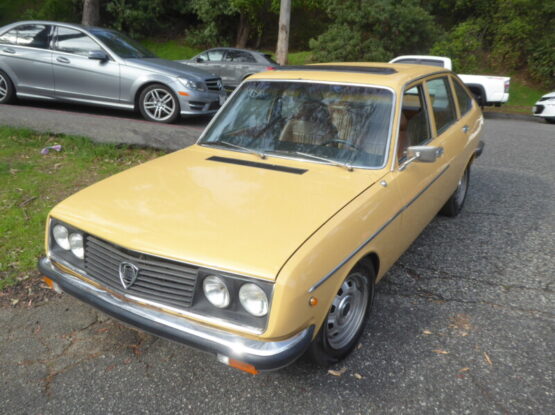
In 1973 the second style in the Beta family to appear was a 2+2 two-door coupé with a 93″ wheelbase, although due to the fuel crisis it did not become available to the public until early 1974. It was launched with 1.6 and 1.8 engines. New 1.6 and 2.0 engines replaced the original units in late 1975 followed by a 1.3 in early 1976, at which point the Fulvia Coupe was deleted. In 1978 automatic transmission and power steering became available. In 1981 the car received a minor facelift and at the same time the 2.0 became available with fuel Bosch electronic fuel injection. In 1983 a 2.0 VX supercharged engine became available with an output of 135 bhp. The bodywork was developed in-house by a Lancia team led by Aldo Castagno, with Pietro Castagnero acting as styling consultant. Castagnero had also styled the Beta’s predecessor, the Lancia Fulvia saloon and coupé. The car was popular in the mid 1970s with 111,801 examples being built, though they are quite rare now.

The Beta HPE was a three-door sporting estate or shooting-brake introduced in March 1975. HPE stood for High Performance Estate, and then later High Performance Executive. This model had Berlina’s longer wheelbase floorpan combined with the coupé’s front end and doors. The HPE was also styled in house at Lancia by Castagno’s team, with Castagnero as styling consultant. At launch it came with either 1600 or 1800 twin-cam engines, these being replaced in November of the same year by new 1.6 and 2.0 units. In 1978, like other Beta models automatic transmission became available along with power steering. It was renamed the Lancia HPE (without the Beta) from 1979 and in autumn 1981 gained the option of a fuel injected 2.0 engine. In 1984 a 2.0VX supercharged version became available. Like all other cars in the Beta range the HPE was discontinued in 1984.

Replacing the Gamma was the Thema, Lancia’s luxury car based on the Tipo Quattro platform, one of four cars to do so, the others being the Alfa Romeo 164, Fiat Croma and Saab 9000. The Thema re-established Lancia as a high-quality luxury manufacturer with a galvanised steel chassis and rust protection that equalled or bettered that of its competitors. Build quality was higher than the Fiat Croma’s and on par with the Saab 9000, with which it shared a great deal of body engineering, including its doors. Lancia’s sales organisation, however, was poor in many markets and secondhand values for the car suffered. The first series was built between 1984 and 1988, and was available with 1995 cc 8 valve, twin-cam fuel injected or turbocharged engines or a 2849 cc V6. For most European markets a 2445 cc four-cylinder turbodiesel was also available, though this was not offered to UK buyers. Two of these cars, in 2 litre Turbo ie spec, which was the most popular among UK buyers, were on show here. For a while, the Thema changed little, but in 1986, a station wagon designed by Pininfarina was added to the range, though this was also never sold in the UK. 21,074 Thema station wagons were built. The second series Thema was presented at the Paris Motor Show in September 1988 with 16v 2.0 litre engines replacing the 2.0 litre 8v units increasing the power output of the injection version to 146 PS and the turbo to 205 PS. The diesel engine size increased marginally, to 2499 cc. The series two was then replaced by the facelifted third and last series, introduced at the Paris Motor Show in September 1992 and produced from 1992-1994. Production of the Thema ceased in 1994 when Lancia presented a replacement. the Kappa, a car that would not be sold in the UK.


LAND ROVER
The Series 2 model, the successor to the successful Series I, saw a production run from 1958 to 1961. It came in 88 in and 109 in wheelbases (normally referred to as the ‘SWB’ and ‘LWB’). This was the first Land Rover to receive the attention of Rover’s styling department. Chief Stylist David Bache produced the familiar ‘barrel side’ waistline, with a 5 in greater width to cover the vehicle’s wider tracks, as well as the improved design of the truck cab variant, introducing the curved side windows and rounded roof still used on current Land Rovers. The series II was the first vehicle to use the well-known 2.25-litre petrol engine, although the first 1,500 or so short wheelbase (SWB) models retained the 52 hp 2.0-litre petrol engine from the series I. This larger petrol engine produced 72 hp and was closely related to the 2.0-litre diesel unit still in use. This engine became the standard Land Rover unit until the mid-1980s when diesel engines became more popular. The 109-inch series II station wagon introduced a twelve-seater option on top of the standard ten-seater layout. This was primarily to take advantage of UK tax laws, by which a vehicle with 12 seats or more was classed as a bus, and was exempt from Purchase Tax and Special Vehicle Tax. This made the twelve-seater not only cheaper to buy than the 10-seater version, but also cheaper than the seven-seater 88-inch Station Wagon. The twelve-seater layout remained a highly popular body style for decades, being retained on the later series and Defender variants until 2002, when it was dropped. The unusual status of the twelve-seater remained until the end—such vehicles were classed as minibuses and thus could use bus lanes and (if registered correctly) could be exempt from the London Congestion Charge. There was some degree of overlap between series I and II production. Early series-II 88-inch vehicles were fitted with the old 2-litre petrol engine to use up existing stock from production of the series I. The 107-inch Station Wagon continued until late 1959 due to continued demand from export markets and to allow the production of series-II components to reach full level. The SII and the SIIA are very difficult to distinguish. There were some minor cosmetic changes. Body configurations available from the factory ranged from short-wheelbase soft-top to the top-of-the-line five-door station wagon. A 2.25-litre diesel was added to the engine line, which after 1967 included a 2.6-litre inline six cylinder petrol engine for the long-wheelbase models, which also had servo-assisted brakes. 811 of these were NADA (or North American Dollar Area) trucks, which were the only long-wheelbase models made for the American and Canadian markets. From February 1969 (home market), the headlamps moved into the wings on all models, and the sill panels were redesigned to be shallower a few months afterwards. The series IIA is considered by many the most hardy series model constructed. It is quite possibly also the type of classic Land Rover that features strongly in the general public’s perception of the Land Rover, from its many appearances in popular films and television documentaries set in Africa throughout the 1960s, such as Born Free. In February 1968, just a few months after the Rover Company had been subsumed, under government pressure, into the Leyland Motor Corporation, the Land Rover celebrated its twentieth birthday, with total production to date just short of 600,000, of which more than 70% had been exported. Certainly it was whilst the series IIA was in production that sales of utility Land Rovers reached their peak, in 1969–70, when sales of over 60,000 Land Rovers a year were recorded. (For comparison, the sales of the Defender have been around the 25,000 level since the 1990s.) As well as record sales, the Land Rover dominated many world markets- in Australia in the 1960s Land Rover held 90% of the 4×4 market. This figure was repeated in many countries in Africa and the Middle East. The Series 3 replaced this version in 1971.


The first-generation Range Rover was produced between 1969 and 1996. It was available only in a 2-door body until 1981. (Before then, 4-door models had been produced by specialist firms). Unlike other 4x4s such as the Jeep Wagoneer, the original Range Rover was not designed as a luxury vehicle. It was up-market compared to preceding Land Rover models, but the early Range Rovers had fairly basic, utilitarian, interiors with vinyl seats and plastic dashboards that were designed to be washed down with a hose. Convenience features such as power steering, carpeted floors, air conditioning, cloth/leather seats, and wooden interior trim were fitted later. The Range Rover was a body-on-frame design with a box section ladder type chassis, like the contemporary Series Land Rovers. The Range Rover used coil springs as opposed to leaf springs, permanent four-wheel drive, and four-wheel disc brakes. The Range Rover was originally powered by various Rover V8 engines and diesel engines. Originally, the Range Rover was fitted with a detuned 130 hp version of the Buick-derived Rover V8 engine. In 1984, the engine was fitted with Lucas fuel injection, boosting power to 155 bhp. The 3.5-litre (3,528 cc) engine was bored out to a displacement of 3.9 litres for the 1990 model year, and 4.2-litre in 1992 for the 108-inch Long Wheelbase Vogue LSE (County LWB [long wheelbase] in North America). One of the first significant changes came in 1981, with the introduction of a four-door body. Shortly after twin thermo fan technology was introduced to reduce significant overheating problems 1970s models experienced in Australia. In 1988, LR introduced a 2.4-litre turbodiesel (badged Vogue Turbo D) with 112 bhp, manufactured by Italian VM Motori. The same engine was available in the Rover SD1 passenger car. The diesel project was codenamed project Beaver. During the project, 12 world records were broken, including the fastest diesel off-roader to reach 100 mph (160 km/h), and the furthest a diesel off-roader has travelled in 24 hours. In 1990 project Otter was unveiled. This was a mildly tuned 2.5-litre, 119 bhp version of the ‘Beaver’ 2.4. In 1992, Land Rover finally introduced their own diesel engines in the Range Rover, beginning with the 111 bhp 200TDi, first released in the Land Rover Discovery and following in 1994, the 300 TDi, again with 111 bhp. The first generation was known as the Range Rover until almost the end of its production when Land Rover introduced the name Range Rover Classic to distinguish it from its successors. The original model served as the basis for the 1989 introduced 1st generation Discovery (directly based on the standard (short) wheelbase Range Rover), and for the 2nd generation Range Rover, based on the LWB chassis of the Classic.


The Land Rover Freelander is a compact luxury crossover SUV that was manufactured and marketed by Land Rover from 1997 to 2015. The second generation was sold from 2007 to 2015 in North America and the Middle East as the LR2 and in Europe as the Freelander 2. The Freelander was sold in both two-wheel and four-wheel drive versions. The name ‘Freelander’ is derived from the combination of ‘Freedom’ and ‘Lander’. After having built exclusively body-on-frame 4WD vehicles for half a century, the first generation Freelander was the brand’s first model to use monocoque (unibody) structures, and was offered in three- and five-door body options, including a semi soft-top. In 1988, British Aerospace acquired the Rover Group for £150 million, which allowed resources across Rover brands and Land Rover to be pooled differently, and the idea of developing a smaller Land Rover became more attainable than previously. When the board approved the Pathfinder project, it was codenamed CB40 (after Canley Building 40, where the concept was initially developed). Remarkably, the new, compact Land Rover had become almost as long as the original Range Rover, that had been phased out just the year before, and even sported an inch (2.5 cm) longer wheelbase. When BMW acquired Rover Group, they terminated the agreement, and instead funded production facilities at Solihull, making use of the Rover SD1 assembly hall which had been inactive in the early 1980s, when Rover car production was moved to Cowley. There were a variety of models, based around five-door estate and three-door softback (semi-convertible), hardback, and commercial (van-like) versions. In 2004, Land Rover introduced an improved and upgraded version of the Mark I; changes included a new interior and major external revisions, including a new face and rear. The three-door model was available in E, S, ES, Sport and Sport Premium trim and the five-door model in available in E, S, ES, HSE, Sport and Sport Premium trim. Engine choices included: 1.8-litre I4 Rover K-series petrol (1997–2006), badged as ‘1.8i’, ‘Xi’ or ‘XEi’ (Not sold in North America); 2.0-litre I4 Rover L-series diesel (1997–2000), badged as ‘Di’, ‘XDi’ or ‘XEDi’; 2.0-litre I4 BMW M47 diesel (2001–2006), badged as ‘Td4’; 2.5-litre V6 Rover KV6 Engine petrol (2001–2006), badged as ‘V6’. Manual gearboxes dominated the early models, but automatic Tiptronic-style gearboxes (Jatco JF506E) became increasingly popular and were standard on the V6. The Automatic Tiptronic gearbox was also available as an option on the Td4. The first generation Freelander was marketed as a premium compact 4×4, and used in the 1998 Camel Trophy and participated in Land Rover’s G4 Challenge. The vehicle represented a compromise because it did not have a low-range gear selection, nor a locking differential, as found on larger Land Rover models. This meant that in comparison to other Land Rovers, off-road performance was not as good. In comparison to similar models produced by other manufacturers in the same period of time like the Honda CRV or the Toyota RAV4, however, the first generation Freelander was far more competent off-road. It had more than sixteen patented features, including the IRD or Intermediate Reduction Drive, which acted as a front differential and fixed ratio transfer; the VCU or viscous-coupling, which reacts to the differing rotational speed of the prop shafts, allowing varying torque across itself; and the Hill Descent Control system, which was then implemented in the rest of the Land Rover range and even in the first generation BMW X5 (BMW was the parent company of Rover Group at the time of introduction of this model). This first generation also used a Traction Control system and a special version of ABS produced by Wabco, modified to assist driving in off-road situations. Lack of the MG Rover K18 and KV6 engines after the end of the MG Rover production led Land Rover to discontinue the model on 31 August 2005 in the U.S. and Canada. The Mk1 Land Rover Freelander was an instant hit and went on to become the biggest-selling four-wheel-drive model in Europe, with over 540,000 units sold over its nine-year lifespan. The Freelander became Europe’s best-selling 4WD vehicle for five consecutive years after launch in 1997; and in 2016 Land Rover embraced it as its 8th ‘Heritage vehicle’. The second generation (from 2006) dropped all two-door options, leaving only a five-door stationwagon-like body, and – after 62 years – became the brand’s first ever to offer a two-wheel drive option (as of 2010). After a five-year hiatus, the two-door Freelanders were succeeded by the two-door versions of the Range Rover Evoque in 2011, and the five-door generation 2 was replaced by the Discovery Sport


LOTUS
The Type 75 Elite, announced in 1974, was the first of a new generation of Lotus cars which represented a concerted push up-market. The imposition of VAT had effectively killed off the market for the range of models that Lotus had hitherto produced as kit cars, and the only way to stay profitable was to produce something which could sold at higher prices. So whilst Lotus would tell you that the Elite was a replacement for the Lotus Elan Plus 2, it was more accurate to say that it was a rival for cars like the Reliant Scimitar GTE and Lancia Beta HPE. The styling was quite unlike anything that Lotus had produced before, with distinctive wedge lines penned by Oliver Winterbottom which hid the fact that the bodies were produced out of two separate glassfibre moulds and they had to join up in the middle around the waistline. The shooting brake style, with a hatchback as well as the fact that the Elite had 4 seats made it reasonably practical. luggage compartment. Mechanically there were fewer surprise. It was front engined with rear wheel drive, and had 4-wheel independent suspension using coil springs. The Elite was Lotus’ first car to use the 907 aluminium-block 4-valve, DOHC, four-cylinder, 1973cc, developing 155 bhp. which had previously been used in the Jensen-Healeys, where all the reliability issues had been found) The 907 engine ultimately became the foundation for the 2.0 litre and 2.2 litre Lotus Esprit powerplants, the naturally aspirated 912 and the turbocharged 910. The Elite was fitted with a 4 or 5 speed gearbox and from January 1976 automatic transmission was optional. The Elite had a claimed drag co-efficient of 0.30 and at the time of launch it was the world’s most expensive four cylinder car. Elites were available in 4 main specification variations, 501, 502, 503, and later on 504. The 501 was the ‘base’ version. The 502 added air conditioning, the 503 had power steering and the 504 added automatic transmission. The Elite was the basis for a coupe model, the Eclat which was launched in October 1975. Facelifted versions of both came in 1980, with a larger 2.2 litre engine and refinements to the trim. The Elite would live a couple of years in this form, but market interest shifted to the Coupe and when this was given a more significant revision a couple of years later, and a new name of Excel, the Elite was dropped from the range. Although 2535 of them were made, they are rare these days, so it was nice to see this 503 model.


The silver Italdesign concept that eventually became the Esprit was unveiled at the Turin Motor Show in 1972 as a concept car, and was a development of a stretched Lotus Europa chassis. It was among the first of designer Giorgetto Giugiaro’s polygonal “folded paper” designs. Originally, the name Kiwi was proposed, but in keeping with the Lotus tradition of having all car model names start with the letter “E”, the name became Esprit. The production Esprit was launched in October 1975 at the Paris Auto Show, and went into production in June 1976, replacing the Europa in the Lotus model lineup. These first cars eventually became known as S1 Esprits. With a steel backbone chassis and a fibreglass body, the Esprit was powered by the Lotus 907 4-cylinder engine, as previously used in the Jensen Healey. This engine displaced 2.0 litre, produced 160 bhp in European trim 140 bhp in US/Federal trim, and was mounted longitudinally behind the passengers, as in its predecessor. The transaxle gearbox was a 5-speed manual unit, previously used in the Citroën SM and Maserati Merak; it featured inboard rear brakes, as was racing practice at the time. The Series 1 embodied Lotus’ performance through light weight mantra, weighing less than 1,000 kg (2,205 lb). The original Esprit was lauded for its handling and is said to have the best steering of any Esprit. However, it was generally regarded as lacking power, especially in markets such as the United States where the engine was down-rated for emissions purposes. Lotus’ claim of 0-60 mph in 6.8 seconds and a top speed of 138 mph may be thought of as optimistic – actual road test times indicated 0-60 mph in 8 seconds and a top speed of around 133 mph. The S1 Esprit can be distinguished from later Esprits by a shovel-style front air dam, Fiat X1/9 tail lights, lack of body-side ducting, and Wolfrace alloy wheels. Inside the car, the most obvious indication of an S1 Esprit is a one-piece instrument cluster with green-faced Veglia gauges. The car gained fame through its appearance in the James Bond film The Spy Who Loved Me (1977) where a fictionally-modified version was featured in a long action sequence. Bond’s Esprit car is first chased on road, by a motorcycle, then by another car, and then a helicopter, then converts into a submarine for an undersea battle. A series of improvements made to the Esprit during its initial run culminated in the S2 Esprit, which was introduced in 1978. The most obvious of these changes are intake and cooling duct “ears” located behind the rear quarter window, tail lights from the Rover SD1, and an integrated front spoiler. S2 Esprits also used 14-inch Speedline alloy wheels designed specifically for Lotus. Other changes included relocating the battery from above the right side fuel tank (under the rear quarter window) to the rear of the car, adding an access door to the engine cover, as well as replacing the instrument cluster made by Veglia with individual gauges made by Smiths and using different style of switches on the dashboard. During this era, a special edition car was released to commemorate Lotus’s racing victories and their victory in the 1978 F1 World Championship. Sharing the black and gold colour scheme of Lotus’ then F1 sponsor, John Player & Sons, these cars are commonly known as the John Player Special (JPS) Esprits. The “JPS” Esprit has the same mechanicals as the regular two-litre S2. According to Lotus themselves a limited series of 300 was built, but most likely the total was considerably lower.Lotus’ records of production figures are notoriously vague, but best estimates suggest that 149 JPS Esprits were produced. The S2.2 was produced as a stop-gap model from May 1980, almost identical to the S2 but with an enlarged (2.2 litre) type 912 engine used. This kept horsepower the same, but bumped up torque from 140 lb·ft to 160 lb·ft. Importantly, the S2.2 also introduced the use of a galvanised chassis, although it did not benefit from the succeeding S3’s chassis improvements. These cars are extremely rare even among Esprits: according to Lotus themselves, only 88 were produced in its thirteen-month production span. In 1980 the first factory turbocharged Esprit was launched. Initially, this was another special edition model commemorating F1 ties and reflecting current sponsorship, this time in the blue, red and chrome livery of Essex Petroleum, and is therefore known as the Essex Esprit. The new turbocharged dry-sump type 910 engine produced 210 hp and 200 lb·ft of torque. 0-60 mph could be achieved in 6.1 seconds, with a top speed of 150 mph. These performance improvements were coupled to a redesign and strengthening of the chassis and rear suspension, where an upper link was added to alleviate strain on the driveshafts, along with brake improvements. The Essex cars introduced a Giugiaro-designed aerodynamic body kit with a rear lip spoiler, prominent louvered rear hatch, more substantial bumpers, a deeper front airdam, and air ducts in the sills just ahead of the rear wheels, which were 15″ Compomotive three piece items. Internally, scarlet leather, combined with a roof-mounted Panasonic stereo, made for a dramatic environment. 45 Essex Esprits were built, interspersed and followed by a number of non Essex-liveried but otherwise identical specification dry-sump turbo cars. Two Essex-spec Turbo Esprits – one in white and the other in copper – were featured in the James Bond film For Your Eyes Only (1981), although these were scripted as the same vehicle – the white one was destroyed by an anti-burglar explosion system in Spain, while the copper red one was a “rebuild” of the original (actually a joke between Bond and Q in the latter’s laboratory), and was fully functional (the copper exterior paint colour for the replacement car was chosen to make the car stand out more in filming against the snowy background of Cortina, Italy, the only locale in which it appears). By the close of 1980, Lotus was effectively building three different models of Esprit, with distinct chassis designs and body moulds – the Domestic S2.2, the Export S2.2, and the dry-sump Turbo Esprit. Introduced in April 1981, the Turbo Esprit and S3 Esprits marked a necessary consolidation: both new models had a common chassis, inheriting much of the configuration of the Essex cars, whilst body production was based on a single common set of moulds. The S3 continued to use the 2.2 litre type 912 engine of the S2.2, whilst the Turbo Esprit reverted to a less complex wet-sump lubrication system, retaining the power and torque outputs of its dry-sump predecessor. The interior for both cars was revised and featured new trim; combined with changes to the body moulds this resulted in more headroom and an enlarged footwell. Externally, the Turbo Esprit retained the full aerodynamic body kit of the Essex cars, and featured prominent ‘turbo esprit’ decals on the nose and sides; the S3 gained the more substantial bumpers, yet retained the simpler sill line and glazed rear hatch of the S2.2 body style. Both models were supplied with 15″ BBS alloy wheels. For the 1985 model year, the S3 and Turbo underwent some slight alterations to the bodywork and to the front suspension. In April 1986, the final incarnations of the Giugiaro-styled Esprit were announced, with raised engine compression giving rise to the ‘HC’ moniker. This increased the output of the naturally aspirated engine to 172 hp and 160 lb·ft for the Esprit HC, and to 215 hp and 220 lb·ft for the Turbo Esprit HC, with the increased torque available at a lower rpm. For markets with stringent emissions requirements (mainly the United States), Lotus introduced the HCi variant, teaming the higher compression engine with Bosch KE-Jetronic fuel injection and a catalytic converter- the first fuel-injected Esprits. This engine had the same peak power as the carburettor version, but at a somewhat higher engine speed, and torque dropped to 202 lb·ft


Known internally as the Type 89, the Excel, built from 1982 to 1992, was a development of the earlier Lotus Eclat, which itself was based on the Type 75 Elite. Although a promising design, the Elite and Eclat had suffered from numerous quality control issues which were difficult for owners to accept given the price of the cars. The Excel was a concerted effort to address these, and it stood every chance of so doing, as it took advantage of the relationship with Toyota. This had started when Toyota engaged Lotus to assist with engineering work on the Supra. During this period, Toyota then became a major shareholder in Lotus. Part of the deal between the two included the use of many Toyota mechanical components in Lotus’ cars. The original Excel (aka the Eclat Excel) used the W58 manual transmission, driveshafts, rear differential, 14×7 in alloy wheels, and door handles from the Supra Mk II, which was made from 1982 to 1986. The engine was the familiar all-aluminium, DOHC 2.2 litre Lotus 912 Slant Four which was also used in the Lotus Esprit S3. During its lifetime, the Excel received two major upgrades. With the introduction of the Excel SE which had a 180 bhp engine vs the standard 160 bhp car in October 1985, the bumpers, wing and interior was changed, including a new dashboard. In October 1986 the Excel SA with automatic gearbox was introduced. Further facelifts in 1989 saw Citroën-derived mirrors, as featured on the Esprit, and 15 inch OZ alloy wheels to a similar pattern as the Esprit’s. According to Lotus records, only 1 Excel was manufactured to USA specification. The lack of release in the USA was due to the high emission regulations (which would hinder the car’s performance), and poor sales of the car in Europe.


MARCOS
Designed by brothers Dennis and Peter Adams, this well-known car caused something of a sensation when it was shown at the 1964 Racing Car Show. Known as the Marcos 1800, it had a glassfibre body, with a wooden chassis and was offered for sale fully built or in kit form. This was to be the design that would become familiar to sports car enthusiasts for more than 30 years, even though the original plywood chassis would later be replaced by a steel chassis and the futuristic scalloped dashboard also vanished after a few years. The plywood chassis was glued together from 386 separate pieces and was not only light and strong, but also required a minimum up front investment to construct. The extremely low Marcos required a nearly supine driving position and fixed seats, mounted lower than the floor of the car. In return, the entire pedal set could be moved fore and aft with a knob on the dashboard. If this proved not to be enough Marcos also offered optional booster pillows. This setup, with the fixed seats, remained until the end of Marcos production in late 2007. The original Marcos 1800 had a two-spoke steering wheel and a novel dash with a prominent centre console, a rather expensive design which did not survive onto the Ford-engined cars. The entire nose portion, of a long and tapered design, was hinged at the front and was held down by latches behind the front wheelwells. It used the cast-iron four-cylinder 96 hp Volvo 1778 cc B18 unit with overdrive gearbox from the Volvo P1800S enough for a 116 mph top speed and a 0-60 mph time of 8.2 seconds. Successful in competition, the rather expensive 1800 sold very slowly, and after the first 33 cars the de Dion rear suspension was replaced by a live Ford axle. The price was dropped from ₤1500 to ₤1340, but it was not enough to make the car profitable. Cars were stockpiling in 1966, and after 106 (or 99) had been built, the 1800 was replaced by the Ford-engined 1500. Normally fitted with a four-speed manual transmission a five-speed one was also available, allowing for a higher top speed. According to some sources, a few of the last cars built had the 2 litre Volvo B20 engine fitted, as did some of the racing cars. The 1800 is the only Marcos that is eligible for historic racing and as such is considerably more valuable today than later models. In 1966 the GT was changed to a pushrod inline-four Ford Kent engine of 1500 cc, in order to lower costs as the 1800 had been rather too expensive to market. The complex dash was also replaced with a flat polished wood unit, which was soon downgraded further yet to a mass-produced “wood-effect” one. Power and performance were both down on the 1800, but sales increased considerably. To hide the fact that a common Ford engine was used, Marsh replaced the rocker covers with Marcos ones and switched from Weber to Stromberg carburettors. An overbored Lawrencetune 1650 cc version was made available in 1967 (32 built) to ameliorate the power shortage, for the Marcos 1650 GT. The 1650 also had bigger disc brakes and a standard Webasto sunroof, but proved somewhat less than reliable It and the 1500 were both replaced by Ford’s new Crossflow four not much later, in late 1967. The 1600 proved to be the most popular model yet, with 192 cars built until early 1969. Weight was 740 kg (1,631 lb) and disc brakes up front were standard, although power assist was an optional extra. Production ended in October 1969 as the new steel chassis was not well suited for the crossflow engine. A new model, the 2 litre, appeared at the January 1969 London Show with the engine changed to the Ford Essex V4 engine from the Ford Corsair – while a V6 engine had already appeared at the top of the lineup in 1968. Also in 1969, the plywood chassis was gradually replaced by a square section steel one, which shortened production time and saved on cost. These steel framed cars required a lower sill panel and have reshaped rear bumpers, as well as some subtle interior differences. The wooden chassis had also begun to meet a certain amount of resistance from buyers. There seem to have been no V4-engined wooden cars made, although there is a few months overlap between the introduction dates. The V4 received most of the same standard and optional equipment (except the overdrive) and the same central bonnet bulge as did the V6 models; very few of the Marcos 2 litres still have their V4 engines, as a V6 swap is a rather quick job and makes for a much faster car than the original’s 85 hp. It was not exactly a success story, 78 2 litres were most likely built, although numbers as low as 40 have also been mentioned. New at the October 1968 London Show was the more powerful Marcos 3 litre. Fitted with the double-carb Ford Essex V6 engine and transmission from the Ford Zodiac, production beginning in January 1969. Max power was 140 bhp and aside from the badging, this car is most easily recognised by the large, central bonnet bulge necessary to clear the larger engine. The 3 litre had a four-speed manual with a Laycock-de-Normanville Overdrive for the third and fourth gears fitted. In December 1969 a twin-carburetted 3-litre Volvo B30 straight-six became available (initially only for the US), and in 1971 eleven or twelve cars were fitted with the 150 bhp Triumph 2.5-litre straight-six. These were called the Marcos 2½ litre. As the bonnet was a close fit over the various larger engines, this resulted in a corresponding variation in the bonnet design as regards changes designed to clear engine air intakes, often the only external sign of the type of engine fitted. All inline-sixes required a rather angular bulge right of centre on the bonnet to clear the carburettors. Around this time, some V6 cars begun sporting single rectangular headlights (not on US-market cars), borrowed from the Vauxhall Viva HB. Later in 1969 the six-cylinder cars, as with their four-cylinder counterparts, received the new steel chassis. Either 100 or 119 of the wood-chassied V6 cars were built. The Ford V6 version achieved over 120 mph on test and the Volvo-engined model was not far behind it, but the heavy cast-iron engines increased nose-heaviness in comparison to the four-cylinder variants. With US sales going strong, Marcos production was up to three per week and they had to invest in a bigger space in 1969. Cars for the North Americas market had Volvo’s inline-six cylinder, 3 litre engines with a standard Borg-Warner Type 35 automatic transmissions. They sat on tubular steel space frames, have a higher ride height, and no headlight covers – all of this was in order to get US road certification. Air conditioning was also listed as an option by New York-based importers Marcos International Inc. Delays and problems with the federalised cars were beginning to mount. In 1970, 27 exported cars were impounded by US Customs for supposedly not meeting federal law, causing Marcos to withdraw entirely from the US market. Together with the development costs of the Mantis and the introduction of VAT on kit cars on the horizon, Marcos had to close its doors for what turned out to be the first time. About sixty US market cars were built, some of which were brought back after the US market dried up in 1970 and converted to RHD for sale in the home market. Production of the Volvo 3 litre continued for the rest of the world, with these cars fitted with a four-speed manual transmission. Either 80 or 172 of the Volvo I6-engined Marcos were built until early 1972, with the final one destined to become the last Marcos built for the next ten years. After Marcos had run out of money the company was sold to Hebron & Medlock Bath Engineering in mid-1971. They themselves had to call in the receivers only six months later. The Rob Walker Garage Group bought the factory only to sell off everything, including some finished cars such as all six Mark 2 1600s built. Jem Marsh bought up spares and other parts at the liquidation sale and proceeded to run a company servicing existing Marcos, until he resumed production of Marcos kits in 1981. The original GT continued to be built until 1989 or 1990, being developed into its altered Mantula form. This was further developed into more powerful and aggressively-styled designs, culminating in the 1994 LM600 (which competed in the 1995 Le Mans 24-hour race).


MASERATI
Still acclaimed as one of the best-looking saloons ever produced is this car, the fifth generation Quattroporte, a couple of which were on show. Around 25,000 of these cars were made between 2004 and 2012, making it the second best selling Maserati of all time, beaten only by the cheaper BiTurbo of the 1980s. The Tipo M139 was unveiled to the world at the Frankfurt Motor Show on 9 September 2003, with production starting in 2004. Exterior and interior design was done by Pininfarina, and the result was widely acclaimed to be one of the best looking saloons not just of its time, but ever, an opinion many would not disagree with even now. Built on an entirely new platform, it was 50 cm (19.7 in) longer than its predecessor and sat on a 40 cm (15.7 in) longer wheelbase. The same architecture would later underpin the GranTurismo and GranCabrio coupés and convertibles. Initially it was powered by an evolution of the naturally aspirated dry sump 4.2-litre V8 engine, mounted on the Maserati Coupé, with an improved output of 400 PS. Due to its greater weight compared to the Coupé and Spyder, the 0-62 mph (0–100 km/h) time for the Quattroporte was 5.2 seconds and the top speed 171 mph (275 km/h). Initially offered in only one configuration, equipped with the DuoSelect transmission, the gearbox was the weak point of the car, receiving most of the criticism from the press reviews. Maserati increased the range at the 2005 Frankfurt Motor Show, with the launch of the Executive GT and Sport GT trim levels. The Executive GT came equipped with a wood-rimmed steering wheel, an alcantara suede interior roof lining, ventilated, adaptive, massaging rear seats, rear air conditioning controls, veneered retractable rear tables, and curtain shades on the rear windows. The exterior was distinguished by 19 inch eight-spoke ball-polished wheels and chrome mesh front and side grilles. The Quattroporte Sport GT variant offered several performance upgrades: faster shifting transmission and firmer Skyhook suspensions thanks to new software calibrations, seven-spoke 20 inch wheels with low-profile tyres, cross-drilled brake rotors and braided brake lines. Model-specific exterior trim included dark mesh front and side grilles and red accents to the Trident badges, as on vintage racing Maseratis. Inside there were aluminium pedals, a sport steering wheel and carbon fibre in place of the standard wood inserts. A new automatic transmission was presented at the 2007 Detroit Motor Show, marketed as the Maserati Quattroporte Automatica. As all three trim levels were offered in both DuoSelect and Automatica versions, the lineup grew to six models. The Quattroporte Sport GT S was introduced at the 2007 Frankfurt Motor Show. Taking further the Sport GT’s focus on handling, this version employed Bilstein single-rate dampers in place of the Skyhook adaptive system. Other changes from the Sport GT comprised a lowered ride height and 10 mm wider 295/30 rear tyres, front Brembo iron/aluminium dual-cast brake rotors and red-painted six piston callipers. The cabin was upholstered in mixed alcantara and leather, with carbon fibre accents; outside the door handles were painted in body colour, while the exterior trim, the 20 inch wheels and the exhaust pipes were finished in a “dark chrome” shade. After Images of a facelifted Quattroporte appeared on the Internet in January 2008; the car made its official début at the 2008 Geneva Motor Show. Overseen by Pininfarina, the facelift brought redesigned bumpers, side sills and side mirrors, a convex front grille with vertical bars instead of horizontal, new headlights and tail lights with directional bi-xenon main beams and LED turn signals. Inside there was a new navigation and entertainment system. All Quattroporte models now used the ZF automatic transmission, the DuoSelect being discontinued. The 4.2-litre Quattroporte now came equipped with single-rate damping comfort-tuned suspension and 18 inch wheels. Debuting alongside it was the Quattroporte S, powered by a wet-sump 4.7-litre V8, the same engine of the Maserati GranTurismo S, with a maximum power of 424 bhp and maximum torque of 361 lb·ft. In conjunction with the engine, the braking system was upgraded to cross-drilled discs on both axles and dual-cast 360 mm rotors with six piston callipers at the front. Skyhook active damping suspension and 19 inch V-spoke wheels were standard. Trim differences from the 4.2-litre cars were limited to a chrome instead of titanium-coloured front grille. The Quattroporte Sport GT S was premièred at the North American International Auto Show in January 2009. Its 4.7-litre V8 produced 440 PS (434 hp), ten more than the Quattroporte S, thanks to revised intake and to a sport exhaust system with electronically actuated bypass valves. Other mechanical changes were to the suspensions, where as on the first Sport GT S single-rate dampers took place of the Skyhook system, ride height was further lowered and stiffer springs were adopted. The exterior was distinguished by a specific front grille with convex vertical bars, black headlight bezels, red accents to the Trident badges, the absence of chrome window trim, body colour door handles and black double oval exhaust pipes instead of the four round ones found on other Quattroporte models. Inside veneers were replaced by “Titan Tex” composite material and the cabin was upholstered in mixed Alcantara and leather. This means that there are quite a number of different versions among the 25,256 units produced, with the early DuoSelect cars being the most numerous.

MATRA
The Matra Murena was a 3-seat single row sports car with mid-engined rear wheel drive, produced from 1980 through 1983. Replacing the Bagheera, a similar vehicle resulting from the first fruits of the Matra-Simca cooperation, the Murena employed the base Bagheera structure, but substantial changes were made to address some of the concerns regarding the previous model. The car still had a steel spaceframe with body panels made of fibreglass-polyester, but to counter the rust issues plaguing the Bagheeras, the spaceframe was galvanized, the first production car to use galvanized steel for all chassis parts. This, coupled with the composite panels, made the car essentially immune to rust, except for the rear trailing arms of the suspension. The Murena also inherited the Bagheera’s mid-engined layout together with the sleek hatchback body shape, with the rear hatch allowing access to the engine mounted behind the passenger compartment, and a luggage area. The styling was all-new, though, and the body very aerodynamic for its time. A unique feature carried over from the previous model was the seating arrangement – all three seats were placed in one row, with the middle seat folding down to become an armrest when not in use by a passenger. The engine selection was different, however. The base model had a 1.6 engine, while the more powerful version employed the 2.2 engine that was also the base engine for the top of the range Talbot Tagora saloon. This engine was also available with the so-called “S-kit” that upgraded its output to 142bhp At first, this was a dealer-fitted option, but later it could be ordered straight from the factory. The standard carburation was via a single Solex downdraft carburettor, but S models had twin side draft carburettors. The car had good performance and handling. It was only available in left hand drive specification, although a very small number of right hand drive conversions were made. Production ceased when the Matra factory in Romorantin switched to production of the Renault Espace multi-people carrier.


Also here was one of now highly-admired Rancho models. Thought of as a leisure activity vehicle, the Rancho was created by the French engineering group Matra, in cooperation with the automaker Simca, to capitalise on the off-road trend started by the Range Rover, with an “off-road look” offered at a much lower price than the British car. The Rancho was launched in 1977. Designed by Antonis Volanis, the Rancho was based on the pick-up version of Simca’s popular 1100, using its front structure and a stretched chassis. The rest of the body was made by Matra from fibreglass and polyester, including the mouldings adorning the body, which made it look more “sturdy”. This technology would later be used on the Renault Espace, as well. The ground clearance was also increased. Unlike most off-roaders, it was not fitted with all-wheel drive, retaining the 1100s front-wheel drive layout. Other elements retained from the 1100 included the dashboard and front seats which were identical with the ones found in the Simca 1100 GLS. The Rancho was powered by the 1442 cc, 80 bhp version of the “Poissy engine” straight-4 engine. The Rancho’s optional third row of seats (making it an early MPV) shared head restraints with the normal rear seats. Sales of the model were quite respectable, but they could do nothing to alleviate the larger problems at Chrysler Europe (Simca’s parent company). Chrysler finally sold its European arm to PSA in 1978, which was then rebranded as Talbot in 1979. The Matra-Simca Rancho became the Talbot Matra Rancho. Production continued until 1984, and 57,792 were made. During its life, the Rancho was offered in several versions. Apart from the basic Rancho, there was the Grand Raid, around 2000 of which were built, fitted with such “off-road” extras as an electric winch on the front bumper and the spare wheel mounted on the roof – as well as a limited-slip differential. The Rancho X was the upscale model, with additional standard items such as alloy wheels and metallic paint. The Découvrable model’s rear cabin consisted of an open frame with roll-down fabric covers, which could serve as an “open” car during good weather. Finally, the Rancho AS was the commercial version, with no rear seat, making it exempt from the French tax on passenger cars. Rarest of the lot was the Midnight, only 100 of which were made. Although the bodies do not rust, the mechanicals are less durable, so there are not that many survivors, down to just single figures in the UK, sadly.


MAZDA
In January 1985, the fifth generation Familia/323 featured many updates. It was available as a hatchback or sedan only for the first year, and wagon and cabriolet models were added in November 1985 and March 1986 respectively. In January 1987 a personal coupé version with its own bodywork, the Étude, was added. In February 1987 the Familia range underwent a light facelift that included replacing the old E engines with the more modern B series. In some markets, such as Indonesia, the B engine continued to be installed after the facelift. The 1985 Familia spawned a Ford Laser twin sold in the Asia-Pacific. The Laser sedan and wagon were nearly identical to the Familia but with a Ford grille. By contrast the Laser hatchback model, which was sold in the U.S. as the Mercury Tracer used completely different panels from the Familia’s. This generation of the Familia/323 was also available in a version with a turbocharged DOHC engine, with either front- or four-wheel drive, producing 140 PS. The 4WD version (sold in either a light-weight GT or fully optioned GT-X grade) introduced in October 1985, saw some success in rally’s Group A category. A limited production homologation special, the 4WD GT-X, appeared in May 1988 and offered an additional ten horsepower. There was also a 1.7-litre diesel version available with 58 PS at 4300 rpm and 112 N⋅m (83 lb⋅ft) at 2800 rpm. It is an indirect injection engine, naturally aspirated. This generation was sold through the 1989 model year in the United States. The wagon (BW) continued alongside the succeeding generation in most markets until 1994/95, and was later updated with a new grille and lights. The model remained in production in South Africa, as an entry-level model until 2003. It was also sold there as the “Midge”, the “Sting”, and as the “Ford Tonic”. A locally designed pick-up based on the Familia front end, called the Rustler was also produced, and sold as the “Ford Bantam”. From 1991 to 1994 Samcor also produced and sold the 323 with the 2.0 L 16-valve DOHC FE engine from the Mazda 626 and badged it “200i”. Along with the 2.0 L 16-valve DOHC engine there were upgrades to the suspension and braking system. Still, the 1.6-litre GT-X homologation car was more powerful. This South African built model was also sold in Australia between 1989 and 1991 with minor changes, the most noticeable one being the front indicators having a clear colour rather than the normal amber. These models were labelled BF as opposed to the next generation’s BG. A factory-built convertible body was introduced in March

During Japan’s “Bubble Economy” (1986-1991), the nation’s car manufacturers enjoyed a bit of freedom in their car designs. Cars designed for smaller and smaller niche markets were financially feasible during this period. Nowhere was this more evident than in the kei class, or “light car”, segment. Suzuki Motor Corporation began designing a mid-engine sports coupe in 1985, displaying the concept at the 1987 Tokyo Motor Show as the RS-3. Design work was stopped soon after so that Suzuki could concentrate on the front-engine/rear-drive concept which would become the Cappuccino. The RS-3 concept caught Mazda’s interest, and Suzuki agreed to let them develop the car for production under Mazda’s Autozam sub-brand. Toshiko Horai’s design team (which also created the Miata/MX-5/Eunos) took over and created three separate concepts for the 1989 Tokyo Motor Show to measure public reaction. Only one of the three had gull-wing doors and while it was not the best received, Mazda’s top brass chose it for production, with Suzuki handling the production for Mazda. Developing the AZ-1 for production was challenging, however, and took three years with the car debuting in September 1992. During the development period, Japan’s economy crashed and a recession began. As a result, less than 4,400 AZ-1s were built before production ended. Suzuki built an additional 531 cars for their brand, badged as the Cera.


MERCEDES-BENZ
The Ponton was Daimler-Benz’s first totally new Mercedes-Benz series of passenger vehicles produced after World War II. In July 1953, the cars replaced the pre-war-designed Type 170 series and were the bulk of the automaker’s production through 1959, though some models lasted through 1962. The nickname comes from the German word for “pontoon” and refers to one definition of pontoon fenders — and a postwar styling trend, subsequently called ponton styling. A bewildering array of models were produced, with a mixture of 180 four and 220 six cylinder engines, with Mercedes W numbers of W120 for the 4 cylinder cars, and W180 for the 220s, as well as W105 for the little known or seen 219, a six cylinder model with a smaller engine. Mercedes introduced fuel injection to the 220 model in 1958, creating the W128 220SE, and the company was rare among car makers in the 50s in offering a diesel engine, so 180D models were also offered.


The Mercedes range of the 1960s was quite complex, with body styles and mechanical updates proceeding at a different rate, and even by referring to the cars by their internal development codes (the “W” number), they are still quite hard to define unambiguously. In the W111 family, the Coupe was the first to appear, a replacement for the two-door W120 “Ponton” models, and work on it began in 1957. Since most of the chassis and drivetrain were to be unified with the sedan, the scope was focused on the exterior styling. Some of the mockups and prototypes show that Mercedes-Benz attempted to give the two-door car a front styling almost identical to what would be realised in the Pagoda (W113), but ultimately favoured the work of engineer Paul Bracq. The rear featured small tailfins, subtle compared to the fintails’ and evocative of the later squarish styling of the W108/W109. Production began in late 1960, with the coupe making its debut at the 75th anniversary of the opening of Mercedes-Benz Museum in Stuttgart in February of the next year. The convertible followed at the Frankfurt Auto Show a few months later. Almost identical to the coupe, its soft-top roof folded into a recess behind the rear seat and was covered by a tightly fitting leather “boot” in the same colour as the seats. Unlike the previous generation of two-door ponton series, the 220SE designation was used for both the coupe and convertible; both received the same version of the 2195 cc M127 engine. Options included a sliding sunroof for the coupe, automatic transmission, power steering, and individual rear seats. In March 1962, Mercedes-Benz released the exclusive two-door M189-powered 300SE. Like the 300 sedan, it was based on the W111 chasis but shared both Daimler’s top-range 2996 cc fuel-injected engine and the unique W112 chassis designation, efforts on Mercedes’ part to distance it from the maker’s modest W110 and W111 lineups and link it to the prestigious W188 300S two-door luxury sports tourer. It was distinguished by a chrome strip, and featured air suspension and a higher level of interior trim and finish. In summer of 1965, Mercedes-Benz launched replacements for both W111 and W112 sedans, the W108 and W109 respectively. With the tailfin fashion well eroded by the mid 1960s, the new design was based on the restrained W111 coupe, widened and squared off. Work on a future new chassis that would fully replace the Ponton-derived W111/W112 and W108/W109 was well under way. With a concept car of the first S-Class shown in 1967, Daimler declined to develop a two-door W108/W109 vehicle, instead continuing production of the aging W111/W112 with modest changes. The 220SE was superseded in early autumn 1965 by the 250SE, which featured the new 2496cc M129 engine. Producing 150 hp. it gave the vehicle a significant improvement in top speed, to 120 mph. Visibly the only changes affected the new 14-inch rims, which came with new hub cabs and beauty rings accommodating the larger disk brakes and new rear axle from the W108 family. In November 1967 the 250 SE was superseded by the 280 SE. It was powered by the new 2778 cc M130 engine, which produced 160 hp. The top speed was hardly affected, but acceleration improved to 10.5 seconds. Inside the car received a wood veneer option on the dashboard and other minor changes, including door lock buttons and different heater levers. The hubcaps were changed yet again to a new one piece wheelcover, and the exterior mirror was changed. Despite its smaller engine, the 280 SE could outperform the early 1950s M189 powered 300 SE, resulting in the more expensive model’s retirement. The coupe and cabriolet retained their shared model model designation until replaced by a new-generation chassis in 1968. A final model was added in August 1969, the 280 SE 3.5. The car was fitted with the brand-new M116 3499 cc V8. It produced 200 hp, and had a top speed of 130 mph and a 0-100 km/h at 9.5 seconds. To accommodate the large engine, the car’s front grille was widened; front and rear bumpers were also modified with the addition of rubber strips. The rear lenses changed to a flatter cleaner design. This change was carried across the standard 280 SE. As the top of its range, the 280 SE 3.5 is seen as an ideological successor to the W112 300 SE, though it lacked the W112’s air suspension. The last 280 SE was produced in January 1971, with the 280 SE 3.5 ending in July. The total production over the decade was: 220 SEb – 16,902, 250 SE – 6,213, 280 SE – 5,187, and 280 SE 3.5 – 4,502 units. Not including 3,127 W112 300 SE models, the grand total of 2-door W111 models was 32,804 of which 7,456 were convertibles. These days the cars are much sought after and prices, especially for the convertible, are high and still rising.

The Mercedes-Benz W124 is a range of executive cars made by Daimler-Benz from 1984 to 1997. The range included numerous body configurations, and though collectively referred to as the W-124, official internal chassis designations varied by body style: saloon (W 124); estate (S 124); coupé (C 124); cabriolet (A 124); limousine (V 124); rolling chassis (F 124); and long-wheelbase rolling chassis (VF 124). From 1993, the 124 series was officially marketed as the E-Class. The W 124 followed the 123 series from 1984 and was succeeded by the W 210 E-Class (saloons, estates, rolling chassis) after 1995, and the C 208 CLK-Class (coupés, and cabriolets) in 1997. In North America, the W124 was launched in early November 1985 as a 1986 model and marketed through the 1995 model year. Series production began at the beginning of November 1984, with press presentation on Monday, 26 November 1984 in Seville, Spain, and customer deliveries and European market launch starting in January 1985. The W124 was a mid-sized vehicle platform, which entered planning in the autumn of 1976 under development Hans Scherenberg. In July 1977, the W124 program officially began, with R&D commencing work under newly appointed Werner Breitschwerdt. In April 1978, decisions were made to base it on the Mercedes-Benz W201 model program. By April 1979, a package plan was completed for the program, laying out the guidelines of the project. During the winter of 1980–1981, the final exterior for the W124 program was completed, chosen as the leading proposal by design director Bruno Sacco, and approved by the board of management in early 1981. By mid-1982, the first prototypes reflective of the production design, were assembled and sent to testing. In March 1984, pilot production commenced and development of the sedan concluded with engineering sign-off. Front suspension used a separate spring and damper with a rubber top mount. The rear suspension of the W124 featured the Mercedes multi-link axle introduced in 1982 with the Mercedes W201 and which is now standard on many modern cars. Estate cars (and optionally, saloons and coupés) had Citroën-like rear self-levelling suspension with suspension struts rather than shock absorbers, gas-filled suspension spheres to provide damping and an under bonnet pressurizing pump. Unlike the traditional Citroën application, the Mercedes suspension system had a fixed ride height and employed rear coil springs to maintain the static ride height when parked. The W124 was the first Mercedes series to be fitted with the iconic 15-hole, flat-faced alloy wheels characteristic of Mercedes-Benz cars of the 1980s and 1990s. The alloy wheels were nicknamed ‘Gullideckel’ or manhole covers, because they resemble manhole or drainage covers in Germany, which are consistently round in shape with a series of 15- or 16-holes around the outer edge, often within a concentric ring. Gullideckel wheels in a variety of diameter and offset specifications were later incorporated into the facelift versions of the W126 S-Class, R107 SL and W201 190E series, and were also the ‘non-option’ wheel on the R129 SL-Class roadster. Much of the 124’s engineering and many of its features were advanced automotive technology at its introduction, incorporating innovations that have been adopted throughout the industry. It had one of the lowest coefficient of drag (Cd) of any vehicle of the time (0.28 for the 200/200D model for the European market with 185/65 R15 tyres) due to its aerodynamic body, that included plastic molding for the undercarriage to streamline airflow beneath the car, reducing fuel consumption and wind noise. It had a single windscreen wiper that had an eccentric mechanism at its base that extended the wiper’s reach to the top corners of the windscreen (more than if it had travelled in a simple arc). The saloon/sedan, coupés and convertibles had optional rear headrests that would fold down remotely to improve rearward visibility when required. This feature was not available for the T-model because of its specific layout (no space to store the retractable headrests), but the estate serially came with a “neighbour-friendly” rear door that was pulled in the shut-position silently and automatically by a sensor-controlled servomotor. This allowed the use of a tighter fitting rear gate, minimizing the cabin noise in the T-model – sometimes an area of concern for station wagons. The estate cars (chassis designation S124) came in 5 or 7-seat models, the 7-seater having a rear-facing bench seat that folded flush luggage compartment cover and an optional (in the US until 1994) retractable cargo net. To provide a flat loading floor with the seat folded down, the T-model’s rear seat squab was mounted about 10 cm (3.9 in) higher than in saloons, robbing rear seat passengers of some head room. The S124 estate continued in production alongside the new W210 until the S210 estate launched more than a year later. A two-door coupé version was also built, with the chassis designation C124. The E 320, E 220, and E 200 cabriolets ceased production in 1997. Indian assembly (in a joint-venture with Telco called Mercedes-Benz India) began in March 1995. Offered with five-cylinder diesel engines built by Mercedes’ Indian partner Bajaj Tempo, the W124 was replaced there in December 1997. The pre-facelift models from 1985 to 1993 used the model designations: 200/200 T (carburettor), 200 E/200 TE (originally intended for Italian market due to Italy’s tax rates on cars larger than 2 liters; available in Germany since September 1988),[ 200 CE, 230 E/230 TE, 230 CE, 260 E (saloon only), 300 E/TE, 300 CE, 300 E-24/300 CE-24/300 TE-24 valve, 400 E (not in the UK), & 500 E (LHD only in the UK). Diesel models consisted of the following designations; the 200 D/200 TD (not in the UK), 250 D/250 TD and the 300 D/300 TD. Facelift models produced from 1993 to 1996 used the following model designations: E 200, E 220, E 280, E 320, E 420 (not in the UK) & E 500 (LHD only in the UK). Both saloon and estate versions of the facelifted model carried the same model designation on their boot lid, i.e. the T was no longer used for estate versions. In the UK post-facelift diesels were E 250 Diesel (saloon only) and E 300 Diesel (saloon & estate) models. The W124 was also offered as a long wheelbase saloon targeted for taxi companies, but the more luxury equipped version was also used as a limousine. Daimler lists November 1984 as the start of production for the series but also lists 1985 as part of preproduction for any specific early model. No regular deliveries occurred in 1984.


This is not just any old W126 S Class, or even any old AMG conversion, but when new was the property of George Harrison, yes, he, of Beatles fame. It’s a 500 SEL AMG. George Harrison purchased the car new in May 1984 and owned it for 16 years, the longest he kept any car. He sold it to a friend in August 2000, a little over a year before his death. Harrison had the vehicle customized to his liking at Strattons of Wilmslow, the UK’s only official importer of AMG Mercedes at the time. Customizations included an AMG body kit, spoilers, a leather steering wheel, black chrome trim, and a wired-in mobile phone. The car features a 5.0L V8 engine with AMG tuning, producing a reported 272 hp. The car was featured in the official music video for The Beatles’ song “Real Love” in 1995. It was sold at auction in March 2018 for £43,200 and been seen at a number of events since then.

It is quite sobering to realise that the W201 is now an over 40 year old design. Mercedes spent over £600 million researching and developing the 190 and subsequently said it was ‘massively over-engineered’. It marked a new venture for Mercedes-Benz, finally giving it a new smaller model to compete with the likes of the BMW 3 Series. The W201-based 190 was introduced in November 1982, and was sold in right-hand drive for the UK market from September 1983. Local red tape in Bremen (which produced commercial vehicles at the time) prevented Daimler-Benz from building the 190 there, so production was started in Sindelfingen at a capacity of just 140,000 units per year. Eventually after just the first year, Bremen was cleared for production of the 190, replacing its commercial vehicle lines, and there the 190 was built with the first running modifications since release. Initially there were just two models, the 190 and 190 E. Each was fitted with an M102 1,997 cc displacement engine. The 190 was fitted with an M102.921 90 hp engine and the 190 E fitted with an M102.962 122 hp engine. In September 1983, the 190 E 2.3 (2,299 cc) was released for the North American market only (although a 190 E 2.3 appeared in other countries later), fitted with a 113 hp M102.961 engine. This reduction in power was due to the emissions standards in the North American market at the time. The intake manifold, camshaft, and fuel injection system were refined in 1984, and the engine produced 122 hp. The carburettor 190 was revised in 1984 as well, increasing its horsepower rating to 105 hp. 1984 also saw the arrival of the 2.3-16 “Cosworth.” In 1985, the 190 E 2.3 now came fitted with the M102.985 engine, producing 130 hp until it was revised in 1987 to use Bosch KE3-Jetronic Injection, a different ignition system, and a higher compression ratio, producing 136 hp. 1987 marked the arrival of the first inline-six equipped 190, the 190 E 2.6. Fitted with the M103.940 engine, the 190 E 2.6 provided 160 hp with a catalyst and 164 hp without. In the North American market, the 190 E 2.6 was sold until 1993, the end of the W201 chassis’s production. From 1992-1993 the 2.6 was available as a special “Sportline” model, with an upgraded suspension and interior. The 190 E 2.3 was sold until 1988, then went on a brief hiatus until it was sold again from 1991 until 1993. The W201 190 D is known for its extreme reliability and ruggedness with many examples doing more than 500,000 miles without any major work. The 190 D was available in three different engines. The 2.0 was the baseline, and was never marketed in North America. The 2.2, with the same power as the 2.0, was introduced in September 1983. It was only available in model years 1984 and 1985, and only in the USA and Canada. The 2.5 was available in the late 80’s and early 90’s. The 2.5 Turbo, while sold in mainland Europe, but not the UK for many years, was available to American buyers only in 1987 and is now somewhat of a collectors item. The exterior of the 2.5 Turbo is different from other models in that it has fender vents in the front passenger side wing for the turbo to breathe. Although the early cars were very basic and not very powerful, they sold strongly, and things only got better as the model evolved, with the result that over 1.8 million had been produced by the time the W202 model arrived in 2002 to replace it.


Designed in 1984, and launched in 1989, the R129 was based on the shortened floorpan of the Mercedes-Benz W124 and featured many innovative details for the time, for instance electronically controlled damping (Adaptive Damping System ADS, optional) and a hidden, automatically extending roll-over bar. The R107’s somewhat dated rear suspension with semi-trailing arms gave way to a modern multi-link axle. The number of standard features was high, with electric action for the windows, mirrors, seats and hydraulic convertible top. This car has the distinction of being the first passenger vehicle to have seat belts integrated into the seats as opposed to anchoring to the floor, B-pillar, and transmission tunnel. Initially, there were three different engines available: 300 SL with a M103 3.0 L 12-valve SOHC I6 (188 bhp), a 300 SL-24 with a M104 3.0 L 24-valve DOHC I6 (228 bhp) and the 500 SL with a M119 5.0 L 32-valve DOHC V8 (322 bhp) . These were joined in July 1992 by the 600 SL with a M120 6.0 L 48-valve DOHC V12 (389 bhp). There was a choice of 5-speed manual or 4–5 speed automatic for the six-cylinder cars; the V8 and V12 could only be ordered with a 4-speed automatic gearbox. In autumn 1993 Mercedes-Benz rearranged names and models. Also, the 300 SL and 300 SL-24 were respectively replaced by: SL 280 with a M104 2.8 L 24-valve DOHC I6 (190 bhp) and the SL 320 with a M104 3.2 L 24-valve DOHC I6 (228 bhp). Only the 280 was available with a manual gearbox. SL 500 and 600 continued with their respective engines. Starting in 1993, the cars were re-designated. For example, 500 SL became SL 500. Starting in model year 1994, Mercedes-Benz offered special SL models from time to time, such as the Mille Miglia edition cars of model year 1994 or the SL edition of model year 2000. 1994 cars had minor updates for the car and then in 1995 there was a minor facelift for the car, with the front fender vents updated to only 2 rounded slots, rather than 3 squared slots, and bumpers in body colour. The V8 and V12s were upgraded to 5 speed electronic transmission, the previous transmission was hydraulic 4-speed. A second facelift occurred in 1998 with many detailed changes applied, including new external mirrors, 17″ wheels and new bumpers. Also new were the engines, a SL 280 with a M112 2.8 L 18-valve SOHC V6 (201 bhp); SL 320 with a M112 3.2 L 18-valve SOHC V6 (221 bhp) and a SL 500 with a M113 5.0 L 24-valve SOHC V8 (302 bhp). The V12 engine remained unchanged. The car was replaced by the R230 generation SL in 2001, after 213,089 had been built. There were a number of very low volume AMG versions of the car, including this SL70 AMG. This was powered by a 7.1 litres (7,055 cc) V12 engine developing 496 PS (489 bhp) at 5,500 rpm and a maximum torque of 720 Nm (531 lb/ft) at 3,900 rpm. It was a bored out version of M120 6.0 V12 and with a longer stroke. Produced between 1996 and 1997, just 150 units were made.


The R230 generation of the Mercedes-Benz SL-Class was introduced at the 2001 Frankfurt Motor Show and 2001 Bologna Motor Show, replacing the R129. The R230 underwent revisions in 2006 and 2008, and was superseded by the new SL-Class R231 in 2011. In early 1996, over six years into the life of the R129, development work on a successor began. On 27 January 1996, design work commenced and draft designs were submitted from ten designers in Germany, California, and Japan. Hundreds of sketches were submitted and would form the basis for twelve quarter scale models which were digitized for computer manipulation. Design of the R230 would progress through two different formats. The real world process centered on the traditional 1:4 scale models, with most of them initially being done clay. Virtual world design development took place in a room packed with state-of-the-art computer processing technology referred to as the “CAVE” (Computer Aided Virtual Environment). This technology was also used earlier on to design the W203 in 1995. The supercomputer in the “CAVE” was able to create full-size images of selected designs, using its five projectors and allowing designers to inspect every inch of every surface rendered. Parallel to the virtual process, the twelve scale models were scrutinized as well, with four standouts chosen to be created in full-size mockups. This evolution of the scale models occurred alongside the development of the interior design. On 16 June 1997, the final design for the R230 was approved by the board and refined into production specifications into 1998. The design patents for the R230 were later filed in Germany on 9 September 1999 and on 1 March 2000 in the United States. In July 2001, after over five years of development, the new SL was unveiled and introduced at the 2001 Frankfurt Motor Show that September. Production began on 13 October 2001 at the Bremen plant and European sales commenced that November. This car first appeared as the Safety Car for Formula One at the 2001 German Grand Prix in Hockenheim. The street version was unveiled at the 2001 IAA. The range was launched with a film style advertisement called Lucky Star. Tthe range soon grew from the initial SL350 and Sl500 to include the V12 engined Sl600 and SL55 AMG and SL65 AMG models, this last offering 612 PS. The SL underwent a facelift in 2006, and was unveiled at the 2006 Geneva Motor Show. Changes include new engines for SL 350 and SL 500 (called SL 550 in North America), with improved performance on SL 55 AMG and SL 600, as well as a new top-of-the-line SL 65 AMG. ABC (Active Body Control) was improved to reduce body movements in dynamic driving by up to 60%, standard on all models except the SL 350. The new engines were mated to a new 7-speed 7G-Tronic automatic, with a Sport option to allow shifting to be performed up to 30% faster in manual “M” mode, and with added steering-wheel shift paddles. Exterior styling changes include a new bumper with three large cooling air intakes and a more pronounced V-shape as well as fog lamps with chrome surrounds, new light-alloy wheels, new rear light. Interior changes include softer leather upholstery, new interior colours, high-quality metal door sills with Mercedes-Benz lettering and embossed aluminium trim elements, removable luggage cover, optional remote boot-lid release. The roof opening mechanism was also revised, reducing the opening time from 20 seconds to 16 seconds. With the 2007 model year, there was a limited production model (550 units) introduced to celebrate the 50th Anniversary of the SL roadster model. This Anniversary Edition version came with a pewter metallic exterior, cognac brown leather interior with black ash wood trim, 382 hp V8, exclusive twin-spoke rims, custom luggage bag for rear shelf, and many other standard options and features. The facelifted SL model was revealed in the Geneva Motor Show in March 2008. The SL received a new, more aggressive front end reflecting Mercedes’s new design philosophy, with a pair of long powerdomes on the bonnet and a single-bar grille replacing the old three-bar effort. Improvements have been made also on the engines. The 3.5 L V6 is uprated to 307 bhp at 6500 rpm. Compared to the previous 3.5-litre engine, the output has been boosted by 16 percent. Torque has also been improved adding 10 Nm (7.4 lb/ft) to the previous 350 Nm (258 lbf⋅ft) making it 360 N⋅m (266 lbf⋅ft). This engine now can rev up to a max of 7200 rpm for a period as the oil temperature and other engine parameters permit, a higher compression ratio, a new intake manifold and featuring extensive modifications to and lightening of the valve train. In this case, however, the extra power does not come at the expense of fuel economy: with a consumption figure of 9.9 l/100 km, the new SL 350 undercuts the previous model developing 272 PS by 0.4 l/100 km. Mercedes-Benz is extending the SL-Class line-up by introducing an attractive entry-level model in the shape of the SL 280 developing 231 PS. The six cylinder powerplant delivers its peak torque of 300 N⋅m (221 lbf⋅ft) from 2500 rpm and accelerates the roadster from 0 to 100 km/h (62 mph) in 7.8 seconds, whilst fuel consumption (NEDC) is just 9.4 L/100 km (30 mpg‑imp; 25 mpg‑US). It features the AIRSCARF heating system used in the SLK. The R221 generation cars arrived to replace the model in 2011.

At the 1999 North American International Auto Show, Mercedes-Benz presented their Vision SLR concept, inspired both by the Mercedes-Benz 300 SLR Uhlenhaut Coupé of 1955, which was a modified Mercedes-Benz W196S race car, and the design of closed-wheel Formula One cars, a field in which Mercedes had prior experience, as Mercedes-Benz were already designing and developing powertrains and electronics for McLaren’s Formula One Team. The car was presented as “Tomorrow Silver Arrow” in a clear reference to the Silver Arrows of the golden age of Mercedes in competition during the fifties. Later that year, during the Frankfurt Motor Show, a roadster version of the SLR concept was presented. The concept car was fitted with a 5.0-litre supercharged AMG V8 engine able to generate a power output of 565 PS (557 bhp) and 720 Nm (531 lb/ft) of torque at 4,000 rpm, mated to a 5-speed automatic gearbox with Touchshift control. Wanting to bring the concept to production following its positive reception, Mercedes joined forces with their Formula One partner, McLaren, thus creating the Mercedes-Benz SLR McLaren. The production version of the car was unveiled to the general public on 17 November 2003 having some minor design adjustments in respect of the initial design. The adjustments included more complex vents on both sides of the car, a redesigned front with the three pointed star plunged in the nose and red tinted rear lights. A new version of the SLR was introduced in 2006, called the Mercedes-Benz SLR McLaren 722 Edition. The “722” refers to the victory by Stirling Moss and his co-driver Denis Jenkinson in a Mercedes-Benz 300 SLR with the starting number 722 (indicating a start time of 7:22 a.m.) at the Mille Miglia in 1955. The “722 Edition” includes a modified version of the engine used in the SLR generating a power output of 650 PS (641 bhp) at 6,500 rpm and 820 Nm (605 lb/ft) at 4,000 rpm. 19-inch light-alloy wheels were used to reduce unsprung mass, while modifications were also made to the suspension, with a stiffer damper setup and 10 mm (0.39 in) lower ride height introduced for improved handling. Larger 15.4 in diameter front brakes and a revised front air dam and rear diffuser were fitted. Other exterior changes include red “722” badging, harking back to the original 722 racer, black tinted tail lights and headlamps. The interior has carbon fibre trim and black leather upholstery combined with Alcantara. The Mercedes-Benz SLR McLaren saw a production run of over six years. On 4 April 2008, Mercedes announced it would discontinue the SLR. The last of the coupés rolled off the production line at the end of 2009 and the roadster version was dropped in early 2010. A total of 2,157 cars were produced, rather less than the 3500 production ceiling which Mercedes initially announced. The car had a mixed reception even when new, but now it is for sure a classic.


The Mercedes-AMG GT is a series of 2-door sports cars produced by German automobile manufacturer Mercedes-AMG. The car was introduced on 9 September 2014 and was officially unveiled to the public in October 2014 at the Paris Motor Show. While not directly replacing the SLS AMG (competing in a different segment), it is the second sports car developed entirely in-house by Mercedes-AMG. The Mercedes-AMG GT went on sale in two variants (GT and GT S) in March 2015, while a GT3 racing variant of the car was introduced in 2015. A high performance variant called the GT R was introduced in 2016. A GT4 racing variant, targeted at semi-professional drivers and based on the GT R variant, was introduced in 2017. In 2021, a new variant called the AMG GT Black Series was released. All variants are assembled at the Mercedes-Benz plant in Sindelfingen, Germany. The interior of the Mercedes-AMG GT was previewed on 16 April 2014. The car made its debut on 9 September 2014 and was officially unveiled to the public in October 2014 at the Paris Motor Show. The GT’s exterior design was kept similar to that of the preceding SLS AMG, with wide wheel arches, lower bodywork, and fastback sloping roofline of the SLS AMG, but using conventional forward-opening doors instead of the iconic gullwing style pioneered by the 300 SL in the 1950s. It also employed an upgraded and shortened version of the Transaxle Spaceframe platform used by the SLS. The vehicle structure is made up of 93% aluminium, with the front module base made up of magnesium. The exterior lead designer was Mark Fetherston, whose previous works include the W176 A-Class, the CLA-Class, and SLS AMG. The interior, designed by Jan Kaul, features a large centre console and decorative elements in a leather and carbon polymer design. The trunk offers room for a medium-sized suitcase. Two engine power output options were offered: the GT, with 462 PS/456 hp, and the GT S with 510 PS/ 503 hp. The GT generates 600 N⋅m (443 lb⋅ft) of torque, and the GT S generates 650 Nm (479 lb/ft) of torque. Shortly after its introduction, Mercedes-AMG CEO at the time, Tobias Moers, promised a Black Series variant of the Mercedes-AMG GT. The new high performance variant was called the AMG GT R. The Mercedes-AMG family was given a facelift in 2017, along with the introduction of the GT C roadster variant and the Edition 50 model, which is a limited-edition derivative of the GT C variant. The key improvements made as part of the facelift include increased power output from the M178 engine for the GT and GT S variants (10 kW and 9 kW respectively) and the inclusion of the ‘Panamericana’ grille from the GT3, GT4 and GT R variants as standard equipment for all variants. The GT is the entry level variant of the Mercedes-AMG GT family. The M178 engine in this variant is tuned to an output of 462 PS/456 hp and 601 Nm (443 lb/ft) of torque, with the key differences between this and its more expensive siblings being a mechanical limited-slip differential, an absorbent glass mat battery, the lack of the “Race Mode” setting in the AMG Dynamic Select adaptive drivetrain system, the lack of the AMG Ride Control adaptive suspensive system, and a passive AMG Sport Exhaust System. Keyless-Go is also an optional feature, as opposed to standard equipment. The GT is equipped with 19-inch wheels at the front and rear. The GT S is a more highly equipped variant of the Mercedes-AMG GT. The M178 engine in this variant is tuned to an output of 510 PS/503 hp and 651 Nm (480 lb/ft) of torque. The key mechanical differences the GT S gains over the GT include an electronically controlled limited-slip differential, “Race Mode” and “Race Start” mode settings in the AMG Dynamic Select adaptive drivetrain system, AMG Ride Control adaptive suspensive system, an AMG Performance Exhaust System with dynamic flaps, and a lithium-ion battery. Keyless-Go is standard equipment, as is a staggered set of wheels (19-inch at the front, 20-inch at the rear). As with many other recent Mercedes-AMGs, at the time of introduction a limited production “Edition 1” series was issued of the GT S. 375 examples were sold worldwide, and include a gloss black aerodynamic set including a front splitter, lower wheelwell extensions, a carbon fibre roof, a fixed rear wing, red interior accents and red brake calipers, and various other extras.

MESSERSCHMITT
The Messerschmitt KR200, or Kabinenroller (Cabin Scooter), is a three-wheeled bubble car designed by the aircraft engineer Fritz Fend and produced in the factory of the German aircraft manufacturer Messerschmitt from 1955 until 1964. Messerschmitt, temporarily not allowed to manufacture aircraft, had turned its resources to making other products. In 1952, Fend approached Messerschmitt with the idea of manufacturing small motor vehicles. These were based on his Fend Flitzer invalid carriage. The first of Fend’s vehicles to enter production at Messerschmitt’s Regensburg factory was the KR175. The title Kabinenroller means “scooter with cabin”. While the Messerschmitt name and insignia were used on the car, a separate company, incorporated as Regensburger Stahl- und Metallbau GmbH, was created to manufacture and market the vehicle. The KR200 replaced the KR175 in 1955. While using the same basic frame as the KR175 with changes to the bodywork (notably including wheel cutouts in the front fenders) and an improved canopy design, the KR200 was otherwise an almost total redesign. The rear suspension and engine mounting were reworked, and hydraulic shock absorbers were installed at all three wheels. Tire sizes were enlarged to 4.00×8. Retailing for around DM 2,500, the KR200 was considered an instant success with almost 12,000 built during its first year, which was the highest annual production for Kabinenroller models. A maximum speed in excess of 90 km/h (56 mph) despite a claimed power output of only 10 PS, 1 more PS than the 175 cc engine from the KR175, reflected the vehicle’s light weight and low aerodynamic drag. The KR200, however, was 23 kg heavier than the KR175 it replaced but had a 10 km/h (6 mph) higher top speed. An “Export” package included a two-tone paint scheme, painted hubcaps, a fully trimmed interior, a heater, a clock, and a sunshade for the canopy. In 1956, around a year after West Germany joined NATO, Messerschmitt was allowed to manufacture aircraft again and lost interest in Fend’s microcars. Messerschmitt sold the Regensburg works to Fend who, with brake and hub supplier Valentin Knott [de], formed Fahrzeug- und Maschinenbau GmbH Regensburg (FMR) to continue production of the KR200 and his other vehicles. In 1957 the KR201 Roadster was launched and remained in production until 1964 with very limited numbers produced. It had a frameless windscreen with no window frames, an optional folding cloth roof and removable side curtains made from transparent plastic. In February 1958, the KR200 Kabrio Limousine model was released, featuring a cloth convertible top and fixed side window frames. A Sport model was later offered with a cut down plexiglas windscreen with no roof and with fixed side panels so that the driver would have to climb in and out at the top of the car. Production of the Sport was extremely limited and, apart from the KR200 ‘Super’ it is the rarest type of KR200. Production of the KR200 was heavily reduced in 1962 and ceased in 1964 as sales had been dropping for a few years. The demand for basic economical transport in Germany had diminished as the German economy boomed. A similar situation developed in other parts of Europe such as in the manufacturer’s biggest export destination, the United Kingdom, where sales were particularly affected by the increasing popularity of the Mini. A total of 30,286 units of the KR200 were built.


MEYERS MANX
The Meyers Manx dune buggy is a small recreationally-oriented automobile, designed initially for desert racing by Californian engineer, artist, boat builder and surfer Bruce F. Meyers. It was produced by his Fountain Valley, California company, B. F. Meyers & Co. from 1964 to 1971, in the form of car kits applied to shortened chassis of Volkswagen Beetles. The car line dominated dune racing in its time, breaking records immediately, and was eventually also released in street-oriented models, until the company’s demise due to tax problems after Meyers’s departure. New vehicles inspired by the original Manx buggy have been produced by Meyers’s re-founded operation, Meyers Manx, Inc., since 2000. The name and cat logo of the brand derives from the Manx cat, by virtue of the tailless breed’s and the shortened vehicle’s truncated “stubbiness”. Drawing on his experience in sailboat construction, Meyers modeled and built his first dune buggy, “Old Red”, a shortened VW Beetle with a monocoque, fiberglass shell and Chevrolet pickup truck (trailing arm style) suspension, in late 1963 to May 1964 in his garage in Newport Beach, California. The first known street-legal fiberglass dune buggy, it featured a unibody shell that fused body, fenders and frame, retaining just the engine, transmission and other mechanicals of the VW, and with no top and no hood. The use of compound curves throughout provided great rigidity. The fenders were arched high, to make room for large, knobby dirt-racing wheels. The “Manx” name for the shortened, taller-wheeled, more maneuverable VW Beetle mods refers to and derives from the comparably stubby Manx cat breed, colloquially called “stubbins”; they are short-spined and stub-tailed-to-tailless, long-legged, and known for their turning ability while chasing. The Meyers Manx logo prominently features a Manx cat. The tailless cat in the logo, as featured on the hood ornament, is stylized after a passant heraldic lion, its right forepaw brandishing a sword. The name also suggests racing fitness, as the already globally renowned, British-manufactured Norton Manx motorcycle dominated the Isle of Man TT, Manx Grand Prix and other Isle of Man-based (i.e. Manx) international races from the 1940s to the early 1970s. The Meyers Manx has no direct connection to the Isle of Man. Meyers produced kits later in 1964 and into 1965, marketed under the name Meyers Manx. Although this early design was critically acclaimed, even featured on the April 1967 cover of Car & Driver magazine, and drew much attention, it proved too expensive to be profitable; ultimately only 12 kits of the monocoque Manx were produced. Meyers and a friend (both amateur racers) broke by over four hours the Ensenada – La Paz run’s record of 39 hours, until then held by a pro racer. According to James Hale, compiler of the Dune Buggy Handbook, this feat ushered in an era of Meyers Manx “domination in off-road events … and the formation of NORRA (National Off-Road Racing Association)”. The commercially manufactured Meyers Manx Mk I featured an open-wheeled fiberglass bodyshell, coupled with the Volkswagen Beetle H4 flat-four engine (1.2 L, 1.3 L, 1.5 L and 1.6 L, in different models) and a modified, RR-layout Beetle frame. It is a small car, with a wheelbase 14¼ inches (36.2 cm) shorter than a Beetle automobile for lightness and better maneuverability. For this reason, the car is capable of very quick acceleration and good off-road performance, despite not being four-wheel drive. The usually street-legal car redefined and filled a recreational and competitive niche that had been essentially invented by the first civilian Jeep in 1945, and which was later to be overtaken by straddle-ridden, motorcycle-based all-terrain vehicles (introduced in 1970) and newer, small and sporty (but usually four-wheel-drive), off-road automobiles. The commercial Meyers Manx received widespread recognition when it defeated motorcycles, trucks and other cars to win the inaugural 1967 Mexican 1000 race (the predecessor of the Baja 1000). It crossed automotive press genre lines, being selected as the cover story in the August 1966 issue of Hot Rod magazine. Approximately 6,000 of the original Meyers Manx dune buggies were produced, but when the design became popular many copies (estimated at a quarter of a million worldwide) were made by other companies. Although already patented, Meyers & Co. lost in court to the copiers, the judge rescinding his patent as unpatentable, opening the floodgates to the industry Meyers started.[citation needed] Since then, numerous vehicles of the general “dune buggy” or “beach buggy” body type, some VW-based, others not, have been and continue to be produced. An early example was the Imp by EMPI (1968–1970), which borrowed stylistic elements from the Chevrolet Corvette but was otherwise Manx-like. A later 1970s Manx clone was the Dune Runner from Dune Buggy Enterprises in Westminster, California. The Meyers company attempted to stay ahead of this seemingly unfair competition with the release of the distinctive, and harder-to-copy, Meyers Manx Mk II design. B. F. Meyers & Co. also produced other Beetle-based vehicles, including the May 1970 Car & Driver magazine cover sporty Manx SR variant (street roadsters, borrowing some design ideas from the Porsche 914), the Meyers Tow’d (sometimes referred to as the “Manx Tow’d”, a non-street-legal racing vehicle designed to be towed to the desert or beach), the Meyers Tow’dster (a street-legal hybrid of the two, and Meyers Resorter a.k.a. Meyers Turista (a small recreational or “resort” vehicle inspired by touring motorcycles). The Manx SR2 was a modified SR that was only produced by later manufacturers including Karma Coachworks, Heartland Motors and Manx Motors of MD. While the Tow’d was a minimal off-road racer and the SR/SR2 was a showy roadster, the Tow’dster was a compromise between a dune-capable vehicle and a more utilitarian street rod, and “paved the way for the rail-type buggy that was to dominate the buggy scene following the demise of the traditional Manx-type buggy.” The company ceased operation in 1971, after financial troubles, including with the Internal Revenue Service and Bruce Meyers himself had already left his own company by then.


MG
Whilst the TC, the first postwar MG and launched in 1945, was quite similar to the pre-war TB, sharing the same 1,250 cc pushrod-OHV engine, it had a slightly higher compression ratio of 7.4:1 giving 54.5 bhp at 5200 rpm. The makers also provided several alternative stages of tuning for “specific purposes”. It was exported to the United States, even though only ever built in right-hand drive. The export version had slightly smaller US specification sealed-beam headlights and larger twin rear lights, as well as turn signals and chrome-plated front and rear bumpers. The body of the TC was approximately 4 inches wider than the TB measured at the rear of the doors to give more cockpit space. The overall car width remained the same resulting in narrower running boards with two tread strips as opposed to the previous three. The tachometer was directly in front of the driver, while the speedometer was on the other side of the dash in front of the passenger. 10,001 TCs were produced, from September 1945 to Nov. 1949, more than any previous MG model. It cost £527 on the home market in 1947.

As one of Britain’s most popular classic cars, it was no surprise to find several examples of the MGB here, with cars from throughout the model’s long life, both in Roadster and MGB GT guise, as well as one of the short-lived V8 engined cars. Launched in October 1962, this car was produced for the next 18 years and it went on to become Britain’s best selling sports car. When first announced, the MGB was an innovative, modern design, with a monocoque structure instead of the traditional body-on-frame construction used on both the MGA and MG T-types and the MGB’s rival, the Triumph TR series, though components such as the brakes and suspension were developments of the earlier 1955 MGA and the B-Series engine had its origins back in 1947. The lightweight design reduced manufacturing costs while adding to overall vehicle strength, and with a 95hp 3-bearing 1798cc engine under the bonnet, performance was quite respectable with a 0–60 mph time of just over 11 seconds. The car was rather more civilised than its predecessor, with wind-up windows now fitted as standard, and a comfortable driver’s compartment offered plenty of legroom. The roadster was the first of the MGB range to be produced. The body was a pure two-seater but a small rear seat was a rare option at one point. By making better use of space the MGB was able to offer more passenger and luggage accommodation than the earlier MGA while being 3 inches shorter overall. The suspension was also softer, giving a smoother ride, and the larger engine gave a slightly higher top speed. The four-speed gearbox was an uprated version of the one used in the MGA with an optional (electrically activated) overdrive transmission. A five-bearing engine was introduced in 1964 and a number of other modifications crept into the specification. In late 1967, sufficient changes were introduced for the factory to define a Mark II model. Alterations included synchromesh on all 4 gears with revised ratios, an optional Borg-Warner automatic gearbox, a new rear axle, and an alternator in place of the dynamo with a change to a negative earth system. To accommodate the new gearboxes there were significant changes to the sheet metal in the floorpan, and a new flat-topped transmission tunnel. US market cars got a new safety padded dashboard, but the steel item continued for the rest of the world. Rostyle wheels were introduced to replace the previous pressed steel versions in 1969 and reclining seats were standardised. 1970 also saw a new front grille, recessed, in black aluminium. The more traditional-looking polished grille returned in 1973 with a black “honeycomb” insert. Further changes in 1972 were to the interior with a new fascia. To meet impact regulations, in late 1974, the chrome bumpers were replaced with new, steel-reinforced black rubber bumpers, the one at the front incorporating the grille area as well, giving a major restyling to the B’s nose, and a matching rear bumper completed the change. New US headlight height regulations also meant that the headlamps were now too low. Rather than redesign the front of the car, British Leyland raised the car’s suspension by 1-inch. This, in combination with the new, far heavier bumpers resulted in significantly poorer handling. For the 1975 model year only, the front anti-roll bar was deleted as a cost-saving measure (though still available as an option). The damage done by the British Leyland response to US legislation was partially alleviated by revisions to the suspension geometry in 1977, when a rear anti-roll bar was made standard equipment on all models. US emissions regulations also reduced horsepower. In March 1979 British Leyland started the production of black painted limited edition MGB roadsters for the US market, meant for a total of 500 examples. Due to a high demand of the limited edition model, production ended with 6682 examples. The United Kingdom received bronze painted roadsters and a silver GT model limited editions. The production run of home market limited edition MGBs was split between 421 roadsters and 579 GTs. Meanwhile, the fixed-roof MGB GT had been introduced in October 1965, and production continued until 1980, although export to the US ceased in 1974. The MGB GT sported a ground-breaking greenhouse designed by Pininfarina and launched the sporty “hatchback” style. By combining the sloping rear window with the rear deck lid, the B GT offered the utility of a station wagon while retaining the style and shape of a coupe. This new configuration was a 2+2 design with a right-angled rear bench seat and far more luggage space than in the roadster. Relatively few components differed, although the MGB GT did receive different suspension springs and anti-roll bars and a different windscreen which was more easily and inexpensively serviceable. Although acceleration of the GT was slightly slower than that of the roadster, owing to its increased weight, top speed improved by 5 mph to 105 mph because of better aerodynamics. 523,826 examples of the MGB of all model types were built, and although many of these were initially sold new in North America, a lot have been repatriated here.


MG re-entered the sports car market in 1995 with the launch of the MGF Two versions of this mid-engined and affordable rival to the Mazda MX5 were offered: both of which used the 1.8 litre K-Series 16-valve engine. The cheaper of the two put out 118 hp and the more costly VVC model (by dint of its variable valve control) had 143 hp. Rover Special Projects had overseen the development of the F’s design and before finalising the styling bought-in outside contractors to determine the most appropriate mechanical configuration for the new car. Steve Harper of MGA Developments produced the initial design concept in January 1991 (inspired by the Jaguar XJR-15 and the Ferrari 250LM), before Rover’s in house design team refined the concept under the leadership of Gerry McGovern. The MGF used the Hydragas suspension, a system employing interconnected fluid and gas displacers, which gave the car a surprisingly compliant ride and which could be tuned to provide excellent handling characteristics. The MG F quickly shot to the top of the affordable sports car charts in Britain and remained there until the introduction of the MG TF in 2002. The MG F underwent a facelift in Autumn of 1999 which gave the car a revised interior as well as styling tweaks and fresh alloy wheels designs. There was also the introduction of a base 1.6 version and a more powerful 160 hp variant called the Trophy 160, which had a 0-60 mph time of 6.9 seconds. It was only produced for a limited time. An automatic version with a CVT called the Steptronic was also introduced. A comprehensive update in 2002 resulted in the MG TF, named after the MG TF Midget of the 1950s. Based upon the MG F platform but heavily redesigned and re-engineered, the most significant mechanical changes were the abandonment of Hydragas suspension in favour of conventional coil springs, the new design of the air-induction system that along with new camshafts produces more power than in MG F engines, and the torsional stiffness of the body increased by 20%. Various cosmetic changes included a revised grille, redesigned front headlights, bumpers, side air-intake grills and changes to the rear boot,. The car continued to sell well. Production was suspended when MG-Rover went out of business, but resumed again in 2007 when Nanjing built a number more.

Unless you go back to the 1930s. when MG made a few high performance cars which had racing more in mind than road use, the only model to get anywhere supercar status that bears the famous roundel is the SV, and this was also represented here. This car came about after MG-Rover acquired Qvale of Italy. Taking the Qvale Mangusta as a base, a car which had been designed, but not quite made production, MG Rover allocated the project code X80 and set up a subsidiary company, MG X80 Ltd., to produce their new model. A big factor behind the project was that was seen as having the potential sales in the United States, as the Mangusta had already been homologated for the American market. The MG X80 was originally revealed as a concept car in 2001. However, the styling was considered too sedate, so when the production model, now renamed MG XPower SV, was eventually launched the following year, designer Peter Stevens had made the car’s styling more aggressive. The conversion from a clay model to a production car, including all requirements, was done in just 300 days by the Swedish company Caran. The production process was complex, partly caused by the use of carbon fibre to make the body panels. The basic body parts were made in the UK by SP Systems and then shipped to Belco Avia near Turin for assembly into body panels. These were then assembled into a complete body shell and fitted onto the box frame chassis and running gear and shipped to MG Rover’s Longbridge factory to be trimmed and finished. Several of the cars’ exterior and interior parts were borrowed from current and past Fiat models. The headlights, for example, were taken from a Punto Mk.2 and the rear lights borrowed from a Fiat Coupe. The goal had been to get a street price of under £100,000, and on launch, the base model came in well under that at £65,000, and even the uprated XPower SV-R model was priced at £83,000. Those were ambitious prices for a car bearing MG badges, though, so not surprisingly, sales were slow. It is understood that just 82 cars were produced excluding the 4 ‘XP’ pre-production prototypes. This included a few pre-production and show cars which were later dismantled, before production was stopped due to lack of sales. Most were sold to private owners, with the final ones being sold to customers in early 2008.

MIDAS

MINI
The Mini was marketed under BMC’s two main brand names, Austin and Morris, until 1969, when it became a marque in its own right. The Morris version was known to all as “the Mini” or the “Morris Mini-Minor”. This seems to have been a play on words: the Morris Minor was a larger, well known, and successful car that continued in production, and minor is Latin for “lesser”, so an abbreviation of the Latin word for “least” – minimus – was used for the new even smaller car. One name proposed for the almost identical Austin version was Austin Newmarket, but it was sold as the Austin Seven (sometimes written as SE7EN in early publicity material – with the ‘7’ using the letter V rotated anticlockwise so it approximated the number 7), which recalled the popular small Austin 7 of the 1920s and 1930s. Until 1962, the cars appeared in North America and France as the Austin 850 and Morris 850, and in Denmark as the Austin Partner (until 1964) and Morris Mascot (until 1981). It was introduced in Australia as Morris 850 only (not “Austin”), and then later as Morris Cooper and Morris Cooper S versions, as well. The Morris name Mini (Mini-Minor) was first used for Austin’s version by BMC in 1961 when the Austin Seven was rebranded as the Austin Mini, somewhat to the surprise of the Sharp’s Commercials car company (later known as Bond Cars), who had been using the name Minicar for their three-wheeled vehicles since 1949. However, legal action was somehow averted, and BMC used the name “Mini” thereafter. In 1964, the suspension of the cars was replaced by another Moulton design, the hydrolastic system. The new suspension gave a softer ride, but it also increased weight and production cost. In 1971, the original rubber suspension reappeared and was retained for the remaining life of the Mini. From October 1965, the option of the unique Automotive Products designed four-speed automatic transmission became available. Cars fitted with this became the Mini-Matic. Slow at the outset, Mark I sales strengthened across most of the model lines in the 1960s, and production totalled 1,190,000. Ford purchased a Mini and dismantled it to see if they could offer an alternative. Ford determined that the BMC must have been losing around £30 per car, so decided to produce a larger car – the Cortina, launched in 1962 – as its competitor in the budget market. BMC insisted that the way company overheads were shared out, the Mini always made money. Larger profits came from the popular De Luxe models and from optional extras such as seat belts, door mirrors, a heater, and a radio, which would be considered necessities on modern cars, as well as the various Cooper and Cooper S models. The Mini entered into popular culture in the 1960s with well-publicised purchases by film and music stars.


The Morris Mini Traveller and Austin Mini Countryman were two-door estate cars with double “barn-style” rear doors. Both were built on a slightly longer chassis of 84 inches (2.1 m) compared to 80.25 inches (2.038 m) for the saloon. The early Morris Mini Traveller and Austin Mini Countryman cars had an internal fuel tank located on the left hand side of the rear load area. This is identifiable by the fuel filler cap being on the left hand side of the car just below the rear window. In October 1961 the fuel tank was relocated to the underneath of the car and the filler cap was moved to low down on the right hand side of the car – the same configuration that was already in use on the Mini Van. From the start of production both models had a decorative, non-structural, ash wood trim on the rear body, in the style of a pre-war shooting-brake. This gave the car a similar appearance to the larger Morris Minor Traveller and gave rise to these cars simply being called a woodie. It is a popular misconception that the difference between the Traveller and the Countryman is the wood trim, or that only wood-fitted models in the Austin and Morris ranges were respectively called Countryman and Traveller, with the plain versions simply being Estates, but neither of these is the case.An all steel version of both the Traveller and the Countryman without the wood trim was launched for export markets in April 1961 and for the home market in October 1962 at a lower cost than the versions with the wood trim. Estate versions of the Mini were then produced in both Austin Countryman and Morris Traveller variants, both available with or without the wooden framing. Some of these models also had front and rear folding seats that folded out flat in order to make a sleeping platform. In October 1967 the Mk2 version was launched with the same changes as the saloon. Approximately 108,000 Austin Mini Countrymans and 99,000 Morris Mini Travellers were built

The Van version was launched in May 1960, a matter of weeks after the Countryman and Traveller had appeared and on whose extended platform this light commercial was based. The shape was the same as those Estate models, but clearly without the side windows or a rear seat. It proved popular in 1960s Britain as a cheaper alternative to the car:, as it was classed as a commercial vehicle and as such carried no sales tax. A set of simple stamped steel slots served in place of a more costly chrome grille. The Mini Van was renamed as the Mini 95 in 1978, the number representing the gross vehicle weight of 0.95 tons. 521,494 were built, but few survive.


In 1969, now under the ownership of British Leyland, the Mini was given a facelift by stylist Roy Haynes, who had previously worked for Ford. The restyled version was called the Mini Clubman, and had a squarer frontal look, using the same indicator/sidelight assembly as the Austin Maxi. The Mini Clubman was intended to replace the upmarket Riley and Wolseley versions, and a new model, dubbed the 1275 GT, was slated as the replacement for the 998 cc Mini Cooper, the 1,275 cc Mini Cooper S continuing alongside the 1275 GT until 1971. The Clubman Estate replaced the Countryman and Traveller. The original “round-front” design remained in production alongside the Clubman and 1275 GT. Production of the Clubman and 1275 GT got off to a slow start because the cars incorporated “lots of production changes” including the relocation of tooling from Cowley to the Longbridge plant: so very few cars were handed over to customers before the early months of 1970. Early domestic market Clubmans were still delivered on cross-ply tyres despite the fact that by 1970 radials had become the norm for the car’s mainstream competitors. By 1973 new Minis were, by default, being shipped with radial tyres, though cross-plies could be specified by special order, giving British buyers a price saving of £8. The most significant update after this came in 1976, when the engine was upgraded to the 110cc A Series unit, cloth seat trim was made standard and the wiper functions were moved to a column stalk. The stick on “wood” trim was replaced by painted coachlines at this time. The Clubman models were deleted in 1980, effectively replaced by the Metro, and they are relatively rare these days. The 1275 GT is often incorrectly described as the “Mini Clubman 1275 GT”. The official name was always just the “Mini 1275 GT”, and it was a separate, distinct model from the Clubman (although it shared the same frontal treatment as the Mini Clubman, and was launched at the same time). It had the 1275cc A Series unit and a 4 speed gearbox, as well as larger wheels. It was also deleted in the autumn of 1980. Although moderately popular when new, it is now seen as something of a poor substitute for the Cooper models, and the survival rate is pretty low, so you don’t see them that often.

The Mini was the model that refused to die, with sales continuing after the launch of the Metro in 1980, and gathering momentum again in the 1990s, thanks in no small part to interest from Japan and because Rover Group decided to produce some more Cooper models. The first series of Cooper cars had been discontinued in 1971, replaced by the cheaper to build 1275GT, but when a limited edition model was produced in 1990, complete with full endorsement from John Cooper, the model was a sell out almost overnight, which prompted the decision to make it a permanent addition to the range. A number of refinements were made during the 90s, with fuel injection adding more power, a front mounted radiator and more sound deadening making the car quieter and new seats adding more comfort and a new dash making the car look less spartan inside. It formed part of the range until production of all Issigonis Minis ended in 2000.


There was a whole row of the modern BMW, linked to the Issigonis cars in name only, really.


Commonly referred to as the GP2, the 2013 John Cooper Works GP is a limited-edition, track-oriented version of the regular John Cooper Works hatchback based loosely on the JCW Challenge race car. Production was limited to 2000 units worldwide. The GP2 boasts a 218-hp (214 for US models) turbo-charged 1.6 L direct-injected four cylinder engine, giving it a 0–60 mph time of 6.1 seconds and a top speed of 150 mph. The engine is essentially identical to the N18 used in other 2013 John Cooper Works models, with a slight increase in compression accounting for the modest power gain. In keeping with its uncompromising roots, a 6-speed manual gearbox was the only transmission offered. The GP2 also features exclusive 17” wheels, high-performance tires designed in a special partnership with Kumho, adjustable coil over suspension with revised geometry unique to the GP, 6-piston Brembo® front calipers borrowed from the BMW 135i, a full valance tray and functional rear diffuser, a hatch-mounted spoiler with carbon fibre element, red mirror caps, brake ducts, signature badging, a pair of special-edition RECARO sport seats (complete with side-impact airbags), and deletion of the rear seats to save weight. The stability control suite features an additional “GP mode” exclusive to this model which permits a greater degree of wheel-slip while retaining function of the brake-based electronic limited slip differential. The 500 examples sold in the US originally retailed for $39,950 and were available in only one configuration.

MORGAN
Introduced after 1915 following the success of early Morgan three-wheelers, the “Family” was designed to accommodate more passengers, featuring a longer chassis and, often, a 4-seater, 2-door configuration. Early models often used motorcycle-derived J.A.P. V-twin engines, though later models, particularly in the 1930s and post-WWII, adopted four-cylinder engines, including those from Ford. They featured a motorcycle-style chain drive, a lightweight tubular steel chassis, and a distinctive “boat-tail” or “barrel back” shape in later iterations. They were marketed as a practical alternative to motorcycles and sidecars, and they were, for a time, one of the largest-produced British cars, with a new factory built in Pickersleigh Road to meet demand. While 3-wheeler production continued, the 1936 introduction of the 4-wheeled Morgan 4/4 began to shift the company’s focus, though the 3-wheeled family runabouts were produced until 1951. The Family Runabout was crucial to the early success of the Morgan Motor Company, establishing its reputation for producing reliable, high-performance, and accessible cars.


This one is known as a “Flat Rad”, the name given to the first of the 4-wheeled cars, produced from 1935. and more correctly called the 4-4. The first cars had the sliding pillar suspension of the three-wheeler plus an underslung live rear axle sitting over Z-section cross-section chassis side rails, carried in leaf springs. The first cars had a 34 bhp 1122 Coventry Climax four cylinder engine, a crossflow with overhead inlet and side exhaust valves. In competition form it had a slightly smaller capacity of 1098cc and it put out a healthy 50 – 60 bhp. The car enjoyed considerable success with a lightened car winning the Tourist Trophy in 1937 on handicap and in 1938 if finished second in class at Le mans. In 1939, Morgan changed to the 1267 cc overhead valve Standard Special engine which was both lighter and more powerful. Post was the name was changed to Plus 4 and in 1950 the engine was replaced by the much larger 2088cc 68 bhp Standard engine from the Vanguard and the body was revised to be slightly wider and roomier. The bodies were made of steel over a wooden frame. three different styles were offered: a two seater, a four seat tourer and a drophead coupe. This last was more sophisticated with a fixed windscreen frame sliding windows and a three position hood. The first of the cowled radiator cars arrived in 1953.

There were plenty more examples or more recent cars, showing the enduring body style that is oh-so-familiar.


MORRIS
Beginning in 1922, the tiny Austin Seven had brought motoring to a new public and broadened the market. Against that Morris’s Oxfords and Cowleys had taken 41 per cent of the entire 1925 British private car market. Morris sales had begun to slow in 1926. They were revived by a new face for the Morris Oxford and Cowley and an expansion of Morris’s range both up and down the scale. The same year William Morris realised millions from the sale and stock market listing of preference shares in his business and he privately bought Wolseley, founded by Herbert Austin, which up to a few years earlier had been Britain’s largest car manufacturer. This gave Morris ample wherewithal to go after Herbert Austin’s little car with his own small Morris. With a surplus of production facilities, and Wolseley’s design engineers added to his own at Morris Commercial Cars, little time was taken for development of the Morris Minor. A more complex design than Austin’s Seven the all-new car was revealed in 1928. The launch was on 11 October 1928 at the opening of London’s 22nd Olympia Motor Show. A 4-seated tourer was displayed and a 4-seated saloon with sliding windows. Both had two doors. The Times’ motoring correspondent tested the fabric saloon and reported at length in December finishing with “I liked the general control and one does not get the impression that one is driving a very small car”. The fabric covered bodies used so much wadding to smooth their corners birds learned to peck through the fabric for the felt to build their nests. Coachbuilt, steel-panelled cars with a folding “sunshine” roof, for £9 more than the fabric car, were announced in August 1929 and all three cars were given rear-hinged doors with their forward ends sloping towards the front at the bottom. A 5-cwt van was added to the Minor range for 1930. It was displayed as Morris’s smallest van offering at the 1929 Motor Transport Show. The following year, in August 1930, a new 2-seater semi-sports joined the range with a hood and side screens. It was designed for two adults and their luggage and was cheapest in the range by £5. The tourer and two saloons, fabric and steel-panelled, remained in production. Advertisements referred to improved coachwork comfort and finish and improved lubrication and electrical systems. Tyres were now 19 x 4.00-inches. The coachbuilt saloon might now be had in black as well as blue. This last saloon came with automatic windscreen wiper, rear-vision mirror, safety glass and the new chromium finish. Morris’s stand at Olympia displayed just a chassis of the Minor. Just before Christmas 1930 Sir William Morris released a statement saying that he would put on the market very soon a new car to sell at £100 and it would be known as the Morris Minor S.V. two-seater. The body, he said, is to be coach built—steel panels on a wood frame—has as few bright parts as possible “to reduce polishing” and is finished in naval grey with red upholstery. Decarbonisation and valve adjustment were very simple and contributed to the new car’s low running costs.Within a few months 2-door saloon models with the S.V. type engine were also in production. A 4-seater S.V. tourer was announced in April.The overhead valve engine was proving to be expensive to make and Wolseley’s design—the six-cylinder version powered their successful Hornet saloon, and racing MGs—suffered from oil getting into the dynamo. So in 1931 a version with valve gear re-designed by staff of Morris Engines using side-valves and giving nearly the same power output, 19 bhp was introduced. On the road, the tester advised, the new Morris Minor S.V. exceeded 50 mph. A certain amount of wheel-bounce consumed a lot of power when testing standing-start times. The tappets could have been adjusted more finely, the accelerator needs a steadier spring and there should be a rest pedal beside it. Speed and brake levers were rather distant, top speed was apt to jump out when the load came off, some wheel bounce and movement with such a short wheelbase is acceptable, the foot brakes pulled to the near-side. The lower cost of the new engine allowed the Minor to be sold for the magic £100 as a stripped-down two-seater. The S.V. 2-seater cars were priced exactly 25 per cent cheaper than the SOHC cars had been. For a while both overhead and side valve versions were produced. The overhead-camshaft unit survived until 1932 in the four-door model, which also gained hydraulic brakes. In August 1931 a new radiator shape was revealed. The overhead valve version was renamed Morris Family Eight and was given a 7 ft 7 inches wheelbase, an extra 13 inches. The Family Eight was placed within the range between the Minor and Cowley. This saloon has four doors and has enough room for four grown persons. 17 x 4.50-inch tyres were fitted to the new Magna type wire wheels. Magna wheels were now fitted throughout the entire Morris range. The saloon bodies were slightly restyled with a more rounded look being given an “eddyfree” front, the standard size was roomier, their front seats could be adjusted and their doors were widened and fitted with safety glass winding instead of sliding windows. New colour schemes were made available. The fuel tank moved from the scuttle area below the windscreen to the rear of the car. An electric fuel pump or “automatic petrol-lift” was fitted. These Morris Family Eight cars were fitted with hydraulic brakes. Their new smooth sloping screen and rounded front allowed smooth passage of air and less resistance. The use of hydraulics distinguished the Morris from the competing Austin 7 with its less reliable cable brakes. The S.V. cars continued now known as Morris Minors in contrast to the Morris Family Eight cars. Morris displayed at the next Motor Show in October 1932 a Minor chassis for £87.10.0. For £90 the same chassis came equipped with a four-speed twin-top gearbox (“silent” third), cam steering and deep radiator. The 2-door Minor coachbuilt saloon was £125 or with fixed head £122.10.0. By the end of August 1933 all Morris cars had synchromesh four-speed gearboxes, dipping headlights, hydraulic shock absorbers, leather upholstery, hydraulic brakes, rear petrol tank, direction indicators and safety glass. The Family Saloon and Minor added to that illuminated direction indicators and pneumatic upholstery. The Minor and Family Saloon were replaced by the Morris Eight in August 1934 with an entirely new body and a slightly larger 918 cc engine.


This splendid period piece is a 1933 Morris Commercial C-Type 2-Tonne Dropside Truck. The Morris C-Type was announced in early 1933, and its production continued until late 1937. The C-type covered capacity ratings between 30 cwt (hundredweight) to 5 tons. It was available in various derivatives, including fire trucks, dropside lorries (trucks), vans, and even a 5th wheel tractor type designed for towing long trailers. The truck was available with 4- and 6-cylinder petrol engines.


Announced 1 September 1932, the Morris Ten was a new class of car for Morris. It was equipped with wire wheels and a new type of mud guarding—domed wings with wing side shields. Power was from a Morris 1292 cc four-cylinder side-valve engine employing a single SU carburettor, which produced 24 bhp at 3,200 rpm. it had a four-speed manual transmission behind a wet cork clutch, and Lockheed hydraulic brakes on 19 inch wheels. Early models had a centre accelerator pedal and large sidelamps on the wings, the propeller shaft had Cardan (Rag joint) disc couplings made from leather. After 1933 wheels became 18 inch and the accelerator pedal was moved to the right of the cluster in line with the modern convention.Body styles at launch in August 1932 were restricted to a saloon and two-door coupé, but a four-door tourer joined the range in December, followed in 1934 by a two-seater with dickey seat and a Traveller’s Saloon. Twelve months later, with the introduction of the Ten Six, Four was added to the Ten’s name. The chassis was strengthened, engine mountings were revised and synchromesh appeared on the gearbox. Engine output was increased to 27½ bhp by April 1934. Two tone paint schemes were optional from 1935.

The Eight was produced from 1935 to 1948, inspired by the sales popularity of the similarly shaped Ford Model Y. The success of the car enabled Morris to regain its position as Britain’s largest motor manufacturer. The Eight was powered by a Morris UB series 918 cc four-cylinder side-valve engine with three bearing crankshaft and single SU carburettor with maximum power of 23.5 bhp. The gearbox was a three-speed unit with synchromesh on the top two speeds and Lockheed hydraulic brakes were fitted. Coil ignition was used in a Lucas electrical system powered by a 6 volt battery and third brush dynamo. The body which was either a saloon or open tourer was mounted on a separate channel section chassis with a 7 feet 6 inches wheelbase. The tourer could reach 58 mph and return 45 mpg; the saloons were a little slower. The chrome-plated radiator shell and honeycomb grille were dummies disguising the real one hidden behind. In September 1934 the bare chassis was offered for £95. For buyers of complete cars prices ranged from £118 for the basic two-seater to £142 for the four door saloon with “sunshine” roof and leather seats. Bumpers and indicators were £2 10 shillings (£2.50) extra. Compared with the similarly priced, but much lighter and longer established Austin 7, the 1934/35 Morris Eight was well equipped. The driver was provided with a full set of instruments including a speedometer with a built in odometer, oil pressure and fuel level gauges and an ammeter. The more modern design of the Morris was reflected in the superior performance of its hydraulically operated 8 inch drum brakes. The Morris also scored over its Ford rival by incorporating an electric windscreen wiper rather than the more old-fashioned vacuum powered equivalent, while its relatively wide 45 inch track aided directional stability on corners. The series I designation was used from June 1935 in line with other Morris models, cars made before this are known as pre-series although the official Morris Motors designation was by the model year even though they were introduced in October 1934. Of the 164,102 cars produced approximately 24,000 were tourers.


This is a Morris Eight Series E. The Series E announced in October 1938 brought a major restyle with a “waterfall” dummy grille, headlights in the wings and the running boards had gone. The car was longer, wider and heavier but the wheelbase was actually 1-inch (25 mm) shorter at 7 feet 5 inches (2.26 m). There was now an “inbuilt luggage compartment with external access” with a space available of ‘close on 5¼ cubic feet with the door closed’. There was also a parcels tray the full width of the dashboard. The “alligator” bonnet was now rear hinged making engine access poor. A vertical-lensed headlight conversion was available from Lucas, to give better lighting. The engine was upgraded to the Morris USHM series, getting a new cylinder head, still side-valve however, the unit being very similar to those used in Series I and II cars. Increased power to 29 bhp was now available and the crankshaft was counterbalanced and fitted with shell-type bearings. The gearbox was now four-speed with synchromesh on second, third and top. The Lucas electrics remained at 6 volts, but now with automatic regulation of the dynamo in a two-brush system. Top speed was around 58 mph (93 km/h). The engine went on to be used, with very minor changes, in the series MM from 1948 till 1953 Morris Minor and was also adapted as an auxiliary power unit in Centurion, Conqueror and Chieftain tanks. Morris also used this engine as the basis of special Marine and Stationary power plants. Production continued through the war for the military, essential civilian use and some export. Post-war general production restarted in 1945 but there were no more tourers made in the UK. In Australia, however, a flourishing bodybuilding industry continued to provide tourer versions on imported chassis/mechanicals. A very similarly styled Wolseley Eight was also prepared in the 1930s and offered after 1945. An original 1939 prototype survives, having for many years been owned by Lord Nuffield.

The Morris Cowley MCV (Morris Commercial Vehicle) is a light pickup and van produced between 1950 and 1956. Based on the Morris Oxford Series MO, the MCV was a durable 10cwt (half-ton) vehicle tailored for practical work, designed for commercial utility, featuring a separate chassis and available as a pickup, van, or chassis-cab . Over 44,000 were built, with many exported to Australia.

No surprise to see the evergreen Morris Minor here as this is a very popular classic. The Minor was conceived in 1941. Although the Nuffield Organization was heavily involved in war work and there was a governmental ban on civilian car production, Morris Motors’ vice chairman, Miles Thomas, wanted to prepare the ground for new products to be launched as soon as the war was over. Vic Oak, the company’s chief engineer, had already brought to Thomas’ attention a promising junior engineer, Alec Issigonis, who had been employed at Morris since 1935 and specialised in suspension design but he had frequently impressed Oak with his advanced ideas about car design in general. Issigonis had come to Oak’s particular attention with his work on the new Morris Ten, which was in development during 1936/7. This was the first Morris to use unitary construction and was conceived with independent front suspension. Issigonis designed a coil-sprung wishbone system which was later dropped on cost grounds. Although the design would later be used on the MG Y-type and many other post-war MGs the Morris Ten entered production with a front beam axle. Despite his brief being to focus on the Ten’s suspension Issigonis had also drawn up a rack and pinion steering system for the car. Like his suspension design this was not adopted but would resurface in the post-war years on the MG Y-type, but these ideas proved that he was the perfect candidate to lead the design work on a new advanced small car. With virtually all resources required for the war effort, Thomas nonetheless approved the development of a new small family car that would replace the Morris Eight. Although Oak (and Morris’ technical director, Sidney Smith) were in overall charge of the project it was Issigonis who was ultimately responsible for the design, working with only two other draughtsmen. Thomas named the project ‘Mosquito’ and ensured that it remained as secret as possible, both from the Ministry of Supply and from company founder William Morris (now Lord Nuffield), who was still chairman of Morris Motors and, it was widely expected, would not look favourably on Issigonis’ radical ideas. Issigonis’ overall concept was to produce a practical, economical and affordable car for the general public that would equal, if not surpass, the convenience and design quality of a more expensive car. In later years he summed up his approach to the Minor; that he wanted to design an economy car that “the average man would take pleasure in owning, rather than feeling of it as something he’d been sentenced to” and “people who drive small cars are the same size as those who drive large cars and they should not be expected to put up with claustrophobic interiors.” Issigonis wanted the car to be as spacious as possible for its size and comfortable to drive for inexperienced motorists. Just as he would with the Mini ten years later, he designed the Mosquito with excellent roadholding and accurate, quick steering not with any pretence of making a sports car, but to make it safe and easy to drive by all. As work proceeded, there were plenty of battle to overcome, to get Issigonis’ ideas approved, and not all of them were. The production car, called the Minor was launched at the British Motor Show at Earls Court in London on October 27, 1948. At the same show Morris also launched the new Morris Oxford and Morris Six models, plus Wolseley variants of both cars, which were scaled-up versions of the new Minor, incorporating all the same features and designed with Issigonis’ input under Vic Oak’s supervision. Thus Issigonis’ ideas and design principles underpinned the complete post-war Morris and Wolseley car ranges. The original Minor MM series was produced from 1948 until 1953. It included a pair of four-seat saloons, two-door and (from 1950) a four-door, and a convertible four-seat Tourer. The front torsion bar suspension was shared with the larger Morris Oxford MO, as was the almost-unibody construction. Although the Minor was originally designed to accept a flat-4 engine, late in the development stage it was replaced by a 918 cc side-valve inline-four engine, little changed from that fitted in the 1935 Morris 8, and producing 27.5 hp and 39 lbf·ft of torque. This little engine pushed the Minor to just 64 mph but delivered 40 mpg. Brakes were four-wheel drums. Early cars had a painted section in the centre of the bumpers to cover the widening of the production car from the prototypes. This widening of 4 inches is also visible in the creases in the bonnet. Exports to the United States began in 1949 with the headlamps removed from within the grille surround to be mounted higher on the wings to meet local safety requirements. In 1950 a four-door version was released, initially available only for export, and featuring from the start the headlamps faired into the wings rather than set lower down on either side of the grille. The raised headlight position became standard on all Minors in time for 1951. From the start, the Minor had semaphore-type turn indicators, and subsequent Minor versions persisted with these until 1961 An Autocar magazine road test in 1950 reported that these were “not of the usual self-cancelling type, but incorporate[d] a time-basis return mechanism in a switch below the facia, in front of the driver”. It was all too easy for a passenger hurriedly emerging from the front passenger seat to collide with and snap off a tardy indicator “flipper” that was still sticking out of the B-pillar, having not yet been safely returned by the time-basis return mechanism to its folded position. Another innovation towards the end of 1950 was a water pump (replacing a gravity dependent system), which permitted the manufacturer to offer an interior heater “as optional equipment”. When production of the first series ended, just over a quarter of a million had been sold, 30 per cent of them the convertible Tourer model. In 1952, the Minor line was updated with an Austin-designed 803 cc overhead valve A-series engine, replacing the original side-valve unit. The engine had been designed for the Minor’s main competition, the Austin A30, but became available as Austin and Morris were merged into the British Motor Corporation. The new engine felt stronger, though all measurements were smaller than the old. The 52 second drive to 60 mph was still calm, with 63 mph as the top speed. Fuel consumption also rose to 36 mpg. An estate version was introduced in 1952, known as the Traveller (a Morris naming tradition for estates, also seen on the Mini). The Traveller featured an external structural ash (wood) frame for the rear bodywork, with two side-hinged rear doors. The frame was varnished rather than painted and a highly visible feature of the body style. Commercial models, marketed as the Morris Quarter Ton Van and Pick-up were added in May 1953. Rear bodies of the van versions were all steel. The 4-seat convertible and saloon variants continued as well. The car was again updated in 1956 when the engine was increased in capacity to 948 cc. The two-piece split windscreen was replaced with a curved one-piece one and the rear window was enlarged. In 1961 the semaphore-style trafficators were replaced by the flashing direction indicators, these were US-style red at the rear (using the same bulb filament as the brake lamp) and white at the front (using a second brighter filament in the parking lamp bulb) which was legal in the UK and many export markets at the time (such as New Zealand). An upmarket car based on the Minor floorpan using the larger BMC B-Series engine was sold as the Riley One-Point-Five/Wolseley 1500 beginning in 1957: versions of this Wolseley/Riley variant were also produced by BMC Australia as the Morris Major and the Austin Lancer. In December 1960 the Morris Minor became the first British car to sell more than 1,000,000 units. To commemorate the achievement, a limited edition of 350 two-door Minor saloons (one for each UK Morris dealership) was produced with distinctive lilac paintwork and a white interior. Also the badge name on the side of the bonnet was modified to read “Minor 1,000,000” instead of the standard “Minor 1000”. The millionth Minor was donated to the National Union of Journalists, who planned to use it as a prize in a competition in aid of the union’s Widow and Orphan Fund. The company, at the same time, presented a celebratory Minor to London’s Great Ormond Street Hospital for Sick Children, but this car was constructed of cake.The final major upgrades to the Minor were made in 1962. Although the name Minor 1000 was retained, the changes were sufficient for the new model to be given its own ADO development number. A larger version of the existing A-Series engine had been developed in conjunction with cylinder head specialist Harry Weslake for the then new ADO16 Austin/Morris 1100 range. This new engine used a taller block than did the 948 cc unit, with increased bore and stroke bringing total capacity up to 1,098 cc. Although fuel consumption suffered moderately at 38 mpg, the Minor’s top speed increased to 77 mph with noticeable improvements in low-end torque, giving an altogether more responsive drive. Other changes included a modified dashboard layout with toggle switches, textured steel instrument binnacle, and larger convex glove box covers. A different heater completed the interior upgrade, whilst the larger combined front side/indicator light units, common to many BMC vehicles of the time, were fitted to the front wings. These now included a separate bulb and amber lens for indicators while larger tail lamp units also included amber rear flashers. During the life of the Minor 1000 model, production declined. The last Convertible/Tourer was manufactured on 18 August 1969, and the saloon models were discontinued the following year. Production of the more practical Traveller and commercial versions ceased in 1972, although examples of all models were still theoretically available from dealers with a surplus of unsold cars for a short time afterwards. 1,619,857 Minors of all variants were ultimately sold.


The Morris Commercial J4 was a 10 cwt (0.5 ton) forward-control van (driver’s controls in front of front wheels) launched by Morris Commercial in 1960 and produced with two facelifts until 1974. The van was marketed first as both the Morris J4 and the Austin J4. Following the formation of the British Leyland Motor Corporation in 1968, into which British Motor Corporation (BMC), by then a subsidiary of British Motor Holdings, had been absorbed, the van was branded as the BMC J4. The van was fitted available with the familiar B series petrol engine in 1622cc form and also, at extra cost, with a 1500 cc diesel unit. Stopping power came from drum brakes all round; there was no servo assistance. Suspension was similar to that on the Austin Cambridge/Morris Oxford of the time: the front independent suspension incorporated coil springs and hydraulic “Lever-type” shock absorbers while the rear springing was achieved by semi-elliptic leaf springs. In the 1960s light vans were often named simply by their load capacity, and the van at the time was often called simply the Morris 10/12 cwt. During its life the van underwent minor improvements under the metal. However, even in 1967 the vans were still shipped with synchromesh on the top three forward gears only. The engine lived in the driver’s cabin between the two seats: the van was considered unusually noisy, even in the 1960s. A J4-based petrol-engined motor caravan was tested by Britain’s Autocar magazine in 1967. It managed a maximum speed of 63 mph and a time from 0–50 mph of 20.2 seconds. The vehicle as tested weighed 2,910 pounds (1,320 kg) and overall petrol consumption for the test came in at 22.7 mpg. This van became a familiar sight on British streets collecting and delivering mail in the Royal Mail livery of the Post Office. Although quite a successful light commercial, it sold mainly by virtue of keen pricing to large fleets, living after 1965 in the shadow of the all conquering front engined Ford Transit, as did several other British built 60s/70s light commercials such as the Standard Atlas, Commer FC and the formerly class-leading but now ageing Bedford CA. Whilst competent as a van, the Morris J4 offered a rather poor driving experience even by the standards of the day. The sliding front doors were replaced by a pair of conventional front-hinged doors for the last model year (1973-74).

NISSAN
The Datsun 520 was built from May 1965 to May 1968, when it was facelifted and became the 521. The 420 designation, which was next in sequence, was skipped as it is a homophone for the Japanese word for “rudeness” or “impolite” (see Japanese wordplay). It used the new 1.3-litre, 67 hp Nissan J13. In 1965 and 1966, the 520 had two headlights (one per side). For 1967, the 520 was slightly redesigned and received quad headlights (two per side). This design was carried on until the end of 520 production. Single cab (520, and L520 for left-hand drive version), LWB Single cab (G520), Double cab (U520) and delivery van (V520) versions were available. “G” was used to identify the long wheelbase versions. The fender emblems said “Datsun 1300”. A grille emblem was added in 1966 and simply said “D”. In late 1967, a slightly altered model appeared, now with a slightly changed chrome grille with a distinct frame. In 1967, Nissan added the Sunny Pickup Truck, which was exclusive to Nissan Saito Store locations, which closely shared the dimensions, engine displacement and load carrying duties of the 520 Series truck. The 521 was the facelifted version of 520, with a so-called “flat-deck” style. This meant it featured a flattened bonnet and front fenders as well as a new grille design. It used the Nissan J engines (the previously mentioned J13 or the larger J15, rated at 77 hp) and later had a 94 hp Nissan L16 engine, always with a straight rear axle. The 520 strongly resembles a Datsun 410/411 from the front, since it shares most sheet metal with that car. The fender emblems said “Datsun 1300”, “Datsun 1500” or “Datsun 1600” (depending on engine fitment). Van/delivery van (V521) and double cab (U521) versions were also available. It was manufactured from June 1968 until 1972, preceded by the 520 and followed by the 620. The 521 was the first compact half-ton pickup sold in the American market, in 1968. A replacement model arrived in 1972 and this become much more familiar in the UK.


The 330 series Cedric was produced from 1975 through 1979. As with the 230, the 330 was offered as a Sedan, Wagon/Van, Coupé, and as a comparatively rare, pillarless Hardtop Sedan. Again, it was sold as the Gloria as well in the domestic Japanese market; in the export it was marketed as the 200C, 220C, 260C, and 280C (after 1978). The diesel engine returned, mainly for taxi usage. For the same purpose, there was a version of the four-cylinder “H20” petrol engine which ran on LPG. Trim levels offered at the time of introduction were the Deluxe, Custom Deluxe, GL, GL-E, SGL, SGL-E, 2800SGL, and 2800SGL-E. The SGL Brougham also first appeared in this generation. The “SGL” designation stands for Senior Grade Level, and the “E” represents fuel injection. Japanese buyers of the top level “SGL” models were liable for higher road taxes which justified the higher equipment levels and optional features added. The engines were further modified in June 1976 as emission control regulations were again adjusted, with the revised engines using the moniker Nissan NAPS. Model codes for petrol-engined cars were changed to 331, to reflect the engine changes. At the same time, halogen headlights were added and the luxurious F-series subvariant was introduced, only on the hardtop bodystyle (also available on the Gloria). Positioned just beneath the Brougham, “F” stood for fashionable. This was expressed by the fitment of rectangular headlamps, body-coloured hubcaps, and a higher quality audio system. October 1977 saw 1 million Cedrics produced. In November 1978 the petrol engines on private-use models were revised to meet the 1978 emissions standards, leading to model codes being changed to 332 for cars equipped with those engines (diesels and vans remained 330). At the same time, radial tyres were made standard fitment on some of the highest-end models. The Datsun 220C Diesel was commonly used as taxis in Singapore and Hong Kong. This model came with front bench seat and column-shift manual transmission. A replacement model arrived in late 1979. Few of these were sold in the UK when new so this is a rare car these days.


The original Micra (chassis name K10) was introduced onto the Japanese market in October 1982 as a challenger to the Honda City, Daihatsu Charade, Suzuki Cultus, and Toyota Starlet. It was intended to replace the Nissan Cherry as the company’s competitor in the supermini sector, as the Cherry model sold in Europe had progressively become larger with each successive generation. In Japan, it was exclusive to Nissan Cherry store locations, as the Japanese market Cherry was renamed March, benefiting from engineering contributions from Nissan’s 1966 acquisition of the Prince Motor Company, who originally developed the outgoing Cherry. The Micra had particularly low fuel consumption made possible by a specially developed engine only used in the Micra, an uncommonly high gearing, and a particularly low weight: only 630 kg (1,389 lb) in early European trim. The low weight target necessitated a minimum of insulation, meaning that early Micras were quite loud. Japanese owners benefitted from the engine below 1000cc when it came time to pay the annual road tax obligation. The body style was originally designed for Fiat as a replacement for the Fiat 127, but Fiat then adopted the Giugiaro-styled Uno instead. It was introduced in the European market in June 1983, and in Canada in 1984 for the 1985 model year (replacing the slightly larger Nissan Pulsar hatchbacks). Because the Micra was launched during Nissan’s rebranding effort to systematically phase out the Datsun name, a small “Datsun” (ダットサン, Dattosan) appeared on the tailgate for the first two years, and in some European markets, the car was known as the “Datsun-Nissan Micra”. The Datsun badges had disappeared completely by the end of 1984. The Micra was initially available with an extremely refined all-aluminium MA10S SOHC engine. European market cars developed 50 PS (49 hp) or 55 PS (54 hp) in the high compression version coupled with the five-speed option. It was also available with either automatic (called “Nissanmatic”), four-speed or five-speed gearbox. Both the automatic and five-speed manual gearboxes were unusual in a supermini at this time. The Nissanmatic model originally had a 60 PS (59 bhp) version of the 1-liter engine. It was one of several important small cars to be launched onto the European market during 1983. Also launched that year were the Fiat Uno, Peugeot 205, Vauxhall Nova (a Britain-only model which had been launched across Europe the previous year as the Opel Corsa) and the second generation of the Ford Fiesta. It sold well in Britain, being launched there in June 1983 and peaking at more than 50,000 sales for the year in 1989, and was one of the most popular imported cars of its era. The model was revised in June 1985, identifiable by a restyled tailgate and larger rear lamp clusters. The Japanese market saw the debut of the first Micra Turbo/MA10ET, where Nissan grafted a turbocharger to the small 1.0 L engine. This version was never sold in Europe, where the only engines ever available were the 1.0 and 1.2 units. The 1.2, with the larger MA12 1.2 L engine with an electronically controlled carburettor with 57 PS (56 hp), arrived in late 1987. A non-catalyzed version produced 60 PS. Another facelift came in March 1989, which consisted of some minor upgrades such as deeper bumpers, a new front grille, minor interior details, and headlight changes. This was also when the five-door hatchback version was introduced in Europe, shortly before Ford launched the third-generation Fiesta which also offered a 5-door model for the first time. The Micra’s chassis spawned a number of variations. The Be-1 (BK10), launched at the Tokyo Motor Show in 1985 (but not sold until 1987), was a limited edition model with a more rounded bodyshape, and only 10,000 were sold. In 1987, the canvas-topped, retro-looking hatchback Pao (パオ) (PK10) was launched (also at the Tokyo Motor Show) and sold to the public in 1989; 51,657 units were sold. The canvas-topped Figaro (フィガロ) (FK10) coupé was unveiled at the same show in 1989, but not released until 1991. Because demand for the Figaro exceeded the 20,000 vehicles built, Nissan sold the car by lottery: winners could place orders for the car. Despite being a JDM-only model, the Figaro is one of the most imported models of the K10 derivatives; its popularity among numerous celebrity owners helped it earn cult status. The K10 ceased production on 21 December 1992, although its replacement had gone into production some months earlier. During its lifetime, the Micra gained a good reputation for reliability and economy. In 1995, it topped the small car class in a reliability survey of four to six-year-old cars undertaken by the German Automobile Association (ADAC), with 7.5 recorded breakdowns per 1,000 vehicles for four-year-old Micras and 11.5 for six-year-old cars: this compared with 8.0 breakdowns per 1,000 cars for four-year-old Volkswagen Polos and 15.3 for six-year-old Polos. (The class loser was the Fiat Uno with 20.7 breakdowns per 1,000 for four-year-old cars and 37.3 for six-year-old Unos. In the longer term, the Micra would also go on to achieve a much higher survival rate than many of its competitors.) In 1988, Nissan launched a limited 10,000-unit run of its homologated (certified) Nissan 1989 Micra Super Turbo (EK10GFR/GAR). Both this and the 1988 Micra R (EK10FR) featured the same highly advanced sequential compound charged (supercharger plus turbocharger) engine in an all-aluminium straight-four 930 cc eight-valve MA09ERT unit that produced 110 PS (108 hp) at 6400 rpm. This car came with either a 3-speed automatic or 5-speed manual gearbox with viscous limited slip differential, as well as options such as air conditioning and electric mirrors. The Micra Super Turbo still holds the crown for the fastest production Micra in Nissan’s history, with factory performance figures of 7.7 seconds to go from 0 to 100 km/h (62 mph) and 15.5 seconds to run a quarter-mile. It has a top speed of 180 km/h (112 mph) (the maximum allowed to Japanese production cars at the time) and continued to be built until December 1991.

NOBEL
The Nobel was a microcar built under licence from Elektromaschinenbau Fulda GmbH by York Noble Industries Ltd, between 1958 and 1962. Born in Vienna on August 17, 1922, Jakob Knoblauch, was credited in at least one publication as the “designer of the first bubble car” although this is otherwise unsubstantiated. In England, he adopted the name York Noble and formed the company Noble Motors, Ltd., in May 1956, as UK concessionaires for the Heinkel bubble car, until its manufacture was transferred to the Dundalk Engineering Company, in Dundalk during 1958. In December 1957, Noble set up another company, York Noble Industries Ltd, and in June 1958, it was announced that the company would be introducing two cars. The Nobel 200 limousine, a hard-top saloon, and the Nobel 200 ‘Vicky’, described as van or pick-up with detachable canvas top and side panels. Both vehicles would be available either as do-it-yourself kits or as ready to drive vehicles. The cars were described as re-designed versions of the German Fuldamobil, which with the exception of the Sachs engine, would be entirely built in Britain. Shortly before York Noble made his announcement, a team had been sent on behalf of Short Brothers aircraft company by Sir Matthew Slattery to examine whether it would be viable for Shorts to build the Fuldamobil under licence. Further details emerged in September 1958, when Cyril Lord, named as chairman of York Noble Industries, announced that manufacture would take place in Northern Ireland. Formula One World Champion Mike Hawthorn became associated with the marque towards the end of 1958, flagging away two Nobels amongst a host of other bubble cars at a promotional event in September, before appearing on the Nobel stand at the Paris Motor show the following month. At the show, it was announced that Hawthorn had accepted the role of Technical Director for York Noble industries. “Call me the outfit’s tea-boy” was his jovial riposte to the press. Two Nobel saloons were on display at the Paris show, both differed from later production cars, with different side trim and a different two-tone colour scheme. At least one car was fitted with a sun-roof, and also had its fuel cap on the left at the rear rather than in the usual central position. Both cars were left-hand drive and were fitted with four wheels. It was confirmed at the show that the car would be assembled by Short Brothers & Harland Ltd at their Glen Works in Newtownards, Northern Ireland, although about 90% of the manufacture of parts was done elsewhere. The chassis was made by Rubery Owen. Production of the fibreglass body shell was subcontracted to the Bristol Aeroplane Company, with regular shipments of the bodies between Bristol and Larne Harbour. The Nobel used mainly rectangular box-section steel tube for its chassis. Although this, like much of the car, was almost identical to the initial Fuldamobil S7 design, there were many minor differences and the overall dry weight of the Nobel was slightly heavier. The original Fuldamobil front brake arrangement proved liable to faults and rectifying this held up production for several months. The Bristol Aeroplane Company made the bodies at their factory at Coalpit Heath near Bristol. The intention was to produce these using new injection moulding techniques they had developed, with the fibreglass injected at high pressure between male and female moulds. This had been successful on small mouldings, but proved to be unreliable on the larger car bodies and eventually normal fibreglass lay-up techniques were adopted. Official production of fully assembled saloon cars commenced in February 1959, with a provisional retail price in the UK of £317 before Purchase Tax. With the exception of the four-seater Reliant Regal, this made it the most expensive three-wheeled car on the market in the UK at the time. Four-wheeled versions of the saloon were available as an option, or for export markets. The rear axle on these were fitted without any differential and with a very narrow track between the rear wheels. All production cars were painted white, with peacock blue lower sections. Self-coloured bodies made using pigments mixed into the gelcoat were experimented with, but this idea was abandoned when the overall finish proved unacceptable. In the UK, the intention to produce the cars in kit form had been in the anticipation that this would enable buyers to benefit from a significant reduction in the total amount of tax payable, but this does not appear to have been secured. One car was shipped in kit form to New York in April 1959, but in May 1959 it was stated that kits would not be available for sale at least another six months, and it is unclear if any cars were ever sold in kit form. A production capability of a 250 cars per week was often mentioned with regard to the Shorts factory, but despite extensive publicity, with the car appearing in London, and at major car shows in Paris, Geneva, and New York, where it was hoped that many four-wheel versions would be sold, and despite reports of large orders appearing in the press, chassis numbers indicate only about 400 of the cars had actually been produced by January 1960. The appearance of the car at the 1959 New York International Automobile Show drew particularly positive reports and it was stated that 1450 Nobels had been sold, with the car making “a million dollars for Britain”. Despite such extravagant claims, there is no record to indicate that any cars were ever exported to the USA. For the home market at least, it appeared that the retail price was too high, but it was also clear that with the production arrangements as they stood, there was very little scope to reduce it. In fact the Bristol Aeroplane company had attempted to increase the contract price for the bodies and in response, Shorts decided to transfer manufacture to their own factory at Queen’s Island in Belfast after autumn 1959. The additional overheads from transporting significant components such as the engines and chassis to Northern Ireland in addition to the subsequent cost of shipping completed cars back to the mainland made long-term production in Northern Ireland commercially untenable, and on 4 August 1959 it was announced that production by Shorts would cease after the first 1500 cars had been produced. Days after this announcement, a major strike by employees at Short Brothers and Harland began in protest at proposed redundancies. Though the specific issue of Nobel production was not the major trigger for the strike, it was felt to be a contributory factor, and the issue was raised by the Northern Ireland Labour Party when it called for the Northern Ireland Parliament to be recalled and steps taken to retain production of the Nobel. The strike was resolved after a few weeks, but it was without any deference or solution to the problem of the production costs of the Nobel saloon. At the same time as he announced that production of Nobel saloons at Shorts in Northern Ireland would end, Lord stated that he was negotiating with several companies in England to take over their work. He also announced that the Fairey Aviation Company at Heaton Chapel, Stockport would manufacture two new models, a Nobel “utility” car and a sports convertible, although they would not be producing the saloon.

OPEL
The Manta A was released in September 1970, two months ahead of the then new Opel Ascona on which it was based. A competitor to the Ford Capri, it was a two-door “three-box” coupé, and featured distinctive round tail lights, quite similar to those on the Opel GT and which in fact were used on the GT in 1973, its final model year. It took its name, and a few minor styling cues, from the Manta Ray concept car (1961), which also famously influenced the 1968 Chevrolet Corvette C3 (both Chevrolet and Opel have General Motors as their parent company). The only difference between the Ascona and Manta was exterior sheet metal, glass and trim. The frame, mechanics, dash, front seats, and many other parts were shared between the cars. The Manta was normally equipped with a 1.6 or a 1.9-litre CIH engine, although in Europe, a small 1.2-litre motor was also offered. All Mantas sold in the U.S. had the 1.9 L and larger heavy duty radiator (an option on European models). It came with either a four-speed manual or a three-speed TH-180 automatic. The Manta was known to be one of the best-handling cars in its class and went on to win a large number of rallies in Europe and the United States. There was a sport model known as the “Rallye” from 1971 to 1974. The Rallye model was, overall, an appearance and gauge package, the most noticeable difference being the addition of a black bonnet, and on 1970–1973 models, fog lamps. Mechanically, the only difference was the gear ratios in the models with manual transmissions, and the Rallye model came with standard stiffer suspension, a tighter turning radius, and very aggressive front caster adjustments. Both had dual rear anti-roll bars, providing exceptional handling. In 1973 and 1974 there was also the “Luxus” model, which included refinements like corduroy seats, colour-coded interiors (blue or burgundy), and faux wood panelling. The only special edition Manta ever produced for the U.S. market was the “Blue Max”, in 1973. This amounted to a blue 1973 Luxus model, with a unique dark blue vinyl roof, mechanical sunroof, and automatic transmission. The European market had a number of different versions. Most were basic trim packages, the most popular being the “Berlinetta”, which was similar to the Luxus but included rubber trim on the bumpers (standard on all 1973 U.S. Opel Mantas), vinyl roof, and other miscellaneous features. The one exception was the 1975 Opel, which offered the GT/E and a number of special editions based on the GT/E. The GT/E was a fuel-injected version of the European 1.9L and the performance figures were very impressive for the time. The most notable special editions models based on the GT/E were the “Black Magic” (with black and plaid interior) and the “Swinger” edition in white, also with an odd interior choice.

PACKARD
Eight

PEUGEOT
Mindful of the success of the Golf GTi, in the class above, and how a small car with good handling could take more power, as the Mini Cooper had proved, Peugeot came up with the GTi in early 1984. The first models had a 1.6 litre XU5J engine, producing 105 PS, which was uprated in 1987 with a cylinder head with larger valves thus becoming XU5JA, which took the power output up to 115 bhp. Visually the car retained the good looks of the 3 door version of the regular models, but it featured plastic wheel arch extensions and trim, beefier front and rear bumper valances and judicious use of red badging and trim. The shell also underwent some minor changes, including larger wheel arches (to suit the larger wheels , and the suspension was redesigned and sat lower on the GTI with stiffer springs, different wishbones and a drop-linked anti-roll bar. Red was a dominant colour inside. The car was an instant hit. At the end of 1986, Peugeot followed up with a more potent model, the 1.9 GTi, whose XU9JA engine produced 128 PS. Internally the engine of this car and the 1.6 model are very similar, the main differences on 1.9 litre versions being the longer stroke, oil cooler, and some parts of the fuel injection system. The shorter stroke 1.6 litre engine is famed for being revvy and eager, while the 1.9 litre feels lazier and torquier. Outside the engine bay the main differences between the 1.6 GTi and the 1.9 GTi are half-leather seats on the 1.9 GTi vs. cloth seats and disc brakes all-round (1.9 GTi) vs. discs at the front and drum brakes at the back; as well as the 14-inch Speedline SL201 wheels on the 1.6 GTi vs. 15 inch Speedline SL299 alloys on the 1.9 GTi. The 205 is still often treated as a benchmark in group car tests of the newest GTI models or equivalent. Peugeot itself has never truly recreated this success in future GTI models, although they came very close with the highly regarded GTI-6 variant of the Peugeot 306.

During the early 1990s, Peugeot decided not to directly replace the Peugeot 205, citing the reason that superminis were no longer profitable or worthwhile. Instead, Peugeot followed a unique strategy and decided that its new, smaller, supermini, the Peugeot 106 (launched in 1991), would take sales from the lower end of the 205 range while the lowest models of the Peugeot 306 range, launched in 1993 to replace the Peugeot 309, would take sales from the top-end 205s. Between the 106 and 306, Peugeot hoped that the 205 would not need to be replaced, and could be phased out slowly, while customers who would normally plump for the 205 would continue to have a choice with either a smaller or larger car. This strategy did not work. With the 205 phased out, other superminis like the Ford Fiesta and Volkswagen Polo continued to sell well and increased in popularity, and without a direct competitor to these cars Peugeot was losing sales fast. A new supermini was required, and the 206 was launched in 1999 as a somewhat belated replacement for the 205. On 7 April 1994, Jacques Calvet, then president of Peugeot, approved of the 206 development program codenamed T1, with launch planned by 1997. The in-house design team was led by Peugeot’s Head of Design, Murat Günak, and designer Gérard Welter [fr]. The design was fixed six months after project approval, and the project took 34 months from design freeze to start of production. The development costs a total of 6.3 billion francs, with intensive use of IT as it is their first car designed with a digital mock-up along with crash simulations. The prototype was extensively tested on the Belchamp test circuit in the Valentigney forest. With no larger in-house platform from PSA Group to base its new supermini on (the Peugeot 106 shared its platform with the Citroën Saxo), Peugeot developed an all-new front drive platform for the 206. The 206 was originally launched as a hatchback with 1.1L, 1.4L, and 1.6L petrol engines and a 1.9L diesel engine, an HDi version with common rail coming later. In 1999 a 2.0L GTi capable of 210 km/h (130 mph), and in 2003 a tuned version of the GTi called the Peugeot 206 RC (GTi 180 in the UK), were added to the range. It did 0–100 km/h (0–62 mph) in 7.4 seconds and it reached a top speed of 220 km/h (137 mph) with 177 PS. In 2001, two more versions of the 206 were launched – the 206 CC (coupé convertible) with a folding steel roof and the 206 SW station wagon. A 4-door notchback sedan version, developed by Iran Khodro, was unveiled in late 2005, and it is available in the Iranian, North African, Chinese, Russian, Romanian, Turkish and Bulgarian markets. The Peugeot 206 was mainly manufactured in Peugeot’s Poissy and Mulhouse factories in France until 18 December 2012, as well as in Ryton, United Kingdom, whereas outside Europe it was produced in Iran (Iran Khodro), Chile (for the Mexican and Colombian markets, French-made 206s were cheaper than Chilean-built ones, in Chile), Argentina (PSA), Brazil (PSA), Uruguay (Oferol), China (Dongfeng), Indonesia (Gaya Motor) and Malaysia (Naza). In 2003, it received a minor facelift, getting clear headlights, different rear clusters, new side repeater lamps, chrome badges, a new range of colors, as well as other subtle interior revisions. The Peugeot 206 was also assembled at its Ryton facility in Coventry, England, however, with the introduction of the 207 to the range, Peugeot decided to close the Ryton factory, ending the 206 production on 12 December 2006 and move production to Slovakia, due to the fact that they could produce their vehicles with same or better quality for a lower price there. The Peugeot 206 proved to be a sales success all over Europe. It was one of the best-selling cars in Europe from 2001 to 2003and it was the best car of the year in the UK for three consecutive years, between 1998 and 2001. The 1.4-litre XR was the best-selling model. On 26 May 2005, the 206 celebrated the five millionth unit produced since its commercial launch on 10 September 1998. Sales in the United Kingdom were strong from the start, with the 206 regularly being among the nation’s five most popular new cars during its first six years on sale. Second hand examples of the 206 traditionally hold their value well, due to high demand.

PLYMOUTH
This is a 1948 Plymouth Special De Luxe that saw service in Pima County, Arizona as the Sheriff’s car

The Savoy was an upscale trim of the Suburban station wagon in 1957. For the 1957 and 1958 model years, the line added a four-door hardtop sedan.In 1959, Plymouth dropped the Plaza and replaced it with the Savoy, making the Savoy the model’s entry-level full-size Plymouth. The two hardtop models were dropped, as well as the side trim and interior appointments. Sales were not diminished as the Savoy became vehicles used by taxicab companies, police departments, and other fleet customers. The model was also available to customers who were in the market for a low-cost, economical vehicle with the availability of a V8 engine and automatic transmission, and the roominess of a full-size vehicle. By 1960, a new model, the Plymouth Taxi Special, was spun off from the Savoy. Front leg room was 45.5 inches (116 cm). A restyled model was launched for 1960.


PORSCHE
The 911 traces its roots to sketches drawn by Ferdinand “Butzi” Porsche in 1959. The Porsche 911 was developed as a more powerful, larger and a more comfortable replacement for the 356, the company’s first model. The new car made its public debut at the 1963 Frankfurt Motor Show. The car was developed with the proof-of-concept twin-fan Type 745 flat-six engine, but the car presented at the auto show had a non-operational mockup of the single-fan 901 engine, receiving a working unit in February 1964. It originally was designated as the “Porsche 901” (901 being its internal project number). A total of 82 cars were built as which were badges as 901s. However, French automobile manufacturer Peugeot protested on the grounds that in France it had exclusive rights to car names formed by three numbers with a zero in the middle. Instead of selling the new model with a different name in France, Porsche changed the name to 911. Internally, the cars’ part numbers carried on the prefix 901 for years. Production began in September 1964, with the first 911s exported to the US in February 1965. The first models of the 911 had a rear-mounted 130 hp Type 901/01 flat-6 engine, in the “boxer” configuration like the 356, the engine is air-cooled and displaces 1,991 cc as compared to the 356’s four-cylinder, 1,582 cc unit. The car had four seats although the rear seats were small, thus it is usually called a 2+2 rather than a four-seater (the 356 was also a 2+2). A four or five-speed “Type 901” manual transmission was available. The styling was largely penned by Ferdinand “Butzi” Porsche, son of Ferdinand “Ferry” Porsche. Butzi Porsche initially came up with a notchback design with proper space for seating two rear passengers but Ferry Porsche insisted that the 356’s successor was to use its fastback styling. 7 prototypes were built based on Butzi Porsche’s original design and were internally called the Porsche 754 T7. Erwin Komenda, the leader of the Porsche car body construction department who initially objected, was also involved later in the design. In 1966, Porsche introduced the more powerful 911S with Type 901/02 engine having a power output of 160 PS. Forged aluminum alloy wheels from Fuchsfelge, with a 5-spoke design, were offered for the first time. In motorsport at the same time, the engine was developed into the Type 901/20 and was installed in the mid-engine 904 and 906 with an increased power output of 210 PS, as well as fuel injected Type 901/21 installed in later variants of the 906 and 910 with a power output of 220 PS. In August 1967, the A series went into production with dual brake circuits and widened (5.5J-15) wheels still fitted with Pirelli Cinturato 165HR15 CA67 tyres. and the previously standard gasoline-burning heater became optional. The Targa version was introduced. The Targa had a stainless steel-clad roll bar, as automakers believed that proposed rollover safety requirements by the US National Highway Traffic Safety Administration (NHTSA) would make it difficult for fully open convertibles to meet regulations for sale in the US, an important market for the 911. The name “Targa” came from the Targa Florio sports car road race in Sicily, Italy in which Porsche had several victories until 1973. The last win in the subsequently discontinued event was scored with a 911 Carrera RS against prototypes entered by Ferrari and Alfa Romeo. The road going Targa was equipped with a removable roof panel and a removable plastic rear window (although a fixed glass version was offered from 1968). The 110 PS 911T was also launched in 1967 with Type 901/03 engine. The 130 PS model was renamed the 911L with Type 901/06 engine and ventilated front disc brakes. The brakes had been introduced on the previous 911S. The 911R with 901/22 engine had a limited production (20 in all), as this was a lightweight racing version with thin fibreglass reinforced plastic doors, a magnesium crankcase, twin overhead camshafts, and a power output of 210 PS. A clutchless semi-automatic Sportomatic model, composed of a torque converter, an automatic clutch, and the four-speed transmission was added in Autumn 1967. It was cancelled after the 1980 model year partly because of the elimination of a forward gear to make it a three-speed. The B series went into production in August 1968, replacing the 911L model with 911E with fuel injection. It remained in production until July 1969. The 911E gained 185/70VR15 Pirelli Cinturato CN36. and 6J-15 wheels. The C series was introduced in August 1969 with an enlarged 2.2-litre engine. The wheelbase for all 911 and 912 models was increased from 2,211–2,268 mm (87.0–89.3 in), to help as a remedy to the car’s nervous handling at the limit. The overall length of the car did not change, but the rear wheels were relocated further back. Fuel injection arrived for the 911S (901/10 engine) and for a new middle model, 911E (901/09 engine). The D series was produced from Aug. 1970 to July 1971. The 2.2-litre 911E (C and D series) had lower power output of the 911/01 engine (155 PS) compared to the 911S’s Type 911/02 (180 PS, but 911E was quicker in acceleration up to 160 km/h. The E series for 1972–1973 model years (August 1971 to July 1972 production) consisted of the same models, but with a new, larger 2,341 cc engine. This is known as the “2.4 L” engine, despite its displacement being closer to 2.3 litres. The 911E (Type 911/52 engine) and 911S (Type 911/53) used Bosch mechanical fuel injection (MFI) in all markets. For 1972 the 911T (Type 911/57) was carbureted, except in the US and some Asian markets where the 911T also came with (MFI) mechanical fuel injection (Type 911/51 engine) with power increase over European models (130 hp) to 140 hp commonly known as a 911T/E. With power and torque increase, the 2.4-litre cars also got a newer, stronger transmission, identified by its Porsche type number 915. Derived from the transmission in the 908 race car, the 915 did away with the 901 transmission’s “dog-leg” style first gear arrangement, opting for a traditional H pattern with first gear up to the left, second gear underneath first, etc. The E series had the unusual oil filler behind the right side door, with the dry sump oil tank relocated from behind the right rear wheel to the front of it in an attempt to move the center of gravity slightly forward for better handling. An extra oil filler/inspection flap was located on the rear wing, for this reason it became known as an “Oil Klapper”, “Ölklappe” or “Vierte Tür (4th door)”. The F series (August 1972 to July 1973 production) moved the oil tank back to the original behind-the-wheel location. This change was in response to complaints that gas-station attendants often filled gasoline into the oil tank. In January 1973, US 911Ts were switched to the new K-Jetronic CIS (Continuous Fuel Injection) system from Bosch on Type 911/91 engine. 911S models also gained a small spoiler under the front bumper to improve high-speed stability. The cars weighed 1,050 kg (2,310 lb). The 911 ST was produced in small numbers for racing (the production run for the ST lasted from 1970 to 1971). The cars were available with engines of either 1,987 cc or 2,404 cc, having a power output of 270 PS at 8,000 rpm. Weight was down to 960 kg (2,120 lb). The cars had success at the Daytona 6 Hours, the Sebring 12 Hours, the 1000 km Nürburgring, and the Targa Florio. The G Series cars, with revised bodies and larger impact-absorbing bumpers arrived in the autumn of 1973 and would continue in production with few visual changes but plenty of mechanical ones for a further 16 years.

In February 2021, Porsche introduced the 992’s GT3 version. Like most other GT3 Porsches, it is intended for mixed usage with a more track-focused setup. It uses the same 4.0 litre naturally aspirated flat-6 as the 991.2, and producing over 510 PS (503 hp). It reaches 100 km/h (62 mph) in 3.4 seconds while the top speed is 320 km/h (199 mph). The 992 GT3 recently set a lap time at Nürburgring Nordschleife with a time of 6:55.34 minutes. Unlike the standard model, the GT3 features a large rear spoiler with larger air vents, a bigger diffuser, two large exhaust connections, bucket seats in its interior, and an optional roll cage. The GT3 uses a 7-speed PDK or a 6-speed manual instead of the 7-speed manual or 8-speed PDK used in other models.

The first V8 engined Porsche, the 928 was originally conceived to replace the 911, though as we all know, that did not happen, with the two complementing each other in the range during the 18 year life of the 928. By the late 1960s, Porsche had changed significantly as a company, and executives including owner Ferdinand Porsche were toying with the idea of adding a luxury touring car to the line-up. Managing Director Ernst Fuhrmann was also pressuring Ferdinand to approve development of the new model in light of concerns that the current flagship model at the time, the 911, was quickly reaching the limits of its potential. Slumping sales of the 911 seemed to confirm that the model was approaching the end of its economic life cycle. Fuhrmann envisioned the new range-topping model as being the best possible combination of a sports coupe and a luxury sedan, something well equipped and comfortable enough to be easily driven over long distances that also had the power, poise and handling prowess necessary to be driven like a sports car. This set it apart from the 911, which was intended to be an out-and-out sports car. Ordered by Ferdinand Porsche to come up with a production-feasible concept for his new model, Fuhrmann initiated a design study in 1971, eventually taking from the process the final specification for the 928. Several drivetrain layouts were considered during early development, including rear and mid-engined designs, but most were dismissed because of technical and/or legislative difficulties. Having the engine, transmission, catalytic converter(s) and exhaust all cramped into a small rear engine bay made emission and noise control more difficult, something Porsche was already facing problems with on the 911 and wanted to avoid. After deciding that the mid-engine layout didn’t allow enough room in the passenger compartment, a front engine/rear wheel drive layout was chosen. Porsche also may have feared that the U.S. government would soon ban the sale of rear-engined cars in response to the consumer concern over safety problems with the rear-engined Chevrolet Corvair. Porsche engineers wanted a large-displacement engine to power the 928, and prototype units were built with a 5-litre V8 producing close to 300 hp. Ferdinand Piëch wanted this car to use a 4.6-litre V10 based upon Audi’s five-cylinder engine. Several members of the Porsche board objected, chiefly because they wished for Porsche AG to maintain some separation from Volkswagen. The first two running prototypes of Porsche’s M28 V8 used one four-barrel carburettor, but this was just for initial testing. The cars were sold with the planned Bosch K-Jetronic fuel injection system. When increasing concern within the company over the pricing and availability of fuel during the oil crisis of the 1970s became an issue of contention, smaller engines were considered in the interest of fuel economy. A push began for the development of a 3.3 litre 180 hp powerplant they had drawn up designs for, but company engineers balked at this suggestion. Both sides finally settled on a 4.5 litre SOHC per bank 16-valve V8 producing 240 PS which they considered to have an acceptable compromise of performance and fuel economy. The finished car debuted at the 1977 Geneva Motor Show, going on sale later that year. Although it won early acclaim for its comfort and power, sales were slow. Base prices were much higher than that of the 911 model and the 928’s front-engined, water-cooled design put off many Porsche purists, not least because the design marked a major change in direction for Porsche started with the introduction of the Porsche 924 in 1976 which purists found hard to accept. Porsche utilised a transaxle in the 928 to help achieve 50/50 front/rear weight distribution, aiding the car’s balance. Although it weighed more than the difficult-to-handle 911, its more neutral weight balance and higher power output gave it similar performance on the track. The 928 was regarded as the more relaxing car to drive at the time. It came with either a five-speed dog leg manual transmission, or a Mercedes-Benz-derived automatic transmission, originally with three speeds, with four-speed from 1983 in North America and 1984 in other markets. More than 80% had the automatic transmission. Exact percentage of manual gearbox cars for entire production run is not known but it is believed to be between 15 and 20%. The body, styled by Wolfgang Möbius under guidance of Anatole Lapine, was mainly galvanised steel, but the doors, front fenders, and hood were aluminium in order to make the car more lightweight. It had a substantial luggage area accessed via a large hatchback. The new polyurethane elastic bumpers were integrated into the nose and tail and covered in body-coloured plastic; an unusual feature for the time that aided the car visually and reduced its drag. Porsche opted not to offer a convertible variant but several aftermarket modifiers offered convertible conversions, most notably Carelli, based in Orange County, CA. The Carelli conversions were sold as complete cars, with the conversion doubling the price of the car. A reported 12 units were made. The 928 qualified as a 2+2, having two small seats in the rear. Both rear seats could be folded down to enlarge the luggage area, and both the front and rear seats had sun visors for occupants. The rear seats are small (due to the prominent transmission hump) and have very little leg room; they are only suitable for adults on very short trips or children. The 928 was also the first vehicle in which the instrument cluster moved along with the adjustable steering wheel in order to maintain maximum instrument visibility. The 928 included several other innovations such as the “Weissach Axle”, a simple rear-wheel steering system that provides passive rear-wheel steering to increase stability while braking during a turn, and an unsleeved, silicon alloy engine block made of aluminium, which reduced weight and provided a highly durable cylinder bore. Porsche’s design and development efforts paid off during the 1978 European Car of the Year, where the 928 won ahead of the BMW 7 Series, and the Ford Granada. The 928 is the only sports car ever to have won this competition, which is regarded as proof of how advanced the 928 was, compared to its contemporaries. Porsche introduced a refreshed 928 S into the European market in 1980 model year. Externally, the S wore new front and rear spoilers and sported wider wheels and tyres than the older variant, but the main change for the 928 S was under the bonnet where a revised 4.7 litre engine was used. European versions debuted with 300 PS , and were upgraded to 310 PS for 1984, though it is rumoured that they typically made around 330 hp. From 1984 to 1986, the S model was called S2 in UK. These cars used Bosch LH-Jetronic fuel injection and purely electronic Bosch ignition, the same systems used on the later 32-valve cars, though without the pollution controls. North American-spec 1983 and 1984 S models used, among other differences, smaller valves, milder camshafts, smaller diameter intake manifolds, and additional pollution equipment in order to meet emissions regulations, and were limited to 234 hp as a result. Due to low grade fuel 16V low compression S engine was made for Australian market in 1985 model year. It had 9.3:1 compression ratio pistons instead of normal 10.4:1 but used same large intake, high lift cams, large valves etc. of other S engines. In 1982, two special models were available for different markets. 202 “Weissach Edition” cars were sold in North America. Unusual features were champagne gold metallic paint, matching brushed gold flat disc wheels, two-tone leather interior, a plaque containing the production number on the dash and the extremely collectible three-piece Porsche luggage set. It’s believed these cars were not made with S spoilers even though these were available in U.S. during this time period as part of the “Competition Group” option. The “Weissach Edition” option was also available for the US market 911 in 1980 model year and 924 in 1981 model year. 141 special “50th Jubilee” 928 S models were available outside the U.S. and Canada to celebrate the company’s 50-year existence as a car manufacturer. This model is also sometimes referred to as the “Ferry Porsche Edition” because his signature was embroidered into the front seats. It was painted meteor metallic and fitted with flat disc wheels, wine red leather and special striped fabric seat centres. Similar 911 and 924 specials were also made for world markets. Porsche updated the North American 928 S for 1985, replacing the 4.7 litre SOHC engine with a new 5.0 litre DOHC unit sporting four valves per cylinder and producing 288 hp. Seats were also updated to a new style, these cars are sometimes unofficially called S3 to distinguish them from 16-valve “S” models. European models kept a 4.7 litre engine, which was somewhat more powerful as standard, though lower 9.3:1 compression 32-valve engine together with catalytic converters became an option in some European countries and Australia for 1986. In 1986, revised suspension settings, larger brakes with 4-piston calipers and modified exhaust was installed on the 928S, marking the final changes to old body style cars. These were straight from the 928S4, which was slated to debut a few months later. These changes came starting from VIN 1001, which means that the first thousand ’86’s had the old brakes, but later cars had the later systems. This later 1986 model is sometimes referred to as a 19861⁄2 or 1986.5 because of these changes. The name is a little misleading as more than 3/4 of the 1986 production had these updates. The 928 S4 variant debuted in the second half of 1986 with an updated version of the 5.0 litre V8 producing 320 PS, sporting a new single-disc clutch in manual gearbox cars, larger torque converter in automatics and fairly significant styling updates which gave the car a cleaner, sleeker look. S4 was much closer to being a truly world car than previous models as only major differences for North American models were instrumentation in either kilometers or miles, lighting, front and rear bumper shocks and the availability of catalytic converters in many other markets. The Australian market version was only one with different horsepower rating at 300 PS due to preparation for possible low grade fuel. Even this was achieved without engine changes. A Club Sport variant which was up to 100 kg (220 lb) lighter became available to continental Europe and U.S. in 1988. This model was watered down version of the 1987 factory prototype which had a lightened body. Also in 1987 the factory made four white lightened manual gearbox S4 models for racecar drivers who were on their payroll at the time. These were close to same as later actual Club Sport models and can also be considered prototypes for it. An SE (sometimes called the S4 Sport due to model designation on rear bumper), a sort of halfway point between a normally equipped S4 and the more race-oriented Club Sport, became available to the UK. It’s generally believed these Porsche Motorsport-engined cars have more hp than the S4. They utilise parts which later became known as GT pistons, cams and engine ECU programs. Some of them had stronger, short geared manual gearbox. The automatic gearbox was not available. For the 1989 model year, a visible change inside was digital trip computer in dashboard. At the same time Australian models received the same 320 PS engine management setup as other markets. Porsche debuted the 928 GT in the late winter 1988/89 after dropping the slowly selling CS and SE. In terms of equipment, the GT was like the 928 SE, having more equipment than a Club Sport model but less than a 928 S4 to keep the weight down somewhat. It had the ZF 40% limited-slip differential as standard like the Club Sport and SE before it. Also like the CS and SE, the GT was only available with a manual gearbox. European 1989 CS and GT wheels had an RDK tyre pressure monitoring system as standard, which was also optional for the same year S4. For 1990 model year Porsche made RDK and a 0-100% variable ratio limited-slip called PSD (Porsche SperrDifferential) standard in both GT and S4 models for all markets. This system is much like the one from the 959 and gives the vehicle even more grip. In 1990 the S4 was no longer available with a manual gearbox. The S4 and GT variants were both cut at the end of 1991 model year, making way for the final version of the 928. The 928 GTS came for sale in late 1991. Changed bodywork, larger front brakes and a new, more powerful 5.4 litre 350 PS engine were the big advertised changes; what Porsche wasn’t advertising was the price. Loaded GTS models could eclipse US$100,000 in 1995, making them among the most expensive cars on the road at the time. This severely hampered sales despite the model’s high competency and long standard equipment list. Porsche discontinued the GTS model that year after shipping only 77 of them to the United States. Total worldwide production of 928s over an 18 year period was a little over 61,000 cars. Second-hand models’ value decreased as a result of generally high maintenance costs due largely to spare parts that are expensive to manufacture, with the result that there are fewer survivors than you might expect, though with values hardening, people are now spending the money required to restore these cars.

QUANTUM
Not a car I recognised, it turns out this is a Quantum Sports Cars LMR-141, a kit car inspired by 1950s sports cars. It is based on a single Mazda MX-5 (Miata) donor vehicle for parts. It features a high-quality glass-reinforced plastic (GRP) body shell and a powder-coated steel space frame chassis. The design is heavily inspired by 1950s racing sports cars, specifically the Aston Martin DBR1.

RELIANT
Tom Karen of Ogle was asked to submit some body designs based on the Ogle Design GTS estate car experiment for a new four-seater Scimitar, the SE5 Reliant Scimitar. Managing Director Ray Wiggin, Chief Engineer John Crosthwaite and fibreglass body expert Ken Wood went to Ogle’s in Letchworth to view some mock-up body designs for the new SE5. Wiggin told Wood to proceed with a proper master. The SE5 was conceived and ready for the 1968 Motor Show in less than 12 months. For the SE5 John Crosthwaite and his team designed a completely different longer chassis frame, revised suspension, new and relocated fuel tank, a rollover bar, new cooling system, spare wheel mounted in the nose to give increased rear space and a 17+1⁄4 imperial gallons (78 L) fuel tank. When designing the chassis Crosthwaite worked closely with Ogle body stylist Peter Bailey to modify and refine the prototype. The main change introduced in the SE5 was the sports estate hatchback body shape, although other car manufacturers had also produced hatchback models. The SE5 came with the same 3.0-litre Ford Essex engine used in the SE4a/b. This gave the SE5 a claimed top speed of over 120 mph (193 km/h). A Borg-Warner 35 automatic transmission was added as an option in 1970 and by 1971, overdrive on the 4-speed manual was offered. In 1972 several improvements were included in the upgrade to SE5A, including a boost in power. The extra 7 hp and maximum engine speed raised performance and the GTE was now capable of 0–60 mph (0–97 km/h) in 8.5 seconds and top speed was raised to 121 mph (195 km/h). The SE5’s flat dashboard also gave way to a curved and moulded plastic one. The SE5A can be recognised from a SE5 at the rear by the reverse lamps which are below the bumper on the earlier model and are incorporated into the rear clusters on the later version (these were also carried over onto the SE6 and later). Badging changes included changing the “SCIMITAR” lettering from a narrow type-style to a fatter one. Directly following the announcement of the car, Autocar magazine tested a 3-litre GTE (with manual transmission) in October 1968. They reported a maximum speed of 117 mph (188 km/h) and a 0–60 mph (0–97 km/h) time of 10.7 seconds. Overall fuel consumption for the test came in at 18.5 mpg. The manufacturer’s UK market recommended retail price, including sales taxes, was £1,759. The 3-litre MG MGC GT was retailing at this time for £1,337 while Rover’s 3500 was offered for £1,791. Launch of the more directly comparable Volvo 1800ES was still four years away. 4,311 SE5s were produced. It was an instant success; GT production was cut down and the proportion of GTEs to GTs being built was four-to-one. Reliant increased its volume by 20% in the first year. The 5A model sold more than any other Scimitar, with 5105 manufactured. Princess Anne was given a manual overdrive SE5 as a joint 20th birthday present and Christmas present in November 1970 by the Queen and the Duke of Edinburgh. It was Air Force blue in colour with a grey leather interior and registered 1420 H in recognition of her position as Colonel-in-Chief of the 14th/20th Hussars. Anne subsequently owned eight other GTEs.

The Robin was first manufactured in October 1973 as a direct replacement for the Reliant Regal. These models feature a 750 cc engine, but in 1975, the car gained a number of improvements including an engine boost to 850 cc. The Reliant Robin was well received in the 1970s because of good work executed by Ogle Design (who had previously designed the Bond Bug, and Reliant Scimitar) and affordable price, considering 70 and 85 mph (113 and 137 km/h) was possible, and orders increased with the 1970s fuel crisis. The final original version of the Robin rolled off the production line in 1982, and after a number of limited editions, including the GBS and the Jubilee, it was replaced by the restyled Reliant Rialto designed by IAD in Worthing, UK. The vehicle was also produced under licence in Greece by MEBEA between 1974 and 1978.

RENAULT
Eighteen months after the debut of the second generation R5, the “supercinq” as it is sometimes known, Renault produced their response to Peugeot’s 205 GTi, the R5 GT Turbo. Many were convinced that this was a better car, though it did have a reputation for unreliability and hot starting was quite an issue with fuel vaporising in the carburettor as the engine cooled. It used a modified four cylinder, eight-valve Cléon 1,397 cc engine, a pushrod unit dating back to the 1962 original (in 1,108 cc form). It was turbocharged with an air-cooled Garrett T2 turbocharger. Weighing a mere 850 kg (1,874 lb), and producing 113 hp, the GT Turbo had an excellent power-to-weight ratio, permitting it to accelerate from a standstill to 60 mph in 7.5 seconds. To differentiate it from the standard 5, it came with blocky plastic side skirts. Unfortunately, turbo lag was an issue, along with poor hot starting, and it was considered rather difficult to control. The same engine was used, with similar issues, in the Renault 9 and 11 Turbos. In 1987, the facelifted Phase II was launched. Major changes in the Phase II version included installing watercooling to the turbocharger, aiding the Phase I’s oil-cooled setup, which extended the life of the turbo. It also received a new ignition system which permitted it to rev 500 rpm higher. These changes boosted engine output up to over 118 hp. Externally, the car was revamped, with changes (including new bumpers and arches) that reduced the car’s drag coefficient from 0.36 to 0.35. Giving the Phase II a 0–100 km/h time of 7.5 secs. In 1989 the GT Turbo received a new interior, and in 1990 the special edition Raider model (available only in metallic blue, with different interior and wheels) was launched. In late 1991 the Renault 5 GT Turbo was discontinued, superseded by the Clio 16v and the Clio Williams. Survival rate of the R5 GT Turbo is low and few cars are particularly original, so this was nice one to behold.


The R19 was presented in June 1988, with sales in the domestic French market beginning in September 1988. It was the replacement for the 9 and 11, both of which were ageing and outdated by the end of the 1980s. The R19 went on sale in right hand drive form for the British market in February 1989. The R19 was styled by Giorgetto Giugiaro, featuring Renault’s new E-type (or “Energy”) 1.4 L engine and F type 1.7 L versions. Base models originally used the OHV C-type Cléon 1.2 and 1.4 L engines, depending on the market. While originally only available with an atmospheric diesel engine, a turbocharged version appeared in the beginning of 1992. Intended to be Renault’s last numeric named car, the 19 ushered in a new naming policy, with the saloon versions of the 19 being known as the 19 Chamade, to distinguish them from the hatchbacks. The saloon version was launched in 1989. In many markets, the Chamade badge was dropped following the facelift of 1992, with some replacing it with the “Europa” tag. The 19 Chamade customers were more often men, more often married and more rural and older than R19 hatchback buyers. In 1991, a convertible bodystyle built by Karmann was first shown; only a small number of these were built with the Phase I design as it was facelifted shortly thereafter. The convertible version went on sale in the beginning of 1992; it was only available with the two most powerful engine options. Although the R19’s exterior design (which was relatively conservative, like that of the Renault 9/11) received a muted response, it was praised for its interior comfort, handling, and for being of a higher quality than previous Renaults. For the fuel injected top versions, a four-speed automatic transmission became available in the fall of 1990. Lesser versions still made do with four- or five-speed manuals, or a three-speed automatic.


In 1993, Renault launched the Clio Williams as a limited edition of 3,800 cars – 1,300 more than they needed for homologation purposes – with each car bearing a numbered plaque on the dash. These sold out so quickly that Renault ended up building 1,600 more. After the first series, due to the demand, Renault built the Williams 2 and 3, with more than 12,000 eventually being built. However, many new road cars were directly converted to race cars and when damaged replaced with another converted road car, which means that the actual number of road cars is significantly lower than the figures suggest. The car was named after the then Renault-powered Formula One team WilliamsF1, though Williams had nothing to do with the design or engineering of this Clio. The modifications to the Clio 16S on which it was based were the work of Renault Sport, Renault’s motorsport division. Nevertheless, this car had a Formula One link by being the sport’s Safety Car in 1996. The naturally aspirated 1,998 cc DOHC 4 valves per cylinder fed by Multipoint fuel injection Inline-four engine, was rated at 150 PS/148 hp at 6,100 rpm and 175 Nm (129 lb/ft) at 4,500 rpm of torque. It has a top speed of 215 km/h (134 mph) equipped with performance-tuned ride and handling. Renault later released the Williams 2 and Williams 3 special editions, much to the chagrin of those owners who had been assured of the exclusivity of the “original” Williams. One common mistake people can make is thinking that the 2.0 16V (F7R) used in the Williams is simply a bored out 1.8 16V (F7P), whereas, in reality the large engine had different size valves, cams, stroked crank and engine oil cooler. Other differences between the Williams and the Clio 16S it is based on include a wider front track with wishbones similar, but not the same as the Renault 19, wider Speedline alloys, uprated (JC5) gearbox, bespoke four-to-one manifold, firmer suspension, and some cosmetic differences on the exterior and interior. The differences between the three versions of the Williams were largely a reflection of phase changes across the Clio range, e.g. the gradual addition of enhanced safety features and cosmetic variations. Other than this, the Williams 1 and 2 had no sunroof and were painted in 449 Sports Blue. The final Williams 3 was painted in a slightly brighter shade of blue (432 Monaco Blue) and finally gained a sunroof which had long been standard on virtually all previous Clios. The original Williams was the lightest of the three, lacking the electrics necessary for the sunroof or the mirrors, and was the only one to support a metal plaque stating the build number.


The Renault Mégane (French pronunciation: [meɡan]), also spelled without the acute accent as Megane, especially in languages other than French, and also known as the Renault Megavan for an LCV in Ireland, as the Renault Scala in Iran and as the Renault Mégane Grandcoupé for the saloon in Israel, Palestinian Authority and Serbia for certain generations, is a small family car produced by the French car manufacturer Renault for the 1996 model year, and was the successor to the Renault 19. The Mégane has been offered in three- and five-door hatchback, saloon, coupé, convertible and estate bodystyles at various points in its lifetime, and having been through four generations is now in its fifth incarnation. The first generation was largely based on its predecessor, the 19, and utilized modified versions of that car’s drivetrain and chassis. The second and third generations were based on the Renault–Nissan C platform. The fourth generation is based on the CMF-CD platform, as used by the Renault Talisman and Renault Scénic. The Mégane entered its third generation in 2008, with another totally different design being used; the saloon version of the Mégane became known as the Renault Fluence for this generation, and it was introduced in 2009. The fourth-generation Mégane was launched in 2015, with sales commencing in 2016. In 2021, Renault revealed a battery electric version known as the Megane E-Tech Electric, which takes on a crossover exterior design. Development of the X64 began at the beginning of 1990, with the first sketches of X64 programme being drawn during the first six months of 1990. Very quickly, several themes were outlined and developed into four small scale (1/5) models by September 1990. The Mégane name, meaning “eyeglasses” in Japanese, was coined by Manfred Gotta. The designs retained were developed around four themes. Theme A: a six light version, evoking the Laguna; Theme B: a model with a markedly cuneiform line; Theme C: another design with ellipse shaped glasswork and rear notch; Theme D: a model with the same elliptical glazing and rounded rear. In March 1991, all four styling proposals were developed into full scale (1:1). Theme C by Michel Jardin was chosen by Le Quement and frozen for production in April 1992. The first prototypes were built and presented to management in December 1992. Approximately 432 prototypes were built (at Rueil assembly) and destroyed during development. In June 1993, Renault purchased production tooling for the X64, with the first test unit being assembled at the Douai plant in October 1994, and pre production units being constructed from December 1994 to the middle of 1995. The Mégane I was unveiled in September 1995, at the Frankfurt Motor Show, as a replacement for the Renault 19. The car was essentially a reskin of its predecessor, and carried over the 19’s floorpan, engines, transmissions and chassis design, albeit with much modification. Taking its name from a Renault concept car shown in 1988, the Mégane further developed the new corporate styling theme introduced by Patrick Le Quément on the Laguna, most notably the “bird beak” front grille – a styling cue borrowed from the Renault 16 of the 1960s. Renault decided to add an acute accent to the vehicle name (Mégane), in order to assert its European identity, in a context of growing competition of newer car manufacturers coming from Japan. As with the 19 and the 11 before it, the Mégane was produced at Renault’s Douai plant in northern France starting in July 1995, and at the Spanish plant of Palencia. Market launch began on 15 November 1995 in France, and 15 December 1995 for the coupé. Sales in the United Kingdom commenced in April 1996. Safety was a key focus of the Mégane I, Renault’s first car reflecting their new focus of selling on safety. It featured a pillar mounted three-point seatbelt for the middle rear occupant (replacing the common ‘lap strap’), standard front belt pre tensioners and load limiters, driver’s airbag (passenger airbag from 1996) and an impressive safety structure – a specification ahead of all rivals in 1995, e.g. VW Golf Mk 3, Opel Astra F, Ford Escort etc. Some features, such as the three-point middle belt, had debuted on the Renault 19 safety concept vehicle (and this feature entered production on the Renault Laguna before the Mégane). The car also benefited from Renault’s first “System for Restraint and Protection” (SRP), essentially a system of careful optimisation of occupant restraint by interaction of the seat, seatbelt, pretensioner, load limiter and airbag. The Mégane I achieved a best in class four star crash test rating in the 1998 round of testing by Euro NCAP. November 1996 saw the introduction of the Mégane Scénic compact MPV. Power came from the Renault E type (“Energy”) engine in 1.4 L and 1.6 L, and the F-type unit in both 1.9 L diesel and 2.0 L petrol forms, although this time around there was a wider variety of 16 valve derivatives. A 1.9 L diesel engine in both normally aspirated and turbocharged forms was also available. Renault also produced a limited number of Renaultsport edition Phase 1’s with the Renaultsport bodywork; however, these were very rare. The Renaultsport kit was available to purchase for a short time direct from Renault France, but has now been discontinued, thus their value has increased. The estate version of the original Mégane was only available in LHD form, with no RHD variants built. This could be due to the greater popularity of the Scenic in those markets, limiting the potential sales of a compact estate. The estate was added with the facelift of 1999, although pre-facelifted Mégane estates were sold from September 1998 in Turkey, where it was manufactured by Oyak-Renault. In Japan, Renault was formerly licensed by Yanase Co., Ltd., but in 1999 Renault acquired a stake in Japanese automaker Nissan. As a result of Renault’s purchase, Yanase canceled its licensing contract for all Renault models sold in Japan, including, but not limited to, the Mégane I, in 2000, and Nissan took over as the sole licensee for Renault cars. A mild facelift in spring 1999 gave the Mégane I a modified grille, more advanced safety features and upgraded equipment, and 16 valve engines were used across the range. An Estate body style was also launched in mainland Europe with the facelift. The production continued for the Latin America Market, where it was sold alongside the Mégane II line at a considerably lower price until 2011.

Viewed as a modern classic these days, there was an example of the quirky Avantime model here. Designed and manufactured by Matra, between 2001 and 2003, this one-box design without B-pillars was styled by Patrick Le Quément and was supposed to combine the space of an estate with the style of a 2+2 coupé. It was conceived by Philippe Guédon, head of the automotive division at Matra, who “believed that the children of Espace owners remained loyal to the car even after they had grown up and left home. As a result, the renowned estate was gaining a generation of new drivers.” It used the Espace as a base, which imposed some constraints, such as the central instrument display, but the marketeers turned that into something they called a part of the innovative character of the whole vehicle. The one-box design eliminated B-pillars and featured an aluminium structure, aluminium panels for the greenhouse and a full sunroof of strengthened heat-reflecting glass. The interior featured four seats each with built-in seatbelts and Bridge of Weir leather. To facilitate access to the rear seats, two long doors featured a double parallel-opening hinge system (marketed as “double-kinematic”) that maximized access with minimal outswing of the doors. Front side windows lowered automatically when either of the front seats folded forward to further facilitate entry to the rear two seats. Windows featured power-deployable sunshades, and the H-points of the rear two seats were higher than the forward two seats, giving the Avantime “theatre seating.” The luggage compartment featured a retaining system using retractable straps, and all Avantimes featured a two-tone look created by the exposed aluminium of the greenhouse. The windows and panoramic sunroof could open automatically via a single, headliner mounted control, to give the Avantime an ‘open air’ mode. The Avantime was first shown in February 1999 in concept form at a press launch in the Louvre, and one month later to the public at the Geneva Auto Show — where it was referred to as a “Coupéspace” — and went into production two years later, after the subsequent engineering of the pillarless roof to meet safety standards. The Avantime’s sales were poor. The car’s fortunes were not helped by the introduction of the Renault Vel Satis (another large, upmarket Renault) around the same time. When Matra decided to pull out of the automotive production business in 2003 (partly as a result of the financial loss incurred by the poor sales of the Avantime), Renault chose to discontinue the Avantime rather than move its production elsewhere. 8,557 were built from 2001 to 2003.


The Renault Vel Satis is a five-passenger, five-door executive hatchback, manufactured and marketed by Renault from 2002–2009 over a single generation, sharing its platform with the Laguna II and Espace IV and manufactured on the same assembly line in Sandouville, France and noted for its unorthodox styling approach to the luxury segment. Launched at the 2001 Geneva Motor Show to replace the already discontinued Safrane, the Vel Satis followed a 1998 Paris Motor Show concept. As Renault’s flagship model, it was the company’s first car offered with adaptive cruise control, Renault reportedly spent €550 million developing the Vel Satis, predicting 50,000 sales across Europe in its first year. In total, over an eight year production, approximately 62,000 were manufactured. The Vel Satis is noted for its height (13 cm higher than a Safrane), benefiting interior space, and remains in use by high-ranking French officials. It was the second ever car to receive a five star Euro NCAP safety crash test rating, after the Laguna II. Patrick Le Quément, Renault’s design chief, said the Vel Satis was intended to have physical presence, to redefine the prestige car on French terms, and to target less conformist customers. In September 2002, Car described the Vel Satis as “ugly and very French.” Reviews of the car were critical of its ride and handling but noted the car was quiet under most conditions. “The gearbox is prone to considerable hunting in its quest to deliver power, at which point engine noise intrudes more than anticipated, and the change itself is by no means the smoothest in the class.” The ride quality was described as feeling “over tough at pottering speeds, but displays a tendency to disintegrate into chop and judder when confronted with anything other than the smoothest of surfaces.” The Vel Satis received a minor facelift for model year 2005, featuring a revised front grille, rear apron, twin-flow exhaust system, and chrome-plated door handles. The interior featured revised fittings, fabrics and materials and revised radio and navigation systems. Thee 2.0-liter petrol engine received an increase in output to 125 kW. In March 2005, Renault UK decided not to develop a RHD version of the facelifted Vel Satis, as sales of the model had been poor in the United Kingdom since launch. Although 3,500 sales were predicted, only a third of these were achieved. This came two years after Renault discontinued the Avantime coupé/MPV. On August 27, 2009, Renault ended production of the Vel Satis — losing an estimated €18,710 per vehicle produced.


RILEY
The Riley RM Series was the last model developed independently by Riley. RM vehicles were produced from 1945, after the Second World War, until the 1952 merger of Riley’s parent company, the Nuffield Organisation with Austin to form BMC. They were originally made in Coventry, but in 1949 production moved to the MG works at Abingdon. The RM models were marketed as the Riley 1½ Litre and the Riley 2½ Litre. There were three types of RM vehicles produced: the RMA was a large saloon, and was replaced by the updated RME, both of which had the 1.5 litre engine; the RMB was an even larger car, and was replaced by the RMF, and these cars had the 2.5 litre engine; the RMC and RMD were open topped cars produced in limited numbers, intended largely for the all important export markets, with about 500 of each being made. These were nicely produced quality cars and considered quite sporting in their day, with the sort of appeal that many years later would be inherent in a BMW. Ironically, of course, BMW now own the rights to the Riley brand.


The Elf was one of a pair of Mini based models which BMC launched in 1961, the other being the Wolseley Hornet. Both had longer, slightly finned rear wings and larger boots that gave the cars a more traditional three-box design. Wheelbase of the Elf and Hornet remained at 2.036 m (6.68 ft), whereas the overall length was increased to 3.27 m (10.7 ft). This resulted in a dry weight of 638 kg for the Elf and 618 kg for the Hornet. Front-end treatment, which incorporated each marque’s traditional upright grille design (the Hornet’s grille with a lit “Wolseley” badge), also contributed to a less utilitarian appearance. The cars had larger-diameter chrome hubcaps than the Austin and Morris Minis, and additional chrome accents, bumper overriders and wood-veneer dashboards. The Riley was the more expensive of the two cars. The name “Wolseley Hornet” was first used on 1930s saloon, coupé, sports and racing cars, while the name “Elf” recalled the Riley Sprite and Imp sports cars, also of the 1930s (Riley’s first choice of name “Imp” could not be used as Hillman had registered it). The full-width dashboard was a differentiator between the Elf and Hornet. This dashboard was the idea of Christopher Milner the Sales Manager for Riley. Both the Riley Elf’s and Wolseley Hornet’s bodies were built at Fisher & Ludlow under their “Fisholow” brandname. Plates in the engine compartment on the right side fitch plate bear evidence of this speciality. Very early Mark I versions of both cars had no overriders on the bumpers and a single piece front wing (A-panel and wing in one piece, no outside seam below scuttle panel) that was soon given up again, allegedly due to cost. The Elf’s and Hornet’s special bumper overriders first appeared in 1962. Early production Mark I’s also had a combination of leather and cloth seats whereas all later models had full leather seats. Mark I models were equipped with single leading shoe brakes on the front. Both the Elf and the Hornet went through three engine versions. Initially, they used the 848 cc 34 bhp engine with a single HS2 carburettor, changing to a single HS2 carburettor 38 bhp version of the Cooper’s 998 cc power unit in the Mark II in 1963. This increased the car’s top speed from 71 to 77 mph . Therefore, Mark II cars also came with increased braking power in the form of front drum brakes with twin leading shoes to cope with the increased power output. Both Mark I and Mark II featured four-speed gearboxes (three synchromesh gears) with rod gear change, a.k.a. “magic wand” type. Automatic gearboxes became available on the Mark II in 1965 as an option. The Mark III facelift of 1966 brought wind-up windows and fresh-air fascia vents. Concealed door hinges were introduced two years before these were seen on the mainstream Mini. The gear selecting mechanism was updated to the rod type, as seen on all later Mini type cars. Automatic gearboxes were available to the Mark III in 1967 again. Full-four synchromesh gearing was eventually introduced during 1968. 30,912 Riley Elfs and 28,455 Wolseley Hornets were built. Production of both models ceased in late 1969.


Riley revived the Kestrel name in September 1965 when they produced their version of the popular ADO16 fmaily of front wheel drive cars. The Riley, and similar Wolseley 1100 were based on the MG 1100 and had their own detailed differences, notably the grille, to help tell them apart. The Kestrel would proved to be the shortest lived of the range, as it was deleted in 1969 and with its demise, the Riley name reached the end.


ROLLS ROYCE
When new, the Silver Shadow was considered a big car, but looking at this one, it does not seem quite so massive any more.The Silver Shadow was produced from 1965 to 1976, and the Silver Shadow II from 1977 to 1980. Initially, the model was planned to be called “Silver Mist”, a natural progression from its predecessor Silver Cloud. The name was changed to “Silver Shadow” after realising that “Mist” is the German word for manure, rubbish, or dirt. The design was a major departure from its predecessor, the Silver Cloud; although several styling cues from the Silver Cloud were modified and preserved, as the automobile had sold well. The John Polwhele Blatchley design was the firm’s first single bow model. The original Shadow was 3 1⁄2 inches narrower and 7 inches shorter than the car it replaced, but nevertheless managed to offer increased passenger and luggage space thanks to more efficient packaging made possible by unitary construction. Aside from a more modern appearance and construction, the Silver Shadow introduced many new features such as disc rather than drum brakes, and independent rear suspension, rather than the outdated live axle design of previous cars. The Shadow featured a 172 hp 6.2 litre V8 from 1965 to 1969, and a 189 hp 6.75 ltire V8 from 1970 to 1980. Both powerplants were coupled to a General Motors-sourced Turbo Hydramatic 400 automatic gearbox, except on pre-1970 right-hand-drive models, which used the same 4-speed automatic gearbox as the Silver Cloud (also sourced from General Motors, the Hydramatic). The car’s most innovative feature was a high-pressure hydropneumatic suspension system licensed from Citroën, with dual-circuit braking and hydraulic self-levelling suspension. At first, both the front and rear of the car were controlled by the levelling system; the front levelling was deleted in 1969 as it had been determined that the rear levelling did almost all the work. Rolls-Royce achieved a high degree of ride quality with this arrangement. In 1977, the model was renamed the Silver Shadow II in recognition of several major changes, most notably rack and pinion steering; modifications to the front suspension improved handling markedly. Externally, the bumpers were changed from chrome to alloy and rubber starting with the late 1976 Silver Shadows. These new energy absorbing bumpers had been used in the United States since 1974, as a response to tightening safety standards there. Nonetheless, the bumpers on cars sold outside of North America were still solidly mounted and protruded 2 in less. Also now made standard across the board was the deletion of the small grilles mounted beneath the headlamps. Outside of North America, where tall kerbs and the like demanded more ground clearance, a front skirt was also fitted to the Silver Shadow II and its sister cars. In 1979 75 Silver Shadow II cars were specially fitted to commemorate the 75th anniversary of the company with the original red “RR” badges front and rear, pewter/silver paint, grey leather with red piping, scarlet red carpets, and a silver commemorative placard on the inside of the glove box door. 33 75th anniversary cars were designated for and shipped to the North American market. 8425 examples of the Shadow II were made, which, when added to the total of over 16,000 of the first generation cars made this the biggest selling Rolls Royce of all time.

ROVER
Now just over 100 years old, this is a 1924 Rover 8 two-seater tourer. These Rover 8 cars were manufactured between 1919 and 1925, featuring a 998cc or 1056cc two-cylinder air-cooled engine. Unlike conventional chassis of the era, the Rover 8 used a unique backbone frame structure. This specific car is a rare survivor, historically powered by an air-cooled flat-twin engine designed by Jack Sangster.

Beloved of Government Ministers, who kept the car in service long after production had ceased in 1973, thanks to an amount of stock-piling, and now a much loved classic, the P5 is a quintessentially British motor car. Launched in late 1958, it was a partial replacement for the then 10 year old P4 model, but also an extension of the Rover range further upmarket. Early cars were known as the 3 litre, as they had It was powered by a 2,995 cc straight-6 engine which used an overhead intake valve and side exhaust valve, an unusual arrangement inherited from the Rover P4. In this form, output of 115 bhp was claimed. An automatic transmission, overdrive on the manual, and Burman power steering were optional with overdrive becoming standard from May 1960. Stopping power came originally from a Girling brake system that employed 11″drums all round, but this was a heavy car and by the time of the London Motor Show in October 1959 Girling front-wheel power discs brakes had appeared on the front wheels. The suspension was independent at the front using wishbones and torsion bars and at the rear had a live axle with semi-elliptic leaf springs. A Mark I-A line, introduced in September 1961, featured a minor restyle with added front quarter windows, intended to “assist the dashboard ventilation”. Under the skin, the 1A featured modifications to the engine mountings and the automatic transmission and hydrosteer variable ratio power steering as an option. By 1962, when production of the original Mark I series ended, 20,963 had been produced. The Mark II version was introduced in 1962. It featured more power,129 hp, from the same 3 litre engine and an improved suspension, while dropping the glass wind deflectors from the top of the window openings which also, on the front doors, now featured “quarterlight” windows. The most notable addition to the range was the option of the Coupé body style launched in autumn 1962. Unlike most coupés, which tend to be two-door versions of four-door saloons, this retained the four doors and was of the same width and length as the saloon, but featured a roofline lowered by two and a half inches along with thinner b-pillars, giving it the look of a hardtop. Hydrosteer was standard on the Coupe and optional on the Saloon. Production of the Mark II ended in 1965, by which time 5,482 coupés and 15,676 saloons had been produced. The Mark III was presented at the London Motor Show in October 1965, described at the time as “even more luxuriously trimmed and furnished”. It was again available in two 4-door body styles, coupé and saloon. The Mark III used the same engine as its predecessor, but it now produced 134 hp. Externally it could be distinguished by the full-length trim strip along the body and Mark III badging; internally it replaced the rear bench seat with two individually moulded rear seats, making it more comfortable to ride in for four occupants but less so for five. A total of 3,919 saloons and 2,501 coupés had been sold by the time production ended in 1967. The final iteration of the P5 appeared in September 1967. Now powered by the 3,528 cc Rover V8 engine also used in the P6 model 3500, the car was badged as the “3.5 Litre”, and commonly known as the 3½ Litre. The final letter in the “P5B” model name came from Buick, the engine’s originator. Rover did not have the budget or time to develop such engines, hence they chose to redevelop the lightweight aluminium concept Buick could not make successful. They made it considerably stronger, which added some weight but still maintained the engine’s light and compact features. The Borg Warner Type-35 automatic transmission, hydrosteer variable ratio power steering and front Lucas fog lights were now standard. Output of 160 bhp was claimed along with improved torque. When compared to its predecessor, the aluminium engine enabled the car to offer improved performance and fuel economy resulting both from the greater power and the lesser weight of the power unit. The exterior was mostly unchanged, apart from bold ‘3.5 Litre’ badging, a pair of fog lights which were added below the head lights, creating a striking 4 light array, and the fitting of chrome Rostyle wheels with black painted inserts. The P5B existed as both the 4-door coupe and saloon body style until end of production. Production ended in 1973, by when 9099 coupés and 11,501 saloons had been built.

Whilst the 3 litre P5 model may have been thought of as a replacement for the top end of the long running P4 Rovers, it was really this car, the P6 model, first seen in October 1963 which was its true successor. Very different from the long-running 60/75/80/90/95/100/105/110 models, this car took some of its inspiration, it is claimed, from the Citroen DS as well as lessons learned from Rover’s Jet Turbine program of the 1950s and early 60s. It was a “clean sheet” design, carrying nothing over, and was advanced for the time with a de Dion tube suspension at the rear, four-wheel disc brakes (inboard on the rear), and a fully synchromesh transmission. The unibody design featured non-stressed panels bolted to a unit frame. The de Dion set-up was unique in that the “tube” was in two parts that could telescope, thereby avoiding the need for sliding splines in the drive shafts, with consequent stiction under drive or braking torque, while still keeping the wheels vertical and parallel in relation to the body. The Rover 2000 won industry awards for safety when it was introduced and included a carefully designed “safety” interior. One innovative feature was the prism of glass on the top of the front side lights. This allowed the driver to see the front corner of the car in low light conditions, and also confirmed that they were operative. One unique feature of the Rover 2000 was the design of the front suspension system, in which a bell crank (an L-shaped rotating bracket trailing the upper hub carrier joint) conveyed the vertical motion of the wheel to a fore-and-aft-horizontally mounted spring fastened to the rear wall of the engine compartment. A single hydraulically damped arm was mounted on the firewall for the steering. The front suspension was designed to allow as much width for the engine compartment as possible so that Rover’s Gas Turbine engine could be fitted. In the event, the engine was never used for the production vehicle, but the engine compartment width helped the accommodation of the V8 engine adopted years after the car’s initial launch for the 2000. The luggage compartment was limited in terms of usable space, because of the “base unit” construction, complex rear suspension and, in series II vehicles, the battery location. Lack of luggage space (and hence the need to re-locate the spare tyre) led to innovative options for spare tyre provision including boot lid mountings and optional Dunlop Denovo run-flat technology. The car’s primary competitor on the domestic UK market was the Triumph 2000, also released in October 1963, just one week after the Rover, and in continental Europe, it contended in the same sector as the Citroen DS which, like the initial Rover offering, was offered only with a four-cylinder engine – a deficiency which in the Rover was resolved, four years after its launch, when Rover’s compact V8 was engineered to fit into the engine bay. The Rover 2000 interior was not as spacious as those of its Triumph and Citroen rivals, especially in the back, where its sculpted two-person rear seat implied that Rover customers wishing to accommodate three in the back of a Rover should opt for the larger and older Rover 3 Litre. The first P6 used a 1,978 cc engine designed specifically for the car, which put out around 104 bhp. That was not enough to live up to the sports saloon ambitions, so Rover later developed a twin SU carburettor version with a re-designed top end and marketed the revised specification vehicles as the 2000 TC. The 2000 TC was launched in March 1966 for export markets in North America and continental Europe, relenting and making it available to UK buyers later that year. This engine generated around 124 bhp. The standard specification engines continued in production in vehicles designated as 2000 SC models. These featured the original single SU. More performance was to come. Rover saw Buick’s compact 3528 cc V8 unit that they had been looking at developing as the means of differentiating the P6 from its chief rival, the Triumph 2000. They purchased the rights to the innovative aluminium engine, and, once improved for production by Rover’s own engineers, it became an instant hit. The Rover V8 engine, as it became known, outlived its original host, the P5B, by more than thirty years. The 3500 was introduced in April 1968, one year after the Rover company was purchased by Triumph’s owner, Leyland and continued to be offered until 1977. The light metal V8 engine weighed the same as the four-cylinder unit of the Rover 2000, and the more powerful car’s maximum speed of 114 mph as well as its 10.5-second acceleration time from 0–60 mph were considered impressive, and usefully faster than most of the cars with which, on the UK market, the car competed on price and specifications. It was necessary to modify the under-bonnet space to squeeze the V8 engine into the P6 engine bay: the front suspension cross-member had to be relocated forward, while a more visible change was an extra air intake beneath the front bumper to accommodate the larger radiator. There was no longer space under the bonnet for the car’s battery, which in the 3500 retreated to a position on the right side of the boot. Nevertheless, the overall length and width of the body were unchanged when compared with the smaller-engined original P6. Having invested heavily in the car’s engine and running gear, the manufacturer left most other aspects of the car unchanged. However, the new Rover 3500 could be readily distinguished from the 2000 thanks to various prominent V8 badges on the outside and beneath the radio. The 3500 was also delivered with a black vinyl covering on the C-pillar, although this decoration later appeared also on four-cylinder cars. A 3-speed Borg Warner 35 automatic was the only transmission until the 1971 addition of a four-speed manual 3500S model, fitted with a modified version of the gearbox used in the 2000/2200. The letter “S” did not denote “Sport”, it was chosen because it stood for something specific on those cars: “Synchromesh”. However it is important to note that the 3500S was noticeably quicker than the automatic version of this car with a 0-60mph time of 9 seconds, compared with 10.1 for the standard car. Moreover, due to the fuel-guzzling nature of automatic gearboxes of this era, the manual car’s official cycle was 24mpg compared to the automatic’s 22mpg. The Series II, or Mark II as it was actually named by Rover, was launched in 1970. All variants carried the battery in the boot and had new exterior fixtures such as a plastic front air intake (to replace the alloy version), new bonnet pressings (with V8 blips even for the 4-cylinder-engined cars) and new rear lights. The interior of the 3500 and 2000TC versions was updated with new instrumentation with circular gauges and rotary switches. The old-style instrumentation with a linear speedometer and toggle switches continued on the 2000SC versions. The final changes to the P6 came in the autumn of 1973 when the 2200 SC and 2200 TC replaced the 2000 SC and TC. These cars used an enlarged 2,205 cc version of the 2000 engine, which increased power outputs to 98 and 115 bhp respectively as well as offering improved torque. The P6 was replaced by the SD1 Rover, a completely different sort of car indeed, after 322,302 cars had been built. Seen here was an late model 3500S, a very aspirational car in its day.


It is hard to imagine now just how excited people were when this dramatically different looking Rover burst onto the scene in July 1976. These days it takes a very extreme supercar for most car enthusiasts to get truly animated, but back then, a 3.5 litre V8 engined 5 seater British hatchback was all it took, and it was no surprise that the model collected the “Car of the Year” award later in 1976, fending off the second placed Ford Fiesta and the new Audi 100. Replacing both the Rover P6 and the big Triumphs which had been launched at the 1963 Motor Show and updated only in detail since then, this new David Bache styled car, with more than a hint of Ferrari Daytona in its profile really was something very different indeed to look at, even if underneath it was more of a clever update of proven mechanicals, with the 3.5 litre V8 engine carried over from its predecessor. Early press reports suggested that the car was as good to drive as it was to behold, and quickly there were long waiting lists as Rover struggled to produce the car fast enough in an all-new manufacturing facility in Solihull. Sadly, it did not take too long before it became apparent that although the car had been a long time in gestation, there were a number of design and manufacturing quality issues, quite apart form the extra ones that were inflicted by a still very truculent and strike-prone workforce. These frustrations did little to quell demand, though, which increased when the promised 6 cylinder models arrived in the autumn of 1977. 2300 and 2600 models sported a new 6 cylinder engine and were the more obvious replacement for the big Triumph and the Rover 2200 than the V8 car had been. BL’s next move was to take the car up market with the launch of the V8S in 1979 which was available in a rather bright Triton Green metalllic paint and a choice of gold or silver alloy wheels, as well having a far higher standard level of equipment. It was replaced by the even more luxurious Vanden Plas model in late 1980. More significant was a facelift which came in early 1982. A revised rear window line was aimed at improving the rather limited rear visibility and finally a rear wiper was fitted, this having been excluded from the earlier cars as it had been deemed unnecessary by a BL management who still thought that they knew better than the customers who clamoured for one) and the bumpers and lights were altered, along with significant interior trim and equipment changes. A few weeks later, a cheaper 4 cylinder 2000 model appeared, with the O Series engine under the bonnet, aimed at the all important fleet market and later that year it was joined by a diesel version, using the VM Motor engine, creating the 90 bhp 2400SD. The real joy though was the car revealed at the 1982 British Motor Show, the Vitesse, which boasted fuel injection and 190 bhp to give the car better performance, and with a new front and rear spoiler, the looks to suggest that this was an Autobahn-stormer to rival BMW and Mercedes. Of course, the other reason for the Vitesse was so as to homologate some of the changes for what turned out to be a less than successful career on the race track. It was this which led to the final handful of Vitesse models having a further power upgrade with the TwinPlenum versions, and these are the most highly prized cars of the lot these days. That said, values of SD1 remain very low, with the result that the majority of the cars have been scrapped as they are economic to restore. You see more Vitesse models than anything else so it was nice to see here that there are other models still around. There were a couple of Touring Car versions here as well as the road cars.


Next new car from the Group was the fruits of the XX project, which emerged as the Rover 800 in July 1986. Replacing the much loved, but now 10 year old Rover SD1 design, this was a joint development effort with Honda. Not that you would know it by looking at the cars, as the Honda Legend looked completely different from the Rover. The 2.5 litre engines were shared, but Rover also installed their new M Series 2 litre unit under the bonnet, which in multi-point fuel injected guise in the Si and SLi models had a good 20 bhp more power than all its rivals, making this a rapid and refined executive car. Shame is that the early production concentrated on the V6 models, which were seen as a retrograde step compared to the sonorous V8 of their predecessor, and also somewhat lacking in torque (an upgrade to 2.7 litres in February 1988 addressed the latter issue to some extent). A conventional four door saloon on launch, a five door hatchback was added to the range a couple of years later, as well as a cheaper version with the O Series engine under the bonnet aimed at the fleet market. Towards the end of production of the XX car, before it was replaced by the R17 facelift in late 1991, here was also a brief run of just over 500 820 Turbo 16v cars which used a turbocharged version of the M-Series developed with help from Tickford, leading to this model often being referred to as the “Tickford Turbo”. Utilising such enhancements as sodium-filled exhaust valves and Mahle forged pistons the car produced 180 bhp, although there is much speculation about this figure being severely held back by the electronics as not to step on the toes of the more costly 177 bhp V6-engined 827 and Sterling models as well as to preserve the reliability of the gearbox. In reality the engine was capable of 250+hp while still preserving the reliability and driveability.


When news of Project YY, a new mid-sized car started to filter out, another joint Honda-Rover development, it was assumed that once again each would adopt their own body style. Honda was first to market, by some months, with their Concerto, and when the Rover 200 Series as the new 5 door hatch models were called, were then revealed in the autumn of 1989, there was much disappointment expressed that it seemed that Rover had merely changed the details of lights, bumpers and grille, as well putting their own touches to the interior. They had also put their brand new K Series 1.4 litre engine under the bonnet, though, and once the press and then the public got to drive the new car, any thoughts that this might be another dull Japanese car were dispelled, as it was evident that this was a cracking new car in every respect. Only high prices counted against it, but look past that, and the choice between a Rover 214 with a 92 bhp engine and sweet five speed gearbox and a quality interior, or a Ford Escort 1.4 saddled with the rough and crude 75 1.4 litre CVH engine and a decidedly mass-market feeling interior pointed in the Rover’s favour every time. The 216 model retained a Honda engine, but with 125 bhp, this was unbelievably rapid for the class. The 4 door saloon version, the 400, followed a few months later, and then Rover added their own unique 3 door body style, as well as the option of a 2 litre model for a hot hatch to rival the Golf GTi and 309 GTi. Coupe, Cabrio and 400 Tourer versions followed soon after, giving a comprehensive range which was a clear class leader. I had a 414 Si from January 1992 for three years, during which time I put over 100,000 miles on the clock, the highest mileage I had covered to date, and I thought the car was absolutely brilliant. It would have been even better with power steering, probably, but this was an era when you needed to go up a size or two to find this feature as standard. Rover changed the front end of the cars with a false grille not long after the October 1992 launch of the Coupe, the car that was codenamed TomCat, so you don’t see many with the simple front end, but there was one here, along with a large number of cars with the grille. With a choice of 1.6 and 2,0 injected engines or a 2.0 Turbo that was astonishingly fast for its day and the money charged, these were popular cars which sold well, with only really the Calibra as a true market rival.


In the autumn of 1991, the Rover 800 was re-skinned and re-engineered under the R17 codename. This saw the re-introduction of the traditional Rover grille (which would be applied to all other models in the range in the coming years) and more curvaceous bodywork. The scope of the design change was restricted by the need to retain the core XX structure, including the door structure design. The redesign was a partial answer to major press and market criticism of the “folded paper” school of design and the quest for better aerodynamics that had led to many cars appearing very similar, especially from the front. The redesign found much favour and as a result the car’s sales enjoyed a renaissance, the 800 series becoming Britain’s best selling executive car in the early to mid-1990s, overtaking the Ford Granada which had been Britain’s best-selling car in this sector almost continuously since its launch in 1972. Although the Granada’s successor, the Scorpio, failed to sell well, the 800 was faced with stiff competition from 1994 in the shape of the Vauxhall Omega. Mechanically, the car was similar to the later XX cars, though the T16 2 litre engine replaced the M16 found in pre 1992 cars and this was offered in normally aspirated and Turbo forms, the Turbo being fitted to the Vitesse and the later Vitesse Sport (1994–96), taking the place of the former 820 Turbo. V6 models were offered with the Honda 2.7 litre engine initially but this was substituted with Rover’s own acclaimed KV6 unit in the later years of production.


Sadly, rather rarer these days is the oh so elegant Rover 600. This is another product resulting from the Honda partnership. The Rover 600 is a medium sized executive car range that was produced between 1993 and 1999. The Rover 600 exterior was designed by Rover, and was a complete re-skin of the European Honda Accord, also built in the UK by Honda in Swindon. The core structure and vast majority of the engineering content was sourced from Honda but the vehicles were designed at the same time, with a small Rover team on-site in Japan. Colour and trim derivatives were also used to help separate the Rover from the Honda in the marketplace. It was generally said at the time that the Rover was a far better looking car than the Honda, and indeed many of the pre-launch clinics had given the car very high marks indeed for the elegance of its design. This was an example of partnering in the right way, as mechanically, the 600 relied lots of Honda, with the 1.8, 2.0 and 2.3-litre straight-4 petrol engines were all provided by the Japanese. All these were praised for their refinement and efficiency. The 2.0-litre turbodiesel Rover L-Series engine and turbocharged T-Series engines which joined the range some months after launch were developed by Rover, evolutions of units already available elsewhere in the Rover model range. The 620ti, the Turbo model, was launched in May 1994 and this was the most exciting car in the range. It had a turbocharged, intercooled, 16-valve, twin-cam 2.0-litre T series engine, a top speed of 143 mph and a 0-60 mph time of 7 seconds, thanks to 197 bhp and 174 lb/ft of torque. The 620ti also had uprated suspension, dark half-leather upholstery, and a set of six-spoke 16 inch alloy wheels. Autocar magazine had an example on a long term test and found it to be as quick in the mid-range as a Ford Sapphire 2.0i Cosworth following tests at Millbrook Proving Ground. The 600’s interior included wood and chrome trim, as well as relatively high equipment levels, although rear legroom was criticised as rather constrained. The interior was similar to the Japanese-built Honda Ascot Innova, except with a few cosmetic changes. Carpet was also not evident along the bottom trim of the dashboard, although it did feature there on the Innova. The Honda-derived chassis was reported to give a comfortable but unsporting ride. The 600 was available in a number of different trims. All models had power-assisted steering (PAS), electric front windows, remote central locking with alarm and immobiliser and tinted windows. The entry level 618i cars had unpainted bumpers initially which looked very cheap. The Si had split rear seats, Si Auto and above got a sunroof. SLi trim added electric rear windows and wooden door trim; GSi models received 15″ multispoke alloys and full leather trim. From 1994 all cars had a driver’s airbag. The 623iS had half leather trim and a small lip spoiler on its boot. The ti featured a set of 16″ six spoke alloys with uprated suspension, ‘Torsen’ gearbox and a dark half leather interior. Given the Rover’s equipment, prices were reasonably competitive in the large family car segment and considerably lower than the price of such compact executive cars such as the BMW 3 Series and Audi A4. The car had a mixed time with the press, with initially positive reports turning quite damning quite quickly, for no really discernible reason., The car was well built and proved reliable, even the ones with the British engines! Production ceased in the Spring of 1999; when the car, along with the Rover 800 was replaced with the retro-styled Rover 75 developed under BMW’s stewardship. It was good to see one example here, and in nice condition, as this model is often conspicuous by its absence at events like this. Perhaps the tide has turned and the car is now old enough for youngtimer classic status?

Although the Rover 800 had sold well, by the mid 90s, it was in need of replacement. The relationship with Honda, which had helped to create it, as well as the slightly smaller and cheaper Honda 600 was over, as new owners BMW had their own ideas of what to do with the marque that it is alleged that they sometimes referred rather unkindly to as “The English Patient”. Three new designs were produced under the guidance of Richard Woolley; a large saloon codenamed Flagship, a smaller vehicle (with the codename of Eric), and the 75. Of these only the 75 concept progressed. The initial aim had been to re-skin the Rover 600, but following the BMW takeover it was quickly decided that this platform would not be re-used but replaced by an entirely new model. Work on the new model, codenamed R40, progressed well with little operational interference from BMW; the styling received an enthusiastic response from the management and both companies believed the classical look would be the ideal direction for Rover. Revolutionary new design processes were adopted, including the 3D virtual reality assembly simulation “ebuild” techniques, ensuring the car would achieve class leading build quality when series production started. Under the lauded styling were to be a range of petrol and diesel engines from 1.8- to 2.5-litre sizes. Petrol engines would use the much praised Rover 4-cylinder K series in 1.8-litre guise and the quad cam KV6, offered in either short-stroke 2.0 or revised 2.5-litre formats. The 2.0-litre was later dropped on introduction of the 1.8-litre turbo for emissions purposes. Transmissions on all models would be either the Getrag 283 5-speed manual, supplied from the company’s new facility in Bari, Italy, or the JATCO 5-speed automatic unit—one of the first transverse engine deployments made with this feature. Braking would be in the form of all-round discs, complemented with a Bosch 5.7 4-channel ABS system and electronic brake force distribution. The parking brake was a cable operated drum integral within the rear discs. Suspension was to be a MacPherson strut arrangement at the front, anchored by lower alloy L-arms. The wide spacing of the mounting points, compliant bushings and a perimeter subframe gave the model a cushioned yet precise ride with relaxed handling that could be tuned for different markets or model derivatives such as the later MG ZT. The rear suspension, after a period of uncertainty during development, was eventually a version of BMW’s Z-Axle arrangement first featured on the 1988 Z1 sports car. At the time of the launch, there had been speculation within the media that the Rover 75 used the BMW 5-Series platform, perhaps due to the overall size of the model, the apparent presence of a transmission tunnel and the use of the parent company’s rear suspension system, but this was in fact not the case: Rover engineers had used the concept of incorporating a central tunnel which had been explored by BMW as part of their own research into front-wheel-drive chassis design. As the 75 took shape, this core engineering was passed over to Rover and evolved into the Rover 75 structure. The tunnel concept, along with the rear suspension system, was also used by the Rover engineers for the design of the Mini. The Rover 75 was premiered at the 1998 British Motor Show, and it attracted praise for its styling and design integrity. Although some labelled its styling as too “retro”, suggesting it had been designed with an older buyer in mind, and was not sporting enough when compared to the competition, it received far more praise than the Jaguar S Type which debuted at the same time. The 75 went on to win a series of international awards including various “most beautiful car” awards, including one in Italy. Assembly originally took place at Cowley but in 2000, following the sale of the company by BMW to Phoenix Venture Holdings, production was moved to Longbridge. 2001 saw the introduction of the Rover 75 Tourer (developed alongside the saloon but never authorised for production by BMW), swiftly followed by the MG ZT and MG ZT-T, more sporting interpretations of the model, differentiated by modified, sporting chassis settings and colour and trim derivatives. Between 2000 and 2003, there were few changes to the range: the most significant was the replacement of the 2-litre V6 engine by a low-pressure-turbocharged version of the 1.8-litre 4-cylinder engine, which benefited British company car drivers, taxed on carbon dioxide emissions. A customisation programme, Monogram, was launched, allowing buyers to order their car in a wider range of exterior paint colours and finishes, different interior trims and with optional extras installed during production In early 2004 Rover facelifted the design of the 75 to look less retro and more European. Changes were restricted to bolt-on components and some technical upgrades. At the front was a new, more angular bumper fitted with a mesh lower grille, bigger door mirrors, one-piece headlights with halogen projectors fitted as standard, revamped front and side indicators and fog lights as well as a larger yet sleeker chrome grille on top. The rear also featured a more modern bumper with a new chrome boot handle. The middle-specification Club trim was dropped, and on Connoisseur trim light oak wood took the place of the original walnut, which remained standard fitment on the entry-level Classic trim. Rover also added a new trim to the range called Contemporary which featured revised fittings such as larger alloy wheels, body colour exterior accents, black oak wood trim and sports seats as well as an altered equipment tally. The instrumentation and its back-lighting were modernised, the console texture finish was upgraded and the seat bolsters revised to offer more support. Access to the rear seats was improved and leg-room increased. Production of this range continued until the collapse of MG-Rover in April 2005. The 75 developed an almost fanatical following among many of its owners, and although even the newest model is now over 10 years old, many have hung onto their cars. They were well built, and have proved reliable and long-lasting, so there are still plenty around.


A facelifted version of the Rover 200, renamed the Rover 25 (internal codename Jewel) was launched in autumn 1999. This version used similar frontal styling to the larger 75 model. The chassis was uprated to give sportier handling with the suspension and steering setup from 200vi and a number of safety improvements and interior changes were made. Even so, the 25 was instantly recognisable as a reworked 200 Series. The 1.4, 1.6 and 1.8 litre K series petrol engines as well as the 2.0 litre L series diesel were all carried over from the previous range. CVT automatic gearboxes were carried over from the R3 200, with ‘Steptronic’ (later ‘Stepspeed’ post-BMW demerger) semi-automatic system available from late 2000. R65 manual gearboxes were again carried over but were later superseded by Ford ‘IB5’ units in mid-2003. The Rover 25 also saw the introduction, from autumn 2000, of the 16V twin-cam version of the 1.1 L K-Series engine, replacing the 1.1 single-cam 8-valve K-Series engine previously found in the Rover 211i. This development saw power boosted from 59 to 74 bhp.

The Rover CityRover is a supermini car that was marketed by the former British manufacturer MG Rover under the Rover marque, between 2003 and 2005. Launched in the autumn of 2003, the car was a rebadged version of the Indian developed Tata Indica. Its performance was considered poor for a small car in contemporary road tests, and its lack of quality, poor road handling and high price were not well received. The CityRover was offered with only one engine: a Peugeot derived 1,405 cc four cylinder, eight valve engine producing 85 bhp and 88 lb/ft (119 Nm). It could accelerate to 60 mph in 11.9 seconds and had a top speed of 100 mph (160.9 km/h). The CityRover was manufactured by Tata Motors, at their factory in Pune, India. Alterations for the British market included new bumpers, Rover badge grille, 14″ wheels, and new suspension settings. The high driving position and large glass area afforded drivers with good all-round visibility, while the rear lamps were mounted high up on the structure so other road users could see them more prominently. All doors were fitted with anti-intrusion bars, with child locks on the rear doors. The steering column was collapsible, and a driver-side airbag was fitted as standard to all models, with a passenger airbag standard on the top trim level and available as an option on the entry-level and midrange trims. All seats had anti-submarine ramps and three-point seatbelts, with the front getting belt pretensioners and height-adjustable head restraints. ABS was included on “style” models. MG Rover was reported to be paying Tata £3,000 for each car and, with each model featuring a Rover corporate nose and revised suspension settings, the buying public was not impressed by the £6,495 starting price. In May 2004, Rover refused to lend a CityRover to motoring show Top Gear to test it. In order to answer the question of “just how bad could it be?” James May went undercover and test drove one at a dealer while carrying a hidden camera. May went on to say, “that is the worst car I have driven on this programme”. Sales were well short of MG Rover’s targets, so the CityRover was given an upgrade for the model year of 2005, with more standard equipment. In December 2004, prices were reduced by £900, confirming that the car’s previous prices had not been competitive. According to car reviewer Parker’s, the CityRover was the worst rated Rover car from MG Rover, with a rating of two out of five. In October 2013, Top Gear Magazine placed the CityRover as number two behind the Perodua Kelisa on its list of “The thirteen worst cars of the last twenty years.” Production of the CityRover ceased in April 2005, along with the rest of the MG Rover range, when the company fell into administration.


SAAB
The Saab 93 (pronounced ninety-three) is the second production automobile that was manufactured by Saab. Styled by Sixten Sason, it was first presented on December 1, 1955. The 93 was powered by a longitudinally-mounted three-cylinder 748 cc Saab two-stroke engine giving 33 hp. The gearbox had three gears, the first unsynchronised. In order to overcome the problems of oil starvation on overrun (engine braking) for the two-stroke engine, a freewheel device was fitted. In 1957, two-point seatbelts were introduced as an option. The 93 was the first Saab to be exported from Sweden, with most exports going to the United States. A Saxomat clutch and a cabrio coach (large cloth sunroof) were available as options. On September 2, 1957, the 93B was introduced. The original two-piece windshield was also replaced with a one-piece windshield. In 1957, Erik Carlsson finished 1st in the Finland Rally in a Saab 93; in 1959, he was 1st in the Swedish Rally, also in a Saab 93. However, Saab was not the first Swedish manufacturer to win the Swedish Rally. Saab’s long-standing Swedish rival, Volvo, had beaten them consecutively in 1957 and 1958 with the PV544. n late 1959, the 93F was introduced, featuring front-hinged doors from the Saab GT750. 1960 was the last year of production for the 93. The 93 was replaced by the Saab 96, although the two models were sold side by side for the earlier part of the year. A total of 52,731 Saab 93s were made.


Compared with its predecessor, the Saab 93, the 96 featured greater and more easily accessible storage space and larger rear window. The front end was lengthened for 1965 models, in preparation for a new engine, and the radiator was placed ahead of the engine, rather than above and behind, a leftover from the thermosiphon cooling days. Both front and rear windows were enlarged slightly for 1968 models. The Saab 96 had a longitudinally mounted engine layout. As first designed, it had an 841 cc displacement, 38 PS three-cylinder Saab two-stroke engine. By 1965 this was increased to 40 PS. An optional 52 PS version of the engine, with triple carburettors and oil injection, was used in the Sport and Monte Carlo models. The additional power was obtained from a modified cylinder head and filled crankshaft counterweights offering higher overall compression ratio. For 1966 models, the standard 96 841 cc engine, using pre-mix oil, appeared with a three throat Solex carburettor in which the centre carburettor handled start, idle, and low speed functions, increasing the power to 42 PS. The same carburettor had been used in the Monte Carlo and Sport models. A common throttle shaft minimized carburettor synchronization problems. The model continued to evolve, with frequent changes made to the styling details and trim. Mechanically the most significant alteration came in 1967 when the traditional two stroke in-house engine was replaced by Ford’s V4 unit that was also used in German Ford Taunus cars, a four-stroke 1498 cc V4 unit, originally developed for the 1962 Ford Taunus 15M. Saab’s project to source a four-stroke engine was dubbed ‘Operation Kajsa’. The two-stroke option was offered until 1968. Four-stroke engines had been tested before, between 1962 and 1964 Kjell Knutsson and Ingvar Andersson under Rolf Mellde tested three different engines: a 45 hp Lloyd Arabella 897cc; a 33 hp BMC A-Series 848cc engine and a Lancia Appia engine of 1089cc and 48 hp. However Rolf Mellde’s view that Saab needed to switch to a four-stroke engine was stopped higher up by CEO Tryggve Holm. Mellde then went behind the back of Holm and made contact with Marc Wallenberg, son of Marcus Wallenberg, Saab’s major stockholder. The coup succeeded and testing could begin. The tested engines were Volvo B18, Ford V4, Triumph 1300, Lancia V4 engine, Opel, Volkswagen and Hillman Imp. Whilst the Volvo unit proved the most reliable, the Ford V4 was not far behind and was significantly easier to fit into the engine bay of the 96. The testing was done in secrecy. Rolf Mellde took a leave of absence and said he was going to run his father’s paint shop. In reality he went to Desenzano in northern Italy with a 96V4 prototype for testing. With five months to go before production only seven people knew about the new engine. To maintain secrecy they rented a house west of Kristinehamn. To keep purchases of V4 specific parts secret they started the company Maskinverktyg AB. The ordinary purchase department at Saab was oblivious to what was going on, something that caused an incident when Rune Ahlberg cancelled the orders for cables for the two-stroke engine and the purchase department called the supplier and sharply told them to keep their deliveries. In the last week of July, just before the summer holidays, information about the new engine was released to further people and they were informed that full-scale production would start in four weeks. To keep secrecy, 40 of the ordinary staff were told to report to work to fix a problem with the disc brakes. Just prior to the official introduction, a journalist noticed a lorry loaded with 96s with V4 stickers on the front bumpers. The ordinary V4 engines produced between 1967 and 1976 had 65 hp. For the 1976 model, known as the 96L, power was reduced to 62 hp due to new Swedish emission regulations. However, the 1977-1980 models had 68 hp due to a two-stage Solex 32TDID carburettor. The V4 96 managed 0–100 km/h in 16 seconds. The car was tough, and although by the 1970s it was old fashioned in many respects, but it had plenty of fans, who only started to desert the model as the decade ran its course.


In the early 1960s, Björn Karlström, an aircraft and automotive illustrator, and Walter Kern, an engineer at Massachusetts Institute of Technology, independently suggested a two-seat roadster with Saab components and a two-stroke engine called the “Shrike”. Two prototypes were developed: the Saab MFI13 by Malmö Flygindustri, and the Saab Catherina by Sixten Sason. After some modifications, the MFI13 was put into limited production (28 units) in 1966 as the Sonett II, manufactured at the Aktiebolaget Svenska Järnvägsverkstäderna (ASJ) in Arlöv. Inside Saab, it was designated model 97. A further 230 units were assembled in 1967, but as the two-stroke engine became increasingly uncompetitive in the US market, a switch to the Ford Taunus V4 engine was made in the middle of the 1967 production year, and the model was renamed the Sonett V4. Apart from the engine and related drivetrain, the Sonett II and Sonett V4 share much of their componentry. The additional weight did require some strengthening of the chassis and suspension pieces, and the wheels were half an inch wider than the four-inch units used on the Sonett II. Approximately 50 percent of the Sonett II production has survived, preserved or maintained by museums, collectors, and race enthusiasts. Like the Sonett I prototype, the Sonett II fiberglass body was bolted to a box-type chassis with an added roll-bar to support the hard top. The entire front hood section hinged forward to allow easy access to the engine, transmission, and front suspension. Equipped with a three-cylinder, two-stroke engine generating 60 PS (59 bhp), the Sonett II achieved 0 to 100 km/h (0–62 mph) time of 12.5 seconds, with a top speed of 150 km/h (93 mph). All Sonett IIs were left hand drive (LHD). Designed as a race car, the Sonett II competed successfully against other small European sports cars, including the Austin-Healey Sprite and Triumph Spitfire, in Sports Car Club of America (SCCA) races of the period. Due to low production volume, Sonett IIs were disqualified from certain competitions. By 1967, the two-stroke engine failed to meet US emission control standards. In 2011 a two-stroke Sonett II achieved 109 mph 175 km/h) at the Bonneville Salt Flats. Of the 28 Sonett IIs manufactured in 1966 all were equipped with 841cc three cylinder two-stroke engines. SAAB produced serial numbers 29 through 258 with the two-stroke engine, serial number 259 was the first Sonett to have the V4 engine. All Sonett II transmissions had a freewheel that could be engaged and disengaged while in motion via a pull handle down near the throttle pedal. The freewheel was required in the normal (non-oil pump engines) SAAB two stroke engines but not in the racing engines that had an oil injection system fed from a supply tank, nor in the Sonett V4 since it had a four-stroke engine with the common recirculating pressure lubrication.


The Saab 99 was produced from 1968 to 1984; their first foray into a larger class than the 96. While considered a large family car in Scandinavia, it was marketed as a niche compact executive car in most other markets. It was manufactured both in Sweden and Finland and was succeeded by the Saab 900, although the 99 continued to be produced alongside its successor. The Saab 90, an updated, less complex version using many 900 parts took over from the 99 in late 1984. On 2 April 1964, Gudmund’s day in Sweden, after several years of planning, the Saab board started Project Gudmund. This was a project to develop a new and larger car to take the manufacturer beyond the market for the smaller Saab 96. This new car became the Saab 99, designed by Sixten Sason and unveiled in Stockholm on November 22, 1967. The first prototypes of the 99 were built by cutting a Saab 96 lengthwise and widening it by 20 centimetres (7.9 in); this created the so-called Paddan (The toad), which was a disguise for the new project. After that phase, also as a disguise, the first 99 body shell was badged “Daihatsu” as that name could be made up out of the badging available for the Saab Sport. The 99 was not only built in Saab’s own Trollhättan Assembly – some variants were built by the Finnish Valmet Automotive in Uusikaupunki from 1969 onwards; the last five years of this production (1979-1984) was alongside the Finnish built version of the Talbot Horizon, which shared a similar high quality velour upholstery to the 99. Although Saab engineers liked the company’s existing two-stroke engine, it was decided that a four-stroke engine was necessary, and the choice was a 1.7 L (later 1.85 L) engine from Triumph. This was the same Triumph Slant-4 engine used in the Triumph Dolomite, but the Saab version was fitted with a Zenith-Stromberg CD carburettor developed specially for Saab. A number of Saab 99s were equipped with a Triumph Stag V8, but the V8 was later dropped in favour of a turbocharged unit which later powered the 99 Turbo. A three-door estate version was planned from the start, but never made it into production. In 1971 (with thoughts about a combi coupé) the work on an estate was restarted, this time as a five-door. The 99 was first shown on November 22, 1967. The first production cars came in autumn 1968, although only 4190 cars were built this year. Production increased considerably in 1969 and again in 1970 when the four-door model arrived. In 1970 the interior was also given a facelift and became more luxurious, with a new steering wheel. The exhaust system was now made of aluminium, engine mounts and drive joints were changed. In March, the 99E (also available with a three-speed automatic transmission) was introduced. It had a 1.75 L engine with electronically controlled fuel injection, giving 87 PS. In 1971 the 99 was given a larger and stronger engine, a 1.85 L engine giving 86 PS on the carburettor model and 95 PS for the fuel-injected model. The 1.75 L engine was now only available with a carburettor. Saab also introduced headlight wipers, as well as larger rear-view mirrors and an additional air inlet beneath the existing grille. The dashboard was given a redesign along with new instruments. In 1972 the 1.75 L engine was no longer available. The power of the engine was increased to 88 PS for carburettor models and 97 PS for fuel-injected models. The 2.0 L engine became available. The major change this year were new plastic bumpers that could take impacts up to 8 km/h (5 mph) and still retain their shape. The suspension was stiffened and received stronger dampers. An electrically heated driver’s seat was also introduced. In January 1972 the 99 EMS (Electronic-Manual-Special) was introduced. It was a sportier model that was originally only available in a two-door version; but became available in the wagonback body beginning in 1974 (Europe). It had stiffer suspension and also silver or copper (‘bronze’)-coloured metallic paint as option. The engine had 1985 cc displacement and Bosch D-Jetronic electronic fuel injection giving 110 PS and a top speed of 170 km/h (106 mph). For the United States, a special 99 SSE was developed to satisfy demand while the EMS was not yet available there. The SSE had a black or burled walnut vinyl roof cover and an automatic transmission (by Borg-Warner). It also had the 1.85 L Triumph engine installed. In 1973 a low-cost model called the 99L was introduced. It was a two-door with a 1.85 L engine giving 88 PS All other models had the Swedish-built 2.0 L engine, which produces 95 PS in carburetted form. The LE model had electronic fuel injection giving 110 PS. The LE model was mainly made for export. The inner ceiling was changed, as were protective bars in the doors, and a new black grille. In Northern Europe, a de-contented model called the 99 X7 was also marketed. In January 1974 the three-door hatchback Combi-coupé (marketed as a “Wagon Back” in the USA) was introduced. It was 11 cm (4.3 in) longer than the sedan. Front seats and steering wheel were new for 1974, while the EMS received an all-new, model-specific interior. Inertial reel belts were also fitted. In 1975 the brakes were improved and the hand brake now worked directly on the primary brake pads instead of on separate pads acting as drum brakes inside the brake rotor. The 99 was now available in two versions, one with a carburettor with 100 PS and a fuel-injected version using Bosch K-Jetronic fuel injection system giving 118 PS. In February a model using Zenith-Stromberg 150CDS(E) dual carburettors was introduced. It was only available for the Combi-coupé and has 108 PS. The Combi-coupé had been fitted with a unique grille in 1974; this was now applied across the range. In 1976 nothing major was changed, but a self-adjusting clutch was introduced. The engines were adapted for tougher emissions requirements and several models with an electrically heated rear window were introduced. A luxurious 4-door sedan model was available, the 99 GLE. it came with power steering, an automatic transmission, a fuel-injected engine, luxurious upholstery on the seats and an armrest in the rear seat. The five-door Combi-coupé model was also introduced. In 1977, the front light clusters and the sedan’s tail lights were enlarged. The rubber strips on the bumpers were changed. The “One Hundred series” of test-fleet Turbo cars were distributed around the world. The cars were mainly made from three- and two-door EMS models, but a few four-door and even five-door cars were also made. The four- and five-door models were tested by mostly police in Sweden, Finland and Switzerland. In 1978 a turbocharged version of the car, the 99 Turbo, was introduced. It was only available as a Combi-coupé until the next year. The turbocharged two-litre engine produced 145 PS giving the car a top speed of 200 km/h (124 mph). The turbochargers were designed and built by Garrett AiResearch. In terms of appearance, it received distinctive alloy wheels and front and rear spoilers. The 99 Turbo repositioned Saab in the car market and it came to be regarded as an iconic and technologically significant model of its era. By early 1979, over 10,000 turbo-engined Saabs had already been built, as Saab successfully entered a new market segment. Other news for 1978 included the availability of a sunroof, and the EMS became a three-door Combi-coupé in some markets. In 1979 the Combi-coupé option was discontinued for the 99, as the new Saab 900 was only available in this bodystyle. The 99 Turbo changed over to the two-door saloon bodywork although only a small number were built. The rear axle was altered, the fuel tank changed to a plastic one, new wheels were fitted, and four-door models received new bumpers similar to those of the 900. These bumpers were also installed on two-doors beginning with the 1980 model year. In 1980 the 99 was also given the new and safer seats from the Saab 900, as well as low-mounted protective strips along the sides. The spare wheel was changed to an emergency unit. The carpeting, which had been changed to rubber a few years earlier, went back to textile. In the Swedish market the twin-carb version made a return for a single year, sold as the 99 Super and only available with four doors and an automatic transmission. In 1981 the twin-carb Super was discontinued, although the 99 did gain a new engine option in its stead: the 99 GL with 100 PS was joined by the 99 GLi with 118 PS, both with four-speed manual transmissions. The GLi was a bit more luxurious and had power side mirrors. It was only sold in Northern Europe and only around 1600 were built. All 99s received a new rear seat, velour upholstery, new rear mirrors, a new steering wheel, and the 900’s front axle. In 1982 came the H engine, built by Scania at Södertälje, making it possible for all cars to run on 93 octane gasoline. The two- and four-door 99 GLs were now available with a five-speed manual transmission. The window surround trim was blacked out and the wheels were new. In 1983 a number of smaller technical and cosmetic changes were made, including a new grille similar to that of the 900 and blacked out B-pillars on two-door models. Brake pads were now asbestos-free. Five-speed-equipped 99s received low-resistance tires, which sit on wider 5½-inch rims, requiring moving the rear axle. Some further minor changes took place for 1984, including electronic ignition, lowered seats, and a more upright steering wheel. Five-speed cars also received interval wipers. This was to be the final year for the 99. It was replaced by the Saab 90 and the Saab 900. A total of 588,643 were made; this total rises to 614,003 if Saab 90 production is included.

The Saab 900 is a mid-sized automobile which was produced by Saab from 1978 until 1998 in two generations. The first generation from 1978 to 1993 is known as the “classic” or “OG”, and the 2nd generation from 1994 to 1998 is known as the “new generation”. The “classic” or “OG” Saab 900 was based on the Saab 99 chassis, though with a longer front end to meet U.S. frontal crash regulations. The 900 was produced in 2- and 4-door sedan, and 3- and 5-door hatchback configurations and, from 1986, as a cabriolet (convertible) model. There were single- and twin-Zenith carburettor, fuel injected, and turbocharged engines, including both Full Pressure Turbo (FPT), and, in European models during the early 1990s, Low Pressure Turbos (LPT). The Saab 900 is a front-engine, front-wheel-drive mid-size car with a longitudinally mounted, 45-degree slanted, inline four-cylinder engine, double wishbone front suspension and beam-axle rear suspension. It was originally introduced on 12 May 1978, for the 1979 model year. Sales commenced in the fall of 1978. Like its predecessor the 99, the 900 contained a number of unusual design features that distinguish it from most other cars. First, the B-engine, that was installed “backwards”, with power delivered from the crank at the front of the car. Second, the transmission, technically a transaxle, bolted directly to the bottom of the engine to form the oil pan (albeit with separate oil lubrication). Thus, power from the crank would be delivered out of the engine at the front, then transferred down and back to the transmission below, via a set of chain-driven primary gears. In similar fashion, Mini’s also had their gearbox mounted directly below the engine; however, the Mini gearbox and engine shared the same oil, whereas the Saab 900 (and 99) gearboxes contained a separate sump for engine oil. Refined over several decades of two-digit Saab models, the 900’s double wishbone suspension design provided excellent handling and road feel. The rear suspension comprised a typical beam axle design, stabilized with a Panhard rod. However, the attachment points between the axle and chassis made up an unusual configuration that, in essence, consists of two Watt’s linkages at either end of the axle: A lower control arm attaches the axle to the bottom of the vehicle, while an upper link attaches at the top but faces towards the rear, unlike a typical four-link design with both lower and upper links facing forward. Early models did not have sway bars; they began appearing on certain models in 1985, and, in U.S. and possibly other markets, became standard on all trim levels by the late 1980s. The sway bars decreased body roll, but at the expense of some ride comfort and when driven aggressively, increased inside wheel spin. The front and rear bars’ diameters were unchanged throughout the model’s run. The 900 utilized a deeply curved front windshield, providing the best driver visibility, calling attention to the marque’s aircraft legacy. Also underscoring their aircraft lineage, the 900’s dashboard was curved to enable easy reach of all controls and featured gauges lit up from the front. Saab engineers placed all controls and gauges in the dashboard according to their frequency of use and/or importance so that the driver need only divert his gaze from the road for the shortest possible time and by the smallest angle. This is why, for example, the oft-used radio is placed so high in the dashboard. In keeping with the paradigm of its predecessor, the 99 model, the 900 employed a door design unique in automotive manufacturing, with an undercutting sweep to meet the undercarriage, forming a tight, solid unit when the door was closed. This feature also eliminated the stoop in the cabin at the footing of the door, as seen in automobiles of other manufacturers, thereby preventing water and debris from collecting and possibly entering the cabin or initiating corrosion, as well as enabling passengers to enter and exit the cabin without need to step over several inches of ledge. The 900 underwent minor cosmetic design changes for 1987, including restyled front-end and bumpers that went from a vertical to a more sloped design; sheet metal body parts were unchanged. Being a small car factory, for economic reasons, Saab kept the basic undercarriage more or less unchanged throughout the 900’s production run. The Saab 900 could be ordered with different options. One highly sought-after option was called the Aero or, as it was known in the U.S. “Special Performance Group” (SPG). The Aero/SPG incorporated (depending on the market and model year) a body skirt; a sport-suspension (1987+) that included shorter, stiffer springs, stiffer shocks, and sway bars; leather seats; premium stereo; and air conditioning. Each of these features could, of course, be ordered independently from Saab’s Accessories Catalog for fitment to standard models. Another desirable UK option at this time was the fitment of very distinctive Minilite alloy wheels. Initially these had the words ‘Minilite’ and ‘Saab’ cast in raised lettering (later Saabs had a remarkably similar copy but made by Ronal). Power output varied by model year and market, but 900S and 900 Turbo models produced from 1985 and onward were fitted with a 16-valve engine, while the basic 900 kept the earlier 8-valve engine. A 1989 Saab 900 SPG, owned by Peter Gilbert of Wisconsin, was driven over a million miles before being donated to The Wisconsin Automotive Museum. Peter Gilbert claimed a million miles out of the turbocharging unit in addition to the engine itself. Saab gave Mr Gilbert a Saab 9-5 Aero. The typical Saab windshield shape is visible. The 1979 900 was available in three versions of the B-engine: The GL had the single-carb 100 PS engine, the GLs had twin carburettors for 108 PS, the EMS and GLE had Bosch jetronic fuel injection for 118 PS and the 900 Turbo produced 145 PS. The only bodywork originally available was the three or five-door hatchback style, which was seen as more modern at the time. The EMS was only available with three doors while the automatic-equipped GLE was only offered with five. Saab’s model years were generally introduced in August/September of the preceding year. The Turbo had a different grille from the naturally aspirated models, which received a design with a hexagonal central element. For the 1980 model year, all versions received the sleeker turbo-style grille. The 1980 900 also received larger taillights rather than the earlier 99 units, as well as lower, adjustable headrests up front. 1980 was also the first year for a five-speed gearbox, originally only available in the EMS and the Turbo. The four-door 900 sedan was introduced in Geneva 1980, as a result of dealer pressure. This introduction corresponded with the phase-out of the old Saab B engine in favor of the lighter Saab H engine. With the introduction of the H-engine, Saab simplified the model designation on the international markets outside Scandinavia: GL for the model with the single carburettor, GLs for the models with the twin carburettor engine, GLi as designation for the models with fuel injection without turbo, and correspondingly “Turbo” for the top models with the corresponding engine. The GLE was now offered only as a better equipped four-door Sedan. Model designations in the USA becoming just 900 for the base model and 900S for the models with 8V i. The EMS designation was dropped. In the early 1980s, most 900s were produced in Trollhättan. However, coinciding with the introduction of the 9000, more of the 900 production took place elsewhere. The Valmet plant in Finland, referenced below under the 900c, also produced regular 900s, a total of 238,898 examples. The plant in Arlöv (now closed), near Malmö, also produced some 900s. For 1981 all models except for the GL three-door received a considerable boost in equipment, as well as broader side trims, larger luggage compartments and fuel tanks. The spare tire was moved to underneath the floor, rather than standing upright in the luggage compartment. A big change for 1982 was the introduction of Saab’s Automatic Performance Control (APC), a.k.a. boost controller for the Turbo models. The APC employed a knock sensor, allowing the engine to use different grades of gasoline without engine damage. Another new feature that year was the introduction of central locking doors (on the GLE and Turbo). The long-wheelbase 900 CD was also introduced. Asbestos-free brakes were introduced in 1983, an industry first. The front pads were semi-metallic while the rears were made from silica. The GLE model gained a new central console, while the decor strips on the bumpers of all models were made wider (necessitating wider trim pieces on the flanks as well). A new luxury package was made available on Turbo cars. Model year 1984 saw the introduction of the 16-valve DOHC B202 engine in Europe. With a turbocharger and intercooler, it could produce 175 hp in the Turbo 16 model (less for catalyst-equipped engines). The Turbo 16 Aero [designated SPG, Special Performance Group in North American Markets] had a body kit allowing the car to reach 210 km/h (130 mph). A different grille and three-spoke steering wheel appeared across all models. The connection between the side strips and the bumpers was changed, Turbo hatchbacks received a black trim piece between the taillights, and the GLi began replacing the twin-carburetted GLs. At the 1983 Frankfurt Motor Show a two-door sedan was shown; it went on sale in January 1984, initially only as a GLi. The two-door sedan was only ever built at the Valmet plant in Finland. The dual-carb model (and “GL” nomenclature) was gone for 1985. Now, the base 900 had the single-carburetor engine, while the 900i added fuel injection. Two turbocharged models were offered: The 900 Turbo had the 8-valve engine, while the Turbo 16 (also Aero) had the 16-valve intercooled unit. Wheel trims (naturally aspirated cars) and alloys (turbos) were redesigned, and the Turbos also received chromed grilles. The 8-valve turbo received an intercooler for 1986, bringing up power to 155 PS, while the 16-valve cars had hydraulic engine mounts. The eight-valve Turbo was also available as a two-door. Side marker lights at the rear of the front fenders were also added, while the 900i gained new interior fabrics. The new Saab-Scania badge was introduced, placed in the steering wheel, on the bonnet, and on the bootlid. 1986 also marked the introduction of the 16-valve 900i 16 and 900 convertible, both only for North America initially. A new grille, headlights, front sidelights and so-called “integrated” bumpers freshened the 900’s look for 1987, though the sheet metal was largely unchanged. Several common parts for the 900 and 9000 were introduced for 1988 model year, including brakes and wheel hubs. This also meant that Saab finally abandoned the use of parking brakes which acted on the front wheels. Power steering was added on the 900i. The base 900, available with two or four doors, kept the pre-facelift appearance for 1987. Also new was the carburetted 900c. The Aero model received slightly bigger fender extensions so as to accommodate larger wheels, while the window trim was blacked out on all models. For 1988 catalyzed models of all fuel injected engines became available to European buyers, all with cruise control as standard to further help lower emissions. A water and oil cooled turbocharger (replacing the older oil-cooled unit) was also introduced to improve the unit’s durability. In each of the seasons 1987 and 1988, there was a special ‘one-make’ race series, in the UK, called the Saab Turbo Mobil Challenge, sponsored by Saab Great Britain and Mobil. It was run by the BARC. The eight-valve engines were phased out in 1989 and 1990, with the turbo versions having been removed in North American markets by the end of 1984; North American 900S models received the non-turbo 16-valve engine for 1986. A non-turbo 16-valve engine replaced the 8-valve FI unit in the 900i (900S in North America) as well, while the carbureted engines were dropped. In Europe the eight-valve Turbo dropped out with the 1989 model year, with the limited production 900 T8 Special built to celebrate this. 805 were built for Sweden, featuring Aero trim and equipment. The 900i 16 arrived in Europe, with 128 PS. Anti-lock brakes were introduced as well, and were standard on Turbo models. High-mounted rear brake lights appeared during 1988, and power of the catalyzed Turbo 16 Aero jumped from 160 to 175 PS. Larger pinion bearings were fitted to manual gearboxes for 1989 to improve their strength and reliability. For 1990 eight-valve engine were taken out of production while a low pressure turbo engine with 145 PS was available in European markets. ABS brakes and driver’s side airbags were standardized for all North American market cars beginning with the 1990 model year. In the spring of 1990 the naturally aspirated 900i 16 Cabriolet was added. A 2.1 litre engine was introduced for 1991. This engine was available in the United States until the end of the original 900, but in most of Europe, this engine was replaced a year later with the earlier B202 because of tax regulations in many European countries for engines with a displacement of more than 2000 cc. Front seats from the 9000 were standard from 1991 on and electronically adjustable ones were available as an option. Airbags became available as an option in Europe as well, while there was also an Aero version of the Cabriolet. The Saab 900 no longer offered the mesh wheels. There was also a change in the door locks, which carried over to the 900NG.For 1992 there were mostly equipment adjustments, with ABS brakes finding their way into most of the lineup everywhere. 1993 brought no changes, and “classic” 900 production ended on 26 March 1993, with a new GM2900 platform-based 900 entering production shortly afterwards. The final classic convertibles were still sold as 1994 models, with the Special Edition commanding top dollar in the resale market even today. In all, 908,817 Saab 900s were built, including 48,888 convertibles.


SIMCA
The Simca Plein Ciel was a two-door hardtop coupé manufactured by the French automaker Simca, introduced in October 1957 alongside its convertible counterpart, the Océane, as part of the Simca Aronde range. Both models featured special bodies designed by Facel. It was produced from 1956 to 1962 (generation 60A/P60) as a sporty version of the popular Aronde.


The Simca 1000, or Simca Mille in French, is a small, boxy rear-engined four-door saloon, manufactured for 18 years by French automaker Simca, from 1961 to 1978. The origins of the Simca 1000 do not lie in France but in Italy. Simca’s President-director general, Henri Pigozzi, had been born in Turin and had known Fiat’s founder, Giovanni Agnelli, from 1922 until Agnelli’s death in 1945. Fiat would remain Simca’s dominant share holder until 1963. Pigozzi remained a regular visitor to Fiat’s vast Turin operation throughout his time as the head of Simca, and when Pigozzi visited, he was as an honoured friend. Following the launch in 1955 of the well received Fiat 600, Fiat’s development department, still headed up by the designer-engineer Dante Giacosa, set about planning for its successor. The replacement foreseen would be a little larger and more powerful than the current car, reflecting growing prosperity in Italy at the time. Two projects were run in parallel: “Project 119” was for a two-door successor, building on the strengths of the current model, while “Project 122” was for a more radically differentiated four door successor. The entrance to the inner sanctum of Fiat’s Development Department would have been blocked to most visitors, but Pigozzi’s privileged relationship with the Agnellis opened even these doors, and during the late 1950s he took a particular interest in the department. It became clear that Pigozzi’s intentions to extend the Simca range further down, in the small car market segment, aligned closely with Fiat’s projects “119” and “122”, intended to build a presence up-market from the small ( 3.22 m (10.6 ft) long) Fiat 600. Pigozzi obtained the agreement of the Fiat directors to select one of the six different rather boxy four-door clay models and mock-ups that then comprised the output of “Project 122” to be developed into Simca’s new small car. The head of the Simca styling department, Mario Revelli de Beaumont, was born in Rome in 1907. He had transferred from General Motors in 1955. Dividing his time between Fiat’s Industrial Design Centre at Turin and Simca’s Styling Centre at Poissy, Revelli de Beaumont spent the two years between 1959 and 1961 working with Fiat’s Felice Mario Boano, developing the Simca 1000 to production readiness. Although the surviving prototypes differ in detail, the basic architecture and boxy shape of the car had evidently been “right first time” and the Simca 1000 of 1961 is entirely recognizable as the model that Pigozzi had selected from Fiat’s “Project 122”. In the meantime, in Italy the Fiat 600 continued to sell strongly and there was little sense of urgency about investing to replace it. Management evidently decided that a four-door replacement for the 600 would represent too big a jump from the existing car. However, in 1964 the fruits of “Project 119” became public with the launch of the Fiat 850. The “Simca Mille” (as the car is called in French) was inexpensive and, at the time of launch, quite modern, with a brand-new inline-four water-cooled “Poissy engine” of (at this stage) 944 cc. Production began on 27 July 1961, with the official unveiling taking place in the context of a high-profile publicity campaign at the Paris Motor Show on 10 October 1961. At the launch Pigozzi, for obvious reasons, placed great stress on the extent to which the new car marked a landmark achievement for an increasingly independent Simca, and the company’s new Development Department at Poissy, while omitting to mention that the Simca 1000 was the product of close collaboration with the company’s majority shareholder, Fiat. Initially, cars could be ordered in one of three colours (red/rouge tison, egg-shell blue/bleu pervenche or off-white/gris-princesse). However, the show stand featured two additional body colours and the range of colours available to customers was soon expanded. The company’s marketing strategy was characteristically imaginative, and having acquired a Paris taxi business in 1958, in November 1961 Simca replaced 50 of that company’s Simca Ariane based taxis with 50 much smaller (but evidently spacious enough for the relatively short journeys normally undertaken by taxi) Simca 1000s: thus the stylish little car, often with iconic Paris landmarks in the background, quickly became a familiar sight on the capital’s roads. Pictures of Simca 1000s working as Paris taxis turned up in the press. It was nevertheless made clear that this was not a permanent change and after a few months the red and black Simca 1000 taxis were removed from circulation and replaced with more conventionally sized taxis. The Simca 1000 was also seen in a number of export markets, with left- or right-hand-drive. Already by June 1963 it had found its way to South Africa, where it was sold alongside Chryslers, Dodges, and Plymouths. In the United States, the 1000 sedan was on sale for the 1963 model year, with the Coupé following in 1965. Use of the RR layout was a first for Simca, although leading auto-makers in France and Germany had been applying it to mainstream small cars for more than a decade. In addition to the rear engine, the fuel tank of the Simca 1000 was located in the rear, behind the rear passenger seat. This gave the car a 35/65 front/rear weight distribution, with an extremely light and nimble front end and a responsive oversteer on curvy roads. The interior was considered “surprisingly” spacious for this class of car, with plenty of space for four, although the luggage locker under the front hood/bonnet offered only limited space: unlike the similarly configured competitor Renault Dauphine and Renault 8 (and Simca’s own prototypes for the Simca 1000) which stowed their spare wheels flat underneath the front luggage locker, the Simca 1000 had its spare wheel stowed vertically in the front luggage compartment, just behind the front bumper. The driver enjoyed an excellent view out: the speedometer pod and minor controls positioned ahead of the driver were basic, although the manufacturer stressed that the glass covering the speedometer was angled to minimize reflections. Over the course of time, the 1000 (whose name was pronounced “mille” in French) was available in a number of versions featuring different equipment levels and variations of the original Type 315 engine. In 1963 the poverty spec Simca 900 was released. In spite of the name change, it also had the 944 cc engine with 36 PS, but the 1000 now gained three more horsepower. In 1966 only the 900C was available, equipped with the more powerful iteration of the 315. In October 1968 the low cost Simca 4 CV (marketed in France as the Sim’4) appeared, powered by a 777 cc unit providing 31 PS (DIN), and very competitively priced. The bare bones Sim’4 used the hubcaps from the earlier generation while receiving smaller bumper overriders without rubber inserts; a “4CV” badge on the right rear fender also helped identify the model. Twelve months after introduction, power was increased somewhat, to 33 PS. Being very cheap in the second-hand market, the Sim’4 was a perfect starting point for creating Simca Rallye replicas and very few remain in original condition. The 1000 engine was updated simultaneously with the 4CV model’s upgrade in October 1968 and was now called the type 349. At the top end of the range, the 1118 cc unit from the larger Simca 1100 was added for the 1969 model year (the Simca 1000 was marketed in the US as Simca 1118). The engine was again expanded to 1294cc in 1971 and fitted to 1000 in 1972. Apart from the standard manual transmission, some versions could be fitted with a three-speed semiautomatic developed by Ferodo. The car underwent a light facelift first shown at the 1968 Paris Motor Show (for the 1969 model year): new hubcaps, redesigned bumpers, bigger headlamps, and square taillights. The high-specification versions were offered in the British market with a walnut dashboard decor. In 1977, the model was revised for the last time, gaining the new names of 1005/1006 (depending on the specifications), to put it in line with the newer Simca 1307 and its derivatives. Production stopped in 1978 without a direct replacement.

The 1100 was the result of “Project 928”, started in 1962, finalized by engineers Philippe Grundeler and Charles Scales. The design was a result of Simca’s market research in the early 1960s, which showed the increasing popularity of front wheel drive cars that provided better utilization of space and comfort in small cars. In Spring 1962, Simca organised a 1966–67 launch of a new range of front wheel drive cars with saloons, estates cars and light commercial vehicles to be included, all fitting into France’s 6CV tax class – between the Simca Mille and Simca 1300. Both transverse and longitudinal engine placement were tested, and in 1963 the transverse-engine design was approved. The Simca 1100 was one of the first designs outside Fiat to feature a transverse engine with an end-on gearbox and unequal length driveshafts (now near-universal amongst small cars), a possible result of Fiat influence as a major shareholder. In 1963, Chrysler took a controlling interest in Simca, approving the project in 1964, with a production target of summer 1967. The short timetable included developing a new transmission, and using a larger version of the rear engined rear wheel drive Simca Mille (Simca 1000) “Poissy engine”, displacing 1118 cc (the Mille used a 1.0 litre engine, the 1500 a 1.5 litre engine). When first shown on Sardinia and at the Paris Auto Show in 1967, the 1100 was advanced in design, featuring a hatchback with folding rear seats, disc brakes, rack and pinion steering, an independent front (double wishbone) and rear (trailing arm) suspension using torsion bars. Numerous permutations were available, with a manual, automatic and semi-automatic transmission. The engine was slanted to allow for a lower bonnet; and the engine, gearbox, and suspension were carried on a subframe to allow the unibody to be relatively unstressed. The body was welded to the frame, not bolted. The 1100 was reportedly studied closely by Volkswagen when the latter company was designing its Volkswagen Golf, after making rear-engined, rear-wheel-drive vehicles. The 1100 was (along with the pricier Renault 16 & Austin Maxi), one of the first hatchback designs, with a folding rear seat and in three and five-door variations. Different equipment levels were defined as LS, GL, GLS and “Special” tags. Three- and five-door estate cars were also included in the range. The car was fitted with Simca Type 315 petrol OHV “Poissy engines” with 944, 1118, and 1294 cc variants, depending on year and market. A “stroked” 1118 cc engine displacing 1.2 litres was introduced in 1971 to the UK market as the Simca 1204. It was also sold in the US in limited quantities. In 1974, the sporty TI appeared with the 1294 cc engine (82 PS), at the time when the car also saw a cosmetic redesign. Based on the 1100 chassis, the Matra engineering firm created a crossover derivation named Matra Rancho. The 1100 had a four-speed manual gearbox and room for five people. There was also a three-speed semi-automatic gearbox that required manual shifting but used an electronically activated clutch. The 1100s transmission configuration was the same as the one introduced by Fiat on the 1964 Autobianchi Primula, in that it was transverse and axial with the engine giving the “engine on one side, transmission on the other” layout copied on almost all “hatchbacks” and front wheel drive vehicles throughout the world ever since. In France, the 1100 was very successful, achieving best-seller status, but it was less competitive in non-European export markets. Perhaps the car with the strongest claim to be the first “Hot Hatch” was the Simca 1100 Ti which was available on sale in 1974 with 82hp (up over 40% from 58hp of the standard models) which dramatically improved performance and sent the top speed over 100mph for the first time to 105mph and a 0-60mph time of 12 seconds. Based on the 1100 Special introduced in 1970, distinguishing features of this performance version were its six-headlamp and foglight arrangement, front disc brakes, front and rear spoilers, alloy wheels, matte black grille and single colour paint scheme (red), items which would be adopted by the many Hot Hatches that would follow. Based on the Simca 1100 range introduced in 1967, the front wheel drive hatchback was a top seller throughout Europe and said to have inspired VW to replace its rear-engined range with a new front-engine product range including the Polo and Golf. Another early hot hatch was the Renault 5 Alpine (called Gordini in the UK due to Chrysler owning the Alpine model name there) which first went on sale in May 1976 and also pre-dated sales of the Volkswagen Golf GTi, by two months. The 1100Ti was never sold in RHD in the UK. Three LCV versions with van, pick up and High Top Van bodystyles were also available. In France and most European markets these were sold as the “Simca 1100 Fourgonnette”. In the UK the high-roof van was called the Simca VF2 (short for “Voiture Fourgonnette”), and was sold from December 1972. The regular low-roof van was called the VF1, while an even higher roofed version introduced for 1978 became the VF3. The pick-up model arrived in December 1975. Commercial versions lasted until the spring of 1985, three years after the 1100 passenger car models had been removed from the market. In the United Kingdom, commercial models assumed the Dodge nameplate after 1976 and were called Talbots after 1979. The commercial models were sold as ‘Simca Fixaren’ (“the fixer”) in Sweden, where they were fitted with a 66 PS version of the 1.3 litre engine. In addition to the dedicated van models, there was also a two-seater commercial version of the three-door hatchback available to French customers from December 1976. This, the 50 PS 1100 AS (for Affaires et Societés, businesses and companies) qualified for a considerably lower tax rate.


SKODA
The Škoda 100 and Škoda 110 were two variations of a rear-engined, rear-wheel drive compact car that was produced by Czechoslovakian automaker AZNP in Mladá Boleslav from 1969 to 1977. They were the successors for the Škoda 1000 MB and Škoda 1100 MB. With a total of 1,079,798 units produced in their eight-year production run, the Škoda 100/110 series was the first Škoda car to exceed a million in production figures. The Škoda 1000 MB and Škoda 1100 MB are two rear-engined, rear-wheel drive small family cars produced by Czechoslovak manufacturer AZNP (Škoda Auto) in Mladá Boleslav between 1964 and 1969. The 2-door coupé versions of the 1000 MB and 1100 MB were called 1000 MBX and 1100 MBX. In 1955, the year when Škoda 440/445 made its first appearance, Škoda started making plans for a new car for the 1960s. Initial plans for the car were to make it as light and fuel-efficient as possible; it was planned to weigh no more than 700 kg, and the overall fuel consumption was expected not to exceed 6–7 litres per 100 kilometres (33-38mpg). The next step was to produce the car as a four-door saloon, which would be built using monocoque construction. Like most leading car manufacturers dating from before World War II, Škoda had always built their cars using the traditional and well-proven front-engine and rear-wheel drive layout. As the front-engined-with-front-wheel-drive option was unsuccessful due to higher cost and design complexity, Škoda opted for the rear-engined-with-rear-wheel-drive format. Even by the early 1960s, the idea of rear-engined small family saloons was still considered to be reasonably popular. In France, there were the Renault Dauphine, Renault 8 and Simca 1000, in Germany the Volkswagen Beetle and NSU Prinz, in Italy the Fiats 500 and 600, and in Britain the Hillman Imp, all of which employed the rear-engined concept. The Škoda 1000 MB (the letters ‘MB’ being the initials of Mladá Boleslav) made its debut in April 1964, as the successor for the Škoda Octavia. This was the beginning of what was to eventually evolve into a long line of rear-engined Škodas. The engine that powered the 1000 MB was a 988 cc (1-litre), 4-cylinder, overhead valve (OHV) unit that produced 44 bhp (33 kW). It was water-cooled, with an aluminum cylinder block and cast iron cylinder head. The 1000 MB had a four-speed manual all-synchromesh gearbox, all-round independent suspension, swing axle rear suspension, and drum brakes for all wheels. The 1000 MB is a four-door saloon, measuring 13 feet 8 inches in length and 5 feet 4 inches in width, with a wheelbase of 7 feet 10 inches. It featured a steeply sloping nose flanked by rounded front wings (not unlike the Ford Anglia 105E of the time). Being a rear-engined car, the 1000 MB’s radiator and (engine-driven) cooling fan were situated in the rear engine compartment, so a series of slats were cut into each rear wing and the rear panel to increase the flow of air that was needed for cooling the engine. Apart from these vents, everything else in the 1000 MB’s styling was conventional, possibly in an attempt to appeal the conservative-minded buyers in export countries like the UK.[citation needed] The car was highly successful both for the Škoda Works and the Czechoslovak economy in general. By early 1965, the British were starting to receive the 1000 MB, priced at £579, which worked out cheaper than similarly sized domestic four-door saloons like the Ford Cortina 1200 (at £592) and Hillman Minx Deluxe (at £636). For this price, the 1000 MB was well equipped, with reclining front seats, a heater and demister, full tool kit, and a generously sized boot up front as well as a useful storage area behind the split/folding rear seat. The 1000 MB had a top speed of 120 km/h (75 mph), reaching 100 km/h (62 mph) from standstill in 27 seconds. Overall fuel economy was around 36 miles per gallon (6.5 litres per 100 km). By the late 1960s, Škoda decided it was time for an update of the ‘MB series, which they did with the introduction of the Škoda 100 and Škoda 110 in August 1969. By this time, a total of 443,141 ‘MBs were built. The ‘MBX series, produced in very limited numbers (2,517 in total), is now an extreme rarity.

The Škoda 100 and Škoda 110 were two variations of a rear-engined, rear-wheel drive compact car that was produced by Czechoslovakian automaker AZNP in Mladá Boleslav from 1969 to 1977. They were the successors for the Škoda 1000 MB and Škoda 1100 MB. With a total of 1,079,798 units produced in their eight-year production run, the Škoda 100/110 series was the first Škoda car to exceed a million in production figures. Engine sizes were 1.0 litre (Škoda 100) and 1.1 litre (Škoda 110) respectively. The derived Škoda 110 R coupé (1970–1980), was styled similarly to the Porsche of the time, but with a much lower price and performance. The sporty 120 S and the 130 RS were Sport/Rallye cars, produced in small numbers.


This is a Favorit, the final design produced by the Czech firm before its acquisition by the VW Group. The Favorit eventually succeeded the ageing rear-engined, rear-wheel drive Škoda 105/120 Estelle, and was a considerable move towards the modern mainstream in design terms thanks to its Bertone-designed hatchback body and front-wheel drive. However, the Favorit initially took a long time to get to market – Škoda’s then owner, the communist government of Czechoslovakia approved the development of this new front-wheel drive car back in 1982, with actual development not starting until 1983. Disputes between the government’s brief, and Nuccio Bertone, the designer, meant that the car was not designed until mid-1985, and full production wouldn’t commence until 1987. Probably the worst aspects of this dispute is that a four-door saloon was fully designed, but was never allowed to go into production. The Favorit proved itself as one of Central Europe’s most popular cars, and was also exported to a number of countries including Argentina, Bosnia and Herzegovina, Chile, Colombia, Ecuador, Perú, Israel, Poland, Russia, Turkey and other countries. It is perhaps comparable to the Volkswagen Polo (fuel injected versions share the Bosch Mono-Motronic 1.2.3 engine management system with the Volkswagen Polo Mk2 and Volkswagen Golf Mk3) due to its large engine compartment, contributing to the possibility of easy repair. Parts are very universal with other Eastern European cars. Its general design and mechanical functionality is very practical, especially in comparison to a Western car which requires expensive parts, or maintenance for simple knobs, buttons or other simple mechanical and rudimentary apparatus. The car body style of the Škoda Favorit was a five-door five-seater hatchback. A five-door estate version named the Škoda Forman (Type 785) appeared in 1990. This was known as the Favorit Estate in the UK from its launch in June 1991, two years after British buyers were first able to buy the hatchback. The name originates from the Czech word “forman”, which in English is “wagoneer”, or someone who transports goods by wagon. It is a common misconception that the name is somehow related to famous Czech filmmaker Miloš Forman. A two-door two-seat pick-up, called the Škoda Pick-up (Type 787), was introduced the following year. Following the takeover of Škoda Auto in 1991 by the Volkswagen Group, new developments and upgrades were rapidly implemented on the Favorit. This included new fuel injected catalytic converter versions, marketed as the Li, GLi and the GLXi models were introduced. At the same time many cosmetic improvements were made to the Favorit, such as improved door hinges, Volkswagen seats and interiors, dashboards and instrumentation. Quality control improvements were also implemented, along with safety features such as strengthened beams in the doors, and a redesigned front. During 1993, another range of modernisations took place, which included mechanical and electrical upgrades to the engine, a facelift of the bodywork, and bigger bumpers. In 1994 the car was modernised rather more and took on a new name, of Felicia. Some 50,000 examples of the Favorit were sold in the UK from 1989 to 1995, although just 232 were still on the road by December 2016.


The Felicia came in a variety of body styles, both for personal and professional use. The base model was a five door hatchback, and from June 1995, was accompanied by an estate, replacing the Favorit-based Forman, now redubbed as the Felicia Combi (Typ 795). There was also a coupe utility version, the Felicia Pickup, (Typ 797) and a panel van called a Felicia Vanplus. Pickup featured redesigned rear axle to increase space in cargo area. The pickup version was also imported to some countries re branded as the Volkswagen Caddy Pickup. The pick up model also had a lifestyle edition named the Felicia Fun, (Typ 796) conceived mostly for the market in Western Europe. The rear screen section hinges out into the loadbay, allowing two extra seats to be folded out, giving comfortable seating for four adults. A tonneau cover is available to cover the rear seats, which are otherwise open to the elements. A Truckman top is also available which encloses the rear seats and loadbay, making for a more practical bad weather conversion.


STANDARD
Introduced initially as the Eight, it was launched in 1953 as a replacement for the Triumph Mayflower. Deliberately designed to be cheaper in every way, the first cars were extremely basic, though they were the cheapest four door car on sale at the time, listing for £481 at launch. They were too basic, as it turned out, and gradually, some of the features which the market considered important, such as an external boot lid and a passenger sun visor were added, and a more powerful engine appeared making the Ten, which arrived in 1954. A posher model, called the Pennant was added to the range in 1957, sporting traces of the then fashionable tail fins in an attempt to modernise the styling appeal, along with two tone paintwork. A very practical Estate model was also offered, called the Companion. In the 1950s, estate cars were regarded as largely being the preserve of the commercial traveller for whom luxury certainly did not seem to matter. Standard adapted their small car to produce the Companion, which was unusual among its competitors for having four passenger doors. The model was replaced by the Triumph Herald in 1959.


The Vanguard Phase III, released to the market for the mid-October 1955 British International Motor Show, was a radical change with the elimination of the separate chassis. There was an overlap in availability of the old model with the Phase II estate continuing into 1956. UK fuel was no longer restricted to the 72 octane “Pool petrol” of the 1940s and early 1950s, and with the modest increases in available octane levels, the Vanguard’s compression ratio was increased to 7.0:1. The 2,088 cc engine with its single Solex downdraught carburettor now produced 68 bhp. The front suspension was independent, using coil springs, and was bolted to a substantial sub-frame which also carried the recirculating ball steering gear. Semi-elliptic leaf springs were used on the rear axle. Lockheed hydraulic brakes with 9 in (229 mm) drums were fitted front and rear. The three-speed gearbox had a column change and the optional overdrive was operated by a switch on the steering column. A four-speed floor change became an option. The new body was lower and had an increased glass area, making it look much more modern, and the old two-piece flat windscreen gave way to a one-piece curved design. The wheelbase increased by 8 in (203 mm), giving much better passenger accommodation. A heater was now a standard fitting. Bench seats were fitted in front and rear with folding centre arm rests. They were covered in Vynide, with leather available as an option. The car was lighter than the superseded model, and the gearing was changed to deliver better economy with performance virtually unchanged. A car with overdrive was tested by the British magazine The Motor in 1956. It had a top speed of 83.7 mph, could accelerate from 0–60 mph in 21.7 seconds and had a fuel consumption of 25.9 miles per imperial gallon (10.9 L/100 km; 21.6 mpg‑US). The test car cost £998 including taxes. For 1957, the Australian-produced Phase III was given a facelift with a new mesh grille. In addition the sedan now sported fins on the rear guards. A performance model, the Vanguard Sportsman, intended to be badged as the Triumph Renown until shortly before launch, was announced in August 1956 with a tuned 90 bhp engine having similar features to the Triumph TR3 sports car. These included an increased compression ratio to 8.0:1, twin SU carburettors, and improved pistons. However, the Sportsman’s inlet manifold and carburettors sat at a different angle from those of the TR3, and its engine had the same 85 mm bore as the Vanguard’s, not the 83 mm bore of the TR3. The final-drive ratio was lowered to 4.55:1 to give better acceleration, and larger 10 in (254 mm) drums fitted to the brakes. The standard version had a bench front seat but separate seats were an option. Although sharing the same basic body shell with the other Vanguard variations, the Sportsman had design variations, including a squarer front grille, which gave the car a slightly higher, squarer appearance than the regular models. Just 901 examples of the Sportsman model were made up to 1958. Sportsmans then became available to special order, and around another fifty (mostly estate cars) were built between 1958 and 1960. A small number were built before the Vignale makeover in 1958. Popular Classics magazine’s test of a Sportsman in 1994 stated that a total of 962 were built. A Sportsman with overdrive was tested by the British magazine The Motor in 1956 and it recorded a top speed of 90.7 mph (146.0 km/h), acceleration from 0–60 mph in 19.2 seconds and a fuel consumption of 25.6 mpg imperial (11.0 L/100 km; 21.3 mpg‑US). The test car cost £1231 including taxes. A face-lift of the Phase III was designed by Italian stylist Giovanni Michelotti and coach-builders Vignale in 1958, and was introduced at the October 1958 Earls Court Motor Show. The windscreen and rear window were deeper, and there was a revised grill and trim. A floor change four-speed manual gearbox was now fitted, and the provision of a three-speed gear box with column change offered as an option. An overdrive was also offered an option, as was an automatic. One automatic car is known to have survived – there may be others. The car had front and rear bench seats, which were covered, as standard, in Vynide. Leather was an option on the home market and cloth for exported models. A heater and (unusual for the time) electric windscreen washers were factory fitted, although a radio remained an option. The car was replaced by the Triumph 2000 in late 1963.


SUBARU
The Subaru Alcyone SVX, marketed outside Japan as the Subaru SVX, is a two-door, front-engine, all- or front-wheel drive coupé manufactured and marketed by Subaru from 1991 to 1996 over a single generation. Superseding the company’s aviation-influenced XT range, the Alcyone SVX was Subaru’s first entry into the luxury/performance market, and was noted for its aircraft-inspired ‘window-within-a-window’ side-glass configuration. The nameplate “Alcyone” refers to the brightest star in the Pleiades constellation, stylized in the Subaru company logo. The suffix “SVX” is an acronym for “Subaru Vehicle X”. The Subaru Alcyone SVX debuted as a concept at the 1989 Tokyo Auto Show with styling by noted Italian designer Giorgetto Giugiaro of ItalDesign. The SVX entered production, retaining its window-within-a-window configuration, adapted from the previous generation Subaru Alcyone with an additional extension of glass covering the A-pillar — which Subaru described as an “aircraft-inspired glass-to-glass canopy.” In contrast to the angular XT, the SVX featured softer lines with its two-piece power side windows. Each side window featured an operable section roughly two-thirds of the entire windows size, with the division parallel to the upper curve of the door frame. The SVX featured a drag coefficient of Cd=0.29, identical to that of the XT coupe it replaced. European market cars had a slightly lower wind resistance of Cd=0.285, thanks to a larger undertray. From 1991 to 1992, Subaru displayed the Amadeus, a prototype shooting brake variation on the SVX, in both two- and four-door versions, which was considered for production. Ultimately the Amadeus was not produced. The SVX debuted with and remained available with only one engine, the EG33 model 3.3-litre boxer horizontally opposed flat-six. This engine was the largest engine produced by Subaru for its passenger cars until the introduction of the 3.6-litre EZ36 engine in the 2008 Subaru Tribeca. The previous generation Subaru Alcyone had a turbocharged four-cylinder engine, but the larger EG33 was more powerful and so a turbo was not installed. The SVX was offered solely with an automatic transmissions, as Subaru did not offer a manual transmission capable of handling the horsepower and torque of the EG33 engine at the time. Subaru offered two all-wheel drive systems for the automatic transmission, called ACT-4 or VTD. The first system, called ACT-4 (active torque split) was introduced on the 1988.5 Alcyone using an electronic control unit to vary the torque applied to the rear wheels dynamically based on driving conditions. As an active system, it varied the torque split to the rear infinitely based on several inputs as a percentage of the torque available to the directly geared front wheels, never to exceed the theoretical “full lock” of 50% rear bias. This AWD system was used throughout the entire production run in vehicles manufactured for sale in the US.[citation needed] A more advanced system called VTD (variable torque distribution), was used on SVX for sale in Japan, Europe and Brazil. The VTD AWD system adds a planetary centre differential. The system retains the use of the ACT clutch and active control, though its size and role are much smaller as it is used only to suppress differential action instead of the complete differential function. When no speed difference exists between front and rear, the entire VTD gear rotates as a unit and torque split is at a mechanical 36/64 biased by the planetary gear ratio. The clutch is incorporated to prevent and suppress any differential action that may occur as the planetary gear will send virtually all torque to the axle with the highest speed if not restrained. By using a similar logic to the previous ACT system, the clutch can theoretically direct any percentage of torque to either axle, but in practice the variation remains between 34-50% front and 64-50% rear. This system is not capable of operating in 2WD and therefore could not be used on 2WD dynos as required for emissions testing in some states. This prevented VTD as an option on Subaru vehicles offered for sale in US until passenger car regulations were changed, which occurred long after the end of svx production. It was later introduced to the US with the Outback VDC. Problems with early SVX transmissions included a defective torque converter clutch which disintegrates and clogs early radiators (both clutch and radiator changed in 1993), and had systemic high clutch failures due to lower than spec pump pressure, fluid evacuation, and clutch balance pressure. Several major revisions were made, all of which are included by late 1994 production. Shortly after the SVX ended production Subaru transitioned to a completely redesigned 4 speed unit. The Japanese-spec “SVX L” received four-wheel steering in 1991 and 1992 (model code “CXD” of which 1,905 were built). The VTD equipped versions received the “CXW” chassis code. In an attempt to lower the price for the US market, a front-wheel drive (“CXV”) was offered in 1994 and 1995 but sales were less than stellar. Sales of the SVX reached 14,257 in the United States and a total of 24,379 worldwide. 2,478 SVXs were sold in Europe (of which 951 went to Switzerland, 854 to Germany, and 60 to France). Roughly 7,000 of all SVXs sold were right-hand drive models. Included in this number were the 249 vehicles sold in Australia. 5,884 units remained in Japan.


SUNBEAM
The first Sunbeam to bear the Alpine name was an open-topped version of the Sunbeam-Talbot 90 sports saloon, named after the model’s success in rallying, especially the Monte Carlo rally, launched in 1953. Kenneth Howes and Jeff Crompton were tasked with doing a complete redesign in 1956, with the goal of producing a dedicated sports car aimed principally at the US market to compete with the MGs and Triumphs that were very popular. Ken Howes contributed some 80 per cent of the overall design work, which bears more than incidental resemblance to the early Ford Thunderbird, hardly a surprise, as Howe had worked at Ford before joining Rootes. The Alpine was produced in four subsequent revisions until 1968. Total production numbered around 70,000. Production stopped shortly after the Chrysler takeover of the Rootes Group. Styled by the Loewy Studios for the Rootes Group, the “Series” Alpine started production in late 1959. One of the original prototypes still survives and was raced by British Touring car champion Bernard Unett. The car made extensive use of components from other Rootes Group vehicles and was built on a modified floorpan from the Hillman Husky estate car. The Series I used a 1,494 cc engine with dual downdraft carburettors, a soft top that could be hidden by special integral covers and the first available wind-up side windows offered in a British sports car of that time. The running gear came mainly from the Sunbeam Rapier, but with front disc brakes replacing the saloon car’s drums. An overdrive unit and wire wheels were optional. The suspension was independent at the front using coil springs and at the rear had a live axle and semi-elliptic springing. The Girling-manufactured brakes used 9.5 in discs at the front and 9 in drums at the rear. An open car with overdrive was tested by The Motor in 1959. It had a top speed of 99.5 mph and could accelerate from 0–60 mph in 13.6 seconds. A fuel consumption of 31.4 mpg was recorded. The test car cost £1031 including taxes. 11,904 examples of the series I were produced. The Series II of 1962 featured an enlarged 1,592 cc engine producing 80 bhp and revised rear suspension, but there were few other changes. When it was replaced in 1963, 19,956 had been made. The Series III was produced in open and removable hardtop versions. On the hardtop version the top could be removed and the soft-top was stored behind the small rear seat; also the 1592 cc engine was less powerful. To provide more room in the boot, twin fuel tanks in the rear wings were fitted. Quarter light were fitted to the windows. Between 1963 and 1964, 5863 were made. For the Series IV, made in 1964 and 1965, there was no longer a lower-output engine option; the convertible and hardtop versions shared the same 82 bhp engine with single Solex carburettor. A new rear styling was introduced with the fins largely removed. Automatic transmission with floor-mounted control became an option, but was unpopular. From autumn 1964 a new manual gearbox with synchromesh on first gear was adopted in line with its use in other Rootes cars. A total of 12,406 were made. The final version was the Series V, produced between 1965–68 which had the new five-bearing 1,725 cc engine with twin Zenith-Stromberg semi-downdraught carburettors producing 93 bhp. There was no longer an automatic transmission option. 19,122 were made.

SUZUKI
The Suzuki Cervo is a kei car manufactured by Suzuki Motor Corporation. Introduced in 1976 as the successor to the Suzuki Fronte Coupé, the Cervo name was originally affixed to a kei sports coupe, and then to models derived from the Suzuki Alto. For export, Suzuki transformed the Cervo into the SC100, first introduced in April 1978. It had its European premiere in February 1979, at Amsterdam’s AutoRAI. The SC100 was known in the UK by the nickname “Whizzkid”. The three-cylinder engine was replaced by a rear-mounted 970 cc four-cylinder F10A engine (later used in the SJ410) developing 47 PS. The top speed was 142.8 km/h (89 mph) in a contemporary test. The body differed from the Cervo’s in that the windshield was not as steeply raked, necessitating a different doorframe and side window as well. Square headlights were used in European markets, with either round or square ones used elsewhere. In European markets the grille incorporated the chunky indicator lenses, which were normally positioned in a space underneath the bumper – these openings were blanked with plastic grilles. In the UK it was only available as the lavishly equipped SC100 GX, while in other countries it was also offered as a CX or the more luxurious CX-G. The GX, with a cigar lighter, reclining front seats, and independent all-round suspension, sold for £2,400 upon introduction (the slightly larger Alto of the same period sold for £3375). The marketing campaign was further helped by an enthusiastic owner, the late LJK Setright, long-time CAR magazine columnist. Other markets included the Netherlands, Hong Kong, South Africa, New Zealand and several Latin American countries. It was sold in Europe from 1979 to 1982, when production ended. There was only one model change, when dashboard and column switches were modified in January 1980. With demand always outstripping supply, British importer Heron Suzuki sold 4696 SC100s in Britain, where the car has since then gained minor classic status.[citation needed] Nimag sold 3290 SC100s in the Netherlands, while the 1299 remaining cars were delivered to New Zealand, South Africa, and Latin America. This production includes the Chilean SS80 version. As of mid 2014, there were 96 “Whizzkids” registered with the Driver and Vehicle Licensing Agency (DVLA) in the UK.


TICKFORD
Launched in the autumn of 1983, the Tickford Capri used a turbocharged 2.8 Injection Cologne engine which developed 205 hp, allowing it to reach 60 miles per hour in 6.7 seconds and 100 miles per hour in 18.5 seconds, topping out at 137 mph. This version also featured a luxury interior with optional full leather retrim and Wilton carpeting and headlining,[ large rear spoiler, colour-coded front grille, deeper bumpers and ‘one off’ bodykit designed by Simon Saunders, later of KAT Designs and now designer of the Ariel Atom. Rear disc brakes were standard on the Tickford, which featured numerous other suspension modifications. This model was essentially rebuilt by hand by Tickford at approximately 200 hours per car. It sold only 80 units. One problem was the relative price difference to the standard Capri Injection, with the Tickford version costing twice as much. What is thought to be the last Capri registered in the UK is a white Tickford registered on 11 September 1991 with the registration number J4AJA.

Tickford were behind the Cavalier Calibre. It is over 35 years this year since the launch of the Mk 2 Cavalier, a model which marked the introduction of front wheel drive and the availability of a hatchback to a market segment that was still very conservative in its taste. That the new car was head and shoulders above all its rivals was very evident very quickly, with lusty 1.3 and 1.6 litre engines making it good to drive just adding to the appeal. The range expanded with the more luxurious CD version arriving in late 1982, at which point a five speed gearbox became an option, and a 1.8 litre injected engine added some spice to the SRi version which every 1.6L driver aspired to. Diesels came in 1983 and there was also a practical Estate model in the UK (but not the rest of Europe) which used pressings developed for the Australian Holden Camira version. An open topped model was offered later. A mild facelift in 1986 was enough to keep the car fresh until its replacement by the more rounded and aerodynamic looking Mark 3 in 1988, but somehow it never quite hit the same spot, and GM have struggled ever since to find the same appeal as this car did. Seen here was one of the Calibre versions which were a conversion done by Tickford. 500 cars were produced with the engine from the SRi 130 and a 5 speed close ratio box. All were produced in Carmine Red with Grey Chicago velour trim. The bodywork was a joint design by Tickford and Irmscher. The price new was £13,127. It is believed that just 5 are left on the road.


TOYOTA
The HiAce was first seen in Japan in 1967. The new second generation HiAce of 1977 featured a longer, and more streamlined cab with single headlights. As the second generations dimensions grew, it was joined by a smaller, junior-level cabover van called the Toyota LiteAce to continue to offer dimensions closer to the first generation. In addition to the petrol engines, a 2.2-litre diesel engine was offered in certain markets. New for the “20–40 series” HiAce was a double-cab pick-up, super-long-wheelbase van, and a super long, high-roof Commuter. The Commuter models can seat up to 15 passengers. The short wheelbase truck initially carried the “H11”-series chassis codes. For the vans, 20 series vans have short wheelbases, 30 series have long, and 40 series have super long wheelbases. After the third generation was introduced in 1982, certain variants of the second generation such as the truck continued to be manufactured for several years. A majority of the second generation models were exported from Europe and Japan to African and Asian countries after production ended and are used as public transport vehicles.

This is an example of the J40 series of the long-lived Land Cruiser. The Toyota Land Cruiser (J40), is a series of Land Cruisers made by Toyota from 1960 until 2001. Traditional body on frame, most 40 series Land Cruisers were built as 2-door models with slightly larger dimensions than the similar Jeep CJ. The model was available in short (J40/41/42), medium (J43/44/46) and long (J45/47) wheelbase versions, with petrol and diesel engines. The 20 Series was upgraded to the now classic 40 Series. Toyota made many production changes by buying new steel presses. Mechanically, the FJ40 was given a new 126 PS/125 hp, 3.9 L F engine and the Land Cruiser finally received low-range gearing, but continued the three-speed main gearbox. In 1965, global production surpassed 50,000 vehicles. The Land Cruiser was the best selling Toyota vehicle in the United States. By 1968 the 100,000th Land Cruiser was sold worldwide. Brazilian J40 production, as the Bandeirante, commenced in September. The Bandeirante has a Mercedes-Benz built diesel engine generating a power output of 78 bhp. In 1972, the 200,000th Land Cruiser was sold. In 1973 the 300,000th Land Cruiser was sold. The first diesel Land Cruiser was introduced for export based on a long wheelbase with a six-cylinder H engine. For 1974 a four-cylinder 3.0 L B diesel engine was offered. The introduction of this engine boosted sales in Japan by putting the Land Cruiser in a lower tax compact freight-car category as compared to the 3.9 L petrol version. In 1975 the 3.9 L petrol engine was replaced by a larger, more powerful 4.2 L 2F unit and the FJ55 received front disc brakes. The 3.6 L H diesel engine was optional in some markets in the HJ45. Changes continued to be incremental For 1976 the FJ40 Land Cruiser (United States version) received front disc brakes like the FJ55. The Toyota Land Cruiser Association was founded in California. In 1977 the Irish Army took delivery of the first of 77 FJ45 Land Cruisers. Although fast, reliable, and with good off-road performance, the vehicle tended to rust excessively in the wet Irish climate. A few which did not succumb to the effects of weather were repainted in gloss olive green and survive as ceremonial gun tractors at military funerals. In 1978 the first BJ/FJ40 and FJ55 models were officially sold in West Germany with both diesel (BJ40) and petrol engines (FJ40/55). In 1979 the J40 (United States-version) was updated this year with a new wider, square bezel surrounding the headlights. Power steering and cooler were offered in FJ40 for the first time. The diesel engine was improved, evolving into the 3.2 L 2B unit but only in Japanese markets. In 1980 the H diesel engine (HJ45) was replaced by the 4.0 L 2H engine (now with chassis code HJ47). For 1981 the Diesel version received front disc brakes and the more powerful 3.4 L 3B engine, and the LWB BJ45 with 3B engine was added to the range. In 1983 the last FJ40s imported to the U.S. were 1983 models (mid-1982 to mid-1983). It is unknown how many were imported by Toyota, but many guess the number to be around 300. The 1983 FJ40s typically bring a premium for their rarity, though they are not much different from 1982 models (mid-1981 to mid-1982). For 1984, the North American market was limited to Canada with the BJ42, which had a 5-speed (overdrive) transmission that was widely sought. The original cost was around CA$14,000


There were some more Land Cruiser models here, too, from the more car-like part of the family. This is from the Land Cruiser 60 series, produced from 1980 through 1990, for most markets but the Cumana Plant in Venezuela continued production until 1992 for their local market. It is a front engine, four-door wagon which can seat five to eight people. The 60 series was available in the following exterior colours: Alpine White, Brown, Desert Beige, Freeborn Red, Royal Blue; and in the following metallic exterior colours: Charcoal Gray, Cognac, Gray-Blue, Rootbeer, Sky Blue, Stardust Silver. In 1980, the 60 series was introduced. While still retaining the rugged off-road characteristics of previous Land Cruisers, the 60 was designed to better compete in the emerging sport utility vehicle market. The 60 was given a variety of creature comforts like air conditioning, a rear heater and an upgraded interior. The FJ60’s “2F” petrol engine was left unchanged from the “40” series while the six-cylinder 4.0 L 2H and the four-cylinder 3.4 L 3B diesel engines were added to the lineage. Less equipped versions were also available in many markets. In Europe this model was sold as the Land Cruiser Wagon Van. In 1981, Land Cruiser sales surpassed 1 million and a high-roof version was introduced. The 60 series was introduced to South Africa when a stock Land Cruiser competed in the Toyota 1000 km Desert Race in the punishing wilds of Botswana. 1982 saw a 5-speed gearbox introduced. For 1984, the petrol engine was upgraded to the 4.0 L 3F (carburettor) in all markets but North America, which kept the 2F until the release of the 3F-E (injection) in 1987. In 1985 the direct-injection 12H-T turbo-diesel engine was introduced. For 1987, the petrol engine 4.0 L 3F-E EFI was introduced alongside the 4.0 L 3F carburettor engine. The FJ62G VX-Series was introduced, allowing the Land Cruiser to be sold in Japan as a passenger vehicle. In US-specs, the 3F-E produces 155 hp. In 1992 the last FJ62 with a 4.0 L 3F carburettor engine was built in Venezuela which was the only country producing the vehicles after production ended in Japan in 1990.


The 70 Series is a family of Toyota Land Cruiser models produced since 1984. It replaced the 25-year-old 40 Series as the off-road model of the Land Cruiser lineup, while the contemporary 60 Series developed into more comfortable luxury SUVs starting with the 80 Series. Despite major changes in styling and numerous technological updates, the 70 Series was designed to retain the off-road capabilities and durability associated with the 40 Series. Originally, model numbers 70 through 74 referred to the two-door short- and medium-wheelbase versions. These were the successors of the 40 Series, such as the FJ40. Model numbers 75, 78 and 79 referred to the long-wheelbase version, which was available in pickup and two-door troop carrier models. These were the successors of the less-well known long-wheelbase 40 Series, such as the FJ45. Models 77 and 76 are a semi-long wheelbase four-door wagon in a few markets. In 1999, Toyota introduced several updates and changed the model designations, where the long-wheelbase models became the 78 (troop carrier) and 79 (pickup). In 2007, the 76 (four-door wagon) was added, while the new dual-cab models also share the 79 model designation (essentially the same chassis). Short-wheelbase models are only in production today for a few select markets. A version of the 70 Series is still in production.

This is from the fourth generation of the Celica. In August 1985 the Celica was changed completely. It was an all-new vehicle with front wheel drive, a rounded, flowing body and new 2.0 litre four-cylinder engines, which arrived in Europe around the turn of 1985/86. The Celica was no longer built on the Toyota A platform, and instead realigned with the Toyota T platform underpinning the Toyota Corona. The Toyota A platform was now exclusive to the Toyota Supra. The coupe bodystyle in Japan was used only for the Corona coupe, sold only at Japanese Toyota dealerships Toyopet Store without the retractable headlights. An optional feature only offered on the Corona coupe was four-wheel steering, not shared with the Celica during this generation, however, the turbocharged engine on the Celica was not installed in the Corona coupe. Toyota introduced the “ultimate Celica”, the GT-Four (ST165) onto the Japanese market in October 1986. With full-time all-wheel drive, including an electronically controlled central locking differential, and a turbocharged version of the GT-S 2.0 L engine producing 190 hp (3S-GTE), it immediately took its place as the flagship of the Celica range and became the official Toyota rally car for all years of production. The GT-Four, with a revised viscous coupling central locking differential, began export in 1987 (1988 US model year) and marketed in North America as the All-trac Turbo. It was rated at 190 bhp and 190 lb/ft (258 Nm). The All-trac system was also offered for a limited time on the Camry, and Corolla in North America without the turbo, as well as the normally aspirated and supercharged Previa. The ST165 chassis design was quite acclaimed in its time. Toyota chose not to make any drastic suspension changes for the AWD GT-Four. The front suspension comprises MacPherson struts with an anti-swaybar and strut tower brace, while the rear employs struts with a trailing link and twin lateral links per side plus an anti-rollbar. The ST165 GT-Four made its World Rally debut in the 1988 Tour de Corse and finished 6th. The first victory came in 1988 Cyprus (non-WRC), and the first WRC victory in 1989 Rally Australia. The next generation model arrived in 1989.
The MR2 derived from a 1976 Toyota design project with the goal of a car which would be enjoyable to drive, yet still provide good fuel economy – not necessarily a sports car. Design work began in 1979 when Akio Yoshida from Toyota’s testing department started to evaluate alternatives for engine placement and drive method, finalising a mid-transverse engine placement. Toyota called the 1981 prototype SA-X. From its original design, the car evolved into a sports car, and further prototypes were tested both in Japan and in the US. Significant testing was performed on race circuits including Willow Springs, where former Formula One driver Dan Gurney tested the car. All three generations were in compliance with Japanese government regulations concerning exterior dimensions and engine displacement. The MR2 appeared around the same time as the Honda CR-X, the Nissan EXA, the VW Scirocco from Europe, and the Pontiac Fiero and Ford EXP from North America. Toyota debuted its SV-3 concept car in October 1983 at the Tokyo Motor Show, gathering press and audience publicity. The car was scheduled for a Japanese launch in the second quarter of 1984 under the name MR2. Toyota introduced the first-generation MR2 in 1984, designating it the model code “W10”. When fitted with the 1.5-litre 3A engine, it was known as the “AW10”. Likewise, the 1.6-litre 4A version is identified by the “AW11” code. The MR2’s suspension and handling were designed by Toyota with the help of Lotus engineer Roger Becker. Toyota’s cooperation with Lotus during the prototype phase can be seen in the AW11, and it owes much to Lotus’s sports cars of the 1960s and 1970s. Toyota’s active suspension technology, called TEMS, was not installed. With five structural bulkheads, the MR2 was quite heavy for a two-seater of its size. Toyota employed the naturally aspirated 4A-GE 1,587 cc inline-four engine, a DOHC four-valve-per-cylinder motor, borrowed from the E80 series Corolla. This engine was also equipped with Denso electronic port fuel injection and T-VIS variable intake geometry, giving the engine a maximum power output of 112 hp in the US, 128 hp in the UK, 116 or 124 PS (114 or 122 hp) in Europe (with or without catalytic converter), 118 hp in Australia and 130 PS (128 hp) in Japan. Japanese models were later detuned to 120 PS (118 hp). A five-speed manual transmission was standard, with a four-speed automatic available as an option. In 1986 (1988 for the US market), Toyota introduced a supercharged engine for the MR2. Based on the same block and head, the 4A-GZE was equipped with a small Roots-type supercharger and a Denso intercooler. T-VIS was eliminated and the compression ratio was lowered to 8:1. It produced 145 hp at 6,400 rpm and 186 Nm (137 lb/ft) of torque at 4,400 rpm and accelerated the car from 0 to 100 km/h (62 mph) in 6.5 to 7.0 seconds. The supercharger was belt-driven but actuated by an electromagnetic clutch, so that it would not be driven except when needed, increasing fuel economy. Curb weight increased to as much as 2,494 lb (1,131 kg) for supercharged models, due to the weight of the supercharger equipment and a new, stronger transmission. A fuel selector switch was also added in some markets, to allow the car to run on regular unleaded fuel if required to. In addition to the new engine, the MR2 SC was also equipped with stiffer springs, and received special “tear-drop” aluminium wheels. The engine cover had two raised vents (only one of which was functional) that visually distinguished it from the naturally aspirated models. It was also labelled “SUPER CHARGER” on the rear trunk and body mouldings behind both doors. This model was never offered outside of the Japanese and North American markets, although some cars were privately imported to other countries. Toyota made detailed changes to the car every year until replacing it with a second generation model in 1989.

Needing little introduction, perhaps, is this car, a 2nd generation MR2. Toyota proved that the market for small affordable sports cars was far from dead when they launched the first generation MR2 in 1984. As was the trend at the time among Japanese manufacturers, models were replaced on quite a regular 4/5 year cycle, so it was little surprise when a second generation car appeared in 1989. However, this one would go on to be produced for 10 years, The overall design changed little in that time, but there were lots of small details that were refined during that time. The car was generally well received,
with its “mini Ferrari” looks proving quite an attraction, as were the willing engines and the entertaining handling. There are not that many nice clean examples left now, though.

In October 1993, Toyota launched the sixth-generation Celica. The styling of the new model was acclaimed by most publications as “Supra-esque” with four round headlights and also had a visual resemblance to the Soarer introduced in 1991. Celicas were available in either notchback coupe or liftback form, the convertible would come later. New safety equipment in the form of driver (and then later passenger) airbags were standard in most markets, and anti-lock brakes were available on all models. Many Celicas also sported CFC-free air conditioning. Engine choices and model trims varied by market. The UK received ST and GT models initially, with the 3 door liftback being the only bodystyle offered. It was not long before the GT-Four version joined the range. This ST205 version was to be the most powerful Celica produced to date, producing 239 bhp in export guise from an updated 3S-GTE engine. Influenced strongly by Toyota Team Europe, Toyota’s factory team in the World Rally Championship, the final version of the GT-Four included improvements such as an all-aluminium bonnet to save weight, four-channel ABS (with G-force sensor), an improved turbocharger (incorrectly known by enthusiasts as the CT20B), and Super Strut Suspension. The 2500 homologation cars built to allow Toyota to enter the GT-Four as a Group A car in the World Rally Championship also sported extras such as all of the plumbing required to activate an anti-lag system, a water spray bar for the intercooler’s front heat exchanger, a water injection system for detonation protection, a hood spoiler mounted in front of the windscreen to stop hood flex at high speed and the standard rear spoiler mounted on riser blocks. The car proved to be quite competitive in the 1995 World Championship. However, the team was banned from competition for a year after the car’s single victory due to turbocharger fixing – a device that meant there was no air path restriction on the intake – when the jubilee clip was undone this would flick back into place so as to go un-noticed by inspectors. Toyota has always claimed that they knew nothing of the fix – but opponents say it was one very cleverly engineered device. In some respects this car is a true sports car; in order to qualify for rallying it has a lot of special features and a unique strut arrangement. The fourth-generation convertible was introduced in 1994. Built off of the GT coupe, the conversion took place in the ASC facility in Rancho Dominguez, California. The vehicle arrived in the US as a partially assembled vehicle. At ASC, the roof was removed and a three-layer insulated and power-operated top was installed, producing a vehicle that was virtually water and windproof. In August 1995, minor changes were given to all Japanese market Celica Liftback models, and the SS-III was added into the line up. All models received new rear combination lamps, and if fitted, the new style rear spoiler. The front drive models received new a front bumper design. The SS-III came with standard Super Strut Suspension and side aerodynamic rocker panels. The GT-Four also got side rocker panels, restyled rear spoiler, and new alloys. In January 1996, facelift was given to the Japanese market Celica convertible. The 1996 Celica for export market received the same front restyling as the Japanese models, although the tail lights were untouched. The new front bumper has two smaller sections on each side of a smaller air dam as opposed to a single large air dam in previous models. Also new were optional side skirts to improve its aerodynamic efficiency, as well as a redesigned rear spoiler. The North American GT and Australian ZR models came with standard fog lights, and the ST and SX models without the optional fog lights had black grills fill in their place. To celebrate 25 years of Celica, the SS-I and SS-III Special Edition were released in Japan, and the 25th Anniversary ST Limited and GT convertible marked this occasion in the US. These Special Edition models have special emblems on the front fenders, and the inside on the rear view mirror hanger, and the name Celica was printed on the front seats as well. For 1997, the only change in the North American Celica was the discontinuation of the GT coupe. Another minor change was given to Japanese market Celicas in December 1997. Projector headlights were optional for all models. The 3S-GE engine on the SS-II and SS-III received VVT-i, the SS-III was given a BEAMS tuned 3S-GE engine. WRC style high rear spoiler returned on the GT-Four and also standard on the SS-III. In 1998, the underpowered ST model was discontinued in the US, leaving only GT models. In addition, the GT notchback coupe returned after a year’s absence. In the UK, Toyota released the SR based on the 1.8 ST. The SR has full body kit, mesh grille, 16-inch alloys, and upgraded sound system. The US Celica line up was simplified even further in 1999 by eliminating all coupes, leaving only the GT liftback and GT convertible. The GT-Four was still offered in Japan. Also in early 1999, Toyota released pictures of their XYR concept car, which would soon become the next Celica, launched later that year.


In July 1999, Toyota began production of the seventh-generation Celica, with European sales beginning late that year. It closely resembled the XYR concept with the exception of the front bumper and rear spoiler, while omitting the previously available coupe body style. The 2000 model year Celica was an element of Toyota Project Genesis, an effort to bring younger buyers to the marque in the United States. Toyota took time to lighten the car and lower cost wherever possible. Power window and door lock controls were placed in the center console so only 1 set was necessary for both doors. Initial sunroofs were made of polymer plastic instead of the traditional glass. This generation was assembled by Kanto Auto Works at its Higashi-Fuji plant in Susono, Shizuoka Prefecture, Japan. The Celica came in only one Liftback body style with the choice of two different engines. The ZZT230 was powered by a relatively economical 1.8 L 4-cylinder 140 hp 1ZZ-FE engine and the ZZT231 powered by a higher-performance 1.8 L 4-cylinder 192 hp (in Europe and Japan) 2ZZ-GE version, co-developed with Yamaha, the latter featuring a two-step variable valve lift control in conjunction with its variable valve timing. In 2004, CNNMoney.com rated the Celica as one of the best cars to purchase for fuel economy. Exporting of the Celica ceased in July 2005. However, until mid-May, customers could still order one, although it was advised they took action before that time ended. The last Celica was rolled off production line on 21 April 2006, after 36 years and seven generations. In its last year, the Celica was only officially sold in Japan. There has been no direct successor to the Celica, however, the Scion tC (exclusive to North America) is seen by some people as the spiritual successor to the Celica.

This Supra is from the fourth generation of the model, known as the A80. Design work began in February 1989 under various teams for design, product planning, and engineering. By the middle of 1990, a final A80 design concept from Toyota Technical Centre Aichi was approved and frozen for production in late 1990. The first test mules were hand-built in A70 bodies during late 1990, followed by the first A80 prototypes being hand-assembled in 1991. Again using subframe, suspension, and drivetrain assemblies from the Z30 Soarer (Lexus SC300/400), test model pre-production started in December 1992 with 20 models, and official mass production began in April 1993. This redesign saw Toyota placing great emphasis on a more serious high-performance car. The new Supra was completely redesigned, with rounded body styling and featured two new engines: a naturally aspirated Toyota 2JZ-GE producing 220 hp at 5800 rpm and 210 lb/ft at 4800 rpm of torque and a twin turbocharged Toyota 2JZ-GTE making 276 hp and 318 lb·ft of torque for the Japanese version. The styling, while modern, does seem to borrow some elements from Toyota’s first grand touring sports car, the Toyota 2000GT. For the export model (America/Europe) Toyota upgraded the Supra turbo’s engine which increased the power output to 320 hp at 5600 rpm and 315 lb/ft at 4000 rpm. The turbocharged variant could achieve 0–60 mph in as low as 4.6 seconds and 1/4-mile in 13.1 seconds at 109 mph. The turbo version was tested to reach over 285 km/h (177 mph), but the cars were restricted to just 180 km/h (112 mph) in Japan and 250 km/h (155 mph) elsewhere. The twin turbos operated in sequential mode, not parallel. Initially, all of the exhaust is routed to the first turbine for reduced lag. This resulted in boost and enhanced torque as early as 1800 rpm, where it already produced 300 lb/ft (410 Nm) of torque. At 3500 rpm, some of the exhaust is routed to the second turbine for a “pre-boost” mode, although none of the compressor output is used by the engine at this point. At 4000 rpm, the second turbo’s output is used to augment the first turbo’s output. Compared to the parallel mode, sequential mode turbos provide quicker low RPM response and increased high RPM boost. This high RPM boost was also aided with technology originally present in the 7M-GE in the form of the Acoustic Control Induction System (ACIS) which is a way of managing the air compression pulses within the intake piping as to increase power. For this generation, the Supra received a new 6-speed Getrag/Toyota V160 gearbox on the turbo models while the naturally aspirated models made do with a 5-speed manual W58, revised from the previous version. Each model was offered with a 4-speed automatic with manual shifting mode. All vehicles were equipped with 5-spoke aluminium alloy wheels, the naturally aspirated model had 16″ rims and the turbo models were 17″. The difference in wheel size was to accommodate the larger brakes equipped as standard onto the turbo model, but in Japan were optional extras. Both models had a space saver spare tire on a steel rim to save both space and weight. Toyota took measures to reduce the weight of this new model. Aluminium was used for the hood, targa top (when fitted), front crossmember, oil and transmission pans, and the suspension upper A-arms. Other measures included hollow carpet fibres, magnesium-alloy steering wheel, plastic gas tank and lid, gas injected rear spoiler, and a single pipe exhaust. Despite having more features such as dual airbags, traction control, larger brakes, wheels, tyres, and an additional turbo, the car was at least 200 lb lighter than its predecessor. The base model with a manual transmission had a curb weight of 3,210 lb (1,460 kg). The Sport Roof added 40 lb while the automatic transmission added 55 lb. It had a 51:49 (front:rear) weight distribution. The turbo model weighed 3,450 lb (1,560 kg) for the manual, automatic added another 10 lb (4.5 kg). Weight distribution was 53% front/47% rear. The Supra was heavier than the spartan Mazda RX-7 and all aluminium bodied Acura/Honda NSX, but it was lighter than the Mitsubishi 3000GT VR-4. The Supra soon became something of a legend, establishing itself as an effective platform for drifting in Japan, and for roadracing, with several top 20 and top 10 One Lap of America finishes in the SSGT1 class. Despite its curb weight, in 1994 the A80 managed remarkable skidpad ratings of 0.95 lateral g’s (200 ft) and 0.98 lateral g’s (300 ft), and the car has proved popular even as it ages in the UK, with several “grey market” cars having been brought here over the years.

TRIUMPH
The 1800 Roadster, model number 18TR, was designed in the closing days of World War II. Triumph had been bought by the Standard Motor Company in 1944, and the managing director of Standard, Sir John Black, wanted a sports car to take on Jaguar, who had used Standard engines in the pre-war period. Frank Callaby was selected to style the new car. After getting Black’s approval for the general shape, Callaby worked with Arthur Ballard to design the details of the body. Design of the rolling chassis was by Ray Turner. Walter Belgrove, who had styled the pre-war Triumphs and was employed as Chief Body Engineer, had no part in the design. Early post-war steel shortages meant that the body was built from aluminium, using rubber press tools that had been used making panels for the largely wooden bodied Mosquito bomber that had been built by Standard during the war. The frame was hand welded up from steel tube. The engine was a version of Standard’s 1.5-litre, four-cylinder side-valve design that had been converted to overhead valves by Harry Weslake and built by Standard exclusively for SS-Jaguar before World War II. The Triumph version differed from the Jaguar version in having a 6.7:1 compression ratio instead of the Jaguar’s 7.6:1 and a downdraught Solex carburettor instead of the Jaguar’s side-draught SU. A four-speed gearbox with synchromesh on the top three ratios was used. The tubular steel chassis was a short-wheelbase version of the 1800 saloon, featuring transverse leaf sprung independent suspension at the front and a live axle with semi-elliptic springs at the rear. The rear track was wider than the front by some 4 inches. Brakes were hydraulic. The body design was anachronistic. A journalist old enough to remember the pre-war Dolomite Roadster that had inspired the car felt that the elegant proportions of the earlier model had been abandoned in favour of a committee-based compromise, “a plump Christmas turkey to set against that dainty peacock … [more] Toadster [than Roadster]”. The front had large separate headlamps and the radiator was well back from the front between large “coal scuttle” wings. Passenger accommodation was on a bench seat that was claimed to seat three: the car’s 64 inch width helped make a reality of the three-abreast seating, and the approach meant a column gear change was required. The car’s unusual width also made it necessary to fit three screen wipers in a row, an example followed by early shallow windscreen Jaguar E Types. Additional room for two was provided at the rear in a dickey seat with its own folding windscreen: this was outside the hood that could be erected to cover the front seat. Entry and exit to the dickey seat was never easy and a step was provided on the rear bumper. The Roadster was the last production car with a dickey seat. The actor, John Nettles, drove a red 1947 Triumph Roadster 1800 in the 1980s television series, Bergerac. Two cars were actually used over the duration of the series production. This was made evident by the colour difference of the front mudguards and body without hood ornament on one car used in the earlier series and the same colour front mudguards and body with the hood ornament on the other car used in later series. The same number plate J 1610 was used on both cars in the series. In some episodes both cars appeared purporting to be the same car. The only significant update in the Roadster’s production came in September 1948 for the 1949 models, when the 2088 cc Vanguard engine, transmission, and rear axle were fitted. A retrograde step was the fitting of a three-speed gearbox even though it now had synchromesh on bottom gear. Apart from minor modifications to the mounting points, the chassis, suspension and steering were unaltered. This later version of the Roadster was given the model designation TRA. The car was never made in large numbers and was mainly hand built. 2501 examples of the 1800 and 2000 of the larger-engined version were made. Production ended in October 1949.

Successor to the TR3a, and code named “Zest” during development, the TR4 was based on the chassis and drivetrain of the previous TR sports cars, but with a modern Michelotti styled body. The TR 4 engine was carried over from the earlier TR2/3 models, but the displacement was increased from 1991cc to 2138 cc by increasing the bore size. Gradual improvements in the manifolds and cylinder head allowed for some improvements culminating in the TR4A model. The 1991 cc engine became a no-cost option for those cars destined to race in the under-two-litre classes of the day. Some cars were fitted with vane-type superchargers, as the three main bearing engine was liable to crankshaft failure if revved beyond 6,500 rpm; superchargers allowed a TR4 to produce much more horse-power and torque at relatively modest revolutions. The standard engine produced 105 bhp but, supercharged and otherwise performance-tuned, a 2.2-litre I4 version could produce in excess of 200 bhp at the flywheel. The TR4, in common with its predecessors, was fitted with a wet-sleeve engine, so that for competition use the engine’s cubic capacity could be changed by swapping the cylinder liners and pistons, allowing a competitor to race under different capacity rules (i.e. below or above 2 litres for example). Other key improvements over the TR3 included a wider track front and rear, slightly larger standard engine displacement, full synchromesh on all forward gears, and rack and pinion steering. In addition, the optional Laycock de Normanville electrically operated overdrive Laycock Overdrive could now be selected for 2nd and 3rd gear as well as 4th, effectively providing the TR4 with a seven-speed manual close ratio gearbox. The TR4 was originally fitted with 15×4.5″ disc wheels. Optional 48-lace wire wheels could be ordered painted the same colour as the car’s bodywork (rare), stove-enamelled (matte silver with chrome spinners, most common) or in matte or polished chrome finishes (originally rare, but now more commonly fitted). The most typical tyre originally fitted was 590-15 bias ply or optional radial tires. In the US at one point, American Racing alloy (magnesium and aluminium) wheels were offered as an option, in 15×5.5″ or 15×6″ size. Tyres were a problem for original owners who opted for 60-spoke wire wheels, as the correct size radial-ply tyre for the factory rims was 155-15, an odd-sized tyre at the time only available from Michelin at considerable expense. Some original TR4 sales literature says the original radial size was 165-15. The much more common 185-15 radials were too wide to be fitted safely. As a result, many owners had new and wider rims fitted and their wheels re-laced. The new TR4 body style did away with the classical cutaway door design of the previous TRs to allow for wind-down windows (in place of less convenient side-curtains), and the angular rear allowed a boot with considerable capacity for a sports car. Advanced features included the use of adjustable fascia ventilation, and the option of a unique hard top that consisted of a fixed glass rear window (called a backlight) with an integral rollbar and a detachable, steel centre panel (aluminium for the first 500 units). This was the first such roof system on a production car and preceded by 5 years the Porsche 911/912 Targa, which has since become a generic name for this style of top. On the TR4 the rigid roof panel was replaceable with an easily folded and stowed vinyl insert and supporting frame called a Surrey Top. The entire hard top assembly is often mistakenly referred to as a Surrey Top. In original factory parts catalogues the rigid top and backlight assembly is listed as the Hard Top kit. The vinyl insert and frame are offered separately as a Surrey Top. Features such as wind-down windows were seen as a necessary step forward to meet competition and achieve good sales in the important US market, where the vast majority of TR4s were eventually sold. Dealers had concerns that buyers might not fully appreciate the new amenities, therefore a special short run of TR3As (commonly called TR3Bs) was produced in 1961 and ’62. The TR4 proved very successful and continued the rugged, “hairy-chested” image that the previous TRs had enjoyed. 40,253 cars were built during production years. Most were sold new to the US, but plenty have returned, and it is estimated that there are not far short of 900 examples of the model in the UK at present.

There were several of the successor to that car here, the TR6, the first Triumph for some time not to have been styled by Michelotti. By the mid 1960s, money was tight, so when it came to replacing the TR4 and TR5 models, Triumph were forced into trying to minimise the costs of the redesign, which meant that they kept the central section of the old car, but came up with new bodywork with the front and back ends were squared off, reportedly based on a consultancy contract involving Karmann. The resulting design, which did look modern when it was unveiled in January 1969 has what is referred to as a Kamm tail, which was very common during 1970s era of cars and a feature on most Triumphs of the era. All TR6 models featured inline six-cylinder engines. For the US market the engine was carburetted, as had been the case for the US-only TR250 engine. Like the TR5, the TR6 was fuel-injected for other world markets including the United Kingdom, hence the TR6PI (petrol-injection) designation. The Lucas mechanical fuel injection system helped the home-market TR6 produce 150 bhp at model introduction. Later, the non-US TR6 variant was detuned to 125 bhp for it to be easier to drive, while the US variant continued to be carburetted with a mere 104 hp. Sadly, the Lucas injection system proved somewhat troublesome, somewhat denting the appeal of the car. The TR6 featured a four-speed manual transmission. An optional overdrive unit was a desirable feature because it gave drivers close gearing for aggressive driving with an electrically switched overdrive which could operate on second, third, and fourth gears on early models and third and fourth on later models because of constant gearbox failures in second at high revs. Both provided “long legs” for open motorways. TR6 also featured semi-trailing arm independent rear suspension, rack and pinion steering, 15-inch wheels and tyres, pile carpet on floors and trunk/boot, bucket seats, and a full complement of instrumentation. Braking was accomplished by disc brakes at the front and drum brakes at the rear. A factory steel hardtop was optional, requiring two people to fit it. TR6 construction was fundamentally old-fashioned: the body was bolted onto a frame instead of the two being integrated into a unibody structure; the TR6 dashboard was wooden (plywood with veneer). Other factory options included a rear anti-roll bar and a limited-slip differential. Some say that the car is one of Leyland’s best achievements, but a number of issues were present and remain because of poor design. As well as the fuel injection problems, other issues include a low level radiator top-up bottle and a poor hand-brake. As is the case with other cars of the era, the TR6 can suffer from rust issues, although surviving examples tend to be well-cared for. The TR6 can be prone to overheating. Many owners fit an aftermarket electric radiator fan to supplement or replace the original engine-driven fan. Also the Leyland factory option of an oil cooler existed. Despite the reliability woes, the car proved popular, selling in greater quantity than any previous TR, with 94,619 of them produced before production ended in mid 1976. Of these, 86,249 were exported and only 8,370 were sold in the UK. A significant number have since been re-imported, as there are nearly 3000 of these much loved classics on the road and a further 1300 on SORN, helped by the fact that parts and services to support ownership of a TR6 are readily available and a number of classic car owners’ clubs cater for the model.

The TR’s smaller and cheaper brother was the Spitfire and there were a couple of examples from the later part of production. Based on the chassis and mechanicals of the Triumph Herald, the Spitfire was conceived as a rival to the Austin-Healey Sprite and MG Midget, which were launched a year earlier. The Triumph soon found a strong following, with many preferring it to the BMC cars which in time would become in-house stablemates. Mark II models arrived in 1965 and a more comprehensive facelift in 1967 with the distinctive “bone in mouth” front grille necessitated by US bumper height regulations also brought changes, but it was with the Mark IV that the greatest number of alterations would come about. The Mark IV featured a completely re-designed cut-off rear end, giving a strong family resemblance to the Triumph Stag and Triumph 2000 models, both of which were also Michelotti-designed. The front end was also cleaned up, with a new bonnet pressing losing the weld lines on top of the wings from the older models, and the doors were given recessed handles and squared-off glass in the top rear corner. The interior was much improved: a proper full-width dashboard was provided, putting the instruments ahead of the driver rather than over the centre console. This was initially black plastic however was replaced with wood in 1973. An all-new hardtop was also available, with rear quarter-lights and a flatter rear screen. By far the most significant change, however, was to the rear suspension, which was de-cambered and redesigned to eliminate the unfortunate tendencies of the original swing-axle design. The Triumph GT6 and Triumph Vitesse had already been modified, and the result on all these cars was safe and progressive handling even at the limit. The 75 hp engine was now rated at 63 hp (for UK market employing the 9:1 compression ratio and twin SU HS2 carburettors; the less powerful North American version still used a single Zenith Stromberg carburettor and an 8.5:1 compression ratio) due to the German DIN system; the actual output was the same for the early Mark IV. However, it was slightly slower than the previous Mark III due to carrying more weight, and employing a taller 3.89:1 final drive as opposed to the earlier 4.11:1. The engine continued at 1296 cc, but in 1973 was modified with larger big-end bearings to rationalise production with the TR6 2.5 litre engines, which somewhat decreased its “revvy” nature; there was some detuning, to meet new emissions laws, which resulted in the new car being a little tamer. With the overall weight also increasing to 1,717 lb (779 kg) the performance dropped as a consequence, 0 to 60 mph now being achieved in 15.8 seconds and the top speed reducing to 90 mph. The overall fuel economy also dipped to 32mpg. The gearbox gained synchromesh on its bottom gear. The Mark IV went on sale in the UK at the end of 1970 with a base price of £735. In 1973 in the United States and Canada, and 1975 in the rest of the world, the 1500 engine was used to make the Spitfire 1500. Although in this final incarnation the engine was rather rougher and more prone to failure than the earlier units, torque was greatly increased by increasing the cylinder stroke to 87.5 mm (3.44 in), which made it much more drivable in traffic. While the rest of the world saw 1500s with the compression ratio reduced to 8.0:1, the American market model was fitted with a single Zenith-Stromberg carburettor and a compression ratio reduced to 7.5:1 to allow it to run on lower octane unleaded fuel, and after adding a catalytic converter and exhaust gas recirculating system, the engine only delivered 53 bhp with a slower 0–60 time of 16.3 seconds. The notable exception to this was the 1976 model year, where the compression ratio was raised to 9.1:1. This improvement was short-lived, however, as the ratio was again reduced to 7.5:1 for the remaining years of production. In the UK the 9:1 compression ratio, less restrictive emissions control equipment, and the Type HS2 SU carburettors now being replaced with larger Type HS4 models, led to the most powerful variant to date. The 1500 Spitfire now produced 71hp (DIN) at 5500 rpm, and produced 82 lb/ft of torque at 3000 rpm. Top speed was now at the magical 100 mph mark, and 0 to 60 mph was reached in 13.2 seconds. Fuel economy was reduced to 29mpg. Further improvements to the suspension followed with the 1500 included longer swing axles and a lowered spring mounting point for more negative camber and a wider rear track. The wider, lower stance gave an impressive skid pad result of 0.87g average. This put the Spitfire head and shoulders over its competition in handling. The American market Spitfire 1500 is easily identified by the big plastic over-riders and wing mounted reflectors on the front and back wings. The US specification models up to 1978 still had chrome bumpers, but on the 1979 and 1980 models these were replaced by black rubber bumpers with built-in over-riders. Chassis extensions were also fitted under the boot to support the bumpers. Detail improvements continued to be made throughout the life of the Mark IV, and included reclining seats with “chequered brushed nylon centre panels” and head restraints, introduced for domestic market cars early in 1977 along with a new set of column stalk operated minor controls (as fitted already in the TR7) replacing the old dashboard mounted knobs and switches. Also added for the model’s final years were a wood dash, hazard flashers and an electric screen washer, in place of the previous manual pump operated ones. Options such as the hard top, tonneau cover, map light and overdrive continued to be popular, but wire wheels ceased to be available. The 1980 model was the last and the heaviest of the entire run, weighing 1,875 lb (850.5 kg). Base prices for the 1980 model year was £3,631 in the UK. The last Spitfire, an Inca Yellow UK-market model with hardtop and overdrive, rolled off the assembly line at Canley in August 1980, shortly before the factory closed. It was never sold and is now displayed at the museum at Gaydon.

Contemporary Triumph marketing advertised the GT6 as being developed from the “race winning Le Mans Spitfires” to capitalise on their aesthetic similarities, whereas the Le Mans Spitfires and the GT6 were actually two entirely separate development programmes (the GT programme pre-dating the racing programme). However, the marketing spin was so successful that many people erroneously believed the Le Mans Spitfires to actually be GT6s. The production car was introduced in 1966 and called the Triumph GT6. The new body was a sleek fastback design with an opening rear hatch which gave the GT6 the nickname “Poor man’s E-Type”. It was really a 2-seater, but a small extra rear seat could be ordered if required and was large enough for small children. The family resemblance to the Spitfire Mk II was strong, the longer 6-cylinder engine necessitated a new bonnet top with a power bulge and the doors were provided with opening quarter light windows and squared-off glass in the top rear corner. The 6-cylinder engine was tuned to develop 95 bhp at 5000 rpm, and produced 117 lb·ft of torque at 3000 rpm. The increased power necessitated certain changes to the Spitfire mechanics; the radiator was new and mounted further forward in the car and the gearbox was the stronger unit from the Vitesse, with optional overdrive. Front springs were uprated to cope with the extra weight of the new engine. The overall vehicle weight unladed was 1,904 lb (864 kg). The interior of the GT6 was well equipped; a wooden dashboard housed a full complement of instruments, with carpets and heater included as standard. The new car had some very strong selling points. The new engine provided a 106 mph top speed and 0–60 mph in 12 seconds, a little better than the MGB GT. Moreover, the unit was comparatively smooth and tractable, in marked contrast to the MG’s rather harsh 4-cylinder engine. Fuel economy was very reasonable for the period at 20mpg, and the interior well up to the competition. The only major criticism was of its rear suspension; the GT6 inherited the swing-axle system from the Spitfire, which in turn was copied from the Herald small saloon. In the saloon it was tolerated, in the little Spitfire it was not liked and in the powerful GT6 it was heavily criticised. Triumph had done nothing to improve the system for the GT6 and the tendency to break away if the driver lifted off the power mid-corner was not helped at all by the increased weight at the front of the car. The handling was most bitterly criticised in the USA, an important export market for Triumph, where they were traditionally very strong. Similar criticism was being levelled at the Vitesse saloon, which shared the GT6’s engine and its handling problems. Triumph realised that they needed to find an answer to the handling problem, if only to maintain their reputation in the USA. Their response came with the 1969 model year, with the introduction of the GT6 Mk II, known in the States as the GT6+. The rear suspension was significantly re-engineered using reversed lower wishbones and Rotoflex driveshaft couplings, taming the handling and turning the Triumph into an MGB beater. The Vitesse was also modified, but the Spitfire had to wait until 1970 for any improvements to be made. There were other changes for the Mk II; the front bumper was raised (in common with the Spitfire Mk.3) to conform to new crash regulations, necessitating a revised front end, and side vents were added to the front wings and rear pillars. Under the bonnet, the engine was uprated to develop 104 bhp with a new cylinder head, camshaft, and manifolds. Performance improved to 107 mph but perhaps more noteworthy the 0–60 mph time dropped to 10 seconds. The fuel economy was also improved to 25 mpg. The interior was updated with a new dashboard and better ventilation, a two-speed heater fan and a black headlining. Overdrive remained a popular option for the manual transmission. A further update to the Series 3 came in the autumn of 1970, at the same time as the Spitfire Mark IV was launched, but sales remained low and the car was deleted in the autumn of 1973 with production having reached 40,926 examples.


The 1300 Saloon a medium sized luxury car, was intended as a replacement of the popular Triumph Herald. Launched at the London Motor Show in October 1965, the 1300 was designed by Michelotti in a style similar to the larger Triumph 2000. It was Leyland’s first front-wheel drive design. Their major rival was BMC, who were at the time producing three FWD model ranges including the Mini and the best-selling Austin 1100 series; it was hoped by Leyland that some of the 1100s phenomenal success would rub off on the new Triumph. Triumph decided to adopt a different layout to BMC however, placing the engine above the gearbox in a front-back configuration (but not sharing the same oil) rather than BMC’s transverse engine layout. This resulted in a tall profile for the engine/gearbox combination which limited styling options. The engine was the same 1296 cc unit as used in the Triumph Herald 13/60. (the engine had originated in 1953 in the Standard Eight in 803 cc form) A conventional OHV four-cylinder unit, it developed 61 hp with the single Stromberg CD150 carburettor (also as used in the Herald 13/60) and was mated to a 4-speed all-synchromesh gearbox. Front suspension was by double wishbone layout, attached to a shock-absorber/spring unit, and the rear suspension by semi-trailing arms and coil springs like the 2000. The interior was particularly well-appointed with full instrumentation in a wooden dashboard, wooden door cappings, adjustable steering column and comfortable seats with ventilated PVC upholstery. There was through-flow ventilation with outlets under the rear roof lip. The car was fairly roomy, and aside from a slightly baulky gearchange, easy to drive with very reasonable performance. Standard equipment was generous and included thick carpeting but no heated backlight. Although not reclining, the front seats were remarkably versatile and could be easily adjusted for height and rake. The steering column was adjustable not only up and down but back and forth as well. From a safety angle the door handles were recessed and could not be caught on clothing and the (awkward to operate) window winders were spring-loaded and similarly recessed. The instrument panel had a speedometer, fuel gauge, temperature gauge, ammeter and a comprehensive cluster of warning lights arranged in a “pie chart” formation. The rear seat had a centre armrest which could be folded up when not in use. Although the car was costly compared to its more humdrum rivals, it did find favour, both with the press, who rated it, and the public, who bought it in decent quantity. For 1968, the 1300TC joined the basic model. The TC used the engine then fitted in the Triumph Spitfire, which featured twin SU carburettors and in this configuration provided an advertised 75 hp. The compression ratio of the TC was 9.0:1, whereas the single carb engine compression was rated 8.5:1 The car was identified by discreet “TC” badges. Top speed was significantly higher than the 1300 at a claimed 90 mph and acceleration times were cut by 11 percent to a 0–50 mph time of 11.5 seconds. A road test a few months later significantly improved on the company’s performance claims, achieving a maximum speed of 93 mph and 0–50 mph time of 10.5 seconds. With the car then retailing for a recommended UK price of £909, the road test concluded that “the 1300 TC costs only £41 more than the original model, and is a very good bargain indeed”. An estate version of the 1300 reached the concept stages, but was never produced due to budgetary constraints, so all 1300s are four door saloons. In August 1970 the 1300 and 1300TC were replaced by the Triumph 1500. The engine was enlarged to 1493 cc, providing a useful increase in torque, but a decrease in overall power and increased fuel consumption. The front end was cleaned up considerably, and the rear redesigned with longer tail, providing a useful increase in boot space. Production of the FWD Triumphs came to an end in 1973. 113,00 examples of the regular 1300 were made and 35,342 1300TCs, but there are surprisingly few left now.

TROJAN
The Heinkel Kabine was a microcar designed by Heinkel Flugzeugwerke and built by them from 1956 to 1958. Production was transferred under licence to Dundalk Engineering Company in Ireland in 1958. However, the licence was withdrawn shortly afterwards due to poor quality control. Production restarted in 1960, again under licence, under the Trojan 200 name by Trojan Cars Ltd. in the UK, and continued until 1966. Heinkel Kabines were also assembled under licence by Los Cedros S.A. from 1959 until 1962. As Heinkel in Argentina, they were built alongside Studebaker pickups. The Kabine Model 150 used the 174 cc 9.2 hp single-cylinder four-stroke engine that powered the Heinkel Tourist scooter. In October 1956, Heinkel introduced the Kabine Model 153 (with three wheels) and the Kabine Model 154 (with four wheels), both with 204 cc engines. The engines in these models were later reduced in capacity to 198 cc for insurance purposes. The Kabine had a steel unit body. Access to the interior was by an opening front. In order not to infringe Iso Rivolta’s patent used on the Isetta, the steering wheel did not hinge outwards with the door to ease passenger access. However, it did feature a reverse gear, unlike some other bubble cars. The fabric sun roof served as an emergency escape hatch should the sole door in front become jammed in a collision. The Kabine featured prominently in the 1959 film I’m All Right Jack and the 1961 film Murder in Eden, and was briefly featured in the 1957 films Blue Murder at St Trinian’s and The Naked Truth (aka Your Past Is Showing).

TVR
Taking its name from the Greek name of a lightweight battle-axe used by the Scythians which was feared for its ability to penetrate the armour of their enemies, the final TVR model to be seen here was a Sagaris, a car which made its debut at the MPH03 Auto Show in 2003. The pre-production model was then shown at the 2004 Birmingham Motorshow. In 2005 the production model was released for public sale at TVR dealerships around the world. Based on the TVR T350, the Sagaris was designed with endurance racing in mind. Several design features of the production model lend themselves to TVR’s intentions to use the car for such racing. The multitude of air vents, intake openings and other features on the bodywork allow the car to be driven for extended periods of time on race tracks with no modifications required for cooling and ventilation. The final production model came with several variations from the pre-production show models such as the vents on the wings not being cut out, different wing mirrors, location of the fuel filler and bonnet hinges. As with all modern TVRs the Sagaris ignored the European Union guideline that all new cars should be fitted with ABS and at least front airbags because Peter Wheeler believed that such devices promote overconfidence and risk the life of a driver in the event of a rollover, which TVRs are engineered to resist. It also eschewed electronic driver’s aids (such as traction control or electronic stability control). In 2008, TVR unveiled the Sagaris 2, which was designed to replace the original Sagaris. In the prototype revealed, there were minor changes to the car including a revised rear fascia and exhaust system, and modifications to the interior. Sagaris models. on the rare occasions that they come up for sale, are pricey.


VAUXHALL
By the time the FD Series models had come along, in the autumn of 1967, the Victor range had increased in size quite significantly, making it larger than the Cortina with which it had been competing. The new models featured overhead cam 1600 and 2000cc engines which sounded advanced, but which in reality did not deliver the potential that they should have done. The sporting VX4/90 was included once more. Vauxhall added a more luxurious model to the top of the new range in February 1968, with the Ventora, which was in effect a marriage of the Victor FD body with the 3.3-litre six-cylinder engine hitherto offered only in the larger Cresta and Viscount models. The Ventora offered a claimed 123 bhp compared with 88 bhp from the 2-litre 4-cylinder Victor, also featuring correspondingly larger front disc-brake calipers. The Ventora therefore differed most spectacularly from its siblings through its effortless performance: in that respect it had no obvious direct competitor at or near its launch price of £1,102. The interior was also enhanced, with extra instrumentation including a rev counter. From the outside Ventoras can be identified by their wider tyres, a front grille of toothy-harmonica like gaps in place of the Victor’s closely packed horizontal bars, and a black vinyl roof. Sales of the entire FD range were down over previous Victor models, with just under 200,000 units made between Autumn 1967 and March 1972.


The final car to bear the Victor name, and the last Vauxhall to be designed independently of Opel, was the FE Series, and this was launched in March 1972. This was a time when labour relations in the UK motor industry were poor and strikes were an almost constant feature, so there were very few launch cars and most of the publicity material used drawings rather than photos. The FE Series cars appeared substantially larger than their predecessors, but in fact were no wider and only 2 inches longer with much of the extra length accounted for by larger bumpers. Nevertheless, a higher cabin and improved packaging enabled the manufacturer to boast of 1.5 inches more leg room in the front and no less than 4 inches of extra leg room in the back, with virtually no loss of luggage capacity. Useful increases in headroom and shoulder-level cabin width were also achieved through the use of differently shaped side panels and windows. The engines were carried over from the FD range although enlarged to 1759 cc and 2279 cc. For a short period, the straight-six engine was used in the Ventora and 3300SL models, the latter effectively a Victor Estate with lesser trim than the luxury Ventora. Most cars in this class featured manual transmission and with the FE Vauxhall belatedly fell into line with their principal market competitors by including a four-speed gearbox – available only at extra cost on the old Victor FD – as standard equipment. The FE’s extra weight presumably made this development irresistible. The four-speed transmission used the same box and ratios across the range, from the 1759 cc Victor to the torquey 3294 cc Ventora-badged version. Contemporary road tests of the four-cylinder cars commented adversely on the wide gap – highlighted on the mountain roads included in the Portuguese route chosen for the car’s press launch – between second and third gears. Although the architecture of the suspension remained as before, numerous detailed modifications were made to counter criticism of the old model. Changes included an anti-roll bar as standard equipment on all but the entry-level models, and stiffer springs at the back, intended to compensate for the Victor’s tendency to understeer. At the front the springing remained soft by the standards of the time: the track was widened by 1.7 inches and wheel geometry modified to incorporate “anti-dive action”, improvements intended to address the Victor’s tendency to wallow, which by then was attracting criticism from performance-oriented commentators. The FE Victor shared its floorpan with the Opel Rekord but retained a distinct bodyshell, its own suspension and rack-and-pinion steering as opposed to the Rekord’s recirculating ball unit. The front end incorporated the then advanced detail of having the slim bumper bisect the grille, with a third of the grille and the side-lights (on quad headlamp models) below the bumper line. Despite the absence of shared body panels anywhere that they could be seen, detailed investigation disclosed that minor assemblies such as the door locks and the wiper mechanisms were shared with the Opel Rekord D. World energy crises, falling exports and an increasingly muddled image led to Vauxhall’s decline during the early 1970s, such that sales of the FE slumped to 55,000 units before it was transformed to the VX series in January 1976. The changes introduced then were intended to position the car more clearly in the range over the newly introduced, and more expensive Cavalier, with a more powerful 1800cc engine and upgraded trim being among the modifications made. In this guise, the VX Series lived on nearly another 3 years before finally being replaced by the Carlton in the autumn of 1978.


The Cavalier was a critical model for Vauxhall, who had been trailing Ford and BL in the sales charts in the all important home market for some time. Much of the reason for that is because they lacked a car to compete directly against the market-leading Ford Cortina, their rival, the Vauxhall Victor having grown in size with every model update marking it more of a Granada competitor, a size up. The Cortina class was crucial, as the United Kingdom tax system meant that sales to company car fleets comprised a larger proportion of the overall market – especially for middle-weight saloons – than elsewhere in Europe. It was dominated by the Cortina, which regularly achieved over 10% of the total market and yet when Cortina Mk II had been replaced by the Ford Cortina Mk III in 1970, in the eyes of the all important company car fleet managers, the newer Cortina never quite matched the earlier car for reliability, notably in respect of problems with its cable clutch and with camshaft wear in the 1.6 and 2.0 litre ohc units. With alternatives in a market which only really wanted “British” cars, and traditionally engineered ones at that, limited to the Morris Marina, there was a clear need for some competition, which meant that the market should have been particularly receptive to Vauxhall’s new Cortina challenger. There was a slight problem that the new car was actually made in Belgium, but that objection was pushed to one side by many when they saw this smartly styled car. Launched with a choice of 1596 and 1,896 cc engines, the Cavalier was a restyled version of the second generation German Opel Ascona, offered as a two and four-door saloon, and with a two-door booted coupé body, withe coupe only available with the larger engine, The Ascona/Cavalier was built on what GM called the U-car platform. Whilst the Cavalier was originally intended to have its own bodywork, it ended up with the front of an Opel Manta B model and the rearend of an Opel Ascona B model, to keep costs down. A different nose, designed by Wayne Cherry, was the only obvious styling feature to set the Vauxhall apart. Although van, pick-up and estate versions were also on the drawing board, these never made production and nor did the prototype that was built using the 2.3 litre Vauxhall Slant-4 engine, planned for use in a high performance variant, which meant that the larger engined Cavaliers were exclusively powered by the Opel CIH engine. The Cavalier did not replace the larger Victor, which remained in production until 1978, as the VX1800/VX2000, With growing demand, and also a desire to answer the “but it is not British built” objection, Vauxhall started to produce the Cavalier in the UK, with the first Cavalier to be assembled at Vauxhall’s Luton plant being driven off the production line by Eric Fountain, Vauxhall’s manufacturing director, on 26 August 1977, after which the 1256 cc version, assembled at Luton and using engine and transmission already familiar to Viva 1300 owners, broadened the range. At that stage the 1584 cc Cavalier and the 1897 cc which had joined it were still being imported from Belgium, but in due course these, too, started to emerge from the Luton production plant. The range was revised in 1978, when the 1.9 litre engine was enlarged to 2 litres and a few weeks later, a three-door hatchback known as the Sports hatch (also seen on the Manta) was added to the range. Apart from minor updates, that was it until the model was replaced in the autumn of 1981 by the new front wheel drive J-car, but there was a new trim added to the range in 1980, the LS, and there was a rare survivor of that on show here. The original Cavalier was a relatively strong seller in Britain, even though it never quite matched the runaway sales success of the Ford Cortina, or even the sales figures attained by British Leyland’s Morris Marina (which sold well throughout the 1970s despite an adverse reputation) but it at least managed to help Vauxhall regain lost ground in a market sector where it had declined during the first half of the 1970s as Victor sales slumped. Nearly 250,000 were sold but there are few survivors of any type of the Mark 1, so it was nice to see this one here.


The front-wheel drive Opel Corsa was first launched in September 1982. It went on sale first in France, Italy, and Spain – markets where small cars represented from 34 to 43 percent of sales. Built-in Zaragoza, Spain, the first Corsas were three-door hatchback and two-door saloon models, with four-door and five-door versions arriving in 1984. In certain markets, commercial “van” models were also sold, with or without rear windows depending on local requirements. In mainland Europe, the saloon versions were known as the “Corsa TR” until May 1985 and received an egg-crate grille rather than the four slits used on hatchbacks. The saloons were intended to appeal to customers of the Opel Kadett C and its sister the Vauxhall Chevette who still desired a traditional 3-box sedan shape – but it did not sell particularly well in most of Europe but were popular in Spain and Portugal, among other markets. While only taking ten percent of French Corsa sales during the car’s first half-year, the TR represented half of all Corsas sold in Spain. The basic trim level was called just the Corsa, which was followed by the Corsa Luxus, Corsa Berlina, and the sporty Corsa SR. The SR receives a spoiler which surrounds the rear window, alloy wheels, checkered sport seats, and a somewhat more powerful 70 PS engine. Six years later, the Corsa received a facelift, which included a new front fascia and some other minor changes. The models were called LS, GL, GLS, and GT. The Corsa A was known in the United Kingdom market as the Vauxhall Nova (as it was considered that Corsa sounded too much like “coarser”), where it was launched in April 1983, following a seven-month-long union dispute due to British workers being angry about the car not being built there, in contrast to the rival Ford Fiesta, Austin Metro and Talbot Samba. In addition, there was also a dispute about the disparity of import tariffs, as while cars exported from Spain to the European Community were subject to tariffs of only 4.4 per cent, those exported in the other direction were subject to tariffs as high as 36.7 per cent. Power first came from 1.0 L 45 hp, 1.2 L 55 hp, and 1.3 L 70 hp petrol engines. (The first engines were all equipped with carburettors; fuel injection came later, but never for the 1.0.) The engines were based on the well proven Family II design, except for the 1.0 L and early 1.2 L engines, which were based on the OHV unit from the Kadett C. There was also an Isuzu-built, 67 PS 1.5 L turbo diesel engine available, which was also used in the Isuzu Gemini at around the same time. The diesel joined the line up in May 1987, at the Frankfurt Motor Show, along with the sporty GSi. The engines and most of the mechanical componentry were derived from those used in the Astra/Kadett. In September 1987 the Corsa received a light facelift, with a new grille that was now the same on hatchbacks and sedans, an updated interior, and other slight changes. For the 1989 model year, the 1.3 was bored out to 1.4 liters. Power remained the same, although torque increased. A rare “Sport” model was produced in 1985 to homologate for the sub 1,300 cc class of Group A for the British Rally Championship. These Sport models were white and came with unique vinyl decals, a 13SB engine with twin Weber 40 DCOE carburettors, an optional bespoke camshaft, a replacement rear silencer, and few luxuries. This gave 93 hp and a top speed of 112 mph (180 km/h) with a 0–60 mph time of 8.9 seconds. These are by far the rarest models (500 produced) and thus acquire a high market price if one does become available. A 1.6 L multi point fuel-injected engine with 101 PS at 5600 rpm (98 PS in the catalysed version) and capable of 186 km/h (116 mph) was added to the Corsa/Nova at the 1987 Frankfurt Motor Show, giving decent performance and being badged as a GSi (“Nova GTE” in pre-facelift models in the United Kingdom, later models were all called GSi). The GSi’s engine mapping had been carried out by Opel tuning specialists Irmscher. A model with the 82 PS 1.4 L multi-point fuel-injected engine, which was otherwise mechanically identical to the GSi, also became available as the Nova SRi in the United Kingdom. In January 1988, a turbocharged version of the Isuzu diesel engine was introduced, with power increased to 67 PS. The design was freshened in September 1990, with new bumpers, headlights, grille, and interior, but it was clearly recognisable as a gentle makeover of an early 1980s design when it had to compete with the latest two all-new superminis in Europe – the Peugeot 106 and the Renault Clio. The car was finally replaced in the spring of 1993. Nearly 500,000 Novas were sold in Britain over its ten years on sale. In its best year, 1989, it was Britain’s seventh best selling car with more than 70,000 sales, but by February 2016, only 1,757 were still on the road.

Getting rare now is the Calibra, a model that GM introduced to counter the Japanese sports coupés of the late 1980s and early 1990s. Launched in 1989, it employed the running gear of the first generation Opel Vectra, which had been launched a year earlier in 1988. Calibra production was based in the Opel factory in Rüsselsheim, Germany, and the Valmet Automotive factory in Uusikaupunki, Finland, where production was consolidated in November 1995. Known in Europe as the Opel Calibra and as a Vauxhall in the UK, it was also marketed as the Chevrolet Calibra in South America and the Holden Calibra in Australia and New Zealand. The Calibra was styled by GM’s designer Wayne Cherry and the German designer, Erhard Schnell. and when launched, it was the most aerodynamic production car in the world, with a drag coefficient (Cd) of 0.26. It remained the most aerodynamic mass production car for the next 10 years, until the Honda Insight, along with the Audi A2, were launched both in 1999, with a Cd of 0.25, though the more powerful 16V, V6, 4×4 and turbo models had a worse Cd of 0.29, due to changes in their cooling system, underbody, use of spoked wheels and glass detail. As a front-wheel drive coupé based on the Vectra A chassis, its ride and handling were not significantly better than that of the large family car from which it grew. The 4WD turbo version of the car, which had independent rear suspension, featured the rear axle of the Opel Omega A with some minor alterations to it. Power was initially from 2.0 litre 8-valve 115 bhp and a Cosworth designed 16-valve fuel-injected 150 bhp four-cylinder redtop petrol engines. In 1992 a turbocharged 2.0 litre 16 valve 204 bhp engine was added to the range. With four-wheel drive, a six-speed Getrag manual transmission and a claimed top speed of 152 mph, this flagship model finally gave the Calibra the dynamics to match its looks. The Turbo model was also notable for the 5-stud wheel hubs and the extreme negative camber of its rear wheels, which is apparent even from a cursory visual inspection. In 1993 a 167 hp 2.5 litre V6 (was introduced. Available with both manual and automatic transmissions, the V6 was not as fast as the Turbo, but was rather more civilised, and proved to be more reliable as car than the complex four-wheel drive model. 1995 saw the introduction of the X20XEV Ecotec engine, a new version of the classic C20XE 16-valve or “red top” engine. This marked a reduction in power from 150 bhp to 136 bhp for the 16-valve version, although the Turbo continued with the older C20LET. Throughout the production run, several special edition models were launched. This began with the 1993 SE1, and ran through to the SE9 in 1997. These limited run editions had often unique aspects. For example, solar yellow paint on the SE2, or “Icelandic” blue on the SE6. Neither colours were found on any other Calibra. In September 1995, the Vectra A was replaced, but Calibra production continued until 1997. During its lifetime, the Calibra was much more popular in Europe, and outsold its nearest rival, the Ford Probe, which was considered to be underpowered, and very American for most European drivers, but in the UK, it failed to outsell the Rover 200 Coupé, which offered comparable performance, but without 4WD in the top–of–the–range models.

Following its launch at the London Motor Show in October 1997, the Astra Mk4 was released in Spring 1998 and addressed many of the criticisms of the MK3 in the UK with greatly improved ride and handling. The growing emphasis on safety was also reflected in greater body rigidity, resulting in a Euro NCAP 4 star crash test rating, considered excellent for its time. In the UK, the MK4 Astra was available with a range of 16v Ecotec engines as well some 8v units. The 8v unit was refined during the model’s life however, with the Z16SE offering good all round performance compared with its higher insurance 16v equivalent. In addition to the standard hatchback and estate variants, the MK4 also had a popular choice of the coupé and convertible, both released in the year 2000. There was also a saloon variant offered which sold poorly. Although it was replaced in 2004 by the MK5, variants of the model continued for a while afterwards, 5-door hatchbacks were sold until mid-2005 with a reduced range, while the coupe, convertible and Astravan models continued into 2006.

VOLKSWAGEN
There were plenty of examples of the classic Beetle here.

This is variously known as the 181 or the Trekka, in the UK, and the Thing to Americans. Originally developed for the West German Army, the Type 181 was also sold to the public, though civilian sales ended after model year 1980. Manufactured in Wolfsburg, West Germany (1968–74), Hannover, West Germany (1974–83), Puebla, Mexico (1970–80), and Jakarta, Indonesia (1973–80), the Type 181 shared its mechanicals with Volkswagen’s Type 1 (Beetle) and the pre-1968 Volkswagen Microbus, its floor pan with the Type 1 Karmann Ghia, and its concept with the company’s Kübelwagen, which had been used by the German military during World War II. During the 1960s, several European governments began cooperating on development of a vehicle known as the Europa Jeep, a lightweight, amphibious four-wheel drive vehicle that could be mass-produced for use by various national military and government groups. Development of the vehicle proved time-consuming, however, and the West German government was in need of a limited number of light, inexpensive, durable transport vehicles that could fulfill their basic needs while the Europa Jeep was being developed and put into production. Although Volkswagen had been approached during the 1950s about building such a vehicle, and had subsequently passed on the proposition, the then-current management of the company saw the project as having some amount of potential as a consumer vehicle; Mexican customers were asking for something that could handle rural roads better than the Type 1, which was a large seller in Mexico at the time, and the popularity of VW-based dune buggies within the U.S. made executives think that a durable, fun, off-road-capable vehicle would become attractive to many buyers. VW could keep cost to a minimum and thus maximize profitability by using existing parts. Like the World War II era Type 82 Kübelwagen, the Type 181 used mechanical parts and a rear-engine platform, manual transmission and a flat-4 engine derived from that of the Type 1. The floorpans came from the Type 1 Karmann Ghia, which had a wider floorpan than the Beetle. Rear swing axle suspension with reduction gearing from the discontinued split-screen Volkswagen Transporter was used until 1973, when it was replaced with double-jointed axles used by Porsche and IRS semi-trailing arm setup as used on the 1303 and US-spec Beetles. Civilian sales began in mainland Europe and Mexico during 1971; in the U.S. in 1972; and briefly in Britain in 1975, where it failed to sell well and was dropped fairly quickly. The model was dropped from the American lineup for 1975 as it failed to meet new, stricter US safety standards. The Type 181 was reclassified as a passenger vehicle, and thus subject to stricter safety standards. The Windshield Intrusion Rule of the 1975 DOT standard called for a greater distance between the front seat occupants and the front window glass. The Europa Jeep was the result of a NATO plan to have a vehicle whereby each European NATO makers all combined to build a light-duty patrol vehicle. The Volkswagen 181 was only supposed to fill in, until the time that the Europa Jeep was ready. From 1968 until 1979, over 50,000 Type 181s were delivered to the NATO forces. By 1979 the Europa Jeep project had fallen apart completely and was abandoned, and the West German government began supplementing their consumption of 181s with the new front-engined Type 183 Iltis. Despite the West German government’s switch to the Type 183, European and Mexican sales of the civilian 181 continued through 1980, and several organizations, including NATO, continued to purchase military-spec Type 181 units through 1983, finding their reliability and low purchase and maintenance costs attractive.

Most stylish of the VWs here was, in my opinion, a splendidly presented Type 1 Karmann Ghia Coupe. This model debuted at the October 1953 Paris Auto Show as a styling concept created for Ghia by Luigi Segre. In the early 1950s, Volkswagen was producing its economy car, the Type 1 (Beetle), but with an increase in post-war standards of living, executives at Volkswagen proposed adding a halo car to its model range, contracting with German coachbuilder Karmann for its manufacture. Karmann in turn contracted the Italian firm Ghia, who adapted styling themes previously explored for Chrysler and Studebaker to a Beetle floorpan widened by 12 in. Virgil Exner claimed that the design was his, based on the 1953 Chrysler D’Elegance. In contrast to the Beetle’s machine-welded body with bolt-on wings, the Karmann Ghia’s body panels were butt-welded, hand-shaped, and smoothed with English pewter in a time-consuming process commensurate with higher-end manufacturers, resulting in the Karmann Ghia’s higher price. The design and prototype were well received by Volkswagen executives, and in August 1955 the first Type 14 was manufactured in Osnabrück, Germany. Public reaction to the Type 14 exceeded expectations, and more than 10,000 were sold in the first year. The Type 14 was marketed as a practical and stylish 2+2 rather than as a true sports car. As they shared engines, the Type 14’s engine displacement grew concurrently with the Type 1 (Beetle), ultimately arriving at a displacement of 1584 cc, producing 60 hp. In August 1957, Volkswagen introduced a convertible version of the Karmann Ghia. Exterior changes in 1961 included wider and finned front grilles, taller and more rounded rear taillights and headlights relocated to a higher position – with previous models and their lower headlight placement called lowlights. The Italian designer Sergio Sartorelli, designer of the larger Type 34 model, oversaw the various restylings of the Type 14. In 1970, larger taillights integrated the reversing lights and larger wrap-around indicators. Still larger and wider taillights increased side visibility. In 1972, large square-section bumpers replaced the smooth round originals. For the USA model only, 1973 modifications mandated by the National Highway Traffic Safety Administration (NHTSA) included energy-absorbing bumpers. A carpeted package shelf replaced the rear seat. In late 1974 the car was superceded by the Porsche 914 and the Golf based Scirocco.


The Volkswagen Golf Mk1 is the first generation of a small family car manufactured and marketed by Volkswagen. It was noteworthy for signalling Volkswagen’s shift of its major car lines from rear-wheel drive and rear-mounted air-cooled engines to front-wheel drive with front-mounted, water-cooled engines that were often transversely-mounted. The Golf Mk1 received VW model designation Type 17. Production started in March 1974, and sales officially began in May 1974. By this time Giugiaro’s rectangular headlamps and wide tail-lamps had given way to round headlamps and much narrower rear lamps. On these earliest cars the lower horizontal bodyline running under the tail-lamps on the rear hatch dropped down in the location of the rear license plate. This feature has been dubbed “Swallowtail” by some Golf enthusiasts. The surface between the raised sides on the bonnet on early cars also blended smoothly into the leading edge. The Golf was not the first example of Giugiaro’s work for Volkswagen to reach production. His design for the first generation Passat was released in 1973, and the first generation Scirocco, a Giugiaro design prepared concurrently with the Golf, was released months ahead of the Golf. From October 2, 1974 to January 14, 1975 two Golf Mk1s were driven over 30,500 km (19,000 mi) from Fairbanks, Alaska to Tierra del Fuego as a test of their durability. The right-hand drive Golf went on sale in Britain in October 1974. For the 1975 sales year it was the 14th best selling car in Britain with more than 19,000 units sold. In 1981 the facelifted Golf GTI was voted Car of the Year by What Car? magazine, ahead of all-new models like the Austin Metro and MK3 Ford Escort. In its final sales year of 1983 it sold more than 25,000 units and was Britain’s 14th best selling car despite being almost 10 years old. Air conditioning became available as an option on the domestic market in August 1975. The ability to retrofit the system, together with installing a larger battery, was offered to owners of existing cars. In December 1975 a minor styling revision deleted the Swallowtail line on the rear hatch, replacing it with a simple straight horizontal body-line. The bonnet also received a transverse line connecting the two raised sides across the front edge of the panel. The Golf was introduced to Japan in 1975, where it was imported by the Yanase dealership chain. Its exterior dimensions and engine displacement were in compliance with Japanese Government dimension regulations. The Golf Mk1 was runner-up for European Car of the Year in 1975, losing to the Citroën CX. A minor exterior revision in December 1978 replaced the narrow front and rear bumpers with moulded units that wrapped around the sides of the car. Another minor facelift in 1980 saw the adoption of wider rear lamp clusters and a new dashboard with a more modern-looking instrument display featuring LED warning lights. US versions also received rectangular headlights. This was the last major update before the MK1 was replaced by the MK2 Golf in most markets in September 1983 and in the British market in March 1984. The Golf was West Germany’s best selling new car for much of its production life, and was among the most successful cars in the whole of Europe during its nine-year production run.


Joining it was an example of the Golf GTi Mark 2. VW had launched the second generation Golf in August of 1983, nearly 9 years after production of the first model to bear the name had begun. This time, a GTi version was included in the product plans from the start, and the new GTi was announced in May 1984. Like the regular Golf 2, it was almost 7″ longer than the Mark 1, with 3″ extra in the wheelbase and a 2″ wider track. It was also 10% heavier, but with significantly improved aerodynamics, resulting from attention to detail which included integrated gutters and flush glass as well as more rounded styling, the cd fell from 0.42 to 0.34. Initially it was powered by the same 1781cc fuel injected engine, but there were all round disc brakes and longer suspension travel improved the ride. Competitors came snapping at its heels, though, so after 2/5 years, VW responded by giving the car 24% more power, achieved by doubling the number of valves to 16. Lower stiffer suspension and bigger front brakes were also fitted, all of which restored the Golf GTi 16V to the top of the Hot Hatch pile. For most people that is, though the 8v car retained a following thanks to its broader torque spread. This less powerful car changed from a mechanical K-Jetronic injection system to a new Digifant electronic set up in 1987 at which point the front quarterlights were deleted, and a digital instrument pack became an option on the 16v car. Power steering became standard in late 1990 and the 8v gained the interior from the 16v model. Production ran through to February 1992, by which time the Mark 3 GTi was waiting in the wings. over 600,000 were built over an 8 year period, around 10% of all Mark 2 Golf production.

VOLVO
There was a single example of the “Amazon” Volvo here. Although costly when new, thanks to the UK’s Import Duty which applied to foreign car imports at the time, the Volvo of this era was surprisingly popular with UK buyers. The cars were tough, as strong success in rallying evidenced, but not that many have survived. There’s a complex history to this model, with lots of different numbers applied to the car during a 13 year production run. When introduced, the car was named the Amason (with an ‘s’), deriving from the fierce female warriors of Greek mythology, the Amazons. German motorcycle manufacturer Kreidler had already registered the name, and the two companies finally agreed that Volvo could only use the name domestically (i.e., within Sweden), modifying the spelling to Amazon. Subsequently, Volvo began its tri-digit nomenclature and the line became known as the 120 Series. Under prototype designation 1200, following the PV444’s internal designation as the 1100, the Amazon was released in the press in February 1956, with production initially set to begin in July of the same year, and deliveries commenced in August 1956 — under the now modified internal designation 120 series. The Amazon sedan’s ponton genre, three-box styling was inspired by US cars of the early 1950s, strongly resembling the Chrysler New Yorker sedan and the Chrysler 300C hardtop Coupe. According to designer Jan Wilsgaard, the Amazon’s styling was inspired by a Kaiser he saw at the Gothenburg harbour. The Amazon featured strong articulation front to rear, pronounced “shoulders”, and slight but visible tailfins. These features became inspiration for Peter Horbury when reconceiving Volvo’s design direction with the V70 after decades of rectilinear, slab-sided, boxy designs. The Amazon’s bodywork was constructed of phosphate-treated steel (to improve paint adhesion) and with heavy use of undercoating and anti-corrosive oil treatment. The Amazon shared the wheelbase, tall posture and high H-point seating of its predecessor, the PV. In 1959 Volvo became the world’s first manufacturer to provide front seat belts as standard equipment — by providing them on all Amazon models, including the export models — and later becoming the first car featuring three-point seat belts as standard equipment. The Amazon’s handbrake location, outboard of the driver’s seat, was intended to accommodate subsequent bench seat models with column shift transmissions — which never materialised. Buyers began to receive the first cars in February 1957, and initial models were two-tone red and black with light grey roof, light grey with a black roof, followed by a dark blue with grey roof in 1958. Further iterations included the 121, the base model with a single carburettor 66 bhp engine, the 122S introduced in 1958 as a performance model equipped with a dual carburettor 85 bhp engine. The estate version was introduced at the 1962 Stockholm Auto Show, and Volvo manufactured 73,000 examples between 1962 and 1969. The Amazon estate featured a two-piece tailgate, with the lower section folding down to provide a load surface and the upper section that hinged overhead. The vehicle’s rear licence plate, attached to the lower tailgate, could fold “up” such that when the tailgate was lowered and the vehicle in use, the plate was still visible. This idea was used by the original 1959 Mini. In recent years a similar arrangement was used on the tailgate of the Subaru Baja. In 1966 the Volvo PV ended production, replaced by the Amazon Favorit, a less expensive version of the Amazon, without exterior chrome trim, a passenger-side sun visor or cigarette lighter, and with a three-speed rather than four-speed transmission — available in black with red interior and later white or black with red interior. The newer Volvo 140 was becoming the company’s mainstream model, and the last of the four-door 120 saloons were produced in 1967, the year which saw the launch of the 123GT, which was a Model 130 with high-compression four-cylinder B18B engine (from the Volvo P1800), M41 gearbox, fully reclining seats, front fog and driving lights (on some markets), alternator, fender mounted mirrors, special steering wheel, dash with a shelf and tachometer, and other cosmetic upgrades. In 1969 the displacement of the old B18 engine was increased and the engine was called the B20. The last Amazon was manufactured on 3 July 1970. By the end of production, 234,653 four-door models, 359,917 two-door models and 73,220 station wagons had been produced, of which 60% were exported; a total of 667,791 vehicles.

This is a nice example of the Volvo P1800, a sports car that was manufactured by Volvo Cars between 1961 and 1973. The car was a one-time venture by the usually sober Swedish Volvo, who already had a reputation for building sensible sedans. The project was originally started in 1957 because Volvo wanted a sports car to compete in the US and European markets, despite the fact that their previous attempt, the P1900, had failed to take off with only 68 cars sold. The man behind the project was an engineering consultant to Volvo, Helmer Petterson, who in the 1940s was responsible for the Volvo PV444. The design work was done by Helmer’s son Pelle Petterson, who worked at Pietro Frua at that time. Volvo insisted it was an Italian design by Frua and only officially recognised that it was by Pelle Petterson many years later. The Italian Carrozzeria Pietro Frua design firm (then a recently acquired subsidiary of Ghia) built the first three prototypes between September 1957 and early 1958, later designated by Volvo in September 1958: P958-X1, P958-X2 and P958-X3. In December 1957 Helmer Petterson drove X1, the first hand-built P1800 prototype to Osnabrück, West Germany, headquarters of Karmann. Petterson hoped that Karmann would be able to take on the tooling and building of the P1800. Karmann’s engineers had already been preparing working drawings from the wooden styling buck at Frua. Petterson and Volvo chief engineer Thor Berthelius met there, tested the car and discussed the construction with Karmann. They were ready to build it and this meant that the first cars could hit the market as early as December 1958. But in February, Karmann’s most important customer, Volkswagen forbade Karmann to take on the job, as they feared that the P1800 would compete with the sales of their own cars, and threatened to cancel all their contracts with Karmann if they took on this car. This setback almost caused the project to be abandoned. Other German firms, NSU, Drautz and Hanomag, were contacted but none was chosen because Volvo did not believe they met Volvo’s manufacturing quality-control standards. It began to appear that Volvo might never produce the P1800. This motivated Helmer Petterson to obtain financial backing from two financial firms with the intention of buying the components directly from Volvo and marketing the car himself. At this point Volvo had made no mention of the P1800 and the factory would not comment. Then a press release surfaced with a photo of the car, putting Volvo in a position where they had to acknowledge its existence. These events influenced the company to renew its efforts: the car was presented to the public for the first time at the Brussels Motor Show in January 1960 and Volvo turned to Jensen Motors, whose production lines were under-utilised, and they agreed a contract for 10,000 cars. The Linwood, Scotland, body plant of manufacturer Pressed Steel was in turn sub-contracted by Jensen to create the unibody shells, which were then taken by rail to be assembled at Jensen in West Bromwich. In September 1960, the first production P1800 left Jensen for an eager public. The engine was the B18, an 1800cc petrol engine, with dual SU carburettors, producing 100 hp. This variant (named B18B) had a higher compression ratio than the slightly less powerful twin-carb B18D used in the contemporary Amazon 122S, as well as a different camshaft. The ‘new’ B18 was actually developed from the existing B36 V8 engine used in Volvo trucks at the time. This cut production costs, as well as furnishing the P1800 with a strong engine boasting five main crankshaft bearings. The B18 was matched with the new and more robust M40 manual gearbox through 1963. From 1963 to 1972 the M41 gearbox with electrically actuated overdrive was a popular option. Two overdrive types were used, the D-Type through 1969, and the J-type through 1973. The J-type had a slightly shorter ratio of 0.797:1 as opposed to 0.756:1 for the D-type. The overdrive effectively gave the 1800 series a fifth gear, for improved fuel efficiency and decreased drivetrain wear. Cars without overdrive had a numerically lower-ratio differential, which had the interesting effect of giving them a somewhat higher top speed of just under 120 mph, than the more popular overdrive models. This was because the non-overdrive cars could reach the engine’s redline in top gear, while the overdrive-equipped cars could not, giving them a top speed of roughly 110 mph. As time progressed, Jensen had problems with quality control, so the contract was ended early after 6,000 cars had been built. In 1963 production was moved to Volvo’s Lundby Plant in Gothenburg and the car’s name was changed to 1800S (S standing for Sverige, or in English : Sweden). The engine was improved with an additional 8 hp. In 1966 the four-cylinder engine was updated to 115 PS, which meant the top speed increased to 109 mph. In 1969 the B18 engine was replaced with the 2-litre B20B variant of the B20 giving 118 bhp, though it kept the designation 1800S. For 1970 numerous changes came with the fuel-injected 1800E, which had the B20E engine with Bosch D-Jetronic fuel injection and a revised camshaft, and produced 130 bhp without sacrificing fuel economy. Top speed was around 118 mph and acceleration from 0–62 took 9.5 seconds. In addition, the 1970 model was the first 1800 with four-wheel disc brakes; till then the 1800 series had front discs and rear drums. Volvo introduced its final P1800 variant, the 1800ES, in 1972 as a two-door station wagon with a frameless, all-glass tailgate. The final design was chosen after two prototypes had been built by Sergio Coggiola and Pietro Frua. Frua’s prototype, Raketen (“the Rocket”), is located in the Volvo Museum. Both Italian prototypes were considered too futuristic, and instead in-house designer Jan Wilsgaard’s proposal was accepted. The ES engine was downgraded to 125 bhp by reducing the compression ratio with a thicker head gasket (engine variant B20F); although maximum power was slightly down the engine was less “peaky” and the car’s on-the-road performance was actually improved. The ES’s rear backrest folded down to create a long flat loading area. As an alternative to the usual four-speed plus overdrive manual transmission, a Borg-Warner three-speed automatic was available in the 1800ES. With stricter American safety and emissions standards looming for 1974, Volvo did not see fit to spend the considerable amount that would be necessary to redesign the small-volume 1800 ES. Only 8,077 examples of the ES were built in its two model years.


Volvo’s intention was to show the convertible version of the P1800 by April 1962 and start producing a year later, in April 1963. The expected maximum production volume would per 100 bodies per week. Simonsson asked Tor Berthelius to investigate if this was realistic or not. The focus was on the tooling costs and contained modifications of most things from the front wings, door sills, the rear section the windscreen frame and the a-pillars to chassis members, the scuttle and seat mountings. Considering that everything was at a very early stage, very little was known about the actual market potential of the coupe, and nothing of a convertible version. Therefore Volvo chose a cautious line. Berthelius suggested that a market analysis was going to be carried out in order to be able to conclude whether a convertible was going to be added. It was of vital importance to have Pressed Steel produce a test body in order to carry out material strength and rigidity tests. The next step would the be to ask Pressed Steel for a suggested design of the hood and its frame., either operated by hand or a hydraulic solution. Berthelius said that the additional weight of a convertible would affect the performance of the car. According to Pressed Steel, cost for the tools would reach the sum of 1,5 million Swedish Crowns to which were added the cost for design and engineering of other components, tools, the building of two prototypes plus testing, on both short and long terms. In total, the cost for the project would be two million Crowns. After Engellau had read the report from Berthelius, he decided that it would be too expensive, risky and on the whole very doubtful to pursue this cause which meant that the convertible plans were abandoned. Surely this project was affected in a negative way by all the time and resource consuming work at Pressed Steel that Volvo already had to deal with. Some years later, a Volvo dealer on Long Island outside New Your, Volvoville started their own limited production of convertible by cutting the roof of the coupe and fitting soft top. Between 1963 and 1967 some 30 cars were made of which a handful still survive. A convertible 1800 was also made in Britain by Harold Radford coach building company

The Volvo 200 series replaced the 140 and 160 series and was produced by Volvo Cars from 1974 to 1993, with more than 2.8 million units sold worldwide. Like the Volvo 140, it was designed by Jan Wilsgaard. It overlapped production of the Volvo 700 series introduced in 1982. As the 240 remained popular, only the 260 was displaced by the 700 series — which Volvo marketed alongside the 240 for another decade. The 700 series was replaced a year before the 240 was discontinued. Production of the 240 ended on 14 May 1993 after nearly 20 years. The Volvo 240 and 260 series were introduced in the autumn of 1974, and was initially available as six variations of the 240 Series (242L, 242DL, 242GT, 244DL, 244GL, 245L and 245DL) and two variations of the 260 Series (264DL and 264GL). The 240 Series was available in sedan (with two or four doors) or station wagon, however the 260 Series was available as a coupé (262C Bertone), four-door sedan, or station wagon. The 200 looked much like the earlier 140 and 164 Series, for they shared the same body shell and were largely the same from the cowl rearward. However, the 200 incorporated many of the features and design elements tried in the Volvo VESC ESV in 1972, which was a prototype experiment in car safety. The overall safety of the driver and passengers in the event of a crash was greatly improved with very large front and rear end crumple zones. Another main change was to the engines, which were now of an overhead-cam design. The 260 series also received a V6 engine in lieu of the 164’s inline-six. The 200 Series had MacPherson strut type front suspension, which increased room around the engine bay, while the rear suspension was a modified version of that fitted to the 140 Series. The steering was greatly improved with the installation of rack-and-pinion steering, with power steering fitted as standard to the 244GL, 264DL and 264GL, and there were some modifications made to the braking system. The front end of the car was also completely restyled – that being the most obvious change which made the 200 Series distinguishable from the earlier 140 and 160 Series. Other than all the changes mentioned above, the 200 Series was almost identical to the 140 and 160 Series from the bulkhead to the very rear end. In 1978, a facelift meant a redesigned rear end for sedans, with wraparound taillights and a trunk opening with a lower lip. The dashboard was derived from the safety fascia introduced for the 1973 140-series – but was changed again for the 1981 model year with the instrument pod made considerably larger and the radio repositioned near the top of the dashboard. All models were available with a choice of four-speed manual or a three-speed automatic transmission. Overdrive was also optional on the manual 244GL, while a five-speed manual gearbox was optional on the 264GL and 265GL. In the autumn of 1975 (for the 1976 model year in America), the 265 DL estate became available alongside the existing range, and this was the first production Volvo estate to be powered by a six-cylinder engine. The choice of gearbox was also greatly improved, with overdrive now available as an option in all manual models except the base-model 242L and 245L. As before, the 3-speed automatic was optional in every model. The B21A engine gained three horsepower; a new steering wheel and gearknob were also introduced. At the 1976 Paris Motor Show Bertone first showed the stretched 264 TE, a seven-seater limousine on a 3,430 mm (135 in) wheelbase, although it had entered production earlier. The raw bodies were sent from Sweden to Grugliasco for lengthening, reinforcing, and finishing. Carl XVI Gustav of Sweden used one, as did much of East Germany’s political leadership. For 1977 the B19A engine with 90 PS replaced the old B20A in most markets, although it soldiered on for another two years in some places. This is also when the sportier 242 GT arrived. In 1978 the grille was altered, now with a chrome surround. Rear view mirrors were now black, while the front seats were changed as were the emblems, while interval wipers were introduced. 1978s were also the first 240s to receive new paint, unlike the earlier model years which rusted very badly. 1979 brought a full facelift front and rear. The GLE was added while the L was cancelled, and the six-cylinder diesel arrived late in the year. For 1980, the sporty GLT arrived, replacing the GT. For 1981 there was yet another new grille, while the station wagons received new, wraparound taillights. The B21A gained some four horsepower, now 106 PS, while the carburetted B23A with 112 PS was introduced in some markets. The Turbo arrived, while six-cylinder models now had a more powerful 2.8-litre engine. Incremental improvements were made almost every year of the production run. One of the major improvements was the introduction of the oxygen sensor in North America in late 1976, which Volvo called Lambda Sond and developed in conjunction with Bosch. It added a feedback loop to the K-Jetronic fuel injection system already in use, which allowed fine-tuning of the air and fuel mixture and therefore produced superior emissions, driveability and fuel economy. For the 1983 model year, Volvo dropped the DL and GLE labels, selling the cars simply as 240s. Buyers protested and the grades returned for 1984. A new manual gearbox also arrived for 1984, while a four-speed automatic option was available in the GL. GLT and Turbo versions received a taller grille. About one-third of all 240s sold were estate models, which featured very large cargo space of 41 cubic feet. They could be outfitted with a rear-facing foldable jumpseat in the passenger area, making them a seven-passenger vehicle. The last 200 produced was a blue station wagon built to the Italian specification and named the “Polar Italia”, currently displayed at the Volvo World Museum.


The Volvo 262C is a luxury coupé made by Volvo from 1977 (as 1978 model) to 1981). Based on the 264 six-cylinder saloon, the 262C was designed in-house by Volvo’s Jan Wilsgaard, and built mainly by Bertone in Turin, Italy. The drivetrain, suspension, floor pan, and many of the body panels of the 262C were taken directly from the Volvo 260 four-door sedan, with Bertone building the roof pillars, roof pan, windshield surround, cowl, and upper parts of the doors. The roof of the 262C is about 100 mm (3.9 in) lower than that of the 260 sedans. The chopping had the effect of cramping interior space, and the wide C-pillars made for small-sized rear side windows The 262C used the PRV engine, a V6 engine developed jointly by Peugeot, Renault, and Volvo. The engine used a Lambda-sond oxygen sensor system; this was the first use of this system on a production V engine. Standard equipment included power windows and mirrors, central locking, cruise control, air conditioning, heated front seats, leather interior, alloy wheels, and electrically powered radio antenna. The only optional extras were a limited-slip differential, a choice of stereos, and the no-cost option of a Borg-Warner three-speed automatic instead of the four-speed manual with electrically operated overdrive. By 1981, the manual-transmission option had been discontinued for the U.S. market. On the occasion of Volvo’s 25th anniversary in the United States, Volvo North America contracted Newport Conversions of Santa Ana, California, to convert the 262C into a convertible to give as a gift to the company CEO. This version was called the 262C Solaire. Volvo’s Swedish headquarters, however, vetoed the project due to safety concerns. A total of five 262 convertibles were made. Aimed mainly at the United States market, the 262C was Volvo’s first entry into the luxury car segment. About half of the annual production was earmarked for the United States.[5] It competed against the Cadillac Eldorado and the Mercedes-Benz 280 CE and 300 CD. A total of 6,622 cars were produced from 1978 until 1980. The model was available in only one color combination: silver paint with black vinyl-covered roof. One automobile journalist described the 262C as “the strangely proportioned two-door looks like a chopped diesel locomotive” that “evades the classic ideals of beauty, regardless of the stylistic authorship.” For the 1979 model year, the rear-end design was modified with a deeper trunk lid and wrap-around taillights. Upgrades included thermostatic heater controls, and cars with manual transmission included the shift linkage from the 242GT. The 1980 model year featured an engine displacement increase from 2,664 to 2,849 cc as a result of the bore going from 88 to 91 mm. The engine was also reconfigured, with seven main bearings instead of four and an increase in compression ratio from 8.2:1 to 8.8:1. Also, in 1980, the front air dam from the 242GT was added to the 262C. For North America, the 2.8-litre engine was rated at 130 hp. The vinyl roof cover was deleted for the final 1981 model year of production.

Now quite a rare sighting, there were a couple of the Volvo 480ES here. This was a car produced in Born, Netherlands, at the factory that built DAF cars, including the DAF 66 based Volvo 66, and later, the Volvo 300 Series. It was the first front-wheel drive car made by the automaker. The 480 was available in only one body style on an automobile platform related to the Volvo 440/460 five door hatchback and four door sedan models. It featured an unusual four seat, three door hatchback body, somewhere between liftback and estate in form, the first Volvo of its style since the P1800ES, and the last until the unveiling of the C30. All of these models featured a frameless glass hatch for cargo access.. Volvo took six years from the time the 480 was conceived, through its development, and finally brought to production readiness. Designed by Volvo’s Dutch subsidiary, the “sporty 480 ES coupe” was introduced to change the automaker’s “frumpy image” and into the “yuppie” market segment. The concept was to market a modern, compact front wheel drive car with a unique low slung design targeting buyers “between 25 and 40, probably with a higher than average education and with a career.” The press launch was on October 15, 1985, but the 480 was first put on public show at Geneva in March 1986, becoming available to the buyers in 1987. It was initially well received, with the press describing it as having a “sleek hatch body” in contrast to Volvo’s traditional “boxcar look”. Because the 480 was originally planned for the North American market (evidenced by its front and rear side markers, not used on European automobiles). it was, Volvo claimed, one of the first cars sold in Europe featuring bumpers designed to comply with United States National Highway Traffic Safety Administration (NHTSA) regulations to withstand a 5 mph front rear impact without damage to the engine, lights, and safety equipment. This was the only Volvo to feature pop up headlamps for better aerodynamics. Volvo highlighted that the car was “well-endowed with advanced electronics” and the automaker’s press release described in detail the numerous features, though some of these would prove to be the cause of the reliability problems that plagued early cars. The 480 had good handling, due in part to its Lotus designed suspension. The normally aspirated Renault engines were reliable. The 1987 models were available with ABS as an optional extra. In 1988, a Turbo version was introduced, the Garrett AiResearch turbocharger increasing the power from 108 bhp to 118 bhp. Maximum torque was 129 lb-ft compared to 103 lb-ft for the naturally aspirated engine. In 1993 new legislation meant that catalytic converters had to be fitted to unleaded petrol engines, power dropped and so the 2.0 litre engine was developed; it was rated at 108 bhp and 122 lb-ft. A four-speed automatic transmission was also offered. In 1991, the 480 received new mirrors, headrests for the back seats, as well as subtle modifications to the trim and body colour bumpers. The 2.0 naturally aspirated engine was also introduced, again based on the Renault F3 engine. Changes between the CEM (Central Electronic Module) are externally apparent with the introduction of a total closure system whereby the key can be held in the lock position to close the windows and (where fitted) sunroof. Earlier CEM modules feature a “passing” function for the wipers, whereby fully depressing the accelerator pedal will switch intermittent wipers to full. Early 1992 saw the first release of special editions such as the “TwoTone”. 1994 saw the United Kingdom release of the “Celebration” limited edition of 480 specially equipped and numbered cars. In 1994, the 480 also received its last light update, and now sported clear front turn signals. Production ended on 7 September 1995. According to the Volvo Museum, 76,375 cars in ES and Turbo versions were made between 1986 and 1995.


The Volvo 440 and 460 are versions of a small family car produced by the Swedish manufacturer Volvo between June 1988 and September 1996. The 440 was a five-door hatchback and the 460 a four-door saloon which followed in 1989. They were built at the NedCar factory in Born, the Netherlands and were only offered with front-wheel drive. They shared many components with the earlier Volvo 480 coupé, including floorpan, front and rear suspension, engines from Renault, transmissions, and braking systems. The Volvo 440/460 Series models were designed to fit in below Volvo’s bigger saloon and estate cars as a replacement to the 340/360 Series, to compete with the likes of the Ford Sierra. Development of the 440/460/480 started in 1978, as part of the “Galaxy Project” which was to create two lines of front-wheel drive cars to replace the 300- and 200-series. The smaller line was called G1, while the larger G2 was to become the new Volvo 850. The first G1 mule, designed by Jan Wilsgaard and called the G4, was completed in September 1980 and looked largely identical to the finished Volvo 440. The G1 project was split into three branches, the G13 becoming the 480, the G14 the 460, and the G15 the 440. In 1982, the entire project was sold by Volvo to Volvo Car B.V. in the Netherlands (the successor company to DAF), who started work on the 480 coupé version. As was Volvo’s tradition, a new line of cars was always introduced with the most expensive and lowest selling model first, allowing Volvo time to iron out any problems before starting volume production. The 480 had a lot of problems in its first year of production, and the Dutch office did not have the manpower to complete the G15 (440). A lot of the work was thus subcontracted to two English companies. With the project being shifted to the Netherlands, then partially shifted to England, and further held up by the troubled gestation and initial production of the 480, the 440 looked rather dated by the time it was introduced. While the actual design is credited to Peter van Kuilenburg, Gothenburg had laid down a lot of design provisions since this was to be a volume product for the company, and the final result looked near identical to Wilsgaard’s 1980 design. A station wagon was never offered, to avoid competing directly with the larger 240 and 740 wagons. This did not stop independent suppliers ASC and Heuliez from designing station wagon models and presenting them to Volvo, while the Dutch company Toncar sold a bolt-on conversion which replaced the 440’s tailgate with an add-on station wagon structure. First generation 400 series cars resemble the bigger 940, whilst the facelifted example bore a resemblance to the Volvo 850 to increase sales. The interiors of the 400-series variants were designed by British Volvo designer Peter Horbury. A bewliering array of engines and trims were offered. The cars were replaced by the S40 and V40 in 1995.


In the spring of 1996, Volvo introduced a new high-performance Volvo 850 as a replacement for the hugely successful limited edition T-5R. Volvo decided there should be no direct successor to the T-5R, but due to its success, Volvo decided to develop a new high-performance model. The new car, based on the T-5R, was called the 850 R, which again came in either saloon or sport wagon editions. The only colours available were Bright Red, Black Stone, Dark Grey Pearl, Dark Olive Pearl, Turquoise Pearl and Polar White. In the U.S. market only Bright Red, Polar White and Black Stone were available. Cream yellow was discontinued for the 850 R. The saloon featured a newly designed rear spoiler; spoiler was now standard on the estate. The interior upgrades included bucket style heavily bolstered ‘sport’ front seats (Alcantara centre with leather bolsters), Alcantara door cards, 2-tone leather steering wheel, stainless steel ‘850’ kick plates and R branded over mats. A 200w amplifier was also added to the 8-speaker audio system as was the option to have an SC-805/815 in-dash CD player (some markets). For a limited time in 1996 only, Volvo offered a new heavy duty manual transmission designed specifically for the 850 R (excluding U.S. market), called the M59, which featured a viscous coupling limited slip differential. Furthermore, the M59 equipped cars were fitted with the B5234T4 2.3-litre 5-cylinder engine featuring a larger TD04HL-16T turbo, re-designed turbo manifold & intercooler, unique ecu with Motronic 4.4, uprated fuel pressure sensor and a heavy duty clutch. These modifications enabled the manual transmission cars to produce 250 bhp and 350 Nm (258 lb/ft) versus 240 bhp and 330 Nm (243 lb/ft) for the automatic transmission. Due to encumbrances placed on engine volume by the Italian government, 850 Rs sold in Italy were based on the 2.0 litre 850 Turbo. The transmission was the standard AW/50-42 used in all U.S. 850s, the M59 being available in other countries.


Two further Volvo models here were very contrasting: a V70 police car from the early part of this century and an N1220 truck. This was part of the N series that was produced from 1973 to 1989


WARTBURG
This was an absolutely pristine looking Wartburg 1.3, a model that was not sold in the UK when new. These were produced by Automobilwerk Eisenach between October 1988 and April 1991, as an updated version of the Wartburg 353, with a 1.3 litre, four-stroke, four-cylinder engine as also used in the second generation Volkswagen Polo, instead of the original 1-litre, two-stroke, three-cylinder unit found in the 353. In 1984 a deal was reached in which IFA would assemble Volkswagen’s 1.3-litre EA111 engine under license, in the Barkas plant in Karl-Marx-Stadt (Chemnitz). The engine was too long to be mounted longitudinally in the Wartburg 353, and too long to fit between the front wheels in a transverse installation. One prototype with the longitudinal engine was built, nicknamed Nasenbär (Coati) because of its long nose. Wartburg chose the transverse option, and thus the Wartburg 1.3 only entered production in October 1988 as a new transmission also had to be developed, as well as an entirely new front end (everything ahead of the A-pillar was new). The track was widened by 3.9 inches in front and by 2.4 inches in the rear, necessitating small wing extensions. The new drivetrain also meant that the gearlever migrated to the floor, instead of on the column where it was usually found on Wartburgs. The considerable changes meant that the development costs far outreached the projected expense of manufacturing the four-stroke 1600 cc engine developed by Wartburg’s own engineers in the early seventies. The appearance was also altered by the installation of a new front panel, with large wraparound turn signals and a smoothed-off appearance. Being rather expensive (nearly twice the price of the 353 W), the 1.3 sold slowly from the get-go. The two-stroke 353 W continued to be built until 1989, when imported cars became available. Being a four-stroke was not enough of a novelty to convince buyers, especially in Western export markets. After the reunification in late 1989, the Wartburg 1.3 was no longer competitive, and production slowed down until it was discontinued on 10 April 1991. A pickup version (not available within the Eastern Bloc) called the Wartburg 1.3 Trans was also available, although only about 920 were built. A total of 152,757 Wartburg 1.3 were built, about half of them intended for export.

WESTFIELD
The Westfield XI (or Westfield Eleven) is a British sports car and kit car based on the Lotus Eleven. In 1982 Westfield Sportscars, responding to the popularity of the original Lotus XI, started production of a replica with a fiberglass body available as either a finished car or kit car. Initially called the Westfield Sports, the factory-finished cars were usually fitted with an uprated 1,275 cc BMC A-Series engine, although some factory cars were fitted with Ford Kents. The majority of Westfield XIs are sold as self-build kits without engines and designed to accept the 1275cc A-series from a donor MG Midget or Austin-Healey Sprite. Owners have fitted a variety of engines, including Coventry Climaxes, Lotus twin-cams and Alfa Romeo engines, although engine fitment is limited by the small size of the engine bay. The kit is designed to utilise other components from a donor Sprite or Midget: the rear axle (modified by Westfield), gearbox, driveshaft, front upright/brake assembly, radiator, wheels/tyres, steering rack, wiring, and gauges. In 1983 and 1984, Road & Track featured two articles about the Westfield XI, telling the story of how the magazine’s team built a kit car and subsequently took it for a 5,000-mile (8,000 km) cross-country trip from California to Wisconsin. This article raised awareness of the car in the United States and led to more sales. Production of the original Westfield XI ceased in 1986, although the company offered kits until about 1988. In 2004 Westfield restarted production, still using the A-series engine. Westfield continues to offer the XI kit in small production batches.

WOLSELEY
There were a number of early 1930s Hornet-based specials here. These cars were quite popular in motorsport as they had small capacity six cylinder engines which made them smooth.

The Wolseley 15/50 was an updated version of the Wolseley 4/44. The main change was the engine; the 4/44 used a pre BMC Morris XPA unit and after the MG TF stopped production it was the only car still fitted with it. To rationalise production the 15/50 was launched with the BMC B-series engine fitted. Much of the design was shared with the MG Magnette, although some of the panels of the MG Magnette ZA/ZB (e.g. the boot and rear wings) are not interchangeable with those of the Wolseley 15/50, as stated in Practical Classics. Unlike the MG, the 15/50 engine had only a single SU carburettor so the power output was slightly less at 55 bhp at 4400 rpm. Unlike the 4/44, the 15/50 had a floor gear change. From 1956 a “Manumatic” two pedal (centrifugal clutch) transmission was an option. This was controlled by a micro switch hidden in the gear lever operating a vacuum servo. Having no synchromesh on bottom gear could make changes into the lowest ratio, which would normally require double declutching, difficult. The construction was monocoque with independent suspension at the front by coil springs and a live rear axle with semi elliptic leaf springs. The steering was rack and pinion and Lockheed brakes were fitted with 9 in drums all round In keeping with the up-market positioning of the Wolseley brand the car had upmarket trim with polished walnut dashboard and door cappings and leather seats and a traditional Wolseley radiator grille with illuminated badge. The individual front seats were placed very closely together to allow the car to be used as a six-seater albeit marginal but it was usually sold as a four seater. The handbrake lever was under the dash. A heater was fitted as standard. An example with Manumatic transmission tested by The Motor magazine in 1957 had a top speed of 77.9 mph and could accelerate from 0-60 mph in 26.7 seconds. A fuel consumption of 28.7 mpg was recorded. The test car cost £1011 including taxes of £338. 12.352 were built and it was replaced in 1958 by the Farina styled Wolseley 15/60.

Along with the Riley Kestrel, the Wolseley 1100 was the last of the badge-engineered ADO16 cars to be launched, making their debuts in September 1965. These were always four door cars and both were mechanically similar to the MG 1100. The Wolseley had a strip speedometer in a wooden fascia as per the MG, while the Riley Kestrel had three round dials including a rev counter in a wooden fascia. Both were offered with leather seats as standard. They were both replaced in the autumn of 1967 as past of the range’s Mark II update by 1275cc engined ars, giving rise to the Wolseley 1300 and Riley Kestrel 1300.

There were a couple of examples of the Wolseley version of the ADO17 “Land Crab” here, the 18/85 and later Six. This was the luxury version of the car and featured higher quality trim and the most powerful engine, which in the case of the 18/85 meant the twin carb 1798cc B Series and for the Six, which was launched in March 1972 with the Series 3 cars, the new E Series 2226cc 6 cylinder engine. Production ceased at the end of 1974.

I really enjoyed this event. It was just the right size that I felt I had done justice to everything on display, something you can’t really do with the much larger November NEC Classic Car Show. Whilst busy, it was also far less crowded, so getting to see everything and get the photos I wanted was also a lot easier. The combination of restored cars either for sale or on display along with the work in progress made for some interesting displays and there were plenty of rarities here, meaning that this is definitely I shall revisit if I can time my vacations not to conflict with the dates.