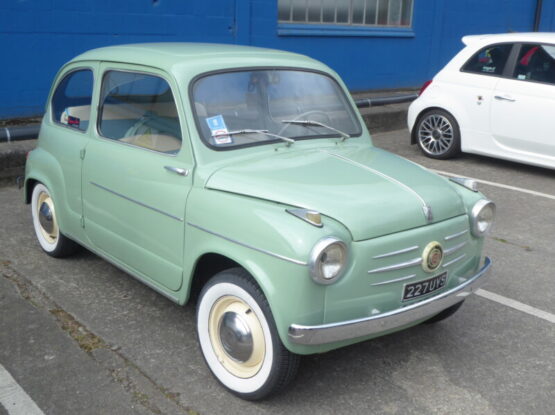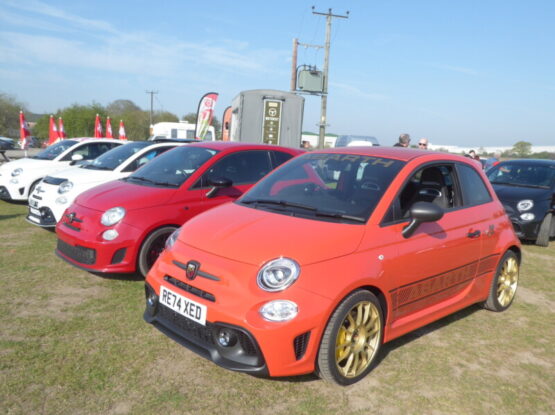
There are many factors which govern the precise dates of my planned trips to the US, mostly around flight prices (which can vary quite dramatically from one day to the next!) and diary commitments in the UK, so I don’t actually plan around things like local Cars and Coffee events, but it is always pleasing when I realise that the timing of my visit will allow me to go and get an early morning experience of some cars that you might not see out on the roads of the US let alone back in the UK. I discovered this particular event, the Manhattan Beach Cars and Coffee only last year, even though it is only a few minutes away from my habitual hotel choices at the LAX Airport. If you just search on “Los Angeles” you will find the one event that I’ve been going to for a while, but if you select what Americans think of as separate cities or neighbourhoods, you will soon find there are a whole lot more meets going on. Like all American Cars and Coffee events, things get underway early, and people do not linger as long as they would in the UK, so it is a case of having an early breakfast, going and sourcing a rental car and trying to be on site for as close to 8am as I can – and even then cars seem to be departing as much as they are arriving. Even so, there was plenty go see, with some cars I recall spotting here on previous visits and some I certainly had not. Here is what the camera recorded:
AC
Just as in the UK and Europe so there are plenty of replica and recreation versions of the legendary AC Cobra out and about in the US and this is one of them.

ALFA ROMEO
Alfa replaced the Giulia-based Spider model with an all-new design which finally made its debut in 1966 together with the Giulia Sprint GT Veloce at an event organised in Gardone Riviera. With its boat tailed styling, it quickly found favour, even before taking a starring role in the film “The Graduate”. The original 1600cc engine was replaced by a more powerful 1750cc unit at the same time as the change was made to the rest of the range, and the car continued like this until 1970, when the first significant change to the exterior styling was introduced on the 1750 Spider Veloce, with the original’s distinctive elongated round tail changed to a more conventional cut-off tail, called the “Kamm tail”, as well as improving the luggage space. Numerous other small changes took place both inside and out, such as a slightly different grille, new doorhandles, a more raked windscreen, top-hinged pedals and improved interior trim. 1971 saw the Spider Veloce get a new, larger powerplant—a 1962 cc, 132 hp unit—and consequently the name was changed from 1750 Spider Veloce to 2000 Spider Veloce. The 1600 Spider restarted production a year later as the Spider 1600 Junior, and was visually identical to the 1300. 1974 saw the introduction of the rare, factory request, Spider-Targa. Based upon the Spider, it featured a Porsche style solid rear window and lift out roof panels, all made out of black GRP type material. Less than 2,000 models of such type were ever made and was the only part solid roof Spider until the introduction of the factory crafted hard top. The 1300 and 2000 cars were modified in 1974 and 1975 respectively to include two small seats behind the front seats, becoming a “two plus two” four seater. The 1300 model was discontinued in 1977. Also, between 1974 and 1976, the early-style stainless-steel bumpers were discontinued and replaced with black, rubber-clad units to meet increasingly stringent North American crash requirements. 4,557 examples of the 1300 Junior were made and 4,848 of the 1600 Junior as well as 16,320 2000 Spider Veloces and 22,059 of 2000 Spider Veloce US version. There were also 4,027 1750 Spider Veloces produced.


As was still the practice in the 1970s, Alfa followed up the launch of the Alfetta Berlina with a very pretty coupe. Styled by Giugiaro, this car, initially called the GT, and premiered in the autumn of 1974, looked completely unlike the saloon on which it was based. The first cars had 1.8 litre four cylinder engines and there was one of those on show. In 1976 the range was expanded both up and down with a 1.6 and a 2.0 model, the latter adopting the legendary GTV name. A rare SE model from this period was part of the display, complete with period vinyl roof (look closely), and although the pain does appear a bit like a lot of older Alfa reds, having gone rather pink, this was the actual shade when the car was new. In 1981, with the 2.5 litre V6 engine that had been developed for the ill-fated Alfa 6 luxury saloon available, Alfa was able to create a true rival for the 2.8 litre Capri with the GTV6. A facelift modernised the look of the car with plastic bumpers front and rear and a new interior looked rather better as well as being more ergonomically logical. There was a good mix of the earlier chrome bumpered and later plastic bumpered models, the last with 2.0 and 2.5 GTV6 versions both represented. There was also a car sporting 3.0 badging and right hand drive. This is a South African car. From 1974 South African Alfetta’s were manufactured at Alfa Romeo’s own Brits plant. South Africa was one of two markets to have a turbocharged GTV6, with a Garrett turbocharger and a NACA intake. An estimated 750 were assembled before all production ceased in 1986. The South African range included a 3.0 litre GTV-6, predating the international debut of the factory’s 3.0 litre engine in 1987 (for the Alfa 75). and 212 of these were built in South Africa for racing homologation. The last 6 GTV-6 3.0’s were fuel injected. To this day, the GTV-6 remains the quintessential Alfa Romeo for South Africans.


ARIEL
The Ariel Atom is a road-legal high performance open-wheel car made by the British Ariel Motor Company based in Crewkerne, Somerset, England, and under license in North America by TMI Autotech, Inc. at Virginia International Raceway in Alton, Virginia. The Atom began as a student project by Coventry University transport design student Niki Smart. Known then as the LSC (Lightweight Sports Car), it was developed at the university in 1996 with input and funding from various automotive industry members, including British Steel and TWR. Ariel Motor Company boss Simon Saunders was a senior lecturer whose responsibility for the project was primarily as financial manager and design critic for Smart, whom he described as “The best all-round design student I’ve ever seen.” The car was first shown publicly at the British International Motor Show at the NEC in Birmingham in October 1996. The Ariel Atom features a prominently visible chassis (i.e., an exoskeleton, no roof or windows, a small optional windscreen) and a drag coefficient of 0.40 There have been eight Ariel Atom generations to date: Ariel Atom, Ariel Atom 2, Ariel Atom 3 (including the Ariel Atom 3 Mugen Limited Edition and Honda Racing Edition – of which only one was made) Ariel Atom 3.5, Ariel Atom 3S, Ariel Spec:Race Atom, Ariel Atom 500 V8 Limited Edition (only 25 to be made), and the Ariel Atom 4. The limited production Ariel Atom 500 V8 featured a 500 bhp V8 engine. The Ariel Atom 4 uses a turbocharged 2.0 litre engine, also used in the Honda Civic Type R, with 3-stage boost.

AUSTIN HEALEY
Donald Healey had been producing a range of expensive sports cars from the 1940s, cars such as the Silverstone, the Abbott and the Farnham. For the 1952 London Motor Show, he produced a new design, which was called the Healey Hundred, based on Austin A90 mechanicals, which he intended to produce in-house at his small car company in Warwick. It was one of the stars of the 1952 Show, and it so impressed Leonard Lord, the Managing Director of Austin, who was looking for a replacement to the unsuccessful A90. that Lord struck a deal with Healey on the spot, to build it in quantity. Bodies made by Jensen Motors would be given Austin mechanical components at Austin’s Longbridge factory. The car was renamed the Austin-Healey 100, in reference to the fact that the car had a top speed of 100 mph. Production got under way in 1953, with Austin-Healey 100s being finished at Austin’s Longbridge plant alongside the A90 and based on fully trimmed and painted body/chassis units produced by Jensen in West Bromwich—in an arrangement the two companies previously had explored with the Austin A40 Sports. By early 1956, production was running at 200 cars a month, 150 of which were being sold in California. Between 1953 and 1956, 14,634 Austin-Healey 100s were produced, the vast majority of them, as was the case for most cars in this post war era, going for export. The car was replaced by an updated model in 1956, called the 100-6. It had a longer wheelbase, redesigned bodywork with an oval shaped grille, a fixed windscreen and two occasional seats added (which in 1958 became an option with the introduction of the two-seat BN6 produced in parallel with the 2+2 BN4), and the engine was replaced by one based on the six-cylinder BMC C-Series engine. In 1959, the engine capacity was increased from 2.6 to 2.9 litres and the car renamed the Austin-Healey 3000. Both 2-seat and 2+2 variants were offered. It continued in this form until production ceased in late 1967.


Known officially as the Sprite, it was announced to the press in Monte Carlo by the British Motor Corporation on 20 May 1958, just before that year’s Monaco Grand Prix. It was intended to be a low-cost model that “a chap could keep in his bike shed”, yet be the successor to the sporting versions of the pre-war Austin Seven. The Sprite was designed by the Donald Healey Motor Company, with production being undertaken at the MG factory at Abingdon. It first went on sale at a price of £669, using a tuned version of the Austin A-Series engine and as many other components from existing cars as possible to keep costs down. It was produced for a little over 3 years before being replaced by a Mark 2 version, which was then joined by a badge-engineered MG version, the Midget, reviving a model name used by MG from the late 1920s through to the mid 1950s. Enthusiasts often refer to Sprites and the later Midgets collectively as “Spridgets.” The first Sprite quickly became affectionately known as the “frogeye” in the UK and the “bugeye” in the US, because its headlights were prominently mounted on top of the bonnet, inboard of the front wings. The car’s designers had intended that the headlights could be retracted, with the lenses facing skyward when not in use; a similar arrangement was used many years later on the Porsche 928. But cost cutting by BMC led to the flip-up mechanism being deleted, therefore the headlights were simply fixed in a permanently upright position, giving the car its most distinctive feature. The body was styled by Gerry Coker, with subsequent alterations by Les Ireland following Coker’s emigration to the US in 1957. The car’s distinctive frontal styling bore a strong resemblance to the defunct American 1951 Crosley Super Sport. The problem of providing a rigid structure to an open-topped sports car was resolved by Barry Bilbie, Healey’s chassis designer, who adapted the idea provided by the Jaguar D-type, with rear suspension forces routed through the bodyshell’s floor pan. The Sprite’s chassis design was the world’s first volume-production sports car to use unitary construction, where the sheet metal body panels (apart from the bonnet) take many of the structural stresses. The original metal gauge (thickness of steel) of the rear structure specified by Bilbie was reduced by the Austin Design Office during prototype build, however during testing at MIRA (Motor Industry Research Association) distortion and deformation of the rear structure occurred and the original specification was reinstated. The two front chassis legs projecting forward from the passenger compartment mean the shell is not a full monocoque. The front sheet-metal assembly, including the bonnet (hood) and wings, was a one-piece unit, hinged from the back, that swung up to allow access to the engine compartment. The 43 bhp, 948 cc OHV engine (coded 9CC) was derived from the Austin A35 and Morris Minor 1000 models, also BMC products, but upgraded with twin 11⁄8 inch SU carburettors which gave it 43 hp at 5200 rpm and 52 lb/ft at 3300 rpm. When tested by “The Motor” magazine in 1958. It had a top speed of 82.9 mph and could accelerate from 0-60 mph in 20.5 seconds. Fuel consumption of 43 mpg was recorded. The rack and pinion steering was derived from the Morris Minor 1000 and the front suspension from the Austin A35. The front suspension was a coil spring and wishbone arrangement, with the arm of the Armstrong lever shock absorber serving as the top suspension link. The rear axle was both located and sprung by quarter-elliptic leaf springs, again with lever-arm shock absorbers and top links. There were no exterior door handles; the driver and passenger were required to reach inside to open the door. There was also no boot lid, owing to the need to retain as much structural integrity as possible, and access to the spare wheel and luggage compartment was achieved by tilting the seat-backs forward and reaching under the rear deck, a process likened to potholing by many owners, but which resulted in a large space available to store soft baggage. The BMC Competition Department entered Austin Healey Sprites in major international races and rallies, their first major success coming when John Sprinzel and Willy Cave won their class on the 1958 Alpine Rally. Private competitors also competed with much success in Sprites. Because of its affordability and practicality, the Austin Healey Sprite was developed into a formidable competition car, assuming many variants by John Sprinzel, Speedwell and WSM. The Sebring Sprite became the most iconic of the racing breed of Austin Healey Sprites. Many owners use their Austin Healey Sprites in competition today, sixty years after its introduction. 48,987 “frogeye” Sprites were made and the car remains popular to this day.


BENTLEY
Bentley replaced the 3 Litre with a more powerful car by increasing its engine displacement to 4.5 litres. As before, Bentley supplied an engine and chassis and it was up to the buyer to arrange for their new chassis to be fitted with one of a number of body styles, most of which were saloons or tourers. Very few have survived with their four-seater coachwork intact. WO Bentley had found that success in motorsport was great publicity for the brand, and he was particularly attracted to the 2 Hours of Le Mans endurance race, the inaugural running of which took place 26–27 May 1923, attracting many drivers, mostly French. There were two foreign competitors in the first race, Frank Clement and Canadian John Duff, the latter winning the 1924 competition in his personal car, a Bentley 3 Litre. This success helped Bentley sell cars, but was not repeated, so after two years without success, Bentley convened a group of wealthy British men, “united by their love of insouciance, elegant tailoring, and a need for speed,” to renew Bentley’s success. Both drivers and mechanics, these men, later nicknamed the “Bentley Boys”, drove Bentley automobiles to victory in several races between 1927 and 1931, including four consecutive wins at the 24 Hours of Le Mans, and forged the brands reputation. It was within this context that, in 1927, Bentley developed the Bentley 4½ Litre. Two cylinders were removed from the 6½ Litre model, reducing the displacement to 4.4 litres. At the time, the 3 Litre and the 6½ Litre were already available, but the 3 Litre was an outdated, under-powered model and the 6½ Litre’s image was tarnished by poor tyre performance. Sir Henry “Tim” Birkin, described as “the greatest British driver of his day” by W. O. Bentley, was one of the Bentley Boys. He refused to adhere strictly to Bentley’s assertion that increasing displacement is always preferable to forced induction. Birkin, aided by a former Bentley mechanic, decided to produce a series of five supercharged models for the competition at the 24 Hours of Le Mans; thus the 4½ litre Blower Bentley was born. The first supercharged Bentley had been a 3-litre FR5189 which had been supercharged at the Cricklewood factory in the winter of 1926/7. The Bentley Blower No.1 was officially presented in 1929 at the British International Motor Show at Olympia, London. The 55 copies were built to comply with 24 Hours of Le Mans regulations. Birkin arranged for the construction of the supercharged cars having received approval from Bentley chairman and majority shareholder Woolf Barnato and financing from wealthy horse racing enthusiast Dorothy Paget. Development and construction of the supercharged Bentleys was done in a workshop in Welwyn by Amherst Villiers, who also provided the superchargers. W.O. Bentley was hostile to forced induction and believed that “to supercharge a Bentley engine was to pervert its design and corrupt its performance.” However, having lost control of the company he founded to Barnato, he could not halt Birkin’s project. Although the Bentley 4½ Litre was heavy, weighing 1,625 kg (3,583 lb), and spacious, with a length of 172 in and a wheelbase of 130.0 in, it remained well-balanced and steered nimbly. The manual transmission, however, required skill, as its four gears were unsynchronised. The robustness of the 4½ Litre’s latticed chassis, made of steel and reinforced with ties, was needed to support the heavy cast iron inline-four engine. The engine was “resolutely modern” for the time. The displacement was 4,398 cc. Two SU carburettors and dual ignition with Bosch magnetos were fitted. The engine produced 110 hp for the touring model and 130 hp for the racing model. The engine speed was limited to 4,000 rpm. A single overhead camshaft actuated four valves per cylinder, inclined at 30 degrees. This was a technically advanced design at a time where most cars used only two valves per cylinder. The camshaft was driven by bevel gears on a vertical shaft at the front of the engine, as on the 3 Litre engine. The essential difference between the Bentley 4½ Litre and the Blower was the addition of a Roots-type supercharger to the Blower engine by engineer Amherst Villiers, who had also produced the supercharger. W. O. Bentley, as chief engineer of the company he had founded, refused to allow the engine to be modified to incorporate the supercharger. As a result, the supercharger was placed at the end of the crankshaft, in front of the radiator. This gave the Blower Bentley an easily recognisable appearance and also increased the car’s understeer due to the additional weight at the front. A guard protected the two carburettors located at the compressor intake. Similar protection was used, both in the 4½ Litre and the Blower, for the fuel tank at the rear, because a flying stone punctured the 3 Litre of Frank Clement and John Duff during the first 24 Hours of Le Mans, which contributed to their defeat. The crankshaft, pistons and lubrication system were special to the Blower engine. It produced 175 hp at 3,500 rpm for the touring model and 240 hp at 4,200 rpm for the racing version, which was more power than the Bentley 6½ Litre developed. Between 1927 and 1931 the Bentley 4½ Litre competed in several competitions, primarily the 24 Hours of Le Mans. The first was the Old Mother Gun at the 1927 24 Hours of Le Mans, driven as a prototype before production. Favoured to win, it instead crashed and did not finish. Its performance was sufficient for Bentley to decide to start production and deliver the first models the same year. Far from being the most powerful in the competitions, the 4½ Litre of Woolf Barnato and Bernard Rubin, raced neck and neck against Charles Weymann’s Stutz Blackhawk DV16, setting a new record average speed of 69 mph; Tim Birkin and Jean Chassagne finished fifth. The next year, three 4½ Litres finished second, third, and fourth behind another Bentley, the Speed Six, which possessed two more cylinders.The naturally aspirated 4½ Litre was noted for its good reliability. The supercharged models were not; the two Blower models entered in the 1930 24 Hours of Le Mans by Dorothy Paget, one of which was co-driven by Tim Birkin, did not complete the race. In 1930, Birkin finished second in the French Grand Prix at the Circuit de Pau behind a Bugatti Type 35. Ettore Bugatti, annoyed by the performance of Bentley, called the 4½ Litre the “fastest lorry in the world.” The Type 35 is much lighter and consumes much less petrol. Blower Bentleys consume 4 litres per minute at full speed. In November 1931, after selling 720 copies of the 4½ Litre – 655 naturally aspirated and 55 supercharged – in three different models (Tourer, Drophead Coupé and Sporting Four Seater, Bentley was forced to sell his company to Rolls-Royce for £125,175, a victim of the recession that hit Europe following the Wall Street Crash of 1929.

BMW
Partially based on the BMW Isetta two-seater, the 600 was BMW’s first postwar four-seater economy car. It was not a sales success, but it began the design process for its more successful successor, the BMW 700. BMW needed to expand its model range, but they did not have the resources to develop an all-new car with an all-new engine. Therefore, it used the Isetta as starting point for a new four seat economy car. As a result, the 600 used the front suspension and front door of the Isetta. The need to carry four people required a longer frame, a different rear suspension, and a larger engine. A new perimeter frame was designed, using box section side members and straight tube crossmembers. The rear suspension was an independent semi trailing arm design; this was the first time BMW had used this system. The chassis had a wheelbase of 1,700 mm (67 in), a front track of 1,220 mim (48 in), and a rear track of 1,160 mm (46 in). The 600 was powered by the 582 cc flat-twin engine from the R67 motorcycle/sidecar combination. This engine, which delivered 19.5 bhp at 4,500 rpm, was mounted behind the rear wheels. A four-speed manual gearbox was standard, while a Saxomat semi-automatic transmission was available. The 600 had a top speed of approximately 100 km/h. Access to the rear seats was by a conventional door on the right side of the vehicle. The Isetta image hurt the sales of this larger, more upscale car. The sales figures for the 600 did not meet BMW’s expectations. During production from August 1957 to 1959, about 35,000 were built. This is attributed to competition with more conventional cars, including the Volkswagen Beetle.

BMW E21 is the first generation of the BMW 3 Series compact executive car, produced by from 1975 to 1981. Most E21s were sold as 2-door compact sedans, however a Baur cabriolet was also available. Under the direction of its 51% percent shareholder, Herbert Quandt, BMW decided upon a replacement for their aging 02 Series. Paul Bracq, Director of Design at BMW from 1970 to 1974, is credited with setting the design direction of the E21. In July 1975, BMW’s Board of Management first presented this new model series in the Munich Olympic Stadium for public appraisal. The frontal view of the new car was dominated by the BMW trademark kidney grille standing out clearly from the radiator cover. The styling of the new car bore a resemblance to the BMW E12 5 Series. The wedge shape of the two-door model was distinctive, extending all the way to the unusually high rear end. In response to criticism of the tail design, a black plastic trim panel between the tail lights was added. Like many other BMW models, the C-pillar of the E21 features a Hofmeister kink. The cockpit design of the E21 marked the introduction of a new design concept, with the centre console and central dashboard area angled towards the driver. This feature has become part of BMW’s interior design philosophy for many years. As a sign of passive safety, all edges and control elements within the interior were rounded off and padded. The suspension incorporated rack and pinion steering and MacPherson strut suspension at the front, and semi-trailing arm type independent suspension at the rear. The rear suspension design causes camber changes, which can introduce “snap oversteer” at the handling limits, and the car was castigated repeatedly for this (now, of course, the press would shout in joy about such an attribute! The power assisted brakes were discs on the front wheels, while the rear wheels had drum brakes. Initially, a Getrag four-speed manual was the standard transmission fitment. Five-speed overdrive Getrag gearboxes were fitted as standard in 1980, but close ratio ‘sport’ gearboxes were available at the car’s release as an option. Alternatively, purchasers could opt for the ZF 3 HP-22 three-speed automatic transmission. At the E21’s release, three models were available: with 316 (1.6-litre), 318 (1.8-litre) and 320 (2.0-litre) versions of the BMW M10 4-cylinder engine. To differentiate between models, the 320 model came with dual headlights, while the 316 and 318 had single headlights. The fuel-injected 320i was introduced at the end of 1975. It featured the M10 4-cylinder engine with Bosch K-Jetronic fuel injection, and a limited slip differential was available as an option. At the 1977 International Auto Show in Frankfurt, BMW unveiled its new variants of the E21, featuring the new straight-6 M20 engines (which were initially called “M60”). BMW had invested DM 110 million the M20 engine series. The 4-cylinder 320 model was replaced with the 320/6, featuring a 2.0 version of the M20 engine. The 323i model was introduced, featuring 2.3 litre with 141 hp, which gave the 323i a top speed of 200 km/h (124 mph). The braking system was also upgraded, with the 323i featuring disc brakes on all wheels. Options include power steering, a 5-speed close-ratio ‘dogleg’ sport gearbox, and 25% limited slip differential. For the 1980 model year, the four-cylinder models were upgraded: the 1.8 litre carburetted M10 unit was revised to produce 89 hp and entered the market in the updated 316, while a fuel-injected version of the 1.8 litre M10 was introduced in the 318i model (which replaced the carburetted 318 as the mid-range model). The 320is model (USA only) was released in 1980 using a 1.8 litre version of the M10. The “S Package” featured Recaro sport seats, a modified dash with no air conditioning (A/C could be added by the dealer), upgraded suspension components that included a rear anti-roll bar and a larger front anti-roll bar, a 5-speed transmission and limited-slip differential, cross-spoke alloy wheels, an upgraded tool kit, a dual operation manual sunroof, an AM/FM Blaupunkt radio with cassette player, fog lights, a 3-spoke leather-wrapped steering wheel and leather shift knob, a front air dam, a “delete” of the alphanumeric 320i markers on the rear boot lid and a limited colour palate of white, silver or black. Just 2,500 320is were produced. In 1981, the economy model 315 was introduced as a reaction to the second “oil crisis” in late 1979. More spartan than the other E21 models, it was the last E21 to be built and shared production with the E30.

The BMW E30 is the second generation of BMW 3 Series, which was produced from 1982 to 1994 and replaced the E21 3 Series, and was the car which really saw the popularity of the 3 Series increase dramatically. . Development of the E30 3 Series began in July 1976, with styling being developed under chief designer Claus Luthe with exterior styling led by Boyke Boyer. In 1978, the final design was approved, with design freeze (cubing process) being completed in 1979. BMW’s launch film for the E30 shows the design process including Computer-aided design (CAD), crash testing and wind-tunnel testing. The car was released at the end of November 1982. Externally, the E30’s appearance is very similar to twin headlight versions of its E21 predecessor, however there are various detail changes in styling to the E30. Major differences to the E21 include the interior and a revised suspension, the latter to reduce the oversteer for which the E21 was criticised. At launch, the car had a 2 door style like its predecessor and just four engines, all of them petrol: the 316 and 318 four cylinder units and the 320 and 323i 6 cylinders. This last was soon upgraded to a 2.5 litre unit. Diesel models were added during the 80s and there was an all-wheel drive 325iX option for continental European markets. In addition to the 2 door saloon and Baur convertible body styles of its E21 predecessors, the E30 became available by early 1984 as a four-door sedan and later a five-door station wagon (marketed as “Touring”). The Touring body style began life as a prototype built by BMW engineer Max Reisböck in his friend’s garage in 1984 and began production in 1987. The factory convertible version began production in 1985, with the Baur convertible conversions remaining available alongside it. Following the launch of the E36 3 Series in 1990, the E30 began to be phased out.

The M3 model of the E90/E92/E93 3 Series range was powered by the BMW S65 V8 engine and was produced in sedan, convertible and coupé body styles. The E9x is the first and only standard production M3 powered by a V8 engine as its successor would revert to using a straight 6 engine. In the standard M3, the S65 engine rated at 420 PS (414 bhp) at 8,300 rpm and 400 Nm (295 lb/ft) at 3,900 rpm. Initially, the M3 was produced with a 6-speed manual transmission. In April 2008, the E90/E92/E93 M3 became the first BMW to be available with a dual-clutch transmission when the 7-speed Getrag “M-DCT” transmission was introduced as an option. The official 0 to 100 km/h (62 mph) acceleration times for the coupé and sedan are 4.6 seconds with the DCT transmission (4.8 seconds with the manual transmission) and 5.1 seconds for the convertible. The E90 and E92 versions received many positive reviews, including “the greatest all-around car in the world”, “the finest car on the market, period” and “the best, most complete car in the world”. The first body style to be introduced was the coupé, which was previewed at the 2007 Geneva Motor Show and introduced in production form at the 2007 Frankfurt Motor Show on 12 September. The coupé version uses a carbon fibre roof to reduce weight and lower the centre of gravity. In 2010, the coupé and convertible versions received a minor facelift, which included revised LED tail-lights and minor interior trim pieces but it did not get the updated headlights from the regular series. The E93 convertible version was introduced shortly after the coupé and uses a power retractable hardtop. The leather seats in the convertible version are treated with a coating to reflect sunlight, in order to reduce their tendency to become uncomfortably hot with the top down. A sedan version was introduced in 2008 and was the second (along with the E36) M3 by generation to be produced in a 4-door body style. The sedan has the same drivetrain and similar external styling as the coupé, however the lack of a carbon fibre roof contributes to a weight increase of 10 kg (22 lb) compared to an identically equipped coupé. The official kerb weights for the 2008 European-specification models (with manual transmission) are 1,580 kg (3,483 lb) for the coupé, 1,605 kg (3,538 lb) for the sedan and 1,810 kg (3,990 lb) for the convertible. Total production of the E9x M3 was 40,092 coupés, 16,219 convertibles and 9,674 sedans. Production of sedan models finished in 2011, with coupés remaining in production until July 5, 2013.

CADILLAC
This splendid machine is a 1947 Cadillac Model 62 Convertible. The first postwar Cadillac rolled off the line on October 7, 1945, and for several months, only Series 62s were produced. 1946 Cadillacs were not significantly altered from 1942 outside a few styling changes and the addition of a negative ground battery. The Series 62 retained the same lineup of body styles as in 1942—coupe, sedan, and convertible, and 18,565 total were produced for the model year, approximately 65% of Cadillac’s total 1946 output of 29,000 vehicles. Resuming civilian production was a difficult task for the entire automobile industry and demand for new cars much exceeded supply. Cadillac had as many as 100,000 unfilled orders into 1947. Due to materials shortages, some Cadillacs shipped from the factory with wooden bumpers, dealers being expected to install proper ones as they became available. Postwar inflation pushed the sticker price of a 1946 Cadillac over $1000 higher than 1942. In 1946, the Series 62 used GM’s C-body platform, as did the Cadillac Sixty Special, Buick Super and Buick Roadmaster, and Oldsmobile 98. Notchback styling characterized the cars except for the Club Coupe which had fastback styling. It was easy to distinguish the Series 62 coupe from the Series 61 because the door skins did not flare out above the rocker panel moldings, and the side window openings were lower and the reveal window moldings circled each window individually instead of looping around all the windows. The Series 62 sedan featured ventiplanes on both the front and rear door windows. It was also the first Cadillac to enter production after World War II. Interior styling and technical features were similar to those seen on the Cadillac Series 61 but with slightly richer interior appointments. Late 1946 models introduced technical changes to the V8 engine in the form of hardened ball seats for the hydraulic lifters. The 1947 models received minor styling changes and the addition of Hydro-Lectric window lifts on the Series 62 convertible, which remained the sole convertible in Cadillac’s lineup. 1947 grilles featured five horizontal blades in place of the six blades used for 1946. Polished metal stone guards on the fenders replaced the rubber ones used on 1946 models. As before, Series 62s remained Cadillac’s best-selling model with 39,834 produced, 84% of the make’s total 1947 volume. An all-new model arrived for 1948.


This one is a 1964 Sedan De Ville. Cadillac was restyled and re-engineered for 1961. The new grille slanted back towards both the bumper and the hood lip, along the horizontal plane, and sat between dual headlamps. New forward slanting front pillars with non-wraparound windshield glass were seen. The revised backlight treatment had crisp angular lines with thin pillars on some models and heavier semi-blind quarter roof posts on others. De Ville models featured front series designation scripts and lower body “skeg fins” trimmed with a thin, three-quarter-length spear molding running from behind the front wheel opening to the rear of the car. Standard equipment included power brakes, power steering, automatic transmission, dual backup lights, windshield washer, dual speed wipers, wheel discs, plain fender skirts, outside rearview mirror, vanity mirror, oil filter, power windows and 2-way power seats. Rubberized front and rear coil springs replaced the trouble prone air suspension system. Four-barrel induction systems were now the sole power choice and dual exhausts were no longer available. A new 7 in (18 cm) shorter rear-decked four-door Town Sedan hardtop appeared mid-season. A mild facelift characterized Cadillac styling trends for 1962. A flatter grille with a thicker horizontal centre bar and more delicate cross-hatched insert appeared. Ribbed chrome trim panel, seen ahead of the front wheel housings in 1961, were now replaced with cornering lamps and front fender model and series identification badges were eliminated. More massive front bumper end pieces appeared and housed rectangular parking lamps. At the rear, tail lamps were now housed in vertical nacelles designed with an angled peak at the centre. A vertically ribbed rear beauty panel appeared on the deck lid latch panel. Cadillac script also appeared on the lower left side of the radiator grille. The short-deck hardtop Town Sedan was moved from the De Ville series to the Series 6200, being replaced by a short-deck Park Avenue. In addition, all short deck Cadillac models went from being 6-window sedans in 1961 to 4-window sedans in 1962 and 1963. Standard equipment included all of the previous year’s equipment plus remote controlled outside rearview mirror, five tubeless black wall tires, heater and defroster and front cornering lamps. Cadillac refined the ride and quietness, with more insulation in the floor and behind the firewall. DeVille sales as a separate series exceeded their sales level as a trim level for the first time ever at 71,883 units, or nearly 45% of Cadillac’s total sales. Cadillac was restyled again for 1963. Exterior changes imparted a bolder and longer look. Hoods and deck lids were redesigned. The front fenders projected 4.625 inches (117.5 mm) further forward than in 1962 while the tailfins were trimmed down somewhat to provide a lower profile. Body-side sculpturing was eliminated. The slightly V-shaped radiator grille was taller and now incorporated outer extensions that swept below the flush-fender dual headlamps. Smaller circular front parking lamps were mounted in those extensions. A DeVille signature script was incorporated above the lower beltline molding near the rear of the body. A total of 143 options including bucket seats with wool, leather, or nylon upholstery fabrics and wood veneer facings on dash, doors, and seatbacks, set an all-time record for interior appointment choices. Standard equipment was the same as the previous year. The engine displacement and output remained the same, 390 cu in (6.4 L) and 325 hp. A minor facelift followed in 1964. New up front was a bi-angular grille that formed a V-shape along both its vertical and horizontal planes. The main horizontal grille bar was now carried around the body sides. Outer grille extension panels again housed the parking and cornering lamps. It was the 17th consecutive year for the Cadillac tailfins with a new fine-blade design carrying on the tradition. Short-deck models were discontinued. Performance improvements including a larger V-8 were the dominant changes for the model run. Equipment features were same as in 1963 for the most part. Comfort Control, a completely automatic heating and air conditioning system controlled by a dial thermostat on the instrument panel, was introduced as an industry first. The engine was bumped to 429 cu in (7 L), with 340 hp available. Performance gains from the new engine showed best in the lower range, at 20 to 50 mph traffic driving speeds. A new technical feature was the Turbo-Hydramatic transmission, also used in the Eldorado and the Sixty Special. A De Ville script above the lower belt molding was continued as an identifier. This was the first year for the De Ville convertible. De Ville sales reached 110,379 units, accounting for nearly two thirds of all Cadillacs sold


CHEVROLET
The first generation of Corvette was introduced late in the 1953 model year. Originally designed as a show car for the 1953 Motorama display at the New York Auto Show, it generated enough interest to induce GM to make a production version to sell to the public. First production was on June 30, 1953. This generation was often referred to as the “solid-axle” models (the independent rear suspension was not introduced until the second generation).Three hundred hand-built polo white Corvette convertibles were produced for the 1953 model year. The 1954 model year vehicles could be ordered in Pennant Blue, Sportsman Red, Black, or Polo White. 3,640 were built, and sold slowly. The 1955 model offered a 265 cu in (4.34 litre) V8 engine as an option. With a large inventory of unsold 1954 models, GM limited production to 700 for 1955. With the new V8, the 0-60 mph time improved by 1.5 seconds. A new body was introduced for the 1956 model featuring a new “face” and side coves; the taillamp fins were also gone. An optional fuel injection system was made available in the middle of the 1957 model year. It was one of the first mass-produced engines in history to reach 1 bhp per cubic inch (16.4 cc) and Chevrolet’s advertising agency used a “one hp per cubic inch” slogan for advertising the 283 bhp 283 cu in (4.64 litre) Small-Block engine. Other options included power windows (1956), hydraulically operated power convertible top (1956), heavy duty brakes and suspension (1957), and four speed manual transmission (late 1957). Delco Radio transistorised signal-seeking “hybrid” car radio, which used both vacuum tubes and transistors in its radio’s circuitry (1956 option). The 1958 Corvette received a body and interior freshening which included a longer front end with quad headlamps, bumper exiting exhaust tips, a new steering wheel, and a dashboard with all gauges mounted directly in front of the driver. Exclusive to the 1958 model were bonnet louvres and twin trunk spears. The 1959–60 model years had few changes except a decreased amount of body chrome and more powerful engine offerings. In 1961, the rear of the car was completely redesigned with the addition of a “duck tail” with four round lights. The light treatment would continue for all following model year Corvettes until 2014. In 1962, the Chevrolet 283 cu in (4.64 litre) Small-Block was enlarged to 327 cu in (5.36 litre). In standard form it produced 250 bhp. For an extra 12% over list price, the fuel-injected version produced 360 bhp, making it the fastest of the C1 generation. 1962 was also the last year for the wrap around windshield, solid rear axle, and convertible-only body style. The boot lid and exposed headlamps did not reappear for many decades.


This is a second generation Corvette, sometimes referred to as the C2, which was launched in 1963. This model introduced us to the name Sting Ray. It continued with fibreglass body panels, and overall, was smaller than the first generation. The car was designed by Larry Shinoda with major inspiration from a previous concept design called the “Q Corvette,” which was created by Peter Brock and Chuck Pohlmann under the styling direction of Bill Mitchell. Earlier, Mitchell had sponsored a car known as the “Mitchell Sting Ray” in 1959 because Chevrolet no longer participated in factory racing. This vehicle had the largest impact on the styling of this generation, although it had no top and did not give away what the final version of the C2 would look like. The third inspiration was a Mako Shark Mitchell had caught while deep-sea fishing. Production started for the 1963 model year and ended in 1967. The 1963 model was the first year for a Corvette coupé and it featured a distinctive tapering rear deck (a feature that later reappeared on the 1971 “Boattail” Buick Riviera) with, for 1963 only, a split rear window. The Sting Ray featured hidden headlamps, non-functional bonnet vents, and an independent rear suspension. Corvette chief engineer Zora Arkus-Duntov never liked the split rear window because it blocked rear vision, but Mitchell thought it to be a key part of the entire design. Maximum power for 1963 was 360 bhp, raised to 375 bhp in 1964. Options included electronic ignition, the breakerless magnetic pulse-triggered Delcotronic first offered on some 1963 Pontiac models. On 1964 models the decorative bonnet vents were eliminated and Duntov, the Corvette’s chief engineer, got his way with the split rear window changed to a full width window. Four-wheel disc brakes were introduced in 1965, as was a “big block” engine option: the 396 cu in (6.49 litre) V8. Side exhaust pipes were also optionally available in 1965, and continued to be offered through 1967. The introduction of the 425 bhp 396 cu in big block in 1965 spelled the beginning of the end for the Rochester fuel injection system. The 396 cu in option cost $292.70 while the fuel injected 327 cu in (5.36 litre) engine cost $538.00. Few people could justify spending $245.00 more for 50 bhp less, even though FI could deliver over 20 mpg on the highway and would keep delivering fuel despite high G-loading in corners taken at racing speeds. Another rare ’63 and ’64 option was the Z06 competition package, which offered stiffer suspension, bigger, multi-segment lined brakes with finned drums and more, only a couple hundred coupes and ONE convertible were factory-equipped this way in 1963. With only 771 fuel-injected cars built in 1965, Chevrolet discontinued the option at the end of the ’65 production, having introduced a less-expensive big block 396 engine rated at 425 hp in the middle of the production year and selling over 2,000 in just a few months. For 1966, Chevrolet introduced an even larger 427 cu in 7 litre Big Block version. Other options available on the C2 included the Wonderbar auto-tuning AM radio, AM-FM radio (mid-1963), air conditioning (late-1963), a telescopic steering wheel (1965), and headrests (1966). The Sting Ray’s independent rear suspension was successfully adapted for the new-for-1965 Chevrolet Corvair, which solved the quirky handling problems of that unique rear-engine compact. 1967 was the final year for the C2 generation. The 1967 model featured restyled bumper vents, less ornamentation, and back-up lamps which were on the inboard in 1966 were now rectangular and centrally located. The first use of all four taillights in red started in 1961 and was continued thru the C-2 line-up except for the 1966. The 1967 and subsequent models continuing on all Corvettes since. 1967 had the first L88 engine option which was rated at 430 bhp, but unofficial estimates place the actual output at 560 bhp or more. Only twenty such engines were installed at the factory. From 1967 (to 1969), the Holley triple two-barrel carburettor, or Tri-Power, was available on the 427 L89 (a $368 option, on top of the cost for the high-performance 427). Despite these changes, sales slipped over 15%, to 22,940 – 8,504 coupes and 14,436 convertibles.


The third generation Corvette, patterned after the Mako Shark II concept car, was introduced for the 1968 model year and was in production until 1982. C3 coupes featured the first use of T-top removable roof panels. The C3 introduced monikers that were later revived, such as LT-1, ZR-1, Z07 and Collector Edition. In 1978, the Corvette’s 25th anniversary was celebrated with a two-tone Silver Anniversary Edition and an Indy Pace Car replica edition of the C3. This was also the first time that a Corvette was used as a Pace Car for the Indianapolis 500. Engines and chassis components were mostly carried over from the C2, but the body and interior were new. The 350 cu in (5.7 litre) engine replaced the old 327 cu in (5.36 litre) as the base engine in 1969, but power remained at 300 bhp. 1969 was the only year for a C3 to optionally offer either a factory installed side exhaust or normal rear exit with chrome tips. The all-aluminium ZL1 engine was also new for 1969; the special big-block engine was listed at 430-hp , but was reported to produce 560 hp and propelled a ZL1 through the 1/4 mile in 10.89 seconds. There was an extended production run for the 1969 model year due a lengthy labour strike, which meant sales were down on the 1970 models, to 17,316. 1970 small-block power peaked with the optional high compression, high-revving LT-1 that produced 370 bhp. The 427 big-block was enlarged to 454 cu in (7.44 litre) with a 390 bhp rating. The ZR-1 special package was an option available on the 1970 through 1972 model years, and included the LT-1 engine combined with special racing equipment. Only 53 ZR-1’s were built. In 1971, to accommodate regular low-lead fuel with lower anti-knock properties, the engine compression ratios were lowered which resulted in reduced power ratings. The power rating for the 350 cu in (5.7 litre) L48 base engine decreased from 300 to 270 hp and the optional special high performance LT1 engine decreased from 370 to 330 hp. The big-block LS6 454 was reduced from 450 to 425 bhp, though it was not used in Corvettes for 1970; it was used in the Chevelle SS. For the 1972 model year, GM moved to the SAE Net measurement which resulted in further reduced, but more realistic, power ratings than the previous SAE Gross standard. Although the 1972 model’s 350 cu in horsepower was actually the same as that for the 1971 model year, the lower net horsepower numbers were used instead of gross horsepower. The L48 base engine was now rated at 200 bhp and the optional LT1 engine was now rated at 270 bhp. 1974 models had the last true dual exhaust system that was dropped on the 1975 models with the introduction of catalytic converters requiring the use of no-lead fuel. Engine power decreased with the base ZQ3 engine producing 165 bhp), the optional L82’s output 250 bhp, while the 454 big-block engine was discontinued. Gradual power increases after 1975 peaked with the 1980 model’s optional L82 producing 230 bhp. Styling changed subtly throughout the generation until 1978 for the car’s 25th anniversary. The Sting Ray nameplate was not used on the 1968 model, but Chevrolet still referred to the Corvette as a Sting Ray; however, the 1969 (through 1976) models used the “Stingray” name as one word, without the space. In 1970, the body design was updated including fender flares, and interiors were refined, which included redesigned seats, and indication lights near the gear shift that were an early use of fibre optics . Due to government regulation, the 1973 Corvette’s chrome front bumper was changed to a 5-mile-per-hour (8 km/h)system with a urethane bumper cover. 1973 Corvettes are unique in that sense, as they are the only year where the front bumper was polyurethane and the rear retained the chrome two-piece bumper set. 1973 was also the last year chrome bumpers were used. The optional wire-spoked wheel covers (left) were offered for the last time in 1973. Only 45 Z07 were built in 1973. From 1974 onwards both the front and rear bumpers were polyurethane. In 1974, a 5-mph rear bumper system with a two-piece, tapering urethane bumper cover replaced the Kamm-tail and chrome bumper blades, and matched the new front design from the previous year. 1975 was the last year for the convertible, (which did not return for 11 years). For the 1976 models the fibreglass floor was replaced with steel panels to provide protection from the catalytic converter’s high operating temperature. 1977 was last year the tunnelled roof treatment with vertical back window was used, in addition leather seats were available at no additional cost for the first time. The 1978 25th Anniversary model introduced the fastback glass rear window and featured a new interior and dashboard. Corvette’s 25th anniversary was celebrated with the Indy 500 Pace Car limited edition and a Silver Anniversary model featuring silver over gray lower body paint. All 1979 models featured the previous year’s pace car seats and offered the front and rear spoilers as optional equipment. 53,807 were produced for the model year, making 1979 the peak production year for all versions of the Corvette. Sales have trended downward since then. In 1980, the Corvette received an integrated aerodynamic redesign that resulted in a significant reduction in drag. After several years of weight increases, 1980 Corvettes were lighter as engineers trimmed both body and chassis weight. In mid-1981, production shifted from St. Louis, Missouri to Bowling Green, Kentucky, and several two-tone paint options were offered. The 1981 models were the last available with a manual transmission until well into the 1984 production run. In 1982, a fuel-injected engine returned, and a final C3 tribute Collectors Edition featured an exclusive, opening rear window hatch.


The C7 generation Corvette had been in development since 2007. Originally set to be introduced for the 2011 model year, its introduction was delayed for 3 years. It was finally released for the 2014 model year. Mid-engine and rear-engine layouts had been considered, but the front-engine, rear-wheel drive platform was chosen to keep production costs lower. To GM’s product planners and marketers, the fact that the Corvette had become known as an “old man’s toy” became a prime factor in developing the next generation. Studies showed that about 46 percent of Corvette buyers in 2012, through October, were 55 or older, compared with 22 percent of Audi R8 and 30 percent of Porsche 911 customers. The head of Chevy marketing, Chris Perry, acknowledges that too many people saw it as the car of “the successful plumber.” John Fitzpatrick, Corvette’s marketing manager said “It’s the old saying, ‘Nobody wants to be seen driving an old man’s car, but everybody wants to be seen driving a young man’s car. ” To counter that perception GM planned to make the new generation C7 more aspirational to younger people. Towards that end, a camouflaged version of the car was made available in the popular video game Gran Turismo 5 in November 2012. As part of the marketing effort associated with the introduction of the new generation, the 2013 Indianapolis 500 utilised a Corvette for the 12th time as its pace car. Pace car editions are planned. Sales success of the new Corvette is important to GM. The Motley Fool reports that the Corvette could be earning GM $10,000 or more in gross profit for every Corvette it sells.The 2014 Chevrolet Corvette uses an LT1 6.2 litre V8 making 455 bhp. The LT1 engine is in the Gen 5 family of small block engines, which will be used in GM vehicles as the new small V8 option. It features three technologies new to the GM V8, though widely available on other engines in the marketplace: direct injection, variable valve timing, and an active fuel management system. Fuel injectors are located under the intake manifold. The Corvette remains rear-wheel drive with the transaxle located in the rear. Transmission choices include a 7-speed manual or a 8-speed automatic with paddle shifters. The new interior includes wide-bottom seats as standard, with sportier versions with high side bolsters optional. The Corvette’s flag logo has been revised for the new car and a small casting of a stingray has been added to the car’s ornamentation. Features of the new generation’s structure include a carbon fibre bonnet and removable roof panel. The fenders, doors and rear quarter panels remain composite. At the rear of the car, the trademark round taillights have changed to a more squarish form. The underbody panels are made of “carbon-nano” composite and it makes use of a new aluminium frame which locates the four wheels an inch farther apart, front to rear and side to side. Luggage space decreased by 33% from the previous generation’s. The overall weight of the car was not announced by General Motors for many months after its first showing in January 2013. Despite the increased use of aluminium and other light weight materials, numerous publications reported that the weight would remain essentially unchanged from that of the previous generation’s. In August, 2013, the weight of the new Corvette was reported to be 3,444 lb meaning it would weigh more than the previous generation’s C6 ZR1 model (3,324 lb (1,508 kg)). The ZR1 C6 weight included a supercharger and intercooler on its 6.2 litre engine. Chevrolet announced the C7 Z06 at the 2014 Detroit Auto Show. The 2015 Z06 Corvette has 650 bhp from the supercharged LT4 aluminium 6.2L V-8 engine. The final C7 generation cars were produced in 2019.


Completing the array of Corvette models was the current one, the C8 generation and the first mid-engined production car that Chevrolet have offered.


The Camaro was GM’s very definite response to the huge success of Ford’s Mustang, which had been codenamed Panther. Although there had been rumours that GM was doing something, this was an era when even the journalists were surprised. and on June 21, 1966, around 200 automotive journalists of them were when they received a telegram from General Motors stating, “…please save noon of June 28 for important SEPAW meeting. Hope you can be on hand to help scratch a cat. Details will follow…(signed) John L. Cutter – Chevrolet public relations – SEPAW secretary.” The following day, the same journalists received another General Motors telegram stating, “Society for the Eradication of Panthers from the Automotive World will hold first and last meeting on June 28…(signed) John L. Cutter – Chevrolet public relations SEPAW secretary.” These telegrams were something of a puzzle at the time. On June 28, 1966, General Motors held a live press conference in Detroit’s Statler-Hilton Hotel. It was to be the first time in history that 14 cities were connected in real time for a press conference via telephone lines. Chevrolet general manager Pete Estes started the news conference stating that all attendees of the conference were charter members of the Society for the Elimination of Panthers from the Automotive World and that this would be the first and last meeting of SEPAW. Estes then announced a new car line, project designation XP-836, with a name that Chevrolet chose in keeping with other car names beginning with the letter C such as the Corvair, Chevelle, Chevy II, and Corvette. He claimed the name, suggests the comradeship of good friends as a personal car should be to its owner and that to us, the name means just what we think the car will do… go. The Camaro name was then unveiled. Automotive press asked Chevrolet product managers, what is a Camaro? and were told it was a small, vicious animal that eats Mustangs. According to the book “The Complete Book of Camaro: Every Model Since 1967”, the name Camaro was conceived by Chevrolet merchandising manager Bob Lund and General Motors vice president Ed Rollett, while they were reading the book Heath’s French and English Dictionary by James Boïelle and by de V. Payen-Payne printed in 1936. Lund and Rollett found the word “camaro” in the French-English dictionary to mean friend, pal, or comrade. The article further repeated Estes’s statement of what the word camaro was meant to imply, that the car’s name “suggests the comradeship of good friends, as a personal car should be to its owner”. In fact, the actual French word that has that meaning is “camarade”, from which the English word “comrade” is derived, and not “camaro”. “Camaro” is not a recognised word in the French language. Be that as it may, the Camaro was first shown at a press preview in Detroit, Michigan, on September 12, 1966, and then later in Los Angeles, California, on September 19, 1966. Public introduction of the new model was on September 26, 1966. The Camaro officially went on sale in dealerships on September 29, 1966, for the 1967 model year It was an instant success. The first generation model ran for three years before an all new second generation car premiered (late) for the 1970 model year.


Plenty has been written about the Corvair, following the publication of consumerist Ralph Nader’s book “Unsafe at any Speed”, even though subsequent research found that the car was no more prone to the things which the non-driving Nader alleged than many others on sale at the same time. Although the book damaged sales, that was not the only reason why the car ultimately was not that commercially successful. Until 1960, the “Big Three” domestic auto manufacturers (General Motors, Ford, and Chrysler) produced only one basic size of passenger cars: large. However, a successful modern “compact car” market segment was established in the US by the 1950 Nash Rambler. Moreover, imports from Europe, such as Volkswagen, Renault, and Fiat, showed that there was demand in the US for small cars, often as a second car or an alternative for budget-minded consumers. While the “Big Three” continued to introduce ever-larger cars during the 1950s, the newly formed American Motors Corporation (AMC) focused its business strategy on smaller-sized and fuel-efficient cars, years before there was a real need for them. The sale success of the Rambler did not go unnoticed, so during 1959 and 1960, the Big Three automakers planned to introduce their own “compact” cars. Most of these designs were scaled-down versions of the conventional American car, using four- or six-cylinder engines instead of V8s, and with bodies about 20% smaller than their standard cars. The exception to this was going to be Chevrolet’s offering, the Corvair. Led by General Manager Cole, Chevrolet designed a revolutionary new car. It was powered by an air-cooled horizontal six-cylinder 2.3 litre engine made almost entirely out of aluminium, which initially produced 80 bhp. The engine was mounted in the rear of the car, driving the rear wheels through a compact transaxle. Suspension was independent at all four wheels. There was no conventional frame, it was the first unibody built by Fisher Body. The tyres were an entirely new wide low-profile design. The styling was unconventional for Detroit: subtle and elegant, with no tailfins or chrome grille. Its engineering earned numerous patents, while Time magazine put Ed Cole and the Corvair on the cover, and Motor Trend named the Corvair as the 1960 “Car of the Year”. As well as a four door saloon, the range included a two door coupe, a convertible, and from 1961, an estate car as well as a range of light commercial vehicles including a panel van and a pick up. The Corvair’s sales exceeded 200,000 for each of its first six model years. Sales figures revealed to Chevrolet management that the Corvair was more of a specialty car than a competitor to the conventionally designed Ford Falcon or Chrysler’s Valiant. Corvair was not as competitive in the economy segment and Chevrolet began a design program that resulted in a compact car with a conventional layout, the Chevy II, for the 1962 model year. That meant that the Corvair was developed in a different way, with more emphasis put on the sporting models. so in 1962 a high performance 150 hp turbocharged “Spyder” option was added for the Monza coupes and convertibles, making the Corvair the second production automobile to come with a turbocharger as a factory option The Monza Coupe was the most popular model with 151,738 produced out of 292,531 total Corvair passenger car production for 1962. The Corvair was fast becoming the darling of the sporty car crowd. Many after-market companies offered a vast array of accessories for the Corvair, everything from imitation front grilles to serious performance upgrades such as additional carburettors, superchargers and performance exhaust and suspension upgrades. There were numerous detailed changes for 1963 and 1964. The Monza line really came into its own, as in 1963, 80% of sales were Monzas. The Convertible model counted for over 20% of all the Monzas sold. A sporty image meant big profits. In October 1964, Chevrolet presented a new Corvair, with different styling and detailed refinements to the mechanical parts, as well as fully independent rear suspension replacing the former swing axles. Saloon, coupe and convertibles were the only body styles offered, the other versions having been not renewed. Although the new car received rave reviews from journalists such as the often-critical David E Davies, sales were not that strong, and they declined every year thereafter. By 1967, the range was pruned to just the 500 and Monza Hardtop Coupes and Hardtop Sedans, and the Monza Convertible. Chevrolet was still actively marketing the Corvair in 1967, including colour print ads and an “I Love My Corvair” bumper sticker campaign by dealers, but production and sales continued to fall off drastically. Only 27,253 copies were built. In 1968, the four-door hardtop was discontinued, leaving three models—the 500 and Monza Hardtop Coupes and the Monza Convertible. All advertising was virtually stopped and sales were down to 15,400. The final model-year 1969 Corvairs were assembled almost by hand at the same plant as the Nova in Willow Run, Michigan. A total of 1,786,243 Corvairs were produced between 1960 and 1969. The phenomenal success of the Ford Mustang and that 1966 book had proved very damaging to the Corvair, and GM decided that their sporting future lay with the Camaro and for families, with the Nova. These days, there is something of a cult-following for the Corvair.


The Chevelle Super Sport, or SS, represented Chevrolet’s entry into the muscle car battle. In early 1964 and 1965, Chevelles had a Malibu SS badge on the rear quarter panel. Chevelles with the mid-1965 Z-16 option, priced at US$1,501 in 2024) in 1965, had the emblem on the front fender as well as distinct in-house style numbers: 737 for the hardtop, and 767 for the convertible. The $162 Super Sport package was available on the upscale Malibu two-door hardtop, and convertible models; the option added special exterior brightwork with SS emblems, and the 14-inch full-disc wheel covers from the Impala SS. Inside, the vinyl bucket-seat interior featured a floor console for models equipped with the optional Muncie aluminium four-speed manual or Powerglide two-speed automatic instead of the standard three-speed manual. Malibu SS also came with a four-gauge cluster instead of engine warning lights, and a dash-mounted tachometer was optional. The available 283-cubic-inch four-barrel V8 engine was rated at 220 hp, the same rating as the 1957 Chevrolet Power-Pak 283 engine. Starting in mid-1964, the Chevelle could be ordered with the division’s 327-cubic-inch V8, in either 250 or 300 hp. Both used a four-barrel carburettor, and 10.5:1 compression. For 1965, Chevrolet added the 350-hp 327 V8 as a Regular Production Option (RPO) L79. A total of 294,160 Chevelles were built in the first year, including 76,860 SS models. After 1965, the Malibu SS badge disappeared except for those sold in Canada. A limited 201 Malibu SS 396 ‘Z-16’ big-block-equipped cars were also eventually produced starting in late 1965, with most being built between mid-March and mid-April. The Chevelle SS 396 became a series of its own in 1966 with series/style numbers 13817 and 13867. SS396 sport coupes, and convertibles used the same Malibu sport coupe and convertible bodies with reinforced frames. The front suspension was revised with higher-rate springs, recalibrated shocks, and a thicker front stabilizer bar, but with different exterior trim. They also had simulated hood scoops, red-stripe tires, and bright trim mouldings. The engines included three 396 cu in (6.5 L) V8s – the standard, rated at 325 hp, an optional 360 hp, and an optional 375 hp (the mid-horsepower 396 was rated at 360 hp for 1966 and 350 hp thereafter). The SS 396 series lasted from 1966 through 1968 before being relegated to an option package in 1969. The 1966 and 1967 model years were the only two years of the ‘strut back’ 2-door sport coupe with its style number, 17. In Canada, Chevelles continued to have “Malibu SS” badges for the 1966, and early 1967 model years. These Chevelles were available with the same equipment as non-SS Malibu models in the U.S., and did not get the domed hood or the blackout front, and rear treatment. Redline tires were not available on Canadian Chevelles in 1966. A 1966 Malibu SS factory photo shows wheel covers on the car from the 1965 Impala. The Canadian Malibu SS got its “SS” name from the “Sports Option” package under RPO A51 and was primarily a trim option. This A51 option included bucket seats, a centre console (except when the three-speed manual transmission was ordered), standard full-wheel covers, and ribbed rocker panel mouldings. The “Malibu SS” emblems were carried over from the 1965 Malibu SS series. This Canadian option could be ordered with any six-cylinder or V8 engine. Starting in January 1967, the Chevelle SS396 became available. It was the 138xx series, the same as in the U.S. Produced at the Oshawa, Ontario production facility, only 867 SS 396 models were produced during 1967.


The third generation of Nova ran from 1968 to 1974. There was a complex array of models offered and there were annual changes, as was the custom in the US at this time. The 1973 model year introduced a hatchback body style based on the 2-door coupe. The front and rear of the Nova were restyled, following a government mandate for vehicles to be fitted with front bumpers capable of withstanding 5 mph (8 km/h) impacts and rear bumpers capable of absorbing 2.5 mph (4 km/h) impacts. To go along with the bigger bumpers, stylists gave the Nova a new grille with a loosely patterned crosshatch insert and parking lights located inboard of the headlights. In 1974, the rear bumper could absorb 5 mph impacts. Fuel tank capacity increased to 21 gallons, which required a redesigned trunk pan where a circular section was stamped to house the space-saver spare tire used on hatchback models. An SS option remained available, but it was merely a $123 dress-up package that included a blackout grille and Rally wheels. It could be ordered with any of the Nova engines. 35,542 SS packages were installed, making 1973 the best-selling year for the option. A modified rear side window shape was also introduced, eliminating the vent windows on both two- and four-door models. A revised rear suspension was adapted from the second generation Camaro with multi-leaf springs replacing the mono-leaf springs used on Novas since the original 1962 model. By this time, six-cylinder and V8 engines were de rigueur for American compact cars, with the 307 cu in (5.03 L) and 350 cu in (5.7 L) V8s becoming fairly common. The 1973 Nova with a six-cylinder engine or 307 cu. in. (5.0 L) V8 were among the last Chevrolets to be offered with the two-speed Powerglide automatic transmission, which was in its final year. A dressy Custom series (which became a mid-level trim package in 1975) joined the Nova line and a Custom hatchback listed for $2,701 with a six-cylinder engine. That was $173 more than the six-cylinder base-model two-door hatchback. Air conditioning added $381. Every 1973 Chevrolet Nova got side guard door beams and additional sound insulation, as well as flow-through ventilation systems. A sunroof could be installed, and fold-down rear seats were available. For 1974, the Chevrolet Nova got a centered bow-tie grille emblem, as well as modified bumpers that added two inches to the length and helped cushion minor impacts. The Powerglide was replaced by a lightweight version of the three-speed Turbo-Hydramatic 350 ( THM 250 ) already offered with the 350 cu in (5.7 L) V8, which was the only V8 offered for 1974. Nova sales continued the surge they had enjoyed since 1972 and approached 400,000 cars for 1974. Six-cylinder Novas were the fastest gainers, as sales of V-8 Novas declined. These were the years of the first energy crisis as Middle Eastern countries cut back on oil exports. After waiting for hours in gas lines and fretting about the prospect of fuel rationing, thrifty compacts looked pretty good to plenty of Americans and it fit the bill. The ‘Spirit of America’ Nova was introduced in 1974. In anticipation of the US bicentennial in 1976, the limited edition Nova Coupes were painted white and featured blue and red accent stripes as well as red and blue interior carpets and fabrics. Oldsmobile and Buick entered the compact car market; both the Apollo and Omega debuted, using the same body styles from the Nova lineup. Additional options were included on these Nova-like models, such as lighting under the dashboard and in the glove compartment. Pontiac’s final GTO of this era was based on a facelifted 1974 Ventura coupe, itself based on the Nova, but fitted with a shaker hood scoop from the Trans Am. Novas and all 1974 cars were fitted with a weight-sensitive relay within the front seat that prevented the vehicle from being started until the driver’s seatbelt had been fastened, following a safety mandate from the NHTSA. Later, Congress repealed the mandate requiring this type of device, declaring that it infringed on a driver’s freedom of choice, and allowed owners of 1974-model cars to have the seat belt interlock bypassed.[29] The devices were not included in future Nova models. Along with this controversial seat belt interlock, a new, more convenient “inertial reel” one-piece lap/shoulder safety belt assembly was standard for both front outboard passengers, along with a plastic clip attached to the headrest to guide the belt across the wearer’s shoulder.


CHRYSLER
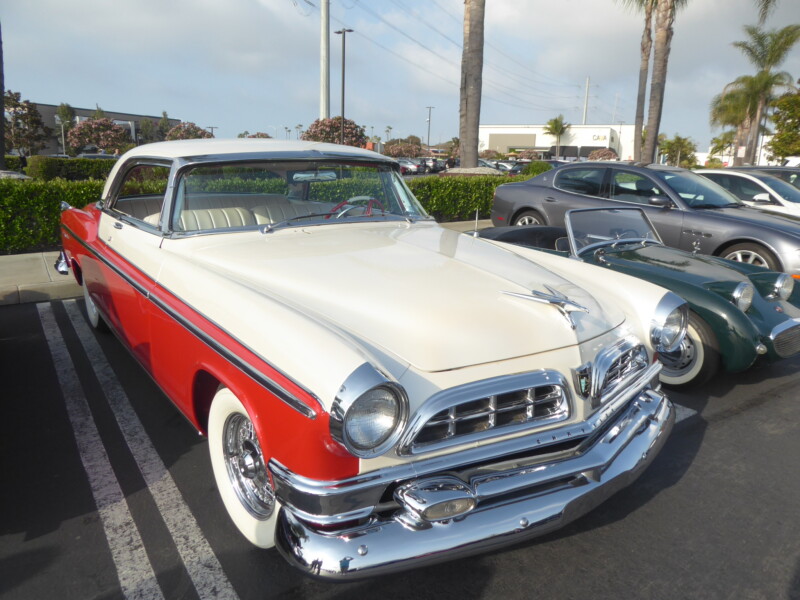
For the 1955 model year, Chrysler introduced new designs that borrowed styling cues from Virgil Exner’s custom 1952 Imperial Parade Phaeton. These replaced the out-of-fashion high roofline designs of K.T. Keller. Additionally, the Imperial luxury brand was reintroduced. A new four-door hardtop body style became available. The tradition of adding the Newport as a suffix to the model name continued, while the “St. Regis” nameplate was used for hardtops with exclusive two-tone paint. The Hemi V8’s output was up to 250 hp, another step forward in Detroit’s ongoing horsepower war, while the Chrysler 300 offered higher amounts of horsepower from the same displacement engine. The PowerFlite transmission added a control lever on the instrument panel for 1955. All New Yorkers for 1955 were now given the “DeLuxe” suffix, and the Imperial Newport two-door hardtop replaced the Club Coupe. The new, higher-priced St. Regis two-door hardtop filled the position of the former Chrysler Windsor. The sedan, convertible, and Town & Country wagon were offered. Chrysler described the 1956 model year’s design “PowerStyle,” a product of Chrysler designer Virgil Exner. The New Yorker gained a new mesh grille, leather seats, pushbutton TorqueFlite selector, and a 354 cubic inch Hemi V8 with 280 hp. A four-door pillarless hardtop made its debut, and the “DeLuxe” nameplate was dropped from the New Yorker for 1956. Chrysler introduced an under-dash mounted 16 2/3 rpm record player, dubbed the “Highway Hi-Fi”, that was manufactured by CBS Electronics. A two-way switch in the dash changed the input for the speaker from the all-transistor radio to the 7-inch record player. The St. Regis two-door hardtop was available with a choice of nine optional three-tone paint schemes, and the Town and Country Wagon model was Chrysler’s most expensive vehicle labelled as a Chrysler for 1956, listed at $4,523. Only 921 convertibles were made. New and bold designs arrived for 1957.


De TOMASO
Designed by American Tom Tjaarda, and unlike the Mangusta, which employed a steel backbone chassis, the Pantera was a steel monocoque design, the first instance of De Tomaso using this construction technique. The Pantera logo included a version of Argentina’s flag turned on its side with a T-shaped symbol that was the brand used by De Tomaso’s Argentinian cattle ranching ancestors. The car made its public debut in Modena in March 1970 and was presented at the 1970 New York Motor Show a few weeks later. Approximately a year later the first production Panteras were sold, and production was increased to three per day. The curious slat-backed seats which had attracted comment at the New York Show were replaced by more conventional body-hugging sports-car seats in the production cars: leg-room was generous but the pedals were off-set and headroom was insufficient for drivers above approximately 6 ft. Reflecting its makers’ transatlantic ambitions, the Pantera came with an abundance of standard features which appeared exotic in Europe, such as electric windows, air conditioning and even “doors that buzz when … open”. By the time the Pantera reached production, the interior was in most respects well sorted, although resting an arm on the central console could lead to inadvertently activating the poorly located cigarette lighter. The first 1971 Panteras were powered by a Ford 351 cu in (5.8 litre) V8 engine that produced a severely underrated 330 hp. Stock dynos over the years proved that power was more along the lines of about 380 hp. The high torque provided by the Ford engine reduced the need for excessive gear changing at low speeds: this made the car much less demanding to drive in urban conditions than many of the locally built competitor products. The ZF transaxle used in the Mangusta was also used for the Pantera: a passenger in an early Pantera recorded that the mechanical noises emanating from the transaxle were more intrusive than the well restrained engine noise. Power-assisted four-wheel disc brakes and rack and pinion steering were all standard equipment on the Pantera. The 1971 Pantera could accelerate to 60 mph in 5.5 seconds. In the summer of 1971, a visitor to the De Tomaso plant at Modena identified two different types of Pantera awaiting shipment, being respectively the European and American versions. From outside, the principal differences were the larger tail lamps on the cars destined for America, along with addition of corner marker lamps. The visitor was impressed by the large number of cars awaiting shipment; but in reality, spending the best part of a year under dust covers in a series of large hangars probably did nothing for the cash-flow of the business or the condition of some of the cars by the time they crossed the Atlantic. Late in 1971, Ford began importing Panteras for the American market to be sold through its Lincoln Mercury dealers. The first 75 cars were simply European imports and are known for their “push-button” door handles and hand-built Carrozzeria Vignale bodies. A total of 1,007 Panteras reached the United States that first year. These cars were poorly built, and several Panteras broke down during testing on Ford’s test track. Early crash testing at UCLA showed that safety cage engineering was not very well understood in the 1970s. Rust-proofing was minimal on these early cars, and the quality of fit and finish was poor, with large amounts of body solder being used to cover body panel flaws. Notably, Elvis Presley once fired a gun at his Pantera after it would not start. An L model (“Lusso”) was added in 1972 and a GTS version in 1974, but it was not enough and Ford ended their importation to the US in 1975, having sold around 5,500 cars. De Tomaso continued to build the car in ever-escalating forms of performance and luxury for almost two decades for sale in the rest of the world. A small number of Panteras were imported to the US by grey market importers in the 1980s, notably Panteramerica and AmeriSport. After 1974, Ford US discontinued the Cleveland 351 engine, but production continued in Australia until 1982. De Tomaso started sourcing their V8s from Australia once the American supplies dried up. These engines were tuned in Switzerland and were available with a range of outputs up to 360 PS. The chassis was completely revised in 1980, beginning with chassis number 9000. From May 1980 the lineup included the GT5, which had bonded and riveted-on fibreglass wheelarch extensions and from November 1984 the GT5S model which had blended arches and a distinctive wide-body look. The GT5 also incorporated better brakes, a more luxurious interior, much larger wheels and tires and the fibreglass body kit also included an air dam and side skirts. Production of the wide body GT5 (and similarly equipped narrow body GTS models) continued until 1985, when the GT5-S replaced the GT5. Although the factory has not made its records available, an analysis based on Vehicle Identification Numbers by the Pantera Owners Club of America (POCA) late model (9000 series) registrar has shown that fewer than 252 GT5 Panteras were likely to have been built. The GT5-S featured single piece flared steel fenders instead of the GT5’s riveted-on fibreglass flares, and a smaller steel front air dam. The ‘S’ in the GT5-S name stood for “steel”. Otherwise the GT5-S was largely identical to the GT5. The POCA 9000 series registrar’s VIN analysis indicates that fewer than 183 GT5-S Panteras were built. Concurrent GTS production continued, on a custom order and very limited basis, until the late 1980s. The car continued to use a Ford V8 engine, although in 1988, when the supply of Ford 351 Cleveland engines from Australia ran out, De Tomaso began installing Ford 351 Windsor engines in the Pantera instead. For 1990 the 351 was changed to the Ford 302 cu in (4942 cc, commonly called a “5.0”). Incorporating a Marcello Gandini facelift, suspension redesign, partial chassis redesign and the new, smaller engine, the Pantera 90 Si model was introduced in 1990. Only 38 90 Si models were sold before the Pantera was finally phased out in 1993 to make way for the radical, carbon-fibre-bodied Guarà. Some say 41 were built (with the last one not finished until 1996), of which four were targa models. The targas were converted by Pavesi directly off the production lines. In all, about 7,200 Panteras were built.


DODGE
The Demon is a limited production wide-body and extreme (drag race level) performance variant of the already high-performance Challenger SRT Hellcat. It debuted during the New York Auto Show in April 2017. The Demon uses an all-new 6.2-liter V8 engine equipped with a 2.7-liter supercharger, which is rated at 808 hp (819 PS) with 91 octane gasoline and 840 hp (852 PS) with 100 octane fuel or higher (both outputs are with the red key fob supplied with the car). Torque stands at 770 lb/ft (1,044 Nm) on 100 octane fuel. The car weighs 215 lb (98 kg) less than the Hellcat, the total being 4,254 lb (1,930 kg). The SRT Demon uses a set of road tires by Nitto Tire, called the NT05R. The tyres are the 315/40R18 variations at both front and rear. The tyres are targeted for the drag strip, but have enough tread pattern to make them legal for the road. This tire, although an NT05R consumer tire, is a variation built specifically to withstand the power output of the Demon. This makes the Challenger SRT Demon the first production car to contain a set of drag radial road tyres. The SRT Demon contains a system that is used specifically for drag racing called transbrake. Dodge uses a unique transbrake that puts the transmission in first gear and second gear simultaneously, holding the Demon stationary. This is used along with the car’s torque converter to build up hydraulic pressure before launch. The power-to-weight ratio of the SRT Demon is 418 hp (424 PS) per ton on 91 octane gasoline and 435 hp (441 PS) per ton on 100 octane or higher. The SRT Demon accelerates from 0–30 mph (0–48 km/h) in 1.0 second, 0–60 mph (0–97 km/h) in 2.3 seconds (2.0s with a rollout), 0–100 mph (0–161 km/h) in 5.1 seconds, a top speed of 168 mph (270 km/h) (factory limited), and the quarter mile (400 m (1,300 ft; 440 yd)) in only 9.65 seconds at 140.09 mph (225.45 km/h).[50] This makes the Demon the fastest non-electric production car to reach 0-60 mph (0–97 km/h) and to complete a straight-line quarter mile at its time of announcement. The SRT Demon is also capable of accelerating at 1.8 G’s of force at launch. The boost pressure of the supercharger can be increased to 14.5 psi (100 kPa; 1.00 bar) and redline up to 6,500 rpm. With this extreme power, and hard acceleration, the SRT Demon is the first production car to perform a wheelie. With the control module from the “Demon Crate” and high-speed tires, the Demon has attained a top speed of over 200 mph (320 km/h) in test runs. Because of the lack of an NHRA certified roll cage, which is required if the quarter-mile time is under 10 seconds, the NHRA banned the SRT Demon from competition. Like the SRT Hellcat, it comes with both red and black key fobs, with the black fob limiting the power output to 500 hp. With the red key and the use of 100+ octane gasoline, the Demon can utilize its full power potential. Only 3,300 cars were made, with production beginning in the summer of 2017 and market introduction happening in the fall of 2017. The interior of the SRT Demon is the same as all other Challenger trims, but with changes that differentiate it to the other trims. The Demon only includes a front driver’s seat as standard, and no other seats front or rear in the vehicle. However, the front passenger’s seat, as well as a rear bench seat, can both be added back as options for one dollar each. To replace the rear seats, Dodge included rear roll bars, and has a 4-point harness installed on it for the driver seat. The dashboard display and the seats now have the Demon logo on them, and includes a performance display on it, as well as on the center console touch screen. Dodge engineers reduced the curb weight of the 2018 Challenger SRT Demon to 4,237 lb (1,922 kg) versus the 4,469 lb (2,027 kg) curb weight of the SRT Hellcat, a difference of 105 kg (231 lb). Weight reduction was achieved by removing the front passenger seat (it could be added back), rear seat, speakers, trunk trim, parking sensors, and insulators, among other items. The SRT Demon also uses lightweight aluminum alloy wheels, pistons, calipers, and brake rotors. The SRT Demon was chosen as one of the Top 10 Tech Cars by the IEEE in 2018

FERRARI
First seen at the 1968 Paris Motor Show, the 365 GTB/4 was the last of the classic front engined V12 Ferrari models. Almost immediately the 365 GTB/4 gained its ‘Daytona’ moniker from Ferrari’s 1-2-3 result in the 1967 24-hour race of the same name. The Daytona’s engine and handling certainly didn’t undermine its racing nomenclature. The 4.4-litre, 4-cam V12 produced an astonishing 352bhp and, despite its 1,633kg bulk, the Daytona was billed as the fastest road car in the world. Not only was 174mph more than brisk, but crucially, it was faster than the Miura. The 5-speed gearbox was mounted at the rear for a more optimal weight distribution, and helped give the Daytona its predictable handling and solid road-holding. Like so many Ferraris of the period, the Daytona’s beautiful bodywork was designed by Pininfarina with the car built by Scaglietti. The delicate front was cleanly cut with both pop-up and Plexiglas headlight varieties. The rear slope was suggestively rakish and a Kamm tail provided further clues as to the performance of the car. The wheel arch flares, although elegant in proportion, are the only real overt notion that this car has significant pace, until you drive one! A number of them had their roof removed in the 1980s when people wanted the far rarer GTS Spider version, but values of the cars are such now that I would hope no-one would even contemplate such an act of sacrilege again!


The Ferrari 365 GTC/4, a 2+2 grand tourer, was only produced by Ferrari from 1971 to 1972. It was based on the chassis of the Ferrari 365 GTB/4 “Daytona”. In the very short two-year production run 505 examples of the GTC/4 were produced. Its chassis and drivetrain, however, were carried over mostly unaltered (apart from a wheelbase stretch to provide more satisfying rear seat room) on its successor, the 1972 365 GT4 2+2. The GTC/4’s coupé bodywork by Pininfarina enclosed two front and two rear seats, as on the 365 GT 2+2 it replaced directly. However, the rear seats were small and the slanting rear window limited rear headroom, so it can also be seen to trace to the two-seat 365 GTC that had been discontinued in 1970. With its wedge shape, fastback silhouette, sharp creases and hidden headlamps the GTC/4’s styling clearly reflects the 365 GTB/4 “Daytona” it was based on. Power steering, electric windows and air conditioning were standard. The cabin was upholstered in mixed leather and tartan fabric, unique to this model and unusual for a Ferrari, with full leather upholstery an option. The 365 GTC/4 shared the chassis and engine block as the 365 GTB/4 Daytona, riding on the same wheelbase and suspension. Many changes were made to make it a more comfortable grand tourer than its two-seat predecessor and sibling. These included softer spring rate and a hydraulic power steering. The chassis was a tubular spaceframe, mated to a steel body with aluminium doors and bonnets; as was customary in this period, the bodies were made and finished by Pininfarina in Turin, then sent to Ferrari in Modena for the assembly. The suspension system used transverse A-arms, coil springs coaxial with the shock absorbers (double at the rear), and anti-roll bars on all four corners. Wheels were cast magnesium on Rudge knock-off hubs, while Borrani wire wheels were optional; the braking system used vented discs front and rear. The engine was a Tipo F 101 AC 000 Colombo V12, displacing 4,390 cc. Engine block and cylinder heads were aluminium alloy, with cast iron pressed-in sleeves; chain-driven two overhead camshafts per bank (four in total, as noted by the “4” in the model designation) commanded two valves per cylinder. The V12 was detuned to 340 PS (335 bhp) from the Daytona, to provide a more tractable response suited to a GT-oriented Ferrari. In place of the Daytona’s downdraft setup, six twin-choke side-draft Weber carburetors were used, whose lower profile made possible the car’s lower and sloping bonnet line. The 5-speed all-synchronised manual transmission was bolted to the engine, another difference from the Daytona which used a transaxle. However the set back placement of the engine and transmission still allowed the car to achieve a near perfect 51:49 weight distribution. The gearbox was rigidly connected to the alloy housing of the rear differential through a torque tube.


Firmly placed in Ferrari’s history as one of their finest big GTs, the 550 Maranello’s combination of stylish Pininfarina lines and front mounted 12-cylinder engine meant this car had the potential to become an instant classic, following in the footsteps of its forebear, the 365 GTB/4 ‘Daytona’, and if you look at the way the prices are steading to go, it’s clear that the potential is being realised. Launched in 1996, and with modern styling cues, a 5.5 litre V12 engine producing around 485bhp and a reported top speed of 199mph, the 550 Maranello was a serious motor car. A less frenetic power delivery, the six speed manual box and excellent weight distribution were all factors in the 550 becoming the perfect European Grand Tourer. Ferrari updated the car to create the 575M. Launched in 2002, it is essentially an updated 550 Maranello featuring minor styling changes from Pininfarina. The 575M was replaced by the 599 GTB in the first half of 2006. Updates from the 550 included a redesigned interior and substantial mechanical improvements, including bigger brake discs, a larger and more powerful engine, improved weight distribution, refined aerodynamics and fluid-dynamics along with an adaptive suspension set-up (the four independent suspensions are also controlled by the gearbox, to minimize pitch throughout the 200-milliseconds shift time). Two six-speed transmissions were available, a conventional manual gearbox and, for the first time on a Ferrari V12, Magneti Marelli’s “F1” automated manual gearbox. The 575 model number refers to total engine displacement in cc, whilst the ‘M’ is an abbreviation of modificata (“modified”).

Effectively a mid-life update to the 360 Modena, the F430 debuted at the 2004 Paris Motor Show. Designed by Pininfarina, under the guidance of Frank Stephenson, the body styling of the F430 was revised from the 360 Modena, to improve its aerodynamic efficiency. Although the drag coefficient remained the same, downforce was greatly enhanced. Despite sharing the same basic Alcoa Aluminium chassis, roof line, doors and glass, the car looked significantly different from the 360. A great deal of Ferrari heritage was included in the exterior design. At the rear, the Enzo’s tail lights and interior vents were added. The car’s name was etched into the Testarossa-styled driver’s side mirror. The large oval openings in the front bumper are reminiscent of Ferrari racing models from the 60s, specifically the 156 “sharknose” Formula One car and 250 TR61 Le Mans cars of Phil Hill. Designed with soft-top-convertible. The F430 featured a 4.3 litre V8 petrol engine of the “Ferrari-Maserati” F136 family. This new power plant was a significant departure for Ferrari, as all previous Ferrari V8’s were descendants of the Dino racing program of the 1950s. This fifty-year development cycle came to an end with the entirely new unit. The engine’s output was 490 hp at 8500 rpm and 343 lb/ft of torque at 5250 rpm, 80% of which was available below 3500rpm. Despite a 20% increase in displacement, engine weight grew by only 4 kg and engine dimensions were decreased, for easier packaging. The connecting rods, pistons and crankshaft were all entirely new, while the four-valve cylinder head, valves and intake trumpets were copied directly from Formula 1 engines, for ideal volumetric efficiency. The F430 has a top speed in excess of 196 mph and could accelerate from 0 to 100 km/h in 3.9 seconds, 0.6 seconds quicker than the old model. The brakes on the F430 were designed in close cooperation with Brembo (who did the calipers and discs) and Bosch (who did the electronics package),resulting in a new cast-iron alloy for the discs. The new alloy includes molybdenum which has better heat dissipation performance. The F430 was also available with the optional Carbon fibre-reinforced Silicon Carbide (C/SiC) ceramic composite brake package. Ferrari claims the carbon ceramic brakes will not fade even after 300-360 laps at their test track. The F430 featured the E-Diff, a computer-controlled limited slip active differential which can vary the distribution of torque based on inputs such as steering angle and lateral acceleration. Other notable features include the first application of Ferrari’s manettino steering wheel-mounted control knob. Drivers can select from five different settings which modify the vehicle’s ESC system, “Skyhook” electronic suspension, transmission behaviour, throttle response, and E-Diff. The feature is similar to Land Rover’s “Terrain Response” system. The Ferrari F430 was also released with exclusive Goodyear Eagle F1 GSD3 EMT tyres, which have a V-shaped tread design, run-flat capability, and OneTRED technology. The F430 Spider, Ferrari’s 21st road going convertible, made its world premiere at the 2005 Geneva Motor Show. The car was designed by Pininfarina with aerodynamic simulation programs also used for Formula 1 cars. The roof panel automatically folds away inside a space above the engine bay. The conversion from a closed top to an open-air convertible is a two-stage folding-action. The interior of the Spider is identical to that of the coupé. Serving as the successor to the Challenge Stradale, the 430 Scuderia was unveiled by Michael Schumacher at the 2007 Frankfurt Auto Show. Aimed to compete with cars like the Porsche RS-models and the Lamborghini Gallardo Superleggera it was lighter by 100 kg/220 lb and more powerful (510 PS) than the standard F430. Increased power came from a revised intake, exhaust, and an ion-sensing knock-detection system that allows for a higher compression ratio. Thus the weight-to-power ratio was reduced from 2.96 kg/hp to 2.5 kg/hp. In addition to the weight saving measures, the Scuderia semi-automatic transmission gained improved “Superfast”, known as “Superfast2”, software for faster 60 millisecond shift-times. A new traction control system combined the F1-Trac traction and stability control with the E-Diff electronic differential. The Ferrari 430 Scuderia accelerates from 0-100 km/h in 3.6 seconds, with a top speed of 202 miles per hour. Ferrari claimed that around their test track, Fiorano Circuit, it matched the Ferrari Enzo, and the Ferrari F430’s successor, the Ferrari 458. To commemorate Ferrari’s 16th victory in the Formula 1 Constructor’s World Championship in 2008, Ferrari unveiled the Scuderia Spider 16M at World Finals in Mugello. It is effectively a convertible version of the 430 Scuderia. The engine produces 510 PS at 8500 rpm. The car has a dry weight of 1,340 kg, making it 80 kg lighter than the F430 Spider, at a curb weight of 1,440 kg (3,175 lb). The chassis was stiffened to cope with the extra performance available and the car featured many carbon fibre parts as standard. Specially lightened front and rear bumpers (compared to the 430 Scuderia) were a further sign of the efforts Ferrari was putting into this convertible track car for the road. Unique 5-spoke forged wheels were produced for the 16M’s launch and helped to considerably reduce unsprung weight with larger front brakes and callipers added for extra stopping power (also featured on 430 Scuderia). It accelerates from 0-100 km/h in 3.7 seconds, with a top speed of 315 km/h (196 mph). 499 vehicles were released beginning early 2009 and all were pre-sold to select clients.

The next V12 engined Ferrari was the 599 GTB (internal code F141) a new flagship, replacing the 575M Maranello. Styled by Pininfarina under the direction of Ferrari’s Frank Stephenson, the 599 GTB debuted at the Geneva Motor Show in February 2006. It is named for its total engine displacement (5999 cc), Gran Turismo Berlinetta nature, and the Fiorano Circuit test track used by Ferrari. The Tipo F140 C 5999 cc V12 engine produced a maximum 620 PS (612 hp), making it the most powerful series production Ferrari road car of the time. At the time of its introduction, this was one of the few engines whose output exceeded 100 hp per litre of displacement without any sort of forced-induction mechanism such as supercharging or turbocharging. Its 448 ft·lb of torque was also a record for Ferrari’s GT cars. Most of the modifications to the engine were done to allow it to fit in the Fiorano’s engine bay (the original Enzo version could be taller as it would not block forward vision due to its mid-mounted position). A traditional 6-speed manual transmission as well as Ferrari’s 6-speed called “F1 SuperFast” was offered. The Fiorano also saw the debut of Ferrari’s new traction control system, F1-Trac. The vast majority of the 599 GTB’s were equipped with the semi-automatic gearbox, with just 30 examples produced with a manual gearbox of which 20 were destined for the United States and 10 remained in Europe. The car changed little during its 6 year production, though the range did gain additional versions, with the HGTE model being the first, with a number of chassis and suspension changes aimed at making the car even sharper to drive, and then the more potent 599GTO came in 2010. With 670 bhp, this was the fastest road-going Ferrari ever made. Just 599 were made. The model was superceded by the F12 Berlinetta in 2012.

Launched at the 2015 Geneva Show, the 488GTB followed the lead set by the California T in bringing turbocharging into a modern-day, mid-engined V8 Ferrari supercar for the first time. The engine is completely new when compared with its V8 stablemate, not only in components but also in feel and character. It is a twin-turbocharged 3902cc unit whilst that in the California T is 3855cc. In the 488 GTB, it produces 660bhp at 8000rpm and 560lb ft at 3000rpm. Both outputs are significant increases over the normally aspirated 4.5-litre V8 used in the 562 bhp 458 Italia and 597 bhp 458 Speciale, and also greater than the car’s biggest rival, the McLaren 650S. The torque figure of the 488 GTB is such that it also exceeds the 509lb ft at 6000rpm of the normally aspirated V12 used in the range-topping Ferrari F12 Berlinetta. The mighty new engine in the 488 GTB drives the rear wheels through a revised seven-speed dual-clutch automatic gearbox derived from the 458. It features a new ‘Variable Torque Management’ system which, Ferrari says, “unleashes the engine’s massive torque smoothly and powerfully right across the rev range”. The gear ratios are also tuned to “deliver incredibly progressive acceleration when the driver floors the throttle”. The 488 GTB can crack 0-62mph in just 3.0sec, 0-124mph in 8.4sec and reach a top speed of 205mph. Its 0-62mph and 0-124mph times match the McLaren 650S’s, but the Woking car’s top speed is slightly higher at 207mph. The engine also accounts for the ‘488’ element of the car’s name, because each of the engine’s eight cylinders is 488cc in capacity when rounded up. The GTB suffix, standing for Gran Turismo Berlinetta, is a hallmark of previous mid-engined V8 Ferraris such as the 308 GTB. Not only is the new turbo engine more potent than the 4.5-litre V8 from the 458 Italia, but it is also more economical. Combined fuel economy is rated at 24.8mpg, compared with 21.2mpg in the 458 Italia, and CO2 emissions are 260g/km – a 47g/km improvement. Ferrari’s HELE engine stop-start system features on the 488 GTB. Developments on the dynamic side include a second generation of the Side Slip Angle Control system, called SSC2. This allows the driver to oversteer without intruding, unless it detects a loss of control. The SSC2 now controls the active dampers, in addition to the F1-Trac traction control system and E-Diff electronic differential. Ferrari says the result is “more precise and less invasive, providing greater longitudinal acceleration out of corners” and flatter, more stable behaviour during “complex manoeuvres”. Learnings from the Ferrari XX programme have also been incorporated into the 488 GTB, something that Ferrari says allows all drivers and not just professionals, to make the most of its electronic and vehicle control systems. It also claims the 488 GTB is “the most responsive production model there is”, with responses comparable to a track car. The 488 GTB has lapped Ferrari’s Fiorano test track in 1min 23sec – two seconds faster than the 458 Italia, and half a second quicker than the 458 Speciale. The dimensions of the 488 GTB – it is 4568mm in length, 1952mm in width and 1213mm in height – closely match the 458 Italia from which it has evolved. Its dry weight is 1370kg when equipped with lightweight options – 40kg more than the McLaren 650S. The new look, styled at the Ferrari Styling Centre, features several new aerodynamic features that improve downforce and reduce drag. Most notable is the addition of active aerodynamics at the rear through a ‘blown’ rear spoiler, where air is channelled from the base of the glass engine cover under the spoiler. This contributes to the 50% increase in downforce over the 458 Italia. Also new is a double front spoiler, an aerodynamic underbody, a large air intake at the front that references the 308 GTB, a diffuser with active flaps, new positioning for the exhaust flaps and new-look lights. The interior has been redesigned to be made more usable, including new switchgear, air vents and instrument panel. The multi-function steering wheel remains, while the infotainment system gets a new interface and graphics. The Spider followed the closed coupe model six months later,


The 488 Pista was launched at the 2018 Geneva Show but it has taken until now before UK customers have got their hands on the cars they ordered all that time ago. Compared to the regular Ferrari 488 GTB, the 488 Pista is 90 kg lighter at 1280kg dry, features a 20 percent improved aerodynamic efficiency and makes 49hp more from its twin-turbo V8 that now produces 711hp (720PS). These are some stunning specs to be honest, especially when you consider just how good the car it’s based upon is. Ferrari claims a 0-62mph (100km/h) in 2.85 seconds, 0-124mph (200km/h) in 7.6 seconds and a top speed of over 211mph (340km/h). Ferrari has opted to call the new special series sports car “Pista”, which is Italian for ‘track’, joining a celebrated lineup of hardcore models that includes the Challenge Stradale, the 430 Scuderia and the 458 Speciale. The whole bodywork has been reshaped, with the designers using innovations such as the S-Duct at the front and the unique edges of the front bumper and side sills that guide the air flow in -apparently- all the right places. The 3.9-litre V8 engine is essentially the same unit found in the Challenge race car and features specific valves and springs, a new cam profile, strengthened pistons and cylinder heads shorter inlet ducts, radiators with an inverted rake, a larger intercooler and more. It’s also 18kg lighter than the standard engine. For the first time ever in a Ferrari, the new 488 Pista can be fitted with a set of optional single-piece carbon-fibre wheels that are around 40 percent lighter than the GTB’s standard rims. A new generation of Ferrari’s Side Slip Control System is also present (SSC 6.0) because who doesn’t like to slide around a Ferrari with some help from the gods of Maranello. The 488 Pista is not a limited production model and was offered alongside the regular 488 GTB until it went out of production.


The F8 Tributo was a surprise newcomer at the 2019 Geneva Show, and the successor to the 488 GTB and the most powerful mid-engined V8 berlinetta in the history of the brand. The new Ferrari F8 Tributo is powered by the company’s twin-turbo 3.9-litre V8 engine, here tuned to produce 710 bhp and 568lb/ft (770Nm) of peak torque. The numbers are the exact same with the special 488 Pista. Ferrari claims that the new F8 Tributo is capable of a 0-62mph (100km/h) in 2.9 seconds, with 0-124mph (200km/h) in 7.8 seconds before hitting a top speed of 211mph (340km/h). It’s not a secret that the new F8 Tributo is the latest evolution of the aluminium 458 platform, with Ferrari saying that their latest mid-engine berlinetta is “a bridge to a new design language”. The new supercar blends in new design elements with aero features such as an S-Duct at the front, which on its own increases downforce by 15 percent compared to a standard 488 GTB. The rear end of Ferrari’s McLaren 720S rival marks the return of the classic Ferrari twin light clusters, while the engine cover is now made out of Lexan and features louvres to extract hot air and remind us of the iconic F40. The chassis of the new F8 Tributo employs Ferrari’s latest version of the Side Slip Angle Control traction management system, which aims to make sliding the car around manageable even for the less experienced drivers. The changes over the 488 GTB are less prominent once you look inside the cabin; the layout of the redesigned dashboard remains the same as before, only now there are completely new door panels and a centre console, as well as a new steering wheel design. The passenger gets a 7-inch touchscreen display. First deliveries of the new Ferrari F8 Tributo started earlier in 2020 .


FIAT
Known as project 110, the brief for the Nuova 500 was to create a micro-car that would not only carry on the tradition of the earlier Topolino, but which would also take sales away from the ever popular Lambretta and Vespa scooters of the day. It clearly needed to be smaller than the 600 which had been released with a conventional 4 cylinder engine. Not an easy task, but development started in 1953 and by August 1954, two designs were ready to be shown to Fiat management. They selected one, and serious development began. At first the car was referred to as the 400, as it was going to have a 400cc engine, but it was soon realised that this was just too small, so a larger 500cc air-cooled engine was developed. It was signed off in January 1956, with production starting in March 1957 in advance of a June launch. Fiat’s marketing department got busy, with hundreds of the new car taking to the streets of Turin, each with a pretty girl standing through the open sunroof that was a feature of all the early cars. The press loved it. 50 units were shipped to Britain, where the car made its debut at Brands Hatch, and again the reception was enthusiastic. But the orders just did not come in. Fiat went for a hasty rethink, relaunching the car at the Turin Show later that year. power was increased from 13 to 15 bhp, and the poverty spec was lessened a little, with headlight bezels, brightwork on the side and chrome hubcaps, a Nuova500 badge on the engine cover, winding side windows (the launch cars just had opening quarterlights) and the option of a heater fan. It was enough to get sales moving. The original car was still offered, at a lower price, called the Economy. In the first year of production, 28,452 Fiat 500s were made. Over the next 19 years, the car changed little in overall appearance, but there were a number of updates with more power and equipment added. A 500 Sport was launched in August 1958, with a more powerful version of the 499cc engine. It lost the soft top, having a ridged steel roof, to increase strength of the body. It was only available in grey with a red side flash. The first major changes came in 1960 with the 500D. This looks very similar to the Nuova, but with two key differences. One is the engine size: the D features an uprated 499 cc engine producing 17 bhp as standard, an engine which would be used right through until the end of the L in 1973; and the other is the roof: the standard D roof does not fold back as far as the roof on the Nuova, though it was also available as the “Transformable” with the same roof as the Nuova. The D still featured “suicide doors”. There were larger rear light clusters, more space in the front boot thanks to a redesign of the fuel tank and new indicators under the headlights. A year later, Fiat added a light on the rear-view mirrors and a windscreen washer, but the car still lacked a fuel gauge. Sales increased from 20,900 in 1960 to 87.000 in 1961, 132,000 in 1962 and by 1964, the last year of production, they hit 194,000 units. The D was replaced in 1965 by the 500F, which finally moved the door hinges from back to the front, owing to changes in Italian safety laws. There was a deeper windscreen and thinner door pillars, which increased the height of the car by 10mm, improving visibility for the driver. The 500F ran through to 1975, from 1968 alongside the more luxurious 500L which was added to the range in 1968. The L is easy to tell apart, with its bumper overriders. The final updates created the 500R, which incorporated many changes from the 126 under the skin of the classic shape, and in this form production continued alongside the newer 126 until 1976


FORD
Oldest Ford here was this V8-based hot rod from the 1930s.

I remembered seeing this on my first visit here when it arrived quite late, but today it was in situ even before I was. This is a very splendid 1947 Ford Super de Luxe Wagon. Following the official surrender of Japan in September 1945, civilian car production slowly resumed. The 1946 Ford was identical to the 1942 model under the skin, though a heavy new grille with horizontal bars and red accents refreshed the styling. The hood was widened by adding a center strip. One notable change was to use the 239 CID engine which since 1939 had been used in Mercurys and trucks, and capable of 100 hp for the first time. With steel in short supply, Ford produced a distinctive “Sportsman” convertible with wood side panels, supplied from the Ford Iron Mountain Plant. The convertible had an electric top instead of manual. In the 1985 film Back to the Future and its sequel Back to the Future Part II, the car which Biff Tannen owns in 1955 was a black 1946 Ford Super De Luxe convertible. In Back to the Future, during the skateboard chase scene, based on the park lights, some shots are a 1946 model year, whereas others are a 1947 model year. Looking at the “top boot” area shape, it appears the 1947 is a real convertible, and the 1946 with the manure on it is a coupe with its top removed to resemble a convertible. In Back to the Future: Part II, some trim is different, suggesting a possible third car. After the film, the car was kept by Universal and displayed in their back lot tour. The 1946 car is now in a private collection. A 1946 woodie station wagon model was specifically selected by Jim Henson for use in the 1979 film The Muppet Movie. The 1947 Ford line was similar to the short 1946. Visual differences included the removal of the red accents from the grill and the two small lights located just above it. Ford began titling 1947s in February 1947. For the first few weeks, the 1947 model was identical to the 1946. Ford then restyled the body slightly first by moving the parking lights from above the grill to below each headlight. Exterior mouldings were changed from grooved to a smooth design. A new hood ornament with a blue plastic insert was installed. A new hubcap design became available in March. The interior dash colour was changed from red accent to gold. By September, the roof-mounted antenna was moved to the cowl. Horns were moved to in front of the radiator from the engine compartment. The final 1947 models were titled in November. In the 1984 film The Karate Kid, Mr. Miyagi gives Daniel LaRusso a cream-colored 1947 Ford Super DeLuxe convertible as a birthday gift. The car was actually a gift to Ralph Macchio from the film’s producer. To this day, Macchio still owns the car. The final year for the old-style Ford was 1948, with an all-new model launched partway through the year. The wood-sided Sportsman convertible, supplied by the Ford Iron Mountain Plant, ended the year with just 28 built, and the all-wood bodies on the woody station wagons were replaced with steel for the 1949 season. The old car-based trucks were replaced by the F-Series this year. With Ford in financial chaos during this period, sales fell well behind Chevrolet—Ford output for 1948 was 430,198 vehicles, only about 62% of Chevrolet’s output, and Plymouth came close to knocking Ford from second place with an output of 412,540 vehicles.


For the 1953 model year, Ford introduced a second generation of the F-Series trucks. Increased dimensions, improved engines, and an updated chassis were features of the second generation. In another change, the model nomenclature of the F-Series was expanded to three numbers; this remains in use in the present day. The half-ton F-1 became the F-100; the F-2 and F-3 were combined into the 3⁄4-ton F-250, while the F-4 became the one-ton F-350. Conventional F-Series trucks were F-500 to F-900; COE chassis were renamed C-Series trucks. While the cabs, doors, radiator support, inner fenders, and hoods are the same from 1953 to 1956 F-100 and F-250s (the fenders varied on F-250, F-350, and F-500, and long boxes were only available on the F-250), in 1956, the cab underwent a major revision. Centred around a wraparound windshield, the cab was given new doors, a redesigned dashboard, and an (optional) panoramic rear window. In line with Ford cars, the 1956 F-Series offered seat belts as an option. This was the final generation with separate front fenders.

Dating from 1964 is this Ford Galaxie. Model year 1964 was the fourth and final year of this body style. Interior trim was altered, and the exterior featured a more sculpted look which was actually designed to make the car more aerodynamic for NASCAR. The formal-roof “boxtop” style was no longer available, all non-wagon models now featuring the “fastback” roof design that was the runaway best-seller in 1963. The base 300 was replaced by a line of Custom and Custom 500 models. The 289 continued as the base V8 and was standard in the XL series. XL models got new thin-shell bucket seats with chrome trim. Federal regulations now required lap-style safety belts for both front outboard occupants. The ignition switch was moved from the left side of the steering column, to the right, but otherwise the attractive instrument panel remained unchanged from ’63. The 1964 XL two-door hardtop became the best seller of any XL produced in any year. The 427 cu in (7.0 L) engine was used in 50 lightweight fiberglass-equipped cars for drag racing. These competed in North America but were still too heavy and Ford introduced the lightweight Fairlane Thunderbolt. The Ford Country Squire station wagon, while wearing “Country Squire” badging, was actually part of the Galaxie 500 line. Some Country Squires had “Galaxie 500” badging on the glovebox indicating the series name. These station wagons featured the same trims as Galaxie 500s, and were a step up from the base-model Country Sedan.


Drawing on inspiration from the mid-engined Ford Mustang I concept vehicle, Lee Iacocca ordered development of a new “small car” to vice-president of design at Ford, Eugene Bordinat. Bordinat tasked Ford’s three design studios (Ford, Lincoln-Mercury, and Advanced Design) to create proposals for the new vehicle. The design teams had been given five goals for the design of the Mustang: It would seat four, have bucket seats and a floor mounted shifter, weigh no more than 2,500 pounds (1,100 kg) and be no more than 180 inches (4,572 mm) in length, sell for less than $2,500, and have multiple power, comfort, and luxury options. The Lincoln–Mercury design studio ultimately produced the winning design in the intramural contest, under Project Design Chief Joe Oros and his team of L. David Ash, Gale Halderman, and John Foster. Development of the Mustang was completed in a record 18 months from September 1962 to March 1964. and Iacocca himself championed the project as Ford Division general manager. The styling is often credited to one person, and that is not accurate, as this was very much a team effort, it has been reported by those involved. To decrease developmental costs, the Mustang used chassis, suspension, and drivetrain components derived from the Ford Falcon and Fairlane. It used a unitised platform-type frame from the 1964 Falcon, and welded box-section side rails, including welded crossmembers. Although hardtop Mustangs accounted for the highest sales, durability problems with the new frame led to the engineering of a convertible first, which ensured adequate stiffness. Overall length of the Mustang and Falcon was identical, although the Mustang’s wheelbase was slightly shorter. With an overall width of 68.2 in (1,732 mm), it was 2.4 in (61 mm) narrower, yet the wheel track was nearly identical. Shipping weight, approximately 2,570 lb (1,166 kg) with the straight six-cylinder engine, was also similar to the Falcon. A fully equipped V8 model weighed approximately 3,000 lb (1,361 kg). Although most of the mechanical parts were from the Falcon, the Mustang’s body was completely different; sporting a shorter wheelbase, wider track, lower seating position and lower overall height. An industry first, the “torque box” was an innovative structural system that greatly stiffened the Mustang’s construction and helped contribute to better handling. The car was launched in 17th April 1964, as a hardtop and a convertible, with the fastback version following in August. It was an instant sensation, with demand massively exceeding supply. Since it was introduced four months before the normal start of the 1965 production year and manufactured alongside 1964 Ford Falcons and 1964 Mercury Comets, the earliest Mustangs are widely referred to as the 1964½ model. Nevertheless, all “1964½” cars were given 1965 U.S. standard VINs at the time of production, and – with limited exception to the earliest of promotional materials – were marketed by Ford as 1965 models. The low-end model hardtop used a “U-code” 170 cu in (2.8 litre) straight-6 engine borrowed from the Falcon, as well as a three-speed manual transmission and retailed for US$2,368. Standard equipment for the early 1965 Mustangs included black front seat belts, a glove box light, and a padded dash board. Production began in March 1964 and official introduction following on April 17 at the 1964 World’s Fair. V8 models got a badge on the front fender that spelled out the engine’s cubic inch displacement (“260” or “289”) over a wide “V.” This emblem was identical to the one on the 1964 Fairlane. Several changes to the Mustang occurred at the start of the “normal” 1965 model year in August 1964, about four months after its introduction. These cars are known as “late 65’s”. The engine lineup was changed, with a 200 cu in (3.3 litre) “T-code” engine that produced 120 hp. Production of the Fairlane’s “F-code” 260 cu in (4.3 litre) engine ceased when the 1964 model year ended. It was replaced with a new 200 hp “C-code” 289 cu in (4.7 litre) engine with a two-barrel carburettor as the base V8. An “A-code” 225 hp four-barrel carburettor version was next in line, followed by the unchanged “Hi-Po” “K-code” 271 hp 289. The DC electrical generator was replaced by a new AC alternator on all Fords (a way to distinguish a 1964 from a 1965 is to see if the alternator light on the dash says “GEN” or “ALT”). The Mustang GT version was introduced as the “GT Equipment Package” and included a V8 engine (most often the 225 hp 289), grille-mounted fog lamps, rocker panel stripes, and disc brakes. In the interior the GT option added a different instrument panel that included a speedometer, fuel gauge, temp. gauge, oil pressure gauge and ammeter in five round dials (the gauges were not marked with numbers, however.) A four-barrel carburettor engine was now available with any body style. Additionally, reverse lights were an option added to the car from August 1964 production. In 1965, the Shelby Mustang was born, it was available only in newly introduced fastback body version with its swept-back rear glass and distinctive ventilation louvres. The standard interior features of the 1965 Mustang included adjustable driver and passenger bucket seats, an AM radio, and a floor mounted shifter in a variety of colour options. Ford added additional interior options during the 1965 model year. The Interior Decor Group was popularly known as “Pony Interior” due to the addition of embossed running ponies on the seat fronts, and also included integral armrests, woodgrain appliqué accents, and a round gauge cluster that would replace the standard Falcon instrumentation. Also available were sun visors, a (mechanical) remote-operated mirror, a floor console, and a bench seat. Ford later offered an under-dash air-conditioning unit, and discontinued the vinyl with cloth insert seat option, offered only in early 1965 models. One option designed strictly for fun was the Rally-Pac. Introduced in 1963 after Ford’s success at that year’s Monte Carlo Rally and available on other Ford and Mercury compacts and intermediates, the Rally-Pac was a combination clock and tachometer mounted to the steering column. It was available as a factory ordered item for US$69.30. Installed by a dealer, the Rally-Pac cost US$75.95.A 14″ rim option was available for Rally-pac and GT350R vehicles widening front and rear track to 57.5″. Reproductions are presently available from any number of Mustang restoration parts sources. A compass, rear seat belts, A/C, and back-up lights were also optional. The 1966 Mustang debuted with moderate trim changes including a new grille, side ornamentation, wheel covers and filler cap. Ford’s new C-4 “cruise-o-matic” three-speed auto transmission became available for the 225 hp V8. The 289 “HiPo” K-code engine was also offered with a c4 transmission, but it had stronger internals and can be identified by the outer casing of the servo which is marked with a ‘C’. The long duration solid-lifter camshaft that allowed the high revving 289 to make the horsepower it was known for, was not friendly for a low stall speed automatic torque converter. The “HiPo” could be spotted very easily by the 1-inch-thick vibration damper, (as compared to 1/2 inch on the 225-hp version) and the absence of a vacuum advance unit on the dual point distributor. With the valve covers off, there is a large letter “K” stamped between the valve springs, along with screw in studs (vs. a pressed in stud for other 289s) for the adjustable rocker arms. A large number of new paint and interior color options, an AM/eight-track sound system, and one of the first AM/FM mono automobile radios were also offered. It also removed the Falcon instrument cluster; the previously optional features, including the round gauges and padded sun visors, became standard equipment. The Mustang would be the best-selling convertible in 1966, with 72,119 sold, beating the number two Impala by almost 2:1. The 1965 and 1966 Mustangs are differentiated by variations in the exterior, despite similar design. These variations include the emblem on the quarter-panels behind the doors. From August 1964 production, the emblem was a single vertical piece of chrome, while for 1966 models the emblem was smaller in height and had three horizontal bars extending from the design, resembling an “E”. The front intake grilles and ornaments were also different. The 1965 front grille used a “honeycomb” pattern, while the 1966 version was a “slotted” style. While both model years used the “Horse and Corral” emblem on the grille, the 1965 had four bars extending from each side of the corral, while on the 1966, these bars were removed. The 1966 model year saw introduction of ‘High Country Special’ limited edition, 333 of them were sold in Colorado, Wyoming, and Nebraska. When Ford wanted to introduce the Mustang in Germany, they discovered that Krupp company had already registered the name for a truck. The German company offered to sell the rights for US$10,000. Ford refused and removed Mustang badges from exported units, instead naming the cars as T-5 (a pre-production Mustang project name) for the German market until 1979 when Krupp copyrights expired. In 1965, Harry Ferguson Research purchased 3 Mustang notchbacks and converted them to 4×4 in an attempt to sell potential clients on their FF AWD system. A similar system was used in the Ferguson P99 Formula One car, and would go on to be featured in the Jensen FF, widely considered the first AWD passenger car. As in the Jensen FF, the AWD Mustangs also featured an ABS braking system, long before such a feature was commonplace. Ford Australia organised the importation and conversion of 1966 Mustang to right-hand-drive for the Australian market. This coincided with the launch of new XR Falcon for 1966, which was marketed as “Mustang-bred Falcon”. To set the official conversion apart from the cottage industry, the RHD Mustangs were called “Ford Australia Delivered Mustang” and had compliance plates similar to XR Falcon. About 209 were imported to Australia with 48 units were converted in 1965 while the further 161 were done in 1966. The 1967 model year Mustang was the first redesign of the original model. Ford’s designers began drawing up a larger version even as the original was achieving sales success, and while “Iacocca later complained about the Mustang’s growth, he did oversee the redesign for 1967 .” The major mechanical feature was to allow the installation of a big-block V8 engine. The overall size, interior and cargo space were increased. Exterior trim changes included concave taillights, side scoop (1967 model) and chrome (1968 model) side ornamentation, square rear-view mirrors, and usual yearly wheel and gas cap changes. The high-performance 289 option was placed behind the newer 335 hp 6.4 litre FE engine from the Ford Thunderbird, which was equipped with a four-barrel carburettor. During the mid-1968 model year, a drag racer for the street could be ordered with the optional 428 cu in (7.0 litre) Cobra Jet engine which was officially rated at 335 hp. All of these Mustangs were issued R codes on their VIN’s. The 1967 Deluxe Interior was revised, discontinuing the embossed running horse motif on the seat backs (the source for the “pony interior” nickname) in favor of a new deluxe interior package, which included special colour options, brushed aluminium (from August 1966 production) or woodgrain dash trim, seat buttons, and special door panels. The hardtop also included upholstered quarter trim panels, a carryover from the 1965-66 deluxe interior. The 1967 hardtop also had the chrome quarter trim caps, carried over from 1965-66, but these were painted to match the interior in 1968 models. The 1967 deluxe interior included stainless steel-trimmed seat back shells, similar to those in the Thunderbird. These were dropped at the end of the 1967 model year, and were not included in the woodgrain-trimmed 1968 interior. The deluxe steering wheel, which had been included in the deluxe interior for the 1965-66, became optional, and could also be ordered with the standard interior. The 1968 models that were produced from January 1968 were also the first model year to incorporate three-point lap and shoulder belts (which had previously been optional, in 1967-68 models) as opposed to the standard lap belts. The air-conditioning option was fully integrated into the dash, the speakers and stereo were upgraded, and unique center and overhead consoles were options. The fastback model offered the option of a rear fold-down seat, and the convertible was available with folding glass windows. Gone was the Rally-Pac, since the new instrument cluster had provisions for an optional tachometer and clock. Its size and shape also precluded the installation of the accessory atop the steering column. The convenience group with four warning lights for low fuel, seat belt reminder, parking brake not released, and door ajar were added to the instrument panel, or, if one ordered the optional console and A/C, the lights were mounted on the console. Changes for the 1968 model increased safety with a two-spoke energy-absorbing steering wheel, along with newly introduced shoulder belts. Other changes included front and rear side markers, “FORD” lettering removed from hood, rearview mirror moved from frame to windscreen, a 302 cu in (4.9 litre) V8 engine was now available, and C-Stripe graphics were added. The California Special Mustang, or GT/CS, was visually based on the Shelby model and was only sold in Western states. Its sister, the ‘High Country Special’, was sold in Denver, Colorado. While the GT/CS was only available as a coupe, the ‘High Country Special’ model was available in fastback and convertible configurations during the 1966 and 1967 model years, and as a coupe for 1968. The 1968 Ford Mustang GT Fastback reached iconic status after it was featured in the 1968 film Bullitt, starring Steve McQueen. In the film, McQueen drove a modified 1968 Mustang GT 2+2 Fastback chasing a Dodge Charger through the streets of San Francisco. There were further annual updates until the model’s replacement in 1973, but with each the car got steadily bigger and less overtly sporty. Sales reduced, too, suggesting that Ford were losing their way. Mustang II did not fix that, of course, but gradually, the legendary nameplate has returned to delivering the same sort of promise as those early and much loved cars were able to do.


Developed under the watch of S. “Bunkie” Knudsen, Mustang evolved “from speed and power” to the growing consumer demand for bigger and heavier “luxury” type designs. “The result was the styling misadventures of 1971–73 …the Mustang grew fat and lazy,” “Ford was out of the go-fast business almost entirely by 1971.” “This was the last major restyling of the first-generation Mustang.” “The cars grew in every dimension except height, and they gained about 800 pounds (363 kg).” “The restyling also sought to create the illusion that the cars were even larger.” The 1971 Mustang was nearly 3 inches (76 mm) wider than the 1970, its front and rear track was also widened by 3 inches (76 mm), and its size was most evident in the SportsRoof models with its nearly flat rear roofline and cramped interior with poor visibility for the driver. Performance decreased with sales continuing to decrease as consumers switched to the smaller Pintos and Mavericks. A displeased Iacocca summed up later: “The Mustang market never left us, we left it.” Of course the second generation Mustang of 1974 went even further down the path and perhaps the less said about that one, the better!

The 1979 Mustang was based on the larger Fox platform (initially developed for the 1978 Ford Fairmont and Mercury Zephyr). The larger body with an increased wheelbase yielded more interior space for four passengers, especially in the back seat, as well as a larger capacity trunk and a bigger engine bay. Body styles included a coupe (or notchback), hatchback, and convertible which was added for the 1983 model year. Available trim levels included an unnamed base model (1979–1981), Ghia (1979–1981), Cobra (1979–1981, 1993), L (1982–1984), GL (1982–1983), GLX (1982–1983), GT (1982–1993), Turbo GT (1983–1984), LX (1984–1993), GT-350 20th anniversary edition (1984), SVO (1984–1986) and Cobra R (1993). Engines and drivetrains carried over from the Mustang II including the 2.3 L I4, 2.8 L V6, and 4.9 L V8 engines. A troublesome 2.3 L turbocharged I4 was available during initial production startup and then reappeared after undergoing improvements for the mid-year introduction of the 1983 turbo GT. The 2.8 L V6, in short supply, was replaced with a 3.3 L I6 engine during the 1979 model year. That engine was ultimately replaced with a new 3.8 L V6 for 1983. The 302 cu in (4.9 L) V8 was suspended after 1979 and replaced with a smaller, 4.2 L V8 which was dropped in favour of the high output 302 cu in (4.9 L) V8 for 1982. From 1979 to 1986, the Capri was domestically produced as a Mercury-badged version of the Mustang, using a few of its own styling cues. The third-generation Mustang had two different front-end styles. From 1979 to 1986, the front end was angled back using four rectangular headlights, known by enthusiasts as “four eyes”. The front end was restyled for 1987 to 1993 model years to reflect the contemporary, rounded-off “aero” style of the Ford Taurus using flush-composite headlamps and a smooth grille-less nose. The Mustang was selected as the 1979 Official Indianapolis 500 Pace Car with replicas sold to the public. Its special body-appearance parts were adapted by the Cobra package for 1980–81. 1982 marked the return of the Mustang GT (replacing the Cobra) which used a specially-modified high-output 302 cu in (4.9 L) engine. 1983 saw the return of the Mustang convertible after a nine-year absence. The front fascias of all Mustangs were restyled, featuring new grilles, sporting “blue oval” Ford emblems for the first time. 1984 introduced the high-performance Mustang SVO, which featured a 2.3 L turbocharged and intercooled four-cylinder engine and unique bodywork. The Mustang celebrated its 20th anniversary with a special GT350 model in white with red interior and red lower-bodyside rocker stripes. 1985 Mustangs received another front-fascia restyle. In response to poor sales and escalating fuel prices during the early 1980s, a new Mustang was in development. It was to be a variant of the Mazda MX-6 assembled at AutoAlliance International in Flat Rock, Michigan. Enthusiasts wrote to Ford objecting to the proposed change to a front-wheel drive, Japanese-designed Mustang without a V8 option. The result was the continuation of the existing Mustang while the Mazda MX-6 variant had a last-minute name change from Mustang to Probe and was released as a 1989 model. The Mustang received a major restyling for 1987, including the interior, which carried it through the end of the 1993 model year. Under the newly established Ford SVT division, the 1993 Ford Mustang SVT Cobra and Cobra R were added as special, high-performance models.


Seeking to reverse the sales slide of the 1980–1982 models and revitalize the Thunderbird’s appearance, Ford executed a significant redesign for 1983. Though still based on the Fox body, it featured a radically sleeker, more aerodynamic body and a slightly shorter wheelbase of 104.2 in (2,647 mm). Power, however, remained limited, with the 3.8 L Essex V6 and the 302 cu in (4.9 L) V8 being carried over from the previous generation. The 302 gained electronic Central Fuel Injection (CFI) in 1983, and the V6 in 1984 for US models, 1985 for Canadian models (which was in turn replaced by multiport Sequential Electronic Fuel Injection (SEFI) on the V8 in 1986 and the V6 in 1988). All-new, and a Thunderbird first, was a turbocharged 2.3 L OHC four-cylinder engine featured in the 1983 Thunderbird Turbo Coupe. The engine initially was rated at 142 hp, but by 1985, power was increased to 155 hp. Another first was the availability of a five-speed manual transmission with the turbocharged four. In 1983, the higher trim model was the Heritage; this was renamed the Elan in 1984. Also, a Fila-branded model was introduced. In 1985, a special 30th Anniversary edition was available, with special Medium Regatta Blue Metallic paint, special graphics, and trim. For 1987, the Thunderbird received a significant refresh, complete with new sheet metal and a revised front fascia with aerodynamic composite headlamps. Mechanically, the car was little changed. The V6 models carried over the CFI from 1986, while the Turbo Coupe’s turbocharged four-cylinder engine gained an intercooler, increasing output to 190 hp and 240 lb of torque. For the 1988 model year the V6 gained SEFI multiport fuel injection with power increasing substantially, from 120 hp to 140 hp. The tenth generation model was launched for 1989.

FUTURA
This spectacular car is a replica of the one-off concept Lincoln Futura, a concept car promoted by Ford’s Lincoln brand, designed by Ford’s lead stylists Bill Schmidt and John Najjar, and hand-built by Ghia in Turin, Italy, at a cost of $250,000. Displayed on the auto show circuit in 1955, the Futura was modified by George Barris into the Batmobile, for the 1966 TV series Batman. The idea for the Futura came from designer Bill Schmidt, who got the idea while he was diving, after an encounter with a shark. The car’s official public debut was on January 8, 1955, at the Chicago Auto Show; it had been shown to the press at the city’s Congress Hotel on January 5. While being displayed elsewhere in the U.S. that spring, the Futura was seen by the country’s television audience on Today (“The Today Show”) on March 3, 1955. The Futura’s styling was original by 1950s standards, with a double, clear-plastic canopy top, exaggerated hooded headlight pods, and very large, outward-canted tailfins. The Futura had a complete powertrain and was fully operable, in contrast to many show cars. Its original colour was a pearlescent white, created by one of the first pearlescent color treatments. To achieve the effect Bill Schmidt wanted, Ghia ground and pulverized the scales of thousands of fish and mixed them into the paint. The Futura was powered by a 368 cubic inch Lincoln engine and powertrain; the chassis was an early prototype Y-shaped backbone perimeter frame that would go into production on the 1956–1957 Continental Mark II. The Futura was a success as a show car, garnering favourable publicity for Ford, and so was released as a model kit and a toy. In a much more subdued form, its headlight and tailfin motifs would appear on production Lincolns for 1956 and 1957, such as the Lincoln Premiere and Lincoln Capri. The concave front grille inspired the grille on the 1960 Mercury Monterey and the 1960 Ford Galaxie.


HONDA
On 9 April 1987, the third-generation Prelude was released in the Japanese domestic market and released later that year worldwide, being a 1988 model in North America. Featuring evolutionary styling from its predecessor, it shared design cues from the Honda NSX that would be introduced later in 1990. The Prelude featured innovative features for its time such as a 0.34 drag coefficient, roof pillars made of high-strength metal and its signature feature, the available option of the world’s first mechanical four-wheel steering system available in a mass-production passenger car, which was later shared with the Honda Ascot 2.0FBT-i sedan. The mechanical four-wheel steering setup used two steering boxes, linked together with a dedicated steering shaft. Despite its complexity, it provided the driver additional benefits. At highway speeds lane changes required minimal steering input, and served as a safety feature providing more responsive and quicker manoeuvrability in adverse conditions. It also aided in low speed driving conditions such as parallel parking. The front and rear wheels would turn in opposite directions once the steering wheel had been turned 140 degrees. A ‘Road & Track’ magazine comparison between the Prelude and a C4-series Chevrolet Corvette favoured the Prelude in a slalom speed test. Honda had expected 30% of buyers to opt for four-wheel-steering, but the feature was a runaway success in the home market, and 80% of buyers opted for it in the first year. The third-generation Prelude was exclusively powered by variants of the Honda B20A engine, a base carbureted version with a SOHC 12-valve valvetrain, or a DOHC variant with Honda’s PGM-FI fuel injection and 16 valves. The engine was tilted backwards by 18 degrees, which made it possible to make the hood 30 mm (1.2 in) lower than on the previous generation. It was well received by judges of the European Car of the Year accolade for 1988, finishing third in a contest where the Peugeot 405 was the runaway winner and the Citroën AX came second. This was one of the best performances by a Japanese built or branded car until the Nissan Micra won the award five years later. The facelift third-generation Prelude was revealed in Japan on 21 November 1989. The front and rear bumpers were revised on the new Prelude. The rear front bumper and rear tail lights featured clear indicators and a revised parking light design. Many of the interior parts were also revised, including the dash bezel, the door handle and window switches. The Japanese version of the Si with the B20A was rated 140 PS with the JDM engine and was rated for 37 MPG. In the US, the facelifted Prelude debuted for the 1990 model year, with the carbureted 2.0S model being discontinued. The fuel-injected 2.0 Si became the entry-level model, being supplanted by a new Si model with the B21A1 engine, with Si 4WS or Si ALB (ABS) as optional trim models. The revised version of the B20A5, called the B21A1 was available. It was bored to 83 mm (3.3 in) with a total displacement of 2,056 cc producing up to 145 hp. The fourth generation Prelude launched in 1991.


The third generation of the Civic Type R was offered in two distinct models: one developed for the Japanese domestic market and the other for UK and international markets each matching the availability of their regular 8th generation counterparts. The Japanese market Civic Type R (FD2) went on sale on 30 March 2007. For the first time, the JDM Civic Type R was sold as a four-door sedan, rather than a three-door hatchback. The FD2 Type R was bigger, wider and heavier than the EP3 Type R. The wheelbase grew from 2,570 mm (101.2 in) to 2,700 mm (106.3 in), giving the FD2 more stability during high speed cornering. The Japanese model’s engine power output is higher than the European versions, with 225 PS (165 kW; 222 hp) being generated at 8,000 rpm and 215 Nm (159 lb/ft) of torque peaking at 6,100 rpm (versus 201 PS) at 7,800 rpm and 193 Nm (142 lb/ft) at 5,600 rpm for the European model). Honda quoted that mid-range is increased by 10 PS. Power is sent to the front wheels through a close-ratio six-speed manual transmission, and a helical limited-slip differential is fitted as standard. The front brake discs are 320 mm (12.6 in) diameter and fitted with four-piston Brembo calipers. The car is fitted with Bridgestone Potenza RE070 tires having a size of 225/40 R18. Honda claims the chassis is 50% more rigid than the previous Japan-only pre-facelift DC5 Integra Type R and 25% more rigid than the previous Japan-only facelift DC5 Integra Type R. The FD2 features an independent rear suspension rather than the torsion beam configuration used on the FN2 Type-R. To save weight, aluminium is used extensively and bonded with adhesive instead of welded. Though the chassis is larger and more rigid than the JDM Integra Type R, it is only 70 kg (154 lb) heavier. Exterior wise, the front bumper is wider and different from the standard Civic designed aerodynamically. The rear bumper features a diffuser built into the bumper and a large rear wing completes the aero package. Inside, the trademark black and red bucket seats are no longer made by Recaro as with previous versions but designed in-house by Honda. Also gone is the Momo made steering wheel, instead replaced by a Honda made version. The familiar red-on-black colour scheme or black-on-black scheme is offered on Championship White and Super Platinum Metallic Silver while a black-on-black scheme with red stitching is for the Vivid Blue Pearl model only. In October 2008, the Type R received new colours, those being Premium White Pearl, Premium Deep Violet Pearl and Crystal Black Pearl. The Vivid Blue Pearl color was dropped. In back to back tests, the Civic Type R (FD2) was on average 1 second quicker than the Integra Type-R (DC5) at the Tsukuba Circuit and four seconds faster at the longer Suzuka Circuit. In a back-to-back test on the United Kingdom TV program Fifth Gear, the FD2 Type-R was three seconds quicker than the equivalent FN2 UK version around Castle Combe Circuit in wet conditions. However, the FN2 managed a 13.1 second quarter mile pass at Killarney Raceway. A total of 14,062 FD2 Civic Type R units were produced until it ceased production in August 2010 due to failure to meet the upcoming emission requirements. Following the previous success due to the introduction of the FN2 Civic Type R from Europe in 2009, another batch of FN2 Type R with minor updates was available in Japan from fall 2010. However, the engine was the same K20Z4 straight-4 as used in the European version. In addition to the Civic Type R, 300 units of Honda Civic Mugen RR cars available exclusively in Milano Red had also been produced for Japanese market, which reduced weight to 1,255 kg (2,767 lb) using carbon fiber bumpers and aluminum for the hood. The engine is rated at 240 PS at 8,000 rpm and 218 Nm (161 lb/ft) torque at 7,000 rpm achieved through Mugen parts such as camshafts, exhaust system and ECU. Other exclusive items include Recaro SP-X racing bucket seats and other Mugen items on the interior while special 18-inch Mugen 7-spoke wheels come equipped as standard. It went on sale in Japan on 13 September 2007. Mugen also debuted the Civic Type-RR Experimental Spec concept car at the 2008 Tokyo Auto Salon, which featured a 2,157 cc (2.2 L) K20A engine rated at 260 PS at 8250 rpm and torque of 237 Nm (175 lb/ft) at 6,750 rpm. Weight is further reduced using an aluminium hood (4.6 kg (10 lb)), as well as a new titanium exhaust system (7.6 kg (17 lb)). The interior was also updated with more carbon fiber parts. The car also features Intelligent-Tire Condition Monitoring System (i-TCMS) and Recaro seats. The Honda Civic Mugen RR Advanced Concept was debuted at the 2009 Tokyo Auto Salon, based on the face-lifted FD2. It has a dry weight of 1,095 kg (2,414 lb).[18] Brake disc size was increased to 340 mm (13.4 in) diameter (as compared to 320 mm (12.6 in) in Type R/RR)

JEEP
The Jeep Wagoneer is a luxury 4×4 produced and marketed under the Jeep brand from the 1963 to 1991 model years. Introduced as the replacement for the Jeep Station Wagon, the Wagoneer was the first Jeep model line completely distinct from the Jeep CJ. Designed as a truck-based station wagon, the model line became a progenitor of the modern sport-utility vehicle (SUV). Designed under contract by industrial designer Brooks Stevens, the exterior of the Wagoneer was styled by engineer Dave Nutting. Sharing the Jeep SJ chassis (full-size Jeep) with the Jeep Gladiator/J-Series, the Wagoneer also shared its underpinnings with the introductory Jeep Cherokee. In 1966, Jeep introduced the high-content Super Wagoneer, upgrading the model line with features from higher-priced sedans. Though the trim was short-lived, the Wagoneer became upgraded in content and features throughout the 1970s. For 1984, the Jeep Grand Wagoneer was introduced (to distinguish the SJ from the smaller XJ Wagoneer), becoming its flagship trim. Through its 29-year production under a single generation (the third longest in U.S. automotive history), the Wagoneer underwent only nominal changes to its body structure and appearance. The model line was produced by Jeep through its ownership by Kaiser Jeep, AMC, and Chrysler. With competition from the “big three” automakers advancing on Jeep’s four-wheel-drive market, Willys management decided that a new and more advanced vehicle was needed. Conceived in the early 1960s while Willys-Overland Motors was owned by Kaiser Jeep Corporation, the Wagoneer replaced the original Willys Jeep Station Wagon, originally introduced in July 1946 and produced until the 1964 model year. It was introduced in November 1962 for the 1963 model year as a successor to the Willys Jeep Station Wagon that had been built since 1946. Although sharing a pickup truck chassis (like its predecessor), the Wagoneer had a sophisticated station wagon body design, that was more carlike than any other 4×4 on the market. Compared with offerings from GM, Ford, International Harvester, Toyota, Nissan and Land Rover — which were producing utilitarian work-oriented vehicles with spartan truck-like interiors — the Wagoneer’s luxury set it apart. Together with the Gladiator, the revolutionary Wagoneer SJ platform included an advanced overhead cam straight-six engine, and offered features unheard of at the time in any other mainstream 4WD vehicle, such as independent front suspension, power steering, automatic transmission, a factory radio, and optional air conditioning. Like its long-lived predecessor, the new 1963 Wagoneer took shape under an industrial designer Brooks Stevens, while Willys’ engineering staff handled the technical development. To appeal to mainstream consumers, the Wagoneer received a relatively low stance and car-like manners. The lower entry height was accomplished with a transfer case and a compact running gear design. Suspension tuning gave it a good ride, but because it was developed as a truck, it could haul and tow as needed. Development took three years and cost around US$20 million. At its introduction, the Jeep Wagoneer had no direct competition. For comparison, it took another eight years for Land Rover’s Range Rover to start in only a two-door body style. It took until 1981 for the four-door 4×4 to be developed and Range Rover sales in the United States began in 1987. In early 1970, AMC acquired Kaiser Jeep Corporation and began refining and upgrading the range. American Motors improved manufacturing efficiency and lowered costs by incorporating shared components such as engines. Reducing noise, vibration, and harshness improved the Wagoneer driving experience. Chrysler bought out American Motors Corporation on March 2, 1987. At the time, AMC was already working on designing a replacement for the antiquated SJ platform. Chrysler had other priorities, and although the Jeep J-Series pickups that shared the SJ platform and directly competed with Chrysler’s Dodge Ram pickups were discontinued in 1988, Chrysler left the Grand Wagoneer largely untouched over its first few years overseeing Jeep production, and even continued to build the model with the carbureted AMC V8 instead of its own (arguably, more modern) fuel-injected V8. Year-to-year changes were minimal. At the time of Chrysler’s purchase, customer demand for the Grand Wagoneer continued to be steady, and it was a very profitable model generating approximately five to six thousand dollars on each unit. The 1989–1991 model years are considered the “best of the breed” because of many improvements. These include upgraded wood siding and modernized aluminium alloy wheels that lost their gold-coloured inlays in favour of gunmetal grey metallic. Chrysler also introduced an electrocoat primer for better rust-proofing and all exterior colours were now applied in a two-stage base-clearcoat system. In 1988, Jeep’s first full year under Chrysler, a total of 14,117 Grand Wagoneers were produced. Many improvements were made for the 1989–1991 model year series, including a quality replacement for the earlier, leak-prone air conditioning compressor, the addition of the visually identifiable rear wiper/washer assembly, as well as a general improvement in fit and finish. An interior overhead console, taken from Chrysler’s popular minivans, was also added. This functional console featured much brighter map lights, an outside temperature sensor and compass, a storage compartment for sunglasses as well as an infrared remote-controlled keyless entry system. The last three model years also featured several new exterior paint colours and the tan interior colour was replaced with a lighter colour that Jeep called “sand.” The “new” exterior colours included a hunter green metallic that was only available in the 1991 model year and is the paint colour of the 1991 Grand Wagoneer in the Chrysler Museum, as well as the colour of the very last Grand Wagoneer ever made. The Wagoneer enjoyed one of the longest production runs of any Jeep product. Despite its combined fuel economy of only 11 mpg, its powerful 5.9 litre V8 engine and high towing capacity, and the fact that unlike most competitive full-size SUVs of the era it had four doors, made the Grand Wagoneer popular among its many repeat buyers through the 1960s, 70s, and 80s. By 1991, it was the longest-running domestically produced vehicle (29 years) on the same platform. As a result of the 1990 oil price shock, gasoline prices in the United States rose 11 percent in less than a year. Sales of the gas-guzzling Grand Wagoneer plummeted from over 10,000 units in 1989 to 6,449 in 1990. Slow sales continued during the Gulf War and only 4253 Grand Wagoneers were produced in the 1991 model year. In addition to its poor fuel economy, the antiquated SJ platform would have required extensive re-engineering to comply with new Federal Motor Vehicle Safety Standards that would apply to all light trucks and sport utility vehicles sold in the United States by the mid-1990s. As a result, on February 27, 1991, Chrysler announced that it was ending production of the Grand Wagoneer, leaving the Jeep line without a full-size SUV. Buyers of 1991 Grand Wagoneers sold after that date had the option of having a gold “Final Edition Jeep Grand Wagoneer” badge on the dashboard. The last SJ Grand Wagoneer produced rolled out of Chrysler’s Toledo Assembly Plant on June 21, 1991. Even before Chrysler assembled the final SJ Grand Wagoneer, there were specialized companies that were refurbishing and restoring them. Grand Wagoneers that are in top condition seem not to decrease in value. The 1989–1991 model years are considered “the best of the breed and still have a loyal following among a select group.” Later model, low mileage, rust-free Grand Wagoneers have become highly collectible with some pristine examples selling for more than their original sticker price over three decades after they rolled off the assembly line. In 2013, the 1963–1991 models were in a list of eight SUVs that have become collectibles and, depending on the condition, desirable items at car auctions.

JENSEN
With the demise of the Austin-Healey 3000, Donald Healey opened discussions with Jensen Motors, who had built the bodies for Healey’s Austin-Healey cars. The largest Austin Healey Car Dealer in the US, Kjell Qvale was also keen to find a replacement to the Austin-Healey 3000 then became a major shareholder of Jensen, making Donald Healey the chairman. The Jensen-Healey was designed in a joint venture by Donald Healey, his son Geoffrey, and Jensen Motors. Hugo Poole did the styling of the body, the front and back of which were later modified by William Towns to take advantage of the low profile engine and to allow cars for the U.S. market to be fitted with bumpers to meet increasing US regulations. The unitary body understructure was designed by Barry Bilbie, who had been responsible for the Austin-Healey 100, 100-6 and 3000 as well as the Sprite. It was designed to be cheap to repair, with bolt-on panels, to reduce insurance premiums. Launched in 1972 as a fast luxurious and competent convertible sports car, it was positioned in the market between the Triumph TR6 and the Jaguar E-Type. The 50/50 weight balance due to the all alloy Lotus engine led to universal praise as having excellent handling. It all looked very promising, but it was the engine which was the car’s undoing. Various engines had been tried out in the prototype stage including Vauxhall, Ford and BMW units. The Vauxhall 2.3 litre engine met United States emission requirements but did not meet the power target of 130 hp. A German Ford V6 was considered but industrial action crippled supply. BMW could not supply an engine in the volumes needed. Colin Chapman of Lotus offered, and Jensen accepted his company’s new 1973 cc Lotus 907 engine, a two-litre, dual overhead cam, 16 valve all-alloy powerplant. This multi-valve engine is the first to be mass-produced on an assembly line. This setup put out approximately 144 bhp, topping out at 119 mph and accelerating from zero to 60 mph in 8.1 seconds. The problem was that it was a brand new engine, and Lotus were effectively using Jensen-Healey to complete the development. There were numerous issues early on, which meant that warranty claims rocketed and then sales stalled, so whilst this soon became the best selling Jensen of all time, it also helped seal the fate of the company. In total 10,503 (10 prototypes, 3,347 Mk.1 and 7,146 Mk.2) were produced by Jensen Motors Ltd. A related fastback, the Jensen GT, was introduced in 1975. Values are surprisingly low these days, which is a shame, as the problems are long since ironed out, and the resulting car looks good and goes well.

LAMBORGHINI
In June 2019, Lamborghini introduced an off-road concept sports car based on the Huracán Evo called the Huracán Sterrato. The ground clearance of the car was increased by 47 mm (2 in) with the car’s front approach improved by 1% and the departure angle enhanced by 6.5%. The wheel track is also increased by 30 mm (1 in) and the Sterrato has new wide body fender flares with integrated air-intakes for improved airflow for the brakes. The car is fitted with 20-inch wheels with special tyres for increased grip during off-roading. The car also comes with a reinforced frame and integrated skidpads for protection against debris. Fog lights fitted at the front and a roof rack complete the aggressive exterior appearance. The engine is shared with the Huracán Evo and has the same output as the Evo. The LDVI (Lamborghini Dinamica Veicolo Integrata) system is modified and now comes with predictive logic, conceived as a sophisticated central processing unit that controls every aspect of the car’s behaviour, perfectly integrating dynamic systems to anticipate driver actions and needs, translating them into a perfect driving dynamic. The production version of the Huracán Sterrato was unveiled at Art Basel in Miami on 30 November 2022. It is an all-terrain variant of the Hurácan. Changes over other variants include a 1.7-inch higher ground clearance, revamped suspension with greater travel, widened front and rear track, LED lights mounted to the front bumper, additional protective underbody sills, and Bridgestone all-terrain tires. In addition, it features a unique Rally mode, which optimizes the suspension and all-wheel drive system for driving on gravel, dirt, and sand. In November 2022, Lamborghini confirmed that the Hurácan Sterrato will be the last non-hybrid model to be launched. Special versions of the Sterrato are the Alpha, limited to 50 units (2023), and the Sterrato All-Terrain Ad Personam (revealed in April 2024 at the Milan Design Week), which was limited to 12 units in four different finishes: NEVE (snow), SABBIA (sand), BOSCO (green track), and TERRA (gravel). All have a matte black look for the roof and rear bonnet, along with the roof rails and cross bars. The total production of Sterratos was 1,499 examples.


LANCIA
The Fulvia Coupé was a compact two-door, three-box coupé introduced in 1965. Like the saloon it was designed in-house by Piero Castagnero, using a wheelbase 150 mm (5.9 in) shorter than its sedan counterpart. As the last Fulvia model to be discontinued, the coupe was ultimately replaced in 1977 by a 1.3-litre version of the Beta Coupé. The 1965–67 cars were equipped with a 1,216 cc 818.100 engine—from 1967 enlarged to 1,231 cc—producing 79 hp at 6,000 rpm. The same engines were subsequently used on the Berlina GT. The Coupé HF of 1966–67 was the competition version of the coupé, introduced later in 1965. It carried a tuned version of the 1,216 cc engine producing 87 hp at 6,000 rpm. Bodywork was lightened by removing the bumpers, using an aluminium bonnet, doors and boot lid, Plexiglas side and rear windows, and bare steel wheels without hubcaps. The Rallye 1.3 HF of 1967–69 had a new 1,298 cc engine with 100 hp at 6,400 rpm. The Rallye 1.3 of 1967–68 was an updated coupé with the 818.302 1,298 cc engine with 86 hp at 6,000 rpm. The Rallye 1.3 S of 1968–70 was an updated, more powerful Rallye 1.3 with a new 818.303 1,298 cc engine producing 91 hp at 6,000 rpm. There was also the Rallye 1.6 HF of 1969–70. Known as Fanalone (“big lamps”) because of the characteristic upsized inner pair of headlamps. The evolution of Rallye 1.3 HF, equipped with an all-new 818.540 1,584 cc engine producing 113 hp at 6,500 rpm. Other changes included negative camber front suspension geometry, with light alloy 13 inch 6J wheels; and a close ratio 5-speed gearbox and wheel arch extensions. The easiest way to distinguish this version is by the triangular holes between headlamps and grille. The Rallye 1.6 HF of 1969–70 was a works rally-spec Fanalone, produced in very limited numbers. The most powerful Fulvia with a 1,584 cc engine producing up to 130 hp depending on tune. This was the version used by the works rally team until 1974 when it was superseded in competition by the Stratos HF. 45 mm bore Solex carburettors were used that were later replaced by 45 DCOE Webers. The cam cover had a special blue stripe over the yellow paint job (HF cars had just a yellow paint job). The Series II cars first appeared in 1970. For the Coupé 1.3 S of 1970–73, there was a face-lifted body and new 5 speed gearbox with 1298 cc (818.303) engine producing 89 hp at 6000 rpm. Larger Girling callipers and pads replaced the Dunlop system fitted to 1st series cars. The Coupé 1.3 S Montecarlo of 1972–73 was a special edition based on the 1.3 S, commemorating Lancia’s victory at the 1972 Monte Carlo Rally. The livery resembled the works car, with matte black bonnet and boot lid bearing Monte Carlo rally plate-style stickers. This version used his own bodyshell with flared wheel arches, similar to the 1.6 HF bodyshell. Other accoutrements included 1.6 HF Lusso interior fittings such as bucket seats with headrests, rectangular front fog lamps, no bumpers and black single wing mirror; 4.5J steel wheels of the standard Coupé were fitted. The Coupé 1600 HF of 1970 had the face-lifted all steel body with 1,584 cc engine with Solex C42DDHF carb producing 113 hp at 6,000 rpm. The bodywork was changed from the standard 1.3 Coupé to incorporate flared wheel arches (replacing the extensions used on 1st series HFs). There was a further update creating the Coupé Series 3. This was introduced in 1974 and was mechanically the same as the earlier Series 2 1.3 S except for the addition of emission control on the Solex carburettors. Other than for “Fulvia 3” badges, it is easily recognized by its matte black grilled and headlight frame. It featured a new design of seats incorporating headrests and new white-faced instrument dials with an updated range of trim colours, materials and options. There was a Coupé 3 Montecarlo between 1974–76 which was as the earlier Montecarlo, but with Coupé 3 accoutrements. And finally there was the Safari between 1974–76. A limited edition based on the standard Coupé 3 with simplified trim and equipment, celebrating Fulvia’s participation in the Safari Rally. It came without bumpers, with matte black exterior trim, seats upholstered in denim cloth and leatherette, exterior badges on the bonnet and on the boot lid and also a special numbered plaque on the dashboard.


LINCOLN
For the 1961 model year the Lincoln range was consolidated into one model. Following the $60 million in losses to develop the 1958–1960 cars, all models were replaced by a new Lincoln Continental. Making its first appearance since 1948, the fourth-generation was available only as a four-door sedan and convertible until its 1966 model year refresh. The 1961 four-door sedan was listed at US$6,067 and manufactured 22,303 while the convertible was listed at US$6,713 and manufactured 2,857. The new generation was nearly 15 inches shorter overall with a 8″ shorter wheelbase over its predecessor, though heavier than its Cadillac or Imperial counterparts. Its construction and post-build quality control reflected Ford corporate management’s commitment to quality. The 1961 Lincoln Continental and its designers received a bronze medal by the Industrial Design Institute (IDI) of New York. It also won Car Life’s 1961 Engineering Excellence Award. The fourth-generation Lincoln Continental was styled by Ford design vice president Elwood Engel. In mid-1958, Lincoln was struggling against Cadillac, with its lack of profitability putting the future of the division at risk. In 1958, Engel developed a proposal for the 1961 Ford Thunderbird with staffers Howard Payne and John Orfe. While the proposal was not selected for the Thunderbird, the design interested Ford executives to the point of desiring the vehicle as a four-door Lincoln. At the time of the approval, Ford product planners had come to two conclusions critical to restoring the Lincoln Division to profitability. First, to instill design continuity, Lincoln would adopt a model cycle distinct from Ford or Mercury, moving from three years to eight or nine. Second, the 1958 Lincoln model line was too large for a standard-length sedan; consequently, the 1961 Lincoln would have to decrease its exterior footprint. The fourth-generation Lincoln Continental rode on a stretched version of the unibody platform produced for the 1961 Thunderbird, lengthened to a 123-inch wheelbase from market launch to 1963. This was then extended to 126 inches and retained until 1969. The only engine available was the 430 cu in (7.0 L) MEL V8 carried over from the Mark V. It was expanded to 462 cubic inches on 1966 models, becoming the largest-displacement engine ever used in a Ford Motor Company passenger car. A new engine, the 460 cu in (7.5 L) 385-series-based V8, took its place by 1969, shared with the Continental Mark III. All versions of the Continental were fitted with a 3-speed automatic transmission. New for 1966 was Ford’s C6 automatic, designed for use in big block, high-horsepower V8 engines. At its launch, the fourth-generation Lincoln Continental was offered solely as a four-door, as either a sedan or a convertible. For the first time on a Lincoln since 1951, rear doors were rear-hinged (suicide doors). To alert drivers of open doors, Lincoln fitted the dashboard with a “Door Ajar” warning light as seen on many modern automobiles. Latching at the B-pillar with a vacuum-operated central locking system, convertibles used an abbreviated pillar while sedans were “pillared hardtops.” In the configuration, a thin B-pillar supported the roof structure while all four doors utilized frameless door glass in the style of a hardtop or convertible; the layout would become used by several Ford Motor Company sedans during the 1960s and 1970s. In what would be the first four-door convertible from a major American manufacturer after World War II, the Lincoln Continental convertible was fitted with a power-operated top on all examples. Deriving its mechanism from the Ford Fairlane 500 Skyliner hardtop convertible, the Continental was fitted with a fabric roof that stored under a rear-hinged deck lid/filler panel. In a similar fashion as the Skyliner, to access the trunk for storage, the deck lid was opened electrically without raising or lowering the roof. Due to the overlap of the front- and rear-door window weatherstripping on the four-door convertibles (with “suicide” doors), to open the rear door when the front door was closed required that the rear-door window be slightly lowered first. This was accomplished automatically using sensors and relay-controlled logic—when the outside door latch button or inside handle was first pressed, the power-operated window lowered a few inches, then raised when the door was closed. An option for 1964–1965 was the vertically adjustable steering column. Unlike most tilt-adjustable columns that employ a lever-activated locking pivot joint just behind the steering wheel the Lincoln version employed a vacuum-actuated clamp, a dash-mounted height indicator window and a pivot point further down the column. During its production, the fourth-generation Lincoln Continental would be produced in three versions, undergoing model revisions in 1964 and 1966. The 1961 Lincoln Continental was introduced with four-door sedan and four-door convertible versions, replacing the Lincoln Premiere and Lincoln Continental Mark V. For the first time in a car manufactured in the United States, the Lincoln Continental was sold with a 2 year/ 24,000 mi (39,000 km) bumper-to-bumper warranty. California walnut veneer was used on the doors and instrument panel. For 1962, a simpler front grille design with floating rectangles and a thin centre bar replaced the heavy-gauge, Thunderbird-like, high mounted bumper of the ’61. For 1963, the Continental underwent several functional updates. The front seatbacks were modified in an effort to increase rear seat legroom. To increase luggage space, the trunklid was reshaped. In line with a number of vehicles in the United States, the electrical charging system introduced an alternator, replacing the generator.


LOTUS
The original Elan was introduced in 1962 as a roadster, although an optional hardtop was offered in 1963 and a coupé version appeared in 1965, and there were examples of all of these here. The two-seat Lotus Elan replaced the elegant, but unreliable and expensive to produce Lotus Elite. It was the first Lotus road car to use a steel backbone chassis with a fibreglass body. At 1,600 lb (726 kg), the Elan embodied the Colin Chapman minimum weight design philosophy. Initial versions of the Elan were also available as a kit to be assembled by the customer. The Elan was technologically advanced with a DOHC 1557 cc engine, 4-wheel disc brakes, rack and pinion steering, and 4-wheel independent suspension. Gordon Murray, who designed the spectacular McLaren F1 supercar, reportedly said that his only disappointment with the McLaren F1 was that he couldn’t give it the perfect steering of the Lotus Elan. This generation of the two-seater Elan was famously driven by the character Emma Peel on the 1960s British television series The Avengers. The “Lotus TwinCam” engine was based on Ford Kent Pre-Crossflow 4-cylinder 1498 cc engine, with a Harry Mundy-designed 2 valve alloy chain-driven twin-cam head. The rights to this design was later purchased by Ford, who renamed it to “Lotus-Ford Twin Cam”. It would go on to be used in a number of Ford and Lotus production and racing models

The silver Italdesign concept that eventually became the Esprit was unveiled at the Turin Motor Show in 1972 as a concept car, and was a development of a stretched Lotus Europa chassis. It was among the first of designer Giorgetto Giugiaro’s polygonal “folded paper” designs. Originally, the name Kiwi was proposed, but in keeping with the Lotus tradition of having all car model names start with the letter “E”, the name became Esprit. The production Esprit was launched in October 1975 at the Paris Auto Show, and went into production in June 1976, replacing the Europa in the Lotus model lineup. These first cars eventually became known as S1 Esprits. With a steel backbone chassis and a fibreglass body, the Esprit was powered by the Lotus 907 4-cylinder engine, as previously used in the Jensen Healey. This engine displaced 2.0 litre, produced 160 bhp in European trim 140 bhp in US/Federal trim, and was mounted longitudinally behind the passengers, as in its predecessor. The transaxle gearbox was a 5-speed manual unit, previously used in the Citroën SM and Maserati Merak; it featured inboard rear brakes, as was racing practice at the time. The Series 1 embodied Lotus’ performance through light weight mantra, weighing less than 1,000 kg (2,205 lb). The original Esprit was lauded for its handling and is said to have the best steering of any Esprit. However, it was generally regarded as lacking power, especially in markets such as the United States where the engine was down-rated for emissions purposes. Lotus’ claim of 0-60 mph in 6.8 seconds and a top speed of 138 mph may be thought of as optimistic – actual road test times indicated 0-60 mph in 8 seconds and a top speed of around 133 mph. The S1 Esprit can be distinguished from later Esprits by a shovel-style front air dam, Fiat X1/9 tail lights, lack of body-side ducting, and Wolfrace alloy wheels. Inside the car, the most obvious indication of an S1 Esprit is a one-piece instrument cluster with green-faced Veglia gauges. The car gained fame through its appearance in the James Bond film The Spy Who Loved Me (1977) where a fictionally-modified version was featured in a long action sequence. Bond’s Esprit car is first chased on road, by a motorcycle, then by another car, and then a helicopter, then converts into a submarine for an undersea battle. A series of improvements made to the Esprit during its initial run culminated in the S2 Esprit, which was introduced in 1978. The most obvious of these changes are intake and cooling duct “ears” located behind the rear quarter window, tail lights from the Rover SD1, and an integrated front spoiler. S2 Esprits also used 14-inch Speedline alloy wheels designed specifically for Lotus. Other changes included relocating the battery from above the right side fuel tank (under the rear quarter window) to the rear of the car, adding an access door to the engine cover, as well as replacing the instrument cluster made by Veglia with individual gauges made by Smiths and using different style of switches on the dashboard. During this era, a special edition car was released to commemorate Lotus’s racing victories and their victory in the 1978 F1 World Championship. Sharing the black and gold colour scheme of Lotus’ then F1 sponsor, John Player & Sons, these cars are commonly known as the John Player Special (JPS) Esprits. The “JPS” Esprit has the same mechanicals as the regular two-litre S2. According to Lotus themselves a limited series of 300 was built, but most likely the total was considerably lower.Lotus’ records of production figures are notoriously vague, but best estimates suggest that 149 JPS Esprits were produced. The S2.2 was produced as a stop-gap model from May 1980, almost identical to the S2 but with an enlarged (2.2 litre) type 912 engine used. This kept horsepower the same, but bumped up torque from 140 lb·ft to 160 lb·ft. Importantly, the S2.2 also introduced the use of a galvanised chassis, although it did not benefit from the succeeding S3’s chassis improvements. These cars are extremely rare even among Esprits: according to Lotus themselves, only 88 were produced in its thirteen-month production span. In 1980 the first factory turbocharged Esprit was launched. Initially, this was another special edition model commemorating F1 ties and reflecting current sponsorship, this time in the blue, red and chrome livery of Essex Petroleum, and is therefore known as the Essex Esprit. The new turbocharged dry-sump type 910 engine produced 210 hp and 200 lb·ft of torque. 0-60 mph could be achieved in 6.1 seconds, with a top speed of 150 mph. These performance improvements were coupled to a redesign and strengthening of the chassis and rear suspension, where an upper link was added to alleviate strain on the driveshafts, along with brake improvements. The Essex cars introduced a Giugiaro-designed aerodynamic body kit with a rear lip spoiler, prominent louvered rear hatch, more substantial bumpers, a deeper front airdam, and air ducts in the sills just ahead of the rear wheels, which were 15″ Compomotive three piece items. Internally, scarlet leather, combined with a roof-mounted Panasonic stereo, made for a dramatic environment. 45 Essex Esprits were built, interspersed and followed by a number of non Essex-liveried but otherwise identical specification dry-sump turbo cars. Two Essex-spec Turbo Esprits – one in white and the other in copper – were featured in the James Bond film For Your Eyes Only (1981), although these were scripted as the same vehicle – the white one was destroyed by an anti-burglar explosion system in Spain, while the copper red one was a “rebuild” of the original (actually a joke between Bond and Q in the latter’s laboratory), and was fully functional (the copper exterior paint colour for the replacement car was chosen to make the car stand out more in filming against the snowy background of Cortina, Italy, the only locale in which it appears). By the close of 1980, Lotus was effectively building three different models of Esprit, with distinct chassis designs and body moulds – the Domestic S2.2, the Export S2.2, and the dry-sump Turbo Esprit. Introduced in April 1981, the Turbo Esprit and S3 Esprits marked a necessary consolidation: both new models had a common chassis, inheriting much of the configuration of the Essex cars, whilst body production was based on a single common set of moulds. The S3 continued to use the 2.2 litre type 912 engine of the S2.2, whilst the Turbo Esprit reverted to a less complex wet-sump lubrication system, retaining the power and torque outputs of its dry-sump predecessor. The interior for both cars was revised and featured new trim; combined with changes to the body moulds this resulted in more headroom and an enlarged footwell. Externally, the Turbo Esprit retained the full aerodynamic body kit of the Essex cars, and featured prominent ‘turbo esprit’ decals on the nose and sides; the S3 gained the more substantial bumpers, yet retained the simpler sill line and glazed rear hatch of the S2.2 body style. Both models were supplied with 15″ BBS alloy wheels. For the 1985 model year, the S3 and Turbo underwent some slight alterations to the bodywork and to the front suspension. In April 1986, the final incarnations of the Giugiaro-styled Esprit were announced, with raised engine compression giving rise to the ‘HC’ moniker. This increased the output of the naturally aspirated engine to 172 hp and 160 lb·ft for the Esprit HC, and to 215 hp and 220 lb·ft for the Turbo Esprit HC, with the increased torque available at a lower rpm. For markets with stringent emissions requirements (mainly the United States), Lotus introduced the HCi variant, teaming the higher compression engine with Bosch KE-Jetronic fuel injection and a catalytic converter- the first fuel-injected Esprits. This engine had the same peak power as the carburettor version, but at a somewhat higher engine speed, and torque dropped to 202 lb·ft


In 1987, a new version of the mid-engined Esprit was unveiled, incorporating rounder styling cues given by designer Peter Stevens (who later designed the McLaren F1). A new Lotus patented process was introduced to create the new body, called the VARI (Vacuum Assisted Resin Injection) process, which offered more advantages than the previous hand laid process. Kevlar reinforcement was added to the roof and sides for roll-over protection, resulting in an increase of the Esprit’s torsional rigidity by 22 percent. Giugiaro is said to have liked the restyling, claiming it was perhaps too close to his original design. The Stevens styled cars retained the mechanical components of the previous High Compression Esprit and Turbo Esprit, but introduced a stronger Renault transaxle, which necessitated a move to outboard rear brakes. However, the MY 1988 North American Esprit Turbo kept its Citroën SM type transaxle and the Bosch K-Jetronic fuel injection system used in the previous model year. The car’s Type 910 engine retained 215 bhp and 220 lb·ft, but decreased its zero to sixty from 5.6 seconds to a varied time between 5.4 – 5.1 seconds and a top speed of over 150 mph. The exterior style changes were accompanied by a redesign of the interior, allowing a little more space for the occupants. The Stevens styled Esprit is often known by its project code of X180. In 1989, the Esprit was again improved with the GM multi-port, electronic fuel injection system and the addition of a water to air intercooler, which Lotus has named the Chargecooler, producing the SE (Special Equipment). This inline-four engine was known as the Type 910S. Horsepower was pushed up to 264 with 280 available on overboost and zero to sixty miles per hour times reduced to 4.7 seconds with a top speed of over 160 mph. Several modifications were made to the body kit as well, like side skirts which are parallel to the body, five air ducts in the front air dam, wing mirrors from the Citroën CX and the addition of a rear wing. Along with the SE, Lotus produced the little seen Esprit S, a midrange turbocharged car offering fewer appointments and 228 hp, as well as the standard turbo still offering 215 hp . The N/A and lower-powered turbo were cancelled after 1990, and the S in 1991. Another unusual variant was a two-litre “tax special” developed for the Italian market, fitted with an intercooled and turbocharged version of a new 1,994 cc version of the venerable 900-series four-cylinder engine. Equipped with SE trim, this appeared in December 1991 and produced 243 PS at 6,250 rpm. Beginning in the autumn of 1996, this engine became available in other markets as well. The Esprit was a popular and successful addition to the American IMSA Bridgestone Supercar Championship and as a result Lotus produced the SE-based X180R, with horsepower bumped to 300 and with racing appointments. The Sport 300 was a derivative of the X180R sold in Europe, which included many modifications. These are known as the fastest of the four-cylinder Esprits and among the most desirable. In 1993, another exterior and interior revamp of the car resulted in the S4 which was the first model to include power steering. The exterior redesign was done by Julian Thompson, which included a smaller rear spoiler placed halfway up the rear decklid. Other major changes were to the front and rear bumpers, side skirts and valence panels. New five spoke alloy wheels were also included in the redesign. The S4 retained the same horsepower as the SE at 264 hp.The S4 was succeeded in 1994 by the S4s (S4 sport), which upped power to 300 bhp and 290 lb·ft of torque, improving all-around performance while retaining the comfort of the previous version. Top speed was increased to 168 mph, skidpad increased to 0.91g, an increased slalom of 61.7 mph and a 0-60 mph time of 4.6 seconds. Although the engine kept its 2.2-litre capacity, many modifications were added to improve engine performance. Some of the changes were enlarged inlet ports, cylinder head modifications, a re-calibrated ECM and a revised turbocharger. The most visible external styling changes was the addition of a larger rear wing taken from the Sport 300. In 1996 the Esprit V8 used Lotus’ self-developed all-aluminium, twin-turbocharged (Garrett T25/60 turbos) 90-degree V-8, Code-named Type 918, in front of the same Renault transmission as before with no Chargecooler. Derek Bell developed an uprated gearbox that overcame a lot of the gearbox problems with a much thicker single piece input shaft. The Type 918 engine was detuned from a potential 500 bhp to 350 bhp to prevent gearbox damage due to the fragility of the Renault UN-1 transmission. In period tests, zero to sixty miles per hour came in at 4.4 seconds and top speeds of over 175 mph were achieved. Produced alongside V8 models was the GT3, a turbocharged four-cylinder car with the type 920 2.0 litre chargecooled and turbocharged engine which had been used only in Italian market cars previously. In 1998 the V8 range was split into SE and GT specifications, both cars with a much changed interior configuration, both offering similar performance with the SE being the more luxurious of the two. The ultimate incarnation of the Esprit came in 1999 with the Sport 350. Only 50 were made, each offering 350 horsepower (per the name) and various engine, chassis and braking improvements, like the addition of AP Racing brakes, stiffer springs and a revised ECU. Several visual changes were made as well, including the addition of a large carbon fibre rear wing on aluminium uprights in place of the standard fibreglass rear wing. By this time the Esprit could reach 60 mph in 4.3 seconds as well as reaching 0-100 mph in less than 10 seconds, and weighed 1,300 kg (2,866 lb) as a result of many modifications. Thereafter, Lotus made little development aside from minor cosmetic changes including a switch to four round tail lights for the 2002 model year. Esprit production ceased in February 2004 after a 28 year production run. A total of 10,675 Esprits were produced.


MASERATI
After producing BiTurbo based cars for 17 years, Maserati replaced their entire range with a new model in July 1998, the 3200 GT. This very elegant 2+2 grand tourer was styled by Italdesign, whose founder and head Giorgetto Giugiaro had previously designed, among others, the Ghibli, Bora and Merak. The interior design was commissioned to Enrico Fumia. Its name honoured the Maserati 3500 GT, the Trident’s first series production grand tourer. Sold mainly in Europe, the 3200 GT was powered by the twin-turbo, 32-valve, dual overhead cam 3.2-litre V8 engine featured in the Quattroporte Evoluzione, set up to develop 370 PS (365 hp). The car was praised for its styling, with the distinctive array of tail-lights, consisting of LEDs, arranged in the shape of boomerang being particularly worthy of comment. The outer layer of the ‘boomerang’ provided the brake light, with the inner layer providing the directional indicator. The car was also reviewed quite well by the press when they got to drive it in early 1999, though it was clear that they expected more power and excitement. That came after 4,795 cars had been produced, in 2001, with the launch of the 4200 models. Officially called the Coupé and joined by an open-topped Spyder (Tipo M138 in Maserati speak), these models had larger 4.2 litre engines and had been engineered so the cars could be sold in America, marking the return to that market for Maserati after an 11 year gap. There were some detailed styling changes, most notable of which were the replacement of the boomerang rear lights with conventional rectangular units. Few felt that this was an improvement. The cars proved popular, though, selling strongly up until 2007 when they were replaced by the next generation of Maserati. Minor changes were made to the model during its six year production, but more significant was the launch at the 2004 Geneva Show of the GranSport which sported aerodynamic body cladding, a chrome mesh grille, carbon fibre interior trim, and special 19-inch wheels. It used the Skyhook active suspension, with a 0.4 inch lower ride height, and the Cambiocorsa transmission recalibrated for quicker shifts. The exhaust was specially tuned to “growl” on start-up and full throttle. The GranSport was powered by the same 4244 cc, 90° V8 petrol engine used on the Coupé and Spyder, but developing 400 PS (395 hp) at 7000 rpm due primarily to a different exhaust system and improvements on the intake manifolds and valve seats. A six-speed paddle shift transmission came as standard. The GranSport has a claimed top speed of 180 mph (290 km/h) and a 0–62 mph (0–100 km/h) time of 4.8 seconds.

Also here was Maserati’s current top of the range, the MC20 supercar.

MERCEDES-BENZ
This one comes from the W108 family. The car’s predecessor, the Mercedes-Benz W111 (produced 1959–1971) helped Daimler develop greater sales and achieve economy of scale production. Whereas in the 1950s, Mercedes-Benz was producing the coachwork 300 S and 300 SLs and all but hand-built 300 Adenauers alongside conveyor assembled Pontons (190, 190SL and 220) etc., the fintail (German: Heckflosse) family united the entire Mercedes-Benz range of vehicles onto one automobile platform, reducing production time and costs. However, the design fashion of the early 1960s changed. For example, the tail fins, originally intended to improve aerodynamic stability, died out within a few years as a fashion accessory. By the time the 2-door coupé and cabriolet W111s were launched, the fins lost their chrome trim and sharp appearance, the arrival of the W113 Pagoda in 1963 saw them further buried into the boot’s contour, and finally disappeared on the W100 600 in 1964. The upgrade of the W111 began under the leadership of designer Paul Bracq in 1961 and ended in 1963. Although the fins’ departure was the most visible change, the W108 compared to the W111 had a lower body waist line that increased the window area, (the windscreen was 17 percent larger than W111). The cars had a lower ride (a decrease by 60 mm) and wider doors (+15 mm). The result was a visibly new car with a more sleek appearance and an open and spacious interior. The suspension system featured a reinforced rear axle with hydropneumatic compensating spring. The car sat on larger wheels (14”) and had disc brakes on front and rear. The W109 was identical to the W108, but featured an extended wheelbase of 115 mm (4.5 in) and self-levelling air suspension. This was seen as a successor to the W112 300SEL that was originally intended as an interim car between the 300 “Adenauer” (W189) and the 600 (W100) limousines. However, its success as “premium flagship” convinced Daimler to add an LWB car to the model range. From that moment on, all future S-Class models would feature a LWB line. Although the W108 succeeded the W111 as a premium range full-size car, it did not replace it. Production of the W111 continued, however the 230S was now downgraded to the mid-range series, the Mercedes-Benz W110, and marketed as a flagship of that family until their production ceased in 1968. The W108 is popular with collectors and the most desirable models to collect are the early floor shift models with the classic round gear knob and the 300 SEL’s. The car was premièred at the Frankfurt Auto Show in 1965. The initial model lineup consisted of three W108s: 250S, 250SE, and 300SE, as well as a sole W109, the 300SEL. Engines for the new car were carried over from the previous generation, but enlarged and refined. The 250S was the entry-level vehicle fitted with a 2496 cm³ Straight-six M108 engine, with two dual downdraft carburettors, delivering 130 bhp at 5400 rpm which accelerated the car to 100 km/h (62 mph) in 13 seconds (14 on automatic transmission) and gave a top speed of 182 km/h (177 on auto). The 250SE featured an identical straight-six, but with a six-plunger fuel injection (designated M129) with performance improved to 150 bhp (112 kW) at 5500 rpm, which decreased 0-100 acceleration by one second and increased top speed by 11 km/h (7 mph) for both manual and automatic versions. Both the 300SE and 300SEL came with the M189 2996 cm³ engine, originally developed for the Adenauers. It had a modern six-plunger pump that adjusted automatically to accelerator pedal pressure, engine speed, atmospheric pressure, and cooling water temperature, to deliver the proper mixture depending on driving conditions. Producing 170 bhp at 5,400 rpm the cars could accelerate to 200 km/h (195 km/h with automatic transmission) and reach 100 km/h (62 mph) in 12 seconds. The cylinder capacity of the three litre Mercedes engine was unchanged since 1951. From 1965 to 1967, fewer than 3,000 W109s were produced. However, approximately 130,000 of the less powerful 250 S/SE models were built during the first two years of the W108/109’s existence. By 1967 the fuel consumption of the 3 litre unit in this application was becoming increasingly uncompetitive.


The Mercedes-Benz W124 is a range of executive cars made by Daimler-Benz from 1984 to 1997. The range included numerous body configurations, and though collectively referred to as the W-124, official internal chassis designations varied by body style: saloon (W 124); estate (S 124); coupé (C 124); cabriolet (A 124); limousine (V 124); rolling chassis (F 124); and long-wheelbase rolling chassis (VF 124). From 1993, the 124 series was officially marketed as the E-Class. The W 124 followed the 123 series from 1984 and was succeeded by the W 210 E-Class (saloons, estates, rolling chassis) after 1995, and the C 208 CLK-Class (coupés, and cabriolets) in 1997. In North America, the W124 was launched in early November 1985 as a 1986 model and marketed through the 1995 model year. Series production began at the beginning of November 1984, with press presentation on Monday, 26 November 1984 in Seville, Spain, and customer deliveries and European market launch starting in January 1985. The W124 was a mid-sized vehicle platform, which entered planning in the autumn of 1976 under development Hans Scherenberg. In July 1977, the W124 program officially began, with R&D commencing work under newly appointed Werner Breitschwerdt. In April 1978, decisions were made to base it on the Mercedes-Benz W201 model program. By April 1979, a package plan was completed for the program, laying out the guidelines of the project. During the winter of 1980–1981, the final exterior for the W124 program was completed, chosen as the leading proposal by design director Bruno Sacco, and approved by the board of management in early 1981. By mid-1982, the first prototypes reflective of the production design, were assembled and sent to testing. In March 1984, pilot production commenced and development of the sedan concluded with engineering sign-off. Front suspension used a separate spring and damper with a rubber top mount. The rear suspension of the W124 featured the Mercedes multi-link axle introduced in 1982 with the Mercedes W201 and which is now standard on many modern cars. Estate cars (and optionally, saloons and coupés) had Citroën-like rear self-levelling suspension with suspension struts rather than shock absorbers, gas-filled suspension spheres to provide damping and an under bonnet pressurizing pump. Unlike the traditional Citroën application, the Mercedes suspension system had a fixed ride height and employed rear coil springs to maintain the static ride height when parked. The W124 was the first Mercedes series to be fitted with the iconic 15-hole, flat-faced alloy wheels characteristic of Mercedes-Benz cars of the 1980s and 1990s. The alloy wheels were nicknamed ‘Gullideckel’ or manhole covers, because they resemble manhole or drainage covers in Germany, which are consistently round in shape with a series of 15- or 16-holes around the outer edge, often within a concentric ring. Gullideckel wheels in a variety of diameter and offset specifications were later incorporated into the facelift versions of the W126 S-Class, R107 SL and W201 190E series, and were also the ‘non-option’ wheel on the R129 SL-Class roadster. Much of the 124’s engineering and many of its features were advanced automotive technology at its introduction, incorporating innovations that have been adopted throughout the industry. It had one of the lowest coefficient of drag (Cd) of any vehicle of the time (0.28 for the 200/200D model for the European market with 185/65 R15 tyres) due to its aerodynamic body, that included plastic molding for the undercarriage to streamline airflow beneath the car, reducing fuel consumption and wind noise. It had a single windscreen wiper that had an eccentric mechanism at its base that extended the wiper’s reach to the top corners of the windscreen (more than if it had travelled in a simple arc). The saloon/sedan, coupés and convertibles had optional rear headrests that would fold down remotely to improve rearward visibility when required. This feature was not available for the T-model because of its specific layout (no space to store the retractable headrests), but the estate serially came with a “neighbour-friendly” rear door that was pulled in the shut-position silently and automatically by a sensor-controlled servomotor. This allowed the use of a tighter fitting rear gate, minimizing the cabin noise in the T-model – sometimes an area of concern for station wagons. The estate cars (chassis designation S124) came in 5 or 7-seat models, the 7-seater having a rear-facing bench seat that folded flush luggage compartment cover and an optional (in the US until 1994) retractable cargo net. To provide a flat loading floor with the seat folded down, the T-model’s rear seat squab was mounted about 10 cm (3.9 in) higher than in saloons, robbing rear seat passengers of some head room. The S124 estate continued in production alongside the new W210 until the S210 estate launched more than a year later. A two-door coupé version was also built, with the chassis designation C124. The E 320, E 220, and E 200 cabriolets ceased production in 1997. Indian assembly (in a joint-venture with Telco called Mercedes-Benz India) began in March 1995. Offered with five-cylinder diesel engines built by Mercedes’ Indian partner Bajaj Tempo, the W124 was replaced there in December 1997. The pre-facelift models from 1985 to 1993 used the model designations: 200/200 T (carburettor), 200 E/200 TE (originally intended for Italian market due to Italy’s tax rates on cars larger than 2 liters; available in Germany since September 1988),[ 200 CE, 230 E/230 TE, 230 CE, 260 E (saloon only), 300 E/TE, 300 CE, 300 E-24/300 CE-24/300 TE-24 valve, 400 E (not in the UK), & 500 E (LHD only in the UK). Diesel models consisted of the following designations; the 200 D/200 TD (not in the UK), 250 D/250 TD and the 300 D/300 TD. Facelift models produced from 1993 to 1996 used the following model designations: E 200, E 220, E 280, E 320, E 420 (not in the UK) & E 500 (LHD only in the UK). Both saloon and estate versions of the facelifted model carried the same model designation on their boot lid, i.e. the T was no longer used for estate versions. In the UK post-facelift diesels were E 250 Diesel (saloon only) and E 300 Diesel (saloon & estate) models. The W124 was also offered as a long wheelbase saloon targeted for taxi companies, but the more luxury equipped version was also used as a limousine .Daimler lists November 1984 as the start of production for the series but also lists 1985 as part of preproduction for any specific early model. No regular deliveries occurred in 1984.

The Mercedes-AMG GT is a series of 2-door sports cars produced by German automobile manufacturer Mercedes-AMG. The car was introduced on 9 September 2014 and was officially unveiled to the public in October 2014 at the Paris Motor Show. While not directly replacing the SLS AMG (competing in a different segment), it is the second sports car developed entirely in-house by Mercedes-AMG. The Mercedes-AMG GT went on sale in two variants (GT and GT S) in March 2015, while a GT3 racing variant of the car was introduced in 2015. A high performance variant called the GT R was introduced in 2016. A GT4 racing variant, targeted at semi-professional drivers and based on the GT R variant, was introduced in 2017. In 2021, a new variant called the AMG GT Black Series was released. All variants are assembled at the Mercedes-Benz plant in Sindelfingen, Germany. The interior of the Mercedes-AMG GT was previewed on 16 April 2014. The car made its debut on 9 September 2014 and was officially unveiled to the public in October 2014 at the Paris Motor Show. The GT’s exterior design was kept similar to that of the preceding SLS AMG, with wide wheel arches, lower bodywork, and fastback sloping roofline of the SLS AMG, but using conventional forward-opening doors instead of the iconic gullwing style pioneered by the 300 SL in the 1950s. It also employed an upgraded and shortened version of the Transaxle Spaceframe platform used by the SLS. The vehicle structure is made up of 93% aluminium, with the front module base made up of magnesium. The exterior lead designer was Mark Fetherston, whose previous works include the W176 A-Class, the CLA-Class, and SLS AMG. The interior, designed by Jan Kaul, features a large centre console and decorative elements in a leather and carbon polymer design. The trunk offers room for a medium-sized suitcase. Two engine power output options were offered: the GT, with 462 PS/456 hp, and the GT S with 510 PS/ 503 hp. The GT generates 600 N⋅m (443 lb⋅ft) of torque, and the GT S generates 650 Nm (479 lb/ft) of torque. Shortly after its introduction, Mercedes-AMG CEO at the time, Tobias Moers, promised a Black Series variant of the Mercedes-AMG GT. The new high performance variant was called the AMG GT R. The Mercedes-AMG family was given a facelift in 2017, along with the introduction of the GT C roadster variant and the Edition 50 model, which is a limited-edition derivative of the GT C variant. The key improvements made as part of the facelift include increased power output from the M178 engine for the GT and GT S variants (10 kW and 9 kW respectively) and the inclusion of the ‘Panamericana’ grille from the GT3, GT4 and GT R variants as standard equipment for all variants. The GT is the entry level variant of the Mercedes-AMG GT family. The M178 engine in this variant is tuned to an output of 462 PS/456 hp and 601 Nm (443 lb/ft) of torque, with the key differences between this and its more expensive siblings being a mechanical limited-slip differential, an absorbent glass mat battery, the lack of the “Race Mode” setting in the AMG Dynamic Select adaptive drivetrain system, the lack of the AMG Ride Control adaptive suspensive system, and a passive AMG Sport Exhaust System. Keyless-Go is also an optional feature, as opposed to standard equipment. The GT is equipped with 19-inch wheels at the front and rear. The GT S is a more highly equipped variant of the Mercedes-AMG GT. The M178 engine in this variant is tuned to an output of 510 PS/503 hp and 651 Nm (480 lb/ft) of torque. The key mechanical differences the GT S gains over the GT include an electronically controlled limited-slip differential, “Race Mode” and “Race Start” mode settings in the AMG Dynamic Select adaptive drivetrain system, AMG Ride Control adaptive suspensive system, an AMG Performance Exhaust System with dynamic flaps, and a lithium-ion battery. Keyless-Go is standard equipment, as is a staggered set of wheels (19-inch at the front, 20-inch at the rear). As with many other recent Mercedes-AMGs, at the time of introduction a limited production “Edition 1” series was issued of the GT S. 375 examples were sold worldwide, and include a gloss black aerodynamic set including a front splitter, lower wheelwell extensions, a carbon fibre roof, a fixed rear wing, red interior accents and red brake calipers, and various other extras.


MG
Whilst the TC, the first postwar MG and launched in 1945, was quite similar to the pre-war TB, sharing the same 1,250 cc pushrod-OHV engine, it had a slightly higher compression ratio of 7.4:1 giving 54.5 bhp at 5200 rpm. The makers also provided several alternative stages of tuning for “specific purposes”. It was exported to the United States, even though only ever built in right-hand drive. The export version had slightly smaller US specification sealed-beam headlights and larger twin rear lights, as well as turn signals and chrome-plated front and rear bumpers. The body of the TC was approximately 4 inches wider than the TB measured at the rear of the doors to give more cockpit space. The overall car width remained the same resulting in narrower running boards with two tread strips as opposed to the previous three. The tachometer was directly in front of the driver, while the speedometer was on the other side of the dash in front of the passenger. 10,001 TCs were produced, from September 1945 to Nov. 1949, more than any previous MG model. It cost £527 on the home market in 1947.


MINI
The third generation of the Mini John Cooper Works GP first appeared as a concept car in the IAA Cars 2017 with a track ready race-track character. The stripped-out interior included a roll cage and only a pair of racing seats (back seats were absent) with five-point racing harnesses. Outside, both front and rear wheels were covered by prominent wings (especially in the rear). A unique rear spoiler and centrelock 19″ wheels were other features of the track-focused hot hatch. In June 2019, a tweet was posted showing the Nürburgring time of 07:56:69 molded into the plastic trim of the dashboard. The actual production model was revealed in November 2019, retaining some characteristics from the concept such as a very similar rear spoiler and wings (this time smaller in the rear). The wider track and wider wheels required wider wings. Other more extreme racing features (for a street car) like the centrelock wheels and five-point harnesses were removed, although the back seats were kept absent. The suspension is even stiffer and lower than a standard JCW and the turbocharger was redesigned for more boost pressure. The transmission is automatic only because there was no manual transmission available that could withstand the power and torque from the engine. The Nürburgring time on the dashboard was replaced by the individual production number (this same number appears on the front wings). The 2.0 litre turbocharged engine outputs 302 hp and 450 Nm (332 lb/ft) of torque. The 0–100 km/h is 5.2 s and the top speed is 265 km/h (165 mph) (not cut off). As of release time, the third generation of the Mini JCW GP is the fastest and most powerful street car Mini has ever produced. Production was limited to 3,000 units,

MITSUBISHI
Following the successful showing of the Mitsubishi HSR and Mitsubishi HSX concept cars at the 1989 Tokyo Motor Show, Mitsubishi developed a production car which they called the 3000 GTO as a technologically advanced 2+2 seater sports coupe to compete with the Honda NSX, Mazda RX-7, Nissan 300ZX, Skyline GT-R, Subaru SVX and the Toyota Supra. They resurrected the GTO name, last used in the mid 1970s and the top spec Galant Coupe model, and the car went on to serve as Mitsubishi’s flagship for the remainder of the decade. However, despite the cachet of the badge at home, it was marketed as the Mitsubishi 3000GT and as the Dodge Stealth outside Japan; the company was concerned that connoisseurs would object to the evocative nameplate from the highly regarded Ferrari 250 GTO and Pontiac GTO being used on a Japanese vehicle. However, regardless of its badge or eventual target market, every car was built on the same production line at Mitsubishi’s plant in Nagoya, Japan. Its introduction in Japan in 1990 was unfortunately timed, as it coincided with the softening of the Japanese economy, known as the “bubble economy” which had an effect on sales. The car was packed with technology and many of Mitsubishi’s contemporary performance-enhancing technologies, such as full-time four-wheel drive, four-wheel steering, active aerodynamics featuring automatically adjusting front and rear spoilers, sport/tour exhaust modes and electronically controlled suspension (ECS). These “Active Aerodynamics” were not used on the Dodge Stealth. Visually, both the GTO/3000GT and Stealth featured pop-up headlights and noticeable “caps” on the bonnet to accommodate the ECS controllers at the top of the strut turrets. However the rest of factory body kit differed in styling with their respective badges. Most notable are the Dodge signature cross-hairs on the Stealth front bumper fascia, Ferrari inspired gills on the 3000GT rocker panels, Crescent shaped spoiler on the Stealth commonly referred to as the “Banana Wing” and front Active Aero air dam on 3000GT VR4. A mildly revised second generation car appeared in 1994. As the price increased, Mitsubishi also steadily removed some of the or costly (and gimmicky) technology features, and towards the end of production the front end was revised to incorporate fixed rather than pop up headlights. The car was phased out in 1999 for all markets apart from Japan, where it ran for another year.

MORGAN

MUNTZ
The Muntz Jet is a two-door hardtop convertible built by the Muntz Car Company in the United States between approximately 1949 and 1954. It is sometimes credited as the first personal luxury car. Developed from the Kurtis Sport Car (KSC) that was designed by Frank Kurtis, it was produced and marketed by Earl “Madman” Muntz. The car was powered by one of two V8 engines, either a 160 hp Cadillac engine or a 160 hp Lincoln engine, and it was equipped with either a General Motors Hydramatic automatic transmission or a three-speed Borg-Warner manual transmission. The Jet was streamlined, featured numerous luxury appointments, and was equipped with safety features that were not standard on most cars of its day, including a padded dashboard and seat belts. Production of the Muntz Jet occurred in Glendale, California; Evanston, Illinois; and Chicago before ceasing in 1954. The car sold for $5,500 in 1953, but cost $6,500 to produce. In total, Muntz lost approximately $400,000 on the venture. Only 198 Jets were built, an estimated 50 to 130 of which are still in existence. By 2016, fully restored cars had sold for over $100,000 at auction. Author Matt Stone called the Jet “one of the fastest and best-performing American cars of the time” while Muntz claimed that the 1958 Ford Thunderbird was inspired by his Jet. he Muntz Jet was built by the Muntz Car Company, which was founded by Elgin, Illinois, native Earl “Madman” Muntz. Muntz, who was born in 1914 and attended Elgin High School for three semesters before dropping out, had established a prominent reputation selling television sets and other commercial and consumer electronics. Before founding the Muntz Car Company, Muntz had worked successfully as a used-car salesman and at Kaiser-Frazer dealerships in both Los Angeles and New York City, even earning the sobriquet of “world’s largest car dealer”. According to automotive journalist Turk Smith, he “made and lost several fortunes” during his lifetime, and he was married to seven different women. The Muntz Jet was developed from the Kurtis Sport Car (KSC), a two-seat, aluminium-body sports car designed by Frank Kurtis. Muntz bought the rights to the KSC, along with its parts and tooling, from Kurtis Kraft for $200,000. Sam Hanks, who would later win the 1957 Indianapolis 500, contributed to the redesign and re-engineering necessary to create the Muntz. The Jet was built with a solid hardtop. Two different V8 engines were used in the Jet: a 160 hp Cadillac engine, and a 160 hp Lincoln engine. The first Jets to be constructed, in Glendale, California, had the Cadillac engine and aluminium bodies, while those built later in Illinois instead had the Lincoln engine and steel bodies. The cars were equipped with General Motors Hydramatic automatic transmissions, while a three-speed Borg-Warner manual transmission was also available as an option. Compared to its Kurtis predecessor, the Jet was heavier but also more agile and capable of a higher top speed, due to its lower drive ratio. The Muntz was 400 pounds (180 kg) heavier than the KSC, weighing almost 4,000 pounds (1,800 kg). Its wheelbase was 113 inches (290 cm), 10 inches (25 cm) longer in both overall length and wheelbase than the Kurtis, which gave it enough room to include a back seat and accommodate four occupants. The Jet stood 54 inches (140 cm) in height. It was built with body-on-chassis construction and had independent front suspension (A-arms with coil springs) and a live rear axle with leaf springs. It also featured power steering, four-wheel hydraulic brakes, dual exhausts, and a dual coil ignition. In April 1951, Norman Nicholson described the Jet as having “the appearance of a streamlined, scaled-down limousine”. It was available in colors such as boy blue and elephant pink. Similar in appearance to the KSC, the Muntz was more luxuriously appointed than its sports car predecessor. Some of these appointments included an all-leather “tuck-and-roll” interior, racing-style Stewart-Warner gauges, and a centre console with a Muntz radio. A liquor cabinet and ice chest placed under the rear seat armrests were available as an option. The Jet was equipped with safety features that were not standard on most cars of its day, including a padded dashboard and seat belts. The first 26 to 40 Muntz Jets were built in Glendale, California. Production was then moved to a factory at 1000 Grey Avenue in Evanston, Illinois, where the car was built roughly between 1949 and 1952. The near cross-country move was necessitated by difficulties related to materials and transportation that plagued the original plant in Glendale. In April 1951, the Muntz Car Company was employing 40 people in its Evanston factory and producing a car a day. In approximately 1952, the company moved plants again, to 2901 North Sheffield Avenue in Chicago’s Lake View neighbourhood. Production ceased in 1954. In January 1951, the projected cost of a Jet was $5,000. That year, Muntz planned to sell the car out of factory-run showrooms in Houston, Los Angeles, and New York City. With no network of dealers, Muntz Jets were sold to customers directly from the factory. The car sold for $5,500 in 1953. At the same time, a Cadillac convertible sold for $3,987, and a comparable Lincoln for $3,600. A single Jet cost roughly $6,500 to produce, $1,000 more than its sticker price. Muntz himself estimated that labour costs alone for each Jet produced totalled $2,000. In total, he lost approximately $400,000 on the venture, and after four years gave up on it. Famous owners of the Jet included Clara Bow, Vic Damone, Grace Kelly, Alfred “Lash” LaRue, and Mickey Rooney. Six Jets were fitted with a factory-installed “hop up” kit that included an Edelbrock aluminium intake and twin double-barrelled Stromberg carburettors. Muntz Car Company welding chief Peter Condos claimed that two Jets were built with 331-cubic-inch (5,420 cc) Chrysler FirePower V8 engines. Writing in 1951, Norman Nicholson noted a production Muntz Jet had an official top speed of 112 mph (180 km/h). Muntz himself claimed it could accelerate from 0 to 80 mph (130 km/h) in nine seconds. He also stated that the Jet could reach 150 mph (240 km/h), but automotive journalist Turk Smith, writing in 1969, expressed doubt that it could even attain 130 mph (210 km/h). In total, 198 Muntz Jets were built. Earlier estimates of 400 cars produced, a figure possibly sourced to Muntz himself, are now thought to be inaccurate. An estimated 50 to 130 of these cars are still in existence.


NISSAN/DATSUN
Although not many of the Datsun 240Z were sold in the UK, or indeed Europe, this car proved phenomenally popular in the US, and was really the beginning of the end for the British sports cars which American buyers had been buying in large quantities throughout the 1960s. Known internally as the Nissan S30, and sold in Japan as the Nissan Fairlady Z, the car we call the the Datsun 240Z, and the later 260Z and 280Z was the first generation of Z GT two-seat coupe, produced by Nissan from 1969 to 1978. It was designed by a team led by Yoshihiko Matsuo, the head of Nissan’s Sports Car Styling Studio. With strong performance from the 2.4 litre engine, and excellent ride and handling from the four-wheel independent suspension, the car was good to drive, In the United States, Datsun priced the 240Z within $200 of the MGB-GT, and dealers soon had long waiting lists for the “Z”. Its modern design, relatively low price, and growing dealer network compared to other imported sports cars of the time (Jaguar, BMW, Porsche, etc.), made it a major success for the Nissan Motor Corporation, which at the time sold cars in North America under the name Datsun. As a “halo” car, the 240Z broadened the image of Japanese car-makers beyond their econobox success. The car was updated to the 260Z in 1975, when a larger 2.6 litre engine was used.


The Nissan S130 is a sports coupé produced by Nissan in Japan from 1978 until 1983. It was sold as the Datsun 280ZX, Nissan Fairlady Z and Nissan Fairlady 280Z, depending on the market. In Japan, it was exclusive to Nissan Bluebird Store locations. It was the second generation Z-car, replacing the Nissan Fairlady Z (S30) in late 1978. The 280ZX was the first time the “by Nissan” subscript was badged alongside the Datsun logo, along with Nissan trucks. The 280ZX was Motor Trend’s import car of the year for 1979. The 280ZX was replaced by the Nissan 300ZX in 1984. The 280ZX was a complete redesign, retaining only the L28 inline-six engine and other driveline components from the 280Z. Both two-seat and four-seat (2+2) designs were offered. Compared to the more overtly sporting earlier models, the 280ZX was a much softer, heavier car, with less focus on driving and more on driver comfort and refinement. Softer suspension, better sound insulation, more comfortable seats, and ample equipment including high-end audio systems defined the new ZX. In the spirit of the times, emissions controls and aerodynamics were markedly improved over the first generation Z-cars, while weight was down somewhat as long as the buyer did not pick much from the very long options list. The exterior design was evolutionary, less rounded and with better integrated safety bumpers. Many parts, including the rear-axle and the power steering came from the Datsun 810 luxury sedan. Most of the design effort went into the entirely different and much more modern interior. The car became a grand tourer rather than a sports car, particularly in the plush Grand Luxury versions. The 280ZX adopted a suspension similar to that of the concurrent Bluebird 910, with MacPherson struts in front and semi-trailing arm independent suspension in the rear. The wheelbase was up from its predecessor (90.7 in or 2,304 mm) to 91.3 in (2,319 mm) for the two-seater. The 280ZX’s body was redesigned with aerodynamics in mind. By closing in the open grille of the first generation Z-car and through other improvements taken from wind-tunnel testing, the drag coefficient was reduced from 0.467 to 0.385, and the lift coefficient from 0.41 to 0.14. The new design had a lower center-of-gravity and nearly 50/50 weight distribution in both the two-seater and 2+2 designs. The rear of the car was stretched to accommodate a larger 80 L (21.133 US liquid gallons) fuel tank. Overall, the new body design gave better fuel economy and high-speed stability (one of the known issues from the first generation Z-car). The 280ZX initially offered either unassisted rack-and-pinion steering or a Datsun 810-derived recirculating-ball with power assistance. Neither came in for much appreciation in period road tests. A new power-assisted rack-and-pinion steering replaced the recirculating-ball steering system for the 1981 turbo, becoming available on the naturally aspirated models the following year. It is a common misconception that the 280ZX’s L28 engine is less powerful than the L24 engine of the 1970 240Z or the L26 engine of the 260Z; the difference is due to Nissan adopting the SAE net standard of power measurement, which resulted in lower power ratings than the earlier gross figures and added emissions. However, Nissan designers deliberately sacrificed raw acceleration for improved fuel economy in the 280ZX, so the early 1979 models rated at 135 hp actually had slower acceleration than the 240Z, largely due to increases in weight and taller gearing, as well as power losses to emissions controls. This overall performance deficit was not addressed until the release of the 280ZX Turbo in 1981. The 280ZX was branded in the North American and Australian markets as the “Datsun 280ZX”; and in the local Japanese market as the “Fairlady Z”. For the 1979 model year, in the American market, it was co-branded “Datsun by Nissan” through the 1983 model year. These were considered transitional years, as Nissan began to phase in their new global brand under the Nissan name. The Japanese market got both 2.0 L and 2.8 L engines. The 2.0 L-engined Fairlady 200Z used the L20 engine common in Nissan family cars of the same era. The smaller engine was offered so that it would comply with Japanese government dimension regulations, while models with the larger engine were regarded as the top-level luxury model in Japan. Export markets all got the L28-powered version. In Japan the Fairlady was joined by a Nissan Skyline-derived sedan and coupé, called the Nissan Leopard TR-X, available at Nissan Japanese dealerships called “Nissan Bluebird Stores”. Two trim levels were offered in North America, with a no-frills two-seater and a fully equipped 2+2 GL. The GL package was also available for the two-seater, carrying the full equipment list. Leather seats were optional, and an optional digital instrument cluster was introduced in 1982. The T-bar roof was available on both bodystyles, but only in combination with the GL package. A “Blackout” package, without most of the chrome brightwork, was available for the standard two-seater. Early reviews of the 280ZX were mixed. Some lamented the transformation the Z-car had made to a grand tourer, while others appreciated the improvements in refinement, comfort, and overall market appeal. The sales figures soon proved the Nissan designers right, with the 280ZX becoming a sales success. In 1979 Datsun homologated a high-downforce “whale-tail” type spoiler for the Datsun 280ZX by producing 1,001 280ZX-R cars; this allowed for use of this aerodynamic aid in IMSA and SCCA racing. These cars also had distinctive body decals and ZX-R logos. These cars were identical to the other cars of this year with the exception of the spoiler and decal package. Successful IMSA racer Don Devendorf was involved in the development of the spoiler. From 1980 onwards, the 280ZX was available with a T-bar roof (on both the two-seater and 2+2 body styles). The T-bar roof panels could be removed and stored in bags in the rear of the car. In 1980, a limited edition “10th anniversary” car was released. Available in either black and gold or black and red two-tone paint, these cars came with leather seating, and other special trim features. A total of 3,000 of these cars were built – – 2,500 in black and gold, and 500 in red and black. A turbocharged model, using the L28ET engine rated at 180 bhp at 5,600 rpm and 203 lb⋅ft (275 N⋅m) of torque at 2,800 rpm, was introduced to the US export market in 1981. At the same time the Japanese domestic market received L20ET (2 L turbo) in both manual and automatic transmissions. Nissan’s concerns about the reliability of their own five-speed transmission when combined with the additional torque of the 2.8 L turbo engine, meant that no manual transmission was offered with the L28ET engine for the 1981 model year. Other export markets (Europe and Australia) continued to receive only the normally aspirated 2.8 L engine with manual or automatic transmission. This engine was considered too powerful to receive type approval by Japan’s Ministry of Transportation, who would only allow turbochargers to be installed in sub 2 litre-engined cars, and it was therefore never sold in its homeland. The turbocharged 280ZX used a single Garrett AiResearch TB03 turbocharger with an internal wastegate, and no intercooler. Nissan’s design philosophy at the time led to boost being limited to 6.8 psi (0.47 bar), despite the lowered compression of the turbo engine (7.4:1 with dished, cast aluminum pistons). Additional changes over the naturally aspirated engine included a higher volume oil pump, an oil cooler on automatic models, and Nissan’s Electronic Concentrated Control System (ECCS). At the time of its release into the US market, the 280ZX turbo was the fastest Japanese import on the American market. The turbocharged 280ZX with a three-speed automatic delivered 0–60 mph times of 7.4 seconds and a very respectable quarter mile time of 16.6 seconds, at a top speed of 130 mph (209 km/h). One criticism of the early 280ZX was a reduction in spring rates, giving a softer ride and making the car rather difficult to drive hard through corners without transient oversteer, which was a feature of trailing-arm rear suspensions. The release of the turbocharged model in 1981 saw the introduction of a revised rear suspension, which Nissan continued to use in the 1982 and 1983 turbos, as well as the non-turbo from mid-1982 onward. Car and Driver had another complaint of the 280ZX turbo: in a 1981 comparison of several performance cars, they decided that while the acceleration was on par with other sports cars of the era, the braking system was prone to fading away completely before a lap could be completed on their test track. Nissan gave the 280ZX a facelift in 1982, with revised NACA ducting in the hood, new alloy wheels (14-inch six-spoke alloys for non-turbo models, and 15-inch four-spoke alloys for turbo models), a revised B-pillar garnish, new pin-stripe style tail-lights, and rubber bumper over-riders replaced the earlier model’s chrome and rubber items. The bumpers were now also body coloured and wrapped around further. Interior changes were minor but included new seat trim styling. The 1982 model also was the first to offer the popular voice warning system, which warned the driver when the headlights were left on after the vehicle was turned off, if the parking brake was on while the vehicle was in motion, and many others. Power steering became standard equipment with a new rack-and-pinion system, rather than recirculating ball. Changes were made to the rear suspension layout, which also meant the exhaust pipe now exited from the left, rather than right-hand side. The rear brake calipers and rotors were also changed and the drive shafts (half shafts) were upgraded from universal joints to constant velocity joints on certain models. As in 1981, both turbo and naturally aspirated engines were offered, but non-turbo cars now used the uprated L20E for the Japanese market or the L28E for the export market, which on the 2.8 L version, due to increased compression, were rated at 145 hp rather than the earlier engine’s 135 hp. The naturally aspirated 1982 Datsun 280ZX had a 0-60 mph time of 9.1 seconds, 1.2 seconds slower than the Corvette of the same year. The 280ZX Turbo manual had a 0-60 mph time of 7.4 seconds, while the automatic managed to turn out 7.1 seconds. That compares to the Aston Martin Volante, which had a 0-60 mph time of 8.9 seconds at almost seven times the cost, and the Ferrari 308GTSi, which had a 0-60 mph time of 7.9 seconds. The only US-market car in 1982 to beat the Turbo ZX’ acceleration figures was the Porsche 911SC. This information can be referenced in the R&T Guide to Sports & GT Cars (1982). The (US market only) 280ZX Turbo was offered with a Borg-Warner T-5 5-speed manual transmission. This was one of the first Nissan and Japanese car in general which used a non-Japanese transmission; the T-5 was also used in the GM F-bodies and Ford Mustang in addition to numerous other American domestic vehicles. The T-5 was only available in 1982 and 1983 after which Nissan USA phased in the use of local automotive components – the 1981 Turbo had only been available with an automatic. Hitherto mainly sold in the US, in the second half of 1983 the 280ZXT Turbo also became available in Germany. It was the fastest, most expensive, and most powerful (with 200 PS) Japanese car offered to that point in Germany. Spring rates and sway bars were revised, which largely addressed the handling nervousness of the early 280ZX Turbo, and reviews confirmed that the 1982 280ZX Turbo was the most sporting Z-car since the original 240Z of 1970. The car was replaced by the 300ZX in 1984.

Two contrasting performance and enthusiast Nissan models were also here, the long-lived R35 generation GT-R and the much smaller Z sports car.


OLDSMOBILE
The F-85/Cutlass underwent a major body restyle in 1968, as did all other GM A-body cars. Oldsmobile’s was penned by the styling studio headed by Stan Wilen. Two-door and four-door models now rode different wheelbases: 112 inches (2,800 mm) for two-doors and 116 inches (2,900 mm) for four-doors. Ostensibly, this change was to allow more individual styling, although several engineers were quoted off the record as saying the 115-inch (2,900 mm) wheelbase had created problems with uncomfortable “freeway hop” owing to its resonance frequency. Overall length shrunk about 2.6 inches (66 mm), but curb weight rose approximately 75 pounds (34 kg) to 3,465 lb (1,572 kg) for the hardtop coupe. Two-door F-85 and Cutlass models adopted a semi-fastback roofline, which was a revival of a streamlining on all GM products from 1942 until 1950 as demonstrated on the Oldsmobile Rocket 88 Club Coupe. Base model remained the F-85, with mid-level Cutlass S, and upscale Cutlass Supreme, as well as the 4-4-2, which became a distinct model instead of an option package. A limited-production model was the Hurst/Olds, a special 4-4-2 marketed by Oldsmobile and Hurst Performance. The H/O combined the 4-4-2 suspension package with a 455 cu in (7.5 L) Rocket V8, not ordinarily offered in Cutlasses because of a GM policy limiting intermediates to engines of 400 cu in (6.6 L) or less. Cutlass and Vista Cruiser station wagons were likewise redesigned; the F-85 wagon was discontinued. Engine options were similar to the previous year, although the Cutlass’s V8 option was expanded to 350 cu in (5.7 L), still with both two- and four-barrel carburetion. The variable-pitch stator feature of both optional two-speed Jetaway and three-speed Turbo Hydra-matic automatic transmissions was discontinued. The 1969 F-85/Cutlass models received only minor trim changes from their ’68 counterparts such as a now-Olds trademark split grille with vertical bars and vertical taillights. Per federal safety regulations, headrests were now standard equipment and the ignition switch moved from the instrument panel to the steering column to lock the steering wheel when not in use, in common with all other 1969-model GM cars, one year before the locking steering columns were federally mandated. Engine offerings were unchanged from 1968, but a new three-speed Turbo Hydra-matic 350 transmission was added to the option list and available with all versions of the 350 cu in (5.7 L) Rocket V8, including the standard two-barrel 350 cu in (5.7 L) version, four-barrel “Ultra High Compression” 310 hp option and the W-31 option, conservatively rated at 325 hp. The two-speed Jetaway automatic was still available with the Chevy-built 250 cu in (4.1 L) “Action-Line” six or the two-barrel 350 cu in (5.7 L) V8. The Turnpike Cruiser two-barrel 400 cu in (6.6 L) Rocket V8 was dropped and the four-barrel 400 engine from the 4-4-2 was available only in the Vista Cruiser wagons. The 1970 F-85 and Cutlass was available in seven body styles, three of which were coupes: a pillared fastback Sports Coupe (in F-85, Cutlass S or 4-4-2 trims), an hardtop fastback Holiday Coupe (Cutlass S and 4-4-2 only), and finally a more formal notchback Holiday Coupe, only offered in Cutlass Supreme trim. This practice was similar to that followed at the time by Ford and Mercury for their intermediates, which were offered in both notchback and fastback coupes starting in 1968. Also available were a four-door hardtop Holiday Sedan, a four-door Town Sedan, a convertible, a flat-top station wagon called the Cutlass Cruiser, as well as the fancier Vista-Cruiser station wagon. Counting all trim level and body style permutations, Oldsmobile’s 1970 lineup included 15 different intermediate models. With GM tossing out the 400 cubic-inch limit for intermediates and the 4-4-2 now coming standard with the larger 455 cubic-inch Rocket V8 from the big Oldsmobiles and previously used in the 1968–69 Hurst/Olds, Olds discontinued the 400 engine entirely and also offered the 455 as an option in the Cutlass S models and the Vista Cruiser wagons. There was an SX option that became available in 1970 and was available only on the Cutlass Supreme hardtop and convertible. The SX cars all had the 455 engine and TH-400 automatic transmission. The same assortment of three- and four-speed manual transmissions were carried over from previous years with Hurst shifters used on floor-mounted three-speeds and all four-speeds. The two-speed Jetaway automatic transmission was discontinued entirely with the three-speed Turbo Hydra-matic now the sole offering for shiftless driving. Cutlass S coupes with the optional Strato bucket seats and Turbo Hydra-matic could be equipped with the Hurst Dual-Gate shifter (also known as the “His and Her-Shifter”) in conjunction with the extra-cost center console. The Hurst Dual-Gate made it possible to either put the transmission in Drive, and let the transmission decide when to shift. Or it could be placed in a manual mode, much like today’s computer-controlled automatics. A 1970-only offering was the Oldsmobile Rallye 350, a value-priced high-performance model using the 350 engine. It was intended for younger buyers that wanted the performance and looks of a supercar, but might have trouble with the rising insurance premiums associated with 455-engined cars like the 4-4-2. In essence the Rallye 350 was an appearance package (coded W45) tied to mandatory options, and could be ordered on the Cutlass S Holiday or Sports Coupe as well as on the F-85 Sports Coupe. All Rallye 350s were painted in Sebring Yellow with matching urethane-coated bumpers front and rear. The package also included special black and orange decals, blacked out grille and yellow-painted 7″ wide Super Stock II rally wheels without trim rings, wearing G70×14″ bias-belted Wide Oval blackwall tires. The engine was the L74 air-inducted high-compression 350 cu.in. Rocket V8 engine, fitted with a Quadrajet carburetor and producing 310 hp. Required options were the associated “Force-Air” fiberglass vented hood, dual exhaust with 4-4-2-style megaphone outlets, 3.23:1 axle ratio, heavy-duty “Rallye-Sport Suspension” with front and rear stabilizers, sports mirrors and sports steering wheel. The 1971 model shared much of the same exterior sheetmetal as the 1970, but with a new hood, grille, and headlight assemblies, as well as new bumpers and taillights. Four new exterior body colors were offered, Viking Blue, Lime Green, Bittersweet, and Saturn Gold. The famous “Rocket” V8 continued in several different sizes and power options, with both the large 455 and ‘small-block’ 350 available with either 2- or 4-barrel carburetors. This was the last year for the 250 cubic-inch six-cylinder engine, as it had not been a popular offering in Olds intermediates. All engines were now fitted with hardened valve seats, preparing for the upcoming mandate for unleaded gasoline that took effect with the introduction of catalytic converters on 1975 models. The 1971 Olds engines also featured lowered compression ratios and designed to run on regular leaded, low-lead or unleaded gasoline with a research octane rating of 91 or higher (equivalent to 87 octane by today’s octane measurements). For 1972, there were minor style changes to the Cutlass, and the 4-4-2 reverted to being a Cutlass trim line (W-29 option) instead of the distinct model it was in 1971. The primary changes to the 1972 Cutlass were the front grilles and the tail lights. The straight six engine was dropped but would return to the lineup in 1975.The Hurst/Olds used the Cutlass Supreme notchback hardtop and convertible bodies. A 1972 Hurst/Olds paced the Indianapolis 500, and Olds built about 630 replicas, some 25% of them convertibles. The entry-level F-85 series was reduced to solely a four-door sedan, then discontinued mid-year due to low sales. This ended the use of the F-85 nameplate, although it would later resurface in 1975 on an entry-level version of the compact Omega.

PONTIAC
The 1949 Pontiacs featured low sleek envelope bodies. Streamliner coupes and sedans used the fastback B-body shell. Station wagons continued to be part of the Streamliner line. All of these cars came as standards or Deluxes. All station wagons and other standard models had small hubcaps. Standard coupes, sedans, and wagons were characterized by an absence of beltline trim along with use of rubber gravel guards and painted headlight rims. Deluxes had beltline moldings, chrome gravel guards and bright plated headlight doors. Silver Streak styling was seen again. Silver Streak lettering was placed above front fender spears on Deluxes and high on the fenders of standards. Eights had the number “8” between the two words. Most standard models had gray striped pattern cloth upholstery. Most Deluxes used dark gray broadcloth trims. Wagons were trimmed as before except imitation leather was only used on standard wagons. 1949 was the last year for wood-bodied station wagons, as production shifted to all-metal station wagons with woodgrain trim during the model year. Streamliner station wagons continued to be the most expensive Pontiac model, ranging in price from $2,543 for a standard Six to $2,690 for a Deluxe Eight. By the beginning of the new decade, the fastback body design, dating back to pre-war era, was no longer seen as futuristic, but rather dated. Most buyers were now preferring the new notchback-designed Chieftain. The 1950 Pontiacs used the popular 1949 envelope bodies with revisions to trim and appointments. The horizontal centre grille bar now wrapped around the corners of the body. Deluxes had a chrome body strip, chrome wheel rings, chrome headlight rings and stainless steel gravel guards. Eights had an “8” between the words. Streamliners (except for station wagons and sedan delivery trucks) had fastback styling. The price of Streamliner station wagons fell to a range of $2,264 for standard Sixes to $2,411 for Deluxe Eights due to the fact all-metal construction did not require final work be done at Hercules Body Company or Iona Manufacturing. Nevertheless, the Streamliner station wagon remained the most expensive Pontiac model. The 1951 “Silver Anniversary” Pontiacs reflected 25 years of advanced engineering. A wing-shaped grille was seen and a Silver Streak theme continued. Streamliners again used the B-body shell with sloping fastbacks on coupes. Deluxes had chrome body strip, bright gravel guards, and headlight rings. Belt line moldings on all Deluxe passenger cars (not station wagons) had a dip behind the doors. Standard belt moldings were straight. A script plate reading Pontiac was used on Series 25 Sixes and on Series 27 Eights a different script read Pontiac Eight. In its final year, the Streamliner station wagon continued to be Pontiac’s most expensive model, ranging in price from $2,470 for a standard Six to $2,629 for a Deluxe Eight. Pontiac’s headquarter operations at the Pontiac, Michigan plant was responsible for 49.2% of all Pontiacs built in 1951. With the demise of the Streamliner, 1951 would be the last time Pontiac offered a B-bodied car until 1959.


The Bonneville name first appeared in 1954 on a pair of bubble-topped GM Motorama concept cars called the Bonneville Special, sharing an appearance with the Chevrolet Corvette. It was also the beginning of a new tradition of Pontiac vehicles using French words for model names. It entered the production lineup as a high-performance, fuel-injected luxury convertible version of the Star Chief in 1957, and was loaded with every available option as standard equipment to include leather upholstery, power adjustable front seat, power windows, power steering, power brakes and power convertible top with the exception of air conditioning and a fashionable for the time continental kit. Standard only for the Bonneville was Pontiac’s first-ever fuel injection system. A mechanical system built by Rochester, it was similar in principle, but not identical, to the contemporary Chevrolet Bel Air installed with the Rochester Ramjet continuous mechanical fuel injection (closed-loop). Pontiac did not release official power ratings for this engine, which had only been introduced earlier in 1955 replacing the flathead straight eight, saying only that it had more than 300 hp. Contemporary road tests suggest that it was somewhat inferior to the Tri-Power engines, though it did offer better fuel economy. This put the Bonneville in a Cadillac-like price range of US$5,782 – more than double the base price of the Chieftain on which it was built, with the result being a fully equipped Bonneville could cost more than the longer, entry-level Cadillac Series 62. Only 630 units were produced that first year, all of them fuel-injected, making it one of the most collectible Pontiacs of all time and was introduced to compete with the Chrysler 300C. The following year it became a separate model, and it would endure until 2005 as the division’s top-of-the-line model.


The 1961 full-sized Pontiacs were completely restyled with more squared-off bodylines, the reintroduction of the split grille first seen in 1959 and dropped for 1960 and an all-new Torque-Box perimeter frame with side rails replacing the “X” frame chassis used since 1958. The new frame not only provides greater side-impact protection than the “X” design but also improves interior roominess. The distinctive protruding grille made its appearance on all Pontiac products during the early 1960s, and was a modern revival of a similar appearance on Pontiac products during the 1930s and early 1940s, as demonstrated on the Pontiac Torpedo. Rooflines are more squared off on four-door models with the six-window styling dropped on pillared sedans and wider C-pillars with flat rear windows on four-door hardtops. A revised version of the 1959-60 “bubbletop” roof was used on two-door hardtops. Wrap-around windshields were dropped in favour of flatter glasswork for improved entry and exit to the front seat. The new body is somewhat smaller and lighter than the 1960 model with the wheelbase down three inches (76 mm) to 119, overall length reduced by the same to 210 in (5,300 mm) and width dropping nearly two inches to 78.2 from 80 in (2,032.0 mm) 1960. The front and rear track of the 1961-62 Pontiac was reduced to 62.5 in (1,590 mm) front and rear. The 1961 Pontiac was advertised as “all Pontiac…on a new wide track.” All engines were again 389 cu in (6.4 L) V8s as in previous years, now called “Trophy” engines. rather than “Tempest” (including the larger 421ci “big bore” engine). Standard engines are two-barrel units rated at 215 hp with the three-speed manual transmission or 267 hp with the optional Hydramatic, with a 230 hp regular-fuel-capable “economy” V8 offered as a no-cost option with the Hydramatic. Offered as extra-cost options were more powerful versions of the 389 including a 303 hp version with a four-barrel carburetor or 318 hp Tri-Power option. New to the options list were two higher performance versions of the 389, including a four-barrel 333 hp unit and a 348 hp Tri-Power option, both with higher, 10.75:1, compression ratios. A 363 hp engine was offered to drag racers. Late in the 1961 sales season the 421 cu in (6.9 L) Super Duty was released for sale as a dealer installed engine. The 1961 models never came from the assembly line with the 421ci engine; instead it was a specialty item installed and sold at the discretion of individual dealers. A new “three-speed four-range” “Roto Hydramatic” automatic transmission replaced the previous four-speed unit for 1961. The new transmission is slimmer and lighter than the older four-speed Hydramatic, which was continued on the larger Star Chief and Bonneville models. Also new for 1961 was a four-speed manual transmission with Hurst floor shifter, available on special order. The 1962 Pontiacs received a heavy facelift from the 1961 design with more rounded body contours and new rooflines on two-door hardtops featuring convertible-like bows. Catalina sedans and coupes got a 1-inch (25 mm) wheelbase increase to 120″, after spending 1961 on a 119-inch (3,000 mm) length shared with full-sized Chevys (Safari wagons retained the 119-inch (3,000 mm) wheelbase through 1964). 1962 also saw the introduction of the Grand Prix, a sporty version of the Catalina hardtop coupe. Most regular engine and transmission offerings were carried over from 1961 with the 389 cu in (6.4 L) Trophy V8, ranging in power ratings from 215 hp to 348 hp. A small number of 1962 Catalinas and other Pontiacs were built with a “non-streetable” 421 cu in (6.9 L) Super Duty V8 with two four-barrel carburetors and 405 hp, as a US$2,250 option (when the base Catalina listed at US$2,725), along with various “over the counter” performance options offered by Pontiac including aluminum bumpers and even lighter frames with drilled holes (which were dubbed the “Swiss cheese” frames). For 1963, Catalinas and other full-sized Pontiacs featured cleaner, squared-off bodylines and vertical headlights flanking the split grille, but retained the same dimensions and basic bodyshell of 1961-62 models except for the rear flanks of the new coke bottle styling and due to this styling the rear track was extended to the 59 and 60 Pontiac’s 64″ wide track. Engine offerings were revised as the 333 hp and 348 hp versions of the 389 V8 were dropped in favour of “production” versions of the larger 421 cu in (6.9 L) rated at 338 horsepower (252 kW) with four-barrel carburetor, 353 hp with Tri-Power, or a 370 hp “HO” with Tri-Power . The 405 hp Super Duty 421 was still offered to racing teams during the early portion of the model year but discontinued after General Motors ordered Pontiac (and Chevrolet) to “cease and desist” from factory-supported racing efforts in February 1963. New options for 1963 included a tilt steering wheel that could be adjusted to six different positions, AM/FM radio and cruise control. The 1963 Grand Prix got a brand new body with a unique roofline along with unique front and rear end styling. Although still based on the Catalina, the GP looked much larger, more powerful and more luxurious, sharing its content with the longer Bonneville. It featured sumptuous “Morrokide” bucket seats and a chrome-trimmed center console with floor shifter for the optional Hydra-Matic or 4-speed manual transmissions. Mild facelifting including new grilles and taillights highlighted the 1964 full-sized Pontiacs. Engine and transmission offerings were unchanged from 1963 except for a new GM-built Muncie four-speed manual replacing the Borg-Warner T-10 unit. Also new for 1964, was the Pontiac 2+2 option package available on Catalina two-door hardtops and convertibles that included bucket seats for both front and rear passengers, heavy-duty suspension and other performance equipment, along with the same selection of 389 cu in (6.4 L) and 421 cu in (6.9 L) V8s found in other Catalinas. The 64 2+2 was a $291 trim option only with the same standard engine as the base Catalina which was listed at $2,869. It was only until 1965 that the 421 engine became the standard engine on the 2+2. Throughout most of the 1960s when Pontiac annually captured third place in industry sales, behind Chevrolet and Ford, the Catalina was also often the industry’s third best-selling full-sized car behind the first-place Chevrolet Impala and second-place Ford Galaxie 500. The Catalina’s success in the low-medium priced field led many competitors to respond with similar products such as the 1961 Chrysler Newport, a less-expensive Chrysler that was priced lower than base models bearing the Chrysler nameplate in recent previous years; and the 1962 Dodge Custom 880 and 1963 Mercury Monterey, both of which were introduced as full-fledged low-medium priced full-sized cars in size and power that followed unsuccessful efforts by Mercury and Dodge to bring out downsized full-sized cars. In 1964, even Pontiac’s mid-priced rivals within General Motors responded to the Catalina’s success in the marketplace as well as to capture Chevy Impala owners “trading up” to cars from upscale GM divisions. Buick took its lowest-priced big car, the LeSabre, and lowered the base sticker price further by substituting a smaller 300 cu in (4.9 L) V8 engine and two-speed automatic transmission from its intermediate-sized cars in place of the 401 cu in (6.6 L) V8 and three-speed automatic used in other big Buicks. Oldsmobile went even further by creating a whole new full-sized series, the Jetstar 88, which was $75 lower than the Dynamic 88 series (but still a few dollars higher than comparable Pontiac Catalina models) and also got a smaller engine – a 330 cu in (5.4 L) V8 and two-speed automatic transmission from the intermediate F-85/Cutlass line, along with smaller 9.5 in (240 mm) brake drums (also from the GM intermediates) compared to the 11–12 in (280–300 mm) drums still found on all other GM full-sized cars from the bare-bones six-cylinder Chevrolet Biscayne to the Cadillac 75 limousine. And since the Catalina was still priced lower than the Jetstar and LeSabre, the lowest-priced full-sized Pontiac was often perceived by buyers as a better value in the marketplace due to its larger standard V8 engine and three-speed automatic transmission, and (in comparison to the Jetstar 88) bigger brakes. An all-new car arrived for 1965.


The first Pontiac GTO was available as an option package for the Pontiac LeMans, available in coupé, hardtop, and convertible body styles. The US$295 package included a 389 cu in (6.4 L) V8 rated at 325 hp at 4,800 rpm with a single Carter AFB four-barrel carburettor and dual exhaust pipes, chromed valve covers and air cleaner, seven-blade clutch fan, a floor-shifted three-speed manual transmission with a Hurst shifter, stiffer springs, larger diameter front sway bar, wider wheels with 7.50 × 14 redline tires, hood scoops, and GTO badges. Optional equipment included a four-speed manual transmission, Super Turbine 300 two-speed automatic transmission, a more powerful engine with “Tri-Power” carburetion (three two-barrel Rochester 2G carburettors) rated at 348 bhp, metallic drum brake linings, limited-slip differential, heavy-duty cooling, ride and handling package as well as a tachometer mounted in the far right dial on the dash. Some limited power features were available, as well as other accessories. With every available option, the GTO cost about $4,500 and weighed around 3,500 lb (1,600 kg). Most contemporary road tests by the automotive press such as Car Life criticised the slow steering, particularly without power steering, and inadequate drum brakes, which were identical to those of the normal Tempest. Frank Bridge’s initial sales forecast of 5,000 units proved inaccurate: the GTO package’s total sales amounted to 32,450 units. The Tempest model line up, including the GTO, was restyled for the 1965 model year, adding 3.1 inches (79 mm) to the overall length while retaining the same wheelbase and interior dimensions. It had Pontiac’s characteristic vertically stacked quad headlights. Overall weight was increased by about 100 lb (45 kg). The brake lining area increased by nearly 15%. Heavy-duty shocks were standard, as was a stronger front antisway bar. The dashboard design was changed, and an optional rally gauge cluster (US$86.08) added a more legible tachometer and oil pressure gauge. An additional option was a breakerless transistor ignition. The 389 cubic inches engines received revised cylinder heads with re-cored intake passages and high rise intake manifolds, improving airflow to the engine. Rated power increased to 335 hp at 5,000 rpm for the base four-barrel engine; the Tri-Power engine was now rated 360 hp at 5,200 rpm. The ‘S’-cammed Tri-Power engine had slightly less peak torque rating than the base engine 424 lb/ft (575 Nm) at 3,600 rpm as compared to 431 lb/ft (584 Nm) at 3,200 rpm. Transmission and axle ratio choices remained the same. The three-speed manual was standard, while two four-speed manual transmissions (wide or close ratio) and a two-speed automatic transmission were optional. The restyled car had a new simulated hood scoop. A seldom seen dealer-installed option consisted of a metal underhood pan and gaskets to open the scoop, making it a cold air intake. The scoop was low enough that its effectiveness was questionable (it was unlikely to pick up anything but boundary layer air), but it allowed an enhanced engine sound. Another exterior change was the black “egg-crate” grille. Car Life tested a 1965 GTO with Tri-Power and what they considered the most desirable options (close-ratio four-speed manual transmission, power steering, metallic brakes, rally wheels, 4.11 limited-slip differential, and “Rally” gauge cluster), with a total sticker price of US$3,643.79. With two testers and equipment aboard, they recorded a 0–60 miles per hour (0–97 km/h) acceleration time of 5.8 seconds, the standing quarter-mile in 14.5 seconds with a trap speed of 100 mph (160 km/h), and an observed top speed of 114 mph (182.4 km/h) at the engine’s 6,000 rpm redline. A four-barrel Motor Trend test car, a heavier convertible handicapped by the two-speed automatic transmission and the lack of a limited-slip differential, ran 0–60 mph in 7 seconds and through the quarter-mile in 16.1 seconds at 89 mph (142.4 km/h). Major criticisms of the GTO continued to centre on its slow steering (ratio of 17.5:1, four turns lock-to-lock) and subpar brakes. Car Life was satisfied with the metallic brakes on its GTO, but Motor Trend and Road Test found the four-wheel drum brakes with organic linings to be alarmingly inadequate in high-speed driving. Sales of the GTO, abetted by a marketing and promotional campaign that included songs and various merchandise, more than doubled to 75,342. It spawned many imitators, both within other GM divisions and its competitors. The GTO became a separate Pontiac model (model number 242) in 1966, instead of being an “option package” on the Tempest LeMans. The entire GM “A” body intermediate line was restyled that year, gaining more curvaceous styling with kicked-up rear fender lines for a “Coke-bottle” look, and a slightly “tunneled” backlight. The tail light featured a louvered cover, only seen on the GTO. Overall length grew only fractionally, to 206.4 in (5,243 mm), still on a 115 in (2,921 mm) wheelbase, while width expanded to 74.4 in (1,890 mm). Rear track increased one inch (2.5 cm). Overall weight remained about the same. The GTO was available as a pillared coupe, a hardtop (without B-pillars), and a convertible. An automotive industry first was a plastic front grille that replaced the pot metal and aluminium versions used in earlier years. New Strato bucket seats were introduced with higher and thinner seat backs and contoured cushions for added comfort and adjustable headrests were introduced as a new option. The instrument panel was redesigned and more integrated than in previous years with the ignition switch moved from the far left of the dash to the right of the steering wheel. Four pod instruments continued, and the GTO’s dash was highlighted by walnut veneer trim. Engine and carburettor choices remained the same as the previous year, except the Tri-Power option was discontinued mid-model year. A new engine was offered that saw few takers: the XS option consisted of a factory Ram Air set up with a new 744 high lift cam. Approximately 35 factory-installed Ram Air packages are believed to have been built, though 300 dealership-installed Ram Air packages are estimated to have been ordered. Sales increased to 96,946, the highest production figure for all GTO years. Although Pontiac had strenuously promoted the GTO in advertising as the “GTO Tiger,” it had become known in the youth market as the “goat.” The GTO underwent a few styling changes in 1967. The louver-covered taillights were replaced with eight tail lights, four on each side. Rally II wheels with coloured lug nuts were also available in 1967. The GTO emblems located on the rear part of the fenders were moved to the chrome rocker panels. The grille was changed from a purely split grille to one that shared some chrome. The 1967 GTO was available in three body styles: Hardtop – 65,176 produced; Convertible – 9,517 produced; Sports coupe – 7,029 produced. The GTO also saw several mechanical changes in 1967. The Tri-Power carburetion system was replaced with a single 4-barrel Rochester Quadrajet carburettor. The 389 cu in (6.4 L) engine received a larger cylinder bore 4.12 in (104.6 mm) for a total displacement of 400 cu in (6.6 L) V8, which was available in three models: economy, standard, and high output. The economy engine used a two-barrel carburetor rather than the Rochester Quadrajet and was rated at 265 hp at 4,400 rpm and 397 lb⋅ft (538 N⋅m) at 3,400 rpm. The standard engine was rated at 335 hp at 5,000 rpm; and the highest torque of the three engines at 441 lb/ft (598 Nm) at 3,400 rpm. The high output engine produced the most power for that year at 360 hp at 5,100 rpm and a maximum torque of 438 lb/ft (594 Nm) at 3,600 rpm. Emission controls were fitted in GTOs sold in California. The 1967 model year required new safety equipment. A new energy-absorbing steering column was accompanied by an energy-absorbing steering wheel, padded instrument panel, non-protruding control knobs, and four-way emergency flashers. A shoulder belt option was also featured, and the brake master cylinder was now a dual reservoir unit with a backup hydraulic circuit. The two-speed automatic transmission was also replaced with a three-speed Turbo-Hydramatic TH-400, which was equipped with a Hurst Performance dual-gate shifter, called a “his/hers” shifter, that permitted either automatic shifting in “drive” or manual selection through the gears. Front disc brakes were also an option in 1967. The GTO sales for 1967 totalled 81,722 units.

PORSCHE
The 356 was created by Ferdinand “Ferry” Porsche (son of Dr. Ing. Ferdinand Porsche, founder of the German company), who founded the Austrian company with his sister, Louise. Like its cousin, the Volkswagen Beetle (which Ferdinand Porsche Senior had designed), the 356 was a four-cylinder, air-cooled, rear-engine, rear-wheel-drive car utilising unitised pan and body construction. The chassis was a completely new design as was the 356’s body which was designed by Porsche employee Erwin Komenda, while certain mechanical components including the engine case and some suspension components were based on and initially sourced from Volkswagen. Ferry Porsche described the thinking behind the development of the 356 in an interview with the editor of Panorama, the PCA magazine, in September 1972. “….I had always driven very speedy cars. I had an Alfa Romeo, also a BMW and others. ….By the end of the war I had a Volkswagen Cabriolet with a supercharged engine and that was the basic idea. I saw that if you had enough power in a small car it is nicer to drive than if you have a big car which is also overpowered. And it is more fun. On this basic idea we started the first Porsche prototype. To make the car lighter, to have an engine with more horsepower…that was the first two seater that we built in Carinthia (Gmünd)”. The first 356 was road certified in Austria on June 8, 1948, and was entered in a race in Innsbruck where it won its class. Porsche re-engineered and refined the car with a focus on performance. Fewer and fewer parts were shared between Volkswagen and Porsche as the ’50’s progressed. The early 356 automobile bodies produced at Gmünd were handcrafted in aluminium, but when production moved to Zuffenhausen, Germany in 1950, models produced there were steel-bodied. Looking back, the aluminium bodied cars from that very small company are what we now would refer to as prototypes. Porsche contracted with Reutter to build the steel bodies and eventually bought the Reutter company in 1963. The Reutter company retained the seat manufacturing part of the business and changed its name to Recaro. Little noticed at its inception, mostly by a small number of auto racing enthusiasts, the first 356s sold primarily in Austria and Germany. It took Porsche two years, starting with the first prototype in 1948, to manufacture the first 50 automobiles. By the early 1950s the 356 had gained some renown among enthusiasts on both sides of the Atlantic for its aerodynamics, handling, and excellent build quality. The class win at Le Mans in 1951 was clearly a factor. It was always common for owners to race the car as well as drive them on the streets. They introduced the four-cam racing “Carrera” engine, a totally new design and unique to Porsche sports cars, in late 1954. Increasing success with its racing and road cars brought Porsche orders for over 10,000 units in 1964, and by the time 356 production ended in 1965 approximately 76,000 had been produced. The 356 was built in four distinct series, the original (“pre-A”), followed by the 356 A, 356 B, and then finally the 356 C. To distinguish among the major revisions of the model, 356’s are generally classified into a few major groups. 356 coupés and “cabriolets” (soft-top) built through 1955 are readily identifiable by their split (1948 to 1952) or bent (centre-creased, 1953 to 1955) windscreens. In late 1955 the 356 A appeared, with a curved windshield. The A was the first road going Porsche to offer the Carrera 4 cam engine as an option. In late 1959 the T5 356 B appeared; followed by the redesigned T6 series 356 B in 1962. The final version was the 356 C, little changed from the late T6 B cars but with disc brakes to replace the drums.


Although rare in the UK, you are more likely to see a 914 here, as the vast majority of these cars were sold new into the US. Accordingly, there was a 914 2.0 here. The 914 was born of a joint need that Porsche had for a replacement for the 912, and Volkswagen’s desire for a new range-topping sports coupe to replace the Karmann Ghia. At the time, the majority of Volkswagen’s developmental work was handled by Porsche, part of a setup that dated back to Porsche’s founding; Volkswagen needed to contract out one last project to Porsche to fulfill the contract, and decided to make this that project. Ferdinand Piëch, who was in charge of research and development at Porsche, was put in charge of the 914 project. Originally intending to sell the vehicle with a flat four-cylinder engine as a Volkswagen and with a flat six-cylinder engine as a Porsche, Porsche decided during development that having Volkswagen and Porsche models sharing the same body would be risky for business in the American market, and convinced Volkswagen to allow them to sell both versions as Porsches in North America. On March 1, 1968, the first 914 prototype was presented. However, development became complicated after the death of Volkswagen’s chairman, Heinz Nordhoff, on April 12, 1968. His successor, Kurt Lotz, was not connected with the Porsche dynasty and the verbal agreement between Volkswagen and Porsche fell apart. In Lotz’s opinion, Volkswagen had all rights to the model, and no incentive to share it with Porsche if they would not share in tooling expenses. With this decision, the price and marketing concept for the 914 had failed before series production had begun. As a result, the price of the chassis went up considerably, and the 914/6 ended up costing only a bit less than the 911T, Porsche’s next lowest price car. The 914/6 sold quite poorly while the much less expensive 914/4 became Porsche’s top seller during its model run, outselling the Porsche 911 by a wide margin with over 118,000 units sold worldwide. Volkswagen versions originally featured an 80 PS fuel-injected 1.7 L flat-4 engine based on the Volkswagen air-cooled engine. Porsche’s 914/6 variant featured a carburettor 110 PS 2.0 litre flat-6 engine from the 1969 911T, placed amidships in front of a version of the 1969 911’s “901” gearbox configured for a mid-engine car. Karmann manufactured the rolling chassis at their plant, completing Volkswagen production in-house or delivering versions to Porsche for their final assembly. 914/6 models used lower gear ratios and high brake gearing in order to try to overcome the greater weight of the 6 cylinder engine along with higher power output. Suspension, brakes, and handling were otherwise the same. A Volkswagen-Porsche joint venture, Volkswagen of America, handled export to the U.S., where both versions were badged and sold as Porsches, except in California, where they were sold in Volkswagen dealerships. The four-cylinder cars were sold as Volkswagen-Porsches at European Volkswagen dealerships. Slow sales and rising costs prompted Porsche to discontinue the 914/6 variant in 1972 after producing 3,351 of them; its place in the lineup was filled by a variant powered by a new 100 PS 2.0 litre, fuel-injected version of Volkswagen’s Type 4 engine in 1973. For 1974, the 1.7 L engine was replaced by a 85 PS 1.8 litre, and the new Bosch L-Jetronic fuel injection system was added to American units to help with emissions control. 914 production ended in 1976. The 2.0 litre flat-4 engine continued to be used in the 912E, which provided an entry-level model until the 924 was introduced.

The 911 traces its roots to sketches drawn by Ferdinand “Butzi” Porsche in 1959. The Porsche 911 was developed as a more powerful, larger and a more comfortable replacement for the 356, the company’s first model. The new car made its public debut at the 1963 Frankfurt Motor Show. The car was developed with the proof-of-concept twin-fan Type 745 flat-six engine, but the car presented at the auto show had a non-operational mockup of the single-fan 901 engine, receiving a working unit in February 1964. It originally was designated as the “Porsche 901” (901 being its internal project number). A total of 82 cars were built as which were badges as 901s. However, French automobile manufacturer Peugeot protested on the grounds that in France it had exclusive rights to car names formed by three numbers with a zero in the middle. Instead of selling the new model with a different name in France, Porsche changed the name to 911. Internally, the cars’ part numbers carried on the prefix 901 for years. Production began in September 1964,[9] with the first 911s exported to the US in February 1965. The first models of the 911 had a rear-mounted 130 hp Type 901/01 flat-6 engine, in the “boxer” configuration like the 356, the engine is air-cooled and displaces 1,991 cc as compared to the 356’s four-cylinder, 1,582 cc unit. The car had four seats although the rear seats were small, thus it is usually called a 2+2 rather than a four-seater (the 356 was also a 2+2). A four or five-speed “Type 901” manual transmission was available. The styling was largely penned by Ferdinand “Butzi” Porsche, son of Ferdinand “Ferry” Porsche. Butzi Porsche initially came up with a notchback design with proper space for seating two rear passengers but Ferry Porsche insisted that the 356’s successor was to use its fastback styling. 7 prototypes were built based on Butzi Porsche’s original design and were internally called the Porsche 754 T7. Erwin Komenda, the leader of the Porsche car body construction department who initially objected, was also involved later in the design. In 1966, Porsche introduced the more powerful 911S with Type 901/02 engine having a power output of 160 PS. Forged aluminium alloy wheels from Fuchsfelge, with a 5-spoke design, were offered for the first time. In motorsport at the same time, the engine was developed into the Type 901/20 and was installed in the mid-engine 904 and 906 with an increased power output of 210 PS, as well as fuel injected Type 901/21 installed in later variants of the 906 and 910 with a power output of 220 PS. In August 1967, the A series went into production with dual brake circuits and widened (5.5J-15) wheels still fitted with Pirelli Cinturato 165HR15 CA67 tyres. and the previously standard gasoline-burning heater became optional. The Targa version was introduced. The Targa had a stainless steel-clad roll bar, as automakers believed that proposed rollover safety requirements by the US National Highway Traffic Safety Administration (NHTSA) would make it difficult for fully open convertibles to meet regulations for sale in the US, an important market for the 911. The name “Targa” came from the Targa Florio sports car road race in Sicily, Italy in which Porsche had several victories until 1973. The last win in the subsequently discontinued event was scored with a 911 Carrera RS against prototypes entered by Ferrari and Alfa Romeo. The road going Targa was equipped with a removable roof panel and a removable plastic rear window (although a fixed glass version was offered from 1968). The 110 PS 911T was also launched in 1967 with Type 901/03 engine. The 130 PS model was renamed the 911L with Type 901/06 engine and ventilated front disc brakes. The brakes had been introduced on the previous 911S. The 911R with 901/22 engine had a limited production (20 in all), as this was a lightweight racing version with thin fibreglass reinforced plastic doors, a magnesium crankcase, twin overhead camshafts, and a power output of 210 PS. A clutchless semi-automatic Sportomatic model, composed of a torque converter, an automatic clutch, and the four-speed transmission was added in Autumn 1967. It was cancelled after the 1980 model year partly because of the elimination of a forward gear to make it a three-speed. The B series went into production in August 1968, replacing the 911L model with 911E with fuel injection. It remained in production until July 1969. The 911E gained 185/70VR15 Pirelli Cinturato CN36.[16] and 6J-15 wheels. The C series was introduced in August 1969 with an enlarged 2.2-litre engine. The wheelbase for all 911 and 912 models was increased from 2,211–2,268 mm (87.0–89.3 in), to help as a remedy to the car’s nervous handling at the limit. The overall length of the car did not change, but the rear wheels were relocated further back. Fuel injection arrived for the 911S (901/10 engine) and for a new middle model, 911E (901/09 engine). The D series was produced from Aug. 1970 to July 1971. The 2.2-litre 911E (C and D series) had lower power output of the 911/01 engine (155 PS) compared to the 911S’s Type 911/02 (180 PS, but 911E was quicker in acceleration up to 160 km/h. The E series for 1972–1973 model years (August 1971 to July 1972 production) consisted of the same models, but with a new, larger 2,341 cc engine. This is known as the “2.4 L” engine, despite its displacement being closer to 2.3 litres. The 911E (Type 911/52 engine) and 911S (Type 911/53) used Bosch mechanical fuel injection (MFI) in all markets. For 1972 the 911T (Type 911/57) was carbureted, except in the US and some Asian markets where the 911T also came with (MFI) mechanical fuel injection (Type 911/51 engine) with power increase over European models (130 hp) to 140 hp commonly known as a 911T/E. With power and torque increase, the 2.4-litre cars also got a newer, stronger transmission, identified by its Porsche type number 915. Derived from the transmission in the 908 race car, the 915 did away with the 901 transmission’s “dog-leg” style first gear arrangement, opting for a traditional H pattern with first gear up to the left, second gear underneath first, etc. The E series had the unusual oil filler behind the right side door, with the dry sump oil tank relocated from behind the right rear wheel to the front of it in an attempt to move the center of gravity slightly forward for better handling. An extra oil filler/inspection flap was located on the rear wing, for this reason it became known as an “Oil Klapper”, “Ölklappe” or “Vierte Tür (4th door)”. The F series (August 1972 to July 1973 production) moved the oil tank back to the original behind-the-wheel location. This change was in response to complaints that gas-station attendants often filled gasoline into the oil tank. In January 1973, US 911Ts were switched to the new K-Jetronic CIS (Continuous Fuel Injection) system from Bosch on Type 911/91 engine. 911S models also gained a small spoiler under the front bumper to improve high-speed stability. The cars weighed 1,050 kg (2,310 lb). The 911 ST was produced in small numbers for racing (the production run for the ST lasted from 1970 to 1971). The cars were available with engines of either 1,987 cc or 2,404 cc, having a power output of 270 PS at 8,000 rpm. Weight was down to 960 kg (2,120 lb). The cars had success at the Daytona 6 Hours, the Sebring 12 Hours, the 1000 km Nürburgring, and the Targa Florio. The G Series cars, with revised bodies and larger impact-absorbing bumpers arrived in the autumn of 1973 and would continue in production with few visual changes but plenty of mechanical ones for a further 16 years.


The 911 continued to evolve throughout the 1960s and early 1970s, though changes initially were quite small. The SC appeared in the autumn of 1977, proving that any earlier plans there had been to replace the car with the front engined 924 and 928 had been shelved. The SC followed on from the Carrera 3.0 of 1967 and 1977. It had the same 3 litre engine, with a lower compression ratio and detuned to provide 180 PS . The “SC” designation was reintroduced by Porsche for the first time since the 356 SC. No Carrera versions were produced though the 930 Turbo remained at the top of the range. Porsche’s engineers felt that the weight of the extra luxury, safety and emissions equipment on these cars was blunting performance compared to the earlier, lighter cars with the same power output, so in non-US cars, power was increased to 188 PS for 1980, then finally to 204 PS. However, cars sold in the US market retained their lower-compression 180 PS engines throughout. This enabled them to be run on lower-octane fuel. In model year 1980, Porsche offered a Weissach special edition version of the 911 SC, named after the town in Germany where Porsche has their research centre. Designated M439, it was offered in two colours with the turbo whale tail & front chin spoiler, body colour-matched Fuchs alloy wheels and other convenience features as standard. 408 cars were built for North America. In 1982, a Ferry Porsche Edition was made and a total of 200 cars were sold with this cosmetic package. SCs sold in the UK could be specified with the Sport Group Package (UK) which added stiffer suspension, the rear spoiler, front rubber lip and black Fuchs wheels. In 1981 a Cabriolet concept car was shown at the Frankfurt Motor Show. Not only was the car a true convertible, but it also featured four-wheel drive, although this was dropped in the production version. The first 911 Cabriolet debuted in late 1982, as a 1983 model. This was Porsche’s first cabriolet since the 356 of the mid-1960s. It proved very popular with 4,214 sold in its introductory year, despite its premium price relative to the open-top targa. Cabriolet versions of the 911 have been offered ever since. 911 SC sales totalled 58,914 cars before the next iteration, the 3.2 Carrera, which was introduced for the 1984 model year. Coupe models outsold the Targa topped cars by a big margin.


It was only really with the launch in 1989 of the 964 that a truly “new” model would appear. Designed by Benjamin Dimson in 1986, it featured significant styling revisions over previous 911 models, most prominently the more integrated bumpers. The 964 was considered to be 85% new as compared to its predecessor. The first 964s available in 1989 were all wheel drive equipped “Carrera 4” models; Porsche added the rear wheel drive Carrera 2 variant to the range in 1990. Both variants were available as a coupe, Targa or Cabriolet. The 964 Carrera was the last generation sold with the traditional removable Targa roof until the 2011 991. A new naturally aspirated engine called the M64 was used for 964 models, with a flat-6 displacement of 3.6 litres. Porsche substantially revised the suspension, replacing torsion bars with coil springs and shock absorbers. Power steering and ABS brakes were added to the 911 for the first time; both were standard. The exterior bumpers and fog lamps became flush with the car for better aerodynamics. A new electric rear spoiler raised at speeds above 50 mph and lowered down flush with the rear engine lid at lower speeds. A revised interior featured standard dual airbags beginning in 1990 for all North American production cars. A new automatic climate control system provided improved heating and cooling. Revised instrumentation housed a large set of warning lights that were tied into the car’s central warning system, alerting the driver to a possible problem or malfunction.


Replacing the 964, the 993 models were first seen in October 1993, with production starting a few weeks later. Its arrival marked the end of air-cooled 911 models. The 993 was much improved over, and quite different from its predecessor. According to Porsche, every part of the car was designed from the ground up, including the engine and only 20% of its parts were carried over from the previous generation. Porsche refers to the 993 as “a significant advance, not just from a technical, but also a visual perspective.” Porsche’s engineers devised a new light-alloy subframe with coil and wishbone suspension (an all new multi-link system), putting behind the previous lift-off oversteer and making significant progress with the engine and handling, creating a more civilised car overall providing an improved driving experience. The 993 was also the first 911 to receive a six speed transmission. The 993 had several variants, as its predecessors, varying in body style, engines, drivetrains and included equipment. Power was increased by the addition of the VarioRam system, which added additional power, particularly in the mid-ranges, and also resulted in more throttle noise at higher revs; as a consequence, resulted in a 15% increase in power over its predecessor. The external design of the Porsche 993, penned by English designer Tony Hatter, retained the basic body shell architecture of the 964 and other earlier 911 models, but with revised exterior panels, with much more flared wheel arches, a smoother front and rear bumper design, an enlarged retractable rear wing and teardrop mirrors. A major change was the implementation of all alloy multi-link rear suspension attached to an alloy sub frame, a completely new design derived from the 989, a four-door sedan which never went into production. The system later continued in the 993’s successor, the 996, and required the widening of the rear wheel arches, which gave better stability. The new suspension improved handling, making it more direct, more stable, and helping to reduce the tendency to oversteer if the throttle was lifted during hard cornering, a trait of earlier 911s. It also reduced interior noise and improved ride quality. The 993 was the first generation of the 911 to have a 6-speed manual transmission included as standard; its predecessors had 4 or 5-speed transmissions. In virtually every situation, it was possible to keep the engine at its best torque range above 4,500 rpm. The Carrera, Carrera S, Cabriolet and Targa models (rear wheel drive) were available with a “Tiptronic” 4-speed automatic transmission, first introduced in the 964. From the 1995 model year, Porsche offered the Tiptronic S with additional steering wheel mounted controls and refined software for smoother, quicker shifts. Since the 993’s introduction, the Tiptronic is capable of recognising climbs and descents. The Tiptronic equipped cars suffer as compared to the manual transmission equipped cars in both acceleration and also top speed, but the differences are not much notable. Tiptronic cars also suffered a 55 lb (25 kg) increase in weight. The 993’s optional all wheel drive system was refined over that of the 964. Porsche departed from the 964’s setup consisting of three differentials and revised the system based on the layout from its 959 flagship, replacing the centre differential with a viscous coupling unit. In conjunction with the 993’s redesigned suspension, this system improved handling characteristics in inclement weather and still retained the stability offered by all wheel drive without having to suffer as many compromises as the previous all-wheel-drive system. Its simpler layout also reduced weight, though the four wheel drive Carrera 4 weighs 111 lb (50 kg) more than its rear wheel drive counterpart (at 3,131 lb (1,420 kg) vs. 3,020 lb (1,370 kg)). Other improvements over the 964 include a new dual-flow exhaust system, larger brakes with drilled discs, and a revised power steering. A full range of models arrived before the arrival of the 996 generation in 1998.


During the 1990s, Porsche was facing financial troubles and rumours of a proposed takeover were being spread. The signature air-cooled flat-6 of the 911 was reaching the limits of its potential as made evident by the 993. Stricter emissions regulations world wide further forced Porsche to think of a replacement of the air-cooled unit. In order to improve manufacturing processes, Porsche took the aid of leading Japanese car manufacturer Toyota whose consultants would assist in the overhaul of the Zuffenhausen manufacturing facility introducing mass production techniques which would allow Porsche to carry out production processes more efficiently. Porsche had realised that in order to keep the 911 in production, it would need radical changes. This led to the development of the 996. The sharing of development between the new 911 and the entry level Boxster model allowed Porsche to save development costs. This move also resulted in interchangeable parts between the two models bringing down maintenance costs. The Porsche 996 was a new design developed by Pinky Lai under Porsche design chief Harm Lagaay from 1992 to 1994; it was the first 911 that was completely redesigned, and carried over little from its predecessor as Porsche wanted the design team to design a 911 for the next millennium. Featuring an all new body work, interior, and the first water-cooled engine, the 996 replaced the 993 from which only the front suspension, rear multi-link suspension, and a 6-speed manual transmission were retained in revised form. The 996 had a drag coefficient of Cd=0.30 resulting from hours spent in the wind tunnel. The 996 is 185 mm (7 in) longer and 40 mm (2 in) wider than its predecessor. It is also 45% stiffer courtesy of a chassis formed from high-strength steel. Additionally, it is 50 kg (110 lb) lighter despite having additional radiators and coolant. All of the M96 engines offered in the 996 (except for the variants fitted to the Turbo and GT2/GT3 models) are susceptible to the Porsche Intermediate Shaft Bearing issue which can potentially cause serious engine failure if not addressed via a retrofit. The 996 was initially available in a coupé or a cabriolet (Convertible) bodystyle with rear-wheel drive, and later with four-wheel drive, utilising a 3.4 litre flat-6 engine generating a maximum power output of 296 bhp. The 996 had the same front end as the entry-level Boxster. After requests from the Carrera owners about their premium cars looking like a “lower priced car that looked just like theirs did”, Porsche redesigned the headlamps of the Carrera in 2002 similar to the high performance Turbo’s headlamps. The design for the initial “fried egg” shaped headlamps could be traced back to the 1997 911 GT1 race car. In 2000, Porsche introduced the 996 Turbo, equipped with a four-wheel-drive system and a 3.6-litre, twin-turbocharged and intercooled flat-six engine generating a maximum power output of 420 bhp, making the car capable of accelerating from 0–60 mph in 4.2 seconds. An X50 option which included larger turbochargers and intercoolers along with revised engine control software became available from the factory in 2002, increasing power output to 451 bhp. In 2005, Porsche introduced the Turbo S, which had the X50 option included as standard equipment, with the formerly optional Carbon fibre-reinforced Silicon Carbide (C/SiC) composite ceramic brakes (PCCB) also included as standard. In 2000, power output on the base Carrera model was increased to 300 bhp. 2001 marked the final year of production for the base Carrera 4 Coupé in narrow body format. In 2002, the standard Carrera models underwent the above-mentioned facelift. In addition, engine capacity was also increased to 3.6-litres across the range, yielding gains of 15 bhp for the naturally aspirated models. 2002 also marked the start of the production of the 996 based Targa model, with a sliding glass “green house” roof system as introduced on its predecessor. It also features a rear glass hatch which gave the driver access to the storage compartment. Also in 2002, the Carrera 4S model was first introduced.

The RS version of the 991 GT3 was launched at the 2015 Geneva Motor Show, and featured in first drive articles in the press a few weeks later, with cars reaching the UK in the summer and another series of universally positive articles duly appearing. It had very big shoes to fill, as the 997 GT3 RS model was rated by everyone lucky enough to get behind the wheel, where the combination of extra power and reduced weight made it even better to drive than the standard non-RS version of the car. A slightly different approach was taken here, with the result weighing just 10kg less than the GT3. It is based on the extra wide body of the 991 Turbo. Compared to the 991 GT3, the front wings are now equipped with louvres above the wheels and the rear wings now include Turbo-like intakes, rather than an intake below the rear wing. The roof is made from magnesium a bonnet, whilst the front wings, rear deck and rear spoiler all in carbonfibre-reinforced plastic (CFRP), the rear apron is in a new polyurethane-carbonfibre polymer and polycarbonate glazing is used for the side and rear windows. The wider body allows the RS’s axle tracks to grow, to the point where the rear track is some 72mm wider than that of a standard 3.4-litre Carrera and the tyres are the widest yet to be fitted to a road-going 911. A long-throw crankshaft made of extra-pure tempered steel delivers the 4mm of added piston stroke necessary to take the GT3’s 3.8-litre flat six out to 3996cc . The engine also uses a new induction system, breathing through the lateral air intakes of the Turbo’s body rather than through the rear deck cover like every other 911. This gives more ram-air effect for the engine and makes more power available at high speeds. It results in an output of 500 bhp and 339 lb/ft of torque. A titanium exhaust also saves weight. The suspension has been updated and retuned, with more rigid ball-jointed mountings and helper springs fitted at the rear, while Porsche’s optional carbon-ceramic brakes get a new outer friction layer. Which is to say nothing of the RS’s biggest advancement over any other 911: downforce. The rear wing makes up to 220kg of it, while the front spoiler and body profile generates up to 110kg. In both respects, that’s double the downforce of the old 997 GT3 RS 4.0. The transmission is PDK only. The result is a 0-62 mph time of just 3.3 seconds, some 0.6 seconds quicker than the 997 GT3 RS 4.0 and 0-124 mph (0-200kmh) in 10.9 seconds. The 991 GT3 RS also comes with functions such as declutching by “paddle neutral” — comparable to pressing the clutch with a conventional manual gearbox –- and Pit Speed limiter button. As with the 991 GT3, there is rear-axle steering and Porsche Torque Vectoring Plus with fully variable rear axle differential lock. The Nürburgring Nordschleife time is 7 minutes and 20 seconds. The interior includes full bucket seats (based on the carbon seats of the 918 Spyder), carbon-fibre inserts, lightweight door handles and the Club Sport Package as standard (a bolted-on roll cage behind the front seats, preparation for a battery master switch, and a six-point safety harness for the driver and fire extinguisher with mounting bracket). Needless to say, the car was an instant sell out, even at a starting price of £131,296.


Not surprisingly, there were examples of the current 992 generation here, too.


In February 2021, Porsche introduced the 992’s GT3 version. Like most other GT3 Porsches, it is intended for mixed usage with a more track-focused setup. It uses the same 4.0 litre naturally aspirated flat-6 as the 991.2, and producing over 510 PS (503 hp). It reaches 100 km/h (62 mph) in 3.4 seconds while the top speed is 320 km/h (199 mph). The 992 GT3 recently set a lap time at Nürburgring Nordschleife with a time of 6:55.34 minutes. Unlike the standard model, the GT3 features a large rear spoiler with larger air vents, a bigger diffuser, two large exhaust connections, bucket seats in its interior, and an optional roll cage. The GT3 uses a 7-speed PDK or a 6-speed manual instead of the 7-speed manual or 8-speed PDK used in other models.


In August 2022, Porsche unveiled the 992 GT3 RS. A further evolution of other GT3 Porsches, it represents the highest track performance of their road-legal 911 lineup. It features a dramatically improved aerodynamic profile compared to the 992 GT3, resulting in 860 kilograms-force (8.4 kN) of downforce at 285 km/h, a two-fold increase over the 991.2 GT3 RS, and 409 kilograms-force (4.01 kN) of downforce at 200 km/h. The rear wing features a static portion and an active portion, which can open and close automatically based on vehicle data, or manually with a button fitted to the steering wheel, inspired by Formula 1’s Drag Reduction Systems (DRS). Its engine produces 525 PS at 8500 rpm and 465 of Nm torque at 6300 rpm. The car has a redline of 9000 rpm (same as the GT3 done by its naturally aspirated flat-six engine). The curb weight of the car in European specification is 1450 kg, and it’s capable of achieving 100 km/h in 3.2 seconds, and 200 km/h in 10.6 seconds. The top speed stated by Porsche is 296 km/h (184 mph).[36] The GT3 RS set a 20,600m Nürburgring Nordschleife lap time of 6:44:848 minutes and a 20,832m lap time of 6:49:328 minutes. In February 2023, Porsche revealed 911 GT3 RS Carrera RS Tribute Edition. This edition is a tribute to 1973 911 Carrera RS 2.7. The car has white exterior with Python Green rims, decals and badges. Behind the RS badges on the rear wing there is a tiny green American flag. The interior is also stitched in Python Green. These were only made for US market, 150 units were produced.

Whilst its precursor, the 924, had received largely positive reviews, it was criticised by many including Porsche enthusiasts for its Audi-sourced engine and although the Turbo model had increased performance, this model carried a high price, which caused Porsche to decide to develop the 924, as they had with generations of the 911. They re-worked the platform and a new all-alloy 2.5 litre inline-four engine, that was, in essence, half of the 928’s 5.0 litre V8, although very few parts were actually interchangeable. Not typical in luxury sports cars, the four-cylinder engine was chosen for fuel efficiency and size, because it had to be fitted from below on the Neckarsulm production line. To overcome roughness caused by the unbalanced secondary forces that are typical of four-cylinder engines, Porsche included two counter-rotating balance shafts running at twice engine speed. Invented in 1904 by British engineer Frederick Lanchester, and further developed and patented in 1975 by Mitsubishi Motors, balance shafts carry eccentric weights which produce inertial forces that balance out the unbalanced secondary forces, making a four-cylinder engine feel as smooth as a six-cylinder. The engine was factory-rated at 150 hp in its U.S. configuration. Revised bodywork with wider wheel arches, similar to that of the 924 Carrera GT, a fresh interior and upgrades to the braking and suspension systems rounded out the major changes and Porsche introduced the car as the 944 in 1982. It was slightly faster (despite having a poorer drag co-efficient than the 924), the 944 was better equipped and more refined than the 924; it had better handling and stopping power, and was more comfortable to drive. The factory-claimed 0-60 mph time of less than 9 seconds and a top speed of 130 mph which turned out to be somewhat pessimistic, In mid-1985, the 944 underwent its first significant changes. These included : a new dash and door panels, embedded radio antenna, upgraded alternator, increased oil sump capacity, new front and rear cast alloy control arms and semi-trailing arms, larger fuel tank, optional heated and powered seats, Porsche HiFi sound system, and revisions in the mounting of the transaxle to reduce noise and vibration. The “cookie cutter” style wheels used in the early 944s were upgraded to new “phone dial” style wheels (Fuchs wheels remained an option). 1985 model year cars incorporating these changes are sometimes referred to as “1985B”, “85.5” or “1985½” cars. For the 1987 model year, the 944 Motronic DME was updated, and newly incorporated anti-lock braking and air bags. Because of the ABS system, the wheel offset changed and Fuchs wheels were no longer an option. In early 1989 before the release of the 944S2, Porsche upgraded the 944 from the 2.5 to a 2.7 litre engine, with a rated 162 hp and a significant increase in torque. For the 1985 model year, Porsche introduced the 944 Turbo, known internally as the 951. This had a turbocharged and intercooled version of the standard car’s engine that produced 220 PS at 6000 rpm. In 1987, Car and Driver tested the 944 Turbo and achieved a 0-60 mph time of 5.9 seconds. The Turbo was the first car using a ceramic port liner to retain exhaust gas temperature and new forged pistons and was also the first vehicle to produce identical power output with or without a catalytic converter. The Turbo also featured several other changes, such as improved aerodynamics, notably an integrated front bumper. This featured the widest turn signals (indicators) fitted to any production car, a strengthened gearbox with a different final drive ratio, standard external oil coolers for both the engine and transmission, standard 16 inch wheels (optional forged Fuchs wheels), and a slightly stiffer suspension (progressive springs) to handle the extra weight. The Turbo’s front and rear brakes were borrowed from the Porsche 911, with Brembo 4-piston fixed calipers and 12-inch discs as ABS also came standard. Engine component revisions, more than thirty in all, were made to the 951 to compensate for increased internal loads and heat. Changes occurred for the 1987 model year. On the interior, the 1987 944 Turbo for North America became the first production car in the world to be equipped with driver and passenger side air bags as standard equipment. A low oil level light was added to the dash as well as a 180 mph (290 km/h) speedometer as opposed to the 170 mph speedometer on the 1986 model Turbos. Also included is the deletion of the transmission oil cooler, and a change in suspension control arms to reduce the car’s scrub radius. The engine remained the same M44/51 as in the 1986 model. In 1988, Porsche introduced the Turbo S. The 944 Turbo S had a more powerful engine (designation number M44/52) with 250 hp and 258 lb·ft torque (standard 944 Turbo 220 hp and 243 lb·ft. This higher output was achieved by using a larger K26-8 turbine housing and revised engine mapping which allowed maintaining maximum boost until 5800 rpm, compared to the standard 944 Turbo the boost would decrease from 1.75 bar at 3000 rpm to 1.52 bar at 5800 rpm. Top speed was factory rated at 162 mph. The 944 Turbo S’s suspension had the “M030” option consisting of Koni adjustable shocks front and rear, with ride height adjusting threaded collars on the front struts, progressive rate springs, larger hollow rear anti-roll/torsion bars, harder durometer suspension bushings, larger hollow anti-roll/torsion bars at the front, and chassis stiffening brackets in the front frame rails. The air conditioning dryer lines are routed so as to clear the front frame brace on the driver’s side. The 944 Turbo S wheels, known as the Club Sport design, were 16-inch Fuchs forged and flat-dished, similar to the Design 90 wheel. Wheel widths were 7 inches in the front, and 9 inches in the rear with 2.047 in offset; sizes of the Z-rated tyres were 225/50 in the front and 245/45 in the rear. The front and rear fender edges were rolled to accommodate the larger wheels. The manual transmission featured a higher friction clutch disc setup, an external cooler, and a limited slip differential with a 40% lockup setting. The Turbo S front brakes were borrowed from the Porsche 928 S4, with larger Brembo GT 4-piston fixed calipers and 12-inch discs; rear Brembo brakes remained the same as a standard Turbo. ABS also came standard. The 944 Turbo S interior featured power seats for both driver and passenger, where the majority of the factory-built Turbo S models sported a “Burgundy plaid” (Silver Rose edition) but other interior/exterior colours were available. A 10-speaker sound system and equalizer + amp was a common option with the Turbo S and S/SE prototypes. Only the earlier 1986, 250 bhp prototypes featured a “special wishes custom interior” options package. In 1989 and later production, the ‘S’ designation was dropped from the 944 Turbo S, and all 944 Turbos featured the Turbo S enhancements as standard, however the “M030” suspension and the Club Sport wheels were not part of that standard. The 944 Turbo S was the fastest production four cylinder car of its time. For the 1987 model year, the 944S “Super” was introduced, featuring a high performance normally aspirated, dual-overhead-cam 16-valve 190 PS version of the 2.5 litre engine (M44/40) featuring a self-adjusting timing belt tensioner. This marked the first use of four-valve-per-cylinder heads and DOHC in the 944 series, derived from the 928 S4 featuring a redesigned camshaft drive, a magnesium intake tract/passages, magnesium valve cover, larger capacity oil sump, and revised exhaust system. The alternator capacity was 115 amps. The wheel bearings were also strengthened and the brake servo action was made more powerful. Floating 944 calipers were standard, but the rear wheel brake circuit pressure regulator from the 944 turbo was used. Small ’16 Ventiler’ script badges were added on the sides in front of the body protection mouldings. Performance was quoted as 0 – 100 km/h in 6.5 seconds and a 144 mph top speed due to a 2857 lb weight. It also featured an improved programmed Bosch Digital Motronic 2 Computer/DME with dual knock sensors for improved fuel performance for the higher 10.9:1 compression ratio cylinder head. Like the 944 Turbo, the 944S received progressive springs for greater handling, Larger front and rear anti-roll bars, revised transmission and gearing to better suit the 2.5 litre DOHC higher 6800 rpm rev limit. Dual safety air bags, limited-slip differential, and ABS braking system were optional on the 944S. A Club Sport touring package (M637) was available as was the lightweight 16 inch CS/Sport Fuch 16×7 and 16×9 forged alloy wheels. This SC version car was raced in Canada, Europe and in the U.S. IMSA Firehawk Cup Series. Production was only during 1987 and 1988. It was superseded in 1989 by the ‘S2’ 944 edition. The 1987 944S power-to-weight ratio was such that it was able to accelerate from 0 to 62 mph in 6.5 seconds thus matching the acceleration of its newer larger displacement 3.0 litre 944 S2 sibling. In 1989 the 944S2 was introduced, powered by a 211 PS normally aspirated, dual-overhead-cam 16-valve 3.0 litre version of the 944S engine, the largest production 4-cylinder engine of its time. The 944S2 also received a revised transmission and gearing to better suit the 3.0 litre M44/41 powerplant. The 944S2 had the same rounded nose and a rear valance found on the Turbo model. This was the first example of the use of an integrated front bumper, where the fender and hood profiles would merge smoothly with the bumper, a design feature that has only now seen widespread adoption on the 1990 onward production cars. Performance was quoted as 0-60 mph in 6.0 seconds with a top speed of 240 km/h (150 mph) via manual transmission. A Club Sport touring package (M637) was also available. Dual air bags (left hand drive models), limited-slip differential and ABS were optional. Series 90 16-inch cast alloy wheels were standard equipment. In 1989, Porsche released the 944 S2 Cabriolet, a first for the 944 line that featured the cabriolet body built by ASC-American Sunroof Company at Weinsberg Germany. The first year of production included sixteen 944 S2 Cabriolet for the U.S. market. For the 1990 model year, Porsche produced 3,938 944 S2 Cabriolets for all markets including right-hand drive units for the United Kingdom, Australia and South Africa. This car was raced, including the British championship that was called the Porsche Motorsport Championship. Production was during 1989, 1990, and 1991. The 944 S2 power-to-weight ratio was such that it was able to accelerate from 0 to 60 mph in 6.5 seconds. In February 1991, Porsche released the 944 Turbo Cabriolet, which combined the Turbo S’s 250 hp engine with the cabriolet body built by ASC-American Sunroof Company at Weinsberg Germany. Porsche initially announced that 600 would be made; ultimately 625 were built, 100 of which were right-hand drive for the United Kingdom, Japanese, Australian, and South African market. None were imported to the U.S. and The Americas. In early 1990, Porsche engineers began working on what they had intended to be the third evolution of the 944, the S3. As they progressed with the development process, they realised that so many parts were being changed that they had produced an almost entirely new vehicle. Porsche consequently shifted development from the 944 S/S2 to the car that would replace the 944 entirely, the 968. The 944’s final year of production was 1991. A grand total 163,192 cars in the 944 family were produced between 1982 and 1991. This made it the most successful car line in Porsche’s history until the introductions of the Boxster and 997 Carrera.

After two years of development, the first model of the fastback coupé to be released was the Cayman S (type 987120). Photographs and technical details were released in May 2005, but the public unveiling took place at the September Frankfurt Motor Show. The S suffix (for Sport or Special) indicated that this was a higher performance version of a then unreleased base model. That model, the Cayman (987110), went on sale in July 2006. The Cayman fastback coupé (project 987c) and the second generation Boxster roadster (project 987) shared the same mid-engine platform and many components, including the front fenders and trunk lid, doors, headlights, taillights, and forward portion of the interior. The design of the Cayman’s body incorporates styling cues from classic Porsches; 356/1, the 550 Coupé and the 904 Coupé. The 987.1 Cayman used the M97.20 and M97.21 engines. Unlike the Boxster, the Cayman has a hatchback for access to luggage areas on top of and in the back of the engine cover. The entire rear section rear-wards of the side doors of the Cayman is made from stainless steel. The suspension design is fundamentally the same as that of the Boxster with revised settings due to the stiffer chassis with the car’s fixed roof. The 3.4-litre flat-6 boxer engine (M97.21) in the first generation Cayman S was derived from the 3.2-litre (M96.26) that was used in the Boxster S, with cylinder heads from the 997 S’s 3.8-litre engine (M97.01), which have the VarioCam Plus inlet valve timing and lift system. A less powerful but more fuel efficient version, the 2.7-litre M97.20, powered the base model. The use of these engines exclusively in Caymans ended in the 2007 model year when Porsche upgraded the Boxster (987310) and Boxster S (987320). A 5-speed manual transaxle is standard on the Cayman (G87.01), while a 6-speed manual (Getrag 466) was the standard transmission for the S model (G87.21) and an option on the base model (A87.20). An electronically controlled 5-speed automatic transaxle (Tiptronic) was also available on the S (A87.21) and the non-S version (A87.02) (The 2009 models replaced this option with a seven-speed “PDK”, Porsche’s dual clutch transmission. Other options include active shock absorbers (ThyssenKrupp Bilstein GmbH’s DampTronic, rebadged as PASM by Porsche), ceramic disc brakes (PCCB), xenon headlights (Hella’s Bi-Xenon) and an electronically controlled sport mode (Sport Chrono Package). The first generation Cayman ceased production in November 2011. The car seen here has been heavily customised and the back end has been modified to look more like the next generation 718 Cayman GT4.


In 2021, Porsche unveiled the 718 Cayman GT4 RS, the first Cayman to receive the RS treatment which is usually reserved for the 911 models. With a 4.0 naturally aspirated flat-six derived from the 911 GT3, it puts out 500 PS (490 bhp) and 450 Nm (330 lb/ft) with an rpm limit of 9,000rpm, which allows it to sprint from 0–100 km/h (0–62 mph) in just 3.4 seconds. It generates 25% more downforce than the GT4 variant, through a swan-neck attachment fixed rear wing. The GT4 RS lapped the Nürburgring Nordschleife 23 seconds faster than the GT4. There is a hefty price premium over the GT4 model. The Boxster RS Spyder version followed a few months later and was mechanically identical to the Cayman.

SHELBY
This is, of course, a Shelby Series 1 is a high-performance roadster designed by Carroll Shelby and produced by Shelby American. It was powered by Oldsmobile’s 4.0-litre L47 Aurora V8 engine. Unveiled at the 1997 Los Angeles Auto Show, it was intended to be a modern day reinterpretation of the original Shelby AC Cobra. Despite initial claims that the car was entirely built in-house, much of the production run was overseen by General Motors with much of the components used from their parts bin, including the powerplant. Prior to production of the Series 1, significant costs were incurred in testing and certification required to conform to 1999 Federal Motor Vehicle Safety Standards. In early 2000, Shelby announced a retroactive price increase but were forced to backtrack within a few weeks. Another developmental issue was the car’s soft top; these were not attaching properly and required reengineering after the first sixty-plus cars had already been built. Thirty cars had been delivered without convertible tops and technicians were sent to install them at buyers’ homes. A production run of 500 cars had been announced, but in total 249 of the Series 1 were constructed by Shelby American, all as 1999 models. The engine was rated at 320 bhp with two upgrade options available. The first option, called X50 cost US$20,150. It was supposed to add an additional 50 bhp to the engine’s power output. The second option included the addition of a supercharger costing US$35,100 which increased the power output up to 450 bhp. Shelby American Records show only 11 cars were built with both X50 and the supercharged options. Although the X50 package came up short of its advertised gains. The two options worked well together pushing the power output to just over 540 bhp. The X50 optioned cars required a US$4,160 2 piston brake package upgrade. While factory supercharged cars were additionally required to add an US$11,050 4 piston brake package upgrade and were additionally fitted with a special dual disc clutch system. The Series 1 came with all creature comforts of a luxury performance car. It had power steering, power disc brakes, factory air conditioning, power windows, and an AM/FM/CD audio system. The convertible top folded away out of sight in a compartment located behind the cabin. Some cars were sold as a true open top with no convertible tops. The Series 1 had dual wishbone suspension with coil-over remote reservoir dampers mounted inboard, and actuated by rocker arms. The engine was mounted completely behind the front axle and drove a drive shaft supported in a torque tube that spun a 6 speed ZF trans-axle specially modified for the Series 1. The chassis was made of extruded and formed 6061 aluminium. It was welded together and then post-heat-treated for maximum strength throughout. Then aluminium honeycomb panels specially designed were bonded into the floor boards and rocker panels for added structure and stiffness. The body panels were carbon fibre and fiberglass laminate. The engine, torque-tube, trans-axle, and damper mounts were all rubber-isolated from the frame. The supercharged prototypes had an engine power output of 600 bhp and 530 lb/ft (720 Nm) of torque. The Goodyear Eagle F1 tyres specially made for the car, were based on an IMSA racing rain tyres that had been used for the show car. Performance figures include a 0-60 mph acceleration time of 4.4 seconds and a quarter mile time of 12.8 seconds at 112 mph (180.2 km/h). The Series 1 can attain a top speed of 170 mph (274 km/h) – the car weighed 1,202 kg (2,650 lb). During production, Venture Corporation purchased Shelby American. The purchase included the rights to the Series 1 model, but not the rights to produce the “Continuation Series” Shelby Cobras. In 2004, after a subsequent bankruptcy by Venture Corporation, Carroll Shelby’s new company Shelby Automobiles, Inc. purchased the Series 1 assets for pennies on the dollar. Included in the asset purchase were sufficient components to produce several more complete Series 1s. Because the 1999 Federal Motor Vehicle Safety Standards certificate had expired, and the cost to re-certify the car was prohibitive, all Series 1’s produced after that date were completed as “component cars” and delivered with no engine or transmission. Those “component car” models built in 2005 are identified with a seven digit vehicle identification number (VIN) and were designated with a CSX5000 series serial number. The original 249 were production cars with a seventeen digit VIN. A lot of the interior components came from General Motors, such as a Monsoon premium sound system, an A/M-F/M cassette player and CD player radio from Buick, an instrument cluster and climate controls from Pontiac, and a few other parts. After the bankruptcy of Venture Corporation, new investors approached Carroll Shelby with plans to build a Series II (a.k.a.: “Series 2”). The design was much like the Series I, but with restyled bumpers, headlamp assemblies, improved powertrain, more horsepower and other refinements. Three prototype Series II’s were built for introduction at the 2006 Concorso Italiano in Monterey, CA. They were introduced at a price of $225,000 for the production models. Orders with deposits were placed for a limited production run. All but a few production slots sold out in a relatively short time. After the prototypes were completed and before production began, more restrictive US DOT emission and safety standards became law, pushing the cost of Series II homologation well beyond what was originally anticipated. With the significant changes and additional testing required to meet new standards, the project ran out of money and was put on hold. Over $5,000,000 US was invested into the Series 2 project, but only the three Series II prototypes were built.


SUNBEAM
The Sunbeam Tiger is a high-performance V8 version of the British Rootes Group’s Sunbeam Alpine roadster, designed in part by American car designer and racing driver Carroll Shelby and produced from 1964 until 1967. Shelby had carried out a similar V8 conversion on the AC Cobra, and hoped to be offered the contract to produce the Tiger at his facility in the United States. Rootes decided instead to contract the assembly work to Jensen at West Bromwich in England, and pay Shelby a royalty on every car produced. Two major versions of the Tiger were built: the Mark I (1964–1967) was fitted with the 260 cu in (4.3 L) Ford V8; the Mark II, of which only 633 were built in the final year of Tiger production, was fitted with the larger displacement Ford 289 cu in (4.7 L) engine. Two prototype and extensively modified versions of the Mark I competed in the 1964 24 Hours of Le Mans, but neither completed the race. Rootes also entered the Tiger in European rallies with some success, and for two years it was the American Hot Rod Association’s national record holder over a quarter-mile drag strip. Production ended in 1967 soon after the Rootes Group was taken over by Chrysler, which did not have a suitable engine to replace the Ford V8

TOYOTA
In May 1970, the Corolla E20 was restyled with a more rounded body. The now mutually exclusive Corolla and Sprinter names were used to differentiate between two slightly different treatments of sheet metal and trim. The Corolla Levin and Sprinter Trueno names were introduced as the enhanced performance version of the Corolla and Sprinter respectively when a double overhead camshaft version of the 2T engine was introduced in March 1972 (TE27). In September 1970, the 1400 cc T and 1600 cc 2T OHV engines were added to the range. In Australia, only the 1.2 L engine (3K) powered 2-door KE20 was available as a sedan and wagon / panelvan. The brakes were single system with no booster, solid discs on the front and rear drums. Front sway bar but no rear sway bar. Parts are not compatible with later models. In New Zealand, the 4-door KE20 was available alongside the 2-door KE25 and KE26 2-door wagon respectively. Most models stopped production in July 1974 but the KE26 wagon and van were still marketed in Japan alongside the new 30-series, until production finally ended in May 1978.


The third-generation MR2 was marketed as the Toyota MR-S in Japan, Toyota MR2 Spyder in the US, and the Toyota MR2 Roadster in Europe. Also known as the Midship Runabout-Sports, the newest MR2 took a different approach than its predecessor, most obviously becoming a convertible and receiving the ‘Spyder’ marketing nomenclature. The first prototype of MR-S appeared in 1997 at the Tokyo Motor Show. The MR2 Spyder chief engineer Harunori Shiratori said, “First, we wanted true driver enjoyment, blending good movement, low inertia and light weight. Then, a long wheelbase to achieve high stability and fresh new styling; a mid-engine design to create excellent handling and steering without the weight of the engine up front; a body structure as simple as possible to allow for easy customizing, and low cost to the consumer.” The only engine available for the ZZW30 was the all-aluminium alloy 1ZZ-FED, a 1.8 litre Inline-four engine. Like its predecessors, it used DOHC and 4 valves per cylinder. The intake camshaft timing was adjustable via the VVT-i system, which was introduced earlier on the 1998 MR2 in some markets. Unlike its predecessors, however, the engine was placed onto the car the other way round, with the exhaust manifold towards the rear of the car instead of towards the front. The maximum power of 138 bhp at 6,400 rpm and 126 lb/ft (171 Nm) of torque at 4,400 rpm was quite a drop from the previous generation, but thanks to the lightness of the car it could still move quite quickly, accelerating from 0 to 100 km/h (62 mph) in 6.8 to 8.7 seconds depending on the transmission option, the Sequential Manual being unable to launch and shift as quickly as the clutch operated manual. Curb weight is 996 kg (2,195 lb) for manual transmission models. In addition to the 5-speed manual transmission, a 6-speed manual or 5-speed Sequential Manual Transmission (SMT) was also available starting in 2002. The SMT was a standard feature in Australian market; however, air conditioning was optional. After 2003, a 6-speed SMT was an option. The SMT had no conventional H-pattern shift lever or clutch pedal. The driver could shift gears by tapping the shift lever forward or backward or by pressing steering-wheel mounted buttons. Clutch engagement is automatic, and the car will automatically shift to second and then first gear when stopping. Cruise control was never offered with the manual transmission, but was standard for SMT-equipped cars. The MR2 Spyder featured a heated glass rear window. A hard top was also available from Toyota in Japan and Europe. Production ended in 2007 and there was no direct successor.

TRIUMPH
This is an Italia Coupé. These were built between 1959 and 1962, during which time 329 cars were produced. Designed by Giovanni Michelotti, the TR3 chassis and mechanical components were supplied by the Triumph Motor Company in the United Kingdom, and built by Alfredo Vignale in Turin, Italy. Designed by Giovanni Michelotti and built by Alfredo Vignale in Turin, under contract to Ruffino S.p.A. Industria Construzione Automobile of Naples – it was thought that these cars would appeal to people willing to spend more for the dependability and ease of obtaining stock mechanical parts of a Triumph, but who wanted a better looking car than the standard Triumph. At the time, Salvatore Ruffino was the owner of CESAC, the Italian company that distributed Standard-Triumph in Italy. He approached Standard-Triumph to supply chassis and mechanical components to build 1,000 cars. Ruffino approached a number of carrozzeria, including Zagato. He had not found a design that was to his liking and was later introduced to the young, Giovanni Michelotti. It was this introduction that was to lead to the Triumph Italia. The resulting two door coupé, now referred to as the “slope-nosed prototype,” was well received at the 1958 Turin Motor Show – “Italian artistry and British craftsmanship have come together and produced this new, superlative Italia 2000 Coupé.” A second prototype was built with a revised nose and rear roof line. The change was necessary after road tests with the first prototype highlighted some handling issues. This second prototype was much closer to the final “look” of the Italia. The first prototype was converted into another car, quite possibly the second prototype. This second car still survives. The 1959 Turin show featured another early car (probably Italia #3) on the Triumph stand and, by all accounts, the motoring press was impressed. The first two “show” cars were Italia #1 which was delivered to Standard-Triumph for testing and Italia #2 which was reputedly Ruffino’s personal car. These early show cars had many small differences from the later “production” run. The first 13 cars were assembled completely by Vignale. These cars have a number of different badges but not all appeared on all of these “show” cars. On the nose was a large “V” (for Vignale) badge, a “by G. Michelotti” badge on the bonnet, small “Vignale” scripts and a cloisonné Vignale-badge on the front wings, “Triumph Italia” on the rear wings with a set of Vignale crossed-flags (these are very similar to the ones on the S-T Vignale Vanguard, they are nautical flags for “V” and “S,” the “S” presumably for Standard-Triumph), a large Vignale script on the boot handle and a “Triumph 2000” script on the boot. After the first 13, Ruffino took over production on an assembly line he leased from Vignale for the remainder of production. Ruffino began full production in December 1959 with only a few changes from the Vignale-built “show” cars. The most noticeable differences include the badging. The car was no longer billed as the “Triumph Italia” and was now referred to as the “Italia 2000.” Other than a cloisonné Vignale-badge on the front wings and crossed-flags on the rear wings, all other references to Vignale were removed. The only reference to Triumph were the “T.M. Triumph” badges on the rear wings. Subsequent investigation points to the “T.M.” representing the Italian (Telaio e Motore) for “Chassis and Engine.” Perhaps the easiest method to identify a “production” Italia is the use of side marker lights on the front wings. While aluminium was used for a few internal panels, all Italias used steel for the bodywork. Each Italia has a small badge located near the bonnet catch, identifying its place in production. For the production series, this badge was riveted in place. If this badge is missing, the number can be found stamped on other parts of the car or written on the backs of the interior panels. In the case of a missing badge, it is important for owners to check in multiple places for numbers as occasionally parts from cars being assembled at the same time were interchanged with others. Cars in the 1XX or 2XX series may only have the last two digits of their numbers stamped on subsequent parts. Chassis were not used consecutively and this can make it difficult to identify a car if the S-T chassis plate is missing. If the original engine is still in place, the chassis number can be found from this. It would be highly unusual for a TR series car to have an engine and chassis number that are the same, because engines were pulled from the assembly line to supply other manufacturers, including Morgan and Peerless. No Italia has matching engine and chassis numbers. Ruffino envisioned building 1,000 cars, between 1960 and 1962, with worldwide distribution including the American marketplace. He had a verbal agreement to have every Triumph dealer (720) purchase an Italia. The Italia never became an official model of Standard-Triumph. Faced with ensuing financial and labour problems, Standard-Triumph was taken over by Leyland Motors in 1961. The new management did not follow through with the verbal contract that Ruffino had made with Triumph. Perhaps fearing increased competition, Triumph concentrated their efforts on the new TR4 to be released in 1962. The TR4, also designed by Michelotti, clearly borrowed many elements from the Italia: the distinctive bonnet bulge, kick-up door with wind-up windows, and roomier modern body design. With Triumph’s decision not to distribute the Italia, Ruffino S.p.A. re-badged the car as the Italia 2000 and continued production. Over a three-year production period (mid-1959 to mid-1962) Vignale produced approximately 329 cars. Six cars were produced in right-hand drive. The first show car, Italia #1, was converted to right-hand drive after being sold by Standard-Triumph. After a six-month halt in production, the last run of 30 cars was based on the TR3B chassis. These all used the TSF chassis specification and, as such, retained the 1991cc engine and non-synchro first gear transmission of the TR3.


Successor to the TR3a, and code named “Zest” during development, the TR4 was based on the chassis and drivetrain of the previous TR sports cars, but with a modern Michelotti styled body. The TR 4 engine was carried over from the earlier TR2/3 models, but the displacement was increased from 1991cc to 2138 cc by increasing the bore size. Gradual improvements in the manifolds and cylinder head allowed for some improvements culminating in the TR4A model. The 1991 cc engine became a no-cost option for those cars destined to race in the under-two-litre classes of the day. Some cars were fitted with vane-type superchargers, as the three main bearing engine was liable to crankshaft failure if revved beyond 6,500 rpm; superchargers allowed a TR4 to produce much more horse-power and torque at relatively modest revolutions. The standard engine produced 105 bhp but, supercharged and otherwise performance-tuned, a 2.2-litre I4 version could produce in excess of 200 bhp at the flywheel. The TR4, in common with its predecessors, was fitted with a wet-sleeve engine, so that for competition use the engine’s cubic capacity could be changed by swapping the cylinder liners and pistons, allowing a competitor to race under different capacity rules (i.e. below or above 2 litres for example). Other key improvements over the TR3 included a wider track front and rear, slightly larger standard engine displacement, full synchromesh on all forward gears, and rack and pinion steering. In addition, the optional Laycock de Normanville electrically operated overdrive Laycock Overdrive could now be selected for 2nd and 3rd gear as well as 4th, effectively providing the TR4 with a seven-speed manual close ratio gearbox. The TR4 was originally fitted with 15×4.5″ disc wheels. Optional 48-lace wire wheels could be ordered painted the same colour as the car’s bodywork (rare), stove-enamelled (matte silver with chrome spinners, most common) or in matte or polished chrome finishes (originally rare, but now more commonly fitted). The most typical tyre originally fitted was 590-15 bias ply or optional radial tires. In the US at one point, American Racing alloy (magnesium and aluminium) wheels were offered as an option, in 15×5.5″ or 15×6″ size. Tyres were a problem for original owners who opted for 60-spoke wire wheels, as the correct size radial-ply tyre for the factory rims was 155-15, an odd-sized tyre at the time only available from Michelin at considerable expense. Some original TR4 sales literature says the original radial size was 165-15. The much more common 185-15 radials were too wide to be fitted safely. As a result, many owners had new and wider rims fitted and their wheels re-laced. The new TR4 body style did away with the classical cutaway door design of the previous TRs to allow for wind-down windows (in place of less convenient side-curtains), and the angular rear allowed a boot with considerable capacity for a sports car. Advanced features included the use of adjustable fascia ventilation, and the option of a unique hard top that consisted of a fixed glass rear window (called a backlight) with an integral rollbar and a detachable, steel centre panel (aluminium for the first 500 units). This was the first such roof system on a production car and preceded by 5 years the Porsche 911/912 Targa, which has since become a generic name for this style of top. On the TR4 the rigid roof panel was replaceable with an easily folded and stowed vinyl insert and supporting frame called a Surrey Top. The entire hard top assembly is often mistakenly referred to as a Surrey Top. In original factory parts catalogues the rigid top and backlight assembly is listed as the Hard Top kit. The vinyl insert and frame are offered separately as a Surrey Top. Features such as wind-down windows were seen as a necessary step forward to meet competition and achieve good sales in the important US market, where the vast majority of TR4s were eventually sold. Dealers had concerns that buyers might not fully appreciate the new amenities, therefore a special short run of TR3As (commonly called TR3Bs) was produced in 1961 and ’62. The TR4 proved very successful and continued the rugged, “hairy-chested” image that the previous TRs had enjoyed. 40,253 cars were built during production years. Most were sold new to the US, but plenty have returned, and it is estimated that there are not far short of 900 examples of the model in the UK at present.

By the mid 1960s, money was tight, so when it came to replacing the TR4 and TR5 models, Triumph were forced into trying to minimise the costs of the redesign, which meant that they kept the central section of the old car, but came up with new bodywork with the front and back ends were squared off, reportedly based on a consultancy contract involving Karmann. The resulting design, which did look modern when it was unveiled in January 1969 has what is referred to as a Kamm tail, which was very common during 1970s era of cars and a feature on most Triumphs of the era. All TR6 models featured inline six-cylinder engines. For the US market the engine was carburetted, as had been the case for the US-only TR250 engine. Like the TR5, the TR6 was fuel-injected for other world markets including the United Kingdom, hence the TR6PI (petrol-injection) designation. The Lucas mechanical fuel injection system helped the home-market TR6 produce 150 bhp at model introduction. Later, the non-US TR6 variant was detuned to 125 bhp for it to be easier to drive, while the US variant continued to be carburetted with a mere 104 hp. Sadly, the Lucas injection system proved somewhat troublesome, somewhat denting the appeal of the car. The TR6 featured a four-speed manual transmission. An optional overdrive unit was a desirable feature because it gave drivers close gearing for aggressive driving with an electrically switched overdrive which could operate on second, third, and fourth gears on early models and third and fourth on later models because of constant gearbox failures in second at high revs. Both provided “long legs” for open motorways. TR6 also featured semi-trailing arm independent rear suspension, rack and pinion steering, 15-inch wheels and tyres, pile carpet on floors and trunk/boot, bucket seats, and a full complement of instrumentation. Braking was accomplished by disc brakes at the front and drum brakes at the rear. A factory steel hardtop was optional, requiring two people to fit it. TR6 construction was fundamentally old-fashioned: the body was bolted onto a frame instead of the two being integrated into a unibody structure; the TR6 dashboard was wooden (plywood with veneer). Other factory options included a rear anti-roll bar and a limited-slip differential. Some say that the car is one of Leyland’s best achievements, but a number of issues were present and remain because of poor design. As well as the fuel injection problems, other issues include a low level radiator top-up bottle and a poor hand-brake. As is the case with other cars of the era, the TR6 can suffer from rust issues, although surviving examples tend to be well-cared for. The TR6 can be prone to overheating. Many owners fit an aftermarket electric radiator fan to supplement or replace the original engine-driven fan. Also the Leyland factory option of an oil cooler existed. Despite the reliability woes, the car proved popular, selling in greater quantity than any previous TR, with 94,619 of them produced before production ended in mid 1976. Of these, 86,249 were exported and only 8,370 were sold in the UK. A significant number have since been re-imported, as there are nearly 3000 of these much loved classics on the road and a further 1300 on SORN, helped by the fact that parts and services to support ownership of a TR6 are readily available and a number of classic car owners’ clubs cater for the model.

VOLKSWAGEN
Large numbers of the iconic Beetle were sold in the US, and a considerable number remain here, so it was perhaps not a surprise to see a couple of them here.


The Type 1 Karmann Ghia Coupe debuted at the October 1953 Paris Auto Show as a styling concept created for Ghia by Luigi Segre. In the early 1950s, Volkswagen was producing its economy car, the Type 1 (Beetle), but with an increase in post-war standards of living, executives at Volkswagen proposed adding a halo car to its model range, contracting with German coachbuilder Karmann for its manufacture. Karmann in turn contracted the Italian firm Ghia, who adapted styling themes previously explored for Chrysler and Studebaker to a Beetle floorpan widened by 12 in. Virgil Exner claimed that the design was his, based on the 1953 Chrysler D’Elegance. In contrast to the Beetle’s machine-welded body with bolt-on wings, the Karmann Ghia’s body panels were butt-welded, hand-shaped, and smoothed with English pewter in a time-consuming process commensurate with higher-end manufacturers, resulting in the Karmann Ghia’s higher price. The design and prototype were well received by Volkswagen executives, and in August 1955 the first Type 14 was manufactured in Osnabrück, Germany. Public reaction to the Type 14 exceeded expectations, and more than 10,000 were sold in the first year. The Type 14 was marketed as a practical and stylish 2+2 rather than as a true sports car. As they shared engines, the Type 14’s engine displacement grew concurrently with the Type 1 (Beetle), ultimately arriving at a displacement of 1584 cc, producing 60 hp. In August 1957, Volkswagen introduced a convertible version of the Karmann Ghia. Exterior changes in 1961 included wider and finned front grilles, taller and more rounded rear taillights and headlights relocated to a higher position – with previous models and their lower headlight placement called lowlights. The Italian designer Sergio Sartorelli, designer of the larger Type 34 model, oversaw the various restylings of the Type 14. In 1970, larger taillights integrated the reversing lights and larger wrap-around indicators. Still larger and wider taillights increased side visibility. In 1972, large square-section bumpers replaced the smooth round originals. For the USA model only, 1973 modifications mandated by the National Highway Traffic Safety Administration (NHTSA) included energy-absorbing bumpers. A carpeted package shelf replaced the rear seat. In late 1974 the car was superseded by the Porsche 914 and the Golf based Scirocco..

The first generation of the Volkswagen Type 2 with the split windshield, informally called the Microbus, Splitscreen, or Splittie among modern fans, was produced from 8 March 1950 through the end of the 1967 model year. From 1950 to 1956, the T1 (not called that at the time) was built in Wolfsburg; from 1956, it was built at the completely new Transporter factory in Hanover. Like the Beetle, the first Transporters used the 1100 Volkswagen air-cooled engine, an 1,131 cc 24 bhp, air-cooled flat-four-cylinder ‘boxer’ engine mounted in the rear. This was upgraded to the 1200 – an 1,192 cc 30 bhp in 1953. A higher compression ratio became standard in 1955; while an unusual early version of the 40 bhp engine debuted exclusively on the Type 2 in 1959. Any 1959 models that retain that early engine today are true survivors. Since the engine was totally discontinued at the outset, no parts were ever made available. The early versions of the T1 until 1955 were often called the “Barndoor” (retrospectively called T1a since the 1990s), owing to the enormous rear engine cover, while the later versions with a slightly modified body (the roofline above the windshield is extended), smaller engine bay, and 15″ roadwheels instead of the original 16″ ones are nowadays called the T1b (again, only called this since the 1990s, based on VW’s retrospective T1,2,3,4 etc. naming system.). From the 1964 model year, when the rear door was made wider (same as on the bay-window or T2), the vehicle could be referred to as the T1c. 1964 also saw the introduction of an optional sliding door for the passenger/cargo area instead of the outwardly hinged doors typical of cargo vans. In 1962, a heavy-duty Transporter was introduced as a factory option. It featured a cargo capacity of 1,000 kg (2,205 lb) instead of the previous 750 kg (1,653 lb), smaller but wider 14″ roadwheels, and a 1.5 litre 42 bhp DIN engine. This was so successful that only a year later, the 750 kg, 1.2 L Transporter was discontinued. The 1963 model year introduced the 1500 engine – 1,493 cc as standard equipment to the US market at 51 bhp DIN with an 83 mm bore, 69 mm stroke, and 7.8:1 compression ratio. When the Beetle received the 1.5 litre engine for the 1967 model year, its power was increased to 54 bhp DIN. German production stopped after the 1967 model year; however, the T1 still was made in Brazil until 1975, when it was modified with a 1968–79 T2-style front end, and big 1972-vintage taillights into the so-called “T1.5” and produced until 1996. The Brazilian T1s were not identical to the last German models (the T1.5 was locally produced in Brazil using the 1950s and 1960s-era stamping dies to cut down on retooling, alongside the Beetle/Fusca, where the pre-1965 body style was retained), though they sported some characteristic features of the T1a, such as the cargo doors and five-stud 205 mm (8.1 in) Pitch Circle Diameter rims. Wheel tracks varied between German and Brazilian production and with 14-inch, 15-inch and 16-inch wheel variants but commonly front track varied from 1290 mm to 1310 mm and rear track from 1370 mm to 1390 mm. Among American enthusiasts, it is common to refer to the different models by the number of their windows. The basic Kombi or Bus is the 11-window (a.k.a. three-window bus because of three side windows) with a split windshield, two front cabin door windows, six rear side windows, and one rear window. The DeLuxe model featured eight rear side windows and two rear corner windows, making it the 15-window (not available in Europe). Meanwhile, the sunroof DeLuxe with its additional eight small skylight windows is, accordingly, the 23-window. From the 1964 model year, with its wider rear door, the rear corner windows were discontinued, making the latter two the 13-window and 21-window respectively. The 23- and later 21-window variants each carry the nickname “Samba” or in Australia, officially “Alpine”. The Volkswagen Samba, in the United States also known as Sunroof Deluxe, was the most luxurious version of the T1. Volkswagen started producing Sambas in 1951. In the USA Volkswagen vans were informally classified according to the number of windows they had. This particular model had 23 and later 21 windows including eight panoramic windows in the roof (the 23 window version had additional curved windows in the rear corners). To distinguish it from the normal Volkswagen van the name Samba was coined. Instead of a sliding door at the side the Samba had two pivot doors. In addition the Samba had a fabric sunroof. At that time Volkswagen advertised with the idea of using the Samba to make tourist trips through the Alps. Sambas were painted standard in two colours. Usually, the upper part was coloured white. The two colored sections were separated by a decorative strip. Further the bus had a so-called “hat”: at the front of the van the roof was just a little longer than the car itself to block the sun for the driver. The windows had chrome tables and the van had a more comprehensive dashboard than the normal T1. When Volkswagen started producing the successor of the T1 (the T2) the company also stopped producing the Samba so there are no Sambas in later versions of the Transporter.


This is an example of the Type 2 “Bus”, the second generation of VW’s versatile van range, first seen in late 1967. It was built in Germany until 1979. In Mexico, the Volkswagen Kombi and Panel were produced from 1970 to 1994. Models before 1971 are often called the T2a (or “Early Bay”), while models after 1972 are called the T2b (or “Late Bay”). This second-generation Type 2 lost its distinctive split front windshield, and was slightly larger and considerably heavier than its predecessor. Its common nicknames are Breadloaf and Bay-window, or Loaf and Bay for short. At 1.6 litres and 47 bhp DIN, the engine was also slightly larger. The battery and electrical system was upgraded to 12 volts, making it incompatible with electric accessories from the previous generation. The new model also did away with the swing axle rear suspension and transfer boxes previously used to raise ride height. Instead, half-shaft axles fitted with constant velocity joints raised ride height without the wild changes in camber of the Beetle-based swing axle suspension. The updated Bus transaxle is usually sought after by off-road racers using air-cooled Volkswagen components. The T2b was introduced by way of gradual change over three years. The first models featured rounded bumpers incorporating a step for use when the door was open (replaced by indented bumpers without steps on later models), front doors that opened to 90° from the body, no lip on the front guards, unique engine hatches, and crescent air intakes in the D-pillars (later models after the Type 4 engine option was offered, have squared off intakes). The 1971 Type 2 featured a new, 1.6 litre engine with dual intake ports on each cylinder head and was DIN-rated at 50 bhp. An important change came with the introduction of front disc brakes and new roadwheels with brake ventilation holes and flatter hubcaps. Up until 1972, front indicators are set low on the nose rather than high on either side of the fresh air grille – giving rise to their being nicknamed “Low Lights”. 1972’s most prominent change was a bigger engine compartment to fit the larger 1.7- to 2.0-litre engines from the Volkswagen Type 4, and a redesigned rear end which eliminated the removable rear apron and introduced the larger late tail lights. The air inlets were also enlarged to accommodate the increased cooling air needs of the larger engines. In 1971 the 1600cc Type 1 engine as used in the Beetle, was supplemented with the 1700cc Type 4 engine – as it was originally designed for the Type 4 (411 and 412) models. European vans kept the option of upright fan Type 1 1600 engine but the 1700 Type 4 became standard for US spec models. In the Type 2, the Type 4 engine, or “pancake engine”, was an option for the 1972 model year onward. This engine was standard in models destined for the US and Canada. Only with the Type 4 engine did an automatic transmission become available for the first time in the 1973 model year. Both engines were 1.7 L, DIN-rated at 66 bhp with the manual transmission and 62 bhp with the automatic. The Type 4 engine was enlarged to 1.8 L and 67 bhp DIN for the 1974 model year and again to 2.0 L and 70 bhp DIN for the 1976 model year. The two-litre option appeared in South African manufactured models during 1976, originally only in a comparably well-equipped “Executive” model. The 1978 2.0 L now featured hydraulic valve lifters, eliminating the need to periodically adjust the valve clearances as on earlier models. The 1975 and later U.S. model years received Bosch L-Jetronic electronic fuel injection as standard equipment; 1978 was the first year for electronic ignition, utilising a hall effect sensor and digital controller, eliminating maintenance-requiring contact-breaker points. As with all Transporter engines, the focus in development was not on power, but on low-end torque. The Type 4 engines were considerably more robust and durable than the Type 1 engines, particularly in Transporter service. In 1972, exterior revisions included relocated front turn indicators, squared off and set higher in the valance, above the headlights. Also, square-profiled bumpers, which became standard until the end of the T2 in 1979, were introduced in 1973. Crash safety improved with this change because of a compressible structure behind the front bumper. This meant that the T2b was capable of meeting US safety standards for passenger cars of the time, though not required of vans. The “VW” emblem on the front valance became slightly smaller. Later model changes were primarily mechanical. By 1974, the T2 had gained its final shape. Very late in the T2’s design life, during the late 1970s, the first prototypes of Type 2 vans with four-wheel drive (4WD) were built and tested.


VOLVO
There was just one example of the Volvo sports cars that were manufactured by Volvo Cars between 1961 and 1973. The car was a one-time venture by the usually sober Swedish Volvo, who already had a reputation for building sensible sedans. The project was originally started in 1957 because Volvo wanted a sports car to compete in the US and European markets, despite the fact that their previous attempt, the P1900, had failed to take off with only 68 cars sold. The man behind the project was an engineering consultant to Volvo, Helmer Petterson, who in the 1940s was responsible for the Volvo PV444. The design work was done by Helmer’s son Pelle Petterson, who worked at Pietro Frua at that time. Volvo insisted it was an Italian design by Frua and only officially recognised that it was by Pelle Petterson many years later. The Italian Carrozzeria Pietro Frua design firm (then a recently acquired subsidiary of Ghia) built the first three prototypes between September 1957 and early 1958, later designated by Volvo in September 1958: P958-X1, P958-X2 and P958-X3. In December 1957 Helmer Petterson drove X1, the first hand-built P1800 prototype to Osnabrück, West Germany, headquarters of Karmann. Petterson hoped that Karmann would be able to take on the tooling and building of the P1800. Karmann’s engineers had already been preparing working drawings from the wooden styling buck at Frua. Petterson and Volvo chief engineer Thor Berthelius met there, tested the car and discussed the construction with Karmann. They were ready to build it and this meant that the first cars could hit the market as early as December 1958. But in February, Karmann’s most important customer, Volkswagen forbade Karmann to take on the job, as they feared that the P1800 would compete with the sales of their own cars, and threatened to cancel all their contracts with Karmann if they took on this car. This setback almost caused the project to be abandoned. Other German firms, NSU, Drautz and Hanomag, were contacted but none was chosen because Volvo did not believe they met Volvo’s manufacturing quality-control standards. It began to appear that Volvo might never produce the P1800. This motivated Helmer Petterson to obtain financial backing from two financial firms with the intention of buying the components directly from Volvo and marketing the car himself. At this point Volvo had made no mention of the P1800 and the factory would not comment. Then a press release surfaced with a photo of the car, putting Volvo in a position where they had to acknowledge its existence. These events influenced the company to renew its efforts: the car was presented to the public for the first time at the Brussels Motor Show in January 1960 and Volvo turned to Jensen Motors, whose production lines were under-utilised, and they agreed a contract for 10,000 cars. The Linwood, Scotland, body plant of manufacturer Pressed Steel was in turn sub-contracted by Jensen to create the unibody shells, which were then taken by rail to be assembled at Jensen in West Bromwich. In September 1960, the first production P1800 left Jensen for an eager public. The engine was the B18, an 1800cc petrol engine, with dual SU carburettors, producing 100 hp. This variant (named B18B) had a higher compression ratio than the slightly less powerful twin-carb B18D used in the contemporary Amazon 122S, as well as a different camshaft. The ‘new’ B18 was actually developed from the existing B36 V8 engine used in Volvo trucks at the time. This cut production costs, as well as furnishing the P1800 with a strong engine boasting five main crankshaft bearings. The B18 was matched with the new and more robust M40 manual gearbox through 1963. From 1963 to 1972 the M41 gearbox with electrically actuated overdrive was a popular option. Two overdrive types were used, the D-Type through 1969, and the J-type through 1973. The J-type had a slightly shorter ratio of 0.797:1 as opposed to 0.756:1 for the D-type. The overdrive effectively gave the 1800 series a fifth gear, for improved fuel efficiency and decreased drivetrain wear. Cars without overdrive had a numerically lower-ratio differential, which had the interesting effect of giving them a somewhat higher top speed of just under 120 mph, than the more popular overdrive models. This was because the non-overdrive cars could reach the engine’s redline in top gear, while the overdrive-equipped cars could not, giving them a top speed of roughly 110 mph. As time progressed, Jensen had problems with quality control, so the contract was ended early after 6,000 cars had been built. In 1963 production was moved to Volvo’s Lundby Plant in Gothenburg and the car’s name was changed to 1800S (S standing for Sverige, or in English : Sweden). The engine was improved with an additional 8 hp. In 1966 the four-cylinder engine was updated to 115 PS, which meant the top speed increased to 109 mph. In 1969 the B18 engine was replaced with the 2-litre B20B variant of the B20 giving 118 bhp, though it kept the designation 1800S. For 1970 numerous changes came with the fuel-injected 1800E, which had the B20E engine with Bosch D-Jetronic fuel injection and a revised camshaft, and produced 130 bhp without sacrificing fuel economy. Top speed was around 118 mph and acceleration from 0–62 took 9.5 seconds. In addition, the 1970 model was the first 1800 with four-wheel disc brakes; till then the 1800 series had front discs and rear drums. Volvo introduced its final P1800 variant, the 1800ES, in 1972 as a two-door station wagon with a frameless, all-glass tailgate. The final design was chosen after two prototypes had been built by Sergio Coggiola and Pietro Frua. Frua’s prototype, Raketen (“the Rocket”), is located in the Volvo Museum. Both Italian prototypes were considered too futuristic, and instead in-house designer Jan Wilsgaard’s proposal was accepted. The ES engine was downgraded to 125 bhp by reducing the compression ratio with a thicker head gasket (engine variant B20F); although maximum power was slightly down the engine was less “peaky” and the car’s on-the-road performance was actually improved. The ES’s rear backrest folded down to create a long flat loading area. As an alternative to the usual four-speed plus overdrive manual transmission, a Borg-Warner three-speed automatic was available in the 1800ES. With stricter American safety and emissions standards looming for 1974, Volvo did not see fit to spend the considerable amount that would be necessary to redesign the small-volume 1800 ES. Only 8,077 examples of the ES were built in its two model years.

As with all such US events, people really don’t stay long, so not only does it pay to arrive early, you have to be quite quick in getting around the displays or run the risk of missing lots of cars. I know there were cars here that eluded my camera for one reason or another, but even so, it was still good to stop by and see a broad mix of vehicles some more familiar than others and some of which you would be very unlikely to come across at any event in the UK. I will keep coming to this event if the timings of my LA visits coincide with the monthly dates for this Cars and Coffee. I expect that to be the case later in the year.