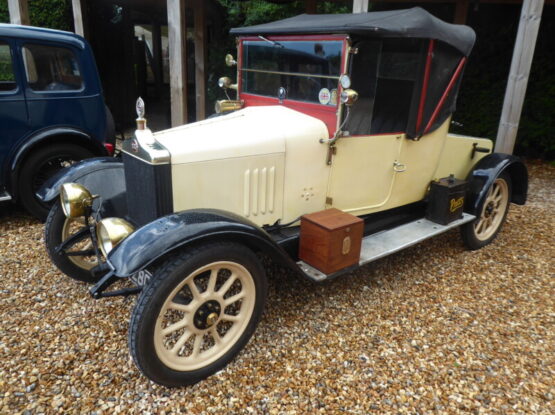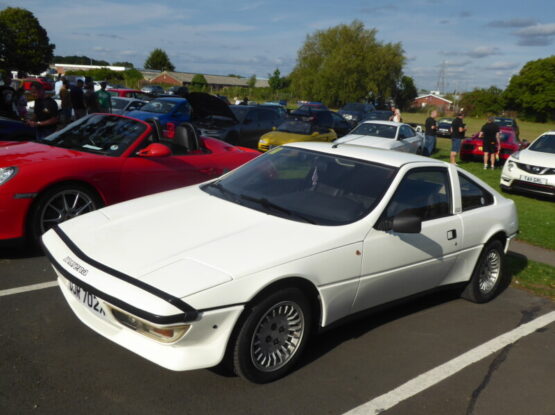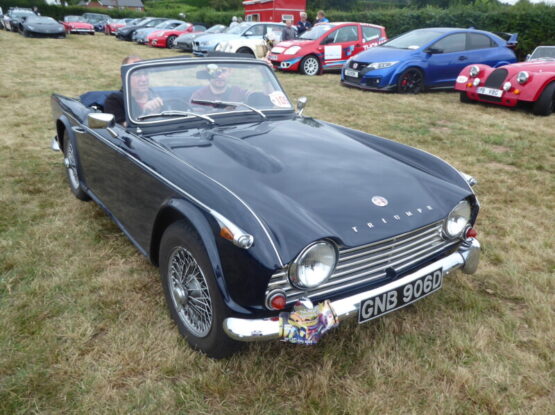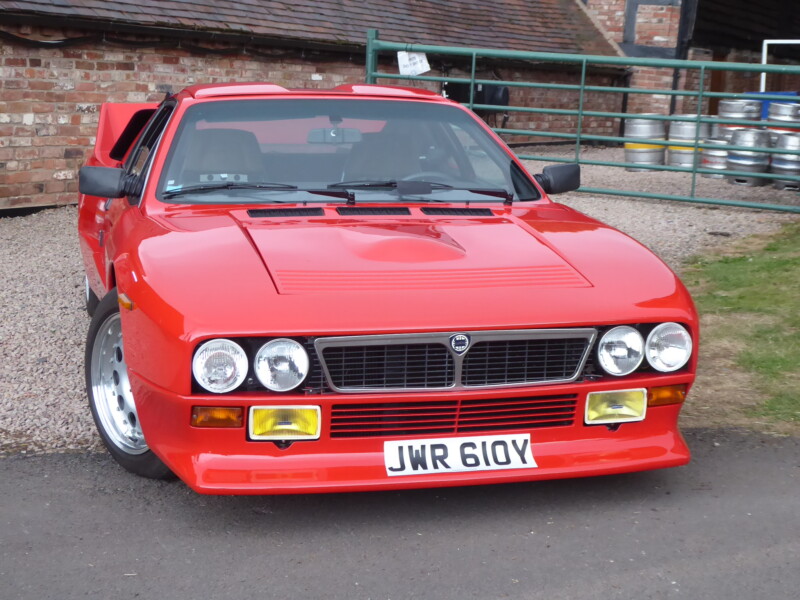
This is the third consecutive month when my diary has been clear enough to enable me to get to the popular “Cars in the Valley” event at the iconic Shelsley Walsh hillclimb. These mid-week evening events have been running for a few years now and are always popular. Unlike some evening events, they really do officially start in the evening, though I have noticed that if you arrive close to the stated start time of 6pm you will find the site already quite populated, so clearly some do arrive early. When the weather is favourable, the site does tend to fill up, with the parking area adjacent used for modern and what we should call the “less interesting” cars, leaving the whole of the paddock and the side of the lower reaches of the hill with an array of varied machinery, some of which are regular visitors to events here and others are more occasional or one-offs. There is always some decent hot food on offer and the bar is open, so an evening here has plenty to commend it, which is why I like coming. The July 2025 event was definitely one of the busiest I have seen in a while and there were a lot of cars here that I’ve not seen here before. Here are the highlights:
ABARTH
Although this event had not been advertised in any of the Abarth Groups there were still a couple of Abarth models here, both of them 500-based models which have been on sale now since the end of 2008, following a launch at the Paris Show that year. Since that time there have been a number of detailed changes to the standard cars and a lot of limited editions. Those who really know the marque can spot most of them, but some are so subtle that unless there is a badge you can see, you will not ne quite sure which version you are looking at. It used to be relatively easy, when the model was first launched, as there was only one version as shipped ex works called the 500. It had a 135 bhp 1.4 litre turbo-charged engine coupled to a five speed manual gearbox, with 16″ alloys as standard, and the option of 17″ wheels, and a colour palette comprising of two whites (BossaNova White, the standard colour, or the pearlescent Funk White), Red (Pasadoble), Pale Grey (Campovolo) or Black. If you wanted more power – 160 bhp – then you could order an Esseesse kit, which came in a large wooden crate, containing new wheels, springs, an ECU upgrade, the Monza exhaust system and badging. It was dealer fitted and could be applied at any time within the first 12 months or 10,000 miles from registration. Needless to say, it proved popular. As were many of the optional extras, with stickers for the sides, a large scorpion for the bonnet and even a chequered pattern for the roof among the personalisation options offered. Whilst a sliding glass sunroof (Skydome in Fiat/Abarth parlance) was an option from inception, fans of open air motoring had to wait until Geneva 2010 for the launch of the 500C models, with a roll-back roof which provided the best of open-topped motoring and yet still with the rigidity of the regular body style. For the first few months these cars only came with the robotised manual gearbox, which limited the appeal in the eyes of some, but they also introduced us to the “bi-colore”, a series of two tone cars, with upper and lower halves of the body painted in different colours. It took us a while to get used to this, as no other production road cars had been painted like this for some time, but now this is seen as yet another of those marque defining attributes, and (perhaps with the exception of the rarely seen Rally Beige and Officina Red combination that would come for 2014) in the eyes of many this distinctive look enhances the appeal of the cars still further.


AC
There are so many replica and recreation examples of the Cobra that it is tempting to assume that whenever you see one, that is what it is. Occasionally, of course, the car before you is actually one of the original ones from the 1960s and that is the case with this fabulous Cobra 289. Like many British manufacturers, AC Cars had been using the Bristol straight-6 engine in its small-volume production, including its AC Ace two-seater roadster. This had a hand-built body with a steel tube frame, and aluminium body panels that were made using English wheeling machines. The engine was a pre-World War II design by BMW which by the 1960s was considered dated. In 1961 Bristol decided to cease production of its engine. In September 1961, American retired race car driver and automotive designer Carroll Shelby wrote to AC asking if they would build him a car modified to accept a V8 engine. Bristol engines for the AC Ace two-seater sports car had recently been discontinued so AC agreed, provided a suitable engine could be found. Shelby went to Chevrolet to see if they would provide him with engines, but not wanting to add competition to the Corvette they said no. However, Ford wanted a car that could compete with the Corvette and they happened to have a brand new engine which could be used in this endeavor: the Windsor 3.6-litre (221 cu in) engine – a new lightweight, thin-wall cast small-block V8. Ford provided Shelby with two engines. In January 1962 mechanics at AC Cars in Thames Ditton, Surrey designed the “AC Ace 3.6” prototype with chassis number CSX2000. AC had already made most of the modifications needed for the small-block V8 when they installed the 2.553-litre (156 cu in) inline 6 Ford Zephyr engine, including the extensive rework of the AC Ace’s front end bodywork. The only modification of the front end of the first Cobra from that of the “AC Ace 2.6” was the steering box, which had to be moved outward to clear the wider V8 engine. The most important modification was the fitting of a stronger rear differential to handle the increased engine power. A Salisbury 4HU unit with inboard disc brakes to reduce unsprung weight was chosen instead of the old E.N.V. unit. It was the same unit used on the Jaguar E-Type. After testing and modification, the engine and transmission were removed and the chassis was air-freighted to Shelby in Los Angeles on 2 February 1962, By this time the small-block’s displacement was increased to 4.7 L (289 cu in). Shelby’s team paired this engine along with a transmission into CSX2000, in less than eight hours at Dean Moon’s shop in Santa Fe Springs, California, and began road-testing. A few changes were made to the production version: The inboard brakes were moved outboard to reduce cost; the fuel tank filler was relocated from the fender to the cenre of the trunk; the trunk lid had to be shortened to accommodate this change. AC exported completed, painted, and trimmed cars (less engine and gearbox) to Shelby who then finished the cars in his workshop in Los Angeles by installing the engine and gearbox and correcting any bodywork flaws caused by the car’s passage by sea. A small number of cars were also completed on the East Coast of the US by Ed Hugus in Pennsylvania, including the first production car; CSX2001. The first 75 Cobra Mk1 models (including the prototype) were fitted with the 4.3 L (260 cu in). The remaining 51 Mk1 models were fitted with a larger version of the Windsor Ford engine, the 4.7-litre (289 cu in) V8. In late 1962, Alan Turner, AC’s chief engineer completed a major design change of the car’s front end to accommodate rack and pinion steering while still using transverse leaf spring suspension (with the leaf spring doublin as the upper suspension link). The new car entered production in early 1963 and was designated Mark II. The steering rack was borrowed from the MGB while the new steering column came from the VW Beetle. About 528 Mark II Cobras were produced from 1963 to the summer of 1965 (the last US-bound Mark II was produced in November 1964). In 1963 to keep production focused on producing cars for Shelby American Inc., the Ruddspeed Ace was discontinued. To supply cars to the European market, AC began to market and sell the Cobra in Europe. Advertisements from the time state that the Cobra was designed to meet the requirements of Shelby American Inc. Shelby experimented with a larger Ford FE engine, of 6.4 L (390 cu in) in chassis number CSX2196. Unfortunately, the car was not able to receive the development it needed, as resources were aimed at taking the crown from Ferrari in the GT class. Ken Miles drove and raced the FE-powered Mark II at Sebring and pronounced the car virtually undrivable, naming it “The Turd”. It failed to finish with the engine expiring due to damper failure. CSX2196 was revised for the showdown at Nassau which allowed a more relaxed class division of racing. This allowed the Cobras to run with a prototype Ford GT40, GM Grand Sport Corvettes and a Lola Mk6. An aluminium 6.4-litre (390 cu in) engine was used. By the end of the first lap, the Cobra had a lead of the length of the start-finish straight. However, the car failed to finish due to brake problems. A new chassis was required, developed, and designated Mark III. The new car was designed in cooperation with Ford in Detroit. A new chassis was built using 101.6 mm (4 in) main chassis tubes, up from 76.2 mm (3 in) and coil spring suspension all around (an especially significant change up front, where the previously-used transverse leaf spring had done double duty as the top link). The new car also had wide fenders and a larger radiator opening. It was powered by the “side oiler” Ford 7.0 L (427 cu in) FE engine equipped with a single 4-barrel 780 CFM Holley carburetor rated at 425 bhp at 6000 rpm and 651 N⋅m (480 lb⋅ft) at 3700 rpm of torque, which provided a top speed of 264 km/h (164 mph) in the standard model. The more powerful tune of 485 bhp with a top speed of 298 km/h (185 mph) in the semi-competition (S/C) model. Cobra Mark III production began on 1 January 1965; two prototypes had been sent to the United States in October 1964. Cars were sent to the US as unpainted rolling chassis, and they were finished in Shelby’s workshop. Unfortunately, The MK III missed homologation for the 1965 racing season and was not raced by the Shelby team. Only 56 of the 100 planned cars were produced. Of those, 31 unsold competition models were detuned and fitted with windscreens for street use. Called S/C for semi-competition, an original example can currently sell for US$1.5 million, making it one of the most valuable Cobra variants. Some Cobra 427s were actually fitted with Ford’s 7-litre (428 cu in) engine, a long stroke, smaller bore, lower cost engine, intended for road use rather than racing. The AC Cobra was a financial failure that led Ford and Carroll Shelby to discontinue importing cars from England in 1967. AC Cars kept producing the coil-spring AC Roadster with narrow fenders and a small block Ford 289. It was built and sold in Europe until late 1969.

Genuine AC Cobra models are few and far between, but almost since the end of their very limited production, there have been numerous companies producing replicas, and many of these are almost indistinguishable from the real thing, even though most do have contemporary mechanical parts. The car seen here is an AK 427 produced by the Peterborough-based firm of AK Sportscars. They offer kits that recreate the legendary AC Cobra, such as this car, the Jaguar XKSS and the Ford GT40. They have three options for their AK 427 and choosing between them will depend on a number of factors including budget, the amount of time you have to spare and the amount of space you have in which to build your car. The choices start with the basic body and chassis kit for which there are three options. The “Standard” body/chassis kit is based on the early Jaguar XJ6/S running gear with the inboard rear brakes. Or the popular “Generation II ” body/chassis kit which is based on the later Jaguar XJ40 running gear which have the outboard rear brakes, or the latest ” Generation III SUPALITE” body/chassis kit which is also based on the Jaguar XJ40 but has a stiffer more tubular chassis and the bonus of over 100 kg weight saving over the Generation II Kit. The company also offers a ”Factory built Rolling Chassis” for the Generation II / III which gets you off to a flying start!

There was a third example here, harder to identify exactly who made it, though.

ALFA ROMEO
Alfa replaced the Giulia-based Spider model with an all-new design which finally made its debut in 1966 together with the Giulia Sprint GT Veloce at an event organised in Gardone Riviera. With its boat tailed styling, it quickly found favour, even before taking a starring role in the film “The Graduate”. The original 1600cc engine was replaced by a more powerful 1750cc unit at the same time as the change was made to the rest of the range, and the car continued like this until 1970, when the first significant change to the exterior styling was introduced on the 1750 Spider Veloce, with the original’s distinctive elongated round tail changed to a more conventional cut-off tail, called the “Kamm tail”, as well as improving the luggage space. Numerous other small changes took place both inside and out, such as a slightly different grille, new doorhandles, a more raked windscreen, top-hinged pedals and improved interior trim. 1971 saw the Spider Veloce get a new, larger powerplant—a 1962 cc, 132 hp unit—and consequently the name was changed from 1750 Spider Veloce to 2000 Spider Veloce. The 1600 Spider restarted production a year later as the Spider 1600 Junior, and was visually identical to the 1300. 1974 saw the introduction of the rare, factory request, Spider-Targa. Based upon the Spider, it featured a Porsche style solid rear window and lift out roof panels, all made out of black GRP type material. Less than 2,000 models of such type were ever made and was the only part solid roof Spider until the introduction of the factory crafted hard top. The 1300 and 2000 cars were modified in 1974 and 1975 respectively to include two small seats behind the front seats, becoming a “two plus two” four seater. The 1300 model was discontinued in 1977. Also, between 1974 and 1976, the early-style stainless-steel bumpers were discontinued and replaced with black, rubber-clad units to meet increasingly stringent North American crash requirements. 4,557 examples of the 1300 Junior were made and 4,848 of the 1600 Junior as well as 16,320 2000 Spider Veloces and 22,059 of 2000 Spider Veloce US version. There were also 4,027 1750 Spider Veloces produced.

During the 1950s, Alfa had undergone a fairly fundamental transformation from producing cars designed for racing or very high-end sports touring road machines, in small quantities, to being a manufacturer of more affordable cars, albeit with a sporting bias to their dynamics. But the desire to produce something exclusive and expensive was not completely lost, and indeed it was re-manifest in the next Alfa to be seen here, the very lovely Montreal. First seen as a concept car in 1967 at Expo 67, the car was initially displayed without any model name, but the public took to calling it the Montreal. It was a 2+2 coupe using the 1.6-litre engine of the Alfa Romeo Giulia TI and the short wheelbase chassis of the Alfa Romeo Giulia Sprint GT, with a body designed by Marcello Gandini at Bertone. One of the two concept cars built for Expo 67 is displayed in the Alfa Romeo Historical Museum in Arese, Italy, while the other is in museum storage. Reaction to the concept was sufficiently encouraging that Alfa decided to put the car into production. The result, the Tipo 105.64, was shown at the 1970 Geneva Motor Show and was quite different from the original, using a 2593 cc 90° dry-sump lubricated V8 engine with SPICA (Società Pompe Iniezione Cassani & Affini) fuel injection that produced around 200 PS (197 hp), coupled to a five-speed ZF manual gearbox and a limited-slip differential. This engine was derived from the 2-litre V8 used in the 33 Stradale and in the Tipo 33 sports prototype racer; its redline was set at 7,000 rpm, unheard of for a V8 at that time. The chassis and running gear of the production Montreal were taken from the Giulia GTV coupé and comprised double wishbone suspension with coil springs and dampers at the front and a live axle with limited slip differential at the rear.Since the concept car was already unofficially known as The Montreal, Alfa Romeo kept the model name in production. Stylistically, the most eye catching feature was the car’s front end with four headlamps partly covered by unusual “grilles”, that retract when the lights are switched on. Another stylistic element is the NACA duct on the bonnet. The duct is actually blocked off since its purpose is not to draw air into the engine, but to optically hide the power bulge. The slats behind the doors contain the cabin vents, but apart from that only serve cosmetic purposes. Paolo Martin is credited for the prototype instrument cluster. The Montreal was more expensive to buy than the Jaguar E-Type or the Porsche 911. When launched in the UK it was priced at £5,077, rising to £5,549 in August 1972 and to £6,999 by mid-1976. Production was split between the Alfa Romeo plant in Arese and Carrozzeria Bertone’s plants in Caselle and Grugliasco outside Turin. Alfa Romeo produced the chassis and engine and mechanicals and sent the chassis to Caselle where Bertone fitted the body. After body fitment, the car was sent to Grugliasco to be degreased, partly zinc coated, manually spray painted and have the interior fitted. Finally, the car was returned to Arese to have the engine and mechanicals installed. It is worth noting that because of this production method, there is not necessarily any correspondence between chassis number, engine number and production date. The Montreal remained generally unchanged until it was discontinued in 1977. By then, production had long ceased already as Alfa were struggling to sell their remaining stock. The total number built was around 3900. None of them were sold in Montreal, Quebec since Alfa did not develop a North American version to meet the emission control requirements in the United States & Canada. The car was both complex and unreliable which meant that many cars deteriorated to a point where they were uneconomic to restore. That position has changed in the last couple of years, thankfully, with the market deciding that the car deserves better, and prices have risen to you whereas a good one would have been yours for £20,000 only a couple of years ago, you would now likely have to pay more than double that.


It was more than 10 years after the Montreal had ceased production before Alfa offered another high-end and costly Coupe model, and the result, seen for the first time in 1989, could hardly have been more different than its forebear. That car had been praised for its looks, whereas this one, the SZ, and cruelly nicknamed “Il Mostro”, was almost wilfully, well, “different”. First seen at the 1989 Geneva Show, the car was also first shown simply as a concept, called the ES-30, for Experimental Sports car 3 litre. It was produced by Zagato. Robert Opron of the Fiat design studio was responsible for the initial sketches while Antonio Castellana was largely responsible for the final styling details and interior. Only the ‘Z’ logo of Zagato was kept. The car possessed unusual headlights positioned in a trio on each side – a styling used more subtly on later Alfa Romeos in the 2000s. Mechanically and engine-wise, the car was based on the Alfa 75, production being carried out by Zagato at Terrazzano di Rho near the Alfa factory in Arese. The thermoplastic injection moulded composite body panels were produced by Italian company Carplast and French company Stratime Cappelo Systems. The suspension was taken from the Alfa 75 Group A/IMSA car, and modified by Giorgio Pianta, engineer and team manager of the Lancia and Fiat rally works team. A hydraulic damper system was made by Koni. The SZ was originally equipped with Pirelli P Zero tyres (front 205/55 ZR 16, rear 225/50 ZR 16) and is able to sustain over 1.1 G in cornering, some drivers have measured a cornering force of 1.4 G, which remains an excellent performance figure. Low volume production got underway late in 1989, and over the next three years, 1036 were built, slightly more than planned. With the exception of a black car made for Zagato, all of them were red. Subsequently a convertible version, the RZ (for Roadster Zagato), was produced from 1992 until December 1994. Although almost identical to look at the two cars had completely different body panels save for the front wings and boot. The RZ had a revised bumper and door sills to give better ground clearance and the bonnet no longer featured the aggressive ridges. Three colours were available as standard: black, yellow and red, with black and yellow being the more popular choices. Yellow and red cars got a black leather interior and black cars burgundy. Although the interior layout was almost unchanged from the SZ, the RZ had a painted central console that swept up between the seats to conceal the convertible roof storage area. 350 units were planned but production was halted after 252 units when the Zagato factory producing the cars for Alfa Romeo went in to receivership, a further 32 cars were then completed under the control of the receivers before production finished at 284 units. Of those final three were painted silver with burgundy interior and another pearlescent white.


Final Alfa here was an example of the well-received and now long-lived Giulia.


ALPINE
The A110 was introduced as an evolution of the A108. Like other road-going Alpines, the 1961 A110 used many Renault parts – including engines. But while the preceding A108 was designed around Dauphine components, the A110 was updated to use R8 parts. Unlike the A108, which was available first as a cabriolet and only later as a coupé, the A110 was delivered first with “Berlinetta” bodywork and then as a cabriolet. The main visible difference with the A108 coupé was a restyling of the rear body to fit the larger engine, which gave the car a more aggressive look. Like the A108, the A110 featured a steel backbone chassis with fibreglass body. The A110 was originally available with 1.1 litre R8 Major or R8 Gordini engines. The Gordini engine delivered 95 hp at 6,500 rpm. The A110 achieved most of its fame in the early 1970s as a victorious rally car. After winning several rallies in France in the late 1960s with iron-cast R8 Gordini engines the car was fitted with the aluminium-block Renault 16 TS engine. With two dual-chamber Weber 45 carburettors, the TS engine delivered 125 hp at 6,000 rpm. This allowed the production 1600S to reach a top speed of 210 km/h (130 mph). The longer wheelbase 2+2 Alpine GT4, originally considered a version of the A108, was updated with A110 engines and mechanicals, now being marketed as the “A110 GT4”. The car reached international fame during the 1970–1972 seasons when it participated in the newly created International Championship for Manufacturers, winning several events around Europe and being considered one of the strongest rally cars of its time. Notable performances from the car included victory in the 1971 Monte Carlo Rally with Swedish driver Ove Andersson. With the buy-out of Alpine by Renault complete, the International Championship was replaced by the World Rally Championship for 1973, at which time Renault elected to compete with the A110. With a team featuring Bernard Darniche, Jean-Pierre Nicolas and Jean-Luc Thérier as permanent drivers and “guest stars” like Jean-Claude Andruet (who won the 1973 Monte Carlo Rally) the A110 won most races where the works team was entered, making Alpine the first World Rally Champion. Later competition-spec A110s received engines of up to 1.8 litres. As well as being built at Alpine’s Dieppe factory, A110 models were constructed by various other vehicle manufacturers around the world. The Alpine A110 was produced in Mexico under the name “Dinalpin”, from 1965 to 1974, by Diesel Nacional (DINA), which also produced Renault vehicles. The Alpine A110 was also produced in Bulgaria under the name “Bulgaralpine”, from 1967 to 1969, by a cooperative formed between SPC Metalhim and ETO Bulet, whose collaboration also resulted in the production of the Bulgarrenault. In 1974 the mid-engined Lancia Stratos, the first car designed from scratch for rally racing, was operational and homologated. At the same time, it was obvious that the tail-engined A110 had begun reaching the end of its development. The adoption of fuel injection brought no performance increase. On some cars, a DOHC 16-valve head was fitted to the engine, but it proved unreliable. Chassis modification, like the use of an A310 double wishbone rear suspension, homologated with the A110 1600SC, also failed to increase performance. On the international stage, the Stratos proved to be the “ultimate weapon”, making the A110, as well as many other rally cars, soon obsolete. The A110 is still seen in events such as the Rallye Monte-Carlo Historique and there was a nice example here.

The Alpine A110 is a rear mid-engine, rear-wheel-drive sports car introduced by French car manufacturer Alpine at the 87th Geneva International Motor Show in March 2017. Deliveries began in late 2017 for Continental European markets and in 2018 for the UK, Japan and Australia. Both its name and design refer back to the original Alpine A110 that was produced from 1961 to 1977. Based on an all-aluminium construction, the A110 is powered by a Nissan-derived 1.8-litre turbocharged gasoline direct injection 4 valves per cylinder inline-four engine mated to a 7-speed dual-clutch transmission manufactured by Getrag. Developed by Renault–Nissan and reworked by Alpine engineers, the engine has an output of 252 PS at 6,000 rpm and 320 Nm (236 lb/ft) of torque at 2,000–5,000 rpm. According to Alpine, the A110 can accelerate from 0 to 100 km/h (0 to 62 mph) in 4.5 seconds, and has an electronically limited top speed of 250 km/h (155 mph). The A110 was initially available in three trims: Pure, Première, and Legende. The Pure cars, the base trim, have 17-inch alloy wheels. The Première trim cars are technically the launch edition models limited to 1,955 units and were equipped with amenities such as forged alloy wheels, quilted leather Sabelt bucket sports seats, a reversing camera, and metallic blue exterior colour as standard. The Legende trim cars come with six-way adjustable sports seats, black or brown leather interior upholstery, an upgraded hi-fi sound system, and specially designed wheels exclusive to this trim. All of the three trims share the same powertrain and transmission. For the 2020 model year, The Pure trim level was replaced by the Alpine A110, with no other badging. The Légende was replaced by the Alpine A110 GT which employed the same engine as the A110 S.


ASTON MARTIN
Following the unveiling of the AMV8 Vantage concept car in 2003 at the North American International Auto Show designed by Henrik Fisker, the production version, known as the V8 Vantage was introduced at the Geneva Motor Show in 2005. The two seat, two-door coupé had a bonded aluminium structure for strength and lightness. The 172.5 inch (4.38 m) long car featured a hatchback-style tailgate for practicality, with a large luggage shelf behind the seats. In addition to the coupé, a convertible, known as the V8 Vantage Roadster, was introduced later in that year. The V8 Vantage was initially powered by a 4.3 litre quad-cam 32-valve V8 which produced 380 bhp at 7,300 rpm and 409 Nm (302 lb/ft) at 5,000 rpm. However, models produced after 2008 had a 4.7-litre V8 with 420 bhp and 470 Nm (347 lbft) of torque. Though based loosely on Jaguar’s AJ-V8 engine architecture, this engine was unique to Aston Martin and featured race-style dry-sump lubrication, which enabled it to be mounted low in the chassis for an improved centre of gravity. The cylinder block and heads, crankshaft, connecting rods, pistons, camshafts, inlet and exhaust manifolds, lubrication system and engine management were all designed in house by Aston Martin and the engine was assembled by hand at the AM facility in Cologne, Germany, which also built the V12 engine for the DB9 and Vanquish. The engine was front mid-mounted with a rear-mounted transaxle, giving a 49/51 front/rear weight distribution. Slotted Brembo brakes were also standard. The original V8 Vantage could accelerate from 0 to 60 mph in 4.8 seconds before topping out at 175 mph. In 2008, Aston Martin introduced an aftermarket dealer approved upgrade package for power and handling of the 4.3-litre variants that maintained the warranty with the company. The power upgrade was called the V8 Vantage Power Upgrade, creating a more potent version of the Aston Martin 4.3-litre V8 engine with an increase in peak power of 20 bhp to 400 bhp while peak torque increased by 10 Nm to 420 Nm (310 lb/ft). This consists of the fitting of the following revised components; manifold assembly (painted Crackle Black), valved air box, right and left hand side vacuum hose assemblies, engine bay fuse box link lead (ECU to fuse box), throttle body to manifold gasket, intake manifold gasket, fuel injector to manifold seal and a manifold badge. The V8 Vantage had a retail price of GB£79,000, US$110,000, or €104,000 in 2006, Aston Martin planned to build up to 3,000 per year. Included was a 6-speed manual transmission and leather-upholstery for the seats, dash board, steering-wheel, and shift-knob. A new 6-speed sequential manual transmission, similar to those produced by Ferrari and Lamborghini, called Sportshift was introduced later as an option. An open-topped model was added to the range in 2006 and then in the quest for more power a V12 Vantage joined the range not long after. There were no fewer than 18 different versions of the car produced over its model life


AUSTIN
The first Austin Sevens were built in 1922, and were four seat open tourers. Nicknamed Chummy, the first 100 featured a 696cc four cylinder engine, which was quickly upgraded to the 747cc unit that remained until the end of production some 17 years later. The first cars had an upright edge to the doors and a sloping windscreen, but from 1924, the screen became upright and there was a sloping edge to the doors, as well as a slightly longer body. Stronger brakes came along in 1926, along with a slightly taller nickel-plated radiator grille, conventional coil ignition, a more spacious body and wider doors. An even longer and wider body arrived in 1930, as well as a stronger crankshaft and improvements to the brakes which coupled front and rear systems together so they both worked by the footbrake. In 1931 the body was restyled , with a thin ribbon-style radiator and by 1932 there was a four speed gearbox to replace the earlier three-speeder. 1933 saw the introduction of the Ruby, a car that looked more modern with its cowled radiator. There were also Pearl and Opal versions. Development continued, so in 1937 there was a move to crankshaft shell bearings in place of the white metal previously used, and the Big Seven appeared. The last Seven was made in 1939, by which time 290,000 had been produced. Aside from saloons and tourers, there had been vans and sports derivatives like the Le Mans, the supercharged Ulster and the rather cheaper Nippy. Around 11,000 Sevens survive today.


BENTLEY
Bentley replaced the 3 Litre with a more powerful car by increasing its engine displacement to 4.5 litres. As before, Bentley supplied an engine and chassis and it was up to the buyer to arrange for their new chassis to be fitted with one of a number of body styles, most of which were saloons or tourers. Very few have survived with their four-seater coachwork intact. WO Bentley had found that success in motorsport was great publicity for the brand, and he was particularly attracted to the 2 Hours of Le Mans endurance race, the inaugural running of which took place 26–27 May 1923, attracting many drivers, mostly French. There were two foreign competitors in the first race, Frank Clement and Canadian John Duff, the latter winning the 1924 competition in his personal car, a Bentley 3 Litre. This success helped Bentley sell cars, but was not repeated, so after two years without success, Bentley convened a group of wealthy British men, “united by their love of insouciance, elegant tailoring, and a need for speed,” to renew Bentley’s success. Both drivers and mechanics, these men, later nicknamed the “Bentley Boys”, drove Bentley automobiles to victory in several races between 1927 and 1931, including four consecutive wins at the 24 Hours of Le Mans, and forged the brands reputation. It was within this context that, in 1927, Bentley developed the Bentley 4½ Litre. Two cylinders were removed from the 6½ Litre model, reducing the displacement to 4.4 litres. At the time, the 3 Litre and the 6½ Litre were already available, but the 3 Litre was an outdated, under-powered model and the 6½ Litre’s image was tarnished by poor tyre performance. Sir Henry “Tim” Birkin, described as “the greatest British driver of his day” by W. O. Bentley, was one of the Bentley Boys. He refused to adhere strictly to Bentley’s assertion that increasing displacement is always preferable to forced induction. Birkin, aided by a former Bentley mechanic, decided to produce a series of five supercharged models for the competition at the 24 Hours of Le Mans; thus the 4½ litre Blower Bentley was born. The first supercharged Bentley had been a 3-litre FR5189 which had been supercharged at the Cricklewood factory in the winter of 1926/7. The Bentley Blower No.1 was officially presented in 1929 at the British International Motor Show at Olympia, London. The 55 copies were built to comply with 24 Hours of Le Mans regulations. Birkin arranged for the construction of the supercharged cars having received approval from Bentley chairman and majority shareholder Woolf Barnato and financing from wealthy horse racing enthusiast Dorothy Paget. Development and construction of the supercharged Bentleys was done in a workshop in Welwyn by Amherst Villiers, who also provided the superchargers. W.O. Bentley was hostile to forced induction and believed that “to supercharge a Bentley engine was to pervert its design and corrupt its performance.” However, having lost control of the company he founded to Barnato, he could not halt Birkin’s project. Although the Bentley 4½ Litre was heavy, weighing 1,625 kg (3,583 lb), and spacious, with a length of 172 in and a wheelbase of 130.0 in, it remained well-balanced and steered nimbly. The manual transmission, however, required skill, as its four gears were unsynchronised. The robustness of the 4½ Litre’s latticed chassis, made of steel and reinforced with ties, was needed to support the heavy cast iron inline-four engine. The engine was “resolutely modern” for the time. The displacement was 4,398 cc. Two SU carburettors and dual ignition with Bosch magnetos were fitted. The engine produced 110 hp for the touring model and 130 hp for the racing model. The engine speed was limited to 4,000 rpm. A single overhead camshaft actuated four valves per cylinder, inclined at 30 degrees. This was a technically advanced design at a time where most cars used only two valves per cylinder. The camshaft was driven by bevel gears on a vertical shaft at the front of the engine, as on the 3 Litre engine. The essential difference between the Bentley 4½ Litre and the Blower was the addition of a Roots-type supercharger to the Blower engine by engineer Amherst Villiers, who had also produced the supercharger. W. O. Bentley, as chief engineer of the company he had founded, refused to allow the engine to be modified to incorporate the supercharger. As a result, the supercharger was placed at the end of the crankshaft, in front of the radiator. This gave the Blower Bentley an easily recognisable appearance and also increased the car’s understeer due to the additional weight at the front. A guard protected the two carburettors located at the compressor intake. Similar protection was used, both in the 4½ Litre and the Blower, for the fuel tank at the rear, because a flying stone punctured the 3 Litre of Frank Clement and John Duff during the first 24 Hours of Le Mans, which contributed to their defeat. The crankshaft, pistons and lubrication system were special to the Blower engine. It produced 175 hp at 3,500 rpm for the touring model and 240 hp at 4,200 rpm for the racing version, which was more power than the Bentley 6½ Litre developed. Between 1927 and 1931 the Bentley 4½ Litre competed in several competitions, primarily the 24 Hours of Le Mans. The first was the Old Mother Gun at the 1927 24 Hours of Le Mans, driven as a prototype before production. Favoured to win, it instead crashed and did not finish. Its performance was sufficient for Bentley to decide to start production and deliver the first models the same year. Far from being the most powerful in the competitions, the 4½ Litre of Woolf Barnato and Bernard Rubin, raced neck and neck against Charles Weymann’s Stutz Blackhawk DV16, setting a new record average speed of 69 mph; Tim Birkin and Jean Chassagne finished fifth. The next year, three 4½ Litres finished second, third, and fourth behind another Bentley, the Speed Six, which possessed two more cylinders.The naturally aspirated 4½ Litre was noted for its good reliability. The supercharged models were not; the two Blower models entered in the 1930 24 Hours of Le Mans by Dorothy Paget, one of which was co-driven by Tim Birkin, did not complete the race. In 1930, Birkin finished second in the French Grand Prix at the Circuit de Pau behind a Bugatti Type 35. Ettore Bugatti, annoyed by the performance of Bentley, called the 4½ Litre the “fastest lorry in the world.” The Type 35 is much lighter and consumes much less petrol. Blower Bentleys consume 4 litres per minute at full speed. In November 1931, after selling 720 copies of the 4½ Litre – 655 naturally aspirated and 55 supercharged – in three different models (Tourer, Drophead Coupé and Sporting Four Seater, Bentley was forced to sell his company to Rolls-Royce for £125,175, a victim of the recession that hit Europe following the Wall Street Crash of 1929.

The Bentley Mulsanne is a large (performance) luxury saloon produced by Bentley Motors from 1980 until 1992, though derivative models including the Continental T and Azure continued in production into the 2000s. Contrary to its predecessors, the Bentley Mulsanne was given an actual name instead of a letter, but otherwise started as another standard rebadged Rolls-Royce, the Silver Spirit. However, with the launch of the ‘Brooklands’ version, and the 1982 Mulsanne Turbo – with 50 percent more horsepower – the Mulsanne began the rebuild of an appealing individual Bentley brand image. The Mulsanne was named after the Mulsanne straight, a section at the Circuit de la Sarthe in which refers to the Bentley’s success at the 24 Hours of Le Mans between 1924 and 1930. In 1980, the Rolls-Royce Silver Shadow and the Bentley T-series were replaced by the RR Silver Spirit and, as with prior models, a Bentley-badged equivalent. This time however, it was given a name: the “Mulsanne”. This was derived from Bentley’s motorsport history, which included five victories at the 24 Hours of Le Mans between 1924 and 1930. The ‘Mulsanne Straight’ is the stretch of Le Mans’ race-course where cars reach their highest speeds. The Mulsanne initially shared the same carburetted 6,750 cc Rolls-Royce V8 engine with aluminium alloy cylinder heads with the Silver Spirit, carried over from the Silver Shadow II and Bentley T2. In 1982 however, a turbocharged version with much more power and torque was also introduced – for Bentley only – in the Mulsanne Turbo. From 1986, the two SU carburettors were replaced by Bosch fuel injection on all cars. All Mulsannes use a 3-speed automatic transmission. The Mulsanne Turbo was launched at the Geneva Motor Show in 1982 and produced until 1985. A Garrett AiResearch turbocharger provided a 50% increase in engine power – something not seen on a Bentley in half a century. The interior sported the usual highly polished, walnut veneered fascia, blemish-free leather upholstery, and pure wool for the carpets and headlining. A total of 498 standard wheelbase and 18 long-wheelbase Mulsanne Turbos were built, until they were replaced by the Bentley Turbo R in 1985, which used a fuel injected version of the same 63⁄4 litre V8 engine since 1987. The Mulsanne S was introduced in 1987. Although this model lacked its turbocharger, many of its other details were similar to the Turbo R, including that car’s alloy wheels and interior, and the suspension was firmed up for a more sporting ride. The rectangular headlamps from the 1980s gave way to quad round units for 1989, and the model was produced until 1992.

BMW
The first car to bear the 6 Series nomenclature was the E24, which was launched in 1976, as a replacement for the E9 model 3.0 CS and CSL coupés first produced in 1965. The 3.0 CS was almost changed by adding a few centimeters in height to make it easier for customers to get into the car. However, Bob Lutz rebelled against the decision and rough drafted an alternative version that soon became the 6 series. Production started in March 1976 with two models: the 630 CS and 633 CSi. Originally the bodies were manufactured by Karmann, but production was later taken in-house to BMW. In July 1978 a more powerful variant, the 635 CSi, was introduced that featured as standard a special close-ratio 5-speed gearbox and a single piece black rear spoiler. The bigger bore and shorter stroke facilitated max 218 hp at 5200rpm and a better torque curve. For the first year, the 635 CSi was offered in three colours (Polaris, Henna Red, Graphite), and could also be spotted by the front air dam that did not have attached fog lights. These simple cosmetic changes reportedly worked to reduce uplift on the car at high speeds by almost 15% over the non-spoiler body shape. This early model shared suspension components with the inaugural BMW 5-series, the E12. In 1979 the carburettor 630 CS was replaced with the 628 CSi with its fuel injected 2.8 litre engine taken from the BMW 528i. In 1980 the 635 CSi gained the central locking system that is also controlled from the boot. Also, the E24 body style converted from L-jetronic injection to a Bosch Motronic DME. In 1982 (Europe) and 1983 (US), the E24 changed slightly in appearance, with an improved interior and slightly modified exterior. At the same time, the 635 CSi received a new engine, a slightly smaller-bored and longer-stroked 3430 cc six to replace the former 3453 cc engine and became available with a wide-ratio 5-speed manual or an automatic. This slight change was in fact a major change as pre-1982 cars were based on the E12 5-series chassis; after mid-1982, E24s shared the improved E28 5-series chassis. The only parts that remained the same were some of the exterior body panels. E24s produced after June 1987 came with new, ellipsoid headlamps which projects beam more directly onto road surface (newly introduced E32 7-series also sporting them). The sleeker European bumpers were also discontinued. Previous cars had either a European-standard bumper or a larger, reinforced bumper to meet the US standard requiring bumpers to withstand impact at 5 mph without damage to safety-related components. 1989 was the last year for the E24 with production stopping in April. The E24 was supplanted by the considerably heavier, more complex, and more exclusive 8 Series. BMW Motorsport introduced the M 635 CSi in Europe at the Frankfurt Motor Show in 1983. It is essentially an E24 powered by the powerplant of the BMW M1 – the M88 with 286 PS). Most of the cars were equipped with special metric 415 mm diameter wheels requiring Michelin TRX tyres. A catalysed, lower compression ratio version of the car with the S38 engine (260 PS ) was introduced in the U.S. in 1987. All M6 cars came standard with a 25% rear limited slip differential. U.S. models included additional comforts that were usually optional on models sold in Europe such as Nappa leather power seats and a dedicated rear A/C unit with a centre beverage chiller. 4,088 M635CSi cars were built between 1983 and 1988.

Representing the E31 8 Series, a car which found less favour than everyone expected when it was new, as this 840Ci. While it did supplant the original E24 based 6 Series in 1991, a common misconception is that the 8 Series was developed as a successor. It was actually an entirely new class aimed at a different market, however, with a substantially higher price and better performance than the 6 series. Design of the 8 Series began in 1984, with the final design phase and production development starting in 1986. The 8 Series debuted at the Frankfurt Motor Show (IAA) in early September 1989. The 8 Series was designed to move beyond the market of the original 6 Series. The 8 Series had substantially improved performance, however, as well as a far higher purchase price. Over 1.5 billion Deutsche Mark was spent on total development. BMW used CAD tools, still unusual at the time, to design the car’s all-new body. Combined with wind tunnel testing, the resulting car had a drag coefficient of 0.29, a major improvement from the previous BMW M6/635CSi’s 0.39. The 8 Series supercar offered the first V-12 engine mated to a 6-speed manual gearbox on a road car. It was the first car to feature CAN bus—a form of multiplex wiring for cars that is now an industry standard. It was also one of the first vehicles to be fitted with an electronic drive-by-wire throttle. The 8 Series was one of BMW’s first cars, together with the Z1, to use a multi-link rear axle. While CAD modelling allowed the car’s unibody to be 8 lb (3 kg) lighter than that of its predecessor, the car was significantly heavier when completed due to the large engine and added luxury items—a source of criticism from those who wanted BMW to concentrate on the driving experience. Some of the car’s weight may have been due to its pillarless “hardtop” body style, which lacked a “B” post. Sales of the 8 Series were affected by the global recession of the early 1990s, the Persian Gulf War, and energy price spikes. As a result, plans for the M8 supercar were dropped in 1991. A cheaper 8 cylinder 840CI joined the range in 1993 in an effort to boost sales, and to an extent it, did but this was still not enough and BMW pulled the 8 Series from the North American market in 1997, having sold only 7,232 cars over seven years. BMW continued production for Europe until 1999. The ultimate worldwide production total was 31,062

The BMW Z3 is a range of two-seater sports cars which was produced from 1995 to 2002. The Z3 was based on the E36/5 compact platform, a shortened version of the conventional E36 platform. This smaller and cheaper platform used the rear semi-trailing arm suspension design from the older E30 3 Series. It is the first mass-produced Z Series car. M models were introduced in 1998 in roadster and coupé body styles and were powered by the S50, S52, or S54 straight-six engine depending on country and model year. The M models came with a 5-speed manual transmission. The regular Z3s were offered with straight-sixes or four-cylinder engines. Development on the roadster began in 1991 and was led by Burkhard Göschel. The exterior was designed by Joji Nagashima, being completed in mid-1992 at 39 months before production and the design was frozen in 1993. Design patents were filed on April 2, 1994, in Germany and on September 27, 1994, in the US.[7] The Z3 was introduced via video press release by BMW North America on June 12, 1995. Production began on September 20, 1995. Development on the coupé model was run by a group of BMW engineers outside of work in their own time. The Z3 Coupé shares the identical platform and parts with the roadster, but features a chassis-stiffening hatch area and is 2.7 times stiffer in comparison. The Z3 Coupé was unveiled at the 1997 Frankfurt Motor Show. The Z3 was the first BMW model to be solely manufactured outside of Germany. It was manufactured in Greer, South Carolina. Roadster models entered production in September 1995, powered by 4-cylinder engines on launch. 6-cylinder engines were later introduced in 1996. A removable hardtop roof was available as an optional accessory. Coupé models entered production in January 1998. The unusual side profile has been given nicknames such as “clown shoe” and “bread van” by critics. In Germany, it has been referred to as a “turnschuh” (sports shoe). The coupé body style was only available with the engines that matched the 2.8, 3.0i, and M model Roadsters. The engine outputs varied as they spanned three generations of engine architecture, peaking at 325 bhp with the facelift M Coupé. Like the roadster models, it was rear-wheel drive only, and was available in either an automatic or manual transmission. Very few of these cars were made, making it rarer than most cars, the BMW M Coupe model especially so. Production ended on June 28, 2002, with the Z3 line replaced by the E85 Z4.

BOND
The Bond Bug was built from 1970 to 1974. Following the purchase of Bond Cars Ltd., Reliant commissioned Tom Karen of Ogle Design to design a fun car. The Bond Bug was based on chief engineer John Crosthwaite’s newly designed chassis and some Reliant Regal running gear. The original concept was explored by chopping down a production Regal vehicle, the rear of the car being shortened to end over the rear axle. The engine is the front-mounted 700 cc (later uprated to 750 cc) Reliant light-alloy four-cylinder unit, developed from the Austin 7, and which protruded into the passenger cabin. At launch 29 bhp was claimed for the less expensive 700 and 700E models. The more up-market 700ES incorporates a redesigned cylinder head which permitted the compression ratio to be increased from 7.35:1 to 8.4:1. This provided a power increase to 31 bhp as well as improved torque for the then range-topping 700ES. The Bond Bug 700ES also offers more supportive seats as well as more padding over the engine cowl, twin mudflaps, an ashtray, a rubber front bumper and a spare wheel. The car enjoyed an upbeat launch, at which Reliant’s Ray Wiggin stated: “The fact it has three wheels is quite incidental. It’s a new form of transport. So now, in fact, we think it’s going to appeal to a much wider section of the market than we originally envisaged.” The Bug was available in a bright orange tangerine colour, although six white Bugs were produced for a Rothmans cigarette promotion – one of which was also used in an advertisement for Cape Fruit. Only three Rothmans bugs are known to exist. In contrast to the image of three-wheeled Reliants as being slow, the Bond Bug was capable of 76 mph, in excess of the UK 70 mph national speed limit, and comparable to small saloon cars such as the basic 850 cc Mini (72 mph) and the Hillman Imp (80 mph). However, it could not match the speed of the Mini Cooper S (96 mph) or larger saloons such as the Ford Cortina Mark III (104 mph). The Bond Bug was sold as being fun to drive, with the low seating position giving a similar exaggerated impression of speed as in a go-kart, while the actual speed was similar to that reached by high performance cars only a few years earlier (indeed, earlier versions of the Lotus 7 had a top speed of 76 mph/122 km/h right up until 1968, and their trim level, e.g. side curtains instead of windows, was also similar). The Bug was, however, no cheaper than more practical cars. It cost £629, while a basic 850 cc Mini, a four-seater much faster round corners but with considerably inferior acceleration, cost £620. Production ceased in 1974, after 2270 had been built. The car’s fame was helped by a distinctive Corgi Toys die-cast toy car, and it has a dedicated following today.

CHEVROLET
The C6 Corvette retained the front engine and rear transmission design of the C5, but was otherwise all-new, including new bodywork with exposed headlamps (for the first time since 1962), a larger passenger compartment, a new 6.0 litre engine and a reworked suspension geometry. It had a longer wheelbase than the C5, but its overall vehicle length and width were less than the C5, allegedly to widen appeal to the European market.The 6.0 litre LS2 V8 produced 400 bhp at 6000 rpm and 400 lb·ft at 4400 rpm, giving the vehicle a 0–60 time of under 4.2 seconds.Its top speed was 190 mph. The C6 generation did not match the previous generation’s relatively good fuel economy, despite its relatively low 0.28 drag coefficient and low curb weight, achieving 16/26 mpg (city/highway) equipped with automatic or manual transmissions; like all manual transmission Corvettes since 1989, it is fitted with Computer Aided Gear Selection (CAGS) to improve fuel economy by requiring drivers to shift from 1st gear directly to 4th in low-speed/low-throttle conditions. This feature helps the C6 avoid the Gas Guzzler Tax by achieving better fuel economy. The new Z06 arrived as a 2006 model in the third quarter of 2005. It has a 7.0 litre version of the small block engine codenamed LS7. At 427.6 cubic inches, the Z06 was the largest small block ever offered from General Motors. Because of the Corvette’s former use of 427 cubic-inch big blocks in the late-1960s and early 1970s, the LS7’s size was rounded down to 427 cubic inches. Official output was 505 bhp and has a 0-60 mph time of 3.7 seconds. Top speed is 198 mph. For 2008, the Corvette received a mild freshening: a new LS3 engine with displacement increased to 6.2 litres resulting in 430 bhp and 424 lb·ft. The 6-speed manual transmission also has improved shift linkage and a 0–60 time of 4.0 seconds, while the automatic is set up for quicker shifts giving the C6 automatic a 0–60 time of 4.0 seconds, faster than any other production automatic Corvette. The interior was slightly updated and a new 4LT leather-wrap interior package was added. The wheels were also updated to a new five-spoke design. ZR1 was formally announced in a December 2007 press statement by General Motors, where it was revealed that their target of 100 bhp per litre had been reached by a new “LS9″ engine with an Eaton-supercharged 6.2-litre engine producing 638 bhp and 604 lb·ft. The LS9 engine was the most powerful to be put into a GM production sports car. Its top speed was 205 mph. The historical name Grand Sport returned to the Corvette lineup in 2010 as an entirely new model series that replaced the Z51 option. The new model was basically an LS3 equipped Z06 with a steel frame instead of aluminium. It retained many of the features of the Z06 including a wide body with 18×9.5 and 19×12 inch wheels, dry sump oiling (manual transmission coupes only), 6-piston 14” front brakes and 4-piston rear, improved suspension, and front carbon fibre fenders. Manual power train equipped G/S coupe models receive a tweaked LS3 with a forged crank, are built in Z06 fashion by hand, and utilise a dry-sump oil system. The first three gears were also made shorter for better throttle response and faster acceleration. A new launch control system was introduced for all models that allows for sub 4 second 0-60. Beginning with the 2011 model year, buyers of the Corvette Z06 and ZR1 were offered the opportunity to assist in the build of their engine. Titled the “Corvette Engine Build Experience,” buyers paid extra to be flown to the Wixom, Michigan Performance Build Center. Participants helped the assembly line workers build the V8 engine, then took delivery of the car at the National Corvette Museum in Bowling Green, KY, near the Corvette final assembly point. The last C6 Corvette was manufactured in February 2013.

CITROEN
Development of the AX started in 1983, and was initially also going to form the basis of a sister model from Talbot to replace the Samba; however, the falling popularity of the Talbot brand – coupled with the huge success of the new Peugeot 205 – had led to Peugeot deciding to axe it by the time the Citroën AX was launched, and so the Talbot version never made it into production. The car was available on the left-hand drive continental markets from its launch on 2 October 1986, as a three-door hatchback with 1.0, 1.1 and 1.4-litre TU-series belt driven OHC engines. A range of five-door models was added in 1987 and a 1.4 litre diesel engine was introduced in 1988. The latter was replaced by a 1.5 litre unit in September 1994. The right-hand drive version for the UK market was launched in August 1987, initially only as a three-door hatchback, with a five-door version joining the range a year later, effectively replacing the five-door Citroën Visa, which was discontinued that year. With the final demise of the classic Citroën 2CV in 1990, the AX became the smallest model in the Citroën range. The very earliest cars had an issue with gear shifters falling off; this was rectified by the time the AX reached export markets. It was initially backed by a memorable television advertising campaign filmed in China, starring actress Janet Mas and an elderly gentleman, whose character was simply known as Mr. Wong. The car was very economical, largely because of excellent aerodynamics for its class of car (drag coefficient of 0.31) and a very light weight of 640 kg (1,411 lb) for the basic version. This was due to the extensive use of plastic panels in non-load bearing areas and varying the thicknesses of steel in the bodyshell to be the minimum needed to take required loads. Another target for the engineers was lowering friction in the engines. The AX has fully independent suspension with unusually long wheel travel. It also optionally used self-coloured plastic bumpers. This technology came from the PSA Peugeot-Citroën / Renault / French government ECO 2000 project. The production version was much more conservative than the original ‘one box’ design prototype, that was closer to the Eco 2000 styling after negative reactions in focus groups. The “one-box” city car eventually came to market with the Renault Twingo, launched in 1992. In 1989, a naturally aspirated diesel AX, using the 1360 cc all aluminium alloy TUD engine, managed a figure of 2.7 litres/100 km (100 mpg), totalling over 1,000 miles from Dover to Barcelona. This was the longest ever distance travelled on 10 gallons of fuel and earned it a place in the Guinness Book of Records as the most economical production car. Also available was a 4×4 variant, but with limited success when compared to the rival Fiat Panda 4×4. The AX 4×4 was only available with five doors and was not sold in the United Kingdom. The first performance version was the limited-run AX Sport from 1987, with a 1.3 engine and twin carburettors producing 95 bhp, wearing iconic white steel wheels (5,5″ x 13″) which resembled those on its brother, the Peugeot 205 Rallye. The AX Sport used Solex ADDHE 40 carburettors until late 1988 and was then replaced with Weber DCOM 40s, just like the 205 Rallye 1,3. The AX Sport had a shorter inlet manifold than the 205 Rallye, to save room in the smaller engine compartment. In phase 2 guise the Sport was available in other colours and with optional GT wheels and rear spoiler. Later, the AX 14GT, with a single-carburettor 85 bhp 1.4 engine also found in the Peugeot 205 XS, was introduced. From 1991, this model utilised fuel injection to coincide with the revamp of the entire range and to coincide with tougher 1992 EU emission regulations that introduced exhaust catalytic converters. Late 1991 saw the range revised, with a heavily facelifted tailgate and interior being the most notable changes. The front turn signals were now clear, and the Citroën logo was moved to the center of the bonnet. The much maligned dashboard was replaced by a more conservative design. The following year saw the introduction of the most powerful AX variant, the 100 bhp GTi. The GT was sold alongside the GTi for a few months, but was eventually phased out. New models were also introduced, such as the Forte, Spree, Elation and Dimension. In January 1995, the Citroën AX Echo was launched, with a top speed of 110 mph (180 km/h). Its closest competitor, the Peugeot 106 Ski, (that shared components with the AX), was outsold by the Echo. From June 1996, following the introduction of the Saxo, the range was slimmed-down, with production of the AX ending in December 1998, after a 12-year production run. It had been withdrawn from the UK market during the first half of 1997, following the demise of right-hand drive production. A total of 2,425,138 AXs were produced.

DODGE
The original Viper was intended to be a performance sports car. The project was started in 1988 at Chrysler’s Advanced Design Studios, when then-president Bob Lutz suggested to Tom Gale that the company should consider the production of a modern Cobra. A clay model was created months later, and the car later appeared as a concept in 1989 at the North American International Auto Show. Chief engineer Roy Sjoberg was then directed to develop the car after public reactions of the initial concept were highly positive. “Team Viper” was later formed with 85 engineers selected by Sjoberg, and development of the car began in March 1989, with full completion in February 1990. It was later introduced in 1991 at the Indianapolis 500 of that year with a pre-production car driven by Carroll Shelby, being forced to replace the Dodge Stealth because of complaints coming from the United Automobile Workers. It later went on sale as the Dodge Viper RT/10 Roadster in January 1992. The Viper lacks modern driver aids such as traction control and anti-lock brakes. The car also has no exterior-mounted door handles or key locks, and instead, entry is done by unzipping a vinyl window to reach the interior door release handle (when the canvas/hard top is in place). No air conditioning was installed on the car (the option for A/C was added in later 1994 models). There were also no airbags for weight reduction. The roof was made from canvas, and the windows were made from vinyl and used zippers to open and close. Despite these lack of features, the car still had some features in order for it to be tolerable as a daily driving car, such as manually-adjustable seats with lumbar support, an AM/FM stereo player, a clock, and carpeting. Later models of the Viper allowed the option for a lightweight fibreglass hard top to replace the standard canvas soft top. Lamborghini, who was owned by Chrysler Corporation at the time, assisted with the design of the aluminium-alloy V10 engine for the car, with the design based on Chrysler’s LA engine. Dick Winkles, the chief power engineer, was a major contributor on the engine project, and had spent time in Italy for the purpose of the engine’s development. The engine generated a maximum power output of 400 hp at 4,600 rpm and 465 lb/ft (630 Nm) and 3,600 rpm, and weighed 323 kg (712 lb). Fuel economy rated by the United States Environmental Protection Agency to be 12 mpg‑US (14 mpg‑imp) during city driving and 20 mpg‑US (24 mpg‑imp) on the highway, all made possible due to long gearing. The Dodge Viper has a curb weight of 1,490 kg (3,285 lb), with the body’s tubular steel frame and resin-transfer moulding fibreglass panels. The car is able to accelerate from 0–60 mph in 4.6 seconds, 0–100 mph in 9.2 seconds, completes a quarter mile in 12.6 seconds at the speed of 113.8 mph and has a maximum speed of 165 mph (266 km/h). Its large tyres allowed the car to average 0.96 lateral g in corners, which placed it among the best performance cars of its day, however, the car proved tricky for the unskilled drivers. The SRI was replaced by the updated SRII after a series of updates in 1995.


FERRARI
Launched in 1987, the F40 was the successor to the 288 GTO. It was designed to celebrate Ferrari’s 40th anniversary and was the last Ferrari automobile personally approved by Enzo Ferrari. At the time it was Ferrari’s fastest, most powerful, and most expensive car for sale. As soon as the 288 GTO was launched, Ferrari started the development of an evolution model, intended to compete against the Porsche 959 in FIA Group B. However, when the FIA brought an end to the Group B category for the 1986 season, Enzo Ferrari was left with five 288 GTO Evoluzione development cars, and no series in which to campaign them. Enzo’s desire to leave a legacy in his final supercar allowed the Evoluzione program to be further developed to produce a car exclusively for road use. In response to the quite simple, but very expensive car with relatively little out of the ordinary being called a “cynical money-making exercise” aimed at speculators, a figure from the Ferrari marketing department was quoted as saying “We wanted it to be very fast, sporting in the extreme and Spartan,” “Customers had been saying our cars were becoming too plush and comfortable.” “The F40 is for the most enthusiastic of our owners who want nothing but sheer performance. It isn’t a laboratory for the future, as the 959 is. It is not Star Wars. And it wasn’t created because Porsche built the 959. It would have happened anyway.” Power came from an enlarged, 2936 cc version of the GTO’s twin IHI turbocharged V8 developing 478 bhp. The F40 did without a catalytic converter until 1990 when US regulations made them a requirement for emissions control reasons. The flanking exhaust pipes guide exhaust gases from each bank of cylinders while the central pipe guides gases released from the wastegate of the turbochargers. Engines with catalytic converters bear F120D code. The suspension was similar to the GTO’s double wishbone setup, though many parts were upgraded and settings were changed; the unusually low ground clearance prompted Ferrari to include the ability to raise the vehicle’s ground clearance when necessary. The body was an entirely new design by Pininfarina featuring panels made of Kevlar, carbon fibre, and aluminium for strength and low weight, and intense aerodynamic testing was employed. Weight was further minimised through the use of a plastic windscreen and windows. The cars did have air conditioning, but had no sound system, door handles, glove box, leather trim, carpets, or door panels. The first 50 cars produced had sliding Lexan windows, while later cars were fitted with wind down windows. The F40 was designed with aerodynamics in mind. For speed the car relied more on its shape than its power. Frontal area was reduced, and airflow greatly smoothed, but stability rather than terminal velocity was a primary concern. So too was cooling as the forced induction engine generated a great deal of heat. In consequence, the car was somewhat like an open-wheel racing car with a body. It had a partial undertray to smooth airflow beneath the radiator, front section, and the cabin, and a second one with diffusers behind the motor, but the engine bay was not sealed. Nonetheless, the F40 had an impressively low Cd of 0.34 with lift controlled by its spoilers and wing. The factory never intended to race the F40, but the car saw competition as early as 1989 when it debuted in the Laguna Seca Raceway round of the IMSA, appearing in the GTO category, with a LM evolution model driven by Jean Alesi, finishing third to the two faster space-framed four wheel drive Audi 90 and beating a host of other factory backed spaceframe specials that dominated the races. Despite lack of factory backing, the car would soon have another successful season there under a host of guest drivers such as Jean-Pierre Jabouille, Jacques Laffite and Hurley Haywood taking a total of three second places and one third. It would later be a popular choice by privateers to compete in numerous domestic GT series. Although the original plan was to build just 400 cars, such was the demand that in the end, 1311 were built over a 4 year period.


Effectively a mid-life update to the 360 Modena, the F430 debuted at the 2004 Paris Motor Show. Designed by Pininfarina, under the guidance of Frank Stephenson, the body styling of the F430 was revised from the 360 Modena, to improve its aerodynamic efficiency. Although the drag coefficient remained the same, downforce was greatly enhanced. Despite sharing the same basic Alcoa Aluminium chassis, roof line, doors and glass, the car looked significantly different from the 360. A great deal of Ferrari heritage was included in the exterior design. At the rear, the Enzo’s tail lights and interior vents were added. The car’s name was etched into the Testarossa-styled driver’s side mirror. The large oval openings in the front bumper are reminiscent of Ferrari racing models from the 60s, specifically the 156 “sharknose” Formula One car and 250 TR61 Le Mans cars of Phil Hill. Designed with soft-top-convertible. The F430 featured a 4.3 litre V8 petrol engine of the “Ferrari-Maserati” F136 family. This new power plant was a significant departure for Ferrari, as all previous Ferrari V8’s were descendants of the Dino racing program of the 1950s. This fifty-year development cycle came to an end with the entirely new unit. The engine’s output was 490 hp at 8500 rpm and 343 lb/ft of torque at 5250 rpm, 80% of which was available below 3500rpm. Despite a 20% increase in displacement, engine weight grew by only 4 kg and engine dimensions were decreased, for easier packaging. The connecting rods, pistons and crankshaft were all entirely new, while the four-valve cylinder head, valves and intake trumpets were copied directly from Formula 1 engines, for ideal volumetric efficiency. The F430 has a top speed in excess of 196 mph and could accelerate from 0 to 100 km/h in 3.9 seconds, 0.6 seconds quicker than the old model. The brakes on the F430 were designed in close cooperation with Brembo (who did the calipers and discs) and Bosch (who did the electronics package),resulting in a new cast-iron alloy for the discs. The new alloy includes molybdenum which has better heat dissipation performance. The F430 was also available with the optional Carbon fibre-reinforced Silicon Carbide (C/SiC) ceramic composite brake package. Ferrari claims the carbon ceramic brakes will not fade even after 300-360 laps at their test track. The F430 featured the E-Diff, a computer-controlled limited slip active differential which can vary the distribution of torque based on inputs such as steering angle and lateral acceleration. Other notable features include the first application of Ferrari’s manettino steering wheel-mounted control knob. Drivers can select from five different settings which modify the vehicle’s ESC system, “Skyhook” electronic suspension, transmission behaviour, throttle response, and E-Diff. The feature is similar to Land Rover’s “Terrain Response” system. The Ferrari F430 was also released with exclusive Goodyear Eagle F1 GSD3 EMT tyres, which have a V-shaped tread design, run-flat capability, and OneTRED technology. The F430 Spider, Ferrari’s 21st road going convertible, made its world premiere at the 2005 Geneva Motor Show. The car was designed by Pininfarina with aerodynamic simulation programs also used for Formula 1 cars. The roof panel automatically folds away inside a space above the engine bay. The conversion from a closed top to an open-air convertible is a two-stage folding-action. The interior of the Spider is identical to that of the coupé. Serving as the successor to the Challenge Stradale, the 430 Scuderia was unveiled by Michael Schumacher at the 2007 Frankfurt Auto Show. Aimed to compete with cars like the Porsche RS-models and the Lamborghini Gallardo Superleggera it was lighter by 100 kg/220 lb and more powerful (510 PS) than the standard F430. Increased power came from a revised intake, exhaust, and an ion-sensing knock-detection system that allows for a higher compression ratio. Thus the weight-to-power ratio was reduced from 2.96 kg/hp to 2.5 kg/hp. In addition to the weight saving measures, the Scuderia semi-automatic transmission gained improved “Superfast”, known as “Superfast2”, software for faster 60 millisecond shift-times. A new traction control system combined the F1-Trac traction and stability control with the E-Diff electronic differential. The Ferrari 430 Scuderia accelerates from 0-100 km/h in 3.6 seconds, with a top speed of 202 miles per hour. Ferrari claimed that around their test track, Fiorano Circuit, it matched the Ferrari Enzo, and the Ferrari F430’s successor, the Ferrari 458. To commemorate Ferrari’s 16th victory in the Formula 1 Constructor’s World Championship in 2008, Ferrari unveiled the Scuderia Spider 16M at World Finals in Mugello. It is effectively a convertible version of the 430 Scuderia. The engine produces 510 PS at 8500 rpm. The car has a dry weight of 1,340 kg, making it 80 kg lighter than the F430 Spider, at a curb weight of 1,440 kg (3,175 lb). The chassis was stiffened to cope with the extra performance available and the car featured many carbon fibre parts as standard. Specially lightened front and rear bumpers (compared to the 430 Scuderia) were a further sign of the efforts Ferrari was putting into this convertible track car for the road. Unique 5-spoke forged wheels were produced for the 16M’s launch and helped to considerably reduce unsprung weight with larger front brakes and callipers added for extra stopping power (also featured on 430 Scuderia). It accelerates from 0-100 km/h in 3.7 seconds, with a top speed of 315 km/h (196 mph). 499 vehicles were released beginning early 2009 and all were pre-sold to select clients

The Ferrari FF (FF meaning “Ferrari Four”, for four seats and four-wheel drive, the Type F151) is a grand tourer presented by Ferrari on March 1, 2011 at the Geneva Motor Show as a successor to the 612 Scaglietti and is Ferrari’s first production four-wheel drive model. The body style has been described as a shooting-brake, a type of sporting hatchback/estate car with two doors. With a top speed of f 335 km/h (208 mph) and it accelerates from 0 to 100 km/h (62 mph) in 3.7 seconds, Ferrari stated that the FF was the world’s fastest four-seat automobile upon its release to the public. At the time of its reveal, the Ferrari FF had the largest road-going Ferrari engine ever produced: an F140 EB 6,262 cc naturally aspirated direct injected 65° V12, which produced 660 PS (485 kW; 651 hp) at 8,000 rpm and 683 N⋅m (504 lb⋅ft) of torque at 6000 rpm. The FF is equipped with a 7-speed dual-clutch transmission and paddle shift system similar to the California, the 458 Italia, and the Ferrari F12berlinetta. The new four-wheel drive system, engineered and patented by Ferrari, is called 4RM: it is around 50% lighter than a conventional system, and provides power intelligently to each of the four wheels as needed. It functions only when the manettino dial on the steering wheel is in the “comfort” or “snow” positions, leaving the car most often in the traditional rear wheel drive layout. Ferrari’s first use of 4RM was in a prototype created in the end of the 80s, called 408 4RM (abbreviation of “4.0 litre, 8 cylinder, 4 Ruote Motrici”, meaning “four-wheel drive”). This system is based around a second, simple, gearbox (gears and other components built by Carraro Engineering), taking power from the front of the engine. This gearbox (designated “power take off unit”, or PTU) has only two forward gears (2nd and 4th) plus reverse (with gear ratios 6% taller than the corresponding ratios in the main gearbox), so the system is only active in 1st to 4th gears. The connection between this gearbox and each front wheel is via independent Haldex-type clutches, without a differential. Due to the difference in ratios “the clutches continually slip” and only transmit, at most, 20% of the engine’s torque. A detailed description of the system (based on a conversation with Roberto Fedeli, Ferrari’s technical director) has been published. The FF shares the design language of contemporary Ferraris, including the pulled-back headlights of the 458 Italia, and the twin circular taillights seen on the 458 as well as the 599 GTB Fiorano. Designed under the direction of Lowie Vermeersch, former Design Director at Pininfarina, and Flavio Manzoni, Ferrari’s Styling Centre, work on the shooting brake concept initially started following the creation of the Sintesi show car of 2007. Distinctive styling elements inclubde a large egg-crate grille, defined side skirts, and four exhaust tips. The shooting brake configuration is a departure from the conventional wedge shape of modern Ferraris, and the FF has been likened to the similarly-shaped 1962 Ferrari 250 GT SWB Drogo race car. The combination of hatchback-like shooting-brake design and collapsible rear seats gives the Ferrari FF a boot capacity of between 16 and 28 cu ft. Luxury is the main element of the interior and the use of Leather is incorporated throughout, just like the predecessors of the FF. Creature comforts like premium air conditioning, GPS navigation system, carpeting and sound system are also used. An updated version. called the GTC4 Lusso was launched in 2016 by which 2291 examples had been built.

FORD
Production of the Capri began on 14 December 1968 in Ford’s Dagenham plant in the UK and on 16 December 1968 at the Cologne plant in West Germany, before its unveiling in January 1969 at the Brussels Motor Show, and sales starting the following month. The intention was to reproduce in Europe the success Ford had had with the North American Ford Mustang; to produce a European pony car. It was mechanically based on the Cortina and built in Europe at the Dagenham and Halewood plants in the United Kingdom, the Genk plant in Belgium, and the Saarlouis and Cologne plants in Germany. The car was named Colt during its development stage, but Ford was unable to use the name, as it was trademarked by Mitsubishi. Although a fastback coupé, Ford wanted the Capri Mk I to be affordable for a broad spectrum of potential buyers. To help achieve that, it was available with a variety of engines. The British and German factories produced different line-ups. The continental model used the Ford Taunus V4 engine in 1.3, 1.5 and 1.7 litre displacements, while the British versions were powered by the Ford Kent straight-four in 1.3 and 1.6 litre forms. The Ford Essex V4 engine 2.0 litre (British built) and Cologne V6 2.0 litre (German built) served as initial range-toppers. At the end of the year, new sports versions were added: the 2300 GT in Germany, using a double-barrel carburettor with 125 PS, and in September 1969 the 3000 GT in the UK, with the Essex V6, capable of 138 hp. Under the new body, the running gear was very similar to the 1966 Cortina. The rear suspension employed a live axle supported on leaf springs with short radius rods. MacPherson struts were featured at the front in combination with rack and pinion steering which employed a steering column that would collapse in response to a collision. The initial reception of the car was broadly favourable.The range continued to be broadened, with another 3.0 variant, the Capri 3000E introduced from the British plant in March 1970, offering “more luxurious interior trim”. Sales in other global markets got underway with the Capri reaching Australia in May 1969 and in April 1970 it was released in the North American and South African markets. These versions all used the underpowered Kent 1.6 engine although a Pinto straight-four 2.0 litre replaced it in some markets in 1971. The Capri proved highly successful, with 400,000 cars sold in its first two years. Ford revised it in 1972. It received new and more comfortable suspension, enlarged tail-lights and new seats. Larger headlamps with separate indicators were also fitted, with quad headlamps now featured on the 3000GXL model. The Kent engines were replaced by the Ford Pinto engine and the previously UK-only 3000 GT joined the German line-up. In the UK the 2.0 litre V4 remained in use. In 1973, the Capri saw the highest sales total it would ever attain, at 233,000 vehicles: the 1,000,000th Capri, an RS 2600, was completed on 29 August. A replacement model, the Capri II was launched in February 1974.

The squarer-styled Escort Mark II version appeared in January 1975. The first production models had rolled off the production lines on 2 December 1974. Unlike the first Escort (which was developed by Ford of Britain), the second generation was developed jointly between the UK and Ford of Germany. Codenamed “Brenda” during its development, it used the same mechanical components as the Mark I. The 940 cc engine was still offered in Italy where the smaller engine attracted tax advantages, but in the other larger European markets in Europe it was unavailable. The estate and van versions used the same panelwork as the Mark I, but with the Mark II front end and interior. The car used a revised underbody, which had been introduced as a running change during the last six months production of the Mark I. Rear suspension still sat on leaf springs though some contemporaries such as the Hillman Avenger had moved on to coil springs. The car came in for criticism for its lack of oddments space, with a glove compartment only available on higher end models, and its stalk-mounted horn. The “L” and “GL” models (2-door, 4-door, estate) were in the mainstream private sector, the “Sport”, “RS Mexico”, and “RS2000” in the performance market, the “Ghia” (2-door, 4-door) for a hitherto untapped small car luxury market, and “base / Popular” models for the bottom end. Panel-van versions catered to the commercial sector. The 1598 cc engine in the 1975 1.6 Ghia produced 84 hp with 92 ft·lbft torque and weighed 955 kg (2105 lb). A cosmetic update was given in 1978 with L models gaining the square headlights (previously exclusive to the GL and Ghia variants) and there was an upgrade in interior and exterior specification for some models. Underneath a wider front track was given. In 1979 and 1980 three special edition Escorts were launched: the Linnet, Harrier and Goldcrest. Production ended in Britain in August 1980, other countries following soon after


A sporting version of Ford’s front wheel drive Escort was announced at the same time as the “cooking” 1.1, 1.,3 and 1,6 litre cars in October 1980. This was the XR3, and it came initially with a carb fed 1.6 litre engine generating 105 bhp and had a four speed gearbox. Fuel injection finally arrived in October 1982 (creating the XR3i), eight months behind the limited edition (8,659 examples), racetrack-influenced RS 1600i. The Cologne-developed RS received a more powerful engine with 115 PS, thanks to computerised ignition and a modified head as well as the fuel injection. For 1983, the XR3i was upgraded to 115bhp thanks to the use of fuel injection and a five speed transmission had been standardised. Both variants proved very popular, getting a significant percentage of Escort sales and also as a slightly more affordable alternative to a Golf GTi. For those for whom the performance was not quite enough, Ford had an answer, withe the RS Turbo. This 132 PS car was shown in October 1984, as a top of the range car, offering more power than the big-selling XR3i and the limited production RS1600i. Going on sale in the spring of 1985, it proved to be somewhat of a disappointment, with the chassis coming in for severe criticism. The RS Turbo Series 1 was only marketed in a few European nations as production was limited to 5,000 examples, all in white. They were well equipped, with the alloy wheels from the limited production RS 1600i, Recaro seats, and a limited slip differential. One car only was finished in black; it was built especially for Lady Diana. Ford facelifted the entire Escort range in January 1986, and a few months later, a revised Series 2 RS Turbo emerged, which adopted the styling changes of the less potent models, and the new dashboard, as well as undergoing a mechanical revision and the addition of more equipment including anti-lock brakes. The Series 2 cars were available in a wider range of colours.

The Sierra RS Cosworth model. a very sporting version of Ford’s upper-medium sized family car, was built by Ford Europe from 1986 to 1992, the result of a Ford Motorsport project with the purpose of producing an outright winner for Group A racing in Europe. The project was defined in the spring of 1983 by Stuart Turner, then recently appointed head of Ford Motorsport in Europe, who had realised right away that Ford was no longer competitive in this area. Turner got in touch with Walter Hayes, at the time the vice-president of public relations at Ford, to get support for the project. Hayes had earlier been the driving force behind the development of the Ford GT40 that won Le Mans in 1966, and the Cosworth DFV engine that brought Ford 154 victories and 12 world championships in Formula One during the 1960s and 1970s. Hayes found the project very appealing and promised his full support. Turner then invited Ken Kohrs, vice-president of development, to visit Ford’s longtime partner, the automotive company Cosworth, where they were presented a project developed on Cosworth’s own initiative, the YAA engine. This was a twin cam, 16-valve engine based on Ford’s own T88 engine block, better known as the Pinto. This prototype proved an almost ideal basis for the engine Turner needed to power his Group A winner. Therefore, an official request for a turbocharged version (designated Cosworth YBB) capable of 180 HP on the street and 300 HP in race trim, was placed. Cosworth answered positively, but they put up two conditions: the engine would produce not less than 204 HP in the street version, and Ford had to accept no fewer than 15,000 engines. Turner’s project would only need about 5,000 engines, but Ford nevertheless accepted the conditions. The extra 10,000 engines would later become one of the reasons Ford also chose to develop a four door, second generation Sierra RS Cosworth. To find a suitable gearbox proved more challenging. The Borg-Warner T5, also used in the Ford Mustang, was chosen, but the higher revving nature of the Sierra caused some problems. Eventually Borg-Warner had to set up a dedicated production line for the gearboxes to be used in the Sierra RS Cosworth. Many of the suspension differences between the standard Sierra and the Cosworth attributed their development to what was learned from racing the turbocharged Jack Roush IMSA Merkur XR4Ti in America and Andy Rouse’s successful campaign of the 1985 British Saloon Car Championship. Much of Ford’s external documentation for customer race preparation indicated “developed for the XR4Ti” when describing parts that were Sierra Cosworth specific. Roush’s suspension and aerodynamics engineering for the IMSA cars was excellent feedback for Ford. Some production parts from the XR4Ti made their way into the Cosworth such as the speedometer with integral boost gauge and the motorsport 909 chassis stiffening plates. In April 1983, Turner’s team decided on the recently launched Sierra as a basis for their project. The Sierra filled the requirements for rear wheel drive and decent aerodynamic drag. A racing version could also help to improve the unfortunate, and somewhat undeserved, reputation that Sierra had earned since the introduction in 1982. Lothar Pinske, responsible for the car’s bodywork, demanded carte blanche when it came to appearance in order to make the car stable at high speed. Experience had shown that the Sierra hatchback body generated significant aerodynamic lift even at relatively moderate speed. After extensive wind tunnel testing and test runs at the Nardò circuit in Italy, a prototype was presented to the project management. This was based on an XR4i body with provisional body modifications in fibreglass and aluminium. The car’s appearance raised little enthusiasm. The large rear wing caused particular reluctance. Pinske insisted however that the modifications were necessary to make the project successful. The rear wing was essential to retain ground contact at 300 km/h, the opening between the headlights was needed to feed air to the intercooler and the wheel arch extensions had to be there to house wheels 10” wide on the racing version. Eventually, the Ford designers agreed to try to make a production version based on the prototype. In 1984, Walter Hayes paid visits to many European Ford dealers in order to survey the sales potential for the Sierra RS Cosworth. A requirement for participation in Group A was that 5,000 cars were built and sold. The feedback was not encouraging. The dealers estimated they could sell approximately 1,500 cars. Hayes did not give up, however, and continued his passionate internal marketing of the project. As prototypes started to emerge, dealers were invited to test drive sessions, and this increased the enthusiasm for the new car. In addition, Ford took some radical measures to reduce the price on the car. As an example, the car was only offered in three exterior colours (black, white and moonstone blue) and one interior colour (grey). There were also just two equipment options: with or without central locking and electric window lifts. The Sierra RS Cosworth was first presented to the public at the Geneva Motor Show in March 1985, with plans to release it for sale in September and closing production of the 5,000 cars in the summer of 1986. In practice, it was launched in July 1986. 5545 were manufactured in total of which 500 were sent to Tickford for conversion to the Sierra three-door RS500 Cosworth. The vehicles were manufactured in right hand drive only, and were made in Ford’s Genk factory in Belgium. Exactly 500 RS500s were produced, all of them RHD for sale in the UK only – the biggest market for this kind of Ford car. It was originally intended that all 500 would be black, but in practice 56 white and 52 moonstone blue cars were produced.To broaden the sales appeal, the second generation model was based on the 4 door Sierra Sapphire body. It was launched in 1988, and was assembled in Genk, Belgium, with the UK-built Ford-Cosworth YBB engine. Cylinder heads on this car were early spec 2wd heads and also the “later” 2wd head which had some improvements which made their way to the 4X4 head. Suspension was essentially the same with some minor changes in geometry to suit a less aggressive driving style and favour ride over handling. Spindles, wheel offset and other changes were responsible for this effect. Approximately 13,140 examples were produced during 1988-1989 and were the most numerous and lightest of all Sierra Cosworth models. Specifically the LHD models which saved weight with a lesser trim level such as manual rear windows and no air conditioning. In the UK, the RHD 1988-1989 Sierra Sapphire RS Cosworth is badged as such with a small “Sapphire” badge on the rear door window trims. All 1988-1989 LHD models are badged and registered as a Sierra RS Cosworth with no Sapphire nomenclature at all. “Sapphire” being viewed as a Ghia trim level that saw power rear windows, air conditioning and other minor options. Enthusiasts of the marque are mindful of this and will describe the LHD cars by their body shell configuration, 3 door or 4 door. As the Sapphire Cosworth was based on a different shell to the original three-door Cosworth, along with its more discreet rear wing, recorded a drag co-efficient of 0.33, it registered slightly better performance figures, with a top speed of 150 mph and 0-60 of 6.1 seconds, compared to the original Cosworth. In January 1990, the third generation Sierra RS Cosworth was launched, this time with four wheel drive. As early as 1987, Mike Moreton and Ford Motorsport had been talking about a four wheel drive Sierra RS Cosworth that could make Ford competitive in the World Rally Championship. The Ferguson MT75 gearbox that was considered an essential part of the project wasn’t available until late 1989 however. Ford Motorsport’s desire for a 3-door “Motorsport Special” equivalent to the original Sierra RS Cosworth was not embraced. The more discreet 4-door version was considered to have a better market potential. It was therefore decided that the new car should be a natural development of the second generation, to be launched in conjunction with the face lift scheduled for the entire Sierra line in 1990. The waiting time gave Ford Motorsport a good opportunity to conduct extensive testing and demand improvements. One example was the return of the bonnet louvres. According to Ford’s own publicity material, 80% of the engine parts were also modified. The improved engine was designated YBJ for cars without a catalyst and YBG for cars with a catalyst. The latter had the red valve cover replaced by a green one, to emphasise the environmental friendliness. Four wheel drive and an increasing amount of equipment had raised the weight by 100 kg, and the power was therefore increased to just about compensate for this. The Sierra RS Cosworth 4×4 received, if possible, an even more flattering response than its predecessors and production continued until the end of 1992, when the Sierra was replaced by the Mondeo. The replacement for the Sierra RS Cosworth was not a Mondeo however, but the Escort RS Cosworth. This was to some extent a Sierra RS Cosworth clad in an “Escort-like” body. The car went on sale in May 1992, more than a year after the first pre-production examples were shown to the public, and was homologated for Group A rally in December, just as the Sierra RS Cosworth was retired. It continued in production until 1996. The Sierra and Sapphire Cosworths were undoubted performance bargains when new, but they also gained a reputation both for suffering a lot of accidents in the hands of the unskilled and also for being among the most frequently stole cars of their generation. These days, though, there are some lovely and treasured examples around and indeed you are far more likely to see a Cosworth version of the Sierra than one of the volume selling models.

The regular second generation Focus cars were released in late 2004. An ST version followed very quickly, and for a long time, Ford maintained that was the only sporty Focus there was going to be. Finally, on December 17, 2007 Ford of Europe confirmed that a Mk 2 Focus RS would be launched in 2009, with a concept version due in mid-2008, with an upgraded Duratec ST engine with 305PS Duratec RS, gearbox, suspension, and LSD. In 2008, Ford revealed the new Focus RS in “concept” form at the British International Motor Show. Contrary to numerous rumours and speculation, the RS was announced by Ford to have a conventional FWD layout. The Duratec RS engine was upgraded to produce 301 bhp and 325 lb/ft of torque. 0 to 100 km/h (62 mph) acceleration was quoted to be under 6 seconds. The RS used a modified Volvo -engineered 2,522cc five-cylinder engine found in the Focus ST. A larger Borg Warner K16 turbo now delivers up to 20.3-psi of boost. A new air-to-air intercooler has been developed as a complement, while the forged crankshaft, silicon-aluminium pistons, graphite-coated cylinder bores, 8.5:1 compression ratio and variable valve timing also up the power output. The car remained front wheel drive, but to reduce torque steer used a Quaife Automatic Torque Biasing LSD, and a specially designed MacPherson strut suspension at the front called RevoKnuckle, which provided a lower scrub radius and kingpin offset than traditional designs while avoiding the increased weight and complexity of double wishbone and multi-link suspension setups. Ford UK claim: “It’s as close as you’ll come to driving a full-spec rally car (Ford Focus RS WRC). The production car was finally unveiled on 5 January 2009. It looked very distinctive, as at the rear a large venturi tunnel and a dramatic rear spoiler created a purposeful look. It was available in three expressive exterior colours: Ultimate Green, Performance Blue and Frozen White. The ‘Ultimate’ Green was a modern reinterpretation of the classic 1970s Ford Le Mans Green of the Ford Escort RS1600 era.


Drawing on inspiration from the mid-engined Ford Mustang I concept vehicle, Lee Iacocca ordered development of a new “small car” to vice-president of design at Ford, Eugene Bordinat. Bordinat tasked Ford’s three design studios (Ford, Lincoln-Mercury, and Advanced Design) to create proposals for the new vehicle. The design teams had been given five goals for the design of the Mustang: It would seat four, have bucket seats and a floor mounted shifter, weigh no more than 2,500 pounds (1,100 kg) and be no more than 180 inches (4,572 mm) in length, sell for less than $2,500, and have multiple power, comfort, and luxury options. The Lincoln–Mercury design studio ultimately produced the winning design in the intramural contest, under Project Design Chief Joe Oros and his team of L. David Ash, Gale Halderman, and John Foster. Development of the Mustang was completed in a record 18 months from September 1962 to March 1964. and Iacocca himself championed the project as Ford Division general manager. The styling is often credited to one person, and that is not accurate, as this was very much a team effort, it has been reported by those involved. To decrease developmental costs, the Mustang used chassis, suspension, and drivetrain components derived from the Ford Falcon and Fairlane. It used a unitised platform-type frame from the 1964 Falcon, and welded box-section side rails, including welded crossmembers. Although hardtop Mustangs accounted for the highest sales, durability problems with the new frame led to the engineering of a convertible first, which ensured adequate stiffness. Overall length of the Mustang and Falcon was identical, although the Mustang’s wheelbase was slightly shorter. With an overall width of 68.2 in (1,732 mm), it was 2.4 in (61 mm) narrower, yet the wheel track was nearly identical. Shipping weight, approximately 2,570 lb (1,166 kg) with the straight six-cylinder engine, was also similar to the Falcon. A fully equipped V8 model weighed approximately 3,000 lb (1,361 kg). Although most of the mechanical parts were from the Falcon, the Mustang’s body was completely different; sporting a shorter wheelbase, wider track, lower seating position and lower overall height. An industry first, the “torque box” was an innovative structural system that greatly stiffened the Mustang’s construction and helped contribute to better handling. The car was launched in 17th April 1964, as a hardtop and a convertible, with the fastback version following in August. It was an instant sensation, with demand massively exceeding supply. Since it was introduced four months before the normal start of the 1965 production year and manufactured alongside 1964 Ford Falcons and 1964 Mercury Comets, the earliest Mustangs are widely referred to as the 1964½ model. Nevertheless, all “1964½” cars were given 1965 U.S. standard VINs at the time of production, and – with limited exception to the earliest of promotional materials – were marketed by Ford as 1965 models. The low-end model hardtop used a “U-code” 170 cu in (2.8 litre) straight-6 engine borrowed from the Falcon, as well as a three-speed manual transmission and retailed for US$2,368. Standard equipment for the early 1965 Mustangs included black front seat belts, a glove box light, and a padded dash board. Production began in March 1964 and official introduction following on April 17 at the 1964 World’s Fair. V8 models got a badge on the front fender that spelled out the engine’s cubic inch displacement (“260” or “289”) over a wide “V.” This emblem was identical to the one on the 1964 Fairlane. Several changes to the Mustang occurred at the start of the “normal” 1965 model year in August 1964, about four months after its introduction. These cars are known as “late 65’s”. The engine lineup was changed, with a 200 cu in (3.3 litre) “T-code” engine that produced 120 hp. Production of the Fairlane’s “F-code” 260 cu in (4.3 litre) engine ceased when the 1964 model year ended. It was replaced with a new 200 hp “C-code” 289 cu in (4.7 litre) engine with a two-barrel carburettor as the base V8. An “A-code” 225 hp four-barrel carburettor version was next in line, followed by the unchanged “Hi-Po” “K-code” 271 hp 289. The DC electrical generator was replaced by a new AC alternator on all Fords (a way to distinguish a 1964 from a 1965 is to see if the alternator light on the dash says “GEN” or “ALT”). The Mustang GT version was introduced as the “GT Equipment Package” and included a V8 engine (most often the 225 hp 289), grille-mounted fog lamps, rocker panel stripes, and disc brakes. In the interior the GT option added a different instrument panel that included a speedometer, fuel gauge, temp. gauge, oil pressure gauge and ammeter in five round dials (the gauges were not marked with numbers, however.) A four-barrel carburettor engine was now available with any body style. Additionally, reverse lights were an option added to the car from August 1964 production. In 1965, the Shelby Mustang was born, it was available only in newly introduced fastback body version with its swept-back rear glass and distinctive ventilation louvres. The standard interior features of the 1965 Mustang included adjustable driver and passenger bucket seats, an AM radio, and a floor mounted shifter in a variety of colour options. Ford added additional interior options during the 1965 model year. The Interior Decor Group was popularly known as “Pony Interior” due to the addition of embossed running ponies on the seat fronts, and also included integral armrests, woodgrain appliqué accents, and a round gauge cluster that would replace the standard Falcon instrumentation. Also available were sun visors, a (mechanical) remote-operated mirror, a floor console, and a bench seat. Ford later offered an under-dash air-conditioning unit, and discontinued the vinyl with cloth insert seat option, offered only in early 1965 models. One option designed strictly for fun was the Rally-Pac. Introduced in 1963 after Ford’s success at that year’s Monte Carlo Rally and available on other Ford and Mercury compacts and intermediates, the Rally-Pac was a combination clock and tachometer mounted to the steering column. It was available as a factory ordered item for US$69.30. Installed by a dealer, the Rally-Pac cost US$75.95.A 14″ rim option was available for Rally-pac and GT350R vehicles widening front and rear track to 57.5″. Reproductions are presently available from any number of Mustang restoration parts sources. A compass, rear seat belts, A/C, and back-up lights were also optional. The 1966 Mustang debuted with moderate trim changes including a new grille, side ornamentation, wheel covers and filler cap. Ford’s new C-4 “cruise-o-matic” three-speed auto transmission became available for the 225 hp V8. The 289 “HiPo” K-code engine was also offered with a c4 transmission, but it had stronger internals and can be identified by the outer casing of the servo which is marked with a ‘C’. The long duration solid-lifter camshaft that allowed the high revving 289 to make the horsepower it was known for, was not friendly for a low stall speed automatic torque converter. The “HiPo” could be spotted very easily by the 1-inch-thick vibration damper, (as compared to 1/2 inch on the 225-hp version) and the absence of a vacuum advance unit on the dual point distributor. With the valve covers off, there is a large letter “K” stamped between the valve springs, along with screw in studs (vs. a pressed in stud for other 289s) for the adjustable rocker arms. A large number of new paint and interior color options, an AM/eight-track sound system, and one of the first AM/FM mono automobile radios were also offered. It also removed the Falcon instrument cluster; the previously optional features, including the round gauges and padded sun visors, became standard equipment. The Mustang would be the best-selling convertible in 1966, with 72,119 sold, beating the number two Impala by almost 2:1. The 1965 and 1966 Mustangs are differentiated by variations in the exterior, despite similar design. These variations include the emblem on the quarter-panels behind the doors. From August 1964 production, the emblem was a single vertical piece of chrome, while for 1966 models the emblem was smaller in height and had three horizontal bars extending from the design, resembling an “E”. The front intake grilles and ornaments were also different. The 1965 front grille used a “honeycomb” pattern, while the 1966 version was a “slotted” style. While both model years used the “Horse and Corral” emblem on the grille, the 1965 had four bars extending from each side of the corral, while on the 1966, these bars were removed. The 1966 model year saw introduction of ‘High Country Special’ limited edition, 333 of them were sold in Colorado, Wyoming, and Nebraska. When Ford wanted to introduce the Mustang in Germany, they discovered that Krupp company had already registered the name for a truck. The German company offered to sell the rights for US$10,000. Ford refused and removed Mustang badges from exported units, instead naming the cars as T-5 (a pre-production Mustang project name) for the German market until 1979 when Krupp copyrights expired. In 1965, Harry Ferguson Research purchased 3 Mustang notchbacks and converted them to 4×4 in an attempt to sell potential clients on their FF AWD system. A similar system was used in the Ferguson P99 Formula One car, and would go on to be featured in the Jensen FF, widely considered the first AWD passenger car. As in the Jensen FF, the AWD Mustangs also featured an ABS braking system, long before such a feature was commonplace. Ford Australia organised the importation and conversion of 1966 Mustang to right-hand-drive for the Australian market. This coincided with the launch of new XR Falcon for 1966, which was marketed as “Mustang-bred Falcon”. To set the official conversion apart from the cottage industry, the RHD Mustangs were called “Ford Australia Delivered Mustang” and had compliance plates similar to XR Falcon. About 209 were imported to Australia with 48 units were converted in 1965 while the further 161 were done in 1966. The 1967 model year Mustang was the first redesign of the original model. Ford’s designers began drawing up a larger version even as the original was achieving sales success, and while “Iacocca later complained about the Mustang’s growth, he did oversee the redesign for 1967 .” The major mechanical feature was to allow the installation of a big-block V8 engine. The overall size, interior and cargo space were increased. Exterior trim changes included concave taillights, side scoop (1967 model) and chrome (1968 model) side ornamentation, square rear-view mirrors, and usual yearly wheel and gas cap changes. The high-performance 289 option was placed behind the newer 335 hp 6.4 litre FE engine from the Ford Thunderbird, which was equipped with a four-barrel carburettor. During the mid-1968 model year, a drag racer for the street could be ordered with the optional 428 cu in (7.0 litre) Cobra Jet engine which was officially rated at 335 hp. All of these Mustangs were issued R codes on their VIN’s. The 1967 Deluxe Interior was revised, discontinuing the embossed running horse motif on the seat backs (the source for the “pony interior” nickname) in favour of a new deluxe interior package, which included special colour options, brushed aluminium (from August 1966 production) or woodgrain dash trim, seat buttons, and special door panels. The hardtop also included upholstered quarter trim panels, a carryover from the 1965-66 deluxe interior. The 1967 hardtop also had the chrome quarter trim caps, carried over from 1965-66, but these were painted to match the interior in 1968 models. The 1967 deluxe interior included stainless steel-trimmed seat back shells, similar to those in the Thunderbird. These were dropped at the end of the 1967 model year, and were not included in the woodgrain-trimmed 1968 interior. The deluxe steering wheel, which had been included in the deluxe interior for the 1965-66, became optional, and could also be ordered with the standard interior. The 1968 models that were produced from January 1968 were also the first model year to incorporate three-point lap and shoulder belts (which had previously been optional, in 1967-68 models) as opposed to the standard lap belts. The air-conditioning option was fully integrated into the dash, the speakers and stereo were upgraded, and unique centre and overhead consoles were options. The fastback model offered the option of a rear fold-down seat, and the convertible was available with folding glass windows. Gone was the Rally-Pac, since the new instrument cluster had provisions for an optional tachometer and clock. Its size and shape also precluded the installation of the accessory atop the steering column. The convenience group with four warning lights for low fuel, seat belt reminder, parking brake not released, and door ajar were added to the instrument panel, or, if one ordered the optional console and A/C, the lights were mounted on the console. Changes for the 1968 model increased safety with a two-spoke energy-absorbing steering wheel, along with newly introduced shoulder belts. Other changes included front and rear side markers, “FORD” lettering removed from hood, rearview mirror moved from frame to windscreen, a 302 cu in (4.9 litre) V8 engine was now available, and C-Stripe graphics were added. The California Special Mustang, or GT/CS, was visually based on the Shelby model and was only sold in Western states. Its sister, the ‘High Country Special’, was sold in Denver, Colorado. While the GT/CS was only available as a coupe, the ‘High Country Special’ model was available in fastback and convertible configurations during the 1966 and 1967 model years, and as a coupe for 1968. The 1968 Ford Mustang GT Fastback reached iconic status after it was featured in the 1968 film Bullitt, starring Steve McQueen. In the film, McQueen drove a modified 1968 Mustang GT 2+2 Fastback chasing a Dodge Charger through the streets of San Francisco. There were further annual updates until the model’s replacement in 1973, but with each the car got steadily bigger and less overtly sporty. Sales reduced, too, suggesting that Ford were losing their way. Mustang II did not fix that, of course, but gradually, the legendary nameplate has returned to delivering the same sort of promise as those early and much loved cars were able to do.


GMC
The first generation of the C/K series is a range of trucks that was manufactured by General Motors from the 1960 to 1966 model years. Marketed by both the Chevrolet and GMC divisions, the C/K series replaced the previous Task Force generation of trucks. These are the first General Motors light trucks developed on a dedicated truck platform (no longer a derivative of the GM A platform); the C/K series included pickup trucks, chassis-cab trucks, and medium/heavy commercial trucks. Unlike previous GM truck lines, the 1960 C/K was not given an official generational name. As part of the new model nomenclature introduced by GMC, C denoted two-wheel-drive and K denoted four-wheel-drive. Replacing second-party conversions, the four-wheel drive was offered as a factory-supplied option for the first time. Alongside pickup trucks, the C/K light truck line served as the basis of the fifth generation of the Chevrolet Suburban/GMC Carryall, which was marketed as either a truck-based wagon (SUV) or a panel van. Produced by multiple sites across the United States and Canada, the model line was also produced in South America. For the 1967 model year, GM introduced a second generation of the C/K, naming it the “Action-Line” series. The first-generation C/K trucks were produced from the 1960 to 1966 model years. For 1963, the model line underwent a mechanical revision, with a more substantial update to the body for the 1964 model year. In 1960, GMC also reorganized its model designation system. To distinguish itself from Chevrolet, GMC used a four-digit system, using 1000, 1500, 2500, and 3000 for 1⁄2, 3⁄4, 1, and 1+1⁄2-ton (nominal) payload ratings. The 1+1⁄2 Chevrolet C40 and GMC 3000 (offered only as chassis-cab and stake truck) used the light-duty cab, lasting only through the 1963 model year. While GMC did not use the C designation, it used the K designation on 4×4 trucks. In contrast to Chevrolet, GMC offered two trim levels, a standard “Deluxe” and an upgrade “Custom Cab”.

HONDA
In December 2007, Acura announced plans to launch a NSX successor by 2010, based on the styling of the front V10-engined Acura ASCC (Advanced Sports Car Concept). Despite prototypes being tested for production, just a year later, Honda announced that plans had been cancelled due to poor economic conditions. Instead, in March 2010, Honda unveiled the HSV-010 GT for participation in the Japanese SuperGT Championship. This car never reached production as a street-legal car. Reports that Honda was again developing a successor to the NSX remerged in April 2011. By December 2011, Honda officially announced a second generation NSX concept, which was unveiled the following month at the 2012 North American International Auto Show as the Acura NSX Concept. The production model was displayed three years later at the 2015 North American International Auto Show, for sale in 2016. Although the original name was retained, this time it was defined as “New Sports eXperience”. Unlike the first generation NSX which was manufactured in Japan, the new NSX was designed and engineered in Marysville, Ohio, at Honda’s plant, led by chief engineer Ted Klaus. The new NSX has a hybrid electric powertrain, with a 3.5 L twin-turbocharged V6 engine and three electric motors, two of which form part of the “SH-AWD” all wheel drive drivetrain, altogether capable of close to 600 hp. The transmission is a 9-speed dual-clutch automatic. Its body utilizes a space frame design—which is made from aluminium, ultra-high-strength steel, and other rigid and lightweight materials, some of which are the world’s first applications. The first production vehicle with VIN #001 was auctioned off by Barrett Jackson on 29 January 2016. NASCAR team owner Rick Hendrick won the auction with a bid for US$1,200,000. The entire bid was donated to the charities Pediatric Brain Tumor Foundation and Camp Southern Ground. The first NSX rolled off the line in Ohio on 27 May 2016. Hendrick was there to drive it off. The first sales of the new NSX were registered in the second half of 2016


JAGUAR
The E-Type Series 3 was introduced in 1971, with a new 5.3 L Jaguar V12 engine, uprated brakes and standard power steering. Optionally an automatic transmission, wire wheels and air conditioning were available. The V12 was equipped with four Zenith carburettors, and as introduced produced a claimed 272 bhp, more torque, and a 0–60 mph acceleration of less than seven seconds. The short wheelbase FHC body style was discontinued, with the Series 3 available only as a convertible and 2+2 coupé. The newly used longer wheelbase now offered significantly more room in all directions. The Series 3 is easily identifiable by the large cross-slatted front grille, flared wheel arches, wider tyres, four exhaust tips and a badge on the rear that proclaims it to be a V12. The first published road test of the series 3 was in Jaguar Driver, the club magazine of the Jaguar Drivers’ Club, the only owners club to be officially sanctioned by Sir William Lyons and Jaguar themselves. The road test of a car provided by Jaguar was published ahead of all the national and international magazines. Cars for the US market were fitted with large projecting rubber bumper over-riders (in 1973 these were on front, in 1974 both front and rear) to meet local 5 mph impact regulations, but those on European models were considerably smaller. US models also have side indicator repeats on the front wings. There were also a very limited number of six-cylinder Series 3 E-Types built. These were featured in the initial sales procedure but the lack of demand stopped their production. The V12 Open Two Seater and V12 2+2 were factory fitted with Dunlop E70VR − 15-inch tyres on 15 × 6K wire or solid wheels. The final production E-Type OTS Roadster was built in June 1974. Total production was 15,290.

Successor to the E Type was the XJ-S, launched in September 1975, and to a not universally approving public. This was a very different sort of sporting Jaguar, more boulevard cruiser than sports car, even though the car had plenty of appeal with its smooth V12 engine which gave it genuine 150 mph performance. Press reports were favourable, but a thirsty V12 and a car with inconsistent build quality and styling that not everyone warmed to meant that sales were slow, and they got slower as the decade passed, leading questions to be asked as to whether the car should continue. As well as sorting the saloon models, Jaguar’s Chairman, John Egan, put in place a program to improve the XJ-S as well, which also benefitted from the HE engine in early 1981. A Cabrio model and the option of the new 3.6 litre 6 cylinder engine from 1984 widened the sales appeal, and the volumes of cars being bought started to go up. A fully open Convertible, launched in 1988 was the model many had been waiting for, and by this time, although the design was over 10 years old, it was now brimming with appeal to many. 1991 saw an extensive facelift which changed the styling details as well as incorporating the latest mechanical changes from the Jaguar parts bin, making the XJS (the hyphen had been dropped from the name in 1990) a truly desirable car. Seen here were both pre- and post-facelift models as well as one of the rare TWR-converted XJR-S cars. These were made between 1988 and 1993 by the newly formed JaguarSport, a separate company owned in a ratio of 50:50 by Jaguar and TWR Group Limited specialising in developing high performance Jaguar sports cars. The car had a distinctive body kit, special alloy wheels, a unique suspension system utilising modified coil springs and Bilstein shocks, a luxurious interior with Connolly Autolux leather along with walnut wood trim, and handling improvements. The first 100 of these cars were named “Celebration Le Mans” to commemorate Jaguar’s 1988 win at the 24 Hours of Le Mans and were only sold in the UK. Between 1988 and 1989, a total of 326 XJR-S cars were produced with the 5.3 litres engine with a power output of 318 bhp. After September 1989, the displacement of the engine was increased to 5,993 cc and it was now equipped with Zytek fuel injection and engine management system. This was different from the standard 6.0-litre engine used in the late XJS models and was unique to this model. The power output was raised to 334 bhp at 5,250 rpm and 495 Nm (365 lb/ft) of torque at 3,650 rpm due to a higher compression ratio of 11.0:1, a new forgedsteel crankshaft, increased bore and forged alloy pistons. A modified air intake system and a low loss dual exhaust system was also standard on the model. The engine was mated to the 3-speed GM400 automatic transmission utilising a recalibrated valve body and had faster shift times. The car was equipped with Dunlop D40 M2 tyres for better grip. These modifications resulted in a top speed of 260 km/h (160 mph). A total of 787 coupés and 50 convertible XJR-S were built for the world market.


LANCIA
The Flavia model was updated further in 1971, an evolution of the Series II Flavia Coupé and a stable mate to the 2000 Berlina model The car’s bodyshell was designed and made by Pininfarina. The interior was also designed by Pininfarina and bears a striking resemblance to that of the Ferrari 330 GT. The cosmetic changes to the 2000 Coupé were largely confined to a new grille (matte black instead of chrome) with headlamps incorporated into the now wider intake, new bumpers (with rubber strips on the HF), and the tail was shorn of its vestigial tailfins, with a raised and squared decklid. The interior did not undergo significant changes, merely refinement of the previous design. The powerplant was adopted from the 2000 sedan and available in two states of tune: carburettors on the 2000 Coupé, Bosch electronic fuel injection and engine management on the 2000 HF which raised its output to 123 bhp, which was the same as contemporary BMW and Alfa Romeo models. This improvement, however, was never publicised by Lancia because the marketing department believed that their targeted customers would less favourably respond to a campaign that emphasised power and performance rather than quality, technical sophistication and riding comfort. The HF was recognizable by the body-side rub-strip, wooden Nardi steering wheel, and magnesium alloy wheels by Cromodora. Both versions had a 5-speed manual transmission with a dog-leg gearbox arrangement. The Lancia 2000 and 2000 HF coupé were technologically advanced for the day with features such as 5 speed transmission, power assisted steering and electronic fuel injection on the 2000 HF. The cars offer sporty but also very refined and comfortable transport and are very capable in modern traffic and motorway cruising. They are very well appointed with polished stainless steel brightwork, as opposed to chromed mild steel. The 2000 and 2000 HF Coupé are considered to be some of the last true Lancia cars, designed before Fiat took control of the company in 1969. The cars do not suffer the corrosion problems associated with later generation Lancias and are generally regarded as being more resistant than contemporary rivals from other manufacturers. The cars were expensive when new and hence only sold in small numbers, and they are particularly rare now, so seeing one of these elegant machines was a real treat.


Homologation requirements for the World Rally Championship’s Group B mandated Lancia to produce at minimum 200 verifiable road-going examples in order to compete with the 037. 207 037 Stradale (Italian for “road going/for the road”) cars are known to have been produced from 1982 through 1984. This road-going 037 variant was equipped with an Abarth-developed DOHC 2.0-litre (1,995 cc) 16-valve Inline-four engine, mated to an Abarth Volumex Roots-type supercharger generating 205 hp at 7,000 rpm. It was capable of pushing the car to over 220 km/h (137 mph) and to 100 km/h (62 mph) from a standstill in 5.8 seconds.


Lancia launched the Delta in 1979, as what we would now think of as a “premium hatch”. Offered in 1300 and 1500cc engines, this car, which collected the prestigious “Car of the year” award a few months later, brought Italian style and an expensive feeling interior to a new and lower price point in the market than Lancia had occupied since the early days of the Fulvia some 15 years earlier. The range grew first when a model was offered using the 4 speed AP automatic transmission and then in late 1982, more powerful models started to appear, with first a 1600cc engine, and then one with fuel injection, before the introduction of the HF Turbo. All these cars kept the same appearance and were quite hard to tell apart. These were the volume models of the range, but now they are very definitely the rare ones, as it is the performance versions which have survived and are now much loved classics, even though relatively were sold when they were new, thanks to a combination of the fact that they were quite costly and that they only ever came with left hand drive. The Integrale evolved over several years, starting off as the HF Turbo 4WD that was launched in April 1986, to homologate a new rally car for Lancia who needed something to fill the void left by the cancellation of Group B from the end of 1986. The Delta HF 4X4 had a four-wheel drive system with an in-built torque-splitting action. Three differentials were used. Drive to the front wheels was linked through a free-floating differential; drive to the rear wheels was transmitted via a 56/44 front/rear torque-splitting Ferguson viscous-coupling-controlled epicyclic central differential. At the rear wheels was a Torsen (torque sensing) rear differential. It divided the torque between the wheels according to the available grip, with a maximum lockup of 70%. The basic suspension layout of the Delta 4WD remained the same as in the rest of the two-wheel drive Delta range: MacPherson strut–type independent suspension with dual-rate dampers and helicoidal springs, with the struts and springs set slightly off-centre. The suspension mounting provided more isolation by incorporating flexible rubber links. Progressive rebound bumpers were adopted, while the damper rates, front and rear toe-in and the relative angle between springs and dampers were all altered. The steering was power-assisted rack and pinion. The car looked little different from the front wheel drive models. In September 1987, Lancia showed a more sophisticated version of the car, the Lancia Delta HF Integrale 8V. This version incorporated some of the features of the Delta HF 4WD into a road car. The engine was an 8-valve 2 litre fuel injected 4-cylinder, with balancing shafts. The HF version featured new valves, valve seats and water pump, larger water and oil radiators, more powerful cooling fan and bigger air cleaner. A larger capacity Garrett T3 turbocharger with improved air flow and bigger inter-cooler, revised settings for the electronic injection/ignition control unit and a knock sensor, boosting power output to 185 bhp at 5300 rpm and maximum torque of 224 lb/ft at 3500 rpm. The HF Integrale had permanent 4-wheel drive, a front transversely mounted engine and five-speed gearbox. An epicyclic centre differential normally split the torque 56 per cent to the front axle, 44 per cent to the rear. A Ferguson viscous coupling balanced the torque split between front and rear axles depending on road conditions and tyre grip. The Torsen rear differential further divided the torque delivered to each rear wheel according to grip available. A shorter final drive ratio (3.111 instead of 2.944 on the HF 4WD) matched the larger 6.5×15 wheels to give 24 mph/1000 rpm in fifth gear. Braking and suspension were uprated to 284 mm ventilated front discs, a larger brake master cylinder and servo, as well as revised front springs, dampers, and front struts. Next update was to change the engine from 8 valves to 16. The 16v Integrale was introduced at the 1989 Geneva Motorshow, and made a winning debut on the 1989 San Remo Rally. It featured a raised centre of the bonnet to accommodate the new 16 valve engine, as well as wider wheels and tyres and new identity badges front and rear. The torque split was changed to 47% front and 53% rear. The turbocharged 2-litre Lancia 16v engine now produced 200 bhp at 5500 rpm, for a maximum speed of 137 mph and 0–100 km/h in 5.5 seconds. Changes included larger injectors, a more responsive Garrett T3 turbocharger, a more efficient intercooler, and the ability to run on unleaded fuel without modification. The first Evoluzione cars were built at the end of 1991 and through 1992. These were to be the final homologation cars for the Lancia Rally Team; the Catalytic Evoluzione II was never rallied by the factory. The Evoluzione I had a wider track front and rear than earlier Deltas. The bodyside arches were extended and became more rounded. The wings were now made in a single pressing. The front strut top mounts were also raised, which necessitated a front strut brace. The new Integrale retained the four wheel drive layout. The engine was modified to produce 210 bhp at 5750 rpm. External changes included: new grilles in the front bumper to improve the air intake for engine compartment cooling; a redesigned bonnet with new lateral air slats to further assist underbonnet ventilation; an adjustable roof spoiler above the tailgate; new five-bolt wheels with the same design of the rally cars; and a new single exhaust pipe. Interior trim was now grey Alcantara on the Recaro seats, as fitted to the earlier 16V cars; leather and air conditioning were offered as options, as well as a leather-covered Momo steering wheel. Presented in June 1993, the second Evolution version of the Delta HF Integrale featured an updated version of the 2-litre 16-valve turbo engine to produce more power, as well as a three-way catalyst and Lambda probe. A Marelli integrated engine control system with an 8 MHz clock frequency which incorporates: timed sequential multipoint injection; self-adapting injection times; automatic idling control; engine protection strategies depending on the temperature of intaken air; Mapped ignition with two double outlet coils; Three-way catalyst and pre-catalyst with lambda probe (oxygen sensor) on the turbine outlet link; anti-evaporation system with air line for canister flushing optimised for the turbo engine; new Garrett turbocharger: water-cooled with boost-drive management i.e. boost controlled by feedback from the central control unit on the basis of revs/throttle angle; Knock control by engine block sensor and new signal handling software for spark park advance, fuel quantity injected, and turbocharging. The engine now developed 215 PS as against 210 PS on the earlier uncatalysed version and marginally more torque. The 1993 Integrale received a cosmetic and functional facelift that included. new 16″ light alloy rims with 205/45 ZR 16 tyres; body colour roof moulding to underline the connection between the roof and the Solar control windows; aluminium fuel cap and air-intake grilles on the front mudguards; red-painted cylinder head; new leather-covered three-spoke MOMO steering wheel; standard Recaro seats upholstered in beige Alcantara with diagonal stitching. In its latter years the Delta HF gave birth to a number of limited and numbered editions, differing mainly in colour, trim and equipment; some were put on general sale, while others were reserved to specific markets, clubs or selected customers.

LEA FRANCIS
The 2½ Litre is a car initially sold by the British automaker Lea-Francis from 1949 to 1953. A total of about 85 examples were built. Three models were made: a sports car, saloon, and tourer. The chassis of the 2½ Litre was very similar in appearance to that of the 14hp Sport. It was fitted with a bulky 2496cc four-cylinder engine designed by Hugh Rose capable of generating 100 to 120 bhp of output. The gearbox was inadequate for the engine, and the brakes were not always up to the engine’s performance. The 2½ Litre also featured high-lift shafts, four rocker boxes, and two SU H3 carburetors. Along with the engine, the vehicle weighed approximately 1143 kg.


LOTUS
The Lotus Seven is a sports car produced between 1957 and 1973. The Seven is an open-wheel car with two seats and an open top. It was designed by Lotus founder Colin Chapman and has been considered the embodiment of the Lotus philosophy of performance through low weight and simplicity. The original model was highly successful with more than 2,500 cars sold, due to its attraction as a road legal car that could be used for clubman racing. The Lotus Seven was launched in 1957 to replace the Mark VI as the entry-level Lotus model. The Seven name was left over from a model that Lotus abandoned, which would have been a Riley-engine single-seater that Lotus intended to enter into the Formula Two in 1952 or 1953. However, the car was completed on Chapman’s chassis as a sports car by its backers and christened the Clairmonte Special. Externally similar to Chapman’s earlier Lotus Mark VI, but with a different tubular frame similar to the Lotus Eleven, the Seven was powered by a 36 bhp Ford Sidevalve 1,172 cc straight-four engine. In addition to the Ford unit, both BMC series A and Coventry Climax FWA engines were available for fitment. Under the Purchase Tax system of the time cars supplied as a kit did not attract the tax surcharge that would apply if sold in assembled form. Tax rules specified assembly instructions could not be included. This situation remained until 1973 and a large proportion of Sevens sold in the United Kingdom were delivered in kit form as a result. The Seven Series 1 was used both on the road and for club racing (750 motor club in the UK). The Lotus Seven S2 followed in June 1960 and was supplemented by the Lotus Super Seven S2 from 1961. These were slightly more road-oriented than the Series 1, and received a somewhat simpler chassis. The Series 1’s aluminium nosecone was changed to a fibreglass unit. Cycle fenders were originally standard, with clamshell units standard fitment on the 1500, Super Seven, and America or available as an option. While the 1172 cc Sidevalve unit remained available until 1962, the series 2 typically used Ford Kent engines of 1,340 or 1,499 cc from the Ford Consul Classic. These were also available with Cosworth modifications; the Cosworth 1,340 cc “Super Seven” delivered 85 bhp and the later “Super Seven 1500” 105 bhp. Some Series 2 Sevens built during 1968 (oftentimes referred to as “Series 2+1⁄2”) were fitted with the later crossflow Kent engine of 1,599 cc. The series II had problems with its Standard Companion estate car rear axle and differential, unable to cope with the high power and cornering forces of the Seven. This was later solved on the Series III by installing a Ford Cortina rear end. Production of the Series 2 ended in August 1968, after 1310 examples had been built. The Seven S3 was released in 1968. As for late Series 2s, the S3 typically received the 1,599 cc crossflow Kent engine. First shown at Earl’s Court in 1969, the Super Seven Twin Cam SS used the Lotus Twin Cam engine. Only 13 examples were built. While only manufactured by Lotus for around two years, the Series 3 was the model later revived by Caterham after they ran out of Series 4 kits some time in the first half of the 1970s. In modified form, the design continues to be produced until today. Between 1970 and 1975, following a representation agreement, Lotus Argentina SA obtained the licence to manufacture the Lotus Seven in Argentina. This production reached approximately 51 units. These vehicles were not replicas but built under licence and branded as Lotuses. In 1970, Lotus radically changed the shape of the car to create the slightly more conventional sized Series 4 (S4), with a squarer fibreglass shell replacing most of the aluminium bodywork. It also offered some luxuries as standard, such as an internal heater matrix. The S4 Seven could be supplied with 1298 or 1599 cc Kent engines or the twin cam. Until now, most Sevens in the UK had been sold in kit form in order to avoid paying purchase tax. However, once the UK joined the EEC on 1 January 1973, the VAT system was adopted instead so the tax advantage of the kit-built Lotus Seven came to an end. Accordingly, in 1973, Lotus decided to shed fully its “British tax system”-inspired kit car image. As part of this plan, it sold the rights to the Seven to its only remaining agents Caterham Cars in England and Steel Brothers Limited in New Zealand. Caterham ran out of the Lotus Series 4 kits in the early 1970s. When this occurred and in accordance with their agreement with Lotus, Caterham introduced its own brand version of the Series 3. They have been manufacturing the car ever since as the Caterham Seven. Steel Brothers Limited in Christchurch, New Zealand, assembled Lotus Seven Series 4s until March 1979 when the last of the 95 kits provided by Lotus was used up. Steel Brothers had a much wider range of factory options than the UK models with carpet, centre console glove-box, radio, window-washer and hardtop. Sold largely to competition enthusiasts, the NZ cars also had engine modifications, close-ratio gears, and adjustable suspension as factory options. As such, they were very successful in local racing. With officially licensed production stopping in 1979, the last Lotus badged Seven, a Series 4, was therefore produced in New Zealand. After Lotus ended production of the Seven in 1973, Caterham bought the rights and today Caterham makes both kits and fully assembled cars based on the original design known as the Caterham 7. The Lotus Seven design has spawned a host of imitations on the kit car market, generally called Sevens or Sevenesque roadsters.

The original Elan was introduced in 1962 as a roadster, although an optional hardtop was offered in 1963 and a coupé version appeared in 1965, and there were examples of all of these here. The two-seat Lotus Elan replaced the elegant, but unreliable and expensive to produce Lotus Elite. It was the first Lotus road car to use a steel backbone chassis with a fibreglass body. At 1,600 lb (726 kg), the Elan embodied the Colin Chapman minimum weight design philosophy. Initial versions of the Elan were also available as a kit to be assembled by the customer. The Elan was technologically advanced with a DOHC 1557 cc engine, 4-wheel disc brakes, rack and pinion steering, and 4-wheel independent suspension. Gordon Murray, who designed the spectacular McLaren F1 supercar, reportedly said that his only disappointment with the McLaren F1 was that he couldn’t give it the perfect steering of the Lotus Elan. This generation of the two-seater Elan was famously driven by the character Emma Peel on the 1960s British television series The Avengers. The “Lotus TwinCam” engine was based on Ford Kent Pre-Crossflow 4-cylinder 1498 cc engine, with a Harry Mundy-designed 2 valve alloy chain-driven twin-cam head. The rights to this design were later purchased by Ford, who renamed it to “Lotus-Ford Twin Cam”. It would go on to be used in a number of Ford and Lotus production and racing models

Known internally as the Type 89, the Excel, built from 1982 to 1992, was a development of the earlier Lotus Eclat, which itself was based on the Type 75 Elite. Although a promising design, the Elite and Eclat had suffered from numerous quality control issues which were difficult for owners to accept given the price of the cars. The Excel was a concerted effort to address these, and it stood every chance of so doing, as it took advantage of the relationship with Toyota. This had started when Toyota engaged Lotus to assist with engineering work on the Supra. During this period, Toyota then became a major shareholder in Lotus. Part of the deal between the two included the use of many Toyota mechanical components in Lotus’ cars. The original Excel (aka the Eclat Excel) used the W58 manual transmission, driveshafts, rear differential, 14×7 in alloy wheels, and door handles from the Supra Mk II, which was made from 1982 to 1986. The engine was the familiar all-aluminium, DOHC 2.2 litre Lotus 912 Slant Four which was also used in the Lotus Esprit S3. During its lifetime, the Excel received two major upgrades. With the introduction of the Excel SE which had a 180 bhp engine vs the standard 160 bhp car in October 1985, the bumpers, wing and interior was changed, including a new dashboard. In October 1986 the Excel SA with automatic gearbox was introduced. Further facelifts in 1989 saw Citroën-derived mirrors, as featured on the Esprit, and 15 inch OZ alloy wheels to a similar pattern as the Esprit’s. According to Lotus records, only 1 Excel was manufactured to USA specification. The lack of release in the USA was due to the high emission regulations (which would hinder the car’s performance), and poor sales of the car in Europe.


It is now over 25 years since Lotus launched the Elise, a model which showed a return to the core values of simplicity and light-weight which were cornerstones of Colin Chapman’s philosophy when he founded the marque in 1955. The first generation Elise was produced for just over 4 years, with a replacement model, the Series 2 arriving in October 2000. It came about as the Series 1 could not be produced beyond the 2000 model production year due to new European crash sustainability regulations. Lacking the funding to produce a replacement, Lotus needed a development partner to take a share of investment required for the new car. General Motors offered to fund the project, in return for a badged and GM-engined version of the car for their European brands, Opel and Vauxhall. The result was therefore two cars, which although looking quite different, shared much under the skin: a Series 2 Elise and the Vauxhall VX220 and Opel Speedster duo. The Series 2 Elise was a redesigned Series 1 using a slightly modified version of the Series 1 chassis to meet the new regulations, and the same K-series engine with a brand new Lotus-developed ECU. The design of the body paid homage to the earlier M250 concept, and was the first Lotus to be designed by computer. Both the Series 2 Elise and the Opel Speedster/Vauxhall VX220 were built on the same production line, in a new facility at Hethel. Both cars shared many parts, including the chassis, although they had different drive-trains and power-plants. The VX220 carried the Lotus internal model identification Lotus 116, with the code name Skipton for the launch 2.2 normally aspirated version and Tornado for the 2 litre Turbo which came out in 2004. Fitted with 17 inch over the Elise’s 16 inch front wheels, the Vauxhall/Opel version ceased production in late 2005 and was replaced by the Opel GT for February 2007, with no RHD version for the United Kingdom. The Elise lived on. and indeed production only ceased at the end of 2021 and there have been countless different versions produced in that time. Whilst the first of the Series 2 cars came with the Rover K-Series engine, and that included the 111S model which had the VVC engine technology producing 160 hp, a change came about in 2005 when Lotus started to use Toyota engines. This was initially due to Lotus’ plans to introduce the Elise to the US market, meaning that an engine was needed which would comply with US emissions regulations. The selected 1.8 litre (and later 1.6 litre) Toyota units did, and the K-series did not. that MG-Rover went out of business in 2005 and engine production ceased confirmed the need for the change. Since then, Lotus have offered us track focused Elise models like the 135R and Sport 190, with 135 bhp and 192 bhp respectively, as well as the 111R, the Sport Racer, the Elise S and Elise R. In 2008 an even more potent SC model, with 218 bhp thanks to a non-intercooled supercharger was added to the range. In February 2010, Lotus unveiled a facelifted version of the second generation Elise. The new headlights are now single units; triangular in shape they are somewhat larger than the earlier lights. The cheapest version in Europe now has a 1.6 litre engine to comply with Euro 5 emissions, with the same power output as the earlier 1.8 136bhp car.

Final Lotus here was the only sports car in the current line-up, the Emira.


McLAREN
The McLaren 570S is a sports car designed and manufactured by the British car manufacturer McLaren Automotive, produced from 2015 until 2021. It was unveiled at the 2015 New York International Auto Show. The car is powered by a new iteration of the 3.8-litre twin-turbocharged V8 engine already used in the 650S and P1, designated M838T E with thirty per cent of the parts redesigned. It delivers 562 hp and 443 lb/ft (601 Nm) of torque through a 7-speed dual-clutch transmission developed by Graziano Trasmissioni, as it is arranged in the car as a rear-mid engine configuration, The car can accelerate from 0–62 mph (0–100 km/h) in 3.2 seconds and can achieve a top speed of 204 mph (328 km/h). A total dry weight of 2,989 lb (1,356 kg) and maximum weight of 3,201 lb (1,452 kg) gives the 570S a power to weight ratio of 428 PS per tonne delivering a fuel economy of 25.5 miles per imperial gallon (11.1 L/100 km; 21.2 mpg‑US) and CO2 emissions of 249 g/km. McLaren focused on delivering “day-to-day usability and driveability” against the most sporting model options in its range with increased luggage space, greater interior storage and leather upholstery options. The car is designed with aerodynamics in mind and the teardrop shaped cockpit helps achieve that objective. The rear of the car is inspired by the P1 and borrows the slim LED tail lights and diffuser styling from the flagship sports car. The car features dihedral doors, a trademark of McLaren as featured on its ultimate and super series cars. At the 2015 Shanghai Motor Show, the entry level McLaren Sports Series car named 540C was unveiled with 533 hp (540 PS) and 540 Nm (398 lb/ft) of torque. This new entry-level model focuses on “day-to-day usability and driveability” even more than that of the 570S with improved city driving and ride quality. The car can accelerate from 0–60 mph (0–97 km/h) in 3.4 seconds and has a top speed of 199 mph (320 km/h). The 540C is cheaper than the 570S and went on sale shortly after its Shanghai debut. The 540C is not available in the US due to McLaren wanting to focus on the more powerful 570S model for the US market. At the 2016 Geneva Motor Show, McLaren presented another addition to the Sport Series and 570 line up, dubbed the 570GT. The 570GT is the less track focused, and more road trip worthy version of the 570S. The 570GT sports a side opening cargo hatch above the mid-mounted engine for additional cargo space in place of the engine cover of the 570S, slightly softer suspension settings and improved sound insulation. The 570GT went through a facelift at the start of 2018 which added ceramic brakes as standard and steel as a free option. The convertible version of the 570S was unveiled at the 2017 Goodwood Festival of Speed event. It borrows the roof folding mechanism from the Super Series line-up. The two-piece aluminium roof folds into a compartment located behind the seats of the car leaving the rear buttress in place. The roof folding mechanism takes 30 seconds to fold and unfold and is operable at speeds up to 48 km/h (30 mph). Unlike the 12C Spider and the 650S Spider, the 570S spider required no significant reengineering for the folding roof mechanism because of the carbon monocell used in the 570S. As a result, the 570S Spider is only 46 kg (101 lb) heavier than the coupe. The drivetrain of the Spider remains identical to that of the coupe which results in similar performance to the coupé counterpart with the roof up. The Spider has new forged aluminium wheels and three special launch colours namely Vega Blue, Sicilian Yellow and Ventura Orange. Deliveries of the Spider began in late 2017

MERCEDES-BENZ
With prices of the classic Pagoda model having risen to unaffordable for most people attention has started to switch to it successor, the R107 SL range, which had a long production life, being the second longest single series ever produced by the automaker, after the G-Class. The R107 and C107 took the chassis components of the mid-size Mercedes-Benz W114 model and mated them initially to the M116 and M117 V8 engines used in the W108, W109 and W111 series. The SL variant was a 2-seat convertible/roadster with standard soft top and optional hardtop and optional folding seats for the rear bench. The SLC (C107) derivative was a 2-door hardtop coupe with normal rear seats. The SLC is commonly referred to as an ‘SL coupe’, and this was the first time that Mercedes-Benz had based a coupe on an SL roadster platform rather than on a saloon, replacing the former saloon-based 280/300 SE coupé in Mercedes lineup. The SLC was replaced earlier than the SL, with the model run ending in 1981, with a much larger model, the 380 SEC and 500SEC based on the new S class. Volume production of the first R107 car, the 350 SL, started in April 1971 alongside the last of the W113 cars; the 350 SLC followed in October. The early 1971 350SL are very rare and were available with an optional 4 speed fluid coupling automatic gearbox. In addition, the rare 1971 cars were fitted with Bosch electronic fuel injection. Sales in North America began in 1972, and cars wore the name 350 SL, but had a larger 4.5L V8 with 3 speed auto (and were renamed 450 SL for model year 1973); the big V8 became available on other markets with the official introduction of the 450 SL/SLC on non-North American markets in March 1973. US cars sold from 1972 through 1975 used the Bosch D Jetronic fuel injection system, an early electronic engine management system. From July 1974 both SL and SLC could also be ordered with a fuel-injected 2.8L straight-6 as 280 SL and SLC. US models sold from 1976 through 1979 used the Bosch K Jetronic system, an entirely mechanical fuel injection system. All US models used the 4.5 litre engine, and were called 450 SL/SLC. In September 1977 the 450 SLC 5.0 joined the line. This was a homologation version of the big coupé, featuring a new all-aluminium five-litre V8, aluminium alloy bonnet and boot-lid, and a black rubber rear spoiler, along with a small front-lip spoiler. The 450SLC 5.0 was produced in order to homologate the SLC for the 1978 World Rally Championship. Starting in 1980, the 350, 450 and 450 SLC 5.0 models (like the 350 and 450 SL) were discontinued in 1980 with the introduction of the 380 and 500 SLC in March 1980. At the same time, the cars received a very mild makeover; the 3-speed automatic was replaced by a four-speed unit, returning to where the R107 started in 1971 with the optional 4 speed automatic 350SL. The 280, 380 and 500 SLC were discontinued in 1981 with the introduction of the W126 series 380 and 500 SEC coupes. A total of 62,888 SLCs had been manufactured over a ten-year period of which just 1,636 were the 450 SLC-5.0 and 1,133 were the 500 SLC. Both these models are sought by collectors today. With the exception of the SL65 AMG Black Series, the SLC remains the only fixed roof Mercedes-Benz coupe based on a roadster rather than a sedan. Following the discontinuation of the SLC in September 1981, the 107 series continued initially as the 280, 380 and 500 SL. At this time, the V8 engines were re-tuned for greater efficiency, lost a few hp and consumed less fuel- this largely due to substantially higher (numerically lower) axle ratios that went from 3.27:1 to 2.47:1 for the 380 SL and from 2.72:1 to 2.27:1 for the 500 SL. From September 1985 the 280 SL was replaced by a new 300 SL, and the 380 SL by a 420 SL; the 500 SL continued and a 560 SL was introduced for certain extra-European markets, notably the USA, Australia and Japan. Also in 1985, the Bosch KE Jetronic was fitted. The KE Jetronic system varied from the earlier, all mechanical system by the introduction of a more modern engine management “computer”, which controlled idle speed, fuel rate, and air/fuel mixture. The final car of the 18 years running 107 series was a 500 SL painted Signal red, built on August 4, 1989; it currently resides in the Mercedes-Benz museum in Stuttgart.

The R170 Mercedes-Benz SLK-Class is the first generation of the Mercedes-Benz SLK-Class range of compact luxury roadsters produced by Mercedes-Benz between 1996 and 2004. SLK stands for the company’s design mission to create a sportlich (sporty), leicht (light) and kurz (compact) roadster, and is based on a shortened platform of the W202 Mercedes C-Class. The R170 Mercedes SLK is based on the SLK I Concept and SLK II Concept, which is a two-seater roadster concept car that features a folding metal electro-hydraulic roof, dubbed ‘vario-roof’ by Mercedes, and takes 25 seconds to operate. A German design patent was filed on 30 September 1993, with the final production version of the SLK introduced at the Turin Motor Show on 22 April 1996. The R170 SLK is based on the W202 C-Class platform, sharing many drivetrain and chassis components, as well as using a shortened version of the floor pan. The wheelbase is also identical to the wheelbase of the 190SL and 300SL, at 2,400 mm (94 in). The platform of the R170 Mercedes SLK is also used by the Chrysler Crossfire, which shares 80% of its components with the car. The SLK 200 was exported and sold exclusively to Italy, Netherlands, Portugal, Turkey, and Greece, and was only available with the Getrag five-speed manual transmission in most countries. After the 2000 facelift, the SLK 200 Kompressor was introduced to the worldwide market, replacing the SLK 200. The SLK 32 AMG was introduced in 2001, designed to rival the BMW M Roadster and Porsche Boxster S. The car featured the same M112 engine as in the SLK 320, but has a helical twin-screw supercharger and water-to-air intercooler. The SLK 32 AMG introduced Mercedes’ new ‘SpeedShift’ 5G-Tronic (automatic) transmission, that allow for manual shifting of the gears, and faster automatic downshifts before overtaking. There was no manual transmission option available for the SLK 32 AMG. The SLK 32 AMG features a more angular steering wheel, AMG instrument dials, an updated front and rear bumper with larger air intakes, and larger brakes; from 300 mm (12 in), upgraded to 334 mm (13 in) in diameter. SLK 32 production started from January 2001, to March 2004. A total of 4,333 were produced; 979 were sold in Germany, 2,056 were imported to the US, and 263 to the UK. It was replaced by the Mercedes R171 SLK in 2004.


The second generation Mercedes-Benz SLK, internally designated model R171, is a two-passenger, front-engine, rear-drive, retractable hardtop roadster, unveiled at the 74th Geneva International Motor Show—and manufactured and marketed for model years 2004–2010. Currently in its third generation and manufactured at Mercedes’ Bremen plant, the SLK nameplate designates Sportlich (sporty), Leicht (light), and Kurz (compact). The R171 features a number of revisions compared to its predecessor, the R170: a 30mm longer wheelbase, increased length (72mm) and width (65mm), 40% increased use of high strength steel, seven-speed automatic transmission, adaptive two-stage airbags, head/thorax sidebags and a revised roof mechanism (marketed as the Vario roof) deployable in 22 seconds (previously 25 seconds) with a rotary-pivoting rear window enabling a more compact folded roof stack and trunk storage increased by 63 litres with the roof retracted.[6] Optional features include remote operation of the retractable hardtop as well as an innovative forced air, neck-level heating system integral to the headrests, marketed as Airscarf. The fully galvanized bodywork, which features 19 percent improvement in static bending and 46 percent improvement in torsional strength with the roof down, also features a 3% improvement in aerodynamic efficiency, with a Cd value of 0.32. The design has been aerodynamically optimised to minimise interior draughts with the top retracted and includes a fabric windblocker which can be pulled up over the two roll-over bars. Mercedes marketed the R171’s tapering front end styling by designer Steve Mattin as “Formula One-inspired”. In 2008, the SLK reached sales of 500,000. The R171 SLK were the last series that a manual transmission was available in a 6 Cylinder Mercedes-Benz Convertible. The successor to the R171, R172, only offered manual transmission in their 4-cylinder vehicles.

The R230, introduced in 2001, continues the evolution of R129 with smoother body design and new peanut-shaped headlamp design. The fifth-generation SL-Class featured a ‘Vario Roof’ retractable hardtop, as introduced on the 1996 SLK Class: Active Body Control (ABC) active suspension system, Keyless Go keyless entry and smart key, and Sensotronic Brake Control (SBC) electro-hydraulic power brake system. The SBC proved troublesome, and was later disabled by Mercedes-Benz in a large recall campaign due to the difficulties in modulating the brake effort. In 2006, R230 received a minor cosmetic update and revised engine options. The R230 SL underwent a significant facelift in 2008 featuring new and revised engines and a new front end that evokes the classic 300 SL with a large grille featuring a prominent 3-pointed star and twin “power domes” on the bonnet, the car also features new headlights with an optional “Intelligent Light System” and a new speed sensitive steering system. The SL 63 AMG replaced the SL 55 AMG. A high-performance version of R230, SL 65 AMG Black Series, was offered as a coupe only body type. A total of 169,433 SL R230s were ever produced. The most common model is SL500 (~100,000 units). The rarest is SL65 AMG with only 3,055 units (350 of which SL65 AMG Black Series).

MG
Launched in October 1962, the MGB was produced for the next 18 years and it went on to become Britain’s best selling sports car. When first announced, the MGB was an innovative, modern design, with a monocoque structure instead of the traditional body-on-frame construction used on both the MGA and MG T-types and the MGB’s rival, the Triumph TR series, though components such as the brakes and suspension were developments of the earlier 1955 MGA and the B-Series engine had its origins back in 1947. The lightweight design reduced manufacturing costs while adding to overall vehicle strength, and with a 95hp 3-bearing 1798cc engine under the bonnet, performance was quite respectable with a 0–60 mph time of just over 11 seconds. The car was rather more civilised than its predecessor, with wind-up windows now fitted as standard, and a comfortable driver’s compartment offered plenty of legroom. The roadster was the first of the MGB range to be produced. The body was a pure two-seater but a small rear seat was a rare option at one point. By making better use of space the MGB was able to offer more passenger and luggage accommodation than the earlier MGA while being 3 inches shorter overall. The suspension was also softer, giving a smoother ride, and the larger engine gave a slightly higher top speed. The four-speed gearbox was an uprated version of the one used in the MGA with an optional (electrically activated) overdrive transmission. A five-bearing engine was introduced in 1964 and a number of other modifications crept into the specification. In late 1967, sufficient changes were introduced for the factory to define a Mark II model. Alterations included synchromesh on all 4 gears with revised ratios, an optional Borg-Warner automatic gearbox, a new rear axle, and an alternator in place of the dynamo with a change to a negative earth system. To accommodate the new gearboxes there were significant changes to the sheet metal in the floorpan, and a new flat-topped transmission tunnel. US market cars got a new safety padded dashboard, but the steel item continued for the rest of the world. Rostyle wheels were introduced to replace the previous pressed steel versions in 1969 and reclining seats were standardised. 1970 also saw a new front grille, recessed, in black aluminium. The more traditional-looking polished grille returned in 1973 with a black “honeycomb” insert. Further changes in 1972 were to the interior with a new fascia. To meet impact regulations, in late 1974, the chrome bumpers were replaced with new, steel-reinforced black rubber bumpers, the one at the front incorporating the grille area as well, giving a major restyling to the B’s nose, and a matching rear bumper completed the change. New US headlight height regulations also meant that the headlamps were now too low. Rather than redesign the front of the car, British Leyland raised the car’s suspension by 1-inch. This, in combination with the new, far heavier bumpers resulted in significantly poorer handling. For the 1975 model year only, the front anti-roll bar was deleted as a cost-saving measure (though still available as an option). The damage done by the British Leyland response to US legislation was partially alleviated by revisions to the suspension geometry in 1977, when a rear anti-roll bar was made standard equipment on all models. US emissions regulations also reduced horsepower. In March 1979 British Leyland started the production of black painted limited edition MGB roadsters for the US market, meant for a total of 500 examples, but due to a high demand, production ended with 6682 examples. The United Kingdom received bronze painted roadsters and a silver GT model limited editions. The production run of home market limited edition MGBs was split between 421 roadsters and 579 GTs. Meanwhile, the fixed-roof MGB GT had been introduced in October 1965, and production continued until 1980, although export to the US ceased in 1974. The MGB GT sported a ground-breaking greenhouse designed by Pininfarina and launched the sporty “hatchback” style. By combining the sloping rear window with the rear deck lid, the B GT offered the utility of a station wagon while retaining the style and shape of a coupe. This new configuration was a 2+2 design with a right-angled rear bench seat and far more luggage space than in the roadster. Relatively few components differed, although the MGB GT did receive different suspension springs and anti-roll bars and a different windscreen which was more easily and inexpensively serviceable. Although acceleration of the GT was slightly slower than that of the roadster, owing to its increased weight, top speed improved by 5 mph to 105 mph because of better aerodynamics. 523,826 examples of the MGB of all model types were built, and although many of these were initially sold new in North America, a lot have been repatriated here.

The 1961 Midget resurrected the name that was used by MG for their smallest car, the M Type, in the late 20s, was the Midget announced in 1961, and was essentially a slightly more expensive badge-engineered version of the MkII Austin-Healey Sprite. The original ‘Frogeye’ Sprite had been introduced specifically to fill the gap in the market left by the end of production of the MG T-type Midget as its replacement, the MGA had been a significantly larger and more expensive car with greater performance. Many existing MG enthusiast and buyers turned to the Sprite to provide a modern low-cost sports car and so a badge-engineered MG version reusing the Midget name made sense. The new Midget differed from the Sprite only in its grille design, badging, colour options and having both leather seats and more external chrome trim as standard to justify its higher purchase price. Mechanically the car was identical to its Austin-Healey counterpart, retaining the rear suspension using quarter-elliptic leaf springs and trailing arms from the ‘Frogeye’. The engine was initially a 948 cc A-Series with twin SU carburettors producing 46 hp at 5500 rpm and 53 lb/ft at 3000 rpm. Brakes were 7″ drums all round. A hard top, heater, radio and luggage rack were available as factory-fitted extras. In October 1962 the engine was increased to 1098 cc, raising the output to 56 hp at 5500 rpm and 62 lb/ft at 3250 rpm, and disc brakes replaced the drums at the front. Wire spoked wheels became available. The doors had no external handles or locks and the windows were sliding Perspex side-screens. A heater was still an optional extra. The car sold well, with 16,080 of the small-engined version and 9601 of the 1098 being made before the arrival in 1964 of the Mark II. Externally the main changes were to the doors, which gained wind-up windows, swivelling quarter lights, external handles and separate locks. The windscreen also gained a slight curvature and was retained in a more substantial frame. The hood, though modified, continued to have a removable frame that had to be erected before the cover was put on. The rear springs were replaced by more conventional semi-elliptic types which gave a better ride. The engine block was strengthened and larger main bearings were fitted, increasing the power to 59 hp at 5750 rpm and torque to 65 lbf·ft at 3500 rpm. A total of 26,601 were made. 1967 saw the arrival of the Mark III. The engine now grew to 1275 cc using the development seen on the Mini-Cooper ‘S’. Enthusiasts were disappointed that this was a detuned version of the 76-bhp Cooper ‘S’ engine, giving only 65 hp at 6000 rpm and 72 lbf·ft at 3000 rpm. A reduced compression ratio of 8.8:1 was used instead of the 9.75:1 employed on the Cooper S engine. The Midget used the 12G940 cylinder head casting that was common to other BMC 1300 cars, whereas the Cooper ‘S’ had a special head with not only larger inlet, but also larger exhaust valves; however, these exhaust valves caused many ‘S’ heads to fail through cracking between the valve seats. The detuned engine was used for reasons of model range placement – with the Cooper ‘S’ spec engine, the Midget would have been faster than the more expensive MGB. The hydraulic system gained a separate master cylinder for the clutch. The hood was now permanently attached to the car, with an improved mechanism making it much easier to use. Minor facelift changes were made to the body trim in late 1969 with the sills painted black, a revised recessed black grille, and squared off taillights as on the MGB. The 13″ “Rostyle” wheels were standardised, but wire-spoked ones remained an option. The square-shaped rear wheel arches became rounded in January 1972 and later that year a Triumph steering rack was fitted, giving a gearing that was somewhat lower than earlier Midgets. A second exhaust silencer was also added in 1972. Alternators were fitted instead of dynamos from 1973 onwards. Many consider the round-arch Midgets with chrome bumpers produced for model years 1972 and 1974 to be the most desirable. These round-arch cars started leaving the Abingdon factory in late 1971. Between 1966 and the 1969 face lift, 22,415 were made, and a further 77,831 up to 1974.


In advance of the all-new MX5 rival that was still some way off production, MG decided to re-enter the open topped sports car market in 1992 when they launched the MGR V8, which combined new body panels with the standard MGB body shell to create an updated MGB model. The suspension was only slightly updated, sharing the leaf spring rear of the MGB. The boot lid and doors were shared with the original car, as were the rear drum brakes. The engine was the 3.9-litre version of the aluminium Rover V8, similar to the one previously used in the MGB GT V8. A limited-slip differential was also fitted. The interior featured veneered burr elm woodwork and Connolly Leather. The engine produced 190 bhp at 4,750 rpm, achieving 0–60 mph in 5.9 seconds, which was fast but largely due to the rear drum brakes and rear leaf springs, the RV8 was not popular with road testers at the time. A large proportion of the limited production went to Japan – 1579 of the 2000 produced. Only 330 RV8s were sold initially in the UK, but several hundred (possibly as many as 700) of these cars were re-imported back to the UK and also Australia between 2000–2010 with a peak number of 485 registered at the DVLA in the UK.


The MG ZT and ZT-T were introduced three years after the Rover 75 and less than a year after the de-merger of MG Rover from BMW, along with the cheaper 25-based ZR and 45-based ZS models. The basic shape and styling of the MG ZT remained the same as for the Rover 75 but with changes to the front bumper, now with an integrated grille, and detail alterations including colour coding of the chromed waistline, a new bootlid plinth and different alloy wheels and tyres sizes. The interior featured revised seats and dashboard treatment with new instrument faces. Engineering changes ranged from uprated suspension and brakes to revised engine tuning for the petrol and diesel models. Development of the MG ZT was headed by Rob Oldaker, Product Development Director, with styling changes undertaken by Peter Stevens, who was previously responsible for the styling of the McLaren F1 and X180 version of the Lotus Esprit. At launch, the most potent ZT was the 190bhp petrol powered model, but in 2003, the 260 version of the car was launched, which utilised a 4.6 litre V8 from the Ford Mustang range. The model was converted from front-wheel drive to rear-wheel drive and was largely engineered by motorsport and engineering company Prodrive before being completed by MG. Apart from the badges, the only visual difference externally between the 260 and other ZTs are the quad exhausts. The 4.6 version is regarded as a true Q-car. and it has its own every enthusiastic and active Owners Club.

MITSUBISHI
The Mitsubishi Lancer Evolution VIII appeared in 2003 this time sporting 17″ grey Enkei wheels, Brembo brakes and Bilstein shocks to handle traction and a 5-speed manual gearbox with 280 PS. Originally a one off model, sales were so successful in the U.S. that by 2005 it was available in four trims: the standard GSR model in Japan, the RS, 5-speed gearbox, and standard wheels (lacking excess components, such as interior map lights, power windows/doors, and radio), the SSL (with a sunroof, trunk mounted subwoofer, and leather seats) All of which had chrome head and taillight housings, and the MR, which came with a revised front limited-slip differential, aluminium MR shift knob, handbrake with carbon fibre handle, 17 inch BBS wheels, aluminum roof, and a 6-speed manual gearbox. The new Evolution Mr also sported Black housing taillights and headlights. The Mitsubishi Lancer Evolution VIII MR used slick-response Bilstein shocks for improved handling. The aluminium roof panel and other reductions in body weight have lowered the centre of gravity to produce more natural roll characteristics. Detail improvements have also been made to Mitsubishi’s own electronic four-wheel drive, to the ACD 5 + Super AYC 6 traction control, and to the Sports ABS systems. The Lancer Evolution VIII displayed at the 2003 Tokyo Motor Show took the MR designation traditionally reserved for Mitsubishi Motors high-performance models (first used for the Galant GTO). Other parts on the MR include BBS alloy wheels, the aforementioned Bilstein shocks, and an aluminium roof. In the United Kingdom, many special Evolutions were introduced, including the 260, FQ300, FQ320, FQ340, and FQ400 variants. They came with 260, 305, 325, 345, and 405 hp. The FQ-400, sold through Ralliart UK, produced 411 PS at 6,400 rpm and maximum torque of 481 Nm (355 lb/ft) at 5,500 rpm, from its 1,997 cc 4G63 inline-four engine, the result of special modifications by United Kingdom tuning firms Rampage Tuning, Owen Developments, and Flow Race Engines. At 202.8 hp per litre, it has one of the highest specific outputs per litre of any road car engine. With a curb weight of 1,450 kg (3,197 lb), it achieves 0–60 mph in 3.5 seconds, 0–100 mph (161 km/h) in 9.1 seconds, 1⁄4 mile (402 m) in 12.1 seconds at 117 mph (188 km/h), and a top speed of 175 mph (282 km/h) while costing £48,000. BBC’s television series Top Gear demonstrated that the stock FQ-400 could keep up with a Lamborghini Murciélago around a test track. The Stig recorded a Top Gear Power Lap Time of 1 minute and 24.8 seconds (damp track), 1.1 seconds slower than the Murciélago’s time of 1 minute 23.7 seconds (dry track). In a similar test conducted by Evo magazine, the Evolution was able to lap the Bedford Autodrome faster than an Audi RS4 and a Porsche 911 Carrera 4S. The Lancer Evolution VIII was also the first Evolution to be sold in the United States of America, spurred by the success of the Subaru Impreza WRX which had been released there just the year prior. The Evolution VIII found its true competition in the Subaru Impreza WRX STI model the same year as the Evolution VIII’s US introduction. With its 2.0 litre, 271 hp engine, the 2003 Evolution VIII was capable of achieving a 0–100 km/h (62 mph) time of 5.1 seconds. However, the internal components for the American versions were largely stripped-down versions of the specifications for the Japanese Lancer Evolution VIII. No US-spec Evolution model prior to the Evo X has active yaw control, including the 2006 Evolution IX. The American 2003 and 2004 GSRs are without the helical limited-slip front differential and 6-speed manual transmission. The 2004 US spec RS models, however, do have a front helical limited-slip differential. All 2003, 2004 and 2005 RS and GSR models have the Japanese Evolution VII’s 5-speed transmission. The MR edition was introduced to the US in 2005, with ACD and the only model with a 6-speed transmission. The 2005 US spec RS and GSR have the ACD standard, and the front helical limited-slip differential is now standard on all models. The boost, timing, and tuning are also significantly lower than its Japanese counterpart, allowing it to adhere to the strict emissions regulations of the United States. Starting in 2005, the US model Evos were also fitted with a 5500 rpm limit on launching in 1st gear to protect the drivetrain. Most Evolution VIIIs have a carbon fibre rear spoiler with matching body-colour endplates. Furthermore, the US versions of the Lancer Evolution VIII 2003–2005 were given bulkier rear bumpers than their Japanese counterparts to accommodate US safety laws in the form of the metal rear crash bar. All Evos have lightweight aluminium front fenders and hoods. The basic RS Edition does not come with power windows, locks, or mirrors, an audio system, rear wing, sound deadening material, map lamps or an anti-lock braking system. All Evo VIII RS models sold in the US have an air conditioning system. The 2005 MR/RS editions came with an aluminium roof. Additionally, Evolution VIII MR Editions come equipped with a 6-speed transmission, Bilstein shocks, optional graphite grey color (unique to the Evolution VIII MR), optional BBS wheels and an optional vortex generator. The MR Edition also received engine updates and reliability changes, the engine updates include larger turbo diameter mouth, updated cam profiles, lighter balance shafts and changed from single wastegate solenoid to dual solenoid. Exterior changes included HID headlights, updated tail lights, and MR rear badging. Interior updates included black suede Recaro seats with higher side bolsters, carbon look dash trim, and MR badging on centre console. Mechanical changes saw S-AWC rear diff changes, a larger oil cooler core, ion coated piston rings, reinforced cylinder head and 5 layer head gasket compared to the 3 layer. The car seen here is an Evo VIII MR FQ 340.

MORGAN


Also here was an example of the “Flat Rad”, the name given to the first of the 4-wheeled cars, produced from 1935. and more correctly called the 4-4. The first cars had the sliding pillar suspension of the three-wheeler plus an underslung live rear axle sitting over Z-section cross-section chassis side rails, carried in leaf springs. The first cars had a 34 bhp 1122 Coventry Climax four cylinder engine, a crossflow with overhead inlet and side exhaust valves. In competition form it had a slightly smaller capacity of 1098cc and it put out a healthy 50 – 60 bhp. The car enjoyed considerable success with a lightened car winning the Tourist Trophy in 1937 on handicap and in 1938 if finished second in class at Le mans. In 1939, Morgan changed to the 1267 cc overhead valve Standard Special engine which was both lighter and more powerful. Post was the name was changed to Plus 4 and in 1950 the engine was replaced by the much larger 2088cc 68 bhp Standard engine from the Vanguard and the body was revised to be slightly wider and roomier. The bodies were made of steel over a wooden frame. three different styles were offered: a two seater, a four seat tourer and a drophead coupe. This last was more sophisticated with a fixed windscreen frame sliding windows and a three position hood. The first of the cowled radiator cars arrived in 1953.

MORRIS
No surprise to see the evergreen Morris Minor here as this is a very popular classic. The Minor was conceived in 1941. Although the Nuffield Organization was heavily involved in war work and there was a governmental ban on civilian car production, Morris Motors’ vice chairman, Miles Thomas, wanted to prepare the ground for new products to be launched as soon as the war was over. Vic Oak, the company’s chief engineer, had already brought to Thomas’ attention a promising junior engineer, Alec Issigonis, who had been employed at Morris since 1935 and specialised in suspension design but he had frequently impressed Oak with his advanced ideas about car design in general. Issigonis had come to Oak’s particular attention with his work on the new Morris Ten, which was in development during 1936/7. This was the first Morris to use unitary construction and was conceived with independent front suspension. Issigonis designed a coil-sprung wishbone system which was later dropped on cost grounds. Although the design would later be used on the MG Y-type and many other post-war MGs the Morris Ten entered production with a front beam axle. Despite his brief being to focus on the Ten’s suspension Issigonis had also drawn up a rack and pinion steering system for the car. Like his suspension design this was not adopted but would resurface in the post-war years on the MG Y-type, but these ideas proved that he was the perfect candidate to lead the design work on a new advanced small car. With virtually all resources required for the war effort, Thomas nonetheless approved the development of a new small family car that would replace the Morris Eight. Although Oak (and Morris’ technical director, Sidney Smith) were in overall charge of the project it was Issigonis who was ultimately responsible for the design, working with only two other draughtsmen. Thomas named the project ‘Mosquito’ and ensured that it remained as secret as possible, both from the Ministry of Supply and from company founder William Morris (now Lord Nuffield), who was still chairman of Morris Motors and, it was widely expected, would not look favourably on Issigonis’ radical ideas. Issigonis’ overall concept was to produce a practical, economical and affordable car for the general public that would equal, if not surpass, the convenience and design quality of a more expensive car. In later years he summed up his approach to the Minor; that he wanted to design an economy car that “the average man would take pleasure in owning, rather than feeling of it as something he’d been sentenced to” and “people who drive small cars are the same size as those who drive large cars and they should not be expected to put up with claustrophobic interiors.” Issigonis wanted the car to be as spacious as possible for its size and comfortable to drive for inexperienced motorists. Just as he would with the Mini ten years later, he designed the Mosquito with excellent roadholding and accurate, quick steering not with any pretence of making a sports car, but to make it safe and easy to drive by all. As work proceeded, there were plenty of battle to overcome, to get Issigonis’ ideas approved, and not all of them were. The production car, called the Minor was launched at the British Motor Show at Earls Court in London on October 27, 1948. At the same show Morris also launched the new Morris Oxford and Morris Six models, plus Wolseley variants of both cars, which were scaled-up versions of the new Minor, incorporating all the same features and designed with Issigonis’ input under Vic Oak’s supervision. Thus Issigonis’ ideas and design principles underpinned the complete post-war Morris and Wolseley car ranges. The original Minor MM series was produced from 1948 until 1953. It included a pair of four-seat saloons, two-door and (from 1950) a four-door, and a convertible four-seat Tourer. The front torsion bar suspension was shared with the larger Morris Oxford MO, as was the almost-unibody construction. Although the Minor was originally designed to accept a flat-4 engine, late in the development stage it was replaced by a 918 cc side-valve inline-four engine, little changed from that fitted in the 1935 Morris 8, and producing 27.5 hp and 39 lb/ft of torque. This little engine pushed the Minor to just 64 mph but delivered 40 mpg. Brakes were four-wheel drums. Early cars had a painted section in the centre of the bumpers to cover the widening of the production car from the prototypes. This widening of 4 inches is also visible in the creases in the bonnet. Exports to the United States began in 1949 with the headlamps removed from within the grille surround to be mounted higher on the wings to meet local safety requirements. In 1950 a four-door version was released, initially available only for export, and featuring from the start the headlamps faired into the wings rather than set lower down on either side of the grille. The raised headlight position became standard on all Minors in time for 1951. From the start, the Minor had semaphore-type turn indicators, and subsequent Minor versions persisted with these until 1961. An Autocar magazine road test in 1950 reported that these were “not of the usual self-cancelling type, but incorporate[d] a time-basis return mechanism in a switch below the facia, in front of the driver”. It was all too easy for a passenger hurriedly emerging from the front passenger seat to collide with and snap off a tardy indicator “flipper” that was still sticking out of the B-pillar, having not yet been safely returned by the time-basis return mechanism to its folded position. Another innovation towards the end of 1950 was a water pump (replacing a gravity dependent system), which permitted the manufacturer to offer an interior heater “as optional equipment”. When production of the first series ended, just over a quarter of a million had been sold, 30 per cent of them the convertible Tourer model. In 1952, the Minor line was updated with an Austin-designed 803 cc overhead valve A-series engine, replacing the original side-valve unit. The engine had been designed for the Minor’s main competition, the Austin A30, but became available as Austin and Morris were merged into the British Motor Corporation. The new engine felt stronger, though all measurements were smaller than the old. The 52 second drive to 60 mph was still calm, with 63 mph as the top speed. Fuel consumption also rose to 36 mpg. An estate version was introduced in 1952, known as the Traveller (a Morris naming tradition for estates, also seen on the Mini). The Traveller featured an external structural ash (wood) frame for the rear bodywork, with two side-hinged rear doors. The frame was varnished rather than painted and a highly visible feature of the body style. Commercial models, marketed as the Morris Quarter Ton Van and Pick-up were added in May 1953. Rear bodies of the van versions were all steel. The 4-seat convertible and saloon variants continued as well. The car was again updated in 1956 when the engine was increased in capacity to 948 cc. The two-piece split windscreen was replaced with a curved one-piece one and the rear window was enlarged. In 1961 the semaphore-style trafficators were replaced by the flashing direction indicators, these were US-style red at the rear (using the same bulb filament as the brake lamp) and white at the front (using a second brighter filament in the parking lamp bulb) which was legal in the UK and many export markets at the time (such as New Zealand). An upmarket car based on the Minor floorpan using the larger BMC B-Series engine was sold as the Riley One-Point-Five/Wolseley 1500 beginning in 1957: versions of this Wolseley/Riley variant were also produced by BMC Australia as the Morris Major and the Austin Lancer. In December 1960 the Morris Minor became the first British car to sell more than 1,000,000 units. To commemorate the achievement, a limited edition of 350 two-door Minor saloons (one for each UK Morris dealership) was produced with distinctive lilac paintwork and a white interior. Also the badge name on the side of the bonnet was modified to read “Minor 1,000,000” instead of the standard “Minor 1000”. The millionth Minor was donated to the National Union of Journalists, who planned to use it as a prize in a competition in aid of the union’s Widow and Orphan Fund. The company, at the same time, presented a celebratory Minor to London’s Great Ormond Street Hospital for Sick Children, but this car was constructed of cake. The final major upgrades to the Minor were made in 1962. Although the name Minor 1000 was retained, the changes were sufficient for the new model to be given its own ADO development number. A larger version of the existing A-Series engine had been developed in conjunction with cylinder head specialist Harry Weslake for the then new ADO16 Austin/Morris 1100 range. This new engine used a taller block than did the 948 cc unit, with increased bore and stroke bringing total capacity up to 1,098 cc. Although fuel consumption suffered moderately at 38 mpg, the Minor’s top speed increased to 77 mph with noticeable improvements in low-end torque, giving an altogether more responsive drive. Other changes included a modified dashboard layout with toggle switches, textured steel instrument binnacle, and larger convex glove box covers. A different heater completed the interior upgrade, whilst the larger combined front side/indicator light units, common to many BMC vehicles of the time, were fitted to the front wings. These now included a separate bulb and amber lens for indicators while larger tail lamp units also included amber rear flashers. During the life of the Minor 1000 model, production declined. The last Convertible/Tourer was manufactured on 18 August 1969, and the saloon models were discontinued the following year. Production of the more practical Traveller and commercial versions ceased in 1972, although examples of all models were still theoretically available from dealers with a surplus of unsold cars for a short time afterwards. 1,619,857 Minors of all variants were ultimately sold.

NISSAN
The Figaro was introduced at the 1989 Tokyo Motor Show under the slogan “Back to the Future”. The name references the title character in the play The Marriage of Figaro by Pierre Beaumarchais. Based on the Nissan Micra, the Figaro was built at Aichi Machine Industry, a special projects group which Nissan would later call “Pike Factory,” which also produced three other niche automobiles: the Be-1, Pao and S-Cargo. As a fixed-profile convertible, the upper side elements of the Figaro’s bodywork remain fixed, while its fabric soft top retracts to provide a less fully open experience than a typical convertible. The fixed-profile concept is seen on other convertibles, including the Citroën 2CV and the 1957 Fiat 500. The Figaro was marketed in four colours representing the four seasons: Topaz Mist (Autumn), Emerald Green (Spring), Pale Aqua (Summer) and Lapis Grey (Winter). Few, reportedly 2,000, were marketed in Topaz Mist. The Figaro was equipped with leather seats, air conditioning, CD player and a fixed-profile slide-back open roof. 8000 were originally available with an additional 12,000 added to production numbers to meet demand. Prospective purchasers entered a lottery to purchase a Figaro. Limited edition cars came with passenger side baskets and cup holders. A surprising number of them have been imported to the UK in recent years.

PEMBERTON


PEUGEOT
Launched in September 1991, the 106 was Peugeot’s entry level offering throughout its production life, and was initially sold only as a three door hatchback, with a five door hatchback joining the range in the beginning of 1992. The “10” line of Peugeot superminis had commenced in 1972 with the launch of the 104, one of the first modern European superminis. The 104 was effectively replaced by the Peugeot 205 in 1983, but remained in production for some markets until 1988. There was no “105”. The 106 was introduced as a three door hatchback in continental Europe in September 1991, and two months later in the United Kingdom. The initial engine range had 1.0, 1.1 and 1.4 petrol engines, as well as a 1.5 diesel. The early 1.0 and 1.1s were carburetted, but were replaced with fuel injection after a year due to EC emissions requirements. The 106 was updated in July 1996, with changes including the introduction of side impact bars and availability of driver and passenger airbags for the first time, with the new 1.6 GTI joining the range as the spiritual successor to the hugely popular and highly regarded 205 GTI, which had been discontinued in 1994. In January 1996, the Peugeot 106 also formed the basis for the near identical looks and size Citroën Saxo. Marketed as having “fewer frills, more thrills”, the Rallye version had trademark steel wheels painted white. Power steering, central locking, and electric windows were omitted to keep the weight down to 825 kilograms. There were pre and post facelift versions of the 106 Rallye known to enthusiasts as S1 and S2 models, with the latter having a 103bhp 1.6 litre (TU5J2) engine in place of the original high revving Rallye specific 1.3 100bhp (TU2J2) engine fitted to pre facelift cars. Contrary to some sources, the S1 models did not share the same engine with the 205 Rallye and AX Sport, which used a carburettor TU24 engine. The dimensions of the aluminium S1 block resemble those of the 1.4 iron block with slightly lowered capacity to comply with the rules of the lower French rally classes at the time.(Under 1.300cc) The S1 (TU2J2)and S2 (TU5J2) were fuel injected, employing Magneti Marelli multi point fuel injection systems. The S1 Rallye were designed as a homologation special to compete in the 1300cc rally class. It featured a four cylinder, 8 valve, high compression engine with an aggressive cam profile designed to come ‘on song’ between 5400 and the 7200rpm redline. This engine coupled to a short ratio five speed gearbox made the 1.3 more of a sprinter than a cruiser. 70mph on the motorway was a noisy 4,000rpm in fifth gear, but given enough tarmac, the little 1.3 would redline in top gear at 115mph. The 106 was competitive in racing, but also made a practical small family car. All cars had steel wheels, and Rallye decals and seat coverings featuring a one or three colour flash, which again varied between early and late cars. With facelift came new top model named Peugeot 106 GTI with 1.6 litre 16 valves engine that produce 120hp. It came with new exterior body kit and new wheels. On some markets in Europe, it was badged S16 or Rallye. Production ceased in 2003. The 106’s successor, the Peugeot 107, along with rebadged versions, Citroën C1 and Toyota Aygo, was launched two years later in June 2005, as a joint venture with Toyota.

PORSCHE
The 356 was created by Ferdinand “Ferry” Porsche (son of Dr. Ing. Ferdinand Porsche, founder of the German company), who founded the Austrian company with his sister, Louise. Like its cousin, the Volkswagen Beetle (which Ferdinand Porsche Senior had designed), the 356 was a four-cylinder, air-cooled, rear-engine, rear-wheel-drive car utilising unitised pan and body construction. The chassis was a completely new design as was the 356’s body which was designed by Porsche employee Erwin Komenda, while certain mechanical components including the engine case and some suspension components were based on and initially sourced from Volkswagen. Ferry Porsche described the thinking behind the development of the 356 in an interview with the editor of Panorama, the PCA magazine, in September 1972. “….I had always driven very speedy cars. I had an Alfa Romeo, also a BMW and others. ….By the end of the war I had a Volkswagen Cabriolet with a supercharged engine and that was the basic idea. I saw that if you had enough power in a small car it is nicer to drive than if you have a big car which is also overpowered. And it is more fun. On this basic idea we started the first Porsche prototype. To make the car lighter, to have an engine with more horsepower…that was the first two seater that we built in Carinthia (Gmünd)”. The first 356 was road certified in Austria on June 8, 1948, and was entered in a race in Innsbruck where it won its class. Porsche re-engineered and refined the car with a focus on performance. Fewer and fewer parts were shared between Volkswagen and Porsche as the ’50’s progressed. The early 356 automobile bodies produced at Gmünd were handcrafted in aluminium, but when production moved to Zuffenhausen, Germany in 1950, models produced there were steel-bodied. Looking back, the aluminium bodied cars from that very small company are what we now would refer to as prototypes. Porsche contracted with Reutter to build the steel bodies and eventually bought the Reutter company in 1963. The Reutter company retained the seat manufacturing part of the business and changed its name to Recaro. Little noticed at its inception, mostly by a small number of auto racing enthusiasts, the first 356s sold primarily in Austria and Germany. It took Porsche two years, starting with the first prototype in 1948, to manufacture the first 50 automobiles. By the early 1950s the 356 had gained some renown among enthusiasts on both sides of the Atlantic for its aerodynamics, handling, and excellent build quality. The class win at Le Mans in 1951 was clearly a factor. It was always common for owners to race the car as well as drive them on the streets. They introduced the four-cam racing “Carrera” engine, a totally new design and unique to Porsche sports cars, in late 1954. Increasing success with its racing and road cars brought Porsche orders for over 10,000 units in 1964, and by the time 356 production ended in 1965 approximately 76,000 had been produced. The 356 was built in four distinct series, the original (“pre-A”), followed by the 356 A, 356 B, and then finally the 356 C. To distinguish among the major revisions of the model, 356’s are generally classified into a few major groups. 356 coupés and “cabriolets” (soft-top) built through 1955 are readily identifiable by their split (1948 to 1952) or bent (centre-creased, 1953 to 1955) windscreens. In late 1955 the 356 A appeared, with a curved windshield. The A was the first road going Porsche to offer the Carrera 4 cam engine as an option. In late 1959 the T5 356 B appeared; followed by the redesigned T6 series 356 B in 1962. The final version was the 356 C, little changed from the late T6 B cars but with disc brakes to replace the drums. This one is one of many replica and recreation cars that have been made.


The 911 traces its roots to sketches drawn by Ferdinand “Butzi” Porsche in 1959. The Porsche 911 was developed as a more powerful, larger and a more comfortable replacement for the 356, the company’s first model. The new car made its public debut at the 1963 Frankfurt Motor Show. The car was developed with the proof-of-concept twin-fan Type 745 flat-six engine, but the car presented at the auto show had a non-operational mockup of the single-fan 901 engine, receiving a working unit in February 1964. It originally was designated as the “Porsche 901” (901 being its internal project number). A total of 82 cars were built as which were badges as 901s. However, French automobile manufacturer Peugeot protested on the grounds that in France it had exclusive rights to car names formed by three numbers with a zero in the middle. Instead of selling the new model with a different name in France, Porsche changed the name to 911. Internally, the cars’ part numbers carried on the prefix 901 for years. Production began in September 1964, with the first 911s exported to the US in February 1965. The first models of the 911 had a rear-mounted 130 hp Type 901/01 flat-6 engine, in the “boxer” configuration like the 356, the engine is air-cooled and displaces 1,991 cc as compared to the 356’s four-cylinder, 1,582 cc unit. The car had four seats although the rear seats were small, thus it is usually called a 2+2 rather than a four-seater (the 356 was also a 2+2). A four or five-speed “Type 901” manual transmission was available. The styling was largely penned by Ferdinand “Butzi” Porsche, son of Ferdinand “Ferry” Porsche. Butzi Porsche initially came up with a notchback design with proper space for seating two rear passengers but Ferry Porsche insisted that the 356’s successor was to use its fastback styling. 7 prototypes were built based on Butzi Porsche’s original design and were internally called the Porsche 754 T7. Erwin Komenda, the leader of the Porsche car body construction department who initially objected, was also involved later in the design. In 1966, Porsche introduced the more powerful 911S with Type 901/02 engine having a power output of 160 PS. Forged aluminum alloy wheels from Fuchsfelge, with a 5-spoke design, were offered for the first time. In motorsport at the same time, the engine was developed into the Type 901/20 and was installed in the mid-engine 904 and 906 with an increased power output of 210 PS, as well as fuel injected Type 901/21 installed in later variants of the 906 and 910 with a power output of 220 PS. In August 1967, the A series went into production with dual brake circuits and widened (5.5J-15) wheels still fitted with Pirelli Cinturato 165HR15 CA67 tyres. and the previously standard gasoline-burning heater became optional. The Targa version was introduced. The Targa had a stainless steel-clad roll bar, as automakers believed that proposed rollover safety requirements by the US National Highway Traffic Safety Administration (NHTSA) would make it difficult for fully open convertibles to meet regulations for sale in the US, an important market for the 911. The name “Targa” came from the Targa Florio sports car road race in Sicily, Italy in which Porsche had several victories until 1973. The last win in the subsequently discontinued event was scored with a 911 Carrera RS against prototypes entered by Ferrari and Alfa Romeo. The road going Targa was equipped with a removable roof panel and a removable plastic rear window (although a fixed glass version was offered from 1968). The 110 PS 911T was also launched in 1967 with Type 901/03 engine. The 130 PS model was renamed the 911L with Type 901/06 engine and ventilated front disc brakes. The brakes had been introduced on the previous 911S. The 911R with 901/22 engine had a limited production (20 in all), as this was a lightweight racing version with thin fibreglass reinforced plastic doors, a magnesium crankcase, twin overhead camshafts, and a power output of 210 PS. A clutchless semi-automatic Sportomatic model, composed of a torque converter, an automatic clutch, and the four-speed transmission was added in Autumn 1967. It was cancelled after the 1980 model year partly because of the elimination of a forward gear to make it a three-speed. The B series went into production in August 1968, replacing the 911L model with 911E with fuel injection. It remained in production until July 1969. The 911E gained 185/70VR15 Pirelli Cinturato CN36. and 6J-15 wheels. The C series was introduced in August 1969 with an enlarged 2.2-litre engine. The wheelbase for all 911 and 912 models was increased from 2,211–2,268 mm (87.0–89.3 in), to help as a remedy to the car’s nervous handling at the limit. The overall length of the car did not change, but the rear wheels were relocated further back. Fuel injection arrived for the 911S (901/10 engine) and for a new middle model, 911E (901/09 engine). The D series was produced from Aug. 1970 to July 1971. The 2.2-litre 911E (C and D series) had lower power output of the 911/01 engine (155 PS) compared to the 911S’s Type 911/02 (180 PS, but 911E was quicker in acceleration up to 160 km/h. The E series for 1972–1973 model years (August 1971 to July 1972 production) consisted of the same models, but with a new, larger 2,341 cc engine. This is known as the “2.4 L” engine, despite its displacement being closer to 2.3 litres. The 911E (Type 911/52 engine) and 911S (Type 911/53) used Bosch mechanical fuel injection (MFI) in all markets. For 1972 the 911T (Type 911/57) was carbureted, except in the US and some Asian markets where the 911T also came with (MFI) mechanical fuel injection (Type 911/51 engine) with power increase over European models (130 hp) to 140 hp commonly known as a 911T/E. With power and torque increase, the 2.4-litre cars also got a newer, stronger transmission, identified by its Porsche type number 915. Derived from the transmission in the 908 race car, the 915 did away with the 901 transmission’s “dog-leg” style first gear arrangement, opting for a traditional H pattern with first gear up to the left, second gear underneath first, etc. The E series had the unusual oil filler behind the right side door, with the dry sump oil tank relocated from behind the right rear wheel to the front of it in an attempt to move the center of gravity slightly forward for better handling. An extra oil filler/inspection flap was located on the rear wing, for this reason it became known as an “Oil Klapper”, “Ölklappe” or “Vierte Tür (4th door)”. The F series (August 1972 to July 1973 production) moved the oil tank back to the original behind-the-wheel location. This change was in response to complaints that gas-station attendants often filled gasoline into the oil tank. In January 1973, US 911Ts were switched to the new K-Jetronic CIS (Continuous Fuel Injection) system from Bosch on Type 911/91 engine. 911S models also gained a small spoiler under the front bumper to improve high-speed stability. The cars weighed 1,050 kg (2,310 lb). The 911 ST was produced in small numbers for racing (the production run for the ST lasted from 1970 to 1971). The cars were available with engines of either 1,987 cc or 2,404 cc, having a power output of 270 PS at 8,000 rpm. Weight was down to 960 kg (2,120 lb). The cars had success at the Daytona 6 Hours, the Sebring 12 Hours, the 1000 km Nürburgring, and the Targa Florio. The G Series cars, with revised bodies and larger impact-absorbing bumpers arrived in the autumn of 1973 and would continue in production with few visual changes but plenty of mechanical ones for a further 16 years.


The 911 continued to evolve throughout the 1960s and early 1970s, though changes initially were quite small. The SC appeared in the autumn of 1977, proving that any earlier plans there had been to replace the car with the front engined 924 and 928 had been shelved. The SC followed on from the Carrera 3.0 of 1967 and 1977. It had the same 3 litre engine, with a lower compression ratio and detuned to provide 180 PS . The “SC” designation was reintroduced by Porsche for the first time since the 356 SC. No Carrera versions were produced though the 930 Turbo remained at the top of the range. Porsche’s engineers felt that the weight of the extra luxury, safety and emissions equipment on these cars was blunting performance compared to the earlier, lighter cars with the same power output, so in non-US cars, power was increased to 188 PS for 1980, then finally to 204 PS. However, cars sold in the US market retained their lower-compression 180 PS engines throughout. This enabled them to be run on lower-octane fuel. In model year 1980, Porsche offered a Weissach special edition version of the 911 SC, named after the town in Germany where Porsche has their research centre. Designated M439, it was offered in two colours with the turbo whale tail & front chin spoiler, body colour-matched Fuchs alloy wheels and other convenience features as standard. 408 cars were built for North America. In 1982, a Ferry Porsche Edition was made and a total of 200 cars were sold with this cosmetic package. SCs sold in the UK could be specified with the Sport Group Package (UK) which added stiffer suspension, the rear spoiler, front rubber lip and black Fuchs wheels. In 1981 a Cabriolet concept car was shown at the Frankfurt Motor Show. Not only was the car a true convertible, but it also featured four-wheel drive, although this was dropped in the production version. The first 911 Cabriolet debuted in late 1982, as a 1983 model. This was Porsche’s first cabriolet since the 356 of the mid-1960s. It proved very popular with 4,214 sold in its introductory year, despite its premium price relative to the open-top targa. Cabriolet versions of the 911 have been offered ever since. 911 SC sales totalled 58,914 cars before the next iteration, the 3.2 Carrera, which was introduced for the 1984 model year. Coupe models outsold the Targa topped cars by a big margin.


It was only really with the launch in 1989 of the 964 that a truly “new” model would appear. Designed by Benjamin Dimson in 1986, it featured significant styling revisions over previous 911 models, most prominently the more integrated bumpers. The 964 was considered to be 85% new as compared to its predecessor. The first 964s available in 1989 were all wheel drive equipped “Carrera 4” models; Porsche added the rear wheel drive Carrera 2 variant to the range in 1990. Both variants were available as a coupe, Targa or Cabriolet. The 964 Carrera was the last generation sold with the traditional removable Targa roof until the 2011 991. A new naturally aspirated engine called the M64 was used for 964 models, with a flat-6 displacement of 3.6 litres. Porsche substantially revised the suspension, replacing torsion bars with coil springs and shock absorbers. Power steering and ABS brakes were added to the 911 for the first time; both were standard. The exterior bumpers and fog lamps became flush with the car for better aerodynamics. A new electric rear spoiler raised at speeds above 50 mph and lowered down flush with the rear engine lid at lower speeds. A revised interior featured standard dual airbags beginning in 1990 for all North American production cars. A new automatic climate control system provided improved heating and cooling. Revised instrumentation housed a large set of warning lights that were tied into the car’s central warning system, alerting the driver to a possible problem or malfunction. In 1992, Porsche produced a super-lightweight, rear-wheel-drive only version of the 964 dubbed Carrera RS for the European market. It was based on Porsche’s 911 “Carrera Cup” race car and harked back to the 2.7 and 3.0 RS and RSR models. It featured a revised version of the standard engine, titled M64/03 internally, with an increased power output of 260 bhp and lightweight flywheel coupled to the G50/10 transmission with closer ratios, asymmetrical Limited Slip Differential and steel synchromesh. A track-oriented suspension system with 40 mm (1.6 in) lower ride height, stiffer springs, shocks and adjustable stabiliser bars without power steering (RHD UK cars did have power steering). A stripped-out interior devoid of power windows or seats, rear seats, air conditioning, cruise control, sound deadening or a stereo system (optionally fitted) and new racing-bucket front seats were part of the package. The front boot cover was made of aluminium and the chassis was seam welded. Wheels were made of magnesium and the glass was thinner in the doors and rear window. The Carrera RS is approximately 345 pounds (155 kg) lighter than the Carrera 2 model. Also available were a heavier Touring variant (with sound deadening, power seats (optional), undercarriage protection and power windows) and an N/GT racing variant with a stripped, blank metal interior and a roll cage. They also came with optional lights on the visors. The RS was regarded as somewhat challenging to drive, though as time has gone by, everyone seems to have warmed to it.


During the 1990s, Porsche was facing financial troubles and rumours of a proposed takeover were being spread. The signature air-cooled flat-6 of the 911 was reaching the limits of its potential as made evident by the 993. Stricter emissions regulations world wide further forced Porsche to think of a replacement of the air-cooled unit. In order to improve manufacturing processes, Porsche took the aid of leading Japanese car manufacturer Toyota whose consultants would assist in the overhaul of the Zuffenhausen manufacturing facility introducing mass production techniques which would allow Porsche to carry out production processes more efficiently. Porsche had realised that in order to keep the 911 in production, it would need radical changes. This led to the development of the 996. The sharing of development between the new 911 and the entry level Boxster model allowed Porsche to save development costs. This move also resulted in interchangeable parts between the two models bringing down maintenance costs. The Porsche 996 was a new design developed by Pinky Lai under Porsche design chief Harm Lagaay from 1992 to 1994; it was the first 911 that was completely redesigned, and carried over little from its predecessor as Porsche wanted the design team to design a 911 for the next millennium. Featuring an all new body work, interior, and the first water-cooled engine, the 996 replaced the 993 from which only the front suspension, rear multi-link suspension, and a 6-speed manual transmission were retained in revised form. The 996 had a drag coefficient of Cd=0.30 resulting from hours spent in the wind tunnel. The 996 is 185 mm (7 in) longer and 40 mm (2 in) wider than its predecessor. It is also 45% stiffer courtesy of a chassis formed from high-strength steel. Additionally, it is 50 kg (110 lb) lighter despite having additional radiators and coolant. All of the M96 engines offered in the 996 (except for the variants fitted to the Turbo and GT2/GT3 models) are susceptible to the Porsche Intermediate Shaft Bearing issue which can potentially cause serious engine failure if not addressed via a retrofit. The 996 was initially available in a coupé or a cabriolet (Convertible) bodystyle with rear-wheel drive, and later with four-wheel drive, utilising a 3.4 litre flat-6 engine generating a maximum power output of 296 bhp. The 996 had the same front end as the entry-level Boxster. After requests from the Carrera owners about their premium cars looking like a “lower priced car that looked just like theirs did”, Porsche redesigned the headlamps of the Carrera in 2002 similar to the high performance Turbo’s headlamps. The design for the initial “fried egg” shaped headlamps could be traced back to the 1997 911 GT1 race car. In 2000, Porsche introduced the 996 Turbo, equipped with a four-wheel-drive system and a 3.6-litre, twin-turbocharged and intercooled flat-six engine generating a maximum power output of 420 bhp, making the car capable of accelerating from 0–60 mph in 4.2 seconds. An X50 option which included larger turbochargers and intercoolers along with revised engine control software became available from the factory in 2002, increasing power output to 451 bhp. In 2005, Porsche introduced the Turbo S, which had the X50 option included as standard equipment, with the formerly optional Carbon fibre-reinforced Silicon Carbide (C/SiC) composite ceramic brakes (PCCB) also included as standard. In 2000, power output on the base Carrera model was increased to 300 bhp. 2001 marked the final year of production for the base Carrera 4 Coupé in narrow body format. In 2002, the standard Carrera models underwent the above-mentioned facelift. In addition, engine capacity was also increased to 3.6-litres across the range, yielding gains of 15 bhp for the naturally aspirated models. 2002 also marked the start of the production of the 996 based Targa model, with a sliding glass “green house” roof system as introduced on its predecessor. It also features a rear glass hatch which gave the driver access to the storage compartment. Also in 2002, the Carrera 4S model was first introduced.

In 2003, Porsche introduced the Porsche 911 GT3 RS, an even more track-focused version of the 996 GT3. RS is short for the German RennSport, translating to “racing sport” in English. The “RS” moniker, and the characteristic lightweight blue or red wheels and “GT3 RS” side stickers link the 996 GT3 RS to historically important Porsches such as the Carrera 2.7 RS of the early 1970s. The 996 GT3 RS is lighter than the 996 GT3 thanks to a polycarbonate rear window, and a carbon fibre hood & rear wing. Porsche Ceramic Composite Brake (PCCB) Carbon fibre-reinforced Silicon Carbide (C/SiC) ceramic composite brakes, which are also more heat and fade resistant than the cast iron units fitted as standard, were optional. The 996 GT3 RS has a slightly different engine specification to the 996 GT3. The cylinder heads of the 996 GT3 RS have reshaped intake and exhaust ports for race homologation. Porsche claim the same 381 hp power output as the standard GT3, but Porsche’s control dyno showed a jump to nearly 400 hp. The RS also has progressive springs rather than linear. The dampers are uprated and are between 10 and 15 percent stiffer than the 996 GT3 in bounce and rebound. The wheel carriers are totally redesigned to maximize the improved dynamic camber control. The suspension top mounts can be turned 120 degrees to a cup car position. Both front and rear control arms are adjustable. The RS is 3 mm (0.1 in) lower than the 996 GT3. The rear wing delivers 35 kg (77 lb) of downforce at 200 km/h (120 mph). The RS has ram air ducts on the engine bay which force air into the intake with 18 mb (18 hPa) of pressure at 300 km/h (190 mph), and this is enough to create an excess power output of 15 hp. This additional power output cannot be homologated since the official engine output figures are certified on a dynamometer. The 996 GT3 RS had a production run from 2003 to 2005. Only 140 right hand drive cars were built by Porsche and 113 of those were officially imported into the UK. The 996 GT3 RS was not sold in the United States or Canada.


Porsche unveiled the facelifted 991.2 GT3 at the 2017 Geneva Motor Show. Extensive changes were made to the engine allowing for a 9,000 rpm redline from the 4.0 litre flat-six engine derived from Porsche 911 GT3 R and Cup racing cars. The engine has a power output of 500 PS (493 bhp) and 460 Nm (339 lb/ft) of torque. Porsche’s focus was on reducing internal friction to improve throttle response. Compared to the 991.1, the rear spoiler is 0.8 inch taller and located farther back to be more effective resulting in a 20% increase in downforce. There is a new front spoiler and changes to the rear suspension along with larger ram air ducts. The car generates 154 kg (340 lb) of downforce at top speed. The 991.2 GT3 brought back the choice between a manual transmission or a PDK dual clutch transmission. Performance figures include a 0-60 mph acceleration time of 3.8 seconds (3.2 seconds for the PDK version) and a quarter mile time of 11.6 seconds. The GT3 can attain a top speed of 319 km/h (198 mph).


Also here among the pretty sizeable assembly of Porsche models were examples of the still-current 992 generation car.


In February 2021, Porsche introduced the 992’s GT3 version. Like most other GT3 Porsches, it is intended for mixed usage with a more track-focused setup. It uses the same 4.0 litre naturally aspirated flat-6 as the 991.2, and producing over 510 PS (503 hp). It reaches 100 km/h (62 mph) in 3.4 seconds while the top speed is 320 km/h (199 mph). The 992 GT3 recently set a lap time at Nürburgring Nordschleife with a time of 6:55.34 minutes. Unlike the standard model, the GT3 features a large rear spoiler with larger air vents, a bigger diffuser, two large exhaust connections, bucket seats in its interior, and an optional roll cage. The GT3 uses a 7-speed PDK or a 6-speed manual instead of the 7-speed manual or 8-speed PDK used in other models.


The 968 was launched in 1992, renamed from the 944, as so little of the outgoing S2 remained unaltered. In addition to the numerous mechanical upgrades, the new model also received significantly evolved styling both inside and out, with a more modern, streamlined look and more standard luxury than on the 944. Production was moved from the Audi plant in Neckarsulm to Porsche’s own factory in Zuffenhausen. The 968 was powered by an updated version of the 944’s straight-four engine, now displacing 3.0 L with 104 mm bore, 88 mm stroke and producing 240 PS. Changes to the 968’s powertrain also included the addition of Porsche’s then-new VarioCam variable valve timing system, newly optimized induction and exhaust systems, a dual-mass flywheel, and updated engine management electronics among other more minor revisions. The 968’s engine was the second-largest four-cylinder ever offered in a production car up to that time. A new 6-speed manual transmission replaced the 944’s old 5-speed, and Porsche’s dual-mode Tiptronic automatic became an available option. Both the VarioCam timing system and Tiptronic transmission were very recent developments for Porsche. The Tiptronic transmission had debuted for the first time ever only 3 years prior to the debut of the 968, on the 1989 Type 964 911. The VarioCam timing system was first introduced on the 968 and would later become a feature of the Type 993 air-cooled six-cylinder engine. The 968’s styling was an evolution on that of the outgoing 944, itself styled evolutionarily from the earlier 924, but elements were borrowed from the more expensive 928 model in an attempt to create a “family resemblance” between models, and the swooping headlamp design, inspired by those of the 959, previewed similar units found later on the Type 993 911. Along with the new styling, the 968 featured numerous small equipment and detail upgrades, including a Fuba roof-mounted antenna, updated single lens tail lamps, “Cup” style 16″ alloy wheels, a wider selection of interior and exterior colours, and a slightly updated “B” pillar and rear quarter window to accommodate adhesive installation to replace the older rubber gasket installation. Because some parts are interchangeable between the 968, 944 and 924, some enthusiasts purchase those parts from Porsche parts warehouses as “upgrades” for their older models. Like the 944, the 968 was sold as both a coupe and a convertible. Much of the 968’s chassis was carried over from the 944 S2, which in itself shared many components with the 944 Turbo. Borrowed components include the Brembo-sourced four-piston brake calipers on all four wheels, aluminium semi-trailing arms and aluminium front A-arms, used in a Macpherson strut arrangement. The steel unibody structure was also very similar to that of the previous models. Porsche maintained that 80% of the car was new. From 1993 through 1995, Porsche offered a lighter-weight “Club Sport” version of the 968 designed for enthusiasts seeking increased track performance. Much of the 968’s luxury-oriented equipment was removed or taken off the options list; less sound deadening material was used, electrical windows were replaced with crank-driven units, upgraded stereo systems, A/C and sunroof were still optional as on the standard Coupe and Convertible models. In addition, Porsche installed manually adjustable lightweight Recaro racing seats rather than the standard power-operated leather buckets (also manufactured by Recaro), a revised suspension system optimised and lowered by 20 mm for possible track use, 17-inch wheels rather than the 16-inch and wider tyres, 225 front and 255 rears rather than 205 and 225 respectively. The four-spoke airbag steering wheel was replaced with a thicker-rimmed three-spoke steering wheel with no airbag, heated washer jets were replaced with non heated, vanity covers in the engine bay were deleted, as was the rear wiper. The Club Sport has no rear seats, unlike the 2+2 Coupé. Club Sports were only available in Grand Prix White, black, Speed yellow, Guards red, Riviera blue or Maritime blue. Seat backs were colour-coded to the body. Club Sport decals were standard in either black, red or white but there was a ‘delete’ option. All Club Sports had black interiors with the 944 S2 door cards. Due to the reduction in the number of electrical items the wiring loom was reduced in complexity which saved weight and also the battery was replaced with a smaller one, again reducing weight. With the no frills approach meaning less weight, as well as the optimising of the suspension, Porsche could focus media attention on the Club Sport variants fast road and track abilities. This helped to slightly bolster the flagging sales figures in the mid-1990s. The Club Sport variant achieved a ‘Performance Car Of The Year’ award in 1993 from Performance Car magazine in the UK. Club Sport models were only officially available in the UK, Europe, Japan & Australia, although “grey market” cars found their way elsewhere. The declared weight of the 968 CS is 1320 kg, ~100 kg lighter than the regular 968. Acceleration from standstill to 100 km/h is 6.3 seconds and a top speed is 260 km/h (160 mph). A UK-only version called “968 Sport”, was offered in 1994 and 1995, and was essentially a Club Sport model (and was produced on the same production line with similar chassis numbers) with electric windows, electric release boot, central locking, cloth comfort seats (different from both the standard and the Club Sport). With the added electrics the larger wiring loom was used. The Sport Variant also got back the two rear seats, again in the cloth material specific to the Sport. At £29,975, the 968 Sport was priced £5,500 lower than the standard 968, but had most of the latter’s desirable “luxuries” and consequently outsold it by a large margin (306 of the 968 Sport models compared to 40 standard 968 coupés). In 1993, Porsche Motorsports at Weissach briefly produced a turbocharged 968 Turbo S, a fairly odd naming choice for Porsche which usually reserves the added “S” moniker for models that have been tuned for more power over a “lesser” counterpart, such as with the 911 Turbo. The 968 Turbo S shared the same body and interior as the Club Sport and visually can be identified by the NACA bonnet hood scoops, adjustable rear wing and deeper front spoiler. Powered by a large 8 valve SOHC cylinder head (944 Turbo S) with 3.0 Litre 944S2 style engine block. Tests conducted in 1993 produced a 0 to 60 mph (97 km/h) of 4.7 seconds and a top speed of 282 km/h (175 mph), performance comparable to the much newer Type 996 911. It generated 305 bhp at 5600 rpm with a maximum torque of 370 lb·f) at 3000rpm. Only 16 were produced in total and only for sale in mainland Europe. Between 1992 and 1994, Porsche Motorsports Research and Development built and provided a full “Race” version (stripped out 968 Turbo S) for Porsche’s customer race teams. The 968 Turbo RS was available in two variations; a 337 bhp version using the K27 turbocharger from the Turbo S, which was built to the German ADAC GT specification (ballast added to bring the car up to the 1350 kg minimum weight limit), and an international spec version which used a KKK L41 turbocharger producing 350 bhp and was reduced to 1212 kg in weight. Only 4 were ever produced ; 1 Guards Red, 1 Speed Yellow, 1 Black and 1 White. These are the rarest 968s ever produced.


The commercially very significant Boxster was also represented here. Grant Larson’s design, inspired by the 356 Cabriolet, Speedster, and 550 Spyder, stimulated a commercial turnaround for Porsche. Through consultation with Toyota. Porsche began widely sharing parts among models and slashed costs. By October 1991 following a visit to the Tokyo Motor Show, Porsche in dire straits, began to devise solutions to succeed the poor selling 928 and incoming 968 (a heavy update of the 944). In February 1992, Porsche began development of a successor to the 928 (mildly updated for 1992) and recently released 968. By June 1992, out of 4 proposals based on dual collaboration between the 986 and 996 (993 successor) design teams, a proposal by Grant Larson and Pinky Lai was chosen by Harm Lagaay. In August 1992, a decision was made to develop the concept into a show vehicle, in time for the 1993 North American International Auto Show. After garnering widespread acclaim from the press and public upon presentation of the Boxster Concept in January 1993, the final production 986 production exterior design by Larson was frozen in March 1993. However, by the second half of 1993, difficulties arose with fitment of some components, resulting in lengthening of the hood and requiring another design freeze by fourth quarter of that year. Prototypes in 968 bodies were built to test the mid-engine power train of the 986 by the end of 1993, with proper prototypes surfacing in 1994. Pilot production began in the second half of 1995, ahead of series production in mid-1996. The Boxster was released ahead of the 996. The 986 Boxster had the same bonnet, front wings, headlights, interior and engine architecture as the 996. All 986 and 987 Boxsters use the M96, a water-cooled, horizontally opposed (“flat”), six-cylinder engine. It was Porsche’s first water-cooled non-front engine. In the Boxster, it is placed in a mid-engine layout, while in the 911, the classic rear-engine layout was used. The mid-engine layout provides a low center of gravity, a near-perfect weight distribution, and neutral handling. The engines had a number of failures, resulting in cracked or slipped cylinder liners, which were resolved by a minor redesign and better control of the casting process in late 1999. A failure for these early engines was a spate of porous engine blocks, as the manufacturer had difficulty in the casting process. In addition to causing problems with coolant and oil systems mingling fluids, it also resulted in Porsche’s decision to repair faulty engines by boring out the cast sleeves on the cylinders where defects were noted in production and inserting new sleeves rather than scrapping the engine block. Normally, the cylinder walls are cast at the same time as the rest of the engine, this being the reason for adopting the casting technology. The model received a minor facelift in 2002. The plastic rear window was replaced by a smaller glass window. The interior received a glove compartment, new electro-mechanical hood and trunk release mechanism (with an electronic emergency release in the fuse box panel) and an updated steering wheel. Porsche installed a reworked exhaust pipe and air intake. In addition, the front headlight’s amber indicators were replaced with clear indicators. The rear light cluster was also changed with translucent grey turn signals replacing the amber ones. The side marker lights on the front wings were changed as well from amber to clear, except on American market cars where they remained amber. The bumpers were also changed slightly for a more defined, chiselled appearance, and new wheel designs were made available. The second generation of the Boxster debuted at the 2004 Paris Motor Show

On 5 November 2009, Porsche officially announced a new variant of the Boxster, which was officially unveiled at the 2009 Los Angeles Motor Show. Positioned above the Boxster S, the Boxster Spyder was the lightest Porsche on the market at the time, weighing 1,275 kg (2,811 lb), 80 kg (176 lb) lighter than a Boxster S. This was achieved through the elimination of the conventional soft top’s operating mechanism, the radio/PCM unit, door handles, air conditioning, storage compartments, cup holders and large LED light modules on the front fascia, although some of these could be re-added to the car in the form of options. Weight saving was also gained using aluminum doors, an aluminum rear deck and the lightest 19-inch wheels in the Porsche pallet. The Spyder has a firmer suspension setup than the other Boxster models, and is almost one inch lower in order to have improved handling. A manually operated canvas top, carbon fibre sports bucket seats and two signature humps running along the back of the vehicle provide characteristic design elements. It is powered by a six-cylinder boxer engine rated at 320 PS and 273 lb/ft (370 Nm) of torque, a 10 bhp increase in power over the Boxster S and the related Cayman S. The Boxster Spyder came with a 6-speed manual transmission as standard and had Porsche’s 7-speed PDK dual-clutch gearbox available as an option. The vehicle was released worldwide in February 2010 as a 2011 model.


The third-generation Boxster (internally known as the 981) was announced on 13 March 2012 at the Geneva Motor Show with sales starting in early summer 2012. The 981 Boxster reflected the new design language from the 911 (991) and 918, and featured new and revised engine and transmission specifications. Together with a new body, the type 981 Boxster featured a new, 40 per cent more torsionally rigid chassis, the front track was 40 mm (1.6 in) wider, the rear 18 mm (0.7 in) wider and the wheelbase extended by 60 mm (2.4 in), but with a small weight reduction of up to 35 kg (77 lb) compared to the previous type 987 Boxster. The standard Boxster was fitted with a new 2.7-litre flat-6 engine, and the Boxster S was fitted with the existing 3.4-litre engine but with revised performance. Both engines were equipped with a 6-speed manual gearbox and an optional 7-speed reworked PDK. Both manual and automatic models were available with several technical options, including Porsche Torque Vectoring (PTV) and a Sport Chrono Package that included active transmission mounts, and made the PDK-equipped model even faster. Porsche claimed that the new generation Boxster provided fuel savings of 15% over the outgoing model. The range was expanded in March 2014 with the addition of the GTS derivative, with slightly altered front and rear bumpers and an additional 15 PS/ 15 bhp from the 3.4-litre engine. In 2015 the GT4 derivative was introduced, seeing the engine from a 991.1 Carrera S rotated 180 degrees. The GT4 also saw a lowered ride height, altered bumpers, a rear wing and additional GT package upgrades including brakes and certain suspension components from a 991.1 GT3. These special cars were manufactured from 2015 – 2016 with a total of 2500 being made, making this model one of the more desirable collector’s cars in Porsche’s lineup. The GT4 was widely considered one of the best cars of 2015/2016 where it won many awards for its impeccable handling and performance. The third generation Cayman was unveiled at the 2012 Geneva Motor Show. The production version of the 981 Cayman was released as a 2014 model in the spring of 2013. The new car was available in both the standard trim with a 2.7-litre engine, and in the S trim with a 3.4-litre engine. Both versions were available with either a 6-speed manual or a dual-clutch 7-speed PDK transmission. The 981 Cayman featured upgrades including a new body, a longer wheelbase, a wider front track, electrically powered steering, and a redesigned interior that matched the firm’s contemporaneous 911 models. The new model gained acclaim in the motoring press as one of the best handling sports cars at any price, due to its mid-engine layout and driving dynamics. The Cayman S benefited from the same engine and running gear as Porsche’s 3.4-litre version of the 911. A heavily revamped version of both models, known as the 982 generation was launched in 2016 to replace these cars.

Much rumoured for some time, the Cayman GT4 was officially launched at the 2015 Geneva Show, positioned to sit between the Cayman GTS and the 911 GT3. By the time of the official unveiling, the car was supposedly sold out many times over, though more recently it has become apparent that at least some Porsche dealers have been holding onto cars claiming that the first purchaser changed their mind, and then offering them to those who did not get one of the allocation a year ago, at vastly inflated prices. If true, this is very sharp practice indeed, but seems to be the sort to tricks that are becoming increasingly common as enthusiasts are being fleeced in the name of extra profit. For a starting price of around £65,000 in the UK, the lucky customer would get a car which used used a stiffened and strengthened Cayman bodyshell as a starting point, but lowered by 30mm . Porsche say that in fitting as many GT parts as possible, they did not make it out of a Cayman GTS, but rather they produced an entry-level mid-engined GT3 car. That sounds like PR spin to me, as of course the car does use an awful lot of parts from the regular Cayman. However, plenty is changed, too. There is a reworked version of the Carrera S’s 3.8-litre flat six engine, producing 380bhp at 7400rpm and 310lb ft at 4750-6000rpm, hooked up to a modified version of the Cayman GTS’s six-speed manual gearbox. A PDK dual-clutch automatic was considered but rejected, meaning the Cayman GT4 is manual only. This is enough to mean that the 0-62mph sprint takes 4.4sec and the top speed is 183mph, with combined fuel economy of 27.4mpg and CO2 emissions rated at 238g/km. The front axle and suspension are borrowed from the 911 GT3 and the rear axle and forged aluminium double wishbone suspension are completely new. Dampers are taken from the 911 GT3. The electric steering system from the 911 GT3 does make it onto the Cayman GT4 but is given new software. Stopping power is provided by standard steel brakes, or optional carbon-ceramics from the 911 GT3. The forged 20in alloy wheels were new and are shod with Michelin Pilot Sport Cup 2 tyres. The rear 295/30 ZR20 tyres are bespoke, but the front 245/35 ZR20s were borrowed from the 911 GT3 as they were “a perfect match”. design-wise, the goal was to create a “zero lift car”, but thanks to the extensive aerodynamic and cooling package on the car – which includes a front splitter, a larger front grille and increased frontal air intakes, side air intakes, not one but two rear spoilers and a fully functional diffuser – the Cayman GT4 produces as much downforce at speed (100kg) as the 911 GT3. Every single part on the Cayman GT4 has a functional use. Other design features include “cool” black glass on the front and rear lights, blackened twin central exhausts and quality stitching on the twin lightweight bucket seats, taken from the 918 Spyder, as small details adding to that ‘want factor’.Despite all the extra equipment, the Cayman GT4 weighs no more than a Cayman GTS, tipping the scales at 1340kg dry. You could delete items such as the sat-nav and air-con to save weight, but few customers did, just as with the 911 GT3 RS were just 2% of buyers deleted the air-con. Inside, the steering wheel was new. The sports seats were trimmed in both leather and Alcantara. Standard equipment included bi-xenon headlights, a sports exhaust system, a Sport Chrono Package with dynamic engine mounts, the Porsche Torque Vectoring system, a mechanical limited-slip differential at the rear and the Porsche Stability Management system. On the options list were items such as carbonfibre-reinforced, plastic-backed seats for the two-seat interior. These weigh just 15kg each and were inspired by the 918 Spyder. A customised version of the Sport Chrono Package was offered, as is a Club Sport Package. Initially it was declared that production would be very limited, but Porsche soon relented and far more were built than had originally been declared.


ROVER
In May 1990, a heavily revised Metro was revealed, with the model adopting full Rover badging. The looks had been modernised, but it was what had been done under the bonnet that was far more significant, with the relatively new K-Series engine finding a home in both 1100 and 1400cc guises. Combined with a five speed gearbox in more costly models, and a new trim that looked decidedly up-market for a small car, suddenly the Metro was back in contention, and that year, the model won high praise and just about every comparison test there was. The MGs were no more, but there was a 1.4 GTi car at the top of the range, and there was even a (very low volume) Cabrio for a while. Sadly, though, with development funds still next to non-existent, the car stayed in production for too long. By 1997, the basic design was 17 years old, and it was the fact that it had the safety standards more akin to cars of 1980 than 1997 that finally finished it off, with a disastrous NCAP safety test which deterred all but the very faithful form buying it.

SAAB
Compared with its predecessor, the Saab 93, the 96 featured greater and more easily accessible storage space and larger rear window. The front end was lengthened for 1965 models, in preparation for a new engine, and the radiator was placed ahead of the engine, rather than above and behind, a leftover from the thermosiphon cooling days. Both front and rear windows were enlarged slightly for 1968 models. The Saab 96 had a longitudinally mounted engine layout. As first designed, it had an 841 cc displacement, 38 PS three-cylinder Saab two-stroke engine. By 1965 this was increased to 40 PS. An optional 52 PS version of the engine, with triple carburettors and oil injection, was used in the Sport and Monte Carlo models. The additional power was obtained from a modified cylinder head and filled crankshaft counterweights offering higher overall compression ratio. For 1966 models, the standard 96 841 cc engine, using pre-mix oil, appeared with a three throat Solex carburettor in which the centre carburettor handled start, idle, and low speed functions, increasing the power to 42 PS. The same carburettor had been used in the Monte Carlo and Sport models. A common throttle shaft minimized carburettor synchronization problems. The model continued to evolve, with frequent changes made to the styling details and trim. Mechanically the most significant alteration came in 1967 when the traditional two stroke in-house engine was replaced by Ford’s V4 unit that was also used in German Ford Taunus cars, a four-stroke 1498 cc V4 unit, originally developed for the 1962 Ford Taunus 15M. Saab’s project to source a four-stroke engine was dubbed ‘Operation Kajsa’. The two-stroke option was offered until 1968. Four-stroke engines had been tested before, between 1962 and 1964 Kjell Knutsson and Ingvar Andersson under Rolf Mellde tested three different engines: a 45 hp Lloyd Arabella 897cc; a 33 hp BMC A-Series 848cc engine and a Lancia Appia engine of 1089cc and 48 hp. However Rolf Mellde’s view that Saab needed to switch to a four-stroke engine was stopped higher up by CEO Tryggve Holm. Mellde then went behind the back of Holm and made contact with Marc Wallenberg, son of Marcus Wallenberg, Saab’s major stockholder. The coup succeeded and testing could begin. The tested engines were Volvo B18, Ford V4, Triumph 1300, Lancia V4 engine, Opel, Volkswagen and Hillman Imp. Whilst the Volvo unit proved the most reliable, the Ford V4 was not far behind and was significantly easier to fit into the engine bay of the 96. The testing was done in secrecy. Rolf Mellde took a leave of absence and said he was going to run his father’s paint shop. In reality he went to Desenzano in northern Italy with a 96V4 prototype for testing. With five months to go before production only seven people knew about the new engine. To maintain secrecy they rented a house west of Kristinehamn. To keep purchases of V4 specific parts secret they started the company Maskinverktyg AB. The ordinary purchase department at Saab was oblivious to what was going on, something that caused an incident when Rune Ahlberg cancelled the orders for cables for the two-stroke engine and the purchase department called the supplier and sharply told them to keep their deliveries. In the last week of July, just before the summer holidays, information about the new engine was released to further people and they were informed that full-scale production would start in four weeks. To keep secrecy, 40 of the ordinary staff were told to report to work to fix a problem with the disc brakes. Just prior to the official introduction, a journalist noticed a lorry loaded with 96s with V4 stickers on the front bumpers. The ordinary V4 engines produced between 1967 and 1976 had 65 hp. For the 1976 model, known as the 96L, power was reduced to 62 hp due to new Swedish emission regulations. However, the 1977-1980 models had 68 hp due to a two-stage Solex 32TDID carburettor. The V4 96 managed 0–100 km/h in 16 seconds. The car was tough, and although by the 1970s it was old fashioned in many respects, but it had plenty of fans, who only started to desert the model as the decade ran its course.


TOYOTA
The MR2 derived from a 1976 Toyota design project with the goal of a car which would be enjoyable to drive, yet still provide good fuel economy – not necessarily a sports car. Design work began in 1979 when Akio Yoshida from Toyota’s testing department started to evaluate alternatives for engine placement and drive method, finalising a mid-transverse engine placement. Toyota called the 1981 prototype SA-X. From its original design, the car evolved into a sports car, and further prototypes were tested both in Japan and in the US. Significant testing was performed on race circuits including Willow Springs, where former Formula One driver Dan Gurney tested the car. All three generations were in compliance with Japanese government regulations concerning exterior dimensions and engine displacement. The MR2 appeared around the same time as the Honda CR-X, the Nissan EXA, the VW Scirocco from Europe, and the Pontiac Fiero and Ford EXP from North America. Toyota debuted its SV-3 concept car in October 1983 at the Tokyo Motor Show, gathering press and audience publicity. The car was scheduled for a Japanese launch in the second quarter of 1984 under the name MR2. Toyota introduced the first-generation MR2 in 1984, designating it the model code “W10”. When fitted with the 1.5-litre 3A engine, it was known as the “AW10”. Likewise, the 1.6-litre 4A version is identified by the “AW11” code. The MR2’s suspension and handling were designed by Toyota with the help of Lotus engineer Roger Becker. Toyota’s cooperation with Lotus during the prototype phase can be seen in the AW11, and it owes much to Lotus’s sports cars of the 1960s and 1970s. Toyota’s active suspension technology, called TEMS, was not installed. With five structural bulkheads, the MR2 was quite heavy for a two-seater of its size. Toyota employed the naturally aspirated 4A-GE 1,587 cc inline-four engine, a DOHC four-valve-per-cylinder motor, borrowed from the E80 series Corolla. This engine was also equipped with Denso electronic port fuel injection and T-VIS variable intake geometry, giving the engine a maximum power output of 112 hp in the US, 128 hp in the UK, 116 or 124 PS (114 or 122 hp) in Europe (with or without catalytic converter), 118 hp in Australia and 130 PS (128 hp) in Japan. Japanese models were later detuned to 120 PS (118 hp). A five-speed manual transmission was standard, with a four-speed automatic available as an option. In 1986 (1988 for the US market), Toyota introduced a supercharged engine for the MR2. Based on the same block and head, the 4A-GZE was equipped with a small Roots-type supercharger and a Denso intercooler. T-VIS was eliminated and the compression ratio was lowered to 8:1. It produced 145 hp at 6,400 rpm and 186 N⋅m; 137 lb⋅ft (19 kg⋅m) of torque at 4,400 rpm and accelerated the car from 0 to 100 km/h (62 mph) in 6.5 to 7.0 seconds. The supercharger was belt-driven but actuated by an electromagnetic clutch, so that it would not be driven except when needed, increasing fuel economy. Curb weight increased to as much as 2,494 lb (1,131 kg) for supercharged models, due to the weight of the supercharger equipment and a new, stronger transmission. A fuel selector switch was also added in some markets, to allow the car to run on regular unleaded fuel if required to. In addition to the new engine, the MR2 SC was also equipped with stiffer springs, and received special “tear-drop” aluminium wheels. The engine cover had two raised vents (only one of which was functional) that visually distinguished it from the naturally aspirated models. It was also labelled “SUPER CHARGER” on the rear trunk and body mouldings behind both doors. This model was never offered outside of the Japanese and North American markets, although some cars were privately imported to other countries. Toyota made detailed changes to the car every year until replacing it with a second generation model in 1989.

TRIUMPH
Contemporary Triumph marketing advertised the GT6 as being developed from the “race winning Le Mans Spitfires” to capitalise on their aesthetic similarities, whereas the Le Mans Spitfires and the GT6 were actually two entirely separate development programmes (the GT programme pre-dating the racing programme). However, the marketing spin was so successful that many people erroneously believed the Le Mans Spitfires to actually be GT6s. The production car was introduced in 1966 and called the Triumph GT6. The new body was a sleek fastback design with an opening rear hatch which gave the GT6 the nickname “Poor man’s E-Type”. It was really a 2-seater, but a small extra rear seat could be ordered if required and was large enough for small children. The family resemblance to the Spitfire Mk II was strong, the longer 6-cylinder engine necessitated a new bonnet top with a power bulge and the doors were provided with opening quarter light windows and squared-off glass in the top rear corner. The 6-cylinder engine was tuned to develop 95 bhp at 5000 rpm, and produced 117 lb·ft of torque at 3000 rpm. The increased power necessitated certain changes to the Spitfire mechanics; the radiator was new and mounted further forward in the car and the gearbox was the stronger unit from the Vitesse, with optional overdrive. Front springs were uprated to cope with the extra weight of the new engine. The overall vehicle weight unladed was 1,904 lb (864 kg). The interior of the GT6 was well equipped; a wooden dashboard housed a full complement of instruments, with carpets and heater included as standard. The new car had some very strong selling points. The new engine provided a 106 mph top speed and 0–60 mph in 12 seconds, a little better than the MGB GT. Moreover, the unit was comparatively smooth and tractable, in marked contrast to the MG’s rather harsh 4-cylinder engine. Fuel economy was very reasonable for the period at 20mpg, and the interior well up to the competition. The only major criticism was of its rear suspension; the GT6 inherited the swing-axle system from the Spitfire, which in turn was copied from the Herald small saloon. In the saloon it was tolerated, in the little Spitfire it was not liked and in the powerful GT6 it was heavily criticised. Triumph had done nothing to improve the system for the GT6 and the tendency to break away if the driver lifted off the power mid-corner was not helped at all by the increased weight at the front of the car. The handling was most bitterly criticised in the USA, an important export market for Triumph, where they were traditionally very strong. Similar criticism was being levelled at the Vitesse saloon, which shared the GT6’s engine and its handling problems. Triumph realised that they needed to find an answer to the handling problem, if only to maintain their reputation in the USA. Their response came with the 1969 model year, with the introduction of the GT6 Mk II, known in the States as the GT6+. The rear suspension was significantly re-engineered using reversed lower wishbones and Rotoflex driveshaft couplings, taming the handling and turning the Triumph into an MGB beater. The Vitesse was also modified, but the Spitfire had to wait until 1970 for any improvements to be made. There were other changes for the Mk II; the front bumper was raised (in common with the Spitfire Mk.3) to conform to new crash regulations, necessitating a revised front end, and side vents were added to the front wings and rear pillars. Under the bonnet, the engine was uprated to develop 104 bhp with a new cylinder head, camshaft, and manifolds. Performance improved to 107 mph but perhaps more noteworthy the 0–60 mph time dropped to 10 seconds. The fuel economy was also improved to 25 mpg. The interior was updated with a new dashboard and better ventilation, a two-speed heater fan and a black headlining. Overdrive remained a popular option for the manual transmission. A further update to the Series 3 came in the autumn of 1970, at the same time as the Spitfire Mark IV was launched, but sales remained low and the car was deleted in the autumn of 1973 with production having reached 40,926 examples.

TVR
The Cerbera was first shown as a prototype at the 1994 Birmingham Show, entering production in 1996. The name derives from Cerberus the three-headed beast of Greek legend that guarded the entrance of Hades. This was the third car manufactured by TVR under the leadership of Peter Wheeler, and it represented three firsts for the Wheeler-led company: the first hard-top—the Griffith and the Chimaera were both convertibles; the first 2+2—TVRs were traditionally two-seaters; the first to be driven by TVR’s own engines—historically, TVR had purchased engines from mainstream manufacturers like Rover, Ford and Triumph. Prior to the Cerbera, TVR had purchased V8 engines from Rover and then tuned them for their own use. When Rover was purchased by BMW, Peter Wheeler did not want to risk problems should the Germans decide to stop manufacturing the engine. In response, he engaged the services of race engineer Al Melling to design a V8 engine that TVR could manufacture in-house and even potentially offer for sale to other car-makers. In an interview for the television programme Top Gear, Wheeler explained “Basically, we designed the engine as a race engine. It was my idea at the time that if we wanted to expand, we ought to make something that we could sell to other people. We’ve ended up with a 75-degree V8 with a flat-plane crank. The bottom-half of the engine to the heads is exactly as you would see in current Formula One engines.” Wheeler was quoted at the time of the car’s launch as saying that the combination of light weight and high power was too much for a road car, a quote which ensured much free publicity in the press. Enthusiasts still argue about whether this was a typical example of Wheeler’s legendary frankness, or an equally typical example of his PR chief Ben Samuelson’s knack for saving on advertising costs by creating a story. The result was dubbed the “Speed Eight” (official designation ‘AJP8’) after Al Melling, John Ravenscroft and Peter Wheeler, a 4.2 litre V8 producing 360 hp and gave the Cerbera a top speed of 185 mph (297 km/h). A 4.5 litre version of the engine was later offered with 420 hp. The AJP8 has one of the highest specific outputs of any naturally aspirated V8 in the automotive world at 83.3 hp/litre for the 4.2 and 93.3 hp/litre for the 4.5. Later models of the 4.5 litre engine had the ‘Red Rose’ option, which increased output to 440 bhp (97.7 hp/litre) when fuelled with super-unleaded (high octane) and the driver pushed the unmarked button on the dashboard which altered the engine mapping to suit. In some cases, real-world outputs for production V8s (4.5 in particular) were down from TVRs quoted output. Some of these have seen some form of modification (ECU, induction, exhaust etc.) to bring the power back up to the factory quoted output. One of the attractions of the V8 Cerberas for many owners was the loud backfire produced on overrun, particularly at low speeds. In fact this was the result of an argument at the factory between one of TVR’s executives and the engineers mapping the engine. The engineers wanted to map out this “irregularity” to improve fuel efficiency and CO2 emissions, whilst the executive insisted it was exactly the kind of thing owners would like. In the end a compromise was reached in which the popping and banging remained on the 4.5 litre cars. With the success of the Speed Eight program, Wheeler also undertook the design of a “Speed Six” engine to complement it. This engine also made its debut in the Cerbera but was a 4.0 litre inline slant six design with four valves per cylinder to the Speed Eight’s two. In service however it gained a reputation for unreliability and many engines had to be rebuilt. The car itself was designed from the start as a four-seater. The rear seats are smaller than the front, a design commonly referred to as a “2+2”. However, the interior is designed so that the passenger seat can slide farther forward than the driver’s seat. This allows more room for the person sitting behind the front passenger. TVR have referred to this as a “3+1” design. TVR maintained its tradition of building cars that were not only exceptionally powerful but also very light for their size and power output. The Cerbera’s weight was quoted by TVR at 1100 kilograms, although customers claimed the weight varied between 1,060 kg (2,337 lb) and 1,200 kg (2,646 lb). The dashboard was designed especially for the Cerbera and uses a two-spar steering wheel as opposed to the typical three-spar previously found in most TVRs. The reason for this is that minor instruments are located on a small panel below the steering wheel and a third spar in the wheel would have made them difficult to read. Like all TVRs of the Peter Wheeler era, the Cerbera had a long-travel throttle to compensate for the lack of electronic traction-control and very sharp steering. The V8 powered cars were two turns from lock to lock and the Speed Six car was 2.4 turns. This made it easier for experienced drivers to maintain or regain control of the car in the event of a loss of traction but some less experienced drivers complained that it made the cars feel “twitchy” and more responsive than they would otherwise have preferred. In 2000, TVR changed the styling of the car slightly by modifying the headlights to more closely resemble those seen in the TVR Tuscan. The “facelift” features were available with all three engine configurations. In addition, the cars equipped with the 4.5 litre engine were offered with the “lightweight” option, reducing the overall weight through the use of lighter body panels and a slightly reworked interior. The final car was made in 2006

VAUXHALL
The front-wheel drive Opel Corsa was first launched in September 1982. It went on sale first in France, Italy, and Spain – markets where small cars represented from 34 to 43 percent of sales. Built-in Zaragoza, Spain, the first Corsas were three-door hatchback and two-door saloon models, with four-door and five-door versions arriving in 1984. In certain markets, commercial “van” models were also sold, with or without rear windows depending on local requirements. In mainland Europe, the saloon versions were known as the “Corsa TR” until May 1985 and received an egg-crate grille rather than the four slits used on hatchbacks. The saloons were intended to appeal to customers of the Opel Kadett C and its sister the Vauxhall Chevette who still desired a traditional 3-box sedan shape – but it did not sell particularly well in most of Europe but were popular in Spain and Portugal, among other markets. While only taking ten percent of French Corsa sales during the car’s first half-year, the TR represented half of all Corsas sold in Spain. The basic trim level was called just the Corsa, which was followed by the Corsa Luxus, Corsa Berlina, and the sporty Corsa SR. The SR receives a spoiler which surrounds the rear window, alloy wheels, checkered sport seats, and a somewhat more powerful 70 PS engine. Six years later, the Corsa received a facelift, which included a new front fascia and some other minor changes. The models were called LS, GL, GLS, and GT. The Corsa A was known in the United Kingdom market as the Vauxhall Nova (as it was considered that Corsa sounded too much like “coarser”), where it was launched in April 1983, following a seven-month-long union dispute due to British workers being angry about the car not being built there, in contrast to the rival Ford Fiesta, Austin Metro and Talbot Samba. In addition, there was also a dispute about the disparity of import tariffs, as while cars exported from Spain to the European Community were subject to tariffs of only 4.4 per cent, those exported in the other direction were subject to tariffs as high as 36.7 per cent. Power first came from 1.0 L 45 hp, 1.2 L 55 hp, and 1.3 L 70 hp petrol engines. (The first engines were all equipped with carburettors; fuel injection came later, but never for the 1.0.) The engines were based on the well proven Family II design, except for the 1.0 L and early 1.2 L engines, which were based on the OHV unit from the Kadett C. There was also an Isuzu-built, 67 PS 1.5 L turbo diesel engine available, which was also used in the Isuzu Gemini at around the same time. The diesel joined the line up in May 1987, at the Frankfurt Motor Show, along with the sporty GSi. The engines and most of the mechanical componentry were derived from those used in the Astra/Kadett. In September 1987 the Corsa received a light facelift, with a new grille that was now the same on hatchbacks and sedans, an updated interior, and other slight changes. For the 1989 model year, the 1.3 was bored out to 1.4 liters. Power remained the same, although torque increased. A rare “Sport” model was produced in 1985 to homologate for the sub 1,300 cc class of Group A for the British Rally Championship. These Sport models were white and came with unique vinyl decals, a 13SB engine with twin Weber 40 DCOE carburettors, an optional bespoke camshaft, a replacement rear silencer, and few luxuries. This gave 93 hp and a top speed of 112 mph (180 km/h) with a 0–60 mph time of 8.9 seconds. These are by far the rarest models (500 produced) and thus acquire a high market price if one does become available. A 1.6 L multi point fuel-injected engine with 101 PS at 5600 rpm (98 PS in the catalysed version) and capable of 186 km/h (116 mph) was added to the Corsa/Nova at the 1987 Frankfurt Motor Show, giving decent performance and being badged as a GSi (“Nova GTE” in pre-facelift models in the United Kingdom, later models were all called GSi). The GSi’s engine mapping had been carried out by Opel tuning specialists Irmscher. A model with the 82 PS 1.4 L multi-point fuel-injected engine, which was otherwise mechanically identical to the GSi, also became available as the Nova SRi in the United Kingdom. In January 1988, a turbocharged version of the Isuzu diesel engine was introduced, with power increased to 67 PS. The design was freshened in September 1990, with new bumpers, headlights, grille, and interior, but it was clearly recognisable as a gentle makeover of an early 1980s design when it had to compete with the latest two all-new superminis in Europe – the Peugeot 106 and the Renault Clio. The car was finally replaced in the spring of 1993. Nearly 500,000 Novas were sold in Britain over its ten years on sale. In its best year, 1989, it was Britain’s seventh best selling car with more than 70,000 sales, but by February 2016, only 1,757 were still on the road.


VOLVO
This is a nice example of the Volvo 1800ES, a sports car that was manufactured by Volvo Cars between 1961 and 1973. The car was a one-time venture by the usually sober Swedish Volvo, who already had a reputation for building sensible sedans. The project was originally started in 1957 because Volvo wanted a sports car to compete in the US and European markets, despite the fact that their previous attempt, the P1900, had failed to take off with only 68 cars sold. The man behind the project was an engineering consultant to Volvo, Helmer Petterson, who in the 1940s was responsible for the Volvo PV444. The design work was done by Helmer’s son Pelle Petterson, who worked at Pietro Frua at that time. Volvo insisted it was an Italian design by Frua and only officially recognised that it was by Pelle Petterson many years later. The Italian Carrozzeria Pietro Frua design firm (then a recently acquired subsidiary of Ghia) built the first three prototypes between September 1957 and early 1958, later designated by Volvo in September 1958: P958-X1, P958-X2 and P958-X3. In December 1957 Helmer Petterson drove X1, the first hand-built P1800 prototype to Osnabrück, West Germany, headquarters of Karmann. Petterson hoped that Karmann would be able to take on the tooling and building of the P1800. Karmann’s engineers had already been preparing working drawings from the wooden styling buck at Frua. Petterson and Volvo chief engineer Thor Berthelius met there, tested the car and discussed the construction with Karmann. They were ready to build it and this meant that the first cars could hit the market as early as December 1958. But in February, Karmann’s most important customer, Volkswagen forbade Karmann to take on the job, as they feared that the P1800 would compete with the sales of their own cars, and threatened to cancel all their contracts with Karmann if they took on this car. This setback almost caused the project to be abandoned. Other German firms, NSU, Drautz and Hanomag, were contacted but none was chosen because Volvo did not believe they met Volvo’s manufacturing quality-control standards. It began to appear that Volvo might never produce the P1800. This motivated Helmer Petterson to obtain financial backing from two financial firms with the intention of buying the components directly from Volvo and marketing the car himself. At this point Volvo had made no mention of the P1800 and the factory would not comment. Then a press release surfaced with a photo of the car, putting Volvo in a position where they had to acknowledge its existence. These events influenced the company to renew its efforts: the car was presented to the public for the first time at the Brussels Motor Show in January 1960 and Volvo turned to Jensen Motors, whose production lines were under-utilised, and they agreed a contract for 10,000 cars. The Linwood, Scotland, body plant of manufacturer Pressed Steel was in turn sub-contracted by Jensen to create the unibody shells, which were then taken by rail to be assembled at Jensen in West Bromwich. In September 1960, the first production P1800 left Jensen for an eager public. The engine was the B18, an 1800cc petrol engine, with dual SU carburettors, producing 100 hp. This variant (named B18B) had a higher compression ratio than the slightly less powerful twin-carb B18D used in the contemporary Amazon 122S, as well as a different camshaft. The ‘new’ B18 was actually developed from the existing B36 V8 engine used in Volvo trucks at the time. This cut production costs, as well as furnishing the P1800 with a strong engine boasting five main crankshaft bearings. The B18 was matched with the new and more robust M40 manual gearbox through 1963. From 1963 to 1972 the M41 gearbox with electrically actuated overdrive was a popular option. Two overdrive types were used, the D-Type through 1969, and the J-type through 1973. The J-type had a slightly shorter ratio of 0.797:1 as opposed to 0.756:1 for the D-type. The overdrive effectively gave the 1800 series a fifth gear, for improved fuel efficiency and decreased drivetrain wear. Cars without overdrive had a numerically lower-ratio differential, which had the interesting effect of giving them a somewhat higher top speed of just under 120 mph, than the more popular overdrive models. This was because the non-overdrive cars could reach the engine’s redline in top gear, while the overdrive-equipped cars could not, giving them a top speed of roughly 110 mph. As time progressed, Jensen had problems with quality control, so the contract was ended early after 6,000 cars had been built. In 1963 production was moved to Volvo’s Lundby Plant in Gothenburg and the car’s name was changed to 1800S (S standing for Sverige, or in English : Sweden). The engine was improved with an additional 8 hp. In 1966 the four-cylinder engine was updated to 115 PS, which meant the top speed increased to 109 mph. In 1969 the B18 engine was replaced with the 2-litre B20B variant of the B20 giving 118 bhp, though it kept the designation 1800S. For 1970 numerous changes came with the fuel-injected 1800E, which had the B20E engine with Bosch D-Jetronic fuel injection and a revised camshaft, and produced 130 bhp without sacrificing fuel economy. Top speed was around 118 mph and acceleration from 0–62 took 9.5 seconds. In addition, the 1970 model was the first 1800 with four-wheel disc brakes; till then the 1800 series had front discs and rear drums. Volvo introduced its final P1800 variant, the 1800ES, in 1972 as a two-door station wagon with a frameless, all-glass tailgate. The final design was chosen after two prototypes had been built by Sergio Coggiola and Pietro Frua. Frua’s prototype, Raketen (“the Rocket”), is located in the Volvo Museum. Both Italian prototypes were considered too futuristic, and instead in-house designer Jan Wilsgaard’s proposal was accepted. The ES engine was downgraded to 125 bhp by reducing the compression ratio with a thicker head gasket (engine variant B20F); although maximum power was slightly down the engine was less “peaky” and the car’s on-the-road performance was actually improved. The ES’s rear backrest folded down to create a long flat loading area. As an alternative to the usual four-speed plus overdrive manual transmission, a Borg-Warner three-speed automatic was available in the 1800ES. With stricter American safety and emissions standards looming for 1974, Volvo did not see fit to spend the considerable amount that would be necessary to redesign the small-volume 1800 ES. Only 8,077 examples of the ES were built in its two model years.


No question this was a good event and well worth the journey which always takes me a little longer than I imagine it is going to. There are a couple more of the Cars in the Valley events in the calendar for 2025 before reverting to Sunday morning Breakfast Club meets. Let’s hope my diary continues to play nicely and enables me to attend them.