

Ferrari, Aston Martin, Lamborghini, Bentley, Rolls-Royce, Maserati – all brands which when I was growing up produced small numbers of cars. And I really do mean small numbers, measured in the hundreds per year. Even back in the 60s and 70s those low volumes gave the finance guys more than a few challenges and at various points in the history of these and a whole load of other high-end marques no longer with us, it became all too apparent that a car manufacturer cannot survive on such a low sales base. In the absence of a super-benevolent new owner, the only route to survival was not just the acquisition by a much larger commercial entity, but also to increase sales volume and to find ways of sharing more of the costly bits of development and production across multiple cars. Maserati first went down the volume increase route in the early 1960s with their Quattroporte, a luxury high speed four door and five seater car that was always likely to have a bigger potential market than any two seater coachbuilt GT no matter how beautiful it might be. In its day, the Quattroporte enjoyed decent sales volumes but not enough to avoid the company being bought out by Citroen in 1968 and then when the company ink went very red, again, by de Tomaso in the early 70s and then yet again by the much larger Fiat empire in 1997. Now easier to position in the market as far more exclusive than Alfa Romeo, but not quite as much as Ferrari, the renaissance with models like the 3200GT of 1999 and fifth generation Quattroporte of 2003 saw a significant upturn in the sales fortunes of this much-respected Modenese marque. But even that was not enough to keep the bean-counters happy, so for the 2010s, a new plan was announced with the ambition of increasing sales to around 50,000 a year. Two saloons, the sixth generation Quattroporte and the slightly smaller Ghibli, were expected to deliver the vast majority of this ambitious target. Whilst the Ghibli was well received, and even went down the route of matching its market rivals by including a diesel engine to appeal to company car drivers, sales never got close to that 50,000 target. The market was shifting again, with almost all of the high-end brands following where Porsche had first trodden with their Cayenne and so to the surprise of no-one, the first Maserati SUV, the Levante, arrived in 2016. It quickly became one of the strongest sellers in the range, so it was also not a surprise to learn at the 2020 launch of the MC20 supercar that, just like Porsche had done when Macan joined Cayenne, Maserati were planning a second and slightly smaller SUV. Based on a modified version of the highly rated Giorgio platform that underpins the Alfa Romeo Giulia and Stelvio, but with an appearance that is most definitely Maserati, the new car emerged in early 2022 and, following Maserati tradition, taking the name of another Mediterranean wind, as the Grecale. UK sales started in the middle of 2022 and the car received a pretty favourable reception from the UK motoring press at its launch, though it is still far from a common sight on our roads.


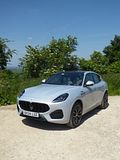


Whilst Maserati dealers do try to provide a Maserati as a courtesy car, you don’t always get one, as their fleet is limited, so although it was suggested that I should be able to try one when my Ghibli was booked in for a service early in 2023, I ended up with one of the salesmen’s company cars for the day as I learned that priority for the courtesy Maserati goes to the Ferrari part of the dealership. However, a few months later, when I needed to get a cracked windscreen replaced, Graypaul were able to provide a Grecale for me for the day. That car was the entry level Grecale GT and whilst time was limited as I had the car on a workday, and I could only really drive it from the dealership in Solihull to the office in Warwick and back, I learned enough to know that as well as liking the look of this car, it was good to drive and a pleasant place in which to sit. It duly retained its place at the top of the short list of potential replacement cars for the time when the Ghibli had to be returned. Although my Ghibli is on a four year lease, and I have been ignoring the relatively frequent dealer emails saying that they want to buy the car back, with its third birthday approaching, I decided that it might make sense to look more seriously at making a change after three years rather than four. Preliminary numbers from the dealer suggested that as my Ghibli was on a rather lower mileage than expected, they could come up with a deal which would not cost that much more per month than my Ghibli payments. That meant that I needed to try the Grecale again to see if it really would be the car for me. I asked for a Modena, as I wanted to assess the differences over and above the GT version I had already driven, as well as remind myself of the essence of what is now Maserati’s “volume” seller.


One of the most significant differences between the GT and the Modena versions is that whilst the same engine is used, there is 10% more power in the Modena, 330 bhp as opposed to 300. That means that the state of the tune of the Modena version is the same as in the Ghibli Hybrid. Both are large and heavy cars, but I know from experience of the Ghibli over the last three years that 330 bhp is enough to make the car feel quite lively, and the same was true here. The engine is started with a push button which is on the lower left of the steering wheel, and when it fires there a really rather agreeable growl which does soften as the engine warms up. There is no doubting the sporting intent of the car though on that cold start. Driven gently, which is what you will be doing in traffic the engine is very quiet and the Grecale comes across as a serene and refined motor vehicle, but out on the open road, if you want some fun or just some rapid acceleration, the Grecale really comes to life and reminds you that whilst this is an SUV it is also a Maserati with a rich sporting heritage. This is what is known as a MHEV, a mild hybrid. What that means is that the car will always run o the petrol engine but there is a boost available from the battery as well and this is most beneficial when accelerating. You are never aware of what some clever technology is actually doing in response to the demands from your right foot. Standard on all Grecale models is an 8 speed automatic transmission which is very well matched with the engine, making almost imperceptible gear changes. Rather than a traditional gearlever, the Grecale has a row of push buttons on the dash, below the lower touch screen. I found that you needed to press them quite deliberately, especially the Reverse one, to be sure they had engaged. One consequence of this is that the only way to change gear manually is to use the paddles, which are standard on all models of the Grecale. These are absolutely massive, far bigger than I would like, really. So whilst they are easy to reach, their size does mean it is a bit of a reach around them to get to the indicators and wipers, especially if you don’t have big hands. No doubt this is something that you would get used to with familiarity, but I marked it down as a demerit compared to the Ghibli. Underway, the Grecale is easy to drive. Acceleration is there if you need it, but it is also a car in which you could undertake long journeys without feeling that long. Noise levels are low, and at motorway speed, just as in the Ghibli, the engine is doing around 1800 rpm. This of course has consequent benefits on fuel economy. My test drive was not long enough to get a meaningful figure, but I know from experience of the Ghibli that you get similar fuel consumption to the former diesel model. That gave the Ghibli a massive range, as it had a tank of over 80 litres. The tank in the Grecale is smaller, at around 63 litres, but even so a range of 350 to 400 miles is readily achievable.


The Grecale is built on a slightly modified and enlarged version of the much-praised Giorgio platform which has earned much praise in the Alfa Stelvio, so it is no surprise to learn that it also makes the Grecale a very agreeable car to drive. I found that when I drove the GT version and the driving attributes of the Modena are little different, as you might expect, since the car is so similar. The only differences are that the Modena comes as standard on larger 20” wheels, with 21” available and fitted to the test car and there is air suspension. The steering is not quite as crisp as you would find in an Alfa Giulia or a modern Mazda, but it is precise and there is some feel. It is suitably light when you are manoeuvering taking on more weight and feel as you turn the wheel. This is a large and heavy car with a higher centre of gravity than there was in the Ghibli, but even so, you can hustle the Grecale along twisty roads with some confidence. All Grecale models have standard all-wheel drive which means that there is plenty of grip and the car corners pretty flat with not much in the way of body roll. My test car had the larger 21” wheels (even bigger available, depending on the wheel trim selected) and the air suspension and this gives the car a generally comfortable ride. Although some of the worst of the pothole and surface imperfections will be felt, the primary ride is smooth and this, coupled with the overall refinement suggests that this would be a great car for a long journey that would not feel like it had been a long journey. The brakes are very effective, needing only a gentle touch in ordinary circumstances. The electronic parking brake is low on the dash over the driver’s knee. It is not very obvious, and it won’t usually matter if you don’t even know where it is, but if you try to move the car without the seat belt on (which you might do if shuffling it in a car park), it will not automatically release. Visibility is about par for the course these days, with a decent field of view from the mirrors and the rear camera is helpful when parking. Most of the irritating ADAS features that ruin modern cars are only offered here if you buy one of the options packages which includes them. Whilst Blind Spot Warning would be useful, like most people, I can happily live without all the others. They did not feature on my test car.


Maserati still do interiors better and nicer than just about any other brand on the market. The traditional clock mounted high in the centre of the dash is a clue as to the marque you are looking at, but beyond this there is a style and a quality of material that gives a wonderful ambience. There is more leather used on the dash and door casings in a Modena than GT and this, along with the open pore wood inlays (other inlay types are available) really does mean that this is a quality-looking product, spoiled only by the extra size of the slightly cheap looking dual touchscreens in the centre of the dash. There is a chunky perforated leather-wrapped steering wheel that is pleasant to hold. Sitting behind this is an electronic dash display with large round dials for speedometer and rev counter, and smaller fuel level and water temperature inset in the lower portions as well as an area between them where you configure what you want to appear from trip computer style data to a representation of the navigation system. As I observed before, these are different to those on the Ghibli with a changed style which appears a little more modern. I am not sure that all the progress here is entirely commendable, as the trip data that used to be easy to cycle through has largely been relegated to the touchscreen where it is harder to find and there seems to be no way of seeing an odometer until the turn the ignition odd. Modena models have a standard Head-Up display and you can vary the position where this projects and also choose to an extent what it shows. There are no fewer than 30 buttons on the steering wheel, including a large one to the lower left to start and stop the engine, with others controlling cruise control and some audio repeater functions. Some of these also operate from buttons on the back of the wheel. One welcome change over the Ghibli is that you get two column stalks, rather than the one, though I thought the new noise that goes with the indicators was not an improvement! The lights are set on the touch screen, so putting them into Auto mode is important. Controlled by Maserati Connect, the 12.3” upper touchscreen – the largest ever seen in a Maserati to date – has different software to the set-up in my current Ghibli though there are enough similarities that I was able to do what I wanted to without much of a learning curve. You get all the features you would expect including DAB radio, Apple Car Play, Android Auto and navigation. There is a Sonus Faber sound system with 14 speakers. The lower 8.8” screen, set at an angle to make it a little easier to see and reach, is used for the dual zone automated climate control system. It is not as easy to use as the old buttons were but this seems to be the way every manufacturer is going. Wireless phone charging features.


The outside door handles of the Grecale are electric and there are electric release buttons inside. You are aware of the fact that this is a taller car than the Ghibli when you get in as there is more of a reach up than in that saloon offering. Once installed there is a real feeling of space, rather more so than is the case with the Ghibli. The cabin is light and airy thanks to an expansive panoramic glass roof and a relatively uncluttered design. The two seats seem well apart thanks to quite a wide console, just as you get in the Ghibli and Levante. There’s even more adjustment offered on the Modena – no less than 14-ways – than the 10-way electrically adjustable seats in the GT and the steering column also has electric adjustment. There are three memory settings and you do need to use these, as the seat powers back when you cut the ignition, to aid exit and entry. Like all Maserati models, the quality of the leather that trims them is exemplary, which, combined with the tasteful interior décor really does make you feel like you are in a luxury product. The seats also proved supremely comfortable. Add in the refinement on the motorway and this truly would be a superb way to traverse a county or two in comfort, style and leaving you feeling relaxed at journey’s end.


The rear space is certainly good enough for two adults to travel in comfort, where they will find a USB and a USB-C socket to share between them, as well as a vent each, with a separate rear climate control setting on the Modena and Trofeo cars. Those rear passengers will find they can easily slide their feet under the front seats, and headroom is decent. What they won’t want is another person sat between them, and the person in the middle will certainly be the least happy of the three. The centre console extends well back and the transmission tunnel is pretty wide, so their feet will be straddling it, but at least there’s no lump in the middle so they’ll be on a flat bench seat. Stick with two rear occupants and they can drop the central armrest, which reveals a pair of cupholders, as well as a through-load hatch. The rear door bins are, like the ones in the front, smaller than many other similar cars, again thanks to the hefty speaker embedded into the door. In Modena trim you do get the map pockets on the back of the front seats that are missing from GT spec. If you’re putting child seats in the back, there’s enough space once they’re in, but the rear doors don’t open particularly wide and the ISOFIX fixings aren’t the most accessible, so it’s a bit of a faff if you’re moving seats in and out of the car.


Boot space in the Grecale is generous. The top-spec Trofeo has an extra 35 litres of space thanks to it being the only car that doesn’t have additional batteries for a hybrid system, but the GT and Modena still boast 535 litres, which beats the BMW X4’s 525 litres and the 500 of the Porsche Macan. It’s a big square shape. There’s no under-floor stowage or moveable boot floor, beyond space for some tyre foam and a repair kit, but a 12-volt power socket, a pair of bag hooks, four tie-down points and an elasticated belt for securing small items are all present. Drop the asymmetrically split rear seats, which fold at the touch of a button in the boot, and it’s an easy slide of lengthy items through the luggage area, as the seats fold flat to the boot floor. There is also a ski flap. There is electric opening and closing for the rather large tailgate. Inside the passenger compartment, there are a pair of decent-sized cupholders and a very deep under-armrest storage, cubby which is countered by a modest glovebox and below-average door bins, the latter limited a bit by the hefty speakers in the doors. There is an area under the climate control touchscreen which includes wireless phone charging, but you could also put small items here.


There are currently three versions of the Grecale available: GT, Modena and Trofeo. The GT is the entry level car and is actually quite a lot less expensive than most people would assume. The Modena has more power and some extra equipment to justify the price difference and then the Trofeo sits at the top of the range with a V6 Nettuno engine and more standard equipment again. The Grecale GT comes with black leather upholstery, 10-way power adjustment for the driver, a 12.3-inch touchscreen navigation display including Apple CarPlay and Android Auto, Amazon Alexa and Google Assistant. It also features selectable drive modes as well as an eight-speed automatic gearbox and mild-hybrid electrical assistance. The Grecale GT comes with 19-inch alloy wheels as standard. Almost all of the convenience features that you might reasonably expect for a car of this price are included, from dual-zone climate control, auto lights and wipers, to leather seats, an electrically assisted tailgate, a 14 speaker 3D Sonus Baber sound system, navigation and plenty more. The slightly sportier Modena version of the Grecale gets more power – 330 bhp as opposed to 300 – than the GT and has the quad exhaust tips to show it. There’s also three-zone climate control, 14-way electric adjustment for both front seats, a head-up display, an extra 8.8-inch touchscreen control panel for the air conditioning system, standard 20-inch alloy wheels, black brake callipers, contrast stitching for the leather seats, and open-pore wood trim. The Trofeo is the most powerful version of the Grecale, with its 530hp V6 engine. It comes as standard with 21-inch alloy wheels, red painted brake callipers, adaptive ‘Skyhook’ suspension, carbon-fibre body kit, black premium leather with contrast red stitching, and carbon-fibre cabin trim as well as an upgraded 21 speaker sound system. A lot of what you will either think of as invaluable safety tech or a suite of annoying features many of which you want to disable, are optional in one of two Driver Assistance packs – even on the top-spec £100,000 Trofeo. The basic driver assistance pack adds adaptive cruise control, lane keeping and blind spot assist systems, full LED matrix headlights, driver drowsiness protection and auto-dimming rear view mirrors, much of which it’s a little surprising to find isn’t standard. The Advanced Driver Assistance Plus Pack adds traffic sign recognition, intelligent speed assist, intersection collision assistant and active driving assistant safety systems, although it costs in the region of £5,000, almost double the basic package.


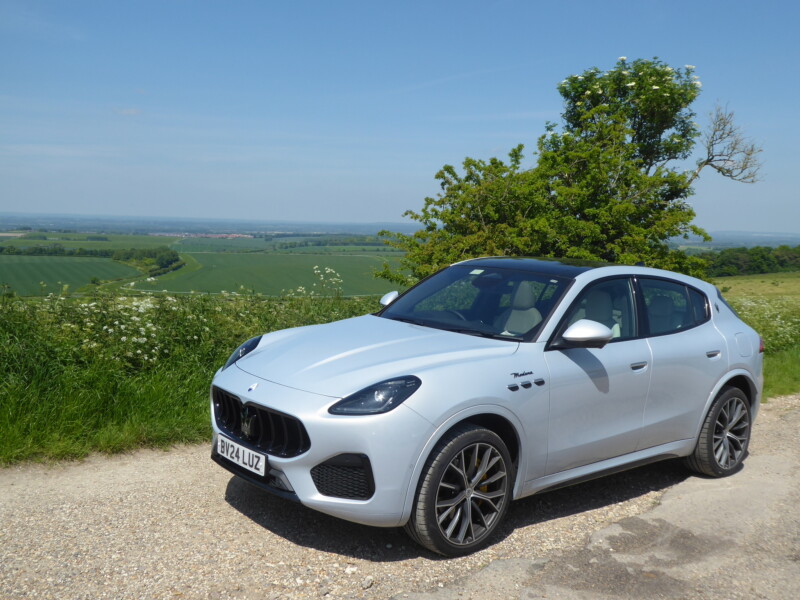
The time with the Grecale Modena told me what I needed to know. I liked the GT I had driven earlier in the year and this one was that bit nicer: more performance and more equipment along with some even nicer quality interior trim. On return to the dealership it was simply a case of sitting down and waiting for the calculations on the size of the deposit and the monthly payments. With stronger residuals than most believe to the case, various discounts and Maserati contributions for loyalty and however else finance justified what they were doing, the bottom line number was attractive enough for me to decide there and then to sign the order form. A car to my spec duly arrived at the dealership a few weeks later and that is the one that features in most of the photos here. Whilst I did love the Ghibli very much, especially the second one I had, now that is out of production, the Grecale is a more than worthy and more versatile substitute. I expect to be very happy for the next four years with this car.