Having enjoyed my visit to the Engines at Elkstone evening event in June, when I spotted that my diary was clear to go along again in July, I did not hesitate. This new venue had shown considerable promise, and I predicted that as word got out, then attendance would surely only increase, as this has been the pattern for quite a lot of newly established events. That said, July starts to see challenges based on people being away on holiday, so you can never be quite sure. What I found during the course of a very pleasant evening was a mixture of some of the same cars as I had seen in June, many of them rally tribute cars just like the one belonging to the event organiser, and some cars that had not been here before. Total numbers were probably not that different to the June event, but the variety of cars and the opportunity to chat with friends and some owners I only met for the first time at this event made for a very agreeable evening. Here are the notable cars of the evening:
ABARTH
Rumours started to circulate towards the end of 2014 that Abarth were going to upgrade the Competizione model, so as better to bridge the gap between the Turismo and the 190 bhp 695 Biposto that had been added to the range earlier in the year. It was Geneva 2015 when the result was finally shown to an expectant fan base. Most exciting news was that thanks to a bigger Garrett Turbo, the engine had been tweaked to 180 bhp, and with reduced CO2 emissions. A standard spec that included Koni Dampers, Brembo brakes, Xenon lights, Sabelt seats, Climate Control, parking sensors as well as other refinements that had been added like the TFT instrument display all proved very compelling, so not long after the first cars reached the UK in June of 2015, I found temptation too hard to resist, and as is well documented here, swapped my 2010 car for one of these. At the time I ordered it, Cordolo Red, a tri-coat pearlescent paint which shimmers in bright sunlight looked set to become one of the most popular colours of the lot, even though it is a cost option. Indeed, the Launch Edition models were all offered either in this colour or Scorpion Black, with black wheels. Surprisingly, the colour was not carried over to the Series 4 cars.


Also here were two examples of the all-electric 500e. These are both ex Abarth press cars and have recently been acquired by two friends of mine from the new Abarth dealership, Unity Automotive, in Cheltenham. The Abarth New 500e Scorpionissima is a performance variant that made its official debut on 22 November 2022, featuring unique scorpion-badged alloy wheels. Initially, it is being released in a Scorpionissima edition limited to 1,949 examples. Scorpionissima models will be available in a choice of Acid Green or Poison Blue colours, bearing unique side graphics and wheels. The first deliveries were scheduled for June 2023. It has a single electric traction motor that produces 114 kW (153 hp) and 235 Nm (173 lb/ft), an increase of 26.7 kW (35.8 hp) and 15 Nm (11 lb/ft) over the standard motor, and accelerates from 0 to 100 km/h (62 mph) in 7 seconds. The enhancements in power and torque output are derived from improved inverter and battery wiring, and a reduction in the final-drive ratio. The Abarth also swaps the rear drum brakes on the New 500 for discs. Three driving modes are offered: Turismo, Scorpion Street, and Scorpion Track; output power and torque are limited to 100 kW (130 hp) and 220 Nm (160 lb/ft) in Turismo. Scorpion Street maximizes regenerative braking, simulating the engine braking effect of a conventional car equipped with a manual transmission, while Scorpion Track sacrifices range for performance. In manufacturer testing at Balocco, the Abarth 500e is able to complete laps 1 second quicker than the Abarth 695. Total weight is 1,410 kg (3,110 lb), including the 295 kg (650 lb) battery. Charging hardware is carried over from the regular New 500 equipped with the larger battery, at rates up to 85 kW. The Abarth 500e has a battery with a capacity of 42.2 kWh (gross) and 37.3 kWh (net), giving the vehicle a claimed range of 264 km (164 mi) under the WLTP driving cycle with the standard 17-inch wheels; equipping the 18-inch wheels reduces range to 253 km (157 mi). Real-world mixed driving with 18-inch wheels indicated an actual range of 212 km (132 mi), with consumption of 3.4 mi/kWh.


ALFA ROMEO
The first car was called the Alfa Romeo Giulia Sprint GT, and was revealed at a press event held at the then newly opened Arese plant on 9 September 1963, and displayed later the same month at the Frankfurt Motor Show. In its original form the Bertone body is known as scalino (step) or “step front”, because of the leading edge of the engine compartment lid which sat 1/4 an inch above the nose of the car. The Giulia Sprint GT can be distinguished from the later models by a number of features including: Exterior badging: Alfa Romeo logo on the front grille, a chrome script reading “Giulia Sprint GT” on the boot lid, and rectangular “Disegno di Bertone” badges aft of the front wheel arches; flat, chrome grille in plain, wide rectangular mesh without additional chrome bars; single-piece chrome bumpers; no overriders. Inside the cabin the padded vinyl dashboard was characterised by a concave horizontal fascia, finished in grey anti-glare crackle-effect paint. Four round instruments were inset in the fascia in front of the driver. The steering wheel was non-dished, with three aluminium spokes, a thin bakelite rim and a centre horn button. Vinyl-covered seats with cloth centres and a fully carpeted floor were standard, while leather upholstery was an extra-cost option. After initially marketing it as a four-seater, Alfa Romeo soon changed its definition of the car to a more realistic 2+2. The Giulia Sprint GT was fitted with the 1,570 cc version of Alfa Romeo’s all-aluminium twin cam inline four (78 mm bore × 82 mm stroke), which had first debuted on the 1962 Giulia Berlina. Breathing through two twin-choke Weber 40 DCOE 4 carburettors, on the Sprint GT this engine produced 105 hp at 6,000 rpm. Like all subsequent models, the Sprint GT was equipped with an all-synchromesh 5-speed manual transmission. The braking system comprised four Dunlop disc brakes and a vacuum servo. The rear brakes featured an unusual arrangement with the slave cylinders mounted on the axle tubes, operating the calipers by a system of levers and cranks. According to Alfa Romeo the car could reach a top speed of “over 180 km/h (112 mph)”. In total 21,902 Giulia Sprint GT were produced from 1963 to 1965, when the model was superseded by the Giulia Sprint GT Veloce. Of these 2,274 were right hand drive: 1,354 cars fully finished in Arese, and 920 shipped in complete knock-down kit form for foreign assembly. For 1966, the Giulia Sprint GT was replaced by the Alfa Romeo Giulia Sprint GT Veloce, which was very similar but featuring a number of improvements: a revised engine—slightly more powerful and with more torque—better interior fittings and changes to the exterior trim. Alongside the brand new 1750 Spider Veloce which shared its updated engine the Sprint GT Veloce was introduced at the 36th Geneva Motor Show in March 1966, and then tested by the international specialist press in Gardone on the Garda Lake. Production had began in 1965 and ended in 1968. The Giulia Sprint GT Veloce can be most easily distinguished from other models by the following features: badging as per Giulia Sprint GT, with the addition of round enamel badges on the C-pillar—a green Quadrifoglio (four-leaf clover) on an ivory background—and a chrome “Veloce” script on the tail panel; black mesh grille with three horizontal chrome bars; the grille heart has 7 bars instead of 6; stainless steel bumpers, as opposed to the chromed mild steel bumpers on the Giulia Sprint GT. The bumpers are the same shape, but are made in two pieces (front) and three pieces (rear) with small covers hiding the joining rivets. Inside the main changes from the Giulia Sprint GT were imitation wood dashboard fascia instead of the previous anti-glare grey finish, front seats revised to a mild “bucket” design, and a dished three aluminium spoke steering wheel, with a black rim and horn buttons through the spokes. The Veloce’s type 00536 engine, identical to the Spider 1600 Duetto’s, featured modifications compared to the Giulia Sprint GT’s type 00502—such as larger diameter exhaust valves. As a result it produced 108 hp at 6,000 rpm, an increase of 3 hp over the previous model, and significantly more torque. The top speed now exceeded 185 km/h (115 mph). Early Giulia Sprint GT Veloces featured the same Dunlop disc brake system as the Giulia Sprint GT, while later cars substituted ATE disc brakes as pioneered on the GT 1300 Junior in 1966. The ATE brakes featured an handbrake system entirely separate from the pedal brakes, using drum brakes incorporated in the rear disc castings. Though the Sprint GT Veloce’s replacement—the 1750 GT Veloce—was introduced in 1967, production continued throughout the year and thirty final cars were completed in 1968. By then total Giulia Sprint GT Veloce production amounted to 14,240 examples. 1,407 of these were right hand drive cars, and 332 right hand drive complete knock-down kits. The Alfa Romeo 1750 GT Veloce (also known as 1750 GTV) appeared in 1967 along with the 1750 Berlina sedan and 1750 Spider. The same type of engine was used to power all three versions; this rationalisation was a first for Alfa Romeo. The 1750 GTV replaced the Giulia Sprint GT Veloce and introduced many updates and modifications. Most significantly, the engine capacity was increased to 1779 cc displacement. Peak power from the engine was increased to 120 hp at 5500 rpm. The stroke was lengthened from 82 to 88.5 mm over the 1600 engine, and a reduced rev limit from 7000 rpm to 6000 rpm. Maximum torque was increased to 137 lb·ft at 3000 rpm. A higher ratio final drive was fitted (10/41 instead of 9/41) but the same gearbox ratios were retained. The result was that, on paper, the car had only slightly improved performance compared to the Giulia Sprint GT Veloce, but on the road it was much more flexible to drive and it was easier to maintain higher average speeds for fast touring. For the United States market, the 1779 cc engine was fitted with a fuel injection system made by Alfa Romeo subsidiary SPICA, to meet emission control laws that were coming into effect at the time. Fuel injection was also featured on Canadian market cars after 1971. Carburettors were retained for other markets. The chassis was also significantly modified. Tyre size went to 165/14 from 155/15 and wheel size to 5 1/2J x 14 instead of 5J x 15, giving a wider section and slightly smaller rolling diameter. The suspension geometry was also revised, and an anti-roll bar was fitted to the rear suspension. ATE disc brakes were fitted from the outset, but with bigger front discs and calipers than the ones fitted to GT 1300 Juniors and late Giulia Sprint GT Veloces. The changes resulted in significant improvements to the handling and braking, which once again made it easier for the driver to maintain high average speeds for fast touring. The 1750 GTV also departed significantly from the earlier cars externally. New nose styling eliminated the “stepped” bonnet of the Giulia Sprint GT, GTC, GTA and early GT 1300 Juniors and incorporated four headlamps. For the 1971 model year, United States market 1750 GTV’s also featured larger rear light clusters (there were no 1970 model year Alfas on the US market). Besides the chrome “1750” badge on the bootlid, there was also a round Alfa Romeo badge. Similar Quadrofoglio badges to those on the Giulia Sprint GT Veloce were fitted on C pillars, but the Quadrofoglio was coloured gold instead of green. The car also adopted the higher rear wheelarches first seen on the GT 1300 Junior. The interior was also much modified over that of earlier cars. There was a new dashboard with large speedometer and tachometer instruments in twin binnacles closer to the driver’s line of sight. The instruments were mounted at a more conventional angle, avoiding the reflections caused by the upward angled flat dash of earlier cars. Conversely, auxiliary instruments were moved to angled bezels in the centre console, further from the driver’s line of sight than before. The new seats introduced adjustable headrests which merged with the top of the seat when fully down. The window winder levers, the door release levers and the quarterlight vent knobs were also restyled. The remote release for the boot lid, located on the inside of the door opening on the B-post just under the door lock striker, was moved from the right hand side of the car to the left hand side. The location of this item was always independent of whether the car was left hand drive or right hand drive. Early (Series 1) 1750 GTV’s featured the same bumpers as the Giulia Sprint GT Veloce, with the front bumper modified to mount the indicator / sidelight units on the top of its corners, or under the bumper on US market cars. The Series 2 1750 GTV of 1970 introduced other mechanical changes, including a dual circuit braking system (split front and rear, with separate servos). The brake and clutch pedals on left hand drive cars were also of an improved pendant design, instead of the earlier floor-hinged type. On right hand drive cars the floor-hinged pedals were retained, as there was no space for the pedal box behind the carburettors. Externally, the series 2 1750 GTV is identified by new, slimmer bumpers with front and rear overriders. The combined front indicator and sidelight units were now mounted to the front panel instead of the front bumper, except again on the 1971-72 US/Canadian market cars. The interior was slightly modified, with the seats retaining the same basic outline but following a simpler design. 44,269 1750 GTVs were made before their replacement came along. That car was the 2000GTV. Introduced in 1971, together with the 2000 Berlina sedan and 2000 Spider, the 2 litre cars were replacements for the 1750 range. The engine displacement was increased to 1962 cc. Oil and radiator capacities remained unchanged. The North American market cars had fuel injection, but everyone else retained carburettors. Officially, both versions generated the same power, 130 hp at 5500 rpm. The interior trim was changed, with the most notable differences being the introduction of a separate instrument cluster, instead of the gauges installed in the dash panel in earlier cars. Externally the 2000 GTV is most easily distinguished by its grille with horizontal chrome bars, featuring protruding blocks forming the familiar Alfa heart in outline, smaller hubcaps with exposed wheel nuts, optional aluminium alloy wheels of the same size as the standard 5. 1/2J × 14 steel items, styled to the “turbina” design first seen on the alloy wheels of the Alfa Romeo Montreal, and the larger rear light clusters first fitted to United States market 1750 GTV’s were standard for all markets. From 1974 on, the 105 Series coupé models were rationalised and these external features became common to post-1974 GT 1300 Junior and GT 1600 Junior models, with only few distinguishing features marking the difference between models. 37,459 2000 GTVs were made before production ended and these days they are very sought after with prices having sky-rocketed in recent years.

ARIEL
The Ariel Atom is a road-legal high performance open-wheel car made by the British Ariel Motor Company based in Crewkerne, Somerset, England, and under license in North America by TMI Autotech, Inc. at Virginia International Raceway in Alton, Virginia. The Atom began as a student project by Coventry University transport design student Niki Smart. Known then as the LSC (Lightweight Sports Car), it was developed at the university in 1996 with input and funding from various automotive industry members, including British Steel and TWR. Ariel Motor Company boss Simon Saunders was a senior lecturer whose responsibility for the project was primarily as financial manager and design critic for Smart, whom he described as “The best all-round design student I’ve ever seen.” The car was first shown publicly at the British International Motor Show at the NEC in Birmingham in October 1996. The Ariel Atom features a prominently visible chassis (i.e., an exoskeleton, no roof or windows, a small optional windscreen) and a drag coefficient of 0.40 There have been eight Ariel Atom generations to date: Ariel Atom, Ariel Atom 2, Ariel Atom 3 (including the Ariel Atom 3 Mugen Limited Edition and Honda Racing Edition – of which only one was made) Ariel Atom 3.5, Ariel Atom 3S, Ariel Spec:Race Atom, Ariel Atom 500 V8 Limited Edition (only 25 to be made), and the Ariel Atom 4. The limited production Ariel Atom 500 V8 featured a 500 bhp V8 engine. The Ariel Atom 4 uses a turbocharged 2.0 litre engine, also used in the Honda Civic Type R, with 3-stage boost.


BMW
The BMW E30 is the second generation of BMW 3 Series, which was produced from 1982 to 1994 and replaced the E21 3 Series, and was the car which really saw the popularity of the 3 Series increase dramatically. . Development of the E30 3 Series began in July 1976, with styling being developed under chief designer Claus Luthe with exterior styling led by Boyke Boyer. In 1978, the final design was approved, with design freeze (cubing process) being completed in 1979. BMW’s launch film for the E30 shows the design process including Computer-aided design (CAD), crash testing and wind-tunnel testing. The car was released at the end of November 1982. Externally, the E30’s appearance is very similar to twin headlight versions of its E21 predecessor, however there are various detail changes in styling to the E30. Major differences to the E21 include the interior and a revised suspension, the latter to reduce the oversteer for which the E21 was criticised. At launch, the car had a 2 door style like its predecessor and just four engines, all of them petrol: the 316 and 318 four cylinder units and the 320 and 323i 6 cylinders. This last was soon upgraded to a 2.5 litre unit. Diesel models were added during the 80s and there was an all-wheel drive 325iX option for continental European markets. In addition to the 2 door saloon and Baur convertible body styles of its E21 predecessors, the E30 became available by early 1984 as a four-door sedan and later a five-door station wagon (marketed as “Touring”). The Touring body style began life as a prototype built by BMW engineer Max Reisböck in his friend’s garage in 1984 and began production in 1987. The factory convertible version began production in 1985, with the Baur convertible conversions remaining available alongside it. Following the launch of the E36 3 Series in 1990, the E30 began to be phased out.


FIAT
Known as project 110, the brief for the Nuova 500 was to create a micro-car that would not only carry on the tradition of the earlier Topolino, but which would also take sales away from the ever popular Lambretta and Vespa scooters of the day. It clearly needed to be smaller than the 600 which had been released with a conventional 4 cylinder engine. Not an easy task, but development started in 1953 and by August 1954, two designs were ready to be shown to Fiat management. They selected one, and serious development began. At first the car was referred to as the 400, as it was going to have a 400cc engine, but it was soon realised that this was just too small, so a larger 500cc air-cooled engine was developed. It was signed off in January 1956, with production starting in March 1957 in advance of a June launch. Fiat’s marketing department got busy, with hundreds of the new car taking to the streets of Turin, each with a pretty girl standing through the open sunroof that was a feature of all the early cars. The press loved it. 50 units were shipped to Britain, where the car made its debut at Brands Hatch, and again the reception was enthusiastic. But the orders just did not come in. Fiat went for a hasty rethink, relaunching the car at the Turin Show later that year. power was increased from 13 to 15 bhp, and the poverty spec was lessened a little, with headlight bezels, brightwork on the side and chrome hubcaps, a Nuova500 badge on the engine cover, winding side windows (the launch cars just had opening quarterlights) and the option of a heater fan. It was enough to get sales moving. The original car was still offered, at a lower price, called the Economy. In the first year of production, 28,452 Fiat 500s were made. Over the next 19 years, the car changed little in overall appearance, but there were a number of updates with more power and equipment added. A 500 Sport was launched in August 1958, with a more powerful version of the 499cc engine. It lost the soft top, having a ridged steel roof, to increase strength of the body. It was only available in grey with a red side flash. The first major changes came in 1960 with the 500D. This looks very similar to the Nuova, but with two key differences. One is the engine size: the D features an uprated 499 cc engine producing 17 bhp as standard, an engine which would be used right through until the end of the L in 1973; and the other is the roof: the standard D roof does not fold back as far as the roof on the Nuova, though it was also available as the “Transformable” with the same roof as the Nuova. The D still featured “suicide doors”. There were larger rear light clusters, more space in the front boot thanks to a redesign of the fuel tank and new indicators under the headlights. A year later, Fiat added a light on the rear-view mirrors and a windscreen washer, but the car still lacked a fuel gauge. Sales increased from 20,900 in 1960 to 87.000 in 1961, 132,000 in 1962 and by 1964, the last year of production, they hit 194,000 units. The D was replaced in 1965 by the 500F, which finally moved the door hinges from back to the front, owing to changes in Italian safety laws. There was a deeper windscreen and thinner door pillars, which increased the height of the car by 10mm, improving visibility for the driver. The 500F ran through to 1975, from 1968 alongside the more luxurious 500L which was added to the range in 1968. The L is easy to tell apart, with its bumper overriders. The final updates created the 500R, which incorporated many changes from the 126 under the skin of the classic shape, and in this form production continued alongside the newer 126 until 1976.


FORD
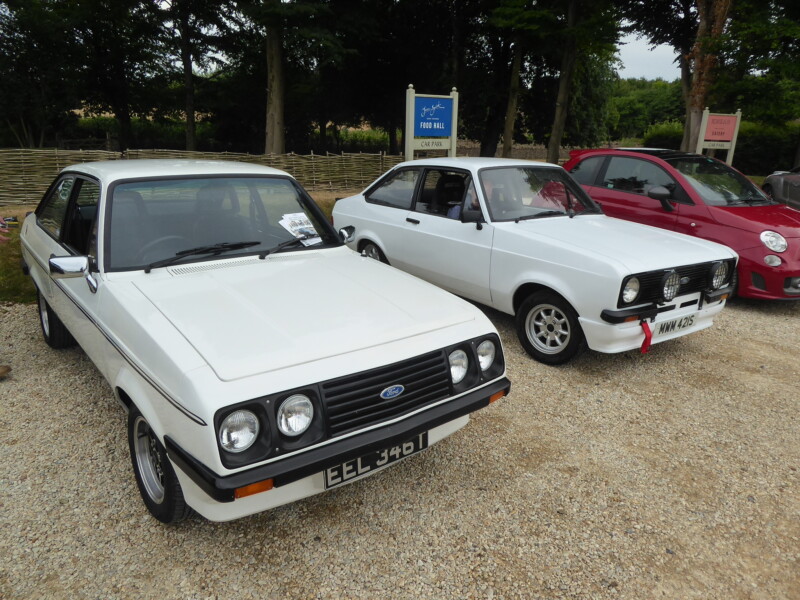
The squarer-styled Escort Mark II version appeared in January 1975. The first production models had rolled off the production lines on 2 December 1974. Unlike the first Escort (which was developed by Ford of Britain), the second generation was developed jointly between the UK and Ford of Germany. Codenamed “Brenda” during its development, it used the same mechanical components as the Mark I. The 940 cc engine was still offered in Italy where the smaller engine attracted tax advantages, but in the other larger European markets in Europe it was unavailable. The estate and van versions used the same panelwork as the Mark I, but with the Mark II front end and interior. The car used a revised underbody, which had been introduced as a running change during the last six months production of the Mark I. Rear suspension still sat on leaf springs though some contemporaries such as the Hillman Avenger had moved on to coil springs. The car came in for criticism for its lack of oddments space, with a glove compartment only available on higher end models, and its stalk-mounted horn. The “L” and “GL” models (2-door, 4-door, estate) were in the mainstream private sector, the “Sport”, “RS Mexico”, and “RS2000” in the performance market, the “Ghia” (2-door, 4-door) for a hitherto untapped small car luxury market, and “base / Popular” models for the bottom end. Panel-van versions catered to the commercial sector. The 1598 cc engine in the 1975 1.6 Ghia produced 84 hp with 92 ft·lbft torque and weighed 955 kg (2105 lb). A cosmetic update was given in 1978 with L models gaining the square headlights (previously exclusive to the GL and Ghia variants) and there was an upgrade in interior and exterior specification for some models. Underneath a wider front track was given. In 1979 and 1980 three special edition Escorts were launched: the Linnet, Harrier and Goldcrest. Production ended in Britain in August 1980, other countries following soon after


HONDA
Introduced on 7 November 1996, the fifth-generation Prelude retained an FF layout with an independent front suspension and 63/37 weight distribution. The fifth-generation Prelude marked a return to the more square bodystyle of the third generation (1987–1991), in an attempt to curb slumping sales of the fourth-generation bodystyle. The two-door notchback style is retained but the design is less aggressive and more angular than the previous generation. The redesigned sports coupe is slightly larger than its predecessor at 1.4 inches (36 mm) longer in wheelbase and 3.2 inches (81 mm) overall. Base curb weight increased by 145 pounds (66 kg) and interior dimensions are nearly identical but trunk space expanded by nearly 1 cubic foot. The ATTS model received Honda’s Active Torque Transfer System; badged as the Type S in Japan, VTi-S in Europe, and Type SH (“Super Handling”) in North America. ATTS automatically distributes more of the engine’s power to the outside front wheel when accelerating in a turn. This forces the outside front wheel to rotate up to 15 percent faster than the inside wheel directing up to 80 percent of the torque to a single wheel. ATTS was designed to counteract the understeer inherent in a front-wheel drive car, but the Prelude’s 63.1 percent front weight distribution was too much for the system to successfully mask. The Prelude was available in three models for Canada and two models for the US (the Base and Type SH). All North American models came with a 195 horsepower (later increased to 200HP) 2.2-liter DOHC VTEC 4-cylinder engine and 16-inch alloy wheels. The optional automatic transmission has a new manual-shift feature called Sequential SportShift. The gear lever can be left in Drive, which allows automatic shifting or it can be tipped forward or backward to allow manual shifting. A 5-speed manual transmission was standard. The Type SH was only available with a 5-speed manual transmission. The 2.0i and JDM Si trims came with 195/60 R15 tires mounted on steel wheels, and the JDM Xi came with 14-inch steel wheels. Unlike the North American market Preludes, JDM Preludes came with rear windscreen wipers, except for the Xi. Australian and JDM Preludes weigh less than American and European models: VTi-R manual weighs 1,268 kg (2,795 lb), autos weigh 1,298 kg (2,862 lb), and the ATTS weighs 1,308 kg (2,884 lb). Most fifth-generation Preludes came with 16-inch (410 mm) aluminum alloy wheels with all-season 205/50 R16 87V tyres, featured the 11.1-inch front brakes with 5-lug hubs and anti-lock brakes are standard. US models were well equipped and the Type SH only added ATTS, a leather-wrapped shift knob, and a rear spoiler over the base model. All models and trim packages stayed within the BB-chassis code (BB5-BB9) and housed either an H-series or F-Series engine: For the 1999 model year, the Prelude received a mid-cycle refresh; this included a 5 hp increase in power for manual (200 hp from 195 hp) and automatic (195 hp from 190 hp) transmission models, a new front grille featuring a small “Prelude” badge, an access door to the cabin air filtration system allowing for cabin air filter replacement without modifications, and changes to available colours.


HYUNDAI
A performance version called the i20 N was revealed for the European market in October 2020. It slots under the i30 N in the Hyundai N family. The i20 N is powered by a 1.6-litre turbocharged GDi engine mated to a 6-speed manual transmission with automatic rev matching. This engine has 201 bhp and 275 Nm (203 lb/ft) of torque. As the i20 N only weighs 1,190 kg (2,620 lb), it is able to accelerate from 0–100 km/h (0–62 mph) in 6.2 seconds with a top speed of 230 km/h (143 mph). Its engine delivers peak torque between 1,750 and 4,500 rpm and hits peak power between 5,500 and 6,000 rpm. The broad power band helps its acceleration performance throughout the mid and high-speed range. Although the Smartstream engine is featured in other Hyundai models, for the i20 N it is equipped with a bespoke turbocharger and intercooler system. Changes also include a mechanical limited-slip differential, a reinforced chassis at 12 different points, and a reinforced front domes and knuckles with distinct geometry for the torsion beam suspension. The camber has also been increased while a new sway bar, new springs, and new shock absorbers have been fitted. The brakes have also been enlarged, being 40mm larger than the base i20 brakes. Production of the i20 N ceased for the European market in February 2024, and Hyundai N will only offer electric models in the region. Despite its discontinuation in Europe, the facelifted model of the i20 N is being prepared for export to the Australian market.


JAGUAR
The Series 2 E Type introduced a number of design changes, largely due to U.S. National Highway Traffic and Safety Administration mandates. The most distinctive exterior feature is the absence of the glass headlight covers, which affected several other imported cars, such as the Citroën DS, as well. Unlike other cars, this step was applied worldwide for the E-Type. Other hallmarks of Series 2 cars are a wrap-around rear bumper, larger front indicators and tail lights re-positioned below the bumpers, and an enlarged grille and twin electric fans to aid cooling. Additional U.S.-inspired changes included a steering lock which moved the ignition switch to the steering column, replacing the dashboard mounted ignition and push button starter, the symmetrical array of metal toggle switches replaced with plastic rockers, and a collapsible steering column to absorb impact in the event of an accident. New seats allowed the fitment of head restraints, as required by U.S. law beginning in 1969. The engine is easily identified visually by the change from smooth polished cam covers to a more industrial “ribbed” appearance. It was de-tuned in the US with twin two-barrel Strombergs replacing three SUs. Combined with larger valve clearances horsepower was reduced from 265 to 246 and torque from 283 to 263. Air conditioning and power steering were available as factory options. Production totalled 13,490 of all types, with 4885 of the FHC, 5,326 of the 2+2 and 8,628 of the OTS model.


LANCIA
Needing little in the way of an introduction is this Stratos. Sadly not an original car (which are extremely rare these days), it is a well-produced replica, but is still rather splendid, and it was attracting lots of interest. A Bertone-designed concept car called the Lancia Stratos Zero was shown to the public in 1970, but shares little but the name and mid-engined layout with the Stratos HF version. A new car called the New Stratos was announced in 2010 which was heavily influenced by the design of the original Stratos, but was based on a Ferrari chassis and engine. Bertone had no previous business with Lancia, who were traditionally linked with Pininfarina, and he wanted to come into conversation with them. Bertone knew that Lancia was looking for a replacement for the ageing Fulvia for use in rally sports and so he designed an eye-catcher to show to Lancia. Bertone used the running gear of the Fulvia Coupé of one of his personal friends and built a running showpiece around it. When Bertone himself appeared at the Lancia factory gates with the Stratos Zero he passed underneath the barrier and got great applause from the Lancia workers. After that a co-operation between Lancia and Bertone was formed to develop a new rally car based on ideas of Bertone’s designer Marcello Gandini who already had designed the Lamborghini Miura and Countach. Lancia presented the Bertone-designed Lancia Stratos HF prototype at the 1971 Turin Motor Show, a year after the announcement of the Stratos Zero concept car. The prototype Stratos HF (Chassis 1240) was fluorescent red in colour and featured a distinctive crescent-shaped-wrap-around windshield providing maximum forward visibility with almost no rear visibility. The prototype had three different engines in its early development life: the Lancia Fulvia engine, the Lancia Beta engine and finally for the 1971 public announcement, the mid-mounted Dino Ferrari V6 producing 190 hp. The use of the Dino V6 was planned right from the beginning of the project, but Enzo Ferrari was reluctant to sign off the use of this engine in a car he saw as a competitor to his own Dino V6. After the production of the Dino car had ended the “Commendatore” (a popular nickname for Enzo Ferrari) agreed on delivering the engines for the Stratos, and Lancia then suddenly received 500 units. The Stratos was a very successful rally car during the 1970s and early 1980s. It started a new era in rallying as it was the first car designed from scratch for this kind of competition. The three leading men behind the entire rallying project were Lancia team manager Cesare Fiorio, British racer/engineer Mike Parkes and factory rally driver Sandro Munari with Bertone’s Designer Marcello Gandini taking a very personal interest in designing and producing the bodywork. Lancia did extensive testing with the Stratos and raced the car in several racing events where Group 5 prototypes were allowed during the 1972 and 1973 seasons. Production of the 500 cars required for homologation in Group 4 commenced in 1973 and the Stratos was homologated for the 1974 World Rally Championship season. The Ferrari Dino V6 engine was phased out in 1974, but 500 engines among the last built were delivered to Lancia. Production ended in 1975 when it was thought that only 492 were made (for the 1976 season, the Group 4 production requirement was reduced to 400 in 24 months. Manufacturer of the car was Bertone in Turin, with final assembly by Lancia at the Chivasso plant. Powered by the Dino 2.4 litreV6 engine that was also fitted to the rallying versions, but in a lower state of tune, it resulted in a power output of 190 hp, giving the road car a 0–100 km/h time of 6.8 seconds, and a top speed of 232 km/h (144 mph). The Stratos weighed between 900 and 950 kilograms, depending on configuration. Power output was around 275 hp for the original 12 valve version and 320 hp for the 24 valve version. Beginning with the 1978 season the 24 valve heads were banned from competition by a change to the FIA rules. Even with this perceived power deficit the Stratos was the car to beat in competition and when it did not suffer an accident or premature transmission failure (of the latter there were many) it had great chances to win. Despite the fact that the Stratos was never intended to be a race car, there were two Group 5 racing cars built with 560 hp, using a single KKK turbocharger. The car won the 1974, 1975 and 1976 championship titles in the hands of Sandro Munari and Björn Waldegård, and might have gone on to win more had not internal politics within the Fiat group placed rallying responsibility on the Fiat 131 Abarths. As well as victories on the 1975, 1976 and 1977 Monte Carlo Rally, all courtesy of Munari, the Stratos won the event with the private Chardonnet Team as late as 1979. Without support from Fiat, and despite new regulations that restricted engine power, the car would remain a serious competitor and proved able to beat works cars in several occasions when entered by an experienced private team with a talented driver. The last victory of the Stratos was in 1981, at the Tour de Corse Automobile, another World Rally Championship event, with a victory by longtime Stratos privateer Bernard Darniche. When the Fiat group favoured the Fiat 131 for rallying Lancia also built two Group 5 turbocharged ‘silhouette’ Stratos for closed-track endurance racing. These cars failed against the Porsche 935s on closed tracks but proved successful in hybrid events. While they failed in the Tour de France Automobile, one of these cars won the 1976 Giro d’Italia Automobilistico, an Italian counterpart of the Tour de France Automobile. One of the cars was destroyed in Zeltweg, when it caught fire due to overheating problems. The last surviving car would win the Giro d’Italia event again before it was shipped to Japan to compete in the Fuji Speedway based Formula Silhouette series, which was never raced. The car would then be sold and reside in the Matsuda Collection before then being sold to the renowned collector of Stratos’, Christian Hrabalek, a car designer and the founder of Fenomenon Ltd, who has the largest Lancia Stratos Collection in the world, 11 unique Lancia Stratos cars, including the fluorescent red 1971 factory prototype and the 1977 Safari Rally car. His interest in the car led to the development of the Fenomenon Stratos in 2005. The Stratos also gained limited success in 24 Hours of Le Mans, with a car, driven by Christine Dacremont and Lella Lombardi, finishing 20th in 1976


LAND ROVER
The Land Rover was conceived by the Rover Company in 1947 during the aftermath of World War II. Before the war Rover had produced luxury cars which were not in demand in the immediate post-war period and raw materials were strictly rationed to those companies building construction or industrial equipment, or products that could be widely exported to earn crucial foreign exchange for the country. Also, Rover’s original factory in Coventry had been bombed during the war, forcing the company to move into a huge “shadow factory” built just before the war in Solihull near Birmingham, previously used to construct Bristol Hercules aircraft engines. This factory was now empty but starting car production there from scratch would not be financially viable. Plans for a small, economical car known as the M Type were drawn up, and a few prototypes made, but would be too expensive to produce. Maurice Wilks, Rover’s chief designer came up with a plan to produce a light agricultural and utility vehicle, of a similar concept to the Willys Jeep used in the war, but with an emphasis on agricultural use. He was possibly inspired by the Standard Motor Company, who faced similar problems and were producing the highly successful Ferguson TE20 tractor in their shadow factory in Coventry. More likely, he used his own experience of using an army-surplus Jeep on his farm in Anglesey, North Wales. His design added a power take-off (PTO) feature since there was a gap in the market between jeeps and tractors (which offered the feature but were less flexible as transport). The original Land Rover concept (a cross between a light truck and a tractor) is similar to the Unimog, which was developed in Germany during this period. The first prototype had a distinctive feature — the steering wheel was mounted in the middle of the vehicle. It hence became known as the “centre steer”. It was built on a Jeep chassis and used the engine and gearbox out of a Rover P3 saloon car. The bodywork was handmade out of an aluminium/magnesium alloy called Birmabright, to save on steel, which was closely rationed. The choice of colour was dictated by military surplus supplies of aircraft cockpit paint, so early vehicles only came in various shades of light green. The first pre-production Land Rovers were being developed in late 1947 by a team led by engineer Arthur Goddard. Tests showed this prototype vehicle to be a capable and versatile machine. The PTO drives from the front of the engine and from the gearbox to the centre and rear of the vehicle allowed it to drive farm machinery, exactly as a tractor would. It was also tested ploughing and performing other agricultural tasks. However, as the vehicle was readied for production, this emphasis on tractor-like usage decreased and the centre steering proved impractical in use. The steering wheel was mounted off to the side as normal, the bodywork was simplified to reduce production time and costs and a larger engine was fitted, together with a specially designed transfer gearbox to replace the Jeep unit. The result was a vehicle that didn’t use a single Jeep component and was slightly shorter than its American inspiration, but wider, heavier, faster and still retained the PTO drives. The Land Rover was designed to only be in production for two or three years to gain some cash flow and export orders for the Rover Company so it could restart up-market car production. Once car production restarted, however, it was greatly outsold by the off-road Land Rover, which developed into its own brand that remains successful today. Many of the defining and successful features of the Land Rover design were in fact the result of Rover’s drive to simplify the tooling required for the vehicle and to use the minimum amount of rationed materials. As well as the aluminium alloy bodywork (which has been retained throughout production despite it now being more expensive than a conventional steel body due to its ideal properties of light weight and corrosion resistance) other examples include the distinctive flat body panels with only simple, constant-radius curves (originally used because they could be cut and formed by hand from aluminium sheet on a basic jig) and the sturdy box-section ladder chassis, which on series vehicles was made up from four strips of steel welded at each side to form a box, thus cutting down on the complex operations required when making a more conventional U- or I-section frame. Land Rover entered production in 1948 with what has later been termed the Series I. This was launched at the Amsterdam Motor Show. It was designed for farm and light industrial use, with a steel box-section chassis and an aluminium body. Originally the Land Rover was a single model offering, which from 1948 until 1951 used an 80-inch wheelbase and a 1.6-litre petrol engine producing around 50 bhp. The four-speed gearbox from the Rover P3 was used, with a new two-speed transfer box. This incorporated an unusual four-wheel-drive system, with a freewheel unit (as used on several Rover cars of the time). This disengaged the front axle from the manual transmission on the overrun, allowing a form of permanent 4WD. A ring-pull mechanism in the driver’s footwell allowed the freewheel to be locked to provide more traditional 4WD. This was a basic vehicle: tops for the doors and a roof (canvas or metal) were optional extras. In 1950, the lights moved from a position behind the grille to protruding through the grille. From the beginning it was realised that some buyers would want a Land Rover’s abilities without the spartan interiors. In 1949, Land Rover launched a second body option called the “Station Wagon”, fitted with a body built by Tickford, a coachbuilder known for their work with Rolls-Royce and Lagonda. The bodywork was wooden-framed and had seating for seven people. Tickford was well equipped in comparison with the standard Land Rover, having leather seats, a heater, a one-piece laminated windscreen, a tin-plate spare wheel cover, some interior trim and other options. The wooden construction made them expensive to build. The Tickford was taxed as a private car, which attracted high levels of Purchase Tax unlike the original Land Rover. As a result, fewer than 700 Tickfords were sold, and all but 50 were exported. In 1952 and 1953, a larger 2.0-litre petrol engine was fitted. This engine has Siamese bores, meaning that there are no water passages for cooling between the cylinders. During 1950, the unusual semi-permanent 4WD system was replaced with a more conventional setup, with drive to the front axle being taken through a simple dog clutch. Around this time the Land Rover’s legal status was also clarified. As mentioned above, the Land Rover was originally classed as a commercial vehicle, meaning it was free from purchase tax. However, this also meant it was limited to a speed of 30 mph on British roads. After an appeal to the Law Lords after an owner was charged with exceeding this limit, the Land Rover was classified as a “multi-purpose vehicle” which was only to be classed as a commercial vehicle if used for commercial purposes. The 1954 model year brought major changes. The 80-inch wheelbase model was replaced by an 86-inch wheelbase model, and a 107-inch wheelbase “pick up” version was introduced. The extra wheelbase was added behind the cab area to provide additional load space. In mid-1954 the “spread bore” petrol engine was introduced (from engines 5710xxxx), allowing better cooling between the cylinders. This had been introduced in the Rover car the year before. The engine was modified again in 1955 (from engine 1706xxxxx), sometimes known as the ‘later’ spread bore. September 1955 saw the introduction of the first five-door model, on the 107-inch chassis known as the “station wagon” with seating for up to ten people. The 86-inch station wagon was a three-door, seven-seater. The new station wagons were very different from the previous Tickford model, being built with simple metal panels and bolt-together construction instead of the complex wooden structure of the older Station Wagon. They were intended to be used both as commercial vehicles as people-carriers for transporting workmen to remote locations, as well as by private users. Like the Tickford version, they came with basic interior trim and equipment such as roof vents and interior lights. The Station Wagons saw the first expansion of the Land Rover range. Station Wagons were fitted with a “Safari Roof” which consisted of a second roof skin fitted on top of the vehicle. This kept the interior cool in hot weather and reduced condensation in cold weather. Vents fitted in the roof allowed added ventilation to the interior. While they were based on the same chassis and drivetrains as the standard vehicles, Station Wagons carried different chassis numbers, special badging, and were advertised in separate brochures. Unlike the original Station Wagon, the new in-house versions were highly popular. In mid-1956 the wheelbases were extended by 2 inches to 88 inches and 109 inches and the front chassis cross-member was moved an inch forward, to accommodate the new diesel engine, to be an option the following year. This change was made to all models with the exception of the 107 Station Wagon, which would never be fitted with a diesel engine, and would eventually be the last series I in production. These dimensions were to be used on all Land Rovers for the next 25 years. In 1957 a brand new 2.0-litre diesel engine was introduced that, despite the similar capacity, was not related to the petrol engines used. The petrol engines of the time used the rather out-dated inlet-over-exhaust valve arrangement; the diesel used the more modern overhead valve layout. This diesel engine was one of the first high-speed diesels developed for road use, producing 52 hp at 4,000 rpm.

MORGAN
First referred to in 2011, and launched in production spec in 2012, the Three Wheeler has been a huge success for Morgan, and for a while the company simply could not build them fast enough. Relatively affordable, compared to the other products in the range, this fun machine has a 2 litre S&S engine coupled to an MX-5 gearbox, and a weight of 550 kg, which is enough to give it a top speed of around 115 mpg and a 0- 60 time of less than 5 seconds.

NISSAN
The second-generation Primera was launched in Japan at the end of 1995 and in Europe in the autumn of 1996. Unique in its class, the new Primera featured multi-link front and multi-link beam rear suspension. As before, in Europe the Primera was sold with 1.6 L and 2.0 L petrol engines and a 2.0 L diesel, with hatchback, saloon and estate bodystyles. While the estate was now based on the Primera’s platform, it was assigned a model code of WP11. In Japan, the Primera was initially offered with the SR18DE, SR20DE and SR20VE engines, and initially only as a sedan; these models (including the British-built UK GT models for sale in Japan) were slightly narrower at 1,695 mm (66.7 in) to remain within the Japanese compact class tax bracket. The hatchback assembled in the United Kingdom was available only with the SR20DE engine and automatic transmission and began production from November 1997, a captive import known as the Primera UK GT. Estate began production from September 1997. Alongside the original Primera, the Nissan Primera Camino was launched as a badge engineered model for different dealer networks. The models for Japan also introduced a CVT automatic transmission during the P11 series, including a six-speed tiptronic version in the M6 G-V and Autech edition wagons and Te-V saloon. The Te-V was equipped with SR20VE and CVT M6 transmissions only. Nissan continued selling the Primera in the United States as the Infiniti G20 from 1998 until 2002, when it was replaced by a rebadged version of the Nissan Skyline V35 as the Infiniti G35. The G20 used the same grille and rear lamp alterations from the Primera Camino. In 1998, Nissan New Zealand released a limited edition Primera SMX with association with Steve Millen (Stillen Sports Parts). Features include cross drilled brakes, Eibach springs and a more aggressive body kit. The engine received minor modifications including a free-flow exhaust and a K&N air filter, bumping power up to 160 PS/158 hp. There were a total of 26 (including the prototype numbered 000) made in five colour choices (the prototype was the only white one made). This was because until 1998 (due to lifting of import tariffs on cars) Nissan had an automotive assembly operation in New Zealand, and for a short time between 1997 and 1998 the P11 Primera was assembled in Wiri, Auckland. The locally assembled models were all fitted with the 150 PS/148 hp SR20DE engine and were available in four different trim levels: S, SE, SES, and SEL. The Japanese-made Primeras which replaced it received the one-piece chrome grille (from the Primera Camino) and US-style taillights; the new trim levels were GX and GXE. To celebrate the two victories in 1998, Nissan UK released a limited edition of 400 GTSE models, with 16″ AZEV alloy wheels, two tone “flip” ChromaFlair “Mystic” green paint, following the special theme to the interior which featured full leather seating with green piping seats, steering wheel and a Momo gearknob. To celebrate the 1999 “clean sweep”, they released a limited edition GTLE model with 16″ multi spoke Enkei alloy wheels, a full leather interior with silver piping, a Momo gearknob and a colour choice of Flame Red, Kuro Black, Starburst Silver, and Nordic Blue. In August 1999, Nissan gave the Primera a facelift, giving it a more modern front end with clear style headlamps featuring projector units, instead of the traditional Fresnel lens type. Nissan also introduced their new corporate identity front design with the “flying wing” grille, although this was mainly applied to models marketed outside of Japan. The new code name for this model was “P11-144”. Along with the exterior changes, improved specification levels were present; entry-level models such as the “S” now featured automatic climate control, driver, passenger, and side airbags. Further up the model range, other features were seen such as xenon headlamps. A new “lean burn” 1.8-litre petrol engine, the QG18DE was added to the range. This facelift was not generally applied outside Europe and was not available in Japan where Nissan chose to “formalize” the fronts of the Primeras and Caminos instead, bringing them into line with the look of the American Infiniti version. 2000 saw the introduction of the STCC (Swedish Touring Car Championship) limited-edition model for the Scandinavian markets. Based on the Sport model, it was lowered by 25 mm (1.0 in), and was also equipped with headlight “goggles” and a larger wing. 1,000 cars were built.Production ended in June 2002. The Primera won the British Touring Car Championship manufacturer’s and team titles thanks to the factory backed RML team in the 1998 and 1999 as well as the Independents’ Cup in 1999 and 2000. This Estate model has been created in tribute to that success.


This is an R34 generation Skyline GT-R. The GF-BNR34 (R34) Skyline GT-R, GT-R V·Spec and GT-R V·Spec N1 models were introduced in January 1999. The R34 GT-R was shorter (from front to rear), and the front overhang was reduced as compared to its predecessor. The valve covers were painted glossy red (colour code Cherry Red Effect Z24 or X1020), as opposed to black in previous models. A new feature on the R34 GT-R is a 5.8″ LCD multifunction display on the center of the dashboard, which shows seven different live readings of engine and vehicle statistics such as turbocharger pressure (1.2 bar max), oil and water temperature, among others. The GT-R V·Spec model added two extra features to the display: intake and exhaust gas temperatures. Nismo Multi-function Displays (MFD) could be bought at an extra cost, they included a lap timer, G-Force meter and an increase in boost pressure measurement to 2 bar. The R34 GT-R was made shorter in response to customer concerns who thought the R33 was too bulky. Like the R33, the new R34 GT-R V·Spec (Victory Specification) models come equipped with the ATTESA E-TS Pro system and an Active LSD at the rear, while standard GT-R models come with the non-Pro system and a conventional mechanical differential. The V·Spec model also had firmer suspension and lower ground clearance, thanks to front and side splitters, as well as a rear carbon fibre air diffuser, designed to keep air flowing smoothly under the car. At the time of the R34’s introduction, like the R32 and R33, Nissan introduced an R34 V·Spec N1 model. The R34 V·Spec N1 was equipped similar to the R32 and R33 N1 models – a homologation special. It was sold without air conditioning, audio equipment, rear wiper, or boot lining, but ABS remained. The new R34 N1 was also given the new R34 N1 engine. Only 38 known R34 V·Spec N1 models were produced from the factory, 12 of which Nismo used for Super Taikyu racing. The rest were sold to various customers, mostly racing teams and tuning garages. The V·Spec version was also imported into the UK with a number of modifications carried out on these 80 cars. These included 3 additional oil coolers, revised ECU map, full Connolly leather interior, underbody diffusers, stiffer suspension, active rear limited slip differential, extra display feature on the in car display. In additional to the UK, 10 were sold to Hong Kong and Singapore, and 5 to New Zealand although with different changes for their respective markets. In October 2000, Nissan introduced the V·Spec II, replacing the V·Spec. The V·Spec II has increased stiffness in the suspension (even stiffer than the original V·Spec) and had larger rear brake rotors. It also comes equipped with a carbon fibre bonnet equipped with a NACA duct, which is lighter than the aluminium that all other GT-R bonnets are made from. Also different on the V·Spec II was an iridium center console and aluminium pedals. The seats were upholstered with black cloth rather than the gray cloth used on previous R34 GT-R models, and the amber turn lenses were replaced with white versions. With the exception of the carbon fibre bonnet, the standard trim level GT-R also received these updates. A total of 18 V·Spec II N1 were built. A total of 1855 V·Spec II were built for Japan, with an additional 2 being sold for the New Zealand market. The V·Spec N1 was replaced with the V·Spec II N1. The same changes applied to the V·Spec N1 were applied to the V·Spec II N1, with the exception of the V·Spec II carbon bonnet which was now unpainted. In May 2001, the M·Spec was introduced. It was based on the V-Spec II, but had special “Ripple control” dampers, revised suspension set up, stiffer rear sway bar and a leather interior with heated front seats. The ‘M’ on the M·Spec stood for Mizuno who is the chief engineer of Nissan. The only other change was the removal of the carbon fibre bonnet which was replaced with the standard aluminium bonnet. In February 2002, Nissan launched a final production model of the R34 GT-R called the Skyline GT-R V·Spec II Nür and the Skyline GT-R M·Spec Nür. The Nür was named after the famous German Nürburgring racetrack, where the Skyline was developed. In total 1,003 units R34 GT-R Nür(s) were produced, 718 were V·Spec II Nürs’ and 285 were M·Spec Nürs’. The Nür model featured an improved RB26DETT based on the N1 racing engine. The standard turbochargers were upgraded to larger versions with a slight increase in boost and the ceramic blades were replaced with steel versions. This has increased lag, but the turbo’s durability was improved while being able to handle a bigger boost increase. The V·Spec II Nür is based on the regular V·Spec II model, and the M·Spec Nür was based on the regular M·Spec model. Other than the addition of the Nür engine, the Nür models also included a different colour of stitching on the interior trim, as well as a speedometer reading up to 300 km/h (186 mph), gold valve covers instead of red and a gold VIN plate instead of silver. Due to Japanese car industry norms at the time, the car was advertised as having 276 bhp but it actually had over 330 bhp when it left the factory. In 1999, during Nissan’s testing session at the Nürburgring Nordscheleife. Unofficially the GT-R R34 ran a 7:52 minute lap around the track, driven by Nissan’s test driver Kazuo Shimizu. The car broke the GT-R R33’s record which was the fastest road-legal series production vehicle and second fastest road-legal production vehicle around the track at the time.

PEUGEOT
This is the car owned by the event organiser, a tribute to the WRC 206 cars. The Peugeot 206 WRC is a World Rally Car based on the Peugeot 206. It was used by Peugeot Sport, Peugeot’s factory team, in the World Rally Championship from 1999 to 2003. The car brought Peugeot the manufacturers’ world title three consecutive years (2000 to 2002). Marcus Grönholm won the drivers’ title in 2000 and 2002. In order to homologate the 206 World Rally Car, Peugeot needed to sell road going versions of the 206 that were at least 4.0 metres long (the minimum length stipulated by the FIA for WRC cars). The WRC car was homologated with the 206 Grand Tourisme, similar to the standard 206 but with front and rear body extensions to bring the car from the standard road car’s 3.83 meters to the rally car’s 4 metre length. 4000 cars in total were produced, each with a unique number on a plaque on the door pillar both sides. 600 right-hand drive cars were produced for the UK. The mechanicals fitted to the Grand Tourisme were what was fitted to the upcoming 206 GTI, not yet released. In 1999, Peugeot Sport unveiled the 206 WRC, and it competed for the first time in that year’s World Rally Championship, with French tarmac veteran and long-time marque stalwart Gilles Panizzi narrowly failing, against a resurgent reigning champion in Mitsubishi’s Tommi Mäkinen, to win the Rallye Sanremo. The car was soon a success, however, and won both the manufacturers’ and drivers’ championships in 2000, Peugeot’s first such accolades since their withdrawal from the WRC after Group B was banned after the 1986 season, and achieved in the hands of Panizzi, Francois Delecour and Mäkinen’s successor as drivers’ world champion, Marcus Grönholm. For 2001, Grönholm competed alongside two refugees of SEAT’s exit from the championship at the end of 2000; compatriot Harri Rovanperä and the French 1994 world champion, Didier Auriol. Rovanperä and Auriol each contributed single wins, on Swedish Rally and Rally Catalunya respectively (the former to be a sole career win for the Finn, and the latter victory helped by assorted problems for the blisteringly quick debuting Citroën Xsara WRCs), before Auriol left the team at the end of the season. Grönholm, meanwhile, suffered sufficient reliability woes in the first half of the year such that he could manage no higher than fourth overall in the series, although Peugeot did fend off Ford, with a 1-2 result by the two Finns on the season-ending Rally of Great Britain to successfully defend the constructors’ championship title. In 2002, Grönholm – despite now being paired in the factory line-up with defending 2001 champion from Subaru, the Briton Richard Burns – led Peugeot to a repeat of the WRC title double aboard his 206 WRC. His dominance that year was compared to Michael Schumacher’s dominance of Formula One. In summary, Peugeot won two drivers’ championships, in 2000 and 2002, and three manufacturers’ titles in a row between 2000 and 2002. However, by 2003 the 206 WRC was beginning to show its age and was less effective against the competition, notably the newer Xsara WRC and the Subaru Impreza WRC, so it was retired from competition at the end of the season, to be replaced with the 307 WRC, albeit, unlike its predecessor, based not on the production version’s hatchback, but its coupé cabriolet body style. The Peugeot 206 WRC was awarded the Autosport “Rally Car of the Year” in 2002, preceded by the Ford Focus RS WRC and followed by the Citroën Xsara WRC. Peugeot GB created a Peugeot 206 rally championship aimed at young drivers. The championship was created to help young drivers develop their careers. The cars were built by Vic Lee Racing and drivers such as Tom Boardman, Luke Pinder and Garry Jennings all drove in the championship.


PORSCHE
The 914 is a model born of a joint need that Porsche had for a replacement for the 912, and Volkswagen’s desire for a new range-topping sports coupe to replace the Karmann Ghia. At the time, the majority of Volkswagen’s developmental work was handled by Porsche, part of a setup that dated back to Porsche’s founding; Volkswagen needed to contract out one last project to Porsche to fulfill the contract, and decided to make this that project. Ferdinand Piëch, who was in charge of research and development at Porsche, was put in charge of the 914 project. Originally intending to sell the vehicle with a flat four-cylinder engine as a Volkswagen and with a flat six-cylinder engine as a Porsche, Porsche decided during development that having Volkswagen and Porsche models sharing the same body would be risky for business in the American market, and convinced Volkswagen to allow them to sell both versions as Porsches in North America. On March 1, 1968, the first 914 prototype was presented. However, development became complicated after the death of Volkswagen’s chairman, Heinz Nordhoff, on April 12, 1968. His successor, Kurt Lotz, was not connected with the Porsche dynasty and the verbal agreement between Volkswagen and Porsche fell apart. In Lotz’s opinion, Volkswagen had all rights to the model, and no incentive to share it with Porsche if they would not share in tooling expenses. With this decision, the price and marketing concept for the 914 had failed before series production had begun. As a result, the price of the chassis went up considerably, and the 914/6 ended up costing only a bit less than the 911T, Porsche’s next lowest price car. The 914/6 sold quite poorly while the much less expensive 914/4 became Porsche’s top seller during its model run, outselling the Porsche 911 by a wide margin with over 118,000 units sold worldwide. Volkswagen versions originally featured an 80 PS fuel-injected 1.7 L flat-4 engine based on the Volkswagen air-cooled engine. Porsche’s 914/6 variant featured a carburettor 110 PS 2.0 litre flat-6 engine from the 1969 911T, placed amidships in front of a version of the 1969 911’s “901” gearbox configured for a mid-engine car. Karmann manufactured the rolling chassis at their plant, completing Volkswagen production in-house or delivering versions to Porsche for their final assembly. 914/6 models used lower gear ratios and high brake gearing in order to try to overcome the greater weight of the 6 cylinder engine along with higher power output. Suspension, brakes, and handling were otherwise the same. A Volkswagen-Porsche joint venture, Volkswagen of America, handled export to the U.S., where both versions were badged and sold as Porsches, except in California, where they were sold in Volkswagen dealerships. The four-cylinder cars were sold as Volkswagen-Porsches at European Volkswagen dealerships. Slow sales and rising costs prompted Porsche to discontinue the 914/6 variant in 1972 after producing 3,351 of them; its place in the lineup was filled by a variant powered by a new 100 PS 2.0 litre, fuel-injected version of Volkswagen’s Type 4 engine in 1973. For 1974, the 1.7 L engine was replaced by a 85 PS 1.8 litre, and the new Bosch L-Jetronic fuel injection system was added to American units to help with emissions control. 914 production ended in 1976. The 2.0 litre flat-4 engine continued to be used in the 912E, which provided an entry-level model until the 924 was introduced.


The 911 continued to evolve throughout the 1960s and early 1970s, though changes initially were quite small. The SC appeared in the autumn of 1977, proving that any earlier plans there had been to replace the car with the front engined 924 and 928 had been shelved. The SC followed on from the Carrera 3.0 of 1967 and 1977. It had the same 3 litre engine, with a lower compression ratio and detuned to provide 180 PS . The “SC” designation was reintroduced by Porsche for the first time since the 356 SC. No Carrera versions were produced though the 930 Turbo remained at the top of the range. Porsche’s engineers felt that the weight of the extra luxury, safety and emissions equipment on these cars was blunting performance compared to the earlier, lighter cars with the same power output, so in non-US cars, power was increased to 188 PS for 1980, then finally to 204 PS. However, cars sold in the US market retained their lower-compression 180 PS engines throughout. This enabled them to be run on lower-octane fuel. In model year 1980, Porsche offered a Weissach special edition version of the 911 SC, named after the town in Germany where Porsche has their research centre. Designated M439, it was offered in two colours with the turbo whale tail & front chin spoiler, body colour-matched Fuchs alloy wheels and other convenience features as standard. 408 cars were built for North America. In 1982, a Ferry Porsche Edition was made and a total of 200 cars were sold with this cosmetic package. SCs sold in the UK could be specified with the Sport Group Package (UK) which added stiffer suspension, the rear spoiler, front rubber lip and black Fuchs wheels. In 1981 a Cabriolet concept car was shown at the Frankfurt Motor Show. Not only was the car a true convertible, but it also featured four-wheel drive, although this was dropped in the production version. The first 911 Cabriolet debuted in late 1982, as a 1983 model. This was Porsche’s first cabriolet since the 356 of the mid-1960s. It proved very popular with 4,214 sold in its introductory year, despite its premium price relative to the open-top targa. Cabriolet versions of the 911 have been offered ever since. 911 SC sales totalled 58,914 cars before the next iteration, the 3.2 Carrera, which was introduced for the 1984 model year. Coupe models outsold the Targa topped cars by a big margin.


The “GT3” nameplate was introduced in 1999 as part of the first generation of the Porsche 996 model range (commonly known as 996.1) as a homologation model for the cars entered in the Le Mans GT class, predating the Group GT3 which was introduced in 2005. As with Porsche’s previous 911 RS models, the 996 GT3 was focused on racing, and so was devoid of items that added unnecessary weight to the car. Sound deadening was almost completely removed, as were the rear seats, rear loud speakers, sunroof, and air conditioning, although automatic air conditioning and CD/radio became no-cost optional add-ons. The engine of the 996 GT3 sets it apart from 996 Carrera models, as it shared nothing with the standard so-called “integrated dry sump” (e.g. wet-sump) flat-six engine used in the water-cooled 996 Carrera engine introduced in MY1999. The 996 GT3 engine is naturally aspirated and based on the “Mezger” racing engine used in the 962 and 911 GT1 race cars. That engine was known as the “Mezger” engine after its designer, Hans Mezger. The engine uses the original air-cooled 911’s versatile dry-sump crankcase with an external oil reservoir. The 996 GT3 has 355 hp (360 PS), compared to the 296 hp (300 PS) of the standard 996. In GT3 configuration, the so-called “split” crankcase (meaning the parting line of crankcase is on the crankshaft centreline) uses, instead of a fan and finned cylinders, separate water jackets added onto each side of the crankcase to cool banks of three cylinders with water pumped through a radiator. Thus, the GT3 engine is very similar to the completely water-cooled 962 racing car’s engine, which is based on the same crankcase. The 962 differs, however, by using six individual cylinder heads while the “Mezger” uses two cylinder heads, each covering a bank of three cylinders. The GT3 engine could thus also be thought of as similar to a 959 engine, but with water-cooled crankcase. Up until model year 2004 996 production, the basic casting used for the “Mezger” crankcase of the GT3 was the same as the 996 GT1 LeMans cars, and the same “964..” block part-number is visible on the bottom of the crankcase. Beginning with MY2004 however, production was outsourced to Valmet facilities in Spain, France, and Austria, and all subsequent road-legal Mezger engines are part-numbered “996..” (even on later 997 cars). Because the GT1 Mezger block uses the same legacy Porsche 356 engine to transmission mounting flange configuration, the 996 GT3 used a 6-speed manual gearbox also of air-cooled 911 heritage. This new G96/50 gearbox has interchangeable gear ratios and is more durable making it more suitable for racing than the standard type 996 Carrera’s gearbox. To bring the vehicle’s track-prowess to the maximum level, Porsche endowed the GT3 with enlarged brakes, a lowered, re-tuned suspension system, lighter-weight wheels and a new front bumper with matched rear spoiler to help increase downforce, thereby increasing grip. Porsche offered a no-cost option for the GT3 called the ‘Clubsport’ package. This option replaced the standard electrically adjustable leather front seats with manually adjustable racing bucket seats finished in fire-retardant fabric, single mass flywheel, bolt-in half-roll cage, 6-point drivers racing harness (also replacing the standard side airbags), fire extinguisher (mounted in the front passenger footwell) and preparation for a battery master switch. The Clubsport option was never offered to US customers, ostensibly due to the additional DOT crash testing that would have been required to allow US sales. Porsche made significant updates to the GT3 for 2004 model year (the first year the car was offered to US customers), using the 2002 996 facelift including headlights that were differentiated from the entry-level Boxster. This model is commonly known as the 996.2 GT3. Engine power output rating was raised to 381 PS and torque to 385 Nm (284 lb⋅ft), 80% of which was available from 2,000 rpm. The braking setup was upgraded, now featuring 6-piston calipers on the front (rears remained 4-piston), and the Porsche Ceramic Composite Brake system was offered as an option. The GT3 now used the body shell of the Carrera 4. In track testing by American automotive journals, the GT3 managed a 0–97 km/h (0–60 mph) acceleration time of 4.5 seconds and a quarter mile time of 12.0 seconds at 190 km/h (118 mph). During skidpad testing, the GT3 posted 1.03g. Porsche’s official test-driver Walter Röhrl completed the Nürburgring Nordschleife with the 996 GT3 in 7 minutes 56 seconds, a feat which was used by Porsche to promote the car.


The 996 was replaced with the 997 in 2005. It retains the 996’s basic profile, with an even lower 0.28 drag coefficient, but draws on the 993 for detailing. In addition, the new headlights revert to the original bug-eye design from the teardrop scheme of the 996. Its interior is also similarly revised, with strong links to the earlier 911 interiors while at the same time looking fresh and modern. The 997 shares less than a third of its parts with the outgoing 996, but is still technically similar to it. Initially, two versions of the 997 were introduced— the rear-wheel-drive Carrera and Carrera S. While the base 997 Carrera had a power output of 321 hp from its 3.6 L Flat 6, a more powerful 3.8 L 350 hp Flat 6 powers the Carrera S. Besides a more powerful engine, the Carrera S also comes standard with 19 inch “Lobster Fork” style wheels, more powerful and larger brakes (with red calipers), lowered suspension with PASM (Porsche Active Suspension Management: dynamically adjustable dampers), Xenon headlamps, and a sports steering wheel. In late 2005, Porsche introduced the all-wheel-drive versions to the 997 lineup. Carrera 4 models (both Carrera 4 and Carrera 4S) were announced as 2006 models. Both Carrera 4 models are wider than their rear-wheel-drive counterparts by 1.76 inches (32 mm) to cover wider rear tyres. The 0–100 km/h (62 mph) acceleration time for the Carrera 4S with the 350 hp engine equipped with a manual transmission was reported at 4.8 seconds. The 0–100 km/h (62 mph) acceleration for the Carrera S with the 350 hp was noted to be as fast as 4.2 seconds in a Motor Trend comparison, and Road & Track has timed it at 3.8 seconds. The 997 lineup includes both 2- and 4-wheel-drive variants, named Carrera and Carrera 4 respectively. The Targas (4 and 4S), released in November 2006, are 4-wheel-drive versions that divide the difference between the coupés and the cabriolets with their dual, sliding glass tops. The 997 received a larger air intake in the front bumper, new headlights, new rear taillights, new clean-sheet design direct fuel injection engines, and the introduction of a dual-clutch gearbox called PDK for the 2009 model year. They were also equipped with Bluetooth support. The change to the 7th generation (991) took place in the middle of the 2012 model year. A 2012 Porsche 911 can either be a 997 or a 991, depending on the month of the production.

The 991 introduced in 2012 is an entirely new platform, only the third since the original 911. Porsche revealed basic information on the new Carrera and Carrera S models on 23 August 2011. The Carrera is powered by a 350 hp 3.4-litre engine. The Carrera S features a 3.8-litre engine rated at 400 hp. A Power Kit (option X51) is available for the Carrera S, increasing power output to 430 hp. The new 991’s overall length grows by 56 mm (2.2 in) and wheelbase grows by 99 mm (3.9 in) (now 96.5 in.) Overhangs are trimmed and the rear axle moves rearward at roughly 76 mm (3 in) towards the engine (made possible by new 3-shaft transmissions whose output flanges are moved closer to the engine). There is a wider front track (51 mm (2 in) wider for the Carrera S). The design team for the 991 was headed by Michael Mauer. At the front, the new 991 has wide-set headlights that are more three-dimensional. The front fender peaks are a bit more prominent, and wedgy directionals now appear to float above the intakes for the twin coolant radiators. The stretched rear 3/4 view has changed the most, with a slightly more voluminous form and thin taillights capped with the protruding lip of the bodywork. The biggest and main change in the interior is the centre console, inspired by the Carrera GT and adopted by the Panamera. The 991 is the first 911 to use a predominantly aluminium construction. This means that even though the car is larger than the outgoing model, it is still up to 50 kilograms (110 lb) lighter. The reduced weight and increased power means that both the Carrera and Carrera S are appreciably faster than the outgoing models. The 0–60 mph acceleration time for the manual transmission cars are 4.6 seconds for the Carrera and 4.3 seconds for the Carrera S. When equipped with the PDK transmission, the two 991 models can accelerate from 0–97 km/h in 4.4 seconds and 4.1 seconds. With the optional sports chrono package, available for the cars with the PDK transmission, the 991 Carrera can accelerate from 0–97 km/h in as little as 4.2 seconds and the Carrera S can do the same in 3.9 seconds. Apart from the reworked PDK transmission, the new 991 is also equipped with an industry-first 7-speed manual transmission. On vehicles produced in late 2012 (2013 model year) Rev Matching is available on the 7-speed manual transmission when equipped with the Sport Chrono package. Rev-Matching is a new feature with the manual transmission that blips the throttle during downshifts (if in Sport Plus mode). Also, the 7th gear cannot be engaged unless the car is already in 5th or 6th gear. One of Porsche’s primary objectives with the new model was to improve fuel economy as well as increase performance. In order to meet these objectives, Porsche introduced a number of new technologies in the 911. One of the most controversial of these is the introduction of electromechanical power steering instead of the previous hydraulic steering. This steering helps reduce fuel consumption, but some enthusiasts feel that the precise steering feedback for which the 911 is famous is reduced with the new system. The cars also feature an engine stop/start system that turns the engine off at red lights, as well as a coasting system that allows the engine to idle while maintaining speed on downhill gradients on highways. This allows for up to a 16% reduction in fuel consumption and emissions over the outgoing models. The new cars also have a number of technologies aimed at improving handling. The cars include a torque vectoring system (standard on the Carrera S and optional on the Carrera) which brakes the inner wheel of the car when going into turns. This helps the car to turn in quicker and with more precision. The cars also feature hydraulic engine mounts (which help reduce the inertia of the engine when going into turns) as part of the optional sports chrono package. Active suspension management is standard on the Carrera S and optional on the Carrera. This helps improve ride quality on straights while stiffening the suspension during aggressive driving. The new 991 is also equipped with a new feature called Porsche Dynamic Chassis Control (PDCC). Porsche claims that this new feature alone has shaved 4 seconds off the standard car’s lap time around the Nürburgring. PDCC helps the car corner flat and is said to improve high-speed directional stability and outright lateral body control, but according to several reviews, the car is more prone to understeer when equipped with this new technology. In January 2013, Porsche introduced the all-wheel-drive variants of the Carrera models. The ‘4’ and ‘4S’ models are distinguishable by wider tyres, marginally wider rear body-work and a red-reflector strip that sits in between the tail-lights. In terms of technology, the 4 and 4S models are equipped with an all-new variable all-wheel-drive system that sends power to the front wheels only when needed, giving the driver a sense of being in a rear-wheel-drive 911. In May 2013, Porsche announced changes to the model year 2014 911 Turbo and Turbo S models, increasing their power to 513 hp on the ‘Turbo’, and 552 hp on the ‘Turbo S’, giving them a 0–97 km/h acceleration time of 3.2 and 2.9 seconds, respectively. A rear-wheel steering system has also been incorporated on the Turbo models that steers the rear wheels in the opposite direction at low speeds or the same direction at high speeds to improve handling. During low-speed manoeuvres, this has the virtual effect of shortening the wheelbase, while at high speeds, it is virtually extending the wheelbase for higher driving stability and agility. In January 2014, Porsche introduced the new model year 2015 Targa 4 and Targa 4S models. These new models come equipped with an all-new roof technology with the original Targa design, now with an all-electric cabriolet roof along with the B-pillar and the glass ‘dome’ at the rear. In September 2015, Porsche introduced the second generation of 991 Carrera models at the Frankfurt Motor Show. Both Carrera and Carrera S models break with previous tradition by featuring a 3.0-litre turbocharged 6-cylinder boxer engine, marking the first time that a forced induction engine has been fitted to the base models within the 911 range


The 718 Cayman GT4 and 718 Spyder (previously named the Boxster Spyder) were revealed in June 2019. Both are differentiated from less powerful models by more aggressive bodywork, including a lower stance, new front bumper, a large new diffuser, and exhaust pipes that are spaced farther apart. The GT4 also features larger side intakes and an adjustable wing, the latter of which helps it generate up to 150 kg (330 lb) of downforce, 50 percent more than its predecessor. Both have a naturally aspirated 4.0-litre flat-6 derived from the 992’s 3.0-litre 9A2EVO engine, which is rated at 414 bhp at 7,600 rpm and 420 Nm (310 lb/ft) of torque at 5,000–6,800 rpm. The engine has cylinder deactivation, a first for Porsche. Porsche claims a top speed of 304 km/h (189 mph) for the GT4, and 301 km/h (187 mph) for the Spyder. The front suspension and brakes are borrowed from the 911 GT3, and the adaptive dampers, ABS and stability-control programming are borrowed from the 911 GT3 RS. The anti-roll bar end links, camber and toe can be manually adjusted, but the ride height–3 cm (1.2 in) lower than a standard 718–is fixed. Both are around 15 kg heavier than the GTS models. Sales commenced in the spring of 2020. For the 2021 model year, the GT4 and Spyder became available with the 7-speed PDK dual-clutch transmission as an option. It reduces the 0-60 mph (97 km/h) acceleration time from 4.3 seconds to 3.7 seconds. In March of 2023, Porsche announced that 718 GT4 and Spyder Models would cease production as of the 2024 model year, however it was later extended through the 2025 model year with production ending October 2025.

SUBARU
The second generation of the Subaru Impreza compact car was introduced in 2000 and manufactured up to 2007 by Subaru in Ōta, Gunma, Japan, in both sedan (GD series) and five-door Hatchback (GG series) bodystyles, as well as two intermediate facelifts throughout its lifespan. The Impreza received naturally aspirated 1.5, 1.6, 2.0, or 2.5 liter flat-four engines, with the performance oriented WRX and WRX STI models upgraded to turbocharged versions of the two latter options. Export models typically received all-wheel drive, with front-wheel drive also available in the Japanese domestic market. Built on a significantly modified version of the first generation platform, the new Impreza followed much the same formula as its predecessor, including a similarly contoured silhouette. Despite this, the front-end styling—distinguished by ovoid headlamps—attracted significant controversy. This version of the Impreza has gained the nickname ‘Bug Eye’ among Subaru enthusiasts. Body dimensions for the sedan increased by 45 mm (1.8 in) in length, 40 mm (1.6 in) in width, and 25 mm (1.0 in) in height; wheelbase increased by 5 mm (0.2 in). To satisfy Japanese vehicle size tax regulations, the width of the hatchback increased by just 5 mm (0.2 in) to 1,695 mm (66.7 in) and therefore remaining in the limit “5” classification. As Subaru had intended to homologate the sedan chassis for rallying, the decision to increase the width of the sedan—which placed it into the higher taxed number “3” division—brought added stability. Likewise, the 20 mm (0.8 in) increase in track for the sedan also worked to aid handling, with the hatchback gaining just 5 mm (0.2 in). Other main improvements to the chassis included a 120 percent increase in torsional rigidity; mainly due to revisions in front subframe design. The suspension retained its basic MacPherson strut in the front and rear, although Subaru altered the geometry. The GD chassis gains nearly 200 kg (441 lb) in weight over the GC chassis. Subaru claims that compared to the previous model, the GD chassis is 148 percent and 82 percent stiffer in torsional and beam rigidity, respectively. This stiffness is primarily due to the addition of a steel “ring” which encircles the cabin at the B-pillar. While the stiffness was increased for passenger safety, it has the added benefit of providing more stability for motorsports events. Firehouse magazine notes that the Jaws of Life need to cut the Subaru’s B-pillars at certain points in order to cut through the car frame.[9] In terms of safety, the GD chassis scored much higher than the GC chassis and earned a “Good” rating (highest mark) from the IIHS’s offset crash test. 4 stars front driver, 5-star front passenger and 4-star side safety ratings from the NHTSA. In Subaru’s home market of Japan, the Impreza range started with the 1.5i—powered by the 1.5-liter EJ15 SOHC engine and paired with a manual transmission or optional automatic. Subaru fitted a DOHC version of the same engine to the automatic-only 1.5R, which also featured an active valve control system. For both models, front- and all-wheel drive versions were available. Starting from 2006, Subaru phased out the EJ15 engine in favour of the new EL15. In Greece a turbocharged version of the 1.6 liter version was also offered. In addition to the turbo, it received new mapping, new fuel injectors, new pistons, a dual exhaust, and a mid-sized spoiler. This engine makes 180 PS. Subarru released this generation of Impreza to North America in 2001 for the 2002 model year. The release of the 230 PS/227 bhp 2.0-litre turbocharged Impreza WRX, did not occur until the 2002 model year, and the Impreza WRX STI was delayed until the 2004 model year. The US version of the STI includes various departures from the Japanese and European counterparts, such as a turbocharged 2.5-liter EJ257 engine, rather than the twin scroll turbo 2.0 L engine sold elsewhere. All 2006 American Imprezas use some form of the 2.5-liter EJ25 engine since naturally aspirated and turbocharged are available. The Outback Sport was sold in Australia for model years 2001–2007, but it was renamed as the Impreza RV with the same color scheme as the American version. The Australian version had a dual-range manual transmission, not available in the United States. The Impreza was Wheels magazine’s Car of the Year for 2000. After mixed reaction to the round headlight design, in 2001 Subaru enlisted the help of Peter Stevens of Prodrive, who updated the car’s fascia in 2002 (2003 in the US for the 2004 model year), with more rectangular headlamps. For the US market, the facelifted Impreza was offered as 2.5 RS Sedan and TS Wagon, 2.5 Outback Sport Wagon, WRX Sedan and Wagon, and the new WRX STI Sedan. Sport Package was optional for the RS, and the WRX could be ordered with Premium Package. The RS, TS, Outback Sport, and WRX are available with manual or automatic transmission, while the sole transmission for the STI is 6-speed manual. After this facelift, a sedan without the wide fenders was offered for the Japanese market. This version of the Impreza has gained the nickname ‘Blob Eye’ among Subaru enthusiasts. In 2005, Subaru made their AVCS standard on all engines used in the Impreza. From June 2005 in Japan (2006 model year) Imprezas have been redesigned, along with new headlights, taillights, and bumpers. Greek designer Andreas Zapatinas, formerly of Alfa Romeo, penned the updated front-end in 2004. The facelift introduced Subaru’s new corporate face, including its controversial “jet intake and wings” grille design that first appeared on the Subaru R2 kei car. The new corporate face was designed to pay homage to their aircraft manufacturing roots, the Nakajima Aircraft Company. This version of the Impreza has gained the nickname ‘Hawk Eye’ among Subaru enthusiasts. There were vast number of limited edition models produced for various markets, and of course this is the car synonymous with Subaru’s rally successes so there are plenty these days that have been liveried up in tribute, such as this one.

VOLKSWAGEN
Here once again, having it last month, was this nice example of an early 1970s Beetle.


This was once again an enjoyable evening at a location that is not that far from home, so easily reachable after work – and it genuinely does start at an after work time, as opposed to mid-afternoon. I will continue to look out for updates on dates for future events.