

During the 1970s, an onslaught of new models from all the Japanese brands that we now know well served notice that the established players in the world’s mature automotive markets were about to get far more competitive. It is fair to say that for quite a while there was pretty much a denial from those Big Names about the threat they were facing, with plenty suggesting that these cars, whilst well equipped and clearly well built, would never appeal in the way that the traditional players’ products would. Perhaps more than any other single car that should have been the wake-up call was when in 1976 Honda, hitherto known for having shaken up the motorbike market in the 1960s and for producing a small range of beautifully engineered but very small cars, launched their first medium-sized car, the Accord. Although initially offered as a three door hatch that could be seen more as a rival to the Ford Capri than the Cortina, a four door saloon followed fairly quickly. Motoring journalists were universal in their praise for this car which not just had a refined and lusty engine but which truly drove, steered and handled as well as the best that Europe could offer. Whilst the Accord name plate faded out in Europe in the early 2010s as the market moved to crossover base products such as Honda’s own CR-V, the model lives on in the all-important American market. Recent years have seen its position as Honda US’ best-selling car usurped by the CR-V, but even now it still sells by the hundreds of thousand a year, trading blows with Toyota’s Camry and an admittedly diminishing list of other family-sized sedan offerings. We are now on the eleventh generation of the Accord, and the last couple of these have seen the model offered only as a four door saloon. Conventional in both its styling and engineering, it consistently wins comparison tests published by the US press, though, and whilst the Accord has always been outsold by its Toyota rival, the Accord generally outsells everything else on sale.


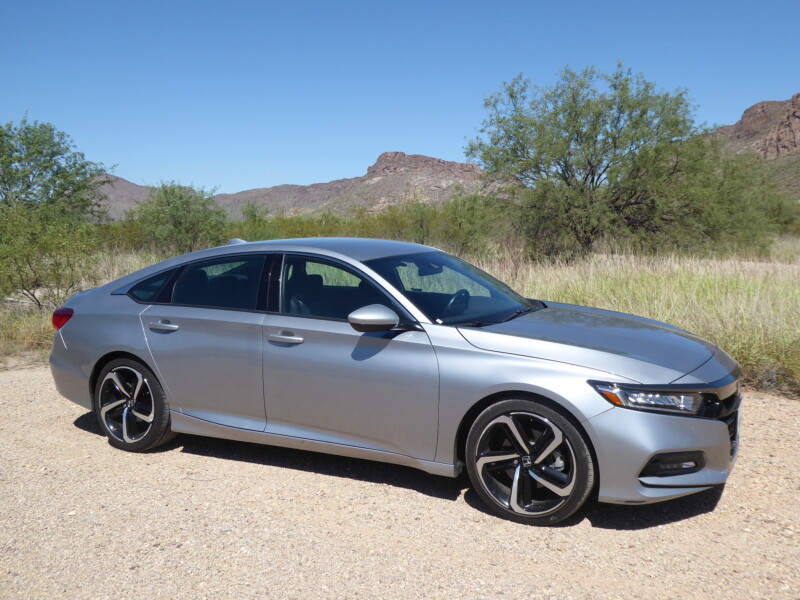
The tenth generation Accord was unveiled in July 2017, for the 2018 model year. Honda models don’t tend to appear in the rental fleets that often, certainly not the Accord, so it had been a very long time since I had last driven one (back in 2007) but the post-Covid chip-supply shortage area had seen a number of Accord models appear at Hertz and I was able to source one of these cars on my US trip in early 2022. It was a top spec Touring with the potent 2.0 litre turbo engine, which certainly made it stand out over and above the sea of less powerful and much plainer rental spec Altima and Malibu cars you usually get when you booked a mid-sized car, but it was also clear that this was indeed an excellent car and I rated it as the pick of the class. I did notice that most of the Accord models that Hertz had sourced were in fact from further down the range and with the more popular 1.5 litre turbo engine, and so I vowed that I would try and source one of these just to see if it was the extra power and toys that had won me over or not. My chance came at the Phoenix Sky Harbor airport when I spotted the car featured here parked up and available for rent. Like the Touring, this one out to be a few years old, a 2020 model year car, and it had covered quite a mileage, but it was in good shape and a photographically good colour, so I grabbed the keys before anyone else took a fancy to it.


Honda have long had a reputation for building great engines, and the one in this Accord does not disappoint. 1.5 litres in capacity, and fitted with a turbo, this four cylinder unit puts out 192 bhp and 192 lb/ft of torque, which is on a par with all its rivals. It is smooth and refined, even when you work it hard. This engine combines with a CVT transmission and it is well suited to the car. Unlike the 2.0 litre Touring I tested, this one has a conventional gearlever, but having pushed the keyless start button, you will probably simply put it into Drive and let the car make the decisions. The raw performance numbers are not actually that special, but in realty acceleration is strong and the gearbox seems to be able to adapt smoothly and quickly to what you are doing with your right foot both when going faster and when slowing down. Noise levels are well suppressed, so this is a restful car on the freeway. I covered 240 miles in my day with this Accord and it needed 4.7 gallons to fill it up, which works out at a very impressive 51.0 mpg US or 61.0 mpg Imperial. Even allowing for the fact that a lot of the test distance was covered at a steady speed on the freeway, those figures seem almost too good, making me wonder if in fact this was one occasion where I not only had a car that was genuinely full on collection, but that I may have returned it less full.


One reason why the Accord always scores highly in comparison tests is because it is so nice to drive, and consistently better in this regard than the Camry. As that car has improved especially in its latest generation, so the gap is smaller, but this is still more agreeable out on the road. The steering is well judged with nice feel to it, yet it is sufficiently assisted that it is not heavy to drive and easy manoeuvre or park up. The handling is good. Grip is excellent, and there is minimal body roll on cornering. The Accord rides well, too. The test car came on 225/40R19 wheels. I did note that the alloys protrude more than on some cars and judging by the state of them on the test car are clearly quite easy to kerb. The brakes were strong and powerful. Honda include a whole slew of ADAS and safety systems on the Accord. I found that the Lane Keep Assist kicked in a bit too readily, but thankfully it is easy to turn off.


Although this is not positioned, or priced as a premium offering, it certainly feels like a quality product. There is a reassuring thunk when you close the doors and the interior is nicely finished using good quality materials. There are plenty of soft plastics that are agreeable to the touch and the herringbone grey inlays add some visual interest. Sport trim does give you a leather-wrapped steering wheel, which is nice to hold. The instrument cluster comprises electronic dials and you can customise what you see. There is a dot chart used for the fuel gauge and there are limited number of trip computer display options. There are two conventional column stalks which include an auto lights function on the left hand one. Buttons on the steering wheel boss control the cruise control and audio repeaters. The centre of the dash houses the 8” infotainment colour touch screen. There is not a lot of it to do in this spec, where the AM/FM radio is the main element with everything else needing a smartphone connection using Apple Car Play or Android Auto, which are standard. There are still some physical buttons which means the unit is easy to use and the menu structure is simple and intuitive. Beneath this unit are the buttons for dual zone climate control.


There is part leather trim for the seats even in the Sport trim, which comes near the bottom of the range. Adjustment for the driver is all electric and this includes lumbar support, but the front passenger will have to use manual levers to alter the position and angle of their seat and also has to manage without a height adjuster. I found the seat to be very comfortable, and thanks to a good range of adjustment on the steering column was able to get my perfect driving position.


By European standards, the Accord is a large car, even though in America it only counts still as a mid-size and that means that there is plenty of space for those in the back. Even with the front seats set well back, there is masses of legroom. The sloping rear roof line means that headroom is OK, rather than generous, but my head did not touch the roof-lining and that is a good test. There are pockets on the doors but there is only one seat-back map pocket here in Sport trim.


The boot is a good size. Despite the swoopy rear end styling, the Accord is a conventional four door saloon. Access to the luggage space is good with a wide opening, though there is no external release for the lid, meaning you need the button on the key fob or inside the cabin. It is not quite the largest space in it s class, but it should more than adequate for most people’s needs. The rear seat backrests are asymmetrically split and drop down to create a much longer load platform. There is a space saver spare wheel under the boot floor, but this is tightly packed in and there is no space around it for even the smallest of items. There are a number of places inside the cabin for bits and pieces. The glovebox is a good size, and the are the usual door bins and a deep central armrest cubby as well as a big lidded area in front of the gearlever.


Honda made the 2020 Accord in five trim levels: LX, Sport, EX, EX-L, and Touring. The first four trims come with the 1.5-litre turbocharged engine. Available in the Sport and EX-L and standard in the Touring is a 2.0-litre turbocharged four-cylinder engine. The base engine is paired with a continuously variable automatic transmission (CVT), while the upgraded engine gets a 10-speed automatic. The Sport trim is available with a six-speed manual transmission. Most buyers will want to skip the base LX and upgrade to a Sport trim, as it adds a higher-end infotainment system with a touch screen and smartphone connectivity via Android Auto and Apple Car Play. Standard equipment in the LX includes a 7-inch display, a USB port, a four-speaker stereo, Bluetooth, dual-zone automatic climate control, alloy wheels, automatic high-beam headlights, and a rearview camera. Also standard is the Honda Sensing suite of safety features, which includes forward collision warning, a collision mitigation braking system, traffic sign recognition, lane departure warning, lane keep assist, adaptive cruise control, and road departure mitigation. The Sport trim adds an 8-inch touch screen, an eight-speaker stereo, Apple CarPlay, Android Auto, a leather-wrapped steering wheel, a power-adjustable driver’s seat, larger alloy wheels, a rear spoiler, and sport pedals. EX models lose the Sport’s leather-trimmed steering wheel and sporty add-ons but gain heated front seats, blind spot monitoring, rear cross traffic alert, proximity keyless entry, remote start, a moonroof, HD Radio, satellite radio, and a second USB port. The EX-L comes with leather upholstery, a power-adjustable front passenger seat, a 10-speaker stereo, and an auto-dimming rearview mirror. The range-topping Touring trim gains an adaptive damping suspension, a head-up display, front and rear parking sensors, ventilated front seats, heated rear outboard seats, a satellite-linked navigation system, a Wi-Fi hot spot, and wireless device charging.


I liked this car a lot. You are giving up 60 bhp and quite a few features if you go for a Sport rather than the top spec Touring, but it is also cheaper to buy and to run. Viewed in isolation, the accord is an excellent car, with many strengths and no real weaknesses at all. Although the rivals have diminished in number, there are still several, notable among them the Toyota Camry, Nissan Altima, Chevy Malibu, Hyundai Sonata and Kia K5. I’ve not driven the Kia, but I have tried the others, and of them all, I would say that the Honda is indeed the best and the one I would pick, given the chance. Whether the Accord will stay in the rental fleet now that things are more or less back to normal and fleet orders can be fulfilled in the way they used to be, is not clear. I do hope so, but what that does mean is that if any more Accords appear in the fleet henceforth, they won’t be this car, but the latest eleventh generation car. This was launched at the 2022 Los Angeles Auto Show and cars have recently gone sale. I hope that the positive reaction to the tenth generation cars from rental customers means that these will appear on fleet in due course.