For lovers of Italian cars in the UK, the annual event at the historic Brooklands site is the one not to miss. From tentative beginnings in the 1990s, this event quickly evolved to become the largest gathering of the many gatherings of Italian cars in the UK, with strong support from all the various Owners Clubs as well as plenty of private owners not affiliated to a Club, and more than a few specialists in the sale, repair and maintenance of all the current and some former brands. Organised by the ever enthusiastic team who publish the monthly Auto Italia magazine, the event consistently fills this expansive site with a mixture of cars that are familiar with some real rarities and there are always individual cars that appear as if from nowhere that have not been seen in public before. The core of the event are the displays which fill not just the Brooklands museum site but an overflow parking area that technically belongs to the adjoining businesses in The Heights, and then at lunchtime attention diverts to the Mercedes-Benz World track where specially selected cars are invited to show their paces as they do a number of laps of this circuit. Mid afternoon, the famous Test Hill is opened and anyone who as signed up can test both their car and their skill and nerves on this trick ascent. Large numbers of visitors come along to the event as well, as there is always a real buzz here. It is one of my favourite events of the year. Here are the cars that attracted my camera in the 2025 edition:
ABARTH
Whilst the numbers of Abarth here were perhaps not quite as many as had been seen a couple of years ago, there was still a very strong showing with a vast array of the different versions of all three models that have been produced since the brand’s relaunch in 2007. Where grouped together, they made for some colourful displays on the side of the start/finish straight and on the banking.


The vast majority of Abarth cars here were the 500-based models which have been on sale now since the end of 2008, following a launch at the Paris Show that year. Since that time there have been a number of detailed changes to the standard cars and a lot of limited editions. Those who really know the marque can spot most of them, but some are so subtle that unless there is a badge you can see, you will not be quite sure which version you are looking at. It used to be relatively easy, when the model was first launched, as there was only one version as shipped ex works called the 500. It had a 135 bhp 1.4 litre turbo-charged engine coupled to a five speed manual gearbox, with 16″ alloys as standard, and the option of 17″ wheels, and a colour palette comprising of two whites (BossaNova White, the standard colour, or the pearlescent Funk White), Red (Pasadoble), Pale Grey (Campovolo) or Black. If you wanted more power – 160 bhp – then you could order an Esseesse kit, which came in a large wooden crate, containing new wheels, springs, an ECU upgrade, the Monza exhaust system and badging. It was dealer fitted and could be applied at any time within the first 12 months or 10,000 miles from registration. Needless to say, it proved popular. As were many of the optional extras, with stickers for the sides, a large scorpion for the bonnet and even a chequered pattern for the roof among the personalisation options offered. Several of the original style of cars were here.


Whilst a sliding glass sunroof (Skydome in Fiat/Abarth parlance) was an option from inception, fans of open air motoring had to wait until Geneva 2010 for the launch of the 500C models, with a roll-back roof which provided the best of open-topped motoring and yet still with the rigidity of the regular body style. For the first few months these cars only came with the robotised manual gearbox, which limited the appeal in the eyes of some, but they also introduced us to the “bi-colore”, a series of two tone cars, with upper and lower halves of the body painted in different colours. It took us a while to get used to this, as no other production road cars had been painted like this for some time, but now this is seen as yet another of those marque defining attributes, and (perhaps with the exception of the rarely seen Rally Beige and Officina Red combination that would come for 2014) in the eyes of many this distinctive look enhances the appeal of the cars still further.
in 2007/8, the 500 Abarth Assetto Corse was released, a Works-prepared race car limited to just 49 examples worldwide, stripped back in the factory for a 180kg weight reduction and all in left-hand drive. With the advent of a well-prepared road car came a race series, the Trofeo Race Series to be exact, under the umbrella of the BTCC TOCA. It’s powered by a Punto EsseEsse 1.4-litre 16V producing 200bhp with peak torque standing at 300Nm at 3,000rpm from its Garrett GT 1446 fixed geometry turbocharger and mated to a M32 6-speed manual gearbox. The suspension has a McPherson layout at the front, bespoke racing shock absorbers with co-axial spring and adjustable height, rear inter-connected arms and electric power steering with race tuning. Retardation was courtesy of Brembo radial four-piston front calipers, 305mm x 28mm ventilated front discs, 264mm x 11mm rear discs and high performance pads. The reinforced cage was welded to a bodyshell that sported a front splitter and rear spoiler, whilst the driving position was shifted slightly to the centre and the car sat four square on forged aluminium wheels.


The first of the special production models was the 695 Tributo Ferrari and there was one example of the model at the event. Most of these cars are tucked away in collections, never being used, so it was good to see this one. You got more power than was available in the standard cars at the time, with the engine uprated to 180 bhp, thanks to a different Garrett turbocharger. The spec included a MTA (Manual Transmission Automated) electromechanical transmission with paddle shifter, unique to this version 17 inch alloy wheels with performance tyres, Brembo multi-section discs with fixed 4-piston calipers, “Record Monza” variable back-pressure “dual mode” exhaust, Magneti Marelli Automotive Lighting xenon headlights, “Abarth Corsa by Sabelt” seats in black leather upholstery with carbon fibre shell and seat base, black leather steering wheel with red leather inserts and a tricolour hub, Jaeger instrument panel, non-slip aluminium foot wells, Scorpion racing pedals, special kick plates and a plate bearing the vehicle series number. The Tributo Ferrari was unveiled at the 2009 Frankfurt Motor Show, with deliveries starting in 2010. Four colours were offered: Grey, Abu Dhabi Blue, Scuderia Red and finally Yellow. Of these the red and yellow cars were more numerous, but the car remained rare as it was fearsomely expensive. Just how expensive depended on the dealer, as in a move that only the Italians could make, they were all first registered in Italy and so technically were used cars by the time these right hand drive machines arrived on UK soil, which mean that the dealers could charge what they wanted. Most aimed somewhere between £32 and £36,000, a lot for a car of this size. Nevertheless, they all sold, though many ended up on another boat, off to right hand drive Asian markets, which is why they are a rare sight these days.


Having used the legendary 695 badging from the 1960s on the Tributo cars, at the 2012 Geneva Show, Abarth dusted off the 595 name that had been used on the less powerful of the Nuova 500 based cars of the same generation, and created two new versions which we should think of as Series 2 cars, the 595 Turismo and Competizione, both of which could be bought in either closed or open top C guise, with either the 5 speed manual or robotised automated gearshifts. Both models had the 160 bhp engine as standard. Effectively they were a replacement for the Esseesse kit, and it meant that the cars were produced complete at the factory, rather than needing the dealer to undertake the upgrade (and the associated paperwork), though Abarth did not withdraw the Esseesse kits from the market for some while. Turismo, as the name suggests was aimed slightly less extreme in intent, featuring standard leather upholstery, upgraded dampers and climate control, Xenon headlights and Alutex interior details. The sportier Abarth 595 Competizione replaced the leather seats with Sabelt cloth sport seats and Alutex with aluminium, while adding p-cross-drilled brakes and the Record Monza dual-mode exhaust.


Seen by most as the ultimate model, there was the 695 Biposto. First shown at the 2014 Geneva Show, this 2 seater (that’s what Biposto means in Italian) is nothing other than a road legal version of the 695 Assetto Corse Racing car, a vehicle which has its own race series in Europe. Although the car is road legal, it was envisaged that the majority of people who buy one of these cars will use it on the track and quite frequently. So it was conceived accordingly. That means upgrades to all the important bits – engine, brakes, suspension, gearbox – and some fairly drastic measures to save weight which resulted in a car which generates 190 bhp and 199 lb/ft or 250 Nm of torque with a kerb weight of just 997kg. That’s enough to give a 0 – 60 time that is under 6 seconds, and a top speed of 143 mph. Those are supercar figures produced by a city car. There’s more to it than that, though, as the changes that go to make a Biposto are extensive, and they have been well thought through, so this is a long-way from being a hastily conceived or tuned up special. Ignoring the limited edition cars which arrived during 2015, the “regular” Biposto is only offered in Matt Performance Grey paint, and the car is visually distinctive, with a new front bumper, rear diffuser, wider arches, new skirts and bigger roof spoiler. Although the engine is still the same 1.4 T-jet that features in the lesser 500 and 595 cars, it has been reworked here, with a new Garrett turbocharger, larger intercooler, altered fuel rail and an Akrapovic exhaust system. Buyers can choose between the standard five speed gearbox or an optional race-bred dog-ring unit mated to a mechanical limited slip diff. The standard car’s MacPherson strut and torsion beam suspension has been reworked, too, with altered springs, wider tracks adjustable ride height and dampers with more resilient bushings, using Extreme Shox technology shock absorbers. The brakes are upgraded in line with the extra power, featuring 305mm Brembo discs and four pot calipers up front and 240mm discs with single pot calipers at the rear. The wheels are lightened 18″ OZ and attached via a titanium hub, shod with bespoke 215/35 Goodyear tyres. In the interest of weight saving, a number of standard trim items are removed, including the regular door trims, air conditioning, the rear seats and some of the sound deadening material. Even the standard air vents have been changed so they are covered by a simple mesh. In their place is plenty of polished carbon fibre, a titanium strut brace, racing seats and harness, as well as special trim features such as new pedals, tread plates and a race inspired digital display on the dash where the radio usually sits. Although the Matt Performance Grey car is probably the one you think of when someone says “Biposto”, there were other versions, with a very rare red being a car that is only see occasionally and the Record Edition being the version that was here. There were just 133 of these made, all painted in Modena Yellow, at the time an exclusive Biposto colour.


Rumours started to circulate towards the end of 2014 that Abarth were going to upgrade the Competizione model, so as better to bridge the gap between the Turismo and the 190 bhp 695 Biposto that had been added to the range earlier in the year. It was Geneva 2015 when the result was finally shown to an expectant fan base. Most exciting news was that thanks to a bigger Garrett Turbo, the engine had been tweaked to 180 bhp, and with reduced CO2 emissions. A standard spec that included Koni Dampers, Brembo brakes, Xenon lights, Sabelt seats, Climate Control, parking sensors as well as other refinements that had been added like the TFT instrument display all proved very compelling, so not long after the first cars reached the UK in June of 2015, I found temptation too hard to resist, and as is well documented here, swapped my 2010 car for one of these. At the time I ordered it, Cordolo Red, a tri-coat pearlescent paint which shimmers in bright sunlight looked set to become one of the most popular colours of the lot, even though it is a cost option. Indeed, the Launch Edition models were all offered either in this colour or Scorpion Black, with black wheels. Surprisingly, the colour was not carried over to the Series 4 cars.


What is known as the Series 4 version of the familiar 595 reached the markets in the middle of 2016. After rumours had circulated all winter following the launch of the facelifted Fiat 500 last year, Abarth finally unveiled the Series 4 at the end of May 2016. Initially, we were told that the cars would not be available in the UK until September, but that came forward somewhat, with dealers all receiving demo cars in June, and the first customers taking delivery in July. Three regular production versions of both the closed car and the open-topped C were initially available, all badged 595, and called Custom, Turismo and Competizione, as before, though numerous limited edition models have since appeared and in most case disappeared. The most significant changes with the Series 4 are visual, with a couple of new colours, including the much asked for Modena Yellow and a different red, called Abarth Red, which replaces both the non-metallic Officina and – slightly surprisingly – the tri-coat pearlescent Cordolo Red. as well as styling changes front and rear. The jury is still out on these, with many, me included, remaining to be convinced. At the front, the new air intake does apparently allow around 15 – 20 % more air in and out, which will be welcome, as these cars do generate quite a lot of heat under the bonnet. Competizione models for the UK retain the old style headlights, as they have Xenon lights as standard, whereas the Custom and Turismo cars have reshaped units. At the back, there are new light clusters and a new rear bumper and diffuser. Inside, the most notable change is the replacement of the Blue & Me system with a more modern uConnect Audio set up, which brings a new colour screen to the dash. Mechanically, there is an additional 5 bhp on the Custom (now 145) and Turismo (now 165 bhp) and the option of a Limited Slip Diff for the Competizione, which is likely to prove a popular option. Details of the interior trim have changed, with a filled-in glovebox like the US market cars have always had, and electric windows switches that are like the US ones, as well as a part Alcantara trim to the steering wheel in Competizione cars. These cars were on offer for over eight years so it was no surprise that they were particularly well represented here.


A limited edition model, the 695 XSR was created in recognition of the fact that for the third year running, in 2017 Abarth was to be the Official Sponsor and Official Car Supplier of the Yamaha Factory Racing Team, competing in the 2017 FIM MotoGP World Championship. In the wake of the Abarth 595 Yamaha Factory Racing and the 695 biposto Yamaha Factory Racing Edition, the 695 XSR Yamaha Limited Edition special series is available exclusively with a Pista Grey livery: only 695 sedans and 695 convertibles will be made. The new car was created to celebrate the Yamaha XSR900 Abarth, which is the first exclusive motorcycle to spring from the collaboration between the two brands and which sports the same grey livery with red trim as the 695 XSR, as well as sharing many of its features. The special series makes extensive use of carbon fibre to demonstrate its affinity with the front fairing, front mudguard and saddle cover of the two-wheel Yamaha. The Abarth 695 XSR and the Yamaha XSR900 Abarth also share Akrapovič ultralight exhaust developed in the racing world to boost the personality, sound and performance of both vehicles. On the Abarth car, the carbon fibre tailpipes enhance the looks and technology of the exhaust system. The XSR logo on the tailgate distinguishes the Abarth 695 XSR, while an aluminium badge identifies the sequential number of 695 units for each body type. Other carbon fibre details, in addition to the mirror caps and Akrapovič tailpipes, are available as optional equipment, such as dashboard fascia, pedal covers, gear knob and kick plate. The car uses the 1.4 T-Jet engine delivering 165 bhp. Equipment on this special series includes Koni rear suspension and Eibach springs, 17” Supersport alloy rims with Matt Black finish, Satin Chrome accents on handles and badge supports, red details on bumpers and mirrors, red brake callipers and a braking system with perforated discs. This version can be customised even further using the tuning kit to increase the power to 180 HP, improve handling by fitting a Koni front suspension with FSD (Frequency Selective Damping) valve and make braking even prompter with 305x28mm perforated and self-ventilating Brembo floating front discs with high-performance Ferodo HP 1000/1 front brake pads. It also features the new UconnectTM 7″ HD LIVE system integrated with Apple CarPlay allows iPhone users to access contents such as Apple Maps, Messages, telephone calls, Apple Music, also with Siri voice assistance.

More recently, Abarth have produced the 695 Rivale, a celebration of Fiat’s partnership with Riva, which has already seen a special Riva version of the 500,. Described as being “the most sophisticated Abarth ever”, it is available either as a hatch or a cabriolet, with both of them featuring a two-tone Riva Sera Blue and Shark Grey paintwork. The Rivale is adorned with an aquamarine double stripe, satin chrome finish on the door handles and satin chrome moulding on the tailgate, various aesthetic elements inspired by the Riva 56 Rivale yachts and ‘695 Rivale’ logos, joined by Brembo Brakes, Koni suspension, and 17-inch Supersport alloy wheels. Enhancing the nautical theme the new 695 Rivale features either a carbon fibre or mahogany dashboard, black mats with blue inserts, blue leather seats and door panels, carbon fibre kick plates, special steering wheel wrapped in blue and black leather and with a mahogany badge, blue leather instrument panel cover, and mahogany gear lever knob and kick plate. These are joined by the standard Uconnect infotainment with a 7-inch display, which is compatible with Android Auto and Apple CarPlay, and there is also a hand-written numbered plate that can be customised with the mane of the customer’s yacht on request. Powering the 695 Rivale is the same 1.4-litre turbocharged engine that makes 180PS (177hp) and 184lb/ft of torque, that features in the 595 Competizione, allowing it to go from rest to 100km/h (62mph) in 6.7 seconds and up to a top speed of 225km/h (140mph). This is a regular model in the range, but confusingly, there is also the Abarth 695 Rivale 175 Anniversary, created to celebrate 175 years of the Riva brand. Just 350 of these were produced, half of them the hatch and the other half cabriolets. These featured 17-inch alloy wheels with a special pattern, celebratory badge on the outside, hand-crafted details such as the two-tone colour – blue and black hand-stitched leather seats with a celebratory logo stitched onto the headrest, carbon dashboard silk screen printed with special logo, numbered plate. Standard Rivale cars arrived in the UK in April 2018, and quite a few have been sold. They always attract lots of interest when they do appear.


The 695 Anniversario was launched at the brand’s 70th anniversary celebrations in Milan in October 2019, and deliveries of which started around the turn of the year. The Anniversario is in a choice of 5 colours: White, Black, Podium Blue, Grey and 1958 Green, and there were examples of some but not all of these here, including a couple of cars in the 1958 Green which was selected to evoke memories of the 1958 record-breaking 500, though I can advise that the two shades of green are quite different, the older car being much lighter. Online verdicts of the new car at launch were not entirely positive, with many challenging the appearance, others the spec and yet more the price (£29,995 in the UK), but in the metal, it looks far better than those first web pictures portrayed, and there is no doubt that the 1949 buyers of the car are getting something quite distinctive, with the Campovolo Grey accents around the wheelarches and lower body skirts. What they aren’t getting is more than 180 bhp, as it would seem that to get Euro 6d compliance from the T-Jet engine, 180 bhp is the limit. But the Abarth 695 70° Anniversario does have an ace up its sleeve. Look at the back and you’ll notice a rather large roof-mounted spoiler serving as the special edition’s party piece. Manually adjustable in literally a dozen of positions, the spoiler was developed in the wind tunnel to achieve maximum aero efficiency regardless of speed. Its inclination varies from 0 to 60 degrees and helps increase aerodynamic load by 42 kilograms when the car is travelling at speeds of 124 mph (200 km/h) provided the spoiler is at its maximum inclination. Abarth has done the maths and it claims the new aero component will reduce steering corrections by as much as 40% based on the testing they’ve done at FCA’s wind tunnel in the Orbassano municipality located southwest of Turin. Power is provided by the familiar 1.4-litre turbocharged engine with 180 hp and 250 Nm (184 lb-ft) of torque, good enough for a sprint from 0 to 62 mph (100 km/h) in 6.7 seconds before topping out at 140 mph (225 km/h) if the spoiler is in the 0° position. Those 17-inch SuperSport wheels are paired to a Brembo braking system with four-piston aluminium calipers finished in red, hugging the 305-mm front and 240-mm rear self-ventilated discs. Rounding off the changes on the outside is the newly developed Record Monza exhaust with active valve for a better soundtrack. Abarth also spruced up the cabin a bit where the body-hugging seats are exclusive to this special edition, just like the individually numbered plaque reminding you this isn’t an ordinary 695. Onboard tech includes support for both Apple CarPlay and Android Auto, DAB digital radio and a navigation system for that seven-inch touchscreen display. Additional standard equipment includes automatic climate control, daytime running lights, LED fog lights, unique mats, and the Abarth telemetry system if you plan on taking the hot hatch to the track.


For the final couple of years of production, Abarth changed their naming convention so that the 595 cars were the 165 bhp ones and the 695s were the ones with 180 bhp. Both were available in Turismo and Competizione spec. Sadly, the 695 Competizione was only ever offered with the MTA box, otherwise I could have been tempted, especially in the new Rally Orange colour. Not many cars came to the UK in this rather attractive shade, but Keith Mills, a keen Abarthisti who has owned a number of models over the years managed to source this one, a 695 Turismo.


Many owners modify their cars. Some of the changes are concentrated on mechanical things with the appearance remaining standard whereas others change the look of the car, with everything from additional spoilers and splitters to a full body wrap, resulting in some distinctive looking and unique cars. There were a number of examples of this here.


The Abarth Grande Punto debuted at the 2007 Frankfurt IAA Show, going on sale in the UK in late summer of 2008. Offering 155 bhp from its 1.4 litre T-Jet engine, coupled to a six speed gearbox, and riding on 45 profile 17″ alloys, the standard car got rave reviews from the journalists when they first tried it, and they were even more impressed by the changes wrought by the optional Esseesse kit. This increased power to 177 bhp, brought 18″ OZ lower profile wheels, whilst new springs lowered the ride height by 15-20mm, and high-performance front brake pads and cross-drilled front disc brakes helped the car to stop more quickly. The most distinctive feature of the car were the white alloy wheels, though, as owners found, keeping these clean is not a job for the uncommitted, and many have a second set of wheels that they use fro grubbier conditions. Despite the positive press at launch, the car entered a very competitive sector of the market, and the combination of being relatively unknown, a limited number of dealers and the existence of established rivals from Renault and others meant that this always remained a left-field choice. The owners loved them, though, and they still do. The oldest cars have now had their 15th birthdays, and some have amassed relatively big mileages, but they are still a car for the cognoscenti.

The Punto Evo was launched at the 2010 Geneva Show, with the cars reaching UK buyers in the summer of that year, and it incorporated many of the changes which had been seen a few months earlier on the associated Fiat models, the visual alterations being the most obvious, with the car taking on the nose of the associated Fiat, but adapted to make it distinctively Abarth, new rear lights and new badging. There was more to it than this, though, as under the bonnet, the T-Jet unit was swapped for the 1.4 litre Multi-Air, coupled to a 6 speed gearbox, which meant that the car now had 165 bhp at its disposal. Eventually, Abarth offered an Esseesse kit for these cars, though these are exceedingly rare. The final Punto model was the SuperSport. Easily identified by the distinctive black bonnet, just 199 of the SuperSport versions were built, of which around 120 are registered on UK roads. These cars had many of the options from the Punto Evo included as standard. Power came from the the 1.4-litre MultiAir turbo engine, tuned to produce 178bhp and 199lb ft of torque, up from 165 of the standard Punto Evo, giving the SuperSport a 0-62 time of 7.5 seconds and a top speed of over 132mph. To help put the power down, the SuperSport was fitted with wider 18″ wheels and optional Koni FSD dampers. Standard equipment included the Blue&Me infotainment system with steering wheel controls, automatic climate control and a popular option was the ‘Abarth Corsa by Sabelt’ sports leather seats. The SuperSport was available in the same colours as the regular Punto Evo, which means white, grey, black and red. For those in the know – which never seemed to be that many people – this was a really capable and desirable car, and the owners love them, lamenting the fact that the model had quite a short production life and has not been replaced.


The Abarth 124 Spider was developed in parallel with the Fiat model. It does cost a lot more, and there are those who think you don’t get enough extra for your money, but those who have driven it will tell you otherwise. You certainly get more power. The 1.4 MultiAir turbo unit jumps up from 138bhp to 168bhp, while torque also increases by a modest 10Nm to 250Nm, which gives it a 0-62mph time of 6.8 seconds, which is half a second quicker than the 2.0-litre Mazda MX-5. The top speed is 143mph. It weighs just 1060kg meaning a power-to-weight ratio of 158bhp-per-tonne, and with the new Record Monza exhaust system it sounds great even at idle. The Abarth version gets a stiffer suspension setup than the regular Fiat 124 Spider, with Bilstein dampers and beefed-up anti-roll bars. Bigger Brembo brakes also feature, with aluminium calipers. It can be had with a six-speed manual or six-speed automatic transmission with paddles, and the latter gets a Sport mode for quicker shifts. Many of the UK cars sport the ‘Heritage Look’ pack, which is a no-cost option. It brings a matt black bonnet and bootlid, plus red exterior trim detailing and has proved popular. The £29,565 starting price gets you standard equipment such as cruise control, climate control, Bluetooth, a DAB radio and satnav, plus Alcantara black and red (or pure black) seat trim. The automatic gearbox is a £2,035 extra, while an optional visibility pack brings LED DRLs, auto lights and wipers and rear parking sensors. Sales ceased during 2019, with around 1800 cars having been brought into the UK, so this is always going to be a rare car, and values are already increasing at a rate reflecting its desirability and the difficulty in finding one.


With production of the 500-based range having ceased at the end of 2024, Abarth will henceforth be an all-electric brand. The first EV model went on sale in 2023 and it has recently been joined by the larger 600. Sales have been slow to get started and there are only a handful of these cars that ever appear at Abarth events, so perhaps it was not a surprise that there were just two electric Abarths here.
The Abarth New 500e Scorpionissima is a performance variant that made its official debut on 22 November 2022, featuring unique scorpion-badged alloy wheels. Initially, it is being released in a Scorpionissima edition limited to 1,949 examples. Scorpionissima models will be available in a choice of Acid Green or Poison Blue colours, bearing unique side graphics and wheels. The first deliveries were scheduled for June 2023. It has a single electric traction motor that produces 114 kW (153 hp) and 235 Nm (173 lb/ft), an increase of 26.7 kW (35.8 hp) and 15 Nm (11 lb/ft) over the standard motor, and accelerates from 0 to 100 km/h (62 mph) in 7 seconds. The enhancements in power and torque output are derived from improved inverter and battery wiring, and a reduction in the final-drive ratio. The Abarth also swaps the rear drum brakes on the New 500 for discs. Three driving modes are offered: Turismo, Scorpion Street, and Scorpion Track; output power and torque are limited to 100 kW (130 hp) and 220 Nm (160 lb/ft) in Turismo. Scorpion Street maximizes regenerative braking, simulating the engine braking effect of a conventional car equipped with a manual transmission, while Scorpion Track sacrifices range for performance. In manufacturer testing at Balocco, the Abarth 500e is able to complete laps 1 second quicker than the Abarth 695. Total weight is 1,410 kg (3,110 lb), including the 295 kg (650 lb) battery. Charging hardware is carried over from the regular New 500 equipped with the larger battery, at rates up to 85 kW. The Abarth 500e has a battery with a capacity of 42.2 kWh (gross) and 37.3 kWh (net), giving the vehicle a claimed range of 264 km (164 mi) under the WLTP driving cycle with the standard 17-inch wheels; equipping the 18-inch wheels reduces range to 253 km (157 mi). Real-world mixed driving with 18-inch wheels indicated an actual range of 212 km (132 mi), with consumption of 3.4 mi/kWh.


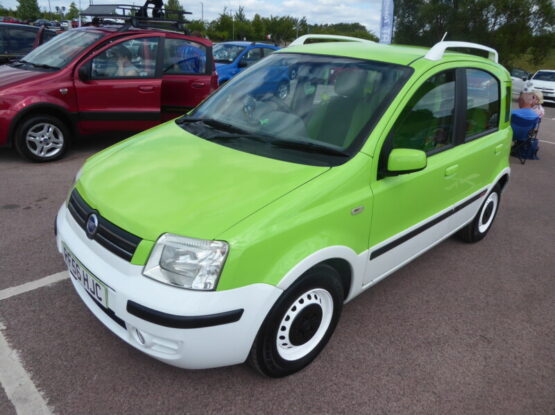
Second of the electric Abarths present was the new 600e and this is actually the press car that is out on extended loan to Chris Rees, editor of Auto Italia magazine. For most of the day it was parked next to another newcomer, the Grande Panda, and sadly, the Abarth was not the one that got the attention. Let’s hope this is not a portent for difficulty in the showroom.


There were a number of heritage Abarths here, too, with most of them taking to the track for the lunchtime demo. An added attraction here was the presence of Lincoln Small, who led Radbourne Racing in the 1960s, both selling Abarths new and also campaigning them on track. He was launching his new book telling hist story and was available to chat. Needless to say, I bought the book, which he kindly autographed and we had quite a chat.
Appearing in early 1956, Abarth’s 750 Gran Turismo Derivazione was the first Abarth product to use the standard Fiat bodywork. Fiat delivered these cars incomplete, to make it easier and more cost effective for Abarth to carry out their performance modifications. Rather than the 633 cc original or Abarth’s own 710 cc model, the engine now displaced 747 cc thanks to a one millimetre wider bore and a stroke increased by four millimetres (0.04 and 0.16 in respectively). Sharper cams, lighter flywheel, a bigger carburetor, and myriad other traditional tuning tricks were employed; as a result power nearly doubled, up from 21.5 to 40 CV. Claimed top speed was 80 mph (129 km/h). Originally the aerodynamic 750 Zagato “double bubble” had a single-cam engine. This was first presented at the 1955 Turin Motor Show. The original model was also offered in a more luxurious variant for export (called “America”, as it was almost strictly meant for the United States) and a stripped down model with lower, uncovered headlamps and smaller taillights for the domestic Italian market. The “America” also has a different layout around the rear license plate. The all-aluminium bodywork has Zagato’s famous “double-bubble” design and Abarth’s tuned derivazione engine with 42 hp. Aside from the floorpan, not much of the Fiat 600 remains in use for these cars. By the time of the appearance of the Abarth Zagato Record Monza 750 Bialbero, the bodywork had been unified into a separate model with a rather large hump on the engine lid, made necessary by the taller twin-cam motor. There were then three distinct models: 750 “Double Bubble,” 750 Record Monza, and 750 “Sestriere.” The Sestriere had a single cam pushrod engine, and the majority were built with a steel body. There were a very small number of alloy cars, a single aluminium car is known to exist today. The Sestriere had upright headlights, and two very large air intakes on the engine lid, much wider than a double bubble. (The Sestriere was believed to be the last model produced for Abarth by Zagato, due to disagreements between Abarth and Zagato.) The 750 GT Bialbero model appeared at the 1958 Turin Auto Show; along with various alterations to the bodywork it has the new twin-cam engine with 56 hp at 7000 rpm. The Fiat 600 engine presented certain challenges for Gioacchino Colombo in designing a twin-cam head: an engine mount on the rear face of the engine blocked the natural routing for the cam chain, while other restrictions made it impossible to use a classic crossflow design; instead, the carburettors were mounted between the camshafts, on top of the engine, rotated about 45 degrees to provide access to the spark plugs. This location no longer worked as the carburettors and inlets grew larger, and Abarth developed a distinctive banana-shaped intake manifold which allowed for two carburetors to be perched to either side above the engine. This, by necessity, made the Bialbero engine quite tall, necessitating sizable bulges and bumps in the bodywork on lower designs like the Zagato or various Spiders. The first Bialbero series constituted 100 cars, enough to homologate the car for the Gran Turismo competition category. 750 Bialbero-equipped Fiat-Abarth Zagato Record Monzas featured a lower roof with no bubbles and one single centred air scoop on the engine lid. “The Record Monza” was the most successful racing Abarth in the USA with the Franklin D. Roosevelt Jr Racing team, (Abarth cars winning over 700 races worldwide), including both Sebring with the 750 cc Bialbero engine and Daytona under-1,000 cc races in 1959 widely believed to have had the first 982 cc Bialbero engine.


Abarth produced various versions of the Fiat 600 from 1956 to 1970 under a variety of model names, including Abarth 210 A, Fiat-Abarth 750, 850, and 1000. Many suffixes like Granturismo, Berlina, TC, and TCR were also used and many were built with aluminium bodywork by Zagato and other famed Italian carrozzerie. This is one of the earlier cars.

Most Abarths of the 1960s were based on regular Fiat models, and there were some of these on show as well. Smallest of these were those based on the Nuova 500, and there were a couple of them here. For the 595 SS, Abarth increased the engine capacity to 594 cc, just under the limit for the European 600cc racing sedan class. High compression 10:1 pistons were used together with a special camshaft, a specific alloy sump, Abarth valve covers and air filter, propped up engine lid and wheels were fitted and of course the exhaust system was a special in house model. This package together with lowered suspension, flared arches and 10 inch rims amounted to what was known as the Assetto Corsa SS model. These cars have become very rare as many were crashed in competition or simply rotted away due to bad rust protection in the 70s A number of recreations have been built, and these are likely such. So, not original, but still nice and still a lot of fun.


Seen often at Italian car gatherings, especially in the South East is Carlo Cacciavelli’s car. Although this amazing machine has the form of a classic Nuova 500, don’t be too taken in by that. The car is actually built on a chassis that has its origins in the Abarth Osella 2000SP sports racing car, with double wishbone suspension and disc brakes front and rear. Sitting in the back is a fuel injected 1.5 litre Alfa Romeo “boxer” engine of the type originally found in the front of the Alfa Romeo ‘Sud, Sprint 33 and even the Nissan Arna GTi. It is coupled to an Alfa 5-speed gearbox. Carlo’s coachwork company built the special extra wide body, which is all steel. The car was first registered in the UK on the 28th July 2000 and it has been seen at a great variety of events ever since. It never fails to pull the crowds wherever it its taken.


Abarth produced several tuned versions of the Fiat 850 Berlina, Coupé, and Spider, with ever-increasing displacements. These belonged to the OT series of Abarth cars—standing for Omologata Turismo or “touring homologated”, which also included two-seater sports racing cars. The Fiat-Abarth OT 850, as seen here, was Abarth’s first 850 derivative, introduced in July 1964. Its Tipo 201 engine was the regular saloon’s 847 cc inline-four brought from 34 bhp to 44 bhp. The top speed went up accordingly from 75 mph (120 kn/h) to 81 mph (130 km/h). The OT 850 could be distinguished from the standard Fiat model by its Abarth badging, an asymmetric front ornament with the Abarth shield on the right hand side and the “Fiat Abarth” script on a red field on the left, and wheels with cooling slots. From October of the same year it became available in two guises: OT 850 Oltre 130 (“Over 130”), almost unchanged from the initial model, and OT 850 Oltre 150, with a 52 bhp engine, front disc brakes and a 150 km/h (93 mph) top speed. In October 1964, Abarth added the Fiat-Abarth OT 1000. With engine displacement increased to 982 cc, it produced 60 bhp and 58 lb·ft of torque. The front brakes were changed to discs. Coupe and Spider models would follow from 1965, initially with the same 982cc engine, but it was not long before 1300, 1600 and then 2 litre engines were inserted in the car. There are not many of these in any body style in the UK, but of those that you do see, the Coupe would seem to be the most numerous and indeed, there was one of these here as well as an OT1600 Berlina.


Having concentrated mainly on the modification of Fiat cars, Carlo Abarth began forging links with the French Simca concern in the early 1960s, introducing a series of tuned Simca-Abarth road cars and, in 1962, producing a pretty, 1.3-litre GT coupé similar in style to the existing Fiat-Abarth 1000. Notable as the first car produced with an all-Abarth engine, the 1300GT was based on the newly introduced Simca 1000 whose chassis and suspension it used in modified form. A four-cylinder twin-cam like Abarth’s 1-litre Fiat-based unit, the all-alloy engine differed by employing horizontal, as opposed to down-draught, carburettors, and dry-sump lubrication. The prototype was reported as clocking 142mph on the autostrada, an outstanding performance by a 1,300cc car and one that must have given those racing Alfa Giuliettas cause for concern. Abarth’s next Simca-based model – the 1600GT – arrived in 1963. Though recognisably an evolution of the preceding 1300GT, the newcomer showed the influence of recent aerodynamic developments in the form of an upturned ‘duck tail’ rear end similar to that of Ferrari’s contemporary GTs and sports-racers. Essentially the same as the 1300GT’s, the chassis featured independent suspension and Girling disc brakes all round. The engine’s cast-iron, production-based block was topped by an aluminium-alloy, twin-cam cylinder head featuring two magneto-sparked plugs per cylinder. The gearbox was an all-synchromesh six-speeder. 153bhp and 150mph were claimed. Abarth’s collaboration with Simca ended following the latter’s acquisition by Chrysler in 1965, but before then the relationship’s final flowering had arrived in the form of the potent Abarth-Simca 2000 (Abarth insisted on having their name first for these cars). Constructed around a Simca 1500 block, the latter’s engine came equipped with a pair of the largest Weber carburettors ever made – 58mm-choke DCOs – and at the peak of its development produced a staggering 200+bhp. Independent road tests recorded a top speed of 165mph.


Making another appearance here was the fabulous 1000 OTR Berlinetta Coupe recreation belonging to Frazer Whyte. In March 1965, Carozzeria Bertone launched Fiat’s new open 2 seat 850 Spider. Carlo Abarth encouraged Nuccio Bertone to create a special Berlinetta version for the 1965 Turin Motor Show. It is believed that two cars were built, one for the Bertone stand and one for the Abarth stand. Bertone’s designer, Giorgetto Giugario, transformed the Spider into the 1000 OTR Berlinetta. Along with the steel roof, it was upgraded with an Abarth 982cc engine with 74 bhp, which was more than a 50% increase over the Fiat engine. A front radiator improved the weight distribution and cooling, through new vents in the nose. Paul Frere, the renowned Belgian acing journalist achieved 175 kmh in this slippery little car. Sadly, despite exhaustive attempts, no trace has been found of either show car. This one is owned by Frazer Whyte, a committed Fiat and Abarth enthusiast and is a replica, built for Guy Moerenhout, who famously runs the Abarth Works Museum in Belgium. When Frazer was looking through a book and saw the car, he immediately thought, ‘That would look great in my museum’. I saw the replica he’d built on Guy’s website in 2013. I loved the look of it, as well as the story behind it, so I decided I had to have it. I got in touch with Guy asking to buy it and he agreed to sell it to me.” There’s no questioning the excellent work that went into creating this replica. Given the disappearance of the real thing, there had to be some supposition about replicating it, going entirely from photos. Fraser has been in touch with Abarth Classiche, but even they don’t have any information on the original 1965 car. The original plan had been to use a post-1968 Bertone Racer coupe as a basis and graft on an early Fiat 850 Spider front end, but in the end a 1966 Spider was used, with a Racer roof transplanted on. One issue with this was the side windows, which are different on the Spider and Racer versions, the latter having a 90-degree upper corner, while the Spider has a curved profile. Black fill-in pieces had been fitted to cover the gap, but Fraser succeeded in locating a very rare Racer window – but only one. For the other side, he approached several glass companies about making a new one, before selecting Hourglass of Havant. Because the window has compound curves, it couldn’t be made in safety glass so the new one had to be plain glass, now laminated with bulletproof film. The interior was completely retrimmed, too, which was tricky because Fraser has yet to find any internal pictures of the original. You can just see that the 1965 headlining was light-coloured, which Fraser has replicated. Those beautiful seats, in leathercloth peppered with eyelets, are original items sold by Bertone, which Fraser describes as “rare as hen’s teeth”. As bought in 2013, the seats had non-standard headrests fixed with metal straps riveted to the glassfibre seat backs, which he duly removed. When Abarth showed its OTR 1000 in 1965, it had the ‘Radiale’ engine installed in the back, complete with its complex cylinder head forming two intersecting hemispherical combustion chambers, plus twin Dell’Orto carbs. One problem with this engine was that it needed a front-mounted radiator. As a result, Bertone was tasked with modifying the 850 Spider’s front end, adding a horizontal opening above and below the bumper. Fraser’s replica may not have the full-spec OTR engine but it does have a front-mounted radiator, and therefore a replica front grille. So what engine does this replica have? “It’s a 1.0-litre unit originally built by a Dutch engineer/racer called Ron Verzijlbergen to racing specification, with a hot road camshaft and high-compression pistons – in fact, too high compression, as it kept blowing head gaskets. Guy then fitted the eight-port cylinder head and twin Weber 40DCOEs to make the engine appear more like the Radiale. I took the engine to Tony Castle-Miller of Middle Barton Garage who rebuilt it using a new block, as the original had been skimmed so much. The exhaust is a period Abarth item, complete with dents and an original sticker.” As bought, the car had Koni dampers but they were shot, so the suspension has been returned to standard 850 Spider. It also had a gearbox that crunched into second and whose gearing was way too low, so Fraser has fitted a four-speed ’box from an 850 Coupe which is much better. Another alteration concerned the fuel tank location. Fraser wasn’t happy about the lack of bulkhead between the engine and tank, so he’s had a new front-mounted tank made up by CompBrake. Approaching this car, it makes a great impression. The streamlined fastback’s swooping roof pillars extend elegantly back to the rear engine cover, but cleverly the rear window is recessed, avoiding the need to change the standard engine cover hinges. As Fraser says: “People generally have no idea what it is. A lot of people assume it’s a Porsche because of its sloping headlamps and silver paint.” Back in 1966, there was talk of a production run, with one Italian magazine quoting an estimated price of 1.5 million lire (about 50% more than the regular 850 Spider) but ultimately that never happened. Instead, In March 1968, almost three years after the 1965 debut of the OTR 1000 Coupe, Bertone unveiled a brand new model for sale: the Racer. This essentially adopted the same fastback roof as the 1965 OTR 1000 prototype, although with the new front end treatment that Fiat had adopted for the 850 Sport Spider in 1968, plus a 903cc, 52hp Fiat 850 Sport engine. Like the OTR 1000, the roof was not removable, but it now had ‘Racer’ badges on the roof, which was finished in vinyl (black, ivory or green depending on main body colour). The Racer was also available, exclusively for the European market, in Racer Team form, with a non-vinyl, painted hardtop and ‘Racer Team’ stickers, spotlights and upgraded interior trim. There was a convertible version of the Racer, too, and Bertone even entered three Racer Team coupes in the 1969 Monte Carlo Rally, complete with OTAS-tuned engines. Between 1968 and 1971, only 4404 Racers were made at the Bertone factory, 3641 of which were the berlinetta (2890 of which went to the USA) and 763 convertibles.

There was one of the Lombardi Grand Prix-based Abarth models here. Although many have now seen them a number of times in the past couple of years, they remain a car that few can identify with any confidence. It was based on the Lombardi Grand Prix, you most have probably never heard of that, either! The Lombardi Grand Prix was a small, rear-engined sports car, based on Fiat 850 underpinnings, developed by the Carrozzeria Francis Lombardi with an in-house design by Giuseppe Rinaldi. It was first shown in March 1968, at the Geneva Motor Show. The design had a Kammback rear and a very low nose with flip-up headlights, and a large single windshield wiper. The headlights were electrically powered. The bodywork was all steel, except the rear panel. The design was originally shown as a prototype based on the front-wheel drive Autobianchi A112, and was adapted by Lombardi for the 850 sedan’s floorpan. At the 1969 Turin Show, a targa version was also shown; called the “Monza”, this open model has a rollover bar. At least two were built but it is unknown whether any were sold. The original Lombardi Grand Prix had the regular 843 cc Fiat 850 engine with 37 PS at 5000 rpm, coupled to a four-speed gearbox. Low drag resistance and weight (630 kg or 1,390 lb) meant that this was supposedly enough for a top speed of 99 mph. Later production models had the 850 Special engine, with 47 PS at 6400 rpm – in a period German test the maximum speed of the more powerful variant was 95.6 mph. Luggage space is limited, with very little space next to the spare wheel up front and with a tiny area behind the seats. In case the electric wind-up mechanism for the headlights should fail, there is also a mechanical lever underneath the bonnet. The single round tail lights are Fiat 850 Coupé units. The front suspension consists of a transverse leaf spring on the bottom and A-arms on top, while the rear received coil sprung semi-trailing arms. The Lombardi Grand Prix was built in two series: early models used the regular, metal engine cover from the Fiat 850 while the Series II has a louvred unit in black metal. The door windows are also different, being of a three-piece design (one on top, two lower pieces of which one could be slid open) while later cars have a more conventional layout with a vent window up front and a single piece which, however, could only be rolled halfway down. A Cypriot casino owner and millionaire had also shown interest in the Lombardi Grand Prix around the time of its introduction. Frixos Demetriou intended to market the car in the United Kingdom and began planning for an order of 1000 cars. After his death in a British Army tank accident in Cyprus, this project came to a sudden halt. Only ten cars were imported into the UK, with the remaining parts languishing in storage in Turin. A few unsold cars were re-exported to Cyprus in 1969 to avoid pending customs bills. The story gets more complex than that. The tiny OTAS company (Officina Trasformazioni Automobili Sportive, or “Sports car conversion shop”) was founded in 1969 and was a collaboration between Francis Lombardi and Franco Giannini – the son of Domenico Giannini of Giannini Automobili – allowing for a more powerful, Giannini-engined Grand Prix model to be marketed abroad. The resulting OTAS Grand Prix has a tuned, 982 cc twin-cam “Tigre” engine. In Italy, this model was sold as the “Giannini 1000 Grand Prix” (beginning in 1969). In a very convoluted operation, Francis Lombardi sold engineless cars to Giannini, while Giannini sold their engines to OTAS for sale outside of Italy. Responding to interest in the important North American market, OTAS also sold the Grand Prix in the United States and in Canada as the “OTAS Grand Prix 820cc”, to give the tiny car its full name. Going on sale in 1970 it was fitted with the same down-sleeved 817 cc version of the inline-four engine as used in federalised Fiat 850s – all to sneak under 50 cubic inches, thereby avoiding the need to carry emissions controls equipment. Sixty-five of these cars were brought to North America, or perhaps as many as a hundred. Fiat 850 chassis numbers were retained for the OTAS 820. Importer John Rich of Glendale, California, also offered tune-up kits directly and Siata International in New Jersey imported nine of the bigger Tigre-engined cars before the strictures of the EPA put a halt to such activities. This was the first car to have US sales curtailed by the EPA. The OTAS was sold until 1971, when the company shut its doors following homologation troubles. The car never sold particularly well, being expensive considering its performance and with a tendency to overheat. Along with other tuners (such as Giannini), Carlo Abarth also had a look at the Grand Prix. Abarth’s version, first seen at the 1968 Paris Motor Show, received a tuned version of the larger 903 cc engine from the recently introduced Fiat 850 Sport Coupé/Sport Spider. The resulting variant has a claimed 52 PS, providing performance more suitable to the sporting bodystyle and name. For better cooling than the original Lombardi and OTAS, Abarth mounted the cooler up front, in the air stream. In 1970 Abarth showed the considerably more powerful “Abarth 1300 Scorpione”, which was to be Abarth’s last independently developed car. Equipped with a version of the Fiat 124s 1.2 litre engine, bored out by 2.5 mm for a total of 1280 cc, this model has 75 PS and only moderately more weight, ranging from 680 to 750 kg (1,500 to 1,650 lb) depending on the source. In a 1970 road test by Auto, Motor und Sport, the Scorpione reached 109.1 mph, close to the claimed 112 mph. There is also mention of a 982 cc Abarth 1000 OT-engined version of the Scorpione. The Scorpione had a special Abarth-made bell housing, to allow matching the 124 engine to the four-speed 850 gearbox. After Abarth was taken over by Fiat in 1971, the Scorpione was quickly cancelled.


Abarth, in 1973, developed the Abarth X1/9 Prototipo to replace the 124 Spider Abarth as Fiat’s main rally car. Ultimately, the parallel 131 Abarth project was chosen over the X1/9 as the main rally competition platform. The X1/9 Prototipo used an 1840 cc engine (a bored out 1600 cc 124-derived unit) with a custom 16-valve cylinder head fed by twin 44 mm Weber IDF carburettors. Externally the cars sported flared wheel-arches, a small “duck tail” spoiler and an F1 style air intake designed to feed the carburettors cool air from above the cars roof. All the X1/9 Prototipos were raced in the traditional Abarth lime-green/yellow and orange/pink colour scheme. The prototype nature of the X1/9 Prototipo project means that the exact number of cars produced is impossible to define. Components and entire body-shells were routinely swapped and replaced as part of the development process, but it is believed that 5 genuine cars were produced. There have been several recreations made since then.

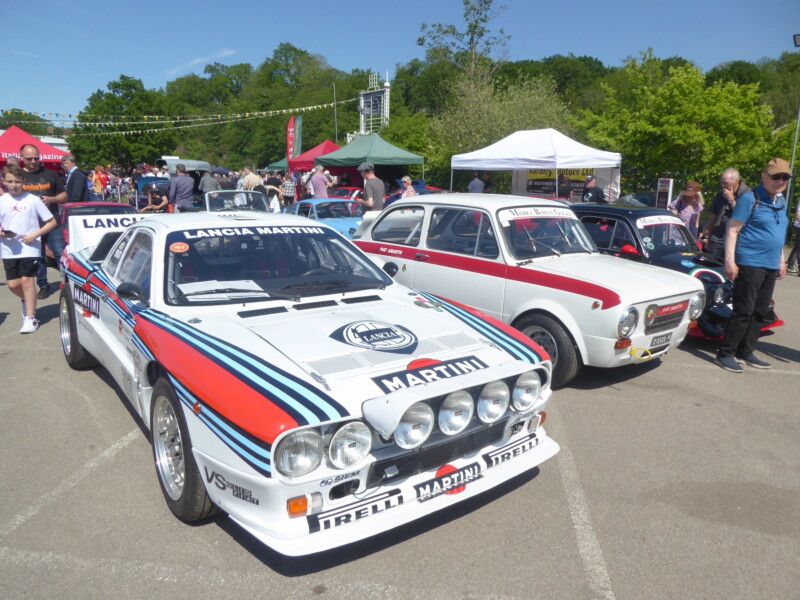
In 1976, 400 examples of the Fiat Abarth 131 Rally were built for homologation purposes. These cars were built in a co-operation between Fiat, Bertone and Abarth. Bertone took part-completed two door standard bodyshells from the production line in Mirafiori, fitted plastic mudguards front and rear, a plastic bonnet and bootlid and modified the metal structure to accept the independent rear suspension. The cars were fully painted an trimmed and then delivered back to the Fiat special Rivalta plant where they received the Abarth mechanicals. The street version of the car used a 16-valve DOHC derivative of the standard DOHC engine, which equipped with a double Weber downdraught carburettor produced 140 PS. The street cars used the standard gearbox with no synchromesh (Rally type regulations required the use of the same type of synchromesh on the competition cars as on the street versions) and the hopelessly underdimensioned brake system of the small Fiat 127. Competition cars used dry sump lubrication and eventually Kugelfischer mechanical fuel injection. In race specifications, the engine produced up to 240 PS in 1980, being driven to World Championship status by Walter Röhrl


Completing the line-up was Bob Woodward’s fabulous Strada 130 TC, the final major variant to be added to the Strada range when it appeared in 1984. It was based on the 125 TC (which had not been sold in the UK) and was powered by a 1,995 cc engine with power output increased to 130 PS. This was achieved by replacing the single Weber carb used in the 125 TC with twin Solex/Weber carburettors on a side-draught manifold, and via improved cam profiles. The 130 TC had a top speed of 195 km/h (121 mph) and accelerated from 0 to100 km/h (62 mph) in 7.8 seconds. It was fitted with Recaro bucket seats in Britain and it remained the only 1980s European hot hatch to continue to use carburettors instead of fuel injection. Ignition timing was controlled electronically. Although appearing outwardly similar to the restyled 105 TC with its lower door and wheelarch trims, the 130 TC could be distinguished by its polished four-spoke alloy wheels (continued from the earlier 125 TC), aerodynamic perspex front door wind deflectors, and lower hatchback spoiler. The powerful twin-cam was mated to a close ratio five-speed ZF manual gearbox and had superior performance to its contemporary rivals, which included the Volkswagen Golf GTI, Ford Escort XR3i, Vauxhall Astra GTE and the MG Maestro. In its day, it was faster than all of them, but it found relatively few buyers.


ALFA ROMEO
Following the 1900 family, Alfa’s next new model range would be cheaper and aimed at capturing some of the market from middle class buyers. Known as Giulietta, the 750 and later 101 Series were a series of family-sized cars made from 1954 to 1965, and Alfa Romeo’s first, successful, foray into the 1.3-litre class. The first to be introduced was the Giulietta Sprint 2+2 coupé which was premiered at the 1954 Turin Motor Show. Designed by Franco Scaglione at Bertone, it was produced at the coachbuilder’s Grugliasco plant, near Turin. A year later, at the Turin Motor Show in April 1955, the Sprint was joined by the 4-door saloon Berlina. In mid 1955, the open two-seat Giulietta Spider, featuring convertible bodywork by Pininfarina arrived. The Giulietta used unibody construction and a front-engine, rear-wheel-drive layout. Front suspension was by control arms, with coaxial coil springs and hydraulic dampers. At the rear there was a solid axle on coil springs and hydraulic dampers. The axle was located by a longitudinal link on each side, and by a wishbone-shaped arm linking the top of the aluminium differential housing to the chassis. All Giuliettas (save for the last SZ examples) had hydraulic drum brakes on all four corners. The Giulietta used an Alfa Romeo Twin Cam straight-four of 1290 cc, with an aluminium alloy engine block and cast iron inserted sleeves. Bore and stroke measured 74.0 mm and 75.0 mm. The aluminium alloy cylinder head was of a crossflow design and featured hemispherical combustion chambers. The double overhead camshafts were driven by two timing chains, and acted on two valves per cylinder, angled 80°. In 1957 a more powerful Berlina version, called Giulietta T.I. (Turismo Internazionale) was presented with minor cosmetic changes to the bonnet, the dial lights and rear lamps. Carrozzeria Colli also made the Giulietta station wagon variant called Giulietta Promiscua. Ninety-one examples of this version were built. Carrozzeria Boneschi also made a few station wagon examples called Weekendina. A new version of the Giulietta Berlina debuted at the Frankfurt Motor Show in 1959. Mechanical changes were limited to shifting the fuel pump from the cylinder head to a lower position below the distributor, and moving the previously exposed fuel filler cap from the tail to the right rear wing, under a flap. The bodywork showed a revised front end, with more rounded wings, recessed head lights, and new grilles with chrome frames and two horizontal bars. The rear also showed changes, with new larger tail lights on vestigial fins, which replaced the earlier rounded rear wings. The interior was much more organised and upholstered in new cloth material; the redesigned dashboard included a strip speedometer flanked by two round bezels, that on the T.I. housed a tachometer and oil and water temperature gauges. The T.I. also received a front side repeater mounted in a small spear, unlike the Normale which kept the earlier small round lamp with no decorations. During 1959 the type designation for all models was changed from 750 and 753 to 101. In February 1961 the 100,001st Giulietta rolled out of the Portello factory, with a celebration sponsored by Italian actress Giulietta Masina. In Autumn 1961 the Giulietta was updated a second time. Both Normale and T.I. had revised engines and new exhaust systems; output rose to 61 bhp and 73 bhp. With this new engine the car could reach a speed of almost 100mph. At the front of the car square mesh side grilles were now pieced together with the centre shield, and at the rear there were larger tail lights. Inside the T.I. had individual instead of bench seats, with storage nets on the seatbacks. June 1962 saw the introduction of the Alfa Romeo Giulia, which would eventually replace the Giulietta. As until 1964 the Giulia only had a larger 1.6-litre engine, production of the standard Berlina ended with 1963, whilst the T.I. continued for a full year more. A last T.I. was completed in 1965. The Giulietta sport models had a different fate: Sprint, Sprint Speciale and Spider were fitted with the new 1.6-litre engine, received some updates and continued to be sold under the Giulia name until they were replaced by all-new Giulia-based models during 1965. These days., the Berlina is the model you see the least often. A few of the model are used in historic racing where the car takes on the might of those with far larger engines. A total of 177,690 Giuliettas were made, the great majority in Berlina saloon, Sprint coupé or Spider roadster body styles


Next up was this supremely elegant Giulia Spider. Along with the equally pretty Coupe model, this started out as part of the Giulietta range, but in later life adopted Giulia badging. This the more commonly seen of the pair, the lovely Giulia Spider 1600. Alfa had followed up the 1950 launch of the 1900 Berlina with a smaller model, the Giulietta. Known as the Type 750 and later 101 Series, the Giulietta evolved into a family of models. The first to be introduced was the Giulietta Sprint 2+2 coupé at the 1954 Turin Motor Show. Designed by Franco Scaglione at Bertone, it was produced at the coachbuilder’s Grugliasco plant near Turin. A year later, at the Turin Motor Show in April 1955, the Sprint was joined by the 4-door saloon Berlina. In mid 1955, the open two-seat Giulietta Spider, featuring convertible bodywork by Pininfarina, and it was one of these achingly pretty cars that was to be seen here. Alfa replaced the Giulietta with the Giulia in 1962, but as the Coupe and Spider were not ready, the Giulietta based models were kept in production, and renamed as Giulia. They gained a larger 1600cc engine, and this meant that the bonnet needed to be raised a little to accommodate the new unit, so the easy recognition beyond Giulietta and Giulia Spiders is whether there is a flat bonnet or one with a slight hump and a vent in it.


Many people will be unaware that Alfa Romeo have produced Vans in their past. The first the Autotutto was launched back in 1954, and it was updated three times in the following 11 years before being replaced with by the Giulia engined Alfa Romeo F12 and A12 vans in 1967. The front of the vehicle was updated with wider chrome and mesh grille, and the 1,290 cc Alfa Romeo Twin Cam engine was updated now having 52 hp. The front-engined van had four-speed gearbox and front-wheel drive. In 1973 an inline-four 1,760 cc Perkins diesel was also offered, with 50 hp. This same engine was also available in the Giulia Berlina from 1976. The van had top speed of around 115 km/h (71 mph). The front brakes were discs and rear ones drums. Abandoning the use of a model name, “F” denoted a furgone, or van, “A” depicted an autocarro or light truck, while “12” indicated the carrying capacity of 12 quintali (1 quintale = 100 kg (220 lb)). Motor Ibérica took over of FADISA in 1967, this company made Ebro trucks and these FADISA trucks were merged to this same division. As a result, the Alfa Romeo F12 was named as Ebro F-100 in Spain and after the facelift it was sold as the F-108. In 1987 Nissan Motors took control of Motor Ibérica and Ebro trucks were renamed “Nissan Trade”. They continued to be made until the beginning of the 2000s at the Ávila plant in Spain. Between 1967 and 1971 a “light” A11 or F11 version was also available. This has a lighter payload and a lower horsepower rating. All Alfa Romeo vans were facelifted in 1977 with a new black plastic radiator grille, and chrome badging was replaced with black adhesive stickers. Production stopped in 1983. The total production of all A11, A12, F11, and F12 was around 17,300 units.

First of the all-new Giulia models to appear was the Berlina, launched in 1962. The styling was quite straight forward, but great attention was paid to detail. The engine bay, cabin and boot were all square shaped. But the grille, the rooflines and details on the bonnet and boot made for an integrated design from bumper to bumper. Thanks to Alfa Romeo using a wind tunnel during its development, the Giulia was very aerodynamic with a drag coefficient of Cd=0.34, which was particularly low for a saloon of the era and not a bad figure even for cars of today. Couple that with the fact that Alfa Romeo was one of the first manufacturers to put a powerful engine in a light-weight car (it weighed about 1,000 kilograms) and thanks to an array of light alloy twin overhead camshaft four-cylinder engine, similar to that of the earlier Giulietta models range, the car had a lively performance which bettered that of many sports cars of the day. The Tipo 105.14 was the first model, with a 1,570 cc Twin Cam engine with single down-draft carburettor generating 91 hp at 6500 rpm. The “TI” nomenclature referred to a class of Italian saloon car racing known as “Turismo Internazionale”, and had previously been applied to higher-performance versions of the 1900 and Giulietta saloons in the 1950s. However, for the Giulia saloon, the Ti was at first the only version available, and later, with the introduction of the TI Super and Super, the TI became the base version for the 1,600 cc engine class. The steering column gearchange (the only one in the Giulia range) was replaced with a floor change for 1964 (Tipo 105.08). Right hand drive cars, available from 1964, only ever had a floor change (Tipo 105.09). Brakes were by drums all around at first. Discs were introduced later, first at the front, and later all around. A brake servo was not fitted at first, but was introduced in later cars. The steering wheel featured the only horn ring ever in the Giulia range. The dashboard with a strip speedo is a notable feature, as is the steering wheel with a horn ring. The Giulia TI was phased out in 1968 and re-introduced as the austerity model 1600 S. Tipo 105.16 was a special racing model introduced in 1963. Quadrifoglio Verde stickers on the front wings were a distinguishing feature. Only 501 were made for homologation and today it is very rare and desirable. The 1,570 cc engine was fitted with two double-choke horizontal Weber 45DCOE carburettors for 110 hp at 6500 rpm. The body was lightened and a floor gearchange was fitted as standard, as were alloy wheels of very similar appearance to the standard steel ones of the TI. The TI’s instrument cluster with its strip speedometer was replaced with a three-instrument binnacle comprising speedometer, tachometer and a multi-gauge instrument (fuel, water temperature, oil temperature and pressure) – these instruments were similar to those fitted to the contemporary Giulia Sprint and Sprint Speciale coupes and Spider convertibles. The steering wheel was a three-spoke item with centre hornpush, also similar to that of the more sporting models. Braking was by discs all around, although the first cars used drums and early disc models lacked a servo which was introduced later. The police cars seen in The Italian Job were of this type. Tipo 105.06 was an austerity model made from 1964 to 1970 with a 1,290 cc single-carburettor engine for 77 hp at 6000 rpm. Four-speed gearbox with floor change fitted as standard (the 1300 was the only Giulia model not fitted with a five-speed gearbox). Though the engine was given a 105 series type number, it was basically the engine from the 101 series Giulietta Ti. This model appears not to have been exported to many markets outside Italy, if at all. Braking was by discs all around, without a servo at first, later with a servo. Tipo 105.26 was introduced in 1965. It transferred the technology from the racing TI Super to a road car, to make the most successful Giulia saloon. 1,570 cc engine with two double-choke Weber 40DCOE carburettors for a milder, but torquier tune than the TI Super – 97 hp at 5500 rpm. There was a new dashboard with two large round instruments (speedo and tacho) and clock, a sportier steering wheel with three aluminium spokes and centre horn push, similar to that of the Ti Super, later changed for one with the horn pushes in the spokes. All-around disc brakes with servo were fitted as standard from the outset. The serpent crest of the Sforza family appears in a badge on the C-pillar and is a distinguishing feature of the Super. For 1968, there was a suspension update, including revised geometry and a rear anti-roll bar. The wheels were changed in size from 5J x 15 to 5J x 14, and tyres from 155/15 to 165/14. For 1970, updates included dual-circuit brakes, centre-mounted handbrake lever to replace under-dash “umbrella handle”, larger external doorhandles, and top-hinged pedals (the latter in left hand drive models only; right hand drive continued with bottom-hinged pedals to the end of production). In 1972, Tipo 105.26 was rationalised into the Giulia 1.3 – Giulia 1.6 range. Tipo 105.39 built from 1965 to 1972. Right hand drive model replaced in 1970 by the 1300 Super. 1,290 cc engine with single down-draft carburettor for 81 hp at 6000 rpm. Unlike the re-deployed 101-series Giulietta engine of the austerity-model 1300, the 1300 ti motor was a 105 series engine, basically that of the sportier GT1300 Junior coupe with different camshaft timing (but the same camshafts) and induction system. Five-speed gearbox. Three-spoke bakelite steering wheel with plastic horn push covering the centre and spokes. Dashboard initially with strip speedo like that of the TI. For 1968, updates included a dashboard based on that of the Super, but with a simpler instrument binnacle, still featuring two large round instruments (speedo and tacho) and a separate fuel gauge, and the same suspension, wheel and tire updates applied to the Giulia Super in the same year. For 1970, updates included dual-circuit brakes, centre handbrake, larger external doorhandles and top-hinged pedals (on left hand drive cars only), again as applied to the Super for that year. Tipo 105.85 was basically a Giulia TI re-introduced in 1968 as a lower-level model to come between the 1300 and 1300 ti on one hand, and the Super on the other. It had a re-interpretation of the 1,570 cc single-carburettor engine for 94 hp at 5500 rpm and similar trim to the 1300 ti. Replaced in 1970 by the 1300 Super which offered similar performance in a lower tax bracket. The last cars from 1970 featured the top-hinged pedals, centre handbrake and dual-circuit brakes as for the Super and 1300 ti. Tipo 115.09 was introduced in 1970. It was basically a 1300 ti fitted with the engine from the GT 1300 Junior coupe that featured two double-choke horizontal carburettors; the engine actually had the GT 1300 Junior type number. This model was rationalised into the Giulia Super 1.3 – Giulia Super 1.6 range in 1972. In 1972 a rationalisation of the Giulia range saw the Super 1300 (Tipo 115.09) and the Super (Tipo 105.26) re-released as the Super 1.3 and Super 1.6. The two models featured the same equipment, interior and exterior trim, differing only in engine size and final drive ratio. The 1300 ti was dropped. A small Alfa Romeo badge on the C-pillar is a distinguishing feature, as are hubcaps with exposed wheel nuts. In December 1972 Alfa-Romeo South Africa released the 1600 Rallye. This locally developed more powerful 1600 cc version of the 1300 Super used the 1300’s single-headlight body shell. The car was largely ready for competition and was only planned to be built in limited numbers, and was fitted with racing-style rear-view mirrors, rally lamps, fully adjustable seats, and a limited-slip differential. Claimed power was 125 hp. The Giulia Super range was re-released in 1974 as the Nuova Super range, including the Giulia Nuova Super 1300 and 1600 This featured a new black plastic front grille and a flat boot lid without the characteristic centre spine. Otherwise the cars differed little from their Giulia Super predecessors and bore the same Tipo numbers with an S suffix. A Nuova Super fitted with a Perkins 1,760 cc diesel with 54 hp at 4000 rpm, was the firm’s first attempt at diesel power. The same Perkins diesel was used also in Alfa Romeo F12 van. The diesel version was slow, 138 km/h (86 mph), and the engine somehow unsuitable for a sport sedan so it was not big seller, only around 6500 examples were made in 1976 and the car was not sold in the UK. Production of the Giulia ceased in 1977. There are relatively few of these cars in the UK, and many of these are left hand drive models which have been re-imported relatively recently, or have been converted for historic racing, so it was good to see a nice road-going model here.


The first car was called the Alfa Romeo Giulia Sprint GT, and was revealed at a press event held at the then newly opened Arese plant on 9 September 1963, and displayed later the same month at the Frankfurt Motor Show. In its original form the Bertone body is known as scalino (step) or “step front”, because of the leading edge of the engine compartment lid which sat 1/4 an inch above the nose of the car. The Giulia Sprint GT can be distinguished from the later models by a number of features including: Exterior badging: Alfa Romeo logo on the front grille, a chrome script reading “Giulia Sprint GT” on the boot lid, and rectangular “Disegno di Bertone” badges aft of the front wheel arches; flat, chrome grille in plain, wide rectangular mesh without additional chrome bars; single-piece chrome bumpers; no overriders. Inside the cabin the padded vinyl dashboard was characterised by a concave horizontal fascia, finished in grey anti-glare crackle-effect paint. Four round instruments were inset in the fascia in front of the driver. The steering wheel was non-dished, with three aluminium spokes, a thin bakelite rim and a centre horn button. Vinyl-covered seats with cloth centres and a fully carpeted floor were standard, while leather upholstery was an extra-cost option. After initially marketing it as a four-seater, Alfa Romeo soon changed its definition of the car to a more realistic 2+2. The Giulia Sprint GT was fitted with the 1,570 cc version of Alfa Romeo’s all-aluminium twin cam inline four (78 mm bore × 82 mm stroke), which had first debuted on the 1962 Giulia Berlina. Breathing through two twin-choke Weber 40 DCOE 4 carburettors, on the Sprint GT this engine produced 105 hp at 6,000 rpm. Like all subsequent models, the Sprint GT was equipped with an all-synchromesh 5-speed manual transmission. The braking system comprised four Dunlop disc brakes and a vacuum servo. The rear brakes featured an unusual arrangement with the slave cylinders mounted on the axle tubes, operating the calipers by a system of levers and cranks. According to Alfa Romeo the car could reach a top speed of “over 180 km/h (112 mph)”. In total 21,902 Giulia Sprint GT were produced from 1963 to 1965, when the model was superseded by the Giulia Sprint GT Veloce. Of these 2,274 were right hand drive: 1,354 cars fully finished in Arese, and 920 shipped in complete knock-down kit form for foreign assembly. For 1966, the Giulia Sprint GT was replaced by the Alfa Romeo Giulia Sprint GT Veloce, which was very similar but featuring a number of improvements: a revised engine—slightly more powerful and with more torque—better interior fittings and changes to the exterior trim. Alongside the brand new 1750 Spider Veloce which shared its updated engine the Sprint GT Veloce was introduced at the 36th Geneva Motor Show in March 1966, and then tested by the international specialist press in Gardone on the Garda Lake. Production had began in 1965 and ended in 1968. The Giulia Sprint GT Veloce can be most easily distinguished from other models by the following features: badging as per Giulia Sprint GT, with the addition of round enamel badges on the C-pillar—a green Quadrifoglio (four-leaf clover) on an ivory background—and a chrome “Veloce” script on the tail panel; black mesh grille with three horizontal chrome bars; the grille heart has 7 bars instead of 6; stainless steel bumpers, as opposed to the chromed mild steel bumpers on the Giulia Sprint GT. The bumpers are the same shape, but are made in two pieces (front) and three pieces (rear) with small covers hiding the joining rivets. Inside the main changes from the Giulia Sprint GT were imitation wood dashboard fascia instead of the previous anti-glare grey finish, front seats revised to a mild “bucket” design, and a dished three aluminium spoke steering wheel, with a black rim and horn buttons through the spokes. The Veloce’s type 00536 engine, identical to the Spider 1600 Duetto’s, featured modifications compared to the Giulia Sprint GT’s type 00502—such as larger diameter exhaust valves. As a result it produced 108 hp at 6,000 rpm, an increase of 3 hp over the previous model, and significantly more torque. The top speed now exceeded 185 km/h (115 mph). Early Giulia Sprint GT Veloces featured the same Dunlop disc brake system as the Giulia Sprint GT, while later cars substituted ATE disc brakes as pioneered on the GT 1300 Junior in 1966. The ATE brakes featured an handbrake system entirely separate from the pedal brakes, using drum brakes incorporated in the rear disc castings. Though the Sprint GT Veloce’s replacement—the 1750 GT Veloce—was introduced in 1967, production continued throughout the year and thirty final cars were completed in 1968. By then total Giulia Sprint GT Veloce production amounted to 14,240 examples. 1,407 of these were right hand drive cars, and 332 right hand drive complete knock-down kits. The Alfa Romeo 1750 GT Veloce (also known as 1750 GTV) appeared in 1967 along with the 1750 Berlina sedan and 1750 Spider. The same type of engine was used to power all three versions; this rationalisation was a first for Alfa Romeo. The 1750 GTV replaced the Giulia Sprint GT Veloce and introduced many updates and modifications. Most significantly, the engine capacity was increased to 1779 cc displacement. Peak power from the engine was increased to 120 hp at 5500 rpm. The stroke was lengthened from 82 to 88.5 mm over the 1600 engine, and a reduced rev limit from 7000 rpm to 6000 rpm. Maximum torque was increased to 137 lb·ft at 3000 rpm. A higher ratio final drive was fitted (10/41 instead of 9/41) but the same gearbox ratios were retained. The result was that, on paper, the car had only slightly improved performance compared to the Giulia Sprint GT Veloce, but on the road it was much more flexible to drive and it was easier to maintain higher average speeds for fast touring. For the United States market, the 1779 cc engine was fitted with a fuel injection system made by Alfa Romeo subsidiary SPICA, to meet emission control laws that were coming into effect at the time. Fuel injection was also featured on Canadian market cars after 1971. Carburettors were retained for other markets. The chassis was also significantly modified. Tyre size went to 165/14 from 155/15 and wheel size to 5 1/2J x 14 instead of 5J x 15, giving a wider section and slightly smaller rolling diameter. The suspension geometry was also revised, and an anti-roll bar was fitted to the rear suspension. ATE disc brakes were fitted from the outset, but with bigger front discs and calipers than the ones fitted to GT 1300 Juniors and late Giulia Sprint GT Veloces. The changes resulted in significant improvements to the handling and braking, which once again made it easier for the driver to maintain high average speeds for fast touring. The 1750 GTV also departed significantly from the earlier cars externally. New nose styling eliminated the “stepped” bonnet of the Giulia Sprint GT, GTC, GTA and early GT 1300 Juniors and incorporated four headlamps. For the 1971 model year, United States market 1750 GTV’s also featured larger rear light clusters (there were no 1970 model year Alfas on the US market). Besides the chrome “1750” badge on the bootlid, there was also a round Alfa Romeo badge. Similar Quadrofoglio badges to those on the Giulia Sprint GT Veloce were fitted on C pillars, but the Quadrofoglio was coloured gold instead of green. The car also adopted the higher rear wheelarches first seen on the GT 1300 Junior. The interior was also much modified over that of earlier cars. There was a new dashboard with large speedometer and tachometer instruments in twin binnacles closer to the driver’s line of sight. The instruments were mounted at a more conventional angle, avoiding the reflections caused by the upward angled flat dash of earlier cars. Conversely, auxiliary instruments were moved to angled bezels in the centre console, further from the driver’s line of sight than before. The new seats introduced adjustable headrests which merged with the top of the seat when fully down. The window winder levers, the door release levers and the quarterlight vent knobs were also restyled. The remote release for the boot lid, located on the inside of the door opening on the B-post just under the door lock striker, was moved from the right hand side of the car to the left hand side. The location of this item was always independent of whether the car was left hand drive or right hand drive. Early (Series 1) 1750 GTV’s featured the same bumpers as the Giulia Sprint GT Veloce, with the front bumper modified to mount the indicator / sidelight units on the top of its corners, or under the bumper on US market cars. The Series 2 1750 GTV of 1970 introduced other mechanical changes, including a dual circuit braking system (split front and rear, with separate servos). The brake and clutch pedals on left hand drive cars were also of an improved pendant design, instead of the earlier floor-hinged type. On right hand drive cars the floor-hinged pedals were retained, as there was no space for the pedal box behind the carburettors. Externally, the series 2 1750 GTV is identified by new, slimmer bumpers with front and rear overriders. The combined front indicator and sidelight units were now mounted to the front panel instead of the front bumper, except again on the 1971-72 US/Canadian market cars. The interior was slightly modified, with the seats retaining the same basic outline but following a simpler design. 44,269 1750 GTVs were made before their replacement came along. That car was the 2000GTV. Introduced in 1971, together with the 2000 Berlina sedan and 2000 Spider, the 2 litre cars were replacements for the 1750 range. The engine displacement was increased to 1962 cc. Oil and radiator capacities remained unchanged. The North American market cars had fuel injection, but everyone else retained carburettors. Officially, both versions generated the same power, 130 hp at 5500 rpm. The interior trim was changed, with the most notable differences being the introduction of a separate instrument cluster, instead of the gauges installed in the dash panel in earlier cars. Externally the 2000 GTV is most easily distinguished by its grille with horizontal chrome bars, featuring protruding blocks forming the familiar Alfa heart in outline, smaller hubcaps with exposed wheel nuts, optional aluminium alloy wheels of the same size as the standard 5. 1/2J × 14 steel items, styled to the “turbina” design first seen on the alloy wheels of the Alfa Romeo Montreal, and the larger rear light clusters first fitted to United States market 1750 GTV’s were standard for all markets. From 1974 on, the 105 Series coupé models were rationalised and these external features became common to post-1974 GT 1300 Junior and GT 1600 Junior models, with only few distinguishing features marking the difference between models. 37,459 2000 GTVs were made before production ended and these days they are very sought after with prices having sky-rocketed in recent years.


Alfa replaced the Giulia-based Spider model with an all-new design which finally made its debut in 1966 together with the Giulia Sprint GT Veloce at an event organised in Gardone Riviera. With its boat tailed styling, it quickly found favour, even before taking a starring role in the film “The Graduate”. The original 1600cc engine was replaced by a more powerful 1750cc unit at the same time as the change was made to the rest of the range, and the car continued like this until 1970, when the first significant change to the exterior styling was introduced on the 1750 Spider Veloce, with the original’s distinctive elongated round tail changed to a more conventional cut-off tail, called the “Kamm tail”, as well as improving the luggage space. Numerous other small changes took place both inside and out, such as a slightly different grille, new doorhandles, a more raked windscreen, top-hinged pedals and improved interior trim. 1971 saw the Spider Veloce get a new, larger powerplant—a 1962 cc, 132 hp unit—and consequently the name was changed from 1750 Spider Veloce to 2000 Spider Veloce. The 1600 Spider restarted production a year later as the Spider 1600 Junior, and was visually identical to the 1300. 1974 saw the introduction of the rare, factory request, Spider-Targa. Based upon the Spider, it featured a Porsche style solid rear window and lift out roof panels, all made out of black GRP type material. Less than 2,000 models of such type were ever made and was the only part solid roof Spider until the introduction of the factory crafted hard top. The 1300 and 2000 cars were modified in 1974 and 1975 respectively to include two small seats behind the front seats, becoming a “two plus two” four seater. The 1300 model was discontinued in 1977. Also, between 1974 and 1976, the early-style stainless-steel bumpers were discontinued and replaced with black, rubber-clad units to meet increasingly stringent North American crash requirements. 4,557 examples of the 1300 Junior were made and 4,848 of the 1600 Junior as well as 16,320 2000 Spider Veloces and 22,059 of 2000 Spider Veloce US version. There were also 4,027 1750 Spider Veloces produced.


The Series 3 Spider was previewed in North America for the 1982 model year with the introduction of 2.0 litre Bosch electronic fuel injection to replace the SPICA mechanical injection. The Spider underwent a major styling revamp in 1983, which saw the introduction of black rubber front and rear bumpers. The front bumper incorporated the grille and a small soft rubber spoiler was added to the trunk lid. The change altered the exterior appearance of the car considerably and was not universally praised by enthusiasts. Various other minor mechanical and aesthetic modifications were also made, and the 1600 car (never available in North America) dropped the “Junior” name. The Quadrifoglio Verde (Green Cloverleaf) model was introduced in 1986, with many aesthetic tweaks, including sideskirts, mirrors, new front and rear spoilers, hard rubber boot mounted spoilers with integral 3rd stoplight, unique 15″ alloys and optional removable hardtop. Different interior trim included blood red carpets and grey leather seats with red stitching. The QV was offered in only 3 colours: red, silver and black. It was otherwise mechanically identical to the standard Spider Veloce model, with a 1962 cc double overhead cam, four-cylinder engine (twin two-barrel carburettors in Europe; North American models retained the Bosch L-Jetronic fuel injection introduced for the 1982 model year except that the VVT mechanism was now L-Jet activated) and five-speed manual transmission. The interior was revised with a new centre console, lower dash panels (to meet U.S. regulations) and a single monopod gauge cluster (with electronic gauges). For the North American market a model dubbed the Graduate was added in tribute to the car’s famous appearance in the 1967 film, The Graduate, starring Dustin Hoffman. The Graduate was intended as a less expensive “entry-level” Alfa. While it had the same engine and transmission as the Quadrifoglio and Veloce, it lacked the alloy wheels and luxury features of the other two models. The Graduate model had manual windows, basic vinyl seats, a vinyl top, and steel wheels as standard. Air conditioning and a dealer-installed radio were the only options. It first appeared in 1985 in North America and continued until 1990. Minor changes occurred from 1986 to 89, including new paint colours, a centre high mount stop lamp midway through 1986 for North American models, a move away from the fade-prone brown carpet and new turn signal levers. Some 1988 models featured automatic seatbelts that extended from a large device between the front seats.

The S4, the final major change to the long running Spider came in 1990, and mechanically, the biggest different was the use of Bosch Motronic electronic fuel injection with an electric fan. Externally, the Spider lost its front under-bumper spoiler and the rather ungainly rear boot spoiler of the S3, and picked up 164-style rear lights stretching across the width of the car as well as plastic bumpers the same colour as the car. This also marked the first generation of the car with automatic transmission, as well as on-board diagnostics capabilities. The car had remained in production largely thanks to continued demand in North America, though this market had to wait until 1991 for the changes to appear on their cars. European markets were offered a car with a 1600cc engine and carburettors as well as the 2 litre injected unit. Production finally ended in 1993, with an all new model, the 916 Series Spider appearing a year later. The S4 car was not officially sold in the UK, but plenty have found their way to our shores since then.

During the 1950s, Alfa had undergone a fairly fundamental transformation from producing cars designed for racing or very high-end sports touring road machines, in small quantities, to being a manufacturer of more affordable cars, albeit with a sporting bias to their dynamics. But the desire to produce something exclusive and expensive was not completely lost, and indeed it was re-manifest in the next Alfa to be seen here, the very lovely Montreal. First seen as a concept car in 1967 at Expo 67, the car was initially displayed without any model name, but the public took to calling it the Montreal. It was a 2+2 coupe using the 1.6-litre engine of the Alfa Romeo Giulia TI and the short wheelbase chassis of the Alfa Romeo Giulia Sprint GT, with a body designed by Marcello Gandini at Bertone. One of the two concept cars built for Expo 67 is displayed in the Alfa Romeo Historical Museum in Arese, Italy, while the other is in museum storage. Reaction to the concept was sufficiently encouraging that Alfa decided to put the car into production. The result, the Tipo 105.64, was shown at the 1970 Geneva Motor Show and was quite different from the original, using a 2593 cc 90° dry-sump lubricated V8 engine with SPICA (Società Pompe Iniezione Cassani & Affini) fuel injection that produced around 200 PS (197 hp), coupled to a five-speed ZF manual gearbox and a limited-slip differential. This engine was derived from the 2-litre V8 used in the 33 Stradale and in the Tipo 33 sports prototype racer; its redline was set at 7,000 rpm, unheard of for a V8 at that time. The chassis and running gear of the production Montreal were taken from the Giulia GTV coupé and comprised double wishbone suspension with coil springs and dampers at the front and a live axle with limited slip differential at the rear.Since the concept car was already unofficially known as The Montreal, Alfa Romeo kept the model name in production. Stylistically, the most eye catching feature was the car’s front end with four headlamps partly covered by unusual “grilles”, that retract when the lights are switched on. Another stylistic element is the NACA duct on the bonnet. The duct is actually blocked off since its purpose is not to draw air into the engine, but to optically hide the power bulge. The slats behind the doors contain the cabin vents, but apart from that only serve cosmetic purposes. Paolo Martin is credited for the prototype instrument cluster. The Montreal was more expensive to buy than the Jaguar E-Type or the Porsche 911. When launched in the UK it was priced at £5,077, rising to £5,549 in August 1972 and to £6,999 by mid-1976. Production was split between the Alfa Romeo plant in Arese and Carrozzeria Bertone’s plants in Caselle and Grugliasco outside Turin. Alfa Romeo produced the chassis and engine and mechanicals and sent the chassis to Caselle where Bertone fitted the body. After body fitment, the car was sent to Grugliasco to be degreased, partly zinc coated, manually spray painted and have the interior fitted. Finally, the car was returned to Arese to have the engine and mechanicals installed. It is worth noting that because of this production method, there is not necessarily any correspondence between chassis number, engine number and production date. The Montreal remained generally unchanged until it was discontinued in 1977. By then, production had long ceased already as Alfa were struggling to sell their remaining stock. The total number built was around 3900. None of them were sold in Montreal, Quebec since Alfa did not develop a North American version to meet the emission control requirements in the United States & Canada. The car was both complex and unreliable which meant that many cars deteriorated to a point where they were uneconomic to restore. That position has changed in the last couple of years, thankfully, with the market deciding that the car deserves better, and prices have risen to you whereas a good one would have been yours for £20,000 only a couple of years ago, you would now likely have to pay more than double that.


There were a number of examples of the AlfaSud here this time. These characterful small cars evoke a very positive reaction, with many people wistfully recollecting one that they, or their parents, owned back in the 1970s, but observing that the car, whilst divine to drive, simply rusted away almost before your very eyes. There are a lot more of these cars left in the UK than you might imagine, but most of them are on SORN, needing massive restorations that may or may not ever happen. That should not detract from the splendour of the models on show at this event. Alfa Romeo had explored building a smaller front wheel drive car in the 1950s but it was not until 1967 that firm plans were laid down for an all-new model to fit in below the existing Alfa Romeo range. It was developed by Austrian Rudolf Hruska, who created a unique engineering package, clothed in a body styled by Giorgetto Giugiaro of ItalDesign. The car was built at a new factory at Pomigliano d’Arco in southern Italy, hence the car’s name, Alfa Sud (Alfa South). January 18, 1968, saw the registration at Naples of a new company named “Industria Napoletana Costruzioni Autoveicoli Alfa Romeo-Alfasud S.p.A.”. 90% of the share capital was subscribed by Alfa Romeo and 10% by Finmeccanica, at that time the financial arm of the government controlled IRI. Construction work on the company’s new state sponsored plant at nearby Pomigliano d’Arco began in April 1968, on the site of an aircraft engine factory used by Alfa Romeo during the war. The Alfasud was shown at the Turin Motor Show three years later in 1971 and was immediately praised by journalists for its styling. The four-door saloon featured an 1,186 cc Boxer water-cooled engine with a belt-driven overhead camshaft on each cylinder head. It also featured an elaborate suspension setup for a car in its class (MacPherson struts at the front and a beam axle with Watt’s linkage at the rear). Other unusual features for this size of car were four-wheel disc brakes (with the front ones being inboard) and rack and pinion steering. The engine design allowed the Alfasud a low bonnet line, making it very aerodynamic (for its day), and in addition gave it a low centre of gravity. As a result of these design features, the car had excellent performance for its engine size, and levels of roadholding and handling that would not be equaled in its class for another ten years. Despite its two-box shape, the Alfasud did not initially have a hatchback. Some of the controls were unorthodox, the lights, turn indicators, horn, wipers and heater fan all being operated by pulling, turning or pushing the two column stalks. In November 1973 the first sport model joined the range, the two-door Alfasud ti—(Turismo Internazionale, or Touring International).Along with a 5-speed gearbox, it featured a more powerful version of the 1.2 engine, brought to 67 hp by adopting a Weber twin-choke carburettor; the small saloon could reach 160 km/h. Quad round halogen headlamps, special wheels, a front body-colour spoiler beneath the bumper and rear black one around the tail distinguished the “ti”, while inside there were a three-spoke steering wheel, auxiliary gauges, leatherette/cloth seats, and carpets in place of rubber mats. In 1974, Alfa Romeo launched a more upscale model, the Alfasud SE. The SE was replaced by the Alfasud L (Lusso) model introduced at the Bruxelles Motor Show in January 1975. Recognisable by its bumper overriders and chrome strips on the door sills and on the tail, the Lusso was better appointed than the standard Alfasud (now known as “normale”), with such features as cloth upholstery, headrests, padded dashboard with glove compartment and optional tachometer. A three-door estate model called the Alfasud Giardinetta was introduced in May 1975. It had the same equipment of the Alfasud “L”. It was never sold in the UK and these models are particularly rare now. The Lusso model was produced until 1976, by then it was replaced with the new Alfasud 5m (5 marce, five speed) model, the first four-door Alfasud with a five-speed gearbox. Presented at the March 1976 Geneva Motor Show, it was equipped like the Lusso it replaced. In late 1977 the Alfasud Super replaced the range topping four-door “5m”; it was available with both the 1.2- and 1.3-litre engines from the “ti”, though both equipped with a single-choke carburettor.The Super introduced improvements both outside, with new bumpers including large plastic strips, and inside, with a revised dashboard, new door cards and two-tone cloth seats. Similar upgrades were applied to the Giardinetta. In May 1978 the Sprint and “ti” got new engines, a 78 hp 1.3 (1,350 cc) and a 84 hp 1.5 (1,490 cc), both with a twin-choke carburettor. At the same time the Alfasud ti received cosmetic updates (bumpers from the Super, new rear spoiler on the boot lid, black wheel arch extensions and black front spoiler) and was upgraded to the revised interior of the Super. The 1.3 and 1.5 engines were soon made available alongside the 1.2 on the Giardinetta and Super, with a slightly lower output compared to the sport models due to a single-choke carburettor. All Alfasuds were upgraded in 1980 with plastic bumpers, new instrument panel, headlamps and rear lights as well as other revisions. The Ti version was now fitted with a twin-carburettor version of the 1490 cc engine that had been fitted to the Sprint the previous year, developing 95 bhp A three-door hatchback was added to the range in 1981 in either SC or Ti trim and the two-door Ti and Giardinetta were deleted from most markets around this time. Belatedly in 1982 the four-door cars were replaced by five-door versions as by now, most of its competitors were producing a hatchback of this size, although some also produced a saloon alternative. The range was topped by the five-door Gold Cloverleaf, featuring the 94 hp engine from the Ti and enhanced interior trim. In 1983 an attempt to keep pace with the hot hatchback market, the final version of the Alfasud Ti received a tuned 1490 cc engine developing 105 PS Now named Quadrifoglio Verde (Green Cloverleaf) this model was also fitted with Michelin low profile TRX tyres on metric rims as well as an enhanced level of equipment. The five-door Alfasud saloons were replaced by the 33 models in 1983. The 33 was an evolution of the AlfaSud’s floorpan and running gear, including minor suspension changes and a change from four-wheel disc brakes to front disc and rear drum brakes to reduce costs. The three-door versions continued for a further year before being replaced by the unsuccessful Alfa Romeo Arna a joint venture between Alfa Romeo and Nissan.


There was a much longer wait for a Coupe version of the AlfaSud than there had been for the larger Alfetta, the Alfasud Sprint being presented to the press in September 1976 in Baia Domizia and shown at the Turin Motor Show in November some five years after the launch of the saloon. Designed by Giorgetto Giugiaro like the AlfaSud, whose mechanicals it was based on, it had a lower, more angular design, featuring a hatchback, although there were no folding rear seats. The AlfaSud Sprint was assembled together with the AlfaSud in the Pomigliano d’Arco plant, located in southern Italy—hence the original “Sud” moniker. Under the Alfasud Sprint’s bonnet there was a new version of the AlfaSud’s 1186 cc four-cylinder boxer engine, stroked to displace 1,286 cc, fed by a twin-choke carburettor and developing 75 hp at 6,000 rpm. Mated to the flat-four was a five-speed, all-synchromesh gearbox. The interior was upholstered in dark brown Texalfa leatherette and tartan cloth. Options were limited to alloy wheels, a quartz clock and metallic paint. In May 1978 the AlfaSud Sprint underwent its first updates, both cosmetic and technical. Engine choice was enlarged to two boxers, shared with the renewed AlfaSud ti, a 78 hp 1.3 (1,350 cc) and a 84 hp 1.5 (1,490 cc); the earlier 1286 cc unit was not offered anymore, remaining exclusive to the AlfaSud. Outside many exterior details were changed from chrome to matte black stainless steel or plastic, such as the wing mirrors, window surrounds and C-pillar ornaments; the B-pillar also received a black finish, the side repeaters changed position and became square, and the front turn signals switched from white to amber lenses. In the cabin the seats had more pronounced bolsters and were upholstered in a new camel-coloured fabric. Just one year later, in June 1979, another engine update arrived and the AlfaSud Sprint became the AlfaSud Sprint Veloce. Thanks to double twin-choke carburettors (each choke feeding a single cylinder) and a higher compression ratio engine output increased to 85 hp and 94 hp, respectively for the 1.3 and 1.5. In February 1983 Alfa Romeo updated all of its sports cars; the Sprint received a major facelift. Thereafter the AlfaSud prefix and Veloce suffix were abandoned, and the car was known as Alfa Romeo Sprint; this also in view of the release of the Alfa Romeo 33, which a few months later replaced the AlfaSud family hatchback. The Sprint also received a platform upgrade, which was now the same as that of the Alfa Romeo 33; this entailed modified front suspension, brakes mounted in the wheels instead of inboard like on the AlfaSud, and drum brakes at the rear end. Three models made up the Sprint range: 1.3 and 1.5, with engines and performance unchanged from the AlfaSud Sprint Veloce, and the new 1.5 Quadrifoglio Verde—1.5 Cloverleaf in the UK. A multitude of changes were involved in the stylistic refresh; there were a new grille, headlamps, wing mirrors, window surrounds and C-pillar ornaments. Bumpers went from chrome to plastic, and large plastic protective strips were added to the body sides; both sported coloured piping, which was grey for 1.3 cars, red for the 1.5 and green for the 1.5 Quadrifoglio. At the rear new trapezoidal tail light assemblies were pieced together with the license plate holder by a black plastic fascia, topped by an Alfa Romeo badge—never present on the AlfaSud Sprint. In the cabin there were new seats with cloth seating surfaces and Texalfa backs, a new steering wheel and changes to elements of the dashboard and door panels. Sprint 1.3 and 1.5 came with steel wheels with black hubcaps from the AlfaSud ti. The newly introduced 1.5 Quadrifoglio Verde sport variant was shown at the March 1983 Geneva Motor Show. Its engine was the 1,490 cc boxer, revised to put out 104 hp at 6,000 rpm; front brake discs were vented and the gearing shorter. In addition to the green bumper piping, also specific to the Quadrifoglio were a green instead of chrome scudetto in the front grille, a rear spoiler and 8-hole grey painted alloy wheels with metric Michelin TRX 190/55 tyres. Inside a three-spoke leather-covered steering wheel, green carpets and sport seats in black cloth with green embroidery. In November 1987 the Sprint was updated for the last time; the 1.3 variant was carried over, while the 1.5 engine was phased out and the 1.5 QV was superseded by the 116 hp Sprint 1.7 Quadrifoglio Verde. The 1,286 cc engine was directly derived from the 33 1.7 Quadrifoglio Verde, and could propel the Sprint from 0 to 100 km/h in 9.3 seconds; to cope with the increased engine power, the 1.7 QV adopted vented brake discs upfront. the coloured piping and side plastic strips were deleted, and the Quadrifoglio had alloy wheels of a new design. A fuel injected and 3-way Catalytic converter-equipped 1.7 variant, with an engine again derived from a 33, was added later for sale in specific markets. There were a total of 116,552 Sprints produced during its lifespan, which lasted from 1976 to 1989. 15 of these formed the basis of the Australian-built Giocattolo sports car, which used a mid-mounted Holden 5.0 group A V8 engine. The Sprint had no direct predecessor or successor.


Taking its name from the successful Formula One car of 1951, the Type 159, was the Alfetta, and there were several of these to be seen here. The 116 Series Alfetta was launched in 1972, equipped with a 1.8-litre four-cylinder. It was a three-box, four-door saloon (Berlina in Italian) with seating for five designed in-house by Centro Stile Alfa Romeo; the front end was characterised by twin equally sized headlamps connected to a central narrow Alfa Romeo shield by three chrome bars, while the tail lights were formed by three square elements. At the 1975 Brussels Motor Show Alfa Romeo introduced the 1,594 cc 08 PS Alfetta 1.6 base model, easily recognizable by its single, larger round front headlights. Meanwhile, the 1.8-litre Alfetta was rebadged Alfetta 1.8 and a few months later mildly restyled, further set apart from the 1.6 by a new grille with a wider central shield and horizontal chrome bars. Engines in both models were Alfa Romeo Twin Cams, with two overhead camshafts, 8-valves and two double-barrel carburettors. Two years later the 1.6 was upgraded to the exterior and interior features of the 1.8. In 1977 a 2.0-litre model was added. Launched at the March Geneva Motor Show, the Alfetta 2000 replaced the long running 115 Series Alfa Romeo 2000. This range-topping Alfetta was 10.5 cm (4.1 in) longer than the others, owing to a redesigned front end with square headlights and larger bumpers with polyurethane inserts; the rectangular tail light clusters and C-pillar vents were also different. Inside there were a new dashboard, steering wheel and upholstery materials. Just a year later, in July 1978, the two-litre model was updated becoming the Alfetta 2000 L. Engine output rose from 122 PS to 130 PS; inside, the upholstery was changed again and dashboard trim went from brushed aluminium to simulated wood. The 2000 received fuel injection in 1979. A turbodiesel version was introduced in late 1979, the Alfetta Turbo D, whose engine was supplied by VM Motori. Apart from a boot lid badge, the Turbo D was equipped and finished like the top-of-the-line 2000 L both outside and inside. Therefore, it received a tachometer—very unusual in diesels of this era, but no standard power steering, in spite of the additional 100 kg (220 lb) burden over the front axle. The turbodiesel, a first on an Alfa Romeo’s passenger car, was of 2.0 litres and produced 82 PS. The Alfetta Turbo D was sold mostly in Italy and in France, as well as a few other continental European markets where the tax structure suited this model. It was never offered in the UK. In 1981 Alfa Romeo developed in collaboration with the University of Genoa a semi-experimental Alfetta version, fitted with a modular variable displacement engine and an electronic engine control unit. Called Alfetta CEM (Controllo Elettronico del Motore, or Electronic Engine Management), it was shown at the Frankfurt Motor Show. The 130 PS 2.0-litre modular engine featured fuel injection and ignition systems governed by an engine control unit, which could shut off two of four cylinders as needed in order to reduce fuel consumption. An initial batch of ten examples were assigned to taxi drivers in Milan, to verify operation and performance in real-world situations. According to Alfa Romeo during these tests cylinder deactivation was found to reduce fuel consumption by 12% in comparison to a CEM fuel-injected engine without variable displacement, and almost by 25% in comparison to the regular production carburetted 2.0-litre. After the first trial, in 1983 a small series of 1000 examples was put on sale, offered to selected clients; 991 examples were produced. Despite this second experimental phase, the project had no further developments. In November 1981 the updated “Alfetta ’82” range was launched, comprising 1.6, 1.8, 2.0 and 2.0 Turbo Diesel models. All variants adopted the bodyshell and interior of the 2.0-litre models; standard equipment became richer. All Alfettas had black plastic rubbing strips, side sill mouldings, tail light surround and hubcaps; the 2000 sported a satin silver grille and a simulated mahogany steering wheel rim. July 1982 saw the introduction of the range topping Alfetta Quadrifoglio Oro (meaning Gold Cloverleaf, a trim designation already used on the Alfasud), which took the place of the discontinued 2000 L. The Quadrifoglio Oro was powered by a 128 PS version of the usual 1962 cc engine, equipped with the SPICA mechanical fuel injection used on US-spec Alfettas; standard equipment included several digital and power-assisted accessories like a trip computer, check control panel and electrically adjustable seats. Visually the Quadrifoglio Oro was distinguished by twin round headlights, concave alloy wheels, and was only available in metallic grey or brown with brown interior plastics and specific beige velour upholstery. In March 1983 the Alfetta received its last facelift; the exterior was modernised with newly designed bumpers (integrating a front spoiler and extending to the wheel openings), a new grille, lower body plastic cladding, silver hubcaps and, at the rear, a full width grey plastic fascia supporting rectangular tail lights with ribbed lenses and the number plate. The C-pillar ventilation outlets were moved to each side of the rear screen. Inside there were a redesigned dashboard and instrumentation, new door panels and the check control panel from the Quadrifoglio Oro on all models. Top of the range models adopted an overhead console, which extended for the full length of the roof and housed three reading spot lamps, a central ceiling light, and controls for the electric windows. Alongside the facelift two models were introduced: the 2.4 Turbo Diesel, replacing the previous 2.0-litre, and a renewed Quadrifoglio Oro, equipped with electronic fuel injection. Thanks to the Bosch Motronic integrated electronic fuel injection and ignition the QO had the same 130 PS output of the carburetted 2.0, while developing more torque and being more fuel efficient. In April 1984 the successor of the Alfetta debuted, the larger Alfa Romeo 90. At the end of the year the Alfetta Berlina went out of production, after nearly 450,000 had been made over a 12-year production period.


As was still the practice in the 1970s, Alfa followed up the launch of the Alfetta Berlina with a very pretty coupe. Styled by Giugiaro, this car, initially called the GT, and premiered in the autumn of 1974, looked completely unlike the saloon on which it was based. The first cars had 1.8 litre four cylinder engines and there was one of those on show. In 1976 the range was expanded both up and down with a 1.6 and a 2.0 model, the latter adopting the legendary GTV name. A rare SE model from this period was part of the display, complete with period vinyl roof (look closely), and although the pain does appear a bit like a lot of older Alfa reds, having gone rather pink, this was the actual shade when the car was new. In 1981, with the 2.5 litre V6 engine that had been developed for the ill-fated Alfa 6 luxury saloon available, Alfa was able to create a true rival for the 2.8 litre Capri with the GTV6. A facelift modernised the look of the car with plastic bumpers front and rear and a new interior looked rather better as well as being more ergonomically logical. There was a good mix of the earlier chrome bumpered and later plastic bumpered models, the last with 2.0 and 2.5 GTV6 versions both represented. There was also a car sporting 3.0 badging and right hand drive. This is a South African car. From 1974 South African Alfetta’s were manufactured at Alfa Romeo’s own Brits plant. South Africa was one of two markets to have a turbocharged GTV6, with a Garrett turbocharger and a NACA intake. An estimated 750 were assembled before all production ceased in 1986. The South African range included a 3.0 litre GTV-6, predating the international debut of the factory’s 3.0 litre engine in 1987 (for the Alfa 75). and 212 of these were built in South Africa for racing homologation. The last 6 GTV-6 3.0’s were fuel injected. To this day, the GTV-6 remains the quintessential Alfa Romeo for South Africans.


Slotting into the range below the Alfetta was the 116 series Giulietta, and there was just one of these cars, a late model. This Giulietta was introduced in November 1977 and while it took its name from the original Giulietta of 1954 to 1965, it was a new design based on the Alfa Romeo Alfetta chassis (including its rear mounted transaxle). While it was a conventional three-box saloon/sedan body style, a defining point of difference was at the rear, where there was a short boot, and a small aerodynamic spoiler, integrated into the body. The Giulietta was only offered in saloon form, but there were several estate/station wagon conversions made. First out was Moretti, whose conversion appeared in the first half of 1978. At launch, two models were available: Giulietta 1.3, with an oversquare 95 PS 1357 cc engine, and Giulietta 1.6, with a 109 PS 1570 cc engine, both Alfa Romeo Twin Cam inline-fours fed by two twin-choke carburettors. In April 1979, just under two years later, Giulietta 1.8 with a 122 PS 1,779 cc engine was added, and in May of the following year the Giulietta Super with a 2-litre engine (1,962 cc, 130 PS appeared. In summer of 1981, the Giulietta received a minor facelift, externally and internally, while the engines remained the same. The car got plastic protection around the lower body, while interior modifications included a new steering wheel and new seats. The instrument panel and the centre armrest were also modified. The Autodelta-produced Giulietta 2.0 Turbo Autodelta (175 PS) was introduced at the 1982 Paris motor show. This special version had a turbocharged 1,962 cc engine. The production Giulietta Turbodelta version had 170 PS and a KKK turbocharger coupled with two double-barrel Weber carburettors. All turbo versions were black with red interior; only 361 were produced. In the same year, the Giulietta 2.0 Ti and turbodiesel (VM) 1995 cc version with 82 PS were also introduced, going on sale in early 1983. In 1982, Alfetta and Giulietta turbodiesels achieved seven world speed records over 5/10/25/50 thousand kilometres and 5/10/25 thousand miles at Nardò (Lecce). While one of the quickest diesels in its category at the time, the Giulietta was rather costly and suffered from a very forward weight distribution (56.9 per cent over the front wheels). In late 1983, the “84” Giulietta (Series 3) was presented, with minor differences in appearance, bumpers were redesigned and the dashboard was significantly re-designed, the instruments changed slightly and the rear seat in some versions changed its form. Mechanically it was basically the same, with minor modifications to the brake booster and inlet manifold on some versions. The largest market for the Giulietta was South Africa, where a very successful TV advertising campaign by Alfa Romeo produced good sales between 1981 and 1984. Central to this campaign was emphasis of the Giulietta’s new ‘aerodynamic’ line, which was carried over to the 75, and then the 33. The Giulietta was the ‘last hurrah’ for Alfa in South Africa before the appearance of the 164 and 156 models in the 1990s. In 1985, after around 380,000 Giuliettas had been built, it was replaced by the Alfa Romeo 75, which used much of the Alfetta/Giulietta underpinnings.


Follow on to the much-loved AlfaSud was the Alfa 33. Despite the low survival rate, believe it or not, the 33 is actually the best selling Alfa in history, with just under a million of them sold between 1983 and 1994. One reason why precious few seem to have survived is that the 33 struggled even new to gain the affections of the enthusiasts in the way that the model’s predecessor, the AlfaSud, did, so when rust and old age came on, the vast majority of the cars were simply scrapped. There were two distinct generations of the 33. The first ran from 1983 until 1990 and then a major facelift was applied with new front and rear styling to bring the looks more into line with the new 164. A mild facelift was applied to the first 905 series cars in late 1986. Exterior alterations were limited to clear indicator lens, wheel covers and alloy wheels of new design, the adoption of side skirts on all models, and a new front grille. Two-tone paint schemes were discontinued. There were more significant changes inside, with a more conventionally designed dashboard and steering wheel, which superseded the innovative moveable instrument binnacle. All 1.5 variants now had the 105 PS engine from the now discontinued 1.5 QV; a TI (Turismo Internazionale) trim level was exclusive to the front-wheel drive 1.5 hatchback. Changes were made to the suspension, brakes and gearbox, with closer-spaced ratios. A new 1,712 cc 116 bhp engine was introduced on the 1.7 Quadrifoglio Verde, which replaced the 1.5 QV. The 1.7 engine was developed from the 1.5 by enlarging bore and stroke; it also used new cylinder heads, incorporating hydraulic tappets. To cope with the increased power the new QV was equipped with vented front brake discs. The 1.7 QV looked close to its predecessor, but had lost the grey mid-body stripe and gained new alloy wheels, wind deflectors on the front windows, more pronounced side skirts and a rear body-colour spoiler on the boot lid. Inside it featured a leather-covered steering wheel, red carpets, and leatherette-backed sport seats upholstered in a grey/black/red chequered cloth. Diesel models were offered in some continental markets, but these were not sold in the UK, where only 1.5 and 1.7 Green Cloverleaf hatchback models were sold, as well as a market-specific 1.7 Sportwagon estate; all three were also available in “Veloce” versions, outfitted by Alfa Romeo GB with a colour-matching Zender body kit.


There were a couple of examples of the Alfa 75 here, the last Alfa model to be developed before the company was bought by Fiat. It was introduced in May 1985, to replace the 116 Series Giulietta with which it shared many components. It was named to celebrate Alfa’s 75th year of production. The body, designed by head of Alfa Romeo Centro Stile Ermanno Cressoni, was styled in a striking wedge shape, tapering at the front with square headlights and a matching grille. The 75 was only ever sold as a four door saloon, though at the 1986 Turin Auto Salon, a prototype 75 estate was to be seen, an attractive forerunner of the later 156 Sportwagon. This version was, however, never listed for sale, being cancelled after Fiat took control of Alfa Romeo. The car, dubbed the 75 Turbo Wagon, was made by Italian coachbuilder Rayton Fissore using a 75 Turbo as the basis. Two estate versions were to be found at the later 1987 Geneva Motor Show; one was this Turbo Wagon and the other was a 2.0 litre version named the Sportwagon. The 75 featured some unusual technical features, most notably the fact that it was almost perfectly balanced from front to rear. This was achieved by using transaxle schema — mounting the standard five-speed gearbox in the rear connected to the rear differential (rear-wheel drive). The front suspension was a torsion bar and shock absorber combination and the rear an expensive de Dion tube assembled with shock absorbers; these designs were intended to optimize the car’s handling; moreover the rear brake discs were fitted at the centre of the rear axle, near the gearbox-differential group. The engine crankshaft was bolted directly to the two-segment driveshaft which ran the length of the underside from the engine block to the gearbox, and rotated at the speed of the engine. The shaft segments were joined with elastomeric ‘doughnuts’ to prevent vibration and engine/gearbox damage. The 2.0 litre Twin Spark and the 3.0 Litre V6 were equipped with a limited slip differential. The 75 featured a then-advanced dashboard-mounted diagnostic computer, called Alfa Romeo Control, capable of monitoring the engine systems and alerting the drivers of potential faults. The 75 engine range at launch featured four-cylinder 1.6, 1.8 and 2.0 litre petrol carburettor engines, a 2.0 litre intercooled turbodiesel made by VM Motori, and a 2.5 litre fuel injected V6. In 1986, the 75 Turbo was introduced, which featured a fuel-injected 1779 cc twin-cam engine using Garrett T3 turbocharger, intercooler and oil cooler. In 1987, a 3.0 litre V6 was added to the range and the 2.0 lire Alfa Romeo Twin Cam engine was redesigned to have now two spark plugs per cylinder, the engine was named as Twin Spark. With fuel injection and variable valve timing this engine produced 146 hp. This was the first production engine to use variable valve timing. In North America, where the car was known as the Milano, only the 2.5 and 3.0 V6s were available, from 1987 to 1989. The North American 2.5-litres were fundamentally different from their European counterparts. Due to federal regulations, some modifications were required. Most noticeable from the outside were the ‘America’ bumpers, with the typical rubber accordions in them. Furthermore, these bumpers had thick (and heavy) shock-absorbing material inside them and in addition, they were mounted to the vehicle on shock absorbers. To accommodate these shock absorbers, the ‘America’-bodies were slightly different from the European ones. The North American cars also had different equipment levels (depending on the version: Milano Silver, Milano Gold or Milano Platinum). electrically adjustable outside mirrors, electrically reclining seats and cruise control were usually optional in Europe. The car was also available with a 3-speed ZF automatic gearbox option for the 2.5 V6. Other, more common options such as electrically operated rear windows and an A/C system were standard in the USA. The USA-cars also had different upholstery styles and of course different dashboard panels also indicating speed in mph, oil pressure in psi and coolant temperature in degrees F, and as a final touch the AR control was different, including a seat belt warning light. The European-spec 2.5 V6 (2.5 6V Iniezione or 2.5QV) was officially sold only between 1985 and 1987, although some of them were not registered until 1989. Relatively few of them were sold (about 2800 units), especially when the 155 PS 1.8 Turbo was launched, which in some countries was cheaper in taxes because of its lower displacement. To create a bigger space between the V6 and the inline fours, the 2.5 was bored out to 2959 cc’s to deliver 188 PS and this new engine was introduced as the 3.0 America in 1987. As its type designation suggests, the 3.0 only came in the US-specification, with the impact-bumpers and in-boot fuel tank. However, the European ‘America’s’ were not equipped with side-markers or the door, bonnet and boot lid fortifications. Depending on the country of delivery, the 3.0 America could be equipped with a catalytic converter. In 1988 engines were updated again, the 1.8 litre carburettor version was replaced with fuel injected 1.8 i.e. and new bigger diesel engine was added to the range. In the end of 1989 the 1.6 litre carburettor version was updated to have fuel injection and 1990 the 1.8 Turbo and 3.0i V6 got some more power and updated suspension. The 3.0 V6 was now equipped with a Motronic system instead of an L-Jetronic. The 1.8 Turbo was now also available in ‘America’-spec, but strangely enough not available for the USA market. The 3.0 V6 did make it to the United States, and was sold as Milano Verde. The UK never particularly warmed to the 75 when it was new, but its reputation has got ever stronger as the car ages.


I was delighted to see that the larger 164 was also represented here, as I had the pleasure of driving one for 4 years and 160,000 miles and to this day, it is the car I regret parting with more than any other of the fleet that I have owned over the years. When I bought mine, Alfa were selling a very small number of cars per month in the UK, so they were never that common, and sadly, survival rates are very low. Most people who know anything about the history of the 164 will be aware that this is one of the four so-called Type 4 cars, a joint venture involving Alfa Romeo, Fiat, Lancia and Saab. In 1978 these four marques agreed to each develop an executive saloon based on a shared platform to compete against the likes of the Ford Granada and Opel Rekord (Vauxhall Carlton) as well as more premium saloons by BMW and Mercedes-Benz in the form of the 5-Series and E-Class, respectively. Alfa’s Project 164 started life as Project 154 and was completed in 1981, then still under Alfa Romeo. A year later, that project morphed into the 164 based on the Type Four platform. This new model was designed by Enrico Fumia of Pininfarina, with a wedge shape that afforded it a leading drag coefficient of Cd=0.30. The design would later influence the rest of the Alfa Romeo range starting in 1990 with the major redesign of the 33 and culminating with the 155, and Pininfarina also adapted it (much to the maker’s chagrin) for the 1987 Peugeot 405 and the 1989 Peugeot 605 saloons. Initial testing of the 164’s dynamic elements (engine and drivetrain) began in 1984, where mules based on the then contemporary Giulietta were used. In 1985, the first pre-production 164’s were put through their paces on the road. Heavily disguised, with many false panels and even a false nose design (borrowing heavily from the then equally undeveloped 155), sporting 4 round headlamps, these vehicle mules served to test the 164 for the gruelling 1 million kilometre static and road testing demanded of the design. In 1986 and 1987, the first 150 164’s were given their pre-production testing. In terms of engineering demands, these exceeded every Alfa before, and by quite a substantial margin. In Morocco, desert testing saw 5 grey 164 Twinsparks and V6’s undergo the equivalent of the Paris-Dakar rally. Road conditions varied from good tarmac to off-road conditions, and accelerometers confirmed the superiority of the 164 in terms of passenger comfort. This data was cross-confirmed in the engineering laboratory with a sophisticated dummy in the driver’s seat, with accelerometers both in its seat, and in its ears to mimic that of the semi-circular canals of the ear. The Twinspark and the V6 underwent handling trials at Arese. The Twinspark displayed very mature driving manners at the limit, with minimal skid. The V6 displayed a 25% increase in at-the-limit skid, a natural consequence of its greater nose weight. ABS testing confirmed that the Twinspark has superior braking to the V6. Brake linings of the 164’s were run at maximum braking until they literally glowed with heat, and displayed no deviation in form. The 164 was the first Alfa to feature slotted double-walled disc brakes. At no point were the discs drilled to release excess heat, the original design being demonstrated to be excellent. Sound production was tested in an anechoic chamber, the car being subjected to stress and road noise testing, with instruments and with live subjects at the wheel, on a specially designed rig. Electromagnetic stability of the complex electronic system was also tested, in an anechoic chamber equipped with EM emitters (radar). The 164 engines were run to destruction, the Twinspark proving to be the most robust, and with the longest possible engine life. The V6 displayed only 10% shorter overall engine life. All this testing meant that by the time the production car, called the 164 was unveiled at the 1987 Frankfurt Motor Show – the last model to be developed while the Alfa Romeo was still a fully independent company, even though the launch was a few months after the takeover by Fiat – that the car was far more thoroughly developed and tested than any Alfa preceding it. There were plenty of innovations in the build, too, thanks to the extensive use of galvanised steel for the frame and various body panels for the first time in the brand’s history. Moreover, the car featured advanced electronics thanks to the most complex wiring harness fitted to any Alfa Romeo. For example: it had three onboard computers (one for air conditioning, one for instrumentation, and one for the engine management); air conditioning and instrument functions shared a multiple-mode coded Zilog Z80-class microcontroller for dashboard functioning). The instrumentation included a full range of gauges including an advanced check-panel.. The car was a sensation at launch. For a start, it looked fantastic thanks to Enrico Fumia of Pininfarina’ design. The first 1:1 scale model of the car had been produced in 1982 and design cues had been publicly revealed on the Alfa Romeo Vivace concept car, which was exhibited at the 1986 Turin Motorshow that went on to influence the design of the Alfa Romeo GTV and Spider (916 series) launched in 1993, but the result was distinctive and elegant and very different from any of its rivals, or indeed any of the other Tipo 4 cars. The 164 became the first Alfa to benefit from extensive use of computer aided design, used to calculate structural stresses that resulted in a very rigid but still relatively lightweight chassis. Although sharing the same platform as that of the Lancia Thema, Fiat Croma and Saab 9000, by virtue of the fact that it was the last of the four to enter production, it featured unique front suspension geometry and the most distinctive styling of the lot. In fact, for example, the other cars all shared identical side door panels. Though still voluminous, the 164 had the tightest aperture to the boot, which had a 510-Litre capacity. The interior was spacious and modern, available with standard velour seating or leather trim depending on the model. Its dashboard continued the avantgarde design of the exterior with a centre dashboard that was dominated by a large number of seemingly identical buttons arranged in rows. Air-direction within the ventilation system was controlled by a pair of servomechanisms, which were constructed using notoriously fragile plastic gears that were prone to failure. Depending on the model, the 164 could feature automatic climate control and electronically controlled damping suspension – the latter, for example, in the sports-oriented Quadrifoglio Verde (“Green Cloverleaf “) and 164S models. This suspension actively reduced damping in response to conditions to provide a dynamic compromise between road holding and comfort. At launch, the original 164 range comprised three models: a 148 bhp 2.0 Twin Spark, the 192 bhp 3.0i V6 12-valve and a 2.5 Turbodiesel (badged “TD”). It took a year before the first cars reached the UK and the first eighteen months saw only the 3 litre model offered. The bigger selling 2.0 TS arrived in the summer of 1990, just before the range was expanded by the 4-cylinder 2.0i Turbo, the sports-oriented 3.0i V6 Quadrifoglio Verde (badged “QV” or “S”) and North American export versions that included the luxury-oriented 164 L (“L” for Lusso) and the 164 S (in essence, the “QV”). Apart from minor running production upgrades, the next change came in 1993 with the launch of the 164 Super. Key differences on the outside consisted of larger bumpers with chrome trimmings added to the upper edge and revised headlights with a slimmer profile. Inside, there were revised instruments and a centre console that featured more delineated switchgear. The range was now also bolstered by a 3.0 V6 24V with a 24-valve engine upgrade and the 3.0 V6 Quadrifoglio 4 (badged “Q4”), which was the most powerful and sole all wheel drive variant built. Production ended in late 1997, with a gap of nearly two years before the replacement model would go on sale.


It was more than 10 years after the Montreal had ceased production before Alfa offered another high-end and costly Coupe model, and the result, seen for the first time in 1989, could hardly have been more different than its forebear. That car had been praised for its looks, whereas this one, the SZ, and cruelly nicknamed “Il Mostro”, was almost wilfully, well, “different”. First seen at the 1989 Geneva Show, the car was also first shown simply as a concept, called the ES-30, for Experimental Sports car 3 litre. It was produced by Zagato. Robert Opron of the Fiat design studio was responsible for the initial sketches while Antonio Castellana was largely responsible for the final styling details and interior. Only the ‘Z’ logo of Zagato was kept. The car possessed unusual headlights positioned in a trio on each side – a styling used more subtly on later Alfa Romeos in the 2000s. Mechanically and engine-wise, the car was based on the Alfa 75, production being carried out by Zagato at Terrazzano di Rho near the Alfa factory in Arese. The thermoplastic injection moulded composite body panels were produced by Italian company Carplast and French company Stratime Cappelo Systems. The suspension was taken from the Alfa 75 Group A/IMSA car, and modified by Giorgio Pianta, engineer and team manager of the Lancia and Fiat rally works team. A hydraulic damper system was made by Koni. The SZ was originally equipped with Pirelli P Zero tyres (front 205/55 ZR 16, rear 225/50 ZR 16) and is able to sustain over 1.1 G in cornering, some drivers have measured a cornering force of 1.4 G, which remains an excellent performance figure. Low volume production got underway late in 1989, and over the next three years, 1036 were built, slightly more than planned. With the exception of a black car made for Zagato, all of them were red. Subsequently a convertible version, the RZ (for Roadster Zagato), was produced from 1992 until December 1994. Although almost identical to look at the two cars had completely different body panels save for the front wings and boot. The RZ had a revised bumper and door sills to give better ground clearance and the bonnet no longer featured the aggressive ridges. Three colours were available as standard: black, yellow and red, with black and yellow being the more popular choices. Yellow and red cars got a black leather interior and black cars burgundy. Although the interior layout was almost unchanged from the SZ, the RZ had a painted central console that swept up between the seats to conceal the convertible roof storage area. 350 units were planned but production was halted after 252 units when the Zagato factory producing the cars for Alfa Romeo went in to receivership, a further 32 cars were then completed under the control of the receivers before production finished at 284 units. Of those final three were painted silver with burgundy interior and another pearlescent white.


The 155 was one of a series of cars built by the Fiat Group on a shared platform, the so called Tipo 3 or Tipo Tre, which sat under the Fiat Tipo, and Lancia Delta 2, as well as the Fiat Coupe. Built to replace the rear wheel drive 75, the 155 was somewhat larger in dimension than its predecessor. The 155 was designed by Italian design house I.DE.A Institute which achieved an exceptional drag coefficient of 0.29, and the rather boxy design gave the car a sizeable boot, as well. The single most significant technical change from the 75 was the change to a front-wheel drive layout. This new configuration gave cost and packaging benefits but many Alfa die-hards and the automotive press lamented the passing of the “purer” rear-wheel drive layout on a car from this sporting marque. Not even the availability of the 155 Q4, which had a 2.0-litre turbocharged engine and a permanent four-wheel drive powertrain, both derived from the Lancia Delta Integrale; making the car essentially a Lancia Delta Integrale with a different body was enough to win the sceptics over. Reception of the model was generally lukewarm. The 75 had been conceived prior to Fiat’s acquisition of the Alfa brand, so as “the last real Alfa” it cast rather a shadow over the 155; the loss of rear-wheel drive was frequently cited as the main cause of the disappointment. Nevertheless, the 155 was entered in Touring Car racing and was successful in every major championship it entered, which gradually improved its image. Belatedly, the factory introduced a wider version in 1995 (the “wide-body”) which as well as a wider track and revised steering based on racing experience or requirements, also brought in new 16-valve engines for the 1.8 and 2.0-litre whilst retaining the 2.5 V6 and making some improvements to cabin materials and build quality. There were several Sport Packs available, including a race-inspired body kit (spoiler and side skirts) and black or graphite-coloured 16-inch Speedline wheels. The more genteel could opt for the Super which came with wood inserts in the cabin and silver-painted alloy wheels. With this version, the 155 really came good. When production ceased in 1998, following the launch of the 156, 192,618 examples had been built.


The 916 Series cars were conceived to replace two very different models in the Alfa range. First of these was the open topped 105 Series Spider which had been in production since 1966 and by the 1990s was long overdue a replacement. Alfa decided to combine a follow on to the Alfetta GTV, long out of production, with a new Spider model, and first work started in the late 1980s. The task was handed to Pininfarina, and Enrico Fumia’s initial renderings were produced in September 1987, with the first clay models to complete 1:1 scale model made in July 1988. Fumia produced something rather special. Clearly an Italian design, with the Alfa Romeo grille with dual round headlights, recalling the Audi-based Pininfarina Quartz, another design produced by Enrico Fumia back in 1981, the proposal was for a car that was low-slung, wedge-shaped with a low nose and high kicked up tail. The back of the car is “cut-off” with a “Kamm tail” giving improved aerodynamics. The Spider would share these traits with the GTV except that the rear is rounded, and would feature a folding soft-top with five hoop frame, which would completely disappear from sight under a flush fitting cover. An electric folding mechanism would be fitted as an option. Details included a one-piece rear lamp/foglamp/indicator strip across the rear of the body, the minor instruments in the centre console angled towards the driver. The exterior design was finished in July 1988. After Vittorio Ghidella, Fiat’s CEO, accepted the design, Alfa Romeo Centro Stile under Walter de Silva was made responsible for the completion of the detail work and also for the design of the interiors, as Pininfarina’s proposal was not accepted. The Spider and GTV were to be based on the then-current Fiat Group platform, called Tipo Due, in this case a heavily modified version with an all new multilink rear suspension. The front suspension and drivetrain was based on the 1992 Alfa Romeo 155 saloon. Chief engineer at that time was Bruno Cena. Drag coefficient was 0.33 for the GTV and 0.38 for the Spider. Production began in late 1993 with four cars, all 3.0 V6 Spiders, assembled at the Alfa Romeo Arese Plant in Milan. In early 1994 the first GTV was produced, with 2.0 Twin Spark engine. The first premiere was then held at the Paris Motor Show in 1994. The GTV and Spider were officially launched at the Geneva Motor Show in March 1995 and sales began the same year. The cars were well received. At launch, many journalists commented that Alfa had improved overall build quality considerably and that it came very close to equalling its German rivals. I can vouch for that, as I owned an early GTV for eighteen months, and it was a well built and reliable car. In 1997 a new engine, a 24-valve 3.0 litre V6, was available for the GTV along with bigger, 12.0 inch brakes and red four-pot calipers from Brembo. The console knobs were changed from round central to rectangle ones and to a three-spoke steering wheel. Some versions were upgraded with different front bumper mesh to bring the wind noise down to 74 dBA. In May 1998 the cars were revamped for the first time, creating the Phase 2 models. Most of the alterations were inside. The interior was changed with new centre console, painted letters on skirt seals, changed controls and switches arrangement and different instrument cluster. Outside, the main changes included chrome frame around the grille and colour-coded side skirts and bumpers. A new engine was introduced, the 142 hp 1.8 Twin Spark, and others were changed: the 2.0 Twin Spark was updated with a modular intake manifold with different length intakes and a different plastic cover. Power output of the 2.0 TS was raised to 153 hp. Engines changed engine management units and have a nomenclature of CF2. The dashboard was available in two new colours in addition to the standard black: Red Style and Blue Style, and with it new colour-coded upholstery and carpets. The 3.0 24V got a six-speed manual gearbox as standard and the 2.0 V6 TB engine was now also available for the Spider. August 2000 saw the revamp of engines to comply with new emission regulations, Euro3. The new engines were slightly detuned, and have a new identification code: CF3. 3.0 V6 12V was discontinued for the Spider and replaced with 24V Euro3 version from the GTV. 2.0 V6 Turbo and 1.8 T.Spark were discontinued as they did not comply with Euro3 emissions. By the 2001-2002 model year, only 2 engines were left, the 2.0 Twin.Spark and 3.0 V6 24V, until the Phase 3 engine range arrived. The Arese plant, where the cars had been built, was closing and, in October 2000, the production of GTV/Spider was transferred to Pininfarina Plant in San Giorgio Canavese in Turin. In 2003 there was another and final revamp, creating the Phase 3, also designed in Pininfarina but not by Enrico Fumia. The main changes were focused on the front with new 147-style grille and different front bumpers with offset numberplate holder. Change to the interior was minimal with different centre console and upholstery pattern and colours available. Instrument illumination colour was changed from green to red. Main specification change is an ASR traction control, not available for 2.0 TS Base model. New engines were introduced: 163 hp 2.0 JTS with direct petrol injection and 237 hp 3.2 V6 24V allowing a 158 mph top speed. Production ceased in late 2004, though some cars were still available for purchase till 2006. A total of 80,747 cars were made, and sales of the GTV and Spider were roughly equal. More V6 engined GTVs than Spiders were made, but in 2.0 guise, it was the other way round with the open model proving marginally more popular.


When it came to replacing the 33, Alfa decided that they needed not just a five door hatch, but a three door as well, just as had been offered with the AlfaSud. The three door model, the Alfa Romeo 145 (Tipo 930A) was first to appear, making its debut on static display at the April 1994 Turin Motor Show and then at the Paris Motor Show in July. A simultaneous European commercial launch was planned for 9 September, but it was delayed until October. It was only in April 1992 that work had begun on a second car, the 146 or Tipo 930B, derived from and to be sold alongside the 145; with its more traditionally Alfa Romeo style it was aimed at a different clientele, that of the outgoing Alfa Romeo 33. The 146 premiéred in November 1994 at the Bologna Motor Show and went on sale in May 1995. The two cars shared design plans and interior components from the B-pillar forwards, but with very different looking rear ends. Based, as they were, on the Fiat Group’s Tipo Due (Type Two) platform, the 145 and 146 had a unibody structure, front MacPherson strut and rear trailing arm suspensions. A peculiarity of these cars is that they were designed to be fitted with both longitudinal engines (the older Boxers) and with transverse engines (the diesels and the Twin Spark). The former were mounted in the same configuration as on the 33 or Alfasud, that is longitudinally overhanging the front axle with the gearbox towards the cabin; the latter in the conventional transverse position with the gearbox to the left side. All engines were coupled to 5-speed manual transmissions. Steering was rack and pinion, with standard hydraulic power assistance. At launch the engine line-up for both cars comprised a 1.9-litre inline-four turbo diesel and the boxer petrol engines from the 33, in 1.3 8-valve, 1.6 8-valve and range topping 1.7 16-valve flat four forms. Depending on the market, the engines were available in either or both base and better equipped L (for “Lusso”) trim levels; L trim standard equipment was richer on larger engined cars. Flagship sport models with the two-litre 16-valve Twin Spark inline-four engine from the Alfa Romeo 155 arrived a year after the début: the 145 Quadrifoglio and 146 ti. Each of the two-litre versions had a unique trim level; both included richer standard equipment than L trims, like ABS, leather-wrapped steering wheel and shifter knob and available Recaro sport seats. The 145 Quadrifoglio (145 Cloverleaf in the UK), launched at the September 1995 Frankfurt Motor Show and on sale from October,had deep body-colour side skirts with “green cloverleaf” badges and 5-hole alloy wheels. The 146 ti went on sale in February 1996. It came with painted side skirts, a boot spoiler and 12-hole alloy wheels. Two-litre cars were equipped with stiffer suspension, uprated all-disk braking system, ABS, wider, lower-profile tires and ‘quick-rack’ direct steering (also seen on the 155, GTV and Spider) which improved responsiveness, but also compromised the turning circle. The sporty suspension set-up was harsher than many others in its category at the time, but this was in line with the Fiat Group’s marketing of Alfa Romeo as a sporting brand and it is said to have resulted in class leading handling. From January 1997 all the boxer engines were phased out in favour of 1.4, 1.6 and 1.8 versions of the Twin Spark 16-valve engine.1.8-litre cars adopted the sport chassis, steering and brakes of the Quadrifoglio/ti, and also offered some of their optional equipment such as the sport seats. At the same time the interior was updated: a new air conditioning system, a redesigned dashboard an upholstered insert were fitted. Outside changes were minor: new wheel covers and alloy wheels and a wider choice of paint colours. In late 1997 Alfa Romeo introduced the Junior, a trim level targeted at young buyers that combined the sport styling and chassis setup of the range topping models with the affordable entry-level 1.4 powertrain,later with 1.6 engine too. Based on the 1.4 L, Junior cars were distinguished by the Quadrifoglio’s side skirts with “Junior” badges, specific 15 inch alloy wheels, and by the stainless steel exhaust tip (as well as, on the 146, the boot spoiler) from the ti. A year later 1.8 and 2.0 Twin Spark engines received the updates first introduced on the Alfa Romeo 156; thanks to variable length intake manifolds the two powertrains gained 4-5 PS and reached peak torque at engine speeds some 500 rpm lower. At the Geneva Motor Show in March 1999 Alfa Romeo introduced the restyled ’99 line-up for both models. The new common rail direct injection 1.9 JTD turbo diesel replaced the 1.9 TD. The main changes outside were new, body-colour bumpers with round fog lights and narrow protection strips; the interior got new upholstery and detail trim changes such as chrome vent surrounds. Optional side airbags complemented the already available passenger and standard driver airbags. The Junior trim level was discontinued, in favour of “pack sport” option package that included side skirts, rear spoiler, alloy wheels, leather-wrapped steering wheel and sport seats, all standard features on the two-litre models. A second “pack lusso” package offered leather steering wheel, velour upholstery and mahogany wood trim. In September of the next year, at the Paris Motor Show the all-new Alfa Romeo 147 was presented Eventually, in 2000, the 145/146 cars were superseded by the all-new 147, which was a far bigger commercial success, with its acclaimed styling front end and improved quality. Still, many enthusiasts feel that it lost a little of the special feel and Alfa Romeo that the 145 had. 221,037 145s and 233,295 146s were built, There are depressingly few survivors of either model in the UK, so it was nice to see both the 145 and 146 represented here.


When the 156 was launched in 1997, things looked very bright for Alfa. Striking good looks were matched by a driving experience that the press reckoned was better than any of its rivals. The car picked up the Car of the Year award at the end of the year. and when it went on sale in the UK in early 1998, waiting lists soon stretched out more than 12 months. Reflecting the way the market was going, Alfa put a diesel engine under the bonnet, launched a (not very good, it has to be admitted) automated transmission with the SeleSpeed, added a very pretty if not that commodious an estate model they called Sport Wagon and then added a top spec 3.2 litre GTA with its 250 bhp engine giving it a performance to outrun all its rivals. And yet, it did not take long before the press turned on the car, seduced by the latest 3 Series once more, citing build quality issues which were in fact far from universal. The 156 received a very minor facelift in 2002 and a more significant one in late 2003 with a new front end that was a clue to what would come with the car’s successor. Production ceased in 2005.


The 156 GTA cars were launched at the Frankfurt Motor Show in September 2001. Named after the Alfa Romeo GTA from the 1960s, the letters GTA meaning Gran Turismo Alleggerita (English: lightened Grand Tourer). 2,973 berlinas and 1,678 Sportwagons were built until the GTA production stopped in October 2005 as the 156 gave way to the Alfa Romeo 159. The GTA came with the 3.2 litre Bussone V6 engine (The big Busso, so called after legendary Ferrari engineer Giuseppe Busso), the largest capacity version of the much loved V6 engine. With a 93 mm bore and a 78 mm stroke giving it a capacity of 3,179 cc, it generated 250 PS (247 hp) and 220 lb/ft of torque. After market Alfa Romeo specialist Autodelta produced performance versions up to 3.7 litres and 400 PS. The European Touring Car Championship winning 156 GTA was however running a 2.0 litre 4-cylinder 300 PS engine due to class regulations. The GTA variants were equipped with either a six-speed manual transmission or six-speed Selespeed (paddles in steering wheel, hydraulically operated robotised) gearbox, had a lowered and stiffened suspension, a distinctive body kit, wider rear arches and leather interior. The suspension was specifically made for the GTA by Fiat Research Centre and Fiat Auto Design and Development Department. Steering was also made faster, only 1.7 turns from lock to lock compared to 2.1 in normal models. The GTA had also larger brakes (Brembo), with 12″ front discs and 10.8″ at the rear. The front discs were later upgraded to 13 ” to cope with the performance potential. Even though the name suggests a light car, the GTA isn’t any lighter than other 156s, as it was actually 91 kilograms (201 lb) heavier than the 2.5 litre V6 engined version. The GTA did not get the Giugiaro designed facelift introduced to the 156 in 2002, but continued with the acclaimed Walter de Silva design to the very end of production.


Alfa followed the 156 a couple of years later, in late 1998, with a larger saloon, the 166, hoping to receive the same sort of acclaim with this executive car which was a direct replacement for the 164. It was not forthcoming. For a start, the styling with its drooping and very small headlamps and pointed nose was quite unlike anything else on the market at the time. Part of the difficulty came from the fat that the car had been designed some years before its launch and then put on the back burner as the 156 was given priority. The 166 was initially available with a 155 PS 2.0-litre Twin Spark, a 190 PS 2.5 V6, a 220 PS 3.0 V6 and in some markets a 205 PS V6 2.0 Turbo petrol engine along with a diesel powered L5 2.4 10v common rail turbodiesel version with 136 PS, 140 PS and 150 PS (148 hp) output. The 2.0 TS model used a 5-speed manual gearbox, whilst the 2.5 and 3.0 had the option of a Sportronic automatic gearbox. The 3.0 V6, L5 2.4 and V6 Turbo were otherwise supplied with a six-speed manual gearbox. The top models were named “Super”, and included MOMO leather interior, 17″ alloy wheels, rain sensitive wipers, cruise control, climate control and ICS (Integrated Control System) with colour screen. Options included xenon headlamps, GSM connectivity and satellite navigation. Suspension systems comprised double wishbones at the front and a multi-link setup for the rear. Though the car’s handling characteristics, engine range and elegant exterior design received praise from many, including Top Gear’s Jeremy Clarkson, it did not become a strong seller to rival the dominant German brands, in the European executive car sector. In September 2003, the 166 underwent a substantial revamp, with the début at the Frankfurt Motor Show. As well as upgrades to the chassis, interior, and the engine range, the styling was substantially altered. The new front end resembled the also recently revamped 156, and lost its famous drooping headlights. The 2.0 V6 Turbo model was dropped because of marketing problems, the V6 2.5 was re-rated at 188 PS and a 3.2 litre V6 with 240 PS was introduced. Both the 3.2 litre and the 2.0 Twin Spark models now featured the six-speed manual gearbox, whilst the 3.0 model was retained, but made available only in Sportronic form. In the diesel sector, the L5 2.4 was re-engineered with Multi-Jet technology which allows up to 5 injections per cycle, second stage common rail, with maximum injection pressure of 1400 bar and 4 valves per cylinder, to output a class leading 175 PS, but these changes made little impact on sales volumes. In October 2005, the Alfa Romeo 166 was officially withdrawn from sale in markets for RHD. Sales of the 166 never grew as Alfa had hoped, following the facelift in September 2003, and the additional lack of a diesel engine in the United Kingdom, Australian, and Irish markets limited its reach into company car sectors. In June 2007, production of the 166 effectively ended, with no direct successor. In September 2008, the platform was sold to the Chinese state run manufacturer GAC Group. In total, less than 100,000 units were made.


The 166 may have failed to hit the jackpot, but the next Alfa certainly did. This was the 147, launched at the 2000 Turin Motor Show as a replacement for the 145 and 146 hatchbacks, and based on the running gear of the larger 156 saloon. Designed by Walter de’Silva and Wolfgang Egger, the 147 received considerable praise for its styling on launch, later it was awarded with some styling awards. It was available initially with 1.6, 2.0, petrol engines and a 1.9-litre diesel engine. A sequential, paddle operated ‘Selespeed’ transmission was available from launch. Two trim levels were available, Turismo and Lusso. The 147 was the first Alfa Romeo to feature dual-zone climate control and electronic traction control. Although some thought the car had lost of some of the Alfa magic, it was well received and was awarded the Car of the Year trophy a few weeks after launch. The entire 147 range was revamped in 2004, with the exterior styling changed considerably to be more reminiscent of the new 159 and Brera models, and Alfa Romeo Visconti concept car, most notably for its more aggressive look, with a new front grille, new headlights, new rear lights and the interior was updated on all models besides the GTA version. A new more powerful diesel engine arrived and suspension was also tweaked. In 2006, the 147 1.9 JTD Q2 version was launched, which featured a front Torsen limited slip differential. Alfa Romeo presented a new limited edition 147 called Ducati Corse at the 2007 Bologna Motor Show. The car came equipped with a 170 PS (68 hp) JTD diesel engine and Q2, a front Torsen limited slip differential. The 147 was in production for ten years, making it one of the oldest small family cars on sale in Europe at the time of its replacement by the Alfa Romeo Giulietta in late May 2010. In total around 580,000 cars were made.


Replacement for the much loved 156 was the 159. The Alfa Romeo 159 had a troubled development, being designed in the midst of the Fiat-General Motors joint venture which was terminated in 2005. Originally, the 159 was intended to use GM’s Epsilon platform; however, late during its development it was changed to the GM/Fiat Premium platform. The Premium platform was more refined and expensive, being intended for E-segment executive cars such as an Alfa Romeo 166 successor but that never materialised, so Alfa Romeo attempted to recoup some of the platform development costs with the 159. General Motors originally planned Cadillac, Buick and Saab models for this platform but ending up discarded them over cost concerns. Unfortunately, the 159’s late transition to what was fundamentally made as an E-segment platform resulted in the 159 having excessive weight, a problem shared by its sisters, the Alfa Romeo Brera coupe and Spider convertible. The 159 was designed by Giorgetto Giugiaro in collaboration with the Centro Stile Alfa Romeo. The nose featured a traditional Alfa Romeo V-shaped grille and bonnet, and cylindrical head light clusters. Similar to its coupé counterpart, front of the car was influenced by the Giugiaro designed 2002 Brera Concept. Several exterior design cues were intended to make the car appear larger, supposedly to appeal to potential buyers in the United States; however, the 159 was never exported to that region. The interior featured styling treatments familiar from earlier cars, including the 156, such as deeply recessed instruments which are angled towards the driver. Alfa Romeo intended for the 159 to compete more directly with BMW, Mercedes-Benz and Audi by using higher quality interior materials; however, it has been said that Alfa Romeo misjudged their brand’s positioning relative to the more well-known German luxury automakers. Several levels of trim were available, depending on market. Four trim levels: Progression, Distinctive, Exclusive and Turismo Internazionale (TI) featured across Europe. In the UK there were three levels of trim: Turismo, Lusso and Turismo Internazionale (TI). A Sportwagon variant was introduced at the Geneva Motor Show in 2006. The 159’s size made it considerably more comfortable than the 156 due to its larger, roomy interior. However, the considerable growth in dimensions deterred many 156 owners from considering the 159 as a direct replacement model, and something seemed to be lost in the character of the new car. Initially offered with a choice of 1.9 and 2,2 litre 4 cylinder and 3.2 litre V6 petrol engines and 1.9 and 2.4 litre diesel units, and an optional four wheel drive system. An automatic gearbox option for the 2.4 JTDM diesel model was also launched in late 2006, and later extended to other versions. In 2007 a four-wheel drive diesel model was released and the 2.4-litre diesel engines’ power output increased to 210 hp, with a newly reintroduced TI trim level also available as an option. For model year 2008 the mechanics and interiors of the 159 were further developed. The 3.2 litre V6 model was offered in front wheel drive configuration, achieving a top speed of 160 mph. All model variants came with Alfa’s electronic “Q2” limited slip differential. As a result of newly introduced aluminium components, a 45 kilograms (99 lb) weight reduction was achieved. For 2009, Alfa introduced a new turbocharged petrol engine badged as “TBi”. This 1742 cc unit had direct injection and variable valve timing in both inlet and exhaust cams. This new engine had 200 PS (197 hp) and would eventually replace the GM-derived 2.2 and 1.9 JTS units. In 2010, all petrol engines except for the 1750 TBi were retired, ending the use of General Motors-based engines in the 159. The only remaining diesel engines were the 136 PS and 170 PS 2.0 JTDm engines. In 2011, the 159 was powered only by diesel engines. In the UK, Alfa Romeo stopped taking orders for the 159 on 8 July 2011. Production for all markets ceased at the end of 2011, after 240,000 had been built.


Rather than replacing the 916 Series GTV with a single model, Alfa elected to produce two successors., The more commodious of the two, the GT, was the first to appear, making its debut in March 2003 at the Geneva Motor Show, finally going on sale in early 2004. It was built at the Pomigliano plant, alongside the 147 and 159. The GT was based on the Alfa 156 platform, which was also used for the 147, providing the 2-door coupé with genuine five-passenger capacity. It was styled by Bertone. Most mechanicals were taken directly from the 156/147 using the same double wishbone front suspension and MacPherson rear setup. The interior was derived from the smaller hatchback 147 and shared many common parts. The GT shared the same dash layout and functions, the climate control system as well as having a similar electrical system. Some exterior parts were taken from 147 with the same bonnet, wing mirrors and front wings (from 147 GTA). The engine range included both a 1.8 TS, and 2.0 JTS petrol engine, a 1.9 MultiJet turbodiesel, and a top-of-the-range 240 bhp 3.2 V6 petrol. There were few changes during the GT’s production life. In 2006 Alfa introduced a 1.9 JTD Q2 version with a limited slip differential, and also added a new trim level called Black Line. In 2008 Alfa introduced the cloverleaf model as a limited edition complete with new trim levels, lowered suspension, body kit, 18 inch alloy wheels and was only available in the colours black, Alfa red, or blue. with 1.8 and 2.0 litre petrol engines as well as the 1.9 litre Multijet turbo diesel. The GT was acclaimed for its attractive styling and purposeful good looks, in 2004 being voted the world’s most beautiful coupe in the annual ‘World’s Most Beautiful Automobile’ (L’Automobile più Bella del Mondo) awards. The car sold reasonably well, with 80,832 units being produced before the model was deleted in 2010.


The other 916 series replacement cars were the Brera and Spider models, and there were a lot of them here. Visually similar to the 159 models at the front, the Brera and Spider boasted unique styling from the A pillars rearwards. They were offered with the same range of engines as the 159, and thanks to that strong, but rather heavy platform on which they were built, even the 3.2 litre V6 cars were more Grand Tourer than rapid sports car. Pininfarina was responsible for both models. The Brera was first to market, in 2005, with the Spider following in 2006. Production of both ceased in late 2010, by which time 12,488 units of the Spider and 21,786 units of the Brera had been built. It will be very surprising if these do not attain classic status, and the consequent rise in values, though that has not happened yet.


Although I am sure there are those who would beg to differ, my contention is that car styling in the twentyfirst century has gone through a period which will not be viewed particularly positively in years to come, with a myriad of forgettable designs and more recently plenty which in trying to be distinctive are just downright ugly. There have been a few high points, though, and top of that list for me must be the Alfa 8C Competizione, a lone example of which was to be seen here. As well as the looks, this car also has noise on its side, with a sound track which must rate as one of the best of recent times. So that is two boxes ticket for me. The press saw it rather differently, and were rather critical of the car when it was new, but for me, finding plenty to fault with the way the car drove. First seen as a concept car at the Frankfurt Motor Show in 2003, the concept was conceived as a reminder for people who were perhaps slightly disillusioned with contemporary Alfa products that the company could still style something as striking in the 21st century as it had been able to do in the 1950s and 1960s. Public reaction was very positive, but Fiat Group Execs were very focused on Ferrari and Maserati and they were not entirely convinced that a car like this was appropriate as it could encroach on those brands’ territory. It was only in 2006, with new management in place that it is decided that a limited production run of just 500 cars would give the once proud marque something of a boost. Announcement of the production version, visually little different from the 2003 concept car was made at the 2006 Paris Show, and it was soon evident that Alfa could have sold far more than 500 cars To turn the concept into reality, Alfa used a shortened Maserati Quattroporte platform with a central steel section, subframes front and rear and main outer panels that were all made from carbon fibre, with the result that the complete car weighed 300 kg less than the GranTurismo. Final assembly was carried out by Maserati, with the cars being built between 2007 and 2010. Competiziones (Coupes) first, and then 500 Spiders. Just 40 of the Competizione models came to the UK. Most of them were sent to the US, so this car is exceptionally rare and is much sought after by collectors. They were fearsomely expensive when new, listing for around £150,000, but prices have never dipped far below this, so anyone who bought one, should they ever feel the need to sell it, is not going to lose money on the car.


The Alfa Romeo MiTo (Type 955) is a front-wheel drive, three-door supermini designed by Centro Stile Alfa Romeo and presented in 2008 at Castello Sforzesco in Milan with an international introduction at the British Motor Show in 2008. The new car was provisionally named the “Junior”. In November 2007, Alfa Romeo launched a European public naming competition; the winner from each country to win an Alfa Romeo Spider or an Alfa Romeo mountain bike. The winning name was “Furiosa”, which scored well in Italy, France, United Kingdom and Germany, but not in Spain. In 2008, Alfa Romeo announced “MiTo” as the official name, a portmanteau of Milano (Milan) & Torino (Turin), because it was designed in the former and was assembled in the latter. The name is also a play on the Italian word “mito”, meaning “myth” or “legend”. The MiTo is front-wheel drive, with a system allowing the driver to choose three driving settings: Dynamic, Normal, and All-Weather. The system, marketed as “Alfa DNA,” tunes the behaviour of the engine, brakes, steering, suspension and gearbox. The MiTo also features LED tail lights and 250-litre (8.8 cu ft) of luggage space. The MiTo also features a Q2 electronic differential on the front wheels, which is active with the DNA switch in Dynamic position, and allows for faster and tighter cornering without loss of traction. In 2010 a new transmission for the MiTo was unveiled at the 2010 Geneva Motor Show, the six-speed TCT which is produced by Fiat Powertrain Technologies in Verrone (TCT Dual Dry Clutch Transmission). Magneti Marelli delivers the control system which integrates BorgWarner’s hydraulic actuation module into its own power and transmission control units. It can handle torque inputs of up to 350 N⋅m (258 lbf⋅ft) In Geneva was also unveiled Blue&Me–TomTom, this new system integrates TomTom navigation to the Blue&Me infotelematic system. At its launch the MiTo featured low-displacement turbocharged petrol and diesel engines. Also, a power limited 78 bhp naturally aspirated engine variant is produced to meet the new Italian legislation for young people. MiTo got new electro-hydraulic valve control system Multiair engines from September 2009. MultiAir engines will increase power (up to 10%) and torque (up to 15%), as well as a considerable reduction in consumption levels (up to 10%) and CO2 emissions (up to 10%), of particulates (up to 40%) and NOx (up to 60%). This new engine is available with 104 bhp,133 bhp and 168 bhp power ratings. All multiair versions have start-stop system as standard. In October 2009 was unveiled a dual fuel MiTo version, this version can run with LPG (Liquefied petroleum gas) or petrol, with this engine MiTo has range of 1,200 km (750 miles). The LPG version is made in collaboration with Landi Renzo. In Summer 2010 Alfa introduced the Dual Dry Clutch Transmission called Alfa TCT ( i.e. Twin Clutch Transmission ). From model year 2011 the start-stop system came as standard on all versions. At the 2011 Frankfurt Motor Show, AR introduced two new engines for the MiTo – The 0.9 L I2 TwinAir and a new low emission 85 PS version of the 1.3 JTD diesel engine. The Quadrifoglio Verde (green four-leaf clover) has traditionally been the highest line of Alfa Romeo models. The car (see Alfa Romeo in motorsport article for the history of this emblem) version of Mito was presented at the 2009 Frankfurt Motor Show. The QV version has the new 1.4 litres (1,368 cc) Turbo Multiair inline-four engine 168 bhp at 5500 rpm and 250 Nm (184 lb/ft) of torque at 2500 rpm, with newly engineered suspension, steering and new six-speed C635 gearbox developed by Fiat Powertrain Technologies (FPT). Its specific output of 124 PS per litre was highest in its segment at that time. The new multiair technology allows fuel consumption of 6 l/100 km (47 mpg) in EU combined driving and CO2 emissions of 139 g/km. QV had bigger 305 mm front brake discs and exclusive 18″ alloy wheels as standard and Sabelt carbon fibre backed bucket seats as an option. From 2014 QV was now available with TCT robotised gearbox which brought down the 0–100 km/h time to 7.3 s. With the 2016 facelift, the QV was renamed as the Veloce. For model year 2014, the MiTo got a new 105 PS 0.9 L Turbo TwinAir engine, new chrome-plated grille, new Anthracite grey colour and new burnished front light clusters. The car interior was also updated with new upholsteries, three new dashboards looks, as well as the new Uconnect 5.0 infotainment systems. The engine range now consists two turbo diesel engines (the updated E5+ 85 PS 1.3 L JTDM and the 120 PS 1.6 L JTDM) and five petrol engines: the 70 PS 1.4, the 78 PS 1.4, the 135 PS 1.4 MultiAir Turbo (with manual or Alfa TCT Dual Dry Clutch Transmission) and the 170 PS 1.4 MultiAir Turbo. The range has also 120 HP 1.4 LPG Turbo option. Debuting at the 2016 2016 Geneva Motor Show, the revised Mito featured a facelifted front fascia with a new updated brand logo and new lettering. Trim line up was changed to Mito, Super and Veloce. A new body colour and new rims designs also became available. The previous MiTo QV became the Mito Veloce, available with 170 PS engine and TCT transmission. The MiTo was marketed across a single generation from 2008 to 2018, sharing the Fiat Small platform with the Fiat Grande Punto. Production reached 293,428 at FCA’s Mirafiori plant.


Replacing the 147, the Alfa Romeo Giulietta (Type 940) is a five door hatchback positioned as a sporty and luxury car. Production started near the end of 2009 and the model was introduced at the March 2010 Geneva Motor Show. The Giulietta was placed second in the 2011 European Car of the Year awards. The platform used in the Fiat Group’s Compact, successor of the C-platform (base for Fiat Stilo, Fiat Bravo and Lancia Delta). Practically this was an all-new modular platform, only the central front part coming from the previous C-platform, but that part is modified also. Fiat Group used around 100 million euros to developing it. Mistakenly the journalists called the C-Evo platform, but Fiat never called on this name. It has a longer wheelbase, shorter overhangs and an advanced new type of MacPherson strut front suspension and multi-link rear suspension. Depending on the market and trim level, 16, 17, or 18-inch wheels are available. Available tire sizes are 205/55 R16, 225/45 R17, and 225/40 R18. The wheels use a 5-hole pattern with a 110 mm bolt circle. The length of the Giulietta is around 4.3 metres (14 ft). Only a five-door body is available for sale. In a viability plan forwarded to the US Government in February 2009, Chrysler (a partner of Alfa Romeo parent company Fiat) reported that the 147 replacement would come to market as the Milano and that it could be built in the USA. However, as of early 2010 Fiat was instead planning to concentrate on bringing larger models to the US, such as the Giulia. At the 2013 Frankfurt International Motor Show Alfa Romeo presented an updated Giulietta. Trim changes include a new Uconnect infotainment system with 5″ or 6.5″ Radionav touchscreen, a new front grille, a chrome-plated frame for the fog lights, a new and more supportive seat design, new wheels (16, 17 and 18-inch), as well as new exterior colours: Moonlight Pearl, Anodizzato Blue and Bronze. A new diesel engine variant has also arrived, the two-litre JTDM 2, developing 150 PS (148 bhp) and 380 Nm (280 lb/ft). In the 2014 range, all engines comply with Euro 5+ (Euro 6-ready) emission standards. Debuting at 2016 Geneva Motor Show, New Giulietta with facelifted front resembling Giulia and with new updated brand logo and new lettering. Trim line up will be changed to Giulietta, Giulietta Super and Giulietta Veloce. New body colour, new rims designs. Previous Giulietta QV will now be changed into sporty Veloce trim available with 240 PS (237 bhp) engine and TCT transmission. Also debuting was a new 1.6 JTDm 120 PS (118 bhp) TCT diesel engine. For 2019, the Giulietta had updated engines, all Euro 6 D: a 1.4-litre 120 PS turbo petrol, a 1.6-litre 120 PS Multijet with manual or Alfa TCT automatic transmission, and a 2.0-litre 170 PS Multijet with Alfa TCT. The top of the range model was a version with 1,742 cc turbocharged TBi engine rated 235 PS (232 bhp), lowered ride height (15 mm (0.6 in) at the front and 10 mm (0.4 in) at the rear), 18-inch Spoke design alloy wheels with dark titanium finish and 225/40 R18 tyres plus 18-inch 5 hole design alloy wheels as an option; an enhanced braking system (330 mm (13.0 in) front, 278 mm (10.9 in) rear) with calipers painted Alfa red; dark tinted windows, sports kick plates, cloverleaf badges, leather and microfibre seats plus sports leather seats as an option; dark brushed aluminium dashboard. 1750 is an engine size which has its roots in Alfa Romeo’s history, with 1.75 L engines being used to power some of Alfa Romeo’s first cars. The UK version was originally marketed as the Giulietta Cloverleaf, then Quadrifoglio Verde through ’14-’15 before finally being renamed to the Veloce in 2016 until the end of production. At the 2014 Geneva Motor Show, Alfa Romeo introduced a new Quadrifoglio Verde, it has new 1,742 cc Turbo direct injection aluminium-block Inline-four engine now upgraded to 240 PS (237 bhp) at 5750 rpm and 340 Nm (251 lb/ft) at 2000 rpm of torque and Alfa TCT 6-speed twin dry clutch transmission borrowed from the Alfa Romeo 4C. With new engine the Giulietta’s flagship can exceed 240 km/h (149 mph) and accelerate from 0 to 100 km/h (62 mph) in only 6.0 seconds. This new facelifted version was premiered with a limited ‘Launch Edition’, recognizable by the black-finish on the sills all round. Available in new matt Grigio Magnesio Opaco along with Rosso Alfa and Rosso Competizione. Each car has its own numbered plaque. Around 700 units were made. Between 2010 and 2019, production reached over 400,000. In 2020, Alfa Romeo announced that they were going to axe the Giulietta and production ended on 22 December 2020 spanning 10 years of sales from a period of 2010 to 2020. In total 469,067 examples were produced until 2020.


The Alfa Romeo 4C is a two-seater, rear-wheel drive coupé with technology and materials derived from the Alfa Romeo 8C Competizione, with a 1750 cc turbo petrol engine with direct injection, the “Alfa TCT” twin dry clutch transmission, and the Alfa DNA dynamic control selector. The 4C concept version was unveiled in the 81st Geneva Motor Show in March 2011, followed by the Mille Miglia 2011 parade, Goodwood Festival of Speed 2011,2011 Frankfurt Motor Show. It was displayed for the first time outside in Concorso d’Eleganza Villa d’Este in 2012. Compared to the production version, it is very similar, with the biggest differences being front lights, side vents and mirrors. The Alfa Romeo 4C Concept was voted the ‘Most Beautiful Concept Car of the Year’ award by the readers of German magazine Auto Bild, and won the Auto Bild Design Award 2011. It was awarded the “Design Award for Concept Cars & Prototypes” by referendum of the public in Villa d’Este. The production car was unveiled at the 2013 Geneva Motor Show, followed by 2013 Essen ‘Techno Classica’, Goodwood Festival of Speed 2013, Moscow Raceway, 2013 Frankfurt Motor Show. The bare ‘4C000’ chassis was also shown at the 2013 Geneva Motor Show. Ordering of European models began in October 2013 at Alfa Romeo dealerships in Europe. As part of the Alfa Romeo 4C launch, Alfa Romeo Style Centre and Compagnia Ducale designed a 4C IFD (Innovative Frame Design) Bicycle, inspired by the Alfa Romeo 4C coupé. The vehicle went on sale in December 2013 and marketed in Europe, Asia and America. Production of the 4C began May 2013 at Maserati’s plant in Modena, with an expected production of up to 2500 units per year. It was the first mass-produced Alfa Romeo model to be sold in the US market since 1995 when the 164 sedan stopped being sold in the US. Production of the Alfa Romeo 4C was originally estimated to be over 1000 units per year, with an upper limit of 3500 units per year, depending on the quantity of carbon fibre chassis that can be built by the supplier Adler Plastic.Within the 3,500-unit quota, 1,000 units are earmarked for Europe. Delivery of the European Alfa Romeo 4C Launch Edition took place at Balocco (Vercelli, Italy) Test Centre. In 2018, the 4C coupe was discontinued for the North American market. The 4C Spider, however continued to be sold there for model year 2019 and model year 2020. In other markets, such as Australia and Japan, both the coupe and Spider continued. In late 2020, a new tribute-edition named the 4C Spider 33 Stradale Tributo was announced. The car was designed by Centro Stile Alfa Romeo (Style Centre) and developed by Alfa Romeo. The chassis is composed of a central carbon fibre tub, with aluminium subframes front and rear. The carbon fibre tub is produced by TTA (Tecno Tessile Adler) in Airola, as a joint venture between Adler Plastic and Lavorazione Materiali Compositi. The carbon fibre components that make up the chassis are cut using CNC technology. The entire carbon-fibre monocoque chassis (“tub”) of the car weighs 143 pounds (65 kg). Front and rear aluminium subframes combine with the tub, roof reinforcements and engine mounting to comprise the 4C chassis giving the vehicle a total chassis weight of 236 lb (107 kg) and a total vehicle curb weight of just 2,465 lb (1,118 kg). The 4C has a single carbon fibre body, similar to the body of many supercars. The outer body is made of a composite material (SMC for Sheet Moulding Compound) which is 20% lighter than steel. The stability is comparable to steel and better than aluminium. The 4C employs double wishbone suspensions at the front and MacPherson struts at the rear. The resultant weight distribution is 38% on the front and 62% on the rear axle. Wheels and tyres have different diameters and widths front and rear: 205/45 R17 front and 235/40 R18 back as standard, with optional 205/40 R18 and 235/35 R19. Both wheel options come equipped with Pirelli P Zero tyres. The 4C uses vented disc brakes on all wheels; Brembo 305 millimetres (12.0 in) on the front and 292 millimetres (11.5 in) on the rear. The car can stop from 100 km/h (62 mph) in 36 metres. To save weight and increase steering feel, the 4C has no power steering. Its centre of gravity height, at 40 centimetres (16 in) off the ground, is 7 centimetres (2.8 in) lower than that of the Lotus Elise. The 4C uses a new all-aluminium 1,742 cc inline 4 cylinder turbocharged engine producing 240 PS at 6000 rpm. The engine has been designed for minimum weight. The engine’s combined fuel consumption 6.8 l/100 km (42 mpg‑imp; 35 mpg‑US). 0–62 mph (0–100 km/h) acceleration is achieved in 4.5 seconds and the top speed is 258 km/h (160 mph), the power-to-weight-ratio being just 0.267 hp/kg (8.22 lb/hp) A journalist from Quattroruote car magazine demonstrated how the 4C accelerates from 0–100 km/h (0–62 mph) faster than 4.5 seconds. In race mode, with left foot on the brake pedal, if you pull the right shift paddle the engine will rev to 3500 rpm, but if you also pull the left paddle the engine will rev to 6000 rpm and 0–100 km/h (0–62 mph) time will go down to 4.2 seconds. Italian car magazine Quattroruote published the lap time of 4C around Nürburgring. It lapped the ring in 8:04. The 4C is equipped with a six speed Alfa TCT Dual Dry Clutch Transmission, and can be operated via gearshift paddles on the steering wheel. It also has an Alfa ‘DNA’ dynamic control selector which controls the behaviour of engine, brakes, throttle response, suspension and gearbox. In addition to the modes already seen in Giulietta, the 4C has a new “Race” mode. The U.S. version of the 4C was introduced in the 2014 New York International Auto Show with the first 100 4C’s being shipped to the U.S. early July, with a total of 850 being shipped by the end of 2014. The U.S. model includes extra bracing and strengthening required to meet U.S. crash regulations (including aluminium inserts in the carbon fibre chassis), resulting in 100 kg (220 lb) of weight increase. This version also has new headlamps similar to those seen before in the 4C Spider version. In 2018, the 4C coupe was discontinued for the North American market due to US DOT NHTSA FMVSS 226 Ejection Mitigation. The regulation called for a progressive compliance date based on volume and, due to low volume, the 4C was allowed to continue until the last compliance date of 9/1/2017, thus all 2018 4C coupes in North America have build dates of 8/2017 or earlier. The 4C Spider, however continued to be sold in North America for model year 2019 and model year 2020. The Spider version of the 4C was previewed showing a pre-production prototype at the 2014 Geneva Motor Show. Sharing its engine with the Coupé version, the 4C Spider has different external parts such as the headlights, exhaust and engine hood, as well as a different roof section that features a removable roof panel. The North American spec 4C reflects a weight difference of only 22 lb (10 kg) (2,465 lbs vs. 2,487 lbs) for the Spider variant. Top speed is quoted at 257 km/h (160 mph) and acceleration from 0 to 100 km/h (62 mph) at 4.5 seconds. The 4C Launch Edition was a limited and numbered edition, unveiled at the vehicle’s launch at the 2013 Geneva Motor Show. The vehicle came in a choice of four paint colours (Rosso Alfa, Rosso Competizione tri-coat, Madreperla White tri-coat or Carrara White matte). 500 examples were reserved for Europe/ROW, 500 for North America, 88 for Australia (Rosso Alfa and Madreperla White only), 200 to Japan and 100 for the Middle East. Note that the original press release cited 500 for North America, 400 Europe, and 100 ROW; however, the plaques on actual cars suggest that more were built and are the numbers referenced above. Distinguishing features of the Launch Edition were carbon fiber trim (including headlight housings, spoiler and door mirror caps), rear aluminium extractor with dark finishing, Bi-LED headlights, dark painted 18-inch front and 19-inch rear alloy wheels, additional air intakes on the front fascia, red brake calipers, racing exhaust system, BMC air cleaner, specific calibration for shock absorbers and rear anti-roll bar, leather/fabric sports seats with parts in Alcantara and a numbered plaque. Alfa Red coloured cars got matching red stitching on the steering wheel, handbrake, mats, handles and sports seats. In Europe the vehicle went on sale for 60,000 euros including VAT. The 4C Competizione is a limited edition version of the 4C introduced in the 2018 Geneva Motor Show, finished in matte Vesuvio Grey, with carbon details on the roof, rear spoiler, mirror caps, side air vents and headlight moulding. The run reportedly consisted of 108 units. The Japanese market received 25 units, and 10 units were assigned to Australia. The US-market received no Competizione editions. The car had a very mixed reaction. The UK press hated it at launch, but owners generally disagreed and loved it. A total of 9117 were built before production ceased in 2020.


The Giulia – long-awaited – finally reached UK buyers at the start of 2017, so with a few years of registrations now on our roads, the car is reasonably evident to those who travel around the country. Not surprisingly, there were quite a few of them here. Many of them were the top of the range Quadrifoglio, which was not entirely a surprise, as this version has claimed a slightly surprisingly high percentage of the sales, following press reviews which declared it to be “better” than its German rivals, and also because this is an event for enthusiasts and therefore more likely to own this version. That said, the regular versions were also far more evident than they have ever been.


At the 2019 Geneva Motor Show the Alfa Romeo Racing limited edition was introduced, which celebrates Alfa Romeo’s legendary racing history and the entry of a new Italian driver in Formula 1 competition: Antonio Giovinazzi joining the “Alfa Romeo Racing” team together with the 2007 F1 World Champion Kimi Räikkönen. This special edition has exclusive paintwork, as a tribute to the Alfa Romeo Racing C38 Formula 1 car. It has also some stylistic details like some carbon fibre aerodynamic parts and an Akrapovič titanium exhaust system. The weight was reduced by about 28 kilograms (62 lb) from the standard Quadrifoglio, followed by a technical tune-up by Alfa Romeo engineers that has resulted more torque and power, which now amounts to 520 PS/513 bhp.


Preceded by Alfa Romeo’s first off-roader, the Matta, in the 1950s and the Kamal concept car in March 2003, the Stelvio is Alfa Romeo’s first production SUV. The high-performance trim of the Stelvio, the Quadrifoglio, was unveiled on 16 November 2016 at the Los Angeles Auto Show. The European versions of the Stelvio were presented at the Geneva Motor Show in March 2017. On January 18, 2017, Alfa Romeo began accepting orders for the Stelvio First Edition in the EMEA region. On November 2, 2017, the Stelvio Quadrifoglio went on sale in Italy. The Stelvio uses the same Giorgio platform already used by the Giulia, but slightly modified and raised by 22 cm (8.7 in). The Stelvio also shares the same engines and most of the mechanics, including a carbon-fibre driveshaft. In addition, its track width has increased by 2.9 cm (1.1 in) in the rear and 5.4 cm (2.1 in) in the front. It has a boot capacity of 525 L (18.5 cu ft). The boot sill is aligned with the rear bumper and cargo does not need to be lifted over a lip when being removed. There are large vehicle blind spots behind the car’s pillars. It has a 50/50 weight distribution and a drag coefficient of 0.32 (Cd). Euro NCAP classify it as a large off-road car. In order to reduce the weight of the car, aluminium is used for body panels, as well as for mechanical parts such as the suspension, brakes, and engine. The suspension, called AlfaLink, implements double wishbones in the front, and an aluminium multi-link configuration in the rear. The springs are longer than those in the Giulia, but stiffer to account for the extra weight and ride height. The driver sits nearly 20 cm (7.9 in) higher from the road than in the Giulia.[15] The suspension is tuned for improved handling and driving dynamics, which can compromise ride quality if optional larger-diameter wheels are fitted. Rear-wheel drive as standard, the Stelvio can be optioned with an Alfa Romeo “Q4” all-wheel drive system, which can send up to 50% of power to the front in low-grip conditions. The Stelvio weighs 1,660 kg (3,660 lb) with all fluids, 145 kg (320 lb) less than an equivalent BMW X3 and 110 kg (243 lb) less than a four-cylinder Porsche Macan. The car’s braking system is designed to be less-susceptible to brake fade, which can take time for unfamiliar drivers to get used to. All models feature an 8.8-inch infotainment system with Apple Car Play and Android Auto as standard, while small tweaks have been made throughout the ranges. The car’s engine lineup is similar to that of the Giulia’s, with a turbocharged 2.0-litre inline-four and a 2.2-litre diesel inline-four. The Quadrifoglio trim level offers a 2.9 litre 690T twin-turbo 90° V6 rated at 510 PS (503 bhp), developed for Alfa Romeo by Ferrari. In Europe, consumption standards use the WLTP measuring system, which increases accuracy for consumption and emission figures. On 29 September 2017, a Quadrifoglio model set a Nürburgring lap time of 7 minutes, 51.7 seconds, the fastest for a production SUV. For the 2019 model year, diesel engines of the Stelvio were updated to meet the Euro 6d emissions standards, with AdBlue technology introduced to tackle particulates in the exhaust. Both the 150 PS (148 bhp) and 180 PS (178 bhp) versions got 10 PS (10 bhp) more from this change. In addition, Alfa Romeo introduced a new trim level for Europe: the Ti (Turismo Internazionale). Slightly different than the similarly named Stelvio Ti on sale in the United States, the Euro-spec Ti is fitted with the TBI-M 2.0-litre inline-four, mated to an eight-speed automatic transmission, with power sent to all four wheels through Alfa Romeo’s Q4 all-wheel drive system. In 2020, Alfa Romeo introduced the newly updated Stelvio in China, with both the Giulia and the Stelvio featuring updated interiors, a new 8.8-inch touchscreen for the infotainment system, which now offers a WiFi hotspot, over-the-air software upgrades, integrated emergency call function, and call assistant function. There is the new leather-wrapped multi-function steering wheel and gear lever, with revised dashboard materials. The debut for North America was in the 2019 LA Auto Show. As of 2022 in North America, the Stelvio has four distinct models. Starting with the base model Sprint, the Ti, the Veloce and the top-of-the-line Quadrifoglio. In light of the Alfa Romeo Tonale’s release, Stelvio’s range of models was condensed from seven to four. The Stelvio has been Alfa’s best-selling model in Europe for the past few years though in the UK, the Giulia has done slightly better.


At the 2018 Geneva Motor Show, a limited edition (only 108 examples) NRING trim of the Stelvio (Nürburgring-inspired special edition) was unveiled. The NRING edition has carbon-ceramic brakes, Sparco seats, carbon-fiber interior trim, and a Mopar-branded gear shifter and floor mats. The cars are differentiated on the exterior by NRING badges as well as carbon-fiber mirror caps and side skirts. Equipment is upgraded to include adaptive cruise control, and a premium sound system.


Latest addition to the range is the mid-sized Tonale and there were a couple of examples of them here. The production Tonale was originally scheduled for release in 2021, but was delayed until 2022 due to the global semiconductor shortage and Alfa Romeo management demanding better range and performance from its drivetrain. It was developed during the ownership of Fiat Chrysler Automobiles and underpinned by a heavily modified version of the SCCS crossover platform shared with the Jeep Compass. It is also the first Alfa Romeo to be equipped with an optional plug-in hybrid system, which uses a 15.5 kWh (56 MJ) lithium-ion battery to achieve 30 miles (48 km) of all-electric range. The Tonale marks the brand’s electrification effort, where Alfa Romeo will be the first brand among the 14 brands of Stellantis to go fully electric by 2027. The Tonale is marketed in the premium segment, and has been described variously as a “compact crossover”, a “compact SUV”, a “small SUV”, and a “tall hatchback”. All models of the Tonale are equipped with a 12.3-inch (31 cm) digital infotainment cluster and a 10.25-inch (26.0 cm) infotainment screen, which will run on the Uconnect 5 software suite. In addition, the Tonale will come with an NFT that records and stores data of the car’s life cycle. According to Alfa Romeo, the NFT will generate a certificate that Stellantis claims can help maintain the car’s residual value. The Verge noted that Alfa Romeo had not provided much information about what blockchain technology they intended to use for this. Jalopnik felt that digitising a car’s service history was a good idea, but that blockchain NFTs were a “bad” and “entirely unnecessary” way to achieve this. According to Alfa Romeo, the Tonale was designed to offer more driving engagement than the class average by using a very quick steering rack (2.3 turns lock-to-lock). It also features torque vectoring by braking, frequency-selective dampers as standard, and adaptive items and four-piston brakes on the range-topping Veloce. UK sales started in late 2022 and the car is starting to appear at Italian car events now.

AUTOBIANCHI
The Bianchina cars were the first Autobianchi models to be produced. Based on the Fiat 500, they were available in various configurations: Berlina (saloon), Cabriolet, Trasformabile (convertible), Panoramica (station wagon), and Furgoncino (van). The car was presented to the public on 16 September 1957 at the Museum of Science and Technology in Milan. Initially, the car was equipped with the smallest Fiat engine, air-cooled 479 cc producing 15 PS. In 1959, the engine power was increased to 17 PS and in 1960, the cabriolet version was launched. In the same year, the Trasformabile, whose engine cylinder capacity was increased to 499 cc (18 hp), was made available in a Special version with bicolour paint and an engine enhanced to 21 PS. The Trasformabile featured fixed B-pillar and partial roof, as the rest of the opening was covered with foldable fabric hood. Cabriolet version had no B-pillar. Also this was the only version to feature suicide doors. In 1962, the Trasformabile was replaced by a four-seat saloon. The engine and chassis were the same as in the Trasformabile. In 1965, a minor facelift was made. In France, the models were sold under different names: the Berlina became the Lutèce, the Familiare the Texane, and the Trasformabile was marketed as the Eden Roc. Production ceased in 1970.


The Autobianchi A112 was a supermini, developed using a shrunken version of the contemporary Fiat 128’s platform and whose mechanicals subsequently underpinned the Fiat 127. It was introduced in November 1969, as a replacement for the Bianchina and Primula, and was built until 1986, when it made way for the more modern Autobianchi Y10 (branded in most export markets as the Lancia Y10). Over 1.2 million A112s were produced in Autobianchi’s Milan factory. The A112 was available only with a 3-door body. It was offered with the OHV engine of 903 cc from the Fiat 850 capable of attaining 42 PS. The Autobianchi represented the first appearance of this engine in a front-engine, front-wheel drive configuration which would later become familiar to a wider range of drivers in the top selling Fiat 127 and its derivatives. Claimed power increased to 47 PS in 1971, but without any mechanical changes having taken place. The A112 reached a very particular market; by 1984 female buyers represented 35% of A112 owners and about a third were in the 18-24 age range. In September 1971 the A112 E (“E” for Elegant, which also became its name after the 1973 facelift) was introduced. This featured improved seats, higher grade trimming and equipment, as well as a five-speed gearbox later in life. The mechanics were originally identical to the regular version, now referred to as the Normale, but from 1975 until 1977 the Normale’ received a less powerful engine. A performance edition “Abarth” was introduced too. In March 1973 the A112 received a makeover. The grille was new, with a larger mesh, and the bumpers were now of rubber with chrome insert (although the Normale retained the old metal bumpers with rubber strips). A new style of alloys were also available, and the seats and dashboard underwent some changes. The Abarth received a new chess pattern upholstery. In 1975 the third series arrived. The insides in the rear were recontoured, so that the car now became a five-seater (instead of four). The easiest way to spot a third series is that it received new, much larger vents on the C-pillars, as well as redesigned taillights – with integrated reversing lights on the Elegant and Abarth. The Abarth also received a new larger 1050 cc engine (“70HP”), while the Normale’s output dropped to 42 PS in July 1975. All engines were still pushrod units, derived from the old tipo 100 engine first introduced in the Fiat 600. In 1976, due to new emissions standards, the Elegant lost two horsepower, now down to 45 PS. Third series Normales still received metal bumpers, but from now on they were painted black (instead of being chromed) and no longer had a rubber strip. This was the last model to have the diamond shaped turn signals on the front fenders, with later models receiving more orthodox rectangular ones. In November 1977 the “Nuova A112” (new A112) was introduced: The most obvious difference is a slightly taller roof, with a marked edge around the sides. This improved interior habitability considerably. Autobianchi also at this time modified the upmarket version branded as the “A112 Elegant” with an engine enlarged to 965 cc, now promising 48 PS and improved torque. Later, there were also “A112 Elite” and “A112 LX” versions which received even more comfortable equipment. The 903 cc engine of the lesser A112 Normale remained unchanged. In July 1979 the car underwent another styling modification, receiving large black plastic cladding on the rear, surrounding new taillights, and new side trim and bumpers. The grille was also new, and there was black plastic wheelarches to link all of the plastic parts together. The extractor vents behind the rear side windows were also larger, of black plastic, and wrapped around the pillar. In terms of transmissions, a five-speed transmission now became available on certain models. The fifth gear was an overgear, while the ratios of the four lower speeds and the final gearing remained unchanged. The front turn signals were moved from the front of the fenders to a spot just in front of the leading edge of the doors, while a small badge denoting the trim level appeared in the turn signal’s old place. The Normale now became the Junior, and the Elite version was added, a notch above the Elegant in the lineup. There were some very light modifications to the interior. A large, rollback canvas sunroof became available on the Junior, and a rear window wiper became optional across the range. Aside from the new transmission there were no notable mechanical changes. Power outputs remained at 42, 48, and 70 PS. The Abarth also received the new five-speed gearbox, as well as new alloy wheels and foglights as standard. A lot of the plastic excesses of the fifth series were reversed for the sixth series, which was introduced in the autumn of 1982. New smoother bumpers, removal of the wheelarch trim, and a less heavy grille treatment brought back some of the original elegance of the A112, while the interior was also completely renovated. Another new version arrived, the top-of-the-line LX, which featured tinted windows, velvet seat trimming, power windows, metallic paintwork, and a digital clock amongst other creature comforts. Mechanically, the LX was identical to the Elite, with the five-speed transmission and 965 cc engine. The Elegant version was discontinued, with the Elite taking its position in the lineup. The sixth series also received new body-coloured vents on the C-pillar, and the front corner lights were incorporated into the top of the bumper. The seventh series, presented in 1984, only saw minor changes, largely remaining the same as the sixth. The taillights were again redesigned and were now joined by a reflective strip. The rear license plate was relocated to the bumper and the dashboard received modifications, more noticeable in the better equipped Elite and LX versions. The Abarth received standard front foglights, which were optional on the other versions. The Abarth also has red seatbelts. While the Junior retained small hubcaps, and the Abarth received alloys, the rest of the range now received full-face hubcaps. The front corner lights were now white, instead of orange as before. The engines remained as before, all models except the lowest-priced Junior now used five-speed transmissions. By this time, only France, Italy and Israel still used the “Autobianchi” badge; all others had switched to calling the car a Lancia. At the time of the seventh series introduction, a total of 1,115,000 A112s had been built. As the new Autobianchi Y10 was introduced in 1985, the A112 range was cut down considerably, with only the Junior remaining on sale as a low-priced alternative. It was no longer called Junior, however, now being marketed simply as the “Autobianchi A112”. Other than the name change, there were no design changes to the car. Production continued into 1986, at which point 1,254,178 Autobianchi A112s had been built. The most interesting version was the A112 Abarth, introduced in September 1971 at the same time as the Elegant. It was prepared by the motorsports division of the Fiat Group, at first with a 982 cc engine, obtained by increasing the stroke, coupled to a sportive exhaust, a twin carburettor, and a different camshaft. In 1975, displacement was increased to 1,050 cc, while power climbed from 58 HP to 70 HP at 6600 rpm, for a weight of only 700 kg (1,540 lb). The two engines were offered in parallel until production of the smaller unit ended in late 1976. The 1975 model was also the first A112 to use a 5-speed manual gearbox. These changes turned the A112 into a nervous machine, much admired by young performance enthusiasts. The car was entered in various rallying events throughout Europe and even spawned a one-make trophy: the Campionato A112 Abarth spanned eight editions, from 1977 to 1984, and adopted contemporary Group 1 rules, which meant nearly-stock cars. Some famous Italian rally drivers, including Attilio Bettega, Fabrizio Tabaton and Gianfranco Cunico, were among the winners of the championship. The increasing popularity of the A112 in historic rallies and hillclimbs led to the reintroduction of a one-make trophy, called Trofeo A112 Abarth, in 2010. Abarths have often led hard lives, having been preferred by young owners with aggressive driving styles!


De TOMASO
Designed by American Tom Tjaarda, and unlike the Mangusta, which employed a steel backbone chassis, the Pantera was a steel monocoque design, the first instance of De Tomaso using this construction technique. The Pantera logo included a version of Argentina’s flag turned on its side with a T-shaped symbol that was the brand used by De Tomaso’s Argentinian cattle ranching ancestors. The car made its public debut in Modena in March 1970 and was presented at the 1970 New York Motor Show a few weeks later. Approximately a year later the first production Panteras were sold, and production was increased to three per day. The curious slat-backed seats which had attracted comment at the New York Show were replaced by more conventional body-hugging sports-car seats in the production cars: leg-room was generous but the pedals were off-set and headroom was insufficient for drivers above approximately 6 ft. Reflecting its makers’ transatlantic ambitions, the Pantera came with an abundance of standard features which appeared exotic in Europe, such as electric windows, air conditioning and even “doors that buzz when … open”. By the time the Pantera reached production, the interior was in most respects well sorted, although resting an arm on the central console could lead to inadvertently activating the poorly located cigarette lighter. The first 1971 Panteras were powered by a Ford 351 cu in (5.8 litre) V8 engine that produced a severely underrated 330 hp. Stock dynos over the years proved that power was more along the lines of about 380 hp. The high torque provided by the Ford engine reduced the need for excessive gear changing at low speeds: this made the car much less demanding to drive in urban conditions than many of the locally built competitor products. The ZF transaxle used in the Mangusta was also used for the Pantera: a passenger in an early Pantera recorded that the mechanical noises emanating from the transaxle were more intrusive than the well restrained engine noise. Power-assisted four-wheel disc brakes and rack and pinion steering were all standard equipment on the Pantera. The 1971 Pantera could accelerate to 60 mph in 5.5 seconds. In the summer of 1971, a visitor to the De Tomaso plant at Modena identified two different types of Pantera awaiting shipment, being respectively the European and American versions. From outside, the principal differences were the larger tail lamps on the cars destined for America, along with addition of corner marker lamps. The visitor was impressed by the large number of cars awaiting shipment; but in reality, spending the best part of a year under dust covers in a series of large hangars probably did nothing for the cash-flow of the business or the condition of some of the cars by the time they crossed the Atlantic. Late in 1971, Ford began importing Panteras for the American market to be sold through its Lincoln Mercury dealers. The first 75 cars were simply European imports and are known for their “push-button” door handles and hand-built Carrozzeria Vignale bodies. A total of 1,007 Panteras reached the United States that first year. These cars were poorly built, and several Panteras broke down during testing on Ford’s test track. Early crash testing at UCLA showed that safety cage engineering was not very well understood in the 1970s. Rust-proofing was minimal on these early cars, and the quality of fit and finish was poor, with large amounts of body solder being used to cover body panel flaws. Notably, Elvis Presley once fired a gun at his Pantera after it would not start. An L model (“Lusso”) was added in 1972 and a GTS version in 1974, but it was not enough and Ford ended their importation to the US in 1975, having sold around 5,500 cars. De Tomaso continued to build the car in ever-escalating forms of performance and luxury for almost two decades for sale in the rest of the world. A small number of Panteras were imported to the US by grey market importers in the 1980s, notably Panteramerica and AmeriSport. After 1974, Ford US discontinued the Cleveland 351 engine, but production continued in Australia until 1982. De Tomaso started sourcing their V8s from Australia once the American supplies dried up. These engines were tuned in Switzerland and were available with a range of outputs up to 360 PS. The chassis was completely revised in 1980, beginning with chassis number 9000. From May 1980 the lineup included the GT5, which had bonded and riveted-on fibreglass wheelarch extensions and from November 1984 the GT5S model which had blended arches and a distinctive wide-body look. The GT5 also incorporated better brakes, a more luxurious interior, much larger wheels and tires and the fibreglass body kit also included an air dam and side skirts. Production of the wide body GT5 (and similarly equipped narrow body GTS models) continued until 1985, when the GT5-S replaced the GT5. Although the factory has not made its records available, an analysis based on Vehicle Identification Numbers by the Pantera Owners Club of America (POCA) late model (9000 series) registrar has shown that fewer than 252 GT5 Panteras were likely to have been built. The GT5-S featured single piece flared steel fenders instead of the GT5’s riveted-on fibreglass flares, and a smaller steel front air dam. The ‘S’ in the GT5-S name stood for “steel”. Otherwise the GT5-S was largely identical to the GT5. The POCA 9000 series registrar’s VIN analysis indicates that fewer than 183 GT5-S Panteras were built. Concurrent GTS production continued, on a custom order and very limited basis, until the late 1980s. The car continued to use a Ford V8 engine, although in 1988, when the supply of Ford 351 Cleveland engines from Australia ran out, De Tomaso began installing Ford 351 Windsor engines in the Pantera instead. For 1990 the 351 was changed to the Ford 302 cu in (4942 cc, commonly called a “5.0”). Incorporating a Marcello Gandini facelift, suspension redesign, partial chassis redesign and the new, smaller engine, the Pantera 90 Si model was introduced in 1990. Only 38 90 Si models were sold before the Pantera was finally phased out in 1993 to make way for the radical, carbon-fibre-bodied Guarà. Some say 41 were built (with the last one not finished until 1996), of which four were targa models. The targas were converted by Pavesi directly off the production lines. In all, about 7,200 Panteras were built.


FERRARI
As ever, there were plenty of Ferrari models here, with extensive displays on the start/finish straight. This has a slope to it, and sadly, there was a bit of a disaster when the handbrake of one them let go and the car rolled forward into another Ferrari which pushed it forward into a third model, causing damage to all three.
There were a couple of replica models here which really did look pretty convincingly like the real thing.
For many, the Ferrari 250 ‘Pontoon Fender’ Testa Rossa is simply one of the most beautiful and versatile road-going competition cars ever made. Boasting an enviable racing pedigree with a highly impressive three World Sportscar Titles under its belt and victories at Le Mans, Sebring and the Targa Florio. Just thirty-three 250 TRs were produced by the factory between 1957 and 1962 (approximately 22 to Pontoon Fender specification) and the first example off the line (chassis 0666TR) sold for $16,390,000 in August 2011 – ownership is necessarily a select affair! Stepping back in time to the early 1980s, which is where this fascinating story begins; the prolific Ferrari collector and wealthy Sheffield-based engineering entrepreneur Mel Farrar acquired Ferrari 365 GT 2+2 (chassis number 13473) as a complete running car, but with some corrosion issues to the steel bodywork. Commissioned in December 1969 for delivery the following March, this car is one of just 80 supplied new in RHD configuration and was purchased by a Mr Shelley, director of Shelleys Ford agents of Motherwell. Unusually ‘BRE 450J’ wasn’t however registered for road use until June of 1971, later passing through the hands of clothing giants Dorothy Perkins & Co. Subsequently sold to it to its penultimate custodian, Mr Dyke-Price of Huntingdon – the four seater Ferrari GT was showing its age by this time and new owner Mel Farrar saw it as the ideal basis for a high performance 1950s 250 TR-style Barchetta, however utilising the more powerful engine and refinement of the reliable 365 underpinnings. Based on that of the contemporary 330GTC, the chassis of the 365 was made up of Ferrari’s familiar combination of oval and round steel tubing, and in addition to featuring independent suspension all round (for the first time on a Ferrari Grand Tourer). The car boasted Koni’s hydro-pneumatic system at the rear and further refinements included mounting the engine and drive-train in rubber bushes to insulate the car’s occupants from noise and vibration, and providing ZF power-assisted steering as standard equipment. Developing 320bhp in its 365GT incarnation, the well-proven 4.4-liter V12 engine was coupled to a substantial five-speed gearbox. The car’s blistering performance – top speed 151mph, 0-60mph in 7.0 seconds – was restrained by Girling ventilated discs all around. Endowed with that unusual combination of fine handling and a supple ride, the 365GT was rated by Car magazine as ‘the most civilized Ferrari yet.’ Whilst visiting the workshops of his close friend Vincent Pumo in the early 1980s, Farrar spotted the complete hand-beaten aluminium bodywork for a 250TR, which had been purchased for a ‘rainy day’ a few years prior. Vincent was the late father of James Pumo – the well known Ferrari parts guru and founder of Eurospares Ltd. A deal was struck and the project finally began to gain momentum. Correctly riveted and formed as per Scaglietti factory specification, the bodywork was created by Giovanni Giordanengo – the Cuneo based ‘artigiano’ renowned for his exacting recreations of competition and road going Ferraris and Alfa Romeos. It was he who was entrusted by Alfa Romeo with creating a sanction II series of the TZ2 much like Aston Martin did with their DB4 GT Zagato. Determined that `13473’ should not only look, but also act, the part of a 1950s sports racer, Farrar set about shortening the 365 chassis to suit the glorious open two-seater coachwork. His in-house team of technicians rebuilt the drivetrain, however, the engine wasn’t actually reinstalled until much later after acquisition by our vendor in 2008. A decision was taken by the car’s current custodian that it should be finished to ultra fast road specification, rather than ‘full race’ which would limit its usability. Entrusted to respected motor engineer Stuart McPherson (of Ian McPherson & Son) for completion to concourse standards, a substantial six figure sum was invested in the project between 2008 – 2017, utilising parts supplied by Maranello, GTO Engineering and other top international parts suppliers. Simon Isles and David Moroney refined the aluminium coachwork and produced a selection of bespoke components including the dashboard, fuel tank, air filter box, windscreen frame and body mounts. One of the leading UK Ferrari restoration outfits had a toolroom copy in their workshops during this period and provided McPherson with a library of photographs for reference – these proved crucial in the restoration of this eye-catching roadster. Riding on bespoke Turrino spoked wire wheels and lavishly trimmed in Blood Red leather by Futura (using hides purchased in Italy), the car is finished in gleaming Rosso Corsa – twenty-two coats of period cellulose paint to be precise! Upon completion, having been reregistered ‘MOI 436’ (in the style of the factory Italian ’Prova’ test plates), the car was passed on to R&D Automotive of Manchester for a final check over and set-up using Beissbarth ML4000 laser alignment equipment. Described as having “A1 geometry” and “chassis modifications carried out to perfection”, the car has remained on static display ever since, save for 200-or-so test miles. It is therefore described as being in “excellent condition” and is said to be “ready for use on the road or track”. Safety is enhanced by modern specification bespoke ventilated front disk brakes and a Girling set up to the rear (with full bias adjustment). Considerably more powerful than an original 250TR, with far superior independent suspension, disc brakes and five speed transmission, the car also benefits from a wider, more spacious cockpit, making long-distance Continental touring an excellent proposition.


This is car was born as a Series I 330 GT 2+2 (chassis 5577 for those interested). It is one of five rebodies by Jim Rose in the style of the 250TR/60 in the early 90s.

And this is a recreation/replica of the 1961 Ferrari 250 GT SWB (Short Wheelbase) Berlinetta, specifically a recreation or tribute model based on the famous Rob Walker Racing livery. The personalized registration M250GT is frequently seen on high-quality recreations that emulate the appearance of the original competition cars. The deep dark blue paint with a distinctive white noseband is the signature colour scheme of the Rob Walker Racing Team. This specific look pays tribute to chassis number 2735, one of the most famous Ferraris ever built. That original car was famously driven by Sir Stirling Moss to several victories, including the 1961 Tourist Trophy at Goodwood. The original Ferrari 250 GT SWB (Passo Corto) was a dual-purpose car designed for both road use and competitive racing. It featured a 3.0-litre Colombo V12 engine producing between 240 and 280 bhp.

I hesitate to call this one a replica. Whilst the overall styling has some vague resemblance to the iconic 250 GTO, the proportions forced on the designed because of the chassis on which the car is based just do not look right. Apparently the owner was most put out because the organisers would not allow the car to be parked in the Nuvolari Paddock area of the event with all the special cars. Whilst I am sure it is the pride and joy of the owner, there were more than a few people here who were rather less enamoured!

Still seen by many as the most beautiful Ferrari ever built was the 246 GT Dino and this time there was just one example here. The Ferrari Dino was created to honour Alfredo ‘Dino’ Ferrari, Enzo Ferrari’s only legitimate son, who sadly died of muscular dystrophy in 1956. Unlike any previous road-going Ferrari, the Dino utilised a V6 engine, the Tipo 156, which Alfredo himself had helped develop and strongly advocated during his working life. Following continued motor racing success and in order to homologate Ferrari’s 1966 Formula Two campaign, a new line of mid-engined production V6 coupés with Fiat running gear went on sale in 1967 in two litre 206 GT form. However, in 1969 a larger 2.4 litre Dino was introduced, named the 246 GT or GTS in the case of the Spider. Only 3,913 definitive Dinos were built before the introduction of the completely restyled V8 engined 308 in 1973. The voluptuous bodywork of the 246, which many regard as the prettiest ever to grace a road-going Ferrari, was designed by Pininfarina and built by Scaglietti. It clothed a tubular chassis which carried wishbone independent suspension at each corner. The compact four-cam, 190bhp. engine was mounted transversely above the five-speed gearbox and just ahead of the rear axle, allowing for both a comfortable cockpit and some usable boot space.


Successor to that car was the 308 GT4 Dino. From the factory these were all four seater (just!) coupe models, but here is an intriguing one-off, a convertible conversion. It was done in Italy and is actually based on the Italian market 208 GT4 which had a smaller 2.0 litre engine for tax reasons. There is not much info available on this car on-line.


The 308 GTB was launched at the Paris Motor Show in 1975 as a direct replacement for the Dino 246. Designed by Pininfarina with sweeping curves and aggressive lines, the 308 has gone on to become one of the most recognised Ferraris of all time. Fitted with a 2.9 litre DOHC V8 engine fed by four Webber 40DCNF Carburettors, the power output of 255bhp was sufficient to propel the 308 from 0 to 60mph in 6.5 seconds and on to a top speed of 159 mph. Tougher emissions standards in the 1980s challenged Ferrari more than many other marques. In 1980, fuel injection was adopted for the first time on the 308 GTB and GTS models, and power dropped quite noticeably from 240 bhp to 214bhp. Two years later, at the 1982 Paris Motor Show, Ferrari launched the 308 quattrovalvole, in GTB and GTS form. The main change from the 308 GTBi/GTSi it succeeded were the 4-valves per cylinder—hence its name, which pushed output back up to 240 hp restoring some of the performance lost to the emission control equipment. The new model could be recognised by the addition of a slim louvred panel in the front lid to aid radiator exhaust air exit, power operated mirrors carrying a small enamel Ferrari badge, a redesigned radiator grille with rectangular driving lights on each side, and rectangular (in place of round) side repeaters. The interior also received some minor updates, such as a satin black three spoke steering wheel with triangular centre; cloth seat centres became available as an option to the standard full leather. Available included metallic paint, a deep front spoiler, air conditioning, wider wheels, 16-inch Speedline wheels with Pirelli P7 tyres, and a satin black roof aerofoil (standard on Japanese market models). Apart from the 32-valve cylinder heads, the V8 engine was essentially of the same design as that used in the 308 GTSi model. The gear and final drive ratios were altered to suit the revised characteristics of the four valves per cylinder engine. One other significant benefit of the QV four valve heads was the replacement of the non-QV models sodium valves which have been known to fail at the joint between the head and the stem. Bosch K-Jetronic fuel injection and Marelli Digiplex electronic ignition were carried over from the GTBi/GTSi. The car was produced in this form until the launch of the 328 models in the autumn of 1985 which had larger 3.2 litre engines and a number of styling changes. 308 GTB models are becoming increasingly sought after, with prices rising steadily and quite steeply.


The 400 was an evolution of the 365 GT4 2+2, which was first seen at the 1976 Paris Motor Show. It proved quite controversial, as this was the first Ferrari to be offered with an automatic gearbox, a Borg Warner 3-speed unit, though a five speed manual was also offered. The 365’s V12 engine had been stroked to a displacement of 4.8 litres and given six 38 DCOE 110-111 Webers, and now produced 340 PS. 0-60 mph took 7.1 seconds. Other changes compared to the 365 GT4 included five-stud wheels to replace the knock-off hubs (Borrani wheels weren’t offered anymore), a revised interior, the addition of a lip to the front spoiler, and double circular tail light assemblies instead of triple. A total of 502 examples were produced, 355 of which were Automatics and 147 GTs before a further upgrade in 1979 which saw the addition of fuel injection. It was replaced by the visually similar 412i in 1985. which had a larger 5 litre engine. Production of this version ran for 4 years, meaning that by the time the model was deleted from the range, this elegant Pininfarina design had been produced for 17 years, the longest run of any Ferrari bodystyle ever. It was some years before another 4 seater V12 Ferrari would join the range, the 456 GT in 1994.

Produced alongside the 308/328 GTB and GTS models was the Mondial, and there were a couple of examples of the car on show. Produced by Ferrari from 1980 through 1993, it replaced the 208/308 GT4. The “Mondial” name came from Ferrari’s history — the 500 Mondial race car of the early 1950s. Despite its predecessor being Bertone styled, the Mondial saw Ferrari return to Pininfarina for styling. Sold as a mid-sized coupe and, eventually a cabriolet, it was conceived as a ‘usable’ model, offering the practicality of four seats and the performance of a Ferrari. The car had a slightly higher roofline than its stablemates, with a single long door either side, offering easy access and good interior space, reasonable rear legroom while all-round visibility was excellent. The cabriolets also hold the distinction of being the only production automobile in history that has four seats, is rear mid-engined, and is a full convertible. The car body was not built as a monocoque in the same way as a conventional car. The steel outer body produced by the famous Italian coachbuilder Carrozzeria Scaglietti, in nearby Modena, was built over a lightweight steel box-section space frame. The engine cover and rear luggage compartment lids are in light alloy. The seats and interior were trimmed in Connolly hide, contrasting with the body colour. Most cars were painted rosso red, but some were black or silver, and a few were dark blue. The Mondial was the first Ferrari car where the entire engine/gearbox/rear suspension assembly is on a detachable steel subframe. This design made engine removal for a major rebuild or cylinder head removal much easier than it was on previous models. Unusually, the handbrake is situated between the driver’s seat and the inner sill. Once the handbrake is set it drops down so as, not to impede egress and ingress. Instead of the conventional “H” shift pattern, the gearbox has 1st gear situated in a “dog leg” to the left and back, behind reverse. This pattern, otherwise known as a “reverse h-gate”, allows quicker gear shifts between 2nd and 3rd gear, and also between 4th and 5th. The Mondial underwent many updates throughout production. There were four distinct iterations (8, QV, 3.2, and t), with the latter 3 having two variations each. (coupe and cabriolet). The first car was introduced as the Mondial 8 at the 1980 Geneva Auto Salon. It was the first Ferrari to depart from the company’s simple 3-digit naming scheme, and some reviews found it relatively mild, compared to other Ferraris, regarding performance, drawing criticism from some in the motoring press. It used a mid/rear-mounted Bosch K-Jetronic fuel injection V8, shared with the 308 GTBi/GTSi, mounted transversely. The engine used in the 1973 Dino 308 GT4. The K-Jetronic system is mechanical, with a high-pressure pump which streams fuel continuously to the injectors; it does not have a computer, just a few relays to handle the cold start sequence etc. The chassis was also based on the 308 GT4, but with a 3.9 inch longer wheelbase at 104.3 in. The suspension was the classic layout of unequal-length double wishbones and Koni dampers all around. Today, the Mondial 8 is considered one of the marque’s most “practical” vehicles, due to its 214 hp, proven drivetrain, four seats, and relatively low cost of maintenance (major services can be performed without removing the entire engine/transmission subframe). 703 examples were made. The first Mondial engine, although a DOHC design, used just two valves per cylinder. The 1982 Quattrovalvole or QV introduced a new four-valve head; the combustion chamber design purportedly based on the early eighties Formula 1 engine. Again, the engine was shared with the contemporary 308 GTB/GTS QV, and produced a much more respectable 240 hp. Appearance was largely as per the Mondial 8, although with red engine heads and prominent “quattrovalvole” script at the rear. 1,145 coupés built between 1982 and 1985. A new Cabriolet body style added for 1983. Body styling remained the same as the coupé variant, with the roof maintaining the ‘buttress’ design of the roof, though the Cabriolet required the rear seats to be mounted closer together laterally. The introduction of the Cabriolet saw the popularity of the Mondial rise, particularly in the American market, where the convertible body style was highly desirable. The Cabriolet has the added distinction of being the only four-seat, mid-rear engine, convertible automobile ever manufactured in regular production. 629 units were produced between 1983 and 1985, making this the rarest version of the Mondial. Like the Ferrari 328, the Mondial’s engine grew in both bore and stroke to 3,185 cc in 1985. Output was now 270 PS. The Mondial 3.2 was first presented at the 1985 Frankfurt Auto Show in September that year. Available in both Coupé and Cabriolet forms, styling refreshed with restyled and body-coloured bumpers, similar to the 328 with more integrated indicators and driving lamps, and new alloy wheels with a more rounded face. The 3.2 also boasted a major interior update, with a more ergonomic layout and a more rounded instrument binnacle. Later cars, from 1987 onwards, also sported ABS brakes. Fuel injection remained the primarily mechanical Bosch K-Jetronic (CIS) with an O2 sensor in the exhaust providing feedback to a simple computer for mixture trimming via a pulse modulated frequency valve that regulated control fuel pressure. The ignition system was Marelli Microplex, with electronic advance control and one distributor per bank of the V8. The 1988 Mondial 3.2 would be the final model year that retained the relatively low maintenance costs of the 308/328 drivetrain, allowing major service items like timing belt and clutch replacement performed with the engine/transmission package still in the car. The final Mondial evolution was 1989’s Mondial t, which was a substantially changed model. It was visually different from preceding Mondial models, the most recognizable being the redesign of the air intakes to a smaller rectangular shape. Additionally, the door-handles were of a visually different design, as were the front and rear bumpers which became body coloured. New front and rear wings cover wider tracks and are re-profiled to a fuller shape compared to previous models, which feature a rolled lip. The ‘t’ called attention to the car’s new engine/transmission layout: the previously-transverse engine mounted longitudinally while the gearbox remained transverse, thus forming a ‘t’. By adopting this layout, a longer engine could be mounted lower in the chassis, improving handling dramatically. The ‘t’ configuration was used by Ferrari’s Formula One cars of the 1980s, and would be the standard for the marque’s future mid-engined V8 cars, beginning with the 348, introduced later in the year. The transverse manual gearbox fitted with a Limited Slip Differential with a twin-plate clutch design with bevel gears driving the wheels. Later in production, a Semi-automatic transmission termed “Valeo” was available as an option; while shifting was using a traditional gear lever, the clutch was actuated automatically without a clutch pedal. The engine was up to 3405 cc and 300 hp, controlled by Bosch Motronic DME 2.5 (later DME 2.7) electronic engine management that integrated EFI and ignition control into a single computer unit. Two of these used in the car: one for each bank of the engine. Engine lubrication upgraded to a dry-sump system. The Mondial’s chassis would underpin a new generation of 2-seat Ferraris, right up to the 360, but the 2+2 Mondial would end production just four and a half years later in 1993. However, the “t” layout of the engine and transaxle, adapted from Ferrari’s Formula One cars, continues to be used in mid-engined V8 model Ferraris to date, albeit with a more sophisticated chassis. The new layout saw the engine and transmission mounted on a removable subframe; the assembly removed from the underside of the vehicle for maintenance. This process is necessary for timing belt replacement, making this a costly procedure for the owner who does not have a lift. On the other hand, the clutch was now located at the very rear of the drive train. This arrangement makes clutch replacement and service a simple, inexpensive, and readily owner-do-able proposition. The “t” was home to other Ferrari firsts: It used power assisted steering for the first time and had a 3-position electronically controlled suspension for a variable trade-off between ride quality and road holding. It also had standard ABS. Total production of the t Coupe was 858 (45 Right Hand Drive), and the t Cabriolet of 1,017 (51 Right Hand Drive, meaning that around 6000 Mondial cars were produced over those 13 years, making it one of the most numerous Ferraris.


Introduced at the 1985 Frankfurt Show alongside the Mondial 3.2 series, the Ferrari 328 GTB and GTS (Type F106) were the successors to the Ferrari 308 GTB and GTS which had first been seen in October 1975. While mechanically still based on the 308 GTB and GTS respectively, small modifications were made to the body style and engine, most notably an increase in engine displacement to 3185 cc for increased power and torque output. As had been the case for a generation of the smaller Ferraris, the model name referred to the total cubic capacity of the engine, 3.2 litres, and 8 for the number of cylinders. Essentially the new model was a revised and updated version of the 308 GTS, which had survived for eight years without any radical change to the overall shape, albeit with various changes to the 3-litre engine. The 328 model presented a softening of the wedge profile of its predecessor, with a redesigned nose that had a more rounded shape, which was complemented by similar treatment to the tail valance panel. The revised nose and tail sections featured body colour bumpers integral with the valance panels, which reflected the work done concurrently to present the Mondial 3.2 models, with which they also shared a similar radiator grille and front light assembly layout. Thus all the eight-cylinder cars in the range shared fairly unified front and rear aspects, providing a homogeneous family image. The exhaust air louvres behind the retractable headlight pods on the 308 series disappeared, coupled with an increase in the size of the front lid radiator exhaust air louvre, which had been introduced on the 308 Quattrovalvole models, whilst a new style and position of exterior door catch was also provided. The interior trim also had a thorough overhaul, with new designs for the seat panel upholstery and stitching, revised door panels and pulls, together with more modern switchgear, which complemented the external updating details. Optional equipment available was air conditioning, metallic paint, Pirelli P7 tyres, a leather dashboard, leather headlining to the removable roof panel plus rear window surround, and a rear aerofoil (standard on Japanese market models). In the middle of 1988 ABS brakes were made available as an option, which necessitated a redesign of the suspension geometry to provide negative offset. This in turn meant that the road wheel design was changed to accommodate this feature. The original flat spoke “star” wheels became a convex design, in the style as fitted to the 3.2 Mondial models, whether ABS was fitted or not. The main European market 328 GTS models had a tubular chassis with a factory type reference F 106 MS 100. Disc brakes, with independent suspension via wishbones, coil springs, and hydraulic shock absorbers, were provided all round, with front and rear anti roll bars. There were various world market models, each having slight differences, with right and left hand drive available. The V8 engine was essentially of the same design as that used in the 308 Quattrovalvole model, with an increase in capacity to 3185 cc. The engine retained the Bosch K-Jetronic fuel injection system of its predecessor, but was fitted with a Marelli MED 806 A electronic ignition system, to produce a claimed power output of 270 bhp at 7000 rpm. As with the preceding 308 models the engine was mounted in unit with the all synchromesh five-speed manual transmission assembly, which was below, and to the rear of the engine’s sump. The 328 GTS continued in production for four years, until replaced by the 348 ts model in the autumn of 1989, during which time 6068 examples were produced, GTS production outnumbering the GTB (1344 produced) version almost five to one.


Object of many a poster on a young enthusiast’s bedroom wall when the car was new was the Testarossa and there was a couple of nice examples here. A replacement for the BB512i, the final iteration of Ferrari’s first ever mid-engined road car, the Testarossa was launched at the Paris Show in October 1984. The Pininfarina-designed car was produced until 1991, with the same basic design then going through two model revisions, with the 512 TR and later F512 M which were produced from 1992 to 1996 before the model was replaced by the front-engined 550 Maranello. Almost 10,000 Testarossas, 512 TRs, and F512 Ms were produced, making it one of the most-produced Ferrari models, despite its high price and exotic design. The Testarossa followed the same concept as the BB512, but was intended to fix some of the criticisms of the earlier car, such as a cabin that got increasingly hot from the indoor plumbing that ran between the front-mounted radiator and the midships-mounted engine and a lack of luggage space. This resulted in a car that was larger, and at 1,976 millimetres (78 in) wide the Testarossa was half a foot wider than the Boxer and immediately condemned for being too wide, though these days it does not appear anything like as wide as it did when new. This resulted in an increased wheelbase that stretched about 64 mm (2.5 in) to 2,550 mm (100 in) which was used to accommodate luggage in a carpeted storage space under the front forward-opening lid. The increase in length created extra storage space behind the seats in the cabin. Headroom was also increased with a roofline half an inch taller than the Boxer. The design came from Pininfarina with a team of designers led by design chief Leonardo Fioravanti, the designer of many contemporary Ferraris. The design was originated by Nicosia, but the guidance of Fioravanti was equally important. Being a trained aerodynamicist, Fioravanti applied his know-how to set the aerodynamics layout of the car. This meant the large side intakes were not only a statement of style but actually functional – they drew clean air to cool the side radiators and then went upward and left the car through the ventilation holes located at the engine lid and the tail. As a result, the Testarossa did not need a rear spoiler like Lamborghini’s Countach yet produced zero lift at its rear axle. The aerodynamic drag coefficient of 0.36 was also significantly better than the Lamborghini’s 0.42. Pininfarina’s body was a departure from the curvaceous boxer—one which caused some controversy. The side strakes sometimes referred to as “cheese graters” or “egg slicers,” that spanned from the doors to the rear wings were needed for rules in several countries outlawing large openings on cars. The Testarossa had twin radiators in the back with the engine instead of a single radiator up-front. In conjunction the strakes provided cool air to the rear-mounted side radiators, thus keeping the engine from overheating. The strakes also made the Testarossa wider at the rear than in the front, thus increasing stability and handling. One last unique addition to the new design was a single high mounted rear view mirror on the driver’s side. On US based cars, the mirror was lowered to a more normal placement in 1987 and quickly joined by a passenger side rear view mirror for the driver to be able to make safe easy lane changes. Like its predecessor, the Testarossa used double wishbone front and rear suspension systems. Ferrari improved traction by adding 10-inch-wide alloy rear wheels. The Testarossa drivetrain was also an evolution of the BB 512i. Its engine used near identical displacement and compression ratio, but unlike the BB 512i had four-valve cylinder heads that were finished in red. The capacity was 4,943 cc, in a flat-12 engine mid mounted. Each cylinder had four valves, lubricated via a dry sump system, and a compression ratio of 9.20:1. These combined to provide a maximum torque of 490 Nm (361 lb/ft) at 4500 rpm and a maximum power of 390 hp at 6300 rpm. That was enough to allow the Testarossa to accelerate from 0–60 mph in 5.2 seconds and on to 100 mph. The original Testarossa was re-engineered for 1992 and released as the 512 TR, at the Los Angeles Auto Show, effectively as a completely new car, with an improved weight distribution of 41% front: 59% rear. The F512 M was introduced at the 1994 Paris Auto Show, with the M standing for “modificata”. That car is easy to spot as it lost the pop-up headlights and gained awkward glazed in units.

Ferrari made only one official convertible Testarossa. This was custom-made for Mr. Agnelli of Fiat, and equipped with a special gearbox. However, due to structural rigidity issues, Ferrari never ventured into making it a regular production convertible, though a number of aftermarket cars were converted when people wanted something similar. The ‘Ratarossa’, however, isn’t one of those aftermarket convertibles from the ‘80s. Current owner, Scott Chivers’ time with this car began when he stumbled upon it on an American forum while searching for a part for another Testarossa he owned. The Ratarossa was a rolling shell, accompanied by two massive wooden crates filled with parts. A project car that hadn’t touched the road in over two decades. Despite the challenges, his passion for Ferraris and a knack for tinkering, managed to piece the car together without an owner’s manual. The result? A 390-horsepower flat 12 beast that, while lacking the rigidity of a typical Testarossa, offers a driving experience like no other.


With styling that had a close link to the Testarossa, the next V8 Ferrari to be launched, in 1989, was the 348, as a replacement for the 328 GTB/GTS models, and there were several examples of this model here. At launch, the 348 series were not that enthusiastically received by the press who found much to complain about. The 348’s styling differed from previous models with straked side air intakes and rectangular taillights resembling the Testarossa. Launched in two models, a coupe badged 348 tb (Trasversale Berlinetta) and targa roofed 348 ts (Targa), these were soon joined by a fully open car, the 348 Spider. All featured a normally aspirated 3.4-litre version of the quad-cam, four-valve-per-cylinder V8 engine. As with its predecessors, the model number was derived from this configuration, with the first two digits being the displacement and the third being the number of cylinders. The engine, which produced 300 hp was mounted longitudinally and coupled to a transverse manual gearbox, like the Mondial t with which the 348 shared many components. This was a significant change for Ferrari, with most previous small Ferraris using a transverse engine with longitudinal transmission. The “T” in the model name 348 tb and ts refers to the transverse position of the gearbox. The 348 was fitted with dual-computer engine management using twin Bosch Motronic ECUs, double-redundant anti-lock brakes, and self-diagnosing air conditioning and heating systems. Late versions (1993 and beyond) have Japanese-made starter motors and Nippondenso power generators to improve reliability, as well as the battery located within the front left fender for better weight distribution. Similar to the Testarossa but departing from the BB 512 and 308/328, the oil and coolant radiators were relocated from the nose to the sides, widening the waist of the car substantially, but making the cabin much easier to cool since hoses routing warm water no longer ran underneath the cabin as in the older front-radiator cars. This also had the side effect of making the doors very wide. The 348 was equipped with a dry-sump oil system to prevent oil starvation at high speeds and during hard cornering. The oil level can only be accurately checked on the dipstick when the motor is running due to this setup. The 348 was fitted with adjustable ride-height suspension and a removable rear sub-frame to speed up the removal of the engine for maintenance. Despite trenchant criticism of the car, especially its handling, 2,895 examples of the 348 tb and 4,230 of the 348 ts were produced. Seen here were both the 348 tb and ts models.

Launched in May 1994 as an evolution of the Ferrari 348, just about everything was changed, and improved for the F355, seen here in Berlinetta and Targa formats. Design emphasis for the F355 was placed on significantly improved performance, but driveability across a wider range of speeds and in different environments such as low-speed city traffic was also addressed, as the Honda NS-X had proved that you could make a supercar that could be lived with every day. Apart from the displacement increase from 3.4 to 3.5 litres, the major difference between the V8 engine in the 348 and F355 was the introduction of a 5-valve cylinder head. This new head design allowed for better intake permeability and resulted in an engine that was considerably more powerful, producing 375 hp. The longitudinal 90° V8 engine was bored 2mm over the 348’s engine, resulting in the small increase in displacement. The F355 had a Motronic system controlling the electronic fuel injection and ignition systems, with a single spark plug per cylinder, resulting in an unusual 5 valves per cylinder configuration. This was reflected in the name, which did not follow the formula from the previous decades of engine capacity in litres followed by number of cylinders such as the 246 = 2.4 litres and 6 cylinders and the 308 of 3.0 litres and 8 cylinders. For the F355, Ferrari used engine capacity followed by the number of valves per cylinder (355 = 3.5 litres engine capacity and 5 valves per cylinder) to bring the performance advances introduced by a 5 valve per cylinder configuration into the forefront. 5. The frame was a steel monocoque with tubular steel rear sub-frame with front and rear suspensions using independent, unequal-length wishbones, coil springs over gas-filled telescopic shock absorbers with electronic control servos and anti-roll bars. The car allows selection between two damper settings, “Comfort” and “Sport”. Ferrari fitted all road-going F355 models with Pirelli tires, size 225/40ZR 18 in front and 265/40 ZR 18 in the rear. Although the F355 was equipped with power-assisted steering (intended to improve low-speed driveability relative to the outgoing 348), this could optionally be replaced with a manual steering rack setup by special order. Aerodynamic designs for the car included over 1,300 hours of wind tunnel analysis. The car incorporates a Nolder profile on the upper portion of the tail, and a fairing on the underbody that generates downforce when the car is at speed. These changes not only made the car faster but also much better to drive, restoring Ferrari to the top of the tree among its rivals. At launch, two models were available: the coupe Berlinetta and the targa topped GTS, which was identical to the Berlinetta apart from the fact that the removable “targa-style” hard top roof could be stored behind the seats. The F355 would prove to be last in the series of mid-engined Ferraris with the Flying Buttress rear window, a lineage going back to the 1965 Dino 206 GT, unveiled at the Paris Auto Show. The Spider (convertible) version came later in the year. In 1997 the Formula One style paddle gear shift electrohydraulic manual transmission was introduced with the Ferrari 355 F1 adding £6,000 to the dealer asking price. This system promised faster gearchanges and allowed the driver to keep both hands on the steering wheel, It proved to be very popular and was the beginning of the end for the manual-transmission Ferrari. Ferrari produced 4,871 road-going Berlinetta models, of which 3,829 were 6-speed and 1,042 were F1 transmissions. The Spider proved to be the second-most popular F355 model, with a total production of 3,717 units, of which 2,664 were produced with the 6-speed transmission and another 1,053 produced with the F1 transmission. A total of 2,577 GTS models were produced, with 2,048 delivered with the 6-speed transmission and another 529 with the F1 transmission. This was the last GTS targa style model produced by Ferrari. This made a total production run of 11,273 units making the F355 the most-produced Ferrari at the time, though this sales record would be surpassed by the next generation 360 and later, the F430.


A front-engined grand tourer, the 456 was produced from 1992 until 2003, as an overdue replacement for the long-defunct front-engined 412 as the company’s V12 four seater. Pietro Camardella and Lorenzo Ramaciotti at Pininfarina designed the original 456 which was available in GT and from 1996 in GTA forms. The difference in name signifies the transmission: the former has a six-speed manual and the latter has a four-speed automatic developed in partnership with FF Developments, in Livonia, MI (which was later purchased by Ricardo Engineering in the UK). This was only the fourth automatic transmission ever offered by Ferrari. The 5473 cc 65° V12 engine was derived from the Dino V6 rather than the more conventional 60° V12s used in the 412 and Daytona. It produced 442 PS with 4 valves per cylinder and Bosch Motronic M2.7 engine management. It could push the 1690 kg car and four passengers to 302 km/h (188 mph) making it the world’s fastest production four-seater. Acceleration to 100 km/h was just 5.2 seconds, with a 13.4 second quarter-mile time. At the time of its development it was the most powerful road car ever developed by Ferrari (aside from the F40). In 1996 engine was changed with Motronic M5.2 management and typed as F116C. The name 456, as was Ferrari practice, came from the fact that each cylinder displaces 456 cubic centimeters. This was the last Ferrari to use this naming convention. Despite its supercar performance, the 456 has a relatively unstressed engine, which has proven to be a very reliable unit. The chassis is a tubular steel spaceframe construction with a one-piece composite bonnet and body panels of aluminium. The body panels are welded to the chassis by using a special “sandwich filler” called feran that, when laid between, allows steel and aluminium to be welded. The Modificata 456M appeared in 1998, starting with chassis number 109589. Many changes were made to improve aerodynamics and cooling, and the interior – still featuring Connolly Leather – was freshened with new seats and other conveniences (fewer gauges on dash, and a new Becker stereo fitted in front of gear stick rather than behind as in the very shallow and special Sony head unit in the 456 GT). The 456 has a smaller grille with fog lights outside the grille, and lacked the bonnet-mounted air scoops. The undercarriage spoiler on the 456M is fixed, where the older 456 had a motorised spoiler that began its deployment above 105 km/h (65 mph). Power remained unchanged on the Modificata using Bosch Motronic M5.2 engine management at 442 PS; the cylinder firing order was changed for smoother running, and the torque remained the same for later versions of the 456 GT. The Tour de France Blue with Daytona Seats was the most desirable colour and leather combination. Approximately 3,289 of all versions were built, consisting of: 456 GT: 1,548; 456 GTA: 403; 456M GT: 688; 456M GTA: 650.


It was with the 360 Modena that sales of Ferrari models really took off, with unprecedented volumes of the car being sold. The 360 Modena was launched in 1999, named after the town of Modena, the birthplace of Enzo Ferrari. A major innovation in this all new model came from Ferrari’s partnership with Alcoa which resulted in an entirely new all-aluminium space-frame chassis that was 40% stiffer than the F355 which had utilised steel. The design was 28% lighter despite a 10% increase in overall dimensions. Along with a lightweight frame the new Pininfarina body styling deviated from traditions of the previous decade’s sharp angles and flip-up headlights. The new V8 engine, common to all versions, was of 3.6 litre capacity with a flat plane crankshaft, titanium connecting rods and generates 400 bhp Despite what looks like on paper modest gains in reality the power to weight ratio was significantly improved on over the F355, this was due to the combination of both a lighter car and more power. The 0 to 100 km/h acceleration performance improved from 4.6 to 4.3 seconds. The first model to be rolled out was the 360 Modena, available as a manual, or an F1 electrohydraulic manual. Next up was an open car. The 360 was designed with a Spider variant in mind; since removing the roof of a coupe reduces the torsional rigidity, the 360 was built for strength in other areas. Ferrari designers strengthened the sills, stiffened the front of the floorpan and redesigned the windscreen frame. The rear bulkhead had to be stiffened to cut out engine noise from the cabin. The convertible’s necessary dynamic rigidity is provided by additional side reinforcements and a cross brace in front of the engine. Passenger safety is ensured by a strengthened windscreen frame and roll bars. The 360 Spider displays a curvilinear waistline. The fairings imply the start of a roof, and stable roll bars are embedded in these elevations. Due to use of light aluminium construction throughout, the Spider weighs in only 60 kg heavier than the coupé. As with the Modena version, its 3.6 litre V8 with 400 bhp is on display under a glass cover. The engine — confined in space by the convertible’s top’s storage area — acquires additional air supply through especially large side grills. The intake manifolds were moved toward the center of the engine between the air supply conduits in the Spider engine compartment, as opposed to lying apart as with the Modena. In terms of performance, the 0-60 mph time was slightly slower at 4.4 seconds due to the slight weight increase, and the top speed was reduced from 189 to 180 mph. Despite the car’s mid-mounted V8 engine, the electrically operated top is able to stow into the compartment when not in use. The convertible top was available in black, blue, grey and beige. The transformation from a closed top to an open-air convertible is a two-stage folding-action that has been dubbed “a stunning 20 second mechanical symphony”. The interior of the Spider is identical to that of the coupé. There were several examples of both the Modena Coupe and the Spider here.


Firmly placed in Ferrari’s history as one of their finest big GTs, the 550 Maranello’s combination of stylish Pininfarina lines and front mounted 12-cylinder engine meant this car had the potential to become an instant classic, following in the footsteps of its forebear, the 365 GTB/4 ‘Daytona’, and if you look at the way the prices are steading to go, it’s clear that the potential is being realised. Launched in 1996, and with modern styling cues, a 5.5 litre V12 engine producing around 485bhp and a reported top speed of 199mph, the 550 Maranello was a serious motor car. A less frenetic power delivery, the six speed manual box and excellent weight distribution were all factors in the 550 becoming the perfect European Grand Tourer. Ferrari updated the car to create the 575M. Launched in 2002, it is essentially an updated 550 Maranello featuring minor styling changes from Pininfarina. The 575M was replaced by the 599 GTB in the first half of 2006. Updates from the 550 included a redesigned interior and substantial mechanical improvements, including bigger brake discs, a larger and more powerful engine, improved weight distribution, refined aerodynamics and fluid-dynamics along with an adaptive suspension set-up (the four independent suspensions are also controlled by the gearbox, to minimize pitch throughout the 200-milliseconds shift time). Two six-speed transmissions were available, a conventional manual gearbox and, for the first time on a Ferrari V12, Magneti Marelli’s “F1” automated manual gearbox. The 575 model number refers to total engine displacement in cc, whilst the ‘M’ is an abbreviation of modificata (“modified”).


There were several examples of the F430 here, of course, as this car sold in what were large quantities, by Ferrari standards. Effectively a mid-life update to the 360 Modena, the F430 debuted at the 2004 Paris Motor Show. Designed by Pininfarina, under the guidance of Frank Stephenson, the body styling of the F430 was revised from the 360 Modena, to improve its aerodynamic efficiency. Although the drag coefficient remained the same, downforce was greatly enhanced. Despite sharing the same basic Alcoa Aluminium chassis, roof line, doors and glass, the car looked significantly different from the 360. A great deal of Ferrari heritage was included in the exterior design. At the rear, the Enzo’s tail lights and interior vents were added. The car’s name was etched into the Testarossa-styled driver’s side mirror. The large oval openings in the front bumper are reminiscent of Ferrari racing models from the 60s, specifically the 156 “sharknose” Formula One car and 250 TR61 Le Mans cars of Phil Hill. Designed with soft-top-convertible. The F430 featured a 4.3 litre V8 petrol engine of the “Ferrari-Maserati” F136 family. This new power plant was a significant departure for Ferrari, as all previous Ferrari V8’s were descendants of the Dino racing program of the 1950s. This fifty-year development cycle came to an end with the entirely new unit. The engine’s output was 490 hp at 8500 rpm and 343 lb/ft of torque at 5250 rpm, 80% of which was available below 3500rpm. Despite a 20% increase in displacement, engine weight grew by only 4 kg and engine dimensions were decreased, for easier packaging. The connecting rods, pistons and crankshaft were all entirely new, while the four-valve cylinder head, valves and intake trumpets were copied directly from Formula 1 engines, for ideal volumetric efficiency. The F430 has a top speed in excess of 196 mph and could accelerate from 0 to 100 km/h in 3.9 seconds, 0.6 seconds quicker than the old model. The brakes on the F430 were designed in close cooperation with Brembo (who did the calipers and discs) and Bosch (who did the electronics package),resulting in a new cast-iron alloy for the discs. The new alloy includes molybdenum which has better heat dissipation performance. The F430 was also available with the optional Carbon fibre-reinforced Silicon Carbide (C/SiC) ceramic composite brake package. Ferrari claims the carbon ceramic brakes will not fade even after 300-360 laps at their test track. The F430 featured the E-Diff, a computer-controlled limited slip active differential which can vary the distribution of torque based on inputs such as steering angle and lateral acceleration. Other notable features include the first application of Ferrari’s manettino steering wheel-mounted control knob. Drivers can select from five different settings which modify the vehicle’s ESC system, “Skyhook” electronic suspension, transmission behaviour, throttle response, and E-Diff. The feature is similar to Land Rover’s “Terrain Response” system. The Ferrari F430 was also released with exclusive Goodyear Eagle F1 GSD3 EMT tyres, which have a V-shaped tread design, run-flat capability, and OneTRED technology. The F430 Spider, Ferrari’s 21st road going convertible, made its world premiere at the 2005 Geneva Motor Show. The car was designed by Pininfarina with aerodynamic simulation programs also used for Formula 1 cars. The roof panel automatically folds away inside a space above the engine bay. The conversion from a closed top to an open-air convertible is a two-stage folding-action. The interior of the Spider is identical to that of the coupé. Serving as the successor to the Challenge Stradale, the 430 Scuderia was unveiled by Michael Schumacher at the 2007 Frankfurt Auto Show. Aimed to compete with cars like the Porsche RS-models and the Lamborghini Gallardo Superleggera it was lighter by 100 kg/220 lb and more powerful (510 PS) than the standard F430. Increased power came from a revised intake, exhaust, and an ion-sensing knock-detection system that allows for a higher compression ratio. Thus the weight-to-power ratio was reduced from 2.96 kg/hp to 2.5 kg/hp. In addition to the weight saving measures, the Scuderia semi-automatic transmission gained improved “Superfast”, known as “Superfast2”, software for faster 60 millisecond shift-times. A new traction control system combined the F1-Trac traction and stability control with the E-Diff electronic differential. The Ferrari 430 Scuderia accelerates from 0-100 km/h in 3.6 seconds, with a top speed of 202 miles per hour. Ferrari claimed that around their test track, Fiorano Circuit, it matched the Ferrari Enzo, and the Ferrari F430’s successor, the Ferrari 458. To commemorate Ferrari’s 16th victory in the Formula 1 Constructor’s World Championship in 2008, Ferrari unveiled the Scuderia Spider 16M at World Finals in Mugello. It is effectively a convertible version of the 430 Scuderia. The engine produces 510 PS at 8500 rpm. The car has a dry weight of 1,340 kg, making it 80 kg lighter than the F430 Spider, at a curb weight of 1,440 kg (3,175 lb). The chassis was stiffened to cope with the extra performance available and the car featured many carbon fibre parts as standard. Specially lightened front and rear bumpers (compared to the 430 Scuderia) were a further sign of the efforts Ferrari was putting into this convertible track car for the road. Unique 5-spoke forged wheels were produced for the 16M’s launch and helped to considerably reduce unsprung weight with larger front brakes and callipers added for extra stopping power (also featured on 430 Scuderia). It accelerates from 0-100 km/h in 3.7 seconds, with a top speed of 315 km/h (196 mph). 499 vehicles were released beginning early 2009 and all were pre-sold to select clients


The next V12 engined Ferrari was the 599 GTB (internal code F141) a new flagship, replacing the 575M Maranello. Styled by Pininfarina under the direction of Ferrari’s Frank Stephenson, the 599 GTB debuted at the Geneva Motor Show in February 2006. It is named for its total engine displacement (5999 cc), Gran Turismo Berlinetta nature, and the Fiorano Circuit test track used by Ferrari. The Tipo F140 C 5999 cc V12 engine produced a maximum 620 PS (612 hp), making it the most powerful series production Ferrari road car of the time. At the time of its introduction, this was one of the few engines whose output exceeded 100 hp per litre of displacement without any sort of forced-induction mechanism such as supercharging or turbocharging. Its 448 ft·lb of torque was also a record for Ferrari’s GT cars. Most of the modifications to the engine were done to allow it to fit in the Fiorano’s engine bay (the original Enzo version could be taller as it would not block forward vision due to its mid-mounted position). A traditional 6-speed manual transmission as well as Ferrari’s 6-speed called “F1 SuperFast” was offered. The Fiorano also saw the debut of Ferrari’s new traction control system, F1-Trac. The vast majority of the 599 GTB’s were equipped with the semi-automatic gearbox, with just 30 examples produced with a manual gearbox of which 20 were destined for the United States and 10 remained in Europe. The car changed little during its 6 year production, though the range did gain additional versions, with the HGTE model being the first, with a number of chassis and suspension changes aimed at making the car even sharper to drive, and then the more potent 599GTO came in 2010. With 670 bhp, this was the fastest road-going Ferrari ever made. Just 599 were made. The model was superceded by the F12 Berlinetta in 2012.

After a gap of some years, Ferrari added a 4 seater V8 model to the range at the 2008 Paris Motor Show, with the California. According to industry rumours, the California originally started as a concept for a new Maserati, but the resulting expense to produce the car led the Fiat Group to badge it as a Ferrari in order to justify the high cost of purchase; the company denies this, however. The California heralded a number of firsts for Ferrari: the first front engined Ferrari with a V8; te first to feature a 7-speed dual-clutch transmission; the first with a folding metal roof; the first with multi-link rear suspension; and the first with direct petrol injection. Bosch produced the direct injection system. The engine displaces 4,297 cc, and used direct injection. It delivered 453 bhp at 7,750 rpm; its maximum torque produced was 358 lb/ft at 5,000 rpm. The resulting 106 bhp per litre of engine displacement is one of the highest for a naturally aspirated engine, as other manufacturers have used supercharging or turbocharging to reach similar power levels. Ferrari spent over 1,000 hours in the wind tunnel with a one-third-scale model of the California perfecting its aerodynamics. With the top up, the California has a drag coefficient of Cd=0.32, making it the most aerodynamic Ferrari ever made until the introduction of the Ferrari F12 Berlinetta. Throughout the California’s production, only 3 cars were built with manual transmission, including one order from the UK. On 15 February 2012, Ferrari announced an upgrade, which was lighter and more powerful. Changes include reducing body weight by 30 kg (66 lb), increased power by output of 30 PS and 11 lbf·ft, acceleration from 0–100 km/h (62 mph) time reduced to 3.8 seconds, introduction of Handling Speciale package and elimination of the manual transmission option. The car was released at the 2012 Geneva Motor Show as a 2012 model in Europe. To give the clients a more dynamic driving experience, an optional HS (Handling Speciale) package was developed as part of the update. It can be recognised by a silver coloured grille and ventilation blisters behind the front wheel wells. The HS package includes Delphi MagneRide magnetorheological dampers controlled by an ECU with 50% faster response time running patented Ferrari software, stiffer springs for more precise body control and a steering rack with a 9 per cent quicker steering ratio (2.3 turns lock to lock as opposed to the standard rack’s 2.5). A more substantive update came in 2014, with the launch of the California T, which remains in production. It featured new sheetmetal, a new interior, a revised chassis and a new turbocharged powertrain.


The Ferrari California T (Type 149M) is an updated design of the California model featuring new sheetmetal and revised body features; a new interior, a revised chassis and a new turbocharged powertrain. First unveiled on the web on February 12, 2014, subsequently, the car debuted at the Geneva Motor Show. The T in the moniker stands for Turbo, a technology Ferrari last used on the F40 roadcar. The car utilizes a new 3,855 cc twin-turbocharged V8 engine that produces 560 PS (553 bhp) at 7,500 rpm and 755 Nm (557 lb/ft) at 4,750 rpm as well as a 7-speed dual clutch transmission with different gear ratios, a revised MagneRide adaptive suspension, as well as a new F1 Trac system. The car can accelerate from 0–100 km/h (0–62 mph) in 3.6 seconds and attain a top speed of 315 km/h (196 mph). The car also features a new front fascia that was influenced by the F12, a revised rear section and a revised interior. The revised rear end replaced the two sets of two vertically stacked exhaust pipes with four horizontally aligned pipes. Another improvement to the car is the reduction of emission pollution by 15% compared to its naturally aspirated predecessor. The car also utilises small turbo chargers and a variable boost management system to reduce turbo lag. It is also the first Ferrari road car debuting the new Apple CarPlay functionality into its built-in infotainment system – Apple confirmed at the launch of the Geneva Motor Show that Ferrari, Mercedes-Benz and Volvo would be among the first car manufacturers to bring CarPlay compatible models to the market. Similarly to the previous generation, a Handling Speciale (HS) package was made available for the California T, providing sportier handling at the expense of a stiffer ride. The Handling Speciale includes stiffer springs front and aft, retuned magnetorheological dampers, faster gear shifts when in Sport mode, a reprogrammed F1-Trac stability control, and a new sport exhaust system. Visually, the HS package-equipped cars are distinguished by a matte grey grille and rear diffuser, matte black diffuser fences and matte black exhaust tips.The California T Handling Speciale was unveiled at the March 2016 Geneva Motor Show. Through the Tailor Made programme, the California T was produced in several special editions and could also be customised to suit individual customers. For Ferrari’s 70th anniversary in 2017, this included 70 liveries inspired by the company’s iconic cars of the past such as the 250 GT Berlinetta SWB and Steve McQueen’s 1963 250 GT Berlinetta lusso. The California T Tailor Made liveries were unveiled at the March 2016 Geneva Motor Show and also shown at other subsequent motor shows such as the October 2016 Paris Motor Show. Production ceased in 2019 when the car was replaced by the Portofino.


Next up was the 458, of which there were examples of both the closed Coupe and the later Spider model. An all new design, the 458 Italia was first officially unveiled at the 2009 Frankfurt Motor Show. Once more, Ferrari advised that the model incorporated technologies developed from the company’s experience in Formula 1. The body computer system was developed by Magneti Marelli Automotive Lighting. The 458 came with a 4,499 cc V8 engine of the “Ferrari/Maserati” F136 engine family, producing 570 PS ( 562 hp) at 9,000 rpm and 540 N·m (398 lb/ft) at 6,000 rpm with 80% torque available at 3,250 rpm. The engine featured direct fuel injection, a first for Ferrari mid-engine setups in its road cars. The only transmission available was a dual-clutch 7-speed Getrag gearbox, in a different state of tune shared with the Mercedes-Benz SLS AMG. There was no traditional manual option, making this the fourth road-car after the Enzo, Challenge Stradale and 430 Scuderia not to be offered with Ferrari’s classic gated manual. The car’s suspension featured double wishbones at the front and a multi-link setup at the rear, coupled with E-Diff and F1-Trac traction control systems, designed to improve the car’s cornering and longitudinal acceleration by 32% when compared with its predecessors. The brakes included a prefill function whereby the pistons in the calipers move the pads into contact with the discs on lift off to minimise delay in the brakes being applied. This combined with the ABS and standard Carbon Ceramic brakes caused a reduction in stopping distance from 100–0 km/h (62-0 mph) to 32.5 metres. Ferrari’s official 0–100 km/h (62 mph) acceleration time was quoted as 2.9–3.0 seconds with a top speed of 340 km/h (210 mph). In keeping with Ferrari tradition the body was designed by Pininfarina under the leadership of Donato Coco, the Ferrari design director. The interior design of Ferrari 458 Italia was designed by Bertrand Rapatel, a French automobile designer. The car’s exterior styling and features were designed for aerodynamic efficiency, producing a downforce of 140 kg (309 lb) at 200 km/h. In particular, the front grille features deformable winglets that lower at high speeds, in order to offer reduced drag. The car’s interior was designed using input from former Ferrari Formula 1 driver Michael Schumacher; in a layout common to racing cars, the new steering wheel incorporates many controls normally located on the dashboard or on stalks, such as turning signals or high beams. At launch the car was widely praised as being pretty much near perfect in every regard. It did lack a fresh air version, though, but that was addressed with the launch of the 458 Spider at the 2011 Frankfurt Motor Show. This convertible variant of the 458 Italia featured an aluminium retractable hardtop which, according to Ferrari, weighs 25 kilograms (55 lb) less than a soft roof such as the one found on the Ferrari F430 Spider, and can be opened in 14 seconds The engine cover was redesigned to accommodate the retractable roof system. It had the same 0–100 km/h time as the hard-top but a lower top speed of 199 mph. It quickly became the better seller of the two versions.


The Ferrari F12berlinetta (Type F152) is a front mid-engine, rear-wheel-drive grand tourer which debuted at the 2012 Geneva Motor Show, and replaces the 599 grand tourer. The naturally aspirated 6.3 litre Ferrari V12 engine used in the F12berlinetta has won the 2013 International Engine of the Year Award in the Best Performance category and Best Engine above 4.0 litres. The F12berlinetta was named “The Supercar of the Year 2012” by car magazine Top Gear. The F12berlinetta was replaced by the 812 Superfast in 2017.


The F12 TdF was unveiled in October 2015, as a faster, lighter and more powerful special edition of the regular F12 Berlinetta. The accompanying press releases informed us that the the car was created in homage to the legendary Tour de France road races, which it dominated in the 1950s and 1960s with the likes of the 1956 250 GT Berlinetta. However, the full Tour de France name cannot be used, as this is registered to the famous annual cycle race held in France, and even the might of Ferrari’s often belligerent and bullying legal department clearly had not managed to get past that obstacle. The F12 TdF, described by its maker as “the ultimate expression of the concept of an extreme road car that is equally at home on the track”, keeps the same 6.3-litre naturally aspirated V12 engine as the regular F12 Berlinetta, but power has been boosted from 730bhp to 770bhp at 8500rpm, while torque has increased from 509lb ft to 520lb ft at 6750rpm. Ferrari says 80% of the car’s torque is available from 2500rpm. By comparison, McLaren’s 675LT features a 3.8-litre twin-turbocharged V8 engine and produces 660bhp and 516lb ft – enough to give it a 0-62mph sprint time of 2.9 seconds. The older Ferrari 458 Speciale, meanwhile, made 597bhp from its 4.5-litre naturally aspirated V8. The car is capable of reaching 62mph in 2.9sec and has a top speed of more than 211mph. Official fuel consumption is rated at 18.3mpg, with CO2 emissions of 360g/km. Ferrari says it has has used various modifications derived from its F1 cars to boost the engine’s efficiency. The F12 TdF uses a new version of the firm’s dual-clutch automatic transmission, which features shorter gear ratios. New one-piece brake calipers – the same as those used on the LaFerrari supercar – are said to provide “outstanding” stopping distances, allowing the F12 TdF to brake from 62-0mph in 30.5 metres. Ferrari says the car’s performance is “second to none”, but that it has also been conceived to be “an extremely agile and powerful car which could also be driven by less expert drivers”. The F12 TdF has lapped Ferrari’s Fiorano test track in 1min 21sec. The regular F12 Berlinetta completed the lap in 1min 23sec – the same as the new 488. The LaFerrari currently holds the fastest time on the course, with a time of 1min 19.70sec. Among the other changes made to the F12 TdF are larger front tyres, allowing greater lateral acceleration through corners. Ferrari says the car’s “natural tendency” to oversteer has been compensated for by the use of a new rear-wheel steering system. Dubbed Virtual Short Wheelbase, the system – which automatically adjusts the rear wheels for the optimum steering angle – is said to increase stability at high speeds while guaranteeing “the steering wheel response times and turn-in of a competition car”. The F12 TdF’s aggressive bodywork includes a longer and higher rear spoiler, larger air vents to channel air flow along the sides of the car, a redesigned rear diffuser and new wheel arch louvres. It sits on 20in alloy wheels. Overall, the changes combine to give the F12 TdF 30% more downforce compared to the F12. Ferrari says the redesigned bodywork has almost doubled the aerodynamic efficiency of the car compared to the standard F12, while the use of lightweight carbonfibre inside and out has reduced the F12 TdFf’s kerb weight by 110kg over the standard car, which weighs 1630kg. The cabin is deliberately stripped out. The door panels feature carbonfibre trim, while knee padding replaces the traditional glovebox. The majority of the cabin is trimmed with Alcantara instead of real leather. Aluminium plates feature on the floor instead of mats, again hinting at the car’s track-focused nature. Just 799 examples were built, around 20 of which came to the UK, with an asking price of £339,000, around £100,000 more than the regular F12 Berlinetta.


The Ferrari FF (FF meaning “Ferrari Four”, for four seats and four-wheel drive, the Type F151) is a grand tourer presented by Ferrari on March 1, 2011 at the Geneva Motor Show as a successor to the 612 Scaglietti and is Ferrari’s first production four-wheel drive model. The body style has been described as a shooting-brake, a type of sporting hatchback/estate car with two doors. With a top speed of f 335 km/h (208 mph) and it accelerates from 0 to 100 km/h (62 mph) in 3.7 seconds, Ferrari stated that the FF was the world’s fastest four-seat automobile upon its release to the public. At the time of its reveal, the Ferrari FF had the largest road-going Ferrari engine ever produced: an F140 EB 6,262 cc naturally aspirated direct injected 65° V12, which produced 660 PS (485 kW; 651 hp) at 8,000 rpm and 683 N⋅m (504 lb⋅ft) of torque at 6000 rpm. The FF is equipped with a 7-speed dual-clutch transmission and paddle shift system similar to the California, the 458 Italia, and the Ferrari F12berlinetta. The new four-wheel drive system, engineered and patented by Ferrari, is called 4RM: it is around 50% lighter than a conventional system, and provides power intelligently to each of the four wheels as needed. It functions only when the manettino dial on the steering wheel is in the “comfort” or “snow” positions, leaving the car most often in the traditional rear wheel drive layout. Ferrari’s first use of 4RM was in a prototype created in the end of the 80s, called 408 4RM (abbreviation of “4.0 litre, 8 cylinder, 4 Ruote Motrici”, meaning “four-wheel drive”). This system is based around a second, simple, gearbox (gears and other components built by Carraro Engineering), taking power from the front of the engine. This gearbox (designated “power take off unit”, or PTU) has only two forward gears (2nd and 4th) plus reverse (with gear ratios 6% taller than the corresponding ratios in the main gearbox), so the system is only active in 1st to 4th gears. The connection between this gearbox and each front wheel is via independent Haldex-type clutches, without a differential. Due to the difference in ratios “the clutches continually slip” and only transmit, at most, 20% of the engine’s torque. A detailed description of the system (based on a conversation with Roberto Fedeli, Ferrari’s technical director) has been published. The FF shares the design language of contemporary Ferraris, including the pulled-back headlights of the 458 Italia, and the twin circular taillights seen on the 458 as well as the 599 GTB Fiorano. Designed under the direction of Lowie Vermeersch, former Design Director at Pininfarina, and Flavio Manzoni, Ferrari’s Styling Centre, work on the shooting brake concept initially started following the creation of the Sintesi show car of 2007. Distinctive styling elements inclubde a large egg-crate grille, defined side skirts, and four exhaust tips. The shooting brake configuration is a departure from the conventional wedge shape of modern Ferraris, and the FF has been likened to the similarly-shaped 1962 Ferrari 250 GT SWB Drogo race car. The combination of hatchback-like shooting-brake design and collapsible rear seats gives the Ferrari FF a boot capacity of between 16 and 28 cu ft. Luxury is the main element of the interior and the use of Leather is incorporated throughout, just like the predecessors of the FF. Creature comforts like premium air conditioning, GPS navigation system, carpeting and sound system are also used. An updated version. called the GTC4 Lusso was launched in 2016 by which 2291 examples had been built.


Launched at the 2015 Geneva Show, the 488GTB followed the lead set by the California T in bringing turbocharging into a modern-day, mid-engined V8 Ferrari supercar for the first time. The engine is completely new when compared with its V8 stablemate, not only in components but also in feel and character. It is a twin-turbocharged 3902cc unit whilst that in the California T is 3855cc. In the 488 GTB, it produces 660bhp at 8000rpm and 560lb ft at 3000rpm. Both outputs are significant increases over the normally aspirated 4.5-litre V8 used in the 562 bhp 458 Italia and 597 bhp 458 Speciale, and also greater than the car’s biggest rival, the McLaren 650S. The torque figure of the 488 GTB is such that it also exceeds the 509lb ft at 6000rpm of the normally aspirated V12 used in the range-topping Ferrari F12 Berlinetta. The mighty new engine in the 488 GTB drives the rear wheels through a revised seven-speed dual-clutch automatic gearbox derived from the 458. It features a new ‘Variable Torque Management’ system which, Ferrari says, “unleashes the engine’s massive torque smoothly and powerfully right across the rev range”. The gear ratios are also tuned to “deliver incredibly progressive acceleration when the driver floors the throttle”. The 488 GTB can crack 0-62mph in just 3.0sec, 0-124mph in 8.4sec and reach a top speed of 205mph. Its 0-62mph and 0-124mph times match the McLaren 650S’s, but the Woking car’s top speed is slightly higher at 207mph. The engine also accounts for the ‘488’ element of the car’s name, because each of the engine’s eight cylinders is 488cc in capacity when rounded up. The GTB suffix, standing for Gran Turismo Berlinetta, is a hallmark of previous mid-engined V8 Ferraris such as the 308 GTB. Not only is the new turbo engine more potent than the 4.5-litre V8 from the 458 Italia, but it is also more economical. Combined fuel economy is rated at 24.8mpg, compared with 21.2mpg in the 458 Italia, and CO2 emissions are 260g/km – a 47g/km improvement. Ferrari’s HELE engine stop-start system features on the 488 GTB. Developments on the dynamic side include a second generation of the Side Slip Angle Control system, called SSC2. This allows the driver to oversteer without intruding, unless it detects a loss of control. The SSC2 now controls the active dampers, in addition to the F1-Trac traction control system and E-Diff electronic differential. Ferrari says the result is “more precise and less invasive, providing greater longitudinal acceleration out of corners” and flatter, more stable behaviour during “complex manoeuvres”. Learnings from the Ferrari XX programme have also been incorporated into the 488 GTB, something that Ferrari says allows all drivers and not just professionals, to make the most of its electronic and vehicle control systems. It also claims the 488 GTB is “the most responsive production model there is”, with responses comparable to a track car. The 488 GTB has lapped Ferrari’s Fiorano test track in 1min 23sec – two seconds faster than the 458 Italia, and half a second quicker than the 458 Speciale. The dimensions of the 488 GTB – it is 4568mm in length, 1952mm in width and 1213mm in height – closely match the 458 Italia from which it has evolved. Its dry weight is 1370kg when equipped with lightweight options – 40kg more than the McLaren 650S. The new look, styled at the Ferrari Styling Centre, features several new aerodynamic features that improve downforce and reduce drag. Most notable is the addition of active aerodynamics at the rear through a ‘blown’ rear spoiler, where air is channelled from the base of the glass engine cover under the spoiler. This contributes to the 50% increase in downforce over the 458 Italia. Also new is a double front spoiler, an aerodynamic underbody, a large air intake at the front that references the 308 GTB, a diffuser with active flaps, new positioning for the exhaust flaps and new-look lights. The interior has been redesigned to be made more usable, including new switchgear, air vents and instrument panel. The multi-function steering wheel remains, while the infotainment system gets a new interface and graphics. The Spider followed the closed coupe model six months later.


Also here was the Ferrari 812 Superfast. Known internally as the Type F152M, this is a front mid-engine, rear-wheel-drive grand tourer that made its debut at the 2017 Geneva Motor Show. The 812 Superfast is the successor to the F12berlinetta. The 812 Superfast has a 6,496 cc F140 GA V12, an enlarged version of the 6.3-litre engine used in the F12berlinetta. It generates a power output of 800 PS (789 bhp) at 8,500 rpm and 718 Nm (530 lb/ft) of torque at 7,000 rpm. According to Ferrari in 2018, the 812 Superfast’s engine was, at the time, the most powerful naturally aspirated production car engine ever made. It does not feature turbocharging or hybrid technology.


On May 5, 2021, Ferrari presented a limited production, track focused version of the 812 Superfast, called Competizione, this version being presented together with its drop-top variant, Competizione A (for Aperta, Ferrari’s moniker for limited open top models, translating to “open” in Italian). Both versions have a more powerful version of the 6.5-litre V12, extensive aerodynamic upgrades and the introduction of an independent four-wheel steering system. The upgraded engine is rated at 830 PS at 9,250 rpm and 692 Nm (510 lb/ft) of torque at 7,000 rpm, and is capable of a 9,500 rpm redline. The 812 Competizione & Competizione A are the latest iterations of Ferrari’s light weight limited edition front mid-engined V12 Berlinetta platform. They are the direct successors to the F12 TDF and 599 GTO. In total, only 999 Competizione and 599 Competizione A will be produced, and both are sold out. As with other strictly limited models from Ferrari, these cars are allocated only to customers that meet certain criteria.


The F8 Tributo was a surprise newcomer at the 2019 Geneva Show, and the successor to the 488 GTB and the most powerful mid-engined V8 berlinetta in the history of the brand. The new Ferrari F8 Tributo is powered by the company’s twin-turbo 3.9-litre V8 engine, here tuned to produce 710 bhp and 568lb/ft (770Nm) of peak torque. The numbers are the exact same with the special 488 Pista. Ferrari claims that the new F8 Tributo is capable of a 0-62mph (100km/h) in 2.9 seconds, with 0-124mph (200km/h) in 7.8 seconds before hitting a top speed of 211mph (340km/h). It’s not a secret that the new F8 Tributo is the latest evolution of the aluminium 458 platform, with Ferrari saying that their latest mid-engine berlinetta is “a bridge to a new design language”. The new supercar blends in new design elements with aero features such as an S-Duct at the front, which on its own increases downforce by 15 percent compared to a standard 488 GTB. The rear end of Ferrari’s McLaren 720S rival marks the return of the classic Ferrari twin light clusters, while the engine cover is now made out of Lexan and features louvres to extract hot air and remind us of the iconic F40. The chassis of the new F8 Tributo employs Ferrari’s latest version of the Side Slip Angle Control traction management system, which aims to make sliding the car around manageable even for the less experienced drivers. The changes over the 488 GTB are less prominent once you look inside the cabin; the layout of the redesigned dashboard remains the same as before, only now there are completely new door panels and a centre console, as well as a new steering wheel design. The passenger gets a 7-inch touchscreen display. First deliveries of the new Ferrari F8 Tributo started earlier in 2020 and production ceased in 2022.

The Ferrari Portofino (Type F164) is a grand touring sports car. It is a two-door 2+2 hard top convertible, with a 3.9 L twin-turbo V8 engine and a 0–60 mph time of 3.5 seconds. The car is named after the village of Portofino on the “Italian Riviera” and succeeds the company’s previous V8 grand tourer, the California T. The car was unveiled at the 2017 Frankfurt Motor Show. The 2020 Ferrari Roma coupe is based on the Portofino. A convertible version of the Roma was unveiled in 2023 to replace the Portofino. The Ferrari Portofino was unveiled on the Italian Riviera in the village of Portofino at two exclusive evenings on 7 and 8 September 2017, at which Piero Ferrari, Sergio Marchionne, Sebastian Vettel, and Giancarlo Fisichella were present. It was also shown at Maranello on September 9 and 10 during the Ferrari 70th Anniversary celebration. By the end of 2017, the Portofino was unveiled in Asia, namely China and Japan, where China is said to be a big market for the car. In Japan, the vehicle was initially private-previewed in November, before its official debut in February 2018. Prices in Japan start from JPY25,300,000. Prices in the U.S. start from $215,000. In Hong Kong, the Portofino was launched in late March 2018, making it the third time in Ferrari’s history to launch a new car in the Hong Kong’s Peninsula Hotel (Enzo in 2003, followed by FF in 2010). Unlike previous occasions where the vehicle launch occurred in only one part of the ground floor lobby, the Portofino’s launch occupied the hotel’s entire ground floor area, where a few other Ferrari models were also parked outside the drop-off area, and creative lighting featuring the Ferrari’s Prancing Horse logo was also projected on the hotel’s exterior walls. A China-spec, left-hand drive model was displayed, which features a simplified Chinese menu display—a rare move for Ferrari as not all Chinese-speaking Asian regions would receive a Chinese language menu. Pricing for the Portofino in Hong Kong (as of April 2018) starts from HK$3.5M, with deliveries scheduled later in the year. A right-hand drive model was first spotted at the city’s 488 Pista launch event in late June 2018. The chassis of the Portofino is made of 12 different aluminium alloys with much of its components now being integrated. The A-pillar of its predecessor consisted of 21 separate components but it is now a single piece in the Portofino. Hollow castings allow for increased structural rigidity, increasing it by 35% over its predecessor, the Ferrari California T. Its body has drag coefficient of Cd=0.312. Weight saving has been kept in focus while the development of the Portofino was carried out. Ferrari engineers managed to shave weight from the powertrain, dashboard structure, air-conditioning and heating and electronic systems of the car resulting in a weight of 1,664 kg (3,668 lb), making the car 80 kg (176 lb) lighter than its predecessor. The engine, a 3,855 cc Ferrari F154BE twin-turbocharged V8, is the same as in the Ferrari GTC4Lusso T, but yields a slightly de-tuned power output of 592 bhp (600 PS) at 7,500 rpm and 760 Nm (561 lb/ft) of torque at 3,000 to 5,250 rpm. Changes to the engine include a 10% pressure increase in the combustion chamber, revised connecting rods and pistons and a single cast exhaust manifold. The car retains the 7-speed dual clutch transmission from its predecessor but features a new software to allow for faster gear shifts. The exhaust system has been tweaked to give the car a proper sound note while maintaining its grand touring nature, featuring an adjustable electric bypass valve that monitors the engine’s sound according to driving conditions. The Portofino can accelerate from 0–100 km/h (0–62 mph) in 3.5 seconds, 0–200 km/h (0–124 mph) in 10.8 seconds and can attain a top speed of 320 km/h (199 mph). The Portofino features optional magnetorheological dampers, a carryover from the California, with an improved software to maintain good ride quality even though having a stiffer suspension system than the California. Like the company’s V12 grand tourer 812 Superfast, the Portofino features an electrically assisted power steering. Both the suspension system and steering become increasingly responsive when the car is in sports mode. The interior of the Portofino was developed after taking input from various clients. The rear seats have increased legroom (by 5 cm) and the infotainment system is more advanced and easier to use, featuring a 10.2-inch display screen in the centre console with optional Apple CarPlay functionality, as in its predecessor. The air conditioning system has been refined as well and is now 25% faster and 50% quieter than the California’s. On 16 September 2020, Ferrari launched the Portofino M (Modificata or Modified). The power was increased to 612 bhp (620 PS) and was released in the middle of 2021.

The Ferrari 296 (Type F171)is a sports car built since 2022 by the Italian company Ferrari. The 296 is a two-seater, offered as a GTB coupé and a GTS folding hard-top convertible. It is a plug-in hybrid with a rear mid-engine, rear-wheel-drive layout and its power train combines a twin-turbocharged 120-degree block-angle V6 with an electric drive fitted in between the engine and gearbox. The 296 can be driven in electric-only mode for short distances, to comply with use in urban zero-emission zones. Unveiled on 24 June 2021, the 296 is Ferrari’s first stock model with 6-cylinders other than the Dino 206 GT, 246 GT and 246 GTS cars produced by Ferrari but sold under the Dino marque. Its power pack puts out a combined 830 PS, giving the 296 a power-to-weight ratio of 560 hp/ton. The 296 GTB was presented as the first “real Ferrari with just six cylinders on it” on 24 June 2021. Previously, such models were both designed and built by Ferrari, but marketed as a new, entry-level Dino brand, below Ferrari’s exclusively V12-model policy, until 1974. The new car went on sale in 2022. The 296 in the model name reprises the original Dino’s naming scheme, indicating the engine’s displacement and the number of cylinders. GTB stands for Gran Turismo Berlinetta. It remains a current model.


FIAT
Known for being the car which really put Italy on wheels, the 500 Topolino was one of the smallest cars in the world at the time of its production. Launched in 1937, three versions were produced until 1955, all with only minor mechanical and cosmetic changes. It was equipped with a 569 cc four-cylinder, side-valve, water-cooled engine mounted in front of the front axle, which meant that it was a full-scale car rather than a cyclecar. The radiator was located behind the engine which made possible a lowered aerodynamic nose profile at a time when competitors had a flat, nearly vertical grille. The shape of the car’s front allowed exceptional forward visibility. The rear suspension initially used quarter-elliptic rear springs, but buyers frequently squeezed four or five people into the nominally two-seater car, and in later models the chassis was extended at the rear to allow for more robust semi-elliptic springs. With horsepower of about 13 bhp, its top speed was about 53 mph and it could achieve about 48 mpg. The target price given when the car was planned was 5,000 lire. In the event the price at launch was 9,750 lire, though the decade was one of falling prices in several part of Europe and later in the 1930s the Topolino was sold for about 8,900 lire. Despite being more expensive than first envisioned, the car was competitively priced and nearly 520,000 were sold. Nowadays the car seen here is known as the 500A, and this shares its body with the later 500 Model B, but the later car had more power, a heady 16 hp. It was made between 1948 and 1949. The Model A was offered as a 2-door coupé, 2-door cabriolet and a 2-door van, while the Model B also introduced a 3-door estate under the name 500 B Giardinetta (“estate car”). The Model C was introduced in 1949 with a restyled body and the same engine as Model B, and was offered in 2-door coupé, 2-door cabriolet, 3-door estate and 2-door van versions. In 1952, the Giardinetta was renamed the Belvedere (“A turret or other raised structure offering a pleasant view of the surrounding area”, referring to its sunroof). The car seen here, belonging to Jackie Kowaleski, may look pretty standard but under that body, it is anything but, as the car has a 2 litre Ford engine which makes it considerably more rapid than the original car. She has had to re-engineer the chassis to take this much bigger engine, and also upgrade the brakes and suspension, so the car is now quite a rocket.


Known as project 110, the brief for the Nuova 500 was to create a micro-car that would not only carry on the tradition of the earlier Topolino, but which would also take sales away from the ever popular Lambretta and Vespa scooters of the day. It clearly needed to be smaller than the 600 which had been released with a conventional 4 cylinder engine. Not an easy task, but development started in 1953 and by August 1954, two designs were ready to be shown to Fiat management. They selected one, and serious development began. At first the car was referred to as the 400, as it was going to have a 400cc engine, but it was soon realised that this was just too small, so a larger 500cc air-cooled engine was developed. It was signed off in January 1956, with production starting in March 1957 in advance of a June launch. Fiat’s marketing department got busy, with hundreds of the new car taking to the streets of Turin, each with a pretty girl standing through the open sunroof that was a feature of all the early cars. The press loved it. 50 units were shipped to Britain, where the car made its debut at Brands Hatch, and again the reception was enthusiastic. But the orders just did not come in. Fiat went for a hasty rethink, relaunching the car at the Turin Show later that year. power was increased from 13 to 15 bhp, and the poverty spec was lessened a little, with headlight bezels, brightwork on the side and chrome hubcaps, a Nuova500 badge on the engine cover, winding side windows (the launch cars just had opening quarterlights) and the option of a heater fan. It was enough to get sales moving. The original car was still offered, at a lower price, called the Economy. In the first year of production, 28,452 Fiat 500s were made. Over the next 19 years, the car changed little in overall appearance, but there were a number of updates with more power and equipment added. A 500 Sport was launched in August 1958, with a more powerful version of the 499cc engine. It lost the soft top, having a ridged steel roof, to increase strength of the body. It was only available in grey with a red side flash. The first major changes came in 1960 with the 500D. This looks very similar to the Nuova, but with two key differences. One is the engine size: the D features an uprated 499 cc engine producing 17 bhp as standard, an engine which would be used right through until the end of the L in 1973; and the other is the roof: the standard D roof does not fold back as far as the roof on the Nuova, though it was also available as the “Transformable” with the same roof as the Nuova. The D still featured “suicide doors”. There were larger rear light clusters, more space in the front boot thanks to a redesign of the fuel tank and new indicators under the headlights. A year later, Fiat added a light on the rear-view mirrors and a windscreen washer, but the car still lacked a fuel gauge. Sales increased from 20,900 in 1960 to 87.000 in 1961, 132,000 in 1962 and by 1964, the last year of production, they hit 194,000 units. The D was replaced in 1965 by the 500F, which finally moved the door hinges from back to the front, owing to changes in Italian safety laws. There was a deeper windscreen and thinner door pillars, which increased the height of the car by 10mm, improving visibility for the driver. The 500F ran through to 1975, from 1968 alongside the more luxurious 500L which was added to the range in 1968. The L is easy to tell apart, with its bumper overriders. The final updates created the 500R, which incorporated many changes from the 126 under the skin of the classic shape, and in this form production continued alongside the newer 126 until 1976.


It was Ghia that came up with the concept of creating a ‘beach car’. That was way back in 1954 using the 4CV as its basis, but by 1957 Ghia had been commissioned by Fiat boss Gianni Agnelli to create a beach car based on the Nuova 500 which was launched that year. Agnelli wanted a small fun car that he could carry on the back of his yacht Agneta. The car would have to be small and light enough for the yacht crew to load and unload, and it had to have enough power for the occasional longer on-road journey. The Nuova 500 was the ideal choice for Agnelli’s needs, so one was despatched to Ghia’s workshops where the doors, side windows, roof and rear window were removed. To prevent the car from folding up under its own weight, the bodyshell was strengthened and the windscreen was cut down; in some cases the wipers were also dispensed with. To stop the Jolly’s occupants from suffering heat stroke a rudimentary canvas top was fitted, called a Surrey canopy, which could be folded away if necessary. Presumably at any speed over 30mph it would have blown away altogether. The 500’s regular interior was also junked, with wicker seats fitted instead, to ensure that every journey was as uncomfortable as possible. Few cars were as basic as the 500 Jolly, but that didn’t stop a whole raft of high-profile people wanting one. Owners included Princess Grace of Monaco, Elvis Presley and Aristotle Onassis. President Lyndon B Johnson was another high-profile owner although he didn’t buy his Jolly; Fiat gave it to him instead, and he used it as a golf cart. The first 500 Jollys featured bug-eyed headlights (see the gallery), but as production progressed Ghia made fewer changes to the bodywork and the standard 500 nose was retained instead. However, Ghia did go on to offer different versions of the 500 Jolly, including an economy edition with a factory interior rather than wicker seats. From the first example until Ghia built the final 500 Jolly in 1966, the focus was only ever on changing the bodywork and interior; the mechanicals were always left untouched so the running gear was always pure 500 throughout. In all Ghia built around 400 Fiat 500 Jollys but once that final example had been built in 1966 it wasn’t a disaster for anybody who wanted a quirky Fiat-500 based car that was madly impractical. Just a year later Vignale introduced its own take on the formula, in the shape of the Fiat Gamine, around 2000 of which would be built.

The Fiat 595 Barchetta is an ultra-rare, lightweight speedster designed by Peter Stevens in the early 1990s, with only nine examples built by Simpatico Design Ltd. Based on a Fiat 126 floor pan with fiberglass/Kevlar bodywork, it is a minimalistic, roofless two-seater weighing approximately 460 kg, designed for a pure, open-air driving experience.


Following the success of the 500 and 600 models, Fiat introduced a slightly larger and more expensive variant, the 850 in 1964. The regular 2 door saloon was soon joined in the range by other models and they are the ones you see more often these days, not that they are exactly common now. The 850 Coupe, early and later versions of which were to be seen here was seen for the first time at the 1965 Geneva Show. As was generally the case at the time, the body looked completely different from the saloon on which it was based, but underneath it shared the same mechanicals including the the original 843 cc engine producing 47 hp, which gave it a maximum speed of 84 mph. A Spider model was launched at the same time. In order to separate the sportier variants, equipment levels were raised, with both models getting sport seats, a sport steering wheel and round speedometer; The Spider even received a completely rearranged instrument panel. The front drum brakes were replaced with disc brakes, although drum brakes remained on the rear wheels. In 1968, Fiat revised both the Spider and Coupé and gave them a stronger engine with 903 cc and 52 hp. They were called Sport Spider and Sport Coupé. The Sport Spider body stayed essentially the same, but with a restyled front, whereas the Coupe gained twin headlights at the front and a revised tail with a slight lip on the trailing edge of the engine cover. Despite its popularity, the Coupe was the first model to cease production, being deleted in 1971.


It was only a few months after the launch of the 124 Berlina (saloon), that Fiat expanded the range with a very stylish Coupe model. It was designed as a three-box, 2-door notchback coupé by Mario Boano, known for designing the bodywork on the Ferrari 250 GT “Boano”. As many parts as possible were used from the 124 saloon. Both the Coupe and the Spider and Coupé shared the same basic platform as the 124 Berlina, but the Spider had a 14 cm shorter wheelbase. There were three distinct generations, known as AC, BC and CC. The AC model began in 1967 and came with a 90PS 1438 cc twin cam, 4-speed gearbox (the option of a 5-speed item appearing in mid-’67), front and rear anti-roll bars and a torque tube rear axle. It featured a 120 mph speedo, three supplementary gauges, a faux wood steering wheel, a woodgrain dash and console top, as well as tail lights shared with the Lamborghini Espada and Iso Rivolta. 124 Sport Coupés were modern in chassis and engine design. Braking was via four 9″ disc brakes with a front/rear weight-sensitive proportioning valve. It also had a sealed cooling system, viscous fan clutch and a toothed timing belt for the twin-cam motor, the first mass-produced engine to feature this instead of the usual chain-drive. Launched in 1969, the BC featured revised styling with twin headlights and revised taillights shared with the Lamborghini Jarama. The BC was available with both the 1438 cc and later the 1608 cc engine. Other details remained similar to the AC except the interior dash now had a 140 mph or 220 km/h speedo, 9000 rpm tacho in 1608 cc models and a clock. The steering wheel now had black painted spokes and the seats had for the first time cloth inserts in the centre. There was no woodgrain inside like before (all the panels were finished in black vinyl and the gauge rims were matt black to match) and “eyeball” vents were fitted in the centre console where the AC had a decorative panel simply filling in the space for an optional radio. Options included green tinted windows, Cromodora alloy wheels with chrome centre hub cap (as per AC optional), radio, seat headrests, heated rear window, electronic ignition. At the end of the BC run air conditioning was available as an option as well. The fuel tanks were always around 46 litres. The CC Coupe arrived in 1973 with new front styling and a revised squarer rear tail with a new deeper boot lid. Taillights were changed to a vertical arrangement and the side rear windows were revised. The CC started with a small batch fitted with the 1608 cc engine, soon changing to a revised 1592 cc engine (slightly shorter stroke at 79,2 mm to create a “sub-1600” engine to fit the lower tax bracket in Italy) and an enlarged 84 mm bore creating an engine of 1756 cc. The 1592 cc and 1756 cc (sourced from the new Fiat 132, introduced in 1972) both made use of a single carburettor again (the Weber 34 DMS). In spite of this change the 1756 cc was the most powerful engine produced with 118 hp and 115 mph (185 km/h) top speed. The CC’s revised interior featured a new dashboard incorporating a lower panel on the passenger side, an alloy fascia in front of the driver and seats covered completely in cloth. There was a new vinyl-covered steering wheel rim with anodised silver spokes. The optional but not uncommon Cromodora wheels now had a revised design with no chrome centre hubcap, instead having exposed wheelnuts. These were of an 8 slot design, the earlier wheels used coming in 6 slot configuration (an 8-slot design was also current but not original to the 124 range). The car continued until 1975. There were approx 113,000 AC Coupés, 98,000 BC Coupés 1,438 cc/1,608 cc, and about 75,000 CC Coupés manufactured.


Among my favourite cars of all time are the Fiat Dino Coupe and Spider and I was pleased to see an example of the Coupe here. They came about because of Enzo Ferrari’s need to homologate a V6 engine for Formula 2 racing cars. In 1965 the Commission Sportive Internationale de la FIA had drawn up new rules, to be enacted for the 1967 season. F2 engines were required to have no more than six cylinders, and to be derived from a production engine, from a road car homologated in the GT class and produced in at least 500 examples within 12 months. Since a small manufacturer like Ferrari did not possess the production capacity to reach such quotas, an agreement was signed with Fiat and made public on 1 March 1965: Fiat would produce the 500 engines needed for the homologation, to be installed in a yet unspecified GT car. The Fiat Dino was introduced as a 2-seater Spider at the Turin Motor Show in October 1966; a 2+2 Coupé version, built on a 270 mm (10.6 in) longer wheelbase, bowed a few months later at the Geneva Motor Show in March 1967. The two bodies showed very different lines, as they had been designed and were manufactured for Fiat by two different coachbuilders: the Spider by Pininfarina, and the Coupé by Bertone—where it had been sketched out by Giorgetto Giugiaro. Curiously the Spider type approval identified it as a 2+1 seater. The Spider had poorer interior trim than the Coupé, below par for its class: the dashboard was covered in vinyl, the metal-spoke steering wheel had a plastic rim, and the interior switchgear was derived from cheaper Fiat models. After a few months this issue was addressed, and Spiders produced after February 1967 had a wood-rimmed steering wheel as well as a wood trim on the dashboard like the sister Coupé car had since the beginning. Option lists for both models were limited to radio, metallic paint, leather upholstery, and for the Spider a vinyl-covered hardtop with roll-bar style stainless steel trim. The car was offered with an all-aluminium DOHC 2.0 litre V6, coupled to a 5-speed manual transmission. The same 2.0-litre engine was used in mid-engined, Ferrari-built Dino 206 GT, which was introduced in pre-production form at the 1967 Turin Motor Show and went on sale in 1968. Fiat quoted 160 PS (158 hp) for the Fiat Dino, while in 1967 Ferrari—presenting the first prototype of the Dino 206 GT—claimed 180 hp despite both engines were made by Fiat workers in Turin on the same production line, without any discrimination as to their destination. Jean-Pierre Gabriel in “Les Ferraris de Turin” notes that, “La declaration de Ferrari ne reposait sur aucun fondament technique”—Ferrari’s statement had no technical basis. The real reason for this difference was a mistake in between quotes made in SAE and BHP power output. In 1969, both Ferrari and Fiat introduced new 2.4-litre Dino models. The Fiat Dino 2400 premiered in October 1969 at the Turin Motor show; besides the larger engine, another notable improvements was independent rear suspension. The V6 now put out 180 PS, and used a cast iron instead of the previous light alloy engine block; the same engine was installed on the Dino 246 GT, Ferrari’s evolution of the 206. Whereas the original Dino was equipped with a rigid axle suspended by leaf springs and 4 shock absorbers, 2.4-litre cars used a coil-sprung independent rear suspension with 2 shock absorbers derived from the Fiat 130. Rather than engine power and absolute speed, the most important consequence of the larger displacement was a marked increase in torque, available at lower engine speeds; the Dino 2400 had much better pickup, and it was found more usable, even in city traffic. Other modifications went on to improve the car’s drivability and safety: larger diameter clutch, new dogleg ZF gearbox with revised gear ratios, wider section 205/70VR -14 tyres, and up-sized brake discs and callipers. Cosmetic changes were comparatively minor. Both models were now badged “Dino 2400”. On the coupé the previous silver honeycomb grille with the round Fiat logo on its centre had been replaced by a new black grille and a bonnet badge. A host of details were changed from chrome to matte black, namely part of the wheels, the vents on the front wings and the cabin ventilation outlets—the latter moved from next the side windows to the rear window. At the rear there were different tail lights. The spider also sported a new grille with two horizontal chrome bars, 5-bolts instead of knock-off wheels, as well as a new bumpers with rubber strips. Inside only the coupé received an entirely redesigned dashboard and new cloth seats, with optional leather seat upholstery; front seat headrests were standard on the coupé and optional on the spider. Spider and coupé bodies were produced respectively by Pininfarina and Bertone. 2.0-litre and early 2.4-litre cars were assembled by Fiat in Rivalta di Torino. Starting from December 1969 the Fiat Dino was assembled in Maranello on Ferrari’s production line, alongside the 246 GT. Between 1966 and 1969 there were 3,670 2.0-litre coupés and 1,163 2.0-litre spiders made; with only 420 built, the 2400 Spider is the rarest of the Fiat’s Dinos. Of the total 7,803 Fiat Dino produced, 74% were the popular coupés and only 26% were spiders. Spiders are worth big money now – good ones are over £100k – which means that the car is way beyond my means, but every time I see one, I go weak at the knees. To my eyes, it is one of the best looking cars ever made.

At the 53rd Turin Motor Show of November 1971 Fiat introduced the 2 door 128 Coupé, based on a shortened 128 chassis. It was available with two different engines (1100 and 1300) and in two different trim levels (S and SL) for a total of four variants. In its base “S” trim, the coupé had single rectangular front headlamps, and wheels and hubcaps from the saloon. The pricier “SL” (for Sport Lusso) was distinguished by quadruple round headlamps, a specific grille, steel sport wheels without hubcaps, chromed window surround trim, door handles and fuel cap, and black decorative striping along the sills and across the tail panel. Inside it gained a leatherette-wrapped steering wheels, perforated leatherette upholstery, extended four-gauge instrumentation, loop pile carpeting and black headlining. The two engines were developed from the units found in the 128 saloon and 128 Rally respectively, and both were fitted with twin-choke carburettors and a two-piece exhaust manifold. The 1100 produced 63 hp while the 1300 produced 74 hp. Top speed was over 150 km/h (93 mph) and 160 km/h (99 mph) respectively. Compared with the 128 saloon, the coupé had a 9.1 in shorter wheelbase and tracks that were wider at the front and narrower at the rear. Suspension was the familiar all-independent 128 layout—save for the front anti-roll bar, which had been replaced by radius rods. The braking system consisted of discs at the front and drums at the rear; it was made more efficient by fitting smaller diameter front discs and the front and the vacuum servo first used on the 128 Rally. It was replaced by a hatchback version, the 3P in the autumn of 1975, which was mechanically the same under the skin.


You don’t often see examples of the once very popular 127 range here, so this 127 GT was a pleasant surprise. Developed towards the end of the 1960s, the Fiat 127 was launched as a two-door saloon in April 1971. A three-door hatchback, using an identical body profile but with a full-depth rear door and folding rear seat, was launched the following year; this would prove to be the most popular version of the 127. This was Fiat’s first supermini-sized hatchback, along with a state-of-the-art transverse-engine/front-wheel-drive layout, with the transmission mounted on the end of the engine, both design ideas had been fully trialled since 1964, by Fiat’s Autobianchi subsidiary with the Autobianchi Primula and 1969 Autobianchi A112 and A111 – although these models were not as widely exported as the 127 was. The larger Fiat 128, launched in 1969, was the first Fiat badged car to use the same transverse powertrain layout. The 127 used, as the A112, a shrunken version of the 128 platform and the rugged Fiat OHV 100 series 903 cc engine, that had powered the Autobianchi and, with various cylinder capacities, earlier generations of Fiat cars. The 127 also featured a unique transverse leaf spring suspension at the rear. Safety was another area of innovation – the 127 included an articulated steering column and crumple zones for progressive deformation under impact. The car was one of the first of the modern superminis, and won praise for its utilisation of space (80 percent of the floor space was available for passengers and luggage) as well as its road-holding. It was launched a year before the comparable Renault 5, and before the end of the 1970s most mass market European manufacturers were producing similar cars, notable examples being the Ford Fiesta and Volkswagen Polo, while General Motors added a three-door hatchback to the Opel Kadett range, which was reworked for British production and sold as the Vauxhall Chevette. The 127 was also one of the more popular imported cars on the UK market, peaking at more than 20,000 sales in 1978. It was also the first car fitted with an all-polypropylene bumper on steel support. The 127 was an instant success, winning the European Car of the Year award for 1972, and quickly became one of the best-selling cars in Europe for several years. It was the third Fiat in six years to receive this accolade. In June 1974, slightly over three years after the model’s introduction, Fiat reported that the one millionth 127 had been completed at the Mirafiori plant in Turin, after just over three years in production. The (in its time) hugely successful Fiat 600 had taken seven years to reach that same milestone. The Series 1 car changed little during its lifetime. However, in May 1973 saloons became available in both standard and deluxe versions. In 1975 the 127 Special variant was released which featured a restyled front grille and detail changes to the interior. The deluxe version was differentiated by its reclining front seats and opening hinged rear side windows as standard equipment. During the next couple of years the Fiat 850, which had initially been marketed alongside the 127, was withdrawn from most markets. The Series 2 version of the 127 debuted in May 1977. It featured a restyled front and rear, a new dashboard (although almost identical in layout to that of the Series 1), larger rear side windows (using rear quarter pressings derived from those used on the Brazil market Fiat 147) and the option of the 1049 cc engine – uniquely for the 127 this was the five-bearing OHC “Brazil” 124 series engine from the 147 rather than the Fiat OHC unit from the 128. The tailgate was extended and now reached nearly to the rear bumper, addressing complaints about the high lip over which luggage had to be lifted for loading into the earlier 127 hatchbacks. A short-lived Series 3 came early in 1982, but when the Uno followed it just a year later, the car was deleted from most European markets.


The X1/9 followed a 1969 show concept car called the Autobianchi Runabout, with styling by Bertone under chief designer Marcello Gandini. The Runabout was powered by the same engine as the Autobianchi A112. Designed around the all-new 128 SOHC engine and with the gearbox (transmission) from the front wheel drive Fiat 128, the X1/9 relocated the transverse drive train and suspension assembly from the front of the 128 to the rear of the passenger cabin, directly in front of the rear axle, giving a mid-engined layout. The layout also located the fuel tank and spare wheel side by side ahead of the engine, directly behind the seats — optimising the proportion of the car’s weight falling within its wheelbase for more effective handling and also enabling cargo areas front and rear. Unlike Fiat’s marketing nomenclature at the time which used a numerical system (e.g., 127, 128, 124, 131) denoting relative position in the model range, the X1/9 retained its prototype code as its marketing name. Fiat’s prototype coding used X0 for engines, X1 for passenger vehicles and X2 for commercial vehicles. The X1/9 was thus the ninth passenger car developed using the nomenclature. The prototype car featured a distinctive wedge shape and took many styling cues from contemporary power-boat design. Though the more extreme features of the Runabout such as the C pillar mounted headlights and the small wind-deflector windscreen were lost for the production car, many aesthetic features of the Autobianchi Runabout are readily identifiable on the X1/9. The long flat bonnet with central indentation, the large front obbbbbbverhang, the wedge shape with prominent C pillar roll-over hoop and the car-length indented plimsoll-line all made the successful transition to the X1/9, giving it a highly distinctive appearance. Once developed for production, the two-seater featured sharp-edged styling with a wedge shape, pop-up headlights and a removable hard top roof panel (targa top). The removable hardtop stores in the front luggage compartment, below the front hood, only slightly reducing the space available for cargo. An aftermarket company offered a top made of lightweight clear-smoked polycarbonate. The car was developed for release for European sales in 1972 to replace the 850 spider by Bertone. It was not intended as a replacement for the 124 Sport spider and production of the 124 spider and X1/9 continued in parallel for much of the X1/9’s life. The car’s monocoque body was produced at the Bertone factory in Torino and then transported to the Fiat’s Lingotto factory for final assembly. In 1982, shortly after the introduction of the 1500 model, complete production was assumed by Bertone with models subsequently badged as the “Bertone” X1/9. Bertone models featured revised footwells redesigned to enhance legroom and sitting comfort for persons taller than the original design’s target. The first models featured a 75 bhp 1290 cc single overhead cam engine with an aluminium head. In 1978 the more powerful 85bhp 1500cc unit found its way into the engine bay which necessitated a raised engine cover to provide the clearance. Larger bumpers were fitted at this time. Fiat made few other changes for many years, as if they lost interest in the car. The last production models were named the Gran Finale and sold over the 1989/1990 period. They were a dealer modification of the special edition (commonly abbreviated to SE) of 1988/1989, with the addition of a rear spoiler and “gran finale” badges.

Fiat launched the Uno, the Tipo 146, in January 1983, just one day before the equally iconic Peugeot 205, to replace the elderly Fiat 127. Both were huge sellers, and deservedly so too, but it was the Fiat that sold in greater quantity, with over 8 million examples produced. It was Italy’s best selling car, and by some margin, throughout its 10 year production life, though you might find that hard to believe now, as they were are not a common sight even in Italy. The 127 had revolutionised the supermini market on its launch more than 10 years earlier, and the Uno followed the same format, but brought uptodate. Designed by Giorgetto Giugiaro’s ItalDesign company, its tall, square body utilising a Kamm tail achieved a low drag coefficient of 0.34 won it much praise for interior space and fuel economy as well as its excellent ride and handling, and was widely regarded as the most innovative small car in Europe at the time of its launch. It incorporated many packaging lessons learnt from Giugiaro’s 1978 Lancia Megagamma concept car (the first modern people carrier / MPV / mini-van) but miniaturised. Its tall car / high seating packaging is imitated by every small car today. It reversed the trend for lower and lower built cars. It showed that not just low sleek cars could be aerodynamic, but small, roomy, boxy well packaged cars could be too. There was a lot of activity in the supermini class in 1983, as the Uno hit the UK market a couple of months before the Peugeot 205 – another small European car which became the benchmark for this market sector, enjoying a long production life and strong sales, and just after General Motors launched its new Opel Corsa/Vauxhall Nova. Within a few months of its launch it had gained two new major competitors in the shape of the restyled Ford Fiesta and Nissan’s new Micra. UK sales began in June 1983, and more than 20,000 were sold in its first full year and peaking at more than 40,000 sales in 1988, making it one of the UK’s most popular imported cars during the 1980s. In December 1983, it was European Car of the Year for 1984, finishing narrowly ahead of the Peugeot 205. Initially, the Uno was offered with the 0.9 litre (903 cc) 100-series OHV, 1.1 litre (1116 cc) and 1.3 litre (1301 cc) 128-series SOHC petrol engines and transmissions carried over from the 127. The Uno’s badging was not by the commonly used measurement of engine size but by metric horsepower: 45, 55, 60, 70, or 75. The Uno was available as either a three- or five-door hatchback. It also featured ergonomic “pod” switchgear clusters each side of the main instrument binnacle, (that could be operated without removing the driver’s hands from the steering wheel), although indicators remained on a stalk; an unusual arrangement similar to that used by Citroën. The Uno had MacPherson strut independent front suspension and twist-beam rear suspension with telescopic dampers and coil springs. From 1985, the 1.0 litre (999 cc) SOHC Fully Integrated Robotised Engine (FIRE) powerplant was offered, replacing the 0.9 litre unit. This was a lighter engine, built with fewer parts, and gave improved performance and economy. The most luxurious version, the single-point injected 75 SX i.e., had remote door locks, integrated front foglamps, and the oval exhaust tip also used on the Turbo. In April 1985 the hot hatch version of the first series Uno – the Uno Turbo i.e. – was launched as a three-door only derivative. It competed with the likes of the Ford Fiesta XR2, MG Metro Turbo and Peugeot 205 GTI. The Uno was replaced by the Punto in late 1993, although production for some markets continued for some time after that.


The Tipo (Type 160 in development speak) was styled by the I.DE.A Institute design house, and produced between 1988 and 1995. The Tipo was initially available only as a five door hatchback. The car was made entirely out of galvanised body panels to avoid rust, and was built on a completely new Fiat platform, which was later used on Fiat, Alfa-Romeo, and Lancia models. It stood out because of its boxy styling that gave it innovative levels of packaging, rear passenger room being greater than that in a rear-wheel-drive Ford Sierra, but in a car that was of a similar size to the smaller Ford Escort. This type of design was comparable to the smaller Fiat Uno, which was launched five years earlier. For 1989, the Tipo won the European Car of the Year award. Unveiled in January 1988, the Tipo went on sale in Europe during June 1988, and on the right-hand drive UK market from 16 July 1988, initially base (i.e.), DGT, (early Italian market DGT models were badged as ‘digit’, presumably in recognition of the digital dash, but this was quickly changed to DGT after a dispute over ownership of the name, leading to confusion about whether the model was diesel-powered) S, SX and 16v trim levels were available. Power outputs ranged from 57 to 146 bhp, with a engines of 1.1, 1.4, 1.6, 1.7, 1.8, 1.8 16v, 2.0, and 2.0 16v litre petrol engines, as well as a 1.7 and 1.9 diesel, and 1.9 turbodiesel, though not all of these were available in all markets. The 1.1 base engine was widely regarded as underpowered for the car, which was otherwise roomy for five adults and with above average equipment. This version was never sold in the UK, which initially received only the 1.4 and 1.6 versions of the Tipo, with the 1.8 and 2.0 petrol engines and the diesel powered units not being imported until the early 1990s. The smaller Uno had been a huge success there during the 1980s (peaking at more than 40,000 sales in 1988) and it was widely expected by both Fiat and by the motoring press that the Tipo would prove similarly successful, not least as the car launched into a favourable market in the UK, where none of the “big three” (Ford, Vauxhall, and Austin Rover) had launched an all new car of this size for at least four years. However, these three marques all had new Tipo sized products within three years, and increased competition reduced the Tipo’s sales. Initially it won plaudits for its innovative and practical design, as well as its good handling. It was originally sold with only 1.4 and 1.6 petrol engines, although the 16 valve 1.8 and 2.0 engines with fuel injection became available in the early 1990s. The digital dashboard of higher end models proved to be controversial and unreliable. The addition of the more powerful models did little to help, even though these were pretty good. The top of the range was the 2.0 Sedicivalvole (16 valves), which took its engine from the Lancia Thema, and with a much smaller and lighter bodyshell to house it, this power unit brought superb performance and handling, and a top speed of around 130 mph (210 km/h), which made it faster than the Volkswagen Golf GTI of that era. Many thought it to be one of the best cars in its class at the time. The Tipo was facelifted in 1993 and a three door version was added, abbs well as minor exterior changes (the two evolutions of the car can be differentiated by their slightly different radiator grilles and headlamps) and improved specifications; safety features like stiffer bodyshells, driver’s airbag, and side impact bars were added to the range. This included the new S, SX, and SLX trim levels, as well as a new eight valve 2.0 GT model. The Tipo ceased production in the summer of 1995, and was replaced by the three door Fiat Bravo and five-door Fiat Brava.


Follow on to the Uno was the Punto, first appearing in 1993 and proving an immediate hit. Internally codenamed Project 176, the Punto was announced in September 1993 as a replacement for the ageing Fiat Uno and launched in the end of 1993 or the beginning of 1994, depending on the market. The Fiat Punto was voted European Car of the Year for 1995, defeating rival Volkswagen Polo by only 78 points. The Punto was designed by Giorgetto Giugiaro and was available as a three-door or five door hatchback, a two-door cabriolet and a three-door panel van. As with the majority of the new Fiat group models, suspension was all independent, composed of MacPherson struts at the front and trailing arms at the rear. Entry level in the Punto range were the 1.1 and 1.2 L petrol engines and the 1.7 diesel engine. The 1.2 engine’s actual capacity is 1242 cc, available in three versions. The first, was fitted in the Punto ELX 75 and produced 75 hp at 6000 rpm while the second, fitted to Punto ELX 85 produced 86 hp at 6000 rpm. The third was a 60 hp engine which eventually replaced the 1.1 54 hp engine. A Sporting model was also available with a 1.6 8v updated 128 SOHC engine, producing 88 hp, later replaced in 1997 by the 1.2 16v FIRE engine used in the 85 ELX, and a power drop to 86 hp. The top of the range model was the 136 PS 1.4 GT, using an evolution of the turbocharged 128 SOHC engine originally found in the Fiat Uno Turbo Mk II – capable of running over 200 km/h (120 mph) and reaching 100 km/h (62 mph) in 7.9 seconds, which came fitted with a five speed manual gearbox. During the years the GT was made in three different “series” with power 136 PS (1993–1995),133 PS (1995–1997) and 130 PS (1997–1999).


Taking note of the increasing popularity of open-topped versions of family-sized cars during the 1980s and 1990s, Fiat decided to offer an open version of their hugely popular Punto. The cabriolet version was built by Bertone rather than at the main Fiat factory. It featured an electric powered fully retracting roof and was one of the cheapest open-top cars in the world at the time. In Europe, it was also made with a manual roof. Available in both ELX and SX trim, initially powered by the 90 hp 1.6 engine, replaced in 1995 by the 86 hp 1.2 litre 16v FIRE unit. Approximately 55,000 cars were built between 1994 and 1999, although the last cars were registered in 2000.


Developed as the Tipo 175, the Coupe was introduced at the Brussels Motor Show in 1993. It is perhaps best remembered for its distinctive, angular design, with unique scalloped side panels. The body was designed by Chris Bangle from Centro Stile Fiat, while the interior was designed by Pininfarina, and the car media headlines in auto magazines during 1992 after several spy shots were taken revealing the car on test. On its launch in 1993, the Coupé was available with a four-cylinder, 2.0 litre 16V engine, in both turbo (190 PS) and normally aspirated (139 PS) versions. Both engines were later versions of Fiat’s twin-cam design and inherited from the Lancia Delta Integrale. 1996 brought in a 1.8 litre 131 PS 16V engine (not available in the UK), along with a 2.0-litre 5-cylinder 20V (147 PS), and a 5-cylinder 2.0-litre 20V turbo (220 PS). The turbocharged 16 and 20 valve versions were equipped with a very efficient Viscodrive limited-slip differential to counter the understeer that plagues most powerful front wheel drive cars. Additionally, the coupe featured independent suspension all round: at the front MacPherson struts and lower wishbones anchored to an auxiliary crossbeam, offset coil springs and anti-roll bar; at the rear, trailing arms mounted on an auxiliary subframe, coil springs and an anti-roll bar. The car was well received at launch, and the 5 cylinder engines just made it even better, with sales increasing slightly for a couple of years, but then they started to drop off, as Coupe models in general fell from favour. 1998 saw the release of the Limited Edition which featured red Brembo brake calipers at the front and standard red calipers at the back, a body kit, push-button start, six-speed gearbox, strut brace to make the chassis more rigid and Recaro seats with red leather inserts which offered better support than the standard 20VT seats. The LE was produced in Black, Red, Vinci Grey (metallic), Crono Grey and Steel Grey (metallic). The bodywork of the LE also benefited from titanium coloured insert around the light bezels and the wing mirrors. Each Limited Edition (‘LE’) Coupé was manufactured with a badge located by the rear-view mirror which contained that car’s unique number (it is rumoured that Michael Schumacher was the original owner of LE No. 0001, however when the question was raised to him personally he confirmed he had owned one, but a red one, while LE No. 0001 is a Crono Grey one). Originally a spokesman from Fiat stated only approximately 300 Limited Editions would be built. The final number was much higher, perhaps as many as 1400. This angered many of the owners of the original 300 cars and almost certainly impacted residual values. The original number however was quoted by a Fiat UK spokesman, so probably that number only applied to the UK market. The numbered plaque on every Coupe features enough space for 4 numbers. In 1998 the 2.0-litre 5-cylinder 20V got a Variable Inlet System which brought the power to 154 PS. The 2.0-litre 5-cylinder 20V Turbo received a 6-speed gearbox and a large, satin gloss push starter button. In addition, the sills of the Turbo version were colour matched with the body paintwork. Fiat also released the 2.0 litre 5 cylinder Turbo ‘Plus’. This model came with an option kit that made it virtually identical to the LE, except for minor interior design changes and without the unique identification badge of the LE. In 2000 Fiat released another special version of the Fiat Coupé. Featuring the 1.8-litre engine, it was only available throughout mainland Europe and marketed as an elegant and affordable edition. Fiat also made changes throughout the rest of the range: new seats, side skirts and wheels for the 2.0-litre 20V model, ‘Plus’ edition wheels on turbo models and Fiat manufactured seats on the ‘Plus’ that were virtually identical to the original Plus Recaro seats with the addition of extra airbags. The 2.0-litre 20V Turbo model is capable of accelerating from 0–100 km/h (0 to 62 mph) in 6.5 seconds and 6.3 seconds for the 20v Turbo Plus, with a top speed of 240 km/h (149 mph) or 250 km/h (155 mph) with later 6-speed gearbox. When production finally stopped in September 2000, a total number of 72,762 units had been produced. There are still well over 1000 units in the UK, so this is a Fiat which has proved durable as well as good to drive, and to look at.


Follow on to the Cinquecento was the Seicento, and that was represented here by the Sporting version, debuting in 1997. It did not differ much from its predecessor, retaining the same engines, chassis and general dimensions, although it did gain a minor 9 cm in length (total length of 3.34 m). At launch, the Seicento was available with three trim levels; a basic ‘S’ with black bumpers and spartan equipment and initially the 899 cc 39 PS FIAT 100 series engine; an ‘SX’ model, a slight upgrade over the ‘S’ with colour-coded bumpers, electric windows, central locking and a sunroof – which was also available as a ‘Citymatic’ with a clutchless manual gearchange – and a ‘Sporting’ with the larger FIAT FIRE series 1108 cc 55 PS engine, 20 mm (0.8 in) lower suspension and anti-roll bars added. Cosmetically, this version gained 13″ alloy wheels, sports seats. An Abarth styling kit was also available with a body kit with optional Abarth 14″ wheels a close-ratio gearbox, sill kick plates, embroidered headrests, leather gear stick and steering wheel, colour highlighted trim in the bumpers, side skirts and a spoiler also available. Both the sporting and the Abarths were available with ABS, air-conditioning and power steering but due to cost not very many owners took up the options. In 1999, the FIRE engine was used in the special ‘Suite’ version, which came with air-conditioning. A special edition ‘Soleil’ model was available in some markets, which was based on the ‘SX’ model but came with a full-length electrically-folding fabric roof. In 2001, after the update, all cars were given clear indicator lenses, with the Sporting model getting a restyled bodykit. Power steering was still an option, in lower end Seicentos. A ‘Michael Schumacher’ edition of the Sporting, with ABS and the Abarth styling kit, was also launched at this time to celebrate the Ferrari driver’s Formula One success, This model was almost identical to the Abarth kit with the exception of chrome gear stick surrounds and Michael’s signature on the boot lid and side skirt. A limited edition plate and number was also on the passenger door. In 2004, the model was withdrawn from the UK market, and production of RHD models ceased, following the arrival of the new and more practical Panda. The LHD model was facelifted, gaining a new design for the wheel rims and the introduction of the new Fiat logo to the rear. In 2005, the name Seicento was replaced by 600 (on the occasion of the 50th anniversary of the first edition, in 1955) together with some changes in the front and in versions donations: now the name Fiat is written on the seats. The new versions now were named “Class” and “50 anniversary”, thus reminding the strict relationship between this model and the previous one. Production continued until 2010 by which time over 1.33 million units had been built.

After the 124 Spider ended production, there was a wait of over 10 years before Fiat would produce another open-topped car. Developed between 1990 and 1994 under the project name Tipo B Spider 176, the Barchetta, a small open topped rival to the Mazda MX5 was designed by Andreas Zapatinas and Alessandro Cavazza under the supervision of Peter Barrett Davis and other car designers at the Fiat Centro Stile, and prototyping was carried out by Stola. Production began in February 1995 and lasted until June 2005, with a brief pause due to the bankruptcy of coachbuilder Maggiora. The Barchetta was based on the chassis of the Mark 1 Fiat Punto. The Barchetta has 1,747 cc DOHC petrol engine fitted with variable camshaft timing, used for the first time in a Fiat production car, after being patented in 1970. The engine has 132 PS, and with a weight of 1056 kg (2328 lb) without air conditioning can accelerate to 100 km/h in 8.9 seconds and on to a top speed of 200 km/h (124 mph). It came in various trim levels which offered different features, for example, diamond cross stitch – patterned red leather instead of the standard black leather or fabric seats, alloy wheels instead of steel wheels, or fog-lights as an option. Arguably one of the biggest external cosmetic changes was made by the addition of the third brake light, first introduced by Fiat on the Lido and Riviera in 2000, and on sub models thereafter. The bodies were welded at ILCAS in Sparone Canavese, and final assembly was done in Chivasso by the coachbuilder Maggiora. After Maggiora’s bankruptcy in 2002, Fiat relocated production of the Barchetta to its Mirafiori plant and resumed production two years later. The most notable changes were the revised front spoiler and rear bumper. Production of the car eventually stopped in June 2005, with around 57,700 cars having been built. Production of the Barchetta was limited to LHD cars only, even though the car was marketed and sold in two RHD markets, the United Kingdom and Japan.


The second generation Punto codenamed Project 188, was launched in September 1999 at the Frankfurt Motor Show. The styling was all-new while retaining the original Punto’s distinctive shape and design, while the chassis and interior were completely overhauled, with a new torsion beam rear suspension. The new Punto also became the first Fiat in decades to carry the original round Fiat badge, to celebrate Fiat’s centenary. At the launch event of the hatchback, the Fiat Wish concept car was also presented, which was hardtop convertible version of the Fiat Punto, very similar in styling with the Peugeot 206 CC. The model was conceived by Pininfarina to celebrate the centenary of Fiat. The 1.1 and 1.4 engines were discontinued due to emissions issues and the entry level models had only a 1.2 petrol unit, with either 8 or 16 valves, giving 60 hp and 80 hp respectively, or a 1.9L diesel, with common rail injection and turbocharger or naturally aspired with mechanical injection. Two sporty versions were offered. The 1.2 16 valve Sporting model with a six-speed manual, and the 1.8 HGT which could reach almost 130 mph (210 km/h). The 1.2 16V model also has a Speedgear CVT equipped variant (with a sequential manual shift mode consisting of six gears, seven for the Sporting model). The 1.8 HGT accelerates from 0 to 60 in 8.0 seconds. It was considered a big improvement in handling over the Punto GT. The HGT was also available (in limited numbers) as an “HGT Abarth” which added deeper bumpers, rear spoiler, side skirts, new alloy wheels, and interior trim. The HGT Abarth had no technical improvements over the regular HGT. The second generation Punto has also adopted the Dualdrive electric power steering and came with two operation modes, using an electric motor, rather than a hydraulic pump driven by the engine. This resulted in reduced fuel consumption and less environmental impact. It has a fuel economy of 5.6 l/100 km (50 mpg), urban and 3.9 l/100 km (72 mpg), extra urban for the 1.9 diesel. The 1.8 petrol does 8.8 l/100 km (32 mpg), urban and 5.3 l/100 km (53 mpg), extra urban. At the beginning of 2003, Fiat celebrated the rollout of the 5,000,000th production Punto. During the same year, the second generation facelift brought further revisions to the platform, including extensive changes to the exterior styling and engines, partly due to changes in pedestrian safety regulations. The round Fiat badge, found only on the bonnet of second-generation models, was introduced on the tailgate of the second generation facelift. On 1 June 2005, Fiat produced the 6,000,000th Punto at the Melfi plant. Engine changes included a new 1.4 L 16v engine, alongside the staple 1.2 and 1.2 L 16v variants, and the introduction of two HGT versions, the 1.9 L MultiJet diesel engine and the 1.8 L 16v petrol engine, which could reach almost 130 mph (210 km/h) continued over from the pre-facelift version. There was an introduction also of the 1.3 L common rail diesel MultiJet engine. Despite the launch of the slightly larger Grande Punto at the end of 2005, the second generation Punto remained in production, marketed as the Punto Classic, and has been sold in many emerging markets in addition to the newer versions. It was launched for the first time in Chile in 2007. It ended production in Italy in November 2010.

Needless to say there were plenty of examples of the modern generation 500 here. Launched in 2007, this car has been Fiat’s lifeline ever since and it has been produced in a bewildering array of standard and limited edition models.


The Fiat 124 Spider (Type 348) is a front-engine, rear-drive, two-passenger roadster manufactured by Mazda for FCA, having debuted at the 2015 LA Auto Show for model year 2016. Largely based on the fourth generation Mazda MX-5 Miata roadster, and manufactured alongside the MX-5 at Mazda’s Hiroshima plant, the 124 shares its platform, mechanicals, interior and top mechanism with the MX-5 — it is distinguished by an FCA engineered and manufactured turbocharged Multiair engine, uniquely tuned shock absorbers, unique exterior styling and slightly increased length and cargo capacity over the MX-5. In May 2012, Mazda and Alfa Romeo — at the time a subsidiary of the Fiat Group, now Stellantis — announced a joint venture to manufacture a common rear wheel drive platform. The companies would “develop two differentiated, distinctly styled, iconic and brand specific, lightweight roadsters featuring rear wheel drive”, with the two variants offering proprietary engines unique to each brand. In December 2014, FCA’s Sergio Marchionne determined Alfa Romeos would be manufactured only in Italy, saying “some things belong to a place. Alfa belongs to Italy,” adding “I remain committed to that architecture, with our powertrain. I’m not sure it will be with Alfa. But it will be with one of our brands.” At the time, Alfa Romeos were manufactured only in Italy, while Fiats were manufactured in Italy, but also globally — from Tychy, Poland, to Toluca, Mexico. With their prior agreement in place — for FCA to market a roadster based on the MX-5 to be manufactured by Mazda at its Hiroshima factory — FCA conceived of marketing a Fiat badged variant in lieu of the Alfa Romeo variant. In August 2016, FCA formally announced the Fiat 124 Spider based on the Mazda ND platform. In December 2016, the Detroit News said “in partnering with Mazda’s MX-5 Miata to resurrect the classic Fiat 124 Spider, Fiat Chrysler not only gained a halo sports car for its struggling Italian brand, but likely saved the most celebrated small sports car of the past 25 years (the MX-5)” — citing the markedly increased cost of developing a new car at the time and “the costliest wave of government regulation since the 1970s.” The 124 Spider was powered by Fiat’s 1.4 litre MultiAir turbocharged inline-four, producing 140 PS (138 bhp) and 240 Nm (177 lb/ft) of torque in European specification—and 160 bhp and 184 lb/ft (249 Nm) of torque in North American specification. The 124 manual transmission is from the third generation MX-5’s six speed transmission to cope with the turbo’s torque. Multiair is a hydraulically actuated variable valve timing (VVT) engine technology enabling “cylinder by cylinder, stroke by stroke” control of intake air directly via a gasoline engine’s inlet valves. Developed by Fiat Powertrain Technologies, the technology bypasses a primary engine inefficiency: pumping losses caused by restriction of the intake passage by the throttle plate, used to regulate air feeding the cylinders. At the 124’s debut, Fiat marketed a 124 Spider Anniversary edition, with 124 units carrying the designation—to commemorate the 50th anniversary of original 124 Sport Spider. Including features of the 124 Spider Lusso Plus trim, the edition also includes chromed mirrors, red ‘124’ badge on the front grille, interior numbered plaque, red exterior and black leather interior. In January 2019, FCA announced the Fiat 124 Spider was to be withdrawn from the market in the United Kingdom with immediate effect. The Abarth 124 Spider continued to be sold, but this too was withdrawn from the UK market in April 2019. On December 23, 2020, Stellantis announced the 124 Spider and 500 were to be withdrawn from their North American model lineup after the 2020 model year and would not return for 2021, as is the situation with 500L. These models were expected to sell into 2021 until stock depletion.

The 500X was represented by this DolceVita, a sort of open-topped model.


The 600 is from the latest generation of Fiat models, available in hybrid or all-electric form.

Eagerly awaited, production of the Grande Panda is now underway, but it would seem that the on-sale date for the UK market has been put back to the end of the year as there is strong demand in left hand drive markets that Fiat is eager to fulfil. But to wet the appetite, a left hand drive cars was here, open for inspection and it was certainly attracting lots of attending.


Parked in a row with the Grande Panda were examples of the preceding three generations of the model.
Introduced at the 1980 Geneva Show, the Panda (Tipo 141) was designed as a cheap, easy to use and maintain, no-frills utility vehicle, positioned in Fiat’s range between the 126 and 127. It can be seen as a then-modern approach to the same niche which the Citroën 2CV and Renault 4 were designed to serve. The first Panda was designed by Giorgetto Giugiaro of Italdesign. In an interview to Turinese newspaper La Stampa published in February 1980, Giugiaro likened the Panda to a pair of jeans, because of its practicality and simplicity, and he has often said that this is his favourite of all the cars he designed. Mechanically the first Pandas borrowed heavily from the Fiat parts bin. Engines and transmissions came from the Fiat 127 and, in certain territories, the air-cooled 652 cc two-cylinder powerplant from the Fiat 126. The plan for a mechanically simple car was also evident in the rear suspension, which used a solid axle suspended on leaf springs. Later versions of the car added various mechanical improvements but this spirit of robust simplicity was adhered to throughout the life of the model. Many design features reflect the Panda’s utilitarian practicality. Examples include a seven-position adjustable rear seat which could be folded flat to make an improvised bed, or folded into a V shape to support awkward loads, or easily and quickly removed altogether to increase the overall load space. The first Pandas also featured removable, washable seat covers, door trims and dashboard cover, and all the glass panels were flat making them cheap to produce, easy to replace and interchangeable between left and right door. Much like its earlier French counterparts the Panda could be specified with a two piece roll forward canvas roof. At launch two models were available: the Panda 30, powered by a longitudinally-mounted air cooled 652 cc straight-two-cylinder engine derived from the 126, or the Panda 45, with a transversely-mounted water cooled 903 cc four-cylinder from the 127. As a consequence of the different drivetrain layout the 45 had the radiator grille to the right side, the 30 to the left. In September 1982 Fiat added another engine to the line-up: the Panda 34 used an 843 cc water-cooled unit, derived from that in the 850. It was originally reserved for export to France, Belgium, Germany, and the Netherlands. Fiat launched the Panda 45 Super at the Paris Motor Show later in 1982, with previous specification models continuing as the “Comfort” trim. The Super offered numerous improvements, most significant being the availability of a five-speed gearbox as well as improved trim. There were minor styling changes to the Super including the introduction of Fiat’s new black plastic “corporate” grille with five diagonal silver bars. The earlier grille design (metal with slots on the left for ventilation) continued on the Comfort models until the next major revision of the line-up. A 30 Super was added to the range in February 1983, offering the Super trim combined with the smaller engine. The Panda 4×4 was launched in June 1983, it was powered by a 965 cc engine with 48 bhp derived from that in the Autobianchi A112. Known simply as the Panda 4×4, this model was the first small, transverse-engined production car to have a 4WD system. The system itself was manually selectable, with an ultra-low first gear. Under normal (on-road) conditions starting was from second, with the fifth gear having the same ratio as fourth in the normal Panda. Austrian company Steyr-Puch supplied the entire drivetrain (clutch, gearbox, power take-off, three-piece propshaft, rear live axle including differential and brakes) to the plant at Termini Imerese where it was fitted to the reinforced bodyshell. Minor revisions in November 1984 saw the range renamed “L”, “CL”, and “S”. Specifications and detailing were modified across the range including the adoption of the Fiat corporate grille across all versions. Mechanically, however, the cars remained largely unchanged. In January 1986, the Panda received a substantial overhaul and a series of significant mechanical improvements. Most of these changes resulted in the majority of parts being changed and redesigned, making many of the pre-facelift and post-facelift Panda parts incompatible between models. The 652 cc air-cooled 2-cyl engine was replaced by a 769 cc (34 bhp) water-cooled 4-cyl unit, and the 903/965cc by a 999cc (45 bhp, 50 bhp in the 4×4) unit. Both new engines were from Fiat’s new FIRE family of 4-cylinder water-cooled powerplants with a single overhead camshaft. The rear suspension was also upgraded, the solid axle with leaf springs being replaced by a more modern dependent suspension system using a non-straight rigid axle (known as the ‘Omega’ axle) with a central mounting and coil springs (first seen on the Lancia Y10, which used the same platform). The 4×4 retained the old leaf sprung live axle set-up, presumably to avoid having to redesign the entire 4WD system. Improvements were also made to the interior and the structure. The body was strengthened and fully galvanised on later models, virtually eliminating the earlier car’s strong tendency to rust. The rear panel design was also revamped to include flared arches that mirrored those of the front wings, replacing the un-sculpted style seen on earlier models, and the doors received a slight redesign with the earlier car’s quarter light windows being removed and replaced by a full width roll-down window. The bottom seam of the facelifted model’s doors unfortunately retained much the earlier car’s susceptibility to rust. In ascending order of specification and cost, the revised range was as follows: 750L, 750CL, 750S, 1000CL, 1000S, 4×4. April 1986 saw the introduction of a 1,301 cc diesel engine with 37 bhp (a detuned 127/Uno unit). Fitted as standard with a five-speed gearbox it was only available in the basic “L” trim. A van variant of the Panda was also introduced, with both petrol and diesel engines. The van was basically a standard Panda without rear seats. The rear windows were replaced with plastic blanking panels and a small (always black) steel extension with side hinged doors was fitted instead of the usual hatchback tailgate. Neither the van nor the diesel were available in right hand drive markets. In 1987, a new entry-level model badged “Panda Young” was added to the range. This was essentially an L spec car with a 769 cc OHV engine based on the old 903 cc push-rod FIAT 100 engine and producing the same 34 bhp as the more sophisticated 769 cc FIRE unit. The Panda 4×4 Sisley limited edition was also released; this was based on the standard 4×4, but came with metallic paint, inclinometer, white painted wheels, roof rack, headlamp washers, bonnet scoop, “Sisley” badging and trim. Although originally limited to the production of only 500, in 1989 the Sisley model became a permanent model due to its popularity. In 1991, a facelift was introduced. This entailed a new front grille with a smaller five-bar corporate badge, plus revisions to trim and specifications across the range. New arrivals included the ‘Selecta’, which had a continuously variable transmission with an electromagnetic clutch. This advanced transmission was available either with the normal 999 cc FIRE engine (revised with single-point fuel injection and a catalytic converter) or an all new 1108 cc FIRE unit, fitted with electronic fuel injection and a three-way catalytic converter and producing 51 bhp. The new CLX trim also featured a five-speed gearbox as standard. The range now comprised the 750 Young (769 cc ohv), 750 and 750 CLX (both 769 cc FIRE sohc), 900 Dance (903 cc ohv), 1000 Shopping, CLX, CL Selecta and S (all with 999 cc sohc, available with or without SPI and catalytic converter depending on the market), 1100 CL Selecta (1108 cc sohc with SPI and cat) and the 4×4 Trekking (999 cc, again available with and without a cat depending on the market). The Elettra concluded the range. In 1992, the 1108 cc engine, complete with SPI and catalytic converter, replaced the 999 cc unit in the 4×4 (with 50 bhp) and also in 1992 an 899 cc (with injection and catalyst) became available, in the ‘Cafe’ special edition. This was a reduced capacity 903 cc unit, designed to meet tax requirements in some markets. From 1996 onwards, the Panda was gradually phased out across Europe, due to tightening emissions and safety legislation. The car remained in production in Italy until May 2003. Its total production run of 23 years makes the Panda one of Europe’s longest-lived small cars. Over 4,5 million were built and the car is still popular in Italy.


The second generation Panda, codenamed Tipo 169, first appeared in 2003. In its development phase, the new Panda was originally intended to be called “Gingo”. However, this name was considered to be too similar to the Renault Twingo, so Fiat decided to continue with the Panda name, although it has almost no direct engineering link to the original 1980 car. Successor to the Fiat Seicento, the new model also effectively replaced the old Panda after 23 years of production, although the Seicento itself proved still popular and remained in production. Like the Seicento, the Panda was manufactured only in Tychy, Poland, by Fiat Auto Poland. The high-bodied Panda took clear styling cues from mini MPVs and mini SUVs, especially the second generation Fiat Multipla. Its long high positioned vertical tail lights are in particular reminiscent of much larger cars (especially estate cars) from the likes of Volvo, although Fiat started using smaller versions of this style of lights on the 1994 Italdesign Giugiaro Fiat Punto. The Panda won the European Car of the Year award in 2004. The financially troubled Fiat needed the new Panda to be a success, and indeed it was, selling half a million units by October 2005. It sold particularly well in Italy (over half of the cars produced were sold in Italy), being seen as closer to a spiritual successor to the Fiat 500 than a replacement for either the Seicento or the old Panda. Fiat expanded the range with diesel and 4X4 versions, and the decided to add a sporting model. It is widely believed that this sporting version was going to be the car to reintroduce the Abarth brand, but a last minute declaration (unbroken for now, but rumours suggest it may well be rescinded) that Abarth models do not have 4 or 5 doors meant that it was branded the 100HP instead. The Panda 100 HP was launched in 2004, a few months after the debut of the second generation Panda, and it was the sporty model in the range, with its 1.4-litre 16-valve FIRE petrol engine tuned to develop 100 PS (99 bhp) through a six-speed manual transmission. It differs from other Pandas by being equipped with 4-wheel disc brakes, tinted windows, and sports styled front and rear bumpers. The Panda 100 HP features a unique suspension setup with modified springs, dampers, bushes and compliance giving a considerably firmer ride. Performance was far livelier than the other models in the range, with 0–100 km/h acceleration in 9.5 secs and a maximum speed of 185 km/h (115 mph), fuel consumption at 6.5 L/100 km (43.5 mpg) in the EU combined cycle and 154 g/km of CO2 emissions. It was available in black, white, red, metallic blue, and metallic grey while a “Pandamonium Pack” which added red disc brakes, decals and colour-coded wing mirrors was an optional extra. Due to tightening emissions regulations, Fiat halted all Panda 100HP production in July 2010.


Also here was the third generation car.


LAMBORGHINI
The Espada, a 4-seat grand touring coupé, arrived in 1968. The car was designed by Marcello Gandini at Bertone. Gandini drew inspiration and cues from two of his Bertone show cars from 1967, the Lamborghini Marzal and the Jaguar Piraña. The name “Espada” means “sword” in Spanish, referring to the sword that the Torero uses to kill the bull in the Corrida. During its ten years in production the car underwent some changes, and three different series were produced. These were the S1 (1968–1970), the S2 (1970–1972) and the S3 (1972–1978). Each model featured interior redesigns, while only minor details were changed on the exterior. The Espada was launched at the 1968 Geneva Motor Show. The original design of the dashboard was inspired by the Marzal concept car, and featured octagonal housings for the main instruments, topped by an additional binnacle for the secondary gauges. Wheels were Campagnolo alloys on knock-off hubs, of the same design seen on the Miura. The tail lights were the same units mounted on the first series Fiat 124 Sport Coupé. 186 were made up until January 1970. At the 1970 Brussels Motor Show Lamborghini unveiled the Espada S2. Outside the only change was the deletion of the grille covering the vertical glass tail panel. Inside changes were more radical: all-new dashboard, centre console and steering wheel were installed. The instrument binnacle was of a more conventional rectangular shape, with round gauges. A wood-trimmed fascia extended along the entire width of the dashboard. Power output increased to 350 PS (345 bhp) due to a higher 10.7:1 compression ratio; the brakes were upgraded to vented Girling discs. Power steering was offered as an option. 575 Series II Espada were made, making it the most popular and desirable variant. The Espada S3 was launched in 1972. Its 3.9 litre V12 engine produced 325 PS (321 bhp) With the second redesign the dashboard changed to a aluminium-trimmed cockpit that kept all instruments and most controls (including the radio) within easy reach of the driver. Newly designed wheels on five-stud hubs replaces the earlier knock-off wider wheels fitted with Pirelli Cinturato 215/70WR15 CN12 tyres, making the Espada S3 instantly recognisable; other exterior changes included the square instead of hexagonal mesh grille and tail lights from the Alfa Romeo 2000 replacing the previous Fiat-sourced ones. In 1974 a Borg Warner automatic transmission became available. From 1975 large impact bumpers had to be installed to meet United States safety requirements; some people consider cars produced with them as a separate fourth series, but Lamborghini did not officially change the model designation. In total, 1217 Espadas were made, making it the most successful Lamborghini model until the expansion of Countach production in the mid-1980s.


Which small boy (and perhaps car loving girl) did not lust after a Countach back in the 1970s and 1980s. A dramatic looking car, this was the stuff of dreams that you would only ever see at the London or NEC Motor Shows. Countach first made an appearance, as a concept in 1971, but it was 1973 before the production car made its debut, and despite unfortunate timing with fuel shortages and a recession, and a number of financial problems for its maker, the car sold well throughout its production life. The Countach entered production as the LP400 with a 3929 cc engine delivering 370 hp. The first production Countach was delivered to an Australian in 1974. Externally, little had altered from the final form of the prototype except at the rear, where conventional lights replaced the futuristic light clusters of the prototype. The styling had become rather more aggressive than Gandini’s original conception, with the required large air scoops and vents to keep the car from overheating, but the overall shape was still very sleek. The original LP400 rode on the quite narrow tyres of the time, but their narrowness and the slick styling meant that this version had the lowest drag coefficient of any Countach model. The emblems at the rear simply read “Lamborghini” and “Countach”, with no engine displacement or valve arrangement markings as is found on later cars. By the end of 1977, the company had produced 158 Countach LP400s. In 1978, a new LP400 S model was introduced. Though the engine was slightly downgraded from the LP400 model (350 bhp), the most radical changes were in the exterior, where the tyres were replaced with 345/35R15 Pirelli P7 tyres; the widest tyres available on a production car at the time, and fibreglass wheel arch extensions were added, giving the car the fundamental look it kept until the end of its production run. An optional V-shaped spoiler was available over the rear deck, which, while improving high-speed stability, reduced the top speed by at least 16 km/h (10 mph). Most owners ordered the wing. The LP400 S handling was improved by the wider tyres, which made the car more stable in cornering. Aesthetically, some prefer the slick lines of the original, while others prefer the more aggressive lines of the later models, beginning with the LP400 S. The standard emblems (“Lamborghini” and “Countach”) were kept at the rear, but an angular “S” emblem was added after the “Countach” on the right side. 1982 saw another improvement, this time giving a bigger, more powerful 4754 cc engine. The bodywork was unaltered, however the interior was given a refresh. This version of the car is sometimes called the 5000 S, which may cause confusion with the later 5000 QV. 321 of these cars were built. Two prototypes of the 1984 Countach Turbo S were built by Lamborghini, of which one is known to exist. The Turbo S weighed 1,515 kg (3,340 lb), while its 4.8 litre twin-turbo V12 had a claimed maximum power output of 758 PS and a torque output of 876 N·m (646 lb·ft), giving the car an acceleration of 0–100 km/h (0–62 mph) in 3.7 seconds and a top speed of 335 km/h (208 mph). A turbo adjuster, located beneath the steering wheel, could be used to adjust the boost pressure from 0.7 bar to 1.5 bar at which the engine performed its maximum power output. The Turbo S has 15″ wheels with 255/45 tyres on the front and 345/35 on the rear. In 1985 the engine design evolved again, as it was bored and stroked to 5167 cc and given four valves per cylinder—quattrovalvole in Italian, hence the model’s name, Countach 5000 Quattrovalvole or 5000 QV in short. The carburettors were moved from the sides to the top of the engine for better breathing—unfortunately this created a hump on the engine deck, reducing the already poor rear visibility to almost nothing. Some body panels were also replaced by Kevlar. In later versions of the engine, the carburettors were replaced with fuel injection. Although this change was the most notable on the exterior, the most prominent change under the engine cover was the introduction of fuel injection, with the Bosch K-Jetronic fuel injection, providing 414 bhp, rather than the six Weber carburettors providing 455 bhp. As for other markets, 1987 and 1988 model Quattrovalvoles received straked sideskirts. 610 cars were built.


Lamborghini had been toying for some time with the idea of a smaller and cheaper car, powered by a V8 engine, to rival the smaller Ferraris, and the result, the Urraco, was first seen at the 1970 Turin Show. It was styled by Marcello Gandini, and engineered by Paolo Stanzani. It was launched with a 2.5 litre V8 engine, engineered to be cheaper to build, with belt-driven camshafts, situated within a steel monocoque structure suspended on McPherson struts. It reached the market before the rival Maserati Merak and Ferrari 308 GT4 Dino, which should have given it a big advantage. But it did not. For a start, it was deemed not powerful enough, so even before the difficulties of the late 1973 Fuel Crisis made things difficult, the car did not sell well at all. The solution was to add more power, and this came when the engine was enlarged to 3 litres, with four chain-driven cams, which took power from 220 bhp to 265 bhp. A roll-hoop across the back of the cabin improved rigidity, and more powerful brakes were fitted. It sold better, though never in the sort of volume that had been anticipated, and the addition of an Italian market tax special P200 did not help much, either. Just 66 of these were built, whereas 520 of the original P250 models found buyers, and 190 of the more powerful P300s added to the total before production ceased in 1979. The story did not quite end there, as in 1976 a heavily revised version, with removable targa roof panels, appeared, called the Silhouette, and both were replaced by the Jalpa in the 1980s, though neither of these sold as well as the Urraco.

The Lamborghini Jalpa (Spanish pronunciation: [ˈxalpa]) is a sports car produced by the Italian automotive manufacturer Lamborghini from 1981 until 1988. It debuted at the 1981 Geneva Motor Show alongside the Lamborghini LM001 concept off-road vehicle. The Jalpa was the last Lamborghini to use a V8 engine until the Urus SUV in 2018. The Jalpa was a development of the earlier Silhouette intended to fill a role as a more “affordable” Lamborghini, being much less expensive than the flagship Countach and being also designed by Bertone. Compared to the Countach, the Jalpa was much easier to drive, having better visibility and being more tractable in heavy traffic and at slow speeds, although reviewers have noted that it had a heavy steering and accelerator. The name Jalpa Kandachia came from a famous breed of fighting bulls, a tradition later followed with the Gallardo. The 3.5-litre transverse V8 engine used in the Jalpa along with attached transmission, rear suspension components and the rear brakes. The Jalpa was fitted with a 3.5 L double overhead camshaft version of the V8 engine used in the Silhouette on which it was based. The version used in the Jalpa had a power output of 255 bhp at 7,000 rpm and 225 lb⋅ft (305 N⋅m) of torque at 4,000 rpm in European specification. The engine in the US models had a power output of 250 bhp. Fuel flow was managed by four twin-barrel down-draught Weber 42 DCNF carburettors. Lamborghini claimed the Jalpa could accelerate from 0 to 100 km/h (62 mph) in 6.0 seconds, to 161 km/h (100 mph) in 19.1 seconds and a 1/4 mile time of 15.4 at 148 km/h (92 mph) with a top speed of 249 km/h (155 mph), Curb weight was 1,510 kg (3,329 lb). The performance of the Jalpa was comparable to the entry-level Ferrari 328 which itself was based on the older Ferrari 308. Classic & Sports Car magazine quoted a 0–60 mph acceleration time of 6.8 seconds and a 0–161 km/h time of 16 seconds for the Jalpa, while Car and Driver reported a 0–60 mph acceleration time of 5.8 seconds. When the car was sold in 1981, the plastic components (bumpers, air intakes and engine cover) were black, and the car carried over the rectangular taillights of the Silhouette along with the targa top body style. This was changed in 1984 when round taillights were fitted and the black plastic parts were replaced by parts in body colour. A rear wing, as with the Countach, was optional. In 1988, after falling sales, the new owners, Chrysler, decided to end Jalpa production despite its being Lamborghini’s second most successful V8 car to date (after the Urraco), having sold 410 units.


At a time when the company was financed by the Swiss-based Mimran brothers, Lamborghini began development of what was codenamed Project 132 in June 1985 as a replacement for the Countach model. The brief stated that its top speed had to be at least 315 km/h (196 mph). The design of the car was contracted to Marcello Gandini, who had designed its two predecessors. When Chrysler bought the company in 1987, providing money to complete its development, its management was uncomfortable with Gandini’s designs and commissioned its design team in Detroit to execute a third extensive redesign, smoothing out the trademark’s sharp edges and corners of Gandini’s original design, and leaving him famously unimpressed. In fact, Gandini was so disappointed with the “softened” shape that he would later realise his original design in the Cizeta-Moroder V16T. The car became known as the Diablo, carrying on Lamborghini’s tradition of naming its cars after breeds of fighting bulls. The Diablo was named after a ferocious bull raised by the Duke of Veragua in the 19th century, famous for fighting an epic battle with ‘El Chicorro’ in Madrid on July 11, 1869 In the words of Top Gear presenter Jeremy Clarkson, the Diablo was designed “solely to be the biggest head-turner in the world.” The Diablo was presented to the public for sale on January 21, 1990. Its power came from a 5.7 litre 48-valve version of the existing Lamborghini V12 featuring dual overhead cams and computer-controlled multi-point fuel injection, producing a maximum output of 499 PS and 580 N·m (428 lb/ft) of torque. The vehicle could reach 100 km/h in about 4.5 seconds, with a top speed of 202 mph. The Diablo was rear-wheel drive and the engine was mid-mounted to aid its weight balance. The Diablo came better equipped than the Countach; standard features included fully adjustable seats and steering wheel, electric windows, an Alpine stereo system, and power steering from 1993 onwards. Anti-lock brakes were not initially available, although they would eventually be used. A few options were available, including a custom-moulded driver’s seat, remote CD changer and subwoofer, rear spoiler, factory fitted luggage set and an exclusive Breguet clock for the dash. The Diablo VT was introduced in 1993. Although the VT differed from the standard Diablo in a number of ways, by far the most notable change was the addition of all wheel drive, which made use of a viscous centre differential (a modified version of LM002’s 4WD system). This provided the new nomenclature for the car (VT stands for viscous traction). The new drivetrain could direct up to 25% of the torque to the front wheels to aid traction during rear wheel slip, thus significantly improving the handling characteristics of the car. Other improvements debuting on the VT included front air intakes below the driving lamps to improve brake cooling, larger intakes in the rear arches, a more ergonomic interior with a revised dashboard, electronically adjustable dampers, four-piston brake calipers, power steering, and minor engine refinements. Many of these improvements, save the four-wheel drive system, soon transferred to the base Diablo, making the cars visually nearly identical. Further updates would follow before the car gave way to the Murcielago in 2001. The Diablo sold in greater numbers than its predecessor with 2898 examples being made during its 11 year production life. There were several here, including the VT and the SV, a few of them were the late model cars with their faired-in headlights.


In its turn, the Diablo gave way to the Murcielago in 2001. Taking its name from the Spanish for “bat”, this was Lamborghini’s first new design in eleven years and more importantly, the brand’s first new model under the ownership of German parent company Audi, which was manifest in a much higher level of quality and reliability. The Murcielago was styled by Peruvian-born Belgian Luc Donckerwolke, Lamborghini’s head of design from 1998 to 2005. Initially it was only available as a Coupe. The Murciélago was an all-wheel drive, mid-engined supersports car. With an angular design and an exceptionally low slung body, the highest point of the roof is just under 4 feet above the ground. One of the vehicle’s most distinguishing features are its scissor doors. which lends to the extreme image. First-generation Murciélagos, produced between 2001 and 2006, were powered by a Lamborghini V12 that traces its roots back to the company’s beginnings in the 1960s. The rear differential is integrated with the engine itself, with a viscous coupling centre differential providing drive to the front wheels. Power is delivered through a 6-speed manual transmission. The Murciélago suspension uses an independent double-wishbone design, and bodywork features carbon fiber, steel and aluminium parts. The rear spoiler and the active air intakes integrated into the car’s shoulders are electromechanically controlled, deploying automatically only at high speeds in an effort to maximise both aerodynamic and cooling efficiency. The first generation cars were produced between 2001 and 2006, and known simply as Murciélago, sometimes Murciélago VT. Their V12 engines produced just under 580 PS (572 hp), and powered the car to 100 km/h (62 mph) in 3.8 seconds. Subsequent versions incorporated an alphanumeric designation to the name Murciélago, which indicated their engine configuration and output. However, the original cars are never referred to as “LP 580s”. The Murciélago Roadster was introduced in 2004. Primarily designed to be an open top car, it employed a manually attached soft roof as cover from adverse weather, but a warning on the windshield header advised the driver not to exceed 100 mph (160 km/h) with the top in place. The designer used the B-2 stealth bomber, the Wally 118 WallyPower yacht, and architect Santiago Calatrava’s Ciutat de les Arts i les Ciències in Valencia, Spain as his inspiration for the roadster’s revised rear pillars and engine cover. In March 2006, Lamborghini unveiled a new version of its halo car at the Geneva Motor Show: the Murciélago LP 640. The new title incorporated the car’s name, along with an alphanumeric designation which indicated the engine’s orientation (Longitudinale Posteriore), along with the newly updated power output. With displacement now increased to 6.5 litres, the new car made 640 PS ( 631 hp) at 8000 rpm. The Murciélago’s exterior received a minor facelift. Front and rear details were revised, and side air intakes were now asymmetrical with the left side feeding an oil cooler. A new single outlet exhaust system incorporated into the rear diffuser, modified suspension tuning, revised programming and upgraded clutch for the 6-speed “e-Gear” automated sequential transmission with launch control rounded out the performance modifications. Interior seating was also re-shaped to provide greater headroom, and a new stereo system formed part of the updated dashboard. Optional equipment included Carbon fibre-reinforced Silicon Carbide (C/SiC) ceramic composite brakes, chrome paddle shifters and a glass engine cover. At the 2006 Los Angeles Auto Show, Lamborghini announced that the roadster version of the Murciélago would also be updated to LP 640 status. At the 2009 Geneva Motor Show, Lamborghini unveiled the ultimate version of the Murciélago, the LP 670–4 SuperVeloce. The SV moniker had previously appeared on the Diablo SV, and Miura. SV variants are more extreme and track-oriented, and are released at the end of each model’s production run. The SuperVeloce’s V12 produced 670 PS (661 hp) at 8000 rpm and 660 N·m (490 lbf·ft) of torque at 6500 rpm, thanks to revised valve timing and upgraded intake system. The car’s weight was also reduced by 100 kg (220 lb) through extensive use of carbon fibre inside and out. A new lighter exhaust system was also used. As a result of the extensive weight loss, the SV had a power-to-weight ratio of 429 bhp/ton. Also standard were the LP 640’s optional 15-inch carbon-ceramic disc brakes with 6 piston calipers. The original production plan for the SV was limited to 350 cars, but in fact only 186 LP 670-4s were produced before the factory had to make room for the new Aventador production line. Numbered cars 1–350 do not represent the order in which cars were manufactured. Only 5-6 were made with manual transmission. Production of the Murciélago ended on November 5, 2010, with a total run of 4,099 cars. Its successor, the Aventador, was released at the 2011 Geneva Motor Show.


The Lamborghini Gallardo is a sports car built by the Italian automotive manufacturer Lamborghini from 2003 to 2013. Named after a famous breed of fighting bull, the V10 powered Gallardo has been Lamborghini’s sales leader and stable-mate to a succession of V12 flagship models—first to the Murciélago (4,099 built between 2001 and 2010), then to the current flagship, the Aventador. The first generation of the Gallardo was powered with an even firing 4,961 cc (5.0 L) 90 degree V10 engine generating a maximum power output of 500 PS at 7500 rpm and 510 Nm (376 lb/ft) of torque at 4500 rpm. The Gallardo was offered with two choices of transmission; a conventional (H-pattern) six-speed manual transmission, and a six-speed electro-hydraulically actuated single-clutch automated manual transmission that Lamborghini called “E-gear”. The “E-gear” transmission provides gear changes more quickly than could be achieved through a manual shift. The driver shifts up and down via paddles behind the steering wheel, but can also change to an automatic mode via the gear selector located in place of the gear shift lever. The vehicle was designed by Luc Donckerwolke and was based on the 1995 Calà prototype designed by Italdesign Giugiaro. For the 2006 model year (launched in late 2005), Lamborghini introduced many changes to the car to counter some criticisms garnered from the press and owners. The exhaust system was changed to a more sporty one (including a flap to make it quieter during city driving), the suspension was revised, a new steering rack was fitted, the engine power was increased by 20 PS to a maximum of 520 PS and the biggest change was overall lower gearing ratios, especially in 1st to 5th gear. These changes gave the car a much better performance than the original and were also included in the limited edition Gallardo SE. The convertible variant of the Gallardo, called the Gallardo Spyder, was unveiled at the Los Angeles Auto Show in January 2006. It was considered by the company to be an entirely new model, with the engine having a power output of 520 PS (382 kW; 513 hp) and a low-ratio six-speed manual transmission. The Spyder has a retractable soft-top. At the 2007 Geneva Auto Show, Lamborghini unveiled the Gallardo Superleggera. The name paid tribute to the construction style of the first Lamborghini production model, the 350 GT, designed and built by Carrozzeria Touring and its emphasis on weight reduction. The Superleggera is lighter than the base model by 100 kg (220 lb) due to the use of carbon fibre panels for the rear diffuser, undertray, the rearview-mirror housings, the interior door panels, the central tunnel, engine cover; titanium wheel nuts and carbon fibre sports seats. The engine power was uprated by 10 PS courtesy of an improved intake, exhaust and ECU for a total power output of 530 PS. The 6-speed E-Gear transmission was standard on US spec models with the 6-speed manual transmission offered as a no cost option. Production of the Superleggera amounted to 618 units worldwide. Presented at the 2008 Geneva Motor Show, the Gallardo LP 560-4 was a significant update of the Gallardo, powered by a new, uneven firing5,200 cc V10 engine that produces 560 PS at 8,000 rpm and 540 Nm (398 lb/ft) of torque at 6,500 rpm. Featuring “Iniezione Diretta Stratificata” direct fuel injection system to improve efficiency; fuel consumption and CO2 emissions have been reduced by 18% despite the increase in performance. The car was redesigned, inspired by the Murciélago LP 640 and Reventón. The new engine, 40 PS more powerful than in the previous car, comes with two transmission choices: a 6-speed manual or 6-speed E-gear, the latter of which was revised to offer a Corsa mode which makes 40% quicker shifts than before and decreases traction control restrictions, a Thrust Mode launch control system was also added. Accompanied with a 20 kg (44 lb) weight reduction. All the improvements add up to a claimed performance of 0-100 km/h (62 mph) in 3.7 seconds, 0-200 km/h (124 mph) of 11.8 and a top speed of 325 km/h (202 mph). The MSRP base price was $198,000 in the US and £147,330 (including NavTrak vehicle tracking system and delivery package) in the UK. The first US car was sold in the 16th Annual Race to Erase MS charity auction for $198,000 to former True Religion Jeans co-founder/co-creator Kymberly Gold and music producer Victor Newman. The Lamborghini Gallardo LP 560-4 Spyder was unveiled at the 2008 LA Auto Show.as the replacement for the previous Gallardo Spyder. It is the convertible model of the Gallardo LP 560-4 and as such possess all of its features like the new uneven firing 5.2 L V10 engine, improved E-gear transmission and 20 kg (44 lb) weight reduction. Performance has been improved to 0-100 km/h (62 mph) in 3.8 seconds, 0-200 km/h (124 mph) of 13.1 and a top speed of 324 km/h (201 mph) In March 2010, Lamborghini announced the release of the Gallardo LP 570-4 Superleggera, a lightweight and more powerful version of the Gallardo LP 560–4 in the same vein as the previous Superleggera. With carbon fibre used extensively inside and out to reduce weight to just 1,340 kg (2,954 lb) making it the lightest road-going Lamborghini in the range. The odd firing 5.2 L V10 on the LP 570-4 gets a power bump over the standard Gallardo to 570 PS at 8,000 rpm and 540 Nm (398 lb/ft) at 6,500 rpm of torque. Performance has been improved to 0-100 km/h (62 mph) in 3.2 seconds, and a 329 km/h (204 mph) top speed. The Gallardo became Lamborghini’s best-selling model with 14,022 built throughout its production run. On 25 November 2013, the last Gallardo was rolled off the production line. The Gallardo was replaced by the Huracán in 2014


The Aventador has been a huge success for Lamborghini. It was first seen at the 2011 Geneva Show, with the full name of Aventador LP700-4 Coupe, the numbers denoting the output of 700 bhp from the all-new V12 engine and the 4 meaning four wheel drive, something which has featured on every Aventador since. The launch price was £250,000 but even so within a month, Lamborghini had a year’s worth of orders, and within a year, 1000 had been built. In November 2012 a Roadster version arrived, which was very similar to the Coupe, but with a lift-out roof panel. A suite of mechanical changes came at this point, with a cylinder deactiviation technology helping to improve fuel consumption and cut emissions. To mark half a century of car production, in April 2013, the LP720-4 50th Anniversary was launched, with 100 units available. As well as the extra 20 bhp, these had a mildly redesigned nose and tail, special paintwork and unique interior trim. A Roadster version followed in December 2014, the LP 700-4 Pirelli Edition. This did not have the extra power, but did feature two tone paint, unique wheels and a transparent engine cover, with the engine bay finished in carbon fibre. Lamborghini turned up the wick in March 2015 with the LP750-4 SuperVeloce, or SV for short, which featured and extra 50 bhp and a 50 kg weight reduction largely thanks to the use of more carbon fibre. A Roadster version followed a few months later.


The Lamborghini Huracán (Spanish for “hurricane”; [uɾaˈkan]) is a sports car replacing the previous V10 offering, the Gallardo. The Huracán was revealed online in December 2013, making its worldwide debut at the 2014 Geneva Auto Show, and was released in the market in the second quarter of 2014. The Huracán’s name (huracán being the Spanish word for hurricane) is inspired by a Spanish fighting bull. Historic Spanish fighting bulls have traditionally provided the names of most Lamborghini car models. Huracán was a bull known for its courage that fought in 1879. The Huracán maintains the 5.2-litre naturally aspirated Audi/Lamborghini V10 engine with an additional 0.2 litres, compared to the Gallardo, tuned to generate a maximum power output of 602 bhp/610 PS. To ensure its balance and performance, the car is mid-engined. The engine has both direct fuel injection and multi-point fuel injection. It combines the benefits of both of these systems; it is the first time this combination is used in a V10 engine. To increase its efficiency, the Huracán’s engine also includes a start-stop system. The firing order of the engine is 1, 6, 5, 10, 2, 7, 3, 8, 4, 9. This is printed on a metal plate on the top of the engine, as with all other Lamborghini models. The drag coefficient of Cd=0.39 was undisclosed until 2021. The LP 610-4 designation comes from the car having 610 PS and four-wheel drive, while LP stands for “Longitudinale Posteriore”, which refers to the longitudinal mid-rear engine position. Changes from the Gallardo include full LED illumination, a 12.3 inch full-colour TFT instrument panel, fine napa leather and Alcantara interior upholstery, redesigned dashboard and central tunnel, Iniezione Diretta Stratificata (IDS, essentially an adapted version of parent Audi’s Fuel Stratified Injection) direct and indirect gasoline injections, engine Stop & Start technology, EU6 emissions regulation compliance, Lamborghini Doppia Frizione (LDF) 7-speed dual-clutch transmission with 3 modes (STRADA, SPORT and CORSA), 20-inch wheels, carbon-ceramic braking system, optional Lamborghini Dynamic Steering variable steering system and MagneRide electromagnetic damper control. The main competitors of the Huracán include the McLaren 650S (as well as the 720S), the Audi R8, the Ferrari 458 Speciale and the 488 GTB. Extra options that increase the price of the car include interior enhancements, special paint schemes, improved suspension, and a lifting system, as well as multiple components optionally available in carbon fibre, rather than aluminium. The convertible variant of the Huracán LP 610-4 was revealed at the Frankfurt Motor Show on 14 September 2015. The 5.2-litre naturally-aspirated V10 engine is the same as the coupé and generates a maximum power output of 602 bhp/610 PS. Acceleration from 0 to 100 km/h (62 mph) takes 3.4 seconds and the top speed is 323 km/h (201 mph). It has the same 7-speed Lamborghini Doppia Frizione (LDF) dual-clutch transmission as that of the coupé. The Spyder has a dry weight of 1,542 kg (3,400 lb) which is 120 kg (265 lb) more than the coupé due to chassis reinforcing components. The Spyder has a CO2 emission of about 280 g/km. Unveiled at the 2016 Geneva Motor Show, the Huracán LP 580-2 is a lower cost derivative of the Huracán LP 610-4 that differs mostly in having the 5.2 L V10 engine detuned to 572 bhp/580 PS and 533 Nm (393 lb/ft) of torque along with having a rear wheel drive drivetrain instead of the all-wheel drive drivetrain found in the standard Huracán. Lamborghini claims the car will accelerate from 0–100 km/h (0–62 mph) in 3.4 seconds and 0–200 km/h (0–124 mph) in 10.1 seconds. The top speed is claimed to be as high as 320 km/h (199 mph). It also features slight visual differences to the standard variant of the car – with a different front fascia and larger air vents at the rear of the car for improved brake cooling. The seven-speed dual-clutch transmission is the same as used in the standard LP 610–4. The base level LP 580-2 costs US$201,100, about US$40,000 less than the base level LP 610–4. A convertible variant of the Huracán LP 580-2 was unveiled at the Los Angeles Auto Show on 16 November 2016. The 5.2-litre naturally-aspirated V10 engine is the same as in the coupé, and generates a maximum power output of 572 bhp/580 PS. 0 to 100 km/h (62 mph) takes 3.6 seconds and the top speed is 320 km/h (199 mph). A track oriented variant of the Huracán, called the Performante, was unveiled at the 2017 Geneva Motor Show. The Performante underwent various exterior changes with the most noticeable being the front and rear bumpers. Carbon fibre is used for the bumpers and the side skirts. An adjustable carbon fibre rear wing has been added to increase downforce. The position of the exhaust has also been changed, and is now just a bit above the rear diffuser. The interior also underwent noticeable changes, now sporting new seats and a new digital speedometer (similar to that of the Aventador SV’s speedometer). The Performante’s 5.2-litre V10 has been tuned to have a power output of 631 bhp/640 PS at 8,000 rpm and 601 Nm (443 lb/ft) of torque at 6,500 rpm. The weight has also decreased by 40 kg (88 lb), courtesy of the forged aluminium and forged carbon fibre body components (first used in the construction of the Sesto Elemento). All the new aero components on the car have active aerodynamic capability and help keep the car stable at high speeds. The Performante is capable of accelerating from 0–100 km/h (0–62 mph) in 2.9 seconds, 0–200 km/h (0–124 mph) in 8.9 seconds. It also has a theoretical top speed of 325 km/h (200 mph). The car has been stiffened by 10% with new springs, roll bars, and radial axial arm bushings. The magnetorheological suspension has been reworked to give a driver a serious track experience. The Lamborghini Dynamic Steering has been re-calibrated. The Performante utilises Lamborghini’s new ALA (Aerodinamica Lamborghini Attiva) system, which is said to be 80% lighter than regular sports car hydraulic systems. According to Lamborghini, ALA is also said to provide 750% more downforce than the standard Huracán. The Lamborghini Huracán Performante Spyder was unveiled at the 2018 Geneva Motor Show. It takes much of the styling inspiration from the coupé and the outgoing LP 610-4 Spyder. The Spyder is identical to the coupé from performance and technological standpoint, but the acceleration time from 0–60 mph has risen by one-tenth of a second and stands at 3.1 seconds while the 0–200 km/h (0–124 mph) has risen by four-tenths of a second and stands at 9.3 seconds. Due to the loss of the roof, the Spyder weighs 125 kg (276 lb) more than the coupé due to chassis reinforcing components. Top speed remains the same as well and stands at 325 km/h (202 mph). Deliveries of the Spyder began in the fourth quarter of 2018. The Huracán received a mid-cycle update in 2019, now being called the Huracán Evo. It now shares its engine and some of the technology with the Performante variant. The updated version of the Huracán has a more aggressive design language, the new front bumper has integrated aeroblades for improved downforce along with the rear styling inspired by the Performante variant, having the same rear diffuser, exhaust pipe position and radiators. A new ducktail spoiler improves downforce by 5 times as compared to the outgoing model. The engine is shared with the Performante and generates 631 bhp/640 PS at 8,000 rpm and 601 Nm (443 lb/ft) of torque at 6,500 rpm. The exhaust system is more refined and has titanium intake valves. This allows the car to achieve a 0–60 mph) acceleration time of 2.9 seconds, 0–200 km/h (0–124 mph) acceleration time of 9 seconds and a top speed of 325 km/h (202 mph). The car has a braking distance from 100–0 km/h (62–0 mph) of 104 ft (32 m). The Huracán Evo has a rear-wheel steering system for improved handling and a torque vectoring system. A new central processing unit controls the various functions of the car and monitors various settings. The control system is controlled by the new infotainment system (via an 8.4 inch touchscreen) dubbed the Lamborghini Dinamica Veicolo Integrata which has integrated both Apple CarPlay and Android Auto. The infotainment system predicts the driving modes by a feed forward logic. The feed forward logic works by sensors monitoring the lateral, longitudinal and vertical accelerations, as well as roll, pitch and yaw rate to predict the best possible driving mode for the driver. The magnetorheological suspension is also revised and now uses electromagnetic current to adjust the suspension system in accordance with the driving mode. The transmission system from the outgoing model is retained which transfers power to all four wheels. A new Ego mode allows the driver to change driving settings to their own preference. The Huracán Evo Spyder was introduced online in February 2019. The Spyder has the same enhancements as the coupé but is 100 kg (220 lb) heavier due to the addition of chassis reinforcement components owing to the loss of the roof. The car has the same canvas folding soft top as the outgoing model which takes 17 seconds for operation and is operable at speeds up to 50 km/h (31 mph). The Spyder can accelerate to 100 km/h (62 mph) in 3.1 seconds from a standstill, to 200 km/h (124 mph) in 9.3 seconds and can attain a top speed of 325 km/h (202 mph). A rear-wheel drive variant of the Evo debuted in January 2020, replacing the LP 580–2. The front splitter has been reshaped and generates more airflow, which is directed to the revised diffuser. Unique to the RWD model is P-TCS (Performance Traction Control System) that ensures that torque is not cut off abruptly; Lamborghini claims this increases oversteer by 30 percent compared to the LP 580–2. The engine is detuned and is now rated at 602 bhp/610 PS. Due to the detuned engine, the car is slower than the standard Huracán Evo accelerating to 100 km/h (62 mph) in 3.3 seconds while having the same top speed. The car also receives a unique paint option, Giallo Belenus, along with a matching interior upholstered in leather and microsuede. A convertible version of the rear-wheel drive variant of the Evo was showcased in May 2020, replacing the LP 580-2 Spyder. Like the Coupé variant, the convertible has a power output of 602 bhp/610 PS. The convertible has a 0– 60 mph acceleration time of 3.5 seconds and has a claimed top speed of 323 km/h (201 mph). Unveiled on April 12, 2022, The Huracán Tecnica sits between the EVO RWD and the track-focused STO. It is 6.1 cm (2.4 in) longer than the EVO, but is the same height and width. It uses the naturally-aspirated V10 engine from the STO and has a top speed of 325 km/h (202 mph) and an acceleration time of 0–100 km/h (0–62 mph) in 3.2 seconds. According to Lamborghini, the Tecnica’s aerodynamic changes increase downforce 35 percent and reduce drag by 20 percent compared to the EVO. It is expected that production will end in 2024.

The Huracán STO (Super Trofeo Omologato) is a track focused variant of the Huracan. It is completely different from other Huracan variants. The STO has a taller rear wing with a roof snorkel for engine cooling. There is a shark fin aerodynamic device connecting the roof snorkel with the rear wing. The engine cover is reminiscent of the Lamborghini Super Trofeo Evo race cars. The entire hood opens to reveal a small compartment for storing racing equipment, the body is made of 75% carbon fibre, the engine and the power output of the STO is the same as the Huracan Perfomante and the Huracan Evo but it has Rear-wheel drive with Rear Wheel Steering system, it has CCMR Brakes inspired from Formula 1. The STO comes with three new modes: STO for road driving, TROFEO for fast lap times on dry tarmac, and PIOGGIA for wet weather driving. The bucket seats on the interior feature racing harnesses.


The first examples of the Revuelto, follow-on to the Aventador, have now reached the UK and there were a couple of examples of the model here.


LANCIA
Launched in 1937, the Aprilia was one of the first cars to be designed using a wind tunnel. This was in collaboration with Battista Farina and Politecnico di Torino and allowed the car to achieve a record low drag coefficient of 0.47. This was the last of Vincenzo Lancia’s designs, with the car entering production in the very month in which he died. The first series (model. 238) of which 10,354 units were built between 1937–39 featured a 1,352 cc V4 motor providing 47 bhp. The second series (model. 438) of which 9,728 were made, was first seen in 1939 and production of which continued after the war, had its engine capacity increased to 1,486 cc which provided 48 bhp. A Lusso model of this second series was also offered as well as a lungo (lengthened) version. 706 of these were made between 1946 and 1949, making a grand total of 20,082 cars, with 7,554 additional chassis for coach built bodies, produced in Turin along with about 700 in France. With the Aprilia, Lancia followed their tradition of offering cars with the steering wheel on the right even in markets seen by other manufacturers as left hand drive markets. Outside the UK and Sweden customers increasingly picked the optional left hand drive versions, however.

The Appia was a small car that was made between 1953 and 1963, in three distinct Series. First series Appias were only offered in factory body styles, but this changed with the second and third series Appias, which were also built as a platform chassis intended for coachbuilt bodies. Towards the end of 1955 a first batch of 14 chassis based on the brand new second series Appia were built and handed over to some of the most prominent coachbuilders of the time: Allemano, Boano, Ghia Aigle, Motto, Pininfarina, Vignale and Zagato. Initially all fourteen chassis were coded Tipo 812.00, based on standard saloon mechanicals; five of were upgraded to a more powerful 53 PS engine and floor-mounted gearchange, and given the new type designation 812.01. At the April 1956 Turin Motor Show, a month after the successful introduction of the second series Appia in Geneva, five specially bodied Appias were shown: a coupé and a two-door saloon by Vignale, a coupé each from Pininfarina, Boano and Zagato. Between Spring 1956 and Spring 1957 the coachbuilders presented their one-off interpretations of the Appia at various motor shows. Later more 812.01 chassis were built, bringing the total of unique to thirteen. Of the coachbuilders who had worked on the first fourteen chassis, two were selected by Lancia to produce special Appia body styles: Pininfarina for the coupé, and Vignale for the convertible. Their nearly definitive proposals debuted at the March 1957 Geneva Motor Show, and soon went into limited series production. Built by their respective designers on chassis supplied by Lancia, these were included in Lancia’s own catalogue and regularly sold through Lancia dealerships. In the later years other variants were added to the official portfolio: Vignale’s Lusso, Zagato’s GTE and Sport, and Viotti’s Giardinetta. All of these variants were built on the 812.01 type chassis with the more powerful engine and floor change; when the third series saloon debuted its mechanical upgrades were transferred to the chassis, and the engine gained one horsepower 54 PS. In early 1960 a revised, more powerful engine was adopted thanks to a new Weber carburettor and an inlet manifold with a duct per each cylinder. In total 5,161 Appia chassis for coachbuilders were made.


Designed by Vittorio Jano, the Lancia Aurelia was launched in 1950 and production lasted until the summer of 1958.The very first Aurelias were the B10 Berlinas. They used the first production V6 engine, a 60° design developed by Francesco de Virgilio who was, between 1943 and 1948 a Lancia engineer, and who worked under Jano. The first cars had a capacity of 1754 cc, and generated 56 hp. During production, capacity grew from 1.8 litres to 2.5 litres across six distinct Series. Prototype engines used a bore and stroke of 68 mm x 72 mm for 1569 cc; these were tested between 1946 and 1948. It was an all-alloy pushrod design with a single camshaft between the cylinder banks. A hemispherical combustion chamber and in-line valves were used. A single Solex or Weber carburettor completed the engine. Some uprated 1991 cc models were fitted with twin carburettors. At the rear was an innovative combination transaxle with the gearbox, clutch, differential, and inboard-mounted drum brakes. The front suspension was a sliding pillar design, with rear semi-trailing arms replaced by a de Dion tube in the Fourth series. The Aurelia was also first car to be fitted with radial tyres as standard equipment. Aurelia was named after Via Aurelia, a Roman road leading from Rome to France. The B21 version was released in 1951 with a larger 1991 cc 70 hp engine and a 2-door B20 GT coupé appeared that same year. It had a shorter wheelbase and a Ghia-designed, Pininfarina-built body. The same 1991 cc engine produced 75 hp in the B20. In all, 500 first series Aurelias were produced. This is generally believed to the first car to use the name GT, or Gran Turismo. The B20 GT Aurelia had a successful career in motorsport, too. In the 1951 Mille Miglia the 2-litre Aurelia, driven by Giovanni Bracco and Umberto Maglioli, finished 2nd beaten only by the Ferrari America. The same year it took first in class and 12th overall at LeMans. Modified Aurelias took the first three places on 1952’s Targa Florio with Felice Bonetto as the winner and another win on Lièges-Rome-Lièges of 1953.


Named after the Via Flavia, the Roman road leading from Trieste (Tergeste) to Dalmatia, and launched at the 1960 Turin Motor Show, the Flavia was initially available only as a four-door saloon, featuring a 1.5 litre aluminium boxer engine, Dunlop disc brakes on all four wheels, front-wheel drive and front suspension by unequal-length wishbones. This model was soon joined by a two-door coupé, designed by Pininfarina on a shortened platform. Vignale built 1,601 two-door convertibles, while Zagato designed an outlandish-looking light weight two-door sport version. The sport version has twin carburettors for extra power (just over 100 hp); however, this version of the engine was notoriously difficult to keep in tune. Even the single-carburettor engine suffered from the problem of timing chain stretch. Sprockets with vernier adjusters were fitted to allow for chain wear, and the cam timing was supposed to be checked every 6000 miles. Early cars also suffered from corrosion of the cylinder heads caused by using copper gaskets on aluminium heads; nevertheless, the car was quite lively for its day, considering the cubic capacity. Later development of the engine included an enlargement to 1.8 litres, a mechanical injection version using the Kugelfischer system, and a five-speed manual gearbox. Towards the end of the 1960s, when Fiat took control of the company, the Vignale and Zagato versions were discontinued. The coupé and saloon versions received new bodywork, first presented in March 1969 at the Geneva Motor Show. The engine increased to 2.0 litres, available with carburettor or injection, and four- or five-speed gearbox. The 2.0 litre models were only made with revised Pininfarina Coupe and revised Berlina bodies.

The Fulvia Coupé was a compact two-door, three-box coupé introduced in 1965. Like the saloon it was designed in-house by Piero Castagnero, using a wheelbase 150 mm (5.9 in) shorter than its sedan counterpart. As the last Fulvia model to be discontinued, the coupe was ultimately replaced in 1977 by a 1.3-litre version of the Beta Coupé. The 1965–67 cars were equipped with a 1,216 cc 818.100 engine—from 1967 enlarged to 1,231 cc—producing 79 hp at 6,000 rpm. The same engines were subsequently used on the Berlina GT. The Coupé HF of 1966–67 was the competition version of the coupé, introduced later in 1965. It carried a tuned version of the 1,216 cc engine producing 87 hp at 6,000 rpm. Bodywork was lightened by removing the bumpers, using an aluminium bonnet, doors and boot lid, Plexiglas side and rear windows, and bare steel wheels without hubcaps. The Rallye 1.3 HF of 1967–69 had a new 1,298 cc engine with 100 hp at 6,400 rpm. The Rallye 1.3 of 1967–68 was an updated coupé with the 818.302 1,298 cc engine with 86 hp at 6,000 rpm. The Rallye 1.3 S of 1968–70 was an updated, more powerful Rallye 1.3 with a new 818.303 1,298 cc engine producing 91 hp at 6,000 rpm. There was also the Rallye 1.6 HF of 1969–70. Known as Fanalone (“big lamps”) because of the characteristic upsized inner pair of headlamps. The evolution of Rallye 1.3 HF, equipped with an all-new 818.540 1,584 cc engine producing 113 hp at 6,500 rpm. Other changes included negative camber front suspension geometry, with light alloy 13 inch 6J wheels; and a close ratio 5-speed gearbox and wheel arch extensions. The easiest way to distinguish this version is by the triangular holes between headlamps and grille. The Rallye 1.6 HF of 1969–70 was a works rally-spec Fanalone, produced in very limited numbers. The most powerful Fulvia with a 1,584 cc engine producing up to 130 hp depending on tune. This was the version used by the works rally team until 1974 when it was superseded in competition by the Stratos HF. 45 mm bore Solex carburettors were used that were later replaced by 45 DCOE Webers. The cam cover had a special blue stripe over the yellow paint job (HF cars had just a yellow paint job). The Series II cars first appeared in 1970. For the Coupé 1.3 S of 1970–73, there was a face-lifted body and new 5 speed gearbox with 1298 cc (818.303) engine producing 89 hp at 6000 rpm. Larger Girling callipers and pads replaced the Dunlop system fitted to 1st series cars. The Coupé 1.3 S Montecarlo of 1972–73 was a special edition based on the 1.3 S, commemorating Lancia’s victory at the 1972 Monte Carlo Rally. The livery resembled the works car, with matte black bonnet and boot lid bearing Monte Carlo rally plate-style stickers. This version used his own bodyshell with flared wheel arches, similar to the 1.6 HF bodyshell. Other accoutrements included 1.6 HF Lusso interior fittings such as bucket seats with headrests, rectangular front fog lamps, no bumpers and black single wing mirror; 4.5J steel wheels of the standard Coupé were fitted. The Coupé 1600 HF of 1970 had the face-lifted all steel body with 1,584 cc engine with Solex C42DDHF carb producing 113 hp at 6,000 rpm. The bodywork was changed from the standard 1.3 Coupé to incorporate flared wheel arches (replacing the extensions used on 1st series HFs). There was a further update creating the Coupé Series 3. This was introduced in 1974 and was mechanically the same as the earlier Series 2 1.3 S except for the addition of emission control on the Solex carburettors. Other than for “Fulvia 3” badges, it is easily recognized by its matte black grilled and headlight frame. It featured a new design of seats incorporating headrests and new white-faced instrument dials with an updated range of trim colours, materials and options. There was a Coupé 3 Montecarlo between 1974–76 which was as the earlier Montecarlo, but with Coupé 3 accoutrements. And finally there was the Safari between 1974–76. A limited edition based on the standard Coupé 3 with simplified trim and equipment, celebrating Fulvia’s participation in the Safari Rally. It came without bumpers, with matte black exterior trim, seats upholstered in denim cloth and leatherette, exterior badges on the bonnet and on the boot lid and also a special numbered plaque on the dashboard.


The Fulvia Sport was a fastback two-seater based on Coupé mechanicals, built for Lancia by Zagato — where it had also been designed, by Ercole Spada. The Sport was commissioned by Lancia to Zagato as more aerodynamic and sportier version of the coupé, which could be used in road and track competitions. Three peculiarities of the Sport body were the engine bonnet, which was hinged to the right-hand side, the rear hatch, which could be lifted electrically by a handful of centimetres to aid cabin ventilation, and the spare wheel, which was housed in a separate compartment and accessed from a rotating panel which held the rear number plate. The tail lights were sourced from the NSU Prinz 4. Introduced at the 1965 Turin Motor Show, the first Sport had an all-aluminium alloy bodyshell and used the coupé’s 1.2-litre (1,216 cc) engine. Inside it reprised the wood-trimmed dashboard of the coupé, and featured two small bucket seats of Zagato’s own design. Just 202 were made in total. In 1966 the Sport was upgraded to an 818.302 1,298 cc engine from the Rallye 1.3, producing 87 hp at 6,000 rpm. Early versions still had all aluminium bodyshells (700 were produced with both 1,216 cc & 1,298 cc engines), but later ones were fitted with steel bodyshells with aluminium bonnet, doors, and spare wheel hatch. Whereas the first Sport was homologated as a two-seater, the car was now classified as a three-seater—or 2+1. The 1.3 can be distinguished from the 1.2 for its silver- instead of ivory-painted steel wheels, and the side mirror on the driver’s side front wing. An updated Sport 1.3 with 1,298 cc engine producing 92 hp at 6,000 rpm. These Sports were normally fitted with brake servos. It is recognizable by its larger hubcaps, decorated with Lancia flag logos instead of being plain. The second series Fulvia Sport was launched at the 1970 Turin Motor Show. Changes included a 5-speed gearbox, revised suspension geometry, taller ride height, an alternator in place of the previous dynamo, a taller final drive compared to coupés, and wider tyres. The body was now all-steel, and seated 2+2 passengers. Some of the Zagato’s most unusual features were lost: the bonnet was now hinged at the front, and the spare wheel compartment hatch was deleted. Several other changes set the second series apart from the first: new driving lights, a side mirror moved from the wing to the door, larger bullet-shaped tail lights from the Peugeot 204, and stamped steel wheels without hubcaps. There was also a Lancia Fulvia Sport 1600 Zagato produced in 1971–72. This the top of the range, with 1,584 cc engine from the HF, producing 115 hp. With a top speed of 118 mph (190 km/h), this version was the fastest production Fulvia ever produced. The 1600 was distinguished by a matte black radiator grille with chrome edges, black rubber over-riders on the bumpers, a matte black band on the engine bonnet, and new flush door handles. Some of these new fixtures—like the black grille and door handles—found their way on late 1.3 S examples. Inside the 1600 had an oil temperature gauge, bucket seats with headrests and electric front windows as standard. Cromodora alloy wheels like those found on the 1600 HF were optional.

The Flavia model was updated further in 1971, an evolution of the Series II Flavia Coupé and a stable mate to the 2000 Berlina model The car’s bodyshell was designed and made by Pininfarina. The interior was also designed by Pininfarina and bears a striking resemblance to that of the Ferrari 330 GT. The cosmetic changes to the 2000 Coupé were largely confined to a new grille (matte black instead of chrome) with headlamps incorporated into the now wider intake, new bumpers (with rubber strips on the HF), and the tail was shorn of its vestigial tailfins, with a raised and squared decklid. The interior did not undergo significant changes, merely refinement of the previous design. The powerplant was adopted from the 2000 sedan and available in two states of tune: carburettors on the 2000 Coupé, Bosch electronic fuel injection and engine management on the 2000 HF which raised its output to 123 bhp, which was the same as contemporary BMW and Alfa Romeo models. This improvement, however, was never publicised by Lancia because the marketing department believed that their targeted customers would less favourably respond to a campaign that emphasised power and performance rather than quality, technical sophistication and riding comfort. The HF was recognizable by the body-side rub-strip, wooden Nardi steering wheel, and magnesium alloy wheels by Cromodora. Both versions had a 5-speed manual transmission with a dog-leg gearbox arrangement. The Lancia 2000 and 2000 HF coupé were technologically advanced for the day with features such as 5 speed transmission, power assisted steering and electronic fuel injection on the 2000 HF. The cars offer sporty but also very refined and comfortable transport and are very capable in modern traffic and motorway cruising. They are very well appointed with polished stainless steel brightwork, as opposed to chromed mild steel. The 2000 and 2000 HF Coupé are considered to be some of the last true Lancia cars, designed before Fiat took control of the company in 1969. The cars do not suffer the corrosion problems associated with later generation Lancias and are generally regarded as being more resistant than contemporary rivals from other manufacturers. The cars were expensive when new and hence only sold in small numbers, and they are particularly rare now, so seeing one of these elegant machines was a real treat.

A Bertone-designed concept car called the Lancia Stratos Zero was shown to the public in 1970, but shares little but the name and mid-engined layout with the Stratos HF version. A new car called the New Stratos was announced in 2010 which was heavily influenced by the design of the original Stratos, but was based on a Ferrari chassis and engine. Bertone had no previous business with Lancia, who were traditionally linked with Pininfarina, and he wanted to come into conversation with them. Bertone knew that Lancia was looking for a replacement for the ageing Fulvia for use in rally sports and so he designed an eye-catcher to show to Lancia. Bertone used the running gear of the Fulvia Coupé of one of his personal friends and built a running showpiece around it. When Bertone himself appeared at the Lancia factory gates with the Stratos Zero he passed underneath the barrier and got great applause from the Lancia workers. After that a co-operation between Lancia and Bertone was formed to develop a new rally car based on ideas of Bertone’s designer Marcello Gandini who already had designed the Lamborghini Miura and Countach. Lancia presented the Bertone-designed Lancia Stratos HF prototype at the 1971 Turin Motor Show, a year after the announcement of the Stratos Zero concept car. The prototype Stratos HF (Chassis 1240) was fluorescent red in colour and featured a distinctive crescent-shaped-wrap-around windshield providing maximum forward visibility with almost no rear visibility. The prototype had three different engines in its early development life: the Lancia Fulvia engine, the Lancia Beta engine and finally for the 1971 public announcement, the mid-mounted Dino Ferrari V6 producing 190 hp. The use of the Dino V6 was planned right from the beginning of the project, but Enzo Ferrari was reluctant to sign off the use of this engine in a car he saw as a competitor to his own Dino V6. After the production of the Dino car had ended the “Commendatore” (a popular nickname for Enzo Ferrari) agreed on delivering the engines for the Stratos, and Lancia then suddenly received 500 units. The Stratos was a very successful rally car during the 1970s and early 1980s. It started a new era in rallying as it was the first car designed from scratch for this kind of competition. The three leading men behind the entire rallying project were Lancia team manager Cesare Fiorio, British racer/engineer Mike Parkes and factory rally driver Sandro Munari with Bertone’s Designer Marcello Gandini taking a very personal interest in designing and producing the bodywork. Lancia did extensive testing with the Stratos and raced the car in several racing events where Group 5 prototypes were allowed during the 1972 and 1973 seasons. Production of the 500 cars required for homologation in Group 4 commenced in 1973 and the Stratos was homologated for the 1974 World Rally Championship season. The Ferrari Dino V6 engine was phased out in 1974, but 500 engines among the last built were delivered to Lancia. Production ended in 1975 when it was thought that only 492 were made (for the 1976 season, the Group 4 production requirement was reduced to 400 in 24 months. Manufacturer of the car was Bertone in Turin, with final assembly by Lancia at the Chivasso plant. Powered by the Dino 2.4 litreV6 engine that was also fitted to the rallying versions, but in a lower state of tune, it resulted in a power output of 190 hp, giving the road car a 0–100 km/h time of 6.8 seconds, and a top speed of 232 km/h (144 mph). The Stratos weighed between 900 and 950 kilograms, depending on configuration. Power output was around 275 hp for the original 12 valve version and 320 hp for the 24 valve version. Beginning with the 1978 season the 24 valve heads were banned from competition by a change to the FIA rules. Even with this perceived power deficit the Stratos was the car to beat in competition and when it did not suffer an accident or premature transmission failure (of the latter there were many) it had great chances to win. Despite the fact that the Stratos was never intended to be a race car, there were two Group 5 racing cars built with 560 hp, using a single KKK turbocharger. The car won the 1974, 1975 and 1976 championship titles in the hands of Sandro Munari and Björn Waldegård, and might have gone on to win more had not internal politics within the Fiat group placed rallying responsibility on the Fiat 131 Abarths. As well as victories on the 1975, 1976 and 1977 Monte Carlo Rally, all courtesy of Munari, the Stratos won the event with the private Chardonnet Team as late as 1979. Without support from Fiat, and despite new regulations that restricted engine power, the car would remain a serious competitor and proved able to beat works cars in several occasions when entered by an experienced private team with a talented driver. The last victory of the Stratos was in 1981, at the Tour de Corse Automobile, another World Rally Championship event, with a victory by longtime Stratos privateer Bernard Darniche. When the Fiat group favoured the Fiat 131 for rallying Lancia also built two Group 5 turbocharged ‘silhouette’ Stratos for closed-track endurance racing. These cars failed against the Porsche 935s on closed tracks but proved successful in hybrid events. While they failed in the Tour de France Automobile, one of these cars won the 1976 Giro d’Italia Automobilistico, an Italian counterpart of the Tour de France Automobile. One of the cars was destroyed in Zeltweg, when it caught fire due to overheating problems. The last surviving car would win the Giro d’Italia event again before it was shipped to Japan to compete in the Fuji Speedway based Formula Silhouette series, which was never raced. The car would then be sold and reside in the Matsuda Collection before then being sold to the renowned collector of Stratos’, Christian Hrabalek, a car designer and the founder of Fenomenon Ltd, who has the largest Lancia Stratos Collection in the world, 11 unique Lancia Stratos cars, including the fluorescent red 1971 factory prototype and the 1977 Safari Rally car. His interest in the car led to the development of the Fenomenon Stratos in 2005. The Stratos also gained limited success in 24 Hours of Le Mans, with a car, driven by Christine Dacremont and Lella Lombardi, finishing 20th in 1976. This one is a replica.

The Lancia Beta (Type 828) was an entry-level luxury car produced by Italian car manufacturer Lancia from 1972 to 1984. It was the first new model introduced by Lancia after it had been taken over by Fiat in 1969. The Beta was made in several body styles, namely 4-door fastback saloon (Beta berlina), 4-door three-box, notchback saloon (Beta Trevi), 2-door coupé (Beta Coupé), 2-door targa (Beta Spider), 3-door estate (Beta HPE); a mid-engined sports car was also sold under the Beta name, the Lancia Beta Montecarlo. When Fiat acquired Lancia in 1969, the company had been without a Technical Director for the year following the death of Technical Director Antonio Fessia. Ing. Sergio Camuffo was given the job of developing the new model in early 1970. Although in the difficult years before the Fiat take-over, a number of the engineering staff had left the company, Camuffo was able to pull together a core of Lancia engineers — who were tasked with getting the car into production by the end of 1972. Romanini, chassis design, Zaccone Mina, engine development, with Gilio and Bencini in testing. This was a very short timeframe, and development money was relatively limited. These were key factors that influenced the decision to use an existing power plant: the Fiat twin overhead cam straight four engine with its alloy head and cast iron block. At the Beta’s launch late in 1972 Fiat chief Gianni Agnelli told journalists that Lancia’s output would be about 40,000 units in 1972 at a time when a volume of 100,000 was needed to cover the fixed costs involved in developing and building the cars. Lancia’s lack of profitability was also evidenced by the absence of replacement models under development at the time of the Fiat take-over. The Lancia Fulvia, though much loved, had been developed with little concern for making it cost-effective to manufacture; it had therefore been sold at a high price in correspondingly low volumes. The company’s new owner’s objective with the new Beta was to retain the quality image and price premium of existing Lancias, while minimising development time and production costs — using in-house Fiat group technology and parts where possible. The project adapted a well-regarded existing Fiat engine, fitted transversely and driving the front wheels, in line with Fiat’s investment in this configuration during the previous decade. The gear box was a development of a transmission unit then being developed by Fiat-partner Citroën for a forthcoming model of their own. Above all, and in contrast with the Fulvia, the Beta design was relatively inexpensive to produce in volumes significantly higher than those achieved by predecessor Lancia saloons. The company chose the name Beta for a new vehicle to be launched in 1972. The choice of name symbolised a new beginning as it reflected the fact that the company’s founder, Vincenzo Lancia (1881–1937), had used letters of the Greek alphabet for his early vehicles — such as Alpha, Beta, Gamma, Delta, and so on. “Beta” had been used before, for Lancia’s 1908 car and again for a 1953 bus. Lancia had previously used the first letter of the Greek alphabet, Alpha, but this was not chosen for the new 1972 Lancia due to the obvious confusion it might cause with Alfa Romeo. All versions of the car came with DOHC engines, five-speed gearboxes, rack and pinion steering, fully independent suspension using MacPherson struts, both front and rear, with disc brakes on all four wheels. The front-wheel-drive models were available in a number of engine capacities ranging from 1.3 L to 2.0 L. Breathing was provided by a single Weber carburettor until fuel injection was introduced on late two litre HPE and Coupe models. As with a number of previous front-wheel drive-Lancia models, the engine and gearbox were mounted on a subframe that bolted to the underside of the body. However, in the Beta the engine and manual gearbox were fitted transversely in-line. This Fiat-inspired configuration not only enabled neat engine bay packaging, but also, by tilting the engine 20 degrees rearwards, the Lancia engineers achieved improved weight transfer over the driven wheels and towards the centre of the car, as well as lowering the centre of gravity. The rear-wheel drive Lancia Montecarlo employed a similar layout except the subframe was mounted at the rear. On the front-wheel drive Betas, Lancia designed a particularly original independent rear suspension with MacPherson struts attached to parallel transverse links that pivoted on a centrally mounted cross member bolted to the underside of the floorpan. An anti-roll bar was fitted to the floorpan ahead of the rear struts with both ends of the bar trailing back to bolt to the rear struts on each side. This unique design went on to be used in later Lancia models. The design was never patented by Lancia, and consequently inspired similar rear suspension system layouts in other manufacturers’ vehicles during the 1980s and 1990s. A short wheelbase coupé was introduced in June 1973, then the following year the 2+2 Spider convertible. At the 1975 Geneva Motor Show Lancia launched the HPE (High Performance Estate), styled in a similar vein to the Reliant Scimitar and Volvo 1800ES while utilizing the wheelbase of the Berlina. Later the Beta Montecarlo, a two-seater mid-engined coupé was launched. The different models all underwent various revisions and improvements over the years. Power steering specially produced by the German company ZF became available on certain Left Hand Drive models and was also used on the Gamma. For 1975 the exterior styling was modified by Pininfarina: “the back window has been relocated in a more upright position” to aid visibility, the rear quarter pillars gained sharper trailing edges, the waistline was lowered and windows made larger. Electronic ignition became available in 1978. Automatic transmission became available the same year; the Beta was the first Lancia manufactured with an automatic transmission factory option. In 1981 power steering also became available on certain Right Hand Drive models. Also in that year a fuel-injected version of the 2.0-litre engine became available on certain models. The Coupé and HPE underwent a facelift in June 1983 (at the same time that the supercharged VX versions were introduced) and remained available for a little while longer than the other bodystyles. Introduced in 1972, the first body style to appear, and the most common was the four-door berlina (saloon), with a wheelbase of 2,535 mm (99.8 in) and ‘fastback’ styling giving the appearance of a hatchback, although in fact it had a conventional boot like a saloon. This practice was common in the industry at the time as manufacturers deemed that hatchback designs would not be accepted in this market sector. It featured 1400, 1600 and 1800 transversely mounted twin-cam engines based on earlier Fiat designs along with five speed gearbox. In 1974 the 1.8ES version was launched featuring electric windows, alloy wheels and sunroof. At the Turin Auto Show in November 1974 a 1300 engine joined the range at the bottom, then in the fall of 1975 the existing 1600 and 1800 engines were replaced by new 1600 and 2000 units. The 2.0 litre units had improved torque (up 20% to 128 lb ft at 2800 rpm). In the same year Lancia returned to the US market with the Beta. Automatic versions were introduced in 1978. In 1981 the 2.0 became available with electronic fuel injection. Berlina production ended in 1981


In 1973 the second style to appear was a 2+2 two-door coupé with a 93″ wheelbase, although due to the fuel crisis it did not become available to the public until early 1974. It was launched with 1.6 and 1.8 engines. New 1.6 and 2.0 engines replaced the original units in late 1975 followed by a 1.3 in early 1976, at which point the Fulvia Coupe was deleted. In 1978 automatic transmission and power steering became available. In 1981 the car received a minor facelift and at the same time the 2.0 became available with fuel Bosch electronic fuel injection. In 1983 a 2.0 VX supercharged engine became available with an output of 135 bhp. The bodywork was developed in-house by a Lancia team led by Aldo Castagno, with Pietro Castagnero acting as styling consultant. Castagnero had also styled the Beta’s predecessor, the Lancia Fulvia saloon and coupé. The car was popular in the mid 1970s with 111,801 examples being built, though they are quite rare now


Considered to be part of the Beta family, though there is an awful lot about the car that is very different from the front wheel drive models was the MonteCarlo, one example of which was displayed. First conceived in 1969, with a a final design completed by 1971 by Paolo Martin at Pininfarina, what was initially known as the Fiat X1/8 Project, was originally designed as Pininfarina’s contender to replace Fiat’s 124 Coupe, but it lost out to Bertone’s cheaper design, which became the Fiat X1/9. Rather than scrap the proposal completely, it was developed further, when Fiat commissioned Pininfarina to build a 3.0 litre V6 mid-engined sports car. An X1/8 chassis was used as the start point, and developed for the first time in-house by Pininfarina and not based on any existing production car. Due to the 1973 Oil Crisis, the project was renamed X1/20 and updated to house a 2.0 litre engine. The first car to be made out of the X1/20 Project was the Abarth SE 030 in 1974. The project was passed to Lancia, and the road car was launched at the 1975 Geneva Motor Show as the Lancia Beta MonteCcarlo. It was the first car to be made completely in-house by Pininfarina. Lancia launched the MonteCarlo as a prbemium alternative to the X1/9, with the 2 litre twin cam engine rather than the X1/9’s single cam 1300. Both used a similar, based on the Fiat 128, MacPherson strut front suspension and disc brakes at both front and rear. Lancia Beta parts were limited to those from the existing Fiat/Lancia standard parts bin, the transverse mount version of the Fiat 124’s twin cam engine and the five speed gearbox and transaxle. MonteCarlos were available as fixed head “Coupés” and also as “Spiders” with solid A and B pillars, but a large flat folding canvas roof between them. Sales were slow to get started, and it soon became apparent that there were a number of problems with a reputation for premature locking of the front brakes causing particular alarm. Lancia suspended production in 1979 whilst seeking a solution, which meant that the car was not produced for nearly two years. The second generation model, known simply as MonteCarlo now, was first seen in late 1980. The braking issue was addressed by removing the servo, as well as few other careful mechanical tweaks. The revised cars also had glass panels in the rear buttresses, improving rear visibility somewhat, and there was a revised grille. In the cabin there was a new three spoke Momo steering wheel in place of the old two spoke one, as well as revamped trim and fabrics. The engine was revised, with a higher compression ratio, Marelli electronic ignition and new carburettors which produced more torque. It was not enough for sales to take off, and the model ceased production in 1982, although it took quite a while after that to shift all the stock. Just under 2000 of the Phase 2 cars were made, with 7798 MonteCarlos made in total.


The first offspring of the X1/20 project to actually be revealed to the public wasn’t the definitive Beta Montecarlo, but rather the Abarth 030. Powered by a 280 hp, 3.2 litre V6, sporting conspicuous aerodynamic appendages (including a snorkel over the roof to feed the engine) and the Abarth red-yellow livery, the SE 030 was first intended as a replacement to the 124 Abarth in motorsport. Nevertheless, Fiat for the time being preferred racing the high volume selling 131 for marketing reasons, and only two Abarth 030s were ever made. In 1974 one of the two prototypes took part in the then-popular Giro d’Italia automobilistico, a championship consisting of both road and track races. Driven by Giorgio Pianta and Cristine Becker it scored a remarkable second place, just behind the Lancia Stratos Turbo of the duo Andruet-Biche. The Montecarlo Turbo was a Group 5 racer. It was the first racing car to be fielded by Lancia in eight years when it entered the May 1979 Silverstone Six-Hours race. It won the 1979 World Championship for Makes (under 2-litre division) and overall for 1980 World Championship for Makes and 1981 World Endurance Championship for Makes. Hans Heyer also won the Deutsche Rennsport Meisterschaft in 1980 at the wheel of a Montecarlo. In 1980 Turbo also placed first and second at Giro d’Italia automobilistico, an Italian counterpart of the Tour de France Automobile. Being a silhouette car, the Montecarlo Turbo only shared the centre section of the body with its namesake production car. Front and rear tubular subframes supported the suspension and housed the engine, still mid-mounted with Colotti gearbox. Three engines were used: 440 hp 1,425.9 cc, 490 hp 1,429.4 cc and 490 hp 1,773.0 cc. The Montecarlo was the basis for Lancia’s successful Group B rally car, the Lancia 037. Debuting in 1982, the car won the 1983 WRC Manufacturers’ Championship for Lancia. Similarly to the Montecarlo Turbo, the 037 only retained the centre section from the Montecarlo but little else, and its supercharged engine, while still midship, was mounted longitudinally rather than transversely as it is in the Montecarlo.


After finishing the Beta family, Lancia turned their engine to a new flagship, calling their new model the Gamma, which continued the naming convention of using Greek letters that was started by its smaller stablemate. Launched at the 1976 Geneva Show, there were several surprises about the new car. As with several other cars of the period, the fastback style of the Berlina featured a conventional boot at the rear, and was not a hatchback, despite its appearance. At the car’s press launch Pininfarina explained that a hatchback was avoided to save the inconvenience to back seat passengers when luggage is being loaded: “inconvenience” was thought to be a reference to possible draughts.More surprising, perhaps was the mechanical configuration. Lancia developed unique flat-4 engines for the Gamma (an idea initially was to use a Fiat V6). Engine designer De Virgilio also drew up an engine for the Gamma which was a V6 4-cam with either 3- or 4-litre displacement, but this never came to fruition. The Flat four engine finally chosen for the Gamma lacked the cachet afforded to luxury cars in this sector, which generally came with 6 or 8 cylinders. The 4-cylinder engine was unusually large for a modern 4-cylinder petrol engine, though Subaru EJ flat-4 engines matched it in volume and the later Porsche 944 and 968 had 3 litre straight-4 engines. The “4” had certain engineering advantages, but more than anything it allowed Aldo Brovarone (Pininfarina chief stylist) to design a rakish looking coupé with a low bonnet line and a steeply raked windscreen. Pressure cast in alloy with wet cylinder liners, the engine was also extremely light and though it only produced 140 bhp, (120 bhp in 2.0-litre form) in line with traditional Lancia thinking it generated a huge amount of torque, most of which was available at just 2000 rpm. The car was initially available with a displacement of 2.5 litres, as the Gamma 2500, but this was later joined by a 2.0 litre version (Gamma 2000), which resulted from the Italian tax system (cars with engines larger than 2.0 L are subject to heavier tax burden). The displacement was lowered by decreasing the bore rather than the stroke of the engine. Both displacements were using Weber carburettors, though the 2.5 litre later came in a version fitted with fuel injection, the Gamma 2500 I.E. Ironically, it was the engines that caused the Gamma to have a poor name. They overheated far too easily, wore its cams, and leaked oil. The wishbone bushes wore out early, and, because the power steering was driven from the left cam-belt, the car was prone to snapping that belt when steering was on full lock — with disastrous results. By the time the Facelifted car was launched most of these problems had been addressed, but the damage was done, and the car’s poor reputation cemented. Lancia referred to the change merely as a “face-lift”. The main change was that the engines went from carburettors to Bosch L-Jetronic fuel injection. At the same time a lot of cosmetic work was done; the cars got a new corporate grille, 15-inch “sunburst” alloy wheels, and a slightly upgraded interior, with new instrumentation and interior lighting, new badging, a new style handbrake and gear lever gaitor. But sales continued to lessen, and the car was deleted in 1984, Lancia having built 15,272 berlinas and 6,790 coupés.

Lancia launched the Delta in 1979, as what we would now think of as a “premium hatch”. Offered in 1300 and 1500cc engines, this car, which collected the prestigious “Car of the year” award a few months later, brought Italian style and an expensive feeling interior to a new and lower price point in the market than Lancia had occupied since the early days of the Fulvia some 15 years earlier. The range grew first when a model was offered using the 4 speed AP automatic transmission and then in late 1982, more powerful models started to appear, with first a 1600cc engine, and then one with fuel injection, before the introduction of the HF Turbo. All these cars kept the same appearance and were quite hard to tell apart. These were the volume models of the range, but now they are very definitely the rare ones, as it is the performance versions which have survived and are now much loved classics, even though relatively were sold when they were new, thanks to a combination of the fact that they were quite costly and that they only ever came with left hand drive. The Integrale evolved over several years, starting off as the HF Turbo 4WD that was launched in April 1986, to homologate a new rally car for Lancia who needed something to fill the void left by the cancellation of Group B from the end of 1986. The Delta HF 4X4 had a four-wheel drive system with an in-built torque-splitting action. Three differentials were used. Drive to the front wheels was linked through a free-floating differential; drive to the rear wheels was transmitted via a 56/44 front/rear torque-splitting Ferguson viscous-coupling-controlled epicyclic central differential. At the rear wheels was a Torsen (torque sensing) rear differential. It divided the torque between the wheels according to the available grip, with a maximum lockup of 70%. The basic suspension layout of the Delta 4WD remained the same as in the rest of the two-wheel drive Delta range: MacPherson strut–type independent suspension with dual-rate dampers and helicoidal springs, with the struts and springs set slightly off-centre. The suspension mounting provided more isolation by incorporating flexible rubber links. Progressive rebound bumpers were adopted, while the damper rates, front and rear toe-in and the relative angle between springs and dampers were all altered. The steering was power-assisted rack and pinion. The car looked little different from the front wheel drive models. In September 1987, Lancia showed a more sophisticated version of the car, the Lancia Delta HF Integrale 8V. This version incorporated some of the features of the Delta HF 4WD into a road car. The engine was an 8-valve 2 litre fuel injected 4-cylinder, with balancing shafts. The HF version featured new valves, valve seats and water pump, larger water and oil radiators, more powerful cooling fan and bigger air cleaner. A larger capacity Garrett T3 turbocharger with improved air flow and bigger inter-cooler, revised settings for the electronic injection/ignition control unit and a knock sensor, boosting power output to 185 bhp at 5300 rpm and maximum torque of 224 lb/ft at 3500 rpm. The HF Integrale had permanent 4-wheel drive, a front transversely mounted engine and five-speed gearbox. An epicyclic centre differential normally split the torque 56 per cent to the front axle, 44 per cent to the rear. A Ferguson viscous coupling balanced the torque split between front and rear axles depending on road conditions and tyre grip. The Torsen rear differential further divided the torque delivered to each rear wheel according to grip available. A shorter final drive ratio (3.111 instead of 2.944 on the HF 4WD) matched the larger 6.5×15 wheels to give 24 mph/1000 rpm in fifth gear. Braking and suspension were uprated to 284 mm ventilated front discs, a larger brake master cylinder and servo, as well as revised front springs, dampers, and front struts. Next update was to change the engine from 8 valves to 16. The 16v Integrale was introduced at the 1989 Geneva Motorshow, and made a winning debut on the 1989 San Remo Rally. It featured a raised centre of the bonnet to accommodate the new 16 valve engine, as well as wider wheels and tyres and new identity badges front and rear. The torque split was changed to 47% front and 53% rear. The turbocharged 2-litre Lancia 16v engine now produced 200 bhp at 5500 rpm, for a maximum speed of 137 mph and 0–100 km/h in 5.5 seconds. Changes included larger injectors, a more responsive Garrett T3 turbocharger, a more efficient intercooler, and the ability to run on unleaded fuel without modification. The first Evoluzione cars were built at the end of 1991 and through 1992. These were to be the final homologation cars for the Lancia Rally Team; the Catalytic Evoluzione II was never rallied by the factory. The Evoluzione I had a wider track front and rear than earlier Deltas. The bodyside arches were extended and became more rounded. The wings were now made in a single pressing. The front strut top mounts were also raised, which necessitated a front strut brace. The new Integrale retained the four wheel drive layout. The engine was modified to produce 210 bhp at 5750 rpm. External changes included: new grilles in the front bumper to improve the air intake for engine compartment cooling; a redesigned bonnet with new lateral air slats to further assist underbonnet ventilation; an adjustable roof spoiler above the tailgate; new five-bolt wheels with the same design of the rally cars; and a new single exhaust pipe. Interior trim was now grey Alcantara on the Recaro seats, as fitted to the earlier 16V cars; leather and air conditioning were offered as options, as well as a leather-covered Momo steering wheel. Presented in June 1993, the second Evolution version of the Delta HF Integrale featured an updated version of the 2-litre 16-valve turbo engine to produce more power, as well as a three-way catalyst and Lambda probe. A Marelli integrated engine control system with an 8 MHz clock frequency which incorporates: timed sequential multipoint injection; self-adapting injection times; automatic idling control; engine protection strategies depending on the temperature of intaken air; Mapped ignition with two double outlet coils; Three-way catalyst and pre-catalyst with lambda probe (oxygen sensor) on the turbine outlet link; anti-evaporation system with air line for canister flushing optimised for the turbo engine; new Garrett turbocharger: water-cooled with boost-drive management i.e. boost controlled by feedback from the central control unit on the basis of revs/throttle angle; Knock control by engine block sensor and new signal handling software for spark park advance, fuel quantity injected, and turbocharging. The engine now developed 215 PS as against 210 PS on the earlier uncatalysed version and marginally more torque. The 1993 Integrale received a cosmetic and functional facelift that included. new 16″ light alloy rims with 205/45 ZR 16 tyres; body colour roof moulding to underline the connection between the roof and the Solar control windows; aluminium fuel cap and air-intake grilles on the front mudguards; red-painted cylinder head; new leather-covered three-spoke MOMO steering wheel; standard Recaro seats upholstered in beige Alcantara with diagonal stitching. In its latter years the Delta HF gave birth to a number of limited and numbered editions, differing mainly in colour, trim and equipment; some were put on general sale, while others were reserved to specific markets, clubs or selected customers.


Replacing the Gamma was the Thema, Lancia’s luxury car based on the Tipo Quattro platform, one of four cars to do so, the others being the Alfa Romeo 164, Fiat Croma and Saab 9000. The Thema re-established Lancia as a high-quality luxury manufacturer with a galvanised steel chassis and rust protection that equalled or bettered that of its competitors. Build quality was higher than the Fiat Croma’s and on par with the Saab 9000, with which it shared a great deal of body engineering, including its doors. Lancia’s sales organisation, however, was poor in many markets and secondhand values for the car suffered. The first series was built between 1984 and 1988, and was available with 1995 cc 8 valve, twin-cam fuel injected or turbocharged engines or a 2849 cc V6. For most European markets a 2445 cc four-cylinder turbodiesel was also available, though this was not offered to UK buyers. Two of these cars, in 2 litre Turbo ie spec, which was the most popular among UK buyers, were on show here. For a while, the Thema changed little, but in 1986, a station wagon designed by Pininfarina was added to the range, though this was also never sold in the UK. 21,074 Thema station wagons were built. The second series Thema was presented at the Paris Motor Show in September 1988 with 16v 2.0 litre engines replacing the 2.0 litre 8v units increasing the power output of the injection version to 146 PS and the turbo to 205 PS. The diesel engine size increased marginally, to 2499 cc. The series two was then replaced by the facelifted third and last series, introduced at the Paris Motor Show in September 1992 and produced from 1992-1994. Production of the Thema ceased in 1994 when Lancia presented a replacement. the Kappa, a car that would not be sold in the UK.


The first generation Delta had been given a second lease of life by its rallying successes, but by the 1990s it was over ten years old and due replacement; its four-door saloon sibling, the Prisma, had already been replaced by the Lancia Dedra. By the time the new car was ready, Lancia had all but pulled out of the UK, so the car was never officially sold here. A few have since been brought in, though, and there were two of them here. Both are the three door HPE models, and are familiar sights at Italian car and other gatherings in the area. The “Nuova Delta” (Tipo 836)—always referred to by Lancia as Lancia δ with the lower-case Greek letter – was introduced at the Geneva Show in 1993, alongside the final “Evo 2” HF Integrale. Sales commenced in May 1993. Initially the Nuova Delta was offered with three engines and outputs varying from 76 to 142 PS: an entry level SOHC 1.6-litre, and two DOHC inline fours with Lancia’s twin counter rotating balance shafts, an 8-valve 1.8 and a 16-valve 2.0 litre. Trim levels were three: base and LE for the 1.6 and 1.8, base and richer LS for two-litre models. The sportier 2.0 HF was also unveiled in Geneva, but went on sale in September; it used a version of the 16-valve 2.0 litre equipped with a Garrett T3 turbocharger and an intercooler to produce 186 PS. Mechanical changes from the other Deltas included up-sized 205/50 tyres, stiffer suspension, standard 4-way ABS, a “Viscodrive” viscous coupling limited slip differential and, in the HF LS trim, electronically adjustable dampers with two settings. Visually the HF turbo was set apart by an eggcrate grille with a gunmetal surround and a yellow HF badge, a sportier front bumper complementing 1.1 inch wider front wings, black side skirts, specific 15 inch 7-spoke alloy wheels and a spoiler at the base of the rear window. Larger disk brakes and optional Alcantara Recaro sport seats were shared with the 2.0 LS. About a year after the launch, in June 1994, the 1.9 turbo ds turbodiesel variant was added to the range; it was powered by the usual 1,929 cc SOHC unit, pushing out 90 PS. The turbo ds was given the flared fenders and bumper of the HF, and was available in base and LE trim. Presented a month later and put on sale in autumn, the Delta 2.0 GT paired the naturally aspirated 2-litre engine with the looks of the HF—flared wings, bumper and spoiler. Although a three-door had been rumoured since 1991, it was not until the 1995 Geneva Motor Show that one became available. It was christened HPE—a denomination that had previously been used for a variant of the Lancia Beta, and standing for “High Performance Executive”. At first the HPE was only available with the three top engines: 2.0 16v, 1.9 turbodiesel and 2.0 16v turbo in HF guise. The three-door bodyshell had entirely redesigned body sides, but retained the roof and rear section of the five-door model; rear wheelarch flares complemented the HF-derived wide front wings and bumper, sported by all HPE versions. This meant the HPE was around 2.4 inches wider than a standard Delta, while all other exterior dimensions remained unchanged. Styling differences from the five-door included specific side skirts and a body-colour grille, to which the HPE 2.0 HF added all the accoutrements of the five-door HF and additional air intakes under the headlights. At the beginning of 1996 the range was updated. All naturally aspirated engines were replaced; the 1.6 and 1.8 8-valve by 16-valve units, while the 2.0 16v was discontinued in favour of a 1.8 16v equipped with variable valve timing. Trim levels for the 5-door were now three: base LE, richer LX and GT, exclusive to the 1.8 V.V.T. engine. The three-door HF turbo remained the only one offered, as the five-door version was discontinued. In addition to the turbocharged engines, the HPE was available with 1.8 V.V.T. and also the smaller 1.6 engines; the latter, entry level HPE adopted the bumper and narrow front wings of the standard Delta. Minor styling changes were introduced, such as alloy wheels and wheel covers of a new design, chrome vertical bars to the 5-door cars’ grille, and body colour mirror caps. November 1997 brought the last revisions for the Delta. Seven models made up the updated range: 5-door and HPE with a choice of 1.6, 1.8 V.V.T. or 1.9 td engines—the 18 16v having been phased out—and a renewed 2.0 HF, again in HPE form only. The 5-door range was reduced to a single LS trim. More of the plastic exterior details were now painted in body colour, namely bumper, bodyside and C-pillar inserts. All HPEs donned flared front wings. The updated HPE 2.0 HF was shown at the Bologna Motor Show in November. Visually it continued the monochrome theme of the restyled cars, and it was made more distinctive by bumpers, side skirts, and spoiler of a new design, and 16 inch Speedline Montecarlo alloy wheels with 215/50 tyres; inside the seats were upholstered in black leather with contrasting colour Alcantara centres. Mechanically it received a tweaked engine, producing 193 PS, which made for a 5 km/h higher top speed. The Delta was dropped from Lancia’s lineup in 1999, with no immediate successor.

The Lancia Kappa or Lancia k (Type 838) is an executive car manufactured from 1994–2000, with saloon, estate, and coupé variants — sharing platforms with the Alfa Romeo 166. The Kappa has a front-engine, front-drive, five passenger, left-hand drive design. After its debut at the 1994 Paris Auto Show, production reached 117,216, over six years. The Kappa was manufactured at the Fiat factory in Tetti Francesi, Rivalta di Torino and was designed by the Lancia Style Center in collaboration with the I.DE.A Institute. Lancia had earlier used the Kappa nameplate for the 1919 Kappa, with evolutions called Dikappa and Trikappa). Kappa is the tenth letter of the Greek alphabet, Lancia having frequently used the Greek letters for its model nameplates. In writing, Lancia often referred to the Kappa simply as the k (lower case “k”), which is fairly similar to the original Greek letter κ. Autocar’s Peter Robinson reviewed the Kappa in November 1994. He commented on the car’s bland styling which was justified by Fiat’s Paolo Cantarella on the basis that the designers did not want to create too much “visual noise.” The body was reported as having twice the torsional rigidity of the outgoing Thema, and was 15 percent stiffer than any of its rivals. The automatic Aisin-Warner gearbox (50-40 LE type) was shared with the Volvo 850. Robinson went on to say “the Kappa´s dimensions ensure a commodious interior, the impression of space only heightened by a low cowl and very Japanese-looking fascia, somewhere between a Honda NSX and Lexus LS400.” Rear cabin room was described as “immense” but the cushion was criticised for being too flat, a fault rectified in later iterations of the car. Robinson criticised the “horrid mock wood with which Lancia frames the prominent central console that runs from the handbrake, up the full length of the dash and over the top.” About the driving characteristics, Robinson wrote: “If Lancia quietened the starter motor, this would be one refined drivetrain…with no hint of any 5-cylinder unevenness.” The 2.4 litre engine tested appeared to have been tuned for low-end torque, a characteristic of this Alpine brand. The engine was praised by Robinson for its “smooth responsiveness” and “torque steer has been eliminated…and the Servotronic steering is terrific, with just the right degree of self-centering.” His summary of ride and handling was that car was better than average but not class-leading: “On the Lancia there is too much body roll and the front grip in the wet didn’t inspire confidence.” The Coupé was designed by Centro Stile Lancia and built by Maggiora and technically quite different from the saloon, having a shorter wheelbase (by 120 mm), wider rear track and a distinctive profile with frameless doors. The front, from bumper to the window screen, was identical to the other Kappas. It was Lancia’s first coupé since 1984, when the Beta and Gamma coupés were discontinued, and remains the last Lancia to feature this body style to this day. The small building capacities at the Maggiora factory for this essentially hand-made car, and the relatively high price, destined it to be a rare vehicle. As a money saver the rear lights came from Delta. Only 3263 coupes were manufactured from 1996 to 2000, making this model a true rarity. Car magazine described the car as looking “top heavy, like a Bentley Continental that’s been heated up and squeezed at both ends.” However, the car’s engine range was praised for matching the vehicle’s dynamics, the 2.4 litre five cylinder and the 3.0 Alfa-derived V6 coming closest to “infusing the k Coupe with the classy character its styling tries to suggest.” “It’s the spiky turbo four that asks the hardest questions of the chassis and the all-strut suspension doesn’t flounder. It shines. A viscous coupling helps the front wheels cope with the onslaught of the engine’s old school, big-bang turbo delivery, and it feels remarkably untroubled.” About the refinement and ride, John Barker (of Car Magazine) reported that the occupants “are completely isolated from any vibration while the ride is smooth at moderate speeds, parrying bumps quietly and unobtrusively.” The interior was described as “appealing” and having “curvy, attractive door casings, plump supportive Recaro seats and choice plastics.”. The 1997 price was estimated at 24,000 pounds sterling.


In September 2006, Lancia announced the revival of the Delta name, with new cars to be built on the Fiat C platform. The world première of the new HPE concept was held at the 63rd Venice International Film Festival. The new Lancia Delta (Type 844) was unveiled at the 2008 Geneva Motor Show. The Lancia brand was reintroduced to the Scandinavian, Russian, and Turkish markets in 2007. The new Delta was also intended for a proposed return by Lancia to the UK market during 2009. However, due to an economic downturn, plans were shelved until Fiat bought Chrysler. As the car had been engineered for RHD already, the decision was made in 2010 to bring both the new Delta and Lancia’s Ypsilon into the UK and Ireland rebranded as Chryslers and sold through the UK Chrysler dealer network. At the 2010 North American International Auto Show, the Chrysler branded version of the Delta was unveiled as a concept car for a potential North American release. Engines available at launch were 120 PS and 150 PS 1.4 L Turbojet petrol engines and 1.6 L 120 PS MultiJet diesel, 2.0 Multijet with 165 PS and 1.9 Twinturbo Multijet with 190 PS. A new petrol unit was launched later: 1.8 Di Turbojet with 200 PS. The car never really found much in the way of popularity and production ceased in 2012.

MASERATI
Maserati had made their first forays into the grand tourer market, with the 1947 A6 1500, 1951 A6G 2000 and 1954 A6G/54, but whilst these cars had proven that the expanding the business beyond race cars was feasible; these A6 road cars were still built at the rate of just a dozen examples a year, which hardly constituted series production. A different approach was going to be needed, with the objective of building fully accomplished grand tourers. An engine was not really a problem. The 2 litre twin cam unit that had enabled Maserati to achieve racing success and international visibility in the early 1950s, thanks to cars such as the A6GCM;, had already been enlarged to three litre capacity on the Maserati 300S. Chief engineer Giulio Alfieri felt the next step was to design an all-new 3.5-litre engine; the resulting long-stroke six, designed foremost for endurance racing on the Maserati 350S, was ready in 1955. The main development efforts that led to the 3500 GT were carried out in 1956–57, despite the frantic activity required by Maserati’s participation in the Formula 1 world championship. Alfieri modified the 350S’s engine to suit a touring car, such as switching to a wet sump oil system and changing the engine accessories. He also made several business trips to the United Kingdom in order to contact components suppliers. None were found in Italy, as Italian taxation system and the industry structure forced manufacturers to design every part in-house; a daunting task for small companies like Maserati. Thus the 3500 GT alongside Italian Weber carburettors and Marelli ignition, used many British-made components such as a Salisbury rear axle, Girling brakes and Alford & Alder suspension parts. Clearly the bodywork would have to be Italian. According to Carrozzeria Touring’s Carlo Felice Bianchi Anderloni it was Commendatore Franco Cornacchia, a prominent Ferrari dealer, that put in contact Maserati owner Omar Orsi with the Milanese Carrozzeria The first 3500 GT Touring prototype had a 2+2 body, with superleggera construction and was white in colour; it was nicknamed Dama Bianca (White Lady). Two 3500 GT prototypes were shown at the March 1957 Salon International de l’Auto in Geneva. Both had a 2,600 mm (102.4 in) wheelbase and aluminium bodywork; they were Touring’s Dama Bianca, and another one by Carrozzeria Allemano. Touring’s proposal was chosen for series production; few changes were made to it, chiefly a more imposing grille. Production of the 3500 GT started in late 1957; eighteen cars were built that year, the first handful leaving the factory before Christmas. All 3500 GTs had leather interior and Jaeger-LeCoultre instruments. A first Touring convertible prototype was shown at the 1958 Turin Motor Show, but it was a proposal by Carrozzeria Vignale (designed by Michelotti) shown at the 1959 Salon de l’Auto in Paris that went into production as 3500 GT Convertibile. The Convertibile did not feature Touring’s Superleggera construction, but rather a steel body with aluminium bonnet, boot lid and optional hard top; it was also built on an 10 cm (3.9 in) shorter wheelbase, and weighed 1,380 kg (3,042 lb). Front disc brakes and limited slip differential became optional in 1959, and were standardised in 1960; rear discs became standard in 1962. The 3500 GTi was introduced at the 1960 Salon International de l’Auto, and by the following year became the first fuel-injected Italian production car. It had a Lucas mechanical fuel injection, and developed 232 bhp. A 5-speed gearbox was now standard. The body had a lowered roofline and became somewhat longer; minor outward changes appeared as well (new grille, rear lights, vent windows). From 1961 convertible 3500s for export markets were named 3500 GT Spyder and GTi Spyder. In total, 2,226 3500 GT coupés and convertibles were built between 1957 and 1964. In the first year, 1958, just 119 cars were sold, while 1961 was the best-selling year, totalling 500. All together, 245 Vignale convertibles and nearly 2000 coupés were manufactured, of these, 1981 being Touring coupés, the rest were bodied by other coachbuilders: Carrozzeria Allemano (four coupés, including the 1957 prototype), Zagato (one coupe, 1957), Carrozzeria Boneschi (1962 Turin Motor Show and 1963 Geneva Motor Show ), Pietro Frua (two or three coupés, one spider) and Bertone (one coupé, 1959 Turin Motor Show) The last was a coupé by Moretti for the 1966 Geneva Motor Show. The car was replaced by the Sebring in 1964.

The Maserati Indy (Tipo AM 116) is a four-seater fastback grand tourer produced from 1969 to 1975. The Indy was conceived as an alternative to the Ghibli offering a V8 engine and room for four people; it effectively replaced both the ageing six-cylinder 2+2 Maserati Sebring—which descended from the 1957 3500 GT— and the first generation Quattroporte. Two coachbuilders showed their proposals at the November 1968 Salone dell’automobile di Torino, both based on a Maserati 4.2-litre chassis. On Ghia’s stand there was the Simùn, a 2+2 berlinetta designed by Giorgetto Giugiaro; on Carrozzeria Vignale’s, a sleek 4-seater fastback penned by Giovanni Michelotti. Both coachbuilders had already an established relationship with Maserati, as Vignale had been responsible for the 3500 GT Spyder, Mexico and Sebring, while Giugiaro had recently penned the Ghibli at Ghia. Vignale’s prototype was preferred, and the production model was launched by Maserati at the Geneva Motor Show the following March. The car was christened Indy in honour of Maserati’s two victories at the Indy 500. At its launch in 1969 the Indy was offered with a 4.2-litre V8 engine. From 1970 a 4.7-litre Indy 4700 was offered alongside the 4200; the same year some interior updates were introduced, including seats with retractable headrests and a new dashboard. In 1972, Maserati added the Indy 4900 to the range, equipped with the new 4.9-litre V8. Production of the Indy ended in 1975. In total 1,104 were produced, 440 of them Indy 4.2s, 364 Indy 4.7s and 300 Indy 4.9s. These days the cars worth a fraction of the prices charged for a Ghibli, which makes them something of a bargain to my mind.


The Merak was introduced at the 1972 Paris Auto Show, over a year after the Bora, a car whose front part of the bodyshell up to the doors, it shares. The front ends are differenced mainly by the use of dual chrome bumpers in place of twin trapezoidal grilles, but the similarities end at the B-pillar. Unlike its bigger sister the Merak doesn’t have a true, fully glassed fastback, but rather a cabin ending abruptly with a vertical rear window and a flat, horizontal engine bonnet pierced by four series of ventilation slats. Giugiaro completed the vehicle’s silhouette by adding open flying buttresses, visually extending the roofline to the tail. The main competitors of the Merak were the similarly Italian, mid-engined, 3-litre and 2+2 Dino 308 GT4 and Lamborghini Urraco P250. However unlike its transverse V8-engined rivals the Merak used a more compact V6, that could therefore be mounted longitudinally. Having been designed during the Citroën ownership of Maserati, certain Citroën hydropneumatic systems were used in the Merak, as for the Bora. These included the braking system and the clutch which were both hydraulically assisted and operated, and the pop-up headlights were hydraulically actuated. After 1976, when the French manufacturer gave up control of Maserati, the Citroën-derived parts were gradually replaced by more conventional systems. In 1977 Alejandro de Tomaso purchased Maserati and the Bora was discontinued after a production run of less than 600 cars, while the Merak remained on sale for six more years. The Merak’s V6 engine descended from the 2.7 litre Tipo C.114 originally designed by Giulio Alfieri in 1967 for use in the Citroën SM, that was bored out to 91.6 mm to displace 2,965 cc. It was a chain-driven double overhead camshaft, 12-valve unit featuring an unusual 90° angle between the cylinder banks. The lubrication system used a wet sump and an oil cooler. This V6 did not end its days on the Merak: it was later modified and made into the first ever production twin-turbocharged engine in the Biturbo, ending its career in the 1990s Ghibli after reaching the highest specific output of any production engine at the time. The powerplant was mounted longitudinally behind the passenger compartment, and joined through a single-plate dry clutch to a 5-speed, all synchromesh Citroën transaxle gearbox and a limited-slip differential. The original Merak’s three-litre engine produced 190 PS at 6000 rpm. Three twin-choke Weber carburettors (one 42 DCNF 31 and two 42 DCNF 32) fed the engine, and the compression ratio was 8.75:1. Maserati declared a top speed of over 240 km/h (149 mph). Early Meraks (1972 to 1975) were fitted with the Citroën SM’s dashboard, characterised by oval instrument gauges inset in a brushed metal fascia and a single-spoke steering wheel. 630 were made up to 1974. The lightened and more powerful Merak SS (Tipo AM122/A) was introduced at the 41st Geneva Motor Show in March 1975, although it did not enter production until the next year. It featured a 50 kg weight reduction and a 30 PS power increase to 220 PS (217 hp), thanks to the adoption of three larger 44 DCNF 44 carburettors and a higher 9:1 compression ratio. The SS was recognisable from a black grille between the pop-up headlights. A Maserati-designed upper fascia with round instruments and a four-spoke steering wheel replaced the previous SM-derived interior furniture. Later cars were bestowed with the full driver-oriented dashboard and three-spoke padded steering wheel of the Maserati Bora. The US-spec version of the Merak SS also saw a return to traditional hydraulics, eliminating the last of the Citroen high pressure system. 1000 units of the SS had been made by 1983, when all Merak production ceased. A third version of the Merak was made, In November 1977 at the Turin Auto Show, De Tomaso launched the Merak 2000 GT (Tipo AM122/D), which was basically a Merak with a smaller two-litre powerplant. It was built almost exclusively for the Italian market, where a newly introduced law strongly penalised cars with engine capacity over 2000 cc by subjecting them to a 38% Value Added Tax against the usual 19% VAT. The Merak’s competitors already offered similar two-litre models, specifically the Urraco P200 and Dino 208 GT4. The Merak 2000 GT featured a 1,999 cc engine generating 170 PS (168 hp) at 7000 rpm. Colour choice was limited to two shades: metallic light blue or gold. The two-litre cars were also distinguished by a black tape stripe running just below the mid-body character line, matte black bumpers in place of the usual chrome and the absence of the front spoiler, available as an optional. The SS’s front bonnet with the grille between the headlights was used on 2000 GTs. When production ended in 1983 just 200 Meraks 2000 GT had been made. Although a total of 1830 Merak models were made, they are rare cars now. Their low values meant that when they went wrong, which they inevitably did, it was not economic to repair or restore them, and a large number have been scrapped, which is a pity, as this is a great looking car.

Top of the range throughout the 1970s was the stunning Khamsin and there was one of them here. Introduced on the Bertone stand at the November 1972 Turin Auto Show. and designed by Marcello Gandini, it was Bertone’s first work for Maserati. In March 1973 the production model was shown at the Paris Motor Show. Regular production of the vehicle started only a year later, in 1974. The Khamsin was developed under the Citroën ownership for the clientele that demanded a front-engined grand tourer on the lines of the previous Ghibli, more conventional than the mid-engined Bora. The Khamsin’s body is prominently wedge-shaped, with a fastback roofline and kammback rear end. The tail is characterized by a full-width glass rear panel, carrying inset “floating” tail lights. Combined with the wide, almost all-glass rear hatch this gave exceptional rear visibility in comparison to most cars, especially similar sports cars. Cosmetic triangular vented panels are inlaid in the C-pillar, with the right-hand one hiding the fuel filler cap. Another distinguishing feature is the engine bonnet, pierced by asymmetrical vents. Design features as the wedge body, glazed tail panel and the location of the fuel filler cap all carry Gandini’s signature, as they were all present on his earlier Lamborghini Espada. Despite being marketed as a 2+2, the leather-trimmed rear seats, nestled between the two fuel tanks, were found too lacking in headroom and legroom to be usable. The complete instrumentation included gauges for speedometer, tachometer, water temperature, oil temperature, oil pressure, voltmeter and a clock. The Khamsin used an all-steel monocoque construction, with a rear Silentbloc-bushing insulated tubular subframe supporting the rear suspension and differential. Suspension was double wishbones all around – a major improvement over the Ghibli’s leaf-sprung solid axle – with coaxial springs and shock absorbers (single upfront, double at the rear) and anti-roll bars. The front-mid mounted engine gave the car a 50/50 weight distribution; it was pushed so far back towards the firewall that the full size spare tyre could be stored beneath the radiator in front of it, thus freeing up space in the boot. Apart from the adoption of Bosch electronic ignition, Maserati’s 4,930 cc DOHC, 16-valve V8 engine was carried over from the Ghibli SS and delivered 320 bhp at 5500 rpm and 355.5 lb-ft of torque at 4000 rpm. It was fed through four double barrel 42 DCNF 41 Weber carburettors and used dry-sump lubrication. As on the Ghibli the fuel tanks were two, but not of similar size. A small tank is on the right and it is connected to the main tank below the cargo floor, with a single fuel filler on the right hand side feeding directly the small tank. The double exhaust system ended with two resonators, each with twin exhaust tips. Power was routed to the rear wheels through a 5-speed, all syncromesh ZF manual gearbox with a single-plate dry clutch; a 3-speed Borg Warner automatic transmission was also available on request. Khamsins rode on 215/70 Michelin XWX tyres on 7½J 15″ Campagnolo alloy wheels. Having been developed under the Citroën ownership, the Khamsin made large use of its high-pressure hydraulic systems. The power steering used the Citroën SM’s DIRAVI speed-sensitive variable assistance, which made steering lighter for easier parking and decreased its intervention with speed. The all-around vented disc brakes and the clutch command were both hydraulically actuated and assisted. The adjustable seats and the pop-up headlights were also hydraulically actuated. An adjustable steering column (an innovative feature at the time), air conditioning, electric windows, a radio and full leather upholstery were standard. Maserati claimed a 270 km/h (170 mph) top speed for the European-specification model. In 1977 a mild facelift added three horizontal slots on the Khamsin’s nose to aid cooling. Inside it brought a restyled dashboard and a new padded steering wheel. One Khamsin was delivered to Luciano Benetton in 1981. Despite the many improvements over its predecessor, the Khamsin didn’t replicate its success; partly due to the concurrent fuel crisis that decreased demand for big V8 grand tourers. Production ended in 1982, with 435 vehicles made (a mere third of the Ghibli’s 1274 examples production run) – 155 of whose had been exported to the United States.

Not a well known car these days, what was developed under the code of Tipo 129, the Kyalami is a four-seat GT coupé produced from 1976 to 1983. which was named after the Kyalami Grand Prix Circuit in South Africa, where a Maserati-powered Cooper T81 had won the 1967 South African Grand Prix. The Kyalami was the first new model developed under the Alejandro de Tomaso ownership. It was derived from, and mechanically virtually identical (except for some body panels) to the Longchamp, a three-box grand tourer made by De Tomaso Automobili. Pietro Frua was commissioned from De Tomaso to undertake the restyling of the Tom Tjaarda-designed Longchamp, to give the new car a distinctive Maserati feel. The interior was also upgraded to incorporate classic Maserati elements such the steering wheel and instrumentation. A Maserati four overhead camshaft 90° V8 was utilised to power the car, as opposed to the American-sourced Ford V8 which was used in the Longchamp. The Kyalami was launched at the 1976 Geneva Motor Show and was initially powered by a 265 PS 4.2-litre engine. Starting in 1978, an enlarged version of 4.9-litre displacement delivering 290 PS was also available. Both engines were coupled with a ZF five-speed manual transmission or upon request a three-speed Borg Warner automatic. Mechanically the Kyalami was closely related to its contemporary Quattroporte, which was also offered with the same engines and gearboxes. 210 Kyalamis were built between 1976 and 1983. Due to its rarity very little in the way of performance tests were published in the various international magazines when the car was new, and it features very seldom these days.


Maserati replaced their entire range in 1981 with the BiTurbo. Introduced initially as a single model, a 2 door coupe with a 2 litre twin-turbo V6 engine, over the next 15 years, it would evolve into a complex range of different models, and three basic bodystyles, as well as the special low-volume Karif and V8 engined Shamal cars. The car was designed by Pierangelo Andreani, Chief of Centro Stile Maserati up to 1981, and was somewhat influenced by the design of the recent Quattroporte III. The BiTurbo marked quite a change of direction for the Modense firm, a consequence of its acquisition by Alejandro de Tomaso in 1976. de Tomaso’s ambitious plans for the marque were to combine the prestige of the Maserati brand with a sports car that would be more affordable than the earlier high-priced models that had traditionally made up the Maserati range. The Biturbo was initially a strong seller and brought Italian prestige to a wide audience, with sales of about 40,000 units, but it quickly became apparent that the quality of the car was way off what the market expected, and the car is not regarded as one of the marque’s better models. Indeed, the Biturbo is number 28 in the BBC book of “Crap Cars” and in 2007 was selected as Time Magazine’s worst car of 1984, although they ranked the Chrysler TC by Maserati as a “greater ignominy”. Between 1987–89 a facelift was phased in, which helped to soften the sharp bodylines. The redesign included a taller and more rounded grille with mesh grille and bonnet, aerodynamic wing mirrors and 15″ disc-shaped alloy wheels, now mounted on 5-lug hubs. Some models received the wraparound bumpers with integral foglights and the deep sills introduced with the 2.24v. In 1991 the entire lineup was restyled for a second time, again by the hand of Marcello Gandini; the design features introduced with the Shamal were spread to the other models. Gandini, the Shamal’s designer, developed an aerodynamic kit that included a unique spoiler at the base of the windscreen hiding the windshield wipers, a rear spoiler, and side skirts. The new two-element headlights used poli-ellypsoidal projectors developed by Magneti-Marelli. Inset in body-colour housings, they flanked a redesigned grille, slimmer and integrated in the bonnet; the 1988 bumpers were adopted by all models. The 15″ disc-shaped alloys were replaced by new 16″ seven-spoke wheels, with a hubcap designed to look like a centerlock nut. The second facelift was referred to as “nuovolook”. The engines underwent change, too. As well as being the first ever production car with a twin-turbocharged engine, it was also the first production car engine with three valves per cylinder. The aluminium 90-degree SOHC V6 engine was roughly based on the 2.0 litre Merak engine, itself based on earlier V8 Formula One Maserati engines, designed by Giulio Alfieri. Because in Italy new cars with engine displacement over 2000 cc were subjected to a 38% value added tax, against 19% on smaller displacement cars, throughout the Biturbo’s production life there were both two-litre models aimed mainly at the domestic market and “export” versions, initially with a 2.5 litre V6. The carburettor 2.5 unit produced 185 hp and 208 lb·ft of torque in North American spec and slightly more elsewhere. Fuel injection was fitted in 1987 raising power to 187 hp. In 1989 the enlarged 2.8 litre engine bumped power to 225 hp and 246 lb·ft of torque for North America and 250 PS for Europe. In 1988, with the coupés being restyled, the Biturbo name was dropped in favour of 222—meaning 2-door, 2-litre engine and 2nd generation. The car carried all the visual clues of Gandini’s first facelift, with a more rounded grille and bonnet, different wing mirrors and rear spoiler. The engine size of the 222 E export model grew from the Biturbo’s 2.5- to 2.8-litres. A mixed velour-leather interior was standard on the domestic models, while export markets got leather upholstery as standard. 1990 saw the arrival of the 2.8 litre 222 SE, heir to the Biturbo ES. It inherited the latter’s limited paint finish availability (red, silver or black) and the dark trim and grille, while modern aprons and side skirts (blacked out as well) came from the 2.24v. After just a year the 222 SE was replaced by the 1991-restyled 222 SR; the SR offered adaptive suspension as an option. Simultaneously the very similar 222 4v. joined the lineup; it was a 222 SR with a 2.8 litre four-valve engine, the first DOHC car in the direct Biturbo E lineage. It used wider, 16″ 7-spoke wheels.


Also here was the fourth generation Quattroporte, a model which was built from 1994 to 2001 on an evolved and stretched version of the Biturbo saloons’ architecture, which used twin-turbocharged V6 and V8 engines respectively from the Maserati Shamal and Ghibli coupés. For this reason the car retained very compact exterior dimensions, and is smaller than any of its predecessors and successors. As the designer’s signature angular rear wheel arches gave away, the wedge-shaped aerodynamic (0.31 Cd) body was the work of Marcello Gandini. The world première of the fourth generation Quattroporte took place at the April 1994 Turin Motor Show and the car went on sale towards the end of the year. Initially the Quattroporte was powered by twin-turbocharged, 24-valve V6 engines from the Maserati Ghibli. For export markets there was a 2.8-litre unit, producing 284 PS and reaching a claimed top speed of 255 km/h (158 mph). As local taxation strongly penalised cars over two-litre in displacement, Italian buyers were offered a 2.0 litre version, which developed a little more power (287 PS) but less torque than the 2.8; on the home market the 2.8 was not offered until a year after its introduction The cabin was fully upholstered in Connolly leather and trimmed in elm burr veneer. After having been displayed in December 1995 at the Bologna Motor Show, a 3.2-litre twin-turbocharged V8 Quattroporte was added to the range. Derived from the Maserati Shamal’s engine, on the Quattroporte this unit developed 336 PS for a claimed top speed of 270 km/h (168 mph). At the same time some minor updates were introduced on all models: new eight-spoke alloy wheels and aerodynamic wing mirrors, and seicilindri or ottocilindri (Italian for “six-” and “eight-cylinders” and) badges on the front wings, denoting which engine was under the bonnet. As standard all three engines were mated to a Getrag 6-speed gearbox, while 4-speed automatic transmissions were available on request with the 2.8 and 3.2 engines—respectively a 4HP22 by ZF and a computer-controlled one by Australian firm BTR. In July 1997 Ferrari acquired 50% of Maserati S.p.A. from Fiat S.p.A.. Ferrari immediately undertook a renewal of Maserati’s dated production facilities, as well as made improvements to the manufacturing methods and quality control. This resulted in the improved Quattroporte Evoluzione, introduced at the March 1998 Geneva Motor Show. It featured 400 all-new or modified parts out of a total 800 main components. Powertrains and performance remained unvaried, save for the adoption of the same BTR transmission from the 3.2 V8 by the automatic 2.8 V6 model. The Evoluzione no longer had the oval Maserati clock on the dashboard. Outside it was distinguished from the earlier models by details like “V6 evoluzione” or “V8 evoluzione” badges on the front wings and redesigned wing mirrors. Production of the fourth generation Quattroporte ended in May 2001.

In keeping with Maserati tradition, the Shamal was also named after a wind, in this case a hot summer wind that blows in large areas of Mesopotamia. My favourite of the Biturbo generation Maserati models, it was introduced on 14 December 1989 in Modena, when Maserati president and owner Alejandro de Tomaso showed it to the press, it was the last model announced under the De Tomaso ownership, as in January 1990 half of Maserati was acquired by Fiat S.p.A.. Sales began in 1990. The Shamal was designed by Marcello Gandini, of Bertone fame. Clearly based on the Biturbo, as you can see in the doors, interior, and basic bodyshell, all of which were carried over from the Biturbo. Gandini’s styling signature is visible in the slanted profile of the rear wheel wheel arch, also present on the fourth generation Quattroporte IV and first seen on the Lamborghini Countach. Nonetheless, the Shamal has a look all of its own, with the centre pillar wrapping around the cabin as a roll bar, always finished in black, a distinguishing characteristic of the Shamal. The name “Shamal” appears on either side of the central pillar in chrome lettering. The car has alloy wheels, a small rear spoiler and a blacked-out grille with chrome accents. Another defining feature of the Shamal are its numerous headlamps in individual housings: outer round Carello low beams of the then-new projector type, inner rectangular high beams, combined indicators and position lamps in the bumper, and two pairs of square lights in the lower grille—fog lamps and driving lamps. The two-seat interior of the Shamal features extended leather seat cushions, temperature control and the famous Maserati oval clock, which is situated in the centre of the dashboard. The gear lever is finished in elm. While built for comfort as well as performance, the Shamal was not as luxuriously appointed as the similar Maserati Ghibli II. The Shamal used a traditional front-engine, rear-wheel-drive layout and an all-steel unibody construction. Suspension was by MacPherson struts upfront and semi-trailing arms at the rear. All Shamals were equipped with an adaptive suspension developed by Maserati together with Koni. The system varied the damping rates, based on road conditions and the level of comfort desired. It was powered by an AM 479 3,217 cc square (bore and stroke 80 mm) V8 engine, with two overhead camshafts per bank, and four valves per cylinder. It was twin-turbocharged with two IHI turbines and intercoolers, and equipped with a Marelli IAW integrated electronic ignition and fuel injection ECU per cylinder bank. The engine put out 325 PS at 6,000 rpm and 320 lb·ft at 3,000 rpm. Power was sent to the rear wheels through a six-speed Getrag manual transmission and Maserati’s Ranger limited-slip differential. The manufacturer claimed a top speed of 170 mph and a 0 to 62 mph acceleration time of 5.3 seconds. The final year of production for the Maserati Shamal was 1996 and factory figures indicate that 369 examples were produced.

The Maserati Karif (Tipo AM339) is a luxury coupé produced by Italian automobile manufacturer Maserati between 1988 and 1991. It was designed to be luxurious, but also sporty and agile to allow the driver to “feel like a racing driver again or for the first time”. At the car’s unveiling, Alejandro de Tomaso declared a very limited production run of 250 examples. In the end, only 221 units were sold over the time the car was built. Production dates are not entirely clear, but the last cars were sold late in the summer of 1992, long after they had been built. In a throwback to Maserati’s earlier naming practices for two-seater GTs, the car was named after the wind called “Karif”, which blows South West across the Gulf of Aden at Berbera, Somalia. The Karif was built on the same shortened chassis as the Zagato-bodied Maserati Spyder model, adding a fixed notchback coupé roof. It used the powerful iteration of the Maserati Biturbo engine: the AM473, a 2.8 90° V6 engine with 3 valves per cylinder, rated at 285 PS at 5,500 rpm. According to Maserati, the Karif could accelerate to 100 km/h (62 mph) from a standstill in 4.8 seconds, and achieve a top speed of over 255 km/h (158 mph). Other sources claim power outputs of 248 PS, and 225 PS for the later catalysed model. With these lower power outputs, claimed top speeds were 233 and 230 km/h (145 and 143 mph) respectively. The rear limited-slip differential was a Ranger unit manufactured by GKN, while the 5-speed manual transmission was a ZF dog-leg unit.


The Ghibli name was resurrected with the unveiling at the 62nd Turin Motor Show in April 1992. of the 1992 Ghibli (Tipo AM336). Like the V8 Maserati Shamal, it was an evolution of the previous Biturbo coupés; the doors, interior, and basic bodyshell were carried over from the Biturbo. It was powered by updated 24-valve Biturbo engines: a 2.0-litre V6 coupled to a six-speed manual transmission for the Italian market, and a 2.8-litre V6 for export, at first with a 5-speed manual, then from 1995 with the 6-speed. A 4-speed automatic was optional. The coupé was built for luxury as well as performance, and its interior featured Connolly leather upholstery and burl elm trim. At the 1994 Geneva Motor Show, Maserati launched an updated Ghibli. A refreshed interior, new wing mirrors, wider and larger 17″ alloy wheels of a new design, fully adjustable electronic suspension and ABS brakes were added. The Ghibli Open Cup single-make racing car was announced in late 1994. Two sport versions were introduced in 1995. The first was the Ghibli Kit Sportivo, whose namesake handling kit included wider tyres on OZ “Futura III” split-rim wheels, specific springs, dampers and anti-roll bars. The second was the limited edition Ghibli Cup, which brought some features of the Open Cup racer into a road-going model; it debuted at the December 1995 Bologna Motor Show. it mounted a 2-litre engine upgraded to 330 PS. At the time the Ghibli Cup had the highest ever per litre power output of any street legal car, surpassing the Bugatti EB110 and Jaguar XJ220. Chassis upgrades included tweaked suspension and Brembo brakes. Visually the Cup was recognizable from its 5-spoke split-rim Speedline wheels and badges on the doors. Only four paint colours were available: red, white, yellow and French blue. The sporty theme continued in the Cup’s cabin with black leather, carbon fibre trim, aluminium pedals and a MOMO steering wheel. A second round of improvements resulted in the Ghibli GT in 1996. It was fitted with 7-spoked 17″ alloy wheels, black headlight housings, and had suspension and transmission modifications. On 4 November 1996 on the Lake Lugano, Guido Cappellini broke the flying kilometre’s World Speed Record on water in the 5-litre class piloting a composite-hulled speedboat powered by the biturbo V6 from the Ghibli Cup and run by Bruno Abbate’s Primatist/Special Team, at an average speed of 216,703 km/h.To celebrate the world record Maserati made 60 special edition Ghiblis called the Ghibli Primatist. The cars featured special Ultramarine blue paintwork and two-tone blue/turquoise leather interior trimmed in polished burr walnut. Production of the second generation Ghibli ended in summer 1998.


After producing BiTurbo based cars for 17 years, Maserati replaced their entire range with a new model in July 1998, the 3200 GT. This very elegant 2+2 grand tourer was styled by Italdesign, whose founder and head Giorgetto Giugiaro had previously designed, among others, the Ghibli, Bora and Merak. The interior design was commissioned to Enrico Fumia. Its name honoured the Maserati 3500 GT, the Trident’s first series production grand tourer. Sold mainly in Europe, the 3200 GT was powered by the twin-turbo, 32-valve, dual overhead cam 3.2-litre V8 engine featured in the Quattroporte Evoluzione, set up to develop 370 PS (365 hp). The car was praised for its styling, with the distinctive array of tail-lights, consisting of LEDs, arranged in the shape of boomerang being particularly worthy of comment. The outer layer of the ‘boomerang’ provided the brake light, with the inner layer providing the directional indicator. The car was also reviewed quite well by the press when they got to drive it in early 1999, though it was clear that they expected more power and excitement. That came after 4,795 cars had been produced, in 2001, with the launch of the 4200 models. Officially called the Coupé and joined by an open-topped Spyder (Tipo M138 in Maserati speak), these models had larger 4.2 litre engines and had been engineered so the cars could be sold in America, marking the return to that market for Maserati after an 11 year gap. There were some detailed styling changes, most notable of which were the replacement of the boomerang rear lights with conventional rectangular units. Few felt that this was an improvement. The cars proved popular, though, selling strongly up until 2007 when they were replaced by the next generation of Maserati. Minor changes were made to the model during its six year production, but more significant was the launch at the 2004 Geneva Show of the GranSport which sported aerodynamic body cladding, a chrome mesh grille, carbon fibre interior trim, and special 19-inch wheels. It used the Skyhook active suspension, with a 0.4 inch lower ride height, and the Cambiocorsa transmission recalibrated for quicker shifts. The exhaust was specially tuned to “growl” on start-up and full throttle. The GranSport was powered by the same 4244 cc, 90° V8 petrol engine used on the Coupé and Spyder, but developing 400 PS (395 hp) at 7000 rpm due primarily to a different exhaust system and improvements on the intake manifolds and valve seats. A six-speed paddle shift transmission came as standard. The GranSport has a claimed top speed of 180 mph (290 km/h) and a 0–62 mph (0–100 km/h) time of 4.8 seconds.


Still acclaimed as one of the best-looking saloons ever produced is this car, the fifth generation Quattroporte, a couple of which were on show. Around 25,000 of these cars were made between 2004 and 2012, making it the second best selling Maserati of all time, beaten only by the cheaper BiTurbo of the 1980s. The Tipo M139 was unveiled to the world at the Frankfurt Motor Show on 9 September 2003, with production starting in 2004. Exterior and interior design was done by Pininfarina, and the result was widely acclaimed to be one of the best looking saloons not just of its time, but ever, an opinion many would not disagree with even now. Built on an entirely new platform, it was 50 cm (19.7 in) longer than its predecessor and sat on a 40 cm (15.7 in) longer wheelbase. The same architecture would later underpin the GranTurismo and GranCabrio coupés and convertibles. Initially it was powered by an evolution of the naturally aspirated dry sump 4.2-litre V8 engine, mounted on the Maserati Coupé, with an improved output of 400 PS . Due to its greater weight compared to the Coupé and Spyder, the 0-62 mph (0–100 km/h) time for the Quattroporte was 5.2 seconds and the top speed 171 mph (275 km/h). Initially offered in only one configuration, equipped with the DuoSelect transmission, the gearbox was the weak point of the car, receiving most of the criticism from the press reviews. Maserati increased the range at the 2005 Frankfurt Motor Show, with the launch of the Executive GT and Sport GT trim levels. The Executive GT came equipped with a wood-rimmed steering wheel, an alcantara suede interior roof lining, ventilated, adaptive, massaging rear seats, rear air conditioning controls, veneered retractable rear tables, and curtain shades on the rear windows. The exterior was distinguished by 19 inch eight-spoke ball-polished wheels and chrome mesh front and side grilles. The Quattroporte Sport GT variant offered several performance upgrades: faster shifting transmission and firmer Skyhook suspensions thanks to new software calibrations, seven-spoke 20 inch wheels with low-profile tyres, cross-drilled brake rotors and braided brake lines. Model-specific exterior trim included dark mesh front and side grilles and red accents to the Trident badges, as on vintage racing Maseratis. Inside there were aluminium pedals, a sport steering wheel and carbon fibre in place of the standard wood inserts. A new automatic transmission was presented at the 2007 Detroit Motor Show, marketed as the Maserati Quattroporte Automatica. As all three trim levels were offered in both DuoSelect and Automatica versions, the lineup grew to six models. The Quattroporte Sport GT S was introduced at the 2007 Frankfurt Motor Show. Taking further the Sport GT’s focus on handling, this version employed Bilstein single-rate dampers in place of the Skyhook adaptive system. Other changes from the Sport GT comprised a lowered ride height and 10 mm wider 295/30 rear tyres, front Brembo iron/aluminium dual-cast brake rotors and red-painted six piston callipers. The cabin was upholstered in mixed alcantara and leather, with carbon fibre accents; outside the door handles were painted in body colour, while the exterior trim, the 20 inch wheels and the exhaust pipes were finished in a “dark chrome” shade. After Images of a facelifted Quattroporte appeared on the Internet in January 2008; the car made its official début at the 2008 Geneva Motor Show. Overseen by Pininfarina, the facelift brought redesigned bumpers, side sills and side mirrors, a convex front grille with vertical bars instead of horizontal, new headlights and tail lights with directional bi-xenon main beams and LED turn signals. Inside there was a new navigation and entertainment system. All Quattroporte models now used the ZF automatic transmission, the DuoSelect being discontinued. The 4.2-litre Quattroporte now came equipped with single-rate damping comfort-tuned suspension and 18 inch wheels. Debuting alongside it was the Quattroporte S, powered by a wet-sump 4.7-litre V8, the same engine of the Maserati GranTurismo S, with a maximum power of 424 bhp and maximum torque of 361 lb·ft. In conjunction with the engine, the braking system was upgraded to cross-drilled discs on both axles and dual-cast 360 mm rotors with six piston callipers at the front. Skyhook active damping suspension and 19 inch V-spoke wheels were standard. Trim differences from the 4.2-litre cars were limited to a chrome instead of titanium-coloured front grille. The Quattroporte Sport GT S was premièred at the North American International Auto Show in January 2009. Its 4.7-litre V8 produced 440 PS (434 hp), ten more than the Quattroporte S, thanks to revised intake and to a sport exhaust system with electronically actuated bypass valves. Other mechanical changes were to the suspensions, where as on the first Sport GT S single-rate dampers took place of the Skyhook system, ride height was further lowered and stiffer springs were adopted. The exterior was distinguished by a specific front grille with convex vertical bars, black headlight bezels, red accents to the Trident badges, the absence of chrome window trim, body colour door handles and black double oval exhaust pipes instead of the four round ones found on other Quattroporte models. Inside veneers were replaced by “Titan Tex” composite material and the cabin was upholstered in mixed Alcantara and leather. This means that there are quite a number of different versions among the 25,256 units produced, with the early DuoSelect cars being the most numerous.


The Maserati GranTurismo and GranCabrio (Tipo M145) are a series of a grand tourers produced from 2007 to 2019. They succeeded the 2-door V8 grand tourers offered by the company, the Maserati Coupé, and Spyder. The GranTurismo set a record for the most quickly developed car in the auto industry, going from design to production stage in just nine months. The reason being that Ferrari, after selling off Maserati to the Fiat Chrysler Group, took the designs of the proposed replacement of the Maserati Coupé and after some modifications, launched it as the Ferrari California. Unveiled at the 2007 Geneva Motor Show, the GranTurismo has a drag coefficient of 0.33. The model was initially equipped with a 4.2-litre V8 engine developed in conjunction with Ferrari. The engine generates a maximum power output of 405 PS and is equipped with a 6-speed ZF automatic transmission. The 2+2 body was derived from the Maserati M139 platform, also shared with the Maserati Quattroporte V, with double-wishbone front suspension and a multilink rear suspension. The grand tourer emphasises comfort in harmony with speed and driver-enjoyment. The better equipped S variant was unveiled at the 2008 Geneva Motor Show and features the enlarged 4.7-litre V8 engine shared with the Alfa Romeo 8C Competizione, rated at 440 PS at 7,000 rpm and 490 Nm (361 lb/ft) of torque at 4,750 rpm. At the time of its introduction, it was the most powerful road-legal Maserati offered for sale (excluding the homologation special MC12). The engine is mated to the 6-speed automated manual shared with the Ferrari F430. With the transaxle layout weight distribution improved to 47% front and 53% rear. The standard suspension set-up is fixed-setting steel dampers, with the Skyhook adaptive suspension available as an option along with a new exhaust system, and upgraded Brembo brakes. The seats were also offered with various leather and Alcantara trim options. The upgrades were made to make the car more powerful and more appealing to the buyers while increasing performance, with acceleration from 0–100 km/h (0–62 mph) happening in 4.9 seconds and a maximum speed of 295 km/h (183 mph). Aside from the power upgrades, the car featured new side skirts, unique 20-inch wheels unavailable on the standard car, a small boot lip spoiler, and black headlight clusters in place of the original silver. The variant was available in the North American market only for MY2009 with only 300 units offered for sale. The GranTurismo MC is the racing version of the GranTurismo S developed to compete in the FIA GT4 European Cup and is based on the Maserati MC concept. The car included a 6-point racing harness, 120 litre fuel tank, 380 mm (15.0 in) front and 326 mm (12.8 in) rear brake discs with 6-piston calipers at the front and 4-piston calipers at the rear, 18-inch racing wheels with 305/645/18 front and 305/680/18 rear tyres, carbon fibre bodywork and lexan windows throughout along with a race interior. All the weight-saving measures lower the weight to about 3,000 lb (1,361 kg). The car shares the 4.7-litre V8 engine from the GranTurismo S but is tuned to generate a maximum power output of 450 PS along with the 6-speed automated manual transmission. The GranTurismo MC was unveiled at the Paul Ricard Circuit in France. It went on sale in October, 2009 through the Maserati Corse programme. 15 GranTurismo MC racecars were developed, homologated for the European Cup and National Endurance Series, one of which was taken to be raced by GT motorsport organization Cool Victory in Dubai in January, 2010. Introduced in 2008, the GranTurismo MC Sport Line is a customisation programme based on the GranTurismo MC concept. Changes include front and rear carbon-fibre spoilers, carbon-fibre mirror housings and door handles, 20-inch wheels, carbon-fibre interior (steering wheel rim, paddle shifters, instrument panel, dashboard, door panels), stiffer springs, shock absorbers and anti-roll bars with custom Maserati Stability Programme software and 10 mm (0.4 in) lower height than GranTurismo S. The programme was initially offered for the GranTurismo S only, with the product line expanded to all GranTurismo variants and eventually all Maserati vehicles in 2009. Replacing both the GranTurismo S and S Automatic, the Granturismo Sport was unveiled in March 2012 at the Geneva Motor Show. The revised 4.7L engine is rated at 460 PS. The Sport features a unique MC Stradale-inspired front fascia, new headlights and new, sportier steering wheel and seats. The ZF six-speed automatic gearbox is now standard, while the six-speed automated manual transaxle is available as an option. The latter has steering column-mounted paddle-shifters, a feature that’s optional with the automatic gearbox. New redesigned front bumper and air splitter lowers drag coefficient from Cd=0.33 to 0.32. In September 2010, Maserati announced plans to unveil a new version of the GranTurismo – the MC Stradale – at the 2010 Paris Motor Show. The strictly two-seat MC Stradale is more powerful than the GranTurismo at 450 PS, friction reduction accounts for the increase, says Maserati, due to the strategic use of “diamond-like coating”, an antifriction technology derived from Formula 1, on wear parts such as the cams and followers. It is also 110 kg lighter (1,670 kg dry weight) from the GranTurismo, and more aerodynamic than any previous GranTurismo model – all with the same fuel consumption as the regular GranTurismo. In addition to two air intakes in the bonnet, the MC Stradale also receives a new front splitter and rear air dam for better aerodynamics, downforce, and improved cooling of carbon-ceramic brakes and engine. The body modifications make the car 48 mm (2 in) longer. The MC Race Shift 6-speed robotised manual gearbox (which shares its electronics and some of its hardware from the Ferrari 599 GTO) usually operates in an “auto” mode, but the driver can switch this to ‘sport’ or ‘race’ (shifting happening in 60 milliseconds in ‘race’ mode), which affects gearbox operations, suspension, traction control, and even the sound of the engine. The MC Stradale is the first GranTurismo to break the 300 km/h (186 mph) barrier, with a claimed top speed of 303 km/h (188 mph). The push for the Maserati GranTurismo MC Stradale came from existing Maserati customers who wanted a road-legal super sports car that looked and felt like the GT4, GTD, and Trofeo race cars. It has been confirmed by the Maserati head office that only 497 units of 2-seater MC Stradales were built in total from 2011 to 2013 in the world, Europe: 225 units, China: 45 units, Hong Kong: 12, Taiwan: 23 units, Japan: 33 units, Oceania: 15 units and 144 units in other countries. US market MC’s do not have the “Stradale” part of the name, and they are sold with a fully automatic six-speed transmission rather than the one available in the rest of the world. US market cars also do not come with carbon fibre lightweight seats like the rest of the world. The MC Stradale’s suspension is 8% stiffer and the car rides slightly lower than the GranTurismo S following feedback from racing drivers who appreciated the better grip and intuitive driving feel of the lower profile. Pirelli has custom-designed extra-wide 20-inch P Zero Corsa tyres to fit new flow-formed alloy wheels. The Brembo braking system with carbon-ceramic discs weighs around 60% less than the traditional system with steel discs. The front is equipped with 380 x 34 mm ventilated discs, operated by a 6 piston caliper. The rear discs measure 360 x 32 mm with four-piston calipers. The stopping distance is 33 m at 100 km/h (62 mph) with an average deceleration of 1.2g. At the 2013 Geneva Motor Show, an update to the GranTurismo MC Stradale was unveiled. It features an updated 4.7 litre V8 engine rated at 460 PS at 7,000 rpm and 520 Nm (384 lb/ft) of torque at 4,750 rpm, as well as the MC Race Shift 6-speed robotized manual gearbox which shifts in 60 milliseconds in ‘race’ mode. The top speed is 303 km/h (188 mph). All models were built at the historic factory in viale Ciro Menotti in Modena. A total of 28,805 GranTurismos and 11,715 units of the convertible were produced. The final production example of the GranTurismo, called Zéda, was presented painted in a gradient of blue, black and white colours.


As a former owner of the Ghibli, I was pleased to see a couple of examples here. The Ghibli marked Maserati’s comeback in the mid-size luxury car segment after two decades of absence, since the last of the Biturbo family saloons went out of production in 1994; it served as a key model in Maserati’s plan of expanding its lineup to cover all segments in the luxury car market. Assembly of the Ghibli took place alongside that of the Quattroporte VI at the new Giovanni Agnelli Plant in Grugliasco near Turin, Italy. On September 24, 2019, the 100,000th Ghibli rolled off the production line as announced by Maserati. The Ghibli was introduced at the 2013 Shanghai Auto Show and marked Maserati’s entry into the mid-size executive car market as being positioned below the Quattroporte. The Ghibli is the first car to be underpinned by the Maserati M156 platform and was the company’s best seller until the Levante crossover SUV was launched. The company sold 6,000 units of the car in its first year into the market, which alone exceeded the best sales figures for Maserati for 2008, which was 9,000 cars sold in total consisting of different models. The number increased to 22,500 in 2013 and 36,448 in 2014. It continued to increase in 2015 due to the delay in the Levante’s launch. The Ghibli also marks the return of the name in the US market as the Biturbo based Ghibli (AM336) was not available for sale there. The Ghibli, which is based on a shorter wheelbase than the flagship Quattroporte, uses a steel monocoque chassis with additional subframes with the front subframe made of aluminium. Tested weight distribution for the diesel version stands at 51/49 front/rear. The diesel engine in the Ghibli, developed under Ferrari engine specialist Paulo Martinelli, is based on the V6 diesel unit found in the Jeep Grand Cherokee. The engine is exclusive to the European market only. A ZF 8HP transmission powers the rear wheels as used by all the major competition except Mercedes-Benz. Both the Ghibli and the Quattroporte share the same suspension although the Skyhook suspension is optional on the former. An optional Koni adaptive sport suspension is also available. From the 2018 model year, the Ghibli can be optioned with one of two new trims, namely GranSport and GranLusso, all of which relate to the interior of the car with the GranSport trim featuring an aggressive front bumper. A facelifted Maserati Ghibli and new, hybrid version were unveiled online on 16 July 2020. Production was phased out in 2024.


The most recent and sixth-generation of the Quattroporte was introduced in early 2013. With a 3,171 mm (124.8 in) wheelbase it is a considerably larger vehicle than any of its predecessors, to set itself apart from the smaller Ghibli, which shares its underpinnings. Engine choice includes twin-turbocharged V6 and V8 petrol engines, as well as a turbodiesel V6. Production ended in late 2023, with the last model year being 2024 and without successor.

There were examples of both of the recent Maserati SUVs, the Levante and the Grecale.


Maserati’s supercar was represented by the regular MC20 and the incredible MC Extrema.


The MCXtrema is a track-only derivative of the Maserati MC20 introduced in August 2023, with significant weight savings and more advanced aerodynamics. The Nettuno engine found in the MC20 has also undergone changes to produce more power. Customers who purchase the car will be able to customise it via Maserati’s Fuoriserie (custom-built) program, and production will be limited to 62 units. The car features significant use of carbon-fibre along with other natural fibres to significantly lower the weight compared to the road-legal MC20. Maserati aims for a dry weight of 1,250 kg (2,756 lb), which would mean that it is over 250 kg (551 lb) lighter than the MC20. Double wishbone suspension along with adjustable dampers, front and rear anti-roll bars provide ride height control for the car. The Nettuno engine has been fitted with two new turbochargers, increasing the power output to 740 PS/730 hp, sent to the rear 18 in forged aluminium wheels via a 6-speed sequential manual transmission paired with a mechanical limited slip differential. Stopping power is provided by ventilated carbon ceramic Brembo brakes. Other features include a FIA-standard 120 L (32 US gal; 26 imp gal) fuel tank, along with a FIA-standard fire extinguisher and roll cage. Air-conditioning, a feature traditionally not found on track-focused cars, is also standard along with a seat for a passenger.


OM
Oldest car here by some margin was this 1929 OM Type 665S Tourer. Officine Meccanice became part of Fiat in 1933 but before then it had a splendid sporting record winning the early Mille Miglia races. This Cadogan of London bodied example had a six cylinder 2.0 litre sidevalve engine with a twin Zenith sdtyle carburettor and a four speed gearbox. Following a major rebuild in 1962, it has appeared at a number of concours events in the UK and Italy.


VIGNALE
Perhaps the best known of the cars to bear the Vignale name is this 500 Gamine, sometimes known as the “noddy car”. Produced from 1967 to 1971, the Gamine was based on the Fiat 500, but unlike that car, however, the Gamine had an open-top Roadster structure and only two seats. Styling was by Alfredo Vignale. The Gamine is sometimes related in design to the Fiat 508 Balila. A hard-top was offered at an extra cost, and is considered these days to be quite rare. It was powered by a 2-cylinder, air-cooled engine of 499.5 cc from the Fiat 500 sport, the sporty version of the 500, and an engine later to be offered on the 500F, producing 21.2 bhp, which was enough to get the car to 60 mph, just. The Gamine was Alfredo Vignale’s baby project, but while the design was fairly cute, the performance was lacklustre even for the times. A high price, mediocre handling and versatility, meant that the Gamine never sold very well. In fact, the slow sales drove Carrozzeria Vignale out of business, forcing Alfredo Vignale to sell his production line to De Tomaso


INTERLOPERS
For reasons I do not understand, somehow a few non Italian cars were allowed into the event and parked among the hundreds of theme compliant cars. Three of them were notable enough to be worth a photo:
With the DB7, produced from September 1994 to December 2004, Aston Martin made more cars from a single model than all Astons previously made, with over 7000 built. Known internally as the NPX project, the DB7 was made mostly with resources from Jaguar and had the financial backing of the Ford Motor Company, owner of Aston Martin from 1988 to 2007. The DB7’s platform was an evolution of the Jaguar XJS’s, though with many changes. The styling started life as the still-born Jaguar F type (XJ41 – coupe / XJ42 – convertible) designed by Keith Helfet. Ford cancelled this car and the general design was grafted onto an XJS platform. The styling received modest changes by Ian Callum so that it looked like an Aston Martin. The first generation Jaguar XK-8 also uses an evolution of the XJ-S/DB7 platform and the cars share a family resemblance, though the Aston Martin was significantly more expensive and rare. The prototype was complete by November 1992, and debuted at the Geneva Motor Show in March, 1993, with the car positioned as an “entry-level” model below the hand-built V8 Virage introduced a few years earlier. With production of the Virage (soon rechristened “V8” following Vantage styling revisions) continuing at Newport Pagnell, a new factory was acquired at Bloxham, Oxfordshire that had previously been used to produce the Jaguar XJ220, where every DB7 would be built throughout its production run. The DB7 and its relatives were the only Aston Martins produced in Bloxham and the only ones with a steel unit construction inherited from Jaguar . Aston Martin had traditionally used aluminium for the bodies of their cars, and models introduced after the DB7 use aluminium for the chassis as well as for many major body parts. The convertible Volante version was unveiled at the North American International Auto Show in Detroit in 1996. Both versions have a supercharged straight-six engine that produced 335 bhp and 361 lb·ft of torque. The Works Service provided a special Driving Dynamics package, which greatly enhanced performance and handling for drivers who wanted more than what the standard configuration offered. In 1999, the more powerful DB7 V12 Vantage was introduced at the Geneva Motor Show. Its 5.9 litre, 48-valve, V12 engine produced 420 bhp and 400 lb·ft of torque. It has a compression ratio of 10.3:1. Transmissions were available with either a TREMEC T-56 six speed manual or a ZF 5HP30 five speed automatic gearbox. Aston Martin claimed it had a top speed of either 186 mph with the manual gearbox or 165 mph with the automatic gearbox, and would accelerate from 0–60 mph in 4.9 seconds. It is 4,692 mm long, 1,830 mm (72.0 in) wide, 1,243 mm (48.9 in) high, with a weight of 1,800 kg (3,968.3 lb). After the launch of the Vantage, sales of the supercharged straight-6 engine DB7 had reduced considerably and so production was ended by mid-1999. In 2002, a new variant was launched, named V12 GT or V12 GTA when equipped with an automatic transmission. It was essentially an improved version of the Vantage, its V12 engine producing 435 bhp and 410 lb·ft of torque for the manual GT, although the automatic GTA retained the 420 bhp and 400 lb·ft of torque of the standard DB7 Vantage. Additionally, the GT and GTA chassis had substantially updated suspension from the DB7 Vantage models. Aesthetically, compared to the Vantage it has a mesh front grille, vents in the bonnet, a boot spoiler, an aluminium gear lever, optional carbon fibre trim and new wheels. It also has 14.0 in front and 13.0 in rear vented disc brakes made by Brembo. When being tested by Jeremy Clarkson on Top Gear in 2003, he demonstrated the car’s ability to pull away in fourth gear and continue until it hit the rev limiter: the speedometer indicated 135 mph. Production of the GT and GTA was extremely limited, as only 190 GT’s and 112 GTA’s were produced worldwide with 17 of them shipped to the US market, for a total of 302 cars.

Follow on to the DB7 was the DB9 (there has never been a car called DB8 – supposedly because people might have assumed this meant a V8 engine), and there was a nice example here. Designed by Marek Reichmann and Hendrik Fisker, the DB9 was first shown at the 2003 Frankfurt Auto Show, in coupe form. It was widely praised for the beauty of its lines. This was the first model to be built at Aston Martin’s Gaydon facility. It was built on the VH platform, which would become the basis for all subsequent Aston models. The Aston Martin DB9 was initially launched equipped with a 6.0 litre V12 engine, originally taken from the V12 Vanquish. The engine produced 420 lbf·ft of torque at 5,000 rpm and a maximum power of 444 hp at 6,000 rpm, allowing the DB9 to accelerate from 0 to 60 mph in 4.7 seconds and a top speed of 299 km/h (186 mph). The engine largely sits behind the front-axle line to improve weight distribution. Changes to the engine for the 2013 model year increased the power to 503 hp and torque to 457 lb-ft, decreasing the 0 to 60 mph time to 4.50 seconds and with a new top speed is 295 km/h (183 mph). The DB9 was available with either a six-speed conventional manual gearbox from Graziano or a six-speed ZF automatic gearbox featuring paddle-operated semi-automatic mode. The gearbox is rear-mounted and is driven by a carbon-fibre tail shaft inside a cast aluminium torque tube. The DB9 was the first Aston Martin model to be designed and developed on Ford’s aluminium VH (vertical/horizontal) platform. The body structure is composed of aluminium and composites melded together by mechanically fixed self-piercing rivets and robotic assisted adhesive bonding techniques. The bonded aluminium structure is claimed to possess more than double the torsional rigidity of its predecessor’s, despite being 25 percent lighter. The DB9 also contains anti-roll bars and double wishbone suspension, supported by coil springs. To keep the back-end in control under heavy acceleration or braking, the rear suspension has additional anti-squat and anti-lift technology. Later versions of the car also features three modes for the tuning: normal, for every-day use, sport, for more precise movement at the cost of ride comfort, and track, which furthers the effects of the sport setting. The Aston Martin DB9 Volante, the convertible version of the DB9 coupe, followed a few months later. The chassis, though stiffer, uses the same base VH platform. To protect occupants from rollovers, the Volante has strengthened windscreen pillars and added two pop-up hoops behind the rear seats. The hoops cannot be disabled and will break the car’s rear window if deployed. In an effort to improve the Volante’s ride while cruising, Aston Martin have softened the springs and lightened the anti-roll bars in the Volante, leading to a gentler suspension. The retractable roof of the Volante is made of folding fabric and takes 17 seconds to be put up or down. The Volante weighs 59 kilograms (130 pounds) more than the coupe. The coupe and Volante both share the same semi-automatic and automatic gearboxes and engine. The car was limited to 266 km/h (165 mph) to retain the integrity of the roof. Like the coupe, the original Volante has 420 lb·ft of torque at 5,000 rpm and a maximum power of 450 hp at 6,000 rpm. The 0 to 60 mph slowed to 4.9 seconds due to the additional weight. The DB9 was facelifted in July 2008, which mainly amounted to an increase in engine power, to 476 hp and a redesigned centre console. Externally, the DB9 remained virtually unchanged. For the 2013 model year revision, Aston made minor changes to the bodywork by adapting designs from the Virage, including enlarging the recessed headlight clusters with bi-xenon lights and LED daytime strips, widening the front splitter, updating the grille and side heat extractors, updating the LED rear lights with clear lenses and integrating a new rear spoiler with the boot lid. .On newer models, like the coupe’s, the Volante’s horsepower and torque increased to 517 PS (510 hp) and 457 lb·ft respectively. As a finale for the model, a more powerful DB9 was released in 2015, called the DB9 GT. This had 540 bhp and 457 lb-ft of torque at 5500 rpm, giving a 0 to 60mph time of 4.4 seconds and 0 to 100mph in 10.2 seconds, with the standing quarter mile dispatched in 12.8 to 12.9 seconds and a top speed of 183mph. Production of the DB9 ended in 2016 being replaced by its successor, the DB11.

And finally, and even more blatantly parked among the Ferrari was this Lotus Emira, the only sports that Lotus currently makes and which, a few years after production finally started has become a relatively common sight at enthusiast-focused meets.

I always look forward to this event, and I’ve yet to be disappointed. 2025 was no exception. This was a great day out, which passed all to rapidly. It’s hard to get around the site at least a couple of times to ensure you don’t miss anything as well as spending time catching up with the many people I know who are part of this massive community, and inevitably, I know I missed a few cars and quite a lot of people. But I had an excellent day out, with the weather definitely on side this time, which further helped. Every year I wonder if there are new and interesting cars that I’ve not yet seen and there always are, and I am sure that the 2026 edition of this event will see some more such. I can’t wait!