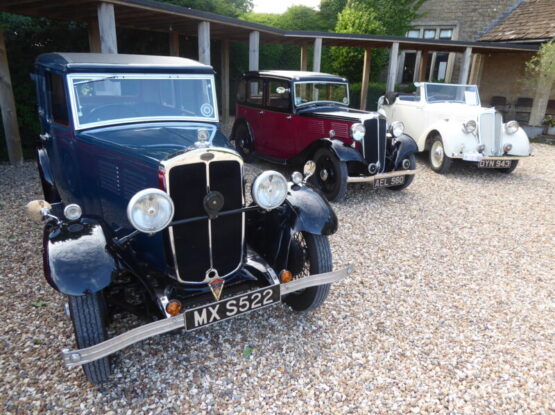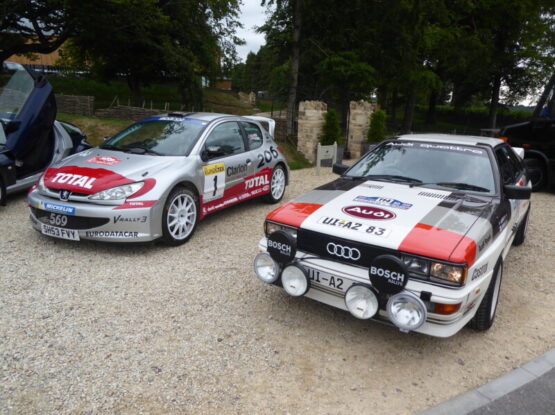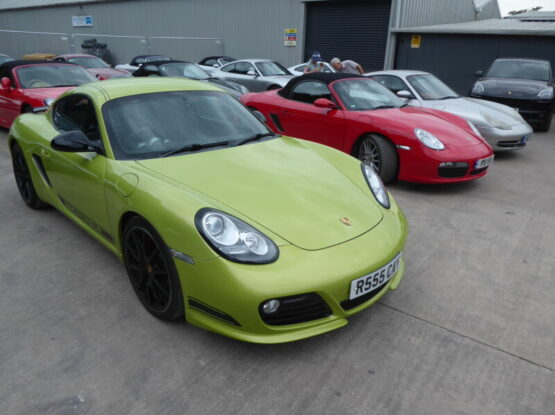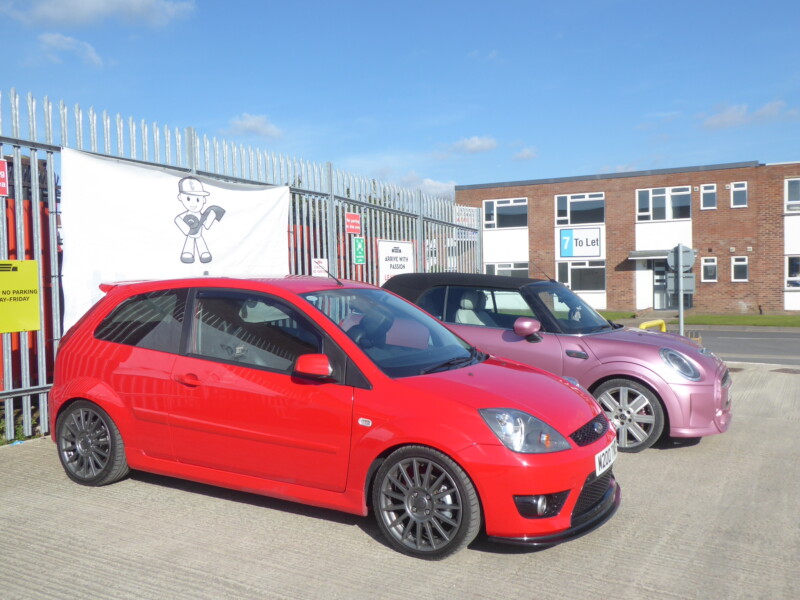
Although you would be unlikely to find Podium Place by accident, as it is located on a rather unpromising looking minor road that goes through an industrial estate to the east of the A34 and Newbury town centre, this venue is now well known by locals, car and bike enthusiasts alike. It is a popular place for people to meet up, for a coffee and a bite to eat whether they are enthusiasts or not and it is generally pretty busy at least on a weekend. I’ve been many times over the years, mostly because there has been a pre-arranged Group meeting, with Abarth Berkshire who see the venue as their sort of home, but on this occasion, it was a convenient place for the IAMC Directors to meet up and have a chat in advance of doing a recce in the centre of Newbury for a prospective event later in the year. We assembled early in the morning not long after Podium had opened so there were not many cars on site, but it did fill up whilst we were there. I decided to make a return visit after the town centre site visit was done, and the site was much fuller, with most of the cars different from the ones I had seen first thing. Here is what caught my eye:
ABARTH
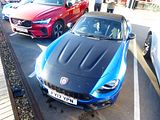
Eagerly awaited, the 124 Spider went on sale in September 2016. A quick reminder as to what this car is: The Abarth 124 Spider was developed in parallel with the Fiat model. It does cost a lot more, and there are those who think you don’t get enough extra for your money, but those who have driven it will tell you otherwise. You certainly get more power. The 1.4 MultiAir turbo unit jumps up from 138bhp to 168bhp, while torque also increases by a modest 10Nm to 250Nm, which gives it a 0-62mph time of 6.8 seconds, which is half a second quicker than the 2.0-litre Mazda MX-5. The top speed is 143mph. It weighs just 1060kg meaning a power-to-weight ratio of 158bhp-per-tonne, and with the new Record Monza exhaust system it sounds great even at idle. The Abarth version gets a stiffer suspension setup than the regular Fiat 124 Spider, with Bilstein dampers and beefed-up anti-roll bars. Bigger Brembo brakes also feature, with aluminium calipers. It can be had with a six-speed manual or six-speed automatic transmission with paddles, and the latter gets a Sport mode for quicker shifts. Many of the UK cars sport the ‘Heritage Look’ pack, which is a no-cost option. It brings a matt black bonnet and bootlid, plus red exterior trim detailing and has proved popular. The £29,565 starting price gets you standard equipment such as cruise control, climate control, Bluetooth, a DAB radio and satnav, plus Alcantara black and red (or pure black) seat trim. The automatic gearbox is a £2,035 extra, while an optional visibility pack brings LED DRLs, auto lights and wipers and rear parking sensors. The final cars were sold during 2019, so there are only around 1800 of them in the UK, which means that this is always going to be quite a rare sighting
ASTON MARTIN
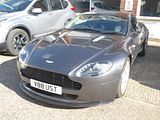
Following the unveiling of the AMV8 Vantage concept car in 2003 at the North American International Auto Show designed by Henrik Fisker, the production version, known as the V8 Vantage was introduced at the Geneva Motor Show in 2005. The two seat, two-door coupé had a bonded aluminium structure for strength and lightness. The 172.5 inch (4.38 m) long car featured a hatchback-style tailgate for practicality, with a large luggage shelf behind the seats. In addition to the coupé, a convertible, known as the V8 Vantage Roadster, was introduced later in that year. The V8 Vantage was initially powered by a 4.3 litre quad-cam 32-valve V8 which produced 380 bhp at 7,300 rpm and 409 Nm (302 lb/ft) at 5,000 rpm. However, models produced after 2008 had a 4.7-litre V8 with 420 bhp and 470 Nm (347 lbft) of torque. Though based loosely on Jaguar’s AJ-V8 engine architecture, this engine was unique to Aston Martin and featured race-style dry-sump lubrication, which enabled it to be mounted low in the chassis for an improved centre of gravity. The cylinder block and heads, crankshaft, connecting rods, pistons, camshafts, inlet and exhaust manifolds, lubrication system and engine management were all designed in house by Aston Martin and the engine was assembled by hand at the AM facility in Cologne, Germany, which also built the V12 engine for the DB9 and Vanquish. The engine was front mid-mounted with a rear-mounted transaxle, giving a 49/51 front/rear weight distribution. Slotted Brembo brakes were also standard. The original V8 Vantage could accelerate from 0 to 60 mph in 4.8 seconds before topping out at 175 mph. In 2008, Aston Martin introduced an aftermarket dealer approved upgrade package for power and handling of the 4.3-litre variants that maintained the warranty with the company. The power upgrade was called the V8 Vantage Power Upgrade, creating a more potent version of the Aston Martin 4.3-litre V8 engine with an increase in peak power of 20 bhp to 400 bhp while peak torque increased by 10 Nm to 420 Nm (310 lb/ft). This consists of the fitting of the following revised components; manifold assembly (painted Crackle Black), valved air box, right and left hand side vacuum hose assemblies, engine bay fuse box link lead (ECU to fuse box), throttle body to manifold gasket, intake manifold gasket, fuel injector to manifold seal and a manifold badge. The V8 Vantage had a retail price of GB£79,000, US$110,000, or €104,000 in 2006, Aston Martin planned to build up to 3,000 per year. Included was a 6-speed manual transmission and leather-upholstery for the seats, dash board, steering-wheel, and shift-knob. A new 6-speed sequential manual transmission, similar to those produced by Ferrari and Lamborghini, called Sportshift was introduced later as an option. An open-topped model was added to the range in 2006 and then in the quest for more power a V12 Vantage joined the range not long after.
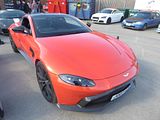
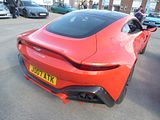
The latest and still current Aston Martin Vantage was unveiled on 21 November 2017 with production starting in June 2018, replacing the previous model which had been in production for 12 years. It introduced a new styling direction but this was not universally well received and the car had a hefty price increase over its predecessor. Muted press enthusiasm did not help and sales have been disappointing. Aston Martin have continued to develop the model with a number of new versions introduced, to try to improve demand. The Vantage AMR is a track-focused variant of the Vantage. The main highlight of the model is the replacement of the ZF 8-speed automatic transmission with a dog-leg Graziano Trasmissioni 7-speed manual transmission previously used on the V12 Vantage S. The AMR also comes with a driver-selectable AMSHIFT system which controls the throttle during gear shifting. A new limited-slip differential ensures linear delivery of power. The power-band of the engine is wider and the unit is designed to deliver 625 Nm (461 lb/ft) of torque from 2,000 rpm to 5,000 rpm. The use of a manual transmission and carbon-ceramic brakes reduce the weight by 95 kg (209 lb). New adaptive dampers with the section of Sport, Sport + and Track modes improve handling. Performance figures include a 0–97 km/h (60 mph) acceleration time of 3.9 seconds, half a second more than the standard Vantage while the top speed remains the same as the standard model. Visual changes include 20-inch forged wheels as available on the Rapide AMR, new carbon fibre side vents and cooling vents present on the hood a sports exhaust system with quad tailpipes and racing bucket seats. Production of the AMR will be limited to 200 units worldwide. Available exterior colours for the AMR include Sabiro Blue, Pnyx Black, China Grey and White Stone. The final 59 cars will be finished in a Sterling Green exterior colour with Lime accents and will pay homage to the 1959 24 Hours of LeMans victory of Aston Martin. Once the production of the AMR ceases, the 7-speed manual transmission will become available on the standard Vantage. The vehicle went on sale in May 2019, with delivery set to begin in Q4 2019. Revealed in February 2020, the Vantage Roadster is a convertible version of the V8 Coupe with a fabric roof. The roof claimed to be the fastest of any automotive automatic convertible system, takes 6.7 seconds to lower and 6.8 seconds to raise and can be operated at speeds of up to 50 km/h (31 mph). The Vantage Roadster has a dry weight of 1,628 kg (3,589 lb). The F1 Edition is a version of the V8 Coupe and V8 Roadster commemorating Aston Martin’s return to Formula One after 61 years. The car features a fixed rear wing at the back, increased engine power to 535 PS (528 bhp), a top speed of 314 km/h (195 mph), new 21-inch wheel rims, and a 0–100 km/h (0–62 mph) acceleration time of 3.5 seconds. The car is available in three colours: Aston Martin Racing Green, Jet Black, and Lunar White. A convertible version called the Roadster is also available. Delivery began in May 2021.
AUDI
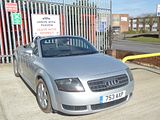
The styling of the Audi TT began in the spring of 1994 at the Volkswagen Group Design Center in California. The TT was first shown as a concept car at the 1995 Frankfurt Motor Show. The design is credited to J Mays and Freeman Thomas, with Hartmut Warkuss, Peter Schreyer, Martin Smith and Romulus Rost contributing to the interior design. A previously unused laser beam welding adaptation, which enabled seamless design features on the first-generation TT, delayed its introduction. Audi did not initially offer any type of automatic transmission option for the TT. However, from 2003, a dual clutch six-speed Direct-Shift Gearbox (DSG) became available, with the United Kingdom TT variants becoming the world’s first user of a dual clutch transmission configured for a right-hand drive vehicle, although the outright world first for a road car equipped with a dual clutch transmission was claimed earlier by a Volkswagen Group platform-mate, the left hand drive Volkswagen Golf Mk4 R32. The Audi TT takes its name from the successful motor racing tradition of NSU in the British Isle of Man TT (Tourist Trophy) motorcycle race. NSU marque began competing at the Isle of Man TT in 1907 with the UK manager Martin Geiger finishing in fifth position in the single-cylinder race. The 1938 Isle of Man Lightweight TT race was won by Ewald Kluge with a 250 cc supercharged DKW motor-cycle and the DKW and NSU companies later merged into the company now known as Audi. The TT name has also been attributed to the phrase “Technology & Tradition”. The production model (internal designation Type 8N) was launched as a coupé in September 1998, followed by a roadster in August 1999. It is based on the Volkswagen Group A4 (PQ34) platform as used for the Volkswagen Golf Mk4, the original Audi A3, the Škoda Octavia, and others. The styling differed little from the concept, except for slightly reprofiled bumpers, and the addition of rear quarterlight windows behind the doors. Factory production commenced in October 1998. Early TT models received press coverage following a series of high-speed accidents and the related fatalities which occurred at speeds in excess of 112 mph (180 km/h) during abrupt lane changes or sharp turns. Both the coupé and roadster variants were recalled in late 1999/early 2000, to improve predictability of the car’s handling at very high speeds. Audi’s Electronic Stability Programme (ESP) or Anti Slip Regulation (ASR) and rear spoiler were added, along with modifications to the suspension system. All changes were incorporated into subsequent production. Mechanically, the TT shares an identical powertrain layout with its related Volkswagen Group-mates. The TT uses a transversely mounted internal combustion engine, with either front-wheel drive or ‘quattro four-wheel drive’ available as an option. It was first available with a 1.8-litre inline four-cylinder 20-valve turbocharged engine in two states of DIN-rated power outputs; 180 PS (178 bhp) and 225 PS (222 bhp). The engines share the same fundamental design, but the 225 PS version features a larger K04 turbocharger (180 PS version came with a smaller K03), an additional intercooler on the left side (complementing the existing right-side intercooler), larger 20mm wrist-pins, a dual tailpipe exhaust, intake manifold with inlet on driver’s side, and a few other internals – designed to accommodate the increase in turbo boost, from roughly 10 pounds per square inch (0.7 bar) peak, to 15 pounds per square inch (1.0 bar). Haldex Traction enabled four-wheel drive, ‘branded’ as “Quattro” was optional on the 180 engine, and standard on the more powerful 225 version. The original four-cylinder engine range was complemented with a 3,189 cc VR6 engine rated at 250 PS (247 bhp) and 320 Nm (236 lb/ft) of torque in early 2003, which came as standard with the quattro four-wheel-drive system. In July 2003, a new six-speed dual clutch transmission – dubbed the Direct-Shift Gearbox (DSG), which improves acceleration through much-reduced shift times, was offered, along with a stiffer suspension. The second generation TT was launched in 2006.
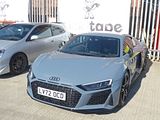
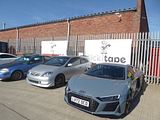
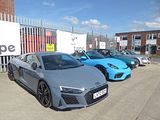
This is the second generation R8. Launched at the 2015 Geneva Motor Show and is based on the Modular Sports System platform shared with the Lamborghini Huracan. The development of the Type 4S commenced in late 2013 and was completed in late 2014. Initial models included the all-electric e-Tron and the V10 5.2 FSI along with the V10 plus. Unlike its predecessor, there was no manual transmission available and the entry-level V8 trim was also dropped. In 2016, the convertible (Spyder) variant was added to the line up which was initially available in the base V10 trim. In mid-2017, the high performance V10 plus Spyder was added to the range. A rear-wheel-drive model called the R8 RWS was introduced. In 2018, the R8 received a mid-cycle refresh with mechanical and exterior changes. The newer and more aggressive design language carried over from famous Audi models of the past and it’s appearance is slightly more angular up front. Some of the aerodynamic features such as the front aeroblades are shared with the Lamborghini Huracàn. The refreshed model had substantial performance improvements over its predecessor. The base R8 got a power boost from 532 hp to 562 hp, while the V10 Plus was renamed V10 Performance Quattro and the engine saw a power increase by 10 hp, now up to 612 hp. Production ceased a few months ago.
BENTLEY
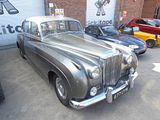
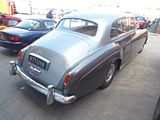
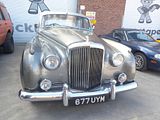
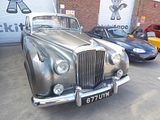
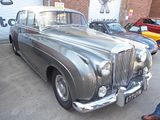
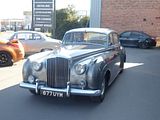
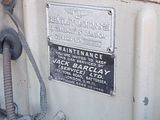
A close relative of the Rolls Royce Silver Cloud, the S Type was first revealed in April 1955. It represented a complete redesign of the standard production car, the R Type. It was a more generously sized five- or six-seater saloon with the body manufactured in pressed steel with stressed skin construction, with the doors, bonnet and boot lid made of aluminium. The external appearance was very different, although the car still had the traditional radiator grille. Compared to the outgoing R Type, the new model had a three inch longer wheelbase, was lower of build without reducing headroom and with an enlarged luggage boot, softer suspension with electrically operated control of rear dampers, lighter steering and improved braking. The engine, still a clear descendants of the one originally used in the Rolls-Royce Twenty from 1922 to 1929, had its capacity increased to 4887cc, and a four-speed automatic gearbox was standard, with the ability to select individual ratios if desired, which was enough to give the Bentley a top speed of just over 100 mph and 0 – 60 acceleration times of around 13 seconds. Standard and from 1957, long wheelbase saloons were offered and some were sent to the coachbuilders for alternative bodies to be fitted. An upgrade in 1959, creating the S2, saw the installation of a new V8 engine, and in 1962, the S3 cars gained four round headlights. 3072 S Types were made, 145 of them with coachbuilt bodies as well as 35 of the long wheelbase cars, before the model was replaced by the new T Type in 1965.
BMW
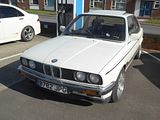
The BMW E30 is the second generation of BMW 3 Series, which was produced from 1982 to 1994 and replaced the E21 3 Series, and was the car which really saw the popularity of the 3 Series increase dramatically. . Development of the E30 3 Series began in July 1976, with styling being developed under chief designer Claus Luthe with exterior styling led by Boyke Boyer. In 1978, the final design was approved, with design freeze (cubing process) being completed in 1979. BMW’s launch film for the E30 shows the design process including Computer-aided design (CAD), crash testing and wind-tunnel testing. The car was released at the end of November 1982. Externally, the E30’s appearance is very similar to twin headlight versions of its E21 predecessor, however there are various detail changes in styling to the E30. Major differences to the E21 include the interior and a revised suspension, the latter to reduce the oversteer for which the E21 was criticised. At launch, the car had a 2 door style like its predecessor and just four engines, all of them petrol: the 316 and 318 four cylinder units and the 320 and 323i 6 cylinders. This last was soon upgraded to a 2.5 litre unit. Diesel models were added during the 80s and there was an all-wheel drive 325iX option for continental European markets. In addition to the 2 door saloon and Baur convertible body styles of its E21 predecessors, the E30 became available by early 1984 as a four-door sedan and later a five-door station wagon (marketed as “Touring”). The Touring body style began life as a prototype built by BMW engineer Max Reisböck in his friend’s garage in 1984 and began production in 1987. The factory convertible version began production in 1985, with the Baur convertible conversions remaining available alongside it. Following the launch of the E36 3 Series in 1990, the E30 began to be phased out.
The M3 model of the E90/E92/E93 3 Series range was powered by the BMW S65 V8 engine and was produced in sedan, convertible and coupé body styles. The E9x is the first and only standard production M3 powered by a V8 engine as its successor would revert to using a straight 6 engine. In the standard M3, the S65 engine rated at 420 PS (414 bhp) at 8,300 rpm and 400 Nm (295 lb/ft) at 3,900 rpm. Initially, the M3 was produced with a 6-speed manual transmission. In April 2008, the E90/E92/E93 M3 became the first BMW to be available with a dual-clutch transmission when the 7-speed Getrag “M-DCT” transmission was introduced as an option. The official 0 to 100 km/h (62 mph) acceleration times for the coupé and sedan are 4.6 seconds with the DCT transmission (4.8 seconds with the manual transmission) and 5.1 seconds for the convertible. The E90 and E92 versions received many positive reviews, including “the greatest all-around car in the world”, “the finest car on the market, period” and “the best, most complete car in the world”. The first body style to be introduced was the coupé, which was previewed at the 2007 Geneva Motor Show and introduced in production form at the 2007 Frankfurt Motor Show on 12 September. The coupé version uses a carbon fibre roof to reduce weight and lower the centre of gravity. In 2010, the coupé and convertible versions received a minor facelift, which included revised LED tail-lights and minor interior trim pieces but it did not get the updated headlights from the regular series. The E93 convertible version was introduced shortly after the coupé and uses a power retractable hardtop. The leather seats in the convertible version are treated with a coating to reflect sunlight, in order to reduce their tendency to become uncomfortably hot with the top down. A sedan version was introduced in 2008 and was the second (along with the E36) M3 by generation to be produced in a 4-door body style. The sedan has the same drivetrain and similar external styling as the coupé, however the lack of a carbon fibre roof contributes to a weight increase of 10 kg (22 lb) compared to an identically equipped coupé. The official kerb weights for the 2008 European-specification models (with manual transmission) are 1,580 kg (3,483 lb) for the coupé, 1,605 kg (3,538 lb) for the sedan and 1,810 kg (3,990 lb) for the convertible. Total production of the E9x M3 was 40,092 coupés, 16,219 convertibles and 9,674 sedans. Production of sedan models finished in 2011, with coupés remaining in production until July 5, 2013.
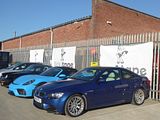
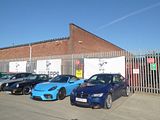
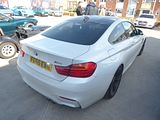
On 25 September 2013, BMW released the technical specifications of the M4. It is powered by the S55B30 engine, which is developed and engineered by BMW M GmbH. This 3.0-litre inline-6 engine has been built specifically for the new M4/M3, having a redline of 7,600 rpm with the rev limiter actuated at 7,300 rpm. The engine uses two mono-scroll turbochargers with a peak boost pressure of 18.1 psi (1.2 bar). The power is rated at 431 PS/425 hp, however this is achieved not at a specific engine speed, but is instead rated throughout the range of 5,500–7,300 rpm. The engine’s torque is rated at 550 Nm (406 lb/ft) throughout the range of 1,850–5,500. Two transmission choices are available, the 6-speed manual and the 7-speed M-DCT transmissions. The 7-speed M-DCT transmission accelerates the car from 0 to 100 km/h (62 mph) in 4.1 seconds) and the 6-speed manual transmission from 0 to 100 km/h (62 mph) in 4.3 seconds. The weight of the European specification M4 equipped with a manual transmission is 1,572 kg (3,466 lb) and with the M-DCT dual-clutch transmission, the car is some 40 kg (88 lb) heavier, losing some 80 kg (176 lb) as compared to the E92 M3. As per its E92 predecessor, the roof of the coupe model is constructed from carbon fibre (except if the optional sunroof is fitted). Carbon fibre is also used for the bootlid and engine brace. For the first time in a M3/M4 model, an electric power steering unit is used. The steering system is specifically tuned for both the M3 and M4, however it has been criticized for lacking in feel. The 18 inches (460 mm) and 19 inches (480 mm) wheel options are available with lightweight forged alloy wheels being standard. The M compound brakes come standard (with blue brake calipers), while carbon ceramic brakes (with gold brake calipers) are available as an option. The M4 features Active Sound, live amplification of the engine’s natural sound inducted into the passenger cabin via speakers in the car. BMW claims this technology has been used so that the well insulated cabin can reduce road/wind noise but still provide the driver with the sporty sound of the M powered engine. There are no artificial sound or any pre-recorded track in the system. This system was first implemented in the M5. The M4 is based on the F32 4 Series however 50 percent of its components are unique as compared to the 4 Series. The convertible variant of the M4 was announced along with its coupe sibling, also internally known as F82 or F83 M4. It shares almost everything with the coupé version, but weighs more due to its folding metal roof. The convertible weighs 1,750 kg (3,858 lb) (manual), 1,691 kg (3,728 lb) (M-DCT). The three-piece retractable hardtop folds in 20 seconds. The only significant difference between the two is the weight due to its retractable hardtop. Like its hardtop counterpart, the F83 M4 uses carbon fibre reinforced plastic to lighten and stiffen the car. Because of its extra weight it accelerates slower, taking it 0.3 seconds longer to 100 km/h (62 mph); 4.6 seconds with the manual and 4.3 seconds with the M-DCT transmission. The dynamic differences between the two variants are marginally small. Starting from the 2019 model year (production from 07/2018 onward) BMW removed the carbon fibre driveshaft so as to be able to fit an Otto Particulate Filter (OPF), necessary to comply with WLTP emissions regulations and this also meant that the M Performance Exhaust was no longer able to be offered on these cars by BMW. In February 2016, BMW announced the M4 Competition Package. The M4 Competition Package increases power output by 19 PS to 450 PS/444 hp and has a revised suspension for better handling. New springs, dampers and anti-roll bars complement the included Adaptive M Suspension. BMW also re-tuned the electronic differential and the Dynamic Stability Control to match the upgraded hardware. The interior remains largely unchanged, but Competition Package cars get new lightweight sport seats along with the M-striped woven seat belts. The exterior includes the M Sport exhaust with black chrome tailpipes and high gloss Shadow Line exterior trim. Gloss black trim is added to the kidney grille, side gills, and model badge on the trunk. With the Competition Package, the coupe version accelerates from standstill to 100 km/h (62 mph) in 4.0 seconds. There is a convertible version, and that does the run in 4.2 seconds, both coupe and convertible forms using the dual-clutch transmission.
DAIHATSU
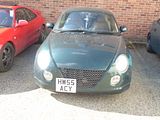
The Copen was originally designed with a 660 cc turbocharged engine in order to meet Japanese kei car regulations. However, since this engine did not meet environmental emissions standards in several other countries, the Copen was fitted with a more powerful 1.3 L non-turbo engine in these markets in 2007. Styling was inspired by the older Nissan Figaro and actual Audi TT Roadster, which has key elements found in the Copen. The leading characteristic of this model was the active top, a motorized hide-away hard roof. However, between 2002 and 2007 there existed a variation with a detachable top. This version was about 30 kg. lighter than the regular model. The Copen was never built with left-hand-drive for the first four model years (2002-2005). The right-hand-drive Copen was officially sold in Germany and some European countries from 2003 to 2005 and with smaller 660cc engine. After a lacklustre sale in Germany for the right-hand-drive Copen, Daihatsu introduced the left-hand-drive Copen with bigger 1.3 L engine for non-Japanese markets, which was announced at 2005 IAA Frankfurt, along with new trim level, ZZ. The sales increased to 802 units for model year 2006. The sales number declined greatly from 2007 until the Copen was withdrawn from German market in the summer of 2011. Daihatsu introduced 60 “farewell edition” (Abschiedsmodell) Copen in Germany. The Copen has been featured on the UK show Top Gear where James May attempted to find the best convertible car. The contestants were the Mercedes-Benz CLK, Audi A4, Citroën C3 Pluriel, Volkswagen New Beetle, and the Copen. May loved the Copen, but he had one small problem: it felt “toy-ish”. On 13 January 2011, Daihatsu announced that it would withdraw the Copen from the European market in 2011 due to the increasing strength of the Japanese Yen and sharp decline in sales from 2006 to 2011. Daihatsu announced on 2 April 2012 that the production for the Copen would cease in August 2012 with the final “10th Anniversary Edition” model. The 500 “10th Anniversary Edition” models were luxuriously appointed with leather upholstery and commemorative 10th Anniversary plate in the door openings. A second generation model has been produced but this has not been sold in Europe.
FORD
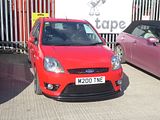
The Fiesta Mark II appeared in August 1983 with a revised front end and interior, and a bootlid mirroring the swage lines from the sides of the car. The 1.3 L OHV engine was dropped, being replaced in 1984 by a compound valve-angle hemispherical combustion chamber (CVH) powerplant of similar capacity, itself superseded by the lean burn 1.4 L two years later. The 957 and 1,117 cc Kent/Valencia engines continued with only slight alterations and for the first time a Fiesta diesel was produced with a 1,600 cc engine adapted from the Escort. The new CTX continuously variable transmission, also fitted in the Fiat Uno, eventually appeared early in 1987 on 1.1 L models only. The Mk2 Fiesta core range (excluding special editions) was made up of these model variants; Popular, Popular Plus, L, Ghia, 1.4S (1986 onwards), and finally, the XR2. The second-generation Fiesta featured a different dashboard on the lower-series trim levels compared to the more expensive variants. The XR2 model was thoroughly updated with a larger body kit. It also featured a 96 bhp 1.6 L CVH engine as previously seen in the Ford Escort XR3, and five-speed gearbox (also standard on the 1.3 L CVH models), rather than the four-speed gearbox, which had been used on the previous XR2 and on the rest of the Fiesta range. The engine was replaced by a lean-burn variant in 1986, which featured a revised cylinder head and carburettor; it was significantly cleaner from an environmental viewpoint, but was slightly less powerful as a result. A truly “hot” Fiesta was never produced by the factory to avoid impacting sales of performance Ford Escort variants, but many aftermarket conversions were available, such as that by the English firm Turbo Technics boosting power to 125 bhp. Ford appreciated the high quality of this conversion, and was keen to look after its customers; the installation was undertaken by approved fitting centres and all the warranties remained valid after. The facelifted Fiesta, facing competition from the Austin Metro, Fiat Uno, Nissan Micra, Peugeot 205, Toyota Starlet, Vauxhall Nova, and Volkswagen Polo, was one of the UK’s top superminis. In its best-ever year, 1987, over 150,000 Fiesta models were sold in the UK, though it finished second in the sales charts to the Ford Escort. It was available in Japan, sold at Ford/Mazda dealerships called Autorama; it complied with Japanese government dimension regulations, and the engine displacement was in the more favourable Japanese road tax bracket, which helped sales.
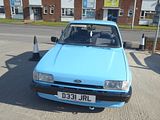
On April 1, 2002, the all-new fifth-generation car was unveiled. Production at Almussafes Plant started on April 29, 2002. Most engines were carried over from the previous Fiesta, but renamed “Duratec”, as the “Zetec” name was now solely used for sportier models. The previous push-rod 1.3 L engine was initially available in the UK, but this was quickly replaced with a RoCam 1.3 L, both under the name Duratec 8v. Trim levels available initially were Finesse, LX, Zetec, and Ghia, with limited edition variants soon following. The fifth-generation was also the first Fiesta to feature an anti-lock braking system and passenger airbags as standard. This generation became the best-selling Ford Fiesta generation to date. Engines available include 1.25, 1.3, 1.4, 1.6, and 2.0-liter petrols, plus an 8-valve 1.4 and a 16-valve 1.6-liter Duratorq TDCi common-rail diesels built in a joint venture with PSA. Fiestas sold in Asia and Australasia were all 1.6 L LX 3dr/5dr, Zetec 3dr, or Ghia 5dr. They replaced the Kia-based Festiva, the first time the Fiesta was marketed in those regions. In Brazil and Argentina, a Fiesta saloon version was introduced in late 2004. A similar Fiesta saloon model called the “Ikon”, with a different front end, was released in India in late 2005. This Fiesta generation was ergonomically and mechanically more advanced than any previous generation. The 2005 facelift came with an improved exterior. The Fiesta ST/XR4 was the performance model of this Fiesta. It includes a 2.0 L Duratec petrol engine rated at 150 PS (148 bhp) in standard form, with a top speed of 129 mph (208 km/h). The Fiesta ST also features 17 in alloy wheels, disc brakes to all wheels, different front and rear bumpers, side skirts, body colour handles and bump strips, partial leather seats or an optional extra of heated full leather seats and a ST logo on the front seat backs and on the steering wheel. In Australia, the Fiesta ST was sold as the Fiesta XR4. To stay in line with all sports model Fords sold in Australia it received the ‘XR’ badging, instead of the ‘ST’ badging used in Europe The car was replaced in 2008.
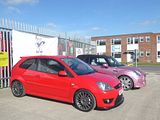
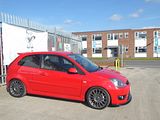
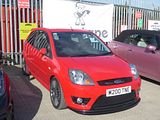
HONDA
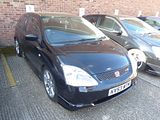
In 2001, Honda introduced the next generation of the Civic Type R as a unique 3-door hatchback to the UK market, which was manufactured in Swindon, England. This European Domestic Market Civic Type R featured a 200 PS 2.0-litre i-VTEC engine (K20A2) and the regular Type R treatment of seam welding, close-ratio 6-speed transmission and upgraded brakes, but did not include some of the other higher-end features, such as the helical LSD and red Recaro race-seats, that were standard on the EK9. However, Honda marketed a JDM (Japanese domestic market) version of the EP3 (which was exclusively manufactured in Swindon, UK and was shipped to Japan), which retained the highly renowned helical LSD similar to that of the EK9 and red Recaro race-seats. Other differences of the JDM model included a more track-oriented chassis/undercarriage settings as compared to the European model as well as a more powerful engine having a power output of 215 PS (designated K20A) had a fully balanced crankshaft assembly with the different intake manifold, exhaust manifold, higher-lift camshafts, higher-compression pistons, chrome-moly flywheel and ECU programming. All of the Japan-spec K20A Type R powertrains were built in Japan and shipped to the Swindon plant to be installed in the Japan-spec Type-R EP3. The JDM EP3 was also available in the traditional Type R Championship White while the EDM was not. The EDM has more relaxed gear ratios and some high rpm torque traded for low rpm torque compared to the JDM. In 2003, the EP3 was updated with many improvements – revised EPS with quicker steering, revised suspension settings, projector headlamps (JDM came equipped with halogens only while the EDM came with an option for HIDs with self-levelling motors), lighter clutch and flywheel assembly, etc. Based on Honda literature, this facelifted (FL) model was targeted at addressing customers’ and critics’ feedback such as understeer on the limit (due to the front MacPherson strut setup), numb steering response and lack of low-end torque. Mugen Motorsports developed an upgraded version of the JDM Civic Type R, with a sport exhaust system and engine tuning, special Mugen Grille, and anti-roll bars for pro racing activities. In 2003 Honda celebrated 30 years of the Civic badge by offering a special edition 30th Anniversary Civic Type R. This special edition features red bucket seats from Recaro, AIR CONDITIONING, privacy glass on the rear windows, a leather MOMO steering wheel, red interior carpet and door cards. The 30th Anniversary models in the UK were available in Nighthawk Black, Satin Silver and Milano Red. Only 300 of these models were produced, 100 in each colour. In 2005 towards the end of the EP3’s production run, Honda introduced the Civic Type R Premier edition which had Recaro Trendline seats (similar to those found in the Anniversary Edition, only in red and black rather than all red), a darker shade of fabric on the rear seat centre sections, a MOMO Steering Wheel, Red Carpet, Door Linings, “Type R” embossed into the front brake calipers and black privacy glass on the rear windows. Air conditioning was an option. They were available in Milano Red, Nighthawk Black, Cosmic Grey and Satin Silver. In 2004 Honda introduced the “C Package” option (¥330,000 JPY) to Japan’s Civic Type R line-up which included an additional colour, Satin Silver Metallic, HID lighting, rear privacy glass, automatic air conditioner and outside air temperature sensor. For the last production year (2005), the EP3 Type R was offered in Vivid Blue Pearl for the European Market. A total of 132 EP3’s, which were all left-hand drive, were produced in Vivid Blue Pearl.
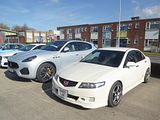
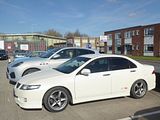
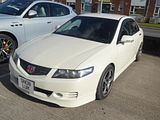
The eighth generation Honda Accord for Japanese and European markets is a mid-size car. It went on sale in mid 2008 for the 2009 model year. The Japanese-built Accord is also sold in Australia and New Zealand as the Accord Euro. It is also available in US, Canada, and Mexico as the second-generation Acura TSX. From late 2009, it is available as Honda Spirior in China. While not as large as the North American Accord, sold in Japan as the Honda Inspire, this generation Accord is not in compliance with Japanese Governments regulations concerning exterior dimensions, and is not classified as a compact sedan in Japan. Honda revealed some detail shots and a teaser video of the European-spec Accord in January 2008, before debuting it at the Geneva Motor Show in March. The new Accord comes in both sedan and wagon forms, offering a host of engine and transmission options. Available engines are the 2.0-litre i4, 2.4-litre i4, and 3.5-litre V6 i-VTEC petrol engines (V6 was US only), as well as the 2.2-litre i-DTEC diesel engine. All engines come with a 6-speed manual transmission (except Japan where all lineup was automatic transmission only), while the petrol engines get in addition to that a 5-speed automatic transmission. Dimensionally, the Accord has become longer, wider, and lower for a sleek, sporty look, along with sharper body lines and slightly redesigned headlights. Honda has built the Accord on its new ACE body structure, available with a host of new safety features. In Australia, the Euro variant of this model won the prestigious Wheels Car of the Year award for 2008. It also won the South African Car Of The Year award for 2009. In March 2012, Wheels magazine Australia compared 11 mid-sized sedans, and the Accord Euro won top position. Production ended at the end of February 2015 for Australian and New Zealand spec models, with sales lasting until the end of 2015. Sales also ended in Europe, Israel, and Turkey as well. Seen here is an Accord Euro R, a high-performance Japanese Domestic Market (JDM) sports sedan produced until 2008, featuring a 220 PS K20A engine, 6-speed manual transmission, and a limited-slip differential. It offers a balanced, daily-driver alternative to the Civic Type R with Recaro seats and stiffer suspension. It was only sold new in Japan.
JAGUAR
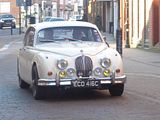
One of the most loved Jaguars of all time, both when it was new, and still now, is the Mark 2 saloon. Many will tell you that it is not the 3 Series BMW that “invented” the “compact sports saloon” car class, but this model, which dates back to 1959. A thorough revision of the small Jaguar saloon that had joined the range in 1955, the Mark 2 was notable in that it was the first car to use the Arabic numeral in its name, as opposed to the Roman numerals of the larger Jaguar models. At launch, the earlier model which had hitherto been known by its engine size was christened the Mark 1. Although clearly based on that car, the updated car looked significantly different, with an increase of 18% in cabin glass area greatly improving visibility. The car was re-engineered above the waistline. Slender front pillars allowed a wider windscreen and the rear window almost wrapped around to the enlarged side windows now with the familiar Jaguar D-shape above the back door and fully chromed frames for all the side windows. The radiator grille was amended and larger side, tail and fog lamps repositioned. Inside a new heating system was fitted and ducted to the rear compartment (although still notoriously ineffective). There was an improved instrument layout that became standard for all Jaguar cars until the XJ Series II of 1973. As well as the familiar 2.4 and 3.4 litre engines, what made this car particularly special was that it was also offered with the potent 220 bhp 3.8 litre unit that was fitted to the XK150 and which would later see service in the E Type. This gave the car a 0 – 60 time of around 8.5 seconds and a top speed of 125 mph. No wonder that the Mark 2 became popular as a get-away car for the criminal fraternity, and to keep up with and catch them, many police forces bought the car as well. With revised suspension and standard four wheel disc brakes, the car was effective on the track, taking plenty of class wins when new, and it is still popular in historic racing circles today. The quickest and most successful private entries came from John Coombs, a man with significant race experience who operated a large Jaguar dealership in Guildford. Coombs would undertake modifications to meet the demands of his customers, so not all the cars that he worked on are the same. Jaguar replaced the Mark 2 with simplified and slightly more cheaply finished 240 and 340 models, as an interim measure until an all-new model was ready to take over from them. The 3.8 litre disappeared from the range at this time, but in the 7 years it had been in production, it had been the best seller of the range, with around 30,000 cars produced, as compared to 28,666 of the 3.4 litre and 25,741 of the 2.4 litre model. This car was not actually at Podium Place but was seen whilst we were in Newbury town centre. It was too good not to include in this report, though.
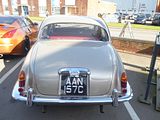
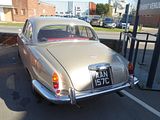
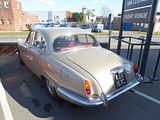
There was also an example of the S Type here. Having made 2 significant new car launches in 1961 at the top of the range, with the gargantuan Mark X and the E Type, for their next new model, Jaguar turned their attention lower down, believing that the Mark 2, based on design which had first launched in 1955 would need updating to keep it competitive. Sir William Lyons believed that the car would need to adopt some of the innovations that had been seen on the Mark X and the E Type, such as Jaguar’s new independent rear suspension and the triple SU carburettor version of the 3.8-litre XK engine Accordingly work started on a call which was codenamed “Utah Mk III”, (the Mark 2 having been “Utah Mk II”) and which made its public debut as the S Type. Both time and budget were limited, so rather than being an all new car, the S Type was a major redevelopment of the Mark 2. It used a mid-scale version of the Mark X independent rear suspension to replace the Mark 2’s live rear axle and featured revised styling, with the changes more obvious at the back with a longer tail giving more boot space. rear bodywork, with only minor changes to the front and a slightly flattened roofline, which is one reason why a lot of people have trouble distinguishing the car from its smaller brother. A more luxurious interior was fitted, with greater use of burr walnut and leather than was to be found in the Mark 2. The S Type was available with either 3.4 or 3.8-litre XK engines but only in twin carburettor form because the triple carburettor set-up would not fit into what was essentially still the Mark 2 engine bay. By the time of the S Type’s release in 1963, the Mark 2 was still selling strongly, despite its age, whereas the Mark X was selling less well than had been hoped, especially in its intended market of the USA, so Sir William decided to retain all three models in the Jaguar range concurrently. Sales of the S Type were relatively modest throughout its 6 year production life, with 9928 of the 3.4 litre and 15.065 of the 3.8 litre cars made.
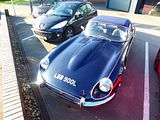
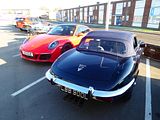
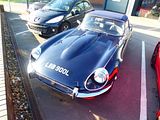
The E-Type Series 3 was introduced in 1971, with a new 5.3 L Jaguar V12 engine, uprated brakes and standard power steering. Optionally an automatic transmission, wire wheels and air conditioning were available. The V12 was equipped with four Zenith carburettors, and as introduced produced a claimed 272 bhp, more torque, and a 0–60 mph acceleration of less than seven seconds. The short wheelbase FHC body style was discontinued, with the Series 3 available only as a convertible and 2+2 coupé. The newly used longer wheelbase now offered significantly more room in all directions. The Series 3 is easily identifiable by the large cross-slatted front grille, flared wheel arches, wider tyres, four exhaust tips and a badge on the rear that proclaims it to be a V12. The first published road test of the series 3 was in Jaguar Driver, the club magazine of the Jaguar Drivers’ Club, the only owners club to be officially sanctioned by Sir William Lyons and Jaguar themselves. The road test of a car provided by Jaguar was published ahead of all the national and international magazines. Cars for the US market were fitted with large projecting rubber bumper over-riders (in 1973 these were on front, in 1974 both front and rear) to meet local 5 mph impact regulations, but those on European models were considerably smaller. US models also have side indicator repeats on the front wings. There were also a very limited number of six-cylinder Series 3 E-Types built. These were featured in the initial sales procedure but the lack of demand stopped their production. The V12 Open Two Seater and V12 2+2 were factory fitted with Dunlop E70VR − 15-inch tyres on 15 × 6K wire or solid wheels. The final production E-Type OTS Roadster was built in June 1974. Total production was 15,290.
LAMBORGHINI
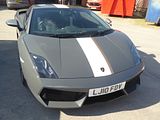
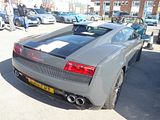
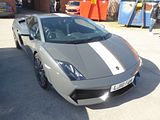
The Lamborghini Gallardo is a sports car built by the Italian automotive manufacturer Lamborghini from 2003 to 2013. Named after a famous breed of fighting bull, the V10 powered Gallardo has been Lamborghini’s sales leader and stable-mate to a succession of V12 flagship models—first to the Murciélago (4,099 built between 2001 and 2010), then to the current flagship, the Aventador. The first generation of the Gallardo was powered with an even firing 4,961 cc (5.0 L) 90 degree V10 engine generating a maximum power output of 500 PS at 7500 rpm and 510 Nm (376 lb/ft) of torque at 4500 rpm. The Gallardo was offered with two choices of transmission; a conventional (H-pattern) six-speed manual transmission, and a six-speed electro-hydraulically actuated single-clutch automated manual transmission that Lamborghini called “E-gear”. The “E-gear” transmission provides gear changes more quickly than could be achieved through a manual shift. The driver shifts up and down via paddles behind the steering wheel, but can also change to an automatic mode via the gear selector located in place of the gear shift lever. The vehicle was designed by Luc Donckerwolke and was based on the 1995 Calà prototype designed by Italdesign Giugiaro. For the 2006 model year (launched in late 2005), Lamborghini introduced many changes to the car to counter some criticisms garnered from the press and owners. The exhaust system was changed to a more sporty one (including a flap to make it quieter during city driving), the suspension was revised, a new steering rack was fitted, the engine power was increased by 20 PS to a maximum of 520 PS and the biggest change was overall lower gearing ratios, especially in 1st to 5th gear. These changes gave the car a much better performance than the original and were also included in the limited edition Gallardo SE. The convertible variant of the Gallardo, called the Gallardo Spyder, was unveiled at the Los Angeles Auto Show in January 2006. It was considered by the company to be an entirely new model, with the engine having a power output of 520 PS (382 kW; 513 hp) and a low-ratio six-speed manual transmission. The Spyder has a retractable soft-top. At the 2007 Geneva Auto Show, Lamborghini unveiled the Gallardo Superleggera. The name paid tribute to the construction style of the first Lamborghini production model, the 350 GT, designed and built by Carrozzeria Touring and its emphasis on weight reduction. The Superleggera is lighter than the base model by 100 kg (220 lb) due to the use of carbon fibre panels for the rear diffuser, undertray, the rearview-mirror housings, the interior door panels, the central tunnel, engine cover; titanium wheel nuts and carbon fibre sports seats. The engine power was uprated by 10 PS courtesy of an improved intake, exhaust and ECU for a total power output of 530 PS. The 6-speed E-Gear transmission was standard on US spec models with the 6-speed manual transmission offered as a no cost option. Production of the Superleggera amounted to 618 units worldwide. Presented at the 2008 Geneva Motor Show, the Gallardo LP 560-4 was a significant update of the Gallardo, powered by a new, uneven firing5,200 cc V10 engine that produces 560 PS at 8,000 rpm and 540 Nm (398 lb/ft) of torque at 6,500 rpm. Featuring “Iniezione Diretta Stratificata” direct fuel injection system to improve efficiency; fuel consumption and CO2 emissions have been reduced by 18% despite the increase in performance. The car was redesigned, inspired by the Murciélago LP 640 and Reventón. The new engine, 40 PS more powerful than in the previous car, comes with two transmission choices: a 6-speed manual or 6-speed E-gear, the latter of which was revised to offer a Corsa mode which makes 40% quicker shifts than before and decreases traction control restrictions, a Thrust Mode launch control system was also added. Accompanied with a 20 kg (44 lb) weight reduction. All the improvements add up to a claimed performance of 0-100 km/h (62 mph) in 3.7 seconds, 0-200 km/h (124 mph) of 11.8 and a top speed of 325 km/h (202 mph). The MSRP base price was $198,000 in the US and £147,330 (including NavTrak vehicle tracking system and delivery package) in the UK. The first US car was sold in the 16th Annual Race to Erase MS charity auction for $198,000 to former True Religion Jeans co-founder/co-creator Kymberly Gold and music producer Victor Newman. The Lamborghini Gallardo LP 560-4 Spyder was unveiled at the 2008 LA Auto Show.as the replacement for the previous Gallardo Spyder. It is the convertible model of the Gallardo LP 560-4 and as such possess all of its features like the new uneven firing 5.2 L V10 engine, improved E-gear transmission and 20 kg (44 lb) weight reduction. Performance has been improved to 0-100 km/h (62 mph) in 3.8 seconds, 0-200 km/h (124 mph) of 13.1 and a top speed of 324 km/h (201 mph) In March 2010, Lamborghini announced the release of the Gallardo LP 570-4 Superleggera, a lightweight and more powerful version of the Gallardo LP 560–4 in the same vein as the previous Superleggera. With carbon fibre used extensively inside and out to reduce weight to just 1,340 kg (2,954 lb) making it the lightest road-going Lamborghini in the range. The odd firing 5.2 L V10 on the LP 570-4 gets a power bump over the standard Gallardo to 570 PS at 8,000 rpm and 540 Nm (398 lb/ft) at 6,500 rpm of torque. Performance has been improved to 0-100 km/h (62 mph) in 3.2 seconds, and a 329 km/h (204 mph) top speed. The Gallardo became Lamborghini’s best-selling model with 14,022 built throughout its production run. On 25 November 2013, the last Gallardo was rolled off the production line. The Gallardo was replaced by the Huracán in 2014
LOTUS
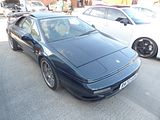
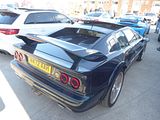
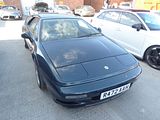
In 1987, a new version of the mid-engined Esprit was unveiled, incorporating rounder styling cues given by designer Peter Stevens (who later designed the McLaren F1). A new Lotus patented process was introduced to create the new body, called the VARI (Vacuum Assisted Resin Injection) process, which offered more advantages than the previous hand laid process. Kevlar reinforcement was added to the roof and sides for roll-over protection, resulting in an increase of the Esprit’s torsional rigidity by 22 percent. Giugiaro is said to have liked the restyling, claiming it was perhaps too close to his original design. The Stevens styled cars retained the mechanical components of the previous High Compression Esprit and Turbo Esprit, but introduced a stronger Renault transaxle, which necessitated a move to outboard rear brakes. However, the MY 1988 North American Esprit Turbo kept its Citroën SM type transaxle and the Bosch K-Jetronic fuel injection system used in the previous model year. The car’s Type 910 engine retained 215 bhp and 220 lb·ft, but decreased its zero to sixty from 5.6 seconds to a varied time between 5.4 – 5.1 seconds and a top speed of over 150 mph. The exterior style changes were accompanied by a redesign of the interior, allowing a little more space for the occupants. The Stevens styled Esprit is often known by its project code of X180. In 1989, the Esprit was again improved with the GM multi-port, electronic fuel injection system and the addition of a water to air intercooler, which Lotus has named the Chargecooler, producing the SE (Special Equipment). This inline-four engine was known as the Type 910S. Horsepower was pushed up to 264 with 280 available on overboost and zero to sixty miles per hour times reduced to 4.7 seconds with a top speed of over 160 mph. Several modifications were made to the body kit as well, like side skirts which are parallel to the body, five air ducts in the front air dam, wing mirrors from the Citroën CX and the addition of a rear wing. Along with the SE, Lotus produced the little seen Esprit S, a midrange turbocharged car offering fewer appointments and 228 hp, as well as the standard turbo still offering 215 hp . The N/A and lower-powered turbo were cancelled after 1990, and the S in 1991. Another unusual variant was a two-litre “tax special” developed for the Italian market, fitted with an intercooled and turbocharged version of a new 1,994 cc version of the venerable 900-series four-cylinder engine. Equipped with SE trim, this appeared in December 1991 and produced 243 PS at 6,250 rpm. Beginning in the autumn of 1996, this engine became available in other markets as well. The Esprit was a popular and successful addition to the American IMSA Bridgestone Supercar Championship and as a result Lotus produced the SE-based X180R, with horsepower bumped to 300 and with racing appointments. The Sport 300 was a derivative of the X180R sold in Europe, which included many modifications. These are known as the fastest of the four-cylinder Esprits and among the most desirable. In 1993, another exterior and interior revamp of the car resulted in the S4 which was the first model to include power steering. The exterior redesign was done by Julian Thompson, which included a smaller rear spoiler placed halfway up the rear decklid. Other major changes were to the front and rear bumpers, side skirts and valence panels. New five spoke alloy wheels were also included in the redesign. The S4 retained the same horsepower as the SE at 264 hp.The S4 was succeeded in 1994 by the S4s (S4 sport), which upped power to 300 bhp and 290 lb·ft of torque, improving all-around performance while retaining the comfort of the previous version. Top speed was increased to 168 mph, skidpad increased to 0.91g, an increased slalom of 61.7 mph and a 0-60 mph time of 4.6 seconds. Although the engine kept its 2.2-litre capacity, many modifications were added to improve engine performance. Some of the changes were enlarged inlet ports, cylinder head modifications, a re-calibrated ECM and a revised turbocharger. The most visible external styling changes was the addition of a larger rear wing taken from the Sport 300. In 1996 the Esprit V8 used Lotus’ self-developed all-aluminium, twin-turbocharged (Garrett T25/60 turbos) 90-degree V-8, Code-named Type 918, in front of the same Renault transmission as before with no Chargecooler. Derek Bell developed an uprated gearbox that overcame a lot of the gearbox problems with a much thicker single piece input shaft. The Type 918 engine was detuned from a potential 500 bhp to 350 bhp to prevent gearbox damage due to the fragility of the Renault UN-1 transmission. In period tests, zero to sixty miles per hour came in at 4.4 seconds and top speeds of over 175 mph were achieved. Produced alongside V8 models was the GT3, a turbocharged four-cylinder car with the type 920 2.0 litre chargecooled and turbocharged engine which had been used only in Italian market cars previously. In 1998 the V8 range was split into SE and GT specifications, both cars with a much changed interior configuration, both offering similar performance with the SE being the more luxurious of the two. The ultimate incarnation of the Esprit came in 1999 with the Sport 350. Only 50 were made, each offering 350 horsepower (per the name) and various engine, chassis and braking improvements, like the addition of AP Racing brakes, stiffer springs and a revised ECU. Several visual changes were made as well, including the addition of a large carbon fibre rear wing on aluminium uprights in place of the standard fibreglass rear wing. By this time the Esprit could reach 60 mph in 4.3 seconds as well as reaching 0-100 mph in less than 10 seconds, and weighed 1,300 kg (2,866 lb) as a result of many modifications. Thereafter, Lotus made little development aside from minor cosmetic changes including a switch to four round tail lights for the 2002 model year. Esprit production ceased in February 2004 after a 28 year production run. A total of 10,675 Esprits were produced.
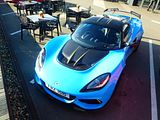
A third Series Elise was debuted in 2010 and the car has undergone almost constant enhancements ever since, with power outputs boosted considerably on the way. Revealed in November 2015, the Lotus Elise Sport and Sport 220 joined the two-seater sports car’s line-up, with the two models replacing the outgoing Elise and Elise S. The models mark a return for the ‘Sport’ name to a Lotus, with the badge last appearing on the Lotus Esprit. The two cars get a weight reduction of 10kg, with the Elise Sport now down to 866kg and the Sport 220 now 914kg. The reduced weight doesn’t improve performance but it does bring a marginal boost in claimed economy, with the Sport now managing 45.0mpg the Sport 220 improving to 37.5mpg. The changes are marginal enough that the CO2 emissions remain unchanged. Both cars also come with lightweight sports seats, which are available with optional tartan trim that harks back to the 1970s Esprit S1. Other visual upgrades and options include lightweight silver or black cast wheels, which are 16 inch at the front and 17 inch at the rear. Optional lightweight wheels can shave another 5kg off the car’s weight. A black rear diffuser is standard, along with a choice of 10 different colours. Other options include a hard roof, air conditioning, cruise control and an upgraded Clarion stereo system. The engines remained unchanged. The Sport comes with a 1.6-litre petrol engine with 134 bhp and 160 Nm (118 lb/ft) of torque. It can go 0-62mph in 6.5 seconds, and has a top speed of 127mph. The Sport 220’s 1.8-litre engine can develop 217 bhp (220 PS) and 250 Nm (184 lb/ft) of torque. It can go 0-62mph in 4.6 seconds and has a 145mph of top speed. Both come with a six-speed manual transmission. The pricing has also been trimmed, with the Elise Sport model starting at £29,900 and the Elise Sport 220 priced at £36,500. Both cars will go on sale from December 2015 in Europe and the rest of the world from January 2016. At the 2016 Geneva Motor Show, Lotus revealed the high performance version of the Elise called the Cup 250. The Cup 250 is a more track focused and hardcore version of the standard Elise. It has a 1.8 litre supercharged Toyota 2ZR-FE Inline-4 engine with a 6-speed Toyota EC60 manual gearbox with sport ratios, developing 243 bhp at 7200 rpm, giving a 0-60 mph time of 3.9 seconds and a Top speed of 154 mph. In October 2017, Lotus unveiled a hardcore version of the Elise called the Elise Cup 260. It is inspired by the two hardcore variants of the Evora and Exige line up, the Sport 380 and the GT430 respectively. It features the double taillight units and rear wing from the Exige Sport 380 and the Lotus 3-Eleven respectively. Power has also been uprated and is now 250 hp thanks to a revised supercharger. Other changes include increased top speed, acceleration, low weight and high downforce due to added aero elements. Performance was marginally improved over the 220 version. In March 2017, Lotus announced the special edition ‘Sprint’ models of the Elise. For the Elise Sprint, Lotus used several weight-saving techniques to cut the car’s weight down to 798 kg (1,759 lb). To achieve the 40 kg (88 lb) weight saving, some body parts are made in carbon, as well as the seats. The backlight glass is made of polycarbonate, and the lightweight battery is a Lithium-ion model. Wheels are the usual size, but forged instead of cast alloy. The Sprint can be had with either a 1.6-litre naturally aspirated engine, or a 1.8-litre supercharged engine, available for the Sprint 220 version. The former has a 0–60 mph of 5.9 seconds, while the Sprint 220 can accelerate from 0–60 mph in 4.1 seconds. Dampers are uprated, as on the Elise Cup models. On 9 February 2021, Lotus unveiled two final editions line-up models of Elise on online platforms. Opening the range is the Elise Sport 240 Final Edition, which sees the existing Sport 220’s 1.8-litre supercharged four-cylinder engine uprated to develop 240 bhp and 244 Nm (180 lb/ft), permitting a zero to 100km/h time of 4.5 seconds. When fully specified with weight-saving options – namely carbon-fibre sill and engine covers, a lithium-ion starter battery and a polycarbonate rear window – the Sport 240 is the lightest car on offer, tipping the scales in at just 898kg. A set of 10-spoke forged alloy wheels fill the arches, measuring 16 inches in diameter up front and 17 inches at the rear, wrapped in Yokohama Y105 tyres. Lotus claims the new wheels are 0.5kg lighter than the examples fitted to the outgoing Sport 220. The Elise Cup 250 Final Edition features a variant of the Sport 240’s 1.8-litre four-cylinder, now tuned to produce 245 bhp and 244 Nm (180 lb/ft). Lotus claims a 4.3-second 0-100km/h sprint time. This model gets an optimised aerodynamic package allowing for 155kg of downforce at its top speed of 248km/h, along with 10-spoke M Sport forged alloy wheels, Yokohama A052 tyres, Bilstein dampers and adjustable anti-roll bars. A lightweight lithium-ion battery and polycarbonate rear window are also fitted as standard for increased weight saving, and, in top spec layout, the car weighs 931kg. The Elise story came to an end in late 2021 when production of the model ceased after 25 years.
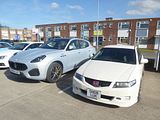
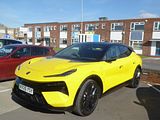
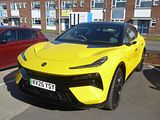
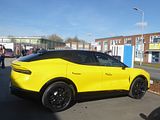
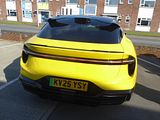
Definitely the newest car here, this was the 25 plated car I had seen on the road on what was the day for the new plates. This is the Eletre, the first all-electric Lotus and the brand’s first ever SUV. Very different from anything the marque has produced before, sales started in 2024 and having been building steadily, if not at the rate that the maker had been hoping.
MASERATI
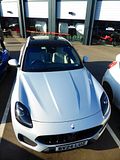
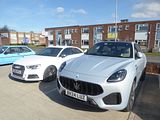
Sole Maserati here was my Grecale.

MAZDA
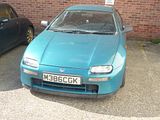
The sixth generation Familia (BG) included three-door hatchback, five-door fastback, and four-door sedan variants, none of which share any body panels. The new five-door fastback version was called the Familia Astina in Japan and was sold as the 323F or 323 Astina elsewhere. The BF wagon (originally introduced in 1985) was carried over in facelifted form, although Ford marketed a wagon on the new platform as part of the North American Escort line. The BG Familia was available with front- or all-wheel drive and a 1.3 L, 1.5 L, 1.6 L, or 1.8 L gas or 1.7 L diesel engine. Later, a turbocharged engine was added, especially developed for homologation purposes for the World Rally Championship, Group A category. The four-wheel drive models (including the turbocharged GT-X) were introduced in August 1989. In Japan, the SOHC 1.6 was only available coupled to four-wheel drive. With a carburettor, it offered 91 PS, the same as the lower-spec 1.5, but with a somewhat larger torque curve. In Europe, only the 1.8 (in naturally aspirated, 106 PS form or either of the turbocharged variants) was offered with four-wheel-drive. Production of the BG Familia mostly ended on 24 May 1994, although the 1.3-liter hatchback was kept in production until October 1996 as there was originally no 1.3 option in the following generation. In Australia, the BG model continued to be sold until 1996 as a more affordable alternative to the newer BH model.
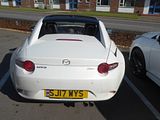
The fourth-generation Mazda MX-5 was unveiled in 2014 and has been in production since 2015. An updated model was introduced in 2019 and is visually identical to the pre-update model; it has been designated as series “ND2” due to an engine upgrade to 181 bhp and several other improvements around the car. The ND generation introduced a Retractable Fastback (RF) variant that features a rigid roof and buttresses that give the silhouette a more coupé-like appearance than the soft top convertible. The fourth generation MX-5 has received several accolades such as the 2015-2016 Car of the Year Japan Award, the 2016 World Car of the Year Award, Car and Driver’s 10Best list from 2016 to 2019, and the Red Dot Best of the Best Award in Product Design 2017. In addition, the car is the basis for the Fiat 124 Spider and Abarth 124 Spider.
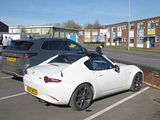
MG
MG re-entered the sports car market in 1995 with the launch of the MGF Two versions of this mid-engined and affordable rival to the Mazda MX5 were offered: both of which used the 1.8 litre K-Series 16-valve engine. The cheaper of the two put out 118 hp and the more costly VVC model (by dint of its variable valve control) had 143 hp. Rover Special Projects had overseen the development of the F’s design and before finalising the styling bought-in outside contractors to determine the most appropriate mechanical configuration for the new car. Steve Harper of MGA Developments produced the initial design concept in January 1991 (inspired by the Jaguar XJR-15 and the Ferrari 250LM), before Rover’s in house design team refined the concept under the leadership of Gerry McGovern. The MGF used the Hydragas suspension, a system employing interconnected fluid and gas displacers, which gave the car a surprisingly compliant ride and which could be tuned to provide excellent handling characteristics. The MG F quickly shot to the top of the affordable sports car charts in Britain and remained there until the introduction of the MG TF in 2002. The MG F underwent a facelift in Autumn of 1999 which gave the car a revised interior as well as styling tweaks and fresh alloy wheels designs. There was also the introduction of a base 1.6 version and a more powerful 160 hp variant called the Trophy 160, which had a 0-60 mph time of 6.9 seconds. It was only produced for a limited time. An automatic version with a CVT called the Steptronic was also introduced. A comprehensive update in 2002 resulted in the MG TF, named after the MG TF Midget of the 1950s. Based upon the MG F platform but heavily redesigned and re-engineered, the most significant mechanical changes were the abandonment of Hydragas suspension in favour of conventional coil springs, the new design of the air-induction system that along with new camshafts produces more power than in MG F engines, and the torsional stiffness of the body increased by 20%. Various cosmetic changes included a revised grille, redesigned front headlights, bumpers, side air-intake grills and changes to the rear boot,. The car continued to sell well. Production was suspended when MG-Rover went out of business, but resumed again in 2007 when Nanjing built a number more.
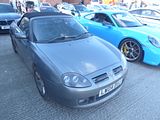
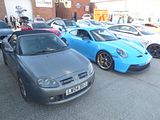
MINI
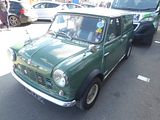
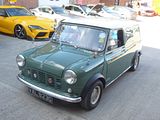
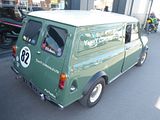
The Van version was launched in May 1960, a matter of weeks after the Countryman and Traveller had appeared and on whose extended platform this light commercial was based. The shape was the same as those Estate models, but clearly without the side windows or a rear seat. It proved popular in 1960s Britain as a cheaper alternative to the car:, as it was classed as a commercial vehicle and as such carried no sales tax. A set of simple stamped steel slots served in place of a more costly chrome grille. The Mini Van was renamed as the Mini 95 in 1978, the number representing the gross vehicle weight of 0.95 tons. 521,494 were built, but few survive.
MORGAN
NISSAN
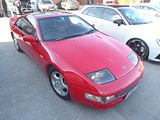
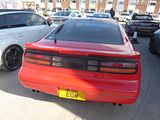
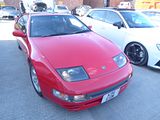
The Z32 version of the 300ZX was a new design, approved in final form by Nissan management on October 1, 1986 and designed by Isao Sono and Toshio Yamashita. The body was wider with a rounder profile and fewer hard edges. It had a marginally increased drag coefficient of .31 compared to the Z31’s .30. Unchanged from the previous generation 300ZX was the displacement of the 2,960 cc VG30 V6 engine, now with DOHC and variable valve timing (N-VCT), producing 222 bhp at 6,400 rpm and 198 lb/ft (268 Nm) at 4,800 rpm in naturally aspirated (NA) form. The twin turbocharged (TT) variant was upgraded with Garrett AiResearch parallel twin-turbochargers and dual intercoolers producing 300 bhp at 6,400 rpm and 283 lb/ft (384 Nm) of torque at 3,600 rpm. The Z32 was the first car to be marketed following the introduction of the 280 PS power ceiling imposed by JAMA that remained until 2004. Performance varied from 0-60 mph times of 5.0-6.0 seconds depending on the source, and a governed top speed of 155 mph (249 km/h). Twin Turbocharged Z32s also featured adjustable two mode suspension and the four-wheel steering systems called “Super HICAS” (High Capacity Actively Controlled Steering), first introduced on the R31 Nissan Skyline. Nissan utilized the Cray-2 supercomputer to design the new Z32 with a form of CAD software making it one of the first production cars to utilize this tool. Like previous generations, Nissan offered a 4-seater (2+2) model with the Z32. Most Z32s now featured T-tops as standard. A hardtop (Slicktop) model was available in North America, only in Naturally Aspirated guise, and in Japan was available as Naturally Aspirated as well as an extremely rare Twin Turbo model (Japan-only). All “Slicktops” were 2 seaters (2+0). In 1992, a 2-seat convertible version (produced by ASC) was introduced for the first time, in response to after-market conversions. In 1990, Motorsports International of Waco, Texas collaborated with Japanese tuning company HKS to create the SR-71 Z32. The cars were upgraded with larger Garrett turbochargers, HKS electronics and a Kaminari body kit designed for the SR-71 by Pete Brock. The SR-71 was California CARB certified and was to be sold through a select dealer network and Japanese performance tuning shops located within the United States. It was planned to build 500 cars per year through 1993. One hundred orders were already in hand. The exact number is not known. The SR-71 claimed the title of the third fastest production car in the world in 1990 for a fraction of the price of a Lamborghini Diablo and Ferrari F40 according to the designer Randy Ball. The base price was $65,000 for the Z32 and SR-71 conversion. In 1995 and 1996, Steve Millen Motorsports (Stillen), developed a SMZ model with Nissan North America that were sold throughout the U.S. and Canada through designated Nissan dealerships. The performance upgrades were covered by the factory warranty. Each vehicle was numbered in the engine bay and interior. A total of 104 SMZs were produced at $14,000 more than the standard Nissan Z32 Twin Turbo. American Z-car sales reached one million sales during the 1990 model year, making it at that time the best selling sports car. In America the 300ZX faced the same fate of many Japanese sports cars of the time. While the 1989 300ZX was priced at around $30,000, its final model year price increased to about $50,000. The mid-1990s marketplace trends toward SUVs and the rising Yen:Dollar ratio contributed to the end of North American 300ZX sales in 1996 with over 80,000 in sales. A Commemorative Edition for the final 300 units shipped to America included decals and certificates of authenticity. In the UK & Europe, all Z32s offered were in 2+2 TT form between 1990 and 1996 (1990-1994 for UK). They were sold through dealerships in the UK, France, Germany, Belgium and Italy. In Australia, all Z32s offered were in 2+2 NA form between 1990 to 1995. In Japan, the 300ZX continued until August 2000. The Japanese Domestic Market was offered a number of variants unavailable to the international market such as the “Version S” (Spec Model), “Version R” (Ready Model) and Slicktop Twin Turbo (the most expensive trim option only available in Version S guise). The facelift of late 1998 featured a new front fascia, tail lights, optional Xenon HID headlights, optional rear spoiler, optional BBS mesh wheels, orange rear corner lights and an instrument cluster with white dials as well as other minor changes. Early model Z32s (made pre-1994) and sold in Japan did not have Exhaust Gas Recirculation systems nor Air Injection Valve systems. All JDM Z32s used a front rebar system made out of fiberglass rather than steel (like their American Market counterparts), and also had different exhaust systems with lighter weight Catalytic Converters (with only one set on the JDM Twin Turbo model vs. two sets on the USDM Twin Turbo models). Given the lack of these regulatory items, JDM Z32s often weighed 100+lbs (45+kg) less than their American specification counterparts. The Z32 chassis underwent some changes during its production run between 1989 and 2000 (Japan) and 1990 to 1996 (US). The Z32’s extended model year sales in 1990 reached 39,290 units.
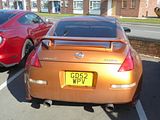
Released on July 2002 in Japan at reorganized Nissan Japanese dealerships called Nissan Blue Stage, and August 20, 2002 in the US., the 350Z coupé was available in 5 trim packages: ‘350Z’ (Base), ‘Enthusiast’, ‘Performance’, ‘Touring’, and ‘Track’ editions. In Europe, only the ‘Track’ trim was available, although it was badged and marketed as ‘350Z’. The Base model did not include a VLSD or Traction Control and was only available with cloth seats. It did not include cruise control, nor power or heated seats. The Enthusiast model came with traction control, a VLSD, and cruise control. The Performance model came with bigger 18-inch wheels, front air dam, rear spoiler, optional Brembo brakes, and VDC instead of Traction Control. Touring was made more of the luxury model. It had power, leather, heated seats, VDC, a VLSD, xenon headlamps, optional Brembos, 18-inch wheels, and optional GPS. The Track model included Brembo brakes, front air dam, rear spoiler, traction control, cloth seats, 18-inch wheels, VLSD, and optional GPS. In 2004 Nissan introduced the 350Z Roadster with an electrically retractable soft-top roof. In the U.S. market the car was available in two trim packages (Enthusiast and Touring), while in Europe, the same versions as the coupé were offered. Nissan added the Grand Touring (GT) trim to the Roadster trim packages for 2005. In 2005 Nissan launched a 35th Anniversary edition, with a revised exterior and interior. Early 2005 model-year 35th anniversary edition models were equipped with the original VQ35DE with 287 hp and automatic transmission. In January 2005, Nissan introduced the 35th Anniversary 6-speed manual models and Track models (mid-year introduction), which included the updated VQ35DE 300 hp Rev-up engine and new updated CD009 manual transmission. As well as minor changes to suspension tuning and parts. For the 2006 model year, the 350Z received changes for its mid-cycle facelift. The VQ35DE 300 hp Rev-up engine that was introduced mid-year 2005 on the Track and 35th Anniversary Edition with 6-speed manual transmission models was offered for every trim level that had a manual transmission option. The VQ35DE with 287 hp continued to be offered with only the 5-speed automatic. Additions included bi-xenon projectors, a revised front fascia, new LED rear lights, changes to the interior trim and speed sensitive steering. Touring and Grand Touring models had radio-steering controls standard, MP3 CD compatibility, and Satellite Radio became an available option. For the 2007 model year, the 350Z was again moderately revised. The VQ35DE V6 was replaced with a new VQ35HR V6. It produced 306 hp at 6800 rpm with 268 ft·lb at 4800 rpm using the revised SAE certified power benchmark. The VQ35HR had a raised redline to 7500 rpm and more torque across the rpm range. The bonnet was redesigned with a bulge reminiscent of the original 240Z to accommodate the raised deck height of the new VQ35HR. In the US, trim levels were narrowed down to 350Z (base), Enthusiast, Touring, and Grand Touring, while in Europe the same trim levels remained. Bluetooth was added for the 2007 model year. The car was replaced by the 370Z for the 2009 model year. It has never found quite the same levels of enthusiasm that greeted – and have stayed with – the 350Z.
NOBLE
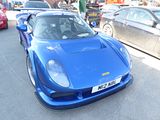
Follow on to the Noble M10, the M12 was a two-door, two-seat model, originally planned both as a coupe and as a convertible. All M12s were powered by modified bi-turbocharged Ford Duratec V6 engines. There was a full steel roll cage, steel frame, and G.R.P. (fibreglass) composite clam shell body parts. Although looking to be track derived, the M12 was street-legal, ready for both road and track. The M12 has no anti-roll bars on the car, allowing for a comfortable feel. The coupe evolved through four versions of Noble cars, with the 425 bhp M400 as the ultimate version of the M12, following the first 2.5 litre 310 bhp car, the 352 bhp 3 litre GTO-3 and the GTO-3R. The car was sold in the US, where it proved quite popular, with 220 GTO-3Rs and M400s sold there. US production rights were sold in February 2007 to 1G Racing from Ohio. Due to high demand of these cars, 1G Racing (now Rossion Automotive) released its own improved car based on the M400, named Rossion Q1. Another company which is also producing a model developed from the M12 is Salica Cars 1 with their Salica GT and Salica GTR.
PORSCHE
The 911 continued to evolve throughout the 1960s and early 1970s, though changes initially were quite small. The SC appeared in the autumn of 1977, proving that any earlier plans there had been to replace the car with the front engined 924 and 928 had been shelved. The SC followed on from the Carrera 3.0 of 1967 and 1977. It had the same 3 litre engine, with a lower compression ratio and detuned to provide 180 PS . The “SC” designation was reintroduced by Porsche for the first time since the 356 SC. No Carrera versions were produced though the 930 Turbo remained at the top of the range. Porsche’s engineers felt that the weight of the extra luxury, safety and emissions equipment on these cars was blunting performance compared to the earlier, lighter cars with the same power output, so in non-US cars, power was increased to 188 PS for 1980, then finally to 204 PS. However, cars sold in the US market retained their lower-compression 180 PS engines throughout. This enabled them to be run on lower-octane fuel. In model year 1980, Porsche offered a Weissach special edition version of the 911 SC, named after the town in Germany where Porsche has their research centre. Designated M439, it was offered in two colours with the turbo whale tail & front chin spoiler, body colour-matched Fuchs alloy wheels and other convenience features as standard. 408 cars were built for North America. In 1982, a Ferry Porsche Edition was made and a total of 200 cars were sold with this cosmetic package. SCs sold in the UK could be specified with the Sport Group Package (UK) which added stiffer suspension, the rear spoiler, front rubber lip and black Fuchs wheels. In 1981 a Cabriolet concept car was shown at the Frankfurt Motor Show. Not only was the car a true convertible, but it also featured four-wheel drive, although this was dropped in the production version. The first 911 Cabriolet debuted in late 1982, as a 1983 model. This was Porsche’s first cabriolet since the 356 of the mid-1960s. It proved very popular with 4,214 sold in its introductory year, despite its premium price relative to the open-top targa. Cabriolet versions of the 911 have been offered ever since. 911 SC sales totalled 58,914 cars before the next iteration, the 3.2 Carrera, which was introduced for the 1984 model year. Coupe models outsold the Targa topped cars by a big margin.
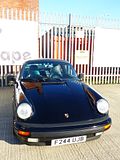
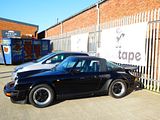
During the 1990s, Porsche was facing financial troubles and rumours of a proposed takeover were being spread. The signature air-cooled flat-6 of the 911 was reaching the limits of its potential as made evident by the 993. Stricter emissions regulations world wide further forced Porsche to think of a replacement of the air-cooled unit. In order to improve manufacturing processes, Porsche took the aid of leading Japanese car manufacturer Toyota whose consultants would assist in the overhaul of the Zuffenhausen manufacturing facility introducing mass production techniques which would allow Porsche to carry out production processes more efficiently. Porsche had realised that in order to keep the 911 in production, it would need radical changes. This led to the development of the 996. The sharing of development between the new 911 and the entry level Boxster model allowed Porsche to save development costs. This move also resulted in interchangeable parts between the two models bringing down maintenance costs. The Porsche 996 was a new design developed by Pinky Lai under Porsche design chief Harm Lagaay from 1992 to 1994; it was the first 911 that was completely redesigned, and carried over little from its predecessor as Porsche wanted the design team to design a 911 for the next millennium. Featuring an all new body work, interior, and the first water-cooled engine, the 996 replaced the 993 from which only the front suspension, rear multi-link suspension, and a 6-speed manual transmission were retained in revised form. The 996 had a drag coefficient of Cd=0.30 resulting from hours spent in the wind tunnel. The 996 is 185 mm (7 in) longer and 40 mm (2 in) wider than its predecessor. It is also 45% stiffer courtesy of a chassis formed from high-strength steel. Additionally, it is 50 kg (110 lb) lighter despite having additional radiators and coolant. All of the M96 engines offered in the 996 (except for the variants fitted to the Turbo and GT2/GT3 models) are susceptible to the Porsche Intermediate Shaft Bearing issue which can potentially cause serious engine failure if not addressed via a retrofit. The 996 was initially available in a coupé or a cabriolet (Convertible) bodystyle with rear-wheel drive, and later with four-wheel drive, utilising a 3.4 litre flat-6 engine generating a maximum power output of 296 bhp. The 996 had the same front end as the entry-level Boxster. After requests from the Carrera owners about their premium cars looking like a “lower priced car that looked just like theirs did”, Porsche redesigned the headlamps of the Carrera in 2002 similar to the high performance Turbo’s headlamps. The design for the initial “fried egg” shaped headlamps could be traced back to the 1997 911 GT1 race car. In 2000, Porsche introduced the 996 Turbo, equipped with a four-wheel-drive system and a 3.6-litre, twin-turbocharged and intercooled flat-six engine generating a maximum power output of 420 bhp, making the car capable of accelerating from 0–60 mph in 4.2 seconds. An X50 option which included larger turbochargers and intercoolers along with revised engine control software became available from the factory in 2002, increasing power output to 451 bhp. In 2005, Porsche introduced the Turbo S, which had the X50 option included as standard equipment, with the formerly optional Carbon fibre-reinforced Silicon Carbide (C/SiC) composite ceramic brakes (PCCB) also included as standard. In 2000, power output on the base Carrera model was increased to 300 bhp. 2001 marked the final year of production for the base Carrera 4 Coupé in narrow body format. In 2002, the standard Carrera models underwent the above-mentioned facelift. In addition, engine capacity was also increased to 3.6-litres across the range, yielding gains of 15 bhp for the naturally aspirated models. 2002 also marked the start of the production of the 996 based Targa model, with a sliding glass “green house” roof system as introduced on its predecessor. It also features a rear glass hatch which gave the driver access to the storage compartment. Also in 2002, the Carrera 4S model was first introduced.
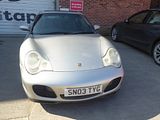
The 991 introduced in 2012 is an entirely new platform, only the third since the original 911. Porsche revealed basic information on the new Carrera and Carrera S models on 23 August 2011. The Carrera is powered by a 350 hp 3.4-litre engine. The Carrera S features a 3.8-litre engine rated at 400 hp. A Power Kit (option X51) is available for the Carrera S, increasing power output to 430 hp. The new 991’s overall length grows by 56 mm (2.2 in) and wheelbase grows by 99 mm (3.9 in) (now 96.5 in.) Overhangs are trimmed and the rear axle moves rearward at roughly 76 mm (3 in) towards the engine (made possible by new 3-shaft transmissions whose output flanges are moved closer to the engine). There is a wider front track (51 mm (2 in) wider for the Carrera S). The design team for the 991 was headed by Michael Mauer. At the front, the new 991 has wide-set headlights that are more three-dimensional. The front fender peaks are a bit more prominent, and wedgy directionals now appear to float above the intakes for the twin coolant radiators. The stretched rear 3/4 view has changed the most, with a slightly more voluminous form and thin taillights capped with the protruding lip of the bodywork. The biggest and main change in the interior is the center console, inspired by the Carrera GT and adopted by the Panamera. The 991 is the first 911 to use a predominantly aluminium construction. This means that even though the car is larger than the outgoing model, it is still up to 50 kilograms (110 lb) lighter. The reduced weight and increased power means that both the Carrera and Carrera S are appreciably faster than the outgoing models. The 0–60 mph acceleration time for the manual transmission cars are 4.6 seconds for the Carrera and 4.3 seconds for the Carrera S. When equipped with the PDK transmission, the two 991 models can accelerate from 0–97 km/h in 4.4 seconds and 4.1 seconds. With the optional sports chrono package, available for the cars with the PDK transmission, the 991 Carrera can accelerate from 0–97 km/h in as little as 4.2 seconds and the Carrera S can do the same in 3.9 seconds. Apart from the reworked PDK transmission, the new 991 is also equipped with an industry-first 7-speed manual transmission. On vehicles produced in late 2012 (2013 model year) Rev Matching is available on the 7-speed manual transmission when equipped with the Sport Chrono package. Rev-Matching is a new feature with the manual transmission that blips the throttle during downshifts (if in Sport Plus mode). Also, the 7th gear cannot be engaged unless the car is already in 5th or 6th gear. One of Porsche’s primary objectives with the new model was to improve fuel economy as well as increase performance. In order to meet these objectives, Porsche introduced a number of new technologies in the 911. One of the most controversial of these is the introduction of electromechanical power steering instead of the previous hydraulic steering. This steering helps reduce fuel consumption, but some enthusiasts feel that the precise steering feedback for which the 911 is famous is reduced with the new system.[citation needed] The cars also feature an engine stop/start system that turns the engine off at red lights, as well as a coasting system that allows the engine to idle while maintaining speed on downhill gradients on highways. This allows for up to a 16% reduction in fuel consumption and emissions over the outgoing models. The new cars also have a number of technologies aimed at improving handling. The cars include a torque vectoring system (standard on the Carrera S and optional on the Carrera) which brakes the inner wheel of the car when going into turns. This helps the car to turn in quicker and with more precision. The cars also feature hydraulic engine mounts (which help reduce the inertia of the engine when going into turns) as part of the optional sports chrono package. Active suspension management is standard on the Carrera S and optional on the Carrera. This helps improve ride quality on straights while stiffening the suspension during aggressive driving. The new 991 is also equipped with a new feature called Porsche Dynamic Chassis Control (PDCC). Porsche claims that this new feature alone has shaved 4 seconds off the standard car’s lap time around the Nürburgring. PDCC helps the car corner flat and is said to improve high-speed directional stability and outright lateral body control, but according to several reviews, the car is more prone to understeer when equipped with this new technology. In January 2013, Porsche introduced the all-wheel-drive variants of the Carrera models. The ‘4’ and ‘4S’ models are distinguishable by wider tyres, marginally wider rear body-work and a red-reflector strip that sits in between the tail-lights. In terms of technology, the 4 and 4S models are equipped with an all-new variable all-wheel-drive system that sends power to the front wheels only when needed, giving the driver a sense of being in a rear-wheel-drive 911. In May 2013, Porsche announced changes to the model year 2014 911 Turbo and Turbo S models, increasing their power to 513 hp on the ‘Turbo’, and 552 hp on the ‘Turbo S’, giving them a 0–97 km/h acceleration time of 3.2 and 2.9 seconds, respectively. A rear-wheel steering system has also been incorporated on the Turbo models that steers the rear wheels in the opposite direction at low speeds or the same direction at high speeds to improve handling. During low-speed manoeuvres, this has the virtual effect of shortening the wheelbase, while at high speeds, it is virtually extending the wheelbase for higher driving stability and agility. In January 2014, Porsche introduced the new model year 2015 Targa 4 and Targa 4S models. These new models come equipped with an all-new roof technology with the original Targa design, now with an all-electric cabriolet roof along with the B-pillar and the glass ‘dome’ at the rear. In September 2015, Porsche introduced the second generation of 991 Carrera models at the Frankfurt Motor Show. Both Carrera and Carrera S models break with previous tradition by featuring a 3.0-litre turbocharged 6-cylinder boxer engine, marking the first time that a forced induction engine has been fitted to the base models within the 911 range
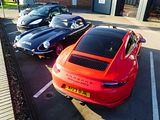
The RS version of the 991 GT3 was launched at the 2015 Geneva Motor Show, and featured in first drive articles in the press a few weeks later, with cars reaching the UK in the summer and another series of universally positive articles duly appearing. It had very big shoes to fill, as the 997 GT3 RS model was rated by everyone lucky enough to get behind the wheel, where the combination of extra power and reduced weight made it even better to drive than the standard non-RS version of the car. A slightly different approach was taken here, with the result weighing just 10kg less than the GT3. It is based on the extra wide body of the 991 Turbo. Compared to the 991 GT3, the front wings are now equipped with louvres above the wheels and the rear wings now include Turbo-like intakes, rather than an intake below the rear wing. The roof is made from magnesium a bonnet, whilst the front wings, rear deck and rear spoiler all in carbonfibre-reinforced plastic (CFRP), the rear apron is in a new polyurethane-carbonfibre polymer and polycarbonate glazing is used for the side and rear windows. The wider body allows the RS’s axle tracks to grow, to the point where the rear track is some 72mm wider than that of a standard 3.4-litre Carrera and the tyres are the widest yet to be fitted to a road-going 911. A long-throw crankshaft made of extra-pure tempered steel delivers the 4mm of added piston stroke necessary to take the GT3’s 3.8-litre flat six out to 3996cc . The engine also uses a new induction system, breathing through the lateral air intakes of the Turbo’s body rather than through the rear deck cover like every other 911. This gives more ram-air effect for the engine and makes more power available at high speeds. It results in an output of 500 bhp and 339 lb/ft of torque. A titanium exhaust also saves weight. The suspension has been updated and retuned, with more rigid ball-jointed mountings and helper springs fitted at the rear, while Porsche’s optional carbon-ceramic brakes get a new outer friction layer. Which is to say nothing of the RS’s biggest advancement over any other 911: downforce. The rear wing makes up to 220kg of it, while the front spoiler and body profile generates up to 110kg. In both respects, that’s double the downforce of the old 997 GT3 RS 4.0. The transmission is PDK only. The result is a 0-62 mph time of just 3.3 seconds, some 0.6 seconds quicker than the 997 GT3 RS 4.0 and 0-124 mph (0-200kmh) in 10.9 seconds. The 991 GT3 RS also comes with functions such as declutching by “paddle neutral” — comparable to pressing the clutch with a conventional manual gearbox –- and Pit Speed limiter button. As with the 991 GT3, there is rear-axle steering and Porsche Torque Vectoring Plus with fully variable rear axle differential lock. The Nürburgring Nordschleife time is 7 minutes and 20 seconds. The interior includes full bucket seats (based on the carbon seats of the 918 Spyder), carbon-fibre inserts, lightweight door handles and the Club Sport Package as standard (a bolted-on roll cage behind the front seats, preparation for a battery master switch, and a six-point safety harness for the driver and fire extinguisher with mounting bracket). Needless to say, the car was an instant sell out, even at a starting price of £131,296.
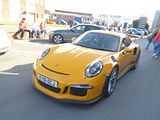
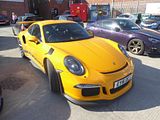
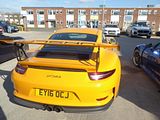
In February 2021, Porsche introduced the 992’s GT3 version. Like most other GT3 Porsches, it is intended for mixed usage with a more track-focused setup. It uses the same 4.0 litre naturally aspirated flat-6 as the 991.2, and producing over 510 PS (503 hp). It reaches 100 km/h (62 mph) in 3.4 seconds while the top speed is 320 km/h (199 mph). The 992 GT3 recently set a lap time at Nürburgring Nordschleife with a time of 6:55.34 minutes. Unlike the standard model, the GT3 features a large rear spoiler with larger air vents, a bigger diffuser, two large exhaust connections, bucket seats in its interior, and an optional roll cage. The GT3 uses a 7-speed PDK or a 6-speed manual instead of the 7-speed manual or 8-speed PDK used in other models.
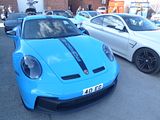
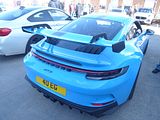
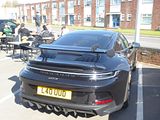
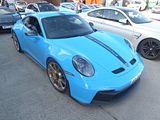
Also here was the regular version of the 992.
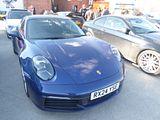
On 5 November 2009, Porsche officially announced a new variant of the Boxster, which was officially unveiled at the 2009 Los Angeles Motor Show. Positioned above the Boxster S, the Boxster Spyder was the lightest Porsche on the market at the time, weighing 1,275 kg (2,811 lb), 80 kg (176 lb) lighter than a Boxster S. This was achieved through the elimination of the conventional soft top’s operating mechanism, the radio/PCM unit, door handles, air conditioning, storage compartments, cup holders and large LED light modules on the front fascia, although some of these could be re-added to the car in the form of options. Weight saving was also gained using aluminum doors, an aluminum rear deck and the lightest 19-inch wheels in the Porsche pallet. The Spyder has a firmer suspension setup than the other Boxster models, and is almost one inch lower in order to have improved handling. A manually operated canvas top, carbon fibre sports bucket seats and two signature humps running along the back of the vehicle provide characteristic design elements. It is powered by a six-cylinder boxer engine rated at 320 PS and 273 lb/ft (370 Nm) of torque, a 10 bhp increase in power over the Boxster S and the related Cayman S. The Boxster Spyder came with a 6-speed manual transmission as standard and had Porsche’s 7-speed PDK dual-clutch gearbox available as an option. The vehicle was released worldwide in February 2010 as a 2011 model.
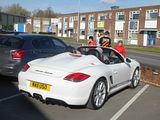
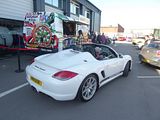
Also here was an example of the latest and still current Boxster, known as the 982 series.
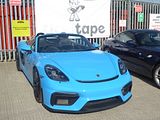
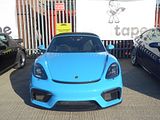
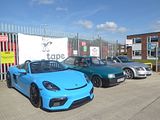
TOYOTA
Needing little introduction, perhaps, is this car, a 2nd generation MR2. Toyota proved that the market for small affordable sports cars was far from dead when they launched the first generation MR2 in 1984. As was the trend at the time among Japanese manufacturers, models were replaced on quite a regular 4/5 year cycle, so it was little surprise when a second generation car appeared in 1989. However, this one would go on to be produced for 10 years, The overall design changed little in that time, but there were lots of small details that were refined during that time. The car was generally well received, with its “mini Ferrari” looks proving quite an attraction, as were the willing engines and the entertaining handling. There are not that many nice clean examples left now, though.
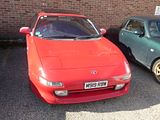
TRIUMPH
Contemporary Triumph marketing advertised the GT6 as being developed from the “race winning Le Mans Spitfires” to capitalise on their aesthetic similarities, whereas the Le Mans Spitfires and the GT6 were actually two entirely separate development programmes (the GT programme pre-dating the racing programme). However, the marketing spin was so successful that many people erroneously believed the Le Mans Spitfires to actually be GT6s. The production car was introduced in 1966 and called the Triumph GT6. The new body was a sleek fastback design with an opening rear hatch which gave the GT6 the nickname “Poor man’s E-Type”. It was really a 2-seater, but a small extra rear seat could be ordered if required and was large enough for small children. The family resemblance to the Spitfire Mk II was strong, the longer 6-cylinder engine necessitated a new bonnet top with a power bulge and the doors were provided with opening quarter light windows and squared-off glass in the top rear corner. The 6-cylinder engine was tuned to develop 95 bhp at 5000 rpm, and produced 117 lb·ft of torque at 3000 rpm. The increased power necessitated certain changes to the Spitfire mechanics; the radiator was new and mounted further forward in the car and the gearbox was the stronger unit from the Vitesse, with optional overdrive. Front springs were uprated to cope with the extra weight of the new engine. The overall vehicle weight unladed was 1,904 lb (864 kg). The interior of the GT6 was well equipped; a wooden dashboard housed a full complement of instruments, with carpets and heater included as standard. The new car had some very strong selling points. The new engine provided a 106 mph top speed and 0–60 mph in 12 seconds, a little better than the MGB GT. Moreover, the unit was comparatively smooth and tractable, in marked contrast to the MG’s rather harsh 4-cylinder engine. Fuel economy was very reasonable for the period at 20mpg, and the interior well up to the competition. The only major criticism was of its rear suspension; the GT6 inherited the swing-axle system from the Spitfire, which in turn was copied from the Herald small saloon. In the saloon it was tolerated, in the little Spitfire it was not liked and in the powerful GT6 it was heavily criticised. Triumph had done nothing to improve the system for the GT6 and the tendency to break away if the driver lifted off the power mid-corner was not helped at all by the increased weight at the front of the car. The handling was most bitterly criticised in the USA, an important export market for Triumph, where they were traditionally very strong. Similar criticism was being levelled at the Vitesse saloon, which shared the GT6’s engine and its handling problems. Triumph realised that they needed to find an answer to the handling problem, if only to maintain their reputation in the USA. Their response came with the 1969 model year, with the introduction of the GT6 Mk II, known in the States as the GT6+. The rear suspension was significantly re-engineered using reversed lower wishbones and Rotoflex driveshaft couplings, taming the handling and turning the Triumph into an MGB beater. The Vitesse was also modified, but the Spitfire had to wait until 1970 for any improvements to be made. There were other changes for the Mk II; the front bumper was raised (in common with the Spitfire Mk.3) to conform to new crash regulations, necessitating a revised front end, and side vents were added to the front wings and rear pillars. Under the bonnet, the engine was uprated to develop 104 bhp with a new cylinder head, camshaft, and manifolds. Performance improved to 107 mph but perhaps more noteworthy the 0–60 mph time dropped to 10 seconds. The fuel economy was also improved to 25 mpg. The interior was updated with a new dashboard and better ventilation, a two-speed heater fan and a black headlining. Overdrive remained a popular option for the manual transmission. A further update to the Series 3 came in the autumn of 1970, at the same time as the Spitfire Mark IV was launched, but sales remained low and the car was deleted in the autumn of 1973 with production having reached 40,926 examples.
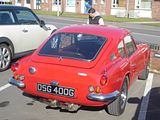
VAUXHALL
The front-wheel drive Opel Corsa was first launched in September 1982. It went on sale first in France, Italy, and Spain – markets where small cars represented from 34 to 43 percent of sales. Built-in Zaragoza, Spain, the first Corsas were three-door hatchback and two-door saloon models, with four-door and five-door versions arriving in 1984. In certain markets, commercial “van” models were also sold, with or without rear windows depending on local requirements. In mainland Europe, the saloon versions were known as the “Corsa TR” until May 1985 and received an egg-crate grille rather than the four slits used on hatchbacks. The saloons were intended to appeal to customers of the Opel Kadett C and its sister the Vauxhall Chevette who still desired a traditional 3-box sedan shape – but it did not sell particularly well in most of Europe but were popular in Spain and Portugal, among other markets. While only taking ten percent of French Corsa sales during the car’s first half-year, the TR represented half of all Corsas sold in Spain. The basic trim level was called just the Corsa, which was followed by the Corsa Luxus, Corsa Berlina, and the sporty Corsa SR. The SR receives a spoiler which surrounds the rear window, alloy wheels, checkered sport seats, and a somewhat more powerful 70 PS engine. Six years later, the Corsa received a facelift, which included a new front fascia and some other minor changes. The models were called LS, GL, GLS, and GT. The Corsa A was known in the United Kingdom market as the Vauxhall Nova (as it was considered that Corsa sounded too much like “coarser”), where it was launched in April 1983, following a seven-month-long union dispute due to British workers being angry about the car not being built there, in contrast to the rival Ford Fiesta, Austin Metro and Talbot Samba. In addition, there was also a dispute about the disparity of import tariffs, as while cars exported from Spain to the European Community were subject to tariffs of only 4.4 per cent, those exported in the other direction were subject to tariffs as high as 36.7 per cent. Power first came from 1.0 L 45 hp, 1.2 L 55 hp, and 1.3 L 70 hp petrol engines. (The first engines were all equipped with carburettors; fuel injection came later, but never for the 1.0.) The engines were based on the well proven Family II design, except for the 1.0 L and early 1.2 L engines, which were based on the OHV unit from the Kadett C. There was also an Isuzu-built, 67 PS 1.5 L turbo diesel engine available, which was also used in the Isuzu Gemini at around the same time. The diesel joined the line up in May 1987, at the Frankfurt Motor Show, along with the sporty GSi. The engines and most of the mechanical componentry were derived from those used in the Astra/Kadett. In September 1987 the Corsa received a light facelift, with a new grille that was now the same on hatchbacks and sedans, an updated interior, and other slight changes. For the 1989 model year, the 1.3 was bored out to 1.4 liters. Power remained the same, although torque increased. A rare “Sport” model was produced in 1985 to homologate for the sub 1,300 cc class of Group A for the British Rally Championship. These Sport models were white and came with unique vinyl decals, a 13SB engine with twin Weber 40 DCOE carburettors, an optional bespoke camshaft, a replacement rear silencer, and few luxuries. This gave 93 hp and a top speed of 112 mph (180 km/h) with a 0–60 mph time of 8.9 seconds. These are by far the rarest models (500 produced) and thus acquire a high market price if one does become available. A 1.6 L multi point fuel-injected engine with 101 PS at 5600 rpm (98 PS in the catalysed version) and capable of 186 km/h (116 mph) was added to the Corsa/Nova at the 1987 Frankfurt Motor Show, giving decent performance and being badged as a GSi (“Nova GTE” in pre-facelift models in the United Kingdom, later models were all called GSi). The GSi’s engine mapping had been carried out by Opel tuning specialists Irmscher. A model with the 82 PS 1.4 L multi-point fuel-injected engine, which was otherwise mechanically identical to the GSi, also became available as the Nova SRi in the United Kingdom. In January 1988, a turbocharged version of the Isuzu diesel engine was introduced, with power increased to 67 PS. The design was freshened in September 1990, with new bumpers, headlights, grille, and interior, but it was clearly recognisable as a gentle makeover of an early 1980s design when it had to compete with the latest two all-new superminis in Europe – the Peugeot 106 and the Renault Clio. The car was finally replaced in the spring of 1993. Nearly 500,000 Novas were sold in Britain over its ten years on sale. In its best year, 1989, it was Britain’s seventh best selling car with more than 70,000 sales, but by February 2016, only 1,757 were still on the road.
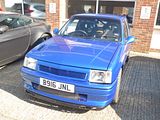
VOLKSWAGEN
The Polo Mk2 (or Typ 86C) was introduced in October 1981, with the major change being the introduction of a third body style with a steep (almost vertical) rear window, in addition to a version resembling the original Mk1 shape with a diagonal rear window. These two body styles were called the Wagon (in some markets) and Coupé, respectively, although in fact both were three-door hatchbacks, and in some markets the Wagon designation was not used, with that car being simply called the Volkswagen Polo without a suffix. The saloon version received the name Volkswagen Derby. Production was expanded to Spain in the mid-1980s following Volkswagen’s takeover of SEAT. By 1983, the one-millionth Polo was produced. The second million were produced by 1986. The Polo competed in the supermini sector with its new rivals such as the Austin Metro and Ford Fiesta, and it was one of the largest superminis in production at this time, meaning that it was close to larger cars, including the Ford Escort in terms of size, space, and price. Within two years of its launch, however, it was faced with competition from a wave of new rivals, particularly the Fiat Uno and Peugeot 205. The Polo Mk2 was used extensively by Volkswagen to develop future innovations, for example supercharging with a 40-mm G-Lader supercharger in the GT G40 version. A 60&-mm G-Lader would later be used on the larger and more technically challenging G60 engine used in the Golf and Corrado. A fuel-efficient two-cylinder diesel was prototyped in the mid 1980s with a G40 supercharger to overcome its small capacity, although this did not enter production. A high fuel-efficiency model that did make production was the petrol-engined Formel E (E for economy), introduced at the launch in 1981 with a 1.1-litre engine and from 1983 with a 1.3-litre engine, overdrive top-gear ratio and an early stop-start ignition system (called “SSA”), which would cut the engine when idle for more than two seconds to save fuel whilst temporarily stopped in traffic, and restart the engine on moving the gear lever to the left in neutral. Similar systems were later used on the Volkswagen Golf Mk3 and various systems from other car manufacturers. It was a popular import in the UK, competing with the likes of the Peugeot 205, Fiat Uno, and Nissan Micra. Its reliability and build quality were among the best to be found on a small car of this era, and in the years since then, it went on to achieve a higher survival rate than many of its competitors. However, some engines were only available on certain markets. For example, the British market never received any diesel-engined versions of the Polo, though the diesel engine was already available on many similar cars by the end of the 1980s, namely the Ford Fiesta, Vauxhall Nova, and Peugeot 205. The Mark II Facelift (referred to as the Mark IIF, also erroneously known as the “Mark 3”) was a far-reaching facelift of the MkII, including a reskin of the bodywork, launched in the autumn of 1990. The new look had square headlights, enlarged and reshaped tail-lights, bigger bumpers, and a new interior (dashboard and door trim). The three different body styles were maintained. Under the skin, the car received modifications to the chassis, suspension, and brakes, as well as the cosmetic differences. The new Polo retained the previous four-cylinder engines, but now as well as the carburetted 1.0-litre, a fuel-injected model was available with single-point injection, and all engines came with a catalytic converter as standard to combat tightening European emissions regulations. The saloon was only produced in Spain, and production ceased in 1992 due to disappointing sales. At the time of launch of the Mark IIF Polo, the highest-performance model was the Polo GT. This featured a multipoint fuel-injected version of the 1272-cc engine, and a top speed more than 100 mph. This produced 75 PS and had a quoted top speed of 172 km/h (107 mph). Times for 0–60 stood at 11.1 seconds. The defining features of the GT include red piping in the bumpers, black overhead cloth, a tachometer, and a red “GT” badge in the grille. This was succeeded by the launch of the G40 in May 1991, displacing the GT as the most powerful Polo at the time, with a top speed around 120 mph – rivalling the likes of the Ford Fiesta XR2i, Peugeot 205 GTI, and Renault Clio 16v. The GT squareback was discontinued in 1992 due to poor sales in comparison with the coupé version. Soon after the launch of the Mark IIF, another sporting model was added to the range — a new version of the supercharged G40, now as a full production model in all markets rather than the limited batch of Mark II G40s. As with the previous model, Volkswagen Motorsport modified G40 Cup cars were sold for racing in a one-make series, the Volkswagen Polo G40 Cup. Features that define the G40 from other Polo models at the time (on top of the GT) include a bee-sting aerial, BBS cross-spoke alloy wheels, Le Mans interior trim, and front and rear red “G40” badges.
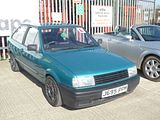
As ever, I enjoyed my visit here. If I lived more locally, I have no doubt that I would spend a lot more time at Podium Place, as whilst it might look quite unassuming from the outside, there is much here that appeals: the coffee is excellent, the food tasty, the staff friendly and the almost constant comings and goings of cars and bikes mean that there is plenty to look at. I have no dount I will be back here soon.