

Wind the clock back, say 5 years, and there was lots of choice in what is sometimes known as the sub-compact class for US buyers. Nissan had created the headlines many years earlier with the Versa, which in very stripped out guise was the cheapest car on the market, not that many bought it in bare-bones spec, but there were also offerings from Chevy, with the Spark and Sonic, Honda with the Fit (Jazz to us in the UK) Toyota with the Yaris, Mitsubishi with the truly hateful Mirage and Kia with the Rio, as well as Hyundai’s Accent, offered in saloon and hatch forms, and even Ford’s Fiesta, also as hatch or saloon. Mazda had one the best-looking, and from my experience, best to drive cars with their 2 model. So, lots of choice. One by one, as each of these cars reached the end of the planned model cycle, they’ve not been directly replaced. In some cases the manufacturer will point you to a very small crossover, such as the Hyundai Venue or Chevrolet Trax, but in general, small cars mean small profits and for a land where small is not a particularly necessary attribute, they have simply walked away from the segment.


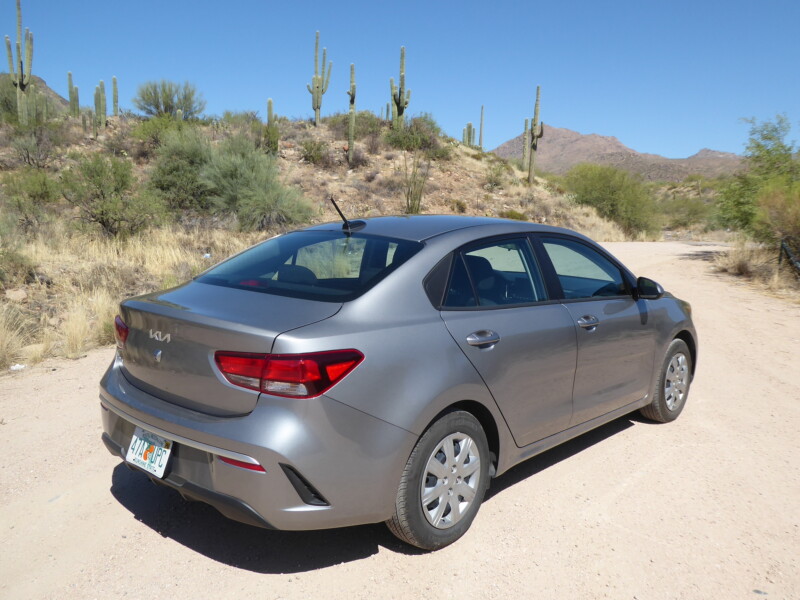
Kia are one of the very few who have persisted, at least for now, and their entry is the Rio, a car familiar to Europeans, though we only see it as a hatch model, and whilst that is available to American buyers, Kia sells far more of the four door saloon version. We are now on the fourth generation of the car and each has been a marked improvement on the one that went before. In Kia’s complicated world, there are two versions, just as there with the third generation car, one made specifically for Russia and China and one for the rest of the world, though slightly oddly that does not include the domestic South Korean market where Kia will point you at the Stonic hatchback. The fourth generation Rio was launched at the 2016 Paris Motor Show. The new car was designed in Kia’s California and Germany design centres and features longer front overhangs, larger bonnet and a more upright C-pillars for the hatchback model. The hatchback model is 15 mm longer, 5 mm wider and 5 mm shorter in height than its predecessor. Engine choices vary by market, with US buyers getting just the 1.6 litre four cylinder unit. This was updated to the Gamma II engine as part of the mid-cycle facelift that arrived in late 2020, along with subtle visual tweaks which take a very trained eye to spot and upgrades to equipment levels.


Although the Rio has been on sale in the US in this form for nearly six years now, I’d still not driven one, but that changed when on yet another night of very limited choice of cars at Hertz’ Phoenix Sky Harbor airport, I found a 2023 model year sedan model parked up and decided to try it, not least as memories of its main market rival, the Nissan Versa were still fresh in my head from a few days prior. So what did I find?


No keyless starting here. You still need a key in the ignition slot. Power for the Rio comes from a 1.6 litre four cylinder engine producing 120 bhp and there is a standard CVT transmission. That might not sound like a lot even for a small car, but in fact it is ample to make the little Kia feel pretty eager almost all the time. Not only is acceleration perfectly respectable, but the car is generally refined and mostly smooth. CVT transmissions do not have the best of reputations but this one was not bad, generally responding quite well to what I was doing with the accelerator pedal. There were times, however, when the car was on the noisy side, especially on some of the steeper ascents on the roads out of Phoenix heading up into the mountains. In any car the engine has to work quite hard here, but there did not seem to be any particular penalty at the fuel pump. I covered 180 miles in my time with the Rio and it needed 3.98 gallons to fill it, which works out at 45.22 mpg US or 54.03 mpg Imperial, an impressive result.


The Rio is pretty nice to drive. It steers well, with some feel so you know what the road wheels are going to do, and it handles quite precisely. There is excellent grip and although I am sure you could ultimately provoke understeer, I found that on the public road, you could take the swooping bends with confidence and this little Kia generally feels quite stable and composed. The ride is comfortable, with this car coming on what these days are pretty small 185/65 R15 wheels. The brakes proved well up to par. This is one of a fast diminishing number of cars with a traditional pull-up handbrake between the seats. All round visibility is good, meaning that the car easy to place on the road and not hard to park. Unless you select the Technology Pack, you don’t get much in the way of ADAS systems, only some of which you may miss. On the whole, I enjoyed the refreshing simplicity of driving this car as it came.


The Rio is neatly finished inside. It’s not been spoiled by a fussy or overly complex design, so what you get here is easy to use but with a material quality that belies its economy car roots and pricing thanks to texture surfaces that hide the use of lots of relatively hard plastics. The dashboard is pretty conventional, with a single cluster containing the two large dials for speedometer and rev counter with two smaller fuel level and water temperature gauges inset in the lower portions of the large dials. There is an old style trip computer display area between the two dials, with all the information presented in one view. There are two column stalks, with lights which include an auto function on the left hand one and wheel mounted buttons control cruise control and audio repeater functions. The centre of the dash contains the small 8” touch screen, mounted up high between the two central air vents where it is easy to see and reach. In essence this provides audio functions, but does also include wireless Android Auto and Apple Car Play. There are just two knobs for audio volume and tuning, the rest relies on the screen, but the menu structure is simple and easy to use. Beneath this unit are three rotary dials for the air conditioning system.


The seats are trimmed in a pleasant sort of cloth. Adjustment is all manual, as you might except. Only the driver’s seat gets a height adjuster, but there are height adjustable belts for both occupants. The steering wheel does not telescope in/out, so the only adjustment is up/down, but even so, I found it was easy to get the driving position I wanted. I found the seat well-shaped and comfortable.


This is one of the smallest cars on the US market and yet there is ample space in the rear for a couple of adults. With the front seats set well back, legroom is a bit tight but set them further forward, as per my driving position and it is fine. The Rio is not really wide enough for three adults, though at a pinch they could be squeezed in. There is plenty of headroom. You are not exactly over-endowed with luxuries here, but there is one seat-back map pocket.


The boot is a good size, especially for a small car. It is particularly deep, even though there is a space saver tyre under the main boot floor. There is some space around this for a few odds and ends. There are split folding backrests which allows you to extend the length of the cargo area quite considerably. Inside the cabin there is good provision for odds and ends. The glovebox is large and there are door pockets and a small armrest cubby as well as a large stowage recess in front of the gearlever.


The 2023 Kia Rio is available in sedan and hatchback body styles. The sedan comes in LX and S trims, while the hatchback is only available as the Rio S. All models are equipped with a 120 bhp 1.6-litre four-cylinder engine, a continuously variable automatic transmission (CVT) and front-wheel drive. The base LX sedan comes standard with cloth upholstery, a six-way manually adjustable driver’s seat, an 8-inch touch screen, wireless Apple CarPlay and Android Auto, a six-speaker stereo, Bluetooth, a USB port and a rearview camera. The S trim adds split-folding rear seats, additional USB ports, cruise control and keyless entry. Models with the Technology package gain automatic climate control, forward-collision warning, pedestrian detection, lane-keep assist, lane-departure warning, driver-attention monitoring, LED headlights with automatic high beams, a rear-seat alert, 15-inch alloy wheels and chrome exterior door handles.


Time was that selecting a US market economy car did feel like a true hair-shirt experience. But lately, things have changed. Just as I found with the Nissan Versa a few days earlier, the Kia Rio is a perfectly acceptable car that, whilst from luxurious or dripping in equipment, is nicely finished, comfortable and with adequate performance to cope with both traffic and hills. Yes, there’s less space in these cars than most others on the market, but there are times when that small foot print will be particularly welcome. It just seems a shame that now that the products have been improved, so manufacturer after manufacturer has chosen to exit this sector of the market. 2023 is the last model year for the Kia Rio and for American customers, it will not be replaced, meaning that Kia’s entry-level car will be the Soul or the rather larger Forte, and leaving the sub-compact class entirely to Nissan and the rather unpleasant Mitsubishi Mirage. A combination of relatively low demand and low profit margins are to blame. For a little while, at least, there will be good numbers of the Versa and a few less of the Rio parked up in the cheap seats of the rental car companies. Given the choice, I’d probably pick the Kia, but it is a close run thing, as the Nissan in its latest form is a much-improved product. Both are now more than acceptable, so unless you need the room, there’s no particular need to be swayed by the rental car agent’s efforts to get you to pay for an upgrade.