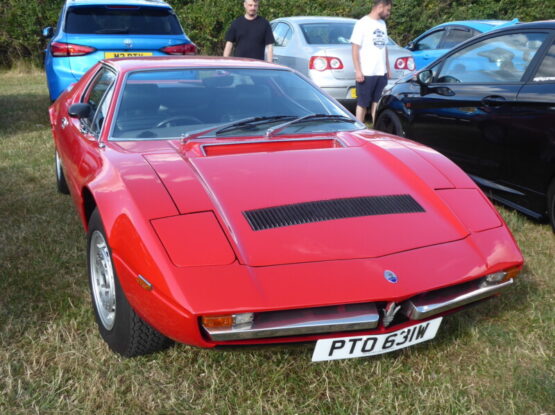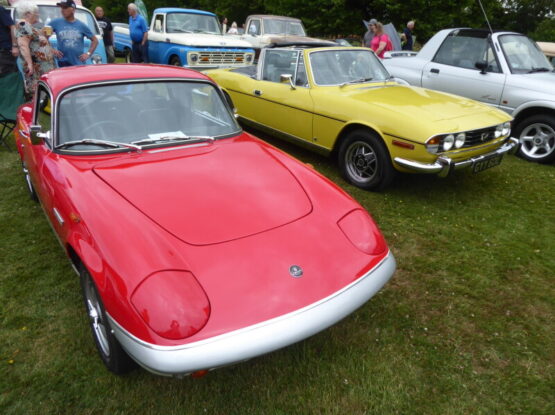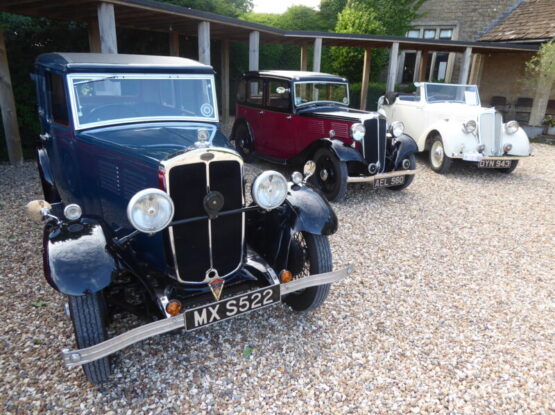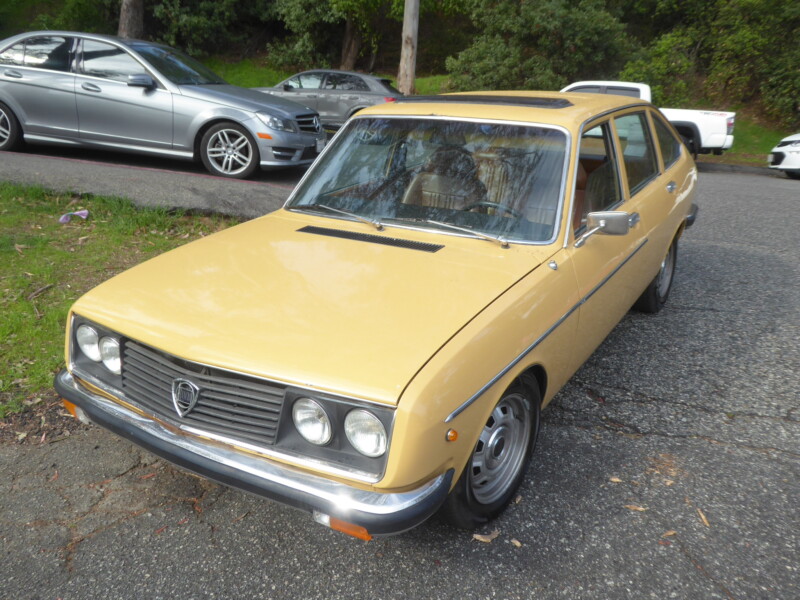
Just one day after spending the morning at Cars and Coffee event in the LA area, here I am at another one. This is the one which is actually called Los Angeles Cars and Coffee and it is held on the last Sunday of the month in Griffith Park which is a large expanse of parkland that includes the LA Zoo just to the north of DownTown. I’ve been to this one a few times now, having finally discovered it in late 2023 and have always found a really varied mix of cars attend, with some that you might expect and more than a few that you would not, quite often as they are European cars recently imported under the “over 25 year old” rule. Like all US Cars and Coffee events, it pays to arrive early, as people do not tend to stat that long. Whilst some do linger, by mid-morning the main parking lot that is used for the event has reverted to general parking and it fills up with modern and generally fairly uninteresting machinery. Before that happens, though, there are plenty of cars here, and in the roadway adjoining as well as a second parking area around the corner (which is where I park my modern rental car). Here is what I saw on this occasion:
ACURA
The Acura Legend is a mid-size luxury car manufactured by Honda from Japan. It was sold in the U.S. and Canada under Honda’s luxury brand, Acura, from 1985 until 1995. It was the first flagship sedan sold under the Acura nameplate, until being renamed in 1996 as the Acura 3.5RL. The 3.5RL was the North American version of the KA9 series Honda Legend. The opportunity for Japanese manufacturers to export more expensive models had arisen with the 1980s voluntary export restraints, negotiated by the Japanese government and U.S. trade representatives, restricting mainstream car sales. The initial success of the Legend and Honda’s Acura division in competing against established European and American luxury manufacturers would lead to Toyota and Nissan creating the Lexus and Infiniti brands, respectively, to compete in the luxury car market. Honda introduced the model in Japan on October 22, 1985, to be their premier luxury model, and in North America for the 1986 model year, as the top of the line model for its then-new Acura lineup. Sedan models came to the market first, powered by a 151 hp 2.5 L C25A V6, with coupes making their first appearance in 1987, powered by a new 161 hp 2.7 L C27A engine. Sedans received the new engine for 1988. The Legend was the first production Honda vehicle to offer a V6 engine. The 1987 Acura Legend LS coupe would be the first Japanese car to offer a driver’s side airbag. The Legend was a result of a joint venture with Britain’s Austin Rover Group called Project XX that started in November 1981 with the Austin Rover-Honda XX letter of intent signed by the two companies to replace the Rover SD1 and to provide a luxury vehicle for Honda. The Rover Company had a long established reputation as a luxury car in the United Kingdom and Europe, demonstrated with the Rover P6, and Honda wanted to introduce a luxury car for both domestic Japanese and the United States markets. The joint development produced the Legend and the corresponding British version was the Rover 800-series, which was badged under the Sterling brand in the United States and competed with the Legend. Rover also wanted to return to the American market when they had reportedly sold only 1,500 cars in 1971, and a brief return in 1980, selling 800 Rover SD1s by offering the Sterling. The Legend won Car and Driver’s Ten Best three years in a row and Motor Trend’s Import Car of the Year for 1987. Manual-equipped models could accelerate from 0-60 mph in under 8 seconds and reach a top speed of 135 mph (217 km/h). Sedan models had a drag coefficient of 0.32, while coupes were only 0.30. When the Legend was introduced, Honda’s newly established luxury car division just for the Legend was called Acura, using the advertising slogan “Precision Crafted Performance”, and the Legend was offered with one factory installed option, the choice of transmission used, and one trim level. In the 1986 sales brochure, the Legend’s full name used was “Legend Touring Sedan”. The vehicle was virtually identical in luxury content to the Japanese market V6Zi, but was identical in size and the longer overall length of the top level V6Xi to comply with United States crash standards, using the larger 2.5 V6 engine. The Technics supplied 80W four speaker cassette tape stereo offered four user programmable equalizer settings, and was equipped with a dual diversity antenna, meaning it had a conventional extendable power antenna and an embedded antenna in the rear window. One of the novelty items was a simple volume control rocker switch and a pre-set radio station channel selector installed on the instrument binnacle within reach of the right hand; the opposite side of the instrument binnacle had a button to open, tilt or close the standard equipped glass moonroof with sun shade. The North American Legend was not offered with some of the items offered in Japan, such as automatic, one-touch climate control, and 100% wool cloth interior in brown. Blue interior was shared with Japan and North America, but brown was not offered in North America, and “sand gray” was offered instead. Exterior colours were matched to only one interior colour choice and leather was not offered. Due to the success Honda had with the Legend, it served as an inspiration for the Subaru Legacy with which it shares many visual resemblances and dimensions both inside and out. In late 1988 for the 1989 model year, the sedan received some minor tweaks, upgrading to the one-piece front headlamps already in use in Japan since the 1985 introduction, a revised front bumper, trunk lid, tail light cluster, and an upgraded double-wishbone rear suspension, with a new alloy wheel appearance. By that time all Legends came equipped with a Honda-designed 4-wheel anti-lock brake system. A driver’s side airbag was now standard on all Legends. Other features such as power driver’s seat memory for 3 positions were added. High-end LS models featured a trip computer, electronic vehicle monitoring system in the center console and a Bose sound system. It was also joined by the Acura Vigor which set the stage for the larger second generation Legend introduced October 1990. For the 1990 model year, all Legends came with body-colored side mirrors. Legend coupes had a revised body-coloured front grille, new red & clear tail lights, and improved front seats. LS model coupes also received a trunk-mounted lip spoiler. All LS models featured burlwood interior trim. Production of the first-generation models ended in 1990 as a second-generation version became available for the 1991 model year. At least by the 1990 model year, the fuel filler door on the sedan had been moved rearward about 15 cm (5.9 in). From the exterior, there are only superficial similarities between the Legend and its Rover 800/Sterling cousin. Both cars share the 2.5L and 2.7L Honda engine with 160 hp and a 4-speed automatic transmission. The core structure and chassis design is also common to both cars, however the Rover version has its own exterior panelwork, interior and electrical systems. The Rover was also offered with a 2.0L in-line 4-cylinder engines, however the Legend was only available with V6 power regardless of market. In Japan only, Honda installed a turbocharger with variable geometry in the Legend with the smaller 2.0 L V6, called the “Wing Turbo” for model year 1989.

Second generation Legends became available October 24, 1990, now using a 200 hp SOHC (C32A) engine mated to either a standard 6-speed manual or an optional 4-speed automatic. The second generation Legend was a larger, more streamlined-looking car (drag coefficients were actually higher at 0.34 for sedans and 0.32 for coupes). The design was referred to as a “fuselage” shape, and had rear-wheel drive proportions which were possible thanks to the use of a longitudinally mounted engine; unusual for front-wheel-drive automobiles. The Legend offered a host of features seen on luxury cars of today including dual front driver & passenger airbags (standard on 1991 Legend LS, 1992 L and LS trims), speed-sensitive steering, hands-free telephone, automatic climate control, heated leather seats, heated mirrors, four-wheel ABS disc brakes, seatbelt pretensioners, and electric soft-close doors (coupe only). Japan and New Zealand coupe/sedan models came factory with one-piece headlamps and built-in foglights. In Europe the Legend was fitted with all glass headlamps as well as built-in foglights, also a flush decklid spoiler option was available from factory (1991-1993 coupes only), similar to the USDM KA3/KA4 Legend first generation coupe/sedan option . (1994-1995 coupe) rear decklids were excluded from Europe’s factory flush spoiler option, as they offered a slightly enhanced curvature of decklid in the later production years. Japan, New Zealand & Europe coupe/sedan models also came fitted with a one of a kind Honda alpha touring grille. North American models did not, however they did receive a factory option set of lower bumper guard foglights making all legend model interchangeable options endless. Appearance of the sedan was adopted from the first generation Legend coupe and Honda also wanted to visually align the appearance of both the Legend coupe and sedan to the Acura NSX. Legend coupes also shared the same mirror design as the first generation NSX. The segment the Legend originally filled was now being served by the Acura Vigor which allowed the Legend to position itself more towards the rear drive Lexus LS and the Infiniti Q45 sedans. Honda decided not to upgrade the size of the engine to a V8 because it would have upstaged the Acura NSX which has a V6 that introduced Honda’s VTEC technology. For 1991 and 1992 the Legend sedan was available in ‘base’, ‘L’, and ‘LS’ trims; the coupe remained available in L and LS through its entire run. The higher-end LS cars added automatic climate control, a power four-way passenger seat, burled walnut interior trim, and body coloured side mouldings. Honda made significant upgrades for 1993, making a 230 hp Type II North America version of the SOHC C32A1 engine standard on all coupes, along with the option of a 6-speed manual transmission (for 1993-1995 coupes 1994-1995 sedan). The LS version of the sedan lost the option for a manual transmission and was only available with an automatic transmission from then on. 1993 also saw the addition of dual airbags as standard equipment in all trims, the deletion of the black moulding on the entry-level cars, and a new wheel design with fewer spokes on the sedans (16-spoke vs. 20-spoke). To reach the higher output, the Type II engine has bigger intake valves, a higher lift camshaft, and an exhaust with freer flow. For the 1994–95 model years, all Legends received new front bumper and trunk lid designs, a new front grille (L & LS Sedans only), and a power tilt-telescoping steering column; the word “Legend” was now spelled out in individual letters on the back. The base sedan was dropped, while a new GS sedan became the new top-line variant, sporting the 230 hp Type II engine, upgraded brakes from the coupe, sport suspension from the coupe, a body-coloured version of the 1991 to 1993 grille, the same standard 6-speed manual transmission found on the coupes as well as the special 16-inch 5-spoke LS Coupe wheels (better known as GS Wheels). This was the only 6-speed sedan offered. Added for 1995 was the limited-production ‘SE’ sedan, which was essentially a Legend ‘L’ with a two-tone paint scheme, pre-1993 15-inch 7-spoke ‘LS’ coupe wheels, “Special Edition” floor mats, and an automatic transmission. The Japan Domestic Market version of the 1990 Legend (second generation) was the second vehicle offered with a navigation system (electro Gyrocator). The tooling and intellectual property rights of the second generation Legend were licensed to Daewoo Motors of South Korea, where a clone of the Legend sedan, called the Daewoo Arcadia, was produced from 1994 to 1999. During this period, Honda also held a small stake in Daewoo Motors. Whilst the Legend name persisted in other markets, the successor to this car was rebranded as the RL in the US market when it appeared in 1995.


ALFA ROMEO
Sole Alfa here was this example of the still current Giulia, a car which has sold in very small quantities in the US.

ASTON MARTIN
Aston Martin was facing financial pressure in the mid-1970s and needed something to bring in some much-needed funds. Traditionally Aston Martin had worked on 2+2 sports cars but the Lagonda was a four-door saloon. As soon as it was introduced, it attracted hundreds of deposits and boosted Aston Martin’s cash reserves. The 1976 wedge-shaped styling contrasted sharply with other cars of its day. After the production of seven Series 1 cars, the Lagonda was designed from the ground up in 1976 by William Towns as an extreme interpretation of the classic 1970s “folded paper” style. It was an unconventional design practice for the company. With famous contemporaries like the Lamborghini Countach, Lotus Esprit, and DMC DeLorean, the Lagonda is frequently named among the most striking wedge-shaped designs. The Lagonda combined striking styling with a premium leather interior and (for the day), advanced instrumentation. Coupled to a Chrysler three-speed “TorqueFlite” automatic transmission, its four-cam carburettorV8 provided poor fuel economy, affected little by the change to fuel injection in the Series 3. Throughout the history of the marque, the hand-built Lagonda was amongst the most expensive luxury saloons in the world. The only other production cars to approach its price were the Rolls-Royce Silver Spirit/Silver Spur and the Bentley Mulsanne. The Lagonda was the first production car to use a digital instrument panel. The development cost for the electronics alone on the Lagonda came to four times as much as the budget for the whole car. The Series 3 used cathode ray tubes for the instrumentation, which proved even less reliable than the original model’s light-emitting diode (LED) display. It was named by Bloomberg Businessweek as one of the 50 ugliest cars of the last 50 years[8] and Time magazine included it in its “50 Worst Cars of All Time”, describing it as a mechanical “catastrophe” with electronics that would be impressive if they ever worked. A number of iterations of the Lagonda were produced: the original Series 1 and the wedge-shaped Series 2, 3, and 4. A total of 645 cars were produced in its 12-year production run. The 1st Series Lagonda was essentially just a four-door version of the Aston Martin V8. The wedge-shaped Lagonda V8 saloon was launched in 1976 at the London Motor Show and was a total contrast to the 1974 model, sharing little but the engine. Deliveries of the Lagonda did not commence until 1979. Series 2 cars were originally fitted with digital LCD dashboards and touch button controls but these features were abandoned in 1980. The Lagonda retailed at £49,933 in 1980, significantly more than a Ferrari 400 or Maserati Kyalami but less than a Rolls-Royce Corniche. The car commenced sales in the US from 1982 with minor regulatory amendments to the front bumper and airdam. The Series 3 was produced for only one year with 75 units manufactured. All had fuel injected engines. Cathode ray tube instrumentation was later changed to a vacuum fluorescent display system and shared exterior styling with the Series 2. The Series 4 was launched at the Geneva Motor Show in March 1987, having been extensively restyled by the car’s original designer William Towns. Sharp edges were rounded off and the pop-up headlights were replaced with three headlights on each side of the grille. The side swage line (or character line) was removed and 16-inch wheels were introduced. With production of around one car per week, 105 cars were manufactured through January 1990. 72 of the Series 4 cars were built with left-hand drive.


Follow on to the DB7 was the DB9 (there has never been a car called DB8 – supposedly because people might have assumed this meant a V8 engine), and there was a nice example here. The Aston Martin DB9, designed by Marek Reichmann and Hendrik Fisker, was first shown by Aston Martin at the 2003 Frankfurt Auto Show, in coupe form. It was widely praised for the beauty of its lines. This was the first model to be built at Aston Martin’s Gaydon facility. It was built on the VH platform, which would become the basis for all subsequent Aston models. The Aston Martin DB9 was initially launched equipped with a 6.0 litre V12 engine, originally taken from the V12 Vanquish. The engine produced 420 lbf·ft of torque at 5,000 rpm and a maximum power of 444 hp at 6,000 rpm, allowing the DB9 to accelerate from 0 to 60 mph in 4.7 seconds and a top speed of 299 km/h (186 mph). The engine largely sits behind the front-axle line to improve weight distribution. Changes to the engine for the 2013 model year increased the power to 503 hp and torque to 457 lb-ft, decreasing the 0 to 60 mph time to 4.50 seconds and with a new top speed is 295 km/h (183 mph). The DB9 was available with either a six-speed conventional manual gearbox from Graziano or a six-speed ZF automatic gearbox featuring paddle-operated semi-automatic mode. The gearbox is rear-mounted and is driven by a carbon-fibre tail shaft inside a cast aluminium torque tube. The DB9 was the first Aston Martin model to be designed and developed on Ford’s aluminium VH (vertical/horizontal) platform. The body structure is composed of aluminium and composites melded together by mechanically fixed self-piercing rivets and robotic assisted adhesive bonding techniques. The bonded aluminium structure is claimed to possess more than double the torsional rigidity of its predecessor’s, despite being 25 percent lighter. The DB9 also contains anti-roll bars and double wishbone suspension, supported by coil springs. To keep the back-end in control under heavy acceleration or braking, the rear suspension has additional anti-squat and anti-lift technology. Later versions of the car also features three modes for the tuning: normal, for every-day use, sport, for more precise movement at the cost of ride comfort, and track, which furthers the effects of the sport setting. The Aston Martin DB9 Volante, the convertible version of the DB9 coupe, followed a few months later. The chassis, though stiffer, uses the same base VH platform. To protect occupants from rollovers, the Volante has strengthened windscreen pillars and added two pop-up hoops behind the rear seats. The hoops cannot be disabled and will break the car’s rear window if deployed. In an effort to improve the Volante’s ride while cruising, Aston Martin have softened the springs and lightened the anti-roll bars in the Volante, leading to a gentler suspension. The retractable roof of the Volante is made of folding fabric and takes 17 seconds to be put up or down. The Volante weighs 59 kilograms (130 pounds) more than the coupe. The coupe and Volante both share the same semi-automatic and automatic gearboxes and engine. The car was limited to 266 km/h (165 mph) to retain the integrity of the roof. Like the coupe, the original Volante has 420 lb·ft of torque at 5,000 rpm and a maximum power of 450 hp at 6,000 rpm. The 0 to 60 mph slowed to 4.9 seconds due to the additional weight. The DB9 was facelifted in July 2008, which mainly amounted to an increase in engine power, to 476 hp and a redesigned centre console. Externally, the DB9 remained virtually unchanged. For the 2013 model year revision, Aston made minor changes to the bodywork by adapting designs from the Virage, including enlarging the recessed headlight clusters with bi-xenon lights and LED daytime strips, widening the front splitter, updating the grille and side heat extractors, updating the LED rear lights with clear lenses and integrating a new rear spoiler with the boot lid. .On newer models, like the coupe’s, the Volante’s horsepower and torque increased to 517 PS (510 hp) and 457 lb·ft respectively. As a finale for the model, a more powerful DB9 was released in 2015, called the DB9 GT. This had 540 bhp and 457 lb-ft of torque at 5500 rpm, giving a 0 to 60mph time of 4.4 seconds and 0 to 100mph in 10.2 seconds, with the standing quarter mile dispatched in 12.8 to 12.9 seconds and a top speed of 183mph. Production of the DB9 ended in 2016 being replaced by its successor, the DB11.

Following the unveiling of the AMV8 Vantage concept car in 2003 at the North American International Auto Show designed by Henrik Fisker, the production version, known as the V8 Vantage was introduced at the Geneva Motor Show in 2005. The two seat, two-door coupé had a bonded aluminium structure for strength and lightness. The 172.5 inch (4.38 m) long car featured a hatchback-style tailgate for practicality, with a large luggage shelf behind the seats. In addition to the coupé, a convertible, known as the V8 Vantage Roadster, was introduced later in that year. The V8 Vantage was initially powered by a 4.3 litre quad-cam 32-valve V8 which produced 380 bhp at 7,300 rpm and 409 Nm (302 lb/ft) at 5,000 rpm. However, models produced after 2008 had a 4.7-litre V8 with 420 bhp and 470 Nm (347 lbft) of torque. Though based loosely on Jaguar’s AJ-V8 engine architecture, this engine was unique to Aston Martin and featured race-style dry-sump lubrication, which enabled it to be mounted low in the chassis for an improved centre of gravity. The cylinder block and heads, crankshaft, connecting rods, pistons, camshafts, inlet and exhaust manifolds, lubrication system and engine management were all designed in house by Aston Martin and the engine was assembled by hand at the AM facility in Cologne, Germany, which also built the V12 engine for the DB9 and Vanquish. The engine was front mid-mounted with a rear-mounted transaxle, giving a 49/51 front/rear weight distribution. Slotted Brembo brakes were also standard. The original V8 Vantage could accelerate from 0 to 60 mph in 4.8 seconds before topping out at 175 mph. In 2008, Aston Martin introduced an aftermarket dealer approved upgrade package for power and handling of the 4.3-litre variants that maintained the warranty with the company. The power upgrade was called the V8 Vantage Power Upgrade, creating a more potent version of the Aston Martin 4.3-litre V8 engine with an increase in peak power of 20 bhp to 400 bhp while peak torque increased by 10 Nm to 420 Nm (310 lb/ft). This consists of the fitting of the following revised components; manifold assembly (painted Crackle Black), valved air box, right and left hand side vacuum hose assemblies, engine bay fuse box link lead (ECU to fuse box), throttle body to manifold gasket, intake manifold gasket, fuel injector to manifold seal and a manifold badge. The V8 Vantage had a retail price of GB£79,000, US$110,000, or €104,000 in 2006, Aston Martin planned to build up to 3,000 per year. Included was a 6-speed manual transmission and leather-upholstery for the seats, dash board, steering-wheel, and shift-knob. A new 6-speed sequential manual transmission, similar to those produced by Ferrari and Lamborghini, called Sportshift was introduced later as an option. An open-topped model was added to the range in 2006 and then in the quest for more power a V12 Vantage joined the range not long after. All told, there were no fewer than 18 different versions of the car before its replacement with a new and quite different looking model in 2017.

BENTLEY
The Bentley Mulsanne is a large (performance) luxury saloon produced by Bentley Motors from 1980 until 1992, though derivative models including the Continental T and Azure continued in production into the 2000s. Contrary to its predecessors, the Bentley Mulsanne was given an actual name instead of a letter, but otherwise started as another standard rebadged Rolls-Royce, the Silver Spirit. However, with the launch of the ‘Brooklands’ version, and the 1982 Mulsanne Turbo – with 50 percent more horsepower – the Mulsanne began the rebuild of an appealing individual Bentley brand image. The Mulsanne was named after the Mulsanne straight, a section at the Circuit de la Sarthe in which refers to the Bentley’s success at the 24 Hours of Le Mans between 1924 and 1930. In 1980, the Rolls-Royce Silver Shadow and the Bentley T-series were replaced by the RR Silver Spirit and, as with prior models, a Bentley-badged equivalent. This time however, it was given a name: the “Mulsanne”. This was derived from Bentley’s motorsport history, which included five victories at the 24 Hours of Le Mans between 1924 and 1930. The ‘Mulsanne Straight’ is the stretch of Le Mans’ race-course where cars reach their highest speeds. The Mulsanne initially shared the same carburetted 6,750 cc Rolls-Royce V8 engine with aluminium alloy cylinder heads with the Silver Spirit, carried over from the Silver Shadow II and Bentley T2. In 1982 however, a turbocharged version with much more power and torque was also introduced – for Bentley only – in the Mulsanne Turbo. From 1986, the two SU carburettors were replaced by Bosch fuel injection on all cars. All Mulsannes use a 3-speed automatic transmission. The Mulsanne Turbo was launched at the Geneva Motor Show in 1982 and produced until 1985. A Garrett AiResearch turbocharger provided a 50% increase in engine power – something not seen on a Bentley in half a century. The interior sported the usual highly polished, walnut veneered fascia, blemish-free leather upholstery, and pure wool for the carpets and headlining. A total of 498 standard wheelbase and 18 long-wheelbase Mulsanne Turbos were built, until they were replaced by the Bentley Turbo R in 1985, which used a fuel injected version of the same 63⁄4 litre V8 engine since 1987. The Mulsanne S was introduced in 1987. Although this model lacked its turbocharger, many of its other details were similar to the Turbo R, including that car’s alloy wheels and interior, and the suspension was firmed up for a more sporting ride. The rectangular headlamps from the 1980s gave way to quad round units for 1989, and the model was produced until 1992.


BMW
The 1600-2, as the first “02 Series” BMW was designated, was an entry-level BMW, and was smaller, less expensive, and less well-appointed than the New Class Sedan on which it was based. BMW’s design director Wilhelm Hofmeister assigned the two-door project to staff designers Georg Bertram and Manfred Rennen. The 9.1 in shorter length and wheelbase and lighter weight of the two-door sedan made it more suitable than the original New Class sedan for sporting applications. As a result, the two door sedan became the basis of the sporting 02 Series. The 1600-2 (the “-2” meaning “2-door”) made its debut at the Geneva Show in March 1966 and was sold until 1975, with the designation being simplified to “1602” in 1971. The 1.6 litre M10 engine produced 84 hp at 5,700 rpm and 96 lb·ft. A high performance version, the 1600 TI, was introduced in September 1967. With a compression ratio of 9.5:1 and the dual Solex PHH side-draft carburettor system from the 1800 TI, the 1600 TI produced 110 hp at 6,000 rpm. Also introduced in September 1967 was a limited-production cabriolet, which would be produced by Baur from 1967 through 1971. A hatchback 1600 Touring model was introduced in 1971 but was discontinued in 1972. It was what came next which was more significant. Helmut Werner Bönsch, BMW’s director of product planning, and Alex von Falkenhausen, designer of the M10 engine, each had a two litre engine installed in a 1600-2 for their respective personal use. When they realised they had both made the same modification to their own cars, they prepared a joint proposal to BMW’s board to manufacture a two litre version of the 1600-2. At the same time, American importer Max Hoffman was asking BMW for a sporting version of the 02 series that could be sold in the United States. As per the larger coupe and 4-door saloon models, the 2.0 engine was sold in two states of tune: the base single-carburettor 2002 producing 101 hp and the dual-carburettor high compression 2002 ti producing 119 hp. In 1971, the Baur cabriolet was switched from the 1.6 litre engine to the 2.0 litre engine to become the 2002 cabriolet, the Touring hatchback version of the 02 Series became available with all engine sizes available in the 02 Series at the time and the 2002 tii was introduced as the replacement for the 2002 ti. The 2002 tii used the fuel-injected 130 hp engine from the 2000 tii, which resulted in a top speed of 185 km/h (115 mph). A 2002 tii Touring model was available throughout the run of the tii engine and the Touring body, both of which ended production in 1974. The 2002 Turbo was launched at the 1973 Frankfurt Motor Show. This was BMW’s first turbocharged production car and the first turbocharged car since General Motors’ brief offerings in the early 1960s. It produced 170 hp. The 2002 Turbo used the 2002 tii engine with a KKK turbocharger and a compression ratio of 6.9:1 in order to prevent engine knocking. Kugelfischer mechanical fuel injection was used, with a sliding throttle plate instead of the usual throttle butterfly. The 2002 Turbo was introduced just before the 1973 oil crisis, therefore only 1,672 were built. The 1802 was introduced in 1971 and was available with either the original 2-door sedan body or the 3-door Touring hatchback introduced that year. Production of the Touring model continued until 1974, with the 1802 sedan ending production the following year. The 1502, an economy model with an engine displacement of 1573 cc was introduced in 1975. This engine had a lower compression ratio of 8.0:1, therefore standard-octane petrol could be used. While the rest of the 02 Series was replaced in 1975 by the E21 3 Series, the 1502 was continued until 1977.

BUICK
This is a 1948 Buick Super. The 1942 Super coupes adopted the appealing Sedanet fastback style that had been the sensation of 1941 on Century and Special. New wider and lower bodies were offered and “Airfoil” front fenders that flowed into the lines of the rear fenders were introduced on convertibles and sedanet models. The Super had new front fender trim featuring parallel chrome strips. Also featured for 1942 was a handsome new grille with a lower outline and thin vertical strips. A feature shared with other Buicks was a new interior air intake positioned near the front centre grille that eliminated the old cowl-level ventilator. The number of body styles was reduced to three with the elimination of the one year only Business coupe. After the government prohibited the use of chrome on January 1, 1942 a number of body styles were dropped and most trim was now painted. Cast iron pistons were used in the 248 cu in (4.1 L) Fireball straight-eight engine. The last of the 1942 Buicks were completed on February 4, 1942. Only 33,034 Supers were built in the abbreviated model year. In 1946 Buick once again combined the large Series 70 Roadmaster body with the economical Series 40 Special powerplant to create the Series 50 Super line. Basic styling was continued from 1942 now sedans had the front fender sweep across the doors to the rear fenders as did the Sedanet and convertible styles. A stamped grille with vertical bars dominated the frontal ensemble. Single stainless body trim lines began on the front fenders and ended at the rear edge of the standard rear wheelhouse shields. Standard equipment included an automatic choke, clock, ash receiver, turn signals and a painted woodgrain instrument panels. Exterior series identification was found on the crossbar between the bumper guards front and rear. Cloisonne emblems carried the Super emblem. Compound Carburetion was eliminated and the compression ratio was reduced to 6.30:1. As a consequence the 1946 Super’s horsepower fell from 125 to 110. Torque on the other hand was hardly affected. The number of body styles increased to four with the return of the Estate wagon after a six year absence. A total of 119,334 units were sold. The front suspension was independent with coil springs. 76.98% of Buick sales this year were Supers. Combining big Roadmaster room with an economical Special engine continued to make the Super an American favourite in 1947. The Super was little changed from its 1946 counterpart, except for new stamped grille that had separate upper bar and new emblem. Stainless lower body moldings made a single line along the body and continued onto the standard wheelhouse shields. A white Tenite steering wheel was standard while the instruments were round and set into a two-toned dash panel. Exterior series identification was found on the crossbars between the standard bumper guards. A chrome emblem was used with the series script embossed and filled with red. Sales reached a record 159,588. The height was 64.9 inches. Brakes were 12 inch drums. The main external change to the 1948 Super from its 1947 counterpart was the “Super” script on each front fender. Other series identification continued to be earned on the bumper guard crossbar. The car was a bit lower than in 1947 rolling on new 7.60 x 15 tyres mounted on wheels with trim rings and small hubcaps. Super script was also found on the center crest of a new black Tenite steering wheel. New cloth interiors featured leatherette scuff pads and trim risers. The instrument panel was redone, using silver-tone instruments on a two-tone gray panel. The sedan was carpeted in the rear with a carpet insert also found in the front rubber mat. The convertible also featured cloth and leather interior trim with power top, seat and windows standard. Total sales were 108,521. A third generation Super was launched for 1949.


CHEVROLET
This splendid old-timer is a 1939 Chevrolet Master DeLuxe. The Chevrolet Master and Master Deluxe were manufactured between 1933 and 1942 to replace the 1933 Master Eagle. It was the most expensive model in the Chevrolet range at this time, with the Standard Mercury providing an affordable product between 1933 and 1937. Starting with this generation, all GM cars shared a corporate appearance as a result of the Art and Color Section headed by Harley Earl. From 1940 a more expensive version based on the Master Deluxe was launched called the Special Deluxe. The updated corporate appearance introduced a concealed radiator behind a façade with a grille. This was the last Chevrolet that was exported to Japan in knock-down kits and assembled at the company’s factory in Osaka, Japan before the factory was appropriated by the Imperial Japanese Government. When Toyota decided to develop their own sedan called the Toyota AA, a locally manufactured Master was disassembled and examined to determine how Toyota should engineer their own cars. In May 1925 the Chevrolet Export Boxing plant at Bloomfield, New Jersey was repurposed from a previous owner where Knock-down kits for Chevrolet, Pontiac, Oldsmobile, Buick and Cadillac passenger cars, and both Chevrolet and G. M. C. truck parts are crated and shipped by railroad to the docks at Weehawken, New Jersey for overseas GM assembly factories. The Master name was used on a number of different versions, and the Series name changed each year. A four door open top convertible was no longer offered starting in 1933. The 1933 Series CA began production as the “Eagle”, but was renamed “Master” midway through the model year when the 1933 Standard model (Series CC) was introduced. Several changes were made to the Eagle when the name was changed to Master. The easiest to distinguishing feature is the post between the front door wing windows and the roll down windows: on the Eagle the chrome divider between these two windows goes down as the window goes down, whereas on the Master this divider remains fixed and does not go down with the window. For 1934, the Series DA Master offered an increased wheelbase of 112 in (2,844.8 mm). This increased the difference with the cheaper Standard wheelbase to 5 in (127.0 mm). Powered by an upgraded version of the 206 cu in (3,380 cc) “Stovebolt” six-cylinder engine, now producing 80 hp. The independent front suspension was something GM called “Knee-Action” using trailing arms and coil springs. For 1935, with the Series EA and ED, the Master underwent a redesign, utilising a new “Turret Top” construction method. This consisted of steel used entirely in the body construction to include the roof and wood was no longer used in bodywork or chassis construction. In 1936, the Series FA and FD took on an upgraded streamlined appearance as Chevrolet sought to take on a new and modern appearance called Art Deco, and the bodies were shared with the Pontiac Deluxe. Body Styles included the 4dr Sedan, 4dr Sport Sedan, 2dr Coach, 2dr Town Sedan, 2dr Coupe (5w). With the GA and GB Series for 1937, the Master now replaced the lower priced Standard Six, while the higher equipment Master Deluxe edged the range upwards. While external differentiation was limited to trim and equipment, the Master Deluxe introduced independent front suspension while the Master retained a beam front axle on leaf springs. In 1938, there were series HA and HB. The Master (HB) and Master Deluxe (HA) sold well, with 162,430 and 302,728 respectively. 1939 saw the series JA and JB. The Master returned for 1939. The Master Deluxe was now the JA, while the base model was renamed the Master 85 (JB). A station wagon was first offered, though its construction had been contracted to Mid States Body Corp. For 1940, the Master continued to be available in Master 85 (KB) as well as the more upscale “Master Deluxe” model (KA). The even better equipped “Special Deluxe” also appeared for the 1940 model year. This was the last series of trucks and medium-duty vehicles that shared an appearance with Chevrolet passenger coupes and sedans, and were replaced with the AK Series trucks. The first truck body style was introduced in 1918 as the Chevrolet Series 490 using the same approach used by the Ford Model TT. Each year a Chevrolet Series was introduced, the chassis was also available with a cargo bed body style.


Plenty has been written about the Corvair, following the publication of consumerist Ralph Nader’s book “Unsafe at any Speed”, even though subsequent research found that the car was no more prone to the things which the non-driving Nader alleged than many others on sale at the same time. Although the book damaged sales, that was not the only reason why the car ultimately was not that commercially successful. Until 1960, the “Big Three” domestic auto manufacturers (General Motors, Ford, and Chrysler) produced only one basic size of passenger cars: large. However, a successful modern “compact car” market segment was established in the US by the 1950 Nash Rambler. Moreover, imports from Europe, such as Volkswagen, Renault, and Fiat, showed that there was demand in the US for small cars, often as a second car or an alternative for budget-minded consumers. While the “Big Three” continued to introduce ever-larger cars during the 1950s, the newly formed American Motors Corporation (AMC) focused its business strategy on smaller-sized and fuel-efficient cars, years before there was a real need for them. The sale success of the Rambler did not go unnoticed, so during 1959 and 1960, the Big Three automakers planned to introduce their own “compact” cars. Most of these designs were scaled-down versions of the conventional American car, using four- or six-cylinder engines instead of V8s, and with bodies about 20% smaller than their standard cars. The exception to this was going to be Chevrolet’s offering, the Corvair. Led by General Manager Cole, Chevrolet designed a revolutionary new car. It was powered by an air-cooled horizontal six-cylinder 2.3 litre engine made almost entirely out of aluminium, which initially produced 80 bhp. The engine was mounted in the rear of the car, driving the rear wheels through a compact transaxle. Suspension was independent at all four wheels. There was no conventional frame, it was the first unibody built by Fisher Body. The tyres were an entirely new wide low-profile design. The styling was unconventional for Detroit: subtle and elegant, with no tailfins or chrome grille. Its engineering earned numerous patents, while Time magazine put Ed Cole and the Corvair on the cover, and Motor Trend named the Corvair as the 1960 “Car of the Year”. As well as a four door saloon, the range included a two door coupe, a convertible, and from 1961, an estate car as well as a range of light commercial vehicles including a panel van and a pick up. The Corvair’s sales exceeded 200,000 for each of its first six model years. Sales figures revealed to Chevrolet management that the Corvair was more of a specialty car than a competitor to the conventionally designed Ford Falcon or Chrysler’s Valiant. Corvair was not as competitive in the economy segment and Chevrolet began a design program that resulted in a compact car with a conventional layout, the Chevy II, for the 1962 model year. That meant that the Corvair was developed in a different way, with more emphasis put on the sporting models. so in 1962 a high performance 150 hp turbocharged “Spyder” option was added for the Monza coupes and convertibles, making the Corvair the second production automobile to come with a turbocharger as a factory option The Monza Coupe was the most popular model with 151,738 produced out of 292,531 total Corvair passenger car production for 1962. The Corvair was fast becoming the darling of the sporty car crowd. Many after-market companies offered a vast array of accessories for the Corvair, everything from imitation front grilles to serious performance upgrades such as additional carburettors, superchargers and performance exhaust and suspension upgrades. There were numerous detailed changes for 1963 and 1964. The Monza line really came into its own, as in 1963, 80% of sales were Monzas. The Convertible model counted for over 20% of all the Monzas sold. A sporty image meant big profits. In October 1964, Chevrolet presented a new Corvair, with different styling and detailed refinements to the mechanical parts, as well as fully independent rear suspension replacing the former swing axles. Saloon, coupe and convertibles were the only body styles offered, the other versions having been not renewed. Although the new car received rave reviews from journalists such as the often-critical David E Davies, sales were not that strong, and they declined every year thereafter. By 1967, the range was pruned to just the 500 and Monza Hardtop Coupes and Hardtop Sedans, and the Monza Convertible. Chevrolet was still actively marketing the Corvair in 1967, including colour print ads and an “I Love My Corvair” bumper sticker campaign by dealers, but production and sales continued to fall off drastically. Only 27,253 copies were built. In 1968, the four-door hardtop was discontinued, leaving three models—the 500 and Monza Hardtop Coupes and the Monza Convertible. All advertising was virtually stopped and sales were down to 15,400. The final model-year 1969 Corvairs were assembled almost by hand at the same plant as the Nova in Willow Run, Michigan. A total of 1,786,243 Corvairs were produced between 1960 and 1969. The phenomenal success of the Ford Mustang and that 1966 book had proved very damaging to the Corvair, and GM decided that their sporting future lay with the Camaro and for families, with the Nova. These days, there is something of a cult-following for the Corvair.


The Chevelle Super Sport, or SS, represented Chevrolet’s entry into the muscle car battle. In early 1964 and 1965, Chevelles had a Malibu SS badge on the rear quarter panel. Chevelles with the mid-1965 Z-16 option, priced at US$1,501 in 2024) in 1965, had the emblem on the front fender as well as distinct in-house style numbers: 737 for the hardtop, and 767 for the convertible. The $162 Super Sport package was available on the upscale Malibu two-door hardtop, and convertible models; the option added special exterior brightwork with SS emblems, and the 14-inch full-disc wheel covers from the Impala SS. Inside, the vinyl bucket-seat interior featured a floor console for models equipped with the optional Muncie aluminium four-speed manual or Powerglide two-speed automatic instead of the standard three-speed manual. Malibu SS also came with a four-gauge cluster instead of engine warning lights, and a dash-mounted tachometer was optional. The available 283-cubic-inch four-barrel V8 engine was rated at 220 hp, the same rating as the 1957 Chevrolet Power-Pak 283 engine. Starting in mid-1964, the Chevelle could be ordered with the division’s 327-cubic-inch V8, in either 250 or 300 hp. Both used a four-barrel carburettor, and 10.5:1 compression. For 1965, Chevrolet added the 350-hp 327 V8 as a Regular Production Option (RPO) L79. A total of 294,160 Chevelles were built in the first year, including 76,860 SS models. After 1965, the Malibu SS badge disappeared except for those sold in Canada. A limited 201 Malibu SS 396 ‘Z-16’ big-block-equipped cars were also eventually produced starting in late 1965, with most being built between mid-March and mid-April. The Chevelle SS 396 became a series of its own in 1966 with series/style numbers 13817 and 13867. SS396 sport coupes, and convertibles used the same Malibu sport coupe and convertible bodies with reinforced frames. The front suspension was revised with higher-rate springs, recalibrated shocks, and a thicker front stabilizer bar, but with different exterior trim. They also had simulated hood scoops, red-stripe tires, and bright trim mouldings. The engines included three 396 cu in (6.5 L) V8s – the standard, rated at 325 hp, an optional 360 hp, and an optional 375 hp (the mid-horsepower 396 was rated at 360 hp for 1966 and 350 hp thereafter). The SS 396 series lasted from 1966 through 1968 before being relegated to an option package in 1969. The 1966 and 1967 model years were the only two years of the ‘strut back’ 2-door sport coupe with its style number, 17. In Canada, Chevelles continued to have “Malibu SS” badges for the 1966, and early 1967 model years. These Chevelles were available with the same equipment as non-SS Malibu models in the U.S., and did not get the domed hood or the blackout front, and rear treatment. Redline tires were not available on Canadian Chevelles in 1966. A 1966 Malibu SS factory photo shows wheel covers on the car from the 1965 Impala. The Canadian Malibu SS got its “SS” name from the “Sports Option” package under RPO A51 and was primarily a trim option. This A51 option included bucket seats, a centre console (except when the three-speed manual transmission was ordered), standard full-wheel covers, and ribbed rocker panel mouldings. The “Malibu SS” emblems were carried over from the 1965 Malibu SS series. This Canadian option could be ordered with any six-cylinder or V8 engine. Starting in January 1967, the Chevelle SS396 became available. It was the 138xx series, the same as in the U.S. Produced at the Oshawa, Ontario production facility, only 867 SS 396 models were produced during 1967.


This is a second generation Corvette, sometimes referred to as the C2, which was launched in 1963. This model introduced us to the name Sting Ray. It continued with fibreglass body panels, and overall, was smaller than the first generation. The car was designed by Larry Shinoda with major inspiration from a previous concept design called the “Q Corvette,” which was created by Peter Brock and Chuck Pohlmann under the styling direction of Bill Mitchell. Earlier, Mitchell had sponsored a car known as the “Mitchell Sting Ray” in 1959 because Chevrolet no longer participated in factory racing. This vehicle had the largest impact on the styling of this generation, although it had no top and did not give away what the final version of the C2 would look like. The third inspiration was a Mako Shark Mitchell had caught while deep-sea fishing. Production started for the 1963 model year and ended in 1967. The 1963 model was the first year for a Corvette coupé and it featured a distinctive tapering rear deck (a feature that later reappeared on the 1971 “Boattail” Buick Riviera) with, for 1963 only, a split rear window. The Sting Ray featured hidden headlamps, non-functional bonnet vents, and an independent rear suspension. Corvette chief engineer Zora Arkus-Duntov never liked the split rear window because it blocked rear vision, but Mitchell thought it to be a key part of the entire design. Maximum power for 1963 was 360 bhp, raised to 375 bhp in 1964. Options included electronic ignition, the breakerless magnetic pulse-triggered Delcotronic first offered on some 1963 Pontiac models. On 1964 models the decorative bonnet vents were eliminated and Duntov, the Corvette’s chief engineer, got his way with the split rear window changed to a full width window. Four-wheel disc brakes were introduced in 1965, as was a “big block” engine option: the 396 cu in (6.49 litre) V8. Side exhaust pipes were also optionally available in 1965, and continued to be offered through 1967. The introduction of the 425 bhp 396 cu in big block in 1965 spelled the beginning of the end for the Rochester fuel injection system. The 396 cu in option cost $292.70 while the fuel injected 327 cu in (5.36 litre) engine cost $538.00. Few people could justify spending $245.00 more for 50 bhp less, even though FI could deliver over 20 mpg on the highway and would keep delivering fuel despite high G-loading in corners taken at racing speeds. Another rare ’63 and ’64 option was the Z06 competition package, which offered stiffer suspension, bigger, multi-segment lined brakes with finned drums and more, only a couple hundred coupes and ONE convertible were factory-equipped this way in 1963. With only 771 fuel-injected cars built in 1965, Chevrolet discontinued the option at the end of the ’65 production, having introduced a less-expensive big block 396 engine rated at 425 hp in the middle of the production year and selling over 2,000 in just a few months. For 1966, Chevrolet introduced an even larger 427 cu in 7 litre Big Block version. Other options available on the C2 included the Wonderbar auto-tuning AM radio, AM-FM radio (mid-1963), air conditioning (late-1963), a telescopic steering wheel (1965), and headrests (1966). The Sting Ray’s independent rear suspension was successfully adapted for the new-for-1965 Chevrolet Corvair, which solved the quirky handling problems of that unique rear-engine compact. 1967 was the final year for the C2 generation. The 1967 model featured restyled bumper vents, less ornamentation, and back-up lamps which were on the inboard in 1966 were now rectangular and centrally located. The first use of all four taillights in red started in 1961 and was continued thru the C-2 line-up except for the 1966. The 1967 and subsequent models continuing on all Corvettes since. 1967 had the first L88 engine option which was rated at 430 bhp, but unofficial estimates place the actual output at 560 bhp or more. Only twenty such engines were installed at the factory. From 1967 (to 1969), the Holley triple two-barrel carburettor, or Tri-Power, was available on the 427 L89 (a $368 option, on top of the cost for the high-performance 427). Despite these changes, sales slipped over 15%, to 22,940 – 8,504 coupes and 14,436 convertibles.

The third generation Corvette, patterned after the Mako Shark II concept car, was introduced for the 1968 model year and was in production until 1982. C3 coupes featured the first use of T-top removable roof panels. The C3 introduced monikers that were later revived, such as LT-1, ZR-1, Z07 and Collector Edition. In 1978, the Corvette’s 25th anniversary was celebrated with a two-tone Silver Anniversary Edition and an Indy Pace Car replica edition of the C3. This was also the first time that a Corvette was used as a Pace Car for the Indianapolis 500. Engines and chassis components were mostly carried over from the C2, but the body and interior were new. The 350 cu in (5.7 litre) engine replaced the old 327 cu in (5.36 litre) as the base engine in 1969, but power remained at 300 bhp. 1969 was the only year for a C3 to optionally offer either a factory installed side exhaust or normal rear exit with chrome tips. The all-aluminium ZL1 engine was also new for 1969; the special big-block engine was listed at 430-hp , but was reported to produce 560 hp and propelled a ZL1 through the 1/4 mile in 10.89 seconds. There was an extended production run for the 1969 model year due a lengthy labour strike, which meant sales were down on the 1970 models, to 17,316. 1970 small-block power peaked with the optional high compression, high-revving LT-1 that produced 370 bhp. The 427 big-block was enlarged to 454 cu in (7.44 litre) with a 390 bhp rating. The ZR-1 special package was an option available on the 1970 through 1972 model years, and included the LT-1 engine combined with special racing equipment. Only 53 ZR-1’s were built. In 1971, to accommodate regular low-lead fuel with lower anti-knock properties, the engine compression ratios were lowered which resulted in reduced power ratings. The power rating for the 350 cu in (5.7 litre) L48 base engine decreased from 300 to 270 hp and the optional special high performance LT1 engine decreased from 370 to 330 hp. The big-block LS6 454 was reduced from 450 to 425 bhp, though it was not used in Corvettes for 1970; it was used in the Chevelle SS. For the 1972 model year, GM moved to the SAE Net measurement which resulted in further reduced, but more realistic, power ratings than the previous SAE Gross standard. Although the 1972 model’s 350 cu in horsepower was actually the same as that for the 1971 model year, the lower net horsepower numbers were used instead of gross horsepower. The L48 base engine was now rated at 200 bhp and the optional LT1 engine was now rated at 270 bhp. 1974 models had the last true dual exhaust system that was dropped on the 1975 models with the introduction of catalytic converters requiring the use of no-lead fuel. Engine power decreased with the base ZQ3 engine producing 165 bhp), the optional L82’s output 250 bhp, while the 454 big-block engine was discontinued. Gradual power increases after 1975 peaked with the 1980 model’s optional L82 producing 230 bhp. Styling changed subtly throughout the generation until 1978 for the car’s 25th anniversary. The Sting Ray nameplate was not used on the 1968 model, but Chevrolet still referred to the Corvette as a Sting Ray; however, the 1969 (through 1976) models used the “Stingray” name as one word, without the space. In 1970, the body design was updated including fender flares, and interiors were refined, which included redesigned seats, and indication lights near the gear shift that were an early use of fibre optics . Due to government regulation, the 1973 Corvette’s chrome front bumper was changed to a 5-mile-per-hour (8 km/h)system with a urethane bumper cover. 1973 Corvettes are unique in that sense, as they are the only year where the front bumper was polyurethane and the rear retained the chrome two-piece bumper set. 1973 was also the last year chrome bumpers were used. The optional wire-spoked wheel covers (left) were offered for the last time in 1973. Only 45 Z07 were built in 1973. From 1974 onwards both the front and rear bumpers were polyurethane. In 1974, a 5-mph rear bumper system with a two-piece, tapering urethane bumper cover replaced the Kamm-tail and chrome bumper blades, and matched the new front design from the previous year. 1975 was the last year for the convertible, (which did not return for 11 years). For the 1976 models the fibreglass floor was replaced with steel panels to provide protection from the catalytic converter’s high operating temperature. 1977 was last year the tunnelled roof treatment with vertical back window was used, in addition leather seats were available at no additional cost for the first time. The 1978 25th Anniversary model introduced the fastback glass rear window and featured a new interior and dashboard. Corvette’s 25th anniversary was celebrated with the Indy 500 Pace Car limited edition and a Silver Anniversary model featuring silver over gray lower body paint. All 1979 models featured the previous year’s pace car seats and offered the front and rear spoilers as optional equipment. 53,807 were produced for the model year, making 1979 the peak production year for all versions of the Corvette. Sales have trended downward since then. In 1980, the Corvette received an integrated aerodynamic redesign that resulted in a significant reduction in drag. After several years of weight increases, 1980 Corvettes were lighter as engineers trimmed both body and chassis weight. In mid-1981, production shifted from St. Louis, Missouri to Bowling Green, Kentucky, and several two-tone paint options were offered. The 1981 models were the last available with a manual transmission until well into the 1984 production run. In 1982, a fuel-injected engine returned, and a final C3 tribute Collectors Edition featured an exclusive, opening rear window hatch.


The Camaro was GM’s very definite response to the huge success of Ford’s Mustang, which had been codenamed Panther. Although there had been rumours that GM was doing something, this was an era when even the journalists were surprised. and on June 21, 1966, around 200 automotive journalists of them were when they received a telegram from General Motors stating, “…please save noon of June 28 for important SEPAW meeting. Hope you can be on hand to help scratch a cat. Details will follow…(signed) John L. Cutter – Chevrolet public relations – SEPAW secretary.” The following day, the same journalists received another General Motors telegram stating, “Society for the Eradication of Panthers from the Automotive World will hold first and last meeting on June 28…(signed) John L. Cutter – Chevrolet public relations SEPAW secretary.” These telegrams were something of a puzzle at the time. On June 28, 1966, General Motors held a live press conference in Detroit’s Statler-Hilton Hotel. It was to be the first time in history that 14 cities were connected in real time for a press conference via telephone lines. Chevrolet general manager Pete Estes started the news conference stating that all attendees of the conference were charter members of the Society for the Elimination of Panthers from the Automotive World and that this would be the first and last meeting of SEPAW. Estes then announced a new car line, project designation XP-836, with a name that Chevrolet chose in keeping with other car names beginning with the letter C such as the Corvair, Chevelle, Chevy II, and Corvette. He claimed the name, suggests the comradeship of good friends as a personal car should be to its owner and that to us, the name means just what we think the car will do… go. The Camaro name was then unveiled. Automotive press asked Chevrolet product managers, what is a Camaro? and were told it was a small, vicious animal that eats Mustangs. According to the book “The Complete Book of Camaro: Every Model Since 1967”, the name Camaro was conceived by Chevrolet merchandising manager Bob Lund and General Motors vice president Ed Rollett, while they were reading the book Heath’s French and English Dictionary by James Boïelle and by de V. Payen-Payne printed in 1936. Lund and Rollett found the word “camaro” in the French-English dictionary to mean friend, pal, or comrade. The article further repeated Estes’s statement of what the word camaro was meant to imply, that the car’s name “suggests the comradeship of good friends, as a personal car should be to its owner”. In fact, the actual French word that has that meaning is “camarade”, from which the English word “comrade” is derived, and not “camaro”. “Camaro” is not a recognised word in the French language. Be that as it may, the Camaro was first shown at a press preview in Detroit, Michigan, on September 12, 1966, and then later in Los Angeles, California, on September 19, 1966. Public introduction of the new model was on September 26, 1966. The Camaro officially went on sale in dealerships on September 29, 1966, for the 1967 model year It was an instant success. The first generation model ran for three years before an all new second generation car premiered (late) for the 1970 model year.


Dating from 1984 is this MonteCarlo, a long-lived name in the Chevrolet history. The body was restyled with the other GM mid-size formal coupes (Oldsmobile Cutlass Supreme, Pontiac Grand Prix, Buick Regal). It featured a smoother profile than the previous models and new vertical taillights similar to the 1973 through 1977 models. Engine offerings were carried over, including the standard 229 cu in (3.8 L) Chevrolet V6 (231 cu in (3.8 L) Buick V6 in California) an optional 267 cu in (4.4 L) V8 (not available in California), a 305 cu in (5.0 L) V8 in the base and Landau models, and a turbocharged 170 hp (127 kW) 231 cu in (3.8 L) Buick V6 in the Monte Carlo Turbo. There were a total of 3,027 Monte Carlo Turbos for 1981. The Monte Carlo Turbo appeared slightly different from other Monte Carlos that year because, in addition to the turbo, it also was equipped with a small hood scoop on the left side of the hood. It also had “Turbo 3.8” badges with a Chevrolet bowtie on the sides of the hood scoop, the trunk lid, and the right side of the dash. Standard equipment included automatic transmission, power steering, and front disc brakes. While some considered this car much better looking[citation needed] (and appeared more aerodynamic) than its Buick Regal, Pontiac Grand Prix, and Oldsmobile Cutlass cousins, only one team attempted to use the Monte Carlo in NASCAR cup racing. While the big Monte Carlo was the dominant body style in the late 1970s, winning many races, the downsized 1981 body would only take two checkered flags during the 1981 and 1982 seasons. Few revisions were made on the 1982 Monte Carlo. All engines, except for the turbocharged 231 cu in (3.8 L) V6, which was discontinued along with the Monte Carlo Turbo model, were carried over from 1981. New for 1982 were a 263 cu in (4.3 L) V6 and an Oldsmobile 350 cu in (5.7 L) V8, both of which were diesel engines. With the introduction of GM’s new mid-size platform that saw the introduction of the Buick Century, Chevrolet Celebrity, Oldsmobile Cutlass Ciera, and Pontiac 6000, the chassis designations were changed. The new mid-size cars were designated as A-body cars, whereas the cars previously designated as A-bodies were now called G-bodies. A black exterior was not offered in 1982 and also not available in 1982 for the first time in Monte Carlo history was a sportier interior option with Strato bucket seats and console, as only the standard notchback bench or optional 55/45 bench were offered this year. Weight distribution was 57% in the front and 43% in the rear. Receiving only minor updates, the 1983 model year Monte Carlo gained a revised grille and interior trim patterns. The standard engine continued to be the 229 cu in (3.8 L) V6, and the 150 hp 305 cu in (5.0 L) V8 was optional. The Monte Carlo SS was reintroduced in 1983 with the 175 hp 305 cu in (5.0 L) HO being standard, following twelve years of being discontinued. The Monte Carlo SS featured European body color-coding, a new front fascia, a rear spoiler, a performance axle ratio, the F41 suspension package, model-specific wheels and tires, as well as interior upgrades. The 1984 year model coupe production totalled 112,730 with an additional 24,050 had the SS option (with a 180 hp 305 V8 that saw a 5 hp boost from the previous year). The Monte Carlo SS was available with Strato bucket seats and floor console as extra-cost options for the first time in place of the standard split bench seat with armrest (the Strato buckets also returned as an option on the regular Monte after a two-year absence along with the T-top option.). The regular Monte Carlo came standard with a 125 hp 229 cu in (3.8 L) V6 (231 cu in (3.8 L) V6 for California) and a 165 hp 305 cu in (5.0 L) V8 was optional. The 350 cu in (5.7 L) diesel engine was available for the last year in a base Monte Carlo and were only 168 manufactured. All engines for 1984 included the three-speed automatic transmission except for three SSs at the end of the 1984 production run that received the Turbo Hydramatic 200-4R transmission with overdrive. In 1984, a limited number of Monte Carlo SSs were made in Mexico for Mexican sale. The differences are many compared to US/Canadian SSs. There was no rear spoiler. The wheels were 14-inch checker style, an option on the base Monte Carlos in the US. The side mirrors are in a different style and painted black. The interior is from the Grand Prix and is only in blue. The engine was a 350 cu in (5.7 L) V8, and the transmission was a 4-speed manual with a Hurst shifter. For 1985, additional SS colours (black, maroon, and silver in addition to white), pinstriping, and options were made available. The (later to be highly sought after) medium blue (“gunmetal”) colour for the SS was dropped. A four-speed automatic overdrive transmission, the Turbo Hydramatic 200-4R, with a revised sport rear axle ratio with a 3.73:1 gear, became standard on the SS. Discontinued were the 229 cu in (3.8 L) V6 and 350 cu in (5.7 L) V8 diesel engines. Introduced in place of the 229 V6 was a 262 cu in (4.3 L) V6 (RPO LB4) that was fuel-injected with throttle-body fuel injection. The small block 305 cu in (5.0 L) V8s included computer-controlled 2-barrel Quadrajet carburettors with an automatic choke to improve starting. The 1985 Chevrolet Monte Carlo was no longer available with a diesel engine. The base model’s previously standard 3.8 L Chevy V6 was changed to a 4.3 L V6 with throttle-body fuel injection. This increased output to 130. The optional 5.0 L V8 gained horsepower via an increased compression ratio. Horsepower rating went from 150 to 165. The High Output 5.0 L V8 in the 1985 Chevrolet Monte Carlo SS remained at 180 horsepower. 10.5-inch front disc brakes were standard, with drum brakes on the rear. A/C was $730. The V6 and base V8 were available with either a three- or four-speed automatic transmission, but the H.O. V8 in the SS came only with a four-speed automatic this year. The base coupe was visually unchanged except for pin-striping, optional T-tops, or a vinyl-covered roof. The SS version was modified. Previously offered only in white or dark blue metallic, color choices were expanded to include silver, maroon, and black. “Removable glass roof panels” (T-tops) came on board as a midyear option. Nearly 120,000 Monte Carlos were sold in 1985. Though the total was down from 1984, the SS model saw sales climb from 24,050 to 35,484. The 1985 Monte Carlo SS also came with a 35-millimeter sway bar. For 1986, there were four distinct trim levels available. The base model Sport Coupe was still available with the same general body panels that it had since 1981, but featured new “aero” side mirrors similar to those on Camaros and Chevrolet Corvette of the 1980s. New for the 1986 model year was a Luxury Sport model with a revised front fascia, new “aero” side mirrors, and an updated sleek-looking rear fascia. The LS front fascia included “Euro” headlights with removable bulbs in a glass composite headlamp housing, versus the smaller sealed beam glass headlights of previous years. The rear bumper of the LS no longer had a “notch” between the bumper and trunk, and the taillights wrapped around so that they were visible from the sides of the car. The 1986 Super Sport model incorporated “aero” mirrors yet utilized the previous year’s styling for the rear bumper. New for 1986 was the Aerocoupe model. Modifications to the Super Sport body included a more deeply sloped rear window and a shorter trunk lid with a lower spoiler than the previous Super Sports version. A total of 200 Aerocoupes were sold, which was the number NASCAR required for road model features to be incorporated into the racing cars All 200 were built in Arlington, Texas, finished in white with burgundy interior and sent to Cars & Concepts in Michigan for the conversion. In 1987, Chevrolet eliminated the Sport Coupe version of the Monte Carlo, leaving the LS, SS, and Aerocoupe. The Super Sport incorporated the “smoothed” rear bumper and tail lamps first introduced on the 1986 Luxury Sport; the “lay-down” spoiler was introduced midway through the production year. The Aerocoupe made up 6,052 of the 39,251 Super Sports produced that year. A total of 39,794 Luxury Sports were produced in 1987. The Monte Carlo returned for a shortened 1988 model year, largely carryover from 1987. The Monte Carlo SS now only offered a lay-down style spoiler (dropping the stand-up spoiler), with the LS seeing no visible changes. The Aerocoupe did not return, as Chevrolet had unveiled its intention to enter the Chevrolet Lumina coupe into NASCAR racing for 1989 – before the production vehicle was released to dealers as an early 1990 model. The design was more aerodynamic compared to the Monte Carlo SS. The final G-platform Monte Carlo – a silver SS — was produced by Arlington Assembly on December 12, 1987; production in the shortened model year fell to 30,174 units (16,204 Monte Carlo SS).

De TOMASO
The Qvale Mangusta is a sports car produced in limited numbers by the Italian automaker Qvale between 1999 and 2002. During development and very early production, it was developed from the De Tomaso Biguá concept car shown to the general public at the 1996 Geneva Motor Show. When the car started production, it was renamed De Tomaso Mangusta (named after the car originally built between 1967 and 1971) before De Tomaso became disassociated from the project and all subsequent cars received Qvale badging. The Mangusta uses a front mid-engine, rear-wheel drive layout and was penned by Italian automotive designer Marcello Gandini. Its powertrain, technical basis[2] and components were largely provided by American manufacturer Ford Motor Company. It is powered by a 4.6 L DOHC Ford modular V8 engine and was offered with either a 5-speed manual transmission supplied by BorgWarner, or a 4-speed automatic transmission. In 1993 and 1994, Maserati technical director Giordano Casarini made a number of business trips to the United Kingdom and, while there, first saw the TVR Griffith. He was impressed by the style and sales success of such a low-production-volume car. Alejandro de Tomaso had meanwhile suffered a stroke in 1993. After a period of recovery, de Tomaso asked Casarini (whom he considered a trusted friend) what should be done with the De Tomaso company. Casarini suggested that De Tomaso make “an Italian TVR”, pointing out the positive design elements that made the Griffith attractive. Alejandro de Tomaso negotiated with the Maserati chairman to release Casarini to De Tomaso, so that work on the design could begin. Casarini intended to use an existing, inexpensive V8 engine that would reduce the purchase and maintenance costs of the car. In the tradition of De Tomaso cars, he wished to use a Ford V8 and explored the possibility of using the new Ford Modular 4.6 L V8, but discovered that Ford was not yet ready to sell it to manufacturers. Casarini learned that TVR was investigating the possibility of using differentials made by Australian company BTR Automotive in its cars. When communicating with a supplier for the differentials, he was directed towards Holden Special Vehicles (HSV), who indicated that they would be able to offer engines and transmissions. At this stage, the De Tomaso project was given the internal code name “ETX”. Soon after Casarini’s communications with HSV, Ford Motor Company contacted him with the news that they would indeed be able to supply the Modular V8, along with transmissions, ancillaries, and electrical systems. Alejandro de Tomaso had been a fan of the design work done by Marcello Gandini, so Gandini was called to Modena to discuss the job of styling the new De Tomaso project. To show him the character and feel of the desired product, Gandini was driven around in a TVR Griffith. He was ultimately commissioned for the styling job, and was given the instruction that the folding roof mechanism on the De Tomaso be similar to the multi-position roof used by the Griffith. A prototype of the car was displayed at the 1996 Geneva Motor Show and was called the De Tomaso Biguà, though it still needed development before it would reach full production. The company required capital to continue, and an initial appeal to the Italian government failed due to the declining health of Alejandro de Tomaso. Eventually, the company approached the Qvale family, who, led by Kjell Qvale, had been a North American importer for the original De Tomaso Mangusta in the 1960s and later Maserati when it was under De Tomaso ownership. Qvale agreed to fund the development of the car, with the agreement that the final product would be sold under the De Tomaso brand, as the De Tomaso Mangusta. The agreement between De Tomaso and Qvale was soured over licensing and distribution issues. Bruce Qvale, who was managing Qvale at the time decided to produce the car under the Qvale name after an investment of over US$30 million on the development of the car. In 1997, the Qvale Modena SpA company was established to produce the Mangusta. Bruce Qvale led the project of developing a production facility, which involved the renovation and modernization of a building in Modena. The building was “elegantly and comprehensively furnished, [with] marble everywhere”, and certified ISO 9001 compliant. The chassis of the Mangusta was designed by former Formula 1 designer Enrique Scalabroni, who had worked for Dallara, Williams F1, and Scuderia Ferrari. Each chassis is formed of welded laser-cut steel sections, and was then galvanized by Vaccari & Bosi. Body panels were constructed of resin transfer moulding (RTM) plastic by Stratime Cappelo Systems of Villers-Cotterêts, France; this same company had provided bodywork using the RTM technology for the Alfa Romeo SZ and the Lotus Elan M100. The panels were then painted by Italian company Rovercoat SpA before they were fitted to a car. The first simple mock-up of the chassis design was done by Casarini and Scalabroni assembling pieces of packing cardboard to show the basic layout. Scalabroni placed emphasis on high torsional rigidity of the chassis, which was particularly important as the final design would not have a structural roof. The design also emphasized safety: significant impact energy during a front-end collision is dissipated by lateral movement of the engine. In tests, the Mangusta chassis showed a torsional stiffness of 1450 kg/m/deg, which was more than four times the typical stiffness of an open car at the time. Both the front and rear suspension on the Mangusta uses double wishbones with coil springs and anti-roll bars. The Mangusta uses a unique roof mechanism referred to as the “roto-top”, designed by Gandini and inspired by the folding roof of the TVR Griffith. The roto-top features a center removable panel (similar to normal targa configurations) but also allows the rear section to electrically rotate (on a forward pivot) out of sight into a cavity behind the seats. This transforms the car into a full convertible. In the Mangusta’s interior, most visible surfaces are covered in leather. Visteon Automotive Systems was selected as the supplier for the interior electrical systems. In order to save maintenance costs, the interior shares many parts with the Ford Mustang SVT Cobra. The alloy wheels for the Mangusta were produced by Antera. When the Mangusta was transitioned from a prototype to production model, Carlo Gaino of Synthesis Design was contracted to perform any necessary adjustments to the design. Synthesis Design developed two cars: one was the restyling of the production car, the other an evolution based on the reduction of production costs. The first De Tomaso Mangusta was completed on November 10, 1999. On January 6, 2000, at the Los Angeles Motor Show, Bruce Qvale announced the return of the De Tomaso brand to North America with the new Mangusta. Also announced was the Mangusta’s entry into racing, with Qvale Motorsports entering a car sponsored by Tommy Bahama into the BF Goodrich Tires Trans-Am Series. Brian Simo and Qvale founder Bruce Qvale competed, with Simo winning the title by 12 points. The Mangusta went on sale for US$78,900 on January 20, 2000, with a single ordering option of 18-inch alloy wheels. As the Mangusta was being launched, Alejandro de Tomaso was independently pursuing another design project (which was to recycle the De Tomaso Pantera name). Because the De Tomaso company was being financially supported by Qvale at the time, this caused disharmony between Qvale and de Tomaso that ultimately resulted in the decision to discontinue their cooperation on the project. The De Tomaso Mangusta was renamed the “Qvale Mangusta”, and production continued. Twenty-nine cars were manufactured for the purpose of crash-testing and homologation. Also, a partially completed right-hand-drive Qvale Mangusta was shown at the British Motor Show in October 2000 and was later sold as street legal in Europe. Eighteen cars were sold new in Europe. Overall, 284 cars were sold.


DODGE
Representing the Dodge Challenger was this splendid 1971 model. Almost certainly a belated response by Dodge to the Mustang and Camaro, the Challenger was introduced in the autumn of 1969 for the 1970 model year, one of two Chrysler E-body cars, the other being the slightly smaller Plymouth Barracuda. Both the Challenger and Barracuda were available in a staggering number of trim and option levels, offering virtually every engine in Chrysler’s inventory. The first Barracuda had actually beaten the Mustang to market by a few weeks, but it was the Ford which really captured the public’s imagination and which came to define the sector known as the “Pony Car”. There was room for more models, as GM discovered when they produced the Camaro and Firebird in 1967. The Challenger’s longer wheelbase, larger dimensions and more luxurious interior were prompted by the launch of the 1967 Mercury Cougar, likewise a bigger, more luxurious and more expensive pony car aimed at affluent young American buyers. The wheelbase, at 110 inches was two inches longer than the Barracuda, and the Dodge differed substantially from the Plymouth in its outer sheetmetal, much as the Cougar differed from the shorter-wheelbase Ford Mustang. Air conditioning and a heated rear window were optional. Exterior design was done by Carl Cameron, who also did the exterior for the 1966 Dodge Charger. Cameron based the 1970 Challenger grille off an older sketch of his 1966 Charger prototype that was to have a turbine engine. The Charger never got the turbine, but the Challenger featured that car’s grille. Although the Challenger was well received by the public (with 76,935 produced for the 1970 model year), it was criticised by the press, and the pony car segment was already declining by the time the Challenger arrived. Sales fell dramatically after 1970, and though sales rose for the 1973 model year with over 27,800 cars being sold, Challenger production ceased midway through the 1974 model year. A total of 165,437 Challengers were sold over this generation’s lifespan.

FORD
Oldest of the Ford models here is this classic 1936 Pickup. Ford had been producing factory made pickup trucks since 1925, their trucks of the 1930’s didn’t receive the radical styling changes the passenger cars got. Focus was on functionality rather than style. Styling was updated in 1935, the trucks borrowed some design cues from their passenger car cousins, featuring a slanted-back grille and windshield, and curvaceous, skirted fenders. The engine generated 85 hp from a 221 cu. in. Flathead V8 engine and there was a three-speed sliding gear manual transmission. You got a solid front axle with transverse leaf spring, ¾-floating rear axle with transverse leaf spring, and four-wheel mechanical drum brakes.


In 1960, the Ranchero became much smaller, based on Ford’s compact Falcon, specifically the two-door sedan delivery variant. The popularity of small, economical cars like the Volkswagen Beetle perpetuated a shift in thinking among the three largest American manufacturers; 1959 had the introduction of the 1960 Falcon along with the 1960 Chevrolet Corvair and Plymouth Valiant. A pickup version of the Volkswagen Bus and a van based on the Chevrolet Corvair were offered, as well. The economic recession of the late 1950s also certainly played a role. Ford believed the market wanted a more practical vehicle, one much smaller, lighter, and cheaper than a full-sized pickup truck, and indeed the Ranchero sold well in this incarnation. Now marketed in print as the “Falcon Ranchero”, the new vehicle’s standard powerplant was an economical 144 cu in (2.4 L) straight-6. In 1961, the 170 cu in (2.8 L) straight-6 was offered, and in 1963, the optional 260 cu in (4.3 L) V8 was offered in addition to the 144 and 170. The two-speed Ford-O-Matic automatic transmission (offered between 1960 and 1963) or three-speed C4 Cruise-O-Matic could be ordered as could a three-speed manual transmission. The Ranchero had an 800-lb load capacity. Three almost entirely different coupé utility bodies were available for this generation of Falcon: the Australian Falcon Utility differed in having a shorter rear overhang than North American models, a cargo box that extended farther forward than the rear window, and shorter doors, while the Argentinian version also shared the sedan’s overall length and short “four-door” doors, adding higher and more squared-off cargo box sides. The Ranchero evolved along with the Falcon in 1964, becoming just a little larger along with its parent and using the same basic body style for 1964 and 1965. In 1965, the 289 cu in (4.7 L) V8 replaced the discontinued 260 and an alternator replaced the generator in all Ford cars.

The Ford and Mazda design teams merged once again to give the Ford Probe a complete redesign for the 1993 model year. As before, the Probe was to share its under-structure with Mazda’s MX-6 and 626. Mazda engineered the engine, transmission, and chassis, while Ford engineered the body and interior. Technically, the second generation Probe is 60% Mazda and 40% Ford. Despite the car being extended 2 inches and widened 4 inches, it was 125 pounds lighter than the first generation Probe. The second generation Probe was introduced in August 1992 as a 1993 model. As first planned during 1992, it finally went on sale in Europe in the spring of 1994, filling the gap left there by Ford in that market sector since the demise of the Capri seven years earlier. The Capri had regularly been one of Britain’s 10 best selling cars throughout the 1970s, but its popularity declined in the early 1980s as Ford launched high performance versions of the Fiesta, Escort and Sierra hatchbacks. Such was the falling demand for this type of car that by 1986, when the end of Capri production was announced, Ford decided against launching a direct replacement. The second-generation Probe was designed by a team led by Mimi Vandermolen, who led the interior design of the 1986 Ford Taurus. In 1987, Vandermolen became the first female designer to be the design executive of small cars for an automobile manufacturer, and Vandermolen designed the Probe to improve the driving experience for women, stating “If I can solve all the problems inherent in operating a vehicle for a woman, that’ll make it that much easier for a man to use.” However, the late 1980s and early 1990s saw the sales of affordable sports cars recover, first with a rising demand for Japanese built models like the Honda Prelude, Nissan Silvia, Mitsubishi Eclipse, and Toyota Celica, and then with the Volkswagen Corrado and the Vauxhall/Opel Calibra from Ford’s direct competitor General Motors. By 1992, Ford had decided that there was now justifiable demand in Europe for a new affordable sports coupe to be launched. Ford had been hoping to sell around 20,000 Probes each year in Britain as the car market recovered from the effects of the recession from 1992, but in the three years it was sold there, a total of just over 15,000 were sold – around a quarter of the projected figure for that length of time. Imports ceased during 1997, and its Cougar successor – launched a year later – was even less successful, being imported to Europe for just two years. By February 2016, just 718 examples of the Probe were still in use in Britain.

GMC
Produced from 1947 to 1955, this is the third generation Suburban, this one with GMC badging (later models would be called the CarryAll, but only from 1960). This model generation was based on the Chevrolet Advance Design series of pickups. Beginning in 1953, the Hydra-Matic 4-speed automatic transmission was available in GMC models and in the 1954 model year Chevrolet Suburbans. Models with rear panel doors were designated “3106,” while those with tailgates were designated “3116.” In 1952, the Suburban came with either a tailgate or panel doors. The front bench seat was split, with two seats on the driver’s side and a single seat on the passenger side, which slid forward for access to the rear two rows of seats. The second row was a “2/3” seat, requiring occupants to move past the front passenger seat, as well as the second-row seats to access the third row. This was the last series to feature “canopy express” models. The design of the 1947 Suburban would inspire the design of the Chevrolet HHR over half a century later

HONDA
The second-generation Prelude was released in Japan on 25 November 1982 and worldwide in the spring of 1983. Riding on an all-new platform, the Prelude was initially available with an A18A or ET-2, 1.8 L 12-valve twin carburettor engine, producing 105 PS DIN. In Japan, Asia and Europe, it later became available with a 2-liter DOHC 16-valve PGM-FI engine (JDM = BA1, EU = BA2) although this engine was not released in Europe until 1986. The JDM B20A produced 160 PS JIS at 6300 rpm, while the European B20A1 produced only 137 hp. This was the first generation of Prelude to have pop-up headlights, which allowed for a more aerodynamic front clip, reducing drag. Opening the headlights, however, especially at higher speeds, produced significantly more drag. The design retained nothing of the first generation, being considerably more aerodynamic and with large glass surfaces. As with the predecessor, it was amply equipped, with an air of “mini-gran turismo” rather than that of a sports car. It also offered, as an option, Honda’s new “A.L.B.” anti-lock brakes. In Japan, the Prelude was one of the key models sold at Japanese Honda dealership sales channels, called Honda Verno, which offered performance-oriented products. All Honda Verno products, like the Vigor, initially shared the concealed headlights introduced with this generation Prelude that would help identify “sports” products from Honda in Japan. The approach was short-lived, however. The model with the 2.0 litre engine was regarded as the top level car in Japan because Japanese buyers were liable for a higher annual road tax over the car with the 1.8 liter engine. The Japanese 1.8 had CVCC and claimed 125 PS JIS, considerably more than export models. When the 2-liter 16-valve DOHC engine came out the hood had to be slightly modified since the larger engine could not fit under the original hood. The original 1.8-liter engine was developed specifically for the Prelude to allow a low hoodline, even tilting the engine backward to make it lower still. The European version also saw slight modifications to the rear lights and revised front and rear bumpers which were now colour-matched. Due to the fairly low weight of the car (1,025 kg or 2,260 lb) and high power (the 16-valve engine produced 160 PS in Japanese trim), the car was relatively nimble in comparison to its competitors, which most Preludes had not been up to that time. The North American 1983 model is identifiable by its standard painted steel wheels with bright trim rings (although alloy rims were optional). The 1984-87 base models had Civic-style full wheel covers. In Canada, a “Special Edition” trim was created, which is essentially the same as the USA 2.0Si “sport injected” model. Fuel injection was introduced in the “Si” models in 1985. North American 1.8’s offered 100 hp at 5,500 rpm, while the later 2.0 has 110 hp at the same engine speed. This version of the Prelude was far more popular in Britain than its predecessor, and sold well at a time when sports cars were declining in popularity and many manufacturers were withdrawing from this market sector; including Ford, who did not replace the Capri after its 1986 demise, even though it had been one of Britain’s 10 most popular new cars as recently as 1980. The European lineup originally consisted of the base Prelude, without power steering, and the well-equipped EX which was also available with an automatic transmission and the A.L.B. brakes.

LANCIA
The Lancia Beta (Type 828) was an entry-level luxury car produced by Italian car manufacturer Lancia from 1972 to 1984. It was the first new model introduced by Lancia after it had been taken over by Fiat in 1969. The Beta was made in several body styles, namely 4-door fastback saloon (Beta berlina), 4-door three-box, notchback saloon (Beta Trevi), 2-door coupé (Beta Coupé), 2-door targa (Beta Spider), 3-door estate (Beta HPE); a mid-engined sports car was also sold under the Beta name, the Lancia Beta Montecarlo. When Fiat acquired Lancia in 1969, the company had been without a Technical Director for the year following the death of Technical Director Antonio Fessia. Ing. Sergio Camuffo was given the job of developing the new model in early 1970. Although in the difficult years before the Fiat take-over, a number of the engineering staff had left the company, Camuffo was able to pull together a core of Lancia engineers — who were tasked with getting the car into production by the end of 1972. Romanini, chassis design, Zaccone Mina, engine development, with Gilio and Bencini in testing. This was a very short timeframe, and development money was relatively limited. These were key factors that influenced the decision to use an existing power plant: the Fiat twin overhead cam straight four engine with its alloy head and cast iron block. At the Beta’s launch late in 1972 Fiat chief Gianni Agnelli told journalists that Lancia’s output would be about 40,000 units in 1972 at a time when a volume of 100,000 was needed to cover the fixed costs involved in developing and building the cars. Lancia’s lack of profitability was also evidenced by the absence of replacement models under development at the time of the Fiat take-over. The Lancia Fulvia, though much loved, had been developed with little concern for making it cost-effective to manufacture; it had therefore been sold at a high price in correspondingly low volumes. The company’s new owner’s objective with the new Beta was to retain the quality image and price premium of existing Lancias, while minimising development time and production costs — using in-house Fiat group technology and parts where possible. The project adapted a well-regarded existing Fiat engine, fitted transversely and driving the front wheels, in line with Fiat’s investment in this configuration during the previous decade. The gear box was a development of a transmission unit then being developed by Fiat-partner Citroën for a forthcoming model of their own. Above all, and in contrast with the Fulvia, the Beta design was relatively inexpensive to produce in volumes significantly higher than those achieved by predecessor Lancia saloons. The company chose the name Beta for a new vehicle to be launched in 1972. The choice of name symbolised a new beginning as it reflected the fact that the company’s founder, Vincenzo Lancia (1881–1937), had used letters of the Greek alphabet for his early vehicles — such as Alpha, Beta, Gamma, Delta, and so on. “Beta” had been used before, for Lancia’s 1908 car and again for a 1953 bus. Lancia had previously used the first letter of the Greek alphabet, Alpha, but this was not chosen for the new 1972 Lancia due to the obvious confusion it might cause with Alfa Romeo. All versions of the car came with DOHC engines, five-speed gearboxes, rack and pinion steering, fully independent suspension using MacPherson struts, both front and rear, with disc brakes on all four wheels. The front-wheel-drive models were available in a number of engine capacities ranging from 1.3 L to 2.0 L. Breathing was provided by a single Weber carburettor until fuel injection was introduced on late two litre HPE and Coupe models. As with a number of previous front-wheel drive-Lancia models, the engine and gearbox were mounted on a subframe that bolted to the underside of the body. However, in the Beta the engine and manual gearbox were fitted transversely in-line. This Fiat-inspired configuration not only enabled neat engine bay packaging, but also, by tilting the engine 20 degrees rearwards, the Lancia engineers achieved improved weight transfer over the driven wheels and towards the centre of the car, as well as lowering the centre of gravity. The rear-wheel drive Lancia Montecarlo employed a similar layout except the subframe was mounted at the rear. On the front-wheel drive Betas, Lancia designed a particularly original independent rear suspension with MacPherson struts attached to parallel transverse links that pivoted on a centrally mounted cross member bolted to the underside of the floorpan. An anti-roll bar was fitted to the floorpan ahead of the rear struts with both ends of the bar trailing back to bolt to the rear struts on each side. This unique design went on to be used in later Lancia models. The design was never patented by Lancia, and consequently inspired similar rear suspension system layouts in other manufacturers’ vehicles during the 1980s and 1990s. A short wheelbase coupé was introduced in June 1973, then the following year the 2+2 Spider convertible. At the 1975 Geneva Motor Show Lancia launched the HPE (High Performance Estate), styled in a similar vein to the Reliant Scimitar and Volvo 1800ES while utilizing the wheelbase of the Berlina. Later the Beta Montecarlo, a two-seater mid-engined coupé was launched. The different models all underwent various revisions and improvements over the years. Power steering specially produced by the German company ZF became available on certain Left Hand Drive models and was also used on the Gamma. For 1975 the exterior styling was modified by Pininfarina: “the back window has been relocated in a more upright position” to aid visibility, the rear quarter pillars gained sharper trailing edges, the waistline was lowered and windows made larger. Electronic ignition became available in 1978. Automatic transmission became available the same year; the Beta was the first Lancia manufactured with an automatic transmission factory option. In 1981 power steering also became available on certain Right Hand Drive models. Also in that year a fuel-injected version of the 2.0-litre engine became available on certain models. The Coupé and HPE underwent a facelift in June 1983 (at the same time that the supercharged VX versions were introduced) and remained available for a little while longer than the other bodystyles. Introduced in 1972, the first body style to appear, and the most common was the four-door berlina (saloon), with a wheelbase of 2,535 mm (99.8 in) and ‘fastback’ styling giving the appearance of a hatchback, although in fact it had a conventional boot like a saloon. This practice was common in the industry at the time as manufacturers deemed that hatchback designs would not be accepted in this market sector. It featured 1400, 1600 and 1800 transversely mounted twin-cam engines based on earlier Fiat designs along with five speed gearbox. In 1974 the 1.8ES version was launched featuring electric windows, alloy wheels and sunroof. At the Turin Auto Show in November 1974 a 1300 engine joined the range at the bottom, then in the fall of 1975 the existing 1600 and 1800 engines were replaced by new 1600 and 2000 units. The 2.0 litre units had improved torque (up 20% to 128 lb ft at 2800 rpm). In the same year Lancia returned to the US market with the Beta. Automatic versions were introduced in 1978. In 1981 the 2.0 became available with electronic fuel injection. Berlina production ended in 1981


LINCOLN
Less well known these days than the Continental, this is a Lincoln Premier. hese were the first Lincolns produced at the new Wixom plant, and were made on a unibody platform, Lincoln’s first since the Lincoln-Zephyr. While advertising brochures made the case that Continental was still a separate make, the car shared its body with that year’s Lincoln. The Lincoln Premiere was placed between the Lincoln Capri and Continental in trim level, with a traditional roof treatment instead of the Continental’s extravagant reverse-angle power rear “breezeway” window that retracted behind the back seat that was also featured on the Mercury Turnpike Cruiser. Lincoln lost over $60 million during 1958–1960, reflecting the enormous expense of developing the largest unibody car produced to date and poor consumer reception. The 1958 full-size Lincoln sold poorly in all models, compounded by the economic recession in the U.S. and sold only 10,275 with an average retail price of US$5,483. The 1958–60 Lincoln Premiere was truly hulking. One of the largest cars ever made regardless of platform, larger than contemporaneous Cadillac Sixty-Specials or Imperial Crowns. With canted headlights and heavily scalloped fenders its styling was considered excessive even in a decade overcome with it. They are the longest Lincolns ever produced without federally mandated 5 mph (8.0 km/h) bumpers. The 63.1 inches (1,603 mm) front and 63.0 inches (1,600 mm) rear shoulder room they possessed set a record for Lincoln that still stands to this day. FM radio was a rare option. The model’s overkill reflected the superabundance of styling talent involved in the development and modification of Lincolns of this vintage. George W. Walker, known for his contribution to the development of the original Ford Thunderbird, was vice-president in charge of Styling at Ford during this time. Elwood Engel, famous for being lead designer of the 1961 Lincoln Continental and for his work as chief designer at Chrysler in the 1960s, was Staff Stylist (and consequently roamed all of the design studios) at Ford during this period and worked very closely with John Najjar in developing not only the 1958, but also the 1959 update. After Najjar was relieved of his responsibilities as Chief Stylist of Lincoln in 1957 he became Engel’s executive assistant, and the two worked closely together in the “stilleto studio” in developing the 1961 Lincoln Continental, which won an award for its superlative styling. After Engel left Ford in 1961, Najjar became the lead designer of the Ford Mustang I concept car, which later gave birth to the Ford Mustang. Don Delarossa, who succeeded Najjar as Chief Stylist of Lincoln, was responsible for the 1960 Continental and Premiere update, and went on to become chief designer at Chrysler in the 1980s. Alex Tremulis, Chief Stylist at Auburn-Cord-Duesenberg in the mid to late 1930s and famous for the 1948 Tucker Sedan, was head of Ford’s Advanced Styling Studio during this period. It was his Ford La Tosca concept car, with its oval overlaid with an “X” theme, that gave birth to the “slant eyed monster” nickname to the 1958 Lincoln front end. Immediately after he rebounded with a contribution to Joe Oros’ dramatic “bullet” design for the 1961 Thunderbird.


MAZDA
The Series 1 RX-7 (produced from 1978 until 1980) is commonly referred to as the “SA22C” from the first alphanumerics of the vehicle identification number. Mazda’s internal project number for what was to become the RX-7 was X605. In Japan it was introduced in March 1978, replacing the Savanna RX-3, and joined Mazda’s only other remaining rotary engine-powered products, called the Cosmo which was a two-door luxury coupé, and the Luce luxury sedan. The lead designer at Mazda was Matasaburo Maeda (前田 又三郎, Maeda Matasaburō), whose son, Ikuo, would go on to design the Mazda2 and the RX-7’s successor, the RX-8. The transition of the Savanna to a sports car appearance reflected products from other Japanese manufacturers. The advantage the RX-7 had was its minimal size and weight, and the compact rotary engine installed behind the front axle helped balance the front and rear weight distribution, which provided a low center of gravity. In Japan, sales were enhanced by the fact that the RX-7 complied with the Japanese Government dimension regulations, and Japanese buyers were not liable for yearly taxes for driving a larger car. The rotary engine had financial advantages to Japanese consumers in that the engine displacement remained below 1,500 cc, a significant determination when paying the Japanese annual road tax; this kept the obligation affordable to most buyers while having more power than the traditional engines having a straight cylinder configuration. In May 1980, Mazda introduced a limited production run of special North American models known as the Leathersport Models. This package was essentially an uprated GS model with added LS badges on each B-pillar, special stripes on the exterior, and LS-only gold anodized wheels (with polished outer face and wheel rim). All LS editions came equipped with special LS-only full brown leather upholstery, leather-wrapped steering wheel, leather-wrapped shift knob, removable sunroof, LS-specific four-speaker AM/FM stereo radio with power antenna (though listed as a six-speaker stereo, as the two rear dual voice coil speakers were counted as four speakers in total), remote power door side mirrors, and other standard GS equipment. Two primary options were also available; a three-speed JATCO 3N71B automatic transmission and air conditioning. Other GS options such as cassette tape deck, splash guards, padded center console arm rest and others could be added by the dealer. The LS model was only ever available in three different exterior colours: Aurora White, Brilliant Black, and Solar Gold. No official production records are known to exist or to have been released. This series of RX-7 had exposed steel bumpers and a high-mounted indentation-located rear license plate, called by Werner Buhrer of Road & Track magazine a “Baroque depression.” The Series 2, referred to as the FB (produced from 1981 to 1983), had integrated plastic-covered bumpers, wide black rubber body side moldings, wraparound taillights and updated engine control components. While marginally longer overall, the new model was 135 lb (61 kg) lighter in federalized trim. The four-speed manual option was dropped for 1981 as well, while the gas tank grew larger and the dashboard was redesigned, including a shorter gear stick mounted closer to the driver. In 1983, the 130 mph (209 km/h) speedometer returned for the RX-7. The GSL package provided optional four-wheel disc brakes, front ventilated (Australian model) and clutch-type rear limited-slip differential (LSD). This revision of the SA22 was known in North America as the “FB” after the US Department of Transportation mandated 17 digit Vehicle Identification Number changeover. For various other markets worldwide, the 1981–1985 RX-7 retained the ‘SA22C’ VIN prefix. In the UK, the 1978–1980 series 1 cars carried the SA code on the VIN but all later cars (1981–1983 series 2 and 1984–1985 series 3) carried the FB code and these first-generation RX-7s are known as the “FB” only in North America. In Japan, a very well appointed version similar to the export market GSL arrived late in 1982, called the SE-Limited. This model received two-tone paint, alloy wheels shaped like the Wankel rotor, all-wheel disc brakes, limited-slip differential, and a full leather interior. It also had the latest iteration of the 12A rotary engine, the RE-6PI with variable induction port system and 140 PS. In Europe, the FB was mainly noticed for having received a power increase from the 105 PS of the SA22; the 1981 RX-7 now had 115 PS on tap. European market cars also received four-wheel disc brakes as standard. The Series 3 (produced 1984–1985) featured an updated lower front fascia. North American models received a different instrument cluster. GSL package was continued into this series, but Mazda introduced the GSL-SE sub-model. The GSL-SE had a fuel injected 1,308 cc 13B RE-EGI engine rated at 135 bhp and 133 lb/ft (180 Nm). GSL-SE models had much the same options as the GSL (clutch-type rear LSD and rear disc brakes), but the brake rotors were larger, allowing Mazda to use the more common lug nuts (versus bolts), and a new bolt pattern of 4×114.3mm (4×4.5″). Also, they had upgraded suspension with stiffer springs and shocks. The external oil cooler was reintroduced, after being dropped in the 1983 model-year for the controversial “beehive” water-oil heat exchanger. The 1984 RX-7 GSL has an estimated 29 MPG (8.11 litres/100 km) highway/19 MPG (12.37 L/100 km) city. According to Mazda, its rotary engine, licensed by NSU-Wankel allowed the RX-7 GSL to accelerate from 0 to 80 km/h (50 mph) in 6.3 seconds. In 1985, Mazda introduced the RX-7 Finale in Australia. This was the last of the series and brought out in limited numbers. The Finale featured power options and a brass plaque mentioning the number the car was as well as “Last of a legend” on the plaque. The finale had special stickers and a blacked out section between the window & rear hatch. The handling and acceleration of the car were noted to be of a high caliber for its day. The RX-7 had “live axle” 4-link rear suspension with Watt’s linkage, a 50:50 front and rear weight distribution, and weighed under 1,100 kg (2,425 lb). It was the lightest generation of the RX-7 ever produced. 12A-powered models accelerated from 0–97 km/h (60 mph) in 9.2 seconds, and turned 0.779 g (7.64 m/s²) laterally on a skidpad. The 1,146 cc 12A engine was rated at 100 bhp at 6,000 rpm in North American models, allowing the car to reach speeds of over 190 km/h (120 mph). Because of the smoothness inherent in the Wankel rotary engine, little vibration or harshness was experienced at high engine speeds, so a buzzer was fitted to the tachometer to warn the driver when the 7,000 rpm redline was approaching. The 12A engine has a long thin shaped combustion chamber, having a large surface area in relation to its volume. Therefore, combustion is cool, giving few oxides of nitrogen. However, the combustion is also incomplete, so there are large amounts of partly burned hydrocarbons and carbon monoxide. The exhaust is hot enough for combustion of these to continue into the exhaust. An engine-driven pump supplies air into the exhaust to complete the burn of these chemicals. This is done in the “thermal reactor” chamber where the exhaust manifold would normally be on a conventional engine. Under certain conditions, the pump injects air into the thermal reactor and at other times air is pumped through injectors into the exhaust ports. This fresh air is needed for more efficient and cleaner-burning of the air/fuel mixture. Options and models varied from country to country. The gauge layout and interior styling in the Series 3 was only changed for the North American models. Additionally, North America was the only market to have offered the first generation of the RX-7 with the fuel-injected 13B, model GSL-SE. Sales of the first-generation RX-7 were strong, with a total of 474,565 cars produced; 377,878 (nearly eighty percent) were sold in the United States alone. Following the introduction of the first turbocharged rotary engine in the Luce/Cosmo, a similar, also fuel injected and non-intercooler 12A turbocharged engine was made available for the top-end model of the Series 3 RX-7 in Japan. It was introduced in September 1983. The engine was rated at 165 PS (JIS) at 6,500 rpm. While the peak power figures were only slightly higher than those of the engine used in the Luce/Cosmo, the new “Impact Turbo” was developed specifically to deal with the different exhaust gas characteristics of a rotary engine. Both rotor vanes of the turbine were remodelled and made smaller, and the turbine had a twenty percent higher speed than a turbo intended for a conventional engine. The Savanna Turbo was short-lived, as the next generation of the RX-7 was about to be introduced.

The sixth generation Familia (BG) included three-door hatchback, five-door fastback, and four-door sedan variants, none of which share any body panels. The new five-door fastback version was called the Familia Astina in Japan and was sold as the 323F or 323 Astina elsewhere. The BF wagon (originally introduced in 1985) was carried over in facelifted form, although Ford marketed a wagon on the new platform as part of the North American Escort line. The BG Familia was available with front- or all-wheel drive and a 1.3 L, 1.5 L, 1.6 L, or 1.8 L gas or 1.7 L diesel engine. Later, a turbocharged engine was added, especially developed for homologation purposes for the World Rally Championship, Group A category. The four-wheel drive models (including the turbocharged GT-X) were introduced in August 1989. In Japan, the SOHC 1.6 was only available coupled to four-wheel drive. With a carburettor, it offered 91 PS, the same as the lower-spec 1.5, but with a somewhat larger torque curve. In Europe, only the 1.8 (in naturally aspirated, 106 PS form or either of the turbocharged variants) was offered with four-wheel-drive. Production of the BG Familia mostly ended on 24 May 1994, although the 1.3-liter hatchback was kept in production until October 1996 as there was originally no 1.3 option in the following generation. In Australia, the BG model continued to be sold until 1996 as a more affordable alternative to the newer BH model.


MERCEDES-BENZ
Oldest of the Mercedes models here was this 190SL. Produced between May 1955 and February 1963, having first been seen in prototype at the 1954 New York Auto Show, this was designed as a more affordable sports car than the exclusive and rather pricey 300SL, sharing its basic styling, engineering, detailing, and fully independent suspension. While both cars had double wishbones in front and swing axles at the rear, the 190 SL did not use the 300 SL’s purpose-built W198 tubular spaceframe. Instead, it was built on a shortened monocoque R121 platform modified from the W120 saloon. The 190 SL was powered by a new, slightly oversquare 105 PS Type M121 1.9 litre four cylinder engine. Based on the 300 SL’s straight six, it had an unchanged 85 mm bore and 4.3 mm reduced 83.6 mm stroke, was fitted with twin-choke dual Solex carburettors, and produced 120 gross hp. In detuned form, it was later used in the W120 180 and W121 190 models. Both the 190 SL and the 300 SL were replaced by the Mercedes-Benz 230SL in 1963.

This one comes from the W108 family. The car’s predecessor, the Mercedes-Benz W111 (produced 1959–1971) helped Daimler develop greater sales and achieve economy of scale production. Whereas in the 1950s, Mercedes-Benz was producing the coachwork 300 S and 300 SLs and all but hand-built 300 Adenauers alongside conveyor assembled Pontons (190, 190SL and 220) etc., the fintail (German: Heckflosse) family united the entire Mercedes-Benz range of vehicles onto one automobile platform, reducing production time and costs. However, the design fashion of the early 1960s changed. For example, the tail fins, originally intended to improve aerodynamic stability, died out within a few years as a fashion accessory. By the time the 2-door coupé and cabriolet W111s were launched, the fins lost their chrome trim and sharp appearance, the arrival of the W113 Pagoda in 1963 saw them further buried into the boot’s contour, and finally disappeared on the W100 600 in 1964. The upgrade of the W111 began under the leadership of designer Paul Bracq in 1961 and ended in 1963. Although the fins’ departure was the most visible change, the W108 compared to the W111 had a lower body waist line that increased the window area, (the windscreen was 17 percent larger than W111). The cars had a lower ride (a decrease by 60 mm) and wider doors (+15 mm). The result was a visibly new car with a more sleek appearance and an open and spacious interior. The suspension system featured a reinforced rear axle with hydropneumatic compensating spring. The car sat on larger wheels (14”) and had disc brakes on front and rear. The W109 was identical to the W108, but featured an extended wheelbase of 115 mm (4.5 in) and self-levelling air suspension. This was seen as a successor to the W112 300SEL that was originally intended as an interim car between the 300 “Adenauer” (W189) and the 600 (W100) limousines. However, its success as “premium flagship” convinced Daimler to add an LWB car to the model range. From that moment on, all future S-Class models would feature a LWB line. Although the W108 succeeded the W111 as a premium range full-size car, it did not replace it. Production of the W111 continued, however the 230S was now downgraded to the mid-range series, the Mercedes-Benz W110, and marketed as a flagship of that family until their production ceased in 1968. The W108 is popular with collectors and the most desirable models to collect are the early floor shift models with the classic round gear knob and the 300 SEL’s. The car was premièred at the Frankfurt Auto Show in 1965. The initial model lineup consisted of three W108s: 250S, 250SE, and 300SE, as well as a sole W109, the 300SEL. Engines for the new car were carried over from the previous generation, but enlarged and refined. The 250S was the entry-level vehicle fitted with a 2496 cm³ Straight-six M108 engine, with two dual downdraft carburettors, delivering 130 bhp at 5400 rpm which accelerated the car to 100 km/h (62 mph) in 13 seconds (14 on automatic transmission) and gave a top speed of 182 km/h (177 on auto). The 250SE featured an identical straight-six, but with a six-plunger fuel injection (designated M129) with performance improved to 150 bhp (112 kW) at 5500 rpm, which decreased 0-100 acceleration by one second and increased top speed by 11 km/h (7 mph) for both manual and automatic versions. Both the 300SE and 300SEL came with the M189 2996 cm³ engine, originally developed for the Adenauers. It had a modern six-plunger pump that adjusted automatically to accelerator pedal pressure, engine speed, atmospheric pressure, and cooling water temperature, to deliver the proper mixture depending on driving conditions. Producing 170 bhp at 5,400 rpm the cars could accelerate to 200 km/h (195 km/h with automatic transmission) and reach 100 km/h (62 mph) in 12 seconds. The cylinder capacity of the three litre Mercedes engine was unchanged since 1951. From 1965 to 1967, fewer than 3,000 W109s were produced. However, approximately 130,000 of the less powerful 250 S/SE models were built during the first two years of the W108/109’s existence. By 1967 the fuel consumption of the 3 litre unit in this application was becoming increasingly uncompetitive.

With prices of the classic Pagoda model having risen to unaffordable for most people attention has started to switch to it successor, the R107 SL range, which had a long production life, being the second longest single series ever produced by the automaker, after the G-Class. The R107 and C107 took the chassis components of the mid-size Mercedes-Benz W114 model and mated them initially to the M116 and M117 V8 engines used in the W108, W109 and W111 series. The SL variant was a 2-seat convertible/roadster with standard soft top and optional hardtop and optional folding seats for the rear bench. The SLC (C107) derivative was a 2-door hardtop coupe with normal rear seats. The SLC is commonly referred to as an ‘SL coupe’, and this was the first time that Mercedes-Benz had based a coupe on an SL roadster platform rather than on a saloon, replacing the former saloon-based 280/300 SE coupé in Mercedes lineup. The SLC was replaced earlier than the SL, with the model run ending in 1981, with a much larger model, the 380 SEC and 500SEC based on the new S class. Volume production of the first R107 car, the 350 SL, started in April 1971 alongside the last of the W113 cars; the 350 SLC followed in October. The early 1971 350SL are very rare and were available with an optional 4 speed fluid coupling automatic gearbox. In addition, the rare 1971 cars were fitted with Bosch electronic fuel injection. Sales in North America began in 1972, and cars wore the name 350 SL, but had a larger 4.5L V8 with 3 speed auto (and were renamed 450 SL for model year 1973); the big V8 became available on other markets with the official introduction of the 450 SL/SLC on non-North American markets in March 1973. US cars sold from 1972 through 1975 used the Bosch D Jetronic fuel injection system, an early electronic engine management system. From July 1974 both SL and SLC could also be ordered with a fuel-injected 2.8L straight-6 as 280 SL and SLC. US models sold from 1976 through 1979 used the Bosch K Jetronic system, an entirely mechanical fuel injection system. All US models used the 4.5 litre engine, and were called 450 SL/SLC. In September 1977 the 450 SLC 5.0 joined the line. This was a homologation version of the big coupé, featuring a new all-aluminium five-litre V8, aluminium alloy bonnet and boot-lid, and a black rubber rear spoiler, along with a small front-lip spoiler. The 450SLC 5.0 was produced in order to homologate the SLC for the 1978 World Rally Championship. Starting in 1980, the 350, 450 and 450 SLC 5.0 models (like the 350 and 450 SL) were discontinued in 1980 with the introduction of the 380 and 500 SLC in March 1980. At the same time, the cars received a very mild makeover; the 3-speed automatic was replaced by a four-speed unit, returning to where the R107 started in 1971 with the optional 4 speed automatic 350SL. The 280, 380 and 500 SLC were discontinued in 1981 with the introduction of the W126 series 380 and 500 SEC coupes. A total of 62,888 SLCs had been manufactured over a ten-year period of which just 1,636 were the 450 SLC-5.0 and 1,133 were the 500 SLC. Both these models are sought by collectors today. With the exception of the SL65 AMG Black Series, the SLC remains the only fixed roof Mercedes-Benz coupe based on a roadster rather than a sedan. Following the discontinuation of the SLC in September 1981, the 107 series continued initially as the 280, 380 and 500 SL. At this time, the V8 engines were re-tuned for greater efficiency, lost a few hp and consumed less fuel- this largely due to substantially higher (numerically lower) axle ratios that went from 3.27:1 to 2.47:1 for the 380 SL and from 2.72:1 to 2.27:1 for the 500 SL. From September 1985 the 280 SL was replaced by a new 300 SL, and the 380 SL by a 420 SL; the 500 SL continued and a 560 SL was introduced for certain extra-European markets, notably the USA, Australia and Japan. Also in 1985, the Bosch KE Jetronic was fitted. The KE Jetronic system varied from the earlier, all mechanical system by the introduction of a more modern engine management “computer”, which controlled idle speed, fuel rate, and air/fuel mixture. The final car of the 18 years running 107 series was a 500 SL painted Signal red, built on August 4, 1989; it currently resides in the Mercedes-Benz museum in Stuttgart.


The W116 was the first Mercedes to be known officially by the title “S Class”, although sometimes it is now applied to the car’s predecessor as well, since it was also called – among other things – the 280SE. The ‘new’ S-class generation development began in 1966, which was only a year after the launch of the W108/09. This was the first Mercedes saloon to feature the brand new corporate styling theme which was to be continued until 1993 when the 190 was discontinued. The design, finalised in December 1969 was a dramatic leap forward, with more masculine lines that combined to create an elegant and sporty character. The basic design concept carried through the themes originally introduced on the R107 SL-Class roadster, especially the front and rear lights. As for the SL, the W116 received the ridged lamp covers which kept dirt accumulation at bay; this was to remain a Mercedes-Benz design theme into the 21st century. The W116 was Friedrich Geiger’s last design for Mercedes-Benz; his career had started with the Mercedes-Benz 500K in 1933. The car was presented in September 1972. The model range initially included two versions of the M110 engine (Straight-six with 2746 cc displacement)—the 280 S (using a Solex carburetor) and the 280 SE (using Bosch D-Jetronic injection), plus the 350 SE, powered by the M116 engine (V8 with 3499 cc displacement). After the 1973 Fuel Crisis, a long-wheelbase version of the 280 was added to the lineup. Half a year later, in early 1973, two new models powered by the M117 engine (V8 with 4520 cc displacement) were added to the range—the 450 SE and the 450 SEL (with a 100 mm longer body). The 450 had 225 PS in most markets, federalised cars offered 190 hp while Swedish market cars had an EGR-valve and 200 PS until 1976. The 450s received a plusher interior as well, with velour or leather seats rather than the checkered cloth of the lesser models. The door insides were also of a different design, being pulled up around the windows. The most notable W116 was the high-performance, limited-production 450 SEL 6.9, which was introduced in 1975. This model boasted by far the largest engine installed in a post-war Mercedes-Benz (and any non-American production automobile) up to that time, and also featured self-levelling hydropneumatic suspension. The 300 SD sedan (American market only) had a turbocharged 3.0-litre inline-five diesel engine developed from the C111 experimental vehicle. In September 2013, a 1979 W116 300 SD was campaigned in the 24 Hours of Lemons at Carolina Motorsports Park, where it completed 166 laps at an average speed of 54.8 MPH. It won the highest prize of the event, the Index of Effluency. Other than mild issues relating to brake and tire wear, no mechanical issues were encountered. After numerous modifications to handling, the car was again run in February 2014 at Barber Motorsports park in Birmingham, AL. It placed 44th, but turned 281 laps at an average pace of 59.6 MPH. One of the key advantages of the 300 SD is its exceptional fuel economy on track, where it burns just 2.5 GPH (Roughly 18MPG). In July 2014 it placed first in class at Sebring. It is still active in the series. The 450 SE was named the European Car of the Year in 1974, even though the W116 range was first introduced at the Paris Motor Show in October 1972. The W116 range became the first production car to use an electronic four-wheel multi-channel anti-lock braking system (ABS) from Bosch as an option from 1978 on. Production totalled 473,035 units. The W116 was succeeded by the W126 S-Class in 1979


Mercedes-Benz introduced the W123 four-door versions on 29 January 1976. While there were some technical similarities to their predecessors, the new models were larger in wheelbase and exterior dimensions. The styling was also updated, although stylistic links with the W114 / W115 were maintained. Initially, all models except 280/280E featured quad unequal-size round headlights and the latter large rectangular units. When facelifted, these units became standard across the range. All W115 engines were carried over, with the 3-litre 5-cylinder diesel model being renamed from “240D 3.0” to “300D” (as it had already been called before in North American markets). The only new engine was the 250’s 2,525 cc inline-six (Type M123, a short-stroke version of the 2.8-litre six Type M110) that replaced the old 2,496 cc Type M114 “six”. In the spring of 1976, a Coupé version was introduced on a shorter wheelbase than the saloon (106.7 in versus 110.0 in). This W123C/CE was available as a 230C (later 230CE) and as a 280C/CE in most markets; in North America there were additional 300CD versions with naturally aspirated, later turbocharged 3-litre diesel engines. In North America, buyers favored diesel engines for upmarket cars, while CAFE legislation meant that Mercedes-Benz North America had to lower their corporate average fuel economy. This led to the introduction of a few diesel models only sold in the United States. It is a tribute to the car’s instant popularity – and possibly to the caution built into the production schedules – that nine months after its introduction, a black market had developed in Germany for Mercedes-Benz W123s available for immediate delivery. Customers willing to order new cars from their local authorised dealer for the recommended list price faced waiting times in excess of twelve months. Meanwhile, models that were barely used and were available almost immediately commanded a premium over the new price of around DM 5,000. From August 1976, long-wheelbase versions (134.8 in) were produced. These were available as 7/8 seater saloons with works bodies or as a chassis with complete front body clip, the latter serving as the base for ambulance and hearse bodies by external suppliers like Binz or Miesen. These “Lang” versions could be ordered as 240D, 300D and 250 models. At the Frankfurt Auto Show in September, 1977 the W123T estate was introduced; the T in the model designation stood for “Touring and Transport”. All engines derivative except “200TD” were available in the range. T production began in March, 1978 in Mercedes’ Bremen factory. It was the first factory-built Mercedes-Benz estate, previous estates had been custom-built by external coachbuilders, such as Binz. In early 1979, the diesel models’ power output was increased; power rose from 54 hp to 59 hp in the 200D, from 64 hp to 71 hp in the 240D and from 79 hp to 87 hp in the 300D; at the same time, the 220D went out of production. The first Mercedes turbo diesel production W123 appeared in September, 1981. This was the 300 TD Turbodiesel, available with automatic transmission only. In most markets, the turbocharged 5-cylinder 3-litre diesel engine (Type OM617.95) was offered only in the T body style, while in North America it was also available in saloon and coupé guises. June 1980 saw the introduction of new four-cylinder petrol engines (Type M102). A new 2-litre four with shorter stroke replaced the old M115, a fuel-injected 2.3-litre version of this engine (in 230E/TE/CE) the old carburettor 230. Both engines were more powerful than their predecessors. In 1980/81, the carburettor 280 versions went out of production; the fuel-injected 280E continued to be offered. In September 1982, all models received a mild facelift. The rectangular headlights, previously fitted only to the 280/280E, were standardised across the board, as was power steering. Since February 1982, an optional five-speed manual transmission was available in all models (except the automatic-only 300 turbodiesel). W123 production ended in January, 1986 with 63 final T-models rolling out. Most popular single models were the 240D (455,000 built), the 230E (442,000 built), and the 200D (378,000 built). The W123 introduced innovations including ABS (optional from August, 1980), a retractable steering column and an airbag for the driver (optional from 1982). Power (vacuum servo) assisted disc brakes were standard on all W123s. Available options included MB-Tex (Mercedes-Benz Texturized Punctured Vinyl) upholstery or velour or leather upholstery, interior wood trim, passenger side exterior mirror (standard on T models), 5-speed manual transmission (European market only), 4-speed automatic transmission (standard in turbodiesel models), power windows with rear-seat switch cut-outs, vacuum powered central locking, rear-facing extra seats (estate only), Standheizung (prestart timer-controlled engine heating), self-locking differential, sun roof, air conditioning, climate control, “Alpine” horn (selectable quieter horn), headlamp wipers (European market only), Tempomat (cruise control), power steering (standard after 1982/08), seat heating, catalytic converter (available from 1984 for California only, from fall (autumn) 1984 also in Germany for the 230E of which one thousand were built). These days, the cars are very popular “youngtimer” classics, with all models highly rated.

Also here were examples of both the saloon and SEC coupe versions of the W126-generation S Class. This premiered in September 1979 at the Frankfurt IAA Show, with sales starting in Europe in March 1980 and October 1980 for the UK. Following the debut of the 1970s generation W116 (which also included the limited-production Mercedes-Benz 450 SEL 6.9), Mercedes-Benz began plans for the next-generation S-Class model in October 1973. Codenamed “project W126,” the project aimed to provide an improved ride, better handling, and improved fuel efficiency, to help retain the model’s marketing position. Mercedes-Benz made fuel efficiency a goal (named “Energy Program”), in the large V8 engined versions of the S-Class. The W126 design team, led by Mercedes-Benz’s Bruno Sacco, sought to produce a car that was more aerodynamic than the previous model. The application of lighter materials and alloys combined with thorough wind tunnel testing to reduce overall drag meant the car consumed about 10% less fuel than its predecessor. The W126 featured the first seatbelt pretensioners. After six years of development, the W126 was introduced at the Internationale Automobil-Ausstellung (International Motor Show, or IAA) in Frankfurt on September 1979. The initial rsnge featured seven models in standard (S S-KLasse-Vergaser, SE S-Klasse-Einspritzmotor, SD S-Klasse-Diesel) and long (SEL, SDL) wheelbase sedan body styles: the 280 S/SE/SEL, 380 SE/SEL, 500 SE/SEL and 300 SD. The long-wheelbase (SEL) variants were internally codenamed V126. In 1981, the coupé version C126 (SEC, acronym for S-Klasse-Einspritzmotor-Coupé) of the W126 S-Class premiered at the IAA with the 500 SEC model. In 1981, Wheels Magazine selected the W126 model 380 SE as its Car of the Year. Although the top of range Mercedes-Benz 450 SEL 6.9 of the previous generation was not directly replaced, the W126 carried forward the hydropneumatic suspension of the 6.9 as an option on the 500 SEL and later on 420 SEL and 560 SEL models. Four years after the introduction of the fuel-efficiency “Energieskonzept” (Energy Concept) in 1981, the model range was extensively revised. In September 1985, again at the IAA in Frankfurt, the revised model range was introduced. Apart from visual changes to the bumpers, side covers and larger 15-inch wheels with a new design on the hubcaps and alloys (optional), there where technical upgrades as well as revised engines available. A new generation of inline-six petrol and diesel engines and new 4.2- and 5.5-litre V8s were added, and other engines were revised. The W126 generation was replaced by the W140 in 1991. Over the twelve years,1979-1991, W126 S-Class production reached 892,123 — including 818,063 sedans and 74,060 coupés.


It is quite sobering to realise that the W201 is now an over 40 year old design. Mercedes spent over £600 million researching and developing the 190 and subsequently said it was ‘massively over-engineered’. It marked a new venture for Mercedes-Benz, finally giving it a new smaller model to compete with the likes of the BMW 3 Series. The W201-based 190 was introduced in November 1982, and was sold in right-hand drive for the UK market from September 1983. Local red tape in Bremen (which produced commercial vehicles at the time) prevented Daimler-Benz from building the 190 there, so production was started in Sindelfingen at a capacity of just 140,000 units per year. Eventually after just the first year, Bremen was cleared for production of the 190, replacing its commercial vehicle lines, and there the 190 was built with the first running modifications since release. Initially there were just two models, the 190 and 190 E. Each was fitted with an M102 1,997 cc displacement engine. The 190 was fitted with an M102.921 90 hp engine and the 190 E fitted with an M102.962 122 hp engine. In September 1983, the 190 E 2.3 (2,299 cc) was released for the North American market only (although a 190 E 2.3 appeared in other countries later), fitted with a 113 hp M102.961 engine. This reduction in power was due to the emissions standards in the North American market at the time. The intake manifold, camshaft, and fuel injection system were refined in 1984, and the engine produced 122 hp. The carburettor 190 was revised in 1984 as well, increasing its horsepower rating to 105 hp. 1984 also saw the arrival of the 2.3-16 “Cosworth.” In 1985, the 190 E 2.3 now came fitted with the M102.985 engine, producing 130 hp until it was revised in 1987 to use Bosch KE3-Jetronic Injection, a different ignition system, and a higher compression ratio, producing 136 hp. 1987 marked the arrival of the first inline-six equipped 190, the 190 E 2.6. Fitted with the M103.940 engine, the 190 E 2.6 provided 160 hp with a catalyst and 164 hp without. In the North American market, the 190 E 2.6 was sold until 1993, the end of the W201 chassis’s production. From 1992-1993 the 2.6 was available as a special “Sportline” model, with an upgraded suspension and interior. The 190 E 2.3 was sold until 1988, then went on a brief hiatus until it was sold again from 1991 until 1993. The W201 190 D is known for its extreme reliability and ruggedness with many examples doing more than 500,000 miles without any major work. The 190 D was available in three different engines. The 2.0 was the baseline, and was never marketed in North America. The 2.2, with the same power as the 2.0, was introduced in September 1983. It was only available in model years 1984 and 1985, and only in the USA and Canada. The 2.5 was available in the late 80’s and early 90’s. The 2.5 Turbo, while sold in mainland Europe, but not the UK for many years, was available to American buyers only in 1987 and is now somewhat of a collectors item. The exterior of the 2.5 Turbo is different from other models in that it has fender vents in the front passenger side wing for the turbo to breathe. Although the early cars were very basic and not very powerful, they sold strongly, and things only got better as the model evolved, with the result that over 1.8 million had been produced by the time the W202 model arrived in 2002 to replace it.

Designed in 1984, and launched in 1989, the R129 was based on the shortened floorpan of the Mercedes-Benz W124 and featured many innovative details for the time, for instance electronically controlled damping (Adaptive Damping System ADS, optional) and a hidden, automatically extending roll-over bar. The R107’s somewhat dated rear suspension with semi-trailing arms gave way to a modern multi-link axle. The number of standard features was high, with electric action for the windows, mirrors, seats and hydraulic convertible top. This car has the distinction of being the first passenger vehicle to have seat belts integrated into the seats as opposed to anchoring to the floor, B-pillar, and transmission tunnel. Initially, there were three different engines available: 300 SL with a M103 3.0 L 12-valve SOHC I6 (188 bhp), a 300 SL-24 with a M104 3.0 L 24-valve DOHC I6 (228 bhp) and the 500 SL with a M119 5.0 L 32-valve DOHC V8 (322 bhp) . These were joined in July 1992 by the 600 SL with a M120 6.0 L 48-valve DOHC V12 (389 bhp). There was a choice of 5-speed manual or 4–5 speed automatic for the six-cylinder cars; the V8 and V12 could only be ordered with a 4-speed automatic gearbox. In autumn 1993 Mercedes-Benz rearranged names and models. Also, the 300 SL and 300 SL-24 were respectively replaced by: SL 280 with a M104 2.8 L 24-valve DOHC I6 (190 bhp) and the SL 320 with a M104 3.2 L 24-valve DOHC I6 (228 bhp). Only the 280 was available with a manual gearbox. SL 500 and 600 continued with their respective engines. Starting in 1993, the cars were re-designated. For example, 500 SL became SL 500. Starting in model year 1994, Mercedes-Benz offered special SL models from time to time, such as the Mille Miglia edition cars of model year 1994 or the SL edition of model year 2000. 1994 cars had minor updates for the car and then in 1995 there was a minor facelift for the car, with the front fender vents updated to only 2 rounded slots, rather than 3 squared slots, and bumpers in body colour. The V8 and V12s were upgraded to 5 speed electronic transmission, the previous transmission was hydraulic 4-speed. A second facelift occurred in 1998 with many detailed changes applied, including new external mirrors, 17″ wheels and new bumpers. Also new were the engines, a SL 280 with a M112 2.8 L 18-valve SOHC V6 (201 bhp); SL 320 with a M112 3.2 L 18-valve SOHC V6 (221 bhp) and a SL 500 with a M113 5.0 L 24-valve SOHC V8 (302 bhp). The V12 engine remained unchanged. The car was replaced by the R230 generation SL in 2001, after 213,089 had been built. There were a number of very low volume AMG versions of the car, including this SL70 AMG. This was powered by a 7.1 litres (7,055 cc) V12 engine developing 496 PS (489 bhp) at 5,500 rpm and a maximum torque of 720 Nm (531 lb/ft) at 3,900 rpm. It was a bored out version of M120 6.0 V12 and with a longer stroke. Produced between 1996 and 1997, just 150 units were made.


MINI
On most of the occasions when I’ve been to this event, there have been quite a large number of the classic Issigonis-designed Mini here, in excess of 20 cars lined up when I arrived. In fact this car was sold in the US and Canada back in the early 1960s, but not surprisingly, it found little favour, as the car was deemed to be just too small by these markets. Nowadays, a number of them have been imported, mostly from the UK. Several of those to be seen here still had their UK number plates on them.

Issigonis’ friend John Cooper, owner of the Cooper Car Company and designer and builder of Formula One cars, saw the potential of the Mini for competition. Issigonis was initially reluctant to see the Mini in the role of a performance car, but after John Cooper appealed to BMC management, the two men collaborated to create the Mini Cooper. The Austin Mini Cooper and Morris Mini Cooper debuted in September 1961. The 848 cc engine from the Morris Mini-Minor was given a longer stroke to increase capacity to 997 cc increasing power from 34 to 55 bhp. The car featured a race-tuned engine, twin SU carburettors, a closer-ratio gearbox and front disc brakes, uncommon at the time in a small car. One thousand units of this version were commissioned by management, intended for and designed to meet the homologation rules of Group 2 rally racing. The 997 cc engine was replaced by a shorter stroke 998 cc unit in 1964. In 1962, Rhodesian John Love became the first non-British racing driver to win the British Saloon Car Championship driving a Mini Cooper. A more powerful Mini Cooper, dubbed the “S”, was developed in tandem and released in 1963. Featuring a 1071 cc engine with a 70.61 mm bore and nitrided steel crankshaft and strengthened bottom end to allow further tuning; and larger servo-assisted disc brakes, 4,030 Cooper S cars were produced and sold until the model was updated in August 1964. Cooper also produced two S models specifically for circuit racing in the under 1,000 cc and under 1,300 cc classes respectively, rated at 970 cc and a 1,275 cc both had a 70.61 mm bore and both were also offered to the public. The smaller-engine model was not well received, and only 963 had been built when the model was discontinued in 1965. The 1,275 cc Cooper S models continued in production until 1971. Sales of the Mini Cooper were: 64,000 Mark I Coopers with 997 cc or 998 cc engines; 19,000 Mark I Cooper S with 970 cc, 1,071 cc or 1,275 cc engines; 16,000 Mark II Coopers with 998 cc engines; 6,300 Mark II Cooper S with 1,275 cc engines. There were no Mark III Coopers and 1,570 Mark III Cooper S.


From a distance, you would probably have seen this car and thought that it was “simply” an example of the classic Issigonis-designed Mini. But it is not, as this is an Innocenti, built in Italy under licence. The Innocenti models had Innocenti badges and some different detailing, especially the front grille. Innocenti was an Italian machinery works originally established by Ferdinando Innocenti in 1920. Over the years they produced Lambretta scooters as well as a range of cars, most of them with British Leyland origins. After World War II, the company was famous for many years for Lambretta scooters models. From 1961 to 1976 Innocenti built under licence the BMC (later the British Leyland Motor Corporation, or BLMC for short) Mini, with 998 cc and 1,275 cc engines, followed by other models, including the Regent (Allegro), with engines up to 1,485 cc. The company of this era is commonly called Leyland Innocenti. The Innocenti Spyder (1961–70) was a rebodied version of the Austin-Healey MKII Sprite (styling by Ghia). The car was produced by OSI, near Milan. In 1972 BLMC took over control of the company in a £3 million deal involving the purchase of the company’s land, buildings and equipment. BLMC had high hopes for its newly acquired subsidiary at a time when, they reported to the UK press, Italian Innocenti sales were second only to those of Fiat, and ahead of Volkswagen and Renault. There was talk of further increasing annual production from 56,452 in 1971 to 100,000. However, the peak production under BLMC was 62,834 in 1972, in spite of exports increasing from one car in 1971 to more than 17,000 in 1974. Demonstrating their ambitions, the British company installed as Managing Director one of their youngest UK based senior executives, the then 32-year-old former Financial Controller Geoffrey Robinson. Three years later BLMC ran out of money and was nationalised by the UK government. In February 1976, the company passed to Alejandro de Tomaso and was reorganised by the De Tomaso Group under the name Nuova Innocenti. Benelli had a share and British Leyland retained five percent, with De Tomaso owning forty-four percent with the aid of a rescue plan from GEPI (an Italian public agency intended to provide investment for troubled corporations). Management was entirely De Tomaso’s responsibility, however, and later in 1976 GEPI and De Tomaso combined their 95% of Innocenti (and all of Maserati) into one new holding company. However, with the loss of the original Mini, the Austin I5, and the (admittedly slow-selling) Regent, sales were in freefall. Production was nearly halved in 1975 and was down to about a fifth of the 1974 levels in 1976. After this crisis, however, the new Bertone-bodied Mini began selling more strongly and production climbed to a steady 40,000 per annum by the end of the ’70s. The first model had Bertone-designed five-seater bodywork and was available with Leyland’s 998 cc and 1275 cc engines. Exports, which had been carried out mainly by British Leyland’s local concessionaires, began drying up in the early eighties as BL did not want to see internal competition from the Innocenti Mini. Sales to France (Innocenti’s biggest export market) ended in 1980, with German sales coming to a halt in 1982. Around the same time, the engine deal with Leyland ended, and production soon dropped into the low twenty thousands. Later models, from model year 1983 on, used 993 cc three-cylinder engines made by Daihatsu of Japan. De Tomaso developed a turbocharged version of this engine for Daihatsu which found use in both Innocenti’s and Daihatsu’s cars. Fiat bought the company in 1990, and the last Innocenti models were versions of the Uno-based Fiat Duna Saloon and Estate, which were badged Elba. The brand was retired in 1996. The car seen here was badged Cooper 1300, and these cars had lots of little differences compared to the Longbridge and Cowley made models. Innocenti had been assembling Minis since 1965, creating finished cars from CKD kits, the first cars called Innocenti 850. In 1971, they started to produce the Innocenti Cooper 1300, following the demise of the model in the UK, which had been replaced by the 1275GT, and it continued until 1975 when all the Issigonis Minis were deleted, to be replaced by the hatchback Bertone Mini 90 and 120 cars.


OLDSMOBILE
The Oldsmobile Eighty Eight was redesigned for 1992, following the redesign of the Ninety Eight the previous year. This was the last Eighty Eight or 88 model from Oldsmobile (along with its performance LSS and Regency models) before being discontinued in 1999 and being replaced in 2001 with the Aurora. The 3.8 L Buick V6 was still the only engine, but output increased to 170 hp and 220 lb/ft (300 Nm) of torque. The Eighty-Eight’s front and rear were restyled for 1996, and with it the nomenclature was changed from “Eighty Eight Royale” to three models – Eighty Eight, Eighty Eight LS and LSS (A “Luxury Sports Sedan” targeted to male European car buyers, available with a supercharged V6 and a floor mounted gear shifter). It is important to note, however, early LSS models (1995) were rarely equipped with the 3800 Supercharged engine. The LSS was originally a trim level package on the 88 starting in 1992. In 1996 the LSS received Aurora-inspired seats. 1996 was the final year that the original-style rocket (in black and silver) appeared on a hood emblem. 1997 would welcome the new Oldsmobile logo on all Eighty-Eight trims except the Regency. After the demise of the Ninety-Eight in 1996, Oldsmobile added the Regency to the 1997 and 1998 lineups, which used the same front fenders and chrome grille as the Ninety-Eight sedan but kept the standard Eighty-Eight body. The Regency featured a long list of standard features including traction control, leather upholstery, dual 6-way power seats with power lumbar and a driver’s side memory function, a dual-zone automatic climate control system, and an electronic level control for the rear suspension. A driver’s side electrochromic outside mirror was also standard on the Regency, a feature that even Cadillac didn’t offer as standard equipment. The interior day/night auto-dimming mirror was linked to the outside mirror and dimmed both with the same intensity at the same time. Some of these options, like the 2-driver memory feature, were not available on the Eighty-Eight Royale or LSS. To commemorate the 50th anniversary of the 88/Eighty-Eight nameplate, Oldsmobile offered a special 50th Anniversary Edition of the 1999 Eighty-Eight. This edition included front and rear leather bench seats from the 98/Regency, steering wheel with audio and HVAC controls, the older rocket logo, electronic climate control unit, gold plated badges, and special Anniversary badges on the C-pillars and front door panels. All four vehicles used the same 110.8 in (2,814 mm) wheelbase and shared an updated version of the H-body. The suspension tuning, interior appointments, and certain exterior trim was used to differentiate the three models. For 1992, models included the Eighty-Eight Royale and the Eighty-Eight Royale LS. The 1992 full line Oldsmobile factory brochure makes brief mention of the LSS (Luxury Sport Sedan) model in one small photo, yet it doesn’t appear later in the options summary. In 1993 the trunk mounted key cover emblem was removed. The Eighty-Eight LSS returned with better factory promotion of its sporty option package that included: Bucket seats (a pair of right-hand halves of the standard 60/40 split bench seat), steering wheel audio and HVAC controls, floor shifter and centre console (borrowed from the previous generation Pontiac Bonneville SSE) in the interior, and full instrumentation for the dash. Sixteen inch alloy wheels, higher spring rates and larger diameter stabilizer bars for the front and rear suspension gave the LSS a firm ride and more controlled handling. 1994 saw the first facelift: Front grille and headlamps were redesigned, aluminium turbine rims became available. A major redesign to the dash added a passenger side airbag. In 1995, the 3.8L V6 engine was bumped from 170 hp to 205 hp. All models shared this same 3.8L engine. The optional L67 3800 Supercharged engine, making 225 bhp, was made an available option for the LSS, and later other models. First OEM GPS system introduced by any manufacturer, as an option the Oldsmobile Guidestar. 1996 saw the second facelift: Revised front grille, headlights, and body trim. Tail-lamps and rear reflector bar were slightly reshaped. All models were renamed from Eighty Eight Royale to Eighty Eight and Eighty Eight LS ([LS] which migrated from an 88 Royale trim). The LSS continued with the same changes to the exterior as other models, the addition of Aurora styled seats, but the same centre console was retained for one more year. The supercharged LSS engine was bumped from 225 hp to 240 hp. In 1997, an upscale, “fully loaded” version of the Eighty-Eight was introduced as the Oldsmobile Regency. All Oldsmobile Eighty Eight and LSS models (except for the Regency) changed badges and steering-wheel engravings from the ’80s Oldsmobile “Rocket” logo to the 1997–2004 Oldsmobile “Rocket Oval” logo, borrowed from the Aurora’s symbol. The Eighty Eight LS received integral fog lights as standard. The centre console in interiors equipped with bucket seats was redesigned, integrating into the lower dash; this allowed for rear passenger vents and two cup holders for the front occupants. 1998 was the last year for the Regency which kept the old “Rocket” logo. 1999 was the last year for both Eighty Eight and LSS models. This was also the last Oldsmobile sedan to have 6-passenger seating as an option. The last Oldsmobile LSS was produced on September 23, 1998. The last Oldsmobile Eighty Eight 50th Anniversary Edition was manufactured on January 6, 1999.


PORSCHE
The 911 continued to evolve throughout the 1960s and early 1970s, though changes initially were quite small. The SC appeared in the autumn of 1977, proving that any earlier plans there had been to replace the car with the front engined 924 and 928 had been shelved. The SC followed on from the Carrera 3.0 of 1967 and 1977. It had the same 3 litre engine, with a lower compression ratio and detuned to provide 180 PS . The “SC” designation was reintroduced by Porsche for the first time since the 356 SC. No Carrera versions were produced though the 930 Turbo remained at the top of the range. Porsche’s engineers felt that the weight of the extra luxury, safety and emissions equipment on these cars was blunting performance compared to the earlier, lighter cars with the same power output, so in non-US cars, power was increased to 188 PS for 1980, then finally to 204 PS. However, cars sold in the US market retained their lower-compression 180 PS engines throughout. This enabled them to be run on lower-octane fuel. In model year 1980, Porsche offered a Weissach special edition version of the 911 SC, named after the town in Germany where Porsche has their research centre. Designated M439, it was offered in two colours with the turbo whale tail & front chin spoiler, body colour-matched Fuchs alloy wheels and other convenience features as standard. 408 cars were built for North America. In 1982, a Ferry Porsche Edition was made and a total of 200 cars were sold with this cosmetic package. SCs sold in the UK could be specified with the Sport Group Package (UK) which added stiffer suspension, the rear spoiler, front rubber lip and black Fuchs wheels. In 1981 a Cabriolet concept car was shown at the Frankfurt Motor Show. Not only was the car a true convertible, but it also featured four-wheel drive, although this was dropped in the production version. The first 911 Cabriolet debuted in late 1982, as a 1983 model. This was Porsche’s first cabriolet since the 356 of the mid-1960s. It proved very popular with 4,214 sold in its introductory year, despite its premium price relative to the open-top targa. Cabriolet versions of the 911 have been offered ever since. 911 SC sales totalled 58,914 cars before the next iteration, the 3.2 Carrera, which was introduced for the 1984 model year. Coupe models outsold the Targa topped cars by a big margin.


Replacing the 964, the 993 models were first seen in October 1993, with production starting a few weeks later. Its arrival marked the end of air-cooled 911 models. The 993 was much improved over, and quite different from its predecessor. According to Porsche, every part of the car was designed from the ground up, including the engine and only 20% of its parts were carried over from the previous generation. Porsche refers to the 993 as “a significant advance, not just from a technical, but also a visual perspective.” Porsche’s engineers devised a new light-alloy subframe with coil and wishbone suspension (an all new multi-link system), putting behind the previous lift-off oversteer and making significant progress with the engine and handling, creating a more civilised car overall providing an improved driving experience. The 993 was also the first 911 to receive a six speed transmission. The 993 had several variants, as its predecessors, varying in body style, engines, drivetrains and included equipment. Power was increased by the addition of the VarioRam system, which added additional power, particularly in the mid-ranges, and also resulted in more throttle noise at higher revs; as a consequence, resulted in a 15% increase in power over its predecessor. The external design of the Porsche 993, penned by English designer Tony Hatter, retained the basic body shell architecture of the 964 and other earlier 911 models, but with revised exterior panels, with much more flared wheel arches, a smoother front and rear bumper design, an enlarged retractable rear wing and teardrop mirrors. A major change was the implementation of all alloy multi-link rear suspension attached to an alloy sub frame, a completely new design derived from the 989, a four-door sedan which never went into production. The system later continued in the 993’s successor, the 996, and required the widening of the rear wheel arches, which gave better stability. The new suspension improved handling, making it more direct, more stable, and helping to reduce the tendency to oversteer if the throttle was lifted during hard cornering, a trait of earlier 911s. It also reduced interior noise and improved ride quality. The 993 was the first generation of the 911 to have a 6-speed manual transmission included as standard; its predecessors had 4 or 5-speed transmissions. In virtually every situation, it was possible to keep the engine at its best torque range above 4,500 rpm. The Carrera, Carrera S, Cabriolet and Targa models (rear wheel drive) were available with a “Tiptronic” 4-speed automatic transmission, first introduced in the 964. From the 1995 model year, Porsche offered the Tiptronic S with additional steering wheel mounted controls and refined software for smoother, quicker shifts. Since the 993’s introduction, the Tiptronic is capable of recognising climbs and descents. The Tiptronic equipped cars suffer as compared to the manual transmission equipped cars in both acceleration and also top speed, but the differences are not much notable. Tiptronic cars also suffered a 55 lb (25 kg) increase in weight. The 993’s optional all wheel drive system was refined over that of the 964. Porsche departed from the 964’s setup consisting of three differentials and revised the system based on the layout from its 959 flagship, replacing the centre differential with a viscous coupling unit. In conjunction with the 993’s redesigned suspension, this system improved handling characteristics in inclement weather and still retained the stability offered by all wheel drive without having to suffer as many compromises as the previous all-wheel-drive system. Its simpler layout also reduced weight, though the four wheel drive Carrera 4 weighs 111 lb (50 kg) more than its rear wheel drive counterpart (at 3,131 lb (1,420 kg) vs. 3,020 lb (1,370 kg)). Other improvements over the 964 include a new dual-flow exhaust system, larger brakes with drilled discs, and a revised power steering. A full range of models arrived before the arrival of the 996 generation in 1998.

The 996 was replaced with the 997 in 2005. It retains the 996’s basic profile, with an even lower 0.28 drag coefficient, but draws on the 993 for detailing. In addition, the new headlights revert to the original bug-eye design from the teardrop scheme of the 996. Its interior is also similarly revised, with strong links to the earlier 911 interiors while at the same time looking fresh and modern. The 997 shares less than a third of its parts with the outgoing 996, but is still technically similar to it. Initially, two versions of the 997 were introduced— the rear-wheel-drive Carrera and Carrera S. While the base 997 Carrera had a power output of 321 hp from its 3.6 L Flat 6, a more powerful 3.8 L 350 hp Flat 6 powers the Carrera S. Besides a more powerful engine, the Carrera S also comes standard with 19 inch “Lobster Fork” style wheels, more powerful and larger brakes (with red calipers), lowered suspension with PASM (Porsche Active Suspension Management: dynamically adjustable dampers), Xenon headlamps, and a sports steering wheel. In late 2005, Porsche introduced the all-wheel-drive versions to the 997 lineup. Carrera 4 models (both Carrera 4 and Carrera 4S) were announced as 2006 models. Both Carrera 4 models are wider than their rear-wheel-drive counterparts by 1.76 inches (32 mm) to cover wider rear tyres. The 0–100 km/h (62 mph) acceleration time for the Carrera 4S with the 350 hp engine equipped with a manual transmission was reported at 4.8 seconds. The 0–100 km/h (62 mph) acceleration for the Carrera S with the 350 hp was noted to be as fast as 4.2 seconds in a Motor Trend comparison, and Road & Track has timed it at 3.8 seconds. The 997 lineup includes both 2- and 4-wheel-drive variants, named Carrera and Carrera 4 respectively. The Targas (4 and 4S), released in November 2006, are 4-wheel-drive versions that divide the difference between the coupés and the cabriolets with their dual, sliding glass tops. The 997 received a larger air intake in the front bumper, new headlights, new rear taillights, new clean-sheet design direct fuel injection engines, and the introduction of a dual-clutch gearbox called PDK for the 2009 model year. They were also equipped with Bluetooth support. The change to the 7th generation (991) took place in the middle of the 2012 model year. A 2012 Porsche 911 can either be a 997 or a 991, depending on the month of the production.


Porsche unveiled the facelifted 991.2 GT3 at the 2017 Geneva Motor Show. Extensive changes were made to the engine allowing for a 9,000 rpm redline from the 4.0 litre flat-six engine derived from Porsche 911 GT3 R and Cup racing cars. The engine has a power output of 500 PS (493 bhp) and 460 Nm (339 lb/ft) of torque. Porsche’s focus was on reducing internal friction to improve throttle response. Compared to the 991.1, the rear spoiler is 0.8 inch taller and located farther back to be more effective resulting in a 20% increase in downforce. There is a new front spoiler and changes to the rear suspension along with larger ram air ducts. The car generates 154 kg (340 lb) of downforce at top speed. The 991.2 GT3 brought back the choice between a manual transmission or a PDK dual clutch transmission. Performance figures include a 0-97 km/h (60 mph) acceleration time of 3.8 seconds (3.2 seconds for the PDK version) and a quarter mile time of 11.6 seconds. The GT3 can attain a top speed of 319 km/h (198 mph).


Looking a bit different to European spec cars because of the federalisation changes was this 944. Whilst its precursor, the 924, had received largely positive reviews, it was criticised by many including Porsche enthusiasts for its Audi-sourced engine and although the Turbo model had increased performance, this model carried a high price, which caused Porsche to decide to develop the 924, as they had with generations of the 911. They re-worked the platform and a new all-alloy 2.5 litre inline-four engine, that was, in essence, half of the 928’s 5.0 litre V8, although very few parts were actually interchangeable. Not typical in luxury sports cars, the four-cylinder engine was chosen for fuel efficiency and size, because it had to be fitted from below on the Neckarsulm production line. To overcome roughness caused by the unbalanced secondary forces that are typical of four-cylinder engines, Porsche included two counter-rotating balance shafts running at twice engine speed. Invented in 1904 by British engineer Frederick Lanchester, and further developed and patented in 1975 by Mitsubishi Motors, balance shafts carry eccentric weights which produce inertial forces that balance out the unbalanced secondary forces, making a four-cylinder engine feel as smooth as a six-cylinder. The engine was factory-rated at 150 hp in its U.S. configuration. Revised bodywork with wider wheel arches, similar to that of the 924 Carrera GT, a fresh interior and upgrades to the braking and suspension systems rounded out the major changes and Porsche introduced the car as the 944 in 1982. It was slightly faster (despite having a poorer drag co-efficient than the 924), the 944 was better equipped and more refined than the 924; it had better handling and stopping power, and was more comfortable to drive. The factory-claimed 0-60 mph time of less than 9 seconds and a top speed of 130 mph which turned out to be somewhat pessimistic, In mid-1985, the 944 underwent its first significant changes. These included : a new dash and door panels, embedded radio antenna, upgraded alternator, increased oil sump capacity, new front and rear cast alloy control arms and semi-trailing arms, larger fuel tank, optional heated and powered seats, Porsche HiFi sound system, and revisions in the mounting of the transaxle to reduce noise and vibration. The “cookie cutter” style wheels used in the early 944s were upgraded to new “phone dial” style wheels (Fuchs wheels remained an option). 1985 model year cars incorporating these changes are sometimes referred to as “1985B”, “85.5” or “1985½” cars. For the 1987 model year, the 944 Motronic DME was updated, and newly incorporated anti-lock braking and air bags. Because of the ABS system, the wheel offset changed and Fuchs wheels were no longer an option. In early 1989 before the release of the 944S2, Porsche upgraded the 944 from the 2.5 to a 2.7 litre engine, with a rated 162 hp and a significant increase in torque. For the 1985 model year, Porsche introduced the 944 Turbo, known internally as the 951. This had a turbocharged and intercooled version of the standard car’s engine that produced 220 PS at 6000 rpm. In 1987, Car and Driver tested the 944 Turbo and achieved a 0-60 mph time of 5.9 seconds. The Turbo was the first car using a ceramic port liner to retain exhaust gas temperature and new forged pistons and was also the first vehicle to produce identical power output with or without a catalytic converter. The Turbo also featured several other changes, such as improved aerodynamics, notably an integrated front bumper. This featured the widest turn signals (indicators) fitted to any production car, a strengthened gearbox with a different final drive ratio, standard external oil coolers for both the engine and transmission, standard 16 inch wheels (optional forged Fuchs wheels), and a slightly stiffer suspension (progressive springs) to handle the extra weight. The Turbo’s front and rear brakes were borrowed from the Porsche 911, with Brembo 4-piston fixed calipers and 12-inch discs as ABS also came standard. Engine component revisions, more than thirty in all, were made to the 951 to compensate for increased internal loads and heat. Changes occurred for the 1987 model year. On the interior, the 1987 944 Turbo for North America became the first production car in the world to be equipped with driver and passenger side air bags as standard equipment. A low oil level light was added to the dash as well as a 180 mph (290 km/h) speedometer as opposed to the 170 mph speedometer on the 1986 model Turbos. Also included is the deletion of the transmission oil cooler, and a change in suspension control arms to reduce the car’s scrub radius. The engine remained the same M44/51 as in the 1986 model. In 1988, Porsche introduced the Turbo S. The 944 Turbo S had a more powerful engine (designation number M44/52) with 250 hp and 258 lb·ft torque (standard 944 Turbo 220 hp and 243 lb·ft. This higher output was achieved by using a larger K26-8 turbine housing and revised engine mapping which allowed maintaining maximum boost until 5800 rpm, compared to the standard 944 Turbo the boost would decrease from 1.75 bar at 3000 rpm to 1.52 bar at 5800 rpm. Top speed was factory rated at 162 mph. The 944 Turbo S’s suspension had the “M030” option consisting of Koni adjustable shocks front and rear, with ride height adjusting threaded collars on the front struts, progressive rate springs, larger hollow rear anti-roll/torsion bars, harder durometer suspension bushings, larger hollow anti-roll/torsion bars at the front, and chassis stiffening brackets in the front frame rails. The air conditioning dryer lines are routed so as to clear the front frame brace on the driver’s side. The 944 Turbo S wheels, known as the Club Sport design, were 16-inch Fuchs forged and flat-dished, similar to the Design 90 wheel. Wheel widths were 7 inches in the front, and 9 inches in the rear with 2.047 in offset; sizes of the Z-rated tyres were 225/50 in the front and 245/45 in the rear. The front and rear fender edges were rolled to accommodate the larger wheels. The manual transmission featured a higher friction clutch disc setup, an external cooler, and a limited slip differential with a 40% lockup setting. The Turbo S front brakes were borrowed from the Porsche 928 S4, with larger Brembo GT 4-piston fixed calipers and 12-inch discs; rear Brembo brakes remained the same as a standard Turbo. ABS also came standard. The 944 Turbo S interior featured power seats for both driver and passenger, where the majority of the factory-built Turbo S models sported a “Burgundy plaid” (Silver Rose edition) but other interior/exterior colours were available. A 10-speaker sound system and equalizer + amp was a common option with the Turbo S and S/SE prototypes. Only the earlier 1986, 250 bhp prototypes featured a “special wishes custom interior” options package. In 1989 and later production, the ‘S’ designation was dropped from the 944 Turbo S, and all 944 Turbos featured the Turbo S enhancements as standard, however the “M030” suspension and the Club Sport wheels were not part of that standard. The 944 Turbo S was the fastest production four cylinder car of its time. For the 1987 model year, the 944S “Super” was introduced, featuring a high performance normally aspirated, dual-overhead-cam 16-valve 190 PS version of the 2.5 litre engine (M44/40) featuring a self-adjusting timing belt tensioner. This marked the first use of four-valve-per-cylinder heads and DOHC in the 944 series, derived from the 928 S4 featuring a redesigned camshaft drive, a magnesium intake tract/passages, magnesium valve cover, larger capacity oil sump, and revised exhaust system. The alternator capacity was 115 amps. The wheel bearings were also strengthened and the brake servo action was made more powerful. Floating 944 calipers were standard, but the rear wheel brake circuit pressure regulator from the 944 turbo was used. Small ’16 Ventiler’ script badges were added on the sides in front of the body protection mouldings. Performance was quoted as 0 – 100 km/h in 6.5 seconds and a 144 mph top speed due to a 2857 lb weight. It also featured an improved programmed Bosch Digital Motronic 2 Computer/DME with dual knock sensors for improved fuel performance for the higher 10.9:1 compression ratio cylinder head. Like the 944 Turbo, the 944S received progressive springs for greater handling, Larger front and rear anti-roll bars, revised transmission and gearing to better suit the 2.5 litre DOHC higher 6800 rpm rev limit. Dual safety air bags, limited-slip differential, and ABS braking system were optional on the 944S. A Club Sport touring package (M637) was available as was the lightweight 16 inch CS/Sport Fuch 16×7 and 16×9 forged alloy wheels. This SC version car was raced in Canada, Europe and in the U.S. IMSA Firehawk Cup Series. Production was only during 1987 and 1988. It was superseded in 1989 by the ‘S2’ 944 edition. The 1987 944S power-to-weight ratio was such that it was able to accelerate from 0 to 62 mph in 6.5 seconds thus matching the acceleration of its newer larger displacement 3.0 litre 944 S2 sibling. In 1989 the 944S2 was introduced, powered by a 211 PS normally aspirated, dual-overhead-cam 16-valve 3.0 litre version of the 944S engine, the largest production 4-cylinder engine of its time. The 944S2 also received a revised transmission and gearing to better suit the 3.0 litre M44/41 powerplant. The 944S2 had the same rounded nose and a rear valance found on the Turbo model. This was the first example of the use of an integrated front bumper, where the fender and hood profiles would merge smoothly with the bumper, a design feature that has only now seen widespread adoption on the 1990 onward production cars. Performance was quoted as 0-60 mph in 6.0 seconds with a top speed of 240 km/h (150 mph) via manual transmission. A Club Sport touring package (M637) was also available. Dual air bags (left hand drive models), limited-slip differential and ABS were optional. Series 90 16-inch cast alloy wheels were standard equipment. In 1989, Porsche released the 944 S2 Cabriolet, a first for the 944 line that featured the cabriolet body built by ASC-American Sunroof Company at Weinsberg Germany. The first year of production included sixteen 944 S2 Cabriolet for the U.S. market. For the 1990 model year, Porsche produced 3,938 944 S2 Cabriolets for all markets including right-hand drive units for the United Kingdom, Australia and South Africa. This car was raced, including the British championship that was called the Porsche Motorsport Championship. Production was during 1989, 1990, and 1991. The 944 S2 power-to-weight ratio was such that it was able to accelerate from 0 to 60 mph in 6.5 seconds. In February 1991, Porsche released the 944 Turbo Cabriolet, which combined the Turbo S’s 250 hp engine with the cabriolet body built by ASC-American Sunroof Company at Weinsberg Germany. Porsche initially announced that 600 would be made; ultimately 625 were built, 100 of which were right-hand drive for the United Kingdom, Japanese, Australian, and South African market. None were imported to the U.S. and The Americas. In early 1990, Porsche engineers began working on what they had intended to be the third evolution of the 944, the S3. As they progressed with the development process, they realised that so many parts were being changed that they had produced an almost entirely new vehicle. Porsche consequently shifted development from the 944 S/S2 to the car that would replace the 944 entirely, the 968. The 944’s final year of production was 1991. A grand total 163,192 cars in the 944 family were produced between 1982 and 1991. This made it the most successful car line in Porsche’s history until the introductions of the Boxster and 997 Carrera.

SAAB
The Saab 900 is a front-engine, front-wheel-drive mid-size car with a longitudinally mounted, 45-degree slanted, inline four-cylinder engine, double wishbone front suspension and beam-axle rear suspension. It was originally introduced on 12 May 1978, for the 1979 model year. Sales commenced in the fall of 1978. Like its predecessor the 99, the 900 contained a number of unusual design features that distinguish it from most other cars. First, the B-engine, that was installed “backwards”, with power delivered from the crank at the front of the car. Second, the transmission, technically a transaxle, bolted directly to the bottom of the engine to form the oil pan (albeit with separate oil lubrication). Thus, power from the crank would be delivered out of the engine at the front, then transferred down and back to the transmission below, via a set of chain-driven primary gears. In similar fashion, Mini’s also had their gearbox mounted directly below the engine; however, the Mini gearbox and engine shared the same oil, whereas the Saab 900 (and 99) gearboxes contained a separate sump for engine oil. Refined over several decades of two-digit Saab models, the 900’s double wishbone suspension design provided excellent handling and road feel. The rear suspension comprised a typical beam axle design, stabilized with a Panhard rod. However, the attachment points between the axle and chassis made up an unusual configuration that, in essence, consists of two Watt’s linkages at either end of the axle: A lower control arm attaches the axle to the bottom of the vehicle, while an upper link attaches at the top but faces towards the rear, unlike a typical four-link design with both lower and upper links facing forward. Early models did not have sway bars; they began appearing on certain models in 1985, and, in U.S. and possibly other markets, became standard on all trim levels by the late 1980s. The sway bars decreased body roll, but at the expense of some ride comfort and when driven aggressively, increased inside wheel spin. The front and rear bars’ diameters were unchanged throughout the model’s run.The 900 has a deeply curved windshield, providing the best driver visibility. The dashboard was curved to enable easy reach of all controls, and featured gauges lit up from the front.[citation needed] Saab engineers placed all controls and gauges in the dashboard according to their frequency of use and/or importance so that the driver need only divert their gaze from the road for the shortest possible time and by the smallest angle. This is why, for example, the oft-used radio is placed so high in the dashboard. In keeping with the paradigm of its predecessor, the 99 model, the 900 employed a door design unique in automotive manufacturing, with an undercutting sweep to meet the undercarriage, forming a tight, solid unit when the door was closed. This feature also eliminated the stoop in the cabin at the footing of the door, as seen in automobiles of other manufacturers, thereby preventing water and debris from collecting and possibly entering the cabin or initiating corrosion, as well as enabling passengers to enter and exit the cabin without need to step over several inches of ledge. The 900 underwent minor cosmetic design changes for 1987, including restyled front end and bumpers that went from a vertical to a more sloped design. To save money, Saab kept the basic undercarriage more or less unchanged throughout the 900’s production run. The Saab 900 could be ordered with different options. One highly sought-after option was called the Aero or, as it was known in the U.S. “Special Performance Group” (SPG). The Aero/SPG incorporated (depending on the market and model year) a body skirt; a sport-suspension (1987+) that included shorter, stiffer springs, stiffer shocks, and sway bars; leather seats; premium stereo; and air conditioning. Each of these features could also be ordered independently from Saab’s Accessories Catalog for fitment to standard models. The 1979 900 was available in three versions of the B-engine: The GL had the single-carb 100 PS engine, the GLs had twin carburettors for 108 PS, the EMS and GLE had Bosch jetronic fuel injection for 118 PS and the 900 Turbo produced 145 PS. The only bodywork originally available was the three or five-door hatchback style, which was seen as more modern at the time. The EMS was only available with three doors while the automatic-equipped GLE was only offered with five. Saab’s model years were generally introduced in August/September of the preceding year.The Turbo had a different grille from the naturally aspirated models, which received a design with a hexagonal central element. For the 1980 model year, all versions received the sleeker turbo-style grille. The 1980 900 also received larger taillights rather than the earlier 99 units, as well as lower, adjustable head restraints.1980 was also the first year for a five-speed gearbox, originally only available in the EMS and the Turbo. The four-door 900 sedan was introduced in Geneva 1980, as a result of dealer pressure. This introduction corresponded with the phase-out of the old Saab B engine in favor of the lighter Saab H engine. With the introduction of the H-engine, Saab simplified the model designation on the international markets outside Scandinavia: GL for the model with the single carburettor, GLs for the models with the twin carburettor engine, GLi as designation for the models with fuel injection without turbo, and correspondingly “Turbo” for the top models with the corresponding engine. The GLE was now offered only as a better equipped four-door Sedan. Model designations in the USA became just 900 for the base model and 900S for the models with 8V i. The EMS designation was dropped. In the early 1980s, most 900s were produced in Trollhättan. However, coinciding with the introduction of the 9000, more of the 900 production took place elsewhere. The Valmet plant in Finland, referenced below under the 900c, also produced regular 900s, a total of 238,898 examples. The plant in Arlöv (now closed), near Malmö, also produced some 900s. For 1981 all models except for the GL three-door received a considerable boost in equipment, as well as broader side trims, larger luggage compartments and fuel tanks. The spare tire was moved to underneath the floor, rather than standing upright in the luggage compartment. A big change for 1982 was the introduction of Saab’s Automatic Performance Control (APC), a.k.a. boost controller for the Turbo models. The APC employed a knock sensor, allowing the engine to use different grades of gasoline without engine damage. Another new feature that year was the introduction of central locking doors (on the GLE and Turbo). The long-wheelbase 900 CD was also introduced. Asbestos-free brakes were introduced in 1983, an industry first. The front pads were semi-metallic while the rears were made from silica. The GLE model gained a new central console, while the decor strips on the bumpers of all models were made wider (necessitating wider trim pieces on the flanks as well). A new luxury package was made available on Turbo cars. 1985 Saab 900 CD, a limited production version with a longer wheelbase and stretched rear doors. Model year 1984 saw the introduction of the 16-valve DOHC B202 engine in Europe. With a turbocharger and intercooler, it could produce 175 hp in the Turbo 16 model (less for catalyst-equipped engines). The Turbo 16 Aero [designated SPG, Special Performance Group in North American Markets] had a body kit allowing the car to reach 210 km/h (130 mph). A different grille and three-spoke steering wheel appeared across all models. The connection between the side strips and the bumpers was changed, Turbo hatchbacks received a black trim piece between the taillights, and the GLi began replacing the twin-carburetted GLs. At the 1983 Frankfurt Motor Show a two-door sedan was shown; it went on sale in January 1984, initially only as a GLi. The two-door sedan was only ever built at the Valmet plant in Finland. The dual-carburettor model (and “GL” nomenclature) was gone for 1985. Now, the base 900 had the single-carburettor engine, while the 900i added fuel injection. Two turbocharged models were offered: The 900 Turbo had the 8-valve engine, while the Turbo 16 (also Aero) had the 16-valve intercooled unit. Wheel trims (naturally aspirated cars) and alloys (turbos) were redesigned, and the Turbos also received chromed grilles. The 8-valve turbo received an intercooler for 1986, bringing up power to 155 PS while the 16-valve cars had hydraulic engine mounts. The eight-valve Turbo was also available as a two-door. Side marker lights at the rear of the front fenders were also added, while the 900i gained new interior fabrics. The new Saab-Scania badge was introduced, placed in the steering wheel, on the bonnet, and on the bootlid. 1986 also marked the introduction of the 16-valve 900i 16 and 900 convertible, both only for North America initially. A new grille, headlamps, front turn signal lights and so-called “integrated” bumpers freshened the 900’s look for 1987, though the sheetmetal was largely unchanged. Several common parts for the 900 and 9000 were introduced for 1988 model year, including brakes and wheel hubs. This also meant that Saab finally abandoned the use of parking brakes which acted on the front wheels. Power steering was added on the 900i. The base 900, available with two or four doors, kept the pre-facelift appearance for 1987. Also new was the carburetted 900c. The Aero model received slightly bigger fender extensions so as to accommodate larger wheels, while the window trim was blacked out on all models. For 1988 catalytic converters became available with all fuel injected engines in Europe, all with cruise control as standard equipment to further help lower emissions. A water- and oil-cooled turbocharger (replacing the older oil-cooled unit) was also introduced to improve the unit’s durability. In each of the seasons 1987 and 1988, there was a special ‘one-make’ race series, in the UK, called the Saab Turbo Mobil Challenge, sponsored by Saab Great Britain and Mobil. It was run by the BARC. The eight-valve engines were phased out in 1989 and 1990, with the turbo versions having been removed in North American markets by the end of 1984; North American 900S models received the non-turbo 16-valve engine for 1986. A non-turbo 16-valve engine replaced the 8-valve FI unit in the 900i (900S in North America) as well, while the carbureted engines were dropped. In Europe the eight-valve Turbo dropped out with the 1989 model year, with the limited production 900 T8 Special built to celebrate this. 805 were built for Sweden, featuring Aero trim and equipment. The 900i 16 arrived in Europe, with 128 PS. Anti-lock brakes were introduced as well, and were standard on Turbo models. High-mounted rear brake lights appeared during 1988, and power of the catalyzed Turbo 16 Aero jumped from 160 to 175 PS. Larger pinion bearings were fitted to manual gearboxes for 1989 to improve their strength and reliability. For 1990 eight-valve engine were taken out of production while a low pressure turbo engine with 145 PS was available in European markets. ABS brakes and driver’s side airbags were standardized for all North American market cars beginning with the 1990 model year. In the spring of 1990 the naturally aspirated 900i 16 Cabriolet was added. A 2119 cc (B212) engine was introduced for 1991. This engine was available in the United States until the end of the original 900, but in most of Europe, this engine was replaced a year later with the earlier B202 because of tax regulations in many European countries for engines with a displacement of more than 2000 cc. Front seats from the 9000 were standard from 1991 on and electronically adjustable ones were available as an option. Airbags became available as an option in Europe as well, while there was also an Aero version of the Cabriolet. The Saab 900 no longer offered the mesh wheels. There was also a change in the door locks, which carried over to the 900NG. For 1992 there were mostly equipment adjustments, with ABS brakes finding their way into most of the lineup everywhere. 1993 brought no changes, and “classic” 900 production ended on 26 March 1993, with a new GM2900 platform-based 900 entering production shortly afterwards. The final classic convertibles were still sold as 1994 models, with the Special Edition commanding top dollar in the resale market even today. In all, 908,817 Saab 900s were built, including 48,888 convertibles.

This is a rare car and the owner told me that he had been so desperate to get one that he travelled all the way to Colorado to source it. During 2009 the 9-3X was launched at the Geneva Auto Show. The 9-3X is a four-wheel-drive XUV version of the 9-3 SportWagon. The new 9-3X came with two engine choices: the 1.9 L diesel (producing 180 bhp) and the 2.0 L petrol engine (producing the 210 bhp). Only the 2.0 L petrol engine is equipped with the XWD while the diesel version is available only with front-wheel-drive.


A next generation 9-5 built on the Global Epsilon platform was presented at the Frankfurt International Auto Show in September 2009. The vehicle had its North American debut in October 2009 at the South Florida Auto Show in Miami. On November 24, 2009, the first pre-series Saab 9-5 of the new generation rolled off the Trollhättan production line. With the announcement of the sale of Saab to Spyker on January 26, 2010, the new generation Saab 9-5 was taken into production at the Saab plant in Trollhättan. Full production began in April 2010, with the cars appearing in dealerships on June 19. Saab introduced a wagon variant of the new 9-5, dubbed “SportCombi,” at the 2011 Geneva Motor Show. The Saab 9-5 Sedan 2.8 V6 Turbo was named Car of the Year in Singapore by “Wheels Asia”. Production of the 9-5 ended in March 2011 with Trollhättan production stopping due to the company’s failing liquidity. Total production numbers of the Gen II Saab 9-5 ended at 11,280 units. While several prototype vehicles and a number of production SportCombis were manufactured, the official variant did not enter serial production prior to Saab’s bankruptcy in December 2011, and the vehicles never reached dealerships. A 9-5 liftback and a new 9-5X were also planned, as well as an overall facelift around mid-2014.


TOYOTA
The AE86 series of the Toyota Corolla Levin and Toyota Sprinter Trueno are small, front-engine/rear-wheel-drive models within the front-engine/front-wheel-drive fifth generation Corolla (E80) range—marketed by Toyota from 1983 to 1987 in coupé and liftback configurations. Lending themselves to racing, the cars were light, affordable, easily modifiable and combined a five-speed manual transmission, optional limited slip differential, MacPherson strut front suspension, high revving (7800 rpm), twin-cam engine with oil cooler (e.g., in the US), near 50/50 front/rear weight balance, and importantly, a front-engine/rear-drive layout—at a time when this configuration was waning industry-wide. Widely popular for Showroom Stock, Group A, and Group N, Rally and Club racing, the cars’ inherent qualities also earned the AE86 an early and enduring international prominence in the motorsport discipline of drifting. The AE86 was featured centrally in the popular, long-running Japanese manga and anime series titled Initial D (1995–2013) as the main character’s drift and tofu delivery car. In 2015, Road & Track called the AE86 “a cult icon, inextricably interwoven with the earliest days of drifting.” The AE86 would go on to inspire the Toyota 86 (2012–present), a 2+2 sports car jointly developed by Toyota and Subaru, manufactured by Subaru—and marketed also as the Toyota GT86, Toyota FT86, Scion FR-S and Subaru BRZ. In November 2021, Toyota temporarily restarted the production of a limited number of parts for the AE86, with dealers beginning to take orders for new steering knuckle arms and rear brake calipers. Rear axle half shafts have also been scheduled for new production. Toyota has also announced that this reboot is temporary, and parts will only be available as long as stocks last. The nameplate Trueno derives from the Spanish word for thunder, and Levin derives from the Middle English for lightning. In Japan, the Sprinter Trueno was exclusive to Toyota Japan dealerships called Toyota Auto Store, while the Corolla Levin was exclusive to Toyota Corolla Store. The name AE86 derives from Toyota’s internal code during the car’s development, designating the 1600 cc RWD model from the fifth generation of the Corolla. In Toyota’s code language, the “A” designates the car’s engine (4A series), “E” designates Corolla, “8” designates fifth generation (E80 series) and “6” designates the variant within this generation. The AE86 is also called the “Hachi-Roku (ハチロク)”, Japanese for “eight-six”. Similarly the AE85 was commonly called “Hachi-Go (ハチゴー)”, meaning “eight-five”. Bracketing a minor external facelift, models marketed between 1983 and 1985 are called “zenki” (前期, lit. early period), and those marketed from 1986 to 1987 are called “kouki” (後期, lit. latter period). In 1986, Toyota marketed a limited edition model of the AE86 as the “Black Limited” model. It was advertised as a limited-production model with only 400 units, and was based on the Kouki Sprinter Trueno GT-APEX 3-door liftback. The AE86 was available with a naturally aspirated 4A-GE 1,587 cc inline-four engine, a DOHC four-valve-per-cylinder motor, in Japan and Europe, which was also used in the first-generation MR2 G Limited (AW11), Corona GT (AT141), Celica 1600GT-R (AA63) and Carina 1600GTR (AA63) (Japan only) with a compression ratio of 9.4:1. It had a maximum SAE gross power output of 130 PS (128 bhp) at 6,600 rpm and 110 lb/ft (149 Nm) at 5,200 rpm of torque in standard form, though it was later down-rated to 120 PS (118 hp) and 105 lb/ft (142 Nm) in net output. The 4A-GE engines used in the AE86 and AW11 were also equipped with Denso electronic port fuel injection and T-VIS variable intake geometry. In North America, a modified 4A-GEC engine was used to comply with California emissions regulations. Power was rated at 112 hp (114 PS) and 100 lb/ft (136 Nm) of torque. The AE86 used ventilated disc brakes. The car was equipped with a MacPherson strut style independent suspension at the front and a four-link live axle with coil springs for the rear as well as stabilizer bars, front and rear, and an optional LSD. The AE86 came with a 5-speed manual gearbox, and later came with the option of an automatic. Higher-spec American AE86 models known as the Sport GT-S featured the DOHC 4A-GEC engine, four-wheel disc brakes, had a T-series 6.7″ differential, colour-matched bumpers, front lower bumper surround with a much more sporty and pronounced lip, moulded door panels, tachometer redline at 7500 rpm, leather-wrapped steering wheel, seats with leather-wrapped tops (front seats are completely different from Sport SR5), optional LSD, and aluminium wheels. The VIN of the GT-S is AE88 (for North American market cars), however the chassis code on the engine firewall remained as AE86. The Sport GT-S can also be identified by the “Q” identification on the 4th digit of the model code, found on the chassis plate. Lower-spec American AE86 SR5 models used the 1,587 cc 4A-C SOHC unit, The S-series rear end was a 6.38″ non-LSD with drum brakes. The SR5 model also had a softer suspension, and small styling and interior changes such as seats, gauge cluster, door panels, un-painted matte black front and rear bumpers, the lower part of the front bumper surround is shorter and flat, and its VIN differs as well, being AE86 for the SR5 model (for North American market cars). The SR5 can also be identified by the “X” identification on the 4th digit of the model code, found on the chassis plate. Another lower-spec American AE86 model was the base-model DX, which had the same 1,587 cc (1.6 L) 4A-C SOHC unit and 6.38″ non-LSD rear end with drum brakes as the SR5. It had a smaller center console, no rear sway bars, no air-conditioning, a very basic interior, and many options present on the GT-S and SR5 that were unavailable in the DX. The DX was an internal Toyota designation and was absent in advertising and brochures, as well as being more uncommon than the SR5 and GT-S. The VIN of the DX is AE85 (which is not to be confused with the Japan-only AE85), but as with the GT-S, the chassis code on the engine firewall remained as AE86. The DX can also be identified with the “D” identification on the 4th digit of the model code, found on the chassis plate. Models equipped with the 4A-GE engine received a 6.7 in (170 mm) T-series rear differential, while 3A-U (only offered on the AE85), 4A-U and 4A-C models received a smaller, weaker, 6.38 in (162 mm) S-series rear differential. The AE86 DX and SR5 (4A-C equipped) had an optional 4-speed automatic transmission alongside the 5-speed manual, however the GT-S model (with the 4A-GE DOHC engine) only came with a standard 5-speed manual gearbox. One of the staff who was behind the car’s engineering work was Nobuaki Katayama, who would later head the company’s motorsport department and who would become chief engineer of the Altezza project a decade later. He has a photo of an AE86 hung in his office. The Levin and Trueno featured fixed-headlights and retractable headlights respectively, with both available as hatchback or coupé. The export model name Corolla applies to both variations. The AE86 (along with the lower spec 1,452 cc AE85 and 1,587 cc SR5 and DX versions) was rear wheel drive, built on the rear wheel drive E70 Corolla platform (same wheelbase length, interchangeable parts, etc.), unlike the front wheel drive E80 models in the same range.

No particular surprise to see the Corolla GR here, as this is proving popular among American enthusiasts.

TRIUMPH
By the mid 1960s, money was tight, so when it came to replacing the TR4 and TR5 models, Triumph were forced into trying to minimise the costs of the redesign, which meant that they kept the central section of the old car, but came up with new bodywork with the front and back ends were squared off, reportedly based on a consultancy contract involving Karmann. The resulting design, which did look modern when it was unveiled in January 1969 has what is referred to as a Kamm tail, which was very common during 1970s era of cars and a feature on most Triumphs of the era. All TR6 models featured inline six-cylinder engines. For the US market the engine was carburetted, as had been the case for the US-only TR250 engine. Like the TR5, the TR6 was fuel-injected for other world markets including the United Kingdom, hence the TR6PI (petrol-injection) designation. The Lucas mechanical fuel injection system helped the home-market TR6 produce 150 bhp at model introduction. Later, the non-US TR6 variant was detuned to 125 bhp for it to be easier to drive, while the US variant continued to be carburetted with a mere 104 hp. Sadly, the Lucas injection system proved somewhat troublesome, somewhat denting the appeal of the car. The TR6 featured a four-speed manual transmission. An optional overdrive unit was a desirable feature because it gave drivers close gearing for aggressive driving with an electrically switched overdrive which could operate on second, third, and fourth gears on early models and third and fourth on later models because of constant gearbox failures in second at high revs. Both provided “long legs” for open motorways. TR6 also featured semi-trailing arm independent rear suspension, rack and pinion steering, 15-inch wheels and tyres, pile carpet on floors and trunk/boot, bucket seats, and a full complement of instrumentation. Braking was accomplished by disc brakes at the front and drum brakes at the rear. A factory steel hardtop was optional, requiring two people to fit it. TR6 construction was fundamentally old-fashioned: the body was bolted onto a frame instead of the two being integrated into a unibody structure; the TR6 dashboard was wooden (plywood with veneer). Other factory options included a rear anti-roll bar and a limited-slip differential. Some say that the car is one of Leyland’s best achievements, but a number of issues were present and remain because of poor design. As well as the fuel injection problems, other issues include a low level radiator top-up bottle and a poor hand-brake. As is the case with other cars of the era, the TR6 can suffer from rust issues, although surviving examples tend to be well-cared for. The TR6 can be prone to overheating. Many owners fit an aftermarket electric radiator fan to supplement or replace the original engine-driven fan. Also the Leyland factory option of an oil cooler existed. Despite the reliability woes, the car proved popular, selling in greater quantity than any previous TR, with 94,619 of them produced before production ended in mid 1976. Of these, 86,249 were exported and only 8,370 were sold in the UK. A significant number have since been re-imported, as there are nearly 3000 of these much loved classics on the road and a further 1300 on SORN, helped by the fact that parts and services to support ownership of a TR6 are readily available and a number of classic car owners’ clubs cater for the model.

VOLKSWAGEN
Large numbers of the iconic Beetle were sold in the US, and a considerable number remain here, so it was perhaps not a surprise to see a couple of them here.


As well as the regular saloon there was one example of the Beetle Cabrio. These were produced by Karmann at their Osnabruck facility. Production of an open-topped Type 1 Beetle Cabriolet began in 1949. The convertible was more than a Beetle with a folding top. To compensate for the strength lost in removing the roof, the sills were reinforced with welded U-channel rails, a transverse beam was fitted below the front edge of the rear seat cushion, and the side cowl-panels below the instrument panel were double-wall. In addition, the lower corners of the door apertures had welded-in curved gussets, and the doors had secondary alignment wedges at the B-pillar. The top was cabriolet-style with a full inner headliner hiding the folding mechanism and crossbars. In between the two top layers was 1 in (25 mm) of insulation. The rear window was tempered safety glass, and after 1968, heated. Due to the thickness of the top, it remained quite tall when folded. To enable the driver to see over the lowered top, the inside rearview was mounted on an offset pivot. By twisting the mirror 180 degrees on a longitudinal axis, the mirror glass would raise approximately 2 in (5.1 cm). The convertible was generally more lavishly equipped than the sedan with dual rear ashtrays, twin map pockets, a visor vanity mirror on the passenger side, rear stone shields, and through 1969, wheel trim rings. Many of these items did not become available on other Beetles until the advent of the optional “L” (Luxus) Package of 1970. After a number of stylistic and technical alterations made to the Karmann cabriolet, corresponding to the many changes VW made to the Beetle throughout its history, the last of 331,847 cabriolets came off the production line on 10 January 1980.

The Type 1 Karmann Ghia Coupe debuted at the October 1953 Paris Auto Show as a styling concept created for Ghia by Luigi Segre. In the early 1950s, Volkswagen was producing its economy car, the Type 1 (Beetle), but with an increase in post-war standards of living, executives at Volkswagen proposed adding a halo car to its model range, contracting with German coachbuilder Karmann for its manufacture. Karmann in turn contracted the Italian firm Ghia, who adapted styling themes previously explored for Chrysler and Studebaker to a Beetle floorpan widened by 12 in. Virgil Exner claimed that the design was his, based on the 1953 Chrysler D’Elegance. In contrast to the Beetle’s machine-welded body with bolt-on wings, the Karmann Ghia’s body panels were butt-welded, hand-shaped, and smoothed with English pewter in a time-consuming process commensurate with higher-end manufacturers, resulting in the Karmann Ghia’s higher price. The design and prototype were well received by Volkswagen executives, and in August 1955 the first Type 14 was manufactured in Osnabrück, Germany. Public reaction to the Type 14 exceeded expectations, and more than 10,000 were sold in the first year. The Type 14 was marketed as a practical and stylish 2+2 rather than as a true sports car. As they shared engines, the Type 14’s engine displacement grew concurrently with the Type 1 (Beetle), ultimately arriving at a displacement of 1584 cc, producing 60 hp. In August 1957, Volkswagen introduced a convertible version of the Karmann Ghia. Exterior changes in 1961 included wider and finned front grilles, taller and more rounded rear taillights and headlights relocated to a higher position – with previous models and their lower headlight placement called lowlights. The Italian designer Sergio Sartorelli, designer of the larger Type 34 model, oversaw the various restylings of the Type 14. In 1970, larger taillights integrated the reversing lights and larger wrap-around indicators. Still larger and wider taillights increased side visibility. In 1972, large square-section bumpers replaced the smooth round originals. For the USA model only, 1973 modifications mandated by the National Highway Traffic Safety Administration (NHTSA) included energy-absorbing bumpers. A carpeted package shelf replaced the rear seat. In late 1974 the car was superseded by the Porsche 914 and the Golf based Scirocco..


VOLVO
For 1995, the special limited edition 850 T-5R was offered, and was a commercial success, leading Volvo to produce a second run in 1996. Originally, it was to be called 850 Plus 5. The vehicle was based on the 850 Turbo, utilizing the B5234T5 engine with a special ECU (Bosch #628 in U.S and #629 in EU) that added an additional 2 psi (0.1 bar) of turbocharger boost pressure, giving the engine an extra 18 hp for a total of 243 hp and 250 lb/ft (340 Nm) of torque. The engine was mated to a 4-speed automatic transmission or 5-speed manual transmission, the latter of which was not available in the United States. The T-5R was renowned as a sleeper car; despite its boxy, understated appearance, it boasted a drag coefficient of 0.29 and was capable of accelerating from 0 to 60 mph (97 km/h) in 5.8 – 6.0 seconds (depending on transmission and body type). The top speed was electronically limited to 152.2 mph (244.9 km/h). The vehicle came standard with Pirelli P-Zero tyres, providing lateral grip of 0.88 g. The engine tuning was co-developed with Porsche, as was the transmission and other powertrain components. Porsche also aided in designing some of the interior, such as the Alcantara seat inserts. These cars came as standard with nearly every feature available, only a handful of options – such as heated rear seats – were available. On the North American market only two options could be chosen, a trunk-mounted Alpine 6-CD changer and no-cost 16″ wheels for a smoother, more comfortable ride and driveability in snow when using all-season tyres. Also included in the 1995 T-5R package was a front bumper with a lip, rear spoiler, side skirts, polished aluminum door sills, special graphite leather and Alcantara seats, and a black interior with deep walnut wood grain accents. Both yellow and black versions came with the same black interior as the only choice. The T-5R has an additional badge to the left of the “850” on the trunk, referred to as “The Motorsport badge”. The standard road wheel was the titanium-gray 5-spoke 17×7 “Titan”. 1995 was the only year that the model was badged as a “T-5R”; the following year, as Volvo recognized the vehicle’s popularity, the model was renewed with the designation “850R”. The T-5R featured side airbags installed in the seat cushions. The side airbags were integrated into the rest of the Volvo model line the following year as an option, and became standard a year after that; other manufacturers soon followed suit. The car was also fitted with an early example of daytime running lamps. Also, just like the 940, it had three-point seatbelts at all five seating positions (previously, cars had only a lap belt for the centre rear seat). The T-5R also used the OBDII diagnostics system, a year before OBDII was made an automotive standard. 6964 T-5Rs were produced worldwide, of which the largest market was Germany (1,433), Italy (914; 2.0 turbo), United States (876), Japan (749), Netherlands (489), UK (440), Sweden (321), Spain (185), and Canada (103). The 1995 850 T-5R was limited in exterior paint colour choices: Cream Yellow – 2,537 worldwide including saloon and estate. Only 346 sedans in this colour were imported into the United States; wagons, only 49. Cream Yellow was marketed in the Australian market as ‘Faded Yellow’ to compensate for the unrelenting Australian sun. The Gothenburg engineers were aware of the 1990s paint technology, and the fact it wouldn’t retain its deep lustre over the course of time, and hence, the clever marketing descriptor, ‘Faded Yellow’ was coined; Stone Black – 2,516 worldwide including saloon and estate; Olive Green metallic – 1,911 worldwide including saloon and estate. Colour distribution was limited in some countries, that is, not all countries got all three colours: Norway only received yellow, for instance. Two white, two Aubergine and three grey T-5Rs were also produced. The white and aubergine cars were preproduction cars whereas the grey ones were produced by special demand for the Arabian market. Both aubergines, at least one grey and at least one white T-5R were still registered in Sweden as late as 2014.


I will confess that I probably missed a few interesting and camera-worthy cars this time, as I got talking to the guy who has that bright red SAAB 9.3X Wagon, and we ended up in lengthy conversation before noticing that lot of the cars were departing. Even so, there was lots here that surprised me and some real rarities – that Lancia Beta is a genuine US market car, one family owner from new, and a Qvale Mangusta is something you hardly ever see as only a few were made. For sure, this is a good event, and I commend it to anyone who is in the area on the right day – it even featured in Autocar magazine, so I’m not the only Brit to have discovered it. I hope to get the chance to rediscover it all over again later in the year when I am back in Los Angeles.