

For more years than I can remember, successive CEOs of Alfa Romeo and indeed the parent company have promised a renaissance of the brand with investment in new models which would massively increase sales. Things did indeed look very promising in the late 1990s, with the much lauded 156 quickly followed by the 147 as well as the executive 166 saloon and the established 916 series GTV and Spider giving Alfa a range which could compete with the best on the market. Come forward ten years and there was a refresh with the 159 taking over from the 156, the GT and Brera/Spider replacing the sports cars and the Giulietta and MiTo at the more affordable end of the range, and whilst the press were not quite so convinced these were class leaders, those who did buy them generally loved them. But after 2010, things went very quiet and all we got was promises and no new models. That all changed when the Giulia premiered in mid 2015 as part of the company’s 100 year celebrations. It certainly looked good but we had an awfully long wait before anyone got to drive it, at which point we found out that it was also an absolute belter from behind the wheel. One car alone, though, cannot achieve the increase in sales volumes that Alfa need, and with the market having moved ever more towards crossovers and SUVs away from traditional saloons and estates, it was clear that Alfa needed at least one of those. Thankfully, they had been developing just such a car, also based on the same Giorgio platform, which they called the Stelvio and which was launched at the Los Angeles Auto Show in November 2016. Keeping all the good bits of the Giulia, which meant the platform, the engines and the styling approach, this was a car that was more likely to sell in higher volume just because of the way the market is. Early press reports suggested that Alfa had hit the bull’s eye a second time, and the car received excellent reviews from its press launch drives. Sales started much more quickly than they had done for the Giulia, but yet again, although people loved the car, they just were not buying it. I got to sample a diesel-powered Stelvio in Italy in the autumn of 2017, even before I had managed to source a Giulia, and I loved it.


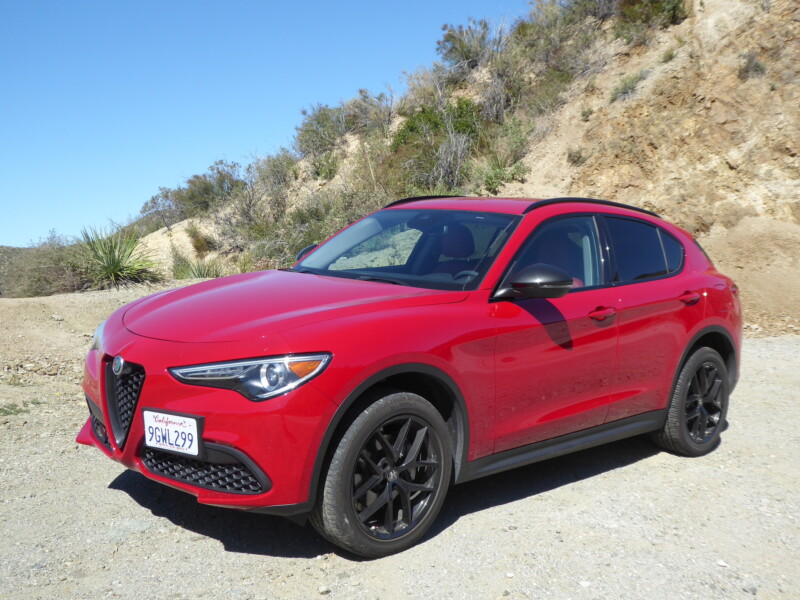
Stelvio sales have been steady but unspectacular ever since. Across Europe, it has outsold the Giulia, but in the UK, the position is the other way around. It also fared better than the Giulia in the US where neither car is what you would call a big seller, Alfa have made a number of updates to the Stelvio since launch, but these are generally quite subtle and not generally visually obvious apart from some new and bold colours which came a few months ago. Mostly these concerned keeping the engines compliant with changing and ever tougher regulations especially in Europe and minor tweaks to the trim and equipment. A couple of limited editions mirrored those offered for the Giulia with the very distinctive livery of the F1 edition being hard to miss whilst the matt grey paint of the N-Ring car is rather more subtle. A more substantive update was announced earlier in 2023 with new headlight units following the style set by the Tonale and sequential turn indicators following a current trend. The instrument cluster was also altered and there were changes to trim levels and equipment. But in essence the Stelvio is pretty much the car now that was when production started in 2017. Is that enough for it still to have appeal? Well, when I spotted a classic Alfa Red model parked up at Hertz’ LAX facility that thankfully was not allocated to anyone else, I hoped to find out.


The test car had the 280 bhp petrol engine that is reckoned by many to be the best choice, not that Americans get many other options, as the only alternative to them is the thunderous 505 bhp Quadrifoglio, which whilst doubtless as much fun here as it is in the Giulia is probably a bit too much for everyday motoring, and certainly far costlier to run. I certainly thought the sweet spot of the Giulia range to be this engine, and having now tried it here, I would conclude that this really is the engine to go for. It endows the Stelvio with excellent performance. It is also very smooth and very quiet, perhaps too quiet for an Alfa where a barking exhaust mode is almost part of the list of essentials. There is an eight speed automatic transmission, with a conventional gearlever that is shared with that in my Maserati, and it is really well matched to the engine, so there is always plenty of acceleration available and the Stelvio never seems to be caught out, no matter what you want. Like all recent Alfa models there is a DNA switch and flicking it to D (“Dinamico”) gives and extra bite to everything – throttle response, holding onto the gears a bit more and sharpening up the steering. There may be a price to pay for this, though, as having driven the car 161 miles I had to put in 6.4 gallons to fill it which works out at 25.16 mpg US or 30.05 mpg Imperial, which is not a particularly good result, though in the Stelvio’s defence I do have to say I think the tank was not very full, as the needle moved off the “F” mark very quickly after collection. The Stelvio has a Start/Stop system, which I noticed had been turned off by a previous renter.


Although this is a large and heavy SUV type car, you really would not know it from behind the wheel. It feels almost as athletic as a Gulia. The steering is extremely well judged with plenty of feel and just the right weighting and the handling is extremely good. This really is a car that you would take on the twisty roads just for the sake of it. It also rides very nicely. This one came on 255/55 R20 wheels, but evidence that the suspension has been well thought through comes from the fact that it handles all but the worst surfaces with aplomb. The brakes are strong and powerful and did what was required up in the hills where I took the Stelvio. Visibility is generally good, though there is a bit of a blind spot thanks to the rear end styling. The Stelvio of 2021 features fewer ADAS systems than you get in the latest cars and that may not be an entirely bad thing as there is less to irritate!


I did have a bit of a shock when I opened the door, as the whole interior was red. This certainly won’t be to all tastes, and indeed if it was my choice, I would much prefer tan, but several people who saw the photos of the car that I posted said they really liked it, just proving that we do indeed all have varying preferences. What matter more, perhaps, is the overall quality and here the Stelvio scores more highly to my mind that some others would have you believe. The steering wheel is leather-wrapped and was delightful to hold. There’s a definite link to classic interior Alfa dashboard designs of years ago, with an instrument layout that sees two humped cowls containing the speedometer and rev counter. Outside these you get water temperature and fuel gauges which use a series of illuminating dots to make their indications. Central in the cluster is a large trip display area which includes a digital speed repeater. There are two chunky column stalks which will be familiar to anyone who has driven a Giulia. Lights operate from a dial on the dash. The engine start button is on the lower portion of the wheel and the spokes here also operate cruise control and audio repeater functions. The touchscreen is integrated in the centre of the dash. By modern standards it is not that large at 8.8”, but it is made easier to use by the presence of a control wheel in the centre console. Even so, I found it a bit clunky in operation. Features on the entry level spec, such as the test car include an eight-speaker stereo, satellite radio, Bluetooth, five USB ports, Apple CarPlay and Android Auto. There are separate buttons for the dual zone climate control. You also get a wireless charging pad.


Those leather-trimmed seats are electrically adjustable and they power back when the ignition is off to aid exit and entry. That does mean that you need to set the three-position memory if you want to preserve the driving position you have found. There is also adjustable lumbar support. I particularly like the real soft headrest, but the whole seat was supremely comfortable, with support in all the right places. Add in an adjustable steering column and it was easy to get the optimum driving position.


There’s plenty of space in the rear. For two, anyway. Headroom is generous, of course, and even with the front seats set well back, there should be ample legroom. The central console unit does extend well back, though, so a middle seat occupant may struggle a bit for knee room. Occupants here get a central drop-down armrest with cup holders in the upper surface, and they have their own air vents as well as two USB ports. There are stowage bins on the doors and nets on the back of the front seats.


The tailgate has electrical assistance, which is always welcome these days given how large and heavy these items have become. It opens to reveal a good sized boot, even though some rivals do offer a little more space. There are useful stowage wells to either side of the main luggage area, and lots of hooks as well as 12v power outlet. There is a bit more space under the boot floor, as there is no spare here. The rear seat backrests are asymmetrically split 40:20:40 and drop down to give a flat and much longer load area, with release levers conveniently positioned near the tailgate. There is ample provision for odds and ends in the passenger cabin with a decently sized glovebox, pockets on the doors, a central armrest cubby and a small cubby over the driver’s left knee.


American buyers get less choice in Stelvio models than those in Europe. There are four trims: Sprint, Ti, Ti Sport and Quadrifoglio. The lower three trims have a 280 bhp turbocharged four-cylinder engine. A 505 bhp twin-turbocharged V6 lies under the bonnet of the top Quadrifoglio trim. The Stelvio Sprint comes with an eight-speed automatic transmission and rear-wheel drive. Standard features include dual-zone automatic climate control, remote start, proximity keyless entry, an 8.8-inch touch screen, a 7-inch digital instrument cluster, Apple CarPlay and Android Auto, an eight-speaker stereo, satellite radio, Bluetooth, five USB ports, leather-trimmed seats, 10-way power adjustable front seats, a leather-wrapped steering wheel, a universal garage door opener and interior ambient lighting. Standard driver-assistance features include a rearview camera, forward collision warning, forward automatic emergency braking and rear parking sensors. When this trim was new it was available with all-wheel drive, wireless device charging, blind-spot monitoring, adaptive cruise control, lane-departure warning, front parking sensors, automatic high-beam headlights, an infrared windshield, a dual-pane sunroof, a 10-speaker audio system, heated front seats and a heated steering wheel. The Stelvio Ti gains all-wheel drive, heated front seats, a heated steering wheel, a dual-pane sunroof, front parking sensors, navigation and HD Radio. It’s available with a hands-free power liftgate, wireless device charging, a limited-slip rear differential, driver-drowsiness monitoring, blind-spot monitoring, adaptive cruise control, lane-keep assist, traffic-sign recognition, upgraded interior materials, aluminium pedals, front seats with added power adjustability, heated rear seats and a 14-speaker Harman Kardon audio system. The Ti Sport adds paddle shifters, a limited-slip rear differential, 14-way power-adjustable front seats and a sport-tuned suspension. The Quadrifoglio is this Alfa’s high-performance trim, and it comes with a torque-vectoring rear differential, high-performance tyres, an upgraded suspension system and Brembo brakes. This trim also gains leather front sport seats with added power adjustability, rear cross-traffic alert, blind-spot monitoring and a 14-speaker Harman Kardon audio system. You may find some models with a dual-pane sunroof.


It is fair to say that I loved this Stelvio, just liked I really liked the mechanically similar Giulia that I was able to sample earlier in the year. These are both cars which remain on my very short list of current production cars that I would consider owning. Not only do they both look great, they go well and have far more character – as well as relative rarity value – than the long list of rivals. I do know why they have not sold in the quantity that Alfa were hoping for and that they deserved, and it is largely around the cost. On paper they may appear to be priced competitively but the German trio can all offer such aggressive finance deals that the monthly cost ends up much higher for the Alfa (or the equivalent Jaguar), which puts people off. People will also tell you that the deprecation is much worse, though it is harder to be definitive on this, but if it were indeed true, than a lightly used one would be a real bargain. I have no doubt that in years to come when all the X3s, Q5s and GLCs have been scrapped, these Giorgio platform Alfa will remain as cherished classics, evidence of being a true Alfa that is find when new and ever more highly rated as it ages.