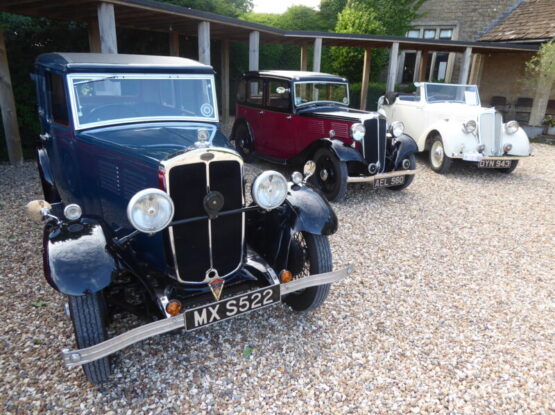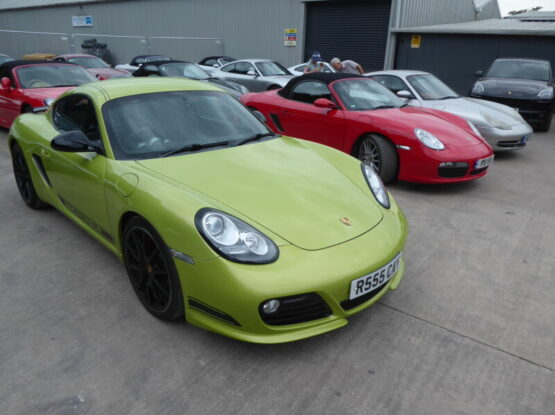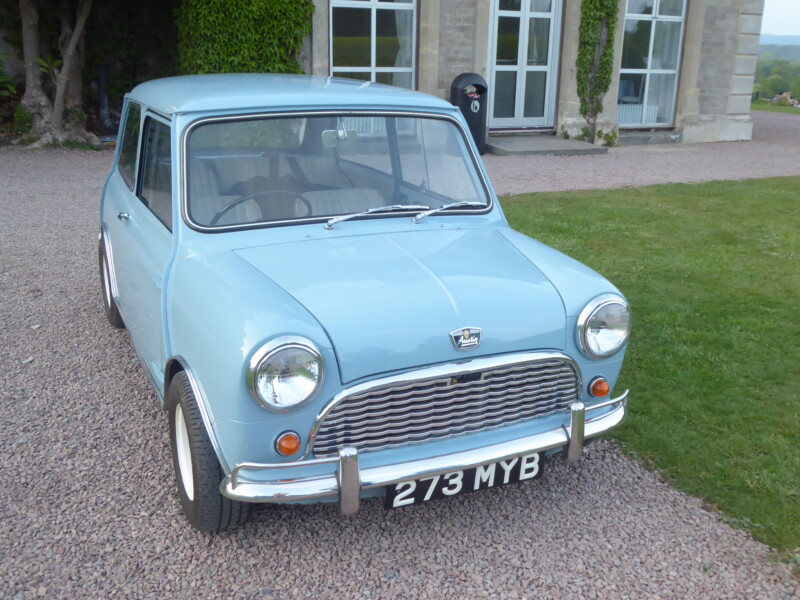
After years of holding breakfast meets at a variety of locations around Bristol, with the events still growing in popularity, the decision was taken to try a mid-week evening event. It was so well received that a couple were added to the calendar the following year and that has been the case ever since. So here we are, in late April, when the daylight lasts longer than people’s appetite to stay at a car meet, back at Eastwood Park for the first of the planned 2026 evening meets. The weather is pleasant, though not really warm enough yet for it to be T shirt weather, especially once the sun had gone down, and there are cars to look at. Many of them, of course are Queen Square regulars, but as always, there are cars that have either have not been seen before or which only appear rarely and April is also the month when a lot of treasured classics are taken out of the garage and taxed up for the season. I was optimistic of a good showing of cars. Here is what I actually saw which piqued my interest:
ALFA ROMEO
The Alfa Romeo 4C is a two-seater, rear-wheel drive coupé with technology and materials derived from the Alfa Romeo 8C Competizione, with a 1750 cc turbo petrol engine with direct injection, the “Alfa TCT” twin dry clutch transmission, and the Alfa DNA dynamic control selector. The 4C concept version was unveiled in the 81st Geneva Motor Show in March 2011, followed by the Mille Miglia 2011 parade, Goodwood Festival of Speed 2011,2011 Frankfurt Motor Show. It was displayed for the first time outside in Concorso d’Eleganza Villa d’Este in 2012. Compared to the production version, it is very similar, with the biggest differences being front lights, side vents and mirrors. The Alfa Romeo 4C Concept was voted the ‘Most Beautiful Concept Car of the Year’ award by the readers of German magazine Auto Bild, and won the Auto Bild Design Award 2011. It was awarded the “Design Award for Concept Cars & Prototypes” by referendum of the public in Villa d’Este. The production car was unveiled at the 2013 Geneva Motor Show, followed by 2013 Essen ‘Techno Classica’, Goodwood Festival of Speed 2013, Moscow Raceway, 2013 Frankfurt Motor Show. The bare ‘4C000’ chassis was also shown at the 2013 Geneva Motor Show. Ordering of European models began in October 2013 at Alfa Romeo dealerships in Europe. As part of the Alfa Romeo 4C launch, Alfa Romeo Style Centre and Compagnia Ducale designed a 4C IFD (Innovative Frame Design) Bicycle, inspired by the Alfa Romeo 4C coupé. The vehicle went on sale in December 2013 and marketed in Europe, Asia and America. Production of the 4C began May 2013 at Maserati’s plant in Modena, with an expected production of up to 2500 units per year. It was the first mass-produced Alfa Romeo model to be sold in the US market since 1995 when the 164 sedan stopped being sold in the US. Production of the Alfa Romeo 4C was originally estimated to be over 1000 units per year, with an upper limit of 3500 units per year, depending on the quantity of carbon fibre chassis that can be built by the supplier Adler Plastic. Within the 3,500-unit quota, 1,000 units are earmarked for Europe. Delivery of the European Alfa Romeo 4C Launch Edition took place at Balocco (Vercelli, Italy) Test Centre. In 2018, the 4C coupe was discontinued for the North American market. The 4C Spider, however continued to be sold there for model year 2019 and model year 2020. In other markets, such as Australia and Japan, both the coupe and Spider continued. In late 2020, a new tribute-edition named the 4C Spider 33 Stradale Tributo was announced. The car was designed by Centro Stile Alfa Romeo (Style Centre) and developed by Alfa Romeo. The chassis is composed of a central carbon fibre tub, with aluminium subframes front and rear. The carbon fibre tub is produced by TTA (Tecno Tessile Adler) in Airola, as a joint venture between Adler Plastic and Lavorazione Materiali Compositi. The carbon fibre components that make up the chassis are cut using CNC technology. The entire carbon-fibre monocoque chassis (“tub”) of the car weighs 143 pounds (65 kg). Front and rear aluminium subframes combine with the tub, roof reinforcements and engine mounting to comprise the 4C chassis giving the vehicle a total chassis weight of 236 lb (107 kg) and a total vehicle curb weight of just 2,465 lb (1,118 kg). The 4C has a single carbon fibre body, similar to the body of many supercars. The outer body is made of a composite material (SMC for Sheet Moulding Compound) which is 20% lighter than steel. The stability is comparable to steel and better than aluminium. The 4C employs double wishbone suspensions at the front and MacPherson struts at the rear. The resultant weight distribution is 38% on the front and 62% on the rear axle. Wheels and tyres have different diameters and widths front and rear: 205/45 R17 front and 235/40 R18 back as standard, with optional 205/40 R18 and 235/35 R19. Both wheel options come equipped with Pirelli P Zero tyres. The 4C uses vented disc brakes on all wheels; Brembo 305 millimetres (12.0 in) on the front and 292 millimetres (11.5 in) on the rear. The car can stop from 100 km/h (62 mph) in 36 metres. To save weight and increase steering feel, the 4C has no power steering. Its center of gravity height, at 40 centimetres (16 in) off the ground, is 7 centimetres (2.8 in) lower than that of the Lotus Elise. The 4C uses a new all-aluminium 1,742 cc inline 4 cylinder turbocharged engine producing 240 PS at 6000 rpm. The engine has been designed for minimum weight. The engine’s combined fuel consumption 6.8 l/100 km (42 mpg‑imp; 35 mpg‑US). 0–62 mph (0–100 km/h) acceleration is achieved in 4.5 seconds and the top speed is 258 km/h (160 mph), the power-to-weight-ratio being just 0.267 hp/kg (8.22 lb/hp) A journalist from Quattroruote car magazine demonstrated how the 4C accelerates from 0–100 km/h (0–62 mph) faster than 4.5 seconds. In race mode, with left foot on the brake pedal, if you pull the right shift paddle the engine will rev to 3500 rpm, but if you also pull the left paddle the engine will rev to 6000 rpm and 0–100 km/h (0–62 mph) time will go down to 4.2 seconds. Italian car magazine Quattroruote published the lap time of 4C around Nürburgring. It lapped the ring in 8:04. The 4C is equipped with a six speed Alfa TCT Dual Dry Clutch Transmission, and can be operated via gearshift paddles on the steering wheel. It also has an Alfa ‘DNA’ dynamic control selector which controls the behaviour of engine, brakes, throttle response, suspension and gearbox. In addition to the modes already seen in Giulietta, the 4C has a new “Race” mode. The U.S. version of the 4C was introduced in the 2014 New York International Auto Show with the first 100 4C’s being shipped to the U.S. early July, with a total of 850 being shipped by the end of 2014. The U.S. model includes extra bracing and strengthening required to meet U.S. crash regulations (including aluminium inserts in the carbon fibre chassis), resulting in 100 kg (220 lb) of weight increase. This version also has new headlamps similar to those seen before in the 4C Spider version. In 2018, the 4C coupe was discontinued for the North American market due to US DOT NHTSA FMVSS 226 Ejection Mitigation. The regulation called for a progressive compliance date based on volume and, due to low volume, the 4C was allowed to continue until the last compliance date of 9/1/2017, thus all 2018 4C coupes in North America have build dates of 8/2017 or earlier. The 4C Spider, however continued to be sold in North America for model year 2019 and model year 2020. The Spider version of the 4C was previewed showing a pre-production prototype at the 2014 Geneva Motor Show. Sharing its engine with the Coupé version, the 4C Spider has different external parts such as the headlights, exhaust and engine hood, as well as a different roof section that features a removable roof panel. The North American spec 4C reflects a weight difference of only 22 lb (10 kg) (2,465 lbs vs. 2,487 lbs) for the Spider variant. Top speed is quoted at 257 km/h (160 mph) and acceleration from 0 to 100 km/h (62 mph) at 4.5 seconds. The 4C Launch Edition was a limited and numbered edition, unveiled at the vehicle’s launch at the 2013 Geneva Motor Show. The vehicle came in a choice of four paint colours (Rosso Alfa, Rosso Competizione tri-coat, Madreperla White tri-coat or Carrara White matte). 500 examples were reserved for Europe/ROW, 500 for North America, 88 for Australia (Rosso Alfa and Madreperla White only), 200 to Japan and 100 for the Middle East. Note that the original press release cited 500 for North America, 400 Europe, and 100 ROW; however, the plaques on actual cars suggest that more were built and are the numbers referenced above. Distinguishing features of the Launch Edition were carbon fiber trim (including headlight housings, spoiler and door mirror caps), rear aluminium extractor with dark finishing, Bi-LED headlights, dark painted 18-inch front and 19-inch rear alloy wheels, additional air intakes on the front fascia, red brake calipers, racing exhaust system, BMC air cleaner, specific calibration for shock absorbers and rear anti-roll bar, leather/fabric sports seats with parts in Alcantara and a numbered plaque. Alfa Red coloured cars got matching red stitching on the steering wheel, handbrake, mats, handles and sports seats. In Europe the vehicle went on sale for 60,000 euros including VAT. The 4C Competizione is a limited edition version of the 4C introduced in the 2018 Geneva Motor Show, finished in matte Vesuvio Grey, with carbon details on the roof, rear spoiler, mirror caps, side air vents and headlight moulding. The run reportedly consisted of 108 units. The Japanese market received 25 units, and 10 units were assigned to Australia. The US-market received no Competizione editions. The car had a very mixed reaction. The UK press hated it at launch, but owners generally disagreed and loved it. A total of 9117 were built before production ceased in 2020.


ALPINA
The Alpina version of the E85 Z4 came at the 2003 Frankfurt Show and was called the Roadster S. Based on the 3 litre Z4, it used an Alpina tuned version of the older N52 engine to give 300 bhp which was coupled to a 6 speed auto box. Alpina modified the suspension and made minor tweaks to the exterior as well as applying their usual changes to the interior.


ALPINE
The Alpine A110 is a rear mid-engine, rear-wheel-drive sports car introduced by French car manufacturer Alpine at the 87th Geneva International Motor Show in March 2017. Deliveries began in late 2017 for Continental European markets and in 2018 for the UK, Japan and Australia. Both its name and design refer back to the original Alpine A110 that was produced from 1961 to 1977. Based on an all-aluminium construction, the A110 is powered by a Nissan-derived 1.8-litre turbocharged gasoline direct injection 4 valves per cylinder inline-four engine mated to a 7-speed dual-clutch transmission manufactured by Getrag. Developed by Renault–Nissan and reworked by Alpine engineers, the engine has an output of 252 PS at 6,000 rpm and 320 Nm (236 lb/ft) of torque at 2,000–5,000 rpm. According to Alpine, the A110 can accelerate from 0 to 100 km/h (0 to 62 mph) in 4.5 seconds, and has an electronically limited top speed of 250 km/h (155 mph). The A110 was initially available in three trims: Pure, Première, and Legende. The Pure cars, the base trim, have 17-inch alloy wheels. The Première trim cars are technically the launch edition models limited to 1,955 units and were equipped with amenities such as forged alloy wheels, quilted leather Sabelt bucket sports seats, a reversing camera, and metallic blue exterior colour as standard. The Legende trim cars come with six-way adjustable sports seats, black or brown leather interior upholstery, an upgraded hi-fi sound system, and specially designed wheels exclusive to this trim. All of the three trims share the same powertrain and transmission. For the 2020 model year, The Pure trim level was replaced by the Alpine A110, with no other badging. The Légende was replaced by the Alpine A110 GT which employed the same engine as the A110 S.


AUDI
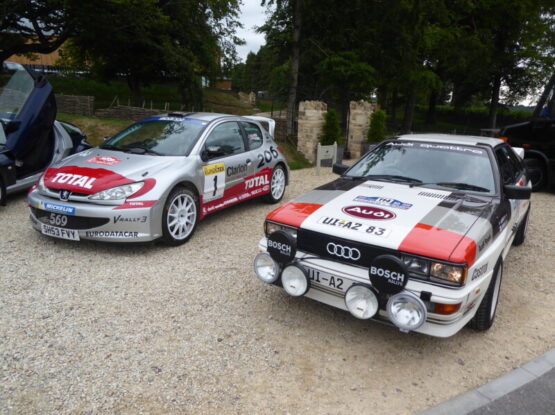
Still well-regarded over 40 years since its launch is the Quattro, a legend which transformed rallying and brought the idea of four wheel drive as a performance benefit to the market. The idea for a high-performance four-wheel-drive car was proposed by Audi’s chassis engineer, Jörg Bensinger, in 1977, when he found that the Volkswagen Iltis could outperform any other vehicle in snow, no matter how powerful. Bensinger’s idea was to start developing an Audi 80 variant in co-operation with Walter Treser, Director of Pre-Development.. Following an unveiling on 1st March 1980, Audi released the original Quattro to European customers in late 1980, with the car featuring Audi’s quattro permanent four-wheel drive system (hence its name), and the first to mate four-wheel drive with a turbocharged engine. The original engine was the 2,144 cc in-line-5-cylinder 10 valve SOHC, with a turbocharger and intercooler. It produced 197 bhp propelling the Quattro from 0 to 100 km/h in 7.1 seconds, and reaching a top speed of over 220 km/h (137 mph). The engine was eventually modified to a 2,226 cc inline-5 10 valve, still producing 197 bhp, but with peak torque lower in the rev-range. In 1989, it was then changed to a 2,226 cc inline-5 20v DOHC setup producing 217 bhp, now with a top speed of 230 km/h (143 mph) Audi Quattros are referred to among owners and enthusiasts by their engine codes, to differentiate between the earlier and later versions: the earliest 2144 cc 10v being the “WR” engine, the 2226 cc 10v being the “MB” engine, and the later 20v being the “RR” engine. Hence, Quattro models may be referred to as either the WR Quattro, MB Quattro, and RR or “20v” Quattro, respectively. Quattro car production was 11,452 vehicles over the period 1980–1991, and through this 11 year production span, despite some touch-ups, there were no major changes in the visual design of the vehicle. For the 1983 model year, the dash was switched from an analogue instrument cluster, to a green digital LCD electronic instrument cluster. This was later changed in 1988 to an orange LCD electronic instrument cluster. The interior was redesigned in 1984, and featured a whole new dash layout, new steering wheel design, and new centre console design, the switches around the instrument panel were also redesigned at this time. In 1985 the dash changed slightly with harder foam and lost a diagonal stripe, the dash switches were varied slightly and the diff lock pull knob gave way to a two-position turning knob with volt and oil temp digital readouts. External styling received very little modification during its production run. Originally, the car had a flat fronted grille featuring four separate headlamp lenses, one for each of the low and high beam units. This was altered for the 1983 model year, and replaced with combined units featuring a single lens, but housing twin reflectors. This was changed again, for the 1985 model year, in what has become known as the ‘facelift model’ and included such alterations as a new sloping front grille, headlights, and trim and badging changes. Max speed was 124 mph. The RR 20v Quattro also featured a new three spoke steering wheel design, leather covering for door arm rests, gloveboxes, centre console and door pockets. There was also a full length leather-wrapped centre console running all the way to the rear seats. The 20v was also the first Ur-Q to have “quattro” script interior with partial leather seats. The floor on the drivers side had a bulge due to dual catalytic exhaust setup. The different models may be distinguished by the emblems on their boot lids: the WR had a vinyl ‘quattro’ decal or a brushed aluminium effect plastic emblem, the MB had chrome plated ‘audi’, ‘audi rings’ and ‘quattro’ emblems, whilst the RR had only chrome plated ‘audi rings’. The rear suspension was altered early on with geometry changes and removal of the rear anti-roll bar to reduce a tendency for lift-off oversteer. For the 1984 facelift, the wheel size went from 6×15-inch with 205/60-15 tyres to 8×15-inch wheels with 215/50-15 tyres. At the same time the suspension was lowered 20 mm with slightly stiffer springs for improved handling. For 1987, the Torsen centre differential was used for the first time, replacing the manual centre differential lock. The last original Audi Quattro was produced on 17 May 1991, more than two years after the first models of the new Audi Coupe range (based on the 1986 Audi 80) had been produced.


The Audi R8, based on the Audi Le Mans quattro concept car (designed by Frank Lamberty and Julian Hoenig) first appeared at the 2003 International Geneva Motor Show and the 2003 Frankfurt International Motor Show. The R8 road car was officially launched at the Paris Auto Show on 30 September 2006. There was some confusion with the name, which the car shares with the 24 Hours of Le Mans winning R8 Le Mans Prototype (LMP). Initial models included the R8 4.2 FSI coupé (with a V8 engine) and R8 5.2 FSI coupé (with a V10 engine). Convertible models, called the Spyder by the manufacturer, were introduced in 2008, followed by the high-performance GT model introduced in 2011. The Motorsport variants of the R8 were also subsequently introduced from 2008 onwards. An all-electric version called the e-Tron started development but would only reach production stage when the second generation model would be introduced. 6-time 24 Hours of Le Mans winner Jacky Ickx described the R8 as “the best handling road car today” and the car was well received by everyone who drove it. The car received a facelift in 2012 and a new model called the V10 Plus was now added to the range. Production of the Type 42 ended in August 2015

This is the second generation R8. Launched at the 2015 Geneva Motor Show and is based on the Modular Sports System platform shared with the Lamborghini Huracan. The development of the Type 4S commenced in late 2013 and was completed in late 2014. Initial models included the all-electric e-Tron and the V10 5.2 FSI along with the V10 plus. Unlike its predecessor, there was no manual transmission available and the entry-level V8 trim was also dropped. In 2016, the convertible (Spyder) variant was added to the line up which was initially available in the base V10 trim. In mid-2017, the high performance V10 plus Spyder was added to the range. A rear-wheel-drive model called the R8 RWS was introduced. In 2018, the R8 received a mid-cycle refresh with mechanical and exterior changes. The newer and more aggressive design language carried over from famous Audi models of the past and its appearance is slightly more angular up front. Some of the aerodynamic features such as the front aeroblades are shared with the Lamborghini Huracàn. The refreshed model had substantial performance improvements over its predecessor. The base R8 got a power boost from 532 hp to 562 hp, while the V10 Plus was renamed V10 Performance Quattro and the engine saw a power increase by 10 hp, now up to 612 hp.

In August 2004, Audi announced that the next generation TT would be manufactured using aluminium, and would go into production in 2007. A preview of the second-generation TT was provided in the form of the Audi Shooting Brake concept car, shown at the Tokyo Motor Show in 2005. This concept was an insight into the new TT, but featured angular styling, and a “shooting-brake” two-door hatchback body style. Audi debuted the second-generation TT, internal designation Type 8J, on 6 April 2006, using the Volkswagen Group A5 (PQ35) platform with aluminium front bodypanels, and steel in the rear, to enhance its near-neutral front-to-rear weight distribution. Available in front-wheel drive or “quattro” four-wheel drive layout, the TT was again offered as a 2+2 Coupé, and as a two-seater Roadster. The second generation was five inches longer and three inches wider than its predecessor. Factory production commenced during August 2006. The powertrain options initially only included petrol engines, which consist of either one of two inline four-cylinder engines – the new 1.8-litre EA888 Turbocharged Fuel Stratified Injection (TFSI) (available initially only in Germany, later elsewhere from mid 2009), or the more common and established EA113-variant 2.0-litre TFSI. The Fuel Stratified Injection (FSI) technology was derived from the Audi Le Mans endurance race cars, and offers improved fuel efficiency as well as an increased power output and cleaner emissions. The 3.2-litre ‘V6’ badged VR6 engine was carried over from the previous generation. 2.0 TFSI quattro models, with the latest EA888 engine, became available in 2009 model year. A six-speed manual transmission is standard, with the six-speed Direct-Shift Gearbox (now called “S-TRONIC” on all Audi models) as an option for all engines. Quattro on-demand four-wheel drive, again using the Haldex Traction clutch is available – standard on V6 models, but not available on the 1.8 TFSI. The third generation model replaced it in 2014.

BMW
Produced initially purely as a homologation special, the E30 generation M3 achieved far greater levels of interest than ever imagined, and the rest, as they say, is history. Based on the 1986 model year E30 3 Series, the car was initially available with the 2 door body and was later offered as a convertible bodies. The E30 M3 used the BMW S14 engine. The first iteration of the road car engine produced 195 PS with a catalytic converter and 200 PS without a catalytic converter in September 1989 power was increased to 215 PS with a catalytic converter. The “Evolution” model (also called “EVO2”) produced 220 PS. Other Evolution model changes included larger wheels (16 X 7.5 inches), thinner rear and side window glass, a lighter bootlid, a deeper front splitter and additional rear spoiler. Later the “Sport Evolution” model production run of 600 (sometimes referred as “EVO3”) increased engine displacement to 2.5 litres and produced 238 PS. Sport Evolution models have enlarged front bumper openings and an adjustable multi-position front splitter and rear wing. Brake cooling ducts were installed in place of front foglights. An additional 786 convertibles were also produced. The E30 M3 differed from the rest of the E30 line-up in many other ways. Although using the same basic unit-body shell as the standard E30, the M3 was equipped with 12 different and unique body panels for the purposes of improving aerodynamics, as well as “box flared” wheel-arches in the front and rear to accommodate a wider track with wider and taller wheels and tyres. The only exterior body panels the standard model 3 Series and the M3 shared were the bonnet, roof panel, sunroof, and door panels. The E30 M3 differed from the standard E30 by having a 5×120 wheel bolt pattern. The E30 M3 had increased caster angle through major front suspension changes. The M3 had specific solid rubber offset control arm bushings. It used aluminium control arms and the front strut tubes were changed to a design similar (bolt on kingpins and swaybar mounted to strut tube) to the E28 5 Series. This included carrying over the 5 series front wheel bearings and brake caliper bolt spacing. The rear suspension was a carry over from the E30. The E30 M3 had special front and rear brake calipers and rotors. It also has a special brake master cylinder. The E30 M3 had one of two Getrag 265 5-speed gearboxes. US models received an overdrive transmission while European models were outfitted with a dogleg version, with first gear being down and to the left, and fifth gear being a direct 1:1 ratio. Rear differentials installed included a 4.10:1 final-drive ratio for US models. European versions were equipped with a 3.15:1 final drive ratio. All versions were clutch-type limited-slip differentials with 25% lockup. To keep the car competitive in racing following year-to-year homologation rules changes, homologation specials were produced. These include the Evo 1, Evo 2, and Sport Evolution, some of which featured less weight, improved aerodynamics, taller front wheel arches (Sport Evolution; to further facilitate 18-inch wheels in DTM), brake ducting, and more power. Other limited-production models (based on evolution models but featuring special paintwork and/or unique interior schemes commemorating championship wins) include the Europa, Ravaglia, Cecotto, and Europameister. Production of the original E30 M3 ended in early 1992.


The E34 generation of the M5 was produced from September 1988 to August 1995. Powered by the S38 straight-six engine, an evolution of the previous generation’s straight-six, the E34 was initially produced in a saloon body style, with a second LHD Touring (estate/wagon) version following in 1992. Production of M5 models began with the painted bodyshell of an E34 5 Series at the BMW Dingolfing plant. The shells were then transported to BMW M GmbH in Garching, where the car was assembled by hand over a period of two weeks. Only the South African M5 was entirely assembled at the Rosslyn, South Africa assembly plant from complete knock-down kits supplied from Garching, Germany. Cosmetic changes to the exterior from the standard E34 included unique front and rear bumpers and side rocker panels, contributing to a drag coefficient of 0.32 (from 0.30), while interior updates included a unique gearshift surround, different trunk lining with storage partitions and rear headrests. The second-generation M5 was introduced with the S38B36 engine, which generated 315 PS/3 11 hp at 6,900 rpm and 360 Nm (266 lb/ft) of torque at 4,750 rpm, touting a factory 0-97 km/h (60 mph) acceleration time of 6.3 seconds. Top speed was electronically limited to 250 km/h (155 mph). In late 1991 (1992 model year), the engine was upgraded to the 3.8-litre S38B38, with exception to North America and South Africa, which continued with the 3.6-litre engine due to emission laws. Power increased to 340 PS/ 335 hp, leading to a factory 0-97 km/h (60 mph) acceleration time of 5.9 seconds, and the ignition changed to a distributor-less system with each cylinder having an individual coil. BMW also used a dual-mass flywheel in place of the single in the 3.6-litre version for a smoother idle and throttle input at the expense of response. The standard self-leveling suspension (SLS) system, which maintained a constant ride height in the rear, was replaced with Electronic Damper Control (EDCIII+), an electronically controlled and hydraulically regulated system that can switch between comfort “P” setting and a more track-oriented “S” setting. A 6-speed Getrag 420G manual transmission was introduced in 1994. The M5 Touring, which was BMW M Division’s first estate as well as the last hand-built M car, saw 891 units produced. Total production of the E34 M5 was 12,254 units, of which 8,344 were 3.6-litre and 3,910 were 3.8-litre. In the North American market, only the 3.6-litre version was sold (model years 1991–1993).

The M3 version of the E46 3 Series was produced in coupé and convertible body styles. The E46 M3 is powered by the S54 straight-six engine and has a 0-100 km/h (62 mph) acceleration time of 5.1 seconds for the coupe, with either the manual or SMG-II transmission. The skid pad cornering results are 0.89 g for the coupe and 0.81 g for the convertible. The top speed is electronically limited to 250 km/h (155 mph). The available transmissions were a Getrag 420G 6-speed manual transmission or a SMG-II 6-speed automated manual transmission, which was based on the Getrag 420G. The SMG-II used an electrohydraulically actuated clutch and gearshifts could be selected via the gear knob or paddles mounted on the steering wheel. The SMG-II was praised for its fast shift times and racetrack performance, but some people found its shifts to be delayed and lurching in stop-start traffic. In 2005, a special edition was introduced which used several parts from the CSL. This model was called the M3 Competition Package (ZCP) in the United States and mainland Europe, and the M3 CS in the United Kingdom. Compared to the regular M3, the Competition Package includes: 19-inch BBS alloy wheels- 19″x 8″ at the front and 19″x 9.5″ at the rear; Stiffer springs (which were carried over to the regular M3 from 12/04); Faster ratio steering rack of 14.5:1 (compared with the regular M3’s ratio of 15.4:1) as per the CSL; Steering wheel from the CSL; M-track mode for the electronic stability control, as per the CSL; The CSL’s larger front brake discs (but with the regular M3 front calipers) and rear brake calipers with larger pistons; Alcantara steering wheel and handbrake covers; The engine, gearbox and other drivetrain components are the same as the standard M3. Total production of the E46 M3 was 56,133 coupes and 29,633 convertibles. The cars were assembled at the BMW Regensburg factory in Germany and production was from September 2000 until August 2006, production totallled 85,766.


Introduced in 1998 at the Geneva Motor Show, the E39 generation of the M5 was the first M5 to use a V8 engine, resulting in an increase in power output to 400 PS. It is also the first M5 to use aluminium front suspension components and a multi-link rear suspension. Production began in October 1998. Unlike its predecessors, the M5 was produced on the same assembly line as the regular 5 Series models at the Dingolfing factory in Germany. The official performance figures are 0–97 km/h (60 mph) acceleration time of 4.8 seconds and an electronically limited top speed of 250 km/h (155 mph). In testing, an unrestricted M5 reached a top speed in excess of 300 km/h (186 mph). The E39 M5 recorded a Nurburgring lap time of 8:20. The M5 received the September 2000 facelift at the same time as the standard E39 models. Changes included halogen “corona rings” in headlights (often called “Angel Eyes”), LED tail-lights and various interior upgrades. The mechanical specification was unchanged. For the subsequent two model years, changes were limited to the addition of new exterior colours (from September 2001) and the upgrade to a DVD-based navigation system (from September 2002). Production of a “Touring” E39 M5 model was evaluated by BMW, and at least one prototype was developed (in Titanium Silver with a Black Exclusive leather interior). However the Touring did not reach production, due to financial considerations. Production totalled to 20,482 cars from 1999 to 2003.

On 25 September 2013, BMW released the technical specifications of the M4. It is powered by the S55B30 engine, which is developed and engineered by BMW M GmbH. This 3.0-litre inline-6 engine has been built specifically for the new M4/M3, having a redline of 7,600 rpm with the rev limiter actuated at 7,300 rpm. The engine uses two mono-scroll turbochargers with a peak boost pressure of 18.1 psi (1.2 bar). The power is rated at 431 PS/425 hp, however this is achieved not at a specific engine speed, but is instead rated throughout the range of 5,500–7,300 rpm. The engine’s torque is rated at 550 Nm (406 lb/ft) throughout the range of 1,850–5,500. Two transmission choices are available, the 6-speed manual and the 7-speed M-DCT transmissions. The 7-speed M-DCT transmission accelerates the car from 0 to 100 km/h (62 mph) in 4.1 seconds) and the 6-speed manual transmission from 0 to 100 km/h (62 mph) in 4.3 seconds. The weight of the European specification M4 equipped with a manual transmission is 1,572 kg (3,466 lb) and with the M-DCT dual-clutch transmission, the car is some 40 kg (88 lb) heavier, losing some 80 kg (176 lb) as compared to the E92 M3. As per its E92 predecessor, the roof of the coupe model is constructed from carbon fibre (except if the optional sunroof is fitted). Carbon fibre is also used for the bootlid and engine brace. For the first time in a M3/M4 model, an electric power steering unit is used. The steering system is specifically tuned for both the M3 and M4, however it has been criticized for lacking in feel. The 18 inches (460 mm) and 19 inches (480 mm) wheel options are available with lightweight forged alloy wheels being standard. The M compound brakes come standard (with blue brake calipers), while carbon ceramic brakes (with gold brake calipers) are available as an option. The M4 features Active Sound, live amplification of the engine’s natural sound inducted into the passenger cabin via speakers in the car. BMW claims this technology has been used so that the well insulated cabin can reduce road/wind noise but still provide the driver with the sporty sound of the M powered engine. There are no artificial sound or any pre-recorded track in the system. This system was first implemented in the M5. The M4 is based on the F32 4 Series however 50 percent of its components are unique as compared to the 4 Series. The convertible variant of the M4 was announced along with its coupe sibling, also internally known as F82 or F83 M4. It shares almost everything with the coupé version, but weighs more due to its folding metal roof. The convertible weighs 1,750 kg (3,858 lb) (manual), 1,691 kg (3,728 lb) (M-DCT). The three-piece retractable hardtop folds in 20 seconds. The only significant difference between the two is the weight due to its retractable hardtop. Like its hardtop counterpart, the F83 M4 uses carbon fibre reinforced plastic to lighten and stiffen the car. Because of its extra weight it accelerates slower, taking it 0.3 seconds longer to 100 km/h (62 mph); 4.6 seconds with the manual and 4.3 seconds with the M-DCT transmission. The dynamic differences between the two variants are marginally small. Starting from the 2019 model year (production from 07/2018 onward) BMW removed the carbon fibre driveshaft so as to be able to fit an Otto Particulate Filter (OPF), necessary to comply with WLTP emissions regulations and this also meant that the M Performance Exhaust was no longer able to be offered on these cars by BMW. In February 2016, BMW announced the M4 Competition Package. The M4 Competition Package increases power output by 19 PS to 450 PS/444 hp and has a revised suspension for better handling. New springs, dampers and anti-roll bars complement the included Adaptive M Suspension. BMW also re-tuned the electronic differential and the Dynamic Stability Control to match the upgraded hardware. The interior remains largely unchanged, but Competition Package cars get new lightweight sport seats along with the M-striped woven seat belts. The exterior includes the M Sport exhaust with black chrome tailpipes and high gloss Shadow Line exterior trim. Gloss black trim is added to the kidney grille, side gills, and model badge on the trunk. With the Competition Package, the coupe version accelerates from standstill to 100 km/h (62 mph) in 4.0 seconds. There is a convertible version, and that does the run in 4.2 seconds, both coupe and convertible forms using the dual-clutch transmission.


Also here were examples of the latest M5 in both saloon and Touring formats. Gosh, this is now a very big car indeed and we also know that it is exceedingly heavy at around 2.5 tonnes. I know that beauty is in the eye of the beholder, but it would be a stretch for anyone to call this good looking.


CATERHAM
The Caterham story is one of continual development, a four decade process of honing Colin Chapman’s original design, which is now 60 years old. Since 1973, when Graham Nearn’s Caterham cars took over the rights and manufacture of the fly-weight sportscars, it’s grown more power, better engines, more sophistication in both suspension and powertrains, as well – in some cases – as more space inside and certainly more creature comforts, all while preserving the original character. Caterham completed 42 of the heavier and not that well thought of Series 4 cars before deciding to concentrate on the classic Series 3 design, with a simple space frame chassis clothed in aluminium and glassfibre. At the time of the S3, the power unit was from Ford, with the Crossflow unit developing 84 bhp in GT form with a twin choke carburettor, though twin Webers were never far away. Sevens had started out with Ford side valve power, before the 948cc BMC A Series unit found its way into the car, followed by Ford’s new 1340cc and 1498cc engines, before the head redesign put the intake and the exhaust on opposite sides. When Ford discontinued the Kent engine in 1976, it caused something of a difficulty for Caterham, as this also meant the end of the Twin Cam and the BDR engines, of which Caterham had bought 500 in preceding years, and whilst the final pushrod engines came from South Africa, eventually the supply ran out and a new supplier was needed. At first the firm turned to Vauxhall’s 2 litre unit for the higher powered cars but when the found out that Rover were developing a new and sophisticated twin cam engine, which turned out to be the K Series unit, a deal was struck and the first K Series engined Caterhams appeared in 1991, once the multi-point injection version was available (the single point would have required a bonnet bulge which Caterham did not want). To get round the relative lack of torque, Caterham developed their own close ratio 6 speed gearbox which was lighter than the Ford unit they had been using, and which could cope with larger capacity and more powerful K Series units as Rover made them available. Caterham continued to develop the car throughout the 90s, starting to make their own steering racks among other changes. By the time the K Series and the 240 bhp Vauxhall engines in the HPC car came along, the interior had become plusher with a long cockpit option and a wider variant, the SV. There were now proper bucket seats instead of those with a plywood backrest and in 1996 the handbrake moved from under the dash to the transmission tunnel. This required extra tubing in the chassis, which made it 80% stiffer. The front suspension had gained a proper top wishbone and separate anti-roll bar, but the biggest change came with the adoption of de Dion rear suspension. The move was occasioned by a need to keep the rear wheels linked and parallel to each other, yet still as simple as possible, though the engineers harboured a desire for a fully independent rear end, which finally came about with the CSR version in 2004. This change improved the ride massively on bumpy roads and makes the car feel more planted. The collapse of Rover in 2005 meant the end for the K Series, so there was a switch back to Ford power, using the Sigma engine, which happily fits under the bonnet – something that few modern engines do as they are now often simply too tall. Adding more power is a law of diminishing returns with a Caterham, thanks to the aerodynamics, though there are now an array of different power outputs offered, but the most recent change was a new entry level model, which uses a 660cc Suzuki turbo triple, with a live axle and a similar power to weight ratio to the classic single carb Ford powered models of 30 years ago. However, these days you can get carpets, leather seats and full weather gear if you upgrade to an S pack. Caterham plan to continue to develop the car for as long as they can. To date they have built around 16,000 examples, and it is said that were you to gather 100 models together, you would not find two the same, even though, colour apart, many cars look very similar at a quick glance.


FERRARI
Introduced at the 1985 Frankfurt Show alongside the Mondial 3.2 series, the Ferrari 328 GTB and GTS (Type F106) were the successors to the Ferrari 308 GTB and GTS which had first been seen in October 1975. While mechanically still based on the 308 GTB and GTS respectively, small modifications were made to the body style and engine, most notably an increase in engine displacement to 3185 cc for increased power and torque output. As had been the case for a generation of the smaller Ferraris, the model name referred to the total cubic capacity of the engine, 3.2 litres, and 8 for the number of cylinders. Essentially the new model was a revised and updated version of the 308 GTS, which had survived for eight years without any radical change to the overall shape, albeit with various changes to the 3-litre engine. The 328 model presented a softening of the wedge profile of its predecessor, with a redesigned nose that had a more rounded shape, which was complemented by similar treatment to the tail valance panel. The revised nose and tail sections featured body colour bumpers integral with the valance panels, which reflected the work done concurrently to present the Mondial 3.2 models, with which they also shared a similar radiator grille and front light assembly layout. Thus all the eight-cylinder cars in the range shared fairly unified front and rear aspects, providing a homogeneous family image. The exhaust air louvres behind the retractable headlight pods on the 308 series disappeared, coupled with an increase in the size of the front lid radiator exhaust air louvre, which had been introduced on the 308 Quattrovalvole models, whilst a new style and position of exterior door catch was also provided. The interior trim also had a thorough overhaul, with new designs for the seat panel upholstery and stitching, revised door panels and pulls, together with more modern switchgear, which complemented the external updating details. Optional equipment available was air conditioning, metallic paint, Pirelli P7 tyres, a leather dashboard, leather headlining to the removable roof panel plus rear window surround, and a rear aerofoil (standard on Japanese market models). In the middle of 1988 ABS brakes were made available as an option, which necessitated a redesign of the suspension geometry to provide negative offset. This in turn meant that the road wheel design was changed to accommodate this feature. The original flat spoke “star” wheels became a convex design, in the style as fitted to the 3.2 Mondial models, whether ABS was fitted or not. The main European market 328 GTS models had a tubular chassis with a factory type reference F 106 MS 100. Disc brakes, with independent suspension via wishbones, coil springs, and hydraulic shock absorbers, were provided all round, with front and rear anti roll bars. There were various world market models, each having slight differences, with right and left hand drive available. The V8 engine was essentially of the same design as that used in the 308 Quattrovalvole model, with an increase in capacity to 3185 cc. The engine retained the Bosch K-Jetronic fuel injection system of its predecessor, but was fitted with a Marelli MED 806 A electronic ignition system, to produce a claimed power output of 270 bhp at 7000 rpm. As with the preceding 308 models the engine was mounted in unit with the all synchromesh five-speed manual transmission assembly, which was below, and to the rear of the engine’s sump. The 328 GTS continued in production for four years, until replaced by the 348 ts model in the autumn of 1989, during which time 6068 examples were produced, GTS production outnumbering the GTB (1344 produced) version almost five to one.

Firmly placed in Ferrari’s history as one of their finest big GTs, the 550 Maranello’s combination of stylish Pininfarina lines and front mounted 12-cylinder engine meant this car had the potential to become an instant classic, following in the footsteps of its forebear, the 365 GTB/4 ‘Daytona’, and if you look at the way the prices are steading to go, it’s clear that the potential is being realised. Launched in 1996, and with modern styling cues, a 5.5 litre V12 engine producing around 485bhp and a reported top speed of 199mph, the 550 Maranello was a serious motor car. A less frenetic power delivery, the six speed manual box and excellent weight distribution were all factors in the 550 becoming the perfect European Grand Tourer. Ferrari updated the car to create the 575M. Launched in 2002, it is essentially an updated 550 Maranello featuring minor styling changes from Pininfarina. The 575M was replaced by the 599 GTB in the first half of 2006. Updates from the 550 included a redesigned interior and substantial mechanical improvements, including bigger brake discs, a larger and more powerful engine, improved weight distribution, refined aerodynamics and fluid-dynamics along with an adaptive suspension set-up (the four independent suspensions are also controlled by the gearbox, to minimize pitch throughout the 200-milliseconds shift time). Two six-speed transmissions were available, a conventional manual gearbox and, for the first time on a Ferrari V12, Magneti Marelli’s “F1” automated manual gearbox. The 575 model number refers to total engine displacement in cc, whilst the ‘M’ is an abbreviation of modificata (“modified”).

Effectively a mid-life update to the 360 Modena, the F430 debuted at the 2004 Paris Motor Show. Designed by Pininfarina, under the guidance of Frank Stephenson, the body styling of the F430 was revised from the 360 Modena, to improve its aerodynamic efficiency. Although the drag coefficient remained the same, downforce was greatly enhanced. Despite sharing the same basic Alcoa Aluminium chassis, roof line, doors and glass, the car looked significantly different from the 360. A great deal of Ferrari heritage was included in the exterior design. At the rear, the Enzo’s tail lights and interior vents were added. The car’s name was etched into the Testarossa-styled driver’s side mirror. The large oval openings in the front bumper are reminiscent of Ferrari racing models from the 60s, specifically the 156 “sharknose” Formula One car and 250 TR61 Le Mans cars of Phil Hill. Designed with soft-top-convertible. The F430 featured a 4.3 litre V8 petrol engine of the “Ferrari-Maserati” F136 family. This new power plant was a significant departure for Ferrari, as all previous Ferrari V8’s were descendants of the Dino racing program of the 1950s. This fifty-year development cycle came to an end with the entirely new unit. The engine’s output was 490 hp at 8500 rpm and 343 lb/ft of torque at 5250 rpm, 80% of which was available below 3500rpm. Despite a 20% increase in displacement, engine weight grew by only 4 kg and engine dimensions were decreased, for easier packaging. The connecting rods, pistons and crankshaft were all entirely new, while the four-valve cylinder head, valves and intake trumpets were copied directly from Formula 1 engines, for ideal volumetric efficiency. The F430 has a top speed in excess of 196 mph and could accelerate from 0 to 100 km/h in 3.9 seconds, 0.6 seconds quicker than the old model. The brakes on the F430 were designed in close cooperation with Brembo (who did the calipers and discs) and Bosch (who did the electronics package),resulting in a new cast-iron alloy for the discs. The new alloy includes molybdenum which has better heat dissipation performance. The F430 was also available with the optional Carbon fibre-reinforced Silicon Carbide (C/SiC) ceramic composite brake package. Ferrari claims the carbon ceramic brakes will not fade even after 300-360 laps at their test track. The F430 featured the E-Diff, a computer-controlled limited slip active differential which can vary the distribution of torque based on inputs such as steering angle and lateral acceleration. Other notable features include the first application of Ferrari’s manettino steering wheel-mounted control knob. Drivers can select from five different settings which modify the vehicle’s ESC system, “Skyhook” electronic suspension, transmission behaviour, throttle response, and E-Diff. The feature is similar to Land Rover’s “Terrain Response” system. The Ferrari F430 was also released with exclusive Goodyear Eagle F1 GSD3 EMT tyres, which have a V-shaped tread design, run-flat capability, and OneTRED technology. The F430 Spider, Ferrari’s 21st road going convertible, made its world premiere at the 2005 Geneva Motor Show. The car was designed by Pininfarina with aerodynamic simulation programs also used for Formula 1 cars. The roof panel automatically folds away inside a space above the engine bay. The conversion from a closed top to an open-air convertible is a two-stage folding-action. The interior of the Spider is identical to that of the coupé. Serving as the successor to the Challenge Stradale, the 430 Scuderia was unveiled by Michael Schumacher at the 2007 Frankfurt Auto Show. Aimed to compete with cars like the Porsche RS-models and the Lamborghini Gallardo Superleggera it was lighter by 100 kg/220 lb and more powerful (510 PS) than the standard F430. Increased power came from a revised intake, exhaust, and an ion-sensing knock-detection system that allows for a higher compression ratio. Thus the weight-to-power ratio was reduced from 2.96 kg/hp to 2.5 kg/hp. In addition to the weight saving measures, the Scuderia semi-automatic transmission gained improved “Superfast”, known as “Superfast2”, software for faster 60 millisecond shift-times. A new traction control system combined the F1-Trac traction and stability control with the E-Diff electronic differential. The Ferrari 430 Scuderia accelerates from 0-100 km/h in 3.6 seconds, with a top speed of 202 miles per hour. Ferrari claimed that around their test track, Fiorano Circuit, it matched the Ferrari Enzo, and the Ferrari F430’s successor, the Ferrari 458. To commemorate Ferrari’s 16th victory in the Formula 1 Constructor’s World Championship in 2008, Ferrari unveiled the Scuderia Spider 16M at World Finals in Mugello. It is effectively a convertible version of the 430 Scuderia. The engine produces 510 PS at 8500 rpm. The car has a dry weight of 1,340 kg, making it 80 kg lighter than the F430 Spider, at a curb weight of 1,440 kg (3,175 lb). The chassis was stiffened to cope with the extra performance available and the car featured many carbon fibre parts as standard. Specially lightened front and rear bumpers (compared to the 430 Scuderia) were a further sign of the efforts Ferrari was putting into this convertible track car for the road. Unique 5-spoke forged wheels were produced for the 16M’s launch and helped to considerably reduce unsprung weight with larger front brakes and callipers added for extra stopping power (also featured on 430 Scuderia). It accelerates from 0-100 km/h in 3.7 seconds, with a top speed of 315 km/h (196 mph). 499 vehicles were released beginning early 2009 and all were pre-sold to select clients.


The Ferrari F12berlinetta (Type F152) is a front mid-engine, rear-wheel-drive grand tourer which debuted at the 2012 Geneva Motor Show, and replaces the 599 grand tourer. The naturally aspirated 6.3 litre Ferrari V12 engine used in the F12berlinetta has won the 2013 International Engine of the Year Award in the Best Performance category and Best Engine above 4.0 litres. The F12berlinetta was named “The Supercar of the Year 2012” by car magazine Top Gear. The F12berlinetta was replaced by the 812 Superfast in 2017.


FIAT
Internally codenamed Project 176, the Punto was announced in September 1993 as a replacement for the ageing Fiat Uno and launched in the end of 1993 or the beginning of 1994, depending on the market. The Fiat Punto was voted European Car of the Year for 1995, defeating rival Volkswagen Polo by only 78 points. The Punto was designed by Giorgetto Giugiaro and was available as a three-door or five door hatchback, a two-door cabriolet and a three-door panel van. As with the majority of the new Fiat group models, suspension was all independent, composed of MacPherson struts at the front and trailing arms at the rear. Entry level in the Punto range were the 1.1 and 1.2 L petrol engines and the 1.7 diesel engine. The 1.2 engine’s actual capacity is 1242 cc, available in three versions. The first, was fitted in the Punto ELX 75 and produced 75 hp at 6000 rpm while the second, fitted to Punto ELX 85 produced 86 hp at 6000 rpm. The third was a 60 hp engine which eventually replaced the 1.1 54 hp engine. A Sporting model was also available with a 1.6 8v updated 128 SOHC engine, producing 88 hp, later replaced in 1997 by the 1.2 16v FIRE engine used in the 85 ELX, and a power drop to 86 hp. The top of the range model was the 136 PS 1.4 GT, using an evolution of the turbocharged 128 SOHC engine originally found in the Fiat Uno Turbo Mk II – capable of running over 200 km/h (120 mph) and reaching 100 km/h (62 mph) in 7.9 seconds, which came fitted with a five speed manual gearbox. During the years the GT was made in three different “series” with power 136 PS (1993–1995),133 PS (1995–1997) and 130 PS (1997–1999).


FORD
The Capri Mk III was referred to internally as “Project Carla”, and although little more than a substantial update of the Capri II, it was often referred to as the Mk III. The first cars were available in March 1978, but failed to halt a terminal decline in sales. The concept of a heavily facelifted Capri II was shown at the 1976 Geneva show: a Capri II with a front very similar to the Escort RS2000 (with four headlamps and black slatted grille), and with a rear spoiler, essentially previewed the model some time before launch. The new styling cues, most notably the black “Aeroflow” grille (first used on the Mk I Fiesta) and the “sawtooth” rear lamp lenses echoed the new design language being introduced at that time by Ford of Europe’s chief stylist Uwe Bahnsen across the entire range. Similar styling elements were subsequently introduced in the 1979 Cortina 80, 1980 Escort Mk III and the 1981 Granada Mk IIb. In addition, the Mk III featured improved aerodynamics, leading to improved performance and economy over the Mk II and the trademark quad headlamps were introduced. At launch the existing engine and transmission combinations of the Capri II were carried over, with the 3.0 S model regarded as the most desirable model although the softer, more luxurious Ghia derivative with automatic, rather than manual transmission, was the bigger seller of the two V6-engined models. Ford began to focus their attention on the UK Capri market as sales declined, realising the car had something of a cult following there. Unlike sales of the contemporary 4-door Cortina, Capri sales in Britain were to private buyers who would demand less discounts than fleet buyers allowing higher margins with the coupé. Ford tried to maintain interest in 1977 with Ford Rallye Sport, Series X, “X Pack” options from the performance oriented RS parts range. Although expensive and slow selling these proved that the press would enthusiastically cover more developed Capris with higher performance. In early 1982, the Essex 3.0 V6 which had been the range topper since September 1969 was dropped, while a new sporty version debuted at the Geneva Motor Show, called the 2.8 Injection. The new model was the first regular model since the RS2600 to use fuel injection. Power rose to a claimed 160 PS, even though tests showed the real figure was closer to 150 PS, giving a top speed of 210 km/h (130 mph), but the car still had a standard four-speed gearbox. The Capri 2.8 Injection breathed new life into the range and kept the car in production 2–3 years longer than Ford had planned. The four-speed gearbox was replaced with a five-speed unit early on – at the same time Ford swapped the dated looking chequered seats for more luxurious looking velour trim. A more substantial upgrade was introduced in 1984 with the Capri Injection Special. This development used half leather seating and included a limited slip differential. Externally the car could be easily distinguished by seven spoke RS wheels (without the customary “RS” logo since this was not an RS vehicle) and colour-coded grille and headlamp surrounds. At the same time the 2.0 Capri was rationalised to one model, the 2.0 S, which simultaneously adopted a mildly modified suspension from the Capri Injection. The 1.6 model was also reduced to a single model, the 1.6 LS. The car was finally deleted at the end of 1986, 1.9 million cars having been made over 18 years, and having been sold only in the UK for the final months of production.


The Ford Escort RS Cosworth is a sports derivative and rally homologation special of the fifth generation European Ford Escort. It was designed to qualify as a Group A car for the World Rally Championship, in which it competed between 1993 and 1998. It was available as a road car from 1992–96 in very limited numbers. Ford developed the car around the chassis and mechanicals of its spiritual predecessor, the Sierra Cosworth to accommodate the larger Cosworth engine and transmission, whilst clothing it in Escort body panels to make it resemble the standard car. Designed under the guidance of Rod Mansfield and John Wheeler of Ford’s SVO department, the styling was carried out during 1989, a year before the standard Escort was launched, by Stephen Harper at MGA Developments in Coventry. The spoiler was added by Frank Stephenson, who originally proposed a three-deck piece. The body tooling was created by coachbuilders Karmann at their facility in Rheine, Germany, where the cars were manufactured. Changes were made to the engine management system and a new turbocharger was fitted. Permanent four wheel drive with a 34/66% front/rear split came courtesy of an uprated five speed gearbox as used in the Sierra Cosworth. Recaro sports seats came as a standard fitment. Later production models were available without the oversize tail spoiler although by far the majority were still ordered with it. Like its Sierra predecessor, they are commonly nicknamed “Cossie” by enthusiasts. The car’s top speed was 150 mph, which rivalled lower-end supercars including the Audi Quattro, BMW M3, Nissan 300ZX and Toyota Supra, and comfortably outperformed traditional “hot hatchbacks” like the Volkswagen Golf GTI. It was much faster than the 126 mph which the Escort RS2000 and earlier Escort RS Turbo were capable of. Two versions were produced. The initial 2,500 units were “homologation specials” used to get the FIA accreditation for entry into the World Rally Championship. They were fitted with a Garrett T3/T04B turbocharger. Among these initial units, a handful were badged as Motorsport versions, these lacked certain refinements such as a sunroof and sound deadening. The initial cars included features that, although they made the Cosworth a more effective car, did not enhance it as a road vehicle, and once the rules were satisfied Ford attempted to make the car less temperamental and easier to drive under normal conditions. The second generation, starting production from late 1994, were fitted with a Garrett T25 turbocharger, a smaller unit which reduced turbo lag and increased usability in everyday driving situations. With these later models, the ‘whale tail’ spoiler became a delete option. The Escort Cosworth was a rare car, with 7,145 vehicles produced from the start of production on 19 February 1992 until the last car rolled out of the factory on 12 January 1996.


Ford played much the same guessing game about whether there would be an RS version of the third generation Focus as they had done with the earlier versions. Production of the regular cars started in late 2010, but it was not until the 2015 Geneva Motor Show before the production ready MKIII Ford Focus RS was unveiled. It came packing the turbocharged 2.3-litre inline-four engine found in the Mustang EcoBoost. In the Focus RS, the engine itself produces 350 hp. Power is sent to all four wheels via Ford’s all-new Torque-Vectoring All-Wheel-Drive system with a rear drive unit designed by GKN, as well as upgraded suspension and brakes. As well as that, the new Focus RS will be fitted with Drive Modes – including an industry-first Drift Mode that allows controlled oversteer drifts – and Launch Control. The RS will boast a model specific aerodynamic package that helps to differentiate it from other Focus models. The RS is capable of accelerating to 100 km/h (62 mph) in 4.7 seconds. Sales finally started in mid 2016, with long waiting lists having been created, though Ford did eventually catch up with expanded production levels allowing them to meet the demand.

A Ford of a rather different sort was this one, a Hot Rod based on one of the V8 models of the mid 30s.

HONDA
Introduced in September 1991 for the 1992 model year, the fifth-generation Civic featured increased dimensions, as well as more aerodynamic styling. The wagon variant was now only available in the Japanese market where the previous generation wagon was carried over until 1995. The efficiency of the previous HF model was replaced by the VX hatchback which, with an EPA rating of 48 / 55 miles per US gallon (4.9 / 4.3 L/100 km; 58 / 66 mpg‑imp), was Honda’s most fuel efficient model sold at the time. In North America, the Si featured a 1.6-litre SOHC VTEC valve train, whereas the VX featured the VTEC-E. The Japanese Si featured a 1.6-litre DOHC non-VTEC valve train D16A9. Continuing in the sporty tradition of the original Civic SiR, Honda sold several similarly equipped variants of the fifth generation car, still referred to as the Civic SiR, in Japan, Asia and Europe. In South Africa, MBSA (Mercedes Benz of SA) built the Civic as the Ballade only in 4-door sedan. A special model was the 180i with the B18B4, that was fitted to Ballade models. A new body style was introduced with this generation called the Civic Coupé, based from the Civic Ferio sedan, and was sold in North America, Europe and Japan. The fifth-generation remains popular among tuners and racers alike.

In 2001, Honda introduced the next generation of the Civic Type R as a unique 3-door hatchback to the UK market, which was manufactured in Swindon, England. This European Domestic Market Civic Type R featured a 200 PS 2.0-litre i-VTEC engine (K20A2) and the regular Type R treatment of seam welding, close-ratio 6-speed transmission and upgraded brakes, but did not include some of the other higher-end features, such as the helical LSD and red Recaro race-seats, that were standard on the EK9. However, Honda marketed a JDM (Japanese domestic market) version of the EP3 (which was exclusively manufactured in Swindon, UK and was shipped to Japan), which retained the highly renowned helical LSD similar to that of the EK9 and red Recaro race-seats. Other differences of the JDM model included a more track-oriented chassis/undercarriage settings as compared to the European model as well as a more powerful engine having a power output of 215 PS (designated K20A) had a fully balanced crankshaft assembly with the different intake manifold, exhaust manifold, higher-lift camshafts, higher-compression pistons, chrome-moly flywheel and ECU programming. All of the Japan-spec K20A Type R powertrains were built in Japan and shipped to the Swindon plant to be installed in the Japan-spec Type-R EP3. The JDM EP3 was also available in the traditional Type R Championship White while the EDM was not. The EDM has more relaxed gear ratios and some high rpm torque traded for low rpm torque compared to the JDM. In 2003, the EP3 was updated with many improvements – revised EPS with quicker steering, revised suspension settings, projector headlamps (JDM came equipped with halogens only while the EDM came with an option for HIDs with self-levelling motors), lighter clutch and flywheel assembly, etc. Based on Honda literature, this facelifted (FL) model was targeted at addressing customers’ and critics’ feedback such as understeer on the limit (due to the front MacPherson strut setup), numb steering response and lack of low-end torque. Mugen Motorsports developed an upgraded version of the JDM Civic Type R, with a sport exhaust system and engine tuning, special Mugen Grille, and anti-roll bars for pro racing activities. In 2003 Honda celebrated 30 years of the Civic badge by offering a special edition 30th Anniversary Civic Type R. This special edition features red bucket seats from Recaro, AIR CONDITIONING, privacy glass on the rear windows, a leather MOMO steering wheel, red interior carpet and door cards. The 30th Anniversary models in the UK were available in Nighthawk Black, Satin Silver and Milano Red. Only 300 of these models were produced, 100 in each colour. In 2005 towards the end of the EP3’s production run, Honda introduced the Civic Type R Premier edition which had Recaro Trendline seats (similar to those found in the Anniversary Edition, only in red and black rather than all red), a darker shade of fabric on the rear seat centre sections, a MOMO Steering Wheel, Red Carpet, Door Linings, “Type R” embossed into the front brake calipers and black privacy glass on the rear windows. Air conditioning was an option. They were available in Milano Red, Nighthawk Black, Cosmic Grey and Satin Silver. In 2004 Honda introduced the “C Package” option (¥330,000 JPY) to Japan’s Civic Type R line-up which included an additional colour, Satin Silver Metallic, HID lighting, rear privacy glass, automatic air conditioner and outside air temperature sensor. For the last production year (2005), the EP3 Type R was offered in Vivid Blue Pearl for the European Market. A total of 132 EP3’s, which were all left-hand drive, were produced in Vivid Blue Pearl.

HYUNDAI
A performance version called the i20 N was revealed for the European market in October 2020. It slots under the i30 N in the Hyundai N family. The i20 N is powered by a 1.6-litre turbocharged GDi engine mated to a 6-speed manual transmission with automatic rev matching. This engine has 201 bhp and 275 Nm (203 lb/ft) of torque. As the i20 N only weighs 1,190 kg (2,620 lb), it is able to accelerate from 0–100 km/h (0–62 mph) in a 6.2 seconds with a top speed of 230 km/h (143 mph). Its engine delivers peak torque between 1,750 and 4,500 rpm and hits peak power between 5,500 and 6,000 rpm. The broad power band helps its acceleration performance throughout the mid and high-speed range. Although the Smartstream engine is featured in other Hyundai models, for the i20 N it is equipped with a bespoke turbocharger and intercooler system. Changes also include a mechanical limited-slip differential, a reinforced chassis at 12 different points, and a reinforced front domes and knuckles with distinct geometry for the torsion beam suspension. The camber has also been increased while a new sway bar, new springs, and new shock absorbers have been fitted. The brakes have also been enlarged, being 40mm larger than the base i20 brakes. Production of the i20 N ceased for the European market in February 2024, and Hyundai N will only offer electric models in the region. Despite its discontinuation in Europe, the facelifted model of the i20 N is being prepared for export to the Australian market.

LAMBORGHINI
The Lamborghini Gallardo is a sports car built by the Italian automotive manufacturer Lamborghini from 2003 to 2013. Named after a famous breed of fighting bull, the V10 powered Gallardo has been Lamborghini’s sales leader and stable-mate to a succession of V12 flagship models—first to the Murciélago (4,099 built between 2001 and 2010), then to the current flagship, the Aventador. The first generation of the Gallardo was powered with an even firing 4,961 cc (5.0 L) 90 degree V10 engine generating a maximum power output of 500 PS at 7500 rpm and 510 Nm (376 lb/ft) of torque at 4500 rpm. The Gallardo was offered with two choices of transmission; a conventional (H-pattern) six-speed manual transmission, and a six-speed electro-hydraulically actuated single-clutch automated manual transmission that Lamborghini called “E-gear”. The “E-gear” transmission provides gear changes more quickly than could be achieved through a manual shift. The driver shifts up and down via paddles behind the steering wheel, but can also change to an automatic mode via the gear selector located in place of the gear shift lever. The vehicle was designed by Luc Donckerwolke and was based on the 1995 Calà prototype designed by Italdesign Giugiaro. For the 2006 model year (launched in late 2005), Lamborghini introduced many changes to the car to counter some criticisms garnered from the press and owners. The exhaust system was changed to a more sporty one (including a flap to make it quieter during city driving), the suspension was revised, a new steering rack was fitted, the engine power was increased by 20 PS to a maximum of 520 PS and the biggest change was overall lower gearing ratios, especially in 1st to 5th gear. These changes gave the car a much better performance than the original and were also included in the limited edition Gallardo SE. The convertible variant of the Gallardo, called the Gallardo Spyder, was unveiled at the Los Angeles Auto Show in January 2006. It was considered by the company to be an entirely new model, with the engine having a power output of 520 PS (382 kW; 513 hp) and a low-ratio six-speed manual transmission. The Spyder has a retractable soft-top. At the 2007 Geneva Auto Show, Lamborghini unveiled the Gallardo Superleggera. The name paid tribute to the construction style of the first Lamborghini production model, the 350 GT, designed and built by Carrozzeria Touring and its emphasis on weight reduction. The Superleggera is lighter than the base model by 100 kg (220 lb) due to the use of carbon fibre panels for the rear diffuser, undertray, the rearview-mirror housings, the interior door panels, the central tunnel, engine cover; titanium wheel nuts and carbon fibre sports seats. The engine power was uprated by 10 PS courtesy of an improved intake, exhaust and ECU for a total power output of 530 PS. The 6-speed E-Gear transmission was standard on US spec models with the 6-speed manual transmission offered as a no cost option. Production of the Superleggera amounted to 618 units worldwide. Presented at the 2008 Geneva Motor Show, the Gallardo LP 560-4 was a significant update of the Gallardo, powered by a new, uneven firing5,200 cc V10 engine that produces 560 PS at 8,000 rpm and 540 Nm (398 lb/ft) of torque at 6,500 rpm. Featuring “Iniezione Diretta Stratificata” direct fuel injection system to improve efficiency; fuel consumption and CO2 emissions have been reduced by 18% despite the increase in performance. The car was redesigned, inspired by the Murciélago LP 640 and Reventón. The new engine, 40 PS more powerful than in the previous car, comes with two transmission choices: a 6-speed manual or 6-speed E-gear, the latter of which was revised to offer a Corsa mode which makes 40% quicker shifts than before and decreases traction control restrictions, a Thrust Mode launch control system was also added. Accompanied with a 20 kg (44 lb) weight reduction. All the improvements add up to a claimed performance of 0-100 km/h (62 mph) in 3.7 seconds, 0-200 km/h (124 mph) of 11.8 and a top speed of 325 km/h (202 mph). The MSRP base price was $198,000 in the US and £147,330 (including NavTrak vehicle tracking system and delivery package) in the UK. The first US car was sold in the 16th Annual Race to Erase MS charity auction for $198,000 to former True Religion Jeans co-founder/co-creator Kymberly Gold and music producer Victor Newman. The Lamborghini Gallardo LP 560-4 Spyder was unveiled at the 2008 LA Auto Show.as the replacement for the previous Gallardo Spyder. It is the convertible model of the Gallardo LP 560-4 and as such possess all of its features like the new uneven firing 5.2 L V10 engine, improved E-gear transmission and 20 kg (44 lb) weight reduction. Performance has been improved to 0-100 km/h (62 mph) in 3.8 seconds, 0-200 km/h (124 mph) of 13.1 and a top speed of 324 km/h (201 mph) In March 2010, Lamborghini announced the release of the Gallardo LP 570-4 Superleggera, a lightweight and more powerful version of the Gallardo LP 560–4 in the same vein as the previous Superleggera. With carbon fibre used extensively inside and out to reduce weight to just 1,340 kg (2,954 lb) making it the lightest road-going Lamborghini in the range. The odd firing 5.2 L V10 on the LP 570-4 gets a power bump over the standard Gallardo to 570 PS at 8,000 rpm and 540 Nm (398 lb/ft) at 6,500 rpm of torque. Performance has been improved to 0-100 km/h (62 mph) in 3.2 seconds, and a 329 km/h (204 mph) top speed. The Gallardo became Lamborghini’s best-selling model with 14,022 built throughout its production run. On 25 November 2013, the last Gallardo was rolled off the production line. The Gallardo was replaced by the Huracán in 2014


LOTUS
In 1987, a new version of the mid-engined Esprit was unveiled, incorporating rounder styling cues given by designer Peter Stevens (who later designed the McLaren F1). A new Lotus patented process was introduced to create the new body, called the VARI (Vacuum Assisted Resin Injection) process, which offered more advantages than the previous hand laid process. Kevlar reinforcement was added to the roof and sides for roll-over protection, resulting in an increase of the Esprit’s torsional rigidity by 22 percent. Giugiaro is said to have liked the restyling, claiming it was perhaps too close to his original design. The Stevens styled cars retained the mechanical components of the previous High Compression Esprit and Turbo Esprit, but introduced a stronger Renault transaxle, which necessitated a move to outboard rear brakes. However, the MY 1988 North American Esprit Turbo kept its Citroën SM type transaxle and the Bosch K-Jetronic fuel injection system used in the previous model year. The car’s Type 910 engine retained 215 bhp and 220 lb·ft, but decreased its zero to sixty from 5.6 seconds to a varied time between 5.4 – 5.1 seconds and a top speed of over 150 mph. The exterior style changes were accompanied by a redesign of the interior, allowing a little more space for the occupants. The Stevens styled Esprit is often known by its project code of X180. In 1989, the Esprit was again improved with the GM multi-port, electronic fuel injection system and the addition of a water to air intercooler, which Lotus has named the Chargecooler, producing the SE (Special Equipment). This inline-four engine was known as the Type 910S. Horsepower was pushed up to 264 with 280 available on overboost and zero to sixty miles per hour times reduced to 4.7 seconds with a top speed of over 160 mph. Several modifications were made to the body kit as well, like side skirts which are parallel to the body, five air ducts in the front air dam, wing mirrors from the Citroën CX and the addition of a rear wing. Along with the SE, Lotus produced the little seen Esprit S, a midrange turbocharged car offering fewer appointments and 228 hp, as well as the standard turbo still offering 215 hp . The N/A and lower-powered turbo were cancelled after 1990, and the S in 1991. Another unusual variant was a two-litre “tax special” developed for the Italian market, fitted with an intercooled and turbocharged version of a new 1,994 cc version of the venerable 900-series four-cylinder engine. Equipped with SE trim, this appeared in December 1991 and produced 243 PS at 6,250 rpm. Beginning in the autumn of 1996, this engine became available in other markets as well. The Esprit was a popular and successful addition to the American IMSA Bridgestone Supercar Championship and as a result Lotus produced the SE-based X180R, with horsepower bumped to 300 and with racing appointments. The Sport 300 was a derivative of the X180R sold in Europe, which included many modifications. These are known as the fastest of the four-cylinder Esprits and among the most desirable. In 1993, another exterior and interior revamp of the car resulted in the S4 which was the first model to include power steering. The exterior redesign was done by Julian Thompson, which included a smaller rear spoiler placed halfway up the rear decklid. Other major changes were to the front and rear bumpers, side skirts and valence panels. New five spoke alloy wheels were also included in the redesign. The S4 retained the same horsepower as the SE at 264 hp.The S4 was succeeded in 1994 by the S4s (S4 sport), which upped power to 300 bhp and 290 lb·ft of torque, improving all-around performance while retaining the comfort of the previous version. Top speed was increased to 168 mph, skidpad increased to 0.91g, an increased slalom of 61.7 mph and a 0-60 mph time of 4.6 seconds. Although the engine kept its 2.2-litre capacity, many modifications were added to improve engine performance. Some of the changes were enlarged inlet ports, cylinder head modifications, a re-calibrated ECM and a revised turbocharger. The most visible external styling changes was the addition of a larger rear wing taken from the Sport 300. In 1996 the Esprit V8 used Lotus’ self-developed all-aluminium, twin-turbocharged (Garrett T25/60 turbos) 90-degree V-8, Code-named Type 918, in front of the same Renault transmission as before with no Chargecooler. Derek Bell developed an uprated gearbox that overcame a lot of the gearbox problems with a much thicker single piece input shaft. The Type 918 engine was detuned from a potential 500 bhp to 350 bhp to prevent gearbox damage due to the fragility of the Renault UN-1 transmission. In period tests, zero to sixty miles per hour came in at 4.4 seconds and top speeds of over 175 mph were achieved. Produced alongside V8 models was the GT3, a turbocharged four-cylinder car with the type 920 2.0 litre chargecooled and turbocharged engine which had been used only in Italian market cars previously. In 1998 the V8 range was split into SE and GT specifications, both cars with a much changed interior configuration, both offering similar performance with the SE being the more luxurious of the two. The ultimate incarnation of the Esprit came in 1999 with the Sport 350. Only 50 were made, each offering 350 horsepower (per the name) and various engine, chassis and braking improvements, like the addition of AP Racing brakes, stiffer springs and a revised ECU. Several visual changes were made as well, including the addition of a large carbon fibre rear wing on aluminium uprights in place of the standard fibreglass rear wing. By this time the Esprit could reach 60 mph in 4.3 seconds as well as reaching 0-100 mph in less than 10 seconds, and weighed 1,300 kg (2,866 lb) as a result of many modifications. Thereafter, Lotus made little development aside from minor cosmetic changes including a switch to four round tail lights for the 2002 model year. Esprit production ceased in February 2004 after a 28 year production run. A total of 10,675 Esprits were produced.

Developed under the project name Project Eagle, this car was launched as the Evora on 22 July 2008 at the British International Motor Show. The Evora is based on the first all-new vehicle platform from Lotus Cars since the introduction of the Lotus Elise in 1995 (the Exige, introduced in 2000, and the 2006 Europa S are both derivatives of the Elise. Evora was planned to be the first vehicle of three to be built on the same platform and was the first product of a five-year plan started in 2006 to expand the Lotus line-up beyond its track-specialised offerings, with the aim of making Evora a somewhat of a more practical road car that would appeal to the mainstream. As such it is a larger car than recent Lotus models Elise and its derivatives (Exige, Europa S, etc.), with an unladen weight of 1,383 kg (3,049 lb). It is currently the only Lotus model with a 2+2 configuration, although it is also offered in a two-seater configuration, referred to as the “Plus Zero” option. It is also the only 2+2 mid engined coupé on sale. The interior is larger to allow taller persons of 6’5″ to fit. The cooled boot behind the engine is large enough to fit a set of golf clubs, although Lotus Design Head Russell Carr denies that this was intentional. Lotus intends Evora to compete with different market sectors including the Porsche Cayman. The name “Evora” keeps the Lotus tradition of beginning model names with an “E”. The name is derived from the words evolution, vogue, and aura. and it of course sounds similar to Évora, which is the name of a Portuguese city and UNESCO World Heritage Site. Sales started in summer 2009, with an annual target of 2000 cars per year, with prices between £45,000 and just over £50,000. and in America from the beginning of 2010. The Evora received several accolades at its launch from the British motoring press, including: Britain’s Best Driver’s Car 2009 from Autocar and Car of the Year 2009, from Evo. Sales, however, were far from target, as the car was seen as too costly. A more powerful Evora S was launched in 2010 with a supercharged equipped 3.5-litre V6. A facelifted and more powerful Evora 400 model was unveiled at the 2015 Geneva Motor Show.

A third Series Elise was debuted in 2010 and the car has undergone almost constant enhancements ever since, with power outputs boosted considerably on the way. Revealed in November 2015, the Lotus Elise Sport and Sport 220 joined the two-seater sports car’s line-up, with the two models replacing the outgoing Elise and Elise S. The models mark a return for the ‘Sport’ name to a Lotus, with the badge last appearing on the Lotus Esprit. The two cars get a weight reduction of 10kg, with the Elise Sport now down to 866kg and the Sport 220 now 914kg. The reduced weight doesn’t improve performance but it does bring a marginal boost in claimed economy, with the Sport now managing 45.0mpg the Sport 220 improving to 37.5mpg. The changes are marginal enough that the CO2 emissions remain unchanged. Both cars also come with lightweight sports seats, which are available with optional tartan trim that harks back to the 1970s Esprit S1. Other visual upgrades and options include lightweight silver or black cast wheels, which are 16 inch at the front and 17 inch at the rear. Optional lightweight wheels can shave another 5kg off the car’s weight. A black rear diffuser is standard, along with a choice of 10 different colours. Other options include a hard roof, air conditioning, cruise control and an upgraded Clarion stereo system. The engines remained unchanged. The Sport comes with a 1.6-litre petrol engine with 134 bhp and 160 Nm (118 lb/ft) of torque. It can go 0-62mph in 6.5 seconds, and has a top speed of 127mph. The Sport 220’s 1.8-litre engine can develop 217 bhp (220 PS) and 250 Nm (184 lb/ft) of torque. It can go 0-62mph in 4.6 seconds and has a 145mph of top speed. Both come with a six-speed manual transmission. The pricing has also been trimmed, with the Elise Sport model starting at £29,900 and the Elise Sport 220 priced at £36,500. Both cars will go on sale from December 2015 in Europe and the rest of the world from January 2016. At the 2016 Geneva Motor Show, Lotus revealed the high performance version of the Elise called the Cup 250. The Cup 250 is a more track focused and hardcore version of the standard Elise. It has a 1.8 litre supercharged Toyota 2ZR-FE Inline-4 engine with a 6-speed Toyota EC60 manual gearbox with sport ratios, developing 243 bhp at 7200 rpm, giving a 0-60 mph time of 3.9 seconds and a Top speed of 154 mph. In October 2017, Lotus unveiled a hardcore version of the Elise called the Elise Cup 260. It is inspired by the two hardcore variants of the Evora and Exige line up, the Sport 380 and the GT430 respectively. It features the double taillight units and rear wing from the Exige Sport 380 and the Lotus 3-Eleven respectively. Power has also been uprated and is now 250 hp thanks to a revised supercharger. Other changes include increased top speed, acceleration, low weight and high downforce due to added aero elements. Performance was marginally improved over the 220 version. In March 2017, Lotus announced the special edition ‘Sprint’ models of the Elise. For the Elise Sprint, Lotus used several weight-saving techniques to cut the car’s weight down to 798 kg (1,759 lb). To achieve the 40 kg (88 lb) weight saving, some body parts are made in carbon, as well as the seats. The backlight glass is made of polycarbonate, and the lightweight battery is a Lithium-ion model. Wheels are the usual size, but forged instead of cast alloy. The Sprint can be had with either a 1.6-litre naturally aspirated engine, or a 1.8-litre supercharged engine, available for the Sprint 220 version. The former has a 0–60 mph of 5.9 seconds, while the Sprint 220 can accelerate from 0–60 mph in 4.1 seconds. Dampers are uprated, as on the Elise Cup models. On 9 February 2021, Lotus unveiled two final editions line-up models of Elise on online platforms. Opening the range is the Elise Sport 240 Final Edition, which sees the existing Sport 220’s 1.8-litre supercharged four-cylinder engine uprated to develop 240 bhp and 244 Nm (180 lb/ft), permitting a zero to 100km/h time of 4.5 seconds. When fully specified with weight-saving options – namely carbon-fibre sill and engine covers, a lithium-ion starter battery and a polycarbonate rear window – the Sport 240 is the lightest car on offer, tipping the scales in at just 898kg. A set of 10-spoke forged alloy wheels fill the arches, measuring 16 inches in diameter up front and 17 inches at the rear, wrapped in Yokohama Y105 tyres. Lotus claims the new wheels are 0.5kg lighter than the examples fitted to the outgoing Sport 220. The Elise Cup 250 Final Edition features a variant of the Sport 240’s 1.8-litre four-cylinder, now tuned to produce 245 bhp and 244 Nm (180 lb/ft). Lotus claims a 4.3-second 0-100km/h sprint time. This model gets an optimised aerodynamic package allowing for 155kg of downforce at its top speed of 248km/h, along with 10-spoke M Sport forged alloy wheels, Yokohama A052 tyres, Bilstein dampers and adjustable anti-roll bars. A lightweight lithium-ion battery and polycarbonate rear window are also fitted as standard for increased weight saving, and, in top spec layout, the car weighs 931kg. The Elise story came to an end in late 2021 when production of the model ceased after 25 years.

At the Frankfurt 2011 Show, the 2012 version of the Exige S was announced. It features a supercharged 3.5 litre V6 engine (from the Evora S) rated at 345 hp. In 2013, a roadster version was introduced with only minor changes to the design for the removable top. The engine and performance were virtually unchanged from the coupe. To accommodate the V6 engine, the new model is approximately 25 cm (9.8 inches) longer and 5 cm (2.0 in) wider (exterior bodywise) than the model with the inline-four engine, being 4,052 mm (159.5 inches) long, 1,802 mm (70.9 in) wide (not counting the mirrors) and 1,153 mm (45.4 in) tall. The drag coefficient is 0.433. Since that time there have been a bewildering array of different versions and you need to be a real marque expert to tell them all apart. The policy has worked, though, as sales have remained steady whilst Lotus try to amass the finances to develop any all new models. The Exige V6 Cup is a track oriented version of the Exige S while the Exige CupR is the track-only version of Exige V6 Cup. The Exige V6 Cup is offered for sale in the United States as a track only car. If purchased, US Lotus Dealers will only provide a bill of sale instead of a title. The vehicles were unveiled at the 2013 Autosport International motor show. Limited to 50 examples, the Lotus Exige 360 Cup was revealed on 14 August 2015. The car is powered by a 3.5-liter supercharged Toyota V6 delivering 355 hp. The Lotus Exige Sport 380 is a track focused and more powerful version of the Lotus Exige lineup. It was unveiled on 23 November 2016. Lotus’ CEO, Jean-Marc Gales describes it as, “The Exige Sport 380 is so good, that it is no longer the best in class, it’s now in a class of its own”, and it fulfills this statement by taking on some of the powerful and expensive super cars both on the track and the streets. The 3.5-litre, super-charged V6 engine is now uprated and produces 375 hp and 410 Nm (302 lb/ft) of torque with a 6500 rpm red line achieved by revised supercharger and ECU. It can accelerate from 0 to 60 mph in 3.5 seconds and has a top speed of 178 mph (286 km/h). The interior is also stripped out and features necessary driver aids. The Exige Sport 380 weighs 1,076 kg (2,372 lb), thanks to the extensive use of carbon fibre on the exterior as well as the interior, the application of polycarbonate windows instead of traditional glass windows and a newly designed rear transom panel which features two rear lights instead of four.The Lotus Exige Cup 380 is a more hardcore variant of the Exige Sport 380. Performance of the car remains the same as the Sport 380 but it features more aero components and a larger rear wing to produce more downforce at high speeds. The Exige Cup 380 generates 200 kg (441 lb) of downforce at its maximum speed of 175 mph (282 km/h); the top speed is reduced due to excess downforce and more drag. It features a more stripped out interior in order to save weight and other light weight carbon fiber components, Lotus states a lowest possible dry weight of only 1,057 kg (2,330 lb). On 9 November 2017, Lotus unveiled the most powerful version of the Exige to date called the Exige Cup 430, producing 430 PS (424 hp) and using the Evora GT430’s powertrain, modified to fit in the smaller Exige. The car body can produce 220 kg (485 lb) of downforce. The Cup 430 is 19 kg (42 lb) lighter than the Sport 380 due to the use of carbon fibre in body panels and interior and a titanium exhaust. The gearbox allows quicker gearshifts than the previous model. The Cup 430 is not offered with an automatic gearbox. The Lotus Exige Cup 430 is capable of covering the Hethel circuit in 1 minute 24.8 seconds – the fastest production car to lap the circuit – 1.2 seconds faster than the road going Lotus 3-Eleven. Production ceased at the end of 2021 as Lotus looked to replace all their long-running cars with the new Emira.

MASERATI
The Maserati GranTurismo and GranCabrio (Tipo M145) are a series of a grand tourers produced from 2007 to 2019. They succeeded the 2-door V8 grand tourers offered by the company, the Maserati Coupé, and Spyder. The GranTurismo set a record for the most quickly developed car in the auto industry, going from design to production stage in just nine months. The reason being that Ferrari, after selling off Maserati to the Fiat Chrysler Group, took the designs of the proposed replacement of the Maserati Coupé and after some modifications, launched it as the Ferrari California. Unveiled at the 2007 Geneva Motor Show, the GranTurismo has a drag coefficient of 0.33. The model was initially equipped with a 4.2-litre V8 engine developed in conjunction with Ferrari. The engine generates a maximum power output of 405 PS and is equipped with a 6-speed ZF automatic transmission. The 2+2 body was derived from the Maserati M139 platform, also shared with the Maserati Quattroporte V, with double-wishbone front suspension and a multilink rear suspension. The grand tourer emphasises comfort in harmony with speed and driver-enjoyment. The better equipped S variant was unveiled at the 2008 Geneva Motor Show and features the enlarged 4.7-litre V8 engine shared with the Alfa Romeo 8C Competizione, rated at 440 PS at 7,000 rpm and 490 Nm (361 lb/ft) of torque at 4,750 rpm. At the time of its introduction, it was the most powerful road-legal Maserati offered for sale (excluding the homologation special MC12). The engine is mated to the 6-speed automated manual shared with the Ferrari F430. With the transaxle layout weight distribution improved to 47% front and 53% rear. The standard suspension set-up is fixed-setting steel dampers, with the Skyhook adaptive suspension available as an option along with a new exhaust system, and upgraded Brembo brakes. The seats were also offered with various leather and Alcantara trim options. The upgrades were made to make the car more powerful and more appealing to the buyers while increasing performance, with acceleration from 0–100 km/h (0–62 mph) happening in 4.9 seconds and a maximum speed of 295 km/h (183 mph). Aside from the power upgrades, the car featured new side skirts, unique 20-inch wheels unavailable on the standard car, a small boot lip spoiler, and black headlight clusters in place of the original silver. The variant was available in the North American market only for MY2009 with only 300 units offered for sale. The GranTurismo MC is the racing version of the GranTurismo S developed to compete in the FIA GT4 European Cup and is based on the Maserati MC concept. The car included a 6-point racing harness, 120 litre fuel tank, 380 mm (15.0 in) front and 326 mm (12.8 in) rear brake discs with 6-piston calipers at the front and 4-piston calipers at the rear, 18-inch racing wheels with 305/645/18 front and 305/680/18 rear tyres, carbon fibre bodywork and lexan windows throughout along with a race interior. All the weight-saving measures lower the weight to about 3,000 lb (1,361 kg). The car shares the 4.7-litre V8 engine from the GranTurismo S but is tuned to generate a maximum power output of 450 PS along with the 6-speed automated manual transmission. The GranTurismo MC was unveiled at the Paul Ricard Circuit in France. It went on sale in October, 2009 through the Maserati Corse programme. 15 GranTurismo MC racecars were developed, homologated for the European Cup and National Endurance Series, one of which was taken to be raced by GT motorsport organization Cool Victory in Dubai in January, 2010. Introduced in 2008, the GranTurismo MC Sport Line is a customisation programme based on the GranTurismo MC concept. Changes include front and rear carbon-fibre spoilers, carbon-fibre mirror housings and door handles, 20-inch wheels, carbon-fibre interior (steering wheel rim, paddle shifters, instrument panel, dashboard, door panels), stiffer springs, shock absorbers and anti-roll bars with custom Maserati Stability Programme software and 10 mm (0.4 in) lower height than GranTurismo S. The programme was initially offered for the GranTurismo S only, with the product line expanded to all GranTurismo variants and eventually all Maserati vehicles in 2009. Replacing both the GranTurismo S and S Automatic, the Granturismo Sport was unveiled in March 2012 at the Geneva Motor Show. The revised 4.7L engine is rated at 460 PS. The Sport features a unique MC Stradale-inspired front fascia, new headlights and new, sportier steering wheel and seats. The ZF six-speed automatic gearbox is now standard, while the six-speed automated manual transaxle is available as an option. The latter has steering column-mounted paddle-shifters, a feature that’s optional with the automatic gearbox. New redesigned front bumper and air splitter lowers drag coefficient from Cd=0.33 to 0.32. In September 2010, Maserati announced plans to unveil a new version of the GranTurismo – the MC Stradale – at the 2010 Paris Motor Show. The strictly two-seat MC Stradale is more powerful than the GranTurismo at 450 PS, friction reduction accounts for the increase, says Maserati, due to the strategic use of “diamond-like coating”, an antifriction technology derived from Formula 1, on wear parts such as the cams and followers. It is also 110 kg lighter (1,670 kg dry weight) from the GranTurismo, and more aerodynamic than any previous GranTurismo model – all with the same fuel consumption as the regular GranTurismo. In addition to two air intakes in the bonnet, the MC Stradale also receives a new front splitter and rear air dam for better aerodynamics, downforce, and improved cooling of carbon-ceramic brakes and engine. The body modifications make the car 48 mm (2 in) longer. The MC Race Shift 6-speed robotised manual gearbox (which shares its electronics and some of its hardware from the Ferrari 599 GTO) usually operates in an “auto” mode, but the driver can switch this to ‘sport’ or ‘race’ (shifting happening in 60 milliseconds in ‘race’ mode), which affects gearbox operations, suspension, traction control, and even the sound of the engine. The MC Stradale is the first GranTurismo to break the 300 km/h (186 mph) barrier, with a claimed top speed of 303 km/h (188 mph). The push for the Maserati GranTurismo MC Stradale came from existing Maserati customers who wanted a road-legal super sports car that looked and felt like the GT4, GTD, and Trofeo race cars. It has been confirmed by the Maserati head office that only 497 units of 2-seater MC Stradales were built in total from 2011 to 2013 in the world, Europe: 225 units, China: 45 units, Hong Kong: 12, Taiwan: 23 units, Japan: 33 units, Oceania: 15 units and 144 units in other countries. US market MC’s do not have the “Stradale” part of the name, and they are sold with a fully automatic six-speed transmission rather than the one available in the rest of the world. US market cars also do not come with carbon fibre lightweight seats like the rest of the world. The MC Stradale’s suspension is 8% stiffer and the car rides slightly lower than the GranTurismo S following feedback from racing drivers who appreciated the better grip and intuitive driving feel of the lower profile. Pirelli has custom-designed extra-wide 20-inch P Zero Corsa tyres to fit new flow-formed alloy wheels. The Brembo braking system with carbon-ceramic discs weighs around 60% less than the traditional system with steel discs. The front is equipped with 380 x 34 mm ventilated discs, operated by a 6 piston caliper. The rear discs measure 360 x 32 mm with four-piston calipers. The stopping distance is 33 m at 100 km/h (62 mph) with an average deceleration of 1.2g. At the 2013 Geneva Motor Show, an update to the GranTurismo MC Stradale was unveiled. It features an updated 4.7 litre V8 engine rated at 460 PS at 7,000 rpm and 520 Nm (384 lb/ft) of torque at 4,750 rpm, as well as the MC Race Shift 6-speed robotized manual gearbox which shifts in 60 milliseconds in ‘race’ mode. The top speed is 303 km/h (188 mph). All models were built at the historic factory in viale Ciro Menotti in Modena. A total of 28,805 GranTurismos and 11,715 units of the convertible were produced. The final production example of the GranTurismo, called Zéda, was presented painted in a gradient of blue, black and white colours

The only other Maserati here was my Grecale.

McLAREN
A heavily revised version of the MP12-4C was announced in February 2014, called the 650S, with revised bodywork, upgraded engine and other technical improvements. In April 2014, McLaren announced the end of production of the 12C. The 650S is the core model in the Super Series, designed and developed to give the enthusiast driver the ultimate in luxury, engagement and excitement. Fitted with the award-winning 3.8-litre twin turbo V8 engine producing 650PS (641bhp) and 678Nm (500lb ft) of torque, it is a no compromise open-top high performance supercar with optimised levels of performance, handling and driver enjoyment. The secret of its success is its carbon fibre MonoCell chassis, which needs no extra strengthening to provide the necessary rigidity or safety when developing a convertible. This keeps any weight increase to a minimum, meaning the McLaren 650S Spider offers all the enjoyment and driver appeal of the fixed-roof sibling – but with the added appeal of roof-down driving. The 650S Spider is fitted with an electrically retractable hard top, which can be automatically raised or lowered on the move in less than 17 seconds. Building on the success of the MP4 12C, with which it shares much, the 650S series, first seen at the 2014 Geneva Show has proved very popular, helping to establish the brand as a serious rival to the established supercar players. Production ended when the even faster (and costlier) 720S arrived in 2017.


MERCEDES-BENZ
This is the latest second generation AMG GT, a car which at first glance looks quite similar to its predecessor. It belongs to the owner of Eastwood Park who, as a keen car enthusiast, likes to drop in when he can.


MINI
Standout car of the evening for me was this very early Mini owned by Simon Dennery. I had a long chat with him about it. He’s had it a while and has restored it so it looks absolutely standard, but he has made some modifications to the engine and mechanicals to make it a bit easier to drive in modern traffic – just the sort of mods I approve of! The Mini was marketed under BMC’s two main brand names, Austin and Morris, until 1969, when it became a marque in its own right. The Morris version was known to all as “the Mini” or the “Morris Mini-Minor”. This seems to have been a play on words: the Morris Minor was a larger, well known, and successful car that continued in production, and minor is Latin for “lesser”, so an abbreviation of the Latin word for “least” – minimus – was used for the new even smaller car. One name proposed for the almost identical Austin version was Austin Newmarket, but it was sold as the Austin Seven (sometimes written as SE7EN in early publicity material – with the ‘7’ using the letter V rotated anticlockwise so it approximated the number 7), which recalled the popular small Austin 7 of the 1920s and 1930s. Until 1962, the cars appeared in North America and France as the Austin 850 and Morris 850, and in Denmark as the Austin Partner (until 1964) and Morris Mascot (until 1981). It was introduced in Australia as Morris 850 only (not “Austin”), and then later as Morris Cooper and Morris Cooper S versions, as well. The Morris name Mini (Mini-Minor) was first used for Austin’s version by BMC in 1961 when the Austin Seven was rebranded as the Austin Mini, somewhat to the surprise of the Sharp’s Commercials car company (later known as Bond Cars), who had been using the name Minicar for their three-wheeled vehicles since 1949. However, legal action was somehow averted, and BMC used the name “Mini” thereafter. In 1964, the suspension of the cars was replaced by another Moulton design, the hydrolastic system. The new suspension gave a softer ride, but it also increased weight and production cost. In 1971, the original rubber suspension reappeared and was retained for the remaining life of the Mini. From October 1965, the option of the unique Automotive Products designed four-speed automatic transmission became available. Cars fitted with this became the Mini-Matic. Slow at the outset, Mark I sales strengthened across most of the model lines in the 1960s, and production totalled 1,190,000. Ford purchased a Mini and dismantled it to see if they could offer an alternative. Ford determined that the BMC must have been losing around £30 per car, so decided to produce a larger car – the Cortina, launched in 1962 – as its competitor in the budget market. BMC insisted that the way company overheads were shared out, the Mini always made money. Larger profits came from the popular De Luxe models and from optional extras such as seat belts, door mirrors, a heater, and a radio, which would be considered necessities on modern cars, as well as the various Cooper and Cooper S models. The Mini entered into popular culture in the 1960s with well-publicised purchases by film and music stars.


NISSAN
This car was known in the UK as the 240SX, but back home it was from the long-lived Silvia line. The S14 Silvia debuted in Japan towards the end of 1993. It was lower and wider than the S13. New rounded styling contributed to the illusion of a greater increase in size than actually occurred. Wheelbase and track were both increased, leading to slightly improved handling. Unlike export markets, where sales of the S14 chassis variants faltered, the Silvia remained popular in Japan. However, the width dimension exceeded 1,700 mm (67 in), which pushed this generation out of the compact class tax bracket and made Japanese buyers liable for higher road taxes. Sales of the S14 also faltered because specialty car buyers at the time were moving to RVs and SUVs. The fastback and convertible bodystyles were discontinued internationally, leaving only the coupé in production. Trim level designations were similar to the S13, however the Club Selection package was dropped. “Aero” variants of the Q’s and K’s were offered that featured large rear wings and mild ground effects. The S14 Silvia K’s received a new version of the SR20DET, with a slight bump in power due to the implementation of Nissan’s variable cam timing system known as N-VCT, on the intake cam, and a larger T28 turbocharger. The engine now produced 220 PS (217 hp) at 6000 rpm and 274 Nm (202 lb/ft) of torque at 4800 rpm. There was a mild styling update to the S14 during 1996, which added aggressive-looking projector headlamps and tinted taillights to all models. The older version is known as the zenki (前期, literally “prior period”). Fascias and other exterior trim pieces were also revised. The turbocharger now used a more efficient ball bearing centre section. This updated version is also known as the kouki (後期, literally “later period”) S14, or by enthusiasts as the S14A. It was sold as the second generation 240SX in North America from 1995 to 1998, equipped with the non-turbo KA24DE engine. The final model year of S14 production in all markets was 1999, called the Touring Model, which had a better engine block, pistons, and better acceleration in lower gears.


Released on July 2002 in Japan at reorganized Nissan Japanese dealerships called Nissan Blue Stage, and August 20, 2002 in the US., the 350Z coupé was available in 5 trim packages: ‘350Z’ (Base), ‘Enthusiast’, ‘Performance’, ‘Touring’, and ‘Track’ editions. In Europe, only the ‘Track’ trim was available, although it was badged and marketed as ‘350Z’. The Base model did not include a VLSD or Traction Control and was only available with cloth seats. It did not include cruise control, nor power or heated seats. The Enthusiast model came with traction control, a VLSD, and cruise control. The Performance model came with bigger 18-inch wheels, front air dam, rear spoiler, optional Brembo brakes, and VDC instead of Traction Control. Touring was made more of the luxury model. It had power, leather, heated seats, VDC, a VLSD, xenon headlamps, optional Brembos, 18-inch wheels, and optional GPS. The Track model included Brembo brakes, front air dam, rear spoiler, traction control, cloth seats, 18-inch wheels, VLSD, and optional GPS. In 2004 Nissan introduced the 350Z Roadster with an electrically retractable soft-top roof. In the U.S. market the car was available in two trim packages (Enthusiast and Touring), while in Europe, the same versions as the coupé were offered. Nissan added the Grand Touring (GT) trim to the Roadster trim packages for 2005. In 2005 Nissan launched a 35th Anniversary edition, with a revised exterior and interior. Early 2005 model-year 35th anniversary edition models were equipped with the original VQ35DE with 287 hp and automatic transmission. In January 2005, Nissan introduced the 35th Anniversary 6-speed manual models and Track models (mid-year introduction), which included the updated VQ35DE 300 hp Rev-up engine and new updated CD009 manual transmission. As well as minor changes to suspension tuning and parts. For the 2006 model year, the 350Z received changes for its mid-cycle facelift. The VQ35DE 300 hp Rev-up engine that was introduced mid-year 2005 on the Track and 35th Anniversary Edition with 6-speed manual transmission models was offered for every trim level that had a manual transmission option. The VQ35DE with 287 hp continued to be offered with only the 5-speed automatic. Additions included bi-xenon projectors, a revised front fascia, new LED rear lights, changes to the interior trim and speed sensitive steering. Touring and Grand Touring models had radio-steering controls standard, MP3 CD compatibility, and Satellite Radio became an available option. For the 2007 model year, the 350Z was again moderately revised. The VQ35DE V6 was replaced with a new VQ35HR V6. It produced 306 hp at 6800 rpm with 268 ft·lb at 4800 rpm using the revised SAE certified power benchmark. The VQ35HR had a raised redline to 7500 rpm and more torque across the rpm range. The bonnet was redesigned with a bulge reminiscent of the original 240Z to accommodate the raised deck height of the new VQ35HR. In the US, trim levels were narrowed down to 350Z (base), Enthusiast, Touring, and Grand Touring, while in Europe the same trim levels remained. Bluetooth was added for the 2007 model year. The car was replaced by the 370Z for the 2009 model year. It has never found quite the same levels of enthusiasm that greeted – and have stayed with – the 350Z.

The Nissan 370Z (known as the Fairlady Z Z34 in Japan) is a 2-door, 2-seater sports car (S-segment in Europe) manufactured by Nissan Motor Company. It was announced on October 29, 2006, and was first shown at an event in Los Angeles ahead of the 2008 Greater LA Auto Show, before being officially unveiled at the show itself. The 370Z is the sixth generation of the Nissan Z-car line, succeeding the 350Z. The 370Z marks the last production car with a naturally aspirated and high-rev V6 coupled to a manual transmission. Almost every piece and component of the 370Z has been redesigned from the previous 350Z. The wheelbase is 4 in (100 mm) shorter at 100.4 in (2,550 mm) and an overall length 2.7 in (69 mm) shorter at 167.1 in (4,240 mm). The overall width has been increased by 1.3 in (33 mm), the rear track by 2.2 in (56 mm), and overall height reduced by 0.3 in (7.6 mm). The smaller exterior dimensions and use of more lightweight materials helped reduce weight. The 370Z features a front aluminium subframe, aluminium-alloy engine cradle, aluminium door panels, an all-aluminium hood, and an aluminium hatch. Front body torsional rigidity is improved by 10 percent with an extensively revised body structure, which includes a new front suspension cradle to reduce front body lateral bending, new rear structural reinforcements, and an underbody “V-bar” to help reduce rear lateral bending. Rear body torsional rigidity is improved by up to 22 percent and rear body vertical bending rigidity is improved by up to 30 percent. Additional enhancements include the use of a carbon fibre composite radiator housing and strengthening of the rear fender and hatch areas. The new structure weighs slightly less than the 350Z. The 370Z uses a front double wishbone suspension, with forged aluminium control arms and steering knuckle. The rear multi-link suspension uses a forged aluminium upper control arm, lower arm and radius rod, the toe control rod is steel and wheel carrier assembly is aluminium. The refreshed 2013 model uses new dampers with the Sport package models. The brakes have been changed from the more expensive Brembo racing brakes to Nissan branded brakes which are manufactured by Akebono. The coefficient of drag is 0.30 and 0.29 with the Sport Package, figures identical to the 350Z. The Japanese model of the 370Z Coupe went on sale in December 1, 2008. The vehicle was unveiled in the 2008 Los Angeles Auto Show, with sales of the North American model beginning at Nissan dealers in early 2009. Standard and optional equipment includes 19-inch RAYS wheels, Bluetooth, Sirius/XM satellite radio, heated electric seats, viscous limited slip differential, Bose sound system with dual subwoofers and 6-CD changer, and automatic climate control. Deliveries of the European model began in April 2009. There was also an open-topped car, the 370Z Roadster which went on sale in late summer 2009 as 2010 model year vehicle. Early models include the 370Z and 370Z Touring, with Sport Package and Navigation packages for the 370Z Touring. European models went on sale as 2010 model year vehicles. Although there were numerous limited edition models that followed, the car changed little over the next several years. The 2020 model year was the final model year for the 370Z. The line was continued by the Nissan Z (RZ34) on a modified version of the same platform.

Final Nissan here was this example of the now very long-running R35 generation GT-R.

PEUGEOT
A cabriolet version of the 205, known as the CJ (or CT in France), was designed and partially assembled by Pininfarina of Italy. A CTi version, with the same plastic arches and wheels as the 1.6 GTI was also available. Only minor changes were made to the car in the next few years, with the most obvious visual change being the switch to grey bumpers and trim from black ones in 1990, along with revised lights. A new dashboard had been incorporated across the entire 205 range a couple of years before this. Sales of the GTI in the UK in the early 1990s were badly hit by soaring insurance premiums, brought about by high theft and ‘joyriding’ of cars of this sort. Increasingly stringent emissions regulations meant the 1.6 GTi went out of production in 1992, while the 1.9 litre was sold for a couple more years thanks to re-engineering of the engine to enable it to work properly with a catalytic converter, which dropped power to 122 bhp. Many of them had a hard life, but there are some nice original cars out there and people are starting to spend serious money in restoring them.


Launched in September 1991, the 106 was Peugeot’s entry level offering throughout its production life, and was initially sold only as a three door hatchback, with a five door hatchback joining the range in the beginning of 1992. The “10” line of Peugeot superminis had commenced in 1972 with the launch of the 104, one of the first modern European superminis. The 104 was effectively replaced by the Peugeot 205 in 1983, but remained in production for some markets until 1988. There was no “105”. The 106 was introduced as a three door hatchback in continental Europe in September 1991, and two months later in the United Kingdom. The initial engine range had 1.0, 1.1 and 1.4 petrol engines, as well as a 1.5 diesel. The early 1.0 and 1.1s were carburetted, but were replaced with fuel injection after a year due to EC emissions requirements. The 106 was updated in July 1996, with changes including the introduction of side impact bars and availability of driver and passenger airbags for the first time, with the new 1.6 GTI joining the range as the spiritual successor to the hugely popular and highly regarded 205 GTI, which had been discontinued in 1994. In January 1996, the Peugeot 106 also formed the basis for the near identical looks and size Citroën Saxo. Marketed as having “fewer frills, more thrills”, the Rallye version had trademark steel wheels painted white. Power steering, central locking, and electric windows were omitted to keep the weight down to 825 kilograms. There were pre and post facelift versions of the 106 Rallye known to enthusiasts as S1 and S2 models, with the latter having a 103bhp 1.6 litre (TU5J2) engine in place of the original high revving Rallye specific 1.3 100bhp (TU2J2) engine fitted to pre facelift cars. Contrary to some sources, the S1 models did not share the same engine with the 205 Rallye and AX Sport, which used a carburettor TU24 engine. The dimensions of the aluminium S1 block resemble those of the 1.4 iron block with slightly lowered capacity to comply with the rules of the lower French rally classes at the time.(Under 1.300cc) The S1 (TU2J2)and S2 (TU5J2) were fuel injected, employing Magneti Marelli multi point fuel injection systems. The S1 Rallye were designed as a homologation special to compete in the 1300cc rally class. It featured a four cylinder, 8 valve, high compression engine with an aggressive cam profile designed to come ‘on song’ between 5400 and the 7200rpm redline. This engine coupled to a short ratio five speed gearbox made the 1.3 more of a sprinter than a cruiser. 70mph on the motorway was a noisy 4,000rpm in fifth gear, but given enough tarmac, the little 1.3 would redline in top gear at 115mph. The 106 was competitive in racing, but also made a practical small family car. All cars had steel wheels, and Rallye decals and seat coverings featuring a one or three colour flash, which again varied between early and late cars. With facelift came new top model named Peugeot 106 GTI with 1.6 litre 16 valves engine that produce 120hp. It came with new exterior body kit and new wheels. On some markets in Europe, it was badged S16 or Rallye. Production ceased in 2003. The 106’s successor, the Peugeot 107, along with rebadged versions, Citroën C1 and Toyota Aygo, was launched two years later in June 2005, as a joint venture with Toyota.


PORSCHE
The 911 continued to evolve throughout the 1960s and early 1970s, though changes initially were quite small. The SC appeared in the autumn of 1977, proving that any earlier plans there had been to replace the car with the front engined 924 and 928 had been shelved. The SC followed on from the Carrera 3.0 of 1967 and 1977. It had the same 3 litre engine, with a lower compression ratio and detuned to provide 180 PS . The “SC” designation was reintroduced by Porsche for the first time since the 356 SC. No Carrera versions were produced though the 930 Turbo remained at the top of the range. Porsche’s engineers felt that the weight of the extra luxury, safety and emissions equipment on these cars was blunting performance compared to the earlier, lighter cars with the same power output, so in non-US cars, power was increased to 188 PS for 1980, then finally to 204 PS. However, cars sold in the US market retained their lower-compression 180 PS engines throughout. This enabled them to be run on lower-octane fuel. In model year 1980, Porsche offered a Weissach special edition version of the 911 SC, named after the town in Germany where Porsche has their research centre. Designated M439, it was offered in two colours with the turbo whale tail & front chin spoiler, body colour-matched Fuchs alloy wheels and other convenience features as standard. 408 cars were built for North America. In 1982, a Ferry Porsche Edition was made and a total of 200 cars were sold with this cosmetic package. SCs sold in the UK could be specified with the Sport Group Package (UK) which added stiffer suspension, the rear spoiler, front rubber lip and black Fuchs wheels. In 1981 a Cabriolet concept car was shown at the Frankfurt Motor Show. Not only was the car a true convertible, but it also featured four-wheel drive, although this was dropped in the production version. The first 911 Cabriolet debuted in late 1982, as a 1983 model. This was Porsche’s first cabriolet since the 356 of the mid-1960s. It proved very popular with 4,214 sold in its introductory year, despite its premium price relative to the open-top targa. Cabriolet versions of the 911 have been offered ever since. 911 SC sales totalled 58,914 cars before the next iteration, the 3.2 Carrera, which was introduced for the 1984 model year. Coupe models outsold the Targa topped cars by a big margin.


During the 1990s, Porsche was facing financial troubles and rumours of a proposed takeover were being spread. The signature air-cooled flat-6 of the 911 was reaching the limits of its potential as made evident by the 993. Stricter emissions regulations world wide further forced Porsche to think of a replacement of the air-cooled unit. In order to improve manufacturing processes, Porsche took the aid of leading Japanese car manufacturer Toyota whose consultants would assist in the overhaul of the Zuffenhausen manufacturing facility introducing mass production techniques which would allow Porsche to carry out production processes more efficiently. Porsche had realised that in order to keep the 911 in production, it would need radical changes. This led to the development of the 996. The sharing of development between the new 911 and the entry level Boxster model allowed Porsche to save development costs. This move also resulted in interchangeable parts between the two models bringing down maintenance costs. The Porsche 996 was a new design developed by Pinky Lai under Porsche design chief Harm Lagaay from 1992 to 1994; it was the first 911 that was completely redesigned, and carried over little from its predecessor as Porsche wanted the design team to design a 911 for the next millennium. Featuring an all new body work, interior, and the first water-cooled engine, the 996 replaced the 993 from which only the front suspension, rear multi-link suspension, and a 6-speed manual transmission were retained in revised form. The 996 had a drag coefficient of Cd=0.30 resulting from hours spent in the wind tunnel. The 996 is 185 mm (7 in) longer and 40 mm (2 in) wider than its predecessor. It is also 45% stiffer courtesy of a chassis formed from high-strength steel. Additionally, it is 50 kg (110 lb) lighter despite having additional radiators and coolant. All of the M96 engines offered in the 996 (except for the variants fitted to the Turbo and GT2/GT3 models) are susceptible to the Porsche Intermediate Shaft Bearing issue which can potentially cause serious engine failure if not addressed via a retrofit. The 996 was initially available in a coupé or a cabriolet (Convertible) bodystyle with rear-wheel drive, and later with four-wheel drive, utilising a 3.4 litre flat-6 engine generating a maximum power output of 296 bhp. The 996 had the same front end as the entry-level Boxster. After requests from the Carrera owners about their premium cars looking like a “lower priced car that looked just like theirs did”, Porsche redesigned the headlamps of the Carrera in 2002 similar to the high performance Turbo’s headlamps. The design for the initial “fried egg” shaped headlamps could be traced back to the 1997 911 GT1 race car. In 2000, Porsche introduced the 996 Turbo, equipped with a four-wheel-drive system and a 3.6-litre, twin-turbocharged and intercooled flat-six engine generating a maximum power output of 420 bhp, making the car capable of accelerating from 0–60 mph in 4.2 seconds. An X50 option which included larger turbochargers and intercoolers along with revised engine control software became available from the factory in 2002, increasing power output to 451 bhp. In 2005, Porsche introduced the Turbo S, which had the X50 option included as standard equipment, with the formerly optional Carbon fibre-reinforced Silicon Carbide (C/SiC) composite ceramic brakes (PCCB) also included as standard. In 2000, power output on the base Carrera model was increased to 300 bhp. 2001 marked the final year of production for the base Carrera 4 Coupé in narrow body format. In 2002, the standard Carrera models underwent the above-mentioned facelift. In addition, engine capacity was also increased to 3.6-litres across the range, yielding gains of 15 bhp for the naturally aspirated models. 2002 also marked the start of the production of the 996 based Targa model, with a sliding glass “green house” roof system as introduced on its predecessor. It also features a rear glass hatch which gave the driver access to the storage compartment. Also in 2002, the Carrera 4S model was first introduced.

The 996 was replaced with the 997 in 2005. It retains the 996’s basic profile, with an even lower 0.28 drag coefficient, but draws on the 993 for detailing. In addition, the new headlights revert to the original bug-eye design from the teardrop scheme of the 996. Its interior is also similarly revised, with strong links to the earlier 911 interiors while at the same time looking fresh and modern. The 997 shares less than a third of its parts with the outgoing 996, but is still technically similar to it. Initially, two versions of the 997 were introduced— the rear-wheel-drive Carrera and Carrera S. While the base 997 Carrera had a power output of 321 hp from its 3.6 L Flat 6, a more powerful 3.8 L 350 hp Flat 6 powers the Carrera S. Besides a more powerful engine, the Carrera S also comes standard with 19 inch “Lobster Fork” style wheels, more powerful and larger brakes (with red calipers), lowered suspension with PASM (Porsche Active Suspension Management: dynamically adjustable dampers), Xenon headlamps, and a sports steering wheel. In late 2005, Porsche introduced the all-wheel-drive versions to the 997 lineup. Carrera 4 models (both Carrera 4 and Carrera 4S) were announced as 2006 models. Both Carrera 4 models are wider than their rear-wheel-drive counterparts by 1.76 inches (32 mm) to cover wider rear tyres. The 0–100 km/h (62 mph) acceleration time for the Carrera 4S with the 350 hp engine equipped with a manual transmission was reported at 4.8 seconds. The 0–100 km/h (62 mph) acceleration for the Carrera S with the 350 hp was noted to be as fast as 4.2 seconds in a Motor Trend comparison, and Road & Track has timed it at 3.8 seconds. The 997 lineup includes both 2- and 4-wheel-drive variants, named Carrera and Carrera 4 respectively. The Targas (4 and 4S), released in November 2006, are 4-wheel-drive versions that divide the difference between the coupés and the cabriolets with their dual, sliding glass tops. The 997 received a larger air intake in the front bumper, new headlights, new rear taillights, new clean-sheet design direct fuel injection engines, and the introduction of a dual-clutch gearbox called PDK for the 2009 model year. They were also equipped with Bluetooth support. The change to the 7th generation (991) took place in the middle of the 2012 model year. A 2012 Porsche 911 can either be a 997 or a 991, depending on the month of the production.

Porsche introduced the 991 GT3 at the Geneva Motor Show in 2013. The 991 GT3 features a new 3.8 litre multi-point electronic indirect injection flat-six engine developing 469 bhp (475 PS) at 8,250 rpm, a Porsche Doppelkupplung (PDK) double-clutch gearbox and rear-wheel steering. The engine is based on the unit fitted in the 991 Carrera S, but shares only a few common parts. All other components, particularly the crankshaft and valve train, were specially adapted or developed for the 991 GT3. For example, the 991 GT3’s engine uses titanium connecting rods attached to forged pistons, in order to allow the engine to reach up to 9,000 rpm. The dual-clutch gearbox is another feature specially developed for the 991 GT3, based on sequential manual transmissions used in racing cars. The 911 GT3 is claimed to be able to accelerate from 0–97 km/h (0–60 mph) in 3.5 seconds or less, and 400 m (the quarter mile) in 11.2 seconds at 203 km/h (126 mph). The GT3 has a claimed top speed of 325 km/h (202 mph). The lap time on the Nürburgring Nordschleife is 7 minutes and 25 seconds. After a number of engine failures in 2014, it was discovered that the supplier of the connecting rod bolts had made a production error in the alloy of the bolt. Subsequently, all 785 of the GT3s that had been produced up to that point were recalled to the dealership organisations and fitted with new engines, and all owners were issued with an extra year’s warranty. A formal letter sent to Porsche from members of the US-based Rennlist.com “991.1 GT3 Concerned Owners Group” about additional engine durability issues lead to a meeting between representatives of the owners group and Porsche, including head of Porsche Motorsport Dr. Frank-Steffen Walliser, on 3 August 2017 at the Porsche North America Atlanta headquarters. According to Dr. Walliser the concerning high-RPM misfire issue could be traced primarily to a metallurgical defect in certain batches of “finger followers” (valve train rocker arms) and secondarily to individual driving patterns and engine variations – such as temperature, oil quality, oil viscosity and parts tolerances – that lead to increased wear of the specific parts. In response to the issue and after implementing new engine tests to trace down the issue Porsche had developed revised camshafts and finger followers and offers a fully transferable 10-year, 120,000 mile extended engine warranty to all 991.1 generation GT3 owners worldwide that covers the replacement of the defective engine with a new engine with the revised parts if failure is a direct result of the finger-follower issue. The base bumper-to-bumper warranty and all other warranty terms and conditions remain unchanged. Porsche confirmed that the issue is isolated to the 991.1 GT3, and that the 991.1 GT3 RS and the 991 R are not affected.


The 968 was launched in 1992, renamed from the 944, as so little of the outgoing S2 remained unaltered. In addition to the numerous mechanical upgrades, the new model also received significantly evolved styling both inside and out, with a more modern, streamlined look and more standard luxury than on the 944. Production was moved from the Audi plant in Neckarsulm to Porsche’s own factory in Zuffenhausen. The 968 was powered by an updated version of the 944’s straight-four engine, now displacing 3.0 L with 104 mm bore, 88 mm stroke and producing 240 PS. Changes to the 968’s powertrain also included the addition of Porsche’s then-new VarioCam variable valve timing system, newly optimized induction and exhaust systems, a dual-mass flywheel, and updated engine management electronics among other more minor revisions. The 968’s engine was the second-largest four-cylinder ever offered in a production car up to that time. A new 6-speed manual transmission replaced the 944’s old 5-speed, and Porsche’s dual-mode Tiptronic automatic became an available option. Both the VarioCam timing system and Tiptronic transmission were very recent developments for Porsche. The Tiptronic transmission had debuted for the first time ever only 3 years prior to the debut of the 968, on the 1989 Type 964 911. The VarioCam timing system was first introduced on the 968 and would later become a feature of the Type 993 air-cooled six-cylinder engine. The 968’s styling was an evolution on that of the outgoing 944, itself styled evolutionarily from the earlier 924, but elements were borrowed from the more expensive 928 model in an attempt to create a “family resemblance” between models, and the swooping headlamp design, inspired by those of the 959, previewed similar units found later on the Type 993 911. Along with the new styling, the 968 featured numerous small equipment and detail upgrades, including a Fuba roof-mounted antenna, updated single lens tail lamps, “Cup” style 16″ alloy wheels, a wider selection of interior and exterior colours, and a slightly updated “B” pillar and rear quarter window to accommodate adhesive installation to replace the older rubber gasket installation. Because some parts are interchangeable between the 968, 944 and 924, some enthusiasts purchase those parts from Porsche parts warehouses as “upgrades” for their older models. Like the 944, the 968 was sold as both a coupe and a convertible. Much of the 968’s chassis was carried over from the 944 S2, which in itself shared many components with the 944 Turbo. Borrowed components include the Brembo-sourced four-piston brake calipers on all four wheels, aluminium semi-trailing arms and aluminium front A-arms, used in a Macpherson strut arrangement. The steel unibody structure was also very similar to that of the previous models. Porsche maintained that 80% of the car was new. From 1993 through 1995, Porsche offered a lighter-weight “Club Sport” version of the 968 designed for enthusiasts seeking increased track performance. Much of the 968’s luxury-oriented equipment was removed or taken off the options list; less sound deadening material was used, electrical windows were replaced with crank-driven units, upgraded stereo systems, A/C and sunroof were still optional as on the standard Coupe and Convertible models. In addition, Porsche installed manually adjustable lightweight Recaro racing seats rather than the standard power-operated leather buckets (also manufactured by Recaro), a revised suspension system optimised and lowered by 20 mm for possible track use, 17-inch wheels rather than the 16-inch and wider tyres, 225 front and 255 rears rather than 205 and 225 respectively. The four-spoke airbag steering wheel was replaced with a thicker-rimmed three-spoke steering wheel with no airbag, heated washer jets were replaced with non heated, vanity covers in the engine bay were deleted, as was the rear wiper. The Club Sport has no rear seats, unlike the 2+2 Coupé. Club Sports were only available in Grand Prix White, black, Speed yellow, Guards red, Riviera blue or Maritime blue. Seat backs were colour-coded to the body. Club Sport decals were standard in either black, red or white but there was a ‘delete’ option. All Club Sports had black interiors with the 944 S2 door cards. Due to the reduction in the number of electrical items the wiring loom was reduced in complexity which saved weight and also the battery was replaced with a smaller one, again reducing weight. With the no frills approach meaning less weight, as well as the optimising of the suspension, Porsche could focus media attention on the Club Sport variants fast road and track abilities. This helped to slightly bolster the flagging sales figures in the mid-1990s. The Club Sport variant achieved a ‘Performance Car Of The Year’ award in 1993 from Performance Car magazine in the UK. Club Sport models were only officially available in the UK, Europe, Japan & Australia, although “grey market” cars found their way elsewhere. The declared weight of the 968 CS is 1320 kg, ~100 kg lighter than the regular 968. Acceleration from standstill to 100 km/h is 6.3 seconds and a top speed is 260 km/h (160 mph). A UK-only version called “968 Sport”, was offered in 1994 and 1995, and was essentially a Club Sport model (and was produced on the same production line with similar chassis numbers) with electric windows, electric release boot, central locking, cloth comfort seats (different from both the standard and the Club Sport). With the added electrics the larger wiring loom was used. The Sport Variant also got back the two rear seats, again in the cloth material specific to the Sport. At £29,975, the 968 Sport was priced £5,500 lower than the standard 968, but had most of the latter’s desirable “luxuries” and consequently outsold it by a large margin (306 of the 968 Sport models compared to 40 standard 968 coupés). In 1993, Porsche Motorsports at Weissach briefly produced a turbocharged 968 Turbo S, a fairly odd naming choice for Porsche which usually reserves the added “S” moniker for models that have been tuned for more power over a “lesser” counterpart, such as with the 911 Turbo. The 968 Turbo S shared the same body and interior as the Club Sport and visually can be identified by the NACA bonnet hood scoops, adjustable rear wing and deeper front spoiler. Powered by a large 8 valve SOHC cylinder head (944 Turbo S) with 3.0 Litre 944S2 style engine block. Tests conducted in 1993 produced a 0 to 60 mph (97 km/h) of 4.7 seconds and a top speed of 282 km/h (175 mph), performance comparable to the much newer Type 996 911. It generated 305 bhp at 5600 rpm with a maximum torque of 370 lb·f) at 3000rpm. Only 16 were produced in total and only for sale in mainland Europe. Between 1992 and 1994, Porsche Motorsports Research and Development built and provided a full “Race” version (stripped out 968 Turbo S) for Porsche’s customer race teams. The 968 Turbo RS was available in two variations; a 337 bhp version using the K27 turbocharger from the Turbo S, which was built to the German ADAC GT specification (ballast added to bring the car up to the 1350 kg minimum weight limit), and an international spec version which used a KKK L41 turbocharger producing 350 bhp and was reduced to 1212 kg in weight. Only 4 were ever produced ; 1 Guards Red, 1 Speed Yellow, 1 Black and 1 White. These are the rarest 968s ever produced.


The second generation of the Boxster debuted at the 2004 Paris Motor Show with the (997) 911 and became available for sale in 2005. Revised styling included modified headlights, larger side intake vents and enlarged wheel arches to allow wheels up to 19 inches in diameter. Interior revisions included a more prominent circular theme for the instrument cluster and cooling vents. The base engine is a 2.7-litre 176 kW (239 PS; 236 hp) flat-six boxer engine, with the Boxster S getting a 3.2-litre 206 kW (280 PS; 276 hp) engine. For 2007, the base Boxster received a revised engine featuring VarioCam Plus and the Boxster S engine was upgraded from 3.2-litre to 3.4-litre. These upgrades made the Boxster series and the Cayman series equivalent in terms of power. The 987 is the last generation of the Boxster and Cayman series with hydraulic steering. The Cayman S fastback coupé (987c) was first unveiled and went on sale in late 2005. The base Cayman followed in July 2006. Both the Cayman and second generation Boxster roadster share their mid-engine platform and many components, including the front fenders and trunk lid, doors, headlights, taillights, and forward portion of the interior. Styling incorporates cues from the 356/1, the 550 Coupé and the 904 Coupé. The Cayman’s hatchback enables access to luggage areas on top of and in the back of the engine cover. The suspension design is fundamentally the same as that of the Boxster with revised settings due to the stiffer chassis with the car’s fixed roof. The Cayman S was powered by a 3.4-litre flat-six mated to a 6-speed manual transaxle, a 2.7-litre engine with a 5-speed transmission was standard for the base model. An electronically controlled 5-speed automatic (Tiptronic) was also available on the S and base models. The Boxster and Boxster S models received a facelift in 2008. Changes included an increase in engine displacement to 2.9-litre for the Boxster, incorporation of Direct Fuel Injection (DFI) for the Boxster S. Both models now came standard with a new 6-speed manual gearbox and were available with a 7-speed Porsche Doppelkupplungsgetriebe (PDK) dual clutch gearbox. Cosmetic changes included new head and tail lights, larger front air intakes with incorporated day time running lights, and an altered lower rear end flanked by twin diffusers. A facelift of the Porsche Cayman followed in February 2009. As with the Boxster, the base Cayman’s engine displacement was increased to 2.9-litre while the Cayman S gained direct injection. Both the Cayman and Cayman S maintained a 7 kW (10 PS; 9 hp) power advantage over their roadster sibling, the Boxster. A limited slip differential was now a factory option. The third generation, 981 series, cars arrived in March 2012.

The third-generation Boxster (internally known as the 981) was announced on 13 March 2012 at the Geneva Motor Show with sales starting in early summer 2012. The 981 Boxster reflected the new design language from the 911 (991) and 918, and featured new and revised engine and transmission specifications. Together with a new body, the type 981 Boxster featured a new, 40 per cent more torsionally rigid chassis, the front track was 40 mm (1.6 in) wider, the rear 18 mm (0.7 in) wider and the wheelbase extended by 60 mm (2.4 in), but with a small weight reduction of up to 35 kg (77 lb) compared to the previous type 987 Boxster. The standard Boxster was fitted with a new 2.7-litre flat-6 engine, and the Boxster S was fitted with the existing 3.4-litre engine but with revised performance. Both engines were equipped with a 6-speed manual gearbox and an optional 7-speed reworked PDK. Both manual and automatic models were available with several technical options, including Porsche Torque Vectoring (PTV) and a Sport Chrono Package that included active transmission mounts, and made the PDK-equipped model even faster. Porsche claimed that the new generation Boxster provided fuel savings of 15% over the outgoing model. The range was expanded in March 2014 with the addition of the GTS derivative, with slightly altered front and rear bumpers and an additional 15 PS/ 15 bhp from the 3.4-litre engine. In 2015 the GT4 derivative was introduced, seeing the engine from a 991.1 Carrera S rotated 180 degrees. The GT4 also saw a lowered ride height, altered bumpers, a rear wing and additional GT package upgrades including brakes and certain suspension components from a 991.1 GT3. These special cars where manufactured from 2015 – 2016 with a total of 2500 being made, making this model one of the more desirable collector’s cars in Porsche’s lineup. The GT4 was widely considered one of the best cars of 2015/2016 where it won many awards for its impeccable handling and performance. The third generation Cayman was unveiled at the 2012 Geneva Motor Show. The production version of the 981 Cayman was released as a 2014 model in the spring of 2013. The new car was available in both the standard trim with a 2.7-litre engine, and in the S trim with a 3.4-litre engine. Both versions were available with either a 6-speed manual or a dual-clutch 7-speed PDK transmission. The 981 Cayman featured upgrades including a new body, a longer wheelbase, a wider front track, electrically powered steering, and a redesigned interior that matched the firm’s contemporaneous 911 models. The new model gained acclaim in the motoring press as one of the best handling sports cars at any price, due to its mid-engine layout and driving dynamics. The Cayman S benefited from the same engine and running gear as Porsche’s 3.4-litre version of the 911. A heavily revamped version of both models, known as the 982 generation was launched in 2016 to replace these cars.

In 2021, Porsche unveiled the 718 Cayman GT4 RS, the first Cayman to receive the RS treatment which is usually reserved for the 911 models. With a 4.0 naturally aspirated flat-six derived from the 911 GT3, it puts out 500 PS (490 bhp) and 450 Nm (330 lb/ft) with an rpm limit of 9,000rpm, which allows it to sprint from 0–100 km/h (0–62 mph) in just 3.4 seconds. It generates 25% more downforce than the GT4 variant, through a swan-neck attachment fixed rear wing. The GT4 RS lapped the Nürburgring Nordschleife 23 seconds faster than the GT4. There is a hefty price premium over the GT4 model.


RENAULT
The third generation of the Renault Megane R.S. is based on the 4th generation of the Mégane and was introduced at the 2017 Frankfurt Motor Show. It was available in 3 trims: 280-Sport, 280-Cup and 300-Trophy. The Mégane R.S. is only available in 5-door hatchback bodystyle and was developed with the assistance of Renault F1 team driver Nico Hulkenberg. All feature a similar turbocharged 1.8-litre inline-4 engine (to a varying rate of tune) shared with the Alpine A110, and as standard a four-wheel steering system to improve handling, though this was removed to save weight in the Trophy-R. Five selectable drive-modes are available, namely Comfort, Neutral, Sport, Race and Personal (which is a customisable driving mode). The gearbox choices are either a 6-speed manual gearbox or a 6-speed Efficient Dual Clutch (EDC) gearbox with paddle shifters and launch control (which can be activated by holding both of the shifter paddles). The interior features a portrait style infotainment system and red graphical display on the digital tachometer flanked by analogue fuel and water temperature gauges. The infotainment system supports AppleCarPlay and Android Auto. An engine revving sound is played through the speakers when the driver opens the door of the car. Red stitching with RS badges are standard on the interior and the Trophy model adds an Alcantara-suede trim on the steering wheel. Recaro sports seats are optional equipment. Buyers have the choice to have a carbon fibre weave or an Alcantara trim. The suspension system has struts up front and a torsion beam at the rear, but its front configuration has new geometry and retains Renault Sport’s PerfoHub technology, which reduces kingpin angle offset and resists torque and bump steer. The system uses fluid-filled shock absorbers commonly found on rally cars on the lower end of the suspension struts and is called a damper within a damper system by the manufacturer. The entry-level 280 Sport, features a torque-vectoring system of braking the inner wheels during a turn, to further improve turn-in; and a passive double damping suspension system. The 280 Cup trim is similar to the 280 Sport trim, but adds a mechanical Torsen limited-slip-differential to the front wheels along with a 10% stiffer suspension setup. 19-inch wheels with Bridgestone tyres and lightweight brakes with aluminium hubs and red calipers are optional. The 300 Trophy is similar to the 280 Cup, but has even firmer suspension, a lightweight DESS (Dual-Energy Storage System) battery, a different cylinder head and turbocharger with a higher-performance engine tune for more power (300 bhp). Torque figure is increased to 420 NM (400 NM for cars with a manual gearbox). In 2020, the facelifted Megane RS was introduced for the 2021 model year. The trim levels were revised and the 280-Sport model was removed, bringing the engine power output to 300 hp for all facelifted Megane RS models. Buyers could choose between the 300-Sport and the 300-Trophy, equipped similarly to the pre-facelift models. On the outside, the facelifted Megane RS came with new LED headlights and different-looking taillights. Inside, the instrument panel was now fully digital and the infotainment system used a new software. The climate controls were also changed and now featured separate temperature displays on the temperature control dials. The ambient lighting was removed from the rear door cards. Sales of this model in the UK were very limited and the car was pulled from sale sometime in 2022, production for other markets finally ending in 2023.

SUBARU
Subaru introduced the “New Age” Impreza, the second generation car, to Japan in August 2000, and it arrived in Europe towards the end of that year. Larger in size compared to the previous iteration, the sedan increased its width by 40 millimetres (1.6 in), while the wagon notably increased by just 5 millimetres (0.2 in)—placing the two variants in different Japanese classification categories. The coupe body style from the first generation did not reappear for the new series, and the off-road appearance package that included contrasting-coloured bumpers did carry over forward. Marketed as a separate model line, this North America-only variant was, as before, badged the Outback Sport. Naturally aspirated flat-four (boxer) engines comprised the 1.5-litre EJ15, the 1.6-litre EJ16, the 2.0-litre EJ20, and the 2.5-litre EJ25. Turbocharged versions of the 2.0- and 2.5-litre engines were offered in the WRX and WRX STI models. STI models featured a more powerful 2.0-litre (2.5-litre outside of the Japanese market) turbocharged engine. WRX models featured a 2.0-litre turbocharged boxer engine until 2005, after which they switched to the 2.5-litre turbocharged engine. As with the first generation, the turbocharged STI variants were available in numerous specifications with a myriad of limited edition variants sold. The bug-eyed styling was not well received, and Subaru had two further attempts at the front end, neither of which was entirely successful, either, but enthusiasts were happy to overlook the gawky looks because the way the car drove. Subaru issued yearly updates to the STI, tweaking cosmetics and equipment levels, and also improving performance and handling. The car was replaced in 2007 by the third generation Impreza, widely regarded as inferior in many ways to this version


TOYOTA
The third-generation MR2 was marketed as the Toyota MR-S in Japan, Toyota MR2 Spyder in the US, and the Toyota MR2 Roadster in Europe. Also known as the Midship Runabout-Sports, the newest MR2 took a different approach than its predecessor, most obviously becoming a convertible and receiving the ‘Spyder’ marketing nomenclature. The first prototype of MR-S appeared in 1997 at the Tokyo Motor Show. The MR2 Spyder chief engineer Harunori Shiratori said, “First, we wanted true driver enjoyment, blending good movement, low inertia and light weight. Then, a long wheelbase to achieve high stability and fresh new styling; a mid-engine design to create excellent handling and steering without the weight of the engine up front; a body structure as simple as possible to allow for easy customizing, and low cost to the consumer.” The only engine available for the ZZW30 was the all-aluminium alloy 1ZZ-FED, a 1.8 litre Inline-four engine. Like its predecessors, it used DOHC and 4 valves per cylinder. The intake camshaft timing was adjustable via the VVT-i system, which was introduced earlier on the 1998 MR2 in some markets. Unlike its predecessors, however, the engine was placed onto the car the other way round, with the exhaust manifold towards the rear of the car instead of towards the front. The maximum power of 138 bhp at 6,400 rpm and 126 lb/ft (171 Nm) of torque at 4,400 rpm was quite a drop from the previous generation, but thanks to the lightness of the car it could still move quite quickly, accelerating from 0 to 100 km/h (62 mph) in 6.8 to 8.7 seconds depending on the transmission option, the Sequential Manual being unable to launch and shift as quickly as the clutch operated manual. Curb weight is 996 kg (2,195 lb) for manual transmission models. In addition to the 5-speed manual transmission, a 6-speed manual or 5-speed Sequential Manual Transmission (SMT) was also available starting in 2002. The SMT was a standard feature in Australian market; however, air conditioning was optional. After 2003, a 6-speed SMT was an option. The SMT had no conventional H-pattern shift lever or clutch pedal. The driver could shift gears by tapping the shift lever forward or backward or by pressing steering-wheel mounted buttons. Clutch engagement is automatic, and the car will automatically shift to second and then first gear when stopping. Cruise control was never offered with the manual transmission, but was standard for SMT-equipped cars. The MR2 Spyder featured a heated glass rear window. A hard top was also available from Toyota in Japan and Europe. Production ended in 2007 and there was no direct successor

TVR
The Tuscan was launched in 2000, by which time there had been a series of what we think of as the modern era TVRs produced for nearly a decade, the Cerbera, Griffith and Cerbera. The Tuscan did not replace any of them, but was intended to help with the company’s ambitious push further up market to become a sort of Blackpool-built alternative to Ferrari. It did not lack the styling for the task, and unlike the preceding models with their Rover V8 engines, the new car came with TVR’s own engine, a straight six unit of 3.6 litre capacity putting out 360 bhp. The Tuscan was intended to be the grand tourer of the range, perfectly practical for everyday use, though with only two seats, no ABS, no airbags and no traction control, it was a tough sell on wet days in a more safety conscious world, but at least there was a removable targa top roof panel for those days when the sun came out. The car may have lacked the rumble of a V8, but when pushed hard, the sound track from the engine was still pretty special, and the car was faster than the Cerbera, but sadly, the car proved less than reliable, which really started to harm TVR’s reputation, something which would ultimately prove to be its undoing.

VAUXHALL
The VX220 is the only true sports car that the marque has produced in the last 90 years. Quite unlike any Vauxhall that had ever come before it, the VX220 was the result of a deal between GM and Lotus, struck to generate enough funding for the latter to be able to develop a replacement for their Elise model, something forced on them owing to changes in European crash safety regulations for the 2000 model year. Lotus agreed to develop and produce a 2 seater sports car for GM, on the new Series 2 Elise chassis, with a concept version of the proposed GM model being shown at the Geneva Motor Show in 1999. Although the body styling was different, clearly the economies would only work if as much else could be shared, and that presented a challenge as it was planned to use a 1.8-litre Toyota engine, similar to that found in the Toyota Celica, in the second generation Elise, whereas the GM cars clearly had to use a GM engine, namely the 2.2-litre GM Ecotec engine from the Astra. As neither engine had been used in the original Elise, which had been fitted with a 1.8-litre Rover K-Series engine, this simply became one of the many design challenges .In order to accommodate the production of the new cars, Lotus expanded its Hethel factory to a capacity of 10,000 cars, with around 3,500 slots allocated to Speedster production. Production of the Speedster commenced in 2000. The car was hailed by the motoring press as a great drivers’ car and won several accolades, including Top Gear’s Car of the Year in 2003. The lesser naturally aspirated 2.2 version was considered easier to drive than the potent Turbo model, and some journalists suggested that the Opel/Vauxhall car was better value for money than the Lotus, among them one Jeremy Clarkson in his 2003 DVD Shoot Out. However, the market did not really agree, and sales were limited. The car was deleted in 2005, with no successor.

VOLKSWAGEN
This is a splendid Beetle Cabrio These were produced by Karmann at their Osnabruck facility. Production of an open-topped Type 1 Beetle Cabriolet began in 1949. The convertible was more than a Beetle with a folding top. To compensate for the strength lost in removing the roof, the sills were reinforced with welded U-channel rails, a transverse beam was fitted below the front edge of the rear seat cushion, and the side cowl-panels below the instrument panel were double-wall. In addition, the lower corners of the door apertures had welded-in curved gussets, and the doors had secondary alignment wedges at the B-pillar. The top was cabriolet-style with a full inner headliner hiding the folding mechanism and crossbars. In between the two top layers was 1 in (25 mm) of insulation. The rear window was tempered safety glass, and after 1968, heated. Due to the thickness of the top, it remained quite tall when folded. To enable the driver to see over the lowered top, the inside rearview was mounted on an offset pivot. By twisting the mirror 180 degrees on a longitudinal axis, the mirror glass would raise approximately 2 in (5.1 cm). The convertible was generally more lavishly equipped than the sedan with dual rear ashtrays, twin map pockets, a visor vanity mirror on the passenger side, rear stone shields, and through 1969, wheel trim rings. Many of these items did not become available on other Beetles until the advent of the optional “L” (Luxus) Package of 1970. After a number of stylistic and technical alterations made to the Karmann cabriolet, corresponding to the many changes VW made to the Beetle throughout its history, the last of 331,847 cabriolets came off the production line on 10 January 1980.


A popular classic now, this was a nice example of the first generation Golf GTi. The model was first seen at the Frankfurt Motor Show in 1975. The idea behind it was rather straightforward – take a basic-transportation economy car and give it a high-performance package, making it practical and sporty. It was one of the first small cars to adopt mechanical fuel injection, which meant that the 1588cc engine put out 110 bhp, a big increase on what was available in the regular Golf models, which, in conjunction with a light weight of just 810 kg, gave it a top speed of aorund 100 mph and a 0 – 60 time of 9 seconds, impressive figures in their day. Volkswagen initially built the GTI only for the home market of West Germany, but launched it onto the British market in 1977 in left-hand drive form, with a right-hand drive version finally becoming available in 1979 as demand and competition increased. Many regard the Golf GTI Mk1 as the first “hot hatch” on the market, it was in fact preceded by the Autobianchi A112 Abarth in 1971, although it would prove to be far more popular than the earlier car in the UK market since the A112 Abarth was never available in RHD. It also competed with a number of quick small saloons including the Ford Escort RS2000. When the Escort switched to front-wheel drive and a hatchback for the third generation model in 1980, Ford launched a quick XR3 model which was comparable to the Golf GTI in design and performance. The Golf GTI was among the first “hot hatch” with mass market appeal, and many other manufacturers since have created special sports models of their regular volume-selling small hatchbacks. Within a few years of its launch, it faced competitors including the Fiat Ritmo, Ford Escort XR3/XR3i, Renault 5 GT Turbo and Vauxhall Astra/Opel Kadett GTE. A five speed gearbox became available in 1981 and in 1982, the engine was enlarged to 1780cc, which increased the available power a little. The car proved popular in the UK from the outset, with over 1500 being sold in 1979. Although the subsequent recession saw new car sales fall considerably during 1980 and 1981, sales of the Golf GTI reached nearly 5,000 in 1981. This also came in spite of the arrival of a popular new British-built competitor – the Ford Escort XR3. By 1983, the GTI accounted for more than 25% of total Golf sales (some 7,000 cars).

Conceived as a replacement for the popular Beetle Cabrio, and at the time unique in the market place, a convertible version of the Golf was presented to Volkswagen’s management by coachbuilder Wilhelm Karmann GmbH as early as 1976. This early prototype lacked the roll-over bar of the later version, and had a flat body line in the rear, where the soft top folded down below the sill level. The production version of the convertible Golf was designated Type 155. In Europe and Canada it was called the Golf Cabriolet, while in the United States it was sold as the Rabbit Convertible until 1985, when it was also renamed “Cabriolet”. The Cabriolet was sold from 1980 to 1993. It had a reinforced body, a transverse roll-over bar, and a high level of trim. From stamping to final assembly the Mk1 Cabriolet was built entirely at the Karmann factory. Volkswagen supplied engines, suspension, and interior trim for Karmann to install. The tops, of vinyl or cloth, were heavily insulated, with a heated glass rear window. The top was raised and lowered manually until 1991, when it became electrically operated. The body of the Cabriolet did not change through the entire production run except for a larger fuel tank. It kept the pre-1980 style of rear lamp clusters. A space saver spare wheel was fitted from the outset, including 1978 pre-production models, unlike the saloon which did not adopt this until 1984. All Cabriolets from 1988 on left the factory fitted with a “Clipper” bodykit that featured smooth body-coloured bumpers, wheel-arch extensions, and side skirts. Prior to the 1984 model year the highest standard specification Cabriolet was the GLI, which was essentially a GTI in all but name. It was only in late 1983 with the introduction of the 1984 model that an officially badged GTI version of the cabriolet finally became available.

VW had enjoyed considerable success with the Scirocco, a front wheel drive Hatch that was based on the Golf, and offered a stylish modern alternative to the Ford Capri and Opel Manta. the second generation car did not quite the same favour as the first, but even so there was eager anticipation of what was initially thought would be the third generation car. But as VW looked to push the model further upmarket, they opted for a new name, choosing Corrado for the car, which debuted in 1988. Although the new car’s floorpan was based on that of the Mark 2 Golf/Jetta, there had been a plan that the model would actually replace the Porsche 944. That idea came to nought and the car, built by Karmann, as the Scirocco had been, took its place in the VW range, alongside the Scirocco which remained in production for a further three years. All Corrados were front-wheel drive and featured petrol engines, the car debuting with two engine choices: a 1.8 litre 16-valve inline-four with 136 hp and a troublesome supercharged 1.8 litre eight-valve inline-four, marketed as the G60 and delivering 160 hp. The Corrado G60 was named for the G-Lader with which it was equipped, a scroll supercharger whose interior resembles the letter “G”. Volkswagen introduced two new engines for 1992. The first was a naturally-aspirated 2.0 litre 16-valve 136 bhp inline-four, basically a further development of the 1.8 litre engine; this engine was not made available to the North American market. The second was the 12-valve VR6 engine, which came in two variants: a 2.8 litre 179 bhp model for the US and Canadian markets and a 2.9 litre 187 bhp version for the European market. Upon revising the engine, VW updated the styling with a new front grille and foglamps. With the introduction of the VR6 engine, the G60 engine disappeared from the North American market after 1992 and European market in 1993. The VR6 engine provided a compromise between both V-shaped and straight engines by placing the two cylinder banks at an angle of 15° with a single cylinder head. This design allowed engineers to fit a six-cylinder engine into roughly the same space that was previously occupied by four-cylinder engines, while closely approaching the smoothness of a straight-six design. By the time it was launched, VW had updated the Golf to the Mark 3,and some elements of its A3 platform was introduced on the Corrado with the VR6 announcement, including the suspension components, the rear axle assembly and some parts of the A3’s ‘plus’ type front axle assembly. The subsequent wider front wheel-track of the Corrado VR6 necessitated the fitting of new front wings with wider wheel arches and liners along with a new front bumper assembly. Together with a new raised-style bonnet to accommodate the VR6 engine, these body improvements were carried across the model range. A 2.0 litre eight-valve model with 115 hp was produced in Europe in 1995. A UK-only limited production model, the Corrado Storm, was also sold. Some discreet “Storm” badging, a colour-keyed front grille, an additional Storm badge on the gear gaiter surround (an upgrade from the standard Karmann badge), 15 inch BBS “Solitude” alloy wheels, and standard fitment of some previously optional items (such as the leather heated front seats) were all that differentiated this model from the base Corrado VR6. Only 500 were produced: 250 in Classic Green with a cream leather interior, and 250 in Mystic Blue, a colour unique to the Storm, with a black leather interior. The Storm models are the most desirable of all these days. Production ended in 1995. Although the car was much praised for its handling, and the VR6 engine was sublime, t was costly, Karmann’s build quality was patchy and those who experienced the G60 versions had more than their fair share of reliability issues (A colleague of mine had at least 4 superchargers blow in the first 60,000 miles). All told, 97,521 Corrados were produced.


In September 2005, the Mk5 Golf R32 went on sale in Europe. United Kingdom sales began in November that year. It features an updated 3.2-litre VR6 engine of that fitted to the previous Mk4 version, with an extra 10 PS due to a reworked inlet manifold. Maximum power is now 250 PS (247 bhp) at 6,300 rpm; torque is unchanged at 320 Nm (236 lb/ft). It reaches an electronically governed top speed of 250 km/h (155.3 mph). Going from 0 to 100 km/h (62 mph) will take 6.5 s, reduced to 6.2 s with the Direct-Shift Gearbox. Compared with the previous Mk4 R32, it is 0.1 seconds faster for the manual version, while the newer R32 is about 40 kg (88.2 lb) heavier. As with the previous R32; there is the Haldex Traction-based 4motion part-time four-wheel drive, now through 18″ Zolder 20-spoke alloy wheels. Stopping the R32 comes in the form of blue-painted brake calipers with 345 mm (13.58 in) discs at the front and 310 mm (12.20 in) disks at the rear. The car would be replaced by the sixth generation Golf R.

AND FINALLY…….
We had a visit from the local police force. Some see this as a bit sinister, but the reality is that the police officers who come along are keen car enthusiasts and if they have a quiet time, they love to drop by to look at the cars. It also gives them the chance to talk to a number of owners and to foster better relations between police and public. As ever, they were apologetic for the relatively mundane patrol car in which they arrived.

This was a very pleasant evening, even if the volume of cars here was perhaps not as great as might have been expected given the popularity of the Sunday meets and the fact that the weather was very much on side. There is one further evening meet planned for later in the year, in August, which I hope to be able to attend, along with a number more of the regular Sunday gatherings.