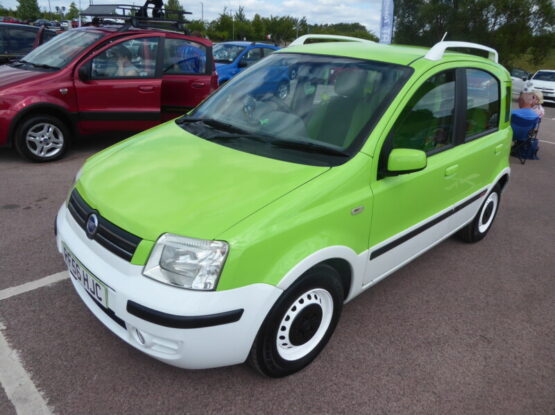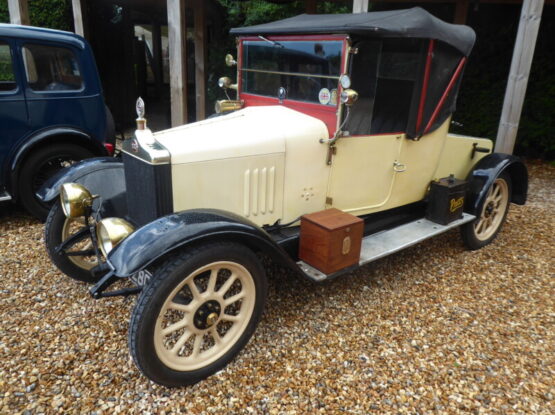
Although this event is now in its 18th year, I will wager that many have never even heard of it, as it probably does not get as much publicity as it deserves. Held at St Rose’s school, a non-maintained Catholic specialist school for children with physical disabilities and associated difficulties, including speech and language, epilepsy, visual impairment and/or learning difficulties. on the outskirts of Stroud, it attracts around 450 classic cars and bikes (so clearly some people have heard of it), which are displayed in the grounds of the school for what feels like an old style car event, the sort that tended to be organised not by car enthusiasts but by locals who wanted to raise money for local charities. And that is what this one does, the biggest fund-raising event of the year for the venue. Whilst I’ve seen pictures from previous years, I’ve never managed to get along to see it for myself, something I decided to address in 2025. It is fair to say that what I found was even more impressive than the library of photos that others had posted had suggested. Here are the highlights:
AC
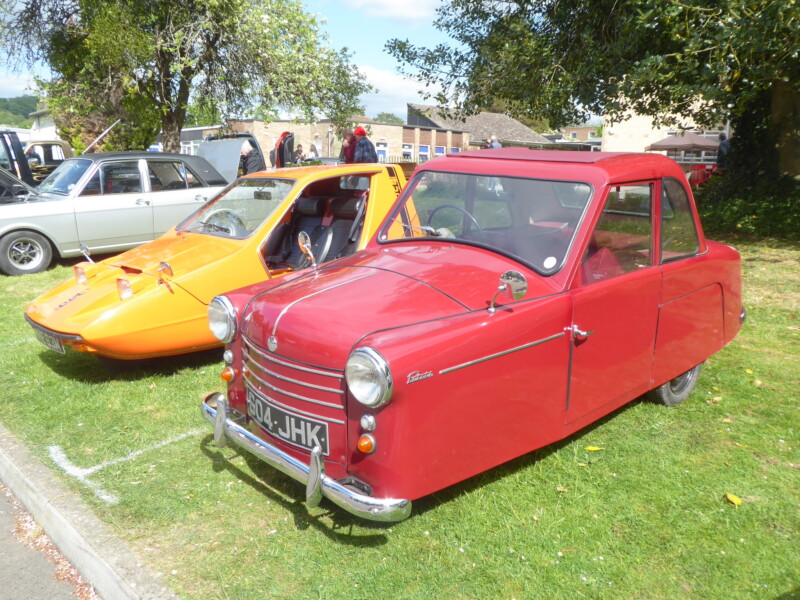
The AC Petite is a three-wheeled British microcar with a rear-mounted 350 cc Villiers single cylinder, two-stroke engine. The car has a single bench seat seating two adults, and was said to be capable of 60 mpg‑imp (4.7 L/100 km; 50 mpg‑US) to 70 mpg‑imp (4.0 L/100 km; 58 mpg‑US) and 40 mph (64 km/h). There were two versions of the car. Between 1952 and 1955 the car was fitted with a Villiers 27B engine and two different sizes of wheel; the rears were 18-inch (460 mm) spoked wheels whilst the front was only 8 inches (200 mm). In 1955 a Mark II version was launched, incorporating minor changes to the exterior trim, a slightly more powerful Villiers 28B engine and 12-inch (300 mm) wheels front and rear. Approximately 4,000 AC Petites were built until 1957


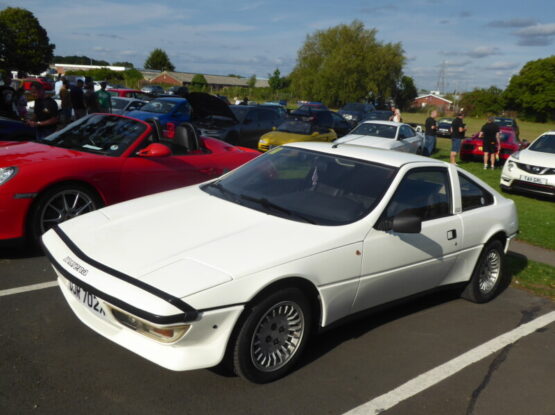
The AC 3000ME is a mid-engined sports car originally sold by AC Cars. The two-door coupé debuted at the 1973 London Motor Show. Sales did not begin until 1979 and lasted until 1984. Rights to the 3000ME and tooling were transferred to a second company who managed to produce a small number of additional cars before going into receivership themselves in mid-1985. A third company acquired the rights to the car with plans to begin selling a revised version under a different name, but only a single prototype was ever produced. The AC 3000ME was based on a prototype called the Diablo built by the Bohanna Stables company and shown at the London Racing Car Show in 1972. Peter Bohanna was an automotive body structures engineer. His experience included working with fibreglass structures as a boat engineer and a stint with Ford’s Advanced Vehicle Operations in the UK doing bodywork for the Ford GT40. In late 1967 Bohanna was at Lola cars working on the T70, where he met Robin Stables, who prior to his arrival at Lola had been a racing mechanic and Lotus dealer. In 1968 Bohanna and Stables won a design contract for a new sports car tendered by a young aristocrat named Piers Weld-Forester. The partners designed a two-seat mid-engined car to be powered by the 2.2 L inline six version of BMC’s newly announced SOHC E-series engine, code-named ARO25. Production problems would delay release of this engine until 1972. In late 1968 Weld-Forester partnered with Ernie Unger to form a new company named UWF (for Unger Weld-Forester), and bought the Unipower GT production line from Universal Power Drives. Bohanna and Stables’ subsequent work for UWF was to design a car to replace the existing Unipower GT, but this design would not reach production. Instead the partners started the Bohanna Stables company and resumed development of the earlier mid-engined design, which would become the Diablo. The 1972 Diablo prototype was built with the 1.5 L inline four version of the E-series engine and 5-speed manual transaxle that was used in the Austin Maxi. Bohanna Stables had sought interest from both AC and TVR before the Diablo was shown at the Racing Car Show, but neither company committed to the project. After the car’s debut AC’s Keith Judd drove the Diablo to the company’s Thames Ditton headquarters and convinced AC owner Derek Hurlock to take the project on. AC acquired the rights to the Bohanna Stables Diablo design and assigned two of their engineers, Alan Turner and Bill Wilson, to develop it into a production car. AC also hired Bohanna and Stables to consult on the redesign. The Diablo’s steel tubing spaceframe was completely re-engineered. A new engine had to be found for the car, as British Leyland expected to need all of the E-series engines produced at their Cofton Hackett factory for their own models. The substitute chosen was a Ford V6. AC first showed their version of the car at the 1973 London Motor Show. This prototype was called the AC 3 Litre, or the AC 3000. Later pre-production prototypes were called the AC ME 3000. Press releases of the time indicated that the company hoped to be able to build and sell the car at the rate of 10 to 20 cars per week. AC suggested that pricing would to be somewhere between £3000 and £4000. Even though the car debuted in 1973, development was still ongoing, with the car’s styling not finalised until 1974. A prototype failed the 30 mph (48 km/h) crash portion of the new Type Approval tests that had been instituted in 1976, necessitating a chassis redesign. The revised chassis passed on the next attempt. Several pre-production prototypes were built, with their number variously reported as eight, nine or eleven cars. The car officially went on sale when it appeared at the 1978 NEC Motor Show. The name was now the “AC 3000ME”. The list price for the car had risen to £11,300. The first customer cars were not delivered until 1979, by which time they had to compete with newer designs like the Lotus Esprit. The delays meant that the 3000ME was out of date by the time it reached production. Prices also continued to rise; a road test by Autocar magazine in March 1980 reported that the car cost £13,238. The same test expressed some reservations with the car’s handling when pushed. Several other contemporary reviews expressed similar misgivings. As early as August 1975 AC was planning to offer a turbocharged version. The forced induction system was originally expected to be supplied by Broadspeed. By 1980 turbocharged conversions were available, but from a company run by engineer and photographer Robin Rews rather than Broadspeed. Rews’ conversion for semi-competition applications used a Garrett AiResearch turbocharger blowing through a 1½” Reece Fish carburettor mounted to a custom intake manifold. Boost was limited to 7.0 psi, and the compression ratio was reduced to 8:1 by the use of low-compression cylinder heads. A Bosch fuel pump supplied the system. Rews used Rotomaster turbochargers for regular road car conversions. The conversion raised power to 200 bhp Rews also modified the rear suspension geometry to add toe-in to improve the car’s handling. 19 cars received turbocharger upgrades from Rews’ Rooster Turbos company. Attempts to convince AC to offer the turbo conversion as a factory option were unsuccessful. A road test of another turbo conversion in December 1983 shows that the Rooster Turbo conversion had evolved. The turbocharger was now an IHI unit, and while the “standard” turbo compression ratio was still 8:1, special pistons sourced from Cosworth would lower it even further to 7.2:1 to permit the use of higher boost. The carburettor for this later conversion was also the standard 3000ME unit, although like the earlier conversion it was a blow-through system. A waste-gate and a dump-valve handled boost control. The conversion cost £1180 until 1984, when prices rose to £2000. Rew and Rooster Turbos also did at least one twin-turbo conversion. This engine used the Cosworth pistons, Weber carburretion and water injection to cool the intake charge. Output was estimated to have been 300 bhp. By the early 1980s Derek Hurlock’s health had been poor for some time. The world economy was in difficulty, and sales of the 3000ME had never reached the volumes hoped for. After building fewer than 80 cars, Hurlock called a halt to production. In 1984, production stopped at Thames Ditton and the car and the AC name were licensed to a company registered as AC (Scotland) plc. This company was run by David McDonald, and operated out of a new factory in Hillington, Glasgow. Production goals were set at 40 cars per week. A total of 30 additional cars were built to the original 3000ME specification. The Scottish cars are distinguished from the Thames Ditton cars by their body-coloured air-intakes and grilles. 3000ME chassis #129, registration VPC 634X, which had previously served as both a factory demonstrator at AC and Managing Director Andrew Hurlock’s personal ride, was used by AC (Scotland) as a development mule for an updated car. Aubrey Woods, a former BRM production engineer, was tasked with the related development. The original Ford engine was replaced by an Alfa Romeo 2.5-litre Busso V6 engine. While the original gearbox was retained, other parts of the running gear were swapped for Alfa parts. AC (Scotland) also began work on a Mark 2 prototype of the car, which was nearly complete at the time of the company’s closing. Changes were also made to the suspension to eliminate the earlier car’s unpredictable handling at the limit AC (Scotland) went into receivership in June 1985. The license agreement with AC Cars ended in November 1985.


ALFA ROMEO
The Series 3 Spider was previewed in North America for the 1982 model year with the introduction of 2.0 litre Bosch electronic fuel injection to replace the SPICA mechanical injection. The Spider underwent a major styling revamp in 1983, which saw the introduction of black rubber front and rear bumpers. The front bumper incorporated the grille and a small soft rubber spoiler was added to the trunk lid. The change altered the exterior appearance of the car considerably and was not universally praised by enthusiasts. Various other minor mechanical and aesthetic modifications were also made, and the 1600 car (never available in North America) dropped the “Junior” name. The Quadrifoglio Verde (Green Cloverleaf) model was introduced in 1986, with many aesthetic tweaks, including sideskirts, mirrors, new front and rear spoilers, hard rubber boot mounted spoilers with integral 3rd stoplight, unique 15″ alloys and optional removable hardtop. Different interior trim included blood red carpets and grey leather seats with red stitching. The QV was offered in only 3 colours: red, silver and black. It was otherwise mechanically identical to the standard Spider Veloce model, with a 1962 cc double overhead cam, four-cylinder engine (twin two-barrel carburettors in Europe; North American models retained the Bosch L-Jetronic fuel injection introduced for the 1982 model year except that the VVT mechanism was now L-Jet activated) and five-speed manual transmission. The interior was revised with a new centre console, lower dash panels (to meet U.S. regulations) and a single monopod gauge cluster (with electronic gauges). For the North American market a model dubbed the Graduate was added in tribute to the car’s famous appearance in the 1967 film, The Graduate, starring Dustin Hoffman. The Graduate was intended as a less expensive “entry-level” Alfa. While it had the same engine and transmission as the Quadrifoglio and Veloce, it lacked the alloy wheels and luxury features of the other two models. The Graduate model had manual windows, basic vinyl seats, a vinyl top, and steel wheels as standard. Air conditioning and a dealer-installed radio were the only options. It first appeared in 1985 in North America and continued until 1990. Minor changes occurred from 1986 to 89, including new paint colours, a centre high mount stop lamp midway through 1986 for North American models, a move away from the fade-prone brown carpet and new turn signal levers. Some 1988 models featured automatic seatbelts that extended from a large device between the front seats.

The 155 was one of a series of cars built by the Fiat Group on a shared platform, the so called Tipo 3 or Tipo Tre, which sat under the Fiat Tipo, and Lancia Delta 2, as well as the Fiat Coupe. Built to replace the rear wheel drive 75, the 155 was somewhat larger in dimension than its predecessor. The 155 was designed by Italian design house I.DE.A Institute which achieved an exceptional drag coefficient of 0.29, and the rather boxy design gave the car a sizeable boot, as well. The single most significant technical change from the 75 was the change to a front-wheel drive layout. This new configuration gave cost and packaging benefits but many Alfa die-hards and the automotive press lamented the passing of the “purer” rear-wheel drive layout on a car from this sporting marque. Not even the availability of the 155 Q4, which had a 2.0-litre turbocharged engine and a permanent four-wheel drive powertrain, both derived from the Lancia Delta Integrale; making the car essentially a Lancia Delta Integrale with a different body was enough to win the sceptics over. Reception of the model was generally lukewarm. The 75 had been conceived prior to Fiat’s acquisition of the Alfa brand, so as “the last real Alfa” it cast rather a shadow over the 155; the loss of rear-wheel drive was frequently cited as the main cause of the disappointment. Nevertheless, the 155 was entered in Touring Car racing and was successful in every major championship it entered, which gradually improved its image. Belatedly, the factory introduced a wider version in 1995 (the “wide-body”) which as well as a wider track and revised steering based on racing experience or requirements, also brought in new 16-valve engines for the 1.8 and 2.0-litre whilst retaining the 2.5 V6 and making some improvements to cabin materials and build quality. There were several Sport Packs available, including a race-inspired body kit (spoiler and side skirts) and black or graphite-coloured 16-inch Speedline wheels. The more genteel could opt for the Super which came with wood inserts in the cabin and silver-painted alloy wheels. With this version, the 155 really came good. When production ceased in 1998, following the launch of the 156, 192,618 examples had been built.


ALVIS
The first 12/50s were produced in late 1923 for the 1924 model year. The cars from this first year of production were designated SA and SB. The SA had a 1496 cc 4-cylinder overhead valve engine in a chassis with a wheelbase of 108.5 in (2,756 mm), while the SB had a wheelbase of 112.5 in (2,858 mm). The SB was initially fitted with the 1496cc engine, but after the introduction of a 1598 cc version of the OHV engine this became the standard fitment. The engines of these early cars were carried in a subframe bolted to the relatively slender ladder chassis. The SA usually carried two-seat bodywork, typically the Super Sports 2/3-seater nicknamed “duck’s back” because of its pointed rear end, said to resemble that of a duck. The majority of SB cars carried Super Sports four-seater bodywork, but a good number were also fitted with touring bodies from the standard Alvis range. The SA and SB 12/50s were built with (twin shoed) brakes on the rear wheels only. All the 12/50s had a four speed non-synchromesh gearbox with right hand change. The clutch was a fabric-faced aluminium cone. The cars were right hand drive. The SC arrived in Autumn 1924, with the larger 1598 cc engine as standard (though the 1496 cc unit could be specified for sporting use). Most SC 12/50s were built on the longer chassis, which would be standard for the 12/50 until the end of production. Front wheel brakes were offered as an option on this model: a front axle of new design could be supplied with or without brakes. Power transmission was via a roller-bearing prop shaft of new design.The 12/50 was redesigned for the 1926 model year. From Autumn 1925 a new stronger chassis was used for the TE, which had its engine (now built around a redesigned crankcase) enlarged again to 1645 cc, and the TF of the same year with a short stroke version of the same engine, displacing 1496 cc. A single-plate clutch replaced the previous cone type, and for these and all subsequent 12/50s the engine was bolted directly to the flange-frame chassis, dispensing with the subframe of previous models. From the TE and TF models onwards four-wheel brakes were fitted as standard, single-shoe drums on the rear replacing the double-shoe drums of the previous model. The TE and was superseded for the 1927 model year by the TG. Confusingly, the short-stroke TF was replaced in the 1927 range by a car with an ‘S’ prefix: the SD. The TG was the standard ‘touring’ model, while the SD – powered by the 1496 cc engine, now fitted with a large-port cylinder head – satisfied the needs of the sporting motorist. Also available in this year was the TH, which had the gearbox and rear axle ratios of the ‘touring’ TG, but the sub-1500 cc engine of the SD. The TG and SD models were available until 1929. The TG and (very rare) TH models can be recognised by their taller radiators, with a noticeably deeper top section. Cars from the 1928 and 1929 model years also sported higher-set lamps, with horizontal crossbar, in accordance with the fashion of the time. The 12/50 was withdrawn between 1929 and 1930 when the company decided that the future lay with the front-wheel drive FD and FE models, but when these did not reach the hoped for volumes a final version of the 12/50 was announced for the 1931 model year as TJ. Fitted with the 1645 cc engine this continued in production until 1932. The ‘post-vintage’ TJ is referred to by Alvis historians as being from the ‘revival period’, and it differs from its predecessor in a number of ways, notably coil instead of magneto ignition, deep chromed radiator shell, and rear petrol tank in place of the scuttle-mounted tank on most older 12/50s. The TJ was joined in the range by a more sporting version of the same chassis, but this car was marketed not as a 12/50, but as the 12/60. The TK 12/60 was available in 1931, and the TL 12/60 in 1932. The Alvis 12/70 was announced by Alvis cars 22 September 1937. It was a four-cylinder sports saloon or 4-seater drophead coupé related to the pricier six-cylinder Alvis Silver Crest. Technical director and chief designer Smith-Clarke was fully occupied with a new factory to make Alvis’s Gnome-Rhone radial engines so the 12/70 was designed by George Lanchester and it proved to be his last automobile design. Alvis manufactured the four-cylinder 1,842 cc pushrod overhead valve engine[6] which was similar to the engine of the Alvis Firebird but was, in fact, a new design. Its 63 hp was enough to propel the car to a top speed of about 80 mph (130 km/h). Alvis also designed and made the four-speed gearbox which had synchromesh on the top three speeds. Cam steering is by Marles and brakes by Bendix-Cowdrey. Suspension is by half-elliptic springs, those in the back are underslung, dampened by hydraulic shock absorbers. There is an easy jacking system. The standard catalogued four-door four-seater saloon or two-door four-seater drophead coupé bodywork was made for Alvis by Mulliners of Birmingham. It was described by a motoring correspondent of The Times as follows: The four-door body has four sidewindows and makes a comfortable four-seater; the doors have roll armrests and ashtrays and there is a central pull-down rest. The rear windows are “carried well back and allow a very fair view”. The doors have slip pockets and glass louvres that conform to the body’s lines. There is a cupboard in the instrument panel and the instruments and ashtray are centrally placed. There are two-way visors, independent wiper controls (left and right), a spring steering wheel and in its centre ignition, dip and switch (headlights), signalling and horn controls. There are ventilators in the scuttle, a sliding roof and a fully opening windscreen. The front seats are adjustable, the backrests will tip up and beneath them there are floor wells for the feet of the back passengers. A stabilising bumper and two horns are fitted at the front. The whole of the back panel of the car was hinged at the bottom carrying the spare wheel on its inner side and it could be made to open just past the vertical. The correspondent reported “it does not make the most convenient arrangement for luggage. In a carefully worded brief portion of a full item about a 12/70 on test a Times correspondent reported in June 1938 that he considered the price high for a Twelve but that the value was there, the quietness and smoothness of running and the firmness yet gentleness of the controls. However he did comment that in view of the ordinary (sic) springing it travelled with remarkable evenness and held the road in a most stable way. 75 mph was the greatest speed in top gear. Price as tested £435, “a drophead coupé is also made at a rather higher figure”. A total of 741 cars were manufactured until 1940, with 121 still surviving. In 1945 the 12/70 was replaced by the modernized Alvis TA 14, but much of the 12/70 lived on in this post war model. In September 1938 it was announced that more room and comfort had been given to the 12/70. The lines of the car had been improved, the floor-level lowered and the body’s extra length and width gave more head, leg and elbow room for driver and passengers. It was now easier to get into the back seat and all four seats had been redesigned to give better support. The spare wheel was moved outside the car and enclosed in a metal cover. Two handles were now provided to the boot door, one with a lock. Otherwise the specification remained the same, as did the price at £435 and that of the drophead coupé was now £445. The chassis alone cost £315.

ASTON MARTIN
Following the unveiling of the AMV8 Vantage concept car in 2003 at the North American International Auto Show designed by Henrik Fisker, the production version, known as the V8 Vantage was introduced at the Geneva Motor Show in 2005. The two seat, two-door coupé had a bonded aluminium structure for strength and lightness. The 172.5 inch (4.38 m) long car featured a hatchback-style tailgate for practicality, with a large luggage shelf behind the seats. In addition to the coupé, a convertible, known as the V8 Vantage Roadster, was introduced later in that year. The V8 Vantage was initially powered by a 4.3 litre quad-cam 32-valve V8 which produced 380 bhp at 7,300 rpm and 409 Nm (302 lb/ft) at 5,000 rpm. However, models produced after 2008 had a 4.7-litre V8 with 420 bhp and 470 Nm (347 lbft) of torque. Though based loosely on Jaguar’s AJ-V8 engine architecture, this engine was unique to Aston Martin and featured race-style dry-sump lubrication, which enabled it to be mounted low in the chassis for an improved centre of gravity. The cylinder block and heads, crankshaft, connecting rods, pistons, camshafts, inlet and exhaust manifolds, lubrication system and engine management were all designed in house by Aston Martin and the engine was assembled by hand at the AM facility in Cologne, Germany, which also built the V12 engine for the DB9 and Vanquish. The engine was front mid-mounted with a rear-mounted transaxle, giving a 49/51 front/rear weight distribution. Slotted Brembo brakes were also standard. The original V8 Vantage could accelerate from 0 to 60 mph in 4.8 seconds before topping out at 175 mph. In 2008, Aston Martin introduced an aftermarket dealer approved upgrade package for power and handling of the 4.3-litre variants that maintained the warranty with the company. The power upgrade was called the V8 Vantage Power Upgrade, creating a more potent version of the Aston Martin 4.3-litre V8 engine with an increase in peak power of 20 bhp to 400 bhp while peak torque increased by 10 Nm to 420 Nm (310 lb/ft). This consists of the fitting of the following revised components; manifold assembly (painted Crackle Black), valved air box, right and left hand side vacuum hose assemblies, engine bay fuse box link lead (ECU to fuse box), throttle body to manifold gasket, intake manifold gasket, fuel injector to manifold seal and a manifold badge. The V8 Vantage had a retail price of GB£79,000, US$110,000, or €104,000 in 2006, Aston Martin planned to build up to 3,000 per year. Included was a 6-speed manual transmission and leather-upholstery for the seats, dash board, steering-wheel, and shift-knob. A new 6-speed sequential manual transmission, similar to those produced by Ferrari and Lamborghini, called Sportshift was introduced later as an option. An open-topped model was added to the range in 2006 and then in the quest for more power a V12 Vantage joined the range not long after.

AUDI
The Auto Union 1000 is a luxury compact front-wheel drive automobile manufactured by Auto Union GmbH between 1958 and 1965. It was the first (and in many markets the last) model branded as an Auto Union by the manufacturer since the 1930s; it replaced the DKW 3=6, although the latter continued in production until the end of 1959. The two cars were broadly similar, but the new car had its two-stroke engine enlarged to 981 cc yielding a 10% – 37% (depending on model) power increase. The Auto Union 1000 was an evolution of the earlier DKW F93, F94 and F94U models of the 3=6 series. Apart from the enlarged engine capacity, which now provided 44 PS in the base model, the 1000 featured the old four-ring Auto Union badge across the grille along with the Auto Union name above it, in place of the DKW badge that had adorned the nose of the earlier models, as well as a smooth boot lid. For the European market there were three distinct series of the 1000/1000S; (not including the 1000SP or 1000 engined DKW Munga); The first series was known as the “model 58” or AU1000/58, which was available as the 1000 Coupe de luxe only with the 44 PS engine. This model was available for 1958/59 only and was released in late 1957. The second series was known as the “model 60” or AU1000/60 – which, in two door form was the first model to feature the “panoramic” windscreen. The third and final series was known as the “model 62” or AU1000/62, which was an improved version of the “model 60” – featuring front disc brakes, Lubrimat, wider track rear axle, larger boot and other refinements. The first car of the “model 60” line was a 1000S Coupe chassis number 6820000001, completed at Düsseldorf on 27 July 1959. There were 25 pre-production cars built. The first production 1000/1000S was chassis number 6820000026. Over time the “model 60” 1000 series gained a four-door and Universal in the range, all produced at Düsseldorf. Production of all “model 60” second series cars was switched to the third series “model 62” on 29 September 1961. Production of the third series of 1000/1000S was gradually closed from late 1962. The final 1000 Universal was completed on 31 October 1962, and the final 1000S four door on 13 November, in both cases at Ingolstadt. The details of the final European 1000S assembled are unknown, as the final batch of production contained CKD and SKD (Completely Knocked Down and Semi Knocked Down) kits, which were assembled later, outside Germany. The final European 1000/1000S manufactured (note, not assembled) though, was a 1000S Coupe de Luxe chassis number 6820146387. In addition to the two- and four-door saloons, a “pillarless” Coupe shared the profile of the saloons apart from the absence of any fixed B pillar. A three-door station wagon version was also offered (essentially, an updated DKW F94U), now branded as the 1000 Universal, between 1959 and 1962 (1959/60/61 only for right hand drive). For the new decade, the coupe and four door was renamed Auto Union 1000S. In August 1959, an eye-catching wrap-around windscreen with vertical strip speedometer was introduced on the two door models of the “model 60” series (AU1000 limousine, AU1000 Coupe and AU1000S Coupe). Neither the windscreen nor the name changes entirely concealed the fact that at a time when competitor designs employed the modern ponton, three-box form, this Auto Union’s body along with most of its technical features descended directly from that of the Zwickau-developed DKW F9 prototype of 1938. Fortunately in 1938, the front-wheel drive DKW design had been an innovative one. The Düsseldorf plant (in the old Rheinmetall – Borsig factory) produced most of the 171,008 Auto Union 1000 cars built during the six-year model run. The pretty 1000 SP sports version continued in production for another two years, until 1965, notching up sales of 5,000 for the hard-top version and 1,640 for the cabriolet. The production of the car was extensively shown in the 1960 film “Träume, die Sie kaufen können”. The car was sold worldwide and was popular in markets where its characteristics suited the local conditions well. Export sales were especially strong in Africa and the car was well regarded for its robust and reliable construction. In countries where its sporting heritage is especially strong, such as South Africa, the car has since acquired a legendary status. In 2012, the South African artist Steve Hofmeyr released a song, “DKW” which, taking in the Auto Union 1000, expressed a nostalgia for the car as a representation of solidity and reliability. Import tariffs made the Auto Union 1000 a costly car in certain markets, and sales were slow in countries where the 1960s “Buy British” campaigns were effective. In New Zealand, for example, a 1960 Auto Union 1000S could be bought from Crosbie Motors in Invercargill for £1578 at a time when larger cars were selling for significantly less. The Auto Union 1000 also enjoyed much publicity from being prominently featured in European films of the day, such as the German musical comedy Hula-Hopp, Conny, the German Comedy Robert and Bertram and the Swedish film Mannekäng i rött. In 1970, well after the car’s production ended, an Auto Union 1000S featured as the star in the German comedy film Das kann doch unsren Willi nicht erschüttern. As with its predecessor, the DKW 3=6, the Auto Union 1000 enjoyed the attention of a number of famous owners, such as the famous aviator, Elly Beinhorn (her white and red 1958 Auto Union 1000 Coupe de luxe was named “Alwine VIII”), Hollywood film maker Billy Wilder[33] (1000SP), Big band bandleader Max Greger (1000SP), Graf von Brandenstein-Zeppelin (1000SP) and German fashion designer Katja Nieborg (1000S Coupe). In 1963, the Auto Union 1000 gave way in Europe to its successor, the contemporary-looking DKW F102 – the last model to wear either the Auto Union or DKW badges before the company was acquired by Volkswagen and the dormant Audi brand was resurrected. The 1000 was also the last Auto Union/DKW model to be produced at the Düsseldorf factory before production was moved to the company’s new plant in Ingolstadt; the old factory was sold to Auto Union’s then parent company Daimler-Benz to be converted to a Mercedes truck and van assembly plant.


The Audi R8, based on the Audi Le Mans quattro concept car (designed by Frank Lamberty and Julian Hoenig) first appeared at the 2003 International Geneva Motor Show and the 2003 Frankfurt International Motor Show. The R8 road car was officially launched at the Paris Auto Show on 30 September 2006. There was some confusion with the name, which the car shares with the 24 Hours of Le Mans winning R8 Le Mans Prototype (LMP). Initial models included the R8 4.2 FSI coupé (with a V8 engine) and R8 5.2 FSI coupé (with a V10 engine). Convertible models, called the Spyder by the manufacturer, were introduced in 2008, followed by the high-performance GT model introduced in 2011. The Motorsport variants of the R8 were also subsequently introduced from 2008 onwards. An all-electric version called the e-Tron started development but would only reach production stage when the second generation model would be introduced. 6-time 24 Hours of Le Mans winner Jacky Ickx described the R8 as “the best handling road car today” and the car was well received by everyone who drove it. The car received a facelift in 2012 and a new model called the V10 Plus was now added to the range. Production of the Type 42 ended in August 2015

AUSTIN
There was one late model example of the popular Seven here. Herbert Austin’s masterpiece which did much to put Britain on wheels in the 1920s was first seen in 1922, as a four seat open tourer. Nicknamed Chummy, the first 100 featured a 696cc four cylinder engine, which was quickly upgraded to the 747cc unit that remained until the end of production some 17 years later. The first cars had an upright edge to the doors and a sloping windscreen, but from 1924, the screen became upright and there was a sloping edge to the doors, as well as a slightly longer body. Stronger brakes came along in 1926, along with a slightly taller nickel-plated radiator grille, conventional coil ignition, a more spacious body and wider doors. An even longer and wider body arrived in 1930, as well as a stronger crankshaft and improvements to the brakes which coupled front and rear systems together so they both worked by the footbrake. In 1931 the body was restyled , with a thin ribbon-style radiator and by 1932 there was a four speed gearbox to replace the earlier three-speeder. 1933 saw the introduction of the Ruby, a car that looked more modern with its cowled radiator. There were also Pearl and Opal versions. Development continued, so in 1937 there was a move to crankshaft shell bearings in place of the white metal previously used, and the Big Seven appeared. The last Seven was made in 1939, by which time 290,000 had been produced. Aside from saloons and tourers, there had been vans and sports derivatives like the Le Mans, the supercharged Ulster and the rather cheaper Nippy. Around 11,000 Sevens survive today

The Austin Ten is a small car that was produced by Austin. It was launched on 19 April 1932 and was Austin’s best-selling car in the 1930s and continued in production, with upgrades, until 1947. It fitted in between their “baby” Austin Seven which had been introduced in 1922 and their various Austin Twelves which had been updated in January 1931. The design of the car was conservative with a pressed steel body built on a ladder chassis. The chassis was designed to give a low overall height to the car by dipping down by 2.75 inches (70 mm) between the axles. The 1125-cc four-cylinder side-valve engine producing 21 bhp drove the rear wheels through a four-speed gearbox and open drive shaft to a live rear axle. Steering was by worm and wheel. Suspension was by half-elliptic springs all round mounted on silent-bloc bushes and damped by frictional shock absorbers. The four-wheel brakes were cable and rod operated by pedal or by hand lever on the offside of the speed lever. The electrical system was 6 volt. For the first year only, a four-door saloon was made in two versions. The basic model cost £155 and was capable of reaching 55 mph with an economy of 34 and the Sunshine or De-Luxe with opening roof and leather upholstery at £168. Bumpers were provided. The chassis was priced at £120. A big change came in December 1936 with the almost streamlined Cambridge saloon and Conway cabriolet. Compared with the preceding cars the passengers and engine were positioned much further forward, the back seat now being rather forward of the back axle. There were six side windows like the Sherborne and the quarter lights were fixed. Again like the Sherborne the forward doors opened rearwards. At the back there was now a compartment large enough to take a trunk as well as more luggage on the open compartment door when it was let down. A new smoother single plate spring-drive clutch was now fitted, the two friction rings carried by the centre plate were held apart by leaf springs. Other changes included Girling brakes with wedge and roller shoe expansion and balance lever compensation using operating rods in tension with automatic compensation between front and rear brakes all four of which might be applied by hand or foot. Drums were now 9 inches diameter. 16-inch steel disc wheels replaced the 18-inch wires Top speed rose to 60 mph. The car’s wheelbase was now ¾ inch, 0.75 in (19 mm) longer. Rear track was now increased to 3′ 10½”, 46.5 in (1,180 mm). The vehicle’s weight was now reported to be 18½ cwt, 2,072 lb (940 kg). The Times, when they had a car on test, commented favourably on the new clutch, saying no previous Austin clutch had engaged smoothly and added “the car is built for steady economical running rather than for speed or brilliance”. These changes did not appear on the open cars, which no longer included the Ripley sports, until 1938 when the Cambridge and the Conway cabriolet gained an aluminium cylinder head on the engine and a higher compression ratio.


Launched initially as a four-seat convertible, the A90 Atlantic made its début at the 1948 Earls Court Motor Show in London, with production models built between spring 1949 and late 1950, the range was later augmented when a two-door coupé, marketed as the A90 Atlantic Sports Saloon, followed a year later. It had been previewed at the 1949 Motor Show and was in production at Longbridge between 1950 and 1952. The Atlantic was one of the first post-war cars engineered from scratch by Austin, and was said to be styled from a thumbnail sketch by Leonard Lord, then Chairman of Austin, though in truth the styling was more likely the work of resident Italian Austin stylist Dick Burzi. The car was almost certainly influenced by a 1946 Pininfarina-bodied Alfa Romeo cabriolet, which just happened to end up at the Longbridge factory in mid-1947, a few months before the light blue 16 hp sports prototype made its first appearance in the experimental department and on nearby roads around the factory. A rare edition was a coachbuilt estate car, regularly seen in the 1950s used by a convent in Leith, Scotland. The car had a lifting rear door, and sported then unusual curved perspex roof panels. With the then Government edict of “Export or die” and steel allocated only to those who generated much needed dollar revenue, the Atlantic was designed specifically to appeal to North American tastes (certain aspects look like a 1949 Mercury and the bonnet brightwork looks similar to the Pontiac Chieftains of this era). The car featured up-to-the-minute detailing, with a wrap around windscreen, composed of a flat glass centre section with, tiny curved end panels. The front wings (fenders) sported twin ‘Flying A’ hood ornaments and swept down to a rounded tail, with spats enclosing the rear wheels. A centrally mounted third, main beam, headlight was built into the letter-box style air intake grille, and the then unheard of luxury of hydraulically powered windows and hood (convertible top), “flashing indicators” rather than trafficators, (for the United States market at least) and the option of EKCO or HMV Autocrat radios. The range-topping Austin was offered in a variety of “jewelescent” colours with names like ‘seafoam green’ and ‘desert gold’ but few of these brave new metallics were sold in the UK market. The convertible, a three window, drophead coupe had a simple fabric top, without rear quarter lights, which butted up to the rear of a rather thick windscreen header rail. The fixed head, five window, Sports Saloon, could be had with its roof painted or covered in fabric. This gave it the popular ‘drophead or cabriolet’ look; all the style with no leaks. Many photographs of this car are wrongly titled, due to observers confusing the fabric covered hardtop for a convertible. As its final party trick, the centre section of the three piece, wrap-around, rear window, could be lowered into the boot, for added ventilation by a remote winder above the front windscreen. Few people in the car’s native Britain would have ever seen anything like the futuristically-styled Atlantic before, and certainly not from a conservative mainstream manufacturer like Austin. The radical Atlantic suffered, however, from the dramatically new Jaguar XK120, also launched at the 1948 Motor Show. Out of a total production run of 7,981, 3,597 were exported, 350 of which were to the US. This low level of sales in the US was despite a huge focus by Austin, including a successful attempt at breaking 63 stock car records at the Indianapolis Motor Speedway in April 1949 by Alan Hess, Charles Goodacre and Dennis Buckley) and a US$1000 price reduction in 1949, the four-cylinder 2.7-litre couldn’t compare in power output to native V8 engines — although, for its time, performance was strong. A few were also used in civilian versions of the Austin Champ. The car did see more success in former British Colonies, Europe, Scandinavia and Australasia.


Launched at the 1949 London Motor Show was the A40 Sports, a four-passenger, aluminium-bodied convertible version of the Austin A40 – carrying an Austin of England nameplate, bearing Austin’s Flying A hood ornament, and designed and manufactured in conjunction with Jensen Motors. Production did not begin until November 1950 for model year 1951. By the time production ended in 1953, about 4,011 examples had been produced. As one in a series of collaborations between Austin and Jensen Motors of West Bromwich, the A40 Sports originated when Austin’s chairman Leonard Lord saw the Jensen Interceptor and requested that Jensen develop a body that could use the A40 mechanicals. The resulting body-on-frame A40 Sports was designed by Eric Neale, a stylist who had joined Jensen in 1946 after working at Wolseley Motors. During production, A40 Sports bodies were built by Jensen and transported to Austin’s Longbridge plant for final assembly. As per Lord’s intention, the A40 Sports was based on the mechanicals of the Austin A40 Devon, though the centre section of the chassis was boxed to provide rigidity for the open body. The A40 Sports also employed a twin-SU carburettor version of the 1.2 litre engine producing 46 bhp rather than 42 bhp Gear selection was originally via a floor-mounted lever. Steering was worm and roller type, front suspension was independent coil springs with rigid beam axle and semi-elliptic leaf springs at the rear. Production of the A40 Sports occurred in two series. The initial GD2 Series began in November 1950 and featured a floor gear change and dashboard identical to that of the Devon. The later GD3 Series began production in August 1951 and ended in April 1953, featuring a steering-column gear change, full hydraulic brakes, and a revised dash with a centred instrument panel The A40 Sports had trouble maintaining 60 to 65 miles per hour cruising speeds – despite a top speed of 77.8 mph as recorded by the British magazine The Motor in 1951 – and could accelerate from 0–60 mph in 25.6 seconds. Tests achieved a fuel consumption of 29.3 mpg. In the United States – initially targeted as its primary market – the A40 was priced at about $2,200. It was listed at about £818 in the UK, at a time when a mainstream middle market six-cylinder saloon, the Vauxhall Velox, was offered for £550 and Austin’s own A40 saloon was offered for slightly more than £500.


The Morris Minor was already well established when rival Austin launched their competitor, the A30 Saloon of 1952. That was also the year that Austin and Morris merged to become the British Motor Corporation, so suddenly the two cars that had been conceived to compete against each other were stablemates. Except BMC did not work like that. Separate dealer chains remained in place, as they would do for a further 30 years, and whilst this may sound inefficient now, it has to be noted that brand loyalty was such that there were plenty of people would only consider an Austin say, and not a Morris, or vice versa. The A30 was smaller than the Minor and at £507, at launch, it was also £60 cheaper. The body structure was designed by T.K. Garrett, who had been an aeronautical engineer before joining Austin. It was of fully stressed monocoque chassis-less construction, which made it lighter and stiffer than most contemporary vehicles, the first Austin to be made in this way. Inside there were individual seats at the front and a bench at the rear covered in PVC with an option of leather facings on the seats. Evidence of economy was seen in only having a single windscreen wiper, central combined stop/tail/numberplate lamp and a sun visor in front of the driver only. A passenger-side wiper and sun visor, and a heater were available as optional extras. Even so, it sold well, and 223,264 examples were built. The A30 was replaced by the Austin A35 in 1956 with the new name reflecting the larger and more powerful 34 hp A-Series engine, which gave the car a slightly higher top speed and better acceleration, though much of this came as a result of different gearbox ratios. The A30 had the first three ratios close together then a big gap to top, whereas in the A35, the ratios were better spaced and gave a higher speed in third gear. That top speed was 72 mph and 0 – 60 acceleration times are just over 30 seconds, so this remains a very slow car by modern standards. The A35 was very similar in appearance to the A30, and is best recognised by its larger rear window aperture and a painted front grille, with chrome horse-shoe surround, instead of the chrome grille featured on the A30. The semaphore trafficators were replaced with present-day front- and rear-mounted flashing light indicators. A slightly easier to operate remote-control gear-change was provided. Like the A30, the A35 was offered as a two- or four-door saloon or two-door “Countryman” estate and also as a van. The latter model continued in production through to 1968. A rare coupe utility (pickup) version was also produced in 1956, with just 477 sold. Drawings were made for a sports tourer, but no prototype was actually built. The A35 passenger cars were replaced by the new body shape A40 Farina models in 1959 but the estate car version continued until 1962 and van until 1968. These days they are popular as an affordable classic. Their simple mechanicals, good availability of some parts (not bodywork, though) and pert looks give them widespread appeal


Follow on to the A55 Cambridge was another car called A55 Cambridge, but whereas the first had been unique to Austin in its design, the A55 Cambridge Series 2 was one of the range of cars produced by BMC which came to be known as the “Farina” saloons. The concept goes back to the mid 1950s, by which time the BMC organisation was well established, and it dominated the UK market with a 39% share. Plans were made for a complete new range of cars that would encompass all the marques: Austin, Morris, MG, Riley and Wolseley. Italian stylist Pininfarina was commissioned to design them. The first model to appear was the A40, launched early in 1958. Whilst that car was only ever sold with Austin badges, the next of Pininfarina’s designs to appear would go on to be sold with each of the 5 marque’s badges attached. These upper-medium sized family cars were released over a period of months, starting in late 1958 with the Wolseley 15/60. This was followed by the A55 Cambridge Mark II, the Morris Oxford Series V, the MG Magnette Series III and the Riley 4/68. The same basic body style was applied to all, with just trim differences, and in the case of the MG and Riley, more powerful engines thanks to a twin carburettor set up under the bonnet, introducing the world to the concept of “badge engineering”. Whilst the styling was something of an amalgam of Italian glamour and a touch of Americana, with prominent tail fins, under the skin the cars were very conventional. Whilst some may have been disappointed that BMC had not been more adventurous, this was an era when home car maintenance was an established part of the suburban landscape, so simplicity was not completely unwelcome. The familiar 1.5-litre B-Series engine, four-speed manual and straightforward rear-wheel drive gave it solid appeal to many middle-class buyers, especially those horrified by the black magic of the newly launched front-drive Mini. All 5 cars were four-door saloons, with estate versions of the Austin and Morris being added to the range a few months later. A facelift was applied to them all in late 1961, when the tail fins were toned down and an enlarged 1622cc B Series engine found its way under the bonnet, with more power, new names came in for the Wolseley which became the 16/60 and the Austin which adopted the A60 Cambridge name.


The Apache is a small family car that was produced by Leykor – the South African subsidiary of BL – between November 1971 and 1978. The Spanish manufacturer Authi also built a version of the car, called the Austin Victoria, at its Pamplona plant between 1972 and 1975. The car was styled by Michelotti, and based on the chassis and various other components of the Austin/Morris 1100. Leykor executives saw Michelotti’s prototype in England and chose it for production in South Africa, where ADO16 sales had been dropping. While the car’s centre structure was that of the Austin/Morris 1100, its front and rear styling was all-new, styled (particularly at the rear, where the boot was a notchback) to resemble a scaled-down Triumph 2000/2500. The tail lights, and outer sections of the rear bumper were the same as those used by the Triumph 2000/2500. In 1973 the Apache received a minor facelift, introducing proper CV joints, round Smiths gauges and a rod linkage for the gear shift. Originally, the ADO16 used rubber drive joints, a strip speedometer, and a remote extension gear lever. Also in 1973, the sporty TC model was added to the lineup. Power was up to 75 PS at 5,800 rpm, compared to 63 PS at 5,250 rpm for the ‘cooking’ versions. The TC also received Rostyle rims, vinyl roof, a rev counter, and a sporty steering wheel. All versions of the Apache and Victoria used the 1,275 cc version of BMC’s venerable A-series four-cylinder, with a variety of outputs. Just under 22,00 units were built. This car has been in the UK for some time, though it is only recently that it has started to appear at events.


“A British car to beat the world”. So read the billboards when the Austin Metro was revealed in October 1980. We had waited a long time for this car. There were many false starts, with thoughts first turning to how to replace the Mini going back to the late 1960s, but for various reasons, every effort had been cancelled. Fortunately, that extended to the ADO88 prototype which got to quite an advanced state of development in 1978, but which received less than favourable feedback at customer clinics. A hasty redesign was conducted. Despite carrying over the A Series engines, albeit in modified A+ guise, as BL had nothing else suitable an no money to develop an alternative, and that meant the 4 speed in-sump gearbox came with it, the little Metro has an immediate hit. It looked good, with pert, modern looks, and with a large hatchback, and some innovative ideas on how to maximise the use of space, this was a roomy car that Britain could indeed be proud of. That a young lady who came to prominence in the months following launch, the future Princess Diana, could be seen driving around in one probably helped still further. Five models were available at launch: 1.0, 1.0L, the economy-oriented 1.0 HLE, 1.3S and 1.3 HLS, and the cars were available in a wide range of bright and attractive colours, including a greater percentage of metallic paints than were typically offered to buyers of cars in this class. My parents bought a 1.0L in the summer of 1983, as a replacement for our Mini, and the car was a massive improvement in just about every respect. Unlike previous BL cars, this model was not dogged with build quality and reliability issues, though, sadly it did have the same propensity to rust as they did, but it took several years before that would become obvious. Before that happened, the range was expanded with the introduction of cheaper City and City X models, a top spec Vanden Plas and then the sporting MG version. There was a lot of angst about this last one, as the purists all bemoaned the fact that it was not a “real” MG, as it was a family hatchback not a sports car (conveniently ignoring the MG 1100/1300 saloons of the 1960s), but ti soon became apparent that this little car was a blast to drive, and something quite special with its red trim, including red seat belts and a liberal splashing of octagon logos around the car. A wilder Turbo model followed at the end of 1982, reflecting the craze for every manufacturer to bolt one on to every car that they could find to create a series of often rather unruly and lag-prone but fast machines. Although a lot of work was done in the mid 80s on developing what should have been another world class replacement (the AR6, the prototype for which is also hidden away at Gaydon), a lack of funds meant that for the next 7 years, all that happened was a lot of tweaking of the trim, and specification and the incorporation of a pair of rear doors to create a 5 door model. This was at a time when the competition stood far from still, with the Fiat Uno and Peugeot 205 upping the ante in early 1983, Vauxhall joining the fray with the Nova mid year, a facelifted Fiesta with a five speed gearbox arriving later that year, a new Renault R5 the following year, along with several Japanese rivals coming out every 4 years. It all made the Metro look increasingly elderly, and also small, compared to all its rivals.


BEDFORD
The Bedford HA was a car derived van introduced in 1964 by Bedford, based on the Vauxhall Viva (HA) family car. It was also known as the Bedford Beagle in estate form and Bedford Roma in small campervan form. The Beagle was an officially sanctioned conversion based on the 8 cwt van, carried out by Martin Walter of Folkestone, Kent. The Beagle received rear side windows and a fold-down rear seat; leaving 28 inches (710 mm) of luggage space with the seat in use. The Bedford HA was extremely popular with utility companies in the United Kingdom, particularly the Royal Mail, British Rail, electricity boards, the GPO (later British Telecom (BT)), and British Gas. Many other firms such as British European Airways and Meals on Wheels services had large fleets as well. It was the inspiration for Postman Pat’s original van. It was originally available in 6 cwt and heavier duty 8 cwt models (payloads of 670 or 900 lb; 300 or 410 kg), with the chassis codes HAE and HAV respectively. Gross vehicle weights were 2,400 and 2,615 lb (1,090 and 1,185 kg) respectively. The 8 cwt had a heavier rear axle, bigger tyres, and a sixth leaf in the rear springs. The 8 cwt was generally better equipped, offering a number of chromed trim parts (bumpers, mirrors, etcetera) and slightly plusher interior fittings. By 1971 the 6 cwt had been downgraded further yet, and now only came with a driver’s seat as standard. A fold-down rear seat was available as an option. The Bedford Roma, a three berth campervan with a cloth extending roof, was produced from October 1967 until 1973. By the late seventies, the denominations had been changed to HA 110 and HA 130 respectively, with payload ratings of 371 and 546 kg (818 and 1,204 lb). In September 1964, for the 1965 model year, the Viva and HA Van received minor changes such as a quicker steering rack, new door trim, and a modified choke control. In Australia, the Bedford HA was sold as the “Bedford Handi-Van” from 1964 until 1970. The early 1,057 cc version had a lower compression ratio than the Viva saloon (7.3:1 rather than the usual 8.5:1), producing 47.8 hp gross, or 40.3 hp net, both at 5,200 rpm. In 1967, the HA received the engine of the changed Viva. This 1,159 cc was essentially the same as the earlier powerplant; although net power was down to a claimed 32.2 hp at 4,600 rpm. It ran on the lowest rated fuel and was fitted with a 17 mm (0.67 in)-bore carburettor for even higher fuel mileage. The later models powered by the 1,256 cc engine offered 48 hp gross at 5,400 rpm, or 39 hp net at 4,600 rpm. By 1977 only net horsepower ratings were offered, with power up to 42.5 bhp at 4,800 rpm. As for all three generations of HAs, the compression ratio remained 7.3 to 1. For the lighter duty HA 110 there was also an ‘Economy’ version, with a CD carburettor (constant depression), a redesigned manifold, and a different camshaft. This version offered up to 30% lower fuel consumption, although power did drop to 24.4 bhp at 3,800 rpm. The HA continued on in production for twenty years, until 1983, when it was supplanted by the short lived Vauxhall Chevette based Bedford Chevanne which was in turn replaced by the Opel-based Bedford Astravan / Bedford Astramax. Despite the fact that the Vauxhall Viva upon which it was based had gone through two further model generations, the bodywork of the HA van stayed the same until its eventual discontinuation in 1983, although it did receive some of the technical upgrades from the newer HB and HC Vivas. The 1,159 cc engine arrived in 1967, followed by a 1,256 cc in 1972. A pickup was also made by Martin Walter (Dormobile) – who also made the Beagle conversion – and by Walker Bodies of Watford. Made in very small numbers (believed to be around 60 in total) only a handful of these survive today: they were originally sold to companies and private buyers directly through Vauxhall/Bedford dealerships. Production ended in September 1983, with 689,512 produced.


BENTLEY
The Bentley Brooklands Coupé is a two-door hardtop coupé version of the Bentley Azure convertible (itself related to the Bentley Arnage). As a hand-assembled car made in very small numbers, employing traditional coach-building techniques and craftsmanship skills in wood and leather, the Brooklands Coupé is the true successor to the discontinued Bentley Continental R and T. Lifetime production is planned for 550 cars, and deliveries started in the first half of 2008. The Brooklands is powered by a 6.75-litre Rolls-Royce twin-turbocharged OHV V8 engine, producing 530 bhp and 1,050 Nm (774 lb/ft), the highest torque ever developed by a production V8 engine using petrol (there are diesel V8s producing more). It was featured on Top Gear in series 11 by Jeremy Clarkson, and due to the car having so much torque, one of the car’s tires blew out during a powerslide after prolonged aggressive driving with its traction control off. It can achieve 0 to 60 mph in around 5.0 seconds, and a top speed in the region of 296 km/h (183.9 mph). With an optional Carbon fibre-reinforced Silicon Carbide (C/SiC) ceramic composite braking system with 14-inch SGL Carbon brake discs (only with 20-inch wheels),[4] the new Brooklands offers more stopping power than any other passenger vehicle currently available for purchase. This coupé lacks a “B” pillar.

BERKELEY
Berkeley Cars Ltd was a British car manufacturer based in Biggleswade, Bedfordshire. The company produced economical sporting microcars with motorcycle-derived engines from 322 cc to 692 cc and front wheel drive between 1956 and 1960. About 4,100 cars had been sold before bankruptcy in 1960

The B95 and B105 models were launched at the 1959 Geneva Motor Show and boasted more power from twin-cylinder Royal Enfield 692 cc four-stroke engines, with the 40 bhp (30 kW; 41 PS) Super Meteor engine in the B95 and the 50 bhp Constellation unit in the B105 which could reputedly exceed 100 mph (161 km/h) mark. The engines featured Berkeley-design primary chain cases to accommodate a Lucas Bendix starter motor, an external Lucas dynamo mounted above the gearbox, and a duplex (or double-row) chain drive to the differential. Kerb weight increased to 402 kg (886 lb). B95 engine numbers have the unique prefix ‘SMTB’, while B105 engines are prefixed ‘SMUA’. The prototype car was SE492 chassis number 638, which was modified to add bracing to withstand the extra power and weight of the four-stroke engine, a taller bonnet (US hood) with large grille to accommodate the engine, and unfaired headlights. In mid-February 1959 this car spent two weeks at the Royal Enfield factory, during which time it covered 500 mi (805 km) of general road use and 1,000 mi (1,609 km) of endurance testing at MIRA. By the time of the press release announcing the launch of the B95 in March 1959, a further 2,500 mi (4,023 km) of road and track tests had also been carried out by Berkeley factory drivers. Perhaps to address the reputation for breaking down that the two-strokes had developed, especially in export markets, it was emphasised by the factory that during this testing there had been no involuntary stops or any form of mechanical failure, and that further testing would be performed until a total of 15,000 mi (24,000 km) had been completed. At its launch, the B95 cost £659. Chassis numbers followed on from the SE492 series, and chassis number 670 (the earliest known B95) was registered at the end of March 1959. The first B105, chassis number 686, was delivered about one month later. Series production continued to chassis number 835. A separate batch of about 12 cars (chassis numbers 850 to 861) appear to have been made for Mantles Garage in the summer of 1960, which used some chassis parts and the bucket seats of the T60. About 178 B95 and B105 models were made in total, of which approximately 15 to 20 cars were sold to export markets


BMW
The Isetta is far more significant than many show-goers would realise, as without these cars, the modern BMW company simply would not exist. However, the car originated with the Italian firm of Iso SpA, and it is two of those models which were to be seen here. In the early 1950s the company was building refrigerators, motor scooters and small three-wheeled trucks. Iso’s owner, Renzo Rivolta, decided he would like to build a small car for mass distribution. By 1952 the engineers Ermenegildo Preti and Pierluigi Raggi had designed a small car that used the motorcycle engine of the Iso Moto 200 and named it Isetta—an Italian diminutive meaning little ISO. The Isetta caused a sensation when it was introduced to the motoring press in Turin in November 1953, it was unlike anything seen before. Small (only 7.5 ft long by 4.5 ft wide) and egg-shaped, with bubble-type windows, the entire front end of the car hinged outwards to allow entry. In the event of a crash, the driver and passenger were to exit through the canvas sunroof. The steering wheel and instrument panel swung out with the single door, as this made access to the single bench seat simpler. The seat provided reasonable comfort for two occupants, and perhaps a small child. Behind the seat was a large parcel shelf with a spare wheel located below. A heater was optional, and ventilation was provided by opening the fabric sunroof. Power came from a 236 cc 9.5 hp split-single two-stroke motorcycle engine. The engine was started by a combination generator-starter known as Dynastart. A manual gearbox provided four forward speeds and reverse. A chain drive connected the gearbox to a solid rear axle with a pair of closely spaced 25 cm (10 in) rear wheels. The first prototypes had one wheel at the rear, but having a single rear wheel made the car prone to roll-overs, so the rear wheel layout was changed to two wheels set 19 in apart from each other. This narrow track eliminated the need for a differential. The front axle was a modified version of a Dubonnet independent front suspension. The Isetta took over 30 seconds to reach 50 km/h (31 mph) from rest. Top speed was only about 75 km/h (47 mph). The fuel tank held only 13 litres. However, the Isetta would get somewhere between 50 and 70 mpg depending on how it was driven. In 1954, Iso entered several Isettas in the legendary Mille Miglia where they took the top three spots in the economy classification. Over a distance of 1,600 km (1,000 mi) the drivers achieved an average speed of over 70 km/h (43 mph). In view of its maximum speed, which was just 15 km/h (9 mph) higher, this was an almost incredible figure. However, despite its initial success, the Isetta was beginning to slip in popularity at home. This was mainly due to renewed competition from Fiat with its 500C model. Renzo Rivolta wanted to concentrate on his new Iso Rivolta sports car, and was extremely interested in doing licensing deals. Plants in Spain and Belgium were already assembling Isettas and Autocarros using Italian made Iso components. BMW began talking with Rivolta in mid-1954 and bought not just a license but the complete Isetta body tooling as well. Rivolta did not stop with licensing the Isetta to BMW. He negotiated similar deals with companies in France and Brazil. After constructing some 1,000 units, production of the Italian built cars ceased in 1955, although Iso continued to build the Isetta in Spain until 1958. In addition to the Turismo, Iso in Spain also built the Autocarro, a commercial version with full-width rear axle. The Autocarro was offered in several body styles, a flatbed pickup, enclosed truck, a tilt-bed, or even a fire engine, although some of these might not have been sold. The Autocarro was an extremely popular type of vehicle in Italy, and numerous manufacturers produced some variant of the type. Iso had previously produced a motorcycle-type Isocarro. The Iso Autocarro was larger than most, with its four-wheel layout, conventional rear axle with differential and leaf springs, and a large tubular frame. It could carry a 500 kg load. It is thought that more than 4,000 Autocarros were built


Something of a rarity these days is this example of the first generation 7 series, E23 in BMW speak. These were produced between 1977 and 1986. It was built in a 4-door sedan body style with 6-cylinder engines, to replace the BMW ‘New Six’ (E3) sedans. From 1983 until 1986, a turbocharged 6-cylinder engine was available. The E23 introduced many electronic features for the first time in a BMW, including an on-board computer, service interval indicator, a “check control panel” (warning lights to indicate system faults to the driver), a dictaphone and complex climate control systems. It was also the first BMW to offer an anti-lock braking system (ABS), a driver’s airbag (optional, starting in April 1985 and a new design of front suspension. The initial styling concepts were developed under BMW Design Director Paul Bracq, with Manfred Rennen contributing with the exterior styling. All models were powered by a straight-six petrol engine, with the majority of cars using the BMW M30 engine. Most engines were fuel-injected, however the 728 and 730 models of 1978–1979 used a Solex four-barrel carburettor. The fuel-injected models initially used the Bosch L-Jetronic system, until the 1979 732i, which was the first BMW to use the Bosch Motronic fuel-injection system. The 1983 model year facelift (produced from September 1982) included styling changes to the front of the car: wider and more angular ‘kidney’ grilles, valance/spoiler, bumper bars, etc. Inside the car, the dashboard and instrument panels were also updated. The rear suspension was updated and the 735i engine changed from the M90 to the M30B34. 1984 saw the arrival of the optional 4-speed automatic transmission (replacing the 3-speed unit previously offered), wood trim replacing the plastic above the glove compartment and on the ashtray and electrically adjustable power seats. Michelin TRX tyres (requiring special metric wheels) became available as an option on the 5-speed manual models. In 1986, the E23 was replaced by the E32 7 Series, however, the E23 models (called L7) remained on sale in the United States until 1987. 285,029 cars were built


The BMW Z3 is a range of two-seater sports cars which was produced from 1995 to 2002. The Z3 was based on the E36/5 compact platform, a shortened version of the conventional E36 platform. This smaller and cheaper platform used the rear semi-trailing arm suspension design from the older E30 3 Series. It is the first mass-produced Z Series car. M models were introduced in 1998 in roadster and coupé body styles and were powered by the S50, S52, or S54 straight-six engine depending on country and model year. The M models came with a 5-speed manual transmission. The regular Z3s were offered with straight-sixes or four-cylinder engines. Development on the roadster began in 1991 and was led by Burkhard Göschel. The exterior was designed by Joji Nagashima, being completed in mid-1992 at 39 months before production and the design was frozen in 1993. Design patents were filed on April 2, 1994, in Germany and on September 27, 1994, in the US. The Z3 was introduced via video press release by BMW North America on June 12, 1995. Production began on September 20, 1995. Development on the coupé model was run by a group of BMW engineers outside of work in their own time. The Z3 Coupé shares the identical platform and parts with the roadster, but features a chassis-stiffening hatch area and is 2.7 times stiffer in comparison. The Z3 Coupé was unveiled at the 1997 Frankfurt Motor Show. The Z3 was the first BMW model to be solely manufactured outside of Germany. It was manufactured in Greer, South Carolina. Roadster models entered production in September 1995, powered by 4-cylinder engines on launch. 6-cylinder engines were later introduced in 1996. A removable hardtop roof was available as an optional accessory. Coupé models entered production in January 1998. The unusual side profile has been given nicknames such as “clown shoe” and “bread van” by critics. In Germany, it has been referred to as a “turnschuh” (sports shoe). The coupé body style was only available with the engines that matched the 2.8, 3.0i, and M model Roadsters. The engine outputs varied as they spanned three generations of engine architecture, peaking at 325 bhp with the facelift M Coupé. Like the roadster models, it was rear-wheel drive only, and was available in either an automatic or manual transmission. Very few of these cars were made, making it rarer than most cars, the BMW M Coupe model especially so. Production ended on June 28, 2002, with the Z3 line replaced by the E85 Z4.

BOND
The Bond Bug was built from 1970 to 1974. Following the purchase of Bond Cars Ltd., Reliant commissioned Tom Karen of Ogle Design to design a fun car. The Bond Bug was based on chief engineer John Crosthwaite’s newly designed chassis and some Reliant Regal running gear. The original concept was explored by chopping down a production Regal vehicle, the rear of the car being shortened to end over the rear axle. The engine is the front-mounted 700 cc (later uprated to 750 cc) Reliant light-alloy four-cylinder unit, developed from the Austin 7, and which protruded into the passenger cabin. At launch 29 bhp was claimed for the less expensive 700 and 700E models. The more up-market 700ES incorporates a redesigned cylinder head which permitted the compression ratio to be increased from 7.35:1 to 8.4:1. This provided a power increase to 31 bhp as well as improved torque for the then range-topping 700ES. The Bond Bug 700ES also offers more supportive seats as well as more padding over the engine cowl, twin mudflaps, an ashtray, a rubber front bumper and a spare wheel. The car enjoyed an upbeat launch, at which Reliant’s Ray Wiggin stated: “The fact it has three wheels is quite incidental. It’s a new form of transport. So now, in fact, we think it’s going to appeal to a much wider section of the market than we originally envisaged.” The Bug was available in a bright orange tangerine colour, although six white Bugs were produced for a Rothmans cigarette promotion – one of which was also used in an advertisement for Cape Fruit. Only three Rothmans bugs are known to exist. In contrast to the image of three-wheeled Reliants as being slow, the Bond Bug was capable of 76 mph, in excess of the UK 70 mph national speed limit, and comparable to small saloon cars such as the basic 850 cc Mini (72 mph) and the Hillman Imp (80 mph). However, it could not match the speed of the Mini Cooper S (96 mph) or larger saloons such as the Ford Cortina Mark III (104 mph). The Bond Bug was sold as being fun to drive, with the low seating position giving a similar exaggerated impression of speed as in a go-kart, while the actual speed was similar to that reached by high performance cars only a few years earlier (indeed, earlier versions of the Lotus 7 had a top speed of 76 mph/122 km/h right up until 1968, and their trim level, e.g. side curtains instead of windows, was also similar). The Bug was, however, no cheaper than more practical cars. It cost £629, while a basic 850 cc Mini, a four-seater much faster round corners but with considerably inferior acceleration, cost £620. Production ceased in 1974, after 2270 had been built. The car’s fame was helped by a distinctive Corgi Toys die-cast toy car, and it has a dedicated following today.


BUICK
The 1968 model year was one of significant change for the Buick Skylark. Although still using the same basic chassis, all of GM’s mid-sized cars adopted a policy of using two different length wheelbases. Two-door models used a shorter wheelbase of 112 in (2,845 mm), while four-door models used a longer wheelbase of 116 in (the Buick Sport Wagon and Oldsmobile Vista Cruiser used an even longer wheelbase of 121 in). All of GM’s mid-sized cars received all-new sheet metal, incorporating a semi-fastback appearance, which was a revival of a streamlining on all GM products from 1942 until 1950 as demonstrated on the Buick Super Club Coupe (sedanette), that showed influences from the restyled Riviera. More Federally mandated safety features improved occupant protection and accident avoidance, including side marker lights, shoulder belts (on all models built after January 1, 1968), and parking lights that illuminated with headlights. The Buick Gran Sport, previously an option package available on the Skylark, became a separate series, starting with the 340 hp/440 lbs torque 400 c.i.d. V8 1968 GS 400, using the 2-door Skylark body and chassis. In a reshuffling of models in the lineup, the Special Deluxe replaced the previous Special. The Skylark nameplate was shuffled down a notch to replace the previous Special Deluxe. The previous Skylark was replaced by a new Skylark Custom. The basic Skylark was available as a two-door hardtop coupe or a four-door sedan. The Skylark Custom came as a two-door convertible coupe, two-door hardtop coupe, four-door hardtop sedan, or four-door sedan. The previous V6 was discontinued and the associated tooling was sold to Kaiser Industries, which used the V6 in its Jeep trucks and sport utility vehicles. The base engine in Buick Skylarks (and Buick Special sedans) became a 250-cubic-inch 250 cu in (4.1 L) Chevrolet I6, that produced 155 hp at 4200 rpm using a single-barrel Rochester carburettor. Optional on the Skylark and standard on the Skylark Custom was a new 350-cubic-inch V8 derived from the 340, using a two-barrel Rochester carburettor that produced 230 hp at 4400 rpm. The Buick Special name was dropped after the 1969 model year. A locking steering column with a new, rectangular ignition key became standard on all 1969 GM cars (except Corvair), one year ahead of the Federal requirement. For 1970, the mid-sized Buicks once again received new sheet metal and the Buick Skylark name was moved down another notch, replacing the previous entry-level Buick Special. It was available in two- and four-door sedans with the 250-cubic-inch inline-six as standard and the optional 350-cubic-inch V8 (260 horsepower at 4600 rpm). Two-door models shared their roofline with the 1970 Chevelle, distinct from that of the shared Pontiac LeMans and Oldsmobile Cutlass. The two-door sedan was unique to Buick, sharing its roofline as the hardtop but having a thick “B” pillar, with Buick’s traditional “Sweepspear” feature appearing as a crease running the length of the vehicle. Chevrolet did not offer a pillared coupe for the Chevelle from 1970 to 1972; all two-doors were hardtops. Replacing the previous Buick Skylark was the Buick Skylark 350, available as a two-door hardtop coupe or four-door sedan with the 350-cubic-inch V8 as standard equipment. This 350-cubic-inch engine was a different design than the Chevy’s 350 CID engine the Buick design had a longer stroke and smaller bore (3.80 X 3.85 in) allowing for lower-end torque, deep-skirt block construction, higher nickel-content cast iron, 3.0 in (76 mm) crank main journals, and 6.5 in (165 mm) connecting rods, the distributor was located in front of the engine (typical of Buick), the oil pump was external and mounted in the front of the engine, the rocker arm assembly had all rocker arms mounted on a single rod and were not adjustable. The Skylark Custom continued to be available, also using the 350-cubic-inch V8 as standard equipment and still available as a two-door convertible coupe, two-door hardtop coupe, four-door hardtop sedan, and four-door sedan. Buick Gran Sport models continued to be available as a separate series. The Buick Sport Wagon name was now used on a conventional four-door station wagon that no longer featured a raised roof with glass panels over the cargo area, or a longer wheelbase, as in the past. It now used the same 116 in (2,946 mm) wheelbase as the Buick Skylark four-door sedan and the now-discontinued Buick Special four-door Station Wagon. It became, in effect, a Buick Skylark four-door station wagon in all respects but the name. For the 1971 model year, the base Skylark was available only with the inline-6, now only putting out 145 hp due to emission control devices, but in a two-door hardtop coupe body-style (in addition to the previous two- and four-door sedans). The Skylark 350 had a V8 engine that put out only 230 hp. It was now available as a two-door sedan in addition to the previous two-door hardtop coupe and four-door sedan. 1972 was the last model year for the mid-sized Buick Skylark. During this model year many pollution controls were added to the engines, Compression was lowered, engines had to accept leaded and unleaded gas, and spark timing was retarded (no vacuum advance in lower gears) while driving in lower gears to reduce emissions. For 1972, the base Buick Skylark used the 350-cubic-inch V8 with the 2-barrel Rochester carburettor (now putting out 145 horsepower) as standard equipment. A new federally mandated system to calculate power was put into effect that year, and the actual engine performance was probably comparable but slightly lower because of pollution controls in the 1972 model year to the 230 hp that was listed for the previous year. The Skylark 350 now used a version of the same V8 engine as the base Skylark, but with a 4-barrel Rochester carburettor that generated 180 hp. Skylark Customs were available with the same 350-cubic-inch V8 engines available in the basic Skylark and the Skylark 350. The Custom had an upgraded interior and dash with some extra chrome. Convertibles only came in the Skylark Customs and the Skylark 350s. An all-new design arrived for 1973.

CADILLAC
This imposing machine is a 1929 341-B. The 1929 Cadillac Series 341-B represented the second year of the 341-cubic inch V8 engine series. It was part of a lineup that showcased significant mechanical upgrades for Cadillac, including the introduction of synchromesh transmissions. As the name suggests, it featured a 341 cu in (5.6 L) V8 engine which produced approximately 90 hp, a slight increase in power over the 1928 341-A model. Various styles were offered by Fisher and Fleetwood, including Imperial Sedans, Town Sedans, and Sports Phaetons. The 341 series were available on 140-inch and 152-inch wheelbases. The Series 341 (A and B) was produced from September 1927 to the summer of 1929. The combined production for the 341 series was 38,104 units. The series 341 was replaced by the Series 353 in 1930.


The 1959 Cadillac is remembered for its huge sharp tailfins with dual bullet tail lights, two distinctive rooflines and roof pillar configurations, new jewel-like grille patterns and matching deck lid beauty panels. In 1959 the Series 62 had become the Series 6200. De Villes and 2-door Eldorados were moved from the Series 62 to their own series, the Series 6300 and Series 6400 respectively, though they all, including the 4-door Eldorado Brougham (which was moved from the Series 70 to Series 6900), shared the same 130 in wheelbase. New mechanical items were a “scientifically engineered” drainage system and new shock absorbers. All Eldorados were characterised by a three-deck, jewelled, rear grille insert, but other trim and equipment features varied. The Seville and Biarritz models had the Eldorado name spelled out behind the front wheel opening and featured broad, full-length body sill highlights that curved over the rear fender profile and back along the upper beltline region. Engine output was an even 345 hp from the 390 cu in (6.4 litre) engine. Standard equipment included power brakes, power steering, automatic transmission, back-up lamps, two-speed wipers, wheel discs, outside rearview mirror, vanity mirror, oil filter, power windows, six way power seats, heater, fog lamps, remote control deck lid, radio and antenna with rear speaker, power vent windows, air suspension, electric door locks and license frames. The Eldorado Brougham also came with air conditioning, automatic headlight dimmer, and a cruise control standard on the Seville and Biarritz trim lines. For 1960, the year that this Fleetwood Eldorado was made, the styling was toned down a little. General changes included a full-width grille, the elimination of pointed front bumper guards, increased restraint in the application of chrome trim, lower tailfins with oval shaped nacelles and front fender mounted directional indicator lamps. External variations on the Seville two-door hardtop and Biarritz convertible took the form of bright body sill highlights that extended across the lower edge of fender skirts and Eldorado lettering on the sides of the front fenders, just behind the headlamps. Standard equipment included power brakes, power steering, automatic transmission, dual back-up lamps, windshield wipers, two-speed wipers, wheel discs, outside rearview mirror, vanity mirror, oil filter, power windows, six-way power seats, heater, fog lamps, Eldorado engine, remote control trunk lock, radio with antenna and rear speaker, power vent windows, air suspension, electric door locks, license frames, and five whitewall tyres. Technical highlights were finned rear drums and an X-frame construction. Interiors were done in Chadwick cloth or optional Cambray cloth and leather combinations. The last Eldorado Seville was built in 1960. The idea of a large car finished in pink now is simply unthinkable, but the colour goes quite well with the style here. These 59 and 60 Cadillacs attract lots of interest from collectors and the public and this one was no exception.


The Seville, introduced in May 1975 as an early 1976 model, was Cadillac’s answer to the rising popularity of European luxury imports as Mercedes-Benz, Audi and BMW. GM planners were becoming concerned that the division’s once-vaunted image as the “standard of the world” was fading, especially among younger generations of car buyers. Over time, European luxury cars had become quite luxurious and even more expensive than the much larger Cadillacs. As market share of these imports continued to climb, it became obvious that the traditional American automotive paradigm of “bigger equals better” had begun to falter. The Seville became the smallest and most expensive model in the lineup, turning Cadillac’s traditional marketing and pricing strategy upside down. Full size design prototypes were created as early as winter of 1972–73 (wearing the tentative name LaSalle, reviving the Cadillac junior brand from 1927 to 1940). Subsequent design prototypes looked edgier (specifically a 1973 named LaScala which forwardly hinted at the 1992 Seville). Styling took strong cues from the Rolls-Royce Silver Shadow. Cadillac stylists added a crisp, angular body that set the tone for GM styling for the next decade, along with a wide track stance, giving the car a substantial, premium appearance. A wide chrome grille flanked by quadruple rectangular headlamps with narrow parking and signal lamps just below the header panel, while small wrap-around rectangular tail lamps placed at the outermost corners of the rear gave the appearance of a lower, leaner, and wider car. The taillight design was similar to that used on a rejected Coupe DeVille concept. Unibody construction included a bolt-on subframe with a rear suspension based on the rear-wheel drive 1968–74 X-body platform that underpinned a range of intermediate GM autos. It also featured a rear differential with thicker front subframe bushings similar to the second generation F platform used in the Camaro, Firebird, and the 1975–79 X-body platform. Substantial re-engineering and upgrades from these humble origins earned it the unique designation “K-body” (rather than “X-special” following the format of the A-special Chevrolet Monte Carlo/Pontiac Grand Prix and B-special Buick Riviera). Also shared with the X-body platform was part of the roof stamping and trunk floor pan (for 1973 and newer vehicles). Seville engineers chose the X-body platform instead of the originally-intended to be used German Opel Diplomat in response to GM’s budget restrictions—executives felt re-engineering an Opel would be more costly. Another proposal during development was a front-wheel drive layout similar to the Cadillac Eldorado. This proposal was also rejected because of budget concerns since the transaxle used for the Eldorado was produced on a limited basis solely for the E-body (Eldorado/Toronado) and the GMC motorhome of the mid-1970s. Introduced in mid-1975 and billed as the new “internationally-sized” Cadillac, the Seville was almost 1,000 pounds (450 kg) lighter than the full-sized Deville. The Seville was thus more nimble and easy to park, as well as retaining a full complement of Cadillac features. More expensive than any other Cadillac (except the Series 75 Fleetwood factory limousines) at US$12,479, the Seville was modestly successful. It spawned several imitators including the Lincoln Versailles and the Chrysler LeBaron (Fifth Avenue after 1982). To ensure the quality of the initial production run, the first 2,000 units produced were identical in colour (Georgian silver) and options. This enabled workers to “ramp up” to building different configurations. Total 1976 Seville production was 43,772 vehicles. Early Sevilles produced between April 1975 (a total of 16,355) to the close of the 1976 model year were the first Cadillacs to use the smaller GM wheel bolt pattern (5 lugs with a 4.75 in (121 mm) bolt circle; the 2003–2009 XLR also uses this pattern). The first Sevilles shared a minority of components with the X-Body. The rear drums measured 11 in (280 mm) and were similar to the ones used with the Nova 9C1 (police option) and A-body (Chevelle, Cutlass, Regal, LeMans) intermediate station wagons. Starting with the 1977 model year, production Sevilles used the larger 5-lug bolt circle common to full-size Chevrolet passenger cars (1971–76), Cadillacs, Buicks, Oldsmobiles, Pontiacs, and half-ton Chevrolet/GMC light trucks and vans. It also received rear disc brakes, a design which would surface a year later as an option on the F-body Pontiac Trans Am. 1975–76 models included a vinyl roof, to less expensively cover the roof’s two part construction, the rear section around the C-pillar was pressed especially for Cadillac and X-body pressing was used for the forward section. Due to customer demand, a painted steel roof was offered in 1977, requiring a new full roof stamping. 1977 Seville production increased slightly to 45,060 vehicles. The last year, production increased to the first generation’s peak production, at 56,985. The engine was an Oldsmobile-sourced 350 cu in (5.7 L) V8, fitted with a Bendix analog port fuel injection system. This system gave the Seville smooth driveability and performance that was usually lacking in domestic cars of this early emissions control era. Power output was 180 hp, fuel economy was 15 MPG in the city and 21 MPG on the highway. While standard on Seville, this EFI system was optional on the full size models starting in 1975. Performance was considered good for the era, with zero-to-60 mph taking 11.5 seconds. A diesel 350 cu in (5.7 L) LF9 V8 was added in 1978. For the 1978 and 1979 model years, the Seville offered a trip computer, marketed as Tripmaster at an extra cost of $920. The fuel gauge, speedometer and clock were replaced with digital readouts. Gas-discharge display technology was selected due to greater visibility in daylight conditions. A small panel of 12 buttons allowed selection of data to be displayed, such as coolant temp, battery voltage, or fuel range. The driver could also enter initial trip data and the computer would estimate arrival time based on speed and miles remaining. The computer itself was designed around the M6800 architecture and included self-diagnostics. For the 1979 model year, Tripmaster’s hardware was improved, and the option was made available on the newly downsized Eldorado, which shared the same engine and EFI system as the Seville. Though preceded by the British 1976 Aston Martin Lagonda sedan, the Seville was the first American automobile to offer full electronic instrumentation.[citation needed] Although the 1978 Continental Mark V was available with a “Miles-To-Empty” feature (i.e., an LED readout of miles left to travel based on the fuel remaining), Lincoln did not offer full electronic instrumentation until 1980. The Tripmaster proved unpopular due to its high price, but it served successfully as an engineering test bed for future embedded electronics in GM vehicles. For 1980, an integrated LED-based MPG Sentinel display panel became standard equipment, and a VFD digital speedometer cluster was offered as optional starting in 1981. A number of custom coach builders made modifications to the 1975–1979 Seville, including shortened 2-seat 2-door convertibles, a 2-door convertible with a back seat, a 2-door pickup truck, 2-door coupes, 2- and 4-door lengthened-hood Sevilles with a fake spare tire in each front fender, and a lengthened-wheelbase standard 4-door Seville. In the late 1970s, Florida coachbuilder, Grandeur Motor Car Company, offered converted Sevilles with neoclassical 1930s styling cues. These sedans were converted mostly into 2-door coupes with an elongated hood, fake spare tire covers on both sides, a small portal window in the rear right section of the vinyl-covered roof, and an upright Lincoln Mark series-like grille. An estimated 600 Seville Opera Coupes were produced. The Seville was manufactured in Iran under the brand name of “Cadillac Iran” from 1978 to 1987 by Pars Khodro, which was known as “Iran General Motors” before the Islamic Revolution. A total of 2,653 Cadillacs were made in Iran during this period. This made Iran the only country assembling Cadillacs outside the US until 1997 when the Opel Omega-based Catera was built in Germany for US sale. The Cadillac BLS, built in Sweden exclusively for European market, was introduced in 2006. Although the Allanté had an Italian-sourced body and interior, its final assembly was done in the US. From 1978, through the third generation in 1988, the Seville was available with the Elegante package. It added a unique black/silver two-tone exterior paint combination and perforated leather seats in light gray only. Real wire wheels were standard as were a host of other features which were optional or unavailable on the base Seville. In 1979, a second colour combination was added, a two-tone copper shade with a matching leather interior. For the second generation Elegante in 1985, a monotone paint combination became available; however, dual-shade combinations, later available in various colors, remained more popular. The price for this package increased over time from $2,600 in 1978 to $4,005 in 1987 in addition to the base price.


CHEVROLET
This classic pickup is from as the “Advance- Design”. Chevrolet’s first major redesign post-World War II, the Advance-Design series was billed as a bigger, stronger, and sleeker design in comparison to the earlier AK Series. First available on Saturday June 28, 1947, these trucks were sold with various minor changes over the years until March 25, 1955, when the Task Force Series trucks replaced the aging Advance-Design model. The same basic design family was used for all of its trucks including the Suburban, panel trucks, canopy express and cab overs. The Cab Overs used the same basic cab configuration and similar grille but used a shorter and taller bonnet and different bumpers. The unique Cab Over bumpers and bonnet required a custom cowl area which makes the Cab Over Engine cabs and normal truck cabs incompatible with one another while all truck cabs of all weights interchange. While General Motors used this front end sheet metal, and to a slightly lesser extent the cab, on all of its trucks except for the Cab Overs, there are three main sizes of this truck: the half-, three-quarter-, and full ton capacities in short and long wheelbase. From 1947 until 1955, Chevrolet trucks were number one in sales in the United States, with rebranded versions sold at GMC locations.

This is a 1954 Two-Ten. The Chevrolet 210 or Two-Ten is a midrange car from Chevrolet that was marketed from 1953 until 1957. It took its name by shortening the production series number 2100 by one digit in order to capitalize on the 1950s trend toward numerical auto names. The numerical designation “210” was also sporadically used in company literature. It replaced the Styleline DeLuxe model available in previous years. The 210 was discontinued after the 1957 model year to be replaced by the Biscayne. The Two-Ten series, introduced for the 1953 model year, replaced the Styleline DeLuxe series. It was actually the best-selling Chevrolet model during 1953 and 54, offering a balance of style and luxury appointments unavailable in the base 150 series, but was less costly than the glitzy Bel Air. Two-Tens offered the widest choice of body styles for 1953, including a convertible, Sport Coupe hardtop, two- and four-door sedans, and four-door station wagons. As the American public began to prefer posh to economy, the Bel Air began to outsell the lesser series, including both 150 and 210 models. As a partial answer to this, Chevrolet re-introduced the Two-Ten Sport Coupe hardtop in the middle of the 1955 model year, and also added a four-door Two-Ten hardtop Sport Sedan for 1956. Neither achieved the sales of their Bel Air counterparts, however, since they were only about $100.00 cheaper than the Bel Airs, which provided more luxury and premium exterior trim. Unlike the 150 series, Two-Tens were always available with the same luxury options as the Bel Air, including the Powerglide automatic transmission, power window lifts and seat adjuster. The Two-Ten Townsman was the top station wagon model offered in 1953, but the Townsman was moved up to the Bel Air series for 1954, only to return to the Two-Ten for 1955. The lower-priced Handyman station wagon, a four-door model in 1953–54, became a two-door for 1955–57. Both were joined by a nine-passenger Beauville four-door wagon in 1956–57. 1953 and 1954 were the first years for the Two-Ten. These model years are essentially the same except for minor front and rear trim items, and of course the reduced model offering in 1954. Turn signal indicators on 1953 dashboards were white, green in 1954. Two engines were used in each of the 1953-54 model years, the more powerful Blue Flame unit used with the Powerglide automatic transmission. All Two-Tens had a three-speed Synchromesh manual transmission as standard, with two optional transmissions. All engines are of the overhead valve (OHV) design. They are commonly referred to as “Stovebolt Sixes” because of the large slotted-head screws used to fasten the valve cover and pushrod covers to the block. 1954 was the last year for 6 volt electrical systems in Chevrolet vehicles. A new design arrived for 1955.

The C2 generation Corvette was launched in 1963. This model introduced us to the name Sting Ray. It continued with fibreglass body panels, and overall, was smaller than the first generation. The car was designed by Larry Shinoda with major inspiration from a previous concept design called the “Q Corvette,” which was created by Peter Brock and Chuck Pohlmann under the styling direction of Bill Mitchell. Earlier, Mitchell had sponsored a car known as the “Mitchell Sting Ray” in 1959 because Chevrolet no longer participated in factory racing. This vehicle had the largest impact on the styling of this generation, although it had no top and did not give away what the final version of the C2 would look like. The third inspiration was a Mako Shark Mitchell had caught while deep-sea fishing. Production started for the 1963 model year and ended in 1967. The 1963 model was the first year for a Corvette coupé and it featured a distinctive tapering rear deck (a feature that later reappeared on the 1971 “Boattail” Buick Riviera) with, for 1963 only, a split rear window. The Sting Ray featured hidden headlamps, non-functional bonnet vents, and an independent rear suspension. Corvette chief engineer Zora Arkus-Duntov never liked the split rear window because it blocked rear vision, but Mitchell thought it to be a key part of the entire design. Maximum power for 1963 was 360 bhp, raised to 375 bhp in 1964. Options included electronic ignition, the breakerless magnetic pulse-triggered Delcotronic first offered on some 1963 Pontiac models. On 1964 models the decorative bonnet vents were eliminated and Duntov, the Corvette’s chief engineer, got his way with the split rear window changed to a full width window. Four-wheel disc brakes were introduced in 1965, as was a “big block” engine option: the 396 cu in (6.49 litre) V8. Side exhaust pipes were also optionally available in 1965, and continued to be offered through 1967. The introduction of the 425 bhp 396 cu in big block in 1965 spelled the beginning of the end for the Rochester fuel injection system. The 396 cu in option cost $292.70 while the fuel injected 327 cu in (5.36 litre) engine cost $538.00. Few people could justify spending $245.00 more for 50 bhp less, even though FI could deliver over 20 mpg on the highway and would keep delivering fuel despite high G-loading in corners taken at racing speeds. Another rare ’63 and ’64 option was the Z06 competition package, which offered stiffer suspension, bigger, multi-segment lined brakes with finned drums and more, only a couple hundred coupes and ONE convertible were factory-equipped this way in 1963. With only 771 fuel-injected cars built in 1965, Chevrolet discontinued the option at the end of the ’65 production, having introduced a less-expensive big block 396 engine rated at 425 hp in the middle of the production year and selling over 2,000 in just a few months. For 1966, Chevrolet introduced an even larger 427 cu in 7 litre Big Block version. Other options available on the C2 included the Wonderbar auto-tuning AM radio, AM-FM radio (mid-1963), air conditioning (late-1963), a telescopic steering wheel (1965), and headrests (1966). The Sting Ray’s independent rear suspension was successfully adapted for the new-for-1965 Chevrolet Corvair, which solved the quirky handling problems of that unique rear-engine compact. 1967 was the final year for the C2 generation. The 1967 model featured restyled bumper vents, less ornamentation, and back-up lamps which were on the inboard in 1966 were now rectangular and centrally located. The first use of all four taillights in red started in 1961 and was continued thru the C-2 line-up except for the 1966. The 1967 and subsequent models continuing on all Corvettes since. 1967 had the first L88 engine option which was rated at 430 bhp, but unofficial estimates place the actual output at 560 bhp or more. Only twenty such engines were installed at the factory. From 1967 (to 1969), the Holley triple two-barrel carburettor, or Tri-Power, was available on the 427 L89 (a $368 option, on top of the cost for the high-performance 427). Despite these changes, sales slipped over 15%, to 22,940 – 8,504 coupes and 14,436 convertibles.


The Impala was restyled on the GM B platform for the first time for 1961. The new body styling was more trim and boxy than the 1958–1960 models. Sport Coupe models featured a “bubbleback” roof line style for 1961, and a unique model, the 2-door pillared sedan, was available for 1961 only. It was rarely ordered. A “Super Sport” (SS) option debuted for 1961. This was also the last year the top station wagon model would have the Nomad name. Power brakes were $43. The 1962 model featured new “C” pillar styling for all models except the 4-door hardtop. Sport Coupe models now featured the “convertible roof” styling, shared with other GM “B” full-size hardtop coupes, although the less expensive Bel Air hardtop was still available with the 1961-style roofline. This style proved popular. The “overhang” roof style of the sedans was replaced with a wider “C” pillar with wraparound rear window. Engine choices for 1962 included the 348-cubic-inch (5.7 L) V8 discontinued and replaced by the 380 bhp 409-cubic-inch (6.7 L) or 409 bhp 409-cubic-inch (6.7 L) engine.[citation needed] These engines could only be ordered with a manual shift transmission. The small-block 283 was offered with a two barrel carburettor. The 283 was also enlarged to 327-cubic-inch (5.4 L), offered in two versions, one with 250 bhp and one with 300 bhp which added more engine choices for small-block fans. The Beach Boys produced a hit single, “409”, referring to the Chevrolet, which became an iconic song for these cars. Impalas again featured premium interior appointments, plusher seats could be done by the dealerships on customer request. And more chrome trim outside, including a full-width aluminium-and-chrome panel to house the triple-unit taillight assembly. Super Sport (SS) models featured that panel in a special engine-turned aluminium, which was also used to fill the side mouldings, making the SS more distinctive in appearance. The Impala also gained the top trim station wagon body design, in place of the Chevrolet Nomad model. However, unlike the passenger cars, Impala wagons had dual-unit taillights. Due to reliability problems, the optional Turboglide automatic transmission was discontinued, leaving Powerglide the only automatic transmission available until 1965. A new radio was optional. The 1963 Impala featured rectilinear styling with an engine-turned aluminium rear taillight panel surrounded by a chrome border on SS models. Engine choice was similar to 1962, with the small-block 283-and-327-cubic-inch (4.6 and 5.4 L) V8s most popular. The Sport Sedan featured a new, creased roof line. A new “coved” instrument panel with simple indicator lights for hot and cold engine conditions. An optional factory tachometer was built into the dashboard, just above the steering wheel; it was rarely ordered. Impala wagons got triple-unit taillights for the first time. A special 427-cubic-inch (7.0 L) version of the 409 engine was used in the 1963 Chevrolet Impala Sport Coupe, ordered under Chevrolet Regular Production Option (RPO) Z11. This was a special package created for drag racers, as well as NASCAR, and it consisted of a 427 cubic inch engine with aluminium body parts, and a cowl-induction air intake system. The aluminium body parts were fabricated in Flint, Michigan at the facility now known as GM Flint Metal Center. Unlike the later, second-generation 427, it was based on the W-series 409 engine, but with a longer 3.65 in (93 mm) stroke. A high-rise, two-piece aluminium intake manifold and dual Carter AFB carburettors fed a 13.5:1 compression ratio to produce an under-rated 430 bhp and 575 lb/ft (780 Nm) of torque. 50 RPO Z11 cars were produced at the Flint GM plant.


The third generation Corvette, patterned after the Mako Shark II concept car, was introduced for the 1968 model year and was in production until 1982. C3 coupes featured the first use of T-top removable roof panels. The C3 introduced monikers that were later revived, such as LT-1, ZR-1, Z07 and Collector Edition. In 1978, the Corvette’s 25th anniversary was celebrated with a two-tone Silver Anniversary Edition and an Indy Pace Car replica edition of the C3. This was also the first time that a Corvette was used as a Pace Car for the Indianapolis 500. Engines and chassis components were mostly carried over from the C2, but the body and interior were new. The 350 cu in (5.7 litre) engine replaced the old 327 cu in (5.36 litre) as the base engine in 1969, but power remained at 300 bhp. 1969 was the only year for a C3 to optionally offer either a factory installed side exhaust or normal rear exit with chrome tips. The all-aluminium ZL1 engine was also new for 1969; the special big-block engine was listed at 430-hp , but was reported to produce 560 hp and propelled a ZL1 through the 1/4 mile in 10.89 seconds. There was an extended production run for the 1969 model year due a lengthy labour strike, which meant sales were down on the 1970 models, to 17,316. 1970 small-block power peaked with the optional high compression, high-revving LT-1 that produced 370 bhp. The 427 big-block was enlarged to 454 cu in (7.44 litre) with a 390 bhp rating. The ZR-1 special package was an option available on the 1970 through 1972 model years, and included the LT-1 engine combined with special racing equipment. Only 53 ZR-1’s were built. In 1971, to accommodate regular low-lead fuel with lower anti-knock properties, the engine compression ratios were lowered which resulted in reduced power ratings. The power rating for the 350 cu in (5.7 litre) L48 base engine decreased from 300 to 270 hp and the optional special high performance LT1 engine decreased from 370 to 330 hp. The big-block LS6 454 was reduced from 450 to 425 bhp, though it was not used in Corvettes for 1970; it was used in the Chevelle SS. For the 1972 model year, GM moved to the SAE Net measurement which resulted in further reduced, but more realistic, power ratings than the previous SAE Gross standard. Although the 1972 model’s 350 cu in horsepower was actually the same as that for the 1971 model year, the lower net horsepower numbers were used instead of gross horsepower. The L48 base engine was now rated at 200 bhp and the optional LT1 engine was now rated at 270 bhp. 1974 models had the last true dual exhaust system that was dropped on the 1975 models with the introduction of catalytic converters requiring the use of no-lead fuel. Engine power decreased with the base ZQ3 engine producing 165 bhp), the optional L82’s output 250 bhp, while the 454 big-block engine was discontinued. Gradual power increases after 1975 peaked with the 1980 model’s optional L82 producing 230 bhp. Styling changed subtly throughout the generation until 1978 for the car’s 25th anniversary. The Sting Ray nameplate was not used on the 1968 model, but Chevrolet still referred to the Corvette as a Sting Ray; however, the 1969 (through 1976) models used the “Stingray” name as one word, without the space. In 1970, the body design was updated including fender flares, and interiors were refined, which included redesigned seats, and indication lights near the gear shift that were an early use of fibre optics . Due to government regulation, the 1973 Corvette’s chrome front bumper was changed to a 5-mile-per-hour (8 km/h)system with a urethane bumper cover. 1973 Corvettes are unique in that sense, as they are the only year where the front bumper was polyurethane and the rear retained the chrome two-piece bumper set. 1973 was also the last year chrome bumpers were used. The optional wire-spoked wheel covers (left) were offered for the last time in 1973. Only 45 Z07 were built in 1973. From 1974 onwards both the front and rear bumpers were polyurethane. In 1974, a 5-mph rear bumper system with a two-piece, tapering urethane bumper cover replaced the Kamm-tail and chrome bumper blades, and matched the new front design from the previous year. 1975 was the last year for the convertible, (which did not return for 11 years). For the 1976 models the fibreglass floor was replaced with steel panels to provide protection from the catalytic converter’s high operating temperature. 1977 was last year the tunnelled roof treatment with vertical back window was used, in addition leather seats were available at no additional cost for the first time. The 1978 25th Anniversary model introduced the fastback glass rear window and featured a new interior and dashboard. Corvette’s 25th anniversary was celebrated with the Indy 500 Pace Car limited edition and a Silver Anniversary model featuring silver over gray lower body paint. All 1979 models featured the previous year’s pace car seats and offered the front and rear spoilers as optional equipment. 53,807 were produced for the model year, making 1979 the peak production year for all versions of the Corvette. Sales have trended downward since then. In 1980, the Corvette received an integrated aerodynamic redesign that resulted in a significant reduction in drag. After several years of weight increases, 1980 Corvettes were lighter as engineers trimmed both body and chassis weight. In mid-1981, production shifted from St. Louis, Missouri to Bowling Green, Kentucky, and several two-tone paint options were offered. The 1981 models were the last available with a manual transmission until well into the 1984 production run. In 1982, a fuel-injected engine returned, and a final C3 tribute Collectors Edition featured an exclusive, opening rear window hatch. Seen here were both an early Convertioble and one of the later models.

The Camaro was GM’s very definite response to the huge success of Ford’s Mustang, which had been codenamed Panther. Although there had been rumours that GM was doing something, this was an era when even the journalists were surprised. and on June 21, 1966, around 200 automotive journalists of them were when they received a telegram from General Motors stating, “…please save noon of June 28 for important SEPAW meeting. Hope you can be on hand to help scratch a cat. Details will follow…(signed) John L. Cutter – Chevrolet public relations – SEPAW secretary.” The following day, the same journalists received another General Motors telegram stating, “Society for the Eradication of Panthers from the Automotive World will hold first and last meeting on June 28…(signed) John L. Cutter – Chevrolet public relations SEPAW secretary.” These telegrams were something of a puzzle at the time. On June 28, 1966, General Motors held a live press conference in Detroit’s Statler-Hilton Hotel. It was to be the first time in history that 14 cities were connected in real time for a press conference via telephone lines. Chevrolet general manager Pete Estes started the news conference stating that all attendees of the conference were charter members of the Society for the Elimination of Panthers from the Automotive World and that this would be the first and last meeting of SEPAW. Estes then announced a new car line, project designation XP-836, with a name that Chevrolet chose in keeping with other car names beginning with the letter C such as the Corvair, Chevelle, Chevy II, and Corvette. He claimed the name, suggests the comradeship of good friends as a personal car should be to its owner and that to us, the name means just what we think the car will do… go. The Camaro name was then unveiled. Automotive press asked Chevrolet product managers, what is a Camaro? and were told it was a small, vicious animal that eats Mustangs. According to the book “The Complete Book of Camaro: Every Model Since 1967”, the name Camaro was conceived by Chevrolet merchandising manager Bob Lund and General Motors vice president Ed Rollett, while they were reading the book Heath’s French and English Dictionary by James Boïelle and by de V. Payen-Payne printed in 1936. Lund and Rollett found the word “camaro” in the French-English dictionary to mean friend, pal, or comrade. The article further repeated Estes’s statement of what the word camaro was meant to imply, that the car’s name “suggests the comradeship of good friends, as a personal car should be to its owner”. In fact, the actual French word that has that meaning is “camarade”, from which the English word “comrade” is derived, and not “camaro”. “Camaro” is not a recognised word in the French language. Be that as it may, the Camaro was first shown at a press preview in Detroit, Michigan, on September 12, 1966, and then later in Los Angeles, California, on September 19, 1966. Public introduction of the new model was on September 26, 1966. The Camaro officially went on sale in dealerships on September 29, 1966, for the 1967 model year It was an instant success. The first generation model ran for three years before an all new second generation car premiered (late) for the 1970 model year.

The second-generation Chevrolet Camaro is an American pony car produced by Chevrolet from 1970 through the 1981 model years. It was introduced in the spring of 1970. Build information for model 123-12487 was released to the assembly plants in February of that same year. It was longer, lower, and wider than the first generation Camaro. A convertible was no longer available. GM engineers have said the second generation is much more of “a driver’s car” than its predecessor. The high-performance Z/28 option remained available through 1975, redesignated as the Z28 in 1972. The second-generation Camaro was an all-new car, with its basic mechanical layout familiar and engineered much like its predecessor: a unibody utilizing a front subframe, A-arm and coil spring front suspension, and rear leaf springs. The chassis and suspension of the second generation were, however, refined in both performance and comfort; base models offered significant advances in sound-proofing, ride isolation, and road-holding. Extensive experience Chevrolet engineers had gained racing the first-generation led directly to advances in second-generation Camaro steering, braking, and balance. High-performance configurations were initially available, but the marketplace changed as 1970s progressed with fuel crisis, higher insurance rates, and tightening emissions regulations. Major styling changes were made in 1974 and 1978; 1981 was the final model year. Most of the engine and drivetrain components were carried over from 1969, with the exception of the 230 cu in (3.8 L) six-cylinder – replaced by the 250 cu in (4.1 L) six, rated at 155 hp – and the 302 cu in (5 L) used exclusively in the first-generation Z/28. The 1970 Camaro SS 396 had the big block 396 cu in (6.5 L) L78 rated at 350 hp. Starting in 1970, the nominal “396” actually displaced 402 cu in (6.6 L), yet Chevrolet chose to retain the 396 badging, equipped with a single 4-barrel Holley carburetor that produced 375 bhp (380 PS) at 5,600 rpm and 415 lb⋅ft (563 N⋅m) at 3,600 rpm of torque.[5] Two 454 cu in (7.4 L) engines (the LS6 and LS7) were listed on early specification sheets and in some sales brochures but never made it into production. Besides the base model, buyers could select the Rally Sport appearance option, with a distinctive nose and bumper and interior upgrades, a Super Sport performance package, and the Z/28 Special Performance Package (priced at US$572.95) featuring a new high-performance LT-1 360 hp 380 lb/ft (520 Nm) of torque 350 cu in (5.7 L) V8. The LT-1, a Corvette engine built from the ground up using premium parts and components, was a much better performer overall than the smaller Trans-Am racing-derived 302 cu in (5 L) V8s used in 1967-69 Z/28s; greater torque and a less-radical cam, coupled with the 780 cfm Holley four-barrel, permitted the less high-strung new Z/28 to be available with the 3-speed Turbo Hydramatic 400 automatic transmission as an option to the four-speed manual for the first time. The new body style featured a fastback roofline and ventless full-door glass with no rear side quarter windows. Doors were wider to permit easier access to the rear seat, and new pull-up handles replaced the old handles, for which the lower button had to be pushed in to open the door. The roof was a new double-shell unit for improved rollover protection and noise reduction. The base model featured a separate bumper/grille design with parking lights under the bumper, while the Rally Sport option included a distinctive grille surrounded by a flexible Endura material along with round parking lights beside the headlights and bumperettes surrounding on both sides of the grille. The rear was highlighted by four round taillights similar to the Corvette. A convertible was not offered, making this the only Camaro generation not to offer one. The 1970 was the first Camaro offered with a rear stabilizer bar. The four-wheel disc brake option (RPO JL8 of 1969) was dropped. Inside, a new curved instrument panel featured several round dials for gauges and other switches directly in front of the driver while the lower section included the heating/air conditioning controls to the driver’s left and radio, cigarette lighter and ashtray in the center and glovebox door on the right. New Strato bucket seats, unique to 1970 models, featured squared-off seatbacks and adjustable headrests, and the rear seating consisted of two bucket cushions and a bench seat back due to the higher transmission tunnel. The optional center console, with standard Hurst shifter, was now integrated into the lower dashboard with small storage area or optional stereo tape player. The standard interior featured all-vinyl upholstery and a matte black dashboard finish, while an optional custom interior came with upgraded cloth or vinyl upholstery and woodgrain trim on dash and console. The 1970 model was introduced to the assembly plants in February 1970, halfway through the model year. This caused some people to refer to it as a “1970½.” model; all were 1970 models. The 1970 model year vehicles are generally regarded as the most desirable of the early second-generation Camaros, since the performance of following years was reduced by the automobile emissions control systems of the period and later the addition of heavy federally mandated bumpers. The 1971 Camaro received only minor appearance changes from its 1970 counterpart. Inside, new high-back Strato bucket seats with built-in headrests replaced the 1970-only low-back seats with adjustable headrests. The biggest changes came under the hood, due to an emissions-driven Federal mandate that all engines be designed to run on lower-octane regular-leaded, low-lead, or unleaded gasoline, necessitating reductions in compression ratios and horsepower production. The 250 cu in (4.1 L) straight-6, 307 cu in (5.0 L) V8, and two-barrel 350 cu in (5.7 L) V8 were virtually unchanged, as they were low-compression regular-fuel engines in 1970 and previous years. The LT-1 350 V8 used in the Z/28 dropped from 360 hp SAE gross to 330 hp SAE gross (275 hp SAE net) due to a compression ratio decrease from 11.0:1 to 10.3:1. The 396 V8 dropped from 350 to 300 hp SAE gross (260 hp (190 kW) SAE net) due to compression ratio drop from 10.25:1 to 8.5:1. Production and sales dropped due to a 67-day corporate-wide strike at GM that coincided with the introduction of the 1971 models in late September 1970, along with a continued declining interest in the ponycar market fuelled by skyrocketing insurance rates for high-performance cars. Rumours of the possible cancellation of the Camaro after 1972 began to surface and were nearly confirmed a year later when another worker’s strike hit the assembly plant at Norwood, Ohio, which was the only plant building Camaros and Firebirds. The 1972 Camaro suffered two major setbacks. The UAW strike at a GM assembly plant in Norwood disrupted production for 174 days, and 1,100 incomplete Camaros had to be scrapped because they could not meet 1973 federal bumper safety standards. Some at GM seriously considered dropping the Camaro and Firebird altogether, particularly while the corporation was under pressure to adapt its vast number of makes and models to difficult new regulations for emissions, safety, and fuel economy. Others pointed out the fiercely loyal followings the cars enjoyed and were convinced the models remained viable. The latter group eventually convinced those in favour of dropping the F-cars to reconsider, and Chevrolet would go on to produce 68,656 Camaros in 1972. Only 970 SS 396s were produced in 1972, and this was the last year for the SS 396 and SS 350 models, as well as the last year the Camaro was offered with a Big Block from the factory. This year the badges changed from “Z/28” to “Z28”. Horsepower ratings continued to drop, not only due to lower compression and tighter emissions controls but, beginning with the 1972 model year, a switch from gross to net ratings based on an engine in an actual vehicle with all accessories installed. With that, the 350 ci LT1 dropped from 330 gross horsepower (275 net) in 1971 to 255 net horsepower for 1972 and the 300 gross horsepower (260 net) big-block 396 fell to 240. The 1974 Camaro grew seven inches (180 mm) longer, thanks to new bumpers required to meet federal standards and a forward-sloping grille. Round taillights were replaced with a rectangular wraparound design. It was the last year to have a flat rear window, with thick roof pillars. All later years had slimmer roof pillars and a wraparound rear window for better visibility. This was the last year of the RPO Z28, which shared the same drive train and engine as in the previous year (1973), based on the Corvette L82 special high-performance engine; the Z28 would re-emerge in 1977 as its own model and no longer an RPO. Camaro sales increased to over 150,000 units, of which 13,802 were Z28s (the highest 2nd-generation Z28 production to this time) despite the energy crisis fuelled by the Arab Oil Embargo. Two ponycar competitors were repositioned in the marketplace this year. Ford downsized the Mustang to an all new 1974 Ford Mustang II subcompact based on the Pinto that was designed for an era of high gas prices and fuel shortages resulting in 385,993 units produced for the model year. Mercury upsized the Cougar to an intermediate-sized personal luxury car to compete with the Chevrolet Monte Carlo and Pontiac Grand Prix. Other changes included Chrysler Corporation discontinuing the Plymouth Barracuda and Dodge Challenger during the course of the 1974 model year. Likewise, 1974 was the final year of the AMC Javelin, but a sporty AMX model would be reintroduced in 1978. The Camaro continued to evolve for another eight years before finally being replaced by the third generation car in 1982.

The third-generation C/K was introduced for the 1973 model year. Designated the “Rounded Line” generation by General Motors, the C/K grew in size inside and out. As pickup trucks increased in use as personal vehicles, cab features and options moved closer in line with GM sedans (with power windows and power door locks becoming options). To further expand its practicality, a four-door crew cab body was introduced (offering 6-passenger seating). While relatively straight-lined and boxy in appearance (leading to their “square-body” nickname from the public) the Rounded Line trucks were the first generation of the C/K to be designed with the use of computers and wind tunnels, optimizing the exterior shape for lower drag and improved fuel economy. The chassis was an all-new design (with all trucks receiving a leaf-spring rear suspension); K-Series trucks moved to all-wheel drive (shift-on-the-fly 4×4 was introduced for 1981). Alongside the introduction of the four-door crew cab, the third generation C/K marked the introduction of a dual rear-wheel pickup truck (“Big Dooley”). For 1978, the C/K became the first American full-size pickup truck sold with a diesel engine (a 5.7L Oldsmobile diesel V8); a 6.2L diesel V8 was introduced for 1982. This generation also marks the first use of the Chevrolet Silverado nameplate (in use for Chevrolet full-size trucks today). The Rounded Line generation is the longest-produced version of the C/K model line, produced for 18 model years. For 1987, it was renamed the R/V series (to accommodate the fourth-generation C/K marketed alongside it) and was gradually phased out through the 1991 model year.


CHRYSLER
The August 1968 introduction of the 1969 model year full-size Chryslers unveiled an all-new “Fuselage Styling” that shared with all C-body cars, including the completely restyled Imperial. Although the previous generation’s platform continued, the “fuselage” styling was a major reworking. It featured plain curved smooth sides with a higher beltline. Distinguishing the full-size cars were details at the front and rear that had rectangular-frame bumpers as well as different taillamps. However, the high beltline and fenders provided a bulky look because there was no beltline shoulder resulting in a large expanse of rear quarter panel. This was most evident in the two-door hardtop model where the “greenhouse looked turret-topped.” The two-door hardtop’s new look was harking back to the club coupes of the 1940s. The 1970 Chryslers received minor styling changes to the grille, taillamps, and trim. The small vent windows on the front doors were dropped on the two-door hardtops. Due to lower-than-expected sales, the facelift scheduled for 1971 was put off until 1972. Thus, the 1971 models only received new grilles and taillamps. Ventless front-door windows on the four-door sedan and hardtop were new this year. A new “Torsion-Quiet” system was introduced which added rubber cushions and blocks to isolate the suspension. The 1972 model year engine output ratings dropped to meet stricter emissions standards and rising gas prices. Chryslers received a new ‘split grille’ similar to the 1971–1974 Dodge Chargers. This would be the last year for the ‘loop’-style front bumpers on Chryslers. The “Fuselage Styling” continued through the 1973 model year. However, the massive loop bumper was replaced with a new squared-off front end featuring a new bumper with rubber-faced guards to withstand the new 5-mph collision standards. The four-door hardtop was the best-seller for 1973 with 26,635 made, followed by the two-door hardtop with 9,190, and 8,541 four-door sedans


CITROEN
There is a long history to this car, but it was only really with the relaunch of the model to the UK market in 1974 when interest here took off. Sales of the 2CV were reinvigorated by the 1974 oil crisis. The 2CV after this time became as much a youth lifestyle statement as a basic functional form of transport. This renewed popularity was encouraged by the Citroën “Raid” intercontinental endurance rallies of the 1970s where customers could participate by buying a new 2CV, fitted with a “P.O.” kit (Pays d’Outre-mer—overseas countries), to cope with thousands of miles of very poor or off-road routes. Because of new emission standards, in 1975 power was reduced from 28 hp to 25 hp. The round headlights were replaced by square ones, adjustable in height. A new plastic grille was fitted. In July 1975, a base model called the 2CV Spécial was introduced with the 435 cc engine. Between 1975 and 1990 under the name of AZKB “2CV Spécial” a drastically reduced trim basic version was sold, at first only in yellow and with an untreated black roof. Slimmer bumpers with stick-on tape rather than plastic strips and no overriders were fitted. It also had the earlier round headlights, last fitted in 1974. In order to keep the price as low as possible, Citroën removed the third side window, the ashtray, and virtually all trim from the car, while that which remained was greatly simplified, such as simple vinyl-clad door cards and exposed door catches rather than the plastic moulded trims found on the 2CV Club. Other 2CVs shared their instruments with the Dyane and H-Van but the Spécial had a much smaller square speedometer also incorporating the fuel gauge, originally fitted to the 2CV in the mid-1960s and then discontinued. The model also had a revised (and cheaper-to-make) plastic version of the 1960s two-spoke steering wheel instead of the one-spoke item from the Dyane, as found on the Club. From the 1978 Paris Motor Show the Spécial regained third side windows, and was available in red and white; beginning in mid-1979 the 602 cc engine was installed.[58] In June 1981 the Spécial E arrived; this model had a standard centrifugal clutch and particularly low urban fuel consumption. By 1980 the boost to 2CV sales across Europe delivered by the 1973 Energy Crisis had begun to wear off and there was a whole new generation of superminis and economy cars available from European and Japanese manufacturers. Citroën itself now had the Visa available. Peak annual production for 2CVs was reached in 1974 (163,143 cars) but by 1980 this had dropped to 89,994 and by 1983 would stand at just 59,673. Nonetheless the car remained profitable for PSA to produce on account of its tooling and set-up costs being amortised many years before and it could share major parts with more popular or profitable models such as the Visa and Acadiane. As part of this rationalisation in 1981 the Spécial was fitted as standard with the 602 cc engine, although the 435 cc version remained available to special order in some European countries until stocks were used up. Also in 1981 a yellow 2CV6 was driven by James Bond (Roger Moore) in the 1981 film For Your Eyes Only. The car in the film was fitted with the flat-4 engine from a Citroën GS which more than doubled the power. In one scene the ultra light 2CV tips over and is quickly righted by hand. Citroën launched a special edition 2CV “007” to coincide with the film; it was fitted with the standard engine and painted yellow with “007” on the front doors and fake bullet hole stickers. In 1982 all 2CV models got inboard front disc brakes, which also used LHM fluid instead of conventional brake fluid—the same as was found in the larger Citroën models with hydropneumatic suspension. In late 1986 Citroën introduced the Visa’s replacement, the AX. This was widely regarded as a superior car to the Visa and took many of the remaining 2CV sales in France following its introduction. From 1986 to 1987 2CV production fell by 20 per cent to just 43,255 cars. Of that total over 12,500 went to West Germany and 7212 went to the UK. France was now the third-largest market for 2CVs, taking 7045 cars that year. It was estimated that Citroën was now selling the 2CV at a loss in the French market, but that it was still profitable in other European countries. The peak of 2CV sales in the United Kingdom would be reached in 1986, thanks to the introduction of the popular Dolly special edition (see below)—7520 new 2CVs were registered in Britain that year. This year saw the discontinuation of the Club, which was by then the only 2CV model to retain the rectangular headlamps. This left the Spécial as the only regular 2CV model, alongside the more fashion-orientated Dolly, Charleston and the other special editions. In 1988, production ended in France after 40 years. The factory at Levallois-Perret had been the global centre for 2CV production since 1948 but was outdated, inefficient and widely criticised for its poor working conditions. The last French-built 2CV was made on February 25. In recognition of the event, the last 2CV built at Levallois was a basic Spécial in a non-standard grey colour—the same shade as worn by the very first 2CVs. Production of the 2CV would continue at the smaller-capacity but more modern Mangualde plant in Portugal. In 1989 the first European emission standards were introduced voluntarily by a number of European nations, ahead of the legal deadline of July 1992. This meant that the 2CV was withdrawn from sale in Austria, Denmark, Italy, Spain, Sweden, Switzerland and The Netherlands—the latter one of the car’s largest remaining markets. That year the three leading markets for the 2CV were West Germany (7866), France (5231) and the UK (3200). The last 2CV was built at Mangualde on 27 July 1990—it was a specially-prepared Charleston model. Only 42,365 2CVs were built in Portugal in the two years following the end of French production. Portuguese-built cars, especially those from when production was winding down, have a reputation in the UK for being much less well made and more prone to corrosion than those made in France. According to Citroën, the Portuguese plant was more up-to-date than the one in Levallois near Paris, and Portuguese 2CV manufacturing was to higher quality standards. As of October 2016, 3,025 remained in service in the UK.


The Ami was a four-door, front-wheel drive supermini (B-segment), made from 1961 to 1978. At times it was the best-selling new car model in France. The Ami was offered in saloon and break (estate) body styles over two generations, the Ami 6 and the Ami 8. The Citroën Ami had its formal French launch on 25 April 1961, four months ahead of the August introduction of the widely anticipated Renault 4. Both the Renault 4 and the Citroën Ami responded to a perceived market need for a vehicle slightly larger and less rustic than the 2CV. The Ami is a rebodied 2CV with certain mechanical upgrades (particularly a larger engine than the 1950s 2CV), to compensate for the added weight. At launch all the cars were powered by an air cooled 602 cc two-cylinder flat engine which would also be offered at extra cost in the 2CV from 1970. The platform chassis and suspension is similar to the 2CV, being independent all round using leading and trailing arms and coil springs interconnected front to rear. The Ami’s seats were easily removable. Sales pitches of the Ami included photographs of the seats being used as picnic chairs. The Ami and the Ford Taunus P3 were the first cars with rectangular or lozenge-shaped (non-round) headlights. This technical innovation was developed by lighting manufacturers Hella (Taunus) and Cibie (Ami). Soon this innovation found its way to the exclusive coach built Maserati 5000 GT. At the time, it was an unquestioned article of faith that headlights were round, and in the United States, it was the law, so these new headlights were illegal there until 1975. Ten years later this had inspired European automakers to come up with various non-round headlamp shapes. The car went on sale in France in April 1961, though Citroën implemented some simple upgrades in time for the Paris Motor Show only six months later. The most visible change involved the replacement of the fixed windows on the rear doors with two-part horizontal sliding windows, similar to those already fitted on the front doors. Sales initially were not as good as those of the older 2CV; the Ami’s first full year of production was 1962, during which only 85,358 of the cars were sold, while the thirteen-year-old 2CV managed 144,759 sales during the same period. Although the Ami had a modern body, it shared the aggressively minimalist underpinnings of the older car, and this made it hard to justify a starting price for the Ami which, at the end of 1961, was 35% higher. The 1961 Ami 6 sedan is distinguished by an unusual reverse-raked notchback rear window, similar in style to the 1959 Ford Anglia 105E. A Break (estate) model joined the range in the autumn of 1964. The later Ami 8 saloon, launched in March 1969 has a fastback rear window. It was redesigned by the French car design and bodywork company, Heuliez. Most notable changes were the front part and bonnet and the sloping, rather than inverted, rear window on the saloon. The estate version of the Ami 8 had a similar general appearance to that of the Ami 6 although the later car’s taillights were integrated into the rear wings. The Ami Super was a flat-4 variant powered by the engine of the GS and produced between 1973 and 1976. At the launch of the GS, its original flat four-cylinder air-cooled 1015 cc 55 bhp DIN engine was considered to be underpowered. With surplus engines available, Citroën decided to fit the engine into the Ami 8 in January 1973. The car, which became the Ami Super, then easily reached 140 km / h. From the outside, it had a new front grille with six additional vents underneath. On the sides of the front wing there was a badge marked 1015 in reference to the new engine. The body is the same as the Ami 8 apart from changes to inner front wings, bonnet, front panel and bumper mountings. The chassis was also modified from the standard Ami 8 with alterations made to accommodate the 1015 cc engine. Other changes included thicker wire in the suspension springs, to give a tauter ride and front anti-roll bars. Rear anti-roll bars were fitted from 1974 onwards until the end of Ami Super Production in 1976. The Ami Super and Ami 8 Break (Estate) were fitted with 135 15 ZX Michelin tyres as standard while the Ami 8 Berline retained the Michelin 125 15 X although 135 15’s could be ordered as an option. Also on the Ami Super headlamps with built in Quartz iodine fog lights were offered as an option, other options included heated rear screens. Inside, the gear change is floor mounted, in place of the dashboard mounted gear lever of the Ami 6 and 8 and to accommodate this the hand brake of the Super curves up instead of down. The speedometer was also specific to the Ami Super differing slightly to allow higher speed numbers to be shown. The Ami Super was offered in the same three trim levels as the Ami 8, Luxe, Confort and Club on Saloon and Luxe and Confort on Break (estate) versions. These trim differences were fairly minor with Luxe models having bench front and rear seats and vinyl floor matting. Confort trim offered reclining front seats in place of the front bench. The Club models can be considered the Pallas of the Ami range featured sound proofing pads on the floor and bulkhead, carpet including boot lining, stainless steel trim on the window frames and side rubbing strips on the doors and rear wings. Club trim was only available up to the end of the 1973 model year, after that point Ami 8 and Ami super were only available in Luxe and Confort specification. From 1974 Ami Super models were revamped to feature a double line graphic along the exterior of the body sides, either in black or silver depending on body colour, with slotted wheels and double line detailing on the hubcaps. The rear window also featured a graphic in white proclaiming “Ami Super 1015cm³” As the Ami Super looked very much like an Ami 8, and could surprise many by demonstrating its dramatic performance advantage compared to the Ami 8 (55 hp compared to 32 hp). Quoted by Autocar magazine in the UK as a “Q car par excellence” sadly in France its 5CV tax rating made little sense in a small car and as a result sales were low compared to the Ami 8. In the UK however where no such tax penalties existed the Ami Super attracted healthy sales although is now a rare sight due to poor corrosion resistance, a feature suffered by many vehicles of this era. The Ami Super production reached close to 42,000 in sedan and station wagon by February 1976. The Ami 8 continued until early 1979 and reached in the region of 722,000 production, a significant percentage of the total of 1,840,396 of all Ami models.

Also here was the Acadiane Van. This was derived from the Dyane and only available in left-hand drive, produced from 1977 to 1987. Production totalled 253,393 before being replaced by the Visa-based C15. Why Acadiane? Well, as Citroën had already used the prefix AK for its light commercials, so it was an obvious pun to name the AK Dyane “Acadiane”. There was no connection beyond the pun with the French-speaking region of Louisiana that is home to Cajun (Acadiane) cooking. The Acadiane differed from the Dyane on which it was based in having heavier-duty suspension, a slightly altered chassis and a rear-brake limiter whose action was dependent on the load. The Acadiane was also fitted with wind-down windows in the driver’s and passenger’s doors. The Dyane car had horizontally-sliding windows. The payload was approximately 500 kg (1,100 lb), but handling was impaired when fully loaded. The Acadiane was available in commercial (two-seater) form or as a “Mixte”, with sliding rear windows and a removable rear bench seat. Citroën and many other manufacturers continue to this day (Berlingo et al.) with the option of rear seats in a vehicle clearly designed as a commercial. The Mixte version also had a passenger sun visor, missing in the more basic commercial version. In line with many Citroën light commercials, the roof of the rear bodywork was corrugated to add extra rigidity at little cost. The Acadiane cruised on the flat comfortably and economically at 55 mph. Top gear in the four-speed box was usually referred to as overdrive. This had been so since the earliest days of the 2CV. In most circumstances it was best used as such. Progress could be maintained in top, but further acceleration was unlikely. As the motor thrived on revs, third made a perfectly good gear to get up to 80 km/h.

CLAN
The Clan Crusader is a fibreglass monocoque British sports car based on running gear from the Hillman Imp Sport, including its Coventry Climax derived, rear-mounted 875 cc engine. It was first made in Washington, Co Durham, England between 1971 and 1974, but since then several efforts have been made to bring the car back to production. Plans were made by Martin Phaff (of previous Ginetta fame) to re-resurrect the Clan in 2009, but nothing seems to have come of the project so far. The car was designed by a group of ex-Lotus engineers led by Paul Haussauer with styling by John Frayling. The company was set up in 1969, and small-scale production began in July 1971. From September, official production began at a new factory in Washington set up with the aid of a government grant. Engineer Brian Luff, one of the brains behind the all-conquering Lotus 72, created “a remarkably strong, yet ultra-lightweight, monocoque.” Aside from the engine, front and rear suspensions were also lifted from the donor Imp. Handling was described as both agile and tenacious, and more power would not have proved a problem. Design was distinct rather than pretty, with debatable protruding headlights and slablike sides. The black plastic engine lid opened sideways, to the left. The car was available in either kit or fully built versions. With the 51 hp at 6,100 rpm Imp Sport engine and four-speed manual transmission, top speed was 99 mph (159 km/h) Although the little car received good reviews and achieved some competition success, it was expensive at £1400 (£1123 in kit form) when compared with rivals. With little financial backing, constant industrial action, the fuel crisis, and the imposition of VAT on kit cars in 1973 meant that Clan soon met its end despite passing MIRA crash testing in 1972. Particularly troublesome was when Chrysler went on strike and deliveries of running gear stalled. The company shut down in November 1973. Total production in this first phase was 315, although a number were later finished from incomplete cars sold by the receivers. After closure the body moulds were bought by Andreas Kaisis, a businessman from Cyprus and owner of the Kaisis Motor Company. Just as production was about to begin, Turkey invaded Cyprus and plans were shelved. These moulds remained under cover until brought back to Britain a few years later. Meanwhile, about a dozen or so replica body shells made by copying an existing car were sold by Brian Luff. In 1982, Clan-fan Peter McCandless bought these moulds and intended to revive the car. At the same time, original founder Haussauer had the same idea and a period of recriminations occurred. In 1982 some “unofficial” body moulds were bought by Peter McCandless who started a new company Clan Cars Ltd in Newtownards, Northern Ireland, and built about 120 road cars and 10 competition cars over the next four years. The Crusader name was not used for these cars. Contemporary advertisements give an amazing price range of from £1,200 for a basic kit to £10,000 for a complete road ready car with new engine. The car, with a 998 cc Imp engine, was improved with disc brakes (from the MGB). Other differences were its pop-up lights, heavier bumpers, chin spoiler, 13-inch wheels and a dashboard from the Ford Fiesta. The Clan also had standard front disc brakes and Pirelli P6 tyres. The car was available in two specifications, Clan E and Clan S. The E has 68 hp while the more powerful S has 78 hp, enough for a top speed of about 180 km/h (110 mph). According to Clan themselves, it would only take 30 hours to assemble a kit. After Clan cars closed the body moulds were purchased by members of the Clan Owner’s Club to use to make replacement panels. In 1985 Clan Cars developed a new, mid-engined version called the Clan Clover. It used a 1,490 cc, 105 hp Alfa Romeo Flat-4 engine and gearbox. It also received new glass, a rear spoiler, and blistered arches. It is believed that approximately 26 cars were made (twenty road cars and six racing versions). After well-publicized quality issues, Clan Cars ran into financial difficulties and went into receivership and ceased trading in June 1987.


DAIMLER
The Daimler Fifteen was a saloon car at the low end of Daimler Company’s range, offered between 1932 and 1937. It was the first Daimler product for more than two decades with an engine that breathed conventionally through poppet valves. Conventional valve gear had improved, superseding the former advantages of the Daimler-Knight sleeve-valve technology. The car’s name derived from its tax rating of 15 hp. The design of its 6-cylinder 1.8-litre engine was developed from the 4-cylinder 1.2-litre Lanchester Ten which was installed in Lanchester’s shorter versions of the same chassis and bodies and using the same Daimler semi-automatic transmissions. The Fifteen was the first Daimler to be offered at less than £500 since World War I. The Great Depression of the 1930s was well established and Daimler, responsible for economical BSA three-wheelers and, from 1931, the mid-price Lanchester range, went downmarket to assist sales in the austere times. In August 1934, in anticipation of the reduction in annual tax charge, the Fifteen was given a larger 2-litre engine. Again in August 1936 the engine was increased to 2.2-litres then another two years later to a full 2½-litres.

DELAHAYE
Usually the Delahaye models we see are from the 1930s and are either race cars or super elegant tourers, but this is one is earlier, it is a Model 109 Tourer dating from 1928.

DE SOTO
The DeSoto arrived to much acclaim in August 1928, selling a sensational 81,000-plus units in its 12 months of production. Chrysler Corporation was its parent, the DeSoto Series K lightweight six bridging the gap between the up-market Chryslers and the newly introduced Plymouth. The new marque took its name from the 16th Century Spanish explorer Hernando DeSoto, the 1929 Model K roadster ‘Espanol’ continuing this Spanish theme by virtue of its black and yellow livery. Powered by a 174.9cu in (2.9-litre) sidevalve ‘six’ producing 55bhp, these lightweight DeSotos offered pleasing performance and 60mph cruising thanks to an excellent power-to-weight-ratio and the stopping ability of their Lockheed hydraulic brakes. This is one of the first Series Ks produced and one of the earliest known righthand-drive DeSotos existing. Only one other Series K roadster is known in the UK, with a further five scattered worldwide.


FIAT
Among my favourite cars of all time are the Fiat Dino Coupe and Spider and I was pleased to see an example of the Coupe here. They came about because of Enzo Ferrari’s need to homologate a V6 engine for Formula 2 racing cars. In 1965 the Commission Sportive Internationale de la FIA had drawn up new rules, to be enacted for the 1967 season. F2 engines were required to have no more than six cylinders, and to be derived from a production engine, from a road car homologated in the GT class and produced in at least 500 examples within 12 months. Since a small manufacturer like Ferrari did not possess the production capacity to reach such quotas, an agreement was signed with Fiat and made public on 1 March 1965: Fiat would produce the 500 engines needed for the homologation, to be installed in a yet unspecified GT car. The Fiat Dino was introduced as a 2-seater Spider at the Turin Motor Show in October 1966; a 2+2 Coupé version, built on a 270 mm (10.6 in) longer wheelbase, bowed a few months later at the Geneva Motor Show in March 1967. The two bodies showed very different lines, as they had been designed and were manufactured for Fiat by two different coachbuilders: the Spider by Pininfarina, and the Coupé by Bertone—where it had been sketched out by Giorgetto Giugiaro. Curiously the Spider type approval identified it as a 2+1 seater. The Spider had poorer interior trim than the Coupé, below par for its class: the dashboard was covered in vinyl, the metal-spoke steering wheel had a plastic rim, and the interior switchgear was derived from cheaper Fiat models. After a few months this issue was addressed, and Spiders produced after February 1967 had a wood-rimmed steering wheel as well as a wood trim on the dashboard like the sister Coupé car had since the beginning. Option lists for both models were limited to radio, metallic paint, leather upholstery, and for the Spider a vinyl-covered hardtop with roll-bar style stainless steel trim. The car was offered with an all-aluminium DOHC 2.0 litre V6, coupled to a 5-speed manual transmission. The same 2.0-litre engine was used in mid-engined, Ferrari-built Dino 206 GT, which was introduced in pre-production form at the 1967 Turin Motor Show and went on sale in 1968. Fiat quoted 160 PS (158 hp) for the Fiat Dino, while in 1967 Ferrari—presenting the first prototype of the Dino 206 GT—claimed 180 hp despite both engines were made by Fiat workers in Turin on the same production line, without any discrimination as to their destination. Jean-Pierre Gabriel in “Les Ferraris de Turin” notes that, “La declaration de Ferrari ne reposait sur aucun fondament technique”—Ferrari’s statement had no technical basis. The real reason for this difference was a mistake in between quotes made in SAE and BHP power output. In 1969, both Ferrari and Fiat introduced new 2.4-litre Dino models. The Fiat Dino 2400 premiered in October 1969 at the Turin Motor show; besides the larger engine, another notable improvements was independent rear suspension. The V6 now put out 180 PS, and used a cast iron instead of the previous light alloy engine block; the same engine was installed on the Dino 246 GT, Ferrari’s evolution of the 206. Whereas the original Dino was equipped with a rigid axle suspended by leaf springs and 4 shock absorbers, 2.4-litre cars used a coil-sprung independent rear suspension with 2 shock absorbers derived from the Fiat 130. Rather than engine power and absolute speed, the most important consequence of the larger displacement was a marked increase in torque, available at lower engine speeds; the Dino 2400 had much better pickup, and it was found more usable, even in city traffic. Other modifications went on to improve the car’s drivability and safety: larger diameter clutch, new dogleg ZF gearbox with revised gear ratios, wider section 205/70VR -14 tyres, and up-sized brake discs and callipers. Cosmetic changes were comparatively minor. Both models were now badged “Dino 2400”. On the coupé the previous silver honeycomb grille with the round Fiat logo on its centre had been replaced by a new black grille and a bonnet badge. A host of details were changed from chrome to matte black, namely part of the wheels, the vents on the front wings and the cabin ventilation outlets—the latter moved from next the side windows to the rear window. At the rear there were different tail lights. The spider also sported a new grille with two horizontal chrome bars, 5-bolts instead of knock-off wheels, as well as a new bumpers with rubber strips. Inside only the coupé received an entirely redesigned dashboard and new cloth seats, with optional leather seat upholstery; front seat headrests were standard on the coupé and optional on the spider. Spider and coupé bodies were produced respectively by Pininfarina and Bertone. 2.0-litre and early 2.4-litre cars were assembled by Fiat in Rivalta di Torino. Starting from December 1969 the Fiat Dino was assembled in Maranello on Ferrari’s production line, alongside the 246 GT. Between 1966 and 1969 there were 3,670 2.0-litre coupés and 1,163 2.0-litre spiders made; with only 420 built, the 2400 Spider is the rarest of the Fiat’s Dinos. Of the total 7,803 Fiat Dino produced, 74% were the popular coupés and only 26% were spiders. Spiders are worth big money now – good ones are over £100k – which means that the car is way beyond my means, but every time I see one, I go weak at the knees. To my eyes, it is one of the best looking cars ever made.

Introduced at the 1980 Geneva Show, the Panda (Tipo 141) was designed as a cheap, easy to use and maintain, no-frills utility vehicle, positioned in Fiat’s range between the 126 and 127. It can be seen as a then-modern approach to the same niche which the Citroën 2CV and Renault 4 were designed to serve. The first Panda was designed by Giorgetto Giugiaro of Italdesign. In an interview to Turinese newspaper La Stampa published in February 1980, Giugiaro likened the Panda to a pair of jeans, because of its practicality and simplicity, and he has often said that this is his favourite of all the cars he designed. Mechanically the first Pandas borrowed heavily from the Fiat parts bin. Engines and transmissions came from the Fiat 127 and, in certain territories, the air-cooled 652 cc two-cylinder powerplant from the Fiat 126. The plan for a mechanically simple car was also evident in the rear suspension, which used a solid axle suspended on leaf springs. Later versions of the car added various mechanical improvements but this spirit of robust simplicity was adhered to throughout the life of the model. Many design features reflect the Panda’s utilitarian practicality. Examples include a seven-position adjustable rear seat which could be folded flat to make an improvised bed, or folded into a V shape to support awkward loads, or easily and quickly removed altogether to increase the overall load space. The first Pandas also featured removable, washable seat covers, door trims and dashboard cover, and all the glass panels were flat making them cheap to produce, easy to replace and interchangeable between left and right door. Much like its earlier French counterparts the Panda could be specified with a two piece roll forward canvas roof. At launch two models were available: the Panda 30, powered by a longitudinally-mounted air cooled 652 cc straight-two-cylinder engine derived from the 126, or the Panda 45, with a transversely-mounted water cooled 903 cc four-cylinder from the 127. As a consequence of the different drivetrain layout the 45 had the radiator grille to the right side, the 30 to the left. In September 1982 Fiat added another engine to the line-up: the Panda 34 used an 843 cc water-cooled unit, derived from that in the 850. It was originally reserved for export to France, Belgium, Germany, and the Netherlands. Fiat launched the Panda 45 Super at the Paris Motor Show later in 1982, with previous specification models continuing as the “Comfort” trim. The Super offered numerous improvements, most significant being the availability of a five-speed gearbox as well as improved trim. There were minor styling changes to the Super including the introduction of Fiat’s new black plastic “corporate” grille with five diagonal silver bars. The earlier grille design (metal with slots on the left for ventilation) continued on the Comfort models until the next major revision of the line-up. A 30 Super was added to the range in February 1983, offering the Super trim combined with the smaller engine. The Panda 4×4 was launched in June 1983, it was powered by a 965 cc engine with 48 bhp derived from that in the Autobianchi A112. Known simply as the Panda 4×4, this model was the first small, transverse-engined production car to have a 4WD system. The system itself was manually selectable, with an ultra-low first gear. Under normal (on-road) conditions starting was from second, with the fifth gear having the same ratio as fourth in the normal Panda. Austrian company Steyr-Puch supplied the entire drivetrain (clutch, gearbox, power take-off, three-piece propshaft, rear live axle including differential and brakes) to the plant at Termini Imerese where it was fitted to the reinforced bodyshell. Minor revisions in November 1984 saw the range renamed “L”, “CL”, and “S”. Specifications and detailing were modified across the range including the adoption of the Fiat corporate grille across all versions. Mechanically, however, the cars remained largely unchanged. In January 1986, the Panda received a substantial overhaul and a series of significant mechanical improvements. Most of these changes resulted in the majority of parts being changed and redesigned, making many of the pre-facelift and post-facelift Panda parts incompatible between models. The 652 cc air-cooled 2-cyl engine was replaced by a 769 cc (34 bhp) water-cooled 4-cyl unit, and the 903/965cc by a 999cc (45 bhp, 50 bhp in the 4×4) unit. Both new engines were from Fiat’s new FIRE family of 4-cylinder water-cooled powerplants with a single overhead camshaft. The rear suspension was also upgraded, the solid axle with leaf springs being replaced by a more modern dependent suspension system using a non-straight rigid axle (known as the ‘Omega’ axle) with a central mounting and coil springs (first seen on the Lancia Y10, which used the same platform). The 4×4 retained the old leaf sprung live axle set-up, presumably to avoid having to redesign the entire 4WD system. Improvements were also made to the interior and the structure. The body was strengthened and fully galvanised on later models, virtually eliminating the earlier car’s strong tendency to rust. The rear panel design was also revamped to include flared arches that mirrored those of the front wings, replacing the un-sculpted style seen on earlier models, and the doors received a slight redesign with the earlier car’s quarter light windows being removed and replaced by a full width roll-down window. The bottom seam of the facelifted model’s doors unfortunately retained much the earlier car’s susceptibility to rust. In ascending order of specification and cost, the revised range was as follows: 750L, 750CL, 750S, 1000CL, 1000S, 4×4. April 1986 saw the introduction of a 1,301 cc diesel engine with 37 bhp (a detuned 127/Uno unit). Fitted as standard with a five-speed gearbox it was only available in the basic “L” trim. A van variant of the Panda was also introduced, with both petrol and diesel engines. The van was basically a standard Panda without rear seats. The rear windows were replaced with plastic blanking panels and a small (always black) steel extension with side hinged doors was fitted instead of the usual hatchback tailgate. Neither the van nor the diesel were available in right hand drive markets. In 1987, a new entry-level model badged “Panda Young” was added to the range. This was essentially an L spec car with a 769 cc OHV engine based on the old 903 cc push-rod FIAT 100 engine and producing the same 34 bhp as the more sophisticated 769 cc FIRE unit. The Panda 4×4 Sisley limited edition was also released; this was based on the standard 4×4, but came with metallic paint, inclinometer, white painted wheels, roof rack, headlamp washers, bonnet scoop, “Sisley” badging and trim. Although originally limited to the production of only 500, in 1989 the Sisley model became a permanent model due to its popularity. In 1991, a facelift was introduced. This entailed a new front grille with a smaller five-bar corporate badge, plus revisions to trim and specifications across the range. New arrivals included the ‘Selecta’, which had a continuously variable transmission with an electromagnetic clutch. This advanced transmission was available either with the normal 999 cc FIRE engine (revised with single-point fuel injection and a catalytic converter) or an all new 1108 cc FIRE unit, fitted with electronic fuel injection and a three-way catalytic converter and producing 51 bhp. The new CLX trim also featured a five-speed gearbox as standard. The range now comprised the 750 Young (769 cc ohv), 750 and 750 CLX (both 769 cc FIRE sohc), 900 Dance (903 cc ohv), 1000 Shopping, CLX, CL Selecta and S (all with 999 cc sohc, available with or without SPI and catalytic converter depending on the market), 1100 CL Selecta (1108 cc sohc with SPI and cat) and the 4×4 Trekking (999 cc, again available with and without a cat depending on the market). The Elettra concluded the range. In 1992, the 1108 cc engine, complete with SPI and catalytic converter, replaced the 999 cc unit in the 4×4 (with 50 bhp) and also in 1992 an 899 cc (with injection and catalyst) became available, in the ‘Cafe’ special edition. This was a reduced capacity 903 cc unit, designed to meet tax requirements in some markets. From 1996 onwards, the Panda was gradually phased out across Europe, due to tightening emissions and safety legislation. The car remained in production in Italy until May 2003. Its total production run of 23 years makes the Panda one of Europe’s longest-lived small cars. Over 4,5 million were built and the car is still popular in Italy.


FORD
The 1949 Anglia, code E494A, was a makeover of the previous model with a rather more 1940s-style front end, including the sloped, twin-lobed radiator grille. Again, it was a very spartan vehicle and in 1948, it was Britain’s lowest-priced four-wheel car. The 10 hp, 1172 cc engine was again available in export markets; this model is called the E493OA. This would also be the first Anglia to be sold in the US and Canada. An Anglia tested by the British magazine The Motor in 1948 had a top speed of 57 mph (92 km/h) and could accelerate from 0–50 mph (80 km/h) in 38.3 seconds. A fuel consumption of 36.2 mpg imperial (7.8 L/100 km; 30.1 mpg‑US) was recorded. The test car cost £309 including taxes. The Anglia was offered as a two door saloon or a panel van as seen here. Including all production, 108,878 were built. When production as an Anglia ceased in October 1953, it continued as the extremely basic Ford Popular until 1959.

The Mark I Ford Consul and Zephyr models were first displayed at the Earls Court Motor Show in 1950, the first British cars to use in mass production the MacPherson Strut independent front suspension which is widely used today. Production began with the Consul on 1 January 1951. The first of the Zephyr range was a lengthened version of the four-cylinder 1,508 cc Consul, with a 2,262 cc six-cylinder engine producing 68 bhp Like the Consul, the Zephyr came with a three-speed gear box, controlled by a column-mounted lever. The front suspension design, based on that first seen in the Ford Vedette, employed what would later come to be known as MacPherson struts while a more conventional configuration for the rear suspension used a live axle with half-elliptic springs. The car could reach just over 80 mph and 23 mpg. The Ford Zephyr Six was available with 4-door saloon, estate and two-door convertible bodies. The convertible version was made by Carbodies and had a power-operated hood; the estate car was by Abbotts of Farnham and was sold as the Farnham.

Ford replaced their large cars in 1956, with new models using the same names as their predecessors, Consul, Zephyr and Zodiac. The styling was all new and with a decidedly American theme to it. As before, the Consul had a 4 cylinder engine, now of 1700cc capacity and the Zephyr and Zodiac had in-line 6 cylinder units These were enlarged to 2,553 cc with power output correspondingly raised to 86 bhp The wheelbase was increased by 3 inches to 107 inches and the width increased to 69 inches. The weight distribution and turning circle were also improved. Top speed increased to 88 mph and the fuel consumption was also improved at 28 mpg. Following a styling revision in 1959, the models are now referred to as “Highline” or “Lowline”, depending on the year of manufacture — the difference being 1.75 in being cut from the height of the roof panel. The “Highline” variant, the earlier car, featured a hemispherical instrument cluster, whereas the “Lowline” had a more rectangular panel. A two-door convertible version was offered with power-operated hood. Because of the structural weaknesses inherent in the construction of convertibles, few convertibles are known to survive, and these are particularly highly prized these days


The Ford Consul Corsair (later known simply as the Ford Corsair), was introduced at the London Motor Show in October 1963 and was available as either a saloon or estate from 1964 until 1970. There was also a convertible version built by Crayford, which is now very rare and highly sought after as a classic. Two-door Corsair saloons are also rare, being built only to order in the UK, although volume two-door production continued for some export markets. Only one example of the fleet model, the Consul Corsair Standard, is known to exist. The Corsair replaced the Consul Classic range and was essentially a long wheelbase re-skinned Cortina (the windscreen and much of the internal panelling was the same). The Corsair had unusual and quite bold styling for its day, with a sharp horizontal V-shaped crease at the very front of the car into which round headlights were inset. This gave the car an apparently aerodynamic shape. The jet-like styling extended to the rear where sharply pointed vertical light clusters hinted at fins. The overall styling was shared with the early 1960s Ford Thunderbird. This American styling cue was originally inspired by a styling study for the upcoming 1960 Ford Taunus in Germany that Ford designer Elwood Engel saw on a visit. He utilized its front end design in both the 1961 Thunderbird and Lincoln Continental. In 1964 Tony Brookes and a group of friends captured 15 International class G World records at Monza in Italy with a Corsair GT. The car was initially offered with the larger 60 bhp single carburettor, 1.5 L Kent engine that was also used in the smaller Cortina, in standard and GT form. The range was revised in September 1965, adopting new Ford Essex V4 engines, making it rough at idle and coarse on the road. This engine was available in 1663 cc form at first, but later in 1966, a larger 2.0 litre L version was offered alongside. One marketing tag line for the V4 models was “The Car That Is Seen But Not Heard”, which was a real stretch of the ad man’s puff, given the inherent characteristics of the engine. The other tag was “I’ve got a V in my bonnet”. A 3.0 litre conversion using the Ford Essex V6 engine was one of the options available via Crayford Engineering. An estate car by Abbott was added to the range on the eve of the Geneva Motor Show in March 1966, and in 1967, the Corsair underwent the Executive treatment like its smaller Cortina sibling, resulting in the 2000E model with dechromed flanks, which necessitated non-styled-in door handles, special wheel trims, reversing lights, a vinyl roof, and upgraded cabin fittings. The 2000E, priced at £1,008 in 1967, was positioned as a cut price alternative to the Rover 2000, the introduction of which had effectively defined a new market segment for four cylinder executive sedans in the UK three years earlier: the Corsair 2000E comfortably undercut the £1,357 Rover 2000 and the £1,047 Humber Sceptre. A five-seater convertible and a four-seater cabriolet conversion were available via Crayford Engineering. Only 18 Cabriolets were built using technology from Karl Deutsche in Germany. Only 4 are known to survive. The Corsair was replaced by the Mk 3 Cortina in 1970, at which time the enlarged Cortina became Ford’s mid-sized car, and a new smaller model, the Escort, had already filled in the size below. The new Ford Capri took on the performance and sporty aspirations of the company. Over its six-year production, 310,000 Corsairs were built – of which approximately 350 are thought to survive. Conversely, of the 100 convertibles built around 75 have survived.


The second incarnation of the Cortina was designed by Roy Haynes, and launched on 18 October 1966, four years after the original Cortina. Although the launch was accompanied by the slogan “New Cortina is more Cortina”, the car, at 168 in long, was fractionally shorter than before. Its 2 1⁄2 inches of extra width and curved side panels provided more interior space. Again, two-door and four-door saloons were offered with base, Deluxe, Super, GT and, later, 1600E trims available, but again, not across all body styles and engine options. A few months after the introduction of the saloon versions, a four-door estate was launched, released on the UK market on 15 February 1967: much was made at the time of its class topping load capacity. Other improvements included a smaller turning circle, softer suspension, self-adjusting brakes and clutch together with the availability on the smaller-engined models, for the UK and some other markets, of a new five bearing 1,300 cc engine. A stripped-out 1,200 cc version running the engine of the Ford Anglia Super was also available for certain markets where the 1,300 cc engine attracted a higher rate of tax. The 1,500 cc engines were at first carried over, but were discontinued in July 1967 as a new engine was on its way. A month later, in August, the 1,300 received a new crossflow cylinder head design, making it more efficient, while a crossflow 1,600 replaced the 1,500. The new models carried additional “1300” or “1600” designations at the rear. The Cortina Lotus continued with its own unique engine, although for this generation it was built in-house by Ford themselves. The Cortina was Britain’s most popular new car in 1967, achieving the goal that Ford had been trying to achieve since it set out to create the original Cortina back in 1962. Period reviews were favourable concerning both the styling and performance. For 1969, the Mark II range was given subtle revisions, with separate “FORD” block letters mounted on the bonnet and boot lids, a blacked out grille and chrome strips on top and below the taillights running the full width of the tail panel marking them out.


The Mark I Ford Escort was introduced in the UK at the end of 1967, making its show debut at Brussels Motor Show in January 1968, replacing the successful, long-running Anglia. The car was presented in continental Europe as a product of Ford’s European operation. Escort production commenced at the Halewood plant in England during the closing months of 1967, and for left hand drive markets during September 1968 at the Ford plant in Genk. Initially the continental Escorts differed slightly from the UK built ones under the skin. The front suspension and steering gear were differently configured and the brakes were fitted with dual hydraulic circuits; also the wheels fitted on the Genk-built Escorts had wider rims. At the beginning of 1970, continental European production transferred to a new plant on the edge of Saarlouis, West Germany. The Escort was a commercial success in several parts of western Europe, but nowhere more than in the UK, where the national best seller of the 1960s, BMC’s Austin/Morris 1100 was beginning to show its age while Ford’s own Cortina had grown, both in dimensions and in price, beyond the market niche at which it had originally been pitched. In June 1974, six years into the car’s UK introduction, Ford announced the completion of the two millionth Ford Escort, a milestone hitherto unmatched by any Ford model outside the US. It was also stated that 60% of the two million Escorts had been built in Britain. In West Germany cars were built at a slower rate of around 150,000 cars per year, slumping to 78,604 in 1974 which was the last year for the Escort Mark I. Many of the German built Escorts were exported, notably to Benelux and Italy; from the West German domestic market perspective the car was cramped and uncomfortable when compared with the well-established and comparably priced Opel Kadett, and it was technically primitive when set against the successful imported Fiat 128 and Renault 12. Subsequent generations of the Escort made up some of the ground foregone by the original model, but in Europe’s largest auto-market the Escort sales volumes always came in well behind those of the General Motors Kadett and its Astra successor. The Escort had conventional rear-wheel drive and a four-speed manual gearbox, or three-speed automatic transmission. The suspension consisted of MacPherson strut front suspension and a simple live axle mounted on leaf springs. The Escort was the first small Ford to use rack-and-pinion steering. The Mark I featured contemporary styling cues in tune with its time: a subtle Detroit-inspired “Coke bottle” waistline and the “dogbone” shaped front grille – arguably the car’s main stylistic feature. Similar Coke bottle styling featured in the larger Cortina Mark III (also built in West Germany as the Taunus) launched in 1970. Initially, the Escort was sold as a two-door saloon (with circular front headlights and rubber flooring on the “De Luxe” model). The “Super” model featured rectangular headlights, carpets, a cigar lighter and a water temperature gauge. A two-door estate was introduced at the end of March 1968 which, with the back seat folded down, provided a 40% increase in maximum load space over the old Anglia 105E estate, according to the manufacturer. The estate featured the same engine options as the saloon, but it also included a larger, 7 1⁄2-inch-diameter clutch, stiffer rear springs and in most configurations slightly larger brake drums or discs than the saloon. A panel van appeared in April 1968 and the 4-door saloon (a bodystyle the Anglia was never available in for UK market) in 1969. Underneath the bonnet was the Kent Crossflow engine in 1.1 and 1.3 litre versions. A 940 cc engine was also available in some export markets such as Italy and France. This tiny engine remained popular in Italy, where it was carried over for the Escort Mark II, but in France it was discontinued during 1972. There was a 1300GT performance version, with a tuned 1.3 L Crossflow (OHV) engine with a Weber carburettor and uprated suspension. This version featured additional instrumentation with a tachometer, battery charge indicator, and oil pressure gauge. The same tuned 1.3 L engine was also used in a variation sold as the Escort Sport, that used the flared front wings from the AVO range of cars, but featured trim from the more basic models. Later, an “executive” version of the Escort was produced known as the “1300E”. This featured the same 13″ road wheels and flared wings of the Sport, but was trimmed in an upmarket, for that time, fashion with wood trim on the dashboard and door cappings. A higher performance version for rallies and racing was available, the Escort Twin Cam, built for Group 2 international rallying. It had an engine with a Lotus-made eight-valve twin camshaft head fitted to the 1.5 L non-crossflow block, which had a bigger bore than usual to give a capacity of 1,557 cc. This engine had originally been developed for the Lotus Elan. Production of the Twin Cam, which was originally produced at Halewood, was phased out as the Cosworth-engined RS1600 (RS denoting Rallye Sport) production began. The most famous edition of the Twin Cam was raced on behalf of Ford by Alan Mann Racing in the British Saloon Car Championship in 1968 and 1969, sporting a full Formula 2 Ford FVC 16-valve engine producing over 200 hp. The Escort, driven by Australian driver Frank Gardner went on to comfortably win the 1968 championship. The Mark I Escorts became successful as a rally car, and they eventually went on to become one of the most successful rally cars of all time. The Ford works team was practically unbeatable in the late 1960s / early 1970s, and arguably the Escort’s greatest victory was in the 1970 London to Mexico World Cup Rally, co-driven by Finnish legend Hannu Mikkola and Swedish co-driver Gunnar Palm. This gave rise to the Escort Mexico (1598cc “crossflow”-engined) special edition road versions in honour of the rally car. Introduced in November 1970, 10,352 Mexico Mark I’s were built. In addition to the Mexico, the RS1600 was developed with 1,601 cc Cosworth BDA which used a Crossflow block with a 16-valve Cosworth cylinder head, named for “Belt Drive A Series”. Both the Mexico and RS1600 were built at Ford’s Advanced Vehicle Operations (AVO) facility located at the Aveley Plant in South Essex. As well as higher performance engines and sports suspension, these models featured strengthened bodyshells utilising seam welding in places of spot welding, making them more suitable for competition. After updating the factory team cars with a larger 1701 cc Cosworth BDB engine in 1972 and then with fuel injected BDC, Ford also produced an RS2000 model as an alternative to the somewhat temperamental RS1600, featuring a 2.0 litre Pinto (OHC) engine. This also clocked up some rally and racing victories; and pre-empted the hot hatch market as a desirable but affordable performance road car. Like the Mexico and RS1600, this car was produced at the Aveley plant.


Coleman Milne was founded by John Coleman and Roderick Milne in 1953. At first they specialised in vehicle body repairs and horse boxes. They quickly found a niche in using those skills to create limousines and funeral hearses. In 1992 a management buy-out resulted in becoming a trading division under the holding company name of Woodall Nicholson Limited. In the 1970s and 1980s, the firm the company produced a series of specialized limousine and hearse conversions based on the Ford Granada. These vehicles were famous for extending the Ford Granada into luxury, stretched versions—such as the Dorchester and Grosvenor models—that were used extensively by funeral directors and for private hire.


With over 16 million units sold, the Fiesta has been an undoubted success for Ford, vindicating the decision that was taken back in the early 1970s that they really did need a car in this class, one that they were frankly late in joining. Originally developed under the project name “Bobcat” (not to be confused with the subsequent rebadged Mercury variant of the Ford Pinto) and approved for development by Henry Ford II in September 1972, just after the launch of two comparable cars – the Fiat 127 and Renault 5, the Fiesta was an all new car in the supermini segment, and was at the time the smallest car ever made by Ford. Development targets indicated a production cost US$100 less than the current Escort. The car was to have a wheelbase longer than that of the Fiat 127, but with overall length shorter than that of Ford’s Escort. The final proposal was developed by Tom Tjaarda at Ghia. The project was approved for production in late 1973, with Ford’s engineering centres in Cologne and Dunton (Essex) collaborating. Ford estimated that 500,000 Fiestas a year would be produced, and built an all-new factory near Valencia, Spain; a trans-axle factory near Bordeaux, France; factory extensions for the assembly plants in Dagenham, UK. Final assembly also took place in Valencia. The name Fiesta belonged to General Motors, used as a trim level on Oldsmobile estate models, when the car was designed but it was freely given for Ford to use on their new B-class car. After years of speculation by the motoring press about Ford’s new car, it was subject to a succession of carefully crafted press leaks from the end of 1975. A Fiesta was on display at the Le Mans 24 Hour Race in June 1976, and the car went on sale in France and Germany in September 1976; to the frustration of UK dealerships, right hand drive versions only began to appear in January 1977. Its initial competitors in Europe, apart from the Fiat 127 and Renault 5, included the Volkswagen Polo and Vauxhall Chevette. Chrysler UK were also about to launch the Sunbeam by this stage, and British Leyland was working on a new supermini which was eventually launched as the Austin Metro in 1980. The Fiesta was initially available in Europe with the Valencia 957 cc with high compression and low compression options, and 1,117 cc engines in Base, Popular, L, GL (1978 onward), Ghia and S trim, as well as a van. A sporting derivative, the 1.3 Supersport was offered for the 1980 model year, using the 1.3 litre Kent Crossflow engine, effectively to test the market for the similar XR2 introduced a year later, which featured a 1.6 litre version of the same engine. Black plastic trim was added to the exterior and interior. The small square headlights were replaced with larger circular ones, with the front indicators being moved into the bumper to accommodate the change. With a quoted performance of 0–60 mph in 9.3 seconds and 105 mph top speed, the XR2 hot hatch became a cult car beloved of boy racers throughout the 1980s. Minor revisions appeared across the range in late 1981, with larger bumpers to meet crash worthiness regulations and other small improvements in a bid to maintain showroom appeal ahead of the forthcoming second generation. Rust claimed almost all the original Fiestas, so they are a rare sight today.


The Capri Mk III was referred to internally as “Project Carla”, and although little more than a substantial update of the Capri II, it was often referred to as the Mk III. The first cars were available in March 1978, but failed to halt a terminal decline in sales. The concept of a heavily facelifted Capri II was shown at the 1976 Geneva show: a Capri II with a front very similar to the Escort RS2000 (with four headlamps and black slatted grille), and with a rear spoiler, essentially previewed the model some time before launch. The new styling cues, most notably the black “Aeroflow” grille (first used on the Mk I Fiesta) and the “sawtooth” rear lamp lenses echoed the new design language being introduced at that time by Ford of Europe’s chief stylist Uwe Bahnsen across the entire range. Similar styling elements were subsequently introduced in the 1979 Cortina 80, 1980 Escort Mk III and the 1981 Granada Mk IIb. In addition, the Mk III featured improved aerodynamics, leading to improved performance and economy over the Mk II and the trademark quad headlamps were introduced. At launch the existing engine and transmission combinations of the Capri II were carried over, with the 3.0 S model regarded as the most desirable model although the softer, more luxurious Ghia derivative with automatic, rather than manual transmission, was the bigger seller of the two V6-engined models. Ford began to focus their attention on the UK Capri market as sales declined, realising the car had something of a cult following there. Unlike sales of the contemporary 4-door Cortina, Capri sales in Britain were to private buyers who would demand less discounts than fleet buyers allowing higher margins with the coupé. Ford tried to maintain interest in 1977 with Ford Rallye Sport, Series X, “X Pack” options from the performance oriented RS parts range. Although expensive and slow selling these proved that the press would enthusiastically cover more developed Capris with higher performance. In early 1982, the Essex 3.0 V6 which had been the range topper since September 1969 was dropped, while a new sporty version debuted at the Geneva Motor Show, called the 2.8 Injection. The new model was the first regular model since the RS2600 to use fuel injection. Power rose to a claimed 160 PS, even though tests showed the real figure was closer to 150 PS, giving a top speed of 210 km/h (130 mph), but the car still had a standard four-speed gearbox. The Capri 2.8 Injection breathed new life into the range and kept the car in production 2–3 years longer than Ford had planned. The four-speed gearbox was replaced with a five-speed unit early on – at the same time Ford swapped the dated looking chequered seats for more luxurious looking velour trim. A more substantial upgrade was introduced in 1984 with the Capri Injection Special. This development used half leather seating and included a limited slip differential. Externally the car could be easily distinguished by seven spoke RS wheels (without the customary “RS” logo since this was not an RS vehicle) and colour-coded grille and headlamp surrounds. At the same time the 2.0 Capri was rationalised to one model, the 2.0 S, which simultaneously adopted a mildly modified suspension from the Capri Injection. The 1.6 model was also reduced to a single model, the 1.6 LS. The car was finally deleted at the end of 1986, 1.9 million cars having been made over 18 years, and having been sold only in the UK for the final months of production.


Ford introduced a new Granada in 1977 and it was produced until April 1985 following a mild facelift which paid attention to drivetrain noise, vibration, and harshness in 1982. It was a development of the previous car, the main differences being the use of the “Cologne” V6 engine in 2.0, 2.3, and 2.8 ltire forms replacing the older “Essex” unit (which had never been offered in the Cologne-built Granadas), and the introduction of features such as air conditioning and, for the top-priced 2.8-litre versions, fuel-injection. In mainland Europe, a 1.7 litre V4 was originally available. By the time of its introduction, UK Granada production had been quietly abandoned “for some time”; UK market Granada IIs were imported from Germany. A relatively small number of vehicles were also produced with an Indenor four-cylinder diesel engine in 1.9-, 2.1- and 2.5-litre capacities. Most of these went to taxi operators, and few survive. The smallest 1.9 was quite underpowered and was soon replaced by the somewhat more powerful 2.1, which was presented as the “Granada GLD” in March 1979 at Geneva. By 1982, this was replaced by the more capable 2.5. Fuel-injected 2.8 models were originally offered with an ‘S’ pack or GL trim. In 1979, both versions were replaced by the 2.8i GLS. Today early injection models are particularly rare. The UK only received four door saloons and a commodious estate, but there was a two door saloon as well, offered to those markets who still wanted such a configuration. Although most surviving Granada Mark IIs feature the body-coloured post-facelift (1981) grille, the earlier cars came with a simple black grille regardless of body colour. There were examples of both the pre 1981 and post 1981 facelift cars.

Final representative of the Cortina range was this Cortina 80, sometimes known as the Mark V. It was announced on 24 August 1979. Officially the programme was code named Teresa, although externally it was marketed as “Cortina 80”, but the Mark V tag was given to it immediately on release by the press, insiders and the general public. Largely an update to the Mark IV, it was really a step between a facelift and a rebody. The Mark V differentiated itself from the Mark IV by having revised headlights with larger turn indicators incorporated (which were now visible on the side too), a wider slatted grille said to be more aerodynamically efficient, a flattened roof, larger glass area, slimmer C-pillars with revised vent covers, larger slatted tail lights (on saloon models) and upgraded trim. Improvements were also made to the engine range, with slight improvements to both fuel economy and power output compared to the Mark IV. The 2.3 litre V6 engine was given electronic ignition and a slight boost in power output to 116 bhp, compared to the 108 bhp of the Mark IV. Ford also claimed improved corrosion protection on Mark V models; as a result, more Mark Vs have survived; however, corrosion was still quite a problem. The estate models combined the Mark IV’s bodyshell (which was initially from the 1970 Ford Taunus) with Mark V front body pressings. A pick-up (“bakkie”) version was also built in South Africa. These later received a longer bed and were then marketed as the P100. Variants included the Base, L, GL, and Ghia (all available in saloon and estate forms), together with Base and L spec 2-door sedan versions (this bodystyle was available up to Ghia V6 level on overseas markets). The replacement for the previous Mark IV S models was an S pack of optional extras which was available as an upgrade on most Mark V models from L trim level upwards. For the final model year of 1982 this consisted of front and rear bumper overriders, sports driving lamps, an S badge on the boot, tachometer, 4 spoke steering wheel, revised suspension settings, front gas shock absorbers,’Sports’ gear lever knob, sports road wheels, 185/70 SR x 13 tyres and Fishnet Recaro sports seats (optional). Various “special editions” were announced, including the Calypso and Carousel. The final production model was the Crusader special edition which was available as a 1.3 litre, 1.6 litre, and 2.0 litre saloons or 1.6 litre and 2.0 litre estates. The Crusader was a final run-out model in 1982, along with the newly introduced Sierra. It was the best-specified Cortina produced to date and 30,000 were sold, which also made it Ford’s best-selling special edition model. Another special edition model was the Cortina Huntsman, of which 150 were produced. By this time, the Cortina was starting to feel the competition from a rejuvenated Vauxhall, which with the 1981 release Cavalier J-Car, was starting to make inroads on the Cortina’s traditional fleet market, largely helped by the front wheel drive benefits of weight. Up to and including 1981, the Cortina was the best selling car in Britain. Even during its final production year, 1982, the Cortina was Britain’s second best selling car and most popular large family car. On the continent, the Taunus version was competing with more modern and practical designs like the Talbot Alpine, Volkswagen Passat, and Opel Ascona. The very last Cortina – a silver Crusader – rolled off the Dagenham production line on 22 July 1982 on the launch of the Sierra, though there were still a few leaving the forecourt as late as 1987, with one final unregistered Cortina GL leaving a Derbyshire dealership in 2005. The last Cortina built remains in the Ford Heritage Centre in Dagenham, Essex, not far from the factory where it was assembled.


Also here was the version produced by Ford of Germany, the Taunus TC2. By 1970, with the TC model, the Taunus had become outwardly very similar to the Cortina, though many of the body panels were different and the engines certainly were. The differences reduced a lot with the TC2 version which mirrored the Mark IV Cortina and that was also the case for the facelifted car seen here. Production ceased in 1982 to make way for the Sierra.


In 2003, the Ka brand was diversified, with the addition of a new SportKa featuring a sporty body kit, wider track with stiffened suspension and redesigned 16″ (40 cm) alloy wheels. Both models came with slightly widened bumpers front and rear with integral fog lamps. A convertible model called StreetKa also appeared, launched with the help of Australian pop star Kylie Minogue at the Paris Motor Show. It featured a manually folding soft top or an optional detachable hardtop (on the Winter Edition). StreetKa was designed and built by Pininfarina (the 2000 motor show concept was designed by Ghia, Turin) in Italy, and all StreetKas have sill plates inscribed “Pininfarina”. Pininfarina produced 37,076 StreetKas between 2003 and 2005. The build quality of the Streetka was far superior to the standard three-door Ka, with improved rust proofing. StreetKa came in two equipment levels, basic and luxury. The Basic had cloth seats and air conditioning was an option. The Luxury featured leather seats with matching leather door-card inserts, heated seats, a Thatcham approved alarm along with Ford’s PATS immobiliser, air conditioning, and heated door mirrors. Options included upgrading the single CD/radio to an in-dash six-disc CD/radio and additional rear speakers beneath the rollover bars and a heated windscreen, standard on winter models. All models featured remote-control central locking with remote boot release, driver and passenger air bags with passengers air bag deactivation, electric windows and door mirrors, electric headlight aim adjustment, antilock brakes, power steering, front fog lights, racing Puma aluminium gear knob, electric hood cover release, and a tachometer. The engine used in StreetKa (and SportKa) is called a Duratec, but it is of South American origin, where it is known as the Zetec Rocam. StreetKa features MacPherson struts front and rear and uses unique wider front lower arms (wishbones), giving it exceptional handling. The only exterior panels shared with Ka are the bonnet and the headlights, the latter of which appear different due to the front bumper covering them partly to change their shape. The interior shares most parts with Ka, except the StreetKa has its facia painted blue rather than silver. Its seats are mounted lower than Ka’s and it has aluminium effect detailing. Both the StreetKa and SportKa received a new 95 PS 1.6-litre eight-valve Duratec petrol engine, whereas Ka, Ka Collection, and LuxuryKa retained the 1.3-litre Duratec petrol engine. The SportKa was noted for its surprising advertising campaign, “The Ka’s Evil Twin”, denouncing the Ka’s traditionally perceived “cute” design. The StreetKa ceased to be officially on sale in late 2006. A pink version was produced to promote the 2004 Thunderbirds film, and was supplied by Ford to the movie producer. The Thunderbird movie cars were unveiled at the Birmingham Motor Show. Only eight Pink StreetKas were produced by Ford for the film, five in right-hand drive and three in left-hand drive. All were signed by Sophia Myles (Miss Lady Penelope). The matching StreetKa dress designed by Bruce Oldfield of Ford was later sold in an auction during London Fashion Week to raise money for Barnados. In 2005, all Ka models, including the SportKa and StreetKa, received a slightly updated interior, bringing the cabin back up to date, while still retaining the look and feel of the original. The SportKa continued to be available until 2008.

Drawing on inspiration from the mid-engined Ford Mustang I concept vehicle, Lee Iacocca ordered development of a new “small car” to vice-president of design at Ford, Eugene Bordinat. Bordinat tasked Ford’s three design studios (Ford, Lincoln-Mercury, and Advanced Design) to create proposals for the new vehicle. The design teams had been given five goals for the design of the Mustang: It would seat four, have bucket seats and a floor mounted shifter, weigh no more than 2,500 pounds (1,100 kg) and be no more than 180 inches (4,572 mm) in length, sell for less than $2,500, and have multiple power, comfort, and luxury options. The Lincoln–Mercury design studio ultimately produced the winning design in the intramural contest, under Project Design Chief Joe Oros and his team of L. David Ash, Gale Halderman, and John Foster. Development of the Mustang was completed in a record 18 months from September 1962 to March 1964. and Iacocca himself championed the project as Ford Division general manager. The styling is often credited to one person, and that is not accurate, as this was very much a team effort, it has been reported by those involved. To decrease developmental costs, the Mustang used chassis, suspension, and drivetrain components derived from the Ford Falcon and Fairlane. It used a unitised platform-type frame from the 1964 Falcon, and welded box-section side rails, including welded crossmembers. Although hardtop Mustangs accounted for the highest sales, durability problems with the new frame led to the engineering of a convertible first, which ensured adequate stiffness. Overall length of the Mustang and Falcon was identical, although the Mustang’s wheelbase was slightly shorter. With an overall width of 68.2 in (1,732 mm), it was 2.4 in (61 mm) narrower, yet the wheel track was nearly identical. Shipping weight, approximately 2,570 lb (1,166 kg) with the straight six-cylinder engine, was also similar to the Falcon. A fully equipped V8 model weighed approximately 3,000 lb (1,361 kg). Although most of the mechanical parts were from the Falcon, the Mustang’s body was completely different; sporting a shorter wheelbase, wider track, lower seating position and lower overall height. An industry first, the “torque box” was an innovative structural system that greatly stiffened the Mustang’s construction and helped contribute to better handling. The car was launched in 17th April 1964, as a hardtop and a convertible, with the fastback version following in August. It was an instant sensation, with demand massively exceeding supply. Since it was introduced four months before the normal start of the 1965 production year and manufactured alongside 1964 Ford Falcons and 1964 Mercury Comets, the earliest Mustangs are widely referred to as the 1964½ model. Nevertheless, all “1964½” cars were given 1965 U.S. standard VINs at the time of production, and – with limited exception to the earliest of promotional materials – were marketed by Ford as 1965 models. The low-end model hardtop used a “U-code” 170 cu in (2.8 litre) straight-6 engine borrowed from the Falcon, as well as a three-speed manual transmission and retailed for US$2,368. Standard equipment for the early 1965 Mustangs included black front seat belts, a glove box light, and a padded dash board. Production began in March 1964 and official introduction following on April 17 at the 1964 World’s Fair. V8 models got a badge on the front fender that spelled out the engine’s cubic inch displacement (“260” or “289”) over a wide “V.” This emblem was identical to the one on the 1964 Fairlane. Several changes to the Mustang occurred at the start of the “normal” 1965 model year in August 1964, about four months after its introduction. These cars are known as “late 65’s”. The engine lineup was changed, with a 200 cu in (3.3 litre) “T-code” engine that produced 120 hp. Production of the Fairlane’s “F-code” 260 cu in (4.3 litre) engine ceased when the 1964 model year ended. It was replaced with a new 200 hp “C-code” 289 cu in (4.7 litre) engine with a two-barrel carburettor as the base V8. An “A-code” 225 hp four-barrel carburettor version was next in line, followed by the unchanged “Hi-Po” “K-code” 271 hp 289. The DC electrical generator was replaced by a new AC alternator on all Fords (a way to distinguish a 1964 from a 1965 is to see if the alternator light on the dash says “GEN” or “ALT”). The Mustang GT version was introduced as the “GT Equipment Package” and included a V8 engine (most often the 225 hp 289), grille-mounted fog lamps, rocker panel stripes, and disc brakes. In the interior the GT option added a different instrument panel that included a speedometer, fuel gauge, temp. gauge, oil pressure gauge and ammeter in five round dials (the gauges were not marked with numbers, however.) A four-barrel carburettor engine was now available with any body style. Additionally, reverse lights were an option added to the car from August 1964 production. In 1965, the Shelby Mustang was born, it was available only in newly introduced fastback body version with its swept-back rear glass and distinctive ventilation louvres. The standard interior features of the 1965 Mustang included adjustable driver and passenger bucket seats, an AM radio, and a floor mounted shifter in a variety of colour options. Ford added additional interior options during the 1965 model year. The Interior Decor Group was popularly known as “Pony Interior” due to the addition of embossed running ponies on the seat fronts, and also included integral armrests, woodgrain appliqué accents, and a round gauge cluster that would replace the standard Falcon instrumentation. Also available were sun visors, a (mechanical) remote-operated mirror, a floor console, and a bench seat. Ford later offered an under-dash air-conditioning unit, and discontinued the vinyl with cloth insert seat option, offered only in early 1965 models. One option designed strictly for fun was the Rally-Pac. Introduced in 1963 after Ford’s success at that year’s Monte Carlo Rally and available on other Ford and Mercury compacts and intermediates, the Rally-Pac was a combination clock and tachometer mounted to the steering column. It was available as a factory ordered item for US$69.30. Installed by a dealer, the Rally-Pac cost US$75.95.A 14″ rim option was available for Rally-pac and GT350R vehicles widening front and rear track to 57.5″. Reproductions are presently available from any number of Mustang restoration parts sources. A compass, rear seat belts, A/C, and back-up lights were also optional. The 1966 Mustang debuted with moderate trim changes including a new grille, side ornamentation, wheel covers and filler cap. Ford’s new C-4 “cruise-o-matic” three-speed auto transmission became available for the 225 hp V8. The 289 “HiPo” K-code engine was also offered with a c4 transmission, but it had stronger internals and can be identified by the outer casing of the servo which is marked with a ‘C’. The long duration solid-lifter camshaft that allowed the high revving 289 to make the horsepower it was known for, was not friendly for a low stall speed automatic torque converter. The “HiPo” could be spotted very easily by the 1-inch-thick vibration damper, (as compared to 1/2 inch on the 225-hp version) and the absence of a vacuum advance unit on the dual point distributor. With the valve covers off, there is a large letter “K” stamped between the valve springs, along with screw in studs (vs. a pressed in stud for other 289s) for the adjustable rocker arms. A large number of new paint and interior color options, an AM/eight-track sound system, and one of the first AM/FM mono automobile radios were also offered. It also removed the Falcon instrument cluster; the previously optional features, including the round gauges and padded sun visors, became standard equipment. The Mustang would be the best-selling convertible in 1966, with 72,119 sold, beating the number two Impala by almost 2:1. The 1965 and 1966 Mustangs are differentiated by variations in the exterior, despite similar design. These variations include the emblem on the quarter-panels behind the doors. From August 1964 production, the emblem was a single vertical piece of chrome, while for 1966 models the emblem was smaller in height and had three horizontal bars extending from the design, resembling an “E”. The front intake grilles and ornaments were also different. The 1965 front grille used a “honeycomb” pattern, while the 1966 version was a “slotted” style. While both model years used the “Horse and Corral” emblem on the grille, the 1965 had four bars extending from each side of the corral, while on the 1966, these bars were removed. The 1966 model year saw introduction of ‘High Country Special’ limited edition, 333 of them were sold in Colorado, Wyoming, and Nebraska. When Ford wanted to introduce the Mustang in Germany, they discovered that Krupp company had already registered the name for a truck. The German company offered to sell the rights for US$10,000. Ford refused and removed Mustang badges from exported units, instead naming the cars as T-5 (a pre-production Mustang project name) for the German market until 1979 when Krupp copyrights expired. In 1965, Harry Ferguson Research purchased 3 Mustang notchbacks and converted them to 4×4 in an attempt to sell potential clients on their FF AWD system. A similar system was used in the Ferguson P99 Formula One car, and would go on to be featured in the Jensen FF, widely considered the first AWD passenger car. As in the Jensen FF, the AWD Mustangs also featured an ABS braking system, long before such a feature was commonplace. Ford Australia organised the importation and conversion of 1966 Mustang to right-hand-drive for the Australian market. This coincided with the launch of new XR Falcon for 1966, which was marketed as “Mustang-bred Falcon”. To set the official conversion apart from the cottage industry, the RHD Mustangs were called “Ford Australia Delivered Mustang” and had compliance plates similar to XR Falcon. About 209 were imported to Australia with 48 units were converted in 1965 while the further 161 were done in 1966. The 1967 model year Mustang was the first redesign of the original model. Ford’s designers began drawing up a larger version even as the original was achieving sales success, and while “Iacocca later complained about the Mustang’s growth, he did oversee the redesign for 1967 .” The major mechanical feature was to allow the installation of a big-block V8 engine. The overall size, interior and cargo space were increased. Exterior trim changes included concave taillights, side scoop (1967 model) and chrome (1968 model) side ornamentation, square rear-view mirrors, and usual yearly wheel and gas cap changes. The high-performance 289 option was placed behind the newer 335 hp 6.4 litre FE engine from the Ford Thunderbird, which was equipped with a four-barrel carburettor. During the mid-1968 model year, a drag racer for the street could be ordered with the optional 428 cu in (7.0 litre) Cobra Jet engine which was officially rated at 335 hp. All of these Mustangs were issued R codes on their VIN’s. The 1967 Deluxe Interior was revised, discontinuing the embossed running horse motif on the seat backs (the source for the “pony interior” nickname) in favor of a new deluxe interior package, which included special colour options, brushed aluminium (from August 1966 production) or woodgrain dash trim, seat buttons, and special door panels. The hardtop also included upholstered quarter trim panels, a carryover from the 1965-66 deluxe interior. The 1967 hardtop also had the chrome quarter trim caps, carried over from 1965-66, but these were painted to match the interior in 1968 models. The 1967 deluxe interior included stainless steel-trimmed seat back shells, similar to those in the Thunderbird. These were dropped at the end of the 1967 model year, and were not included in the woodgrain-trimmed 1968 interior. The deluxe steering wheel, which had been included in the deluxe interior for the 1965-66, became optional, and could also be ordered with the standard interior. The 1968 models that were produced from January 1968 were also the first model year to incorporate three-point lap and shoulder belts (which had previously been optional, in 1967-68 models) as opposed to the standard lap belts. The air-conditioning option was fully integrated into the dash, the speakers and stereo were upgraded, and unique center and overhead consoles were options. The fastback model offered the option of a rear fold-down seat, and the convertible was available with folding glass windows. Gone was the Rally-Pac, since the new instrument cluster had provisions for an optional tachometer and clock. Its size and shape also precluded the installation of the accessory atop the steering column. The convenience group with four warning lights for low fuel, seat belt reminder, parking brake not released, and door ajar were added to the instrument panel, or, if one ordered the optional console and A/C, the lights were mounted on the console. Changes for the 1968 model increased safety with a two-spoke energy-absorbing steering wheel, along with newly introduced shoulder belts. Other changes included front and rear side markers, “FORD” lettering removed from hood, rearview mirror moved from frame to windscreen, a 302 cu in (4.9 litre) V8 engine was now available, and C-Stripe graphics were added. The California Special Mustang, or GT/CS, was visually based on the Shelby model and was only sold in Western states. Its sister, the ‘High Country Special’, was sold in Denver, Colorado. While the GT/CS was only available as a coupe, the ‘High Country Special’ model was available in fastback and convertible configurations during the 1966 and 1967 model years, and as a coupe for 1968. The 1968 Ford Mustang GT Fastback reached iconic status after it was featured in the 1968 film Bullitt, starring Steve McQueen. In the film, McQueen drove a modified 1968 Mustang GT 2+2 Fastback chasing a Dodge Charger through the streets of San Francisco. There were further annual updates until the model’s replacement in 1973, but with each the car got steadily bigger and less overtly sporty. Sales reduced, too, suggesting that Ford were losing their way. Mustang II did not fix that, of course, but gradually, the legendary nameplate has returned to delivering the same sort of promise as those early and much loved cars were able to do.

For 1970, the Torino became the primary model and the Fairlane became a sub-series of Torino. Ford moved away from emulating the boxy lines of the full-size Fords to a completely new body for the 1970 Torino/Fairlane line influenced by coke bottle styling. Just as tailfins were influenced by jet aircraft of the 1950s, stylists such as Ford stylist Bill Shenk who designed the 1970 Ford Torino were inspired by supersonic aircraft with narrow waists and bulging forward and rear fuselages needed to reach supersonic speeds . The 1970 Torino had more prominent long hood short deck styling, and was longer, lower and wider than the 1969 models. All models had a lower and less formal roofline compared to previous years. The windshield rake was increased, and the SportsRoof models had an even flatter fastback roofline. The Torino had a pointed front end and overall styling appeared much more aerodynamic than years previous. The grille covered the full width of the front fascia and surrounded the quad headlights. The front fender line extended to front door, sloping downward and gradually disappearing in the quarter panel. Both front and rear bumpers were slim tight fitting chromed units, that followed the body lines. The taillights were situated in the rear panel above the bumper, and were now long rectangular units with rounded outer edges. The model line-up for 1970 initially featured 13 models. The base model “Fairlane 500”, was available in a 2-door hardtop, 4-door sedan, and 4-door wagon. Next the mid-level “Torino” was available as a 2-door and 4-door hardtop, a 4-door sedan and station wagon. The 4-door pillarless hardtop was a new body style for the 1970 model year (Chevrolet introduced this body style for its intermediate Chevelle starting in 1966). The “Torino Brougham,” the top trim level, was available as a 2-door and 4-door hardtop, and a 4-door station wagon. The sporty “Torino GT” was available as a 2-door SportsRoof and convertible. The performance model, the “Torino Cobra” was available as a 2-door SportsRoof only. To add to this extensive line-up, the Falcon name was added mid-year as a new entry-level intermediate. The Ford Falcon compact model continued for the first half of the 1970 model year, but was discontinued as it could not meet new federal standards that came into effect on January 1, 1970. As a result, the Falcon model name was used as the new price leader for the intermediate line. The 1970½ Falcon was available as a 2-door and 4-door sedan, and 4-door station wagon. These were the lowest priced intermediate models with less standard features than the Fairlane 500s. The Falcon was the only intermediate that used a rubber floor instead of carpet, and was the only series that offered a pillared 2-door sedan. Also introduced mid-year was a Torino 2-door SportsRoof model, which was marketed as a low price alternative to the GT. With the above mid-year additions, the Ford intermediate line-up consisted of 17 separate models. The new body for 1970 added inches and pounds to the Torino resulting in stretching the chassis used in 1968–69. All cars grew by about 5 in (127 mm) in length, and now rode on a longer 117 in (2,972 mm) wheelbase (station wagons used a 114 in (2,900 mm) wheelbase). Weight was up for most models by at least 100 lb (45 kg). The wheel track was widened to 60.5 in (1,537 mm) in front and 60 in (1,524 mm) in the rear to help the Torino improve its road holding abilities. The extra width between the spring towers increased the engine compartment size allowing the larger 385 Series V8’s to fit. However, the suspension remained unchanged from the 1969 models. Optional suspension packages included the competition suspension and heavy-duty suspension options. The competition suspension consisted of extra-heavy-duty front and rear springs (500 lb (226.8 kg) per inch front, and 210 lb (95.3 kg) per inch rear), Gabriel shocks (staggered rear shocks on 4-speed cars), and a large 0.95″ front sway bar (0.75″ standard on other suspensions). In a 1970 Motor Trend test of a Torino Cobra, Motor Trend described the competition suspension as “completely different: The car goes through tight turns in a confidence-inspiring controlled slide. It’s all very smooth and unusual.” Interiors on the Torino were all new for 1970. The dashboard used a linear style speedometer centred on the driver and a new “ribbon” style tachometer was an option for V8 models. A temperature gauge was the only available gauge; oil pressure and electrics were monitored with warning lights only. High back bucket seats were available for all 2-door models, as was an optional console. All 2-door hardtop, SportsRoof and convertible models had “DirectAire” ventilation systems as a standard feature, which eliminated the need for side vent windows. The 2-door sedan, 4-doors and station wagons still had vent windows but the “DirectAire” system was an option for these models. The ignition switch was moved from the instrument panel to the steering column, in compliance with Federal regulations. The steering wheel and column-mounted shifter locked when the key was removed. The engine line-up received major changes, and only the 250 CID I-6, 302-2V and the 351W-2V were carried over from 1969. Most models continued used the 250 CID I-6 as the standard engine. Optional engines included the 302-2V (standard on GT and Brougham models), 351W-2V, the new 351 Cleveland available with a 2- or 4-barrel carburetor, and the new 429-4V 385 Series V8 (standard on the Cobra models). Selecting the 351-2V on the option list could have resulted in the buyer receiving either the 351W-2V or the 351C-2V; both shared the same power rating and VIN code. The 429-4V was available in three different versions. The first was the 429 Thunder Jet, the standard engine for the Cobra, rated at 360 hp. Next was the 429 CJ (Cobra Jet), rated at 370 hp which included a 2-bolt main block, hydraulic lifters, a 700 CFM Holley or 715 CFM Rochester Quadrajet carburettor, and was available with or without Ram Air. The top option was the 429 SCJ (Super Cobra Jet), rated at 375 bhp and was part of the “Drag Pack” option. Selecting the “Drag Pack” option turned a 429 CJ into a 429 SCJ. The drag pack required either the 3.91:1 or the 4.30:1 axle ratio, and included a 4-bolt main engine block, forged pistons, 780 CFM Holley carburettor, engine oil cooler, and a solid lifter cam. The “Detroit Locker” rear differential was included when the 4.30:1 axle was ordered while the “Traction-Lock” limited-slip differential was included with the 3.91:1 axle. Ram Air induction was optional on the 351C-4V, 429 CJ and 429 SCJ, but Ram Air did not change the advertised power ratings. The Ram Air option included a “shaker hood” where the scoop was attached to the top of the air cleaner assembly, and protruded through a hole in the hood. A 3-speed transmission was standard on all models except for the Cobra which came with a 4-speed as standard equipment. The Cruise-O-Matic was optional for all engines while the 4-speed transmission was available on all engines except the six and the 302-2V. Torino Brougham models came standard with extra exterior and interior trim, finer upholsteries, wheel covers, unique emblems, extra sound insulation and “Hideaway” headlights. “Hideaway” headlights had headlight covers that were styled to look like the grille of the vehicle extended across the front end. When the lights were turned on, vacuum actuators would flip the covers up and out of the way to expose the quad headlamps. Motor Trend wrote[when?] that “when you get into a Brougham, it’s the same feeling as an LTD, or even, dare we say it, a Continental. But in a more manageable scale.”[16] Motor Trend gave accolades to the 1970 Torino Brougham 2-door for its quiet interior that only allowed “the muffled thump of freeway expansion-joints [to] intrude.” The Torino GT came standard with non-functional hood scoop molded into the hood, GT emblems (including the centre of the grille), dual colour-keyed sport mirrors, full width tail lights with a honeycomb effect (the centre portion was only reflective), black decklid appliques, and hub caps with wheel trim rings. Standard tires for the GT were E70-14 fibreglass belted tires, while convertibles wore F70-14s. Bucket seats and console were not longer standard equipment on the GT, but remained as options. Other new options for the Torino GT were a reflective laser stripe, which ran down the middle of the side of the Torino from the front fender to the door, and Hideaway headlamps. Motor Trend magazine tested a 1970 Torino GT SportsRoof with a 429 CJ, C-6 Automatic, and 3.50:1 gears, and obtained a 0 – 60 mph (97 km/h) time of 6.0 seconds, while the quarter-mile took 14.4 seconds at 100.2 mph (161.3 km/h). The Torino Cobra remained the top performance model, but was a lower level of trim than the Torino GT. The Cobra was only available as a SportsRoof, and came standard with a 4-speed close ratio transmission, Hurst shifter, competition suspension, flat black hood and grille, 7-inch-wide wheels, F70-14 tires with raised white letters, twist style exposed hood latches and “Cobra” emblems. New options included 15 in (380 mm) Magnum 500 wheels with F60-15 tires and flat black “Sport Slats” for the rear window (both also available on the Torino GT). Performance was strong even though the Torino was heavier for 1970. Motor Trend tested a 1970 Torino Cobra equipped with the Ram Air 370 hp (276 kW), 429 CJ, C-6 automatic and 3.50:1 rear axle, and it went from 0 – 60 mph in 6.0 seconds while taking 14.5 seconds at 100 mph (161 km/h) to go through the quarter-mile. Motor Trend wrote “The weight obviously helped traction, as it was fairly easy to accelerate away from a standing start with only a modicum of wheelspin.” Motor Trend also tested a 1970 Cobra with a 429 SCJ, 4-speed and 3.91:1 gears, and resulted in a 5.8-second 0 – 60 mph time, with a 13.99-second quarter-mile at 101.0 mph (162.5 km/h). Super Stock and Drag Illustrated bested that time, in their test of a Torino Cobra equipped with the 375 bhp, 429 SCJ, C-6 automatic, and 3.91:1 rear gears. They were able to run the quarter-mile in 13.63 seconds at 105.95 mph (170.51 km/h), however, this was after the carburetor had been modified (improved power valve, larger primary and secondary jets). Super Stock and Drag Illustrated fitted a pair of slicks to the same Torino and ran a 13.39 seconds at 106.96 mph (172.14 km/h). Station wagon models for 1970 were offered initially in three different levels: the Fairlane 500 wagon, the Torino wagon, and the Torino Squire wagon. Mid-year 1970, the Falcon wagon became base station wagon. The sheetmetal on the station wagons was not changed as drastically as 2-door and 4-door models. The majority of the sheetmetal behind the front doors was carried over from the 1968–69 body style. As a result, the wagons appeared more upright and square than the sedans and coupes. The Torino Squire, the top level wagon, featured simulated woodgrain sides, headlamp covers and a trim level similar to the Torino Brougham sedan. The Squire came standard with a 302-2V V8 engine and power front disc brakes; other wagons had 4-wheel drums and the 250 CID I-6. All wagons used Ford’s “Magic Doorgate” two-way tailgate, but the power rear window, rear-facing third seat and roof rack were options. Ford offered a trailering towing package for all Torinos that would allow Torino to have a Class II tow rating (3,500 lb (1,588 kg)). This package included heavy-duty suspension, heavy-duty battery and alternator, extra cooling package, and power front disc brakes. The 351 cu in (5.8 L) or 429 cu in (7.0 L) engine, power steering and the Cruise-O-Matic transmission were required options. Overall, 1970 was a successful year for Torino. It was a well received car by the automotive press and was selected as the Motor Trend Car of the Year for 1970. Motor Trend said the Torino was “Not really a car line in the old sense, but a system of specialty cars, each for a different use … from luxury to performance.” Ford produced 230,411 Torinos for 1970, along with 110,029 Fairlanes and 67,053 Falcons, for a total production of 407,493 units. For the 1971 model year, Ford limited changes to its intermediate line to minor revisions. The biggest change for 1971 was the decision to drop the Fairlane and Falcon model names. The Torino line-up consisted of 14 models. The base model was the “Torino”, available as a 2-door hardtop, 4-door sedan and 4-door station wagon. Next was the mid-level “Torino 500”, available as a 2-door hardtop and SportsRoof, 4-door sedan and hardtop and a 4-door station wagon. The top-of-the-line Torino remained the “Torino Brougham”, available as a 2-door and 4-door hardtop, while the “Torino Squire” remained the station wagon equivalent to the Brougham. The “Torino GT” was offered as a 2-door SportsRoof and convertible, while the “Torino Cobra” was still only available as a 2-door SportsRoof. The styling was mostly unchanged for the 1971 models, save for minor revisions to trim and the grilles. The grille on the 1971 Torinos was divided by a vertical division in the centre for all models except the Cobra. The Cobra used the same grille as the 1970 model. A revised emblem was located on the vertical grille divider for all Torinos except the Cobra. The Torino 500, Brougham, Squire wagon and GT models had the hideaway headlamp option available, which included a unique grille with a less prominent divider bar. The engine line-up remained almost identical to the 1970 model year, with most models featuring the 250 CID I-6 as standard. Broughams, Squires and GTs continued to have the 302-2V as standard, while the Torino Cobra was downgraded to a 351-4V as its standard engine. All engines, other than the 429s, saw a slight drop in compression, which also resulted in a corresponding drop in power ratings. Other manufacturers were following suit, including Torino’s main competitor Chevrolet’s Chevelle, which had an even larger drop in compression on all of its 1971 engines. Ram Air induction was an option on the 351-4V, 429 CJ, and the 429 SCJ. The Torino Cobra came with a 351-4V rated at 285 hp and it also included a 4-speed manual with a Hurst shifter, F70-14 tires Cobra emblems, competition suspension, hub caps, and a blacked out grille. A new option for Cobra models was the reflective laser stripe, formerly an option for just GT models. Although the high-performance 429 Cobra Jets were still rated at the same power as the 1970 models, Super Stock and Drag Illustrated had disappointing results from its test of a 1971 Torino Cobra. They tested a Cobra equipped with the 370 bhp, 429 CJ, C-6 automatic, 3.50:1 gears, and were only able to turn a best quarter-mile time of about 15 seconds at 97 mph (156 km/h). The article states “this car would really respond to a good ignition system, a better intake manifold, a larger carburettor and a set of headers.” Cars magazine had better luck with their test of a 1971 Torino Cobra equipped with the Ram Air 370 hp, 429 CJ, C-6 automatic, and 3:50:1 gears. They went through the quarter-mile in 14.5 seconds at 102 mph (164 km/h) in the 4,100 lb (1,900 kg) Torino. The former time was obtained after the Cars staff did some “proper tuning.” The GT was the Torino’s sporty/high trim model and included a 302-2V engine, dual colour keyed racing mirrors, GT identification, a non-functional hood scoop, hub caps and trim, rings, chrome trim on the foot pedals, full width taillights with honeycomb effect, and E70-14 tyres (F70-14 on convertibles). Torino GT’s had a shaker scoop when equipped with the Ram Air Induction. The Torino Brougham was Torino’s luxury oriented model. This model included Brougham ornamentation, additional trim, full wheel covers, additional sound proofing, and cloth upholstery. Hideaway headlamps were no longer standard, but remained an option. Motor Trend tested a 1971 Torino Brougham 4-door and stated “The [seat] cushioning and support was excellent. ..[and] the upholstery was magnificent.” Production for 1971 was 326,463 units, slightly lower than 1970 Ford intermediate production. Only 1,613 Torino GT Convertibles and 3,054 Torino Cobras were produced for 1971.


The sixth-generation F-Series was introduced in 1973. This version of the F-Series continued to be built on the 1965 fourth-generation’s revised platform, but with significant modernization and refinements, including front disc brakes, increased cabin dimensions, full double-wall bed construction, and increased use of galvanized steel. The FE engine series was discontinued in 1976 after a nearly 20-year run, replaced by the more modern 335 and 385 series engines. In 1975, the F-150 was introduced in between the F-100 and the F-250 to avoid certain emission control restrictions. For 1978, square headlights replaced the previous models’ round ones on higher-trim-package models, such as Lariat and Ranger, and became standard equipment for 1979. Also for 1978, the Ford Bronco was redesigned into a variant of the F-Series pickup; 1979 was the last year that the 460 engine was available in a half-ton truck.

GRINNALL
The Grinnall Scorpion is a small-series sports car built by Grinnall Specialist Cars in England since 1992. Two models are available, the three-wheeled Scorpion III and the four-wheeled Scorpion IV, with the Roman numerals referring to the number of wheels rather than being mark designators. The III is fitted with BMW motorcycle engines, while the IV is typically equipped with automobile engines from Audi. The Grinnall Scorpion III is a reverse trike, with two wheels at the front and one at the rear, which is a better-handling configuration than one wheel at the front. Designed in 1991 by Steve Harper, the Scorpion III features a GRP body tub which is bonded to a space frame chassis underneath, and employs a BMW K-series motorcycle engine as its power plant. The engine, gearbox and final drive from the motorcycle are utilised with a special rear wheel which is fitted with a car tyre, as are the front wheels. It has a very good power-to-weight ratio which endows it with excellent performance. The rear wheel is of a smaller circumference than the bike’s wheel so the gearing is optimised for a lower top speed of around 125 mph (201 km/h) with 0-60 mph (97 km/h) taking around 6 seconds when using a K1100 engine. Any BMW K engine can be used, from a 750 cc 3-cylinder, to a 1200 cc, 4-cylinder, giving power outputs from 75 bhp to 130 bhp. The motorcycle sequential gearchange is retained and operated via a gear shift inside the cockpit and requires a forward or backward movement to change gear. The brake, accelerator and clutch operate as per a car and are adjustable for reach to accommodate drivers of different size. The seat and steering wheel are fixed in position. There are two seats, and there is provision above the engine to accommodate some luggage which is roughly equivalent to two sports bags. Handling is generally considered to be good due to the low centre of gravity and wide front track (approx 6 ft (1.8 m)) although care is needed when roads are wet. A turbocharged engine kit is available from BBR racing, which increases power to around 300 bhp for the 1100 cc engine. The trikes are sold as complete kits with everything needed to finish including washers, ty-wraps etc. or as completed vehicles. They are essentially recreational vehicles which offer high performance but lack the practicality of a conventional car. In 2008 Grinnall offered the Scorpion III with the BMW K40 engine which Grinnall claims is producing over 167 bhp at the rear wheel. The Grinnall Scorpion IV is a car made by Grinnall Specialist Cars. It was designed by Steve Harper to be essentially similar in appearance to the Scorpion III but with an extra wheel and slightly larger dimensions. The Scorpion IV is an open sports car constructed from fibreglass covered steel with a space frame chassis. Power is provided by an Audi 1.8-litre turbocharged petrol engine driving a 6-speed gearbox. The standard engine produces 225 hp but this can be tuned to provide more and Grinnall offer options to increase this to over 300 bhp.

HILLMAN
Known internally at Rootes as the “Apex” project, the Imp was to be the group’s first post-Second World War small car. Its main rival on the home market was the BMC Mini, which preceded the Imp by almost four years. Launched in May 1963, much was expected of this promising small car, which was all-new and which was built in a new factory in Linwood in Scotland, far away from the rest of the Rootes Group’s facilities in the Coventry area. Conceived as a direct competitor to the BMC’s Mini, it adopted a different approach to packaging, with a space-saving rear-engine and rear-wheel-drive layout to allow as much luggage and passenger capacity as possible in both the rear and the front of the car. It used a unique opening rear hatch to allow luggage to be put into the back seat rest. In addition to its 875 cc all-aluminium power unit, adapted by Rootes from a Coventry Climax FWMA fire pump engine it was the first mass-produced British car to have an engine in the back and the first car to use a diaphragm spring clutch. The baulk-ring synchromesh unit for the transaxle compensated for the speeds of gear and shaft before engagement, which the Mini had suffered from during its early production years. It incorporated many design features which were uncommon in cars until the late 1970s such as a folding rear bench seat, automatic choke and gauges for temperature, voltage and oil pressure. At launch it was considered advanced for the time, but reliability problems quickly harmed its reputation, which led to the Rootes Group being taken over by Chrysler Europe in 1967. Over the life of the car, Rootes (and later Chrysler UK) produced four body styles. The original saloon was introduced in May 1963 and ran through to the end of production in 1976. It has an opening rear window, making it effectively a hatchback. The opening rear window was intended to make it easier to load the small luggage area behind the fold-down rear seat. The fold-down nature of the rear seat was itself unusual in small car design at the time, being more often associated with larger upmarket estate cars. In 1965 a van badged as the “Commer Imp” was introduced. A coupe, the Imp Californian, was introduced in 1967 at the same time as the van’s pressings were used to create an estate car, badged “Hillman Husky”. Several estate car prototypes using the saloon body with extended rooflines were tried, but never offered to the public. Instead, buyers choosing the estate had to settle for a van-derived car with somewhat unusual styling. Both the van and estate ceased production in 1970. In an attempt to interest a wider public when sales figures fell well short of the intended 100,000 cars per annum, several badge-engineered derivatives, such as the luxury Singer Chamois (launched October 1964), and the Sunbeam Sport (launched October 1966), with a more powerful twin-carburettor engine, were offered with varying degrees of success. For marketing reasons the Singer variants were sold as Sunbeams in many export markets, even before May 1970 when the Singer marque was discontinued altogether by Chrysler UK. In some markets, such as France, the “Sunbeam” name was used on all British Rootes products, including the Imp and the Husky. The coupe bodyshell is similar to the standard body but features a more shallow-raked windscreen and rear window which, unlike that on the standard bodied cars, can not be opened. The attempt at a more sporty design did not translate into better acceleration or top speed figures and the aerodynamics of the standard saloon are actually slightly better. The new body style made its first appearance at the Paris Motor Show in October 1967, with the introduction of the sporting Sunbeam Stiletto. The coupe body had also appeared, with less powerful engines, in the Hillman Imp Californian announced in January 1967 and the more luxurious Singer Chamois coupe. Production continued to 1976, and around 440,00 units were sold, a far cry from the figures achieved by the Mini, which sold at about 10 times that rate.


Sitting below the Hunter in the Hillman range of the 1970s was the Avenger, a conventionally engineered small saloon that competed with the Ford Escort and Vauxhall Viva. 1250 and 1500cc models from launch were upgraded to 1300 and 1600cc in the autumn of 1973 and these garnered the majority of sales, but they are not the cars that have survived in the greatest numbers. The ones that you most often see now are the Tiger models. Named to evoke memories of the Sunbeam Tiger, the Avenger Tiger concept began as a publicity exercise. Avenger Super (four-door) cars were modified by the Chrysler Competitions Centre under Des O’ Dell and the Tiger model was launched in March 1972. Modifications included the 1500 GT engine with an improved cylinder head with enlarged valves, twin Weber carburettors and a compression ratio of 9.4:1. The engine now developed 92.5 bhp at 6,100 rpm. The suspension was also uprated, whilst brakes, rear axle, and gearbox are directly from the GT. The cars were all painted in a distinctive yellow called Sundance and they featured a bonnet bulge, whilst a rear spoiler and side stripes were standard, set off with “Avenger Tiger” lettering on the rear quarters. They are also distinguished by the fact that have rectangular headlights. Road test figures demonstrated a 0–60 mph time of 8.9 seconds and a top speed of 108 mph, which beat the rival Ford Escort Mexico, but fuel consumption was heavy. All Avenger Tigers were assembled by the Chrysler Competitions Centre and production figures are vague but around 200 of the initial Mark 1 seems likely. In October 1972, Chrysler unveiled the more “productionised” Mark 2 Tiger. The Avenger GL bodyshell with four round headlights was used. Mechanically identical to the earlier cars, the bonnet bulge was lost although the bonnet turned matt black, and there were changes to wheels and seats. These cars went on sale at £1,350. Production was around 400. These were available in a bright red colour called Wardance as well as the earlier Sundance, both with black detailing.


JAGUAR
Although bearing a family resemblance to the earlier XK120 and XK140, the XK150, launched in the spring of 1957, was radically revised. A one-piece windscreen replaced the split screen, and the wing line no longer dropped so deeply at the doors. The widened bonnet opened down to the wings, and on the Roadster the windscreen frame was moved back 4 inches to make the bonnet longer. The XK140’s walnut dashboard was replaced by one trimmed in leather. On the early Drophead Coupés, the aluminium centre dash panel, which was discontinued after June 1958, had an X pattern engraving similar to the early 3.8 E-Type. Thinner doors gave more interior space. On the front parking lights, which were located atop the wings, a little red light reminded the driver the lights were on. Suspension and chassis were very similar to the XK140, and steering was by rack and pinion; power steering was not offered. The standard engine, the similar to the XK140, but with an new “B” type cylinder head, was the 3.4 litre DOHC Jaguar straight-6 rated at 180 SAE bhp at 5750 rpm but most cars were fitted with the SE engine whose modified cylinder head (B type) and larger exhaust valves boosted the power to 210 SAE bhp at 5500 rpm. Twin 1.75-inch (44 mm) SU HD6 carburettors were fitted. While the first XK150s were slower than their predecessors, the deficit was corrected in the spring of 1958 with a 3.4-litre “S” engine whose three 2-inch SU HD8 carburettors and straight-port cylinder head increased power to a claimed 250 SAE bhp. For 1960, the 3.4 litre engine was bored to 3.8 litres, rating this option at 220 hp in standard tune or 265 hp in “S” form. A 3.8 litre 150S could top 135 mph and go from 0–60 mph in around 7.0 seconds. Fuel economy was 18mpg. Four-wheel Dunlop 12 in disc brakes appeared for the first time although it was theoretically possible to order a car with drums. When leaving the factory the car originally fitted either 6.00 × 16 inch Dunlop Road Speed tyres as standard, or you could specify 185VR16 Pirelli Cinturato CA67 as a radial option on either 16 × 5K½ solid wheels (basic models) or 16 × 5K wire wheels. Production ended in October 1960, and totalled 2265 Roadsters, 4445 Fixed Head Coupés and 2672 Drophead Coupés.


The E-Type Series 3 was introduced in 1971, with a new 5.3 L Jaguar V12 engine, uprated brakes and standard power steering. Optionally an automatic transmission, wire wheels and air conditioning were available. The V12 was equipped with four Zenith carburettors, and as introduced produced a claimed 272 bhp, more torque, and a 0–60 mph acceleration of less than seven seconds. The short wheelbase FHC body style was discontinued, with the Series 3 available only as a convertible and 2+2 coupé. The newly used longer wheelbase now offered significantly more room in all directions. The Series 3 is easily identifiable by the large cross-slatted front grille, flared wheel arches, wider tyres, four exhaust tips and a badge on the rear that proclaims it to be a V12. The first published road test of the series 3 was in Jaguar Driver, the club magazine of the Jaguar Drivers’ Club, the only owners club to be officially sanctioned by Sir William Lyons and Jaguar themselves. The road test of a car provided by Jaguar was published ahead of all the national and international magazines. Cars for the US market were fitted with large projecting rubber bumper over-riders (in 1973 these were on front, in 1974 both front and rear) to meet local 5 mph impact regulations, but those on European models were considerably smaller. US models also have side indicator repeats on the front wings. There were also a very limited number of six-cylinder Series 3 E-Types built. These were featured in the initial sales procedure but the lack of demand stopped their production. The V12 Open Two Seater and V12 2+2 were factory fitted with Dunlop E70VR − 15-inch tyres on 15 × 6K wire or solid wheels. The final production E-Type OTS Roadster was built in June 1974. Total production was 15,290.


The “X300” model was the first XJ produced entirely under Ford ownership, and can be considered an evolution of the outgoing XJ40 generation. Like all previous XJ generations, it featured the Jaguar independent rear suspension arrangement. The design of the X300 placed emphasis on improved build quality, improved reliability, and a return to traditional Jaguar styling elements. At the car’s launch in October 1994 at the Paris Motor Show, Jaguar marketing material made use of the phrase “New Series XJ” to describe the X300 models. The X300 series represented the result of a £200 million facilities renewal program by Ford. which included the introduction of state-of-the-art automated body welding robots manufactured by Nissan. Aesthetically, the X300 received several updates in the design refresh led by Geoff Lawson in 1991. The mostly flat bonnet of the XJ40 was replaced with a fluted, curvaceous design that accentuated the four separate round headlamps. Rear wings were reshaped to accommodate the new wrap-around rear light clusters. Also, the separate black-rubber bumper bar of the XJ40 were replaced with a fully integrated body-coloured bumper. The interior of the X300 was similar to that found in the XJ40, with some revisions. The seats were updated to have a more rounded profile, wood trim was updated with bevelled edges, and the steering wheel was redesigned. Jaguar’s V12 engine and AJ6 inline-six (AJ16) engine were both available in various X300 models, although they received significant updates. Both engines were fitted with distributorless electronic engine management systems. The Jaguar X308 first appeared in 1997 and was produced until 2003. It was an evolution of the outgoing X300 platform, and the exterior styling is nearly identical between the two generations, though there are quite a few detailed differences if you know what to look for. The major change was the under the bonnet. Having discontinued production of both the AJ16 inline-six and V12 engines, Jaguar offered only its newly designed V8 engine (named the AJ-V8.) It was available in either 3.2 or 4.0 litre forms, although certain markets, such as the United States, only received cars powered by the 4.0 litre version. The 4.0 litre version was also supercharged in certain models. Equipment levels were notably more generous than had previously been the case.

JENSEN
An enduring classic that has far more appeal now than when it was new (not an uncommon story) is the Jensen Interceptor, launched as a replacement for the rather gawky looking CV8 of the early 1960s. After a false start when a car with the same name was shown in 1965, which received a massive “thumbs down”, Jensen went to Italy to find a new stylist for another attempt. They ended up with Carozzeria Touring, who produced a stunning looking grand tourer which, although sharing some styling cues with other models that they had designed, had a style all of its own, and they then approached another, Vignale, to build the bodies before they would be shipped back to West Bromwich for final assembly. As with the CV8, motive power came from a large Chrysler V8 engine, which gave the car effortless performance, and a somewhat prodigious thirst. The original specification included electric windows, reclining front seats, a wood rimmed steering wheel, radio with twin speakers, reversing lights and an electric clock. Power steering was included as standard from September 1968. The Mark II was announced in October 1969, with slightly revised styling around the headlamps, front grille and bumper and revised rear lights. The interior was substantially revised in order to meet US regulations, and air conditioning was an option. The Mark III, introduced in 1971, revised the front grille, headlamp finishers and bumper treatment again. It had GKN alloy wheels and air conditioning as standard, and revised seats. It was divided into G-, H-, and J-series depending on the production year. The 6.3 litre engine was superseded by the 7.2 litre in 1971. A Convertible version was premiered in 1974,. but just 267 were built, and then in 1975 a Coupe model was shown, effectively a fixed roof version of the Convertible, just 60 of which were made as by this time, the company had fallen on hard times due to the then world-wide recession, and massive and costly reliability problems with its Jensen-Healey sports car. It was placed into receivership and the receivers allowed production to be wrapped up using the available cache of parts. Production of the Interceptor ended in 1976. Enthusiasm for the car remained, though, so in the late 1980s, a group of investors stepped in and re-launched production of the Interceptor, as the Series 4, back as a low-volume hand built and bespoke affair, marketed in a similar way to Bristol, with a price (£70,000 and more) to match. Though the body remained essentially the same as the last of the main production run of series 3; the engine was a much smaller Chrysler supplied 5.9 litre unit which used more modern controls to reduce emissions comparatively and still produce about 230 hp. In addition, the interior was slightly re-designed with the addition of modern “sports” front seats as opposed to the armchair style of the earlier models, as well as a revised dashboard and electronics. The then owner sold up in 1990 to an engineering company believed to be in a stronger position to manufacture the car which lasted until 1993 with approximately 36 cars built, and while work commenced on development of a Series 5 Interceptor, once again receivers were called in and the company was liquidated. Even that was not quite the end of the story, as the Jensen specialist based at Cropredy Bridge has made a business out of rebuilding original Interceptors using modern components, with a General Motors supplied 6.2 litre LS3 engine and transmission from a Chevrolet Corvette. In May 2010, Jensen International Automotive was set up, with the financial backing and know-how of Carphone Warehouse founder and chairman Charles Dunstone who joined its board of directors. A small number of Jensen Interceptor Ss, which had started production under a previous company, are being completed by Jensen International Automotive (JIA), in parallel with JIA’s own production of the new Jensen Interceptor R; deliveries of the latter started at the beginning of 2011.


With the demise of the Austin-Healey 3000, Donald Healey opened discussions with Jensen Motors, who had built the bodies for Healey’s Austin-Healey cars. The largest Austin Healey Car Dealer in the US, Kjell Qvale was also keen to find a replacement to the Austin-Healey 3000 then became a major shareholder of Jensen, making Donald Healey the chairman. The Jensen-Healey was designed in a joint venture by Donald Healey, his son Geoffrey, and Jensen Motors. Hugo Poole did the styling of the body, the front and back of which were later modified by William Towns to take advantage of the low profile engine and to allow cars for the U.S. market to be fitted with bumpers to meet increasing US regulations. The unitary body understructure was designed by Barry Bilbie, who had been responsible for the Austin-Healey 100, 100-6 and 3000 as well as the Sprite. It was designed to be cheap to repair, with bolt-on panels, to reduce insurance premiums. Launched in 1972 as a fast luxurious and competent convertible sports car, it was positioned in the market between the Triumph TR6 and the Jaguar E-Type. The 50/50 weight balance due to the all alloy Lotus engine led to universal praise as having excellent handling. It all looked very promising, but it was the engine which was the car’s undoing. Various engines had been tried out in the prototype stage including Vauxhall, Ford and BMW units. The Vauxhall 2.3 litre engine met United States emission requirements but did not meet the power target of 130 hp. A German Ford V6 was considered but industrial action crippled supply. BMW could not supply an engine in the volumes needed. Colin Chapman of Lotus offered, and Jensen accepted his company’s new 1973 cc Lotus 907 engine, a two-litre, dual overhead cam, 16 valve all-alloy powerplant. This multi-valve engine is the first to be mass-produced on an assembly line. This setup put out approximately 144 bhp, topping out at 119 mph and accelerating from zero to 60 mph in 8.1 seconds. The problem was that it was a brand new engine, and Lotus were effectively using Jensen-Healey to complete the development. There were numerous issues early on, which meant that warranty claims rocketed and then sales stalled, so whilst this soon became the best selling Jensen of all time, it also helped seal the fate of the company. In total 10,503 (10 prototypes, 3,347 Mk.1 and 7,146 Mk.2) were produced by Jensen Motors Ltd. A related fastback, the Jensen GT, was introduced in 1975. Values are surprisingly low these days, which is a shame, as the problems are long since ironed out, and the resulting car looks good and goes well.

JOWETT
Jowett Cars Limited was a new private company formed in June 1919 to make and sell motorcars and it purchased the car manufacturing portion of the business carried on by the Jowett Motor Manufacturing Company. It became a public company listed on the London Stock Exchange in 1935. That year, 1919, a new works site was bought at Springfield, Bradford Road, Idle, outside Bradford, the site of a disused quarry. Car making started in the new factory in 1920. The first vehicle was the Jowett Seven using an enlarged version of the pre-war flat twin. First it was enlarged to 831 cc then to 907 cc in 1921 when the claim to 8 hp was dropped from advertising. Thereafter all Jowetts were Sevens until the introduction of the four-cylinder engine in 1936. The engine developed its maximum torque at low revs and was soon famed for its pulling power, reliability and economy. Commercial vehicles based on the car chassis were also built from 1922 and became an increasingly important part of the company’s output. Jowett first exhibited at the London Motor Show in 1921 and gradually broke out of their previous local market. In 1923 coil ignition and electric starting were added and the four-seater “Long Four” was introduced in tourer form priced from £245 followed in 1925 by a closed saloon model, the previous short-chassis two-seater continuing in production. In 1929, the engine received removable cylinder heads to ease maintenance and braking was on all four wheels. Production was briefly suspended in September 1931 when fire swept through the works. 1933 saw the launch of the Jowett Kestrel with four-speed gearbox and in 1935 there was the oddly named Jowett Weasel sports tourer. The first four-cylinder (flat four) car arrived in 1936 with the 1166 cc twin carburettor Jowett Ten which continued until the outbreak of war alongside the traditional twin-cylinder models which grew to 946 cc in 1937. In 1935 the company went public and in 1936 Benjamin Jowett retired. Brother William carried on until 1940.


The Jowett Javelin was an executive car produced from 1947 to 1953. The model went through five variants coded PA to PE. The designation changed to coincide with the London Motor Show in November but actually engineering design changes occurred frequently during the total production run, as and when required. The car was designed by Gerald Palmer during World War II and was intended to be a major leap forward from the relatively staid designs of pre-war Jowetts. Just over 23,000 units were produced. The new Javelin, not yet in full production, made its first public appearance on Saturday 27 July 1946 in a cavalcade to celebrate 60 years of the British Motor Industry organised by the SMMT. Started by the King in Regent’s Park the cavalcade passed through Marble Arch around London’s West End and Piccadilly Circus and back up to Regent’s Park. Series production was not fully under way until November 1947. In a 1949 road test report The Times’ correspondent welcomed the Javelin’s good performance and original design. The engine mounted ahead of the front axle briskly accelerates (to nearly 80 mph) a body which could carry six persons. The moderate size of the engine, the car’s light weight and good streamlining all contribute to its excellent performance. Controls were all light to operate and it was a restful car to drive. The flat four overhead valve engine of 1486 cc with a compression ratio of 7.2:1 was water-cooled and had an aluminium block and wet cylinder liners. It developed 50 bhp at 4100 rpm (52.5 bhp in the case of the PE) giving the car a maximum speed of 77 mph (124 km/h) and a 0-50 mph (80 km/h) time of 13.4 seconds. Two Zenith carburettors were fitted and PA and PB versions had hydraulic tappets. The radiator was behind the engine. A four-speed gearbox with column change was used. Early cars had gearboxes made by the Henry Meadows company. Later, Jowett made the gearboxes, but the decision to make the gearboxes in-house proved to be a costly mistake. Even though Jowett had some experience in transmission manufacturing, the project went disastrously wrong; powertrain-less bodies stacked up in the assembly line because of problems in gearbox production. The horizontally opposed engine is very low immediately behind the grille and in front of the radiator. Design features included aerodynamic styling with the headlights faired into the wings and, for the time, a steeply sloped, curved windscreen, a first for a British production car. The body was of pressed steel, incorporating a box-section chassis, and was made for Jowett by Briggs Motor Bodies in their Doncaster factory. The suspension used torsion-bars on all wheels (independent at the front) and internal gear-and-pinion steering. PA and PB models had mixed Girling hydraulic brakes at the front and mechanical braking at the rear. Later versions were fully hydraulic. The PA was available in only one version although cloth or leather seats were an option. The PB was available with a “de luxe” option with leather seats and walnut dashboard among other improvements. The “standard” car was simplified, retaining the metal dashboard from the PA series and basic vinyl seats were introduced. The two tier model range was continued until the end of production. The car had a wheelbase of 102 in (2,591 mm) and a track of 51 in (1,295 mm). Overall the car was 14 ft (4.3 m) long, 5 ft (1.5 m) wide and weighed about 1 tonne depending on model and year. The car was expensive, costing £819 at launch. The Jowett was competing against cars such as the Jaguar 1½ litre (£953), Lanchester LD10 (£927), Riley RM 1½ litre (£863) and the Singer Super 12 (£768). A de-luxe saloon version tested by The Motor magazine in 1953 had a top speed of 82.4 mph (132.6 km/h) and could accelerate from 0-60 mph in 20.9 seconds. A fuel consumption of 29.1 mpg imperial (9.7 L/100 km; 24.2 mpg‑US) was recorded. The test car cost £1207 including taxes. An early example won in its class at the 1949 Monte Carlo Rally, and another won the 2-litre touring-car class at the Spa 24-hour race in the same year. In the 1952 International RAC Rally a Javelin again won its class and also took the “Best Closed Car” award. A privately entered Javelin won the 1953 International Tulip Rally outright.


LANCIA
In 1973 the second style in the Beta family to appear was a 2+2 two-door coupé with a 93″ wheelbase, although due to the fuel crisis it did not become available to the public until early 1974. It was launched with 1.6 and 1.8 engines. New 1.6 and 2.0 engines replaced the original units in late 1975 followed by a 1.3 in early 1976, at which point the Fulvia Coupe was deleted. In 1978 automatic transmission and power steering became available. In 1981 the car received a minor facelift and at the same time the 2.0 became available with fuel Bosch electronic fuel injection. In 1983 a 2.0 VX supercharged engine became available with an output of 135 bhp. The bodywork was developed in-house by a Lancia team led by Aldo Castagno, with Pietro Castagnero acting as styling consultant. Castagnero had also styled the Beta’s predecessor, the Lancia Fulvia saloon and coupé. The car was popular in the mid 1970s with 111,801 examples being built, though they are quite rare now.


LOTUS
The original Elan was introduced in 1962 as a roadster, although an optional hardtop was offered in 1963 and a coupé version appeared in 1965, and there were examples of all of these here. The two-seat Lotus Elan replaced the elegant, but unreliable and expensive to produce Lotus Elite. It was the first Lotus road car to use a steel backbone chassis with a fibreglass body. At 1,600 lb (726 kg), the Elan embodied the Colin Chapman minimum weight design philosophy. Initial versions of the Elan were also available as a kit to be assembled by the customer. The Elan was technologically advanced with a DOHC 1557 cc engine, 4-wheel disc brakes, rack and pinion steering, and 4-wheel independent suspension. Gordon Murray, who designed the spectacular McLaren F1 supercar, reportedly said that his only disappointment with the McLaren F1 was that he couldn’t give it the perfect steering of the Lotus Elan. This generation of the two-seater Elan was famously driven by the character Emma Peel on the 1960s British television series The Avengers. The “Lotus TwinCam” engine was based on Ford Kent Pre-Crossflow 4-cylinder 1498 cc engine, with a Harry Mundy-designed 2 valve alloy chain-driven twin-cam head. The rights to this design was later purchased by Ford, who renamed it to “Lotus-Ford Twin Cam”. It would go on to be used in a number of Ford and Lotus production and racing models

Introduced in 1967, the Elan +2 had a longer wheelbase and two rear seats and so was intended for those Lotus customers who needed space to carry (small) people in the back, without sacrificing the same basic principles which made the Elan so appealing. A fast and agile sport coupe, a number of different engines were fitted over the years, with the later models having 130 bhp and a 5 speed gearbox at their disposal, which gave a top speed of 120 mph and 0–60 acceleration of 7.9 seconds and 0-100 mph 21.8 seconds. 5,200 Elans +2 were made, with production ceasing in 1975. Fewer than 1,200 of these cars remain on the roads today. Their relative rarity, beautiful lines, impressive performance and practicality are the main factors for the rising interest on these cars among collectors.

McLAREN
A heavily revised version of the MP12-4C was announced in February 2014, called the 650S, with revised bodywork, upgraded engine and other technical improvements. In April 2014, McLaren announced the end of production of the 12C. The 650S is the core model in the Super Series, designed and developed to give the enthusiast driver the ultimate in luxury, engagement and excitement. Fitted with the award-winning 3.8-litre twin turbo V8 engine producing 650PS (641bhp) and 678Nm (500lb ft) of torque, it is a no compromise open-top high performance supercar with optimised levels of performance, handling and driver enjoyment. The secret of its success is its carbon fibre MonoCell chassis, which needs no extra strengthening to provide the necessary rigidity or safety when developing a convertible. This keeps any weight increase to a minimum, meaning the McLaren 650S Spider offers all the enjoyment and driver appeal of the fixed-roof sibling – but with the added appeal of roof-down driving. The 650S Spider is fitted with an electrically retractable hard top, which can be automatically raised or lowered on the move in less than 17 seconds. Building on the success of the MP4 12C, with which it shares much, the 650S series, first seen at the 2014 Geneva Show has proved very popular, helping to establish the brand as a serious rival to the established supercar players. Production ended when the even faster (and costlier) 720S arrived in 2017.

MERCEDES-BENZ
Oldest of the Mercedes models here was this 190SL. Produced between May 1955 and February 1963, having first been seen in prototype at the 1954 New York Auto Show, this was designed as a more affordable sports car than the exclusive and rather pricey 300SL, sharing its basic styling, engineering, detailing, and fully independent suspension. While both cars had double wishbones in front and swing axles at the rear, the 190 SL did not use the 300 SL’s purpose-built W198 tubular spaceframe. Instead, it was built on a shortened monocoque R121 platform modified from the W120 saloon. The 190 SL was powered by a new, slightly oversquare 105 PS Type M121 1.9 litre four cylinder engine. Based on the 300 SL’s straight six, it had an unchanged 85 mm bore and 4.3 mm reduced 83.6 mm stroke, was fitted with twin-choke dual Solex carburettors, and produced 120 gross hp. In detuned form, it was later used in the W120 180 and W121 190 models. Both the 190 SL and the 300 SL were replaced by the Mercedes-Benz 230SL in 1963.

The Mercedes-Benz W124 is a range of executive cars made by Daimler-Benz from 1984 to 1997. The range included numerous body configurations, and though collectively referred to as the W-124, official internal chassis designations varied by body style: saloon (W 124); estate (S 124); coupé (C 124); cabriolet (A 124); limousine (V 124); rolling chassis (F 124); and long-wheelbase rolling chassis (VF 124). From 1993, the 124 series was officially marketed as the E-Class. The W 124 followed the 123 series from 1984 and was succeeded by the W 210 E-Class (saloons, estates, rolling chassis) after 1995, and the C 208 CLK-Class (coupés, and cabriolets) in 1997. In North America, the W124 was launched in early November 1985 as a 1986 model and marketed through the 1995 model year. Series production began at the beginning of November 1984, with press presentation on Monday, 26 November 1984 in Seville, Spain, and customer deliveries and European market launch starting in January 1985. The W124 was a mid-sized vehicle platform, which entered planning in the autumn of 1976 under development Hans Scherenberg. In July 1977, the W124 program officially began, with R&D commencing work under newly appointed Werner Breitschwerdt. In April 1978, decisions were made to base it on the Mercedes-Benz W201 model program. By April 1979, a package plan was completed for the program, laying out the guidelines of the project. During the winter of 1980–1981, the final exterior for the W124 program was completed, chosen as the leading proposal by design director Bruno Sacco, and approved by the board of management in early 1981. By mid-1982, the first prototypes reflective of the production design, were assembled and sent to testing. In March 1984, pilot production commenced and development of the sedan concluded with engineering sign-off. Front suspension used a separate spring and damper with a rubber top mount. The rear suspension of the W124 featured the Mercedes multi-link axle introduced in 1982 with the Mercedes W201 and which is now standard on many modern cars. Estate cars (and optionally, saloons and coupés) had Citroën-like rear self-levelling suspension with suspension struts rather than shock absorbers, gas-filled suspension spheres to provide damping and an under bonnet pressurizing pump. Unlike the traditional Citroën application, the Mercedes suspension system had a fixed ride height and employed rear coil springs to maintain the static ride height when parked. The W124 was the first Mercedes series to be fitted with the iconic 15-hole, flat-faced alloy wheels characteristic of Mercedes-Benz cars of the 1980s and 1990s. The alloy wheels were nicknamed ‘Gullideckel’ or manhole covers, because they resemble manhole or drainage covers in Germany, which are consistently round in shape with a series of 15- or 16-holes around the outer edge, often within a concentric ring. Gullideckel wheels in a variety of diameter and offset specifications were later incorporated into the facelift versions of the W126 S-Class, R107 SL and W201 190E series, and were also the ‘non-option’ wheel on the R129 SL-Class roadster. Much of the 124’s engineering and many of its features were advanced automotive technology at its introduction, incorporating innovations that have been adopted throughout the industry. It had one of the lowest coefficient of drag (Cd) of any vehicle of the time (0.28 for the 200/200D model for the European market with 185/65 R15 tyres) due to its aerodynamic body, that included plastic molding for the undercarriage to streamline airflow beneath the car, reducing fuel consumption and wind noise. It had a single windscreen wiper that had an eccentric mechanism at its base that extended the wiper’s reach to the top corners of the windscreen (more than if it had travelled in a simple arc). The saloon/sedan, coupés and convertibles had optional rear headrests that would fold down remotely to improve rearward visibility when required. This feature was not available for the T-model because of its specific layout (no space to store the retractable headrests), but the estate serially came with a “neighbour-friendly” rear door that was pulled in the shut-position silently and automatically by a sensor-controlled servomotor. This allowed the use of a tighter fitting rear gate, minimizing the cabin noise in the T-model – sometimes an area of concern for station wagons. The estate cars (chassis designation S124) came in 5 or 7-seat models, the 7-seater having a rear-facing bench seat that folded flush luggage compartment cover and an optional (in the US until 1994) retractable cargo net. To provide a flat loading floor with the seat folded down, the T-model’s rear seat squab was mounted about 10 cm (3.9 in) higher than in saloons, robbing rear seat passengers of some head room. The S124 estate continued in production alongside the new W210 until the S210 estate launched more than a year later. A two-door coupé version was also built, with the chassis designation C124. The E 320, E 220, and E 200 cabriolets ceased production in 1997. Indian assembly (in a joint-venture with Telco called Mercedes-Benz India) began in March 1995. Offered with five-cylinder diesel engines built by Mercedes’ Indian partner Bajaj Tempo, the W124 was replaced there in December 1997. The pre-facelift models from 1985 to 1993 used the model designations: 200/200 T (carburettor), 200 E/200 TE (originally intended for Italian market due to Italy’s tax rates on cars larger than 2 liters; available in Germany since September 1988),[ 200 CE, 230 E/230 TE, 230 CE, 260 E (saloon only), 300 E/TE, 300 CE, 300 E-24/300 CE-24/300 TE-24 valve, 400 E (not in the UK), & 500 E (LHD only in the UK). Diesel models consisted of the following designations; the 200 D/200 TD (not in the UK), 250 D/250 TD and the 300 D/300 TD. Facelift models produced from 1993 to 1996 used the following model designations: E 200, E 220, E 280, E 320, E 420 (not in the UK) & E 500 (LHD only in the UK). Both saloon and estate versions of the facelifted model carried the same model designation on their boot lid, i.e. the T was no longer used for estate versions. In the UK post-facelift diesels were E 250 Diesel (saloon only) and E 300 Diesel (saloon & estate) models. The W124 was also offered as a long wheelbase saloon targeted for taxi companies, but the more luxury equipped version was also used as a limousine .Daimler lists November 1984 as the start of production for the series but also lists 1985 as part of preproduction for any specific early model. No regular deliveries occurred in 1984.

MG
Whilst the TC, the first postwar MG and launched in 1945, was quite similar to the pre-war TB, sharing the same 1,250 cc pushrod-OHV engine, it had a slightly higher compression ratio of 7.4:1 giving 54.5 bhp at 5200 rpm. The makers also provided several alternative stages of tuning for “specific purposes”. It was exported to the United States, even though only ever built in right-hand drive. The export version had slightly smaller US specification sealed-beam headlights and larger twin rear lights, as well as turn signals and chrome-plated front and rear bumpers. The body of the TC was approximately 4 inches wider than the TB measured at the rear of the doors to give more cockpit space. The overall car width remained the same resulting in narrower running boards with two tread strips as opposed to the previous three. The tachometer was directly in front of the driver, while the speedometer was on the other side of the dash in front of the passenger. 10,001 TCs were produced, from September 1945 to Nov. 1949, more than any previous MG model. It cost £527 on the home market in 1947.


The Y Series was conceived before the war. when MG had sought to supplement its popular range of ‘Midget’ sports cars with three saloons of various sizes and engine capacities. These were the “S”, “V” and “W” models, seen above and introduced in the mid 1930s. But these were large and costly machines with the SA and WA aimed at the Jaguar Saloons of the era and even the VA having an engine of 1,548 cc, so the next development was to produce another saloon, of smaller engine capacity than the “VA”. To keep costs down, the Cowley design office turned to Morris’s Ten-Four Series M saloon, which was introduced during 1938, and the smaller Eight Series E which was launched at the Earls Court Motor show the same year for componentry. The prototype “Y” Type was constructed in 1939 with an intended launch at the Earls Court Motor show, the following year. However, as a result of the hostilities the public had to wait a further eight years before production commenced. All prototypes originating from the MG Factory at Abingdon were allocated numbers prefixed by the letters EX; this practice continued until the mid-fifties. Although the prototype of the MG “Y” Type was primarily a Morris concept from Cowley, much of the ‘fleshing out’ was completed at Abingdon. As a result it was allocated the prototype number EX.166. When the car was launched, the MG Sales Literature stated “A brilliant new Member of the famous MG breed. This new One and a Quarter Litre car perpetuates the outstanding characteristics of its successful predecessors – virile acceleration, remarkable ‘road manner,’ instant response to controls, and superb braking. A ‘lively’ car, the new One and a Quarter Litre provides higher standards of performance.” The UK price of the car was £525.0.0 ex works plus purchase tax of £146.11.8d. Gerald Palmer was responsible for body styling and, in essence he took a Morris Eight Series E four-door bodyshell in pressed steel, added a swept tail and rear wings, and also a front-end MG identity in the shape of their well-known upright grille. The MG 1 1/4 Litre Saloon would retain the traditional feature of separately mounted headlights at a time when Morris was integrating headlamps into the front wing and it was also to have a separate chassis under this pressed-steel bodywork, even though the trend in the industry was towards ‘unitary construction’. The car featured an independent front suspension layout designed by Gerald Palmer and Jack Daniels (an MG draughtsman). Independent front suspension was very much the latest technology at the time and the “Y” Type became the first Nuffield product and one of the first British production cars with this feature. The separate chassis facilitated the ‘Jackall System’, which consisted of four hydraulically activated rams that were bolted to the chassis, two at the front and two at the rear. The jacks were connected to a Jackall Pump on the bulkhead that enabled the front, the back, or the entire car to be raised to facilitate a wheel change. The power unit was a single carburettor version of the 1,250 cc engine used in the latest MG-TB. This engine, the XPAG, went on to power both the MG-TC and MG-TD series. The MG Y Type saloon developed 46 bhp at 4,800 rpm, with 58.5 lb ft of torque at 2,400 rpm, the YT Tourer (with the higher lift camshaft and twin carburettors) develop 54 bhp. With the exception of only the Rover Ten, which managed 2 additional bhp, the “Y” Type had more power than other British saloons of similar size. Indeed at the time many manufacturers were still producing side valve engines. The MG “Y” Type had an extremely high standard of interior furnishing and finish, in accordance with the best British traditions. The facing surfaces of all seats were leather, as were the door pockets. The rear of the front seats were made from Rexine, a form of leathercloth, which matched the leather fronts, as were the door panels themselves. A roller blind was fitted to the rear window as an anti-glare mechanism (not a privacy screen as many think). Considerable use of wood was made in the internal trim of the “Y” Type. Door windows, front and rear screens were framed in burr walnut, the instrument panel set in bookmatched veneer offsetting the passenger side glove box. The speedometer, clock, and three-gauge cluster of oil pressure, fuel and ammeter, were set behind octagonal chrome frames, a subtle iteration of the MG badge theme later replicated in the MG TF. An open topped YT Tourer was produced but fewer than 1000 of these were made. Production of the Y Type ended in 1953, when the car was replaced by the ZA Magnette. Just 8336 were made over its 6 year life.

The post-war TC was replaced in 1950 by the TD, which combined the TC’s drivetrain, a modified hypoid-geared rear axle, the MG Y-type chassis, a familiar T-type style body and independent suspension using coil springs from the MG Y-type saloon. A 1950 road-test report described as “most striking” the resulting “transformation … in the comfort of riding”. Also lifted from the company’s successful 1¼-litre YA saloon for the TD was the (still highly geared) rack and pinion steering. In addition the TD featured smaller 15-inch disc type road wheels, a left-hand drive option and standard equipment bumpers and over-riders. The car was also 5 inches wider with a track of 50 inches. For the driver the “all-weather protection” was good by the standards of the time. For night driving, instrument illumination was “effective but not dazzling, by a pale green lighting effect”. There was still no fuel gauge, but the 12 gallon tank capacity gave a range between refuelling stops of about 300 miles and a green light on the facia flashed a “warning” when the fuel level was down to about 2½ gallons. In 1950 the TD MkII Competition Model was introduced, produced alongside the standard car, with a more highly tuned engine using an 8.1:1 compression ratio giving 57 bhp at 5,500 rpm. The higher compression ratio engine was offered with export markets in mind, and would not have been suitable for the UK, where thanks to the continued operation of wartime fuel restrictions, buyers were still limited to 72 octane “Pool petrol”. The TD MkII also featured twin fuel pumps, additional Andrex dampers, and a higher ratio rear-axle. Nearly 30,000 TDs had been produced, including about 1700 Mk II models, when the series ended in 1953 with all but 1656 exported, 23,488 of them to the US alone.


Final version of the popular T Series sports car was the TF, launched on the 15 October 1953. Although it looked quite a bit different, this was really just a facelifted TD, fitted with the TD Mark II engine, headlights faired into the wings, a sloping radiator grille concealing a separate radiator, and a new pressurised cooling system along with a simulated external radiator cap. This XPAG engine’s compression ratio had been increased to 8.1:1 and extra-large valves with stronger valve springs and larger carburettors increased output to 57.5 bhp at 5,500 rpm. In mid-1954 the engine capacity was increased by 17 per cent to 1466 cc and designated XPEG. The bore was increased to 72 mm and compression raised to 8.3:1 giving 63 bhp at 5,000 rpm and a 17 per cent increase in torque. The car was now designated TF1500, and externally distinguished by a cream background enamel nameplate on both sides of the bonnet, placed just to the rear of the forward bonnet-release buttons. Production ended at chassis number TF10100 on 4 April 1955 after 9,602 TFs had been manufactured, including two prototypes and 3,400 TF1500s. A number of replica models have been built in more recent years, with the Naylor of the mid 1980s being perhaps the best known.

The MGA replaced the long running T Series sports cars and presented a complete styling break from MG’s earlier sports cars. Announced on 26 September 1955, the car was officially launched at the Frankfurt Motor Show. A total of 101,081 units were sold through the end of production in July 1962, the vast majority of the 58.750 cars made were exported. Only 5869 cars were sold on the home market, the lowest percentage of any British car. It was replaced by the MGB. The MGA design dates back to 1951, when MG designer Syd Enever created a streamlined body for George Philips’ TD Le Mans car. The problem with this car was the high seating position of the driver because of the limitations of using the TD chassis. A new chassis was designed with the side members further apart and the floor attached to the bottom rather than the top of the frame sections. A prototype was built and shown to the BMC chairman Leonard Lord. He turned down the idea of producing the new car as he had just signed a deal with Donald Healey to produce Austin-Healey cars two weeks before. Falling sales of the traditional MG models caused a change of heart, and the car, initially to be called the UA-series, was brought back. As it was so different from the older MG models it was called the MGA, the “first of a new line” to quote the contemporary advertising. There was also a new engine available, therefore the car did not have the originally intended XPAG unit but was fitted with the BMC corporate B-Series type allowing a lower bonnet line. The MGA convertible had no exterior door handles, however the coupe did. It was a body-on-frame design and used the straight-4 1489cc “B series” engine from the MG Magnette saloon driving the rear wheels through a 4-speed gearbox. Suspension was independent with coil springs and wishbones at the front and a rigid axle with semi-elliptic springs at the rear. Steering was by rack and pinion. The car was available with either wire-spoked or steel-disc road wheels. The 1489 cc engine fitted with twin H4 type SU Carburettors produced 68 hp at first, but was soon uprated to 72 hp. Lockheed hydraulic drum brakes were used on all wheels. A high-performance Twin-Cam model was added for 1958. It used a high-compression (9.9:1 later 8.3:1) DOHC aluminium cylinder head version of the B-Series engine producing 108 hp. Due to detonation problems, a 100 bhp low-compression version was introduced later. Four-wheel disc brakes by Dunlop were fitted, along with Dunlop peg drive knock-off steel wheels similar to wheels used on racing Jaguars, unique to the Twin-Cam and “DeLuxe” MGA 1600 and 1600 MkII roadsters. These wheels and chassis upgrades were used on a small number of the “DeLuxe” models built after Twin-Cam production came to a halt. Aside from the wheels, the only outside identifier was a “Twin-Cam” logo near the vent aside the bonnet. A careful look at the rear wheel vents would also reveal another feature unique to Twin-Cam and DeLuxe: those 4 wheel Dunlop disc brakes . The temperamental engine was notorious for warranty problems during the course of production, and sales dropped quickly. The engine suffered from detonation and burnt oil. Most of the problems with the Twin-Cam engine were rectified with the low-compression version, but by then the damage had been done. Many restored Twin-Cams are running more reliably today than they ever did during production. The Twin-Cam was dropped in 1960 after 2,111 had been produced. Production ended in April 1960, but had slowed to a trickle long before. In May 1959 the standard cars also received an updated engine, now at 1588 cc producing 79.5 bhp . At the front disc brakes were fitted, but drums remained in the rear. Externally the car was very similar to the 1500 with differences including: amber or white (depending on market) front turn indicators shared with white parking lamps, separate stop/tail and turn lamps in the rear, and 1600 badging on the boot and the cowl. 31,501 of these were produced in less than three years. A number of 1600 De Luxe versions were produced with leftover special wheels and four-wheel disc brakes of the departed Twin-Cam, or using complete modified Twincam chassis left redundant by the discontinuance of that model. Seventy roadsters and 12 coupés were built. The engine size was increased again to 1622 cc by increasing the bore from 75.4 mm to 76.2 mm for the 1961 Mark II MGA. The cylinder head was also revised with larger valves and re-engineered combustion chambers. Horsepower increased to 90 bhp. It also had a higher ratio 4:1 rear axle, which made for more relaxed high-speed driving. An inset grille and Morris Mini tail lamps appearing horizontally below the deck lid were the most obvious visual changes. 8,198 Mark II roadsters and 521 coupés were built. As with the 1600 De Luxe, there were also some Mark II De Luxe versions; 290 roadsters and 23 coupés were produced.


As one of Britain’s most popular classic cars, it was no surprise to find several examples of the MGB here, with cars from throughout the model’s long life, both in Roadster and MGB GT guise, as well as one of the short-lived V8 engined cars. Launched in October 1962, this car was produced for the next 18 years and it went on to become Britain’s best selling sports car. When first announced, the MGB was an innovative, modern design, with a monocoque structure instead of the traditional body-on-frame construction used on both the MGA and MG T-types and the MGB’s rival, the Triumph TR series, though components such as the brakes and suspension were developments of the earlier 1955 MGA and the B-Series engine had its origins back in 1947. The lightweight design reduced manufacturing costs while adding to overall vehicle strength, and with a 95hp 3-bearing 1798cc engine under the bonnet, performance was quite respectable with a 0–60 mph time of just over 11 seconds. The car was rather more civilised than its predecessor, with wind-up windows now fitted as standard, and a comfortable driver’s compartment offered plenty of legroom. The roadster was the first of the MGB range to be produced. The body was a pure two-seater but a small rear seat was a rare option at one point. By making better use of space the MGB was able to offer more passenger and luggage accommodation than the earlier MGA while being 3 inches shorter overall. The suspension was also softer, giving a smoother ride, and the larger engine gave a slightly higher top speed. The four-speed gearbox was an uprated version of the one used in the MGA with an optional (electrically activated) overdrive transmission. A five-bearing engine was introduced in 1964 and a number of other modifications crept into the specification. In late 1967, sufficient changes were introduced for the factory to define a Mark II model. Alterations included synchromesh on all 4 gears with revised ratios, an optional Borg-Warner automatic gearbox, a new rear axle, and an alternator in place of the dynamo with a change to a negative earth system. To accommodate the new gearboxes there were significant changes to the sheet metal in the floorpan, and a new flat-topped transmission tunnel. US market cars got a new safety padded dashboard, but the steel item continued for the rest of the world. Rostyle wheels were introduced to replace the previous pressed steel versions in 1969 and reclining seats were standardised. 1970 also saw a new front grille, recessed, in black aluminium. The more traditional-looking polished grille returned in 1973 with a black “honeycomb” insert. Further changes in 1972 were to the interior with a new fascia. To meet impact regulations, in late 1974, the chrome bumpers were replaced with new, steel-reinforced black rubber bumpers, the one at the front incorporating the grille area as well, giving a major restyling to the B’s nose, and a matching rear bumper completed the change. New US headlight height regulations also meant that the headlamps were now too low. Rather than redesign the front of the car, British Leyland raised the car’s suspension by 1-inch. This, in combination with the new, far heavier bumpers resulted in significantly poorer handling. For the 1975 model year only, the front anti-roll bar was deleted as a cost-saving measure (though still available as an option). The damage done by the British Leyland response to US legislation was partially alleviated by revisions to the suspension geometry in 1977, when a rear anti-roll bar was made standard equipment on all models. US emissions regulations also reduced horsepower. In March 1979 British Leyland started the production of black painted limited edition MGB roadsters for the US market, meant for a total of 500 examples. Due to a high demand of the limited edition model, production ended with 6682 examples. The United Kingdom received bronze painted roadsters and a silver GT model limited editions. The production run of home market limited edition MGBs was split between 421 roadsters and 579 GTs. Meanwhile, the fixed-roof MGB GT had been introduced in October 1965, and production continued until 1980, although export to the US ceased in 1974. The MGB GT sported a ground-breaking greenhouse designed by Pininfarina and launched the sporty “hatchback” style. By combining the sloping rear window with the rear deck lid, the B GT offered the utility of a station wagon while retaining the style and shape of a coupe. This new configuration was a 2+2 design with a right-angled rear bench seat and far more luggage space than in the roadster. Relatively few components differed, although the MGB GT did receive different suspension springs and anti-roll bars and a different windscreen which was more easily and inexpensively serviceable. Although acceleration of the GT was slightly slower than that of the roadster, owing to its increased weight, top speed improved by 5 mph to 105 mph because of better aerodynamics. 523,826 examples of the MGB of all model types were built, and although many of these were initially sold new in North America, a lot have been repatriated here


The MGC was produced as a sort of replacement for the Big Healey, though apart from sharing that car’s 3 litre straight six C Series engine, the reality is that the car was quite different and generally appealed to a different sort of customer. Or, if you look at the sales figures, you could say that it did not really appeal to anyone much, as the car struggled to find favour and buyers when new. More of a lazy grand tourer than an out and out sports car, the handling characteristics were less pleasing than in the B as the heavy engine up front did the car no favours. The market now, finally, takes a different view, though and if you want an MGC, in Roadster or the MGC GT form both of which were to be seen here, you will have to dig surprisingly deeply into your pocket.


Sitting alongside the MGB in the MG range was the smaller Midget, and there were a couple of these cars here, a Series 3 model and one of the later rubber-bumpered cars. The 1961 Midget resurrected the name that was used by MG for their smallest car, the M Type, in the late 20s, was the Midget announced in 1961, and was essentially a slightly more expensive badge-engineered version of the MkII Austin-Healey Sprite. The original ‘Frogeye’ Sprite had been introduced specifically to fill the gap in the market left by the end of production of the MG T-type Midget as its replacement, the MGA had been a significantly larger and more expensive car with greater performance. Many existing MG enthusiast and buyers turned to the Sprite to provide a modern low-cost sports car and so a badge-engineered MG version reusing the Midget name made sense. The new Midget differed from the Sprite only in its grille design, badging, colour options and having both leather seats and more external chrome trim as standard to justify its higher purchase price. Mechanically the car was identical to its Austin-Healey counterpart, retaining the rear suspension using quarter-elliptic leaf springs and trailing arms from the ‘Frogeye’. The engine was initially a 948 cc A-Series with twin SU carburettors producing 46 hp at 5500 rpm and 53 lb/ft at 3000 rpm. Brakes were 7″ drums all round. A hard top, heater, radio and luggage rack were available as factory-fitted extras. In October 1962 the engine was increased to 1098 cc, raising the output to 56 hp at 5500 rpm and 62 lb/ft at 3250 rpm, and disc brakes replaced the drums at the front. Wire spoked wheels became available. The doors had no external handles or locks and the windows were sliding Perspex side-screens. A heater was still an optional extra. The car sold well, with 16,080 of the small-engined version and 9601 of the 1098 being made before the arrival in 1964 of the Mark II. Externally the main changes were to the doors, which gained wind-up windows, swivelling quarter lights, external handles and separate locks. The windscreen also gained a slight curvature and was retained in a more substantial frame. The hood, though modified, continued to have a removable frame that had to be erected before the cover was put on. The rear springs were replaced by more conventional semi-elliptic types which gave a better ride. The engine block was strengthened and larger main bearings were fitted, increasing the power to 59 hp at 5750 rpm and torque to 65 lbf·ft at 3500 rpm. A total of 26,601 were made. 1967 saw the arrival of the Mark III. The engine now grew to 1275 cc using the development seen on the Mini-Cooper ‘S’. Enthusiasts were disappointed that this was a detuned version of the 76-bhp Cooper ‘S’ engine, giving only 65 hp at 6000 rpm and 72 lbf·ft at 3000 rpm. A reduced compression ratio of 8.8:1 was used instead of the 9.75:1 employed on the Cooper S engine. The Midget used the 12G940 cylinder head casting that was common to other BMC 1300 cars, whereas the Cooper ‘S’ had a special head with not only larger inlet, but also larger exhaust valves; however, these exhaust valves caused many ‘S’ heads to fail through cracking between the valve seats. The detuned engine was used for reasons of model range placement – with the Cooper ‘S’ spec engine, the Midget would have been faster than the more expensive MGB. The hydraulic system gained a separate master cylinder for the clutch. The hood was now permanently attached to the car, with an improved mechanism making it much easier to use. Minor facelift changes were made to the body trim in late 1969 with the sills painted black, a revised recessed black grille, and squared off taillights as on the MGB. The 13″ “Rostyle” wheels were standardised, but wire-spoked ones remained an option. The square-shaped rear wheel arches became rounded in January 1972 and later that year a Triumph steering rack was fitted, giving a gearing that was somewhat lower than earlier Midgets. A second exhaust silencer was also added in 1972. Alternators were fitted instead of dynamos from 1973 onwards. Many consider the round-arch Midgets with chrome bumpers produced for model years 1972 and 1974 to be the most desirable. These round-arch cars started leaving the Abingdon factory in late 1971. Between 1966 and the 1969 face lift, 22,415 were made, and a further 77,831 up to 1974. In late 1974, to meet US federal regulations, large black plastic bumpers (usually called rubber bumpers, despite not actually being rubber) were added to the front and rear and the ride height was increased. The increased ride height affected handling, and an anti-roll bar was added to help with higher centre of gravity. The A-Series engine was replaced by the 1493 cc unit from the Triumph Spitfire with a modified Morris Marina gearbox with synchromesh on all four gears. The increased displacement of the new engine was better able to cope with the increasing emission regulations. Although the horsepower ratings were similar, at 65 bhp, the 1493 cc engine produced more torque. The increased output combined with taller gear ratios resulted in faster acceleration and a top speed of just over 100 mph. In the US market British Leyland struggled to keep engine power at acceptable levels, as the engines were loaded with air pumps, EGR valves and catalytic converters to keep up with new US and California exhaust emission control regulations. The home market’s dual SU HS4 carbs were swapped for a single Zenith-Stromberg 150 CD4 unit, and the power fell to 50 bhp at 5000 rpm and 67 lb-ft of torque at 2500 rpm. The round rear-wheel arches were now square again, to increase the body strength. The last car was made on 7 December 1979, after 73,899 of the 1500 model had been made, with the last 500 home-market cars painted black.

Just as with the Maestro, so there was an MG version of the Montego. The first cars came with a fuel injected engine and had 115 bhp, but in June 1985, MG added a Turbo which endowed the car with 150 bhp. Wider tyres and spoilers meant that the car was easy to spot. It was certainly fast, though also a little unruly. It was nice to see this survivor here.


MG re-entered the sports car market in 1995 with the launch of the MGF Two versions of this mid-engined and affordable rival to the Mazda MX5 were offered: both of which used the 1.8 litre K-Series 16-valve engine. The cheaper of the two put out 118 hp and the more costly VVC model (by dint of its variable valve control) had 143 hp. Rover Special Projects had overseen the development of the F’s design and before finalising the styling bought-in outside contractors to determine the most appropriate mechanical configuration for the new car. Steve Harper of MGA Developments produced the initial design concept in January 1991 (inspired by the Jaguar XJR-15 and the Ferrari 250LM), before Rover’s in house design team refined the concept under the leadership of Gerry McGovern. The MGF used the Hydragas suspension, a system employing interconnected fluid and gas displacers, which gave the car a surprisingly compliant ride and which could be tuned to provide excellent handling characteristics. The MG F quickly shot to the top of the affordable sports car charts in Britain and remained there until the introduction of the MG TF in 2002. The MG F underwent a facelift in Autumn of 1999 which gave the car a revised interior as well as styling tweaks and fresh alloy wheels designs. There was also the introduction of a base 1.6 version and a more powerful 160 hp variant called the Trophy 160, which had a 0-60 mph time of 6.9 seconds. It was only produced for a limited time. An automatic version with a CVT called the Steptronic was also introduced. A comprehensive update in 2002 resulted in the MG TF, named after the MG TF Midget of the 1950s. Based upon the MG F platform but heavily redesigned and re-engineered, the most significant mechanical changes were the abandonment of Hydragas suspension in favour of conventional coil springs, the new design of the air-induction system that along with new camshafts produces more power than in MG F engines, and the torsional stiffness of the body increased by 20%. Various cosmetic changes included a revised grille, redesigned front headlights, bumpers, side air-intake grills and changes to the rear boot,. The car continued to sell well. Production was suspended when MG-Rover went out of business, but resumed again in 2007 when Nanjing built a number more.


Less than a year after the Rover 25 was launched, BMW sold the Rover Group to the Phoenix consortium for a token £10. By the summer of 2001, the newly named MG Rover Group introduced a sporty version of the Rover 25: the MG ZR. It had modified interior and exterior styling, as well as sports suspension, to give the car the look of a “hot” hatchback. The largest engine in the range was the 1.8 VVC 160 PS unit, which had a top speed of 130 mph . It was frequently Britain’s best-selling “hot hatch”. By 2004, the age of the Rover 25 / MG ZR’s interior design in particular was showing, so MG Rover gave the cars an exterior restyle to make them look more modern. The majority of changes however were focussed on the interior, which featured a completely new layout and fascia design. Production of both cars was suspended in April 2005 when the company went into administration. In March 2005 the 25 won the “Bargain of the Year Award” at the prestigious Auto Express Used Car Honours: “The compact hatchback was recognised by the judges for the availability and affordability that help make five-year old examples an attractive purchase proposition.”

In mid 2001, an MG version of the 45 had been launched, called the ZS, which gave MG a range of 3 different models as well as the TF sports car. The view of the press was that the suspension and steering alterations completely transformed the car, but this model was in a difficult part of the market, compared to the smaller ZR and is found fewer buyers. Those who did sample the ZS, especially in ZS 180 guise with the 2.5 litre KV6 got an absolutely cracking car though. It sported a V6 with all the aural benefits when all its rivals had 4 cylinder turbo engines. Later cars were facelifted to distinguish them more clearly from the Rover 45, with elements of the X Power bodykit being made standard.

MINI
There were numerous examples here of the iconic Issigonis Mini. Many of them were limited editions from the later part of this long-lived model’s life.


The Designer was produced in June 1988. Based on the Mini City with its 998 cc, these were available in White or Black and the exterior trim was Nimbus grey. There were twin coachlines and “Designer” logos on the rear side panels and bootlid. The interior featured black and white striped fabric with ‘Mary Quant’ signatures embossed. Equipment included tinted glass, opening rear side windows, leather-rim steering wheel and two vanity mirrors in the sun visors, 14570R12 Pirelli Cinturato CN54. Production totalled 2,000. The Mini Designer was often called the “Quant” in reference to the Mary Quant-designed interior and Quant Daisy motifs on the steering wheel and bonnet badge.


Dating from 1994, this is an Italian Job, one of a limited edition of just 1000 examples produced and inspired by the 1969 film “The Italian Job” starring Michael Caine. These cars were based upon a 1275cc Mini Mayfair. This one is finished in British Racing Green with a black interior and is recognisable as an “Italian Job” Mini from its unique body coloured wing mirrors, white grill and black bumpers. The spec included tinted glass with opening rear quarterlights and quad Spotlights which were fitted new. Inside there is a black tweed interior and a 3 spoke steering wheel with an Italian flag centre.

In 1969, now under the ownership of British Leyland, the Mini was given a facelift by stylist Roy Haynes, who had previously worked for Ford. The restyled version was called the Mini Clubman, and had a squarer frontal look, using the same indicator/sidelight assembly as the Austin Maxi. The Mini Clubman was intended to replace the upmarket Riley and Wolseley versions, and a new model, dubbed the 1275 GT, was slated as the replacement for the 998 cc Mini Cooper, the 1,275 cc Mini Cooper S continuing alongside the 1275 GT until 1971. The Clubman Estate replaced the Countryman and Traveller. The original “round-front” design remained in production alongside the Clubman and 1275 GT. Production of the Clubman and 1275 GT got off to a slow start because the cars incorporated “lots of production changes” including the relocation of tooling from Cowley to the Longbridge plant: so very few cars were handed over to customers before the early months of 1970. Early domestic market Clubmans were still delivered on cross-ply tyres despite the fact that by 1970 radials had become the norm for the car’s mainstream competitors. By 1973 new Minis were, by default, being shipped with radial tyres, though cross-plies could be specified by special order, giving British buyers a price saving of £8. The most significant update after this came in 1976, when the engine was upgraded to the 110cc A Series unit, cloth seat trim was made standard and the wiper functions were moved to a column stalk. The stick on “wood” trim was replaced by painted coachlines at this time. The Clubman models were deleted in 1980, effectively replaced by the Metro, and they are relatively rare these days. The 1275 GT is often incorrectly described as the “Mini Clubman 1275 GT”. The official name was always just the “Mini 1275 GT”, and it was a separate, distinct model from the Clubman (although it shared the same frontal treatment as the Mini Clubman, and was launched at the same time). It had the 1275cc A Series unit and a 4 speed gearbox, as well as larger wheels. It was also deleted in the autumn of 1980. Although moderately popular when new, it is now seen as something of a poor substitute for the Cooper models, and the survival rate is pretty low, so you don’t see them that often.


The Van version was launched in May 1960, a matter of weeks after the Countryman and Traveller had appeared and on whose extended platform this light commercial was based. The shape was the same as those Estate models, but clearly without the side windows or a rear seat. It proved popular in 1960s Britain as a cheaper alternative to the car:, as it was classed as a commercial vehicle and as such carried no sales tax. A set of simple stamped steel slots served in place of a more costly chrome grille. The Mini Van was renamed as the Mini 95 in 1978, the number representing the gross vehicle weight of 0.95 tons. 521,494 were built, but few survive.

The Mini was the model that refused to die, with sales continuing after the launch of the Metro in 1980, and gathering momentum again in the 1990s, thanks in no small part to interest from Japan and because Rover Group decided to produce some more Cooper models. The first series of Cooper cars had been discontinued in 1971, replaced by the cheaper to build 1275GT, but when a limited edition model was produced in 1990, complete with full endorsement from John Cooper, the model was a sell out almost overnight, which prompted the decision to make it a permanent addition to the range. A number of refinements were made during the 90s, with fuel injection adding more power, a front mounted radiator and more sound deadening making the car quieter and new seats adding more comfort and a new dash making the car look less spartan inside. It formed part of the range until production of all Issigonis Minis ended in 2000.

MITSUBISHI
The Mitsubishi Galant Λ (Lambda) is a two-door, four-seat hardtop/notchback coupé built by Mitsubishi from 1976 until 1984. From 1978, it was exported under various names; such as the Mitsubishi Sapporo in Europe and South America (named for the Japanese city of Sapporo, which was considered to have positive international connotations after having hosted the 1972 Winter Olympics, the Dodge (Colt) Challenger and Plymouth Sapporo in North America and Puerto Rico, and the Chrysler Sigma Scorpion, Chrysler Scorpion and later the Mitsubishi Scorpion in Australia. It was also sold as a Sapporo in the United Kingdom under the Colt brand. Introduced in Japan in December 1976, the Lambda was described not as a coupé but a “personal luxury car”, as Mitsubishi already had the Lancer-based Celeste coupé in its line-up. It competed in Japan with the Toyota Crown, Nissan Cedric, Nissan Gloria, and the Mazda Cosmo coupes newly introduced to Japan. In Australia, the car was imported from Japan as a flagship model of Chrysler Australia’s successful Sigma range. In the mid-1970s, smaller personal luxury cars were a growing trend. Pursuing this market segment, the Lambda/Sapporo featured frameless door glass, canopy vinyl roofs, velour upholstered interiors, wheel covers with whitewall tires, and numerous power assists. In 1980, the second generation featured styled steel wheels with blackwall tyres, less chrome trim and interior courtesy lights, a fuse box with fuse built-in test light and under seat as well as console storage —’ and a radio antenna incorporated into the trunk lid. The wheelbase and bodywork were lengthened with a revised roofline while remaining within the Japanese Government dimension regulations. Revisions offered increased shoulder room, front and rear leg room, headroom and trunk capacity — and merited a new chassis code, shifting from A120 to A160. The shifter was moved closer to the driver, and ventilation was improved. The interior provided additional carpeting, acoustic dampening materials, and a double-thickness front bulkhead. For the 1987 model year, Mitsubishi resurrected the Sapporo name for their Mitsubishi Galant Sapporo. However, this version was an unrelated front-wheel drive, four-door sedan.

MORGAN
The Morgan Grand Prix was made between 1913 and 1926 when it was replaced by the more streamlined Aero – the Aero being available from 1921. The engine is a MAG vee-twin of 1093cc capacity. These engines were supplied by the Swiss company Motosacoche, founded in 1899 by Henri and Armand Dufaux in Geneva. Motosacoche was once the biggest Swiss motorcycle manufacturer – but it was also well known for its MAG (Motosacoche Acacias Genève) proprietary engines used by other European motorcycle manufacturers and of course by Morgan.

First referred to in 2011, and launched in production spec in 2012, the Three Wheeler has been a huge success for Morgan, and for a while the company simply could not build them fast enough. Relatively affordable, compared to the other products in the range, this fun machine has a 2 litre S&S engine coupled to an MX-5 gearbox, and a weight of 550 kg, which is enough to give it a top speed of around 115 mpg and a 0- 60 time of less than 5 seconds.

In March this year, Morgan released a new model, called the SuperSport, to replace the Plus Six. The design of the Supersport is a further development of the Midsummer special model based on the Plus Six, introduced in summer 2024. Technically, the Supersport is based on a further developed platform (CXV) of the predecessor model. The body is handcrafted from aluminium. The roof is available as either a carbon fiber composite hardtop or a mohair folding roof. The Supersport has removable side windows and a boot. Compared to the Plus Six, the car is longer, wider and taller, but the wheelbase is the same. The manufacturer states the kerb weight as 1,170 kg (2,580 lb). The Supersport is powered by the B58 six-cylinder inline petrol engine familiar from the predecessor model. It achieves a maximum output of 340 hp and a maximum torque of 500 Nm. The vehicle is said to accelerate from 0 to 60 mph in 3.9 seconds, and the top speed is stated as 166 mph (267 km/h). An 8-speed automatic transmission from ZF transmits the power to the rear wheels. Sales started immediately, but this would be the first time many would have seen the car – and this one came as the factory demonstrator – for real.

MORRIS
The “bullnose” Morris Oxford is a series of motor car models produced by British manufacturer Morris from 1913 to 1926. It was named by W R Morris after the city in which he grew up and which his cars were to industrialise. William Morris’s first car was called Oxford in recognition of its home city. It was announced in The Autocar magazine in October 1912 and production began in March 1913. Because he had a limited amount of capital and was unwilling to share ownership of his business little was made in-house. Virtually all components were bought-in and assembled by Morris. It was a small car with a 1018 cc four-cylinder side-valve engine with fixed cylinder head from White & Poppe. Ignition was by a Bosch magneto. The chassis made by Rubery Owen was of pressed-steel construction and suspension was by leaf springs, semi-elliptic at the front and longer three-quarter elliptic at the rear slung above the axle. The welded single piece banjo rear axle with splined half shafts was driven by a Wrigley Worm. The front axle was of forged steel and, like the back axle assembly and the steering, was made by Wrigley. The brakes, on the rear wheels only, were the external contracting type, metal to metal, using four shoes in each drum. A White & Poppe three-forward and reverse gearbox was fitted. The Powell & Hanmer headlamps were acetylene and the side and tail lamps oil. The windscreen, by Auster Limited of Barford Street, Birmingham, like the lamps was classed as an accessory. The car got its popular name, Bullnose, from its distinctive round-topped radiator at first called the bullet nose. Most bodies, made by Raworth of Oxford, were of the two-seat open-tourer type. There was also a van version, but the chassis did not allow four-seat bodies to be fitted, as it was not strong enough and too short. It was first displayed at the Olympia Motor Show which opened 7 November 1913. The standard model remained in production unchanged. The new de luxe had a longer wheelbase, 90 in (2,300 mm), and track was now 45 in (1,100 mm). The range of bodies was now expanded from the simple two-seater to include even a limousine and a sporting car which, like the vans, had no windscreen or doors but was provided with a speedometer as a standard fitting. Its front axle and steering had been re-designed to reduce “bump-steer” and its radiator capacity increased. Grooved tyres were now supplied at the rear. The banjo back axle was no longer welded but built up from three pieces and its springs were now slung below it. The 1919 Oxford (advertised as early as September 1918) was assembled from locally made components and now took on the rather more substantial aspect of 1915’s Cowley. Longer and stronger than the old Oxford, enough to carry five passengers, the new Oxford retained the pre-war Bullnose radiator style in its larger version. From August 1919, the Cowley became the downmarket “no frills” variant with only a 2-seater body and lighter smaller tyres. The Oxford had a self-starter (an extra for the Cowley) and a better electrical system and the Oxford took and kept the Cowley’s leather upholstery. The new car’s 11.9 fiscal horsepower 1548 cc engine was made under licence in Coventry for Morris by a British branch of Hotchkiss the French ordnance company which was turning away from guns to the motor industry. The Hotchkiss engine used the Cowley’s Detroit USA Continental Motors Company design. Hotchkiss prices well undercut White and Poppe who had made Oxford engines up to that time. Morris bought Hotchkiss’s British factory in May 1923 and named it Morris Engines. When it was shown at the Scottish Motor Show in January 1920 it drew large crowds of enthusiasts all day. The chassis alone was shown and was genuinely admired for the way all transmission, everything revolving, was fully enclosed in what amounts to an oil bath, everything but the fan belt. A few weeks later after a lengthy trial of the new car The Times’ motoring reporter wrote that the car represents “a very decided advance in light car construction”. The common sense of the designers is shown in many small details but “its greatest charm is in the engine’s steam-like flexibility” and liveliness. In these respects it was the best engine the writer had ever encountered.


No surprise to see the evergreen Morris Minor here as this is a very popular classic. The Minor was conceived in 1941. Although the Nuffield Organization was heavily involved in war work and there was a governmental ban on civilian car production, Morris Motors’ vice chairman, Miles Thomas, wanted to prepare the ground for new products to be launched as soon as the war was over. Vic Oak, the company’s chief engineer, had already brought to Thomas’ attention a promising junior engineer, Alec Issigonis, who had been employed at Morris since 1935 and specialised in suspension design but he had frequently impressed Oak with his advanced ideas about car design in general. Issigonis had come to Oak’s particular attention with his work on the new Morris Ten, which was in development during 1936/7. This was the first Morris to use unitary construction and was conceived with independent front suspension. Issigonis designed a coil-sprung wishbone system which was later dropped on cost grounds. Although the design would later be used on the MG Y-type and many other post-war MGs the Morris Ten entered production with a front beam axle. Despite his brief being to focus on the Ten’s suspension Issigonis had also drawn up a rack and pinion steering system for the car. Like his suspension design this was not adopted but would resurface in the post-war years on the MG Y-type, but these ideas proved that he was the perfect candidate to lead the design work on a new advanced small car. With virtually all resources required for the war effort, Thomas nonetheless approved the development of a new small family car that would replace the Morris Eight. Although Oak (and Morris’ technical director, Sidney Smith) were in overall charge of the project it was Issigonis who was ultimately responsible for the design, working with only two other draughtsmen. Thomas named the project ‘Mosquito’ and ensured that it remained as secret as possible, both from the Ministry of Supply and from company founder William Morris (now Lord Nuffield), who was still chairman of Morris Motors and, it was widely expected, would not look favourably on Issigonis’ radical ideas. Issigonis’ overall concept was to produce a practical, economical and affordable car for the general public that would equal, if not surpass, the convenience and design quality of a more expensive car. In later years he summed up his approach to the Minor; that he wanted to design an economy car that “the average man would take pleasure in owning, rather than feeling of it as something he’d been sentenced to” and “people who drive small cars are the same size as those who drive large cars and they should not be expected to put up with claustrophobic interiors.” Issigonis wanted the car to be as spacious as possible for its size and comfortable to drive for inexperienced motorists. Just as he would with the Mini ten years later, he designed the Mosquito with excellent roadholding and accurate, quick steering not with any pretence of making a sports car, but to make it safe and easy to drive by all. As work proceeded, there were plenty of battle to overcome, to get Issigonis’ ideas approved, and not all of them were. The production car, called the Minor was launched at the British Motor Show at Earls Court in London on October 27, 1948. At the same show Morris also launched the new Morris Oxford and Morris Six models, plus Wolseley variants of both cars, which were scaled-up versions of the new Minor, incorporating all the same features and designed with Issigonis’ input under Vic Oak’s supervision. Thus Issigonis’ ideas and design principles underpinned the complete post-war Morris and Wolseley car ranges. The original Minor MM series was produced from 1948 until 1953. It included a pair of four-seat saloons, two-door and (from 1950) a four-door, and a convertible four-seat Tourer. The front torsion bar suspension was shared with the larger Morris Oxford MO, as was the almost-unibody construction. Although the Minor was originally designed to accept a flat-4 engine, late in the development stage it was replaced by a 918 cc side-valve inline-four engine, little changed from that fitted in the 1935 Morris 8, and producing 27.5 hp and 39 lbf·ft of torque. This little engine pushed the Minor to just 64 mph but delivered 40 mpg. Brakes were four-wheel drums. Early cars had a painted section in the centre of the bumpers to cover the widening of the production car from the prototypes. This widening of 4 inches is also visible in the creases in the bonnet. Exports to the United States began in 1949 with the headlamps removed from within the grille surround to be mounted higher on the wings to meet local safety requirements. In 1950 a four-door version was released, initially available only for export, and featuring from the start the headlamps faired into the wings rather than set lower down on either side of the grille. The raised headlight position became standard on all Minors in time for 1951. From the start, the Minor had semaphore-type turn indicators, and subsequent Minor versions persisted with these until 1961 An Autocar magazine road test in 1950 reported that these were “not of the usual self-cancelling type, but incorporate[d] a time-basis return mechanism in a switch below the facia, in front of the driver”. It was all too easy for a passenger hurriedly emerging from the front passenger seat to collide with and snap off a tardy indicator “flipper” that was still sticking out of the B-pillar, having not yet been safely returned by the time-basis return mechanism to its folded position. Another innovation towards the end of 1950 was a water pump (replacing a gravity dependent system), which permitted the manufacturer to offer an interior heater “as optional equipment”. When production of the first series ended, just over a quarter of a million had been sold, 30 per cent of them the convertible Tourer model. In 1952, the Minor line was updated with an Austin-designed 803 cc overhead valve A-series engine, replacing the original side-valve unit. The engine had been designed for the Minor’s main competition, the Austin A30, but became available as Austin and Morris were merged into the British Motor Corporation. The new engine felt stronger, though all measurements were smaller than the old. The 52 second drive to 60 mph was still calm, with 63 mph as the top speed. Fuel consumption also rose to 36 mpg. An estate version was introduced in 1952, known as the Traveller (a Morris naming tradition for estates, also seen on the Mini). The Traveller featured an external structural ash (wood) frame for the rear bodywork, with two side-hinged rear doors. The frame was varnished rather than painted and a highly visible feature of the body style. Commercial models, marketed as the Morris Quarter Ton Van and Pick-up were added in May 1953. Rear bodies of the van versions were all steel. The 4-seat convertible and saloon variants continued as well. The car was again updated in 1956 when the engine was increased in capacity to 948 cc. The two-piece split windscreen was replaced with a curved one-piece one and the rear window was enlarged. In 1961 the semaphore-style trafficators were replaced by the flashing direction indicators, these were US-style red at the rear (using the same bulb filament as the brake lamp) and white at the front (using a second brighter filament in the parking lamp bulb) which was legal in the UK and many export markets at the time (such as New Zealand). An upmarket car based on the Minor floorpan using the larger BMC B-Series engine was sold as the Riley One-Point-Five/Wolseley 1500 beginning in 1957: versions of this Wolseley/Riley variant were also produced by BMC Australia as the Morris Major and the Austin Lancer. In December 1960 the Morris Minor became the first British car to sell more than 1,000,000 units. To commemorate the achievement, a limited edition of 350 two-door Minor saloons (one for each UK Morris dealership) was produced with distinctive lilac paintwork and a white interior. Also the badge name on the side of the bonnet was modified to read “Minor 1,000,000” instead of the standard “Minor 1000”. The millionth Minor was donated to the National Union of Journalists, who planned to use it as a prize in a competition in aid of the union’s Widow and Orphan Fund. The company, at the same time, presented a celebratory Minor to London’s Great Ormond Street Hospital for Sick Children, but this car was constructed of cake. The final major upgrades to the Minor were made in 1962. Although the name Minor 1000 was retained, the changes were sufficient for the new model to be given its own ADO development number. A larger version of the existing A-Series engine had been developed in conjunction with cylinder head specialist Harry Weslake for the then new ADO16 Austin/Morris 1100 range. This new engine used a taller block than did the 948 cc unit, with increased bore and stroke bringing total capacity up to 1,098 cc. Although fuel consumption suffered moderately at 38 mpg, the Minor’s top speed increased to 77 mph with noticeable improvements in low-end torque, giving an altogether more responsive drive. Other changes included a modified dashboard layout with toggle switches, textured steel instrument binnacle, and larger convex glove box covers. A different heater completed the interior upgrade, whilst the larger combined front side/indicator light units, common to many BMC vehicles of the time, were fitted to the front wings. These now included a separate bulb and amber lens for indicators while larger tail lamp units also included amber rear flashers. During the life of the Minor 1000 model, production declined. The last Convertible/Tourer was manufactured on 18 August 1969, and the saloon models were discontinued the following year. Production of the more practical Traveller and commercial versions ceased in 1972, although examples of all models were still theoretically available from dealers with a surplus of unsold cars for a short time afterwards. 1,619,857 Minors of all variants were ultimately sold.


MOTOR BIKES


PACKARD
The Packard Twelfth Series One-Twenty is an automobile produced from 1935 to 1937 and from 1939 through the 1941 model years. The One-Twenty model designation was derived from the wheelbase, and it was replaced by the Packard 200. The One-Twenty signified the first time that Packard had entered into the highly competitive mid-priced eight-cylinder car market. Packard enthusiasts view the production of the One-Twenty and the Six/One-Ten models as the start of Packard’s losing its hold on the market as the premier American luxury automotive brand. It was a marketing strategy shared with GM’s LaSalle, the Chrysler Airstream, and the Lincoln-Zephyr. It was introduced after Rolls-Royce brought to market the Rolls-Royce Twenty, which was manufactured between 1922 and 1929 (succeeded by the Rolls-Royce 20/25 which was built until 1936). The introduction of the One-Twenty (and later the Six/One-Ten models) was a necessary move to keep Packard in business during the final years of the Great Depression, expanding on an earlier approach with the Packard Light Eight. Branding the One-Twenty a Packard afforded buyers the cachet of owning a Packard. Other reasons the company decided to forgo the development of a companion brand name to sell the less expensive models may have been linked to its single production line capability at its Grand Boulevard manufacturing plant or to the expense of launching a new brand of automobile. It also ushered in a novel advertising approach, commissioning an advertising “jingle” called “When Heaven Was at the Corner of Sycamore and Main”. This car introduced the independent front suspension to the Packard line. Its so-called “Safe-T-Flex” suspension was an unequal upper and lower A-arm type with the largest possible lower A-arm composed of two different arms bolted together at a ninety-degree angle. The support arm was a heavy steel forging reaching a few degrees forward of lateral from the front wheel support to as close to the centerline of the car as is practicable. An integral pad socketed the helical spring, whose upper end reached a high frame cross-beam. A tubular, hence lighter, steel torque arm was bolted to the support arm somewhat inboard of the wheel to permit a sufficient steering arc. It reached the frame nearly at the dashboard with a spherical rubber bearing. The upper A-arm was conventionally welded and oriented parallel to the lower one. Between it and the frame was an old-fashioned horizontal shock absorber whose two cylinders were side by side. The support arm carried all the load; the torque arm carried the accelerating and decelerating torque; the upper A-arm controlled the camber. Advantages claimed for the system included superior maintenance of wheel alignment from the wide spread of the lower A-arm, a permanent fixing of the caster angle, and an increased percentage of the braking force transmitted to the frame through the torque arm. In its introduction year, the Packard One-Twenty was available in a broad array of body styles including two and four-door sedans, convertible and Club Coupe. The One-Twenty, weighing in at 3,688 lb (1,673 kg), was powered by an all-new Packard aluminum-head L-head inline eight producing 110 bhp at 3850 rpm. Prices ranged from $980 for the three-passenger business coupe to $1,095 for the Touring Sedan. Introduced in January 1935, the car was an immediate success with consumers, with Packard producing 24,995 One-Twentys, compared to 7,000 of all other type Packards for the year, while competing with the 1935 LaSalle Series 50. For 1936 Packard increased the displacement on the L-head eight, increasing its output to 120 bhp, making the car capable of reaching a top speed of 85 mph (137 km/h). The One-Twenty added a convertible four-door-sedan model which was the most expensive model in the range priced at $1,395. A total 55,042 units rolled off the line in 1936, the highest production that the One-Twenty would reach. A built in radio was available at a cost of $59.50. In 1937, the One-Twenty went up-market as the company introduced the Packard Six, the first six-cylinder Packard in ten years. For 1937, the One-Twenty broadened its model range and was now available in “C” and “CD” trim levels. The line also added a wood-bodied station wagon, Touring Sedan and limousine built on a 138 in (3,500 mm) wheelbase and priced under $2,000. Introduced in September 1936, 50,100 units were produced during series production. For 1938, the One-Twenty name was dropped and its model folded into the Packard Eight model range, bringing the model name into parity with the Packard Six.

PEUGEOT
Mindful of the success of the Golf GTi, in the class above, and how a small car with good handling could take more power, as the Mini Cooper had proved, Peugeot came up with the GTi in early 1984. The first models had a 1.6 litre XU5J engine, producing 105 PS, which was uprated in 1987 with a cylinder head with larger valves thus becoming XU5JA, which took the power output up to 115 bhp. Visually the car retained the good looks of the 3 door version of the regular models, but it featured plastic wheel arch extensions and trim, beefier front and rear bumper valances and judicious use of red badging and trim. The shell also underwent some minor changes, including larger wheel arches (to suit the larger wheels , and the suspension was redesigned and sat lower on the GTI with stiffer springs, different wishbones and a drop-linked anti-roll bar. Red was a dominant colour inside. The car was an instant hit. At the end of 1986, Peugeot followed up with a more potent model, the 1.9 GTi, whose XU9JA engine produced 128 PS. Internally the engine of this car and the 1.6 model are very similar, the main differences on 1.9 litre versions being the longer stroke, oil cooler, and some parts of the fuel injection system. The shorter stroke 1.6 litre engine is famed for being revvy and eager, while the 1.9 litre feels lazier and torquier. Outside the engine bay the main differences between the 1.6 GTi and the 1.9 GTi are half-leather seats on the 1.9 GTi vs. cloth seats and disc brakes all-round (1.9 GTi) vs. discs at the front and drum brakes at the back; as well as the 14-inch Speedline SL201 wheels on the 1.6 GTi vs. 15 inch Speedline SL299 alloys on the 1.9 GTi. The 205 is still often treated as a benchmark in group car tests of the newest GTI models or equivalent. Peugeot itself has never truly recreated this success in future GTI models, although they came very close with the highly regarded GTI-6 variant of the Peugeot 306.

Launched in September 1991, the 106 was Peugeot’s entry level offering throughout its production life, and was initially sold only as a three door hatchback, with a five door hatchback joining the range in the beginning of 1992. The “10” line of Peugeot superminis had commenced in 1972 with the launch of the 104, one of the first modern European superminis. The 104 was effectively replaced by the Peugeot 205 in 1983, but remained in production for some markets until 1988. There was no “105”. The 106 was introduced as a three door hatchback in continental Europe in September 1991, and two months later in the United Kingdom. The initial engine range had 1.0, 1.1 and 1.4 petrol engines, as well as a 1.5 diesel. The early 1.0 and 1.1s were carburetted, but were replaced with fuel injection after a year due to EC emissions requirements. The 106 was updated in July 1996, with changes including the introduction of side impact bars and availability of driver and passenger airbags for the first time, with the new 1.6 GTI joining the range as the spiritual successor to the hugely popular and highly regarded 205 GTI, which had been discontinued in 1994. In January 1996, the Peugeot 106 also formed the basis for the near identical looks and size Citroën Saxo. Marketed as having “fewer frills, more thrills”, the Rallye version had trademark steel wheels painted white. Power steering, central locking, and electric windows were omitted to keep the weight down to 825 kilograms. There were pre and post facelift versions of the 106 Rallye known to enthusiasts as S1 and S2 models, with the latter having a 103bhp 1.6 litre (TU5J2) engine in place of the original high revving Rallye specific 1.3 100bhp (TU2J2) engine fitted to pre facelift cars. Contrary to some sources, the S1 models did not share the same engine with the 205 Rallye and AX Sport, which used a carburettor TU24 engine. The dimensions of the aluminium S1 block resemble those of the 1.4 iron block with slightly lowered capacity to comply with the rules of the lower French rally classes at the time.(Under 1.300cc) The S1 (TU2J2)and S2 (TU5J2) were fuel injected, employing Magneti Marelli multi point fuel injection systems. The S1 Rallye were designed as a homologation special to compete in the 1300cc rally class. It featured a four cylinder, 8 valve, high compression engine with an aggressive cam profile designed to come ‘on song’ between 5400 and the 7200rpm redline. This engine coupled to a short ratio five speed gearbox made the 1.3 more of a sprinter than a cruiser. 70mph on the motorway was a noisy 4,000rpm in fifth gear, but given enough tarmac, the little 1.3 would redline in top gear at 115mph. The 106 was competitive in racing, but also made a practical small family car. All cars had steel wheels, and Rallye decals and seat coverings featuring a one or three colour flash, which again varied between early and late cars. With facelift came new top model named Peugeot 106 GTI with 1.6 litre 16 valves engine that produce 120hp. It came with new exterior body kit and new wheels. On some markets in Europe, it was badged S16 or Rallye. Production ceased in 2003. The 106’s successor, the Peugeot 107, along with rebadged versions, Citroën C1 and Toyota Aygo, was launched two years later in June 2005, as a joint venture with Toyota.

PLYMOUTH
For 1939 Plymouth revised its models, taking them from 112-inches to 114-inches and giving them new panels that were shared with the rest of the Chrysler products. However, underneath the P8 the cars were mechanically the same and were powered by the same 201 (3,298cc) flat head six cylinder engine as before. The P7 Road King was an entry level model with cut down trim and equipment, sold as 2-door or 4-door sedans, 2-door or 4-door Touring Sedans (with external boot extension) and a Business Coupe. The P8 was the Deluxe model also offered as a Rumble Seat coupe, both a 2-door and a 4-door convertible, a station wagon and a 7-seater limousine on an extended wheelbase. The P8s were styled under Raymond Dietrich although he left Chrysler before the cars launched.


The Road Runner was built in three generations on the mid-size B platform. Like most muscle cars, its performance and sales declined in the 1970s due to an increasing focus on fuel economy and the adoption of more stringent U.S. emission standards. The nameplate became a trim package for the compact Plymouth Volaré for model year 1976—no longer offering any special performance capability—and was discontinued in 1980. This is a second generation model. In 1971, the coupe bodywork was completely changed to a more rounded “fuselage” design in keeping with then-current Chrysler styling trends, including a steeply raked windshield, hidden cowl, and deeply inset grille and headlights. In a departure from previous thinking, the B-Body two-door bodies shared little sheet metal, glass, or trim with the four-door bodies. The convertible was cancelled. The interiors could be ordered with 6-way power leather seats, thick deep-pile carpeting, and additional sound-proofing was installed. A/C and power steering could be had, except on the Hemi. 1971 was a high-water year for the ride and handling for the Road Runner. The overall length was increased, but the wheelbase was shortened an inch. It also saw the introduction of the 340 4-BBL option and a detuned 383 “Road Runner” engine with 8.7:1 compression and power dropping to 300 hp. In return, Road Runners with the 340 and 383 engines received a standard insurance rating without the costly premiums normally tacked onto muscle cars. The 383 would now run on regular gas. The 440+6 and 426 Hemi were available, though this would be the last year for them. The tall axle ratios with the 8 3/4-inch Chrysler and Dana 60 rear ends, as well as the wide and close-ratio 4-speed transmissions, could be had with any of the engine choices, though few cars were built with the six-pack or Hemi engines. Aerodynamics were much improved over the first-generation Road Runners, resulting in much-improved high-speed handling. 1972 saw new emission regulations drive power down and 1/4 mile times up. The 1972 model was nearly identical to 1971 with a few minor changes. The grille design was cleaned up, and the taillights were changed to match the grille’s new aerodynamic look. Side marker lights changed from the flush-mounted side markers to the surface-mounted units adopted across the entire Chrysler line-up for the 1972 model year. The optional bumper guards for 1972 included a rubber strip surrounding the taillights and a rubber strip below the grille. The big differences came in the cutting back of performance options for the car. The suspension, rear axle ratios (a 3:55 ratio was the tallest available), and most noticeably, the engines changed. The big-block 383 was replaced by a larger-bore (and lower performance) 400 CID version as the standard engine. The small-block 340 CID and the performance version of the 440 CID engine (with a 4-barrel carburettor, performance camshaft, and dual exhausts) were also available, and for the last time, a 4-speed manual transmission could be paired with any of the three engines. All of the engines suffered a drop in compression ratios to allow the use of low-lead/no-lead gas and to meet the first round of emissions regulations. The 280 hp (209 kW) 440 engine was the basis for the Road Runner GTX (the GTX was no longer a separate model) and was available on Road Runners from 1972 to 1974. For 1972 power ratings on all engines looked much lower on paper due to the new SAE net measurement system. The famed 426 Hemi was discontinued for 1972, and only five 440 Six Barrel equipped cars were produced before this engine option was dropped (it was determined the 440 six-packs could not meet the stricter 1972 emissions regulations) in the fall of 1971. The 1971-72 Road Runner sheet metal was used by several NASCAR racing teams for their racecars and ran well on the circuit during the 1971-74 seasons. Richard Petty won the championship both in 1971 and 1972 using the Road Runner-based cars, winning 30 races over the two seasons. The 1973–74 models received completely new sheet metal and had more conventional squared-up front-end styling and changes to the rear that closely resembled the four-door models than the 71-72s. The interior options included retaining power seats and windows and offering plusher carpeting and seat covers, moving the car to a slightly higher level of luxury. The restyling helped sales, which were up 40% over the 1972 models. In testing, 1/4 mile times were getting close to the 16s, top speeds had dropped to barely over 125 mph (201 km/h), and the car moved further away from “muscle car” status. The base engine for the 1973-74 models had dropped down to Chrysler’s workaday 318 CID V8 but equipped with dual exhausts which bumped the power up to 170 hp. After 1972, no 440 with four-speed manual cars were built. The code E68 400 cu in 260 hp engine was the biggest Plymouth offered with the 4-speed, which could also be had with the 340 (1973), and 360 (1974) engines. The 318 was equipped with a 3-speed manual transmission as standard (though very few were built), and the TorqueFlite as an option, though at least one 318 engine 1974 car was built with the 4-speed manual transmission equipped with a Hurst shifter. The 440 cu in engine, boasting 280 hp was still available for 1973 and 1974, but only mated to the 727 TorqueFlite automatic, with 3.55 sure-grip 8 3/4 rear axle gearing available. The third generation car was launched for 1975.

The original Plymouth Duster is a semi-fastback two-door coupe version of the compact-sized Plymouth Valiant automobile that was marketed by Plymouth in the U.S. from 1970 to 1976 model years. The Duster coupe provided the compact-sized Plymouth Valiant with a sporty body style to attract customers. The car was a $15 million effort to update the Valiant for the 1970 model year. The Valiant badge appeared only on the first model year Dusters, and continued to be used on all the companion 4-door sedan and 2-door Valiant Scamp hardtop models. The Duster was built on the Valiant platform and shared the same front end sheet metal, but featured a different design from the cowl back. The Duster was also positioned to compete with Ford’s slightly smaller semi-fastback Maverick compact car and the AMC Hornet that were both also introduced in 1970, and the slightly larger semi-fastback Chevrolet Nova whose design was introduced in 1968. While the Maverick, Hornet, and Nova were offered in a 4-door sedan body style, the Duster nameplate was used only for the 2-door coupe. The Duster was also marketed as an alternative to the original Volkswagen Beetle, as well as the new class of domestic subcompact cars such as the Chevrolet Vega. Numerous trim and option package variants of the Duster were offered with names that included Feather Duster, Gold Duster, Silver Duster, Space Duster, Duster Twister, Duster 340, and Duster 360. These marketing variations of the basic Duster design targeted customers seeking economy, cargo capacity, and/or performance. After failed negotiations with Warner Brothers for use of the Tasmanian Devil cartoon, the Duster’s “twister” logo and font logo was created by Chrysler’s Thomas Bertsch (1952–1987). Bertsch was the director of the interior styling and design studio for much of his career. Many corresponding graphics were used for different trim packages over the years. The Plymouth Duster introduced in late-1969 for the 1970 model year was all Valiant from the cowl forward, but the rest of the car’s sheet metal, save door skins, was completely different. The design incorporated a semi-fastback roof and a special rear valance having no bezels. The door glass was operated by a new regulator mechanism, required to fit the much more radical tumblehome (reduced side glass radius), and the windshield was more steeply raked. For 1970 only, a small Valiant badge went on the front fenders just above the Duster badge. The 1970 Duster was available in two models – the standard Duster and a performance-oriented Duster 340. Engine options were 198 cu in (3.2 L) and 225 cu in (3.7 L) versions of Chrysler’s Slant Six, as well as the 318 cu in (5.2 L) and 340 cu in (5.6 L) LA-series V8s. At midyear, a Gold Duster trim package was added. The Gold Duster package came with gold badging, gold stripes on the sides and rear, wall-to-wall carpeting, pleated, all-vinyl seats, whitewalls, wheel covers, a deluxe insulation package, and a canopy vinyl roof. The Gold Duster was offered through 1975 of which 24,817 were equipped with the 318 engine.The Duster was a success for Plymouth, so much so that in 1971 Dodge requested and received their own version, the Demon. In response, Plymouth was given a version of the Dodge Dart Swinger 2-door hardtop named the Plymouth Valiant Scamp. For 1971, only small changes were made to the Duster. The “Valiant” fender badges and “Plymouth” grille logotype were deleted. A new trim package was released, called the Duster Twister. The Twister package presented the appearance of the Duster 340, but came only with the base I6 or 318 V8. The Twister’s appearance package included special side stripes that mimicked the Duster 340 Wedge stripes, a matte-black hood, and the 340’s special shark-tooth grille. A nonfunctional dual hood scoop and rear spoiler appearance package were available, as were high-back bucket seats and dual exhaust. A new electronic “breakerless” ignition became optional on the 340 V8 late in the 1971 model year. In 1971, 186,478 Plymouth Dusters were built, with 12,886 equipped with the higher horsepower 340 cubic inch engines. The Duster was not changed significantly for 1972. New surface-mount sidemarker lights replaced the previous flush-mount items, the taillamps became larger, one-piece units. The power rating of the 340 V8 was reduced from 275 bhp to 245 bhp due in part to a reduction in compression ratio from 10.2:1 to 8.5:1, as well as changing the intake valves from 2.02 in (51 mm) to 1.88 in (48 mm). All horsepower rating numbers, even on unchanged engines, decreased for 1972 due to a new rating protocol. Chrysler’s electronic ignition became standard on the 340 models in 1972. Also, there was a 1-year only air cleaner that had a vacuum-operated door at the bottom to allow for additional airflow when the throttle is depressed. Following the design changes on the Valiant models, the Duster also received a new hood, grille, front fenders, bumpers, and taillights for 1973. The taillights in previous years mounted from the inside and had a flush appearance. Starting in 1973, the taillights were mounted from the outside and were trimmed in chrome. These remained unchanged through 1976. The Dodge version, the Demon, was rebranded “Dart Sport” in response to religious groups’ opposition to the word, “Demon.” Other changes were in store for the Plymouth Duster. Simpler single-piston slider-type disc brake calipers were introduced for the 1973 model year (standard on 318-powered cars and with power-assist on 340 models), replacing the Kelsey Hayes four-piston calipers. Disc brake-equipped Dusters now had the more-common 5-lugs on a 4.5-inch wheel bolt pattern. All 340 and some 318 engine-equipped cars received the simplified 8.25-inch rear axle assembly (with wheel bearings riding directly on the axle shaft and endplay being taken by C-clips); these axles also featured the 5 on a 4.5-inch wheel bolt pattern. (This axle assembly replaced the 8.75-inch “drop-out” arrangement seen on some 1966-1972 A-bodies). The 225-powered cars retained the 5-lugs on a 4-inch pattern on vehicles with the standard drum brakes. A three-speed Torque Flight automatic along with a manual transmission was offered with the 225 slant six. All models received larger front wheel bearings and increased spindle diameter. Electronic ignition became standard across the board. Also, a Space Duster package was offered. This allowed the back bench seat to be folded down, allowing more space to carry cargo. There is also a security flap to hide cargo from outside view. A new, metal sunroof was optional for 1973. The rear window defroster/defogger was upgraded to an electric-grid style for 1973, which replaced the previous recessed package shelf air blower. For 1974, Plymouth replaced the 340 with a 360 cu in (5.9 L) version of the corporate LA-series V8, de-tuned to meet new emissions regulations. The new for 1974 “E58″ 360 engine produced 245 bhp by utilizing the camshaft, heads, intake manifold, carburettor, and dual-exhaust set up from the past 340 engine. New retractable front seat belts were added. In the midst of the first oil crisis, 1974 would be the Duster’s best sales year, with a total of 281,378 Duster-bodied cars produced, the majority of which being the six-cylinder and 318 V8 models. In 1974 there was a separate model called the Duster 360. Standard equipment included the 360 engine, dual exhaust, power disc brakes, full side tape stripe, rear tape stripe, heavier suspension, shocks, added sway bar, and 8 1/4” rear end. Plymouth built 3,969 of these models and most came with automatic transmissions. Duster 360 options included Goodyear raised white letter tires on rally wheels. Air conditioning, a fold-back sunroof, and a flip-down rear seat were also available. The 1975 models were mostly unchanged from the previous two years, with some exceptions: a new grille with a return of the Plymouth 3-pointed-‘spear’ affixed to the grille’s center; catalytic converters were added to 225 Slant Six and 318 V8 models (the 360 was not equipped with a converter and its power was now 235 bhp, due to the addition of a secondary air injection system, commonly referred to as a “smog pump”. Fewer than 2000 of the 1975 model Dusters left the factory equipped with the 360 engine. For 1976, the grille-mounted park and turn signal lenses were amber; prior years had colourless lenses with amber bulbs. The interior rearview mirror was mounted directly to the windshield rather than to the previous double-pivot roof bracket, and the parking brake was now foot- rather than hand-operated. Disc brakes became standard equipment on cars built after 1 January 1976.


PONTIAC
This is a 1972 le Mans GTO, the last year of the Le Mans generation that ran from 1968. For 1972, all Pontiac intermediates were now Le Mans models, and the low-priced T-37 line was replaced by a base Le Mans pillared coupe. The top-line intermediate was the Luxury Le Mans, available in hardtop sedan and coupe models, featuring upgraded interiors compared to regular Le Mans models. The Le Mans Sport was available as a two-door hardtop or convertible with Strato bucket seats and interiors from the Luxury Le Mans. The GTO was changed from a separate series back to an option package on Le Mans and Le Mans Sport coupes. Replacing the previous GT-37 option package for 1972 was the new “Le Mans GT” option, available on Le Mans pillared and hardtop coupes with any V8 ranging from the 350 two-barrel to the 455 HO four-barrel, and also included the same appearance and handling items carried over from the GT-37.

This is an example of the long-lived second generation Firebird, the sister car to the Chevy Camaro. The launch of these had been delayed until February 26, 1970, because of tooling and engineering problems; thus, the first cars are often known as 1970½ model, while leftover 1969s were listed in early Pontiac literature without a model-year identification. This generation of Firebirds were available in coupe form only; convertibles disappearing after the 1969 model year. Replacing the “Coke bottle” styling was a more “swoopy” body style, while still retaining some traditional elements. The top of the rear window line going almost straight down to the lip of the boot lid, a look that was to epitomise F-body styling for the longest period during the Firebird’s lifetime. The new design was initially characterised with a large C-pillar, until 1975 when the rear window was enlarged. There were two Ram Air 400 cu in (6.6 litre) engines for 1970: the 335 hp Ram Air III (366 hp in the GTO) and the 345 hp Ram Air IV (370 hp in the GTO) that were carried over from 1969. The difference between the GTO and Firebird engines was the secondary carburettor linkage which prevented the rear barrels from opening completely. Bending the linkage to allow full carburettor operation resulted in identical engine performance. The 455 engine available in the second generation Firebird Trans Am was arguably the last high-performance engine of the original muscle car generation. The 455 cu in (7.5 litre) engine made its first appearance in the Firebird in 1971 as the 455-HO, which continued through the 1972 model year. In 1973 and 1974, a special version of the 455, called the Super Duty 455 (SD-455), was offered. The SD-455 consisted of a strengthened cylinder block that included 4-bolt main bearings and added material in various locations for improved strength. Actual production cars yielded 1/4 mile results in the high 14 to 15.0 second/98 MPH range, results that are consistent with a 3,850 pound car (plus driver) and the rated 290 SAE net horsepower figure. An original rating of 310 SAE net horsepower had been assigned to the SD455, though that rating was based on an emissions non-compliant “pre-production” engine. That rating appeared in published 1973 model year Pontiac literature, which had been printed prior to the “pre-production” engines “barely passing*” emissions testing, and the last minute switch to what became the production engine During a 1972 strike, the Firebird (and the sister F-body Camaro) were nearly dropped, but fortunately the cars remained in production, though tightening restrictions on vehicle emissions had their effects on the available performance of the cars that would follow. The first significant change to the styling came for 1974 when a slant nose with mandatory 5 mph impact absorbing bumpers was adopted. These added significant weight to the car, blunting its performance, but this was happening to everything on the market at the time. Detailed changes followed again in 1975 and 1976 and then in 1977, a distinctive, slant-nose facelift occurred, with the Firebird now using four square headlamps, while the Camaro continued to retain the two round headlights that had been shared by both Second Generation designs. Pontiac offered the Trans Am 6.6 litre 400 (RPO W72) rated at 200 hp), as opposed to the regular 6.6 litre 400 (RPO L78) rated at 180 hp. The Trans am 6.6 equipped engines had chrome valve covers, while the base 400 engines had painted valve covers. In addition, California and high-altitude cars received the Olds 403 engine, which offered a slightly higher compression ratio and a more usable torque band than the Pontiac engines of 1977. The 1977 Trans-Am Special Edition became famous after being featured in Smokey and the Bandit. Changes for 1978 were slight, with a switch from a honeycomb to a crosshatch pattern grille being the most obvious from the outside. Beginning in 1978, the Pontiac group introduced a new special edition vehicle. The Firebird Formula LT Sport Edition which featured a revised 10% raised compression Chevy 305 V8 powertrain producing 155 hp (same as 1977 Chevy Monza Mirage) combined with a floor centre console 4 speed Manual T-10 BW Transmission coupled to a limited-slip differential final drive. The Limited Touring package (LT) also included a cabin roof, door, fender and hood graphics scheme, the Trans-Am sports handling package with HD gas shocks, Modular Alloy Wheels and the SE Trans-Am rear deck Spoiler with “Formula” word graphic detail. The engineers also revised the compression ratio in the 400ci through the installation of different cylinder heads with smaller combustion chambers (1977 Pontiac 400 engines also had the 350 heads bolted to the 400 blocks, these heads were known as the 6x-4 heads and were taken from the Pontiac 350). This increased power by 10% for a total of 220 during the 1978–79 model years. The 400/403 options remained available until 1979, when the 400 CID engines were only available in the 4-speed transmission Trans Ams and Formulas (the engines had actually been stockpiled from 1978, when PMD had cut production of the engine).

PORSCHE
The 924 was originally another joint project of Volkswagen and Porsche created by the Vertriebsgesellschaft (VG), the joint sales and marketing company funded by Porsche and VW to market and sell sports cars, For Volkswagen, it was intended to be that company’s flagship coupé sports car and was dubbed “Project 425” during its development. For Porsche, it was to be its entry-level sports car replacing the 914. At the time, Volkswagen lacked a significant internal research and design division for developing sports cars; further, Porsche had been doing the bulk of the company’s development work anyway, per a deal that went back to the 1940s. In keeping with this history, Porsche was contracted to develop a new sporting vehicle with the caveat that this vehicle must work with an existing VW/Audi inline-four engine. Porsche chose a rear-wheel drive layout and a rear-mounted transaxle for the design to help provide 48/52 front/rear weight distribution; this slight rear weight bias aided both traction and brake balance. The 1973 oil crisis, a series of automobile-related regulatory changes enacted during the 1970s and a change of directors at Volkswagen made the case for a Volkswagen sports car less striking and the 425 project was put on hold. After serious deliberation at VW, the project was scrapped entirely after a decision was made to move forward with the cheaper, more practical, Golf-based Scirocco model instead. Porsche, which needed a model to replace the 914, made a deal with Volkswagen leadership to buy the design back. The deal specified that the car would be built at the ex-NSU factory in Neckarsulm located north of the Porsche headquarters in Stuttgart, Volkswagen becoming the subcontractor. Hence, Volkswagen employees would do the actual production line work (supervised by Porsche’s own production specialists) and that Porsche would own the design. It became one of Porsche’s best-selling models, and the relative cheapness of building the car made it both profitable and fairly easy for Porsche to finance. The original design used an Audi-sourced four-speed manual transmission from a front wheel drive car but now placed and used as a rear transaxle. It was mated to VW’s EA831 2.0 litre 4 cylinder engine, subsequently used in the Audi 100 and the Volkswagen LT van (common belief is that ‘the engine originated in the LT van’, but it first appeared in the Audi car and in 924 form has a Porsche-designed cylinder head). The 924 engine used Bosch K-Jetronic fuel injection, producing 125 bhp in European cars, but a rather paltry 95 bhp for the US market models, though this was improved to 110 hp in mid-1977 with the introduction of a catalytic converter, which reduced the need for power-robbing smog equipment. The four-speed manual was the only transmission available for the initial 1976 model, later this was replaced by a five-speed dog-leg unit. An Audi three-speed automatic was offered starting with the 1977.5 model. In 1980 the five-speed transmission was changed to a conventional H-pattern, with reverse now on the right beneath fifth gear. Porsche made small improvements to the 924 each model year between 1977 and 1985, but nothing major was changed on non-turbo cars. Porsche soon recognised the need for a higher-performance version of the 924 that could bridge the gap between the basic 924s and the 911s. Having already found the benefits of turbochargers on several race cars and the 1975 911 turbo, Porsche chose to use this technology for the 924, eventually introducing the 924 turbo as a 1978 model. Porsche started with the same Audi-sourced VW EA831 2.0 litre engine, designed an all new cylinder head (which was hand assembled at Stuttgart), dropped the compression to 7.5:1 and engineered a KKK K-26 turbocharger for it. With 10 psi boost, output increased to 170 hp. The 924 turbo’s engine assembly weighed about 65 lb more, so front spring rates and anti-roll bars were revised. Weight distribution was now 49/51 compared to the original 924 figure of 48/52 front to rear. In order to help make the car more functional, as well as to distinguish it from the naturally aspirated version, Porsche added an NACA duct in the bonnet and air intakes in the badge panel in the nose, 15-inch spoke-style alloy wheels, four-wheel disc brakes with five-stud hubs and a five-speed transmission. Forged 16-inch flat wheels of the style used on the 928 were optional, but fitment specification was that of the 911 which the 924 shared wheel offsets with. Internally, Porsche called it the “931” (left hand drive) and “932” (right hand drive). The turbocharged VW EA831 engine allowed the 924’s performance to come surprisingly close to that of the 911 SC (180 bhp), thanks in part to a lighter curb weight, but it also brought reliability problems.This was in part due to the fact that the general public did not know how to operate, or care for, what is by today’s standards a primitive turbo setup. A turbocharger cooled only by engine oil led to short component life and turbo-related seal and seat problems. To fix the problems, Porsche released a revised 924 turbo series 2 (although badging still read “924 turbo”) in 1979. By using a smaller turbocharger running at increased boost, slightly higher compression of 8:1 and an improved fuel injection system with DITC ignition triggered by the flywheel, reliability improved and power rose to 177 hp. In 1984, VW decided to stop manufacturing the engine blocks used in the 2.0 litre 924, leaving Porsche with a predicament. The 924 was considerably cheaper than its 944 stablemate, and dropping the model left Porsche without an affordable entry-level option. The decision was made to equip the narrower bodied 924 with a slightly detuned version of the 944’s 163 bhp 2.5 litre straight four, upgrading the suspension but retaining the 924’s early interior. The result was 1986’s 150 bhp 924S. In 1988, the 924S’ final year of production, power increased to 160 bhp matching that of the previous year’s Le Mans spec cars and the base model 944, itself detuned by 3 bhp. This was achieved using different pistons which raised the S’ compression ratio from 9.7:1 to 10.2:1, the knock-on effect being an increase in the octane rating, up from 91 RON to 95. This made the 924S slightly faster than the base 944 due to its lighter weight and more aerodynamic body. With unfavourable exchange rates in the late 1980s, Porsche decided to focus its efforts on its more upmarket models, dropping the 924S for 1989 and the base 944 later that same year.

It was only really with the launch in 1989 of the 964 that a truly “new” model would appear. Designed by Benjamin Dimson in 1986, it featured significant styling revisions over previous 911 models, most prominently the more integrated bumpers. The 964 was considered to be 85% new as compared to its predecessor. The first 964s available in 1989 were all wheel drive equipped “Carrera 4” models; Porsche added the rear wheel drive Carrera 2 variant to the range in 1990. Both variants were available as a coupe, Targa or Cabriolet. The 964 Carrera was the last generation sold with the traditional removable Targa roof until the 2011 991. A new naturally aspirated engine called the M64 was used for 964 models, with a flat-6 displacement of 3.6 litres. Porsche substantially revised the suspension, replacing torsion bars with coil springs and shock absorbers. Power steering and ABS brakes were added to the 911 for the first time; both were standard. The exterior bumpers and fog lamps became flush with the car for better aerodynamics. A new electric rear spoiler raised at speeds above 50 mph and lowered down flush with the rear engine lid at lower speeds. A revised interior featured standard dual airbags beginning in 1990 for all North American production cars. A new automatic climate control system provided improved heating and cooling. Revised instrumentation housed a large set of warning lights that were tied into the car’s central warning system, alerting the driver to a possible problem or malfunction.

Replacing the 964, the 993 models were first seen in October 1993, with production starting a few weeks later. Its arrival marked the end of air-cooled 911 models. The 993 was much improved over, and quite different from its predecessor. According to Porsche, every part of the car was designed from the ground up, including the engine and only 20% of its parts were carried over from the previous generation. Porsche refers to the 993 as “a significant advance, not just from a technical, but also a visual perspective.” Porsche’s engineers devised a new light-alloy subframe with coil and wishbone suspension (an all new multi-link system), putting behind the previous lift-off oversteer and making significant progress with the engine and handling, creating a more civilised car overall providing an improved driving experience. The 993 was also the first 911 to receive a six speed transmission. The 993 had several variants, as its predecessors, varying in body style, engines, drivetrains and included equipment. Power was increased by the addition of the VarioRam system, which added additional power, particularly in the mid-ranges, and also resulted in more throttle noise at higher revs; as a consequence, resulted in a 15% increase in power over its predecessor. The external design of the Porsche 993, penned by English designer Tony Hatter, retained the basic body shell architecture of the 964 and other earlier 911 models, but with revised exterior panels, with much more flared wheel arches, a smoother front and rear bumper design, an enlarged retractable rear wing and teardrop mirrors. A major change was the implementation of all alloy multi-link rear suspension attached to an alloy sub frame, a completely new design derived from the 989, a four-door sedan which never went into production. The system later continued in the 993’s successor, the 996, and required the widening of the rear wheel arches, which gave better stability. The new suspension improved handling, making it more direct, more stable, and helping to reduce the tendency to oversteer if the throttle was lifted during hard cornering, a trait of earlier 911s. It also reduced interior noise and improved ride quality. The 993 was the first generation of the 911 to have a 6-speed manual transmission included as standard; its predecessors had 4 or 5-speed transmissions. In virtually every situation, it was possible to keep the engine at its best torque range above 4,500 rpm. The Carrera, Carrera S, Cabriolet and Targa models (rear wheel drive) were available with a “Tiptronic” 4-speed automatic transmission, first introduced in the 964. From the 1995 model year, Porsche offered the Tiptronic S with additional steering wheel mounted controls and refined software for smoother, quicker shifts. Since the 993’s introduction, the Tiptronic is capable of recognising climbs and descents. The Tiptronic equipped cars suffer as compared to the manual transmission equipped cars in both acceleration and also top speed, but the differences are not much notable. Tiptronic cars also suffered a 55 lb (25 kg) increase in weight. The 993’s optional all wheel drive system was refined over that of the 964. Porsche departed from the 964’s setup consisting of three differentials and revised the system based on the layout from its 959 flagship, replacing the centre differential with a viscous coupling unit. In conjunction with the 993’s redesigned suspension, this system improved handling characteristics in inclement weather and still retained the stability offered by all wheel drive without having to suffer as many compromises as the previous all-wheel-drive system. Its simpler layout also reduced weight, though the four wheel drive Carrera 4 weighs 111 lb (50 kg) more than its rear wheel drive counterpart (at 3,131 lb (1,420 kg) vs. 3,020 lb (1,370 kg)). Other improvements over the 964 include a new dual-flow exhaust system, larger brakes with drilled discs, and a revised power steering. A full range of models arrived before the arrival of the 996 generation in 1998.

RENAULT
The Renault 5 Alpine was one of the first ‘hot hatches’ launched in 1976 – two months before the original Volkswagen Golf GTi. The right-hand drive 5 Alpine was shown at the British Motor Show in 1978, with sales from 4 April 1979 in the U.K. – but as the Renault 5 Gordini, because Chrysler Europe already had the rights to the name “Alpine” in the U.K. They had just used it on the Chrysler Alpine, the U.K. badged RHD Simca 1307, introduced at that time. It was months before the 1976 VW Golf GTi right-hand drive, which took Volkswagen three years to convert to RHD. Use of the name Gordini came from Amédée Gordini, a French car tuner with links with Renault and previous sporting models, such as the Renault 8. Those cars and the Alpine Turbo models were assembled at Alpine’s Dieppe factory beginning in 1975. The U.K. launch price was £4,149 – nearly a third more than the previous top model, the 5 TS, at £3,187 – showing the considerable changes to the car, over the 64 PS 5 TS, which could not reach 161 km/h (100 mph), compared to the 93 PS Gordini, which could reach 177 km/h (110 mph). The 1.4 L (1397 cc) OHV engine, mated to a five-speed gearbox, was based on the Renault “Sierra” pushrod engine, but having a crossflow cylinder head with hemispherical combustion chambers and developed 93 PS, twice as much as a standard 1.1 L (1108 cc) Renault 5. The larger engine and its various performance parts meant that the spare wheel could no longer fit there and was relocated to the boot. The Alpine could be identified by special alloy wheels and front fog lights and was equipped with stiffened suspension, but still retaining the torsion bar at the rear with added anti-roll bars. Renault quoted a top speed of 110 mph (177 km/h) and tested in the July 1979 issue of UK magazine Car, it achieved a top speed of 110 mph (177 km/h) and 0-60 mph (97 km/h) in 9.7 seconds. The UK car magazine Motor road test figures quoted top speed of 104.7 mph (168.5 km/h) and 0-60 mph (97 km/h) in 9.7 seconds. The Renault 5 Alpine Turbo was launched in 1982 as an upgraded successor to the naturally aspirated Alpine. In Britain, the car was still called Gordini rather than Alpine. Motor magazine undertook a road test of the Turbo in 1982 and while they appreciated the performance (top speed 179.9 km/h (111.8 mph), 0 to 97 kilometres per hour (0 to 60 mph) in 8.7 seconds), they were critical of its high price as it was £2 more than the larger Ford Escort XR3. The 1.4 L (1,397 cc) engine in the Alpine/Gordini Turbo had a single Garrett T3 turbocharger, increasing the power output to 110 bhp. Sales continued until 1984 when the second generation Renault 5 was launched, and the release of the Renault 5 GT Turbo in 1985.


RILEY
The Riley RM Series was the last model developed independently by Riley. RM vehicles were produced from 1945, after the Second World War, until the 1952 merger of Riley’s parent company, the Nuffield Organisation with Austin to form BMC. They were originally made in Coventry, but in 1949 production moved to the MG works at Abingdon. The RM models were marketed as the Riley 1½ Litre and the Riley 2½ Litre. There were three types of RM vehicles produced: the RMA was a large saloon, and was replaced by the updated RME, both of which had the 1.5 litre engine; the RMB was an even larger car, and was replaced by the RMF, and these cars had the 2.5 litre engine; the RMC and RMD were open topped cars produced in limited numbers, intended largely for the all important export markets, with about 500 of each being made. These were nicely produced quality cars and considered quite sporting in their day, with the sort of appeal that many years later would be inherent in a BMW. Ironically, of course, BMW now own the rights to the Riley brand.


ROLLS ROYCE
The Rolls-Royce Silver Dawn is a full-size luxury car that was produced by Rolls-Royce at their Crewe works between 1949 and 1955. It was the first Rolls-Royce car to be offered with a factory built body which it shared, along with its chassis, with the Bentley Mark VI until 1952 and then the Bentley R Type until production finished in 1955. The car was first introduced as an export only model. The left hand drive manual transmission models had a column gear change, while right hand drives had a floor change by the door. In the British home market the Silver Dawn only became available from October 1953, with the introduction of the model corresponding to the Bentley R Type. In 1944 W. A. Robotham saw that there would be limited postwar demand for Rolls-Royce or Bentley chassis to be fitted with bodies from specialist coachbuilders, and negotiated a contract with the Pressed Steel Company for a general-purpose body to carry four people in comfort on their postwar rolling chassis, fitted as always with a distinct Rolls-Royce or Bentley radiator. Though he stretched the demand to 2000 per year, Pressed Steel were “nonplussed” by the small demand. In 1951 the Silver Dawn was upgraded to the 4 1/2 L engine and the full flow oil filter (Chassis Number LSFC2). In 1953 the high compression cylinder head was fitted from Chassis number SMF66 and from the same chassis number on the Bentley Mk VI type camshaft was fitted to left hand drive vehicles. Earlier models up to circa May 1954 had a different fascia from the Bentley Mk.VI and ‘R’ Type, and were fitted with a single exhaust system. Later models from the SRH2 chassis series had the Bentley style fascia and the twin exhaust system, as fitted to the Bentley ‘R’ Type. The inline six-cylinder engine had overhead inlet and side exhaust valves and had a capacity of 4,257 cc until 1951 when it was enlarged to 4,566 cc. The carburettor up to Chassis number SFC100 was a single double downdraught Stromberg type AAV 26 until 1952 when it was replaced by a Zenith DBVC42. A 4-speed manual gearbox was fitted to all cars at first, with a 4-speed automatic becoming an option in late 1952 on the ‘E’ Series chassis, and on the corresponding Bentley R Type chassis. There are conflicting reports if the automatic gearbox became standard in the Silver Dawn, but both manual and automatic options were available until the end of the production run. However the original invoice for a 1955 UK model (Chassis Number SVJ115) clearly shows that the Automatic Gearbox was an optional extra and cost the buyer £70.0.0. The suspension was independent at the front using coil springs while at the rear the live axle used half elliptic leaf springs. The car had a separate chassis made with traditional riveted construction until 1953 after which it was welded. Servo assisted 12.25 in (311 mm) drum brakes were used, hydraulically operated at the front but retaining mechanical operation at the rear. Although many cars were fitted with factory built bodies, others were supplied to external coachbuilders. A factory bodied Silver Dawn with automatic transmission tested by The Motor magazine in 1954 had a top speed of 94.0 mph (151.3 km/h) and could accelerate from 0-60 mph (97 km/h) in 15.2 seconds. A fuel consumption of 15.4 miles per imperial gallon (18.3 L/100 km; 12.8 mpg‑US) was recorded. The test car cost £4704 including taxes. A mere 760 were produced between 1949 and 1955. Silver Dawn Series A-D had bodywork identical to the Mark VI. In 1953, with the “E” series (Chassis Number SKE2), the Silver Dawn body was modified in parallel to the Bentley Mk VI body and a large boot was added. While the Bentley Mk VI was renamed the Bentley R after this change, the Rolls-Royce Silver Dawn kept its name. Even with mass produced Standard Steel bodies, all panels forward of the bulkhead/firewall were slightly different for the Rolls-Royce from those fitted to the Bentley.

ROVER
Earliest model here bearing Rover badging was a P4, sometimes known as the “Auntie” Rover. The P4 had a long production run, and thanks to its sturdy construction, survival rates are quite good, making them a popular classic these days. Like many manufacturers, when production resumed after the Second World War, Rover continued making the same cars as they had been producing before hostilities had broken out. The first new car that they announced was the P4 model, known as the 75. It was launched at the Earls Court Motor Show in September 1949, to replace all previous models and then continued in production until 1964, though the car underwent lots of change under the skin in those 15 years. Designed by Gordon Bashford, the car went into production in 1949 as the 6-cylinder 2.1-litre Rover 75. It featured unusual modern styling in stark contrast with the outdated Rover P3 model 75 which it replaced. Gone were the traditional radiator, separate headlamps and external running boards. In their place were a chromium grille, recessed headlamps and a streamlined body the whole width of the chassis. The car’s styling was derived from the then controversial 1947 Studebakers. The Rover executives purchased two such vehicles and fitted the body from one of them to a prototype P4 chassis to create a development mule. In James Taylor’s highly regarded book ‘Rover P4 – The Complete Story’ he advised that this vehicle was affectionately known as the ‘Roverbaker’ hybrid. Another, at the time minor, distinctive feature but this one did not catch-on was the centrally mounted light in the grille where most other manufacturers of good quality cars provided a pair, one fog and one driving light often separately mounted behind the bumper. Known, unkindly, as the “Cyclops eye” it was discontinued in the new grille announced 23 October 1952. The earliest cars used a more powerful version of the Rover engine from the 1948 Rover P3 75, a 2103 cc straight-6 engine now with chromium plated cylinder bores, an aluminium cylinder head with built-in induction manifold and a pair of horizontal instead of downdraught carburettors. A four-speed manual transmission was used with a column-mounted gear lever which was replaced by a floor-mounted mechanism in September 1953. At first the gearbox only had synchromesh on third and top but it was added to second gear as well in 1953. A freewheel clutch, a traditional Rover feature, was fitted to cars without overdrive until mid-1959, when it was removed from the specifications, shortly before the London Motor Show in October that year. The cars had a separate chassis with independent suspension by coil springs at the front and a live axle with half-elliptical leaf springs at the rear. The brakes on early cars were operated by a hybrid hydro-mechanical system but became fully hydraulic in 1950. Girling disc brakes replaced drums at the front from October 1959. The complete body shells were made by the Pressed Steel company and featured aluminium/magnesium alloy (Birmabright) doors, boot lid and bonnets until the final 95/110 models, which were all steel to reduce costs. The P4 series was one of the last UK cars to incorporate rear-hinged “suicide” doors. After four years of the one model policy Rover returned to a range of the one car but three different sized engines when in September 1953 they announced a four-cylinder Rover 60 and a 2.6-litre Rover 90. A year later, an enlarged 2230cc engine was installed in the 75, and an updated body was shown with a larger boot and a bigger rear window and the end of the flapping trafficators, with redesigned light clusters. Further detailed changes would follow. Announced 16 October 1956, the 105R and 105S used a high-output, 8.5:1 compression version of the 2.6 litres engine used in the 90. The higher compression was to take advantage of the higher octane fuel that had become widely available. This twin-SU carburettor engine produced 108 hp. Both 105 models also featured the exterior changes of the rest of the range announced a month earlier. The 105S featured separate front seats, a cigar lighter, chromed wheel trim rings and twin Lucas SFT 576 spotlamps. To minimise the cost of the 105R, these additional items were not standard, however they were provided on the (higher priced) 105R De Luxe. The 105R featured a “Roverdrive” automatic transmission. This unit was designed and built by Rover and at the time was the only British-built automatic transmission. Others had bought in units from American manufacturers such as Borg-Warner. This unit was actually a two-speed automatic (Emergency Low which can be selected manually and Drive) with an overdrive unit for a total of three forward gears. The 105S made do with a manual transmission and Laycock de Normanville overdrive incorporating a kick-down control. The 105S could reach a top speed of 101 mph. Production of the 105 line ended in 1958 for the 105R and 1959 for the manual transmission 105S, 10,781 had been produced, two-thirds with the manual transmission option. For 1959 the manual model was described simply as a 105 and the trim and accessory level was reduced to match the other models.In 1959, the engines were upgraded again, with the 80 replacing the 60 and the 100 replacing the 90 and the 105. The four cylinder cars were not particularly popular, though and in September they were replaced by the six cylinder 95. Final model was the 110, which took its place at the top of the range until production ceased, a few months after the very different P6 model 2000 had come along.

Whilst the 3 litre P5 model may have been thought of as a replacement for the top end of the long running P4 Rovers, it was really this car, the P6 model, first seen in October 1963 which was its true successor. Very different from the long-running 60/75/80/90/95/100/105/110 models, this car took some of its inspiration, it is claimed, from the Citroen DS as well as lessons learned from Rover’s Jet Turbine program of the 1950s and early 60s. It was a “clean sheet” design, carrying nothing over, and was advanced for the time with a de Dion tube suspension at the rear, four-wheel disc brakes (inboard on the rear), and a fully synchromesh transmission. The unibody design featured non-stressed panels bolted to a unit frame. The de Dion set-up was unique in that the “tube” was in two parts that could telescope, thereby avoiding the need for sliding splines in the drive shafts, with consequent stiction under drive or braking torque, while still keeping the wheels vertical and parallel in relation to the body. The Rover 2000 won industry awards for safety when it was introduced and included a carefully designed “safety” interior. One innovative feature was the prism of glass on the top of the front side lights. This allowed the driver to see the front corner of the car in low light conditions, and also confirmed that they were operative. One unique feature of the Rover 2000 was the design of the front suspension system, in which a bell crank (an L-shaped rotating bracket trailing the upper hub carrier joint) conveyed the vertical motion of the wheel to a fore-and-aft-horizontally mounted spring fastened to the rear wall of the engine compartment. A single hydraulically damped arm was mounted on the firewall for the steering. The front suspension was designed to allow as much width for the engine compartment as possible so that Rover’s Gas Turbine engine could be fitted. In the event, the engine was never used for the production vehicle, but the engine compartment width helped the accommodation of the V8 engine adopted years after the car’s initial launch for the 2000. The luggage compartment was limited in terms of usable space, because of the “base unit” construction, complex rear suspension and, in series II vehicles, the battery location. Lack of luggage space (and hence the need to re-locate the spare tyre) led to innovative options for spare tyre provision including boot lid mountings and optional Dunlop Denovo run-flat technology. The car’s primary competitor on the domestic UK market was the Triumph 2000, also released in October 1963, just one week after the Rover, and in continental Europe, it contended in the same sector as the Citroen DS which, like the initial Rover offering, was offered only with a four-cylinder engine – a deficiency which in the Rover was resolved, four years after its launch, when Rover’s compact V8 was engineered to fit into the engine bay. The Rover 2000 interior was not as spacious as those of its Triumph and Citroen rivals, especially in the back, where its sculpted two-person rear seat implied that Rover customers wishing to accommodate three in the back of a Rover should opt for the larger and older Rover 3 Litre. The first P6 used a 1,978 cc engine designed specifically for the car, which put out around 104 bhp. That was not enough to live up to the sports saloon ambitions, so Rover later developed a twin SU carburettor version with a re-designed top end and marketed the revised specification vehicles as the 2000 TC. The 2000 TC was launched in March 1966 for export markets in North America and continental Europe, relenting and making it available to UK buyers later that year. This engine generated around 124 bhp. The standard specification engines continued in production in vehicles designated as 2000 SC models. These featured the original single SU. More performance was to come. Rover saw Buick’s compact 3528 cc V8 unit that they had been looking at developing as the means of differentiating the P6 from its chief rival, the Triumph 2000. They purchased the rights to the innovative aluminium engine, and, once improved for production by Rover’s own engineers, it became an instant hit. The Rover V8 engine, as it became known, outlived its original host, the P5B, by more than thirty years. The 3500 was introduced in April 1968, one year after the Rover company was purchased by Triumph’s owner, Leyland and continued to be offered until 1977. The light metal V8 engine weighed the same as the four-cylinder unit of the Rover 2000, and the more powerful car’s maximum speed of 114 mph as well as its 10.5-second acceleration time from 0–60 mph were considered impressive, and usefully faster than most of the cars with which, on the UK market, the car competed on price and specifications. It was necessary to modify the under-bonnet space to squeeze the V8 engine into the P6 engine bay: the front suspension cross-member had to be relocated forward, while a more visible change was an extra air intake beneath the front bumper to accommodate the larger radiator. There was no longer space under the bonnet for the car’s battery, which in the 3500 retreated to a position on the right side of the boot. Nevertheless, the overall length and width of the body were unchanged when compared with the smaller-engined original P6. Having invested heavily in the car’s engine and running gear, the manufacturer left most other aspects of the car unchanged. However, the new Rover 3500 could be readily distinguished from the 2000 thanks to various prominent V8 badges on the outside and beneath the radio. The 3500 was also delivered with a black vinyl covering on the C-pillar, although this decoration later appeared also on four-cylinder cars. A 3-speed Borg Warner 35 automatic was the only transmission until the 1971 addition of a four-speed manual 3500S model, fitted with a modified version of the gearbox used in the 2000/2200. The letter “S” did not denote “Sport”, it was chosen because it stood for something specific on those cars: “Synchromesh”. However it is important to note that the 3500S was noticeably quicker than the automatic version of this car with a 0-60mph time of 9 seconds, compared with 10.1 for the standard car. Moreover, due to the fuel-guzzling nature of automatic gearboxes of this era, the manual car’s official cycle was 24mpg compared to the automatic’s 22mpg. The Series II, or Mark II as it was actually named by Rover, was launched in 1970. All variants carried the battery in the boot and had new exterior fixtures such as a plastic front air intake (to replace the alloy version), new bonnet pressings (with V8 blips even for the 4-cylinder-engined cars) and new rear lights. The interior of the 3500 and 2000TC versions was updated with new instrumentation with circular gauges and rotary switches. The old-style instrumentation with a linear speedometer and toggle switches continued on the 2000SC versions. The final changes to the P6 came in the autumn of 1973 when the 2200 SC and 2200 TC replaced the 2000 SC and TC. These cars used an enlarged 2,205 cc version of the 2000 engine, which increased power outputs to 98 and 115 bhp respectively as well as offering improved torque. The P6 was replaced by the SD1 Rover, a completely different sort of car indeed, after 322,302 cars had been built.


When news of Project YY, a new mid-sized car started to filter out, another joint Honda-Rover development, it was assumed that once again each would adopt their own body style. Honda was first to market, by some months, with their Concerto, and when the Rover 200 Series as the new 5 door hatch models were called, were then revealed in the autumn of 1989, there was much disappointment expressed that it seemed that Rover had merely changed the details of lights, bumpers and grille, as well putting their own touches to the interior. They had also put their brand new K Series 1.4 litre engine under the bonnet, though, and once the press and then the public got to drive the new car, any thoughts that this might be another dull Japanese car were dispelled, as it was evident that this was a cracking new car in every respect. Only high prices counted against it, but look past that, and the choice between a Rover 214 with a 92 bhp engine and sweet five speed gearbox and a quality interior, or a Ford Escort 1.4 saddled with the rough and crude 75 1.4 litre CVH engine and a decidedly mass-market feeling interior pointed in the Rover’s favour every time. The 216 model retained a Honda engine, but with 125 bhp, this was unbelievably rapid for the class. The 4 door saloon version, the 400, followed a few months later, and then Rover added their own unique 3 door body style, as well as the option of a 2 litre model for a hot hatch to rival the Golf GTi and 309 GTi. Coupe, Cabrio and 400 Tourer versions followed soon after, giving a comprehensive range which was a clear class leader. I had a 414 Si from January 1992 for three years, during which time I put over 100,000 miles on the clock, the highest mileage I had covered to date, and I thought the car was absolutely brilliant. It would have been even better with power steering, probably, but this was an era when you needed to go up a size or two to find this feature as standard. Rover changed the front end of the cars with a false grille not long after the October 1992 launch of the Coupe, the car that was codenamed TomCat, so you don’t see many with the simple front end, but there was one here, along with a large number of cars with the grille. With a choice of 1.6 and 2,0 injected engines or a 2.0 Turbo that was astonishingly fast for its day and the money charged, these were popular cars which sold well, with only really the Calibra as a true market rival


SAAB
The Saab 99 was produced from 1968 to 1984; their first foray into a larger class than the 96. While considered a large family car in Scandinavia, it was marketed as a niche compact executive car in most other markets. It was manufactured both in Sweden and Finland and was succeeded by the Saab 900, although the 99 continued to be produced alongside its successor. The Saab 90, an updated, less complex version using many 900 parts took over from the 99 in late 1984. On 2 April 1964, Gudmund’s day in Sweden, after several years of planning, the Saab board started Project Gudmund. This was a project to develop a new and larger car to take the manufacturer beyond the market for the smaller Saab 96. This new car became the Saab 99, designed by Sixten Sason and unveiled in Stockholm on November 22, 1967. The first prototypes of the 99 were built by cutting a Saab 96 lengthwise and widening it by 20 centimetres (7.9 in); this created the so-called Paddan (The toad), which was a disguise for the new project. After that phase, also as a disguise, the first 99 body shell was badged “Daihatsu” as that name could be made up out of the badging available for the Saab Sport. The 99 was not only built in Saab’s own Trollhättan Assembly – some variants were built by the Finnish Valmet Automotive in Uusikaupunki from 1969 onwards; the last five years of this production (1979-1984) was alongside the Finnish built version of the Talbot Horizon, which shared a similar high quality velour upholstery to the 99. Although Saab engineers liked the company’s existing two-stroke engine, it was decided that a four-stroke engine was necessary, and the choice was a 1.7 L (later 1.85 L) engine from Triumph. This was the same Triumph Slant-4 engine used in the Triumph Dolomite, but the Saab version was fitted with a Zenith-Stromberg CD carburettor developed specially for Saab. A number of Saab 99s were equipped with a Triumph Stag V8, but the V8 was later dropped in favour of a turbocharged unit which later powered the 99 Turbo. A three-door estate version was planned from the start, but never made it into production. In 1971 (with thoughts about a combi coupé) the work on an estate was restarted, this time as a five-door. The 99 was first shown on November 22, 1967. The first production cars came in autumn 1968, although only 4190 cars were built this year. Production increased considerably in 1969 and again in 1970 when the four-door model arrived. In 1970 the interior was also given a facelift and became more luxurious, with a new steering wheel. The exhaust system was now made of aluminium, engine mounts and drive joints were changed. In March, the 99E (also available with a three-speed automatic transmission) was introduced. It had a 1.75 L engine with electronically controlled fuel injection, giving 87 PS. In 1971 the 99 was given a larger and stronger engine, a 1.85 L engine giving 86 PS on the carburettor model and 95 PS for the fuel-injected model. The 1.75 L engine was now only available with a carburettor. Saab also introduced headlight wipers, as well as larger rear-view mirrors and an additional air inlet beneath the existing grille. The dashboard was given a redesign along with new instruments. In 1972 the 1.75 L engine was no longer available. The power of the engine was increased to 88 PS for carburettor models and 97 PS for fuel-injected models. The 2.0 L engine became available. The major change this year were new plastic bumpers that could take impacts up to 8 km/h (5 mph) and still retain their shape. The suspension was stiffened and received stronger dampers. An electrically heated driver’s seat was also introduced. In January 1972 the 99 EMS (Electronic-Manual-Special) was introduced. It was a sportier model that was originally only available in a two-door version; but became available in the wagonback body beginning in 1974 (Europe). It had stiffer suspension and also silver or copper (‘bronze’)-coloured metallic paint as option. The engine had 1985 cc displacement and Bosch D-Jetronic electronic fuel injection giving 110 PS and a top speed of 170 km/h (106 mph). For the United States, a special 99 SSE was developed to satisfy demand while the EMS was not yet available there. The SSE had a black or burled walnut vinyl roof cover and an automatic transmission (by Borg-Warner). It also had the 1.85 L Triumph engine installed. In 1973 a low-cost model called the 99L was introduced. It was a two-door with a 1.85 L engine giving 88 PS All other models had the Swedish-built 2.0 L engine, which produces 95 PS in carburetted form. The LE model had electronic fuel injection giving 110 PS. The LE model was mainly made for export. The inner ceiling was changed, as were protective bars in the doors, and a new black grille. In Northern Europe, a de-contented model called the 99 X7 was also marketed. In January 1974 the three-door hatchback Combi-coupé (marketed as a “Wagon Back” in the USA) was introduced. It was 11 cm (4.3 in) longer than the sedan. Front seats and steering wheel were new for 1974, while the EMS received an all-new, model-specific interior. Inertial reel belts were also fitted. In 1975 the brakes were improved and the hand brake now worked directly on the primary brake pads instead of on separate pads acting as drum brakes inside the brake rotor. The 99 was now available in two versions, one with a carburettor with 100 PS and a fuel-injected version using Bosch K-Jetronic fuel injection system giving 118 PS. In February a model using Zenith-Stromberg 150CDS(E) dual carburettors was introduced. It was only available for the Combi-coupé and has 108 PS. The Combi-coupé had been fitted with a unique grille in 1974; this was now applied across the range. In 1976 nothing major was changed, but a self-adjusting clutch was introduced. The engines were adapted for tougher emissions requirements and several models with an electrically heated rear window were introduced. A luxurious 4-door sedan model was available, the 99 GLE. it came with power steering, an automatic transmission, a fuel-injected engine, luxurious upholstery on the seats and an armrest in the rear seat. The five-door Combi-coupé model was also introduced. In 1977, the front light clusters and the sedan’s tail lights were enlarged. The rubber strips on the bumpers were changed. The “One Hundred series” of test-fleet Turbo cars were distributed around the world. The cars were mainly made from three- and two-door EMS models, but a few four-door and even five-door cars were also made. The four- and five-door models were tested by mostly police in Sweden, Finland and Switzerland. In 1978 a turbocharged version of the car, the 99 Turbo, was introduced. It was only available as a Combi-coupé until the next year. The turbocharged two-litre engine produced 145 PS giving the car a top speed of 200 km/h (124 mph). The turbochargers were designed and built by Garrett AiResearch. In terms of appearance, it received distinctive alloy wheels and front and rear spoilers. The 99 Turbo repositioned Saab in the car market and it came to be regarded as an iconic and technologically significant model of its era. By early 1979, over 10,000 turbo-engined Saabs had already been built, as Saab successfully entered a new market segment. Other news for 1978 included the availability of a sunroof, and the EMS became a three-door Combi-coupé in some markets. In 1979 the Combi-coupé option was discontinued for the 99, as the new Saab 900 was only available in this bodystyle. The 99 Turbo changed over to the two-door saloon bodywork although only a small number were built. The rear axle was altered, the fuel tank changed to a plastic one, new wheels were fitted, and four-door models received new bumpers similar to those of the 900. These bumpers were also installed on two-doors beginning with the 1980 model year. In 1980 the 99 was also given the new and safer seats from the Saab 900, as well as low-mounted protective strips along the sides. The spare wheel was changed to an emergency unit. The carpeting, which had been changed to rubber a few years earlier, went back to textile. In the Swedish market the twin-carb version made a return for a single year, sold as the 99 Super and only available with four doors and an automatic transmission. In 1981 the twin-carb Super was discontinued, although the 99 did gain a new engine option in its stead: the 99 GL with 100 PS was joined by the 99 GLi with 118 PS, both with four-speed manual transmissions. The GLi was a bit more luxurious and had power side mirrors. It was only sold in Northern Europe and only around 1600 were built. All 99s received a new rear seat, velour upholstery, new rear mirrors, a new steering wheel, and the 900’s front axle. In 1982 came the H engine, built by Scania at Södertälje, making it possible for all cars to run on 93 octane gasoline. The two- and four-door 99 GLs were now available with a five-speed manual transmission. The window surround trim was blacked out and the wheels were new. In 1983 a number of smaller technical and cosmetic changes were made, including a new grille similar to that of the 900 and blacked out B-pillars on two-door models. Brake pads were now asbestos-free. Five-speed-equipped 99s received low-resistance tires, which sit on wider 5½-inch rims, requiring moving the rear axle. Some further minor changes took place for 1984, including electronic ignition, lowered seats, and a more upright steering wheel. Five-speed cars also received interval wipers. This was to be the final year for the 99. It was replaced by the Saab 90 and the Saab 900. A total of 588,643 were made; this total rises to 614,003 if Saab 90 production is included.


STANDARD
An important car not just for Standard, but also for generating significant export revenue, the Vanguard was launched in 1948, the first all new British design produced after the war. It replaced all the pre-war models, production of which had restarted in 1946. The fastback styling of the first models aped American designs of the era leaving little doubt where it was intended to sell the car. As well as the fastback saloon and estate models, a pick-up was offered for the Australian market. The Phase 2 came along at the Geneva Motor Show in March 1953. Not so much a new model as an extensive re-design, keeping the same front end but with a contemporary Ponton, three-box design “notch-back” design, which provided 50% more luggage space and improved rear visibility. Mechanically there were few changes, and the design was produced for a couple of years, including, from 1954 with the option of a diesel engine, the first British car to do so. The third phase Vanguard, launched in 1955 would be very different.

STANLEY
This one had everyone intrigued, as it is a 1924 Stanley Model 740 Tourer. By 1922, the Stanley factory remained the last manufacturer of steam cars, but production was high at more than 450 cars that year. Visually indistinguishable from contemporary petrol powered cars, the performance of late Stanleys had nonetheless fallen far behind. The Model 740 weighed more than 4,000 pounds but used the same power plant as the 2,000-pound cars from more than 10 years earlier. Only minor engineering changes had been made during that time. Although its performance is leisurely, the car offers a smooth and near-silent ride. 1924 would be the last year of production.


STUDEBAKER
The Studebaker 2R is a series of light- and medium-duty trucks built by the Studebaker Corporation from April 1948 until the end of 1953. For the 1954 model year, after a light redesign, the line was renamed 3R and built for an additional eight months. Studebaker had worked on a still born post-war design earlier, called the R, and so the new truck was given the 2R designation. The most distinctive characteristic of Studebaker 2R/3R trucks is the cab, which remained in production with minor changes through the 1959 model year. A one-piece windshield arrived in February 1954 (becoming the 3R series) and a larger rear window arrived in 1955 for the succeeding E-series. The range was offered in half-ton, 3/4-ton, and 1-, 1.5-, and 2-ton capacities. They were called 2R5, 2R10, 2R15, 2R16, and 2R17 respectively. The model numbers were carried over for the 1954, becoming 3R5, 3R10, and so on. Called the “model C cab” internally, this design continued to be used on the succeeding E-series trucks. The modern looking design was lower than the competitors, had comparably large glass areas, and did away with running boards. It also introduced a number of new features to the light truck segment, such as the use of a double-walled bed which protects the outer sheetmetal from damage from loads, a gas tank mounted outside of the cab, and variable rate steering. The design was executed in Studebaker’s in-house studio by Robert Bourke under the direction of Virgil Exner. The designer also claimed that this was the first instance of having the brand name stamped across the tailgate in large letters. Production ended in December 1953, with 266,662 of the 2R-series trucks built in total. The 2R was available with two L-head inline-six engines, the Econ-O-Miser 169.6 cu in (2.8 L) with 80 hp or the larger Power-Plus 226 cu in (3.7 L) with 94 hp in the heavier 1½- and 2-ton 2R16 and 2R17 models. The Power-Plus engine used in trucks built after the end of calendar year 1948 was updated to the longer stroke, 245.6 cu in (4.0 L) version with 102 hp. These models are called 2R16A and 2R17A respectively. The three lighter models originally only received the Econ-O-Miser engine; in May 1949 the Power-Plus became optionally available on the lightest models as well (2R6), originally only for export and in small numbers.[2] In March and April 1950 the more powerful ¾- and 1-ton 2R11 and 2R14 models entered production for export, becoming regularly available in the domestic market for model year 1951. For 1951 the Econ-O-Miser engine also received a higher 7.0 to 1 compression ratio (rather than the earlier 6.5), increasing power to 85 hp. The lighter two models have a three-speed, column-shifted manual transmission by Warner Gear, usually coupled to Dana rear axles. The heavier trucks were fitted with four-speed ‘boxes. In 1950, Studebaker offered another first when they introduced overdrive as an option on the two lightest models. Also in 1950, the lever arm shock absorbers were changed for more modern telescopic shocks. In addition to the regularly available range, Studebaker did also offer a V8-engined version of the 1.5-ton truck but it was never sold in North America. Just over 2,000 were built from 1951 until 1953, all CKD for export. The 2R28 was mainly built in right-hand-drive, with the Indian Army being a prime purchaser. These trucks received the then-new 232.6 cu in (3.8 L), 120 hp (89 kW) OHV V8 as also used in Studebaker’s passenger cars.

SUNBEAM
Replacing the Sunbeam-Talbot 90s were the first cars to bear the Rapier name and the first of the “Audax” range of light cars produced by the Rootes Group. Announced at the London Motor Show in October 1955, it preceded its Hillman Minx and Singer Gazelle counterparts which were not introduced until 1956. The Rapier was a four-seat, two door hardtop coupé, and although designed “in house” by the Rootes Group, it was inspired, via the Raymond Loewy design organisation, by the new-generation Studebaker coupés of 1953. The styling of the Series I Rapier was undertaken by the design firm of Raymond Loewy Associates and showed a great deal of influence of Raymond Loewy’s 1953 Studebaker Hawk (itself an acclaimed design). Available in a range of two-tone colour schemes typical of the period, it had a steering column gear change, leather trim and an overdrive as standard fittings. Vinyl trim was an option in the UK and standard in certain export territories. Rapier bodies were built by Pressed Steel, shipped to Thrupp & Maberly in north London where they were painted and trimmed, then shipped again to the Rootes assembly plant at Ryton-on-Dunsmore near Coventry where the engines, transmission and running gear were fitted. This complex situation persisted until late 1963 when the Series IV was introduced. The Rapier’s 1,390 cc engine was essentially the same as that fitted to the Hillman Minx but with a raised compression ratio (8:1 instead of 7:1), a Zenith DIF 36 carburettor and revised inlet and exhaust manifolds. In this form it developed 62.5 bhp at 5000 rpm. A column change, four speed transmission with overdrive on third and top was included in the price as a standard feature. From October 1956, directly as a result of experience gained in international rallying by Rootes’ competition department, the Rapier was fitted with the updated R67 engine on which the Stromberg carburettor was replaced by twin Zenith 36 WIP carburettors on a new inlet manifold. This engine produced 67.5 bhp at 5000 rpm, the effect of which was to reduce the Rapier’s 0-60 mph time by almost 1 second and increase its top speed by 3 mph. In competition, a Rapier driven by Peter Harper finished in fifth place in the 1958 Monte Carlo Rally. In total, 7,477 units were produced of this initial version of the Sunbeam Rapier. It was discontinued in 1958 on the introduction of the Series II, which was announced on 6 February 1958, available in hardtop and convertible forms. Rootes arranged for nine of the new cars to be in Monte Carlo for the press to try at the end of the 1958 Monte Carlo Rally. The traditional Sunbeam radiator grille was reintroduced, albeit shortened and widened and the spaces at its sides were filled with horizontal side grilles. The two-tone lower body colour scheme of the Series I was discontinued in favour of a broad full length flash in the same colour as the roof, but the most obvious change was the appearance on the rear wings of pronounced fins. The interior of the Series II was little changed from that of the Series I, except that a floor gear change replaced the column change, a modification, developed on the works Series I rally cars. To keep costs down, the leather upholstery, standard on the Series I, was discontinued in favour of vinyl and overdrive became an extra cost option. An improvement in the Series II though, was its more powerful engine. Referred to as the Rallymaster, it had an increased capacity of 1,494 cc. The capacity increase combined with a higher compression ratio of 8.5:1 and larger inlet and exhaust valves to raise the power output to 73 bhp at 5,200 rpm. Autocar quoted the top speed as 91 mph with a 0-60 mph time of 20.2 seconds. Also as a direct result of competition experience, the Series II was fitted with larger front brakes and a recirculating ball steering box instead of the worm and nut box of the Series I. The Series II was discontinued in favour of the Series III in 1959 after 15,151 units (hardtop and convertible) had been built. The Series III was introduced in September 1959. Rootes made subtle changes to the car’s body which individually were insignificant but when combined, considerably altered its appearance. For example, the number of horizontal bars in each of the side grilles was increased from three to four and the boot lid acquired an oblong number plate recess and surround in place of the square one of the earlier cars. The most striking change was the redesigned side flash, now narrower and lower down the side of the car with the Rapier script on its rear end. The most subtle change, however, was a reduction in thickness of the windscreen pillars and a lowering of the scuttle line to give a 20% increase in windscreen area. Inside the Series III the changes were more evident. Rootes stylists completely redesigned the seats and interior panels and specified that they be trimmed in single colour vinyl with contrasting piping. For the first time, deep pile carpets were fitted as standard in the foot-wells (previous versions had rubber mats). The steering wheel, control knobs and switches were in black plastic instead of beige. The dashboard, instead of being, as in the earlier cars, padded metal and plastic, was covered in burr walnut veneer surmounted by a padded crash roll fitted with black-faced British Jaeger instruments. Mechanically, the Series III benefited from the design of the Sunbeam Alpine sports car with which it shared its engine. Although the engine’s displacement was still 1,494 cc, it was fitted with a new eight-port aluminium cylinder head with an increased compression ratio and redesigned valves, and used a new, sportier camshaft. The twin Zenith carburettors from the Series II remained but were mounted on a new water heated inlet manifold. The result of these changes was a power increase of 5 bhp to 78 bhp at 5400 rpm. Gearbox changes included higher second, third and top gear ratios, and a reduced angle of gear lever movement to make for shorter lever travel and snappier changes. New front disc brakes significantly improved the Rapier’s braking capability and widened its front track to give greater stability and improved road-holding. The Series III, of which 15,368 units were built (hardtop and convertible) gave way to the Series IIIA in April 1961, which was was announced with the Series II Sunbeam Alpine 1,592 cc engine. Externally and internally the Series IIIA was identical to the Series III. The improvements were directed solely at improving the durability of the car. To this end, engine capacity was increased and a stiffer crankshaft fitted. To increase reliability, the crankshaft incorporated larger diameter connecting rod bearings which called for modifications to the connecting rods and gudgeon pins. Modified oil and water pumps completed the engine changes. As a result, power output increased from 78 bhp to 80.25 bhp at 5,100 rpm and torque increased from 84 lb·ft at 3500 rpm to 88.2 ft·lbf at 3,900 rpm.In addition, the Series IIIA included many detail changes such as an increased diameter front anti-roll bar which greatly improved roadholding, a redesigned clutch bell housing, a revised clutch assembly with nine pressure springs instead of six and a redesigned air cleaner assembly. Inside the car a fresh-air heater, hitherto available only at extra cost, became a standard fitting. All of these changes combined to make the Series IIIA subtly different from its predecessor and to give the Sunbeam Rapier a new lease of life in the showroom. Maximum speed for the Series IIIA was lower than the Series III at 90 mph. It also took longer than the Series III to get to 60 mph (19.3 seconds) but its engine was far more durable. In mid 1963, the Series IIIA convertible was discontinued but the hardtop soldiered on until October 1963 when it was replaced by the Series IV. When production of the Series IIIA ceased, 17,354 units had been built. Late in 1963, Rootes were set to drop the Rapier. It was no longer the mainstay of the competitions department because Rootes had directed its competitive effort towards the Hillman Imp and the Sunbeam Tiger. In fact a totally new Series IV Rapier had been designed, prototypes built and testing completed, and then the Rootes Group changed its mind! The new Series IV Rapier became the Mark I Humber Sceptre and the old Series IIIA Rapier was redesigned, hopefully to give it a new lease of life as a touring saloon rather than a sports coupé. The most obvious difference was the change to 13-inch road wheels in common with the rest of Rootes’ light car range. This meant that the stainless steel wheel trims of earlier Rapiers were replaced by Rootes corporate hub caps and rim finishers. At the front, the car was redesigned to make it look more up-to-date. A new bonnet made the front look lower and flatter and the front wings were modified to accept extensions housing alloy side grilles and sidelights with amber turn indicators. The traditional Sunbeam grille, already stylised for the Series II, was further modified to give a lower, more square shape with a pronounced convex profile. New headlamp rims were fitted, in fact Sunbeam Alpine items but chromed for the Rapier, and a new front bumper using the same shape and profile as the rest of the Light Car range. At the back, a new full width number plate plinth appeared with a new Light Car range bumper. To give a more open look from the side, the frames were removed from the side windows. Finally, small badges fitted at the bottom of each front wing and on the boot lid proclaimed each car to be a “Series IV”. Inside, a new dash, still in walnut veneer, but with the glove box raised into the dash itself allowed the inclusion of a proper storage shelf on each side of the car. Instrumentation and controls were much as before except that the heater switches and ashtray were now housed in a console in front of the gear lever. To aid driver comfort, an adjustable steering column was fitted along with new front seats which allowed more fore and aft adjustment and for the first time, included backrest adjustment. In common with the rest of the light car range, the Rapier’s front suspension was re-engineered to replace the half king pin on each side of the car with a sealed for life ball joint. All other suspension joints became either sealed for life or were rubber bushed thereby eliminating every grease point on the car. Gearing was adjusted overall to compensate for the smaller wheels and the front brake discs were reduced in size so that they would fit inside the wheels. A brake servo became standard and the spring and damper settings were adjusted to give a softer ride. A new diaphragm clutch and new clutch master cylinder brought lighter and more progressive clutch operation. The 1,592 cc engine from the Series IIIA was unchanged but the twin Zenith carburettors finally gave way to a single twin-choke Solex 32PAIA in the interests of serviceability. The effect of the new carburettor was to increase power to 84 bhp and torque to 91 lb·ft at 3,500 rpm. In October 1964, along with the rest of the light car range, the Series IV received the new Rootes all synchromesh gearbox, a change which coincided with the introduction of a new computerised chassis numbering system. When production of the Series IV ceased in 1965, 9700 units had been built. Pending completion of the new Fastback Rapier, Rootes decided to have one more go at updating the Sunbeam Rapier. In September 1965 they introduced the Series V version which looked exactly like the Series IV inside and out except for badges on wings and boot which now said “1725”, revealing a re-developed engine, although the actual capacity was 1,724 cc. Rootes redesigned the Rapier’s four cylinder engine to increase the capacity, with a new five main bearing crankshaft, making the unit stronger and smoother. This engine would be developed for many subsequent models. In the Series V Rapier the engine developed 91 hp at 5,500 rpm. To further update the car, they changed its polarity from positive to negative earth and fitted an alternator in place of the dynamo. They also devised a new twin pipe exhaust system so that the new engine could breathe more easily. The effect of these changes was to increase the Rapier’s maximum speed to 95 mph and reduce its time from rest to 60 mph to 14.1 seconds. However, for all its improvements, the Series V just did not sell. By the time it was discontinued in June 1967, only 3,759 units had been built, making it the rarest of all the “Series” Sunbeam Rapiers.

There was an example of the Alpine Harrington here. These were Coupe versions of the Alpine, much like the later MGB GT in concept, which were built by Thomas Harrington Ltd. After the Le Mans Index of Efficiency success of 1961, Harrington sold replicas as the “Harrington Le Mans”, using a fastback body and an engine tuned to 104 hp. Unlike the Le Mans racers, these cars had a more integrated rear roofline and were without the tail fins of the roadsters. Until 1962 the car was assembled for Rootes by Armstrong Siddeley. Over 400 of them were produced, based on the Series II, III and IV.


TALBOT
The Chrysler Sunbeam is a small supermini three-door hatchback manufactured by Chrysler Europe at the former Rootes Group factory in Linwood, Scotland, from 1977 to 1981. After the takeover of Chrysler’s European operations by PSA, the model was renamed Talbot Sunbeam and continued in production until 1981. A Talbot Sunbeam Lotus version was successful in rallying and won the World Rally Championship manufacturers’ title for Talbot in 1981. In the mid-1970s, Chrysler UK (formerly Rootes Group) was, like much of the British car industry, in financial trouble. Chrysler’s Linwood facility was generating significant losses and falling demand had led to its car making capacity being greatly underutilised. In 1975, the Ryder Report led to the effective nationalisation of one of Chrysler UK’s major competitor, British Leyland. Chrysler management pressed the government for its own state aid package and threatened to close the company’s UK operations if it did not receive financial support. The government agreed to a state grant reported at £55,000,000 to fund the development of a small car, which was to be developed in Chrysler’s UK facilities and manufactured at the Linwood plant. The development of the new car started in January 1976, under the codename Project R424. The technical side was the responsibility of the engineering team in Ryton, while the styling was the responsibility of Chrysler’s Whitley design studio in Coventry, led by Roy Axe (who left the UK for Chrysler’s headquarters in the US before the car was launched). Many constraints, such as a very tight schedule, low budget and the need to use as many British components as possible, led to the decision to use the rear-wheel drive Hillman Avenger as the base for the new vehicle, rather than the increasingly common front-wheel drive favoured by Chrysler’s French subsidiary, Simca. The Sunbeam was, unlike the larger Horizon and Alpine models that were launched by Chrysler in the mid to late 1970s, never sold in France as a Simca. Although it was targeted at the supermini class, the Sunbeam’s Avenger underpinnings meant that it was slightly larger than its intended rivals, potentially overlapping with Chrysler’s own Horizon model. For this reason, the Sunbeam was only available with three-door bodywork, whereas the Horizon was only offered with five doors. Basing the car on the Avenger’s platform allowed for the car not only to use as many existing components as possible, but also to put it in production relatively quickly and cheaply. The Avenger’s wheelbase was shortened by 3 inches (76 mm), and some modifications were made to accommodate the 928 cc Coventry Climax-derived engine, an enlarged version of the 875cc unit used in the rear-engined Hillman Imp. The car took its steering wheel and instrument pod from Chrysler’s recently launched award-winning Simca 1307/Chrysler Alpine. With the exception of the doors, which were shared with the two-door Avenger, the R424 was given an all-new body, styled very much in line with Chrysler’s new, angular “international” style. This new design language was first seen on the 1975 Simca 1307/Chrysler Alpine, and later on the 1977 Simca/Chrysler Horizon (Project C2). Nevertheless, a constraint in the development process took its toll on the initial look of the car: as the C2’s (Horizon’s) headlamps were not available at the planned launch time of the R424, the smaller car received the lamps of the pre-facelift Hillman Avenger, which required the characteristic recessed mounting in the front fascia. The Sunbeam was only available as a three-door hatchback. The hatch was constructed in a similar style to the Hillman Imp and consisted of a single piece of glass. This design necessitated a high rear sill. The high rear sill increased the car’s structural rigidity, but offered restricted access when compared to its rivals. The Sunbeam’s appeal may also have been hampered by the lack of alternative body styles. This was in contrast to the Sunbeam’s main competitors in the UK, such as the Vauxhall Chevette. Until the R424’s launch, most Chrysler UK products were sold in export markets under the Sunbeam marque. By the mid-1970s Chrysler was striving to rationalise the number of brands in their European portfolio. The result was that when it appeared in showrooms the R424 would be sold as a Chrysler product. The Sunbeam brand was discontinued and the remaining Rootes Group models also rebranded as Chryslers in 1976. After a remarkably short development period of 19 months, the Chrysler Sunbeam was launched on July 23, 1977, to a positive reception by the British automotive press. On launch, the Sunbeam was offered in 0.9, 1.3 and 1.6 litre guises and three trim levels “LS”, “GL” and the range topping “S”. To reduce in-house competition, the more basic versions of the two-door Avengers were dropped at the same time in the UK market, and the Chrysler Horizon restricted to five-door form. The Sunbeam sold well, but was not a runaway success. By 1978 Chrysler was still losing money in both Europe and the US. Faced with the possibility of complete bankruptcy, Chrysler decided to sell its European operations to PSA. In 1979, PSA announced all former Chrysler Europe products would be rebranded as Talbots. From August 1979, the Sunbeam gained Talbot badging but retained a Chrysler Pentastar logo until 1981. After the takeover, PSA decided that Linwood could not be made profitable and made plans to close the factory, signalling the end of the Avenger and Sunbeam model lines. The Sunbeam also overlapped in size with the Simca-based Chrysler Horizon. Waiting in the wings to replace the ageing Sunbeam was the Talbot Samba. Launched in 1981, the Samba was based on the Peugeot 104. Even though the end was looming, the Sunbeam was afforded a facelift for its final year in production, gaining flush headlamps and a revised front end. When production finally came to a halt, approximately 200,000 Sunbeams had been manufactured.


TOYOTA
Toyota redesigned the Tercel in May 1982, now called the Tercel in all markets. Its internal model code is the L20 series. It was available in three- or five-door hatchback models or a four-door station wagon, and also as a four-door sedan in Japan. The station wagon, known in Japan as the Sprinter Carib (Japanese: Toyota Sprinter Carib, short for “caribou”), was introduced in August 1982. The wagon was also available with four-wheel drive (front-wheel-drive wagons were only available in select markets). In Japan, a four-wheel-drive sedan was also available; it, too remained in production alongside the wagon version even after the introduction of the third generation Tercel. Standard front-wheel drive vehicles (and four-wheel drive wagons not equipped with the six-speed manual transmission) came with either a three-speed automatic or a four- or five-speed manual transmission. The four-speed manual was reserved for the very simplest version in North American markets. In Japan, body styles on offer were different for the different models as they had to suit the lineups of the various dealer networks. the Corolla II was originally only available as a three- or five-door hatchback, while the Tercel and the Corsa were both offered exclusively with the five-door or the four-door sedan body styles. The second generation Tercel was moved from the Corolla to the Vista sales network, while the Corsa remained available through Toyopet stores, and the Corolla II in the Corolla dealer network. The Toyota Diesel sales network, which had handled some Tercel sales earlier, was shut down in the 1980s. As only the first two generations were sold officially in Europe, this was the last generation of the Tercel series available there, with either the hatchback or station wagon bodywork. The four-wheel-drive models (chassis code AL25, only with the 1.5 litre engine) could be equipped with six-speed manual transmissions, and could be shifted from two- to four-wheel drive without coming to a stop. The sixth gear it carries is an “extra low” (EL) first gear, a standard transmission gear with a very low (4.71:1) gear-ratio. The EL gear generates a 17.6:1 final drive ratio, giving the driver the torque needed to extract the vehicle from conditions which otherwise may have trapped it. It is only available when in four-wheel drive, and because of its low gear-ratio it is suitable only for very low-speed use. Also included with better equipped four-wheel-drive models was an inclinometer above the radio and air conditioner that measures the tilt of the car. The new Tercel 4WD was built from existing pieces in the Toyota inventory. The engine, transaxle and front-wheel-drive system were from the existing Tercel; the longitudinally mounted engine made such a conversion a simple affair. The coil-sprung, live rear axle and the drive shaft was taken from the rear-wheel drive Corolla. The only major part specifically designed for the new Tercel 4WD was the transfer case, built into the transmission. The transfer case provides the driver with three different power arrangements: Normally, the car is operated with front-wheel drive. When the driver pulls the 4WD selector lever back into four-wheel drive, or presses a button on the gear selector for the automatic transmission, front and rear differentials are driven at the same RPM via a direct mechanical coupling. There is no conventional center differential, so the four-wheel-drive system can be used only on loose or slippery road surfaces (such as snow, gravel, or sand); otherwise the drivetrain experiences severe wear, and handling is compromised. The third power option (which was only available on the six-speed manual) is low range. This is not the same as the low-range power option found in a truck or conventional SUV, as the Tercel lacks a high-range-low-range transfer case. When the lever is placed in four-wheel-drive mode it becomes possible to down shift the vehicle from first to EL. In 1985, there were minor changes to gear ratios and to the grille design, and the interior was updated in 1986. The Tercel wagon (and four-door sedan in Japan) continued with the same design until February 1988 (when the Sprinter Carib was replaced by a larger, Corolla-based design), while the sedans and hatchbacks moved on to the newer design.


This is from the fifth generation of the Celica, which was introduced in September 1989. The Celica received new Super Round organic styling, upgraded wheels and tyres, more powerful GT-Four (All-Trac Turbo in the US) with better cooling system, and for the Japanese market only, the four-wheel steering (4WS) models. Toyota engineers claimed that the round styling and lack of straight edges increased strength without adding weight. The styling was later copied by other manufacturers. Japanese market models were now S-R, Z-R, GT-R, Active Sports (first Toyota with Toyota Active Control Suspension), and GT-Four. The S-R and Z-R were powered by a 3S-FE engine, while the GT-R and Active Sports came with a 3S-GE. The 3S-GTE in the GT-Four features an air-to-air intercooler and CT26 twin entry turbo to eliminate exhaust gas interference. The Japanese market GT-Four has (221 bhp and 304 N⋅m (224 lb⋅ft) of torque, a result of more aggressive ignition advance and ceramic turbine. The Full-time 4WD system in the GT-Four has viscous coupling limited slip centre differential and Torsen rear differential. Trim levels for the European Celica were 1.6 ST-i, 2.0 GT-i 16, and GT-Four. The 2.0 GT-i 16 cabriolet was offered only in certain European countries. Only the 2.0 GT-i 16 liftback and GT-Four were officially sold in the UK. The model was superceded by a sixth generation car in 1993.


The third generation LiteAce van/wagon (M30/M40 series) were placed on the market in September 1985 with four roof variations—a standard roof, a high roof, a high roof with panoramic moonroof (Skylite roof), and a high roof for the SW grade. Dimensionally, body width increased at the expense of length. Improvements to stability and ride comfort were courtesy of an overhauled rear suspension type from a semi-elliptical leaf spring design to a four-link type with a Panhard rod. Further improvements were made by switching to rack and pinion steering. The interior was designed so that the driver’s seating position was virtually the same as in a sedan. Seating options included standard first rows on the cargo van, plus second-row positions on the wagon (five- or six-seater) and optional third-row seats that could be stowed sideways to for additional luggage space. Select trims levels heralded a fully reclining driver’s seat and with some, the second-row seats could be turned three-ways (forward, sideways, and backward). The engine is reached through a small hatch beneath the front seat; this does not open very wide and the limited access came in for some complaint. Engines fitted to the van/wagon included the 1486 cc 5K-U (70 PS) and 1812 cc 2Y-U (79 PS) gasoline engines and two 1974 cc diesels—the 2C (70 PS) and the turbocharged 2C-T (82 PS). In October 1985, a part-time four-wheel drive model was added to the model lineup. Truck variants of the third generation LiteAce and TownAce launched in October 1986, designated M50/M60/M70/M80. These came installed with the 1998 cc 3Y-U gasoline engine or the 2C diesel. TownAce trucks were sold in two levels of trim, the unbadged DX and the more expensive Super X. In a minor model change in August 1988, the front and rear of the van/wagon were redesigned, increasing the body length by 75 mm (3.0 in). This facelift was for Japan only. At the same time, Toyota Electronic Modulated Suspension (TEMS) was employed for the first time in a one-box wagon, and the output of the turbocharged diesel engine was boosted to 85 PS. In September 1989, the new Super SW specification was added, and a five-door version with dual sliding doors could be specified in conjunction with the SW grade. The manual transmission increased from four- to five-gears in August 1990 along with the fitment of a center high mount stop lamp. Then in October 1991, the four-wheel drive system became available with the truck body. Although the van/wagon lines were fully redesigned in January 1992 with the rebodied R20 series, the truck line was not renewed until the S400 series in 2008, leaving the M50/M60/M70/M80 model in production until July 2007. Toyota issued a minor front-end facelift in November 1996 with a redesign of the single-piece plastic panel surrounding both headlamps—this now included the attachment of the modern-day Toyota logo. More substantially updated LiteAce and TownAce trucks were released in June 1999, with the front section of the body and dashboard thoroughly redesigned—however, the design of the doors and all parts rearward carried over verbatim. The optional four-wheel drive switched from part-time to full-time configuration, anti-lock brakes were made standard, and airbags an option. The gasoline engine was upgraded to the 1781 cc 7K-E, and the 2C diesel engine made way for the 2184 cc 3C-E which remained in the market until discontinued in August 2004. From December 2004, production switched from the Honsha plant at Toyota, Aichi to the Hamura, Tokyo plant operated by the Toyota-owned Hino Motors.

TRIUMPH
The Triumph Gloria is a range of cars produced by the Triumph Motor Company in Coventry, England, from 1933 to 1938. Between 1933 and 1938 Triumph made a large and complex range of Gloria sporting saloons, coupés, tourers, 2-seater sports cars, drophead coupés and golfer’s coupés. All these Glorias, apart from the final two models (1.5-Litre Saloon and Fourteen hp Six-Light Saloon, 1937-1938) were powered by Coventry Climax-designed overhead inlet and side exhaust valve engines, modified and built under licence by Triumph. The Coventry Climax engines consisted of 1087 or 1232-cc four-cylinders and 1467 or 1991-cc six-cylinders. The chassis came in two lengths, with an extra 8 in (203 mm) ahead of the passenger compartment depending on whether the four- or six-cylinder engine was fitted, and had conventional non-independent suspension with semi elliptic leaf springs. The brakes were hydraulically operated using the Lockheed system with large 12 in (305 mm) drums. A four-speed transmission was fitted with an optional free wheel mechanism allowing “clutchless” gear changing. Synchromesh was fitted to the gearbox on the final Fourteen and 1.5-litre models. The first models in the Gloria range were a 9.53 hp (tax horsepower, 1087 cc) four-cylinder and a 12.95 hp six-cylinder model of 1467 cc, introduced in August 1933. After about 1,850 had been built, the four-cylinder’s engine was increased to 1232 cc in August 1934, although the smaller engine continued to be installed in the Gloria Ten Saloon until July 1935. The six-cylinder engine was enlarged to 1991 cc and 15.7 hp at the same time. The new Six produces 55 bhp at 4,500 rpm. From August 1934 to 1936 the Gloria range included “Gloria Vitesse” models (not to be confused with later Vitesses) which were up-rated, with twin carburettor engines and additional equipment. In the case of some of the Gloria Vitesse saloons, they also received slightly different bodywork. The Vitesse Six produced a claimed 65 bhp at 4,750 rpm.


By the mid 1960s, money was tight, so when it came to replacing the TR4 and TR5 models, Triumph were forced into trying to minimise the costs of the redesign, which meant that they kept the central section of the old car, but came up with new bodywork with the front and back ends were squared off, reportedly based on a consultancy contract involving Karmann. The resulting design, which did look modern when it was unveiled in January 1969 has what is referred to as a Kamm tail, which was very common during 1970s era of cars and a feature on most Triumphs of the era. All TR6 models featured inline six-cylinder engines. For the US market the engine was carburetted, as had been the case for the US-only TR250 engine. Like the TR5, the TR6 was fuel-injected for other world markets including the United Kingdom, hence the TR6PI (petrol-injection) designation. The Lucas mechanical fuel injection system helped the home-market TR6 produce 150 bhp at model introduction. Later, the non-US TR6 variant was detuned to 125 bhp for it to be easier to drive, while the US variant continued to be carburetted with a mere 104 hp. Sadly, the Lucas injection system proved somewhat troublesome, somewhat denting the appeal of the car. The TR6 featured a four-speed manual transmission. An optional overdrive unit was a desirable feature because it gave drivers close gearing for aggressive driving with an electrically switched overdrive which could operate on second, third, and fourth gears on early models and third and fourth on later models because of constant gearbox failures in second at high revs. Both provided “long legs” for open motorways. TR6 also featured semi-trailing arm independent rear suspension, rack and pinion steering, 15-inch wheels and tyres, pile carpet on floors and trunk/boot, bucket seats, and a full complement of instrumentation. Braking was accomplished by disc brakes at the front and drum brakes at the rear. A factory steel hardtop was optional, requiring two people to fit it. TR6 construction was fundamentally old-fashioned: the body was bolted onto a frame instead of the two being integrated into a unibody structure; the TR6 dashboard was wooden (plywood with veneer). Other factory options included a rear anti-roll bar and a limited-slip differential. Some say that the car is one of Leyland’s best achievements, but a number of issues were present and remain because of poor design. As well as the fuel injection problems, other issues include a low level radiator top-up bottle and a poor hand-brake. As is the case with other cars of the era, the TR6 can suffer from rust issues, although surviving examples tend to be well-cared for. The TR6 can be prone to overheating. Many owners fit an aftermarket electric radiator fan to supplement or replace the original engine-driven fan. Also the Leyland factory option of an oil cooler existed. Despite the reliability woes, the car proved popular, selling in greater quantity than any previous TR, with 94,619 of them produced before production ended in mid 1976. Of these, 86,249 were exported and only 8,370 were sold in the UK. A significant number have since been re-imported, as there are nearly 3000 of these much loved classics on the road and a further 1300 on SORN, helped by the fact that parts and services to support ownership of a TR6 are readily available and a number of classic car owners’ clubs cater for the model.

What turned out to be the final TR model was launched in January 1975, and this time it really was all new. A dramatic Harris Mann wedge shaped was shock enough for the purists, but the fact that at launch it only came as a Fixed Head Coupe was almost too much for some to bear. In the end, though. more TR7s were sold than any other TR model, so it really cannot have been all that bad even if the car had a somewhat bumpy existence, moving production plant from Speke, Liverpool where the early cars were made, to Canley, Coventry in 1978 and then finally to the Rover Solihull plant in 1980. An open topped model did join the range in 1980 and small numbers of factory built TR8s with the 135 bhp Rover V8 engine under the bonnet were made, but the proposed 2+2 Lynx model, and a version with the 16 valve Dolomite Sprint engine and the 2 litre O Series unit never made production. The car was launched in the United States in January 1975, with its UK home market debut in May 1976. The UK launch was delayed at least twice because of high demand for the vehicle in the US, with final sales of new TR7s continuing into 1982. The TR7 was characterised by its “wedge” shape, which was commonly advertised as: “The Shape of Things to Come”, and by a swage line sweeping down from the rear wing to just behind the front wheel. It had an overall length of 160 inches, width of 66 inches, wheelbase of 85 inches and height of 49.5 inches, and a kerbside weight of 2205 pounds, exactly 1000 kg. During development, the TR7 was referred to by the code name “Bullet”.The original full size model wore MG logos because it was styled at Longbridge, which was not a Triumph factory. Power was provided by a 105 bhp 1,998 cc eight-valve four-cylinder engine that shared the same basic design as the Triumph Dolomite Sprint engine, mounted in-line at the front of the car. Drive was to the rear wheels via a four-speed gearbox initially with optional five-speed manual gearbox, or three-speed automatic from 1976. The front independent suspension used coil spring and damper struts and lower single link at the front, and at the rear was a four-link system, again with coil springs. There were front and rear anti roll bars, with disc brakes at the front and drums at the rear. The interior trim was revised in March 1977, with the broadcord seat covers being replaced with red or green “tartan” check inserts with black leather effect vinyl edging, which looks so very period. now The tartan trim was also reflected in the door cards in padded matching red or green tartan cloth inserts in the black leather effect vinyl. A number of other detailed changes were made, partly to ensure commonality of parts in future models, such as the Convertible and the TR8, and also based on what else was available from the corporate parts bin. Badging changed a number of times, but there were no other significant alterations before the end of production in 1981. In total approximately 115,000 TR7 models were built which includes 28,864 soft top/convertibles, and approximately 2,800 TR8 models

Envisioned as a luxury sports car, the Stag was designed to compete directly with the Mercedes-Benz SL. It started as a styling experiment, cut and shaped from a 1963–4 Triumph 2000 pre-production saloon, which had also been styled by Michelotti, and loaned to him by Harry Webster, Director of Engineering at Triumph. Their agreement was that if Webster liked the design, Triumph could use the prototype as the basis of a new Triumph model. Harry Webster, who was a long time friend of Giovanni Michelotti, whom he called “Micho”, loved the design and took the prototype back to England. The end result, a two-door drop head (convertible), had little in common with the styling of its progenitor 2000, but retained the suspension and drive line. Triumph liked the Michelotti design so much that they propagated the styling lines of the Stag into the new Mark 2 2000/2500 saloon and estate. The initial Stag design was based around the saloon’s 2.5-litre six cylinder engine, but Harry Webster intended the Stag, large saloons and estate cars to use a new Triumph-designed overhead cam 2.5-litre fuel injected V8. Under the direction of Harry Webster’s successor, Spen King in 1968, the new Triumph OHC 2.5 PI V8 was enlarged to 2997 cc to increase torque. To meet emission standards in the USA, a key target market, the troublesome mechanical fuel injection was dropped in favour of dual Zenith-Stromberg 175 CDSE carburettors. A key aim of Triumph’s engineering strategy at the time was to create a family of engines of different size around a common crankshaft. This would enable the production of power plants of capacity between 1.5 and 4 litres, sharing many parts, and hence offering economies of manufacturing scale and of mechanic training. A number of iterations of this design went into production, notably a slant four-cylinder engine used in the later Triumph Dolomite and Triumph TR7, and a variant manufactured by StanPart that was initially used in the Saab 99. The Stag’s V8 was the first of these engines into production. Sometimes described as two four-cylinder engines Siamesed together, it is more correct to say that the later four-cylinder versions were half a Stag engine. It has sometimes been alleged that Triumph were instructed to use the proven all-aluminium Rover V8, originally designed by Buick, but claimed that it would not fit. Although there was a factory attempt by Triumph to fit a Rover engine, which was pronounced unsuccessful, the decision to go with the Triumph V8 was probably driven more by the wider engineering strategy and by the fact that the Buick’s different weight and torque characteristics would have entailed substantial re-engineering of the Stag when it was almost ready to go on sale. Furthermore Rover, also owned by British Leyland, could not necessarily have supplied the numbers of V8 engines to match the anticipated production of the Stag anyway. As in the Triumph 2000 model line, unitary construction was employed, as was fully independent suspension – MacPherson struts in front, semi-trailing arms at the rear. Braking was by front disc and rear drum brakes, while steering was power-assisted rack and pinion. Although other bodystyles were envisaged, these never made production, so all Stags were four-seater convertible coupés. For structural rigidity – and to meet new American rollover standards of the time – the Stag required a B-pillar “roll bar” hoop connected to the windscreen frame by a T-bar. A removable hardtop was a popular factory option for the early Stags, and was later supplied as a standard fitment. The car was launched one year late in 1970, to a warm welcome at the various international auto shows. Sadly, it rapidly acquired a reputation for mechanical unreliability, usually in the form of overheating. These problems arose from a variety of causes, all of which are now well understood, and for which solutions have been identified, but at the time, they really hurt the reputation and hence sales of the car. They ranged from late changes to the engine which gave rise to design features that were questionable from an engineering perspective, the choice of materials which necessitated the use of antifreeze all year round, the engine’s use of long, simplex roller link chains, which would first stretch and then often fail inside fewer than 25,000 miles; the arrangement of the cylinder head fixing studs, half of which were vertical and the other half at an angle causing sideways forces which caused premature failure of the cylinder head gaskets. and poor quality production from a plant troubled with industrial unrest and poor quality control. At the time, British Leyland never provided a budget sufficient to correct the few design shortcomings of the Triumph 3.0 litre OHC V8, and the dealers did not help matters. The Stag was always a relatively rare car. British Leyland had around 2,500 UK dealers when the Stag was on sale and a total of around 19,000 were sold in the UK. Thus the average dealer sold only seven or eight Stags during the car’s whole production run, or roughly one car per year. This meant that few dealers saw defective Stags often enough to recognise and diagnose the cause of the various problems. Many owners simply replaced the engine altogether, often with the Rover V8, Ford Essex V6, or even the Triumph 6-cylinder engine around which the car was originally designed. Perhaps thanks to such a reputation for its unreliable engine, only 25,877 cars were produced between 1970 and 1977. Of this number, 6780 were export models, of which 2871 went to the United States. The majority of cars were fitted with a Borg-Warner 3-speed automatic transmission. The other choice was a derivative of the ancient Triumph TR2 gearbox which had been modified and improved over the years for use in the TR series of sports cars. Other than the choice of transmissions there were very few factory-installed options. On early cars buyers could choose to have the car fitted with just the soft-top, just the hard-top (with the hood storage compartment empty) or with both. Later cars were supplied with both roofs. Three wheel styles were offered. The standard fitments were steel wheels with Rostyle “tin-plate” trims. Five-spoke alloy wheels were an option, as were a set of traditional steel spoke wheels with “knock-off”‘ hubcaps. The latter were more commonly found on Stags sold in North America on Federal Specification vehicles. Electric windows, power steering and power-assisted brakes were standard. Options included air conditioning, a luggage rack, uprated Koni shock absorbers, floor mats and Lucas Square Eight fog lamps, and a range of after-market products, most of which were dealer installed as optional accessories could also be fitted. Rather unusually for a 4-seat touring car, the accessory list included a sump protector plate that was never produced. This was probably included as a slightly “gimmicky” tribute to Triumph’s rallying successes. Nowadays, the Stag is seen in a very different light, with lots of very enthusiastic and knowledgeable owners who enjoy the good points of this attractive looking car and who revel in the fact that the market has not yet boosted prices into the unaffordable category, as one day will surely happen.

Towards the end of the 1950s Standard-Triumph offered a range of two-seater Triumph sports cars alongside its Standard saloons, the Standard 8 and 10, powered by a small (803 cc or 948 cc) 4-cylinder engine, which by the late 1950s were due for an update. Standard-Triumph therefore started work on the Herald. The choice of the Herald name suggests that the car was originally intended to be marketed as a Standard, as it fits the model-naming scheme of the time (Ensign, Pennant and Standard itself). But by 1959 it was felt that the Triumph name had more brand equity, and the Standard name was phased out in Britain after 1963. Giovanni Michelotti was commissioned to style the car by the Standard-Triumph board, encouraged by chief engineer Harry Webster, and quickly produced designs for a two-door saloon with a large glass area that gave 93 per cent all-round visibility in the saloon variant and the “razor-edge” looks to which many makers were turning. As Fisher & Ludlow, Standard-Triumph’s body suppliers became part of an uncooperative BMC, it was decided that the car should have a separate chassis rather than adopting the newer monocoque construction. The main body tub was bolted to the chassis and the whole front end hinged forward to allow access to the engine. Every panel – including the sills and roof – could be unbolted from the car so that different body styles could be easily built on the same chassis. As an addition to the original coupé and saloon models, a convertible was introduced in 1960. The Standard Pennant’s 4-cylinder 948 cc OHV engine and 4 speed manual gearbox was used with synchromesh on the top three gears and remote gear shift and driving the rear wheels. Most of the engine parts were previously used in the Standard 8/10. The rack and pinion steering afforded the Herald a tight 25-foot turning circle. Coil and double-wishbone front suspension was fitted, while the rear suspension, a new departure for Triumph, offered “limited” independent springing via a single transverse leaf-spring bolted to the top of the final drive unit and swing axles. Instruments were confined to a single large speedometer with fuel gauge in the saloon (a temperature gauge was available as an option) on a dashboard of grey pressed fibreboard. The coupé dashboard was equipped with speedometer, fuel and temperature gauges, together with a lockable glovebox. The car had loop-pile carpeting and heater as standard. A number of extras were available including twin SU carburettors, leather seats, a wood-vaneered dashboard, Telaflo shock absorbers and paint options. In late 1958, prototype cars embarked on a test run from Cape Town to Tangiers. An account of the journey was embellished by PR at the time. However only minor changes were deemed necessary between the prototype and production cars. The new car was launched at the Royal Albert Hall in London on 22 April 1959 but was not an immediate sales success, partly owing to its relatively high cost, approaching £700 (including 45 per cent Purchase Tax). In standard single-carburettor form the 34.5 bhp car was no better than average in terms of performance. A saloon tested by The Motor magazine in 1959 was found to have a top speed of 70.9 mph and could accelerate from 0–60 mph in 31.1 seconds. A fuel consumption of 34.5 mpg was recorded. The rear suspension was criticised as yielding poor handling at the extremes of performance though the model was considered easy to drive with its good vision, light steering (smallest turning circle of any production car) and controls, and ease of repair. A Herald S variant was introduced in 1961 with a lower equipment level and less chromium than the Herald, offered in saloon form only. The 948cc Herald Coupe and Convertible models were discontinued in 1961, the 948cc Herald Saloon in 1962 and the Herald S in 1964. Standard-Triumph experienced financial difficulties at the beginning of the 1960s and was taken over by Leyland Motors Ltd in 1961. This released new resources to develop the Herald and the car was re-launched in April 1961 with an 1147 cc engine as the Herald 1200. The new model featured rubber-covered bumpers, a wooden laminate dashboard and improved seating. Quality control was also tightened up. Twin carburettors were no longer fitted to any of the range as standard although they remained an option, the standard being a single down-draught Solex carburettor. Claimed maximum power of the Herald 1200 was 39 bhp, as against the 34.5 bhp claimed for the 948 cc model. One month after the release of the Herald 1200, a 2-door estate was added to the range. Disc brakes became an option from 1962. Sales picked up despite growing competition from the BMC Mini and the Ford Anglia, with the car proving particularly popular to women drivers. The coupé was dropped from the range in late 1964 as it was by then in direct competition with the Triumph Spitfire. The Triumph Courier van, a Herald estate with side panels in place of rear side windows, was produced from 1962 until 1966, but was dropped following poor sales. Production in England ceased in mid-1964. CKD assembly by MCA in Malta continued till late 1965, at least. The Courier was powered by the 1147 cc engine. An upmarket version, the Herald 12/50, was offered from 1963 to 1967. It featured a tuned engine with a claimed output of 51 bhp in place of the previous 39, along with a sliding (Webasto) vinyl-fabric sunroof and front disc brakes as standard. The 12/50, which was offered only as a 2-door saloon, was fitted with a fine-barred aluminium grille. The power output of the 1200, which remained in production alongside the 12/50, was subsequently boosted to 48 bhp. In October 1967 the range was updated with the introduction at the London Motor Show of the Herald 13/60, which was offered in saloon, convertible and estate-bodied versions. The sun-roof remained available for the saloon as an optional extra rather than a standard feature. The front end was restyled using a bonnet similar to the Triumph Vitesse’s and the interior substantially revised though still featuring the wooden dashboard. Interior space was improved by recessing a rear armrest in each side panel. The engine was enlarged to 1296 cc, essentially the unit employed since 1965 in the Triumph 1300, fitted with a Stromberg CD150 carburettor, offering 61 bhp and much improved performance. In this form (though the 1200 saloon was sold alongside it until the end of 1970) the Herald Saloon lasted until December 1970 and the Convertible and Estate until May 1971, by which time, severely outdated in style if not performance, it had already outlived the introduction of the Triumph 1300 Saloon, the car designed to replace it and was still selling reasonably well but, because of its labour-intensive method of construction, selling at a loss.


The Triumph Vitesse was introduced on 25 May 1962, reusing a name previously used by the pre-Second World War Triumph Motor Company from 1936–38, and was an in-line 6-cylinder performance version of the Triumph Herald small saloon. The Herald had been introduced on 22 April 1959 and was a 2-door car styled by the Italian designer Giovanni Michelotti. Within two years, Triumph began to give thought to a sports saloon based on the Herald and using their 6-cylinder engine. Michelotti was again approached for styling, and he came up with a car that used almost all body panels from the Herald, combined with a new front end with a slanted 4-headlamp design. Standard-Triumph fitted a 1596 cc version of their traditional straight-6 derived from the engine used in the Standard Vanguard Six, but with a smaller bore diameter of 66.75 mm, compared with the 74.7 mm bore on the Vanguard, equipped with twin Solex B32PIH semi-downdraught carburettors. These were soon replaced by B321H carburettors, as the accelerator pumps proved a problem. The curious observer will notice a “seam” on the cylinder block between the third & fourth cylinders revealing the design beginnings from the 803 cc Standard SC engine block, first used in the Standard Eight of 1953. The gearbox was strengthened and upgraded to closer (more sporting) gear ratios, and also offered with optional Laycock De Normanville ‘D-type’ overdrive with a 20% higher ratio for the top gear (the equivalent change from 3rd to 4th in a standard transmission), giving more relaxed and economical cruising at the expense of slight oil drag from the pump in the overdrive unit. Models fitted with overdrive had a chrome badge with “Overdrive” in italic text on the left side of the boot opposite the Vitesse 6 chrome script badge on the right. Synchromesh was present on 2nd, 3rd and 4th gears. The rear axle was changed to a slightly uprated differential, but retaining the same 4.11:1 ratio and flange sizes as the Herald. Front disc brakes were standard as were larger rear brake drums, and the Herald fuel tank was enlarged, retaining the reserve feature (essentially a curved pickup pipe that could be rotated to dip into the last few centimetres of fuel) of the smaller Herald tank. The front suspension featured uprated springs to cope with the extra weight of the new engine, but the rear suspension was almost the same as on the Herald—a swing-axle transverse-leaf system which quickly proved inadequate for the relatively powerful Vitesse. The chassis looked outwardly similar to the early Heralds but in fact was substantially re-designed and strengthened, especially around the differential mountings, improvements which were immediately passed through to Herald production. The dash and instrument panel of the earliest Vitesse was the same as the Herald, with a single speedo dial featuring fuel and temperature gauge insets. The Vitesse was available in convertible and saloon forms; a coupé never got beyond the prototype stage. The separate chassis construction of the car meant that no additional strengthening to chassis or body was considered necessary for the convertible model, the only concession being additional door catches to prevent the doors opening during hard cornering. The gearboxes of all the Vitesse and GT6 models were a weak point being derived from the earlier Heralds. The increased power caused accelerated wear on the bearing and forward end of the main shaft which would eventually wear through the hardened surface, leading to large amounts of play between the input and main shafts. This was characterised by growling gear noise on acceleration and deceleration in 1st, 2nd and 3rd getting high in each gear as the torque transmission from the lay shaft moved further from the rear of the box where the bearing support was intact. Repair involved either a new mainshaft or metal spraying/stellite repair. Some engineers suggested repairs were more long lived than a new shaft as the technology 10-20 and more years after manufacture meant that the repaired mainshaft had better specifications that new old stock. The remote lever construction suffered from the same regular bushing wear as the herald spitfire etc where sloppy gearchange and rattling can be cured (easy diy job) with a kit of new parts. A handful of Vitesse estates also were assembled to special order at Standard-Triumph’s Service Depot at Park Royal in West London. The interior was much improved over the Herald; wooden door cappings were added to match the wooden dashboard and the car featured slightly better seats and door trims. Optional extras included a vinyl/fabric, (Britax Weathershield), sunroof on saloon models. Exterior trim was also improved with an elongated stainless steel trim piece which extended further down the body than the Herald, including a Vitesse specific piece of trim rearward of the petrol filler cap and satin-silver anodised alloy bumper cappings replacing the white rubber Herald items. In September 1963 the Vitesse received its first facelift, when the dashboard was revised with a full range of Smith instruments instead of the large single dial from the Herald (large speedometer and cable driven tachometer flanked by smaller 2 inch fuel and temperature gauges). From September 1965, at commission number HB27986, the twin Solex carburettors were replaced by twin Stromberg CD 150 carburettors. Power output increased from the original 70 bhp at 5,000 rpm and torque of 92.5 lb/ft (125 Nm), enough to provide a useful performance boost and making the car a more flexible performer. There was a claimed, although somewhat optimistic increase of 13–14 bhp, and the motoring magazine tested top speed rose to 91 mph (146 km/h), with the 0–80 mph (0–129 km/h) time decreasing from 46.6 seconds to just 33.6 seconds. The Vitesse 6 sold extremely well for Triumph, and was by some way the most popular Vitesse sold during the model’s lifetime. The car was well liked for its performance and reasonable fuel economy, and the well-appointed interior. The exceptionally small turning circle was also liked by users. With its ability to perform as well as many sports cars, but with room for a family, the Vitesse had few rivals for the price. The convertible in particular was virtually unique in the marketplace; another genuine four-seater sporting convertible would not reappear from a British manufacturer until the Triumph Stag several years later. In September 1966 Triumph upgraded the engine to 1998 cc, in line with the new Triumph GT6 coupé, and relaunched the Vitesse as the Vitesse 2-Litre. Power was increased to 95 bhp, endowing the new car with a claimed 0–60 mph time of just under 12 seconds, and lifting top speed to 104 mph (167 km/h). (The 2-Litre was advertised by Triumph as “The Two Seater Beater”). The performance increase was welcome, but it highlighted the deficiencies of the rear suspension. Other detail modifications for the 2-litre, included a stronger clutch, all synchromesh gearbox, larger front brakes (still without a servo), and a stronger differential with a slightly higher 3.89:1 ratio. Wider & stronger 4.5-inch wheel rims were fitted, but radial-ply tyres were still optional, at extra cost. There was a satin silver anodised aluminium-alloy cowling above the new reversing light, and badges on the side of the bonnet and in the centre of the grille read 2 litre. The Vitesse boot badge was retained as italic script but lost the 6 of the earlier model – replacing that with the rectangular 2 litre badge and with a chrome strip underlining the Vitesse badge. Cars with overdrive had a separate badge on the cowling above the number plate/reversing light. Inside the car, the seats were greatly improved, with softer (more plush) covering and a better back-rest shape which slightly improved rear-seat knee-room. A new leather-covered three-spoke steering wheel was also added. The Vitesse Mk I was sold until 1968. The Vitesse Mark 2 was launched in October 1968 as the final update to the Vitesse range. Essentially intended to be Triumph’s answer to growing criticism of the rear suspension, the Mark 2 was fitted with a redesigned layout using new lower wishbones and Rotoflex half-shaft couplings. This system, also shared with the new GT6 MKII (GT6+ in the US market), and the first GT6 MkIIIs, tamed the wayward handling and endowed the Vitesse with more firm, progressive roadholding. The solid swing axles of the Herald and earlier Vitesses had camber changes of some 15 degrees from the limits of travel. By adding the lower wishbone and the divided drive shaft whilst retaining the transverse leaf spring as the top link, this camber change was reduced to about 5 degrees. While this was a considerable improvement, it was still a system that struggled to keep up with a really good link-located live axle (such as Triumph would introduce on the Toledo, 1500TC and later Dolomite saloons). There were other improvements: the engine was tweaked once more to provide 104 bhp, cutting the 0–60 mph time to just over 11 seconds and providing a top speed of over 100 mph (160 km/h). The main changes were to the valve timing, to give earlier opening and later closing of the inlet valves compared with the earlier 2-litre engine. (38/78 btdc/atdc for the Mk2 vs 30/60 for the 2 litre). Design changes to the cylinder head allowed for increased inlet valve diameters and better porting. Another major difference in the cylinder head removed the “step” in earlier 1600 and 2 litre incarnations. This meant that in the earlier cars the head studs on the right (manifold) side were short and ended under the manifolds, necessitating unbolting the (hot) manifolds and dropping them back to retorque the studs after a head gasket replacement. The MKII head was full width so all the studs were accessible. The inlet manifolds of the mkII were shorter than the 2 litre to keep inlet tract length the same. The Stromberg carburetors were also changed from 150 CD to 150 CDS, the S referring to the use of a spring between the dashpot cover and piston. The exterior featured a new grille with 3 sets of horizontal elements that were also used (in longer form) in the herald 13/60, Rostyle wheel trims and silver painted steel rear panel, (described by Triumph as “ceramic”), and the interior was upgraded once more in order to share parts with the new Herald 13/60, although there were significant differences between the two models; the inclusion of a tachometer being an obvious one, the provision of a larger ash tray in the Vitesse not quite so obvious. A new colour range was offered for the Mark 2 models. The aluminium cowling above the reversing light gained an oblong chromed VITESSE badge, and the separate chromed Mazak TRIUMPH letters on the bonnet and the boot lid were also deleted. The badges on the bonnet sides were changed to read Mk2 instead of 2 litre. Cars with overdrive had a small badge that fitted below the new rectangular Triumph boot badge. This was the ultimate Vitesse, a saloon or convertible with performance superior to the MGB and the Sunbeam Alpine sports car (in both acceleration and top speed) but with four seats and a large boot. Contemporary testing in the UK press listed the Vitesse’s 0-70 mph time as 15.0 seconds against 17.9 for both the MGBGT and the Sunbeam Alpine Series IV, and standing-quarter-mile times were 18.1, 19.5, and 19.0 respectively. The Vitesse sold well until its withdrawal in July 1971, seven months before the new Triumph Dolomite saloon entered the performance luxury sector for Triumph. Although the Vitesse was an older model, it proved to be more reliable than its replacement, due to its simpler and more proven engine design

Launched at the same time as the Rover 2000 was Triumph’s large saloon car, also called 2000. A replacement for the long running Standard Vanguard, this was the more sporting of the duo, with a subtly different appeal from the Rover. Between them, the cars defined a new market sector in the UK, promising levels of comfort and luxury hitherto associated with larger Rover and Jaguar models, but with usefully lower running costs and purchase prices, all in a modern package. Both added more powerful models to their range, with Rover going down the twin carburettor route, whilst in 1967, Triumph installed a larger 2.5 litre engine and the then relatively new fuel injection system, creating the 2.5PI, which is what was to be seen here. This Lucas system was not renowned for its reliability in the early days, but it did make the car rapid and refined. A facelift in 1969 brought new styling front and rear, which turned out to be a taster for a new grand tourer model which would emerge a few months later, and in this Mark 2 guise, the car was sold until 1977, in both saloon and estate guises. A mid range model, with twin carburettors but the larger engine, the 2500TC was introduced in 1974 and the 2500S arrived in 1975 with more power but also carb fed, to replace the troublesome and thirsty PI. These are the most sought after models now.


TVR
The TVR M Series cars were built between 1972 and 1979, replacing the Vixen and Tuscan models. The styling showed a clear resemblance to the models that the M replaced, with the centre section of the car being carried forward and conceptually, the cars were little different, with a front mid-engine, rear-wheel drive layout and body-on-frame construction. The bodies themselves were built from glass-reinforced plastic (GRP). The engines were bought in, sourced from Triumph and Ford, which resulted in a number of different models being made. These included the 1600M, 2500M, 3000M, 3000S, and Taimar, as well as turbocharged versions of the 3000M, 3000S, and Taimar. The first model to start production was the 2500M in March 1972, after being built as a prototype in 1971, which had the 2500cc engine from the Triumph 2.5PI and TR6 under the bonnet. Ford engined 1600M and 3000M models followed later. The American market was financially very important to TVR, and Gerry Sagerman oversaw import and distribution of the cars within the United States from his facility on Long Island. Approximately thirty dealers sold TVRs in the eastern part of the country. John Wadman handled distribution of the cars in Canada through his business, JAG Auto Enterprises.. A small number of 5.0 litre Ford V8-powered cars were finished or converted by the TVR North America importer; these were sold as the 5000M. A total of 2,465 M Series cars were built over the nine years of production. Because of the hand-built and low-volume nature of TVR production, there are many small and often-undocumented variations between cars of the same model that arise due to component availability and minor changes in the build process. The M Series was regarded by contemporary reviewers as being loud and fast and having excellent roadholding. This came at the expense of unusual ergonomics, and heating and ventilation systems that were sometimes problematic. The first major alteration to the M Series body was the hatchback Taimar, introduced at the October 1976 British International Motor Show and using the same mechanicals as the 3000M. The name was inspired by the name of Martin’s friend’s girlfriend, Tayma. The opening hatchback alleviated the previous difficulty of manoeuvering luggage over the seats to stow it in the cargo area, and the hatch itself was opened electrically via a solenoid-actuated latch triggered by a button on the driver’s doorjamb. Over its three-year production, a total of 395 normally aspirated Taimars were built. The final body style for the M Series, an open roadster, arrived in 1978 as the TVR 3000S (marketed in some places as the “Convertible”, and referred to at least once as the “Taimar Roadster”.) Like the Taimar, the 3000S was mechanically identical to the 3000M; the body, however, had undergone significant changes. Only the nose of the car was the same as the previous coupes, as the windscreen, doors, and rear end had all been reworked. The redesign of the doors precluded the possibility of using wind-up windows, so sliding sidecurtains were instead fitted. These could be removed entirely and stowed in the boot, which, for the first time on a TVR, was a separate compartment with its own lid. The boot lid was operated electrically in a manner similar to the Taimar’s hatch. Its design was not finalised by the time the first cars entered production, so the first several cars (including the prototype) were built with no cutout for boot access. The final styling tweaks and the production of moulds for the fibreglass were done by Topolec Ltd. of Norfolk. The styling of the 3000S was revived in a somewhat modernised form later, with the 1987 introduction of the TVR S Series (although the S Series shared almost no components with the M Series cars.) The windscreen and convertible top had been adapted from those used on the Jensen-Healey roadster. Because Jensen Motors had ceased operation in 1976, the windscreen and sidecurtain designs were done by a company named Jensen Special Products, which was run by former Jensen employees. The design for the convertible top was finalised by Car Hood Company in Coventry. One of the minor undocumented variations found on M Series cars is the presence of a map light built into the upper windscreen surround of the 3000S. It appears to have been included only on a very small number of cars built near the end of the production run. When production of the 3000S ended (with 258 cars built), it cost £8,730. Reportedly, 67 of these cars were in a left-hand drive configuration, and 49 were exported to North America.

The Cerbera was first shown as a prototype at the 1994 Birmingham Show, entering production in 1996. The name derives from Cerberus the three-headed beast of Greek legend that guarded the entrance of Hades. This was the third car manufactured by TVR under the leadership of Peter Wheeler, and it represented three firsts for the Wheeler-led company: the first hard-top—the Griffith and the Chimaera were both convertibles; the first 2+2—TVRs were traditionally two-seaters; the first to be driven by TVR’s own engines—historically, TVR had purchased engines from mainstream manufacturers like Rover, Ford and Triumph. Prior to the Cerbera, TVR had purchased V8 engines from Rover and then tuned them for their own use. When Rover was purchased by BMW, Peter Wheeler did not want to risk problems should the Germans decide to stop manufacturing the engine. In response, he engaged the services of race engineer Al Melling to design a V8 engine that TVR could manufacture in-house and even potentially offer for sale to other car-makers. In an interview for the television programme Top Gear, Wheeler explained “Basically, we designed the engine as a race engine. It was my idea at the time that if we wanted to expand, we ought to make something that we could sell to other people. We’ve ended up with a 75-degree V8 with a flat-plane crank. The bottom-half of the engine to the heads is exactly as you would see in current Formula One engines.” Wheeler was quoted at the time of the car’s launch as saying that the combination of light weight and high power was too much for a road car, a quote which ensured much free publicity in the press. Enthusiasts still argue about whether this was a typical example of Wheeler’s legendary frankness, or an equally typical example of his PR chief Ben Samuelson’s knack for saving on advertising costs by creating a story. The result was dubbed the “Speed Eight” (official designation ‘AJP8’) after Al Melling, John Ravenscroft and Peter Wheeler, a 4.2 litre V8 producing 360 hp and gave the Cerbera a top speed of 185 mph (297 km/h). A 4.5 litre version of the engine was later offered with 420 hp. The AJP8 has one of the highest specific outputs of any naturally aspirated V8 in the automotive world at 83.3 hp/litre for the 4.2 and 93.3 hp/litre for the 4.5. Later models of the 4.5 litre engine had the ‘Red Rose’ option, which increased output to 440 bhp (97.7 hp/litre) when fuelled with super-unleaded (high octane) and the driver pushed the unmarked button on the dashboard which altered the engine mapping to suit. In some cases, real-world outputs for production V8s (4.5 in particular) were down from TVRs quoted output. Some of these have seen some form of modification (ECU, induction, exhaust etc.) to bring the power back up to the factory quoted output. One of the attractions of the V8 Cerberas for many owners was the loud backfire produced on overrun, particularly at low speeds. In fact this was the result of an argument at the factory between one of TVR’s executives and the engineers mapping the engine. The engineers wanted to map out this “irregularity” to improve fuel efficiency and CO2 emissions, whilst the executive insisted it was exactly the kind of thing owners would like. In the end a compromise was reached in which the popping and banging remained on the 4.5 litre cars. With the success of the Speed Eight program, Wheeler also undertook the design of a “Speed Six” engine to complement it. This engine also made its debut in the Cerbera but was a 4.0 litre inline slant six design with four valves per cylinder to the Speed Eight’s two. In service however it gained a reputation for unreliability and many engines had to be rebuilt. The car itself was designed from the start as a four-seater. The rear seats are smaller than the front, a design commonly referred to as a “2+2”. However, the interior is designed so that the passenger seat can slide farther forward than the driver’s seat. This allows more room for the person sitting behind the front passenger. TVR have referred to this as a “3+1” design. TVR maintained its tradition of building cars that were not only exceptionally powerful but also very light for their size and power output. The Cerbera’s weight was quoted by TVR at 1100 kilograms, although customers claimed the weight varied between 1,060 kg (2,337 lb) and 1,200 kg (2,646 lb). The dashboard was designed especially for the Cerbera and uses a two-spar steering wheel as opposed to the typical three-spar previously found in most TVRs. The reason for this is that minor instruments are located on a small panel below the steering wheel and a third spar in the wheel would have made them difficult to read. Like all TVRs of the Peter Wheeler era, the Cerbera had a long-travel throttle to compensate for the lack of electronic traction-control and very sharp steering. The V8 powered cars were two turns from lock to lock and the Speed Six car was 2.4 turns. This made it easier for experienced drivers to maintain or regain control of the car in the event of a loss of traction but some less experienced drivers complained that it made the cars feel “twitchy” and more responsive than they would otherwise have preferred. In 2000, TVR changed the styling of the car slightly by modifying the headlights to more closely resemble those seen in the TVR Tuscan. The “facelift” features were available with all three engine configurations. In addition, the cars equipped with the 4.5 litre engine were offered with the “lightweight” option, reducing the overall weight through the use of lighter body panels and a slightly reworked interior. The final car was made in 2006


VAUXHALL
This is a 1932 Vauxhall Cadet, produced from 1930 until 1933. It was an entirely new model announced by Vauxhall on 6 October 1930. The first Vauxhall priced below £300, it was intended to supplement the existing 24 h.p. 20-60 thereafter to be known as the Vauxhall Eighty. When exported it was usually supplied with a 27 h.p. engine and named VX. The first truly new Vauxhall since General Motors’ purchase of the business in 1925, it was an American-style car with certain local amendments. The mascot on the Cadet’s radiator cap became the (two-dimensional) BOAC Speedbird logo. It was the first British car fitted with a gear-box “embodying the now famous Synchro-Mesh principle”, a system of gear change making every driver an expert. Providing a faultless shift-speed operation it was fitted to all Cadets from late 1931. The front seats are easily moveable. There is a ventilator in the scuttle. The rear-most glasses of the six side windows are fixed while the middle ones can be wound down more than half-way and the forward ones fully. The one-piece windscreen opens out fully. The spare wheel and tyre are in a well in the nearside front wing, tools in a locked cupboard under the bonnet. The metal panelled saloon can be had in three colours. For 1933 detailed refinements were made to provide more comfort and better appearance, “the bodies are more imposing and the cars look lower”. Bonnet flutes, lamps and bumpers were chromium-plated. The saloon’s rear seats were deeper and finer quality leather upholstery provided. An eddy-free roof front, anti-glare sloping windscreen and anti-dazzle dipping headlamps were fitted, and dual electric screenwipers replaced the single vacuum instrument. The 17 h.p. six-cylinder engine’s overhead valves are operated by pushrods, the unit itself being suspended on rubber at four points damping out all vibration in top gear. The carburettor has interconnected choke and throttle controls ensuring immediate starting from cold. The radiator is in a shell with a stone guard. There is no thermostatic control within the engine cooling system. The three branch inlet manifold is on the near or left side of the engine above the four-branched square-sectioned exhaust manifold. Timing is by duplex roller chain. The crankshaft runs in four bearings. A 26.3 h.p. engine is provided for export in a model named VX. Better carburation was provided for 1933, which gave improved acceleration and better fuel consumption. Steering is by cam and lever. Rear suspension is by half-elliptical, and practically flat, springs mounted beneath the axle and on rubber pads. Front springs are splayed. Single-acting hydraulic shock absorbers are employed in front and back. Bumpers are supplied fore and aft and there is a folding luggage grid. Brakes are on all four wheels, they are half servo type and have part rods and part cables in front and cables behind. Rods are used for the handbrake. Smaller wheels with larger tyres, heavier bumpers, smoother springing, improved shock absorbers were all improvements listed for 1933. The motoring correspondent of The Times described the engine as having an almost turbine-like silence and smoothness with beautifully responsive acceleration. Flexibility was demonstrated by “the ability to flash away from 3 m.p.h. in top gear into express train speed in a few seconds without the least suspicion of transmission jerk”. Reportedly in the teeth of a high wind maximum speed was 65 m.p.h. Petrol consumption was good, about 23 mp.pg. and oil consumption about 900 m.p.g. “At its price this car provides luxury motoring in the very best sense and within the reach of people of moderate means.”. 7758 were produced.


Known as the ASY or ASX, the Vauxhall Light 6 was produced by Vauxhall in the United Kingdom from 1933 to 1938. Based on the Vauxhall Cadet the new car had a smaller version of the existing engine created by lengthening the stroke to 100 mm and reducing the bore to 57 mm for the 1530 cc ASY and 61.5 mm for the 1781 cc ASX. With overhead valves and Zenith down-draught carburettor the smaller engine produced 36bhp at 4000 rpm and the 1781 cc produced 43bhp at 3500 rpm. The power was transmitted to the rear axle via a single-plate clutch to a 4-speed gearbox, with “silent third” and synchromesh on 3rd & 4th gears. Twelve volt electrics were fitted. The Cadet chassis was shortened by 6 in (150 mm) and extra cross-members added. Semi-elliptic leaf spring suspension was fitted to front and rear axles. The factory standard bodies used many panels from the Cadet but the radiator was now sloped back slightly and the filler cap was under the bonnet. All the windows used “Triplex” toughened glass. The chassis was also supplied to external coachbuilders. The launch price for the standard saloon was £195 allowing Vauxhall to advertise a 12hp car for less than £200. Unusually, the 14hp ASX was sold for the same price and became by far the better seller. 1933 was also the first year all GM vehicles were installed with optional vent windows which were initially called “No Draft Individually Controlled Ventilation” later renamed “Ventiplanes” which the patent application was filed on Nov. 28, 1932. It was assigned to the Ternstedt Manufacturing Company, a GM subsidiary that manufactured components for Fisher Body. The model was revised in 1935 and given new designations although they kept the same engines. The chassis was re-designed with Dubonnet type independent front suspension enabling the engine to be moved forwards. A revised version appeared in 1937 with a curved radiator grille and pressed-steel wheels replacing the wire-spoked ones. 20,026 of the earlier cars and 39,537 of the post 1937 version were produced

Introduced early in June 1966, with the same engine and mechanical components as the Cresta PC, the Viscount was the “executive” version of it (hence the PCE model code). It was supplied as standard with power steering, electric windows, reclining seats, a vinyl roof, walnut dashboard, inertia reel seat belts front, and even a heated rear window. Areas of the grille and headlamp surrounds were blacked out to give a classier look and the tail-lights had a chrome overlay. The dark green, blue or maroon paintwork featured simulated, hand painted coachlines, along each flank, to give the car a coach-painted appearance. The outer pair of the quad, five-inch, sealed beam headlamps were twin filament, giving the car four main beams. The Viscount also came with wider tyres and rims than the Cresta (7.00-14in on 5″ rims rather than 5.90-14in on 4.5″ rims). All PC 3.3 had twin tail-pipes. The standard transmission option was GM’s Powerglide two-speed automatic, but a four-speed manual gearbox was available, initially on the UK market at a saving of £85: elsewhere the manual gear box was a no-cost option. In the third quarter of 1970 the two-speed Powerglide automatic was replaced with a GM three-speed automatic transmission. The British version of the Vauxhall Viscount automatic with the two-speed Powerglide transmission was road tested by Motor in September 1966. A maximum (best) top speed of 100 mph (161 km/h) was recorded with 0–60 mph in 14.5 seconds and a standing quarter-mile in 20.3 seconds. Overall mpg was 15.6. The later automatic Viscount model, with the three-speed Strasbourg GM transmission, ought to have improved on these acceleration figures, especially at the lower speeds. Production ended in 1972 with no direct replacement – mirroring an industry trend as mainstream manufacturers exited the upper E- and F-segments – although the Cresta engine continued to be used in the slightly smaller Vauxhall Ventora (the new flagship of the Vauxhall range) until 1978. Vauxhall’s GM sister company Opel continued to field an entry in the full-size luxury segment in the form of its Admiral/Diplomat twins until these were also axed in 1977. Ultimately a jointly developed model in the form of the Opel Senator (Vauxhall Royale) would become the flagship for both Vauxhall and Opel from the late 70s onward.

The Cavalier was a critical model for Vauxhall, who had been trailing Ford and BL in the sales charts in the all important home market for some time. Much of the reason for that is because they lacked a car to compete directly against the market-leading Ford Cortina, their rival, the Vauxhall Victor having grown in size with every model update marking it more of a Granada competitor, a size up. The Cortina class was crucial, as the United Kingdom tax system meant that sales to company car fleets comprised a larger proportion of the overall market – especially for middle-weight saloons – than elsewhere in Europe. It was dominated by the Cortina, which regularly achieved over 10% of the total market and yet when Cortina Mk II had been replaced by the Ford Cortina Mk III in 1970, in the eyes of the all important company car fleet managers, the newer Cortina never quite matched the earlier car for reliability, notably in respect of problems with its cable clutch and with camshaft wear in the 1.6 and 2.0 litre ohc units. With alternatives in a market which only really wanted “British” cars, and traditionally engineered ones at that, limited to the Morris Marina, there was a clear need for some competition, which meant that the market should have been particularly receptive to Vauxhall’s new Cortina challenger. There was a slight problem that the new car was actually made in Belgium, but that objection was pushed to one side by many when they saw this smartly styled car. Launched with a choice of 1596 and 1,896 cc engines, the Cavalier was a restyled version of the second generation German Opel Ascona, offered as a two and four-door saloon, and with a two-door booted coupé body, withe coupe only available with the larger engine, The Ascona/Cavalier was built on what GM called the U-car platform. Whilst the Cavalier was originally intended to have its own bodywork, it ended up with the front of an Opel Manta B model and the rearend of an Opel Ascona B model, to keep costs down. A different nose, designed by Wayne Cherry, was the only obvious styling feature to set the Vauxhall apart. Although van, pick-up and estate versions were also on the drawing board, these never made production and nor did the prototype that was built using the 2.3 litre Vauxhall Slant-4 engine, planned for use in a high performance variant, which meant that the larger engined Cavaliers were exclusively powered by the Opel CIH engine. The Cavalier did not replace the larger Victor, which remained in production until 1978, as the VX1800/VX2000, With growing demand, and also a desire to answer the “but it is not British built” objection, Vauxhall started to produce the Cavalier in the UK, with the first Cavalier to be assembled at Vauxhall’s Luton plant being driven off the production line by Eric Fountain, Vauxhall’s manufacturing director, on 26 August 1977, after which the 1256 cc version, assembled at Luton and using engine and transmission already familiar to Viva 1300 owners, broadened the range. At that stage the 1584 cc Cavalier and the 1897 cc which had joined it were still being imported from Belgium, but in due course these, too, started to emerge from the Luton production plant. The range was revised in 1978, when the 1.9 litre engine was enlarged to 2 litres and a few weeks later, a three-door hatchback known as the Sports hatch (also seen on the Manta) was added to the range. Apart from minor updates, that was it until the model was replaced in the autumn of 1981 by the new front wheel drive J-car, but there was a new trim added to the range in 1980, the LS, and there was a rare survivor of that on show here. The original Cavalier was a relatively strong seller in Britain, even though it never quite matched the runaway sales success of the Ford Cortina, or even the sales figures attained by British Leyland’s Morris Marina (which sold well throughout the 1970s despite an adverse reputation) but it at least managed to help Vauxhall regain lost ground in a market sector where it had declined during the first half of the 1970s as Victor sales slumped. Nearly 250,000 were sold but there are few survivors of any type of the Mark 1, so it was nice to see this one here.


The Vauxhall Viceroy was nothing more than an Opel Commodore C with a different grille. The 2.5-litre executive car filled in a tiny gap in between the Carlton and Senator and was eventually assimilated into the Rekord range. It sold rather slowly, as the public were none the wiser on where the Viceroy fitted into their lives. Only sold in the UK as a saloon, GM went one better by kitting out this unique 1982 estate version for the most famous woman in the world. Apparently built to transport her Corgis (the dog variety, rather than stocks of James Bond toy car models), it was used for a short period by its intended recipient and eventually sold on. Vauxhall chose not to promote the royal connection, probably due to its unavailability to the general public and to respect the incognito aspect of the royal household choosing a humble Vauxhall.


Having a relatively short production life was the first generation Astra GTE. Launched in May 1983, the cars were only produced for a little over a year before the second generation Astra arrived. This car featured the 1.8 litre Family Two engine with fuel injection which gave it 115 bhp, and there was a standard five speed gearbox. Many of the cars came with white paint and this extended to the bumpers, a world first.


Soon after the Mark 2 Astra was launched, they introduced the GTE using a 1.8-litre 115 bhp lifted from the Mark 1 GTE, but this was quickly dropped in favour of a 124 bhp 2.0 litre unit due to poorer than expected performance. All GTE models featured an all electronic dash with digital speedometer. Analogue instruments were an optional extra, but were very rarely selected over the digital dash. In 1988 Vauxhall’s twin-camshaft version of the engine, the C20XE known as the “red top” (due to the red spark plug cover), was fitted to the GTE and instantly created a stir with the motoring press because of its performance. When this engine was originally released in Europe and the UK it developed 156 bhp and 150 ft lbs of torque in standard form. A few years later the GTE 16v, now subject to stricter emissions regulations, was fitted with a catalytic converter and a new exhaust manifold, which robbed the engine of 6 bhp, and 5 ft lbs of torque, and added .5 of a second to the 0–60 mph time, raising it from 7.0 seconds to 7.5 seconds. In 1990 the “leather edition” limited-edition was launched, and an allocation of around 250 examples sold only through London dealerships. This special edition came with Bordeaux paint work, and crossed spoke alloy wheels. It was also known as the “London Edition” and featured in a single sheet brochure printed in April 1990. Between the brochure being printed, and the time they hit the road the “Leather Edition” acquired some extra dealer fit decals to help them stand out further from the standard 16 valve GTE. These decals comprise a small three colour flash on the tail gate next to the GTE badge, and the same colours under the bumper strips on the sides near the rear arch. A silver strip was also added adjacent to this. The colours used were that of the GM racing teams, and once fitted these cars also became known as the “Champion” Edition. They came with Recaro seats and door cards clad in Connolly Leather.


VOLKSWAGEN
Most stylish of the VWs here was, in my opinion, a splendidly presented Type 1 Karmann Ghia Coupe. This model debuted at the October 1953 Paris Auto Show as a styling concept created for Ghia by Luigi Segre. In the early 1950s, Volkswagen was producing its economy car, the Type 1 (Beetle), but with an increase in post-war standards of living, executives at Volkswagen proposed adding a halo car to its model range, contracting with German coachbuilder Karmann for its manufacture. Karmann in turn contracted the Italian firm Ghia, who adapted styling themes previously explored for Chrysler and Studebaker to a Beetle floorpan widened by 12 in. Virgil Exner claimed that the design was his, based on the 1953 Chrysler D’Elegance. In contrast to the Beetle’s machine-welded body with bolt-on wings, the Karmann Ghia’s body panels were butt-welded, hand-shaped, and smoothed with English pewter in a time-consuming process commensurate with higher-end manufacturers, resulting in the Karmann Ghia’s higher price. The design and prototype were well received by Volkswagen executives, and in August 1955 the first Type 14 was manufactured in Osnabrück, Germany. Public reaction to the Type 14 exceeded expectations, and more than 10,000 were sold in the first year. The Type 14 was marketed as a practical and stylish 2+2 rather than as a true sports car. As they shared engines, the Type 14’s engine displacement grew concurrently with the Type 1 (Beetle), ultimately arriving at a displacement of 1584 cc, producing 60 hp. In August 1957, Volkswagen introduced a convertible version of the Karmann Ghia. Exterior changes in 1961 included wider and finned front grilles, taller and more rounded rear taillights and headlights relocated to a higher position – with previous models and their lower headlight placement called lowlights. The Italian designer Sergio Sartorelli, designer of the larger Type 34 model, oversaw the various restylings of the Type 14. In 1970, larger taillights integrated the reversing lights and larger wrap-around indicators. Still larger and wider taillights increased side visibility. In 1972, large square-section bumpers replaced the smooth round originals. For the USA model only, 1973 modifications mandated by the National Highway Traffic Safety Administration (NHTSA) included energy-absorbing bumpers. A carpeted package shelf replaced the rear seat. In late 1974 the car was superceded by the Porsche 914 and the Golf based Scirocco.


Conceived as a replacement for the popular Beetle Cabrio, and at the time unique in the market place, a convertible version of the Golf was presented to Volkswagen’s management by coachbuilder Wilhelm Karmann GmbH as early as 1976. This early prototype lacked the roll-over bar of the later version, and had a flat body line in the rear, where the soft top folded down below the sill level. The production version of the convertible Golf was designated Type 155. In Europe and Canada it was called the Golf Cabriolet, while in the United States it was sold as the Rabbit Convertible until 1985, when it was also renamed “Cabriolet”. The Cabriolet was sold from 1980 to 1993. It had a reinforced body, a transverse roll-over bar, and a high level of trim. From stamping to final assembly the Mk1 Cabriolet was built entirely at the Karmann factory. Volkswagen supplied engines, suspension, and interior trim for Karmann to install. The tops, of vinyl or cloth, were heavily insulated, with a heated glass rear window. The top was raised and lowered manually until 1991, when it became electrically operated. The body of the Cabriolet did not change through the entire production run except for a larger fuel tank. It kept the pre-1980 style of rear lamp clusters. A space saver spare wheel was fitted from the outset, including 1978 pre-production models, unlike the saloon which did not adopt this until 1984. All Cabriolets from 1988 on left the factory fitted with a “Clipper” bodykit that featured smooth body-coloured bumpers, wheel-arch extensions, and side skirts. Prior to the 1984 model year the highest standard specification Cabriolet was the GLI, which was essentially a GTI in all but name. It was only in late 1983 with the introduction of the 1984 model that an officially badged GTI version of the cabriolet finally became available.

Joining it was an example of the Golf GTi Mark 2. VW had launched the second generation Golf in August of 1983, nearly 9 years after production of the first model to bear the name had begun. This time, a GTi version was included in the product plans from the start, and the new GTi was announced in May 1984. Like the regular Golf 2, it was almost 7″ longer than the Mark 1, with 3″ extra in the wheelbase and a 2″ wider track. It was also 10% heavier, but with significantly improved aerodynamics, resulting from attention to detail which included integrated gutters and flush glass as well as more rounded styling, the cd fell from 0.42 to 0.34. Initially it was powered by the same 1781cc fuel injected engine, but there were all round disc brakes and longer suspension travel improved the ride. Competitors came snapping at its heels, though, so after 2/5 years, VW responded by giving the car 24% more power, achieved by doubling the number of valves to 16. Lower stiffer suspension and bigger front brakes were also fitted, all of which restored the Golf GTi 16V to the top of the Hot Hatch pile. For most people that is, though the 8v car retained a following thanks to its broader torque spread. This less powerful car changed from a mechanical K-Jetronic injection system to a new Digifant electronic set up in 1987 at which point the front quarterlights were deleted, and a digital instrument pack became an option on the 16v car. Power steering became standard in late 1990 and the 8v gained the interior from the 16v model. Production ran through to February 1992, by which time the Mark 3 GTi was waiting in the wings. over 600,000 were built over an 8 year period, around 10% of all Mark 2 Golf production.

VOLVO
There was a single example of the “Amazon” Volvo here. Although costly when new, thanks to the UK’s Import Duty which applied to foreign car imports at the time, the Volvo of this era was surprisingly popular with UK buyers. The cars were tough, as strong success in rallying evidenced, but not that many have survived. There’s a complex history to this model, with lots of different numbers applied to the car during a 13 year production run. When introduced, the car was named the Amason (with an ‘s’), deriving from the fierce female warriors of Greek mythology, the Amazons. German motorcycle manufacturer Kreidler had already registered the name, and the two companies finally agreed that Volvo could only use the name domestically (i.e., within Sweden), modifying the spelling to Amazon. Subsequently, Volvo began its tri-digit nomenclature and the line became known as the 120 Series. Under prototype designation 1200, following the PV444’s internal designation as the 1100, the Amazon was released in the press in February 1956, with production initially set to begin in July of the same year, and deliveries commenced in August 1956 — under the now modified internal designation 120 series. The Amazon sedan’s ponton genre, three-box styling was inspired by US cars of the early 1950s, strongly resembling the Chrysler New Yorker sedan and the Chrysler 300C hardtop Coupe. According to designer Jan Wilsgaard, the Amazon’s styling was inspired by a Kaiser he saw at the Gothenburg harbour. The Amazon featured strong articulation front to rear, pronounced “shoulders”, and slight but visible tailfins. These features became inspiration for Peter Horbury when reconceiving Volvo’s design direction with the V70 after decades of rectilinear, slab-sided, boxy designs. The Amazon’s bodywork was constructed of phosphate-treated steel (to improve paint adhesion) and with heavy use of undercoating and anti-corrosive oil treatment. The Amazon shared the wheelbase, tall posture and high H-point seating of its predecessor, the PV. In 1959 Volvo became the world’s first manufacturer to provide front seat belts as standard equipment — by providing them on all Amazon models, including the export models — and later becoming the first car featuring three-point seat belts as standard equipment. The Amazon’s handbrake location, outboard of the driver’s seat, was intended to accommodate subsequent bench seat models with column shift transmissions — which never materialised. Buyers began to receive the first cars in February 1957, and initial models were two-tone red and black with light grey roof, light grey with a black roof, followed by a dark blue with grey roof in 1958. Further iterations included the 121, the base model with a single carburettor 66 bhp engine, the 122S introduced in 1958 as a performance model equipped with a dual carburettor 85 bhp engine. The estate version was introduced at the 1962 Stockholm Auto Show, and Volvo manufactured 73,000 examples between 1962 and 1969. The Amazon estate featured a two-piece tailgate, with the lower section folding down to provide a load surface and the upper section that hinged overhead. The vehicle’s rear licence plate, attached to the lower tailgate, could fold “up” such that when the tailgate was lowered and the vehicle in use, the plate was still visible. This idea was used by the original 1959 Mini. In recent years a similar arrangement was used on the tailgate of the Subaru Baja. In 1966 the Volvo PV ended production, replaced by the Amazon Favorit, a less expensive version of the Amazon, without exterior chrome trim, a passenger-side sun visor or cigarette lighter, and with a three-speed rather than four-speed transmission — available in black with red interior and later white or black with red interior. The newer Volvo 140 was becoming the company’s mainstream model, and the last of the four-door 120 saloons were produced in 1967, the year which saw the launch of the 123GT, which was a Model 130 with high-compression four-cylinder B18B engine (from the Volvo P1800), M41 gearbox, fully reclining seats, front fog and driving lights (on some markets), alternator, fender mounted mirrors, special steering wheel, dash with a shelf and tachometer, and other cosmetic upgrades. In 1969 the displacement of the old B18 engine was increased and the engine was called the B20. The last Amazon was manufactured on 3 July 1970. By the end of production, 234,653 four-door models, 359,917 two-door models and 73,220 station wagons had been produced, of which 60% were exported; a total of 667,791 vehicles.


WILLAM
Brought on a trailer for understandable reasons was this Lambretta Willam. The first model, designed by the Italian coachbuilder Scattolini and equipped with the same engine 125 cm3 Innocenti Lambretta , was born on the initiative of the Italian entrepreneur Carlo Lavezzari and was presented as a prototype at the Paris Motor Show 1966 which aroused the interest French entrepreneur Henri Willame , Director of Lambretta France who commissioned the production constituting Lavezzari, now Lawil , an acronym of the names of the two partners of the firm. The small car began to be marketed in Italy in 1971 under the name of Lawil Varzina (named after the town of Varzi ) undergoing profound changes to the mechanics and the motor, originally a Lambretta 125cc was replaced by a BCB 250 cc , also the wheels were change with 8” ones replacing the previous 10”. At the time, according to Italian law, the so-called microcars could not have more than three wheels so the Varzina, with four wheels, was the smallest car for sale in Italy. The same car was marketed in France, where it was considered to be a quadricycle, as the Willam Farmer and it was imported the following year (1972) to England by the coachbuilder Crayford. The car was very small: the length of the prototype did not exceed 1.78 m but there was room for two passengers and with the mechanics of Lambretta engines and two-stroke single-cylinder 125 cc and 175 cc, then the car was lengthened by 27 cm in 1969 and in 1980, shortly before the cessation of production by an additional 20 cm.

WOLSELEY
Along with the 4/50, the 6/80 was the first new model that Wolseley put into production after the war. Launched in 1948, the new cars were based on the Morris Oxford MO and the Morris Six MS respectively. The 4-cylinder 4/50 used a 1476 cc 50 hp version of the 6/80 engine, while the 6/80 used a 2215 cc 72 hp straight-6 single overhead cam. It was 7″ longer, to accommodate the longer in-line 6 cylinder engine and had bigger brakes. The cars featured a round Morris rear end and upright Wolseley grille and were used extensively by the Police at the time, especially the 6/80. These models were built at Morris’ Cowley factory alongside the ‘Oxford’. They were replaced in 1953 and 1954 by the Wolseley 4/44 and 6/90.

This was a really nice event. There were lots of cars here, many of which turned out to live quite locally, but which do not tend to appear at other eventsin the area thal I attend. It’s definitely ine to try to prioritise for the 2026 schedule.