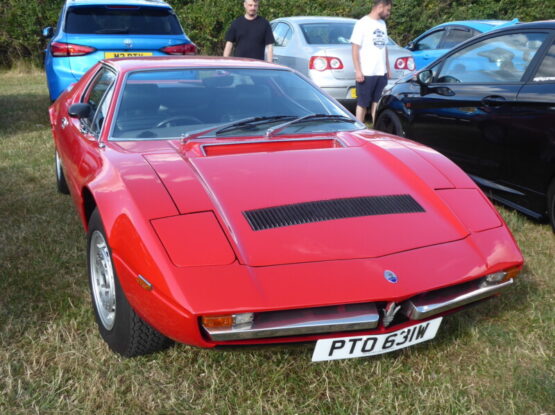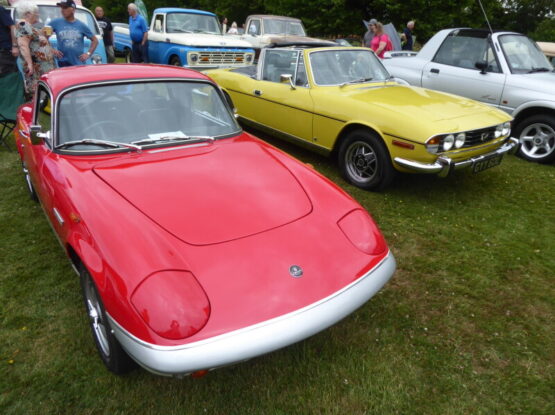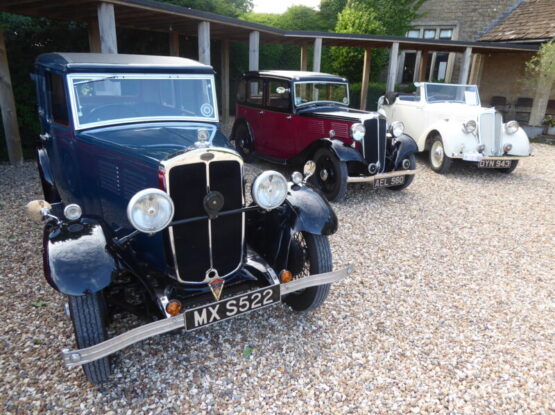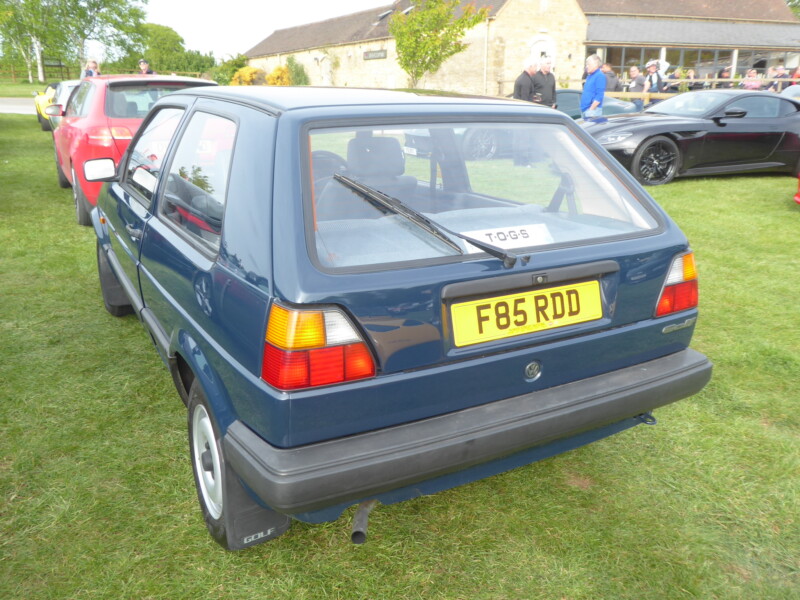
In September 2023 I made my first to the Cotswold Barn to what was the last of their series of mid-week evening car events of the season, and I really enjoyed it. I expressed the view that I hoped to return in 2024, but the combination of a vast number of other mid-week events and a work diary which can have me in the wrong place to attending anything some days all mean that I did not manage to get back at all even though there were five events held here. Things have started off better in 2025 as the event being covered here is the first of the season. Cotswold Barn, as the name suggests, is in the Cotswolds. More precisely, it is on the road from Stow-on-the-Wold to Broadway, which makes it just over an hour from home. Initially the venue simply had a farm shop which became very popular thanks to the quality of their produce, but the owner, a keen car enthusiast, realised that he had the space to open up to Car Clubs, and indeed if you look on their website you will see a list of Clubs booked in for a meeting here. Their diary is pretty full. The evening events have been a more recent addition to the schedule and they quickly became popular. I knew from my previous visit that I was likely to see a variety of cars from some real exotics and rarities to more recent enthusiast cars and a few more prosaic everyday machines, which are generally parked up separately. And that was exactly what I got this time, too. There were plenty of comings and goings during the evening, so I was kept busy moving around the site. And here is what attracted my camera:
ABARTH
What is known as the Series 4 version of the familiar 595 reached the markets in the middle of 2016. After rumours had circulated all winter following the launch of the facelifted Fiat 500 last year, Abarth finally unveiled the Series 4 at the end of May 2016. Initially, we were told that the cars would not be available in the UK until September, but that came forward somewhat, with dealers all receiving demo cars in June, and the first customers taking delivery in July. Three regular production versions of both the closed car and the open-topped C were initially available, all badged 595, and called Custom, Turismo and Competizione, as before, though numerous limited edition models have since appeared and in most case disappeared. The most significant changes with the Series 4 are visual, with a couple of new colours, including the much asked for Modena Yellow and a different red, called Abarth Red, which replaces both the non-metallic Officina and – slightly surprisingly – the tri-coat pearlescent Cordolo Red. as well as styling changes front and rear. The jury is still out on these, with many, me included, remaining to be convinced. At the front, the new air intake does apparently allow around 15 – 20 % more air in and out, which will be welcome, as these cars do generate quite a lot of heat under the bonnet. Competizione models for the UK retain the old style headlights, as they have Xenon lights as standard, whereas the Custom and Turismo cars have reshaped units. At the back, there are new light clusters and a new rear bumper and diffuser. Inside, the most notable change is the replacement of the Blue & Me system with a more modern uConnect Audio set up, which brings a new colour screen to the dash. Mechanically, there is an additional 5 bhp on the Custom (now 145) and Turismo (now 165 bhp) and the option of a Limited Slip Diff for the Competizione, which is likely to prove a popular option. Details of the interior trim have changed, with a filled-in glovebox like the US market cars have always had, and electric windows switches that are like the US ones, as well as a part Alcantara trim to the steering wheel in Competizione cars.


AC
There were no fewer than three replica AC Cobra models here. A bewildering array of companies have offered these over the years, and whilst most of them look pretty faithful to the original car. what sits underneath their bodies varies quite dramatically.


This one is a GD427, produced by Gardner-Douglas. The GD Mk4 body shape is externally accurate to the original displaying the familiar uncompromisingly muscular stance. Compared to the Mk3, the Mk4 sits higher with a deeper cockpit and larger wheel arched, there are other subtle differences that appear more noticeable when viewed side by side. The GD Mk4 uses the same chassis options as the Mk3 and therefore the same framed handling characteristics. Originally designed in 1986, the GD427 was engineered to provide a remarkably stiffer and lighter structure compared to traditional ‘ladder’ chassis, delivering superior build standards for DIY enthusiasts. This groundbreaking design not only allows for lower wheel frequencies and more compliant suspension but also enhances balance with a centrally located mass and a lower centre of gravity, resulting in impeccable poise and balance through corners. To date, the GD427 design has remained much the same, demonstrating its unwavering capability and forward thinking design. Depending on the final detail fitments the GD Mk4 can be every bit the classic 60’s icon or take on a more contemporary appearance, whichever you prefer, it is the underpinnings that make the GD Mk4 so indulgent and rewarding to drive. The GD Mk4 is an uncompromisingly modern sports car suited perfectly to a European landscape of narrow, winding roads and tracks where handling is pre-eminent over straight line speed, the latter comes easy. The driving experience is elevated to new heights, offering smooth and comfortable long-distance touring while delivering sharp, predictable handling and improved traction when pushed to its limits. The GDMk4 is available as a factory built car ready to drive away, or supplied in component form for self assembly. Prices are available to suit most budgets. All factory cars are built to order to individual customer preferences.

ALFA ROMEO
The 916 Series cars were conceived to replace two very different models in the Alfa range. First of these was the open topped 105 Series Spider which had been in production since 1966 and by the 1990s was long overdue a replacement. Alfa decided to combine a follow on to the Alfetta GTV, long out of production, with a new Spider model, and first work started in the late 1980s. The task was handed to Pininfarina, and Enrico Fumia’s initial renderings were produced in September 1987, with the first clay models to complete 1:1 scale model made in July 1988. Fumia produced something rather special. Clearly an Italian design, with the Alfa Romeo grille with dual round headlights, recalling the Audi-based Pininfarina Quartz, another design produced by Enrico Fumia back in 1981, the proposal was for a car that was low-slung, wedge-shaped with a low nose and high kicked up tail. The back of the car is “cut-off” with a “Kamm tail” giving improved aerodynamics. The Spider would share these traits with the GTV except that the rear is rounded, and would feature a folding soft-top with five hoop frame, which would completely disappear from sight under a flush fitting cover. An electric folding mechanism would be fitted as an option. Details included a one-piece rear lamp/foglamp/indicator strip across the rear of the body, the minor instruments in the centre console angled towards the driver. The exterior design was finished in July 1988. After Vittorio Ghidella, Fiat’s CEO, accepted the design, Alfa Romeo Centro Stile under Walter de Silva was made responsible for the completion of the detail work and also for the design of the interiors, as Pininfarina’s proposal was not accepted. The Spider and GTV were to be based on the then-current Fiat Group platform, called Tipo Due, in this case a heavily modified version with an all new multilink rear suspension. The front suspension and drivetrain was based on the 1992 Alfa Romeo 155 saloon. Chief engineer at that time was Bruno Cena. Drag coefficient was 0.33 for the GTV and 0.38 for the Spider. Production began in late 1993 with four cars, all 3.0 V6 Spiders, assembled at the Alfa Romeo Arese Plant in Milan. In early 1994 the first GTV was produced, with 2.0 Twin Spark engine. The first premiere was then held at the Paris Motor Show in 1994. The GTV and Spider were officially launched at the Geneva Motor Show in March 1995 and sales began the same year. The cars were well received. At launch, many journalists commented that Alfa had improved overall build quality considerably and that it came very close to equalling its German rivals. I can vouch for that, as I owned an early GTV for eighteen months, and it was a well built and reliable car. In 1997 a new engine, a 24-valve 3.0 litre V6, was available for the GTV along with bigger, 12.0 inch brakes and red four-pot calipers from Brembo. The console knobs were changed from round central to rectangle ones and to a three-spoke steering wheel. Some versions were upgraded with different front bumper mesh to bring the wind noise down to 74 dBA. In May 1998 the cars were revamped for the first time, creating the Phase 2 models. Most of the alterations were inside. The interior was changed with new centre console, painted letters on skirt seals, changed controls and switches arrangement and different instrument cluster. Outside, the main changes included chrome frame around the grille and colour-coded side skirts and bumpers. A new engine was introduced, the 142 bhp 1.8 Twin Spark, and others were changed: the 2.0 Twin Spark was updated with a modular intake manifold with different length intakes and a different plastic cover. Power output of the 2.0 TS was raised to 153 bhp. Engines changed engine management units and have a nomenclature of CF2. The dashboard was available in two new colours in addition to the standard black: Red Style and Blue Style, and with it new colour-coded upholstery and carpets. The 3.0 24V got a six-speed manual gearbox as standard and the 2.0 V6 TB engine was now also available for the Spider. August 2000 saw the revamp of engines to comply with new emission regulations, Euro3. The new engines were slightly detuned, and have a new identification code: CF3. 3.0 V6 12V was discontinued for the Spider and replaced with 24V Euro3 version from the GTV. 2.0 V6 Turbo and 1.8 T.Spark were discontinued as they did not comply with Euro3 emissions. By the 2001-2002 model year, only 2 engines were left, the 2.0 Twin.Spark and 3.0 V6 24V, until the Phase 3 engine range arrived. The Arese plant, where the cars had been built, was closing and, in October 2000, the production of GTV/Spider was transferred to Pininfarina Plant in San Giorgio Canavese in Turin. In 2003 there was another and final revamp, creating the Phase 3, also designed in Pininfarina but not by Enrico Fumia. The main changes were focused on the front with new 147-style grille and different front bumpers with offset numberplate holder. Change to the interior was minimal with different centre console and upholstery pattern and colours available. Instrument illumination colour was changed from green to red. Main specification change is an ASR traction control, not available for 2.0 TS Base model. New engines were introduced: 163 bhp 2.0 JTS with direct petrol injection and 237 hp 3.2 V6 24V allowing a 158 mph top speed. Production ceased in late 2004, though some cars were still available for purchase till 2006. A total of 80,747 cars were made, and sales of the GTV and Spider were roughly equal. More V6 engined GTVs than Spiders were made, but in 2.0 guise, it was the other way round with the open model proving marginally more popular.


The 156 GTA cars were launched at the Frankfurt Motor Show in September 2001. Named after the Alfa Romeo GTA from the 1960s, the letters GTA meaning Gran Turismo Alleggerita (English: lightened Grand Tourer). 2,973 berlinas and 1,678 Sportwagons were built until the GTA production stopped in October 2005 as the 156 gave way to the Alfa Romeo 159. The GTA came with the 3.2 litre Bussone V6 engine (The big Busso, so called after legendary Ferrari engineer Giuseppe Busso), the largest capacity version of the much loved V6 engine. With a 93 mm bore and a 78 mm stroke giving it a capacity of 3,179 cc, it generated 250 PS (247 hp) and 220 lb/ft of torque. After market Alfa Romeo specialist Autodelta produced performance versions up to 3.7 litres and 400 PS. The European Touring Car Championship winning 156 GTA was however running a 2.0 litre 4-cylinder 300 PS engine due to class regulations. The GTA variants were equipped with either a six-speed manual transmission or six-speed Selespeed (paddles in steering wheel, hydraulically operated robotised) gearbox, had a lowered and stiffened suspension, a distinctive body kit, wider rear arches and leather interior. The suspension was specifically made for the GTA by Fiat Research Centre and Fiat Auto Design and Development Department. Steering was also made faster, only 1.7 turns from lock to lock compared to 2.1 in normal models. The GTA had also larger brakes (Brembo), with 12″ front discs and 10.8″ at the rear. The front discs were later upgraded to 13 ” to cope with the performance potential. Even though the name suggests a light car, the GTA isn’t any lighter than other 156s, as it was actually 91 kilograms (201 lb) heavier than the 2.5 litre V6 engined version. The GTA did not get the Giugiaro designed facelift introduced to the 156 in 2002, but continued with the acclaimed Walter de Silva design to the very end of production

ASTON MARTIN
Representing the longest lived design in Aston Martin’s history were a number of DBS and V8 cars. By the mid 1960s, Aston Martin’s customers had been clamouring for an eight-cylinder car, so Aston Martin designed a larger car. The engine was not ready, however, so in 1967 the company released the DBS with the straight-six Vantage engine from the DB6. Two years later, Tadek Marek’s V8 was ready, and Aston released the DBS V8. Though the body and name was shared with the six-cylinder DBS, the V8 sold for much more. The body was a modern reinterpretation of the traditional Aston Martin look, with a squared-off grille and four headlights (though some consider the styling derivative of the early Ford Mustang). Distinguishing features of the V8 model are the larger front air dam and lack of wire wheels, though some six-cylinder DBS cars also used the V8’s alloy wheels. The tail lights were taken from the Hillman Hunter. A road test report of the time noted that the car had gained 250 lb in weight with the fitting of the V8 in place of the previously used six-cylinder unit, despite the manufacturer’s assurance that the engine weighed only 30 lb more than the older straight-six. Other contributions to the weight gain included heavier ventilated brake discs, air conditioning, fatter tyres, a new and stronger ZF gearbox as well as some extra bodywork beneath the front bumper. Marek’s V8 engine displaced 5,340 cc and used Bosch fuel injection. Output was not officially released, but estimates centre around 315 hp. The DBS V8 could hit 60 mph in 5.9 seconds and had a top speed of nearly 160 mph. 402 DBS V8s were built. In April 1972, the DBS V8 became just the Aston Martin V8 as the six-cylinder DBS was dropped, leaving just this car and the six-cylinder Vantage in production. The V8 became known as the AM V8, a model retroactively referred to as the Series 2 V8 to separate it from later models. Visual differences included twin quartz headlights and a mesh grille, a front design which was to last until the end of production in 1989. AM V8 cars, produced from May 1972 through July 1973, used a similar engine to the DBS V8, albeit with Bosch fuel injection rather than the earlier carburettors. Just 288 Series 2 cars were built. Although David Brown had left the company, he had overseen development of this model. The first 34 cars still carried leftover “DBS V8” badging. The car switched back to Weber carburettors for the Series 3 in 1973, ostensibly to help the car pass new stricter emissions standards in California but most likely because Aston Martin was unable to make the Bosch fuel injection system work correctly. These cars are distinguished by a taller bonnet scoop to accommodate four twin-choke (two-barrel) Weber carbs. The car produced 310 hp and could reach 60 mph in 6.1 seconds with an automatic transmission or 5.7 with a manual. Performance suffered with emissions regulations, falling to 288 hp in 1976. The next year, a more powerful “Stage 1” engine with new camshafts and exhaust brought it up to 305 hp. Production of Series 3 cars lasted from 1973 through October 1978, but was halted for all of 1975. 967 examples were produced in this time. While earlier V8 cars have louvers cut into the little panel mounted beneath the rear windshield, the Series 3 and later cars instead have a small lip at the bottom of this panel, just ahead of the leading edge of the bootlid. The “Oscar India” specification was introduced in October 1978 at the Birmingham International Motor Show. Visually, the former scoop on the bonnet gave way to a closed “power bulge”, while a spoiler was integrated into the tail. Most Oscar India cars were equipped with a Chrysler “Torqueflite” three-speed automatic transmission, with wood trim fitted for the first time since the DB2/4 of the 1950s. Just 352 Oscar India models were built from 1978 through 1985. The power of the now de-smogged engines kept dropping on American market cars, down to a low of 245 hp in the early eighties. The convertible “Volante” was introduced in June 1978, but featured the Series 4 bonnet a few months before the coupé received the Oscar India update. The Volante Series 1 weighs 70 kg (155 lb) more than the coupé, due to the necessity of reinforcing the frame. US market cars received much larger bumpers beginning with the 1980 model year, adding weight and somewhat marring the car’s lines. Owners of US-specified cars often modify them to have the slimmer European bumpers. By 1981, the success of the Volante meant that the coupé model was only built on individual demand. The fuel-injected Series 5 cars were introduced in January 1986 at the New York International Auto Show. The compact Weber/Marelli system no longer needed the space of the previous carburettors, so the bonnet bulge was virtually eliminated. 405 Series 5 cars were built before production ceased in 1989. The Volante Series 2 received the same changes; 216 were built.


The Aston Martin DBS Superleggera, also sold as the Aston Martin DBS, is a grand touring car produced from 2018 to 2024. In June 2018, Aston Martin unveiled the car as a replacement to the second-generation Vanquish. It is based on the DB11 V12, but featuring modifications that differentiate it from the DB11 lineage. The DBS name was previously used for a model built from 1967 to 1972 and for the DB9-based DBS between 2007 and 2012. In addition, the car also uses the Superleggera name which is a reference to Carrozzeria Touring Superleggera, who helped Aston Martin develop their lightest grand tourers in the 1960s and 1970s. In September 2024, Aston Martin announced the third-generation Vanquish as the successor of the DBS Superleggera. The front of the DBS features a new front bumper, with a larger centre grille compared to the DB11, for improved engine cooling, along with two air extractors on the sides to cool the brakes and two vents on the hood that aid in the engine cooling process. The 5.2-litre twin-turbocharged V12 engine, which is cast and manufactured at Grainger & Worrall in the United Kingdom before being shipped to the Aston Martin engine plant in Cologne for assembly, is rated at 725 PS at 6,500 rpm and 900 Nm (664 lb/ft) of torque from 1,800–5,000 rpm. In order to optimise the centre of gravity and weight distribution, the engine has been positioned as low and as far back in the chassis as possible. The DBS Superleggera features the new ZF 8HP95 transmission with a shorter final-drive ratio of 2.93:1, in contrast to the DB11’s 2.70:1. Chassis-wise, it also comes with torque vectoring and a mechanical limited slip differential for more focused track performance. The car also features many of the same aerodynamic features first seen on the DB11, including Aston Martin’s Aeroblade system, but refines aerodynamics with an F1-inspired double-diffuser that helps the car generate 397 lb (180 kg) of downforce – the highest figure ever for a series production Aston Martin. A new quad-pipe titanium exhaust system improves engine sound, while the usage of carbon fibre in major areas of the car lowers the weight down to 1,693 kg (3,732 lb). The DBS Superleggera can accelerate from 0–100 km/h (62 mph) in 3.4 seconds, and 0–161 km/h (100 mph) in 6.4 seconds. The car can also accelerate from 80–161 km/h (50–100 mph) in 4.2 seconds at fourth gear and can attain a top speed of 340 km/h (211 mph). Three driving modes are available: GT, Sport, and Sport Plus which adjust the car’s responsiveness. A Volante (convertible) model of the DBS was unveiled in April 2019. It has nearly identical performance and the same engine and transmission as the coupé but comes with an eight-layer soft top with eight colour options. For the first time on an Aston Martin automobile, the windshield surround is available in carbon fibre as well as the rear tonneau cover. There were a number of limited edition versions produced, too, in very small quantities.

The latest and still current Aston Martin Vantage was unveiled on 21 November 2017 with production starting in June 2018, replacing the previous model which had been in production for 12 years. It introduced a new styling direction but this was not universally well received and the car had a hefty price increase over its predecessor. Muted press enthusiasm did not help and sales have been disappointing. Aston Martin have continued to develop the model with a number of new versions introduced, to try to improve demand. The Vantage AMR is a track-focused variant of the Vantage. The main highlight of the model is the replacement of the ZF 8-speed automatic transmission with a dog-leg Graziano Trasmissioni 7-speed manual transmission previously used on the V12 Vantage S. The AMR also comes with a driver-selectable AMSHIFT system which controls the throttle during gear shifting. A new limited-slip differential ensures linear delivery of power. The power-band of the engine is wider and the unit is designed to deliver 625 Nm (461 lb/ft) of torque from 2,000 rpm to 5,000 rpm. The use of a manual transmission and carbon-ceramic brakes reduce the weight by 95 kg (209 lb). New adaptive dampers with the section of Sport, Sport + and Track modes improve handling. Performance figures include a 0–97 km/h (60 mph) acceleration time of 3.9 seconds, half a second more than the standard Vantage while the top speed remains the same as the standard model. Visual changes include 20-inch forged wheels as available on the Rapide AMR, new carbon fibre side vents and cooling vents present on the hood a sports exhaust system with quad tailpipes and racing bucket seats. Production of the AMR will be limited to 200 units worldwide. Available exterior colours for the AMR include Sabiro Blue, Pnyx Black, China Grey and White Stone. The final 59 cars will be finished in a Sterling Green exterior colour with Lime accents and will pay homage to the 1959 24 Hours of LeMans victory of Aston Martin. Once the production of the AMR ceases, the 7-speed manual transmission will become available on the standard Vantage. The vehicle went on sale in May 2019, with delivery set to begin in Q4 2019. Revealed in February 2020, the Vantage Roadster is a convertible version of the V8 Coupe with a fabric roof. The roof claimed to be the fastest of any automotive automatic convertible system, takes 6.7 seconds to lower and 6.8 seconds to raise and can be operated at speeds of up to 50 km/h (31 mph). The Vantage Roadster has a dry weight of 1,628 kg (3,589 lb). The F1 Edition is a version of the V8 Coupe and V8 Roadster commemorating Aston Martin’s return to Formula One after 61 years. The car features a fixed rear wing at the back, increased engine power to 535 PS (528 bhp), a top speed of 314 km/h (195 mph), new 21-inch wheel rims, and a 0–100 km/h (0–62 mph) acceleration time of 3.5 seconds. The car is available in three colours: Aston Martin Racing Green, Jet Black, and Lunar White. A convertible version called the Roadster is also available. Delivery began in May 2021..


AUDI
The Audi R8, based on the Audi Le Mans quattro concept car (designed by Frank Lamberty and Julian Hoenig) first appeared at the 2003 International Geneva Motor Show and the 2003 Frankfurt International Motor Show. The R8 road car was officially launched at the Paris Auto Show on 30 September 2006. There was some confusion with the name, which the car shares with the 24 Hours of Le Mans winning R8 Le Mans Prototype (LMP). Initial models included the R8 4.2 FSI coupé (with a V8 engine) and R8 5.2 FSI coupé (with a V10 engine). Convertible models, called the Spyder by the manufacturer, were introduced in 2008, followed by the high-performance GT model introduced in 2011. The Motorsport variants of the R8 were also subsequently introduced from 2008 onwards. An all-electric version called the e-Tron started development but would only reach production stage when the second generation model would be introduced. 6-time 24 Hours of Le Mans winner Jacky Ickx described the R8 as “the best handling road car today” and the car was well received by everyone who drove it. The car received a facelift in 2012 and a new model called the V10 Plus was now added to the range. Production of the Type 42 ended in August 2015

BMW
The Isetta is far more significant than many people here would realise, as without these cars, the modern BMW company simply would not exist. However, the car originated with the Italian firm of Iso SpA, and it is two of those models which were to be seen here. In the early 1950s the company was building refrigerators, motor scooters and small three-wheeled trucks. Iso’s owner, Renzo Rivolta, decided he would like to build a small car for mass distribution. By 1952 the engineers Ermenegildo Preti and Pierluigi Raggi had designed a small car that used the motorcycle engine of the Iso Moto 200 and named it Isetta—an Italian diminutive meaning little ISO. The Isetta caused a sensation when it was introduced to the motoring press in Turin in November 1953, it was unlike anything seen before. Small (only 7.5 ft long by 4.5 ft wide) and egg-shaped, with bubble-type windows, the entire front end of the car hinged outwards to allow entry. In the event of a crash, the driver and passenger were to exit through the canvas sunroof. The steering wheel and instrument panel swung out with the single door, as this made access to the single bench seat simpler. The seat provided reasonable comfort for two occupants, and perhaps a small child. Behind the seat was a large parcel shelf with a spare wheel located below. A heater was optional, and ventilation was provided by opening the fabric sunroof. Power came from a 236 cc 9.5 hp split-single two-stroke motorcycle engine. The engine was started by a combination generator-starter known as Dynastart. A manual gearbox provided four forward speeds and reverse. A chain drive connected the gearbox to a solid rear axle with a pair of closely spaced 25 cm (10 in) rear wheels. The first prototypes had one wheel at the rear, but having a single rear wheel made the car prone to roll-overs, so the rear wheel layout was changed to two wheels set 19 in apart from each other. This narrow track eliminated the need for a differential. The front axle was a modified version of a Dubonnet independent front suspension. The Isetta took over 30 seconds to reach 50 km/h (31 mph) from rest. Top speed was only about 75 km/h (47 mph). The fuel tank held only 13 litres. However, the Isetta would get somewhere between 50 and 70 mpg depending on how it was driven. In 1954, Iso entered several Isettas in the legendary Mille Miglia where they took the top three spots in the economy classification. Over a distance of 1,600 km (1,000 mi) the drivers achieved an average speed of over 70 km/h (43 mph). In view of its maximum speed, which was just 15 km/h (9 mph) higher, this was an almost incredible figure. However, despite its initial success, the Isetta was beginning to slip in popularity at home. This was mainly due to renewed competition from Fiat with its 500C model. Renzo Rivolta wanted to concentrate on his new Iso Rivolta sports car, and was extremely interested in doing licensing deals. Plants in Spain and Belgium were already assembling Isettas and Autocarros using Italian made Iso components. BMW began talking with Rivolta in mid-1954 and bought not just a license but the complete Isetta body tooling as well. Rivolta did not stop with licensing the Isetta to BMW. He negotiated similar deals with companies in France and Brazil. After constructing some 1,000 units, production of the Italian built cars ceased in 1955, although Iso continued to build the Isetta in Spain until 1958. In addition to the Turismo, Iso in Spain also built the Autocarro, a commercial version with full-width rear axle. The Autocarro was offered in several body styles, a flatbed pickup, enclosed truck, a tilt-bed, or even a fire engine, although some of these might not have been sold. The Autocarro was an extremely popular type of vehicle in Italy, and numerous manufacturers produced some variant of the type. Iso had previously produced a motorcycle-type Isocarro. The Iso Autocarro was larger than most, with its four-wheel layout, conventional rear axle with differential and leaf springs, and a large tubular frame. It could carry a 500 kg load. It is thought that more than 4,000 Autocarros were built.


The BMW E30 is the second generation of BMW 3 Series, which was produced from 1982 to 1994 and replaced the E21 3 Series, and was the car which really saw the popularity of the 3 Series increase dramatically. . Development of the E30 3 Series began in July 1976, with styling being developed under chief designer Claus Luthe with exterior styling led by Boyke Boyer. In 1978, the final design was approved, with design freeze (cubing process) being completed in 1979. BMW’s launch film for the E30 shows the design process including Computer-aided design (CAD), crash testing and wind-tunnel testing. The car was released at the end of November 1982. Externally, the E30’s appearance is very similar to twin headlight versions of its E21 predecessor, however there are various detail changes in styling to the E30. Major differences to the E21 include the interior and a revised suspension, the latter to reduce the oversteer for which the E21 was criticised. At launch, the car had a 2 door style like its predecessor and just four engines, all of them petrol: the 316 and 318 four cylinder units and the 320 and 323i 6 cylinders. This last was soon upgraded to a 2.5 litre unit. Diesel models were added during the 80s and there was an all-wheel drive 325iX option for continental European markets. In addition to the 2 door saloon and Baur convertible body styles of its E21 predecessors, the E30 became available by early 1984 as a four-door sedan and later a five-door station wagon (marketed as “Touring”). The Touring body style began life as a prototype built by BMW engineer Max Reisböck in his friend’s garage in 1984 and began production in 1987. The factory convertible version began production in 1985, with the Baur convertible conversions remaining available alongside it. Following the launch of the E36 3 Series in 1990, the E30 began to be phased out.

The development programme for the E46 began in 1993 under chief engineer Wolfgang Ziebart and head of R&D Wolfgang Reitzle. In late 1993, design work began under chief designer Chris Bangle and continued into 1995. In May 1995, the general exterior design of the E46 by Erik Goplen of DesignworksUSA was approved and as a result DesignworksUSA was contracted by BMW to work alongside BMW Group’s in-house design team to create the exterior bodywork for the 3 Series range in February 1996. The design team put an emphasis on improving aerodynamics and increasing the car’s aggressive stance. Design patents were filed in Germany on 16 July 1997 and in the US on 16 January 1998. Chris Bangle and Dr. Wolfgang Reitzle (BMW Head of R&D) were responsible through 1995 for the production sedan’s exterior, as evident in the 1997 design patent. Production development of the sedan took 24 months following design freeze and was 31 months from executive board styling approval in 1995 to its start of series production in December 1997. Erik Goplen designed the production coupé, convertible and station wagon during 1996–1997. The E46 sedan was unveiled via press release on 11 November 1997 and was launched on the market at the end of April 1998. The range was gradually built up, with the four door saloon being the first model to be seen, and with a limited range of engines, and over the following months, the 2 door coupe, convertible, Touring and a 3 door hatch Compact were added, and the engine range was widened. All-wheel drive, which was last available in the 3 Series in 1991, was reintroduced for the E46 on the 325xi, 330xi and 330xd models. The E46 was the first 3 Series to be available with an engine using Valvetronic (variable valve lift). Various electronic features were also introduced to the 3 Series in the E46 generation, including satellite navigation, electronic brake-force distribution, rain-sensing wipers and LED tail-lights. The E46 M3 is powered by the BMW S54 inline-six engine with either a 6-speed manual or a 6-speed SMG-II automated manual transmission. The M3 was introduced in late 2000 and was produced in coupé and convertible body styles only. There was a steady program of evolution through the model’s life. Sales were strong. The best year was 2002 when over 560,000 were sold worldwide. Following the introduction of the E90 3 Series sedans in late 2004, the E46 began to be phased out. However the E46 coupé and convertible body styles remained in production until August 2006.

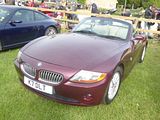
Also here was the Z4. This has been offered in three different generations, of which this is the first, consisting of the BMW E85 (roadster version) and BMW E86 (coupe version) sports cars. The E85/E86 generation was produced from 2002 to 2008. The E85/E86 replaced the Z3 and is the third model in the BMW Z Series. Initial models were in the roadster (E85) body style, with the coupé (E86) body style being added in 2006. As per the Z3, the E85/E86 was manufactured solely in Greer, South Carolina. The E85 was designed by Danish BMW-designer Anders Warming from mid-1998 to the summer of 1999. The coupe models were designed by Tomasz Sycha. The E85 designs were frozen on March 1, 2000. The Z4 was introduced at the Paris Motor Show in 2002, and North American models went on sale in November of the same year (as the 2003 model year). European sales began in March 2003. The Z4 Roadster was launched in 2002 with the 2.5i and 3.0i six-cylinder models. Transmission choices were a five-speed manual, six-speed manual, five-speed automatic and a six-speed SMG-II automated manual transmission. A four-cylinder model, the Z4 2.0i Roadster, was introduced for the European market in May 2005. The drag coefficient is maximum of Cd=0.35. BMW unveiled a concept coupé version of the Z4 at the 2005 Frankfurt Motor Show The design of the Z4 and Z4 coupé has variously been ascribed to Anders Warming, Chris Bangle, the controversial former BMW Head of Design, and Adrian van Hooydonk, former BMW chief designer, and BMW designer Tomasz Sycha. The design was approved in Summer of 2004 and frozen in December 2004. The company announced in 2005 that the two-door coupé would be available for production including the return of the M Coupé. The production car was introduced at the New York Auto Show in April 2006 and was available for sale in late May 2006. Thanks to its hatch design, the Z4 Coupé offers 10.1 cu ft (0.29 m3) of trunk space, compared with 8.5 cu ft (0.24 m3) for the roadster. The Coupe’s fixed roof increases torsional rigidity, resulting in a stiffness of 32,000 N⋅m (24,000 lb⋅ft) per degree of body twist on the coupe (compared to 14,500 N⋅m (10,700 lb⋅ft) per degree on the roadster), which improves turn-in and overall handling response. The roof has a “double-bubble” contour which serves as an aerodynamic aid and offers more headroom than the roadster with the soft top closed. The Coupé has a sleek fastback rear window that slopes down to an integrated spoiler which is shaped to deliver downforce to the rear axle at high-speed. The model range for the Coupé was more limited than the roadster, and consisted of the six-cylinder 3.0si and Z4 M model only. Transmission choices were a 6-speed manual and a 6-speed automatic with shift paddles mounted on the steering column. In February 2009, the BMW Z4 (E89) began production as the successor to the E85/E86.
There were refreshingly few BMW models here (it’s not that sort of meet!), but I did spot a previous generation M3 and who could miss this current Touring in such a bright blue?


CHEVROLET
The Chevrolet Bel Air is a full-size car produced by Chevrolet for the 1950–1975 model years. Initially, only the two-door hardtops in the Chevrolet model range were designated with the Bel Air name from 1950 to 1952. With the 1953 model year, the Bel Air name was changed from a designation for a unique body shape to a premium level of trim applied across a number of body styles. The Bel Air continued with various other trim level designations, and it had gone from a mid-level trim car to a budget fleet sedan when U.S. production ceased in 1975. The Bel Air received a major redesign for the 1959 model year. The most visual new change was the flat, wing shaped tailfins. The car was built on a 119 in (3,000 mm) wheelbase and was 211 in (5,400 mm) long-which was 11 in (280 mm) longer than the 1957 model. This made Chevrolet the longest car in the low-priced range, whereas two years before it had been the shortest. In addition, the car was 3 in (76 mm) wider outside and had 5 in (130 mm) more width inside than it did in 1958, through the reduction of door thickness. The “X” frame from 1958 was continued, but enlarged and strengthened to support the new body. The Bel Air, which had been the top line series since 1953, was now the middle range. Wagons were still classed by themselves, but had model numbers matching the car series. Parkwood 6-passenger and Kingswood 9-passenger wagons had Bel Air’s model number, and as such were the middle range wagons. Under the hood, little change took place. A variety of speed options, such as fuel injection, special cams and lowered compression, gave horsepower ratings up to 315. Bel Air production was 447,100. The new Impala line surpassed Bel Air production by 20,000 units. A parking brake warning light was optional. Little change was made for 1960. The new models were refinements of the 1959 style with a much more restrained front end, the return of the double cone tail lights of 1958 rather than the startling “cat’s eyes” of 1959. Under the hood, things remained constant. Fuel injection was no longer available, but with the 348 cubic inch engine, a horsepower rating of 335 at 5800 rpm was now achieved. This involved the use of three double-barrel carburettors, a special cam and an 11.25:1 compression ratio, all sold as a package. Body style offerings followed 1959, with hardtops and sedans available. The convertible was reserved for the Impala series. The Bel Air Sport Sedan continued to use a rear window overhang and a huge wraparound rear window. Bel Airs (and Biscaynes) had two tail lights per side; the Impalas had three tail lights per side—a situation that would persist for most years through 1975. Many of the same options and accessories that were available on the Impala were also available on the Bel Air. The Bel Airs had more interior and exterior brightwork than the Biscayne.


CITROEN
The Xantia replaced the earlier Citroën BX (which straddled both small and large family car segments), and maintained the high level of popularity of that model, but brought the car more into the mainstream to compete harder with its rivals, such as the Ford Mondeo, Nissan Primera, Rover 600, Toyota Carina E and Opel Vectra/Vauxhall Cavalier. Sales commenced in March 1993. The car was built from November 1992 to October 2002 in France, totalling almost ten years, including the facelift in December 1997. It signalled that Citroën had learned from the reception given to the staid Citroën ZX, introduced two years earlier, and criticised by contemporary journalists for its lack of traditional Citroën flair, in engineering and design. Citroën addressed these concerns in the Xantia. The Xantia also used the traditional Citroën hydropneumatic suspension system, which was pioneered by the older DS. It was initially only available as a hatchback (notchback) (Berline), but an estate (station wagon) (Break) version, built by Heuliez, appeared in September 1995. Inline with PSA Group policy, the Peugeot 406, launched two years later, used the same floorpan, core structure and engines as the Xantia. The Hydractive suspension system was not carried over, and the 406 utilised a more traditional spring suspension. Sales in the United Kingdom were strong, and even though it was never able to match the volume of British favourites, such as the Ford Mondeo or Vauxhall Vectra, the car did help Citroën establish a strong foothold in the business car market in the United Kingdom.


FERRARI
An all new design, the 458 Italia was first officially unveiled at the 2009 Frankfurt Motor Show. Once more, Ferrari advised that the model incorporated technologies developed from the company’s experience in Formula 1. The body computer system was developed by Magneti Marelli Automotive Lighting. The 458 came with a 4,499 cc V8 engine of the “Ferrari/Maserati” F136 engine family, producing 570 PS ( 562 hp) at 9,000 rpm and 540 N·m (398 lb/ft) at 6,000 rpm with 80% torque available at 3,250 rpm. The engine featured direct fuel injection, a first for Ferrari mid-engine setups in its road cars. The only transmission available was a dual-clutch 7-speed Getrag gearbox, in a different state of tune shared with the Mercedes-Benz SLS AMG. There was no traditional manual option, making this the fourth road-car after the Enzo, Challenge Stradale and 430 Scuderia not to be offered with Ferrari’s classic gated manual. The car’s suspension featured double wishbones at the front and a multi-link setup at the rear, coupled with E-Diff and F1-Trac traction control systems, designed to improve the car’s cornering and longitudinal acceleration by 32% when compared with its predecessors.The brakes included a prefill function whereby the pistons in the calipers move the pads into contact with the discs on lift off to minimise delay in the brakes being applied. This combined with the ABS and standard Carbon Ceramic brakes caused a reduction in stopping distance from 100–0 km/h (62-0 mph) to 32.5 metres. Ferrari’s official 0–100 km/h (62 mph) acceleration time was quoted as 2.9–3.0 seconds with a top speed of 340 km/h (210 mph). In keeping with Ferrari tradition the body was designed by Pininfarina under the leadership of Donato Coco, the Ferrari design director. The interior design of Ferrari 458 Italia was designed by Bertrand Rapatel, a French automobile designer. The car’s exterior styling and features were designed for aerodynamic efficiency, producing a downforce of 140 kg (309 lb) at 200 km/h. In particular, the front grille features deformable winglets that lower at high speeds, in order to offer reduced drag. The car’s interior was designed using input from former Ferrari Formula 1 driver Michael Schumacher; in a layout common to racing cars, the new steering wheel incorporates many controls normally located on the dashboard or on stalks, such as turning signals or high beams. At launch the car was widely praised as being pretty much near perfect in every regard. It did lack a fresh air version, though, but that was addressed with the launch of the 458 Spider at the 2011 Frankfurt Motor Show. This convertible variant of the 458 Italia featured an aluminium retractable hardtop which, according to Ferrari, weighs 25 kilograms (55 lb) less than a soft roof such as the one found on the Ferrari F430 Spider, and can be opened in 14 seconds The engine cover was redesigned to accommodate the retractable roof system. It had the same 0–100 km/h time as the hard-top but a lower top speed of 199 mph. It quickly became the better seller of the two versions.


Also here was the Ferrari 812 Superfast. Known internally as the Type F152M, this is a front mid-engine, rear-wheel-drive grand tourer that made its debut at the 2017 Geneva Motor Show. The 812 Superfast is the successor to the F12berlinetta. The 812 Superfast has a 6,496 cc F140 GA V12, an enlarged version of the 6.3-litre engine used in the F12berlinetta. It generates a power output of 800 PS (789 bhp) at 8,500 rpm and 718 Nm (530 lb/ft) of torque at 7,000 rpm. According to Ferrari in 2018, the 812 Superfast’s engine was, at the time, the most powerful naturally aspirated production car engine ever made. It does not feature turbocharging or hybrid technology.

FORD
The Mark I Ford Escort was introduced in the UK at the end of 1967, making its show debut at Brussels Motor Show in January 1968, replacing the successful, long-running Anglia. The car was presented in continental Europe as a product of Ford’s European operation. Escort production commenced at the Halewood plant in England during the closing months of 1967, and for left hand drive markets during September 1968 at the Ford plant in Genk. Initially the continental Escorts differed slightly from the UK built ones under the skin. The front suspension and steering gear were differently configured and the brakes were fitted with dual hydraulic circuits; also the wheels fitted on the Genk-built Escorts had wider rims. At the beginning of 1970, continental European production transferred to a new plant on the edge of Saarlouis, West Germany. The Escort was a commercial success in several parts of western Europe, but nowhere more than in the UK, where the national best seller of the 1960s, BMC’s Austin/Morris 1100 was beginning to show its age while Ford’s own Cortina had grown, both in dimensions and in price, beyond the market niche at which it had originally been pitched. In June 1974, six years into the car’s UK introduction, Ford announced the completion of the two millionth Ford Escort, a milestone hitherto unmatched by any Ford model outside the US. It was also stated that 60% of the two million Escorts had been built in Britain. In West Germany cars were built at a slower rate of around 150,000 cars per year, slumping to 78,604 in 1974 which was the last year for the Escort Mark I. Many of the German built Escorts were exported, notably to Benelux and Italy; from the West German domestic market perspective the car was cramped and uncomfortable when compared with the well-established and comparably priced Opel Kadett, and it was technically primitive when set against the successful imported Fiat 128 and Renault 12. Subsequent generations of the Escort made up some of the ground foregone by the original model, but in Europe’s largest auto-market the Escort sales volumes always came in well behind those of the General Motors Kadett and its Astra successor. The Escort had conventional rear-wheel drive and a four-speed manual gearbox, or three-speed automatic transmission. The suspension consisted of MacPherson strut front suspension and a simple live axle mounted on leaf springs. The Escort was the first small Ford to use rack-and-pinion steering. The Mark I featured contemporary styling cues in tune with its time: a subtle Detroit-inspired “Coke bottle” waistline and the “dogbone” shaped front grille – arguably the car’s main stylistic feature. Similar Coke bottle styling featured in the larger Cortina Mark III (also built in West Germany as the Taunus) launched in 1970. Initially, the Escort was sold as a two-door saloon (with circular front headlights and rubber flooring on the “De Luxe” model). The “Super” model featured rectangular headlights, carpets, a cigar lighter and a water temperature gauge. A two-door estate was introduced at the end of March 1968 which, with the back seat folded down, provided a 40% increase in maximum load space over the old Anglia 105E estate, according to the manufacturer. The estate featured the same engine options as the saloon, but it also included a larger, 7 1⁄2-inch-diameter clutch, stiffer rear springs and in most configurations slightly larger brake drums or discs than the saloon. A panel van appeared in April 1968 and the 4-door saloon (a bodystyle the Anglia was never available in for UK market) in 1969. Underneath the bonnet was the Kent Crossflow engine in 1.1 and 1.3 litre versions. A 940 cc engine was also available in some export markets such as Italy and France. This tiny engine remained popular in Italy, where it was carried over for the Escort Mark II, but in France it was discontinued during 1972. There was a 1300GT performance version, with a tuned 1.3 L Crossflow (OHV) engine with a Weber carburettor and uprated suspension. This version featured additional instrumentation with a tachometer, battery charge indicator, and oil pressure gauge. The same tuned 1.3 L engine was also used in a variation sold as the Escort Sport, that used the flared front wings from the AVO range of cars, but featured trim from the more basic models. Later, an “executive” version of the Escort was produced known as the “1300E”. This featured the same 13″ road wheels and flared wings of the Sport, but was trimmed in an upmarket, for that time, fashion with wood trim on the dashboard and door cappings. A higher performance version for rallies and racing was available, the Escort Twin Cam, built for Group 2 international rallying. It had an engine with a Lotus-made eight-valve twin camshaft head fitted to the 1.5 L non-crossflow block, which had a bigger bore than usual to give a capacity of 1,557 cc. This engine had originally been developed for the Lotus Elan. Production of the Twin Cam, which was originally produced at Halewood, was phased out as the Cosworth-engined RS1600 (RS denoting Rallye Sport) production began. The most famous edition of the Twin Cam was raced on behalf of Ford by Alan Mann Racing in the British Saloon Car Championship in 1968 and 1969, sporting a full Formula 2 Ford FVC 16-valve engine producing over 200 hp. The Escort, driven by Australian driver Frank Gardner went on to comfortably win the 1968 championship. The Mark I Escorts became successful as a rally car, and they eventually went on to become one of the most successful rally cars of all time. The Ford works team was practically unbeatable in the late 1960s / early 1970s, and arguably the Escort’s greatest victory was in the 1970 London to Mexico World Cup Rally, co-driven by Finnish legend Hannu Mikkola and Swedish co-driver Gunnar Palm. This gave rise to the Escort Mexico (1598cc “crossflow”-engined) special edition road versions in honour of the rally car. Introduced in November 1970, 10,352 Mexico Mark I’s were built. In addition to the Mexico, the RS1600 was developed with 1,601 cc Cosworth BDA which used a Crossflow block with a 16-valve Cosworth cylinder head, named for “Belt Drive A Series”. Both the Mexico and RS1600 were built at Ford’s Advanced Vehicle Operations (AVO) facility located at the Aveley Plant in South Essex. As well as higher performance engines and sports suspension, these models featured strengthened bodyshells utilising seam welding in places of spot welding, making them more suitable for competition. After updating the factory team cars with a larger 1701 cc Cosworth BDB engine in 1972 and then with fuel injected BDC, Ford also produced an RS2000 model as an alternative to the somewhat temperamental RS1600, featuring a 2.0 litre Pinto (OHC) engine. This also clocked up some rally and racing victories; and pre-empted the hot hatch market as a desirable but affordable performance road car. Like the Mexico and RS1600, this car was produced at the Aveley plant.

March 1986 saw the Orion getting the same facelift as the Escort. Internally within Ford it is regarded as an updated model (Apollo-86) rather than a new generation, although it is popularly known as the Mark II. The Mark II brought the option of anti-lock-brakes (ABS) and a heated front windscreen to the range. The base “L” version came with an additional 1.3 litre engine option which used the OHV “‘Valencia’ engine as used on the Escort, whilst a new 1.4 litre CVH engine option was introduced. This (along with the 1.6 CVH ) was a “lean burn unit” and various models in the range could run on unleaded fuel without modifications to the cylinder head or to the fuel system. Improved locks were fitted across the range initially being of the Chubb AVA design but soon after replaced with the Tibbe type; same as with the Escort, and a number of other improvements were carried out including new suspension and gearbox mounts, updated interior and trim changes, improved soundproofing and revised steering and suspension settings. Trim levels now included the entry-level L, Biscane (special edition) LX, Equipe (special edition) GL, GLS (special edition), Ghia, Ghia Injection and from 1988 the 1600E (special edition).


The Ford Mondeo Mk3 (second generation) model was launched by Ford in October 2000. This Mondeo was considerably larger than its predecessor, and although Ford abandoned its New Edge design theme for the second generation, it was their first vehicle to fully benefit from the Prodigy concept car. This gave it an overall effect which many critics felt was more restrained and mature, if much less distinctive. Two of the old car’s biggest weaknesses, the modest rear legroom, and uncompetitive diesel version were addressed by a 50 mm (2.0 in) longer wheelbase and the new Duratorq diesel engine. The basic chassis and suspension design was carried over from the previous generation, which meant that the car continued its predecessor’s reputation for class leading handling and ride. This Mondeo came to Mexico, replacing the North American built Ford Contour, and was sold from 2001 to 2007, when the Ford Fusion replaced it. The North American market Fusion and Ford Five Hundred/Taurus featured very similar styling, inside and out. Following the standard setting interior of the Volkswagen Passat (B5) in 1996, Ford paid a great deal of attention to the second generation Mondeo’s interior and was the first major American manufacturer to react to the new standard set by Volkswagen. Ford dispensed with the rounded American style interior of the first generation, and developed a more sober, sophisticated, ‘Germanic’ design, using more expensive materials. This Mondeo simplified trim levels a lot, for example the UK trims had been simplified down to LX, Zetec, Zetec S, Ghia, Ghia X and ST. Despite this, a mid-cycle facelift in 2003 saw the introduction of some new trim levels. Titanium and Titanium X slotted in between Zetec S and Ghia, and ST220 above the ST. As with its predecessor, passive safety was a major selling point of the 2000 Mondeo. With an even stronger bodyshell, Ford introduced its so-called “Intelligent Protection System” (IPS), which used an “intelligent” array of sensors based on a neural network,[citation needed] to decide the best combination of safety devices (traditional front passenger airbags, side airbags and curtain airbags) to deploy for a given crash situation. To enhance active safety, all models were fitted with anti-lock brakes and electronic brake-force distribution, with electronic stability program (ESP) available as an option. Ford’s marketing of the time claimed the Mondeo was ‘One of the safest places to be’. However, Euro NCAP’s testing of the 2000 to 2007 Mondeo found that it protected worse than most key rivals (Vauxhall Vectra, Citroën C5, Toyota Avensis, Volkswagen Passat), achieving a lower-end 4 star rating. Ford redesigned part of the car and it was re-tested, but the higher-than-average risk of chest injury to the driver in the frontal impact remained because the first and second generation Mondeo were based on the relatively dated CDW27 platform which related to the Mazda GE platform designed in late 1980s. The Mondeo established itself as Britain’s most popular automobile in its class and held this position every year from 2001 onwards, though this size of car has fallen slightly in popularity during the 2000s. This version of the Mondeo has never come higher than sixth in the SMMT’s official list of the top selling cars in the UK each year. In 2003, it came tenth in the list. The second generation Mondeo was never sold in Australia, as Ford Australia argued that the segment of the market was in decline. However in neighbouring New Zealand, it was voted Car of the Year in 2002 by the New Zealand Motoring Writers’ Guild. For the second generation Mondeo, the Zetec engine was replaced with 1.8 and 2.0 litre Mazda L engines, branded Duratec by Ford. The standard 2.5 L V6 engine was carried over, while a 3.0 L version was developed for the ST220 and higher trim models. There was a design flaw with the new 1.8 and 2.0 L petrol units with the butterfly valves in the inlet manifold, which could cause severe engine damage when they failed. The plastic components of the butterfly valves wear out too quickly and when loose enough can result in them falling apart and releasing metal and plastic parts into the engine cylinders, potentially causing severe engine damage (How to Diagnose) The part was upgraded by Ford in late 2002 to early 2003 and this largely prevented the problem from occurring in later engines, though random failures have still been reported on even the upgraded parts. The archaic Endura-D 1.8 L turbodiesel engine was dropped, and replaced by a more sophisticated 2.0 L 16v Duratorq common rail (TDCi and TDDi) unit with a fixed or variable geometry turbine, this clever turbine system allows a certain amount of overboost, giving an extra 10% or so of torque for short periods. This engine, known within Ford as the “Puma”-type Duratorq, was first seen in the Transit in detuned form. A new automatic transmission was added to the range called the Durashift. This unit has five gears and may be shifted manually or shifted like an automatic. A six-speed manual transmission was also added to the range, instead of just having a five-speed manual as seen in the previous model. In June 2003, the Mondeo was given a very mild upgrade, the new models being identifiable by the larger chrome honeycomb grille, redesigned fog lights, a new central dashboard made from higher quality materials, with electronic climate control, either a standard Ford radio, Sony radio, or a satellite navigation radio/CD player, which also has climate control built into the unit in lieu of the space taken up by the unit. The Durashift automatic is now available with steering wheel control. The petrol engines were revised at this stage also — the new SCI (direct injection) version of the 1.8 L Duratec engine was introduced, which generates 5 PS more than the standard unit. In addition, equipment was upgraded across the range — with trip computer now standard on all models, and cruise control is also standard in selected trim levels and markets. The main Sports version was the ST220, replacing the ST200 from the last model series. This was available in liftback, estate and saloon form. The ST220 produced 226 bhp from the newly developed 3.0-litre V6 engine, which made it capable of 0 to 62 mph (100 km/h) in 7.4 seconds, and on to a maximum speed of 155 mph (249 km/h). There was also a ST TDCi, a sports version of the regular diesel. This, available in all forms, had a 2.2-litre 4-cyl diesel engine, developing 153 bhp. It accelerated from 0 to 62 mph (100 km/h) in 8.2 seconds, and had a maximum speed of 140 mph (230 km/h). The higher range models, (i.e. the Zetec S, Ghia X and Titanium X), now had two V6 engines available; one being the existing Duratec 25 carried over from the previous model, and one being a Duratec 30; a quieter, smoother variant of the ST220 3.0-litre engine, which produced 206 bhp. This was not dissimilar in performance to the ST220, with a 0 to 62 mph (100 km/h) time of 7.9 seconds and a top speed of 151 mph (243 km/h). In 2005, there were two new Duratorq common rail (TDCi) options, a 2.2L with 155 PS and a detuned version of the 2.0L with 89 PS. Also, the Seat Belt Warning System was added and is now standard, with an audible/visual warning signal reminding the driver to fasten his/her seat belt. The styling was upgraded again, the most notable difference being tweaked taillights.

There were a couple of examples of the Mustang, a car finally offered in right hand drive some 50 years after the launch of the original model. It has proved quite popular in the UK, with the majority of the sales being for the V8 version.


HILLMAN
The Audax body was designed by the Rootes Group, but helped by the Raymond Loewy design organisation, who were involved in the design of Studebaker coupés in 1953. Announced in May 1956 the car went through a succession of annual facelifts each given a series number, replacing the mark number used on the previous Minxes. The Series I, introduced in 1956, was followed by the Series II in 1957, the Series III in 1958, the Series IIIA in 1959, the Series IIIB in 1960, the Series IIIC in 1961, the Series V in 1963 and the Series VI in 1965. There was no Series IV. Over the years the engine was increased in capacity from 1390 cc (in the Series I and II) to 1725 cc in the Series VI. A variety of manual transmissions, with column or floor change, and automatic transmissions were offered. For the automatic version, the Series I and Series II used a Lockheed Manumatic two-pedal system (really only a semi-automatic), the Series III a Smiths Easidrive, which was the first production dual-clutch transmission, while the V/VI a Borg Warner. The Series VI was fitted with an all-synchromesh gearbox. A Series III deLuxe saloon with 1494 cc engine tested by the British magazine The Motor in 1958 had a top speed of 76.9 mph (123.8 km/h) and could accelerate from 0–60 mph (97 km/h) in 25.4 seconds. A fuel consumption of 31.8 miles per imperial gallon (8.9 L/100 km; 26.5 mpg‑US) was recorded. The test car cost £794 including taxes of £265. There were Singer Gazelle and Sunbeam Rapier variants of all these Hillman Minx models and the names were again used on derivatives in the later Rootes Arrow range. Some models were re-badged in certain markets, with the Sunbeam and Humber marques used for some exports. The New Zealand importer/assembler Todd Motors created the Humber 80 and Humber 90, badge-engineered models based respectively on the Minx and Super Minx, to give Humber dealers a smaller car to sell alongside the locally assembled Hawk and Super Snipe. Although the 90 was identical to the Super Minx apart from badging, the cheaper 80 featured a horizontal bar grille design. The Humber 80 was acknowledged in the 1980s Roger Hall play Prisoners of Mother England, in which a newly arrived immigrant in New Zealand spots one and exclaims: “Humber 80? There’s no such car!” In Australia, a Series Va model was released in 1965. It was fitted with a more powerful 1592cc engine and the all-synchromesh gearbox destined for the forthcoming Series VI model. The Audax Minx was also built in Japan by Isuzu Motors as the Isuzu Hillman Minx, under licence from Rootes, between September 1956 and June 1964. Isuzu produced their own unique estate car version, the Isuzu Hillman Express, from 1958 to 1964. The car was replaced by the Arrow-bodied Minx in early 1967.


HONDA
The seventh-generation Civic was released in September 2000, for the 2001 model year. While it retained the previous generation’s exterior dimensions, interior space was improved in part by using a flat rear floor thus bumping up Civic to a compact car size segment. The front suspension was changed from that of a double wishbone to a MacPherson strut, in order to lower costs, as well as allow more engine bay room for the newly introduced Honda K-series engine. Power was also increased on some trim levels. The four main trim levels were DX, LX, EX and HX. The Civic Coupe was no longer sold in Japan starting with this generation. In North America, coupe and sedan body styles were available, except for the Si (SiR in Canada) which was offered only as a three-door hatchback.[20] The rest of the world received three- and five-door hatchbacks. The Type R was redesigned as well this time using a more powerful i-VTEC engine and using the three-door hatchback body style. This generation saw Honda introduce their first Civic Hybrid, powered by a 1.3-liter engine

The S2000 was first alluded to at the 1995 Tokyo Motor Show, with the Honda Sport Study Model (SSM) concept car, a rear-wheel-drive roadster powered by a 2.0 litre inline 4-cylinder engine and featuring a rigid ‘high X-bone frame’ which Honda claimed improved the vehicle’s rigidity and collision safety. The concept car was constructed with aluminium body panels and featured a 50:50 weight distribution. The SSM appeared at many automotive shows for several years afterwards, hinting at the possibility of a production version, which Honda finally announced in 1999. It featured a front mid-engine, rear-wheel-drive layout with power being delivered by a 1,997 cc inline 4-cylinder DOHC-VTEC engine. The engine produced outputs of 237–247 hp, and 153–161 lb/ft depending on the target market., and it was mated to a six-speed manual transmission and Torsen limited slip differential. The S2000 achieved what Honda claimed as “the world’s top level, high performance 4-cylinder naturally aspirated engine”. Features included independent double wishbone suspension, electrically assisted steering and integrated roll hoops. The compact and lightweight engine, mounted entirely behind the front axle, allowed the S2000 to achieve a 50:50 front/rear weight distribution and lower rotational inertia. An electrically powered vinyl top with internal cloth lining was standard, with an aluminium hardtop available as an optional extra. Although the S2000 changed little visually during its production run, there were some alterations, especially in 2004, at which point production of the S2000 moved to Suzuka. The facelifted car introduced 17 in wheels and Bridgestone RE-050 tyres along with a retuned suspension to reduce oversteer. The spring rates and shock absorber damping were altered and the suspension geometry modified to improve stability by reducing toe-in changes under cornering loads. The subframe has also received a revision in design to achieve a high rigidity. In the gearbox the brass synchronisers were replaced with carbon fibre. In addition, cosmetic changes were made to the exterior with new front and rear bumpers, revised headlight assemblies, new LED tail-lights, and oval-tipped exhausts. Although all the cosmetic, suspension and most drivetrain upgrades were included on the Japanese and European S2000s, they retained the 2.0l F20C engine and remained designated as an AP1. A number of special editions were made, such as the more track-oriented Club Racer version offered in the US in 2007/8 and the Type S for Japan in 2008/9. The UK received a GT for 2009, which featured a removable hard-top and an outside temperature gauge. The S2000 Ultimate Edition (continental Europe) and GT Edition 100 (UK) were limited versions of the S2000 released to commemorate the end of production. Both included Grand Prix White body colour, removable hard top, graphite-coloured alloy wheels, red leather interior with red colouring for stitching on the gear lever gaiter. The Ultimate Edition was unveiled at the 2009 Geneva Motor Show and went on sale in March 2009. The GT Edition 100 was a limited run of 100 units released for the UK market. In addition to the Ultimate Edition’s specification, it featured a black S2000 badge and a numbered plaque on the kick-plate indicating which vehicle in the series it was. The car was never replaced, as Honda decided to head off in the same direction as Toyota, producing a series of very dull appliance-like cars that focused on low emissions and dependability but of no appeal to the sort of enthusiast who bought (and probably kept!) an S2000.

JAGUAR
Few would have guessed that the XJS would run for over 20 years, but eventually it came time for its replacement, and the car charged with so doing was the XK8. Development began in 1992, with design work having starting earlier, in late 1991. By October 1992 a design was chosen and later frozen for production in 1993. Prototypes were built from December 1993 after the X100 was given formal approval and design patents were filed in June 1994. Development concluded in 1996, at which point the car was launched. The first-generation XK series shares its platform with the Aston Martin DB7, and both cars are derived from the Jaguar XJS, though the platform has been extensively changed. One of the revisions is the use of the second generation of Jaguar’s independent rear suspension unit, taken from the XJ40. The XK8 was available in coupé or convertible body styles and with the then new 4.0-litre Jaguar AJ-V8 engine. In 1998 the XKR was introduced with a supercharged version of the engine. 2003 the engines were replaced by the 4.2-litre AJ34 engines in both the normally aspirated and supercharged versions. Equipment levels were generous and there was a high standard of fit and finish. Both models came with all-leather interior, burl walnut trim, and side airbags. Jeremy Clarkson, during a Top Gear test-drive, likened the interior of the original XK8 to sitting inside Blenheim Palace. The model ran for 10 years before being replaced by the X150 model XK.

The second generation of the XK debuted in 2005 at the Frankfurt Motor Show in Germany, styled by Jaguar’s chief designer Ian Callum. The X150’s grille was designed to recall the 1961 E-Type. The XK is an evolution of the Advanced Lightweight Coupé (ALC) introduced at the 2005 North American International Auto Show. The XK features a bonded and riveted aluminium chassis shared with the XJ and body panels, both a first for a Jaguar grand tourer. Compared to the XK (X100), the XK (X150) is 61.0 mm (2.4 in) wider and is 162.6 mm (6.4 in) longer. It is also 91 kg (200 lb) lighter resulting in performance and fuel consumption improvements. Unlike the X100, the X150 has no wood trim on the interior offered as standard equipment. The interior featured steering column mounted shift paddles. A more powerful XKR version having a supercharged variant of the engine was introduced in 2007. The XK received a facelift in 2009,[10] with minor alterations to front and rear lights and bumper designs, together with the introduction of a new 5.0-litre V8 for both the naturally aspirated XK and the supercharged XKR. The interior also received some changes, in particular the introduction of the XF style rotary gear selector mated to the new ZF automatic transmission. The XK received a second and more minor facelift in 2011 with new front bumper and light design, which was presented at the New York Auto Show. A higher performance variant of the XKR, the XKR-S, was introduced at the Geneva Motor Show in 2012. The XKR-S gained an additional 40 bhp over the XKR bringing the 0-60 mph acceleration time down to 4.4 seconds and the top speed up to 300 km/h (186 mph). A convertible version of the XKR-S was introduced in 2012. Production of the XK ended in July 2014 without a replacement model.

The “X300” model was the first XJ produced entirely under Ford ownership, and can be considered an evolution of the outgoing XJ40 generation. Like all previous XJ generations, it featured the Jaguar independent rear suspension arrangement. The design of the X300 placed emphasis on improved build quality, improved reliability, and a return to traditional Jaguar styling elements. At the car’s launch in October 1994 at the Paris Motor Show, Jaguar marketing material made use of the phrase “New Series XJ” to describe the X300 models. The X300 series represented the result of a £200 million facilities renewal program by Ford. which included the introduction of state-of-the-art automated body welding robots manufactured by Nissan. Aesthetically, the X300 received several updates in the design refresh led by Geoff Lawson in 1991. The mostly flat bonnet of the XJ40 was replaced with a fluted, curvaceous design that accentuated the four separate round headlamps. Rear wings were reshaped to accommodate the new wrap-around rear light clusters. Also, the separate black-rubber bumper bar of the XJ40 were replaced with a fully integrated body-coloured bumper. The interior of the X300 was similar to that found in the XJ40, with some revisions. The seats were updated to have a more rounded profile, wood trim was updated with bevelled edges, and the steering wheel was redesigned. Jaguar’s V12 engine and AJ6 inline-six (AJ16) engine were both available in various X300 models, although they received significant updates. Both engines were fitted with distributorless electronic engine management systems. The Jaguar X308 first appeared in 1997 and was produced until 2003. It was an evolution of the outgoing X300 platform, and the exterior styling is nearly identical between the two generations, though there are quite a few detailed differences if you know what to look for. The major change was the under the bonnet. Having discontinued production of both the AJ16 inline-six and V12 engines, Jaguar offered only its newly designed V8 engine (named the AJ-V8.) It was available in either 3.2 or 4.0 litre forms, although certain markets, such as the United States, only received cars powered by the 4.0 litre version. The 4.0 litre version was also supercharged in certain models. Equipment levels were notably more generous than had previously been the case.

Also here were a couple of examples of the F Type, the recently discontinued sports car which sat at the top of the modern Jaguar range.


LAMBORGHINI
The Lamborghini Huracán (Spanish for “hurricane”; [uɾaˈkan]) is a sports car replacing the previous V10 offering, the Gallardo. The Huracán was revealed online in December 2013, making its worldwide debut at the 2014 Geneva Auto Show, and was released in the market in the second quarter of 2014. The Huracán’s name (huracán being the Spanish word for hurricane) is inspired by a Spanish fighting bull. Historic Spanish fighting bulls have traditionally provided the names of most Lamborghini car models. Huracán was a bull known for its courage that fought in 1879. The Huracán maintains the 5.2-litre naturally aspirated Audi/Lamborghini V10 engine with an additional 0.2 litres, compared to the Gallardo, tuned to generate a maximum power output of 602 bhp/610 PS. To ensure its balance and performance, the car is mid-engined. The engine has both direct fuel injection and multi-point fuel injection. It combines the benefits of both of these systems; it is the first time this combination is used in a V10 engine. To increase its efficiency, the Huracán’s engine also includes a start-stop system. The firing order of the engine is 1, 6, 5, 10, 2, 7, 3, 8, 4, 9. This is printed on a metal plate on the top of the engine, as with all other Lamborghini models. The drag coefficient of Cd=0.39 was undisclosed until 2021. The LP 610-4 designation comes from the car having 610 PS and four-wheel drive, while LP stands for “Longitudinale Posteriore”, which refers to the longitudinal mid-rear engine position. Changes from the Gallardo include full LED illumination, a 12.3 inch full-colour TFT instrument panel, fine napa leather and Alcantara interior upholstery, redesigned dashboard and central tunnel, Iniezione Diretta Stratificata (IDS, essentially an adapted version of parent Audi’s Fuel Stratified Injection) direct and indirect gasoline injections, engine Stop & Start technology, EU6 emissions regulation compliance, Lamborghini Doppia Frizione (LDF) 7-speed dual-clutch transmission with 3 modes (STRADA, SPORT and CORSA), 20-inch wheels, carbon-ceramic braking system, optional Lamborghini Dynamic Steering variable steering system and MagneRide electromagnetic damper control. The main competitors of the Huracán include the McLaren 650S (as well as the 720S), the Audi R8, the Ferrari 458 Speciale and the 488 GTB. Extra options that increase the price of the car include interior enhancements, special paint schemes, improved suspension, and a lifting system, as well as multiple components optionally available in carbon fibre, rather than aluminium. The convertible variant of the Huracán LP 610-4 was revealed at the Frankfurt Motor Show on 14 September 2015. The 5.2-litre naturally-aspirated V10 engine is the same as the coupé and generates a maximum power output of 602 bhp/610 PS. Acceleration from 0 to 100 km/h (62 mph) takes 3.4 seconds and the top speed is 323 km/h (201 mph). It has the same 7-speed Lamborghini Doppia Frizione (LDF) dual-clutch transmission as that of the coupé. The Spyder has a dry weight of 1,542 kg (3,400 lb) which is 120 kg (265 lb) more than the coupé due to chassis reinforcing components. The Spyder has a CO2 emission of about 280 g/km. Unveiled at the 2016 Geneva Motor Show, the Huracán LP 580-2 is a lower cost derivative of the Huracán LP 610-4 that differs mostly in having the 5.2 L V10 engine detuned to 572 bhp/580 PS and 533 Nm (393 lb/ft) of torque along with having a rear wheel drive drivetrain instead of the all-wheel drive drivetrain found in the standard Huracán. Lamborghini claims the car will accelerate from 0–100 km/h (0–62 mph) in 3.4 seconds and 0–200 km/h (0–124 mph) in 10.1 seconds. The top speed is claimed to be as high as 320 km/h (199 mph). It also features slight visual differences to the standard variant of the car – with a different front fascia and larger air vents at the rear of the car for improved brake cooling. The seven-speed dual-clutch transmission is the same as used in the standard LP 610–4. The base level LP 580-2 costs US$201,100, about US$40,000 less than the base level LP 610–4. A convertible variant of the Huracán LP 580-2 was unveiled at the Los Angeles Auto Show on 16 November 2016. The 5.2-litre naturally-aspirated V10 engine is the same as in the coupé, and generates a maximum power output of 572 bhp/580 PS. 0 to 100 km/h (62 mph) takes 3.6 seconds and the top speed is 320 km/h (199 mph). A track oriented variant of the Huracán, called the Performante, was unveiled at the 2017 Geneva Motor Show. The Performante underwent various exterior changes with the most noticeable being the front and rear bumpers. Carbon fibre is used for the bumpers and the side skirts. An adjustable carbon fibre rear wing has been added to increase downforce. The position of the exhaust has also been changed, and is now just a bit above the rear diffuser. The interior also underwent noticeable changes, now sporting new seats and a new digital speedometer (similar to that of the Aventador SV’s speedometer). The Performante’s 5.2-litre V10 has been tuned to have a power output of 631 bhp/640 PS at 8,000 rpm and 601 Nm (443 lb/ft) of torque at 6,500 rpm. The weight has also decreased by 40 kg (88 lb), courtesy of the forged aluminium and forged carbon fibre body components (first used in the construction of the Sesto Elemento). All the new aero components on the car have active aerodynamic capability and help keep the car stable at high speeds. The Performante is capable of accelerating from 0–100 km/h (0–62 mph) in 2.9 seconds, 0–200 km/h (0–124 mph) in 8.9 seconds. It also has a theoretical top speed of 325 km/h (200 mph). The car has been stiffened by 10% with new springs, roll bars, and radial axial arm bushings. The magnetorheological suspension has been reworked to give a driver a serious track experience. The Lamborghini Dynamic Steering has been re-calibrated. The Performante utilises Lamborghini’s new ALA (Aerodinamica Lamborghini Attiva) system, which is said to be 80% lighter than regular sports car hydraulic systems. According to Lamborghini, ALA is also said to provide 750% more downforce than the standard Huracán. The Lamborghini Huracán Performante Spyder was unveiled at the 2018 Geneva Motor Show. It takes much of the styling inspiration from the coupé and the outgoing LP 610-4 Spyder. The Spyder is identical to the coupé from performance and technological standpoint, but the acceleration time from 0–60 mph has risen by one-tenth of a second and stands at 3.1 seconds while the 0–200 km/h (0–124 mph) has risen by four-tenths of a second and stands at 9.3 seconds. Due to the loss of the roof, the Spyder weighs 125 kg (276 lb) more than the coupé due to chassis reinforcing components. Top speed remains the same as well and stands at 325 km/h (202 mph). Deliveries of the Spyder began in the fourth quarter of 2018. The Huracán received a mid-cycle update in 2019, now being called the Huracán Evo. It now shares its engine and some of the technology with the Performante variant. The updated version of the Huracán has a more aggressive design language, the new front bumper has integrated aeroblades for improved downforce along with the rear styling inspired by the Performante variant, having the same rear diffuser, exhaust pipe position and radiators. A new ducktail spoiler improves downforce by 5 times as compared to the outgoing model. The engine is shared with the Performante and generates 631 bhp/640 PS at 8,000 rpm and 601 Nm (443 lb/ft) of torque at 6,500 rpm. The exhaust system is more refined and has titanium intake valves. This allows the car to achieve a 0–60 mph) acceleration time of 2.9 seconds, 0–200 km/h (0–124 mph) acceleration time of 9 seconds and a top speed of 325 km/h (202 mph). The car has a braking distance from 100–0 km/h (62–0 mph) of 104 ft (32 m). The Huracán Evo has a rear-wheel steering system for improved handling and a torque vectoring system. A new central processing unit controls the various functions of the car and monitors various settings. The control system is controlled by the new infotainment system (via an 8.4 inch touchscreen) dubbed the Lamborghini Dinamica Veicolo Integrata which has integrated both Apple CarPlay and Android Auto. The infotainment system predicts the driving modes by a feed forward logic. The feed forward logic works by sensors monitoring the lateral, longitudinal and vertical accelerations, as well as roll, pitch and yaw rate to predict the best possible driving mode for the driver. The magnetorheological suspension is also revised and now uses electromagnetic current to adjust the suspension system in accordance with the driving mode. The transmission system from the outgoing model is retained which transfers power to all four wheels. A new Ego mode allows the driver to change driving settings to their own preference. The Huracán Evo Spyder was introduced online in February 2019. The Spyder has the same enhancements as the coupé but is 100 kg (220 lb) heavier due to the addition of chassis reinforcement components owing to the loss of the roof. The car has the same canvas folding soft top as the outgoing model which takes 17 seconds for operation and is operable at speeds up to 50 km/h (31 mph). The Spyder can accelerate to 100 km/h (62 mph) in 3.1 seconds from a standstill, to 200 km/h (124 mph) in 9.3 seconds and can attain a top speed of 325 km/h (202 mph). A rear-wheel drive variant of the Evo debuted in January 2020, replacing the LP 580–2. The front splitter has been reshaped and generates more airflow, which is directed to the revised diffuser. Unique to the RWD model is P-TCS (Performance Traction Control System) that ensures that torque is not cut off abruptly; Lamborghini claims this increases oversteer by 30 percent compared to the LP 580–2. The engine is detuned and is now rated at 602 bhp/610 PS. Due to the detuned engine, the car is slower than the standard Huracán Evo accelerating to 100 km/h (62 mph) in 3.3 seconds while having the same top speed. The car also receives a unique paint option, Giallo Belenus, along with a matching interior upholstered in leather and microsuede. A convertible version of the rear-wheel drive variant of the Evo was showcased in May 2020, replacing the LP 580-2 Spyder. Like the Coupé variant, the convertible has a power output of 602 bhp/610 PS. The convertible has a 0– 60 mph acceleration time of 3.5 seconds and has a claimed top speed of 323 km/h (201 mph). Unveiled on April 12, 2022, The Huracán Tecnica sits between the EVO RWD and the track-focused STO. It is 6.1 cm (2.4 in) longer than the EVO, but is the same height and width. It uses the naturally-aspirated V10 engine from the STO and has a top speed of 325 km/h (202 mph) and an acceleration time of 0–100 km/h (0–62 mph) in 3.2 seconds. According to Lamborghini, the Tecnica’s aerodynamic changes increase downforce 35 percent and reduce drag by 20 percent compared to the EVO. It is expected that production will end in 2024.


The Huracán STO (Super Trofeo Omologato) is a track focused variant of the Huracan. It is completely different from other Huracan variants. The STO has a taller rear wing with a roof snorkel for engine cooling. There is a shark fin aerodynamic device connecting the roof snorkel with the rear wing. The engine cover is reminiscent of the Lamborghini Super Trofeo Evo race cars. The entire hood opens to reveal a small compartment for storing racing equipment, the body is made of 75% carbon fibre, the engine and the power output of the STO is the same as the Huracan Perfomante and the Huracan Evo but it has Rear-wheel drive with Rear Wheel Steering system, it has CCMR Brakes inspired from Formula 1. The STO comes with three new modes: STO for road driving, TROFEO for fast lap times on dry tarmac, and PIOGGIA for wet weather driving. The bucket seats on the interior feature racing harnesses.


LOTUS
The silver Italdesign concept that eventually became the Esprit was unveiled at the Turin Motor Show in 1972 as a concept car, and was a development of a stretched Lotus Europa chassis. It was among the first of designer Giorgetto Giugiaro’s polygonal “folded paper” designs. Originally, the name Kiwi was proposed, but in keeping with the Lotus tradition of having all car model names start with the letter “E”, the name became Esprit. The production Esprit was launched in October 1975 at the Paris Auto Show, and went into production in June 1976, replacing the Europa in the Lotus model lineup. These first cars eventually became known as S1 Esprits. With a steel backbone chassis and a fibreglass body, the Esprit was powered by the Lotus 907 4-cylinder engine, as previously used in the Jensen Healey. This engine displaced 2.0 litre, produced 160 bhp in European trim 140 bhp in US/Federal trim, and was mounted longitudinally behind the passengers, as in its predecessor. The transaxle gearbox was a 5-speed manual unit, previously used in the Citroën SM and Maserati Merak; it featured inboard rear brakes, as was racing practice at the time. The Series 1 embodied Lotus’ performance through light weight mantra, weighing less than 1,000 kg (2,205 lb). The original Esprit was lauded for its handling and is said to have the best steering of any Esprit. However, it was generally regarded as lacking power, especially in markets such as the United States where the engine was down-rated for emissions purposes. Lotus’ claim of 0-60 mph in 6.8 seconds and a top speed of 138 mph may be thought of as optimistic – actual road test times indicated 0-60 mph in 8 seconds and a top speed of around 133 mph. The S1 Esprit can be distinguished from later Esprits by a shovel-style front air dam, Fiat X1/9 tail lights, lack of body-side ducting, and Wolfrace alloy wheels. Inside the car, the most obvious indication of an S1 Esprit is a one-piece instrument cluster with green-faced Veglia gauges. The car gained fame through its appearance in the James Bond film The Spy Who Loved Me (1977) where a fictionally-modified version was featured in a long action sequence. Bond’s Esprit car is first chased on road, by a motorcycle, then by another car, and then a helicopter, then converts into a submarine for an undersea battle. A series of improvements made to the Esprit during its initial run culminated in the S2 Esprit, which was introduced in 1978. The most obvious of these changes are intake and cooling duct “ears” located behind the rear quarter window, tail lights from the Rover SD1, and an integrated front spoiler. S2 Esprits also used 14-inch Speedline alloy wheels designed specifically for Lotus. Other changes included relocating the battery from above the right side fuel tank (under the rear quarter window) to the rear of the car, adding an access door to the engine cover, as well as replacing the instrument cluster made by Veglia with individual gauges made by Smiths and using different style of switches on the dashboard. During this era, a special edition car was released to commemorate Lotus’s racing victories and their victory in the 1978 F1 World Championship. Sharing the black and gold colour scheme of Lotus’ then F1 sponsor, John Player & Sons, these cars are commonly known as the John Player Special (JPS) Esprits. The “JPS” Esprit has the same mechanicals as the regular two-litre S2. According to Lotus themselves a limited series of 300 was built, but most likely the total was considerably lower. Lotus’ records of production figures are notoriously vague, but best estimates suggest that 149 JPS Esprits were produced. The S2.2 was produced as a stop-gap model from May 1980, almost identical to the S2 but with an enlarged (2.2 litre) type 912 engine used. This kept horsepower the same, but bumped up torque from 140 lb·ft to 160 lb·ft. Importantly, the S2.2 also introduced the use of a galvanised chassis, although it did not benefit from the succeeding S3’s chassis improvements. These cars are extremely rare even among Esprits: according to Lotus themselves, only 88 were produced in its thirteen-month production span. In 1980 the first factory turbocharged Esprit was launched. Initially, this was another special edition model commemorating F1 ties and reflecting current sponsorship, this time in the blue, red and chrome livery of Essex Petroleum, and is therefore known as the Essex Esprit. The new turbocharged dry-sump type 910 engine produced 210 hp and 200 lb·ft of torque. 0-60 mph could be achieved in 6.1 seconds, with a top speed of 150 mph. These performance improvements were coupled to a redesign and strengthening of the chassis and rear suspension, where an upper link was added to alleviate strain on the driveshafts, along with brake improvements. The Essex cars introduced a Giugiaro-designed aerodynamic body kit with a rear lip spoiler, prominent louvered rear hatch, more substantial bumpers, a deeper front airdam, and air ducts in the sills just ahead of the rear wheels, which were 15″ Compomotive three piece items. Internally, scarlet leather, combined with a roof-mounted Panasonic stereo, made for a dramatic environment. 45 Essex Esprits were built, interspersed and followed by a number of non Essex-liveried but otherwise identical specification dry-sump turbo cars. Two Essex-spec Turbo Esprits – one in white and the other in copper – were featured in the James Bond film For Your Eyes Only (1981), although these were scripted as the same vehicle – the white one was destroyed by an anti-burglar explosion system in Spain, while the copper red one was a “rebuild” of the original (actually a joke between Bond and Q in the latter’s laboratory), and was fully functional (the copper exterior paint colour for the replacement car was chosen to make the car stand out more in filming against the snowy background of Cortina, Italy, the only locale in which it appears). By the close of 1980, Lotus was effectively building three different models of Esprit, with distinct chassis designs and body moulds – the Domestic S2.2, the Export S2.2, and the dry-sump Turbo Esprit. Introduced in April 1981, the Turbo Esprit and S3 Esprits marked a necessary consolidation: both new models had a common chassis, inheriting much of the configuration of the Essex cars, whilst body production was based on a single common set of moulds. The S3 continued to use the 2.2 litre type 912 engine of the S2.2, whilst the Turbo Esprit reverted to a less complex wet-sump lubrication system, retaining the power and torque outputs of its dry-sump predecessor. The interior for both cars was revised and featured new trim; combined with changes to the body moulds this resulted in more headroom and an enlarged footwell. Externally, the Turbo Esprit retained the full aerodynamic body kit of the Essex cars, and featured prominent ‘turbo esprit’ decals on the nose and sides; the S3 gained the more substantial bumpers, yet retained the simpler sill line and glazed rear hatch of the S2.2 body style. Both models were supplied with 15″ BBS alloy wheels. For the 1985 model year, the S3 and Turbo underwent some slight alterations to the bodywork and to the front suspension. In April 1986, the final incarnations of the Giugiaro-styled Esprit were announced, with raised engine compression giving rise to the ‘HC’ moniker. This increased the output of the naturally aspirated engine to 172 hp and 160 lb/ft for the Esprit HC, and to 215 hp and 220 lb/ft for the Turbo Esprit HC, with the increased torque available at a lower rpm. For markets with stringent emissions requirements (mainly the United States), Lotus introduced the HCi variant, teaming the higher compression engine with Bosch KE-Jetronic fuel injection and a catalytic converter- the first fuel-injected Esprits. This engine had the same peak power as the carburettor version, but at a somewhat higher engine speed, and torque dropped to 202 lb/ft.


It is now over 20 years since Lotus launched the Elise, a model which showed a return to the core values of simplicity and light-weight which were cornerstones of Colin Chapman’s philosophy when he founded the marque in 1955. The first generation Elise was produced for just over 4 years, with a replacement model, the Series 2 arriving in October 2000. It came about as the Series 1 could not be produced beyond the 2000 model production year due to new European crash sustainability regulations. Lacking the funding to produce a replacement, Lotus needed a development partner to take a share of investment required for the new car. General Motors offered to fund the project, in return for a badged and GM-engined version of the car for their European brands, Opel and Vauxhall. The result was therefore two cars, which although looking quite different, shared much under the skin: a Series 2 Elise and the Vauxhall VX220 and Opel Speedster duo. The Series 2 Elise was a redesigned Series 1 using a slightly modified version of the Series 1 chassis to meet the new regulations, and the same K-series engine with a brand new Lotus-developed ECU. The design of the body paid homage to the earlier M250 concept, and was the first Lotus to be designed by computer. Both the Series 2 Elise and the Opel Speedster/Vauxhall VX220 were built on the same production line, in a new facility at Hethel. Both cars shared many parts, including the chassis, although they had different drive-trains and power-plants. The VX220 carried the Lotus internal model identification Lotus 116, with the code name Skipton for the launch 2.2 normally aspirated version and Tornado for the 2 litre Turbo which came out in 2004. Fitted with 17 inch over the Elise’s 16 inch front wheels, the Vauxhall/Opel version ceased production in late 2005 and was replaced by the Opel GT for February 2007, with no RHD version for the United Kingdom. Whilst the first of the Series 2 cars came with the Rover K-Series engine, and that included the 111S model which had the VVC engine technology producing 160 hp, a change came about in 2005 when Lotus started to use Toyota engines. This was initially due to Lotus’ plans to introduce the Elise to the US market, meaning that an engine was needed which would comply with US emissions regulations. The selected 1.8 litre (and later 1.6 litre) Toyota units did, and the K-series did not. that MG-Rover went out of business in 2005 and engine production ceased confirmed the need for the change. Since then, Lotus have offered us track focused Elise models like the 135R and Sport 190, with 135 bhp and 192 bhp respectively, as well as the 111R, the Sport Racer, the Elise S and Elise R. In 2008 an even more potent SC model, with 218 bhp thanks to a non-intercooled supercharger was added to the range. In February 2010, Lotus unveiled a facelifted version of the second generation Elise. The new headlights are now single units; triangular in shape they are somewhat larger than the earlier lights. The cheapest version in Europe now has a 1.6 litre engine to comply with Euro 5 emissions, with the same power output as the earlier 1.8 136bhp car. Lotus has been through some difficult times in recent years, but things are looking more optimistic again, with production numbers having risen significantly in the last couple of years, after a period when next to no cars were made.

In 2004, the Series 2 Exige was introduced. It features a naturally aspirated 1.8 L 16-valve DOHC Toyota/Yamaha engine that is rated at 190 bhp with the Toyota engine designation of 2ZZ-GE. Compared to the Series 2 Elise, it has a front splitter, a fibreglass hardtop roof with roof scoop, a rear engine cover, and rear spoiler. The sole purpose of these aerodynamic additions to the base Elise is to create more downforce (almost 45 kg (100 lb) of downforce at 161 km/h (100 mph) in the Exige versus 5.9 kg (13 lb) at 100 mph in the Elise). In February 2005, Lotus announced a limited production run of 50 Exiges, using the Toyota engine with a supercharger. This increased the power output to 243 bhp. These models were only available in yellow or black, representing the colours of Lotus Sport, and are badged 240R. They have a projected 0 – 60 mph time of 3.9 seconds and 0-161 km/h (100 mph) of 9.9 seconds, with a top speed of 249 km/h (155 mph). The North American Exige was unveiled at the Los Angeles Auto Show in January 2006. According to Lotus, the standard Exige Series 2 model weighs 2,016 lb (914 kg). In February 2006, Lotus announced the Exige S model which used a supercharged Toyota 2ZZ-GE engine rated at 220 bhp The S was also made available in North American markets as a 2007 model. According to Lotus, the Exige S model, weighing 2,057 lb (933 kg), has the following specifications: In 2008, the Exige S was replaced by the Exige S 240. Power output increased by 9% over the outgoing model to 240 bhp. The S 240 also received upgraded AP Racing brakes from the Exige Cup 240 and a larger roof scoop utilised by the Exige Cup 255. 0–60 mph times improved to 4.0 seconds. The S 240 base manufacturer suggested retail price was $65,690. The Exige S 260 produced an additional 7% power output over the S 240 resulting in 256 bhp. Even with a full fuel tank, extensive use of weight-saving materials such as carbon fiber reduced the vehicle’s gross weight to 916 kg (2,020 lb) compared to 942 kg (2,077 lb) in the S 240. It can accelerate from 0–60 mph in 4.0 seconds. After 2009, both the S 240 and S 260 received distinctively new and enlarged rear spoilers mounted to the rear clam instead of the motor bay cover. Countless limited edition models were produced, as well. A third generation car was launched in 2012.

MASERATI
Sole Maserati here was my Grecale, still a rare sight on British roads even though it has been on sale now for a couple of years.

MAZDA
The MX-5 was unveiled at the Chicago Auto Show on February 10, 1989, with a price tag of US$14,000. The MX-5, with production code NA, was made available for delivery to buyers worldwide in the following dates: May 1989 (as a 1990 model) in the US and Canada; September 1, 1989 in Japan; and 1990 in Europe. An optional hardtop was made available at the same time, in sheet moulding compound (SMC). Demand initially outstripped production, fueled by enthusiastic press reviews. In Japan, the car was not badged as a Mazda, as the company was in the process of launching different marques for deluxe models, similar to Nissan’s Infiniti, Honda’s Acura and Toyota’s Lexus. Instead, the Mazda MX-5 was sold as the Eunos Roadster, and was joined by the MX-3/AZ-3/Eunos Presso (based on Japanese Mazda dealerships). The exterior dimensions and the engine displacement were also in compliance with Japanese Government compact car regulation. The body shell of the NA was all-steel with a lightweight aluminium bonnet. Overall dimensions were 3,970 mm (156 in) in length, 1,675 mm (65.9 in) in width, and 1,235 mm (48.6 in) in height. Without options, the NA weighed only 980 kg (2,160 lb). It had a drag coefficient of Cd=0.38. Suspension was an independent double wishbone on all four wheels, with an anti-roll bar at the front and rear. Four-wheel disc brakes, ventilated at the front, were behind alloy wheels with 185/60HR14 radial tyres. The base model came with stamped steel wheels from the then-current 323/Protege.The original MX-5, with standard manual transmission, came with a 1.6 L DOHC inline four-cylinder engine, producing 115 bhp at 6,500 rpm, and 136 N⋅m (100 lbf⋅ft) of torque at 5,500 rpm. The engine employs an electronic fuel injection system using a vane-type air flow meter and an electronic ignition system with a camshaft angle sensor instead of a distributor. This engine, codenamed B6ZE(RS), was specifically designed for the MX-5 and featured a lightened crankshaft, flywheel, and aluminium sump with cooling fins. An MX-5 with the optional automatic transmission had its 1.6L engine tuned to develop peak torque at lower rpm’s (136 Nm, 100 lb/ft at 4000 rpm) to better mate with the automatic transmission gearing and torque requirements. This tuning resulted in a lower peak power of 105 bhp at 6500 rpm. The standard transmission was a five-speed manual, derived from the one used in the Mazda 929/Luce (also rear-wheel drive) The gear shift was the subject of close attention during development, with engineers told to make it shift in as small a gear pattern as possible and with minimal effort. In Japan and the US, an optional automatic transmission was also offered. The Japanese and American markets also received an optional viscous limited-slip differential, although it was only available for cars with a manual transmission. To achieve the low introductory price, the base model was stripped. It had steel wheels, manual steering, roll-up windows, and no stereo or air-conditioning. Power steering, air-conditioning, and stereo were added as standard equipment in later years. The NA could reach 60 mph in 8.3 seconds and had a top speed of 203 km/h (126 mph) although Japanese market Eunos models were limited to 180 km/h (110 mph). This first generation of Miata (often referred to as the NA) included a special Limited Edition of 2000 examples in 1991, produced in British racing green with the first use of tan interior, to celebrate the highly successful launch of the MX-5 in the UK.[citation needed] These have a numbered brass plaque on the Windshield Frame and on the front of the Owners Book, and are fitted with alloy wheels from MSW (Mazda Sports Workshop) which are often mistaken for BBS, but which are entirely unique to this model. The NA with an automatic transmission reached 60 mph in 9.9 seconds and had a top speed of 181 km/h (112 mph). In 1993, 1,500 LE (Limited Edition) cars were produced. This model featured red leather interior, upgraded stereo, Nardi shift knob, leather-wrapped steering wheel, cruise control, limited-slip differential, power windows, power mirrors, power steering, air conditioning, BBS wheels, Bilstein shocks, front and rear spoilers, ABS brakes, stainless sill plates, and Harley style peanut tank door speaker trim. All 1993 LE cars came in black. For the 1994 model year, the first-generation MX-5 was freshened with the introduction of the more powerful 1,839 cc BP-ZE engine, dual airbags placed in a redesigned dashboard, the addition of a Mazda badge on the front fascia in the US and a limited-slip differential in some markets. The chassis was substantially braced to meet new side-impact standards, most visibly by adding a “track bar” between the seatbelt towers inside the car, but also to the front and rear subframes. Also, 1994 and 1995 were the only years in which Mazda offered a light metallic blue paint (Laguna Blue Mica), making these cars rare collector’s cars to some. 1994 also saw the introduction of the “R” package, a sport-themed package with Bilstein shocks, stiffer sway bars, retuned springs, subtle front and rear underbody spoilers, and a Torsen LSD. Air conditioning was optional, but the “R” package was not available with power steering, leather, or an automatic transmission. It can also be identified by a red Miata badge on the rear instead of the usual black. No body style changes were made, however. Halfway through the 1997 model year the hazard light button was changed to a black button with red symbol as opposed to the earlier red button with white symbol. The new 1,839 cc engine produced 129 bhp at 6,500 rpm and 149 Nm (110 lb/ft) of torque at 5,500 rpm, which was then increased to 133 bhp at 6,500 rpm and 155 Nm (114 lb/ft) of torque at 5,500 rpm for the 1996 model year. The base weight increased to 990 kg (2,180 lb). Performance was thus improved slightly, because the additional weight was more than offset by the extra power. In some markets such as Europe, the 1.6 L engine continued to be available as a lower-cost option, but was detuned to 89 bhp. This lower-powered model did not receive all the additional chassis bracing of the new 1.8 L. Japanese and U.S. models offered an optional Torsen LSD, which was far more durable than the previous viscous differential. There were a number of trim levels and special editions available, determined by local Mazda marketing departments. In the US, the base model was offered for US$13,995 at launch and was very basic, with manual windows, steel wheels, and without air conditioning or power steering. The “A Package” offered power steering, a leather-wrapped steering wheel, aluminium alloy wheels and cassette stereo. The “B Package” added power windows, along with cruise control and headrest speakers, while the “C Package” included a tan interior and top with leather seats. The “R Package” was for racing, and the annual special editions were formalized as “M Editions”. These included all of the luxury options from the “C Package” as well as special paint and, sometimes, special wheels. The first generation MX-5 was phased out after the 1997 model year (with the exception of 400 limited edition Berkeley models sold only in the UK in 1998 to mark the end of the NA), with the final 1,500 NAs produced for the US market being the “STO” (“Special Touring Option”) versions. In the UK, to celebrate Mazda’s 24 hours of Le Mans win, Mazda brought out a special edition of the MX-5, with the winner’s colour scheme (see Mazda 787B) and came equipped with BBR (Brodie Brittain Racing) turbo conversion; the car is one of the most sought after special edition cars of the MX-5s.

The Mazda MX-5 (NC) is the third generation of the Mazda MX-5 manufactured from 2005 to 2015. At its introduction in 2005, it won the Car of the Year Japan Award and made Car and Driver’s 10Best list from 2006 to 2013. The NC is the first MX-5 generation to feature a retractable hardtop variant, with its roof being able to fold and unfold in 12 seconds without sacrificing trunk space. The exterior styling by Yasushi Nakamuta resembled the original design, but unlike the update from NA to NB, which was mostly a nose/tail/interior change, the NC shares no components with the NB, except for the fender-mounted turn signal lights on non-U.S. models (and rear differential internals). The chief designer of this model generation was Moray Callum. The 2003 Mazda Ibuki concept served as a preview of the new model. The suspension changed from a four-wheel double wishbone setup to a front wishbone/rear multilink setup, shared with the Mazda RX-8. Technologies including traction control and stability control were added to increase driveability. According to Car and Driver, the NC has a skidpad number of 0.90g. For the U.S., the engine was the 16-valve, 2.0 L MZR LF-VE DOHC I4, producing 170 bhp and 190 Nm (140 lb/ft) of torque coupled to either a 5-speed or a 6-speed manual transmission or 158 bhp with the optional 6-speed automatic transmission. A limited-slip differential was available with the 6-speed option. In Australia, the 2.0 L MZR was offered, rated at 158 bhp and 188 N⋅m (139 lb/ft) of torque and the 6-speed transmission and LSD are standard. In Europe, two engines were offered: the 2.0 L MZR LF-VE rated at 158 bhp and 188 Nm (139 lb/ft) of torque, coupled to the 6-speed manual transmission; and a new 1.8 L MZR L8-VE, rated at 126 bhp and 167 Nm (123 lb/ft), coupled to the 5-speed manual transmission. A six-speed automatic transmission, with steering wheel mounted paddle shifters, was optional. A test by Car and Driver magazine revealed a 0-60 mph time of 6.5 s for the 2.0 L U.S.-spec NC. Manufacturer figures for the European-spec model are: 0-100 km/h (62 mph) in 9.4 s for the 1.8 and 7.9 s for the 2.0. As of this generation, the car no longer complies with Japanese law’s maximum exterior width dimension for the mid-size vehicle tax class, making Japanese buyers liable for additional costs for ownership. In July 2006, Mazda debuted a Power Retractable Hard Top (PRHT) version of the NC with a two-piece folding hardtop, named MX-5 Roadster Coupé in Europe, Roadster Power Retractable Hard Top in Japan, and MX-5 Miata Power Retractable Hard Top in the U.S. and Canada. Designed by Webasto and constructed of polycarbonate, the top requires 12 seconds to raise or lower, and the first models were delivered to customers in late August 2006. The hardtop adds 36 kg (79 lb) to the weight of a comparably equipped soft-top, without diminishing trunk space when retracted. The PRHT omits the soft-top’s storage compartments behind the seats to accommodate the folding roof mechanism. Performance times are slightly affected with the weight increase, with the 0-100 km/h (62 mph) time increased to 9.6 s for the 1.8 and 8.2 seconds for the 2.0. Thanks to better aerodynamics, though, top speed is increased from 196 km/h (121.8 mph) to 200 km/h (124.3 mph) for the smaller-engined model and from 210 km/h (130 mph) to 215 km/h (134 mph) for the 2.0. These figures are for the European- versions. The MX-5 facelift was unveiled at the 2008 Paris Motor Show and Science Museum in London, and later at the 2009 Chicago Auto Show. The Japanese model went on sale on December 9, 2008 at Mazda and Mazda Anfini dealers. Major changes concern the restyled front which now incorporates elements from Mazda’s newer models like the larger grille and new head and fog lights. Further restyled elements include the side skirts, rear bumper and the tail lights. The soft-top Touring and Grand Touring models feature a mesh grille bordered by a chrome frame. The hardtop Roadster Coupe now features a mesh grille bordered by a chrome frame and chrome elements inside the headlamps and outer door handles. The instrument panel gained darker features and redesigned graphics for the gauges. To create more leg space in the cabin, a protrusion from the door pockets was eliminated. The 2.0 L; I4 engine was rated 167 bhp at 7,000 rpm and 190 Nm (140 lb/ft) at 5,000 rpm for the 5-speed manual transmission, 158 bhp at 6,700 rpm with the fuel cut-off at 7,200 rpm and 190 Nm (140 lb/ft) at 5,000 rpm for the automatic transmission. Engine redline was raised by 500 rpm to 7,200 rpm in manual model and fuel cut at 7,500 rpm. The suspension and gearbox have been fine-tuned; with the latter offering smoother shifts and an automatic transmission will be introduced in Europe for the first time.

The Series 1 RX-7 (produced from 1978 until 1980) is commonly referred to as the “SA22C” from the first alphanumerics of the vehicle identification number. Mazda’s internal project number for what was to become the RX-7 was X605. In Japan it was introduced in March 1978, replacing the Savanna RX-3, and joined Mazda’s only other remaining rotary engine-powered products, called the Cosmo which was a two-door luxury coupé, and the Luce luxury sedan. The lead designer at Mazda was Matasaburo Maeda (前田 又三郎, Maeda Matasaburō), whose son, Ikuo, would go on to design the Mazda2 and the RX-7’s successor, the RX-8. The transition of the Savanna to a sports car appearance reflected products from other Japanese manufacturers. The advantage the RX-7 had was its minimal size and weight, and the compact rotary engine installed behind the front axle helped balance the front and rear weight distribution, which provided a low center of gravity. In Japan, sales were enhanced by the fact that the RX-7 complied with the Japanese Government dimension regulations, and Japanese buyers were not liable for yearly taxes for driving a larger car. The rotary engine had financial advantages to Japanese consumers in that the engine displacement remained below 1,500 cc, a significant determination when paying the Japanese annual road tax; this kept the obligation affordable to most buyers while having more power than the traditional engines having a straight cylinder configuration. In May 1980, Mazda introduced a limited production run of special North American models known as the Leathersport Models. This package was essentially an uprated GS model with added LS badges on each B-pillar, special stripes on the exterior, and LS-only gold anodized wheels (with polished outer face and wheel rim). All LS editions came equipped with special LS-only full brown leather upholstery, leather-wrapped steering wheel, leather-wrapped shift knob, removable sunroof, LS-specific four-speaker AM/FM stereo radio with power antenna (though listed as a six-speaker stereo, as the two rear dual voice coil speakers were counted as four speakers in total), remote power door side mirrors, and other standard GS equipment. Two primary options were also available; a three-speed JATCO 3N71B automatic transmission and air conditioning. Other GS options such as cassette tape deck, splash guards, padded center console arm rest and others could be added by the dealer. The LS model was only ever available in three different exterior colours: Aurora White, Brilliant Black, and Solar Gold. No official production records are known to exist or to have been released. This series of RX-7 had exposed steel bumpers and a high-mounted indentation-located rear license plate, called by Werner Buhrer of Road & Track magazine a “Baroque depression.” The Series 2, referred to as the FB (produced from 1981 to 1983), had integrated plastic-covered bumpers, wide black rubber body side moldings, wraparound taillights and updated engine control components. While marginally longer overall, the new model was 135 lb (61 kg) lighter in federalized trim. The four-speed manual option was dropped for 1981 as well, while the gas tank grew larger and the dashboard was redesigned, including a shorter gear stick mounted closer to the driver. In 1983, the 130 mph (209 km/h) speedometer returned for the RX-7. The GSL package provided optional four-wheel disc brakes, front ventilated (Australian model) and clutch-type rear limited-slip differential (LSD). This revision of the SA22 was known in North America as the “FB” after the US Department of Transportation mandated 17 digit Vehicle Identification Number changeover. For various other markets worldwide, the 1981–1985 RX-7 retained the ‘SA22C’ VIN prefix. In the UK, the 1978–1980 series 1 cars carried the SA code on the VIN but all later cars (1981–1983 series 2 and 1984–1985 series 3) carried the FB code and these first-generation RX-7s are known as the “FB” only in North America. In Japan, a very well appointed version similar to the export market GSL arrived late in 1982, called the SE-Limited. This model received two-tone paint, alloy wheels shaped like the Wankel rotor, all-wheel disc brakes, limited-slip differential, and a full leather interior. It also had the latest iteration of the 12A rotary engine, the RE-6PI with variable induction port system and 140 PS. In Europe, the FB was mainly noticed for having received a power increase from the 105 PS of the SA22; the 1981 RX-7 now had 115 PS on tap. European market cars also received four-wheel disc brakes as standard. The Series 3 (produced 1984–1985) featured an updated lower front fascia. North American models received a different instrument cluster. GSL package was continued into this series, but Mazda introduced the GSL-SE sub-model. The GSL-SE had a fuel injected 1,308 cc 13B RE-EGI engine rated at 135 bhp and 133 lb/ft (180 Nm). GSL-SE models had much the same options as the GSL (clutch-type rear LSD and rear disc brakes), but the brake rotors were larger, allowing Mazda to use the more common lug nuts (versus bolts), and a new bolt pattern of 4×114.3mm (4×4.5″). Also, they had upgraded suspension with stiffer springs and shocks. The external oil cooler was reintroduced, after being dropped in the 1983 model-year for the controversial “beehive” water-oil heat exchanger. The 1984 RX-7 GSL has an estimated 29 MPG (8.11 litres/100 km) highway/19 MPG (12.37 L/100 km) city. According to Mazda, its rotary engine, licensed by NSU-Wankel allowed the RX-7 GSL to accelerate from 0 to 80 km/h (50 mph) in 6.3 seconds. In 1985, Mazda introduced the RX-7 Finale in Australia. This was the last of the series and brought out in limited numbers. The Finale featured power options and a brass plaque mentioning the number the car was as well as “Last of a legend” on the plaque. The finale had special stickers and a blacked out section between the window & rear hatch. The handling and acceleration of the car were noted to be of a high caliber for its day. The RX-7 had “live axle” 4-link rear suspension with Watt’s linkage, a 50:50 front and rear weight distribution, and weighed under 1,100 kg (2,425 lb). It was the lightest generation of the RX-7 ever produced. 12A-powered models accelerated from 0–97 km/h (60 mph) in 9.2 seconds, and turned 0.779 g (7.64 m/s²) laterally on a skidpad. The 1,146 cc 12A engine was rated at 100 bhp at 6,000 rpm in North American models, allowing the car to reach speeds of over 190 km/h (120 mph). Because of the smoothness inherent in the Wankel rotary engine, little vibration or harshness was experienced at high engine speeds, so a buzzer was fitted to the tachometer to warn the driver when the 7,000 rpm redline was approaching. The 12A engine has a long thin shaped combustion chamber, having a large surface area in relation to its volume. Therefore, combustion is cool, giving few oxides of nitrogen. However, the combustion is also incomplete, so there are large amounts of partly burned hydrocarbons and carbon monoxide. The exhaust is hot enough for combustion of these to continue into the exhaust. An engine-driven pump supplies air into the exhaust to complete the burn of these chemicals. This is done in the “thermal reactor” chamber where the exhaust manifold would normally be on a conventional engine. Under certain conditions, the pump injects air into the thermal reactor and at other times air is pumped through injectors into the exhaust ports. This fresh air is needed for more efficient and cleaner-burning of the air/fuel mixture. Options and models varied from country to country. The gauge layout and interior styling in the Series 3 was only changed for the North American models. Additionally, North America was the only market to have offered the first generation of the RX-7 with the fuel-injected 13B, model GSL-SE. Sales of the first-generation RX-7 were strong, with a total of 474,565 cars produced; 377,878 (nearly eighty percent) were sold in the United States alone. Following the introduction of the first turbocharged rotary engine in the Luce/Cosmo, a similar, also fuel injected and non-intercooler 12A turbocharged engine was made available for the top-end model of the Series 3 RX-7 in Japan. It was introduced in September 1983. The engine was rated at 165 PS (JIS) at 6,500 rpm. While the peak power figures were only slightly higher than those of the engine used in the Luce/Cosmo, the new “Impact Turbo” was developed specifically to deal with the different exhaust gas characteristics of a rotary engine. Both rotor vanes of the turbine were remodelled and made smaller, and the turbine had a twenty percent higher speed than a turbo intended for a conventional engine. The Savanna Turbo was short-lived, as the next generation of the RX-7 was about to be introduced.


The third-generation RX‑7, FD (chassis code FD3S for Japan and JM1FD for the North America), featured an updated body design. The 13B-REW was the first-ever mass-produced sequential twin-turbocharger system to be exported from Japan, boosting power to 255 PS (252 bhp) in 1992 and finally to 280 PS (276 bhp) by the time production ended in Japan in 2002. The RX-7 FD’s chief designer was Yoichi Sato (佐藤 洋一, Satō Yōichi). Another key designer was Wu-huang Chin (秦無荒), a Taiwanese automotive artist who also worked on the Mazda MX-5 Miata. In Japan, sales were affected by this series’ non-compliance with Japanese dimension regulations and Japanese buyers paid annual taxes for the car’s non-compliant width. As the RX‑7 was now considered an upper-level luxury sports car due to the increased width dimensions, Mazda also offered two smaller offerings, the Eunos Roadster, and the Eunos Presso hatchback. The sequential twin turbocharging system, introduced in 1992, was extremely complex and was developed with the aid of Hitachi. It was previously used on the exclusive-to-Japan Cosmo JC Series. The system used two turbochargers, one to provide 10 psi (0.69 bar) of boost from 1,800 rpm. The second turbocharger activated in the upper half of the rpm range, during full-throttle acceleration – at 4,000 rpm to maintain 10 psi (0.69 bar) until redline. The changeover process occurred at 4,500 rpm, with a momentary dip in pressure to 8 psi (0.55 bar), and provided semi-linear acceleration from a wide torque curve throughout the entire rev range under normal operation. Under high-speed-driving conditions, the changeover process produced a significant increase in power output and forced technical drivers to adjust their driving style to anticipate and mitigate any over-steer during cornering. The standard turbo control system used 4 control solenoids, 4 actuators, both a vacuum and pressure chamber, and several feet of preformed vacuum/pressure hoses, all of which were prone to failure in part due to complexity and the inherent high temperatures of the rotary engine. The initial Series 6 was produced from 1992-1995, and was exported throughout the world and had the highest sales. In Japan, Mazda sold the RX-7 through its ɛ̃fini brand as the ɛ̃fini RX-7. Models in Japan included the Type S, the base model, Type R, the lightweight sports model, Type RZ, Type RB, A-spec and the Touring X, which came with a four-speed automatic transmission. The RX-7 was sold in 1993–1995 in the U.S. and Canada. The Series 6 was rated at 255 PS (252 hp) and 294 Nm (217 lb/ft). In the United Kingdom, for 1992, customers were offered only one version of the FD, which was based on a combination of the US touring and the base model. For the following year, in a bid to speed up sales, Mazda reduced the price of the RX-7 to £25,000, down from £32,000, and refunded the difference to those who bought the car before that was announced. From 1992 to 1995, only 210 FD RX-7s were officially sold in the UK. The FD continued to be imported to the UK until 1996. In 1998, for a car that had suffered from slow sales when it was officially sold, with a surge of interest and the benefit of a newly introduced SVA scheme, the FD would become so popular that there were more parallel and grey imported models brought into the country than Mazda UK had ever imported. The Series 7 ran from 1996-1998 and included minor changes to the car. Updates included a simplified vacuum routing manifold and a 16-bit ECU which combined with an improved intake system netted an extra 10 PS. This additional horsepower was only available on manual transmission cars as the increase in power was only seen above 7,000 rpm, which was the redline for automatic transmission equipped cars. The rear spoiler and tail lights were also redesigned. The Type RZ model was now equipped with larger brake rotors as well as 17-inch BBS wheels. In Japan, the Series 7 RX-7 was marketed under the Mazda and ɛ̃fini brand name. Series 7 RX-7s were also sold in Australia, New Zealand and the UK. Series 7 models were produced only with right-hand drive (RHD), which likely explains why they were only exported to these RHD markets. Sold from 1998-2002, the series 8 was the final series, and was only available in the Japanese market. More efficient turbochargers were available on certain models, while improved intercooling and radiator cooling was made possible by a redesigned front fascia with larger openings. The seats, steering wheel, and instrument cluster were all changed. The rear spoiler was modified and gained adjustability on certain models. Three horsepower levels are available: 255 PS (252 bhp) for automatic transmission equipped cars, 265 PS (261 bhp) for the Type RB, and 280 PS (276 bhp) available on the top-of-the-line sporting models. The high-end “Type RS” came equipped with Bilstein suspension and 17-inch wheels as standard equipment, and reduced weight to 1,280 kg (2,822 lb). Power was increased with the addition of a less restrictive muffler and more efficient turbochargers which featured abradable compressor seals, 280 PS (276 bhp) at 6,500 rpm and 314 Nm (232 lb/ft) of torque at 5000 rpm as per the maximum Japanese limit. The Type RS had a brake upgrade by increasing rotor diameter front and rear to 314 mm (12.4 in) and front rotor thickness from 22 mm (0.9 in) to 32 mm (1.3 in). The Type RS version also sported a 4.30 final drive ratio, providing a significant reduction in its 0–100 km/h (62 mph) time. The gearbox was also modified, 5th gear was made longer to reduce cruising rpm and improve fuel efficiency. The very limited edition Type RZ version included all the features of the Type RS, but at a lighter weight, at 1,270 kg (2,800 lb). It also featured gun-metal coloured BBS wheels and a red racing themed interior. An improved ABS system worked by braking differently on each wheel, allowing the car better turning during braking. The effective result made for safer driving for the average buyer. Easily the most collectible of all the RX-7s was the last model limited to 1,500 units. Dubbed the “Spirit R”, they combined all the extra features Mazda had used on previous limited-run specials with new exclusive features like cross-drilled brake rotors. Sticker prices when new were 3,998,000 yen for Type-A and B and 3,398,000 yen for Type-C. Mazda’s press release said “The Type-A Spirit R model is the ultimate RX-7, boasting the most outstanding driving performance in its history.” There are three models of “Spirit R”: the “Type A”, “Type B”, and “Type C”. The “Type A” is a two-seater with a 5-speed manual transmission. It features lightweight red trim Recaro front seats as seen in the earlier RZ models. The “Type B” shares all features of the “Type A” but with a 2+2 seat configuration. The “Type C” is also a 2+2, but has a four-speed automatic transmission. Of the 1504 Spirit R’s made, 1044 were Type A, 420 Type B and 40 Type C. An exclusive Spirit R paint colour, Titanium Grey, adorned 719 of the 1504 cars produced.


McLAREN
In June 2018, McLaren unveiled the top-of-the-line sports series variant online. The car, called the 600LT is based on the 570S and is the third McLaren production car to receive the longtail treatment. Inspired by the 675LT and the F1 GTR Longtail, the body of the car has been extended by 73.7 mm (2.9 in). The car also features enhanced aerodynamic elements such as an extended front splitter and rear diffuser, new side sills, and an aero-enhancing fixed rear wing for increased downforce. McLaren claims that 23% parts on the 600LT are new as compared to the 570S. The carbon fibre monocoque utilised in the 600LT is modified and this combined with the extensive use of carbon fibre in the roof along with the cantrails and front wings, results in a weight saving of 96 kg (212 lb) over the 570S, with the total weight amounting to 1,247 kg (2,749 lb). Another distinguishing feature of the 600LT is the lightweight titanium exhaust system which is mounted on top of the rear of the car which harks back to its original application in the Senna. The interior features sports bucket seats from the P1 and Alcantara trim but can be optioned with the much lighter bucket seats found in the Senna. The 3.8-litre twin-turbocharged V8 engine utilised in the 600LT is tuned to produce a maximum power output of 600 PS (592 bhp) (hence the 600 in the name) and 620 N⋅m (457 lb⋅ft) of torque, achieving a power-to-weight ratio of 479 PS per tonne. Performance figures and production numbers of the car remain unknown. Production of the 600LT started in October 2018. In January 2019, McLaren unveiled the convertible variant of the 600LT at the Detroit Auto Show. Due to the use of the same carbon monocoque as the other models in the 570S lineage the 600LT Spider required did not need any extra modifications to incorporate a folding hardtop roof. As a result, the Spider weighs 50 kg (110 lb) more than the coupé while maintaining the same performance statistics. The Spider has the same engine and aerodynamic components as the coupé and share the roof folding mechanism with the standard 570S Spider which can be operated at speeds upto 40 km/h (25 mph). The car can accelerate to 100 km/h (62 mph) in 2.9 seconds, to 200 km/h (124 mph) in 8.4 seconds (0.2 seconds more than the coupé) and can attain a top speed of 315 km/h (196 mph) with the roof retracted and 323 km/h (201 mph) with the roof closed. The car can achieve a dry weight of 1,297 kg (2,859 lb) when equipped with the MSO ClubSport package which includes the removal of air-conditioning and radio, titanium wheel nuts and the replacement of the standard seats with the carbon fibre seats from the Senna. The car has received rave reviews.


MERCEDES-BENZ
Replacement for the 190SL cars of the 1950s were the “Pagoda” series of W113 cars. By 1955, Mercedes-Benz Technical Director Prof. Fritz Nallinger and his team held no illusions regarding the 190 SL’s lack of performance, while the high price tag of the legendary 300 SL supercar kept it elusive for all but the most affluent buyers. Thus Mercedes-Benz started evolving the 190 SL on a new platform, model code W127, with a fuel-injected 2.2 litre M127 inline-six engine, internally denoted as 220SL. Encouraged by positive test results, Nallinger proposed that the 220SL be placed in the Mercedes-Benz program, with production commencing in July 1957. However, while technical difficulties kept postponing the production start of the W127, the emerging new S-Class W112 platform introduced novel body manufacturing technology altogether. So in 1960, Nallinger eventually proposed to develop a completely new 220SL design, based on the “fintail” W 111 sedan platform with its chassis shortened by 11.8 in, and technology from the W112. This led to the W113 platform, with an improved fuel-injected 2.3 litre M127 inline-six engine and the distinctive “pagoda” hardtop roof, designated as 230 SL. The 230 SL made its debut at the prestigious Geneva Motor Show in March 1963, where Nallinger introduced it as follows: “It was our aim to create a very safe and fast sports car with high performance, which despite its sports characteristics, provides a very high degree of travelling comfort”. The W113 was the first sports car with a “safety body,” based on Bela Barényi’s extensive work on vehicle safety: It had a rigid passenger cell and designated crumple zones with impact-absorbing front and rear sections built into the vehicle structure. The interior was “rounded,” with all hard corners and edges removed, as in the W111 sedan. Production of the 230 SL commenced in June 1963 and ended on 5 January 1967. Its chassis was based on the W 111 sedan platform, with a reduced wheelbase by 11.8 in, recirculating ball steering (with optional power steering), double wishbone front suspension and an independent single-joint, low-pivot swing rear-axle with transverse compensator spring. The dual-circuit brake system had front disc brakes and power-assisted rear drum brakes. The 230 SL was offered with a 4-speed manual transmission, or an optional, very responsive fluid coupled (no torque converter) 4-speed automatic transmission, which was popular for US models. From May 1966, the ZF S5-20 5-speed manual transmission was available as an additional option, which was particularly popular in Italy. The 2,308 cc M127.II inline-six engine with 150 hp and 145 lb/ft torque was based on Mercedes-Benz’ venerable M180 inline-six with four main bearings and mechanical Bosch multi-port fuel injection. Mercedes-Benz made a number of modifications to boost its power, including increasing displacement from 2,197 cc, and using a completely new cylinder head with a higher compression ratio (9.3 vs. 8.7), enlarged valves and a modified camshaft. A fuel injection pump with six plungers instead of two was fitted, which allowed placing the nozzles in the cylinder head and “shooting” the fuel through the intake manifold and open valves directly into the combustion chambers. An optional oil-water heat exchanger was also available. Of the 19,831 230 SLs produced, less than a quarter were sold in the US. Looking identical, the 250 SL was introduced at the 1967 Geneva Motor Show. Production had already commenced in December 1966 and ended in January 1968. The short one-year production run makes the 250 SL the rarest of the W113 series cars. The 250 SL retained the stiffer suspension and sportier feel of the early SLs, but provided improved agility with a new engine and rear disc brakes. Range also improved with increased fuel tank capacity from 65 litres to 82. Like its predecessor, the 250 SL was offered with a 4-speed automatic transmission, and 4-speed or ZF 5-speed manual transmissions. For the first time, an optional limited slip differential was also available. The main change was the use of the 2,496 cc M129.II engine with a larger stroke, increased valve ports, and seven main bearings instead of four. The nominal maximum power remained unchanged at 150 hp, but torque improved from 145 lb/ft to 159 lb/ft. Resiliency also improved with a new cooling water tank (“round top”) with increased capacity and a standard oil-water heat exchanger. The 250 SL also marked the introduction of a 2+2 body style, the so-called “California Coupé”, which had only the removable hardtop and no soft-top: a small fold-down rear bench seat replaced the soft-top well between passenger compartment and boot. It is estimated that only 10% of the 250SLs that were brought into America were California Coupes. Of the 5,196 250 SLs produced, more than a third were sold in the US.The 280 SL was introduced in December 1967 and continued in production through 23 February 1971, when the W 113 was replaced by its successor, the entirely new and substantially heavier R107 350 SL. The main change was an upgrade to the 2,778 cc M130 engine with 170 hp and 180 lb/ft, which finally gave the W 113 adequate power. The performance improvement was achieved by increasing bore by 4.5 mm (0.2 in), which stretched the limits of the M180 block, and required pairwise cylinder casts without cooling water passages. This mandated an oil-cooler, which was fitted vertically next to the radiator. Each engine was now bench-tested for two hours prior to being fitted, so their power specification was guaranteed at last. The M130 marked the final evolution of Mercedes-Benz’ venerable SOHC M180 inline-six, before it was superseded by the entirely new DOHC M110 inline-six introduced with R107 1974 European 280 SL models. For some time, it was also used in the W 109 300 S-Class, where it retired the expensive 3 liter M189 alloy inline-six. Over the years, the W 113 evolved from a sports car into a comfortable grand tourer, and US models were by then usually equipped with the 4-speed automatic transmission and air conditioning. Manual transmission models came with the standard 4-speed or the optional ZF 5-speed, which was ordered only 882 times and thus is a highly sought-after original option today. In Europe, manual transmissions without air conditioning were still the predominant choice. Of the 23,885 280 SLs produced, more than half were sold in the US.


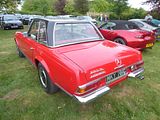
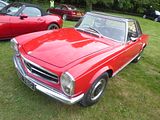

MG
Launched in October 1962, this car was produced for the next 18 years and it went on to become Britain’s best selling sports car. When first announced, the MGB was an innovative, modern design, with a monocoque structure instead of the traditional body-on-frame construction used on both the MGA and MG T-types and the MGB’s rival, the Triumph TR series, though components such as the brakes and suspension were developments of the earlier 1955 MGA and the B-Series engine had its origins back in 1947. The lightweight design reduced manufacturing costs while adding to overall vehicle strength, and with a 95hp 3-bearing 1798cc engine under the bonnet, performance was quite respectable with a 0–60 mph time of just over 11 seconds. The car was rather more civilised than its predecessor, with wind-up windows now fitted as standard, and a comfortable driver’s compartment offered plenty of legroom. The roadster was the first of the MGB range to be produced. The body was a pure two-seater but a small rear seat was a rare option at one point. By making better use of space the MGB was able to offer more passenger and luggage accommodation than the earlier MGA while being 3 inches shorter overall. The suspension was also softer, giving a smoother ride, and the larger engine gave a slightly higher top speed. The four-speed gearbox was an uprated version of the one used in the MGA with an optional (electrically activated) overdrive transmission. A five-bearing engine was introduced in 1964 and a number of other modifications crept into the specification. In late 1967, sufficient changes were introduced for the factory to define a Mark II model. Alterations included synchromesh on all 4 gears with revised ratios, an optional Borg-Warner automatic gearbox, a new rear axle, and an alternator in place of the dynamo with a change to a negative earth system. To accommodate the new gearboxes there were significant changes to the sheet metal in the floorpan, and a new flat-topped transmission tunnel. US market cars got a new safety padded dashboard, but the steel item continued for the rest of the world. Rostyle wheels were introduced to replace the previous pressed steel versions in 1969 and reclining seats were standardised. 1970 also saw a new front grille, recessed, in black aluminium. The more traditional-looking polished grille returned in 1973 with a black “honeycomb” insert. Further changes in 1972 were to the interior with a new fascia. To meet impact regulations, in late 1974, the chrome bumpers were replaced with new, steel-reinforced black rubber bumpers, the one at the front incorporating the grille area as well, giving a major restyling to the B’s nose, and a matching rear bumper completed the change. New US headlight height regulations also meant that the headlamps were now too low. Rather than redesign the front of the car, British Leyland raised the car’s suspension by 1-inch. This, in combination with the new, far heavier bumpers resulted in significantly poorer handling. For the 1975 model year only, the front anti-roll bar was deleted as a cost-saving measure (though still available as an option). The damage done by the British Leyland response to US legislation was partially alleviated by revisions to the suspension geometry in 1977, when a rear anti-roll bar was made standard equipment on all models. US emissions regulations also reduced horsepower. In March 1979 British Leyland started the production of black painted limited edition MGB roadsters for the US market, meant for a total of 500 examples. Due to a high demand of the limited edition model, production ended with 6682 examples. The United Kingdom received bronze painted roadsters and a silver GT model limited editions. The production run of home market limited edition MGBs was split between 421 roadsters and 579 GTs. Meanwhile, the fixed-roof MGB GT had been introduced in October 1965, and production continued until 1980, although export to the US ceased in 1974. The MGB GT sported a ground-breaking greenhouse designed by Pininfarina and launched the sporty “hatchback” style. By combining the sloping rear window with the rear deck lid, the B GT offered the utility of a station wagon while retaining the style and shape of a coupe. This new configuration was a 2+2 design with a right-angled rear bench seat and far more luggage space than in the roadster. Relatively few components differed, although the MGB GT did receive different suspension springs and anti-roll bars and a different windscreen which was more easily and inexpensively serviceable. Although acceleration of the GT was slightly slower than that of the roadster, owing to its increased weight, top speed improved by 5 mph to 105 mph because of better aerodynamics. 523,826 examples of the MGB of all model types were built, and although many of these were initially sold new in North America, a lot have been repatriated here. There were several Roadsters and MGB GT models here.

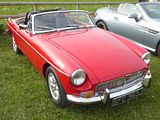


MINI
The Mini was the model that refused to die, with sales continuing after the launch of the Metro in 1980, and gathering momentum again in the 1990s, thanks in no small part to interest from Japan and because Rover Group decided to produce some more Cooper models. The first series of Cooper cars had been discontinued in 1971, replaced by the cheaper to build 1275GT, but when a limited edition model was produced in 1990, complete with full endorsement from John Cooper, the model was a sell out almost overnight, which prompted the decision to make it a permanent addition to the range. A number of refinements were made during the 90s, with fuel injection adding more power, a front mounted radiator and more sound deadening making the car quieter and new seats adding more comfort and a new dash making the car look less spartan inside.

MORGAN


MORRIS
No surprise to see the evergreen Morris Minor here as this is a very popular classic. The Minor was conceived in 1941. Although the Nuffield Organization was heavily involved in war work and there was a governmental ban on civilian car production, Morris Motors’ vice chairman, Miles Thomas, wanted to prepare the ground for new products to be launched as soon as the war was over. Vic Oak, the company’s chief engineer, had already brought to Thomas’ attention a promising junior engineer, Alec Issigonis, who had been employed at Morris since 1935 and specialised in suspension design but he had frequently impressed Oak with his advanced ideas about car design in general. Issigonis had come to Oak’s particular attention with his work on the new Morris Ten, which was in development during 1936/7. This was the first Morris to use unitary construction and was conceived with independent front suspension. Issigonis designed a coil-sprung wishbone system which was later dropped on cost grounds. Although the design would later be used on the MG Y-type and many other post-war MGs the Morris Ten entered production with a front beam axle. Despite his brief being to focus on the Ten’s suspension Issigonis had also drawn up a rack and pinion steering system for the car. Like his suspension design this was not adopted but would resurface in the post-war years on the MG Y-type, but these ideas proved that he was the perfect candidate to lead the design work on a new advanced small car. With virtually all resources required for the war effort, Thomas nonetheless approved the development of a new small family car that would replace the Morris Eight. Although Oak (and Morris’ technical director, Sidney Smith) were in overall charge of the project it was Issigonis who was ultimately responsible for the design, working with only two other draughtsmen. Thomas named the project ‘Mosquito’ and ensured that it remained as secret as possible, both from the Ministry of Supply and from company founder William Morris (now Lord Nuffield), who was still chairman of Morris Motors and, it was widely expected, would not look favourably on Issigonis’ radical ideas. Issigonis’ overall concept was to produce a practical, economical and affordable car for the general public that would equal, if not surpass, the convenience and design quality of a more expensive car. In later years he summed up his approach to the Minor; that he wanted to design an economy car that “the average man would take pleasure in owning, rather than feeling of it as something he’d been sentenced to” and “people who drive small cars are the same size as those who drive large cars and they should not be expected to put up with claustrophobic interiors.” Issigonis wanted the car to be as spacious as possible for its size and comfortable to drive for inexperienced motorists. Just as he would with the Mini ten years later, he designed the Mosquito with excellent roadholding and accurate, quick steering not with any pretence of making a sports car, but to make it safe and easy to drive by all. As work proceeded, there were plenty of battle to overcome, to get Issigonis’ ideas approved, and not all of them were. The production car, called the Minor was launched at the British Motor Show at Earls Court in London on October 27, 1948. At the same show Morris also launched the new Morris Oxford and Morris Six models, plus Wolseley variants of both cars, which were scaled-up versions of the new Minor, incorporating all the same features and designed with Issigonis’ input under Vic Oak’s supervision. Thus Issigonis’ ideas and design principles underpinned the complete post-war Morris and Wolseley car ranges. The original Minor MM series was produced from 1948 until 1953. It included a pair of four-seat saloons, two-door and (from 1950) a four-door, and a convertible four-seat Tourer. The front torsion bar suspension was shared with the larger Morris Oxford MO, as was the almost-unibody construction. Although the Minor was originally designed to accept a flat-4 engine, late in the development stage it was replaced by a 918 cc side-valve inline-four engine, little changed from that fitted in the 1935 Morris 8, and producing 27.5 hp and 39 lb/ft of torque. This little engine pushed the Minor to just 64 mph but delivered 40 mpg. Brakes were four-wheel drums. Early cars had a painted section in the centre of the bumpers to cover the widening of the production car from the prototypes. This widening of 4 inches is also visible in the creases in the bonnet. Exports to the United States began in 1949 with the headlamps removed from within the grille surround to be mounted higher on the wings to meet local safety requirements. In 1950 a four-door version was released, initially available only for export, and featuring from the start the headlamps faired into the wings rather than set lower down on either side of the grille. The raised headlight position became standard on all Minors in time for 1951. From the start, the Minor had semaphore-type turn indicators, and subsequent Minor versions persisted with these until 1961. An Autocar magazine road test in 1950 reported that these were “not of the usual self-cancelling type, but incorporate[d] a time-basis return mechanism in a switch below the facia, in front of the driver”. It was all too easy for a passenger hurriedly emerging from the front passenger seat to collide with and snap off a tardy indicator “flipper” that was still sticking out of the B-pillar, having not yet been safely returned by the time-basis return mechanism to its folded position. Another innovation towards the end of 1950 was a water pump (replacing a gravity dependent system), which permitted the manufacturer to offer an interior heater “as optional equipment”. When production of the first series ended, just over a quarter of a million had been sold, 30 per cent of them the convertible Tourer model. In 1952, the Minor line was updated with an Austin-designed 803 cc overhead valve A-series engine, replacing the original side-valve unit. The engine had been designed for the Minor’s main competition, the Austin A30, but became available as Austin and Morris were merged into the British Motor Corporation. The new engine felt stronger, though all measurements were smaller than the old. The 52 second drive to 60 mph was still calm, with 63 mph as the top speed. Fuel consumption also rose to 36 mpg. An estate version was introduced in 1952, known as the Traveller (a Morris naming tradition for estates, also seen on the Mini). The Traveller featured an external structural ash (wood) frame for the rear bodywork, with two side-hinged rear doors. The frame was varnished rather than painted and a highly visible feature of the body style. Commercial models, marketed as the Morris Quarter Ton Van and Pick-up were added in May 1953. Rear bodies of the van versions were all steel. The 4-seat convertible and saloon variants continued as well. The car was again updated in 1956 when the engine was increased in capacity to 948 cc. The two-piece split windscreen was replaced with a curved one-piece one and the rear window was enlarged. In 1961 the semaphore-style trafficators were replaced by the flashing direction indicators, these were US-style red at the rear (using the same bulb filament as the brake lamp) and white at the front (using a second brighter filament in the parking lamp bulb) which was legal in the UK and many export markets at the time (such as New Zealand). An upmarket car based on the Minor floorpan using the larger BMC B-Series engine was sold as the Riley One-Point-Five/Wolseley 1500 beginning in 1957: versions of this Wolseley/Riley variant were also produced by BMC Australia as the Morris Major and the Austin Lancer. In December 1960 the Morris Minor became the first British car to sell more than 1,000,000 units. To commemorate the achievement, a limited edition of 350 two-door Minor saloons (one for each UK Morris dealership) was produced with distinctive lilac paintwork and a white interior. Also the badge name on the side of the bonnet was modified to read “Minor 1,000,000” instead of the standard “Minor 1000”. The millionth Minor was donated to the National Union of Journalists, who planned to use it as a prize in a competition in aid of the union’s Widow and Orphan Fund. The company, at the same time, presented a celebratory Minor to London’s Great Ormond Street Hospital for Sick Children, but this car was constructed of cake. The final major upgrades to the Minor were made in 1962. Although the name Minor 1000 was retained, the changes were sufficient for the new model to be given its own ADO development number. A larger version of the existing A-Series engine had been developed in conjunction with cylinder head specialist Harry Weslake for the then new ADO16 Austin/Morris 1100 range. This new engine used a taller block than did the 948 cc unit, with increased bore and stroke bringing total capacity up to 1,098 cc. Although fuel consumption suffered moderately at 38 mpg, the Minor’s top speed increased to 77 mph with noticeable improvements in low-end torque, giving an altogether more responsive drive. Other changes included a modified dashboard layout with toggle switches, textured steel instrument binnacle, and larger convex glove box covers. A different heater completed the interior upgrade, whilst the larger combined front side/indicator light units, common to many BMC vehicles of the time, were fitted to the front wings. These now included a separate bulb and amber lens for indicators while larger tail lamp units also included amber rear flashers. During the life of the Minor 1000 model, production declined. The last Convertible/Tourer was manufactured on 18 August 1969, and the saloon models were discontinued the following year. Production of the more practical Traveller and commercial versions ceased in 1972, although examples of all models were still theoretically available from dealers with a surplus of unsold cars for a short time afterwards. 1,619,857 Minors of all variants were ultimately sold.


MOTOR BIKES


NISSAN
Released on July 2002 in Japan at reorganized Nissan Japanese dealerships called Nissan Blue Stage, and August 20, 2002 in the US., the 350Z coupé was available in 5 trim packages: ‘350Z’ (Base), ‘Enthusiast’, ‘Performance’, ‘Touring’, and ‘Track’ editions. In Europe, only the ‘Track’ trim was available, although it was badged and marketed as ‘350Z’. The Base model did not include a VLSD or Traction Control and was only available with cloth seats. It did not include cruise control, nor power or heated seats. The Enthusiast model came with traction control, a VLSD, and cruise control. The Performance model came with bigger 18-inch wheels, front air dam, rear spoiler, optional Brembo brakes, and VDC instead of Traction Control. Touring was made more of the luxury model. It had power, leather, heated seats, VDC, a VLSD, xenon headlamps, optional Brembos, 18-inch wheels, and optional GPS. The Track model included Brembo brakes, front air dam, rear spoiler, traction control, cloth seats, 18-inch wheels, VLSD, and optional GPS. In 2004 Nissan introduced the 350Z Roadster with an electrically retractable soft-top roof. In the U.S. market the car was available in two trim packages (Enthusiast and Touring), while in Europe, the same versions as the coupé were offered. Nissan added the Grand Touring (GT) trim to the Roadster trim packages for 2005. In 2005 Nissan launched a 35th Anniversary edition, with a revised exterior and interior. Early 2005 model-year 35th anniversary edition models were equipped with the original VQ35DE with 287 hp and automatic transmission. In January 2005, Nissan introduced the 35th Anniversary 6-speed manual models and Track models (mid-year introduction), which included the updated VQ35DE 300 hp Rev-up engine and new updated CD009 manual transmission. As well as minor changes to suspension tuning and parts. For the 2006 model year, the 350Z received changes for its mid-cycle facelift. The VQ35DE 300 hp Rev-up engine that was introduced mid-year 2005 on the Track and 35th Anniversary Edition with 6-speed manual transmission models was offered for every trim level that had a manual transmission option. The VQ35DE with 287 hp continued to be offered with only the 5-speed automatic. Additions included bi-xenon projectors, a revised front fascia, new LED rear lights, changes to the interior trim and speed sensitive steering. Touring and Grand Touring models had radio-steering controls standard, MP3 CD compatibility, and Satellite Radio became an available option. For the 2007 model year, the 350Z was again moderately revised. The VQ35DE V6 was replaced with a new VQ35HR V6. It produced 306 hp at 6800 rpm with 268 ft·lb at 4800 rpm using the revised SAE certified power benchmark. The VQ35HR had a raised redline to 7500 rpm and more torque across the rpm range. The bonnet was redesigned with a bulge reminiscent of the original 240Z to accommodate the raised deck height of the new VQ35HR. In the US, trim levels were narrowed down to 350Z (base), Enthusiast, Touring, and Grand Touring, while in Europe the same trim levels remained. Bluetooth was added for the 2007 model year. The car was replaced by the 370Z for the 2009 model year. It has never found quite the same levels of enthusiasm that greeted – and have stayed with – the 350Z.

This is an R34 generation Skyline GT-R. The GF-BNR34 (R34) Skyline GT-R, GT-R V·Spec and GT-R V·Spec N1 models were introduced in January 1999. The R34 GT-R was shorter (from front to rear), and the front overhang was reduced as compared to its predecessor. The valve covers were painted glossy red (colour code Cherry Red Effect Z24 or X1020), as opposed to black in previous models. A new feature on the R34 GT-R is a 5.8″ LCD multifunction display on the center of the dashboard, which shows seven different live readings of engine and vehicle statistics such as turbocharger pressure (1.2 bar max), oil and water temperature, among others. The GT-R V·Spec model added two extra features to the display: intake and exhaust gas temperatures. Nismo Multi-function Displays (MFD) could be bought at an extra cost, they included a lap timer, G-Force meter and an increase in boost pressure measurement to 2 bar. The R34 GT-R was made shorter in response to customer concerns who thought the R33 was too bulky. Like the R33, the new R34 GT-R V·Spec (Victory Specification) models come equipped with the ATTESA E-TS Pro system and an Active LSD at the rear, while standard GT-R models come with the non-Pro system and a conventional mechanical differential. The V·Spec model also had firmer suspension and lower ground clearance, thanks to front and side splitters, as well as a rear carbon fibre air diffuser, designed to keep air flowing smoothly under the car. At the time of the R34’s introduction, like the R32 and R33, Nissan introduced an R34 V·Spec N1 model. The R34 V·Spec N1 was equipped similar to the R32 and R33 N1 models – a homologation special. It was sold without air conditioning, audio equipment, rear wiper, or boot lining, but ABS remained. The new R34 N1 was also given the new R34 N1 engine. Only 38 known R34 V·Spec N1 models were produced from the factory, 12 of which Nismo used for Super Taikyu racing. The rest were sold to various customers, mostly racing teams and tuning garages. The V·Spec version was also imported into the UK with a number of modifications carried out on these 80 cars. These included 3 additional oil coolers, revised ECU map, full Connolly leather interior, underbody diffusers, stiffer suspension, active rear limited slip differential, extra display feature on the in car display. In additional to the UK, 10 were sold to Hong Kong and Singapore, and 5 to New Zealand although with different changes for their respective markets. In October 2000, Nissan introduced the V·Spec II, replacing the V·Spec. The V·Spec II has increased stiffness in the suspension (even stiffer than the original V·Spec) and had larger rear brake rotors. It also comes equipped with a carbon fibre bonnet equipped with a NACA duct, which is lighter than the aluminium that all other GT-R bonnets are made from. Also different on the V·Spec II was an iridium center console and aluminium pedals. The seats were upholstered with black cloth rather than the gray cloth used on previous R34 GT-R models, and the amber turn lenses were replaced with white versions. With the exception of the carbon fibre bonnet, the standard trim level GT-R also received these updates. A total of 18 V·Spec II N1 were built. A total of 1855 V·Spec II were built for Japan, with an additional 2 being sold for the New Zealand market. The V·Spec N1 was replaced with the V·Spec II N1. The same changes applied to the V·Spec N1 were applied to the V·Spec II N1, with the exception of the V·Spec II carbon bonnet which was now unpainted. In May 2001, the M·Spec was introduced. It was based on the V-Spec II, but had special “Ripple control” dampers, revised suspension set up, stiffer rear sway bar and a leather interior with heated front seats. The ‘M’ on the M·Spec stood for Mizuno who is the chief engineer of Nissan. The only other change was the removal of the carbon fibre bonnet which was replaced with the standard aluminium bonnet. In February 2002, Nissan launched a final production model of the R34 GT-R called the Skyline GT-R V·Spec II Nür and the Skyline GT-R M·Spec Nür. The Nür was named after the famous German Nürburgring racetrack, where the Skyline was developed. In total 1,003 units R34 GT-R Nür(s) were produced, 718 were V·Spec II Nürs’ and 285 were M·Spec Nürs’. The Nür model featured an improved RB26DETT based on the N1 racing engine. The standard turbochargers were upgraded to larger versions with a slight increase in boost and the ceramic blades were replaced with steel versions. This has increased lag, but the turbo’s durability was improved while being able to handle a bigger boost increase. The V·Spec II Nür is based on the regular V·Spec II model, and the M·Spec Nür was based on the regular M·Spec model. Other than the addition of the Nür engine, the Nür models also included a different colour of stitching on the interior trim, as well as a speedometer reading up to 300 km/h (186 mph), gold valve covers instead of red and a gold VIN plate instead of silver. Due to Japanese car industry norms at the time, the car was advertised as having 276 bhp but it actually had over 330 bhp when it left the factory. In 1999, during Nissan’s testing session at the Nürburgring Nordscheleife. Unofficially the GT-R R34 ran a 7:52 minute lap around the track, driven by Nissan’s test driver Kazuo Shimizu. The car broke the GT-R R33’s record which was the fastest road-legal series production vehicle and second fastest road-legal production vehicle around the track at the time.

PONTIAC
The 1977 Firebird received a facelift that featured four rectangular headlamps. The shaker scoop was also revised for this year, with the early 1977-built T/As coming with off-center, lower-profile shaker scoops. The Formula hood was changed for the last time for the second generation with a much lower profile. The snowflake wheel became an option for all Firebirds and was standard with the Y82 appearance package, although it could be replaced with Rally II wheels as a credit option. For the Esprit, an optional appearance package RPO W60 called the “Skybird appearance package” became available, featuring an all blue exterior and interior. This package was originally slated to be called the “Bluebird” similar to the “Yellowbird” and “Redbird” packages to follow in the upcoming model years, but the name was already in use for a company that produced school buses. In 1977, General Motors began to source a larger selection of V8 engines to supply in the lower model Firebirds, and the Oldsmobile 350 V8, as well as the Chevrolet 350 V8, became options for the Firebird, Esprit, and Formula. Previously, the Chevrolet inline-six was the only outsourced engine in a Firebird. Pontiac made the 301 (4.9 L) V8 available for order in the lower Firebird models, but due to such high demand and popularity, they removed it’s availability from the Firebird model to allow enough 301 engines for the other Pontiac lines. It was re-introduced as an option in 1979 as production for the 400 ceased and tooling was converted over to the 301. The Trans Am had now three different engine options, the standard Pontiac L78 400, the optional extra cost Pontiac W72 400, and the Oldsmobile-sourced L80 403. 1977 also saw the cubic inch metrics on the shaker dropped in favour of the displacement of the cylinders. The shakers had a “6.6 Litre” decal for all L78 Pontiac 400 and L80 Oldsmobile 403 engines. Only the optional W72 Pontiac 400 received the “T/A 6.6” decal. As Pontiac had discontinued the 455 in the previous model year, a modified 400 Pontiac V8 dubbed the “T/A 6.6” RPO W72 with a single four-barrel 800CFM Rochester Quadrajet carburettor rated at 200 bhp at 3,600 rpm and a maximum torque of 325 lb/ft (441 Nm) at 2,400 rpm, as opposed to the regular “6.6 Litre” 400 (RPO L78) rated at 180 bhp. The T/A 6.6 equipped engines had chrome valve covers, while the base 400 engines had painted valve covers. For 1977, the W72 shared the same air cleaner and shared the same 500577 cast block as the L78, but received the 6×4 heads, whereas the L78 only received the 6×8 heads. The 6×4 heads were used on early Pontiac 350 blocks that helped increase the compression, and also had hardened valve seats for a higher RPM operating range. The Oldsmobile 403 was implemented as the 400 Pontiac could not satisfy emissions requirements for high-altitude states and California. Wanting to still offer a 6.6 litre option for the Trans Am, the 403 Olds was seen as a suitable replacement as when equipped with an A.I.R emissions system, it could satisfy the emissions criteria for these states and still offer the power the Trans Am was known for. The L80 Oldsmobile had slightly more power than the standard L78 Pontiac 400 at 185 hp and offered the same low-end torque of 320 lb/ft (430 Nm) at a more useable operating range of 2,200rpm. From 1977 to 1981, the Firebird used four square headlamps, while the Camaro continued to retain the two round headlights that had been shared by both second-generation designs. The 1977 Trans-Am special edition became famous after being featured in Smokey and the Bandit. The 1980 turbo model was used for Smokey and the Bandit II. Changes for 1978 were slight, with a switch from a honeycomb to a crosshatch pattern grille being the most notable change to the body style. The decals for the standard Trans Ams changed from the “looping style” lettering to the “block-style” font that would remain on the Firebird until the end of the second generation. T-tops in 1978 transitioned from Hurst units to Fisher (GM) in mid-year. Pontiac also introduced the Red Bird package on the Firebird Esprit model. Painted in Roman red with a matching deluxe red interior, it demonstrated gold accents with a unique Red Bird graphic on the b-pillars. It also included a Formula steering wheel with gold spokes and gold dash bezel, similar to the ones included in the Special Edition package, however, the red and gold steering wheel was exclusive to the Red Bird Esprit. The W72 engine option also saw a revision to the camshaft duration and the tuning of the Rochester Quadrajet which lead to a 10% increase of horsepower from the following year, bringing the total to 220 hp. Additionally, the earlier stronger and more durable 481988 cast block returned on the W72, denoted with a large “XX” cast protruding off the side of the block near the cast code. The WS6 special performance package developed by Herb Adams was introduced as a handling option for the Trans Am, including a larger diameter rear sway bar, tighter ratio steering box, 15×8-inch snowflake wheels, additional frame bracing, as well as other suspension changes. Delays in manufacturing prevented the rear disc brake (RPO J65) from being available on the 1978 model year. Approximately 23.1% (28,239) of Formulas and Trans Ams in 1978 had the WS6 option according to Pontiac sales information at the start of 1979. At the end of 1978, the WS6 handling package became available for the Formula models as well. The car would continue to evolve with detailed changes for a further three model years before being replaced by a completely new design for 1982.

PORSCHE
The 911 traces its roots to sketches drawn by Ferdinand “Butzi” Porsche in 1959. The Porsche 911 was developed as a more powerful, larger and a more comfortable replacement for the 356, the company’s first model. The new car made its public debut at the 1963 Frankfurt Motor Show. The car was developed with the proof-of-concept twin-fan Type 745 flat-six engine, but the car presented at the auto show had a non-operational mockup of the single-fan 901 engine, receiving a working unit in February 1964. It originally was designated as the “Porsche 901” (901 being its internal project number). A total of 82 cars were built as which were badges as 901s. However, French automobile manufacturer Peugeot protested on the grounds that in France it had exclusive rights to car names formed by three numbers with a zero in the middle. Instead of selling the new model with a different name in France, Porsche changed the name to 911. Internally, the cars’ part numbers carried on the prefix 901 for years. Production began in September 1964, with the first 911s exported to the US in February 1965. The first models of the 911 had a rear-mounted 130 hp Type 901/01 flat-6 engine, in the “boxer” configuration like the 356, the engine is air-cooled and displaces 1,991 cc as compared to the 356’s four-cylinder, 1,582 cc unit. The car had four seats although the rear seats were small, thus it is usually called a 2+2 rather than a four-seater (the 356 was also a 2+2). A four or five-speed “Type 901” manual transmission was available. The styling was largely penned by Ferdinand “Butzi” Porsche, son of Ferdinand “Ferry” Porsche. Butzi Porsche initially came up with a notchback design with proper space for seating two rear passengers but Ferry Porsche insisted that the 356’s successor was to use its fastback styling. 7 prototypes were built based on Butzi Porsche’s original design and were internally called the Porsche 754 T7. Erwin Komenda, the leader of the Porsche car body construction department who initially objected, was also involved later in the design. In 1966, Porsche introduced the more powerful 911S with Type 901/02 engine having a power output of 160 PS. Forged aluminum alloy wheels from Fuchsfelge, with a 5-spoke design, were offered for the first time. In motorsport at the same time, the engine was developed into the Type 901/20 and was installed in the mid-engine 904 and 906 with an increased power output of 210 PS, as well as fuel injected Type 901/21 installed in later variants of the 906 and 910 with a power output of 220 PS. In August 1967, the A series went into production with dual brake circuits and widened (5.5J-15) wheels still fitted with Pirelli Cinturato 165HR15 CA67 tyres. and the previously standard gasoline-burning heater became optional. The Targa version was introduced. The Targa had a stainless steel-clad roll bar, as automakers believed that proposed rollover safety requirements by the US National Highway Traffic Safety Administration (NHTSA) would make it difficult for fully open convertibles to meet regulations for sale in the US, an important market for the 911. The name “Targa” came from the Targa Florio sports car road race in Sicily, Italy in which Porsche had several victories until 1973. The last win in the subsequently discontinued event was scored with a 911 Carrera RS against prototypes entered by Ferrari and Alfa Romeo. The road going Targa was equipped with a removable roof panel and a removable plastic rear window (although a fixed glass version was offered from 1968). The 110 PS 911T was also launched in 1967 with Type 901/03 engine. The 130 PS model was renamed the 911L with Type 901/06 engine and ventilated front disc brakes. The brakes had been introduced on the previous 911S. The 911R with 901/22 engine had a limited production (20 in all), as this was a lightweight racing version with thin fibreglass reinforced plastic doors, a magnesium crankcase, twin overhead camshafts, and a power output of 210 PS. A clutchless semi-automatic Sportomatic model, composed of a torque converter, an automatic clutch, and the four-speed transmission was added in Autumn 1967. It was cancelled after the 1980 model year partly because of the elimination of a forward gear to make it a three-speed. The B series went into production in August 1968, replacing the 911L model with 911E with fuel injection. It remained in production until July 1969. The 911E gained 185/70VR15 Pirelli Cinturato CN36. and 6J-15 wheels. The C series was introduced in August 1969 with an enlarged 2.2-litre engine. The wheelbase for all 911 and 912 models was increased from 2,211–2,268 mm (87.0–89.3 in), to help as a remedy to the car’s nervous handling at the limit. The overall length of the car did not change, but the rear wheels were relocated further back. Fuel injection arrived for the 911S (901/10 engine) and for a new middle model, 911E (901/09 engine). The D series was produced from Aug. 1970 to July 1971. The 2.2-litre 911E (C and D series) had lower power output of the 911/01 engine (155 PS) compared to the 911S’s Type 911/02 (180 PS, but 911E was quicker in acceleration up to 160 km/h. The E series for 1972–1973 model years (August 1971 to July 1972 production) consisted of the same models, but with a new, larger 2,341 cc engine. This is known as the “2.4 L” engine, despite its displacement being closer to 2.3 litres. The 911E (Type 911/52 engine) and 911S (Type 911/53) used Bosch mechanical fuel injection (MFI) in all markets. For 1972 the 911T (Type 911/57) was carbureted, except in the US and some Asian markets where the 911T also came with (MFI) mechanical fuel injection (Type 911/51 engine) with power increase over European models (130 hp) to 140 hp commonly known as a 911T/E. With power and torque increase, the 2.4-litre cars also got a newer, stronger transmission, identified by its Porsche type number 915. Derived from the transmission in the 908 race car, the 915 did away with the 901 transmission’s “dog-leg” style first gear arrangement, opting for a traditional H pattern with first gear up to the left, second gear underneath first, etc. The E series had the unusual oil filler behind the right side door, with the dry sump oil tank relocated from behind the right rear wheel to the front of it in an attempt to move the center of gravity slightly forward for better handling. An extra oil filler/inspection flap was located on the rear wing, for this reason it became known as an “Oil Klapper”, “Ölklappe” or “Vierte Tür (4th door)”. The F series (August 1972 to July 1973 production) moved the oil tank back to the original behind-the-wheel location. This change was in response to complaints that gas-station attendants often filled gasoline into the oil tank. In January 1973, US 911Ts were switched to the new K-Jetronic CIS (Continuous Fuel Injection) system from Bosch on Type 911/91 engine. 911S models also gained a small spoiler under the front bumper to improve high-speed stability. The cars weighed 1,050 kg (2,310 lb). The 911 ST was produced in small numbers for racing (the production run for the ST lasted from 1970 to 1971). The cars were available with engines of either 1,987 cc or 2,404 cc, having a power output of 270 PS at 8,000 rpm. Weight was down to 960 kg (2,120 lb). The cars had success at the Daytona 6 Hours, the Sebring 12 Hours, the 1000 km Nürburgring, and the Targa Florio. The G Series cars, with revised bodies and larger impact-absorbing bumpers arrived in the autumn of 1973 and would continue in production with few visual changes but plenty of mechanical ones for a further 16 years.

During the 1990s, Porsche was facing financial troubles and rumours of a proposed takeover were being spread. The signature air-cooled flat-6 of the 911 was reaching the limits of its potential as made evident by the 993. Stricter emissions regulations world wide further forced Porsche to think of a replacement of the air-cooled unit. In order to improve manufacturing processes, Porsche took the aid of leading Japanese car manufacturer Toyota whose consultants would assist in the overhaul of the Zuffenhausen manufacturing facility introducing mass production techniques which would allow Porsche to carry out production processes more efficiently. Porsche had realised that in order to keep the 911 in production, it would need radical changes. This led to the development of the 996. The sharing of development between the new 911 and the entry level Boxster model allowed Porsche to save development costs. This move also resulted in interchangeable parts between the two models bringing down maintenance costs. The Porsche 996 was a new design developed by Pinky Lai under Porsche design chief Harm Lagaay from 1992 to 1994; it was the first 911 that was completely redesigned, and carried over little from its predecessor as Porsche wanted the design team to design a 911 for the next millennium. Featuring an all new body work, interior, and the first water-cooled engine, the 996 replaced the 993 from which only the front suspension, rear multi-link suspension, and a 6-speed manual transmission were retained in revised form. The 996 had a drag coefficient of Cd=0.30 resulting from hours spent in the wind tunnel. The 996 is 185 mm (7 in) longer and 40 mm (2 in) wider than its predecessor. It is also 45% stiffer courtesy of a chassis formed from high-strength steel. Additionally, it is 50 kg (110 lb) lighter despite having additional radiators and coolant. All of the M96 engines offered in the 996 (except for the variants fitted to the Turbo and GT2/GT3 models) are susceptible to the Porsche Intermediate Shaft Bearing issue which can potentially cause serious engine failure if not addressed via a retrofit. The 996 was initially available in a coupé or a cabriolet (Convertible) bodystyle with rear-wheel drive, and later with four-wheel drive, utilising a 3.4 litre flat-6 engine generating a maximum power output of 296 bhp. The 996 had the same front end as the entry-level Boxster. After requests from the Carrera owners about their premium cars looking like a “lower priced car that looked just like theirs did”, Porsche redesigned the headlamps of the Carrera in 2002 similar to the high performance Turbo’s headlamps. The design for the initial “fried egg” shaped headlamps could be traced back to the 1997 911 GT1 race car. In 2000, Porsche introduced the 996 Turbo, equipped with a four-wheel-drive system and a 3.6-litre, twin-turbocharged and intercooled flat-six engine generating a maximum power output of 420 bhp, making the car capable of accelerating from 0–60 mph in 4.2 seconds. An X50 option which included larger turbochargers and intercoolers along with revised engine control software became available from the factory in 2002, increasing power output to 451 bhp. In 2005, Porsche introduced the Turbo S, which had the X50 option included as standard equipment, with the formerly optional Carbon fibre-reinforced Silicon Carbide (C/SiC) composite ceramic brakes (PCCB) also included as standard. In 2000, power output on the base Carrera model was increased to 300 bhp. 2001 marked the final year of production for the base Carrera 4 Coupé in narrow body format. In 2002, the standard Carrera models underwent the above-mentioned facelift. In addition, engine capacity was also increased to 3.6-litres across the range, yielding gains of 15 bhp for the naturally aspirated models. 2002 also marked the start of the production of the 996 based Targa model, with a sliding glass “green house” roof system as introduced on its predecessor. It also features a rear glass hatch which gave the driver access to the storage compartment. Also in 2002, the Carrera 4S model was first introduced.


The 996 was replaced with the 997 in 2005. It retains the 996’s basic profile, with an even lower 0.28 drag coefficient, but draws on the 993 for detailing. In addition, the new headlights revert to the original bug-eye design from the teardrop scheme of the 996. Its interior is also similarly revised, with strong links to the earlier 911 interiors while at the same time looking fresh and modern. The 997 shares less than a third of its parts with the outgoing 996, but is still technically similar to it. Initially, two versions of the 997 were introduced— the rear-wheel-drive Carrera and Carrera S. While the base 997 Carrera had a power output of 321 hp from its 3.6 L Flat 6, a more powerful 3.8 L 350 hp Flat 6 powers the Carrera S. Besides a more powerful engine, the Carrera S also comes standard with 19 inch “Lobster Fork” style wheels, more powerful and larger brakes (with red calipers), lowered suspension with PASM (Porsche Active Suspension Management: dynamically adjustable dampers), Xenon headlamps, and a sports steering wheel. In late 2005, Porsche introduced the all-wheel-drive versions to the 997 lineup. Carrera 4 models (both Carrera 4 and Carrera 4S) were announced as 2006 models. Both Carrera 4 models are wider than their rear-wheel-drive counterparts by 1.76 inches (32 mm) to cover wider rear tyres. The 0–100 km/h (62 mph) acceleration time for the Carrera 4S with the 350 hp engine equipped with a manual transmission was reported at 4.8 seconds. The 0–100 km/h (62 mph) acceleration for the Carrera S with the 350 hp was noted to be as fast as 4.2 seconds in a Motor Trend comparison, and Road & Track has timed it at 3.8 seconds. The 997 lineup includes both 2- and 4-wheel-drive variants, named Carrera and Carrera 4 respectively. The Targas (4 and 4S), released in November 2006, are 4-wheel-drive versions that divide the difference between the coupés and the cabriolets with their dual, sliding glass tops. The 997 received a larger air intake in the front bumper, new headlights, new rear taillights, new clean-sheet design direct fuel injection engines, and the introduction of a dual-clutch gearbox called PDK for the 2009 model year. They were also equipped with Bluetooth support. The change to the 7th generation (991) took place in the middle of the 2012 model year. A 2012 Porsche 911 can either be a 997 or a 991, depending on the month of the production.

The 991 introduced in 2012 is an entirely new platform, only the third since the original 911. Porsche revealed basic information on the new Carrera and Carrera S models on 23 August 2011. The Carrera is powered by a 350 hp 3.4-litre engine. The Carrera S features a 3.8-litre engine rated at 400 hp. A Power Kit (option X51) is available for the Carrera S, increasing power output to 430 hp. The new 991’s overall length grows by 56 mm (2.2 in) and wheelbase grows by 99 mm (3.9 in) (now 96.5 in.) Overhangs are trimmed and the rear axle moves rearward at roughly 76 mm (3 in) towards the engine (made possible by new 3-shaft transmissions whose output flanges are moved closer to the engine). There is a wider front track (51 mm (2 in) wider for the Carrera S). The design team for the 991 was headed by Michael Mauer. At the front, the new 991 has wide-set headlights that are more three-dimensional. The front fender peaks are a bit more prominent, and wedgy directionals now appear to float above the intakes for the twin coolant radiators. The stretched rear 3/4 view has changed the most, with a slightly more voluminous form and thin taillights capped with the protruding lip of the bodywork. The biggest and main change in the interior is the center console, inspired by the Carrera GT and adopted by the Panamera. The 991 is the first 911 to use a predominantly aluminium construction. This means that even though the car is larger than the outgoing model, it is still up to 50 kilograms (110 lb) lighter. The reduced weight and increased power means that both the Carrera and Carrera S are appreciably faster than the outgoing models. The 0–60 mph acceleration time for the manual transmission cars are 4.6 seconds for the Carrera and 4.3 seconds for the Carrera S. When equipped with the PDK transmission, the two 991 models can accelerate from 0–97 km/h in 4.4 seconds and 4.1 seconds. With the optional sports chrono package, available for the cars with the PDK transmission, the 991 Carrera can accelerate from 0–97 km/h in as little as 4.2 seconds and the Carrera S can do the same in 3.9 seconds. Apart from the reworked PDK transmission, the new 991 is also equipped with an industry-first 7-speed manual transmission. On vehicles produced in late 2012 (2013 model year) Rev Matching is available on the 7-speed manual transmission when equipped with the Sport Chrono package. Rev-Matching is a new feature with the manual transmission that blips the throttle during downshifts (if in Sport Plus mode). Also, the 7th gear cannot be engaged unless the car is already in 5th or 6th gear. One of Porsche’s primary objectives with the new model was to improve fuel economy as well as increase performance. In order to meet these objectives, Porsche introduced a number of new technologies in the 911. One of the most controversial of these is the introduction of electromechanical power steering instead of the previous hydraulic steering. This steering helps reduce fuel consumption, but some enthusiasts feel that the precise steering feedback for which the 911 is famous is reduced with the new system.[citation needed] The cars also feature an engine stop/start system that turns the engine off at red lights, as well as a coasting system that allows the engine to idle while maintaining speed on downhill gradients on highways. This allows for up to a 16% reduction in fuel consumption and emissions over the outgoing models. The new cars also have a number of technologies aimed at improving handling. The cars include a torque vectoring system (standard on the Carrera S and optional on the Carrera) which brakes the inner wheel of the car when going into turns. This helps the car to turn in quicker and with more precision. The cars also feature hydraulic engine mounts (which help reduce the inertia of the engine when going into turns) as part of the optional sports chrono package. Active suspension management is standard on the Carrera S and optional on the Carrera. This helps improve ride quality on straights while stiffening the suspension during aggressive driving. The new 991 is also equipped with a new feature called Porsche Dynamic Chassis Control (PDCC). Porsche claims that this new feature alone has shaved 4 seconds off the standard car’s lap time around the Nürburgring. PDCC helps the car corner flat and is said to improve high-speed directional stability and outright lateral body control, but according to several reviews, the car is more prone to understeer when equipped with this new technology. In January 2013, Porsche introduced the all-wheel-drive variants of the Carrera models. The ‘4’ and ‘4S’ models are distinguishable by wider tyres, marginally wider rear body-work and a red-reflector strip that sits in between the tail-lights. In terms of technology, the 4 and 4S models are equipped with an all-new variable all-wheel-drive system that sends power to the front wheels only when needed, giving the driver a sense of being in a rear-wheel-drive 911. In May 2013, Porsche announced changes to the model year 2014 911 Turbo and Turbo S models, increasing their power to 513 hp on the ‘Turbo’, and 552 hp on the ‘Turbo S’, giving them a 0–97 km/h acceleration time of 3.2 and 2.9 seconds, respectively. A rear-wheel steering system has also been incorporated on the Turbo models that steers the rear wheels in the opposite direction at low speeds or the same direction at high speeds to improve handling. During low-speed manoeuvres, this has the virtual effect of shortening the wheelbase, while at high speeds, it is virtually extending the wheelbase for higher driving stability and agility. In January 2014, Porsche introduced the new model year 2015 Targa 4 and Targa 4S models. These new models come equipped with an all-new roof technology with the original Targa design, now with an all-electric cabriolet roof along with the B-pillar and the glass ‘dome’ at the rear. In September 2015, Porsche introduced the second generation of 991 Carrera models at the Frankfurt Motor Show. Both Carrera and Carrera S models break with previous tradition by featuring a 3.0-litre turbocharged 6-cylinder boxer engine, marking the first time that a forced induction engine has been fitted to the base models within the 911 range

Porsche unveiled the facelifted 991.2 GT3 at the 2017 Geneva Motor Show. Extensive changes were made to the engine allowing for a 9,000 rpm redline from the 4.0 litre flat-six engine derived from Porsche 911 GT3 R and Cup racing cars. The engine has a power output of 500 PS (493 bhp) and 460 Nm (339 lb/ft) of torque. Porsche’s focus was on reducing internal friction to improve throttle response. Compared to the 991.1, the rear spoiler is 0.8 inch taller and located farther back to be more effective resulting in a 20% increase in downforce. There is a new front spoiler and changes to the rear suspension along with larger ram air ducts. The car generates 154 kg (340 lb) of downforce at top speed. The 991.2 GT3 brought back the choice between a manual transmission or a PDK dual clutch transmission. Performance figures include a 0-60 mph acceleration time of 3.8 seconds (3.2 seconds for the PDK version) and a quarter mile time of 11.6 seconds. The GT3 can attain a top speed of 319 km/h (198 mph).

Also here was an example of the latest 992-generation model 911.

In 2021, Porsche unveiled the 718 Cayman GT4 RS, the first Cayman to receive the RS treatment which is usually reserved for the 911 models. With a 4.0 naturally aspirated flat-six derived from the 911 GT3, it puts out 500 PS (490 bhp) and 450 Nm (330 lb/ft) with an rpm limit of 9,000rpm, which allows it to sprint from 0–100 km/h (0–62 mph) in just 3.4 seconds. It generates 25% more downforce than the GT4 variant, through a swan-neck attachment fixed rear wing. The GT4 RS lapped the Nürburgring Nordschleife 23 seconds faster than the GT4. There is a hefty price premium over the GT4 model. An open-topped 718 Boxster RS Spyder model followed a few months later, mechanically the same, just with the different body. V


RENAULT
In response to Lancia’s rallying success with the mid-engined Stratos, Renault’s Jean Terramorsi, vice-president of production, asked Bertone’s Marc Deschamps to design a new sports version of the Renault 5 Alpine supermini. The distinctive new rear bodywork was styled by Marcello Gandini at Bertone. Although the standard Renault 5 has a front-mounted engine, the 5 Turbo featured a mid-mounted 1,397 cc Cléon-Fonte with fuel fed by Bosch K-Jetronic fuel injection and a Garrett AiResearch T3 turbocharger OHV 2 valves per cylinder Inline-four engine placed behind the driver in mid-body in a modified Renault 5 chassis. In standard form, the engine developed 160 PS at 6000 rpm and maximum torque of 221 Nm (163 lb/ft) at 3250 rpm. Though it used a modified body from a standard Renault 5, and was badged a Renault 5, the mechanicals were radically different, the most obvious difference being rear-wheel drive and rear-mid-engined instead of the normal version’s front-wheel drive and front-mounted engine. At the time of its launch it was the most powerful production French car. The first 400 production 5 Turbos were made to comply with Group 4 homologation to allow the car to compete in international rallies, and were manufactured at the Alpine factory in Dieppe. Many parts later transferred to the Alpine A310, such as the suspension or alloy wheel set. The R5 Turbo was conceived with dual intent, promoting the sales of the common R5 and being homologated in the FIA group 3 and 4 categories of the rally championship (today WRC). All the motorsport derivatives were based on the Turbo 1. The factory pushed the engine output up to 180 PS for the Critérium des Cévennes, 210 PS for the Tour de Corse, and by 1984 as much as 350 PS in the R5 Maxi Turbo. Driven by Jean Ragnotti in 1981, the 5 Turbo won the Monte Carlo Rally on its first outing in the World Rally Championship. The 2WD R5 Turbo soon faced the competition of new Group B four-wheel drive cars that proved faster on dirt. There are several victories throughout the early 80’s in the national championships in France, Portugal, Switzerland, Hungary, and Spain, many victories in international rallies throughout Europe, with wins in iconic rallies such as Monte-Carlo. After the factory ceased support, it lived a second life being developed by many teams and enthusiasts to compete in regional championships and local races in which it was ubiquitous and reached many success for almost 20 years. At the time of retirement, the newly created historical categories allowed these cars to return to international events and competitions, living a third life. For these reasons it has accessed to a legendary status and has a huge fan base. This car, a well known vehicle in the area, has been produced as an homage to the rally versions of the era.


The first generation Mégane RS was introduced in September 2004 and is based on the Renault Mégane II small family car. The Mégane II RS was available in three-door and five-door hatchback versions, both with the same engine and was built at Renault’s Dieppe factory by using body shells made in Palencia, Spain. The Mégane Renault Sport 225 uses double-axis strut suspension with independent steering axis at the front and an electric power steering. The RS uses a turbocharged 2.0-litre petrol engine that produces 225 PS, allowing the car to achieve 0–100 km/h in 6.5 seconds (0–60 mph in 6.5 seconds), with a top speed of about 240 km/h (149 mph). Ninety percent of the engine’s torque is available from 2,000 rpm until redline. A twin-scroll turbocharger minimizes turbo lag, especially when throttle is applied at over 2,000 rpm. The turbocharge functions at 1,800 rpm. The transmission is a six-speed manual. Renault’s claimed combined economy is 8.8 L/100 km (32 mpg). The Mégane Renault Sport has a speed-limiter, which prevents the car from passing a user-determined speed. It can be disabled or recalled with a button-press, and is set in the same way as the cruise control. The Mégane RS is equipped with leather/cloth seats, seat belts with red stitching, 18-inch alloy wheels, dual sunroof, eight airbags and xenon headlights with headlight washers and Brembo brake discs. Other features include automatic double optic headlights, 18-inch alloy wheels, air conditioning, ABS with EBD and electronic stability control. The Lux models feature metallic paint, hands free Renault card, electronic folding mirrors, tyre pressure monitor, electronic front and rear windows, climate control, leather upholstery, 4x15W RDS radio with CD-MP3 player and 6 speakers, front carpet mats, electronic rear view mirror, rear spoiler (petrol engine models only) and 18-inch alloy wheels over the base model. Introduced in 2005, the Megane Renault Sport 225 Cup includes the Cup Chassis option, which adds drilled brake discs, red front and rear brake calipers and increased brake master cylinder diameter, different 18-inch wheels plus revised stiffened steering. Other features include carbon grey interior upholstery with silver stitching. The car is 10 kg (22 lb) lighter than the 225 Sport Hatch and has a gross weight of 1,790 kg (3,946 lb). The handling improvements featured on the Cup were made to the standard Mégane, beginning in late 2005. The Mégane RS received a facelift in July 2006. The facelifted model introduced new safety features and minor exterior changes such as new tapered headlights, a revised front grille and bumpers along with translucent taillights. The Megane Renault Sport 230 Renault F1 Team R26 is a version that commemorates the success of Renault in the Formula 1 World Championship with the 2005 and 2006 Constructors’ and Drivers’ Championship titles and is named after the 2006 F1 car (R26). It is based on the facelifted Mégane RS. The engine is rated at 227 hp at 5,500 rpm and 310 Nm (229 lb/ft) at 3,000 rpm. It incorporates the improved version of the Cup Chassis package now with a limited slip differential fitted for the first time in addition to 18-inch Anthracite spoked alloy wheels with Michelin Pilot Sport 2 235/40 R18 tyres, Brembo front and rear red brake calipers and an increased brake master cylinder diameter, plus revised stiffened steering. Other features include a sport exhaust, Recaro seats, climate control, 4×15-watt RDS radio single CD/MP3 player with 6 speakers, Renault F1 decals, numbered plaque, limited slip differential and a rear spoiler. The car weights 1,355 kg (2,987 lb) kerb, 1,820 kg (4,012 lb) gross. The Megane Renault Sport dCi 175 is a version with a 2.0-litre diesel engine. Engine is rated at 173 bhp at 3,750 rpm and 360 Nm (270 lb/ft) at 2,000 rpm. The Cup Chassis option (available for dCi 175 Lux) includes tyre pressure monitor deletion, 18-inch anthracite alloy wheels with 225/45R18 Continental SportContact 2 tires, retuned dampers and spring rates, disconnectable ESP and anthracite coloured door mirror housings. The Sport Hatch version includes Recaro front seats, and the vehicle is 20 kg (44 lb) lighter (1470 kg kerb, 1,875 kg (4,134 lb) gross). The R26.R is based on the Mégane Renault Sport 230 F1 Team R26, but it is 123 kg (271 lb) lighter. Weight reduction is achieved via the removal of the rear seats and seat belts, passenger airbag and curtain airbags (the driver’s airbag remains), climate control (air conditioning remains as standard), rear wash/wipe and heated rear window, front fog lamps, headlamp washers, radio/CD player and most of the soundproofing. Other features include a carbon fibre bonnet, polycarbonate tailgate and rear side windows, Sabelt seats with carbon fibre shell and aluminium base, 6-point harnesses, a rear spoiler, optional roll cage and an optional titanium exhaust. New parts include new front springs (14 mm/100 kg), new rear springs (16.2 mm/100 kg), recalibrated shock absorber settings, grooved brake discs, new alloy wheels are fitted with a different offset increasing the track by 4 mm (0.2 in), optional Toyo Proxes R888 225/40R18 tyres (Michelin Pilot Sport 2 235/40R18 standard) and stiffer lower arm bushes. The car was unveiled at the 2008 British International Motor Show and went on sale in October 2008 at just under £23,000. 450 vehicles were made with 230 destined for the UK market though Renault struggled to sell them all and some were returned to France.

TRACTORS
This is one of the legendary “little grey Fergie” Ferguson tractors, an iconic, lightweight agricultural tractor designed by Harry Ferguson and produced between 1946 and 1956. It revolutionized farming with its hydraulic three-point hitch system, which became an international standard. Over 500,000 units were built, often replacing horses, and it later merged into Massey Ferguson.


TRIUMPH
Launched in 1955, the TR3 was an evolution of the TR2 and not a brand new model. It was powered by a 1991 cc straight-4 OHV engine initially producing 95 bhp, an increase of 5 hp over the TR2 thanks to the larger SU-H6 carburettors fitted. This was later increased to 100 bhp at 5000 rpm by the addition of a “high port” cylinder head and enlarged manifold. The four-speed manual gearbox could be supplemented by an overdrive unit on the top three ratios, electrically operated and controlled by a switch on the dashboard. In 1956 the front brakes were changed from drums to discs, the TR3 thus becoming the first British series production car to be so fitted. The TR3 was updated in 1957, with various changes of which the full width radiator grille is the easiest recognition point and the facelifted model is commonly referred to as the Triumph “TR3A”, though unlike the later TR4 series, where the “A” suffix was adopted, the cars were not badged as such and the “TR3A” name was not used officially, Other updates included exterior door handles, a lockable boot handle and the car came with a full tool kit as standard (this was an option on the TR3). The total production run of the “TR3A” was 58,236. This makes it the third best-selling TR after the TR6 and TR7. The TR3A was so successful that the original panel moulds eventually wore out and had to be replaced. In 1959 a slightly modified version came out that had raised stampings under the bonnet and boot hinges and under the door handles, as well as a redesigned rear floor section. In addition, the windscreen was attached with bolts rather than the Dzus connectors used on the early “A” models. Partly because it was produced for less time, the original TR3 sold 13,377 examples, of which 1286 were sold within the UK; the rest being exported mainly to the USA.

Successor to the TR3a, and code named “Zest” during development, the TR4 was based on the chassis and drivetrain of the previous TR sports cars, but with a modern Michelotti styled body. The TR 4 engine was carried over from the earlier TR2/3 models, but the displacement was increased from 1991cc to 2138 cc by increasing the bore size. Gradual improvements in the manifolds and cylinder head allowed for some improvements culminating in the TR4A model. The 1991 cc engine became a no-cost option for those cars destined to race in the under-two-litre classes of the day. Some cars were fitted with vane-type superchargers, as the three main bearing engine was liable to crankshaft failure if revved beyond 6,500 rpm; superchargers allowed a TR4 to produce much more horse-power and torque at relatively modest revolutions. The standard engine produced 105 bhp but, supercharged and otherwise performance-tuned, a 2.2-litre I4 version could produce in excess of 200 bhp at the flywheel. The TR4, in common with its predecessors, was fitted with a wet-sleeve engine, so that for competition use the engine’s cubic capacity could be changed by swapping the cylinder liners and pistons, allowing a competitor to race under different capacity rules (i.e. below or above 2 litres for example). Other key improvements over the TR3 included a wider track front and rear, slightly larger standard engine displacement, full synchromesh on all forward gears, and rack and pinion steering. In addition, the optional Laycock de Normanville electrically operated overdrive Laycock Overdrive could now be selected for 2nd and 3rd gear as well as 4th, effectively providing the TR4 with a seven-speed manual close ratio gearbox. The TR4 was originally fitted with 15×4.5″ disc wheels. Optional 48-lace wire wheels could be ordered painted the same colour as the car’s bodywork (rare), stove-enamelled (matte silver with chrome spinners, most common) or in matte or polished chrome finishes (originally rare, but now more commonly fitted). The most typical tyre originally fitted was 590-15 bias ply or optional radial tires. In the US at one point, American Racing alloy (magnesium and aluminium) wheels were offered as an option, in 15×5.5″ or 15×6″ size. Tyres were a problem for original owners who opted for 60-spoke wire wheels, as the correct size radial-ply tyre for the factory rims was 155-15, an odd-sized tyre at the time only available from Michelin at considerable expense. Some original TR4 sales literature says the original radial size was 165-15. The much more common 185-15 radials were too wide to be fitted safely. As a result, many owners had new and wider rims fitted and their wheels re-laced. The new TR4 body style did away with the classical cutaway door design of the previous TRs to allow for wind-down windows (in place of less convenient side-curtains), and the angular rear allowed a boot with considerable capacity for a sports car. Advanced features included the use of adjustable fascia ventilation, and the option of a unique hard top that consisted of a fixed glass rear window (called a backlight) with an integral rollbar and a detachable, steel centre panel (aluminium for the first 500 units). This was the first such roof system on a production car and preceded by 5 years the Porsche 911/912 Targa, which has since become a generic name for this style of top. On the TR4 the rigid roof panel was replaceable with an easily folded and stowed vinyl insert and supporting frame called a Surrey Top. The entire hard top assembly is often mistakenly referred to as a Surrey Top. In original factory parts catalogues the rigid top and backlight assembly is listed as the Hard Top kit. The vinyl insert and frame are offered separately as a Surrey Top. Features such as wind-down windows were seen as a necessary step forward to meet competition and achieve good sales in the important US market, where the vast majority of TR4s were eventually sold. Dealers had concerns that buyers might not fully appreciate the new amenities, therefore a special short run of TR3As (commonly called TR3Bs) was produced in 1961 and ’62. The TR4 proved very successful and continued the rugged, “hairy-chested” image that the previous TRs had enjoyed. 40,253 cars were built during production years. Most were sold new to the US, but plenty have returned, and it is estimated that there are not far short of 900 examples of the model in the UK at present.

By the mid 1960s, money was tight, so when it came to replacing the TR4 and TR5 models, Triumph were forced into trying to minimise the costs of the redesign, which meant that they kept the central section of the old car, but came up with new bodywork with the front and back ends were squared off, reportedly based on a consultancy contract involving Karmann. The resulting design, which did look modern when it was unveiled in January 1969 has what is referred to as a Kamm tail, which was very common during 1970s era of cars and a feature on most Triumphs of the era. All TR6 models featured inline six-cylinder engines. For the US market the engine was carburetted, as had been the case for the US-only TR250 engine. Like the TR5, the TR6 was fuel-injected for other world markets including the United Kingdom, hence the TR6PI (petrol-injection) designation. The Lucas mechanical fuel injection system helped the home-market TR6 produce 150 bhp at model introduction. Later, the non-US TR6 variant was detuned to 125 bhp for it to be easier to drive, while the US variant continued to be carburetted with a mere 104 hp. Sadly, the Lucas injection system proved somewhat troublesome, somewhat denting the appeal of the car. The TR6 featured a four-speed manual transmission. An optional overdrive unit was a desirable feature because it gave drivers close gearing for aggressive driving with an electrically switched overdrive which could operate on second, third, and fourth gears on early models and third and fourth on later models because of constant gearbox failures in second at high revs. Both provided “long legs” for open motorways. TR6 also featured semi-trailing arm independent rear suspension, rack and pinion steering, 15-inch wheels and tyres, pile carpet on floors and trunk/boot, bucket seats, and a full complement of instrumentation. Braking was accomplished by disc brakes at the front and drum brakes at the rear. A factory steel hardtop was optional, requiring two people to fit it. TR6 construction was fundamentally old-fashioned: the body was bolted onto a frame instead of the two being integrated into a unibody structure; the TR6 dashboard was wooden (plywood with veneer). Other factory options included a rear anti-roll bar and a limited-slip differential. Some say that the car is one of Leyland’s best achievements, but a number of issues were present and remain because of poor design. As well as the fuel injection problems, other issues include a low level radiator top-up bottle and a poor hand-brake. As is the case with other cars of the era, the TR6 can suffer from rust issues, although surviving examples tend to be well-cared for. The TR6 can be prone to overheating. Many owners fit an aftermarket electric radiator fan to supplement or replace the original engine-driven fan. Also the Leyland factory option of an oil cooler existed. Despite the reliability woes, the car proved popular, selling in greater quantity than any previous TR, with 94,619 of them produced before production ended in mid 1976. Of these, 86,249 were exported and only 8,370 were sold in the UK. A significant number have since been re-imported, as there are nearly 3000 of these much loved classics on the road and a further 1300 on SORN, helped by the fact that parts and services to support ownership of a TR6 are readily available and a number of classic car owners’ clubs cater for the model.

What turned out to be the final TR model was launched in January 1975, and this time it really was all new. A dramatic Harris Mann wedge shaped was shock enough for the purists, but the fact that at launch it only came as a Fixed Head Coupe was almost too much for some to bear. In the end, though. more TR7s were sold than any other TR model, so it really cannot have been all that bad even if the car had a somewhat bumpy existence, moving production plant from Speke, Liverpool where the early cars were made, to Canley, Coventry in 1978 and then finally to the Rover Solihull plant in 1980. An open topped model did join the range in 1980 and small numbers of factory built TR8s with the 135 bhp Rover V8 engine under the bonnet were made, but the proposed 2+2 Lynx model, and a version with the 16 valve Dolomite Sprint engine and the 2 litre O Series unit never made production. The car was launched in the United States in January 1975, with its UK home market debut in May 1976. The UK launch was delayed at least twice because of high demand for the vehicle in the US, with final sales of new TR7s continuing into 1982. The TR7 was characterised by its “wedge” shape, which was commonly advertised as: “The Shape of Things to Come”, and by a swage line sweeping down from the rear wing to just behind the front wheel. It had an overall length of 160 inches, width of 66 inches, wheelbase of 85 inches and height of 49.5 inches, and a kerbside weight of 2205 pounds, exactly 1000 kg. During development, the TR7 was referred to by the code name “Bullet”.The original full size model wore MG logos because it was styled at Longbridge, which was not a Triumph factory. Power was provided by a 105 bhp 1,998 cc eight-valve four-cylinder engine that shared the same basic design as the Triumph Dolomite Sprint engine, mounted in-line at the front of the car. Drive was to the rear wheels via a four-speed gearbox initially with optional five-speed manual gearbox, or three-speed automatic from 1976. The front independent suspension used coil spring and damper struts and lower single link at the front, and at the rear was a four-link system, again with coil springs. There were front and rear anti roll bars, with disc brakes at the front and drums at the rear. The interior trim was revised in March 1977, with the broadcord seat covers being replaced with red or green “tartan” check inserts with black leather effect vinyl edging, which looks so very period. Now. The tartan trim was also reflected in the door cards in padded matching red or green tartan cloth inserts in the black leather effect vinyl. A number of other detailed changes were made, partly to ensure commonality of parts in future models, such as the Convertible and the TR8, and also based on what else was available from the corporate parts bin. Badging changed a number of times, but there were no other significant alterations before the end of production in 1981. In total approximately 115,000 TR7 models were built which includes 28,864 soft top/convertibles, and approximately 2,800 TR8 models.


Launched at the same time as the Rover 2000 was Triumph’s large saloon car, also called 2000. A replacement for the long running Standard Vanguard, this was the more sporting of the duo, with a subtly different appeal from the Rover. Between them, the cars defined a new market sector in the UK, promising levels of comfort and luxury hitherto associated with larger Rover and Jaguar models, but with usefully lower running costs and purchase prices, all in a modern package. Both added more powerful models to their range, with Rover going down the twin carburettor route, whilst in 1967, Triumph installed a larger 2.5 litre engine and the then relatively new fuel injection system, creating the 2.5PI, which is what was to be seen here. This Lucas system was not renowned for its reliability in the early days, but it did make the car rapid and refined. A facelift in 1969 brought new styling front and rear, which turned out to be a taster for a new grand tourer model which would emerge a few months later, and in this Mark 2 guise, the car was sold until 1977, in both saloon and estate guises. A mid range model, with twin carburettors but the larger engine, the 2500TC was introduced in 1974 and the 2500S arrived in 1975 with more power but also carb fed, to replace the troublesome and thirsty PI. These are the most sought after models now.


According to the DVLA, this one is also a Triumph, with a 1500cc engine, and a first registration date of March 1970. I was unable to find out any more about it, but Triumph were not offering any cars with that engine at that point in 1970 (the 1500 saloon came later in the year, and the Spitfire was still a 1300 until 1974), so I guess it is a real mix of components.

TVR
The Griffith was the first of the modern generation TVRs. First seen as a concept at the 1990 British Motor Show, it wowed the crowds sufficiently that unlike the Show Cars of precediing years, may of which were never seen again, Peter Wheeler and his small team in Blackpool immediately set about preparing it for production. It took until mid 1992 before they were ready. Like its forerunner namesakes, the Griffith 200 and Griffith 400, the modern Griffith was a lightweight (1048 kg) fibreglass-bodied, 2-door, 2-seat sports car with a V8 engine. Originally, it used a 4.0 litre 240 hp Rover V8 engine, but that could be optionally increased to a 4.3 litre 280 hp unit, with a further option of big-valve cylinder heads. In 1993, a TVR-developed 5.0 litre 340 hp version of the Rover V8 became available. All versions of the Griffith used the Lucas 14CUX engine management system and had a five-speed manual transmission. The car spawned a cheaper, and bigger-selling relative, the Chimaera, which was launched in 1993. 602 were sold in the first year and then around 250 cars a year were bought throughout the 90s, but demand started to wane, so iIn 2000, TVR announced that the Griffith production was going to end. A limited edition run of 100 Special Edition (SE) cars were built to mark the end of production. Although still very similar to the previous Griffith 500 model, the SE had a hybrid interior using the Chimaera dashboard and Cerbera seats. Noticeably, the rear lights were different along with different door mirrors, higher powered headlights and clear indicator lenses. Some also came with 16-inch wheels. Each car came with a numbered plaque in the glove box including the build number and a Special Edition Badge on its boot. All cars also had a unique signature in the boot under the carpet. The SEs were built between 2000 and 2002, with the last registered in 2003. A register of the last 100 SEs can be found at TVR Griffith 500 SE Register. These days, the Griffith remains a much loved classic and to celebrate the car, the owners have a meet called “The Griff Growl.”


VAUXHALL
After 25 years of absence of a full-size Holden coupe, the Monaro made a return in November 2001 following the overwhelming response of the public and media to the VT-based Holden Coupé concept displayed at the 1998 Australian International Motor Show held in Sydney. The third generation of the Monaro was produced from 2001 to 2005. The HSV Coupé saw production through to June 2006, with HSV variants on sale until August 2006. After a gestation period of 22 months (contrary to the planned 12 to 18 months) and at a cost of A$60 million, Holden launched the V2-series Monaro based on the VX-series Commodore. It was available as the CV6, with a supercharged 3.8 L V6 and 4-speed automatic transmission (production ceased in mid-2004), and as the CV8, featuring the 5.7 L LS1 V8, with a choice of either a 6-speed manual or 4-speed automatic transmission. A Series 2 model debuted in December 2002 with a revised dashboard from the VY-series, a new alloy road wheel design and new paint and trim colour choices. The CV6 model was dropped after disappointing sales (reputedly 10 times as many Monaros were built as CV8s) when a Series 3 model appeared in 2004. A limited edition model called the CV8-R was introduced in July 2003, all 350 of which were made in Turbine Mica (grey metallic) paint colour. A revised CV8-R model would appear again in May 2004 (based on the Series 3 CV8), all 320 of which were made in an exclusive Pulse Red paint colour. Other unique features of the 2004 CV8-R cars included 18″ five-spoke machined face alloy wheels, smoked front and rear lamp treatment, and a “Holden By Design” electric sunroof. The interior featured the centre fascia and instrument surrounds in satin finish, “Pulse Red” and black floor-mats with CV8-R logo, a unique instrument cluster with white dial-plate daytime illumination, and leather trimming for the steering wheel, handbrake and transmission selectors (matching anthracite leather was used for the sports seats and door trims, with perforated leather inserts and black stitching). On 12 September 2004, Holden introduced the VZ Monaro CV8 with a 15 kW increase in engine power when compared to the previous V2-series cars. The VZ series at first came in only four paint colours (Phantom, Devil, Turismo and Quicksilver) and later saw the addition of a fifth colour named Fusion, seen only in the closing of production CV8-Z model. The VZ Monaro CV8 was upgraded in other ways too, receiving a 10-speaker audio system with two built-in subwoofers, new front/rear bumper assemblies, dual exhaust system and various other small changes. The revised rear bumper, dual exhaust system, and new hood with air intakes would soon find their way onto the export Pontiac GTO. However, in July 2005, Holden announced that production of the current generation VZ Monaro CV8 would soon be coming to an end and this led to the run of a special edition model called the CV8-Z, of which 1,605 units were ultimately made. The last Holden Monaro-badged coupé was purchased by Emerald, Queensland businessman Darryl Mattingley for A$187,355.55—around three times the normal retail price, on 19 February 2006. The car was bought through eBay, with the proceeds going to the Leukaemia Foundation. The Holden Monaro CV8-Z was produced to farewell the legendary Monaro name, much like what had been done with the LE coupé back in 1976. Wheels magazine tested a CV8-Z in the March 2006 issue with a Ford Mustang GT and a Nissan 350Z. They summed up the test with, “The Monaro eats Mustangs and spits out Nissans. It’s a class act that deserves an encore performance.” The CV8-Z was offered in the same colours as the standard CV8 but to highlight the model, a new colour was introduced called ‘Fusion’ orange/gold metallic with unique colour matching (Fusion and black) leather interior. The CV8-Z had unique features including a sunroof, modified darkened taillights, signature black bonnet scoop accents, special engraved CV8-Z wheels, CV8-Z badging throughout the interior and gun metal chrome CV8-Z badging on the exterior. Tony Hyde, the chief engineer of Holden, announced on his retirement in 2007 that being a part of the development of modern Monaro’s was his proudest achievement. He described the modern Monaro program as “pure emotion” and that his Monaro will be kept next to his 1976 Chevrolet Corvette. The Monaro was used as a basis for various concept cars and was used by several different brands, HSV in Australia, Chevrolet in the Middle East, Pontiac in America and Vauxhall Motors in the United Kingdom.


VOLKSWAGEN
The Volkswagen Golf Mk2 is a hatchback, the second generation of the Volkswagen Golf and the successor to the Volkswagen Golf Mk1. It was Volkswagen’s highest volume seller from 1983 and ended in (German) production in late 1992, to be replaced by the Volkswagen Golf Mk3. The Mk2 was larger than the Mk1; its wheelbase grew slightly (+ 75 mm (3.0 in)), as did exterior dimensions (length + 180 mm (7.1 in), width + 55 mm (2.2 in), height + 5 mm (0.2 in)). Weight was up accordingly by about 120 kg (260 lb). Exterior design, developed in-house by VW design director Schäfer, kept the general lines of its Giugiaro-designed predecessor, but was slightly more rounded. All told, about 6.3 million second-generation Golfs were built. The second-generation Volkswagen Golf (also known as the Typ 19E until the 1991 model year, and Typ 1G thereafter) was launched in Europe at the Frankfurt Motor Show in September 1983, with sales beginning in its homeland and most other left-hand drive markets soon after. It debuted in March 1984 on the right-hand drive British market, and it was introduced as a 1985 model in the United States. It featured a larger bodyshell, and a wider range of engine options, including a GTD turbodiesel (in Euro markets, later using the 1.6 “umwelt” (ECO) diesel engine), a DOHC 1781 cc 16-valve version of the straight-four GTI (as well as the tried and tested 1781cc 8v GTI), the supercharged 8v “G60” with front- and four-wheel drive options, and a racing homologated variant of this, the “Rallye Golf”. This model was intended to be sold in the United States as well (badged as “Rallye GTI”), and prototypes were made, but it did not come to be. The original Golf had been one of the few front-wheel drive hatchbacks on sale when launched in 1974, but within a decade almost all mainstream manufacturers had launched a Golf-like family hatchback. Ford had switched to front-wheel drive hatchback format for its MK3 Escort in 1980, soon after General Motors had adapted that concept for its latest Opel Kadett (Vauxhall Astra in Britain). Austin Rover (formerly British Leyland) did not enter the small family hatchback market until the launch of its Maestro at the beginning of 1983, although it had launched its larger Maxi hatchback as long ago as 1969 and in 1976 had taken the then unusual step of launching a hatchback bodystyle on a luxury car (the Rover SD1). Peugeot would not launch its first Golf-sized hatchback (the 309) until late 1985, but it had taken ownership of Chrysler’s European division (which it renamed Talbot) in 1978, just after the launch of the Chrysler/Simca Horizon hatchback. However, the likes of Fiat, Renault and Volvo had all entered the small family hatchback market by the end of the 1970s. The hatchback bodystyle had also become popular on cars produced outside Europe, particularly on Japanese models. In 1985, British motoring magazine What Car? awarded the Golf Mk2 1985 “Car of the Year”, even though it had actually been launched on the UK market early in the previous year. It sold well in Britain, peaking at more than 50,000 sales a year by the end of the decade. However, the Golf was overshadowed in the 1984 European Car of the Year contest, finishing third but being heavily outscored by the victorious Fiat Uno and runner-up Peugeot 205, which were similar in size to Volkswagen’s smaller Polo. During the life of the Golf MK2, there were a number of external style revisions. Notable changes to the looks of the Golf MK2 included the removal of quarterlight windows in the front doors, and the introduction of larger grille slats with the August 1987 facelift. The most notable was the introduction of so-called “Big Bumpers”, which were introduced in the European market with an August 1989 facelift. They were available in the United States from August 1989 as well, as part of the “Wolfsburg Edition” package. They were not standardized until January 1990. This Golf was marketed for the first time with that name in the United States and Canada. The Rabbit name used on the Mk1 was meant to give a car a cuddly image, but with the 1980s redesign of the car, Carl Hahn, the former Volkswagen of America president who was now chairman of the whole company, dictated that Volkswagen model names be standardized globally. James Fuller, head of the Volkswagen brand in North America, concurred in using the Golf name to stress the car’s Teutonic character. The GTI body kit became available on a non-injection Golf and was sold as the “Driver” trim level in Europe. While the GTI remained a trim level in the Golf lineup in Europe, in some markets, it was (and continues to be) marketed as a separate model line. Volkswagen also produced their model in Yugoslavia, in a factory at Vogošća near Sarajevo, called Tvornica Automobila Sarajevo – TAS. The MK2 was produced from June 5, 1985, with a yearly production of 25,000 units until the outbreak of war in 1992. This model was produced only for the six Yugoslav republics, with a rear badge J, JX (which stands for less equipment than C and CL), C and CL and TAS badge on the front grille and Sarajevo city logo instead side blinkers. Such models were usually very poorly equipped, with the passenger side rear-view mirrors being optional equipment which had to be paid for. Engines were 1.3 (carburettor), 1.6 petrol and 1.6 diesel. Continental sales began that autumn, but the MK3 did not take over from the MK2 on the right-hand drive British market until February 1992. The Golf Mk2 was available as a 3- and 5-door hatchback. The 2-door and 4-door sedan variants of the Golf Mk2 were marketed under the Volkswagen Jetta name. No cabriolet version was developed from the Mk2; instead, the Mk1-based convertible continued to be produced, with minor changes. Trim levels included base, C, CL and GL and initially a range-topping Carat model (until 1986), later a GT (in 1987) version was also on offer. In North America, there was only a base model until 1986, in 1987 a GL and GT model, in 1988–1989, there were all three, and in 1990 until the end of its run there was again only a GL. The GTI model existed from 1985 to 1987, and again from 1990 to 1992, and the GTI 16v existed from 1987 to 1992. In Japan the range consisted of catalysed Ci/CLi/GLi models all sharing the same 1.6 or later 1.8 litre fuel-injected inline-four engines. In the course of the years, a host of “limited edition” models appeared on various markets, distinguished by cosmetic changes and/or an enriched features list. Generally, these were option packages on top of a base “model” (CL, GL, etc.). Also in some countries it could be found trim level TX (Austria) and JX (Yugoslavia). The base engine was initially the 1.3 option as used in the first generation Golf, accompanied by 1.6- and 1.8-litre petrol fours and 1.6-litre naturally aspirated or turbocharged diesel engines. In January 1984 a new base engine was introduced, a 1.05 litre inline-four mainly available in Italy and Greece. In North America, all Golf Mk2s had 1.8-litre petrol or 1.6 diesel engines (the GTI, while not a Golf model in North America, also had a 2.0-litre model). The MK2 was the last version of the Golf to feature carburettor petrol engines, as all versions of the MK3 came with fuel injection from its launch, to meet requirements that all new cars sold in the EEC after 1992 must be fitted with a catalytic converter or fuel injection. The MK2 Golf remained in production until the launch of the MK3 model in August 1991.


The Volkswagen Golf Mk4 (or VW Type 1J) is a compact car, the fourth generation of the Volkswagen Golf and the successor to the Volkswagen Golf Mk3. Launched in October 1997 for the 1998 model year, it was the best-selling car in Europe in 2001 (though it slipped to second place, behind the Peugeot 206, in 2002). The Mk4 was a deliberate attempt to take the Volkswagen Golf series further upmarket, with a high-quality interior and higher equipment levels. As with the larger Passat, launched a year earlier, the MK4 Golf helped form a part of Volkswagen’s strategy of moving its products upmarket to plug a gap between mainstream economy cars and premium cars, with SEAT and Škoda, two other VW Group owned marques, poised to fill the gap below the new Golf. In fact, the quality of the Golf was comparable with the Audi A3,[citation needed] which was the first car based on this floor pan when it was launched a year earlier, but cost considerably more than most of its competitors. This generation of the Golf brought in the Haldex 4 Wheel Drive system, which was previously only available on Audi products. The system was used with the 1.9TDI Sport Engines, i.e. PD115 (then replaced by the PD130) and the PD150 Engines (Codes: AJM/ASZ/ARL) and with the VR6-powered models. This featured a totally revised rear axle and rear floor pan, which was shared with the Audi TT 8N. This went on to be used in the R32 model in 2003–2004. This version of the Golf was the only version to do away with the GTD nameplate—there were petrol and diesel versions of the GTI, which featured slightly lowered suspension, the 1.8T or the 1.9 TDI (PD 150) and premium interior features like Climatronic, full leather, and wood trims; however, it was not as sporty as the preceding generations of the GTI. As part of VW’s move upmarket, the firm downplayed the sportiness of the hatchback in favour of comfort. The Mk4 GTI is looked down upon because of this, and VW restored the GTI’s reputation as a sporting hatch with the 25th Anniversary Edition and the Mk5 Golf that followed it. It was also one of the first Golfs to come with xenon headlamps (optional) and rain-sensing wipers at the end of its manufacturing in Europe, and along with this, a full 12-year anti-corrosion warranty, which was rarely seen at this time. The Mk4 Golf was praised for its quality improvements, but was criticized for its handling characteristics, and was compared with the Mk1 Ford Focus of the time, which had an independent rear suspension in the 2WD models, unlike the Mk4, which had a torsion beam rear axle setup in the 2WD models. It was replaced in late 2003 for the 2004 model year by the Volkswagen Golf Mk5 in European markets. However, manufacturing continued in South America and China for developing markets until 2014.

WOLSELEY
This 6/110 Series 2 is one of the “large Farina” models which were first seen in 1959. These were updated in 1961 as the Austin A110 Westminster and Vanden Plas Princess 3-Litre Mk. II. They used the same engine but now tuned to give 120 bhp. The gear lever moved to the floor from the steering column. Hydrosteer variable ratio power steering and air conditioning were options from July 1962. Wolseley 6/99s with left hand drive shipped to Canada used the 4-speed floor mounted shift with overdrive identical to that in the Austin-Healey 100/6 and 3000. A Mark II model was released in 1964 with smaller 13-inch wheels and a 4-speed transmission, overdrive was still available but now an option. Production of the Mark II ended in March 1968. Only the Austin was replaced directly, with the unsuccessful Austin 3-litre, which remained in production until 1971.

Released in 1961 as more luxurious versions of the Mini, both the Wolseley Hornet and the Riley Elf had longer, slightly finned rear wings and larger boots that gave the cars a more conventional three-box design. The wheelbase of the Elf and Hornet remained at 2,036 mm (80.2 in), whereas the overall length was increased to 3.27 m (10.7 ft). This resulted in a dry weight of 638 kg (1,407 lb)/642.3 kg (1,416 lb) (rubber/hydrolastic suspension) for the Elf and 618 kg (1,362 lb)/636.4 kg (1,403 lb) for the Hornet. Front-end treatment, which incorporated each marque’s traditional upright grille design (the Hornet’s grille with a lit “Wolseley” badge), also contributed to a less utilitarian appearance. The cars had larger-diameter chrome hubcaps than the Austin and Morris Minis, and additional chrome accents, bumper overriders and wood-veneer dashboards. The Riley was the more expensive of the two cars. The name “Wolseley Hornet” was first used on 1930s saloon, coupé, sports and racing cars, while the name “Elf” recalled the Riley Sprite and Imp sports cars, also of the 1930s (Riley’s first choice of name “Imp” could not be used as Hillman had registered it). The full-width dashboard was a differentiator between the Elf and Hornet. This dashboard was the idea of Christopher Milner the Sales Manager for Riley. Both the Riley Elf’s and Wolseley Hornet’s bodies were built at Fisher & Ludlow under their “Fisholow” brandname. Plates in the engine compartment on the right side fitch plate bear evidence of this speciality. Very early Mark I versions of both cars (e.g. press photo of 445MWL) had no overriders on the bumpers and a single piece front wing (A-panel and wing in one piece, no outside seam below scuttle panel) that was soon given up again, allegedly due to cost. The Elf’s and Hornet’s special bumper overriders first appeared in 1962. Early production Mark I’s also had a combination of leather and cloth seats (Elf R-A2S1-101 to FR2333, Hornet W-A2S1-101 to FW2105) whereas all later models had full leather seats. Mark I models were equipped with single leading shoe brakes on the front. In 1966 the Heinz food company commissioned, from Crayford Convertibles (Crayford Engineering), 57 convertible Hornets to be given as prizes in a UK competition. Many are still on the road as of 2020. Both the Elf and the Hornet went through three engine versions. Initially, they used the 848 cc 34 bhp engine (engine type 8WR) with a single HS2 carburettor, changing to a single HS2 carburettor 38 bhp version of the Cooper’s 998 cc power unit (engine type 9WR) in the Mark II in 1963. This increased the car’s top speed from 71 to 77 mph (114 to 124 km/h). Therefore, Mark II cars also came with increased braking power in the form of front drum brakes with twin leading shoes to cope with the increased power output. Both Mark I and Mark II featured four-speed gearboxes (three synchromesh gears) with the original, long gear lever, a.k.a. “magic wand” type. Automatic gearboxes became available on the Mark II in 1965 as an option. The Mark III facelift of 1966 brought wind-up windows and fresh-air fascia vents. Concealed door hinges were introduced two years before these were seen on the mainstream Mini. The gear selecting mechanism was updated to the “Cooper” type, (which also gave a welcome increase in engine location due to the remote housing extension being directly bolted onto the back of the differential housing) as seen on Mini 1000 cars of the time. The 850s retained the “magic wand”. Automatic gearboxes were available to the Mark III in 1967 again. Full-four synchromesh gearing was eventually introduced during 1968. 30,912 Riley Elfs and 28,455 Wolseley Hornets were built. Production of both models ceased in late 1969.


This was a most enjoyable evening with a good mix of cars, in a pleasant location, plenty of people to talk to and some excellent food on offer. Let’s hope that diary challenges don’t preclude my attendance at some of the other 2025 events here that are planned. They take place on the first Wednesday of the month, and no pre-booking is (yet) required.