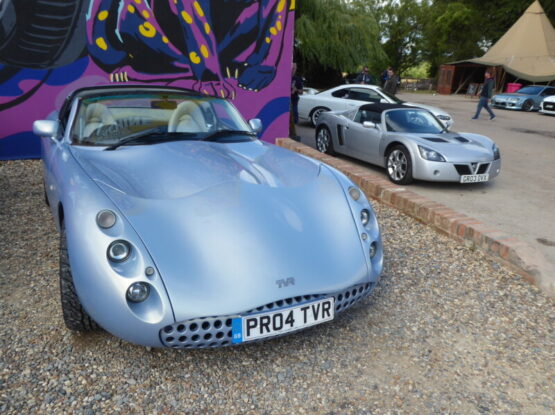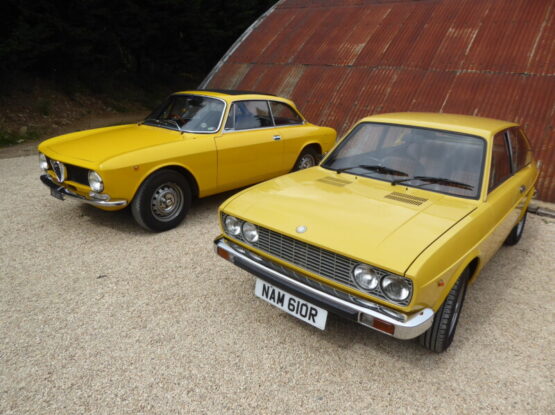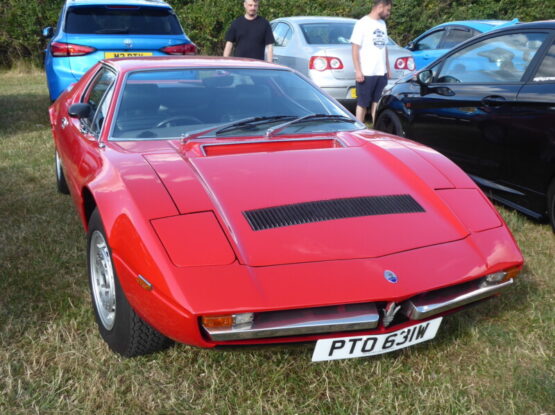
Although there has been a lot more standardisation of car models offered in major markets around the world in the past generation or two, tastes do still vary and so it is always interesting when visiting a different country just to keep an eye out on what you see on the road or parked up in towns and villages. This report covers those cars I was able to photograph in a week’s vacation based out of Gothenberg in Western Sweden, where I spend a mix of time walking around the city, and driving through some of the very attractive countryside up to Trollhattan and the SAAB Museum. I was rather expecting to see more in the way of older cars than I did, so there is surprisingly little to feature in this report. Quite a few of the cars here are American, and there was clearly some American car meet going on over the weekend in the Trollhattan area, as I saw a lot more than is depicted here whilst I was driving. Despite searching on everything I could think of, I never managed to find the event, but there were far too many cars out and about for their not to have been something special going on. Anyway, the net here are some cars that you rarely see anywhere and a few that were never sold in the UK so are, to my eyes at least, rare.
Buick Electra 225: All GM passenger vehicles received a major redesign in 1965 dominated by flowing “Coke bottle” lines and fastback roof profiles on its coupe models, and the 6 window-body style was eliminated. For 1965, Buick also changed its marketing strategy and offering the Electra 225 in two trim levels, base and Custom. Along with the new body came a new chassis with a full perimeter frame including side rails that replaced the previous “X” frame used since 1961. Engine offerings were unchanged from 1964 including the standard 325 hp 401 V8, and two versions of the larger 425 V8 that were rated at 340 hp with a four-barrel carburettor or 360 hp with two four barrels. The three-speed Super Turbine 400 automatic transmission was standard equipment. A new body style introduced for 1965 was the thin-pillar 4-door sedan, which featured frameless window glass with a thin, chrome fixed “B” pillar. The 1966 Electra 225 saw only minor styling changes including a new grille and a revised full-width taillight and trunk lid that included an “Electra 225” script rather than the “BUICK” nameplate spelled out in 1965. Engine offerings were unchanged from 1965 with the exception that the dual-quad 360 hp 425 was downgraded from a factory option to dealer-installed. Inside, a revised instrument panel featured a horizontal sweep speedometer, fuel gauge and warning lights. Front seat headrests became an option. A moderate facelift highlighted the 1967 Electra 225 including a Pontiac/Oldsmobile-like divided split grille. Both base and Custom models were continued with a new “Limited” option package available Electra 225 Custom 4-door hardtop reviving a nameplate that graced Buick’s ultra-luxury flagship in the late 1930s (and again in 1958), which included an ultra-luxurious interior trim. Under the hood a new 430 cubic-inch V8 rated at 360 hp with four-barrel carburetor replaced the previous “Nailhead” 401 and 425 V8s. Power front disc brakes were available as a new option along with a stereo 8-track tape player. The 1968 Electra 225 received a revised grille and taillight trim along with concealed windshield wipers. Inside, there was a revised instrument panel with a square speedometer and other instruments, plus a new steering wheel. Shoulder seat-belts were standard for both the driver and front passenger. Base and Custom models were still offered, with the Limited trim option available on the Electra 225 Custom hardtop sedan. 1969 brought a major restyling to the Electra 225 and other GM B-body and C-body cars with somewhat crisper bodylines than 1965–68 models, but continued with the same chassis and inner body structure introduced with the 1965 model, however the wheelbase was increased one inch to 127 in (3,226 mm). The 1969s were also the first to offer headrests as standard equipment due to a federal safety mandate, and the steering column with ignition switch that also locked the steering wheel with the transmission in “Park”, a feature found on all 1969 GM cars one year before it became a federal safety mandate in 1970. Also new was a variable-ratio power steering system combined with revised front suspension tuning called “Accu-Drive.” Other changes included ventless front windows. The same assortment of base and Custom models were offered in 1969 with the “Limited” trim package available on Custom sedans and coupes. A new option available with the Limited package was a split 60/40 bench seat with center armrest. Finned aluminum drum brakes were again offered as standard equipment, while the Bendix four-piston disk brake units were also available. 12 in × 1 in (305 mm × 25 mm) vented steel rotors were coupled with the cast iron caliper assemblies. A dual exhaust was available as an option. Five different rear axles were available: a 2.56 Economy as well as 2.73, 3.08, 3.23:1 gear ratios. The special PX-Code “AC Delete” 3.91 performance gear option was also available. The standing quarter mile was completed in 15.5 seconds at a terminal velocity of 90 mph (145 km/h) for the dual exhaust engine with the 2.73 gear ratio in a 4,700 lb (2,132 kg) Custom Convertible. Only a minor facelift with revised grille and taillight trim marked the 1970 Electra 225. The large change was in the engine bay, where a new 370 hp (276 kW) 455 cubic-inch V8 replaced the 430 V8 used from 1967 to 1969. This was the final year for the Electra convertible, finned aluminum brake drums and high compression engines. New this year was a concealed radio antenna, which amounted to two wires embedded in the windshield. Also new for 1970 was the Estate Wagon, which shared the Electra’s 455 V8 and four VentiPorts, but was a B-body car like the LeSabre and the Wildcat and consequently shared the smaller cars’ 124.0-inch (3,150 mm) wheelbase and interior. This was Buick’s first full-sized station wagon since 1964. The following year the Buick Estate would move up to Electra’s larger body and more voluminous interior. Like the other GM brands, Buick completely restyled its B-body and C-body cars for 1971


Cadillac Eldorado: The 1959 Cadillac is remembered for its huge sharp tailfins with dual bullet tail lights, two distinctive rooflines and roof pillar configurations, new jewel-like grille patterns and matching deck lid beauty panels. In 1959 the Series 62 had become the Series 6200. De Villes and 2-door Eldorados were moved from the Series 62 to their own series, the Series 6300 and Series 6400 respectively, though they all, including the 4-door Eldorado Brougham (which was moved from the Series 70 to Series 6900), shared the same 130 in wheelbase. New mechanical items were a “scientifically engineered” drainage system and new shock absorbers. All Eldorados were characterised by a three-deck, jewelled, rear grille insert, but other trim and equipment features varied. The Seville and Biarritz models had the Eldorado name spelled out behind the front wheel opening and featured broad, full-length body sill highlights that curved over the rear fender profile and back along the upper beltline region. Engine output was an even 345 hp from the 390 cu in (6.4 litre) engine. Standard equipment included power brakes, power steering, automatic transmission, back-up lamps, two-speed wipers, wheel discs, outside rearview mirror, vanity mirror, oil filter, power windows, six way power seats, heater, fog lamps, remote control deck lid, radio and antenna with rear speaker, power vent windows, air suspension, electric door locks and license frames. The Eldorado Brougham also came with air conditioning, automatic headlight dimmer, and a cruise control standard on the Seville and Biarritz trim lines. For 1960, the year that this Fleetwood Eldorado was made, the styling was toned down a little. General changes included a full-width grille, the elimination of pointed front bumper guards, increased restraint in the application of chrome trim, lower tailfins with oval shaped nacelles and front fender mounted directional indicator lamps. External variations on the Seville two-door hardtop and Biarritz convertible took the form of bright body sill highlights that extended across the lower edge of fender skirts and Eldorado lettering on the sides of the front fenders, just behind the headlamps. Standard equipment included power brakes, power steering, automatic transmission, dual back-up lamps, windshield wipers, two-speed wipers, wheel discs, outside rearview mirror, vanity mirror, oil filter, power windows, six-way power seats, heater, fog lamps, Eldorado engine, remote control trunk lock, radio with antenna and rear speaker, power vent windows, air suspension, electric door locks, license frames, and five whitewall tyres. Technical highlights were finned rear drums and an X-frame construction. Interiors were done in Chadwick cloth or optional Cambray cloth and leather combinations. The last Eldorado Seville was built in 1960. The idea of a large car finished in pink now is simply unthinkable, but the colour goes quite well with the style here. These 59 and 60 Cadillacs attract lots of interest from collectors and the public and this one was no exception.


1968 Cadillac Eldorado: The Eldorado was radically redesigned for 1967 as a front-wheel drive hardtop coupe, becoming Cadillac’s entry in the era’s burgeoning personal luxury car market. Promoted as a “personal” Cadillac, it shared the E-body with the second-generation Buick Riviera and the first-generation Oldsmobile Toronado, which had been introduced the previous year. To enhance its distinctiveness, Cadillac adapted the Toronado’s front-wheel drive unified powerplant package, mating a Cadillac 429 V8 to a Turbo-Hydramatic 425 automatic transmission. Front disc brakes were optional, and new standard safety equipment included an energy absorbing steering column and generously padded instrument panel. The 1967 Eldorado was a great departure from previous generations, which shared styling with Cadillac’s De Ville and Series 62. GM styling chief Bill Mitchell chose angular, crisp styling for the Eldorado, setting it apart from more streamlined Riviera and Toronado. The rear end design was inspired by the GM-X Stiletto concept car. It was the first and only Cadillac model with the headlamps concealed behind moveable covers; this feature was for two years only (1967 and 1968). Rear passenger windows retracted sideways into the C-pillar instead of down into the side body panel. The Eldorado achieved 0-60 mph (0–97 km/h) acceleration in less than nine seconds, and a top speed of 120 mph (190 km/h). Roadability and neutral handling were highly praised by contemporary reviews, and sales were excellent despite high list prices. Its sales of 17,930 units, nearly three times the previous Eldorado high, helped give Cadillac its best year ever. In 1968, the 429 V8 was replaced by the new 472 (7.7 L) V8 with SAE gross 375 hp and 525 lb/ft (712 Nm) of torque. Despite the larger and more powerful engine, acceleration did not improve due to the reduction in final drive ratio from 3.21 to 3.07. Fuel consumption was 10 mpg (23.5 l/100 km) city and 13 mpg (18 l/100 km) highway. The hood was extended 4.5 inches longer in the rear as to conceal the windshield wipers. The previously optional front disc brakes became standard. The bumper-mounted front turn signal indicators and parking lights were repositioned to the fenders, replacing the end caps. The red side running lamps without retroreflective markers were attached to the rear fenders. The external rear view mirrors were enlarged and became rectangle-shaped with fixed housing and moveable mirror. Sales set another record at 24,528, with Eldorado accounting for nearly 11% of all Cadillac models sold. In 1969, the concealed headlamps were eliminated due to the new federal safety regulations stipulating that the headlamp covers must operate within a specific period of time when entering tunnels or darkened buildings (i.e. parking garages). Side impact protection beams were installed inside the doors. The dashboard and instrument cluster were redesigned: the dash cowl became more pronounced and contained all of the controls, driver’s side vents, and instrument clusters. On the passenger side, the vents were moved to the single horizontal rosewood veneer panel. The instrument clusters had a thin wood veneer panel where the warning lights are located. For 1970, the wood veneer was expanded to cover most of the instrument clusters. In 1970, the Eldorado featured the new Cadillac 500 V8 (8.2 L) V8 engine, putting out SAE gross 400 hp and 550 lb/ft (746 Nm). It was exclusive to the Eldorado until 1975, when it became the standard engine option for all Cadillac models except the Seville. The power sunroof by ASC and rear “Trackmaster” anti-lock braking system were offered as extra-cost options. Styling changes for 1970 included a new grille with scripted “Eldorado” and rectangular “8.2 LITRE” badges, and new taillamp bezels that eliminated the protruding “chrome fins”. The side running lamps included retroreflective markers, amber in the front and red in the rear. The car was completely redesigned again for 1971.


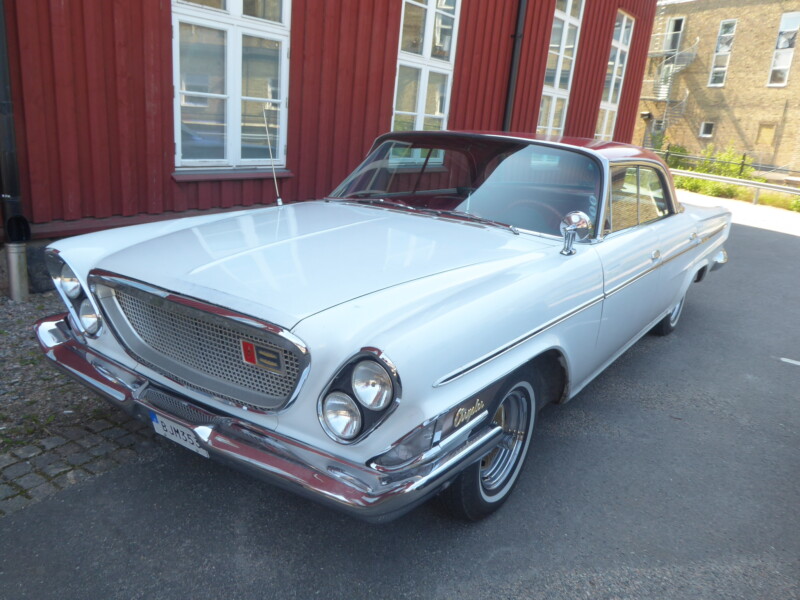
1962 Chrysler 300 H: From 1962s models, the fins were gone from all Chrysler products, as was the letter series’ unique place in the Chrysler lineup; there was now the new Chrysler 300 Sport Series which came as a two-door hardtop, replacing the cancelled Chrysler Windsor, while the convertible remained with the letter series along with a two-door hardtop 300H. Externally there was little difference between the 300H and the 300 Sport Series except for a “300H” badge on the traditional location on the rear fenders, and many of the 300H’s standard features could be ordered as options on the Sport Series. The Mercury competitor was the all-new Mercury S-55 with the same approach to luxury and performance in a coupe or convertible and the Buick Wildcat. Inside, the 300 Sport Series hardtop coupe was installed with standard bench seats front and rear, similar to the Newport, while the 300H had standard bucket seats front and rear with the full length center console, and were also offered on the New Yorker Custom coupe. This was also the last year for the AstraDome Instrument cluster for all Chrysler branded vehicles and the dashboard colour now matched the leather upholstery and carpet. The exterior colour list was updated to Formal Black, Festival Red, Oyster White, and Caramel while the standard interior colour continued as tan leather. Under the hood of the 300H the cross ram engine became an option, and there was a return to the inline dual 4-barrel carburettor setup of the 300E as the base powerplant. With a slight power boost and a 300 lb (140 kg) lighter body, due to the 300H being shared with the Chrysler Newport/Dodge Custom 880 122-inch wheelbase which reduced overall weight, the 300H was faster than the 300G, but the loss of exclusivity coupled with high prices made this the slowest-selling letter series year yet, with only 435 coupes and 135 convertibles sold. The 300 Sport Series hardtop sedan used a 383 cu in (6.3 L) B engine. Suggested retail prices showed a reduction from the past at US$5,090 for the coupe and US$5,461 for the convertible. A completely new model arrived for 1964.


Dacia Logan Pickup: the coupé utility version of the Logan, also based on the MCV, was introduced on 10 September 2007 (4 October 2007 at the Bucharest International Motor Show), as a replacement for the Dacia Pick-Up. Sales began in Romania in 2008, with the price ranging between €7,300 and €9,450. The Logan Pick-Up was discontinued by Dacia in July 2012, and it was not until October 2020 that the company introduced a new pickup model based on the Dacia Duster. Starting October 2008, the Logan Pick-Up is sold in South Africa as the Nissan NP200. Visually similar to the original model at launch, it received a light facelift in early 2009. It is being built at the Nissan plant outside Pretoria, alongside the Renault Sandero, and is also exported to several Southern Africa countries such as Zimbabwe, Mozambique, Namibia, Zambia, Kenya, Uganda, Seychelles and Botswana.In March 2024, the NP200 was discontinued. As of 2016, it is also offered in Iran as the Renault Tondar Pick-Up.

Fiat Tipo Saloon: The development of the Tipo family began in 2014 when Fiat announced the Ægea project (Type 356). Specifically, the Italian manufacturer was building a family of C-segment cars to be marketed in Europe, the Middle East and Africa (EMEA) to replace both the old Fiat Bravo hatchback and the Linea sedan. The production site chosen was the Turkish Bursa plant (owned by Fiat and Tofaş), which already produced the previous Linea. Alfredo Altavilla, at the time director of the EMEA area of the FCA Italy group, and Olivier François, director of Fiat brand, declared that the Ægea family had been built according to the Fiat “Rational” range (including Panda, Punto, Fiorino and Doblò) vehicles characterized by functional solution, low running costs, spacious interior and low price list. The first version to be presented was the three-volume saloon at the Istanbul Motor Show in May 2015; called Fiat Egea, the car went into production in October-November of the same year, replacing the Linea in the Fiat range of products in Turkey. The name Egea is used only on the Turkish market because the term is very well known among the Turkish population as it identifies both the Aegean Sea that bathes the coasts of Turkey and the ancient medieval town of Yumurtalık. In October 2015 Alfredo Altavilla announced that the official name of the cars for the European market would be Fiat Tipo, taking the historical name of the Fiat model of the 80s known for its spacious interior and low running costs.[9] Fiat and Tofaş have invested a total of 1.5 billion dollars for the development and production of the Tipo. The Tipo was assembled at the Tofaş plant in Bursa, Turkey, by the Italian automaker Fiat and is built on the Fiat Small Wide LWB platform. It replaced the Bravo and Linea in the small family car range. The Tipo was designed by Centro Stile Fiat in Mirafiori, Turin. In December 2015, the car won the 2016 Best Buy Car of Europe Award, from the Autobest jury made up of Europe’s twenty-six leading journalists, from twenty-six different European countries. In 2016, the saloon was followed by a hatchback and a station wagon version for the European market. In February 2019, the 500,000th Fiat Tipo was produced at the Bursa plant, in Turkey. At the end of October 2020 (28th), a total of 670,000 units of Fiat Tipo had been produced and distributed in over 40 countries around the world. The saloon version was never sold in the UK.

Ford Fairlane Convertible: For 1957, a new style gave the second generation Fairlane a longer, wider, lower, and sleeker look with low tailfins. The new proportions and modern styling were a hit with customers to the extent that the Ford outsold Chevrolet in 1957 for the first time since 1935. A new top trim level, the Fairlane 500, was added to the Fairlane model line and the Country Squire continued to be the luxury station wagon while the Country Sedan was now added to the Fairlane model line, while engine choices were largely the same as the year before. The big news for 1957 was the introduction of the Fairlane 500 Skyliner power retractable hardtop, whose solid top hinged and folded down into the trunk space at the touch of a button, while the Ford Ranchero two-door coupe utility was also introduced. Another facelift for 1958 had fashionable quad headlights, a grille that matched the 1958 Thunderbird, and other styling changes. New big-block FE V8s of 332 and 352 CID (5.4 L and 5.8 L) replaced the previous largest V8s, and a better three-speed automatic transmission was also available with a steering column transmission gear selector lever. A new top-level full-sized model was introduced at mid-year 1959, the Ford Galaxie. The 1959 Galaxie displayed both “Fairlane 500” and “Galaxie” badging.


Ford Escort Cabriolet: A convertible version of the third generation Escort, made by coachbuilder Karmann, appeared the same year as the five-door estate (1983). It was the first drop-top car produced by Ford Europe since the Corsair of the 1960s. The Escort Cabriolet was initially available in both XR3i and Ghia specification, badged as 1.6i and 1.6 respectively (XR3i and Ghia badging would not appear on convertibles until after 1986), but the Ghia variant was later dropped. It was updated in 1986 along with the rest of the range.


Lada Niva: The Lada Niva Legend, formerly called the Lada Niva, VAZ-2121, VAZ-2131, and Lada 4×4 (Russian: ВАЗ-2121, ВАЗ-2131, Лада Нива), is a series of four-wheel drive, small (hatchback), and compact (wagon and pickup) off-road cars designed and produced by AvtoVAZ since 1977. Initially aimed at the rural market, later models also targeted urban users. The three- and later five-door 4×4 hatchbacks were sold under the Lada marque in many markets, and have been in continuous production since 1977. In the 1990s, three and five-door wagons on a 50 cm (20 in) longer wheelbase and an extra-long wheelbase pick-up were added to the range. After the original Land Rover and its successor, the Land Rover Defender, were discontinued in 2016, the Niva became the longest production run off-road light vehicle still manufactured in its original form. By the end of 2020, an estimated 650,000 Lada Nivas had been sold globally. The Lada Niva is the world’s first mass-produced off-road vehicle with a unibody construction (fully integrated body and frame).It is the predecessor of current crossover SUVs, most of which are built similarly. It was part inspiration for the Suzuki Vitara. In August 2020, Lada took over production of the 2003 Chevrolet Niva and rebranded it the “new” Lada Niva. In December 2020, the new Niva was further rebranded as the Lada Niva Travel, while the old model was renamed Lada Niva Legend in January 2021. The Niva was described by its designers as a “Renault 5 put on a Land Rover chassis”.[16] Development began in 1971 after the 24th Congress of the CPSU, in which Alexei Kosygin (the then-Premier of the Soviet Union) gave the designers at VAZ and AZLK the task of creating a car suitable for rural areas (specifically for the villagers and farmers of the Soviet Union), since the usual Zhiguli, Moskvitch, and Zaporozhets, intended primarily for ordinary people, were not much of use in the isolated areas that made up a large part of the USSR. In the same year, a team of VAZ designers led by Solovyev began competing with AZLK to work on a “civilized” four-wheel drive vehicle. The new car was partly inspired by the IZh-14 prototype of 1974.[18] It was VAZ’s first model that was not based on Fiat, though many of its mechanics were carried over from the earlier Fiat 124- or 125-based Zhiguli models (mostly the VAZ-2103 and 2106); the body, four-wheel drive system, and front suspension were all designed by VAZ. The first prototype appeared in 1971 and was officially designated the E-2121 and nicknamed krokodil (the crocodile) due to its distinctive frontal section, but was rejected for being too utilitarian, so doors and a hardtop were added. This version (designated the 2E-2121) debuted in 1973 and deviated from the off-road vehicles of the period, as it used a modern hatchback body. The design choice was inspired by the prototype known as the VAZ-1101 (itself derived from the Fiat 127), and was created by designer Valery Pavlovitch. The influence of the Fiat 127 is obvious from the Niva’s distinctive “clamshell” hood design and its rear three-quarter section. The 1974 prototype (designated the VAZ-2121M) was derived from an existing model, the VAZ-2103 (then the newest model in VAZ arsenal). It used the VAZ-2103’s 1,452 cc engine and shared some of its features, like chrome-plated bumpers, headlights and taillights, instruments, seats, and steering wheel. In the following year, two samples of the prototype were modified to install a 1,478 cc UZAM-412 engine, which originally powered the Moskvich 1500. Testing later revealed that the engine was incompatible with the newly designed car. The Moskvich engine was abandoned, and the older engine was reused. The 1974 prototype (2121M) was ready to be mass produced in 1975, but the appearance of the new VAZ-2106 at the end of the year resulted in a delay because the company wanted to develop another prototype based on the model in 1976, which became the sixth and final (serial production) prototype. Before its production, the Niva was tested over a period of years by a team led by Vadim Kotlyarov in the most difficult terrain of the Soviet Union, such as the Ural Mountains and Siberia, the deserts of the Kazakh SSR, and the Pamir Mountains in the Tajik SSR, where it was compared with its military counterpart, the UAZ-469, and some Western off-road vehicles—the British-made Land Rover Series and the Range Rover Classic. Its off-road capabilities were demonstrated for the very first time, which were based on its effective permanent four-wheel drive system featuring a transfer case and central differential lock, with the combination of a short wheelbase (only 2,2m), relatively low weight (just over a ton), independent suspension, small dimensions (3,74×1,68 m), and high ground clearance (about 265 mm). Its large but narrow wheels (175/80-R16 in dimensions), originally featuring domestically designed “Voltyre” VLI-5 high-tread tires, offered relatively strong ground pressure, which lowered the chances of slipping or getting bogged down off-road. For example, in the 1973 and 1974 trials, the Niva climbed a 58% slope, and crossed 60 cm (24 in) of water and 100 cm (39 in) of mud and snow. Solovyev died the following year and was replaced by engineer Pyotr Prusov, who took credit for creating the car. In 1976, the final prototype appeared. The engine was changed to a 1,568 cc (95.7 cu in) one, the most powerful engine in VAZ during the Soviet era, taken from their VAZ-2106 (from which the production model of the first Niva generation was generally derived). Like the previous prototype, it featured a permanent four-wheel drive and a transfer case with a lockable central differential. The VAZ prototype displayed better design and real-world performance than its AZLK counterpart, the Moskvitch 416, so it was approved for production in March of the same year, after the 25th Congress of the CPSU. The car was named Niva 1600 (Field) for exports and the VAZ-2121 (alternatively “Niva 2121” or “VAZ Niva”) for the domestic market. For domestic customers, it was described as “[a] high-speed car with the improved capabilities and comfort of all VAZ models,” and also as “[a] combination of the speed and comfort of a Zhiguli with the capabilities of a UAZ.” Production began the following year on 5 April 1977, while the first export models appeared in 1978 at the Paris Motor Salon and quickly took over at least 40% of Europe’s market for four-wheel drive vehicles, making it Lada’s top-selling export. It was the only Soviet car that was ever sold in Japan, starting from the early 1980s, inspiring their Suzuki Samurai. Because of export demand and the higher priority given to exports, domestic customers faced long wait times, despite the car being developed primarily for Soviet citizens.

Mazda 323 Sedan: In January 1985, the fifth generation Familia/323 featured many updates. It was available as a hatchback or sedan only for the first year, and wagon and cabriolet models were added in November 1985 and March 1986 respectively. In January 1987 a personal coupé version with its own bodywork, the Étude, was added. In February 1987 the Familia range underwent a light facelift that included replacing the old E engines with the more modern B series. In some markets, such as Indonesia, the B engine continued to be installed after the facelift. The 1985 Familia spawned a Ford Laser twin sold in the Asia-Pacific. The Laser sedan and wagon were nearly identical to the Familia but with a Ford grille. By contrast the Laser hatchback model, which was sold in the U.S. as the Mercury Tracer used completely different panels from the Familia’s. This generation of the Familia/323 was also available in a version with a turbocharged DOHC engine, with either front- or four-wheel drive, producing 140 PS. The 4WD version (sold in either a light-weight GT or fully optioned GT-X grade) introduced in October 1985, saw some success in rally’s Group A category. A limited production homologation special, the 4WD GT-X, appeared in May 1988 and offered an additional ten horsepower. There was also a 1.7-litre diesel version available with 58 PS at 4300 rpm and 112 Nm (83 lb/ft) at 2800 rpm. It is an indirect injection engine, naturally aspirated. This generation was sold through the 1989 model year in the United States. The wagon (BW) continued alongside the succeeding generation in most markets until 1994/95, and was later updated with a new grille and lights. The model remained in production in South Africa, as an entry-level model until 2003. It was also sold there as the “Midge”, the “Sting”, and as the “Ford Tonic”. A locally designed pick-up based on the Familia front end, called the Rustler was also produced, and sold as the “Ford Bantam”. From 1991 to 1994 Samcor also produced and sold the 323 with the 2.0 L 16-valve DOHC FE engine from the Mazda 626 and badged it “200i”. Along with the 2.0 L 16-valve DOHC engine there were upgrades to the suspension and braking system. Still, the 1.6-litre GT-X homologation car was more powerful. This South African built model was also sold in Australia between 1989 and 1991 with minor changes, the most noticeable one being the front indicators having a clear colour rather than the normal amber. These models were labelled BF as opposed to the next generation’s BG. A factory-built convertible body was introduced in March 1986 in both Mazda 323 and Ford Laser (323 panels from firewall back) versions, initially running the 1.5-litre SOHC E5T engine but later switching to the 1.6-litre DOHC B6D.


1965 Pontiac Grand Prix: First introduced as a full-size performance coupe for the 1962 model year, the Grand Prix repeatedly varied in size, luxury, and performance over successive generations. The Grand Prix was the most expensive coupe Pontiac offered until the 1970s, when the Bonneville Brougham and the Firebird Trans Am became more exclusive; the Grand Prix moved into the intermediate personal luxury car and later the mid-size market segments. All Grand Prixes from 1962 through 1972 were pillarless hardtops (except for the 1967 convertible). Grand Prix and all other full-sized Pontiacs were completely restyled for 1965 featuring more rounded bodylines with coke-bottle profiles, and a 1 in (25 mm) increase in wheelbase to 121 in (3,073 mm) (for Grand Prix, Catalina, and all Safari station wagons — Bonneville and Star Chief increased proportionally from 123 in (3,124 mm) to 124 in (3,150 mm)). While other Pontiac coupes received the semi-fastback rooflines shared with other GM divisions, Grand Prixes retained the exclusive squared-off roofline with concave rear window but a bit more rounded than the 1963 and 1964 version. This generation also introduced fender skirts over the rear wheels for an upscale look, shared with Cadillac, Buick and Oldsmobile senior models. Interiors were revised with new instrument panels featuring more walnut trim which now extended to the center console standard with bucket seats, along with a new steering wheel with horn bars replacing the horn ring used in previous years. The standard bucket seats could be upholstered either in expanded “Morrokide” vinyl or new cloth-and-“Morrokide” trim. New for 1965 was a no-cost bench seat option with a center armrest available with either upholstery choice. The Grand Prix retained the market position as the most expensive model, offering all equipment offered on the Bonneville hardtop coupe as standard equipment, and had a listed retail price of $3,426. New options included an automatic air conditioning system called “Comfort Control”. This system, first introduced by Cadillac in 1964, was available in addition to the regular Circ-L-Aire Conditioning. Hazard flashers and seat belts were also optional. Engine offerings were revised for 1965. The standard four-barrel 389 cu in (6.4 L) V8 was uprated to 333 hp with a manual transmission or 325 hp with automatic. Optional engines included a 389 Tri-Power and 421 four-barrel — both rated at 338 hp; a 421 Tri-Power rated at 350 hp and the 421 HO Tri-Power with 376 hp. The standard three-speed and optional four-speed manual transmissions were carried over from 1964, however, a new three-speed Turbo Hydramatic transmission with torque-converter that was similar in principle to Ford’s Cruise-O-Matic and Chrysler’s TorqueFlite replaced the older three-speed fluid coupling Roto Hydramatic (along with the four-speed Super Hydramatic in Bonneville and Star Chief models). The Turbo Hydramatic also featured the now-standardized P-R-N-D-S-L shift quadrant pattern in place of the P-N-D-S-L-R setup of previous Hydramatics. A 1965 Grand Prix road test was featured in the February 1965 issue of Motor Trend magazine, which was focused on the entire Pontiac lineup receiving M/T “Car of the Year” honors for 1965. Other Pontiac road tests in that issue included a GTO convertible, Tempest Custom sedan, Catalina Vista hardtop sedan, and Bonneville hardtop coupe. The 1966 Grand Prix received only minor appearance revisions including a new more rounded split grille and new taillight trim.


1972 Pontiac Le Mans Sport: For 1970, Pontiac’s intermediate lineup was reshuffled to include the Tempest, Lemans, Lemans Sport, GTO and GTO Judge series. The Le Mans nameplate was downgraded to replace the sub-series previously known as the Tempest Custom, while the previous top Le Mans series was renamed the Le Mans Sport in the same three body styles as earlier, including a four-door hardtop sedan, two-door hardtop coupe and convertible. New for this year were Firebird-inspired front bumpers, wrap-around taillights, and crease-style body lines. Replacing the Pontiac-built OHC six-cylinder as the base engine for Tempest, LeMans, and LeMans Sport was Chevrolet’s 250 cubic-inch straight-six engine. V8 offerings included 350 and 400-cid options with 2-barrel carburation and a 330 hp (246 kW) 400-cid 4-barrel carburettor engine with dual exhausts. The four-barrel 350 HO was discontinued. Pontiac wanted to have a car that was less expensive than its Chevrolet counterpart, so in February 1970, Pontiac introduced the T-37 Hardtop Coupe, replacing the Tempest nameplate for the two-door pillared coupe. The T-37 was initially described as “General Motors’ lowest-priced hardtop,” but was undercut by a base Chevrolet Chevelle hardtop coupe introduced a few weeks later. The T-37 Coupe was followed by the introduction of a new option to the T-37, the GT-37 package. The GT-37 represented the “stripper” muscle car package. In addition to the three V8 engines, GT-37 extras included Rally II wheels sans trim rings, white letter tires, chrome-tipped dual exhaust, vinyl accents stripes, 3-speed floor shift transmission, sport mirrors, hood locking pins, and “GT-37” badging. For the 1971 model year, Pontiac dropped the Tempest name altogether and introduced its intermediate lineup as T-37, Lemans GT-37, Lemans, and Lemans Sport The GTO and GTO Judge were a separate line. Two-door coupes and four-door sedans were available with T-37, Lemans, and Lemans Sport. The 2-door Hardtop was available across the series, while the convertible model was limited to Lemans Sport and the GTO line. The GT-37 returned as a package to T-37 models and was marketed as “The GTO for Kids under 30.” The GT-37 received the same feature package as the previous year with the exception of new eyebrow-type side striping similar to that of the GTO Judge model. In mid-March 1971, a second design change for the GT-37 switched the striping to a reflective sword-style stripe sometimes referred to as the 1971 ½ GT-37. 1971 also afforded the customer the opportunity to choose any of Pontiac’s optional V8s such as 350, 400, or 455 cubic inch models, including the 455 High Output (HO) engine. The 455 had only been offered on the GTOs in 1970 and came in a 325 hp (242 kW) four-barrel version or the 335 hp High Output version. All 1971 engines were detuned with lower compression ratios to run on lower-octane regular leaded, low-lead, or unleaded gasoline. The brakes were 9.5-inch drums. For 1972, all Pontiac intermediates were now Le Mans models, and the low-priced T-37 line was replaced by a base Le Mans pillared coupe. The top-line intermediate was the Luxury Le Mans, available in hardtop sedan and coupe models, featuring upgraded interiors compared to regular Le Mans models. The Le Mans Sport was available as a two-door hardtop or convertible with Strato bucket seats and interiors from the Luxury Le Mans. The GTO was changed from a separate series back to an option package on Le Mans and Le Mans Sport coupes. Replacing the previous GT-37 option package for 1972 was the new “Le Mans GT” option, available on Le Mans pillared and hardtop coupes with any V8 ranging from the 350 two-barrel to the 455 HO four-barrel, and also included the same appearance and handling items carried over from the GT-37. From 1973 until 1977, the Le Mans and other GM intermediates were much larger in size than previous models due to evolutionary changes that resulted in larger cars year after year and federally mandated 5 mph crash bumpers that added weight and length.


Pontiac Firebird Trans Am: The first significant change to the styling of the second generation Firebird came for 1974 when a slant nose with mandatory 5 mph impact absorbing bumpers was adopted. These added significant weight to the car, blunting its performance, but this was happening to everything on the market at the time. Detailed changes followed again in 1975 and 1976 and then in 1977, a distinctive, slant-nose facelift occurred, with the Firebird now using four square headlamps, while the Camaro continued to retain the two round headlights that had been shared by both Second Generation designs. Pontiac offered the Trans Am 6.6 litre 400 (RPO W72) rated at 200 hp), as opposed to the regular 6.6 litre 400 (RPO L78) rated at 180 hp. The Trans am 6.6 equipped engines had chrome valve covers, while the base 400 engines had painted valve covers. In addition, California and high-altitude cars received the Olds 403 engine, which offered a slightly higher compression ratio and a more usable torque band than the Pontiac engines of 1977. The 1977 Trans-Am Special Edition became famous after being featured in Smokey and the Bandit. Changes for 1978 were slight, with a switch from a honeycomb to a crosshatch pattern grille being the most obvious from the outside. Beginning in 1978, the Pontiac group introduced a new special edition vehicle. The Firebird Formula LT Sport Edition which featured a revised 10% raised compression Chevy 305 V8 powertrain producing 155 hp (same as 1977 Chevy Monza Mirage) combined with a floor centre console 4 speed Manual T-10 BW Transmission coupled to a limited-slip differential final drive. The Limited Touring package (LT) also included a cabin roof, door, fender and hood graphics scheme, the Trans-Am sports handling package with HD gas shocks, Modular Alloy Wheels and the SE Trans-Am rear deck Spoiler with “Formula” word graphic detail. The engineers also revised the compression ratio in the 400ci through the installation of different cylinder heads with smaller combustion chambers (1977 Pontiac 400 engines also had the 350 heads bolted to the 400 blocks, these heads were known as the 6x-4 heads and were taken from the Pontiac 350). This increased power by 10% for a total of 220 during the 1978–79 model years. The 400/403 options remained available until 1979, when the 400 CID engines were only available in the 4-speed transmission Trans Ams and Formulas (the engines had actually been stockpiled from 1978, when PMD had cut production of the engine).


Renault R5 EV

Triumph Spitfire Mark III: Based on the chassis and mechanicals of the Triumph Herald, the Spitfire was conceived as a rival to the Austin-Healey Sprite and MG Midget, which were launched a year earlier. The Triumph soon found a strong following, with many preferring it to the BMC cars which in time would become in-house stablemates. Mark II models arrived in 1965 and a more comprehensive facelift in 1967 with the distinctive “bone in mouth” front grille necessitated by US bumper height regulations also brought changes, but it was with the Mark IV that the greatest number of alterations would come about. The Mark IV featured a completely re-designed cut-off rear end, giving a strong family resemblance to the Triumph Stag and Triumph 2000 models, both of which were also Michelotti-designed. The front end was also cleaned up, with a new bonnet pressing losing the weld lines on top of the wings from the older models, and the doors were given recessed handles and squared-off glass in the top rear corner. The interior was much improved: a proper full-width dashboard was provided, putting the instruments ahead of the driver rather than over the centre console. This was initially black plastic however was replaced with wood in 1973. An all-new hardtop was also available, with rear quarter-lights and a flatter rear screen. By far the most significant change, however, was to the rear suspension, which was de-cambered and redesigned to eliminate the unfortunate tendencies of the original swing-axle design. The Triumph GT6 and Triumph Vitesse had already been modified, and the result on all these cars was safe and progressive handling even at the limit. The 75 hp engine was now rated at 63 hp (for UK market employing the 9:1 compression ratio and twin SU HS2 carburettors; the less powerful North American version still used a single Zenith Stromberg carburettor and an 8.5:1 compression ratio) due to the German DIN system; the actual output was the same for the early Mark IV. However, it was slightly slower than the previous Mark III due to carrying more weight, and employing a taller 3.89:1 final drive as opposed to the earlier 4.11:1. The engine continued at 1296 cc, but in 1973 was modified with larger big-end bearings to rationalise production with the TR6 2.5 litre engines, which somewhat decreased its “revvy” nature; there was some detuning, to meet new emissions laws, which resulted in the new car being a little tamer. With the overall weight also increasing to 1,717 lb (779 kg) the performance dropped as a consequence, 0 to 60 mph now being achieved in 15.8 seconds and the top speed reducing to 90 mph. The overall fuel economy also dipped to 32mpg. The gearbox gained synchromesh on its bottom gear. The Mark IV went on sale in the UK at the end of 1970 with a base price of £735. In 1973 in the United States and Canada, and 1975 in the rest of the world, the 1500 engine was used to make the Spitfire 1500. Although in this final incarnation the engine was rather rougher and more prone to failure than the earlier units, torque was greatly increased by increasing the cylinder stroke to 87.5 mm (3.44 in), which made it much more drivable in traffic. While the rest of the world saw 1500s with the compression ratio reduced to 8.0:1, the American market model was fitted with a single Zenith-Stromberg carburettor and a compression ratio reduced to 7.5:1 to allow it to run on lower octane unleaded fuel, and after adding a catalytic converter and exhaust gas recirculating system, the engine only delivered 53 bhp with a slower 0–60 time of 16.3 seconds. The notable exception to this was the 1976 model year, where the compression ratio was raised to 9.1:1. This improvement was short-lived, however, as the ratio was again reduced to 7.5:1 for the remaining years of production. In the UK the 9:1 compression ratio, less restrictive emissions control equipment, and the Type HS2 SU carburettors now being replaced with larger Type HS4 models, led to the most powerful variant to date. The 1500 Spitfire now produced 71hp (DIN) at 5500 rpm, and produced 82 lb/ft of torque at 3000 rpm. Top speed was now at the magical 100 mph mark, and 0 to 60 mph was reached in 13.2 seconds. Fuel economy was reduced to 29mpg. Further improvements to the suspension followed with the 1500 included longer swing axles and a lowered spring mounting point for more negative camber and a wider rear track. The wider, lower stance gave an impressive skid pad result of 0.87g average. This put the Spitfire head and shoulders over its competition in handling. The American market Spitfire 1500 is easily identified by the big plastic over-riders and wing mounted reflectors on the front and back wings. The US specification models up to 1978 still had chrome bumpers, but on the 1979 and 1980 models these were replaced by black rubber bumpers with built-in over-riders. Chassis extensions were also fitted under the boot to support the bumpers. Detail improvements continued to be made throughout the life of the Mark IV, and included reclining seats with “chequered brushed nylon centre panels” and head restraints, introduced for domestic market cars early in 1977 along with a new set of column stalk operated minor controls (as fitted already in the TR7) replacing the old dashboard mounted knobs and switches. Also added for the model’s final years were a wood dash, hazard flashers and an electric screen washer, in place of the previous manual pump operated ones. Options such as the hard top, tonneau cover, map light and overdrive continued to be popular, but wire wheels ceased to be available. The 1980 model was the last and the heaviest of the entire run, weighing 1,875 lb (850.5 kg). Base prices for the 1980 model year was £3,631 in the UK. The last Spitfire, an Inca Yellow UK-market model with hardtop and overdrive, rolled off the assembly line at Canley in August 1980, shortly before the factory closed. It was never sold and is now displayed at the museum at Gaydon.

Volvo 144: This is a 144, one of a series of cars made between 1966 and 1974. Volvo Cars began manufacturing the Volvo 144 at Torslandaverken in the late summer of 1966, the first Volvo to use a tri-digit nomenclature, indicating series, number of cylinders and number of doors. Thus, a “144” was a 1st series, 4-cylinder, 4-door sedan. The 144 was the first Volvo to feature a more rectilinear or boxy styling. Compared to the Volvo Amazon, the 140 was a radical departure with minimal exterior and interior carryover, notably a stylised version of the front split grille. The car’s basic shape would survive into the 1990s as the 200 series. Mechanically, the car used many of the same drivetrain components as the Amazon, but also showcased many improvements, including disc brakes on all four wheels. It was named car of the year in 1966 by Swedish magazine Teknikens Värld. The engine in the standard 144 was the same as found in the standard Amazon (121), the 1.8l B18A, but the 144S was given the more powerful B18B from the 123GT and 1800S. Late in the 1967 model year production of the Volvo 142 (2-door sedan) began, in time to build 1500 units for the first year. In 1968 production of the Volvo 145 5-door station wagon began, completing the three body styles used in the 140 range. For the 1969 model year Volvo enlarged the B18 to become the 2.0 litre B20 and replaced the generator with a more modern alternator. It was also in 1969 that Volvo introduced the 164, which shared much of the 140 series structure and styling aft of the windshield while incorporating a 6-cylinder engine, the B30 which was simply a B20 with 2 more cylinders and a few strengthened and enlarged components. In 1970 a flow-through ventilation system, where vents were added towards the rear of the car (on the exterior under the rear window on the 142 and 144 and as a grille next to the right side taillight of the 145) and electrically defrosted rear windows, were introduced. The split rear side window on the 145 became one piece which was no longer possible to open. In 1971 the first of several styling changes were introduced, including a revised black grille which saw the now ubiquitous Volvo diagonal line introduced as well as new wheels. 1971 also saw the introduction of the B20E, which was a high compression version of the B20 which introduced Bosch D-Jetronic electronic fuel injection. These new cars were either given the designation E (the German word Einspritzer, or “injection”) or GL (for Grand Luxe), which was a more upmarket version of the car. A console on the transmission tunnel with a clock was now standard. The styling changes continued in 1972 with the introduction of flush mounted door handles and a slightly revised dashboard with fake woodgrain trim, newly designed switches and a small central panel with a clock. The transmission tunnel was taken from the 164 as was the same short-shifter gear stick and the automatic transmission became controlled by a T-bar mounted on the floor at the same place. The outer 2 rear seats now had the mounting points for retractable seatbelts. A low compression fuel injected engine, the B20F was introduced for the US and certain other markets. In 1973 the 140 series received a major facelift, with a new plastic grille, new larger indicators and a completely revised tail end. Also, the S designation was dropped and the range consisted of 3 trim levels, standard (with no designation, known as L, or “luxe”) de Luxe and the most upmarket, Grand Luxe. The interior also had a completely revised dashboard with a new instrument cluster consisting of dials rather than the strip speedometer previously used, rocker switches replacing the push-pull switches (with the exception of the headlight switch), and vents to direct air towards the person augmenting the defrost and floor vents. In 1974, the B20E/F engine switched from using the Bosch D-Jetronic to the K-Jetronic mechanical fuel injection system. Also, several safety changes were introduced including a fuel tank that was located close to the axle to protect it in the case of a rear-end collision, and larger bumpers that protruded more from the body. The quarter-light windows in the front doors were removed as a result of the improvements in ventilation inside the car, and small anodised aluminium strips were added to the bottom of the side windows. Total Production was 412,986 2-doors sedans, 523,808 4-doors sedans and 268,317 estates.


Volvo 940: Introduced in September 1990, the 940 was essentially a cosmetic reskin of the 740 aside from the completely redesigned rear from the C pillar back on the sedan. The new, taller trunk did diminish rearward vision but provided a larger opening to a larger boot than on the 700-series. The dashboard and seats were all new, offering a bit more headroom and the option of an integrated child booster seat in the rear. All drivetrains, and most options available in the 940 had been available in the 740, with the exception of the 780 Coupé. The 940 was more closely related to the 740 than the 760, sharing similar drivetrain choices and sheet metal from the A-pillar forward. In contrast, the 960 was an evolution of the 760. The 760 / 960 front sheet metal, independent rear suspension, dashboard, and other interior features were all exclusive to the two upscale models. The 940 estate, introduced in May 1991, was almost identical to its 740 estate predecessor. The engines options were carried over from the 740, with 8-valve 2-litre (B200) and 2.3-litre (B230) four cylinder gasoline engines, either naturally aspirated or turbocharged, as well as the familiar 2.4-litre Volkswagen six-cylinder diesel and turbodiesels being fitted. There were also 16-valve versions of the gasoline engines fitted on some 1991 and 1992 models (B204, B234, naturally aspirated). The 2-litre 16-valve engine was fitted to the 940 base model in Italy at the time of introduction, to mark it being a step up from the 740. After the 740 was discontinued, the eight-valve engine found its way into the 940 as well. The 2.3-litre turbocharged version produces 165 PS; Volvo sold a chip tuning kit called Turbo+ which boosted the power to 190 PS. In 1994, gasoline engine range was limited to 2.3 engines in Britain, but the 2.0-litre engines remained available in markets with tight tax limits, such as Italy, Belgium, and Portugal. A low-pressure turbocharged version of the B230, the B230FK, debuted in 1994 – maximum power was only up slightly over the B230FB, from 131 to 135 PS, but torque increased throughout the range and there was virtually no turbo lag due to the small size of the charger. The 155 PS turbocharged 2.0 was first presented in February 1991. Originally intended for Italy and other markets with significant taxation thresholds at two litres, it was later also installed in the British-market 940 SE. The most commonly found engines on 940s were the naturally aspirated B230FB with 131 PS (all markets but US), B230FD with 115 PS (mainly for the US market), the turbocharged B230FK and FT, and the D24TIC diesel engine with 116 PS. The share of sales for the turbodiesel were much lower for the 900-series than in earlier years. Engines were fitted with either a 5-speed (M47) or 4-speed+overdrive (M46) manual gearbox or an automatic transmission, either Aisin-Warner AW70/71/72 (3-speed+overdrive) or ZF 4HP22 (4-speed) for some B230FB (or E) and diesel engines. In 1995, the manual gearbox was replaced with a full 5-speed (M90), and the ZF was abandoned for gasoline engines and fitted only on diesels. The SE emblem denoted very different trim and engine levels in different countries. In Sweden, the 940 SE was an ordinary non-turbo 940 with some optional extras as standard, most notably painted mirrors and bumpers. In the UK it was a high trim level available with all engines (from 2.0 to 2.3 turbo). In Australia, the 940 SE was a high trim level with only the 2.3 Turbo B230FT with some extras as standard and featured, rather unusually, full painted bumpers. In Thailand the 940 SE was a Turbo (LPT) model with leather seats, ABS brakes and SRS Airbag. In the US, the 940 SE utilised the body from the 960 (different dashboard, firewall, hood, recessed windscreen wipers etc.) with the four-cylinder B230FT engine, the 940 SE badge presumably chosen by Volvo in order to maintain the link between name and number of cylinders. From MY 1993 on, in Italy all 940 estates were badged “Polar” (engine B200F) or “Super Polar” (engine B200FT). Towards the end of the model cycle, certain countries (as Sweden, Germany and Switzerland) received a well equipped, limited series badged “Classic”. Production of the 940 series extended from 1990 to 1998 with a total of 246,704 units of sedan and 231,677 units of estate. The Volvo 940 is among the last in the long-running line of rear-wheel drive cars from Volvo.

An interesting and varied collection, for sure, but not perhaps but what I was expecting. Sweden’s car fleet is generally pretty new, perhaps a reflection of the hard time that cars have here in the winter months, so all the older Volvo and SAAB models I had hoped to see on the roads were not in evidence, and the significant number of American cars was also a surprise. Proof as ever that it does pay to keep your eyes open, and as you never know what you will see next!