Here is yet another evening meet that is within reach of home. This one was brought to my attention by a friend as opposed to it appearing, as if my magic, on my social media feed, as happens with some of the events I’ve discovered in recent times. Mind you if it had, I would perhaps have followed the directions a little better. Described as Hook Norton Brewery, that is where I headed, only to find a lovely place but once which was definitely not hosting an evening car meet. More careful scrutiny of the instructions revealed that it was actually taking place at a local pub about a mile away. When I arrived it was obvious why. Associated with the pub was large field which was the perfect size for a gathering of cars. As I was now later than planned, there were already more than a few cars parked up and cars continued to arrive after I did, so there was plenty to see. Here is what attracted my camera:
ABARTH
What is known as the Series 4 version of the familiar 595 reached the markets in the middle of 2016. After rumours had circulated all winter following the launch of the facelifted Fiat 500 last year, Abarth finally unveiled the Series 4 at the end of May 2016. Initially, we were told that the cars would not be available in the UK until September, but that came forward somewhat, with dealers all receiving demo cars in June, and the first customers taking delivery in July. Three regular production versions of both the closed car and the open-topped C were initially available, all badged 595, and called Custom, Turismo and Competizione, as before, though numerous limited edition models have since appeared and in most case disappeared. The most significant changes with the Series 4 are visual, with a couple of new colours, including the much asked for Modena Yellow and a different red, called Abarth Red, which replaces both the non-metallic Officina and – slightly surprisingly – the tri-coat pearlescent Cordolo Red. as well as styling changes front and rear. The jury is still out on these, with many, me included, remaining to be convinced. At the front, the new air intake does apparently allow around 15 – 20 % more air in and out, which will be welcome, as these cars do generate quite a lot of heat under the bonnet. Competizione models for the UK retain the old style headlights, as they have Xenon lights as standard, whereas the Custom and Turismo cars have reshaped units. At the back, there are new light clusters and a new rear bumper and diffuser. Inside, the most notable change is the replacement of the Blue & Me system with a more modern uConnect Audio set up, which brings a new colour screen to the dash. Mechanically, there is an additional 5 bhp on the Custom (now 145) and Turismo (now 165 bhp) and the option of a Limited Slip Diff for the Competizione, which is likely to prove a popular option. Details of the interior trim have changed, with a filled-in glovebox like the US market cars have always had, and electric windows switches that are like the US ones, as well as a part Alcantara trim to the steering wheel in Competizione cars.


ALFA ROMEO
The Alfa Romeo 4C is a two-seater, rear-wheel drive coupé with technology and materials derived from the Alfa Romeo 8C Competizione, with a 1750 cc turbo petrol engine with direct injection, the “Alfa TCT” twin dry clutch transmission, and the Alfa DNA dynamic control selector. The 4C concept version was unveiled in the 81st Geneva Motor Show in March 2011, followed by the Mille Miglia 2011 parade, Goodwood Festival of Speed 2011,2011 Frankfurt Motor Show. It was displayed for the first time outside in Concorso d’Eleganza Villa d’Este in 2012. Compared to the production version, it is very similar, with the biggest differences being front lights, side vents and mirrors. The Alfa Romeo 4C Concept was voted the ‘Most Beautiful Concept Car of the Year’ award by the readers of German magazine Auto Bild, and won the Auto Bild Design Award 2011. It was awarded the “Design Award for Concept Cars & Prototypes” by referendum of the public in Villa d’Este. The production car was unveiled at the 2013 Geneva Motor Show, followed by 2013 Essen ‘Techno Classica’, Goodwood Festival of Speed 2013, Moscow Raceway, 2013 Frankfurt Motor Show. The bare ‘4C000’ chassis was also shown at the 2013 Geneva Motor Show. Ordering of European models began in October 2013 at Alfa Romeo dealerships in Europe. As part of the Alfa Romeo 4C launch, Alfa Romeo Style Centre and Compagnia Ducale designed a 4C IFD (Innovative Frame Design) Bicycle, inspired by the Alfa Romeo 4C coupé. The vehicle went on sale in December 2013 and marketed in Europe, Asia and America. Production of the 4C began May 2013 at Maserati’s plant in Modena, with an expected production of up to 2500 units per year. It was the first mass-produced Alfa Romeo model to be sold in the US market since 1995 when the 164 sedan stopped being sold in the US. Production of the Alfa Romeo 4C was originally estimated to be over 1000 units per year, with an upper limit of 3500 units per year, depending on the quantity of carbon fibre chassis that can be built by the supplier Adler Plastic.Within the 3,500-unit quota, 1,000 units are earmarked for Europe. Delivery of the European Alfa Romeo 4C Launch Edition took place at Balocco (Vercelli, Italy) Test Centre. In 2018, the 4C coupe was discontinued for the North American market. The 4C Spider, however continued to be sold there for model year 2019 and model year 2020. In other markets, such as Australia and Japan, both the coupe and Spider continued. In late 2020, a new tribute-edition named the 4C Spider 33 Stradale Tributo was announced. The car was designed by Centro Stile Alfa Romeo (Style Centre) and developed by Alfa Romeo. The chassis is composed of a central carbon fibre tub, with aluminium subframes front and rear. The carbon fibre tub is produced by TTA (Tecno Tessile Adler) in Airola, as a joint venture between Adler Plastic and Lavorazione Materiali Compositi. The carbon fibre components that make up the chassis are cut using CNC technology. The entire carbon-fibre monocoque chassis (“tub”) of the car weighs 143 pounds (65 kg). Front and rear aluminium subframes combine with the tub, roof reinforcements and engine mounting to comprise the 4C chassis giving the vehicle a total chassis weight of 236 lb (107 kg) and a total vehicle curb weight of just 2,465 lb (1,118 kg). The 4C has a single carbon fibre body, similar to the body of many supercars. The outer body is made of a composite material (SMC for Sheet Moulding Compound) which is 20% lighter than steel. The stability is comparable to steel and better than aluminium. The 4C employs double wishbone suspensions at the front and MacPherson struts at the rear. The resultant weight distribution is 38% on the front and 62% on the rear axle. Wheels and tyres have different diameters and widths front and rear: 205/45 R17 front and 235/40 R18 back as standard, with optional 205/40 R18 and 235/35 R19. Both wheel options come equipped with Pirelli P Zero tyres. The 4C uses vented disc brakes on all wheels; Brembo 305 millimetres (12.0 in) on the front and 292 millimetres (11.5 in) on the rear. The car can stop from 100 km/h (62 mph) in 36 metres. To save weight and increase steering feel, the 4C has no power steering. Its centre of gravity height, at 40 centimetres (16 in) off the ground, is 7 centimetres (2.8 in) lower than that of the Lotus Elise. The 4C uses a new all-aluminium 1,742 cc inline 4 cylinder turbocharged engine producing 240 PS at 6000 rpm. The engine has been designed for minimum weight. The engine’s combined fuel consumption 6.8 l/100 km (42 mpg‑imp; 35 mpg‑US).[4] 0–62 mph (0–100 km/h) acceleration is achieved in 4.5 seconds and the top speed is 258 km/h (160 mph), the power-to-weight-ratio being just 0.267 hp/kg (8.22 lb/hp) A journalist from Quattroruote car magazine demonstrated how the 4C accelerates from 0–100 km/h (0–62 mph) faster than 4.5 seconds. In race mode, with left foot on the brake pedal, if you pull the right shift paddle the engine will rev to 3500 rpm, but if you also pull the left paddle the engine will rev to 6000 rpm and 0–100 km/h (0–62 mph) time will go down to 4.2 seconds. Italian car magazine Quattroruote published the lap time of 4C around Nürburgring. It lapped the ring in 8:04. The 4C is equipped with a six speed Alfa TCT Dual Dry Clutch Transmission, and can be operated via gearshift paddles on the steering wheel. It also has an Alfa ‘DNA’ dynamic control selector which controls the behaviour of engine, brakes, throttle response, suspension and gearbox. In addition to the modes already seen in Giulietta, the 4C has a new “Race” mode. The U.S. version of the 4C was introduced in the 2014 New York International Auto Show with the first 100 4C’s being shipped to the U.S. early July, with a total of 850 being shipped by the end of 2014. The U.S. model includes extra bracing and strengthening required to meet U.S. crash regulations (including aluminium inserts in the carbon fibre chassis), resulting in 100 kg (220 lb) of weight increase. This version also has new headlamps similar to those seen before in the 4C Spider version. In 2018, the 4C coupe was discontinued for the North American market due to US DOT NHTSA FMVSS 226 Ejection Mitigation. The regulation called for a progressive compliance date based on volume and, due to low volume, the 4C was allowed to continue until the last compliance date of 9/1/2017, thus all 2018 4C coupes in North America have build dates of 8/2017 or earlier. The 4C Spider, however continued to be sold in North America for model year 2019 and model year 2020. The Spider version of the 4C was previewed showing a pre-production prototype at the 2014 Geneva Motor Show. Sharing its engine with the Coupé version, the 4C Spider has different external parts such as the headlights, exhaust and engine hood, as well as a different roof section that features a removable roof panel. The North American spec 4C reflects a weight difference of only 22 lb (10 kg) (2,465 lbs vs. 2,487 lbs) for the Spider variant. Top speed is quoted at 257 km/h (160 mph) and acceleration from 0 to 100 km/h (62 mph) at 4.5 seconds. The 4C Launch Edition was a limited and numbered edition, unveiled at the vehicle’s launch at the 2013 Geneva Motor Show. The vehicle came in a choice of four paint colours (Rosso Alfa, Rosso Competizione tri-coat, Madreperla White tri-coat or Carrara White matte). 500 examples were reserved for Europe/ROW, 500 for North America, 88 for Australia (Rosso Alfa and Madreperla White only), 200 to Japan and 100 for the Middle East. Note that the original press release cited 500 for North America, 400 Europe, and 100 ROW; however, the plaques on actual cars suggest that more were built and are the numbers referenced above. Distinguishing features of the Launch Edition were carbon fiber trim (including headlight housings, spoiler and door mirror caps), rear aluminium extractor with dark finishing, Bi-LED headlights, dark painted 18-inch front and 19-inch rear alloy wheels, additional air intakes on the front fascia, red brake calipers, racing exhaust system, BMC air cleaner, specific calibration for shock absorbers and rear anti-roll bar, leather/fabric sports seats with parts in Alcantara and a numbered plaque. Alfa Red coloured cars got matching red stitching on the steering wheel, handbrake, mats, handles and sports seats. In Europe the vehicle went on sale for 60,000 euros including VAT. The 4C Competizione is a limited edition version of the 4C introduced in the 2018 Geneva Motor Show, finished in matte Vesuvio Grey, with carbon details on the roof, rear spoiler, mirror caps, side air vents and headlight moulding. The run reportedly consisted of 108 units. The Japanese market received 25 units, and 10 units were assigned to Australia. The US-market received no Competizione editions. The car had a very mixed reaction. The UK press hated it at launch, but owners generally disagreed and loved it. A total of 9117 were built before production ceased in 2020.


ASTON MARTIN
The Aston Martin DB11 is a two-door grand touring car. It was available as both a coupe and a convertible, the latter known as the “Volante”. The British carmaker Aston Martin produced the DB11 from 2016 to 2023 when it was replaced by the DB12. The DB11 succeeded the DB9, which the company made between 2004 and 2016. Designed by Marek Reichman, who became lead designer in May 2005, the DB11 debuted at the Geneva Motor Show in March 2016. The first model of Aston Martin’s “second-century plan”, the DB11—like its predecessor and its platform siblings—incorporates aluminium extensively throughout its body. Official manufacture of the DB11 began at the facility in Gaydon, Warwickshire, in September 2016. Two engine configurations of the DB11 were available: a 4.0-litre V8-engine model produced by Mercedes-AMG and a 5.2-litre V12-engine model produced by Aston Martin. The Volante version of the DB11 was introduced in October 2017. In 2018, Aston Martin and its racing division replaced the DB11 V12 with the DB11 V12 AMR, which included an increased engine output. The V8-powered model also received an enhancement in engine performance in 2021. Aston Martin began producing the DB9—a grand touring car—in January 2004 at the facility in Gaydon, Warwickshire. It was the first car built on the vertical–horizontal platform—a design in which all vehicles that used it extensively incorporated aluminium throughout their construction. This platform formed the basis of the Vantage in 2005, the DBS in 2007, the Rapide in 2010, the Vanquish in 2012 and the Lagonda Taraf in 2014. In 2015, Aston Martin announced that the DB9’s successor would be named the “DB11”. The upcoming range, known as the “second-century plan”, which the DB11 was a part of, was to introduce a refreshed design approach directed by Marek Reichman, whom Aston Martin appointed lead designer in May 2005. Insider reports indicated that this model range aimed to address critiques of the existing lineup by emphasising distinctive differences among the models, aligning them more closely with the prominent Italian luxury automobile manufacturer Ferrari. Manufacture of the DB9 officially ended in July 2016, after a twelve-year production run during which 16,500 units had been made. The DB11 debuted at the Geneva Motor Show in March 2016. Official manufacture of the DB11 began on 28 September 2016 at the facility in Gaydon, Warwickshire. To demonstrate his commitment to quality, Aston Martin’s then-CEO, Andy Palmer, personally inspected the first 1,000 cars. Similar to its predecessor, the DB11 is based upon a platform—which it shares with the 2018 model Vantage and the DBS Superleggera—that extensively incorporates aluminium throughout its construction. The chassis, in comparison to the DB9, is lighter and stiffer. Its body panels are made of both aluminium and composite materials, and the bonnet is a single-piece unit. Together, the car’s flat underbody, rear diffuser and sizable front splitter manage airflow beneath the DB11, minimising lift. The DB11 features an AeroBlade that captures high-speed air at the C-pillars and channels it through ducts under the bodywork, exiting through slots in the boot lid. This system mimics the effects of a large rear spoiler, reducing drag without added bodywork. An extendable active spoiler enhances the AeroBlade’s efficiency at high speeds. The DB11 has been described as both a sports car and a grand tourer. It is a two-door coupe that was available only in a four-passenger seating configuration. The DB11 has a rear-wheel drive layout with a front-mid-engine placement and exclusively uses a rear-mounted, eight-speed automatic transmission made by the technology manufacturing company ZF Friedrichshafen. Each DB11 was handcrafted, involving approximately 600 engineers and taking around 250 hours to complete. The Vanquish features anti-roll bars and double wishbone suspension supported by coil springs. There are three different drive modes available for both the drivetrain and chassis: normal—suitable for daily driving; sport—offering enhanced precision; and Sport+—intensifying the characteristics of the sport mode. The DB11 has a near-perfect weight distribution of 51 per cent at the front and 49 per cent at the rear. According to the magazine Motor Trend, the DB11 has a combined fuel economy figure of 17 miles per US gallon (14 L/100 km; 20 mpg‑imp). According to Auto Express, the car has a CO2 emission rating of 270 g/km. The doors of the DB11, like the DB9, are swan-hinged. The infotainment system operates on an eight-inch liquid-crystal display accessed via a rotary controller or an optional touchpad. Each DB11 comes with a 400-watt audio system, USB playback, SiriusXM satellite radio, and a Wi-Fi hotspot with iPhone integration. Upgrades were available for a 700-watt sound system or a 1,000-watt Bang & Olufsen unit. The DB11 has a boot capacity of 270 litres (9.5 cu ft). The AE31 twin-turbocharged V12 engine, with a 5,204 cc displacement, was featured in the initial version of the DB11. It produces a power output of 600 bhp at 6,500 rpm and a torque output of 700 Nm (520 lb/ft) between 1,500–5,000 rpm, sufficient to give the car a zero to 60 mph (97 km/h) acceleration of 3.6 seconds and a maximum speed of 200 miles per hour (320 km/h). Aston Martin began the development of the V12 engine in the summer of 2012 under the leadership of Brian Fitzsimons. The project progressed quickly; initial test firing began in October 2012, and it received approval for production in January 2013. The new V12 engine continues to use conventional fuel injection rather than direct injection due to concerns about the potential increase in particulate emissions associated with direct injection petrol engines. The DB11 V12 can run the quarter mile in 11.7 seconds. In May 2018, Aston Martin introduced the DB11 Aston Martin Racing (AMR) version, which succeeded the DB11 V12. The DB11 AMR offers enhanced performance capabilities compared to its predecessor. The previous DB11 V12 had been in production for eighteen months. The updated DB11 AMR produces a power output of 630 bhp at 6,500 rpm and a torque output of 700 Nm (520 lb/ft) at 1,500 rpm, sufficient to give the car a zero to 60 mph (97 km/h) acceleration of 3.7 seconds and a maximum speed of 208 mph (335 km/h). Its shift programming has been revised, its rear suspension is firmer and stiffer, and its twenty-inch forged wheels are 3.5 kilograms (7.7 lb) lighter. Aston Martin introduced a limited edition of 100 DB11 AMR Signature Edition cars at the beginning of production, featuring a Stirling Green paint scheme with lime green accents. It has a zero to 60 mph (97 km/h) acceleration of 3.5 seconds—0.2 seconds faster than the base AMR. Deliveries started in the second quarter of 2018. In July 2021, Aston Martin announced that the AMR name would no longer be used for the V12-powered DB11 as part of their updated model lineup. The original V12 model was supplemented by an entry-level V8 version in June 2017. Powered by a 4.0-litre Mercedes-Benz M177 twin-turbocharged V8 engine developed by Mercedes-AMG, this configuration achieves a weight reduction of 115 kilograms (254 lb) compared to the V12 variant, resulting in a total kerb weight of 1,760 kilograms (3,880 lb). In contrast to the V12 model, the DB11 V8 has a weight distribution of 49 per cent at the front and 51 per cent at the rear. The V8 engine delivers 503 bhp and 675 Nm (498 lb/ft), providing the car with a zero to 60 mph (97 km/h) in four seconds and a top speed of 187 mph (301 km/h). In July 2021, Aston Martin revealed an upgraded version of the DB11 V8. The power output was increased to 528 bhp, allowing the car to accelerate from zero to 60 mph (97 km/h) in 3.9 seconds and reach a higher top speed of 192 miles per hour (309 km/h). In October 2017, Aston Martin introduced the DB11 Volante, a convertible version of the DB11. The Volante has a weight distribution of 47 per cent at the front and 53 per cent at the rear, and is powered by the same 4.0-litre twin-turbocharged V8 engine as the DB11 V8 coupe, albeit with more torque, at 696 Nm (513 lb/ft). The DB11 Volante can accelerate from zero to 60 mph (97 km/h) in 4.1 seconds and possesses a maximum speed of 187 mph (301 km/h). The additional lower body strengthening and the electric roof mechanism in this version increase the weight by approximately 110 kilograms (240 lb). The DB11 received mostly positive reviews. Production of the DB11 ended at the end of June 2023. It was replaced by the DB12, which was unveiled at the 2023 Cannes Film Festival.

AUBURN
When Errett Lobban Cord joined Auburn as general manager in 1924 the company was in the doldrums, making more cars than it could sell and heading for bankruptcy. From the moment Cord arrived however, the company’s fortunes improved markedly. After some Cord-inspired re-styling, Auburn sales picked up and the stage was set for the creation of a new automotive empire. Despite the introduction of the world’s cheapest-ever V12, Auburn’s fortunes declined through the mid-1930s as Cord’s business empire expanded to include Lycoming, Duesenberg, Columbia Axle and Checker Cab plus interests in shipbuilding and aviation. Against this background Auburn’s eight-cylinder line reached its zenith in 1935 with the introduction of the 851. One of the truly great American automobiles of the 1930s, the Auburn 851 offered breathtaking performance – 100 miles an hour was guaranteed – courtesy of its 4.6-litre, supercharged straight-eight, plus sensational looks in the form of a streamlined, boat-tail speedster body created by Duesenberg designer Gordon Buehrig. Sadly, just two years later Cord’s empire had crashed and Auburn was gone for good, but few automobile manufacturers can have bowed out with anything approaching the style of the glorious 851 speedster. Given its pedigree, not to mention the cost of the genuine article, it is not surprising that the fabulous Auburn 851 Speedster has been a popular subject for the replica-building industry. This Auburn Speedster replica was manufactured in 1974 by the Auburn Speedster Co Inc of Buffalo, New York, whose client list included Sammy Davies Jr. The company’s advertising stated: “Classic Auburn Speedster ownership distinguishes you among fine car owners. A motor car that stands apart from all other cars.” Manufactured with a 126″ wheelbase on a custom boxed chassis, the Speedster’s features include a 351ci (5.7-litre) Ford V8 engine; Ford C4 automatic gearbox; power steering and brakes; and Dayton wire wheels shod with wide whitewall tyres. Recent expenditure includes a new brake booster kit; gearbox overhaul; B&M QuickSilver automatic six-speed shifter; modern radiator core; new water pump; and updated air conditioning for the car’s use in the South of France. This car was last sold by Bonhams Auctions in September 2023 and fetched a little under £40k.

AUSTIN
The Morris Minor was already well established when rival Austin launched their competitor, the A30 Saloon of 1952. That was also the year that Austin and Morris merged to become the British Motor Corporation, so suddenly the two cars that had been conceived to compete against each other were stablemates. Except BMC did not work like that. Separate dealer chains remained in place, as they would do for a further 30 years, and whilst this may sound inefficient now, it has to be noted that brand loyalty was such that there were plenty of people would only consider an Austin say, and not a Morris, or vice versa. The A30 was smaller than the Minor and at £507, at launch, it was also £60 cheaper. The body structure was designed by T.K. Garrett, who had been an aeronautical engineer before joining Austin. It was of fully stressed monocoque chassis-less construction, which made it lighter and stiffer than most contemporary vehicles, the first Austin to be made in this way. Inside there were individual seats at the front and a bench at the rear covered in PVC with an option of leather facings on the seats. Evidence of economy was seen in only having a single windscreen wiper, central combined stop/tail/numberplate lamp and a sun visor in front of the driver only. A passenger-side wiper and sun visor, and a heater were available as optional extras. Even so, it sold well, and 223,264 examples were built. The A30 was replaced by the Austin A35 in 1956 with the new name reflecting the larger and more powerful 34 hp A-Series engine, which gave the car a slightly higher top speed and better acceleration, though much of this came as a result of different gearbox ratios. The A30 had the first three ratios close together then a big gap to top, whereas in the A35, the ratios were better spaced and gave a higher speed in third gear. That top speed was 72 mph and 0 – 60 acceleration times are just over 30 seconds, so this remains a very slow car by modern standards. The A35 was very similar in appearance to the A30, and is best recognised by its larger rear window aperture and a painted front grille, with chrome horse-shoe surround, instead of the chrome grille featured on the A30. The semaphore trafficators were replaced with present-day front- and rear-mounted flashing light indicators. A slightly easier to operate remote-control gear-change was provided. Like the A30, the A35 was offered as a two- or four-door saloon or two-door “Countryman” estate and also as a van. The latter model continued in production through to 1968. A rare coupe utility (pickup) version was also produced in 1956, with just 477 sold. Drawings were made for a sports tourer, but no prototype was actually built. The A35 passenger cars were replaced by the new body shape A40 Farina models in 1959 but the estate car version continued until 1962 and van until 1968. These days they are popular as an affordable classic. Their simple mechanicals, good availability of some parts (not bodywork, though) and pert looks give them widespread appeal.


Following the Leyland takeover in May 1968, Donald Stokes claimed there were no new future models in development. He quickly identified the ADO16 1100/1300 range’s star was on the wane and, along with Harry Webster and George Turnbull formulated a plan to replace ADO16 with separate, independently engineered Austin and Morris cars. This was in line with his plans for the two marques. The Morris Marina was conceived and brought into production in the double-quick time of less than three years, and the conventional car fitted comfortably with Stokes’ notion that Morris cars should be straightforward Ford-fighters. Whereas Austin should be special – a producer of technologically advanced, tour-de-force cars. Initial small Austin thoughts by Harry Webster involved an ADO16 facelift – using a body styled by Michelotti. However, this agreeable idea was soon dropped in favour of an entirely new car. On 12 June 1968, 500 BMC distributors crowded into the exhibition hall at Longbridge, for a question and answer session on their future with Sir Donald Stokes. He promised them a completely new model policy for the next five years under the direction of Harry Webster. Clearly, any hope of a rehash of the ADO16 design had faded away by this point – in the mind-set of the time, new meant better. In hindsight, we can see that British Leyland failed to appreciate that the ADO16 had what we now call ‘brand values’. For all its faults, such as its propensity to rust into horse droppings in the slightest rain shower, the ADO16 just kept on selling, with 1968 and 1969 being the peak years of production. The new 1300 version sent sales rocketing to new levels, demoting the Cortina to second place, demonstrating that what customers really wanted was a better version of a tried and tested product. The ADO22 could have fitted the bill. To present those customers with something completely new was a risky strategy. However, that became the plan and the Allegro’s development progressed rapidly. Prior to setting-up the enlarged Styling Department at the Elephant House at Longbridge, Harris Mann and Paul Hughes produced rival designs at Cowley for the ADO67, but Mann’s design was chosen for further work. Mann would become Austin Morris’ Chief Stylist following the departure of Roy Haynes – who did not want to move from Cowley to Longbridge. Mann closely followed the design brief laid out by Harry Webster – the Allegro should have durable styling, and not be a follower of fashion. Avant-garde cars never followed fashion. Of course, as well know, the final design was nothing like as sleek as Mann’s original proposals, and therein lay one of the many challenges that the Allegro would face. Nonetheless, the production cars were launched in a blaze of publicity on 17th May 1973, with cars in the showroom, available for immediate delivery. British Leyland retained a saloon design for the Allegro rather than a hatchback, as the company had decided that the Austin Maxi should have a hatchback as its unique selling point. The Allegro used front-wheel drive, and was launched with a range of models spread between four engine options. The less powerful pair used the familiar A-Series engine with a sump-mounted transmission in 1100 and 1300 guise, and offered in DL and Super trim. The higher-specification models used the SOHC E-Series engine from the Maxi, in 1500 cc and 1750 cc displacements. The two-box saloon bodyshell was suspended using the new Hydragas system (derived from the previous Hydrolastic system used on the 1100/1300). Stylistically, it went against the sharp-edged styling cues largely led by Italian designer Giorgetto Giugiaro that were becoming fashionable, and featured rounded panel work. The original styling proposal, by Harris Mann, had the same sleek, wedge-like shape of the Princess, but because British Leyland management, keen to control costs, wanted to install the existing E-Series engine and bulky heating system from the Marina, it became impossible to incorporate the low bonnet line as envisaged: the bodyshell began to look more and more bloated and tubby. This was acceptable to BL, however, which according to Jeff Daniels’ book British Leyland, “The Truth About The Cars”, published in 1980, wanted to follow the Citroën approach of combining advanced technology with styling that eschewed mainstream trends in order to create long-lasting “timeless” models. Its unfashionable shape was thus not a problem to the company. The final car bore little resemblance to Mann’s original concept that had originally been conceived as an 1100/1300 reskin. When the Allegro was launched in May 1973, the new small family car’s launch timing was perfect. Maxi had failed to make an impact on the market and ADO16 sales were fading (Morris versions had been discontinued to make way for the Marina). The Ford Cortina, once a rival to the ADO16, had grown significantly in size and the new Mk3 was having teething troubles – so the new car was launched with an air of optimism. The Allegro had been developed thoroughly and BL management believed it would be a great success. At launch, Longbridge was producing around 1100 to 1200 Allegros per week, giving what BL management claimed was the best launch of any of the company’s cars to date. BLMC claimed it had built up a stockpile of 10,000 cars ready for sale to the public, and hoped for an eight to ten per cent UK market penetration. Road tests were not unkind, but it could not be ignored that the 1100 and 1300 Allegros were 10 per cent more expensive and, in terms of performance, it was also slower due to greater weight. Autocar magazine generously summed up the 1300 Super: ‘There is no doubt that a lot of thought and development has gone into the design of the Austin Allegro and it is bound to be a very popular new model. ‘Compared with the much older Austin 1300 it is a big step forward in all respects and we would like to think that much of our criticism stems from the test car being a very early example to move down the line at Longbridge. Apart from its advanced engineering, the Allegro comes with a very complete list of standard equipment and in 1300 Super form offers very good value for money.’ If this sounds like a ringing endorsement of the product, it must be remembered road tests were more circumspect in their criticism of new cars back in 1973. They were certainly less kind in their review of the 1750SS a few months later. The E series engined 1500 and 1750 cars, with standard 5 speed gearboxes were never as popular as imagined, the market not really being ready for the idea of a large engined small car, but anyone who did buy a 1750SS or the later HL had a very brisk car indeed on their hands. The 1500 engined cars came in Super trim, and initially the 1750 was badged as an SS. In late 1974 the SS was replaced by the very similar Sport. With the Allegro, the BL avoided the full extent of badge engineering that had defined the marketing of its predecessor, which was mostly sold as an Austin although it was badged under almost all of the brands which BMC/BL owned, but it nevertheless introduced in September 1974 an upmarket Allegro, branded as the Vanden Plas 1500/automatic. This featured a prominent grille at the front and an interior enhanced by a range of modifications designed to attract traditionally inclined customers, including: special seats upholstered in real leather, with reclining backrests; deep-pile carpets; extra sound insulation; a new instrument panel in walnut; walnut folding tables for the rear passengers; nylon headlining; and for the luggage, a fully trimmed boot. In 1974, a time when the UK starting price for the Austin Allegro was given as £1159, BL was quoting, at launch, a list price of £1951 for the Vanden Plas 1500. The Allegro name was not used on this version. Early Allegro models featured a “quartic” steering wheel, which was rectangular with rounded sides. This was touted as allowing extra room between the base of the steering wheel and the driver’s legs. The quartic steering wheel was unpopular, and was dropped in 1974 when the SS model was replaced by the HL. The VP 1500 was never introduced with one, despite it being featured in the owner’s manual. Despite this feature only having appeared on certain models for a limited time, the Allegro has always been associated with the criticism that it “had a square steering wheel”. It could now be seen as being ahead of its time as today many cars have squared off lower section steering wheels and some Formula 1 cars have square steering wheels. Some other BL cars from this period were fitted with a semi-quartic steering wheel, such as the Rover SD1. In April 1975 a three-door estate car version was added to the range. Allegros were now coming off the production line with the same conventional steering wheel as the Morris Marina, although the company waited till early June 1975 to announce, rather quietly, the demise of the Allegro’s quartic steering wheel, presumably to give time for older cars to emerge from the sales and distribution network. Similar to the two-door saloon, the Allegro estate had a coachline and also featured a rear wash-wipe. The spare wheel was housed under the rear load floor area. It was only in production for about 100 days before the arrival of the Series 2 model, making Series I Allegro estate rarer than most other models in the range. Launched in time for the London Motor Show in October 1975, the Allegro 2 had the same bodyshells but featured a new grille, reversing lights on most models and some interior changes to increase rear seat room. The estate gained a new coachline running over the wing top lip and window edges. Changes were also made to the suspension, braking, engine mounts and drive shafts. The engine options remained the same as before. Only weeks before the launch of the Allegro 3, 1979 saw the release of the Allegro Equipe; a two-door sport style model in silver with red and orange hockey stick-shaped cheatlines and alloy wheels manufactured by GKN. The car was unveiled to the press at Sherburn-in-Elmet in North Yorkshire without the distinctive trim. The Equipe was intended to compete with the Golf GT and the Escort RS; by now though the aging Allegro with its lack of hatchback and dated styling struggled against these offerings and sales were poor. Very few of these cars survive – it is believed there may be no more than 10 of them. The Allegro 3, introduced at the end of 1979, used the “A-Plus” version of the 1.0-litre A-Series engine (developed for the forthcoming new Metro), and featured some cosmetic alterations in an attempt to keep the momentum going, but by then the Allegro was outdated, and was now up against high-tech opposition in the form of the Ford Escort III and Vauxhall Astra Mk.1/Opel Kadett D, both launched within a year of the Allegro’s facelift and both featured hatchback bodies with front-wheel-drive. The cosmetic alterations were fairly minimal; the Allegro 3 gained a new grille with the revised Leyland badge and some models of Allegro 3 (the early HL and later HLS models) were equipped with four round headlights, rather than the more usual two rectangular ones. The cars carried the Allegro 3 name, bore a larger bumper and gained additional side indicators. The interior was modernised with new components such as a new round four spoke steering wheel. By now, however, British Leyland was working on an all-new car to replace the Allegro and Maxi during the early 1980s – the LC10 – which would eventually emerge as the Austin Maestro. British Leyland entered the small hatchback market – pioneered during the 1970s by the likes of the Renault 5 and Volkswagen Polo, with its Metro which was launched in October 1980. The Metro would be built at the Longbridge plant which had just been expanded to provide adequate production capacity for the new car. But with BL hoping to sell more than 100,000 Metros a year in Britain alone, more capacity for production was needed and production of the Allegro and the Mini were pruned back as a result. The base models of the slightly larger Triumph Acclaim, the first product of BL’s alliance with Honda introduced in 1981 also acted as a substitute for the Allegro until the Maestro launched. After 1980, the Allegro failed to feature in the top 10 best selling new cars in Britain, barely a decade since its predecessor had been Britain’s most popular new car, though this fall in sales was compensated by the large sales figures achieved by the smaller Metro, as well as the fact that the slightly larger Triumph Acclaim was among Britain’s top 10 selling cars by 1982. The Vanden Plas models were rebranded as the 1.5 and the 1.7, the 1.5 having a twin carburettor 1500 cc engine and a manual gearbox, while the 1.7 had a single carburettor 1750cc engine and an automatic gearbox. Allegro production, which had lasted for nearly a decade, finally finished in March 1982. Its successor, the Austin Maestro, went into production in November 1982 and was officially launched on 1 March 1983. The backlog of unsold Allegro 3 models remained sufficient to stock dealerships into 1983, well after the Maestro had launched.


AUSTIN HEALEY
Donald Healey had been producing a range of expensive sports cars from the 1940s, cars such as the Silverstone, the Abbott and the Farnham. For the 1952 London Motor Show, he produced a new design, which was called the Healey Hundred, based on Austin A90 mechanicals, which he intended to produce in-house at his small car company in Warwick. It was one of the stars of the 1952 Show, and it so impressed Leonard Lord, the Managing Director of Austin, who was looking for a replacement to the unsuccessful A90. that Lord struck a deal with Healey on the spot, to build it in quantity. Bodies made by Jensen Motors would be given Austin mechanical components at Austin’s Longbridge factory. The car was renamed the Austin-Healey 100, in reference to the fact that the car had a top speed of 100 mph. Production got under way in 1953, with Austin-Healey 100s being finished at Austin’s Longbridge plant alongside the A90 and based on fully trimmed and painted body/chassis units produced by Jensen in West Bromwich—in an arrangement the two companies previously had explored with the Austin A40 Sports. By early 1956, production was running at 200 cars a month, 150 of which were being sold in California. Between 1953 and 1956, 14,634 Austin-Healey 100s were produced, the vast majority of them, as was the case for most cars in this post war era, going for export. The car was replaced by an updated model in 1956, called the 100-6. It had a longer wheelbase, redesigned bodywork with an oval shaped grille, a fixed windscreen and two occasional seats added (which in 1958 became an option with the introduction of the two-seat BN6 produced in parallel with the 2+2 BN4), and the engine was replaced by one based on the six-cylinder BMC C-Series engine. In 1959, the engine capacity was increased from 2.6 to 2.9 litres and the car renamed the Austin-Healey 3000. Both 2-seat and 2+2 variants were offered. It continued in this form until production ceased in late 1967. The Big Healey, as the car became known after the 1958 launch of the much smaller Austin-Healey Sprite, is a popular classic now. You come across the 3000 models more frequently than the 100s, as they accounted for more than 60% of all Big Healey production

BMW
The M3 version of the E46 3 Series was produced in coupé and convertible body styles. The E46 M3 is powered by the S54 straight-six engine and has a 0-100 km/h (62 mph) acceleration time of 5.1 seconds for the coupe, with either the manual or SMG-II transmission. The skid pad cornering results are 0.89 g for the coupe and 0.81 g for the convertible.The top speed is electronically limited to 250 km/h (155 mph). The available transmissions were a Getrag 420G 6-speed manual transmission or a SMG-II 6-speed automated manual transmission, which was based on the Getrag 420G. The SMG-II used an electrohydraulically actuated clutch and gearshifts could be selected via the gear knob or paddles mounted on the steering wheel. The SMG-II was praised for its fast shift times and racetrack performance, but some people found its shifts to be delayed and lurching in stop-start traffic. In 2005, a special edition was introduced which used several parts from the CSL. This model was called the M3 Competition Package (ZCP) in the United States and mainland Europe, and the M3 CS in the United Kingdom. Compared to the regular M3, the Competition Package includes: 19-inch BBS alloy wheels- 19″x 8″ at the front and 19″x 9.5″ at the rear; Stiffer springs (which were carried over to the regular M3 from 12/04); Faster ratio steering rack of 14.5:1 (compared with the regular M3’s ratio of 15.4:1) as per the CSL; Steering wheel from the CSL; M-track mode for the electronic stability control, as per the CSL; The CSL’s larger front brake discs (but with the regular M3 front calipers) and rear brake calipers with larger pistons; Alcantara steering wheel and handbrake covers; The engine, gearbox and other drivetrain components are the same as the standard M3. Total production of the E46 M3 was 56,133 coupes and 29,633 convertibles. The cars were assembled at the BMW Regensburg factory in Germany and production was from September 2000 until August 2006, production totalled 85,766.

CHEVROLET
This is listed as a 1966 Chevrolet by the DVLA and the number plate would bear out that age, even if the bodywork suggests a car from the early 1930s. It has a 2.7 litre engine. Beyond that, my researches drew blank.

FIAT
You don’t often see examples of the once very popular 127 range here, so this 127 GT was a pleasant surprise. Developed towards the end of the 1960s, the Fiat 127 was launched as a two-door saloon in April 1971. A three-door hatchback, using an identical body profile but with a full-depth rear door and folding rear seat, was launched the following year; this would prove to be the most popular version of the 127. This was Fiat’s first supermini-sized hatchback, along with a state-of-the-art transverse-engine/front-wheel-drive layout, with the transmission mounted on the end of the engine, both design ideas had been fully trialled since 1964, by Fiat’s Autobianchi subsidiary with the Autobianchi Primula and 1969 Autobianchi A112 and A111 – although these models were not as widely exported as the 127 was. The larger Fiat 128, launched in 1969, was the first Fiat badged car to use the same transverse powertrain layout. The 127 used, as the A112, a shrunken version of the 128 platform and the rugged Fiat OHV 100 series 903 cc engine, that had powered the Autobianchi and, with various cylinder capacities, earlier generations of Fiat cars. The 127 also featured a unique transverse leaf spring suspension at the rear. Safety was another area of innovation – the 127 included an articulated steering column and crumple zones for progressive deformation under impact. The car was one of the first of the modern superminis, and won praise for its utilisation of space (80 percent of the floor space was available for passengers and luggage) as well as its road-holding. It was launched a year before the comparable Renault 5, and before the end of the 1970s most mass market European manufacturers were producing similar cars, notable examples being the Ford Fiesta and Volkswagen Polo, while General Motors added a three-door hatchback to the Opel Kadett range, which was reworked for British production and sold as the Vauxhall Chevette. The 127 was also one of the more popular imported cars on the UK market, peaking at more than 20,000 sales in 1978. It was also the first car fitted with an all-polypropylene bumper on steel support. The 127 was an instant success, winning the European Car of the Year award for 1972, and quickly became one of the best-selling cars in Europe for several years. It was the third Fiat in six years to receive this accolade. In June 1974, slightly over three years after the model’s introduction, Fiat reported that the one millionth 127 had been completed at the Mirafiori plant in Turin, after just over three years in production. The (in its time) hugely successful Fiat 600 had taken seven years to reach that same milestone. The Series 1 car changed little during its lifetime. However, in May 1973 saloons became available in both standard and deluxe versions. In 1975 the 127 Special variant was released which featured a restyled front grille and detail changes to the interior. The deluxe version was differentiated by its reclining front seats and opening hinged rear side windows as standard equipment. During the next couple of years the Fiat 850, which had initially been marketed alongside the 127, was withdrawn from most markets. The Series 2 version of the 127 debuted in May 1977. It featured a restyled front and rear, a new dashboard (although almost identical in layout to that of the Series 1), larger rear side windows (using rear quarter pressings derived from those used on the Brazil market Fiat 147) and the option of the 1049 cc engine – uniquely for the 127 this was the five-bearing OHC “Brazil” 124 series engine from the 147 rather than the Fiat OHC unit from the 128. The tailgate was extended and now reached nearly to the rear bumper, addressing complaints about the high lip over which luggage had to be lifted for loading into the earlier 127 hatchbacks. A short-lived Series 3 came early in 1982, but when the Uno followed it just a year later, the car was deleted from most European markets.


FORD
The second incarnation of the Cortina was designed by Roy Haynes, and launched on 18 October 1966, four years after the original Cortina. Although the launch was accompanied by the slogan “New Cortina is more Cortina”, the car, at 168 in long, was fractionally shorter than before. Its 2 1⁄2 inches of extra width and curved side panels provided more interior space. Again, two-door and four-door saloons were offered with base, Deluxe, Super, GT and, later, 1600E trims available, but again, not across all body styles and engine options. A few months after the introduction of the saloon versions, a four-door estate was launched, released on the UK market on 15 February 1967: much was made at the time of its class topping load capacity. Other improvements included a smaller turning circle, softer suspension, self-adjusting brakes and clutch together with the availability on the smaller-engined models, for the UK and some other markets, of a new five bearing 1,300 cc engine. A stripped-out 1,200 cc version running the engine of the Ford Anglia Super was also available for certain markets where the 1,300 cc engine attracted a higher rate of tax. The 1,500 cc engines were at first carried over, but were discontinued in July 1967 as a new engine was on its way. A month later, in August, the 1,300 received a new crossflow cylinder head design, making it more efficient, while a crossflow 1,600 replaced the 1,500. The new models carried additional “1300” or “1600” designations at the rear. The Cortina Lotus continued with its own unique engine, although for this generation it was built in-house by Ford themselves. The Cortina was Britain’s most popular new car in 1967, achieving the goal that Ford had been trying to achieve since it set out to create the original Cortina back in 1962. Period reviews were favourable concerning both the styling and performance. For 1969, the Mark II range was given subtle revisions, with separate “FORD” block letters mounted on the bonnet and boot lids, a blacked out grille and chrome strips on top and below the taillights running the full width of the tail panel marking them out.


In the late 1960s, Ford set about developing the third-generation Cortina,the Mark III, which would be produced in higher volumes than before, following the recent merger of Ford of Britain and Ford of Germany into the modern-day Ford of Europe. The car marked the convergence of the German Taunus and British Cortina platforms with only minor differences between the two, hence the car’s internal name TC1, standing for Taunus-Cortina. It was also the last European car engineered by Harley Copp as Vice President Engineering and head of Brentwood, before he returned to Detroit. Ford UK originally wanted to call it something other than Cortina, but the name stuck. Although the Mark III looked significantly larger than the boxier Mark II Cortina, it was actually the same overall length, but 4 inches wider. Within the overall length, a wheelbase lengthened by more than 3 inches (76 mm) also contributed to the slightly more spacious interior. The Mark III Cortina was inspired by the contemporary “coke bottle” design language which had emanated from Detroit – the car sported similar fluted bonnet and beltline design elements to the North American Mercury Montego and Ford LTD of the same era. It replaced both the Mark II Cortina and the larger, more expensive Ford Corsair, offering more trim levels and the option of larger engines than the Mark II Cortina. The Mark III’s continental European sister car – the Taunus TC – was subtly different in appearance, with longer front indicators, different door skins and rear wing pressings that toned down the drooping beltline in order to lose the “coke-bottle” appearance of the Cortina. The MacPherson strut front suspension was replaced with more conventional double A-arm suspension which gave the Mark III a much softer ride on the road’ but did give the larger engines distinct understeer. Trim levels for the Mark III Cortina were Base, L, XL , GT and GXL. The early Mark III Cortinas came with the same 1,300 and 1,600 cc engines as the Mark II Cortinas, except for the 1,600 cc GXL. These engines are known as the Kent, crossflow engine or OHV engine. There was also the introduction of the 2000 cc engine, the single overhead cam engine, now known as the pinto engine. SOHC. The OHV Kent unit was fitted with a single choke carburettor and was used for the early models up to GT trim, the SOHC twin choke carburettor Pinto unit was used for the GT and GXL models. The GXL was also offered in 1,600 in the later Cortina Mark IIIs. In left-hand drive markets, the 1,600 cc OHC was replaced by a twin-carb OHV (Kent) unit not offered in the home market, in order to distinguish it from the competing Taunus which only came with the OHC Pinto engine. 2.0 litre variants used a larger version of the 1,600 cc Pinto unit and were available in all trim levels except base. Base, L and XL versions were available as a five-door estate. Although no longer than its predecessor, the Mark III was a heavier car, reflecting a trend towards improving secondary safety by making car bodies more substantial. Weight was also increased by the stout cross-member incorporated into the new simplified front suspension set-up, and by the inclusion of far more sound deadening material which insulated the cabin from engine and exhaust noise, making the car usefully quieter than its predecessor, though on many cars the benefit was diminished by high levels of wind noise apparently resulting from poor door fit around the windows. Four-speed manual transmissions were by now almost universally offered in the UK for this class of car, and contemporary road tests commented on the rather large gap between second and third gear, and the resulting temptation to slip the clutch when accelerating through the gears in the smaller-engined cars: it was presumably in tacit acknowledgment of the car’s marginal power-to-weight ratio that Ford no longer offered the automatic transmission option with the smallest 1,298 cc-engined Cortina. Four headlights and Rostyle wheels marked out the GT and GXL versions, while the GXL also had bodyside rub strips, a vinyl roof and a brushed aluminium and black boot lid panel on the GXLs, while the GTs had a black painted section of the boot with a chrome trim at either site sloping dashboard with deeply recessed dials and all coil suspension all round. In general styling and technical make up, many observed that the Mark III Cortina aped the Vauxhall Victor FD of 1967. The Cortina went on sale on 23 October 1970, but sales got off to a particularly slow start because of production difficulties that culminated with a ten-week strike at Ford’s plant between April and June 1971, which was at the time reported to have cost production of 100,000 vehicles, equivalent to almost a quarter of the output for a full year. During 1971 the spring rates and damper settings were altered along with the front suspension bushes which reduced the bounciness of the ride and low speed ride harshness which had generated press criticism at the time of the Cortina Mark III’s launch. Volumes recovered, and with the ageing Austin/Morris 1100/1300 now losing out to various newer models, the Cortina was Britain’s top selling car in 1972, closely followed by the Escort. It remained the UK’s top selling car until 1976 when it overtaken by the Mk2 Escort. In late 1973 the Cortina Mark III was given a facelift. The main difference was the dashboard and clocks, no longer did it slope away from the driver’s line of sight. But shared the same dash and clocks as the later Mark IV and Mark V Cortinas, upgraded trim levels and revised grilles, rectangular headlights for the XL, GT and the new 2000E (the “E” standing for executive), which replaced the GXL. The 1.3 litre Kent engine was carried over but now, 1.6 litre models all used the more modern 1.6 litre SOHC engine. Whilst the TD Cortina still had double A-arm suspension with coils at the front and a four-link system at the rear, handling was improved. The 2000E reverted to the classy treatment offered by the 1600E and later Mark IV/V Ghia models instead of the faux wood-grain trim offered by the GXL. The 2000E was also available as an estate version. The cars were replaced by the Mark IV in the autumn of 1976.


Also here was a Cortina 80, sometimes known as the Mark V. It was announced on 24 August 1979. Officially the programme was code named Teresa, although externally it was marketed as “Cortina 80”, but the Mark V tag was given to it immediately on release by the press, insiders and the general public. Largely an update to the Mark IV, it was really a step between a facelift and a rebody. The Mark V differentiated itself from the Mark IV by having revised headlights with larger turn indicators incorporated (which were now visible on the side too), a wider slatted grille said to be more aerodynamically efficient, a flattened roof, larger glass area, slimmer C-pillars with revised vent covers, larger slatted tail lights (on saloon models) and upgraded trim. Improvements were also made to the engine range, with slight improvements to both fuel economy and power output compared to the Mark IV. The 2.3 litre V6 engine was given electronic ignition and a slight boost in power output to 116 bhp, compared to the 108 bhp of the Mark IV. Ford also claimed improved corrosion protection on Mark V models; as a result, more Mark Vs have survived; however, corrosion was still quite a problem. The estate models combined the Mark IV’s bodyshell (which was initially from the 1970 Ford Taunus) with Mark V front body pressings. A pick-up (“bakkie”) version was also built in South Africa. These later received a longer bed and were then marketed as the P100. Variants included the Base, L, GL, and Ghia (all available in saloon and estate forms), together with Base and L spec 2-door sedan versions (this bodystyle was available up to Ghia V6 level on overseas markets). The replacement for the previous Mark IV S models was an S pack of optional extras which was available as an upgrade on most Mark V models from L trim level upwards. For the final model year of 1982 this consisted of front and rear bumper overriders, sports driving lamps, an S badge on the boot, tachometer, 4 spoke steering wheel, revised suspension settings, front gas shock absorbers, ‘Sports’ gear lever knob, sports road wheels, 185/70 SR x 13 tyres and Fishnet Recaro sports seats (optional). Various “special editions” were announced, including the Calypso and Carousel. The final production model was the Crusader special edition which was available as a 1.3 litre,1.6 litre, and 2.0 litre saloons or 1.6 litre and 2.0 litre estates. The Crusader was a final run-out model in 1982, along with the newly introduced Sierra. It was the best-specified Cortina produced to date and 30,000 were sold, which also made it Ford’s best-selling special edition model. Another special edition model was the Cortina Huntsman, of which 150 were produced. By this time, the Cortina was starting to feel the competition from a rejuvenated Vauxhall, which with the 1981 release Cavalier J-Car, was starting to make inroads on the Cortina’s traditional fleet market, largely helped by the front wheel drive benefits of weight. Up to and including 1981, the Cortina was the best selling car in Britain. Even during its final production year, 1982, the Cortina was Britain’s second best selling car and most popular large family car. On the continent, the Taunus version was competing with more modern and practical designs like the Talbot Alpine, Volkswagen Passat, and Opel Ascona. The very last Cortina – a silver Crusader – rolled off the Dagenham production line on 22 July 1982 on the launch of the Sierra, though there were still a few leaving the forecourt as late as 1987, with one final unregistered Cortina GL leaving a Derbyshire dealership in 2005. The last Cortina built remains in the Ford Heritage Centre in Dagenham, Essex, not far from the factory where it was assembled.

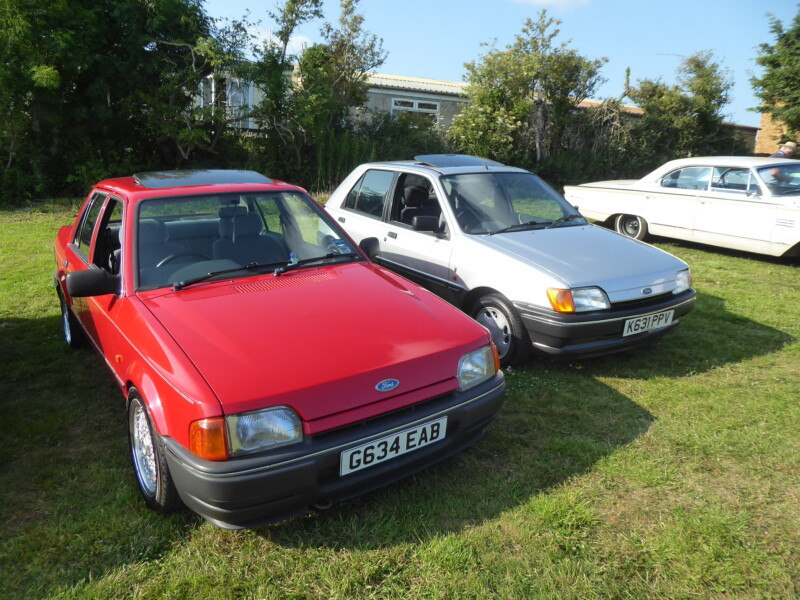
Ford updated the Fiesta in August 1983 with a revised front end and interior, and a bootlid mirroring the swage lines from the sides of the car. The 1.3 L OHV engine was dropped, being replaced in 1984 by a CVH powerplant of similar capacity, itself superseded by the lean burn 1.4 L two years later. The 957 and 1,117 cc Kent/Valencia engines continued with only slight alterations and for the first time a Fiesta diesel was produced with a 1,600 cc engine adapted from the Escort. The new CTX continuously variable transmission, also fitted in the Fiat Uno, eventually appeared early in 1987 on 1.1 L models only. The second generation Fiesta featured a different dashboard on the lower-series trim levels compared to the more expensive variants. The recently launched XR2 model was thoroughly updated with a larger bodykit. It also featured a 96 bhp 1.6 litre CVH engine as previously seen in the Ford Escort XR3, and five-speed gearbox rather than the four-speed gearbox which had been used on the previous XR2 and on the rest of the Fiesta range. The engine was replaced by a lean-burn variant in 1986 which featured a revised cylinder head and carburettor; it was significantly cleaner from an environmental viewpoint but was slightly less powerful as a result with 95 bhp.


A sporting version of Ford’s front wheel drive Escort was announced at the same time as the “cooking” 1.1, 1.,3 and 1,6 litre cars in October 1980. This was the XR3, and it came initially with a carb fed 1.6 litre engine generating 105 bhp and had a four speed gearbox. Fuel injection finally arrived in October 1982 (creating the XR3i), eight months behind the limited edition (8,659 examples), racetrack-influenced RS 1600i. The Cologne-developed RS received a more powerful engine with 115 PS, thanks to computerised ignition and a modified head as well as the fuel injection. For 1983, the XR3i was upgraded to 115bhp thanks to the use of fuel injection and a five speed transmission had been standardised. Both variants proved very popular, getting a significant percentage of Escort sales and also as a slightly more affordable alternative to a Golf GTi. For those for whom the performance was not quite enough, Ford had an answer, withe the RS Turbo. This 132 PS car was shown in October 1984, as a top of the range car, offering more power than the big-selling XR3i and the limited production RS1600i. Going on sale in the spring of 1985, it proved to be somewhat of a disappointment, with the chassis coming in for severe criticism. The RS Turbo Series 1 was only marketed in a few European nations as production was limited to 5,000 examples, all in white. They were well equipped, with the alloy wheels from the limited production RS 1600i, Recaro seats, and a limited slip differential. One car only was finished in black; it was built especially for Lady Diana. Ford facelifted the entire Escort range in January 1986, and a few months later, a revised Series 2 RS Turbo emerged, which adopted the styling changes of the less potent models, and the new dashboard, as well as undergoing a mechanical revision and the addition of more equipment including anti-lock brakes. The Series 2 cars were available in a wider range of colours.


March 1986 saw the Orion getting the same facelift as the Escort. Internally within Ford it is regarded as an updated model (Apollo-86) rather than a new generation, although it is popularly known as the Mark II. The Mark II brought the option of anti-lock-brakes (ABS) and a heated front windscreen to the range. The base “L” version came with an additional 1.3 litre engine option which used the OHV “‘Valencia’ engine as used on the Escort, whilst a new 1.4 litre CVH engine option was introduced. This (along with the 1.6 CVH ) was a “lean burn unit” and various models in the range could run on unleaded fuel without modifications to the cylinder head or to the fuel system. Improved locks were fitted across the range initially being of the Chubb AVA design but soon after replaced with the Tibbe type; same as with the Escort, and a number of other improvements were carried out including new suspension and gearbox mounts, updated interior and trim changes, improved soundproofing and revised steering and suspension settings. Trim levels now included the entry-level L, Biscane (special edition) LX, Equipe (special edition) GL, GLS (special edition), Ghia, Ghia Injection and from 1988 the 1600E (special edition).


A completely new Fiesta, codenamed BE-13 was unveiled at the end of 1988 and officially went on sale in February 1989. The car was based on a new platform ditching the old car’s rear beam axle for a semi-independent torsion beam arrangement and looked radically different, addressing the principal weakness of the previous generation – the lack of a 5-door derivative, something that was by then available in its major rivals such as the Fiat Uno, Peugeot 205 and 106 and Opel Corsa/Vauxhall Nova. The other main change was to the running gear – the improved HCS (High Compression Swirl) version of the Kent/Valencia powerplant. The CVH units from the second generation were carried over largely unmodified. The diesel engine was enlarged to a 1.8L capacity. As for sports models, the XR2i was launched in August 1989 with an eight-valve CVH (standing for “compound valve-angle hemispherical combustion chamber”) engine with 104 PS. This was the first Fiesta to have a fuel-injected engine. This was then replaced by a Zetec 16 valve version in 1992, which also saw the RS Turbo being supplanted by the RS1800 as the CVH engine was being phased out. The RS1800 shared its 1.8 litre Zetec fuel-injected engine with the 130 bhp version of the then current Ford Escort XR3i and had a top speed of 125 mph. The XR2i name was also dropped in early 1994, and the insurance-friendly “Si” badge appeared in its place on a slightly less sporty-looking model with either the 1.4 L PTE (a development of the CVH) or the 1.6 L Zetec engine.

JEEP
While the full-sized Wagoneer continued production for another eight years as the Grand Wagoneer, the Cherokee nameplate was moved to a new platform starting with the 1984 model year and continuing through 2001. Without a traditional body-on-frame chassis, the Cherokee instead featured a lightweight unibody design. This generation of Cherokee would eventually be well known as the innovator of the modern SUV, as it spawned competitors, and other automakers noticed that this Jeep design began replacing regular cars. It also began to supplant the role of the station wagon and “transformed from truck to limousine in the eyes of countless suburban owners.” The XJ is a “significant link in the evolution of the 4×4.” It would prove so popular that the second generation Cherokee’s replacement was released as a separate vehicle, the Jeep Grand Cherokee, starting a successive line of Jeep flagship models.

LANCIA
Replacing the Aurelia was the Flaminia, which although superficially similar to its illustrious predecessor and materially “better” in just about every respect, never managed to capture buyers’ imaginations in the same way when new, and even now, it has to play second fiddle to the older car. The first model in the range was the Berlina, which was launched at the 1957 Geneva Show. It had a Pininfarina styled body which took much inspiration from the Florida concept car that had been shown in the previous year. Much was new under the skin. Its larger 2.5 litre 100 bhp V6 engine was new in detail, and was designed to allow for further increases in capacity, which would come in time. I was smoother than the Aurelia engines and had more torque, and with better cylinder head design and revised cooling, it was more robust, as well. There was synchromesh on all four gears. Lancia’s famous sliding pillar suspension was banished in favour of unequal length wishbones and coil springs which required less maintenance and were more refined. But the car was heavy, and complex, and exceedingly expensive. Lancia thought that their customers would pay a premium for “the best”, but tastes were changing, and the Berlina was never a strong seller, with fewer than 3000 of them being constructed, most of them being the first series cars. Just 549 of the later second series model with 110 bhp and disc brakes were made between 1961 and 1963, hardly surprising when the car cost more than a Rolls Royce Silver Cloud, as it did in the UK. The later cars had a 2.8 litre engine and 125 bhp, and just 599 of these were made between 1963 and 1968. There was more success with the coachbuilt two door variants which joined the range. The most successful of these, the Pininfarina Coupe, was the first to appear. This was made between 1959 and 1967, during which time 5284 of these mostly steel-bodied cars were constructed. In many ways they were very like the Berlina, just a bit smaller, though there was a floor mounted gear lever, and the cars had more power. The first 3200 of them had a 119 bhp single carb engine with a sport camshaft. Later 3Bs had a triple choke Solex from 1962 and the power went up to 136 bhp. It was only a year after the Pininfarina car’s debut when Touring of Milan announced their Flaminia models. These aluminium bodied cars were sold in three distinct variants between 1960 and 1965. The single carburettor GT was followed by a Convertible in 1960, both of them uprated to 140 bhp triple Weber 3C spec in 1961. The 2.8 litre 3C took over in 1963 and were supplemented by a new 2+2 version called the GTL, with a taller roofline, front-hinged bonnet, longer doors and more substantial seats. It is the rarest of all Flaminia models, with just 300 made. The styling house to offer a car was Zagato, with their Sports and SuperSports. Only 526 were made and there is a complicated production history which probably shows the sort of chaotic thinking that was going on at Lancia and which would lead to is bankruptcy and take over by Fiat in 1969. The first 99 Sports had faired-in headlights and the 119 bhp engine. From 1960 another 100 cars were built with expose lights until the introduction of the Sport 3C with the 140 bhp triple carb. Zagato made 174 of those in 1962 and 1963, still with the exposed lights. The faired-in lights returned in 1964 on the SuperSport, which also had a Kamm tail, and with DCN Webers this one put out 150 bhp. 150 of these were made between 1964 and 1967. Many of the earlier cars were upgraded early in their life, so if you see one now, you cannot be totally sure of is true origin. Production of the car ceased in 1970, with fewer than 13,000 Flaminia of all types having been built. These days, the cost to restore them properly – and it is a huge job – exceeds the value of most of them, by some margin, as Berlina and Coupe models tend not to sell for more than £30k. The Zagato cars are a different matter, and when they come up for sale, routinely go for over £300k. The Touring cars – considered by most to be the prettiest tend to be around £100k for the GT and another 50 – 80k for a convertible – a long way from the value of an Aston Martin DB4 Volante, which cost roughly the same when new. There’s believed to be only one Berlina on the road in the UK, so that is going to remain a rare sighting, and it was not here. The car here was one of the Touring GT models.


LOTUS
Known internally as the Type 89, the Excel, built from 1982 to 1992, was a development of the earlier Lotus Eclat, which itself was based on the Type 75 Elite. Although a promising design, the Elite and Eclat had suffered from numerous quality control issues which were difficult for owners to accept given the price of the cars. The Excel was a concerted effort to address these, and it stood every chance of so doing, as it took advantage of the relationship with Toyota. This had started when Toyota engaged Lotus to assist with engineering work on the Supra. During this period, Toyota then became a major shareholder in Lotus. Part of the deal between the two included the use of many Toyota mechanical components in Lotus’ cars. The original Excel (aka the Eclat Excel) used the W58 manual transmission, driveshafts, rear differential, 14×7 in alloy wheels, and door handles from the Supra Mk II, which was made from 1982 to 1986. The engine was the familiar all-aluminium, DOHC 2.2 litre Lotus 912 Slant Four which was also used in the Lotus Esprit S3. During its lifetime, the Excel received two major upgrades. With the introduction of the Excel SE which had a 180 bhp engine vs the standard 160 bhp car in October 1985, the bumpers, wing and interior was changed, including a new dashboard. In October 1986 the Excel SA with automatic gearbox was introduced. Further facelifts in 1989 saw Citroën-derived mirrors, as featured on the Esprit, and 15 inch OZ alloy wheels to a similar pattern as the Esprit’s. According to Lotus records, only 1 Excel was manufactured to USA specification. The lack of release in the USA was due to the high emission regulations (which would hinder the car’s performance), and poor sales of the car in Europe.


MASERATI
Sole Maserati model here was my Grecale.


MERCURY
For 1961, Mercury underwent a major transformation of its model line. In a transition from 1957 to 1960, Mercury again shared a bodyshell with a divisional counterpart, shifting from Edsel to Ford, with the Monterey becoming the equivalent of the Ford Galaxie. The Montclair and Park Lane were discontinued, shifting the Monterey from the base-trim Mercury sedan to its flagship, slotted above the newly introduced Mercury Meteor (as with the Comet, intended as an Edsel before the discontinuation of the division). One of the first examples of downsizing, by adopting a common chassis and body with Ford, the Monterey lost six inches of wheelbase, nearly two inches of width, and over 4 inches of length; dependent on powertrain, the 1961 Monterey shed over 300 pounds of curb weight. At 120 inches, the Monterey was given a 1-inch longer wheelbase than the Galaxie. The Monterey was offered in four bodystyles, including two and four-door hardtops, a four-door sedan, and a two-door convertible. Sharing its roofline with the Galaxie (except for the Starliner fastback), the Monterey differed primarily by its grille; in place of two large taillamps, Mercury used six small taillamps. While slightly more adorned than its Galaxie counterpart, the Monterey continued to adopt more subdued styling, shifting chrome trim nearly entirely to the front and rear fascias and the roofline. Shared with the Ford Galaxie, the Monterey again received the 292 cubic-inch Y-block V8 (175 hp), with the option of 352 and 390 cubic-inch FE V8s (220 hp and 300/330 hp, respectively). As before, 3-speed manual and 3-speed automatics were offered, with a 4-speed manual becoming an option. For 1962, the Monterey served as the entire full-size Mercury line, as Mercury shifted the Meteor nameplate to its all-new intermediate sedan range. The six-cylinder Monterey 6 was introduced, inheriting a 135 hp 223 cubic-inch Mileage Maker inline-6 from the Meteor. To better distinguish the Monterey, stylists added a convex grille (opposed to the flat grille used by Ford); the taillamps were added to the end of the tailfins (further reducing them in size). Intended as the Mercury counterpart of the Ford Galaxie 500XL, the Mercury S-55 was introduced as an option for two-door Monterey hardtops and convertibles, offering front bucket seats, floor-mounted shifters, and special trim. While offered with any Monterey engine, the S-55 option also offered a 405 hp 406 cubic-inch V8. For 1963, the Monterey underwent a substantial revision to its roofline, reintroducing the retractable rear window used by the 1958-1960 Continental model line and the Mercury Turnpike Cruiser. While again using the reverse-slant design, the power-window mechanism was borrowed from the station wagon line. Named “Breezeway”, the retractable rear window was standard on all non-convertible Montereys and S-55s. The front grille adopted a sharply-divided concave design, with the six-lens taillamp rear fascia making a return. As a 19631⁄2 vehicle, Mercury introduced the Mercury Marauder as a trim package for the Monterey; to better compete in racing, Mercury mated the body of the Monterey with the roofline of the Ford Galaxie hardtop. While technically a Monterey trim package, the Marauder option could be combined with the S-55 trim. The powertrain line underwent a similar revision, as the 223 six and 292 and 352 V8s were dropped, with a 250 hp 390 becoming the standard engine; a 300 hp 390 was offered, along with 385 hp and 405 hp versions of the 406 V8. As a running change during 1963, the 406 was replaced by a 427 cubic-inch V8, in 410 hp and 425 hp outputs (the latter offered only through special order). For 1964, Mercury revised its sedan offerings; while the S-55 was discontinued, the Montclair and Park Lane made their return. In another change, the Marauder fastback was introduced as a four-door hardtop (giving Mercury a second roofline distinct from Ford); while performance-oriented, all three Mercury sedans offered the Marauder roofline as an option. In line with the Ford Thunderbird, the entire front fascia became more convex, with a more closely-fitting front bumper. Coinciding with the Montclair and Park Lane, the Monterey was reintroduced as a two-door sedan; the four-door hardtop was only offered as a Marauder fastback.


MG
Final version of the popular T Series sports car was the TF, launched on the 15 October 1953. Although it looked quite a bit different, this was really just a facelifted TD, fitted with the TD Mark II engine, headlights faired into the wings, a sloping radiator grille concealing a separate radiator, and a new pressurised cooling system along with a simulated external radiator cap. This XPAG engine’s compression ratio had been increased to 8.1:1 and extra-large valves with stronger valve springs and larger carburettors increased output to 57.5 bhp at 5,500 rpm. In mid-1954 the engine capacity was increased by 17 per cent to 1466 cc and designated XPEG. The bore was increased to 72 mm and compression raised to 8.3:1 giving 63 bhp at 5,000 rpm and a 17 per cent increase in torque. The car was now designated TF1500, and externally distinguished by a cream background enamel nameplate on both sides of the bonnet, placed just to the rear of the forward bonnet-release buttons. Production ended at chassis number TF10100 on 4 April 1955 after 9,602 TFs had been manufactured, including two prototypes and 3,400 TF1500s. A number of replica models have been built in more recent years, with the Naylor of the mid 1980s being perhaps the best known.

As one of Britain’s most popular classic cars, it was no surprise to find several examples of the MGB here, with cars from throughout the model’s long life, both in Roadster and MGB GT guise, as well as one of the short-lived V8 engined cars. Launched in October 1962, this car was produced for the next 18 years and it went on to become Britain’s best selling sports car. When first announced, the MGB was an innovative, modern design, with a monocoque structure instead of the traditional body-on-frame construction used on both the MGA and MG T-types and the MGB’s rival, the Triumph TR series, though components such as the brakes and suspension were developments of the earlier 1955 MGA and the B-Series engine had its origins back in 1947. The lightweight design reduced manufacturing costs while adding to overall vehicle strength, and with a 95hp 3-bearing 1798cc engine under the bonnet, performance was quite respectable with a 0–60 mph time of just over 11 seconds. The car was rather more civilised than its predecessor, with wind-up windows now fitted as standard, and a comfortable driver’s compartment offered plenty of legroom. The roadster was the first of the MGB range to be produced. The body was a pure two-seater but a small rear seat was a rare option at one point. By making better use of space the MGB was able to offer more passenger and luggage accommodation than the earlier MGA while being 3 inches shorter overall. The suspension was also softer, giving a smoother ride, and the larger engine gave a slightly higher top speed. The four-speed gearbox was an uprated version of the one used in the MGA with an optional (electrically activated) overdrive transmission. A five-bearing engine was introduced in 1964 and a number of other modifications crept into the specification. In late 1967, sufficient changes were introduced for the factory to define a Mark II model. Alterations included synchromesh on all 4 gears with revised ratios, an optional Borg-Warner automatic gearbox, a new rear axle, and an alternator in place of the dynamo with a change to a negative earth system. To accommodate the new gearboxes there were significant changes to the sheet metal in the floorpan, and a new flat-topped transmission tunnel. US market cars got a new safety padded dashboard, but the steel item continued for the rest of the world. Rostyle wheels were introduced to replace the previous pressed steel versions in 1969 and reclining seats were standardised. 1970 also saw a new front grille, recessed, in black aluminium. The more traditional-looking polished grille returned in 1973 with a black “honeycomb” insert. Further changes in 1972 were to the interior with a new fascia. To meet impact regulations, in late 1974, the chrome bumpers were replaced with new, steel-reinforced black rubber bumpers, the one at the front incorporating the grille area as well, giving a major restyling to the B’s nose, and a matching rear bumper completed the change. New US headlight height regulations also meant that the headlamps were now too low. Rather than redesign the front of the car, British Leyland raised the car’s suspension by 1-inch. This, in combination with the new, far heavier bumpers resulted in significantly poorer handling. For the 1975 model year only, the front anti-roll bar was deleted as a cost-saving measure (though still available as an option). The damage done by the British Leyland response to US legislation was partially alleviated by revisions to the suspension geometry in 1977, when a rear anti-roll bar was made standard equipment on all models. US emissions regulations also reduced horsepower. In March 1979 British Leyland started the production of black painted limited edition MGB roadsters for the US market, meant for a total of 500 examples, but due to a high demand, production ended with 6682 examples. The United Kingdom received bronze painted roadsters and a silver GT model limited editions. The production run of home market limited edition MGBs was split between 421 roadsters and 579 GTs. Meanwhile, the fixed-roof MGB GT had been introduced in October 1965, and production continued until 1980, although export to the US ceased in 1974. The MGB GT sported a ground-breaking greenhouse designed by Pininfarina and launched the sporty “hatchback” style. By combining the sloping rear window with the rear deck lid, the B GT offered the utility of a station wagon while retaining the style and shape of a coupe. This new configuration was a 2+2 design with a right-angled rear bench seat and far more luggage space than in the roadster. Relatively few components differed, although the MGB GT did receive different suspension springs and anti-roll bars and a different windscreen which was more easily and inexpensively serviceable. Although acceleration of the GT was slightly slower than that of the roadster, owing to its increased weight, top speed improved by 5 mph to 105 mph because of better aerodynamics. 523,826 examples of the MGB of all model types were built, and although many of these were initially sold new in North America, a lot have been repatriated here.


MORGAN
Initially presented at the 2005 Geneva Motor Show as a bespoke car built for a well respected Morgan customer Prince Eric Sturdza of Banque Baring Sturdza in Geneva, the AeroMax was the next development of the Aero chassis. The car is named after Charles Morgan’s son Max. Due to the level of interest at the show and with the agreement of Prince Sturdza a limited production run of 100 in celebration of Morgan’s centenary was agreed, with final numbers ending slightly over this due to replacement of crashed cars. Production was initiated in 2008 and completed in 2009. The iconic design was created by Matt Humphries, a 21 year old Coventry University Graduate working at the factory. The Empire Line or Art Deco influenced styling has often been compared to cars such as classic Bugattis whilst retaining a clear family relationship with Morgan’s other cars. Many refinements were made to the overall shape including the use of the rear lights from the Lancia Thesis, flush fit of the doors and changes to the interior finish. The Rays alloy wheels introduced on this model became popular on other models following the AeroMax. It was the first Morgan to have a retail price above £100,000 at £110,000 but sold out within a few months. The taillights used on AeroMax, Aero Supersports, Aero Coupe and Aero 8 Series 5 were borrowed from Lancia Thesis.


MORRIS
No surprise to see the evergreen Morris Minor here as this is a very popular classic. The Minor was conceived in 1941. Although the Nuffield Organization was heavily involved in war work and there was a governmental ban on civilian car production, Morris Motors’ vice chairman, Miles Thomas, wanted to prepare the ground for new products to be launched as soon as the war was over. Vic Oak, the company’s chief engineer, had already brought to Thomas’ attention a promising junior engineer, Alec Issigonis, who had been employed at Morris since 1935 and specialised in suspension design but he had frequently impressed Oak with his advanced ideas about car design in general. Issigonis had come to Oak’s particular attention with his work on the new Morris Ten, which was in development during 1936/7. This was the first Morris to use unitary construction and was conceived with independent front suspension. Issigonis designed a coil-sprung wishbone system which was later dropped on cost grounds. Although the design would later be used on the MG Y-type and many other post-war MGs the Morris Ten entered production with a front beam axle. Despite his brief being to focus on the Ten’s suspension Issigonis had also drawn up a rack and pinion steering system for the car. Like his suspension design this was not adopted but would resurface in the post-war years on the MG Y-type, but these ideas proved that he was the perfect candidate to lead the design work on a new advanced small car. With virtually all resources required for the war effort, Thomas nonetheless approved the development of a new small family car that would replace the Morris Eight. Although Oak (and Morris’ technical director, Sidney Smith) were in overall charge of the project it was Issigonis who was ultimately responsible for the design, working with only two other draughtsmen. Thomas named the project ‘Mosquito’ and ensured that it remained as secret as possible, both from the Ministry of Supply and from company founder William Morris (now Lord Nuffield), who was still chairman of Morris Motors and, it was widely expected, would not look favourably on Issigonis’ radical ideas. Issigonis’ overall concept was to produce a practical, economical and affordable car for the general public that would equal, if not surpass, the convenience and design quality of a more expensive car. In later years he summed up his approach to the Minor; that he wanted to design an economy car that “the average man would take pleasure in owning, rather than feeling of it as something he’d been sentenced to” and “people who drive small cars are the same size as those who drive large cars and they should not be expected to put up with claustrophobic interiors.” Issigonis wanted the car to be as spacious as possible for its size and comfortable to drive for inexperienced motorists. Just as he would with the Mini ten years later, he designed the Mosquito with excellent roadholding and accurate, quick steering not with any pretence of making a sports car, but to make it safe and easy to drive by all. As work proceeded, there were plenty of battle to overcome, to get Issigonis’ ideas approved, and not all of them were. The production car, called the Minor was launched at the British Motor Show at Earls Court in London on October 27, 1948. At the same show Morris also launched the new Morris Oxford and Morris Six models, plus Wolseley variants of both cars, which were scaled-up versions of the new Minor, incorporating all the same features and designed with Issigonis’ input under Vic Oak’s supervision. Thus Issigonis’ ideas and design principles underpinned the complete post-war Morris and Wolseley car ranges. The original Minor MM series was produced from 1948 until 1953. It included a pair of four-seat saloons, two-door and (from 1950) a four-door, and a convertible four-seat Tourer. The front torsion bar suspension was shared with the larger Morris Oxford MO, as was the almost-unibody construction. Although the Minor was originally designed to accept a flat-4 engine, late in the development stage it was replaced by a 918 cc side-valve inline-four engine, little changed from that fitted in the 1935 Morris 8, and producing 27.5 hp and 39 lbf·ft of torque. This little engine pushed the Minor to just 64 mph but delivered 40 mpg. Brakes were four-wheel drums. Early cars had a painted section in the centre of the bumpers to cover the widening of the production car from the prototypes. This widening of 4 inches is also visible in the creases in the bonnet. Exports to the United States began in 1949 with the headlamps removed from within the grille surround to be mounted higher on the wings to meet local safety requirements. In 1950 a four-door version was released, initially available only for export, and featuring from the start the headlamps faired into the wings rather than set lower down on either side of the grille. The raised headlight position became standard on all Minors in time for 1951. From the start, the Minor had semaphore-type turn indicators, and subsequent Minor versions persisted with these until 1961 An Autocar magazine road test in 1950 reported that these were “not of the usual self-cancelling type, but incorporate[d] a time-basis return mechanism in a switch below the facia, in front of the driver”. It was all too easy for a passenger hurriedly emerging from the front passenger seat to collide with and snap off a tardy indicator “flipper” that was still sticking out of the B-pillar, having not yet been safely returned by the time-basis return mechanism to its folded position. Another innovation towards the end of 1950 was a water pump (replacing a gravity dependent system), which permitted the manufacturer to offer an interior heater “as optional equipment”. When production of the first series ended, just over a quarter of a million had been sold, 30 per cent of them the convertible Tourer model. In 1952, the Minor line was updated with an Austin-designed 803 cc overhead valve A-series engine, replacing the original side-valve unit. The engine had been designed for the Minor’s main competition, the Austin A30, but became available as Austin and Morris were merged into the British Motor Corporation. The new engine felt stronger, though all measurements were smaller than the old. The 52 second drive to 60 mph was still calm, with 63 mph as the top speed. Fuel consumption also rose to 36 mpg. An estate version was introduced in 1952, known as the Traveller (a Morris naming tradition for estates, also seen on the Mini). The Traveller featured an external structural ash (wood) frame for the rear bodywork, with two side-hinged rear doors. The frame was varnished rather than painted and a highly visible feature of the body style. Commercial models, marketed as the Morris Quarter Ton Van and Pick-up were added in May 1953. Rear bodies of the van versions were all steel. The 4-seat convertible and saloon variants continued as well. The car was again updated in 1956 when the engine was increased in capacity to 948 cc. The two-piece split windscreen was replaced with a curved one-piece one and the rear window was enlarged. In 1961 the semaphore-style trafficators were replaced by the flashing direction indicators, these were US-style red at the rear (using the same bulb filament as the brake lamp) and white at the front (using a second brighter filament in the parking lamp bulb) which was legal in the UK and many export markets at the time (such as New Zealand). An upmarket car based on the Minor floorpan using the larger BMC B-Series engine was sold as the Riley One-Point-Five/Wolseley 1500 beginning in 1957: versions of this Wolseley/Riley variant were also produced by BMC Australia as the Morris Major and the Austin Lancer. In December 1960 the Morris Minor became the first British car to sell more than 1,000,000 units. To commemorate the achievement, a limited edition of 350 two-door Minor saloons (one for each UK Morris dealership) was produced with distinctive lilac paintwork and a white interior. Also the badge name on the side of the bonnet was modified to read “Minor 1,000,000” instead of the standard “Minor 1000”. The millionth Minor was donated to the National Union of Journalists, who planned to use it as a prize in a competition in aid of the union’s Widow and Orphan Fund. The company, at the same time, presented a celebratory Minor to London’s Great Ormond Street Hospital for Sick Children, but this car was constructed of cake.The final major upgrades to the Minor were made in 1962. Although the name Minor 1000 was retained, the changes were sufficient for the new model to be given its own ADO development number. A larger version of the existing A-Series engine had been developed in conjunction with cylinder head specialist Harry Weslake for the then new ADO16 Austin/Morris 1100 range. This new engine used a taller block than did the 948 cc unit, with increased bore and stroke bringing total capacity up to 1,098 cc. Although fuel consumption suffered moderately at 38 mpg, the Minor’s top speed increased to 77 mph with noticeable improvements in low-end torque, giving an altogether more responsive drive. Other changes included a modified dashboard layout with toggle switches, textured steel instrument binnacle, and larger convex glove box covers. A different heater completed the interior upgrade, whilst the larger combined front side/indicator light units, common to many BMC vehicles of the time, were fitted to the front wings. These now included a separate bulb and amber lens for indicators while larger tail lamp units also included amber rear flashers. During the life of the Minor 1000 model, production declined. The last Convertible/Tourer was manufactured on 18 August 1969, and the saloon models were discontinued the following year. Production of the more practical Traveller and commercial versions ceased in 1972, although examples of all models were still theoretically available from dealers with a surplus of unsold cars for a short time afterwards. 1,619,857 Minors of all variants were ultimately sold.

NISSAN
Like its predecessor, the R33 GT-R was the most extreme version of a range of Skyline cars, which in R33 guise were launched in 1993 and would go on to be produced for 6 years. The previous R32 model was a well proven build but the R32 wasn’t without faults and suffered with uplift and balance issues. Along with that, Nissan was as other Japanese companies were under strict restrictions on power gains. So Nissan had to combat all these areas so the sophisticated strength Programme was made. Nissan increased the width by about one inch on the R33 to the R32 and made it about 4 inches longer. This gave the R33 a longer wheelbase overall and lower stance mixed with new technology now from the computer aerodynamic age. Each line on the R33 was intended to give the car ultimate aerodynamics with wider gaps in the bumper and angles of air movement which allowed better cooling, in addition to the fuel tank lifted; the battery moved to the boot/trunk. Rigidity points were added mixed with improvements on the Attessa and Hicas all now offered the R33 with the best aerodynamics, balance, and handling. Nissan engineers also found other ways to reduce weight, even by a few grams. This includes: Hollowing out the side door beams. Using high tensile steel on body panels. Reduction in sound deadening materials. Super HICAS becoming electric. Hollowing out of rear stabiliser bar. Use of high tensile springs front and rear. Shrinking the ABS actuator. Light aluminium wheels with higher rigidity The front and rear axles were made of aluminium (as in the BNR32) but also so were engine mount insulators and brackets New plastics were used for : fuel tank, head lamps, super high strength “PP” bumpers, air cleaner, changing the headlining material, changing material of rear spoiler. All this put together meant we saw an improved time against the R32 of 21 seconds faster around the Nurburgring and 23 seconds faster in V spec trim. Still making the R33 the fastest skyline around the Nurburgring. The BCNR33 GT-R version also had the same RB26DETT engine that the BNR32 was equipped with, although torque had been improved, due to changes in the turbo compressor aerodynamics, turbo dump pipe, and intercooler. The turbo core changed from a sleeve bearing to a ball bearing, but the turbine itself remained ceramic, except on N1 turbos (steel turbine, sleeve bearing). From the R33 onward, all GT-Rs received Brembo brakes. In 1995 the GT-R received an improved version of the RB26DETT, the ATTESA-ETS four-wheel-drive system, and Super HICAS 4-wheel steering. A limited edition model was created in 1996, called the NISMO 400R, that produced 400 hp from a road-tuned version of Nissan’s Le Mans engine. A stronger six-speed Getrag gearbox was used. An R33 GT-R driven by Dirk Schoysman lapped the Nordschleife in less than 8 minutes. The Skyline GT-R R33 is reported to be the first production car to break 8 minutes, at 7 minutes and 59 seconds. Other manufacturers had caught up since the R32 was released, and the R33 never dominated motorsport to the extent of the R32. The R33 saw victory in the JGTC GT500 dominating the class and taking victory each year until its final racing year in which it was finally beaten by the Mclaren F1 GTR. The R33 saw huge favour in the tuning world with it being a popular model on the Wangan and top tuning companies building heavily tuned version from Top Secret ran by Smokey Nagata to Jun etc. and later by companies like Sumo. HKS GT-R would hold a drag series record for several years in there drag series making a record win of 7.671-second pass at Sendai Hi-Land Raceway with Tetsuya Kawasaki behind the wheel and taking it to be the World’s fastest AWD car.

RENAULT
The Renault 4, also known as the 4L (pronounced “Quatrelle” in French), is a small economy car produced by the French automaker Renault between 1961 and 1994. It was the first front-wheel drive family car produced by Renault. The car was launched at a time when several decades of economic stagnation were giving way to growing prosperity and surging car ownership in France. The first million cars were produced by 1 February 1966, less than four and a half years after launch; eventually over eight million were built, making the Renault 4 a commercial success because of the timing of its introduction and the merits of its design. The Renault 4 was Renault’s response to the 1948 Citroën 2CV. Renault was able to review the advantages and disadvantages of the 2CV design. The Citroën had made motoring available to low-income people in France, and especially to farmers and other people in rural areas, for whom the car was as much a working tool as personal transport. The 2CV had been designed in the 1930s for use in the French countryside where the road network was poor – speed was not a requirement but a good ride, useful rough-terrain ability, a versatile body for load carrying, and economy and simplicity of operation were its key considerations. However, by the late 1950s, the 2CV was becoming outdated. Rural roads in France were improved and the national system of autoroutes was being developed. Agriculture was becoming more mechanized with fewer smallholdings and family farms for which the 2CV was designed. The Citroën had also proved popular with people living in towns and cities as affordable, economical transport but the 2CV’s rural design brief made it less than ideal as a city car and, despite improvements, the late-1950s 2CV had a top speed of just 70 km/h (43 mph). Its air-cooled two-cylinder engine was reliable and economical but noisy and offered poor performance. The 2CV’s suspension gave it an excellent ride and good grip and handling but was mechanically complex with many moving parts that required regular maintenance and lubrication at intervals as low as every 1000 miles (1600km). With its roots in the 1930s, the 2CV’s styling was also outdated and, with its separate wing/fenders, had a relatively narrow and cramped body for its overall footprint. While the Citroën had been designed during the Great Depression when money was tight and living standards were relatively low, by the 1960s the French economy was growing and people would be able to afford a more modern, refined, and less utilitarian small car. In early 1956, Renault Chairman Pierre Dreyfus launched this new project: designing a new model to replace the rear engined 4CV and compete against the Citroën 2CV that would become an everyman’s car, capable of satisfying the needs of most consumers. It would be a family car, a woman’s car, a farmer’s car, or a city car. The Renault 4 shared many design traits with the older Citroën 2CV to allow it to fulfill the same role as a versatile utility car, especially for people in rural France and other parts of the world with poor roads. It had a large structural platform with a separate body. It had front-wheel drive, long-travel fully independent suspension, and Rack and pinion steering. It had a simple body with minimal equipment, a large space for cargo or luggage, and ‘deckchair’ seats which could be easily removed. However, the Renault 4 updated this basic concept with a larger four-cylinder water-cooled engine with a sealed cooling system offering much better refinement and performance than the contemporary 2CV, with a top speed of over 104 km/h (65 mph). The suspension consisted of torsion bars which required no regular maintenance. The boxy full-width body offered more space for both passengers and luggage than the similar-sized 2CV and the car boasted an early hatchback body for greater practicality. Renault launched the Renault 3 and the Renault 4 simultaneously in July 1961. The cars shared the same body and most mechanical components, but the R3 was powered by a 603 cc version of the engine while the R4 featured a 747 cc engine. This placed the R3 in the 3CV taxation class while the R4 was in the 4CV class. Maximum power output was rated by Renault as 22.5 hp for the R3, and 26.5 or 32 hp for the R4, depending on price level and the type of carburettor fitted. Initially the base versions of the R3 and R4 came with a thick C-pillar behind each of the rear doors. Quarter glass was a 400 francs option for the basic R4. The extra visibility increased the weight of the vehicle, but these windows soon became standard for all R4s. The R3 and R4 were targeted at the Citroën 2CV that employed soft springs and long wheel travel to absorb bumps on rough roads. The Renault 3/4 applied the same approach and two models appeared at the Paris Motor Show in 1961 on a specialized demonstration display that incorporated an irregular rolling road. Visitors could sit inside a car, which remained undisturbed while the suspension absorbed the erratic bumps of the rolling road. In 1962 Renault employed the same display at the Turin Motor Show. The basic version of the R3 was priced 40 francs below the lowest-priced version of the Citroën 2CV in 1961 and featured painted bumpers and grill, a simplified instrument panel, a single sun visor, no windshield washer, and no interior door trim panels. This trim was also offered in the more powerful R4. The R4L with six side windows, chrome-colored bumper and grill, as well as a less spartan interior cost 400 francs (roughly 8%) more than the R4 with its four side windows. However, as with the Renault 4CV “Service” in 1953, customers shunned the basic model and in October 1962, the Renault R3 was discontinued, along with the most basic version of the Renault 4. A “super” version (branded “de luxe” in some export markets) with opening rear quarter-light windows and extra trim was also offered. The de luxe and super versions of the R4L received a version of the engine from the Renault Dauphine giving them an engine capacity of 845 cc. After the withdrawal of the 603 cc engined R3, the 747 cc R4 model continued to be listed with an entry-level recommended retail price, but the slightly larger-engined L versions were more popular. By 1965, Renault had removed the extra “R” from their model names: the Renault R4L had become the Renault 4L. Early versions of the Renault R4 used engines and transmissions from the Renault 4CV. The original design brief called for an engine size between 600 cc and 700 cc, but there was no consensus as to whether to use a four-cylinder unit or to follow Citroën with a two-cylinder unit. With Volkswagen rapidly growing market share across Europe and North America, Renault also gave serious consideration to an air-cooled boxer motor option for the forthcoming R3/R4. However, using the existing water-cooled unit from the 4CV was a solution, especially in view of the extended period of teething troubles encountered by the Renault Fregate, which was then Renault’s most recent attempt to develop an innovative powerplant. The existing engines were larger than that specified by management for the new 4CV, but the automaker addressed this by reducing the bore so that the overall capacity of the base engine for the new R3 worked out to be 603 cc, comfortably at the lower end of the required 600–700 cc range. However, since Renault already produced the 747 cc version of the engine that was well proven in the 4CV, it made sense to use this as well in what would in many respects be the older car’s successor. Therefore, in 1961, the R3 had a 49 mm bore and 80 mm stroke, while the R4 received the 54.5 mm × 80 mm existing engine. Moving the engine from the rear of the 4CV to the front of the new model involved significant planning: design changes to the unit were introduced as part of the process. The inlet manifold was now a steel casting whereas on the 4CV it had been constructed of a light-weight alloy: this was driven by cost considerations now that aluminum was not so inexpensive as it had been fifteen years earlier. Renault also took the opportunity to introduce a feature which subsequently became mainstream. Renault also designed a “sealed-for-life” cooling system, supported by a small expansion tank on the right side of the engine bay. The cooling system contained antifreeze intended to enable operation without topping up or other intervention throughout a car’s life provided ambient temperatures below -40 C were avoided. The engines were larger than the small 425 cc (later 602 cc and 29 hp), engines in the 2CV. The R4 always had a four-cylinder watercooled engine. The original Renault R4’s engine capacity of 747 cc served to differentiate the model from the more powerful Renault Dauphine, but the Dauphine’s 845 cc engine was used in the 4 itself from 1963 onwards: for most markets at this stage the Dauphine engine now came as standard in the top of the range Renault R4 Super, and was available in some other versions only as an optional extra. Given that Renault’s 603, 747, and 845 cc engines all shared the same cylinder stroke and were all of the same basic design, it is likely that there was very little difference between the manufacturing costs of the basic engine block between the three. From the perspective of the sales and marketing department, they did fall within different taxation classes (respectively 3CV, 4CV, and 5CV) but at this end of the market tax level differences were by now less of an issue even in those European countries that still taxed cars according to engine size. With time, the increasing trend to the production of Renault 4s in a wide range of countries reduces the validity of generalized statements as to which engines were fitted when: in French-built cars the old 845 cc engine continued in the low versions until the mid-1980s, but in 1978 the top-end Renault 4 GTLs received the new 1108 cc engine: this engine was not new to Renault, however, being the five-bearing “Sierra” engine, first installed in the Estafette van and R8 in the summer of 1962. A smaller version (956 cc) of this new engine finally replaced the by now venerable 845 cc engine in the 4 in 1986. Unlike the original “Billancourt” engine from the 4CV, Renault’s “Sierra” engine rotated in a clockwise direction, so fitting it required reversing the direction of the differential in the gear box in order to avoid producing a car with one forward speed and four reverse speeds. The initial transmission was a three-speed manual, described by one critic as an obsolete feature when compared to the four-speed manual of the then thirteen-year-old Citroën 2CV. Ironically the new Renault 4 did not inherit its transmission from the Renault 4CV nor from anyone else: the transmission was newly developed for the car. The dash-mounted gear lever was linked via a straight horizontal rod that passed over the longitudinally mounted engine and clutch directly to the gearbox right at the front. The resulting absence of any linkage at floor level permitted a flat floor across the full width of the car’s cabin. Synchromesh featured only on the top two ratios, even though the low power of the engine required frequent gear changes by drivers using normal roads and wishing to make reasonable progress. On this point Renault quickly acknowledged their error and cars produced from 1962 featured synchromesh on all three ratios. In 1968 the Renault 4 finally received a four-speed transmission. The three principal new models introduced by Renault since the war featured monocoque “chassisless” construction that was less expensive to manufacture process and reduced operating costs because of lower vehicle weight. The Renault R3/R4 design defied this by now widely accepted mantra, employing a separate platform to which the body shell was then attached. The body’s structural role in maintaining the overall rigidity of the car body was thereby reduced, placing less stress on the roof and allowing for thinner window pillars. Although the use made of a separate platform resembled, in some respects, the use that pre-war designs would have made of a chassis, the outcome was a structure described as semi-monocoque, and it would later allow Renault to use the R4 platform, with very little modification, to build new models such as the Renault 6 and Rodeo. (Later, the successful Renault 5 used the R4 running gear, but in a monocoque shell). Because the rear torsion bars are located one behind the other, the wheelbase is longer on the right side than on the left. The R3 and R4 had four-wheel torsion-bar independent suspension. This was an innovation that would be copied on a succession of subsequent front-engined Renaults introduced during the 1960s and 70s. The car features a shorter wheelbase on the left than on the right because the rear wheels are not mounted directly opposite one another. This concept allowed a very simple design of the rear suspension using transverse torsion bars located one behind the other without affecting handling. The front torsion bars were longitudinal. The fixed end of the torsion bars is mounted on quadrants that can be adjusted via a holes/fixing bolt arrangement. This enables the suspension to be “beefed up” and the ground clearance increased. With specialist tools provided by Renault, adjustments can be made to provide the light 4L some off-road capabilities. This feature, along with the installation of a thick protecting aluminum plate under the engine, has been used by and off-road drivers and student 4L Trophy entrants. Damping was provided by hydraulic telescopic shock absorbers on all four wheels. Those at the rear were mounted virtually horizontally which avoided the intrusion of rear suspension componentry into the flat-floored passenger cabin. The longitudinal layout of the front-wheel drive engine and transmission with the engine behind the front axle and gearbox/differential in front is identical to the Citroën Traction Avant. The suspension is similar with the difference being the deletion of the Citroën’s flexible beam between the rear wheels to give the Renault 4 fully independent rear suspension. The Renault 4 was not significantly changed during its production. Exterior chrome trim was eventually phased out on all models, and aluminium grilles were replaced with plastic. There were three different dashboard designs. On the right side of the car at the back the position of the fuel filler was raised by approximately 15 cm (6 inches) less than a year after the car’s launch, but changes to the body panels were limited to a slightly altered hood and hinges. There were many different ‘special edition’ Renault 4s. Some (including the Safari, Sixties, and Jogging) were sold in special colour schemes, upholstery and other details, while others (Clan, Savane) were standard models with special decals. There were also special models that were not solely a marketing exercise, such as the Renault 4 Sinpar 4×4, the Plein Air, a pickup truck, LPG versions, and electric versions. The Plein Air was a doorless and roofless version originally developed to meet a 1964 request by the French Army. Sinpar’s version, called the Sinpar 4×4 Torpedo, was first shown as a prototype at the 1968 Geneva Salon, equipped with Sinpar’s four-wheel-drive system. Sinpar was quickly given a contract to build a front-wheel-drive version at their works in Colombes near Paris; it appeared in May 1968. Called the Plein Air (meaning “Open Air”), it had no doors, with only a chain protecting the passengers. A military contract did not materialize but Renault and Sinpar attempted to ride the late sixties/early seventies buggy wave in marketing it as a fun beach car. Being more expensive and less capable than the Citroën Méhari it did not catch on and was discontinued in March 1970, after only 563 had been built. In 1989, Colombian SOFASA produced the variants Brisa (Breeze) which was based on the French Plein Air and Jogging, which was marketed as a sportier version of the car and featured red accessories. In 1978, the R4 GTL arrived. It had the 1108 cc engine from the Renault 6 TL, albeit with the performance reduced for better economy, and bigger drum brakes. The GTL was identifiable by its grey front grille, grey bumpers, and grey plastic strips along the bottoms of the doors. It also had an extra air intake below the front grille (as a result, the registration plate was moved down to the bumper), and 12 inch (304.8 mm) wiper blades instead of the original 10 inch (254 mm) ones. For the 1983 model year, the GTL got front disc brakes, the handbrake now working on the rear wheels, and there were a modified dashboard and cloth seats. The Renault 4 was the last French automobile to be sold with drum brakes on all four wheels, after the Citroën 2CV received disc brakes in 1981. The very first 1983 models had the handbrake lever moved from left to right under the steering wheel before it was moved to the floor like in almost any other car by then. There was also a panel van (Fourgonette) version of the R4, which with its “high cube” bodyshell and the unique ‘giraffon’ (giraffe hatch) at the rear became the idiosyncratic French “Boulangerie” van. For many years, this was a successful vehicle of its type and for many customers, as it represents their idea of a Renault 4 more than a passenger version. It remained on sale in Europe until 1993 and was replaced by the Renault Express (called Extra in UK and Ireland, Rapid in Germany), which was based on the second generation Renault 5 ‘Supercinq’. Though reasons such as emissions and safety legislation are often given for the Renault 4’s demise in Europe during the 1980s, it would appear that its popularity would not have lasted. Outmoded production methods, more advanced competition and the reasons outlined above meant that the Renault 4’s days were numbered, at least as a mainstream product. And Renault was already enjoying huge sales success with the far more modern R5, which was only slightly more expensive. Comparable products had already been discontinued in Europe or had their production scaled back, as more modern designs enjoyed the strongest sales. British Leyland’s Mini had been produced in smaller figures since the launch of the Austin Metro in 1980 with production continuing until 2000. Volkswagen had switched Beetle production from West Germany to Mexico in 1978 (where it was made until 2003), with the new Polo and Golf proving hugely popular in Europe. Citroën kept its 2CV in production until 1990, but did not directly replace it, with the AX (launched in 1986) taking its place as the entry-level model in the Citroën range. It had also produced the earlier Dyane and Visa as more modern and only marginally more expensive alternatives to 2CV. There were several projects to replace the Renault 4, starting from the early 1970s. However, the continuing success of the Renault 4, the need to replace the more popular Renault 5 during the early 1980s, the difficulties coming up with a suitable replacement (and the idea that the Renault 4’s market would die with it) all meant that a new entry-level Renault (the Twingo) did not appear until 1992.


SUBARU
Subaru debuted the turbocharged WRX performance variant of the third generation series alongside the mainstream naturally aspirated models on 2 April 2007. For this generation, most markets adopted the abbreviated name “WRX”, although the Japanese, North American and UK markets retained the full “Subaru Impreza WRX” title. The 2.5-litre EJ255 engine is largely unchanged internally. The main change is the airflow efficiency of the heads. Changes in the engine compartment consist primarily of a fourth generation Legacy GT style intake manifold and intercooler. The TD04 turbo remains from the previous generation, however it has been adjusted to fit the new intake design. Power output consists of 227 bhp and 320 Nm (236 lb/ft) from its 2.5-litre engine. It was offered in either a five-speed manual, or 4 speed automatic. The five-speed manual transmission was changed to the same found in the fourth-generation Legacy GT. The rear limited slip differential has been discarded in exchange for the new VDC (Vehicle Dynamics Control) system. The weight of the car also has been reduced and gives the WRX a 0 to 100 km/h (0 to 62 mph) time of 5.8 seconds. In contrast, curb weight of the standard Impreza model is around 27.2 kg (60 lb) heavier. For the US market, the WRX was offered in “base”, Premium, and Limited trim levels. In Australia, the WRX is available as a sedan or hatchback. An optional premium package adds the satellite navigation with DVD player and 7-inch screen, leather upholstery and a sunroof. In response to criticism that the third generation WRX suspension is too soft, and needing to keep on par with rival car companies new releases, Subaru issued several changes in 2008 for the 2009 model year, known in the UK as the WRX-S. The EJ255 engine received an output boost to 265 bhp and 331 Nm (244 lb/ft) of torque by swapping the previous TD04 turbocharger to an IHI VF52. This led to the car now achieving a 0–60 mph time of 4.7 seconds, as tested by Car and Driver. In addition, the updated model received altered springs/struts, sway bars, and Dunlop summer tires to improve handling. Exterior cosmetic changes included the 2008 WRX Premium aero package, STi spoiler (Hatchback only), updated grill with WRX badge, and darker Gunmetal colored wheels as standard equipment. Interior changes consisted of aluminium pedals, silver trim around the shifter, red stitching on the shift boot and seats, and a red WRX logo embroidered on the driver and passenger seat. Further changes in 2010 (for the 2011 model year) saw the WRX gain the wide-body shell from the STI, as well as the addition of quad muffler tips with diffuser. The new model gains 15 kg (33 lb). Firmer rear sub-frame bushings and wider 17-inch wheels contribute to improved traction.

SUNBEAM
The first generation Rapier was the first of the “Audax” range of light cars produced by the Rootes Group, in this instance as part of their Sunbeam marque. Announced at the London Motor Show in October 1955, it preceded its Hillman Minx and Singer Gazelle counterparts which were not introduced until 1956. A four-seat, two-door hardtop coupé – designated Series I with the introduction of the Series II in 1958 – it was different from the Sunbeam Mark III, the car it would eventually replace. Although designed “in house” by the Rootes Group, it was inspired, via the Raymond Loewy design organisation, by the new-generation Studebaker coupés of 1953. The styling of the Series I Rapier was undertaken by the design firm of Raymond Loewy Associates and showed a great deal of influence of Raymond Loewy’s 1953 Studebaker Starliner and subsequent Hawk (itself an acclaimed design). Announced in October 1955 for the Motor Show and available in a range of two-tone colour schemes typical of the period, it had a steering column gear change, Two-tone Kangaroo leather trim and a Laycock de Normanville overdrive as standard fittings. Vinyl trim was an option in the UK and standard in certain export territories. Rapier bodies were built by Pressed Steel, shipped to Thrupp & Maberly in north London where they were painted and trimmed, then shipped again to the Rootes assembly plant at Ryton-on-Dunsmore near Coventry where the engines, transmission and running gear were fitted. This complex situation persisted until late 1963 when the Series IV was introduced. The Rapier’s 1,390 cc engine was essentially the same as that fitted to the Hillman Minx but with a raised compression ratio (8:1 instead of 7:1), a Zenith DIF 36 carburettor and revised inlet and exhaust manifolds. In this form it developed 62.5 bhp at 5000 rpm. A column change, 4-speed transmission with overdrive on third and top was included in the price as a standard feature. From October 1956, directly as a result of experience gained in international rallying by Rootes’ competition department, the Rapier was fitted with the updated R67 engine on which the Stromberg carburettor was replaced by twin Zenith 36 WIP carburettors on a new inlet manifold. This engine produced 67.5 bhp at 5000 rpm, the effect of which was to reduce the Rapier’s 0-60 mph (97 km/h) time by almost 1 second and increase its top speed by 3 mph (5 km/h). British magazine The Motor tested a Series I twin carburettor saloon in 1957, recording a top speed of 85.7 mph (138 km/h) and acceleration from 0–60 mph (97 km/h) in 20.9 seconds and a fuel consumption of 30.5 miles per imperial gallon (9.3 L/100 km; 25.4 mpg‑US). The test car cost £1043 including taxes of £348. In competition, a Rapier driven by Peter Harper finished in fifth place in the 1958 Monte Carlo Rally. In total, 7,477 units were produced of this initial version of the Sunbeam Rapier. It was discontinued in 1958 on the introduction of the Series II. The Sunbeam Rapier Series II was announced on 6 February 1958, available in hardtop and convertible forms. Rootes arranged for nine of the new cars to be in Monte Carlo for the press to try at the end of the 1958 Monte Carlo Rally. The traditional Sunbeam radiator grille was reintroduced, albeit shortened and widened and the spaces at its sides were filled with horizontal side grilles. The two-tone lower body colour scheme of the Series I was discontinued in favour of a broad full length flash in the same colour as the roof, but the most obvious change was the appearance on the rear wings of pronounced fins. The interior of the Series II was little changed from that of the Series I, except that a floor gear change replaced the column change, a modification, developed on the works Series I rally cars. To keep costs down, the leather upholstery, standard on the Series I, was discontinued in favour of vinyl and overdrive became an extra cost option. An improvement in the Series II though, was its more powerful engine. Referred to as the Rallymaster, it had an increased capacity of 1,494 cc. The capacity increase combined with a higher compression ratio of 8.5:1 and larger inlet and exhaust valves to raise the power output to 73 bhp at 5,200 rpm. Autocar quoted the top speed as 91 mph (146 km/h) with a 0-60 mph (97 km/h) time of 20.2 seconds. Also as a direct result of competition experience, the Series II was fitted with larger front brakes and a recirculating ball steering box instead of the worm and nut box of the Series I. The Series II was discontinued in favour of the Series III in 1959 after 15,151 units (hardtop and convertible) had been built. The Series III was introduced in September 1959. Rootes made subtle changes to the car’s body which individually were insignificant but when combined, considerably altered its appearance. For example, the number of horizontal bars in each of the side grilles was increased from three to four and the boot lid acquired an oblong number plate recess and surround in place of the square one of the earlier cars. The most striking change was the redesigned side flash, now narrower and lower down the side of the car with the Rapier script on its rear end. The most subtle change, however, was a reduction in thickness of the windscreen pillars and a lowering of the scuttle line to give a 20% increase in windscreen area. Inside the Series III the changes were more evident. Rootes stylists completely redesigned the seats and interior panels and specified that they be trimmed in single colour vinyl with contrasting piping. For the first time, deep pile carpets were fitted as standard in the foot-wells (previous versions had rubber mats). The steering wheel, control knobs and switches were in black plastic instead of beige. The dashboard, instead of being, as in the earlier cars, padded metal and plastic, was covered in burr walnut veneer surmounted by a padded crash roll fitted with black-faced British Jaeger instruments. Mechanically, the Series III benefited from the design of the Sunbeam Alpine sports car with which it shared its engine. Although the engine’s displacement was still 1,494 cc, it was fitted with a new eight-port aluminium cylinder head with an increased compression ratio and redesigned valves, and used a new, sportier camshaft. The twin Zenith carburettors from the Series II remained but were mounted on a new water heated inlet manifold. The result of these changes was a power increase of 5 bhp to 78 bhp at 5400 rpm. Gearbox changes included higher second, third and top gear ratios, and a reduced angle of gear lever movement to make for shorter lever travel and snappier changes. New front disc brakes significantly improved the Rapier’s braking capability and widened its front track to give greater stability and improved road-holding. The Series III, of which 15,368 units were built (hardtop and convertible) gave way to the Series IIIA in April 1961. Externally and internally the Series IIIA was identical to the Series III. The improvements were directed solely at improving the durability of the car. To this end, engine capacity was increased and a stiffer crankshaft fitted. To increase reliability, the crankshaft incorporated larger diameter connecting rod bearings which called for modifications to the connecting rods and gudgeon pins. Modified oil and water pumps completed the engine changes. As a result, power output increased from 78 bhp to 80.25 bhp at 5,100 rpm and torque increased from 84 lb/ft (114 Nm) at 3500 rpm to 88.2 lb/ft (120 Nm) at 3,900 rpm. In addition, the Series IIIA included many detail changes such as an increased diameter front anti-roll bar which greatly improved roadholding, a redesigned clutch bell housing, a revised clutch assembly with nine pressure springs instead of six and a redesigned air cleaner assembly. Inside the car a fresh-air heater, hitherto available only at extra cost, became a standard fitting. All of these changes combined to make the Series IIIA subtly different from its predecessor and to give the Sunbeam Rapier a new lease of life in the showroom. Maximum speed for the Series IIIA was lower than the Series III at 90 mph (140 km/h). It also took longer than the Series III to get to 60 mph (97 km/h) (19.3 seconds) but its engine was far more durable. In mid 1963, the Series IIIA convertible was discontinued but the hardtop soldiered on until October 1963 when it was replaced by the Series IV. When production of the Series IIIA ceased, 17,354 units had been built. Late in 1963, Rootes were set to discontinue the Rapier. It was no longer the mainstay of the competitions department because Rootes had directed its motor sport effort towards the Hillman Imp and the Sunbeam Tiger. In fact a totally new Series IV Rapier had been designed, prototypes built and testing completed, and then the Rootes Group changed its focus. The proposed ‘Series IV’ became the Mark I Humber Sceptre and the old Series IIIA Rapier was redesigned, hopefully to give it a new lease of life as a touring saloon rather than a sports coupé. The most obvious difference was the change to 13-inch (330 mm) road wheels in common with the rest of Rootes’ light car range. This meant that the stainless steel wheel trims of earlier Rapiers were replaced by Rootes corporate hub caps and rim finishers. At the front, the car was redesigned to make it look more up-to-date. A new bonnet made the front look lower and flatter and the front wings were modified to accept extensions housing alloy side grilles and sidelights with amber turn indicators. The traditional Sunbeam grille, already stylised for the Series II, was further modified to give a lower, more square shape with a pronounced convex profile. New headlamp rims were fitted, in fact Sunbeam Alpine items but chromed for the Rapier, and a new front bumper using the same shape and profile as the rest of the Light Car range. At the back, a new full width number plate plinth appeared with a new Light Car range bumper. To give a more open look from the side, the frames were removed from the side windows. Finally, small badges fitted at the bottom of each front wing and on the boot lid proclaimed each car to be a “Series IV”. Inside, a new dash, still in walnut veneer, but with the glove box raised into the dash itself allowed the inclusion of a proper storage shelf on each side of the car. Instrumentation and controls were much as before except that the heater switches and ashtray were now housed in a console in front of the gear lever. To aid driver comfort, an adjustable steering column was fitted along with new front seats which allowed more fore and aft adjustment and for the first time, included backrest adjustment. In common with the rest of the light car range, the Rapier’s front suspension was re-engineered to replace the half king pin on each side of the car with a sealed for life ball joint. All other suspension joints became either sealed for life or were rubber bushed thereby eliminating every grease point on the car. Gearing was adjusted overall to compensate for the smaller wheels and the front brake discs were reduced in size so that they would fit inside the wheels. A brake servo became standard and the spring and damper settings were adjusted to give a softer ride. A new diaphragm clutch and new clutch master cylinder brought lighter and more progressive clutch operation. The 1,592 cc engine from the Series IIIA was unchanged but the twin Zenith carburettors finally gave way to a single twin-choke Solex 32PAIA in the interests of serviceability. The effect of the new carburettor was to increase power to 84 bhp and torque to 91 lb/ft (123 Nm) at 3,500 rpm. In October 1964, along with the rest of the light car range, the Series IV received the new Rootes all synchromesh gearbox, a change which coincided with the introduction of a new computerised chassis numbering system. Pending completion of the new Fastback Rapier, Rootes released one more update of the Sunbeam Rapier. In September 1965 they introduced the Series V version which looked exactly like the Series IV inside and out except for badges on wings and boot which now said “1725”, revealing a re-developed engine. Rootes redesigned the Rapier’s four-cylinder engine to increase the capacity, with a new five main bearing crankshaft, making the unit stronger and smoother. This engine would be developed for many subsequent models. In the Series V Rapier the engine developed 91 hp at 5,500 rpm. To further update the car, they changed its polarity from positive to negative earth and fitted an alternator in place of the dynamo. They also devised a new twin pipe exhaust system so that the new engine could breathe more easily. The effect of these changes was to increase the Rapier’s maximum speed to 95 mph (153 km/h) and reduce its time from rest to 60 mph (97 km/h) to 14.1 seconds. However, for all its improvements, the Series V just did not sell. By the time it was discontinued in June 1967, only 3,759 units had been built, making it the rarest of all the “Series” Sunbeam Rapiers.

TRIUMPH
Launched at the same time as the Rover 2000 was Triumph’s large saloon car, also called 2000. A replacement for the long running Standard Vanguard, this was the more sporting of the duo, with a subtly different appeal from the Rover. Between them, the cars defined a new market sector in the UK, promising levels of comfort and luxury hitherto associated with larger Rover and Jaguar models, but with usefully lower running costs and purchase prices, all in a modern package. Both added more powerful models to their range, with Rover going down the twin carburettor route, whilst in 1967, Triumph installed a larger 2.5 litre engine and the then relatively new fuel injection system, creating the 2.5PI, which is what was to be seen here. This Lucas system was not renowned for its reliability in the early days, but it did make the car rapid and refined. A facelift in 1969 brought new styling front and rear, which turned out to be a taster for a new grand tourer model which would emerge a few months later, and in this Mark 2 guise, the car was sold until 1977, in both saloon and estate guises. A mid range model, with twin carburettors but the larger engine, the 2500TC was introduced in 1974 and the 2500S arrived in 1975 with more power but also carb fed, to replace the troublesome and thirsty PI. These are the most sought after models now.

The last car ever to bear the Triumph name was this, the Acclaim. A front-wheel drive medium-sized family car made from 1981 to 1984, it t was based on the Honda Ballade and used a Honda-designed engine, but met United Kingdom component-content requirements which were still in place at the time. Not only was it the final model of the Triumph marque, and the first fundamentally Japanese car to be assembled in Europe, it was also the first product as a result of the partnership with Honda which ran for over 15 years. The development process began in 1978, when British Leyland entered into negotiations with Honda to develop a new small family saloon, originally intended as a stopgap measure until the Maestro/Montego models were to be ready for production in 1983. On 26 December 1979 Michael Edwardes officially signed a collaboration between the two companies. The new car went into production 18 months later, badged as the Triumph Acclaim and based on the Honda Ballade. It replaced the Triumph Dolomite of the 1970s. The Acclaim was officially launched by BL on 7 October 1981 and with the ending of Dolomite and TR7 production, it meant that the Acclaim was the only car to wear the Triumph badge after 1981. The Acclaim was significant as the first essentially Japanese car to be built within the European Economic Community (now the European Union), to bypass Japan’s voluntary limit of 11 percent market of the total number of European sales. The Acclaim was also a major turnaround point for BL itself, with the car sporting good reliability and build quality from the outset. The Acclaim holds the record for the fewest warranty claims for a BL car. Unlike previous Triumphs, it was assembled at the Pressed Steel Fisher Plant at Cowley Oxford, taking over the withdrawn Austin Maxi production lines. It paved the way for the Honda-based, Rover-badged range of cars which BL, Austin Rover and Rover Group would develop throughout the 1980s and 1990s. There was not time to do much about the styling, with the most notable outward change from the Honda being the appearance of a central badge on the grille. At the time, the Japanese model had “Honda” to the right-hand side of the grille. Other changes included twin Keihin carburettors (the Ballade had only a single carburettor), the mirrors were situated on the doors, the independent front and rear MacPherson strut suspension was tweaked for the UK market and the seats were based on Morris Ital frames. The Acclaim was provided in a more luxurious interior trim than its Honda equivalent, even in its base models. The brakes were disc at the front and drum at the rear. All Acclaims were powered by the transverse-mounted all alloy and overhead-cam 1335 cc engine found in the Honda Civic driving the front wheels through either a five-speed manual gearbox or a three-speed Trio-matic gearbox (a manually selectable automatic transmission, the same as the Hondamatic) and the interior was nearly identical (except for the seats). The usual BL trim levels were offered: L, HL, HLS and the top of the range CD, which had front and rear electric windows, chrome bumpers, headlamp washers, 165/70 tyres (the L had 145/80 tyres and the HL & HLS had 155/80 tyres), plastic wheel trims, velour upholstery with seat pockets on the back of the front seats, front seat head restraints and optional air conditioning. The car remained largely the same throughout its production life. A Mark 2 version of the Acclaim came out in 1983 (from VI No. 180415 onwards). The main changes were to the exterior door handles, an electronic digital clock replaced the previous mechanical one, a restyled steering wheel, a restyled gear knob, the rear interior door handles (they were just swapped) and the heater recirculation control, which was moved. Mark 2 HL and HLS cars were better equipped than the earlier ones. There was a limited-edition Avon Acclaim that had leather seats with piping to match the body colour, leather door panels, wooden and leather trimmed dashboard, wooden door cappings, two-tone metallic paint, colour-coded wheels with chrome embellishers, chrome-plated grille, colour-coded headlamp surrounds, vinyl roof and extra soundproofing. There was also an Avon Turbo, which had Lunar alloy wheels with 205/60 tyres, suede upholstery, front air dam, and side decals. A Turbo Technics turbocharger increased the engine’s power output from the standard 70 bhp to 105 bhp. It is thought that there are only four surviving Avon Turbos including the press car (VWK689X), which was the first Avon Turbo. In 1982 and 1983, the Acclaim featured in the top-ten-selling cars in Britain, the first Triumph to achieve this feat since records began in 1965. Production finished in the summer of 1984 when the Rover 200 was launched, based on the next incarnation of the Honda Ballade. A total of 133,625 Acclaims were produced, the vast majority of which were sold in the UK, with the last Acclaim off the production line (a silver CD with the Trio-matic) now in the Heritage Motor Centre. The Acclaim’s demise saw the end of the Triumph marque as a car. You don’t see Acclaims very often


TVR
The Chimaera was originally intended to replace the Griffith but sufficient demand for both of the models led TVR continuing them. In 1994, TVR introduced the Chimaera 500, a high performance derivative of the Chimaera. The BorgWarner T5 manual transmission replaced the Rover LT77 unit on the rest of the range. A new alternator, power steering and a single Vee belt were fitted to improve reliability. The 4.3 litre engine option was replaced by the 4.0 litre High Compression option. The Chimaera was mildly updated in 1996. Updates included a rear bumper shared with the Cerbera, push button doors with the buttons located under the wing mirrors, a boot lid shared with the Cerbera and the replacement of the front mesh grille with a horizontal bar. The GKN differential was also replaced by a BTR unit. A 4.5 litre model was added to the lineup in 1997. It was originally intended to be fitted with the AJP8 V8 engine but due to the engine not being ready on time, a bored version of the Rover V8 was used instead. In 1998, the rear light styling and the number plate mounting angle was updated while the base 4.0 litre model was discontinued. In 2001, the Chimaera was again facelifted and now featured the Griffith’s headlights as well as seats from the Cerbera. The Chimaera was succeeded by the Tamora in 2002.


VAUXHALL
Although it looks quite different, the VX220 and its Opel Speedster alter ego share much under the skin with the Lotus Elise, and indeed the cars were built for General Motors, by Lotus at Hethel. Quite unlike any Vauxhall that had ever come before it, the VX220 was the result of a deal between GM and Lotus, struck to generate enough funding for the latter to be able to develop a replacement for their Elise model, something forced on them owing to changes in European crash safety regulations for the 2000 model year. Lotus agreed to develop and produce a 2 seater sports car for GM, on the new Series 2 Elise chassis, with the a concept version of the proposed GM model being shown at the Geneva Motor Show in 1999. Although the body styling was different, clearly the economies would only work if as much else could be shared, and that presented a challenge as it was planned to use a 1.8-litre Toyota engine, similar to that found in the Toyota Celica, in the second generation Elise, whereas the GM cars clearly had to use a GM engine, namely the 2.2-litre GM Ecotec engine from the Astra. As neither engine had been used in the original Elise, which had been fitted with a 1.8-litre Rover K-Series engine, this simply became one of the many design challenges .In order to accommodate the production of the new cars, Lotus expanded its Hethel factory to a capacity of 10,000 cars, with around 3,500 slots allocated to Speedster production. Production of the Speedster commenced in 2000. The car was hailed by the motoring press as a great drivers’ car and won several accolades, including Top Gear’s Car of the Year in 2003. The lesser naturally aspirated 2.2 version was considered easier to drive than the potent Turbo model, and some journalists suggested that the Opel/Vauxhall car was better value for money than the Lotus, among them one Jeremy Clarkson in his 2003 DVD Shoot Out. However, the market did not really agree, and sales were limited. The car was deleted in 2005, with no successor.

VOLKSWAGEN
This was a nice example of a classic Beetle.

A popular classic now, this was a nice example of the first generation Golf GTi. The model was first seen at the Frankfurt Motor Show in 1975. The idea behind it was rather straightforward – take a basic-transportation economy car and give it a high-performance package, making it practical and sporty. It was one of the first small cars to adopt mechanical fuel injection, which meant that the 1588cc engine put out 110 bhp, a big increase on what was available in the regular Golf models, which, in conjunction with a light weight of just 810 kg, gave it a top speed of around 100 mph and a 0 – 60 time of 9 seconds, impressive figures in their day. Volkswagen initially built the GTI only for the home market of West Germany, but launched it onto the British market in 1977 in left-hand drive form, with a right-hand drive version finally becoming available in 1979 as demand and competition increased. Many regard the Golf GTI Mk1 as the first “hot hatch” on the market, it was in fact preceded by the Autobianchi A112 Abarth in 1971, although it would prove to be far more popular than the earlier car in the UK market since the A112 Abarth was never available in RHD. It also competed with a number of quick small saloons including the Ford Escort RS2000. When the Escort switched to front-wheel drive and a hatchback for the third generation model in 1980, Ford launched a quick XR3 model which was comparable to the Golf GTI in design and performance. The Golf GTI was among the first “hot hatch” with mass market appeal, and many other manufacturers since have created special sports models of their regular volume-selling small hatchbacks. Within a few years of its launch, it faced competitors including the Fiat Ritmo, Ford Escort XR3/XR3i, Renault 5 GT Turbo and Vauxhall Astra/Opel Kadett GTE. A five speed gearbox became available in 1981 and in 1982, the engine was enlarged to 1780cc, which increased the available power a little. The car proved popular in the UK from the outset, with over 1500 being sold in 1979. Although the subsequent recession saw new car sales fall considerably during 1980 and 1981, sales of the Golf GTI reached nearly 5,000 in 1981. This also came in spite of the arrival of a popular new British-built competitor – the Ford Escort XR3. By 1983, the GTI accounted for more than 25% of total Golf sales (some 7,000 cars).

VOLVO
This is a nice example of the Volvo P1800, a sports car that was manufactured by Volvo Cars between 1961 and 1973. The car was a one-time venture by the usually sober Swedish Volvo, who already had a reputation for building sensible sedans. The project was originally started in 1957 because Volvo wanted a sports car to compete in the US and European markets, despite the fact that their previous attempt, the P1900, had failed to take off with only 68 cars sold. The man behind the project was an engineering consultant to Volvo, Helmer Petterson, who in the 1940s was responsible for the Volvo PV444. The design work was done by Helmer’s son Pelle Petterson, who worked at Pietro Frua at that time. Volvo insisted it was an Italian design by Frua and only officially recognised that it was by Pelle Petterson many years later. The Italian Carrozzeria Pietro Frua design firm (then a recently acquired subsidiary of Ghia) built the first three prototypes between September 1957 and early 1958, later designated by Volvo in September 1958: P958-X1, P958-X2 and P958-X3. In December 1957 Helmer Petterson drove X1, the first hand-built P1800 prototype to Osnabrück, West Germany, headquarters of Karmann. Petterson hoped that Karmann would be able to take on the tooling and building of the P1800. Karmann’s engineers had already been preparing working drawings from the wooden styling buck at Frua. Petterson and Volvo chief engineer Thor Berthelius met there, tested the car and discussed the construction with Karmann. They were ready to build it and this meant that the first cars could hit the market as early as December 1958. But in February, Karmann’s most important customer, Volkswagen forbade Karmann to take on the job, as they feared that the P1800 would compete with the sales of their own cars, and threatened to cancel all their contracts with Karmann if they took on this car. This setback almost caused the project to be abandoned. Other German firms, NSU, Drautz and Hanomag, were contacted but none was chosen because Volvo did not believe they met Volvo’s manufacturing quality-control standards. It began to appear that Volvo might never produce the P1800. This motivated Helmer Petterson to obtain financial backing from two financial firms with the intention of buying the components directly from Volvo and marketing the car himself. At this point Volvo had made no mention of the P1800 and the factory would not comment. Then a press release surfaced with a photo of the car, putting Volvo in a position where they had to acknowledge its existence. These events influenced the company to renew its efforts: the car was presented to the public for the first time at the Brussels Motor Show in January 1960 and Volvo turned to Jensen Motors, whose production lines were under-utilised, and they agreed a contract for 10,000 cars. The Linwood, Scotland, body plant of manufacturer Pressed Steel was in turn sub-contracted by Jensen to create the unibody shells, which were then taken by rail to be assembled at Jensen in West Bromwich. In September 1960, the first production P1800 left Jensen for an eager public. The engine was the B18, an 1800cc petrol engine, with dual SU carburettors, producing 100 hp. This variant (named B18B) had a higher compression ratio than the slightly less powerful twin-carb B18D used in the contemporary Amazon 122S, as well as a different camshaft. The ‘new’ B18 was actually developed from the existing B36 V8 engine used in Volvo trucks at the time. This cut production costs, as well as furnishing the P1800 with a strong engine boasting five main crankshaft bearings. The B18 was matched with the new and more robust M40 manual gearbox through 1963. From 1963 to 1972 the M41 gearbox with electrically actuated overdrive was a popular option. Two overdrive types were used, the D-Type through 1969, and the J-type through 1973. The J-type had a slightly shorter ratio of 0.797:1 as opposed to 0.756:1 for the D-type. The overdrive effectively gave the 1800 series a fifth gear, for improved fuel efficiency and decreased drivetrain wear. Cars without overdrive had a numerically lower-ratio differential, which had the interesting effect of giving them a somewhat higher top speed of just under 120 mph, than the more popular overdrive models. This was because the non-overdrive cars could reach the engine’s redline in top gear, while the overdrive-equipped cars could not, giving them a top speed of roughly 110 mph. As time progressed, Jensen had problems with quality control, so the contract was ended early after 6,000 cars had been built. In 1963 production was moved to Volvo’s Lundby Plant in Gothenburg and the car’s name was changed to 1800S (S standing for Sverige, or in English : Sweden). The engine was improved with an additional 8 hp. In 1966 the four-cylinder engine was updated to 115 PS, which meant the top speed increased to 109 mph. In 1969 the B18 engine was replaced with the 2-litre B20B variant of the B20 giving 118 bhp, though it kept the designation 1800S. For 1970 numerous changes came with the fuel-injected 1800E, which had the B20E engine with Bosch D-Jetronic fuel injection and a revised camshaft, and produced 130 bhp without sacrificing fuel economy. Top speed was around 118 mph and acceleration from 0–62 took 9.5 seconds. In addition, the 1970 model was the first 1800 with four-wheel disc brakes; till then the 1800 series had front discs and rear drums. Volvo introduced its final P1800 variant, the 1800ES, in 1972 as a two-door station wagon with a frameless, all-glass tailgate. The final design was chosen after two prototypes had been built by Sergio Coggiola and Pietro Frua. Frua’s prototype, Raketen (“the Rocket”), is located in the Volvo Museum. Both Italian prototypes were considered too futuristic, and instead in-house designer Jan Wilsgaard’s proposal was accepted. The ES engine was downgraded to 125 bhp by reducing the compression ratio with a thicker head gasket (engine variant B20F); although maximum power was slightly down the engine was less “peaky” and the car’s on-the-road performance was actually improved. The ES’s rear backrest folded down to create a long flat loading area. As an alternative to the usual four-speed plus overdrive manual transmission, a Borg-Warner three-speed automatic was available in the 1800ES. With stricter American safety and emissions standards looming for 1974, Volvo did not see fit to spend the considerable amount that would be necessary to redesign the small-volume 1800 ES. Only 8,077 examples of the ES were built in its two model years.

Although not the largest of evening meets, this one was very agreeable, with a nice mix of cars, several of which I had not see at other events in the area, so it is definitely yet another to add to my now long list of events to watch and to attend as and when the diary permits.