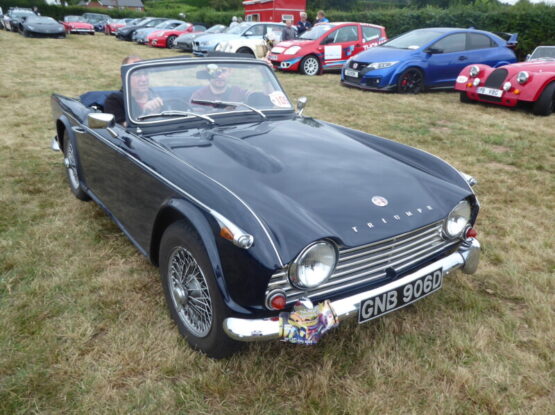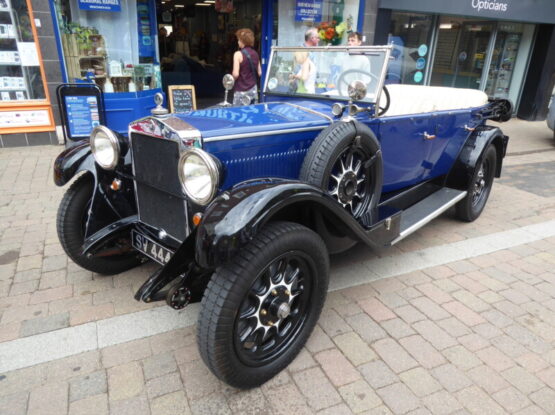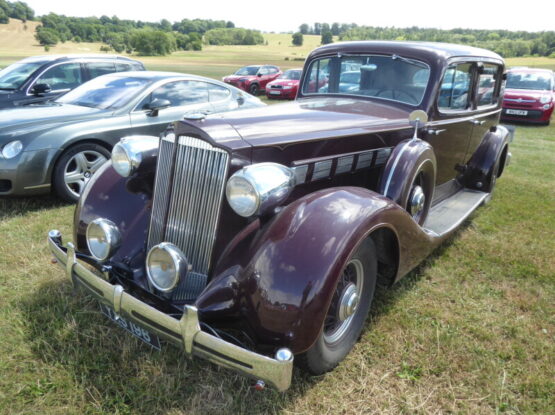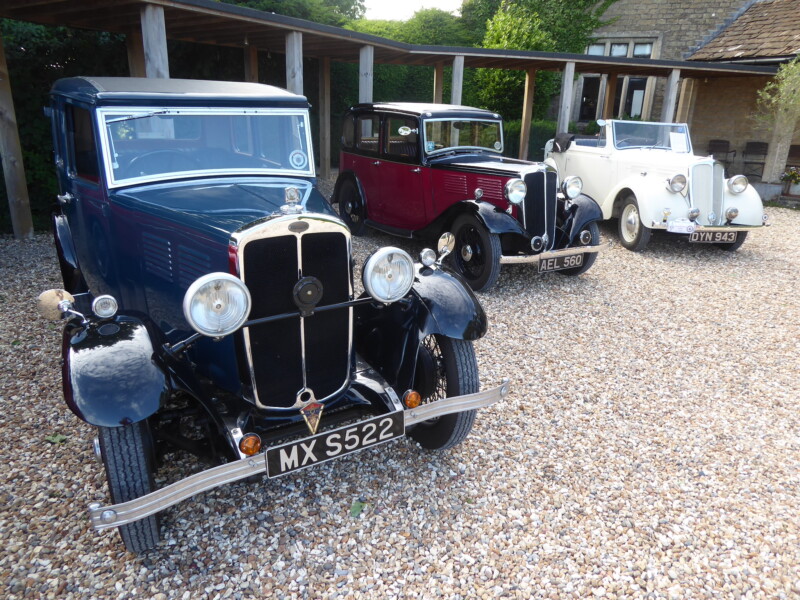
I have already observed that there seems to have been a large increase in the number of mid-week evening cars to tempt the car enthusiast in 2025 and been to a few of them to suss them out. This is one that definitely found me, and actually on the day it was taking place. When I clicked on the post on Facebook, I saw that the location – Stanton Manor Hotel – was just a mile or two off junction 17 of the M4 and this about 20 miles from home. That fact alone, and the sunny weather was all the encouragement I needed to go and investigate. The hotel is a lovely old building at the end of a long drive way just beyond the church in the small village of Stanton St Quintin, a place you would probably not find by accident. The setting is splendid and there is ample parking for a decent sized car meet, though if things get very popular, it would run out of space. As far as I can tell, there had been one previous meet here of this type, but word had certainly got around judging by the cars that turned up. Here they are:
ALFA ROMEO
The first car was called the Alfa Romeo Giulia Sprint GT, and was revealed at a press event held at the then newly opened Arese plant on 9 September 1963, and displayed later the same month at the Frankfurt Motor Show. In its original form the Bertone body is known as scalino (step) or “step front”, because of the leading edge of the engine compartment lid which sat 1/4 an inch above the nose of the car. The Giulia Sprint GT can be distinguished from the later models by a number of features including: Exterior badging: Alfa Romeo logo on the front grille, a chrome script reading “Giulia Sprint GT” on the boot lid, and rectangular “Disegno di Bertone” badges aft of the front wheel arches; flat, chrome grille in plain, wide rectangular mesh without additional chrome bars; single-piece chrome bumpers; no overriders. Inside the cabin the padded vinyl dashboard was characterised by a concave horizontal fascia, finished in grey anti-glare crackle-effect paint. Four round instruments were inset in the fascia in front of the driver. The steering wheel was non-dished, with three aluminium spokes, a thin bakelite rim and a centre horn button. Vinyl-covered seats with cloth centres and a fully carpeted floor were standard, while leather upholstery was an extra-cost option. After initially marketing it as a four-seater, Alfa Romeo soon changed its definition of the car to a more realistic 2+2. The Giulia Sprint GT was fitted with the 1,570 cc version of Alfa Romeo’s all-aluminium twin cam inline four (78 mm bore × 82 mm stroke), which had first debuted on the 1962 Giulia Berlina. Breathing through two twin-choke Weber 40 DCOE 4 carburettors, on the Sprint GT this engine produced 105 hp at 6,000 rpm. Like all subsequent models, the Sprint GT was equipped with an all-synchromesh 5-speed manual transmission. The braking system comprised four Dunlop disc brakes and a vacuum servo. The rear brakes featured an unusual arrangement with the slave cylinders mounted on the axle tubes, operating the calipers by a system of levers and cranks. According to Alfa Romeo the car could reach a top speed of “over 180 km/h (112 mph)”. In total 21,902 Giulia Sprint GT were produced from 1963 to 1965, when the model was superseded by the Giulia Sprint GT Veloce. Of these 2,274 were right hand drive: 1,354 cars fully finished in Arese, and 920 shipped in complete knock-down kit form for foreign assembly. For 1966, the Giulia Sprint GT was replaced by the Alfa Romeo Giulia Sprint GT Veloce, which was very similar but featuring a number of improvements: a revised engine—slightly more powerful and with more torque—better interior fittings and changes to the exterior trim. Alongside the brand new 1750 Spider Veloce which shared its updated engine the Sprint GT Veloce was introduced at the 36th Geneva Motor Show in March 1966, and then tested by the international specialist press in Gardone on the Garda Lake. Production had began in 1965 and ended in 1968. The Giulia Sprint GT Veloce can be most easily distinguished from other models by the following features: badging as per Giulia Sprint GT, with the addition of round enamel badges on the C-pillar—a green Quadrifoglio (four-leaf clover) on an ivory background—and a chrome “Veloce” script on the tail panel; black mesh grille with three horizontal chrome bars; the grille heart has 7 bars instead of 6; stainless steel bumpers, as opposed to the chromed mild steel bumpers on the Giulia Sprint GT. The bumpers are the same shape, but are made in two pieces (front) and three pieces (rear) with small covers hiding the joining rivets. Inside the main changes from the Giulia Sprint GT were imitation wood dashboard fascia instead of the previous anti-glare grey finish, front seats revised to a mild “bucket” design, and a dished three aluminium spoke steering wheel, with a black rim and horn buttons through the spokes. The Veloce’s type 00536 engine, identical to the Spider 1600 Duetto’s, featured modifications compared to the Giulia Sprint GT’s type 00502—such as larger diameter exhaust valves. As a result it produced 108 hp at 6,000 rpm, an increase of 3 hp over the previous model, and significantly more torque. The top speed now exceeded 185 km/h (115 mph). Early Giulia Sprint GT Veloces featured the same Dunlop disc brake system as the Giulia Sprint GT, while later cars substituted ATE disc brakes as pioneered on the GT 1300 Junior in 1966. The ATE brakes featured an handbrake system entirely separate from the pedal brakes, using drum brakes incorporated in the rear disc castings. Though the Sprint GT Veloce’s replacement—the 1750 GT Veloce—was introduced in 1967, production continued throughout the year and thirty final cars were completed in 1968. By then total Giulia Sprint GT Veloce production amounted to 14,240 examples. 1,407 of these were right hand drive cars, and 332 right hand drive complete knock-down kits. The Alfa Romeo 1750 GT Veloce (also known as 1750 GTV) appeared in 1967 along with the 1750 Berlina sedan and 1750 Spider. The same type of engine was used to power all three versions; this rationalisation was a first for Alfa Romeo. The 1750 GTV replaced the Giulia Sprint GT Veloce and introduced many updates and modifications. Most significantly, the engine capacity was increased to 1779 cc displacement. Peak power from the engine was increased to 120 hp at 5500 rpm. The stroke was lengthened from 82 to 88.5 mm over the 1600 engine, and a reduced rev limit from 7000 rpm to 6000 rpm. Maximum torque was increased to 137 lb·ft at 3000 rpm. A higher ratio final drive was fitted (10/41 instead of 9/41) but the same gearbox ratios were retained. The result was that, on paper, the car had only slightly improved performance compared to the Giulia Sprint GT Veloce, but on the road it was much more flexible to drive and it was easier to maintain higher average speeds for fast touring. For the United States market, the 1779 cc engine was fitted with a fuel injection system made by Alfa Romeo subsidiary SPICA, to meet emission control laws that were coming into effect at the time. Fuel injection was also featured on Canadian market cars after 1971. Carburettors were retained for other markets. The chassis was also significantly modified. Tyre size went to 165/14 from 155/15 and wheel size to 5 1/2J x 14 instead of 5J x 15, giving a wider section and slightly smaller rolling diameter. The suspension geometry was also revised, and an anti-roll bar was fitted to the rear suspension. ATE disc brakes were fitted from the outset, but with bigger front discs and calipers than the ones fitted to GT 1300 Juniors and late Giulia Sprint GT Veloces. The changes resulted in significant improvements to the handling and braking, which once again made it easier for the driver to maintain high average speeds for fast touring. The 1750 GTV also departed significantly from the earlier cars externally. New nose styling eliminated the “stepped” bonnet of the Giulia Sprint GT, GTC, GTA and early GT 1300 Juniors and incorporated four headlamps. For the 1971 model year, United States market 1750 GTV’s also featured larger rear light clusters (there were no 1970 model year Alfas on the US market). Besides the chrome “1750” badge on the bootlid, there was also a round Alfa Romeo badge. Similar Quadrofoglio badges to those on the Giulia Sprint GT Veloce were fitted on C pillars, but the Quadrofoglio was coloured gold instead of green. The car also adopted the higher rear wheelarches first seen on the GT 1300 Junior. The interior was also much modified over that of earlier cars. There was a new dashboard with large speedometer and tachometer instruments in twin binnacles closer to the driver’s line of sight. The instruments were mounted at a more conventional angle, avoiding the reflections caused by the upward angled flat dash of earlier cars. Conversely, auxiliary instruments were moved to angled bezels in the centre console, further from the driver’s line of sight than before. The new seats introduced adjustable headrests which merged with the top of the seat when fully down. The window winder levers, the door release levers and the quarterlight vent knobs were also restyled. The remote release for the boot lid, located on the inside of the door opening on the B-post just under the door lock striker, was moved from the right hand side of the car to the left hand side. The location of this item was always independent of whether the car was left hand drive or right hand drive. Early (Series 1) 1750 GTV’s featured the same bumpers as the Giulia Sprint GT Veloce, with the front bumper modified to mount the indicator / sidelight units on the top of its corners, or under the bumper on US market cars. The Series 2 1750 GTV of 1970 introduced other mechanical changes, including a dual circuit braking system (split front and rear, with separate servos). The brake and clutch pedals on left hand drive cars were also of an improved pendant design, instead of the earlier floor-hinged type. On right hand drive cars the floor-hinged pedals were retained, as there was no space for the pedal box behind the carburettors. Externally, the series 2 1750 GTV is identified by new, slimmer bumpers with front and rear overriders. The combined front indicator and sidelight units were now mounted to the front panel instead of the front bumper, except again on the 1971-72 US/Canadian market cars. The interior was slightly modified, with the seats retaining the same basic outline but following a simpler design. 44,269 1750 GTVs were made before their replacement came along. That car was the 2000GTV. Introduced in 1971, together with the 2000 Berlina sedan and 2000 Spider, the 2 litre cars were replacements for the 1750 range. The engine displacement was increased to 1962 cc. Oil and radiator capacities remained unchanged. The North American market cars had fuel injection, but everyone else retained carburettors. Officially, both versions generated the same power, 130 hp at 5500 rpm. The interior trim was changed, with the most notable differences being the introduction of a separate instrument cluster, instead of the gauges installed in the dash panel in earlier cars. Externally the 2000 GTV is most easily distinguished by its grille with horizontal chrome bars, featuring protruding blocks forming the familiar Alfa heart in outline, smaller hubcaps with exposed wheel nuts, optional aluminium alloy wheels of the same size as the standard 5. 1/2J × 14 steel items, styled to the “turbina” design first seen on the alloy wheels of the Alfa Romeo Montreal, and the larger rear light clusters first fitted to United States market 1750 GTV’s were standard for all markets. From 1974 on, the 105 Series coupé models were rationalised and these external features became common to post-1974 GT 1300 Junior and GT 1600 Junior models, with only few distinguishing features marking the difference between models. 37,459 2000 GTVs were made before production ended and these days they are very sought after with prices having sky-rocketed in recent years.


ARMSTRONG SIDDELEY
A replacement for the Whitley, the Sapphire was first seen in 1952, and extended into quite a range of different models over the next 8 years. The first model to bear the Sapphire name was the 346, introduced late in 1952 for sale in 1953 and continuing until 1958. It had a six-cylinder 3,435 cc engine with hemi-spherical combustion chambers and could have optional twin Stromberg carburettors, a £25 extra, which increased the output from 125 to 150 bhp giving a top speed in excess of 100 mph. The front suspension was independent coil springs with a rigid axle and leaf springs at the rear. The body was available as a four- or six-light (two or three windows on each side) at the same cost and with either a bench or individual front seats. The seats were finished in leather, with the dashboard and door-cappings in walnut veneer. A heater was standard. It was introduced with the choice of a Wilson electrically-controlled finger-tip four-speed pre-selector gearbox as a £30 option, or four-speed synchromesh gearbox. It became available with a Rolls-Royce four speed automatic transmission with the introduction of the Mark II in 1954. A long-wheelbase model was launched in 1955 as a limousine version which had the pre-selector gearbox as standard, however, there was an optional four-speed manual column-change gearbox available. 7,697 of the 346s were produced. Next to appear were the cheaper Sapphire 234 and 236 cars. They were identical in appearance but sold with different engines having different performance characteristics. The 234 could be purchased with wire wheels as an optional extra. The 234 was produced from 1955 to 1958 and used a four-cylinder 2,290 cc version of the 346 engine. The transmission was a manual four-speed gearbox with optional overdrive. It was a genuine 100 mph car intended for the man who liked high performance, and 803 of them were produced. The 236 was made between 1955 and 1957 and used the six-cylinder 2,310 cc engine previously seen in the Whitley. A conventional manual gearbox was available but many were fitted with a Lockheed Manumatic “clutchless” transmission. Overdrive was an option on either transmission. This car with an 85 mph maximum was intended to be a quiet, flexible, easy-to-drive saloon, and 603 were produced. In 1958, Armstrong-Siddeley showed what would turn out to be their final model, and the car seen here, the Star Sapphire. Little changed externally from the 346, the radiator grille no longer rose to the top of the bonnet, and there were other detailed changes, including concealed door hinges and the fact that the front doors now hinged at their leading edge. The six-cylinder engine was enlarged more than 16% to 3,990 cc with larger twin Stromberg carburettors as standard and power output increased to 165 bhp Perhaps more important was an increase of nearly 30% in torque at 50 mph. Big end and main bearings were now made of lead indium and a vibration damper fitted to the nose of the crankshaft. The compression ratio was raised to 7.5 to 1. The car could now lap the Lindley high speed track at 104 mph. Various suspension modifications had been carried out. Servo-assisted 12″ Girling disc brakes were now installed on the front wheels and Burman recirculating ball power steering was standardised with a turning circle reduced by 4’6″. A BorgWarner type DG automatic gearbox was fitted which incorporated a lever on the fascia to hold intermediate gear at 35, 45, 55, and 65 mph. There was an independent heater for the rear passengers and demisting slots for the rear window. All features were standard, the provision of alternatives being believed to lead to an unsatisfactory compromise. This was a high quality car, intended to rival Daimler, Jaguar and even Rolls Royce products of the era, and indeed the Star Sapphire won the £4,000 four-door coachwork class at the 1958 Earls Court Motor Show ahead of a Princess limousine and a Jaguar Mark IX. When production ceased in 1960, 902 saloons had been made, as well as 77 long-wheelbase cars, 73 of which were built as limousines (including 2 prototypes). The limousine version was made in 1960 only and had a single-carburettor engine and manual gearbox (the automatic gearbox was fitted to 12 examples). The remaining 4 chassis were used for 3 hearses and an ambulance, meaning a total of 980 Star Sapphires were produced


AUSTIN
Herbert Austin’s masterpiece which did much to put Britain on wheels in the 1920s was first seen in 1922, as a four seat open tourer. Nicknamed Chummy, the first 100 featured a 696cc four cylinder engine, which was quickly upgraded to the 747cc unit that remained until the end of production some 17 years later. The first cars had an upright edge to the doors and a sloping windscreen, but from 1924, the screen became upright and there was a sloping edge to the doors, as well as a slightly longer body. Stronger brakes came along in 1926, along with a slightly taller nickel-plated radiator grille, conventional coil ignition, a more spacious body and wider doors. An even longer and wider body arrived in 1930, as well as a stronger crankshaft and improvements to the brakes which coupled front and rear systems together so they both worked by the footbrake. In 1931 the body was restyled , with a thin ribbon-style radiator and by 1932 there was a four speed gearbox to replace the earlier three-speeder. 1933 saw the introduction of the Ruby, a car that looked more modern with its cowled radiator. There were also Pearl and Opal versions. Development continued, so in 1937 there was a move to crankshaft shell bearings in place of the white metal previously used, and the Big Seven appeared. The last Seven was made in 1939, by which time 290,000 had been produced. Aside from saloons and tourers, there had been vans and sports derivatives like the Le Mans, the supercharged Ulster and the rather cheaper Nippy. Around 11,000 Sevens survive today


AUSTIN-HEALEY
Donald Healey had been producing a range of expensive sports cars from the 1940s, cars such as the Silverstone, the Abbott and the Farnham. For the 1952 London Motor Show, he produced a new design, which was called the Healey Hundred, based on Austin A90 mechanicals, which he intended to produce in-house at his small car company in Warwick. It was one of the stars of the 1952 Show, and it so impressed Leonard Lord, the Managing Director of Austin, who was looking for a replacement to the unsuccessful A90. that Lord struck a deal with Healey on the spot, to build it in quantity. Bodies made by Jensen Motors would be given Austin mechanical components at Austin’s Longbridge factory. The car was renamed the Austin-Healey 100, in reference to the fact that the car had a top speed of 100 mph. Production got under way in 1953, with Austin-Healey 100s being finished at Austin’s Longbridge plant alongside the A90 and based on fully trimmed and painted body/chassis units produced by Jensen in West Bromwich—in an arrangement the two companies previously had explored with the Austin A40 Sports. By early 1956, production was running at 200 cars a month, 150 of which were being sold in California. Between 1953 and 1956, 14,634 Austin-Healey 100s were produced, the vast majority of them, as was the case for most cars in this post war era, going for export. The car was replaced by an updated model in 1956, called the 100-6. It had a longer wheelbase, redesigned bodywork with an oval shaped grille, a fixed windscreen and two occasional seats added (which in 1958 became an option with the introduction of the two-seat BN6 produced in parallel with the 2+2 BN4), and the engine was replaced by one based on the six-cylinder BMC C-Series engine. In 1959, the engine capacity was increased from 2.6 to 2.9 litres and the car renamed the Austin-Healey 3000. Both 2-seat and 2+2 variants were offered. It continued in this form until production ceased in late 1967. The Big Healey, as the car became known after the 1958 launch of the much smaller Austin-Healey Sprite, is a popular classic now. You come across the 3000 models more frequently than the 100s, as they accounted for more than 60% of all Big Healey production.


BMW
Sole BMW here was this Z4 Coupe. Also here was the Z4. This has been offered in three different generations, of which this is the first, consisting of the BMW E85 (roadster version) and BMW E86 (coupe version) sports cars. The E85/E86 generation was produced from 2002 to 2008. The E85/E86 replaced the Z3 and is the third model in the BMW Z Series. Initial models were in the roadster (E85) body style, with the coupé (E86) body style being added in 2006. As per the Z3, the E85/E86 was manufactured solely in Greer, South Carolina. The E85 was designed by Danish BMW-designer Anders Warming from mid-1998 to the summer of 1999. The coupe models were designed by Tomasz Sycha. The E85 designs were frozen on March 1, 2000. The Z4 was introduced at the Paris Motor Show in 2002, and North American models went on sale in November of the same year (as the 2003 model year). European sales began in March 2003. The Z4 Roadster was launched in 2002 with the 2.5i and 3.0i six-cylinder models. Transmission choices were a five-speed manual, six-speed manual, five-speed automatic and a six-speed SMG-II automated manual transmission. A four-cylinder model, the Z4 2.0i Roadster, was introduced for the European market in May 2005. The drag coefficient is maximum of Cd=0.35. BMW unveiled a concept coupé version of the Z4 at the 2005 Frankfurt Motor Show The design of the Z4 and Z4 coupé has variously been ascribed to Anders Warming, Chris Bangle, the controversial former BMW Head of Design, and Adrian van Hooydonk, former BMW chief designer, and BMW designer Tomasz Sycha. The design was approved in Summer of 2004 and frozen in December 2004. The company announced in 2005 that the two-door coupé would be available for production including the return of the M Coupé. The production car was introduced at the New York Auto Show in April 2006 and was available for sale in late May 2006. Thanks to its hatch design, the Z4 Coupé offers 10.1 cu ft (0.29 m3) of trunk space, compared with 8.5 cu ft (0.24 m3) for the roadster. The Coupe’s fixed roof increases torsional rigidity, resulting in a stiffness of 32,000 N⋅m (24,000 lb⋅ft) per degree of body twist on the coupe (compared to 14,500 N⋅m (10,700 lb⋅ft) per degree on the roadster), which improves turn-in and overall handling response. The roof has a “double-bubble” contour which serves as an aerodynamic aid and offers more headroom than the roadster with the soft top closed. The Coupé has a sleek fastback rear window that slopes down to an integrated spoiler which is shaped to deliver downforce to the rear axle at high-speed. The model range for the Coupé was more limited than the roadster, and consisted of the six-cylinder 3.0si and Z4 M model only. Transmission choices were a 6-speed manual and a 6-speed automatic with shift paddles mounted on the steering column. In February 2009, the BMW Z4 (E89) began production as the successor to the E85/E86.

CHEVROLET
First seen in 1963, this Corvette model introduced us to the name Sting Ray. It continued with fibreglass body panels, and overall, was smaller than the first generation. The car was designed by Larry Shinoda with major inspiration from a previous concept design called the “Q Corvette,” which was created by Peter Brock and Chuck Pohlmann under the styling direction of Bill Mitchell. Earlier, Mitchell had sponsored a car known as the “Mitchell Sting Ray” in 1959 because Chevrolet no longer participated in factory racing. This vehicle had the largest impact on the styling of this generation, although it had no top and did not give away what the final version of the C2 would look like. The third inspiration was a Mako Shark Mitchell had caught while deep-sea fishing. Production started for the 1963 model year and ended in 1967. The 1963 model was the first year for a Corvette coupé and it featured a distinctive tapering rear deck (a feature that later reappeared on the 1971 “Boattail” Buick Riviera) with, for 1963 only, a split rear window. The Sting Ray featured hidden headlamps, non-functional bonnet vents, and an independent rear suspension. Corvette chief engineer Zora Arkus-Duntov never liked the split rear window because it blocked rear vision, but Mitchell thought it to be a key part of the entire design. Maximum power for 1963 was 360 bhp, raised to 375 bhp in 1964. Options included electronic ignition, the breakerless magnetic pulse-triggered Delcotronic first offered on some 1963 Pontiac models. On 1964 models the decorative bonnet vents were eliminated and Duntov, the Corvette’s chief engineer, got his way with the split rear window changed to a full width window. Four-wheel disc brakes were introduced in 1965, as was a “big block” engine option: the 396 cu in (6.49 litre) V8. Side exhaust pipes were also optionally available in 1965, and continued to be offered through 1967. The introduction of the 425 bhp 396 cu in big block in 1965 spelled the beginning of the end for the Rochester fuel injection system. The 396 cu in option cost $292.70 while the fuel injected 327 cu in (5.36 litre) engine cost $538.00. Few people could justify spending $245.00 more for 50 bhp less, even though FI could deliver over 20 mpg on the highway and would keep delivering fuel despite high G-loading in corners taken at racing speeds. Another rare ’63 and ’64 option was the Z06 competition package, which offered stiffer suspension, bigger, multi-segment lined brakes with finned drums and more, only a couple hundred coupes and ONE convertible were factory-equipped this way in 1963. With only 771 fuel-injected cars built in 1965, Chevrolet discontinued the option at the end of the ’65 production, having introduced a less-expensive big block 396 engine rated at 425 hp in the middle of the production year and selling over 2,000 in just a few months. For 1966, Chevrolet introduced an even larger 427 cu in 7 litre Big Block version. Other options available on the C2 included the Wonderbar auto-tuning AM radio, AM-FM radio (mid-1963), air conditioning (late-1963), a telescopic steering wheel (1965), and headrests (1966). The Sting Ray’s independent rear suspension was successfully adapted for the new-for-1965 Chevrolet Corvair, which solved the quirky handling problems of that unique rear-engine compact. 1967 was the final year for the C2 generation. The 1967 model featured restyled bumper vents, less ornamentation, and back-up lamps which were on the inboard in 1966 were now rectangular and centrally located. The first use of all four taillights in red started in 1961 and was continued thru the C-2 line-up except for the 1966. The 1967 and subsequent models continuing on all Corvettes since. 1967 had the first L88 engine option which was rated at 430 bhp, but unofficial estimates place the actual output at 560 bhp or more. Only twenty such engines were installed at the factory. From 1967 (to 1969), the Holley triple two-barrel carburettor, or Tri-Power, was available on the 427 L89 (a $368 option, on top of the cost for the high-performance 427). Despite these changes, sales slipped over 15%, to 22,940 – 8,504 coupes and 14,436 convertibles.


FORD
An estate version of the Zephyr Mark IV was announced just in time for the London Motor Show in October 1966, though deliveries commenced only in January 1967. As with the earlier Zephyrs, volumes did not justify tooling up for estate production at the Dagenham plant, and the cars were instead built by E. D. Abbott Ltd of Farnham, based on part finished saloons received from Ford. The Mark IV Zephyr estates (like their more expensive Zodiac siblings) came with black vinyl-covered roof, a fashionable distinguishing feature of upmarket vehicles at the time: retention unchanged of the saloon’s rear light clusters attracted criticism, however, because of the way it narrowed the rear hatch opening at floor level when compared to the arrangements on the cheaper Ford Cortina estates. An estate version of the Zodiac Mk IV was announced at the same time as the Zephyr equivalent, and built alongside it at Farnham. No “Executive” estate was built. Few of either the Zephyr or Zodiac were built and survivors are rare.


The Mark I Ford Escort was introduced in the UK at the end of 1967, making its show debut at Brussels Motor Show in January 1968, replacing the successful, long-running Anglia. The car was presented in continental Europe as a product of Ford’s European operation. Escort production commenced at the Halewood plant in England during the closing months of 1967, and for left hand drive markets during September 1968 at the Ford plant in Genk. Initially the continental Escorts differed slightly from the UK built ones under the skin. The front suspension and steering gear were differently configured and the brakes were fitted with dual hydraulic circuits; also the wheels fitted on the Genk-built Escorts had wider rims. At the beginning of 1970, continental European production transferred to a new plant on the edge of Saarlouis, West Germany. The Escort was a commercial success in several parts of western Europe, but nowhere more than in the UK, where the national best seller of the 1960s, BMC’s Austin/Morris 1100 was beginning to show its age while Ford’s own Cortina had grown, both in dimensions and in price, beyond the market niche at which it had originally been pitched. In June 1974, six years into the car’s UK introduction, Ford announced the completion of the two millionth Ford Escort, a milestone hitherto unmatched by any Ford model outside the US. It was also stated that 60% of the two million Escorts had been built in Britain. In West Germany cars were built at a slower rate of around 150,000 cars per year, slumping to 78,604 in 1974 which was the last year for the Escort Mark I. Many of the German built Escorts were exported, notably to Benelux and Italy; from the West German domestic market perspective the car was cramped and uncomfortable when compared with the well-established and comparably priced Opel Kadett, and it was technically primitive when set against the successful imported Fiat 128 and Renault 12. Subsequent generations of the Escort made up some of the ground foregone by the original model, but in Europe’s largest auto-market the Escort sales volumes always came in well behind those of the General Motors Kadett and its Astra successor. The Escort had conventional rear-wheel drive and a four-speed manual gearbox, or three-speed automatic transmission. The suspension consisted of MacPherson strut front suspension and a simple live axle mounted on leaf springs. The Escort was the first small Ford to use rack-and-pinion steering. The Mark I featured contemporary styling cues in tune with its time: a subtle Detroit-inspired “Coke bottle” waistline and the “dogbone” shaped front grille – arguably the car’s main stylistic feature. Similar Coke bottle styling featured in the larger Cortina Mark III (also built in West Germany as the Taunus) launched in 1970. Initially, the Escort was sold as a two-door saloon (with circular front headlights and rubber flooring on the “De Luxe” model). The “Super” model featured rectangular headlights, carpets, a cigar lighter and a water temperature gauge. A two-door estate was introduced at the end of March 1968 which, with the back seat folded down, provided a 40% increase in maximum load space over the old Anglia 105E estate, according to the manufacturer. The estate featured the same engine options as the saloon, but it also included a larger, 7 1⁄2-inch-diameter clutch, stiffer rear springs and in most configurations slightly larger brake drums or discs than the saloon. A panel van appeared in April 1968 and the 4-door saloon (a bodystyle the Anglia was never available in for UK market) in 1969. Underneath the bonnet was the Kent Crossflow engine in 1.1 and 1.3 litre versions. A 940 cc engine was also available in some export markets such as Italy and France. This tiny engine remained popular in Italy, where it was carried over for the Escort Mark II, but in France it was discontinued during 1972. There was a 1300GT performance version, with a tuned 1.3 L Crossflow (OHV) engine with a Weber carburettor and uprated suspension. This version featured additional instrumentation with a tachometer, battery charge indicator, and oil pressure gauge. The same tuned 1.3 L engine was also used in a variation sold as the Escort Sport, that used the flared front wings from the AVO range of cars, but featured trim from the more basic models. Later, an “executive” version of the Escort was produced known as the “1300E”. This featured the same 13″ road wheels and flared wings of the Sport, but was trimmed in an upmarket, for that time, fashion with wood trim on the dashboard and door cappings. A higher performance version for rallies and racing was available, the Escort Twin Cam, built for Group 2 international rallying. It had an engine with a Lotus-made eight-valve twin camshaft head fitted to the 1.5 L non-crossflow block, which had a bigger bore than usual to give a capacity of 1,557 cc. This engine had originally been developed for the Lotus Elan. Production of the Twin Cam, which was originally produced at Halewood, was phased out as the Cosworth-engined RS1600 (RS denoting Rallye Sport) production began. The most famous edition of the Twin Cam was raced on behalf of Ford by Alan Mann Racing in the British Saloon Car Championship in 1968 and 1969, sporting a full Formula 2 Ford FVC 16-valve engine producing over 200 hp. The Escort, driven by Australian driver Frank Gardner went on to comfortably win the 1968 championship. The Mark I Escorts became successful as a rally car, and they eventually went on to become one of the most successful rally cars of all time. The Ford works team was practically unbeatable in the late 1960s / early 1970s, and arguably the Escort’s greatest victory was in the 1970 London to Mexico World Cup Rally, co-driven by Finnish legend Hannu Mikkola and Swedish co-driver Gunnar Palm. This gave rise to the Escort Mexico (1598cc “crossflow”-engined) special edition road versions in honour of the rally car. Introduced in November 1970, 10,352 Mexico Mark I’s were built. In addition to the Mexico, the RS1600 was developed with 1,601 cc Cosworth BDA which used a Crossflow block with a 16-valve Cosworth cylinder head, named for “Belt Drive A Series”. Both the Mexico and RS1600 were built at Ford’s Advanced Vehicle Operations (AVO) facility located at the Aveley Plant in South Essex. As well as higher performance engines and sports suspension, these models featured strengthened bodyshells utilising seam welding in places of spot welding, making them more suitable for competition. After updating the factory team cars with a larger 1701 cc Cosworth BDB engine in 1972 and then with fuel injected BDC, Ford also produced an RS2000 model as an alternative to the somewhat temperamental RS1600, featuring a 2.0 litre Pinto (OHC) engine. This also clocked up some rally and racing victories; and pre-empted the hot hatch market as a desirable but affordable performance road car. Like the Mexico and RS1600, this car was produced at the Aveley plant.


The Capri Mk III was referred to internally as “Project Carla”, and although little more than a substantial update of the Capri II, it was often referred to as the Mk III. The first cars were available in March 1978, but failed to halt a terminal decline in sales. The concept of a heavily facelifted Capri II was shown at the 1976 Geneva show: a Capri II with a front very similar to the Escort RS2000 (with four headlamps and black slatted grille), and with a rear spoiler, essentially previewed the model some time before launch. The new styling cues, most notably the black “Aeroflow” grille (first used on the Mk I Fiesta) and the “sawtooth” rear lamp lenses echoed the new design language being introduced at that time by Ford of Europe’s chief stylist Uwe Bahnsen across the entire range. Similar styling elements were subsequently introduced in the 1979 Cortina 80, 1980 Escort Mk III and the 1981 Granada Mk IIb. In addition, the Mk III featured improved aerodynamics, leading to improved performance and economy over the Mk II and the trademark quad headlamps were introduced. At launch the existing engine and transmission combinations of the Capri II were carried over, with the 3.0 S model regarded as the most desirable model although the softer, more luxurious Ghia derivative with automatic, rather than manual transmission, was the bigger seller of the two V6-engined models. Ford began to focus their attention on the UK Capri market as sales declined, realising the car had something of a cult following there. Unlike sales of the contemporary 4-door Cortina, Capri sales in Britain were to private buyers who would demand less discounts than fleet buyers allowing higher margins with the coupé. Ford tried to maintain interest in 1977 with Ford Rallye Sport, Series X, “X Pack” options from the performance oriented RS parts range. Although expensive and slow selling these proved that the press would enthusiastically cover more developed Capris with higher performance. In early 1982, the Essex 3.0 V6 which had been the range topper since September 1969 was dropped, while a new sporty version debuted at the Geneva Motor Show, called the 2.8 Injection. The new model was the first regular model since the RS2600 to use fuel injection. Power rose to a claimed 160 PS, even though tests showed the real figure was closer to 150 PS, giving a top speed of 210 km/h (130 mph), but the car still had a standard four-speed gearbox. The Capri 2.8 Injection breathed new life into the range and kept the car in production 2–3 years longer than Ford had planned. The four-speed gearbox was replaced with a five-speed unit early on – at the same time Ford swapped the dated looking chequered seats for more luxurious looking velour trim. A more substantial upgrade was introduced in 1984 with the Capri Injection Special. This development used half leather seating and included a limited slip differential. Externally the car could be easily distinguished by seven spoke RS wheels (without the customary “RS” logo since this was not an RS vehicle) and colour-coded grille and headlamp surrounds. At the same time the 2.0 Capri was rationalised to one model, the 2.0 S, which simultaneously adopted a mildly modified suspension from the Capri Injection. The 1.6 model was also reduced to a single model, the 1.6 LS. The car was finally deleted at the end of 1986, 1.9 million cars having been made over 18 years, and having been sold only in the UK for the final months of production.


GTM
Like many low volume specialist producers, there’s quite a complex history around GTM. The firm started out creating small and relatively inexpensive kitcars in 1967, when they produced the Cox GTM, a mid-engined Mini-based machine with styling inspired by the Ferrari Dino (so it is said!). Production stopped after 5 years, and ownership of the company changed a few times over the next few years, with production of new cars, as opposbed to spares, starting again in 1980, with an updated version of the GTM Coupe. The model continued to be developed and the company took advantage of the Austin-Rover K Series engine when it became available. In 1998 they launched a new car, the Libra. Three years in development, it was a collaboration between GTM Cars directors Peter Beck & Paddy Fitch, designer Richard Oakes and suspension designer Bryn Davies. Conceived as a lightweight sports car, it uses no subframes for its suspension with all the mountings being bolted straight to the GRP monocoque tub. At the front it uses unequal length wishbones of GTM design locating uprights from the Rover Metro/100 range and a forward mounted steering rack for extra legroom. The rear suspension is an unusual double trailing arm design, bolted to the rear bulkhead and using the same uprights as the front. The engine/transmission unit is held in a frame hanging off the rear bulkhead, a frame which also locates the rear hinging engine cover which incorporates a sizeable boot which can accommodate a full size set of golf clubs. The front ‘clamshell’ conceals the radiator, battery, master cylinders etc. and also manages to stow a full size spare wheel (either 16″ or 17″). A removable roof panel can be stowed behind the seats for an open top experience. Initially launched with the 1.4 litre Rover ‘K’-Series engine, the Libra has been fitted successfully


JAGUAR
The C-Type was built specifically for the race track . It used the running gear of the contemporary road-proven XK120 clothed in a lightweight tubular frame, devised by William Heynes, and clothed in an aerodynamic aluminium body designed by Malcolm Sayer. The road-going XK120’s 3.4-litre twin-cam, straight-6 engine produced between 160 and 180 bhp, but when installed in the C-Type, it was originally tuned to around 205 bhp. Early C-Types were fitted with SU carburettors and drum brakes. Later C-Types, from mid 1953, were more powerful, using triple twin-choke Weber carburettors and high-lift camshafts. They were also lighter, and braking performance was improved with disc brakes on all four wheels, which were something of a novelty at the time, though their adoption started to spread quite quickly after Jaguar had used them. The lightweight, multi-tubular, triangulated frame was designed by William Heynes. Malcolm Sayer designed the aerodynamic body. Made of aluminium in the barchetta style, it is devoid of road-going items such as carpets, weather equipment and exterior door handles. The C-Type was successful in racing, most notably at the Le Mans 24 hours race, which it won twice. In 1951 the car won at its first attempt. The factory entered three, whose driver pairings were Stirling Moss and Jack Fairman, Leslie Johnson and triple Mille Miglia winner Clemente Biondetti, and the eventual winners, Peter Walker and Peter Whitehead. The Walker-Whitehead car was the only factory entry to finish, the other two retiring with lack of oil pressure. A privately entered XK120, owned by Robert Lawrie, co-driven by Ivan Waller, also completed the race, finishing 11th. In 1952 Jaguar, worried by a report about the speed of the Mercedes-Benz 300SLs that would run at Le Mans, modified the C-Type’s aerodynamics to increase the top speed. However, the consequent rearrangement of the cooling system made the cars vulnerable to overheating, and all three retired from the race. The Peter Whitehead-Ian Stewart and Tony Rolt/Duncan Hamilton cars blew head gaskets, and the Stirling Moss-Peter Walker car, the only one not overheating having had a full-sized radiator hurriedly fitted, lost oil pressure after a mechanical breakage. Testing by Norman Dewis at MIRA after the race proved that the overheating was caused more by the revisions to the cooling system than by the altered aerodynamics: the water pump pulley was undersized, so it was spinning too fast and causing cavitation; also the header tank was in front of the passenger-side bulkhead, far from the radiator, and the tubing diameter was too small at 7/8 inch. With the pump pulley enlarged, and the tubing increased to 1 1/4 inch, the problem was eliminated. The main drawback of the new body shape was that it reduced downforce on the tail to the extent that it caused lift and directional instability at speeds over 120 mph on the Mulsanne Straight. These cars had chassis numbers XKC 001, 002 and 011. The first two were dismantled at the factory, and the third survives in normal C-type form. In 1953 C-Types won again, and also placed second and fourth. This time the body was in thinner, lighter aluminium and the original twin H8 sand cast SU carburettors were replaced by three DCO3 40mm Webers, which helped boost power to 220 bhp. Further weight was saved by using a rubber bag fuel tank, lighter electrical equipment and thinner gauge steel for some of the chassis tubes . Duncan Hamilton and Tony Rolt won the race at 105.85 mph (170.35 km/h) – the first time Le Mans had been won at an average of over 100 miles per hour (161 km/h). 1954, the C-Type’s final year at Le Mans, saw a fourth place by the Ecurie Francorchamps entry driven by Roger Laurent and Jacques Swaters. Between 19951 and 1953, a total of 53 C-Types were built, 43 of which were sold to private owners mainly in the US. When new, the car sold for about $6,000, approximately twice the price of an XK120. Genuine cars have increased in value massively in recent years, however buyers do need to be aware that replicas have been produced by a number of companies, though even these are far from cheap to buy thesedays. Cars with true racing provenance are well into the millions now. A C-Type once owned and raced by Phil Hill sold at an American auction in August 2009 for $2,530,000 and another C-type was sold at the Pebble Beach auction in 2012 for $3,725,000, More recently an unrestored C-Type that raced at Le Mans has sold for £5,715,580, during the Grand Prix Historique race meeting in Monaco. In August 2015, an ex-Ecurie Ecosse Lightweight C-type, chassis XKC052 and the second of only three works lightweights, driven by Peter Whitehead and Ian Stewart to fourth at the 1953 Le Mans 24 Hours, fetched £8.4 million at auction in California. There have been plenty of recreation cars built and this one. It dates from 1996 and was built by CERA.


LANCIA
In 1973 the second style to appear in the new Beta range was a 2+2 two-door coupé with a 93″ wheelbase, although due to the fuel crisis it did not become available to the public until early 1974. It was launched with 1.6 and 1.8 engines. New 1.6 and 2.0 engines replaced the original units in late 1975 followed by a 1.3 in early 1976, at which point the Fulvia Coupe was deleted. In 1978 automatic transmission and power steering became available. In 1981 the car received a minor facelift and at the same time the 2.0 became available with fuel Bosch electronic fuel injection. In 1983 a 2.0 VX supercharged engine became available with an output of 135 bhp. The bodywork was developed in-house by a Lancia team led by Aldo Castagno, with Pietro Castagnero acting as styling consultant. Castagnero had also styled the Beta’s predecessor, the Lancia Fulvia saloon and coupé. The car was popular in the mid 1970s with 111,801 examples being built, though they are quite rare now. This one is especially rare as it is a HiFi model. The special Beta Coupè Hi Fi version was a limited edition cosmetically treated by the Tickford company. Produced in 1979, it is claimed that 300 were made, tough there is some doubt as to whether there was actually as many as that, and it was only sold in the UK. The cars were painted in special metallic colours with gold stripes on the sides. The car also featured a front and rear spoiler and 185/65 tyires Pirelli P6. The HI FI name was due to the special sound system made by Voxon the car was fitted with. Tickford Company, where the HI FI received the cosmetic treatment, was Aston Martin coach builder. This one has only just been returned to the road and it is thought it may well be the sole survivor.


MASERATI
The Maserati GranTurismo and GranCabrio (Tipo M145) are a series of a grand tourers produced from 2007 to 2019. They succeeded the 2-door V8 grand tourers offered by the company, the Maserati Coupé, and Spyder. The GranTurismo set a record for the most quickly developed car in the auto industry, going from design to production stage in just nine months. The reason being that Ferrari, after selling off Maserati to the Fiat Chrysler Group, took the designs of the proposed replacement of the Maserati Coupé and after some modifications, launched it as the Ferrari California. Unveiled at the 2007 Geneva Motor Show, the GranTurismo has a drag coefficient of 0.33. The model was initially equipped with a 4.2-litre V8 engine developed in conjunction with Ferrari. The engine generates a maximum power output of 405 PS and is equipped with a 6-speed ZF automatic transmission. The 2+2 body was derived from the Maserati M139 platform, also shared with the Maserati Quattroporte V, with double-wishbone front suspension and a multilink rear suspension. The grand tourer emphasises comfort in harmony with speed and driver-enjoyment. The better equipped S variant was unveiled at the 2008 Geneva Motor Show and features the enlarged 4.7-litre V8 engine shared with the Alfa Romeo 8C Competizione, rated at 440 PS at 7,000 rpm and 490 Nm (361 lb/ft) of torque at 4,750 rpm. At the time of its introduction, it was the most powerful road-legal Maserati offered for sale (excluding the homologation special MC12). The engine is mated to the 6-speed automated manual shared with the Ferrari F430. With the transaxle layout weight distribution improved to 47% front and 53% rear. The standard suspension set-up is fixed-setting steel dampers, with the Skyhook adaptive suspension available as an option along with a new exhaust system, and upgraded Brembo brakes. The seats were also offered with various leather and Alcantara trim options. The upgrades were made to make the car more powerful and more appealing to the buyers while increasing performance, with acceleration from 0–100 km/h (0–62 mph) happening in 4.9 seconds and a maximum speed of 295 km/h (183 mph). Aside from the power upgrades, the car featured new side skirts, unique 20-inch wheels unavailable on the standard car, a small boot lip spoiler, and black headlight clusters in place of the original silver. The variant was available in the North American market only for MY2009 with only 300 units offered for sale. The GranTurismo MC is the racing version of the GranTurismo S developed to compete in the FIA GT4 European Cup and is based on the Maserati MC concept. The car included a 6-point racing harness, 120 litre fuel tank, 380 mm (15.0 in) front and 326 mm (12.8 in) rear brake discs with 6-piston calipers at the front and 4-piston calipers at the rear, 18-inch racing wheels with 305/645/18 front and 305/680/18 rear tyres, carbon fibre bodywork and lexan windows throughout along with a race interior. All the weight-saving measures lower the weight to about 3,000 lb (1,361 kg). The car shares the 4.7-litre V8 engine from the GranTurismo S but is tuned to generate a maximum power output of 450 PS along with the 6-speed automated manual transmission. The GranTurismo MC was unveiled at the Paul Ricard Circuit in France. It went on sale in October, 2009 through the Maserati Corse programme. 15 GranTurismo MC racecars were developed, homologated for the European Cup and National Endurance Series, one of which was taken to be raced by GT motorsport organization Cool Victory in Dubai in January, 2010. Introduced in 2008, the GranTurismo MC Sport Line is a customisation programme based on the GranTurismo MC concept. Changes include front and rear carbon-fibre spoilers, carbon-fibre mirror housings and door handles, 20-inch wheels, carbon-fibre interior (steering wheel rim, paddle shifters, instrument panel, dashboard, door panels), stiffer springs, shock absorbers and anti-roll bars with custom Maserati Stability Programme software and 10 mm (0.4 in) lower height than GranTurismo S. The programme was initially offered for the GranTurismo S only, with the product line expanded to all GranTurismo variants and eventually all Maserati vehicles in 2009. Replacing both the GranTurismo S and S Automatic, the Granturismo Sport was unveiled in March 2012 at the Geneva Motor Show. The revised 4.7L engine is rated at 460 PS. The Sport features a unique MC Stradale-inspired front fascia, new headlights and new, sportier steering wheel and seats. The ZF six-speed automatic gearbox is now standard, while the six-speed automated manual transaxle is available as an option. The latter has steering column-mounted paddle-shifters, a feature that’s optional with the automatic gearbox. New redesigned front bumper and air splitter lowers drag coefficient from Cd=0.33 to 0.32. In September 2010, Maserati announced plans to unveil a new version of the GranTurismo – the MC Stradale – at the 2010 Paris Motor Show. The strictly two-seat MC Stradale is more powerful than the GranTurismo at 450 PS, friction reduction accounts for the increase, says Maserati, due to the strategic use of “diamond-like coating”, an antifriction technology derived from Formula 1, on wear parts such as the cams and followers. It is also 110 kg lighter (1,670 kg dry weight) from the GranTurismo, and more aerodynamic than any previous GranTurismo model – all with the same fuel consumption as the regular GranTurismo. In addition to two air intakes in the bonnet, the MC Stradale also receives a new front splitter and rear air dam for better aerodynamics, downforce, and improved cooling of carbon-ceramic brakes and engine. The body modifications make the car 48 mm (2 in) longer. The MC Race Shift 6-speed robotised manual gearbox (which shares its electronics and some of its hardware from the Ferrari 599 GTO) usually operates in an “auto” mode, but the driver can switch this to ‘sport’ or ‘race’ (shifting happening in 60 milliseconds in ‘race’ mode), which affects gearbox operations, suspension, traction control, and even the sound of the engine. The MC Stradale is the first GranTurismo to break the 300 km/h (186 mph) barrier, with a claimed top speed of 303 km/h (188 mph). The push for the Maserati GranTurismo MC Stradale came from existing Maserati customers who wanted a road-legal super sports car that looked and felt like the GT4, GTD, and Trofeo race cars. It has been confirmed by the Maserati head office that only 497 units of 2-seater MC Stradales were built in total from 2011 to 2013 in the world, Europe: 225 units, China: 45 units, Hong Kong: 12, Taiwan: 23 units, Japan: 33 units, Oceania: 15 units and 144 units in other countries. US market MC’s do not have the “Stradale” part of the name, and they are sold with a fully automatic six-speed transmission rather than the one available in the rest of the world. US market cars also do not come with carbon fibre lightweight seats like the rest of the world. The MC Stradale’s suspension is 8% stiffer and the car rides slightly lower than the GranTurismo S following feedback from racing drivers who appreciated the better grip and intuitive driving feel of the lower profile. Pirelli has custom-designed extra-wide 20-inch P Zero Corsa tyres to fit new flow-formed alloy wheels. The Brembo braking system with carbon-ceramic discs weighs around 60% less than the traditional system with steel discs. The front is equipped with 380 x 34 mm ventilated discs, operated by a 6 piston caliper. The rear discs measure 360 x 32 mm with four-piston calipers. The stopping distance is 33 m at 100 km/h (62 mph) with an average deceleration of 1.2g. At the 2013 Geneva Motor Show, an update to the GranTurismo MC Stradale was unveiled. It features an updated 4.7 litre V8 engine rated at 460 PS at 7,000 rpm and 520 Nm (384 lb/ft) of torque at 4,750 rpm, as well as the MC Race Shift 6-speed robotized manual gearbox which shifts in 60 milliseconds in ‘race’ mode. The top speed is 303 km/h (188 mph). All models were built at the historic factory in viale Ciro Menotti in Modena. A total of 28,805 GranTurismos and 11,715 units of the convertible were produced. The final production example of the GranTurismo, called Zéda, was presented painted in a gradient of blue, black and white colours.


The other Maserati here was my Grecale.

MAZDA
The MX-5 was unveiled at the Chicago Auto Show on February 10, 1989, with a price tag of US$14,000. The MX-5, with production code NA, was made available for delivery to buyers worldwide in the following dates: May 1989 (as a 1990 model) in the US and Canada; September 1, 1989 in Japan; and 1990 in Europe. An optional hardtop was made available at the same time, in sheet moulding compound (SMC). Demand initially outstripped production, fueled by enthusiastic press reviews. In Japan, the car was not badged as a Mazda, as the company was in the process of launching different marques for deluxe models, similar to Nissan’s Infiniti, Honda’s Acura and Toyota’s Lexus. Instead, the Mazda MX-5 was sold as the Eunos Roadster, and was joined by the MX-3/AZ-3/Eunos Presso (based on Japanese Mazda dealerships). The exterior dimensions and the engine displacement were also in compliance with Japanese Government compact car regulation. The body shell of the NA was all-steel with a lightweight aluminium bonnet. Overall dimensions were 3,970 mm (156 in) in length, 1,675 mm (65.9 in) in width, and 1,235 mm (48.6 in) in height. Without options, the NA weighed only 980 kg (2,160 lb). It had a drag coefficient of Cd=0.38. Suspension was an independent double wishbone on all four wheels, with an anti-roll bar at the front and rear. Four-wheel disc brakes, ventilated at the front, were behind alloy wheels with 185/60HR14 radial tyres. The base model came with stamped steel wheels from the then-current 323/Protege.The original MX-5, with standard manual transmission, came with a 1.6 L DOHC inline four-cylinder engine, producing 115 bhp at 6,500 rpm, and 136 N⋅m (100 lbf⋅ft) of torque at 5,500 rpm. The engine employs an electronic fuel injection system using a vane-type air flow meter and an electronic ignition system with a camshaft angle sensor instead of a distributor. This engine, codenamed B6ZE(RS), was specifically designed for the MX-5 and featured a lightened crankshaft, flywheel, and aluminium sump with cooling fins. An MX-5 with the optional automatic transmission had its 1.6L engine tuned to develop peak torque at lower rpm’s (136 Nm, 100 lb/ft at 4000 rpm) to better mate with the automatic transmission gearing and torque requirements. This tuning resulted in a lower peak power of 105 bhp at 6500 rpm. The standard transmission was a five-speed manual, derived from the one used in the Mazda 929/Luce (also rear-wheel drive) The gear shift was the subject of close attention during development, with engineers told to make it shift in as small a gear pattern as possible and with minimal effort. In Japan and the US, an optional automatic transmission was also offered. The Japanese and American markets also received an optional viscous limited-slip differential, although it was only available for cars with a manual transmission. To achieve the low introductory price, the base model was stripped. It had steel wheels, manual steering, roll-up windows, and no stereo or air-conditioning. Power steering, air-conditioning, and stereo were added as standard equipment in later years. The NA could reach 60 mph in 8.3 seconds and had a top speed of 203 km/h (126 mph) although Japanese market Eunos models were limited to 180 km/h (110 mph). This first generation of Miata (often referred to as the NA) included a special Limited Edition of 2000 examples in 1991, produced in British racing green with the first use of tan interior, to celebrate the highly successful launch of the MX-5 in the UK. These have a numbered brass plaque on the Windshield Frame and on the front of the Owners Book, and are fitted with alloy wheels from MSW (Mazda Sports Workshop) which are often mistaken for BBS, but which are entirely unique to this model. The NA with an automatic transmission reached 60 mph in 9.9 seconds and had a top speed of 181 km/h (112 mph). In 1993, 1,500 LE (Limited Edition) cars were produced. This model featured red leather interior, upgraded stereo, Nardi shift knob, leather-wrapped steering wheel, cruise control, limited-slip differential, power windows, power mirrors, power steering, air conditioning, BBS wheels, Bilstein shocks, front and rear spoilers, ABS brakes, stainless sill plates, and Harley style peanut tank door speaker trim. All 1993 LE cars came in black. For the 1994 model year, the first-generation MX-5 was freshened with the introduction of the more powerful 1,839 cc BP-ZE engine, dual airbags placed in a redesigned dashboard, the addition of a Mazda badge on the front fascia in the US and a limited-slip differential in some markets. The chassis was substantially braced to meet new side-impact standards, most visibly by adding a “track bar” between the seatbelt towers inside the car, but also to the front and rear subframes. Also, 1994 and 1995 were the only years in which Mazda offered a light metallic blue paint (Laguna Blue Mica), making these cars rare collector’s cars to some. 1994 also saw the introduction of the “R” package, a sport-themed package with Bilstein shocks, stiffer sway bars, retuned springs, subtle front and rear underbody spoilers, and a Torsen LSD. Air conditioning was optional, but the “R” package was not available with power steering, leather, or an automatic transmission. It can also be identified by a red Miata badge on the rear instead of the usual black. No body style changes were made, however. Halfway through the 1997 model year the hazard light button was changed to a black button with red symbol as opposed to the earlier red button with white symbol. The new 1,839 cc engine produced 129 bhp at 6,500 rpm and 149 Nm (110 lb/ft) of torque at 5,500 rpm, which was then increased to 133 bhp at 6,500 rpm and 155 Nm (114 lb/ft) of torque at 5,500 rpm for the 1996 model year. The base weight increased to 990 kg (2,180 lb). Performance was thus improved slightly, because the additional weight was more than offset by the extra power. In some markets such as Europe, the 1.6 L engine continued to be available as a lower-cost option, but was detuned to 89 bhp. This lower-powered model did not receive all the additional chassis bracing of the new 1.8 L. Japanese and U.S. models offered an optional Torsen LSD, which was far more durable than the previous viscous differential. There were a number of trim levels and special editions available, determined by local Mazda marketing departments. In the US, the base model was offered for US$13,995 at launch and was very basic, with manual windows, steel wheels, and without air conditioning or power steering. The “A Package” offered power steering, a leather-wrapped steering wheel, aluminium alloy wheels and cassette stereo. The “B Package” added power windows, along with cruise control and headrest speakers, while the “C Package” included a tan interior and top with leather seats. The “R Package” was for racing, and the annual special editions were formalized as “M Editions”. These included all of the luxury options from the “C Package” as well as special paint and, sometimes, special wheels. The first generation MX-5 was phased out after the 1997 model year (with the exception of 400 limited edition Berkeley models sold only in the UK in 1998 to mark the end of the NA), with the final 1,500 NAs produced for the US market being the “STO” (“Special Touring Option”) versions. In the UK, to celebrate Mazda’s 24 hours of Le Mans win, Mazda brought out a special edition of the MX-5, with the winner’s colour scheme (see Mazda 787B) and came equipped with BBR (Brodie Brittain Racing) turbo conversion; the car is one of the most sought after special edition cars of the MX-5s.

MERCEDES-BENZ
The R230, introduced in 2001, continues the evolution of R129 with smoother body design and new peanut-shaped headlamp design. The fifth-generation SL-Class featured a ‘Vario Roof’ retractable hardtop, as introduced on the 1996 SLK Class: Active Body Control (ABC) active suspension system, Keyless Go keyless entry and smart key, and Sensotronic Brake Control (SBC) electro-hydraulic power brake system. The SBC proved troublesome, and was later disabled by Mercedes-Benz in a large recall campaign due to the difficulties in modulating the brake effort. In 2006, R230 received a minor cosmetic update and revised engine options. The R230 SL underwent a significant facelift in 2008 featuring new and revised engines and a new front end that evokes the classic 300 SL with a large grille featuring a prominent 3-pointed star and twin “power domes” on the bonnet, the car also features new headlights with an optional “Intelligent Light System” and a new speed sensitive steering system. The SL 63 AMG replaced the SL 55 AMG. A high-performance version of R230, SL 65 AMG Black Series, was offered as a coupe only body type. A total of 169,433 SL R230s were ever produced. The most common model is SL500 (~100,000 units). The rarest is SL65 AMG with only 3,055 units (350 of which SL65 AMG Black Series).


MG
Final version of the popular T Series sports car was the TF, launched on the 15 October 1953. Although it looked quite a bit different, this was really just a facelifted TD, fitted with the TD Mark II engine, headlights faired into the wings, a sloping radiator grille concealing a separate radiator, and a new pressurised cooling system along with a simulated external radiator cap. This XPAG engine’s compression ratio had been increased to 8.1:1 and extra-large valves with stronger valve springs and larger carburettors increased output to 57.5 bhp at 5,500 rpm. In mid-1954 the engine capacity was increased by 17 per cent to 1466 cc and designated XPEG. The bore was increased to 72 mm and compression raised to 8.3:1 giving 63 bhp at 5,000 rpm and a 17 per cent increase in torque. The car was now designated TF1500, and externally distinguished by a cream background enamel nameplate on both sides of the bonnet, placed just to the rear of the forward bonnet-release buttons. Production ended at chassis number TF10100 on 4 April 1955 after 9,602 TFs had been manufactured, including two prototypes and 3,400 TF1500s. A number of replica models have been built in more recent years, with the Naylor of the mid 1980s being perhaps the best known.


The MGA replaced the long running T Series sports cars and presented a complete styling break from MG’s earlier sports cars. Announced on 26 September 1955, the car was officially launched at the Frankfurt Motor Show. A total of 101,081 units were sold through the end of production in July 1962, the vast majority of the 58.750 cars made were exported. Only 5869 cars were sold on the home market, the lowest percentage of any British car. It was replaced by the MGB. The MGA design dates back to 1951, when MG designer Syd Enever created a streamlined body for George Philips’ TD Le Mans car. The problem with this car was the high seating position of the driver because of the limitations of using the TD chassis. A new chassis was designed with the side members further apart and the floor attached to the bottom rather than the top of the frame sections. A prototype was built and shown to the BMC chairman Leonard Lord. He turned down the idea of producing the new car as he had just signed a deal with Donald Healey to produce Austin-Healey cars two weeks before. Falling sales of the traditional MG models caused a change of heart, and the car, initially to be called the UA-series, was brought back. As it was so different from the older MG models it was called the MGA, the “first of a new line” to quote the contemporary advertising. There was also a new engine available, therefore the car did not have the originally intended XPAG unit but was fitted with the BMC corporate B-Series type allowing a lower bonnet line. The MGA convertible had no exterior door handles, however the coupe did. It was a body-on-frame design and used the straight-4 1489cc “B series” engine from the MG Magnette saloon driving the rear wheels through a 4-speed gearbox. Suspension was independent with coil springs and wishbones at the front and a rigid axle with semi-elliptic springs at the rear. Steering was by rack and pinion. The car was available with either wire-spoked or steel-disc road wheels. The 1489 cc engine fitted with twin H4 type SU Carburettors produced 68 hp at first, but was soon uprated to 72 hp. Lockheed hydraulic drum brakes were used on all wheels. A high-performance Twin-Cam model was added for 1958. It used a high-compression (9.9:1 later 8.3:1) DOHC aluminium cylinder head version of the B-Series engine producing 108 hp. Due to detonation problems, a 100 bhp low-compression version was introduced later. Four-wheel disc brakes by Dunlop were fitted, along with Dunlop peg drive knock-off steel wheels similar to wheels used on racing Jaguars, unique to the Twin-Cam and “DeLuxe” MGA 1600 and 1600 MkII roadsters. These wheels and chassis upgrades were used on a small number of the “DeLuxe” models built after Twin-Cam production came to a halt. Aside from the wheels, the only outside identifier was a “Twin-Cam” logo near the vent aside the bonnet. A careful look at the rear wheel vents would also reveal another feature unique to Twin-Cam and DeLuxe: those 4 wheel Dunlop disc brakes . The temperamental engine was notorious for warranty problems during the course of production, and sales dropped quickly. The engine suffered from detonation and burnt oil. Most of the problems with the Twin-Cam engine were rectified with the low-compression version, but by then the damage had been done. Many restored Twin-Cams are running more reliably today than they ever did during production. The Twin-Cam was dropped in 1960 after 2,111 had been produced. Production ended in April 1960, but had slowed to a trickle long before. In May 1959 the standard cars also received an updated engine, now at 1588 cc producing 79.5 bhp . At the front disc brakes were fitted, but drums remained in the rear. Externally the car was very similar to the 1500 with differences including: amber or white (depending on market) front turn indicators shared with white parking lamps, separate stop/tail and turn lamps in the rear, and 1600 badging on the boot and the cowl. 31,501 of these were produced in less than three years. A number of 1600 De Luxe versions were produced with leftover special wheels and four-wheel disc brakes of the departed Twin-Cam, or using complete modified Twincam chassis left redundant by the discontinuance of that model. Seventy roadsters and 12 coupés were built. The engine size was increased again to 1622 cc by increasing the bore from 75.4 mm to 76.2 mm for the 1961 Mark II MGA. The cylinder head was also revised with larger valves and re-engineered combustion chambers. Horsepower increased to 90 bhp. It also had a higher ratio 4:1 rear axle, which made for more relaxed high-speed driving. An inset grille and Morris Mini tail lamps appearing horizontally below the deck lid were the most obvious visual changes. 8,198 Mark II roadsters and 521 coupés were built. As with the 1600 De Luxe, there were also some Mark II De Luxe versions; 290 roadsters and 23 coupés were produced.


Launched in October 1962, the MGB was produced for the next 18 years and it went on to become Britain’s best selling sports car. When first announced, the MGB was an innovative, modern design, with a monocoque structure instead of the traditional body-on-frame construction used on both the MGA and MG T-types and the MGB’s rival, the Triumph TR series, though components such as the brakes and suspension were developments of the earlier 1955 MGA and the B-Series engine had its origins back in 1947. The lightweight design reduced manufacturing costs while adding to overall vehicle strength, and with a 95hp 3-bearing 1798cc engine under the bonnet, performance was quite respectable with a 0–60 mph time of just over 11 seconds. The car was rather more civilised than its predecessor, with wind-up windows now fitted as standard, and a comfortable driver’s compartment offered plenty of legroom. The roadster was the first of the MGB range to be produced. The body was a pure two-seater but a small rear seat was a rare option at one point. By making better use of space the MGB was able to offer more passenger and luggage accommodation than the earlier MGA while being 3 inches shorter overall. The suspension was also softer, giving a smoother ride, and the larger engine gave a slightly higher top speed. The four-speed gearbox was an uprated version of the one used in the MGA with an optional (electrically activated) overdrive transmission. A five-bearing engine was introduced in 1964 and a number of other modifications crept into the specification. In late 1967, sufficient changes were introduced for the factory to define a Mark II model. Alterations included synchromesh on all 4 gears with revised ratios, an optional Borg-Warner automatic gearbox, a new rear axle, and an alternator in place of the dynamo with a change to a negative earth system. To accommodate the new gearboxes there were significant changes to the sheet metal in the floorpan, and a new flat-topped transmission tunnel. US market cars got a new safety padded dashboard, but the steel item continued for the rest of the world. Rostyle wheels were introduced to replace the previous pressed steel versions in 1969 and reclining seats were standardised. 1970 also saw a new front grille, recessed, in black aluminium. The more traditional-looking polished grille returned in 1973 with a black “honeycomb” insert. Further changes in 1972 were to the interior with a new fascia. To meet impact regulations, in late 1974, the chrome bumpers were replaced with new, steel-reinforced black rubber bumpers, the one at the front incorporating the grille area as well, giving a major restyling to the B’s nose, and a matching rear bumper completed the change. New US headlight height regulations also meant that the headlamps were now too low. Rather than redesign the front of the car, British Leyland raised the car’s suspension by 1-inch. This, in combination with the new, far heavier bumpers resulted in significantly poorer handling. For the 1975 model year only, the front anti-roll bar was deleted as a cost-saving measure (though still available as an option). The damage done by the British Leyland response to US legislation was partially alleviated by revisions to the suspension geometry in 1977, when a rear anti-roll bar was made standard equipment on all models. US emissions regulations also reduced horsepower. In March 1979 British Leyland started the production of black painted limited edition MGB roadsters for the US market, meant for a total of 500 examples. Due to a high demand of the limited edition model, production ended with 6682 examples. The United Kingdom received bronze painted roadsters and a silver GT model limited editions. The production run of home market limited edition MGBs was split between 421 roadsters and 579 GTs. Meanwhile, the fixed-roof MGB GT had been introduced in October 1965, and production continued until 1980, although export to the US ceased in 1974. The MGB GT sported a ground-breaking greenhouse designed by Pininfarina and launched the sporty “hatchback” style. By combining the sloping rear window with the rear deck lid, the B GT offered the utility of a station wagon while retaining the style and shape of a coupe. This new configuration was a 2+2 design with a right-angled rear bench seat and far more luggage space than in the roadster. Relatively few components differed, although the MGB GT did receive different suspension springs and anti-roll bars and a different windscreen which was more easily and inexpensively serviceable. Although acceleration of the GT was slightly slower than that of the roadster, owing to its increased weight, top speed improved by 5 mph to 105 mph because of better aerodynamics. 523,826 examples of the MGB of all model types were built, and although many of these were initially sold new in North America, a lot have been repatriated here.

MINI
The Mini was the model that refused to die, with sales continuing after the launch of the Metro in 1980, and gathering momentum again in the 1990s, thanks in no small part to interest from Japan and because Rover Group decided to produce some more Cooper models. The first series of Cooper cars had been discontinued in 1971, replaced by the cheaper to build 1275GT, but when a limited edition model was produced in 1990, complete with full endorsement from John Cooper, the model was a sell out almost overnight, which prompted the decision to make it a permanent addition to the range. A number of refinements were made during the 90s, with fuel injection adding more power, a front mounted radiator and more sound deadening making the car quieter and new seats adding more comfort and a new dash making the car look less spartan inside. It formed part of the range until production of all Issigonis Minis ended in 2000.


MORGAN


PONTIAC
This is a 1962 Catalina. The 1961 full-sized Pontiacs were completely restyled with more squared-off bodylines, the reintroduction of the split grille first seen in 1959 and dropped for 1960 and an all-new Torque-Box perimeter frame with side rails replacing the “X” frame chassis used since 1958. The new frame not only provides greater side-impact protection than the “X” design but also improves interior roominess. The distinctive protruding grille made its appearance on all Pontiac products during the early 1960s, and was a modern revival of a similar appearance on Pontiac products during the 1930s and early 1940s, as demonstrated on the Pontiac Torpedo. Rooflines are more squared off on four-door models, with the six-window styling dropped on pillared sedans and wider C-pillars with flat rear windows on four-door hardtops. A revised version of the 1959-60 “bubbletop” roof was used on two-door hardtops. Wrap-around windshields were dropped in favour of flatter glasswork for improved entry and exit to the front seat. The new body is somewhat smaller and lighter than the 1960 model with the wheelbase down three inches (76 mm) to 119, overall length reduced by the same to 210 in (5,300 mm) and width dropping nearly two inches to 78.2 from 80 in (2,032.0 mm) 1960. The front and rear track of the 1961-62 Pontiac was reduced to 62.5 in (1,590 mm) front and rear. The 1961 Pontiac was advertised as “all Pontiac…on a new wide track.” All engines were again 389 cu in (6.4 L) V8s as in previous years, now called “Trophy” engines. rather than “Tempest” (including the larger 421ci “big bore” engine). Standard engines are two-barrel units rated at 215 hp with the three-speed manual transmission or 267 hp with the optional Hydramatic, with a 230 hp regular-fuel-capable “economy” V8 offered as a no-cost option with the Hydramatic. Offered as extra-cost options were more powerful versions of the 389 including a 303 hp version with a four-barrel carburettor or 318 hp Tri-Power option. New to the options list were two higher performance versions of the 389, including a four-barrel 333 hp unit and a 348 hp Tri-Power option, both with higher, 10.75:1, compression ratios. A 363 hp engine was offered to drag racers. Late in the 1961 sales season the 421 cu in (6.9 L) Super Duty was released for sale as a dealer installed engine. The 1961 models never came from the assembly line with the 421ci engine; instead it was a specialty item installed and sold at the discretion of individual dealers. A new “three-speed four-range” “Roto Hydramatic” automatic transmission replaced the previous four-speed unit for 1961. The new transmission is slimmer and lighter than the older four-speed Hydramatic, which was continued on the larger Star Chief and Bonneville models. Also new for 1961 was a four-speed manual transmission with Hurst floor shifter, available on special order. The 1962 Pontiacs received a heavy facelift from the 1961 design with more rounded body contours and new rooflines on two-door hardtops featuring convertible-like bows. Catalina sedans and coupes got a 1-inch (25 mm) wheelbase increase to 120″, after spending 1961 on a 119-inch (3,000 mm) length shared with full-sized Chevys (Safari wagons retained the 119-inch (3,000 mm) wheelbase through 1964). 1962 also saw the introduction of the Grand Prix, a sporty version of the Catalina hardtop coupe. Most regular engine and transmission offerings were carried over from 1961 with the 389 cu in (6.4 L) Trophy V8, ranging in power ratings from 215 hp to 348 hp. A small number of 1962 Catalinas and other Pontiacs were built with a “non-streetable” 421 cu in (6.9 L) Super Duty V8 with two four-barrel carburettors and 405 hp, as a US$2,250 option (when the base Catalina listed at US$2,725), along with various “over the counter” performance options offered by Pontiac including aluminium bumpers and even lighter frames with drilled holes (which were dubbed the “Swiss cheese” frames). For 1963, Catalinas and other full-sized Pontiacs featured cleaner, squared-off bodylines and vertical headlights flanking the split grille, but retained the same dimensions and basic bodyshell of 1961-62 models except for the rear flanks of the new coke bottle styling and due to this styling the rear track was extended to the 59 and 60 Pontiac’s 64″ wide track. Engine offerings were revised as the 333 hp and 348 hp versions of the 389 V8 were dropped in favour of “production” versions of the larger 421 cu in (6.9 L) rated at 338 hp with four-barrel carburettor, 353 hp with Tri-Power, or a 370 hp “HO” with Tri-Power . The 405 hp Super Duty 421 was still offered to racing teams during the early portion of the model year but discontinued after General Motors ordered Pontiac (and Chevrolet) to “cease and desist” from factory-supported racing efforts in February 1963. New options for 1963 included a tilt steering wheel that could be adjusted to six different positions, AM/FM radio and cruise control. The 1963 Grand Prix got a brand new body with a unique roofline along with unique front and rear end styling. Although still based on the Catalina, the GP looked much larger, more powerful and more luxurious, sharing its content with the longer Bonneville. It featured “Morrokide” bucket seats and a chrome-trimmed center console with floor shifter for the optional Hydra-Matic or 4-speed manual transmissions. Mild facelifting including new grilles and taillights highlighted the 1964 full-sized Pontiacs. Engine and transmission offerings were unchanged from 1963 except for a new GM-built Muncie four-speed manual replacing the Borg-Warner T-10 unit. Also new for 1964, was the Pontiac 2+2 option package available on Catalina two-door hardtops and convertibles that included bucket seats for both front and rear passengers, heavy-duty suspension and other performance equipment, along with the same selection of 389 cu in (6.4 L) and 421 cu in (6.9 L) V8s found in other Catalinas. The 64 2+2 was a $291 trim option only with the same standard engine as the base Catalina which was listed at $2,869. It was only until 1965 that the 421 engine became the standard engine on the 2+2. Throughout most of the 1960s when Pontiac annually captured third place in industry sales, behind Chevrolet and Ford, the Catalina was also often the industry’s third best-selling full-sized car behind the first-place Chevrolet Impala and second-place Ford Galaxie 500. The Catalina’s success in the low-medium priced field led many competitors to respond with similar products such as the 1961 Chrysler Newport, a less-expensive Chrysler that was priced lower than base models bearing the Chrysler nameplate in recent previous years; and the 1962 Dodge Custom 880 and 1963 Mercury Monterey, both of which were introduced as full-fledged low-medium priced full-sized cars in size and power that followed unsuccessful efforts by Mercury and Dodge to bring out downsized full-sized cars. In 1964, even Pontiac’s mid-priced rivals within General Motors responded to the Catalina’s success in the marketplace as well as to capture Chevy Impala owners “trading up” to cars from upscale GM divisions. Buick took its lowest-priced big car, the LeSabre, and lowered the base sticker price further by substituting a smaller 300 cu in (4.9 L) V8 engine and two-speed automatic transmission from its intermediate-sized cars in place of the 401 cu in (6.6 L) V8 and three-speed automatic used in other big Buicks. Oldsmobile went even further by creating a whole new full-sized series, the Jetstar 88, which was $75 lower than the Dynamic 88 series (but still a few dollars higher than comparable Pontiac Catalina models) and also got a smaller engine – a 330 cu in (5.4 L) V8 and two-speed automatic transmission from the intermediate F-85/Cutlass line, along with smaller 9.5 in (240 mm) brake drums (also from the GM intermediates) compared to the 11–12 in (280–300 mm) drums still found on all other GM full-sized cars from the bare-bones six-cylinder Chevrolet Biscayne to the Cadillac 75 limousine. And since the Catalina was still priced lower than the Jetstar and LeSabre, the lowest-priced full-sized Pontiac was often perceived by buyers as a better value in the marketplace due to its larger standard V8 engine and three-speed automatic transmission, and (in comparison to the Jetstar 88) bigger brakes.


STANDARD
There was a particularly impressive array of Standard models here. It turned out that these belong to the organiser, Matt Cannon, and his family and they only live a few hundred yards away, so getting them all here is a relatively straight-forward task.

OIdest of the quartet was this 1931 Little Nine. The “Little Nine” is a family car produced by the British Standard Motor Company between 1930 and 1933. It was the smallest in the range of cars offered by the company in the early-1930s, appearing some two years after the demise, in 1929, of the 9.9 bhp Standard Teignmouth. The car was relatively expensive compared to its peers but became popular among the upper echelons of society. The 1,005 cc side-valve engine was replaced three years after launch, in 1934, when the bore was extended. The slightly larger unit now displaced 1,052 cc. Claimed maximum power was 22 bhp. and was delivered to the rear wheels via a 3-speed gearbox. The car was made in Saloon form and a few 2-door convertibles were made on special order, making them extremely rare. In 1936 production came to an end and the car was replaced by the more streamlined and wider Flying Nine model.


This is a 1934 Ten. The “Ten” was the result of some major re-styling Standard performed for the 1934 season and was intended as the replacement for the 1933 “Big Nine”. The Ten saloon was available initially in three forms, standard, special and deluxe and later in Ten/Twelve form with the larger “Twelve” engine in the Ten body. Each form having a higher level specification. The de luxe seems to be most prevalent today. It has a 1343cc side valve engine developing 32 bhp at 3600 rpm giving it a peak power to weight ratio of 34.6 bhp per ton. For comparison a 1964 Morris minor 1000 has 64 bhp per ton. Taxation rules in the 30s favoured engines with relatively small cylinder bores. In order to achieve higher capacity manufacturers made long stroke engines with relatively low maximum revs. It has an advertised top speed of 60 mph but the engine feels a bit busy over 40 mph. I found an article which summarises the history of this car, as follows: “This Ten was originally sold to Dorothy Walker, a teacher in Bournemouth by Stanbourne Motor Co. Ltd. in July 1934 when she traded in her Austin 7. It was “condor grey” with a brown interior. While doing some work a few years ago I found a hat pin and emery board in the recesses of a rear glove pocket. I know from census records that Dorothy Walker never married and lived with her cousin almost her entire life. Who knows if the items I found belonged to them. Having already been driving in 1934 she would have been exempt from taking the driving test when it was introduced in 1935. The car was in her ownership and taxed until 1965, at which point she was 75. Perhaps she gave up driving then and it was put on blocks, I can only speculate. She died in 1980 at the age of 90. The next time the car appears is when Dr. I.N.L. Johnston of Lymmington joins the Standard Motor Club with it in 1982. By this time it has been painted cream. It then enters a mysterious phase between 1988 and 1992 when it was owned by Gordon Hamilton of Turniff in Scotland, but there are receipts for work done in the south of England including being repainted in its current colours in 1991. The club has a record that it was sold at Southerby’s auction, but I can find no proof of this. In 1992 it found a new owner in Eastleigh only a few hundred yards from where I was working but I never saw it. Something must have happened to the owner and it was rescued from a tumble-down garage in 2002 by a club member in Hampshire. The engine was seized but they brought the car back to life. Much to my delight in 2015 they offered to sell it to me. I have tried to bring it up to tip-top mechanical condition and it’s running really well. The eagle eyed among you will notice the blue triangle sticker in the windscreen. In 1960 a basic roadworthiness test was introduced for all cars over 10 years old and became known as the “ten year test”. Its introduction caused many old cars to be scrapped. The sticker indicates that the Standard was lucky enough to pass its 10 year test. It was 26 years old at the time! The test evolved into what we now know as the MOT. So this old standard has seen the introduction of two tests; one for the driver and one for the car!”


Next up was this Flying Standard Twelve DHC from 1937. At the 1935 Motor Show the new range of Flying Standards was announced with (semi) streamlined bodies. The Flying Standards came to the market in 1936 with their distinctive streamlined sloping rears virtually replacing the existing range of Nine, Twelve, Sixteen, and Twenty. The Flying Standards were so-called because of the major radiator shell change to a waterfall grille topped by the Union Jack badge apparently streaming backwards in contrast to its previous forward-facing position. The Flying Nine, Flying Ten, Flying Twelve, and Flying Fourteen had four-cylinder engines, while the Flying Sixteen and Flying Twenty had six-cylinder engines. At the top of the range was the Standard Flying V-Eight, with a 20 RAC hp side-valve 90 degree V8 engine and a top speed of more than 80 mph (130 km/h). 250 Flying V-Eights were made from 1936 to 1937; they were offered for sale from 1936 to 1938 with the initial price of £349 lowered to £325 in the last year to clear inventory. The owner’s story of this one is as follows: “DYN 943 was discovered in a Lock-up garage deep in the rural Chiltern Hills in 1983. A one-owner vehicle, (though the owner had deceased), the car was residing in the wet garage for about 15 years. In order to extract the car, it was necessary to fell a tree that was blocking the doors. What was dragged out was pretty dire. There were no sills of any consequence, the inner wings were mostly holed and all four wings were so rotten they could be pulled off without the use of tools. The restoration only took 19 years! Metalwork first: This was undertaken by a firm of Classic Car restorers by the Thames in South Stoke, Oxfordshire. The sills, which are also the chassis side- members, were refabricated from scratch, as were the missing inner wheel arches. 4 wings were sourced, all secondhand and each from a different autojumble. The chromed pieces were all re-chromed, except the bumpers which were too far gone, and had to be remade from Spring Steel. Lynda gave these to Phil as a present one Christmas! We rubbed the whole car down to bare metal and then applied about 10 coats of Primer/Filler, rubbing back between every 2nd coat until we had the finish we wanted. The car was originally blue, but grey (around the rust) when we purchased it. As neither colour excited us, we decided to go with Old English White and Phil applied about 12 coats of Cellulose with the car parked on the drive. (The car gets covered in paint dust if you do it in the garage!) Each coat was rubbed down with successively finer wet and dry paper and the next coat was applied with more Thinners, until the final coat, which was a mixture of 90% thinners 10% paint. Having said that, White is by far the easiest colour to apply (and black is the worst.) A rebuilt engine from a 1939 Model 12C was purchased from a friend in the Standard Motor Club. A bolt of blue leather was bought from Beaulieu at one Autojumble and this was given to our Trimmer in a workshop near Weston Subedge, just below the ridge of the Cotswolds. He also replaced the rotten hood and invented a bag to cover the hood. Our thanks go to Maurice Ford who managed to piece the Jigsaw together and fit the new wiring loom. It was now 2002 and we had completed the car just a year before the 2003 celebration of the 100th Anniversary of the Standard Motor Company. A very rare survivor, and a huge investment in money and time, we are pleased to have been able to keep the car on the road ever since, though there is usually something else that needs attention. The Burman Douglas steering for instance was a particularly bad idea, and it has required rebuilding twice in order to keep the car going in the direction the driver intends. Presently that is working well. This is an example of what can be achieved by taking on a none too promising, 85-year-old and applying a lot of hard work.”


This one is a Flying Standard Nine and dates from 1937. The Flying Nine was a small family car produced by the British Standard Motor Company between July 1936 and 1940. It was the smallest of several relatively streamlined cars with which the company, in common with several UK mass market competitors, broadened and updated its range in the later 1930s. The Flying Standard series began with the Flying Twelve, Sixteen, and Twenty in October 1935, with smaller versions ranging down to 8HP added in the following years. Behind the stylish rearward sloping radiator grill was a 1,131 cc side-valve engine, with a relatively long 100 mm (3.9 in) stroke and a 60 mm (2.4 in) bore. The long stroke maximised the engine capacity available in the 9 HP tax class which, in the UK at that time, categorised cars and set annual car tax according to the diameter (bore) of the engine’s cylinders. Maximum output was 30 bhp at the time of introduction. The side-valve engine received an aluminium head, a single Zenith carburettor, and thermo-siphon cooling. Power was delivered to the rear wheels via a four-speed gearbox with synchronization on the top three gears. By 1939, maximum power output had climbed to 33 bhp at 4,000 rpm. The two-door, four-light body was all-steel and featured a standard sliding sunroof. The Flying Nine was somewhat of a departure from the existing Flying Standard range; being only available as a two-door, lacking outside access to the luggage compartment, having an externally mounted spare wheel, and featuring running boards. The 1939 Nine Super (9CB) finally received a rear bootlid and a slight notchback style, while the short 1940 model year’s production benefitted from independent front suspension. Earlier models had rigid, H-section front axles suspended by longitudinally-mounted leaf springs. Standard offered a basic model and a DeLuxe model, with various additional equipment such as a dome light, wind down rear side windows, and a body-coloured cover for the spare wheel. While the DeLuxe received leather upholstery, the base Saloon had to make do with something called “leather cloth”. A minor facelift in time for the 1937 London Motor Show (and the 1938 model year) involved a change to the radiator grill which, while still rearward leaning, now became more curvilinear in what was called the Waterfall style. The new model numbers were 9B and 9BA. The 1939 model year started out as before, but then the Super Saloon was added to the lineup. As well equipped as the DeLuxe, it received revised bodywork at the rear and now had an external bootlid. The base model and the DeLuxe remained on sale alongside the Super for a while, but then a base version of the updated design, called the Popular Saloon, replaced the base and DeLuxe at some time during the model year. As with the DeLuxe, the Popular also forewent a clock, dome light, and sun visor, and was fitted with black plated headlights rather than the Super Saloon’s chromed units. Production came to an end in 1940, in response to the requirement to switch the UK car factories over to producing war supplies. By this time the car had been joined in the company’s line-up by the similarly bodied but smaller engined and considerably faster selling Standard Eight. After the war, with Britain much impoverished, only the Standard Eight was revived.


TRIUMPH
What turned out to be the final TR model was launched in January 1975, and this time it really was all new. A dramatic Harris Mann wedge shaped was shock enough for the purists, but the fact that at launch it only came as a Fixed Head Coupe was almost too much for some to bear. In the end, though. more TR7s were sold than any other TR model, so it really cannot have been all that bad even if the car had a somewhat bumpy existence, moving production plant from Speke, Liverpool where the early cars were made, to Canley, Coventry in 1978 and then finally to the Rover Solihull plant in 1980. An open topped model did join the range in 1980 and small numbers of factory built TR8s with the 135 bhp Rover V8 engine under the bonnet were made, but the proposed 2+2 Lynx model, and a version with the 16 valve Dolomite Sprint engine and the 2 litre O Series unit never made production. The car was launched in the United States in January 1975, with its UK home market debut in May 1976. The UK launch was delayed at least twice because of high demand for the vehicle in the US, with final sales of new TR7s continuing into 1982. The TR7 was characterised by its “wedge” shape, which was commonly advertised as: “The Shape of Things to Come”, and by a swage line sweeping down from the rear wing to just behind the front wheel. It had an overall length of 160 inches, width of 66 inches, wheelbase of 85 inches and height of 49.5 inches, and a kerbside weight of 2205 pounds, exactly 1000 kg. During development, the TR7 was referred to by the code name “Bullet”.The original full size model wore MG logos because it was styled at Longbridge, which was not a Triumph factory. Power was provided by a 105 bhp 1,998 cc eight-valve four-cylinder engine that shared the same basic design as the Triumph Dolomite Sprint engine, mounted in-line at the front of the car. Drive was to the rear wheels via a four-speed gearbox initially with optional five-speed manual gearbox, or three-speed automatic from 1976. The front independent suspension used coil spring and damper struts and lower single link at the front, and at the rear was a four-link system, again with coil springs. There were front and rear anti roll bars, with disc brakes at the front and drums at the rear. The interior trim was revised in March 1977, with the broadcord seat covers being replaced with red or green “tartan” check inserts with black leather effect vinyl edging, which looks so very period. now The tartan trim was also reflected in the door cards in padded matching red or green tartan cloth inserts in the black leather effect vinyl. A number of other detailed changes were made, partly to ensure commonality of parts in future models, such as the Convertible and the TR8, and also based on what else was available from the corporate parts bin. Badging changed a number of times, but there were no other significant alterations before the end of production in 1981. In total approximately 115,000 TR7 models were built which includes 28,864 soft top/convertibles, and approximately 2,800 TR8 models. Seen here were both Coupe and Convertible models, one of them with an uprated 4.6 litre V8 under the bonnet.


VAUXHALL
This is a Chevette 2300 HS, the limited production car that was made in the late 1970s. The concept goes back to 1976, when at the instigation of new chairman Bob Price, Vauxhall decided to increase their profile in international rallying. They developed a rally version of the Chevette in conjunction with Blydenstein Racing, who ran Dealer Team Vauxhall, the nearest equivalent to a ‘works’ competition team that GM policy would allow. In order to compete in international rallying, the car had to be homologated; for Group 4, the class the HS was to compete in, this meant building 400 production vehicles for public sale. Vauxhall created a far more powerful Chevette variant by fitting the 2.3 litre Slant Four engine, using a sixteen valve cylinder head which Vauxhall was developing. Fitted with two Stromberg carburettors the engine developed 135 bhp. Suspension and rear axle were from the Opel Kadett C GT/E and the gearbox was a Getrag 5-speed. Chevrolet Vega Alloy wheels (similar in appearance to the Avon wheels used on the droopsnoot Firenza) were used, as well as a newly developed glass-reinforced plastic air dam. The result was a very fast and well handling, if rather unrefined, road car. Like the Droopsnoot Firenza, the HS was available only in silver, with red highlighting and a bright red, black and tartan interior; though (partly to help sell unsold vehicles) some cars were repainted in other colours, such as the black Mamos Garage HS-X. The HS became a great success as a rally car, clocking up notable wins for drivers such as Pentti Airikkala and Tony Pond. It was a challenge to the most successful rally car of the time, the Ford Escort, winning the British Open Rally Championship for Drivers in 1979 and for manufacturers in 1981. It was also successful in other national rally championships, such as Belgium’s. To keep the rally car competitive into the 1980s an evolution version, the Chevette HSR, was developed which was successful for several more years. The modified cars featured glass reinforced plastic (fibreglass) front and rear wings, spoiler, bonnet and tailgate (giving the HSR the nickname ‘Plastic Fantastic’), revised suspension (particularly at the rear, where extra suspension links were fitted), and other minor changes. Group 4 evolution required a production run of 50 cars incorporating the new modifications; these were made by rebuilding unsold HSs and by modifying customers’ vehicles. However, the merger of the Vauxhall and Opel marketing departments resulted in Dealer Team Vauxhall and Dealer Opel Team (DOT) joining to form GM Dealer Sport (GMDS); with the Chevette soon to be obsolete, Opel were able to force the cancellation of the HSR rally programme in favour of the Manta 400.


AND UTTERLY BESPOKE…
Unless you’ve seen this particular car, I can guarantee you’ve not seen one of these, as it is a one-of-one, hand-built.


THE LOCALS INVESTIGATE
Adjoining the parking area is a field which is used for grazing, and the fairly sizeable heard came over more than once – almost in their entirety – to see what was going on!


This was a really nice event. Not huge – at least not yet – but that is part of the charm. The setting is splendid and the bar offers a wide range of drinks and a special value-priced but still tasty burger for the event, but it was the variety of cars here and the fact that most of them are the sort you just don’t see at other similar events which really appealed. I certainly to try to make this one a regular during the summer months.