There really does seem to be a vast increase in the number of mid-week evening car events in 2025. I’ve found some of them, but a lot of them have found me, by appearing in a social media feed for whatever reason the algorithms have decided. This is one such which appeared and when I looked at the details the venue and the date both seemed feasible, so I decided to go and investigate. The Elkstone in question is in Gloucestershire and the venue is a small development a few hundred yards off the busy A417 road that cuts off that lengthy motorway slog down the M5 and along the M4 if you want to go from Gloucester to Swindon. It is just a few miles south of Birdlip, where the hugely ambitious and long-running road works are going on to provide “the missing link”. The site itself contains a number of units occupied by small businesses, as well as some padel courts and there is ample parking. Easy to get to and with the right attributes, I can see why the organiser thought this would be a good venue. As with any new event, it takes time to build up volume, so there were a good number of cars here but it was not a massive event. The organiser himself has a well-known car, a recreation of a Peugeot 206 WRC car and is clearly well connected to a number of owners of other rally tribute cars as there were plenty of these here. There were other cars as well, as the report evidences:
ABARTH
The Abarth New 500e Scorpionissima is a performance variant that made its official debut on 22 November 2022, featuring unique scorpion-badged alloy wheels. Initially, it is being released in a Scorpionissima edition limited to 1,949 examples. Scorpionissima models will be available in a choice of Acid Green or Poison Blue colours, bearing unique side graphics and wheels. The first deliveries were scheduled for June 2023. It has a single electric traction motor that produces 114 kW (153 hp) and 235 Nm (173 lb/ft), an increase of 26.7 kW (35.8 hp) and 15 Nm (11 lb/ft) over the standard motor, and accelerates from 0 to 100 km/h (62 mph) in 7 seconds. The enhancements in power and torque output are derived from improved inverter and battery wiring, and a reduction in the final-drive ratio. The Abarth also swaps the rear drum brakes on the New 500 for discs. Three driving modes are offered: Turismo, Scorpion Street, and Scorpion Track; output power and torque are limited to 100 kW (130 hp) and 220 Nm (160 lb/ft) in Turismo. Scorpion Street maximizes regenerative braking, simulating the engine braking effect of a conventional car equipped with a manual transmission, while Scorpion Track sacrifices range for performance. In manufacturer testing at Balocco, the Abarth 500e is able to complete laps 1 second quicker than the Abarth 695. Total weight is 1,410 kg (3,110 lb), including the 295 kg (650 lb) battery. Charging hardware is carried over from the regular New 500 equipped with the larger battery, at rates up to 85 kW. The Abarth 500e has a battery with a capacity of 42.2 kWh (gross) and 37.3 kWh (net), giving the vehicle a claimed range of 264 km (164 mi) under the WLTP driving cycle with the standard 17-inch wheels; equipping the 18-inch wheels reduces range to 253 km (157 mi). Real-world mixed driving with 18-inch wheels indicated an actual range of 212 km (132 mi), with consumption of 3.4 mi/kWh.


ALFA ROMEO
First of the all-new Giulia models to appear was the Berlina, launched in 1962. The styling was quite straight forward, but great attention was paid to detail. The engine bay, cabin and boot were all square shaped. But the grille, the rooflines and details on the bonnet and boot made for an integrated design from bumper to bumper. Thanks to Alfa Romeo using a wind tunnel during its development, the Giulia was very aerodynamic with a drag coefficient of Cd=0.34, which was particularly low for a saloon of the era and not a bad figure even for cars of today. Couple that with the fact that Alfa Romeo was one of the first manufacturers to put a powerful engine in a light-weight car (it weighed about 1,000 kilograms) and thanks to an array of light alloy twin overhead camshaft four-cylinder engine, similar to that of the earlier Giulietta models range, the car had a lively performance which bettered that of many sports cars of the day. The Tipo 105.14 was the first model, with a 1,570 cc Twin Cam engine with single down-draft carburettor generating 91 hp at 6500 rpm. The “TI” nomenclature referred to a class of Italian saloon car racing known as “Turismo Internazionale”, and had previously been applied to higher-performance versions of the 1900 and Giulietta saloons in the 1950s. However, for the Giulia saloon, the Ti was at first the only version available, and later, with the introduction of the TI Super and Super, the TI became the base version for the 1,600 cc engine class. The steering column gearchange (the only one in the Giulia range) was replaced with a floor change for 1964 (Tipo 105.08). Right hand drive cars, available from 1964, only ever had a floor change (Tipo 105.09). Brakes were by drums all around at first. Discs were introduced later, first at the front, and later all around. A brake servo was not fitted at first, but was introduced in later cars. The steering wheel featured the only horn ring ever in the Giulia range. The dashboard with a strip speedo is a notable feature, as is the steering wheel with a horn ring. The Giulia TI was phased out in 1968 and re-introduced as the austerity model 1600 S. Tipo 105.16 was a special racing model introduced in 1963. Quadrifoglio Verde stickers on the front wings were a distinguishing feature. Only 501 were made for homologation and today it is very rare and desirable. The 1,570 cc engine was fitted with two double-choke horizontal Weber 45DCOE carburettors for 110 hp at 6500 rpm. The body was lightened and a floor gearchange was fitted as standard, as were alloy wheels of very similar appearance to the standard steel ones of the TI. The TI’s instrument cluster with its strip speedometer was replaced with a three-instrument binnacle comprising speedometer, tachometer and a multi-gauge instrument (fuel, water temperature, oil temperature and pressure) – these instruments were similar to those fitted to the contemporary Giulia Sprint and Sprint Speciale coupes and Spider convertibles. The steering wheel was a three-spoke item with centre hornpush, also similar to that of the more sporting models. Braking was by discs all around, although the first cars used drums and early disc models lacked a servo which was introduced later. The police cars seen in The Italian Job were of this type. Tipo 105.06 was an austerity model made from 1964 to 1970 with a 1,290 cc single-carburettor engine for 77 hp at 6000 rpm. Four-speed gearbox with floor change fitted as standard (the 1300 was the only Giulia model not fitted with a five-speed gearbox). Though the engine was given a 105 series type number, it was basically the engine from the 101 series Giulietta Ti. This model appears not to have been exported to many markets outside Italy, if at all. Braking was by discs all around, without a servo at first, later with a servo. Tipo 105.26 was introduced in 1965. It transferred the technology from the racing TI Super to a road car, to make the most successful Giulia saloon. 1,570 cc engine with two double-choke Weber 40DCOE carburettors for a milder, but torquier tune than the TI Super – 97 hp at 5500 rpm. There was a new dashboard with two large round instruments (speedo and tacho) and clock, a sportier steering wheel with three aluminium spokes and centre horn push, similar to that of the Ti Super, later changed for one with the horn pushes in the spokes. All-around disc brakes with servo were fitted as standard from the outset. The serpent crest of the Sforza family appears in a badge on the C-pillar and is a distinguishing feature of the Super. For 1968, there was a suspension update, including revised geometry and a rear anti-roll bar. The wheels were changed in size from 5J x 15 to 5J x 14, and tyres from 155/15 to 165/14. For 1970, updates included dual-circuit brakes, centre-mounted handbrake lever to replace under-dash “umbrella handle”, larger external doorhandles, and top-hinged pedals (the latter in left hand drive models only; right hand drive continued with bottom-hinged pedals to the end of production). In 1972, Tipo 105.26 was rationalised into the Giulia 1.3 – Giulia 1.6 range. Tipo 105.39 built from 1965 to 1972. Right hand drive model replaced in 1970 by the 1300 Super. 1,290 cc engine with single down-draft carburettor for 81 hp at 6000 rpm. Unlike the re-deployed 101-series Giulietta engine of the austerity-model 1300, the 1300 ti motor was a 105 series engine, basically that of the sportier GT1300 Junior coupe with different camshaft timing (but the same camshafts) and induction system. Five-speed gearbox. Three-spoke bakelite steering wheel with plastic horn push covering the centre and spokes. Dashboard initially with strip speedo like that of the TI. For 1968, updates included a dashboard based on that of the Super, but with a simpler instrument binnacle, still featuring two large round instruments (speedo and tacho) and a separate fuel gauge, and the same suspension, wheel and tire updates applied to the Giulia Super in the same year. For 1970, updates included dual-circuit brakes, centre handbrake, larger external doorhandles and top-hinged pedals (on left hand drive cars only), again as applied to the Super for that year. Tipo 105.85 was basically a Giulia TI re-introduced in 1968 as a lower-level model to come between the 1300 and 1300 ti on one hand, and the Super on the other. It had a re-interpretation of the 1,570 cc single-carburettor engine for 94 hp at 5500 rpm and similar trim to the 1300 ti. Replaced in 1970 by the 1300 Super which offered similar performance in a lower tax bracket. The last cars from 1970 featured the top-hinged pedals, centre handbrake and dual-circuit brakes as for the Super and 1300 ti. Tipo 115.09 was introduced in 1970. It was basically a 1300 ti fitted with the engine from the GT 1300 Junior coupe that featured two double-choke horizontal carburettors; the engine actually had the GT 1300 Junior type number. This model was rationalised into the Giulia Super 1.3 – Giulia Super 1.6 range in 1972. In 1972 a rationalisation of the Giulia range saw the Super 1300 (Tipo 115.09) and the Super (Tipo 105.26) re-released as the Super 1.3 and Super 1.6. The two models featured the same equipment, interior and exterior trim, differing only in engine size and final drive ratio. The 1300 ti was dropped. A small Alfa Romeo badge on the C-pillar is a distinguishing feature, as are hubcaps with exposed wheel nuts. In December 1972 Alfa-Romeo South Africa released the 1600 Rallye. This locally developed more powerful 1600 cc version of the 1300 Super used the 1300’s single-headlight body shell. The car was largely ready for competition and was only planned to be built in limited numbers, and was fitted with racing-style rear-view mirrors, rally lamps, fully adjustable seats, and a limited-slip differential. Claimed power was 125 hp. The Giulia Super range was re-released in 1974 as the Nuova Super range, including the Giulia Nuova Super 1300 and 1600 This featured a new black plastic front grille and a flat boot lid without the characteristic centre spine. Otherwise the cars differed little from their Giulia Super predecessors and bore the same Tipo numbers with an S suffix. A Nuova Super fitted with a Perkins 1,760 cc diesel with 54 hp at 4000 rpm, was the firm’s first attempt at diesel power. The same Perkins diesel was used also in Alfa Romeo F12 van. The diesel version was slow, 138 km/h (86 mph), and the engine somehow unsuitable for a sport sedan so it was not big seller, only around 6500 examples were made in 1976 and the car was not sold in the UK. Production of the Giulia ceased in 1977. There are relatively few of these cars in the UK, and many of these are left hand drive models which have been re-imported relatively recently, or have been converted for historic racing, so it was good to see a nice road-going model here.


The first car was called the Alfa Romeo Giulia Sprint GT, and was revealed at a press event held at the then newly opened Arese plant on 9 September 1963, and displayed later the same month at the Frankfurt Motor Show. In its original form the Bertone body is known as scalino (step) or “step front”, because of the leading edge of the engine compartment lid which sat 1/4 an inch above the nose of the car. The Giulia Sprint GT can be distinguished from the later models by a number of features including: Exterior badging: Alfa Romeo logo on the front grille, a chrome script reading “Giulia Sprint GT” on the boot lid, and rectangular “Disegno di Bertone” badges aft of the front wheel arches; flat, chrome grille in plain, wide rectangular mesh without additional chrome bars; single-piece chrome bumpers; no overriders. Inside the cabin the padded vinyl dashboard was characterised by a concave horizontal fascia, finished in grey anti-glare crackle-effect paint. Four round instruments were inset in the fascia in front of the driver. The steering wheel was non-dished, with three aluminium spokes, a thin bakelite rim and a centre horn button. Vinyl-covered seats with cloth centres and a fully carpeted floor were standard, while leather upholstery was an extra-cost option. After initially marketing it as a four-seater, Alfa Romeo soon changed its definition of the car to a more realistic 2+2. The Giulia Sprint GT was fitted with the 1,570 cc version of Alfa Romeo’s all-aluminium twin cam inline four (78 mm bore × 82 mm stroke), which had first debuted on the 1962 Giulia Berlina. Breathing through two twin-choke Weber 40 DCOE 4 carburettors, on the Sprint GT this engine produced 105 hp at 6,000 rpm. Like all subsequent models, the Sprint GT was equipped with an all-synchromesh 5-speed manual transmission. The braking system comprised four Dunlop disc brakes and a vacuum servo. The rear brakes featured an unusual arrangement with the slave cylinders mounted on the axle tubes, operating the calipers by a system of levers and cranks. According to Alfa Romeo the car could reach a top speed of “over 180 km/h (112 mph)”. In total 21,902 Giulia Sprint GT were produced from 1963 to 1965, when the model was superseded by the Giulia Sprint GT Veloce. Of these 2,274 were right hand drive: 1,354 cars fully finished in Arese, and 920 shipped in complete knock-down kit form for foreign assembly. For 1966, the Giulia Sprint GT was replaced by the Alfa Romeo Giulia Sprint GT Veloce, which was very similar but featuring a number of improvements: a revised engine—slightly more powerful and with more torque—better interior fittings and changes to the exterior trim. Alongside the brand new 1750 Spider Veloce which shared its updated engine the Sprint GT Veloce was introduced at the 36th Geneva Motor Show in March 1966, and then tested by the international specialist press in Gardone on the Garda Lake. Production had began in 1965 and ended in 1968. The Giulia Sprint GT Veloce can be most easily distinguished from other models by the following features: badging as per Giulia Sprint GT, with the addition of round enamel badges on the C-pillar—a green Quadrifoglio (four-leaf clover) on an ivory background—and a chrome “Veloce” script on the tail panel; black mesh grille with three horizontal chrome bars; the grille heart has 7 bars instead of 6; stainless steel bumpers, as opposed to the chromed mild steel bumpers on the Giulia Sprint GT. The bumpers are the same shape, but are made in two pieces (front) and three pieces (rear) with small covers hiding the joining rivets. Inside the main changes from the Giulia Sprint GT were imitation wood dashboard fascia instead of the previous anti-glare grey finish, front seats revised to a mild “bucket” design, and a dished three aluminium spoke steering wheel, with a black rim and horn buttons through the spokes. The Veloce’s type 00536 engine, identical to the Spider 1600 Duetto’s, featured modifications compared to the Giulia Sprint GT’s type 00502—such as larger diameter exhaust valves. As a result it produced 108 hp at 6,000 rpm, an increase of 3 hp over the previous model, and significantly more torque. The top speed now exceeded 185 km/h (115 mph). Early Giulia Sprint GT Veloces featured the same Dunlop disc brake system as the Giulia Sprint GT, while later cars substituted ATE disc brakes as pioneered on the GT 1300 Junior in 1966. The ATE brakes featured an handbrake system entirely separate from the pedal brakes, using drum brakes incorporated in the rear disc castings. Though the Sprint GT Veloce’s replacement—the 1750 GT Veloce—was introduced in 1967, production continued throughout the year and thirty final cars were completed in 1968. By then total Giulia Sprint GT Veloce production amounted to 14,240 examples. 1,407 of these were right hand drive cars, and 332 right hand drive complete knock-down kits. The Alfa Romeo 1750 GT Veloce (also known as 1750 GTV) appeared in 1967 along with the 1750 Berlina sedan and 1750 Spider. The same type of engine was used to power all three versions; this rationalisation was a first for Alfa Romeo. The 1750 GTV replaced the Giulia Sprint GT Veloce and introduced many updates and modifications. Most significantly, the engine capacity was increased to 1779 cc displacement. Peak power from the engine was increased to 120 hp at 5500 rpm. The stroke was lengthened from 82 to 88.5 mm over the 1600 engine, and a reduced rev limit from 7000 rpm to 6000 rpm. Maximum torque was increased to 137 lb·ft at 3000 rpm. A higher ratio final drive was fitted (10/41 instead of 9/41) but the same gearbox ratios were retained. The result was that, on paper, the car had only slightly improved performance compared to the Giulia Sprint GT Veloce, but on the road it was much more flexible to drive and it was easier to maintain higher average speeds for fast touring. For the United States market, the 1779 cc engine was fitted with a fuel injection system made by Alfa Romeo subsidiary SPICA, to meet emission control laws that were coming into effect at the time. Fuel injection was also featured on Canadian market cars after 1971. Carburettors were retained for other markets. The chassis was also significantly modified. Tyre size went to 165/14 from 155/15 and wheel size to 5 1/2J x 14 instead of 5J x 15, giving a wider section and slightly smaller rolling diameter. The suspension geometry was also revised, and an anti-roll bar was fitted to the rear suspension. ATE disc brakes were fitted from the outset, but with bigger front discs and calipers than the ones fitted to GT 1300 Juniors and late Giulia Sprint GT Veloces. The changes resulted in significant improvements to the handling and braking, which once again made it easier for the driver to maintain high average speeds for fast touring. The 1750 GTV also departed significantly from the earlier cars externally. New nose styling eliminated the “stepped” bonnet of the Giulia Sprint GT, GTC, GTA and early GT 1300 Juniors and incorporated four headlamps. For the 1971 model year, United States market 1750 GTV’s also featured larger rear light clusters (there were no 1970 model year Alfas on the US market). Besides the chrome “1750” badge on the bootlid, there was also a round Alfa Romeo badge. Similar Quadrofoglio badges to those on the Giulia Sprint GT Veloce were fitted on C pillars, but the Quadrofoglio was coloured gold instead of green. The car also adopted the higher rear wheelarches first seen on the GT 1300 Junior. The interior was also much modified over that of earlier cars. There was a new dashboard with large speedometer and tachometer instruments in twin binnacles closer to the driver’s line of sight. The instruments were mounted at a more conventional angle, avoiding the reflections caused by the upward angled flat dash of earlier cars. Conversely, auxiliary instruments were moved to angled bezels in the centre console, further from the driver’s line of sight than before. The new seats introduced adjustable headrests which merged with the top of the seat when fully down. The window winder levers, the door release levers and the quarterlight vent knobs were also restyled. The remote release for the boot lid, located on the inside of the door opening on the B-post just under the door lock striker, was moved from the right hand side of the car to the left hand side. The location of this item was always independent of whether the car was left hand drive or right hand drive. Early (Series 1) 1750 GTV’s featured the same bumpers as the Giulia Sprint GT Veloce, with the front bumper modified to mount the indicator / sidelight units on the top of its corners, or under the bumper on US market cars. The Series 2 1750 GTV of 1970 introduced other mechanical changes, including a dual circuit braking system (split front and rear, with separate servos). The brake and clutch pedals on left hand drive cars were also of an improved pendant design, instead of the earlier floor-hinged type. On right hand drive cars the floor-hinged pedals were retained, as there was no space for the pedal box behind the carburettors. Externally, the series 2 1750 GTV is identified by new, slimmer bumpers with front and rear overriders. The combined front indicator and sidelight units were now mounted to the front panel instead of the front bumper, except again on the 1971-72 US/Canadian market cars. The interior was slightly modified, with the seats retaining the same basic outline but following a simpler design. 44,269 1750 GTVs were made before their replacement came along. That car was the 2000GTV. Introduced in 1971, together with the 2000 Berlina sedan and 2000 Spider, the 2 litre cars were replacements for the 1750 range. The engine displacement was increased to 1962 cc. Oil and radiator capacities remained unchanged. The North American market cars had fuel injection, but everyone else retained carburettors. Officially, both versions generated the same power, 130 hp at 5500 rpm. The interior trim was changed, with the most notable differences being the introduction of a separate instrument cluster, instead of the gauges installed in the dash panel in earlier cars. Externally the 2000 GTV is most easily distinguished by its grille with horizontal chrome bars, featuring protruding blocks forming the familiar Alfa heart in outline, smaller hubcaps with exposed wheel nuts, optional aluminium alloy wheels of the same size as the standard 5. 1/2J × 14 steel items, styled to the “turbina” design first seen on the alloy wheels of the Alfa Romeo Montreal, and the larger rear light clusters first fitted to United States market 1750 GTV’s were standard for all markets. From 1974 on, the 105 Series coupé models were rationalised and these external features became common to post-1974 GT 1300 Junior and GT 1600 Junior models, with only few distinguishing features marking the difference between models. 37,459 2000 GTVs were made before production ended and these days they are very sought after with prices having sky-rocketed in recent years.


Alfa replaced the Giulia-based Spider model with an all-new design which finally made its debut in 1966 together with the Giulia Sprint GT Veloce at an event organised in Gardone Riviera. With its boat tailed styling, it quickly found favour, even before taking a starring role in the film “The Graduate”. The original 1600cc engine was replaced by a more powerful 1750cc unit at the same time as the change was made to the rest of the range, and the car continued like this until 1970, when the first significant change to the exterior styling was introduced on the 1750 Spider Veloce, with the original’s distinctive elongated round tail changed to a more conventional cut-off tail, called the “Kamm tail”, as well as improving the luggage space. Numerous other small changes took place both inside and out, such as a slightly different grille, new doorhandles, a more raked windscreen, top-hinged pedals and improved interior trim. 1971 saw the Spider Veloce get a new, larger powerplant—a 1962 cc, 132 hp unit—and consequently the name was changed from 1750 Spider Veloce to 2000 Spider Veloce. The 1600 Spider restarted production a year later as the Spider 1600 Junior, and was visually identical to the 1300. 1974 saw the introduction of the rare, factory request, Spider-Targa. Based upon the Spider, it featured a Porsche style solid rear window and lift out roof panels, all made out of black GRP type material. Less than 2,000 models of such type were ever made and was the only part solid roof Spider until the introduction of the factory crafted hard top. The 1300 and 2000 cars were modified in 1974 and 1975 respectively to include two small seats behind the front seats, becoming a “two plus two” four seater. The 1300 model was discontinued in 1977. Also, between 1974 and 1976, the early-style stainless-steel bumpers were discontinued and replaced with black, rubber-clad units to meet increasingly stringent North American crash requirements. 4,557 examples of the 1300 Junior were made and 4,848 of the 1600 Junior as well as 16,320 2000 Spider Veloces and 22,059 of 2000 Spider Veloce US version. There were also 4,027 1750 Spider Veloces produced.


The 166 may have failed to hit the jackpot, but the next Alfa certainly did. This was the 147, launched at the 2000 Turin Motor Show as a replacement for the 145 and 146 hatchbacks, and based on the running gear of the larger 156 saloon. Designed by Walter de’Silva and Wolfgang Egger, the 147 received considerable praise for its styling on launch, later it was awarded with some styling awards. It was available initially with 1.6, 2.0, petrol engines and a 1.9-litre diesel engine. A sequential, paddle operated ‘Selespeed’ transmission was available from launch. Two trim levels were available, Turismo and Lusso. The 147 was the first Alfa Romeo to feature dual-zone climate control and electronic traction control. Although some thought the car had lost of some of the Alfa magic, it was well received and was awarded the Car of the Year trophy a few weeks after launch. The entire 147 range was revamped in 2004, with the exterior styling changed considerably to be more reminiscent of the new 159 and Brera models, and Alfa Romeo Visconti concept car, most notably for its more aggressive look, with a new front grille, new headlights, new rear lights and the interior was updated on all models besides the GTA version. A new more powerful diesel engine arrived and suspension was also tweaked. In 2006, the 147 1.9 JTD Q2 version was launched, which featured a front Torsen limited slip differential. Alfa Romeo presented a new limited edition 147 called Ducati Corse at the 2007 Bologna Motor Show. The car came equipped with a 170 PS (68 hp) JTD diesel engine and Q2, a front Torsen limited slip differential. The 147 was in production for ten years, making it one of the oldest small family cars on sale in Europe at the time of its replacement by the Alfa Romeo Giulietta in late May 2010. In total around 580,000 cars were made.


ARIEL
The Ariel Atom is a road-legal high performance open-wheel car made by the British Ariel Motor Company based in Crewkerne, Somerset, England, and under license in North America by TMI Autotech, Inc. at Virginia International Raceway in Alton, Virginia. The Atom began as a student project by Coventry University transport design student Niki Smart. Known then as the LSC (Lightweight Sports Car), it was developed at the university in 1996 with input and funding from various automotive industry members, including British Steel and TWR. Ariel Motor Company boss Simon Saunders was a senior lecturer whose responsibility for the project was primarily as financial manager and design critic for Smart, whom he described as “The best all-round design student I’ve ever seen.” The car was first shown publicly at the British International Motor Show at the NEC in Birmingham in October 1996. The Ariel Atom features a prominently visible chassis (i.e., an exoskeleton, no roof or windows, a small optional windscreen) and a drag coefficient of 0.40 There have been eight Ariel Atom generations to date: Ariel Atom, Ariel Atom 2, Ariel Atom 3 (including the Ariel Atom 3 Mugen Limited Edition and Honda Racing Edition – of which only one was made) Ariel Atom 3.5, Ariel Atom 3S, Ariel Spec:Race Atom, Ariel Atom 500 V8 Limited Edition (only 25 to be made), and the Ariel Atom 4. The limited production Ariel Atom 500 V8 featured a 500 bhp V8 engine. The Ariel Atom 4 uses a turbocharged 2.0 litre engine, also used in the Honda Civic Type R, with 3-stage boost.

AUDI
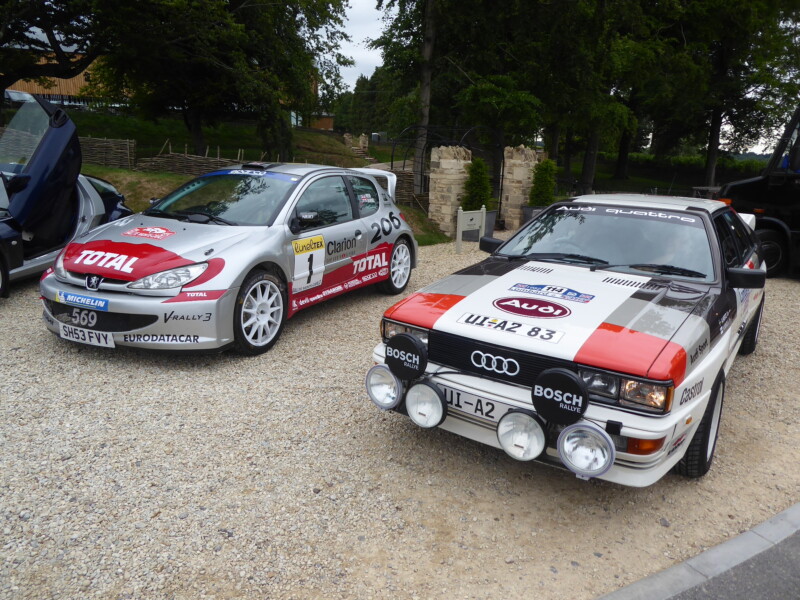
Definitely an icon of rallying, the Quattro changed everything, proving unbeatable in the early 1980s where the combination of incredible grip and traction from the all-wheel drive system and the power of the turbo five cylinder engine made all previous rally cars look decidedly old-fashioned. The original Audi Quattro competition car debuted in 1980, first as a development car (Course Car No. 0, Rali Urbibel Algarve Portugal 30 October to 1 November 1980), and then on a formal basis in the 1981 Jänner Rallye in Austria. Largely based on the bodyshell of the road-going Quattro models (in contrast to the forthcoming Group B cars), the engine of the original competition version produced approximately 304 PS. In 1981, Michèle Mouton became the first female driver to win a world championship rally, piloting an Audi Quattro. Over the next three years, Audi would introduce the A1 and A2 evolutions of the Quattro in response to the new Group B rules, raising the power output of the turbocharged inline 5-cylinder engine to around 355 PS. The Quattro A1 debuted at the WRC 1983 season opener Monte Carlo Rally, and went on to win the Swedish Rally and the Rally Portugal in the hands of Hannu Mikkola. Driven by Stig Blomqvist, Mikkola and Walter Röhrl, the A2 evolution won a total of eight world rallies, three in 1983 and five in 1984. Two examples of the same car completely dominated the South African National Rally Championships during 1984 to 1988, with S.A. champion drivers Sarel van der Merwe and Geoff Mortimer. In 1988, the Audi Ur-Quattro driven by Audi Tradition driver Luciano Viaro won the 13th Silvretta Classic Montafon.


BENTLEY
This is a second generation Continental GT Coupe. These were made between 2011 and 2018 and they followed the successful formula of the first generation cars. Over time the range expanded to include the GTC Convertible body and a number of different versions using the V8 and W12 engines.

FORD
Ford played much the same guessing game about whether there would be an RS version of the third generation Focus as they had done with the earlier versions. Production of the regular cars started in late 2010, but it was not until the 2015 Geneva Motor Show before the production ready MKIII Ford Focus RS was unveiled. It came packing the turbocharged 2.3-litre inline-four engine found in the Mustang EcoBoost. In the Focus RS, the engine itself produces 350 hp. Power is sent to all four wheels via Ford’s all-new Torque-Vectoring All-Wheel-Drive system with a rear drive unit designed by GKN, as well as upgraded suspension and brakes. As well as that, the new Focus RS will be fitted with Drive Modes – including an industry-first Drift Mode that allows controlled oversteer drifts – and Launch Control. The RS will boast a model specific aerodynamic package that helps to differentiate it from other Focus models. The RS is capable of accelerating to 100 km/h (62 mph) in 4.7 seconds. Sales finally started in mid 2016, with long waiting lists having been created, though Ford did eventually catch up with expanded production levels allowing them to meet the demand.

HYUNDAI
This is the less well known Fastback version of the i30N.

JAGUAR
One of the most loved Jaguars of all time, both when it was new, and still now, is the Mark 2 saloon. Many will tell you that it is not the 3 Series BMW that “invented” the “compact sports saloon” car class, but this model, which dates back to 1959. A thorough revision of the small Jaguar saloon that had joined the range in 1955, the Mark 2 was notable in that it was the first car to use the Arabic numeral in its name, as opposed to the Roman numerals of the larger Jaguar models. At launch, the earlier model which had hitherto been known by its engine size was christened the Mark 1. Although clearly based on that car, the updated car looked significantly different, with an increase of 18% in cabin glass area greatly improving visibility. The car was re-engineered above the waistline. Slender front pillars allowed a wider windscreen and the rear window almost wrapped around to the enlarged side windows now with the familiar Jaguar D-shape above the back door and fully chromed frames for all the side windows. The radiator grille was amended and larger side, tail and fog lamps repositioned. Inside a new heating system was fitted and ducted to the rear compartment (although still notoriously ineffective). There was an improved instrument layout that became standard for all Jaguar cars until the XJ Series II of 1973. As well as the familiar 2.4 and 3.4 litre engines, what made this car particularly special was that it was also offered with the potent 220 bhp 3.8 litre unit that was fitted to the XK150 and which would later see service in the E Type. This gave the car a 0 – 60 time of around 8.5 seconds and a top speed of 125 mph. No wonder that the Mark 2 became popular as a get-away car for the criminal fraternity, and to keep up with and catch them, many police forces bought the car as well. With revised suspension and standard four wheel disc brakes, the car was effective on the track, taking plenty of class wins when new, and it is still popular in historic racing circles today. The quickest and most successful private entries came from John Coombs, a man with significant race experience who operated a large Jaguar dealership in Guildford. Coombs would undertake modifications to meet the demands of his customers, so not all the cars that he worked on are the same. Jaguar replaced the Mark 2 with simplified and slightly more cheaply finished 240 and 340 models, as an interim measure until an all-new model was ready to take over from them. The 3.8 litre disappeared from the range at this time, but in the 7 years it had been in production, it had been the best seller of the range, with around 30,000 cars produced, as compared to 28,666 of the 3.4 litre and 25,741 of the 2.4 litre model.

LANCIA
Needing little in the way of an introduction is this Stratos. Sadly not an original car (which are extremely rare these days), it is a well-produced replica, but is still rather splendid, and it was attracting lots of interest. A Bertone-designed concept car called the Lancia Stratos Zero was shown to the public in 1970, but shares little but the name and mid-engined layout with the Stratos HF version. A new car called the New Stratos was announced in 2010 which was heavily influenced by the design of the original Stratos, but was based on a Ferrari chassis and engine. Bertone had no previous business with Lancia, who were traditionally linked with Pininfarina, and he wanted to come into conversation with them. Bertone knew that Lancia was looking for a replacement for the ageing Fulvia for use in rally sports and so he designed an eye-catcher to show to Lancia. Bertone used the running gear of the Fulvia Coupé of one of his personal friends and built a running showpiece around it. When Bertone himself appeared at the Lancia factory gates with the Stratos Zero he passed underneath the barrier and got great applause from the Lancia workers. After that a co-operation between Lancia and Bertone was formed to develop a new rally car based on ideas of Bertone’s designer Marcello Gandini who already had designed the Lamborghini Miura and Countach. Lancia presented the Bertone-designed Lancia Stratos HF prototype at the 1971 Turin Motor Show, a year after the announcement of the Stratos Zero concept car. The prototype Stratos HF (Chassis 1240) was fluorescent red in colour and featured a distinctive crescent-shaped-wrap-around windshield providing maximum forward visibility with almost no rear visibility. The prototype had three different engines in its early development life: the Lancia Fulvia engine, the Lancia Beta engine and finally for the 1971 public announcement, the mid-mounted Dino Ferrari V6 producing 190 hp. The use of the Dino V6 was planned right from the beginning of the project, but Enzo Ferrari was reluctant to sign off the use of this engine in a car he saw as a competitor to his own Dino V6. After the production of the Dino car had ended the “Commendatore” (a popular nickname for Enzo Ferrari) agreed on delivering the engines for the Stratos, and Lancia then suddenly received 500 units. The Stratos was a very successful rally car during the 1970s and early 1980s. It started a new era in rallying as it was the first car designed from scratch for this kind of competition. The three leading men behind the entire rallying project were Lancia team manager Cesare Fiorio, British racer/engineer Mike Parkes and factory rally driver Sandro Munari with Bertone’s Designer Marcello Gandini taking a very personal interest in designing and producing the bodywork. Lancia did extensive testing with the Stratos and raced the car in several racing events where Group 5 prototypes were allowed during the 1972 and 1973 seasons. Production of the 500 cars required for homologation in Group 4 commenced in 1973 and the Stratos was homologated for the 1974 World Rally Championship season. The Ferrari Dino V6 engine was phased out in 1974, but 500 engines among the last built were delivered to Lancia. Production ended in 1975 when it was thought that only 492 were made (for the 1976 season, the Group 4 production requirement was reduced to 400 in 24 months. Manufacturer of the car was Bertone in Turin, with final assembly by Lancia at the Chivasso plant. Powered by the Dino 2.4 litreV6 engine that was also fitted to the rallying versions, but in a lower state of tune, it resulted in a power output of 190 hp, giving the road car a 0–100 km/h time of 6.8 seconds, and a top speed of 232 km/h (144 mph). The Stratos weighed between 900 and 950 kilograms, depending on configuration. Power output was around 275 hp for the original 12 valve version and 320 hp for the 24 valve version. Beginning with the 1978 season the 24 valve heads were banned from competition by a change to the FIA rules. Even with this perceived power deficit the Stratos was the car to beat in competition and when it did not suffer an accident or premature transmission failure (of the latter there were many) it had great chances to win. Despite the fact that the Stratos was never intended to be a race car, there were two Group 5 racing cars built with 560 hp, using a single KKK turbocharger. The car won the 1974, 1975 and 1976 championship titles in the hands of Sandro Munari and Björn Waldegård, and might have gone on to win more had not internal politics within the Fiat group placed rallying responsibility on the Fiat 131 Abarths. As well as victories on the 1975, 1976 and 1977 Monte Carlo Rally, all courtesy of Munari, the Stratos won the event with the private Chardonnet Team as late as 1979. Without support from Fiat, and despite new regulations that restricted engine power, the car would remain a serious competitor and proved able to beat works cars in several occasions when entered by an experienced private team with a talented driver. The last victory of the Stratos was in 1981, at the Tour de Corse Automobile, another World Rally Championship event, with a victory by longtime Stratos privateer Bernard Darniche. When the Fiat group favoured the Fiat 131 for rallying Lancia also built two Group 5 turbocharged ‘silhouette’ Stratos for closed-track endurance racing. These cars failed against the Porsche 935s on closed tracks but proved successful in hybrid events. While they failed in the Tour de France Automobile, one of these cars won the 1976 Giro d’Italia Automobilistico, an Italian counterpart of the Tour de France Automobile. One of the cars was destroyed in Zeltweg, when it caught fire due to overheating problems. The last surviving car would win the Giro d’Italia event again before it was shipped to Japan to compete in the Fuji Speedway based Formula Silhouette series, which was never raced. The car would then be sold and reside in the Matsuda Collection before then being sold to the renowned collector of Stratos’, Christian Hrabalek, a car designer and the founder of Fenomenon Ltd, who has the largest Lancia Stratos Collection in the world, 11 unique Lancia Stratos cars, including the fluorescent red 1971 factory prototype and the 1977 Safari Rally car. His interest in the car led to the development of the Fenomenon Stratos in 2005. The Stratos also gained limited success in 24 Hours of Le Mans, with a car, driven by Christine Dacremont and Lella Lombardi, finishing 20th in 1976


LOTUS
The Type 75 Elite, announced in 1974, was the first of a new generation of Lotus cars which represented a concerted push up-market. The imposition of VAT had effectively killed off the market for the range of models that Lotus had hitherto produced as kit cars, and the only way to stay profitable was to produce something which could sold at higher prices. So whilst Lotus would tell you that the Elite was a replacement for the Lotus Elan Plus 2, it was more accurate to say that it was a rival for cars like the Reliant Scimitar GTE and Lancia Beta HPE. The styling was quite unlike anything that Lotus had produced before, with distinctive wedge lines penned by Oliver Winterbottom which hid the fact that the bodies were produced out of two separate glassfibre moulds and they had to join up in the middle around the waistline. The shooting brake style, with a hatchback as well as the fact that the Elite had 4 seats made it reasonably practical. luggage compartment. Mechanically there were fewer surprise. It was front engined with rear wheel drive, and had 4-wheel independent suspension using coil springs. The Elite was Lotus’ first car to use the 907 aluminium-block 4-valve, DOHC, four-cylinder, 1973cc, developing 155 bhp. which had previously been used in the Jensen-Healeys, where all the reliability issues had been found) The 907 engine ultimately became the foundation for the 2.0 litre and 2.2 litre Lotus Esprit powerplants, the naturally aspirated 912 and the turbocharged 910. The Elite was fitted with a 4 or 5 speed gearbox and from January 1976 automatic transmission was optional. The Elite had a claimed drag co-efficient of 0.30 and at the time of launch it was the world’s most expensive four cylinder car. Elites were available in 4 main specification variations, 501, 502, 503, and later on 504. The 501 was the ‘base’ version. The 502 added air conditioning, the 503 had power steering and the 504 added automatic transmission. The Elite was the basis for a coupe model, the Eclat which was launched in October 1975. Facelifted versions of both came in 1980, with a larger 2.2 litre engine and refinements to the trim. The Elite would live a couple of years in this form, but market interest shifted to the Coupe and when this was given a more significant revision a couple of years later, and a new name of Excel, the Elite was dropped from the range. Although 2535 of them were made, they are rare these days, so it was nice to see this 503 model.


Known internally as the Type 89, the Excel, built from 1982 to 1992, was a development of the earlier Lotus Eclat, which itself was based on the Type 75 Elite. Although a promising design, the Elite and Eclat had suffered from numerous quality control issues which were difficult for owners to accept given the price of the cars. The Excel was a concerted effort to address these, and it stood every chance of so doing, as it took advantage of the relationship with Toyota. This had started when Toyota engaged Lotus to assist with engineering work on the Supra. During this period, Toyota then became a major shareholder in Lotus. Part of the deal between the two included the use of many Toyota mechanical components in Lotus’ cars. The original Excel (aka the Eclat Excel) used the W58 manual transmission, driveshafts, rear differential, 14×7 in alloy wheels, and door handles from the Supra Mk II, which was made from 1982 to 1986. The engine was the familiar all-aluminium, DOHC 2.2 litre Lotus 912 Slant Four which was also used in the Lotus Esprit S3. During its lifetime, the Excel received two major upgrades. With the introduction of the Excel SE which had a 180 bhp engine vs the standard 160 bhp car in October 1985, the bumpers, wing and interior was changed, including a new dashboard. In October 1986 the Excel SA with automatic gearbox was introduced. Further facelifts in 1989 saw Citroën-derived mirrors, as featured on the Esprit, and 15 inch OZ alloy wheels to a similar pattern as the Esprit’s. According to Lotus records, only 1 Excel was manufactured to USA specification. The lack of release in the USA was due to the high emission regulations (which would hinder the car’s performance), and poor sales of the car in Europe.


It is now over 20 years since Lotus launched the Elise, a model which showed a return to the core values of simplicity and light-weight which were cornerstones of Colin Chapman’s philosophy when he founded the marque in 1955. The first generation Elise was produced for just over 4 years, with a replacement model, the Series 2 arriving in October 2000. It came about as the Series 1 could not be produced beyond the 2000 model production year due to new European crash sustainability regulations. Lacking the funding to produce a replacement, Lotus needed a development partner to take a share of investment required for the new car. General Motors offered to fund the project, in return for a badged and GM-engined version of the car for their European brands, Opel and Vauxhall. The result was therefore two cars, which although looking quite different, shared much under the skin: a Series 2 Elise and the Vauxhall VX220 and Opel Speedster duo. The Series 2 Elise was a redesigned Series 1 using a slightly modified version of the Series 1 chassis to meet the new regulations, and the same K-series engine with a brand new Lotus-developed ECU. The design of the body paid homage to the earlier M250 concept, and was the first Lotus to be designed by computer. Both the Series 2 Elise and the Opel Speedster/Vauxhall VX220 were built on the same production line, in a new facility at Hethel. Both cars shared many parts, including the chassis, although they had different drive-trains and power-plants. The VX220 carried the Lotus internal model identification Lotus 116, with the code name Skipton for the launch 2.2 normally aspirated version and Tornado for the 2 litre Turbo which came out in 2004. Fitted with 17 inch over the Elise’s 16 inch front wheels, the Vauxhall/Opel version ceased production in late 2005 and was replaced by the Opel GT for February 2007, with no RHD version for the United Kingdom. The Elise lived on. and indeed is still in production now, some 15 years later, though there have been countless different versions produced in that time. Whilst the first of the Series 2 cars came with the Rover K-Series engine, and that included the 111S model which had the VVC engine technology producing 160 hp, a change came about in 2005 when Lotus started to use Toyota engines. This was initially due to Lotus’ plans to introduce the Elise to the US market, meaning that an engine was needed which would comply with US emissions regulations. The selected 1.8 litre (and later 1.6 litre) Toyota units did, and the K-series did not. that MG-Rover went out of business in 2005 and engine production ceased confirmed the need for the change. Since then, Lotus have offered us track focused Elise models like the 135R and Sport 190, with 135 bhp and 192 bhp respectively, as well as the 111R, the Sport Racer, the Elise S and Elise R. In 2008 an even more potent SC model, with 218 bhp thanks to a non-intercooled supercharger was added to the range. In February 2010, Lotus unveiled a facelifted version of the second generation Elise. The new headlights are now single units; triangular in shape they are somewhat larger than the earlier lights. The cheapest version in Europe now has a 1.6 litre engine to comply with Euro 5 emissions, with the same power output as the earlier 1.8 136bhp car. Lotus has been through some difficult times in recent years, but things are looking more optimistic again, with production numbers having risen significantly in the last couple of years, after a period when next to no cars were made.

MASERATI
Sole Maserati here was my Grecale, still a rare sight on British roads.

MG
Launched in October 1962, the MGB was produced for the next 18 years and it went on to become Britain’s best selling sports car. When first announced, the MGB was an innovative, modern design, with a monocoque structure instead of the traditional body-on-frame construction used on both the MGA and MG T-types and the MGB’s rival, the Triumph TR series, though components such as the brakes and suspension were developments of the earlier 1955 MGA and the B-Series engine had its origins back in 1947. The lightweight design reduced manufacturing costs while adding to overall vehicle strength, and with a 95hp 3-bearing 1798cc engine under the bonnet, performance was quite respectable with a 0–60 mph time of just over 11 seconds. The car was rather more civilised than its predecessor, with wind-up windows now fitted as standard, and a comfortable driver’s compartment offered plenty of legroom. The roadster was the first of the MGB range to be produced. The body was a pure two-seater but a small rear seat was a rare option at one point. By making better use of space the MGB was able to offer more passenger and luggage accommodation than the earlier MGA while being 3 inches shorter overall. The suspension was also softer, giving a smoother ride, and the larger engine gave a slightly higher top speed. The four-speed gearbox was an uprated version of the one used in the MGA with an optional (electrically activated) overdrive transmission. A five-bearing engine was introduced in 1964 and a number of other modifications crept into the specification. In late 1967, sufficient changes were introduced for the factory to define a Mark II model. Alterations included synchromesh on all 4 gears with revised ratios, an optional Borg-Warner automatic gearbox, a new rear axle, and an alternator in place of the dynamo with a change to a negative earth system. To accommodate the new gearboxes there were significant changes to the sheet metal in the floorpan, and a new flat-topped transmission tunnel. US market cars got a new safety padded dashboard, but the steel item continued for the rest of the world. Rostyle wheels were introduced to replace the previous pressed steel versions in 1969 and reclining seats were standardised. 1970 also saw a new front grille, recessed, in black aluminium. The more traditional-looking polished grille returned in 1973 with a black “honeycomb” insert. Further changes in 1972 were to the interior with a new fascia. To meet impact regulations, in late 1974, the chrome bumpers were replaced with new, steel-reinforced black rubber bumpers, the one at the front incorporating the grille area as well, giving a major restyling to the B’s nose, and a matching rear bumper completed the change. New US headlight height regulations also meant that the headlamps were now too low. Rather than redesign the front of the car, British Leyland raised the car’s suspension by 1-inch. This, in combination with the new, far heavier bumpers resulted in significantly poorer handling. For the 1975 model year only, the front anti-roll bar was deleted as a cost-saving measure (though still available as an option). The damage done by the British Leyland response to US legislation was partially alleviated by revisions to the suspension geometry in 1977, when a rear anti-roll bar was made standard equipment on all models. US emissions regulations also reduced horsepower. In March 1979 British Leyland started the production of black painted limited edition MGB roadsters for the US market, meant for a total of 500 examples. Due to a high demand of the limited edition model, production ended with 6682 examples. The United Kingdom received bronze painted roadsters and a silver GT model limited editions. The production run of home market limited edition MGBs was split between 421 roadsters and 579 GTs. Meanwhile, the fixed-roof MGB GT had been introduced in October 1965, and production continued until 1980, although export to the US ceased in 1974. The MGB GT sported a ground-breaking greenhouse designed by Pininfarina and launched the sporty “hatchback” style. By combining the sloping rear window with the rear deck lid, the B GT offered the utility of a station wagon while retaining the style and shape of a coupe. This new configuration was a 2+2 design with a right-angled rear bench seat and far more luggage space than in the roadster. Relatively few components differed, although the MGB GT did receive different suspension springs and anti-roll bars and a different windscreen which was more easily and inexpensively serviceable. Although acceleration of the GT was slightly slower than that of the roadster, owing to its increased weight, top speed improved by 5 mph to 105 mph because of better aerodynamics. 523,826 examples of the MGB of all model types were built, and although many of these were initially sold new in North America, a lot have been repatriated here.


Attracting lots of interest was the Cyberster, MG’s all-electric sports car that has been on sale for a few months now.


MINI
There were a couple of classic Mini models here, one a road-going version and the other a Cooper rally car tribute.


NISSAN/DATSUN
The Datsun Sports (called Datsun Fairlady in the Japanese and Australian markets and simply given a numerical designation alone in other export markets), was a series of roadsters produced by Nissan in the 1960s. The series was a predecessor to the Z-car in the Fairlady line, and offered a competitor to the European MG, Triumph, Fiat and Alfa Romeo sports cars. Beginning with the 1959 S211, the line was built in two generations: the first generation was largely handbuilt in small numbers, while the second generation (310 series) was series produced. The second generation first appeared in 1961 and continued through 1970 with the SP311 and SR311 lines. The second generation Fairlady made its debut at the Tokyo Motor show in 1961, several months before the roll-out of the similar looking MGB. The second generation was designed for mass production, unlike the mostly handbuilt original model. It was sold as the Datsun 1500/1600/2000 Roadster in most export markets. Particularly the 1600 and 2000 Roadsters became regular winners on the Sports Car Club of America (SCCA) circuit, winning 10 national SCCA championships. The 1600 and 2000 were produced until 1970 when they were superseded by the 240Z. The first true Datsun sports car was the 1963 SP310 “Fairlady 1500” model (right hand drive), and the SPL310 (left hand drive). In America it was known as the Datsun 1500. The SP310 was based on a modified Bluebird 310 sedan platform instead of the truck platform of earlier models. It featured a 1.5 L (1,497 cc) G15 OHV engine (from the Cedric) but with a single SU carburettor and 77 PS. After the first 300 SPL310’s had been built, a dual SU carb models with 85 PS was introduced for 1964 and 1965. A four-speed manual transmission was the only shifting option and has a non-syncro’d first gear. The rear axle used the shafts and differential also from the Cedric. It was a well-equipped car with a transistor radio, tonneau cover, map lights, and a clock. The first SP310s (1963–1964) were three-seaters, with a unique transverse single seat in the rear and buckets in front. The final revision of the 1500 model occurred in 1965 with a completely redesigned interior which eliminated the back seat and introduced a more sporty dash layout. To coincide with the 1964 Summer Olympics, Nissan established the gallery on the second and third floors of the San-ai building, located in Ginza, Tokyo. To attract visitors, Nissan started using beautiful female showroom attendants where Nissan held a competition to choose five candidates as the first class of Nissan Miss Fairladys, modelled after “Datsun Demonstrators” from the 1930s who introduced cars. The Fairlady name was used as a link to the popular Broadway play of the era My Fair Lady. Miss Fairladys became the marketers of Datsun Fair Lady 1500. Many changes were made in 1965. Though the 1.5 L SP310 continued in production through January, a new 1.6 L R16-powered SP311 and SPL311 (left-hand drive) replaced it. The new model was first shown at the 1964 Tokyo Motor Show, but did not enter production until March 1965. The restyling was executed in part by Count Albrecht Goertz, who would later be involved with designing the first Fairlady Z. Marketed as the Fairlady 1600, or the Datsun Sports 1600 in many export markets including North America, it featured 14 inch wheels and minor exterior changes. The SPL311 was also known as the “Roadster” on the West Coast of the United States. The front suspension was independent, using coil springs over hydraulic shocks. Rear suspension was a common leaf springs design, damped with hydraulic shocks. The 1600 SPL311 came with a pair of SU carburettors. The engine produced 96 PS. The R16 is an in-line four cylinder OHV engine. Early SPL311 came with a high compression engine that had three main bearings, hydraulic lifters, a cast iron block and cast iron head. Timing of the distributor could be easily adjusted to reduce pre-ignition knock and thereby tune for questionable quality gasoline. Engines in later SPL311 had 5 main bearings and this addressed a design weakness. Top speed for the SPL311 with approximately 91 octane gasoline was approximately 105 mph. The axle gearing suffered from design limitations and Datsun performance parts offered a cooling system as a retrofit. Steering used a worm gear design. The hood badge said “Datsun” in individual letters, the rear badge said “Datsun 1600”, and the side badges said “Fairlady” (Japanese market) or “Datsun 1600” (export market). The SP311 continued in production alongside the later 2000 model through April 1970. The first Nissan Silvia coupe shared the SP311’s platform. The CSP311 Silvia had an R16 engine developing 96 hp and used a modified Fairlady chassis. The Silvia was the first car fitted with Nissan’s new R engine. The R engine was a further development of the 1,488 cc G engine. Early in 1968 the 1600, just as the bigger 2000, was updated to meet new safety legislation. Toggle switches, a padded dashboard and padded center of the steering wheel were new inside. The door handles were changed to flush fit lifting units, while the windshield was taller with a top mounted internal rear view mirror. The introduction of the 1967 SR311 and SRL311 saw a major update. Produced from March 1967 until April 1970, the SR311 used a 2.0 L (1,982 cc) U20 engine and offered a five-speed manual transmission, somewhat unexpected for a production car at the time. The first-year cars (known as “half year” cars) are sought as there were fewer than 1,000 produced which are unencumbered with the 1968 model year emissions and safety changes. The inline, four-cylinder U20 engine had a cast iron block and aluminium alloy head. This new SOHC engine produced, for 1968 to 1970, 135 hp SAE gross in original trim. An optional Competition package included dual Mikuni/Solex carburettors and a special “B” model camshaft for 150 hp SAE gross; the package also provided higher limit gauges and a license plate surround. In Australia there were no emission restrictions at the time and all 2.0-litre cars were fitted with the Competition package as standard. Cars with the 2.0 litre engine in Japan were regarded as expensive, specialized, sports cars due to the annual road tax obligation. The Datsun 2000 was lauded as a bargain sports car. It was raced by John Morton, Bob Sharp and others. Its sticker price was lowest in its class, but it won its class in C Production (Mikuni-Solex carburettors) and D-Production (Hitachi-SU carburettors) in SCCA racing on a consistent basis even after production stopped. For the 1968 model year the entire line was updated with a new body featuring a taller integrated windshield with an integrated rear-view mirror, a padded dashboard with non-toggle switches, built-in headrests, and lifting door handles. This version was first shown at the 14th Tokyo Motor Show in October 1967 and was developed to meet the new Federal Motor Vehicle Safety Standards. In the US the engines were also fitted with new emissions controls, and the lesser 1600 continued as a companion model through the end of production. Australia had no such emission controls. On the TV Program Wheeler Dealers, Mike Brewer bought one from Gene Winfield. Ant Anstead repaired and improved the car.


PEUGEOT
This is the car owned by the event organiser, a tribute to the WRC 206 cars. The Peugeot 206 WRC is a World Rally Car based on the Peugeot 206. It was used by Peugeot Sport, Peugeot’s factory team, in the World Rally Championship from 1999 to 2003. The car brought Peugeot the manufacturers’ world title three consecutive years (2000 to 2002). Marcus Grönholm won the drivers’ title in 2000 and 2002. In order to homologate the 206 World Rally Car, Peugeot needed to sell road going versions of the 206 that were at least 4.0 metres long (the minimum length stipulated by the FIA for WRC cars). The WRC car was homologated with the 206 Grand Tourisme, similar to the standard 206 but with front and rear body extensions to bring the car from the standard road car’s 3.83 meters to the rally car’s 4 metre length. 4000 cars in total were produced, each with a unique number on a plaque on the door pillar both sides. 600 right-hand drive cars were produced for the UK. The mechanicals fitted to the Grand Tourisme were what was fitted to the upcoming 206 GTI, not yet released. In 1999, Peugeot Sport unveiled the 206 WRC, and it competed for the first time in that year’s World Rally Championship, with French tarmac veteran and long-time marque stalwart Gilles Panizzi narrowly failing, against a resurgent reigning champion in Mitsubishi’s Tommi Mäkinen, to win the Rallye Sanremo. The car was soon a success, however, and won both the manufacturers’ and drivers’ championships in 2000, Peugeot’s first such accolades since their withdrawal from the WRC after Group B was banned after the 1986 season, and achieved in the hands of Panizzi, Francois Delecour and Mäkinen’s successor as drivers’ world champion, Marcus Grönholm. For 2001, Grönholm competed alongside two refugees of SEAT’s exit from the championship at the end of 2000; compatriot Harri Rovanperä and the French 1994 world champion, Didier Auriol. Rovanperä and Auriol each contributed single wins, on Swedish Rally and Rally Catalunya respectively (the former to be a sole career win for the Finn, and the latter victory helped by assorted problems for the blisteringly quick debuting Citroën Xsara WRCs), before Auriol left the team at the end of the season. Grönholm, meanwhile, suffered sufficient reliability woes in the first half of the year such that he could manage no higher than fourth overall in the series, although Peugeot did fend off Ford, with a 1-2 result by the two Finns on the season-ending Rally of Great Britain to successfully defend the constructors’ championship title. In 2002, Grönholm – despite now being paired in the factory line-up with defending 2001 champion from Subaru, the Briton Richard Burns – led Peugeot to a repeat of the WRC title double aboard his 206 WRC. His dominance that year was compared to Michael Schumacher’s dominance of Formula One. In summary, Peugeot won two drivers’ championships, in 2000 and 2002, and three manufacturers’ titles in a row between 2000 and 2002. However, by 2003 the 206 WRC was beginning to show its age and was less effective against the competition, notably the newer Xsara WRC and the Subaru Impreza WRC, so it was retired from competition at the end of the season, to be replaced with the 307 WRC, albeit, unlike its predecessor, based not on the production version’s hatchback, but its coupé cabriolet body style. The Peugeot 206 WRC was awarded the Autosport “Rally Car of the Year” in 2002, preceded by the Ford Focus RS WRC and followed by the Citroën Xsara WRC. Peugeot GB created a Peugeot 206 rally championship aimed at young drivers. The championship was created to help young drivers develop their careers. The cars were built by Vic Lee Racing and drivers such as Tom Boardman, Luke Pinder and Garry Jennings all drove in the championship.


PORSCHE
The 911 continued to evolve throughout the 1960s and early 1970s, though changes initially were quite small. The SC appeared in the autumn of 1977, proving that any earlier plans there had been to replace the car with the front engined 924 and 928 had been shelved. The SC followed on from the Carrera 3.0 of 1967 and 1977. It had the same 3 litre engine, with a lower compression ratio and detuned to provide 180 PS . The “SC” designation was reintroduced by Porsche for the first time since the 356 SC. No Carrera versions were produced though the 930 Turbo remained at the top of the range. Porsche’s engineers felt that the weight of the extra luxury, safety and emissions equipment on these cars was blunting performance compared to the earlier, lighter cars with the same power output, so in non-US cars, power was increased to 188 PS for 1980, then finally to 204 PS. However, cars sold in the US market retained their lower-compression 180 PS engines throughout. This enabled them to be run on lower-octane fuel. In model year 1980, Porsche offered a Weissach special edition version of the 911 SC, named after the town in Germany where Porsche has their research centre. Designated M439, it was offered in two colours with the turbo whale tail & front chin spoiler, body colour-matched Fuchs alloy wheels and other convenience features as standard. 408 cars were built for North America. In 1982, a Ferry Porsche Edition was made and a total of 200 cars were sold with this cosmetic package. SCs sold in the UK could be specified with the Sport Group Package (UK) which added stiffer suspension, the rear spoiler, front rubber lip and black Fuchs wheels. In 1981 a Cabriolet concept car was shown at the Frankfurt Motor Show. Not only was the car a true convertible, but it also featured four-wheel drive, although this was dropped in the production version. The first 911 Cabriolet debuted in late 1982, as a 1983 model. This was Porsche’s first cabriolet since the 356 of the mid-1960s. It proved very popular with 4,214 sold in its introductory year, despite its premium price relative to the open-top targa. Cabriolet versions of the 911 have been offered ever since. 911 SC sales totalled 58,914 cars before the next iteration, the 3.2 Carrera, which was introduced for the 1984 model year. Coupe models outsold the Targa topped cars by a big margin.

The 996 was replaced with the 997 in 2005. It retains the 996’s basic profile, with an even lower 0.28 drag coefficient, but draws on the 993 for detailing. In addition, the new headlights revert to the original bug-eye design from the teardrop scheme of the 996. Its interior is also similarly revised, with strong links to the earlier 911 interiors while at the same time looking fresh and modern. The 997 shares less than a third of its parts with the outgoing 996, but is still technically similar to it. Initially, two versions of the 997 were introduced— the rear-wheel-drive Carrera and Carrera S. While the base 997 Carrera had a power output of 321 hp from its 3.6 L Flat 6, a more powerful 3.8 L 350 hp Flat 6 powers the Carrera S. Besides a more powerful engine, the Carrera S also comes standard with 19 inch “Lobster Fork” style wheels, more powerful and larger brakes (with red calipers), lowered suspension with PASM (Porsche Active Suspension Management: dynamically adjustable dampers), Xenon headlamps, and a sports steering wheel. In late 2005, Porsche introduced the all-wheel-drive versions to the 997 lineup. Carrera 4 models (both Carrera 4 and Carrera 4S) were announced as 2006 models. Both Carrera 4 models are wider than their rear-wheel-drive counterparts by 1.76 inches (32 mm) to cover wider rear tyres. The 0–100 km/h (62 mph) acceleration time for the Carrera 4S with the 350 hp engine equipped with a manual transmission was reported at 4.8 seconds. The 0–100 km/h (62 mph) acceleration for the Carrera S with the 350 hp was noted to be as fast as 4.2 seconds in a Motor Trend comparison, and Road & Track has timed it at 3.8 seconds. The 997 lineup includes both 2- and 4-wheel-drive variants, named Carrera and Carrera 4 respectively. The Targas (4 and 4S), released in November 2006, are 4-wheel-drive versions that divide the difference between the coupés and the cabriolets with their dual, sliding glass tops. The 997 received a larger air intake in the front bumper, new headlights, new rear taillights, new clean-sheet design direct fuel injection engines, and the introduction of a dual-clutch gearbox called PDK for the 2009 model year. They were also equipped with Bluetooth support. The change to the 7th generation (991) took place in the middle of the 2012 model year. A 2012 Porsche 911 can either be a 997 or a 991, depending on the month of the production.


RENAULT
The Megane Renault Sport 230 Renault F1 Team R26 is a version that commemorates the success of Renault in the Formula 1 World Championship with the 2005 and 2006 Constructors’ and Drivers’ Championship titles and is named after the 2006 F1 car (R26). It is based on the facelifted Mégane RS. The engine is rated at 227 hp (230 PS) at 5,500 rpm and 310 Nm (229 lb⋅ft) at 3,000 rpm. It incorporates the improved version of the Cup Chassis package now with a limited slip differential fitted for the first time in addition to 18-inch Anthracite spoked alloy wheels with Michelin Pilot Sport 2 235/40 R18 tyres, Brembo front and rear red brake calipers and an increased brake master cylinder diameter, plus revised stiffened steering. Other features include a sport exhaust, Recaro seats, climate control, 4×15-watt RDS radio single CD/MP3 player with 6 speakers, Renault F1 decals, numbered plaque, limited slip differential and a rear spoiler. The car weights 1,355 kg (2,987 lb) kerb, 1,820 kg (4,012 lb) gross. This generation of Megane RS was widely regarded as one of the best hot hatches of the time.


ROVER
The first new car that Rover announced after the war was the P4 model, known as the 75. It was launched at the Earls Court Motor Show in September 1949, to replace all previous models and then continued in production until 1964, though the car underwent lots of change under the skin in those 15 years. Designed by Gordon Bashford, the car went into production in 1949 as the 6-cylinder 2.1-litre Rover 75. It featured unusual modern styling in stark contrast with the outdated Rover P3 model 75 which it replaced. Gone were the traditional radiator, separate headlamps and external running boards. In their place were a chromium grille, recessed headlamps and a streamlined body the whole width of the chassis. The car’s styling was derived from the then controversial 1947 Studebakers. The Rover executives purchased two such vehicles and fitted the body from one of them to a prototype P4 chassis to create a development mule. In James Taylor’s highly regarded book ‘Rover P4 – The Complete Story’ he advised that this vehicle was affectionately known as the ‘Roverbaker’ hybrid. Another, at the time minor, distinctive feature but this one did not catch-on was the centrally mounted light in the grille where most other manufacturers of good quality cars provided a pair, one fog and one driving light often separately mounted behind the bumper. Known, unkindly, as the “Cyclops eye” it was discontinued in the new grille announced 23 October 1952. The earliest cars used a more powerful version of the Rover engine from the 1948 Rover P3 75, a 2103 cc straight-6 engine now with chromium plated cylinder bores, an aluminium cylinder head with built-in induction manifold and a pair of horizontal instead of downdraught carburetters. A four-speed manual transmission was used with a column-mounted gear lever which was replaced by a floor-mounted mechanism in September 1953. At first the gearbox only had synchromesh on third and top but it was added to second gear as well in 1953. A freewheel clutch, a traditional Rover feature, was fitted to cars without overdrive until mid-1959, when it was removed from the specifications, shortly before the London Motor Show in October that year. The cars had a separate chassis with independent suspension by coil springs at the front and a live axle with half-elliptical leaf springs at the rear. The brakes on early cars were operated by a hybrid hydro-mechanical system but became fully hydraulic in 1950. Girling disc brakes replaced drums at the front from October 1959. The complete body shells were made by the Pressed Steel company and featured aluminium/magnesium alloy (Birmabright) doors, boot lid and bonnets until the final 95/110 models, which were all steel to reduce costs. The P4 series was one of the last UK cars to incorporate rear-hinged “suicide” doors. After four years of the one model policy Rover returned to a range of the one car but three different sized engines when in September 1953 they announced a four-cylinder Rover 60 and a 2.6-litre Rover 90. A year later, an enlarged 2230cc engine was installed in the 75, and an updated body was shown with a larger boot and a bigger rear window and the end of the flapping trafficators, with redesigned light clusters. Further detailed changes would follow. Announced 16 October 1956, the 105R and 105S used a high-output, 8.5:1 compression version of the 2.6 litres engine used in the 90. The higher compression was to take advantage of the higher octane fuel that had become widely available. This twin-SU carburettor engine produced 108 hp. Both 105 models also featured the exterior changes of the rest of the range announced a month earlier. The 105S featured separate front seats, a cigar lighter, chromed wheel trim rings and twin Lucas SFT 576 spotlamps. To minimise the cost of the 105R, these additional items were not standard, however they were provided on the (higher priced) 105R De Luxe. The 105R featured a “Roverdrive” automatic transmission. This unit was designed and built by Rover and at the time was the only British-built automatic transmission. Others had bought in units from American manufacturers such as Borg-Warner. This unit was actually a two-speed automatic (Emergency Low which can be selected manually and Drive) with an overdrive unit for a total of three forward gears. The 105S made do with a manual transmission and Laycock de Normanville overdrive incorporating a kick-down control. The 105S could reach a top speed of 101 mph. Production of the 105 line ended in 1958 for the 105R and 1959 for the manual transmission 105S, 10,781 had been produced, two-thirds with the manual transmission option. For 1959 the manual model was described simply as a 105 and the trim and accessory level was reduced to match the other models. In 1959, the engines were upgraded again, with the 80 replacing the 60 and the 100 replacing the 90 and the 105. The four cylinder cars were not particularly popular, though and in September they were replaced by the six cylinder 95. Final model was the 110, which took its place at the top of the range until production ceased, a few months after the very different P6 model 2000 had come along. These cars are popular classics these days.


SMART
The Smart Roadster and Roadster Coupé were introduced in 2003, based on a stretched platform of the Fortwo with a full length of 3427 mm. The two variants are meant to be reminiscent of the British roadster of yore, such as the Triumph Spitfire or the MG B. Both the Roadster and Roadster Coupé are available with a removable Targa roof or an electrical softtop. The Roadster is powered by 61 or 82 PS versions of the turbocharged 698cc 3-cylinder Suprex engine in the rear, which is engineered by Mercedes-Benz. The Roadster Coupé has only the more powerful 80 bhp engine. A steering wheel with Formula 1-style paddle-shifters, to control the single-clutch automated manual transmission, is optional. Weighing as little as 790 kg (1,742 lb), the Roadster is intended to provide the emotion of driving a sports car at an affordable cost. Both the Roadster and Roadster Coupé are available in Brabus-tuned versions with power increased to 99 bhp. The Brabus versions have a different twin sports exhaust, lower suspension, polished six-spoke aluminium alloy Monoblock VI 17″ wheels (205/40 ZR17 at the front and 225/35 ZR17 at the rear), front spoiler, side skirts and radiator grille. Exclusive Brabus (Xclusive) interior includes a leather-trimmed dashboard, alloy-effect accent parts, instrument graphics, leather/aluminium gearshift with Brabus labelled starter button, aluminium handbrake handle (which fouls the central armrest), aluminium pedals and Brabus labelled floor mats. The Brabus version also features stronger clamping of the clutch plates and a faster gearchange. The Monoblock wheels are known to be very soft and as a result, are very easy to buckle. The lacquer on these wheels is also very poor, and corrosion can occur very early in the life of the wheel. Despite a projected break-even of only 8-10,000 units per year, first-year sales almost doubled this estimate. However, some Smart Roadsters leaked and production ceased due to the warranty work and other costs reaching an average of €3000 per vehicle. While a critical success, the Smart Roadster was, due to these costs, an economic failure for the company. Influential British motoring television show and magazine Top Gear praised the Roadster, awarding it Fun Car Of The Year for 2005. 43,091 Roadsters were built and put on the shop fronts, with chassis numbers ranging from 00,001 to around 43,400.


SUBARU
The Impreza chassis has been more successful in rallying than Subaru’s previous contenders. Prior to the introduction of the Impreza into World Rally Championship racing in 1993, the Subaru World Rally Team had fielded its larger mid-size Legacy. However, with the rest of the rally competition increasingly shifting towards smaller and lighter chassis, Subaru introduced the smaller Impreza, immediately achieving a podium on its debut on the 1993 1000 Lakes Rally. To jumpstart its early rally efforts, and to develop the Impreza into a competitive rally car, Subaru teamed up with preparatory firm and British motorsports company Prodrive, in 1989. Immediately following the first overall WRC event win for both the fledgling Subaru team and its young driver, the late Colin McRae aboard a Group A Legacy on the 1993 Rally New Zealand, the Scotsman’s teammate and childhood idol, 1981 World Rally Champion, Ari Vatanen of Finland, went on to finish second in the debut rally of the first ever factory Impreza. New recruit for the following season, 1990 and 1992 World Champion, Carlos Sainz brought the Impreza its inaugural victory on the 1994 Acropolis Rally. The Impreza brought Subaru three consecutive WRC constructors’ titles (1995–1997, the latter season the first for the newly introduced World Rally Car class) and a driver’s championship for McRae in 1995, the late Richard Burns in 2001, and the Norwegian, Petter Solberg in 2003. Another evolution of the Impreza WRC made its debut in the 2007 Corona Rally Mexico. Unfortunately, the team had several major problems with reliability as the car experienced mechanical difficulties in almost every rally from its first. Subaru debuted an Impreza WRC in hatchback form for the first time from the 2008 Acropolis Rally onwards, on which event Solberg scored a second-place finish. On 16 December 2008 Subaru announced that it would withdraw from the World Rally Championship due to economic problems. The Impreza holds the record for the most WRC event wins, tied with the Lancia Delta.


VAUXHALL
The front-wheel drive Opel Corsa was first launched in September 1982. It went on sale first in France, Italy, and Spain – markets where small cars represented from 34 to 43 percent of sales. Built-in Zaragoza, Spain, the first Corsas were three-door hatchback and two-door saloon models, with four-door and five-door versions arriving in 1984. In certain markets, commercial “van” models were also sold, with or without rear windows depending on local requirements. In mainland Europe, the saloon versions were known as the “Corsa TR” until May 1985 and received an egg-crate grille rather than the four slits used on hatchbacks. The saloons were intended to appeal to customers of the Opel Kadett C and its sister the Vauxhall Chevette who still desired a traditional 3-box sedan shape – but it did not sell particularly well in most of Europe but were popular in Spain and Portugal, among other markets. While only taking ten percent of French Corsa sales during the car’s first half-year, the TR represented half of all Corsas sold in Spain. The basic trim level was called just the Corsa, which was followed by the Corsa Luxus, Corsa Berlina, and the sporty Corsa SR. The SR receives a spoiler which surrounds the rear window, alloy wheels, checkered sport seats, and a somewhat more powerful 70 PS engine. Six years later, the Corsa received a facelift, which included a new front fascia and some other minor changes. The models were called LS, GL, GLS, and GT. The Corsa A was known in the United Kingdom market as the Vauxhall Nova (as it was considered that Corsa sounded too much like “coarser”), where it was launched in April 1983, following a seven-month-long union dispute due to British workers being angry about the car not being built there, in contrast to the rival Ford Fiesta, Austin Metro and Talbot Samba. In addition, there was also a dispute about the disparity of import tariffs, as while cars exported from Spain to the European Community were subject to tariffs of only 4.4 per cent, those exported in the other direction were subject to tariffs as high as 36.7 per cent. Power first came from 1.0 L 45 hp, 1.2 L 55 hp, and 1.3 L 70 hp petrol engines. (The first engines were all equipped with carburettors; fuel injection came later, but never for the 1.0.) The engines were based on the well proven Family II design, except for the 1.0 L and early 1.2 L engines, which were based on the OHV unit from the Kadett C. There was also an Isuzu-built, 67 PS 1.5 L turbo diesel engine available, which was also used in the Isuzu Gemini at around the same time. The diesel joined the line up in May 1987, at the Frankfurt Motor Show, along with the sporty GSi. The engines and most of the mechanical componentry were derived from those used in the Astra/Kadett. In September 1987 the Corsa received a light facelift, with a new grille that was now the same on hatchbacks and sedans, an updated interior, and other slight changes. For the 1989 model year, the 1.3 was bored out to 1.4 liters. Power remained the same, although torque increased. A rare “Sport” model was produced in 1985 to homologate for the sub 1,300 cc class of Group A for the British Rally Championship. These Sport models were white and came with unique vinyl decals, a 13SB engine with twin Weber 40 DCOE carburettors, an optional bespoke camshaft, a replacement rear silencer, and few luxuries. This gave 93 hp and a top speed of 112 mph (180 km/h) with a 0–60 mph time of 8.9 seconds. These are by far the rarest models (500 produced) and thus acquire a high market price if one does become available. A 1.6 L multi point fuel-injected engine with 101 PS at 5600 rpm (98 PS in the catalysed version) and capable of 186 km/h (116 mph) was added to the Corsa/Nova at the 1987 Frankfurt Motor Show, giving decent performance and being badged as a GSi (“Nova GTE” in pre-facelift models in the United Kingdom, later models were all called GSi). The GSi’s engine mapping had been carried out by Opel tuning specialists Irmscher. A model with the 82 PS 1.4 L multi-point fuel-injected engine, which was otherwise mechanically identical to the GSi, also became available as the Nova SRi in the United Kingdom. In January 1988, a turbocharged version of the Isuzu diesel engine was introduced, with power increased to 67 PS. The design was freshened in September 1990, with new bumpers, headlights, grille, and interior, but it was clearly recognisable as a gentle makeover of an early 1980s design when it had to compete with the latest two all-new superminis in Europe – the Peugeot 106 and the Renault Clio. The car was finally replaced in the spring of 1993. Nearly 500,000 Novas were sold in Britain over its ten years on sale. In its best year, 1989, it was Britain’s seventh best selling car with more than 70,000 sales, but by February 2016, only 1,757 were still on the road.


VOLKSWAGEN
Needing no introduction is the iconic Beetle, seen here from towards the end of European production, as a regular 1300 model. By the 1970s, when this car was made, it was really very old fashioned, but it still had a loyal following in the market.


Joining it was an example of the Golf GTi Mark 2. VW had launched the second generation Golf in August of 1983, nearly 9 years after production of the first model to bear the name had begun. This time, a GTi version was included in the product plans from the start, and the new GTi was announced in May 1984. Like the regular Golf 2, it was almost 7″ longer than the Mark 1, with 3″ extra in the wheelbase and a 2″ wider track. It was also 10% heavier, but with significantly improved aerodynamics, resulting from attention to detail which included integrated gutters and flush glass as well as more rounded styling, the cd fell from 0.42 to 0.34. Initially it was powered by the same 1781cc fuel injected engine, but there were all round disc brakes and longer suspension travel improved the ride. Competitors came snapping at its heels, though, so after 2/5 years, VW responded by giving the car 24% more power, achieved by doubling the number of valves to 16. Lower stiffer suspension and bigger front brakes were also fitted, all of which restored the Golf GTi 16V to the top of the Hot Hatch pile. For most people that is, though the 8v car retained a following thanks to its broader torque spread. This less powerful car changed from a mechanical K-Jetronic injection system to a new Digifant electronic set up in 1987 at which point the front quarterlights were deleted, and a digital instrument pack became an option on the 16v car. Power steering became standard in late 1990 and the 8v gained the interior from the 16v model. Production ran through to February 1992, by which time the Mark 3 GTi was waiting in the wings. over 600,000 were built over an 8 year period, around 10% of all Mark 2 Golf production.

This proved to be an enjoyable event and will I am sure quickly increase in size as words gets out. There are more dates announced across the summer and, diary permitting, I plan to attend these as well.