

In what is sometimes referred to as the E Segment, that for premium and luxury large cars, the German triumvirate of Audi, BMW and Mercedes have long dominated. For sure they do have competition, from the likes of Jaguar and Volvo who enjoy modest success and the French brands who lately have struggled so badly to sell their luxury cars even in France that they have more or less given up. This was a sector of the market that the Japanese had been eyeing up for a long time, before making their move in the late 1980s when they decided that they needed to use completely different branding from their volume business, which resulted in Lexus, Infiniti and Acura. In America, Lexus has done well, but the other two have not made much dent in the market, and even Lexus found far more success as they shifted to an SUV-focused model range. Just as the Japanese had become an important global player in the 70s and 80s, so the Koreans were not far behind and as the cars of Hyundai and Kia got better and better in the early 2000s, so it was inevitable that they would also go upmarket and try their luck competing against the Big Names. Notice of their ambitions was served with the launch in all markets except Europe of the Hyundai Genesis in 2008, a traditional luxury/sports executive saloon which gathered more than a few headlines and delivered a bloody nose to the German brands. Korean brands still have faster refresh cycles than European ones, so it was just five years later when a replacement car arrived. Objectively better than the first one, and making some headway in the showroom, it still struggled with the fact that the market perceived Hyundai as the maker of value-based product not luxury ones, so it was not a complete surprise that in 2016 Hyundai decided to create a whole new brand, which, perhaps with their true ambition of a new beginning in mind, they called Genesis. The G80, as it was now called had a ready made stablemate in the erstwhile Equus, now called the G90 and there was a very promising concept car shown in 2016 which would become the G70, and which would take direct aim at the 3 Series and its rivals. It was not long before SUV models arrived and suddenly there was a full range of premium cars on offer. The third generation G80 model was launched online in March 2020 just as the world went into lockdown. Sales in the US started a few months later as a 2021 model year car. There were only minor changes made for 2022.


Whilst the first Genesis did appear in the US rental fleets, no doubt as part of a plan to get people behind the wheel to see for themselves just how good the car was, subsequent models did not seem to do so, Genesis no doubt keen to protect the residuals of the cars they were selling. It was only with the launch of the sporting G70, a large number of which arrived in the rental fleets to take the place of the Infiniti Q50 that had been the staple of the small executive rental car class that I got the chance to drive another Genesis. That G70 really impressed me and I kept hoping that Hertz would buy some of the other models in the range. The post-Covid chip supply era seemed to be the catalyst for this and I noticed on my US trips in 2022 that there a few of the larger G80 models on fleet, mainly from the third generation but there were a handful of older cars as well. Finally my chance to test one came towards the end of my November 2023 trip when there were a few available. I was keen to see how this would compare to the Big Names of the class.


Genesis offer the G80 with a choice of two engines, a 2.5 litre Turbo and a lusty 3.5 litre Twin Turbo. My test car had the smaller unit, but even this puts out 300 bhp, so performance is impressive. Not only is the G80 very rapid, it is also extremely smooth. There is a standard eight speed automatic gearbox, and this is very well matched to the engine, making almost imperceptible ratio changes and seemingly always being in the right gear for whatever the occasion. This engine is quiet and refined and so the G80 is an excellent long distance cruiser. It also proved to be an economical one. The trip computer recorded as good as 35 mpg during the day and remember that is in US gallons. At the end of the test I had covered 335 miles and the Genesis needed 11.3 gallons to fill it, which works out at 29.64 mpg US or 35.42 mpg Imperial, which is impressive considering the performance and size of the car.


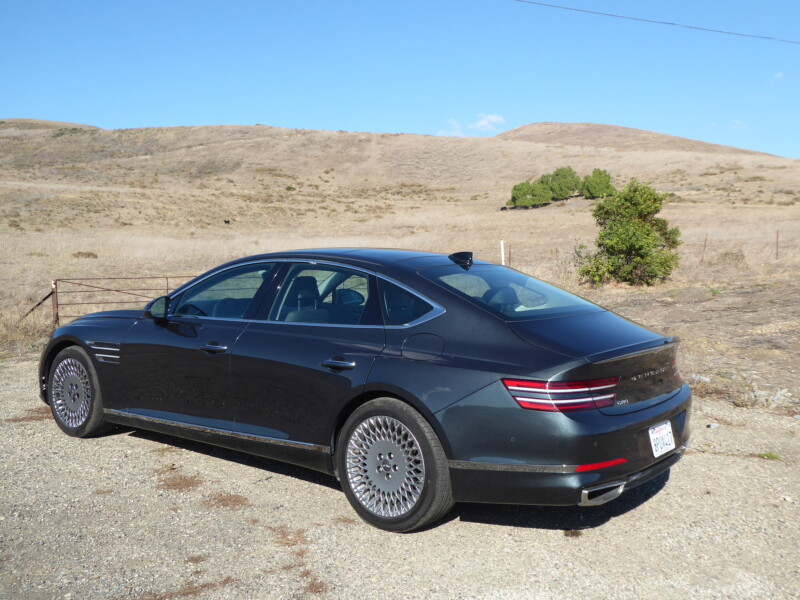
Whilst Genesis position the G80 more as a luxury car than a sporting one (they have the G70 for those with a more sporting desire), it is still very good to drive. The steering is well weighted and has plenty of feel. The car handles really nicely, taking in corners with confidence and minimal body roll. Grip is excellent. Truly this is a car that you can enjoy on the bendier roads that America has to offer. The suspension has been well judged too, so the ride is smooth and comfortable, without ever feeling unduly soft and squishy. The test car came on 245/45 R19 wheels at the front and 275/40 R19 at the rear. The brakes were positive and pedal effort was nicely progressive. All round visibility is generally good, though the rear view camera is pretty much essential given the sloping rear end. Among the many safety features fitted, the Blind Spot Warning system proved invaluable, too.


The interior of the G80 is beautifully finished, thoroughly befitting the luxury positioning of this car. There is plentiful use of leather on the dash and door casings and the inlays are a combination of a nice matt wood and some silver chrome highlights. The steering wheel is quite chunky and is wrapped in a quality leather which makes it nice to hold. The instrument cluster is quite conventional looking with a combined dial for speedometer and fuel level to the left and to the right there is a dial which can either serve as a rev counter or a camera view. There are a couple of chunky column stalks with serrated metal ends used for indicators, wipers and lights. Buttons on the steering wheel boss are used for cruise control and audio repeater functions. Mounted up high, almost on the top of the centre of the dash contains a short but ultra-wide 14.5” colour touch screen which has crisp and clear graphics. It has plenty of functions including a 12 speaker audio system including HD and XM Satellite radio and navigation as well as Apple Car Play and Android Auto. There are some buttons below the central air vents and there is a touch-pad equipped rotary controller in the centre console to operate some of the functions without having to use the screen itself. Beneath this are a couple of rotary dials and buttons for the automated climate control. There is also a wireless charging pad. The whole ensemble proves quite easy to use and does look classy.


The feeling of luxury continues when you look at the seating area. My test car had the Prestige option pack which means that you get genuine leather upholstery. Seat adjustment is all electric, in 16 ways apparently, and the seat powers back when you open the door to give you more space for entry and exit, with a memory setting so you can store your preferred position. Two features here that I have not come across before included putting the adjustment for the passenger seat on the inside so the driver can reach it as easily as the passenger and after driving for an hour or so, there was a “posture adjustment” which provided a bit of movement in the seat without you needing to leave it. The seats were supremely comfortable and there is a real feeling space here and getting the right driving position is eased by the electrically adjustable steering column. The sunroof adds extra lights into the cabin. One further refinement is a “soft close” feature for the doors.


The rear seating area of the G80 is very spacious, with ample room in all directions, including more than sufficient headroom. Occupants here can benefit from a massive central armrest which has both cupholders in the upper surface and a stowage cubby and the feeling luxury continues with seat heaters and window blinds for both the side and rear as well as separate climate controls. There are map pockets in the back of the front seats and stowage bins on the doors as well as a ski flap for access to the boot.


Although the swooping rear end styling may lead you to guess that the G80 is a hatchback, it is not. That does mean that whilst the boot itself is long and voluminous, the boot lid is rather less so, so the opening to get bags in and out is not that large. But the space available is generous which is just as well, as, slightly surprisingly, the rear seat backrests do not fold down. There is just a ski flap. There is a space saver spare wheel under the boot floor but this is quite tightly packed in and there is no room around it for even any small items. Inside the passenger compartment, there is a big glovebox and there are some long door bins as well as a deep central armrest cubby, so there are plenty of places for odds and ends.


For the US market, the 2022 Genesis G80 comes in 2.5T and 3.5T Sport form. The former features a 300 bhp turbocharged 2.5-litre four-cylinder engine, while the latter employs a 375 bhp twin-turbocharged 3.5-litre V6. All-wheel drive is standard with the 3.5T Sport and available on the rear-wheel-drive 2.5T. An eight-speed automatic transmission is standard. The base G80 2.5T boasts amenities such as synthetic leather upholstery, heated and 12-way power-adjustable front seats, driver’s seat memory settings, ambient interior lighting, an auto-dimming rearview mirror, a universal garage door opener, proximity keyless entry, push-button start, dual-zone automatic climate control, a hands-free power trunk lid and a leather-wrapped power tilt-and-telescoping steering wheel. This Genesis also gets an 8-inch digital instrument cluster display, a 14.5-inch touch-screen infotainment system with a touchpad-equipped rotary controller, Apple CarPlay, Android Auto, Bluetooth, a 12-speaker audio system, navigation, HD Radio, satellite radio and four USB ports. The safety suite includes a rearview camera, forward collision warning, forward automatic emergency braking, pedestrian and cyclist detection, lane-centring assist, lane-departure warning, lane-keep assist, blind-spot monitoring, rear cross-traffic alert, lane-trace assist, adaptive cruise control, speed limit recognition, vehicle exit warning, driver-attention monitoring, rain-sensing windshield wipers, front and rear parking sensors and automatic high-beam headlights. The Advanced package adds a 21-speaker Lexicon audio system, a panoramic sunroof, ventilated front seats, wood interior trim, tri-zone automatic climate control and rear sunshades. The Prestige package builds on the Advanced pack with genuine leather upholstery, a massaging 16-way power-adjustable driver’s seat, a heated steering wheel, heated rear seats, power soft-closing doors, wireless device charging, a digital key, a surround-view camera system, a rear-seat alert, a blind-spot camera, reverse automatic emergency braking and remote smart parking assist. G80 models equipped with all-wheel drive also get heated rear seats and a heated steering wheel. The G80 3.5T Sport adds performance brakes and an adaptive suspension system. Inside, you’ll find a panoramic roof, genuine leather upholstery, ventilated front seats, alloy pedals, a sport steering wheel, power soft-closing doors, rear sunshades and tri-zone automatic climate control. It also gains a surround-view camera system, a blind-spot camera, a rear-seat alert, wireless device charging, a digital key and a 21-speaker Lexicon premium audio system. The 3.5T Sport is available with a Prestige package that brings Nappa leather upholstery, a synthetic suede headliner, carbon-fibre cabin trim and 20-inch wheels, plus tech and performance features like a 12.3-inch digital instrument cluster, reverse automatic emergency braking, a head-up display, remote smart parking assist, rear-wheel steering, a sport suspension and either all-season or performance tyres.


This G80 really impressed me. I think it is one of the best looking cars in its class, for starters and the interior is beautifully finished in a way that you can’t really say about not just a Mercedes (too chintzy these days) or a BMW (cheap feeling materials abound) or even a Lexus. It is genuinely good to drive, finding just the right balance between comfort and luxury as well as sporting urgency. There is plenty of space inside and the car is well-equipped. It would be perfect for a very long drive across a couple of States. So, a really good product, but sales are still not that great. As other brands have found out, changing perception and prejudice among the public is a lot harder than building an excellent product. In Europe, Skoda have proved it can be done, but even now people still pull a funny face when you recommend one of their products. Maybe the Americans will in time give Genesis the credit that is deserved for the products they are building, but it feels like the market is not there yet. And if America – which did at least embrace Lexus at scale – is hard to crack, then Europe is a real mountain of obstacles. Infiniti found that out the hard way, with lusty petrol engines when the market wanted diesel and diesel when the fiscal encouragement was for hybrid. They gave up. Genesis are still trying and at least they do have some electrified versions of some of their cars to offer, so they just might stand a chance, but it is going to be a long struggle to get people to take the brand seriously. And yet, as this test proved to me, they really should. The car itself is excellent.