

Those familiar with the Volkswagen range will agree that it is pretty comprehensive, even if the Up! city car has recently been discontinued and the executive Phaeton reached the end of the road a few years prior to that. Truly, it feels like there is a “people’s car” for everyone. A large part of the range these days comprises crossover/SUV type machines and here VW offer several, all of the names for which start with a T. We have T-Cross, Taigo, T-ROC, Tiguan in standard and 7 seat form and the massive Touareg even before we get to the Bus and Caravelle-based machines or add in the all-electric ID4 and ID5. Look to other markets, especially across the Atlantic, though and you’ll discover a whole load more models. The largest crossover in America is known as the Atlas, but in other markets where it is sold, it conforms to the idea that vehicles of this genre start with a “T” as it is the Terramont. Americans get the Tiguan but until now, they’ve not been offered anything smaller. Rather than offer the T-Cross or T-ROC, though, VW looked south, to Mexico and the cars they build for Latin America and decided to federalise the Taos, a car, which is in fact named after a ski resort in New Mexico. The reason for doing this, just as with the Jetta saloon which has long been a strong seller (relatively) in the US was that this car is designed to keep a firm lid on costs and VW felt they needed a car that could compete on price rather than trying to impress with traditional European VW-like levels of quality.


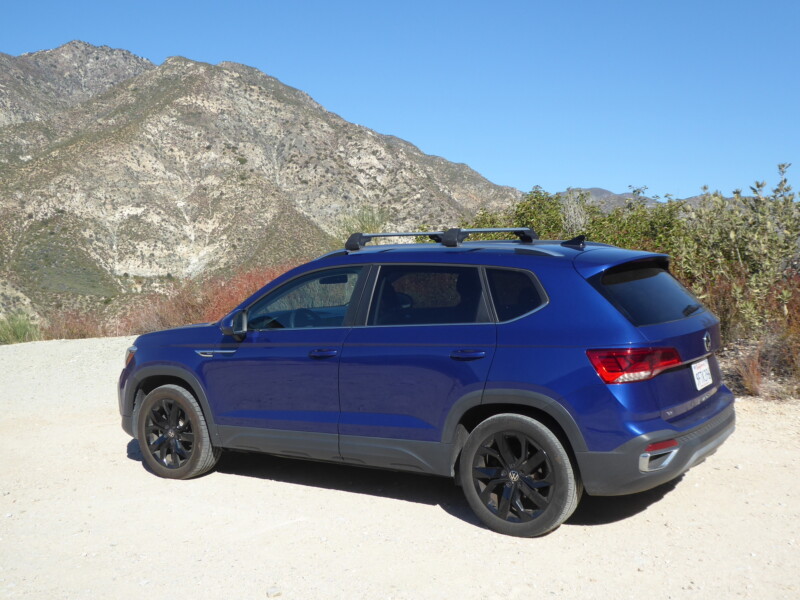
The Taos was actually first released in October 2018 as the Volkswagen Tharu in China, (yet another “T” name!). It was lightly restyled and rename as the Taos for the North American, South American, and Russian markets. It was not designed for the rest of Europe and has never been sold there, as VW already have the T-Cross models for these markets. The Taos/Tharu is based on the Volkswagen Group MQB A1, with its platform closely related and several sheet metals shared with the SEAT Ateca, Škoda Karoq and the Jetta VS5. Known as the ‘Project Tarek’ during development, the Taos/Tharu is considered the first Chinese-developed VW product that is sold outside China. What started out as a regional project became a global one. The Taos was launched for the North American market on 13 October 2020 for the 2022 model year. Looking a little like a slightly smaller Tiguan, it is hard to spot from a distance, but when I found one parked up in the Gold area at Hertz’ LAX facility, I decided to take it for the day. Knowing that there are relatively few VW models of any type on fleet, certainly at present. The car turned out to be a 2022 model year car, and to be in SE spec with the optional 4Motion all-wheel drive. The Dusk Blue Metallic paintwork is quite striking but proved to be not the easiest for the photographer. Question is, what was the Taos like for the driver? Read on.


There is keyless starting. All Taos models have the same 1.5 litre four cylinder engine which puts out a class competitive 158 bhp. If you have an all-wheel drive 4Motion model, as I did then instead of an eight speed auto, you get a seven speed DSG ‘box. The engine is OK, but you really need to push it hard to get decent performance from it. There is even a launch control feature, but few owners will want regular use of something as brutal as that. Drive it more normally, it remains decently refined and noise levels on the freeway are pleasingly low. The transmission lets the side down a bit and is perhaps the reason why you need to push this VW hard to get good acceleration. Gearshifts feel a bit lazy and a bit sluggish unless you force it to act. It as if the transmission has been optimised for refinement and efficiency rather than performance. I covered 178 miles in my day with the Taos and it needed 6 gallons to fill it which works out as almost exactly 30 mpg US, or 35.44mpg Imperial, a decent but not startling result.


Those three words, “decent” and “not starting” sum up the whole driving experience. The steering is OK. It is light but not as bad as in some cars and there is some feel especially as you turn the wheel more from the straight ahead. Handling is generally good though I found there was something of a tendency to oversteer. Grip levels are good and the Taos corners with negligible body roll. It is a sign of the times that a small-ish car like this one comes on 225/50 R18 wheels, but the relatively high profile probably helps ensure that the ride is generally quite smooth and comfortable. The brakes worked as you would hope they do. Visibility all-round presented few problems, thanks to relatively square windows and the boxy styling and the mandated rear-view camera certainly made parking up quite easy. There is a long list of ADAS features here, none of which were intrusive, as you can turn them all off if you so desire.


When you open the door of the Taos and look closely inside, you can see where the cost savings have been made. Interior quality is best described as patchy. There are some softer touch plastics but plenty that are hard and brittle feeling with the rear door casings being particularly horrid. Whilst fit and finish was generally OK, the central armrest creaked quite noticeably. It is quite sad to think that the company who gave us the superlative quality of Golf IV which caused all rivals to up their game massively has now sunk to such a low standard. At least you do get a leather-wrapped steering wheel and the inlays, in dark gunmetal grey are not as nasty as they are in some US market cars. There is a conventional looking instrument binnacle in front of the driver the contents but this actually houses Volkswagen’s Digital Cockpit system, replacing the physical instrument cluster dials with a reconfigurable 12.3-inch display. This is standard across all models. Many of the other controls are directly from the VW Group parts bin. There are twin column stalks for indicators and wipers and the latest standard here is not as nice as they used to be. Lights, including an auto function, operate from a rotary dial on the dash to the left of the wheel. The centre of the dash contains the 8” colour touch screen which is integrated into the dash moulding. There are touch pads to either side for audio and a couple of other functions. There is a button for navigation, but when you press it, you simply get a message saying the feature is not installed. The whole ensemble proved somewhat clunky to use. It does have all the other features you want, though, including HD and XM Satellite radio, a six speaker audio system, Bluetooth, Apple Car Play and Android Auto as well as a wireless hot-spot. Beneath this unit are three rotary dials for the climate control. There is a wireless charging pad.


SE trim means that the seats are upholstered in an artificial leather, with cloth central inserts. It also means that there is 8-way power adjustment for the driver, but the front passenger still has to alter their seat manually. There are heating elements for both. The steering column tilts and telescopes and there are height-adjustable belts, so it is easy to get a good driving position. Even with the optional sunroof fitted, headroom is ample.


There is a surprising amount of space in the rear. For sure the centre console comes well back, but the central tunnel is quite small and the SUV-esque styling means that there is ample headroom. Even with the front seats set well back, legroom should suffice for most people. Seating three across the rear seat would be a bit of a squeeze, but would be fine for children. Occupants here benefit from a drop-down central armrest, and there are map pockets on the back of the front seats as well as bins on the doors. There is a ski flap to allow access to the boot.


Boot space is modest, not entirely surprisingly given the fact that this is not a particularly large car. Whilst that is undeniable, in fact, compared to its direct rivals, it beats them all in raw capacity terms and the boot is a nice regular shape, too. You do lose around 3 cubic feet with the 4Motion compared to the front wheel drive cars. Sadly, as is so often the case with US market cars, there is no load cover. There is a space- saver spare tyre under the boot floor, but this is packed into a well which has no room around it for any other items. The rear seats have a centre pass-through and the usual 60/40 split, and they fold down mostly flat, leaving about a 2-inch level change from the cargo floor. The release levers are on the seats but are close enough to reach if you’re standing at the rear hatch. The resulting space is commodious. Roof rails are included the spec, so I guess you could strap extra luggage up top if you ran out of space inside the car. Oddment provision in the passenger cabin is about par for the class. The glovebox is not that large, but you also get door pockets, a console moulding and there is a small but deep armrest cubby.


The 2022 Volkswagen Taos is available in three trims: S, SE and SEL. All models have a 158 bhp turbocharged 1.5-litre four-cylinder engine. Front-wheel drive is standard and comes with an eight-speed automatic transmission, while the available all-wheel-drive 4Motion system swaps the conventional automatic for a seven-speed dual-clutch automatic. The Taos S comes standard cloth upholstery, a 6.5-inch touch screen, a four-speaker audio system, HD Radio, USB ports, Bluetooth, Android Auto, Apple CarPlay, a Wi-Fi hot spot, LED headlights, push-button start and a rearview camera. Available features include automatic high-beam headlights, adaptive cruise control, blind-spot monitoring, rear cross-traffic alert, forward collision warning, pedestrian detection, forward automatic emergency braking and lane-keep assist. The Taos SE adds synthetic leather upholstery, an eight-way power-adjustable driver’s seat, heated front seats, proximity keyless entry, remote start, forward collision warning, pedestrian detection, forward automatic emergency braking, blind-spot monitoring, rear cross-traffic alert, an 8-inch touch screen, a six-speaker audio system, satellite radio, additional USB ports and wireless device charging. Automatic high-beam headlights, adaptive cruise control, lane-keep assist and a panoramic sunroof are available. The range-topping Taos SEL comes with genuine leather upholstery, dual-zone automatic climate control, lane-keep assist, adaptive cruise control, front and rear parking sensors, traffic-sign recognition, adaptive headlights, navigation and an eight-speaker BeatsAudio sound system. The panoramic sunroof is available on this trim, as well.


In recent years, the small SUV segment in the US market has expanded to the extent that all the major manufacturers, including some of the posher ones such as Buick, now have product, so the Taos has a lot of rivals. Whilst there is plenty here which is commendable, including the amount of space in a relatively small footprint and the fact that the car is decent enough to drive as well as being reasonably economical, it is badly let down by something which used to be VW’s trump card – the quality of interior. This really does feel sub-par. Too many cheap materials and suspect build quality with things creaking are not what you expect from a VW and now what you get from products such as the Kia Seltos and Hyundai Kona. Whilst it does beat the recently superceded Chevrolet Trax and ford EcoSport, this is not a car that sits at the top of its class, and is unlikely to help VW of North America to grow its sales footprint in the way they were hoping.