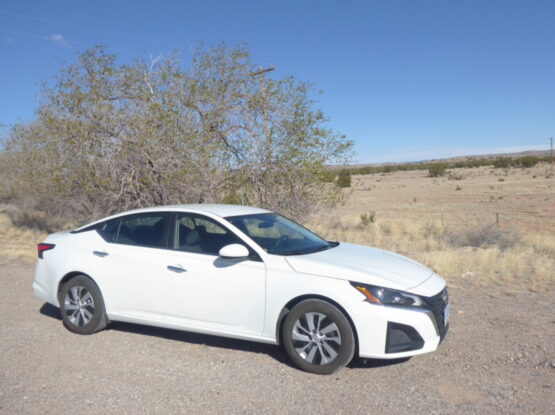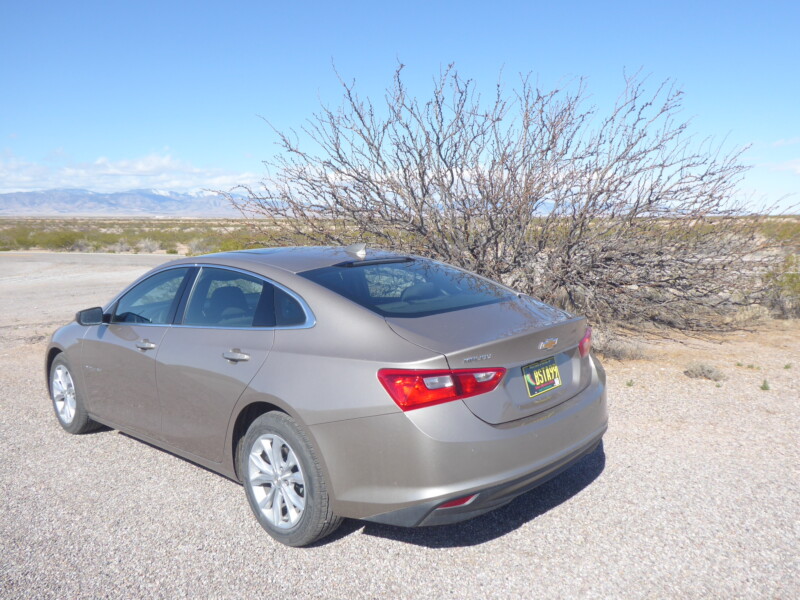


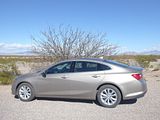

Day two of my trip to Albuquerque, New Mexico, and as I wander over to the collection area at the Hertz facility, I can see that the number of cars parked up is no better than it had been on Day One. Model type is just as limited, too. The President’s Circle area – which I had been told was the only place from which I was able to select a car – had a handful of Nissan Altima, like the one I had just returned and a similar number of Chevrolet Malibu, all of them in a mix of white, pale grey and gold colours. Not exactly an inspiring choice or what I was hoping for, but this is just how it is, sometimes. It’s actually a long time since I last drove a Chevrolet Malibu. Late 2016, to be precise when the car had only recently been launched. You would not expect that a car that dates back over 8 years in what used to be the biggest selling segment of the market would still be on sale, barely altered, but as I observed in the Nissan Altima test, this sector has been shrinking fast and is even more dependent than ever on the daily rental market, where value pricing still counts for a lot. It’s why the likes of the Honda Accord, which attracts little in the way of discount is a rare sight, whereas cars like the Altima and Malibu that rely on volume are popular choices with fleet buyers. Nearly eight years is a long time, so a new look at the Malibu to see what I thought of it in 2024 as opposed to 2016 seemed timely. There have been changes, including new lights front and back and reprofiled bumpers as well as a different grille, but it will take an expert eye to spot the newer cars from the older ones. Trim levels have remained broadly the same, but equipment has been updated to include some of the features now expected by buyers, even if this car does not go as far as flashy all-electronic dials and massive touchscreens and the other un-usability features that manufacturers tell us we want. I had one day with the Malibu to see how it would stack up in 2024 and the memories of one of its closest and slightly more recently designed rivals, the Nissan Altima, fresh in mind.


There is now keyless starting, with a button where there used to be a slot of a conventional key. All Malibu models now come with the same 1.5 litre turbocharged four cylinder engine, demand for the larger 2.0 litre model having proved insufficient to warrant keeping it on offer. This unit generates just 163 bhp which is quite a bit down on the class average, but underway, it did not really feel as if it was under-engined. The unit is generally smooth and refined, though of course acceleration is of the acceptable rather than the exciting sort. If you push the car hard, then it will get quite loud and coarse sounding, but I found little need to do this, admittedly in testing that saw very little traffic to get around or past. There is now a continuously variable transmission, this replacing the six speed auto that was offered until the 2019 mid-cycle facelift, and this proved to be one of the better of its genre, with the gearbox generally adjusting quite well to the movements of the right foot. In my quest for some better weather, I drove 320 miles during the day, and the Malibu needed 9.6 gallons to fill it, which works out at 33.33 mpg US or 39.82 mpg Imperial, a decent result thought quite a long way short of the Altima I had driven the previous day. Most of those miles were at a steady speed on the freeway, where the Malibu impressed more with its low noise levels and refined cruising.


It did not particularly impress as a fun car, though. Whilst it steers, handles and grips just fine, there is no panache here. The steering is light and has not got much in the way of feel. The handling is of the safe and predictable front wheel drive sort, though there is little in the way of body roll on corners. Ultimately it will tend to understeer, but you probably won’t be cornering fast enough to experience this very often. This version of the Malibu comes on 225/55 R17 tyres and these combined with soft-ish suspension combine to give a comfortable ride. The brakes worked just fine, though I had no occasion to test their ultimate stopping power. All-round visibility is a mixed bag. The door mirrors are very small, but there is at least the now-mandated rear-view camera to help when backing up and you really do need this as the view through the steeply-raked rear window is mostly of the sky.


Inside little has changed from the car that I drove back in late 2016. There is still use of textile on both the dash and the door casings, to join the soft-ish plastics that are used for the main dash moulding and door casing. LT spec means a plastic-moulded steering wheel. The instrument cluster comprises two large dials for speedometer and rev counter with two smaller ones for fuel level and water temperature set in the upper portion of the area between them, leaving the lower area for trip computer data, which can be cycled through with a button on the right hand column stalk. The twin stalks also do indicators and wipers with lights, which include an auto function, on a rotary dial on the ash to the left o the wheel. The steering wheel boss has plenty of buttons for cruise control and audio repeater functions. The centre of the dash contains what by modern standards is a relatively small 8” touchscreen, which runs Chevrolet Infotainment 3. Included is XM Satellite radio and you get Apple Car Play and Android Auto as well as 4G LTE wifi hotspot. Below this unit are knobs and buttons for the dual zone climate control.


Seat upholstery is cloth, as you might expect, but adjustment for the driver is electric, which you might not. That said, the front passenger does not get a height adjuster, which seems a little mean these days. The steering column telescopes in/out as well as up/down with plenty of adjustment so it was easy to get comfortable. Even with the optional sunroof fitted, there is ample headroom and the seat itself proved quite comfortable.


In the back of what is likely to prove to be a family car, it is a mixed bag. Legroom is decent enough, even with the front seats set well back, but headroom is surprisingly tight thanks to the sloping rear roof line. The centre console comes well back and is quite a tall unit, so there is not a lot of kneeroom for a middle seat occupant. There is a drop-down armrest with cup holders in the upper surface and there are bins on the doors and one seat-back map pocket.


Luggage space is class competitive. The boot is long, but not that deep. There is no extra space at all under the floor, but you can create more capacity by dropping the asymmetrically split rear seat backrests. Things are better in the passenger cabin with a reasonably sized glovebox, door pockets, a recess in front of the gearlever and a deep central armrest cubby.

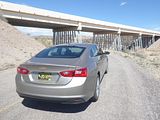


The 2024 Chevrolet Malibu comes in four trims: LS, RS, 1LT and 2LT. Each trim comes with a 163 bhp four-cylinder engine, a continuously variable automatic transmission (CVT) and front-wheel drive. The base Malibu LS comes with cloth upholstery and the Chevrolet Infotainment 3 system, which features an 8-inch touch screen, Bluetooth and wireless Android Auto and Apple CarPlay. This trim also comes with a six-speaker stereo, a USB port, Wi-Fi hot spot, proximity keyless entry, push-button start, remote start and 16-inch alloy wheels. Standard safety features include forward collision warning, forward automatic emergency braking, pedestrian detection, a rearview camera, rear parking sensors, lane-keep assist, lane-departure warning, automatic high-beam headlights, a rear-seat alert and the Buckle to Drive and Teen Driver systems. The optional Driver Confidence package adds blind-spot monitoring and rear cross-traffic alert. The Malibu RS gains an eight-way power-adjustable driver’s seat with lumbar support, 18-inch alloy wheels and a rear spoiler. The Driver Confidence package remains available. Upgrading to the Malibu LT trim gets you satellite radio, heated front seats, dual-zone automatic climate control and 17-inch alloy wheels, but you lose the RS trim’s spoiler. The LT also gains access to an available sunroof. The Sport Edition, Redline Edition and Midnight Edition packages have minor variations but add essentially the same features, including unique black accents, 19-inch wheels and a leather-wrapped steering wheel and shift knob. The Malibu 2LT gains perforated leather upholstery, ventilated front seats, a six-way power-adjustable front passenger seat, a heated steering wheel, an 8-inch digital gauge cluster, a nine-speaker Bose stereo, an additional USB port, navigation and wireless device charging. This trim also offers the Driver Confidence and Cruise package, which adds the contents of the Driver Confidence package plus adaptive cruise control and automatic parking assist.
One of the more popular US online review sites describes the Malibu as “vanilla” and that seems pretty accurate to me. Whilst there is no flair and no panache here at all, equally there are no seriously weak points, either. This is an unflashy car which will meet the transport needs to its target customers, be they private buyers or those like me, at the rental car counter. For sure, it lacks some of the latest on-trend stuff but many will see that as no bad thing, as it means that the car is not annoying in the way that the latest gizmo-laden models can be. I don’t think you’d ever actively choose a Malibu, but if you get one allocated – and there are an awful lot of them in rental fleets now there are fewer models in this sector – it will serve pretty well. No drama, no fuss, and sadly, no real flair.