With Italian car events proving very popular, and also the fact that more than a few of them are just the sort of stock that the Classic Motor Hub hold, it is no surprise that this Cotswolds venue has, among its annual program of events, and event to celebrate the cars of Italy. Despite the fact that this is not that easy a location to access, as it is situated off a very narrow country road just north of the ever-popular village of Bibury, it always attracts not just a lot of Italian cars but also a lot of rare ones. The event has moved around the schedule a bit, and for 2025 it came forward into early July from a previous timing of August, but that seemed to work well, as for 2025 the site was more or less full. These events are a bit like an extended Cars and Coffee style meeting, with cars leaving in the late morning and everything is generally over by 1pm, so it pays to arrive early, which is what I did. Here is what I saw:
ITALIAN CARS
Needless to say, there were lots of Italian cars here, with all the current marques represented and plenty of fabulous machines from the back catalogue on display. The organisers do say that they prefer the presence of older and more classic cars, so there are relatively few modern cars among the display.
ABARTH
The first Abarth 750 GT appeared in early 1956, and was the first Abarth product to use standard Fiat bodywork, that of the little 600 saloon. Fiat delivered these cars incomplete, to make it easier and more cost effective for Abarth to carry out their performance modifications. Rather than the 633 cc original or Abarth’s own 710 cc model, the engine now displaced 747 cc thanks to a one millimetre wider bore and a stroke increased by four millimetres. Sharper cams, lighter flywheel, a bigger carburettor, and a myriad other traditional tuning tricks were employed; as a result power nearly doubled, up from 21.5 to 40 bhp. Claimed top speed was 80 mph. As well as the “standard” car, a special model was then built with a Zagato body, known as the Fiat Abarth 750 GT Zagato. It was launched at the 1955 Salon di Torino. The original model was also offered in a more luxurious variant for export (called “America”, as it was almost strictly meant for the United States) and a stripped down model with lower, uncovered headlamps and smaller taillights for the domestic Italian market. The “America” also has a different layout around the rear license plate. The all-aluminium bodywork has Zagato’s famous “double-bubble” design and Abarth’s tuned derivazione engine with 43 bhp. Aside from the floorpan, not much of the Fiat 600 remains in use for these cars. It had a top speed of around 90 mph and proved popular. Around 600 were sold. By the time of the appearance of the Abarth Zagato Record Monza 750 Bialbero, the bodywork had been unified into a separate model with a rather large hump on the engine lid, made necessary by the taller twin-cam motor. There were then three distinct models 750 “Double Bubble”, 750 Record Monza and 750 “Sestrieie”, this last having a single cam pushrod engine and the majority built with a steel body and a very small number of Alloy cars, just one of which is known to exist today. The 750 GT Bialbero model appeared at the 1958 Turin Show; along with various alterations to the bodywork, it had the new twin-cam engine with 57 bhp at 7000 rpm. The first series constituted 100 cars, enough to homologate the car for the Gran Turismo competition category. The “Record Monza” was the most successful racing Abarth in the USA under the Franklin D. Roosevelt Jr Racing team, (Abarth cars winning over 700 races worldwide), including both Sebring with the 750cc Bialbero engine and Daytona under 1000cc races in 1959 widely believed to have had the first 982cc Bialbero engine. The Sestriere had upright headlights and two very large air intakes on the engine lid much wider than a double bubble. The Sestriere was believed to be the last model produced for Abarth by Zagato, due to disagreements between Abarth and Zagato, so Abarth developed the 750 GTZ with a twin cam engine and the body evolved by Sibona and Basono into the Bialbero 700 and 1000 models. which were first seen in 1960. They are equally rare these days.


Detailed records of what Abarth produced are somewhat conspicuous by their absence, but some things are known. A subset of the 750 GT Zagato model, termed “Sestriere” was also seen throughout the production years. The Sestriere model was named after the Rallye de Sestriere, one of Europe’s most punishing Alpine rally events on the annual calendar at that time, providing the Italian round of the contemporary rally drivers’ Championship. Above all, the Fiat-Abarth 750 Sestriere was a tough and resilient little competition car in true Abarth fashion, though it was actually intended more for road use. Initially the “Sestriere” name was used in some Abarth 750 cars and was based on the “softened” tuning level (possibly GT) used on at least the second of the two overall winners of the Rally Sestriere (February 1958 and February 1959). It seems that a more standard “Sestriere” model was introduced in1959-1960 and appeared as a variant to the “double bubble”. According to an article from Auto Italiana Sport, March 1, 1960 (as seen on John de Boer’s Sestriere information), this later “Sestriere” version is generally considered to be a steel bodied version without roof bubbles. It also has more forward positioned open head lights and a much larger set of rear air intakes to allow for improved cooling. It was not intended for racing like its double bubble brother. The engine was also different with designations of either Tipo 215 (748cc) or Tipo 213A (785cc). Of note, some Sestrieres have been described/claim to have aluminium bodies and/or double bubbles.


All the modern Abarth cars here were the 500-based models which have been on sale now since the end of 2008, following a launch at the Paris Show that year. Since that time there have been a number of detailed changes to the standard cars and a lot of limited editions. Those who really know the marque can spot most of them, but some are so subtle that unless there is a badge you can see, you will not be quite sure which version you are looking at. It used to be relatively easy, when the model was first launched, as there was only one version as shipped ex works called the 500. It had a 135 bhp 1.4 litre turbo-charged engine coupled to a five speed manual gearbox, with 16″ alloys as standard, and the option of 17″ wheels, and a colour palette comprising of two whites (BossaNova White, the standard colour, or the pearlescent Funk White), Red (Pasadoble), Pale Grey (Campovolo) or Black. If you wanted more power – 160 bhp – then you could order an Esseesse kit, which came in a large wooden crate, containing new wheels, springs, an ECU upgrade, the Monza exhaust system and badging. It was dealer fitted and could be applied at any time within the first 12 months or 10,000 miles from registration. Needless to say, it proved popular. As were many of the optional extras, with stickers for the sides, a large scorpion for the bonnet and even a chequered pattern for the roof among the personalisation options offered


Seen by most as the ultimate model, there was the 695 Biposto. First shown at the 2014 Geneva Show, this 2 seater (that’s what Biposto means in Italian) is nothing other than a road legal version of the 695 Assetto Corse Racing car, a vehicle which has its own race series in Europe. Although the car is road legal, it was envisaged that the majority of people who buy one of these cars will use it on the track and quite frequently. So it was conceived accordingly. That means upgrades to all the important bits – engine, brakes, suspension, gearbox – and some fairly drastic measures to save weight which resulted in a car which generates 190 bhp and 199 lb/ft or 250 Nm of torque with a kerb weight of just 997kg. That’s enough to give a 0 – 60 time that is under 6 seconds, and a top speed of 143 mph. Those are supercar figures produced by a city car. There’s more to it than that, though, as the changes that go to make a Biposto are extensive, and they have been well thought through, so this is a long-way from being a hastily conceived or tuned up special. Ignoring the limited edition cars which arrived during 2015, the “regular” Biposto is only offered in Matt Performance Grey paint, and the car is visually distinctive, with a new front bumper, rear diffuser, wider arches, new skirts and bigger roof spoiler. Although the engine is still the same 1.4 T-jet that features in the lesser 500 and 595 cars, it has been reworked here, with a new Garrett turbocharger, larger intercooler, altered fuel rail and an Akrapovic exhaust system. Buyers can choose between the standard five speed gearbox or an optional race-bred dog-ring unit mated to a mechanical limited slip diff. The standard car’s MacPherson strut and torsion beam suspension has been reworked, too, with altered springs, wider tracks adjustable ride height and dampers with more resilient bushings, using Extreme Shox technology shock absorbers. The brakes are upgraded in line with the extra power, featuring 305mm Brembo discs and four pot calipers up front and 240mm discs with single pot calipers at the rear. The wheels are lightened 18″ OZ and attached via a titanium hub, shod with bespoke 215/35 Goodyear tyres. In the interest of weight saving, a number of standard trim items are removed, including the regular door trims, air conditioning, the rear seats and some of the sound deadening material. Even the standard air vents have been changed so they are covered by a simple mesh. In their place is plenty of polished carbon fibre, a titanium strut brace, racing seats and harness, as well as special trim features such as new pedals, tread plates and a race inspired digital display on the dash where the radio usually sits. Although the Matt Performance Grey car is probably the one you think of when someone says “Biposto”, there were other versions, with a very rare red being a car that is only see occasionally and the Record Edition being the version that was here. There were just 133 of these made, all painted in Modena Yellow, at the time an exclusive Biposto colour.


What is known as the Series 4 version of the familiar 595 reached the markets in the middle of 2016. After rumours had circulated all winter following the launch of the facelifted Fiat 500 last year, Abarth finally unveiled the Series 4 at the end of May 2016. Initially, we were told that the cars would not be available in the UK until September, but that came forward somewhat, with dealers all receiving demo cars in June, and the first customers taking delivery in July. Three regular production versions of both the closed car and the open-topped C were initially available, all badged 595, and called Custom, Turismo and Competizione, as before, though numerous limited edition models have since appeared and in most case disappeared. The most significant changes with the Series 4 are visual, with a couple of new colours, including the much asked for Modena Yellow and a different red, called Abarth Red, which replaces both the non-metallic Officina and – slightly surprisingly – the tri-coat pearlescent Cordolo Red. as well as styling changes front and rear. The jury is still out on these, with many, me included, remaining to be convinced. At the front, the new air intake does apparently allow around 15 – 20 % more air in and out, which will be welcome, as these cars do generate quite a lot of heat under the bonnet. Competizione models for the UK retain the old style headlights, as they have Xenon lights as standard, whereas the Custom and Turismo cars have reshaped units. At the back, there are new light clusters and a new rear bumper and diffuser. Inside, the most notable change is the replacement of the Blue & Me system with a more modern uConnect Audio set up, which brings a new colour screen to the dash. Mechanically, there is an additional 5 bhp on the Custom (now 145) and Turismo (now 165 bhp) and the option of a Limited Slip Diff for the Competizione, which is likely to prove a popular option. Details of the interior trim have changed, with a filled-in glovebox like the US market cars have always had, and electric windows switches that are like the US ones, as well as a part Alcantara trim to the steering wheel in Competizione cars

More recently, Abarth have produced the 695 Rivale, a celebration of Fiat’s partnership with Riva, which has already seen a special Riva version of the 500,. Described as being “the most sophisticated Abarth ever”, it is available either as a hatch or a cabriolet, with both of them featuring a two-tone Riva Sera Blue and Shark Grey paintwork. The Rivale is adorned with an aquamarine double stripe, satin chrome finish on the door handles and satin chrome moulding on the tailgate, various aesthetic elements inspired by the Riva 56 Rivale yachts and ‘695 Rivale’ logos, joined by Brembo Brakes, Koni suspension, and 17-inch Supersport alloy wheels. Enhancing the nautical theme the new 695 Rivale features either a carbon fibre or mahogany dashboard, black mats with blue inserts, blue leather seats and door panels, carbon fibre kick plates, special steering wheel wrapped in blue and black leather and with a mahogany badge, blue leather instrument panel cover, and mahogany gear lever knob and kick plate. These are joined by the standard Uconnect infotainment with a 7-inch display, which is compatible with Android Auto and Apple CarPlay, and there is also a hand-written numbered plate that can be customised with the mane of the customer’s yacht on request. Powering the 695 Rivale is the same 1.4-litre turbocharged engine that makes 180PS (177hp) and 184lb/ft of torque, that features in the 595 Competizione, allowing it to go from rest to 100km/h (62mph) in 6.7 seconds and up to a top speed of 225km/h (140mph). This is a regular model in the range, but confusingly, there is also the Abarth 695 Rivale 175 Anniversary, created to celebrate 175 years of the Riva brand. Just 350 of these were produced, half of them the hatch and the other half cabriolets. These featured 17-inch alloy wheels with a special pattern, celebratory badge on the outside, hand-crafted details such as the two-tone colour – blue and black hand-stitched leather seats with a celebratory logo stitched onto the headrest, carbon dashboard silk screen printed with special logo, numbered plate. Standard Rivale cars arrived in the UK in April 2018, and quite a few have been sold. They always attract lots of interest when they do appear.


ALFA ROMEO
First of the all-new Giulia models to appear was the Berlina, launched in 1962. The styling was quite straight forward, but great attention was paid to detail. The engine bay, cabin and boot were all square shaped. But the grille, the rooflines and details on the bonnet and boot made for an integrated design from bumper to bumper. Thanks to Alfa Romeo using a wind tunnel during its development, the Giulia was very aerodynamic with a drag coefficient of Cd=0.34, which was particularly low for a saloon of the era and not a bad figure even for cars of today. Couple that with the fact that Alfa Romeo was one of the first manufacturers to put a powerful engine in a light-weight car (it weighed about 1,000 kilograms) and thanks to an array of light alloy twin overhead camshaft four-cylinder engine, similar to that of the earlier Giulietta models range, the car had a lively performance which bettered that of many sports cars of the day. The Tipo 105.14 was the first model, with a 1,570 cc Twin Cam engine with single down-draft carburettor generating 91 hp at 6500 rpm. The “TI” nomenclature referred to a class of Italian saloon car racing known as “Turismo Internazionale”, and had previously been applied to higher-performance versions of the 1900 and Giulietta saloons in the 1950s. However, for the Giulia saloon, the Ti was at first the only version available, and later, with the introduction of the TI Super and Super, the TI became the base version for the 1,600 cc engine class. The steering column gearchange (the only one in the Giulia range) was replaced with a floor change for 1964 (Tipo 105.08). Right hand drive cars, available from 1964, only ever had a floor change (Tipo 105.09). Brakes were by drums all around at first. Discs were introduced later, first at the front, and later all around. A brake servo was not fitted at first, but was introduced in later cars. The steering wheel featured the only horn ring ever in the Giulia range. The dashboard with a strip speedo is a notable feature, as is the steering wheel with a horn ring. The Giulia TI was phased out in 1968 and re-introduced as the austerity model 1600 S. Tipo 105.16 was a special racing model introduced in 1963. Quadrifoglio Verde stickers on the front wings were a distinguishing feature. Only 501 were made for homologation and today it is very rare and desirable. The 1,570 cc engine was fitted with two double-choke horizontal Weber 45DCOE carburettors for 110 hp at 6500 rpm. The body was lightened and a floor gearchange was fitted as standard, as were alloy wheels of very similar appearance to the standard steel ones of the TI. The TI’s instrument cluster with its strip speedometer was replaced with a three-instrument binnacle comprising speedometer, tachometer and a multi-gauge instrument (fuel, water temperature, oil temperature and pressure) – these instruments were similar to those fitted to the contemporary Giulia Sprint and Sprint Speciale coupes and Spider convertibles. The steering wheel was a three-spoke item with centre hornpush, also similar to that of the more sporting models. Braking was by discs all around, although the first cars used drums and early disc models lacked a servo which was introduced later. The police cars seen in The Italian Job were of this type. Tipo 105.06 was an austerity model made from 1964 to 1970 with a 1,290 cc single-carburettor engine for 77 hp at 6000 rpm. Four-speed gearbox with floor change fitted as standard (the 1300 was the only Giulia model not fitted with a five-speed gearbox). Though the engine was given a 105 series type number, it was basically the engine from the 101 series Giulietta Ti. This model appears not to have been exported to many markets outside Italy, if at all. Braking was by discs all around, without a servo at first, later with a servo. Tipo 105.26 was introduced in 1965. It transferred the technology from the racing TI Super to a road car, to make the most successful Giulia saloon. 1,570 cc engine with two double-choke Weber 40DCOE carburettors for a milder, but torquier tune than the TI Super – 97 hp at 5500 rpm. There was a new dashboard with two large round instruments (speedo and tacho) and clock, a sportier steering wheel with three aluminium spokes and centre horn push, similar to that of the Ti Super, later changed for one with the horn pushes in the spokes. All-around disc brakes with servo were fitted as standard from the outset. The serpent crest of the Sforza family appears in a badge on the C-pillar and is a distinguishing feature of the Super. For 1968, there was a suspension update, including revised geometry and a rear anti-roll bar. The wheels were changed in size from 5J x 15 to 5J x 14, and tyres from 155/15 to 165/14. For 1970, updates included dual-circuit brakes, centre-mounted handbrake lever to replace under-dash “umbrella handle”, larger external doorhandles, and top-hinged pedals (the latter in left hand drive models only; right hand drive continued with bottom-hinged pedals to the end of production). In 1972, Tipo 105.26 was rationalised into the Giulia 1.3 – Giulia 1.6 range. Tipo 105.39 built from 1965 to 1972. Right hand drive model replaced in 1970 by the 1300 Super. 1,290 cc engine with single down-draft carburettor for 81 hp at 6000 rpm. Unlike the re-deployed 101-series Giulietta engine of the austerity-model 1300, the 1300 ti motor was a 105 series engine, basically that of the sportier GT1300 Junior coupe with different camshaft timing (but the same camshafts) and induction system. Five-speed gearbox. Three-spoke bakelite steering wheel with plastic horn push covering the centre and spokes. Dashboard initially with strip speedo like that of the TI. For 1968, updates included a dashboard based on that of the Super, but with a simpler instrument binnacle, still featuring two large round instruments (speedo and tacho) and a separate fuel gauge, and the same suspension, wheel and tire updates applied to the Giulia Super in the same year. For 1970, updates included dual-circuit brakes, centre handbrake, larger external doorhandles and top-hinged pedals (on left hand drive cars only), again as applied to the Super for that year. Tipo 105.85 was basically a Giulia TI re-introduced in 1968 as a lower-level model to come between the 1300 and 1300 ti on one hand, and the Super on the other. It had a re-interpretation of the 1,570 cc single-carburettor engine for 94 hp at 5500 rpm and similar trim to the 1300 ti. Replaced in 1970 by the 1300 Super which offered similar performance in a lower tax bracket. The last cars from 1970 featured the top-hinged pedals, centre handbrake and dual-circuit brakes as for the Super and 1300 ti. Tipo 115.09 was introduced in 1970. It was basically a 1300 ti fitted with the engine from the GT 1300 Junior coupe that featured two double-choke horizontal carburettors; the engine actually had the GT 1300 Junior type number. This model was rationalised into the Giulia Super 1.3 – Giulia Super 1.6 range in 1972. In 1972 a rationalisation of the Giulia range saw the Super 1300 (Tipo 115.09) and the Super (Tipo 105.26) re-released as the Super 1.3 and Super 1.6. The two models featured the same equipment, interior and exterior trim, differing only in engine size and final drive ratio. The 1300 ti was dropped. A small Alfa Romeo badge on the C-pillar is a distinguishing feature, as are hubcaps with exposed wheel nuts. In December 1972 Alfa-Romeo South Africa released the 1600 Rallye. This locally developed more powerful 1600 cc version of the 1300 Super used the 1300’s single-headlight body shell. The car was largely ready for competition and was only planned to be built in limited numbers, and was fitted with racing-style rear-view mirrors, rally lamps, fully adjustable seats, and a limited-slip differential. Claimed power was 125 hp. The Giulia Super range was re-released in 1974 as the Nuova Super range, including the Giulia Nuova Super 1300 and 1600 This featured a new black plastic front grille and a flat boot lid without the characteristic centre spine. Otherwise the cars differed little from their Giulia Super predecessors and bore the same Tipo numbers with an S suffix. A Nuova Super fitted with a Perkins 1,760 cc diesel with 54 hp at 4000 rpm, was the firm’s first attempt at diesel power. The same Perkins diesel was used also in Alfa Romeo F12 van. The diesel version was slow, 138 km/h (86 mph), and the engine somehow unsuitable for a sport sedan so it was not big seller, only around 6500 examples were made in 1976 and the car was not sold in the UK. Production of the Giulia ceased in 1977. There are relatively few of these cars in the UK, and many of these are left hand drive models which have been re-imported relatively recently, or have been converted for historic racing, so it was good to see a nice road-going model here.


The first car was called the Alfa Romeo Giulia Sprint GT, and was revealed at a press event held at the then newly opened Arese plant on 9 September 1963, and displayed later the same month at the Frankfurt Motor Show. In its original form the Bertone body is known as scalino (step) or “step front”, because of the leading edge of the engine compartment lid which sat 1/4 an inch above the nose of the car. The Giulia Sprint GT can be distinguished from the later models by a number of features including: Exterior badging: Alfa Romeo logo on the front grille, a chrome script reading “Giulia Sprint GT” on the boot lid, and rectangular “Disegno di Bertone” badges aft of the front wheel arches; flat, chrome grille in plain, wide rectangular mesh without additional chrome bars; single-piece chrome bumpers; no overriders. Inside the cabin the padded vinyl dashboard was characterised by a concave horizontal fascia, finished in grey anti-glare crackle-effect paint. Four round instruments were inset in the fascia in front of the driver. The steering wheel was non-dished, with three aluminium spokes, a thin bakelite rim and a centre horn button. Vinyl-covered seats with cloth centres and a fully carpeted floor were standard, while leather upholstery was an extra-cost option. After initially marketing it as a four-seater, Alfa Romeo soon changed its definition of the car to a more realistic 2+2. The Giulia Sprint GT was fitted with the 1,570 cc version of Alfa Romeo’s all-aluminium twin cam inline four (78 mm bore × 82 mm stroke), which had first debuted on the 1962 Giulia Berlina. Breathing through two twin-choke Weber 40 DCOE 4 carburettors, on the Sprint GT this engine produced 105 hp at 6,000 rpm. Like all subsequent models, the Sprint GT was equipped with an all-synchromesh 5-speed manual transmission. The braking system comprised four Dunlop disc brakes and a vacuum servo. The rear brakes featured an unusual arrangement with the slave cylinders mounted on the axle tubes, operating the calipers by a system of levers and cranks. According to Alfa Romeo the car could reach a top speed of “over 180 km/h (112 mph)”. In total 21,902 Giulia Sprint GT were produced from 1963 to 1965, when the model was superseded by the Giulia Sprint GT Veloce. Of these 2,274 were right hand drive: 1,354 cars fully finished in Arese, and 920 shipped in complete knock-down kit form for foreign assembly. For 1966, the Giulia Sprint GT was replaced by the Alfa Romeo Giulia Sprint GT Veloce, which was very similar but featuring a number of improvements: a revised engine—slightly more powerful and with more torque—better interior fittings and changes to the exterior trim. Alongside the brand new 1750 Spider Veloce which shared its updated engine the Sprint GT Veloce was introduced at the 36th Geneva Motor Show in March 1966, and then tested by the international specialist press in Gardone on the Garda Lake. Production had began in 1965 and ended in 1968. The Giulia Sprint GT Veloce can be most easily distinguished from other models by the following features: badging as per Giulia Sprint GT, with the addition of round enamel badges on the C-pillar—a green Quadrifoglio (four-leaf clover) on an ivory background—and a chrome “Veloce” script on the tail panel; black mesh grille with three horizontal chrome bars; the grille heart has 7 bars instead of 6; stainless steel bumpers, as opposed to the chromed mild steel bumpers on the Giulia Sprint GT. The bumpers are the same shape, but are made in two pieces (front) and three pieces (rear) with small covers hiding the joining rivets. Inside the main changes from the Giulia Sprint GT were imitation wood dashboard fascia instead of the previous anti-glare grey finish, front seats revised to a mild “bucket” design, and a dished three aluminium spoke steering wheel, with a black rim and horn buttons through the spokes. The Veloce’s type 00536 engine, identical to the Spider 1600 Duetto’s, featured modifications compared to the Giulia Sprint GT’s type 00502—such as larger diameter exhaust valves. As a result it produced 108 hp at 6,000 rpm, an increase of 3 hp over the previous model, and significantly more torque. The top speed now exceeded 185 km/h (115 mph). Early Giulia Sprint GT Veloces featured the same Dunlop disc brake system as the Giulia Sprint GT, while later cars substituted ATE disc brakes as pioneered on the GT 1300 Junior in 1966. The ATE brakes featured an handbrake system entirely separate from the pedal brakes, using drum brakes incorporated in the rear disc castings. Though the Sprint GT Veloce’s replacement—the 1750 GT Veloce—was introduced in 1967, production continued throughout the year and thirty final cars were completed in 1968. By then total Giulia Sprint GT Veloce production amounted to 14,240 examples. 1,407 of these were right hand drive cars, and 332 right hand drive complete knock-down kits. The Alfa Romeo 1750 GT Veloce (also known as 1750 GTV) appeared in 1967 along with the 1750 Berlina sedan and 1750 Spider. The same type of engine was used to power all three versions; this rationalisation was a first for Alfa Romeo. The 1750 GTV replaced the Giulia Sprint GT Veloce and introduced many updates and modifications. Most significantly, the engine capacity was increased to 1779 cc displacement. Peak power from the engine was increased to 120 hp at 5500 rpm. The stroke was lengthened from 82 to 88.5 mm over the 1600 engine, and a reduced rev limit from 7000 rpm to 6000 rpm. Maximum torque was increased to 137 lb·ft at 3000 rpm. A higher ratio final drive was fitted (10/41 instead of 9/41) but the same gearbox ratios were retained. The result was that, on paper, the car had only slightly improved performance compared to the Giulia Sprint GT Veloce, but on the road it was much more flexible to drive and it was easier to maintain higher average speeds for fast touring. For the United States market, the 1779 cc engine was fitted with a fuel injection system made by Alfa Romeo subsidiary SPICA, to meet emission control laws that were coming into effect at the time. Fuel injection was also featured on Canadian market cars after 1971. Carburettors were retained for other markets. The chassis was also significantly modified. Tyre size went to 165/14 from 155/15 and wheel size to 5 1/2J x 14 instead of 5J x 15, giving a wider section and slightly smaller rolling diameter. The suspension geometry was also revised, and an anti-roll bar was fitted to the rear suspension. ATE disc brakes were fitted from the outset, but with bigger front discs and calipers than the ones fitted to GT 1300 Juniors and late Giulia Sprint GT Veloces. The changes resulted in significant improvements to the handling and braking, which once again made it easier for the driver to maintain high average speeds for fast touring. The 1750 GTV also departed significantly from the earlier cars externally. New nose styling eliminated the “stepped” bonnet of the Giulia Sprint GT, GTC, GTA and early GT 1300 Juniors and incorporated four headlamps. For the 1971 model year, United States market 1750 GTV’s also featured larger rear light clusters (there were no 1970 model year Alfas on the US market). Besides the chrome “1750” badge on the bootlid, there was also a round Alfa Romeo badge. Similar Quadrofoglio badges to those on the Giulia Sprint GT Veloce were fitted on C pillars, but the Quadrofoglio was coloured gold instead of green. The car also adopted the higher rear wheelarches first seen on the GT 1300 Junior. The interior was also much modified over that of earlier cars. There was a new dashboard with large speedometer and tachometer instruments in twin binnacles closer to the driver’s line of sight. The instruments were mounted at a more conventional angle, avoiding the reflections caused by the upward angled flat dash of earlier cars. Conversely, auxiliary instruments were moved to angled bezels in the centre console, further from the driver’s line of sight than before. The new seats introduced adjustable headrests which merged with the top of the seat when fully down. The window winder levers, the door release levers and the quarterlight vent knobs were also restyled. The remote release for the boot lid, located on the inside of the door opening on the B-post just under the door lock striker, was moved from the right hand side of the car to the left hand side. The location of this item was always independent of whether the car was left hand drive or right hand drive. Early (Series 1) 1750 GTV’s featured the same bumpers as the Giulia Sprint GT Veloce, with the front bumper modified to mount the indicator / sidelight units on the top of its corners, or under the bumper on US market cars. The Series 2 1750 GTV of 1970 introduced other mechanical changes, including a dual circuit braking system (split front and rear, with separate servos). The brake and clutch pedals on left hand drive cars were also of an improved pendant design, instead of the earlier floor-hinged type. On right hand drive cars the floor-hinged pedals were retained, as there was no space for the pedal box behind the carburettors. Externally, the series 2 1750 GTV is identified by new, slimmer bumpers with front and rear overriders. The combined front indicator and sidelight units were now mounted to the front panel instead of the front bumper, except again on the 1971-72 US/Canadian market cars. The interior was slightly modified, with the seats retaining the same basic outline but following a simpler design. 44,269 1750 GTVs were made before their replacement came along. That car was the 2000GTV. Introduced in 1971, together with the 2000 Berlina sedan and 2000 Spider, the 2 litre cars were replacements for the 1750 range. The engine displacement was increased to 1962 cc. Oil and radiator capacities remained unchanged. The North American market cars had fuel injection, but everyone else retained carburettors. Officially, both versions generated the same power, 130 hp at 5500 rpm. The interior trim was changed, with the most notable differences being the introduction of a separate instrument cluster, instead of the gauges installed in the dash panel in earlier cars. Externally the 2000 GTV is most easily distinguished by its grille with horizontal chrome bars, featuring protruding blocks forming the familiar Alfa heart in outline, smaller hubcaps with exposed wheel nuts, optional aluminium alloy wheels of the same size as the standard 5. 1/2J × 14 steel items, styled to the “turbina” design first seen on the alloy wheels of the Alfa Romeo Montreal, and the larger rear light clusters first fitted to United States market 1750 GTV’s were standard for all markets. From 1974 on, the 105 Series coupé models were rationalised and these external features became common to post-1974 GT 1300 Junior and GT 1600 Junior models, with only few distinguishing features marking the difference between models. 37,459 2000 GTVs were made before production ended and these days they are very sought after with prices having sky-rocketed in recent years.


Alfa replaced the Giulia-based Spider model with an all-new design which finally made its debut in 1966 together with the Giulia Sprint GT Veloce at an event organised in Gardone Riviera. With its boat tailed styling, it quickly found favour, even before taking a starring role in the film “The Graduate”. The original 1600cc engine was replaced by a more powerful 1750cc unit at the same time as the change was made to the rest of the range, and the car continued like this until 1970, when the first significant change to the exterior styling was introduced on the 1750 Spider Veloce, with the original’s distinctive elongated round tail changed to a more conventional cut-off tail, called the “Kamm tail”, as well as improving the luggage space. Numerous other small changes took place both inside and out, such as a slightly different grille, new doorhandles, a more raked windscreen, top-hinged pedals and improved interior trim. 1971 saw the Spider Veloce get a new, larger powerplant—a 1962 cc, 132 hp unit—and consequently the name was changed from 1750 Spider Veloce to 2000 Spider Veloce. The 1600 Spider restarted production a year later as the Spider 1600 Junior, and was visually identical to the 1300. 1974 saw the introduction of the rare, factory request, Spider-Targa. Based upon the Spider, it featured a Porsche style solid rear window and lift out roof panels, all made out of black GRP type material. Less than 2,000 models of such type were ever made and was the only part solid roof Spider until the introduction of the factory crafted hard top. The 1300 and 2000 cars were modified in 1974 and 1975 respectively to include two small seats behind the front seats, becoming a “two plus two” four seater. The 1300 model was discontinued in 1977. Also, between 1974 and 1976, the early-style stainless-steel bumpers were discontinued and replaced with black, rubber-clad units to meet increasingly stringent North American crash requirements. 4,557 examples of the 1300 Junior were made and 4,848 of the 1600 Junior as well as 16,320 2000 Spider Veloces and 22,059 of 2000 Spider Veloce US version. There were also 4,027 1750 Spider Veloces produced.


The Series 3 Spider was previewed in North America for the 1982 model year with the introduction of 2.0 litre Bosch electronic fuel injection to replace the SPICA mechanical injection. The Spider underwent a major styling revamp in 1983, which saw the introduction of black rubber front and rear bumpers. The front bumper incorporated the grille and a small soft rubber spoiler was added to the trunk lid. The change altered the exterior appearance of the car considerably and was not universally praised by enthusiasts. Various other minor mechanical and aesthetic modifications were also made, and the 1600 car (never available in North America) dropped the “Junior” name. The Quadrifoglio Verde (Green Cloverleaf) model was introduced in 1986, with many aesthetic tweaks, including sideskirts, mirrors, new front and rear spoilers, hard rubber boot mounted spoilers with integral 3rd stoplight, unique 15″ alloys and optional removable hardtop. Different interior trim included blood red carpets and grey leather seats with red stitching. The QV was offered in only 3 colours: red, silver and black. It was otherwise mechanically identical to the standard Spider Veloce model, with a 1962 cc double overhead cam, four-cylinder engine (twin two-barrel carburettors in Europe; North American models retained the Bosch L-Jetronic fuel injection introduced for the 1982 model year except that the VVT mechanism was now L-Jet activated) and five-speed manual transmission. The interior was revised with a new centre console, lower dash panels (to meet U.S. regulations) and a single monopod gauge cluster (with electronic gauges). For the North American market a model dubbed the Graduate was added in tribute to the car’s famous appearance in the 1967 film, The Graduate, starring Dustin Hoffman. The Graduate was intended as a less expensive “entry-level” Alfa. While it had the same engine and transmission as the Quadrifoglio and Veloce, it lacked the alloy wheels and luxury features of the other two models. The Graduate model had manual windows, basic vinyl seats, a vinyl top, and steel wheels as standard. Air conditioning and a dealer-installed radio were the only options. It first appeared in 1985 in North America and continued until 1990. Minor changes occurred from 1986 to 89, including new paint colours, a centre high mount stop lamp midway through 1986 for North American models, a move away from the fade-prone brown carpet and new turn signal levers. Some 1988 models featured automatic seatbelts that extended from a large device between the front seats.


There was just one example of the AlfaSud here this time. These characterful small cars evoke a very positive reaction, with many people wistfully recollecting one that they, or their parents, owned back in the 1970s, but observing that the car, whilst divine to drive, simply rusted away almost before your very eyes. There are a lot more of these cars left in the UK than you might imagine, but most of them are on SORN, needing massive restorations that may or may not ever happen. That should not detract from the splendour of the models on show at this event. Alfa Romeo had explored building a smaller front wheel drive car in the 1950s but it was not until 1967 that firm plans were laid down for an all-new model to fit in below the existing Alfa Romeo range. It was developed by Austrian Rudolf Hruska, who created a unique engineering package, clothed in a body styled by Giorgetto Giugiaro of ItalDesign. The car was built at a new factory at Pomigliano d’Arco in southern Italy, hence the car’s name, Alfa Sud (Alfa South). January 18, 1968, saw the registration at Naples of a new company named “Industria Napoletana Costruzioni Autoveicoli Alfa Romeo-Alfasud S.p.A.”. 90% of the share capital was subscribed by Alfa Romeo and 10% by Finmeccanica, at that time the financial arm of the government controlled IRI. Construction work on the company’s new state sponsored plant at nearby Pomigliano d’Arco began in April 1968, on the site of an aircraft engine factory used by Alfa Romeo during the war. The Alfasud was shown at the Turin Motor Show three years later in 1971 and was immediately praised by journalists for its styling. The four-door saloon featured an 1,186 cc Boxer water-cooled engine with a belt-driven overhead camshaft on each cylinder head. It also featured an elaborate suspension setup for a car in its class (MacPherson struts at the front and a beam axle with Watt’s linkage at the rear). Other unusual features for this size of car were four-wheel disc brakes (with the front ones being inboard) and rack and pinion steering. The engine design allowed the Alfasud a low bonnet line, making it very aerodynamic (for its day), and in addition gave it a low centre of gravity. As a result of these design features, the car had excellent performance for its engine size, and levels of roadholding and handling that would not be equaled in its class for another ten years. Despite its two-box shape, the Alfasud did not initially have a hatchback. Some of the controls were unorthodox, the lights, turn indicators, horn, wipers and heater fan all being operated by pulling, turning or pushing the two column stalks. In November 1973 the first sport model joined the range, the two-door Alfasud ti—(Turismo Internazionale, or Touring International).Along with a 5-speed gearbox, it featured a more powerful version of the 1.2 engine, brought to 67 hp by adopting a Weber twin-choke carburettor; the small saloon could reach 160 km/h. Quad round halogen headlamps, special wheels, a front body-colour spoiler beneath the bumper and rear black one around the tail distinguished the “ti”, while inside there were a three-spoke steering wheel, auxiliary gauges, leatherette/cloth seats, and carpets in place of rubber mats. In 1974, Alfa Romeo launched a more upscale model, the Alfasud SE. The SE was replaced by the Alfasud L (Lusso) model introduced at the Bruxelles Motor Show in January 1975. Recognisable by its bumper overriders and chrome strips on the door sills and on the tail, the Lusso was better appointed than the standard Alfasud (now known as “normale”), with such features as cloth upholstery, headrests, padded dashboard with glove compartment and optional tachometer. A three-door estate model called the Alfasud Giardinetta was introduced in May 1975. It had the same equipment of the Alfasud “L”. It was never sold in the UK and these models are particularly rare now. The Lusso model was produced until 1976, by then it was replaced with the new Alfasud 5m (5 marce, five speed) model, the first four-door Alfasud with a five-speed gearbox. Presented at the March 1976 Geneva Motor Show, it was equipped like the Lusso it replaced. In late 1977 the Alfasud Super replaced the range topping four-door “5m”; it was available with both the 1.2- and 1.3-litre engines from the “ti”, though both equipped with a single-choke carburettor.The Super introduced improvements both outside, with new bumpers including large plastic strips, and inside, with a revised dashboard, new door cards and two-tone cloth seats. Similar upgrades were applied to the Giardinetta. In May 1978 the Sprint and “ti” got new engines, a 78 hp 1.3 (1,350 cc) and a 84 hp 1.5 (1,490 cc), both with a twin-choke carburettor. At the same time the Alfasud ti received cosmetic updates (bumpers from the Super, new rear spoiler on the boot lid, black wheel arch extensions and black front spoiler) and was upgraded to the revised interior of the Super. The 1.3 and 1.5 engines were soon made available alongside the 1.2 on the Giardinetta and Super, with a slightly lower output compared to the sport models due to a single-choke carburettor. All Alfasuds were upgraded in 1980 with plastic bumpers, new instrument panel, headlamps and rear lights as well as other revisions. The Ti version was now fitted with a twin-carburettor version of the 1490 cc engine that had been fitted to the Sprint the previous year, developing 95 bhp A three-door hatchback was added to the range in 1981 in either SC or Ti trim and the two-door Ti and Giardinetta were deleted from most markets around this time. Belatedly in 1982 the four-door cars were replaced by five-door versions as by now, most of its competitors were producing a hatchback of this size, although some also produced a saloon alternative. The range was topped by the five-door Gold Cloverleaf, featuring the 94 hp engine from the Ti and enhanced interior trim. In 1983 an attempt to keep pace with the hot hatchback market, the final version of the Alfasud Ti received a tuned 1490 cc engine developing 105 PS Now named Quadrifoglio Verde (Green Cloverleaf) this model was also fitted with Michelin low profile TRX tyres on metric rims as well as an enhanced level of equipment. The five-door Alfasud saloons were replaced by the 33 models in 1983. The 33 was an evolution of the AlfaSud’s floorpan and running gear, including minor suspension changes and a change from four-wheel disc brakes to front disc and rear drum brakes to reduce costs. The three-door versions continued for a further year before being replaced by the unsuccessful Alfa Romeo Arna a joint venture between Alfa Romeo and Nissan.


As was still the practice in the 1970s, Alfa followed up the launch of the Alfetta Berlina with a very pretty coupe. Styled by Giugiaro, this car, initially called the GT, and premiered in the autumn of 1974, looked completely unlike the saloon on which it was based. The first cars had 1.8 litre four cylinder engines and there was one of those on show. In 1976 the range was expanded both up and down with a 1.6 and a 2.0 model, the latter adopting the legendary GTV name. A rare SE model from this period was part of the display, complete with period vinyl roof (look closely), and although the pain does appear a bit like a lot of older Alfa reds, having gone rather pink, this was the actual shade when the car was new. In 1981, with the 2.5 litre V6 engine that had been developed for the ill-fated Alfa 6 luxury saloon available, Alfa was able to create a true rival for the 2.8 litre Capri with the GTV6. A facelift modernised the look of the car with plastic bumpers front and rear and a new interior looked rather better as well as being more ergonomically logical. There was a good mix of the earlier chrome bumpered and later plastic bumpered models, the last with 2.0 and 2.5 GTV6 versions both represented. There was also a car sporting 3.0 badging and right hand drive. This is a South African car. From 1974 South African Alfetta’s were manufactured at Alfa Romeo’s own Brits plant. South Africa was one of two markets to have a turbocharged GTV6, with a Garrett turbocharger and a NACA intake. An estimated 750 were assembled before all production ceased in 1986. The South African range included a 3.0 litre GTV-6, predating the international debut of the factory’s 3.0 litre engine in 1987 (for the Alfa 75). and 212 of these were built in South Africa for racing homologation. The last 6 GTV-6 3.0’s were fuel injected. To this day, the GTV-6 remains the quintessential Alfa Romeo for South Africans.

There were a couple of examples of the Alfa 75 here, the last Alfa model to be developed before the company was bought by Fiat. It was introduced in May 1985, to replace the 116 Series Giulietta with which it shared many components. It was named to celebrate Alfa’s 75th year of production. The body, designed by head of Alfa Romeo Centro Stile Ermanno Cressoni, was styled in a striking wedge shape, tapering at the front with square headlights and a matching grille. The 75 was only ever sold as a four door saloon, though at the 1986 Turin Auto Salon, a prototype 75 estate was to be seen, an attractive forerunner of the later 156 Sportwagon. This version was, however, never listed for sale, being cancelled after Fiat took control of Alfa Romeo. The car, dubbed the 75 Turbo Wagon, was made by Italian coachbuilder Rayton Fissore using a 75 Turbo as the basis. Two estate versions were to be found at the later 1987 Geneva Motor Show; one was this Turbo Wagon and the other was a 2.0 litre version named the Sportwagon. The 75 featured some unusual technical features, most notably the fact that it was almost perfectly balanced from front to rear. This was achieved by using transaxle schema — mounting the standard five-speed gearbox in the rear connected to the rear differential (rear-wheel drive). The front suspension was a torsion bar and shock absorber combination and the rear an expensive de Dion tube assembled with shock absorbers; these designs were intended to optimize the car’s handling; moreover the rear brake discs were fitted at the centre of the rear axle, near the gearbox-differential group. The engine crankshaft was bolted directly to the two-segment driveshaft which ran the length of the underside from the engine block to the gearbox, and rotated at the speed of the engine. The shaft segments were joined with elastomeric ‘doughnuts’ to prevent vibration and engine/gearbox damage. The 2.0 litre Twin Spark and the 3.0 Litre V6 were equipped with a limited slip differential. The 75 featured a then-advanced dashboard-mounted diagnostic computer, called Alfa Romeo Control, capable of monitoring the engine systems and alerting the drivers of potential faults. The 75 engine range at launch featured four-cylinder 1.6, 1.8 and 2.0 litre petrol carburettor engines, a 2.0 litre intercooled turbodiesel made by VM Motori, and a 2.5 litre fuel injected V6. In 1986, the 75 Turbo was introduced, which featured a fuel-injected 1779 cc twin-cam engine using Garrett T3 turbocharger, intercooler and oil cooler. In 1987, a 3.0 litre V6 was added to the range and the 2.0 lire Alfa Romeo Twin Cam engine was redesigned to have now two spark plugs per cylinder, the engine was named as Twin Spark. With fuel injection and variable valve timing this engine produced 146 hp. This was the first production engine to use variable valve timing. In North America, where the car was known as the Milano, only the 2.5 and 3.0 V6s were available, from 1987 to 1989. The North American 2.5-litres were fundamentally different from their European counterparts. Due to federal regulations, some modifications were required. Most noticeable from the outside were the ‘America’ bumpers, with the typical rubber accordions in them. Furthermore, these bumpers had thick (and heavy) shock-absorbing material inside them and in addition, they were mounted to the vehicle on shock absorbers. To accommodate these shock absorbers, the ‘America’-bodies were slightly different from the European ones. The North American cars also had different equipment levels (depending on the version: Milano Silver, Milano Gold or Milano Platinum). electrically adjustable outside mirrors, electrically reclining seats and cruise control were usually optional in Europe. The car was also available with a 3-speed ZF automatic gearbox option for the 2.5 V6. Other, more common options such as electrically operated rear windows and an A/C system were standard in the USA. The USA-cars also had different upholstery styles and of course different dashboard panels also indicating speed in mph, oil pressure in psi and coolant temperature in degrees F, and as a final touch the AR control was different, including a seat belt warning light. The European-spec 2.5 V6 (2.5 6V Iniezione or 2.5QV) was officially sold only between 1985 and 1987, although some of them were not registered until 1989. Relatively few of them were sold (about 2800 units), especially when the 155 PS 1.8 Turbo was launched, which in some countries was cheaper in taxes because of its lower displacement. To create a bigger space between the V6 and the inline fours, the 2.5 was bored out to 2959 cc’s to deliver 188 PS and this new engine was introduced as the 3.0 America in 1987. As its type designation suggests, the 3.0 only came in the US-specification, with the impact-bumpers and in-boot fuel tank. However, the European ‘America’s’ were not equipped with side-markers or the door, bonnet and boot lid fortifications. Depending on the country of delivery, the 3.0 America could be equipped with a catalytic converter. In 1988 engines were updated again, the 1.8 litre carburettor version was replaced with fuel injected 1.8 i.e. and new bigger diesel engine was added to the range. In the end of 1989 the 1.6 litre carburettor version was updated to have fuel injection and 1990 the 1.8 Turbo and 3.0i V6 got some more power and updated suspension. The 3.0 V6 was now equipped with a Motronic system instead of an L-Jetronic. The 1.8 Turbo was now also available in ‘America’-spec, but strangely enough not available for the USA market. The 3.0 V6 did make it to the United States, and was sold as Milano Verde. The UK never particularly warmed to the 75 when it was new, but its reputation has got ever stronger as the car ages.


The 155 was one of a series of cars built by the Fiat Group on a shared platform, the so called Tipo 3 or Tipo Tre, which sat under the Fiat Tipo, and Lancia Delta 2, as well as the Fiat Coupe. Built to replace the rear wheel drive 75, the 155 was somewhat larger in dimension than its predecessor. The 155 was designed by Italian design house I.DE.A Institute which achieved an exceptional drag coefficient of 0.29, and the rather boxy design gave the car a sizeable boot, as well. The single most significant technical change from the 75 was the change to a front-wheel drive layout. This new configuration gave cost and packaging benefits but many Alfa die-hards and the automotive press lamented the passing of the “purer” rear-wheel drive layout on a car from this sporting marque. Not even the availability of the 155 Q4, which had a 2.0-litre turbocharged engine and a permanent four-wheel drive powertrain, both derived from the Lancia Delta Integrale; making the car essentially a Lancia Delta Integrale with a different body was enough to win the sceptics over. Reception of the model was generally lukewarm. The 75 had been conceived prior to Fiat’s acquisition of the Alfa brand, so as “the last real Alfa” it cast rather a shadow over the 155; the loss of rear-wheel drive was frequently cited as the main cause of the disappointment. Nevertheless, the 155 was entered in Touring Car racing and was successful in every major championship it entered, which gradually improved its image. Belatedly, the factory introduced a wider version in 1995 (the “wide-body”) which as well as a wider track and revised steering based on racing experience or requirements, also brought in new 16-valve engines for the 1.8 and 2.0-litre whilst retaining the 2.5 V6 and making some improvements to cabin materials and build quality. There were several Sport Packs available, including a race-inspired body kit (spoiler and side skirts) and black or graphite-coloured 16-inch Speedline wheels. The more genteel could opt for the Super which came with wood inserts in the cabin and silver-painted alloy wheels. With this version, the 155 really came good. When production ceased in 1998, following the launch of the 156, 192,618 examples had been built.


The 916 Series cars were conceived to replace two very different models in the Alfa range. First of these was the open topped 105 Series Spider which had been in production since 1966 and by the 1990s was long overdue a replacement. Alfa decided to combine a follow on to the Alfetta GTV, long out of production, with a new Spider model, and first work started in the late 1980s. The task was handed to Pininfarina, and Enrico Fumia’s initial renderings were produced in September 1987, with the first clay models to complete 1:1 scale model made in July 1988. Fumia produced something rather special. Clearly an Italian design, with the Alfa Romeo grille with dual round headlights, recalling the Audi-based Pininfarina Quartz, another design produced by Enrico Fumia back in 1981, the proposal was for a car that was low-slung, wedge-shaped with a low nose and high kicked up tail. The back of the car is “cut-off” with a “Kamm tail” giving improved aerodynamics. The Spider would share these traits with the GTV except that the rear is rounded, and would feature a folding soft-top with five hoop frame, which would completely disappear from sight under a flush fitting cover. An electric folding mechanism would be fitted as an option. Details included a one-piece rear lamp/foglamp/indicator strip across the rear of the body, the minor instruments in the centre console angled towards the driver. The exterior design was finished in July 1988. After Vittorio Ghidella, Fiat’s CEO, accepted the design, Alfa Romeo Centro Stile under Walter de Silva was made responsible for the completion of the detail work and also for the design of the interiors, as Pininfarina’s proposal was not accepted. The Spider and GTV were to be based on the then-current Fiat Group platform, called Tipo Due, in this case a heavily modified version with an all new multilink rear suspension. The front suspension and drivetrain was based on the 1992 Alfa Romeo 155 saloon. Chief engineer at that time was Bruno Cena. Drag coefficient was 0.33 for the GTV and 0.38 for the Spider. Production began in late 1993 with four cars, all 3.0 V6 Spiders, assembled at the Alfa Romeo Arese Plant in Milan. In early 1994 the first GTV was produced, with 2.0 Twin Spark engine. The first premiere was then held at the Paris Motor Show in 1994. The GTV and Spider were officially launched at the Geneva Motor Show in March 1995 and sales began the same year. The cars were well received. At launch, many journalists commented that Alfa had improved overall build quality considerably and that it came very close to equalling its German rivals. I can vouch for that, as I owned an early GTV for eighteen months, and it was a well built and reliable car. In 1997 a new engine, a 24-valve 3.0 litre V6, was available for the GTV along with bigger, 12.0 inch brakes and red four-pot calipers from Brembo. The console knobs were changed from round central to rectangle ones and to a three-spoke steering wheel. Some versions were upgraded with different front bumper mesh to bring the wind noise down to 74 dBA. In May 1998 the cars were revamped for the first time, creating the Phase 2 models. Most of the alterations were inside. The interior was changed with new centre console, painted letters on skirt seals, changed controls and switches arrangement and different instrument cluster. Outside, the main changes included chrome frame around the grille and colour-coded side skirts and bumpers. A new engine was introduced, the 142 hp 1.8 Twin Spark, and others were changed: the 2.0 Twin Spark was updated with a modular intake manifold with different length intakes and a different plastic cover. Power output of the 2.0 TS was raised to 153 hp. Engines changed engine management units and have a nomenclature of CF2. The dashboard was available in two new colours in addition to the standard black: Red Style and Blue Style, and with it new colour-coded upholstery and carpets. The 3.0 24V got a six-speed manual gearbox as standard and the 2.0 V6 TB engine was now also available for the Spider. August 2000 saw the revamp of engines to comply with new emission regulations, Euro3. The new engines were slightly detuned, and have a new identification code: CF3. 3.0 V6 12V was discontinued for the Spider and replaced with 24V Euro3 version from the GTV. 2.0 V6 Turbo and 1.8 T.Spark were discontinued as they did not comply with Euro3 emissions. By the 2001-2002 model year, only 2 engines were left, the 2.0 Twin.Spark and 3.0 V6 24V, until the Phase 3 engine range arrived. The Arese plant, where the cars had been built, was closing and, in October 2000, the production of GTV/Spider was transferred to Pininfarina Plant in San Giorgio Canavese in Turin. In 2003 there was another and final revamp, creating the Phase 3, also designed in Pininfarina but not by Enrico Fumia. The main changes were focused on the front with new 147-style grille and different front bumpers with offset numberplate holder. Change to the interior was minimal with different centre console and upholstery pattern and colours available. Instrument illumination colour was changed from green to red. Main specification change is an ASR traction control, not available for 2.0 TS Base model. New engines were introduced: 163 hp 2.0 JTS with direct petrol injection and 237 hp 3.2 V6 24V allowing a 158 mph top speed. Production ceased in late 2004, though some cars were still available for purchase till 2006. A total of 80,747 cars were made, and sales of the GTV and Spider were roughly equal. More V6 engined GTVs than Spiders were made, but in 2.0 guise, it was the other way round with the open model proving marginally more popular.


The 156 GTA cars were launched at the Frankfurt Motor Show in September 2001. Named after the Alfa Romeo GTA from the 1960s, the letters GTA meaning Gran Turismo Alleggerita (English: lightened Grand Tourer). 2,973 berlinas and 1,678 Sportwagons were built until the GTA production stopped in October 2005 as the 156 gave way to the Alfa Romeo 159. The GTA came with the 3.2 litre Bussone V6 engine (The big Busso, so called after legendary Ferrari engineer Giuseppe Busso), the largest capacity version of the much loved V6 engine. With a 93 mm bore and a 78 mm stroke giving it a capacity of 3,179 cc, it generated 250 PS (247 hp) and 220 lb/ft of torque. After market Alfa Romeo specialist Autodelta produced performance versions up to 3.7 litres and 400 PS. The European Touring Car Championship winning 156 GTA was however running a 2.0 litre 4-cylinder 300 PS engine due to class regulations. The GTA variants were equipped with either a six-speed manual transmission or six-speed Selespeed (paddles in steering wheel, hydraulically operated robotised) gearbox, had a lowered and stiffened suspension, a distinctive body kit, wider rear arches and leather interior. The suspension was specifically made for the GTA by Fiat Research Centre and Fiat Auto Design and Development Department. Steering was also made faster, only 1.7 turns from lock to lock compared to 2.1 in normal models. The GTA had also larger brakes (Brembo), with 12″ front discs and 10.8″ at the rear. The front discs were later upgraded to 13 ” to cope with the performance potential. Even though the name suggests a light car, the GTA isn’t any lighter than other 156s, as it was actually 91 kilograms (201 lb) heavier than the 2.5 litre V6 engined version. The GTA did not get the Giugiaro designed facelift introduced to the 156 in 2002, but continued with the acclaimed Walter de Silva design to the very end of production.


Rather than replacing the 916 Series GTV with a single model, Alfa elected to produce two successors., The more commodious of the two, the GT, was the first to appear, making its debut in March 2003 at the Geneva Motor Show, finally going on sale in early 2004. It was built at the Pomigliano plant, alongside the 147 and 159. The GT was based on the Alfa 156 platform, which was also used for the 147, providing the 2-door coupé with genuine five-passenger capacity. It was styled by Bertone. Most mechanicals were taken directly from the 156/147 using the same double wishbone front suspension and MacPherson rear setup. The interior was derived form the smaller hatchback 147 and shared many common parts. The GT shared the same dash layout and functions, the climate control system as well as having a similar electrical system. Some exterior parts were taken from 147 with the same bonnet, wing mirrors and front wings (from 147 GTA). The engine range included both a 1.8 TS, and 2.0 JTS petrol engine, a 1.9 MultiJet turbodiesel, and a top-of-the-range 240 bhp 3.2 V6 petrol. There were few changes during the GT’s production life. In 2006 Alfa introduced a 1.9 JTD Q2 version with a limited slip differential, and also added a new trim level called Black Line. In 2008 Alfa introduced the cloverleaf model as a limited edition complete with new trim levels, lowered suspension, body kit, 18 inch alloy wheels and was only available in the colours black, Alfa red, or blue. with 1.8 and 2.0 litre petrol engines as well as the 1.9 litre Multijet turbo diesel. The GT was acclaimed for its attractive styling and purposeful good looks, in 2004 being voted the world’s most beautiful coupe in the annual ‘World’s Most Beautiful Automobile’ (L’Automobile più Bella del Mondo) awards. The car sold reasonably well, with 80,832 units being produced before the model was deleted in 2010.

The other 916 series replacement cars were the Brera and Spider models, and there were a lot of them here. Visually similar to the 159 models at the front, the Brera and Spider boasted unique styling from the A pillars rearwards. They were offered with the same range of engines as the 159, and thanks to that strong, but rather heavy platform on which they were built, even the 3.2 litre V6 cars were more Grand Tourer than rapid sports car. Pininfarina was responsible for both models. The Brera was first to market, in 2005, with the Spider following in 2006. Production of both ceased in late 2010, by which time 12,488 units of the Spider and 21,786 units of the Brera had been built. It will be very surprising if these do not attain classic status, and the consequent rise in values, though that has not happened yet.


The Alfa Romeo MiTo (Type 955) is a front-wheel drive, three-door supermini designed by Centro Stile Alfa Romeo and presented in 2008 at Castello Sforzesco in Milan with an international introduction at the British Motor Show in 2008. The new car was provisionally named the “Junior”. In November 2007, Alfa Romeo launched a European public naming competition; the winner from each country to win an Alfa Romeo Spider or an Alfa Romeo mountain bike. The winning name was “Furiosa”, which scored well in Italy, France, United Kingdom and Germany, but not in Spain. In 2008, Alfa Romeo announced “MiTo” as the official name, a portmanteau of Milano (Milan) & Torino (Turin), because it was designed in the former and was assembled in the latter. The name is also a play on the Italian word “mito”, meaning “myth” or “legend”. The MiTo is front-wheel drive, with a system allowing the driver to choose three driving settings: Dynamic, Normal, and All-Weather. The system, marketed as “Alfa DNA,” tunes the behaviour of the engine, brakes, steering, suspension and gearbox. The MiTo also features LED tail lights and 250-litre (8.8 cu ft) of luggage space. The MiTo also features a Q2 electronic differential on the front wheels, which is active with the DNA switch in Dynamic position, and allows for faster and tighter cornering without loss of traction. In 2010 a new transmission for the MiTo was unveiled at the 2010 Geneva Motor Show, the six-speed TCT which is produced by Fiat Powertrain Technologies in Verrone (TCT Dual Dry Clutch Transmission). Magneti Marelli delivers the control system which integrates BorgWarner’s hydraulic actuation module into its own power and transmission control units. It can handle torque inputs of up to 350 N⋅m (258 lbf⋅ft) In Geneva was also unveiled Blue&Me–TomTom, this new system integrates TomTom navigation to the Blue&Me infotelematic system. At its launch the MiTo featured low-displacement turbocharged petrol and diesel engines. Also, a power limited 78 bhp naturally aspirated engine variant is produced to meet the new Italian legislation for young people. MiTo got new electro-hydraulic valve control system Multiair engines from September 2009. MultiAir engines will increase power (up to 10%) and torque (up to 15%), as well as a considerable reduction in consumption levels (up to 10%) and CO2 emissions (up to 10%), of particulates (up to 40%) and NOx (up to 60%). This new engine is available with 104 bhp,133 bhp and 168 bhp power ratings. All multiair versions have start-stop system as standard. In October 2009 was unveiled a dual fuel MiTo version, this version can run with LPG (Liquefied petroleum gas) or petrol, with this engine MiTo has range of 1,200 km (750 miles). The LPG version is made in collaboration with Landi Renzo. In Summer 2010 Alfa introduced the Dual Dry Clutch Transmission called Alfa TCT ( i.e. Twin Clutch Transmission ). From model year 2011 the start-stop system came as standard on all versions. At the 2011 Frankfurt Motor Show, AR introduced two new engines for the MiTo – The 0.9 L I2 TwinAir and a new low emission 85 PS version of the 1.3 JTD diesel engine. The Quadrifoglio Verde (green four-leaf clover) has traditionally been the highest line of Alfa Romeo models. The car (see Alfa Romeo in motorsport article for the history of this emblem) version of Mito was presented at the 2009 Frankfurt Motor Show. The QV version has the new 1.4 litres (1,368 cc) Turbo Multiair inline-four engine 168 bhp at 5500 rpm and 250 Nm (184 lb/ft) of torque at 2500 rpm, with newly engineered suspension, steering and new six-speed C635 gearbox developed by Fiat Powertrain Technologies (FPT). Its specific output of 124 PS per litre was highest in its segment at that time. The new multiair technology allows fuel consumption of 6 l/100 km (47 mpg) in EU combined driving and CO2 emissions of 139 g/km. QV had bigger 305 mm front brake discs and exclusive 18″ alloy wheels as standard and Sabelt carbon fibre backed bucket seats as an option. From 2014 QV was now available with TCT robotised gearbox which brought down the 0–100 km/h time to 7.3 s. With the 2016 facelift, the QV was renamed as the Veloce. For model year 2014, the MiTo got a new 105 PS 0.9 L Turbo TwinAir engine, new chrome-plated grille, new Anthracite grey colour and new burnished front light clusters. The car interior was also updated with new upholsteries, three new dashboards looks, as well as the new Uconnect 5.0 infotainment systems. The engine range now consists two turbo diesel engines (the updated E5+ 85 PS 1.3 L JTDM and the 120 PS 1.6 L JTDM) and five petrol engines: the 70 PS 1.4, the 78 PS 1.4, the 135 PS 1.4 MultiAir Turbo (with manual or Alfa TCT Dual Dry Clutch Transmission) and the 170 PS 1.4 MultiAir Turbo. The range has also 120 HP 1.4 LPG Turbo option. Debuting at the 2016 2016 Geneva Motor Show, the revised Mito featured a facelifted front fascia with a new updated brand logo and new lettering. Trim line up was changed to Mito, Super and Veloce. A new body colour and new rims designs also became available. The previous MiTo QV became the Mito Veloce, available with 170 PS engine and TCT transmission. The MiTo was marketed across a single generation from 2008 to 2018, sharing the Fiat Small platform with the Fiat Grande Punto. Production reached 293,428 at FCA’s Mirafiori plant.

The Giulia – long-awaited – finally reached UK buyers at the start of 2017, so with a few years of registrations now on our roads, the car is reasonably evident to those who travel around the country. Not surprisingly, there were quite a few of them here. Many of them were the top of the range Quadrifoglio, which was not entirely a surprise, as this version has claimed a slightly surprisingly high percentage of the sales, following press reviews which declared it to be “better” than its German rivals, and also because this is an event for enthusiasts and therefore more likely to own this version. That said, the regular versions were also far more evident than they have ever been.


Preceded by Alfa Romeo’s first off-roader, the Matta, in the 1950s and the Kamal concept car in March 2003, the Stelvio is Alfa Romeo’s first production SUV. The high-performance trim of the Stelvio, the Quadrifoglio, was unveiled on 16 November 2016 at the Los Angeles Auto Show. The European versions of the Stelvio were presented at the Geneva Motor Show in March 2017. On January 18, 2017, Alfa Romeo began accepting orders for the Stelvio First Edition in the EMEA region. On November 2, 2017, the Stelvio Quadrifoglio went on sale in Italy. The Stelvio uses the same Giorgio platform already used by the Giulia, but slightly modified and raised by 22 cm (8.7 in). The Stelvio also shares the same engines and most of the mechanics, including a carbon-fibre driveshaft. In addition, its track width has increased by 2.9 cm (1.1 in) in the rear and 5.4 cm (2.1 in) in the front. It has a boot capacity of 525 L (18.5 cu ft). The boot sill is aligned with the rear bumper and cargo does not need to be lifted over a lip when being removed. There are large vehicle blind spots behind the car’s pillars. It has a 50/50 weight distribution and a drag coefficient of 0.32 (Cd). Euro NCAP classify it as a large off-road car. In order to reduce the weight of the car, aluminium is used for body panels, as well as for mechanical parts such as the suspension, brakes, and engine. The suspension, called AlfaLink, implements double wishbones in the front, and an aluminium multi-link configuration in the rear. The springs are longer than those in the Giulia, but stiffer to account for the extra weight and ride height. The driver sits nearly 20 cm (7.9 in) higher from the road than in the Giulia.[15] The suspension is tuned for improved handling and driving dynamics, which can compromise ride quality if optional larger-diameter wheels are fitted. Rear-wheel drive as standard, the Stelvio can be optioned with an Alfa Romeo “Q4” all-wheel drive system, which can send up to 50% of power to the front in low-grip conditions. The Stelvio weighs 1,660 kg (3,660 lb) with all fluids, 145 kg (320 lb) less than an equivalent BMW X3 and 110 kg (243 lb) less than a four-cylinder Porsche Macan. The car’s braking system is designed to be less-susceptible to brake fade, which can take time for unfamiliar drivers to get used to. All models feature an 8.8-inch infotainment system with Apple Car Play and Android Auto as standard, while small tweaks have been made throughout the ranges. The car’s engine lineup is similar to that of the Giulia’s, with a turbocharged 2.0-litre inline-four and a 2.2-litre diesel inline-four. The Quadrifoglio trim level offers a 2.9 litre 690T twin-turbo 90° V6 rated at 510 PS (503 bhp), developed for Alfa Romeo by Ferrari. In Europe, consumption standards use the WLTP measuring system, which increases accuracy for consumption and emission figures. On 29 September 2017, a Quadrifoglio model set a Nürburgring lap time of 7 minutes, 51.7 seconds, the fastest for a production SUV. For the 2019 model year, diesel engines of the Stelvio were updated to meet the Euro 6d emissions standards, with AdBlue technology introduced to tackle particulates in the exhaust. Both the 150 PS (148 bhp) and 180 PS (178 bhp) versions got 10 PS (10 bhp) more from this change. In addition, Alfa Romeo introduced a new trim level for Europe: the Ti (Turismo Internazionale). Slightly different than the similarly named Stelvio Ti on sale in the United States, the Euro-spec Ti is fitted with the TBI-M 2.0-litre inline-four, mated to an eight-speed automatic transmission, with power sent to all four wheels through Alfa Romeo’s Q4 all-wheel drive system. In 2020, Alfa Romeo introduced the newly updated Stelvio in China, with both the Giulia and the Stelvio featuring updated interiors, a new 8.8-inch touchscreen for the infotainment system, which now offers a WiFi hotspot, over-the-air software upgrades, integrated emergency call function, and call assistant function. There is the new leather-wrapped multi-function steering wheel and gear lever, with revised dashboard materials. The debut for North America was in the 2019 LA Auto Show. As of 2022 in North America, the Stelvio has four distinct models. Starting with the base model Sprint, the Ti, the Veloce and the top-of-the-line Quadrifoglio. In light of the Alfa Romeo Tonale’s release, Stelvio’s range of models was condensed from seven to four. The Stelvio has been Alfa’s best-selling model in Europe for the past few years though in the UK, the Giulia has done slightly better.

FERRARI
The most popular 365 model was 1967’s 365 GT 2+2, replacing the 330 GT 2+2. Unlike the 330 GT 2+2 car it replaced, which had a live rear axle on leaf springs, the 365 GT 2+2 had independent rear suspension. The 365 GT 2+2 was a luxurious car with leather seats, power steering and brakes, electric windows, and optional air conditioning. It quickly became the company’s top-selling model with about 800 produced in four years, 52 of which were right hand drive. When leaving the factory the 365 GT 2+2 was fitted with Pirelli Cinturato 205VR15 tyres (CN72). Production ceased in 1971.


Still seen by many as the most beautiful Ferrari ever built was the 246 GT Dino and this time there was just one example here. The Ferrari Dino was created to honour Alfredo ‘Dino’ Ferrari, Enzo Ferrari’s only legitimate son, who sadly died of muscular dystrophy in 1956. Unlike any previous road-going Ferrari, the Dino utilised a V6 engine, the Tipo 156, which Alfredo himself had helped develop and strongly advocated during his working life. Following continued motor racing success and in order to homologate Ferrari’s 1966 Formula Two campaign, a new line of mid-engined production V6 coupés with Fiat running gear went on sale in 1967 in two litre 206 GT form. However, in 1969 a larger 2.4 litre Dino was introduced, named the 246 GT or GTS in the case of the Spider. Only 3,913 definitive Dinos were built before the introduction of the completely restyled V8 engined 308 in 1973. The voluptuous bodywork of the 246, which many regard as the prettiest ever to grace a road-going Ferrari, was designed by Pininfarina and built by Scaglietti. It clothed a tubular chassis which carried wishbone independent suspension at each corner. The compact four-cam, 190bhp. engine was mounted transversely above the five-speed gearbox and just ahead of the rear axle, allowing for both a comfortable cockpit and some usable boot space.


The 308 GTB was launched at the Paris Motor Show in 1975 as a direct replacement for the Dino 246. Designed by Pininfarina with sweeping curves and aggressive lines, the 308 has gone on to become one of the most recognised Ferraris of all time. Fitted with a 2.9 litre DOHC V8 engine fed by four Webber 40DCNF Carburettors, the power output of 255bhp was sufficient to propel the 308 from 0 to 60mph in 6.5 seconds and on to a top speed of 159 mph. Tougher emissions standards in the 1980s challenged Ferrari more than many other marques. In 1980, fuel injection was adopted for the first time on the 308 GTB and GTS models, and power dropped quite noticeably from 240 bhp to 214bhp. Two years later, at the 1982 Paris Motor Show, Ferrari launched the 308 quattrovalvole, in GTB and GTS form. The main change from the 308 GTBi/GTSi it succeeded were the 4-valves per cylinder—hence its name, which pushed output back up to 240 hp restoring some of the performance lost to the emission control equipment. The new model could be recognised by the addition of a slim louvred panel in the front lid to aid radiator exhaust air exit, power operated mirrors carrying a small enamel Ferrari badge, a redesigned radiator grille with rectangular driving lights on each side, and rectangular (in place of round) side repeaters. The interior also received some minor updates, such as a satin black three spoke steering wheel with triangular centre; cloth seat centres became available as an option to the standard full leather. Available included metallic paint, a deep front spoiler, air conditioning, wider wheels, 16-inch Speedline wheels with Pirelli P7 tyres, and a satin black roof aerofoil (standard on Japanese market models). Apart from the 32-valve cylinder heads, the V8 engine was essentially of the same design as that used in the 308 GTSi model. The gear and final drive ratios were altered to suit the revised characteristics of the four valves per cylinder engine. One other significant benefit of the QV four valve heads was the replacement of the non-QV models sodium valves which have been known to fail at the joint between the head and the stem. Bosch K-Jetronic fuel injection and Marelli Digiplex electronic ignition were carried over from the GTBi/GTSi. The car was produced in this form until the launch of the 328 models in the autumn of 1985 which had larger 3.2 litre engines and a number of styling changes. 308 GTB models are becoming increasingly sought after, with prices rising steadily and quite steeply.

Produced alongside the 308/328 GTB and GTS models was the Mondial, and there were a couple of examples of the car on show. Produced by Ferrari from 1980 through 1993, it replaced the 208/308 GT4. The “Mondial” name came from Ferrari’s history — the 500 Mondial race car of the early 1950s. Despite its predecessor being Bertone styled, the Mondial saw Ferrari return to Pininfarina for styling. Sold as a mid-sized coupe and, eventually a cabriolet, it was conceived as a ‘usable’ model, offering the practicality of four seats and the performance of a Ferrari. The car had a slightly higher roofline than its stablemates, with a single long door either side, offering easy access and good interior space, reasonable rear legroom while all-round visibility was excellent. The cabriolets also hold the distinction of being the only production automobile in history that has four seats, is rear mid-engined, and is a full convertible. The car body was not built as a monocoque in the same way as a conventional car. The steel outer body produced by the famous Italian coachbuilder Carrozzeria Scaglietti, in nearby Modena, was built over a lightweight steel box-section space frame. The engine cover and rear luggage compartment lids are in light alloy. The seats and interior were trimmed in Connolly hide, contrasting with the body colour. Most cars were painted rosso red, but some were black or silver, and a few were dark blue. The Mondial was the first Ferrari car where the entire engine/gearbox/rear suspension assembly is on a detachable steel subframe. This design made engine removal for a major rebuild or cylinder head removal much easier than it was on previous models. Unusually, the handbrake is situated between the driver’s seat and the inner sill. Once the handbrake is set it drops down so as, not to impede egress and ingress. Instead of the conventional “H” shift pattern, the gearbox has 1st gear situated in a “dog leg” to the left and back, behind reverse. This pattern, otherwise known as a “reverse h-gate”, allows quicker gear shifts between 2nd and 3rd gear, and also between 4th and 5th. The Mondial underwent many updates throughout production. There were four distinct iterations (8, QV, 3.2, and t), with the latter 3 having two variations each. (coupe and cabriolet). The first car was introduced as the Mondial 8 at the 1980 Geneva Auto Salon. It was the first Ferrari to depart from the company’s simple 3-digit naming scheme, and some reviews found it relatively mild, compared to other Ferraris, regarding performance, drawing criticism from some in the motoring press. It used a mid/rear-mounted Bosch K-Jetronic fuel injection V8, shared with the 308 GTBi/GTSi, mounted transversely. The engine used in the 1973 Dino 308 GT4. The K-Jetronic system is mechanical, with a high-pressure pump which streams fuel continuously to the injectors; it does not have a computer, just a few relays to handle the cold start sequence etc. The chassis was also based on the 308 GT4, but with a 3.9 inch longer wheelbase at 104.3 in. The suspension was the classic layout of unequal-length double wishbones and Koni dampers all around. Today, the Mondial 8 is considered one of the marque’s most “practical” vehicles, due to its 214 hp, proven drivetrain, four seats, and relatively low cost of maintenance (major services can be performed without removing the entire engine/transmission subframe). 703 examples were made. The first Mondial engine, although a DOHC design, used just two valves per cylinder. The 1982 Quattrovalvole or QV introduced a new four-valve head; the combustion chamber design purportedly based on the early eighties Formula 1 engine. Again, the engine was shared with the contemporary 308 GTB/GTS QV, and produced a much more respectable 240 hp. Appearance was largely as per the Mondial 8, although with red engine heads and prominent “quattrovalvole” script at the rear. 1,145 coupés built between 1982 and 1985. A new Cabriolet body style added for 1983. Body styling remained the same as the coupé variant, with the roof maintaining the ‘buttress’ design of the roof, though the Cabriolet required the rear seats to be mounted closer together laterally. The introduction of the Cabriolet saw the popularity of the Mondial rise, particularly in the American market, where the convertible body style was highly desirable. The Cabriolet has the added distinction of being the only four-seat, mid-rear engine, convertible automobile ever manufactured in regular production. 629 units were produced between 1983 and 1985, making this the rarest version of the Mondial. Like the Ferrari 328, the Mondial’s engine grew in both bore and stroke to 3,185 cc in 1985. Output was now 270 PS. The Mondial 3.2 was first presented at the 1985 Frankfurt Auto Show in September that year. Available in both Coupé and Cabriolet forms, styling refreshed with restyled and body-coloured bumpers, similar to the 328 with more integrated indicators and driving lamps, and new alloy wheels with a more rounded face. The 3.2 also boasted a major interior update, with a more ergonomic layout and a more rounded instrument binnacle. Later cars, from 1987 onwards, also sported ABS brakes. Fuel injection remained the primarily mechanical Bosch K-Jetronic (CIS) with an O2 sensor in the exhaust providing feedback to a simple computer for mixture trimming via a pulse modulated frequency valve that regulated control fuel pressure. The ignition system was Marelli Microplex, with electronic advance control and one distributor per bank of the V8. The 1988 Mondial 3.2 would be the final model year that retained the relatively low maintenance costs of the 308/328 drivetrain, allowing major service items like timing belt and clutch replacement performed with the engine/transmission package still in the car. The final Mondial evolution was 1989’s Mondial t, which was a substantially changed model. It was visually different from preceding Mondial models, the most recognizable being the redesign of the air intakes to a smaller rectangular shape. Additionally, the door-handles were of a visually different design, as were the front and rear bumpers which became body coloured. New front and rear wings cover wider tracks and are re-profiled to a fuller shape compared to previous models, which feature a rolled lip. The ‘t’ called attention to the car’s new engine/transmission layout: the previously-transverse engine mounted longitudinally while the gearbox remained transverse, thus forming a ‘t’. By adopting this layout, a longer engine could be mounted lower in the chassis, improving handling dramatically. The ‘t’ configuration was used by Ferrari’s Formula One cars of the 1980s, and would be the standard for the marque’s future mid-engined V8 cars, beginning with the 348, introduced later in the year. The transverse manual gearbox fitted with a Limited Slip Differential with a twin-plate clutch design with bevel gears driving the wheels. Later in production, a Semi-automatic transmission termed “Valeo” was available as an option; while shifting was using a traditional gear lever, the clutch was actuated automatically without a clutch pedal. The engine was up to 3405 cc and 300 hp, controlled by Bosch Motronic DME 2.5 (later DME 2.7) electronic engine management that integrated EFI and ignition control into a single computer unit. Two of these used in the car: one for each bank of the engine. Engine lubrication upgraded to a dry-sump system. The Mondial’s chassis would underpin a new generation of 2-seat Ferraris, right up to the 360, but the 2+2 Mondial would end production just four and a half years later in 1993. However, the “t” layout of the engine and transaxle, adapted from Ferrari’s Formula One cars, continues to be used in mid-engined V8 model Ferraris to date, albeit with a more sophisticated chassis. The new layout saw the engine and transmission mounted on a removable subframe; the assembly removed from the underside of the vehicle for maintenance. This process is necessary for timing belt replacement, making this a costly procedure for the owner who does not have a lift. On the other hand, the clutch was now located at the very rear of the drive train. This arrangement makes clutch replacement and service a simple, inexpensive, and readily owner-do-able proposition. The “t” was home to other Ferrari firsts: It used power assisted steering for the first time and had a 3-position electronically controlled suspension for a variable trade-off between ride quality and road holding. It also had standard ABS. Total production of the t Coupe was 858 (45 Right Hand Drive), and the t Cabriolet of 1,017 (51 Right Hand Drive, meaning that around 6000 Mondial cars were produced over those 13 years, making it one of the most numerous Ferraris.


Introduced at the 1985 Frankfurt Show alongside the Mondial 3.2 series, the Ferrari 328 GTB and GTS (Type F106) were the successors to the Ferrari 308 GTB and GTS which had first been seen in October 1975. While mechanically still based on the 308 GTB and GTS respectively, small modifications were made to the body style and engine, most notably an increase in engine displacement to 3185 cc for increased power and torque output. As had been the case for a generation of the smaller Ferraris, the model name referred to the total cubic capacity of the engine, 3.2 litres, and 8 for the number of cylinders. Essentially the new model was a revised and updated version of the 308 GTS, which had survived for eight years without any radical change to the overall shape, albeit with various changes to the 3-litre engine. The 328 model presented a softening of the wedge profile of its predecessor, with a redesigned nose that had a more rounded shape, which was complemented by similar treatment to the tail valance panel. The revised nose and tail sections featured body colour bumpers integral with the valance panels, which reflected the work done concurrently to present the Mondial 3.2 models, with which they also shared a similar radiator grille and front light assembly layout. Thus all the eight-cylinder cars in the range shared fairly unified front and rear aspects, providing a homogeneous family image. The exhaust air louvres behind the retractable headlight pods on the 308 series disappeared, coupled with an increase in the size of the front lid radiator exhaust air louvre, which had been introduced on the 308 Quattrovalvole models, whilst a new style and position of exterior door catch was also provided. The interior trim also had a thorough overhaul, with new designs for the seat panel upholstery and stitching, revised door panels and pulls, together with more modern switchgear, which complemented the external updating details. Optional equipment available was air conditioning, metallic paint, Pirelli P7 tyres, a leather dashboard, leather headlining to the removable roof panel plus rear window surround, and a rear aerofoil (standard on Japanese market models). In the middle of 1988 ABS brakes were made available as an option, which necessitated a redesign of the suspension geometry to provide negative offset. This in turn meant that the road wheel design was changed to accommodate this feature. The original flat spoke “star” wheels became a convex design, in the style as fitted to the 3.2 Mondial models, whether ABS was fitted or not. The main European market 328 GTS models had a tubular chassis with a factory type reference F 106 MS 100. Disc brakes, with independent suspension via wishbones, coil springs, and hydraulic shock absorbers, were provided all round, with front and rear anti roll bars. There were various world market models, each having slight differences, with right and left hand drive available. The V8 engine was essentially of the same design as that used in the 308 Quattrovalvole model, with an increase in capacity to 3185 cc. The engine retained the Bosch K-Jetronic fuel injection system of its predecessor, but was fitted with a Marelli MED 806 A electronic ignition system, to produce a claimed power output of 270 bhp at 7000 rpm. As with the preceding 308 models the engine was mounted in unit with the all synchromesh five-speed manual transmission assembly, which was below, and to the rear of the engine’s sump. The 328 GTS continued in production for four years, until replaced by the 348 ts model in the autumn of 1989, during which time 6068 examples were produced, GTS production outnumbering the GTB (1344 produced) version almost five to one.


The GTO was built to compete in the new Group B Race series and a minimum of 200 cars were required for homologation. However, after the death of Henri Toivonen and his co-driver Sergio Cresto in the 1986 Tour de Corse, the FIA disestablished the class, leaving just the Group A Rally championship. As a result, the GTO never raced and all 272 cars built remained purely road cars. Some of the GTO’s styling features were first displayed on a 308 GTB design exercise by Pininfarina shown at the 1977 Geneva Salon. The 288 GTO started out as a modified version of the 308/328 to hold down costs and to build the car quickly, but little of the 308/328 was left when the 288 GTO was finished. Easily noticeable differences were the GTOs bulging wing flares, larger front/rear spoilers, large “flag-style” outside mirrors and four driving lights at the far sides of the grille. Retained from the original 250 GTO were slanted air vents, put in the GTO’s rear wings to cool the brakes. The GTO also had wider body panels than the 308’s because they had to cover much larger Goodyear tyres mounted on racing wheels. The suspension’s height could be set higher for road use and lower for racing on tracks. Bodywork material was new and lighter for better acceleration and handing. The GTO’s weight was only 2,555 pounds, compared to 3,085-3,350 for the 308/328. Steel was used just for the doors because major body panels were made from moulded fibreglass. Kevlar was used for the engine cover, and the roof was made from Kevlar and carbon fibre. The “288” refers to the GTO’s 2.8 litre V8 engine as it used a de-bored (by 1 mm) V8 with twin IHI turbochargers, intercoolers, and Weber-Marelli fuel injection. The 2855 cc engine capacity was dictated by the FIA’s requirement for a Turbocharged engine’s capacity to be multiplied by 1.4. This gave the GTO a theoretical engine capacity of 3997 cc, just under the Group B limit of 4.0 litres. Unlike the 308’s 2926 cc engine, the GTO’s 2855 cc engine was mounted longitudinally, using the 308’s rear boot space. This was necessary to make room for the twin turbochargers and intercoolers. The racing transmission was mounted to the rear of the longitudinal engine, moving the rear differential and wheels aft. The arrangement also let the GTO use a more conventional race-car engine/transmission layout for such things as quick gear ratio changes for various tracks. As a result, the wheelbase was 110 mm (4.3 in) longer at 2,450 mm (96 in). The track was also widened to accommodate wider wheels and tyres to provide increased cornering and braking performance and the ability to apply 400 hp and 366 lb·ft of torque to the ground. The GTO was an impressive performer, with 0-60 mph times around 5 seconds. Ferrari claimed 0-125 mph (201 km/h) in 15 seconds flat and a top speed of 189 mph (304 km/h), making it the first street-legal production car to reach 300 km/h.


Launched in May 1994 as an evolution of the Ferrari 348, just about everything was changed, and improved for the F355, seen here in Berlinetta and Targa formats. Design emphasis for the F355 was placed on significantly improved performance, but driveability across a wider range of speeds and in different environments such as low-speed city traffic was also addressed, as the Honda NS-X had proved that you could make a supercar that could be lived with every day. Apart from the displacement increase from 3.4 to 3.5 litres, the major difference between the V8 engine in the 348 and F355 was the introduction of a 5-valve cylinder head. This new head design allowed for better intake permeability and resulted in an engine that was considerably more powerful, producing 375 hp. The longitudinal 90° V8 engine was bored 2mm over the 348’s engine, resulting in the small increase in displacement. The F355 had a Motronic system controlling the electronic fuel injection and ignition systems, with a single spark plug per cylinder, resulting in an unusual 5 valves per cylinder configuration. This was reflected in the name, which did not follow the formula from the previous decades of engine capacity in litres followed by number of cylinders such as the 246 = 2.4 litres and 6 cylinders and the 308 of 3.0 litres and 8 cylinders. For the F355, Ferrari used engine capacity followed by the number of valves per cylinder (355 = 3.5 litres engine capacity and 5 valves per cylinder) to bring the performance advances introduced by a 5 valve per cylinder configuration into the forefront. 5. The frame was a steel monocoque with tubular steel rear sub-frame with front and rear suspensions using independent, unequal-length wishbones, coil springs over gas-filled telescopic shock absorbers with electronic control servos and anti-roll bars. The car allows selection between two damper settings, “Comfort” and “Sport”. Ferrari fitted all road-going F355 models with Pirelli tires, size 225/40ZR 18 in front and 265/40 ZR 18 in the rear. Although the F355 was equipped with power-assisted steering (intended to improve low-speed driveability relative to the outgoing 348), this could optionally be replaced with a manual steering rack setup by special order. Aerodynamic designs for the car included over 1,300 hours of wind tunnel analysis. The car incorporates a Nolder profile on the upper portion of the tail, and a fairing on the underbody that generates downforce when the car is at speed. These changes not only made the car faster but also much better to drive, restoring Ferrari to the top of the tree among its rivals. At launch, two models were available: the coupe Berlinetta and the targa topped GTS, which was identical to the Berlinetta apart from the fact that the removable “targa-style” hard top roof could be stored behind the seats. The F355 would prove to be last in the series of mid-engined Ferraris with the Flying Buttress rear window, a lineage going back to the 1965 Dino 206 GT, unveiled at the Paris Auto Show. The Spider (convertible) version came later in the year. In 1997 the Formula One style paddle gear shift electrohydraulic manual transmission was introduced with the Ferrari 355 F1 adding £6,000 to the dealer asking price. This system promised faster gearchanges and allowed the driver to keep both hands on the steering wheel, It proved to be very popular and was the beginning of the end for the manual-transmission Ferrari. Ferrari produced 4,871 road-going Berlinetta models, of which 3,829 were 6-speed and 1,042 were F1 transmissions. The Spider proved to be the second-most popular F355 model, with a total production of 3,717 units, of which 2,664 were produced with the 6-speed transmission and another 1,053 produced with the F1 transmission. A total of 2,577 GTS models were produced, with 2,048 delivered with the 6-speed transmission and another 529 with the F1 transmission. This was the last GTS targa style model produced by Ferrari. This made a total production run of 11,273 units making the F355 the most-produced Ferrari at the time, though this sales record would be surpassed by the next generation 360 and later, the F430.


It was with the 360 Modena that sales of Ferrari models really took off, with unprecedented volumes of the car being sold. The 360 Modena was launched in 1999, named after the town of Modena, the birthplace of Enzo Ferrari. A major innovation in this all new model came from Ferrari’s partnership with Alcoa which resulted in an entirely new all-aluminium space-frame chassis that was 40% stiffer than the F355 which had utilised steel. The design was 28% lighter despite a 10% increase in overall dimensions. Along with a lightweight frame the new Pininfarina body styling deviated from traditions of the previous decade’s sharp angles and flip-up headlights. The new V8 engine, common to all versions, was of 3.6 litre capacity with a flat plane crankshaft, titanium connecting rods and generates 400 bhp Despite what looks like on paper modest gains in reality the power to weight ratio was significantly improved on over the F355, this was due to the combination of both a lighter car and more power. The 0 to 100 km/h acceleration performance improved from 4.6 to 4.3 seconds. The first model to be rolled out was the 360 Modena, available as a manual, or an F1 electrohydraulic manual. Next up was an open car. The 360 was designed with a Spider variant in mind; since removing the roof of a coupe reduces the torsional rigidity, the 360 was built for strength in other areas. Ferrari designers strengthened the sills, stiffened the front of the floorpan and redesigned the windscreen frame. The rear bulkhead had to be stiffened to cut out engine noise from the cabin. The convertible’s necessary dynamic rigidity is provided by additional side reinforcements and a cross brace in front of the engine. Passenger safety is ensured by a strengthened windscreen frame and roll bars. The 360 Spider displays a curvilinear waistline. The fairings imply the start of a roof, and stable roll bars are embedded in these elevations. Due to use of light aluminium construction throughout, the Spider weighs in only 60 kg heavier than the coupé. As with the Modena version, its 3.6 litre V8 with 400 bhp is on display under a glass cover. The engine — confined in space by the convertible’s top’s storage area — acquires additional air supply through especially large side grills. The intake manifolds were moved toward the center of the engine between the air supply conduits in the Spider engine compartment, as opposed to lying apart as with the Modena. In terms of performance, the 0-60 mph time was slightly slower at 4.4 seconds due to the slight weight increase, and the top speed was reduced from 189 to 180 mph. Despite the car’s mid-mounted V8 engine, the electrically operated top is able to stow into the compartment when not in use. The convertible top was available in black, blue, grey and beige. The transformation from a closed top to an open-air convertible is a two-stage folding-action that has been dubbed “a stunning 20 second mechanical symphony”. The interior of the Spider is identical to that of the coupé. There were several examples of both the Modena Coupe and the Spider here.


Effectively a mid-life update to the 360 Modena, the F430 debuted at the 2004 Paris Motor Show. Designed by Pininfarina, under the guidance of Frank Stephenson, the body styling of the F430 was revised from the 360 Modena, to improve its aerodynamic efficiency. Although the drag coefficient remained the same, downforce was greatly enhanced. Despite sharing the same basic Alcoa Aluminium chassis, roof line, doors and glass, the car looked significantly different from the 360. A great deal of Ferrari heritage was included in the exterior design. At the rear, the Enzo’s tail lights and interior vents were added. The car’s name was etched into the Testarossa-styled driver’s side mirror. The large oval openings in the front bumper are reminiscent of Ferrari racing models from the 60s, specifically the 156 “sharknose” Formula One car and 250 TR61 Le Mans cars of Phil Hill. Designed with soft-top-convertible. The F430 featured a 4.3 litre V8 petrol engine of the “Ferrari-Maserati” F136 family. This new power plant was a significant departure for Ferrari, as all previous Ferrari V8’s were descendants of the Dino racing program of the 1950s. This fifty-year development cycle came to an end with the entirely new unit. The engine’s output was 490 hp at 8500 rpm and 343 lb/ft of torque at 5250 rpm, 80% of which was available below 3500rpm. Despite a 20% increase in displacement, engine weight grew by only 4 kg and engine dimensions were decreased, for easier packaging. The connecting rods, pistons and crankshaft were all entirely new, while the four-valve cylinder head, valves and intake trumpets were copied directly from Formula 1 engines, for ideal volumetric efficiency. The F430 has a top speed in excess of 196 mph and could accelerate from 0 to 100 km/h in 3.9 seconds, 0.6 seconds quicker than the old model. The brakes on the F430 were designed in close cooperation with Brembo (who did the calipers and discs) and Bosch (who did the electronics package),resulting in a new cast-iron alloy for the discs. The new alloy includes molybdenum which has better heat dissipation performance. The F430 was also available with the optional Carbon fibre-reinforced Silicon Carbide (C/SiC) ceramic composite brake package. Ferrari claims the carbon ceramic brakes will not fade even after 300-360 laps at their test track. The F430 featured the E-Diff, a computer-controlled limited slip active differential which can vary the distribution of torque based on inputs such as steering angle and lateral acceleration. Other notable features include the first application of Ferrari’s manettino steering wheel-mounted control knob. Drivers can select from five different settings which modify the vehicle’s ESC system, “Skyhook” electronic suspension, transmission behaviour, throttle response, and E-Diff. The feature is similar to Land Rover’s “Terrain Response” system. The Ferrari F430 was also released with exclusive Goodyear Eagle F1 GSD3 EMT tyres, which have a V-shaped tread design, run-flat capability, and OneTRED technology. The F430 Spider, Ferrari’s 21st road going convertible, made its world premiere at the 2005 Geneva Motor Show. The car was designed by Pininfarina with aerodynamic simulation programs also used for Formula 1 cars. The roof panel automatically folds away inside a space above the engine bay. The conversion from a closed top to an open-air convertible is a two-stage folding-action. The interior of the Spider is identical to that of the coupé. Serving as the successor to the Challenge Stradale, the 430 Scuderia was unveiled by Michael Schumacher at the 2007 Frankfurt Auto Show. Aimed to compete with cars like the Porsche RS-models and the Lamborghini Gallardo Superleggera it was lighter by 100 kg/220 lb and more powerful (510 PS) than the standard F430. Increased power came from a revised intake, exhaust, and an ion-sensing knock-detection system that allows for a higher compression ratio. Thus the weight-to-power ratio was reduced from 2.96 kg/hp to 2.5 kg/hp. In addition to the weight saving measures, the Scuderia semi-automatic transmission gained improved “Superfast”, known as “Superfast2”, software for faster 60 millisecond shift-times. A new traction control system combined the F1-Trac traction and stability control with the E-Diff electronic differential. The Ferrari 430 Scuderia accelerates from 0-100 km/h in 3.6 seconds, with a top speed of 202 miles per hour. Ferrari claimed that around their test track, Fiorano Circuit, it matched the Ferrari Enzo, and the Ferrari F430’s successor, the Ferrari 458. To commemorate Ferrari’s 16th victory in the Formula 1 Constructor’s World Championship in 2008, Ferrari unveiled the Scuderia Spider 16M at World Finals in Mugello. It is effectively a convertible version of the 430 Scuderia. The engine produces 510 PS at 8500 rpm. The car has a dry weight of 1,340 kg, making it 80 kg lighter than the F430 Spider, at a curb weight of 1,440 kg (3,175 lb). The chassis was stiffened to cope with the extra performance available and the car featured many carbon fibre parts as standard. Specially lightened front and rear bumpers (compared to the 430 Scuderia) were a further sign of the efforts Ferrari was putting into this convertible track car for the road. Unique 5-spoke forged wheels were produced for the 16M’s launch and helped to considerably reduce unsprung weight with larger front brakes and callipers added for extra stopping power (also featured on 430 Scuderia). It accelerates from 0-100 km/h in 3.7 seconds, with a top speed of 315 km/h (196 mph). 499 vehicles were released beginning early 2009 and all were pre-sold to select clients


A variant of the 575 was the 575M SuperAmerica, created to satisfy demand for open-topped V12 motoring and with a rather better roof arrangement than had been on the 550 Barchetta. The 575M Superamerica featured an electrochromic glass panel roof which rotated 180° (both of these attributes being production car firsts) at the rear to lie flat over the boot. The patented Revocromico roof incorporates a carbon fibre structure that is hinged on the single axis with a luggage compartment lid, allowing the access to the latter even with an open roof. With the roof open the rear window, apart for holding the third stop light, also acts as a wind deflector. This roof design was previously used on the 2001-designed Vola by Leonardo Fioravanti. The Superamerica used the higher-output tune of the V-12 engine, F133 G, rated at 533 hp and Ferrari marketed it as the world’s fastest convertible, with a top speed of 199 mph. The GTC handling package was optional. A total of 559 Superamericas were built; this number followed Enzo Ferrari’s philosophy that there should always be one fewer car available than what the market demanded.


After a gap of some years, Ferrari added a 4 seater V8 model to the range at the 2008 Paris Motor Show, with the California. According to industry rumours, the California originally started as a concept for a new Maserati, but the resulting expense to produce the car led the Fiat Group to badge it as a Ferrari in order to justify the high cost of purchase; the company denies this, however. The California heralded a number of firsts for Ferrari: the first front engined Ferrari with a V8; te first to feature a 7-speed dual-clutch transmission; the first with a folding metal roof; the first with multi-link rear suspension; and the first with direct petrol injection. Bosch produced the direct injection system. The engine displaces 4,297 cc, and used direct injection. It delivered 453 bhp at 7,750 rpm; its maximum torque produced was 358 lb/ft at 5,000 rpm. The resulting 106 bhp per litre of engine displacement is one of the highest for a naturally aspirated engine, as other manufacturers have used supercharging or turbocharging to reach similar power levels. Ferrari spent over 1,000 hours in the wind tunnel with a one-third-scale model of the California perfecting its aerodynamics. With the top up, the California has a drag coefficient of Cd=0.32, making it the most aerodynamic Ferrari ever made until the introduction of the Ferrari F12 Berlinetta. Throughout the California’s production, only 3 cars were built with manual transmission, including one order from the UK. On 15 February 2012, Ferrari announced an upgrade, which was lighter and more powerful. Changes include reducing body weight by 30 kg (66 lb), increased power by output of 30 PS and 11 lbf·ft, acceleration from 0–100 km/h (62 mph) time reduced to 3.8 seconds, introduction of Handling Speciale package and elimination of the manual transmission option. The car was released at the 2012 Geneva Motor Show as a 2012 model in Europe. To give the clients a more dynamic driving experience, an optional HS (Handling Speciale) package was developed as part of the update. It can be recognised by a silver coloured grille and ventilation blisters behind the front wheel wells. The HS package includes Delphi MagneRide magnetorheological dampers controlled by an ECU with 50% faster response time running patented Ferrari software, stiffer springs for more precise body control and a steering rack with a 9 per cent quicker steering ratio (2.3 turns lock to lock as opposed to the standard rack’s 2.5). A more substantive update came in 2014, with the launch of the California T. It featured new sheetmetal, a new interior, a revised chassis and a new turbocharged powertrain.


Next up was the 458, of which there were examples of both the closed Coupe and the later Spider model. An all new design, the 458 Italia was first officially unveiled at the 2009 Frankfurt Motor Show. Once more, Ferrari advised that the model incorporated technologies developed from the company’s experience in Formula 1. The body computer system was developed by Magneti Marelli Automotive Lighting. The 458 came with a 4,499 cc V8 engine of the “Ferrari/Maserati” F136 engine family, producing 570 PS ( 562 hp) at 9,000 rpm and 540 N·m (398 lb/ft) at 6,000 rpm with 80% torque available at 3,250 rpm. The engine featured direct fuel injection, a first for Ferrari mid-engine setups in its road cars. The only transmission available was a dual-clutch 7-speed Getrag gearbox, in a different state of tune shared with the Mercedes-Benz SLS AMG. There was no traditional manual option, making this the fourth road-car after the Enzo, Challenge Stradale and 430 Scuderia not to be offered with Ferrari’s classic gated manual. The car’s suspension featured double wishbones at the front and a multi-link setup at the rear, coupled with E-Diff and F1-Trac traction control systems, designed to improve the car’s cornering and longitudinal acceleration by 32% when compared with its predecessors.The brakes included a prefill function whereby the pistons in the calipers move the pads into contact with the discs on lift off to minimise delay in the brakes being applied. This combined with the ABS and standard Carbon Ceramic brakes caused a reduction in stopping distance from 100–0 km/h (62-0 mph) to 32.5 metres. Ferrari’s official 0–100 km/h (62 mph) acceleration time was quoted as 2.9–3.0 seconds with a top speed of 340 km/h (210 mph). In keeping with Ferrari tradition the body was designed by Pininfarina under the leadership of Donato Coco, the Ferrari design director. The interior design of Ferrari 458 Italia was designed by Bertrand Rapatel, a French automobile designer. The car’s exterior styling and features were designed for aerodynamic efficiency, producing a downforce of 140 kg (309 lb) at 200 km/h. In particular, the front grille features deformable winglets that lower at high speeds, in order to offer reduced drag. The car’s interior was designed using input from former Ferrari Formula 1 driver Michael Schumacher; in a layout common to racing cars, the new steering wheel incorporates many controls normally located on the dashboard or on stalks, such as turning signals or high beams. At launch the car was widely praised as being pretty much near perfect in every regard. It did lack a fresh air version, though, but that was addressed with the launch of the 458 Spider at the 2011 Frankfurt Motor Show. This convertible variant of the 458 Italia featured an aluminium retractable hardtop which, according to Ferrari, weighs 25 kilograms (55 lb) less than a soft roof such as the one found on the Ferrari F430 Spider, and can be opened in 14 seconds The engine cover was redesigned to accommodate the retractable roof system. It had the same 0–100 km/h time as the hard-top but a lower top speed of 199 mph. It quickly became the better seller of the two versions.


Also here was an example of the 458 Speciale, one of a now long line of specially engineered cars added to complement the “regular” V8 models that started with the 100 units of the 348 Speciale produced in 1992, and followed up by the 360 Challenge Stradale, the 430 Scuderia and the 16M. In essence they are all about adding power and shedding weight. In simplistic terms, the road to the Speciale can be summed up in four words: more power, less weight. There are other, more detailed changes, too, obviously, but those are the cornerstones around which everything else is shaped. The normally aspirated, flat-plane crank V8 retains its 4497cc swept capacity but receives new cam geometry with higher valve lift, shorter inlet manifolds and different pistons providing a higher compression ratio. Internal friction is reduced, through the use of uprated materials and the upshot is 597bhp (up from 562bhp) generated at the engine’s 9000rpm limit. Torque is the same, at 398lb ft, still delivered at 6000rpm. The engine is mated to a seven-speed, dual-clutch gearbox whose upshifts, we were told at the launch of such gearboxes, are all but instant. That’s still true, but Ferrari has improved the response time to a pull on the lever and made the engine rev-match more quickly on downshifts to reduce the time that those take. The engine’s changes shave 8kg from the car’s overall weight – the exhaust is all aluminium and the intake is carbonfibre. Those 8kg form part of a claimed 90kg total saving at 1395kg now, versus 1485kg for a 458 Italia. Of this 90kg, 12kg is contributed by lighter, forged wheels, 13kg comes from bodywork and window changes (lighter glass all round and Lexan for the engine cover), and 20kg comes from the cabin. There are two flaps on the Speciale’s front valance, one either side of the prancing horse badge in its centre. Below 106mph these flaps remain closed, which diverts air towards the radiators. Above that speed, the radiators get quite enough cool air, thanks very much, so the flaps open, which reduces drag. Then, above 137mph, they move again, lowering to shift downforce to the rear of the car, in turn adjusting the balance 20 per cent rearward in order to promote high-speed cornering stability. At the rear, meanwhile, there is a new diffuser (the exhausts have been rerouted to make the most of its central section). Movable flaps in the diffuser adjust, but this time they are dependent not only on speed but also on steering angle and throttle or brake position. When lowered, the flaps stall the path of air into the diffuser and improve the Cd by 0.03. When raised, the diffuser adds downforce as it should. Bodywork changes, though, also bring some aerodynamic improvements, you’ll not be surprised to hear, with lessons applied from the LaFerrari and FXX programmes. In the front valance and under the rear diffuser, there are flaps that open at speed to reduce drag and improve downforce. Finally, there are new Michelin Pilot Sport Cup 2 tyres in a unique compound – rather a sticky one, we suspect – plus new calibration for the adaptive dampers. The carbon-ceramic brake discs also use a new compound. 499 of them were built and they sold out very quickly.

The Ferrari F12berlinetta (Type F152) is a front mid-engine, rear-wheel-drive grand tourer which debuted at the 2012 Geneva Motor Show, and replaces the 599 grand tourer. The naturally aspirated 6.3 litre Ferrari V12 engine used in the F12berlinetta has won the 2013 International Engine of the Year Award in the Best Performance category and Best Engine above 4.0 litres. The F12berlinetta was named “The Supercar of the Year 2012” by car magazine Top Gear. The F12berlinetta was replaced by the 812 Superfast in 2017.


The Ferrari California T (Type 149M) is an updated design of the California model featuring new sheetmetal and revised body features; a new interior, a revised chassis and a new turbocharged powertrain. First unveiled on the web on February 12, 2014, subsequently, the car debuted at the Geneva Motor Show. The T in the moniker stands for Turbo, a technology Ferrari last used on the F40 roadcar. The car utilizes a new 3,855 cc twin-turbocharged V8 engine that produces 560 PS (553 bhp) at 7,500 rpm and 755 Nm (557 lb/ft) at 4,750 rpm as well as a 7-speed dual clutch transmission with different gear ratios, a revised MagneRide adaptive suspension, as well as a new F1 Trac system. The car can accelerate from 0–100 km/h (0–62 mph) in 3.6 seconds and attain a top speed of 315 km/h (196 mph). The car also features a new front fascia that was influenced by the F12, a revised rear section and a revised interior. The revised rear end replaced the two sets of two vertically stacked exhaust pipes with four horizontally aligned pipes. Another improvement to the car is the reduction of emission pollution by 15% compared to its naturally aspirated predecessor. The car also utilises small turbo chargers and a variable boost management system to reduce turbo lag. It is also the first Ferrari road car debuting the new Apple CarPlay functionality into its built-in infotainment system – Apple confirmed at the launch of the Geneva Motor Show that Ferrari, Mercedes-Benz and Volvo would be among the first car manufacturers to bring CarPlay compatible models to the market. Similarly to the previous generation, a Handling Speciale (HS) package was made available for the California T, providing sportier handling at the expense of a stiffer ride. The Handling Speciale includes stiffer springs front and aft, retuned magnetorheological dampers, faster gear shifts when in Sport mode, a reprogrammed F1-Trac stability control, and a new sport exhaust system. Visually, the HS package-equipped cars are distinguished by a matte grey grille and rear diffuser, matte black diffuser fences and matte black exhaust tips.The California T Handling Speciale was unveiled at the March 2016 Geneva Motor Show. Through the Tailor Made programme, the California T was produced in several special editions and could also be customised to suit individual customers. For Ferrari’s 70th anniversary in 2017, this included 70 liveries inspired by the company’s iconic cars of the past such as the 250 GT Berlinetta SWB and Steve McQueen’s 1963 250 GT Berlinetta lusso. The California T Tailor Made liveries were unveiled at the March 2016 Geneva Motor Show and also shown at other subsequent motor shows such as the October 2016 Paris Motor Show. Production ceased in 2019 when the car was replaced by the Portofino.


Also here was the Ferrari 812 Superfast. Known internally as the Type F152M, this is a front mid-engine, rear-wheel-drive grand tourer that made its debut at the 2017 Geneva Motor Show. The 812 Superfast is the successor to the F12berlinetta. The 812 Superfast has a 6,496 cc F140 GA V12, an enlarged version of the 6.3-litre engine used in the F12berlinetta. It generates a power output of 800 PS (789 bhp) at 8,500 rpm and 718 Nm (530 lb/ft) of torque at 7,000 rpm. According to Ferrari in 2018, the 812 Superfast’s engine was, at the time, the most powerful naturally aspirated production car engine ever made. It does not feature turbocharging or hybrid technology.


The Ferrari Portofino (Type F164) is a grand touring sports car. It is a two-door 2+2 hard top convertible, with a 3.9 L twin-turbo V8 engine and a 0–60 mph time of 3.5 seconds. The car is named after the village of Portofino on the “Italian Riviera” and succeeds the company’s previous V8 grand tourer, the California T. The car was unveiled at the 2017 Frankfurt Motor Show. The 2020 Ferrari Roma coupe is based on the Portofino. A convertible version of the Roma was unveiled in 2023 to replace the Portofino. The Ferrari Portofino was unveiled on the Italian Riviera in the village of Portofino at two exclusive evenings on 7 and 8 September 2017, at which Piero Ferrari, Sergio Marchionne, Sebastian Vettel, and Giancarlo Fisichella were present. It was also shown at Maranello on September 9 and 10 during the Ferrari 70th Anniversary celebration. By the end of 2017, the Portofino was unveiled in Asia, namely China and Japan, where China is said to be a big market for the car. In Japan, the vehicle was initially private-previewed in November, before its official debut in February 2018. Prices in Japan start from JPY25,300,000. Prices in the U.S. start from $215,000. In Hong Kong, the Portofino was launched in late March 2018, making it the third time in Ferrari’s history to launch a new car in the Hong Kong’s Peninsula Hotel (Enzo in 2003, followed by FF in 2010). Unlike previous occasions where the vehicle launch occurred in only one part of the ground floor lobby, the Portofino’s launch occupied the hotel’s entire ground floor area, where a few other Ferrari models were also parked outside the drop-off area, and creative lighting featuring the Ferrari’s Prancing Horse logo was also projected on the hotel’s exterior walls. A China-spec, left-hand drive model was displayed, which features a simplified Chinese menu display—a rare move for Ferrari as not all Chinese-speaking Asian regions would receive a Chinese language menu. Pricing for the Portofino in Hong Kong (as of April 2018) starts from HK$3.5M, with deliveries scheduled later in the year. A right-hand drive model was first spotted at the city’s 488 Pista launch event in late June 2018. The chassis of the Portofino is made of 12 different aluminium alloys with much of its components now being integrated. The A-pillar of its predecessor consisted of 21 separate components but it is now a single piece in the Portofino. Hollow castings allow for increased structural rigidity, increasing it by 35% over its predecessor, the Ferrari California T. Its body has drag coefficient of Cd=0.312. Weight saving has been kept in focus while the development of the Portofino was carried out. Ferrari engineers managed to shave weight from the powertrain, dashboard structure, air-conditioning and heating and electronic systems of the car resulting in a weight of 1,664 kg (3,668 lb), making the car 80 kg (176 lb) lighter than its predecessor. The engine, a 3,855 cc Ferrari F154BE twin-turbocharged V8, is the same as in the Ferrari GTC4Lusso T, but yields a slightly de-tuned power output of 592 bhp (600 PS) at 7,500 rpm and 760 Nm (561 lb/ft) of torque at 3,000 to 5,250 rpm. Changes to the engine include a 10% pressure increase in the combustion chamber, revised connecting rods and pistons and a single cast exhaust manifold. The car retains the 7-speed dual clutch transmission from its predecessor but features a new software to allow for faster gear shifts. The exhaust system has been tweaked to give the car a proper sound note while maintaining its grand touring nature, featuring an adjustable electric bypass valve that monitors the engine’s sound according to driving conditions. The Portofino can accelerate from 0–100 km/h (0–62 mph) in 3.5 seconds, 0–200 km/h (0–124 mph) in 10.8 seconds and can attain a top speed of 320 km/h (199 mph). The Portofino features optional magnetorheological dampers, a carryover from the California, with an improved software to maintain good ride quality even though having a stiffer suspension system than the California. Like the company’s V12 grand tourer 812 Superfast, the Portofino features an electrically assisted power steering. Both the suspension system and steering become increasingly responsive when the car is in sports mode. The interior of the Portofino was developed after taking input from various clients. The rear seats have increased legroom (by 5 cm) and the infotainment system is more advanced and easier to use, featuring a 10.2-inch display screen in the centre console with optional Apple CarPlay functionality, as in its predecessor. The air conditioning system has been refined as well and is now 25% faster and 50% quieter than the California’s. On 16 September 2020, Ferrari launched the Portofino M (Modificata or Modified). The power was increased to 612 bhp (620 PS) and was released in the middle of 2021.


The Ferrari 296 (Type F171)is a sports car built since 2022 by the Italian company Ferrari. The 296 is a two-seater, offered as a GTB coupé and a GTS folding hard-top convertible. It is a plug-in hybrid with a rear mid-engine, rear-wheel-drive layout and its power train combines a twin-turbocharged 120-degree block-angle V6 with an electric drive fitted in between the engine and gearbox. The 296 can be driven in electric-only mode for short distances, to comply with use in urban zero-emission zones. Unveiled on 24 June 2021, the 296 is Ferrari’s first stock model with 6-cylinders other than the Dino 206 GT, 246 GT and 246 GTS cars produced by Ferrari but sold under the Dino marque. Its power pack puts out a combined 830 PS, giving the 296 a power-to-weight ratio of 560 hp/ton. The 296 GTB was presented as the first “real Ferrari with just six cylinders on it” on 24 June 2021. Previously, such models were both designed and built by Ferrari, but marketed as a new, entry-level Dino brand, below Ferrari’s exclusively V12-model policy, until 1974. The new car went on sale in 2022. The 296 in the model name reprises the original Dino’s naming scheme, indicating the engine’s displacement and the number of cylinders. GTB stands for Gran Turismo Berlinetta. It remains a current model.


FIAT
In the summer of 1959 Fiat introduced the 1500 Cabriolet using practically the same body structure as the 1200 designed and produced by Pininfarina. It differed from the 1200 by a larger air intake on the bonnet and by a different grille. At the 1960 Turin Motor Show the 1500 acquired disc brakes on the front wheels. Improved versions of the Cabriolet models were introduced at the 1963 Geneva motor Show, both models having bodywork by Pininfarina. The 1200 version was dropped to be replaced by the 1500 using the same engine as the 1500 Saloon. The O.S.C.A. engined 1600 S Coupé and Cabriolet also continued to be available. All of the coupés and convertibles were replaced by the new 124 coupés and spiders in 1966.


Designed by Sergio Sartorelli and Tom Tjaarda at Carrozzeria Ghia in 1960, the 2300 Coupe was apparently very much inspired by the Ferrari 250 GTE, and it’s not hard to see the evidence. Its design is a masterpiece of grand touring elegance, a rather stretched profile made of taut lines, thin pillars, and graceful proportions for a 2+2. The 2300 S is a statement-making car for sure, but it achieves its presence through its tasteful details rather than brash aggression. Just look at the panoramic rear window and pillar that echoes the same angle as the windshield. It’s the details like that that give this Fiat its charm. Of course, to earn an “Abarth” on its boot lid it had to be athletic as well as beautiful. Carlo Abarth had been charged by Fiat to work on the six-cylinder engine in the 2300 sedans, specifically to develop a more powerful version to be used in the coupé models. The quicker of the two-door models, the 2300S, benefited from a cylinder head reworked by Abarth and two twin-barrel Weber carburettors instead of one. Now good for around 130hp, the car could finally approach the symbolic 200km/h threshold, but the 2300S Abarth Coupé also benefited from four-wheel disc brakes to provide the stopping power to match—back in the early 1960s this was a pretty high level of power and equipment, and it had an incredible sound coming from its hot motor so people in the know were surely privy to these things. As a true sports car in this trim level, the model took part in numerous rallies during the decade and nowadays they are eligible for top historic events like the Tour Auto and Monte-Carlo Historique.


Among my favourite cars of all time are the Fiat Dino Coupe and Spider and I was pleased to see an example of the Coupe here. They came about because of Enzo Ferrari’s need to homologate a V6 engine for Formula 2 racing cars. In 1965 the Commission Sportive Internationale de la FIA had drawn up new rules, to be enacted for the 1967 season. F2 engines were required to have no more than six cylinders, and to be derived from a production engine, from a road car homologated in the GT class and produced in at least 500 examples within 12 months. Since a small manufacturer like Ferrari did not possess the production capacity to reach such quotas, an agreement was signed with Fiat and made public on 1 March 1965: Fiat would produce the 500 engines needed for the homologation, to be installed in a yet unspecified GT car. The Fiat Dino was introduced as a 2-seater Spider at the Turin Motor Show in October 1966; a 2+2 Coupé version, built on a 270 mm (10.6 in) longer wheelbase, bowed a few months later at the Geneva Motor Show in March 1967. The two bodies showed very different lines, as they had been designed and were manufactured for Fiat by two different coachbuilders: the Spider by Pininfarina, and the Coupé by Bertone—where it had been sketched out by Giorgetto Giugiaro. Curiously the Spider type approval identified it as a 2+1 seater. The Spider had poorer interior trim than the Coupé, below par for its class: the dashboard was covered in vinyl, the metal-spoke steering wheel had a plastic rim, and the interior switchgear was derived from cheaper Fiat models. After a few months this issue was addressed, and Spiders produced after February 1967 had a wood-rimmed steering wheel as well as a wood trim on the dashboard like the sister Coupé car had since the beginning. Option lists for both models were limited to radio, metallic paint, leather upholstery, and for the Spider a vinyl-covered hardtop with roll-bar style stainless steel trim. The car was offered with an all-aluminium DOHC 2.0 litre V6, coupled to a 5-speed manual transmission. The same 2.0-litre engine was used in mid-engined, Ferrari-built Dino 206 GT, which was introduced in pre-production form at the 1967 Turin Motor Show and went on sale in 1968. Fiat quoted 160 PS (158 hp) for the Fiat Dino, while in 1967 Ferrari—presenting the first prototype of the Dino 206 GT—claimed 180 hp despite both engines were made by Fiat workers in Turin on the same production line, without any discrimination as to their destination. Jean-Pierre Gabriel in “Les Ferraris de Turin” notes that, “La declaration de Ferrari ne reposait sur aucun fondament technique”—Ferrari’s statement had no technical basis. The real reason for this difference was a mistake in between quotes made in SAE and BHP power output. In 1969, both Ferrari and Fiat introduced new 2.4-litre Dino models. The Fiat Dino 2400 premiered in October 1969 at the Turin Motor show; besides the larger engine, another notable improvements was independent rear suspension. The V6 now put out 180 PS, and used a cast iron instead of the previous light alloy engine block; the same engine was installed on the Dino 246 GT, Ferrari’s evolution of the 206. Whereas the original Dino was equipped with a rigid axle suspended by leaf springs and 4 shock absorbers, 2.4-litre cars used a coil-sprung independent rear suspension with 2 shock absorbers derived from the Fiat 130. Rather than engine power and absolute speed, the most important consequence of the larger displacement was a marked increase in torque, available at lower engine speeds; the Dino 2400 had much better pickup, and it was found more usable, even in city traffic. Other modifications went on to improve the car’s drivability and safety: larger diameter clutch, new dogleg ZF gearbox with revised gear ratios, wider section 205/70VR -14 tyres, and up-sized brake discs and callipers. Cosmetic changes were comparatively minor. Both models were now badged “Dino 2400”. On the coupé the previous silver honeycomb grille with the round Fiat logo on its centre had been replaced by a new black grille and a bonnet badge. A host of details were changed from chrome to matte black, namely part of the wheels, the vents on the front wings and the cabin ventilation outlets—the latter moved from next the side windows to the rear window. At the rear there were different tail lights. The spider also sported a new grille with two horizontal chrome bars, 5-bolts instead of knock-off wheels, as well as a new bumpers with rubber strips. Inside only the coupé received an entirely redesigned dashboard and new cloth seats, with optional leather seat upholstery; front seat headrests were standard on the coupé and optional on the spider. Spider and coupé bodies were produced respectively by Pininfarina and Bertone. 2.0-litre and early 2.4-litre cars were assembled by Fiat in Rivalta di Torino. Starting from December 1969 the Fiat Dino was assembled in Maranello on Ferrari’s production line, alongside the 246 GT. Between 1966 and 1969 there were 3,670 2.0-litre coupés and 1,163 2.0-litre spiders made; with only 420 built, the 2400 Spider is the rarest of the Fiat’s Dinos. Of the total 7,803 Fiat Dino produced, 74% were the popular coupés and only 26% were spiders. Spiders are worth big money now – good ones are over £100k – which means that the car is way beyond my means, but every time I see one, I go weak at the knees. To my eyes, it is one of the best looking cars ever made.
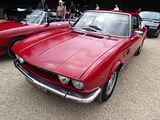


Looking very different to the 130 Berlina which had launched in 1969, the 130 Coupé appeared in 1971 at Geneva Show exhibiting a completely new 2-door body and a completely new interior, both the exterior and interior of which were the work of Paolo Martin at Pininfarina. The car won a design prize, attributed to Pininfarina, and this helped Pininfarina begin a new life after all those years relying on the “Fiat 1800/Peugeot 404/Austin A60” concepts. Pininfarina extended the Fiat 130 Coupé line with two proposals that were rejected by Fiat: the Maremma in 1974 (2-door shooting brake) and the Opera in 1975 (4-door saloon). Paolo Martin never got involved in these Fiat 130 Coupé variations, as he left the company soon after the design prize in 1971. The car was mechanically the same as the 130 Saloon, which meant it had a 165 bhp 3.2 litre V6 unit and a standard Borg Warner 3 speed automatic gearbox with the option of a 5 speed ZF manual. The interior was particularly luxurious by the standards of the day (and other Fiats). It was costly, though, and sales were modes, with 347 being sold in the first year. This ramped up to 1746 in 1972, but then fell steadily every year, reaching 4,491 when production ceased in 1977. There are thought to be fewer than 20 examples in the UK now.


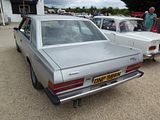


At the 53rd Turin Motor Show of November 1971 Fiat introduced the 2 door 128 Coupé, based on a shortened 128 chassis. It was available with two different engines (1100 and 1300) and in two different trim levels (S and SL) for a total of four variants. In its base “S” trim, the coupé had single rectangular front headlamps, and wheels and hubcaps from the saloon. The pricier “SL” (for Sport Lusso) was distinguished by quadruple round headlamps, a specific grille, steel sport wheels without hubcaps, chromed window surround trim, door handles and fuel cap, and black decorative striping along the sills and across the tail panel. Inside it gained a leatherette-wrapped steering wheels, perforated leatherette upholstery, extended four-gauge instrumentation, loop pile carpeting and black headlining. The two engines were developed from the units found in the 128 saloon and 128 Rally respectively, and both were fitted with twin-choke carburettors and a two-piece exhaust manifold. The 1100 produced 63 hp while the 1300 produced 74 hp. Top speed was over 150 km/h (93 mph) and 160 km/h (99 mph) respectively. Compared with the 128 saloon, the coupé had a 9.1 in shorter wheelbase and tracks that were wider at the front and narrower at the rear. Suspension was the familiar all-independent 128 layout—save for the front anti-roll bar, which had been replaced by radius rods. The braking system consisted of discs at the front and drums at the rear; it was made more efficient by fitting smaller diameter front discs and the front and the vacuum servo first used on the 128 Rally. It was replaced by a hatchback version, the 3P in the autumn of 1975, which was mechanically the same under the skin.

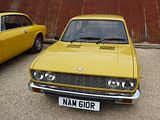


Developed as the Tipo 175, the Coupe was introduced at the Brussels Motor Show in 1993. It is perhaps best remembered for its distinctive, angular design, with unique scalloped side panels. The body was designed by Chris Bangle from Centro Stile Fiat, while the interior was designed by Pininfarina, and the car media headlines in auto magazines during 1992 after several spy shots were taken revealing the car on test. On its launch in 1993, the Coupé was available with a four-cylinder, 2.0 litre 16V engine, in both turbo (190 PS) and normally aspirated (139 PS) versions. Both engines were later versions of Fiat’s twin-cam design and inherited from the Lancia Delta Integrale. 1996 brought in a 1.8 litre 131 PS 16V engine (not available in the UK), along with a 2.0-litre 5-cylinder 20V (147 PS), and a 5-cylinder 2.0-litre 20V turbo (220 PS). The turbocharged 16 and 20 valve versions were equipped with a very efficient Viscodrive limited-slip differential to counter the understeer that plagues most powerful front wheel drive cars. Additionally, the coupe featured independent suspension all round: at the front MacPherson struts and lower wishbones anchored to an auxiliary crossbeam, offset coil springs and anti-roll bar; at the rear, trailing arms mounted on an auxiliary subframe, coil springs and an anti-roll bar. The car was well received at launch, and the 5 cylinder engines just made it even better, with sales increasing slightly for a couple of years, but then they started to drop off, as Coupe models in general fell from favour. 1998 saw the release of the Limited Edition which featured red Brembo brake calipers at the front and standard red calipers at the back, a body kit, push-button start, six-speed gearbox, strut brace to make the chassis more rigid and Recaro seats with red leather inserts which offered better support than the standard 20VT seats. The LE was produced in Black, Red, Vinci Grey (metallic), Crono Grey and Steel Grey (metallic). The bodywork of the LE also benefited from titanium coloured insert around the light bezels and the wing mirrors. Each Limited Edition (‘LE’) Coupé was manufactured with a badge located by the rear-view mirror which contained that car’s unique number (it is rumoured that Michael Schumacher was the original owner of LE No. 0001, however when the question was raised to him personally he confirmed he had owned one, but a red one, while LE No. 0001 is a Crono Grey one). Originally a spokesman from Fiat stated only approximately 300 Limited Editions would be built. The final number was much higher, perhaps as many as 1400. This angered many of the owners of the original 300 cars and almost certainly impacted residual values. The original number however was quoted by a Fiat UK spokesman, so probably that number only applied to the UK market. The numbered plaque on every Coupe features enough space for 4 numbers. In 1998 the 2.0-litre 5-cylinder 20V got a Variable Inlet System which brought the power to 154 PS. The 2.0-litre 5-cylinder 20V Turbo received a 6-speed gearbox and a large, satin gloss push starter button. In addition, the sills of the Turbo version were colour matched with the body paintwork. Fiat also released the 2.0 litre 5 cylinder Turbo ‘Plus’. This model came with an option kit that made it virtually identical to the LE, except for minor interior design changes and without the unique identification badge of the LE. In 2000 Fiat released another special version of the Fiat Coupé. Featuring the 1.8-litre engine, it was only available throughout mainland Europe and marketed as an elegant and affordable edition. Fiat also made changes throughout the rest of the range: new seats, side skirts and wheels for the 2.0-litre 20V model, ‘Plus’ edition wheels on turbo models and Fiat manufactured seats on the ‘Plus’ that were virtually identical to the original Plus Recaro seats with the addition of extra airbags. The 2.0-litre 20V Turbo model is capable of accelerating from 0–100 km/h (0 to 62 mph) in 6.5 seconds and 6.3 seconds for the 20v Turbo Plus, with a top speed of 240 km/h (149 mph) or 250 km/h (155 mph) with later 6-speed gearbox. When production finally stopped in September 2000, a total number of 72,762 units had been produced. There are still well over 1000 units in the UK, so this is a Fiat which has proved durable as well as good to drive, and to look at.


LAMBORGHINI
At a time when the company was financed by the Swiss-based Mimran brothers, Lamborghini began development of what was codenamed Project 132 in June 1985 as a replacement for the Countach model. The brief stated that its top speed had to be at least 315 km/h (196 mph). The design of the car was contracted to Marcello Gandini, who had designed its two predecessors. When Chrysler bought the company in 1987, providing money to complete its development, its management was uncomfortable with Gandini’s designs and commissioned its design team in Detroit to execute a third extensive redesign, smoothing out the trademark’s sharp edges and corners of Gandini’s original design, and leaving him famously unimpressed. In fact, Gandini was so disappointed with the “softened” shape that he would later realise his original design in the Cizeta-Moroder V16T. The car became known as the Diablo, carrying on Lamborghini’s tradition of naming its cars after breeds of fighting bulls. The Diablo was named after a ferocious bull raised by the Duke of Veragua in the 19th century, famous for fighting an epic battle with ‘El Chicorro’ in Madrid on July 11, 1869 In the words of Top Gear presenter Jeremy Clarkson, the Diablo was designed “solely to be the biggest head-turner in the world.” The Diablo was presented to the public for sale on January 21, 1990. Its power came from a 5.7 litre 48-valve version of the existing Lamborghini V12 featuring dual overhead cams and computer-controlled multi-point fuel injection, producing a maximum output of 499 PS and 580 N·m (428 lb/ft) of torque. The vehicle could reach 100 km/h in about 4.5 seconds, with a top speed of 202 mph. The Diablo was rear-wheel drive and the engine was mid-mounted to aid its weight balance. The Diablo came better equipped than the Countach; standard features included fully adjustable seats and steering wheel, electric windows, an Alpine stereo system, and power steering from 1993 onwards. Anti-lock brakes were not initially available, although they would eventually be used. A few options were available, including a custom-moulded driver’s seat, remote CD changer and subwoofer, rear spoiler, factory fitted luggage set and an exclusive Breguet clock for the dash. The Diablo VT was introduced in 1993. Although the VT differed from the standard Diablo in a number of ways, by far the most notable change was the addition of all wheel drive, which made use of a viscous centre differential (a modified version of LM002’s 4WD system). This provided the new nomenclature for the car (VT stands for viscous traction). The new drivetrain could direct up to 25% of the torque to the front wheels to aid traction during rear wheel slip, thus significantly improving the handling characteristics of the car. Other improvements debuting on the VT included front air intakes below the driving lamps to improve brake cooling, larger intakes in the rear arches, a more ergonomic interior with a revised dashboard, electronically adjustable dampers, four-piston brake calipers, power steering, and minor engine refinements. Many of these improvements, save the four-wheel drive system, soon transferred to the base Diablo, making the cars visually nearly identical. Further updates would follow before the car gave way to the Murcielago in 2001. The Diablo sold in greater numbers than its predecessor with 2898 examples being made during its 11 year production life. There were several here, including the VT and the SV, a few of them were the late model cars with their faired-in headlights.


LANCIA
Designed by Vittorio Jano, the Lancia Aurelia was launched in 1950 and production lasted until the summer of 1958.The very first Aurelias were the B10 Berlinas. They used the first production V6 engine, a 60° design developed by Francesco de Virgilio who was, between 1943 and 1948 a Lancia engineer, and who worked under Jano. The first cars had a capacity of 1754 cc, and generated 56 hp. During production, capacity grew from 1.8 litres to 2.5 litres across six distinct Series. Prototype engines used a bore and stroke of 68 mm x 72 mm for 1569 cc; these were tested between 1946 and 1948. It was an all-alloy pushrod design with a single camshaft between the cylinder banks. A hemispherical combustion chamber and in-line valves were used. A single Solex or Weber carburettor completed the engine. Some uprated 1991 cc models were fitted with twin carburettors. At the rear was an innovative combination transaxle with the gearbox, clutch, differential, and inboard-mounted drum brakes. The front suspension was a sliding pillar design, with rear semi-trailing arms replaced by a de Dion tube in the Fourth series. The Aurelia was also first car to be fitted with radial tyres as standard equipment. Aurelia was named after Via Aurelia, a Roman road leading from Rome to France. The B21 version was released in 1951 with a larger 1991 cc 70 hp engine and a 2-door B20 GT coupé appeared that same year. It had a shorter wheelbase and a Ghia-designed, Pininfarina-built body. The same 1991 cc engine produced 75 hp in the B20. In all, 500 first series Aurelias were produced. This is generally believed to the first car to use the name GT, or Gran Turismo. The B20 GT Aurelia had a successful career in motorsport, too. In the 1951 Mille Miglia the 2-litre Aurelia, driven by Giovanni Bracco and Umberto Maglioli, finished 2nd beaten only by the Ferrari America. The same year it took first in class and 12th overall at LeMans. Modified Aurelias took the first three places on 1952’s Targa Florio with Felice Bonetto as the winner and another win on Lièges-Rome-Lièges of 1953.


Replacing the Aurelia was the Flaminia, which although superficially similar to its illustrious predecessor and materially “better” in just about every respect, never managed to capture buyers’ imaginations in the same way when new, and even now, it has to play second fiddle to the older car. The first model in the range was the Berlina, which was launched at the 1957 Geneva Show. It had a Pininfarina styled body which took much inspiration from the Florida concept car that had been shown in the previous year. Much was new under the skin. Its larger 2.5 litre 100 bhp V6 engine was new in detail, and was designed to allow for further increases in capacity, which would come in time. I was smoother than the Aurelia engines and had more torque, and with better cylinder head design and revised cooling, it was more robust, as well. There was synchromesh on all four gears. Lancia’s famous sliding pillar suspension was banished in favour of unequal length wishbones and coil springs which required less maintenance and were more refined. But the car was heavy, and complex, and exceedingly expensive. Lancia thought that their customers would pay a premium for “the best”, but tastes were changing, and the Berlina was never a strong seller, with fewer than 3000 of them being constructed, most of them being the first series cars. Just 549 of the later second series model with 110 bhp and disc brakes were made between 1961 and 1963, hardly surprising when the car cost more than a Rolls Royce Silver Cloud, as it did in the UK. The later cars had a 2.8 litre engine and 125 bhp, and just 599 of these were made between 1963 and 1968. There was more success with the coachbuilt two door variants which joined the range. The most successful of these, the Pininfarina Coupe, was the first to appear. This was made between 1959 and 1967, during which time 5284 of these mostly steel-bodied cars were constructed. In many ways they were very like the Berlina, just a bit smaller, though there was a floor mounted gear lever, and the cars had more power. The first 3200 of them had a 119 bhp single carb engine with a sport camshaft. Later 3Bs had a triple choke Solex from 1962 and the power went up to 136 bhp. It was only a year after the Pininfarina car’s debut when Touring of Milan announced their Flaminia models. These aluminium bodied cars were sold in three distinct variants between 1960 and 1965. The single carburettor GT was followed by a Convertible in 1960, both of them uprated to 140 bhp triple Weber 3C spec in 1961. The 2.8 litre 3C took over in 1963 and were supplemented by a new 2+2 version called the GTL, with a taller roofline, front-hinged bonnet, longer doors and more substantial seats. It is the rarest of all Flaminia models, with just 300 made. The styling house to offer a car was Zagato, with their Sports and SuperSports. Only 526 were made and there is a complicated production history which probably shows the sort of chaotic thinking that was going on at Lancia and which would lead to is bankruptcy and take over by Fiat in 1969. The first 99 Sports had faired-in headlights and the 119 bhp engine. From 1960 another 100 cars were built with expose lights until the introduction of the Sport 3C with the 140 bhp triple carb. Zagato made 174 of those in 1962 and 1963, still with the exposed lights. The faired-in lights returned in 1964 on the SuperSport, which also had a Kamm tail, and with DCN Webers this one put out 150 bhp. 150 of these were made between 1964 and 1967. Many of the earlier cars were upgraded early in their life, so if you see one now, you cannot be totally sure of is true origin. Production of the car ceased in 1970, with fewer than 13,000 Flaminia of all types having been built. These days, the cost to restore them properly – and it is a huge job – exceeds the value of most of them, by some margin, as Berlina and Coupe models tend not to sell for more than £30k. The Zagato cars are a different matter, and when they come up for sale, routinely go for over £300k. The Touring cars – considered by most to be the prettiest tend to be around £100k for the GT and another 50 – 80k for a convertible – a long way from the value of an Aston Martin DB4 Volante, which cost roughly the same when new. There’s believed to be only one Berlina on the road in the UK, so that is going to remain a rare sighting, and it was not here. The car here was one of the Touring GT models.


The Fulvia Coupé was a compact two-door, three-box coupé introduced in 1965. Like the saloon it was designed in-house by Piero Castagnero, using a wheelbase 150 mm (5.9 in) shorter than its sedan counterpart. As the last Fulvia model to be discontinued, the coupe was ultimately replaced in 1977 by a 1.3-litre version of the Beta Coupé. The 1965–67 cars were equipped with a 1,216 cc 818.100 engine—from 1967 enlarged to 1,231 cc—producing 79 hp at 6,000 rpm. The same engines were subsequently used on the Berlina GT. The Coupé HF of 1966–67 was the competition version of the coupé, introduced later in 1965. It carried a tuned version of the 1,216 cc engine producing 87 hp at 6,000 rpm. Bodywork was lightened by removing the bumpers, using an aluminium bonnet, doors and boot lid, Plexiglas side and rear windows, and bare steel wheels without hubcaps. The Rallye 1.3 HF of 1967–69 had a new 1,298 cc engine with 100 hp at 6,400 rpm. The Rallye 1.3 of 1967–68 was an updated coupé with the 818.302 1,298 cc engine with 86 hp at 6,000 rpm. The Rallye 1.3 S of 1968–70 was an updated, more powerful Rallye 1.3 with a new 818.303 1,298 cc engine producing 91 hp at 6,000 rpm. There was also the Rallye 1.6 HF of 1969–70. Known as Fanalone (“big lamps”) because of the characteristic upsized inner pair of headlamps. The evolution of Rallye 1.3 HF, equipped with an all-new 818.540 1,584 cc engine producing 113 hp at 6,500 rpm. Other changes included negative camber front suspension geometry, with light alloy 13 inch 6J wheels; and a close ratio 5-speed gearbox and wheel arch extensions. The easiest way to distinguish this version is by the triangular holes between headlamps and grille. The Rallye 1.6 HF of 1969–70 was a works rally-spec Fanalone, produced in very limited numbers. The most powerful Fulvia with a 1,584 cc engine producing up to 130 hp depending on tune. This was the version used by the works rally team until 1974 when it was superseded in competition by the Stratos HF. 45 mm bore Solex carburettors were used that were later replaced by 45 DCOE Webers. The cam cover had a special blue stripe over the yellow paint job (HF cars had just a yellow paint job). The Series II cars first appeared in 1970. For the Coupé 1.3 S of 1970–73, there was a face-lifted body and new 5 speed gearbox with 1298 cc (818.303) engine producing 89 hp at 6000 rpm. Larger Girling callipers and pads replaced the Dunlop system fitted to 1st series cars. The Coupé 1.3 S Montecarlo of 1972–73 was a special edition based on the 1.3 S, commemorating Lancia’s victory at the 1972 Monte Carlo Rally. The livery resembled the works car, with matte black bonnet and boot lid bearing Monte Carlo rally plate-style stickers. This version used his own bodyshell with flared wheel arches, similar to the 1.6 HF bodyshell. Other accoutrements included 1.6 HF Lusso interior fittings such as bucket seats with headrests, rectangular front fog lamps, no bumpers and black single wing mirror; 4.5J steel wheels of the standard Coupé were fitted. The Coupé 1600 HF of 1970 had the face-lifted all steel body with 1,584 cc engine with Solex C42DDHF carb producing 113 hp at 6,000 rpm. The bodywork was changed from the standard 1.3 Coupé to incorporate flared wheel arches (replacing the extensions used on 1st series HFs). There was a further update creating the Coupé Series 3. This was introduced in 1974 and was mechanically the same as the earlier Series 2 1.3 S except for the addition of emission control on the Solex carburettors. Other than for “Fulvia 3” badges, it is easily recognized by its matte black grilled and headlight frame. It featured a new design of seats incorporating headrests and new white-faced instrument dials with an updated range of trim colours, materials and options. There was a Coupé 3 Montecarlo between 1974–76 which was as the earlier Montecarlo, but with Coupé 3 accoutrements. And finally there was the Safari between 1974–76. A limited edition based on the standard Coupé 3 with simplified trim and equipment, celebrating Fulvia’s participation in the Safari Rally. It came without bumpers, with matte black exterior trim, seats upholstered in denim cloth and leatherette, exterior badges on the bonnet and on the boot lid and also a special numbered plaque on the dashboard.


The Fulvia Sport was a fastback two-seater based on Coupé mechanicals, built for Lancia by Zagato — where it had also been designed, by Ercole Spada. The Sport was commissioned by Lancia to Zagato as more aerodynamic and sportier version of the coupé, which could be used in road and track competitions. Three peculiarities of the Sport body were the engine bonnet, which was hinged to the right-hand side, the rear hatch, which could be lifted electrically by a handful of centimetres to aid cabin ventilation, and the spare wheel, which was housed in a separate compartment and accessed from a rotating panel which held the rear number plate. The tail lights were sourced from the NSU Prinz 4. Introduced at the 1965 Turin Motor Show, the first Sport had an all-aluminium alloy bodyshell and used the coupé’s 1.2-litre (1,216 cc) engine. Inside it reprised the wood-trimmed dashboard of the coupé, and featured two small bucket seats of Zagato’s own design. Just 202 were made in total. In 1966 the Sport was upgraded to an 818.302 1,298 cc engine from the Rallye 1.3, producing 87 hp at 6,000 rpm. Early versions still had all aluminium bodyshells (700 were produced with both 1,216 cc & 1,298 cc engines), but later ones were fitted with steel bodyshells with aluminium bonnet, doors, and spare wheel hatch. Whereas the first Sport was homologated as a two-seater, the car was now classified as a three-seater—or 2+1. The 1.3 can be distinguished from the 1.2 for its silver- instead of ivory-painted steel wheels, and the side mirror on the driver’s side front wing. An updated Sport 1.3 with 1,298 cc engine producing 92 hp at 6,000 rpm. These Sports were normally fitted with brake servos. It is recognizable by its larger hubcaps, decorated with Lancia flag logos instead of being plain. The second series Fulvia Sport was launched at the 1970 Turin Motor Show. Changes included a 5-speed gearbox, revised suspension geometry, taller ride height, an alternator in place of the previous dynamo, a taller final drive compared to coupés, and wider tyres. The body was now all-steel, and seated 2+2 passengers. Some of the Zagato’s most unusual features were lost: the bonnet was now hinged at the front, and the spare wheel compartment hatch was deleted. Several other changes set the second series apart from the first: new driving lights, a side mirror moved from the wing to the door, larger bullet-shaped tail lights from the Peugeot 204, and stamped steel wheels without hubcaps. There was also a Lancia Fulvia Sport 1600 Zagato produced in 1971–72. This the top of the range, with 1,584 cc engine from the HF, producing 115 hp. With a top speed of 118 mph (190 km/h), this version was the fastest production Fulvia ever produced. The 1600 was distinguished by a matte black radiator grille with chrome edges, black rubber over-riders on the bumpers, a matte black band on the engine bonnet, and new flush door handles. Some of these new fixtures—like the black grille and door handles—found their way on late 1.3 S examples. Inside the 1600 had an oil temperature gauge, bucket seats with headrests and electric front windows as standard. Cromodora alloy wheels like those found on the 1600 HF were optional.


In 1973 the second style to appear in the new Beta range was a 2+2 two-door coupé with a 93″ wheelbase, although due to the fuel crisis it did not become available to the public until early 1974. It was launched with 1.6 and 1.8 engines. New 1.6 and 2.0 engines replaced the original units in late 1975 followed by a 1.3 in early 1976, at which point the Fulvia Coupe was deleted. In 1978 automatic transmission and power steering became available. In 1981 the car received a minor facelift and at the same time the 2.0 became available with fuel Bosch electronic fuel injection. In 1983 a 2.0 VX supercharged engine became available with an output of 135 bhp. The bodywork was developed in-house by a Lancia team led by Aldo Castagno, with Pietro Castagnero acting as styling consultant. Castagnero had also styled the Beta’s predecessor, the Lancia Fulvia saloon and coupé. The car was popular in the mid 1970s with 111,801 examples being built, though they are quite rare now. This one is especially rare as it is a HiFi model. The special Beta Coupè Hi Fi version was a limited edition cosmetically treated by the Tickford company. Produced in 1979, it is claimed that 300 were made, tough there is some doubt as to whether there was actually as many as that, and it was only sold in the UK. The cars were painted in special metallic colours with gold stripes on the sides. The car also featured a front and rear spoiler and 185/65 tyres Pirelli P6. The HI FI name was due to the special sound system made by Voxon the car was fitted with. Tickford Company, where the HI FI received the cosmetic treatment, was Aston Martin coach builder. This one has only just been returned to the road and it is thought it may well be the sole survivor.


The Beta Spyder was also here. First seen in 1976, this was effectively an open-topped version of the Coupe, the Spyder was designed by Pininfarina but actually built by Zagato, which is why it was known as the Zagato in America. The Spyder used the Coupé’s shorter wheelbase and featured a targa top roof panel, a roll-over bar and folding rear roof.. Early models did not have a cross-member supporting the roof between the tops of the A to B pillars. Later models had fixed cross-members. It was initially powered by either the 1600 or 1800 twin-cam engine, later being replaced by the new 1.6 and 2.0. It never received the IE or VX engines. There were fuel injected engines for the US market. Lancia spelt the name with a “y” rather than an “i” possibly to differentiate the car from the Alfa Romeo Spider, though most people tend to use the “Spider” spelling these days. 9390 examples were built.


Homologation requirements for the World Rally Championship’s Group B mandated Lancia to produce at minimum 200 verifiable road-going examples in order to compete with the 037. 207 037 Stradale (Italian for “road going/for the road”) cars are known to have been produced from 1982 through 1984. This road-going 037 variant was equipped with an Abarth-developed DOHC 2.0-litre (1,995 cc) 16-valve Inline-four engine, mated to an Abarth Volumex Roots-type supercharger generating 205 hp at 7,000 rpm. It was capable of pushing the car to over 220 km/h (137 mph) and to 100 km/h (62 mph) from a standstill in 5.8 seconds.


Lancia launched the Delta in 1979, as what we would now think of as a “premium hatch”. Offered in 1300 and 1500cc engines, this car, which collected the prestigious “Car of the year” award a few months later, brought Italian style and an expensive feeling interior to a new and lower price point in the market than Lancia had occupied since the early days of the Fulvia some 15 years earlier. The range grew first when a model was offered using the 4 speed AP automatic transmission and then in late 1982, more powerful models started to appear, with first a 1600cc engine, and then one with fuel injection, before the introduction of the HF Turbo. All these cars kept the same appearance and were quite hard to tell apart. These were the volume models of the range, but now they are very definitely the rare ones, as it is the performance versions which have survived and are now much loved classics, even though relatively were sold when they were new, thanks to a combination of the fact that they were quite costly and that they only ever came with left hand drive. The Integrale evolved over several years, starting off as the HF Turbo 4WD that was launched in April 1986, to homologate a new rally car for Lancia who needed something to fill the void left by the cancellation of Group B from the end of 1986. The Delta HF 4X4 had a four-wheel drive system with an in-built torque-splitting action. Three differentials were used. Drive to the front wheels was linked through a free-floating differential; drive to the rear wheels was transmitted via a 56/44 front/rear torque-splitting Ferguson viscous-coupling-controlled epicyclic central differential. At the rear wheels was a Torsen (torque sensing) rear differential. It divided the torque between the wheels according to the available grip, with a maximum lockup of 70%. The basic suspension layout of the Delta 4WD remained the same as in the rest of the two-wheel drive Delta range: MacPherson strut–type independent suspension with dual-rate dampers and helicoidal springs, with the struts and springs set slightly off-centre. The suspension mounting provided more isolation by incorporating flexible rubber links. Progressive rebound bumpers were adopted, while the damper rates, front and rear toe-in and the relative angle between springs and dampers were all altered. The steering was power-assisted rack and pinion. The car looked little different from the front wheel drive models. In September 1987, Lancia showed a more sophisticated version of the car, the Lancia Delta HF Integrale 8V. This version incorporated some of the features of the Delta HF 4WD into a road car. The engine was an 8-valve 2 litre fuel injected 4-cylinder, with balancing shafts. The HF version featured new valves, valve seats and water pump, larger water and oil radiators, more powerful cooling fan and bigger air cleaner. A larger capacity Garrett T3 turbocharger with improved air flow and bigger inter-cooler, revised settings for the electronic injection/ignition control unit and a knock sensor, boosting power output to 185 bhp at 5300 rpm and maximum torque of 224 lb/ft at 3500 rpm. The HF Integrale had permanent 4-wheel drive, a front transversely mounted engine and five-speed gearbox. An epicyclic centre differential normally split the torque 56 per cent to the front axle, 44 per cent to the rear. A Ferguson viscous coupling balanced the torque split between front and rear axles depending on road conditions and tyre grip. The Torsen rear differential further divided the torque delivered to each rear wheel according to grip available. A shorter final drive ratio (3.111 instead of 2.944 on the HF 4WD) matched the larger 6.5×15 wheels to give 24 mph/1000 rpm in fifth gear. Braking and suspension were uprated to 284 mm ventilated front discs, a larger brake master cylinder and servo, as well as revised front springs, dampers, and front struts. Next update was to change the engine from 8 valves to 16. The 16v Integrale was introduced at the 1989 Geneva Motorshow, and made a winning debut on the 1989 San Remo Rally. It featured a raised centre of the bonnet to accommodate the new 16 valve engine, as well as wider wheels and tyres and new identity badges front and rear. The torque split was changed to 47% front and 53% rear. The turbocharged 2-litre Lancia 16v engine now produced 200 bhp at 5500 rpm, for a maximum speed of 137 mph and 0–100 km/h in 5.5 seconds. Changes included larger injectors, a more responsive Garrett T3 turbocharger, a more efficient intercooler, and the ability to run on unleaded fuel without modification. The first Evoluzione cars were built at the end of 1991 and through 1992. These were to be the final homologation cars for the Lancia Rally Team; the Catalytic Evoluzione II was never rallied by the factory. The Evoluzione I had a wider track front and rear than earlier Deltas. The bodyside arches were extended and became more rounded. The wings were now made in a single pressing. The front strut top mounts were also raised, which necessitated a front strut brace. The new Integrale retained the four wheel drive layout. The engine was modified to produce 210 bhp at 5750 rpm. External changes included: new grilles in the front bumper to improve the air intake for engine compartment cooling; a redesigned bonnet with new lateral air slats to further assist underbonnet ventilation; an adjustable roof spoiler above the tailgate; new five-bolt wheels with the same design of the rally cars; and a new single exhaust pipe. Interior trim was now grey Alcantara on the Recaro seats, as fitted to the earlier 16V cars; leather and air conditioning were offered as options, as well as a leather-covered Momo steering wheel. Presented in June 1993, the second Evolution version of the Delta HF Integrale featured an updated version of the 2-litre 16-valve turbo engine to produce more power, as well as a three-way catalyst and Lambda probe. A Marelli integrated engine control system with an 8 MHz clock frequency which incorporates: timed sequential multipoint injection; self-adapting injection times; automatic idling control; engine protection strategies depending on the temperature of intaken air; Mapped ignition with two double outlet coils; Three-way catalyst and pre-catalyst with lambda probe (oxygen sensor) on the turbine outlet link; anti-evaporation system with air line for canister flushing optimised for the turbo engine; new Garrett turbocharger: water-cooled with boost-drive management i.e. boost controlled by feedback from the central control unit on the basis of revs/throttle angle; Knock control by engine block sensor and new signal handling software for spark park advance, fuel quantity injected, and turbocharging. The engine now developed 215 PS as against 210 PS on the earlier uncatalysed version and marginally more torque. The 1993 Integrale received a cosmetic and functional facelift that included. new 16″ light alloy rims with 205/45 ZR 16 tyres; body colour roof moulding to underline the connection between the roof and the Solar control windows; aluminium fuel cap and air-intake grilles on the front mudguards; red-painted cylinder head; new leather-covered three-spoke MOMO steering wheel; standard Recaro seats upholstered in beige Alcantara with diagonal stitching. In its latter years the Delta HF gave birth to a number of limited and numbered editions, differing mainly in colour, trim and equipment; some were put on general sale, while others were reserved to specific markets, clubs or selected customers.


MASERATI
Known internally as Tipo AM109, the Mistral was a 2-seat gran turismo produced between 1963 and 1970, as a successor to the 3500 GT. It was styled by Frua and bodied by Maggiora of Turin. Named after a cold northerly wind of southern France, it was the first in a series of classic Maseratis to be given the name of a wind. The Mistral was the last model from the Casa del Tridente (“House of the Trident”) to have the company’s renowned twin-spark, double overhead cam straight six engine. Fitted to the Maserati 250F Grand Prix cars, it won 8 Grand Prix between 1954 and 1960 and one F1 World Championship in 1957 driven by Juan Manuel Fangio. The engine featured hemispherical combustion chambers fed by a Lucas indirect fuel injection system, a new development for Italian car manufacturers. Maserati subsequently moved on to V8 engines for their later production cars to keep up with the demand for ever more powerful machines. Three engine were fitted to the Mistral, displacing 3500, 3700 and 4000 cc and developing 235 bhp at 5500 rpm, 245 bhp at 5500 rpm and 255 bhp at 5200 rpm, respectively. Only the earliest of the Mistrals were equipped with the 3500 cc, the most sought after derivative is the 4000 cc model. Unusually, the body was offered in both aluminium and, from 1967, in steel, but no one is quite sure how many of each were built. The car came as standard with a five speed ZF transmission and four wheel solid disc brakes. Per Maserati practice, the front suspension was independent and the rear solid axle. Acceleration 0-60 for both the 3.7 litre and 4.0 litre engines was around or just under 7 seconds, and top speed approximately 140 mph (225 km/h) to 145 mph (233 km/h). The body was designed by Pietro Frua and first shown in a preview at the Salone Internazionale dell’Automobile di Torino in November 1963. It is generally considered one of the most beautiful Maseratis of all time. It is also often confused with the very similar looking but larger and more powerful Frua designed AC 428. A total of 828 coupés and 125 Spyders were built. Only the Spyder received the 3500 engine; just 12 were made, along with 76 3.7 litre and 37 4.0 litre versions. Twenty Spyders were right hand drive. The Mistral was succeeded by the Ghibli, which overlapped production from 1967 on.


The Sebring was based on the earlier Maserati 3500 GT, and aimed at the American Gran Turismo market, taking its name from Maserati’s 1957 racing victory at the 12 Hours of Sebring. A single two-seat spyder was built by Vignale in 1963 but did not enter production. The Series I (Tipo AM 101/S) was shown at the Salon International de l’Auto 1962 and again at the Salone dell’automobile di Torino in 1963. Employing all but the Maserati 3500’s coachwork, it could reach 137 mph and 0–60 mph in 8.5 seconds on 185×15 Pirelli Cinturato tyres. A Borg-Warner automatic transmission was available, a first for Italian automobiles. When leaving the factory it originally fitted Pirelli Cinturato 205VR15 tyres (CN72). A total of 348 Series I Sebrings were built between 1962 and 1965. The engine was updated in 1963, gaining 15PS for a total of 235 PS. The 3700 engine first appeared in 1964, although only a handful of Series I cars were thus equipped. In 1965, the modified Series II (Tipo AM 101/10) was introduced. It had lightly redesigned headlamps, modernised bumpers, new front indicators, and new side grilles replacing the lower extraction vents used hitherto. It took minor design cues from the contemporary Quattroporte. At the rear, aside from the squared off bumpers, the taillights were now mounted horizontally rather than vertically and the bootlid opening was narrowed somewhat. The Series II rode on larger 205×15 Pirelli Cinturatos. A run of 247 units were made from 1964 until 1968. Along with the 3500 engine, the 3700 and the even larger 4000 were added. The 4000 GTiS has a 4,012 cc engine producing 255 PS at 5,200 rpm. It remained in production until 1968, when financial constraints forced Maserati to drop its older models from production. No major updates took place over the last three years of production, except for a slight power gain for the 4000, now up to 265 PS. 348 units of Sebring 3.5 and 245 of 3.7 and 4.0 (combined) were made, for a total of 593 units from 1962 to 1969.


The Merak was introduced at the 1972 Paris Auto Show, over a year after the Bora, a car whose front part of the bodyshell up to the doors, it shares. The front ends are differenced mainly by the use of dual chrome bumpers in place of twin trapezoidal grilles, but the similarities end at the B-pillar. Unlike its bigger sister the Merak doesn’t have a true, fully glassed fastback, but rather a cabin ending abruptly with a vertical rear window and a flat, horizontal engine bonnet pierced by four series of ventilation slats. Giugiaro completed the vehicle’s silhouette by adding open flying buttresses, visually extending the roofline to the tail. The main competitors of the Merak were the similarly Italian, mid-engined, 3-litre and 2+2 Dino 308 GT4 and Lamborghini Urraco P250. However unlike its transverse V8-engined rivals the Merak used a more compact V6, that could therefore be mounted longitudinally. Having been designed during the Citroën ownership of Maserati, certain Citroën hydropneumatic systems were used in the Merak, as for the Bora. These included the braking system and the clutch which were both hydraulically assisted and operated, and the pop-up headlights were hydraulically actuated. After 1976, when the French manufacturer gave up control of Maserati, the Citroën-derived parts were gradually replaced by more conventional systems. In 1977 Alejandro de Tomaso purchased Maserati and the Bora was discontinued after a production run of less than 600 cars, while the Merak remained on sale for six more years. The Merak’s V6 engine descended from the 2.7 litre Tipo C.114 originally designed by Giulio Alfieri in 1967 for use in the Citroën SM, that was bored out to 91.6 mm to displace 2,965 cc. It was a chain-driven double overhead camshaft, 12-valve unit featuring an unusual 90° angle between the cylinder banks. The lubrication system used a wet sump and an oil cooler. This V6 did not end its days on the Merak: it was later modified and made into the first ever production twin-turbocharged engine in the Biturbo, ending its career in the 1990s Ghibli after reaching the highest specific output of any production engine at the time. The powerplant was mounted longitudinally behind the passenger compartment, and joined through a single-plate dry clutch to a 5-speed, all synchromesh Citroën transaxle gearbox and a limited-slip differential. The original Merak’s three-litre engine produced 190 PS at 6000 rpm. Three twin-choke Weber carburettors (one 42 DCNF 31 and two 42 DCNF 32) fed the engine, and the compression ratio was 8.75:1. Maserati declared a top speed of over 240 km/h (149 mph). Early Meraks (1972 to 1975) were fitted with the Citroën SM’s dashboard, characterised by oval instrument gauges inset in a brushed metal fascia and a single-spoke steering wheel. 630 were made up to 1974. The lightened and more powerful Merak SS (Tipo AM122/A) was introduced at the 41st Geneva Motor Show in March 1975, although it did not enter production until the next year. It featured a 50 kg weight reduction and a 30 PS power increase to 220 PS (217 hp), thanks to the adoption of three larger 44 DCNF 44 carburettors and a higher 9:1 compression ratio. The SS was recognisable from a black grille between the pop-up headlights. A Maserati-designed upper fascia with round instruments and a four-spoke steering wheel replaced the previous SM-derived interior furniture. Later cars were bestowed with the full driver-oriented dashboard and three-spoke padded steering wheel of the Maserati Bora. The US-spec version of the Merak SS also saw a return to traditional hydraulics, eliminating the last of the Citroen high pressure system. 1000 units of the SS had been made by 1983, when all Merak production ceased. A third version of the Merak was made, In November 1977 at the Turin Auto Show, De Tomaso launched the Merak 2000 GT (Tipo AM122/D), which was basically a Merak with a smaller two-litre powerplant. It was built almost exclusively for the Italian market, where a newly introduced law strongly penalised cars with engine capacity over 2000 cc by subjecting them to a 38% Value Added Tax against the usual 19% VAT. The Merak’s competitors already offered similar two-litre models, specifically the Urraco P200 and Dino 208 GT4. The Merak 2000 GT featured a 1,999 cc engine generating 170 PS (168 hp) at 7000 rpm. Colour choice was limited to two shades: metallic light blue or gold. The two-litre cars were also distinguished by a black tape stripe running just below the mid-body character line, matte black bumpers in place of the usual chrome and the absence of the front spoiler, available as an optional. The SS’s front bonnet with the grille between the headlights was used on 2000 GTs. When production ended in 1983 just 200 Meraks 2000 GT had been made. Although a total of 1830 Merak models were made, they are rare cars now. Their low values meant that when they went wrong, which they inevitably did, it was not economic to repair or restore them, and a large number have been scrapped, which is a pity, as this is a great looking car.


After producing BiTurbo based cars for 17 years, Maserati replaced their entire range with a new model in July 1998, the 3200 GT. This very elegant 2+2 grand tourer was styled by Italdesign, whose founder and head Giorgetto Giugiaro had previously designed, among others, the Ghibli, Bora and Merak. The interior design was commissioned to Enrico Fumia. Its name honoured the Maserati 3500 GT, the Trident’s first series production grand tourer. Sold mainly in Europe, the 3200 GT was powered by the twin-turbo, 32-valve, dual overhead cam 3.2-litre V8 engine featured in the Quattroporte Evoluzione, set up to develop 370 PS (365 hp). The car was praised for its styling, with the distinctive array of tail-lights, consisting of LEDs, arranged in the shape of boomerang being particularly worthy of comment. The outer layer of the ‘boomerang’ provided the brake light, with the inner layer providing the directional indicator. The car was also reviewed quite well by the press when they got to drive it in early 1999, though it was clear that they expected more power and excitement. That came after 4,795 cars had been produced, in 2001, with the launch of the 4200 models. Officially called the Coupé and joined by an open-topped Spyder (Tipo M138 in Maserati speak), these models had larger 4.2 litre engines and had been engineered so the cars could be sold in America, marking the return to that market for Maserati after an 11 year gap. There were some detailed styling changes, most notable of which were the replacement of the boomerang rear lights with conventional rectangular units. Few felt that this was an improvement. The cars proved popular, though, selling strongly up until 2007 when they were replaced by the next generation of Maserati. Minor changes were made to the model during its six year production, but more significant was the launch at the 2004 Geneva Show of the GranSport which sported aerodynamic body cladding, a chrome mesh grille, carbon fibre interior trim, and special 19-inch wheels. It used the Skyhook active suspension, with a 0.4 inch lower ride height, and the Cambiocorsa transmission recalibrated for quicker shifts. The exhaust was specially tuned to “growl” on start-up and full throttle. The GranSport was powered by the same 4244 cc, 90° V8 petrol engine used on the Coupé and Spyder, but developing 400 PS (395 hp) at 7000 rpm due primarily to a different exhaust system and improvements on the intake manifolds and valve seats. A six-speed paddle shift transmission came as standard. The GranSport has a claimed top speed of 180 mph (290 km/h) and a 0–62 mph (0–100 km/h) time of 4.8 seconds.


Still acclaimed as one of the best-looking saloons ever produced is this car, the fifth generation Quattroporte, a couple of which were on show. Around 25,000 of these cars were made between 2004 and 2012, making it the second best selling Maserati of all time, beaten only by the cheaper BiTurbo of the 1980s. The Tipo M139 was unveiled to the world at the Frankfurt Motor Show on 9 September 2003, with production starting in 2004. Exterior and interior design was done by Pininfarina, and the result was widely acclaimed to be one of the best looking saloons not just of its time, but ever, an opinion many would not disagree with even now. Built on an entirely new platform, it was 50 cm (19.7 in) longer than its predecessor and sat on a 40 cm (15.7 in) longer wheelbase. The same architecture would later underpin the GranTurismo and GranCabrio coupés and convertibles. Initially it was powered by an evolution of the naturally aspirated dry sump 4.2-litre V8 engine, mounted on the Maserati Coupé, with an improved output of 400 PS . Due to its greater weight compared to the Coupé and Spyder, the 0-62 mph (0–100 km/h) time for the Quattroporte was 5.2 seconds and the top speed 171 mph (275 km/h). Initially offered in only one configuration, equipped with the DuoSelect transmission, the gearbox was the weak point of the car, receiving most of the criticism from the press reviews. Maserati increased the range at the 2005 Frankfurt Motor Show, with the launch of the Executive GT and Sport GT trim levels. The Executive GT came equipped with a wood-rimmed steering wheel, an alcantara suede interior roof lining, ventilated, adaptive, massaging rear seats, rear air conditioning controls, veneered retractable rear tables, and curtain shades on the rear windows. The exterior was distinguished by 19 inch eight-spoke ball-polished wheels and chrome mesh front and side grilles. The Quattroporte Sport GT variant offered several performance upgrades: faster shifting transmission and firmer Skyhook suspensions thanks to new software calibrations, seven-spoke 20 inch wheels with low-profile tyres, cross-drilled brake rotors and braided brake lines. Model-specific exterior trim included dark mesh front and side grilles and red accents to the Trident badges, as on vintage racing Maseratis. Inside there were aluminium pedals, a sport steering wheel and carbon fibre in place of the standard wood inserts. A new automatic transmission was presented at the 2007 Detroit Motor Show, marketed as the Maserati Quattroporte Automatica. As all three trim levels were offered in both DuoSelect and Automatica versions, the lineup grew to six models. The Quattroporte Sport GT S was introduced at the 2007 Frankfurt Motor Show. Taking further the Sport GT’s focus on handling, this version employed Bilstein single-rate dampers in place of the Skyhook adaptive system. Other changes from the Sport GT comprised a lowered ride height and 10 mm wider 295/30 rear tyres, front Brembo iron/aluminium dual-cast brake rotors and red-painted six piston callipers. The cabin was upholstered in mixed alcantara and leather, with carbon fibre accents; outside the door handles were painted in body colour, while the exterior trim, the 20 inch wheels and the exhaust pipes were finished in a “dark chrome” shade. After Images of a facelifted Quattroporte appeared on the Internet in January 2008; the car made its official début at the 2008 Geneva Motor Show. Overseen by Pininfarina, the facelift brought redesigned bumpers, side sills and side mirrors, a convex front grille with vertical bars instead of horizontal, new headlights and tail lights with directional bi-xenon main beams and LED turn signals. Inside there was a new navigation and entertainment system. All Quattroporte models now used the ZF automatic transmission, the DuoSelect being discontinued. The 4.2-litre Quattroporte now came equipped with single-rate damping comfort-tuned suspension and 18 inch wheels. Debuting alongside it was the Quattroporte S, powered by a wet-sump 4.7-litre V8, the same engine of the Maserati GranTurismo S, with a maximum power of 424 bhp and maximum torque of 361 lb·ft. In conjunction with the engine, the braking system was upgraded to cross-drilled discs on both axles and dual-cast 360 mm rotors with six piston callipers at the front. Skyhook active damping suspension and 19 inch V-spoke wheels were standard. Trim differences from the 4.2-litre cars were limited to a chrome instead of titanium-coloured front grille. The Quattroporte Sport GT S was premièred at the North American International Auto Show in January 2009. Its 4.7-litre V8 produced 440 PS (434 hp), ten more than the Quattroporte S, thanks to revised intake and to a sport exhaust system with electronically actuated bypass valves. Other mechanical changes were to the suspensions, where as on the first Sport GT S single-rate dampers took place of the Skyhook system, ride height was further lowered and stiffer springs were adopted. The exterior was distinguished by a specific front grille with convex vertical bars, black headlight bezels, red accents to the Trident badges, the absence of chrome window trim, body colour door handles and black double oval exhaust pipes instead of the four round ones found on other Quattroporte models. Inside veneers were replaced by “Titan Tex” composite material and the cabin was upholstered in mixed Alcantara and leather. This means that there are quite a number of different versions among the 25,256 units produced, with the early DuoSelect cars being the most numerous.


The Maserati GranTurismo and GranCabrio (Tipo M145) are a series of a grand tourers produced from 2007 to 2019. They succeeded the 2-door V8 grand tourers offered by the company, the Maserati Coupé, and Spyder. The GranTurismo set a record for the most quickly developed car in the auto industry, going from design to production stage in just nine months. The reason being that Ferrari, after selling off Maserati to the Fiat Chrysler Group, took the designs of the proposed replacement of the Maserati Coupé and after some modifications, launched it as the Ferrari California. Unveiled at the 2007 Geneva Motor Show, the GranTurismo has a drag coefficient of 0.33. The model was initially equipped with a 4.2-litre V8 engine developed in conjunction with Ferrari. The engine generates a maximum power output of 405 PS and is equipped with a 6-speed ZF automatic transmission. The 2+2 body was derived from the Maserati M139 platform, also shared with the Maserati Quattroporte V, with double-wishbone front suspension and a multilink rear suspension. The grand tourer emphasises comfort in harmony with speed and driver-enjoyment. The better equipped S variant was unveiled at the 2008 Geneva Motor Show and features the enlarged 4.7-litre V8 engine shared with the Alfa Romeo 8C Competizione, rated at 440 PS at 7,000 rpm and 490 Nm (361 lb/ft) of torque at 4,750 rpm. At the time of its introduction, it was the most powerful road-legal Maserati offered for sale (excluding the homologation special MC12). The engine is mated to the 6-speed automated manual shared with the Ferrari F430. With the transaxle layout weight distribution improved to 47% front and 53% rear. The standard suspension set-up is fixed-setting steel dampers, with the Skyhook adaptive suspension available as an option along with a new exhaust system, and upgraded Brembo brakes. The seats were also offered with various leather and Alcantara trim options. The upgrades were made to make the car more powerful and more appealing to the buyers while increasing performance, with acceleration from 0–100 km/h (0–62 mph) happening in 4.9 seconds and a maximum speed of 295 km/h (183 mph). Aside from the power upgrades, the car featured new side skirts, unique 20-inch wheels unavailable on the standard car, a small boot lip spoiler, and black headlight clusters in place of the original silver. The variant was available in the North American market only for MY2009 with only 300 units offered for sale. The GranTurismo MC is the racing version of the GranTurismo S developed to compete in the FIA GT4 European Cup and is based on the Maserati MC concept. The car included a 6-point racing harness, 120 litre fuel tank, 380 mm (15.0 in) front and 326 mm (12.8 in) rear brake discs with 6-piston calipers at the front and 4-piston calipers at the rear, 18-inch racing wheels with 305/645/18 front and 305/680/18 rear tyres, carbon fibre bodywork and lexan windows throughout along with a race interior. All the weight-saving measures lower the weight to about 3,000 lb (1,361 kg). The car shares the 4.7-litre V8 engine from the GranTurismo S but is tuned to generate a maximum power output of 450 PS along with the 6-speed automated manual transmission. The GranTurismo MC was unveiled at the Paul Ricard Circuit in France. It went on sale in October, 2009 through the Maserati Corse programme. 15 GranTurismo MC racecars were developed, homologated for the European Cup and National Endurance Series, one of which was taken to be raced by GT motorsport organization Cool Victory in Dubai in January, 2010. Introduced in 2008, the GranTurismo MC Sport Line is a customisation programme based on the GranTurismo MC concept. Changes include front and rear carbon-fibre spoilers, carbon-fibre mirror housings and door handles, 20-inch wheels, carbon-fibre interior (steering wheel rim, paddle shifters, instrument panel, dashboard, door panels), stiffer springs, shock absorbers and anti-roll bars with custom Maserati Stability Programme software and 10 mm (0.4 in) lower height than GranTurismo S. The programme was initially offered for the GranTurismo S only, with the product line expanded to all GranTurismo variants and eventually all Maserati vehicles in 2009. Replacing both the GranTurismo S and S Automatic, the Granturismo Sport was unveiled in March 2012 at the Geneva Motor Show. The revised 4.7L engine is rated at 460 PS. The Sport features a unique MC Stradale-inspired front fascia, new headlights and new, sportier steering wheel and seats. The ZF six-speed automatic gearbox is now standard, while the six-speed automated manual transaxle is available as an option. The latter has steering column-mounted paddle-shifters, a feature that’s optional with the automatic gearbox. New redesigned front bumper and air splitter lowers drag coefficient from Cd=0.33 to 0.32. In September 2010, Maserati announced plans to unveil a new version of the GranTurismo – the MC Stradale – at the 2010 Paris Motor Show. The strictly two-seat MC Stradale is more powerful than the GranTurismo at 450 PS, friction reduction accounts for the increase, says Maserati, due to the strategic use of “diamond-like coating”, an antifriction technology derived from Formula 1, on wear parts such as the cams and followers. It is also 110 kg lighter (1,670 kg dry weight) from the GranTurismo, and more aerodynamic than any previous GranTurismo model – all with the same fuel consumption as the regular GranTurismo. In addition to two air intakes in the bonnet, the MC Stradale also receives a new front splitter and rear air dam for better aerodynamics, downforce, and improved cooling of carbon-ceramic brakes and engine. The body modifications make the car 48 mm (2 in) longer. The MC Race Shift 6-speed robotised manual gearbox (which shares its electronics and some of its hardware from the Ferrari 599 GTO) usually operates in an “auto” mode, but the driver can switch this to ‘sport’ or ‘race’ (shifting happening in 60 milliseconds in ‘race’ mode), which affects gearbox operations, suspension, traction control, and even the sound of the engine. The MC Stradale is the first GranTurismo to break the 300 km/h (186 mph) barrier, with a claimed top speed of 303 km/h (188 mph). The push for the Maserati GranTurismo MC Stradale came from existing Maserati customers who wanted a road-legal super sports car that looked and felt like the GT4, GTD, and Trofeo race cars. It has been confirmed by the Maserati head office that only 497 units of 2-seater MC Stradales were built in total from 2011 to 2013 in the world, Europe: 225 units, China: 45 units, Hong Kong: 12, Taiwan: 23 units, Japan: 33 units, Oceania: 15 units and 144 units in other countries. US market MC’s do not have the “Stradale” part of the name, and they are sold with a fully automatic six-speed transmission rather than the one available in the rest of the world. US market cars also do not come with carbon fibre lightweight seats like the rest of the world. The MC Stradale’s suspension is 8% stiffer and the car rides slightly lower than the GranTurismo S following feedback from racing drivers who appreciated the better grip and intuitive driving feel of the lower profile. Pirelli has custom-designed extra-wide 20-inch P Zero Corsa tyres to fit new flow-formed alloy wheels. The Brembo braking system with carbon-ceramic discs weighs around 60% less than the traditional system with steel discs. The front is equipped with 380 x 34 mm ventilated discs, operated by a 6 piston caliper. The rear discs measure 360 x 32 mm with four-piston calipers. The stopping distance is 33 m at 100 km/h (62 mph) with an average deceleration of 1.2g. At the 2013 Geneva Motor Show, an update to the GranTurismo MC Stradale was unveiled. It features an updated 4.7 litre V8 engine rated at 460 PS at 7,000 rpm and 520 Nm (384 lb/ft) of torque at 4,750 rpm, as well as the MC Race Shift 6-speed robotized manual gearbox which shifts in 60 milliseconds in ‘race’ mode. The top speed is 303 km/h (188 mph). All models were built at the historic factory in viale Ciro Menotti in Modena. A total of 28,805 GranTurismos and 11,715 units of the convertible were produced. The final production example of the GranTurismo, called Zéda, was presented painted in a gradient of blue, black and white colours.


As a former owner of the Ghibli, I was pleased to see a couple of examples here. The Ghibli marked Maserati’s comeback in the mid-size luxury car segment after two decades of absence, since the last of the Biturbo family saloons went out of production in 1994; it served as a key model in Maserati’s plan of expanding its lineup to cover all segments in the luxury car market. Assembly of the Ghibli took place alongside that of the Quattroporte VI at the new Giovanni Agnelli Plant in Grugliasco near Turin, Italy. On September 24, 2019, the 100,000th Ghibli rolled off the production line as announced by Maserati. The Ghibli was introduced at the 2013 Shanghai Auto Show and marked Maserati’s entry into the mid-size executive car market as being positioned below the Quattroporte. The Ghibli is the first car to be underpinned by the Maserati M156 platform and was the company’s best seller until the Levante crossover SUV was launched. The company sold 6,000 units of the car in its first year into the market, which alone exceeded the best sales figures for Maserati for 2008, which was 9,000 cars sold in total consisting of different models. The number increased to 22,500 in 2013 and 36,448 in 2014. It continued to increase in 2015 due to the delay in the Levante’s launch. The Ghibli also marks the return of the name in the US market as the Biturbo based Ghibli (AM336) was not available for sale there. The Ghibli, which is based on a shorter wheelbase than the flagship Quattroporte, uses a steel monocoque chassis with additional subframes with the front subframe made of aluminium. Tested weight distribution for the diesel version stands at 51/49 front/rear. The diesel engine in the Ghibli, developed under Ferrari engine specialist Paulo Martinelli, is based on the V6 diesel unit found in the Jeep Grand Cherokee. The engine is exclusive to the European market only. A ZF 8HP transmission powers the rear wheels as used by all the major competition except Mercedes-Benz. Both the Ghibli and the Quattroporte share the same suspension although the Skyhook suspension is optional on the former. An optional Koni adaptive sport suspension is also available. From the 2018 model year, the Ghibli can be optioned with one of two new trims, namely GranSport and GranLusso, all of which relate to the interior of the car with the GranSport trim featuring an aggressive front bumper. A facelifted Maserati Ghibli and new, hybrid version were unveiled online on 16 July 2020. Production was phased out in 2024.


The final Maserati here was my Grecale.


HONOURED GUESTS
The site staff did a pretty good job at maintaining the Italian car theme. Most notably when a group of Porsche owners arrived they were very firmly told that they could not park their cars onsite. There were a few exceptions, though, with these cars either welcomed in, or already on site, parked up around the back.
Aston Martin V8 Volante: By the mid 1960s, Aston Martin’s customers had been clamouring for an eight-cylinder car, so Aston Martin designed a larger car. The engine was not ready, however, so in 1967 the company released the DBS with the straight-six Vantage engine from the DB6. Two years later, Tadek Marek’s V8 was ready, and Aston released the DBS V8. Though the body and name was shared with the six-cylinder DBS, the V8 sold for much more. The body was a modern reinterpretation of the traditional Aston Martin look, with a squared-off grille and four headlights (though some consider the styling derivative of the early Ford Mustang). Distinguishing features of the V8 model are the larger front air dam and lack of wire wheels, though some six-cylinder DBS cars also used the V8’s alloy wheels. The tail lights were taken from the Hillman Hunter. A road test report of the time noted that the car had gained 250 lb in weight with the fitting of the V8 in place of the previously used six-cylinder unit, despite the manufacturer’s assurance that the engine weighed only 30 lb more than the older straight-six. Other contributions to the weight gain included heavier ventilated brake discs, air conditioning, fatter tyres, a new and stronger ZF gearbox as well as some extra bodywork beneath the front bumper. Marek’s V8 engine displaced 5,340 cc and used Bosch fuel injection. Output was not officially released, but estimates centre around 315 hp. The DBS V8 could hit 60 mph in 5.9 seconds and had a top speed of nearly 160 mph. 402 DBS V8s were built. In April 1972, the DBS V8 became just the Aston Martin V8 as the six-cylinder DBS was dropped, leaving just this car and the six-cylinder Vantage in production. The V8 became known as the AM V8, a model retroactively referred to as the Series 2 V8 to separate it from later models. Visual differences included twin quartz headlights and a mesh grille, a front design which was to last until the end of production in 1989. AM V8 cars, produced from May 1972 through July 1973, used a similar engine to the DBS V8, albeit with Bosch fuel injection rather than the earlier carburettors. Just 288 Series 2 cars were built. Although David Brown had left the company, he had overseen development of this model. The first 34 cars still carried leftover “DBS V8” badging. The car switched back to Weber carburettors for the Series 3 in 1973, ostensibly to help the car pass new stricter emissions standards in California but most likely because Aston Martin was unable to make the Bosch fuel injection system work correctly. These cars are distinguished by a taller bonnet scoop to accommodate four twin-choke (two-barrel) Weber carbs. The car produced 310 hp and could reach 60 mph in 6.1 seconds with an automatic transmission or 5.7 with a manual. Performance suffered with emissions regulations, falling to 288 hp in 1976. The next year, a more powerful “Stage 1” engine with new camshafts and exhaust brought it up to 305 hp. Production of Series 3 cars lasted from 1973 through October 1978, but was halted for all of 1975. 967 examples were produced in this time. While earlier V8 cars have louvers cut into the little panel mounted beneath the rear windshield, the Series 3 and later cars instead have a small lip at the bottom of this panel, just ahead of the leading edge of the bootlid. The “Oscar India” specification was introduced in October 1978 at the Birmingham International Motor Show. Visually, the former scoop on the bonnet gave way to a closed “power bulge”, while a spoiler was integrated into the tail. Most Oscar India cars were equipped with a Chrysler “Torqueflite” three-speed automatic transmission, with wood trim fitted for the first time since the DB2/4 of the 1950s. Just 352 Oscar India models were built from 1978 through 1985. The power of the now de-smogged engines kept dropping on American market cars, down to a low of 245 hp in the early eighties. The convertible “Volante” was introduced in June 1978, but featured the Series 4 bonnet a few months before the coupé received the Oscar India update. The Volante Series 1 weighs 70 kg (155 lb) more than the coupé, due to the necessity of reinforcing the frame. US market cars received much larger bumpers beginning with the 1980 model year, adding weight and somewhat marring the car’s lines. Owners of US-specified cars often modify them to have the slimmer European bumpers. By 1981, the success of the Volante meant that the coupé model was only built on individual demand. The fuel-injected Series 5 cars were introduced in January 1986 at the New York International Auto Show. The compact Weber/Marelli system no longer needed the space of the previous carburettors, so the bonnet bulge was virtually eliminated. 405 Series 5 cars were built before production ceased in 1989. The Volante Series 2 received the same changes; 216 were built.

Bentley S3: The Bentley S3 is a four-door luxury car produced by Bentley from late 1962 until 1965, as the successor of the Bentley S2. The S3 was first announced and displayed at the Paris Motor Show in October 1962. The car was very similar to the preceding S2, with the most-visible exterior difference being a four-headlamp layout reflecting that introduced on the Rolls-Royce Silver Cloud III the same model year. The radiator was lowered 1½ inches allowing a lower bonnet line, and other exterior differences included restyled front mudguards and smaller over-riders on the bumpers front and rear. The interior was modified with individual seats for front passengers and a rear seat moved two inches rearward for increased leg room. The 6.2 L (6230 cc/380 cu in) V8 engine continued with larger carburettors and compression raised from 8:1 to 9:1, increasing power output by 7%. The engine upgrades brought improved acceleration and a top speed of 115 mph with no loss of economy; for the American market an engine “breather” was employed to reduce air pollution. The power steering was also improved. The S3 was priced at £6,126, over triple the top of the range British-built Jaguar Mark X (at £2,022, including all taxes). The Park Ward Continental sports saloon was £8,495, a premium of about 40% over an S3.

Dodge Viper: The original Viper was intended to be a performance sports car. The project was started in 1988 at Chrysler’s Advanced Design Studios, when then-president Bob Lutz suggested to Tom Gale that the company should consider the production of a modern Cobra. A clay model was created months later, and the car later appeared as a concept in 1989 at the North American International Auto Show. Chief engineer Roy Sjoberg was then directed to develop the car after public reactions of the initial concept were highly positive. “Team Viper” was later formed with 85 engineers selected by Sjoberg, and development of the car began in March 1989, with full completion in February 1990. It was later introduced in 1991 at the Indianapolis 500 of that year with a pre-production car driven by Carroll Shelby, being forced to replace the Dodge Stealth because of complaints coming from the United Automobile Workers. It later went on sale as the Dodge Viper RT/10 Roadster in January 1992. The Viper lacks modern driver aids such as traction control and anti-lock brakes. The car also has no exterior-mounted door handles or key locks, and instead, entry is done by unzipping a vinyl window to reach the interior door release handle (when the canvas/hard top is in place). No air conditioning was installed on the car (the option for A/C was added in later 1994 models). There were also no airbags for weight reduction. The roof was made from canvas, and the windows were made from vinyl and used zippers to open and close. Despite these lack of features, the car still had some features in order for it to be tolerable as a daily driving car, such as manually-adjustable seats with lumbar support, an AM/FM stereo player, a clock, and carpeting. Later models of the Viper allowed the option for a lightweight fibreglass hard top to replace the standard canvas soft top. Lamborghini, who was owned by Chrysler Corporation at the time, assisted with the design of the aluminium-alloy V10 engine for the car, with the design based on Chrysler’s LA engine. Dick Winkles, the chief power engineer, was a major contributor on the engine project, and had spent time in Italy for the purpose of the engine’s development. The engine generated a maximum power output of 400 hp at 4,600 rpm and 465 lb/ft (630 Nm) and 3,600 rpm, and weighed 323 kg (712 lb). Fuel economy rated by the United States Environmental Protection Agency to be 12 mpg‑US (14 mpg‑imp) during city driving and 20 mpg‑US (24 mpg‑imp) on the highway, all made possible due to long gearing. The Dodge Viper has a curb weight of 1,490 kg (3,285 lb), with the body’s tubular steel frame and resin-transfer moulding fibreglass panels. The car is able to accelerate from 0–60 mph in 4.6 seconds, 0–100 mph in 9.2 seconds, completes a quarter mile in 12.6 seconds at the speed of 113.8 mph and has a maximum speed of 165 mph (266 km/h). Its large tyres allowed the car to average 0.96 lateral g in corners, which placed it among the best performance cars of its day, however, the car proved tricky for the unskilled drivers. The SRI was replaced by the updated SRII after a series of updates in 1995.

Nissan Skyline GT-R: The first GT-R Skyline appeared in February 1969. Called the PGC-10 (KPGC-10 for later coupé version) internally and Hakosuka (ハコスカ) by fans. Hako (ハコ) means box in Japanese, and suka (スカ) is short for Skyline (スカイライン; Sukairain). It used the 2.0 L (1998 cc) S20 I6. This new DOHC engine (which was designed by the former Prince engineers) produced 160 hp and 180 Nm (133 lb/ft) of torque, and was similar to the GR8 engine used in the Prince R380 racing car. The GT-R began as a sedan, but a 2-door coupé version was debuted in October 1970 and introduced in March 1971. The cars were stripped of unnecessary equipment to be as light as possible for racing, and performed well at the track. The sedan racked up 33 victories in less than two years, and the coupé stretched this to 50 through 1972. The C10 raced against many cars including the Toyota 1600GT, Isuzu Bellett GTR, Mazda Familia (R100) & Capella (RX-2) – even Porsche. In late 1971 the new Mazda RX-3 became the GT-R’s main rival. The GT-R managed a few more victories before the RX-3 ended the GT-R’s winning streak.


NSU Ro80: In 1967, NSU had launched a car targetted at the executive sector of the market, the rotary powered Ro80. This featured a 113 bhp, 995 cc twin-rotor Wankel engine driving the front wheels through a semi-automatic transmission with an innovative vacuum operated clutch system. Other technological features of the Ro 80, aside from the powertrain, were the four wheel ATE Dunlop disc brakes, which for some time were generally only featured on expensive sports or luxury saloon cars. The front brakes were mounted inboard, reducing the unsprung weight. The suspension was independent on all four wheels, with MacPherson struts at the front and semi-trailing arm suspension at the rear, both of which are space-saving designs commonly used today. Power assisted ZF rack and pinion steering was used, again foreshadowing more recent designs. The car featured an automatic clutch which was commonly described as a three-speed semi-automatic gearbox: there was no clutch pedal, but instead, touching the gear lever knob operated an internal electric switch that operated a vacuum system which disengaged the clutch. The gear lever itself then could be moved through a standard ‘H pattern’ gate. The styling, by Claus Luthe who was head of design at NSU and later BMW, was considered very modern at the time; the Ro 80 has been part of many gallery exhibits of modern industrial design. The large glass area foreshadowed 1970s designs such as Citroën’s. The shape was also slippery, with a drag coefficient of 0.355 (very good for the era). This allowed for a top speed of 112 mph. The company’s limited resources focused on improving the reliability of the rotary engine, with much attention given to the material used for the three rotor tips (apex seals) for the oval-like epitrochoid-shaped rotor housing that sealed the combustion chambers. A feature of the engine was its willingness to rev quickly and quietly to damagingly high engine speeds, but it was precisely at these high speeds that damage to key engine components occurred: all Ro 80s came with a rev counter, but cars produced after 1971 also came with an “acoustical signal” that warned the driver when the engine was rotating too fast. The Ro 80 remained largely unchanged over its ten year production. From September 1969 the rectangular headlights were replaced with twin halogen units, and air extractor vents appeared on the C-pillar behind the doors. In August 1970 a slightly reshaped plastic grill replaced the metal grill of the early cars, and a minimal facelift in May 1975 saw the final cars getting enlarged rear lights and rubber inserts in the bumpers which increased the car’s overall length by 15 mm to 4795 mm. Series production began in October 1967 and the last examples came off the production line in April 1977. During 1968, the first full year of production, 5,986 cars were produced, increasing to 7,811 in 1969 and falling slightly to 7,200 in 1970. After this output declined, to about 3,000 – 4,000 per year for the next three years. The relative thirst of the rotary engine told against the car after the savage fuel price rises accompanying the oil crisis of 1973, and between 1974 and 1976 annual production came in well below 2,000 units. In total 37,398 Ro80s were produced during the ten-year production run. Ultimately, it was the contrasting success of the similarly sized Audi 100 that sealed both the fate of the Ro80, and the NSU brand as a whole within the Auto Union-NSU combine, as parent company Volkswagen began nurturing Audi as its performance-luxury brand in the late 1970s. After the discontinuation of the Ro80 in 1977, the Neckarsulm plant was switched over entirely to producing Audi’s C- and D- platform vehicles (the 100/200, and later the Audi A6 and A8), and the NSU brand disappeared from the public eye.


CLASSIC MOTOR HUB CARS
As ever, the two large barn-like buildings which house the current Classic Motor Hub stock, along with plenty of period memorabilia were also open, so there was ample opportunity to see a whole load of very delectable cars. Much had changed since I was last here reflecting the fact that some cars come for a matter of days before finding a new owner, whilst others do take a little while longer to sell.
1956 AC Aceca Bristol: During the early 1950s, AC needed a new model with which to replace the aging Two Litre. The bodies for the Two Litre tourers were made by Buckland in Hertfordshire, and based next door to Buckland was John Tojeiro, who produced a two-seater that was proving to be successful in competition. One of Tojeiro’s cars was owned by Vin Davison, who’d had it bodied by Eric Gray in a shape that evokes Ferrari’s 166 MM Barchetta. When Davison showed it to the Hurlock family, who owned AC, they immediately saw its potential and set about turning it into their latest production car. The Ace was unveiled in late 1953, and was followed a year later by a coupé version called the Aceca. The chassis was largely unchanged from the Ace – which meant independent suspension front and rear – but one modification was the addition of flexible rubber mountings for the final drive in order to reduce noise levels inside the car. As with the Ace, the Aceca was initially offered with AC’s six-cylinder engine. Then, from 1956, the company fitted Bristol’s 1991cc straight-six. This BMW-based unit had achieved great competition success, and was offered as either the 105bhp 100B or the 125bhp 100D.Shortly before the end of Aceca production in 1963, AC switched to the 2.6-litre Ford Zephyr unit because Bristol had stopped making its ‘six’. A four-speed gearbox was offered, with synchromesh on the top three ratios, and braking was initially via drums all round. There was later the option of specifying Girling disc brakes on the front. When it tested an Aceca Bristol in 1960, The Autocar neatly summed up the model’s versatile appeal, calling it ‘an excellent choice for the owner who sometimes needs to arrive unruffled at a formal occasion or to transport an elderly relation sedately to the shops, but who, much more often, wishes to enjoy sports car performance and character on open roads.’ The AC Aceca is one of the finest sporting GT cars of its time, and the beautifully restored example being offered for sale here is one of only 169 that were built new with the powerful Bristol straight-six engine. Chassis number BE576 left the factory on 22 September 1956 as the sixth Bristol-engined Aceca, and its early build date means that it’s eligible for the modern-day Mille Miglia. It was finished in blue with cream leather seats and blue piping, and was sent to the Eastern Auto Company in Singapore. There it was bought was a WS Cowie, who was from Kuala Lumpur and went on to drive his Aceca in a support race for the 1960 Johore Coronation Cup. The AC was later acquired by Richard King, an American businessman who lived and worked in Singapore. The car’s history file even includes some of his old insurance certificates from the Automobile Association of Singapore. When Mr King returned to the USA in 1972, he took the Aceca with him to his home in Carmel, California, where he was a neighbour of Clint Eastwood. By that time, the car was in need of restoration, but having bought some engine parts from Bristol’s Chiswick-based service department in April 1973, the work unfortunately went little further and the unfinished Aceca remained in Mr King’s garage for the next 40 years. It was then acquired in 2015 by an English enthusiast via Gullwing Motors of New York. Having been shipped across to the UK, the AC was treated to a full restoration, which included having the Bristol 100D engine rebuilt to fast-road specification by Coltec Racing Engines in Suffolk. The restoration is fully documented within the car’s comprehensive history file, and the owner used the Aceca on the Mille Miglia before selling it in 2018. Since then, it has been fastidiously maintained and has benefited from the fitment of an aluminium radiator and an electric cooling fan. With its combination of fabulous styling and that crisp, powerful six-cylinder engine, this AC Aceca Bristol is a rare and extremely attractive car that is still superbly presented after its rebuild.


1963 Alfa Romeo Giulia 1600 Spider: Alfa Romeo’s famous series of small, open sports cars started with the 1955 Giulietta Spider, which was styled by Pinin Farina and featured the Italian marque’s legendary all-aluminium, twin-overhead-camshaft, four-cylinder engine. The Giulia model was then introduced at Monza in 1962. The Spider was one of four basic variants – along with the saloon and the Bertone-styled Sprint and Sprint Speciale – and although this latest model shared much with its Giulietta sibling, the twin-cam engine had been enlarged from 1290cc to 1570cc. Pinin Farina’s styling was carried over for the Spider, the addition of a bonnet air scoop being one way to tell Giulia from Giulietta. A five-speed gearbox was standard fitment, and the engine produced 92bhp in Normale specification, enough to boost top speed to 109mph. In 1964, the engine from the Sprint Speciale was fitted to the Spider in order to create the Veloce model. Running on twin Weber 40 DCOE2 carburettors, this uprated unit kicked out 112bhp, which gave the Spider Veloce a level of performance that complemented its timelessly elegant styling. The Giulia Spider remained in production until 1966, with Autocar calling it a ‘driver’s dream’ and concluding that ‘the satisfaction of owning such a piece of quality machinery that always responds to its master’s touch … is a rare enjoyment.’ The iconic Alfa Romeo Spider remains an instantly recognisable classic, and few would argue with the conclusion of Cars Illustrated magazine when it said in period that the open-top Giulia was ‘probably one of the most delightful small sports cars which will ever be produced.’ The 1600 Giulia Spider being offered for sale here is the 63rd of only 404 right-hand-drive cars to be built by the factory. All were completed during 1963, and according to the Museo Alfa Romeo archives, this car was built on 1 July that year. It was sold by Alfa Romeo the following April to Chipstead Motors Ltd of Holland Park in London. It was then registered new in the UK on 28 May 1964, and is subsequently thought to have remained in the long-term ownership of an Oxfordshire-based enthusiast. By 1998, when it was acquired by a new owner, it had been repainted white from its original dark blue but was in need of a full restoration. This was duly carried out and faithfully documented via a wealth of photographs, and the Alfa’s colour was changed to red. After the work was completed in the summer of 2004, the owner moved from the UK to Normandy and took the Spider with him. While he was in France, he drove it down to the Le Mans Classic, but then offered the car for sale in the UK in October 2007. It was once again bought by an Oxfordshire-based owner – up until that point, documents suggest that, apart from its French sojourn, it had been based in that county since first arriving in England in 1964. The Spider was sold again in 2013 via a well-known marque specialist, having been treated to a bare-metal repaint. New chromed bumpers and side grilles had also been fitted, plus new seat covers and carpets. More recent work has included an overhaul of the braking system and a rebuild of the carburettor in 2020. Then, the following year, a full gearbox rebuild was carried out with new synchro rings and oil seals, plus a new clutch. This exceptionally pretty and charismatic little sports car is now presented in lovely condition, comes with an extensive history file, and is ready to be used and enjoyed throughout the summer.


1953 Aston Martin DB2: The foundations of what would be a golden period for Aston Martin were established in 1947, when industrialist David Brown bought not only that company, but also Lagonda. The latter gave him access to its WO Bentley-designed, 2.6-litre, twin-overhead-camshaft, six-cylinder engine, which would be installed in the early ‘DB’ series of Aston Martins, starting with the DB2. Introduced in 1950, this new Grand Tourer featured bodywork designed by Frank Feeley and shaped from aluminium at Aston Martin’s Feltham factory. The Lagonda engine produced 105bhp at 5000rpm and drove through a four-speed gearbox, and while the £1914 DB2 was considerably more expensive than the Jaguar XK 120, it was built in far smaller numbers. In the same year that the DB2 was introduced, John Wyer joined Aston Martin to oversee its competition programme. At the 1950 Le Mans 24 Hours, DB2s finished fifth and sixth overall, and won their class. The factory then prepared a team of lighter, more powerful DB2s for 1951, and they again won their class, with the car driven by Lance Macklin and Eric Thompson finishing third overall. There were also class wins in the Mille Miglia before Aston Martin switched its racing focus to the DB3. When The Autocar tested a DB2 in 1950, it recorded a top speed of 110mph and said that it was ‘a car in the first rank for handling and sheer brilliance of performance’. In the USA, Road & Track tested a DB2 belonging to none other than future World Champion Phil Hill. It noted that ‘the Aston Martin has few rivals in the world today’, while Hill himself said that ‘it handles like a dream and is a lot of fun to drive’. A more-powerful, 125bhp Vantage model was introduced in late 1950 with a higher compression ratio. A drophead coupé was also offered, before the new DB2/4 – so named to reflect the additional of two small rear seats – was launched at the 1953 London Motor Show. Victor Gauntlett is a key figure in the long history of Aston Martin, helping to steer the company through a difficult period in the early 1980s and staying on as chairman after the Ford takeover in 1987. He was also a keen enthusiast and a discerning collector, and he owned this DB2 on two separate occasions. Chassis number LML/50/396 was built on 11 April 1953 as a right-hand-drive, UK-market car. The Heritage Certificate notes that it was Black with Beige trim, and that it was dispatched on 23 April to Brooklands of Bond St, London. The registration number that it still wears today – PAR 651 – was issued in Hertfordshire. A black-and-white photograph in its file shows the car competing at Prescott hillclimb during the 1950s, and it was later owned by John Donner – another well-known collector who was noted for the quality of his restorations. Elsewhere in the file is a set of photographs documenting a rebuild during Donner’s ownership, in which the car was stripped all the way down to a bare chassis and its bodywork taken back to bare metal. The DB2 was then acquired by Victor Gauntlett, whose son Richard has fond memories of high-speed runs in this car, including a cross-country drive from Essex to Gloucestershire in tandem with his father, who was at the wheel of his Blower Bentley. Even though Victor subsequently sold the Aston Martin, it must have made quite an impression on him because he bought it back only five months later. In 1995, the DB2 played a central role in the Aston Martin Owners’ Club Diamond Jubilee celebrations, and was one of a select group of cars that were displayed inside the Dorchester Hotel in London during the Grand Jubilee Ball. It was subsequently bought from Gauntlett by a marque enthusiast as part of a small collection, and in 2010 its engine was rebuilt by Rex J Woodgate Automotive Consultants. Now superbly presented in green with red wheels, this Aston Martin DB2 boasts a fascinating ownership history and is a fine example of this charismatic 1950s sports saloon.

1959 Aston Martin DB Mark III Drophead Coupe: The Aston Martin DB MkIII was the ultimate development of the DB2 series, which had been introduced in 1950. For this final incarnation, which was introduced in 1957, the front end was revised so that it was lower and sleeker, evoking the company’s beautiful DB3S sports-racing car. Beneath the bonnet was the 2922cc straight-six engine that had been carried over from the previous DB2/4 MkII, albeit now with a stronger crankcase and a modified cylinder head. Standard fitment was the DBA engine, running on twin SU carburettors and producing 162bhp. Then there was the more powerful DBD, which gave 180bhp on triple carburettors and twin exhausts, and finally the rare, high-compression DBB unit, which was said to produce 195bhp on triple Weber carburettors. An overdrive unit was offered as an option for the four-speed gearbox, and the clutch featured hydraulic actuation rather than mechanical. Front disc brakes were standard and the interior was completely redesigned, with all the gauges and instruments arranged in a single binnacle directly in front of the driver. When American magazine Sports Cars Illustrated tested a DB MkIII in late 1957, it said that it ‘offers a truly sporting drive with pur sang handling characteristics better than most of the popular sports cars.’ The DB MkIII was offered as a saloon or drophead coupé – plus a very rare fixed-head coupé. In late 1957, the saloon cost £3076 including purchase tax, considerably more than a comparable Jaguar XK 150, but the Aston Martin was produced in much smaller numbers before it was discontinued in 1959 following the introduction of the all-new DB4. Production of the Aston Martin DB MkIII totalled 551 cars, but the vast majority of those were the saloon model. Only 84 featured the stylish drophead coupé bodywork, making this particular car a very rare survivor. Chassis number ‘1687’ was a right-hand-drive, UK-market car that was first registered on 2 May 1959. It was sold as a demonstrator to KN Rudd (Engineers) Ltd of Worthing in West Sussex. Ken Rudd was a very capable racing driver who became better known thanks to the Ruddspeed tuning conversions he developed for various cars during the 1950s and 1960s. The DB MkIII was supplied in Elusive Blue with a Blue-Grey interior, and was specified with the optional overdrive unit for the four-speed gearbox. It featured the standard twin-carburettor DBA engine, and subsequent owners listed on the factory data sheet include ABB Clark – a Commander in the Royal Navy who was based in Lossiemouth – then HF Benson of Staines, DWT Hague of Oldham, and finally Dr Greenal, who lived in London and used the Aston Martin in a sprint at Curborough in 1968. Having spent time with an owner in Belgium, the DB MkIII was offered for sale in 2017 by a dealer in The Netherlands. At that stage, a report by noted Aston Martin expert Stephen Archer was commissioned by its next owner, and Archer reported that the car had obviously been well restored. He wrote that the chassis was ‘powder-coated and still looks fresh’, and surmised that the ‘rebuild was not only a body-off project but a total chassis strip as well’. The car was subsequently imported to the UK and reunited with its original registration number: 1602 PO. It has retained its original engine (DBA 1332), and when it arrived from The Netherlands it benefitted from work that included a new brake master cylinder, engine mounts, kingpin assemblies, rear dampers, propshaft and brake servo. The chassis box sections were treated with cavity wax, an electric cooling fan was fitted, and the attention to detail even extended to sourcing the correct jack and tool kit. Since then, this DB MkIII has been regularly serviced and maintained by an Aston Martin main dealer. Widely considered to the best-looking model in the famous DB2 series, it is now being offered for sale as a supremely elegant and distinguished choice of 1950s grand tourer.

1962 Aston Martin DB4 GT Spec: When the Aston Martin DB4 was launched in 1958, it marked the beginning of a new era for the British marque. John Wyer was dissatisfied with the styling of an initial 1956 prototype for the proposed ‘next generation’ of Aston Martin, and insisted that the company should turn to an Italian design house. A deal was therefore done with Touring of Milan, from which Aston Martin also licensed the Superleggera method of lightweight construction, which involved using a framework of small tubes on a rigid platform chassis. Touring’s crisp, clean shape was fitted around a new 3.7-litre six-cylinder engine that had been designed by Tadek Marek. Suspension was via coil springs and wishbones at the front, with a live axle at the rear. Rack-and-pinion steering was fitted in place of the steering box used on the earlier DB2 series, while disc brakes were used all round. The DB4 was regularly updated throughout its production run, from the 1958 Series I to the Series V of late 1962. From 1961 onwards, there were also the options of a convertible body style and the more powerful Vantage model. In addition, there was the short-wheelbase, competition-focused DB4 GT, which was introduced in autumn 1959. Only 95 of these lighter, more powerful models were built, and they were successfully raced in period by the likes of Stirling Moss, Innes Ireland and Jim Clark. When John Bolster tested one for Autosport magazine, he recorded a 0-60mph time of 6.4 seconds, a top speed of 152mph, and concluded that the DB4 GT ‘must be placed high on the list of the world’s most desirable Grand Touring cars.’ This beautifully presented Aston Martin DB4 Series IV was rebuilt to full GT specification by marque specialist Goldsmith & Young, since when it has been maintained regardless of cost. Chassis number DB4/813/R was first registered on 10 February 1962, with the same number that it still wears today – SGR 404. Finished in Black Pearl with red trim, it was sold new to Levey’s Wallpaper Stores Ltd in Newcastle upon Tyne. In February 1964, it was acquired by a new owner who was based in London, and the original log book records its ownership history up to the early 1970s. Its conversion to GT specification was carried out during 2011-12, and involved far more than just upgrading the mechanical components. The car was shortened by five inches to match the dimensions of the GT, and the boot floor was changed to GT spec, with the spare wheel mounted over a 100-litre polished-aluminium fuel tank. The six-cylinder engine was initially bored out to 4.2 litres and fitted with a twin-plug cylinder head. The twin Lucas DMBZ6A distributors were converted to Lumenition electronic ignition with original copper-core HT leads, and triple Weber 45 DCOE carburettors were fitted. A remote oil-filter conversion was added, plus a full-flow oil cooler with braided hoses. More engine work was then carried out by RS Williams in late 2022. The extensive rebuild involved taking the capacity up to 4.7 litres, and a dyno test showed that it was producing 349bhp at 5500rpm and 379lb ft of torque at 4000rpm. It drives through a David Brown four-speed synchromesh gearbox. Considerable thought was given to chassis modifications. Koni SP2 front dampers were fitted, while a telescopic conversion was carried out at the rear. In order to reduce body roll while cornering, the rear roll centre was altered via a lower Watt link centre pivot, and an upgraded anti-roll bar was fitted at the front. Solid steering-rack mounts were also specified. The braking system benefits from Girling four-pot calipers front and rear, and there’s a GT-spec twin master cylinder pedal box, with bias bar. Inside, there are Ridgard RS4 racing seats with Securon four-point harnesses, plus mounting points so that a six-point cage could be installed. A Stack electronic tacho has replaced the original mechanical unit, there’s a mohair headlining, and a battery isolator switch has been added. Now presented in Light Grey with red leather interior, the DB4 has been de-bumpered and the mounting holes deleted. Lightweight polycarbonate rear quarter-windows and rear screen have been installed, although the owner decided to retain framed glass windows for the doors, he specified period correct lightweight polycarbonate rear quarter-windows and screen along with 16in chrome wire wheels to be fitted. Having been used sparingly since its restoration, this Aston Martin DB4 is offered for sale in exceptional condition and with an extensive history file that includes its original build sheet and service record, plus a photographic record of its rebuild. The painstaking way in which it was converted to GT specification is apparent in every detail, and the result is a superb example of this highly sought-after British sports car.

1968 Aston Martin DBS Vantage: The DBS marked the beginning of a new era for Aston Martin when it was launched at Blenheim Palace in September 1967. In-house stylist Williams Towns was given the job of replacing the Touring-designed DB4-5-6 family, and produced a modern, sharp, square-edged design that set the template for the subsequent V8 models. The DBS should have been powered by a V8 engine from day one, but Tadek Marek’s new 5.3-litre unit wasn’t ready in time, so instead Aston Martin carried over the 4-litre six-cylinder engine from the DB6. It was available in either standard 282bhp SU-carburettor form, or as the 325bhp Vantage, which used Weber carburettors. Drive was via a ZF five-speed manual gearbox or a three-speed Borg-Warner automatic, and the rear suspension employed a de Dion set-up rather than the DB6’s live axle. When Motor magazine road-tested a DBS Vantage, it published the results under the headline ‘S for Superb’, and recorded a 0-60mph time of 7.1 seconds. It summed up the car as being ‘the connoisseur’s four-seater GT’ and said that it had ‘great performance and handling’. The DBS V8 eventually joined the six-cylinder model in 1969, and the two ran alongside each other until 1972. The six-cylinder DBS was then dropped, and the bigger-engined car morphed into the V8. The DBS now attracts a strong following for its blend of style and usable performance – not to mention the fact that it was used by both Brett Sinclair in The Persuaders and James Bond in On Her Majesty’s Secret Service. The fact that this Aston Martin DBS is now presented in such stunning condition is due to the quality of a body-off restoration that was started in 2020, and which has resulted in a superb example of this stylish grand tourer. Chassis number DBS/5154/R was supplied new in Mink with Blue trim, and its factory build sheet shows that it was fitted with the optional Motorola radio. Its guarantee was issued on 25 October 1968 and it was sold to a Manchester-based owner via the Colebrook & Burgess dealership. Having been placed on SORN throughout much of the 2000s, the DBS was back in use by the time it passed to a new owner in 2020. They intended to carry out a repair to one of the sills and then continue driving the Aston before one day embarking on a full rebuild. As soon as work commenced, however, it was clear that the planned restoration was needed straight away. The DBS was entrusted to a Hereford-based specialist who spent almost 3000 hours stripping the car right down, replacing all of the rotten metalwork – which was a considerable job on its own – overhauling the running gear, and rebuilding the engine and gearbox. The electrical system was renewed throughout, the interior was fully retrimmed by GB Classic Trim, and the chrome was redone by Marque Restores. In order to cure leaks from the rear main oil seal – a problem that can affect the DB4-5-6 and six-cylinder DBS – a Steel Wings neoprene seal conversion kit was installed during the engine rebuild. Chase Engineering converted the cylinder head to run on unleaded fuel, and in the cockpit there’s now a Radiomobile 108 8-Track with Bluetooth hands-free function and DAB capability. The completed Aston Martin took part in the 2022 Salon Privé Club Trophy at Blenheim Palace and is now being offered for sale with an extensive history file that includes not only a photographic record of its restoration, but also a charming Esso service record that logs the maintenance work that was carried out between 1975 (at 55,000 miles) and 1997 (at just under 88,000 miles). As one of only 72 six-cylinder DBS Vantages to leave the Newport Pagnell factory, this beautifully sorted car represents a rare opportunity to buy one of these powerful and extremely attractive British classics.

1988 Aston Martin V8 Volante PoW/Ecurie Ecosse: Aston Martin has long been a master of bespoke specification and tailoring cars to the exact requirement of the individual customer, and this V8 Vantage Volante is the perfect example of that. During 1987, the British marque had produced a unique Volante to the special order of HRH Prince Charles, now King Charles III, who was drawn to the extra performance of the Vantage but was put off by its extrovert bodywork. Gifted to him by Sheikh Isa bin Salman Al Khalifa of Bahrain, his car therefore combined the relatively restrained styling of the standard V8 Volante with the Vantage engine and suspension, plus a host of individual touches throughout. Not surprisingly, Aston Martin’s clients were soon asking for something similar. Among them were the McCaig brothers, who owned the famous Ecurie Ecosse racing team. Best known for twice winning the Le Mans 24 Hours during the 1950s, the Scottish outfit had been revived in the mid-1980s and was involved in Aston Martin’s AMR1 Group C programme. For their bespoke cars, the McCaigs started with the V8 Vantage Volante. They retained that model’s ‘flip tail’ rear end and blanked-off front grille, but elsewhere applied the ‘less is more’ approach that had been used on the Prince of Wales’s car. That meant deleting the Vantage’s front spoiler, reprofiled wheelarches and sill extensions. In total, only three were built to this specification: two for the McCaig brothers and one for another client. This particular example – chassis number ‘15665’ – is the second of those. A 2010 letter from Aston Martin confirms that it was built as a Vantage Volante and – quoting from a note in its factory records dated 29 April 1988 – states that the following work was carried out prior to the car being delivered to Aston Martin Sales Ltd in London: ‘Removing Vantage Volante side skirts and front spoiler. Cutting away fabricated wheelarches as requested. Prepare and respray reworked areas. Installing front and rear under-valances to suit, incorporating stainless steel side finishers.’ In the concluding words of that 2010 letter: ‘This means the bodywork was altered to represent PoW [Prince of Wales] specification.’ After being sold by Brooks in May 2000 at its inaugural Aston Martin Works Service auction, the Vantage Volante was treated to a bare-metal respray from its original Suffolk Red to Welsh Green, and the Tan upholstery was piped green to match. Also, its Vantage-type ‘blanked’ front panel was replaced with a normal Volante-style mesh grille. Its comprehensive history file is testament to how well maintained this Vantage Volante has been throughout its life. There are invoices from the likes of Aston Martin Works Service, RS Williams and Nicholas Mee, and it benefits from an unleaded engine conversion that was carried out at Newport Pagnell, plus the addition of a factory handling kit. The file also includes the original warranty certificate and certificate of ownership – both dated 13 May 1988 – as well as the original book of service vouchers. Now being offered for sale, this ‘Ecurie Ecosse’ V8 Vantage Volante is an extremely rare and highly collectible example of this muscular British grand tourer.
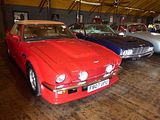
1929 Austin Seven Chummy Tourer: Few cars can genuinely be described as revolutionary, but the Austin Seven is undoubtedly one of them. Announced in 1922 and put into production the following year, the ‘big car in miniature’ transformed the concept of affordable motoring and had a similar impact in the UK to the Ford Model T in America. Devised by Sir Herbert Austin, with the help of a young draughtsman named Stanley Edge, the Seven was based around a simple A-shaped chassis. Its four-cylinder sidevalve engine was initially 696cc but was quickly enlarged to 747cc, while suspension was via quarter-elliptic leaf springs at the rear and a transverse semi-elliptic spring across the front beam axle. Initially available only as the ‘Chummy’ tourer, the 7 would eventually be sold in a vast array of styles that included saloons and vans. There were numerous developments and upgrades during its long production run, too. The headlamps were moved from the scuttle to the front wings in 1928, the wheelbase was extended by six inches in 1931, and from autumn 1932 a four-speed gearbox replaced the original three-speeder. The Seven was a runaway sales success and sounded the death knell for the precariously basic machinery that was being turned out by the cyclecar industry. It was even successful in motor racing and inspired the formation of the 750 Motor Club – one of the foundation stones of the UK’s postwar motorsport industry. In July 1934, the Ruby model was introduced on a new chassis and production continued until March 1939. By then, the Seven had helped to rescue Austin itself – which was struggling in the years immediately following the First World War – and almost 300,000 of these ‘baby Austins’ had been built. The Seven also played a pivotal role in the early days of both Swallow – the company that later morphed into Jaguar – and BMW. Such was its enduring status that the name was revived in 1959 for the Austin version of another groundbreaking small car: the Mini. There aren’t many cars that can match the sheer charm of an Austin Seven, especially a ‘Chummy’ tourer from the 1920s. These enduring cars have a classless appeal that makes them as attractive as ever, even 100 years after they were built. This nicely presented Chummy is still wearing the same London-issued number – UL 4687 – with which it was first registered on 2 February 1929. Its history file includes its buff logbook, which shows that, by 1960, it was owned by Eric Waller in south-east London. By 1966, the little Austin had been acquired by its next owner – Ronald Tucker, who lived on the Norfolk coast in Great Yarmouth. Also included in its history file are MoT test certificates dating all the way back to this period. The Chummy was restored in the late 2000s, after which it spent a few years in storage. Having been thoroughly recommissioned, it was sold in 2015 and then passed more recently to its current owner. Having considered a colour change to maroon and black, he decided to keep the car in its current livery and, after consulting the logbook, noted that it had been green when new. He had the front seats retrimmed and fitted new, high-quality wool carpets with bound edges. He also had a new radiator matrix built to the original pattern, and the car is offered for sale with the correct jack and wheel brace, plus a new hood and a full set of sidescreens. Thanks to its four-wheel brakes and ‘modern’ pedal layout with the throttle on the right, the Austin Seven is an easy pre-war car to drive and guaranteed to put a smile on your face during even the shortest run. It’s also simple to maintain and benefits from an extensive and extremely active network of clubs and specialists. Little wonder that it remains such a popular choice of classic.

1961 Austin Healey 3000 Series II BT7: Donald Healey founded his eponymous car company in 1945, having already served as an RFC pilot in World War One, won the Monte Carlo Rally driving an Invicta, and worked for both Riley and Triumph. At the 1952 London Motor Show, Healey produced a new model with styling by Gerry Coker, a chassis by Barry Bilbie, and the 2660cc four-cylinder engine from an Austin A90. Austin boss Leonard Lord was suitably impressed, and a deal was done for final assembly to take place at Austin’s Longbridge plant. That first Austin-Healey 100 was replaced in 1956 by the six-cylinder 100-6, which was powered by BMC’s 2.6-litre C-Series engine. The straight-six initially produced 102bhp, but modifications to the cylinder head and inlet manifold boosted that to 117bhp in 1957, the same year that production moved from Longbridge to the MG factory at Abingdon. The next step came in 1959 with the introduction of the Austin-Healey 3000. A development of the 100-6, it featured a 3-litre version of the six-cylinder C-series engine as well as front disc brakes. It retained the basic styling of the 100-6, as well as the option of a two-seater (BN7) or 2+2 (BT7) layout, but maximum power was up to 132bhp. The suspension was independent at the front via wishbones and coil springs, with a rigid axle and semi-elliptic leaf springs at the rear. A four-speed gearbox was used, with Laycock de Normanville overdrive operating on third and fourth gears. A more powerful MkIII version was introduced in 1964, and production ended in 1967. By then, the Austin-Healey 3000 had established itself not only as a memorable road car and a great export sales success, but also as one of the finest rally cars of all time. Driven by the likes of Pat Moss, Rauno Aaltonen and Timo Mäkinen, its long roll call of success included two victories apiece on the Liege-Rome-Liege Rally and the Alpine Rally. For many enthusiasts, the Austin-Healey 3000 remains the archetypal British sports car of the late 1950s and early 1960s, thanks to its blend of performance, style and competition pedigree. The car being offered for sale here perfectly epitomises those qualities thanks to a long-term programme of restoration work and well-chosen upgrades. Originally built in June 1961, it is a Mk2 BT7 that was dispatched that month to the Donald Healey Motor Co in Warwick. The ‘BT7’ name denotes that it featured the practical 2+2 seating arrangement, and it was originally finished in Healey Blue with a blue interior. The Heritage Certificate that accompanies the car shows that it was supplied new with wire wheels, a heater, an adjustable steering column, and an overdrive unit for the four-speed gearbox. Beginning in 2005, the Healey was treated to a series of work that started with the restoration of its chassis and bodywork. Four years later, the engine was rebuilt by renowned marque specialist Rawles Motorsport – a job that including uprating the six-cylinder unit to fast-road specification. It was given an unleaded conversion, plus a Rawles performance inlet manifold with new SU carburettors, a Mallory distributor, an alternator, a high-torque starter and a stainless-steel side-exit exhaust. The bumpers were also removed at this time, giving the car a look that evokes period racing Healeys, but they’ve been retained should a future owner wish to reinstate them. The gearbox and overdrive were rebuilt in 2010, and work since then has included uprating the braking system, fitting an adjustable steering box, installing a new wiring harness, and adding wing vents – a very effective modification that helps to reduce under-bonnet temperatures. In 2017, the safety harnesses were replaced with inertia-reel seatbelts, and the following year the front seats were retrimmed. The final touch came in 2020, when Hexagon Classics resprayed the Healey in the striking two-tone colour scheme of Ice Blue metallic over Old English White. This Healey 3000 comes with a works-style hardtop plus an extensive history file that includes a wealth of invoices cataloguing the restoration and upgrade work that’s been carried out, and it’s very attractive example of this muscular British sports car.

1950 Bedford KV: First introduced in 1939 as part of an updated range that also included the M- and O-Type, the Bedford K-Type became an everyday part of British street scenes, in the same way that the Ford Transit would be a generation later. It was offered in a wide variety of applications, with a load-carrying capacity that ranged from 30cwt to five tons. All were powered by a 3.5-litre, overhead-valve, six-cylinder engine, which was updated in 1950 with modifications that included a redesigned intake manifold and a hardened crankshaft. A four-speed gearbox was installed, semi-elliptic springs used all round, and braking was via vacuum-assisted, dual-circuit, hydraulically operated Lockheed drums. The rear axle, meanwhile, was redesigned in order to be more robust than on earlier models. Bedford’s promotional literature highlighted the fact that the K-Type had great load-carrying capacity in a short-wheelbase package that also boasted a compact turning circle. It said of the panel van that, ‘The clean, modern lines are enhanced by the domed roof and radiused roof corners. A partition divides the driver’s compartment from the loading space [while] the extra-wide rear doors are hung on specially designed hinges which permit a wide angle of opening.’ The K-Type could be specified as everything from a delivery van to an ambulance, and was also used by the BBC for outside broadcasts. It remained in production until 1953, when Bedford replaced it with the new TA. Jaguar made its name on the international stage during the 1950s, thanks to the success of its ground-breaking XK 120 and a competition programme that led to five wins in the most celebrated race of all: the Le Mans 24 Hours. Enthusiasts poring over photographs and video footage from early in that period won’t take long to notice the works team’s Bedford KV support vans. One of them appears in a famous photograph showing a trio of C-types lined up outside the Jaguar factory before the 1951 Le Mans 24 Hours, and these faithful commercial vehicles were ever-present in motor-racing paddocks from La Sarthe to Silverstone, carrying spare parts and equipment. The Bedford KV being offered for sale here has been beautifully restored by a prominent collector and marque enthusiast. Intended to be a faithful replica of those works support trucks, it was resprayed in two-tone black and blue during 2017, and the quality of the workmanship is exceptional throughout. The logos and signwriting were applied with great care and lacquered over, while the interior is also superbly presented – from the cabin all the way through to the wood-floored load bay. Since being completed, this charming Bedford has been a regular feature at the Goodwood Revival. Not only has it featured in static displays, it has been driven in track parades such as the Ecurie Ecosse celebration in 2017. It also had a spell on loan to the British Motor Museum at Gaydon – a fitting venue where it joined a variety of legendary Jaguar competition cars. There’s plenty of torque on offer from its 3.5-litre six-cylinder engine, and the steering is wonderfully direct. The windscreen panel in front of the driver can be opened in order to provide extra ventilation, and getting behind the wheel evokes the long journeys that the works mechanics would have undertaken between Coventry and Le Mans, as they chased another victory in the endurance classic. This Bedford KV is offered for sale not only as a painstakingly restored historic commercial vehicle, but also as a reminder of a golden period in Jaguar’s long and illustrious history.

1924 Bentley 3-4.5 litre: From victory at Le Mans to the patronage of royalty and aristocracy, it was the 3 Litre that laid the foundations for the Bentley marque. The first model to be offered by WO Bentley’s new company from its launch in 1919, it used a four-cylinder monobloc engine that was advanced for its time and featured 16 valves, an overhead camshaft and twin plugs per cylinder. Various combinations of chassis and engine tune were offered from the beginning of 3 Litre production in 1921. The majority of the 1622 cars that left the Cricklewood factory were the Blue Label model, which was offered with a wheelbase of either 9ft 9.5in or 10ft 10in, and had a single Smiths carburettor. The Red Label Speed model used only the shorter 9ft 9.5in chassis and featured a higher-compression engine running on twin ‘sloper’ SU carburettors. And finally there was the Green Label Supersports model, which was built in tiny numbers on a 9ft chassis and was guaranteed to offer 100mph performance. Motor racing was part of the Bentley story from the very beginning, and in 1923 Frank Clement and John Duff drove the latter’s 3 Litre in the first running of the Le Mans 24 Hours. They returned in 1924 and won outright – the first of Bentley’s six victories at La Sarthe. Thanks to its combination of robust engineering and sporting pedigree, the Bentley 3 Litre has become one of the most coveted of all vintage cars, and is supported by an enthusiastic network of clubs and specialists. With the engine from a 4½ Litre fitted, you get the best of both worlds – the agility of the 3 Litre, but with the additional power offered by the 4½ Litre. This original Bentley 3 litre Speed Model Tourer – since uprated to 4.5 Litre – was sold new to a highly notable name in the history of Scottish motorsport, later spent more than 50 years in the ownership of a single family, and more recently has benefitted from a bare chassis restoration and upgrade to 4.5 Litre specification. According to the factory service records, chassis number 804 was built in late 1924 and supplied new via John Croall – a coachbuilding business based in Castle Terrace, Edinburgh– with, it’s believed, a sporting tourer style of body. Its first owner was Major EG Thomson, a director of Ben Line Steamers whose family home was in Peeblesshire. Thomson was a keen motor racing enthusiast who later famously provided financial backing for the Le Mans-winning Ecurie Ecosse team. First registered DS 1453 by Peebles County Council in February 1925, the Bentley was built to Speed Model specification on the 9ft 9.5in wheelbase, with the high-compression, twin-carburettor engine. Subsequent owners listed in the factory records are H Bower and L Geary, the latter being based in Middlesex. The logbooks then show that, by 1937, it was owned by George Brown in Birmingham, before passing to Michael Barnes of Staffordshire in 1938, then Richard Grummit of Nottinghamshire in 1946. Correspondence from the Bentley Drivers Club shows that the car was first recorded with it by Guy Porter in 1948, when the body was described as being a ‘VdP tourer’. It then passed through two more owners before being bought in 1954 by William Martin of Berwickshire – and it would remain in the Martin family for the next 56 years, until 2010. Bill Martin was a Bentley enthusiast who served as Secretary to the Winfield Joint Committee, which organised races in the Scottish Borders at the Winfield and Charterhall airfield circuits. He regularly used DS 1453 in Bentley Drivers Club events and passed the car to his son in 2001. Only in 2010 did the Martin family decide to part with their beloved Bentley, and it was considered the perfect candidate for the world renowned restorer Paul Grist to acquire and apply his magical touch to and incorporate the many decades of experience in providing an amazing visual and aged presence, incorporating many period features to provide possibly the ultimate look for a 3 litre Speed model, with the added benefit of taking the opportunity of uprating the original engine to 4.5 Litre specification, with components supplied by marque specialist NDR. The engine work retained the original crankcase, so the car retains its matching-number engine status, and the tourer body was fully rebuilt as required by Paul and his team. This striking and extremely usable Bentley is offered for sale with an extensive history file that includes invoices dating back to the 1950s, tax discs to the 1940s, a copy of the factory service records, and a collection of logbooks tracing its owners back to the 1930s.

1924 Bentley 3 Litre Red Label: With a rich continuous history that includes a stint in India during the 1920s and a cameo role on the big screen in the 50’s, this Bentley 3 Litre Red Label is a very attractive example of this popular British vintageant. The service records for short chassis number 488 show that it was sold new to Major EA Fitzgerald of Mayfair, London and bodied by Weyman as a saloon, and that it returned to the factory in July 1924 to have twin SU carburettors fitted. By 1929, the Bentley was clearly in India because its records include a list of parts that were to be sent to Karrier Motors Ltd in Bombay. During that same year, it was sold to RE Allen, an RAF officer whose address was given first as ‘c/o Karrier Motors’ and then as ‘c/o RAF Club, Piccadilly’. The Bentley returned to the UK and was once again registered here in May 1931. Having started life as a Weymann saloon, it was then fitted with a Vanden Plas-style four-seater tourer body. The logbooks record a series of owners through the 1930s, and in May 1939 the Bentley was acquired by David Southwell of St Margarets, on the south-west fringes of London. The logbook includes a stamp dated 13 September 1939 from the Petroleum Department, which had been set up in the immediate aftermath of the outbreak of war. The next owner is listed as being Linwood Mertens, who bought the Bentley in May 1944. By the end of that decade, it had passed to the owner of an aeronautical engineering firm whose son later said that the Bentley was in a ‘very shabby state’. Having been rebuilt, the car appeared in the 1951 film Mister Drake’s Duck, being driven by leading actor Douglas Fairbanks Jnr. During the 1960s, the Bentley was bought jointly by brothers Stephen and James Lee, who had it rebuilt by HJK Townshend at Elmdown Vintage Automobiles at the then-considerable cost of £3166. The Lees later sold the Bentley to an enthusiast who stopped James while he was driving it down Grantham High Street and immediately offered him £7000. Subsequent owners included Paul Weldon and Kenneth Tams during the 1970s, and in 1980 it was taken on a Bentley Drivers Club tour to Le Mans. In 2001, it was treated to a full mechanical rebuild, including an engine overhaul, by Clive Oliver. This very handsome and much-loved Bentley sporting 3 Litre is now being offered for sale in extremely original specification, and it exudes the sort of charm for which these early cars are rightly renowned.

1961 Bentley Continental S2: The Bentley S2 offered a charismatic mix of ‘old world’ tradition and new technology when it was introduced in 1959. It retained the separate chassis and coachbuilt options of its immediate predecessor, but replaced the aging six-cylinder engine with the latest 6230cc V8 from Rolls-Royce. This aluminium-alloy powerplant featured hydraulic tappets for quieter running, and was shared with the Rolls-Royce Silver Cloud. With an estimated 200bhp – Rolls-Royce had a long tradition of not releasing official power figures – it propelled the standard model to well over 100mph, and the S2 was also fitted as standard with power steering and a four-speed GM automatic transmission. As there had been with the earlier R-type and original S-type, there was the option of a high-performance Continental model with a higher compression ratio, a shorter radiator profile, an upgraded braking system, and a longer rear-axle ratio. Well-heeled clients could order their Continental with bodywork from a range of coachbuilders including Park Ward, James Young and Chiswick-based HJ Mulliner. There was also a single Hooper-bodied example. The S2 Continental perfectly fulfilled its brief over its short production run, before it was replaced in 1962 by the S3. When Autocar magazine tested an S2 in 1960, it wrote that the new model ‘gives high-speed travel in silence and luxury, while the driver and passengers enjoy the sense of well-being that only British craftsmanship can give.’ During the 1960s, the Bentley Continental was the car of choice for everyone from captains of industry to rock stars, and this HJ Mulliner two-door saloon is a beautifully presented example of this coveted model. The build card for ‘BC40.AR’ records that the chassis was delivered to Rolls-Royce’s Lillie Hall premises on 20 November 1959, and the completed car was dispatched to London dealer HA Fox & Co on 1 April 1960. Specified with ‘full refrigeration’ (air-conditioning), plus electric windows and a Marchal Fulgar airhorn, it was finished in Black Pearl with a Blue interior. Its first owner was Ellis Stanning of Lloyds Pharmaceuticals Ltd in London, and he took delivery of his new Bentley on 13 April 1960. Later owners included the Hon William Grosvenor, who bought the car in October 1971. Grosvenor was the Eton-educated son of Lord Ebury, who’d been a Lord in Waiting to King George VI. The Continental must subsequently have been acquired by a US-based enthusiast, because it was from there that it was repatriated to the UK by marque specialist P&A Wood in early 1989. After selling it to Yorkshire-based Stuart Dennison, P&A Wood were commissioned to carry out a bare-metal respray, as well as a complete interior retrim. The top end of the V8 engine was also rebuilt, and the Bentley was sold later that year to Neville Cormack OBE. It passed to his daughter in 1992, before being acquired in 1998 by an enthusiast who had a fine collection of Rolls-Royce and Bentley cars in Ireland. The Continental was kept there in climate-controlled storage under the watchful eye of a full-time caretaker. In 2011, it was sold to a new owner, then passed to the current custodian the following year. He had a major refurbishment carried out between 2012 and 2014 by Hampshire-based specialist A&S Engineering, including an engine rebuild and a comprehensive refurbishment of the engine bay. Recent work carried out by Gordon Dale Enterprises Ltd includes the fitting of new axle bushes and a differential pinion seal, new anti-roll bar bushes, and the installation of new front seatbelts. From its handcrafted aluminium body to its cosseting interior and imperious driving position, this well-maintained Bentley S2 exudes quality and grace. Being one of only 388 HJ Mulliner two-door Continentals makes it an even more special example of this aristocratic British classic.


2002 Bentley Continental T: Five years after it had introduced the Continental R, Bentley unveiled a more powerful, short-wheelbase version of the car as its flagship model: the Continental T. Beneath the bonnet was the same 6.75-litre, turbocharged V8 engine, but it gained an extra 15bhp for a total output of 400bhp. The wheelbase was shortened by four inches, making this more of a ‘two plus two’ than a full four-seater, the suspension was made slightly stiffer, larger brake discs were specified, and the body gained flared wheelarches. Suspension was via struts and lower wishbones at the front, with trailing arms at the rear, while electronic dampers were fitted all round. Steering was via power-assisted rack and pinion. In 1997, the T was upgraded along with the rest of the Continental range, and power was increased to 420bhp, with torque up to an immense 650 lb ft. That made it the most powerful production Bentley ever made, and was enough to propel the big coupé from 0-60mph in 5.7 seconds and on to a top speed of 170mph. Despite testing the car in wet conditions, Autocar recorded a 0-100mph time of 18.5 seconds. They said it would have been at least two seconds faster in the dry, and commented that it was ‘astonishingly rapid for any coupé, let alone one that weighs the same as five and a half Caterham 7s.’ Noting the luxurious interior, the magazine also concluded that ‘there is no finer place in motoring than behind the wheel, staring at the turned aluminium dash, of a Continental T.’ A Mulliner variant, with modifications including revised suspension settings, was introduced in 1999, and production of the Continental T lasted until 2002. It marked the end of an era in that the Continental GT that replaced it became the first new car to be launched under Volkswagen’s ownership of the Bentley marque. Any Bentley Continental T has a muscular, old-school appeal, but this particular car has even greater presence thanks to its combination of immaculate black paintwork and chrome wheels. First registered in September 2002, late in the model’s production run, it is one of the desirable ‘second series’ Continental Ts. These cars featured a matrix grille – evoking the legendary sporting Bentleys from the 1920s Cricklewood era – plus a more powerful, 420bhp version of the 6.75-litre, turbocharged V8 engine. Its pre-delivery Customer Assurance Check was carried out at supplying dealer Bentley Leicester, and it returned there in August 2003 to be serviced at 6822 miles. The car’s service book then records twice-yearly servicing at the same dealership through to March 2007, by which time it had already covered 27,452 miles. Later that year, the Bentley was sold to its second owner. In 2013, and having been acquired by the current custodian, the engine was rebuilt by Hoffmans in Henley on Thames. Since then, it has continued to be maintained with no expense spared, and not only does the history file contain numerous invoices from marque specialists, the car also had a full respray in 2023. Inside the beautifully trimmed cabin, the black leather and carpets contrast beautifully with the turned aluminium dashboard, and the driving position is every inch as commanding and imperious as you’d expect. Having still covered only 46,000 miles from new, it is in exceptional condition throughout. Now being offered for sale as one of only 350 Bentley Continental Ts that were built, it is a superb example of this rare, powerful and charismatic ‘two plus two’ Grand Tourer.

1938 BMW 328 Roadster: When renowned motoring writer Denis Jenkinson reflected on 50 years of the BMW 328 in 1986, he wrote that this acclaimed model ‘set a standard in modern sports cars that was not surpassed until the 1950s and not outmoded until 10 years later.’ That was high praise from a man who was not easily impressed, and it was entirely deserved. The 328 embodied BMW’s ‘leichtbau’ ethos of gaining performance by reducing weight, and at its heart was a six-cylinder engine that could trace its heritage to the Rudolf Schleicher-designed 1173cc unit that had been produced for the 303 model. It was enlarged to 1490cc for the 315, then 1911cc for the 319. By 1936, it had been stretched once again to 1971cc for the new 326 – and it was this variant that provided the basis for the 328. For this latest sports car, Schleicher designed a new cylinder head with inclined overhead valves and ‘cross pushrods’. Power was boosted to 80bhp at 4500rpm in standard form, and could be increased to more than 100bhp for competition use. Fittingly, the 328 made its debut at the 1936 Eifelrennen race meeting at the Nürburgring. Ernst Henne won the 2-litre class and set a new sports-car lap record, beginning an illustrious motorsport career for the 328 that also included class victories at the Tourist Trophy and Le Mans. In 1940, Huschke von Hanstein and Walter Bäumer took a special 328 coupé to outright victory in the 1940 Gran Premio di Brescia, which, in effect, was that year’s Mille Miglia. The 328 won plaudits from all who drove it. In 1937, former ‘Bentley boy’ Sammy Davis took one to Brooklands and lapped the banked circuit at an average speed of 102mph for more than an hour. Motor Sport, meanwhile, called it ‘the fastest and, simultaneously, the most comfortable sports car that has ever been built’. The 328’s six-cylinder engine went on to enjoy a second life following World War Two, when the Car Division of the Bristol Aeroplane Company acquired the design for use in its new models. It was effective not just in road cars, but was also tuned for a variety of motorsport applications during the 1950s – proof of its enduring quality. The lightweight, six-cylinder BMW 328 proved to be a formidable force in international motor racing during the late 1930s, and has since become a highly coveted choice of pre-war sports car. The 328 being offered for sale here was built by BMW in March 1938 and dispatched on 5 April to the Portuguese importer – Stand Batalha, Antonio Marques da Fonseca, which was based in Porto. The car was later owned by the Automuseum Deventer in the Netherlandsbefore returning to Portugal. After being acquired specifically to take part in the Mille Miglia, the BMW was brought over to the UK, where it was treated to a painstaking, no-expense-spared restoration. The work was carried out by leading specialist TT Workshops in Wiltshire, and took place between 2009 and 2011. Every part of the project is faithfully recorded in the car’s huge history file via a comprehensive set of photographs and a wealth of invoices. It included sympathetically restoring the ash frame and lightweight bodywork, while the bottom end of the six-cylinder engine was rebuilt to original specification and the cylinder head was upgraded to later Bristol spec. The triple-carburettor straight-six is mated to the correct Hurth four-speed gearbox, which was one of two options that BMW provided to owners – the other being a ZF five-speed ’box. Since the restoration was completed, the BMW has been owned by noted enthusiasts who revel in driving their cars and enjoying them to the full. One recent custodian is a veteran ofrallies and events such as the Mille Miglia, for which the 328 would make the perfect choice. From its recessed spare wheel to a split windscreen that can be folded flat, its sporting pedigree is clear, and it drives beautifully thanks to its strong, crisp engine and lightweight construction. On the road, it’s certainly a very different proposition to the many pre-war models that rely on brute force to deliver their performance. As one of only 461 examples to be built between 1936 and 1940, this BMW 328 is a rare and highly sought-after car that would be welcome – and extremely competitive – in the world’s most prestigious events.

2003 BMW-Alpina Z8 Roadster: BMW’s E52 project first broke cover at the 1997 Tokyo Motor Show as the Z07 concept, a spectacular homage to the 1950s 507 that was designed by Henrik Fisker as part of a team working under Chris Bangle. It subsequently went into production as the Z8 with very little in the way of visual changes. Based around an aluminium spaceframe, it was assembled in Dingolfing before being finished in Munich, and was powered by the 4.9-litre V8 engine from the contemporary E39 M5. This produced just under 400bhp and drove through a six-speed manual gearbox. Performance was predictably strong, with a number of period road-testers managing to better the factory’s official 0-60mph time of 4.7 seconds. Its top speed was limited to 155mph. The suspension comprised MacPherson struts and lower wishbones at the front, with a five-link set-up at the rear. The brakes, meanwhile, were taken from BMW’s 750i. The Scott Lempert-designed interior continued the retro theme, with plenty of brushed aluminium on display and a sweeping dashboard that had all the instruments placed in the centre, angled slightly towards the driver. Electrically operated leather seats, sat-nav and air-con were all standard. In total, 5703 Z8s were built between 1999 and 2003, with the majority of them going to the USA. The model coincided with James Bond’s BMW phase and a Z8 appeared in The World Is Not Enough, and over the years its stock has steadily risen as one of the most attractive ‘retro’ designs of the 1990s and early 2000s. The BMW Z8 is a fast and stylish two-seater that’s now attracted a cult following, but the car being offered for sale here is even more special. It’s one of only 555 Alpina models to be built, most of which were sold new in the USA. Built on 14 October 2002, it is ‘number 116’ of the 555 and is presented in Titanium Silver with a black interior. After being supplied to the US, it was imported to the UK in 2015 via a New Jersey dealer by the head of an automotive design company. He immediately took it to BMW main dealer Sytner Nottingham and had the car converted to UK spec, before it passed to a new owner in October 2016. An Inspection II service was carried out that year at 15,393 miles, and it had still covered less than 18,000 miles by the time it was bought by its next owner at Bonhams’ Goodwood Revival auction in September 2021. Since then, it has formed part of a private collection and has been used only sparingly. It’s being offered for sale in exceptional original condition and even still features the factory-supplied plastic protection for the carpets. On the road, it benefits from the extensive Alpina modifications that made it an even more effective GT car than the standard Z8. Beneath the bonnet is the 4.8-litre engine from the Alpina B10 V8 S, which drives through a ZF Switchtronic automatic transmission with paddle-shift option. The standard 18in wheels were replaced on the Alpina model with 20in alloys, the suspension was revised to give a more comfortable ride, and the interior was retrimmed in softer Nappa leather. The steering wheel, gauges and gear-selection display were all specific to the Alpina, too. This Alpina Z8 was featured in BMW Car magazine in May 2016 and comes with its original hardtop, and is a superb example of this extremely rare modern classic.


1956 Bristol 405 Drophead: The Bristol 405 was offered in saloon form and as a much rarer drophead coupé when it was launched in 1955. Along with the short-wheelbase 404 two-seater coupé, which had been introduced two years earlier, it marked a departure from the styling of previous Bristols, replacing their upright design with a much more contemporary ‘jet age’ look that evoked the company’s origins in the aircraft industry. Beneath the skin lay a separate steel chassis with box-section main members and a wheelbase of 9ft 6in, while the aluminium body panels were mounted on a steel and ash frame. Lockheed light-alloy drum brakes were used, while front suspension was by a transverse leaf spring and wishbones, and torsion bars were used at the rear. The engine was the 100B development of the famous BMW-based straight-six, with overhead valves operated by cross pushrods. With triple Solex carburettors, it produced 105bhp at 5000rpm, and period road-testers delighted in the quality of the gearchange and the calming effect of the overdrive. All Bristols were largely hand-assembled and, in 1956, a 405 would have cost £3586 including purchase tax – considerably more than rivals such as the Aston Martin DB2/4.Total production of the 405 comprised 265 saloons and 43 drophead coupés, with the latter receiving bodywork from coachbuilder ED Abbot of Farnham. Much was made of the parent company’s aircraft experience, with promotional material trumpeting the fact that ‘the Bristol 405 comes from the same stable as the Britannia’ and that its aerodynamic body was ‘shaped and tested by people skilled in aviation techniques’. When Bill Boddy drove a 405 from London to the Lake District for the February 1956 issue of Motor Sport, he wrote that the Bristol was ‘beautifully made and finished’ and concludedthat it was ‘a tireless car in which to drive fast over long distances.’ This extremely rare Bristol 405 drophead coupé is one of only 43 such cars to have left the Filton factory, and is looking resplendent following a recent restoration. Chassis number 4525 previously formed part of the collection owned by Bristol enthusiast Brian May, and it subsequently spent 20 years with another custodian who replaced most of the car’s wooden frame. More recently, the Bristol was given a full bare-metal restoration during 2022 and 2023, and is now in exceptional condition throughout. The work was overseen by Merlin Classics, which did the bodywork and resprayed the car in Heather Grey. Retro Wiring fitted a new wiring loom, while Bespoke Car Trim of Cheshire carried out an interior retrim in red leather and also fitted a new soft-top. Bristol specialist INRacing rebuilt the car’s six-cylinder engine (number 100B/3623) and fitted Cosworth pistons and new valves. It also pressure-tested the block and cylinder head, and new piston rings and pushrods have been installed. Final engine tuning was done by Nigel Grant Racing, and a new stainless-steel exhaust was installed. This Bristol 405 is now being offered for sale with an extensive history file that includes an original instruction manual, plus a workshop manual for the 100B and 100B2 engine, gearbox and overdrive. All restoration invoices are included, and the car even has a correct period tool kit. Individual, beautifully engineered and built in small numbers, Bristol cars have always been a choice for discerning enthusiasts, and this attractive 405 drophead coupé embodies all of the qualities from which the marque made its name.


1956 Chevrolet Bel Air: Chevrolet first used the famous Bel Air name in 1950, when it was applied to its two-door hardtop coupe. From 1953, it became the marque’s flagship range, sitting above the 150 and 210 models, and was offered in an extensive combination of body styles, engines and transmissions. Chevrolet introduced a revamped Bel Air for the 1955 model year, the most significant change being the availability of a small-block V8 engine in addition to the existing straight-six. The 265ci (4.3-litre) unit produced 162bhp in standard trim, but could be specified with up to 195bhp thanks to the ‘Super Power Pack’ option. The 1956 Bel Air was a mildly facelifted development of the ’55 model, and once again offered a choice of straight-six or V8 engines, plus a three-speed manual gearbox or the two-speed Powerglide automatic. The ‘Power Pack’ option now gave 205bhp, and when Road & Track magazine tested a Bel Air in that specification, it recorded a top speed of 111mph and a 0-60mph time of nine seconds. Later in 1956, the ‘Power Pack’ engine was boosted to 225bhp, and the Chevrolet V8s of this period were referred to as the ‘Hot Ones’. Their performance was highlighted by Chevrolet’s assault on the 12-mile Pikes Peak hillclimb in Colorado in September 1955. Using a ’56 car before it had even been unveiled to the public, Zora Arkus-Duntov broke the long-standing hill record for the sedan class by more than two minutes. Chevrolet sold more than 100,000 of its 1956 Bel Air, and its V8 engine – soon to be enlarged to 283ci for the 1957 model – became a favourite with racers and hot-rodders. While the Bel Air name lived on until 1981, the ’56 model is renowned as being a particular sweet spot thanks to its combination of specification and styling. Colourful, stylish and charismatic, this Chevrolet Bel Air perfectly captures the spirit of 1950s America, and has benefitted from a restoration during which no expense was spared. Little is known of the car’s early history, but the current UK-based owner bought it in France, having fallen in love with it when he travelled there with the intention of buying a Citroën 2CV. At that time, the Chevrolet had recently been rebuilt – all the way down to the last nut and bolt. The bodywork was stripped to bare metal and repainted in the original two-tone colour scheme of Matador Red and India Ivory. All of the brightwork – including the iconic ‘jet bird’ mascot on the bonnet – was rechromed, a process that cost €30,000 on its own. The original straight-six engine has been replaced with Chevrolet’s 283ci (4.6-litre) V8, which is running on a Demon carburettor and an Edelbrock intake manifold. Electronic ignition has been fitted, while the cooling system has been upgraded with an electric fan. Other modifications include uprated double-wishbone front suspension and disc brakes all round, while the standard wheels have been replaced by 15in American Racing rims. Inside, the two-tone interior is pure ‘1950s Americana’, the original features being complemented by a powerful Sony Xplod stereo system, complete with remote control. The total bill for the restoration came to about €100,000, and the Chevrolet has been used only sparingly since being brought into the UK. The owner took it to one car show, where he reported that, not surprisingly, it was the star attraction. Throughout his ownership, it has been kept in a garage beneath a breathable cover and has never been driven in wet weather. The end result is a Chevrolet Bel Air that is being offered for sale in truly exceptional condition. Its combination of an effortlessly powerless V8 engine and three-speed automatic gearbox makes it a relaxing, easy car to drive. When you add its ‘rock and roll’ style, it’s little wonder the Bel Air has become such a coveted Stateside classic.


1969 Chevrolet Camaro: The Chevrolet Camaro was GM’s answer to Ford’s hugely successful Mustang, and when it was introduced in late 1966, Chevrolet’s general manager, Pete Estes, referred to it as a ‘four-passenger package of excitement’. It was based on a brand-new platform and offered as both a coupé and a convertible. Buyers could then choose from an extensive list of engines that ranged from a 230ci (3.8-litre) straight-six to a 427ci (7-litre) V8. There were also numerous manual and automatic transmissions on offer, plus packages that included the RS (with ‘hidden’ headlamps and other visual changes), the SS (with a choice of large-capacity engines) and the Z28 (built for homologation into Trans-Am racing). Beneath the skin, the Camaro’s specification included independent front suspension with coil springs, plus a live rear axle with leaf springs and telescopic dampers. Steering was via recirculating ball, with optional power assistance. When Road & Track magazine road-tested a 1968 Camaro Z28, it recorded a 0-60mph time of 6.8 seconds and said that it ‘offers a lot of performance for the money; how many four-seat cars can you name that will do the quarter-mile in 14.9 seconds, hit 142mph and cost just $4435?’ As was often the case with American manufacturers during that period, Chevrolet updated the Camaro every year, and the 1969 car had a slight facelift with a more pronounced V-shaped grille; there was also the option of disc brakes all round. In fact, that would be the last of the first-generation models. Chevrolet introduced an all-new Camaro in 1970, and the model lasted all the way up to the end of sixth-generation production in early 2024. This incredibly charismatic Chevrolet Camaro was built in 1969 at GM’s Norwood factory in Ohio, and over the past 30 years it has enjoyed a long career in historic racing. After being imported to the UK by Ryland Rogers in North Wales during the early 1990s, it was sold to Hugo Dixon in May 1994 and prepared for motorsport use. It was subsequently raced in the Historic Sports Car Club’s Road Sports series before being sold to Nick Savage in April 2012. The Camaro’s new owner had it restored and race-prepared by muscle-car specialist Martin Savill of Aldershot, and invoices show that he spent almost £60,000 on it between 2012 and 2019. Originally imported to the UK in 396ci (6489cc) RS/SS specification, it now features a 350ci (5735cc) engine, as offered for the Camaro in period. The small-block V8 was rebuilt in 2014 and its current spec includes high-performance Dart II cylinder heads, TRW pistons, an Eagle forged-steel crankshaft and Eagle con-rods. The compression ratio is 9.8:1 and the engine breathes through a Holley 750cfm carburettor. Hedman 1.75in exhaust manifolds have also been fitted. At the rear is a 12-bolt Chevrolet rear axle that was built and set up by Jeff Hauser, and the engine drives through a Muncie ‘rock crusher’ straight-cut, close-ratio, four-speed gearbox. Global West quick-ratio steering has been installed, along with Corvette JL8-option brakes. In 2019, the Camaro was fully rewired and its subframe was rebuilt. A strengthened gearbox casing was also fitted. Inside, the car has been stripped for competition use and there are Sparco seats with Willans harnesses, plus a bolt-in roll cage. Whether it’s once again prepared for competition use or just enjoyed as a thunderous road car, this Chevrolet Camaro is offered for sale as an extremely quick and entertaining example of this ever-popular muscle car.

1937 Delahaye 135 MS: Former railway engineer Emile Delahaye built his first car in 1895, and two years later he moved his company from Tours to Paris. The first four-cylinder design – as opposed to the earlier ‘twins’ – followed in 1903 and the marque’s cars were steadily updated in the years before the First World War. Known for a long time as being a rather conservative manufacturer, Delahaye had a change of direction in 1934 when it launched the ‘Superluxe’. Available with stylish coachwork, independent front suspension, and a choice of four- or six-cylinder engines, this was the forerunner of the 135, which would be launched the following year. During this period, Delahaye had merged with Delage, and the latter’s sporting know-how was clearly being shared with its new stablemate. The 135 was initially available with a six-cylinder overhead-valve engine of 3.2 litres – later enlarged to 3.5 litres for the 135 M – and either a manual gearbox or a four-speed Cotal electro-magnetic unit. Bodywork was supplied by the greatest coachbuilders of the time – Chapron, Figoni et Falaschi, Saoutchik, Pourtout – and Delahaye had shrugged off its previously conservative nature with a new model that offered both luxury and performance. It was the latter that attracted enthusiast drivers to the 135, and it was soon chalking up significant competition success. Its finest hour came in 1938, when Eugene Chaboud and Jean Tremoulet took overall victory in the Le Mans 24 Hours at the wheel of their 135CS. A 135 also won the 1937 Monte Carlo Rally, and the model lived on after the Second World War. It even formed the basis for the 235, which was launched in 1951. Sadly, Delahaye car production ended in 1954 after the company had been taken over first by Hotchkiss and then Brandt. This beautiful Delahaye 135 MS was built during a golden period for the prestigious French marque, when it was producing not only spectacular road cars but also Le Mans-winning sports cars. In a letter written to the owner in January 2014, Club Delahaye president Jean-Paul Tissot explained that chassis number 48748 had long been listed in the club register. The number falls within the range of 135 Compétition models that were built between 1937 and 1939, and Tissot stated that this particular car would originally have been delivered in late 1937. During the 1970s, it was acquired by Maurice Broual, who was based in western France. He bought it from Marcel Chavet, a Parisian coachbuilder who had restored a number of Delahayes. Chavet had started to restore 48748 and had completed the chassis, the wood frame for the body, and the wings. He then sold the car to Broual, who was renowned for the coachwork he fabricated for Delahayes and Delages. Broual duly built a Figoni-style two-seater body for 48748, before selling the still-unfinished project to Michel and Pascal Lagrèze in 1987. It was then acquired by an Argentine enthusiast in 2007, and restored there in a process that involved a considerable amount of work to Broual’s coachwork. The restoration was completed in 2013, and 48748 has remained in the same family ever since. With a stylish body on its short-wheelbase chassis, this superbly presented car is powered by Delahaye’s high-performance ‘Modifée Speciale’ engine. Running on triple carburettors, the 3557cc ‘narrow block’ straight-six features a six-branch exhaust manifold and drives through a four-speed Cotal electro-magnetic gearbox that gives effortless gearchanges. Performance is as strong as you’d expect from a model that did so well in competition, and is accompanied by a fabulous noise from the big ‘six’ up front. The braking system, meanwhile, has been converted to hydraulic operation, which is compulsory in Argentina. The freshly restored Delahaye took part in the 2013 1000 Millas Sport de la Argentina, and won its class in the following year’s Autoclasica – one of the largest and most prestigious classic car events in South America. It is now being offered for sale as not only an exhilarating choice for tours and rallies, but also a supremely elegant pre-war sports car that would grace any show field.

1961 Emeryson: Paul Emery was one of the unsung heroes of the UK’s vibrant post-war motor-racing scene. A talented engineer and driver, he had worked with his father during the 1930s and entered his first race in 1936 at Donington Park. Following the war, the Emeryson company built cars for everything from the 500cc Formula 3 category to Formula 1. In 1960, with financial backing from Alan Brown, it moved from Twickenham to the old Connaught premises in Surrey and Paul designed a 1.5-litre Formula 2 single-seater that was also adapted for use in Formula 1. At the end of 1961, however, the race team’s assets were acquired by Hugh Powell and it morphed into the Scirocco-Powell outfit. Emery’s Formula 2 design also formed the basis for this unique road-legal sports car, which was built in 1961 for Ray Fielding to drive in hillclimb events. Its specification included a spaceframe chassis, a 1460cc Coventry Climax FWB engine and a Cooper-ERSA gearbox, plus disc brakes all round and rack-and-pinion steering. The independent suspension comprised double wishbones up front, and lower wishbones at the rear with the driveshafts acting as upper links – a layout that had also been used by Lotus. As David Roscoe wrote in Motor Racing magazine while it was being built: ‘Sports bodywork is to be fitted to this car and the merest hint of a passenger’s seat will be added to keep the scrutineers happy that this is in fact a sports car.’ The end result certainly made a highly effective hillclimb machine, with Fielding winning his class on the car’s maiden outing at Prescott in 1961. He followed that up with an outright win at Craigantlet and finished sixth in the RAC Hillclimb Championship. For 1962, the Emeryson was sold to Gerry Tyack, who continued to rack up class victories in hillclimb events before selling it to Graeme Austin. He raced it through 1963-64, and it carried on competing in the hands of subsequent owners John McCartney and Georgia Baillie-Hill. In 1971, it was bought from Baillie-Hill for £300 by Richard Falconer, a young trainee architect. Falconer used the Emeryson on the road, where he said it would ‘out-accelerate anything [away] from the lights.’ During the mid-1970s, it was also used in circuit racing. Falconer drove it to meetings, whereit would be raced by his friend Martin Young, and Falconer would then drive home before it got dark because the headlamps weren’t wired up at that time. At Thruxton in 1976, a very special guest driver took the wheel – Paul Emery, who was making his final race outing 40 years after his Donington Park debut. The Emeryson was off the road for much of the 1980s, before being refurbished by Rhoddy Harvey-Bailey in 1991. After once writing that selling the car ‘would be like losing a member of the family’, Falconer finally parted with it in 2017. Its new owner then had a sympathetic rebuild carried out. The original 1950s Climax FWB engine was rebuilt by Tony Mantle at Climax Engine Services, while the four-speed Cooper-Knight-modified ERSA gearbox was checked and serviced by JP Race Shop at Silverstone. The car’s overall set-up was then fine-tuned by Brazell Engineering and a custom free-flow exhaust system was fabricated by Mike Hausman in order to meet the 105dB noise limit at events such as the GRRC sprint meetings at Goodwood. Neat touches include an eight-day clock from a USAF P-51 Mustang fitted to the dashboard, and ‘JCM 700’ was featured in the March 2024 issue of Classic & Sports Car magazine. Now being offered for sale at the Classic Motor Hub, this one-of-a-kind Emeryson boasts an unbroken history and comes with an extensive file that includes scrutineers’ tags from the 1960s, the original logbook, a workshop manual for the Climax engine, invoices and documents dating back to when Richard Falconer bought the car in 1971, and a collection of photographs and results sheets. This compact and lightweight ‘racing car for the road’ not only survives as a tribute to the talent of Paul Emery, it is just as exhilarating today as it was when it first took to the hills more than 60 years ago.


1952 Ferrari 225 Sport Berlinetta: Few early Ferraris encapsulate the romance of the company’s formative years quite like chassis 0178ED. Driven in period by Count Antonio “Bruno” Sterzi—one of Enzo Ferrari’s most important private patrons—the car enjoyed an exceptional competition career during the 1952 season, recording victories in the Coppa della Toscana, the Bolzano-Mendola Hill Climb and the Coppa InterEuropa at Monza, while also contesting the legendary Mille Miglia. Beautifully clothed by Carrozzeria Vignale to a design by the brilliant Giovanni Michelotti, 0178ED combines genuine period competition success with aristocratic ownership, Ferrari Classiche certification and eligibility for virtually every major historic motoring event in the world. Today it stands amongst the most important surviving examples of the celebrated Ferrari 225 Sport. Powered by Gioacchino Colombo’s enlarged 2.7-litre V12, the new 225 represented a considerable advance over the earlier 166 series. More powerful, faster and exceptionally reliable, it also incorporated a five-speed gearbox—a highly advanced feature at a time when the vast majority of sports and competition cars still relied on four-speed transmissions. The additional ratio improved both acceleration and flexibility while allowing relaxed high-speed cruising over long distances, making the 225 equally suited to endurance road races such as the Mille Miglia and Tour de France Automobile as it was to circuit competition. The model immediately established itself as one of the outstanding sports-racing Ferraris of the early post-war era. The model enjoyed remarkable success throughout Europe. Ferrari claimed class honours in the Mille Miglia, dominated the Monaco Grand Prix support races, retired only after running strongly at Le Mans, finished second overall in the gruelling Tour de France Automobile and accumulated victories in hill climbs and circuit races across Italy. The 225 Sport proved equally capable of winning races and gracing the boulevards of Paris, Rome and Monte Carlo. By 1951, Carrozzeria Vignale had become Ferrari’s preferred supplier of lightweight competition coachwork. Under the inspired direction of Giovanni Michelotti, Vignale created some of the most elegant and purposeful Ferraris of the early 1950s. His flowing Berlinettas and Spiders combined competition efficiency with unmistakable Italian elegance, clothing Ferrari chassis destined both for factory-supported teams and wealthy gentleman drivers. Today these early Vignale-bodied competition Ferraris are rightly regarded amongst the most beautiful and desirable coachbuilt Ferraris ever produced. During Ferrari’s formative years, Enzo Ferrari relied heavily upon a select group of wealthy enthusiasts who not only purchased his cars but also raced them with remarkable success. Among the most important were Count Antonio “Bruno” Sterzi of Milan and Prince Igor Nikolayevich Troubetzkoy, husband of Barbara Hutton. Together they founded Scuderia Inter in 1947, purchasing three of Ferrari’s earliest competition cars: Ferrari 166 Spider Corsa chassis 006I, raced by Clemente Biondetti and Tazio Nuvolari in the final Mille Miglia of Nuvolari’s illustrious career; Ferrari 166 Spider Corsa chassis 010I (formerly 01C); Ferrari 166 Spider Sport chassis 001S, in which Prince Igor won the 1948 Targa Florio. Following Prince Igor’s retirement after an accident at the Circuit d’Albi, Scuderia Inter was disbanded, although the famous name lived on through Ferrari’s elegant Inter grand touring models. Count Sterzi, however, remained one of Ferrari’s most loyal customers and successful private entrants. Completed in May 1952, chassis 0178ED was delivered to Count Sterzi and immediately entered into the XIX Mille Miglia with Olympic bobsleigh competitor Angelo “Nino” Rovelli as co-driver. Although the pair failed to finish, the Ferrari returned to Maranello where the rear axle was rebuilt before embarking upon a remarkable season. On 1 June 1952 Sterzi drove 0178ED to outright victory in the Coppa della Toscana before securing class victory in the Bolzano-Mendola Hill Climb. The season reached its climax with another class victory in the Coppa InterEuropa at Monza. For Monza the Berlinetta evolved into an even more purposeful competition machine. The front and rear bumpers were removed, the distinctive Vignale side scallops were incorporated into the bodywork, an opening rear boot was added and the striking two-tone paint scheme adopted. It is in this historically important configuration that the car is presented today. Its significance was recognised immediately, with 0178ED being featured in Ferrari’s official 1952 Yearbook. In March 1954 the Ferrari passed to Florentine racing driver Siro Sbraci before being acquired approximately a year later by Guglielmo “Mimmo” Dei, proprietor of the legendary Scuderia Centro Sud. Subsequently sold to Roberto Federici of Rome, it was later replaced in his stable by a Maserati A6GCS Zagato before crossing the Atlantic to become part of the renowned collection of pioneering American Ferrari enthusiast Carl Bross. Whilst in the Carl Bross collection the Ferrari suffered relatively minor scorch damage. Importantly, the incident did not distort or compromise either the original Vignale coachwork or the chassis structure, preserving the integrity of one of the car’s most valuable assets. A restoration was commenced but never completed and, after being dismantled, 0178ED remained dormant for almost fifty years. The Ferrari’s renaissance began in 2001 when its present owner acquired the car and entrusted Ferrari Classiche with a meticulous restoration to original specification. As virtually no documentation survived describing the original interior, Ferrari’s specialists examined every comparable Vignale-bodied competition Ferrari of the early 1950s to ensure that every detail accurately reflected the appearance of 0178ED during its successful 1952 season. Mechanically, the restoration was equally painstaking. During the Ferrari Classiche certification process the factory took the highly unusual decision that, although the original matching-number crankcase remained with the car, they could not guarantee its long-term reliability for continued competition use. Rather than compromising the certification, Ferrari specially prepared a reinforced replacement crankcase carrying the original engine number. Ferrari Classiche very rarely undertakes such a procedure. It reflects the factory’s desire that the car should not simply become a static museum exhibit but should instead be capable of being driven exactly as Enzo Ferrari intended. For an owner wishing to participate in the world’s premier historic events, it provides the perfect balance between originality, factory authenticity and mechanical confidence. The engine, transmission and chassis were comprehensively rebuilt, while the Vignale coachwork was restored in the attractive two-tone livery worn when the car won its class at the Coppa InterEuropa at Monza in September 1952. Upon completion Ferrari Classiche issued its coveted White Book, and in 2016 the finished restoration was invited to the Ferrari Competition Cars class at the Pebble Beach Concours d’Elegance. Today, chassis 0178ED represents one of the most significant surviving Vignale-bodied Ferrari competition cars of the early 1950s. Eligible for virtually every premier historic motoring event—including the Mille Miglia, Monaco Historic Grand Prix and Le Mans Classic—it combines documented period competition history, aristocratic ownership, Ferrari Classiche certification and matching original chassis, gearbox and engine identity. Its appeal is heightened still further by the approaching 2027 Mille Miglia Centenary, an edition that promises to be one of the most significant celebrations in the history of the world’s greatest road race. As an original Mille Miglia entrant with guaranteed eligibility, yet remarkably a car that has never returned to compete in the modern Mille Miglia, chassis 0178ED represents a unique opportunity. Its participation would undoubtedly be welcomed as a historically important addition to the centenary field, bringing back to Brescia a genuine works-era Ferrari that has remained absent from the event for more than seventy years. Unlike so many important early competition Ferraris, 0178ED has retained the integrity of its original chassis and body while benefiting from one of the most carefully researched Ferrari Classiche restorations undertaken in recent years. Equally at home on the concours lawn or tackling the passes of northern Italy exactly as it did in period, it remains what Enzo Ferrari intended in 1952—a thoroughbred competition Ferrari built to be driven.


1965 Ferrari 275 GTB (Alloy): Blending motorsport pedigree with muscular, elegant styling, the Ferrari 275 GTB offered a considerable step forward over its predecessor – the illustrious 250 GT – when it was introduced in 1964. Technical developments included a five-speed transaxle and all-round independent suspension, the latter being achieved via double wishbones and marking a ‘first’ for Ferrari road cars, which had previously used a live rear axle. Disc brakes were employed all round and Borrani wire wheels fitted, while underneath the bonnet was an updated 3.3-litre version of Gioachino Colombo’s famous V12 engine. As standard, it ran on a trio of Weber carburettors and produced a claimed 280bhp, but a six-carb set-up was offered as a factory option and was said to boost output to well over 300bhp. As per Ferrari tradition, the model name came from the capacity of each individual cylinder, the 77mm bore and 58.8mm stroke adding up to 275cc. The 275 was offered in both GTB coupé form and as the GTS convertible, and for 1966 Ferrari introduced various updates on the Series 2 model. These included revised ‘long nose’ styling for the Pininfarina-designed, Scaglietti-built bodywork, which was made from steel with alloy doors, bonnet and boot lid. The factory also offered the option of a lightweight, all-aluminium body. Although it was initially refused GT-class homologation for 1965, the 275 had a successful motorsport career. A Competizione Speciale model – ostensibly based on the road car’s Tipo 563 chassis but heavily modified in almost every respect – was developed under Mauro Forghieri and finished third overall at Le Mans in 1965. For the 1966 season, a short run of 275 GTB/C cars was produced and the Maranello Concessionaires entry of Piers Courage and Roy Pike won its class in that year’s Le Mans 24 Hours. In late 1966, the roadgoing 275 gained a new four-cam version of the 3.3-litre V12 in order to create the GTB/4. That car lived on until 1968, when it was replaced by the 365 GTB/4 – better known as the Daytona. The 1960s formed a golden decade for Ferrari, during which it not only enjoyed considerable competition success in Formula 1 and sports-car racing, but also produced some of its most coveted road cars. Many marque enthusiasts consider the 275 GTB to be the best of those, and one of the finest Grand Tourers ever built by this revered marque. The Ferrari 275 GTB being offered for sale is a particularly special example of the ‘long nose’ Series 2. It’s thought that fewer than 60 were specified with all-alloy bodywork, and chassis number 08069 is one of them. Completed in late 1965, it was finished in Argento Metallizzato with a Pelle Nera leather interior, and its 3.3-litre V12 engine was fitted with the standard triple Weber carburettors. Ferrari historian Marcel Massini has confirmed that ‘08069’ was supplied new to the well-known dealer Gastone Crepaldi in Milan, who sold it in January 1966 to its first owner, a Signor Zanaboni. It was later acquired by Signor Ghisa, who lived in Trieste in the north-east corner of Italy. By mid-1974, the Ferrari had been exported to the US and was advertised for sale in Road & Track magazine. Its owner at that time was Ronald De Lorenzo, who lived in Youngstown, Ohio, and the advertisement stated that the 275 GTB was still in its original colour, that it was in ‘concours’ condition, and that De Lorenzo was its first US owner. The car was duly sold to Dr Raymond Boniface of Poland, Ohio, and he would end up keeping his treasured Ferrari for 40 years. At some point during his ownership, it was repainted red, and as well as taking it to local shows in Ohio, Dr Boniface also attended larger events such as the Ferrari Club of America’s annual meet at Watkins Glen. Only in 2014 did this 275 GTB change hands again, when it was sold by RM at its Monterey auction. It was then brought to the UK and given a full restoration by marque specialist GTO Engineering. The entire process is painstakingly documented in the car’s history file and included stripping the alloy bodywork to bare metal, at which point it was noted how solid and original this Ferrari was. It was then resprayed in its original colour of Argento Metallizzato and all of the mechanical components were rebuilt to original specification. Such was the quality of the restoration that the Ferrari won its class at the 2015 Salon Privé Concours d’Elegance at Blenheim Palace. Its current owner used the 275 GTB on the 2024 Tour Auto, and this exceptional matching-numbers car is now being offered for sale complete with Ferrari Classiche Certification. From the beautiful Pininfarina styling to the robust and sonorous Colombo-designed V12 engine, the 275 GTB is much sought-after by marque enthusiasts, but this represents an even more special opportunity to acquire a rare alloy-bodied example of this legendary Grand Tourer.

1974 Ferrari 365 GT4/BB: Developed as a replacement for the front-engined Daytona, the Ferrari 365 GT4 BB was first shown at the 1971 Turin Motor Show before being put on sale two years later. It was the first mid-engined road car to carry the Ferrari name and – like the Scuderia’s contemporary Formula 1 cars and sports-prototypes – it featured a flat-12 powerplant. The 360bhp, 4390cc unit used belts rather than chains to drive its overhead camshafts, and it was mounted longitudinally, with the five-speed gearbox positioned underneath. When Motoring News tested a BB in July 1974, it said that, at high revs, ‘the engine is really howling… a beautiful, hard, cammy noise that is unmistakeably Ferrari’. The clean, angular Pininfarina styling laid down a template for mid-engined Ferraris that would last until well into the 1980s. Beneath it lay a blend of unitary construction around the cabin and a tubular structure elsewhere, while the bodywork was made of steel – apart from the doors and the nose and tail sections, which were aluminium. Inside, air-conditioning was standard and road-testers complimented the comfort levels and general ease with which this latest two-seater supercar could be driven. It came at a price, though, with only a handful of ultra-exclusive cars from Mercedes and Rolls-Royce costing more than the 365 GT4 BB when it was launched. Motoring News recorded an unofficial 0-100mph sprint in 12 seconds while carrying a full load of fuel, and the Road & Track testers reached a top speed 175mph. There was a competition-spec version, too – the BB LM, which was raced by the likes of legendary Ferrari concessionaires NART and Ecurie Francorchamps. Only 387 examples of the 365 GT4 BB were built before it morphed into the 512 BB in 1976. This new model featured an enlarged 4942cc engine but was still fitted with Weber carburettors. These were finally phased out on the 512i, which was introduced in 1981 and represented the final stage in the development of the BB before it was replaced by the Testarossa in 1984. Delivered new to Australia in October 1974 via the Victoria-based importer WH Lowe, this beautifully presented Ferrari 365 BB was displayed at the Melbourne Motor Show early the following year. Chassis number 18159 was originally finished in Argento with a Beige interior, and the first owner was Dr John Pierce. In November 1980, Pierce sold the Ferrari to Barry Batagol, a marque enthusiast who also owned a 400 Superamerica, a 750 Monza and a 512 BB. His wife Cheryl subsequently drove the 365 BB in a Ferrari class at an Alfa Romeo Owners Club sprint at Winton Raceway in Victoria, and she not only won the Lance Dixon Trophy for the fastest Ferrari, but also the CF Barnes Trophy for being the fastest lady driver on the day. In spring 1981, the pinion shaft broke in the original transaxle, a common fault with early Boxers, so Ferrari supplied a replacement unit from a 512. He subsequently sold the original unit to New Zealand, and the history file includes a number of letters regarding the replacement and sale. Batagol offered the Ferrari for sale in October 1986, by which time it had covered 23,000 miles. It was acquired by Barry Jorgensen the following month, then sold to a UK-based owner in mid-1988. It was put into dry storage in 1989 and emerged in time to be sold by RM Sotheby’s at its Paris sale in 2014. The 365 BB was subsequently recommissioned and returned to the road, with invoices showing that it was looked after by noted marque specialists such as Bob Houghton and Cotswold Prestige Cars. More recently, it has benefitted from further restoration work that’s included a respray in its original Argento. Between 2015 and 2017, the engine was removed, cleaned and painted, a new flywheel was fitted. The suspension was also removed, inspected and rebuilt at the same time, the five-spoke Campagnolo wheels were refurbished, and the brake calipers were stripped and replated. In Summer 2024 the cambelt was replaced, the carburettors were rebuilt, and ancillaries such as the starter motor and alternator were overhauled. The end result is an exceptional example of this strikingly charismatic Italian supercar, which is now being offered for sale with an extensive history file that includes the UK Service Record and the Instruction Book, as well as a complete tool kit.


1980 Ford Escort RS 2000 Custom:


1926 Frazer Nash Super Sports: The Frazer Nash marque built a name for itself during the 1920s and 1930s thanks to a series of distinctive, exhilarating sports cars that performed well in competition. Captain Archie Frazer-Nash formed his eponymous company after parting ways in 1923 with HR Godfrey, with whom he’d previously built GN cyclecars. GNs had used chain-drive transmission and ‘AFN’ carried over that system to his new Frazer Nash models, giving them their ‘chain gang’ nickname. The cars were built in Kingston upon Thames in Surrey, initially with a three-speed transmission. This was upgraded to four speeds in 1927, and the chain-drive was not only light, it could easily be swapped to give different ratios for different types of motorsport event. Weight-saving was a theme throughout, and even the chassis frame was very light and free from complications, simply comprising two steel side members and three crossmembers. Quarter-elliptic springs were fitted all round, and while the very earliest cars featured a 1.5-litre, four-cylinder Plus-Power engine, this was soon replaced by a side-valve Anzani unit of the same capacity. It’s thought that only about 115 Super Sports and Fast Tourers were built between 1924 and 1929, the year in which Archie Frazer-Nash sold the company to his sales director, HJ Aldington. ‘Aldy’ steered Frazer Nash through the 1930s, the cars benefitting from new engine options such as the overhead-valve Meadows, overhead-camshaft ‘Gough’, and a six-cylinder Blackburne. It also became BMW’s UK importer, starting a new chapter in marque history, but Frazer Nash remained best known for appealing to the uncompromising enthusiast driver. When The Motor tested one of the earlier ‘chain gang’ models, it summed up its appeal by stating: ‘To say that the car handles delightfully is to give a poor idea of the sheer joy that one derives from driving it.’ The ‘chain gang’ Frazer Nash models have earned a cult following over the years and have long been a mainstay of Vintage Sports-Car Club events. This particular Super Sports was built with VSCC trials in mind, the owner wanting something that would not only be competitive on the hills, but which would also be ideally suited to fast-road use – as well as to the famous Frazer Nash Raids. The basis for the project was a rolling chassis that featured original Frazer Nash components such as the front axle, springs and bevel box. The car was then built up by JR Vintage Services using other original parts that had been sourced, plus new spares from the Frazer Nash Car Club. Considering the sort of use that the owner had in mind, a 3.3-litre Ford Model A engine was specified thanks to its simple, robust nature and plentiful reserves of torque. An engine was duly sourced and rebuilt by renowned specialist Belcher Engineering, complete with a pressure-lubricated crankshaft. It was also decided to fit a twin-port, overhead-valve Riley cylinder head to improve the engine’s breathing. A Super Sports body was then fabricated in aluminium, along with an ash frame, and finished in satin green. The simple interior features Smiths gauges and leather bucket seats, while the windscreen and tonneau cover provide a little protection from the weather. A discreet heater has also been fitted. While it would, as intended, make an ideal trials machine, this Frazer Nash Super Sports is being offered for sale complete with VSCC buff form, which makes it eligible for a wide variety of different events. With its short wheelbase, lightweight nature and powerful engine, it’s an exciting road car that drives exactly how a good Nash should.


1937 Jaguar SS100: William Lyons founded Swallow Sidecars in Blackpool in 1922, and soon graduated from building sidecars to producing coachwork for the Austin Seven and other small cars. Then, in 1931, the company introduced its own cars. The six-cylinder SS1 and four-cylinder SS2 both used running gear from the Standard Motor Company, and by 1934 Lyons had established SS Cars Ltd. The following year, he unveiled the SS90 – an open two-seater that was based on a shortened SS1 chassis and shared its 2663cc, six-cylinder, sidevalve engine. Only 23 were built, however, before the SS Jaguar 100 was introduced in September 1935. Along with its 2½-litre saloon sibling, it marked the company’s first use of the ‘Jaguar’ name. The updated model addressed criticism of the SS90’s limited performance thanks to its Harry Weslake-designed overhead-valve cylinder head, which boosted power to 100bhp. Talented engineer Bill Heynes worked on improving the chassis, and the four-speed gearbox featured synchromesh on the top three ratios. The Motor reported that the SS Jaguar 100 was good for almost 100mph, while noting that 75mph cruising was ‘very pleasant’. The model enjoyed considerable competition success on events such as the Alpine Trial, and a squad of 2½-litre SS100s won the Manufacturers’ Team Prize in the 1937 RAC Rally. ‘Few cars have received such high praise from owners and press as the 1937 Jaguars,’ said the company’s promotional literature. ‘With its distinguished appearance and beautiful lines, the Jaguar has long been established as the handsomest car on the road, with a performance that has drawn praise from the most hardened critics.’ Following the war, Lyons changed his company’s name from SS Cars to Jaguar – and the rest is history. With its low, underslung chassis and flowing, rakish bodywork, the SS Jaguar 100 is undoubtedly one of the best-looking sports cars of the 1930s. It also offered an intoxicating blend of style and performance at a price that was significantly lower than its rivals – a recipe that the company would repeat with post-war models such as the XK 120 and E-type. Chassis number 49002 is one of only 198 2½-litre SS100s to leave the Coventry factory between 1936 and 1939, and it was first registered on 9 December 1937. Cream was one of seven standard colours that were offered for the SS100, and it perfectly suits the car’s handsome lines. The logbook traces its post-war history, with Robert Cutler of Arundel owning it for a few months in mid-1952. Between 1954 and 1956, the SS100 was owned by Basil Fox. A charming hand-written letter from him explains that he’d previously owned an SS1 open tourer and was told about the SS Jaguar 100 by none other than marque founder William Lyons himself. Fox duly bought ‘ELK 4’ for £222, after which his brother-in-law carried out an engine overhaul. In 1957, the car was sold to Jack Lipman, who was based in Middlesex and London, and period photographs show that he ran it in a 1960 sprint at Brands Hatch. The SS100 also twice appeared on the cover of The Jaguar Driver – the magazine of the Jaguar Drivers’ Club – during the early 1960s. After a spell in the US, the car was sold via a specialist in Richmond, Virginia, and brought back to the UK in 1987. It then remained with the same enthusiast owner until 2015. This wonderfully original SS100 is well known to the Classic Motor Hub and has been sold by us before. It comes with an extensive history file that includes a collection of incredibly stylish period promotional material, plus photographs, service guides, an SS Car Club badge and even a visitor’s factory pass from 1942. It drives extremely well, delivering good performance with impressively direct steering – all of which is complemented by a wonderful view along the long bonnet and wings to the Lucas headlamps that lead the way. Rare, beautiful and a landmark model in the company’s long history, it’s no wonder that the SS100 has become such a sought-after choice of pre-war sports car, ideal for everything from spirited touring to prestigious events such as the Flying Scotsman.

1954 Jaguar XK140 OTS: Introduced in 1954 as the replacement for the XK 120, the Jaguar XK 140 retained the outline of its famous predecessor while adding various refinements and updates. It holds a coveted place in the affections of marque cognoscenti, with many arguing that it’s the best of all the XKs thanks to its blend of 120 style and 150 practicality. Among the external changes was a revised radiator grille with fewer vertical slats, plus more substantial bumpers. The engine was moved forwards and the interior was redesigned in order to give occupants a little extra room, but the two-piece windscreen remained. Mechanical revisions included telescopic dampers in place of lever-arm units, plus rack-and-pinion steering instead of the old recirculating ball set-up. Beneath the bonnet was the same 3.4-litre engine found in the XK 120, but in a heightened state of tune. The standard XK 140 produced 190bhp, while the SE model gained a cylinder head to C-type specification and was good for 210bhp. The latter was designated XK 140 MC in North America, and it was to this vital market that most XK 140s were exported. When Karl Ludvigsen tested an XK 140 in the US for Sports Car Illustrated, he concluded: ‘This latest revision of a time-tested machine is notably improved in the handling and braking departments, and this, together with its smooth and surging power, make it a delight to drive at high speeds over long distances on fast, winding roads.’ The same three body styles were offered as on the XK 120 – Roadster, Drophead Coupé and Fixed-Head Coupé – with production being split roughly equally between them. In total, 8937 XK 140s were built before it was replaced by the XK 150 in 1957. This Jaguar XK 140 Roadster has recently emerged from a painstaking restoration and is beautifully presented in its original colour combination of Birch Grey with red interior. Chassis number 800003 was completed on 26 November 1954 and was the third right-hand-drive XK 140 Roadster to be built. This variant was by far the most rare of all the XK 140s, with only 73 being built between 1954 and 1956. In contrast, 480 Drophead Coupés and 839 Fixed-Head Coupés left the Browns Lane factory in right-hand-drive configuration. The XK 140 was dispatched on 15 December 1954 and supplied via Henlys London to the Halls dealership in Finchley, on the northern outskirts of the capital. The car’s original registration number of 505 EHX – which it still wears 70 years later – was issued in Middlesex. Little is known of the XK 140’s early history, but it was acquired by the current owner in 1969. He then stored it for several decades until it was in need of a total restoration. This was carried out over three years, with the Jaguar being returned to its former glory. The bodywork was entrusted to Lee Thompson at ML Classics Ltd in Warwickshire and the car was then taken to T&T, which is based near Nuneaton, so that it could be repainted in its original Birch Grey. Hamptons Coach Trimming took care of the interior, which is superbly finished in red, and Classic Engineering Works did the engine machining work that was required. Photographs show that, at some point before the XK 140 had gone into storage, it had been fitted with a triple-carburettor set-up, but it is now running on the correct twin SUs. Now at The Classic Motor Hub and offered for sale for the first time in more than 50 years, this Jaguar XK 140 Roadster is a very rare and extremely early right-hand-drive example. It retains its matching-numbers engine and is presented in original specification, down to its steel wheels and rear spats, with a wealth of receipts and photographs documenting its rebuild.


1963 Jaguar E Type 3.8 FHC: Jaguar stunned the motoring world when it launched the E-type at the 1961 Geneva Motor Show, and beneath its curvaceous Malcolm Sayer-designed bodywork was a layout that owed much to the Le Mans-winning D-type. The E-type retained that car’s central monocoque structure with a front subframe for the engine, but replaced the D-type’s live rear axle with independent suspension all round. With Jaguar having pioneered the use of disc brakes in the 1950s, it came as no surprise that the E-type featured them on all four wheels. The new model was introduced with the 3.8-litre, triple-carburettor, straight-six engine from the outgoing XK 150 S and early road tests produced a sensational top speed of 150mph – at a time when 100mph was still a significant figure. When John Bolster tested a pre-production E-type for Autosport, he wrote that it was ‘capable of whispering along in top gear at 10mph or leaping into its 150mph stride on the brief depression of a pedal. A practical touring car, this… yet it has a sheer beauty of line which easily beats the Italians at their own particular game.’ E-type production slowly ramped up through 1961, and updates came thick and fast as Jaguar struggled to keep up with demand. In 1962, the ‘flat floors’ were modified in order to provide the driver with more room around the pedals, and in late 1964 the engine was enlarged to 4.2 litres. At the same time, a Jaguar gearbox with synchromesh on all four speeds replaced the previous Moss gearbox. A long-wheelbase 2+2 model was added to the range in 1966, and the heavily revised Series 2 followed in 1968. The V12-engined Series 3 then took the E-type through to the end of production in 1975. This beautifully presented Jaguar E-type is an original right-hand-drive UK-market car that was completed at the Browns Lane factory on 6 June 1963. The Heritage Certificate that’s part of its comprehensive history file shows that chassis number 861205 was finished in Cream with a Red interior, and dispatched on 18 June to Highfield Motors in Derby. From there, it was sold to its first owner, an HV Davies of Sutton Coldfield. The E-type was later taken off the road and placed in storage between 1987 and 2000, when a conversation at a Rolls-Royce Enthusiasts’ Club event led to it being sold from its long-term family ownership. It was in need of a full restoration, but fortunately its new custodian had been an apprentice sheet-metal worker and fabricator, and had restored cars before. Fitting the project around his full-time job, he spent the next nine years returning the E-type to its former glory. The car was completely stripped down, and the whole tub was then sandblasted and placed on a rotisserie. Restoring the bodywork involved fitting new footwells, sills, front wings and door skins, plus extensive repairs elsewhere. The car was then resprayed in the very attractive period colour of Pale Primrose. The mechanical side of the project including rebuilding the braking system and adding stainless-steel flexi hoses, and installing new dampers at each corner. A new steering rack was fitted, and a Rob Beere Racing adjustable reaction plate was specified for the front suspension. In addition to the original straight-six engine being rebuilt, the rear axle was overhauled with all new bearings, seals and bushes, and the propshaft gained new UJs. A full Classicfabs exhaust system was also fitted along with having the radiator recored. Rotherham-based specialist Ken Verity fitted an interior trim kit that had been supplied by BAS International, and a new wiring loom was installed. The E-type was back on the road in March 2009, having had no expense spared in terms of its restoration. It was then kept in a cocoon in a garage, and a photographic record of the rebuild comes with the car. More recently, the current owner had the original gearbox rebuilt and placed to one side (it is included in the sale) and a later all-synchromesh Jaguar gearbox rebuilt and installed, a change that greatly enhances the superb driving experience this car offers. Still looking resplendent in Pale Primrose, it is a superb example of the Series 1 3.8 Fixed-Head Coupé – a model that many consider to be the most desirable of all production E-types.


1962 Jaguar E Type 3.8 Series 1 Coupe: The Jaguar E-type was a performance landmark during the 1960s and even a standard car still feels fast today. This particular example, however, has been beautifully upgraded throughout and now offers an even more impressive driving experience. The Heritage Certificate in the history file confirms that chassis number 886653 was built at the Browns Lane factory on 21 August 1962. It was then dispatched on 30 August to Jaguar’s Swedish distributor, Fredlund in Stockholm, finished in Carmen Red with a Beige interior. More recently, the E-type returned to the UK in need of a complete restoration. Its owner commissioned a rebuild that would turn it into a comfortable, reliable and fast long-distance tourer, and its huge specification is testament to how every detail was considered. Having been completely stripped down, it was converted to right-hand drive and gained alloy doors, boot panel and bonnet. New rear wheelarches were fabricated that were wider than standard, in order to cover the more substantial 245/60 rear tyres. At the front, 225/65 tyres were specified, and all round the E-type now sports split-rim alloy wheels in the style of the famous Dunlop rims used by Jaguar during the 1950s and ’60s. Extended louvres were let into the aluminium bonnet in order to improve cooling, and work in tandem with an alloy radiator, electric cooling fan and a high-flow water pump. It’s running on fuel injection with Jenvey throttle bodies, with a tubular stainless-steel exhaust manifold, an upgraded alternator and electronic ignition. A spin-off oil filter has been fitted, too. The braking system features four-pot calipers front and rear, with Aeroquip hoses, while the standard gearbox has been replaced with a five-speed unit – a popular E-type upgrade. An alloy fuel tank was installed, while the suspension is adjustable and a rear anti-roll bar has been fitted. The quality of the interior matches the specification elsewhere. Upgraded seats have been installed, along with a DAB radio and a smaller wood-rimmed steering wheel. The windscreen is heated and LED lighting was fitted. The finishing touch was a stunning respray in the modern Jaguar shade of Portofino Blue, and this spectacular E-type is being offered for sale with a photographic record of its painstaking build. It comes with a car cover and represents a brilliantly individual take on this ever-popular classic.

1962 Jaguar E Type 3.8 Series 1 Coupe: The Series 1 3.8 Fixed-Head Coupé is among the most coveted of all Jaguar E-types, and this superbly restored example benefits from some subtle upgrades to make it even more usable and enjoyable. Chassis number 860303 was built on 19 March 1962, and dispatched on 27 April to Jaguar Distributors in Leeds. It was then sold new to a Dr LE Mitchell by Newton of Huddersfield, which was owned by a family that included two rally-driving daughters who were known as the ‘Mad Newton Sisters’. One of them became a highly successful works driver for the likes of Ford and BMC under her married name of Anne Hall. The registration number 692 KGE was issued in Glasgow, and the E-type was mentioned in the September 1979 issue of Jaguar Driver magazine. At that time, it was owned by David Walker of Crossgates in Fife, and a note said: ‘Body has been assembled, including a brand-new bonnet, engine rebuilt by Sandy Barnett and hopefully going to be on the road next year.’ By 2005, the E-type had been repainted Golden Sand with a Tan interior. It was subsequently restored in Sweden by an owner who was based just north of Stockholm, and the car returned to the road there in 2019. In 2020, it was acquired by a UK-based enthusiast who sent it straight to CKL Developments for assessment. It was decided that the panel fit needed improving in certain areas, and the cylinder head was rebuilt with new tappets, valves and guides. The differential was also overhauled with a new crownwheel and pinion, plus new bearings and seals throughout. Since 2022, further work has been carried out by Southern Classics, including a rebuild of the Getrag five-speed gearbox and the fitment of a new clutch plate and release bearing. The radiator has also been recored and an adjustable front torsion bar reaction plate has been fitted. A retro-look DAB stereo, complete with Bluetooth and hands-free functionality, has been subtly incorporate into the centre console, and there is also a discreet USB charging port. Presented in its original colours of Opalescent Gunmetal with Grey interior, this beautiful Jaguar E-type is offered for sale complete with its original four-speed gearbox, plus a Heritage Certificate and a USB stick full of restoration photographs.

1977 Lancia Stratos Group 4: The origins of the Lancia Stratos can be traced to Bertone’s show-stopping Stratos Zero concept car, which was designed by Marcello Gandini and first shown at the 1970 Turin Salon. Its ‘wedge’ shape provided the inspiration for the Stratos itself, which was developed over the next couple of years by a team that included legendary names such as GianPaolo Dallara and Mike Parkes. Along the way, they decided to use glassfibre for the bodywork rather than aluminium, which had been employed for an early prototype. They also switched from double-wishbone rear suspension to MacPherson struts. The first choice of engine was Ferrari’s 2.4-litre V6, but plans were made to fit Lancia’s own twin-cam ‘four’, or even a Maserati engine, before Maranello agreed to supply its Dino unit. This was mounted transversely behind the driver and gave 190bhp in Stradale spec, with competition cars boasting something closer to 300bhp. Fewer than 500 were built in total, and the Stratos was homologated for Group 4 in October 1974. By then, it had already made its competition debut on the 1972 Tour de Corse, driven by Sandro Munari, who would become synonymous with the Stratos. He also drove one to second place on the 1973 Targa Florio with Jean-Claude Andruet, then won that year’s Tour de France. Munari took a hat-trick of victories on the Monte Carlo Rally in the Stratos, which claimed three consecutive World Rally Championships in 1974, ’75 and ’76, before parent company Fiat switched its attention to its own 131 Abarth. Munari nonetheless won the inaugural drivers’ title in 1977, and the sight of the Italian ace in an Alitalia-liveried Stratos remains one of the sport’s most iconic combinations. The Lancia also enjoyed great success in the hands of privateers, and this remarkable little car won a total of 82 international rallies. For many enthusiasts, the Lancia Stratos is one of the definitive ‘poster cars’ of the 1970s, offering not only a striking blend of Bertone styling and Ferrari’s sonorous V6 engine, but also a long history of motorsport success. Having recently completed a lengthy build process with painstaking attention to detail to Group 4 specification, this car was registered with the DVLA in early 2021 and had the all-important HTP papers issued in February 2025. The Group 4 body panels were reportedly created using the original tooling in Italy, while the suspension is fully Rose-joined. There are also Bilstein dampers all round with ride-height adjustment, plus an Eibach adjustable anti-roll bar front and rear. The front suspension features strengthened lower arms and Group 4-spec track-control arms, while at the rear there are alloy hub carriers, plus strengthened lower wishbones and radius arms. A Group 4 high-ratio steering rack has been installed with 2.5 turns lock to lock, while the braking system includes four-piston calipers and dual Girling master cylinders with adjustable bias. The five-speed dog ’box is also to Group 4 specification, and the 15in Campagnolo-style magnesium wheels have been fitted with Pirelli tyres. The 2.4-litre Dino V6 engine features ported and gas-flowed Group 4 heads with 45mm inlet valves and 39mm exhaust valves. High-compression pistons have been installed, along with an Arrow steel crankshaft and con-rods. It breathes through a trio of Weber 44 IDF carburettors and has a Group 4 air filter and box. There’s also a lightened flywheel, baffled sump and a six-into-one exhaust manifold. Inside, there’s an integral roll cage, Recaro seats, OMP harnesses, a Lifeline fire extinguisher and analogue rally clocks. Not only is this Lancia Stratos superbly finished throughout and with a huge specification, it is truly spectacular to drive and boasts a soundtrack that evokes the glory days of 1970s rallying. It would certainly be a crowd-pleasing addition to any event for which it was entered.


1965 Lola T60 Sprint: Eric Broadley’s Lola company was one of the leading racing-car manufacturers of the 1960s, and this beautifully prepared T60 was raced by a host of famous names during a golden period for Formula 2. The T60 was Lola’s first monocoque design, and was mostly the work of a young Tony Southgate because Broadley was busy with the T70 sports-racer. Formula 2’s relatively high minimum weight of 420kg meant that stiffer mild steel could be used for the tub rather than aluminium, and the T60 also gained rocker-activated inboard front suspension.The very first T60 was a short-wheelbase car that carried its fuel directly in a riveted monocoque, but leaks were a persistent problem. The car being offered for sale here – chassis number SL60/2 – therefore gained bladder fuel tanks in a spot-welded tub. It also had a slightly longer wheelbase, and all subsequent T60s were made to this revised specification. SL60/2 was built over the winter of 1964-65, and was raced for two years by the Midland Racing Partnership. MRP was, in effect, the Lola works team and could attract the very best driving talent, such as reigning World Champion John Surtees, who won the 1965 Oulton Park Gold Cup in an MRP-entered T60. As for SL60/2, it made its debut in the hands of Tony Maggs at Snetterton in April 1965.Later that month, he finished second at Vallelunga to the sister T60 of MRP team leader Richard Attwood, but the most famous result for SL60/2 came at Reims in July. Laconic Australian Frank Gardner was part of an epic four-way battle for the lead at the ultra-fast French road circuit, and actually led coming out of the final corner for the last time. On the long run to the finish line, however, he was slipstreamed by Jochen Rindt – the acknowledged master of 1-litre Formula 2 – who pipped him to victory. Gardner came second, a hair’s breadth ahead of Scottish legend Jim Clark, with Alan Rees just behind them in fourth. The entire quartet was covered by only 0.6 seconds. By Brands Hatch in August, SL60/2’s BRM twin-cam engine had been replaced by a Cosworth SCA, and the Lola was driven there by young Kiwi Chris Amon – who would win the 1966 Le Mans 24 Hours and go on to become a factory Ferrari driver. SL60/2 was also raced during 1965 by the likes of Jo Bonnier, Paul ‘Hawkeye’ Hawkins and Attwood, who did two races in it at the end of the season. MRP continued to race SL60/2 in 1966, most often with Gardner at the wheel. Its best result in a year dominated by the Brabham-Hondas was achieved by David Hobbs, who took fourth place in Barcelona. The Lola was sold at the end of 1966, minus its engine and gearbox, to Brian Nelson in Ireland. He fitted a Lotus Twin Cam engine and continued to race it until 1969, after which it was sold to D&A Shells in London, and then to UK-based New Zealander Keith Laney. Laney took the Lola with him when he subsequently moved back to New Zealand, and sold it to Henry Holt in 1976. After it was bought by Australian film producer Matt Carroll the following year, Carroll reported that Holt had kept the car mounted on the wall of his living room as a ‘decoration’, and that it had been brought to Australia strapped to the deck of Holt’s yacht. Carroll registered the Lola with the Confederation of Australian Motor Sport (CAMS) and raced it through to 1985 in Formula 3 spec, with a Cosworth MAE engine. He then sold it to Don Black of New South Wales, who fitted a 1600cc Lotus Twin Cam engine and campaigned the Lola into the mid-1990s. Black was keen to return SL60/2 to period Formula 2 spec and managed to track down a Cosworth SCA engine, but he didn’t complete the conversion before selling the Lola in 2001 to Sydney-based Rob Tweedie. Tweedie then embarked on a full five-year restoration of the car, rebuilding and installing the SCA engine, and hosting a ‘launch party’ in 2006 at which Frank Gardner was the guest of honour. Having been raced by Tweedie’s son, SL60/2 was sold in 2013 to a UK-based owner who had prepared this very car while working as a mechanic for MRP during the 1960s. He’s owned the Lola ever since, and has ensured that it’s been superbly maintained and prepared. It’s now being offered for sale with an extensive spares package that includes a second set of wheels, as well as a comprehensive history file that contains photographs, race reports and results from day one of its frontline competition career. There are also set-up notes, CAMS logbooks from its years in Australia, and an FIA Historic Technical Passport that’s valid until the end of 2026 – plus current in-date certification for the fuel tanks and safety harness. Single-seaters from the mid-1960s have a purity that was lost in the later ‘wings and slicks’ era, and this beautiful little Lola T60 is ready to be enjoyed by a new owner who will get at least a taste of what it was like to be Frank Gardner, chasing down Rindt and Clark at Reims 60 years ago.

1972 Lotus Elan Sprint: When it was launched in 1962, the Elan was crucial for Lotus. The outgoing Elite had been a critical success but a financial failure, and it could ill-afford to repeat that experience. As a result, the Elite’s advanced glassfibre monocoque was abandoned and the open-top Elan instead featured a steel backbone chassis. Onto this was mounted a GRP body, while beneath the bonnet a Ford-based engine replaced the Elite’s expensive Coventry Climax unit. In order to provide suitable performance, more power was needed, so Lotus designed its own twin-cam cylinder head. The Elan was originally launched in 1962 with a 1498cc version of the ‘Lotus Ford’ Twin Cam engine, but that would soon be enlarged to 1558cc during 1963. There was independent suspension all round, disc brakes, and rack-and-pinion steering, and when Autocar tested an early Elan it commented on the car’s ‘almost uncanny cornering power’. Elan production covered a golden period for Lotus, during which it won multiple Formula 1 World Championships with drivers such as Jim Clark, Graham Hill and Emerson Fittipaldi. There were near-constant updates and developments along the way, including the introduction of a 115bhp SE model, the 126bhp Sprint, the addition of a fixed-head coupé, and a Plus 2 model that featured a larger body and rear seats. The original Elan lasted until 1973, and the name was reintroduced with the 1989 launch of the front-wheel-drive M100 Elan. A financial and critical success, it remains one of the most important Lotus models ever built. The Lotus Elan has become a benchmark sports car thanks to its sublime steering and precise handling, and it perfectly embodies the lightweight ethos of legendary marque founder Colin Chapman. The Elan Sprint being offered for sale here was first registered in January 1973, which was the final year of Elan production at the Hethel factory. A replacement Lotus galvanised chassis was fitted during the mid-1990s, having been sourced from marque specialist Mick Miller, and more recently the car has been treated to an in-depth mechanical refurbishment. A solid driveshaft conversion was carried out, replacing the standard Rotoflex couplings, a Safety Devices roll bar with side-intrusion bars was installed, and the interior was retrimmed in black leather. A new hood was fitted and the Elan now sports genuine Minilite centre-lock alloy wheels. In 2017, new stub axles and rear wheel bearings were fitted, and the braking system was overhauled. Three years later, the Twin Cam engine was rebuilt by JSWL Classics, after which dyno testing showed that it was producing 140bhp at the flywheel. It also benefits from electronic ignition and an alternator upgrade. In 2022, the Elan was sold to its current owner – a discerning collector and marque enthusiast– via renowned Lotus specialist Paul Matty. As a late Sprint, it’s a highly desirable example of a car that still has few peers when it comes to pure driving pleasure.

2013 Lotus Exige S: The Lotus Exige was first introduced in 2000 as a coupé version of the Elise and morphed into the Series 2 in 2004. Then, at the 2011 Frankfurt Motor Show, the new Series 3 was announced. In place of the previous models’ four-cylinder engine was the supercharged 3.5-litre V6 from the Lotus Evora S. This Toyota unit produced 345bhp, which was enough to propel the Exige from 0-60mph in 3.8 seconds and on to a top speed of 172mph. The new engine meant that the Series 3 was longer and wider than the previous Exige, but thanks to its extruded and bonded aluminium structure it still weighed only 1176kg. Beneath the surface was double-wishbone suspension with Bilstein dampers, Eibach springs and AP brakes. A new Dynamic Performance Management system enabled the driver to select different ‘modes’. In ‘Tour’, the engine was limited to 6800rpm and ‘understeer recognition’ was enabled. ‘Sport’ mode raised the rev limit to 7200rpm, switched off ‘understeer recognition’ and increased the throttle response, while ‘Race’ added traction control. There was also the option of turning off all assistance. The Roadster model was added to the range in 2013 and featured cleaner styling thanks to its lack of aerodynamic ‘add-ons’. There was also an array of special editions, including the track-oriented V6 Cup, the LF1 – of which 81 were made, to celebrate each Lotus victory in Formula 1 – and the 360 Cup. The revised Sport 350 model was then introduced in 2015. The Exige S was feted by road-testers around the world for its performance, handling and roadholding. Writing in Autocar magazine in 2013, Matt Prior said that it was ‘an utterly fabulous road car … conceived for the purest of intents: to go fast and to entertain wildly while doing it.’ Lotus made its name with small, light, agile cars that excelled on road and track alike, and this Exige S perfectly embodies all of those qualities. Presented in Ardent Red with an Ivory White leather interior, it is a very early example of the Series 3 Exige and was first registered on 11 July 2013 to Lotus Cars itself. Not until September 2014 was it sold to its first private owner – a Kidderminster-based enthusiast who must have revelled in his new Lotus because it was showing 14,597 miles by the time it was serviced by marque specialist Paul Matty the following year. It has covered very few miles in recent years, having been acquired by another Lotus enthusiast and been maintained as part of his collection of road and race cars. It is still showing less than 17,000 miles from new, and offers sensational performance from its supercharged, 3456cc V6 engine. It drives through a six-speed gearbox and – being the Roadster model – features a stiffer anti-roll bar than the fixed-head model, plus more negative camber at the rear and slightly less at the front. That fine-tuning of the suspension geometry ensures that it drives just as superbly as its coupé sibling over every type of road. It also benefits from the optional Premium Pack, which means that the door panels and centre console are trimmed in leather, there’s more sound insulation, and the footwells are carpeted. Other factory-fitted extras include air-conditioning and heated seats. This Lotus Exige is now being offered for sale as a low-mileage, well-specified example of this exhilarating driver’s car, which still has few peers when it comes to enjoying a spirited cross-country run.


1947 Maserati A6GS Monofaro: The Maserati A6GCS is the last true Maserati. In 1947 the Maserati brothers Ernesto, Bindo and Ettore, now released from their contract with the Orsi family packed up their tools and left to form OSCA with their sights set on building lightweight, fast racing cars. Before they left however, they had time for one last masterpiece, the Maserati A6GCS Series I. Designed in conjunction with lead technical engineer Alberto Massimo, the car was officially called the 2000 Sport after the powerful 1978cc straight-6 under the bonnet. Styled by Medando Fantuzzi, the Monofaro or single headlight was initially designed to have a coupé body but the Maserati brothers, forever focussed on weight saving instructed Fantuzzi to design a lighter “Siluro” or torpedo body featuring cycle-wing fenders to protect the open wheels during racing. The Maserati brothers, perhaps aware this was the last car they would design for the company that bore their name, paid particular attention to the development of the Monofaro. The car was a mechanical masterpiece featuring double wishbone suspension across a low-slung tubular frame chassis with the engine mounted to a 4-speed gearbox. The resulting car was a force to be reckoned with, taking the fight to the more powerful Ferraris also racing at the time. The Monofaro raced predominantly in Formula 2 races where the greats such as Alberto Ascari, Stirling Moss and Tazio Nuvolari battled week in, week out at race meetings all over Europe. The first Monofaro made its debut in 1947 at a Modena sports car race where Ascari and Luigi Villoresi came first and second. In 1948 Maserati Monofaro chassis number 2007 left the Modena factory gates and began its racing career as a works factory car. The car competed on behalf of the Maserati team in European races before being renumbered by the factory in 1949 to chassis 2010 as was a fairly regular occurrence in period. However, by this time the factory had begun development of the A6GCS Series 2 and so sold the car to an Italian businessman named Giuseppe Vianini. Before WWII Giuseppe Vianini had established a successful business in Argentina as a motorcycle dealer and through his business became involved with AC Argentina Equipe who sponsored promising Argentinian racing drivers to come to Europe. One such driver they sponsored was Juan Manuel Fangio who had proven himself on dirt and gravel long-distance races across South America. These races were far removed from the Grand Prix races held in Europe which were considered the pinnacle of competition racing and so in 1947 Fangio moved to Europe to continue his racing career. Having seen Fangio race in South America Guiseppe Vianini was eager to get the young Argentinian into his Monofaro and began leveraging his contacts with AC Equipe Europe to get Fangio into his Monofaro. For the 1949 Rome Formula 2 race Fangio lined up in chassis 2010 against the dominant Ferrari 166Cs. In reality the Ferraris were always going to win with double the cylinder count but the Maseratis of Fangio and Benedicto Campos provided the only credible opposition. For the 1952 season Vianini, eager to get involved with the South American Maserati dealer network imported the A6GCS to Argentina where he sold the car to Carlos Lostaló. Lostaló continued to race chassis 2010 in the local races around Buenos Aires. At some point in the early ‘50s Lostaló removed the engine and gearbox from “2010” and fitted a Ford V8 engine and continued to race the car throughout the 1950s. The original engine and gearbox went into storage. The car we offer here is a hand-crafted Maserati A6GCS Monofaro featuring a Siluro body fitted with the original engine and gearbox from chassis 2010, the car driven by 5-time Formula One World champion Juan Manuel Fangio. The engine and gearbox lay in storage for a considerable length of time before being acquired by the car’s current owner who himself stored the drivetrain until recently deciding to commission a replica chassis and body around the original engine.


1960 Maserati 3500 GT: Maserati had achieved great motorsport success during the 1950s, but despite taking Juan Manuel Fangio to his fifth and final Formula 1 World Championship in 1957, it announced its withdrawal from racing that year. Until that point, the Italian company had built production road cars in only very small numbers. That changed in 1957 with the introduction at the Geneva Salon of the 3500 GT, which drew on Maserati’s racing experience but would be produced in far greater quantities than previous road cars. Originally launched as a 2+2 coupé, the 3500 GT featured bodywork by Carrozzeria Touring that was mounted on a tubular chassis. Beneath the bonnet was a 3485cc straight-six that produced in the region of 220bhp. It was closely related to the marque’s competition engines and boasted twin overhead camshafts, twin-plug ignition and a trio of twin-choke Webers. The front suspension featured double wishbones and coil springs, and at the rear there was a Salisbury axle and semi-elliptic leaf springs. Girling drum brakes were fitted to the early cars, and steering was via a recirculating-ball set-up. Upgrades applied during the model’s production run included a five-speed gearbox in place of the previous four-speeder and, from 1962 onwards, all-round disc brakes, while the 3500GTI gained a Lucas fuel-injection system in place of the Weber carburettors. Following the success of the coupé, Maserati commissioned a short-wheelbase Spyder variant that had been created by Giovanni Michelotti for Vignale. Road & Track magazine compared the Spyder favourably to the Ferrari 250 GT when it tested one, and with a top speed approaching 140mph, it certainly had the performance to go with its good looks. Production of the coupé had reached just under 2000 cars by the time Maserati replaced the 3500 GT in 1964, and it remains an extremely significant model in the long and illustrious history of the Modena-based marque. During the late 1950s and early ’60s, the Maserati 3500 GT was a refined and stylish choice for everyone from captains of industry to glamorous socialites, and this particular car is looking resplendent following a recent restoration. Maserati records show that chassis number 101.1142 was built on 10 November 1960, and dispatched seven days later to Maserati Representatives of California, which was based on Wilshire Boulevard in upmarket Beverly Hills. It subsequently spent some time in Maryland and was in Ohio by the mid-1990s, before eventually being brought over to the UK by musician Guy Berryman – bass player for the band Coldplay and a noted car enthusiast. He embarked on what was intended to be a full rebuild, with Jaguar Panels carrying out a bare-metal restoration of the bodywork. The Maserati was then sold to its current owner as an unfinished project, and was taken through to completion by Rafal Platek – a Krakow-based specialist who is renowned for his work on Italian cars of the 1960s. The end result is a 3500 GT that is beautifully presented in its original colour scheme of Bleu Cobalto with a Pelle Rossa interior. As part of a full retrim, the leather was supplied by Connolly to the original pattern and colour, while Wilton did the same with the carpets. All of the mechanical components were fully overhauled, including the powerful and sonorous straight-six engine, which received new pistons as part of a comprehensive rebuild. The Maserati Classiche documentation that accompanies the car shows that it retains its matching-numbers engine and gearbox, and there is also a full photographic record of its restoration. It is now being offered for sale as an extremely original and well-sorted example of this elegantly understated Grand Tourer.


1970 Mercedes-Benz 280 SL: As a replacement for the famous W198 300SL and the 190SL, the Mercedes-Benz W113 had big shoes to fill when it was launched in 1963. Based on the platform from the W111 saloon, it was styled by a team that included Paul Bracq and Béla Barényi, who was responsible for the concave hardtop that gave the model its ‘Pagoda’ nickname. The new SL was powered by a range of fuel-injected six-cylinder engines, having been introduced as the 2308cc 230SL. The short-lived 2496cc 250SL was produced from late 1966 to early 1968 and gained all-round disc brakes, while the final evolution was the 2778cc 280SL, which was introduced in late 1967. There was a choice between a four-speed automatic gearbox or a four- or five-speed manual, and air-conditioning was usually specified for cars sold in North America. More than half of 280SL production was exported there. Steering was via a recirculating-ball set-up, while the suspension combined double wishbones at the front and a low-pivot swing axle at the rear. The W113 was intended to be more of a safe, comfortable Grand Tourer than a sports car, and when Road & Track tested a 280SL in 1968, it said that ‘in matters of handling, brakes and ride, the SL is still one of the outstanding cars of the day’. The magazine concluded that ‘it is a well-proven, reliable car and the quality of its execution is a delight to the connoisseur of fine automotive machinery’. The 280SL lasted until 1971, when it was replaced by the new R107 model, but the W113 remains a high point in the long history of the Mercedes SL and a coveted style icon. Once described by classic Mercedes expert Roger Edwards as being one of the finest 280SLs he’d ever seen, this is a beautiful example of the German marque’s supremely stylish two-seater. Built in September 1970 and sold new to Mr. Michael L Bergman of Lyons, Colorado, it was specified with a manual gearbox and very rare limited-slip differential, plus of course its ‘Pagoda’ hard-top which accompanies the car on a purpose built stand. Mr Bergman kept the 280SL until the late 1970s, when it passed to Larry Fitzsimons – another Colorado resident. In 1988, Fitzsimons commissioned a Denver-based Mercedes specialist, Austria Motors, to rebuild the engine and, two years later, the gearbox as well. The car changed hands in 1992 and again in 1998, when it was bought by a collector and enthusiast who lived in Denver. He had the 280SL’s bodywork stripped to bare metal and resprayed in its original colour of Light Ivory. There is a photographic record of this work in the car’s extensive history file, and it shows how solid the bodywork had remained. The US-market bumper overriders were removed, European-spec headlamps were fitted, and in 2000 the Mercedes was shipped across the Atlantic when the owner moved to the UK. All of the power-sapping US emissions controls were subsequently removed from the six-cylinder engine, and the car’s paperwork confirms that the car has been fastidiously maintained since then, with no expense spared. The rear suspension rubbers were replaced at 79,000 miles, a new propshaft coupling was fitted at 81,000 miles, and at 84,000 miles it received new hoses and belts, a stainless-steel exhaust and a new brake master cylinder. New front brake discs, fuel hoses and a gearbox oil seal were installed at 91,000 miles, and in January 2024 a brand-new mohair hood was fitted at a cost of more than £4000. Now being offered for sale, this matching-numbers Mercedes 280SL Pagoda is in exceptional condition throughout and is presented with its original handbook, Becker radio and tool kit. It even still has the original stickers on the boot lid for oil level and tyre pressures, and represents a peerless blend of elegant styling and engineering excellence.


1989 Mercedes-Benz 300SL: The Mercedes-Benz R107 was an elegant and refined status symbol that fell squarely into the ‘reassuringly expensive’ category when it was launched in 1971. It was nearly twice the price of a Jaguar E-type but was beautifully engineered and thrived during the 1970s, despite that decade’s economic upheaval and increasing environmental and safety regulations. Based on the mechanical underpinnings of the ‘new generation’ W114/W115 models, it was the final model to be signed off by legendary Mercedes-Benz engineer Rudolf Uhlenhaut before he retired. Beneath the sharply styled bodywork was double-wishbone front suspension and a semi-trailing-arm rear set-up that was a significant improvement over the oft-criticised swing axles on its W113 predecessor. A range of engines was offered, including two six-cylinder offerings in the shape of the 280SL and 300SL, the latter being added to the line-up in 1985. The R107 was also the first SL to be fitted with a V8 engine. A 3.5-litre version of the M116 unit was fitted to the 350SL, before being stretched to 3.8 litres for the 380SL and finally 4.2 litres for the 420SL. Then there was the M117 V8 that was used in the 450SL, 500SL and 560SL. The 188bhp 300SL was offered with the choice of a manual or automatic gearbox, and Motor recorded a 0-60mph time of 8.4 seconds with the latter. The magazine’s road-testers said that changes in the ZF ’box were ‘supremely smooth’ and noted that, on the road, the 300SL had ‘impeccable manners’. Despite its age, the R107 grew in status as the 1980s progressing and its profile rose after starring in everything from Dallas to American Gigolo. Most cars were supplied to the North American market and total production had reached almost 250,000 by the time it was replaced in 1989 by the R129model. Beautifully presented in Almandine Red, this Mercedes 300SL exudes the quality for which the R107 model is rightly renowned. It was delivered new in March 1989 via Neyland Motors and first registered in the name of Sunny Haven Caravan Distributors Ltd in Swansea. Neyland Motors was a Mercedes main dealer in Milford Haven, and continued to look after the car until April 1992, by which point it had covered 17,779 miles. The Mercedes ended up spending almost 30 years in South Wales. It was owned by a Barry-based enthusiast between 1995 and 1999, and was then sold – via Performance Cars and Marine in Cardiff –to a new owner who lived in nearby Penarth. He then kept the 300SL until 2016, covering less than 2000 miles every year and having it serviced by a local independent specialist. The Mercedes was then put into storage for the last two years of his ownership, after which it was sold back to Performance Cars and Marine. Some minor repairs were carried out to the front bulkhead before the Mercedes passed to a new owner in 2017. The car’s history file meticulously records its servicing and MoTs over the years, with recent work including overhauling the braking system and installing a new German Sonnenland hood in 2021, fitting a new radiator and four new Michelin tyres in 2023, and having the petrol injectors replaced in 2024. Used only sparingly in recent years, this Mercedes 300SL is being offered for sale having still covered only 53,000 miles from new, and is a cherished, well-maintained example of this stylish and superbly engineered soft-top.
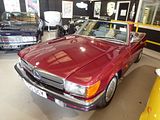
1929 OM 665 SS MM Superba: Officine Meccaniche was founded in February 1899, but didn’t move into car production until it took over the Brixia-Züst company’s Brescia factory in 1917. The first OM-badged car appeared the following year and borrowed heavily from old Züst designs. The first all-new OM was then introduced in 1919. The 465 four-cylinder model had a 1325cc sidevalve engine and was followed by the 467 and 469, OM type numbers being made up of the number of cylinders and the bore dimension in millimetres. A production six-cylinder model – the 665 – was added to the range in 1925 and was, in effect, a ‘stretched’ version of the four-cylinder unit. Introduced in 1991cc form, it was later offered with a supercharger and was enlarged first to 2.2 litres and then – for competition use only – 2.3 litres. Motorsport was always important to OM, which won the 1920 Coppa del Garda and went on to score numerous successes through the decade. OM cars finished fourth and fifth overall at Le Mans in 1925 and 1926, but its most famous result came in 1927, when its cars finished first, second and third on the inaugural Mille Miglia. Although OM stayed faithful to sidevalve engines, British importer LC Rawlence developed an overhead-valve conversion that could be fitted for an extra £100. The basic price for the non-supercharged 2-litre model was £595, with the blown engine raising that to £925. The choice of coachwork included an open tourer, saloon or coupé. In 1928, FIAT bought a 50 per cent stake in OM and had taken over completely by 1933. OM subsequently concentrated on commercial vehicles, but its cars have since acquired a cult following. One of the OMs raced by the Fronteras team in Ireland in 1930 was later owned by noted enthusiast TASO Mathieson, who wrote that its ‘roadholding, steering, etc, were superb and, in my opinion, superior to the Type 43 and 55 Bugattis, and the 1750 and 1500 Alfa Romeos … I consider the OM to have been one of the best cars I have ever owned.’ This extremely rare OM is one of the coveted 2.3-litre supercharged cars that were used only in competition and were not offered by the Italian marque as an official production model. Chassis number 6651095 was part of an OM team that was put together in 1930 by Edgar Fronteras and the marque’s British importer, LC Rawlence & Co. They planned to enter the Irish Grand Prix at Phoenix Park in July that year, and then the RAC Tourist Trophy, which would take place the following month on the Ards circuit near Belfast. The two races each attracted a strong international entry. At the Irish Grand Prix, Rudolf Caracciola won for Mercedes, while the 2.3-litre OMs – driven by Fronteras, Giulio Ramponi and Ferdinando Minoia – engaged in an exciting battle with the Alfa Romeo squad. Between that race and the Tourist Trophy, the team returned to England and tested 6651095 at Brooklands on 11 August. Period records and notes from that test refer to the OM as being a ‘Fronteras car here for the Irish races’. Two weeks later, the Tourist Trophy was dominated by Alfa Romeo, with Tazio Nuvolari, Giuseppe Campari and Achille Varzi finishing first, second and third. As for the OM team, Ramponi crashed during practice in the car that had been assigned to Fronteras, so it’s believed 6651095 was promoted from spare-car duties and took part in the race.


1973 Porsche 550RS Replica: Porsche made its name in the early post-war years with the 356, which found enduring success on either side of the Atlantic. Motorsport played an important role during that formative period, and in 1951 Porsche made its first appearance in the Le Mans 24 Hours – and promptly won its class with a lightweight development of the 356. Two years later, it introduced the 550 Spyder – a much more competition-focused, mid-engined sports-racing car that was powered by the marque’s Type 547 four-cylinder engine.This quad-cam, 1498cc unit featured dry-sump lubrication and twin-plug ignition, and had a power output of about 110bhp. The 550 Spyder enjoyed huge success, with class wins at Le Mans and on the gruelling Carrera Panamericana road race, its achievements on the latter leading to Porsche’s famous use of the ‘Carrera’ name. A 550 Spyder driven by Hans Herrmann also won its class on the Mille Miglia in 1954, its low profile enabling Herrmann to simply drive under a barrier when he encountered a closed level crossing during the race. Two years later, Umberto Maglioli took overall victory in the Targa Florio at the wheel of a 550 RS, the nimble sports-racer being perfectly suited to the twisting, undulating Sicilian roads. By then, Porsche had introduced the updated 550A, with a lighter, stiffer spaceframe chassis. The 550 Spyder was also a huge success in America, especially on the thriving West Coast racing scene. With support from official importer John von Neumann, famous drivers such as Richie Ginther and Ken Miles enjoyed early success in these giant-killing machines before the 550 family was replaced by the 718 RSK. Only 90 Porsche 550 Spyders were built and, not surprisingly, it’s been a popular choice for replica-makers over the years. The Technic 550 Spyder was originally conceived by Barrie Martin and could be bought as a DIY kit or as a complete, ‘turn-key’ car. It’s thought that about 150 were sold after it first appeared in the late 1980s. With an enlarged Porsche 914 engine producing in the region of 140bhp, and an overall weight of about 650kg, this superbly built 550 Spyder replica is an exciting and exhilarating little sports car. Built during the mid-1990s using one of the highly regarded kits offered by Hampshire-based Martin & Walker, this Technic 550 Spyder features an impressive specification that combines a lightweight GRP bodyshell, a tubular space frame chassis, and a mid-mounted Porsche 914 engine. The Volkswagen Beetle-based front suspension features double wishbones and adjustable coilovers, and there’s a de Dion rear axle. The Porsche braking system, meanwhile, uses discs at the front and drums at the rear. The engine was originally a 2-litre flat-four from a Porsche 914, and was running on fuel injection. It’s subsequently been taken out to 2366cc with different barrels and cylinder heads, and has larger valves and a lightened flywheel. It’s now fitted with twin Dellorto 45 DRLA carburettors and drives through a Porsche 901 five-speed gearbox. In 2007, the 550 Spyder was bought by a British Porsche enthusiast who’d previously owned a 928 and a 911 SC. He was living in Spain at the time and revelled in its performance on the rural roads of the Costa Brava, and during his ownership the car was featured in Volks World magazine. Having subsequently returned to the UK, it was treated to a carburettor rebuild in 2020 and now features a stainless-steel exhaust system. The simple, spartan interior features leather-trimmed bucket seats and Sabelt harnesses, and from behind the wheel it feels every inch the period 1950s road-racer, evoking a golden era in Porsche’s illustrious competition history.


1931 Riley Sprite Special: Riley began as a bicycle company in the late 1800s. It built its first car in the early 1900s. With such a long heritage, the company proudly adopted the slogan: “As old as the industry, as modern as the hour.” Like Aston Martin and MG, Riley saw the value of motor racing. It boosted both publicity and engineering progress. After launching the successful Riley 9 in 1926, the brand quickly became a staple of the racing world. The Brooklands Speed Model earned a strong reputation. It won its class in events like the Brooklands Double Twelve and achieved top honours in the Index of Performance at Le Mans. Even more impressively, it took outright victory in the 1932 Tourist Trophy. To build on this success, Riley added two cylinders to the 9 engine. This upgrade led to a new generation of six-cylinder sports cars. One standout was the MPH. It featured a unique chassis design that was underslung at the rear and had a compact 8ft 1.5in wheelbase. In 1934, two MPHs achieved second and third place overall at the Le Mans 24 Hours. Soon after, Riley introduced a new contender—the four-cylinder TT Sprite. In 1936, Riley launched the production Sprite. This two-seater used the MPH’s chassis as its foundation. Most models came with a rounded front grille, giving them a distinct look. Beneath the bonnet was a 1496cc four-cylinder engine that delivered spirited performance. As The Autocar noted at the time: “The Sprite is not a racing car, but in part of its behaviour it shows that it is a close relative.” The Riley 16hp made its debut at the 1937 Earls Court Motor Show. It became one of the final independent Riley models before the brand joined the Nuffield Organisation. The car featured a 2443cc four-cylinder engine and came in several different body styles. This engine, known as the ‘Big Four’, proved to be one of Riley’s most durable. It powered post-war RM series cars and remained in use until production of the Riley Pathfinder ended in 1957. During the 1930s, Riley earned a strong reputation for its motorsport success. These racing achievements often shaped the development of its road cars. This beautifully built pre-war Riley sports car captures the spirit of that golden era for the brand. From 1995 to 2018, one family owned the car. During that time, it took part in Vintage Sports-Car Club events. It’s based on a shortened 1931 Riley chassis and has a Sprite-style body. This body was built by Brian Martin, who once worked for Riley expert Barry Gillies. Martin used exact measurements from an original Sprite to create it. The car features Riley MPH-style wings. Under the bonnet is a powerful 2443cc engine from a Riley 16hp. This ‘Big Four’ engine was recently rebuilt and upgraded. It now includes Alfa Romeo high-compression pistons, Carrillo-type steel conrods, and a balanced crankshaft—making it an ideal pre-war British sports car for both performance and reliability. To make long-distance driving easier, it has a 3.5:1 axle ratio. The braking system was converted to hydraulic and now uses components from a Riley 12/4, including both front and rear axles.After buying the car in 2018, the current owner invested in more improvements. These included a fresh black paint job (it was previously red), a new interior by RC Moss, complete rewiring, and rebuilt wheels. Invoices for this work total over £25,000 and are included with the car. The result is a very well-sorted pre-war Riley sports car. In 2024, the car took part in the Leggenda di Bassano rally in the Italian Dolomites and completed it successfully. A photo book from that trip is included in the car’s history file, along with current FIVA papers. With its short wheelbase and strong four-cylinder engine, this Riley is both fun and reliable. It’s perfect for quick countryside drives or longer rally adventures.


1935 Riley 14/6 MPH: Like Aston Martin and MG, Riley was keenly aware of the promotional and engineering value of motor racing, and for 10 years following the introduction of its four-cylinder Nine model, it was a mainstay of the competition scene. With its high-mounted twin camshafts, inclined overhead valves and hemispherical combustion chambers, the Nine engine was ripe for tuning. The Brooklands Speed Model not only won its class in events such as the Brooklands Double Twelve and the Index of Performance at Le Mans, it won the 1932 Tourist Trophy outright. Adding two more cylinders to the Nine engine enabled Riley to develop a series of sporting ‘sixes’. They included the MPH, the prototypes for which were based on the works cars that had been campaigned in the 1933 Tourist Trophy. This latest model used a chassis that was underslung at the rear and featured a wheelbase of 8ft 1.5in, and three engines would be offered during its short life – 1458cc, 1633cc and 1726cc. Two gearboxes were offered – a close-ratio manual or a pre-selector – and 18in Dunlop tyres were specified. Suspension was via semi-elliptic springs front and rear plus Duplex Hartford dampers. ‘To the open-air-loving motorist with sporting tendencies,’ wrote The Autocar in 1934, ‘this new Riley MPH should prove singularly attractive.’ In the 1934 Le Mans 24 Hours, two works-entered MPH models finished an amazing second and third overall, beaten only by the Alfa Romeo 8C-2300 of Luigi Chinetti and Philippe Étancelin. Despite that success for the six-cylinder car, the next generation of competition Riley was represented by the four-cylinder TT Sprite. Riley produced only a short run of roadgoing MPHs alongside the racing variants. With its sporting bodywork and low-slung stance, it has – as noted writer Mick Walsh put it when he drove an MPH for Classic & Sports Car magazine – ‘the aura of a British Alfa Monza’. Little wonder it’s become such a coveted choice of 1930s sports car. Riley achieved immense competition success during the inter-war years and, with its rakish styling and six-cylinder engine, the MPH model was, in effect, a racing car for the road. Exclusive and expensive in period, it remains one of the Coventry marque’s most famous models. This particular car is ‘MPH No 7’ – chassis number 44T 2255. It was first registered on 19 November 1935 by Stanley Hodgkinson of Botleigh Grange – a large manor house near Southampton. The Riley was therefore issued with the Southampton registration AOT 855. That initial registration came almost a year after the main batch of MPH cars. Marque specialist Robin Cameron, writing in his reference work Riley MPH, suggests that ‘2255’ could originally have been supplied to Riley distributor Hector Dobbs, who was based in the outskirts of Southampton and regularly bought racing models and other special Rileys from the factory. After remaining unregistered during its brief time with Dobbs, it’s thought he sold ‘2255’ to Hodgkinson and the original MPH body was replaced by a more-spacious body made by Bertelli – a coachbuilding company that was run by Enrico Bertelli and which supplied bodies to Aston Martin, which was based next-door to its premises in Feltham, Middlesex. Although AOT 855 was advertised for sale in the mid-1960s as being ‘one of two’ with Bertelli coachwork, Cameron has written that the second car is, in fact, likely to have been one of the works Gamecocks used in the Alpine Trial. If correct, that makes AOT 855 the only MPH to feature a Bertelli body. In the February 1939 issue of Speed magazine, the MPH appeared in the background of a photograph that was taken in the workshops of Thomson & Taylor – the Brooklands-based engineering firm that built Land Speed Record cars as well as the chassis for the famous ERA racing cars, which used Riley-derived engines. AOT 855 was offered for sale during the late 1940s by dealer Blake & Co in Liverpool, by which time it was black. Riley Register records then show that, through the late 1950s and early 1960s, it was owned by N Ashurst, AA Heard and CM Ross. In 1962, the MPH was sold via Chiltern Cars to a Mr Lowdell of Tring in Hertfordshire. His ownership was brief, and later in the year it was back with Chiltern Cars before passing to Tony Fitch of Falcon Hall, Wormley. In 1964, Mr Fitch sold the Riley – which was then British Racing Green – to Donald Beatty of Walnut Creek, California. Early the following year, he wrote to the Classic Car Club of America requesting that the MPH be considered for membership and included a detailed description that included the engine number (14T 2255). After initially being refused, the request was granted in early 1966. The Riley returned to the UK in 1974 via well-known London dealer Dan Margulies, who sold it to Fuad Majzub. Iranian-born Majzub was a wealthy businessman who had a large collection of cars, and in 1976 he entrusted the Riley to Automobile Restorations so that it could be rebuilt – a process that was never completed. The car was kept in storage and shown, still incomplete, at the 1984 Riley Register Coventry Rally. When Fuad passed away, the MPH passed to his son Julian – a keen historic racer and founder of Blockley Tyres. It was then acquired by a new owner in 2004 and he treated the Riley to a full concours-standard restoration, after which he enthusiastically campaigned it in Vintage Sports-Car Club events. Now being offered for sale by the Classic Motor Hub, this well-known Riley MPH comes with an extensive file that meticulously documents its history and includes correspondence and receipts going back to the 1960s. With its crisp six-cylinder engine and pre-selector gearbox, it is a stylish, fast and extremely usable 1930s sports car that’s eligible for a wide range of events and represents a rare opportunity to acquire a genuine MPH.

1931 Talbot AO75/90: Designed by Swiss-born engineer Georges Roesch, the Talbot 14/45 had proved to be an immediate success when it was launched in 1926, to the extent that its sales helped to save the struggling marque. Three years later, its six-cylinder engine was stretched to 2276cc for a run of larger and more powerful ‘18hp’ models. The first of these was the 75, which was introduced in 1930 on the same basic chassis as the 14/45. Surrey-based dealer Fox & Nicholl soon recognised this car’s sporting potential, so Roesch raised the compression ratio and carried out other engine modifications in order to boost power and create the 90 model, which achieved great success at Brooklands and Le Mans. The chassis for these 18hp cars was produced in two different wheelbase options – 9ft 6in and 10ft – while bodywork was supplied by a number of different coachbuilders. The bare chassis was priced at £425, with catalogued bodies including the 2/3-seater ‘double dickey’ at £525 and the drophead saloon at £600. These cars formed the mainstay of the Talbot range into the mid-1930s, with upgrades along the way including the replacement of the ‘silent third’ gearbox with a Wilson pre-selector unit. As the company’s catalogue put it at the time: ‘The Talbot has won a wide circle of firm friends in every section of the community to whom the superb fitness of this thoroughbred motor has special appeal’. When parent company Sunbeam-Talbot-Darracq got into financial difficulties in the mid-1930s, Talbot was taken over by the Rootes Group. As the decade progressed, the famous ‘Roesch Talbots’ would be increasingly diluted by the use of components from other Rootes marques and Roesch eventually left the automotive industry, his legacy secure thanks to the brilliant cars he left behind. The Georges Roesch-designed Talbots of the 1930s are among the most desirable British cars of their time thanks to their competition pedigree and reputation for engineering excellence. This particular Talbot 75/90 adds to that with a fascinating ownership history that begins with an order placed at the 1930 London Motor Show by renowned racing driver Major AT Goldie Gardner. Essex-born Gardner was a veteran of the First World War who had started racing at Brooklands during the mid-1920s. He later enjoyed a long association with MG, lapping Brooklands at over 120mph in a single-seater K3, and was also a prolific record-breaker. During the early 1950s, by which time he was more than 60 years of age, he set 43 speed records at the Bonneville Salt Flats. Gardner’s Talbot was chassis number 29518, which was fitted with engine number 236. It was supplied via Warwick Wright and registered GO 8057 on 25 March 1931. The unique four-seater tourer coachwork was by KC Bodies and it’s thought that Fox & Nicholl then upgraded this 75 model to high-performance 90 specification at the request of Gardner. At some point during 1931, Gardner sold the Talbot via Fox & Nicholl to 19-year-old John Harris, whose family owned a construction company that specialised in building golf courses. A fine golfer himself, Harris went on to become a golf-course architect of considerable renown and designed hundreds of courses all over the world. Harris would keep GO 8057 for 45 years, and in 1965 he wrote to Motor Sport magazine to say that the Talbot ‘has taken me in complete safety for more than 200,000 miles and I have never had an anxious moment due to the road-holding’. He also noted that the car had received two overhauls, one in the mid-1930s and the other 20 years later. The 1950s work was carried out by Fox & Nicholl and included an engine rebuild in which new inlet and exhaust manifolds, a single downdraught SU carburettor and a Scintilla magneto were fitted. In 1955, Harris took the car to an event at Goodwood so that it could be driven by Georges Roesch himself. Harris reported that Roesch was impressed with its performance and Cecil Clutton – President of the VSCC – wrote to Harris thanking him for making the Talbot available, saying that ‘it made all the difference having such a perfect example’. In 1976, Harris sold the car to Peter Pollard, who had the interior retrimmed as close as possible to the original colours by local firm EJ Baker & Co. He also carried out various other repairs in time to use GO 8057 for the Silver Jubilee Rally at Ascot in 1977. Pollard used the car sparingly over the next couple of decades, and in the early 2000s he decided to strip down the chassis until only the main body section was attached. The engine was rebuilt by noted specialist IS Polson and the bodywork was repainted, and in 2016 this highly eligible car was entered into the Concours of Elegance at Windsor Castle. Now being offered for sale by the Classic Motor Hub, GO 8057 is an exceptional and well-known Roesch Talbot that boasts impeccable provenance and comes with an extensive history file that includes a wealth of evocative period photographs – plus invoices that go back to the 1950s work carried out by Fox & Nicholl. This charismatic Talbot still features its original coachwork, engine and ‘silent third’ gearbox, and has real presence both on the road and at rest. The upgrade to 90 specification has given it strong performance and it makes an exhilarating road car, particularly when the small windscreen is folded flat. As long-term owner John Harris put it, ‘There is some real character in the Roesch Talbots.’


1938 Talbot-Lago T15 Cabriolet: When the Sunbeam-Talbot-Darracq company collapsed in the mid-1930s, the French division of the Talbot business was acquired by Italian-born engineer and entrepreneur Antonio Lago. Lago set about reinvigorating the marque’s image with what would become a very successful motorsport programme, and backed that up with a range of extravagantly styled road cars. Launched in 1936, the ‘Baby’ Talbot was based on a short-wheelbase version of the chassis found in the longer Cadette and Major models. It was powered by a six-cylinder engine that was offered in a range of sizes: 2.7 litres, 3 litres or 4 litres. The smallest of those engines – which was powerful enough to give a top speed of more than 80mph – had the option of a four-speed manual gearbox. The larger ‘sixes’, meanwhile, were sold with the Wilson pre-selector gearbox. As was common practice for prestige continental manufacturers at the time, the cars were built in right-hand drive. The independent front suspension featured a transverse leaf spring, while at the rear there was rigid axle, and body styles included a saloon and a two- or four-seater convertible. Talbot-Lago revived the ‘Baby’ name following the Second World War, for a four-cylinder model that was intended to be more accessible than the flagship T26. Although the marque claimed that it was the ‘fastest, most pleasant to drive and safest’ car in its class, production of all models at the Suresnes factory fell sharply and the last T15 ‘Baby’ was built in 1953. Lago then put the company up for sale in 1958, and it was acquired by Simca the following year. This supremely elegant Talbot-Lago T15 has recently been restored to an exceptionally high level, and would grace the show field at any international concours d’elegance. Chassis number 91241 was built new as a disappearing-top two-seater cabriolet, a factory coachwork option that was designed by Paris-based Italian stylist Joseph Figoni. Only about 25 such cars are thought to survive, and this is one of the even rarer early examples that feature a slightly more complex shape. Later cars were simplified in order to make them easier to build. The current owner has patiently pieced together the Talbot-Lago’s history from when it was bought new on 19 October 1938 by Jean Hereaux, a photographer who was based in Charlesville-Meziéres – part of the Ardennes region in north-east France. A change of address shows that Hereaux still owned the car in August 1951, and its file includes period photographs taken during this time. It’s thought that he might have kept his cherished Talbot-Lago until 1964, when it was acquired by André Bulloz in Paris and re-registered 985 FV 75. Bulloz took the car with him to the Dordogne region in early 1979, and then sold it two years later to Pierre Louis Martin in Bordeaux. In 2009, the Talbot-Lago passed to a new ownerwho was based in Toulouse. Although he owned a number of other cars, this one quickly became his favourite and he covered 8000 kilometres in it over the next three years. In December 2012, it was sold to a Slovakian collector who embarked on a full restoration. The body was removed from the chassis, stripped to bare metal and repaired as required, and new sections of wood frame were added. The major mechanical components were also rebuilt before the Talbot-Lago was sold as an unfinished project to its current owner. The work was then finished to an exceptional standard by Concept & Restauration Bonnefoy in central France, including further work to the body and a full respray, plus an interior retrim, and numerous photographs document the entire process. The 2.7-litre, six-cylinder engine, which is believed to be the original, was meticulously rebuilt and is mated to a manual gearbox rather than the Wilson pre-selector that was fitted to many of these cars. Now being offered for sale, this stylish Talbot-Lago evokes a golden period of pre-war French Grandes Routieres and represents a rare opportunity to buy a T15 with Figoni’s flowing, open-top coachwork.
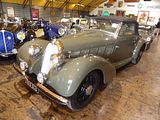

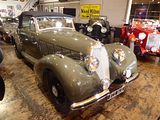
AND A SECOND EVENT
Just as most of the Italian cars had gone, and it looked as if the venue would be getting ready either to open to the general public, or even to close, so a series of Lotus cars arrived. It turned out that this was a Club event, and they were expected. They arrived in dribs and drabs, and the explanation for that is that they all been at the Cotswold Barn earlie in the day and most had got well and truly lost trying to find the Classic Motor Hub. Once parked up, they made for an impressive second display of the day.
The Type 75 Elite, announced in 1974, was the first of a new generation of Lotus cars which represented a concerted push up-market. The imposition of VAT had effectively killed off the market for the range of models that Lotus had hitherto produced as kit cars, and the only way to stay profitable was to produce something which could sold at higher prices. So whilst Lotus would tell you that the Elite was a replacement for the Lotus Elan Plus 2, it was more accurate to say that it was a rival for cars like the Reliant Scimitar GTE and Lancia Beta HPE. The styling was quite unlike anything that Lotus had produced before, with distinctive wedge lines penned by Oliver Winterbottom which hid the fact that the bodies were produced out of two separate glassfibre moulds and they had to join up in the middle around the waistline. The shooting brake style, with a hatchback as well as the fact that the Elite had 4 seats made it reasonably practical. luggage compartment. Mechanically there were fewer surprise. It was front engined with rear wheel drive, and had 4-wheel independent suspension using coil springs. The Elite was Lotus’ first car to use the 907 aluminium-block 4-valve, DOHC, four-cylinder, 1973cc, developing 155 bhp. which had previously been used in the Jensen-Healeys, where all the reliability issues had been found) The 907 engine ultimately became the foundation for the 2.0 litre and 2.2 litre Lotus Esprit powerplants, the naturally aspirated 912 and the turbocharged 910. The Elite was fitted with a 4 or 5 speed gearbox and from January 1976 automatic transmission was optional. The Elite had a claimed drag co-efficient of 0.30 and at the time of launch it was the world’s most expensive four cylinder car. Elites were available in 4 main specification variations, 501, 502, 503, and later on 504. The 501 was the ‘base’ version. The 502 added air conditioning, the 503 had power steering and the 504 added automatic transmission. The Elite was the basis for a coupe model, the Eclat which was launched in October 1975. Facelifted versions of both came in 1980, with a larger 2.2 litre engine and refinements to the trim. The Elite would live a couple of years in this form, but market interest shifted to the Coupe and when this was given a more significant revision a couple of years later, and a new name of Excel, the Elite was dropped from the range. Although 2535 of them were made, they are rare these days, so it was nice to see this 503 model.


In 1987, a new version of the mid-engined Esprit was unveiled, incorporating rounder styling cues given by designer Peter Stevens (who later designed the McLaren F1). A new Lotus patented process was introduced to create the new body, called the VARI (Vacuum Assisted Resin Injection) process, which offered more advantages than the previous hand laid process. Kevlar reinforcement was added to the roof and sides for roll-over protection, resulting in an increase of the Esprit’s torsional rigidity by 22 percent. Giugiaro is said to have liked the restyling, claiming it was perhaps too close to his original design. The Stevens styled cars retained the mechanical components of the previous High Compression Esprit and Turbo Esprit, but introduced a stronger Renault transaxle, which necessitated a move to outboard rear brakes. However, the MY 1988 North American Esprit Turbo kept its Citroën SM type transaxle and the Bosch K-Jetronic fuel injection system used in the previous model year. The car’s Type 910 engine retained 215 bhp and 220 lb·ft, but decreased its zero to sixty from 5.6 seconds to a varied time between 5.4 – 5.1 seconds and a top speed of over 150 mph. The exterior style changes were accompanied by a redesign of the interior, allowing a little more space for the occupants. The Stevens styled Esprit is often known by its project code of X180. In 1989, the Esprit was again improved with the GM multi-port, electronic fuel injection system and the addition of a water to air intercooler, which Lotus has named the Chargecooler, producing the SE (Special Equipment). This inline-four engine was known as the Type 910S. Horsepower was pushed up to 264 with 280 available on overboost and zero to sixty miles per hour times reduced to 4.7 seconds with a top speed of over 160 mph. Several modifications were made to the body kit as well, like side skirts which are parallel to the body, five air ducts in the front air dam, wing mirrors from the Citroën CX and the addition of a rear wing. Along with the SE, Lotus produced the little seen Esprit S, a midrange turbocharged car offering fewer appointments and 228 hp, as well as the standard turbo still offering 215 hp . The N/A and lower-powered turbo were cancelled after 1990, and the S in 1991. Another unusual variant was a two-litre “tax special” developed for the Italian market, fitted with an intercooled and turbocharged version of a new 1,994 cc version of the venerable 900-series four-cylinder engine. Equipped with SE trim, this appeared in December 1991 and produced 243 PS at 6,250 rpm. Beginning in the autumn of 1996, this engine became available in other markets as well. The Esprit was a popular and successful addition to the American IMSA Bridgestone Supercar Championship and as a result Lotus produced the SE-based X180R, with horsepower bumped to 300 and with racing appointments. The Sport 300 was a derivative of the X180R sold in Europe, which included many modifications. These are known as the fastest of the four-cylinder Esprits and among the most desirable. In 1993, another exterior and interior revamp of the car resulted in the S4 which was the first model to include power steering. The exterior redesign was done by Julian Thompson, which included a smaller rear spoiler placed halfway up the rear decklid. Other major changes were to the front and rear bumpers, side skirts and valence panels. New five spoke alloy wheels were also included in the redesign. The S4 retained the same horsepower as the SE at 264 hp.The S4 was succeeded in 1994 by the S4s (S4 sport), which upped power to 300 bhp and 290 lb·ft of torque, improving all-around performance while retaining the comfort of the previous version. Top speed was increased to 168 mph, skidpad increased to 0.91g, an increased slalom of 61.7 mph and a 0-60 mph time of 4.6 seconds. Although the engine kept its 2.2-litre capacity, many modifications were added to improve engine performance. Some of the changes were enlarged inlet ports, cylinder head modifications, a re-calibrated ECM and a revised turbocharger. The most visible external styling changes was the addition of a larger rear wing taken from the Sport 300. In 1996 the Esprit V8 used Lotus’ self-developed all-aluminium, twin-turbocharged (Garrett T25/60 turbos) 90-degree V-8, Code-named Type 918, in front of the same Renault transmission as before with no Chargecooler. Derek Bell developed an uprated gearbox that overcame a lot of the gearbox problems with a much thicker single piece input shaft. The Type 918 engine was detuned from a potential 500 bhp to 350 bhp to prevent gearbox damage due to the fragility of the Renault UN-1 transmission. In period tests, zero to sixty miles per hour came in at 4.4 seconds and top speeds of over 175 mph were achieved. Produced alongside V8 models was the GT3, a turbocharged four-cylinder car with the type 920 2.0 litre chargecooled and turbocharged engine which had been used only in Italian market cars previously. In 1998 the V8 range was split into SE and GT specifications, both cars with a much changed interior configuration, both offering similar performance with the SE being the more luxurious of the two. The ultimate incarnation of the Esprit came in 1999 with the Sport 350. Only 50 were made, each offering 350 horsepower (per the name) and various engine, chassis and braking improvements, like the addition of AP Racing brakes, stiffer springs and a revised ECU. Several visual changes were made as well, including the addition of a large carbon fibre rear wing on aluminium uprights in place of the standard fibreglass rear wing. By this time the Esprit could reach 60 mph in 4.3 seconds as well as reaching 0-100 mph in less than 10 seconds, and weighed 1,300 kg (2,866 lb) as a result of many modifications. Thereafter, Lotus made little development aside from minor cosmetic changes including a switch to four round tail lights for the 2002 model year. Esprit production ceased in February 2004 after a 28 year production run. A total of 10,675 Esprits were produced.


It is now over 20 years since Lotus launched the Elise, a model which showed a return to the core values of simplicity and light-weight which were cornerstones of Colin Chapman’s philosophy when he founded the marque in 1955. The first generation Elise was produced for just over 4 years, with a replacement model, the Series 2 arriving in October 2000. It came about as the Series 1 could not be produced beyond the 2000 model production year due to new European crash sustainability regulations. Lacking the funding to produce a replacement, Lotus needed a development partner to take a share of investment required for the new car. General Motors offered to fund the project, in return for a badged and GM-engined version of the car for their European brands, Opel and Vauxhall. The result was therefore two cars, which although looking quite different, shared much under the skin: a Series 2 Elise and the Vauxhall VX220 and Opel Speedster duo. The Series 2 Elise was a redesigned Series 1 using a slightly modified version of the Series 1 chassis to meet the new regulations, and the same K-series engine with a brand new Lotus-developed ECU. The design of the body paid homage to the earlier M250 concept, and was the first Lotus to be designed by computer. Both the Series 2 Elise and the Opel Speedster/Vauxhall VX220 were built on the same production line, in a new facility at Hethel. Both cars shared many parts, including the chassis, although they had different drive-trains and power-plants. The VX220 carried the Lotus internal model identification Lotus 116, with the code name Skipton for the launch 2.2 normally aspirated version and Tornado for the 2 litre Turbo which came out in 2004. Fitted with 17 inch over the Elise’s 16 inch front wheels, the Vauxhall/Opel version ceased production in late 2005 and was replaced by the Opel GT for February 2007, with no RHD version for the United Kingdom. The Elise lived on. and indeed is still in production now, some 15 years later, though there have been countless different versions produced in that time. Whilst the first of the Series 2 cars came with the Rover K-Series engine, and that included the 111S model which had the VVC engine technology producing 160 hp, a change came about in 2005 when Lotus started to use Toyota engines. This was initially due to Lotus’ plans to introduce the Elise to the US market, meaning that an engine was needed which would comply with US emissions regulations. The selected 1.8 litre (and later 1.6 litre) Toyota units did, and the K-series did not. that MG-Rover went out of business in 2005 and engine production ceased confirmed the need for the change. Since then, Lotus have offered us track focused Elise models like the 135R and Sport 190, with 135 bhp and 192 bhp respectively, as well as the 111R, the Sport Racer, the Elise S and Elise R. In 2008 an even more potent SC model, with 218 bhp thanks to a non-intercooled supercharger was added to the range. In February 2010, Lotus unveiled a facelifted version of the second generation Elise. The new headlights are now single units; triangular in shape they are somewhat larger than the earlier lights. The cheapest version in Europe now has a 1.6 litre engine to comply with Euro 5 emissions, with the same power output as the earlier 1.8 136bhp car. Lotus has been through some difficult times in recent years, but things are looking more optimistic again, with production numbers having risen significantly in the last couple of years, after a period when next to no cars were made.


The first Exige was launched in 2000 and was effectively a closed coupe version of the Elise. It was fitted with a naturally aspirated 1.8 litre Rover K Series Inline-four engine in VHPD (Very High Performance Derivative) tune. It produces 177 bhp at 7,800 rpm in standard form. There was also a “track spec” version with 192 bhp available. The car has a five-speed manual gearbox, and a claimed top speed of 219 km/h (136 mph). 0–60 mph was achieved in 4.7 seconds and 0–100 km/h (62 mph) in 4.9 seconds. The first Exige used the round, less aggressive headlights of the first generation Elise, although the Elise was updated soon after the introduction of the Exige. The Series 1 was built until 2002, and 604 examples were made. It was not replaced until the Series 2 of 2004.

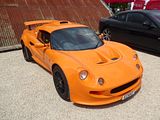
In 2004, the Series 2 Exige was introduced. It features a naturally aspirated 1.8 L 16-valve DOHC Toyota/Yamaha engine that is rated at 190 bhp with the Toyota engine designation of 2ZZ-GE. Compared to the Series 2 Elise, it has a front splitter, a fibreglass hardtop roof with roof scoop, a rear engine cover, and rear spoiler. The sole purpose of these aerodynamic additions to the base Elise is to create more downforce (almost 45 kg (100 lb) of downforce at 161 km/h (100 mph) in the Exige versus 5.9 kg (13 lb) at 100 mph in the Elise). In February 2005, Lotus announced a limited production run of 50 Exiges, using the Toyota engine with a supercharger. This increased the power output to 243 bhp. These models were only available in yellow or black, representing the colours of Lotus Sport, and are badged 240R. They have a projected 0 – 60 mph time of 3.9 seconds and 0-161 km/h (100 mph) of 9.9 seconds, with a top speed of 249 km/h (155 mph). The North American Exige was unveiled at the Los Angeles Auto Show in January 2006. According to Lotus, the standard Exige Series 2 model weighs 2,016 lb (914 kg). In February 2006, Lotus announced the Exige S model which used a supercharged Toyota 2ZZ-GE engine rated at 220 bhp The S was also made available in North American markets as a 2007 model. According to Lotus, the Exige S model, weighing 2,057 lb (933 kg), has the following specifications: In 2008, the Exige S was replaced by the Exige S 240. Power output increased by 9% over the outgoing model to 240 bhp. The S 240 also received upgraded AP Racing brakes from the Exige Cup 240 and a larger roof scoop utilised by the Exige Cup 255. 0–60 mph times improved to 4.0 seconds. The S 240 base manufacturer suggested retail price was $65,690. The Exige S 260 produced an additional 7% power output over the S 240 resulting in 256 bhp. Even with a full fuel tank, extensive use of weight-saving materials such as carbon fiber reduced the vehicle’s gross weight to 916 kg (2,020 lb) compared to 942 kg (2,077 lb) in the S 240. It can accelerate from 0–60 mph in 4.0 seconds. After 2009, both the S 240 and S 260 received distinctively new and enlarged rear spoilers mounted to the rear clam instead of the motor bay cover. Countless limited edition models were produced, as well. A third generation car was launched in 2012.

Developed under the project name Project Eagle, this car was launched as the Evora on 22 July 2008 at the British International Motor Show. The Evora is based on the first all-new vehicle platform from Lotus Cars since the introduction of the Lotus Elise in 1995 (the Exige, introduced in 2000, and the 2006 Europa S are both derivatives of the Elise Evora was planned to be the first vehicle of three to be built on the same platform and was the first product of a five-year plan started in 2006 to expand the Lotus line-up beyond its track-specialised offerings, with the aim of making Evora a somewhat of a more practical road car that would appeal to the mainstream. As such it is a larger car than recent Lotus models Elise and its derivatives (Exige, Europa S, etc.), with an unladen weight of 1,383 kg (3,049 lb). It is currently the only Lotus model with a 2+2 configuration, although it is also offered in a two-seater configuration, referred to as the “Plus Zero” option. It is also the only 2+2 mid engined coupé on sale. The interior is larger to allow taller persons of 6’5″ to fit. The cooled boot behind the engine is large enough to fit a set of golf clubs, although Lotus Design Head Russell Carr denies that this was intentional. Lotus intends Evora to compete with different market sectors including the Porsche Cayman. The name “Evora” keeps the Lotus tradition of beginning model names with an “E”. The name is derived from the words evolution, vogue, and aura. and it of course sounds similar to Évora, which is the name of a Portuguese city and UNESCO World Heritage Site. Sales started in summer 2009, with an annual target of 2000 cars per year, with prices between £45,000 and just over £50,000. and in America from the beginning of 2010. The Evora received several accolades at its launch from the British motoring press, including: Britain’s Best Driver’s Car 2009 from Autocar and Car of the Year 2009, from Evo. Sales, however, were far from target, as the car was seen as too costly. A more powerful Evora S was launched in 2010 with a supercharged equipped 3.5-litre V6. A facelifted and more powerful Evora 400 model was unveiled at the 2015 Geneva Motor Show.


A third Series Elise was debuted in 2010 and the car has undergone almost constant enhancements ever since, with power outputs boosted considerably on the way. Revealed in November 2015, the Lotus Elise Sport and Sport 220 joined the two-seater sports car’s line-up, with the two models replacing the outgoing Elise and Elise S. The models mark a return for the ‘Sport’ name to a Lotus, with the badge last appearing on the Lotus Esprit. The two cars get a weight reduction of 10kg, with the Elise Sport now down to 866kg and the Sport 220 now 914kg. The reduced weight doesn’t improve performance but it does bring a marginal boost in claimed economy, with the Sport now managing 45.0mpg the Sport 220 improving to 37.5mpg. The changes are marginal enough that the CO2 emissions remain unchanged. Both cars also come with lightweight sports seats, which are available with optional tartan trim that harks back to the 1970s Esprit S1. Other visual upgrades and options include lightweight silver or black cast wheels, which are 16 inch at the front and 17 inch at the rear. Optional lightweight wheels can shave another 5kg off the car’s weight. A black rear diffuser is standard, along with a choice of 10 different colours. Other options include a hard roof, air conditioning, cruise control and an upgraded Clarion stereo system. The engines remained unchanged. The Sport comes with a 1.6-litre petrol engine with 134 bhp and 160 Nm (118 lb/ft) of torque. It can go 0-62mph in 6.5 seconds, and has a top speed of 127mph. The Sport 220’s 1.8-litre engine can develop 217 bhp (220 PS) and 250 Nm (184 lb/ft) of torque. It can go 0-62mph in 4.6 seconds and has a 145mph of top speed. Both come with a six-speed manual transmission. The pricing has also been trimmed, with the Elise Sport model starting at £29,900 and the Elise Sport 220 priced at £36,500. Both cars will go on sale from December 2015 in Europe and the rest of the world from January 2016. At the 2016 Geneva Motor Show, Lotus revealed the high performance version of the Elise called the Cup 250. The Cup 250 is a more track focused and hardcore version of the standard Elise. It has a 1.8 litre supercharged Toyota 2ZR-FE Inline-4 engine with a 6-speed Toyota EC60 manual gearbox with sport ratios, developing 243 bhp at 7200 rpm, giving a 0-60 mph time of 3.9 seconds and a Top speed of 154 mph. In October 2017, Lotus unveiled a hardcore version of the Elise called the Elise Cup 260. It is inspired by the two hardcore variants of the Evora and Exige line up, the Sport 380 and the GT430 respectively. It features the double taillight units and rear wing from the Exige Sport 380 and the Lotus 3-Eleven respectively. Power has also been uprated and is now 250 hp thanks to a revised supercharger. Other changes include increased top speed, acceleration, low weight and high downforce due to added aero elements. Performance was marginally improved over the 220 version. In March 2017, Lotus announced the special edition ‘Sprint’ models of the Elise. For the Elise Sprint, Lotus used several weight-saving techniques to cut the car’s weight down to 798 kg (1,759 lb). To achieve the 40 kg (88 lb) weight saving, some body parts are made in carbon, as well as the seats. The backlight glass is made of polycarbonate, and the lightweight battery is a Lithium-ion model. Wheels are the usual size, but forged instead of cast alloy. The Sprint can be had with either a 1.6-litre naturally aspirated engine, or a 1.8-litre supercharged engine, available for the Sprint 220 version. The former has a 0–60 mph of 5.9 seconds, while the Sprint 220 can accelerate from 0–60 mph in 4.1 seconds. Dampers are uprated, as on the Elise Cup models. On 9 February 2021, Lotus unveiled two final editions line-up models of Elise on online platforms. Opening the range is the Elise Sport 240 Final Edition, which sees the existing Sport 220’s 1.8-litre supercharged four-cylinder engine uprated to develop 240 bhp and 244 Nm (180 lb/ft), permitting a zero to 100km/h time of 4.5 seconds. When fully specified with weight-saving options – namely carbon-fibre sill and engine covers, a lithium-ion starter battery and a polycarbonate rear window – the Sport 240 is the lightest car on offer, tipping the scales in at just 898kg. A set of 10-spoke forged alloy wheels fill the arches, measuring 16 inches in diameter up front and 17 inches at the rear, wrapped in Yokohama Y105 tyres. Lotus claims the new wheels are 0.5kg lighter than the examples fitted to the outgoing Sport 220. The Elise Cup 250 Final Edition features a variant of the Sport 240’s 1.8-litre four-cylinder, now tuned to produce 245 bhp and 244 Nm (180 lb/ft). Lotus claims a 4.3-second 0-100km/h sprint time. This model gets an optimised aerodynamic package allowing for 155kg of downforce at its top speed of 248km/h, along with 10-spoke M Sport forged alloy wheels, Yokohama A052 tyres, Bilstein dampers and adjustable anti-roll bars. A lightweight lithium-ion battery and polycarbonate rear window are also fitted as standard for increased weight saving, and, in top spec layout, the car weighs 931kg. The Elise story came to an end in late 2021 when production of the model ceased after 25 years.


Completing the array of Lotus models were a couple of examples of the Emira, the only sports car in the current Lotus range.



Also sneaked in was this. The McLaren 570S is a sports car designed and manufactured by the British car manufacturer McLaren Automotive, produced from 2015 until 2021. It was unveiled at the 2015 New York International Auto Show. The car is powered by a new iteration of the 3.8-litre twin-turbocharged V8 engine already used in the 650S and P1, designated M838T E with thirty per cent of the parts redesigned. It delivers 562 hp and 443 lb/ft (601 Nm) of torque through a 7-speed dual-clutch transmission developed by Graziano Trasmissioni, as it is arranged in the car as a rear-mid engine configuration, The car can accelerate from 0–62 mph (0–100 km/h) in 3.2 seconds and can achieve a top speed of 204 mph (328 km/h). A total dry weight of 2,989 lb (1,356 kg) and maximum weight of 3,201 lb (1,452 kg) gives the 570S a power to weight ratio of 428 PS per tonne delivering a fuel economy of 25.5 miles per imperial gallon (11.1 L/100 km; 21.2 mpg‑US) and CO2 emissions of 249 g/km. McLaren focused on delivering “day-to-day usability and driveability” against the most sporting model options in its range with increased luggage space, greater interior storage and leather upholstery options. The car is designed with aerodynamics in mind and the teardrop shaped cockpit helps achieve that objective. The rear of the car is inspired by the P1 and borrows the slim LED tail lights and diffuser styling from the flagship sports car. The car features dihedral doors, a trademark of McLaren as featured on its ultimate and super series cars. At the 2015 Shanghai Motor Show, the entry level McLaren Sports Series car named 540C was unveiled with 533 hp (540 PS) and 540 Nm (398 lb/ft) of torque. This new entry-level model focuses on “day-to-day usability and driveability” even more than that of the 570S with improved city driving and ride quality. The car can accelerate from 0–60 mph (0–97 km/h) in 3.4 seconds and has a top speed of 199 mph (320 km/h). The 540C is cheaper than the 570S and went on sale shortly after its Shanghai debut. The 540C is not available in the US due to McLaren wanting to focus on the more powerful 570S model for the US market. At the 2016 Geneva Motor Show, McLaren presented another addition to the Sport Series and 570 line up, dubbed the 570GT. The 570GT is the less track focused, and more road trip worthy version of the 570S. The 570GT sports a side opening cargo hatch above the mid-mounted engine for additional cargo space in place of the engine cover of the 570S, slightly softer suspension settings and improved sound insulation. The 570GT went through a facelift at the start of 2018 which added ceramic brakes as standard and steel as a free option. The convertible version of the 570S was unveiled at the 2017 Goodwood Festival of Speed event. It borrows the roof folding mechanism from the Super Series line-up. The two-piece aluminium roof folds into a compartment located behind the seats of the car leaving the rear buttress in place. The roof folding mechanism takes 30 seconds to fold and unfold and is operable at speeds up to 48 km/h (30 mph). Unlike the 12C Spider and the 650S Spider, the 570S spider required no significant reengineering for the folding roof mechanism because of the carbon monocell used in the 570S. As a result, the 570S Spider is only 46 kg (101 lb) heavier than the coupe. The drivetrain of the Spider remains identical to that of the coupe which results in similar performance to the coupé counterpart with the roof up. The Spider has new forged aluminium wheels and three special launch colours namely Vega Blue, Sicilian Yellow and Ventura Orange. Deliveries of the Spider began in late 2017

It is not hard to see why this event gets some priority in my schedule as the quantity and quality of Italian cars that attend every year is excellent, and the venue itself is also always worth visiting, as there are always some fabulous machines in stock. The added bonus of the Lotus cars this year made for an event better event, especially as they arrived after the Italians had left so it did not feel like there was any form of content conflict. I look forward to the 2026 edition of this event.