Even when there is a themed event taking place, you never quite know what you are going to see when you visit one of the Caffeine & Machine locations. All three are popular meeting places for groups of friends and car enthusiasts, but they are also somewhere that individuals choose to drop in with their classic or interesting car. It is not unusual for there to be more such vehicles than there are those compliant with a declared theme. It’s all part of the fun of the experience of visiting. I’ve not managed anything like as many visits in 2025 as was the case in previous years, largely because the diary has been so full and my logistics have had me elsewhere, but I do still like to stop by when I can. This was a late afternoon visit, and the site is often quieter, as this is the lull between the late morning rush and the transformation that takes over in the evening when let’s call them a younger generation tend to dominate rather more. So I was expecting it to be relatively quiet, and indeed it was. And it stayed that way for all the time I was there, so that means this is a much shorter report with far fewer photos that is usually the case from a visit here. These are the cars that attracted my interest:
AC
Over the last 50 years or so, there have been lots of replica versions of the legendary AC Cobra, and these far outnumber the original Shelby cars of the early 1960s. This is one of them: factory built and individually specified. Some specifications have a way of stopping you in your tracks. This GD427 Mk4 ADV is one of them. Finished in a rich pearlescent orange with contrasting black stripes, it’s a striking example of what’s possible when timeless design is paired with uncompromising engineering. Beneath its classic proportions sits our GRP semi-monocoque composite body, mounted to our championship-winning backbone chassis platform and built entirely from purpose-designed, all-new components. Powered by a naturally aspirated 7.0-litre LS7 V8 producing over 600bhp through matching GD AT Power throttle bodies, this Mk4 ADV combines effortless torque, razor-sharp throttle response and an unmistakable character. A Tremec Magnum 6-speed manual gearbox, electric power-assisted rack-and-pinion steering and our championship-winning backbone chassis platform deliver the precision, balance and driver engagement that define a Gardner Douglas. Performance is matched by capability throughout. Outboard ventilated discs with AP Racing front calipers and a split-bias braking system provide reassuring stopping power, while our custom stainless performance exhaust headers with ceramic heat-reduction coating flow into bespoke stainless side pipes, allowing the naturally aspirated LS7 to deliver the kind of unmistakable V8 soundtrack that only an engine of its calibre can. It’s this attention to detail—from the engineering beneath the bodywork to the finish of every visible component—that defines a factory-built Gardner Douglas. Just as much attention has been given to comfort and practicality. Heated GD leather seats, luxurious wool carpets, a factory-fitted GD Le Mans rebated matching hardtop and an impressively spacious boot make this a car that’s equally at home on a cross-country tour as it is on a favourite stretch of road, offering a level of touring practicality rarely found in a high-performance sports car. Safety has never been an afterthought. Comprehensive side-impact protection, burst-proof door latches, dual roll-over bars and full harness seat belts have all been carefully integrated, reflecting the same uncompromising engineering philosophy found throughout the car.


BMW
On 25 September 2013, BMW released the technical specifications of the M4. It is powered by the S55B30 engine, which is developed and engineered by BMW M GmbH. This 3.0-litre inline-6 engine has been built specifically for the new M4/M3, having a redline of 7,600 rpm with the rev limiter actuated at 7,300 rpm. The engine uses two mono-scroll turbochargers with a peak boost pressure of 18.1 psi (1.2 bar). The power is rated at 431 PS/425 hp, however this is achieved not at a specific engine speed, but is instead rated throughout the range of 5,500–7,300 rpm. The engine’s torque is rated at 550 Nm (406 lb/ft) throughout the range of 1,850–5,500. Two transmission choices are available, the 6-speed manual and the 7-speed M-DCT transmissions. The 7-speed M-DCT transmission accelerates the car from 0 to 100 km/h (62 mph) in 4.1 seconds) and the 6-speed manual transmission from 0 to 100 km/h (62 mph) in 4.3 seconds. The weight of the European specification M4 equipped with a manual transmission is 1,572 kg (3,466 lb) and with the M-DCT dual-clutch transmission, the car is some 40 kg (88 lb) heavier, losing some 80 kg (176 lb) as compared to the E92 M3. As per its E92 predecessor, the roof of the coupe model is constructed from carbon fibre (except if the optional sunroof is fitted). Carbon fibre is also used for the bootlid and engine brace. For the first time in a M3/M4 model, an electric power steering unit is used. The steering system is specifically tuned for both the M3 and M4, however it has been criticized for lacking in feel. The 18 inches (460 mm) and 19 inches (480 mm) wheel options are available with lightweight forged alloy wheels being standard. The M compound brakes come standard (with blue brake calipers), while carbon ceramic brakes (with gold brake calipers) are available as an option. The M4 features Active Sound, live amplification of the engine’s natural sound inducted into the passenger cabin via speakers in the car. BMW claims this technology has been used so that the well insulated cabin can reduce road/wind noise but still provide the driver with the sporty sound of the M powered engine. There are no artificial sound or any pre-recorded track in the system. This system was first implemented in the M5. The M4 is based on the F32 4 Series however 50 percent of its components are unique as compared to the 4 Series. The convertible variant of the M4 was announced along with its coupe sibling, also internally known as F82 or F83 M4. It shares almost everything with the coupé version, but weighs more due to its folding metal roof. The convertible weighs 1,750 kg (3,858 lb) (manual), 1,691 kg (3,728 lb) (M-DCT). The three-piece retractable hardtop folds in 20 seconds. The only significant difference between the two is the weight due to its retractable hardtop. Like its hardtop counterpart, the F83 M4 uses carbon fibre reinforced plastic to lighten and stiffen the car. Because of its extra weight it accelerates slower, taking it 0.3 seconds longer to 100 km/h (62 mph); 4.6 seconds with the manual and 4.3 seconds with the M-DCT transmission. The dynamic differences between the two variants are marginally small. Starting from the 2019 model year (production from 07/2018 onward) BMW removed the carbon fibre driveshaft so as to be able to fit an Otto Particulate Filter (OPF), necessary to comply with WLTP emissions regulations and this also meant that the M Performance Exhaust was no longer able to be offered on these cars by BMW. In February 2016, BMW announced the M4 Competition Package. The M4 Competition Package increases power output by 19 PS to 450 PS/444 hp and has a revised suspension for better handling. New springs, dampers and anti-roll bars complement the included Adaptive M Suspension. BMW also re-tuned the electronic differential and the Dynamic Stability Control to match the upgraded hardware. The interior remains largely unchanged, but Competition Package cars get new lightweight sport seats along with the M-striped woven seat belts. The exterior includes the M Sport exhaust with black chrome tailpipes and high gloss Shadow Line exterior trim. Gloss black trim is added to the kidney grille, side gills, and model badge on the trunk. With the Competition Package, the coupe version accelerates from standstill to 100 km/h (62 mph) in 4.0 seconds. There is a convertible version, and that does the run in 4.2 seconds, both coupe and convertible forms using the dual-clutch transmission.

The M2 was first revealed in Need for Speed: No Limits on November 2015, before later premiering at the North American International Auto Show in January 2016. Production commenced in October 2015 and is only available as a rear-wheel drive coupé. The M2 is powered by the turbocharged 3.0-litre N55B30T0 straight-six engine producing 365 bhp at 6,500 rpm and 465 Nm (343 lb/ft) between 1,450–4,750 rpm, while an overboost function temporarily increases torque to 500 Nm (369 lb/ft). The M2 features pistons from the F80 M3 and F82 M4, and has lighter aluminium front and rear suspension components resulting in a 5 kg (11 lb) weight reduction. The M2 is available with a 6-speed manual or with a 7-speed dual-clutch transmission which features a ‘Smokey Burnout’ mode. 0-100 km/h acceleration times are 4.5 seconds manual transmission models and 4.3 seconds for models equipped with the 7-speed dual clutch transmission. Top speed is limited to 250 km/h (155 mph) but can be extended to 270 km/h (168 mph) with the optional M Driver’s package. The M2 Competition was introduced at the 2018 Beijing Auto Show and succeeded the standard M2 Coupé. Production began in July 2018. The M2 Competition uses the high performance S55 engine which is a variant of the 3.0-litre twin turbocharged straight six engine found in the F80 M3 and F82 M4. The engine features a redesigned oil supply system and modified cooling system from the BMW M4 with the Competition Package, and also features a gasoline particulate filter in certain European Union countries to reduce emissions. Compared to the standard M2, the S55 produces an additional 30 kW (40 hp) and 85 Nm (63 lb/ft), resulting in a larger and more sustained power output of 405 bhp between 5,370–7,200 rpm, and 550 N⋅m (406 lb/ft) at 2,350–5,230 rpm. The 0-100 km/h acceleration time is 4.4 seconds for six-speed manual transmission models, and 4.2 seconds for models with the 7-speed dual clutch transmission. Top speed is electronically limited to 250 km/h (155 mph), but the M Driver’s package can extend the limit to 280 km/h (174 mph) which is 10 km/h (6 mph) further than in the M2. The M2 Competition also has a carbon-fibre reinforced plastic strut bar, enlarged kidney grilles, and larger brake discs of 400 mm (15.7 in) in the front axle and 380 mm (15.0 in) in the rear axle. Because of the new engine and cooling system, the M2 Competition is 55 kg (121 lb) heavier than the standard M2 at 1,550 kg (3,417 lb) for manual transmission models and 1,575 kg (3,472 lb) for dual-clutch transmission models. Production ended late in 2021 in anticipation of the next generation car.

FORD
Ford played much the same guessing game about whether there would be an RS version of the third generation Focus as they had done with the earlier versions. Production of the regular cars started in late 2010, but it was not until the 2015 Geneva Motor Show before the production ready MKIII Ford Focus RS was unveiled. It came packing the turbocharged 2.3-litre inline-four engine found in the Mustang EcoBoost. In the Focus RS, the engine itself produces 350 hp. Power is sent to all four wheels via Ford’s all-new Torque-Vectoring All-Wheel-Drive system with a rear drive unit designed by GKN, as well as upgraded suspension and brakes. As well as that, the new Focus RS will be fitted with Drive Modes – including an industry-first Drift Mode that allows controlled oversteer drifts – and Launch Control. The RS will boast a model specific aerodynamic package that helps to differentiate it from other Focus models. The RS is capable of accelerating to 100 km/h (62 mph) in 4.7 seconds. Sales finally started in mid 2016, with long waiting lists having been created, though Ford did eventually catch up with expanded production levels allowing them to meet the demand.

HONDA
The S2000 was first alluded to at the 1995 Tokyo Motor Show, with the Honda Sport Study Model (SSM) concept car, a rear-wheel-drive roadster powered by a 2.0 litre inline 4-cylinder engine and featuring a rigid ‘high X-bone frame’ which Honda claimed improved the vehicle’s rigidity and collision safety. The concept car was constructed with aluminium body panels and featured a 50:50 weight distribution. The SSM appeared at many automotive shows for several years afterwards, hinting at the possibility of a production version, which Honda finally announced in 1999. It featured a front mid-engine, rear-wheel-drive layout with power being delivered by a 1,997 cc inline 4-cylinder DOHC-VTEC engine. The engine produced outputs of 237–247 hp, and 153–161 lb/ft depending on the target market., and it was mated to a six-speed manual transmission and Torsen limited slip differential. The S2000 achieved what Honda claimed as “the world’s top level, high performance 4-cylinder naturally aspirated engine”. Features included independent double wishbone suspension, electrically assisted steering and integrated roll hoops. The compact and lightweight engine, mounted entirely behind the front axle, allowed the S2000 to achieve a 50:50 front/rear weight distribution and lower rotational inertia. An electrically powered vinyl top with internal cloth lining was standard, with an aluminium hardtop available as an optional extra. Although the S2000 changed little visually during its production run, there were some alterations, especially in 2004, at which point production of the S2000 moved to Suzuka. The facelifted car introduced 17 in wheels and Bridgestone RE-050 tyres along with a retuned suspension to reduce oversteer. The spring rates and shock absorber damping were altered and the suspension geometry modified to improve stability by reducing toe-in changes under cornering loads. The subframe has also received a revision in design to achieve a high rigidity. In the gearbox the brass synchronisers were replaced with carbon fibre. In addition, cosmetic changes were made to the exterior with new front and rear bumpers, revised headlight assemblies, new LED tail-lights, and oval-tipped exhausts. Although all the cosmetic, suspension and most drivetrain upgrades were included on the Japanese and European S2000s, they retained the 2.0l F20C engine and remained designated as an AP1. A number of special editions were made, such as the more track-oriented Club Racer version offered in the US in 2007/8 and the Type S for Japan in 2008/9. The UK received a GT for 2009, which featured a removable hard-top and an outside temperature gauge. The S2000 Ultimate Edition (continental Europe) and GT Edition 100 (UK) were limited versions of the S2000 released to commemorate the end of production. Both included Grand Prix White body colour, removable hard top, graphite-coloured alloy wheels, red leather interior with red colouring for stitching on the gear lever gaiter. The Ultimate Edition was unveiled at the 2009 Geneva Motor Show and went on sale in March 2009. The GT Edition 100 was a limited run of 100 units released for the UK market. In addition to the Ultimate Edition’s specification, it featured a black S2000 badge and a numbered plaque on the kick-plate indicating which vehicle in the series it was. The car was never replaced, as Honda decided to head off in the same direction as Toyota, producing a series of very dull appliance-like cars that focused on low emissions and dependability but of no appeal to the sort of enthusiast who bought (and probably kept!) an S2000.

Introduced in September 1995 for the 1996 model year, the sixth generation Civic featured updated styling, although less radical than previous redesigns. Suspension and engine options were available along with the first natural gas powered Civic, the GX. In the United States, model year 1996 to 2000 Civics were sold under the CX, DX, EX, EXR, HX, LX, and for Canada, SE, and Si trims; all base models were made with 1.6-liter 4-cylinder engines. The EX-CX are all SOHC (Honda D engine). The CX, DX and LX all have SOHC (D16Y7) 4-cylinder engines; whereas the EX has a 1.6L 16-valve SOHC VTEC (D16Y8) engine producing 127 hp (95 kW), and the HX has a D16Y5 VTEC-E engine producing 115 hp. The USDM Si and Canadian SiR came with a 1.6L 16-valve DOHC VTEC (B16A2) engine producing 160 hp. The first Civic Si coupe EM1 was introduced in 1999 and was produced until 2000. Europe saw a DOHC 1.6 VTi hatchback and sedan and a DOHC 1.8L engine was available for the Domani related 5-door liftback and estate. In Canada, the Acura EL is based on the Civic, and was replaced by the CSX in 2006.


The first Civic to receive the ‘Type R’ nameplate was based on the sixth-generation of the fan-base ‘EK’ Civic. The contributing base model was the JDM Civic 3-door hatchback called the SiR (code-named EK4). Like its sibling, the Integra Type R DC2/JDM DB8, the Civic SiR’s transformation into a Type R was achieved by working on the base model and improving it to Honda’s idea of a car capable of high performance on the circuit. The first Civic to receive the Type R badge was introduced on August 19, 1997, as the EK9. The EK9 shared many characteristics with the Integra Type R DC2/JDM DB8 such as omission of sound deadening and other weight reduction measures, a hand-ported 1.6-litre DOHC VTEC B16B 4-cylinder engine, front-helical limited-slip differential and a close-ratio 5-speed manual transmission. The B16B engine boasted one of the highest power output per liter of all time for a naturally aspirated engine with 185 PS (182 bhp) at 8,200 rpm and 160 Nm (118 lb/ft) at 7,500 rpm of torque from 1.6 L (1,595 cc) of displacement. For the first time, a strategically seam-welded monocoque chassis was used to improve chassis rigidity. The interior featured red Recaro bucket seats, red door cards, red Type R floor mats, a titanium shift knob, and a Momo leather-wrapped steering wheel. The EK9 was only available for sale in Japan. Performance figures include a 0–97 km/h (0–60 mph) acceleration time of 6.7 seconds and a quarter-mile time of 15.3 seconds. The EK9 could attain a top speed of 225 km/h (140 mph). In 1998, the Civic Type R Motor Sports edition was introduced. It came with steel wheels, the standard grey EK interior, manual windows, no air conditioning and without any other creature comforts. The Type Rx model introduced in 1999 was given a CD player, body-coloured retractable electric door mirrors, power windows, auto air conditioning, keyless entry unlock system, aluminium sports pedals, and a carbon type centre panel. The Type Rx was the final model of the EK9 generation. Production of the EK9 Civic Type R totalled 16,000 units.

HYUNDAI
A performance version called the i20 N was revealed for the European market in October 2020. It slots under the i30 N in the Hyundai N family. The i20 N is powered by a 1.6-litre turbocharged GDi engine mated to a 6-speed manual transmission with automatic rev matching. This engine has 201 bhp and 275 Nm (203 lb/ft) of torque. As the i20 N only weighs 1,190 kg (2,620 lb), it is able to accelerate from 0–100 km/h (0–62 mph) in a 6.2 seconds with a top speed of 230 km/h (143 mph). Its engine delivers peak torque between 1,750 and 4,500 rpm and hits peak power between 5,500 and 6,000 rpm. The broad power band helps its acceleration performance throughout the mid and high-speed range. Although the Smartstream engine is featured in other Hyundai models, for the i20 N it is equipped with a bespoke turbocharger and intercooler system. Changes also include a mechanical limited-slip differential, a reinforced chassis at 12 different points, and a reinforced front domes and knuckles with distinct geometry for the torsion beam suspension. The camber has also been increased while a new sway bar, new springs, and new shock absorbers have been fitted. The brakes have also been enlarged, being 40mm larger than the base i20 brakes. Production of the i20 N ceased for the European market in February 2024, and Hyundai N will only offer electric models in the region. Despite its discontinuation in Europe, the facelifted model of the i20 N is being prepared for export to the Australian market.

MAZDA
The Mazda MX-5 (NC) is the third generation of the Mazda MX-5 manufactured from 2005 to 2015. At its introduction in 2005, it won the Car of the Year Japan Award and made Car and Driver’s 10Best list from 2006 to 2013. The NC is the first MX-5 generation to feature a retractable hardtop variant, with its roof being able to fold and unfold in 12 seconds without sacrificing trunk space. The exterior styling by Yasushi Nakamuta resembled the original design, but unlike the update from NA to NB, which was mostly a nose/tail/interior change, the NC shares no components with the NB, except for the fender-mounted turn signal lights on non-U.S. models (and rear differential internals). The chief designer of this model generation was Moray Callum. The 2003 Mazda Ibuki concept served as a preview of the new model. The suspension changed from a four-wheel double wishbone setup to a front wishbone/rear multilink setup, shared with the Mazda RX-8. Technologies including traction control and stability control were added to increase driveability. According to Car and Driver, the NC has a skidpad number of 0.90g. For the U.S., the engine was the 16-valve, 2.0 L MZR LF-VE DOHC I4, producing 170 bhp and 190 Nm (140 lb/ft) of torque coupled to either a 5-speed or a 6-speed manual transmission or 158 bhp with the optional 6-speed automatic transmission. A limited-slip differential was available with the 6-speed option. In Australia, the 2.0 L MZR was offered, rated at 158 bhp and 188 N⋅m (139 lb/ft) of torque and the 6-speed transmission and LSD are standard. In Europe, two engines were offered: the 2.0 L MZR LF-VE rated at 158 bhp and 188 Nm (139 lb/ft) of torque, coupled to the 6-speed manual transmission; and a new 1.8 L MZR L8-VE, rated at 126 bhp and 167 Nm (123 lb/ft), coupled to the 5-speed manual transmission. A six-speed automatic transmission, with steering wheel mounted paddle shifters, was optional. A test by Car and Driver magazine revealed a 0-60 mph time of 6.5 s for the 2.0 L U.S.-spec NC. Manufacturer figures for the European-spec model are: 0-100 km/h (62 mph) in 9.4 s for the 1.8 and 7.9 s for the 2.0. As of this generation, the car no longer complies with Japanese law’s maximum exterior width dimension for the mid-size vehicle tax class, making Japanese buyers liable for additional costs for ownership. In July 2006, Mazda debuted a Power Retractable Hard Top (PRHT) version of the NC with a two-piece folding hardtop, named MX-5 Roadster Coupé in Europe, Roadster Power Retractable Hard Top in Japan, and MX-5 Miata Power Retractable Hard Top in the U.S. and Canada. Designed by Webasto and constructed of polycarbonate, the top requires 12 seconds to raise or lower, and the first models were delivered to customers in late August 2006. The hardtop adds 36 kg (79 lb) to the weight of a comparably equipped soft-top, without diminishing trunk space when retracted. The PRHT omits the soft-top’s storage compartments behind the seats to accommodate the folding roof mechanism. Performance times are slightly affected with the weight increase, with the 0-100 km/h (62 mph) time increased to 9.6 s for the 1.8 and 8.2 seconds for the 2.0. Thanks to better aerodynamics, though, top speed is increased from 196 km/h (121.8 mph) to 200 km/h (124.3 mph) for the smaller-engined model and from 210 km/h (130 mph) to 215 km/h (134 mph) for the 2.0. These figures are for the European- versions. The MX-5 facelift was unveiled at the 2008 Paris Motor Show and Science Museum in London, and later at the 2009 Chicago Auto Show. The Japanese model went on sale on December 9, 2008 at Mazda and Mazda Anfini dealers. Major changes concern the restyled front which now incorporates elements from Mazda’s newer models like the larger grille and new head and fog lights. Further restyled elements include the side skirts, rear bumper and the tail lights. The soft-top Touring and Grand Touring models feature a mesh grille bordered by a chrome frame. The hardtop Roadster Coupe now features a mesh grille bordered by a chrome frame and chrome elements inside the headlamps and outer door handles. The instrument panel gained darker features and redesigned graphics for the gauges. To create more leg space in the cabin, a protrusion from the door pockets was eliminated. The 2.0 L; I4 engine was rated 167 bhp at 7,000 rpm and 190 Nm (140 lb/ft) at 5,000 rpm for the 5-speed manual transmission, 158 bhp at 6,700 rpm with the fuel cut-off at 7,200 rpm and 190 Nm (140 lb/ft) at 5,000 rpm for the automatic transmission. Engine redline was raised by 500 rpm to 7,200 rpm in manual model and fuel cut at 7,500 rpm. The suspension and gearbox have been fine-tuned; with the latter offering smoother shifts and an automatic transmission will be introduced in Europe for the first time.

NISSAN
Like its predecessor, the R33 GT-R was the most extreme version of a range of Skyline cars, which in R33 guise were launched in 1993 and would go on to be produced for 6 years. The previous R32 model was a well proven build but the R32 wasn’t without faults and suffered with uplift and balance issues. Along with that, Nissan was as other Japanese companies were under strict restrictions on power gains. So Nissan had to combat all these areas so the sophisticated strength Programme was made. Nissan increased the width by about one inch on the R33 to the R32 and made it about 4 inches longer. This gave the R33 a longer wheelbase overall and lower stance mixed with new technology now from the computer aerodynamic age. Each line on the R33 was intended to give the car ultimate aerodynamics with wider gaps in the bumper and angles of air movement which allowed better cooling, in addition to the fuel tank lifted; the battery moved to the boot/trunk. Rigidity points were added mixed with improvements on the Attessa and Hicas all now offered the R33 with the best aerodynamics, balance, and handling. Nissan engineers also found other ways to reduce weight, even by a few grams. This includes: Hollowing out the side door beams. Using high tensile steel on body panels. Reduction in sound deadening materials. Super HICAS becoming electric. Hollowing out of rear stabiliser bar. Use of high tensile springs front and rear. Shrinking the ABS actuator. Light aluminium wheels with higher rigidity The front and rear axles were made of aluminium (as in the BNR32) but also so were engine mount insulators and brackets New plastics were used for : fuel tank, head lamps, super high strength “PP” bumpers, air cleaner, changing the headlining material, changing material of rear spoiler. All this put together meant we saw an improved time against the R32 of 21 seconds faster around the Nurburgring and 23 seconds faster in V spec trim. Still making the R33 the fastest skyline around the Nurburgring. The BCNR33 GT-R version also had the same RB26DETT engine that the BNR32 was equipped with, although torque had been improved, due to changes in the turbo compressor aerodynamics, turbo dump pipe, and intercooler. The turbo core changed from a sleeve bearing to a ball bearing, but the turbine itself remained ceramic, except on N1 turbos (steel turbine, sleeve bearing). From the R33 onward, all GT-Rs received Brembo brakes. In 1995 the GT-R received an improved version of the RB26DETT, the ATTESA-ETS four-wheel-drive system, and Super HICAS 4-wheel steering. A limited edition model was created in 1996, called the NISMO 400R, that produced 400 hp from a road-tuned version of Nissan’s Le Mans engine. A stronger six-speed Getrag gearbox was used. An R33 GT-R driven by Dirk Schoysman lapped the Nordschleife in less than 8 minutes. The Skyline GT-R R33 is reported to be the first production car to break 8 minutes, at 7 minutes and 59 seconds. Other manufacturers had caught up since the R32 was released, and the R33 never dominated motorsport to the extent of the R32. The R33 saw victory in the JGTC GT500 dominating the class and taking victory each year until its final racing year in which it was finally beaten by the Mclaren F1 GTR. The R33 saw huge favour in the tuning world with it being a popular model on the Wangan and top tuning companies building heavily tuned version from Top Secret ran by Smokey Nagata to Jun etc. and later by companies like Sumo. HKS GT-R would hold a drag series record for several years in there drag series making a record win of 7.671-second pass at Sendai Hi-Land Raceway with Tetsuya Kawasaki behind the wheel and taking it to be the World’s fastest AWD car.

This is an S15-generation Silvia, a car not sold new in the UK, though its predecessors had been, under the name 240SX. New in 1999, the engine of the S15 now boasting 250 PS (247 bhp) at 6,400 rpm and 275 Nm; 203 lb/ft at 4,800 rpm of torque from its SR20DET Inline-four engine, thanks to a ball bearing turbocharger upgrade, as well as improved engine management system. The non-turbo SR20DE produced 165 PS. The S15 Silvia included aggressive styling inside and out, updating the previous Silvia styling in-line with modern car design trends. The body dimensions were reduced from the previous generation so that it would comply with Japanese Government compact class, which had an effect on sales of the previous model. The S15 Silvia model lineup was initially simplified to just the Spec-S and Spec-R, both models offering an “Aero” variant with a large rear wing and side skirts/valances. This generation of the Silvia was only sold in Japan, Australia and New Zealand but was available as a grey import in most other countries. In Australia and New Zealand the car was sold as the Nissan 200SX. Within the Australian domestic market (AUDM), the S15 sold in 2 trim levels as noted above; Spec-S and Spec-R – however both models featured the SR20DET motor, albeit slightly detuned from the JDM spec cars. Nissan S15s were never officially sold with the naturally aspirated SR20DE engine in Australia or New Zealand. These two models were available at Nissan showrooms until the Nissan 200SX GT was introduced in 2002, the last year of production for the S15. Main differences here were namely the wheels being finished in a silver shadow chrome, chrome interior door handles, chrome gear selector surround, “sports” metal pedal set and an updated larger rear wing. As of August 2002, Nissan stopped producing the S platform with the S15-series Nissan Silvia being the final variant. Production of the Silvia ended amidst Nissan’s efforts to reduce its myriad of platforms. The S15 Silvia was therefore the last car to hold the Silvia badge. Nissan’s worldwide sports car platform is now the FM platform, which underpins the current Fairlady Z (the 350/370Z outside Japan), as well as the 2001–present Nissan Skyline (the Infiniti G35/37 in North America).


RENAULT
The Mégane II was launched in September 2002 for the 2003 model year, and marked a completely new fresh start. The two cars bear very little resemblance, the new vehicle having been inspired by the manufacturer’s new design language first seen in the Avantime. The new Mégane was voted European Car of the Year for 2003, fighting off stiff competition from Japan’s Mazda3 and PSA’s Citroën C3, and achieved a five star safety rating in the Euro NCAP crash tests, the first small family car to do so. The Mégane II and the Laguna were both showcases for a great deal of technologies Renault launched at the beginning of the 2000s; the Renault Card keyless ignition system, standard on the Mégane II, was a first in this class and has since been widely adopted. Similarly, the option of a panoramic glass sunroof is another area in which Renault led where others followed. In June 2003, the first ever live crash test using a real driver rather than a crash test dummy featuring the Mégane II was conducted by Top Gear. The Mégane II sedan was assembled in Iran by Pars Khodro from 2008 to 2013. As with the previous Mégane, the range of models is wide; there is a three and five door hatchback available, named “Sport Hatch” and “Hatch” respectively, there is a four-door saloon/sedan (Sport Saloon), a five-door estate (Sport Tourer / Grandtour), and to replace both the Mégane Coupe and Convertible, a new retractable hardtop coupe designed by Karmann. Unlike the previous model, the estate version was sold in RHD for the first time. Unlike its predecessor, the Mégane II was not licensed by Yanase Co., Ltd. for the Japanese market, as Renault had acquired a stake in Nissan when the Mégane I was still in production. Instead, the Mégane II was licensed by Nissan Motor Co., Ltd. and sold exclusively through Nissan Red Stage Store locations. The RenaultSport (RS) versions of the three door and five door Mégane hatchbacks were introduced, equipped with a turbocharged petrol 2.0 L 16v engine producing 225 PS (222 hp) and Turbocharged diesel 2.0L dCi 16V engine producing 175 PS (173 hp). Along with the engine, changes were made to the front and rear suspension geometry to improve handling, and the model features a deeper, wider front bumper. The Mégane Renault Sport competes in the hot hatch segment of the market. The hatchback model was revised at Motor Show Brussels in January 2006, the wagon and convertible debuted at Geneva Motor Show in March 2006, with changes in interior trim (e.g. a new revised instrument cluster with the speedometer moved to the right and the tachometer moved to the left), specification levels and most notably, a new nose. A new front suspension system borrowed from the Mégane 2.0 225 PS (222 hp) was adopted, improving the driving performance. During its first full year of sales, the Mégane II topped the French sales charts, with 198,874 registered in 2003. It also sold very well in Britain, being the nation’s fourth most popular car in 2005 and the nation’s fifth most popular car in 2004 and 2006. In 2007, it dipped to eighth place, with just over 55,000 examples being sold.


In 1999 Renault presented the first officially branded RenaultSport Clio, this was the third Clio produced by the RenaultSport division succeeding the Clio 16V and Clio Williams. This new Clio, the 172 was based on the 3 door Clio II shell however had numerous features over the standard car including wider arches, restyled bumpers, side skirts and 15-inch OZ F1 alloy wheels. Power was delivered by the F4R730 engine, a 2.0-litre 16-valve Inline 4 engine with a Variable valve timing (VVT) system via a dephaser on the intake camshaft pulley. The engine was a modified version of the F4R used in models such as the Laguna and Espace and was modified by Mecachrome to deliver a power output of 172 PS. Power was delivered to the wheels via a JC5-089 five-speed manual gearbox. The 172 also featured interior changes over the standard car including Half Leather, Half Alcantara seats embossed with the RenaultSport logo and the car also came standard with manually controlled Air Conditioning. A limited edition of the Phase 1 172 was produced and known as the Clio 172 Exclusive. This was limited to 172 units, all 172 of this “Exclusive” edition were 296 Scarab Green, featured BBS alloy wheels and a full leather interior as opposed to the half-leather half Alcantara seats featured in the standard car. In 2001 the interior and exterior of the Clio II were face-lifted, the Clio RS followed suit shortly after. This facelift of the Clio 172 included redesigned front and rear bumpers, the front bumper falling in line with the style of the face-lifted Clio II. The rear bumper was now less rounded and featured a strip of ABS plastic effectively splitting the bumper into two. The lights, bonnet and boot lid were also matched to the face-lifted Clio II. The interior was also changed to closer match that of the face-lifted Clio II, the seats were slightly revised however still featured the same Half Leather, Half Alcantara fabrics and the embossed RenaultSport logo. One new feature that the Phase 2 172 featured was automatic climate control as opposed to the manual air-conditioning featured in the Phase 1. The dashboard featured Silver interior trims and the steering wheel included a plastic insert featuring the RenaultSport logo. The gear shifter was changed from the metal ball featured on the Phase 1 to a Leather wrapped shifter with a silver coloured insert on the top. The Phase 2 172 also featured increased equipment including automatic Xenon headlights and headlight washers, Rain Sensing wipers a six-disc CD changer, and it also included side-impact airbags integrated into the seats. The 15-inch OZ F1 alloy wheels were also replaced with a 16-inch Alloy Wheel of Renault’s own design. The facelift of the 172 also brought about a number of changes to the engine of the car. A revised version of the F4R used, the F4R 736, this featured a revised cylinder head with the exhaust ports being approximately 30% smaller than those featured on the Phase 1 172. The airbox was also redesigned to be much more square than the original airbox. A revised version of the JC5 gearbox, the JC5-129 was introduced in this version of the Clio 172, which revised JC5 featured a shorter final drive to counter the increased weight of the face-lifted 172. The catalytic converter, which on the PH1 172 had been dual barrel was reduced to a single barrel and featured 2 lambda sensors, one before and one after the catalytic converter. The biggest change to the PH2 172 over the PH1 was the introduction of an electric throttle. This meant the Idle Control Valve of the PH1 was no longer required leading to a minor redesign of the intake manifold. In 2002 Renault released the 172 Cup, which bore the chassis code CB1N and was known by Renault as the “sport lightweight version”. The vast majority of cars were produced in D43 Mondial Blue (metallic) with a limited run of around 90 cars being produced in 640 Iceberg Silver (metallic). The Cup, originally built for Gr.N homologation of the Clio 172 was differentiated from the “non cup” 172 by its lack of many of the luxuries included in the regular car. Instead of the leather / Alcantara seats instead the same style seat was upholstered in a durable but low-cost fabric, the automatic Xenon headlights were replaced by manually controlled halogen units and the washer jets replaced with blanks. The rain sensing wipers and solar reflective coated windscreen were also omitted from the 172 Cup. However the car had features not before seen on a production version of the 172, which included lightweight 16-inch Speedline Turini alloy wheels, matte blue door strips, ABS plastic “Cup” front splitter and a restyled “Cup” rear spoiler. The dash strips which were silver on the regular car were painted to match the outside of the car. One of the main features of the 172 Cup was its significant weight saving, having a kerb weight of 1021 kg, making it the lightest of 172 versions produced. This was achieved by the removal of a majority of sound deadening from the car alongside thinner glass to reduce weight even further. One large difference was also the lack of air conditioning which was a standard fit component on the regular 172, which typically led to the cup producing more power due to the engine having less ancillaries to drive. This however was reintroduced as an optional extra later in the production run of the Cup. The 0–60 time of the 172 Cup was officially marketed by Renault as being 6.5 seconds; however AutoCar Magazine reportedly timed the 0–60 at 6.2 seconds which if this were the case would make the 172 Cup the second fastest road going Clio produced at the time of this article, second to only the V6. Many enthusiasts regard the 172 Cup as the last “hardcore” hot hatch due to its lack of anti-lock brakes; the car also featured modified suspension which gave it a wider track thanks to modified wishbones, the car also sat lower than standard and featured stiffer shocks and springs, the suspension geometry was revised to suit these components and to mean that the steering response was increased, this also lead to an increase in oversteer thanks to the lack of weight and revised geometry. Due to the lack of ABS the brake bias of the car was fixed by way of disconnecting the rear axle compensator, within the UK this often lead to the cars failing the MOT test, VOSA eventually issued an advisory to prevent this from happening. 2004 marked yet another refresh of the Clio II. The inserts of the headlights were changed from Black to Grey, new wheels styles were introduced and new colour options were added with others being dropped. The basic design of the car stayed the same with only minor changes. The Six-Disc CD changer was dropped as standard equipment however was still available as a cost option. This refresh marked the introduction of cruise control and Electronic Stability Program (ESP) as standard equipment. The Clio RS featured a lot more changes than the regular Clio. The engine was again revised and became the F4R 738. The difference between the F4R 738 and F4R 736 was a revised oil breather setup meaning the intake manifold found on a 172 would not fit a 182. Thanks to a number of other changes this engine produced 182 PS . This increase in power was thanks to the addition of a 4-2-1 Manifold and high flow 200 cell sports catalytic converter. The spare wheel well was removed and replaced with a flat floor to make way for the new dual exit exhaust featured on the 182. Minor revisions were made to the interior, the perforated texture of the Alcantara on the seats now featured white dots. The car also featured a new 8 spoke wheel design which came in Silver on a regular car and Anthracite on a “Cup Packed” car. The rarest optional extra available was the Carminat Sat-Nav which was fitted to very few cars. However, the unit wasn’t a popular option due to its high cost and rumoured poor performance compared to aftermarket options. The “Cup” Front Splitter and “Cup” Spoiler originally fitted to the 172 Cup made a reappearance as a cost option known as the Cup Style Pack. This was one of two cup packs available, the other being the Cup Chassis. This Cup Chassis pack included a strengthened hub with 60mm spacing on the strut bolt holes as opposed 54mm on non cup packed cars. The Cup Chassis also featured lowered suspension with stiffer shocks and springs and an anthracite version of the standard alloy wheels. The Clio 182 could also be ordered in a more race focused than ‘base’ RS model called “Cup Specification”, this was available in just two colours, J45 Racing Blue and D38 Inferno Orange, however came as Standard with the Cup Chassis and Cup Style Pack. The 182 Cup lacked the automatic Xenon headlights and headlight washer jets, climate control (rear footwell heater vents were also removed), illuminated sun visors, Solar Reflective Windscreen and Automatic Wipers. The leather / Alcantara seats were replaced with cloth items and the rear bench was downgraded to match. The engine cover and sill plates were removed and the steering wheel was downgraded to no longer include the RenaultSport Logo or rubber thumb grips. Carpet and headlining were downgraded to basic specification and even the documentation wallet was changed from faux leather to cloth. Sound deadening was removed from the 182 Cup, the horn was downgraded from a twin to single unit and the interior light no longer included a map reading function. Despite all of these reductions in specification the 182 Cup was still considerably heavier than the previous 172 Cup, meaning this version of the Clio II RS was considered one of the least desirable versions. The final version of the Clio 182 was known as the 182 Trophy. This version was based on the 182 Cup and featured the same strengthened hubs with 60 mm bolt spacing. Originally only 500 cars were to be produced for the UK market however an additional 50 were produced to be sold in Switzerland. At the time, believing there was no market for this version of the Clio, the Marketing Department of Renault France failed to order a 182 Trophy. The 182 Trophy included 16 Inch Speedline Turini Alloy wheels as seen on the 172 Cup, the Spoiler from the Clio 255 V6, Recaro Trendline seats and exclusive 727 Capsicum Red Paint with Trophy Decals lacquered onto the Side skirts. Each car had an individually numbered plaque on the base of the driver’s seat. The biggest difference however between the 182 Cup and 182 Trophy was the inclusion of Sachs Remote-Reservoir dampers. The basic principle of a Remote-Reservoir damper is that because there is a separate reservoir for the gas or oil which fills the shock they can either be of a reduced length or can house a longer rod, this means that the sizing of the shock can be optimised for the application in which it is being used. These changes definitely made a big difference to the 182 Trophy and have led to its being heralded as one of the best hot hatches of all time and it won Evo Magazine’s “People’s Performance Car of The Year” 2005, whilst also beating off rivals such as the Lamborghini Gallardo and other exotica in an Evo Magazine Group Test. AutoCar Magazine’s front cover from 5 July 2005 simply stated “World’s Greatest Hot Hatch”.

ROVER
The Rover 200 Coupé is a two-door coupé that was produced by Rover and based on the Rover 200 Mark II, with most of the body panels and the bumpers unique in the range. The car was launched on 6 October 1992, at the Paris Motor Show. It was given the project code name ‘Tomcat’ when in development. When introduced, the range flagship, the 220 Turbo Coupé, was the most powerful and fastest production Rover model ever built. The range was revised in 1996, with new engines, and was renamed Rover Coupé. Production ceased in 1998. The Rover 200 Coupé was equipped with a specially shaped split glass roof system with a central T-Bar. The twin panels could be tilted or detached independently, and the bar itself could also be removed and stored in the boot in a special protective cover. The glass was an advanced, semi reflective material, coated with titanium. Transmission of solar heat was restricted to only six per cent, eliminating the need for a sun blind. The lines of the 200 Coupé resulted from a completely new monoside and front and rear roof panels, new front and rear bumpers and a deep front spoiler extension with large intake grille. The interior was designed to accommodate four people, with rear seats individually styled. With the application of burr walnut veneer and quality fabrics, the interior was in the Rover traditions of elegance and refinement. Optional leather trim was also available. The Rover 200 Coupé featured infra red remote central door locking as standard. It also saw the application of ultrasonic alarm system developed originally for the Rover 800 range, giving both perimetric and volumetric protection. A specially developed version of the established ‘Torsen’ torque sensing traction control system previously only applied to four wheel drive and some rear wheel drive vehicles (Maserati Biturbo), was developed to help optimise handling. It was standard on the 220 Turbo Coupé, and optional for the first year of production on the naturally aspirated 220 version. Critics at the time reported that the handling was marred by the power being rather clumsily transmitted through the front wheels. As a result, the handling dynamics fell short of its rivals. At launch, three engine types gave the Coupé a broad appeal: a Honda D-Series 1.6-litre engine 111 PS, and two Rover 2.0 T-Series engines; a naturally aspirated version producing 136 PS and a turbo version 200 PS. All versions had manual transmission as standard, with an automatic option only with the 1.6 version. In 1994, changes were introduced to the 200 Coupé range, most obviously with a chrome grille being added to bring in line with the rest of the 200 series. Cost saving changes were also seen, such as a reduction in the amount of leather used, ignition barrel light removed and dash light dimming deleted. The alarm system received several changes to keep up with current security requirements. Ash Grey was the standard trim colour on all derivatives, but the optional full leather trim set could be specified in either Ash Grey or Sand Stone Beige. Exterior colours initially were: White Diamond, Flame Red, Black, Quicksilver Metallic, Nordic Blue Metallic, Polynesian Turquoise Metallic, Nightfire Red Pearlescent and Tahiti Blue Pearlescent (a new colour exclusive to the Coupé, later introduced to other cars in the Rover range). In 1994, Nordic Blue and Quicksilver were replaced with British Racing Green, Platinum Silver and Charcoal. Black, pearlescent or metallic paint were optional on all models. The 1.6-litre model was designed to appeal to the cost conscious Coupé buyer. Priced at £14,495, the 111 PS (109 bhp) version achieved a 0 to 60 mph time of 9.5 seconds and a maximum speed of 120 mph (193 km/h). Excessive stock of the 216 Coupé led Rover to bring out a new model, the 216 SE, prior to the new 1996 range was launched. This was dressed up with the rear body coloured spoiler and front fog lamps, aimed to generate additional sales to clear the way for the new models. The 220 featured the T series 2.0 litre 16 valve engine, later introduced into the rest of the 200/400 range in 1993. It replaced the M16 unit used in previous models. The 220 Coupé was priced at £16,670. In naturally aspirated form, the 16 valve T-Series produced 136 PS (134 bhp) at 6000 rpm and a top speed of 127 mph (204 km/h). 0-60 mph was achieved in 8.2 seconds. The flagship of the range, the 220 Coupé Turbo’s performance came from the T-Series 2.0 litre 16 valve engine with turbocharging producing 200 PS (197 bhp) at 6000 rpm and 174 lb/ft (236 Nm) The fastest ever production Rover achieved 150 mph (241 km/h) and a 0 to 60 mph time of 6.2 seconds and 30 to 70 mph in 5.7 seconds in a test by Autocar in October 1992. Torsen torque sensing traction control, uprated suspension and anti lock brakes as standard. The differential is a completely mechanical device so by most manufacturer’s standards this would not have been considered to be a ‘Traction Control System’. However, the LSD was the reason why the Rover was marketed as having traction control. Anti lock braking (ABS) was standard on the 2.0 litre models. The car was priced at £18,315. In 1996, Rover announced revisions to the Coupé, with the range also losing the 200 model name. Two, all new, models were introduced to replace the previous models. The Coupé 1.6 was now fitted with Rover Group’s own K-Series 16 valve double overhead camshaft power unit instead of the previous Honda unit. The 2.0 and Turbo models were replaced by the 1.8 VVC Coupe. Inside, the interior was completely revamped and featured the new rounder dash as fitted to the newer shape Rover 200. The alarm system on all models was again changed and now featured Thatcham approval. The interior trim was lightened from the dark Ash Grey to a lighter Picadilly Grey. The 1.6 was fitted with cloth trim in either red or grey centres whilst the VVC came with the leather side bolsters as seen in previous models. All three models had the option of full smokestone leather. Exterior paint could be specified in seven colours, including one all new colour: Flame Red, Charcoal, Platinum, British Racing Green, Tahiti Blue, Nightfire Red and Amaranth. Near the end of production, Diamond White again became available and another new colour, Anthracite was also available, although this is exceptionally rare. In 1998, Rover Group ceased production of the Coupé, bringing the R8 range to an end. The Rover Coupé body shape was never revamped, to bring into line with the new shape 200 and 400.


TOYOTA
The MR2 derived from a 1976 Toyota design project with the goal of a car which would be enjoyable to drive, yet still provide good fuel economy – not necessarily a sports car. Design work began in 1979 when Akio Yoshida from Toyota’s testing department started to evaluate alternatives for engine placement and drive method, finalising a mid-transverse engine placement. Toyota called the 1981 prototype SA-X. From its original design, the car evolved into a sports car, and further prototypes were tested both in Japan and in the US. Significant testing was performed on race circuits including Willow Springs, where former Formula One driver Dan Gurney tested the car. All three generations were in compliance with Japanese government regulations concerning exterior dimensions and engine displacement. The MR2 appeared around the same time as the Honda CR-X, the Nissan EXA, the VW Scirocco from Europe, and the Pontiac Fiero and Ford EXP from North America. Toyota debuted its SV-3 concept car in October 1983 at the Tokyo Motor Show, gathering press and audience publicity. The car was scheduled for a Japanese launch in the second quarter of 1984 under the name MR2. Toyota introduced the first-generation MR2 in 1984, designating it the model code “W10”. When fitted with the 1.5-litre 3A engine, it was known as the “AW10”. Likewise, the 1.6-litre 4A version is identified by the “AW11” code. The MR2’s suspension and handling were designed by Toyota with the help of Lotus engineer Roger Becker. Toyota’s cooperation with Lotus during the prototype phase can be seen in the AW11, and it owes much to Lotus’s sports cars of the 1960s and 1970s. Toyota’s active suspension technology, called TEMS, was not installed. With five structural bulkheads, the MR2 was quite heavy for a two-seater of its size. Toyota employed the naturally aspirated 4A-GE 1,587 cc inline-four engine, a DOHC four-valve-per-cylinder motor, borrowed from the E80 series Corolla. This engine was also equipped with Denso electronic port fuel injection and T-VIS variable intake geometry, giving the engine a maximum power output of 112 hp in the US, 128 hp in the UK, 116 or 124 PS (114 or 122 hp) in Europe (with or without catalytic converter), 118 hp in Australia and 130 PS (128 hp) in Japan. Japanese models were later detuned to 120 PS (118 hp). A five-speed manual transmission was standard, with a four-speed automatic available as an option. In 1986 (1988 for the US market), Toyota introduced a supercharged engine for the MR2. Based on the same block and head, the 4A-GZE was equipped with a small Roots-type supercharger and a Denso intercooler. T-VIS was eliminated and the compression ratio was lowered to 8:1. It produced 145 hp at 6,400 rpm and 186 N⋅m; 137 lb⋅ft (19 kg⋅m) of torque at 4,400 rpm and accelerated the car from 0 to 100 km/h (62 mph) in 6.5 to 7.0 seconds. The supercharger was belt-driven but actuated by an electromagnetic clutch, so that it would not be driven except when needed, increasing fuel economy. Curb weight increased to as much as 2,494 lb (1,131 kg) for supercharged models, due to the weight of the supercharger equipment and a new, stronger transmission. A fuel selector switch was also added in some markets, to allow the car to run on regular unleaded fuel if required to. In addition to the new engine, the MR2 SC was also equipped with stiffer springs, and received special “tear-drop” aluminium wheels. The engine cover had two raised vents (only one of which was functional) that visually distinguished it from the naturally aspirated models. It was also labelled “SUPER CHARGER” on the rear trunk and body mouldings behind both doors. This model was never offered outside of the Japanese and North American markets, although some cars were privately imported to other countries. Toyota made detailed changes to the car every year until replacing it with a second generation model in 1989.

TVR
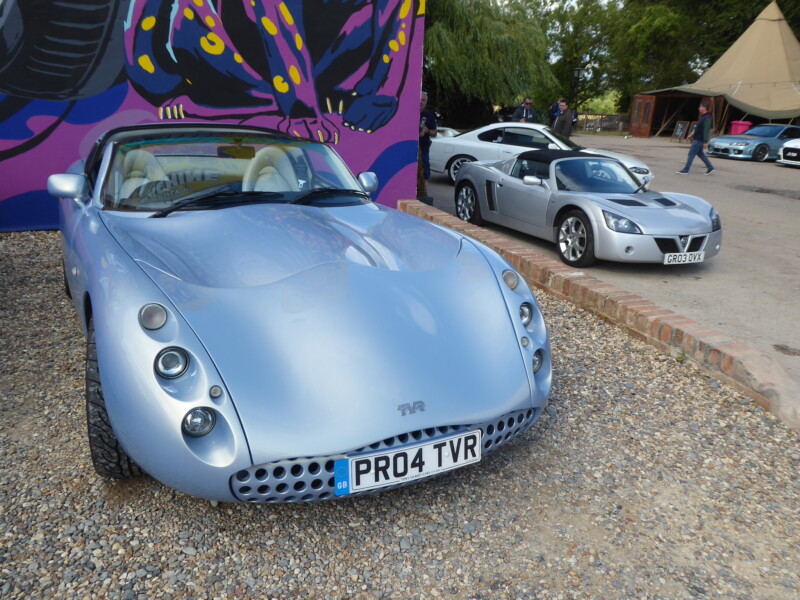
The Tuscan was launched in 2000, by which time there had been a series of what we think of as the modern era TVRs produced for nearly a decade, the Chimaera, Griffith and Cerbera. The Tuscan did not replace any of them, but was intended to help with the company’s ambitious push further up market to become a sort of Blackpool-built alternative to Ferrari. It did not lack the styling for the task, and unlike the preceding models with their Rover V8 engines, the new car came with TVR’s own engine, a straight six unit of 3.6 litre capacity putting out 360 bhp. The Tuscan was intended to be the grand tourer of the range, perfectly practical for everyday use, though with only two seats, no ABS, no airbags and no traction control, it was a tough sell on wet days in a more safety conscious world, but at least there was a removable targa top roof panel for those days when the sun came out. The car may have lacked the rumble of a V8, but when pushed hard, the sound track from the engine was still pretty special, and the car was faster than the Cerbera, but sadly, the car proved less than reliable, which really started to harm TVR’s reputation, something which would ultimately prove to be its undoing.


I still enjoyed my time here despite the fact that there were relatively few cars on site and still less that I deemed interesting enough to photo. As I observed at the start of this report, you just never know quite what you are going to find when you come to a Caffeine & Machine location, and some visits are going to see more interesting cars that others. I am sure it will not be long before I am back to see what surprises are in store on that occasion.