

It is not uncommon for car manufacturers to use a different model name in different markets. Sometimes this is forced upon them by anything from trademark restrictions, to ease of pronunciation in the local language or occasionally for more abstruse reasons such as superstition and associations good or bad. But there are times when we all scratch our heads and ask, “just why?”. Honda has got us doing that with the HR-V. The name reappeared late in 2013 after an absence of a good few years in the market, applied to a B-segment crossover which was based on the Honda Fit, or Jazz if you are European. In Japan it was actually called the Vezel, but for Europe and then a few months later also for North America, the car was called the HR-V. The US market cars were built in Mexico but were largely the same as the Japanese and European market cars. It is when replacement time came that things got complicated. Honda announced a third generation HR-V in Japan in late 2021, based on the Honda Global Small Car platform sharing its platform with the fourth-generation Fit/Jazz/Life and the seventh-generation City/Ballade. Some months later, this car went on sale in Europe, but for the 2022 model year, Americans continued to receive the second generation car. Nothing unusual in that, as market releases are often staggered especially where the cars are sourced from different factories. Some months after the launch of the third generation HR-V, Honda added another SUV to their range, this one called the ZR-V, with the Z apparently referring to Gen-Z, its likely buyers. This one was positioned between the HR-V and CR-V and was based off the same platform as the Civic, just like the larger CR-V. This car was then unveiled in the United States on 4 April 2022 as the third-generation HR-V, differentiated from the global model, in order to “meet the distinct needs of US customers”. I think the translation of that statement comes from the fact that the 2023 HR-V is about 8.7 inches longer and 2.6 inches wider than the previous generation, and its wheelbase grew by 1.7 inches, yet again proving that America really wants even its small cars to be large. The new model boasted more features and equipment and a higher quality interior, and inevitably, somewhat higher prices. Sales started in the US on 7 June 2022 for the 2023 model year. Later launches such as in China and Europe utilised the “ZR-V” nameplate as this car is sold alongside the global HR-V in these markets. As if this was not complicated enough, there are also the all-electric versions of these cars, but let’s leave those for another day or you really will be confused!


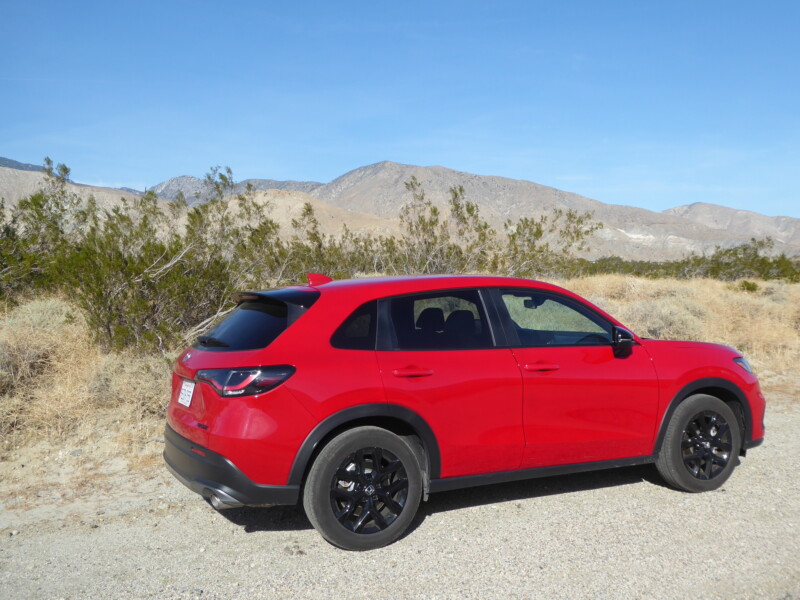
So the net is that from the 2023 model year, there is an HR-V in the US and there is one in Europe, but they are different cars, and there is no particularly logical reason for them to bear different names, but they do. Honda remain quite elusive in the rental fleets, so when I see one, I tend to prioritise it over other makes and models, so when I spotted a bright red (Milano Red in Honda speak) 2023 model year HR-V parked up in the Gold area at Hertz’ LAX facility on my last day of the November 2023 trip, I did not really go looking any further for anything else, but simply grabbed the keys to this one, keen to see what I thought of it.


All HR-V models are powered by the same 2.0 litre four cylinder engine which puts out 158 bhp and which is coupled to a CVT transmission. Whilst this HR-V does not really live up to the “Sport” labelling of the car, it goes well enough, picking up speed quite nicely when needed. This is one of the better CVT transmissions and it results in a generally fuss-free driving experience. Pottering around town and in traffic, all is well, but out on the open road, you need to work the HR-V quite hard and this can get a bit noisy. One at cruising speed, though, noise levels are low and the HR-V comes across as quite a refined vehicle.


Overall, this HR-V is a bit unremarkable to drive. There is nothing wrong the steering, handing and grip, but equally there is no sparkle or flair as you would get in a Mazda CX-30. The steering is quite light and does not have much in the way of feel, but this does make the car easy to drive. The handling is typical front wheel drive safe and predictable, though if you get a bit enthusiastic, there is definitely a tendency for understeer but overall grip levels remained good. The ride is comfortable, with this car coming on 225/50 R18 tyres. There were no concerns with the brakes which worked well. Visibility is about par for the course, with the thick C pillars presenting a bit of a problem at oblique junctions.


The HR-V is neatly trimmed inside, following much the same style as you will find in the latest Civic. That means plenty of soft padding and some decent quality plastics, coloured in a soft brown in the case of the test car, with brown stitching and the same rather unusual honeycomb style open pore gauze inlay that stretches across the width of the car embracing the air vents, just as you get in the Civic and CR-V and there is a chunky leather-wrapped steering wheel. The instrument panel is a 7” digital cluster. The left side features a display that can be reconfigured to show a few different readouts. At the right is an analog speedometer. The rest of the control layout is pretty conventional, with a pair of column stalks including the lights, with an auto function, on the left hand one and the steering wheel boss provides for cruise control and audio repeater functions. Mounted high, almost perched on the top of the dash, the central touchscreen is relatively small at 7” and also relatively basic in function, as you only get an AM/FM radio as well as various car settings. There is wired support for Apple Car Play and Android Auto as well as Bluetooth. The audio system has just six speakers. There are still buttons and knobs to operate the screen functions, hurrah! Climate control operates from three rotary dials lower in the dash.


As this was the Sport trim for the HR-V, you get sports seats. They are cloth upholstered and have orange stitching. Adjustment is all manual and only the driver can alter the height of the seat. The seats are nicely supportive and proved very comfortable. The steering column telescopes in/out as well as up/down.


Space in the rear is reasonable, bearing in mind that, to Americans at least, this is still categorised as a sub-compact car. There is a flat floor which certainly helps out for a prospective middle seat occupant, though the car is not really quite wide enough for three adults to sit comfortably here. Legroom is good even with the front seats set well back and there is ample headroom. You don’t get a central armrest and there is only one seat-back map pocket. The door bins are on the small side.


The boot is also a reasonable size for this class of car, as it is wide and deep, though it is actually smaller than it was on the previous generation car. Loading is easy as the floor is flush with the tailgate. As is often the case with US market cars, there is no load cover. The asymmetrically split rear seat backrests drop down to create a much larger load platform, but you no longer get the extra versatility of the Magic Seats that were part of the previous generation model. Inside the front passenger compartment, there is a modestly sized glovebox, as well as usefully sized and quite deep armrest cubby as well as space the front of the armrest and a recess in front of the gearlever.


The 2023 Honda HR-V is available in three trims: LX, Sport and EX-L. All models come with a 158 bhp four-cylinder engine, a continuously variable automatic transmission (CVT) and front-wheel drive. All-wheel drive is available. Standard features in the base HR-V LX include a 7-inch touch screen, wired Apple CarPlay and Android Auto, Bluetooth, three USB ports, a four-speaker stereo, a 7-inch digital gauge cluster with an analog speedometer, remote keyless entry, push-button start, automatic climate control, cloth upholstery, manually adjustable front seats, a rear-seat alert, driver-attention monitoring, LED headlights with automatic high beams, a rearview camera and 17-inch alloy wheels. The Honda Sensing package is also standard, and it bundles lane departure warning, lane-keep assist, forward collision warning, forward automatic emergency braking, adaptive cruise control and traffic-sign recognition. The midrange HR-V Sport trim adds heated front seats with orange accent stitching, a six-speaker stereo, proximity keyless entry, remote start, blind-spot monitoring, rear cross-traffic alert, a restyled grille, SPORT badging and 18-inch gloss black wheels. The range-topping EX-L gains a 9-inch touch screen, wireless Apple CarPlay and Android Auto, wireless device charging, an eight-speaker stereo, HD Radio, satellite radio, leather upholstery, a power-adjustable driver’s seat, dual-zone automatic climate control, ambient lighting, a moonroof, front and rear parking sensors and 17-inch wheels with a matte finish.


The HR-V is a decent enough car. It is relatively spacious and nicely finished inside and is pleasant enough to drive, even if ultimately it could do with more power. But it has to compete in a very full class where there are now some pretty decent alternatives. I’ve yet to drive the Mazda CX-30, but everyone says that will be the most fun for the driver, and there are also strong alternatives from the Koreans with the Kia Seltos and Hyundai Kona as well as the VW Taos that I sampled a few days prior to this test, all of which are good choices. GM have the Buick Encore GX and Chevy Trailblazer on offer and if you can stretch the budget a bit there is always the MINI Countryman, as well as cars such as the Nissan Kicks and Toyota Corolla Cross. You’ll probably find all of these at the car rental facility, as with the almost complete demise of the small hatch and saloon models, sub-compact SUVs now constitute the entry point into car rental. None of them are bad, but equally none of them truly distinguish themselves as clear class leader, the Mazda being the most likely contender to do that. For sure, pick the Honda if you can find one, as you are less likely to get a second chance, but don’t expect to be blown away by it in the way that the previous generation of Honda models managed to do.