I last went to the National Tramway Museum at Crich, in Derbyshire, when was about five or six years old, and honestly, I don’t really remember anything much about it. Not surprisingly, really, as that is rather a long time ago, and it is fair to assume that it will have changed quite a lot in the intervening time. I have been keen to go back for some time though, with an added interest being the fact that I have noted that they do host various Car Club events as well. When I realised that the site is about 3 miles away from the Great British Car Journey museum, it occurred to me that I could combine a visit to both in one day. That day came when I was en route back from The Motorist and decided to stop off in Derbyshire as Great British Car Journey was hosting a themed morning for French Cars (a report for which is already published). Once that finished, I made the short journey up the hill, through Crich and to the Museum. Here is what I found:
THE TVRs
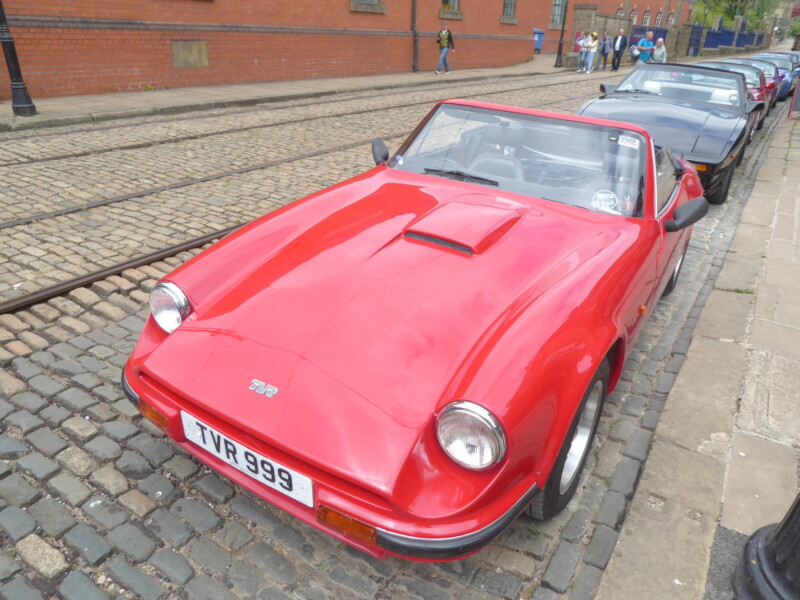
In planning this trip, I had spotted that Crich was hosting a meeting of the TVR Car Club, which I thought would provide an added attraction. However, when I reached the car park, there was no sign of a single TVR, so I wondered if they have been and gone. Having duly paid for a ticket and then started to walk down to the main part of the site, I then a line of TVRs parked up on the side of the street, so actually inside the site itself. Clearly space is limited, but there was quite a line of Blackpool’s finest machines here.
M Series: The TVR M Series cars were built between 1972 and 1979, replacing the Vixen and Tuscan models. The styling showed a clear resemblance to the models that the M replaced, with the centre section of the car being carried forward and conceptually, the cars were little different, with a front mid-engine, rear-wheel drive layout and body-on-frame construction. The bodies themselves were built from glass-reinforced plastic (GRP). The engines were bought in, sourced from Triumph and Ford, which resulted in a number of different models being made. These included the 1600M, 2500M, 3000M, 3000S, and Taimar, as well as turbocharged versions of the 3000M, 3000S, and Taimar. The first model to start production was the 2500M in March 1972, after being built as a prototype in 1971, which had the 2500cc engine from the Triumph 2.5PI and TR6 under the bonnet. Ford engined 1600M and 3000M models followed later. The American market was financially very important to TVR, and Gerry Sagerman oversaw import and distribution of the cars within the United States from his facility on Long Island. Approximately thirty dealers sold TVRs in the eastern part of the country. John Wadman handled distribution of the cars in Canada through his business, JAG Auto Enterprises.. A small number of 5.0 litre Ford V8-powered cars were finished or converted by the TVR North America importer; these were sold as the 5000M. A total of 2,465 M Series cars were built over the nine years of production. Because of the hand-built and low-volume nature of TVR production, there are many small and often-undocumented variations between cars of the same model that arise due to component availability and minor changes in the build process. The M Series was regarded by contemporary reviewers as being loud and fast and having excellent roadholding. This came at the expense of unusual ergonomics, and heating and ventilation systems that were sometimes problematic. The first major alteration to the M Series body was the hatchback Taimar, introduced at the October 1976 British International Motor Show and using the same mechanicals as the 3000M. The name was inspired by the name of Martin’s friend’s girlfriend, Tayma. The opening hatchback alleviated the previous difficulty of manoeuvering luggage over the seats to stow it in the cargo area, and the hatch itself was opened electrically via a solenoid-actuated latch triggered by a button on the driver’s doorjamb. Over its three-year production, a total of 395 normally aspirated Taimars were built. The final body style for the M Series, an open roadster, arrived in 1978 as the TVR 3000S (marketed in some places as the “Convertible”, and referred to at least once as the “Taimar Roadster”.) Like the Taimar, the 3000S was mechanically identical to the 3000M; the body, however, had undergone significant changes. Only the nose of the car was the same as the previous coupes, as the windscreen, doors, and rear end had all been reworked. The redesign of the doors precluded the possibility of using wind-up windows, so sliding sidecurtains were instead fitted. These could be removed entirely and stowed in the boot, which, for the first time on a TVR, was a separate compartment with its own lid. The boot lid was operated electrically in a manner similar to the Taimar’s hatch. Its design was not finalised by the time the first cars entered production, so the first several cars (including the prototype) were built with no cutout for boot access. The final styling tweaks and the production of moulds for the fibreglass were done by Topolec Ltd. of Norfolk. The styling of the 3000S was revived in a somewhat modernised form later, with the 1987 introduction of the TVR S Series (although the S Series shared almost no components with the M Series cars.) The windscreen and convertible top had been adapted from those used on the Jensen-Healey roadster. Because Jensen Motors had ceased operation in 1976, the windscreen and sidecurtain designs were done by a company named Jensen Special Products, which was run by former Jensen employees. The design for the convertible top was finalised by Car Hood Company in Coventry. One of the minor undocumented variations found on M Series cars is the presence of a map light built into the upper windscreen surround of the 3000S. It appears to have been included only on a very small number of cars built near the end of the production run. When production of the 3000S ended (with 258 cars built), it cost £8,730. Reportedly, 67 of these cars were in a left-hand drive configuration, and 49 were exported to North America.

Tasmin: TVR replaced their long-running shape with something really quite radical looking in early 1980. with the Tasmin, and there was a relatively early version of these “wedge” era TVRs here. During the 1970s, when Martin Lilley started to look where to take the Blackpool based company next, he noted that Lotus appeared to have reinvented itself with the Elite, Eclat and Esprit, losing much of the kit-car image in the process, and he thought he needed to do something similar. He needed a new design language, so he contacted Oliver Winterbottom who had done the Elite/Eclat for the Norfolk firm, hoping for something new. The wedge-shaped design that Winterbottom created was produced in 1977, and a prototype was created the following year, before the new car’s launch very early in 1980. Based on the Taimar, but with very different wedge styling, the car was not exactly received with massive enthusiasm. The styling looked a bit like yesterday’s car, as the wedge era was on the wane, and the car’s price pitched it against cars like the Porsche 924 Turbo. Development of the new car had drained TVR’s finances, which led to Lilley ceding control of the company in 1981 to Peter Wheeler. The convertible that followed helped matters a bit, whereas the 2 litre 200 and the 2+2 model did not, but in 1983, TVR announced a revised version with the potent Rover 3.5 litre V8 under the bonnet, in lieu of the 2.8 litre Ford Essex unit, and it transformed the car. It was just what was needed, and over the next few years, a series of ever more potent models, with ever wilder styling came into the range. By 1986, the 450SEAC boasted 340 bhp, making this something of a supercar.

S: TVR’s next model took something of a retro look, the S Series which was announced at the 1986 British International Motor Show, initially as a concept. Due to a massive positive response, the car went into production in less than 12 months, with 250 pre-manufacture orders. This was Peter Wheeler’s first major development since buying the company from Martin Lilley, and the turning point in TVR’s fortunes, which had struggled with the “Wedge” based cars that had been introduced in 1980 to replace the long running M Series models. With styling which looked more like these popular M Series cars, the first S Series cars used Ford’s Cologne V6 in 2.8 litre 160 hp and for the later S2 to S4 had the later 2.9 litre 170 hp unit. TVR made frequent updates to the cars, moving from those retrospectively called the S1 to S2 and later S3 and S4 in short succession. The S3 and S4 received longer doors, although some late S2’s were also thus equipped. Vehicle models ending with “C” were used to denote vehicles which were fitted with a catalytic converter. Only the S3 and S4 were fitted with catalysts. The Cat was only introduced to the UK in August 1992, at “K” registration, but catalysed cars were produced before that, intended for export to markets with tighter emissions standards. Just as they had done with the “wedges”, TVR found more excitement by putting the Rover V8 engine under the bonnet of the car in lieu of the Ford unit, though the two models were offered in parallel. The V8S used a 4.0 litre fuel-injected Rover V8 engine, with gas-flowed cylinder heads, higher lift camshaft, compression ratio upped to 10:5:1, revised manifold, new chip for the engine management system and a limited slip differential. The result was 240 bhp at 5250 rpm and 270 lb/ft of torque at 3000 rpm. The V8S had a number of cosmetic differences over the V6. The bonnet had a large hump – created to house the Italian specification supercharger but carried over to all V8S models. The V8S had a small vent facing the windscreen, whereas S1 to S3 models face forward. Very late S3 and S4 models had no hump at all. As with all TVR’s there is no specific point in time when they changed styles, probably when they ran out! The suspension track was slightly wider on the V8S achieved with revised wishbones at the front and revised trailing arms at the rear. Disc brakes are fitted all round. The standard specification of the V8S included ½ hide leather interior, walnut trim, mohair hood, OZ alloy wheels, driving lamps, electric windows and door mirrors. 0-60 mph could be achieved in 4.9 seconds and 0-100 mph in 12.9 seconds. It was faster than an Aston Martin Virage, a Ferrari Testarossa, Lotus Esprit Turbo SE and Porsche Carrera 2 the supercars of the early 1990s. Between 1986 and 1994 2,604 S Series cars were made; 410 of these were of the V8S variety.


Chimaera: The Chimaera was originally intended to replace the Griffith but sufficient demand for both of the models led TVR continuing them. In 1994, TVR introduced the Chimaera 500, a high performance derivative of the Chimaera. The BorgWarner T5 manual transmission replaced the Rover LT77 unit on the rest of the range. A new alternator, power steering and a single Vee belt were fitted to improve reliability. The 4.3 litre engine option was replaced by the 4.0 litre High Compression option. The Chimaera was mildly updated in 1996. Updates included a rear bumper shared with the Cerbera, push button doors with the buttons located under the wing mirrors, a boot lid shared with the Cerbera and the replacement of the front mesh grille with a horizontal bar. The GKN differential was also replaced by a BTR unit. A 4.5 litre model was added to the lineup in 1997. It was originally intended to be fitted with the AJP8 V8 engine but due to the engine not being ready on time, a bored version of the Rover V8 was used instead. In 1998, the rear light styling and the number plate mounting angle was updated while the base 4.0 litre model was discontinued. In 2001, the Chimaera was again facelifted and now featured the Griffith’s headlights as well as seats from the Cerbera. The Chimaera was succeeded by the Tamora in 2002.


Griffith: The Griffith was the first of the modern generation TVRs. First seen as a concept at the 1990 British Motor Show, it wowed the crowds sufficiently that unlike the Show Cars of precediing years, may of which were never seen again, Peter Wheeler and his small team in Blackpool immediately set about preparing it for production. It took until mid 1992 before they were ready. Like its forerunner namesakes, the Griffith 200 and Griffith 400, the modern Griffith was a lightweight (1048 kg) fibreglass-bodied, 2-door, 2-seat sports car with a V8 engine. Originally, it used a 4.0 litre 240 hp Rover V8 engine, but that could be optionally increased to a 4.3 litre 280 hp unit, with a further option of big-valve cylinder heads. In 1993, a TVR-developed 5.0 litre 340 hp version of the Rover V8 became available. All versions of the Griffith used the Lucas 14CUX engine management system and had a five-speed manual transmission. The car spawned a cheaper, and bigger-selling relative, the Chimaera, which was launched in 1993. 602 were sold in the first year and then around 250 cars a year were bought throughout the 90s, but demand started to wane, so iIn 2000, TVR announced that the Griffith production was going to end. A limited edition run of 100 Special Edition (SE) cars were built to mark the end of production. Although still very similar to the previous Griffith 500 model, the SE had a hybrid interior using the Chimaera dashboard and Cerbera seats. Noticeably, the rear lights were different along with different door mirrors, higher powered headlights and clear indicator lenses. Some also came with 16-inch wheels. Each car came with a numbered plaque in the glove box including the build number and a Special Edition Badge on its boot. All cars also had a unique signature in the boot under the carpet. The SEs were built between 2000 and 2002, with the last registered in 2003. A register of the last 100 SEs can be found at TVR Griffith 500 SE Register. These days, the Griffith remains a much loved classic and to celebrate the car, the owners have a meet called “The Griff Growl.”

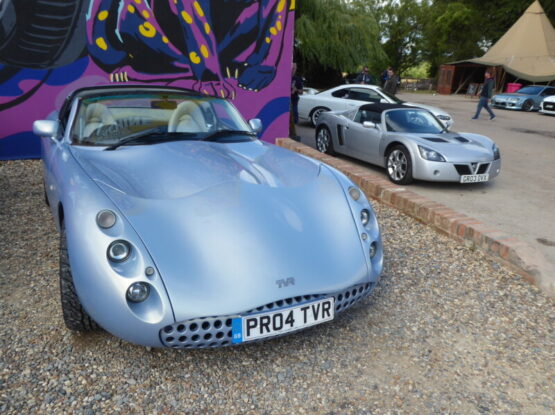
Tuscan: The Tuscan was launched in 2000, by which time there had been a series of what we think of as the modern era TVRs produced for nearly a decade, the Chimaera, Griffith and Cerbera. The Tuscan did not replace any of them, but was intended to help with the company’s ambitious push further up market to become a sort of Blackpool-built alternative to Ferrari. It did not lack the styling for the task, and unlike the preceding models with their Rover V8 engines, the new car came with TVR’s own engine, a straight six unit of 3.6 litre capacity putting out 360 bhp. The Tuscan was intended to be the grand tourer of the range, perfectly practical for everyday use, though with only two seats, no ABS, no airbags and no traction control, it was a tough sell on wet days in a more safety conscious world, but at least there was a removable targa top roof panel for those days when the sun came out. The car may have lacked the rumble of a V8, but when pushed hard, the sound track from the engine was still pretty special, and the car was faster than the Cerbera, but sadly, the car proved less than reliable, which really started to harm TVR’s reputation, something which would ultimately prove to be its undoing.


T350: The T350 cars were made from 2002 to 2006. They were based on the TVR Tamora, and powered by TVR’s Speed Six engine in 3.6 litre form, producing 350 hp. The T350 was available in coupe and targa versions, the coupe version being known as the T350C, and the targa version the T350T. The T350 later formed the base of the TVR Sagaris. Function dominates form evident by the car’s aero-dynamic design which has been created for maximum downforce and minimal drag. The smooth frontal nose and the sharp rear cut tail allows the car to be aerodynamically efficient while reducing drag. The sloping rear line of the car ensures that the car generates minimum lift at high speeds. The car takes many components from the entry level Tamora such as the interior, multi-function display and analogue metres. The optional Sport package adds extra options in the multi-functional display such as lap-times, oil temperature and water temperature. The fastback design of the car gives the customer an advantage of increased boot space. The powerful Speed Six engine is a proven race winning unit and very responsive suiting the car’s aggressive character with a 0 – 100 km/h time of just 4.4 seconds.


AND ALSO
Right by the tram stop there is a large area which could be used for more cars, here I found something else of automotive interest.
Triumph TR4: Successor to the TR3a, and code named “Zest” during development, the TR4 was based on the chassis and drivetrain of the previous TR sports cars, but with a modern Michelotti styled body. The TR 4 engine was carried over from the earlier TR2/3 models, but the displacement was increased from 1991cc to 2138 cc by increasing the bore size. Gradual improvements in the manifolds and cylinder head allowed for some improvements culminating in the TR4A model. The 1991 cc engine became a no-cost option for those cars destined to race in the under-two-litre classes of the day. Some cars were fitted with vane-type superchargers, as the three main bearing engine was liable to crankshaft failure if revved beyond 6,500 rpm; superchargers allowed a TR4 to produce much more horse-power and torque at relatively modest revolutions. The standard engine produced 105 bhp but, supercharged and otherwise performance-tuned, a 2.2-litre I4 version could produce in excess of 200 bhp at the flywheel. The TR4, in common with its predecessors, was fitted with a wet-sleeve engine, so that for competition use the engine’s cubic capacity could be changed by swapping the cylinder liners and pistons, allowing a competitor to race under different capacity rules (i.e. below or above 2 litres for example). Other key improvements over the TR3 included a wider track front and rear, slightly larger standard engine displacement, full synchromesh on all forward gears, and rack and pinion steering. In addition, the optional Laycock de Normanville electrically operated overdrive Laycock Overdrive could now be selected for 2nd and 3rd gear as well as 4th, effectively providing the TR4 with a seven-speed manual close ratio gearbox. The TR4 was originally fitted with 15×4.5″ disc wheels. Optional 48-lace wire wheels could be ordered painted the same colour as the car’s bodywork (rare), stove-enamelled (matte silver with chrome spinners, most common) or in matte or polished chrome finishes (originally rare, but now more commonly fitted). The most typical tyre originally fitted was 590-15 bias ply or optional radial tires. In the US at one point, American Racing alloy (magnesium and aluminium) wheels were offered as an option, in 15×5.5″ or 15×6″ size. Tyres were a problem for original owners who opted for 60-spoke wire wheels, as the correct size radial-ply tyre for the factory rims was 155-15, an odd-sized tyre at the time only available from Michelin at considerable expense. Some original TR4 sales literature says the original radial size was 165-15. The much more common 185-15 radials were too wide to be fitted safely. As a result, many owners had new and wider rims fitted and their wheels re-laced. The new TR4 body style did away with the classical cutaway door design of the previous TRs to allow for wind-down windows (in place of less convenient side-curtains), and the angular rear allowed a boot with considerable capacity for a sports car. Advanced features included the use of adjustable fascia ventilation, and the option of a unique hard top that consisted of a fixed glass rear window (called a backlight) with an integral rollbar and a detachable, steel centre panel (aluminium for the first 500 units). This was the first such roof system on a production car and preceded by 5 years the Porsche 911/912 Targa, which has since become a generic name for this style of top. On the TR4 the rigid roof panel was replaceable with an easily folded and stowed vinyl insert and supporting frame called a Surrey Top. The entire hard top assembly is often mistakenly referred to as a Surrey Top. In original factory parts catalogues the rigid top and backlight assembly is listed as the Hard Top kit. The vinyl insert and frame are offered separately as a Surrey Top. Features such as wind-down windows were seen as a necessary step forward to meet competition and achieve good sales in the important US market, where the vast majority of TR4s were eventually sold. Dealers had concerns that buyers might not fully appreciate the new amenities, therefore a special short run of TR3As (commonly called TR3Bs) was produced in 1961 and ’62. The TR4 proved very successful and continued the rugged, “hairy-chested” image that the previous TRs had enjoyed. 40,253 cars were built during production years. Most were sold new to the US, but plenty have returned, and it is estimated that there are not far short of 900 examples of the model in the UK at present.


THE TRAMWAY MUSEUM
Needless to say, the principal attraction for a lot of visitors here are the trams. And there are lots of them here. The majority are of UK origin, but there are some from other countries as well. At any one time, three from the collection are on duty providing rides up and down the line, a journey which takes round 15 minutes and for which you exchange the old penny you are given with your entrance ticket for a traditional cardboard ticket which the conductor duly punches with every ride you make.


There is a massive shed which houses most of the other trams. You can wander freely around in here, but it is quite hard to get photos, as you are very close to a series of trams that are parked up nose to tail.


A separate museum building has a wide range of exhibits which tell the story of the tram in the UK and which includes a lot of artefacts from the tramway era.


The site has numerous period pieces of street furniture and other memorabilia to find, and there are preserved examples of a typical pub and sweet shop to add more of a period feel.


There is loads of space in the carefully scaped site so you can just go for a walk, enjoy the trees and gardens and set up for a picnic and for those who bring small children, there is a large play area.
I loved this place. Whilst it would be cool to hold a Car Club meet here with cars on the street, the reality is that space is pretty limited and in fact even the main car park is not that large, but for those who want something a little different, then Crich has much to commend it. I will not wait anything like as long before returning!
Information on the National Tramway Museum is on their website: https://tramway.co.uk/