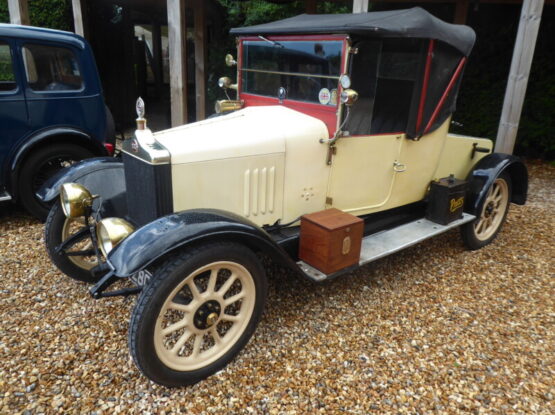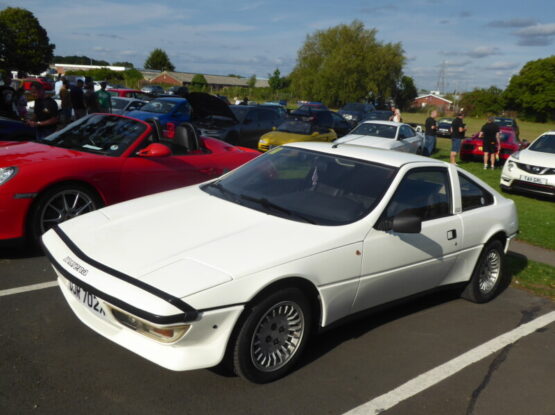
Over the years, the calendar of events at the iconic Prescott Hill Climb has evolved, retaining some of the most popular but also including some new ideas. One such relatively recent addition to the calendar is an event called Prescott Historique which celebrates all forms of motor sport from the dawn of motoring until into the twenty first century with a collection of all manner of different machinery entered to take part in a spectacle which encompasses static displays I the Paddock and action on the Hill. The first couple of these events proved so popular that in 2024 it was expanded to cover two days and that was clearly a success as the 2025 calendar also boasted this as a two-day event. I attended in 2024 and enjoyed it very much, so was determined to attend again in 2025, though diary logistics meant that the only day I could attend was the Saturday. Here is what I saw:
IN THE PADDOCK
In excess of 150 cars were entered for the hill climb, with the oldest having already celebrated their hundredth birthdays and the most modern being born around the turn of this century. That made for quite some variety, and there was a mix of cars that are inveterate attendees and some special guests that have not been seen at Prescott before. When not in action, they were all on show in the Paddock.
ABARTH
For the 595 SS, Abarth increased the engine capacity to 594 cc, just under the limit for the European 600cc racing sedan class. High compression 10:1 pistons were used together with a special camshaft, a specific alloy sump, Abarth valve covers and air filter, propped up engine lid and wheels were fitted and of course the exhaust system was a special in house model. This package together with lowered suspension, flared arches and 10 inch rims amounted to what was known as the Assetto Corsa SS model. These cars have become very rare as many were crashed in competition or simply rotted away due to bad rust protection in the 70s A number of recreations have been built, and these are two such. So, not original, but still nice and still a lot of fun.


Officially known as the Fiat-Abarth 850TC Berlina (Turismo Competizione, or “touring competition”), it was introduced towards the end of 1960, using Fiat 600 bodywork with some modifications, most notably a boxlike structure ahead of the front bumper which held the engine’s oil cooler. The rear wings were usually blistered, to accommodate larger wheels. The engine is a four-cylinder model based on a Fiat unit, with 847 cc capacity and 51 hp. Overall length is 3,090 mm (122 in), overall width is 1,400 mm (55 in), height is 1,380 mm (54 in), wheelbase is 2,000 mm (80 in), and its front and rear track are 1,160 mm (46 in). The fuel tank holds 5.9 imperial gallons, and its empty weight was 793 kg (1,748 lb). The 850TC remained in the price lists until 1966. In 1962 the 850TC Nürburgring was introduced, with 55 PS at 6500 rpm. The name was intended to celebrate the class victory of an Abarth 850TC at the 1961 Nürburgring 500 km race. There followed the 850TC/SS with two more horsepower; this was renamed the 850TC Nürburgring Corsa towards the end of the year. Between 1962 and 1971 the 850cc and 1000cc class cars won hundreds of races all over the World and were commonly called “Giant Killers” due to their superior performance over much larger cars, culminating in a famous dispute with SCCA authorities in the USA when Alfred Cosentino (FAZA) was banned from running his 1970 Fiat Abarth Berlina Corsa 1000 TCR “Radiale” engine because his car was faster (mainly in wet conditions) to many V8 Mustangs, AMC AMX’s and Chev Camaro’s etc. The SCCA authorities dictated FAZA and Cosentino be forced to use an early design engine a non “Radiale” engine from 1962 model in his cars but still achieved 51 Victories from 53 races. The most victories in SCCA racing history, thereby cementing the superiority of the Fiat Abarth Berlina Corsa over larger and more powerful cars.


In 1971 the Fiat 124 Spider was prepared for the World Rally Championship when Abarth became involved with its production and development. Abarth designer Ing. Colucci was responsible for getting the 124 Spider into Group 4 rally trim. Over this period the Abarth Spider was relatively successful with wins at the 1972 Hessen Rally, Acropolis Rally, 1973 Polish Rally, 19th on the 1973 RAC rally and seventh to mostly the Alpine Renaults on the 1973 Monte Carlo Rally. The Spider continued to perform with first, second and third in the 1974 eighth Portuguese TAP Rally, sixth in the 1974 1000 Lakes, fourth in the 1975 Monte Carlo Rally and also with Markku Alén driving the spider to third place. By 1976 the days of 124 rallying were numbered due to the appearance of the Fiat-Abarth 131. The Fiat Abarth 124 Rally is a street legal rally version of the 124 Sport Spider sold to the masses, known also as “124 Abarth Stradale”, introduced in November 1972. Its main purpose was to receive FIA homologation in the special grand touring cars (group 4) racing class, and replace the 1.6-litre Fiat Sport Spider rally cars which were presently being campaigned. At the time 124 had already won the 1972 European Rally Championship at the hands of Raffaele Pinto and Gino Macaluso. The 124 Rally was added to the Sport Spider range, which included the 1600 and 1800 models; the first 500 examples produced were earmarked for the domestic Italian market. Amongst the most notable modifications over the standard spider there were independent rear suspension, engine upgrades, lightweight body panels, and a rigid hard top. In place of the usual rear solid axle, there is independent suspension from lower wishbones, the original trailing arms, an upper strut and an anti-roll bar. At the front a radius rod on each side was added to the standard double wishbones. The Abarth-tuned type 132 AC 4.000 1.8-litre, twin-cam engine was brought from the standard 118 to 128 PS DIN (126 hp) by replacing the standard twin-choke carburettor with double vertical twin-choke Weber 44 IDFs, and by fitting an Abarth exhaust with a dual exit exhaust. The 9.8:1 compression ratio was left unchanged. The transmission is the all-synchronised five-speed optional on the other Sport Spider models, and brakes are discs on all four corners. Despite the 20 kg (44 lb) four-point roll bar fitted, kerb weight is 938 kg (2,068 lb), roughly 25 kg (55 lb) less than the regular 1.8-litre Sport Spider. Engine bonnet, boot lid and the fixed hard top are fibreglass, painted matt black, the rear window is perspex and the doors aluminium. Front and rear bumpers were deleted and replaced by simple rubber bumperettes. A single matte black wing mirror was fitted. Matte black wheel arch extensions house 185/70 VR 13 Pirelli CN 36 tyres on 5.5 J × 13″ four-spoke alloy wheels. Inside centre console, rear occasional seats, and glovebox lid were eliminated; while new features were anodised aluminium dashboard trim, a small three-spoke leather-covered Abarth steering wheel, and Recaro corduroy-and-leather bucket seats as an extra-cost option. The car carries Fiat badging front and rear, Abarth badges and “Fiat Abarth” scripts on the front wings, and Abarth wheel centre caps. Only three paint colours were available: Corsa red, white, and light blue.


ALFA ROMEO


AUSTIN
Not perhaps a car you would expect to see competing in any motorsport event, this is car started out as the fifth prototype of the ADO67 Allegro, built two years before launch and believed to be the first two-door version. Originally a 1500 automatic registered JUV 254K, it was used for transmission and suspension testing, but after an accident was rebuilt as a rally car with a 1750 engine and manual gearbox, re-registered as a new vehicle and driven by Peter Cooper for Patrick Motors of Bournemouth.


AUSTIN HEALEY
No fewer than 20 Healey cars were entered in the Healeysport Speed Championship. There was one lone Jensen Healey and the rest were a mix of the “Big Healey” in original 100 and later 3000 guises as well as a number of the smaller Sprite models.


BMW
There were only a few BMW models entered and as they were in age related classes, the 2002 was in Class 1 of the Fassi Speed Championship, whereas the later E30 models were in Class 3.


BUGATTI
The Type 13 was the first real Bugatti car. The Bugatti automobile had been prototyped as the Type 10 in Ettore Bugatti’s basement in 1908 and 1909 while he was chief engineer at Deutz Gasmotoren Fabrik in Cologne, Germany. The Type 10 used a monobloc straight-four engine of Ettore’s own design. it was an overhead cam unit with 2 valves per cylinder, highly advanced for the time. A very-undersquare design, it had a 60 mm bore and 100 mm stroke for a total of 1131 cc. This was attached to an open roadster body with solid axles front and rear. Leaf springs suspended the front with no suspension at all in the rear. Cables operated rear drum brakes. On ending his contract with Deutz, Ettore loaded his family into the Type 10 and headed to the Alsace region, then still part of the German Empire looking for a factory to begin producing cars of his own. After World War I, Alsace became a part of France again, of course. The prototype car was preserved and nicknamed “la baignoire” (“the bathtub”) by the staff at Molsheim in later years due to its shape. Ettore restored it in 1939 and repainted it an orange-red colour, earning it a new nickname, “le homard” (“the lobster”). It was moved to Bordeaux for the duration of World War II and remained there for decades before falling into private ownership. Today, the car is in California in the hands of a private collector. Upon starting operations at his new factory in Molsheim, Bugatti refined his light shaft-driven car into the Type 13 racer. This included boring the engine out to 65 mm for a total of 1368 cc. A major advance was the 4-valve head Bugatti designed — one of the first of its type ever conceived. Power output with dual Zenith Carburettors reached 30 hp at 4500 rpm, more than adequate for the 660 lb (300 kg) car. Leaf springs were now fitted all around, and the car rode on a roughly 79 in wheelbase. The new company produced five examples in 1910, and entered the French Grand Prix at Le Mans in 1911. The tiny Bugatti looked out of place at the race, but calmly took second place after seven hours of racing. World War I caused production to halt in the disputed region. Ettore took two completed Type 13 cars with him to Milan for the duration of the war, leaving the parts for three more buried near the factory. After the war, Bugatti returned, unearthed the parts, and prepared five Type 13s for racing. By the time production of the model ceased in 1920, 435 examples had been produced and the model had also formed the basis of the later Types 15, 17, 22, and 23. Most of the road cars used an 8-valve engine, though five Type 13 racers had 16-valve heads, one of the first ever produced. The road cars became known as “pur-sang” (“thoroughbred”) in keeping with Ettore Bugatti’s feelings for his designs. The car was brought back after World War I with multi-valve engines to bring fame to the marque at Brescia, which is why the model is often referred to as a Brescia Bugatti. The production “Brescia Tourer” also brought in much-needed cash.


Very well known as a model, indeed many would tell you that this is THE classic Bugatti, is the Type 35 and there were a number of these here. The Type 35 was phenomenally successful, winning over 1,000 races in its time. It took the Grand Prix World Championship in 1926 after winning 351 races and setting 47 records in the two prior years. At its height, Type 35s averaged 14 race wins per week. Bugatti won the Targa Florio for five consecutive years, from 1925 through 1929, with the Type 35. The original model, introduced at the Grand Prix of Lyon on August 3, 1924, used an evolution of the 3-valve 1991 cc overhead cam straight-8 engine first seen on the Type 29. Bore was 60 mm and stroke was 88 mm as on many previous Bugatti models. 96 examples were produced. This new powerplant featured five main bearings with an unusual ball bearing system. This allowed the engine to rev to 6000 rpm, and 90 hp was reliably produced. Solid axles with leaf springs were used front and rear, and drum brakes at back, operated by cables, were specified. Alloy wheels were a novelty, as was the hollow front axle for reduced unsprung weight. A second feature of the Type 35 that was to become a Bugatti trademark was passing the springs through the front axle rather than simply U-bolting them together as was done on their earlier cars. A less expensive version of the Type 35 appeared in May, 1925. The factory’s Type 35A name was ignored by the public, who nicknamed it “Tecla” after a famous maker of imitation jewellery. The Tecla’s engine used three plain bearings, smaller valves, and coil ignition like the Type 30. While this decreased maintenance requirements, it also reduced output. 139 of the Type 35As were sold. The Type 35C featured a Roots supercharger, despite Ettore Bugatti’s disdain for forced induction. Output was nearly 128 hp with a single Zenith carburettor. Type 35Cs won the French Grand Prix at Saint-Gaudens in 1928, and at Pau in 1930. Fifty examples left the factory. The final version of the Type 35 series was the Type 35B of 1927. Originally named Type 35TC, it shared the 2.3 litre engine of the Type 35T but added a large supercharger like the Type 35C. Output was 138 hp, and 45 examples were made. A British Racing Green Type 35B driven by William Grover-Williams won the 1929 French Grand Prix at Le Mans.

CADILLAC
Definitely something different, this is known as “Le Monstre”. In 1950, after the Le Mans 24 Hour, an American race driver decided to re-body one of his 61 series Cadillacs to make it more aerodynamic and that car became known as ‘Le Monstre’. In 2018 Derek Drinkwater and his team built a faithful recreation of ‘Le Monstre’ and raced it at Le Mans Classic. Since then, the car has raced two more times at the Classic and toured in the USA, racing at Daytona, Laguna Seca, Road America and Watkins Glen. This year Derek’s ‘Monster’ is entered for Le Mans Classic again to celebrate the 50-year anniversary since the original race. The car has a Cadillac 331 engine with five carbs, just like the original and ‘3 on the tree’.


CHAPARRAL

The Chaparral 1 was a sports racing car, designed, developed and built by Dick Troutman and Tom Barnes, and raced by Jim Hall, between 1958 and 1961. It is considered to be the first true “Chaparral,” prior to the introduction and founding of Chaparral Cars by Hall in 1962.

COOPER


DAIMLER
This car is affectionately known as Doris, and is well known both to Prescott regulars and to readers of Octane magazine, where it features along with other cars owned by the staff and contributors. The Daimler Conquest was produced by The Daimler Company Limited in the United Kingdom from 1953 to 1958. Based on the Lanchester Fourteen, the Conquest replaced the Daimler Consort. Sales were affected by increasing prices and by the fuel shortage caused by the Suez Crisis, and production ended by January 1958, before a replacement model was in production. The standard 1953 Conquest used a straight-six engine developed from the inline-four engine used in Lanchester’s Fourteen and Leda models. The engine was made from cast iron and had a single Zenith carburettor and a compression ratio of 6.6:1. With a bore of 76.2 mm and a stroke of 88.9 mm, the engine displaced 2,433 cc and delivered 75 bhp. The 1954 Conquest Century model had an alloy head with larger valves, higher compression, high lift cams, and twin SU carburettors. These modifications raised the power to 100 bhp at 4400 rpm. The body was a slightly modified version of that used on the earlier Lanchester Fourteen. Apart from the grille and fog lamps, the Conquest was identical to the Lanchester Fourteen and Leda. While the Fourteen had been coachbuilt of steel on a timber frame, the Leda had an all-steel body, on which the Conquest’s was based. The whole car appeared to have been developed within four months of Bernard Docker, then managing director of BSA, taking on the additional responsibility of managing director of Daimler in January 1953. Presented as a new car, the 75 hp Conquest originated in the 1950 Fourteen or Leda, produced by Daimler’s subsidiary, Lanchester. The chassis was suitably modified to accommodate its new 2.4-litre 6-cylinder engine. The usual Daimler large cruciform chassis had a double wishbone front suspension, with laminated torsion bars, telescopic dampers, and an anti-roll bar, while the rear suspension used leaf springs with telescopic dampers. All cars featured automatic chassis lubrication to 21 points, using a pump controlled by exhaust heat at startup. Cam and peg steering was used, and Girling hydro-mechanical brakes: hydraulic front, mechanical rear. The cars had an 2,642 mm (104 in) wheelbase. The Century specification included a stronger four-pinion differential, replacing the Conquest’s two-pinion differential. The Century’s brakes were also upgraded with increased lining area. In January 1955, a number of upgrades were announced. There was four inches more leg-space for rear seat passengers. In addition, doors now opened wider and there were “further interior embellishments”. In October 1955, the Mark II models were announced for the Earls Court Motor Show, available as before in Conquest (75 bhp) and Conquest Century (100 bhp) form. However, the Daimler Conquest Century was now called the Daimler Century in marketing literature. The built-in fog lamps were now replaced by independent valance-mounted fog and driving lamps and their former location became ducts for the heater and air vent.


DIAMOND T
The Diamond T Company was an American automobile and truck manufacturer. They produced commercial and military trucks. The Diamond T Motor Car Company was founded in Chicago in 1905 by C. A. Tilt. Reportedly, the company name was created when Tilt’s shoe-making father fashioned a logo featuring a big “T” (for Tilt) framed by a diamond, which signified high quality. The company’s hood emblem on trucks was a sled dog in harness. From its beginnings manufacturing touring cars, the company later became known for its trucks. By 1967, as a subsidiary of White Motor Corporation, it was merged with Reo Motor Company to become Diamond Reo Trucks, Inc. The Diamond T Model 404 is a classic medium-duty commercial vehicle produced by the Diamond T Motor Car Company from the late 1930s through the late 1940s. Known as the “Cadillac of trucks,” the Model 404 is highly prized today by vintage collectors, restorers, and custom rat-rod builders for its distinctively elegant styling. Unlike standard utilitarian work trucks of its era, the Model 404 blended heavy-duty capability with premium driver comforts and styling. Typically rated as a 1.5-ton to 2.5-ton truck depending on the specific chassis and spring configuration. Powered originally by a Hercules JXB 263 cubic-inch inline 6-cylinder flathead gasoline engine, producing roughly 68 to 80 horsepower.Drivetrain: Usually paired with a 4-speed Clark manual transmission and a vacuum-shifted 2-speed rear axle. It featured a significantly longer hood (10 inches longer) and sweeping front fenders (16 inches longer) compared to smaller models like the 201 pickup. Available in standard cabs and later “Tall Cab” 5-window configurations which gave operators 3 inches of extra rear legroom. The letters trailing the “404” model name indicated specific factory equipment upgrades: 404H / 404HH – Equipped with heavier-than-standard axle springs; 404HHS – features the heavy-duty springs alongside an upgraded Eaton vacuum-shifted rear axle rated for 19,000 lbs. Because of their sweeping lines and heavy steel build, surviving Model 404s have become popular platforms for high-end custom truck builds. Modern builders often pull the original sheet metal and mount it onto custom modern chassis, inserting modern Cummins turbo-diesels or LS/Coyote V8 engines to create unique car haulers and resto-mod “sleepers.”


ERA
R4D is the last development of this classic voiturette racing car, the only D-Type ever built. Originating as R4B in 1935, the car was rebuilt as a C-Type by modifying the front end of the chassis frame to accommodate independent Porsche-type torsion bar front suspension. Over the winter of 1937-38 the car was given a completely new fully boxed frame, and was designated R4D. This was the first ERA to be fitted with a Zoller supercharger (in 1935), and R4D accumulated a formidable competition record in its various guises, finally being purchased from the works by Raymond Mays, and running as a privately entered car in 1939. Mays set numerous pre-war records in R4D, including Prescott and Shelsley Walsh hill climbs, Brighton Sprints and Brooklands Mountain Circuit. Mays describes his history with the car in his book Split Second. After World War II R4D continued in active competition, but the demands on Mays’s time created by the evolving BRM project meant he competed less frequently. In 1952 Mays sold R4D to Ron Flockhart. In 1953 Flockhart had a phenomenally successful season, winning the Bo’ness hill climb in a record setting 33.82 seconds. The car was featured on the cover of Autosport magazine. This success led to his joining the BRM team as a works driver, and later successes at Le Mans and elsewhere. In 1954 Ken Wharton purchased R4D from Flockhart and used the car to win the RAC Hill Climb Championship. In 1955 he used R4D and his Cooper to finish equal first in the hill climb championship with Tony Marsh. Since Wharton was a multiple previous winner, the RAC awarded the championship to newcomer Marsh. An achievement of R4D in the post-war era is that it has won the Brighton Speed Trials seven times, driven by Raymond Mays four times and Ken Wharton three times, more wins than any other car at this event. The owner after Ken Wharton was the pseudonymous “T. Dryver,” creator of the aero-engined De Havilland-M.G. Special. He raced the ERA in the Brighton Speed Trials in 1957 but his chance of achieving fastest-time-of-the-day was spoiled by rain. From the mid-fifties onward, the car had a variety of owners, but achieved notable success in historic racing in the hands of Neil Corner and Willie Green (the latter driving for Anthony Bamford). R4D rose to pre-eminence again in the hands of Anthony Mayman, achieving many successes and setting many pre-war records at various venues. In recent years the car has been owned and driven by James Baxter and Mac Hulbert, and continues to be one of the most successful pre-war racing cars still active in competition, having set new pre-war records at numerous venues.


Anthony J. Merrick prepared and raced R1A until its then owner sold the car. Being without a car the resourceful Merrick shuffled his stock of genuine ERA parts and came up with AJM1. The 1980s brand new 1930s car is said to be an 80% original ERA B-type car using a 1.5litre engine and light green early works colour scheme, though it has since been repainted in red.


FORD

GINETTA
The G16 was produced as a Group 6 sports-racer in 1968-1969. Buyers installed engines of choice; known fitments include BRM, Coventry Climax, Cosworth FVA and BMW units of 2 litres capacity. Ten examples were built, but it did not prove particularly successful in competition.

LOTUS
There were two separate categories of Lotus cars in the Paul Matty Lotus Championship for Road Cars and also for Racing Cars. I seem only to have the one picture from the Road Car Championship, though there were actually sixteen cars entered, from the classic Elan pictured to more recent Elise and Exige.

Eleven cars featured in the Paul Matty Lotus Championship for Racing Cars
The Lotus 23 was designed by Colin Chapman as a small-displacement sports racing car. Nominally a two-seater, it was purpose-built for FIA Group 4 racing in 1962–1963. Unlike its predecessors Lotus 15 and 17, the engine was mounted amidship behind the driver in the similar configuration developed on Lotus 19. To comply with FIA rules, it had a regulation trunk space to the right-rear of the driver, a windshield wiper, a horn, pairs of headlights and tail lights, rear center licence plate light, a cable-operated hand brake, and a mounting space for one spare tire under the front body. The 23 used a wider version of the Lotus 22 space frame, clothed in a fiberglass body. It was originally intended for engines of 750 cc to 1300 cc (45-80ci) with a Renault 4-speed transaxle, but had a 5-speed Hewland Mk.III in production, which used the entire Volkswagen magnesium alloy transaxle case in upside-down configuration, housing bespoke straight-cut gears with dog-rings, and the Volkswagen differential gear set. Unlike the later Mk.IV/V, the Mk.III had the shifter rod at the end of the VW nose casing, so the shifting rod (pipe) from the centre shifter knob location extended to the tail end of the chassis. As this part was not completely covered by the bodywork, a following driver with good eyesight could tell when the 23 with Hewland Mk.III shifted gears. The front suspension was a typical double wishbone arms with outboard coil/damper unit using the Triumph upright made by Alford & Alder, Triumph Herald rack and pinion steering, and outboard Girling non-ventilated disc brake. The rear had the top link with lower reversed wishbone, top and bottom radius arms with the top arm at the height of the halfshaft, combined with the outboard disc brakes and coil/damper unit. Unlike the arrangement for Lotus 20 suspension, the halfshafts had Metalastic rubber ‘doughnuts’ on the inside, carrying no cornering (side) forces. The side forces are carried by the lower wishbone, together with the top ‘I’ arm link, which connects the tail end of the upper side tube in the frame with the extended top end of cast alloy upright. The tie-rod end, front top and bottom wishbone outside joints were ball joints, and the rear lower wishbone inside joints were Rose joint. The rest of the suspension joints were rubber joint, with joint-mounting pipes welded onto the ends of suspension arms. While most of the suspension arms were in common with Lotus 22, the angle of the rear radius arms on the plan view was different from the narrower-frame Lotus 22, so they were not interchangeable with the 22. On the frame structure, the lower side pipes and the width-wise lower pipe behind the cockpit were rectangle tubes, with most of the other frame pipes being round steel tubes in various diameter. The upper left round pipe was used as the water feed pipe (the use of anti-freeze chemicals was prohibited by most of the race organisers at the time for the danger of making the tarmac slippery) for the radiator up front, and the lower right side pipe and a half of the width-wise lower rear cockpit pipe were used as the return path. Likewise, the upper right side pipe was the oil feed to the oil cooler, and the lower left tube was the return. This frame was mostly made by Arch Motors, carrying ‘AM’ serial number. This water/oil-bearing frame configuration was shared with Lotus 22 and other later Lotus formula cars, but the combination of a wider and thus larger radiator, wider and bulkier steel frame acting as a cooling device, and the small displacement engines resulted in more than ample cooling capacity. Atypical of the contemporary racing cars, Lotus 23 models sometimes experienced an over-cooling problem when the thermostat was not installed in the coolant circuit in sprint races, and displayed a very stable water/oil temperature in endurance racing. The 23B in 1963 had the original center gear shifter relocated to the right side of the driver, and the radiator and oil cooler were combined into a single unit, with the lower 1/5 or so acting as the oil cooler. The frame received additional structural tubes to take the torque of Lotus TwinCam-based 1.6 litre Cosworth Mk.XII and Mk.XIII, mated to “high torque spec” 5-speed Hewland Mk.V transaxle. Smaller displacement engines were mated to 5-speed Hewland Mk.IV. Both the Mk.IV and Mk.V transaxles had GKN (Ford Zephyr) differential gears and a forward-facing selector rod on the right side in a bespoke (Hewland made) tail casing. The intake funnels on the Weber carburettors on 23B (and the 23C) were housed in a “cold air box” which received fresh air from two oval holes cut out on the top side of the rear body behind the driver. The 23B proved to be very successful in being a “giant killer” often beating cars in larger classes, but the limited road adhesion due to the narrow tyre width became apparent as the shortcoming in running with the larger cars. The 23C was developed using much wider Formula Two tyres mounted on wider 6-stud, six-spoke magnesium wheels front and rear. The body received wing-extensions to cover the wider tyres, with the characteristic 23/23B rear wings (covering the top half of the wheels on the outside) cut-out to expose the entire tyre/wheel in the side view. Lotus 23 proved a competitive, durable, and popular race car. These cars are still a mainstay of vintage racing in Europe and the United States today. Including the 23B and 23C, about 130 examples were made in period, but the popularity of the model led to many additional cars assembled from replacement and reproduction parts. The current estimate on the total number ranges between 200 and 400 excluding Xanthos and Noble.

This one is a Lotus 61. Lotus was one of the first major manufacturers of racing cars to embrace the new Formula Ford after its inception in 1967. Intended as a low-cost introduction to ‘proper’ motor racing, Formula Ford required relatively inexpensive cars that were easy for the novice to maintain. In line with these requirements, the Lotus 61 was an entirely conventional design by the standards of the day, being constructed around a multi-tube steel spaceframe with wishbone suspension all round. It was one of a number of Lotus formula car designs of this period to feature wedge-shaped bodywork, an innovation first seen on the Type 56 Indianapolis car.

The Lotus 69 was an open-wheel formula racing car developed by Lotus in 1969 for use in Formula 2, Formula 3, and Formula Ford. Since the Formula 2 regulations for 1970 provided for extensive changes to the vehicles, Dave Baldwin developed the Lotus 69 based on the Lotus 59 Formula 2 car. He left the basic Lotus 59 construction untouched and only changed the central monocoque section, which contained the two fuel tanks. The chassis mounts have been modified and the front has been adapted to the new regulations to reduce the radiator inlet. Since only engines up to a maximum of 1600 cc were allowed in Formula 2 from 1967 to 1971, the car received a 1.6-liter Cosworth FVA four-cylinder engine and a Hewland F.T.200 gearbox. The basic vehicle construction was designed in such a way that by adding other suspensions and brakes, and by changing the body parts and the wheels, the Lotus 69 could be built into a Formula 3 or Formula B- compliant racing car. With the increase in the displacement limit to 2000 cc in Formula 2, the racing cars were equipped with a Cosworth BDA engine in 1971. The Lotus 69F was built to Formula Ford regulations and featured a space frame chassis with a modified front end and narrower wheels than the Formula 2 and Formula 3 variants. It was delivered with 1.6-liter Ford/Lotus engines. A total of 57 racing cars were produced by the Lotus 69, of which eight cars were built for Formula 2. A Formula 2 vehicle was purchased by Pete Lovely and briefly converted into a Formula 1 car. He used this in 1971 at the Canadian Grand Prix and the US Grand Prix without success. The Lotus 69 was the last model developed and produced for customer use. In 1971 Colin Chapman closed Lotus Racing Ltd. and concentrated on Formula 1 motorsport with his works team.


MALLOCK
The Mark 18 dates from 1976. A Clubman’s Formula car, it was a longer wheelbase development of the MK16 with an extra four inches mainly in the engine bay. At least 20 cars were sold making the MK18, along with the MK16, the most popular Mallock ever built.


Mark 20/21


Mark 23

McLAREN
One of the demo cars, this is a McLaren M10B. The McLaren M10 was a Formula 5000 race car chassis built by McLaren that competed in North America, Europe, Australia and New Zealand between 1969 and 1973. The McLaren M10 was manufactured in large numbers. Built close to the weight limit, it was very light and was powered by a 500+ hp Chevrolet V8 engine. The cars were not manufactured by McLaren itself, but by the British racing car manufacturer Trojan. Trojan was able to complete and deliver 17 of the originally ordered quantity of 50 vehicles. The M10 was the only Formula 5000 racing car to win the North American Formula 5000 Championship twice. In 1970, John Cannon won the championship with four race wins. A year later, Briton David Hobbs won the championship with victories at Seattle, Road America, Laguna Seca, Edmonton, and Lime Rock. Australian driver Frank Matich drove a Repco-Holden V8 engine powered McLaren M10B to victory in the 1970 Australian Grand Prix at the Warwick Farm Raceway in Sydney. It was the first of 13 wins for McLaren in the Australian Grand Prix as of 2025 (not including Bruce McLaren’s own AGP wins in 1962 and 1965). The M10 was also used in the European Formula 5000 Championship. In the first season of this series, Peter Gethin won the championship title with an M10 fielded by Church Farm Racing.


MG
This is a somewhat modified MG TC.

MINI


MORRIS

PONTIAC
Probably the noisiest car of the day was this, a genuine NASCAR. Richard Petty drove Pontiacs during the final 12 years of his NASCAR Cup Series career, switching to the manufacturer in 1982 and racing the iconic orange and “Petty Blue” No. 43 Pontiac Grand Prix until his retirement in 1992.Petty’s era in a Pontiac is best known for several major milestones. On July 4, 1984, Petty drove his Pontiac to a historic 200th career victory at the Firecracker 400 at Daytona International Speedway, with President Ronald Reagan in attendance. In the mid-1980s, Petty collaborated with Pontiac on the aerodynamic “2+2” homologation special for the street, famously suggesting a sleeker rear window design to make the Grand Prix more competitive against the Ford Thunderbirds of the era. In 1992, Petty concluded his legendary career driving a Pontiac during his highly publicized fan appreciation “Fan Tour”. To celebrate Petty’s long association with the brand, Pontiac released a limited-production “Richard Petty Edition” Grand Prix Coupe for the 1992 model year. Limited to just 1,000 units, the road cars came with color-matching wheels, special striping, and a 3.4-litre Quad Cam V6 engine.


PRINGETT

RAYMOND MAYS
Perhaps in an attempt to capitalise on the success enjoyed by his ERA single-seaters (or his own reputation as a driver), Raymond Mays set up as an independent producer during the late 1930s. Like SS Cars’ William Lyons before him, Mays sourced the engine for his new sports car from the Standard Motor Company. But whereas contemporary SS Jaguars made do with inline fours and sixes, the Raymond Mays Special was powered by Standard’s 2.7 litre V8. Effectively two Standard Ten blocks on a common crankcase, the latter boasted a sturdy three-bearing crankshaft, coil ignition and light alloy cylinder heads. Conscious that the contemporary motoring press felt that Standard’s V8 had overwhelmed its stock running gear, Mays asked his ERA (and later BRM) collaborator, Peter Berthon to come up with a suitably improved frame. Notable for its use of deep, box-section side members and a similarly reinforced cruciform brace, the resultant chassis also employed transverse-leaf independent front suspension, a live rear axle, front/rear anti-roll bars and four-wheel drum brakes. Only five cars were built before the outbreak of WW2 forced the project’s abandonment: three tourers with bodies by R.E.A.L., of Ealing including the original prototype ‘FLN 386’; a Carlton Coupé (registered ‘FLN 388’) for L Prideaux-Brune, director of the sales company, Shelsley Motors; and one with a Standard open body. In an article published in The Automobile magazine (November 1988 edition, copy available) Alec Rivers Fletcher, who was involved with both the ERA and Mays Special projects, recalls that the car that did the most mileage was the original prototype ‘FLN 386’, which he described as ‘undoubtedly the fastest of all when fitted with twin carburettors and a higher ratio back axle.’ In its 4th April 1939 edition, The Motor announced that the Raymond Mays Special’s first public appearance would be at that year’s RAC Rally, four cars being entered. In the event, three made the start and were driven by Sammy Davis, Dick Anthony and Raymond Mays himself. However, the Mays Special proved not to be competitive with the SS100s and BMW 328s that dominated this type of event in the late 1930s. ‘FLN 386’ was used by the Berkshire Police from just after the war’s end to around 1956 when it passed into private ownership. Whilst in Police service the Mays Special formed part of the official escort that greeted Her Majesty The Queen (then Princess Elizabeth) when she visited Radley College in June 1947. Many years later, Alan Mowlem, researching the whereabouts of the surviving Mays Specials, located ‘FLN 386’ in the USA, where it had been since 1974, and was able to purchase the car. The Mays Special had been fitted with a four-cylinder engine, but came with a spare Standard 20hp V8. It has been recently restored and repainted from cream to the rich burgundy colour you see here.


RENAULT
One of the newest cars taking part was this R5 GT Turbo.

THE SHED
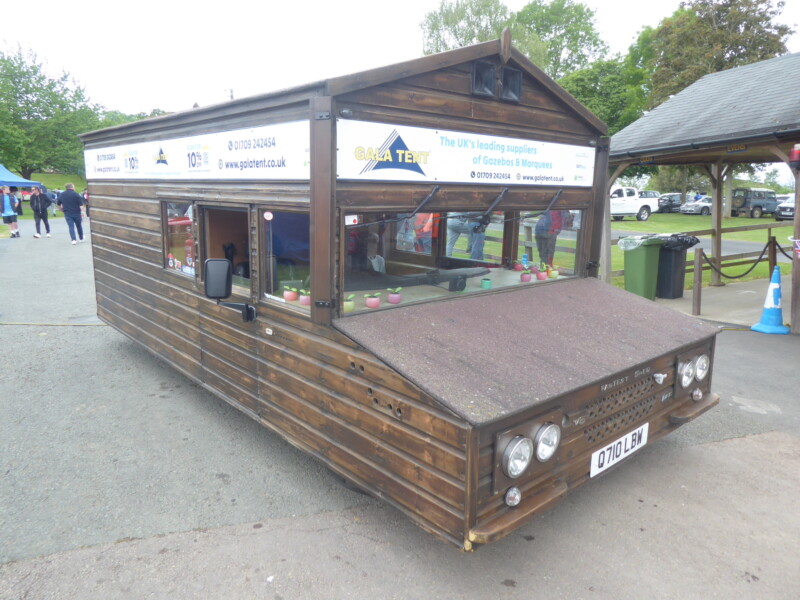
Perhaps even more bizarre than Le Monstre is this, the Fastest Shed, something I’ve read about many times but never seen before. Fastest Shed is a motorised shed designed and built by Kevin Nicks of Great Rollright, Chipping Norton, Oxfordshire, United Kingdom. The vehicle has been used to break the world land speed record for sheds three times since it was built in 2015. The most recent record was a speed of 114.7 mph (184.6 km/h) set on 23 September 2018 at Pendine Sands in Wales. Kevin Nicks, a mechanic and gardener from Chipping Norton in Oxfordshire, United Kingdom came up with the idea of building the unusual vehicle in 2015, as a way of making use of a broken-down Volkswagen Passat he had in his garden. His original focus was to use the Shed for advertising – believing that major organisations would be interested in using a car covered in wood as a replacement for an online marketing strategy. Nicks took twelve months to build the steel frame and wooden shiplap bodywork, install the engine and to make the vehicle roadworthy. The total expenditure for the vehicle was about £50,000. Fastest Shed’s original build was based on a Volkswagen Passat 4Motion, including its 190 bhp engine. Later, the engine power was increased to 265 bhp by fitting it with a nitrous oxide injection kit. For the September 2018 record attempt, the vehicle was fitted with a 400 bhp Audi RS4 (B5) engine. In an interview with Car Throttle, which aired on YouTube, Nicks has confirmed he changed the engine, replacing the existing B5 generation engine with an engine used in the B7 generation RS4, producing 455 bhp. It is also fitted with hydraulic suspension. In May 2018, Nicks broke his own record, achieving a speed of 101.046 mph (162.618 km/h). In mid 2017, Nicks drove Fastest Shed from Land’s End to John O’Groats to raise funds for a hospice charity. Nicks broke this trip at Elvington airfield to attempt a 100 mph (160 km/h) run, but the vehicle only achieved a maximum of 96 mph (154 km/h) on this occasion. A few days after arriving in John O’Groats, Nicks embarked on the North Coast 500 route around the coast of Scotland, which he completed in 12 hours. On 16 September 2017, Nicks set his first shed world speed record. He broke the previous record of 58 mph (94 km/h) held by Edd China, by achieving a speed of 80.673 mph (129.831 km/h) at Elvington airfield, Yorkshire. On 12 May 2018, Fastest Shed broke its first record on Pendine Sands, Carmarthenshire, Wales, with a recorded speed of 101.046 mph (162.618 km/h). Fastest Shed broke the record for the third time, surpassing its previous record by a narrow margin, recording a speed of 101.581 mph (163.479 km/h), again on Pendine Sands, at the Straightliners “Top Speed” event on 23 September 2018.


SUNBEAM

TERRIER

TRIUMPH
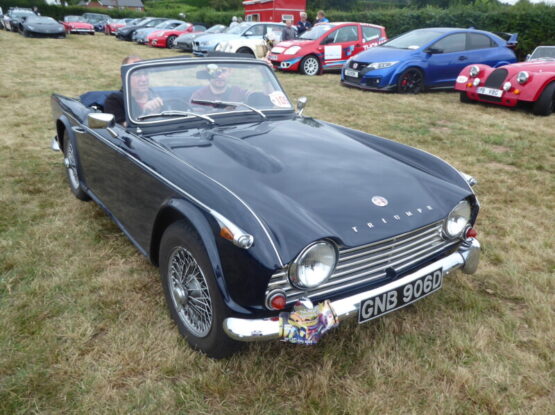
There was quite a collection of historic Triumph cars taking to the hill, hill, in the Triumph TR Register Triumph Speed Championship. Most of them were TR models, as you might expect but there were some saloons as well.


MICRO CARS
BMW Isetta: The Isetta is far more significant than many show-goers would realise, as without these cars, the modern BMW company simply would not exist. However, the car originated with the Italian firm of Iso SpA, and it is two of those models which were to be seen here. In the early 1950s the company was building refrigerators, motor scooters and small three-wheeled trucks. Iso’s owner, Renzo Rivolta, decided he would like to build a small car for mass distribution. By 1952 the engineers Ermenegildo Preti and Pierluigi Raggi had designed a small car that used the motorcycle engine of the Iso Moto 200 and named it Isetta—an Italian diminutive meaning little ISO. The Isetta caused a sensation when it was introduced to the motoring press in Turin in November 1953, it was unlike anything seen before. Small (only 7.5 ft long by 4.5 ft wide) and egg-shaped, with bubble-type windows, the entire front end of the car hinged outwards to allow entry. In the event of a crash, the driver and passenger were to exit through the canvas sunroof. The steering wheel and instrument panel swung out with the single door, as this made access to the single bench seat simpler. The seat provided reasonable comfort for two occupants, and perhaps a small child. Behind the seat was a large parcel shelf with a spare wheel located below. A heater was optional, and ventilation was provided by opening the fabric sunroof. Power came from a 236 cc 9.5 hp split-single two-stroke motorcycle engine. The engine was started by a combination generator-starter known as Dynastart. A manual gearbox provided four forward speeds and reverse. A chain drive connected the gearbox to a solid rear axle with a pair of closely spaced 25 cm (10 in) rear wheels. The first prototypes had one wheel at the rear, but having a single rear wheel made the car prone to roll-overs, so the rear wheel layout was changed to two wheels set 19 in apart from each other. This narrow track eliminated the need for a differential. The front axle was a modified version of a Dubonnet independent front suspension. The Isetta took over 30 seconds to reach 50 km/h (31 mph) from rest. Top speed was only about 75 km/h (47 mph). The fuel tank held only 13 litres. However, the Isetta would get somewhere between 50 and 70 mpg depending on how it was driven. In 1954, Iso entered several Isettas in the legendary Mille Miglia where they took the top three spots in the economy classification. Over a distance of 1,600 km (1,000 mi) the drivers achieved an average speed of over 70 km/h (43 mph). In view of its maximum speed, which was just 15 km/h (9 mph) higher, this was an almost incredible figure. However, despite its initial success, the Isetta was beginning to slip in popularity at home. This was mainly due to renewed competition from Fiat with its 500C model. Renzo Rivolta wanted to concentrate on his new Iso Rivolta sports car, and was extremely interested in doing licensing deals. Plants in Spain and Belgium were already assembling Isettas and Autocarros using Italian made Iso components. BMW began talking with Rivolta in mid-1954 and bought not just a license but the complete Isetta body tooling as well. Rivolta did not stop with licensing the Isetta to BMW. He negotiated similar deals with companies in France and Brazil. After constructing some 1,000 units, production of the Italian built cars ceased in 1955, although Iso continued to build the Isetta in Spain until 1958. In addition to the Turismo, Iso in Spain also built the Autocarro, a commercial version with full-width rear axle. The Autocarro was offered in several body styles, a flatbed pickup, enclosed truck, a tilt-bed, or even a fire engine, although some of these might not have been sold. The Autocarro was an extremely popular type of vehicle in Italy, and numerous manufacturers produced some variant of the type. Iso had previously produced a motorcycle-type Isocarro. The Iso Autocarro was larger than most, with its four-wheel layout, conventional rear axle with differential and leaf springs, and a large tubular frame. It could carry a 500 kg load. It is thought that more than 4,000 Autocarros were built


This is a Lambretta Willam. The first model, designed by the Italian coachbuilder Scattolini and equipped with the same engine 125 cm3 Innocenti Lambretta , was born on the initiative of the Italian entrepreneur Carlo Lavezzari and was presented as a prototype at the Paris Motor Show 1966 which aroused the interest French entrepreneur Henri Willame , Director of Lambretta France who commissioned the production constituting Lavezzari, now Lawil , an acronym of the names of the two partners of the firm. The small car began to be marketed in Italy in 1971 under the name of Lawil Varzina (named after the town of Varzi ) undergoing profound changes to the mechanics and the motor, originally a Lambretta 125cc was replaced by a BCB 250 cc , also the wheels were change with 8” ones replacing the previous 10”. At the time, according to Italian law, the so-called microcars could not have more than three wheels so the Varzina , with four wheels , was the smallest car for sale in Italy. The same car was marketed in France, where it was considered to be a quadricycle, as the Willam Farmer and it was imported the following year (1972) to England by the coachbuilder Crayford. The car was very small: the length of the prototype did not exceed 1.78 m but there was room for two passengers and with the mechanics of Lambretta engines and two-stroke single-cylinder 125 cc and 175 cc, then the car was lengthened by 27 cm in 1969 and in 1980, shortly before the cessation of production by an additional 20 cm.


IN THE CAR PARKS
Of course there were lots of interesting cars in the public car park, too, so I made sure I wandered around a couple of times to see what I could find. Here is what I saw:
ABARTH
What is known as the Series 4 version of the familiar 595 reached the markets in the middle of 2016. After rumours had circulated all winter following the launch of the facelifted Fiat 500 last year, Abarth finally unveiled the Series 4 at the end of May 2016. Initially, we were told that the cars would not be available in the UK until September, but that came forward somewhat, with dealers all receiving demo cars in June, and the first customers taking delivery in July. Three regular production versions of both the closed car and the open-topped C were initially available, all badged 595, and called Custom, Turismo and Competizione, as before, though numerous limited edition models have since appeared and in most case disappeared. The most significant changes with the Series 4 are visual, with a couple of new colours, including the much asked for Modena Yellow and a different red, called Abarth Red, which replaces both the non-metallic Officina and – slightly surprisingly – the tri-coat pearlescent Cordolo Red. as well as styling changes front and rear. The jury is still out on these, with many, me included, remaining to be convinced. At the front, the new air intake does apparently allow around 15 – 20 % more air in and out, which will be welcome, as these cars do generate quite a lot of heat under the bonnet. Competizione models for the UK retain the old style headlights, as they have Xenon lights as standard, whereas the Custom and Turismo cars have reshaped units. At the back, there are new light clusters and a new rear bumper and diffuser. Inside, the most notable change is the replacement of the Blue & Me system with a more modern uConnect Audio set up, which brings a new colour screen to the dash. Mechanically, there is an additional 5 bhp on the Custom (now 145) and Turismo (now 165 bhp) and the option of a Limited Slip Diff for the Competizione, which is likely to prove a popular option. Details of the interior trim have changed, with a filled-in glovebox like the US market cars have always had, and electric windows switches that are like the US ones, as well as a part Alcantara trim to the steering wheel in Competizione cars.


AC
AC had come back to the market after the Second World War with the staid 2-Litre range of cars in 1947, but it was with the Ace sports car of 1953 that the company really made its reputation in the post war years. Casting around for a replacement for the ageing 2-Litre, AC took up a design by John Tojeiro that used a light ladder type tubular frame, all independent transverse leaf spring suspension, and an open two seater alloy body made using English wheeling machines, possibly inspired by the Ferrari Barchetta of the day. Early cars used AC’s elderly 100 bhp two-litre overhead cam straight-six engine (first seen soon after the end of the First World War), which, according to a 1954 road test by Motor magazine, gave a top speed of 103 mph, a 0–60 mph in 11.4 seconds and a fuel consumption of 25.2 mpg. It was hardly a sporting engine, however, and it was felt that something more modern and powerful was required to put the modern chassis to good use. Joining the Ace in 1954 was the Aceca hard top coupé, which had an early form of hatchback rear door but used the same basic timber framed alloy body. From 1956, there was the option of Bristol Cars’ two-litre 120 bhp straight-six with 3 downdraught carburettors and slick four-speed gearbox. Top speed leapt to 116 mph with 0–60 mph in the nine second bracket. Overdrive was available from 1956 and front disc brakes were an option from 1957, although they were later standardised. In 1961 a new 2.6-litre straight-six ‘Ruddspeed’ option was available, adapted by Ken Rudd from the unit used in the Ford Zephyr. It used three Weber or SU carburettors and either a ‘Mays’ or an iron cast head. This setup boosted the car’s performance further, with some versions tuned to 170 bhp, providing a top speed of 130 mph and 0–60 mph in 8.1 seconds. However, it was not long before Carroll Shelby drew AC’s attention to the Cobra, so only 37 of the 2.6 models were made. These Ford engined models had a smaller grille which was carried over to the Cobra.

ALFA ROMEO
There’s a complex history to this much-loved classic. The first car was called the Alfa Romeo Giulia Sprint GT, and was revealed at a press event held at the then newly opened Arese plant on 9 September 1963, and displayed later the same month at the Frankfurt Motor Show. In its original form the Bertone body is known as scalino (step) or “step front”, because of the leading edge of the engine compartment lid which sat 1/4 an inch above the nose of the car. The Giulia Sprint GT can be distinguished from the later models by a number of features including: Exterior badging: Alfa Romeo logo on the front grille, a chrome script reading “Giulia Sprint GT” on the boot lid, and rectangular “Disegno di Bertone” badges aft of the front wheel arches; flat, chrome grille in plain, wide rectangular mesh without additional chrome bars; single-piece chrome bumpers; no overriders. Inside the cabin the padded vinyl dashboard was characterised by a concave horizontal fascia, finished in grey anti-glare crackle-effect paint. Four round instruments were inset in the fascia in front of the driver. The steering wheel was non-dished, with three aluminium spokes, a thin bakelite rim and a centre horn button. Vinyl-covered seats with cloth centres and a fully carpeted floor were standard, while leather upholstery was an extra-cost option. After initially marketing it as a four-seater, Alfa Romeo soon changed its definition of the car to a more realistic 2+2. The Giulia Sprint GT was fitted with the 1,570 cc version of Alfa Romeo’s all-aluminium twin cam inline four (78 mm bore × 82 mm stroke), which had first debuted on the 1962 Giulia Berlina. Breathing through two twin-choke Weber 40 DCOE 4 carburettors, on the Sprint GT this engine produced 105 hp at 6,000 rpm. Like all subsequent models, the Sprint GT was equipped with an all-synchromesh 5-speed manual transmission. The braking system comprised four Dunlop disc brakes and a vacuum servo. The rear brakes featured an unusual arrangement with the slave cylinders mounted on the axle tubes, operating the calipers by a system of levers and cranks. According to Alfa Romeo the car could reach a top speed of “over 180 km/h (112 mph)”. In total 21,902 Giulia Sprint GT were produced from 1963 to 1965, when the model was superceded by the Giulia Sprint GT Veloce. Of these 2,274 were right hand drive: 1,354 cars fully finished in Arese, and 920 shipped in complete knock-down kit form for foreign assembly. For 1966, the Giulia Sprint GT was replaced by the Alfa Romeo Giulia Sprint GT Veloce, which was very similar but featuring a number of improvements: a revised engine—slightly more powerful and with more torque—better interior fittings and changes to the exterior trim. Alongside the brand new 1750 Spider Veloce which shared its updated engine the Sprint GT Veloce was introduced at the 36th Geneva Motor Show in March 1966, and then tested by the international specialist press in Gardone on the Garda Lake. Production had began in 1965 and ended in 1968. The Giulia Sprint GT Veloce can be most easily distinguished from other models by the following features: badging as per Giulia Sprint GT, with the addition of round enamel badges on the C-pillar—a green Quadrifoglio (four-leaf clover) on an ivory background—and a chrome “Veloce” script on the tail panel; black mesh grille with three horizontal chrome bars; the grille heart has 7 bars instead of 6; stainless steel bumpers, as opposed to the chromed mild steel bumpers on the Giulia Sprint GT. The bumpers are the same shape, but are made in two pieces (front) and three pieces (rear) with small covers hiding the joining rivets. Inside the main changes from the Giulia Sprint GT were imitation wood dashboard fascia instead of the previous anti-glare grey finish, front seats revised to a mild “bucket” design, and a dished three aluminium spoke steering wheel, with a black rim and horn buttons through the spokes. The Veloce’s type 00536 engine, identical to the Spider 1600 Duetto’s, featured modifications compared to the Giulia Sprint GT’s type 00502—such as larger diameter exhaust valves. As a result it produced 108 hp at 6,000 rpm, an increase of 3 hp over the previous model, and significantly more torque. The top speed now exceeded 185 km/h (115 mph). Early Giulia Sprint GT Veloces featured the same Dunlop disc brake system as the Giulia Sprint GT, while later cars substituted ATE disc brakes as pioneered on the GT 1300 Junior in 1966. The ATE brakes featured an handbrake system entirely separate from the pedal brakes, using drum brakes incorporated in the rear disc castings. Though the Sprint GT Veloce’s replacement—the 1750 GT Veloce—was introduced in 1967, production continued throughout the year and thirty final cars were completed in 1968. By then total Giulia Sprint GT Veloce production amounted to 14,240 examples. 1,407 of these were right hand drive cars, and 332 right hand drive complete knock-down kits. The Alfa Romeo 1750 GT Veloce (also known as 1750 GTV) appeared in 1967 along with the 1750 Berlina sedan and 1750 Spider. The same type of engine was used to power all three versions; this rationalisation was a first for Alfa Romeo. The 1750 GTV replaced the Giulia Sprint GT Veloce and introduced many updates and modifications. Most significantly, the engine capacity was increased to 1779 cc displacement. Peak power from the engine was increased to 120 hp at 5500 rpm. The stroke was lengthened from 82 to 88.5 mm over the 1600 engine, and a reduced rev limit from 7000 rpm to 6000 rpm. Maximum torque was increased to 137 lb·ft at 3000 rpm. A higher ratio final drive was fitted (10/41 instead of 9/41) but the same gearbox ratios were retained. The result was that, on paper, the car had only slightly improved performance compared to the Giulia Sprint GT Veloce, but on the road it was much more flexible to drive and it was easier to maintain higher average speeds for fast touring. For the United States market, the 1779 cc engine was fitted with a fuel injection system made by Alfa Romeo subsidiary SPICA, to meet emission control laws that were coming into effect at the time. Fuel injection was also featured on Canadian market cars after 1971. Carburettors were retained for other markets. The chassis was also significantly modified. Tyre size went to 165/14 from 155/15 and wheel size to 5 1/2J x 14 instead of 5J x 15, giving a wider section and slightly smaller rolling diameter. The suspension geometry was also revised, and an anti-roll bar was fitted to the rear suspension. ATE disc brakes were fitted from the outset, but with bigger front discs and calipers than the ones fitted to GT 1300 Juniors and late Giulia Sprint GT Veloces. The changes resulted in significant improvements to the handling and braking, which once again made it easier for the driver to maintain high average speeds for fast touring. The 1750 GTV also departed significantly from the earlier cars externally. New nose styling eliminated the “stepped” bonnet of the Giulia Sprint GT, GTC, GTA and early GT 1300 Juniors and incorporated four headlamps. For the 1971 model year, United States market 1750 GTV’s also featured larger rear light clusters (there were no 1970 model year Alfas on the US market). Besides the chrome “1750” badge on the bootlid, there was also a round Alfa Romeo badge. Similar Quadrofoglio badges to those on the Giulia Sprint GT Veloce were fitted on C pillars, but the Quadrofoglio was coloured gold instead of green. The car also adopted the higher rear wheelarches first seen on the GT 1300 Junior. The interior was also much modified over that of earlier cars. There was a new dashboard with large speedometer and tachometer instruments in twin binnacles closer to the driver’s line of sight. The instruments were mounted at a more conventional angle, avoiding the reflections caused by the upward angled flat dash of earlier cars. Conversely, auxiliary instruments were moved to angled bezels in the centre console, further from the driver’s line of sight than before. The new seats introduced adjustable headrests which merged with the top of the seat when fully down. The window winder levers, the door release levers and the quarterlight vent knobs were also restyled. The remote release for the boot lid, located on the inside of the door opening on the B-post just under the door lock striker, was moved from the right hand side of the car to the left hand side. The location of this item was always independent of whether the car was left hand drive or right hand drive. Early (Series 1) 1750 GTV’s featured the same bumpers as the Giulia Sprint GT Veloce, with the front bumper modified to mount the indicator / sidelight units on the top of its corners, or under the bumper on US market cars. The Series 2 1750 GTV of 1970 introduced other mechanical changes, including a dual circuit braking system (split front and rear, with separate servos). The brake and clutch pedals on left hand drive cars were also of an improved pendant design, instead of the earlier floor-hinged type. On right hand drive cars the floor-hinged pedals were retained, as there was no space for the pedal box behind the carburettors. Externally, the series 2 1750 GTV is identified by new, slimmer bumpers with front and rear overriders. The combined front indicator and sidelight units were now mounted to the front panel instead of the front bumper, except again on the 1971-72 US/Canadian market cars. The interior was slightly modified, with the seats retaining the same basic outline but following a simpler design. 44,269 1750 GTVs were made before their replacement came along. That car was the 2000GTV. Introduced in 1971, together with the 2000 Berlina sedan and 2000 Spider, the 2 litre cars were replacements for the 1750 range. The engine displacement was increased to 1962 cc. The North American market cars had fuel injection, but everyone else retained carburettors. Officially, both versions generated the same power, 130 hp at 5500 rpm. The interior trim was changed, with the most notable differences being the introduction of a separate instrument cluster, instead of the gauges installed in the dash panel in earlier cars. Externally the 2000 GTV is most easily distinguished by its grille with horizontal chrome bars, featuring protruding blocks forming the familiar Alfa heart in outline, smaller hubcaps with exposed wheel nuts, optional aluminium alloy wheels of the same size as the standard 5. 1/2J × 14 steel items, styled to the “turbina” design first seen on the alloy wheels of the Alfa Romeo Montreal, and the larger rear light clusters first fitted to United States market 1750 GTV’s were standard for all markets. From 1974 on, the 105 Series coupé models were rationalised and these external features became common to post-1974 GT 1300 Junior and GT 1600 Junior models, with only few distinguishing features marking the difference between models. 37,459 2000 GTVs were made before production ended and these days they are very sought after with prices having sky-rocketed in recent years.

When the 156 was launched in 1997, things looked very bright for Alfa. Striking good looks were matched by a driving experience that the press reckoned was better than any of its rivals. The car picked up the Car of the Year award at the end of the year. and when it went on sale in the UK in early 1998, waiting lists soon stretched out more than 12 months. Reflecting the way the market was going, Alfa put a diesel engine under the bonnet, launched a (not very good, it has to be admitted) automated transmission with the SeleSpeed, added a very pretty if not that commodious an estate model they called Sport Wagon and then added a top spec 3.2 litre GTA with its 250 bhp engine giving it a performance to outrun all its rivals. And yet, it did not take long before the press turned on the car, seduced by the latest 3 Series once more, citing build quality issues which were in fact far from universal. The 156 received a very minor facelift in 2002 and a more significant one in late 2003 with a new front end that was a clue to what would come with the car’s successor. Production ceased in 2005.


ASTON MARTIN
After a production run of over 20 years, Aston came up with a new body shape for the 1988 Birmingham Motor Show, and called the new car the Virage. Initially announced solely as a close coupe, it was not long before an open-topped model was added to the range and then in 1993, these were joined by the high-performance Vantage. The name of the base model was changed to V8 Coupé in 1996. The V8-powered model was intended as the company’s flagship model, with the 6-cylinder DB7, introduced in 1994, positioned below it as an entry-level model. Although the DB7 became available with a V12 engine and claimed a performance advantage, the Virage remained the exclusive, expensive and hand-built flagship of the Aston Martin range. It was replaced in 2000 with the Vanquish. By the end of the 2000 model year, 1,050 cars in total had been produced.


AUSTIN
Launched at the 1949 London Motor Show was the A40 Sports, a four-passenger, aluminium-bodied convertible version of the Austin A40 – carrying an Austin of England nameplate, bearing Austin’s Flying A hood ornament, and designed and manufactured in conjunction with Jensen Motors. Production did not begin until November 1950 for model year 1951. By the time production ended in 1953, about 4,011 examples had been produced. As one in a series of collaborations between Austin and Jensen Motors of West Bromwich, the A40 Sports originated when Austin’s chairman Leonard Lord saw the Jensen Interceptor and requested that Jensen develop a body that could use the A40 mechanicals. The resulting body-on-frame A40 Sports was designed by Eric Neale, a stylist who had joined Jensen in 1946 after working at Wolseley Motors. During production, A40 Sports bodies were built by Jensen and transported to Austin’s Longbridge plant for final assembly. As per Lord’s intention, the A40 Sports was based on the mechanicals of the Austin A40 Devon, though the centre section of the chassis was boxed to provide rigidity for the open body. The A40 Sports also employed a twin-SU carburettor version of the 1.2 litre engine producing 46 bhp rather than 42 bhp Gear selection was originally via a floor-mounted lever. Steering was worm and roller type, front suspension was independent coil springs with rigid beam axle and semi-elliptic leaf springs at the rear. Production of the A40 Sports occurred in two series. The initial GD2 Series began in November 1950 and featured a floor gear change and dashboard identical to that of the Devon. The later GD3 Series began production in August 1951 and ended in April 1953, featuring a steering-column gear change, full hydraulic brakes, and a revised dash with a centred instrument panel The A40 Sports had trouble maintaining 60 to 65 miles per hour cruising speeds – despite a top speed of 77.8 mph as recorded by the British magazine The Motor in 1951 – and could accelerate from 0–60 mph in 25.6 seconds. Tests achieved a fuel consumption of 29.3 mpg. In the United States – initially targeted as its primary market – the A40 was priced at about $2,200. It was listed at about £818 in the UK,at a time when a mainstream middle market six-cylinder saloon, the Vauxhall Velox, was offered for £550 and Austin’s own A40 saloon was offered for slightly more than £500.


AUSTIN HEALEY
Donald Healey had been producing a range of expensive sports cars from the 1940s, cars such as the Silverstone, the Abbott and the Farnham. For the 1952 London Motor Show, he produced a new design, which was called the Healey Hundred, based on Austin A90 mechanicals, which he intended to produce in-house at his small car company in Warwick. It was one of the stars of the 1952 Show, and it so impressed Leonard Lord, the Managing Director of Austin, who was looking for a replacement to the unsuccessful A90. that Lord struck a deal with Healey on the spot, to build it in quantity. Bodies made by Jensen Motors would be given Austin mechanical components at Austin’s Longbridge factory. The car was renamed the Austin-Healey 100, in reference to the fact that the car had a top speed of 100 mph. Production got under way in 1953, with Austin-Healey 100s being finished at Austin’s Longbridge plant alongside the A90 and based on fully trimmed and painted body/chassis units produced by Jensen in West Bromwich—in an arrangement the two companies previously had explored with the Austin A40 Sports. By early 1956, production was running at 200 cars a month, 150 of which were being sold in California. Between 1953 and 1956, 14,634 Austin-Healey 100s were produced, the vast majority of them, as was the case for most cars in this post war era, going for export. The car was replaced by an updated model in 1956, called the 100-6. It had a longer wheelbase, redesigned bodywork with an oval shaped grille, a fixed windscreen and two occasional seats added (which in 1958 became an option with the introduction of the two-seat BN6 produced in parallel with the 2+2 BN4), and the engine was replaced by one based on the six-cylinder BMC C-Series engine. In 1959, the engine capacity was increased from 2.6 to 2.9 litres and the car renamed the Austin-Healey 3000. Both 2-seat and 2+2 variants were offered. It continued in this form until production ceased in late 1967. The Big Healey, as the car became known after the 1958 launch of the much smaller Austin-Healey Sprite, is a popular classic now. You come across the 3000 models more frequently than the 100s, as they accounted for more than 60% of all Big Healey production.


Known officially as the Sprite, it was announced to the press in Monte Carlo by the British Motor Corporation on 20 May 1958, just before that year’s Monaco Grand Prix. It was intended to be a low-cost model that “a chap could keep in his bike shed”, yet be the successor to the sporting versions of the pre-war Austin Seven. The Sprite was designed by the Donald Healey Motor Company, with production being undertaken at the MG factory at Abingdon. It first went on sale at a price of £669, using a tuned version of the Austin A-Series engine and as many other components from existing cars as possible to keep costs down. It was produced for a little over 3 years before being replaced by a Mark 2 version, which was then joined by a badge-engineered MG version, the Midget, reviving a model name used by MG from the late 1920s through to the mid 1950s. Enthusiasts often refer to Sprites and the later Midgets collectively as “Spridgets.” The first Sprite quickly became affectionately known as the “frogeye” in the UK and the “bugeye” in the US, because its headlights were prominently mounted on top of the bonnet, inboard of the front wings. The car’s designers had intended that the headlights could be retracted, with the lenses facing skyward when not in use; a similar arrangement was used many years later on the Porsche 928. But cost cutting by BMC led to the flip-up mechanism being deleted, therefore the headlights were simply fixed in a permanently upright position, giving the car its most distinctive feature. The body was styled by Gerry Coker, with subsequent alterations by Les Ireland following Coker’s emigration to the US in 1957. The car’s distinctive frontal styling bore a strong resemblance to the defunct American 1951 Crosley Super Sport. The problem of providing a rigid structure to an open-topped sports car was resolved by Barry Bilbie, Healey’s chassis designer, who adapted the idea provided by the Jaguar D-type, with rear suspension forces routed through the bodyshell’s floor pan. The Sprite’s chassis design was the world’s first volume-production sports car to use unitary construction, where the sheet metal body panels (apart from the bonnet) take many of the structural stresses. The original metal gauge (thickness of steel) of the rear structure specified by Bilbie was reduced by the Austin Design Office during prototype build, however during testing at MIRA (Motor Industry Research Association) distortion and deformation of the rear structure occurred and the original specification was reinstated. The two front chassis legs projecting forward from the passenger compartment mean the shell is not a full monocoque. The front sheet-metal assembly, including the bonnet (hood) and wings, was a one-piece unit, hinged from the back, that swung up to allow access to the engine compartment. The 43 bhp, 948 cc OHV engine (coded 9CC) was derived from the Austin A35 and Morris Minor 1000 models, also BMC products, but upgraded with twin 11⁄8 inch SU carburettors which gave it 43 hp at 5200 rpm and 52 lb/ft at 3300 rpm. When tested by “The Motor” magazine in 1958. It had a top speed of 82.9 mph and could accelerate from 0-60 mph in 20.5 seconds. Fuel consumption of 43 mpg was recorded. The rack and pinion steering was derived from the Morris Minor 1000 and the front suspension from the Austin A35. The front suspension was a coil spring and wishbone arrangement, with the arm of the Armstrong lever shock absorber serving as the top suspension link. The rear axle was both located and sprung by quarter-elliptic leaf springs, again with lever-arm shock absorbers and top links. There were no exterior door handles; the driver and passenger were required to reach inside to open the door. There was also no boot lid, owing to the need to retain as much structural integrity as possible, and access to the spare wheel and luggage compartment was achieved by tilting the seat-backs forward and reaching under the rear deck, a process likened to potholing by many owners, but which resulted in a large space available to store soft baggage. The BMC Competition Department entered Austin Healey Sprites in major international races and rallies, their first major success coming when John Sprinzel and Willy Cave won their class on the 1958 Alpine Rally. Private competitors also competed with much success in Sprites. Because of its affordability and practicality, the Austin Healey Sprite was developed into a formidable competition car, assuming many variants by John Sprinzel, Speedwell and WSM. The Sebring Sprite became the most iconic of the racing breed of Austin Healey Sprites. Many owners use their Austin Healey Sprites in competition today, sixty years after its introduction. 48,987 “frogeye” Sprites were made and the car remains popular to this day.


The Mark II to Mark IV Sprite were all very similar and represented the evolution of the model throughout the 1960s, The Mark II was announced at the end of May 1961. It used the same 948 cc engine with larger twin 1 1⁄4 inch SU carburettors, increasing power to 46.5 bhp. A close-ratio gearbox was fitted. The bodywork was completely revamped, with the headlights migrating to a more conventional position in the wings, either side of a full-width grille. At the rear, styling borrowed from the soon-to-be-announced MGB gave a similarly more modern look, with the added advantages of an opening boot lid and conventional rear bumper bar. The result was a much less eccentric-looking sports car, though at the expense of some 100 lbs extra weight. It followed the MG version of the car which was introduced a couple of weeks earlier as ‘the new Midget,’ reviving a model name which had been a great success for the MG Car Company in the 1930s. The Midget was to prove more popular with the public than the Sprite and by 1972 had completely supplanted it within the BMC range. In October 1962, both Sprites and Midgets were given a long-stroke 1098 cc engine. A strengthened gearbox with Porsche (baulk-ring) synchromesh was introduced to cope with the extra power – 56 bhp. Front disc brakes were also introduced at the same time and wire wheels became an option. 31,665 Mark II Sprites were made. The Mark III Sprite was also marketed as the Mark II MG Midget – differences between the two were again restricted to minor trim detailing. Although still 1098 cc, the engine had a stronger block casting, and the size of the crankshaft main bearings was increased to two inches. A new (slightly) curved-glass windscreen was introduced with hinged quarterlights and wind-up side windows. Exterior door handles were provided for the first time, with separate door locks. Though the car could now be secured, with a soft-top roof the added protection was limited. The rear suspension was modified from quarter-elliptic to semi-elliptic leaf springs, which gave a more comfortable ride for a near-negligible weight penalty as well as providing additional axle location, the upper links fitted to the quarter-elliptic models being deleted. Though scarcely sybaritic, these changes helped the Sprite and Midget compete with the recently released Triumph Spitfire. 25,905 Mark III Sprites were made. The next upgrade was presented at the London Motor Show in October 1966. Besides receiving the larger 1275 cc engine (which disappointed enthusiasts by being in a lower state of tune than that of the Mini-Cooper ‘S’), the Mark IV and its cousin the Mark III MG Midget had several changes which were more than cosmetic. Most notable is the change from a removable convertible top, which had to be stowed in the boot, to a permanently affixed, folding top of greatly improved design, which was much easier to use. Separate brake and clutch master cylinders were fitted, as car manufacturers’ thoughts began to turn to making their products safer. For the 1970 model year cast-alloy wheels were fitted and the grille was changed to resemble that fitted to the MG Midget. 22,790 Mark IV Sprites were made. The Healey connection was discontinued in 1971, so the final 1,022 Sprites built were simply Austin Sprites.


CHRYSLER
The Newport was a name used by Chrysler for both a hardtop body designation and also for its lowest priced model between 1961 and 1981. Chrysler first used the Newport name on a 1940 show car, of which five vehicles were produced. From 1950 to 1956, the Newport name was then used to designate any Chrysler model with a hardtop body style (for example, the 1956 Chrysler “New Yorker 2 Door Newport”). In 1961, Chrysler introduced the Newport as a new, low-priced model, offering large, comfortable two- and four-door Chrysler models that were modestly priced compared with the Chrysler 300, the Chrysler New Yorker and the Imperial. For 1961, the Newport was priced below the Chrysler Windsor (which originally replaced the Chrysler Royal) in the Windsor’s final year. The Newport was completely redesigned again for 1969, and featured the distinctive “Fuselage Styling” that would become symbolic of Chrysler’s full-size cars until the end of the 1973 model year. Although retaining the same 124 in (3,150 mm) wheelbase that it shared with the premium New Yorker, this generation Newport was longer, lower, wider, and several hundred pounds heavier than the 1965–1968 Newports. Although still offered in 2-door and 4-door hardtop, 2-door convertible, and 4-door sedan models, station wagons were no longer part of the Newport series, as the Town & Country became a separate model outright. Newport convertibles were discontinued after 1970, following a drop in sales of 48 percent that year, to 1,124 convertibles; while total Newport sales were down almost 30 percent, to 110,292 units, despite the restyling. Available in 2- and 4-door hardtops and 4-door sedans, the Newport Custom would still be offered as the top-line Newport through the entire 1969–1973 design cycle. First appearing in 1971, the Newport Royal was an entry-level model in the Newport Series. It borrowed the name of the entry-level Chrysler from 1937–50. The Newport Royal name was discontinued for the 1973 model year and the Newport became the base model Chrysler. For 1970 a special appearance trim package was introduced on the 2- and 4-door hardtop called the Newport Cordoba. For the 1971 model year, the Royal came standard with the 255 hp 360 cu in (5.9 L) V8, with optional 275 hp or 300 hp 383 cu in (6.3 L) engines, but not the 440 cu in (7.2 L); the Custom was standard with the 275 hp 383 cu in (6.3 L) V8, and the 300 hp, 383 cu in (6.3 L) or 335 hp, 440 cu in (7.2 L) V8s as options. For 1972, the Royal came standard with the 190 hp, 400 cu in (6.6 L) V8 with the more powerful engines not available, while the Custom was standard with the 190 hp 400 cu in (6.6 L) V8, and the 225 hp single- and 245 hp dual-exhaust 440 cu in (7.2 L) V8s were optional. Power output would steadily decrease on all engines during this generation due to stricter emissions standards and rising fuel prices.


CITROEN
1934 saw the introduction of the Citroen’s revolutionary and mould-shattering front-wheel-drive semi-monocoque Citroën Traction Avant. The Traction endured a troubled and prolonged birth process, however, and was part of an ambitious investment programme which involved, also in 1934, the bankruptcy of the business, and its acquisition by Citroën’s principal creditor. The patron himself died in 1935. In this troubled situation, availability of the larger Rosalies (although re-engined with a turned-around version of the new Traction’s OHV four-cylinder engines) continued till 1938: it is only through the distorting prism of subsequent events that its reputation has been diminished when set against the technical brilliance of its successor. There were three examples of the Traction Avant here. Produced for over 20 years, many different versions were made during that time, all with the same styling outline, but with power outputs ranging from 7 to 15CV, and different wheelbases, as well as some with Coupe and Convertible body styles. There was even one model with a large opening tailgate, the Commerciale.

It was nice to see examples of the legendary 2CV here. There is a long history to this car, but it was only really with the relaunch of the model to the UK market in 1974 when interest here took off. Sales of the 2CV were reinvigorated by the 1974 oil crisis. The 2CV after this time became as much a youth lifestyle statement as a basic functional form of transport. This renewed popularity was encouraged by the Citroën “Raid” intercontinental endurance rallies of the 1970s where customers could participate by buying a new 2CV, fitted with a “P.O.” kit (Pays d’Outre-mer—overseas countries), to cope with thousands of miles of very poor or off-road routes. Because of new emission standards, in 1975 power was reduced from 28 hp to 25 hp. The round headlights were replaced by square ones, adjustable in height. A new plastic grille was fitted. In July 1975, a base model called the 2CV Spécial was introduced with the 435 cc engine. Between 1975 and 1990 under the name of AZKB “2CV Spécial” a drastically reduced trim basic version was sold, at first only in yellow and with an untreated black roof. Slimmer bumpers with stick-on tape rather than plastic strips and no overriders were fitted. It also had the earlier round headlights, last fitted in 1974. In order to keep the price as low as possible, Citroën removed the third side window, the ashtray, and virtually all trim from the car, while that which remained was greatly simplified, such as simple vinyl-clad door cards and exposed door catches rather than the plastic moulded trims found on the 2CV Club. Other 2CVs shared their instruments with the Dyane and H-Van but the Spécial had a much smaller square speedometer also incorporating the fuel gauge, originally fitted to the 2CV in the mid-1960s and then discontinued. The model also had a revised (and cheaper-to-make) plastic version of the 1960s two-spoke steering wheel instead of the one-spoke item from the Dyane, as found on the Club. From the 1978 Paris Motor Show the Spécial regained third side windows, and was available in red and white; beginning in mid-1979 the 602 cc engine was installed.[58] In June 1981 the Spécial E arrived; this model had a standard centrifugal clutch and particularly low urban fuel consumption. By 1980 the boost to 2CV sales across Europe delivered by the 1973 Energy Crisis had begun to wear off and there was a whole new generation of superminis and economy cars available from European and Japanese manufacturers. Citroën itself now had the Visa available. Peak annual production for 2CVs was reached in 1974 (163,143 cars) but by 1980 this had dropped to 89,994 and by 1983 would stand at just 59,673. Nonetheless the car remained profitable for PSA to produce on account of its tooling and set-up costs being amortised many years before and it could share major parts with more popular or profitable models such as the Visa and Acadiane. As part of this rationalisation in 1981 the Spécial was fitted as standard with the 602 cc engine, although the 435 cc version remained available to special order in some European countries until stocks were used up. Also in 1981 a yellow 2CV6 was driven by James Bond (Roger Moore) in the 1981 film For Your Eyes Only. The car in the film was fitted with the flat-4 engine from a Citroën GS which more than doubled the power. In one scene the ultra light 2CV tips over and is quickly righted by hand. Citroën launched a special edition 2CV “007” to coincide with the film; it was fitted with the standard engine and painted yellow with “007” on the front doors and fake bullet hole stickers. In 1982 all 2CV models got inboard front disc brakes, which also used LHM fluid instead of conventional brake fluid—the same as was found in the larger Citroën models with hydropneumatic suspension. In late 1986 Citroën introduced the Visa’s replacement, the AX. This was widely regarded as a superior car to the Visa and took many of the remaining 2CV sales in France following its introduction. From 1986 to 1987 2CV production fell by 20 per cent to just 43,255 cars. Of that total over 12,500 went to West Germany and 7212 went to the UK. France was now the third-largest market for 2CVs, taking 7045 cars that year. It was estimated that Citroën was now selling the 2CV at a loss in the French market, but that it was still profitable in other European countries. The peak of 2CV sales in the United Kingdom would be reached in 1986, thanks to the introduction of the popular Dolly special edition (see below)—7520 new 2CVs were registered in Britain that year. This year saw the discontinuation of the Club, which was by then the only 2CV model to retain the rectangular headlamps. This left the Spécial as the only regular 2CV model, alongside the more fashion-orientated Dolly, Charleston and the other special editions. In 1988, production ended in France after 40 years. The factory at Levallois-Perret had been the global centre for 2CV production since 1948 but was outdated, inefficient and widely criticised for its poor working conditions. The last French-built 2CV was made on February 25. In recognition of the event, the last 2CV built at Levallois was a basic Spécial in a non-standard grey colour—the same shade as worn by the very first 2CVs. Production of the 2CV would continue at the smaller-capacity but more modern Mangualde plant in Portugal. In 1989 the first European emission standards were introduced voluntarily by a number of European nations, ahead of the legal deadline of July 1992. This meant that the 2CV was withdrawn from sale in Austria, Denmark, Italy, Spain, Sweden, Switzerland and The Netherlands—the latter one of the car’s largest remaining markets. That year the three leading markets for the 2CV were West Germany (7866), France (5231) and the UK (3200). The last 2CV was built at Mangualde on 27 July 1990—it was a specially-prepared Charleston model. Only 42,365 2CVs were built in Portugal in the two years following the end of French production. Portuguese-built cars, especially those from when production was winding down, have a reputation in the UK for being much less well made and more prone to corrosion than those made in France. According to Citroën, the Portuguese plant was more up-to-date than the one in Levallois near Paris, and Portuguese 2CV manufacturing was to higher quality standards. As of October 2016, 3,025 remained in service in the UK.


FERRARI
The Ferrari 296 (Type F171)is a sports car built since 2022 by the Italian company Ferrari. The 296 is a two-seater, offered as a GTB coupé and a GTS folding hard-top convertible. It is a plug-in hybrid with a rear mid-engine, rear-wheel-drive layout and its power train combines a twin-turbocharged 120-degree block-angle V6 with an electric drive fitted in between the engine and gearbox. The 296 can be driven in electric-only mode for short distances, to comply with use in urban zero-emission zones. Unveiled on 24 June 2021, the 296 is Ferrari’s first stock model with 6-cylinders other than the Dino 206 GT, 246 GT and 246 GTS cars produced by Ferrari but sold under the Dino marque. Its power pack puts out a combined 830 PS, giving the 296 a power-to-weight ratio of 560 hp/ton. The 296 GTB was presented as the first “real Ferrari with just six cylinders on it” on 24 June 2021. Previously, such models were both designed and built by Ferrari, but marketed as a new, entry-level Dino brand, below Ferrari’s exclusively V12-model policy, until 1974. The new car went on sale in 2022. The 296 in the model name reprises the original Dino’s naming scheme, indicating the engine’s displacement and the number of cylinders. GTB stands for Gran Turismo Berlinetta. It remains a current model.

FORD
In November 1993, the Mustang debuted its first major redesign in fifteen years. Code-named “SN95” by the automaker, it was based on an updated version of the rear-wheel drive Fox platform called “Fox-4.” The new styling by Patrick Schiavone incorporated several styling cues from earlier Mustangs. For the first time since its introduction 1964, a notchback coupe model was not available. The door windows on the coupe were once again frameless; however, the car had a fixed “B” pillar and rear windows. The base model came with a 3.8 OHV V6 3.8 L (232 cu in) engine rated at 145 bhp in 1994 and 1995, or 150 bhp (1996–1998), and was mated to a standard 5-speed manual transmission or optional 4-speed automatic. Though initially used in the 1994 and 1995 Mustang GTS, GT and Cobra, Ford retired the 302 cid pushrod small-block V8 after nearly 30 years of use, replacing it with the newer Modular 4.6 L (281 cu in) SOHC V8 in the 1996 Mustang GT. The 4.6 L V8 was initially rated at 215 bhp, 1996–1997, but was later increased to 225 bhp in 1998. For 1999, the Mustang was reskinned with Ford’s New Edge styling theme with sharper contours, larger wheel arches, and creases in its bodywork, but its basic proportions, interior design, and chassis remained the same as the previous model. The Mustang’s powertrains were carried over for 1999, but benefited from new improvements. The standard 3.8 L V6 had a new split-port induction system, and was rated at 190 bhp 1999–2000, while the Mustang GT’s 4.6 L V8 saw an increase in output to 260 bhp (1999–2004), due to a new head design and other enhancements. In 2001, the 3.8 L was increased to 193 bhp. In 2004, a 3.9 L variant of the Essex engine replaced the standard 3.8 L mid year with an increase of 3 ft/lb (4 Nm) of torque as well as NVH improvements. There were also three alternate models offered in this generation: the 2001 Bullitt, the 2003 and 2004 Mach 1, as well as the 320 bhp 1999 and 2001, and 390 bhp 2003 and 2004 Cobra.


JAGUAR
The Series 1 E Type was introduced, initially for export only, in March 1961. The domestic market launch came four months later in July 1961. The cars at this time used the triple SU carburetted 3.8-litre six-cylinder Jaguar XK6 engine from the XK150S. Earlier built cars utilised external bonnet latches which required a tool to open and had a flat floor design. These cars are rare and more valuable. After that, the floors were dished to provide more leg room and the twin bonnet latches moved to inside the car. The 3.8-litre engine was increased to 4,235 cc in October 1964. The 4.2-litre engine produced the same power as the 3.8-litre (265 bhp) and same top speed (150 mph), but increased torque approximately 10% from 240 to 283 lb/ft. Acceleration remained pretty much the same and 0 to 60 mph times were around 6.4 seconds for both engines, but maximum power was now reached at 5,400 rpm instead of 5,500 rpm on the 3.8-litre. That all meant better throttle response for drivers that did not want to shift down gears. The 4.2-litre’s block was completely redesigned, made longer to accommodate 5 mm (0.20 in) larger bores, and the crankshaft modified to use newer bearings. Other engine upgrades included a new alternator/generator and an electric cooling fan for the radiator. Autocar road tested a UK spec E-Type 4.2 fixed head coupé in May 1965. The maximum speed was 153 mph, the 0–60 mph time was 7.6 seconds and the 1⁄4 mile from a standing start took 15.1 seconds. They summarised it as “In its 4.2 guise the E-Type is a fast car (the fastest we have ever tested) and offers just about the easiest way to travel quickly by road.”. Motor magazine road tested a UK spec E-Type 4.2 fixed head coupé in Oct 1964. The maximum speed was 150 mph, the 0–60 mph time was 7 seconds and the 1⁄4 mile time was 14.9 seconds. They summarised it as “The new 4.2 supersedes the early 3.8 as the fastest car Motor has tested. The absurd ease which 100 mph can be exceeded in a 1⁄4 mile never failed to astonish. 3,000 miles (4,828 km) of testing confirms that this is still one of the world’s outstanding cars”. All E-Types featured independent coil spring rear suspension designed and developed by R J Knight with torsion bar front ends, and four wheel disc brakes, in-board at the rear, all were power-assisted. The Coventry engineers spared nothing with regards to high automotive technology in braking. Like several British car builders of the middle and late 1950s, the four-wheel disc brakes were also used in that era by Austin-Healey, MG,putting the British far ahead of Ferrari, Maserati, Alfa Romeo, Porsche, and Mercedes-Benz. Even Lanchester tried an abortive attempt to use copper disc brakes in 1902. Jaguar was one of the first vehicle manufacturers to equip production cars with 4 wheel disc brakes as standard from the XK150 in 1958. The Series 1 (except for late 1967 models) can be recognised by glass-covered headlights (up to 1967), small “mouth” opening at the front, signal lights and tail-lights above bumpers and exhaust tips under the number plate in the rear. 3.8-litre cars have leather-upholstered bucket seats, an aluminium-trimmed centre instrument panel and console (changed to vinyl and leather in 1963), and a Moss four-speed gearbox that lacks synchromesh for first gear (“Moss box”) on all except very last cars. 4.2-litre cars have more comfortable seats, improved brakes and electrical systems, and, obviously, an all-synchromesh Jaguar designed four-speed gearbox. 4.2-litre cars also have a badge on the boot proclaiming “Jaguar 4.2 Litre E-Type” (3.8 cars have a simple “Jaguar” badge). Optional extras included chrome spoked wheels and a detachable hard top for the OTS. When leaving the factory the car was originally fitted with Dunlop 6.40 × 15-inch RS5 tyres on 15 × 5K wire wheels (with the rear fitting 15 × 5K½ wheels supplied with 6.50 X15 Dunlop Racing R5 tyres in mind of competition). Later Series One cars were fitted with Dunlop 185 – 15 SP41 or 185 VR 15 Pirelli Cinturato as radial ply tyres. A 2+2 version of the fastback coupé was added in 1966. The 2+2 offered the option of an automatic transmission. The body is 9 in (229 mm) longer and the roof angles are different. The roadster and the non 2+2 FHC (Fixed Head Coupé) remained as two-seaters. Less widely known, right at the end of Series 1 production, but prior to the transitional “Series 1½” referred to below, a small number of Series 1 cars were produced with open headlights. These Series 1 cars had their headlights modified by removing the covers and altering the scoops they sit in, but these Series 1 headlights differ in several respects from those later used in the Series 1½ (or 1.5), the main being they are shorter at 143 mm from the Series 1½ at 160 mm. Production dates on these machines vary but in right-hand drive form production has been verified as late as July 1968. They are not “rare” in the sense of the build of the twelve lightweights, but they are certainly uncommon; they were not produced until January 1967 and given the foregoing information that they were produced as late as July 1968, it appears that there must have been an overlap with the Series 1.5 production, which began in August 1967 as model year 1968 models. These calendar year/model year Series 1 E-Types are identical to other 4.2-litre Series 1 examples in every respect except for the open headlights; all other component areas, including the exterior, the interior, and the engine compartment are the same, with the same three SU carburettors, polished aluminium cam covers, center dash toggle switches, etc. Following the Series 1 there was a transitional series of cars built in 1967–68 as model year 1968 cars, unofficially called “Series 1½.” Due to American pressure the new features were not just open headlights, but also different switches (black rocker switches as opposed to the Series 1 toggle switches), de-tuning for emissions (using two Zenith-Stromberg carburettors instead of the original three SUs) for US models, ribbed cam covers painted black except for the top brushed aluminium ribbing, bonnet frames on the OTS that have two bows, and other changes. Series 1½ cars also have twin cooling fans and adjustable seat backs. The biggest change between 1961–1967 Series 1 E-Types and the 1968 Series 1.5 was the reduction in the number of carburettors from 3 to just 2 (North America), resulting in a loss in horsepower. Series 2 features were gradually introduced into the Series 1, creating the unofficial Series 1½ cars, but always with the Series 1 body style. A United States federal safety law affecting 1968 model year cars sold in the US was the reason for the lack of headlight covers and change in dash switch design in the “Series 1.5” of 1968. An often overlooked change, one that is often “modified back” to the older style, is the wheel knock-off “nut.” US safety law for 1968 models also forbade the winged-spinner knockoff, and any 1968 model year sold in the US (or earlier German delivery cars) should have a hexagonal knockoff nut, to be hammered on and off with the assistance of a special “socket” included with the car from the factory. This hexagonal nut carried on into the later Series 2 and 3. The engine configuration of the US Series 1.5s was the same as is found in the Series 2. An open 3.8-litre car, actually the first such production car to be completed, was tested by the British magazine Motor in 1961 and had a top speed of 149.1 mph and could accelerate from 0 to 60 mph in 7.1 seconds. A fuel consumption of 21.3 mpg was recorded. The test car cost £2,097 including taxes.The cars submitted for road test by the motoring journals of the time (1961) such as Motor, Autocar and Autosport magazines were prepared by the Jaguar works. This work entailed engine balancing and subtle tuning work such as gas-flowing checking the cylinder heads but otherwise production built engines. Both of the well-known 1961 road test cars: the E-Type coupé Reg. No. 9600 HP and E-Type Convertible Reg. No. 77 RW, were fitted with Dunlop Racing Tyres on test, which had a larger rolling diameter and lower drag coefficient. This goes some way to explaining the 150 mph (240 km/h) maximum speeds that were obtained under ideal test conditions. The maximum safe rev limit for standard 6-cylinder 3.8-litre E-Type engines is 5,500 rpm. The later 4.2-Litre units had a red marking on the rev counter from just 5,000 rpm. Both 3.8 test cars may have approached 6,000 rpm in top gear when on road test, depending on final drive ratio. Production numbers were as follows: 15,490 of the 3.8s, 17,320 of the 4.2s and 10,930 of the 2+2s. And by body style there were 15,442 of the FHC, 17,378 of the OTS and 5,500 of the 2+2, making a total of 38,419 of the Series 1 car.


Successor to the E Type was the XJ-S, launched in September 1975, and to a not universally approving public. This was a very different sort of sporting Jaguar, more boulevard cruiser than sports car, even though the car had plenty of appeal with its smooth V12 engine which gave it genuine 150 mph performance. Press reports were favourable, but a thirsty V12 and a car with inconsistent build quality and styling that not everyone warmed to meant that sales were slow, and they got slower as the decade passed, leading questions to be asked as to whether the car should continue. As well as sorting the saloon models, Jaguar’s Chairman, John Egan, put in place a program to improve the XJ-S as well, which also benefitted from the HE engine in early 1981. A Cabrio model and the option of the new 3.6 litre 6 cylinder engine from 1984 widened the sales appeal, and the volumes of cars being bought started to go up. A fully open Convertible, launched in 1988 was the model many had been waiting for, and by this time, although the design was over 10 years old, it was now brimming with appeal to many. 1991 saw an extensive facelift which changed the styling details as well as incorporating the latest mechanical changes from the Jaguar parts bin, making the XJS (the hyphen had been dropped from the name in 1990) a truly desirable car. Seen here were both pre- and post-facelift models as well as one of the rare TWR-converted XJR-S cars. These were made between 1988 and 1993 by the newly formed JaguarSport, a separate company owned in a ratio of 50:50 by Jaguar and TWR Group Limited specialising in developing high performance Jaguar sports cars. The car had a distinctive body kit, special alloy wheels, a unique suspension system utilising modified coil springs and Bilstein shocks, a luxurious interior with Connolly Autolux leather along with walnut wood trim, and handling improvements. The first 100 of these cars were named “Celebration Le Mans” to commemorate Jaguar’s 1988 win at the 24 Hours of Le Mans and were only sold in the UK. Between 1988 and 1989, a total of 326 XJR-S cars were produced with the 5.3 litres engine with a power output of 318 bhp. After September 1989, the displacement of the engine was increased to 5,993 cc and it was now equipped with Zytek fuel injection and engine management system. This was different from the standard 6.0-litre engine used in the late XJS models and was unique to this model. The power output was raised to 334 bhp at 5,250 rpm and 495 Nm (365 lb/ft) of torque at 3,650 rpm due to a higher compression ratio of 11.0:1, a new forgedsteel crankshaft, increased bore and forged alloy pistons. A modified air intake system and a low loss dual exhaust system was also standard on the model. The engine was mated to the 3-speed GM400 automatic transmission utilising a recalibrated valve body and had faster shift times. The car was equipped with Dunlop D40 M2 tyres for better grip. These modifications resulted in a top speed of 260 km/h (160 mph). A total of 787 coupés and 50 convertible XJR-S were built for the world market.

LANCIA
Considered to be part of the Beta family, though there is an awful lot about the car that is very different from the front wheel drive models was the MonteCarlo, one example of which was displayed. First conceived in 1969, with a a final design completed by 1971 by Paolo Martin at Pininfarina, what was initially known as the Fiat X1/8 Project, was originally designed as Pininfarina’s contender to replace Fiat’s 124 Coupe, but it lost out to Bertone’s cheaper design, which became the Fiat X1/9. Rather than scrap the proposal completely, it was developed further, when Fiat commissioned Pininfarina to build a 3.0 litre V6 mid-engined sports car. An X1/8 chassis was used as the start point, and developed for the first time in-house by Pininfarina and not based on any existing production car. Due to the 1973 Oil Crisis, the project was renamed X1/20 and updated to house a 2.0 litre engine. The first car to be made out of the X1/20 Project was the Abarth SE 030 in 1974. The project was passed to Lancia, and the road car was launched at the 1975 Geneva Motor Show as the Lancia Beta MonteCcarlo. It was the first car to be made completely in-house by Pininfarina. Lancia launched the MonteCarlo as a prbemium alternative to the X1/9, with the 2 litre twin cam engine rather than the X1/9’s single cam 1300. Both used a similar, based on the Fiat 128, MacPherson strut front suspension and disc brakes at both front and rear. Lancia Beta parts were limited to those from the existing Fiat/Lancia standard parts bin, the transverse mount version of the Fiat 124’s twin cam engine and the five speed gearbox and transaxle. MonteCarlos were available as fixed head “Coupés” and also as “Spiders” with solid A and B pillars, but a large flat folding canvas roof between them. Sales were slow to get started, and it soon became apparent that there were a number of problems with a reputation for premature locking of the front brakes causing particular alarm. Lancia suspended production in 1979 whilst seeking a solution, which meant that the car was not produced for nearly two years. The second generation model, known simply as MonteCarlo now, was first seen in late 1980. The braking issue was addressed by removing the servo, as well as few other careful mechanical tweaks. The revised cars also had glass panels in the rear buttresses, improving rear visibility somewhat, and there was a revised grille. In the cabin there was a new three spoke Momo steering wheel in place of the old two spoke one, as well as revamped trim and fabrics. The engine was revised, with a higher compression ratio, Marelli electronic ignition and new carburettors which produced more torque. It was not enough for sales to take off, and the model ceased production in 1982, although it took quite a while after that to shift all the stock. Just under 2000 of the Phase 2 cars were made, with 7798 MonteCarlos made in total.


MERCEDES-BENZ
With prices of the classic Pagoda model having risen to unaffordable for most people attention has started to switch to it successor, the R107 SL range, which had a long production life, being the second longest single series ever produced by the automaker, after the G-Class. The R107 and C107 took the chassis components of the mid-size Mercedes-Benz W114 model and mated them initially to the M116 and M117 V8 engines used in the W108, W109 and W111 series. The SL variant was a 2-seat convertible/roadster with standard soft top and optional hardtop and optional folding seats for the rear bench. The SLC (C107) derivative was a 2-door hardtop coupe with normal rear seats. The SLC is commonly referred to as an ‘SL coupe’, and this was the first time that Mercedes-Benz had based a coupe on an SL roadster platform rather than on a saloon, replacing the former saloon-based 280/300 SE coupé in Mercedes lineup. The SLC was replaced earlier than the SL, with the model run ending in 1981, with a much larger model, the 380 SEC and 500SEC based on the new S class. Volume production of the first R107 car, the 350 SL, started in April 1971 alongside the last of the W113 cars; the 350 SLC followed in October. The early 1971 350SL are very rare and were available with an optional 4 speed fluid coupling automatic gearbox. In addition, the rare 1971 cars were fitted with Bosch electronic fuel injection. Sales in North America began in 1972, and cars wore the name 350 SL, but had a larger 4.5L V8 with 3 speed auto (and were renamed 450 SL for model year 1973); the big V8 became available on other markets with the official introduction of the 450 SL/SLC on non-North American markets in March 1973. US cars sold from 1972 through 1975 used the Bosch D Jetronic fuel injection system, an early electronic engine management system. From July 1974 both SL and SLC could also be ordered with a fuel-injected 2.8L straight-6 as 280 SL and SLC. US models sold from 1976 through 1979 used the Bosch K Jetronic system, an entirely mechanical fuel injection system. All US models used the 4.5 litre engine, and were called 450 SL/SLC. In September 1977 the 450 SLC 5.0 joined the line. This was a homologation version of the big coupé, featuring a new all-aluminium five-litre V8, aluminium alloy bonnet and boot-lid, and a black rubber rear spoiler, along with a small front-lip spoiler. The 450SLC 5.0 was produced in order to homologate the SLC for the 1978 World Rally Championship. Starting in 1980, the 350, 450 and 450 SLC 5.0 models (like the 350 and 450 SL) were discontinued in 1980 with the introduction of the 380 and 500 SLC in March 1980. At the same time, the cars received a very mild makeover; the 3-speed automatic was replaced by a four-speed unit, returning to where the R107 started in 1971 with the optional 4 speed automatic 350SL. The 280, 380 and 500 SLC were discontinued in 1981 with the introduction of the W126 series 380 and 500 SEC coupes. A total of 62,888 SLCs had been manufactured over a ten-year period of which just 1,636 were the 450 SLC-5.0 and 1,133 were the 500 SLC. Both these models are sought by collectors today. With the exception of the SL65 AMG Black Series, the SLC remains the only fixed roof Mercedes-Benz coupe based on a roadster rather than a sedan. Following the discontinuation of the SLC in September 1981, the 107 series continued initially as the 280, 380 and 500 SL. At this time, the V8 engines were re-tuned for greater efficiency, lost a few hp and consumed less fuel- this largely due to substantially higher (numerically lower) axle ratios that went from 3.27:1 to 2.47:1 for the 380 SL and from 2.72:1 to 2.27:1 for the 500 SL. From September 1985 the 280 SL was replaced by a new 300 SL, and the 380 SL by a 420 SL; the 500 SL continued and a 560 SL was introduced for certain extra-European markets, notably the USA, Australia and Japan. Also in 1985, the Bosch KE Jetronic was fitted. The KE Jetronic system varied from the earlier, all mechanical system by the introduction of a more modern engine management “computer”, which controlled idle speed, fuel rate, and air/fuel mixture. The final car of the 18 years running 107 series was a 500 SL painted Signal red, built on August 4, 1989; it currently resides in the Mercedes-Benz museum in Stuttgart.

MG
The MGA replaced the long running T Series sports cars and presented a complete styling break from MG’s earlier sports cars. Announced on 26 September 1955, the car was officially launched at the Frankfurt Motor Show. A total of 101,081 units were sold through the end of production in July 1962, the vast majority of the 58.750 cars made were exported. Only 5869 cars were sold on the home market, the lowest percentage of any British car. It was replaced by the MGB. The MGA design dates back to 1951, when MG designer Syd Enever created a streamlined body for George Philips’ TD Le Mans car. The problem with this car was the high seating position of the driver because of the limitations of using the TD chassis. A new chassis was designed with the side members further apart and the floor attached to the bottom rather than the top of the frame sections. A prototype was built and shown to the BMC chairman Leonard Lord. He turned down the idea of producing the new car as he had just signed a deal with Donald Healey to produce Austin-Healey cars two weeks before. Falling sales of the traditional MG models caused a change of heart, and the car, initially to be called the UA-series, was brought back. As it was so different from the older MG models it was called the MGA, the “first of a new line” to quote the contemporary advertising. There was also a new engine available, therefore the car did not have the originally intended XPAG unit but was fitted with the BMC corporate B-Series type allowing a lower bonnet line. The MGA convertible had no exterior door handles, however the coupe did. It was a body-on-frame design and used the straight-4 1489cc “B series” engine from the MG Magnette saloon driving the rear wheels through a 4-speed gearbox. Suspension was independent with coil springs and wishbones at the front and a rigid axle with semi-elliptic springs at the rear. Steering was by rack and pinion. The car was available with either wire-spoked or steel-disc road wheels. The 1489 cc engine fitted with twin H4 type SU Carburettors produced 68 hp at first, but was soon uprated to 72 hp. Lockheed hydraulic drum brakes were used on all wheels. A high-performance Twin-Cam model was added for 1958. It used a high-compression (9.9:1 later 8.3:1) DOHC aluminium cylinder head version of the B-Series engine producing 108 hp. Due to detonation problems, a 100 bhp low-compression version was introduced later. Four-wheel disc brakes by Dunlop were fitted, along with Dunlop peg drive knock-off steel wheels similar to wheels used on racing Jaguars, unique to the Twin-Cam and “DeLuxe” MGA 1600 and 1600 MkII roadsters. These wheels and chassis upgrades were used on a small number of the “DeLuxe” models built after Twin-Cam production came to a halt. Aside from the wheels, the only outside identifier was a “Twin-Cam” logo near the vent aside the bonnet. A careful look at the rear wheel vents would also reveal another feature unique to Twin-Cam and DeLuxe: those 4 wheel Dunlop disc brakes . The temperamental engine was notorious for warranty problems during the course of production, and sales dropped quickly. The engine suffered from detonation and burnt oil. Most of the problems with the Twin-Cam engine were rectified with the low-compression version, but by then the damage had been done. Many restored Twin-Cams are running more reliably today than they ever did during production. The Twin-Cam was dropped in 1960 after 2,111 had been produced. Production ended in April 1960, but had slowed to a trickle long before. In May 1959 the standard cars also received an updated engine, now at 1588 cc producing 79.5 bhp . At the front disc brakes were fitted, but drums remained in the rear. Externally the car was very similar to the 1500 with differences including: amber or white (depending on market) front turn indicators shared with white parking lamps, separate stop/tail and turn lamps in the rear, and 1600 badging on the boot and the cowl. 31,501 of these were produced in less than three years. A number of 1600 De Luxe versions were produced with leftover special wheels and four-wheel disc brakes of the departed Twin-Cam, or using complete modified Twincam chassis left redundant by the discontinuance of that model. Seventy roadsters and 12 coupés were built. The engine size was increased again to 1622 cc by increasing the bore from 75.4 mm to 76.2 mm for the 1961 Mark II MGA. The cylinder head was also revised with larger valves and re-engineered combustion chambers. Horsepower increased to 90 bhp. It also had a higher ratio 4:1 rear axle, which made for more relaxed high-speed driving. An inset grille and Morris Mini tail lamps appearing horizontally below the deck lid were the most obvious visual changes. 8,198 Mark II roadsters and 521 coupés were built. As with the 1600 De Luxe, there were also some Mark II De Luxe versions; 290 roadsters and 23 coupés were produced.


As one of Britain’s most popular classic cars, it was no surprise to find several examples of the MGB here, with cars from throughout the model’s long life, both in Roadster and MGB GT guise, as well as one of the short-lived V8 engined cars. Launched in October 1962, this car was produced for the next 18 years and it went on to become Britain’s best selling sports car. When first announced, the MGB was an innovative, modern design, with a monocoque structure instead of the traditional body-on-frame construction used on both the MGA and MG T-types and the MGB’s rival, the Triumph TR series, though components such as the brakes and suspension were developments of the earlier 1955 MGA and the B-Series engine had its origins back in 1947. The lightweight design reduced manufacturing costs while adding to overall vehicle strength, and with a 95hp 3-bearing 1798cc engine under the bonnet, performance was quite respectable with a 0–60 mph time of just over 11 seconds. The car was rather more civilised than its predecessor, with wind-up windows now fitted as standard, and a comfortable driver’s compartment offered plenty of legroom. The roadster was the first of the MGB range to be produced. The body was a pure two-seater but a small rear seat was a rare option at one point. By making better use of space the MGB was able to offer more passenger and luggage accommodation than the earlier MGA while being 3 inches shorter overall. The suspension was also softer, giving a smoother ride, and the larger engine gave a slightly higher top speed. The four-speed gearbox was an uprated version of the one used in the MGA with an optional (electrically activated) overdrive transmission. A five-bearing engine was introduced in 1964 and a number of other modifications crept into the specification. In late 1967, sufficient changes were introduced for the factory to define a Mark II model. Alterations included synchromesh on all 4 gears with revised ratios, an optional Borg-Warner automatic gearbox, a new rear axle, and an alternator in place of the dynamo with a change to a negative earth system. To accommodate the new gearboxes there were significant changes to the sheet metal in the floorpan, and a new flat-topped transmission tunnel. US market cars got a new safety padded dashboard, but the steel item continued for the rest of the world. Rostyle wheels were introduced to replace the previous pressed steel versions in 1969 and reclining seats were standardised. 1970 also saw a new front grille, recessed, in black aluminium. The more traditional-looking polished grille returned in 1973 with a black “honeycomb” insert. Further changes in 1972 were to the interior with a new fascia. To meet impact regulations, in late 1974, the chrome bumpers were replaced with new, steel-reinforced black rubber bumpers, the one at the front incorporating the grille area as well, giving a major restyling to the B’s nose, and a matching rear bumper completed the change. New US headlight height regulations also meant that the headlamps were now too low. Rather than redesign the front of the car, British Leyland raised the car’s suspension by 1-inch. This, in combination with the new, far heavier bumpers resulted in significantly poorer handling. For the 1975 model year only, the front anti-roll bar was deleted as a cost-saving measure (though still available as an option). The damage done by the British Leyland response to US legislation was partially alleviated by revisions to the suspension geometry in 1977, when a rear anti-roll bar was made standard equipment on all models. US emissions regulations also reduced horsepower. In March 1979 British Leyland started the production of black painted limited edition MGB roadsters for the US market, meant for a total of 500 examples, but due to a high demand, production ended with 6682 examples. The United Kingdom received bronze painted roadsters and a silver GT model limited editions. The production run of home market limited edition MGBs was split between 421 roadsters and 579 GTs. Meanwhile, the fixed-roof MGB GT had been introduced in October 1965, and production continued until 1980, although export to the US ceased in 1974. The MGB GT sported a ground-breaking greenhouse designed by Pininfarina and launched the sporty “hatchback” style. By combining the sloping rear window with the rear deck lid, the B GT offered the utility of a station wagon while retaining the style and shape of a coupe. This new configuration was a 2+2 design with a right-angled rear bench seat and far more luggage space than in the roadster. Relatively few components differed, although the MGB GT did receive different suspension springs and anti-roll bars and a different windscreen which was more easily and inexpensively serviceable. Although acceleration of the GT was slightly slower than that of the roadster, owing to its increased weight, top speed improved by 5 mph to 105 mph because of better aerodynamics. 523,826 examples of the MGB of all model types were built, and although many of these were initially sold new in North America, a lot have been repatriated here. There were several Roadsters and MGB GT.


MORGAN


PEUGEOT
Before the 205, Peugeot was considered the most conservative of France’s “big three” car manufacturers, producing large saloons such as the 504 and 505, although it had entered the modern supermini market in 1973 with the Peugeot 104. The genesis of the 205 lay within Peugeot’s takeover in 1978 of Chrysler’s European divisions Simca and the former Rootes Group, which had the necessary expertise in making small cars including the Simca 1100 in France and Hillman Imp in Britain. It was around this time that Peugeot began to work on the development of a new supermini for the 1980s. It was launched on 24 February 1983, and was launched in right-hand drive form for the UK market in September that year. Shortly after its launch, it was narrowly pipped to the European Car of the Year award by the similar sized Fiat Uno, but ultimately (according to the award organizers) it would enjoy a better image and a longer high market demand than its Italian competitor. It was one of five important small cars to be launched onto the European market within a year of each other: the other four were the Uno, the second generation Ford Fiesta, the original Opel Corsa (sold as the Vauxhall Nova on the British market) and the original Nissan Micra. Its launch also closely followed that of the Austin Metro and Volkswagen Polo Mk2. The styling of the 205 is often thought to be a Pininfarina design, although Gerard Welter claims that it is an in-house design; Pininfarina only styled the Cabriolet. It is often credited as the car that turned Peugeot’s fortunes around. The fully independent suspension used the now standard PSA Peugeot Citroën layout that had debuted in the Peugeot 305 estate. A key ingredient of the success of the 205, it had MacPherson struts at the front and trailing arms with torsion bars at the rear. The rear suspension was very compact, designed to minimise suspension intrusion into the boot, giving a wide flat loadspace, while providing excellent ride and handling. Early 205s used the X petrol engine [n 1] from the older Peugeot 104, although these were later (1987–1988) replaced with the newer XU and TU-series engines, which were of PSA design. Engines ranged in displacement from 954 cc to 1905 cc, in carburettor or fuel injected versions. The diesel models employed the PSA XUD engine, lifted from the Citroën BX which was introduced in September 1982. These engines had a capacity of 1769 cc (XUD7) and 1905 cc (XUD9) and are closely related to the XU5 and XU9 petrol engines in the BX16 and BX19 of the time. The diesel engines were world-beating and so petrol-like that many buyers were won over by petrol car performance combined with diesel economy. For instance, the 205 GRD (1.8 Diesel, 59 bhp, 78 lb/ft (105.8 Nm)) was as fast as, yet smoother than, the 205 GR (1.4 Petrol, 59 bhp, 78 lb/ft (105.8 Nm)), due to the engine developing peak torque at much lower rpm, while using much less fuel. There were various versions intended for commercial use, such as the two-seater XA-series. There was also the “205 Multi”, a tall-bodied special version on XA or XE-basis built by independent coachbuilders like Gruau and Durisotti. Gruau called their XA-based two-seater version the “VU”, while the five-seat XE-based version was called the “VP”. Durisotti began building the 205 Multi in 1986; it was called the “205 Multi New Look”. The 205 was an instant hit, and its styling was echoed in every Peugeot model that was to follow. The exterior styling was never facelifted or significantly altered in its 15-year production run. There was a dashboard redesign for the 1988 model year, and in late 1990 the 205 received new door design and cards, clear front indicators, new ‘smoked’ rear light clusters, single point petrol injection and catalytic converters were introduced, to meet the new 1992 pollution limits. These updates came at a crucial time, as 1990 also saw the arrival of a completely new French competitor, the Renault Clio, while the Rover Metro and Volkswagen Polo were also heavily updated, and Ford had already replaced its Fiesta with a third generation model. Still, the 205 was still widely regarded in the motoring press as the benchmark car in this sector by 1990. At the beginning of 1993, Peugeot launched the 306, which officially replaced the 309; the arrival of this car also diminished the 205’s role (and its sales figures) in the Peugeot range, as had the arrival of the smaller 106 in September 1991 – although the final demise of the 205 was still some years away. The engines were continuously updated, with the new TU engines introduced in 1988. In 1991, the 205 dTurbo was launched with a powerful turbocharged version of the 1,769 cc xud diesel engine. After several years of gradually declining sales, the Peugeot 205 was discontinued in the United Kingdom in 1996. The Peugeot 205 was still offered in the “Sacré Numéro” and “Génération” models until the end of the production in 1998. The last models were GLD 1.8 configuration and were sold in Argentina. Most of the later European versions were only sold in France. Due to the pressure from the market, with buyers wanting a Peugeot supermini in the mould of the 205 again, the company finally built a direct replacement in the 206, which was launched in 1998. 5,278,050 Peugeot 205s have been sold, and a significant percentage of them were still in circulation as of 2009. By 2014, there were still as many as 14,000 on the road in the United Kingdom, compared to the peak high of 374,773 in 1994. With potentially as many 400,000 sales in the UK, it became the best selling car ever sold by Peugeot in the UK – although its success was emulated a few years later by the larger 306 and later by the 206. It also helped boost the popularity of the Peugeot brand there, and was at least a factor in Peugeot’s decision to phase out the Talbot brand in the mid 1980s when launching new models to be built at the former Rootes Group plant near Coventry and the former Simca plant at Poissy.

PORSCHE
The 924 was originally another joint project of Volkswagen and Porsche created by the Vertriebsgesellschaft (VG), the joint sales and marketing company funded by Porsche and VW to market and sell sports cars, For Volkswagen, it was intended to be that company’s flagship coupé sports car and was dubbed “Project 425” during its development. For Porsche, it was to be its entry-level sports car replacing the 914. At the time, Volkswagen lacked a significant internal research and design division for developing sports cars; further, Porsche had been doing the bulk of the company’s development work anyway, per a deal that went back to the 1940s. In keeping with this history, Porsche was contracted to develop a new sporting vehicle with the caveat that this vehicle must work with an existing VW/Audi inline-four engine. Porsche chose a rear-wheel drive layout and a rear-mounted transaxle for the design to help provide 48/52 front/rear weight distribution; this slight rear weight bias aided both traction and brake balance. The 1973 oil crisis, a series of automobile-related regulatory changes enacted during the 1970s and a change of directors at Volkswagen made the case for a Volkswagen sports car less striking and the 425 project was put on hold. After serious deliberation at VW, the project was scrapped entirely after a decision was made to move forward with the cheaper, more practical, Golf-based Scirocco model instead. Porsche, which needed a model to replace the 914, made a deal with Volkswagen leadership to buy the design back. The deal specified that the car would be built at the ex-NSU factory in Neckarsulm located north of the Porsche headquarters in Stuttgart, Volkswagen becoming the subcontractor. Hence, Volkswagen employees would do the actual production line work (supervised by Porsche’s own production specialists) and that Porsche would own the design. It became one of Porsche’s best-selling models, and the relative cheapness of building the car made it both profitable and fairly easy for Porsche to finance. The original design used an Audi-sourced four-speed manual transmission from a front wheel drive car but now placed and used as a rear transaxle. It was mated to VW’s EA831 2.0 litre 4 cylinder engine, subsequently used in the Audi 100 and the Volkswagen LT van (common belief is that ‘the engine originated in the LT van’, but it first appeared in the Audi car and in 924 form has a Porsche-designed cylinder head). The 924 engine used Bosch K-Jetronic fuel injection, producing 125 bhp in European cars, but a rather paltry 95 bhp for the US market models, though this was improved to 110 hp in mid-1977 with the introduction of a catalytic converter, which reduced the need for power-robbing smog equipment. The four-speed manual was the only transmission available for the initial 1976 model, later this was replaced by a five-speed dog-leg unit. An Audi three-speed automatic was offered starting with the 1977.5 model. In 1980 the five-speed transmission was changed to a conventional H-pattern, with reverse now on the right beneath fifth gear. Porsche made small improvements to the 924 each model year between 1977 and 1985, but nothing major was changed on non-turbo cars. Porsche soon recognised the need for a higher-performance version of the 924 that could bridge the gap between the basic 924s and the 911s. Having already found the benefits of turbochargers on several race cars and the 1975 911 turbo, Porsche chose to use this technology for the 924, eventually introducing the 924 turbo as a 1978 model. Porsche started with the same Audi-sourced VW EA831 2.0 litre engine, designed an all new cylinder head (which was hand assembled at Stuttgart), dropped the compression to 7.5:1 and engineered a KKK K-26 turbocharger for it. With 10 psi boost, output increased to 170 hp. The 924 turbo’s engine assembly weighed about 65 lb more, so front spring rates and anti-roll bars were revised. Weight distribution was now 49/51 compared to the original 924 figure of 48/52 front to rear. In order to help make the car more functional, as well as to distinguish it from the naturally aspirated version, Porsche added an NACA duct in the bonnet and air intakes in the badge panel in the nose, 15-inch spoke-style alloy wheels, four-wheel disc brakes with five-stud hubs and a five-speed transmission. Forged 16-inch flat wheels of the style used on the 928 were optional, but fitment specification was that of the 911 which the 924 shared wheel offsets with. Internally, Porsche called it the “931” (left hand drive) and “932” (right hand drive). The turbocharged VW EA831 engine allowed the 924’s performance to come surprisingly close to that of the 911 SC (180 bhp), thanks in part to a lighter curb weight, but it also brought reliability problems.This was in part due to the fact that the general public did not know how to operate, or care for, what is by today’s standards a primitive turbo setup. A turbocharger cooled only by engine oil led to short component life and turbo-related seal and seat problems. To fix the problems, Porsche released a revised 924 turbo series 2 (although badging still read “924 turbo”) in 1979. By using a smaller turbocharger running at increased boost, slightly higher compression of 8:1 and an improved fuel injection system with DITC ignition triggered by the flywheel, reliability improved and power rose to 177 hp. In 1984, VW decided to stop manufacturing the engine blocks used in the 2.0 litre 924, leaving Porsche with a predicament. The 924 was considerably cheaper than its 944 stablemate, and dropping the model left Porsche without an affordable entry-level option. The decision was made to equip the narrower bodied 924 with a slightly detuned version of the 944’s 163 bhp 2.5 litre straight four, upgrading the suspension but retaining the 924’s early interior. The result was 1986’s 150 bhp 924S. In 1988, the 924S’ final year of production, power increased to 160 bhp matching that of the previous year’s Le Mans spec cars and the base model 944, itself detuned by 3 bhp. This was achieved using different pistons which raised the S’ compression ratio from 9.7:1 to 10.2:1, the knock-on effect being an increase in the octane rating, up from 91 RON to 95. This made the 924S slightly faster than the base 944 due to its lighter weight and more aerodynamic body. With unfavourable exchange rates in the late 1980s, Porsche decided to focus its efforts on its more upmarket models, dropping the 924S for 1989 and the base 944 later that same year.

RILEY
By the 1930s, Riley had a vast array of different models on offer, something which turned against the Coventry company, as the costs of doing this got somewhat out of control, leading the firm’s bankruptcy and takeover by the Nuffield Group. Sports saloons were joined by a whole array of open tourers and two seater sports car. Rileys are probably the most popular of all vintage cars, with a decent survival rate, and the number of them here is evidence of that. It takes a marque expert to identify them all exactly. Many of the cars come under the label of a Riley Nine, one of the most successful light sporting cars produced by the British motor industry in the inter war period. It was made with a wide range of body styles between 1926 and 1938. The car was largely designed by two of the Riley brothers, Percy and Stanley. Stanley was responsible for the chassis, suspension and body and the older Percy designed the engine. The 1,087 cc four-cylinder engine had hemispherical combustion chambers with the valves inclined at 45 degrees in a crossflow head. To save the expense and complication of overhead camshafts, the valves were operated by two camshafts mounted high in the crankcase through short pushrods and rockers. The engine was mounted in the chassis by a rubber bushed bar that ran through the block with a further mount at the rear of the gearbox. Drive was to the rear wheels through a torque tube and spiral bevel live rear axle mounted on semi elliptic springs. At launch in July 1926 two body styles were available, a fabric bodied saloon called the Monaco at £285 and a fabric four-seat tourer for £235. The saloon could reach 60 mph (97 km/h) and give 40 mpg. Very quickly a further two bodies were offered, the San Remo, an artillery wheeled basic saloon and a two-seater plus dickie open tourer and there was also the option of steel panelling rather than fabric for the four-seater tourer. After the car’s 1926 launch, Mark 1 production actually started in 1927 at Percy’s engine factory, due to some resistance in the main works to the new design. It was such a critically acclaimed success that after fewer than a thousand cars had been produced the works quickly shut down side-valve production and tooled up for the new Nine in early 1928. This switch to the main factory coincided with several modernisations of the Mark 1 – the cone clutch was dropped, the gear lever and handbrake were moved from the right to the centre of the car and a Riley steering box was adopted, thus making the car the Mark II. The Mark III was a gentle update of the II at the end of 1928, evolving stronger wheels and a different arrangement of rods to the rear brakes. The Mark IV was a thorough re working of the Nine. Heavier Riley-made 6-stud hubs and axles replaced the bought-in five-stud items. A new cable braking system was introduced with larger drums. The range of bodies was further extended in 1929 with the Biarritz saloon which was a de-luxe version of the Monaco. The improved brakes were fitted using the Riley continuous cable system and if the cable stretched it could be adjusted from the driver’s seat. More body variants were added over the next few years and in 1934 a Preselector gearbox was offered for £27 extra. The range was slimmed down in 1935 to the Monaco saloon, Kestrel streamlined saloon and Lynx four-seat tourer as the works started gearing up for production of the new 12 hp model. In an attempt to keep costs down Riley entered into an agreement with Briggs bodies to produce a steel (non coach-built) body for a newly designed chassis. This new chassis was introduced in 1936 and incorporated such features as Girling rod operated brakes and a prop shaft final drive for the Nine (though the 12 hp variant retained the torque tube). The Briggs body was named the Merlin and was available alongside the last nine Kestrel variant, also built on the “Merlin” chassis. The Briggs body evolved through 1937 with a large boot extension to be called the Touring Saloon and an additional body style was added on the same chassis – the higher specified special series Monaco (a completely new design from the previous car). The final version (and last Nine model) was the 1938 Victor also available with 1496 cc engine. The Victor had the engine further forward to increase interior room, with the battery moved to the engine bay and smaller diameter wheels were fitted.


ROVER
When news of Project YY, a new mid-sized car started to filter out, another joint Honda-Rover development, it was assumed that once again each would adopt their own body style. Honda was first to market, by some months, with their Concerto, and when the Rover 200 Series as the new 5 door hatch models were called, were then revealed in the autumn of 1989, there was much disappointment expressed that it seemed that Rover had merely changed the details of lights, bumpers and grille, as well putting their own touches to the interior. They had also put their brand new K Series 1.4 litre engine under the bonnet, though, and once the press and then the public got to drive the new car, any thoughts that this might be another dull Japanese car were dispelled, as it was evident that this was a cracking new car in every respect. Only high prices counted against it, but look past that, and the choice between a Rover 214 with a 92 bhp engine and sweet five speed gearbox and a quality interior, or a Ford Escort 1.4 saddled with the rough and crude 75 1.4 litre CVH engine and a decidedly mass-market feeling interior pointed in the Rover’s favour every time. The 216 model retained a Honda engine, but with 125 bhp, this was unbelievably rapid for the class. The 4 door saloon version, the 400, followed a few months later, and then Rover added their own unique 3 door body style, as well as the option of a 2 litre model for a hot hatch to rival the Golf GTi and 309 GTi. Coupe, Cabrio and 400 Tourer versions followed soon after, giving a comprehensive range which was a clear class leader. I had a 414 Si from January 1992 for three years, during which time I put over 100,000 miles on the clock, the highest mileage I had covered to date, and I thought the car was absolutely brilliant. It would have been even better with power steering, probably, but this was an era when you needed to go up a size or two to find this feature as standard. Rover changed the front end of the cars with a false grille not long after the October 1992 launch of the Coupe, the car that was codenamed TomCat, so you don’t see many with the simple front end, but there was one here, along with a large number of cars with the grille. With a choice of 1.6 and 2,0 injected engines or a 2.0 Turbo that was astonishingly fast for its day and the money charged, these were popular cars which sold well, with only really the Calibra as a true market rival


TOYOTA
This is from the fifth generation of the Celica, which was introduced in September 1989. The Celica received new Super Round organic styling, upgraded wheels and tyres, more powerful GT-Four (All-Trac Turbo in the US) with better cooling system, and for the Japanese market only, the four-wheel steering (4WS) models. Toyota engineers claimed that the round styling and lack of straight edges increased strength without adding weight. The styling was later copied by other manufacturers. Japanese market models were now S-R, Z-R, GT-R, Active Sports (first Toyota with Toyota Active Control Suspension), and GT-Four. The S-R and Z-R were powered by a 3S-FE engine, while the GT-R and Active Sports came with a 3S-GE. The 3S-GTE in the GT-Four features an air-to-air intercooler and CT26 twin entry turbo to eliminate exhaust gas interference. The Japanese market GT-Four has (221 bhp and 304 Nm (224 lb/ft) of torque, a result of more aggressive ignition advance and ceramic turbine. The Full-time 4WD system in the GT-Four has viscous coupling limited slip centre differential and Torsen rear differential. Trim levels for the European Celica were 1.6 ST-i, 2.0 GT-i 16, and GT-Four. The 2.0 GT-i 16 cabriolet was offered only in certain European countries. Only the 2.0 GT-i 16 liftback and GT-Four were officially sold in the UK. The model was superceded by a sixth generation car in 1993.


TRIUMPH
Launched in 1955, the TR3 was an evolution of the TR2 and not a brand new model. It was powered by a 1991 cc straight-4 OHV engine initially producing 95 bhp, an increase of 5 hp over the TR2 thanks to the larger SU-H6 carburettors fitted. This was later increased to 100 bhp at 5000 rpm by the addition of a “high port” cylinder head and enlarged manifold. The four-speed manual gearbox could be supplemented by an overdrive unit on the top three ratios, electrically operated and controlled by a switch on the dashboard. In 1956 the front brakes were changed from drums to discs, the TR3 thus becoming the first British series production car to be so fitted. The TR3 was updated in 1957, with various changes of which the full width radiator grille is the easiest recognition point and the facelifted model is commonly referred to as the Triumph “TR3A”, though unlike the later TR4 series, where the “A” suffix was adopted, the cars were not badged as such and the “TR3A” name was not used officially, Other updates included exterior door handles, a lockable boot handle and the car came with a full tool kit as standard (this was an option on the TR3). The total production run of the “TR3A” was 58,236. This makes it the third best-selling TR after the TR6 and TR7. The TR3A was so successful that the original panel moulds eventually wore out and had to be replaced. In 1959 a slightly modified version came out that had raised stampings under the bonnet and boot hinges and under the door handles, as well as a redesigned rear floor section. In addition, the windscreen was attached with bolts rather than the Dzus connectors used on the early “A” models. Partly because it was produced for less time, the original TR3 sold 13,377 examples, of which 1286 were sold within the UK; the rest being exported mainly to the USA.


Also here was the TR4. Successor to the TR3a, and code named “Zest” during development, the TR4 was based on the chassis and drivetrain of the previous TR sports cars, but with a modern Michelotti styled body. The TR 4 engine was carried over from the earlier TR2/3 models, but the displacement was increased from 1991cc to 2138 cc by increasing the bore size. Gradual improvements in the manifolds and cylinder head allowed for some improvements culminating in the TR4A model. The 1991 cc engine became a no-cost option for those cars destined to race in the under-two-litre classes of the day. Some cars were fitted with vane-type superchargers, as the three main bearing engine was liable to crankshaft failure if revved beyond 6,500 rpm; superchargers allowed a TR4 to produce much more horse-power and torque at relatively modest revolutions. The standard engine produced 105 bhp but, supercharged and otherwise performance-tuned, a 2.2-litre I4 version could produce in excess of 200 bhp at the flywheel. The TR4, in common with its predecessors, was fitted with a wet-sleeve engine, so that for competition use the engine’s cubic capacity could be changed by swapping the cylinder liners and pistons, allowing a competitor to race under different capacity rules (i.e. below or above 2 litres for example). Other key improvements over the TR3 included a wider track front and rear, slightly larger standard engine displacement, full synchromesh on all forward gears, and rack and pinion steering. In addition, the optional Laycock de Normanville electrically operated overdrive Laycock Overdrive could now be selected for 2nd and 3rd gear as well as 4th, effectively providing the TR4 with a seven-speed manual close ratio gearbox. The TR4 was originally fitted with 15×4.5″ disc wheels. Optional 48-lace wire wheels could be ordered painted the same colour as the car’s bodywork (rare), stove-enamelled (matte silver with chrome spinners, most common) or in matte or polished chrome finishes (originally rare, but now more commonly fitted). The most typical tyre originally fitted was 590-15 bias ply or optional radial tires. In the US at one point, American Racing alloy (magnesium and aluminium) wheels were offered as an option, in 15×5.5″ or 15×6″ size. Tyres were a problem for original owners who opted for 60-spoke wire wheels, as the correct size radial-ply tyre for the factory rims was 155-15, an odd-sized tyre at the time only available from Michelin at considerable expense. Some original TR4 sales literature says the original radial size was 165-15. The much more common 185-15 radials were too wide to be fitted safely. As a result, many owners had new and wider rims fitted and their wheels re-laced. The new TR4 body style did away with the classical cutaway door design of the previous TRs to allow for wind-down windows (in place of less convenient side-curtains), and the angular rear allowed a boot with considerable capacity for a sports car. Advanced features included the use of adjustable fascia ventilation, and the option of a unique hard top that consisted of a fixed glass rear window (called a backlight) with an integral rollbar and a detachable, steel centre panel (aluminium for the first 500 units). This was the first such roof system on a production car and preceded by 5 years the Porsche 911/912 Targa, which has since become a generic name for this style of top. On the TR4 the rigid roof panel was replaceable with an easily folded and stowed vinyl insert and supporting frame called a Surrey Top. The entire hard top assembly is often mistakenly referred to as a Surrey Top. In original factory parts catalogues the rigid top and backlight assembly is listed as the Hard Top kit. The vinyl insert and frame are offered separately as a Surrey Top. Features such as wind-down windows were seen as a necessary step forward to meet competition and achieve good sales in the important US market, where the vast majority of TR4s were eventually sold. Dealers had concerns that buyers might not fully appreciate the new amenities, therefore a special short run of TR3As (commonly called TR3Bs) was produced in 1961 and ’62. The TR4 proved very successful and continued the rugged, “hairy-chested” image that the previous TRs had enjoyed. 40,253 cars were built during production years. Most were sold new to the US, but plenty have returned, and it is estimated that there are not far short of 900 examples of the model in the UK at present.


A total of 43 Dové GTR4 and GTR4A fixed head coupés were produced at the direction of L. F. Dove Ltd., an auto dealership in Wimbledon, London. The conversions from standard TR4s were done by coachbuilder Harrington Motor Bodyworks, best known for building the Harrington Alpine, a similarly converted Sunbeam Alpine. Conceived as a more weather-proof alternative to the drophead coupé TR4, the Dové provided a way for Dove Ltd. to enter the market for GT automobiles. The company substituted an accented vowel at the end of the Dové name, although it is not typically pronounced. The cars came with a heater in the engine’s water jackets to assist cold starts. Tinted swing-down see-through acrylic sun visors were custom fitted. Two jump seats were located behind the driver’s and passenger’s seats, covered in material that matched the original TR4 upholstery. A wood-rimmed wheel with riveted perimeter was fitted to some models, along with auxiliary lamps under the front bumper bars. A metallised identifying sticker with “Dové” on it was fitted to the glovebox cover. On the left rear deck below the boot cover was another identifying badge with the Dové logo. The side window glasses were specially shaped, with a flat top edge to fit the new roof line. Some were fitted with a fully balanced motor built by either Jack Brabham Motors or Laystall Engineering in London, which was offered as an option in the sales catalogue. Each Dové was an individual order, with some variations between each car. The cars were priced at an expensive £1250. Although most Dovés were based on the TR4 model, some brochures include pictures of a TR4A-based version. The aerodynamics of the Dové gave it good acceleration from 80 to 100 mph (130 to 160 km/h) in comparison with the TR4 drophead coupé. One example was exported for sale through Australian Motor Industries in Melbourne, Australia. A road test of one of these cars was reported in Autocar magazine dated 7 June 1963, and in Autosport magazine on 12 July 1963. Up to a dozen of the cars are known to still exist.


Replacement for the TR4 was – predictably – the Triumph TR5, which was built for a 13-month period between August 1967 and September 1968. Visually identical to the Michelotti styled TR4,the TR5 hid the main differences under the body. The most significant change from the TR4 was the 2.5-litre straight-6 fuel-injected engine, developing around 145 hp, and which was carried forward to the TR6. At the time, fuel injection (or PI petrol injection, as it was sometimes then called) was uncommon in road cars. Triumph claimed in their sales brochure that it was the “First British production sports car with petrol injection”. Sadly, it was also somewhat troublesome, with mechanical issues a common occurrence. A carburetted version of the TR5 named Triumph TR250 was manufactured during the same period, to be sold in place of the fuel injected car on the North American market. A few of these have now been brought over to the UK and indeed there were both TR250 and TR5 cars here. The Triumph TR250, built during the same period for the North American market, was nearly identical to the TR5. But, because of price pressures and emission regulations the TR250 was fitted with twin Zenith-Stromberg carburettors rather than the Lucas fuel injection system. The reasons for this difference came down to price pressures of the American market, and tighter emissions regulations. The TR250’s straight-six engine delivered 111 bhp , 39 bhp less than the TR5; 0–60 mph acceleration took 10.6 seconds. Standard equipment on both models included front disc brakes, independent rear suspension, rack and pinion steering and a four speed gearbox. Optional extras included overdrive and wire wheels. Both the TR5 and the TR250 were available with the “Surrey Top” hard top system: a weather protection system with rigid rear section including the rear window and removable fabric section over the driver and passenger’s heads.


By the mid 1960s, money was tight, so when it came to replacing the TR4 and TR5 models, Triumph were forced into trying to minimise the costs of the redesign, which meant that they kept the central section of the old car, but came up with new bodywork with the front and back ends were squared off, reportedly based on a consultancy contract involving Karmann. The resulting design, which did look modern when it was unveiled in January 1969 has what is referred to as a Kamm tail, which was very common during 1970s era of cars and a feature on most Triumphs of the era. All TR6 models featured inline six-cylinder engines. For the US market the engine was carburetted, as had been the case for the US-only TR250 engine. Like the TR5, the TR6 was fuel-injected for other world markets including the United Kingdom, hence the TR6PI (petrol-injection) designation. The Lucas mechanical fuel injection system helped the home-market TR6 produce 150 bhp at model introduction. Later, the non-US TR6 variant was detuned to 125 bhp for it to be easier to drive, while the US variant continued to be carburetted with a mere 104 hp. Sadly, the Lucas injection system proved somewhat troublesome, somewhat denting the appeal of the car. The TR6 featured a four-speed manual transmission. An optional overdrive unit was a desirable feature because it gave drivers close gearing for aggressive driving with an electrically switched overdrive which could operate on second, third, and fourth gears on early models and third and fourth on later models because of constant gearbox failures in second at high revs. Both provided “long legs” for open motorways. TR6 also featured semi-trailing arm independent rear suspension, rack and pinion steering, 15-inch wheels and tyres, pile carpet on floors and trunk/boot, bucket seats, and a full complement of instrumentation. Braking was accomplished by disc brakes at the front and drum brakes at the rear. A factory steel hardtop was optional, requiring two people to fit it. TR6 construction was fundamentally old-fashioned: the body was bolted onto a frame instead of the two being integrated into a unibody structure; the TR6 dashboard was wooden (plywood with veneer). Other factory options included a rear anti-roll bar and a limited-slip differential. Some say that the car is one of Leyland’s best achievements, but a number of issues were present and remain because of poor design. As well as the fuel injection problems, other issues include a low level radiator top-up bottle and a poor hand-brake. As is the case with other cars of the era, the TR6 can suffer from rust issues, although surviving examples tend to be well-cared for. The TR6 can be prone to overheating. Many owners fit an aftermarket electric radiator fan to supplement or replace the original engine-driven fan. Also the Leyland factory option of an oil cooler existed. Despite the reliability woes, the car proved popular, selling in greater quantity than any previous TR, with 94,619 of them produced before production ended in mid 1976. Of these, 86,249 were exported and only 8,370 were sold in the UK. A significant number have since been re-imported, as there are nearly 3000 of these much loved classics on the road and a further 1300 on SORN, helped by the fact that parts and services to support ownership of a TR6 are readily available and a number of classic car owners’ clubs cater for the model.


What turned out to be the final TR model was launched in January 1975, and this time it really was all new. A dramatic Harris Mann wedge shaped was shock enough for the purists, but the fact that at launch it only came as a Fixed Head Coupe was almost too much for some to bear. In the end, though. more TR7s were sold than any other TR model, so it really cannot have been all that bad even if the car had a somewhat bumpy existence, moving production plant from Speke, Liverpool where the early cars were made, to Canley, Coventry in 1978 and then finally to the Rover Solihull plant in 1980. An open topped model did join the range in 1980 and small numbers of factory built TR8s with the 135 bhp Rover V8 engine under the bonnet were made, but the proposed 2+2 Lynx model, and a version with the 16 valve Dolomite Sprint engine and the 2 litre O Series unit never made production. The car was launched in the United States in January 1975, with its UK home market debut in May 1976. The UK launch was delayed at least twice because of high demand for the vehicle in the US, with final sales of new TR7s continuing into 1982. The TR7 was characterised by its “wedge” shape, which was commonly advertised as: “The Shape of Things to Come”, and by a swage line sweeping down from the rear wing to just behind the front wheel. It had an overall length of 160 inches, width of 66 inches, wheelbase of 85 inches and height of 49.5 inches, and a kerbside weight of 2205 pounds, exactly 1000 kg. During development, the TR7 was referred to by the code name “Bullet”.The original full size model wore MG logos because it was styled at Longbridge, which was not a Triumph factory. Power was provided by a 105 bhp 1,998 cc eight-valve four-cylinder engine that shared the same basic design as the Triumph Dolomite Sprint engine, mounted in-line at the front of the car. Drive was to the rear wheels via a four-speed gearbox initially with optional five-speed manual gearbox, or three-speed automatic from 1976. The front independent suspension used coil spring and damper struts and lower single link at the front, and at the rear was a four-link system, again with coil springs. There were front and rear anti roll bars, with disc brakes at the front and drums at the rear. The interior trim was revised in March 1977, with the broadcord seat covers being replaced with red or green “tartan” check inserts with black leather effect vinyl edging, which looks so very period. now The tartan trim was also reflected in the door cards in padded matching red or green tartan cloth inserts in the black leather effect vinyl. A number of other detailed changes were made, partly to ensure commonality of parts in future models, such as the Convertible and the TR8, and also based on what else was available from the corporate parts bin. Badging changed a number of times, but there were no other significant alterations before the end of production in 1981. In total approximately 115,000 TR7 models were built which includes 28,864 soft top/convertibles, and approximately 2,800 TR8 models

The Triumph TR7 Grinnall (often referred to as the Grinnall TR8) is a highly modified, V8-powered conversion of the Triumph TR7 by Grinnall Cars. Renowned for transforming the standard four-cylinder sports car into a thrilling and aggressive performer, these conversions are so highly regarded that the TR Register recognizes them as a marque in their own right. Mark Grinnall headed a team in Worcestershire that transformed hundreds of TR7s. Later “Ramestein” models were built almost from scratch using original British Leyland bodyshells, carrying their own unique Grinnall VIN plates. The underpowered 4-cylinder engine was swapped out for a beefy Rover V8 (often 3.5L or 4.0L).Bodywork: Features a distinct, aggressive wide-body kit with moulded arches, color-coded bumpers, and spoilers. The suspension and brakes were upgraded to handle the massive increase in horsepower, including fabricated front suspension systems. Around 350 Grinnall TR8s were built in the 1980s and 1990s


VOLKSWAGEN
Finally, there was an example of the legendary VW 1300, better known as the Beetle.

This was a most enjoyable day, as indeed are all events at Prescott. Although not a huge event, there was more than enough to see and plenty of people with who to talk and the weather played its part, too, which is far from a certainty at any time of year, of course. I particularly liked some of the special guest vehicles. I do wonder what the organisers will manage to source for the 2026 event. I can’t wait to find out!