Perhaps it is a measure of just how busy my diary gets, but it may also be a consequence of the fact that there have never been more car events and venues to attend that here we are not far off the mid point of 2025 and I’ve only been to Caffeine & Machine twice year to date before the visit being covered here, whereas if I go back a few years, I seemed to be here more or less every month at least once. Anyway, the opportunity presented itself on a busy late May Bank Holiday weekend having been at Prescott on the Saturday and en route to Mallory Park for Abarth festival on the Monday, so there was time to stop off at what is now know as “The Hill” for a bite to eat and to see what cars were parked up. The weather was good, so it was not a surprise to find the site quite busy and people can now come and go more or less when the please with the very prescriptive ticket timing rules having been relaxed somewhat. There was a good mix of cars, as you will see in this report.


ABARTH
Having used the legendary 695 badging from the 1960s on the Tributo cars, at the 2012 Geneva Show, Abarth dusted off the 595 name that had been used on the less powerful of the Nuova 500 based cars of the same generation, and created two new versions which we should think of as Series 2 cars, the 595 Turismo and Competizione, both of which could be bought in either closed or open top C guise, with either the 5 speed manual or robotised automated gearshifts. Both models had the 160 bhp engine as standard. Effectively they were a replacement for the Esseesse kit, and it meant that the cars were produced complete at the factory, rather than needing the dealer to undertake the upgrade (and the associated paperwork), though Abarth did not withdraw the Esseesse kits from the market for some while. Turismo, as the name suggests was aimed slightly less extreme in intent, featuring standard leather upholstery, upgraded dampers and climate control, Xenon headlights and Alutex interior details. The sportier Abarth 595 Competizione replaced the leather seats with Sabelt cloth sport seats and Alutex with aluminium, while adding p-cross-drilled brakes and the Record Monza dual-mode exhaust. This one is painted in Rally Beige, one of the rarest of all the colours offered over the years.

Rumours started to circulate towards the end of 2014 that Abarth were going to upgrade the Competizione model, so as better to bridge the gap between the Turismo and the 190 bhp 695 Biposto that had been added to the range earlier in the year. It was Geneva 2015 when the result was finally shown to an expectant fan base. Most exciting news was that thanks to a bigger Garrett Turbo, the engine had been tweaked to 180 bhp, and with reduced CO2 emissions. A standard spec that included Koni Dampers, Brembo brakes, Xenon lights, Sabelt seats, Climate Control, parking sensors as well as other refinements that had been added like the TFT instrument display all proved very compelling, so not long after the first cars reached the UK in June of 2015, I found temptation too hard to resist, and as is well documented here, swapped my 2010 car for one of these. At the time I ordered it, Cordolo Red, a tri-coat pearlescent paint which shimmers in bright sunlight looked set to become one of the most popular colours of the lot, even though it is a cost option. Indeed, the Launch Edition models were all offered either in this colour or Scorpion Black, with black wheels. Surprisingly, the colour was not carried over to the Series 4 cars. A new colour was announced with the new Competizione cars, called Podium Blue, but it was not going to be immediately available, and there were no accurate representations of exactly what shade it would be. Rumours circulated on Abarth forums and Facebook Groups all summer, with lots of guessing and no real facts, although we had been assured that it was not the same as the Abu Dhabi Blue that had featured on a very small number of 695 Tributo Ferrari models in 2011. It was October 2016 when the first cars reached the UK and those who had taken the gamble could see for themselves whether they had got it right. Common consent is this is a stunning colour. A rich blue, it changes shade in different lights. I think it looks fantastic. It has proved very popular and remains on offer to this day.


What is known as the Series 4 version of the familiar 595 reached the markets in the middle of 2016. After rumours had circulated all winter following the launch of the facelifted Fiat 500 last year, Abarth finally unveiled the Series 4 at the end of May 2016. Initially, we were told that the cars would not be available in the UK until September, but that came forward somewhat, with dealers all receiving demo cars in June, and the first customers taking delivery in July. Three regular production versions of both the closed car and the open-topped C were initially available, all badged 595, and called Custom, Turismo and Competizione, as before, though numerous limited edition models have since appeared and in most case disappeared. The most significant changes with the Series 4 are visual, with a couple of new colours, including the much asked for Modena Yellow and a different red, called Abarth Red, which replaces both the non-metallic Officina and – slightly surprisingly – the tri-coat pearlescent Cordolo Red. as well as styling changes front and rear. The jury is still out on these, with many, me included, remaining to be convinced. At the front, the new air intake does apparently allow around 15 – 20 % more air in and out, which will be welcome, as these cars do generate quite a lot of heat under the bonnet. Competizione models for the UK retain the old style headlights, as they have Xenon lights as standard, whereas the Custom and Turismo cars have reshaped units. At the back, there are new light clusters and a new rear bumper and diffuser. Inside, the most notable change is the replacement of the Blue & Me system with a more modern uConnect Audio set up, which brings a new colour screen to the dash. Mechanically, there is an additional 5 bhp on the Custom (now 145) and Turismo (now 165 bhp) and the option of a Limited Slip Diff for the Competizione, which is likely to prove a popular option. Details of the interior trim have changed, with a filled-in glovebox like the US market cars have always had, and electric windows switches that are like the US ones, as well as a part Alcantara trim to the steering wheel in Competizione cars


The Abarth 124 Spider was developed in parallel with the Fiat model. It does cost a lot more, and there are those who think you don’t get enough extra for your money, but those who have driven it will tell you otherwise. You certainly get more power. The 1.4 MultiAir turbo unit jumps up from 138bhp to 168bhp, while torque also increases by a modest 10Nm to 250Nm, which gives it a 0-62mph time of 6.8 seconds, which is half a second quicker than the 2.0-litre Mazda MX-5. The top speed is 143mph. It weighs just 1060kg meaning a power-to-weight ratio of 158bhp-per-tonne, and with the new Record Monza exhaust system it sounds great even at idle. The Abarth version gets a stiffer suspension setup than the regular Fiat 124 Spider, with Bilstein dampers and beefed-up anti-roll bars. Bigger Brembo brakes also feature, with aluminium calipers. It can be had with a six-speed manual or six-speed automatic transmission with paddles, and the latter gets a Sport mode for quicker shifts. Many of the UK cars sport the ‘Heritage Look’ pack, which is a no-cost option. It brings a matt black bonnet and bootlid, plus red exterior trim detailing and has proved popular. The £29,565 starting price gets you standard equipment such as cruise control, climate control, Bluetooth, a DAB radio and satnav, plus Alcantara black and red (or pure black) seat trim. The automatic gearbox is a £2,035 extra, while an optional visibility pack brings LED DRLs, auto lights and wipers and rear parking sensors. Sales ceased during 2019, with around 1800 cars having been brought into the UK, so this is always going to be a rare car, and values are already increasing at a rate reflecting its desirability and the difficulty in finding one.

ALPINE
The Alpine A110 is a rear mid-engine, rear-wheel-drive sports car introduced by French car manufacturer Alpine at the 87th Geneva International Motor Show in March 2017. Deliveries began in late 2017 for Continental European markets and in 2018 for the UK, Japan and Australia. Both its name and design refer back to the original Alpine A110 that was produced from 1961 to 1977. Based on an all-aluminium construction, the A110 is powered by a Nissan-derived 1.8-litre turbocharged gasoline direct injection 4 valves per cylinder inline-four engine mated to a 7-speed dual-clutch transmission manufactured by Getrag. Developed by Renault–Nissan and reworked by Alpine engineers, the engine has an output of 252 PS at 6,000 rpm and 320 Nm (236 lb/ft) of torque at 2,000–5,000 rpm. According to Alpine, the A110 can accelerate from 0 to 100 km/h (0 to 62 mph) in 4.5 seconds, and has an electronically limited top speed of 250 km/h (155 mph). The A110 was initially available in three trims: Pure, Première, and Legende. The Pure cars, the base trim, have 17-inch alloy wheels. The Première trim cars are technically the launch edition models limited to 1,955 units and were equipped with amenities such as forged alloy wheels, quilted leather Sabelt bucket sports seats, a reversing camera, and metallic blue exterior colour as standard. The Legende trim cars come with six-way adjustable sports seats, black or brown leather interior upholstery, an upgraded hi-fi sound system, and specially designed wheels exclusive to this trim. All of the three trims share the same powertrain and transmission. For the 2020 model year, The Pure trim level was replaced by the Alpine A110, with no other badging. The Légende was replaced by the Alpine A110 GT which employed the same engine as the A110 S.


ARIEL
The Ariel Atom is a road-legal high performance open-wheel car made by the British Ariel Motor Company based in Crewkerne, Somerset, England, and under license in North America by TMI Autotech, Inc. at Virginia International Raceway in Alton, Virginia. The Atom began as a student project by Coventry University transport design student Niki Smart. Known then as the LSC (Lightweight Sports Car), it was developed at the university in 1996 with input and funding from various automotive industry members, including British Steel and TWR. Ariel Motor Company boss Simon Saunders was a senior lecturer whose responsibility for the project was primarily as financial manager and design critic for Smart, whom he described as “The best all-round design student I’ve ever seen.” The car was first shown publicly at the British International Motor Show at the NEC in Birmingham in October 1996. The Ariel Atom features a prominently visible chassis (i.e., an exoskeleton, no roof or windows, a small optional windscreen) and a drag coefficient of 0.40 There have been eight Ariel Atom generations to date: Ariel Atom, Ariel Atom 2, Ariel Atom 3 (including the Ariel Atom 3 Mugen Limited Edition and Honda Racing Edition – of which only one was made) Ariel Atom 3.5, Ariel Atom 3S, Ariel Spec:Race Atom, Ariel Atom 500 V8 Limited Edition (only 25 to be made), and the Ariel Atom 4. The limited production Ariel Atom 500 V8 featured a 500 bhp V8 engine. The Ariel Atom 4 uses a turbocharged 2.0 litre engine, also used in the Honda Civic Type R, with 3-stage boost.


ASTON MARTIN
Following the unveiling of the AMV8 Vantage concept car in 2003 at the North American International Auto Show designed by Henrik Fisker, the production version, known as the V8 Vantage was introduced at the Geneva Motor Show in 2005. The two seat, two-door coupé had a bonded aluminium structure for strength and lightness. The 172.5 inch (4.38 m) long car featured a hatchback-style tailgate for practicality, with a large luggage shelf behind the seats. In addition to the coupé, a convertible, known as the V8 Vantage Roadster, was introduced later in that year. The V8 Vantage was initially powered by a 4.3 litre quad-cam 32-valve V8 which produced 380 bhp at 7,300 rpm and 409 Nm (302 lb/ft) at 5,000 rpm. However, models produced after 2008 had a 4.7-litre V8 with 420 bhp and 470 Nm (347 lbft) of torque. Though based loosely on Jaguar’s AJ-V8 engine architecture, this engine was unique to Aston Martin and featured race-style dry-sump lubrication, which enabled it to be mounted low in the chassis for an improved centre of gravity. The cylinder block and heads, crankshaft, connecting rods, pistons, camshafts, inlet and exhaust manifolds, lubrication system and engine management were all designed in house by Aston Martin and the engine was assembled by hand at the AM facility in Cologne, Germany, which also built the V12 engine for the DB9 and Vanquish. The engine was front mid-mounted with a rear-mounted transaxle, giving a 49/51 front/rear weight distribution. Slotted Brembo brakes were also standard. The original V8 Vantage could accelerate from 0 to 60 mph in 4.8 seconds before topping out at 175 mph. In 2008, Aston Martin introduced an aftermarket dealer approved upgrade package for power and handling of the 4.3-litre variants that maintained the warranty with the company. The power upgrade was called the V8 Vantage Power Upgrade, creating a more potent version of the Aston Martin 4.3-litre V8 engine with an increase in peak power of 20 bhp to 400 bhp while peak torque increased by 10 Nm to 420 Nm (310 lb/ft). This consists of the fitting of the following revised components; manifold assembly (painted Crackle Black), valved air box, right and left hand side vacuum hose assemblies, engine bay fuse box link lead (ECU to fuse box), throttle body to manifold gasket, intake manifold gasket, fuel injector to manifold seal and a manifold badge. The V8 Vantage had a retail price of GB£79,000, US$110,000, or €104,000 in 2006, Aston Martin planned to build up to 3,000 per year. Included was a 6-speed manual transmission and leather-upholstery for the seats, dash board, steering-wheel, and shift-knob. A new 6-speed sequential manual transmission, similar to those produced by Ferrari and Lamborghini, called Sportshift was introduced later as an option. An open-topped model was added to the range in 2006 and then in the quest for more power a V12 Vantage joined the range not long after. There were no fewer than 18 different versions of the car produced over its model life


AUDI
The first generation Audi A4 (known internally as the Typ 8D) debuted in October 1994, with production starting November 1994 and European sales commencing in January 1995 for the 1995 model year. North American sales later began in September 1995 for the 1996 model year. It was built on the Volkswagen Group B5 (PL45) platform, which it shared with the fourth generation Volkswagen Passat (B5, Typ 3B). It had a front-mounted longitudinal engine and front-wheel drive. Many variations of the A4 were also available with Audi’s quattro four-wheel drive system. The A4 was initially introduced as a four-door saloon/sedan; the Avant (estate/wagon) was introduced in November 1995 and went on sale in February 1996. Development began in 1988, with the first design sketches being created later that year. By 1991, an exterior design by Imre Hasanic was chosen and frozen for November 1994 production by 1992. The interior design was later finalized in 1992, with pilot production commencing in the first half of 1994. Development concluded in the third quarter of 1994, preceding November 1994 start of production. A wide range of engines were available in European markets, between 1.6 and 2.8 litres for petrol engines; and a 1.9-litre diesel engine available with Volkswagen Group’s VE technology, capable of achieving a 90 PS (89 bhp) or 110 PS (108 bhp). The 2.6 and 2.8-litre V6 engines which had been carried over from the old 80/90 proved popular, although in North America, the 2.8-litre engine was the only V6 that was available there until 1997. A 2.4-litre version was developed especially for the Thai market, where import duty jumped from 60 to 100 percent on cars of over 2,400 cc displacement. The Audi A4 was the first model in the Volkswagen Group to feature the new 1.8-litre 20v engine with five valves per cylinder, based on the unit Audi Sport had developed. A turbocharged 1.8T version produced 150 PS (148 bhp) and 210 Nm (155 lb/ft) torque. Moreover, a quattro GmbH special edition of the B5 1.8T was later available in Germany and Europe, for which the engine’s power output was raised to 180 PS (178 bhp) and 235 Nm (173 lb/ft). Five-valve technology was also added to a reengineered V6 family of engines in 1997, starting with the 2.8-litre V6 30v, which now produced 193 PS (190 bhp), followed by a 2.4-litre V6 which was a downsize from the previous 2.6 litre, 150 hp engine, but with a power increase to 165 PS (163 bhp). Audi also debuted their new tiptronic automatic transmission on the B5 platform, based on the unit Porsche developed for their 964-generation 911. The transmission is a conventional automatic gearbox with a torque converter offering the driver a fully-automatic operation or manual selection of the gear ratios. The B5 marked Audi’s continued move into the midsize luxury car segment, having started this trajectory notably with later model years of the preceding Audi 80/90 B4. Despite initial mechanical problems, overall build and assembly quality were lauded both by the automotive press and within Audi and Volkswagen, and at the time, parent company Volkswagen declared the B5 the company-wide build quality benchmark for all its other models. The Audi A4 B5 saw nearly constant minor changes and alterations throughout its seven-year run. Moreover, a significant facelift was introduced for the 1998 B5 model year at the 1997 Frankfurt Motor Show, with sales beginning in Europe in early 1998. The 2.8-litre 30-valve V6 engine replaced the 2.8-litre 12-valve. A 2.5-litre V6 Turbocharged Direct Injection diesel engine with 150 PS (148 bhp) was standard on the Quattro. A six-speed manual gearbox was available, as well as the new high-performance Audi S4, now part of the A4 lineup (the previous S4 had been an Audi 100). Cosmetic updates included new rear lights, headlights, door handles, and another minor exterior/interior changes. In mid-1998, the 1.8 20vT engine available outside Europe had its power output raised to 170 PS (168 bhp). The previous KKK K03 turbocharger, although fundamentally unchanged, received revisions on the turbine side to prevent cracking due to heat. The 12-valve V6 was replaced by the 30-valve unit which had been available in Europe for two years. A further facelift took place across the A4 and S4 platform in February 1999 as a 1999.5 model; changes were largely cosmetic but affected many components, such as both front and rear bumpers, the front and rear lights, the center console, and door handles. While outer body shell changes from the pre-facelift model were superficially subtle, it meant that no two body panels were directly interchangeable between each other. This facelift was known at Audi as a Grosse Produktaufwertung (Major Product Upgrade), as was also signified by facelift cars now carrying the denomination “8D2”. In 1999 Audi also debuted an even higher performance RennSport model (rennsport translates as racing sport), the RS4 Avant, like its predecessor RS2, available only in the Avant bodystyle. The next generation car was launched in late 2000.


The Audi R8, based on the Audi Le Mans quattro concept car (designed by Frank Lamberty and Julian Hoenig) first appeared at the 2003 International Geneva Motor Show and the 2003 Frankfurt International Motor Show. The R8 road car was officially launched at the Paris Auto Show on 30 September 2006. There was some confusion with the name, which the car shares with the 24 Hours of Le Mans winning R8 Le Mans Prototype (LMP). Initial models included the R8 4.2 FSI coupé (with a V8 engine) and R8 5.2 FSI coupé (with a V10 engine). Convertible models, called the Spyder by the manufacturer, were introduced in 2008, followed by the high-performance GT model introduced in 2011. The Motorsport variants of the R8 were also subsequently introduced from 2008 onwards. An all-electric version called the e-Tron started development but would only reach production stage when the second generation model would be introduced. 6-time 24 Hours of Le Mans winner Jacky Ickx described the R8 as “the best handling road car today” and the car was well received by everyone who drove it. The car received a facelift in 2012 and a new model called the V10 Plus was now added to the range. Production of the Type 42 ended in August 2015


This is the second generation R8. Launched at the 2015 Geneva Motor Show and is based on the Modular Sports System platform shared with the Lamborghini Huracan. The development of the Type 4S commenced in late 2013 and was completed in late 2014. Initial models included the all-electric e-Tron and the V10 5.2 FSI along with the V10 plus. Unlike its predecessor, there was no manual transmission available and the entry-level V8 trim was also dropped. In 2016, the convertible (Spyder) variant was added to the line up which was initially available in the base V10 trim. In mid-2017, the high performance V10 plus Spyder was added to the range. A rear-wheel-drive model called the R8 RWS was introduced. In 2018, the R8 received a mid-cycle refresh with mechanical and exterior changes. The newer and more aggressive design language carried over from famous Audi models of the past and its appearance is slightly more angular up front. Some of the aerodynamic features such as the front aeroblades are shared with the Lamborghini Huracàn. The refreshed model had substantial performance improvements over its predecessor. The base R8 got a power boost from 532 hp to 562 hp, while the V10 Plus was renamed V10 Performance Quattro and the engine saw a power increase by 10 hp, now up to 612 hp. Production ceased recently.


BMW
The M3 model of the E90/E92/E93 3 Series range was powered by the BMW S65 V8 engine and was produced in sedan, convertible and coupé body styles. The E9x is the first and only standard production M3 powered by a V8 engine as its successor would revert to using a straight 6 engine. In the standard M3, the S65 engine rated at 420 PS (414 bhp) at 8,300 rpm and 400 Nm (295 lb/ft) at 3,900 rpm. Initially, the M3 was produced with a 6-speed manual transmission. In April 2008, the E90/E92/E93 M3 became the first BMW to be available with a dual-clutch transmission when the 7-speed Getrag “M-DCT” transmission was introduced as an option. The official 0 to 100 km/h (62 mph) acceleration times for the coupé and sedan are 4.6 seconds with the DCT transmission (4.8 seconds with the manual transmission) and 5.1 seconds for the convertible. The E90 and E92 versions received many positive reviews, including “the greatest all-around car in the world”, “the finest car on the market, period” and “the best, most complete car in the world”. The first body style to be introduced was the coupé, which was previewed at the 2007 Geneva Motor Show and introduced in production form at the 2007 Frankfurt Motor Show on 12 September. The coupé version uses a carbon fibre roof to reduce weight and lower the centre of gravity. In 2010, the coupé and convertible versions received a minor facelift, which included revised LED tail-lights and minor interior trim pieces but it did not get the updated headlights from the regular series. The E93 convertible version was introduced shortly after the coupé and uses a power retractable hardtop. The leather seats in the convertible version are treated with a coating to reflect sunlight, in order to reduce their tendency to become uncomfortably hot with the top down. A sedan version was introduced in 2008 and was the second (along with the E36) M3 by generation to be produced in a 4-door body style. The sedan has the same drivetrain and similar external styling as the coupé, however the lack of a carbon fibre roof contributes to a weight increase of 10 kg (22 lb) compared to an identically equipped coupé. The official kerb weights for the 2008 European-specification models (with manual transmission) are 1,580 kg (3,483 lb) for the coupé, 1,605 kg (3,538 lb) for the sedan and 1,810 kg (3,990 lb) for the convertible. Total production of the E9x M3 was 40,092 coupés, 16,219 convertibles and 9,674 sedans. Production of sedan models finished in 2011, with coupés remaining in production until July 5, 2013.


On 25 September 2013, BMW released the technical specifications of the M4. It is powered by the S55B30 engine, which is developed and engineered by BMW M GmbH. This 3.0-litre inline-6 engine has been built specifically for the new M4/M3, having a redline of 7,600 rpm with the rev limiter actuated at 7,300 rpm. The engine uses two mono-scroll turbochargers with a peak boost pressure of 18.1 psi (1.2 bar). The power is rated at 431 PS/425 hp, however this is achieved not at a specific engine speed, but is instead rated throughout the range of 5,500–7,300 rpm. The engine’s torque is rated at 550 Nm (406 lb/ft) throughout the range of 1,850–5,500. Two transmission choices are available, the 6-speed manual and the 7-speed M-DCT transmissions. The 7-speed M-DCT transmission accelerates the car from 0 to 100 km/h (62 mph) in 4.1 seconds) and the 6-speed manual transmission from 0 to 100 km/h (62 mph) in 4.3 seconds. The weight of the European specification M4 equipped with a manual transmission is 1,572 kg (3,466 lb) and with the M-DCT dual-clutch transmission, the car is some 40 kg (88 lb) heavier, losing some 80 kg (176 lb) as compared to the E92 M3. As per its E92 predecessor, the roof of the coupe model is constructed from carbon fibre (except if the optional sunroof is fitted). Carbon fibre is also used for the bootlid and engine brace. For the first time in a M3/M4 model, an electric power steering unit is used. The steering system is specifically tuned for both the M3 and M4, however it has been criticized for lacking in feel. The 18 inches (460 mm) and 19 inches (480 mm) wheel options are available with lightweight forged alloy wheels being standard. The M compound brakes come standard (with blue brake calipers), while carbon ceramic brakes (with gold brake calipers) are available as an option. The M4 features Active Sound, live amplification of the engine’s natural sound inducted into the passenger cabin via speakers in the car. BMW claims this technology has been used so that the well insulated cabin can reduce road/wind noise but still provide the driver with the sporty sound of the M powered engine. There are no artificial sound or any pre-recorded track in the system. This system was first implemented in the M5. The M4 is based on the F32 4 Series however 50 percent of its components are unique as compared to the 4 Series. The convertible variant of the M4 was announced along with its coupe sibling, also internally known as F82 or F83 M4. It shares almost everything with the coupé version, but weighs more due to its folding metal roof. The convertible weighs 1,750 kg (3,858 lb) (manual), 1,691 kg (3,728 lb) (M-DCT). The three-piece retractable hardtop folds in 20 seconds. The only significant difference between the two is the weight due to its retractable hardtop. Like its hardtop counterpart, the F83 M4 uses carbon fibre reinforced plastic to lighten and stiffen the car. Because of its extra weight it accelerates slower, taking it 0.3 seconds longer to 100 km/h (62 mph); 4.6 seconds with the manual and 4.3 seconds with the M-DCT transmission. The dynamic differences between the two variants are marginally small. Starting from the 2019 model year (production from 07/2018 onward) BMW removed the carbon fibre driveshaft so as to be able to fit an Otto Particulate Filter (OPF), necessary to comply with WLTP emissions regulations and this also meant that the M Performance Exhaust was no longer able to be offered on these cars by BMW. In February 2016, BMW announced the M4 Competition Package. The M4 Competition Package increases power output by 19 PS to 450 PS/444 hp and has a revised suspension for better handling. New springs, dampers and anti-roll bars complement the included Adaptive M Suspension. BMW also re-tuned the electronic differential and the Dynamic Stability Control to match the upgraded hardware. The interior remains largely unchanged, but Competition Package cars get new lightweight sport seats along with the M-striped woven seat belts. The exterior includes the M Sport exhaust with black chrome tailpipes and high gloss Shadow Line exterior trim. Gloss black trim is added to the kidney grille, side gills, and model badge on the trunk. With the Competition Package, the coupe version accelerates from standstill to 100 km/h (62 mph) in 4.0 seconds. There is a convertible version, and that does the run in 4.2 seconds, both coupe and convertible forms using the dual-clutch transmission.

Among many other BMWs that were here was this example of the latest M2. Nothing is going to persuade me that this is a pretty car, but I am told that it is quite special to drive.

CHEVROLET
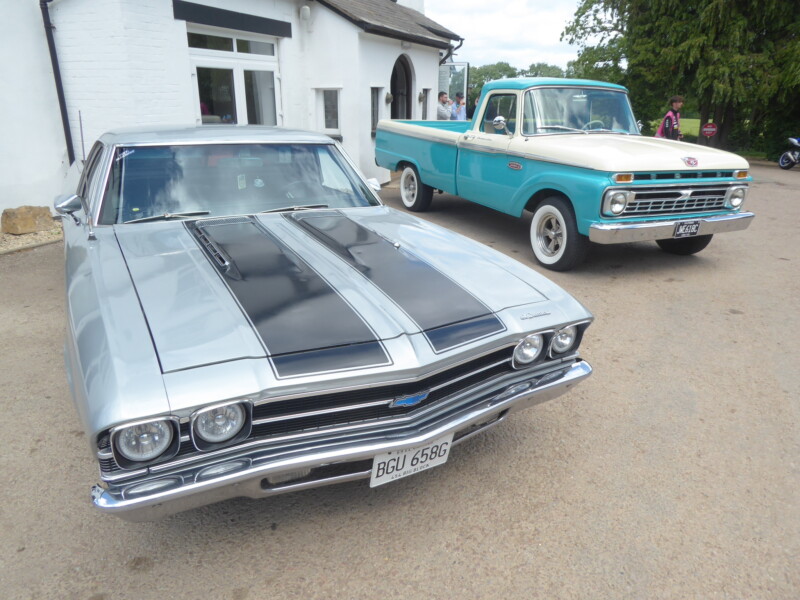
Chevrolet introduced a longer El Camino in 1968, based on the Chevelle station wagon/four-door sedan wheelbase (116 in (2,946 mm), overall length: 208 in (5,283 mm)); it also shared Chevelle Malibu exterior and interior trims. The interior was revamped including cloth and vinyl or all-vinyl bench seats and deep twist carpeting. All-vinyl Strato bucket seats and centre console were an $111 option. Power front disc brakes and Positraction were optional. A new, high-performance Super Sport SS396 version was launched. The Turbo-Jet 396 was offered in 325 bhp or 350 bhp versions. Returning to the official options list for the first time since late 1966 was the 375 bhp L78. It had solid lifters, big-port heads, and an 800 cfm Holley four-barrel on a low-rise aluminium manifold. A three-speed manual was standard with all engines, and a four-speed or automatic was optional. In 1968, the SS was a separate model (the “SS-396”). The 1969 models showed only minor changes, led by more-rounded front-end styling. A single chrome bar connected quad headlights, and a slotted bumper held the parking lights. New round instrument pods replaced the former linear layout. For the first time, the Chevrolet 350 V8 was used in an El Camino. The Super Sport group included a 265 or 325 hp 396-cubic-inch V8 beneath a double-domed hood, along with a black-out grille displaying an SS emblem. More potent editions of the 396 engine, developing 350 or 375 hp also made the options list. Options included power windows and locks. Curiously, back-up lights moved from the rear bumper to the tailgate, where they were ineffective when the gate was down. The 1970 models received sheet metal revisions that gave the bodies a more squared-up stance, and interiors were also redesigned. The new SS396, which actually displaced 402 cu in (6.6 L) (although all emblems read 396) was available. Chevrolet’s largest and most-powerful engine of the time was also put into a select few El Caminos. The LS6 454 CID engine, rated at 450 hp and 500 lb/ft (678 Nm) of torque, gave the El Camino 1/4-mile times in the upper 13-second range at around 106 mph (171 km/h). The 1971 El Camino got fresh front-end styling (again shared with the Chevelle) that included large Power-Beam single-unit headlights, a reworked grille and bumper, and integral park/signal/marker lights. For 1971, mandated lower-octane unleaded fuel necessitated a reduction in engine compression, and GM’s A.I.R. system, a “smog pump”, was added to control tailpipe emissions. Power and performance were reduced. Engine offerings for 1971 included the 250-6, small-block V8s of 307 and 350 cubic inches; and big block V8s of 402 and 454-cubic-inch displacements. Horsepower ratings of those engines for 1971 ranged from 145 for the six to 365 for the RPO LS5 454 – all in gross figures. The LS6 454 V8 was gone forever. A rebadged El Camino, the GMC Sprint, debuted in 1971. It shared the same engine and transmission offerings as its Chevrolet counterpart. The 1972 El Caminos wore single-unit parking and side marker lights on their front fenders, outside of a revised twin-bar grille, but little changed. For 1972, horsepower measurements were switched to the “net” figures as installed in a vehicle with all accessories and emission controls hooked up. Engine offerings included the 110 hp 250-6, a 307 V8, a 175 hp 350-cubic-inch V8, and big block V8s of 402 and 454 cubic-inch displacements. The 402-cubic-inch (still known as a 396) produced 240 hp; the 454 managed to put out 270 hp under the net rating system. Super Sport equipment could now be ordered with any V8 engine, including the base 307-cubic-inch version. All 1972 El Caminos with the 454 ci engine have a “W” as the fifth digit in the VIN, and the 454 was only available with Super Sport trim. An all-new model debuted for 1973.


FERRARI
It was with the 360 Modena that sales of Ferrari models really took off, with unprecedented volumes of the car being sold. The 360 Modena was launched in 1999, named after the town of Modena, the birthplace of Enzo Ferrari. A major innovation in this all new model came from Ferrari’s partnership with Alcoa which resulted in an entirely new all-aluminium space-frame chassis that was 40% stiffer than the F355 which had utilised steel. The design was 28% lighter despite a 10% increase in overall dimensions. Along with a lightweight frame the new Pininfarina body styling deviated from traditions of the previous decade’s sharp angles and flip-up headlights. The new V8 engine, common to all versions, was of 3.6 litre capacity with a flat plane crankshaft, titanium connecting rods and generates 400 bhp Despite what looks like on paper modest gains in reality the power to weight ratio was significantly improved on over the F355, this was due to the combination of both a lighter car and more power. The 0 to 100 km/h acceleration performance improved from 4.6 to 4.3 seconds. The first model to be rolled out was the 360 Modena, available as a manual, or an F1 electrohydraulic manual. Next up was an open car. The 360 was designed with a Spider variant in mind; since removing the roof of a coupe reduces the torsional rigidity, the 360 was built for strength in other areas. Ferrari designers strengthened the sills, stiffened the front of the floorpan and redesigned the windscreen frame. The rear bulkhead had to be stiffened to cut out engine noise from the cabin. The convertible’s necessary dynamic rigidity is provided by additional side reinforcements and a cross brace in front of the engine. Passenger safety is ensured by a strengthened windscreen frame and roll bars. The 360 Spider displays a curvilinear waistline. The fairings imply the start of a roof, and stable roll bars are embedded in these elevations. Due to use of light aluminium construction throughout, the Spider weighs in only 60 kg heavier than the coupé. As with the Modena version, its 3.6 litre V8 with 400 bhp is on display under a glass cover. The engine — confined in space by the convertible’s top’s storage area — acquires additional air supply through especially large side grills. The intake manifolds were moved toward the centre of the engine between the air supply conduits in the Spider engine compartment, as opposed to lying apart as with the Modena. In terms of performance, the 0-60 mph time was slightly slower at 4.4 seconds due to the slight weight increase, and the top speed was reduced from 189 to 180 mph. Despite the car’s mid-mounted V8 engine, the electrically operated top is able to stow into the compartment when not in use. The convertible top was available in black, blue, grey and beige. The transformation from


FORD
On April 1, 2002, the all-new fifth-generation Fiesta was unveiled. Production at Almussafes Plant started on April 29, 2002. Most engines were carried over from the previous Fiesta, but renamed “Duratec”, as the “Zetec” name was now solely used for sportier models. The previous push-rod 1.3 L engine was initially available in the UK, but this was quickly replaced with a RoCam 1.3 L, both under the name Duratec 8v. Trim levels available initially were Finesse, LX, Zetec, and Ghia, with limited edition variants soon following. The fifth-generation was also the first Fiesta to feature an anti-lock braking system and passenger airbags as standard. This generation became the best-selling Ford Fiesta generation to date. Engines available include 1.25, 1.3, 1.4, 1.6, and 2.0-liter petrols, plus an 8-valve 1.4 and a 16-valve 1.6-liter Duratorq TDCi common-rail diesels built in a joint venture with PSA. Fiestas sold in Asia and Australasia were all 1.6 L LX 3dr/5dr, Zetec 3dr, or Ghia 5dr. They replaced the Kia-based Festiva, the first time the Fiesta was marketed in those regions. In Brazil and Argentina, a Fiesta saloon version was introduced in late 2004. A similar Fiesta saloon model called the “Ikon”, with a different front end, was released in India in late 2005. This Fiesta generation was ergonomically and mechanically more advanced than any previous generation. The 2005 facelift came with an improved exterior. The Fiesta ST/XR4 was the performance model of this Fiesta. It includes a 2.0 L Duratec petrol engine rated at 150 PS (148 bhp) in standard form, with a top speed of 129 mph (208 km/h). The Fiesta ST also features 17 in alloy wheels, disc brakes to all wheels, different front and rear bumpers, side skirts, body colour handles and bump strips, partial leather seats or an optional extra of heated full leather seats and a ST logo on the front seat backs and on the steering wheel. In Australia, the Fiesta ST was sold as the Fiesta XR4. To stay in line with all sports model Fords sold in Australia it received the ‘XR’ badging, instead of the ‘ST’ badging used in Europe. The car was replaced in 2008.


Ford played much the same guessing game about whether there would be an RS version of the third generation Focus as they had done with the earlier versions. Production of the regular cars started in late 2010, but it was not until the 2015 Geneva Motor Show before the production ready MKIII Ford Focus RS was unveiled. It came packing the turbocharged 2.3-litre inline-four engine found in the Mustang EcoBoost. In the Focus RS, the engine itself produces 350 hp. Power is sent to all four wheels via Ford’s all-new Torque-Vectoring All-Wheel-Drive system with a rear drive unit designed by GKN, as well as upgraded suspension and brakes. As well as that, the new Focus RS will be fitted with Drive Modes – including an industry-first Drift Mode that allows controlled oversteer drifts – and Launch Control. The RS will boast a model specific aerodynamic package that helps to differentiate it from other Focus models. The RS is capable of accelerating to 100 km/h (62 mph) in 4.7 seconds. Sales finally started in mid 2016, with long waiting lists having been created, though Ford did eventually catch up with expanded production levels allowing them to meet the demand.

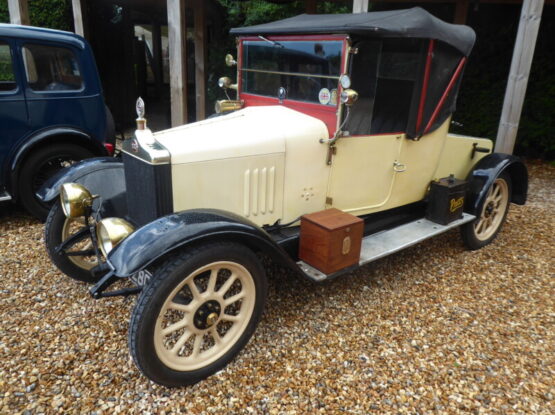
This bespoke vehicle is based on an early 1930s Model B.


Ford introduced a dramatically new style of pickup in 1961 with the fourth-generation F-Series. Longer and lower than its predecessors, these trucks had increased dimensions and new engine and gearbox choices. Additionally, the 1961–1963 models offered an optional unibody design with the cab and bed integrated. The traditional separate cab/bed was offered concurrently. The unibody proved unpopular, and Ford discontinued the option after the 1963 model year. In 1965, the F-Series was given a significant mid-cycle redesign. A completely new platform, including the “Twin I-Beam” front suspension, was introduced, and continued to be used until 1996 on the F-150, and is still used today in the F-250 and F-350 4×2. Additionally, the Ranger name made its first appearance in 1965 on a Ford pickup; previously, the Ranger denoted a base model of the Edsel, but starting in 1965, it was used to denote a high-level styling package for F-Series pickups


In 2001, Ford partnered with Warner Bros. to offer a special version of its GT with the Bullitt nameplate, honouring the 1968 390 fastback model driven by Steve McQueen in the 1968 movie Bullitt which became famous for its high speed chase scene. The car was designed as a good handler so it was lowered 3/4 of an inch, received Tokico shocks, and short length sub-frame connectors. In addition, a new intake design, high-flow mufflers, and special underdrive pulleys helped increase the power to a conservative 265 hp, though many owners report numbers closer to the 270-275 range. More telling is the torque curve, which was vastly improved over the base GT models, 90% of its 305 lb/ft (414 Nm) available from 2000 rpm. This broader torque curve makes itself known at the drag strip, as these special edition Mustangs could cover the 1/4 mile in 2-3 tenths of a second quicker and about 2 mph (3 km/h) faster than regular GT. 17-inch American Racing Torq-Thrust style rims, wrapped in 245/45ZR performance rubber by Goodyear, were reminiscent of those on the car driven by McQueen in the movie. The Bullitt featured a large hood scoop reminiscent of the earlier Boss 429 scoop, as well as new side scoops, lower body mouldings and C-pillars with unique rear side window shape. Other special features on the Bullitt included aluminum pedals and shifter, gauge facings and seat upholstery patterned after the 1968 model, red brake calipers with the Mustang logo on them, and the removal of the spoiler and fog lamps regularly found on Mustang GTs, all for a cleaner look. unique Bullitt badging was added, and the exhaust note was tuned to match the exhaust note from the vehicle in the movie. Braking was also improved with the addition of dual-piston PBR brakes with 13-inch (330 mm) rotors, the same brakes utilized by the 94-04 Mustang Cobra. The vehicles were serialized on tamper-resistant labels in two locations. One was affixed to the drivers side shock tower under the hood, and the other in a hidden location as an “easter egg”. This was a true “skunkworks” style program with Mustang team members essentially volunteering their time in addition to their other responsibilities. It came to be after a show car was produced at Roush Industries for the LA auto show the previous year. The excitement generated by the show car prompted the team to quickly develop a production ready package which it successfully presented a year later at the same LA auto show, where it was announced that it would go into production. Steve McQueen’s son Chad, and grandson Chase, were on hand for the announcement. The Bullitt Mustang was offered in only three colours: Dark Highland Green (the same shade of green used in the famous movie “Bullitt” starring Steve McQueen), Black, and True Blue. Total production was limited to 5,582 units (3,041 Dark Highland Green, 1,819 Black, and 722 True Blue) out of a planned 6500 and sold out prior to production at the Dearborn assembly plant. It was the first of three proposed SN95 feature cars prior to the introduction of the S197 platform. The three feature cars made up the “buzz” cycle plan. A 2008–2009 Bullitt edition has been released as well. Exterior features include uniquely finished 18″ Torq-Thrust style wheels and removal of the decklid spoiler and all badges except for the faux gas cap, which is replaced with a Bullitt-specific unit. Inside, there are Bullitt door sills, gauges, and steering wheel cap, an engine-turned aluminium dash panel, aluminium shift knob and pedals, and GT500-inspired front seats and GT500-inspired steering wheel with black stitching. The first factory Mustang open-element air filter, unique exhaust that mimics the sound of Steve McQueen’s GT 390 Fastback and ends in 3.5-inch tips, and new engine programming raise horsepower to 315 (up from 300). A Tremec 5-speed manual and 3.73:1 ratio live rear axle drops 0-60 mph times to 4.9-5.0 seconds compared to the standard GT’s 5.2-5.3, and quarter miles come in 13.8 seconds at 102 mph (164 km/h). Suspension is upgraded with a Bullitt-badged front tower brace and retuned suspension components that drop the ride height by 6 millimetres (0.24 in). The Bullitt package is a $3,310 upgrade from the standard GT Premium. The Bullitt Mustang returned for the third time for the 2019-2020 model years. It was revealed on stage during the 2018 North American International Auto Show alongside one of the original surviving vehicles from the 1968 film.


HONDA
The sixth-generation Honda Civic is an automobile produced by Honda from 1995 until 2000. It was introduced in 1995 with 3-door hatchback, 4-door sedan and 2-door coupe body styles, replicating its predecessor’s lineup. The sixth-generation Civic offered two new 1.6-liter 4-cylinder engines and a new continuously variable transmission (CVT) on the HX model. The coupe and sedan are 2.3 in (58 mm) longer and the hatchback is 4.3 in (109 mm) longer than the previous-generation Civic. This was the last generation of Civic to have front double-wishbone suspension, as the succeeding seventh generation would change the front suspension to a MacPherson strut. A 5-door hatchback was also on offer, replacing the Honda Concerto hatchback in Europe. This model utilized the same design language as the rest of the Civic range but was actually a hatchback version of the Honda Domani, sharing that car’s platform which was derived from the previous-generation (EG/EH/EJ) Civic. The Domani replaced the sedan version of the Concerto in Japan while the sedan version of the Concerto was directly replaced by the sixth-generation Civic sedan in other markets. Two wagons were also made available; the JDM Orthia, based on the Civic sedan/3-door hatchback line, and a 5-door hatchback/Domani-based model for Europe, sold as the Civic Aerodeck. Neither type was offered in North America. The Civic 5-door hatchback also formed the basis for the 1995 Rover 400 although the 4-door sedan version of the Rover was quite distinct from the Domani. The sixth generation Civic was the first one where Honda made a dedicated version for the European market.


HYUNDAI
The Ioniq 5 N was introduced on 14 July 2023 during the Goodwood Festival of Speed. The variant is the top-of-the-line model, marketed under the Hyundai N performance sub-brand. The exterior changes include a revised front end with larger air intakes, with additional air curtains and air flaps for improved cooling. The rear portion gained a rear wiper, wing-type spoiler integrated with a triangular third brake light, and a rear diffuser. With extended wheel arches and wider track, the Ioniq 5 N is 50 mm (2.0 in) wider than the standard model and also 20 mm (0.8 in) lower. The larger front motor and front external speaker mean the Ioniq 5 N loses the front boot / trunk present in other Ioniq models. The body in white structure of the Ioniq 5 N gains 42 additional welding points and 2.1 m (83 in) of additional adhesives for improved rigidity. The motor and battery mountings were also reinforced, while the subframes were enhanced for lateral rigidity. Its power steering has a higher ratio and improved torque feedback. The vehicle is equipped with two electric motors, providing a total of 448 kW (609 PS; 601 hp) and 740 Nm (546 lb/ft) of torque. Hyundai equipped the Ioniq 5 N with an N Grin Boost mode, allowing a maximum output of 478 kW (650 PS; 641 hp) and 770 N⋅m (568 lb/ft) of torque being released for 10 seconds. Hyundai claimed a 0–100 km/h (0–62 mph) acceleration figure of 3.5 seconds, or 3.4 seconds with launch control or with N Grin Boost mode activated. The lithium-ion battery for this variant is also extended to 84 kWh. Several aspects were conceived to simulate an internal combustion vehicle. An N e-shift function emulates the feel of an 8-speed dual-clutch automatic transmission, by controlling motor torque to simulate the jolt between shifts. A similar system is utilised to simulate a clutch kick to initiate sliding when in N Drift Optimiser Pro mode. A system called N Active Sound+ uses eight interior and two exterior speakers to play three different sound themes based on throttle position, such as a 2.0-liter turbocharged petrol engine from other Hyundai N cars, futuristic EV themes and twin-engine fighter jet sounds. The car has ben widely praised as one of the most fun EVs yet produced.


MERCEDES-BENZ
The Mercedes-AMG GT is a series of 2-door sports cars produced by German automobile manufacturer Mercedes-AMG. The car was introduced on 9 September 2014 and was officially unveiled to the public in October 2014 at the Paris Motor Show. While not directly replacing the SLS AMG (competing in a different segment), it is the second sports car developed entirely in-house by Mercedes-AMG. The Mercedes-AMG GT went on sale in two variants (GT and GT S) in March 2015, while a GT3 racing variant of the car was introduced in 2015. A high performance variant called the GT R was introduced in 2016. A GT4 racing variant, targeted at semi-professional drivers and based on the GT R variant, was introduced in 2017. In 2021, a new variant called the AMG GT Black Series was released. All variants are assembled at the Mercedes-Benz plant in Sindelfingen, Germany. The interior of the Mercedes-AMG GT was previewed on 16 April 2014. The car made its debut on 9 September 2014 and was officially unveiled to the public in October 2014 at the Paris Motor Show. The GT’s exterior design was kept similar to that of the preceding SLS AMG, with wide wheel arches, lower bodywork, and fastback sloping roofline of the SLS AMG, but using conventional forward-opening doors instead of the iconic gullwing style pioneered by the 300 SL in the 1950s. It also employed an upgraded and shortened version of the Transaxle Spaceframe platform used by the SLS. The vehicle structure is made up of 93% aluminium, with the front module base made up of magnesium. The exterior lead designer was Mark Fetherston, whose previous works include the W176 A-Class, the CLA-Class, and SLS AMG. The interior, designed by Jan Kaul, features a large centre console and decorative elements in a leather and carbon polymer design. The trunk offers room for a medium-sized suitcase. Two engine power output options were offered: the GT, with 462 PS/456 hp, and the GT S with 510 PS/ 503 hp. The GT generates 600 N⋅m (443 lb⋅ft) of torque, and the GT S generates 650 Nm (479 lb/ft) of torque. Shortly after its introduction, Mercedes-AMG CEO at the time, Tobias Moers, promised a Black Series variant of the Mercedes-AMG GT. The new high performance variant was called the AMG GT R. The Mercedes-AMG family was given a facelift in 2017, along with the introduction of the GT C roadster variant and the Edition 50 model, which is a limited-edition derivative of the GT C variant. The key improvements made as part of the facelift include increased power output from the M178 engine for the GT and GT S variants (10 kW and 9 kW respectively) and the inclusion of the ‘Panamericana’ grille from the GT3, GT4 and GT R variants as standard equipment for all variants. The GT is the entry level variant of the Mercedes-AMG GT family. The M178 engine in this variant is tuned to an output of 462 PS/456 hp and 601 Nm (443 lb/ft) of torque, with the key differences between this and its more expensive siblings being a mechanical limited-slip differential, an absorbent glass mat battery, the lack of the “Race Mode” setting in the AMG Dynamic Select adaptive drivetrain system, the lack of the AMG Ride Control adaptive suspensive system, and a passive AMG Sport Exhaust System. Keyless-Go is also an optional feature, as opposed to standard equipment. The GT is equipped with 19-inch wheels at the front and rear. The GT S is a more highly equipped variant of the Mercedes-AMG GT. The M178 engine in this variant is tuned to an output of 510 PS/503 hp and 651 Nm (480 lb/ft) of torque. The key mechanical differences the GT S gains over the GT include an electronically controlled limited-slip differential, “Race Mode” and “Race Start” mode settings in the AMG Dynamic Select adaptive drivetrain system, AMG Ride Control adaptive suspensive system, an AMG Performance Exhaust System with dynamic flaps, and a lithium-ion battery. Keyless-Go is standard equipment, as is a staggered set of wheels (19-inch at the front, 20-inch at the rear). As with many other recent Mercedes-AMGs, at the time of introduction a limited production “Edition 1” series was issued of the GT S. 375 examples were sold worldwide, and include a gloss black aerodynamic set including a front splitter, lower wheelwell extensions, a carbon fibre roof, a fixed rear wing, red interior accents and red brake calipers, and various other extras.


MG
Launched in October 1962, the MGB was produced for the next 18 years and it went on to become Britain’s best selling sports car. When first announced, the MGB was an innovative, modern design, with a monocoque structure instead of the traditional body-on-frame construction used on both the MGA and MG T-types and the MGB’s rival, the Triumph TR series, though components such as the brakes and suspension were developments of the earlier 1955 MGA and the B-Series engine had its origins back in 1947. The lightweight design reduced manufacturing costs while adding to overall vehicle strength, and with a 95hp 3-bearing 1798cc engine under the bonnet, performance was quite respectable with a 0–60 mph time of just over 11 seconds. The car was rather more civilised than its predecessor, with wind-up windows now fitted as standard, and a comfortable driver’s compartment offered plenty of legroom. The roadster was the first of the MGB range to be produced. The body was a pure two-seater but a small rear seat was a rare option at one point. By making better use of space the MGB was able to offer more passenger and luggage accommodation than the earlier MGA while being 3 inches shorter overall. The suspension was also softer, giving a smoother ride, and the larger engine gave a slightly higher top speed. The four-speed gearbox was an uprated version of the one used in the MGA with an optional (electrically activated) overdrive transmission. A five-bearing engine was introduced in 1964 and a number of other modifications crept into the specification. In late 1967, sufficient changes were introduced for the factory to define a Mark II model. Alterations included synchromesh on all 4 gears with revised ratios, an optional Borg-Warner automatic gearbox, a new rear axle, and an alternator in place of the dynamo with a change to a negative earth system. To accommodate the new gearboxes there were significant changes to the sheet metal in the floorpan, and a new flat-topped transmission tunnel. US market cars got a new safety padded dashboard, but the steel item continued for the rest of the world. Rostyle wheels were introduced to replace the previous pressed steel versions in 1969 and reclining seats were standardised. 1970 also saw a new front grille, recessed, in black aluminium. The more traditional-looking polished grille returned in 1973 with a black “honeycomb” insert. Further changes in 1972 were to the interior with a new fascia. To meet impact regulations, in late 1974, the chrome bumpers were replaced with new, steel-reinforced black rubber bumpers, the one at the front incorporating the grille area as well, giving a major restyling to the B’s nose, and a matching rear bumper completed the change. New US headlight height regulations also meant that the headlamps were now too low. Rather than redesign the front of the car, British Leyland raised the car’s suspension by 1-inch. This, in combination with the new, far heavier bumpers resulted in significantly poorer handling. For the 1975 model year only, the front anti-roll bar was deleted as a cost-saving measure (though still available as an option). The damage done by the British Leyland response to US legislation was partially alleviated by revisions to the suspension geometry in 1977, when a rear anti-roll bar was made standard equipment on all models. US emissions regulations also reduced horsepower. In March 1979 British Leyland started the production of black painted limited edition MGB roadsters for the US market, meant for a total of 500 examples, but due to a high demand, production ended with 6682 examples. The United Kingdom received bronze painted roadsters and a silver GT model limited editions. The production run of home market limited edition MGBs was split between 421 roadsters and 579 GTs. Meanwhile, the fixed-roof MGB GT had been introduced in October 1965, and production continued until 1980, although export to the US ceased in 1974. The MGB GT sported a ground-breaking greenhouse designed by Pininfarina and launched the sporty “hatchback” style. By combining the sloping rear window with the rear deck lid, the B GT offered the utility of a station wagon while retaining the style and shape of a coupe. This new configuration was a 2+2 design with a right-angled rear bench seat and far more luggage space than in the roadster. Relatively few components differed, although the MGB GT did receive different suspension springs and anti-roll bars and a different windscreen which was more easily and inexpensively serviceable. Although acceleration of the GT was slightly slower than that of the roadster, owing to its increased weight, top speed improved by 5 mph to 105 mph because of better aerodynamics. 523,826 examples of the MGB of all model types were built, and although many of these were initially sold new in North America, a lot have been repatriated here.


NISSAN
Released on July 2002 in Japan at reorganized Nissan Japanese dealerships called Nissan Blue Stage, and August 20, 2002 in the US., the 350Z coupé was available in 5 trim packages: ‘350Z’ (Base), ‘Enthusiast’, ‘Performance’, ‘Touring’, and ‘Track’ editions. In Europe, only the ‘Track’ trim was available, although it was badged and marketed as ‘350Z’. The Base model did not include a VLSD or Traction Control and was only available with cloth seats. It did not include cruise control, nor power or heated seats. The Enthusiast model came with traction control, a VLSD, and cruise control. The Performance model came with bigger 18-inch wheels, front air dam, rear spoiler, optional Brembo brakes, and VDC instead of Traction Control. Touring was made more of the luxury model. It had power, leather, heated seats, VDC, a VLSD, xenon headlamps, optional Brembos, 18-inch wheels, and optional GPS. The Track model included Brembo brakes, front air dam, rear spoiler, traction control, cloth seats, 18-inch wheels, VLSD, and optional GPS. In 2004 Nissan introduced the 350Z Roadster with an electrically retractable soft-top roof. In the U.S. market the car was available in two trim packages (Enthusiast and Touring), while in Europe, the same versions as the coupé were offered. Nissan added the Grand Touring (GT) trim to the Roadster trim packages for 2005. In 2005 Nissan launched a 35th Anniversary edition, with a revised exterior and interior. Early 2005 model-year 35th anniversary edition models were equipped with the original VQ35DE with 287 hp and automatic transmission. In January 2005, Nissan introduced the 35th Anniversary 6-speed manual models and Track models (mid-year introduction), which included the updated VQ35DE 300 hp Rev-up engine and new updated CD009 manual transmission. As well as minor changes to suspension tuning and parts. For the 2006 model year, the 350Z received changes for its mid-cycle facelift. The VQ35DE 300 hp Rev-up engine that was introduced mid-year 2005 on the Track and 35th Anniversary Edition with 6-speed manual transmission models was offered for every trim level that had a manual transmission option. The VQ35DE with 287 hp continued to be offered with only the 5-speed automatic. Additions included bi-xenon projectors, a revised front fascia, new LED rear lights, changes to the interior trim and speed sensitive steering. Touring and Grand Touring models had radio-steering controls standard, MP3 CD compatibility, and Satellite Radio became an available option. For the 2007 model year, the 350Z was again moderately revised. The VQ35DE V6 was replaced with a new VQ35HR V6. It produced 306 hp at 6800 rpm with 268 ft·lb at 4800 rpm using the revised SAE certified power benchmark. The VQ35HR had a raised redline to 7500 rpm and more torque across the rpm range. The bonnet was redesigned with a bulge reminiscent of the original 240Z to accommodate the raised deck height of the new VQ35HR. In the US, trim levels were narrowed down to 350Z (base), Enthusiast, Touring, and Grand Touring, while in Europe the same trim levels remained. Bluetooth was added for the 2007 model year. The car was replaced by the 370Z for the 2009 model year. It has never found quite the same levels of enthusiasm that greeted – and have stayed with – the 350Z.

This is an S15-generation Silvia, a car not sold new in the UK, though its predecessors had been, under the name 240SX. New in 1999, the engine of the S15 now boasting 250 PS (247 bhp) at 6,400 rpm and 275 Nm; 203 lb/ft at 4,800 rpm of torque from its SR20DET Inline-four engine, thanks to a ball bearing turbocharger upgrade, as well as improved engine management system. The non-turbo SR20DE produced 165 PS. The S15 Silvia included aggressive styling inside and out, updating the previous Silvia styling in-line with modern car design trends. The body dimensions were reduced from the previous generation so that it would comply with Japanese Government compact class, which had an effect on sales of the previous model. The S15 Silvia model lineup was initially simplified to just the Spec-S and Spec-R, both models offering an “Aero” variant with a large rear wing and side skirts/valances. This generation of the Silvia was only sold in Japan, Australia and New Zealand but was available as a grey import in most other countries. In Australia and New Zealand the car was sold as the Nissan 200SX. Within the Australian domestic market (AUDM), the S15 sold in 2 trim levels as noted above; Spec-S and Spec-R – however both models featured the SR20DET motor, albeit slightly detuned from the JDM spec cars. Nissan S15s were never officially sold with the naturally aspirated SR20DE engine in Australia or New Zealand. These two models were available at Nissan showrooms until the Nissan 200SX GT was introduced in 2002, the last year of production for the S15. Main differences here were namely the wheels being finished in a silver shadow chrome, chrome interior door handles, chrome gear selector surround, “sports” metal pedal set and an updated larger rear wing. As of August 2002, Nissan stopped producing the S platform with the S15-series Nissan Silvia being the final variant. Production of the Silvia ended amidst Nissan’s efforts to reduce its myriad of platforms. The S15 Silvia was therefore the last car to hold the Silvia badge. Nissan’s worldwide sports car platform is now the FM platform, which underpins the current Fairlady Z (the 350/370Z outside Japan), as well as the 2001–present Nissan Skyline (the Infiniti G35/37 in North America).

The R32 generation Skyline debuted in 1989 and was available as either a 2-door coupe or 4-door hardtop sedan, all previous bodystyles were dropped. The R32 featured several versions of the RB-series straight-6 engines, which had improved heads (the twelve port inlet was gone) and used the ECCS (Electronically Concentrated Control System) injection system. Also available was an 1,800 cc 4-cylinder GXi model. Most models had HICAS four-wheel steering, with the rear wheels being hydraulically linked to the front steering. The 2.5-litre GTS-25 became one of the first Japanese production cars to feature a 5-speed automatic transmission. The GTS-t came in standard and Type M configurations, with the Type M having larger five-stud 16-inch wheels, four piston front callipers and twin piston rears plus other minor differences. ABS was optional (except for the GT-R and GTS-4), mechanical LSD was standard on the GTR and viscous LSD was standard on all turbo models and optional on all but the GXi. Nissan also produced 100 Australian models of the R32. In addition, there was a 4WD version of the GTS-t Type M, called the GTS-4. This generation was considered a “compact” under Japanese legislation that determined the amount of tax liability based on exterior dimensions. The smaller engines were offered so as to provide Japanese buyers the ability to choose which annual road tax obligation they were willing to pay. The station wagon bodystyle was discontinued, and replaced by the Nissan Stagea. 296,087 of these cars were sold in its five year production run.


PORSCHE
The 996 was replaced with the 997 in 2005. It retains the 996’s basic profile, with an even lower 0.28 drag coefficient, but draws on the 993 for detailing. In addition, the new headlights revert to the original bug-eye design from the teardrop scheme of the 996. Its interior is also similarly revised, with strong links to the earlier 911 interiors while at the same time looking fresh and modern. The 997 shares less than a third of its parts with the outgoing 996, but is still technically similar to it. Initially, two versions of the 997 were introduced— the rear-wheel-drive Carrera and Carrera S. While the base 997 Carrera had a power output of 321 hp from its 3.6 L Flat 6, a more powerful 3.8 L 350 hp Flat 6 powers the Carrera S. Besides a more powerful engine, the Carrera S also comes standard with 19 inch “Lobster Fork” style wheels, more powerful and larger brakes (with red calipers), lowered suspension with PASM (Porsche Active Suspension Management: dynamically adjustable dampers), Xenon headlamps, and a sports steering wheel. In late 2005, Porsche introduced the all-wheel-drive versions to the 997 lineup. Carrera 4 models (both Carrera 4 and Carrera 4S) were announced as 2006 models. Both Carrera 4 models are wider than their rear-wheel-drive counterparts by 1.76 inches (32 mm) to cover wider rear tyres. The 0–100 km/h (62 mph) acceleration time for the Carrera 4S with the 350 hp engine equipped with a manual transmission was reported at 4.8 seconds. The 0–100 km/h (62 mph) acceleration for the Carrera S with the 350 hp was noted to be as fast as 4.2 seconds in a Motor Trend comparison, and Road & Track has timed it at 3.8 seconds. The 997 lineup includes both 2- and 4-wheel-drive variants, named Carrera and Carrera 4 respectively. The Targas (4 and 4S), released in November 2006, are 4-wheel-drive versions that divide the difference between the coupés and the cabriolets with their dual, sliding glass tops. The 997 received a larger air intake in the front bumper, new headlights, new rear taillights, new clean-sheet design direct fuel injection engines, and the introduction of a dual-clutch gearbox called PDK for the 2009 model year. They were also equipped with Bluetooth support. The change to the 7th generation (991) took place in the middle of the 2012 model year. A 2012 Porsche 911 can either be a 997 or a 991, depending on the month of the production.

Porsche also offered an RS version of the 997 GT3. In common with its predecessors, it was a homologation model for use in a range of racing series. The 997 GT3 RS was introduced in Europe in October 2006 and in North America in spring 2007. The 997 GT3 RS is 20 kg (44 lb) lighter than the 997 GT3, weighing in at 1,370 kg (3,020 lb). This weight-saving was achieved by the use of an adjustable carbon fibre wing, a steel engine cover, and a lightweight plastic windscreen. The weight savings gives the 997 GT3 RS corresponding engine power to curb weight ratio of 300 hp per tonne. The body of the 997 GT3 RS is 64 mm (2.5 in) wider at the rear than the 997 GT3 (a legacy from the Carrera 4 models with which it shares its body shell). The muscular-looking rear end conceals a wider track that not only improves directional stability but also increases the potential cornering grip. However, drag is increased and top speed is reduced due to the larger rear wing. In addition to the new technology, the paint scheme and body panels are all designed specifically for the RS. The US version of the 997 GT3 RS has a standard rear window (not plexiglas) and the smaller 911 fuel tank to comply with rules of SCCA, Can-Am, and IMSA. For Grand-Am races, the central locking wheel nut is replaced with the standard five-lug pattern required under Grand-Am rules. Production of the first generation 997 GT3 RS (997.1 GT3 RS) ended in 2009. An estimated 1,168 vehicles were delivered worldwide, with a total of 410 units sold in the United States and 42 units in Canada.

The 991 introduced in 2012 is an entirely new platform, only the third since the original 911. Porsche revealed basic information on the new Carrera and Carrera S models on 23 August 2011. The Carrera is powered by a 350 hp 3.4-litre engine. The Carrera S features a 3.8-litre engine rated at 400 hp. A Power Kit (option X51) is available for the Carrera S, increasing power output to 430 hp. The new 991’s overall length grows by 56 mm (2.2 in) and wheelbase grows by 99 mm (3.9 in) (now 96.5 in.) Overhangs are trimmed and the rear axle moves rearward at roughly 76 mm (3 in) towards the engine (made possible by new 3-shaft transmissions whose output flanges are moved closer to the engine). There is a wider front track (51 mm (2 in) wider for the Carrera S). The design team for the 991 was headed by Michael Mauer. At the front, the new 991 has wide-set headlights that are more three-dimensional. The front fender peaks are a bit more prominent, and wedgy directionals now appear to float above the intakes for the twin coolant radiators. The stretched rear 3/4 view has changed the most, with a slightly more voluminous form and thin taillights capped with the protruding lip of the bodywork. The biggest and main change in the interior is the center console, inspired by the Carrera GT and adopted by the Panamera. The 991 is the first 911 to use a predominantly aluminium construction. This means that even though the car is larger than the outgoing model, it is still up to 50 kilograms (110 lb) lighter. The reduced weight and increased power means that both the Carrera and Carrera S are appreciably faster than the outgoing models. The 0–60 mph acceleration time for the manual transmission cars are 4.6 seconds for the Carrera and 4.3 seconds for the Carrera S. When equipped with the PDK transmission, the two 991 models can accelerate from 0–97 km/h in 4.4 seconds and 4.1 seconds. With the optional sports chrono package, available for the cars with the PDK transmission, the 991 Carrera can accelerate from 0–97 km/h in as little as 4.2 seconds and the Carrera S can do the same in 3.9 seconds. Apart from the reworked PDK transmission, the new 991 is also equipped with an industry-first 7-speed manual transmission. On vehicles produced in late 2012 (2013 model year) Rev Matching is available on the 7-speed manual transmission when equipped with the Sport Chrono package. Rev-Matching is a new feature with the manual transmission that blips the throttle during downshifts (if in Sport Plus mode). Also, the 7th gear cannot be engaged unless the car is already in 5th or 6th gear. One of Porsche’s primary objectives with the new model was to improve fuel economy as well as increase performance. In order to meet these objectives, Porsche introduced a number of new technologies in the 911. One of the most controversial of these is the introduction of electromechanical power steering instead of the previous hydraulic steering. This steering helps reduce fuel consumption, but some enthusiasts feel that the precise steering feedback for which the 911 is famous is reduced with the new system.[citation needed] The cars also feature an engine stop/start system that turns the engine off at red lights, as well as a coasting system that allows the engine to idle while maintaining speed on downhill gradients on highways. This allows for up to a 16% reduction in fuel consumption and emissions over the outgoing models. The new cars also have a number of technologies aimed at improving handling. The cars include a torque vectoring system (standard on the Carrera S and optional on the Carrera) which brakes the inner wheel of the car when going into turns. This helps the car to turn in quicker and with more precision. The cars also feature hydraulic engine mounts (which help reduce the inertia of the engine when going into turns) as part of the optional sports chrono package. Active suspension management is standard on the Carrera S and optional on the Carrera. This helps improve ride quality on straights while stiffening the suspension during aggressive driving. The new 991 is also equipped with a new feature called Porsche Dynamic Chassis Control (PDCC). Porsche claims that this new feature alone has shaved 4 seconds off the standard car’s lap time around the Nürburgring. PDCC helps the car corner flat and is said to improve high-speed directional stability and outright lateral body control, but according to several reviews, the car is more prone to understeer when equipped with this new technology. In January 2013, Porsche introduced the all-wheel-drive variants of the Carrera models. The ‘4’ and ‘4S’ models are distinguishable by wider tyres, marginally wider rear body-work and a red-reflector strip that sits in between the tail-lights. In terms of technology, the 4 and 4S models are equipped with an all-new variable all-wheel-drive system that sends power to the front wheels only when needed, giving the driver a sense of being in a rear-wheel-drive 911. In May 2013, Porsche announced changes to the model year 2014 911 Turbo and Turbo S models, increasing their power to 513 hp on the ‘Turbo’, and 552 hp on the ‘Turbo S’, giving them a 0–97 km/h acceleration time of 3.2 and 2.9 seconds, respectively. A rear-wheel steering system has also been incorporated on the Turbo models that steers the rear wheels in the opposite direction at low speeds or the same direction at high speeds to improve handling. During low-speed manoeuvres, this has the virtual effect of shortening the wheelbase, while at high speeds, it is virtually extending the wheelbase for higher driving stability and agility. In January 2014, Porsche introduced the new model year 2015 Targa 4 and Targa 4S models. These new models come equipped with an all-new roof technology with the original Targa design, now with an all-electric cabriolet roof along with the B-pillar and the glass ‘dome’ at the rear. In September 2015, Porsche introduced the second generation of 991 Carrera models at the Frankfurt Motor Show. Both Carrera and Carrera S models break with previous tradition by featuring a 3.0-litre turbocharged 6-cylinder boxer engine, marking the first time that a forced induction engine has been fitted to the base models within the 911 range

The 718 Cayman GT4 and 718 Spyder (previously named the Boxster Spyder) were revealed in June 2019. Both are differentiated from less powerful models by more aggressive bodywork, including a lower stance, new front bumper, a large new diffuser, and exhaust pipes that are spaced farther apart. The GT4 also features larger side intakes and an adjustable wing, the latter of which helps it generate up to 150 kg (330 lb) of downforce, 50 percent more than its predecessor. Both have a naturally aspirated 4.0-litre flat-6 derived from the 992’s 3.0-litre 9A2EVO engine, which is rated at 414 bhp/420 PS at 7,600 rpm and 420 Nm (310 lb/ft) of torque at 5,000–6,800 rpm. The engine has cylinder deactivation, a first for Porsche. Porsche claims a top speed of 304 km/h (189 mph) for the GT4, and 301 km/h (187 mph) for the Spyder. The front suspension and brakes are borrowed from the 911 GT3, and the adaptive dampers, ABS and stability-control programming are borrowed from the 911 GT3 RS. The anti-roll bar end links, camber and toe can be manually adjusted, but the ride height–3 cm (1.2 in) lower than a standard 718–is fixed. Both are around 15 kg heavier than the GTS models. Sales commenced in the spring of 2020. For the 2021 model year, the GT4 and Spyder became available with the 7-speed PDK dual-clutch transmission as an option. It reduces the acceleration time of 0-60 mph (97 km/h) from 4.3 seconds to 3.7 seconds. In March of 2023, Porsche announced that 718 GT4 and Spyder Models would cease production as of the 2024 model year.


RENAULT
It did not take Renault long to add an RS version to their 3rd generation Megane range. debuting the car at the 2009 Geneva Show. This new Megane Renault Sport 250 included a 2.0litre twin-scroll turbo 4-cylinder F4Rt engine rated at 250 PS (247 bhp) at 5500 rpm and 340 Nm (251 lb/ft) at 3000 rpm with a 6-speed manual gearbox, Brembo front brakes, front splitter, extended sills and wheel arches, rear diffuser with central exhaust pipe, and 18-inch alloy wheels wearing 225/40R18 tyres. Aluminum pedals, a Renault Sport steering wheel with thumb grips, analog rev counter and sport seats with extra lateral support dress up the cabin. Other features include front LED daytime running lights and bi-xenon headlights. The 250 Cup variant contains a number of sharpened performance features including a stiffer chassis, track focused suspension, a limited slip differential and a slightly lighter gross weight. The Cup is differentiated visually with painted red brake calipers, instead of the silver calipers for the normal Sport. 18×8.25″ “Ax-l” alloy wheels are fitted with wider 235/40R18 tyres, while 19×8.25″ “Steev” wheels were available as an option with 235/35R19 tyres. In June 2011 Renault Sport revealed a limited edition 265 PS (261 bhp) version of the Mégane III called the Mégane R.S. Trophy. The Megane R.S. Trophy uses the same 2.0 four-cylinder as the standard 250 PS R.S. but thanks to modifications such as a new air intake and higher turbo pressure it gains an extra 15 hp, increasing the power output to 265 PS. It reaches 0–62 mph in six seconds flat and goes on to a top speed of 254 km/h (157 mph). It is recognizable thanks to model-specific decoration such as Trophy stickers on the doors, a new spoiler and specific 19″ rims with R.S. centre caps. It comes in a model-specific metallic yellow (Jaune Sirius) but is also available in more low-key colours such as white (Blanc Glacier), black (Noir Étoilé) and gray (Gris Cassiopée). Production was limited to 500 examples. In 2012, the Megane R.S. adopted the updated engine from the Trophy version with 265 PS (261 HP) and offers the same “Cup” and “Sport” versions like the previous 250 PS (247 HP) model. Changes include Piano Black interior highlights and wider LED daytime running lights with 6 LEDs per side rather than the 3 LEDs found in the RS250. The 18″ wheels were changed to a new design called “Tibor”, while the 19″ wheels carried over from the 250. Extreme Blue and Sport Yellow were dropped as colour options. In Australia, the Cup and Cup Trophée models were replaced with the Cup, Cup+ and Trophy+ with slightly more flexible specification levels.

The third generation of the Renault Megane R.S. is based on the 4th generation of the Mégane and was introduced at the 2017 Frankfurt Motor Show. It was available in 3 trims: 280-Sport, 280-Cup and 300-Trophy. The Mégane R.S. is only available in 5-door hatchback bodystyle and was developed with the assistance of Renault F1 team driver Nico Hulkenberg. All feature a similar turbocharged 1.8-litre inline-4 engine (to a varying rate of tune) shared with the Alpine A110, and as standard a four-wheel steering system to improve handling, though this was removed to save weight in the Trophy-R. Five selectable drive-modes are available, namely Comfort, Neutral, Sport, Race and Personal (which is a customisable driving mode). The gearbox choices are either a 6-speed manual gearbox or a 6-speed Efficient Dual Clutch (EDC) gearbox with paddle shifters and launch control (which can be activated by holding both of the shifter paddles). The interior features a portrait style infotainment system and red graphical display on the digital tachometer flanked by analogue fuel and water temperature gauges. The infotainment system supports AppleCarPlay and Android Auto. An engine revving sound is played through the speakers when the driver opens the door of the car. Red stitching with RS badges are standard on the interior and the Trophy model adds an Alcantara-suede trim on the steering wheel. Recaro sports seats are optional equipment. Buyers have the choice to have a carbon fibre weave or an Alcantara trim. The suspension system has struts up front and a torsion beam at the rear, but its front configuration has new geometry and retains Renault Sport’s PerfoHub technology, which reduces kingpin angle offset and resists torque and bump steer. The system uses fluid-filled shock absorbers commonly found on rally cars on the lower end of the suspension struts and is called a damper within a damper system by the manufacturer. The entry-level 280 Sport, features a torque-vectoring system of braking the inner wheels during a turn, to further improve turn-in; and a passive double damping suspension system. The 280 Cup trim is similar to the 280 Sport trim, but adds a mechanical Torsen limited-slip-differential to the front wheels along with a 10% stiffer suspension setup. 19-inch wheels with Bridgestone tyres and lightweight brakes with aluminium hubs and red calipers are optional. The 300 Trophy is similar to the 280 Cup, but has even firmer suspension, a lightweight DESS (Dual-Energy Storage System) battery, a different cylinder head and turbocharger with a higher-performance engine tune for more power (300 bhp). Torque figure is increased to 420 NM (400 NM for cars with a manual gearbox). In 2020, the facelifted Megane RS was introduced for the 2021 model year. The trim levels were revised and the 280-Sport model was removed, bringing the engine power output to 300 hp for all facelifted Megane RS models. Buyers could choose between the 300-Sport and the 300-Trophy, equipped similarly to the pre-facelift models. On the outside, the facelifted Megane RS came with new LED headlights and different-looking taillights. Inside, the instrument panel was now fully digital and the infotainment system used a new software. The climate controls were also changed and now featured separate temperature displays on the temperature control dials. The ambient lighting was removed from the rear door cards. Sales of this model in the UK were very limited and the car was pulled from sale sometime in 2022, production for other markets finally ending in 2023.


After presenting an initial concept at the 2006 Mondial de l’Automobile, Renault debuted the production Twingo II at the 2007 Geneva Motor Show with French market trim levels named Authentique, Expression, Initiale, Dynamique, and GT. Using the floorpan of the Renault Clio II, the Twingo II offered improved crash protection and was available in both RHD and LHD configurations. Production began in France and subsequently moved to the Revoz plant in Novo Mesto, Slovenia. In January 2008, Renault debuted the Twingo Renaultsport 133, with a new 133 PS (131 hp) 1,598 cc engine, at the 2008 Geneva Motor Show. In August 2013, ordering and production of the 133 model ended. In July 2011, Renault debuted a facelifted Twingo II at the Frankfurt Motor Show, featuring a design language subsequently used on their entire range and offering revised fascias, as well as redesigned front and rear light clusters. On series 14, episode four of Top Gear, presenter Jeremy Clarkson road tested the Twingo 133 on Belfast streets and barrel rolled upside down through a sewage tunnel. After numerous accidents, he raced to catch a departing ferry, instead landing in the ocean. On 16 March 2011, the Renault Twingo won the “best city car award” in the Parkers’ New Car Awards. Special editions in the UK included the Twingo Renaultsport Gordini, Twingo Gordini TCe 100, Twingo Bizu, Twingo Pzaz, Twingo Renaultsport Silverstone GP, Twingo Miss Sixty, and Twingo Renaultsport Red Bull RB7.


I did enjoy this visit and it was only curtailed a bit by the need to head on up to Mallory Park for set-up duties associated with Abarth Festival. Hopefully it will not be too long before I am back here to enjoy the special mix of cars, reasonably priced food and a group of enthusiasts with whom to talk.