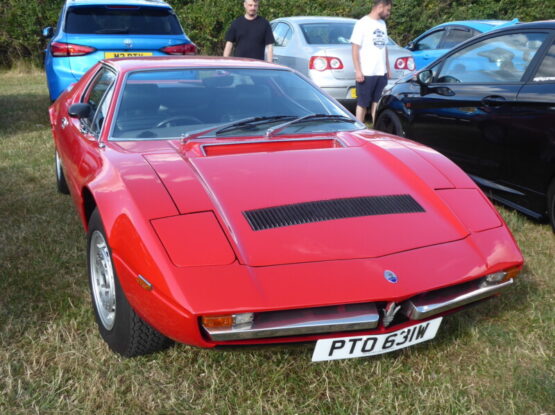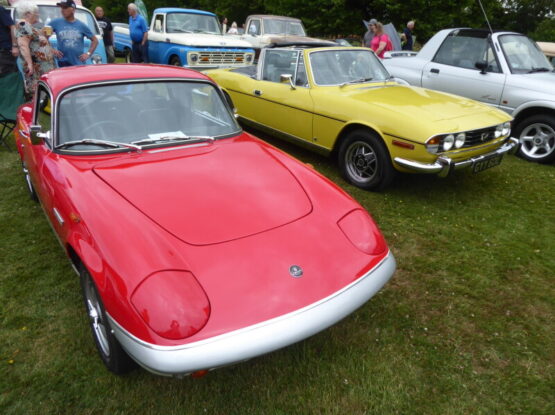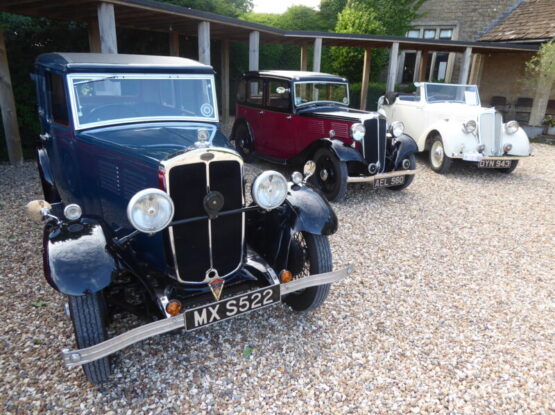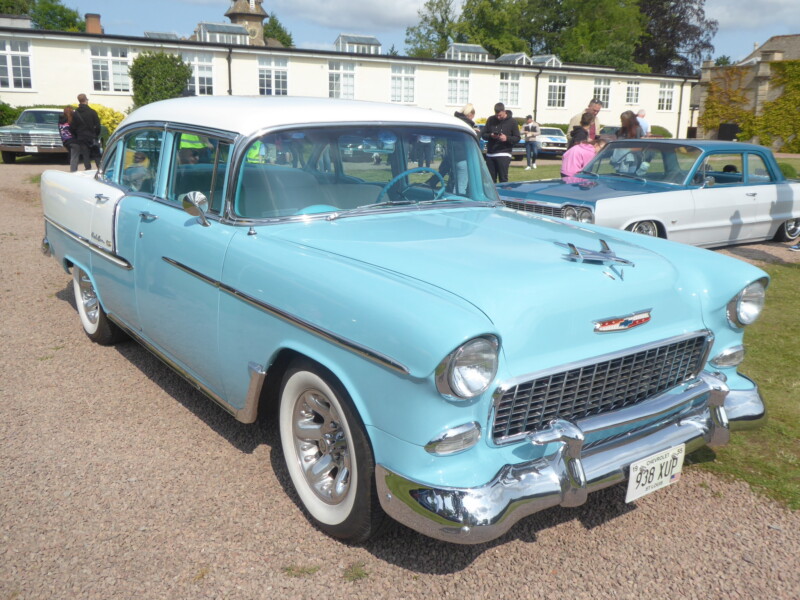
As I have observed many times before, the local and ever popular Queen Square (QS) Breakfast Club meet takes place on the second weekend of every month, year round, but such is the pressure on my diary that I only manage to attend some of the events during the course of the year, generally more of the ones in the winter months, as there is less going on and also because once the event moves to its winter location at Easter Compton, it takes place on a Saturday when there is less competition for my diary. The summer events take place in the very attractive setting Eastwood Park, a few miles to the north of Bristol, on Sundays, and the sad reality is that lots else going on. But sometimes, I look at my diary and realise that in fact there is nothing planned and so, as was the case for the June 2025 QS meet, I can enjoy a short journey to take in what is always a wide range of cars, a mix of event regulars and cars rarely or never before seen at this series of events. There are now declared themes for each event, though this only ever covers a proportion of the available places, so if you don’t like the theme (as if?!!), that should not deter anyone. For this event, the theme was “American” and a surprisingly large and very varied number of cars and trucks from over the Pond showed up, giving this iteration quite a different feel to the last couple of Eastwood Park events I’ve attended. The weather was pleasantly summery, too, so this encouraged a good turn-out generally. My highlights of the event ensure in this report:
ABARTH
The Punto Evo was launched at the 2010 Geneva Show, with the cars reaching UK buyers in the summer of that year, and it incorporated many of the changes which had been seen a few months earlier on the associated Fiat models, the visual alterations being the most obvious, with the car taking on the nose of the associated Fiat, but adapted to make it distinctively Abarth, new rear lights and new badging. There was more to it than this, though, as under the bonnet, the T-Jet unit was swapped for the 1.4 litre Multi-Air, coupled to a 6 speed gearbox, which meant that the car now had 165 bhp at its disposal. Eventually, Abarth offered an Esseesse kit for these cars, though these are exceedingly rare. For those in the know – which never seemed to be that many people – this was a really capable and desirable car, and the owners love them, lamenting the fact that the model had quite a short production life and has not been replaced. The final Punto model was the SuperSport. Easily identified by the distinctive black bonnet, just 199 of the SuperSport versions were built, of which around 120 are registered on UK roads. These cars had many of the options from the Punto Evo included as standard. Power came from the the 1.4-litre MultiAir turbo engine, tuned to produce 178bhp and 199lb ft of torque, up from 165 of the standard Punto Evo, giving the SuperSport a 0-62 time of 7.5 seconds and a top speed of over 132mph. To help put the power down, the SuperSport was fitted with wider 18″ wheels and optional Koni FSD dampers. Standard equipment included the Blue&Me infotainment system with steering wheel controls, automatic climate control and a popular option was the ‘Abarth Corsa by Sabelt’ sports leather seats. The SuperSport was available in the same colours as the regular Punto Evo, which means white, grey, black and red.


ALPINE
The Alpine A110 is a rear mid-engine, rear-wheel-drive sports car introduced by French car manufacturer Alpine at the 87th Geneva International Motor Show in March 2017. Deliveries began in late 2017 for Continental European markets and in 2018 for the UK, Japan and Australia. Both its name and design refer back to the original Alpine A110 that was produced from 1961 to 1977. Based on an all-aluminium construction, the A110 is powered by a Nissan-derived 1.8-litre turbocharged gasoline direct injection 4 valves per cylinder inline-four engine mated to a 7-speed dual-clutch transmission manufactured by Getrag. Developed by Renault–Nissan and reworked by Alpine engineers, the engine has an output of 252 PS at 6,000 rpm and 320 Nm (236 lb/ft) of torque at 2,000–5,000 rpm. According to Alpine, the A110 can accelerate from 0 to 100 km/h (0 to 62 mph) in 4.5 seconds, and has an electronically limited top speed of 250 km/h (155 mph). The A110 was initially available in three trims: Pure, Première, and Legende. The Pure cars, the base trim, have 17-inch alloy wheels. The Première trim cars are technically the launch edition models limited to 1,955 units and were equipped with amenities such as forged alloy wheels, quilted leather Sabelt bucket sports seats, a reversing camera, and metallic blue exterior colour as standard. The Legende trim cars come with six-way adjustable sports seats, black or brown leather interior upholstery, an upgraded hi-fi sound system, and specially designed wheels exclusive to this trim. All of the three trims share the same powertrain and transmission. For the 2020 model year, The Pure trim level was replaced by the Alpine A110, with no other badging. The Légende was replaced by the Alpine A110 GT which employed the same engine as the A110 S.

Alpine has committed to launching seven EVs by 2030, including an electric replacement for the A110, plus crossover SUVs. But first to arrive is the A290, a hot-hatch version of the new all-electric, retro-styled Renault 5 E-Tech. The fastest Renault 5 gets a 148 hp (110 kW / 150 PS) electric motor that drives the front wheels, and while the A290, which was unveiled today at the Le Mans 24 Hour race in France, sticks with the two-wheel drive layout, it ups the pony count considerably. Alpine’s version makes 217 hp (220 PS / 160 kW) and 221 lb-ft (300 Nm) in its most potent GT Performance form, which drops the zero to 62 mph (100 kmh) time from the 5 E-Tech’s 8 seconds to 6.4 seconds. A less powerful model, badged simply A290 GT, generates 178 hp (180 PS / 130 kW) and 210 lb-ft (285 Nm), and takes a second longer to reach 62 mph. The two-tier lineup puts the Alpine pair in direct competition with the new electric Mini Cooper E and Cooper SE, which make 181 hp (184 PS / 134 kW) and the same 217 hp as the Frenchies, and need 7.3 seconds and 6.7 seconds to achieve 62 mph. Adding to the impression of speed is a choice of two digital soundtracks that claim to be based on the natural harmonics of the A290’s electric motor. Though the extra grunt, and the temptation to use it, was always going to put a strain on the driving range, Alpine has stuck with the same 52 kWh battery offered in higher-spec 5 E-Techs for both A290 variants. And while that, plus some aluminium parts, has helped keep the curb weight down to 1,479 kg (3,260 lbs), it does mean the range suffers. Renault quotes a 249-mile (400 km) range for the 5, which drops to 236 miles (380 km) for the Alpines. That figure also matches what Mini claims for the Cooper SE, but the Cooper E gets a smaller battery and is only good for 190 miles (306 km). An unimpressive 100 kW DC charge rate means a 15-80 percent fill in the A290 takes 30 minutes. The stock 5 already looks fairly purposeful thanks to its chiselled lines and angular bulging fenders that tip a hat to the bonkers mid-engined Renault 5 Turbos of the early 1980s, but the A290’s track is 2.4 inches (60 mm wider), 19-inch wheels available in two different designs, filling the wheelarches. Both cars get Brembo four-pot brakes up front. Alpine has also applied its own styling details to A290, including X-shaped driving lights set into the grille, X-motifs in the headlights, a deep front bumper and three strakes ahead of the rear wheels. Like the Renault 5 it’s based on, the A290 is a five-door hatch, but it does a good job of looking like a two-door hatch by hiding the rear door handle in the corner of the window by the C-pillar. Inside, the basic dash architecture, including a 10.1-inch infotainment screen, is carried over from the Renault 5, but Alpine adds its own sports pedals and even a set of transmission selector buttons on the lower console, just like the ones you get in the A110 sports car. There’s a bespoke steering wheel too, whose ‘OV’ overtake button delivers the maximum 217 hp instantly, and which sounds like a pure gimmick since you can unleash the exact same thing with your right foot. More useful to our mind is the button to toggle between the A290’s four regen levels. The 178 hp A290 comes in either GT or GT Premium trim, the fancier one adding a black roof, Alpine Blue calipers, Nappa leather and premium hifi, while the 217 hp car offers red calipers and special Michelin Pilot Sport 5 tires in stock GT Performance trim, or can be ordered as a GTS, which bundles in the GT Premium goodies. Alpine hasn’t revealed full pricing but says the A290 will cost from €38,000 ($41k / £32k), which would make it more expensive than the Mini Cooper E/SE, which starts €34,000 in France ($37k / £ 29k). It’s available to order from this summer with left-hand drive deliveries scheduled for the end of the year. Right-hand drive markets won’t get their cars until early 2025, and, sadly, the US won’t get any at all. Of course no new-car reveal would be complete without the announcement of launch-edition model. In the A290’s case it’s the GTS Premiere Edition, which gets its own livery, extra equipment and a commemorative dashboard plaque, and is limited to 1,955 units, that number a reference to the year Alpine was founded.


AMC
The AMC AMX is a two-seat GT-style muscle car produced by American Motors Corporation from 1968 through 1970. As one of just two American-built two-seaters, the AMX was in direct competition with the one-inch (2.5 cm) longer wheelbase Chevrolet Corvette, for substantially less money. It was based on the new-for-1968 Javelin, but with a shorter wheelbase and deletion of the rear seat. In addition, the AMX’s rear quarter windows remained fixed, making it a coupe, while the Javelin was a true two-door hardtop. Fitted with the standard high-compression 290 cu in (4.8 L) or optional 390 cu in (6.4 L) AMC V8 engine, the AMX offered top-notch performance at an affordable price. In spite of this value and enthusiastic initial reception by automotive media and enthusiasts, sales never thrived. However, the automaker’s larger objectives to refocus AMC’s image on performance and to bring younger customers into its dealer showrooms were achieved. After three model years, the two-seat version was discontinued. The AMX’s signature badging was transferred to a high-performance version of its four-seat sibling, the Javelin, from the 1971 to 1974 model years. American Motors capitalized the respected reputation of the original two-seat AMXs by reviving the model designation for performance-equipped coupe versions of the compact Hornet in 1977, Concord in 1978, and the subcompact Spirit in 1979 and 1980.


ARIEL
The Ariel Atom is a road-legal high performance open-wheel car made by the British Ariel Motor Company based in Crewkerne, Somerset, England, and under license in North America by TMI Autotech, Inc. at Virginia International Raceway in Alton, Virginia. The Atom began as a student project by Coventry University transport design student Niki Smart. Known then as the LSC (Lightweight Sports Car), it was developed at the university in 1996 with input and funding from various automotive industry members, including British Steel and TWR. Ariel Motor Company boss Simon Saunders was a senior lecturer whose responsibility for the project was primarily as financial manager and design critic for Smart, whom he described as “The best all-round design student I’ve ever seen.” The car was first shown publicly at the British International Motor Show at the NEC in Birmingham in October 1996. The Ariel Atom features a prominently visible chassis (i.e., an exoskeleton, no roof or windows, a small optional windscreen) and a drag coefficient of 0.40 There have been eight Ariel Atom generations to date: Ariel Atom, Ariel Atom 2, Ariel Atom 3 (including the Ariel Atom 3 Mugen Limited Edition and Honda Racing Edition – of which only one was made) Ariel Atom 3.5, Ariel Atom 3S, Ariel Spec:Race Atom, Ariel Atom 500 V8 Limited Edition (only 25 to be made), and the Ariel Atom 4. The limited production Ariel Atom 500 V8 featured a 500 bhp V8 engine. The Ariel Atom 4 uses a turbocharged 2.0 litre engine, also used in the Honda Civic Type R, with 3-stage boost.

ASTON MARTIN
With the DB7, produced from September 1994 to December 2004, Aston Martin made more cars from a single model than all Astons previously made, with over 7000 built. Known internally as the NPX project, the DB7 was made mostly with resources from Jaguar and had the financial backing of the Ford Motor Company, owner of Aston Martin from 1988 to 2007. The DB7’s platform was an evolution of the Jaguar XJS’s, though with many changes. The styling started life as the still-born Jaguar F type (XJ41 – coupe / XJ42 – convertible) designed by Keith Helfet. Ford cancelled this car and the general design was grafted onto an XJS platform. The styling received modest changes by Ian Callum so that it looked like an Aston Martin. The first generation Jaguar XK-8 also uses an evolution of the XJ-S/DB7 platform and the cars share a family resemblance, though the Aston Martin was significantly more expensive and rare. The prototype was complete by November 1992, and debuted at the Geneva Motor Show in March, 1993, with the car positioned as an “entry-level” model below the hand-built V8 Virage introduced a few years earlier. With production of the Virage (soon rechristened “V8” following Vantage styling revisions) continuing at Newport Pagnell, a new factory was acquired at Bloxham, Oxfordshire that had previously been used to produce the Jaguar XJ220, where every DB7 would be built throughout its production run. The DB7 and its relatives were the only Aston Martins produced in Bloxham and the only ones with a steel unit construction inherited from Jaguar . Aston Martin had traditionally used aluminium for the bodies of their cars, and models introduced after the DB7 use aluminium for the chassis as well as for many major body parts. The convertible Volante version was unveiled at the North American International Auto Show in Detroit in 1996. Both versions have a supercharged straight-six engine that produced 335 bhp and 361 lb·ft of torque. The Works Service provided a special Driving Dynamics package, which greatly enhanced performance and handling for drivers who wanted more than what the standard configuration offered. In 1999, the more powerful DB7 V12 Vantage was introduced at the Geneva Motor Show. Its 5.9 litre, 48-valve, V12 engine produced 420 bhp and 400 lb·ft of torque. It has a compression ratio of 10.3:1. Transmissions were available with either a TREMEC T-56 six speed manual or a ZF 5HP30 five speed automatic gearbox. Aston Martin claimed it had a top speed of either 186 mph with the manual gearbox or 165 mph with the automatic gearbox, and would accelerate from 0–60 mph in 4.9 seconds. It is 4,692 mm long, 1,830 mm (72.0 in) wide, 1,243 mm (48.9 in) high, with a weight of 1,800 kg (3,968.3 lb). After the launch of the Vantage, sales of the supercharged straight-6 engine DB7 had reduced considerably and so production was ended by mid-1999. In 2002, a new variant was launched, named V12 GT or V12 GTA when equipped with an automatic transmission. It was essentially an improved version of the Vantage, its V12 engine producing 435 bhp and 410 lb·ft of torque for the manual GT, although the automatic GTA retained the 420 bhp and 400 lb·ft of torque of the standard DB7 Vantage. Additionally, the GT and GTA chassis had substantially updated suspension from the DB7 Vantage models. Aesthetically, compared to the Vantage it has a mesh front grille, vents in the bonnet, a boot spoiler, an aluminium gear lever, optional carbon fibre trim and new wheels. It also has 14.0 in front and 13.0 in rear vented disc brakes made by Brembo. When being tested by Jeremy Clarkson on Top Gear in 2003, he demonstrated the car’s ability to pull away in fourth gear and continue until it hit the rev limiter: the speedometer indicated 135 mph. Production of the GT and GTA was extremely limited, as only 190 GT’s and 112 GTA’s were produced worldwide with 17 of them shipped to the US market, for a total of 302 cars

Following the unveiling of the AMV8 Vantage concept car in 2003 at the North American International Auto Show designed by Henrik Fisker, the production version, known as the V8 Vantage was introduced at the Geneva Motor Show in 2005. The two seat, two-door coupé had a bonded aluminium structure for strength and lightness. The 172.5 inch (4.38 m) long car featured a hatchback-style tailgate for practicality, with a large luggage shelf behind the seats. In addition to the coupé, a convertible, known as the V8 Vantage Roadster, was introduced later in that year. The V8 Vantage was initially powered by a 4.3 litre quad-cam 32-valve V8 which produced 380 bhp at 7,300 rpm and 409 Nm (302 lb/ft) at 5,000 rpm. However, models produced after 2008 had a 4.7-litre V8 with 420 bhp and 470 Nm (347 lbft) of torque. Though based loosely on Jaguar’s AJ-V8 engine architecture, this engine was unique to Aston Martin and featured race-style dry-sump lubrication, which enabled it to be mounted low in the chassis for an improved centre of gravity. The cylinder block and heads, crankshaft, connecting rods, pistons, camshafts, inlet and exhaust manifolds, lubrication system and engine management were all designed in house by Aston Martin and the engine was assembled by hand at the AM facility in Cologne, Germany, which also built the V12 engine for the DB9 and Vanquish. The engine was front mid-mounted with a rear-mounted transaxle, giving a 49/51 front/rear weight distribution. Slotted Brembo brakes were also standard. The original V8 Vantage could accelerate from 0 to 60 mph in 4.8 seconds before topping out at 175 mph. In 2008, Aston Martin introduced an aftermarket dealer approved upgrade package for power and handling of the 4.3-litre variants that maintained the warranty with the company. The power upgrade was called the V8 Vantage Power Upgrade, creating a more potent version of the Aston Martin 4.3-litre V8 engine with an increase in peak power of 20 bhp to 400 bhp while peak torque increased by 10 Nm to 420 Nm (310 lb/ft). This consists of the fitting of the following revised components; manifold assembly (painted Crackle Black), valved air box, right and left hand side vacuum hose assemblies, engine bay fuse box link lead (ECU to fuse box), throttle body to manifold gasket, intake manifold gasket, fuel injector to manifold seal and a manifold badge. The V8 Vantage had a retail price of GB£79,000, US$110,000, or €104,000 in 2006, Aston Martin planned to build up to 3,000 per year. Included was a 6-speed manual transmission and leather-upholstery for the seats, dash board, steering-wheel, and shift-knob. A new 6-speed sequential manual transmission, similar to those produced by Ferrari and Lamborghini, called Sportshift was introduced later as an option. An open-topped model was added to the range in 2006 and then in the quest for more power a V12 Vantage joined the range not long after. No fewer than 18 different versions of this car were offering during its long production life.

AUDI
The Audi S2 is an Audi sports car, manufactured by the division of quattro GmbH (now Audi Sport GmbH) on the same platform as the Audi 80 (B4) in Neckarsulm, Germany, produced from 1991 to 1995. The Audi S2 is the first car in the Audi S series. In 1994, a more powerful Audi RS 2 Avant was released. Together with Konrad Schmidt Motorsport GmbH (SMS), who had been responsible for Audi’s DTM version of the V8 quattro, Audi developed a sports version of the Coupé in September 1990 called the Audi S2. This was meant to boost lagging sales of the Coupé and as partial replacement for the famous Audi Quattro (launched in 1980). The front was revised to match the Audi V8, with new headlights and a grille with a body-coloured surround, a look which was then introduced on the entire Audi range before long. The S2 featured the well-proven 2.2-litre in-line five-cylinder 20-valve turbo petrol engine from the Audi 200 20V, which was a variant of the engine used in the Audi Quattro. A similar version of the engine was used in the Audi 100 based S4 (the ‘Ur-S4’). The S2 came as standard with quattro permanent four-wheel drive, and featured a heavy-duty 5-speed manual transmission, and was capable of 150 mph. The S2 was initially available with a 2.2-litre turbocharged engine which produced 220 PS (217 bhp) (Engine code 3B), coupled to a 5-speed transmission. In October 1992, the engine received minor upgrades as per the Audi S4, including distributor-less ignition, which increased power output to 230 PS (227 bhp) (Engine code: ABY) which was coupled to a new 6-speed gearbox. Although the power increase was minimal, the engine now produced 350 Nm (258 lb/ft) of torque (up from 309 Nm (228 lb/ft)) and featured an overboost function that allowed up to 380 Nm (280 lb/ft) in short bursts. The 3B-engined car will accelerate from 0-100 km/h (62.1 mph) in 5.7 seconds, continuing to a top speed of 246 km/h (152.9 mph). The ABY-engined S2 Coupé will accelerate from 0-100 km/h (62.1 mph) in 5.9 seconds, continuing to a top speed of 246 km/h (152.9 mph). In 1993, the S2 received some cosmetic updates, including new AVUS-style alloy wheels, ellipsoid beam (projector) headlamps and clear front indicator lenses. In February, the S2 Avant was introduced (with the more powerful engine and six-speed transmission from the outset). A limited run of four-door S2 sedan models were sold from July 1993 until 1994. The S2 saloon and Avant feature a lot of similarities in the rear axle support system to the later B5 A4 quattro. The B4 platform S2 Avant was also used between 1993 and 1995 as the basis for Audi’s RS2 Avant super-sports estate, which was modified for Audi with assistance from Porsche. 7,370 S2 Coupés were built, along with 1,812 S2 Avants and only 306 S2 sedans. In total, 9,488 S2s of all types were produced.


This is the second generation R8. Launched at the 2015 Geneva Motor Show and is based on the Modular Sports System platform shared with the Lamborghini Huracan. The development of the Type 4S commenced in late 2013 and was completed in late 2014. Initial models included the all-electric e-Tron and the V10 5.2 FSI along with the V10 plus. Unlike its predecessor, there was no manual transmission available and the entry-level V8 trim was also dropped. In 2016, the convertible (Spyder) variant was added to the line up which was initially available in the base V10 trim. In mid-2017, the high performance V10 plus Spyder was added to the range. A rear-wheel-drive model called the R8 RWS was introduced. In 2018, the R8 received a mid-cycle refresh with mechanical and exterior changes. The newer and more aggressive design language carried over from famous Audi models of the past and its appearance is slightly more angular up front. Some of the aerodynamic features such as the front aeroblades are shared with the Lamborghini Huracàn. The refreshed model had substantial performance improvements over its predecessor. The base R8 got a power boost from 532 hp to 562 hp, while the V10 Plus was renamed V10 Performance Quattro and the engine saw a power increase by 10 hp, now up to 612 hp.


AUSTIN
Herbert Austin’s masterpiece which did much to put Britain on wheels in the 1920s was first seen in 1922, as a four seat open tourer. Nicknamed Chummy, the first 100 featured a 696cc four cylinder engine, which was quickly upgraded to the 747cc unit that remained until the end of production some 17 years later. The first cars had an upright edge to the doors and a sloping windscreen, but from 1924, the screen became upright and there was a sloping edge to the doors, as well as a slightly longer body. Stronger brakes came along in 1926, along with a slightly taller nickel-plated radiator grille, conventional coil ignition, a more spacious body and wider doors. An even longer and wider body arrived in 1930, as well as a stronger crankshaft and improvements to the brakes which coupled front and rear systems together so they both worked by the footbrake. In 1931 the body was restyled , with a thin ribbon-style radiator and by 1932 there was a four speed gearbox to replace the earlier three-speeder. 1933 saw the introduction of the Ruby, a car that looked more modern with its cowled radiator. There were also Pearl and Opal versions. Development continued, so in 1937 there was a move to crankshaft shell bearings in place of the white metal previously used, and the Big Seven appeared. The last Seven was made in 1939, by which time 290,000 had been produced. Aside from saloons and tourers, there had been vans and sports derivatives like the Le Mans, the supercharged Ulster and the rather cheaper Nippy. Around 11,000 Sevens survive today


BENTLEY
Representing Bentley was this example of the Continental GT Coupe.

BMW
The first car to bear the 6 Series nomenclature was the E24, which was launched in 1976, as a replacement for the E9 model 3.0 CS and CSL coupés first produced in 1965. The 3.0 CS was almost changed by adding a few centimeters in height to make it easier for customers to get into the car. However, Bob Lutz rebelled against the decision and rough drafted an alternative version that soon became the 6 series. Production started in March 1976 with two models: the 630 CS and 633 CSi. Originally the bodies were manufactured by Karmann, but production was later taken in-house to BMW. In July 1978 a more powerful variant, the 635 CSi, was introduced that featured as standard a special close-ratio 5-speed gearbox and a single piece black rear spoiler. The bigger bore and shorter stroke facilitated max 218 hp at 5200rpm and a better torque curve. For the first year, the 635 CSi was offered in three colours (Polaris, Henna Red, Graphite), and could also be spotted by the front air dam that did not have attached fog lights. These simple cosmetic changes reportedly worked to reduce uplift on the car at high speeds by almost 15% over the non-spoiler body shape. This early model shared suspension components with the inaugural BMW 5-series, the E12. In 1979 the carburettor 630 CS was replaced with the 628 CSi with its fuel injected 2.8 litre engine taken from the BMW 528i. In 1980 the 635 CSi gained the central locking system that is also controlled from the boot. Also, the E24 body style converted from L-jetronic injection to a Bosch Motronic DME. In 1982 (Europe) and 1983 (US), the E24 changed slightly in appearance, with an improved interior and slightly modified exterior. At the same time, the 635 CSi received a new engine, a slightly smaller-bored and longer-stroked 3430 cc six to replace the former 3453 cc engine and became available with a wide-ratio 5-speed manual or an automatic. This slight change was in fact a major change as pre-1982 cars were based on the E12 5-series chassis; after mid-1982, E24s shared the improved E28 5-series chassis. The only parts that remained the same were some of the exterior body panels. E24s produced after June 1987 came with new, ellipsoid headlamps which projects beam more directly onto road surface (newly introduced E32 7-series also sporting them). The sleeker European bumpers were also discontinued. Previous cars had either a European-standard bumper or a larger, reinforced bumper to meet the US standard requiring bumpers to withstand impact at 5 mph without damage to safety-related components. 1989 was the last year for the E24 with production stopping in April. The E24 was supplanted by the considerably heavier, more complex, and more exclusive 8 Series. BMW Motorsport introduced the M 635 CSi in Europe at the Frankfurt Motor Show in 1983. It is essentially an E24 powered by the powerplant of the BMW M1 – the M88 with 286 PS). Most of the cars were equipped with special metric 415 mm diameter wheels requiring Michelin TRX tyres. A catalysed, lower compression ratio version of the car with the S38 engine (260 PS ) was introduced in the U.S. in 1987. All M6 cars came standard with a 25% rear limited slip differential. U.S. models included additional comforts that were usually optional on models sold in Europe such as Nappa leather power seats and a dedicated rear A/C unit with a centre beverage chiller. 4,088 M635CSi cars were built between 1983 and 1988.

The BMW E30 is the second generation of BMW 3 Series, which was produced from 1982 to 1994 and replaced the E21 3 Series, and was the car which really saw the popularity of the 3 Series increase dramatically. . Development of the E30 3 Series began in July 1976, with styling being developed under chief designer Claus Luthe with exterior styling led by Boyke Boyer. In 1978, the final design was approved, with design freeze (cubing process) being completed in 1979. BMW’s launch film for the E30 shows the design process including Computer-aided design (CAD), crash testing and wind-tunnel testing. The car was released at the end of November 1982. Externally, the E30’s appearance is very similar to twin headlight versions of its E21 predecessor, however there are various detail changes in styling to the E30. Major differences to the E21 include the interior and a revised suspension, the latter to reduce the oversteer for which the E21 was criticised. At launch, the car had a 2 door style like its predecessor and just four engines, all of them petrol: the 316 and 318 four cylinder units and the 320 and 323i 6 cylinders. This last was soon upgraded to a 2.5 litre unit. Diesel models were added during the 80s and there was an all-wheel drive 325iX option for continental European markets. In addition to the 2 door saloon and Baur convertible body styles of its E21 predecessors, the E30 became available by early 1984 as a four-door sedan and later a five-door station wagon (marketed as “Touring”). The Touring body style began life as a prototype built by BMW engineer Max Reisböck in his friend’s garage in 1984 and began production in 1987. The factory convertible version began production in 1985, with the Baur convertible conversions remaining available alongside it. Following the launch of the E36 3 Series in 1990, the E30 began to be phased out.

Produced initially purely as a homologation special, the E30 generation M3 achieved far greater levels of interest than ever imagined, and the rest, as they say, is history. Based on the 1986 model year E30 3 Series, the car was initially available with the 2 door body and was later offered as a convertible bodies. The E30 M3 used the BMW S14 engine. The first iteration of the road car engine produced 195 PS with a catalytic converter and 200 PS without a catalytic converter in September 1989 power was increased to 215 PS with a catalytic converter. The “Evolution” model (also called “EVO2”) produced 220 PS. Other Evolution model changes included larger wheels (16 X 7.5 inches), thinner rear and side window glass, a lighter bootlid, a deeper front splitter and additional rear spoiler. Later the “Sport Evolution” model production run of 600 (sometimes referred as “EVO3”) increased engine displacement to 2.5 litres and produced 238 PS. Sport Evolution models have enlarged front bumper openings and an adjustable multi-position front splitter and rear wing. Brake cooling ducts were installed in place of front foglights. An additional 786 convertibles were also produced. The E30 M3 differed from the rest of the E30 line-up in many other ways. Although using the same basic unit-body shell as the standard E30, the M3 was equipped with 12 different and unique body panels for the purposes of improving aerodynamics, as well as “box flared” wheel-arches in the front and rear to accommodate a wider track with wider and taller wheels and tyres. The only exterior body panels the standard model 3 Series and the M3 shared were the bonnet, roof panel, sunroof, and door panels. The E30 M3 differed from the standard E30 by having a 5×120 wheel bolt pattern. The E30 M3 had increased caster angle through major front suspension changes. The M3 had specific solid rubber offset control arm bushings. It used aluminium control arms and the front strut tubes were changed to a design similar (bolt on kingpins and swaybar mounted to strut tube) to the E28 5 Series. This included carrying over the 5 series front wheel bearings and brake caliper bolt spacing. The rear suspension was a carry over from the E30. The E30 M3 had special front and rear brake calipers and rotors. It also has a special brake master cylinder. The E30 M3 had one of two Getrag 265 5-speed gearboxes. US models received an overdrive transmission while European models were outfitted with a dogleg version, with first gear being down and to the left, and fifth gear being a direct 1:1 ratio. Rear differentials installed included a 4.10:1 final-drive ratio for US models. European versions were equipped with a 3.15:1 final drive ratio. All versions were clutch-type limited-slip differentials with 25% lockup. To keep the car competitive in racing following year-to-year homologation rules changes, homologation specials were produced. These include the Evo 1, Evo 2, and Sport Evolution, some of which featured less weight, improved aerodynamics, taller front wheel arches (Sport Evolution; to further facilitate 18-inch wheels in DTM), brake ducting, and more power. Other limited-production models (based on evolution models but featuring special paintwork and/or unique interior schemes commemorating championship wins) include the Europa, Ravaglia, Cecotto, and Europameister. Production of the original E30 M3 ended in early 1992.


The BMW Z3 is a range of two-seater sports cars which was produced from 1995 to 2002. The Z3 was based on the E36/5 compact platform, a shortened version of the conventional E36 platform. This smaller and cheaper platform used the rear semi-trailing arm suspension design from the older E30 3 Series. It is the first mass-produced Z Series car. M models were introduced in 1998 in roadster and coupé body styles and were powered by the S50, S52, or S54 straight-six engine depending on country and model year. The M models came with a 5-speed manual transmission. The regular Z3s were offered with straight-sixes or four-cylinder engines. Development on the roadster began in 1991 and was led by Burkhard Göschel. The exterior was designed by Joji Nagashima, being completed in mid-1992 at 39 months before production and the design was frozen in 1993. Design patents were filed on April 2, 1994, in Germany and on September 27, 1994, in the US. The Z3 was introduced via video press release by BMW North America on June 12, 1995. Production began on September 20, 1995. Development on the coupé model was run by a group of BMW engineers outside of work in their own time. The Z3 Coupé shares the identical platform and parts with the roadster, but features a chassis-stiffening hatch area and is 2.7 times stiffer in comparison. The Z3 Coupé was unveiled at the 1997 Frankfurt Motor Show. The Z3 was the first BMW model to be solely manufactured outside of Germany. It was manufactured in Greer, South Carolina. Roadster models entered production in September 1995, powered by 4-cylinder engines on launch. 6-cylinder engines were later introduced in 1996. A removable hardtop roof was available as an optional accessory. Coupé models entered production in January 1998. The unusual side profile has been given nicknames such as “clown shoe” and “bread van” by critics. In Germany, it has been referred to as a “turnschuh” (sports shoe). The coupé body style was only available with the engines that matched the 2.8, 3.0i, and M model Roadsters. The engine outputs varied as they spanned three generations of engine architecture, peaking at 325 bhp with the facelift M Coupé. Like the roadster models, it was rear-wheel drive only, and was available in either an automatic or manual transmission. Very few of these cars were made, making it rarer than most cars, the BMW M Coupe model especially so. Production ended on June 28, 2002, with the Z3 line replaced by the E85 Z4.

On 25 September 2013, BMW released the technical specifications of the M4. It is powered by the S55B30 engine, which is developed and engineered by BMW M GmbH. This 3.0-litre inline-6 engine has been built specifically for the new M4/M3, having a redline of 7,600 rpm with the rev limiter actuated at 7,300 rpm. The engine uses two mono-scroll turbochargers with a peak boost pressure of 18.1 psi (1.2 bar). The power is rated at 431 PS/425 hp, however this is achieved not at a specific engine speed, but is instead rated throughout the range of 5,500–7,300 rpm. The engine’s torque is rated at 550 Nm (406 lb/ft) throughout the range of 1,850–5,500. Two transmission choices are available, the 6-speed manual and the 7-speed M-DCT transmissions. The 7-speed M-DCT transmission accelerates the car from 0 to 100 km/h (62 mph) in 4.1 seconds) and the 6-speed manual transmission from 0 to 100 km/h (62 mph) in 4.3 seconds. The weight of the European specification M4 equipped with a manual transmission is 1,572 kg (3,466 lb) and with the M-DCT dual-clutch transmission, the car is some 40 kg (88 lb) heavier, losing some 80 kg (176 lb) as compared to the E92 M3. As per its E92 predecessor, the roof of the coupe model is constructed from carbon fibre (except if the optional sunroof is fitted). Carbon fibre is also used for the bootlid and engine brace. For the first time in a M3/M4 model, an electric power steering unit is used. The steering system is specifically tuned for both the M3 and M4, however it has been criticized for lacking in feel. The 18 inches (460 mm) and 19 inches (480 mm) wheel options are available with lightweight forged alloy wheels being standard. The M compound brakes come standard (with blue brake calipers), while carbon ceramic brakes (with gold brake calipers) are available as an option. The M4 features Active Sound, live amplification of the engine’s natural sound inducted into the passenger cabin via speakers in the car. BMW claims this technology has been used so that the well insulated cabin can reduce road/wind noise but still provide the driver with the sporty sound of the M powered engine. There are no artificial sound or any pre-recorded track in the system. This system was first implemented in the M5. The M4 is based on the F32 4 Series however 50 percent of its components are unique as compared to the 4 Series. The convertible variant of the M4 was announced along with its coupe sibling, also internally known as F82 or F83 M4. It shares almost everything with the coupé version, but weighs more due to its folding metal roof. The convertible weighs 1,750 kg (3,858 lb) (manual), 1,691 kg (3,728 lb) (M-DCT). The three-piece retractable hardtop folds in 20 seconds. The only significant difference between the two is the weight due to its retractable hardtop. Like its hardtop counterpart, the F83 M4 uses carbon fibre reinforced plastic to lighten and stiffen the car. Because of its extra weight it accelerates slower, taking it 0.3 seconds longer to 100 km/h (62 mph); 4.6 seconds with the manual and 4.3 seconds with the M-DCT transmission. The dynamic differences between the two variants are marginally small. Starting from the 2019 model year (production from 07/2018 onward) BMW removed the carbon fibre driveshaft so as to be able to fit an Otto Particulate Filter (OPF), necessary to comply with WLTP emissions regulations and this also meant that the M Performance Exhaust was no longer able to be offered on these cars by BMW. In February 2016, BMW announced the M4 Competition Package. The M4 Competition Package increases power output by 19 PS to 450 PS/444 hp and has a revised suspension for better handling. New springs, dampers and anti-roll bars complement the included Adaptive M Suspension. BMW also re-tuned the electronic differential and the Dynamic Stability Control to match the upgraded hardware. The interior remains largely unchanged, but Competition Package cars get new lightweight sport seats along with the M-striped woven seat belts. The exterior includes the M Sport exhaust with black chrome tailpipes and high gloss Shadow Line exterior trim. Gloss black trim is added to the kidney grille, side gills, and model badge on the trunk. With the Competition Package, the coupe version accelerates from standstill to 100 km/h (62 mph) in 4.0 seconds. There is a convertible version, and that does the run in 4.2 seconds, both coupe and convertible forms using the dual-clutch transmission.

CHEVROLET
This is a 1956 Bel Air. The story of these cars starts in 1955, when Chevrolet replaced the entire range of cars, producing what are sometimes referred to as the “Tri-Five” range, which would live for three years. Revolutionary in their day, they spawned a cult following that exists in clubs, website and even entire businesses that exclusively cater to the enthusiasts of the Tri Five automobiles. All featured a front-engine, rear-wheel-drive layout. 1955-1957 were watershed years for Chevrolet, who spent a million dollars in 1956 alone for retooling, in order to make their less expensive Bel Air models look more like a Cadillac, culminating in 1957 with their most extravagant tailfins and Cadillac inspired bumper guards. In 1955, Americans purchased 7.1 million new automobiles, including 1.7 million Chevrolets, giving the company fully 44% of the low-price market and surpassing Ford in total unit sales by 250,000. The Bel Air was an instant hit with consumers, with Base One-Fifty models starting under $1600 and featuring a six cylinder engine. The introduction of the new optional 170 hp 265ci V8, coupled with the Powerglide automatic transmission quickly earned the model the nickname “The Hot One”. In the first year of production, the oil filter was considered an option, although not having it led to significantly shorter engine life. With three basic model lines of 150, 210 and Bel Air and a range of body styles from 2 and 4 door Sedans to Coupes, Convertibles and Wagons, there were as many as 19 different Tri-five models available. The 1956 cars saw minor changes to the grille, trim and other accessories. It meant huge gains in sales for Chevrolet, who sold 104,849 Bel Air models, due in part to the new V8 engine introduced a year before. By this time, their 265cid V8 had gained popularity with hot rodders who found the engine easy to modify for horsepower gains. This wasn’t lost on Chevrolet’s engineers, who managed to up the horsepower in 1956 from 170 hp to 225 hp with optional add-ons. The average two door Bel Air in 1956 sold for $2100, which was considered a good value at the time. Prices ranging from $1665 for the 150 sedan with six cylinder engine to $2443 for the V8 equipped convertible, with Nomad models running slightly higher. Bigger changes came for 1957, including the large tailfins, “twin rocket” bonnet design, even more chrome, tri-colour paint and a choice from no less than seven different V8 engines. While in 1957, Ford outsold Chevrolet for the first time in a great while, years later the used 1957 Chevrolets would sell for hundreds more than their Ford counterparts. As the horsepower race continued, Chevrolet introduced a new version of their small block, with 283 cubic inches of displacement and 245 hp. They also introduced a limited number of Rochester fuel injected 283 engines that produced 283 hp, the first production engine to achieve 1 hp per cubic inch. For all intent and purposes, this made the 1957 Bel Air a “hot rod”, right off the production line. It was available with manual transmission only. The base 265cid engine saw an increase from 170 to 185 hp as well. While not as popular as the previous year’s offering, Chevrolet still managed to sell 1.5 million cars in 1957.


The Chevrolet Bel Air is a full-size car produced by Chevrolet for the 1950–1981 model years. Initially, only the two-door hardtops in the Chevrolet model range were designated with the Bel Air name from 1950 to 1952. With the 1953 model year, the Bel Air name was changed from a designation for a unique body shape to a premium level of trim applied across a number of body styles. The Bel Air continued with various other trim level designations, and it had gone from a mid-level trim car to a budget fleet sedan when U.S. production ceased in 1975. Production continued in Canada, for its home market only, through the 1981 model year. For 1961, the Bel Air received a new body. Its wheelbase remained 119 in (3,000 mm), but its length was now reduced slightly to 209.3 in (5,320 mm). All engines options of the previous year remained in effect with the standard engines being the 235.5 CID Six of 135 hp or the 283 CID V8 of 170 hp. The V8 cost $110 more than the Six and weighed 5 lb (2.3 kg) less. The Bel Air 2-door sedan used squared-off roof styling and large wrap-around rear window as opposed to the hardtop’s swept-back design. The Bel Air 4-door Sport Hardtop still used a different roof line than did the 4-door sedan. For 1962, all sheet metal except the door panels was changed. Overall length was stretched slightly to 209.6 in (5,320 mm). The 4-door Sport Hardtop was no longer offered in the Bel Air series. Standard engines remained the same as the previous year. A new 327 cu in (5,360 cc) V8 of 250 or 300 hp was offered in addition to the giant (for the time) 409 cu in (6.70 L) V8 of 380 hp or 409 hp with the dual four-barrel carburetor setup. The Turboglide was also discontinued, leaving the Powerglide as the only automatic transmission available. All wagons this year were 4-door models and separate series names for wagons were dropped. Now all models were either Biscayne, Bel Air or Impala series. Full carpeting returned as standard equipment on all 1962 Bel Air models for the first time in several years. The Bel Air Sport Coupe was in its last year of U.S. production, and its roofline was a carryover from the 1961 hardtop coupe. The Bel Air was given a facelift in 1963. Its overall length increased to 210.4 in (5,340 mm). Replacing the older 235 cubic-inch six-cylinder engine as standard equipment was a new 230 cubic-inch six-cylinder of more modern design with a 140-horsepower rating that was based on the 194 cubic-inch six introduced on the compact Chevy II Nova the previous year. The base V8 remained the 283 CID, which was upgraded to produce 195 hp. The 409 CID V8 was now offered in 340, 400 and 425 hp versions, while the small block 327 V8 continued with options of 250 and 300 horsepower. The Bel Air continued to be Chevrolet’s middle range, but it now consisted of only two car models- the 2-door sedan and the 4-door sedan. 6 and 9-passenger Bel Air station wagons were again offered. For 1964, very few changes were made except the expected sheet metal and trim renovations. Cars were 209.9 in (5,330 mm) in length while the wagons were 210.8 in (5,350 mm) long. In addition to the un-changed standard engines, there were two different 327 CID engines were offered, developing from 250 hp to 300 hp and three 409 CID engines ranging from 340 hp to 425 hp. Except for a chrome belt line and $100 difference in price there was little exterior difference between the Bel Air and Biscayne version. RHD Bel Airs continued to be imported into Australia. Some of these cars featured a reversed 1961 Pontiac instrument panel, but others had a mirror image of the more attractive current North American panel. Even more curious was that some of these Bel Airs featured Impala-style triple taillights; the center lens was amber in keeping with Australian legal standards. An all-new model arrived for 1965.


The first generation of Corvette was introduced late in the 1953 model year. Originally designed as a show car for the 1953 Motorama display at the New York Auto Show, it generated enough interest to induce GM to make a production version to sell to the public. First production was on June 30, 1953. This generation was often referred to as the “solid-axle” models (the independent rear suspension was not introduced until the second generation).Three hundred hand-built polo white Corvette convertibles were produced for the 1953 model year. The 1954 model year vehicles could be ordered in Pennant Blue, Sportsman Red, Black, or Polo White. 3,640 were built, and sold slowly. The 1955 model offered a 265 cu in (4.34 litre) V8 engine as an option. With a large inventory of unsold 1954 models, GM limited production to 700 for 1955. With the new V8, the 0-60 mph time improved by 1.5 seconds. A new body was introduced for the 1956 model featuring a new “face” and side coves; the taillamp fins were also gone. An optional fuel injection system was made available in the middle of the 1957 model year. It was one of the first mass-produced engines in history to reach 1 bhp per cubic inch (16.4 cc) and Chevrolet’s advertising agency used a “one hp per cubic inch” slogan for advertising the 283 bhp 283 cu in (4.64 litre) Small-Block engine. Other options included power windows (1956), hydraulically operated power convertible top (1956), heavy duty brakes and suspension (1957), and four speed manual transmission (late 1957). Delco Radio transistorised signal-seeking “hybrid” car radio, which used both vacuum tubes and transistors in its radio’s circuitry (1956 option). The 1958 Corvette received a body and interior freshening which included a longer front end with quad headlamps, bumper exiting exhaust tips, a new steering wheel, and a dashboard with all gauges mounted directly in front of the driver. Exclusive to the 1958 model were bonnet louvres and twin trunk spears. The 1959–60 model years had few changes except a decreased amount of body chrome and more powerful engine offerings. In 1961, the rear of the car was completely redesigned with the addition of a “duck tail” with four round lights. The light treatment would continue for all following model year Corvettes until 2014. In 1962, the Chevrolet 283 cu in (4.64 litre) Small-Block was enlarged to 327 cu in (5.36 litre). In standard form it produced 250 bhp. For an extra 12% over list price, the fuel-injected version produced 360 bhp, making it the fastest of the C1 generation. 1962 was also the last year for the wrap around windshield, solid rear axle, and convertible-only body style. The boot lid and exposed headlamps did not reappear for many decades. An all-new C2 generation model was launched for 1963.

The third generation Corvette, patterned after the Mako Shark II concept car, was introduced for the 1968 model year and was in production until 1982. C3 coupes featured the first use of T-top removable roof panels. The C3 introduced monikers that were later revived, such as LT-1, ZR-1, Z07 and Collector Edition. In 1978, the Corvette’s 25th anniversary was celebrated with a two-tone Silver Anniversary Edition and an Indy Pace Car replica edition of the C3. This was also the first time that a Corvette was used as a Pace Car for the Indianapolis 500. Engines and chassis components were mostly carried over from the C2, but the body and interior were new. The 350 cu in (5.7 litre) engine replaced the old 327 cu in (5.36 litre) as the base engine in 1969, but power remained at 300 bhp. 1969 was the only year for a C3 to optionally offer either a factory installed side exhaust or normal rear exit with chrome tips. The all-aluminium ZL1 engine was also new for 1969; the special big-block engine was listed at 430-hp , but was reported to produce 560 hp and propelled a ZL1 through the 1/4 mile in 10.89 seconds. There was an extended production run for the 1969 model year due a lengthy labour strike, which meant sales were down on the 1970 models, to 17,316. 1970 small-block power peaked with the optional high compression, high-revving LT-1 that produced 370 bhp. The 427 big-block was enlarged to 454 cu in (7.44 litre) with a 390 bhp rating. The ZR-1 special package was an option available on the 1970 through 1972 model years, and included the LT-1 engine combined with special racing equipment. Only 53 ZR-1’s were built. In 1971, to accommodate regular low-lead fuel with lower anti-knock properties, the engine compression ratios were lowered which resulted in reduced power ratings. The power rating for the 350 cu in (5.7 litre) L48 base engine decreased from 300 to 270 hp and the optional special high performance LT1 engine decreased from 370 to 330 hp. The big-block LS6 454 was reduced from 450 to 425 bhp, though it was not used in Corvettes for 1970; it was used in the Chevelle SS. For the 1972 model year, GM moved to the SAE Net measurement which resulted in further reduced, but more realistic, power ratings than the previous SAE Gross standard. Although the 1972 model’s 350 cu in horsepower was actually the same as that for the 1971 model year, the lower net horsepower numbers were used instead of gross horsepower. The L48 base engine was now rated at 200 bhp and the optional LT1 engine was now rated at 270 bhp. 1974 models had the last true dual exhaust system that was dropped on the 1975 models with the introduction of catalytic converters requiring the use of no-lead fuel. Engine power decreased with the base ZQ3 engine producing 165 bhp), the optional L82’s output 250 bhp, while the 454 big-block engine was discontinued. Gradual power increases after 1975 peaked with the 1980 model’s optional L82 producing 230 bhp. Styling changed subtly throughout the generation until 1978 for the car’s 25th anniversary. The Sting Ray nameplate was not used on the 1968 model, but Chevrolet still referred to the Corvette as a Sting Ray; however, the 1969 (through 1976) models used the “Stingray” name as one word, without the space. In 1970, the body design was updated including fender flares, and interiors were refined, which included redesigned seats, and indication lights near the gear shift that were an early use of fibre optics . Due to government regulation, the 1973 Corvette’s chrome front bumper was changed to a 5-mile-per-hour (8 km/h)system with a urethane bumper cover. 1973 Corvettes are unique in that sense, as they are the only year where the front bumper was polyurethane and the rear retained the chrome two-piece bumper set. 1973 was also the last year chrome bumpers were used. The optional wire-spoked wheel covers (left) were offered for the last time in 1973. Only 45 Z07 were built in 1973. From 1974 onwards both the front and rear bumpers were polyurethane. In 1974, a 5-mph rear bumper system with a two-piece, tapering urethane bumper cover replaced the Kamm-tail and chrome bumper blades, and matched the new front design from the previous year. 1975 was the last year for the convertible, (which did not return for 11 years). For the 1976 models the fibreglass floor was replaced with steel panels to provide protection from the catalytic converter’s high operating temperature. 1977 was last year the tunnelled roof treatment with vertical back window was used, in addition leather seats were available at no additional cost for the first time. The 1978 25th Anniversary model introduced the fastback glass rear window and featured a new interior and dashboard. Corvette’s 25th anniversary was celebrated with the Indy 500 Pace Car limited edition and a Silver Anniversary model featuring silver over gray lower body paint. All 1979 models featured the previous year’s pace car seats and offered the front and rear spoilers as optional equipment. 53,807 were produced for the model year, making 1979 the peak production year for all versions of the Corvette. Sales have trended downward since then. In 1980, the Corvette received an integrated aerodynamic redesign that resulted in a significant reduction in drag. After several years of weight increases, 1980 Corvettes were lighter as engineers trimmed both body and chassis weight. In mid-1981, production shifted from St. Louis, Missouri to Bowling Green, Kentucky, and several two-tone paint options were offered. The 1981 models were the last available with a manual transmission until well into the 1984 production run. In 1982, a fuel-injected engine returned, and a final C3 tribute Collectors Edition featured an exclusive, opening rear window hatch. Seen here were both an early Convertioble and one of the later models.


Also here was the latest, C8 generation, the first mid-engined Corvette.

The Camaro was GM’s very definite response to the huge success of Ford’s Mustang, which had been codenamed Panther. Although there had been rumours that GM was doing something, this was an era when even the journalists were surprised. and on June 21, 1966, around 200 automotive journalists of them were when they received a telegram from General Motors stating, “…please save noon of June 28 for important SEPAW meeting. Hope you can be on hand to help scratch a cat. Details will follow…(signed) John L. Cutter – Chevrolet public relations – SEPAW secretary.” The following day, the same journalists received another General Motors telegram stating, “Society for the Eradication of Panthers from the Automotive World will hold first and last meeting on June 28…(signed) John L. Cutter – Chevrolet public relations SEPAW secretary.” These telegrams were something of a puzzle at the time. On June 28, 1966, General Motors held a live press conference in Detroit’s Statler-Hilton Hotel. It was to be the first time in history that 14 cities were connected in real time for a press conference via telephone lines. Chevrolet general manager Pete Estes started the news conference stating that all attendees of the conference were charter members of the Society for the Elimination of Panthers from the Automotive World and that this would be the first and last meeting of SEPAW. Estes then announced a new car line, project designation XP-836, with a name that Chevrolet chose in keeping with other car names beginning with the letter C such as the Corvair, Chevelle, Chevy II, and Corvette. He claimed the name, suggests the comradeship of good friends as a personal car should be to its owner and that to us, the name means just what we think the car will do… go. The Camaro name was then unveiled. Automotive press asked Chevrolet product managers, what is a Camaro? and were told it was a small, vicious animal that eats Mustangs. According to the book “The Complete Book of Camaro: Every Model Since 1967”, the name Camaro was conceived by Chevrolet merchandising manager Bob Lund and General Motors vice president Ed Rollett, while they were reading the book Heath’s French and English Dictionary by James Boïelle and by de V. Payen-Payne printed in 1936. Lund and Rollett found the word “camaro” in the French-English dictionary to mean friend, pal, or comrade. The article further repeated Estes’s statement of what the word camaro was meant to imply, that the car’s name “suggests the comradeship of good friends, as a personal car should be to its owner”. In fact, the actual French word that has that meaning is “camarade”, from which the English word “comrade” is derived, and not “camaro”. “Camaro” is not a recognised word in the French language. Be that as it may, the Camaro was first shown at a press preview in Detroit, Michigan, on September 12, 1966, and then later in Los Angeles, California, on September 19, 1966. Public introduction of the new model was on September 26, 1966. The Camaro officially went on sale in dealerships on September 29, 1966, for the 1967 model year It was an instant success. The first generation model ran for three years before an all new second generation car premiered (late) for the 1970 model year.


A new Camaro debuted in early 1970 and this would run through to 1982 before replacement. Dubbed “Super Hugger”, the second-generation Camaro was developed without the rush of the first generation and benefitted from a greater budget justified by the success of the first generation. Although it was an all-new car, the basic mechanical layout of the new Camaro was familiar, engineered much like its predecessor with a unibody structure utilising a front subframe, A-arm and coil spring front suspension, and rear leaf springs. The chassis and suspension of the second generation were greatly refined in both performance and comfort; base models offered significant advances in sound-proofing, ride isolation, and road-holding. Extensive experience Chevrolet engineers had gained racing the first-generation led directly to advances in second-generation Camaro steering, braking, and balance. Although it began its run with a number of high-performance configurations, as the 1970s progressed, the Camaro grew less powerful, succumbing, like many production cars of the era, to the pressures of tightening emissions regulations and a fuel crisis. Detailed changes were made in every year of production and major styling changes were made in 1974 and 1978; 1981 was the final model year for the second-generation Camaro.

The 1974 Camaro grew seven inches (180 mm) longer, thanks to new bumpers required to meet federal standards and a forward-sloping grille. Round taillights were replaced with a rectangular wraparound design. It was the last year to have a flat rear window, with thick roof pillars. All later years had slimmer roof pillars and a wraparound rear window for better visibility. This was the last year of the RPO Z28, which shared the same drive train and engine as in the previous year (1973), based on the Corvette L82 special high-performance engine; the Z28 would re-emerge in 1977 as its own model and no longer an RPO. Camaro sales increased to over 150,000 units, of which 13,802 were Z28s (the highest 2nd-generation Z28 production to this time) despite the energy crisis fueled by the Arab Oil Embargo. Two ponycar competitors were repositioned in the marketplace this year. Ford downsized the Mustang to an all new 1974 Ford Mustang II subcompact based on the Pinto that was designed for an era of high gas prices and fuel shortages resulting in 385,993 units produced for the model year. Mercury upsized the Cougar to an intermediate-sized personal luxury car to compete with the Chevrolet Monte Carlo and Pontiac Grand Prix. Other changes included Chrysler Corporation discontinuing the Plymouth Barracuda and Dodge Challenger during the course of the 1974 model year. Likewise, 1974 was the final year of the AMC Javelin, but a sporty AMX model would be reintroduced in 1978. For 1975, a catalytic converter was added to the exhaust system of all US-market GM passenger cars, including the Camaro. The “Air Injection Reactor” secondary air injection system was still present. The catalytic emission control system was more efficient at reducing emissions than the previous non-catalytic system, and allowed engines to be retuned for improved drivability and fuel economy. The catalytic converter and GM High Energy electronic ignition were advertised among the components of “Chevrolet’s new Efficiency System” which was promoted to offer other benefits to owners of 1975 models versus comparable 1974 models that included extended maintenance intervals from 6,000 to 7,500 mi (12,070 km) for oil/filter changes and spark plugs that lasted up to 22,500 mi (36,210 km) compared to 10,000 mi (16,093 km) on 1974 models. The Z28 option was discontinued for 1975 despite an increase in sales to over 13,000 units in 1974. Optional engines continued to reflect the impact of emissions. Two 350 cid (5.7 L) V8s produced 145 hp and 155 hp (Horsepower losses can seem a bit exaggerated compared to earlier cars, however, their power ratings were now net as opposed to the prior gross ratings. SAE net power ratings (used since 1972) were taken from the engine crankshaft as before, but now all accessories had to be attached and operating, and all emissions equipment and a full production exhaust system had to be in place. These power-robbing additions — along with stringent new emissions laws and the equipment they required — were instrumental in creating the vastly smaller power figures found in subsequent cars. The manufacturers themselves also sometimes intentionally underrated engines for a variety of motives, notably avoiding provoking the insurance companies and federal regulators into enacting undesirable policies, but also sometimes to prevent lower priced models from stacking up too well on paper against their own more profitable high-end products. A new wraparound rear window was introduced for 1975 and the Camaro emblem moved from the center of the grille to above the grillework and the “Camaro” nameplate was deleted from the rear decklid. Also new block letter “Camaro” nameplates replaced the previous scripts on the front fenders. Interiors were revised slightly with new seat trim patterns and bird’s-eye maple trim replacing the Meridian grained walnut on the instrument panel of LT models. Announced for this year was the availability of a leather interior option in the Camaro LT, but never saw the light of day as no production cars were equipped with real hide seats. Other developments included the availability of air conditioning with six-cylinder engines and standard radial tires on all models. Power door locks were a new option for 1975. The Rally Sport option returned after a one-year absence, but amounted to little more than an appearance package. Despite the loss of the Z28, Camaro sales remained steady for 1975 at 145,770 units. With the demise of the other pony cars the previous year, Camaro and Pontiac’s Firebird were now the only traditional pony cars left on the market, giving GM 100 percent penetration of this segment for the first time ever. Also, despite General Motors’ policy against factory-sponsored racing efforts, Camaro began to make a name for itself on the track on the new International Race of Champions (IROC) series with many top drivers winning trophies from behind the wheel of a Camaro year after year until the late 1980s. Only minor appearance changes highlighted the 1976 Camaro, most notably a brushed metal insert in the rear tail section on the LT model. The 250 cubic-inch six-cylinder remained the standard engine in the sport coupe and a new 140 hp 305 cubic-inch V8 became the standard engine in the LT and base V8 option in the sport coupe. The larger 350 cubic-inch V8 was now only available with a four-barrel carburettor and 165 hp. Power brakes became standard on V8 models this year. The Camaro’s popularity was soaring. Sales totals jumped significantly for 1976, the best year yet for the second generation, and were to improve even more dramatically as the decade progressed. Intermittent wipers were offered as a new option in 1977, and the 250 cu in (4.1 L) I-6 became the standard engine for both the sport coupe and luxury LT models. The 145 hp 305 cu in (5.0 L) continued as the base V8 and the four-barrel 350 cu in (5.7 L) that was optional on sport coupe and LT models was uprated to 170 hp. Due to General Motors’ engine sharing program, the 350 CID Chevrolet engine was also used by Oldsmobile. This year the optional “Bumperettes” were offered for the LT models (front bumper only) and were mandatory for all Camaro models sold in the state of California. In response to increasing sales of Pontiac’s Trans Am, which sold over 46,000 units in 1976 and accounted for half of all Firebird sales, the Z28 was reintroduced as its own model in the spring of 1977 (as a 1977½). The revived Z28 was powered by a 350 cu in (5.7 L) LM1 V8 with four-barrel carburetor producing 185 hp (175 hp with California emissions equipment). The engine was not the same “350” that had been part of the RPO Z28 Special Performance Package, the engine that had been shared with the Corvette LT-1 and L82 top-performance 350 engines from 1970 to 1974. Gone were the 4-bolt main bearing engine block, forged crank, forged pistons, big valve heads, and performance camshaft. Still, the LM1 was the most powerful Camaro engine and only available in the Z28 model. The engine came with better tuned intake and exhaust, shared with most Chevy passenger cars. Most Z28s were sold with air conditioning and an automatic transmission, rather than the Borg-Warner Super T-10 4-speed manual transmission. Output set a record for the second-generation Camaro, with 218,853 coupes produced. The Camaro outsold Ford’s Mustang for the first time ever. For 1977 Z28 production was around 13,000 cars with a 195 hp 350 engine. The 1978 Camaro featured a new body colored urethane front and rear bumpers, and amber taillight turn signals. Available models included the base Sport Coupe, Type LT, Z28, and the return of the Rally Sport. The Rally Sport (not badged RS as in previous years) featured a standard two-tone paint treatment. A T-Top roof configuration was offered as an option, introduced on the 1976 Pontiac Trans Am 10th Anniversary Limited Edition, and a regular production option on the 1977 Firebird. The Z28 models included a stripe package that was not deletable and featured the LM1 a 350 cu in (5.7 L) V8 with a four-barrel Quadrajet carburettor that produced 185 hp and 280 lb/ft (380 Nm) of torque, coupled to either a 4-speed manual or a TH-350 3-speed automatic. A non-functioning hood scoop was outlined with a decal around the intake. Camaro sales topped all previous years with 272,631 units, of which 54,907 were the Z28 model. There were few changes to the 1979 Camaro. Engine choices remained with the 250 I6 standard in the base and RS models, with the 305 2bbl being an option and standard on the newly introduced luxury-oriented Berlinetta model. It replaced the Type LT, and had a restyled instrument panel with a much flatter appearance than the previous wraparound design (although the gauges themselves remained in the same places as before). The base models, RS and Z28 remained, the Z28s came with a front spoiler and fender flares much like the Pontiac Trans Am already had, and came with “Z28” decals that ran from the beginning of the front flares to the bottoms of the doors. An electric rear window defroster became an option, replacing the old blower type. Sales for 1979 were 282,571 units, the highest ever for any generation Camaro before or since. For 1980 the aged 250 cu in (4.1 L) inline-six was replaced with a 229 cu in (3.8 L) V6 engine, 231 cu in (3.8 L) in California, a first for Camaro. The 120 hp (4.4 L) 267 cu in V8 engine became an option on the base, RS and Berlinetta models. The 350 cu in (5.7 L) V8 was only available on the Z28. The Z28 hood included a rear-pointing raised scoop with a solenoid operated flap which opened at full throttle, allowing the engine to breathe cooler air. A federally mandated 85 mph (137 km/h) speedometer also debuted, down from 130. Z28s had new optional grey 5-spoke rims, a unique upper and lower front grill, and smaller revised graphics on its doors. The side scoops were also changed from a louvered design to a flatter one with a single opening. The 1981 model was nearly unchanged from 1980, and would be the last model year for the second-generation Camaro. The RS option was dropped (but would reappear in 1989). Due to emissions restrictions, U.S. Z28s came with two different engines: the majority received the 350 cu in (5.7 L) V8, available only with automatic transmission (except California, where it was banned entirely). It was equipped with a CCC (Computer Command Control), a first-generation engine control module (ECM), which had an oxygen sensor, an electronically controlled carburettor, a throttle position sensor, coolant sensors, a barometric pressure sensor, a Manifold Absolute Pressure sensor (MAP), and a check engine light on the dash; it could also be used as a self-diagnostic tool. The transmission gained a lockup torque converter, also controlled by the CCC. However, as the primary goal of computer control was emissions reduction, any performance gains in one area were lost in another, and horsepower dropped to 175 hp. California buyers, and those elsewhere desiring a four-speed manual transmission, had to settle for the 165 hp 305 cu in (5.0 L) V8. The 350 V8/4-speed combination was available in Canada, without the new CCC, with the same specs as 1980. Influenced partly by rising gas prices, production dropped to 126,139 units.


The third-generation C/K was introduced for the 1973 model year. Designated the “Rounded Line” generation by General Motors, the C/K grew in size inside and out. As pickup trucks increased in use as personal vehicles, cab features and options moved closer in line with GM sedans (with power windows and power door locks becoming options). To further expand its practicality, a four-door crew cab body was introduced (offering 6-passenger seating). While relatively straight-lined and boxy in appearance (leading to their “square-body” nickname from the public) the Rounded Line trucks were the first generation of the C/K to be designed with the use of computers and wind tunnels, optimizing the exterior shape for lower drag and improved fuel economy. The chassis was an all-new design (with all trucks receiving a leaf-spring rear suspension); K-Series trucks moved to all-wheel drive (shift-on-the-fly 4×4 was introduced for 1981). Alongside the introduction of the four-door crew cab, the third generation C/K marked the introduction of a dual rear-wheel pickup truck (“Big Dooley”). For 1978, the C/K became the first American full-size pickup truck sold with a diesel engine (a 5.7L Oldsmobile diesel V8); a 6.2L diesel V8 was introduced for 1982. This generation also marks the first use of the Chevrolet Silverado nameplate (in use for Chevrolet full-size trucks today). The Rounded Line generation is the longest-produced version of the C/K model line, produced for 18 model years. For 1987, it was renamed the R/V series (to accommodate the fourth-generation C/K marketed alongside it) and was gradually phased out through the 1991 model year.

The Advance-Design is a light and medium duty truck series by Chevrolet, their first major redesign after WWII. Its GMC counterpart was the GMC New Design. It was billed as a larger, stronger, and sleeker design in comparison to the earlier AK Series. First available on June 28, 1947, these trucks were sold with various minor changes over the years until March 25, 1955, when the Task Force Series trucks replaced the Advance-Design model. The same basic design family was used for all of its trucks including the Suburban, panel trucks, canopy express, and cab overs. The cab overs used the same basic cab configuration and similar grille but used a shorter and taller hood and different fenders. The unique cab over fenders and hood required a custom cowl area which makes the cab over engine cabs and normal truck cabs incompatible with one another while all truck cabs of all weights interchange. From 1947 until 1955, Chevrolet trucks were number one in sales in the United States, with rebranded versions sold at GMC locations. While General Motors used this front end sheet metal, and to a slightly lesser extent the cab, on all of its trucks except for the cab overs, there are three main sizes of this truck: the half-, three-quarter-, and full-ton capacities in short and long wheelbase. There were a number of differences in each model year: 1947 – Gasoline tank filler neck on passenger side of bed. No vent windows in doors. Hood side emblems read “Chevrolet” with “Thriftmaster” or “Loadmaster” underneath. Serial numbers: EP 1⁄2 ton, ER 3⁄4 ton, & ES 1 ton. Radios were first available in Chevrolet trucks as an “in dash” option on the “Advance-Design” body style; 1948 – Manual transmission shifter now mounted on column instead of floor. Serial numbers codes: FP 1⁄2 ton, FR 3⁄4 ton, & FS 1 ton; Early 1949 – Gasoline tank now mounted upright behind seat in cab; filler neck aft of passenger door handle. New serial number codes: GP 1⁄2 ton, GR 3⁄4 ton, & GS 1 ton; Late 1949 – Hood side emblems no longer read “Thriftmaster” or “Loadmaster”, but are now numbers that designate cargo capacity: 3100 on 1⁄2 ton, 3600 on 3⁄4 ton, 3800 on 1 ton. Serial number codes remain the same as on early 1949; 1950 – Telescopic shock absorbers replace lever-action type. Last year for driver’s side cowl vent, its handle is now flat steel, not maroon knob as in previous years. New serial number codes: HP 1⁄2 ton, HR 3⁄4 ton, & HS 1 ton. 1951 – Doors now have vent windows. Mid-year change from a 9-board bed to an 8-board bed. Last year for 80 mph speedometer, chrome window handle knobs, and chrome wiper knob. New serial number codes: JP 1⁄2 ton, JR 3⁄4 ton, & JS 1 ton. 1952 – Outer door handles are now push button type as opposed to the previous turn down style. Speedometer now reads 90 mph instead of 80 and dashboard trim is color-matched instead of chrome. Mid-year, Chevrolet stopped applying the 3100-6400 designations on the hood and changed to maroon window and wiper knobs. New serial number codes: KP 1⁄2 ton, KR 3⁄4 ton, & KS 1 ton. 1953 – Last year for the 216 in3 inline-six. Hood side emblems now only read 3100, 3600, 3800, 4400, or 6400 in large print. Door post ID plate now blue with silver letters (previous models used black with silver letters). Last year to use wooden blocks as bed supports. New serial number codes: H 1⁄2 ton, J 3⁄4 ton, & L 1 ton. 1954 – Only year for significant design changes. Windshield now curved one-piece glass without center vertical dividing strip. Revised steering wheel. Revised dashboard. Cargo bed rails, previously angled, now horizontal. Tail lights round instead of rectangular. Grille changed from five horizontal slats to crossbar design commonly referred to as a “bull nose” grille, similar to modern Dodge truck grilles. New engines are now 235-cubic inch straight-6 and 261-cubic inch straight-6. Serial number codes unchanged from 1953. Hydramatic automatic transmission and a new 2 ton 6500 model became available for the first time, the former as a paid for option. 1955 First Series – Similar to the 1954 model year, except redesigned hood-side emblems and modern open driveshaft in place of enclosed torque tube. Serial number codes unchanged from 1953 and 1954.


CHRYSLER
This spectacular car is a 300 Convertible. 1969 was first year for “fuselage styling”, there were two engine options; 440 and 440 TNT. For 1970, taking a cue from Oldsmobile, a Hurst 300 was offered in Spinnaker White trimmed in Satin Tan with leather interior (borrowed from the Imperial), powered by a 375 hp 440 cu in (7.2 L) TNT V8, as a limited edition of 485. The single convertible built used a standard Chrysler 300 white interior. In 1971, the convertible was no longer offered, as Chrysler halted production of convertibles across the entire lineup in 1971. The 300 name disappeared for 1972.


DODGE
The Charger was introduced mid-1966 model year. Derived from the Chrysler B-body intermediate-sized Dodge Coronet, it shared major components like the chassis and much of the two-door Coronet’s front body with a fastback roofline following the pattern set by AMC’s 1965 Marlin. Similar to the positioning of the Marlin, the Charger was a more substantial car focused on more mature buyers because “Pony cars, the implication ran, were for kids.” The fastback styling was popular with Corvette and Mustang buyers. The Charger’s interior featured four bucket seats with a centre console that went to the back seats and had “race-inspired” instrument gauges. The front fascia introduced hidden headlights behind a full-width grille and a “wall-to-wall” taillamp design. The base engine was a 318 cu in (5.2 L) V8 with a three-speed manual transmission, while automatic and floor-mounted manual transmissions were optional. Larger and more powerful engines were available up to the 426 cu in (7.0 L) Hemi V8. Positioned as a sports-type luxury model, sales of the 1966 and 1967 Chargers were low. The cars’ front and rear overhang made the fastback design look tall, especially given its relatively narrow track dimensions (the distance between the centreline of two wheels on the same axle). Adapting a pony car-sized fastback roofline to intermediate-sized cars was not attractive “with pundits pointing to the similar fate of AMC’s Marlin to support the theory.” The second generation car, launched in 1968 would fare much better.


FERRARI
An all new design, the 458 Italia was first officially unveiled at the 2009 Frankfurt Motor Show. Once more, Ferrari advised that the model incorporated technologies developed from the company’s experience in Formula 1. The body computer system was developed by Magneti Marelli Automotive Lighting. The 458 came with a 4,499 cc V8 engine of the “Ferrari/Maserati” F136 engine family, producing 570 PS ( 562 hp) at 9,000 rpm and 540 N·m (398 lb/ft) at 6,000 rpm with 80% torque available at 3,250 rpm. The engine featured direct fuel injection, a first for Ferrari mid-engine setups in its road cars. The only transmission available was a dual-clutch 7-speed Getrag gearbox, in a different state of tune shared with the Mercedes-Benz SLS AMG. There was no traditional manual option, making this the fourth road-car after the Enzo, Challenge Stradale and 430 Scuderia not to be offered with Ferrari’s classic gated manual. The car’s suspension featured double wishbones at the front and a multi-link setup at the rear, coupled with E-Diff and F1-Trac traction control systems, designed to improve the car’s cornering and longitudinal acceleration by 32% when compared with its predecessors. The brakes included a prefill function whereby the pistons in the calipers move the pads into contact with the discs on lift off to minimise delay in the brakes being applied. This combined with the ABS and standard Carbon Ceramic brakes caused a reduction in stopping distance from 100–0 km/h (62-0 mph) to 32.5 metres. Ferrari’s official 0–100 km/h (62 mph) acceleration time was quoted as 2.9–3.0 seconds with a top speed of 340 km/h (210 mph). In keeping with Ferrari tradition the body was designed by Pininfarina under the leadership of Donato Coco, the Ferrari design director. The interior design of Ferrari 458 Italia was designed by Bertrand Rapatel, a French automobile designer. The car’s exterior styling and features were designed for aerodynamic efficiency, producing a downforce of 140 kg (309 lb) at 200 km/h. In particular, the front grille features deformable winglets that lower at high speeds, in order to offer reduced drag. The car’s interior was designed using input from former Ferrari Formula 1 driver Michael Schumacher; in a layout common to racing cars, the new steering wheel incorporates many controls normally located on the dashboard or on stalks, such as turning signals or high beams. At launch the car was widely praised as being pretty much near perfect in every regard. It did lack a fresh air version, though, but that was addressed with the launch of the 458 Spider at the 2011 Frankfurt Motor Show. This convertible variant of the 458 Italia featured an aluminium retractable hardtop which, according to Ferrari, weighs 25 kilograms (55 lb) less than a soft roof such as the one found on the Ferrari F430 Spider, and can be opened in 14 seconds The engine cover was redesigned to accommodate the retractable roof system. It had the same 0–100 km/h time as the hard-top but a lower top speed of 199 mph. It quickly became the better seller of the two versions.

The Ferrari California T (Type 149M) is an updated design of the California model featuring new sheetmetal and revised body features; a new interior, a revised chassis and a new turbocharged powertrain. First unveiled on the web on February 12, 2014, subsequently, the car debuted at the Geneva Motor Show. The T in the moniker stands for Turbo, a technology Ferrari last used on the F40 roadcar. The car utilizes a new 3,855 cc twin-turbocharged V8 engine that produces 560 PS (553 bhp) at 7,500 rpm and 755 Nm (557 lb/ft) at 4,750 rpm as well as a 7-speed dual clutch transmission with different gear ratios, a revised MagneRide adaptive suspension, as well as a new F1 Trac system. The car can accelerate from 0–100 km/h (0–62 mph) in 3.6 seconds and attain a top speed of 315 km/h (196 mph). The car also features a new front fascia that was influenced by the F12, a revised rear section and a revised interior. The revised rear end replaced the two sets of two vertically stacked exhaust pipes with four horizontally aligned pipes. Another improvement to the car is the reduction of emission pollution by 15% compared to its naturally aspirated predecessor. The car also utilises small turbo chargers and a variable boost management system to reduce turbo lag. It is also the first Ferrari road car debuting the new Apple CarPlay functionality into its built-in infotainment system – Apple confirmed at the launch of the Geneva Motor Show that Ferrari, Mercedes-Benz and Volvo would be among the first car manufacturers to bring CarPlay compatible models to the market. Similarly to the previous generation, a Handling Speciale (HS) package was made available for the California T, providing sportier handling at the expense of a stiffer ride. The Handling Speciale includes stiffer springs front and aft, retuned magnetorheological dampers, faster gear shifts when in Sport mode, a reprogrammed F1-Trac stability control, and a new sport exhaust system. Visually, the HS package-equipped cars are distinguished by a matte grey grille and rear diffuser, matte black diffuser fences and matte black exhaust tips.The California T Handling Speciale was unveiled at the March 2016 Geneva Motor Show. Through the Tailor Made programme, the California T was produced in several special editions and could also be customised to suit individual customers. For Ferrari’s 70th anniversary in 2017, this included 70 liveries inspired by the company’s iconic cars of the past such as the 250 GT Berlinetta SWB and Steve McQueen’s 1963 250 GT Berlinetta lusso. The California T Tailor Made liveries were unveiled at the March 2016 Geneva Motor Show and also shown at other subsequent motor shows such as the October 2016 Paris Motor Show. Production ceased in 2019 when the car was replaced by the Portofino.


Also here was the Ferrari 812 Superfast. Known internally as the Type F152M, this is a front mid-engine, rear-wheel-drive grand tourer that made its debut at the 2017 Geneva Motor Show. The 812 Superfast is the successor to the F12berlinetta. The 812 Superfast has a 6,496 cc F140 GA V12, an enlarged version of the 6.3-litre engine used in the F12berlinetta. It generates a power output of 800 PS (789 bhp) at 8,500 rpm and 718 Nm (530 lb/ft) of torque at 7,000 rpm. According to Ferrari in 2018, the 812 Superfast’s engine was, at the time, the most powerful naturally aspirated production car engine ever made. It does not feature turbocharging or hybrid technology.

The Ferrari 296 (Type F171)is a sports car built since 2022 by the Italian company Ferrari. The 296 is a two-seater, offered as a GTB coupé and a GTS folding hard-top convertible. It is a plug-in hybrid with a rear mid-engine, rear-wheel-drive layout and its power train combines a twin-turbocharged 120-degree block-angle V6 with an electric drive fitted in between the engine and gearbox. The 296 can be driven in electric-only mode for short distances, to comply with use in urban zero-emission zones. Unveiled on 24 June 2021, the 296 is Ferrari’s first stock model with 6-cylinders other than the Dino 206 GT, 246 GT and 246 GTS cars produced by Ferrari but sold under the Dino marque. Its power pack puts out a combined 830 PS, giving the 296 a power-to-weight ratio of 560 hp/ton. The 296 GTB was presented as the first “real Ferrari with just six cylinders on it” on 24 June 2021. Previously, such models were both designed and built by Ferrari, but marketed as a new, entry-level Dino brand, below Ferrari’s exclusively V12-model policy, until 1974. The new car went on sale in 2022. The 296 in the model name reprises the original Dino’s naming scheme, indicating the engine’s displacement and the number of cylinders. GTB stands for Gran Turismo Berlinetta. It remains a current model.

Final Ferrari here was the Roma Spider, also still a current model.


FORD
Oldest Ford here, and indeed one of the oldest vehicles of the day was this Hot Rod based on this early 30s car, as so many are.

Using the project name of “Archbishop”, management at Ford of Britain in Dagenham created a family-sized car which they could sell in large numbers. The chief designer was Roy Brown Jr., the designer of the Edsel, who had been banished to Dagenham following the failure of that car. The car was designed to be economical, cheap to run and easy and inexpensive to produce in Britain. The front-wheel drive configuration used by Ford of Germany for the new Ford Taunus P4, a similarly sized model, was rejected in favour of traditional rear-wheel drive layout. Aimed at buyers of the Morris Oxford Farina and Vauxhall Victor, the car was launched as the Consul Cortina was launched on 20 September 1962. with a 1,198 cc three-bearing engine, which was an enlarged version of the 997 cc engine then fitted in the Ford Anglia. A few months later, in January 1963, the Cortina Super was announced with a five-bearing 1,498 cc engine. Versions of the larger engine found their way into subsequent variations, including the Cortina GT which appeared in spring 1963 with lowered suspension and engine tuned to give a claimed output of 78 bhp ahead of the 60 bhp claimed for the Cortina 1500 Super. The engines used across the Mark I range were of identical design, differing only in capacity and setup. The formula used was a four-cylinder pushrod design that came to be known as the “pre-crossflow” version as both inlet and exhaust ports were located on the same side of the head. The most powerful version of this engine (used in the GT Cortina) was 1,498 cc and produced 78 bhp. This engine contained a different camshaft profile, a different cast of head featuring larger ports, tubular exhaust headers and a Weber double barrel carburettor. Advertising of the revised version, which appeared at the London Motor Show in October 1964, and which dropped the Consul name from its official designation, made much of the newly introduced “Aeroflow” through-flow ventilation, evidenced by the extractor vents on the rear pillars. A subsequent test on a warm day involving the four different Cortina models manufactured between 1964 and 1979 determined that the air delivery from the simple eyeball outlets on the 1964 Mark I Cortina was actually greater than that on the Mark II, the Mark III or the Mark IV. The dashboard, instruments and controls were revised, for the second time, having already been reworked in October 1963 when round instruments replaced the strip speedometer with which the car had been launched: twelve years later, however, the painted steel dashboard, its “knobs scattered all over the place and its heater controls stuck underneath as a very obvious afterthought” on the 1964 Mark I Cortina was felt to have aged much less well than the car’s ventilation system. It was also in 1964 that front disc brakes became standard across the range. The Mark 1 Cortina was available as a two-door and four-door saloon, as well as in five-door estate (from March 1963) forms. Standard, Deluxe, Super, and GT trims were offered but not across all body styles. Early Standard models featured a simple body coloured front grille, earning it the nickname ‘Ironbar’. Since this version cost almost the same as the better equipped Deluxe it sold poorly and is very rare today. Options included heater and bench seat with column gearchange. Super versions of the estates offered the option of simulated wood side and tailgate trim. In an early example of product placement many examples of the brand new Cortina featured as “Glamcabs” in the comedy film Carry On Cabby


The history of the Cortina Lotus began in 1961. Colin Chapman had been wishing to build his own engines for Lotus, mainly because the Coventry Climax unit was so expensive. Colin Chapman’s chance came when he commissioned Harry Mundy (a close friend and designer of the Coventry Climax engine and technical editor for Autocar) to design a twin-cam version of the Ford Kent engine. Most of the development of the engine was done on the 997cc and 1,340cc bottom end, but in 1962 Ford released the 116E five bearing 1,498 cc engine and work centred on this. Keith Duckworth, from Cosworth, played an important part in tuning of the engine. The engine’s first appearance was in 1962 at the Nürburgring in a Lotus 23 driven by Jim Clark. Almost as soon as the engine appeared in production cars (Lotus Elan), it was replaced with a larger capacity unit (82.55 mm bore to give 1,557 cc). This was in order to get the car closer to the 1.6 litre capacity class in motorsport. While the engine was being developed, Walter Hayes (Ford) asked Colin Chapman if he would fit the engine to 1,000 Ford saloons for Group 2 homologation. Chapman quickly accepted, although it must have been very busy in the Cheshunt plant, with the Elan about to be launched. The Type 28 or Lotus Cortina or Cortina Lotus (as Ford liked to call it) was duly launched. Ford supplied the 2-door Cortina bodyshells and took care of all the marketing and selling of the cars, whilst Lotus did all the mechanical and cosmetic changes. The major changes involved installing the 1,557 cc (105 bhp) engine, together with the same close-ratio gearbox as the Elan. The suspension changes were extensive; shorter struts up front, forged track control arms and 5.5J by 13 steel wheel rims. At the rear the leaf springs were replaced by vertical coil spring/dampers and an A- bracket (which connected to the differential housing and brackets near the trailing arm pivot) located the axle. Stiffening braces were put behind the rear seat and from the rear wheelarch down to chassis in the boot. The stiffening braces meant that the spare wheel had to be moved from the standard Cortina’s wheel well and was bolted to the left side of the boot floor. The battery was also relocated to the boot, behind the right wheelarch. Both of these changes made improvements to overall weight distribution. Another improvement the Cortina Lotus gained was the new braking system (9.5 in (240 mm) front discs) which were built by brake specialist Girling. This system also was fitted to Cortina GTs but without a servo, which was fitted in the Cortina Lotus engine bay. Lightweight alloy panels were used for doors, bonnet and boot. Lightweight casings were fitted to gearbox and differential. All the Lotus factory cars were painted white with a green stripe (although Ford built some for racing in red, and one customer had a dark blue stripe due to being superstitious about green). The cars also received front quarter bumpers and round Lotus badges were fitted to rear wings and to the right side of the radiator grille. Initially, the engines were built by J. A. Prestwich of Tottenham and then Villiers of Wolverhampton. In 1966, Lotus moved to Hethel in Norwich where they had their own engine building facilities. The Cortina Lotus used a 8.0 in (200 mm) diaphragm-spring clutch, whereas Ford fitted coil-spring clutches to the rest of the range. The remainder of the gearbox was identical to the Lotus Elan. This led to a few problems because although the ultra-close gear ratios were perfect for the race track or open road, the clutch was given a hard time in traffic: the ratios were later changed. Interior modifications were limited to a centre console designed to accommodate the new gear lever position, different seats and the later style dashboard, featuring tachometer, speedometer, oil pressure, water temperature and fuel level gauges. A wood-rimmed steering wheel was fitted. The early cars were very popular and earned some rave reviews; one magazine described the car as a tin-top version of a Lotus 7. It was ‘THE car’ for many enthusiasts who before had to settle for a Cortina GT or a Mini-Cooper and it also amazed a lot of the public who were used to overweight ‘sports cars’ like the Austin-Healey 3000. The launch was not perfect however, the car was too specialist for some Ford dealerships who did not understand the car; there are a few stories of incorrect parts being fitted at services. There were a few teething problems reported by the first batch of owners, (most of these problems show how quickly the car was developed) some of the engines were down on power, the gear ratios were too close and the worst problem was the differential housing coming away from the casing. This problem was mainly caused by the high loads put on the axle because of the A bracket it was an integral part of the rear suspension. This was made even worse by the fact any oil lost from the axle worked its way on to the bushes of the A bracket. There were four main updates made to the Mk1 Lotus during its production to solve some of these problems. The first change was a swap to a two-piece prop shaft and the lighter alloy transmission casing was changed to the standard Ford item; this also included swapping the ultra-close ratio gears for Cortina GT gear ratios, the main difference being that first, second and reverse were much lower (numerically higher) ratios. From 1964, standard steel panels were used rather than the light alloy ones, though alloy items and ultra-close ratios could still be specified when buying a new car. The second main change came in late 1964 when the entire Cortina range had a facelift which included a full-width front grille and ventilation outlets on the rear C-pillar – because the Cortina Lotus also gained Ford’s new Aeroflow system as well as an update to the interior. The third and probably most important change came in mid-1965, when the Lotus rear suspension was changed for the leaf springs and radius arms of the Cortina GT. This replaced all the stiffening tubing as well. The last update also came in 1965 when the rear drums were swapped for self-adjusting items and also the famous 2000E gearbox ratios were used. These lowered first and reverse about halfway between the Cortina GT ratios and the ultra close-ratio box. All these changes made the cars less specialised but far more reliable and all the special parts were still available for competition as well as to members of the public. The Cortina Lotus had by this time earned an impressive competition reputation. It was also being made in left hand drive when production finished around late 1966 and the Mk2 took over.
Ford wanted to change a few things for the Mk2 Lotus-Cortina. The Mk1 had done all and more than they could expect in competition, but the public linked its competition wins with Lotus and its bad points with Ford. Ford still wanted to build a Mk2 Lotus and compete with it, but Lotus were moving from Cheshunt to Hethel so it was a bad time for them to build another model. Ford were also concerned with the unreliability of the Lotus built cars. So a decision was made at Ford that to continue with its competition drive and make the car more cost effective they would make the car at Dagenham themselves, alongside the other Cortinas. So the Mk2 had to be much easier to build than the Mk1 so that it could be made alongside Mk2 GT production, just with a different engine and suspension. The Mk2 took a while to appear, first appearing in 1967. The main difference was the choice of colours and the lack of a stripe, although most had them fitted at Ford dealers at extra cost. The only cosmetic changes made were a black front grille, 5.5J x 13 steel wheels and Lotus badges on rear wings and by the rear number plate. The badge on the front grille was an option at first. Unlike the Mk1, the Mk2 was also made in left hand drive from the start of production. The Mk2 Cortina Lotus also gained an improved and more powerful (109 bhp) engine, which was formerly supplied as the special equipment engine option on Lotus Elan and the Cortina Lotus Mk1. The gearbox ratios remained 2000E ones but the car now used the Mk2 GT remote-control gearchange. The car also had a different final drive of 3.77:1 rather than 3.9:1. The Mk2 was a wider car than the Mk1, so although they looked the same, the steel wheels had a different offset so as not to upset the tracking, and radial tyres were now standard. Another attraction was the larger fuel tank. The spare wheel could now be mounted in its wheel well, but the battery remained in the boot to aid weight distribution. The only real difference to the engine bay was the air cleaner mounted on top of the engine. The interior was almost identical to a GT. The Mk2 did exactly what Ford wanted, it was far more reliable whilst still quick enough to be used in competition, until it was replaced by the Escort Twin Cam. The car did receive a few updates, but none as urgent as the Mk1’s. Only a few months after production started, the Lotus badge on the rear panel was cancelled and a new TWIN CAM badge was fitted under the Cortina script on the boot lid. Despite the badge changes, Ford UK continued to market the model as the “Cortina Lotus”. The new combined clock and centre console was fitted. In late 1968 the entire Mk2 range received some cosmetic changes; for the Lotus, this meant that the 4 dials on top of the dash were brought down and made part of the dash. An internal bonnet release and a more conventional mounting for the handbrake were also phased in. A new single-rail gearshift mechanism was used. The car stayed in production until 1970. The Cortina Lotus was marketed in Europe as the Cortina Twin Cam in 1969/70. Two 4-door versions were supplied to the Mid-Anglia Constabulary for evaluation as use as a fast patrol and pursuit car by British Police forces. The trial never went beyond the two vehicles, which are both still in existence.

The Capri Mk III was referred to internally as “Project Carla”, and although little more than a substantial update of the Capri II, it was often referred to as the Mk III. The first cars were available in March 1978, but failed to halt a terminal decline in sales. The concept of a heavily facelifted Capri II was shown at the 1976 Geneva show: a Capri II with a front very similar to the Escort RS2000 (with four headlamps and black slatted grille), and with a rear spoiler, essentially previewed the model some time before launch. The new styling cues, most notably the black “Aeroflow” grille (first used on the Mk I Fiesta) and the “sawtooth” rear lamp lenses echoed the new design language being introduced at that time by Ford of Europe’s chief stylist Uwe Bahnsen across the entire range. Similar styling elements were subsequently introduced in the 1979 Cortina 80, 1980 Escort Mk III and the 1981 Granada Mk IIb. In addition, the Mk III featured improved aerodynamics, leading to improved performance and economy over the Mk II and the trademark quad headlamps were introduced. At launch the existing engine and transmission combinations of the Capri II were carried over, with the 3.0 S model regarded as the most desirable model although the softer, more luxurious Ghia derivative with automatic, rather than manual transmission, was the bigger seller of the two V6-engined models. Ford began to focus their attention on the UK Capri market as sales declined, realising the car had something of a cult following there. Unlike sales of the contemporary 4-door Cortina, Capri sales in Britain were to private buyers who would demand less discounts than fleet buyers allowing higher margins with the coupé. Ford tried to maintain interest in 1977 with Ford Rallye Sport, Series X, “X Pack” options from the performance oriented RS parts range. Although expensive and slow selling these proved that the press would enthusiastically cover more developed Capris with higher performance. In early 1982, the Essex 3.0 V6 which had been the range topper since September 1969 was dropped, while a new sporty version debuted at the Geneva Motor Show, called the 2.8 Injection. The new model was the first regular model since the RS2600 to use fuel injection. Power rose to a claimed 160 PS, even though tests showed the real figure was closer to 150 PS, giving a top speed of 210 km/h (130 mph), but the car still had a standard four-speed gearbox. The Capri 2.8 Injection breathed new life into the range and kept the car in production 2–3 years longer than Ford had planned. The four-speed gearbox was replaced with a five-speed unit early on – at the same time Ford swapped the dated looking chequered seats for more luxurious looking velour trim. A more substantial upgrade was introduced in 1984 with the Capri Injection Special. This development used half leather seating and included a limited slip differential. Externally the car could be easily distinguished by seven spoke RS wheels (without the customary “RS” logo since this was not an RS vehicle) and colour-coded grille and headlamp surrounds. At the same time the 2.0 Capri was rationalised to one model, the 2.0 S, which simultaneously adopted a mildly modified suspension from the Capri Injection. The 1.6 model was also reduced to a single model, the 1.6 LS. The car was finally deleted at the end of 1986, 1.9 million cars having been made over 18 years, and having been sold only in the UK for the final months of production.


A sporting version of Ford’s front wheel drive Escort was announced at the same time as the “cooking” 1.1, 1.,3 and 1,6 litre cars in October 1980. This was the XR3, and it came initially with a carb fed 1.6 litre engine generating 105 bhp and had a four speed gearbox. Fuel injection finally arrived in October 1982 (creating the XR3i), eight months behind the limited edition (8,659 examples), racetrack-influenced RS 1600i. The Cologne-developed RS received a more powerful engine with 115 PS, thanks to computerised ignition and a modified head as well as the fuel injection. For 1983, the XR3i was upgraded to 115bhp thanks to the use of fuel injection and a five speed transmission had been standardised. Both variants proved very popular, getting a significant percentage of Escort sales and also as a slightly more affordable alternative to a Golf GTi. For those for whom the performance was not quite enough, Ford had an answer, withe the RS Turbo. This 132 PS car was shown in October 1984, as a top of the range car, offering more power than the big-selling XR3i and the limited production RS1600i. Going on sale in the spring of 1985, it proved to be somewhat of a disappointment, with the chassis coming in for severe criticism. The RS Turbo Series 1 was only marketed in a few European nations as production was limited to 5,000 examples, all in white. They were well equipped, with the alloy wheels from the limited production RS 1600i, Recaro seats, and a limited slip differential. One car only was finished in black; it was built especially for Lady Diana. Ford facelifted the entire Escort range in January 1986, and a few months later, a revised Series 2 RS Turbo emerged, which adopted the styling changes of the less potent models, and the new dashboard, as well as undergoing a mechanical revision and the addition of more equipment including anti-lock brakes. The Series 2 cars were available in a wider range of colours.


The Sierra RS Cosworth model. a very sporting version of Ford’s upper-medium sized family car, was built by Ford Europe from 1986 to 1992, the result of a Ford Motorsport project with the purpose of producing an outright winner for Group A racing in Europe. The project was defined in the spring of 1983 by Stuart Turner, then recently appointed head of Ford Motorsport in Europe, who had realised right away that Ford was no longer competitive in this area. Turner got in touch with Walter Hayes, at the time the vice-president of public relations at Ford, to get support for the project. Hayes had earlier been the driving force behind the development of the Ford GT40 that won Le Mans in 1966, and the Cosworth DFV engine that brought Ford 154 victories and 12 world championships in Formula One during the 1960s and 1970s. Hayes found the project very appealing and promised his full support. Turner then invited Ken Kohrs, vice-president of development, to visit Ford’s longtime partner, the automotive company Cosworth, where they were presented a project developed on Cosworth’s own initiative, the YAA engine. This was a twin cam, 16-valve engine based on Ford’s own T88 engine block, better known as the Pinto. This prototype proved an almost ideal basis for the engine Turner needed to power his Group A winner. Therefore, an official request for a turbocharged version (designated Cosworth YBB) capable of 180 HP on the street and 300 HP in race trim, was placed. Cosworth answered positively, but they put up two conditions: the engine would produce not less than 204 HP in the street version, and Ford had to accept no fewer than 15,000 engines. Turner’s project would only need about 5,000 engines, but Ford nevertheless accepted the conditions. The extra 10,000 engines would later become one of the reasons Ford also chose to develop a four door, second generation Sierra RS Cosworth. To find a suitable gearbox proved more challenging. The Borg-Warner T5, also used in the Ford Mustang, was chosen, but the higher revving nature of the Sierra caused some problems. Eventually Borg-Warner had to set up a dedicated production line for the gearboxes to be used in the Sierra RS Cosworth. Many of the suspension differences between the standard Sierra and the Cosworth attributed their development to what was learned from racing the turbocharged Jack Roush IMSA Merkur XR4Ti in America and Andy Rouse’s successful campaign of the 1985 British Saloon Car Championship. Much of Ford’s external documentation for customer race preparation indicated “developed for the XR4Ti” when describing parts that were Sierra Cosworth specific. Roush’s suspension and aerodynamics engineering for the IMSA cars was excellent feedback for Ford. Some production parts from the XR4Ti made their way into the Cosworth such as the speedometer with integral boost gauge and the motorsport 909 chassis stiffening plates. In April 1983, Turner’s team decided on the recently launched Sierra as a basis for their project. The Sierra filled the requirements for rear wheel drive and decent aerodynamic drag. A racing version could also help to improve the unfortunate, and somewhat undeserved, reputation that Sierra had earned since the introduction in 1982. Lothar Pinske, responsible for the car’s bodywork, demanded carte blanche when it came to appearance in order to make the car stable at high speed. Experience had shown that the Sierra hatchback body generated significant aerodynamic lift even at relatively moderate speed. After extensive wind tunnel testing and test runs at the Nardò circuit in Italy, a prototype was presented to the project management. This was based on an XR4i body with provisional body modifications in fibreglass and aluminium. The car’s appearance raised little enthusiasm. The large rear wing caused particular reluctance. Pinske insisted however that the modifications were necessary to make the project successful. The rear wing was essential to retain ground contact at 300 km/h, the opening between the headlights was needed to feed air to the intercooler and the wheel arch extensions had to be there to house wheels 10” wide on the racing version. Eventually, the Ford designers agreed to try to make a production version based on the prototype. In 1984, Walter Hayes paid visits to many European Ford dealers in order to survey the sales potential for the Sierra RS Cosworth. A requirement for participation in Group A was that 5,000 cars were built and sold. The feedback was not encouraging. The dealers estimated they could sell approximately 1,500 cars. Hayes did not give up, however, and continued his passionate internal marketing of the project. As prototypes started to emerge, dealers were invited to test drive sessions, and this increased the enthusiasm for the new car. In addition, Ford took some radical measures to reduce the price on the car. As an example, the car was only offered in three exterior colours (black, white and moonstone blue) and one interior colour (grey). There were also just two equipment options: with or without central locking and electric window lifts. The Sierra RS Cosworth was first presented to the public at the Geneva Motor Show in March 1985, with plans to release it for sale in September and closing production of the 5,000 cars in the summer of 1986. In practice, it was launched in July 1986. 5545 were manufactured in total of which 500 were sent to Tickford for conversion to the Sierra three-door RS500 Cosworth. The vehicles were manufactured in right hand drive only, and were made in Ford’s Genk factory in Belgium. Exactly 500 RS500s were produced, all of them RHD for sale in the UK only – the biggest market for this kind of Ford car. It was originally intended that all 500 would be black, but in practice 56 white and 52 moonstone blue cars were produced.To broaden the sales appeal, the second generation model was based on the 4 door Sierra Sapphire body. It was launched in 1988, and was assembled in Genk, Belgium, with the UK-built Ford-Cosworth YBB engine. Cylinder heads on this car were early spec 2wd heads and also the “later” 2wd head which had some improvements which made their way to the 4X4 head. Suspension was essentially the same with some minor changes in geometry to suit a less aggressive driving style and favour ride over handling. Spindles, wheel offset and other changes were responsible for this effect. Approximately 13,140 examples were produced during 1988-1989 and were the most numerous and lightest of all Sierra Cosworth models. Specifically the LHD models which saved weight with a lesser trim level such as manual rear windows and no air conditioning. In the UK, the RHD 1988-1989 Sierra Sapphire RS Cosworth is badged as such with a small “Sapphire” badge on the rear door window trims. All 1988-1989 LHD models are badged and registered as a Sierra RS Cosworth with no Sapphire nomenclature at all. “Sapphire” being viewed as a Ghia trim level that saw power rear windows, air conditioning and other minor options. Enthusiasts of the marque are mindful of this and will describe the LHD cars by their body shell configuration, 3 door or 4 door. As the Sapphire Cosworth was based on a different shell to the original three-door Cosworth, along with its more discreet rear wing, recorded a drag co-efficient of 0.33, it registered slightly better performance figures, with a top speed of 150 mph and 0-60 of 6.1 seconds, compared to the original Cosworth. In January 1990, the third generation Sierra RS Cosworth was launched, this time with four wheel drive. As early as 1987, Mike Moreton and Ford Motorsport had been talking about a four wheel drive Sierra RS Cosworth that could make Ford competitive in the World Rally Championship. The Ferguson MT75 gearbox that was considered an essential part of the project wasn’t available until late 1989 however. Ford Motorsport’s desire for a 3-door “Motorsport Special” equivalent to the original Sierra RS Cosworth was not embraced. The more discreet 4-door version was considered to have a better market potential. It was therefore decided that the new car should be a natural development of the second generation, to be launched in conjunction with the face lift scheduled for the entire Sierra line in 1990. The waiting time gave Ford Motorsport a good opportunity to conduct extensive testing and demand improvements. One example was the return of the bonnet louvres. According to Ford’s own publicity material, 80% of the engine parts were also modified. The improved engine was designated YBJ for cars without a catalyst and YBG for cars with a catalyst. The latter had the red valve cover replaced by a green one, to emphasise the environmental friendliness. Four wheel drive and an increasing amount of equipment had raised the weight by 100 kg, and the power was therefore increased to just about compensate for this. The Sierra RS Cosworth 4×4 received, if possible, an even more flattering response than its predecessors and production continued until the end of 1992, when the Sierra was replaced by the Mondeo. The replacement for the Sierra RS Cosworth was not a Mondeo however, but the Escort RS Cosworth. This was to some extent a Sierra RS Cosworth clad in an “Escort-like” body. The car went on sale in May 1992, more than a year after the first pre-production examples were shown to the public, and was homologated for Group A rally in December, just as the Sierra RS Cosworth was retired. It continued in production until 1996. The Sierra and Sapphire Cosworths were undoubted performance bargains when new, but they also gained a reputation both for suffering a lot of accidents in the hands of the unskilled and also for being among the most frequently stole cars of their generation. These days, though, there are some lovely and treasured examples around and indeed you are far more likely to see a Cosworth version of the Sierra than one of the volume selling models.

The 1965 Galaxie was an all-new design, featuring vertically stacked dual headlights. The cars were taller and bulkier than the previous year’s. The new top-of-the-line designation was the Galaxie 500 LTD and Galaxie 500 XL. The LTD and the XL trim package were accessory upgrades from the base Galaxie model. Engine choices were the same as 1964, except for an all-new 240 cu in (3.9 L) six-cylinder engine replacing the 1950s-era 223 “Mileage-Maker” six and the 352 was now equipped with dual exhausts and a four-barrel carburettor. Suspension on the 1965 models was redesigned. Replacing the former leaf-spring rear suspension was a new three-link system, with coil springs. Interiors featured a new instrument panel, as well as two-way key vehicle access: the introduction of two keys was for valet parking, where the rounded head key would only open the trunk or locked glove compartment, while the squared-head key would only unlock the doors and the ignition. The 1966 model had a slight “Coke Bottle” design and new horizontally split grille among other small changes. A new model was introduced for 1966; the Galaxie 500 7 Litre, fitted with a new engine, the 345 hp 428 cu in (7.0 L) Thunderbird V8. This engine was also available on the Ford Thunderbird and the Mercury S-55. The police versions received a 360 hp version of the 428 known as the ‘Police Interceptor’ as police cars. Safety regulations for 1966 required seat belts front and rear on all new cars sold domestically. The Galaxie 500 would be the number three-selling convertible in the U.S. in 1966, with 27,454 sold; it was beaten by the Mustang (at 72,119, by nearly 2.5:1) and by the Impala at 38,000. A parking brake light on the dashboard and an AM/FM radio were optional. The 1966 LTD dropped the Galaxie name. The 1966 body style was introduced in Brazil (Ford do Brasil) as a 1967 model; it used the same platform and body throughout its lifetime until Brazilian production ended in 1983. A vehicle of this model was used by Queen Elizabeth during her visit to Chile in 1968, and has since been preserved by the Chilean government as a ceremonial state car. For 1967, the 7 Litre model no longer carried the Galaxie name; it was to be the last year of it being separately identified. That identification was mainly trim such as horn ring and dashboard markings as well as the “Q” in the Vehicle Identification Number. The 7 Litre for 1967 was a trim and performance option on the Ford XL, which was now a separate model as well. Little else changed, except for trim and the styling; the same engines were available, from the 240 cu in (3.9 L) six-cylinder to the 428 cu in (7.0 L) V8. Modifications to the styling included adding a major bend in the centre of the grille and making the model less “boxy” than the 1966 model. An 8-track tape cartridge player became an option. Back-up lights were standard. For 1967 all Fords featured a large, padded hub in the centre of the plastic steering wheel, along with an energy-absorbing steering column (introduced late into the 1967 model year), padded interior surfaces, recessed controls on the instrument panel, and front outboard shoulder belt anchors. Another safety related change was the introduction of the dual brake master cylinder used on all subsequent Galaxies (and other Ford models). The 1968 model had a new grille with headlights arranged horizontally, although the body was essentially the same car from the windshield back. The ‘long hood, short deck’ style with a more upright roofline and a notchback rear was followed too, as was the new trend for concealed headlights on the XL and LTD. One other change for 1968 was that the base V8 engine increased from 289 cu in (4.7 L) to 302 cu in (4.9 L). Standard equipment included courtesy lights, a cigarette lighter, a suspended gas pedal, and padded front seat backs. The 1968 models featured additional safety features, including side marker lights and shoulder belts on cars built after December 1, 1967. The 1967 model’s large steering wheel hub was replaced by a soft “bar” spoke that ran through the diameter of the wheel (and like the 1967 style, was used throughout the Ford Motor Company line). A plastic horn ring was also featured. The 1969 model was built on a new platform. Seen here were a 1966 LTD and a 1967 Galaxie 500.


For 1964, the Thunderbird was restyled in favour of a more squared-off appearance, which was mostly evident when viewing the car from the side or rear. Hinting at its roots in the previous generation of Thunderbird, the new model retained a similar grille design with quad headlights and a 113.2 in (2,875 mm) wheelbase. As before, the new Thunderbird continued to be offered in hardtop, convertible, and landau versions. The 300 hp 390 cu in (6.4 L) FE V8 continued as the standard engine. It was paired with a three-speed automatic transmission. For 1965, sequential turn signals were added, flashing the individual segments of the broad, horizontal tail lights from inside to outside. Also new for 1965 were standard front disc brakes. The 1966 model received a new egg crate-style grille and a single-blade front bumper. Its restyled rear bumper included new full-width taillamps. The standard 390 cu in (6.4 L) V8 equipped with a single four-barrel carburettor was rated at 315 hp, and a 345 hp 428 cu in (7.0 L) FE V8 became the top power option. This was the last year for the convertible until the “retro” models of 2002–05.


Drawing on inspiration from the mid-engined Ford Mustang I concept vehicle, Lee Iacocca ordered development of a new “small car” to vice-president of design at Ford, Eugene Bordinat. Bordinat tasked Ford’s three design studios (Ford, Lincoln-Mercury, and Advanced Design) to create proposals for the new vehicle. The design teams had been given five goals for the design of the Mustang: It would seat four, have bucket seats and a floor mounted shifter, weigh no more than 2,500 pounds (1,100 kg) and be no more than 180 inches (4,572 mm) in length, sell for less than $2,500, and have multiple power, comfort, and luxury options. The Lincoln–Mercury design studio ultimately produced the winning design in the intramural contest, under Project Design Chief Joe Oros and his team of L. David Ash, Gale Halderman, and John Foster. Development of the Mustang was completed in a record 18 months from September 1962 to March 1964. and Iacocca himself championed the project as Ford Division general manager. The styling is often credited to one person, and that is not accurate, as this was very much a team effort, it has been reported by those involved. To decrease developmental costs, the Mustang used chassis, suspension, and drivetrain components derived from the Ford Falcon and Fairlane. It used a unitised platform-type frame from the 1964 Falcon, and welded box-section side rails, including welded crossmembers. Although hardtop Mustangs accounted for the highest sales, durability problems with the new frame led to the engineering of a convertible first, which ensured adequate stiffness. Overall length of the Mustang and Falcon was identical, although the Mustang’s wheelbase was slightly shorter. With an overall width of 68.2 in (1,732 mm), it was 2.4 in (61 mm) narrower, yet the wheel track was nearly identical. Shipping weight, approximately 2,570 lb (1,166 kg) with the straight six-cylinder engine, was also similar to the Falcon. A fully equipped V8 model weighed approximately 3,000 lb (1,361 kg). Although most of the mechanical parts were from the Falcon, the Mustang’s body was completely different; sporting a shorter wheelbase, wider track, lower seating position and lower overall height. An industry first, the “torque box” was an innovative structural system that greatly stiffened the Mustang’s construction and helped contribute to better handling. The car was launched in 17th April 1964, as a hardtop and a convertible, with the fastback version following in August. It was an instant sensation, with demand massively exceeding supply. Since it was introduced four months before the normal start of the 1965 production year and manufactured alongside 1964 Ford Falcons and 1964 Mercury Comets, the earliest Mustangs are widely referred to as the 1964½ model. Nevertheless, all “1964½” cars were given 1965 U.S. standard VINs at the time of production, and – with limited exception to the earliest of promotional materials – were marketed by Ford as 1965 models. The low-end model hardtop used a “U-code” 170 cu in (2.8 litre) straight-6 engine borrowed from the Falcon, as well as a three-speed manual transmission and retailed for US$2,368. Standard equipment for the early 1965 Mustangs included black front seat belts, a glove box light, and a padded dash board. Production began in March 1964 and official introduction following on April 17 at the 1964 World’s Fair. V8 models got a badge on the front fender that spelled out the engine’s cubic inch displacement (“260” or “289”) over a wide “V.” This emblem was identical to the one on the 1964 Fairlane. Several changes to the Mustang occurred at the start of the “normal” 1965 model year in August 1964, about four months after its introduction. These cars are known as “late 65’s”. The engine lineup was changed, with a 200 cu in (3.3 litre) “T-code” engine that produced 120 hp. Production of the Fairlane’s “F-code” 260 cu in (4.3 litre) engine ceased when the 1964 model year ended. It was replaced with a new 200 hp “C-code” 289 cu in (4.7 litre) engine with a two-barrel carburettor as the base V8. An “A-code” 225 hp four-barrel carburettor version was next in line, followed by the unchanged “Hi-Po” “K-code” 271 hp 289. The DC electrical generator was replaced by a new AC alternator on all Fords (a way to distinguish a 1964 from a 1965 is to see if the alternator light on the dash says “GEN” or “ALT”). The Mustang GT version was introduced as the “GT Equipment Package” and included a V8 engine (most often the 225 hp 289), grille-mounted fog lamps, rocker panel stripes, and disc brakes. In the interior the GT option added a different instrument panel that included a speedometer, fuel gauge, temp. gauge, oil pressure gauge and ammeter in five round dials (the gauges were not marked with numbers, however.) A four-barrel carburettor engine was now available with any body style. Additionally, reverse lights were an option added to the car from August 1964 production. In 1965, the Shelby Mustang was born, it was available only in newly introduced fastback body version with its swept-back rear glass and distinctive ventilation louvres. The standard interior features of the 1965 Mustang included adjustable driver and passenger bucket seats, an AM radio, and a floor mounted shifter in a variety of colour options. Ford added additional interior options during the 1965 model year. The Interior Decor Group was popularly known as “Pony Interior” due to the addition of embossed running ponies on the seat fronts, and also included integral armrests, woodgrain appliqué accents, and a round gauge cluster that would replace the standard Falcon instrumentation. Also available were sun visors, a (mechanical) remote-operated mirror, a floor console, and a bench seat. Ford later offered an under-dash air-conditioning unit, and discontinued the vinyl with cloth insert seat option, offered only in early 1965 models. One option designed strictly for fun was the Rally-Pac. Introduced in 1963 after Ford’s success at that year’s Monte Carlo Rally and available on other Ford and Mercury compacts and intermediates, the Rally-Pac was a combination clock and tachometer mounted to the steering column. It was available as a factory ordered item for US$69.30. Installed by a dealer, the Rally-Pac cost US$75.95.A 14″ rim option was available for Rally-pac and GT350R vehicles widening front and rear track to 57.5″. Reproductions are presently available from any number of Mustang restoration parts sources. A compass, rear seat belts, A/C, and back-up lights were also optional. The 1966 Mustang debuted with moderate trim changes including a new grille, side ornamentation, wheel covers and filler cap. Ford’s new C-4 “cruise-o-matic” three-speed auto transmission became available for the 225 hp V8. The 289 “HiPo” K-code engine was also offered with a c4 transmission, but it had stronger internals and can be identified by the outer casing of the servo which is marked with a ‘C’. The long duration solid-lifter camshaft that allowed the high revving 289 to make the horsepower it was known for, was not friendly for a low stall speed automatic torque converter. The “HiPo” could be spotted very easily by the 1-inch-thick vibration damper, (as compared to 1/2 inch on the 225-hp version) and the absence of a vacuum advance unit on the dual point distributor. With the valve covers off, there is a large letter “K” stamped between the valve springs, along with screw in studs (vs. a pressed in stud for other 289s) for the adjustable rocker arms. A large number of new paint and interior color options, an AM/eight-track sound system, and one of the first AM/FM mono automobile radios were also offered. It also removed the Falcon instrument cluster; the previously optional features, including the round gauges and padded sun visors, became standard equipment. The Mustang would be the best-selling convertible in 1966, with 72,119 sold, beating the number two Impala by almost 2:1. The 1965 and 1966 Mustangs are differentiated by variations in the exterior, despite similar design. These variations include the emblem on the quarter-panels behind the doors. From August 1964 production, the emblem was a single vertical piece of chrome, while for 1966 models the emblem was smaller in height and had three horizontal bars extending from the design, resembling an “E”. The front intake grilles and ornaments were also different. The 1965 front grille used a “honeycomb” pattern, while the 1966 version was a “slotted” style. While both model years used the “Horse and Corral” emblem on the grille, the 1965 had four bars extending from each side of the corral, while on the 1966, these bars were removed. The 1966 model year saw introduction of ‘High Country Special’ limited edition, 333 of them were sold in Colorado, Wyoming, and Nebraska. When Ford wanted to introduce the Mustang in Germany, they discovered that Krupp company had already registered the name for a truck. The German company offered to sell the rights for US$10,000. Ford refused and removed Mustang badges from exported units, instead naming the cars as T-5 (a pre-production Mustang project name) for the German market until 1979 when Krupp copyrights expired. In 1965, Harry Ferguson Research purchased 3 Mustang notchbacks and converted them to 4×4 in an attempt to sell potential clients on their FF AWD system. A similar system was used in the Ferguson P99 Formula One car, and would go on to be featured in the Jensen FF, widely considered the first AWD passenger car. As in the Jensen FF, the AWD Mustangs also featured an ABS braking system, long before such a feature was commonplace. Ford Australia organised the importation and conversion of 1966 Mustang to right-hand-drive for the Australian market. This coincided with the launch of new XR Falcon for 1966, which was marketed as “Mustang-bred Falcon”. To set the official conversion apart from the cottage industry, the RHD Mustangs were called “Ford Australia Delivered Mustang” and had compliance plates similar to XR Falcon. About 209 were imported to Australia with 48 units were converted in 1965 while the further 161 were done in 1966. The 1967 model year Mustang was the first redesign of the original model. Ford’s designers began drawing up a larger version even as the original was achieving sales success, and while “Iacocca later complained about the Mustang’s growth, he did oversee the redesign for 1967 .” The major mechanical feature was to allow the installation of a big-block V8 engine. The overall size, interior and cargo space were increased. Exterior trim changes included concave taillights, side scoop (1967 model) and chrome (1968 model) side ornamentation, square rear-view mirrors, and usual yearly wheel and gas cap changes. The high-performance 289 option was placed behind the newer 335 hp 6.4 litre FE engine from the Ford Thunderbird, which was equipped with a four-barrel carburettor. During the mid-1968 model year, a drag racer for the street could be ordered with the optional 428 cu in (7.0 litre) Cobra Jet engine which was officially rated at 335 hp. All of these Mustangs were issued R codes on their VIN’s. The 1967 Deluxe Interior was revised, discontinuing the embossed running horse motif on the seat backs (the source for the “pony interior” nickname) in favor of a new deluxe interior package, which included special colour options, brushed aluminium (from August 1966 production) or woodgrain dash trim, seat buttons, and special door panels. The hardtop also included upholstered quarter trim panels, a carryover from the 1965-66 deluxe interior. The 1967 hardtop also had the chrome quarter trim caps, carried over from 1965-66, but these were painted to match the interior in 1968 models. The 1967 deluxe interior included stainless steel-trimmed seat back shells, similar to those in the Thunderbird. These were dropped at the end of the 1967 model year, and were not included in the woodgrain-trimmed 1968 interior. The deluxe steering wheel, which had been included in the deluxe interior for the 1965-66, became optional, and could also be ordered with the standard interior. The 1968 models that were produced from January 1968 were also the first model year to incorporate three-point lap and shoulder belts (which had previously been optional, in 1967-68 models) as opposed to the standard lap belts. The air-conditioning option was fully integrated into the dash, the speakers and stereo were upgraded, and unique center and overhead consoles were options. The fastback model offered the option of a rear fold-down seat, and the convertible was available with folding glass windows. Gone was the Rally-Pac, since the new instrument cluster had provisions for an optional tachometer and clock. Its size and shape also precluded the installation of the accessory atop the steering column. The convenience group with four warning lights for low fuel, seat belt reminder, parking brake not released, and door ajar were added to the instrument panel, or, if one ordered the optional console and A/C, the lights were mounted on the console. Changes for the 1968 model increased safety with a two-spoke energy-absorbing steering wheel, along with newly introduced shoulder belts. Other changes included front and rear side markers, “FORD” lettering removed from hood, rearview mirror moved from frame to windscreen, a 302 cu in (4.9 litre) V8 engine was now available, and C-Stripe graphics were added. The California Special Mustang, or GT/CS, was visually based on the Shelby model and was only sold in Western states. Its sister, the ‘High Country Special’, was sold in Denver, Colorado. While the GT/CS was only available as a coupe, the ‘High Country Special’ model was available in fastback and convertible configurations during the 1966 and 1967 model years, and as a coupe for 1968. The 1968 Ford Mustang GT Fastback reached iconic status after it was featured in the 1968 film Bullitt, starring Steve McQueen. In the film, McQueen drove a modified 1968 Mustang GT 2+2 Fastback chasing a Dodge Charger through the streets of San Francisco. There were further annual updates until the model’s replacement in 1973, but with each the car got steadily bigger and less overtly sporty. Sales reduced, too, suggesting that Ford were losing their way. Mustang II did not fix that, of course, but gradually, the legendary nameplate has returned to delivering the same sort of promise as those early and much loved cars were able to do.


The Mustang’s 1969 model year restyle “added more heft to the body” with body length extended by 3.8 inches (97 mm) (the wheelbase remaining at 108 inches), width increased by almost half an inch, and the Mustang’s “weight went up markedly too.” 1969 was the first model to use quad headlamps placed both inside and outside the grille opening. The corralled grille pony was replaced with the pony and tribars logo, set off-centre to the driver’s side. The car was longer than previous models and sported convex rather than concave side panels. The fastback body version was named SportsRoof in Ford’s literature. The 1969 model year introduced the Mach 1, with a variety of powerplant options and many new styling and performance features. Distinctive reflective striping was placed along the body sides, with a pop-open gas cap, dual exhausts, matte-black hood with simulated air scoop, and NASCAR-style cable with pin tie-downs. It had steel wheels with white lettered Goodyear Polyglas tyres. A functional “shaker” hood scoop – which visibly vibrated by being attached directly to the air cleaner through a hole in the hood – was available, as were tail-mounted wing and chin spoilers and rear window louvered blackout shade. The Mach 1 featured a deluxe interior with simulated wood trim, high-backed seats, extra sound deadening, remote sports mirrors, and other features. The Mach 1 proved popular with buyers with 72,458 cars sold through 1969. The Boss 302 was created to satisfy Trans Am rules and featured distinctive hockey-stick stripes, while the understated Boss 429 was created to homologate the Boss 429 engine (based on the new Ford 385 series engine) for NASCAR use. The two Boss models received fame on the track and street. A total of 1,628 Boss 302s and 859 Boss 429s were sold through 1969[66] – making these vehicles somewhat rare. A new “luxury” model became available starting for 1969, available in only the hardtop body style. The ‘Grande’ featured a soft ride, 55 pounds (24.9 kg) of extra sound deadening, as well as a deluxe interior with simulated wood trim. It was popular with buyers with 22,182 units sold through 1969. Amidst other special editions, the 1969 Mustang E was offered for those desiring high fuel efficiency. The 1969 Limited Edition Mustang E was a rare (about 50 produced) fastback special model designed for economy. It came with a six-cylinder engine (250 cu in (4.1 L)), a high stall torque converter for the standard automatic transmission, and a low, 2.33:1 rear axle ratio. Mustang E lettering on the rear quarters identified the special Mustang E. Air conditioning was not available on the ‘E’ model. The Mustang GT was discontinued in 1969 due to poor sales versus the success of the new Mach 1 with only 5396 GT models sold that year. A new 250 cu in (4.1 L) Thriftpower I6 engine with 155 hp filled the gap between the existing 200 cu in (3.3 L) Thriftpower I6 and the V8 engine line-up. Although 1969 continued with many of the same basic V8 engines available on 1968 models, notably a revised 302 cu in (4.9 L) small block engine with 220 hp, the 390 cu in (6.4 L) FE with 320 hp and the recently launched 428 cu in (7.0 L) Cobra Jet engine (with or without Ram-Air) with an advertised 335 hp, a variety of options and changes were introduced to keep the Mustang fresh and competitive including a new performance V8 available in 250 hp or 290 hp tune known as the 351 cu in (5.8 L) Windsor (351W), which was effectively a stretched and revised 302 cu in (4.9 L) to achieve the extra stroke. The 428 cu in (7.0 L) Cobra Jet engine continued unchanged in the 1969 and 1970 model years and continued to be advertised at 335 hp. If a V or W axle was ordered (3.90 or 4.30 locking ratio) on any Cobra Jet Mustang, engine improvements were added to make it more reliable on the strip. Included was an engine oil cooler (making AC not available as an option), stronger crankshaft and conrods, improved engine balancing, and was named the ‘Super Cobra Jet’. These improvements were later referred to as ‘Drag Pack’. The 1969 Shelby Mustang came under Ford’s control and was made to look markedly different from regular production Mustangs, despite being built in-house by Ford. The custom styling included a fiberglass front end with a combination loop bumper/grille that increased the car’s overall length by 3 inches (76 mm), as well as five air intakes on the hood. Two models were available, GT-350 (with a 351 cu in (5.8 L) Windsor producing 290 hp and GT-500 (with the 428 cu in (7.0 L) Cobra Jet engine), in both sportsroof or convertible versions. All 1969–1970 Shelby Mustangs were produced in 1969. Because of dwindling sales, the 789 remaining 1969 cars were given new serial numbers and titled as 1970 models.[69] They had modified front air dam and a blackout paint treatment around the hood scoops. The 1970 model year Mustangs were restyled to be less aggressive and therefore returned to single headlamps which were moved to the inside of the grille opening with ‘fins’ on the outside of the grille sides. The styling of the 1969 model was deemed to have caused a drop in sales and this prompted the headlamp revisions and simplification of other exterior styling aspects for 1970. In the end, however, the 1969 model year sales exceeded those of 1970. The rear fender air scoops were removed and the taillight panel was flat instead of concave as on 1969 models. The interior options remained mostly unchanged. 1970 model year saw the previous 351W V8 engine options replaced with a new 351 cu in (5.8 L) Cleveland (351C) V8 in either 2V (2-venturi carburettor) or 4V (4-venturi carburettor) versions; however, some early production 1970 Mustangs had the 351W. The 351C 4V (M code) engine featured 11.0:1 compression and produced 300 bhp at 5400 rpm. This new performance engine incorporated elements learned from the Ford 385 series engine and the Boss 302, particularly the poly-angle combustion chambers with canted valves and the thin-wall casting technology. Ford made 96 ‘Mustang Twister Special’ cars for Ford’s Kansas City District Sales Office in late 1969. The Twister Specials were Grabber Orange Mach 1s with special decals. Ford also made a few ‘Sidewinders’, which were built in Dearborn, shipped to Omaha, and sold in Iowa and Nebraska. They were available in Grabber Green, Grabber Blue, Calypso Coral, and Yellow. The stripes came in the trunk to be installed by dealers. The car received another restyle for the 1971 model year.


Due to tightening emissions regulations, the Boss 351 edition and optional 429 big block were dropped after 1971, leaving the 351 cu in (5.8 L) variants as the largest available engines for 1972 (and 1973). Exterior differences were virtually unchanged, though all 1972 models were revised with “Fasten Seat Belt” warning lamps on the right side dash panel. The “Decor Group” exterior trim package was also revised, allowing coupe and convertible owners to option their car with two-tone lower body paint, plus the honeycomb sport lamp grille from the Mach 1/Boss 351 and the Mach 1’s urethane bumper. A commemorative Olympic Sprint Edition (also available on the Pinto and Maverick) was released between March and June of this year. Sprint editions were available in Hardtop and Sportsroof variants and featured white paint schemes with light blue accents and USA shield decals on the rear quarter panels. An additional 50 Sprint convertibles were produced exclusively for the 1972 National Cherry Blossom Parade in Washington D.C. 1972 saw the end of the special Ford muscle car performance engine era. At mid-year, Ford offered a slightly detuned Boss 351 engine, which could be ordered with any model. A total of 398 Mustangs were built with the drag race-oriented R code engine and were designated as the 351 HO. Mandatory options were the top loader 4-speed, competition N case rear end (427, 428, 429, Boss 351, 351HO), and air conditioning delete. Vacuum-operated Ram Air was not available. However, the HO came with the first full-time cold air induction system in a Mustang, routing cold air via a two-piece plastic duct under the battery tray to the air cleaner snorkel. All 351 HO cars were manufactured in Dearborn, MI. 973 brought some mild restyling. The urethane front bumper became standard and was enlarged following new NHTSA standards. All Mustang models had their sport lamps replaced with vertical turn signals, as the new bumper covered the previous turn signal locations in the front valance. Both a Mach 1 and base grille were offered, with differing insert patterns. Mach 1 decals were also revised in 1972 for 1973 models, and the previous hockey stick side stripes of 1971–1972 models became an option on hardtops and convertibles with the addition of the ‘Exterior Decor Group’. Magnum 500 wheels, previously optional, were superseded by forged aluminium 5-hole wheels. The 1973 model year Mustang was the final version of the original pony car, as the model name migrated to the economy, Ford Pinto-based Mustang II the next year.


In November 1993, the Mustang debuted its first major redesign in fifteen years. Code-named “SN95” by the automaker, it was based on an updated version of the rear-wheel drive Fox platform called “Fox-4.” The new styling by Patrick Schiavone incorporated several styling cues from earlier Mustangs. For the first time since its introduction 1964, a notchback coupe model was not available. The door windows on the coupe were once again frameless; however, the car had a fixed “B” pillar and rear windows. The base model came with a 3.8 OHV V6 3.8 L (232 cu in) engine rated at 145 bhp in 1994 and 1995, or 150 bhp (1996–1998), and was mated to a standard 5-speed manual transmission or optional 4-speed automatic. Though initially used in the 1994 and 1995 Mustang GTS, GT and Cobra, Ford retired the 302 cid pushrod small-block V8 after nearly 30 years of use, replacing it with the newer Modular 4.6 L (281 cu in) SOHC V8 in the 1996 Mustang GT. The 4.6 L V8 was initially rated at 215 bhp, 1996–1997, but was later increased to 225 bhp in 1998. For 1999, the Mustang was reskinned with Ford’s New Edge styling theme with sharper contours, larger wheel arches, and creases in its bodywork, but its basic proportions, interior design, and chassis remained the same as the previous model. The Mustang’s powertrains were carried over for 1999, but benefited from new improvements. The standard 3.8 L V6 had a new split-port induction system, and was rated at 190 bhp 1999–2000, while the Mustang GT’s 4.6 L V8 saw an increase in output to 260 bhp (1999–2004), due to a new head design and other enhancements. In 2001, the 3.8 L was increased to 193 bhp. In 2004, a 3.9 L variant of the Essex engine replaced the standard 3.8 L mid year with an increase of 3 ft/lb (4 Nm) of torque as well as NVH improvements. There were also three alternate models offered in this generation: the 2001 Bullitt, the 2003 and 2004 Mach 1, as well as the 320 bhp 1999 and 2001, and 390 bhp 2003 and 2004 Cobra.


Ford introduced a re-designed 2005 model year Mustang at the 2004 North American International Auto Show, codenamed “S197”, that was based on the new D2C platform. Developed under the direction of chief engineer Hau Thai-Tang, a veteran engineer for Ford’s IndyCar program under Mario Andretti, and exterior styling designer Sid Ramnarace, the fifth-generation Mustang’s styling echoes the fastback Mustang models of the late-1960s. Ford’s senior vice president of design, J Mays, called it “retro-futurism”. The fifth-generation Mustang was manufactured at the Flat Rock Assembly Plant in Flat Rock, Michigan. For the 2005 to 2010 production years, the base model was powered by a 210 hp cast-iron block 4.0 L SOHC V6, while the GT used an aluminium block 4.6 L SOHC three-valve Modular V8 with variable camshaft timing (VCT) that produced 300 hp. Base models had Tremec T5 five-speed manual transmissions with Ford’s 5R55S five-speed automatic being optional. Automatic GTs also featured this, but manual GTs had the Tremec TR-3650 five-speeds. The 2010 model year Mustang was released in the spring of 2009 with a redesigned exterior — which included sequential LED taillights — and a reduced drag coefficient of 4% on base models and 7% on GT models. The engine for base Mustangs remained unchanged, while the GT’s 4.6 L V8 was revised resulting in 315 hp at 6,000 rpm and 325 lb/ft (441 Nm) of torque at 4,255 rpm. Other mechanical features included new spring rates and dampers, traction and stability control system standard on all models, and new wheel sizes. Engines were revised for 2011, and transmission options included the Getrag-Ford MT82 six-speed manual or the 6R80 six-speed automatic based on the ZF 6HP26 transmission, licensed for production by Ford. Electric power steering replaced the conventional hydraulic version. A new 3.72 L (227 cu in) aluminium block V6 engine weighed 40 lb (18 kg) less than the previous version. With 24 valves and twin independent variable cam timing (TiVCT), it produced 305 hp and 280 lb/ft (380 Nm) of torque. The 3.7 L engine came with a new dual exhaust. GT models included 32-valve 5.0 L engine (4,951cc or 302.13 cu. in) (also referred to as the “Coyote”) producing 412 hp and 390 ft-lbs of torque. Brembo brakes were optional along with 19-inch wheels and performance tyres. The Shelby GT500’s 5.4 L supercharged V8 block is made of aluminium making it 102 lb (46 kg) lighter than the iron units in previous years. It was rated at 550 hp and 510 lb/ft (690 Nm) of torque. For 2012, a new Mustang Boss 302 version was introduced. The engine had 444 hp (331 kW; 450 PS) and 380 lb/ft (520 Nm) of torque. A “Laguna Seca” edition was also available, which offered additional body bracing, the replacement of the rear seat with a steel “X-brace” for stiffening, and other powertrain and handling enhancements. In the second quarter of 2012, Ford launched an update to the Mustang line as an early 2013 model. The Shelby GT500 had a new 5.8 L supercharged V8 producing 662 hp. The Shelby and Boss engines came with a six-speed manual transmission. The GT and V6 models revised styling incorporated the grille and air intakes from the 2010–2012 GT500s. The decklid received a black cosmetic panel on all trim levels. The GT’s 5.0 litre V8 gained eight horsepower from 412 hp to 420 hp.


The sixth generation Mustang was unveiled on December 5, 2013, and for the first time in a 60 year history, Ford sold the car with right hand drive here. It has proved quite popular.


There have been three generations of limited edition Mustang using the Bullitt name after the eponymous film of 1968 and one of them was here. The Bullitt Mustang returned for the third time for the 2019-2020 model years. It was revealed on stage during the 2018 North American International Auto Show alongside one of the original surviving vehicles from the 1968 film. Molly McQueen, Steve McQueen’s granddaughter was the presenter on stage. The s550 variant of the Bullitt was offered in either its signature Dark Highland Green or in Shadow Black paint and had unique exterior features such as: 19″ black Torq-Thrust style wheels, spoiler delete, removed badges and a chrome trim along its side windows and front grille. The faux gas cap was back as was the white cue ball style shifter knob. Performance-wise, the Bullitt came equipped with the Gen 3 Coyote V8 but with the intake manifold, throttle body and airbox from the Shelby GT350 that helped the engine to produce an additional 20-horsepower over the GT at 480. The engine was only offered with the MT-82 6-speed manual transmission. Lastly, the active-valve exhaust was tuned to produce a sound more reminiscent of the movie car.

The third-generation of the Ford F-Series is a series of trucks that were produced by Ford from 1957 until 1960. Following its competitors at Dodge and General Motors, Ford widened the front bodywork to integrate the cab and front fenders together. Going a step further, the F-Series integrated the hood into the bodywork with a clamshell design; the feature would stay part of the F-Series for two decades. Although offered previously, the optional chrome grille was far more prominent than before. In the rear, two types of pickup boxes were offered, starting a new naming convention: the traditional separate-fender box was dubbed “Flareside”, while “Styleside” boxes integrated the pickup bed, cab, and front fenders together. As before, Ford still offered a low-GVWR version of each model. In May 1957, Ford discontinued building trucks at the Highland Park Ford Plant in Highland Park, Michigan. All light and medium trucks were transferred to 10 other plants in the USA. After 1969, heavy-duty trucks (above F-350) and some light duty trucks were transferred to Kentucky Truck Assembly in Louisville, Kentucky. Third generation trucks were built in Brazil as the F-100, F-350, and F-600 from 1962 until 1971, featuring the 272 and 292 cu.in. Y-Block V8. OHV sixes and V8s were the same ones as used in Ford cars of the era. This was the last generation of the panel van. Ford would not offer a full-size van again until the 1968 introduction of the second generation E-Series.


Ford introduced a new style of pickup in 1961 with the fourth-generation F-Series. Longer and lower than its predecessors, these trucks had increased dimensions and new engine and gearbox choices. Additionally, the 1961–1963 models offered an optional unibody design with the cab and bed integrated. The traditional separate cab/bed was offered concurrently. The unibody proved unpopular, and Ford discontinued the option after the 1963 model year. In 1965, the F-Series was given a significant mid-cycle redesign. A completely new platform, including the “Twin I-Beam” front suspension, was introduced, and continued to be used until 1996 on the F-150, and is still used today in the F-250 and F-350 4×2. A 300 cubic inch (4.9 L) six cylinder inline engine was added for the F-series in 1965. It was essentially the standard Ford 240 cubic inch (3.9 L) truck six with a longer stroke. Additionally, the Ranger name made its first appearance in 1965 on a Ford pickup; previously, the Ranger denoted a base model of the Edsel, but starting in 1965, it was used to denote a high-level styling package for F-Series pickups. The next generation arrived for 1967.

For 1975, the Econoline/Club Wagon were given a complete redesign. Based on an all-new chassis, Ford became the first American manufacturer to adapt body-on-frame construction to a full-size van. The new-generation Econoline would become common not only in its own right, but as the basis for other vehicles. With a full frame, the Econoline became popular as a cutaway van chassis; the design served as a basis for many ambulances, and various types of trucks and buses. The shared drivetrain with the F-Series marked the beginning of aftermarket four-wheel drive conversions. During the 1970s, the Econoline became popular as a basis for van conversions. Using the sparsely-equipped Econoline cargo van as a basis, a luxurious interior was fitted, along with extensive customization of the exterior. The 1978 Ford Econoline was Motor Trend’s first-ever Truck of the Year. To increase the versatility of the full-size van line, the Econoline was developed using body-on-frame construction for the first time. In addition to increasing the strength of the chassis, the configuration allowed more commonality with the F-Series trucks. As before, the Twin-I-Beam front suspension was used. In its new configuration, the engine was moved further forward and lowered relative to the body. The van grew in size: the 124 inches (3,150 mm) short-wheelbase configuration was a half inch longer than the previous long-wheelbase chassis; the new long-wheelbase chassis was 138 inches (3,510 mm), the longest wheelbase full-size van sold until 1990. After the 1984 model year, the 124-inch wheelbase Club Wagon passenger van was discontinued, and the 124-inch wheelbase Econoline Cargo Van was discontinued after the 1990 model year, leaving the 138-inch wheelbase as the sole option. In 1983, to increase the fuel economy of the Econoline without a major loss in engine output, Ford introduced the option of a 6.9L IDI diesel V8 produced by International Harvester; in 1988, this was enlarged to 7.3L. The diesel V8 engines were available only in Econoline 350s (or Club Wagons sold on the same chassis). The cutaway version was available with the 4.9L 6-cylinder or the larger (5.8L and up) V8s. Due to the popularity of automatic transmissions in full-size vans, Ford discontinued all manual transmissions after the 1989 model year. The column-shifted 3-speed departed after 1986, leaving the floor-shifted 4-speed overdrive manual as standard. The four-speed was replaced by a Mazda-sourced 5-speed M5OD for 1988. Unlike its predecessors, Ford designed the 1975 Econoline with a “two-box” layout. Similar to the Ford Transit of the time, the configuration moved the engine as far forward as possible and lower in the chassis than in its predecessor; although the hood was nearly twice as long, the hoodline was much lower. A higher degree of parts commonality with the F-Series made itself known in the body styling: the vent windows, taillights, bumpers, and wheels were common items between the two vehicles. During its sixteen-year production run, the exterior of the Econoline/Club Wagon would remain nearly unaltered. In 1978, the Super Van/Super Wagon was introduced; based on the 138-inch wheelbase, it was a rear body extension allowing for extra cargo room or an extra row of seating (for up to 15 passengers). In 1979, a minor facelift updated the grille design; round headlights were replaced by rectangular units. In 1983, the Ford Blue Oval was added to the grille, replacing the “FORD” lettering on the hood. Specific to the 1984 model year was a standard grille finish of dark argent with bright surround for both the Econoline and Club Wagon; chrome remained an option and was included with the latter’s XLT trim. The grille was afterwards reverted to bright argent. Also for ’84 did the Econoline’s payload grade (150/250/350) become incorporated into the fender lettering until all fender badging was eliminated for the 1991 model year. Club Wagon chassis variants were not denoted. Although the 1986 Ford Aerostar minivan would introduce styling far different from the Econoline, the basic styling of the full-size van would heavily influence the Ford Ranger (and its SUV offspring, the Ford Bronco II). Inside, the redesign of the chassis expanded interior room, though the rear of the engine still remained between the front seats; an engine cover still provided access for servicing. Sharing many controls with the F-Series, the new design also improved interior ergonomics. In three body sizes, the Econoline was produced in a cargo van and passenger van, with the latter produced in three trim levels: base, Custom and Chateau. In addition, the Club Wagon was produced solely as a passenger van. After 1980, this was replaced by the F-Series nomenclature of XL and XLT. In line with the F-Series, the Econoline/Club Wagon was sold in 100/150/250/350 variants, with the Econoline 100 discontinued after the 1983 model year.


HONDA
This is an Integra type R and is from the fourth and final generation of the car, often referred to as the DC5, which is the Honda internal reference fro the car. The fourth generation Integra was introduced in Japan on April 13, 2001 and produced from July 2001 to July 2006. For North America (United States and Canada), it was introduced as the Acura RSX in accordance with Acura’s new alphabetical naming scheme. It also had an entirely new engine, the K-series. The Integra came in two models in the United States, the RSX and the RSX Type-S boasting the K20A2 engine from 2002 to 2004, while the 2005 and 2006 RSX-S came with a K20Z1. The RSX was sold as a Honda Integra in Japan and Australia, markets where Acura did not exist. In March 2006, Honda announced that the Integra would be discontinued in June after its final 300 cars were sold, due to the shrinkage of the coupe market. The reaction of the consumers towards the discontinuation, however, forced Honda to extend production until July 2006 and produce 150 more Integras. The Acura RSX was discontinued as well, as the RSX did not fit within the confines of Acura’s re-structured market strategy. This left the Acura TSX as Acura’s entry-level vehicle. Also, the introduction of the similarly powerful and less expensive 2006 model-year Honda Civic Si was there to fill in the gap left by the RSX. The DC5 Type R (Japanese market only) comes standard with a K20A 220 hp 2.0 litre DOHC i-VTEC four-cylinder engine. The “i” in i-VTEC stands for intelligent VTEC, which employs VTC (Variable Timing Control) to advance or retard the intake cam timing within a 50 degree range. The Integra Type R comes equipped with Recaro seats, four-piston Brembo front brakes, a close ratio six-speed manual transmission, a limited-slip differential, variable back-pressure exhaust system, and a stiffer suspension

The Honda CR-Z is a sport compact hybrid electric vehicle manufactured by Honda and marketed as a “sport hybrid coupe.” It combines a gasoline-electric hybrid drivetrain with features typical of a sports car, including a standard six-speed manual transmission and a 2+2 seating layout (except in North America, where it was offered only as a two-seater). The CR-Z was seen as a spiritual successor to the second-generation Honda CR-X, sharing similarities in name and exterior design. In the United States, the CR-Z was classified as an Advanced Technology Partial Zero Emissions Vehicle by the California Air Resources Board. It was the third Honda hybrid available with a manual transmission, following the Insight and Civic Hybrid, and the only one in its class to offer this option. The CR-Z used the sixth generation of Honda’s Integrated Motor Assist (IMA) technology, first introduced with the original Insight. Sales began in Japan in February 2010,followed by the United States in August 2010. The design and production of the CR-Z followed two other Honda hybrid concept cars: the Honda Remix, introduced at the 2006 Los Angeles Auto Show, and the Honda Small Hybrid Sports, introduced at the 2007 Geneva Motor Show. The Honda CR-Z was introduced as a concept vehicle on October 23, 2007, at the 2007 Tokyo Motor Show. Honda said the name “CR-Z” stood for “Compact Renaissance Zero” — reflecting the idea of a renaissance in the design of compact cars. At the show, CEO Fukui stated that a production model is “in the works” and that the car was intended to be “sporty, incredibly efficient and inexpensive”. The “CR-Z” name was previously used as a grade level in 1985 and 1986 as the Honda Ballade CR-Z, which was sold alongside the original Ballade Sports CR-X in Japan. The CR-Z was first shown in America at the 2008 Detroit North American International Auto Show. At the 2009 Tokyo Motor Show, Honda displayed a revised “CR-Z Concept 2009”. The 2009 concept of the CR-Z had a very similar design to the production model. In January 2010, Honda introduced the production CR-Z at the 2010 North American International Auto Show in Detroit. At its introduction in 2010, it won the Car of the Year Japan Award. In 2016, the Honda CR-Z received a minor refresh. It received a change to the front and rear bumper, as well as a slightly revised interior. It also gained the EX-L trim from the refresh with a small increase in price. The base trim was renamed as LX and priced starting at $20,295 with a manual transmission, and $20,945 with a continuously variable transmission or CVT. The EX trim increased to $22,140 with a manual transmission, and $22,790 with a CVT. The new EX-L trim started at $24,440 with a manual transmission, and $25,090 with a CVT. The refresh changed a few colors as well. The North Shore Blue Pearl color changed to the Aegean Blue Metallic color, the Crystal Black Pearl color changed to the Jet Black color, and Premium White Pearl changed to Ivory Pearl. On the EX trim, the secondary interior red color changed to orange. The CR-Z also gained a few new wheel designs for the refresh. Honda had previously confirmed that a second generation of the CR-Z was under development, possibly for the 2018 model year, which never came to fruition. Production of the CR-Z ended at the end of 2016, to make room for the Accord Hybrid and Clarity.


HYUNDAI
The Ioniq 5 N was introduced on 14 July 2023 during the Goodwood Festival of Speed. The variant is the top-of-the-line model, marketed under the Hyundai N performance sub-brand. The exterior changes include a revised front end with larger air intakes, with additional air curtains and air flaps for improved cooling. The rear portion gained a rear wiper, wing-type spoiler integrated with a triangular third brake light, and a rear diffuser. With extended wheel arches and wider track, the Ioniq 5 N is 50 mm (2.0 in) wider than the standard model and also 20 mm (0.8 in) lower. The larger front motor and front external speaker mean the Ioniq 5 N loses the front boot / trunk present in other Ioniq models. The body in white structure of the Ioniq 5 N gains 42 additional welding points and 2.1 m (83 in) of additional adhesives for improved rigidity. The motor and battery mountings were also reinforced, while the subframes were enhanced for lateral rigidity. Its power steering has a higher ratio and improved torque feedback. The vehicle is equipped with two electric motors, providing a total of 448 kW (609 PS; 601 hp) and 740 Nm (546 lb/ft) of torque. Hyundai equipped the Ioniq 5 N with an N Grin Boost mode, allowing a maximum output of 478 kW (650 PS; 641 hp) and 770 N⋅m (568 lb/ft) of torque being released for 10 seconds. Hyundai claimed a 0–100 km/h (0–62 mph) acceleration figure of 3.5 seconds, or 3.4 seconds with launch control or with N Grin Boost mode activated. The lithium-ion battery for this variant is also extended to 84 kWh. Several aspects were conceived to simulate an internal combustion vehicle. An N e-shift function emulates the feel of an 8-speed dual-clutch automatic transmission, by controlling motor torque to simulate the jolt between shifts. A similar system is utilised to simulate a clutch kick to initiate sliding when in N Drift Optimiser Pro mode. A system called N Active Sound+ uses eight interior and two exterior speakers to play three different sound themes based on throttle position, such as a 2.0-liter turbocharged petrol engine from other Hyundai N cars, futuristic EV themes and twin-engine fighter jet sounds. The car has been widely praised as one of the most fun EVs yet produced.

The latest addition to the range is the all-electric Inster, a cheeky-looking city car.

KIA
The Stinger traces its roots to the GT Concept from the 2011 Frankfurt Motor Show and the Kia GT4 Stinger from the 2014 North American International Auto Show. Design work was led by Peter Schreyer and Gregory Guillaume (Kia’s Chief Designer) at Kia’s European studio in Frankfurt and engineered by former BMW M Vice President of Engineering Albert Biermann, the car was unveiled at the 2017 North American International Auto Show. Biermann is now the executive vice president of performance development and high performance vehicles of the Hyundai Motor Group. Testing of the car involved over 1,000 kilometres (620 mi) at the Korea International Circuit and 10,000 kilometres (6,200 mi) at the Nürburgring Nordschleife. The Stinger uses a shortened version of the Hyundai Genesis’ front-engine, rear-wheel-drive platform with additional steel reinforcement and is offered with a choice of two engines: a 2.0-liter turbocharged four-cylinder that produces 255 PS/252 hp; and a 3,342 cc twin-turbo V6 engine that generates 370 PS/ 365 hp at 6,000 rpm and 510 Nm (376 lb/ft) of torque from 1,300-4,500 rpm for the AWD variant. For the European and Korean markets, the Stinger is offered with a base 2.2-liter CRDi diesel I4 that produces 202 PS/199 hp. GT variants are equipped with Brembo brakes and Michelin tyres. The sole transmission is an 8-speed automatic with five driving modes plus paddle-shifters. Kia claims that the Stinger accelerates from zero to 100 km/h (62 mph) in 7.7, 6 and 4.9 seconds for the 2.2-liter diesel, 2.0-liter gasoline and 3.3-liter gasoline respectively. Schreyer reportedly drove a pre-production Stinger GT at a top speed of 269 km/h (167 mph) on the Autobahn, but was allegedly passed by a VW Arteon during the run. During a test by Car and Driver, an all-wheel-drive U.S. spec GT 3.3T with Michelin Pilot Sport 4 tires achieved 0–60 mph (0–97 km/h) in 4.6 seconds on the track, reached 0.91 g on the skidpad and was able to stop from 70 mph (113 km/h) in 164 feet (50 m). According to this publication, the U.S. model’s top speed is governed at 167 mph (269 km/h) per Kia specs. In tests conducted by Motor Trend, the four-cylinder U.S. spec Stinger 2.0 RWD on Bridgestone Potenza tires reached 60 mph (97 km/h) in 6.6 seconds, completed the 1⁄4-mile (0.4 km) run in 15 seconds and stopped from 60 mph (97 km/h) in 126 feet (38 m). The average lateral acceleration recorded in track testing was 0.85 g. In August 2020, Kia unveiled a refreshed Stinger that went on sale in South Korea on the third quarter of 2020 and worldwide by the end of year. Styling updates include revised headlights and tail lights, a new 10.25-inch infotainment screen and an additional wheel design. Kia also added an optional 2.5-liter Smartstream FR G2.5 T-GDi engine producing 304 PS (300 hp) as well as a variable exhaust to the existing 3.3-liter Lambda II RS T-GDi that increases the power by 3 PS (3.0 hp). The Kia Stinger was updated for the British market on 6 January 2021, while the North American model was updated on 16 March 2021, making it one of the first cars to bear the new Kia logo in said region, alongside the Carnival. The Mexican model later arrived on 3 May 2021, also sporting the new Kia logo. In October 2022, Kia decided to end production of the Stinger in April 2023. The discontinuation was due to declining worldwide demand and its status as the lowest-selling Kia model, with only 1,499 units sold in its home country, as well as Kia’s electrification strategy, which included plans for an electric coupe-type vehicle.


LAMBORGHINI
The Lamborghini Gallardo is a sports car built by the Italian automotive manufacturer Lamborghini from 2003 to 2013. Named after a famous breed of fighting bull, the V10 powered Gallardo has been Lamborghini’s sales leader and stable-mate to a succession of V12 flagship models—first to the Murciélago (4,099 built between 2001 and 2010), then to the current flagship, the Aventador. The first generation of the Gallardo was powered with an even firing 4,961 cc (5.0 L) 90 degree V10 engine generating a maximum power output of 500 PS at 7500 rpm and 510 Nm (376 lb/ft) of torque at 4500 rpm. The Gallardo was offered with two choices of transmission; a conventional (H-pattern) six-speed manual transmission, and a six-speed electro-hydraulically actuated single-clutch automated manual transmission that Lamborghini called “E-gear”. The “E-gear” transmission provides gear changes more quickly than could be achieved through a manual shift. The driver shifts up and down via paddles behind the steering wheel, but can also change to an automatic mode via the gear selector located in place of the gear shift lever. The vehicle was designed by Luc Donckerwolke and was based on the 1995 Calà prototype designed by Italdesign Giugiaro. For the 2006 model year (launched in late 2005), Lamborghini introduced many changes to the car to counter some criticisms garnered from the press and owners. The exhaust system was changed to a more sporty one (including a flap to make it quieter during city driving), the suspension was revised, a new steering rack was fitted, the engine power was increased by 20 PS to a maximum of 520 PS and the biggest change was overall lower gearing ratios, especially in 1st to 5th gear. These changes gave the car a much better performance than the original and were also included in the limited edition Gallardo SE. The convertible variant of the Gallardo, called the Gallardo Spyder, was unveiled at the Los Angeles Auto Show in January 2006. It was considered by the company to be an entirely new model, with the engine having a power output of 520 PS (382 kW; 513 hp) and a low-ratio six-speed manual transmission. The Spyder has a retractable soft-top. At the 2007 Geneva Auto Show, Lamborghini unveiled the Gallardo Superleggera. The name paid tribute to the construction style of the first Lamborghini production model, the 350 GT, designed and built by Carrozzeria Touring and its emphasis on weight reduction. The Superleggera is lighter than the base model by 100 kg (220 lb) due to the use of carbon fibre panels for the rear diffuser, undertray, the rearview-mirror housings, the interior door panels, the central tunnel, engine cover; titanium wheel nuts and carbon fibre sports seats. The engine power was uprated by 10 PS courtesy of an improved intake, exhaust and ECU for a total power output of 530 PS. The 6-speed E-Gear transmission was standard on US spec models with the 6-speed manual transmission offered as a no cost option. Production of the Superleggera amounted to 618 units worldwide. Presented at the 2008 Geneva Motor Show, the Gallardo LP 560-4 was a significant update of the Gallardo, powered by a new, uneven firing5,200 cc V10 engine that produces 560 PS at 8,000 rpm and 540 Nm (398 lb/ft) of torque at 6,500 rpm. Featuring “Iniezione Diretta Stratificata” direct fuel injection system to improve efficiency; fuel consumption and CO2 emissions have been reduced by 18% despite the increase in performance. The car was redesigned, inspired by the Murciélago LP 640 and Reventón. The new engine, 40 PS more powerful than in the previous car, comes with two transmission choices: a 6-speed manual or 6-speed E-gear, the latter of which was revised to offer a Corsa mode which makes 40% quicker shifts than before and decreases traction control restrictions, a Thrust Mode launch control system was also added. Accompanied with a 20 kg (44 lb) weight reduction. All the improvements add up to a claimed performance of 0-100 km/h (62 mph) in 3.7 seconds, 0-200 km/h (124 mph) of 11.8 and a top speed of 325 km/h (202 mph). The MSRP base price was $198,000 in the US and £147,330 (including NavTrak vehicle tracking system and delivery package) in the UK. The first US car was sold in the 16th Annual Race to Erase MS charity auction for $198,000 to former True Religion Jeans co-founder/co-creator Kymberly Gold and music producer Victor Newman. The Lamborghini Gallardo LP 560-4 Spyder was unveiled at the 2008 LA Auto Show.as the replacement for the previous Gallardo Spyder. It is the convertible model of the Gallardo LP 560-4 and as such possess all of its features like the new uneven firing 5.2 L V10 engine, improved E-gear transmission and 20 kg (44 lb) weight reduction. Performance has been improved to 0-100 km/h (62 mph) in 3.8 seconds, 0-200 km/h (124 mph) of 13.1 and a top speed of 324 km/h (201 mph) In March 2010, Lamborghini announced the release of the Gallardo LP 570-4 Superleggera, a lightweight and more powerful version of the Gallardo LP 560–4 in the same vein as the previous Superleggera. With carbon fibre used extensively inside and out to reduce weight to just 1,340 kg (2,954 lb) making it the lightest road-going Lamborghini in the range. The odd firing 5.2 L V10 on the LP 570-4 gets a power bump over the standard Gallardo to 570 PS at 8,000 rpm and 540 Nm (398 lb/ft) at 6,500 rpm of torque. Performance has been improved to 0-100 km/h (62 mph) in 3.2 seconds, and a 329 km/h (204 mph) top speed. The Gallardo became Lamborghini’s best-selling model with 14,022 built throughout its production run. On 25 November 2013, the last Gallardo was rolled off the production line. The Gallardo was replaced by the Huracán in 2014

LINCOLN
For the 1961 model year the Lincoln range was consolidated into one model. Following the $60 million in losses to develop the 1958–1960 cars, all models were replaced by a new Lincoln Continental. Making its first appearance since 1948, the fourth-generation was available only as a four-door sedan and convertible until its 1966 model year refresh. The 1961 four-door sedan was listed at US$6,067 and manufactured 22,303 while the convertible was listed at US$6,713 and manufactured 2,857. The new generation was nearly 15 inches shorter overall with a 8″ shorter wheelbase over its predecessor, though heavier than its Cadillac or Imperial counterparts. Its construction and post-build quality control reflected Ford corporate management’s commitment to quality. The 1961 Lincoln Continental and its designers received a bronze medal by the Industrial Design Institute (IDI) of New York. It also won Car Life’s 1961 Engineering Excellence Award. The fourth-generation Lincoln Continental was styled by Ford design vice president Elwood Engel. In mid-1958, Lincoln was struggling against Cadillac, with its lack of profitability putting the future of the division at risk. In 1958, Engel developed a proposal for the 1961 Ford Thunderbird with staffers Howard Payne and John Orfe. While the proposal was not selected for the Thunderbird, the design interested Ford executives to the point of desiring the vehicle as a four-door Lincoln. At the time of the approval, Ford product planners had come to two conclusions critical to restoring the Lincoln Division to profitability. First, to instill design continuity, Lincoln would adopt a model cycle distinct from Ford or Mercury, moving from three years to eight or nine. Second, the 1958 Lincoln model line was too large for a standard-length sedan; consequently, the 1961 Lincoln would have to decrease its exterior footprint. The fourth-generation Lincoln Continental rode on a stretched version of the unibody platform produced for the 1961 Thunderbird, lengthened to a 123-inch wheelbase from market launch to 1963. This was then extended to 126 inches and retained until 1969. The only engine available was the 430 cu in (7.0 L) MEL V8 carried over from the Mark V. It was expanded to 462 cubic inches on 1966 models, becoming the largest-displacement engine ever used in a Ford Motor Company passenger car. A new engine, the 460 cu in (7.5 L) 385-series-based V8, took its place by 1969, shared with the Continental Mark III. All versions of the Continental were fitted with a 3-speed automatic transmission. New for 1966 was Ford’s C6 automatic, designed for use in big block, high-horsepower V8 engines. At its launch, the fourth-generation Lincoln Continental was offered solely as a four-door, as either a sedan or a convertible. For the first time on a Lincoln since 1951, rear doors were rear-hinged (suicide doors). To alert drivers of open doors, Lincoln fitted the dashboard with a “Door Ajar” warning light as seen on many modern automobiles. Latching at the B-pillar with a vacuum-operated central locking system, convertibles used an abbreviated pillar while sedans were “pillared hardtops.” In the configuration, a thin B-pillar supported the roof structure while all four doors utilized frameless door glass in the style of a hardtop or convertible; the layout would become used by several Ford Motor Company sedans during the 1960s and 1970s. In what would be the first four-door convertible from a major American manufacturer after World War II, the Lincoln Continental convertible was fitted with a power-operated top on all examples. Deriving its mechanism from the Ford Fairlane 500 Skyliner hardtop convertible, the Continental was fitted with a fabric roof that stored under a rear-hinged deck lid/filler panel. In a similar fashion as the Skyliner, to access the trunk for storage, the deck lid was opened electrically without raising or lowering the roof. Due to the overlap of the front- and rear-door window weatherstripping on the four-door convertibles (with “suicide” doors), to open the rear door when the front door was closed required that the rear-door window be slightly lowered first. This was accomplished automatically using sensors and relay-controlled logic—when the outside door latch button or inside handle was first pressed, the power-operated window lowered a few inches, then raised when the door was closed. An option for 1964–1965 was the vertically adjustable steering column. Unlike most tilt-adjustable columns that employ a lever-activated locking pivot joint just behind the steering wheel the Lincoln version employed a vacuum-actuated clamp, a dash-mounted height indicator window and a pivot point further down the column. During its production, the fourth-generation Lincoln Continental would be produced in three versions, undergoing model revisions in 1964 and 1966. The 1961 Lincoln Continental was introduced with four-door sedan and four-door convertible versions, replacing the Lincoln Premiere and Lincoln Continental Mark V. For the first time in a car manufactured in the United States, the Lincoln Continental was sold with a 2 year/ 24,000 mi (39,000 km) bumper-to-bumper warranty. California walnut veneer was used on the doors and instrument panel. For 1962, a simpler front grille design with floating rectangles and a thin centre bar replaced the heavy-gauge, Thunderbird-like, high mounted bumper of the ’61. For 1963, the Continental underwent several functional updates. The front seatbacks were modified in an effort to increase rear seat legroom. To increase luggage space, the trunklid was reshaped. In line with a number of vehicles in the United States, the electrical charging system introduced an alternator, replacing the generator.


After ten years on the market (nine of them as the Town Car) relatively unchanged, the Lincoln Town Car was given an extensive redesign inside and out, being launched on October 5, 1989, as a 1990 model. In a move to bring a new generation of buyers to the Lincoln brand, the Town Car adopted a far more contemporary image, bringing it in line with the Continental and Mark VII. In addition, the Town Car adopted a new range of safety and luxury features and would mark the debut of a powertrain that would see usage in a wide variety of Ford Motor Company vehicles. The Town Car was named the 1990 Motor Trend Car of the Year. The Town Car’s redesign gave the model a significant sales boost in 1990, helping Lincoln achieve record total sales that year. The second-generation Town Car became one of the best-selling full-size U.S. luxury sedans. Town Car sales quickly declined again and would drop below 100,000 in 1995 for the first time in over ten years. This decline mirrored what had been going on in the luxury car market as buyers’ tastes shifted more towards nimbler, performance-oriented models, and eventually SUVs. Following the discontinuation of the Cadillac Fleetwood by General Motors after 1996, the Lincoln Town Car became the longest-length regular-production sedan sold in the United States. The second-generation Town Car was developed from 1985 until 1989 under the codename FN36, at a cost of US$650 million, led by project manager John Jay. Following its downsizing to the Panther platform in 1980, the Lincoln Town Car was originally slated to be discontinued by the middle of the decade and replaced by a smaller front-wheel drive sedan; after the 1979 fuel crisis, gasoline prices were predicted to reach $2.50 per gallon and Ford Motor Company had lost $1.5 billion for 1980. However, by 1984, full-size Lincoln sales had rapidly increased, with 1984 sales up 300% over 1980. Instead of ending the product cycle of the Lincoln Town Car, Ford product planners instead chose its front-wheel drive mid-size platform (of the Ford Taurus) to become the next-generation Lincoln Continental. In August 1985, Ford designers began sketching and constructing clay models of competing designs under lead designer Gale Halderman and Ford Group Design Vice President Jack Telnack, with a final design chosen in May 1986; two full-scale (1:1) proposals were reviewed by a four-member design committee, chaired by CEO Donald Petersen, Jack Telnack, Ford President Harold Poling, and William Clay Ford, vice-chairman. Various proposals were considered ranging from a conservative update of the existing Town Car to a European-style body in the design language of the 1988 Lincoln Continental (FN-9, designed in 1984). The final compromise of the committee sought to keep the identity of the Town Car while introducing a contemporary vehicle for the 1990s. In the interest of fuel economy, the Lincoln Town Car was required to become more aerodynamic (reducing wind noise), but key parts of its design were integrated into its design, with its radiator-style grille, chrome trim, and opera windows. In a major design constraint, the design team was not to make any major reductions in size to the Town Car, preserving its large interior and trunk space as key marketing points to buyers. In 1984, a second factor driving the design of the FN36 project was initiated, as the United States government introduced regulations mandating passive restraints on vehicles produced after September 1, 1989; along with automatic seat belts, out of necessity, automakers began to reconsider the use of airbags as passive restraints. By 1988, dual airbags remained nearly unused in cars sold in the United States, with the exception of the Mercedes S-Class (Mercedes-Benz W126) and the Porsche 944. To comply with the legislation, Lincoln introduced the 1988 Continental with dual airbags, becoming the first Ford Motor Company (and first domestically produced vehicle) with them standard. As adding airbags to the 1988-1989 Town Car would require a redesign of the steering column and entire dashboard, dual airbag were moved to the FN36 project, making them an intended standard feature. In March 1986, the design freeze for the project occurred, with an intended production start of mid-1989. The second-generation Lincoln Town Car would become the first domestic Ford vehicle engineered outside of the company and constructed by foreign suppliers, with International Automotive Design of Worthing, West Sussex, England handling the engineering, while Japan-based Ogihara Iron Works supplying all of the Town Car body panels from its own factory near the Wixom plant. To improve quality of prototypes, project managers broke from automotive industry precedent, requiring successive hand-built prototypes to be built to production-level quality to determine the locations and causes of specific issues of tooling and manufacturing. From 1988 until 1989, the Town Car would go from over a year behind its production date to two weeks ahead of schedule. To lower the development and production costs of the extensive redesign, Ford Motor Company retained the Panther platform for the Lincoln Town Car, continuing its use of rear-wheel drive. In a major change, rear air suspension (introduced as an option for all three Panther vehicles in 1988) became standard equipment on all Town Cars. For 1990, the Town Car was produced with 11-inch rear drum brakes (identical to its 1989 predecessor); for 1991, they were replaced by 10-inch solid rotor disc brakes. Due to development delays in the Modular engine program, the 1990 Lincoln Town Car was released with the same powertrain as its predecessor: the 150 hp 302 cu in (4.9 L) small block V8 engine with a 4-speed AOD overdrive automatic. In October 1990, the 302 (marketed as 5.0 L) V8 was replaced by a 190 hp 4.6 L SOHC Modular V8 for 1991 models; for the 1994 model year, the optional 210 hp dual-exhaust version of the engine became standard. Shared with the Ford Crown Victoria and Mercury Grand Marquis, the SOHC version of the 4.6 L Modular V8 would see use in a number of other Ford vehicles within the Ford light-truck line, remaining in production into 2014. For 1993, the AOD transmission was converted to electronic operation, becoming the AOD-E. In 1994, along with a mid-cycle refresh, the 1995 Town Car received the higher-torque 4R70W from the Lincoln Mark VIII.

LOTUS
In 1987, a new version of the mid-engined Esprit was unveiled, incorporating rounder styling cues given by designer Peter Stevens (who later designed the McLaren F1). A new Lotus patented process was introduced to create the new body, called the VARI (Vacuum Assisted Resin Injection) process, which offered more advantages than the previous hand laid process. Kevlar reinforcement was added to the roof and sides for roll-over protection, resulting in an increase of the Esprit’s torsional rigidity by 22 percent. Giugiaro is said to have liked the restyling, claiming it was perhaps too close to his original design. The Stevens styled cars retained the mechanical components of the previous High Compression Esprit and Turbo Esprit, but introduced a stronger Renault transaxle, which necessitated a move to outboard rear brakes. However, the MY 1988 North American Esprit Turbo kept its Citroën SM type transaxle and the Bosch K-Jetronic fuel injection system used in the previous model year. The car’s Type 910 engine retained 215 bhp and 220 lb·ft, but decreased its zero to sixty from 5.6 seconds to a varied time between 5.4 – 5.1 seconds and a top speed of over 150 mph. The exterior style changes were accompanied by a redesign of the interior, allowing a little more space for the occupants. The Stevens styled Esprit is often known by its project code of X180. In 1989, the Esprit was again improved with the GM multi-port, electronic fuel injection system and the addition of a water to air intercooler, which Lotus has named the Chargecooler, producing the SE (Special Equipment). This inline-four engine was known as the Type 910S. Horsepower was pushed up to 264 with 280 available on overboost and zero to sixty miles per hour times reduced to 4.7 seconds with a top speed of over 160 mph. Several modifications were made to the body kit as well, like side skirts which are parallel to the body, five air ducts in the front air dam, wing mirrors from the Citroën CX and the addition of a rear wing. Along with the SE, Lotus produced the little seen Esprit S, a midrange turbocharged car offering fewer appointments and 228 hp, as well as the standard turbo still offering 215 hp . The N/A and lower-powered turbo were cancelled after 1990, and the S in 1991. Another unusual variant was a two-litre “tax special” developed for the Italian market, fitted with an intercooled and turbocharged version of a new 1,994 cc version of the venerable 900-series four-cylinder engine. Equipped with SE trim, this appeared in December 1991 and produced 243 PS at 6,250 rpm. Beginning in the autumn of 1996, this engine became available in other markets as well. The Esprit was a popular and successful addition to the American IMSA Bridgestone Supercar Championship and as a result Lotus produced the SE-based X180R, with horsepower bumped to 300 and with racing appointments. The Sport 300 was a derivative of the X180R sold in Europe, which included many modifications. These are known as the fastest of the four-cylinder Esprits and among the most desirable. In 1993, another exterior and interior revamp of the car resulted in the S4 which was the first model to include power steering. The exterior redesign was done by Julian Thompson, which included a smaller rear spoiler placed halfway up the rear decklid. Other major changes were to the front and rear bumpers, side skirts and valence panels. New five spoke alloy wheels were also included in the redesign. The S4 retained the same horsepower as the SE at 264 hp.The S4 was succeeded in 1994 by the S4s (S4 sport), which upped power to 300 bhp and 290 lb·ft of torque, improving all-around performance while retaining the comfort of the previous version. Top speed was increased to 168 mph, skidpad increased to 0.91g, an increased slalom of 61.7 mph and a 0-60 mph time of 4.6 seconds. Although the engine kept its 2.2-litre capacity, many modifications were added to improve engine performance. Some of the changes were enlarged inlet ports, cylinder head modifications, a re-calibrated ECM and a revised turbocharger. The most visible external styling changes was the addition of a larger rear wing taken from the Sport 300. In 1996 the Esprit V8 used Lotus’ self-developed all-aluminium, twin-turbocharged (Garrett T25/60 turbos) 90-degree V-8, Code-named Type 918, in front of the same Renault transmission as before with no Chargecooler. Derek Bell developed an uprated gearbox that overcame a lot of the gearbox problems with a much thicker single piece input shaft. The Type 918 engine was detuned from a potential 500 bhp to 350 bhp to prevent gearbox damage due to the fragility of the Renault UN-1 transmission. In period tests, zero to sixty miles per hour came in at 4.4 seconds and top speeds of over 175 mph were achieved. Produced alongside V8 models was the GT3, a turbocharged four-cylinder car with the type 920 2.0 litre chargecooled and turbocharged engine which had been used only in Italian market cars previously. In 1998 the V8 range was split into SE and GT specifications, both cars with a much changed interior configuration, both offering similar performance with the SE being the more luxurious of the two. The ultimate incarnation of the Esprit came in 1999 with the Sport 350. Only 50 were made, each offering 350 horsepower (per the name) and various engine, chassis and braking improvements, like the addition of AP Racing brakes, stiffer springs and a revised ECU. Several visual changes were made as well, including the addition of a large carbon fibre rear wing on aluminium uprights in place of the standard fibreglass rear wing. By this time the Esprit could reach 60 mph in 4.3 seconds as well as reaching 0-100 mph in less than 10 seconds, and weighed 1,300 kg (2,866 lb) as a result of many modifications. Thereafter, Lotus made little development aside from minor cosmetic changes including a switch to four round tail lights for the 2002 model year. Esprit production ceased in February 2004 after a 28 year production run. A total of 10,675 Esprits were produced.

At the Frankfurt 2011 Show, the 2012 version of the Exige S was announced. It features a supercharged 3.5 litre V6 engine (from the Evora S) rated at 345 hp. In 2013, a roadster version was introduced with only minor changes to the design for the removable top. The engine and performance were virtually unchanged from the coupe. To accommodate the V6 engine, the new model is approximately 25 cm (9.8 inches) longer and 5 cm (2.0 in) wider (exterior bodywise) than the model with the inline-four engine, being 4,052 mm (159.5 inches) long, 1,802 mm (70.9 in) wide (not counting the mirrors) and 1,153 mm (45.4 in) tall. The drag coefficient is 0.433. Since that time there have been a bewildering array of different versions and you need to be a real marque expert to tell them all apart. The policy has worked, though, as sales have remained steady whilst Lotus try to amass the finances to develop any all new models. The Exige V6 Cup is a track oriented version of the Exige S while the Exige CupR is the track-only version of Exige V6 Cup. The Exige V6 Cup is offered for sale in the United States as a track only car. If purchased, US Lotus Dealers will only provide a bill of sale instead of a title. The vehicles were unveiled at the 2013 Autosport International motor show. Limited to 50 examples, the Lotus Exige 360 Cup was revealed on 14 August 2015. The car is powered by a 3.5-liter supercharged Toyota V6 delivering 355 hp. The Lotus Exige Sport 380 is a track focused and more powerful version of the Lotus Exige lineup. It was unveiled on 23 November 2016. Lotus’ CEO, Jean-Marc Gales describes it as, “The Exige Sport 380 is so good, that it is no longer the best in class, it’s now in a class of its own”, and it fulfills this statement by taking on some of the powerful and expensive super cars both on the track and the streets. The 3.5-litre, super-charged V6 engine is now uprated and produces 375 hp and 410 Nm (302 lb/ft) of torque with a 6500 rpm red line achieved by revised supercharger and ECU. It can accelerate from 0 to 60 mph in 3.5 seconds and has a top speed of 178 mph (286 km/h). The interior is also stripped out and features necessary driver aids. The Exige Sport 380 weighs 1,076 kg (2,372 lb), thanks to the extensive use of carbon fibre on the exterior as well as the interior, the application of polycarbonate windows instead of traditional glass windows and a newly designed rear transom panel which features two rear lights instead of four.The Lotus Exige Cup 380 is a more hardcore variant of the Exige Sport 380. Performance of the car remains the same as the Sport 380 but it features more aero components and a larger rear wing to produce more downforce at high speeds. The Exige Cup 380 generates 200 kg (441 lb) of downforce at its maximum speed of 175 mph (282 km/h); the top speed is reduced due to excess downforce and more drag. It features a more stripped out interior in order to save weight and other light weight carbon fiber components, Lotus states a lowest possible dry weight of only 1,057 kg (2,330 lb). On 9 November 2017, Lotus unveiled the most powerful version of the Exige to date called the Exige Cup 430, producing 430 PS (424 hp) and using the Evora GT430’s powertrain, modified to fit in the smaller Exige. The car body can produce 220 kg (485 lb) of downforce. The Cup 430 is 19 kg (42 lb) lighter than the Sport 380 due to the use of carbon fibre in body panels and interior and a titanium exhaust. The gearbox allows quicker gearshifts than the previous model. The Cup 430 is not offered with an automatic gearbox. The Lotus Exige Cup 430 is capable of covering the Hethel circuit in 1 minute 24.8 seconds – the fastest production car to lap the circuit – 1.2 seconds faster than the road going Lotus 3-Eleven. Production ceased at the end of 2021 as Lotus looked to replace all their long-running cars with the new Emira.


Also here was the Emira, currently Lotus’ only sports car and the only ICE powered car in the range.

MARCOS
Designed by brothers Dennis and Peter Adams, this well-known car caused something of a sensation when it was shown at the 1964 Racing Car Show. Known as the Marcos 1800, it had a glassfibre body, with a wooden chassis and was offered for sale fully built or in kit form. This was to be the design that would become familiar to sports car enthusiasts for more than 30 years, even though the original plywood chassis would later be replaced by a steel chassis and the futuristic scalloped dashboard also vanished after a few years. The plywood chassis was glued together from 386 separate pieces and was not only light and strong, but also required a minimum up front investment to construct. The extremely low Marcos required a nearly supine driving position and fixed seats, mounted lower than the floor of the car. In return, the entire pedal set could be moved fore and aft with a knob on the dashboard. If this proved not to be enough Marcos also offered optional booster pillows. This setup, with the fixed seats, remained until the end of Marcos production in late 2007. The original Marcos 1800 had a two-spoke steering wheel and a novel dash with a prominent centre console, a rather expensive design which did not survive onto the Ford-engined cars. The entire nose portion, of a long and tapered design, was hinged at the front and was held down by latches behind the front wheelwells. It used the cast-iron four-cylinder 96 hp Volvo 1778 cc B18 unit with overdrive gearbox from the Volvo P1800S enough for a 116 mph top speed and a 0-60 mph time of 8.2 seconds. Successful in competition, the rather expensive 1800 sold very slowly, and after the first 33 cars the de Dion rear suspension was replaced by a live Ford axle. The price was dropped from ₤1500 to ₤1340, but it was not enough to make the car profitable. Cars were stockpiling in 1966, and after 106 (or 99) had been built, the 1800 was replaced by the Ford-engined 1500. Normally fitted with a four-speed manual transmission a five-speed one was also available, allowing for a higher top speed. According to some sources, a few of the last cars built had the 2 litre Volvo B20 engine fitted, as did some of the racing cars. The 1800 is the only Marcos that is eligible for historic racing and as such is considerably more valuable today than later models. In 1966 the GT was changed to a pushrod inline-four Ford Kent engine of 1500 cc, in order to lower costs as the 1800 had been rather too expensive to market. The complex dash was also replaced with a flat polished wood unit, which was soon downgraded further yet to a mass-produced “wood-effect” one. Power and performance were both down on the 1800, but sales increased considerably. To hide the fact that a common Ford engine was used, Marsh replaced the rocker covers with Marcos ones and switched from Weber to Stromberg carburettors. An overbored Lawrencetune 1650 cc version was made available in 1967 (32 built) to ameliorate the power shortage, for the Marcos 1650 GT. The 1650 also had bigger disc brakes and a standard Webasto sunroof, but proved somewhat less than reliable It and the 1500 were both replaced by Ford’s new Crossflow four not much later, in late 1967. The 1600 proved to be the most popular model yet, with 192 cars built until early 1969. Weight was 740 kg (1,631 lb) and disc brakes up front were standard, although power assist was an optional extra. Production ended in October 1969 as the new steel chassis was not well suited for the crossflow engine. A new model, the 2 litre, appeared at the January 1969 London Show with the engine changed to the Ford Essex V4 engine from the Ford Corsair – while a V6 engine had already appeared at the top of the lineup in 1968. Also in 1969, the plywood chassis was gradually replaced by a square section steel one, which shortened production time and saved on cost. These steel framed cars required a lower sill panel and have reshaped rear bumpers, as well as some subtle interior differences. The wooden chassis had also begun to meet a certain amount of resistance from buyers. There seem to have been no V4-engined wooden cars made, although there is a few months overlap between the introduction dates. The V4 received most of the same standard and optional equipment (except the overdrive) and the same central bonnet bulge as did the V6 models; very few of the Marcos 2 litres still have their V4 engines, as a V6 swap is a rather quick job and makes for a much faster car than the original’s 85 hp. It was not exactly a success story, 78 2 litres were most likely built, although numbers as low as 40 have also been mentioned. New at the October 1968 London Show was the more powerful Marcos 3 litre. Fitted with the double-carb Ford Essex V6 engine and transmission from the Ford Zodiac, production beginning in January 1969. Max power was 140 bhp and aside from the badging, this car is most easily recognised by the large, central bonnet bulge necessary to clear the larger engine. The 3 litre had a four-speed manual with a Laycock-de-Normanville Overdrive for the third and fourth gears fitted. In December 1969 a twin-carburetted 3-litre Volvo B30 straight-six became available (initially only for the US), and in 1971 eleven or twelve cars were fitted with the 150 bhp Triumph 2.5-litre straight-six. These were called the Marcos 2½ litre. As the bonnet was a close fit over the various larger engines, this resulted in a corresponding variation in the bonnet design as regards changes designed to clear engine air intakes, often the only external sign of the type of engine fitted. All inline-sixes required a rather angular bulge right of centre on the bonnet to clear the carburettors. Around this time, some V6 cars begun sporting single rectangular headlights (not on US-market cars), borrowed from the Vauxhall Viva HB. Later in 1969 the six-cylinder cars, as with their four-cylinder counterparts, received the new steel chassis. Either 100 or 119 of the wood-chassied V6 cars were built. The Ford V6 version achieved over 120 mph on test and the Volvo-engined model was not far behind it, but the heavy cast-iron engines increased nose-heaviness in comparison to the four-cylinder variants. With US sales going strong, Marcos production was up to three per week and they had to invest in a bigger space in 1969. Cars for the North Americas market had Volvo’s inline-six cylinder, 3 litre engines with a standard Borg-Warner Type 35 automatic transmissions. They sat on tubular steel space frames, have a higher ride height, and no headlight covers – all of this was in order to get US road certification. Air conditioning was also listed as an option by New York-based importers Marcos International Inc. Delays and problems with the federalised cars were beginning to mount. In 1970, 27 exported cars were impounded by US Customs for supposedly not meeting federal law, causing Marcos to withdraw entirely from the US market. Together with the development costs of the Mantis and the introduction of VAT on kit cars on the horizon, Marcos had to close its doors for what turned out to be the first time. About sixty US market cars were built, some of which were brought back after the US market dried up in 1970 and converted to RHD for sale in the home market. Production of the Volvo 3 litre continued for the rest of the world, with these cars fitted with a four-speed manual transmission. Either 80 or 172 of the Volvo I6-engined Marcos were built until early 1972, with the final one destined to become the last Marcos built for the next ten years. After Marcos had run out of money the company was sold to Hebron & Medlock Bath Engineering in mid-1971. They themselves had to call in the receivers only six months later. The Rob Walker Garage Group bought the factory only to sell off everything, including some finished cars such as all six Mark 2 1600s built. Jem Marsh bought up spares and other parts at the liquidation sale and proceeded to run a company servicing existing Marcos, until he resumed production of Marcos kits in 1981. The original GT continued to be built until 1989 or 1990, being developed into its altered Mantula form. This was further developed into more powerful and aggressively-styled designs, culminating in the 1994 LM600 (which competed in the 1995 Le Mans 24-hour race).

MASERATI
After producing BiTurbo based cars for 17 years, Maserati replaced their entire range with a new model in July 1998, the 3200 GT. This very elegant 2+2 grand tourer was styled by Italdesign, whose founder and head Giorgetto Giugiaro had previously designed, among others, the Ghibli, Bora and Merak. The interior design was commissioned to Enrico Fumia. Its name honoured the Maserati 3500 GT, the Trident’s first series production grand tourer. Sold mainly in Europe, the 3200 GT was powered by the twin-turbo, 32-valve, dual overhead cam 3.2-litre V8 engine featured in the Quattroporte Evoluzione, set up to develop 370 PS (365 hp). The car was praised for its styling, with the distinctive array of tail-lights, consisting of LEDs, arranged in the shape of boomerang being particularly worthy of comment. The outer layer of the ‘boomerang’ provided the brake light, with the inner layer providing the directional indicator. The car was also reviewed quite well by the press when they got to drive it in early 1999, though it was clear that they expected more power and excitement. That came after 4,795 cars had been produced, in 2001, with the launch of the 4200 models. Officially called the Coupé and joined by an open-topped Spyder (Tipo M138 in Maserati speak), these models had larger 4.2 litre engines and had been engineered so the cars could be sold in America, marking the return to that market for Maserati after an 11 year gap. There were some detailed styling changes, most notable of which were the replacement of the boomerang rear lights with conventional rectangular units. Few felt that this was an improvement. The cars proved popular, though, selling strongly up until 2007 when they were replaced by the next generation of Maserati. Minor changes were made to the model during its six year production, but more significant was the launch at the 2004 Geneva Show of the GranSport which sported aerodynamic body cladding, a chrome mesh grille, carbon fibre interior trim, and special 19-inch wheels. It used the Skyhook active suspension, with a 0.4 inch lower ride height, and the Cambiocorsa transmission recalibrated for quicker shifts. The exhaust was specially tuned to “growl” on start-up and full throttle. The GranSport was powered by the same 4244 cc, 90° V8 petrol engine used on the Coupé and Spyder, but developing 400 PS (395 hp) at 7000 rpm due primarily to a different exhaust system and improvements on the intake manifolds and valve seats. A six-speed paddle shift transmission came as standard. The GranSport has a claimed top speed of 180 mph (290 km/h) and a 0–62 mph (0–100 km/h) time of 4.8 seconds.


The other Maserati here was my Grecale.

McLAREN
The McLaren 570S is a sports car designed and manufactured by the British car manufacturer McLaren Automotive, produced from 2015 until 2021. It was unveiled at the 2015 New York International Auto Show. The car is powered by a new iteration of the 3.8-litre twin-turbocharged V8 engine already used in the 650S and P1, designated M838T E with thirty per cent of the parts redesigned. It delivers 562 hp and 443 lb/ft (601 Nm) of torque through a 7-speed dual-clutch transmission developed by Graziano Trasmissioni, as it is arranged in the car as a rear-mid engine configuration, The car can accelerate from 0–62 mph (0–100 km/h) in 3.2 seconds and can achieve a top speed of 204 mph (328 km/h). A total dry weight of 2,989 lb (1,356 kg) and maximum weight of 3,201 lb (1,452 kg) gives the 570S a power to weight ratio of 428 PS per tonne delivering a fuel economy of 25.5 miles per imperial gallon (11.1 L/100 km; 21.2 mpg‑US) and CO2 emissions of 249 g/km. McLaren focused on delivering “day-to-day usability and driveability” against the most sporting model options in its range with increased luggage space, greater interior storage and leather upholstery options. The car is designed with aerodynamics in mind and the teardrop shaped cockpit helps achieve that objective. The rear of the car is inspired by the P1 and borrows the slim LED tail lights and diffuser styling from the flagship sports car. The car features dihedral doors, a trademark of McLaren as featured on its ultimate and super series cars. At the 2015 Shanghai Motor Show, the entry level McLaren Sports Series car named 540C was unveiled with 533 hp (540 PS) and 540 Nm (398 lb/ft) of torque. This new entry-level model focuses on “day-to-day usability and driveability” even more than that of the 570S with improved city driving and ride quality. The car can accelerate from 0–60 mph (0–97 km/h) in 3.4 seconds and has a top speed of 199 mph (320 km/h). The 540C is cheaper than the 570S and went on sale shortly after its Shanghai debut. The 540C is not available in the US due to McLaren wanting to focus on the more powerful 570S model for the US market. At the 2016 Geneva Motor Show, McLaren presented another addition to the Sport Series and 570 line up, dubbed the 570GT. The 570GT is the less track focused, and more road trip worthy version of the 570S. The 570GT sports a side opening cargo hatch above the mid-mounted engine for additional cargo space in place of the engine cover of the 570S, slightly softer suspension settings and improved sound insulation. The 570GT went through a facelift at the start of 2018 which added ceramic brakes as standard and steel as a free option. The convertible version of the 570S was unveiled at the 2017 Goodwood Festival of Speed event. It borrows the roof folding mechanism from the Super Series line-up. The two-piece aluminium roof folds into a compartment located behind the seats of the car leaving the rear buttress in place. The roof folding mechanism takes 30 seconds to fold and unfold and is operable at speeds up to 48 km/h (30 mph). Unlike the 12C Spider and the 650S Spider, the 570S spider required no significant reengineering for the folding roof mechanism because of the carbon monocell used in the 570S. As a result, the 570S Spider is only 46 kg (101 lb) heavier than the coupe. The drivetrain of the Spider remains identical to that of the coupe which results in similar performance to the coupé counterpart with the roof up. The Spider has new forged aluminium wheels and three special launch colours namely Vega Blue, Sicilian Yellow and Ventura Orange. Deliveries of the Spider began in late 2017

MERCEDES-BENZ
It is quite sobering to realise that the W201 is now an over 40 year old design. Mercedes spent over £600 million researching and developing the 190 and subsequently said it was ‘massively over-engineered’. It marked a new venture for Mercedes-Benz, finally giving it a new smaller model to compete with the likes of the BMW 3 Series. The W201-based 190 was introduced in November 1982, and was sold in right-hand drive for the UK market from September 1983. Local red tape in Bremen (which produced commercial vehicles at the time) prevented Daimler-Benz from building the 190 there, so production was started in Sindelfingen at a capacity of just 140,000 units per year. Eventually after just the first year, Bremen was cleared for production of the 190, replacing its commercial vehicle lines, and there the 190 was built with the first running modifications since release. Initially there were just two models, the 190 and 190 E. Each was fitted with an M102 1,997 cc displacement engine. The 190 was fitted with an M102.921 90 hp engine and the 190 E fitted with an M102.962 122 hp engine. In September 1983, the 190 E 2.3 (2,299 cc) was released for the North American market only (although a 190 E 2.3 appeared in other countries later), fitted with a 113 hp M102.961 engine. This reduction in power was due to the emissions standards in the North American market at the time. The intake manifold, camshaft, and fuel injection system were refined in 1984, and the engine produced 122 hp. The carburettor 190 was revised in 1984 as well, increasing its horsepower rating to 105 hp. 1984 also saw the arrival of the 2.3-16 “Cosworth.” In 1985, the 190 E 2.3 now came fitted with the M102.985 engine, producing 130 hp until it was revised in 1987 to use Bosch KE3-Jetronic Injection, a different ignition system, and a higher compression ratio, producing 136 hp. 1987 marked the arrival of the first inline-six equipped 190, the 190 E 2.6. Fitted with the M103.940 engine, the 190 E 2.6 provided 160 hp with a catalyst and 164 hp without. In the North American market, the 190 E 2.6 was sold until 1993, the end of the W201 chassis’s production. From 1992-1993 the 2.6 was available as a special “Sportline” model, with an upgraded suspension and interior. The 190 E 2.3 was sold until 1988, then went on a brief hiatus until it was sold again from 1991 until 1993. The W201 190 D is known for its extreme reliability and ruggedness with many examples doing more than 500,000 miles without any major work. The 190 D was available in three different engines. The 2.0 was the baseline, and was never marketed in North America. The 2.2, with the same power as the 2.0, was introduced in September 1983. It was only available in model years 1984 and 1985, and only in the USA and Canada. The 2.5 was available in the late 80’s and early 90’s. The 2.5 Turbo, while sold in mainland Europe, but not the UK for many years, was available to American buyers only in 1987 and is now somewhat of a collectors item. The exterior of the 2.5 Turbo is different from other models in that it has fender vents in the front passenger side wing for the turbo to breathe. Although the early cars were very basic and not very powerful, they sold strongly, and things only got better as the model evolved, with the result that over 1.8 million had been produced by the time the W202 model arrived in 2002 to replace it.

MG
MG re-entered the sports car market in 1995 with the launch of the MGF Two versions of this mid-engined and affordable rival to the Mazda MX5 were offered: both of which used the 1.8 litre K-Series 16-valve engine. The cheaper of the two put out 118 hp and the more costly VVC model (by dint of its variable valve control) had 143 hp. Rover Special Projects had overseen the development of the F’s design and before finalising the styling bought-in outside contractors to determine the most appropriate mechanical configuration for the new car. Steve Harper of MGA Developments produced the initial design concept in January 1991 (inspired by the Jaguar XJR-15 and the Ferrari 250LM), before Rover’s in house design team refined the concept under the leadership of Gerry McGovern. The MGF used the Hydragas suspension, a system employing interconnected fluid and gas displacers, which gave the car a surprisingly compliant ride and which could be tuned to provide excellent handling characteristics. The MG F quickly shot to the top of the affordable sports car charts in Britain and remained there until the introduction of the MG TF in 2002. The MG F underwent a facelift in Autumn of 1999 which gave the car a revised interior as well as styling tweaks and fresh alloy wheels designs. There was also the introduction of a base 1.6 version and a more powerful 160 hp variant called the Trophy 160, which had a 0-60 mph time of 6.9 seconds. It was only produced for a limited time. An automatic version with a CVT called the Steptronic was also introduced. A comprehensive update in 2002 resulted in the MG TF, named after the MG TF Midget of the 1950s. Based upon the MG F platform but heavily redesigned and re-engineered, the most significant mechanical changes were the abandonment of Hydragas suspension in favour of conventional coil springs, the new design of the air-induction system that along with new camshafts produces more power than in MG F engines, and the torsional stiffness of the body increased by 20%. Various cosmetic changes included a revised grille, redesigned front headlights, bumpers, side air-intake grills and changes to the rear boot,. The car continued to sell well. Production was suspended when MG-Rover went out of business, but resumed again in 2007 when Nanjing built a number more.

MINI
In 1969, now under the ownership of British Leyland, the Mini was given a facelift by stylist Roy Haynes, who had previously worked for Ford. The restyled version was called the Mini Clubman, and had a squarer frontal look, using the same indicator/sidelight assembly as the Austin Maxi. The Mini Clubman was intended to replace the upmarket Riley and Wolseley versions, and a new model, dubbed the 1275 GT, was slated as the replacement for the 998 cc Mini Cooper, the 1,275 cc Mini Cooper S continuing alongside the 1275 GT until 1971. The Clubman Estate replaced the Countryman and Traveller. The original “round-front” design remained in production alongside the Clubman and 1275 GT. Production of the Clubman and 1275 GT got off to a slow start because the cars incorporated “lots of production changes” including the relocation of tooling from Cowley to the Longbridge plant: so very few cars were handed over to customers before the early months of 1970. Early domestic market Clubmans were still delivered on cross-ply tyres despite the fact that by 1970 radials had become the norm for the car’s mainstream competitors. By 1973 new Minis were, by default, being shipped with radial tyres, though cross-plies could be specified by special order, giving British buyers a price saving of £8. The most significant update after this came in 1976, when the engine was upgraded to the 110cc A Series unit, cloth seat trim was made standard and the wiper functions were moved to a column stalk. The stick on “wood” trim was replaced by painted coachlines at this time. The Clubman models were deleted in 1980, effectively replaced by the Metro, and they are relatively rare these days. The 1275 GT is often incorrectly described as the “Mini Clubman 1275 GT”. The official name was always just the “Mini 1275 GT”, and it was a separate, distinct model from the Clubman (although it shared the same frontal treatment as the Mini Clubman, and was launched at the same time). It had the 1275cc A Series unit and a 4 speed gearbox, as well as larger wheels. It was also deleted in the autumn of 1980. Although moderately popular when new, it is now seen as something of a poor substitute for the Cooper models, and the survival rate is pretty low, so you don’t see them that often.


MORGAN
The Morgan Aero 8 sports car was built by Morgan Motor Company at its factory in Malvern Link from 2000 until 2018. The Aero 8 shape evolved in the traditional Morgan way of form following function and the main players were Chris Lawrence, Charles Morgan and other members of the Morgan Engineering Team, and Norman Kent of Survirn Engineering Ltd – especially for the tooling of the Aero wings. The AeroMax, Aero Supersports and Aero Coupe were designed by the firm’s designer Matthew Humphries. Matthew sent the basic design of it to Charles Morgan when he was at Coventry University and joined Morgan on a KTP programme. Radshape were heavily involved in the chassis (Graham Chapman, the current MMC Development Director was working for them at that time) and Superform with much of the body panels, both companies eventually producing for MMC when the car was launched. The Aero 8 is notable for several reasons, primarily because it is the first new Morgan design since 1964’s +4+. It was touted as Morgan’s first supercar and undertook a comprehensive development programme including endurance testing at BMW’s huge proving grounds L’Autodrome de Miramas. It does not use anti-roll bars, an oddity in a modern sporting car. It is also the first Morgan vehicle with an aluminium chassis and frame as opposed to traditional Morgan vehicles (“trads”) that have an aluminium skinned wooden body tub on a steel chassis. The engine first powering the Aero 8 was a 4.4 L BMW M62 V8 mated to a 6-speed Getrag transmission. In 2007, the Series 4 Aero 8 was released which had an upgraded 4.8 L BMW N62 V8 with an optional ZF automatic transmission. All Aero 8s are assembled at Morgan’s Malvern Link factory, where they are able to produce up to 14 cars a week (Aeros and trads). It has been criticised for its “crosseyed” look which originally was justified by the manufacturers as conferring aerodynamic benefits. The third iteration of the Aero was largely around adding the new style Mini headlamps with changes to the wings and front panels resolving the famous squint of the earlier cars. It retained the interior and mechanical platform of the Series 2. This new front design went on to be used on the new AeroMax and subsequent Aero models. Approximately 200 Series 3 models were produced. Version 4 of the Morgan Aero 8 has seen the 3rd new engine in the life of the vehicle; the BMW 4.4 V8 has been replaced with the BMW 4.8 V8 (N62B48) with 362 bhp and 370 lb/ft of torque. This 13% power increase over the previous Aero gives the new Series 4 Aero 8 a power to weight ratio of 315 bhp per tonne. While heavier BMW saloons were unable to meet emissions regulations with the 4.8l V8 the lighter Aero did meet the Euro 6 emissions standard. BMW produced a short run of engines on a prototype line for Morgan. A first for the Aero 8 also comes in the form of an optional automatic transmission; Morgan state: – ZFs 6 HP26 six speed gives even better performance than a manual gearbox due to its special lock up clutch, low power loss design and instant change characteristic. The automatic is usable either as a full automatic for more relaxed driving or in sport manual mode when the bespoke gear lever will hold the engine revs up to the maximum in each gear, increase change speed and blip the throttle to smooth down changes. In addition to these technical changes, a repositioned fuel tank (to improve the weight distribution), revised instrumentation (from cream dials with blue numerals to black with white), an increase in luggage space, revised air vents, a move to a conventional handbrake lever and air intakes and exits on the front wings distinguish the Series 4 Aero 8 from previous models.


NISSAN
This car was known in the UK as the 240SX, but back home it was from the long-lived Silvia line. The S14 Silvia debuted in Japan towards the end of 1993. It was lower and wider than the S13. New rounded styling contributed to the illusion of a greater increase in size than actually occurred. Wheelbase and track were both increased, leading to slightly improved handling. Unlike export markets, where sales of the S14 chassis variants faltered, the Silvia remained popular in Japan. However, the width dimension exceeded 1,700 mm (67 in), which pushed this generation out of the compact class tax bracket and made Japanese buyers liable for higher road taxes. Sales of the S14 also faltered because specialty car buyers at the time were moving to RVs and SUVs. The fastback and convertible bodystyles were discontinued internationally, leaving only the coupé in production. Trim level designations were similar to the S13, however the Club Selection package was dropped. “Aero” variants of the Q’s and K’s were offered that featured large rear wings and mild ground effects. The S14 Silvia K’s received a new version of the SR20DET, with a slight bump in power due to the implementation of Nissan’s variable cam timing system known as N-VCT, on the intake cam, and a larger T28 turbocharger. The engine now produced 220 PS (217 hp) at 6000 rpm and 274 Nm (202 lb/ft) of torque at 4800 rpm. There was a mild styling update to the S14 during 1996, which added aggressive-looking projector headlamps and tinted taillights to all models. The older version is known as the zenki (前期, literally “prior period”). Fascias and other exterior trim pieces were also revised. The turbocharger now used a more efficient ball bearing centre section. This updated version is also known as the kouki (後期, literally “later period”) S14, or by enthusiasts as the S14A. It was sold as the second generation 240SX in North America from 1995 to 1998, equipped with the non-turbo KA24DE engine. The final model year of S14 production in all markets was 1999, called the Touring Model, which had a better engine block, pistons, and better acceleration in lower gears.

The R32 generation Skyline debuted in 1989 and was available as either a 2-door coupe or 4-door hardtop sedan, all previous bodystyles were dropped. The R32 featured several versions of the RB-series straight-6 engines, which had improved heads (the twelve port inlet was gone) and used the ECCS (Electronically Concentrated Control System) injection system. Also available was an 1,800 cc 4-cylinder GXi model. Most models had HICAS four-wheel steering, with the rear wheels being hydraulically linked to the front steering. The 2.5-litre GTS-25 became one of the first Japanese production cars to feature a 5-speed automatic transmission. The GTS-t came in standard and Type M configurations, with the Type M having larger five-stud 16-inch wheels, four piston front callipers and twin piston rears plus other minor differences. ABS was optional (except for the GT-R and GTS-4), mechanical LSD was standard on the GTR and viscous LSD was standard on all turbo models and optional on all but the GXi. Nissan also produced 100 Australian models of the R32. In addition, there was a 4WD version of the GTS-t Type M, called the GTS-4. This generation was considered a “compact” under Japanese legislation that determined the amount of tax liability based on exterior dimensions. The smaller engines were offered so as to provide Japanese buyers the ability to choose which annual road tax obligation they were willing to pay. The station wagon bodystyle was discontinued, and replaced by the Nissan Stagea. 296,087 of these cars were sold in its five year production run.

NOBLE
Follow on to the Noble M10, the M12 was a two-door, two-seat model, originally planned both as a coupe and as a convertible. All M12s were powered by modified bi-turbocharged Ford Duratec V6 engines. There was a full steel roll cage, steel frame, and G.R.P. (fibreglass) composite clam shell body parts. Although looking to be track derived, the M12 was street-legal, ready for both road and track. The M12 has no anti-roll bars on the car, allowing for a comfortable feel. The coupe evolved through four versions of Noble cars, with the 425 bhp M400 as the ultimate version of the M12, following the first 2.5 litre 310 bhp car, the 352 bhp 3 litre GTO-3 and the GTO-3R. The car was sold in the US, where it proved quite popular, with 220 GTO-3Rs and M400s sold there. US production rights were sold in February 2007 to 1G Racing from Ohio. Due to high demand of these cars, 1G Racing (now Rossion Automotive) released its own improved car based on the M400, named Rossion Q1. Another company which is also producing a model developed from the M12 is Salica Cars 1 with their Salica GT and Salica GTR.


OLDSMOBILE
The 1954 Oldsmobiles were completely restyled, remaining on the GM B platform but receiving new longer and lower body shells, and new one piece wrap-around windshields and rear windows. Wheelbases on the B platform increased to 122 inches (3.1 m). Base models reverted to being simply called 88s after being designated as DeLuxe 88s for only one year and the Super 88 remained the top of the range. The standard two-barrel Rocket V8 was enlarged from 303 to 324 cubic inches and raised to 170 bhp, while Super 88s got a four-barrel 185 hp version. A safety-padded dashboard was offered as a $17 upgrade from the standard all metal dash. Just one year after the all new 1954 models, the 1955s were heavily facelifted, with new grillework, taillights and body-side chrome. Horsepower for the 324-cubic-inch Rocket V8 increased to 185 for 88s and 202 for Super 88s. At mid-year, Olds introduced the new pillarless four-door hardtop body, dubbed the Holiday sedan, in both the 88 and Super 88 series. It joined the four-door 98 Holiday, Buick Century Riviera, and Special Riviera as the first four-door hardtops ever produced. Air conditioning became an option. The 88 had full instrumentation. The term “Morocceen” began to be used to describe the new vinyl interior, which was used for several decades. In 1956, styling highlights included a new split grille, revised taillights and deck, and revised side chrome. Horsepower for the 324 Rocket V8 increased to 230 for 88s and 240 for Super 88s. A new four-speed Jetaway Hydra-Matic was introduced to replace the original Hydra-Matic transmission that Olds had used since 1940. The new Jetaway Hydra-Matic retained the four forward speeds and fluid coupling unit, but added a new “Park” position to the shift quadrant, and no longer required band adjustment as required routine maintenance. Inside, an oval speedometer replaced the round gauge, and a new foot-operated parking brake replaced the previous T-handle unit. A third generation model was launched for 1957.


PLYMOUTH
The Duster 340 was a semi-fastback two-door coupe version of the compact-sized Plymouth Valiant automobile that was marketed from 1970 to the 1976 model years, and which spawned a Dodge version, called the Demon. The Duster coupe provided the compact-sized Plymouth Valiant with a sporty body style to attract customers. The car was a $15 million effort to update the compact Valiant for the 1970 model year. The Valiant badge appeared only on the first model year Dusters, and continued to be used on all the companion 4-door sedan and 2-door Valiant Scamp hardtop models. The Duster was built on the Valiant platform and shared the same front end sheet metal, but featured a different design from the cowl back. The Duster was also positioned to compete with Ford’s slightly smaller semi-fastback Maverick compact car and the AMC Hornet that were both also introduced in 1970, and the slightly larger semi-fastback Chevrolet Nova whose design was introduced in 1968. While the Maverick and Nova were offered in a 4-door sedan body style, the Duster nameplate was used only for the 2-door coupe. The Duster was also marketed as an alternative to the original Volkswagen Beetle, as well as the new class of domestic subcompact cars such as the Chevrolet Vega. Numerous trim and option package variants of the Duster were offered with names that included Feather Duster, Gold Duster, Silver Duster, Space Duster, Duster Twister, Duster 340 and Duster 360. These marketing variations of the basic Duster design targeted customers seeking economy, cargo capacity, and/or performance. There were detailed changes every year, as was commonplace in America at the time. This is a 1973 model, with the 340 cubic inch (5.6 litre) engine, which was one down from the top of the range (that honour went to a 360 ci car).


This is an early TrailDuster. The Dodge Ramcharger is a large sport utility vehicle built by Dodge from 1974 to 1993, based on a shortened-wheelbase version of the Dodge D series/Ram pickup chassis. A Plymouth version, named the Plymouth Trail Duster, offered from 1974 to 1981, was Plymouth’s only SUV. The Ramcharger was mostly produced as a two-door, 4×4 vehicle, although a two-wheel-drive version was available. As a full-size SUV, it competed with the Chevrolet K5 Blazer and the 1978–1996 Ford Bronco. The Ramcharger was discontinued at the end of the 1993 model year in North America. In Mexico, however, production continued until 1996. It was then brought back from 1999 to 2001, still as a two-door SUV and sharing the design of the contemporary Ram pickup. Approximately 30,000 were produced, with all examples being two-wheel-drive only. During development, it was known as the “Rhino.” The Ramcharger/Trail Duster were built using a version of the Dodge Ram’s Chrysler AD platform with a 9 inches (230 mm) shorter wheelbase. Originally available in four-wheel-drive exclusively, a rear-wheel-drive only version was available starting in 1975. The 1974 through 1980 models came without a roof, with a dealer-installed fabric top, or an optional removable steel roof with a flip-up rear tailgate window. The early 1974 year model differs from the others in that its door pillars are attached to the removable roof. The “half doors” were used up to the build date of June 10, 1974; afterwards, the roof was changed to use normal pickup-style doors. Marketed as a basic utility vehicle, only the driver’s seat was standard equipment with the passenger seat optional up to 1976. Also available was an insulated center console for keeping items cool when filled with ice. The Ramcharger was entered in rallying and placed first in the 1975 Sno*Drift event. The standard engine was a 225 cu in (3.7 L) Slant Six. 318 cu in (5.2 L) and 360 cu in (5.9 L) versions of the “LA” series Chrysler small-block V8 were available, along with the larger big-block “B” and “RB” wedge series in 400 cu in (6.6 L) and 440 cu in (7.2 L). In 1978, the 360 cu in (5.9 L) output was 175 hp. In 1979, it was rated at 160 hp. A second generation model was launched for 1981.


PONTIAC
The availability and cost of gasoline (two fuel crises had occurred by this time) meant the weight and the fuel consumption of the third generation had to be considered in the design. In F-body development, both the third-generation Firebird and Camaro were proposed as possible front-wheel-drive platforms, but the idea was scrapped. Computerized engine management was in its infancy, and with fuel efficiency being the primary objective, it was not possible to have high horsepower and torque numbers. They did manage to cut enough weight from the design so that acceleration performance would be better than the 1981 models. They also succeeded in reducing fuel consumption, offering a four-cylinder Firebird that would provide 34 miles per US gallon (6.9 L/100 km). GM executives decided that engineering effort would best be spent on aerodynamics and chassis development. They created a modern platform so that when engine technology advanced, they would have a well-balanced package with acceleration, braking, handling, and aerodynamics. The Firebird and Camaro were completely redesigned for the 1982 model year, with the windshield slope set at 62 degrees, (about three degrees steeper than anything GM had ever tried before), and for the first time, a large, glass-dominated hatchback that required no metal structure to support it. Two concealed pop-up headlights, a first on the F-Body cars, were the primary characteristic that distinguished the third-generation Firebird from both its Camaro sibling and its prior form (a styling characteristic carried into the fourth generation’s design). In addition to being about 500 pounds (230 kg) lighter than the previous design, the new design was the most aerodynamic product GM had ever released. Wind tunnels were used to form the new F-Body platform’s shape, and Pontiac took full advantage of it. The aerodynamic developments extended to the finned aluminum wheels with smooth hubcaps and a functional rear spoiler. In 1988 the Trans Am GTA, which was built with the standard 350 cu in 5.7 L V8 engine, was offered with the option of the removable roof “T-tops”. However, any buyer ordering this option could only order the 305 cu in 5.0 L V8 engine, because the roof did not have the support for all the extra torque from the engine, requiring a power trade-off for those who wanted this option. Pontiac also introduced a rare option for the Trans Am GTA in the 1988 model year, the $800 “notchback”, which replaced the standard long large, glass-dominated hatchback to make the Firebird design look less like the Camaro design, and shared an appearance with the Pontiac Fiero. The notchback was a special fiberglass rear deck lid, replacing the long-sloped window with a short vertical rear window, resembling the back of a Ferrari 288 GTO. A total of 718 of these Notchbacks were built in 1988. The promotion was only in the form of a sheet in the back of a notebook of available options. They were made by Auto-Fab of Auburn Hills, Michigan. Problems with the incorrect fitting of the notchbacks to the GTAs at the Van Nuys plant often resulted in delays of several months for buyers who wanted this option. Furthermore, quality control problems plagued the notchback, many owners complained of rippling and deforming of the fiberglass rear deck, and others complained of large defects resembling acne forming in the notchbacks. Pontiac had to repair them under warranty, sanding down the imperfections, and repainting them, only to have more flaws resurface months later. Because of the poor quality and numerous expensive warranty repairs and repainting, the notchback was subsequently cancelled for the 1989 model year, via a bulletin in August 1988, although production records indicate that a few were produced. For 1989, most Firebird models were nearly identical to those made in 1988. The Trans-Am GTA and Formula 350 models were fitted with upgraded Corvette 5.7 Litre L98 Engines, replacing the 5.7 Litre L98 engine version that powered the 1987 and 1988 models. The L98 was not a factory option on the non-GTA version of the Trans Am in 1989, which was downgraded to only feature the 5.0 Litre LB9 Engine. The Formula and GTA models sold with manual transmissions all featured the LB9 engines as well. In 1989, Pontiac made a limited edition 20th Anniversary Turbo Trans Am, which was the Indianapolis 500 Pace Car that year. The 20th Anniversary model featured the 3.8-liter turbocharged Buick engine used in the 1987 GNX, with two modifications: re-engineered cylinder heads (because the F-Body had less engine room than the G-body) with 8:1 instead of 9:1 compression, and upgraded turbocharger components that provided extra boost (16 psi vs. 14 psi for the Buick GNX). The Turbo Trans Am came with a 5-year 50,000-mile warranty rather than the 12-month 12,000-mile warranty that applied to the Buick GNX. Though officially rated at 250 hp (186 kW) and 340 lb⋅ft (461 N⋅m), dynamometer testing of the 20th Anniversary model tests regularly recorded over 300 horsepower. Hagerty reported that the Turbo Trans Am was 0.1 second faster than the GNX in both 0-60 mph and 1/4-mile tests. The 20th Anniversary Trans Am also featured Chevrolet’s high-performance ‘police-Camaro’ 1LE brakes, and it was the first Indy-500 Pace Car that did not require an engine, suspension, and other performance upgrades and modifications to handle Pace Car duties at Indianapolis. The 20th Anniversary Trans Am was the last ‘anniversary’ model to feature more than a custom interior and special exterior paint trim.

PORSCHE
The 911 continued to evolve throughout the 1960s and early 1970s, though changes initially were quite small. The SC appeared in the autumn of 1977, proving that any earlier plans there had been to replace the car with the front engined 924 and 928 had been shelved. The SC followed on from the Carrera 3.0 of 1967 and 1977. It had the same 3 litre engine, with a lower compression ratio and detuned to provide 180 PS . The “SC” designation was reintroduced by Porsche for the first time since the 356 SC. No Carrera versions were produced though the 930 Turbo remained at the top of the range. Porsche’s engineers felt that the weight of the extra luxury, safety and emissions equipment on these cars was blunting performance compared to the earlier, lighter cars with the same power output, so in non-US cars, power was increased to 188 PS for 1980, then finally to 204 PS. However, cars sold in the US market retained their lower-compression 180 PS engines throughout. This enabled them to be run on lower-octane fuel. In model year 1980, Porsche offered a Weissach special edition version of the 911 SC, named after the town in Germany where Porsche has their research centre. Designated M439, it was offered in two colours with the turbo whale tail & front chin spoiler, body colour-matched Fuchs alloy wheels and other convenience features as standard. 408 cars were built for North America. In 1982, a Ferry Porsche Edition was made and a total of 200 cars were sold with this cosmetic package. SCs sold in the UK could be specified with the Sport Group Package (UK) which added stiffer suspension, the rear spoiler, front rubber lip and black Fuchs wheels. In 1981 a Cabriolet concept car was shown at the Frankfurt Motor Show. Not only was the car a true convertible, but it also featured four-wheel drive, although this was dropped in the production version. The first 911 Cabriolet debuted in late 1982, as a 1983 model. This was Porsche’s first cabriolet since the 356 of the mid-1960s. It proved very popular with 4,214 sold in its introductory year, despite its premium price relative to the open-top targa. Cabriolet versions of the 911 have been offered ever since. 911 SC sales totalled 58,914 cars before the next iteration, the 3.2 Carrera, which was introduced for the 1984 model year. Coupe models outsold the Targa topped cars by a big margin.


The 991 introduced in 2012 is an entirely new platform, only the third since the original 911. Porsche revealed basic information on the new Carrera and Carrera S models on 23 August 2011. The Carrera is powered by a 350 hp 3.4-litre engine. The Carrera S features a 3.8-litre engine rated at 400 hp. A Power Kit (option X51) is available for the Carrera S, increasing power output to 430 hp. The new 991’s overall length grows by 56 mm (2.2 in) and wheelbase grows by 99 mm (3.9 in) (now 96.5 in.) Overhangs are trimmed and the rear axle moves rearward at roughly 76 mm (3 in) towards the engine (made possible by new 3-shaft transmissions whose output flanges are moved closer to the engine). There is a wider front track (51 mm (2 in) wider for the Carrera S). The design team for the 991 was headed by Michael Mauer. At the front, the new 991 has wide-set headlights that are more three-dimensional. The front fender peaks are a bit more prominent, and wedgy directionals now appear to float above the intakes for the twin coolant radiators. The stretched rear 3/4 view has changed the most, with a slightly more voluminous form and thin taillights capped with the protruding lip of the bodywork. The biggest and main change in the interior is the center console, inspired by the Carrera GT and adopted by the Panamera. The 991 is the first 911 to use a predominantly aluminium construction. This means that even though the car is larger than the outgoing model, it is still up to 50 kilograms (110 lb) lighter. The reduced weight and increased power means that both the Carrera and Carrera S are appreciably faster than the outgoing models. The 0–60 mph acceleration time for the manual transmission cars are 4.6 seconds for the Carrera and 4.3 seconds for the Carrera S. When equipped with the PDK transmission, the two 991 models can accelerate from 0–97 km/h in 4.4 seconds and 4.1 seconds. With the optional sports chrono package, available for the cars with the PDK transmission, the 991 Carrera can accelerate from 0–97 km/h in as little as 4.2 seconds and the Carrera S can do the same in 3.9 seconds. Apart from the reworked PDK transmission, the new 991 is also equipped with an industry-first 7-speed manual transmission. On vehicles produced in late 2012 (2013 model year) Rev Matching is available on the 7-speed manual transmission when equipped with the Sport Chrono package. Rev-Matching is a new feature with the manual transmission that blips the throttle during downshifts (if in Sport Plus mode). Also, the 7th gear cannot be engaged unless the car is already in 5th or 6th gear. One of Porsche’s primary objectives with the new model was to improve fuel economy as well as increase performance. In order to meet these objectives, Porsche introduced a number of new technologies in the 911. One of the most controversial of these is the introduction of electromechanical power steering instead of the previous hydraulic steering. This steering helps reduce fuel consumption, but some enthusiasts feel that the precise steering feedback for which the 911 is famous is reduced with the new system.[citation needed] The cars also feature an engine stop/start system that turns the engine off at red lights, as well as a coasting system that allows the engine to idle while maintaining speed on downhill gradients on highways. This allows for up to a 16% reduction in fuel consumption and emissions over the outgoing models. The new cars also have a number of technologies aimed at improving handling. The cars include a torque vectoring system (standard on the Carrera S and optional on the Carrera) which brakes the inner wheel of the car when going into turns. This helps the car to turn in quicker and with more precision. The cars also feature hydraulic engine mounts (which help reduce the inertia of the engine when going into turns) as part of the optional sports chrono package. Active suspension management is standard on the Carrera S and optional on the Carrera. This helps improve ride quality on straights while stiffening the suspension during aggressive driving. The new 991 is also equipped with a new feature called Porsche Dynamic Chassis Control (PDCC). Porsche claims that this new feature alone has shaved 4 seconds off the standard car’s lap time around the Nürburgring. PDCC helps the car corner flat and is said to improve high-speed directional stability and outright lateral body control, but according to several reviews, the car is more prone to understeer when equipped with this new technology. In January 2013, Porsche introduced the all-wheel-drive variants of the Carrera models. The ‘4’ and ‘4S’ models are distinguishable by wider tyres, marginally wider rear body-work and a red-reflector strip that sits in between the tail-lights. In terms of technology, the 4 and 4S models are equipped with an all-new variable all-wheel-drive system that sends power to the front wheels only when needed, giving the driver a sense of being in a rear-wheel-drive 911. In May 2013, Porsche announced changes to the model year 2014 911 Turbo and Turbo S models, increasing their power to 513 hp on the ‘Turbo’, and 552 hp on the ‘Turbo S’, giving them a 0–97 km/h acceleration time of 3.2 and 2.9 seconds, respectively. A rear-wheel steering system has also been incorporated on the Turbo models that steers the rear wheels in the opposite direction at low speeds or the same direction at high speeds to improve handling. During low-speed manoeuvres, this has the virtual effect of shortening the wheelbase, while at high speeds, it is virtually extending the wheelbase for higher driving stability and agility. In January 2014, Porsche introduced the new model year 2015 Targa 4 and Targa 4S models. These new models come equipped with an all-new roof technology with the original Targa design, now with an all-electric cabriolet roof along with the B-pillar and the glass ‘dome’ at the rear. In September 2015, Porsche introduced the second generation of 991 Carrera models at the Frankfurt Motor Show. Both Carrera and Carrera S models break with previous tradition by featuring a 3.0-litre turbocharged 6-cylinder boxer engine, marking the first time that a forced induction engine has been fitted to the base models within the 911 range

RAM
Believe it or not, the RAM 1500 is not the largest of the RAM Pickup range on offer…… but to European eyes this thing is still pretty massive!

RENAULT
Eighteen months after the debut of the second generation R5, the “supercinq” as it is sometimes known, Renault produced their response to Peugeot’s 205 GTi, the R5 GT Turbo. Many were convinced that this was a better car, though it did have a reputation for unreliability and hot starting was quite an issue with fuel vaporising in the carburettor as the engine cooled. It used a modified four cylinder, eight-valve Cléon 1,397 cc engine, a pushrod unit dating back to the 1962 original (in 1,108 cc form). It was turbocharged with an air-cooled Garrett T2 turbocharger. Weighing a mere 850 kg (1,874 lb), and producing 113 hp, the GT Turbo had an excellent power-to-weight ratio, permitting it to accelerate from a standstill to 60 mph in 7.5 seconds. To differentiate it from the standard 5, it came with blocky plastic side skirts. Unfortunately, turbo lag was an issue, along with poor hot starting, and it was considered rather difficult to control. The same engine was used, with similar issues, in the Renault 9 and 11 Turbos. In 1987, the facelifted Phase II was launched. Major changes in the Phase II version included installing watercooling to the turbocharger, aiding the Phase I’s oil-cooled setup, which extended the life of the turbo. It also received a new ignition system which permitted it to rev 500 rpm higher. These changes boosted engine output up to over 118 hp. Externally, the car was revamped, with changes (including new bumpers and arches) that reduced the car’s drag coefficient from 0.36 to 0.35. Giving the Phase II a 0–100 km/h time of 7.5 secs. In 1989 the GT Turbo received a new interior, and in 1990 the special edition Raider model (available only in metallic blue, with different interior and wheels) was launched. In late 1991 the Renault 5 GT Turbo was discontinued, superseded by the Clio 16v and the Clio Williams. Survival rate of the R5 GT Turbo is low and few cars are particularly original, so this was nice one to behold.


ROVER
Whilst the 3 litre P5 model may have been thought of as a replacement for the top end of the long running P4 Rovers, it was really this car, the P6 model, first seen in October 1963 which was its true successor. Very different from the long-running 60/75/80/90/95/100/105/110 models, this car took some of its inspiration, it is claimed, from the Citroen DS as well as lessons learned from Rover’s Jet Turbine program of the 1950s and early 60s. It was a “clean sheet” design, carrying nothing over, and was advanced for the time with a de Dion tube suspension at the rear, four-wheel disc brakes (inboard on the rear), and a fully synchromesh transmission. The unibody design featured non-stressed panels bolted to a unit frame. The de Dion set-up was unique in that the “tube” was in two parts that could telescope, thereby avoiding the need for sliding splines in the drive shafts, with consequent stiction under drive or braking torque, while still keeping the wheels vertical and parallel in relation to the body. The Rover 2000 won industry awards for safety when it was introduced and included a carefully designed “safety” interior. One innovative feature was the prism of glass on the top of the front side lights. This allowed the driver to see the front corner of the car in low light conditions, and also confirmed that they were operative. One unique feature of the Rover 2000 was the design of the front suspension system, in which a bell crank (an L-shaped rotating bracket trailing the upper hub carrier joint) conveyed the vertical motion of the wheel to a fore-and-aft-horizontally mounted spring fastened to the rear wall of the engine compartment. A single hydraulically damped arm was mounted on the firewall for the steering. The front suspension was designed to allow as much width for the engine compartment as possible so that Rover’s Gas Turbine engine could be fitted. In the event, the engine was never used for the production vehicle, but the engine compartment width helped the accommodation of the V8 engine adopted years after the car’s initial launch for the 2000. The luggage compartment was limited in terms of usable space, because of the “base unit” construction, complex rear suspension and, in series II vehicles, the battery location. Lack of luggage space (and hence the need to re-locate the spare tyre) led to innovative options for spare tyre provision including boot lid mountings and optional Dunlop Denovo run-flat technology. The car’s primary competitor on the domestic UK market was the Triumph 2000, also released in October 1963, just one week after the Rover, and in continental Europe, it contended in the same sector as the Citroen DS which, like the initial Rover offering, was offered only with a four-cylinder engine – a deficiency which in the Rover was resolved, four years after its launch, when Rover’s compact V8 was engineered to fit into the engine bay. The Rover 2000 interior was not as spacious as those of its Triumph and Citroen rivals, especially in the back, where its sculpted two-person rear seat implied that Rover customers wishing to accommodate three in the back of a Rover should opt for the larger and older Rover 3 Litre. The first P6 used a 1,978 cc engine designed specifically for the car, which put out around 104 bhp. That was not enough to live up to the sports saloon ambitions, so Rover later developed a twin SU carburettor version with a re-designed top end and marketed the revised specification vehicles as the 2000 TC. The 2000 TC was launched in March 1966 for export markets in North America and continental Europe, relenting and making it available to UK buyers later that year. This engine generated around 124 bhp. The standard specification engines continued in production in vehicles designated as 2000 SC models. These featured the original single SU. More performance was to come. Rover saw Buick’s compact 3528 cc V8 unit that they had been looking at developing as the means of differentiating the P6 from its chief rival, the Triumph 2000. They purchased the rights to the innovative aluminium engine, and, once improved for production by Rover’s own engineers, it became an instant hit. The Rover V8 engine, as it became known, outlived its original host, the P5B, by more than thirty years. The 3500 was introduced in April 1968, one year after the Rover company was purchased by Triumph’s owner, Leyland and continued to be offered until 1977. The light metal V8 engine weighed the same as the four-cylinder unit of the Rover 2000, and the more powerful car’s maximum speed of 114 mph as well as its 10.5-second acceleration time from 0–60 mph were considered impressive, and usefully faster than most of the cars with which, on the UK market, the car competed on price and specifications. It was necessary to modify the under-bonnet space to squeeze the V8 engine into the P6 engine bay: the front suspension cross-member had to be relocated forward, while a more visible change was an extra air intake beneath the front bumper to accommodate the larger radiator. There was no longer space under the bonnet for the car’s battery, which in the 3500 retreated to a position on the right side of the boot. Nevertheless, the overall length and width of the body were unchanged when compared with the smaller-engined original P6. Having invested heavily in the car’s engine and running gear, the manufacturer left most other aspects of the car unchanged. However, the new Rover 3500 could be readily distinguished from the 2000 thanks to various prominent V8 badges on the outside and beneath the radio. The 3500 was also delivered with a black vinyl covering on the C-pillar, although this decoration later appeared also on four-cylinder cars. A 3-speed Borg Warner 35 automatic was the only transmission until the 1971 addition of a four-speed manual 3500S model, fitted with a modified version of the gearbox used in the 2000/2200. The letter “S” did not denote “Sport”, it was chosen because it stood for something specific on those cars: “Synchromesh”. However it is important to note that the 3500S was noticeably quicker than the automatic version of this car with a 0-60mph time of 9 seconds, compared with 10.1 for the standard car. Moreover, due to the fuel-guzzling nature of automatic gearboxes of this era, the manual car’s official cycle was 24mpg compared to the automatic’s 22mpg. The Series II, or Mark II as it was actually named by Rover, was launched in 1970. All variants carried the battery in the boot and had new exterior fixtures such as a plastic front air intake (to replace the alloy version), new bonnet pressings (with V8 blips even for the 4-cylinder-engined cars) and new rear lights. The interior of the 3500 and 2000TC versions was updated with new instrumentation with circular gauges and rotary switches. The old-style instrumentation with a linear speedometer and toggle switches continued on the 2000SC versions. The final changes to the P6 came in the autumn of 1973 when the 2200 SC and 2200 TC replaced the 2000 SC and TC. These cars used an enlarged 2,205 cc version of the 2000 engine, which increased power outputs to 98 and 115 bhp respectively as well as offering improved torque. The P6 was replaced by the SD1 Rover, a completely different sort of car indeed, after 322,302 cars had been built. Seen here was an late model 3500S, a very aspirational car in its day..


SHELBY
This is a replica Shelby Daytona Coupe, an American sports-coupé, related to the Shelby Cobra roadster, loosely based on its chassis and drive-train developed and built as an advanced evolution. It was engineered and purpose built for auto racing, specifically to take on Ferrari and its 250 GTO in the GT class. The original project had six Shelby Daytona Coupes built for racing purposes between 1964 and 1965, as Carroll Shelby was reassigned to the Ford GT40 project to compete at the 24 Hours of Le Mans, again to beat Ferrari in the highest level prototype class. With the Shelby Daytona, Shelby became the first American constructor to win a title on the international scene in the FIA International Championship for GT Manufacturers in 1965. In 2014, the first Cobra Daytona Coupe became the first vehicle recorded under a U.S. federal program for documenting historically important national treasures. During 1964 and 1965, Ford entered their six Shelby Daytona Coupes in numerous races through the British Alan Mann Racing Ford factory team, as well as temporarily selling or leasing to other racing teams such as “Tri-Colore” of France and Scuderia Filipinetti of Switzerland. Just the six cars were built, but in 2015, Shelby announced that they would build a continuation series of a further 50 cars. Even these are exceedingly rare, so when you see one, it is almost certainly going to be a replica model, like this one.


SMART
The Smart Roadster and Roadster Coupé were introduced in 2003, based on a stretched platform of the Fortwo with a full length of 3427 mm. The two variants are meant to be reminiscent of the British roadster of yore, such as the Triumph Spitfire or the MG B. Both the Roadster and Roadster Coupé are available with a removable Targa roof or an electrical softtop. The Roadster is powered by 61 or 82 PS versions of the turbocharged 698cc 3-cylinder Suprex engine in the rear, which is engineered by Mercedes-Benz. The Roadster Coupé has only the more powerful 80 bhp engine. A steering wheel with Formula 1-style paddle-shifters, to control the single-clutch automated manual transmission, is optional. Weighing as little as 790 kg (1,742 lb), the Roadster is intended to provide the emotion of driving a sports car at an affordable cost. Both the Roadster and Roadster Coupé are available in Brabus-tuned versions with power increased to 99 bhp. The Brabus versions have a different twin sports exhaust, lower suspension, polished six-spoke aluminium alloy Monoblock VI 17″ wheels (205/40 ZR17 at the front and 225/35 ZR17 at the rear), front spoiler, side skirts and radiator grille. Exclusive Brabus (Xclusive) interior includes a leather-trimmed dashboard, alloy-effect accent parts, instrument graphics, leather/aluminium gearshift with Brabus labelled starter button, aluminium handbrake handle (which fouls the central armrest), aluminium pedals and Brabus labelled floor mats. The Brabus version also features stronger clamping of the clutch plates and a faster gearchange. The Monoblock wheels are known to be very soft and as a result, are very easy to buckle. The lacquer on these wheels is also very poor, and corrosion can occur very early in the life of the wheel. Despite a projected break-even of only 8-10,000 units per year, first-year sales almost doubled this estimate. However, some Smart Roadsters leaked and production ceased due to the warranty work and other costs reaching an average of €3000 per vehicle. While a critical success, the Smart Roadster was, due to these costs, an economic failure for the company. Influential British motoring television show and magazine Top Gear praised the Roadster, awarding it Fun Car Of The Year for 2005. 43,091 Roadsters were built and put on the shop fronts, with chassis numbers ranging from 00,001 to around 43,400.


SUBARU
Subaru introduced the “New Age” Impreza, the second generation car, to Japan in August 2000, and it arrived in Europe towards the end of that year. Larger in size compared to the previous iteration, the sedan increased its width by 40 millimetres (1.6 in), while the wagon notably increased by just 5 millimetres (0.2 in)—placing the two variants in different Japanese classification categories. The coupe body style from the first generation did not reappear for the new series, and the off-road appearance package that included contrasting-coloured bumpers did carry over forward. Marketed as a separate model line, this North America-only variant was, as before, badged the Outback Sport. Naturally aspirated flat-four (boxer) engines comprised the 1.5-litre EJ15, the 1.6-litre EJ16, the 2.0-litre EJ20, and the 2.5-litre EJ25. Turbocharged versions of the 2.0- and 2.5-litre engines were offered in the WRX and WRX STI models. STI models featured a more powerful 2.0-litre (2.5-litre outside of the Japanese market) turbocharged engine. WRX models featured a 2.0-litre turbocharged boxer engine until 2005, after which they switched to the 2.5-litre turbocharged engine. As with the first generation, the turbocharged STI variants were available in numerous specifications with a myriad of limited edition variants sold. The bug-eyed styling was not well received, and Subaru had two further attempts at the front end, neither of which was entirely successful, either, but enthusiasts were happy to overlook the gawky looks because the way the car drove. Subaru issued yearly updates to the STI, tweaking cosmetics and equipment levels, and also improving performance and handling. The car was replaced in 2007 by the third generation Impreza, widely regarded as inferior in many ways to this version

SUNBEAM
The Sunbeam Tiger was a development of the Sunbeam Alpine series I, introduced by the British manufacturer Rootes in 1959. Rootes realised that the Alpine needed more power if it was to compete successfully in world markets, but lacked a suitable engine and the resources to develop one. The company approached Ferrari to redesign the standard inline-four engine, recognising the cachet that “powered by Ferrari” would likely bring. Negotiations initially went well, but ultimately failed. In 1962 racing driver and Formula 1 champion Jack Brabham proposed to Rootes competition manager Norman Garrad the idea of fitting the Alpine with a Ford V8 engine, which Garrad relayed to his son Ian, then the West Coast Sales Manager of Rootes American Motors Inc. Ian Garrad lived near Carroll Shelby’s Shelby American operation, which had done a similar V8 conversion for the British AC Cobra. According to journalist William Carroll, after measuring the Alpine’s engine bay with “a ‘precision’ instrument of questionable antecedents” – a wooden yardstick – Ian Garrad despatched his service manager Walter McKenzie to visit the local new car dealerships, looking for a V8 engine that might fit. McKenzie returned with the news that the Ford 260 V8 engine appeared to be suitable, which apart from its size advantage was relatively light at 440 lb (200 kg). Ian Garrad asked Shelby for an idea of the timescale and cost to build a prototype, which Shelby estimated to be eight weeks and $10,000. He then approached Brian Rootes, head of sales for the Rootes Group, for funding and authorisation to build a prototype, to which Brian Rootes agreed. Ian Garrad, impatient to establish whether the conversion was feasible, commissioned racing driver and fabricator Ken Miles to build another prototype as quickly as he could. Miles was provided with a budget of $800, a Series II Alpine, a Ford V8 engine and a 2-speed automatic transmission, and in about a week he had a running V8 conversion, thus proving the concept. Shelby began work on his prototype, the white car as it came to be known, in April 1963, and by the end of the month it was ready for trial runs around Los Angeles. Ian Garrad and John Panks, director of Rootes Motors Inc. of North America, tested an early version of the car and were so impressed that Panks wrote a glowing report to Brian Rootes: “we have a tremendously exciting sports car which handles extremely well and has a performance equivalent to an XX-K Jaguar … it is quite apparent that we have a most successful experiment that can now be developed into a production car.” Provisionally known as the Thunderbolt, the Shelby prototype was more polished than the Miles version, and used a Ford 4-speed manual transmission. The Ford V8 was only 3.5 inches longer than the Alpine’s 4-cylinder engine it replaced, so the primary concern was the engine’s width. Like Miles, Shelby found that the Ford V8 would only just fit into the Alpine engine bay: “I think that if the figure of speech about the shoehorn ever applied to anything, it surely did to the tight squeak in getting that 260 Ford mill into the Sunbeam engine compartment. There was a place for everything and a space for everything, but positively not an inch to spare.” All Rootes products had to be approved by Lord Rootes, who was reportedly “very grumpy” when he learned of the work that had gone into the Tiger project without his knowledge. He agreed to have the Shelby prototype shipped from America in July 1963 for him and his team to assess. He insisted on driving the car himself, and was so impressed that shortly after returning from his test drive he contacted Henry Ford II directly to negotiate a deal for the supply of Ford V8 engines. Rootes placed an initial order for 3000, the number of Tigers it expected to sell in the first year, the largest single order Ford had ever received for its engines from an automobile manufacturer. Not only did Lord Rootes agree that the car would go into production, but he decided that it should be launched at the 1964 New York Motor Show, only eight months away, despite the company’s normal development cycle from “good idea” to delivery of the final product being three to four years. Installing such a large engine in a relatively small vehicle required some modifications, although the exterior sheet metal remained essentially the same as the Alpine’s. Necessary chassis modifications included moving from the Burman recirculating ball steering mechanism to a more modern rack and pinion system. Although twice as powerful as the Alpine, the Tiger is only about 20% heavier, but the extra weight of the larger engine required some minor suspension modifications. Nevertheless, the Tiger’s front-to-back weight ratio is very similar to the Alpine’s, at 51.7/48.3 front/rear. Shortly before its public unveiling at the New York Motor Show in April 1964, the car was renamed from Thunderbolt to Tiger—the new name inspired by Sunbeam’s 1925 land-speed-record holder. Shelby had hoped to be given the contract to produce the Tiger in America, but Rootes was uneasy about the closeness of his relationship with Ford, so it was decided to build the car in England. The Rootes factory at Ryton did not have the capacity to build the Tiger, so the company contracted the job to Jensen in West Bromwich. Any disappointment Shelby may have felt was tempered by an offer from Rootes to pay him an undisclosed royalty on every Tiger built. Jensen was able to assume production of the Tiger because its assembly contract for the Volvo P1800 had recently been cancelled. An additional factor in the decision was that Jensen’s chief engineer Kevin Beattie and his assistant Mike Jones had previously worked for Rootes, and understood how the company operated. The first of 14 Jensen-built prototypes were based on the Series IV body shell, which became available at the end of 1963. The Tiger went into production in June 1964, less than a year after completion of the Shelby prototype. Painted and trimmed bodies were supplied by Pressed Steel in Oxfordshire, and the engines and gearboxes directly from Ford in America. Installing the engine required some unusual manufacturing methods, including using a sledgehammer to bash in part of the already primed and painted bulkhead to allow the engine to be slid into place. Jensen was soon able to assemble up to 300 Tigers a month, which were initially offered for sale only in North America. The first few Tigers assembled had to be fitted with a Borg-Warner 4-speed all-synchromesh manual gearbox, until Ford resolved its supply problems and was able to provide an equivalent unit as used in the Ford Mustang. Several performance modifications were available from dealers. The original 260 CID engine was considered only mildly tuned at 164 hp, and some dealers offered modified versions with up to 245 hp for an additional $250. These modifications were particularly noticeable to the driver above 60 mph (97 km/h), although they proved problematic for the standard suspension and tyres, which were perfectly tuned for the stock engine. A 1965 report in the British magazine Motor Sport concluded that “No combination of an American V8 and a British chassis could be happier.” Apart from the bigger engine the changes to the Mark II Tiger were largely cosmetic: the most obvious are the speed stripes and the “egg crate” radiator grille. Production reached 7128 cars over three distinct series. The factory only ever designated two, the Mark I and Mark II, but as the official Mark I production spanned the change in body style from the Series IV Alpine panels to the Series V panels, the later Mark I cars are generally designated Mark IA by Sunbeam Tiger enthusiasts. The Mark II Tiger, fitted with the larger Ford 289 cu in (4.7 L), was intended exclusively for export to America and was never marketed in the UK, although six right-hand drive models were sold to the Metropolitan Police for use in traffic patrols and high-speed pursuits; four more went to the owners of important Rootes dealerships. All Tigers were fitted with a single Ford two barrel carburettor. The compression ratio of the larger Mark II engine was increased from the 8.8:1 of the smaller block to 9.3:1. Other differences between the versions included upgraded valve springs (the 260 had developed a reputation for self-destructing if pushed beyond 5000 rpm), an engine-oil cooler, an alternator instead of a dynamo, a larger single dry plate hydraulically operated clutch, wider ratio transmission, and some rear-axle modifications. There were also cosmetic changes: speed stripes instead of chrome strips down the side of the car, a modified radiator grille, and removal of the headlamp cowls. All Tigers were fitted with the same 4.5 in (110 mm) wide steel disc bolt-on wheels as the Alpine IV, and Dunlop RS5 4.90 in × 13 in cross-ply tyres. The lack of space in the Tiger’s engine bay causes a few maintenance problems; the left bank of spark plugs is only accessible through a hole in the firewall, normally sealed with a rubber bung, and the oil filter was relocated from the lower left on the block to a higher position on the right-hand side, behind the alternator. The Ford V8 as fitted to the Tiger produced 164 bhp @ 4400 rpm, sufficient to give the car a 0–60 mph (97 km/h) time of 8.6 seconds and a top speed of 120 mph (190 km/h). The Girling-manufactured brakes used 9.85 in (250 mm) discs at the front and 9 in (229 mm) drums at the rear. The suspension was independent at the front, using coil springs, and at the rear had a live axle and semi-elliptic springs. Apart from the addition of a Panhard rod to better locate the rear axle, and stiffer front springs to cope with the weight of the V8 engine, the Tiger’s suspension and braking systems are identical to that of the standard Alpine. The fitting points for the Panhard rod interfered with the upright spare wheel in the boot, which was repositioned to lie horizontally beneath a false floor. The battery was moved from beneath the rear seat to the boot at the same time. The kerb weight of the car increased from the 2,220 lb (1,010 kg) of the standard Alpine to 2,653 lb (1,203 kg). In 1964, its first year of production, all but 56 of the 1649 Mark I Tigers assembled were shipped to North America, where it was priced at $3499. In an effort to increase its marketability to American buyers the car was fitted with “Powered by Ford 260” badges on each front wing beneath the Tiger logo. The Mark I was unavailable in the UK until March 1965 when it entered the market priced at £1446.It was also sold in South Africa for R3350, badged as the Sunbeam Alpine 260. A chrome strip along the sides was a quick way to distinguish the Tiger from the Alpine. Priced at $3842, the Mark II Tiger was little more than a re-engined Mark IA; by comparison, a contemporary V8 Ford Mustang sold for $2898. The larger 289 cu in (4.7 L) Ford engine improved the Tiger’s 0–60 mph (97 km/h) time to 7.5 seconds, and increased the top speed to 122 mph (196 km/h). Officially the Mark II Tiger was only available in the US, where it was called the Tiger II. By the time the Mark II car went into production Chrysler was firmly in charge of Rootes, and the “Powered by Ford” shields were replaced by “Sunbeam V-8” badges. Rootes had always been insufficiently capitalised, and losses resulting from a damaging thirteen-week strike at one of its subsidiaries, British & Light Steel Pressings, coupled with the expense of launching the Hillman Imp, meant that by 1964 the company was in serious financial difficulties. At the same time, Chrysler was looking for ways to boost its presence in Europe, and so a deal was struck in June 1964 in which Chrysler paid £12.3 million ($34.44 million) for a large stake in Rootes, although not a controlling one. As part of the agreement Chrysler committed not to acquire a majority of Rootes voting shares without the approval of the UK government, which was keen not to see any further American ownership of the UK motor industry. In 1967 Minister of Technology Anthony Wedgewood Benn approached BMH and Leyland to see if they would buy out Chrysler and Rootes and keep the company British, but neither had the resources to do so. Later that year Chrysler was allowed to acquire a controlling interest in Rootes for a further investment of £20 million. Manufacturing a car powered by a competitor’s engine was unacceptable to the new controlling owner, but Chrysler’s own 273 small-block V-8 was too large to fit under the Tiger’s bonnet without major modifications. Compounding the problem, the company’s small-block V8 engines had the distributor positioned at the rear, unlike the front-mounted distributor of the Ford V8. Chrysler’s big-block V8 had a front-mounted distributor but was significantly larger. Shortly after the takeover, Chrysler ordered that production of the Tiger was to end once Rootes’ stock of Ford V8 engines was exhausted; Jensen assembled the last Tiger on 27 June 1967. Chrysler added its pentastar logo to the car’s badging, and in its marketing literature de-emphasised the Ford connection, simply describing the Tiger as having “an American V-8 power train”. Rootes’ design director Roy Axe commented later that “The Alpine and Tiger were always oddballs in the [Rootes] range. I think they [Chrysler] didn’t understand it, or have the same interest in it as the family cars – I think it was as simple as that.” The Tiger name was resurrected in 1972 when Chrysler introduced the Avenger Tiger, a limited-edition modified Hillman Avenger intended primarily for rallying


SUZUKI
The second generation Cultus first appeared in Japan in September 1988, followed by its European debut as the Swift at the Brussels Auto Salon in October. General Motors, whose Design Center assisted in its development, designated it the GM M platform. The chassis, engines, and drivetrains were developed by Suzuki, being mostly modified variants of the first generation Cultus. The second generation offered new styling and four-wheel independent strut suspension. A turbocharged three-cylinder version remained fairly popular in Canada, which was the only market for the version which was not even available in its homeland Japan. It was available with a 1.0-liter three-cylinder with a power output of 53 PS, a 1.3-liter four-cylinder, and later a 1.6-liter four-cylinder (for the sedan only). The higher powered Cultus/Swift GTi had an improved G13B engine which featured hollow camshafts, stronger web casting on the engine block, a better flowing intake manifold (the prior generation intake manifold had its shape compromised to fit into the engine bay), and its ECU now had electronic control over ignition timing. It now put out 101 PS of power. The GTi also featured all wheel disc brakes. Japanese GTi’s have a much higher compression ratio (11.5:1) and accordingly more power at 115 PS, and were also offered with permanent four-wheel drive. In June 1989, Suzuki introduced their first three-box sedan since the discontinuation of the Fronte 800 in 1969. Sold as the “Cultus Esteem” in Japan, it was also available with a larger 1.6-liter engine never offered in the hatchbacks. In the Japanese market, the 1.3-liter single-cam engine was changed to a 16-valve version in July 1990, which increased power to 82 PS. Suzuki facelifted the Cultus in July 1991 for the 1992 model year. The update involved the relocation of the rear license plate to the rear bumper from in between the tail lamps. The gap vacated by the license plate was filled in with either a black plastic panel or translucent red perspex panel integrating with the tail lamps. At the front, Suzuki revised the bumper’s airdam, and inside, the interior was substantially re-designed. In the Japanese market, the Cultus Esteem’s carburetted 1.6-liter engine was replaced by a single-point fuel injection 1.5-liter G15A engine with 91 PS, to fit a lower tax category. The single-cam 1.3 was also updated with fuel injection in July 1991, although its power remained 82 PS. All Swifts (export models) got a redesigned front and rear fascia as well as a new dashboard. The 1.0-liter three-cylinder engine received a new cylinder head assembly: the engine of the previous generation used the same block and corresponding components but featured a head with valves in a V-formation straddling a single camshaft with rocker arms on shafts, whereas now the cylinder head assumed a much slimmer profile, owing to the valves now being in a vertical, inline configuration, actuated by inverted buckets also serving as hydraulic valve lash adjusters, all underneath a single overhead camshaft. The first European-built model was a “Suzuki Swift” manufactured in September 1992 in Esztergom, Hungary. Updates in 1996 followed, and model year 2000 modifications included a version fitted with the same Suzuki four-wheel drive system that had been available in the Japanese market until February 1996 and badged as the “Subaru Justy”. The last modifications were made on the European Gen II from model year 2002 but only for the Hungarian market, the 1.3-liter engine was also changed to 16-valve version and produces 85 PS. The production of the three-door models ended in September 2002. In the same year, in December, the four-door sedan version was also discontinued. The last variation available was a five-door version, which was offered until March 2003.


TOYOTA
The MR2 derived from a 1976 Toyota design project with the goal of a car which would be enjoyable to drive, yet still provide good fuel economy – not necessarily a sports car. Design work began in 1979 when Akio Yoshida from Toyota’s testing department started to evaluate alternatives for engine placement and drive method, finalising a mid-transverse engine placement. Toyota called the 1981 prototype SA-X. From its original design, the car evolved into a sports car, and further prototypes were tested both in Japan and in the US. Significant testing was performed on race circuits including Willow Springs, where former Formula One driver Dan Gurney tested the car. All three generations were in compliance with Japanese government regulations concerning exterior dimensions and engine displacement. The MR2 appeared around the same time as the Honda CR-X, the Nissan EXA, the VW Scirocco from Europe, and the Pontiac Fiero and Ford EXP from North America. Toyota debuted its SV-3 concept car in October 1983 at the Tokyo Motor Show, gathering press and audience publicity. The car was scheduled for a Japanese launch in the second quarter of 1984 under the name MR2. Toyota introduced the first-generation MR2 in 1984, designating it the model code “W10”. When fitted with the 1.5-litre 3A engine, it was known as the “AW10”. Likewise, the 1.6-litre 4A version is identified by the “AW11” code. The MR2’s suspension and handling were designed by Toyota with the help of Lotus engineer Roger Becker. Toyota’s cooperation with Lotus during the prototype phase can be seen in the AW11, and it owes much to Lotus’s sports cars of the 1960s and 1970s. Toyota’s active suspension technology, called TEMS, was not installed. With five structural bulkheads, the MR2 was quite heavy for a two-seater of its size. Toyota employed the naturally aspirated 4A-GE 1,587 cc inline-four engine, a DOHC four-valve-per-cylinder motor, borrowed from the E80 series Corolla. This engine was also equipped with Denso electronic port fuel injection and T-VIS variable intake geometry, giving the engine a maximum power output of 112 hp in the US, 128 hp in the UK, 116 or 124 PS (114 or 122 hp) in Europe (with or without catalytic converter), 118 hp in Australia and 130 PS (128 hp) in Japan. Japanese models were later detuned to 120 PS (118 hp). A five-speed manual transmission was standard, with a four-speed automatic available as an option. In 1986 (1988 for the US market), Toyota introduced a supercharged engine for the MR2. Based on the same block and head, the 4A-GZE was equipped with a small Roots-type supercharger and a Denso intercooler. T-VIS was eliminated and the compression ratio was lowered to 8:1. It produced 145 hp at 6,400 rpm and 186 N⋅m; 137 lb⋅ft (19 kg⋅m) of torque at 4,400 rpm and accelerated the car from 0 to 100 km/h (62 mph) in 6.5 to 7.0 seconds. The supercharger was belt-driven but actuated by an electromagnetic clutch, so that it would not be driven except when needed, increasing fuel economy. Curb weight increased to as much as 2,494 lb (1,131 kg) for supercharged models, due to the weight of the supercharger equipment and a new, stronger transmission. A fuel selector switch was also added in some markets, to allow the car to run on regular unleaded fuel if required to. In addition to the new engine, the MR2 SC was also equipped with stiffer springs, and received special “tear-drop” aluminium wheels. The engine cover had two raised vents (only one of which was functional) that visually distinguished it from the naturally aspirated models. It was also labelled “SUPER CHARGER” on the rear trunk and body mouldings behind both doors. This model was never offered outside of the Japanese and North American markets, although some cars were privately imported to other countries. Toyota made detailed changes to the car every year until replacing it with a second generation model in 1989.

TRIUMPH
Envisioned as a luxury sports car, the Stag was designed to compete directly with the Mercedes-Benz SL. It started as a styling experiment, cut and shaped from a 1963–4 Triumph 2000 pre-production saloon, which had also been styled by Michelotti, and loaned to him by Harry Webster, Director of Engineering at Triumph. Their agreement was that if Webster liked the design, Triumph could use the prototype as the basis of a new Triumph model. Harry Webster, who was a long time friend of Giovanni Michelotti, whom he called “Micho”, loved the design and took the prototype back to England. The end result, a two-door drop head (convertible), had little in common with the styling of its progenitor 2000, but retained the suspension and drive line. Triumph liked the Michelotti design so much that they propagated the styling lines of the Stag into the new Mark 2 2000/2500 saloon and estate. The initial Stag design was based around the saloon’s 2.5-litre six cylinder engine, but Harry Webster intended the Stag, large saloons and estate cars to use a new Triumph-designed overhead cam 2.5-litre fuel injected V8. Under the direction of Harry Webster’s successor, Spen King in 1968, the new Triumph OHC 2.5 PI V8 was enlarged to 2997 cc to increase torque. To meet emission standards in the USA, a key target market, the troublesome mechanical fuel injection was dropped in favour of dual Zenith-Stromberg 175 CDSE carburettors. A key aim of Triumph’s engineering strategy at the time was to create a family of engines of different size around a common crankshaft. This would enable the production of power plants of capacity between 1.5 and 4 litres, sharing many parts, and hence offering economies of manufacturing scale and of mechanic training. A number of iterations of this design went into production, notably a slant four-cylinder engine used in the later Triumph Dolomite and Triumph TR7, and a variant manufactured by StanPart that was initially used in the Saab 99. The Stag’s V8 was the first of these engines into production. Sometimes described as two four-cylinder engines Siamesed together, it is more correct to say that the later four-cylinder versions were half a Stag engine. It has sometimes been alleged that Triumph were instructed to use the proven all-aluminium Rover V8, originally designed by Buick, but claimed that it would not fit. Although there was a factory attempt by Triumph to fit a Rover engine, which was pronounced unsuccessful, the decision to go with the Triumph V8 was probably driven more by the wider engineering strategy and by the fact that the Buick’s different weight and torque characteristics would have entailed substantial re-engineering of the Stag when it was almost ready to go on sale. Furthermore Rover, also owned by British Leyland, could not necessarily have supplied the numbers of V8 engines to match the anticipated production of the Stag anyway. As in the Triumph 2000 model line, unitary construction was employed, as was fully independent suspension – MacPherson struts in front, semi-trailing arms at the rear. Braking was by front disc and rear drum brakes, while steering was power-assisted rack and pinion. Although other bodystyles were envisaged, these never made production, so all Stags were four-seater convertible coupés. For structural rigidity – and to meet new American rollover standards of the time – the Stag required a B-pillar “roll bar” hoop connected to the windscreen frame by a T-bar. A removable hardtop was a popular factory option for the early Stags, and was later supplied as a standard fitment. The car was launched one year late in 1970, to a warm welcome at the various international auto shows. Sadly, it rapidly acquired a reputation for mechanical unreliability, usually in the form of overheating. These problems arose from a variety of causes, all of which are now well understood, and for which solutions have been identified, but at the time, they really hurt the reputation and hence sales of the car. They ranged from late changes to the engine which gave rise to design features that were questionable from an engineering perspective, the choice of materials which necessitated the use of antifreeze all year round, the engine’s use of long, simplex roller link chains, which would first stretch and then often fail inside fewer than 25,000 miles; the arrangement of the cylinder head fixing studs, half of which were vertical and the other half at an angle causing sideways forces which caused premature failure of the cylinder head gaskets. and poor quality production from a plant troubled with industrial unrest and poor quality control. At the time, British Leyland never provided a budget sufficient to correct the few design shortcomings of the Triumph 3.0 litre OHC V8, and the dealers did not help matters. The Stag was always a relatively rare car. British Leyland had around 2,500 UK dealers when the Stag was on sale and a total of around 19,000 were sold in the UK. Thus the average dealer sold only seven or eight Stags during the car’s whole production run, or roughly one car per year. This meant that few dealers saw defective Stags often enough to recognise and diagnose the cause of the various problems. Many owners simply replaced the engine altogether, often with the Rover V8, Ford Essex V6, or even the Triumph 6-cylinder engine around which the car was originally designed. Perhaps thanks to such a reputation for its unreliable engine, only 25,877 cars were produced between 1970 and 1977. Of this number, 6780 were export models, of which 2871 went to the United States. The majority of cars were fitted with a Borg-Warner 3-speed automatic transmission. The other choice was a derivative of the ancient Triumph TR2 gearbox which had been modified and improved over the years for use in the TR series of sports cars. Other than the choice of transmissions there were very few factory-installed options. On early cars buyers could choose to have the car fitted with just the soft-top, just the hard-top (with the hood storage compartment empty) or with both. Later cars were supplied with both roofs. Three wheel styles were offered. The standard fitments were steel wheels with Rostyle “tin-plate” trims. Five-spoke alloy wheels were an option, as were a set of traditional steel spoke wheels with “knock-off”‘ hubcaps. The latter were more commonly found on Stags sold in North America on Federal Specification vehicles. Electric windows, power steering and power-assisted brakes were standard. Options included air conditioning, a luggage rack, uprated Koni shock absorbers, floor mats and Lucas Square Eight fog lamps, and a range of after-market products, most of which were dealer installed as optional accessories could also be fitted. Rather unusually for a 4-seat touring car, the accessory list included a sump protector plate that was never produced. This was probably included as a slightly “gimmicky” tribute to Triumph’s rallying successes. Nowadays, the Stag is seen in a very different light, with lots of very enthusiastic and knowledgeable owners who enjoy the good points of this attractive looking car and who revel in the fact that the market has not yet boosted prices into the unaffordable category, as one day will surely happen.

Launched at the same time as the Rover 2000 was Triumph’s large saloon car, also called 2000. A replacement for the long running Standard Vanguard, this was the more sporting of the duo, with a subtly different appeal from the Rover. Between them, the cars defined a new market sector in the UK, promising levels of comfort and luxury hitherto associated with larger Rover and Jaguar models, but with usefully lower running costs and purchase prices, all in a modern package. Both added more powerful models to their range, with Rover going down the twin carburettor route, whilst in 1967, Triumph installed a larger 2.5 litre engine and the then relatively new fuel injection system, creating the 2.5PI, which is what was to be seen here. This Lucas system was not renowned for its reliability in the early days, but it did make the car rapid and refined. A facelift in 1969 brought new styling front and rear, which turned out to be a taster for a new grand tourer model which would emerge a few months later, and in this Mark 2 guise, the car was sold until 1977, in both saloon and estate guises. A mid range model, with twin carburettors but the larger engine, the 2500TC was introduced in 1974 and the 2500S arrived in 1975 with more power but also carb fed, to replace the troublesome and thirsty PI. These are the most sought after models now.


VOLKSWAGEN
Oldest of the VW models present was this nicely presented example of the iconic Beetle.

Conceived as a replacement for the popular Beetle Cabrio, and at the time unique in the market place, a convertible version of the Golf was presented to Volkswagen’s management by coachbuilder Wilhelm Karmann GmbH as early as 1976. This early prototype lacked the roll-over bar of the later version, and had a flat body line in the rear, where the soft top folded down below the sill level. The production version of the convertible Golf was designated Type 155. In Europe and Canada it was called the Golf Cabriolet, while in the United States it was sold as the Rabbit Convertible until 1985, when it was also renamed “Cabriolet”. The Cabriolet was sold from 1980 to 1993. It had a reinforced body, a transverse roll-over bar, and a high level of trim. From stamping to final assembly the Mk1 Cabriolet was built entirely at the Karmann factory. Volkswagen supplied engines, suspension, and interior trim for Karmann to install. The tops, of vinyl or cloth, were heavily insulated, with a heated glass rear window. The top was raised and lowered manually until 1991, when it became electrically operated. The body of the Cabriolet did not change through the entire production run except for a larger fuel tank. It kept the pre-1980 style of rear lamp clusters. A space saver spare wheel was fitted from the outset, including 1978 pre-production models, unlike the saloon which did not adopt this until 1984. All Cabriolets from 1988 on left the factory fitted with a “Clipper” bodykit that featured smooth body-coloured bumpers, wheel-arch extensions, and side skirts. Prior to the 1984 model year the highest standard specification Cabriolet was the GLI, which was essentially a GTI in all but name. It was only in late 1983 with the introduction of the 1984 model that an officially badged GTI version of the cabriolet finally became available.

The Volkswagen Polo Mk2 was produced from late 1981 until 1994. It received a major facelift in 1990 and was available in three different body styles, including a distinctive “kammback”-styled hatchback. The sedan version received the name of Volkswagen Derby. A revised Polo model (known as the Mark 2 or Mark II, internally designated Typ 86C) was introduced in October 1981, with the major change being the introduction of a new body style with a steep (almost vertical) rear window, as well a version with a diagonal rear window and a similar profile to the previous model. These two body styles were called the Hatchback and Coupé respectively, although in fact both were three-door hatchbacks. The latter was added to the range in 1983 as the radical styling of the original design was not welcomed by all. The Coupé was originally only available with the more powerful engines (55 and 75 PS), but after a mild facelift in August 1984 the base 40 PS unit was also made available. The sedan version was no longer called the Derby in all countries, and was changed to the Polo Classic on all markets from 1984. Production was expanded to Spain following Volkswagen’s takeover of SEAT in 1986. The hatchback was the lightest bodystyle, 5 kg (11 lb) lighter than the coupé and 15 kg (33 lb) lighter than the three-box sedan. 1093 cc or 1272 cc engines were available at launch. In 1986, the Polo received numerous technical improvements; amongst many other minor updates, the engines were changed to lower maintenance hydraulic tappets, new camshafts and valve gear and an automatic choke; the 1043 cc engine replaced the 1093 cc, and in some markets the 1.3-litre engine was available with fuel injection and equipped with a catalytic converter. In 1984 an all-new 1.3-litre engine was introduced, which was used in various generations of Polo until 1996. The Polo received some changes in August 1984, including a new dashboard, a bigger fuel tank, and more standard equipment. The GL was discontinued with the CL essentially taking its place. All models now received round rather than the earlier square headlights. These changes helped keep the Polo remain competitive in an increasingly competitive market, which had seen the arrival of the Opel Corsa (Vauxhall Nova in the UK) during 1982, and of three more all-new competitors – the Fiat Uno, Nissan Micra and Peugeot 205 – in 1983, as well as an updated Ford Fiesta in the same year and the new Renault 5 a year later. By the time an all-new Fiesta was launched in early 1989, the Polo was the only popular European supermini to lack a four- or five-door version, and had also gained a new competitor, the Citroen AX, which was also available with five doors by the end of the decade. Available with the 1093 cc engine the Coupé featured additions such as sporting seats trim, wheel arch extensions, rear spoiler, low profile tyres and a rev counter, as well as the round headlights which were later fitted across the range. The GL featured a 60 PS engine. In August 1982, for the 1983 model year, the first sporty Polo was introduced. The Polo Coupé GT received a 75 PS version of the 1.3-litre engine, as well as servo assisted brakes, twin headlights, a digital clock, sports seats, and a rev counter. The extra power (up by 25 percent) was the result of dished pistons containing the compression chambers, allowing for a flat cylinder head, providing higher and more even compression. While commonly referred to as a Heron head, Volkswagen called the design “HCS”, for High Compression and Squish. The carburettor remained a twin-barrel one, and the only transmission at the time of introduction was a very long-geared four-speed manual. Other special models were introduced over the rest of the period of the Mark 2 production run including models such as the Twist, Parade and Country. The UK market only ever received the 1.0, 1.1 and 1.3 versions of the Polo, but it was still one of the most popular imported cars there, frequently managing over 30,000 sales per year and peaking as the 11th best selling car there in 1983.


The Volkswagen Lupo (Typ 6X) is a city car that was produced from 1998 to 2005. It shares most of its aspects with the Volkswagen Group’s SEAT Arosa, both derived from the Volkswagen Polo Mk3 platform. Main differences are found in styling and equipment. The Lupo name is Latin, meaning wolf, and is named after its home town of Wolfsburg. The Lupo was introduced in October 1998, to fill the void at the bottom of the Volkswagen model range caused by the increasing size and weight of the Polo. The right-hand-drive version for the UK market was launched in the spring of 1999. In Japan, two models with petrol 4-valve 1.4L and 4-speed automatic with lock-up on the 4th were launched on 11 July 2001. Lupo uses the A00 platform which is a shortened version of the Polo/Ibiza A0 platform. Initially only available in two trim variants, the budget E trim and the upgraded S trim; the range later expanded to include a Sport and GTI variant. Petrol engines ranged from 1.0 to 1.4 (1.6 for the GTI) with diesels from 1.2 to 1.7. The differences between the E and S trim included painted door mirrors, door handles and strip, central locking, electric windows, double folding seats and opening rear windows. The Sport also got a chrome centre exhaust and front foglights as standard. The Lupo was designed by Jozef Kabaň. The 1.6 L Lupo GTI, introduced in the year 2000, has been labelled a true successor to the Volkswagen Golf Mk1, one of the first true hot hatches. The GTI can be identified by its fully body coloured bumpers and twin central exhausts. In March 2002, a six speed gearbox was added, together with improved throttle response, and was suggested as a competitor to the Mini Cooper, or the larger Volkswagen Polo GTI. The GTI features much more standard equipment which was not available on any other in the Lupo range, including bi-xenon headlights, 15 inch Bathurst alloy wheels and an off black interior. With a DOHC sixteen valve four cylinder engine producing 125 PS, the GTI had a top speed of 127 mph (204 km/h) and could accelerate 0 to 60 mph in 7.8 seconds. Sales of the Lupo were slow and missed Volkswagen’s targets. In 2001 a Volkswagen source claimed that it was decided the Lupo would eventually be discontinued and replaced by a model built in China. Production of the Lupo was discontinued in June 2005, and was replaced on the European market by the Brazilian designed Fox. Due to the decision taken by Volkswagen, to use the Fox instead of developing any genuine replacement for the Lupo. The Lupo’s spiritual successor, Volkswagen up!, was released in 2011


WILLYS

As ever, I enjoyed this event. The theme was well supported, largely due to the hard work of American car enthusiast Pip Bodalia, who got many of the owners he knows to come along. Looking at my diary, it may be a while before I get back to another QS meet, but I certainly will be returning when I can.