Here we have yet another event at a different venue that I had come across. Studio 250 is a purpose-built recording studio literally in the middle of nowhere, down a long dusty track off a B road just outside Cinderford in the Forest of Dean. It takes its name from the Ferrari 250 GT SWB that is one of a group of supercars that are also stored here on the ground floor of the building. There is plenty of space on site for a car meet, so working in conjunction with The Carburettor Coffee, they do periodically invite the public in for a charity-focused day. I have come across The Carburettor Coffee enterprise before, seeing them present at a number of other events in the west country, and so it is probably that linkage which put this particular event on my Facebook feed. Intrigued, I decided to go along to investigate this new venue and I persuaded a couple of friends to join me. Here is what we saw:
VISITING CARS
There were not large number of visiting cars here, rather disappointingly and there was nothing that really made me stop dead in my tracks as rare or unusual, but even so there were plenty of cars to photograph, even if I did not bother to record all of the rather large contingent of Porsche models that were here.
ALFA ROMEO
Rather than replacing the 916 Series GTV with a single model, Alfa elected to produce two successors., The more commodious of the two, the GT, was the first to appear, making its debut in March 2003 at the Geneva Motor Show, finally going on sale in early 2004. It was built at the Pomigliano plant, alongside the 147 and 159. The GT was based on the Alfa 156 platform, which was also used for the 147, providing the 2-door coupé with genuine five-passenger capacity. It was styled by Bertone. Most mechanicals were taken directly from the 156/147 using the same double wishbone front suspension and MacPherson rear setup. The interior was derived from the smaller hatchback 147 and shared many common parts. The GT shared the same dash layout and functions, the climate control system as well as having a similar electrical system. Some exterior parts were taken from 147 with the same bonnet, wing mirrors and front wings (from 147 GTA). The engine range included both a 1.8 TS, and 2.0 JTS petrol engine, a 1.9 MultiJet turbodiesel, and a top-of-the-range 240 bhp 3.2 V6 petrol. There were few changes during the GT’s production life. In 2006 Alfa introduced a 1.9 JTD Q2 version with a limited slip differential, and also added a new trim level called Black Line. In 2008 Alfa introduced the cloverleaf model as a limited edition complete with new trim levels, lowered suspension, body kit, 18 inch alloy wheels and was only available in the colours black, Alfa red, or blue. with 1.8 and 2.0 litre petrol engines as well as the 1.9 litre Multijet turbo diesel. The GT was acclaimed for its attractive styling and purposeful good looks, in 2004 being voted the world’s most beautiful coupe in the annual ‘World’s Most Beautiful Automobile’ (L’Automobile più Bella del Mondo) awards. The car sold reasonably well, with 80,832 units being produced before the model was deleted in 2010.

ASTON MARTIN
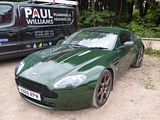
Following the unveiling of the AMV8 Vantage concept car in 2003 at the North American International Auto Show designed by Henrik Fisker, the production version, known as the V8 Vantage was introduced at the Geneva Motor Show in 2005. The two seat, two-door coupé had a bonded aluminium structure for strength and lightness. The 172.5 inch (4.38 m) long car featured a hatchback-style tailgate for practicality, with a large luggage shelf behind the seats. In addition to the coupé, a convertible, known as the V8 Vantage Roadster, was introduced later in that year. The V8 Vantage was initially powered by a 4.3 litre quad-cam 32-valve V8 which produced 380 bhp at 7,300 rpm and 409 Nm (302 lb/ft) at 5,000 rpm. However, models produced after 2008 had a 4.7-litre V8 with 420 bhp and 470 Nm (347 lbft) of torque. Though based loosely on Jaguar’s AJ-V8 engine architecture, this engine was unique to Aston Martin and featured race-style dry-sump lubrication, which enabled it to be mounted low in the chassis for an improved centre of gravity. The cylinder block and heads, crankshaft, connecting rods, pistons, camshafts, inlet and exhaust manifolds, lubrication system and engine management were all designed in house by Aston Martin and the engine was assembled by hand at the AM facility in Cologne, Germany, which also built the V12 engine for the DB9 and Vanquish. The engine was front mid-mounted with a rear-mounted transaxle, giving a 49/51 front/rear weight distribution. Slotted Brembo brakes were also standard. The original V8 Vantage could accelerate from 0 to 60 mph in 4.8 seconds before topping out at 175 mph. In 2008, Aston Martin introduced an aftermarket dealer approved upgrade package for power and handling of the 4.3-litre variants that maintained the warranty with the company. The power upgrade was called the V8 Vantage Power Upgrade, creating a more potent version of the Aston Martin 4.3-litre V8 engine with an increase in peak power of 20 bhp to 400 bhp while peak torque increased by 10 Nm to 420 Nm (310 lb/ft). This consists of the fitting of the following revised components; manifold assembly (painted Crackle Black), valved air box, right and left hand side vacuum hose assemblies, engine bay fuse box link lead (ECU to fuse box), throttle body to manifold gasket, intake manifold gasket, fuel injector to manifold seal and a manifold badge. The V8 Vantage had a retail price of GB£79,000, US$110,000, or €104,000 in 2006, Aston Martin planned to build up to 3,000 per year. Included was a 6-speed manual transmission and leather-upholstery for the seats, dash board, steering-wheel, and shift-knob. A new 6-speed sequential manual transmission, similar to those produced by Ferrari and Lamborghini, called Sportshift was introduced later as an option. An open-topped model was added to the range in 2006 and then in the quest for more power a V12 Vantage joined the range not long after. There were no fewer than 18 different versions of the car produced over its model life

AUDI
The Audi R8, based on the Audi Le Mans quattro concept car (designed by Frank Lamberty and Julian Hoenig) first appeared at the 2003 International Geneva Motor Show and the 2003 Frankfurt International Motor Show. The R8 road car was officially launched at the Paris Auto Show on 30 September 2006. There was some confusion with the name, which the car shares with the 24 Hours of Le Mans winning R8 Le Mans Prototype (LMP). Initial models included the R8 4.2 FSI coupé (with a V8 engine) and R8 5.2 FSI coupé (with a V10 engine). Convertible models, called the Spyder by the manufacturer, were introduced in 2008, followed by the high-performance GT model introduced in 2011. The Motorsport variants of the R8 were also subsequently introduced from 2008 onwards. An all-electric version called the e-Tron started development but would only reach production stage when the second generation model would be introduced. 6-time 24 Hours of Le Mans winner Jacky Ickx described the R8 as “the best handling road car today” and the car was well received by everyone who drove it. The car received a facelift in 2012 and a new model called the V10 Plus was now added to the range. Production of the Type 42 ended in August 2015


BMW
The M3 version of the F30 3 Series was designated the F80 and was produced from 2014 to 2018. The F80 M3 was powered by the BMW S55 twin-turbocharged straight-six engine, therefore being the first turbocharged M3 model. Despite the smaller displacement than the V8 engine used by the previous generation of M3, the switch from naturally aspirated engines to turbocharging resulted in peak power being increased from 414 to 425 hp, and peak torque being increased from 400 to 550 Nm (295 to 406 lb/ft). The official 0–60 mph (0–97 km/h) acceleration times are 3.9 seconds with the M-DCT transmission and 4.1 seconds with the manual transmission. Top speed is limited to 250 km/h (155 mph) but an optional M Driver’s package raises this to 280 km/h (174 mph). The kerb weight is 1,621 kg (3,574 lb). The F80 M3 was unveiled, alongside the F82 M4 (its coupé counterpart), at the 2014 North American International Auto Show. The two-door M3 had been renamed BMW M4 – in line with the new BMW 4 Series range. In 2016, a Competition Package became available for the M3 and M4. Changes included an increase in power to 444 hp, revised tuning of the electronic differential and the electronic stability control (“DSC”), suspension upgrades and new front seats. The official 0–100 km/h (62 mph) time was 4.0 seconds with the dual-clutch transmission. The F80 generation of M3 was produced only as a saloon, following the company’s plans to split off the 4 Series coupé and convertible from the 3 Series. To minimise weight, the roof is made of carbon fibre and the bonnet and front quarter panels are made from aluminium. The F80 M3’s design was updated in (summer) 2015 for the 2016 model year and in (march) 2017 for the 2018 model year. In the former, the taillights were given LEDs, and in the latter, the headlights were restyled and also given newer and more angular LEDs.

CATERHAM
The Caterham story is one of continual development, a four decade process of honing Colin Chapman’s original design, which is now 60 years old. Since 1973, when Graham Nearn’s Caterham cars took over the rights and manufacture of the fly-weight sportscars, it’s grown more power, better engines, more sophistication in both suspension and powertrains, as well – in some cases – as more space inside and certainly more creature comforts, all while preserving the original character. Caterham completed 42 of the heavier and not that well thought of Series 4 cars before deciding to concentrate on the classic Series 3 design, with a simple space frame chassis clothed in aluminium and glassfibre. At the time of the S3, the power unit was from Ford, with the Crossflow unit developing 84 bhp in GT form with a twin choke carburettor, though twin Webers were never far away. Sevens had started out with Ford side valve power, before the 948cc BMC A Series unit found its way into the car, followed by Ford’s new 1340cc and 1498cc engines, before the head redesign put the intake and the exhaust on opposite sides. When Ford discontinued the Kent engine in 1976, it caused something of a difficulty for Caterham, as this also meant the end of the Twin Cam and the BDR engines, of which Caterham had bought 500 in preceding years, and whilst the final pushrod engines came from South Africa, eventually the supply ran out and a new supplier was needed. At first the firm turned to Vauxhall’s 2 litre unit for the higher powered cars but when the found out that Rover were developing a new and sophisticated twin cam engine, which turned out to be the K Series unit, a deal was struck and the first K Series engined Caterhams appeared in 1991, once the multi-point injection version was available (the single point would have required a bonnet bulge which Caterham did not want). To get round the relative lack of torque, Caterham developed their own close ratio 6 speed gearbox which was lighter than the Ford unit they had been using, and which could cope with larger capacity and more powerful K Series units as Rover made them available. Caterham continued to develop the car throughout the 90s, starting to make their own steering racks among other changes. By the time the K Series and the 240 bhp Vauxhall engines in the HPC car came along, the interior had become plusher with a long cockpit option and a wider variant, the SV. There were now proper bucket seats instead of those with a plywood backrest and in 1996 the handbrake moved from under the dash to the transmission tunnel. This required extra tubing in the chassis, which made it 80% stiffer. The front suspension had gained a proper top wishbone and separate anti-roll bar, but the biggest change came with the adoption of de Dion rear suspension. The move was occasioned by a need to keep the rear wheels linked and parallel to each other, yet still as simple as possible, though the engineers harboured a desire for a fully independent rear end, which finally came about with the CSR version in 2004. This change improved the ride massively on bumpy roads and makes the car feel more planted. The collapse of Rover in 2005 meant the end for the K Series, so there was a switch back to Ford power, using the Sigma engine, which happily fits under the bonnet – something that few modern engines do as they are now often simply too tall. Adding more power is a law of diminishing returns with a Caterham, thanks to the aerodynamics, though there are now an array of different power outputs offered, but the most recent change was a new entry level model, which uses a 660cc Suzuki turbo triple, with a live axle and a similar power to weight ratio to the classic single carb Ford powered models of 30 years ago. However, these days you can get carpets, leather seats and full weather gear if you upgrade to an S pack. Caterham plan to continue to develop the car for as long as they can. To date they have built around 16,000 examples, and it is said that were you to gather 100 models together, you would not find two the same, even though, colour apart, many cars look very similar at a quick glance.

FERRARI
The Ferrari F12berlinetta (Type F152) is a front mid-engine, rear-wheel-drive grand tourer which debuted at the 2012 Geneva Motor Show, and replaces the 599 grand tourer. The naturally aspirated 6.3 litre Ferrari V12 engine used in the F12berlinetta has won the 2013 International Engine of the Year Award in the Best Performance category and Best Engine above 4.0 litres. The F12berlinetta was named “The Supercar of the Year 2012” by car magazine Top Gear. The F12berlinetta was replaced by the 812 Superfast in 2017.

The Ferrari 296 (Type F171)is a sports car built since 2022 by the Italian company Ferrari. The 296 is a two-seater, offered as a GTB coupé and a GTS folding hard-top convertible. It is a plug-in hybrid with a rear mid-engine, rear-wheel-drive layout and its power train combines a twin-turbocharged 120-degree block-angle V6 with an electric drive fitted in between the engine and gearbox. The 296 can be driven in electric-only mode for short distances, to comply with use in urban zero-emission zones. Unveiled on 24 June 2021, the 296 is Ferrari’s first stock model with 6-cylinders other than the Dino 206 GT, 246 GT and 246 GTS cars produced by Ferrari but sold under the Dino marque. Its power pack puts out a combined 830 PS, giving the 296 a power-to-weight ratio of 560 hp/ton. The 296 GTB was presented as the first “real Ferrari with just six cylinders on it” on 24 June 2021. Previously, such models were both designed and built by Ferrari, but marketed as a new, entry-level Dino brand, below Ferrari’s exclusively V12-model policy, until 1974. The new car went on sale in 2022. The 296 in the model name reprises the original Dino’s naming scheme, indicating the engine’s displacement and the number of cylinders. GTB stands for Gran Turismo Berlinetta. It remains a current model.

FISHER
The Sylva Fury was launched in 1991 and had an original, 1960s-inspired design, reminiscent of a number of British sports cars of that period. The rights to the design were sold to Fisher Sportscars in 1994; the Fury is currently owned by Fury Sportscars who purchased the rights from BGH Geartech, based in Kent UK. The Fury has been successful in competition with cars racing in many championships, including the 750 Motor Club’s RGB (Road-Going Bike-Engined Kitcar) and Kitcar series. The original model has a tube frame with a rocker arm front suspension, and uses the transmission, rear axle, steering rack, and certain other parts from the Escort Mark II. There have since been two versions of rear suspension developed for the Fury: the Live Axle version uses the Ford Escort rear axle, located using two trailing links in conjunction with a Panhard rod. Coil over shock absorbers are used to give ride comfort combined with handling and grip. The Independent Rear Suspension version uses the Ford Sierra rear hub assembly in conjunction with purpose built hub carriers forming the uprights between upper and lower wishbones. Once again, coil over shock absorbers are used. The original model with an Crossflow engine weighed in at 1,270 lb (576 kg) and was 128 inches (3,250 mm) long, 54 inches (1,370 mm) wide. The wheelbase is 86 inches (2,180 mm). Many different engines can be fitted to the Fury, including all manner of car engines from the Ford Crossflow to Rover V8 and Cosworth Turbo. Customers in the United States favoured Fiat’s Twin Cam engine or the Toyota 4A-GE, as these were already federalized for emissions. Motorbike engines have also been fitted and are popular for track cars due to the low weight, high power, and built-in sequential gearbox.


FORD
Ford played much the same guessing game about whether there would be an RS version of the third generation Focus as they had done with the earlier versions. Production of the regular cars started in late 2010, but it was not until the 2015 Geneva Motor Show before the production ready MKIII Ford Focus RS was unveiled. It came packing the turbocharged 2.3-litre inline-four engine found in the Mustang EcoBoost. In the Focus RS, the engine itself produces 350 hp. Power is sent to all four wheels via Ford’s all-new Torque-Vectoring All-Wheel-Drive system with a rear drive unit designed by GKN, as well as upgraded suspension and brakes. As well as that, the new Focus RS will be fitted with Drive Modes – including an industry-first Drift Mode that allows controlled oversteer drifts – and Launch Control. The RS will boast a model specific aerodynamic package that helps to differentiate it from other Focus models. The RS is capable of accelerating to 100 km/h (62 mph) in 4.7 seconds. Sales finally started in mid 2016, with long waiting lists having been created, though Ford did eventually catch up with expanded production levels allowing them to meet the demand.

JAGUAR
Few would have guessed that the XJS would run for over 20 years, but eventually it came time for its replacement, and the car charged with so doing was the XK8. Development began in 1992, with design work having starting earlier, in late 1991. By October 1992 a design was chosen and later frozen for production in 1993. Prototypes were built from December 1993 after the X100 was given formal approval and design patents were filed in June 1994. Development concluded in 1996, at which point the car was launched. The first-generation XK series shares its platform with the Aston Martin DB7, and both cars are derived from the Jaguar XJS, though the platform has been extensively changed. One of the revisions is the use of the second generation of Jaguar’s independent rear suspension unit, taken from the XJ40. The XK8 was available in coupé or convertible body styles and with the then new 4.0-litre Jaguar AJ-V8 engine. In 1998 the XKR was introduced with a supercharged version of the engine. 2003 the engines were replaced by the 4.2-litre AJ34 engines in both the normally aspirated and supercharged versions. Equipment levels were generous and there was a high standard of fit and finish. Both models came with all-leather interior, burl walnut trim, and side airbags. Jeremy Clarkson, during a Top Gear test-drive, likened the interior of the original XK8 to sitting inside Blenheim Palace. The model ran for 10 years before being replaced by the X150 model XK.

LOMAX
The Lomax is a British kit car produced since 1982 by several companies. It is a custom two-seater retro-style fibreglass body on a Citroën 2CV or Citroën Dyane chassis and components, and is available in three-wheeler and four-wheeler designs. The Lomax was introduced in 1982 by the Lomax Motor Co. of Willoughton, Gainsborough, Lincolnshire. It was designed by Nigel Whall. In the late 1980s production was transferred to the Mumford Motor Co. of Gigg Mill, Nailsworth, Gloucestershire, where it was produced until the early 1990s. From then it was built at Cradley Motor Works in Cradley Heath, West Midlands. By 2009 the car was still being produced by Cradley Motor Works in St Leonards-on-Sea, East Sussex. Since the early 1990s the Lomax has been sold in the Netherlands and Germany. The design is slightly reminiscent of the better-known Morgan Three Wheeler of the 1930s. The car consists of a fibreglass body mounted on an un-modified Citroën 2CV or Dyane floorpan and engine. Later a steel tube chassis was introduced. A Lomax is usually an open two-seat roadster. The original 1982 prototype had a bespoke four-wheel chassis which was specially constructed, and of shorter wheelbase than the donor car, a Citroën Ami. Early “three-wheeler” variants were actually four-wheelers, with two rear wheels closely paired as in some Heinkel bubble cars of the 1960s. Later versions were genuine trikes, three wheels with two wheels in front and one at the back, this allowed to benefit from the (lower) 3-wheel UK road-tax. A four-wheel variant followed later, using an unmodified 2CV chassis. The naming convention was the number of cylinders, the number of seats, and the number of wheels. The common model designations are 223 (2 cylinders, 2 seats, 3 wheels) or 224 (2 cylinders, 2 seats, 4 wheels). A few examples used the engine from the Citroën GS or GSA, designated 424 (4 cylinders, 2 seats, 4 wheels). The Lomax weighs approximately 430 kilograms (950 lb), delivering a top speed of approximately 140 kilometres per hour (87 mph) with a 602cc 2CV/Dyane engine.

LOTUS
The original Elan was introduced in 1962 as a roadster, although an optional hardtop was offered in 1963 and a coupé version appeared in 1965, and there were examples of all of these here. The two-seat Lotus Elan replaced the elegant, but unreliable and expensive to produce Lotus Elite. It was the first Lotus road car to use a steel backbone chassis with a fibreglass body. At 1,600 lb (726 kg), the Elan embodied the Colin Chapman minimum weight design philosophy. Initial versions of the Elan were also available as a kit to be assembled by the customer. The Elan was technologically advanced with a DOHC 1557 cc engine, 4-wheel disc brakes, rack and pinion steering, and 4-wheel independent suspension. Gordon Murray, who designed the spectacular McLaren F1 supercar, reportedly said that his only disappointment with the McLaren F1 was that he couldn’t give it the perfect steering of the Lotus Elan. This generation of the two-seater Elan was famously driven by the character Emma Peel on the 1960s British television series The Avengers. The “Lotus TwinCam” engine was based on Ford Kent Pre-Crossflow 4-cylinder 1498 cc engine, with a Harry Mundy-designed 2 valve alloy chain-driven twin-cam head. The rights to this design were later purchased by Ford, who renamed it to “Lotus-Ford Twin Cam”. It would go on to be used in a number of Ford and Lotus production and racing models.

It is now over 25 years since Lotus launched the Elise, a model which showed a return to the core values of simplicity and light-weight which were cornerstones of Colin Chapman’s philosophy when he founded the marque in 1955. The first generation Elise was produced for just over 4 years, with a replacement model, the Series 2 arriving in October 2000. It came about as the Series 1 could not be produced beyond the 2000 model production year due to new European crash sustainability regulations. Lacking the funding to produce a replacement, Lotus needed a development partner to take a share of investment required for the new car. General Motors offered to fund the project, in return for a badged and GM-engined version of the car for their European brands, Opel and Vauxhall. The result was therefore two cars, which although looking quite different, shared much under the skin: a Series 2 Elise and the Vauxhall VX220 and Opel Speedster duo. The Series 2 Elise was a redesigned Series 1 using a slightly modified version of the Series 1 chassis to meet the new regulations, and the same K-series engine with a brand new Lotus-developed ECU. The design of the body paid homage to the earlier M250 concept, and was the first Lotus to be designed by computer. Both the Series 2 Elise and the Opel Speedster/Vauxhall VX220 were built on the same production line, in a new facility at Hethel. Both cars shared many parts, including the chassis, although they had different drive-trains and power-plants. The VX220 carried the Lotus internal model identification Lotus 116, with the code name Skipton for the launch 2.2 normally aspirated version and Tornado for the 2 litre Turbo which came out in 2004. Fitted with 17 inch over the Elise’s 16 inch front wheels, the Vauxhall/Opel version ceased production in late 2005 and was replaced by the Opel GT for February 2007, with no RHD version for the United Kingdom. The Elise lived on. and indeed production only ceased at the end of 2021 and there have been countless different versions produced in that time. Whilst the first of the Series 2 cars came with the Rover K-Series engine, and that included the 111S model which had the VVC engine technology producing 160 hp, a change came about in 2005 when Lotus started to use Toyota engines. This was initially due to Lotus’ plans to introduce the Elise to the US market, meaning that an engine was needed which would comply with US emissions regulations. The selected 1.8 litre (and later 1.6 litre) Toyota units did, and the K-series did not. that MG-Rover went out of business in 2005 and engine production ceased confirmed the need for the change. Since then, Lotus have offered us track focused Elise models like the 135R and Sport 190, with 135 bhp and 192 bhp respectively, as well as the 111R, the Sport Racer, the Elise S and Elise R. In 2008 an even more potent SC model, with 218 bhp thanks to a non-intercooled supercharger was added to the range. In February 2010, Lotus unveiled a facelifted version of the second generation Elise. The new headlights are now single units; triangular in shape they are somewhat larger than the earlier lights. The cheapest version in Europe now has a 1.6 litre engine to comply with Euro 5 emissions, with the same power output as the earlier 1.8 136bhp car.

MASERATI
After producing BiTurbo based cars for 17 years, Maserati replaced their entire range with a new model in July 1998, the 3200 GT. This very elegant 2+2 grand tourer was styled by Italdesign, whose founder and head Giorgetto Giugiaro had previously designed, among others, the Ghibli, Bora and Merak. The interior design was commissioned to Enrico Fumia. Its name honoured the Maserati 3500 GT, the Trident’s first series production grand tourer. Sold mainly in Europe, the 3200 GT was powered by the twin-turbo, 32-valve, dual overhead cam 3.2-litre V8 engine featured in the Quattroporte Evoluzione, set up to develop 370 PS (365 hp). The car was praised for its styling, with the distinctive array of tail-lights, consisting of LEDs, arranged in the shape of boomerang being particularly worthy of comment. The outer layer of the ‘boomerang’ provided the brake light, with the inner layer providing the directional indicator. The car was also reviewed quite well by the press when they got to drive it in early 1999, though it was clear that they expected more power and excitement. That came after 4,795 cars had been produced, in 2001, with the launch of the 4200 models. Officially called the Coupé and joined by an open-topped Spyder (Tipo M138 in Maserati speak), these models had larger 4.2 litre engines and had been engineered so the cars could be sold in America, marking the return to that market for Maserati after an 11 year gap. There were some detailed styling changes, most notable of which were the replacement of the boomerang rear lights with conventional rectangular units. Few felt that this was an improvement. The cars proved popular, though, selling strongly up until 2007 when they were replaced by the next generation of Maserati. Minor changes were made to the model during its six year production, but more significant was the launch at the 2004 Geneva Show of the GranSport which sported aerodynamic body cladding, a chrome mesh grille, carbon fibre interior trim, and special 19-inch wheels. It used the Skyhook active suspension, with a 0.4 inch lower ride height, and the Cambiocorsa transmission recalibrated for quicker shifts. The exhaust was specially tuned to “growl” on start-up and full throttle. The GranSport was powered by the same 4244 cc, 90° V8 petrol engine used on the Coupé and Spyder, but developing 400 PS (395 hp) at 7000 rpm due primarily to a different exhaust system and improvements on the intake manifolds and valve seats. A six-speed paddle shift transmission came as standard. The GranSport has a claimed top speed of 180 mph (290 km/h) and a 0–62 mph (0–100 km/h) time of 4.8 seconds.

The Maserati GranTurismo and GranCabrio (Tipo M145) are a series of a grand tourers produced from 2007 to 2019. They succeeded the 2-door V8 grand tourers offered by the company, the Maserati Coupé, and Spyder. The GranTurismo set a record for the most quickly developed car in the auto industry, going from design to production stage in just nine months. The reason being that Ferrari, after selling off Maserati to the Fiat Chrysler Group, took the designs of the proposed replacement of the Maserati Coupé and after some modifications, launched it as the Ferrari California. Unveiled at the 2007 Geneva Motor Show, the GranTurismo has a drag coefficient of 0.33. The model was initially equipped with a 4.2-litre V8 engine developed in conjunction with Ferrari. The engine generates a maximum power output of 405 PS and is equipped with a 6-speed ZF automatic transmission. The 2+2 body was derived from the Maserati M139 platform, also shared with the Maserati Quattroporte V, with double-wishbone front suspension and a multilink rear suspension. The grand tourer emphasises comfort in harmony with speed and driver-enjoyment. The better equipped S variant was unveiled at the 2008 Geneva Motor Show and features the enlarged 4.7-litre V8 engine shared with the Alfa Romeo 8C Competizione, rated at 440 PS at 7,000 rpm and 490 Nm (361 lb/ft) of torque at 4,750 rpm. At the time of its introduction, it was the most powerful road-legal Maserati offered for sale (excluding the homologation special MC12). The engine is mated to the 6-speed automated manual shared with the Ferrari F430. With the transaxle layout weight distribution improved to 47% front and 53% rear. The standard suspension set-up is fixed-setting steel dampers, with the Skyhook adaptive suspension available as an option along with a new exhaust system, and upgraded Brembo brakes. The seats were also offered with various leather and Alcantara trim options. The upgrades were made to make the car more powerful and more appealing to the buyers while increasing performance, with acceleration from 0–100 km/h (0–62 mph) happening in 4.9 seconds and a maximum speed of 295 km/h (183 mph). Aside from the power upgrades, the car featured new side skirts, unique 20-inch wheels unavailable on the standard car, a small boot lip spoiler, and black headlight clusters in place of the original silver. The variant was available in the North American market only for MY2009 with only 300 units offered for sale. The GranTurismo MC is the racing version of the GranTurismo S developed to compete in the FIA GT4 European Cup and is based on the Maserati MC concept. The car included a 6-point racing harness, 120 litre fuel tank, 380 mm (15.0 in) front and 326 mm (12.8 in) rear brake discs with 6-piston calipers at the front and 4-piston calipers at the rear, 18-inch racing wheels with 305/645/18 front and 305/680/18 rear tyres, carbon fibre bodywork and lexan windows throughout along with a race interior. All the weight-saving measures lower the weight to about 3,000 lb (1,361 kg). The car shares the 4.7-litre V8 engine from the GranTurismo S but is tuned to generate a maximum power output of 450 PS along with the 6-speed automated manual transmission. The GranTurismo MC was unveiled at the Paul Ricard Circuit in France. It went on sale in October, 2009 through the Maserati Corse programme. 15 GranTurismo MC racecars were developed, homologated for the European Cup and National Endurance Series, one of which was taken to be raced by GT motorsport organization Cool Victory in Dubai in January, 2010. Introduced in 2008, the GranTurismo MC Sport Line is a customisation programme based on the GranTurismo MC concept. Changes include front and rear carbon-fibre spoilers, carbon-fibre mirror housings and door handles, 20-inch wheels, carbon-fibre interior (steering wheel rim, paddle shifters, instrument panel, dashboard, door panels), stiffer springs, shock absorbers and anti-roll bars with custom Maserati Stability Programme software and 10 mm (0.4 in) lower height than GranTurismo S. The programme was initially offered for the GranTurismo S only, with the product line expanded to all GranTurismo variants and eventually all Maserati vehicles in 2009. Replacing both the GranTurismo S and S Automatic, the Granturismo Sport was unveiled in March 2012 at the Geneva Motor Show. The revised 4.7L engine is rated at 460 PS. The Sport features a unique MC Stradale-inspired front fascia, new headlights and new, sportier steering wheel and seats. The ZF six-speed automatic gearbox is now standard, while the six-speed automated manual transaxle is available as an option. The latter has steering column-mounted paddle-shifters, a feature that’s optional with the automatic gearbox. New redesigned front bumper and air splitter lowers drag coefficient from Cd=0.33 to 0.32. In September 2010, Maserati announced plans to unveil a new version of the GranTurismo – the MC Stradale – at the 2010 Paris Motor Show. The strictly two-seat MC Stradale is more powerful than the GranTurismo at 450 PS, friction reduction accounts for the increase, says Maserati, due to the strategic use of “diamond-like coating”, an antifriction technology derived from Formula 1, on wear parts such as the cams and followers. It is also 110 kg lighter (1,670 kg dry weight) from the GranTurismo, and more aerodynamic than any previous GranTurismo model – all with the same fuel consumption as the regular GranTurismo. In addition to two air intakes in the bonnet, the MC Stradale also receives a new front splitter and rear air dam for better aerodynamics, downforce, and improved cooling of carbon-ceramic brakes and engine. The body modifications make the car 48 mm (2 in) longer. The MC Race Shift 6-speed robotised manual gearbox (which shares its electronics and some of its hardware from the Ferrari 599 GTO) usually operates in an “auto” mode, but the driver can switch this to ‘sport’ or ‘race’ (shifting happening in 60 milliseconds in ‘race’ mode), which affects gearbox operations, suspension, traction control, and even the sound of the engine. The MC Stradale is the first GranTurismo to break the 300 km/h (186 mph) barrier, with a claimed top speed of 303 km/h (188 mph). The push for the Maserati GranTurismo MC Stradale came from existing Maserati customers who wanted a road-legal super sports car that looked and felt like the GT4, GTD, and Trofeo race cars. It has been confirmed by the Maserati head office that only 497 units of 2-seater MC Stradales were built in total from 2011 to 2013 in the world, Europe: 225 units, China: 45 units, Hong Kong: 12, Taiwan: 23 units, Japan: 33 units, Oceania: 15 units and 144 units in other countries. US market MC’s do not have the “Stradale” part of the name, and they are sold with a fully automatic six-speed transmission rather than the one available in the rest of the world. US market cars also do not come with carbon fibre lightweight seats like the rest of the world. The MC Stradale’s suspension is 8% stiffer and the car rides slightly lower than the GranTurismo S following feedback from racing drivers who appreciated the better grip and intuitive driving feel of the lower profile. Pirelli has custom-designed extra-wide 20-inch P Zero Corsa tyres to fit new flow-formed alloy wheels. The Brembo braking system with carbon-ceramic discs weighs around 60% less than the traditional system with steel discs. The front is equipped with 380 x 34 mm ventilated discs, operated by a 6 piston caliper. The rear discs measure 360 x 32 mm with four-piston calipers. The stopping distance is 33 m at 100 km/h (62 mph) with an average deceleration of 1.2g. At the 2013 Geneva Motor Show, an update to the GranTurismo MC Stradale was unveiled. It features an updated 4.7 litre V8 engine rated at 460 PS at 7,000 rpm and 520 Nm (384 lb/ft) of torque at 4,750 rpm, as well as the MC Race Shift 6-speed robotized manual gearbox which shifts in 60 milliseconds in ‘race’ mode. The top speed is 303 km/h (188 mph). All models were built at the historic factory in viale Ciro Menotti in Modena. A total of 28,805 GranTurismos and 11,715 units of the convertible were produced. The final production example of the GranTurismo, called Zéda, was presented painted in a gradient of blue, black and white colours.

MINI
Issigonis’ friend John Cooper, owner of the Cooper Car Company and designer and builder of Formula One cars, saw the potential of the Mini for competition. Issigonis was initially reluctant to see the Mini in the role of a performance car, but after John Cooper appealed to BMC management, the two men collaborated to create the Mini Cooper. The Austin Mini Cooper and Morris Mini Cooper debuted in September 1961. The 848 cc engine from the Morris Mini-Minor was given a longer stroke to increase capacity to 997 cc increasing power from 34 to 55 bhp. The car featured a race-tuned engine, twin SU carburettors, a closer-ratio gearbox and front disc brakes, uncommon at the time in a small car. One thousand units of this version were commissioned by management, intended for and designed to meet the homologation rules of Group 2 rally racing. The 997 cc engine was replaced by a shorter stroke 998 cc unit in 1964. In 1962, Rhodesian John Love became the first non-British racing driver to win the British Saloon Car Championship driving a Mini Cooper. A more powerful Mini Cooper, dubbed the “S”, was developed in tandem and released in 1963. Featuring a 1071 cc engine with a 70.61 mm bore and nitrided steel crankshaft and strengthened bottom end to allow further tuning; and larger servo-assisted disc brakes, 4,030 Cooper S cars were produced and sold until the model was updated in August 1964. Cooper also produced two S models specifically for circuit racing in the under 1,000 cc and under 1,300 cc classes respectively, rated at 970 cc and a 1,275 cc both had a 70.61 mm bore and both were also offered to the public. The smaller-engine model was not well received, and only 963 had been built when the model was discontinued in 1965. The 1,275 cc Cooper S models continued in production until 1971. Sales of the Mini Cooper were: 64,000 Mark I Coopers with 997 cc or 998 cc engines; 19,000 Mark I Cooper S with 970 cc, 1,071 cc or 1,275 cc engines; 16,000 Mark II Coopers with 998 cc engines; 6,300 Mark II Cooper S with 1,275 cc engines. There were no Mark III Coopers and 1,570 Mark III Cooper S.

MORRIS
No surprise to see the evergreen Morris Minor here as this is a very popular classic. The Minor was conceived in 1941. Although the Nuffield Organization was heavily involved in war work and there was a governmental ban on civilian car production, Morris Motors’ vice chairman, Miles Thomas, wanted to prepare the ground for new products to be launched as soon as the war was over. Vic Oak, the company’s chief engineer, had already brought to Thomas’ attention a promising junior engineer, Alec Issigonis, who had been employed at Morris since 1935 and specialised in suspension design but he had frequently impressed Oak with his advanced ideas about car design in general. Issigonis had come to Oak’s particular attention with his work on the new Morris Ten, which was in development during 1936/7. This was the first Morris to use unitary construction and was conceived with independent front suspension. Issigonis designed a coil-sprung wishbone system which was later dropped on cost grounds. Although the design would later be used on the MG Y-type and many other post-war MGs the Morris Ten entered production with a front beam axle. Despite his brief being to focus on the Ten’s suspension Issigonis had also drawn up a rack and pinion steering system for the car. Like his suspension design this was not adopted but would resurface in the post-war years on the MG Y-type, but these ideas proved that he was the perfect candidate to lead the design work on a new advanced small car. With virtually all resources required for the war effort, Thomas nonetheless approved the development of a new small family car that would replace the Morris Eight. Although Oak (and Morris’ technical director, Sidney Smith) were in overall charge of the project it was Issigonis who was ultimately responsible for the design, working with only two other draughtsmen. Thomas named the project ‘Mosquito’ and ensured that it remained as secret as possible, both from the Ministry of Supply and from company founder William Morris (now Lord Nuffield), who was still chairman of Morris Motors and, it was widely expected, would not look favourably on Issigonis’ radical ideas. Issigonis’ overall concept was to produce a practical, economical and affordable car for the general public that would equal, if not surpass, the convenience and design quality of a more expensive car. In later years he summed up his approach to the Minor; that he wanted to design an economy car that “the average man would take pleasure in owning, rather than feeling of it as something he’d been sentenced to” and “people who drive small cars are the same size as those who drive large cars and they should not be expected to put up with claustrophobic interiors.” Issigonis wanted the car to be as spacious as possible for its size and comfortable to drive for inexperienced motorists. Just as he would with the Mini ten years later, he designed the Mosquito with excellent roadholding and accurate, quick steering not with any pretence of making a sports car, but to make it safe and easy to drive by all. As work proceeded, there were plenty of battle to overcome, to get Issigonis’ ideas approved, and not all of them were. The production car, called the Minor was launched at the British Motor Show at Earls Court in London on October 27, 1948. At the same show Morris also launched the new Morris Oxford and Morris Six models, plus Wolseley variants of both cars, which were scaled-up versions of the new Minor, incorporating all the same features and designed with Issigonis’ input under Vic Oak’s supervision. Thus Issigonis’ ideas and design principles underpinned the complete post-war Morris and Wolseley car ranges. The original Minor MM series was produced from 1948 until 1953. It included a pair of four-seat saloons, two-door and (from 1950) a four-door, and a convertible four-seat Tourer. The front torsion bar suspension was shared with the larger Morris Oxford MO, as was the almost-unibody construction. Although the Minor was originally designed to accept a flat-4 engine, late in the development stage it was replaced by a 918 cc side-valve inline-four engine, little changed from that fitted in the 1935 Morris 8, and producing 27.5 hp and 39 lb/ft of torque. This little engine pushed the Minor to just 64 mph but delivered 40 mpg. Brakes were four-wheel drums. Early cars had a painted section in the centre of the bumpers to cover the widening of the production car from the prototypes. This widening of 4 inches is also visible in the creases in the bonnet. Exports to the United States began in 1949 with the headlamps removed from within the grille surround to be mounted higher on the wings to meet local safety requirements. In 1950 a four-door version was released, initially available only for export, and featuring from the start the headlamps faired into the wings rather than set lower down on either side of the grille. The raised headlight position became standard on all Minors in time for 1951. From the start, the Minor had semaphore-type turn indicators, and subsequent Minor versions persisted with these until 1961. An Autocar magazine road test in 1950 reported that these were “not of the usual self-cancelling type, but incorporate[d] a time-basis return mechanism in a switch below the facia, in front of the driver”. It was all too easy for a passenger hurriedly emerging from the front passenger seat to collide with and snap off a tardy indicator “flipper” that was still sticking out of the B-pillar, having not yet been safely returned by the time-basis return mechanism to its folded position. Another innovation towards the end of 1950 was a water pump (replacing a gravity dependent system), which permitted the manufacturer to offer an interior heater “as optional equipment”. When production of the first series ended, just over a quarter of a million had been sold, 30 per cent of them the convertible Tourer model. In 1952, the Minor line was updated with an Austin-designed 803 cc overhead valve A-series engine, replacing the original side-valve unit. The engine had been designed for the Minor’s main competition, the Austin A30, but became available as Austin and Morris were merged into the British Motor Corporation. The new engine felt stronger, though all measurements were smaller than the old. The 52 second drive to 60 mph was still calm, with 63 mph as the top speed. Fuel consumption also rose to 36 mpg. An estate version was introduced in 1952, known as the Traveller (a Morris naming tradition for estates, also seen on the Mini). The Traveller featured an external structural ash (wood) frame for the rear bodywork, with two side-hinged rear doors. The frame was varnished rather than painted and a highly visible feature of the body style. Commercial models, marketed as the Morris Quarter Ton Van and Pick-up were added in May 1953. Rear bodies of the van versions were all steel. The 4-seat convertible and saloon variants continued as well. The car was again updated in 1956 when the engine was increased in capacity to 948 cc. The two-piece split windscreen was replaced with a curved one-piece one and the rear window was enlarged. In 1961 the semaphore-style trafficators were replaced by the flashing direction indicators, these were US-style red at the rear (using the same bulb filament as the brake lamp) and white at the front (using a second brighter filament in the parking lamp bulb) which was legal in the UK and many export markets at the time (such as New Zealand). An upmarket car based on the Minor floorpan using the larger BMC B-Series engine was sold as the Riley One-Point-Five/Wolseley 1500 beginning in 1957: versions of this Wolseley/Riley variant were also produced by BMC Australia as the Morris Major and the Austin Lancer. In December 1960 the Morris Minor became the first British car to sell more than 1,000,000 units. To commemorate the achievement, a limited edition of 350 two-door Minor saloons (one for each UK Morris dealership) was produced with distinctive lilac paintwork and a white interior. Also the badge name on the side of the bonnet was modified to read “Minor 1,000,000” instead of the standard “Minor 1000”. The millionth Minor was donated to the National Union of Journalists, who planned to use it as a prize in a competition in aid of the union’s Widow and Orphan Fund. The company, at the same time, presented a celebratory Minor to London’s Great Ormond Street Hospital for Sick Children, but this car was constructed of cake. The final major upgrades to the Minor were made in 1962. Although the name Minor 1000 was retained, the changes were sufficient for the new model to be given its own ADO development number. A larger version of the existing A-Series engine had been developed in conjunction with cylinder head specialist Harry Weslake for the then new ADO16 Austin/Morris 1100 range. This new engine used a taller block than did the 948 cc unit, with increased bore and stroke bringing total capacity up to 1,098 cc. Although fuel consumption suffered moderately at 38 mpg, the Minor’s top speed increased to 77 mph with noticeable improvements in low-end torque, giving an altogether more responsive drive. Other changes included a modified dashboard layout with toggle switches, textured steel instrument binnacle, and larger convex glove box covers. A different heater completed the interior upgrade, whilst the larger combined front side/indicator light units, common to many BMC vehicles of the time, were fitted to the front wings. These now included a separate bulb and amber lens for indicators while larger tail lamp units also included amber rear flashers. During the life of the Minor 1000 model, production declined. The last Convertible/Tourer was manufactured on 18 August 1969, and the saloon models were discontinued the following year. Production of the more practical Traveller and commercial versions ceased in 1972, although examples of all models were still theoretically available from dealers with a surplus of unsold cars for a short time afterwards. 1,619,857 Minors of all variants were ultimately sold.


PEUGEOT
Before the 205, Peugeot was considered the most conservative of France’s “big three” car manufacturers, producing large saloons such as the 504 and 505, although it had entered the modern supermini market in 1973 with the Peugeot 104. The genesis of the 205 lay within Peugeot’s takeover in 1978 of Chrysler’s European divisions Simca and the former Rootes Group, which had the necessary expertise in making small cars including the Simca 1100 in France and Hillman Imp in Britain. It was around this time that Peugeot began to work on the development of a new supermini for the 1980s. It was launched on 24 February 1983, and was launched in right-hand drive form for the UK market in September that year. Shortly after its launch, it was narrowly pipped to the European Car of the Year award by the similar sized Fiat Uno, but ultimately (according to the award organizers) it would enjoy a better image and a longer high market demand than its Italian competitor. It was one of five important small cars to be launched onto the European market within a year of each other: the other four were the Uno, the second generation Ford Fiesta, the original Opel Corsa (sold as the Vauxhall Nova on the British market) and the original Nissan Micra. Its launch also closely followed that of the Austin Metro and Volkswagen Polo Mk2. The styling of the 205 is often thought to be a Pininfarina design, although Gerard Welter claims that it is an in-house design; Pininfarina only styled the Cabriolet. It is often credited as the car that turned Peugeot’s fortunes around. The fully independent suspension used the now standard PSA Peugeot Citroën layout that had debuted in the Peugeot 305 estate. A key ingredient of the success of the 205, it had MacPherson struts at the front and trailing arms with torsion bars at the rear. The rear suspension was very compact, designed to minimise suspension intrusion into the boot, giving a wide flat loadspace, while providing excellent ride and handling. Early 205s used the X petrol engine [n 1] from the older Peugeot 104, although these were later (1987–1988) replaced with the newer XU and TU-series engines, which were of PSA design. Engines ranged in displacement from 954 cc to 1905 cc, in carburettor or fuel injected versions. The diesel models employed the PSA XUD engine, lifted from the Citroën BX which was introduced in September 1982. These engines had a capacity of 1769 cc (XUD7) and 1905 cc (XUD9) and are closely related to the XU5 and XU9 petrol engines in the BX16 and BX19 of the time. The diesel engines were world-beating and so petrol-like that many buyers were won over by petrol car performance combined with diesel economy. For instance, the 205 GRD (1.8 Diesel, 59 bhp, 78 lb/ft (105.8 Nm)) was as fast as, yet smoother than, the 205 GR (1.4 Petrol, 59 bhp, 78 lb/ft (105.8 Nm)), due to the engine developing peak torque at much lower rpm, while using much less fuel. There were various versions intended for commercial use, such as the two-seater XA-series. There was also the “205 Multi”, a tall-bodied special version on XA or XE-basis built by independent coachbuilders like Gruau and Durisotti. Gruau called their XA-based two-seater version the “VU”, while the five-seat XE-based version was called the “VP”. Durisotti began building the 205 Multi in 1986; it was called the “205 Multi New Look”. The 205 was an instant hit, and its styling was echoed in every Peugeot model that was to follow. The exterior styling was never facelifted or significantly altered in its 15-year production run. There was a dashboard redesign for the 1988 model year, and in late 1990 the 205 received new door design and cards, clear front indicators, new ‘smoked’ rear light clusters, single point petrol injection and catalytic converters were introduced, to meet the new 1992 pollution limits. These updates came at a crucial time, as 1990 also saw the arrival of a completely new French competitor, the Renault Clio, while the Rover Metro and Volkswagen Polo were also heavily updated, and Ford had already replaced its Fiesta with a third generation model. Still, the 205 was still widely regarded in the motoring press as the benchmark car in this sector by 1990. At the beginning of 1993, Peugeot launched the 306, which officially replaced the 309; the arrival of this car also diminished the 205’s role (and its sales figures) in the Peugeot range, as had the arrival of the smaller 106 in September 1991 – although the final demise of the 205 was still some years away. The engines were continuously updated, with the new TU engines introduced in 1988. In 1991, the 205 dTurbo was launched with a powerful turbocharged version of the 1,769 cc xud diesel engine. After several years of gradually declining sales, the Peugeot 205 was discontinued in the United Kingdom in 1996. The Peugeot 205 was still offered in the “Sacré Numéro” and “Génération” models until the end of the production in 1998. The last models were GLD 1.8 configuration and were sold in Argentina. Most of the later European versions were only sold in France. Due to the pressure from the market, with buyers wanting a Peugeot supermini in the mould of the 205 again, the company finally built a direct replacement in the 206, which was launched in 1998. 5,278,050 Peugeot 205s have been sold, and a significant percentage of them were still in circulation as of 2009. By 2014, there were still as many as 14,000 on the road in the United Kingdom, compared to the peak high of 374,773 in 1994. With potentially as many 400,000 sales in the UK, it became the best selling car ever sold by Peugeot in the UK – although its success was emulated a few years later by the larger 306 and later by the 206. It also helped boost the popularity of the Peugeot brand there, and was at least a factor in Peugeot’s decision to phase out the Talbot brand in the mid 1980s when launching new models to be built at the former Rootes Group plant near Coventry and the former Simca plant at Poissy.


PORSCHE
The 356 was created by Ferdinand “Ferry” Porsche (son of Dr. Ing. Ferdinand Porsche, founder of the German company), who founded the Austrian company with his sister, Louise. Like its cousin, the Volkswagen Beetle (which Ferdinand Porsche Senior had designed), the 356 was a four-cylinder, air-cooled, rear-engine, rear-wheel-drive car utilising unitised pan and body construction. The chassis was a completely new design as was the 356’s body which was designed by Porsche employee Erwin Komenda, while certain mechanical components including the engine case and some suspension components were based on and initially sourced from Volkswagen. Ferry Porsche described the thinking behind the development of the 356 in an interview with the editor of Panorama, the PCA magazine, in September 1972. “….I had always driven very speedy cars. I had an Alfa Romeo, also a BMW and others. ….By the end of the war I had a Volkswagen Cabriolet with a supercharged engine and that was the basic idea. I saw that if you had enough power in a small car it is nicer to drive than if you have a big car which is also overpowered. And it is more fun. On this basic idea we started the first Porsche prototype. To make the car lighter, to have an engine with more horsepower…that was the first two seater that we built in Carinthia (Gmünd)”. The first 356 was road certified in Austria on June 8, 1948, and was entered in a race in Innsbruck where it won its class. Porsche re-engineered and refined the car with a focus on performance. Fewer and fewer parts were shared between Volkswagen and Porsche as the ’50’s progressed. The early 356 automobile bodies produced at Gmünd were handcrafted in aluminium, but when production moved to Zuffenhausen, Germany in 1950, models produced there were steel-bodied. Looking back, the aluminium bodied cars from that very small company are what we now would refer to as prototypes. Porsche contracted with Reutter to build the steel bodies and eventually bought the Reutter company in 1963. The Reutter company retained the seat manufacturing part of the business and changed its name to Recaro. Little noticed at its inception, mostly by a small number of auto racing enthusiasts, the first 356s sold primarily in Austria and Germany. It took Porsche two years, starting with the first prototype in 1948, to manufacture the first 50 automobiles. By the early 1950s the 356 had gained some renown among enthusiasts on both sides of the Atlantic for its aerodynamics, handling, and excellent build quality. The class win at Le Mans in 1951 was clearly a factor. It was always common for owners to race the car as well as drive them on the streets. They introduced the four-cam racing “Carrera” engine, a totally new design and unique to Porsche sports cars, in late 1954. Increasing success with its racing and road cars brought Porsche orders for over 10,000 units in 1964, and by the time 356 production ended in 1965 approximately 76,000 had been produced. The 356 was built in four distinct series, the original (“pre-A”), followed by the 356 A, 356 B, and then finally the 356 C. To distinguish among the major revisions of the model, 356’s are generally classified into a few major groups. 356 coupés and “cabriolets” (soft-top) built through 1955 are readily identifiable by their split (1948 to 1952) or bent (centre-creased, 1953 to 1955) windscreens. In late 1955 the 356 A appeared, with a curved windshield. The A was the first road going Porsche to offer the Carrera 4 cam engine as an option. In late 1959 the T5 356 B appeared; followed by the redesigned T6 series 356 B in 1962. The final version was the 356 C, little changed from the late T6 B cars but with disc brakes to replace the drums. This one is one of many replica and recreation cars that have been made.

During the 1990s, Porsche was facing financial troubles and rumours of a proposed takeover were being spread. The signature air-cooled flat-6 of the 911 was reaching the limits of its potential as made evident by the 993. Stricter emissions regulations world wide further forced Porsche to think of a replacement of the air-cooled unit. In order to improve manufacturing processes, Porsche took the aid of leading Japanese car manufacturer Toyota whose consultants would assist in the overhaul of the Zuffenhausen manufacturing facility introducing mass production techniques which would allow Porsche to carry out production processes more efficiently. Porsche had realised that in order to keep the 911 in production, it would need radical changes. This led to the development of the 996. The sharing of development between the new 911 and the entry level Boxster model allowed Porsche to save development costs. This move also resulted in interchangeable parts between the two models bringing down maintenance costs. The Porsche 996 was a new design developed by Pinky Lai under Porsche design chief Harm Lagaay from 1992 to 1994; it was the first 911 that was completely redesigned, and carried over little from its predecessor as Porsche wanted the design team to design a 911 for the next millennium. Featuring an all new body work, interior, and the first water-cooled engine, the 996 replaced the 993 from which only the front suspension, rear multi-link suspension, and a 6-speed manual transmission were retained in revised form. The 996 had a drag coefficient of Cd=0.30 resulting from hours spent in the wind tunnel. The 996 is 185 mm (7 in) longer and 40 mm (2 in) wider than its predecessor. It is also 45% stiffer courtesy of a chassis formed from high-strength steel. Additionally, it is 50 kg (110 lb) lighter despite having additional radiators and coolant. All of the M96 engines offered in the 996 (except for the variants fitted to the Turbo and GT2/GT3 models) are susceptible to the Porsche Intermediate Shaft Bearing issue which can potentially cause serious engine failure if not addressed via a retrofit. The 996 was initially available in a coupé or a cabriolet (Convertible) bodystyle with rear-wheel drive, and later with four-wheel drive, utilising a 3.4 litre flat-6 engine generating a maximum power output of 296 bhp. The 996 had the same front end as the entry-level Boxster. After requests from the Carrera owners about their premium cars looking like a “lower priced car that looked just like theirs did”, Porsche redesigned the headlamps of the Carrera in 2002 similar to the high performance Turbo’s headlamps. The design for the initial “fried egg” shaped headlamps could be traced back to the 1997 911 GT1 race car. In 2000, Porsche introduced the 996 Turbo, equipped with a four-wheel-drive system and a 3.6-litre, twin-turbocharged and intercooled flat-six engine generating a maximum power output of 420 bhp, making the car capable of accelerating from 0–60 mph in 4.2 seconds. An X50 option which included larger turbochargers and intercoolers along with revised engine control software became available from the factory in 2002, increasing power output to 451 bhp. In 2005, Porsche introduced the Turbo S, which had the X50 option included as standard equipment, with the formerly optional Carbon fibre-reinforced Silicon Carbide (C/SiC) composite ceramic brakes (PCCB) also included as standard. In 2000, power output on the base Carrera model was increased to 300 bhp. 2001 marked the final year of production for the base Carrera 4 Coupé in narrow body format. In 2002, the standard Carrera models underwent the above-mentioned facelift. In addition, engine capacity was also increased to 3.6-litres across the range, yielding gains of 15 bhp for the naturally aspirated models. 2002 also marked the start of the production of the 996 based Targa model, with a sliding glass “green house” roof system as introduced on its predecessor. It also features a rear glass hatch which gave the driver access to the storage compartment. Also in 2002, the Carrera 4S model was first introduced.

The 991 introduced in 2012 is an entirely new platform, only the third since the original 911. Porsche revealed basic information on the new Carrera and Carrera S models on 23 August 2011. The Carrera is powered by a 350 hp 3.4-litre engine. The Carrera S features a 3.8-litre engine rated at 400 hp. A Power Kit (option X51) is available for the Carrera S, increasing power output to 430 hp. The new 991’s overall length grows by 56 mm (2.2 in) and wheelbase grows by 99 mm (3.9 in) (now 96.5 in.) Overhangs are trimmed and the rear axle moves rearward at roughly 76 mm (3 in) towards the engine (made possible by new 3-shaft transmissions whose output flanges are moved closer to the engine). There is a wider front track (51 mm (2 in) wider for the Carrera S). The design team for the 991 was headed by Michael Mauer. At the front, the new 991 has wide-set headlights that are more three-dimensional. The front fender peaks are a bit more prominent, and wedgy directionals now appear to float above the intakes for the twin coolant radiators. The stretched rear 3/4 view has changed the most, with a slightly more voluminous form and thin taillights capped with the protruding lip of the bodywork. The biggest and main change in the interior is the center console, inspired by the Carrera GT and adopted by the Panamera. The 991 is the first 911 to use a predominantly aluminium construction. This means that even though the car is larger than the outgoing model, it is still up to 50 kilograms (110 lb) lighter. The reduced weight and increased power means that both the Carrera and Carrera S are appreciably faster than the outgoing models. The 0–60 mph acceleration time for the manual transmission cars are 4.6 seconds for the Carrera and 4.3 seconds for the Carrera S. When equipped with the PDK transmission, the two 991 models can accelerate from 0–97 km/h in 4.4 seconds and 4.1 seconds. With the optional sports chrono package, available for the cars with the PDK transmission, the 991 Carrera can accelerate from 0–97 km/h in as little as 4.2 seconds and the Carrera S can do the same in 3.9 seconds. Apart from the reworked PDK transmission, the new 991 is also equipped with an industry-first 7-speed manual transmission. On vehicles produced in late 2012 (2013 model year) Rev Matching is available on the 7-speed manual transmission when equipped with the Sport Chrono package. Rev-Matching is a new feature with the manual transmission that blips the throttle during downshifts (if in Sport Plus mode). Also, the 7th gear cannot be engaged unless the car is already in 5th or 6th gear. One of Porsche’s primary objectives with the new model was to improve fuel economy as well as increase performance. In order to meet these objectives, Porsche introduced a number of new technologies in the 911. One of the most controversial of these is the introduction of electromechanical power steering instead of the previous hydraulic steering. This steering helps reduce fuel consumption, but some enthusiasts feel that the precise steering feedback for which the 911 is famous is reduced with the new system.[citation needed] The cars also feature an engine stop/start system that turns the engine off at red lights, as well as a coasting system that allows the engine to idle while maintaining speed on downhill gradients on highways. This allows for up to a 16% reduction in fuel consumption and emissions over the outgoing models. The new cars also have a number of technologies aimed at improving handling. The cars include a torque vectoring system (standard on the Carrera S and optional on the Carrera) which brakes the inner wheel of the car when going into turns. This helps the car to turn in quicker and with more precision. The cars also feature hydraulic engine mounts (which help reduce the inertia of the engine when going into turns) as part of the optional sports chrono package. Active suspension management is standard on the Carrera S and optional on the Carrera. This helps improve ride quality on straights while stiffening the suspension during aggressive driving. The new 991 is also equipped with a new feature called Porsche Dynamic Chassis Control (PDCC). Porsche claims that this new feature alone has shaved 4 seconds off the standard car’s lap time around the Nürburgring. PDCC helps the car corner flat and is said to improve high-speed directional stability and outright lateral body control, but according to several reviews, the car is more prone to understeer when equipped with this new technology. In January 2013, Porsche introduced the all-wheel-drive variants of the Carrera models. The ‘4’ and ‘4S’ models are distinguishable by wider tyres, marginally wider rear body-work and a red-reflector strip that sits in between the tail-lights. In terms of technology, the 4 and 4S models are equipped with an all-new variable all-wheel-drive system that sends power to the front wheels only when needed, giving the driver a sense of being in a rear-wheel-drive 911. In May 2013, Porsche announced changes to the model year 2014 911 Turbo and Turbo S models, increasing their power to 513 hp on the ‘Turbo’, and 552 hp on the ‘Turbo S’, giving them a 0–97 km/h acceleration time of 3.2 and 2.9 seconds, respectively. A rear-wheel steering system has also been incorporated on the Turbo models that steers the rear wheels in the opposite direction at low speeds or the same direction at high speeds to improve handling. During low-speed manoeuvres, this has the virtual effect of shortening the wheelbase, while at high speeds, it is virtually extending the wheelbase for higher driving stability and agility. In January 2014, Porsche introduced the new model year 2015 Targa 4 and Targa 4S models. These new models come equipped with an all-new roof technology with the original Targa design, now with an all-electric cabriolet roof along with the B-pillar and the glass ‘dome’ at the rear. In September 2015, Porsche introduced the second generation of 991 Carrera models at the Frankfurt Motor Show. Both Carrera and Carrera S models break with previous tradition by featuring a 3.0-litre turbocharged 6-cylinder boxer engine, marking the first time that a forced induction engine has been fitted to the base models within the 911 range


The commercially very significant Boxster was also represented here. Grant Larson’s design, inspired by the 356 Cabriolet, Speedster, and 550 Spyder, stimulated a commercial turnaround for Porsche. Through consultation with Toyota. Porsche began widely sharing parts among models and slashed costs. By October 1991 following a visit to the Tokyo Motor Show, Porsche in dire straits, began to devise solutions to succeed the poor selling 928 and incoming 968 (a heavy update of the 944). In February 1992, Porsche began development of a successor to the 928 (mildly updated for 1992) and recently released 968. By June 1992, out of 4 proposals based on dual collaboration between the 986 and 996 (993 successor) design teams, a proposal by Grant Larson and Pinky Lai was chosen by Harm Lagaay. In August 1992, a decision was made to develop the concept into a show vehicle, in time for the 1993 North American International Auto Show. After garnering widespread acclaim from the press and public upon presentation of the Boxster Concept in January 1993, the final production 986 production exterior design by Larson was frozen in March 1993. However, by the second half of 1993, difficulties arose with fitment of some components, resulting in lengthening of the hood and requiring another design freeze by fourth quarter of that year. Prototypes in 968 bodies were built to test the mid-engine power train of the 986 by the end of 1993, with proper prototypes surfacing in 1994. Pilot production began in the second half of 1995, ahead of series production in mid-1996. The Boxster was released ahead of the 996. The 986 Boxster had the same bonnet, front wings, headlights, interior and engine architecture as the 996. All 986 and 987 Boxsters use the M96, a water-cooled, horizontally opposed (“flat”), six-cylinder engine. It was Porsche’s first water-cooled non-front engine. In the Boxster, it is placed in a mid-engine layout, while in the 911, the classic rear-engine layout was used. The mid-engine layout provides a low center of gravity, a near-perfect weight distribution, and neutral handling. The engines had a number of failures, resulting in cracked or slipped cylinder liners, which were resolved by a minor redesign and better control of the casting process in late 1999. A failure for these early engines was a spate of porous engine blocks, as the manufacturer had difficulty in the casting process. In addition to causing problems with coolant and oil systems mingling fluids, it also resulted in Porsche’s decision to repair faulty engines by boring out the cast sleeves on the cylinders where defects were noted in production and inserting new sleeves rather than scrapping the engine block. Normally, the cylinder walls are cast at the same time as the rest of the engine, this being the reason for adopting the casting technology. The model received a minor facelift in 2002. The plastic rear window was replaced by a smaller glass window. The interior received a glove compartment, new electro-mechanical hood and trunk release mechanism (with an electronic emergency release in the fuse box panel) and an updated steering wheel. Porsche installed a reworked exhaust pipe and air intake. In addition, the front headlight’s amber indicators were replaced with clear indicators. The rear light cluster was also changed with translucent grey turn signals replacing the amber ones. The side marker lights on the front wings were changed as well from amber to clear, except on American market cars where they remained amber. The bumpers were also changed slightly for a more defined, chiselled appearance, and new wheel designs were made available. The second generation of the Boxster debuted at the 2004 Paris Motor Show


The second generation of the Boxster debuted at the 2004 Paris Motor Show with the (997) 911 and became available for sale in 2005. Revised styling included modified headlights, larger side intake vents and enlarged wheel arches to allow wheels up to 19 inches in diameter. Interior revisions included a more prominent circular theme for the instrument cluster and cooling vents. The base engine is a 2.7-litre 239 PS/236 bhp flat-six boxer engine, with the Boxster S getting a 3.2-litre 280 PS/ 276 bhp engine. For 2007, the base Boxster received a revised engine featuring VarioCam Plus and the Boxster S engine was upgraded from 3.2-litre to 3.4-litre. These upgrades made the Boxster series and the Cayman series equivalent in terms of power. The 987 is the last generation of the Boxster and Cayman series with hydraulic steering. The Cayman S fastback coupé (987c) was first unveiled and went on sale in late 2005. The base Cayman followed in July 2006. Both the Cayman and second generation Boxster roadster share their mid-engine platform and many components, including the front fenders and trunk lid, doors, headlights, taillights, and forward portion of the interior. Styling incorporates cues from the 356/1, the 550 Coupé and the 904 Coupé. The Cayman’s hatchback enables access to luggage areas on top of and in the back of the engine cover. The suspension design is fundamentally the same as that of the Boxster with revised settings due to the stiffer chassis with the car’s fixed roof. The Cayman S was powered by a 3.4-litre flat-six mated to a 6-speed manual transaxle, a 2.7-litre engine with a 5-speed transmission was standard for the base model. An electronically controlled 5-speed automatic (Tiptronic) was also available on the S and base models. The Boxster and Boxster S models received a facelift in 2008. Changes included an increase in engine displacement to 2.9-litre for the Boxster, incorporation of Direct Fuel Injection (DFI) for the Boxster S. Both models now came standard with a new 6-speed manual gearbox and were available with a 7-speed Porsche Doppelkupplungsgetriebe (PDK) dual clutch gearbox. Cosmetic changes included new head and tail lights, larger front air intakes with incorporated day time running lights, and an altered lower rear end flanked by twin diffusers. A facelift of the Porsche Cayman followed in February 2009. As with the Boxster, the base Cayman’s engine displacement was increased to 2.9-litre while the Cayman S gained direct injection. Both the Cayman and Cayman S maintained a 10 PS/ 9 bhp power advantage over their roadster sibling, the Boxster. A limited slip differential was now a factory option. The third generation, 981 series, cars arrived in March 2012.

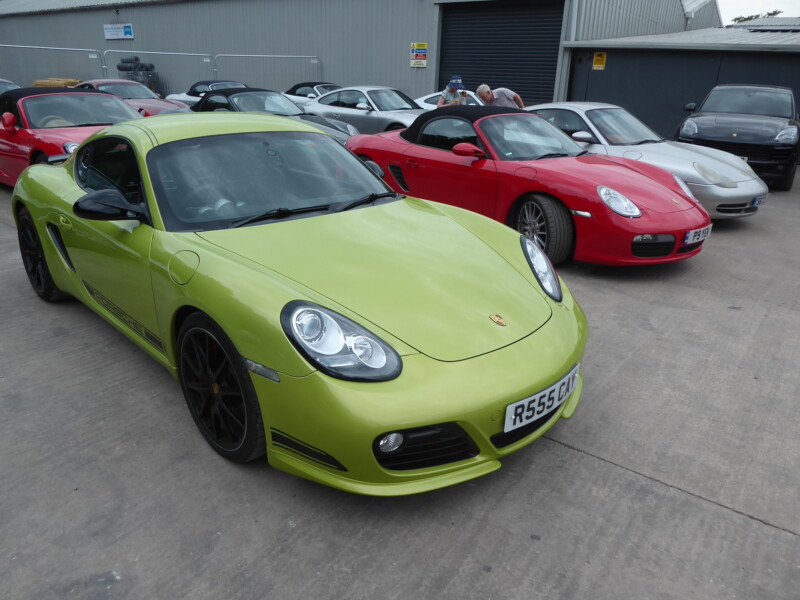
The Cayman R was introduced in 2011 as the pinnacle of the 987 generation. Based on the 2009 987.2 Cayman S, the Cayman R was lighter and came with additional power and handling upgrades. A 54.8 kg (121 lb) weight savings over the Cayman S was achieved with the use of 19 inch lightweight wheels shared with the Boxster Spyder, aluminium doors from the 997 911 GT3, carbon fibre bucket seats from the 997 911 GT2, and with the removal of the radio, storage compartments, air-conditioning, door handles and rear wiper. Porsche Ceramic Composite Brake (PCCB) system was an additional option available for the Cayman R. The Cayman R also received various cosmetic changes, such as decals on the doors, instrument cover delete, gloss black painted mirrors, black ‘R’ model designation emblem on the trunk, dashboard and door sills, as well as black painted wheels. There were minor changes to aerodynamics with the Cayman R, mostly coming from the use of the rarely selected Porsche OEM aerokit, introduced as an option in 2007. A carbon rear spoiler was added as well as more aggressive front fascia spoilers. With all new passive sports suspension, the Cayman R was 10 mm (0.4 in) lower than a Cayman S equipped with PASM, or a full 20 mm (0.8 in) lower than a Cayman S equipped with standard passive suspension. The powertrain is a 3,436 cc direct injection flat-six engine rated at 330 PS (326 hp) at 7,400 rpm and 370 Nm (273 lb/ft) of torque at 4,750 rpm. 6 speed manual or 7 speed PDK automatic gearboxes were offered. The standard Cayman R can accelerate from 0–100 km/h (62 mph) in 5 seconds, with the optional 7-speed PDK dual clutch transmission, it can accelerate from 0–100 km/h (62 mph) in 4.9 seconds, and with the optional Sport Chrono Package offering launch control it can accelerate from 0–100 km/h (62 mph) in 4.7 seconds. The Cayman R with the manual transmission can reach a top speed of 282 km/h (175 mph), and 280 km/h (174 mph) with the PDK. The Cayman R debuted at the 2010 Los Angeles Auto Show on 17 November 2010. A total of 1,621 Cayman Rs were made worldwide, with 220 for the UK market, approximately 100 in manual, and 120 in PDK auto.


The third-generation Boxster (internally known as the 981) was announced on 13 March 2012 at the Geneva Motor Show with sales starting in early summer 2012. The 981 Boxster reflected the new design language from the 911 (991) and 918, and featured new and revised engine and transmission specifications. Together with a new body, the type 981 Boxster featured a new, 40 per cent more torsionally rigid chassis, the front track was 40 mm (1.6 in) wider, the rear 18 mm (0.7 in) wider and the wheelbase extended by 60 mm (2.4 in), but with a small weight reduction of up to 35 kg (77 lb) compared to the previous type 987 Boxster. The standard Boxster was fitted with a new 2.7-litre flat-6 engine, and the Boxster S was fitted with the existing 3.4-litre engine but with revised performance. Both engines were equipped with a 6-speed manual gearbox and an optional 7-speed reworked PDK. Both manual and automatic models were available with several technical options, including Porsche Torque Vectoring (PTV) and a Sport Chrono Package that included active transmission mounts, and made the PDK-equipped model even faster. Porsche claimed that the new generation Boxster provided fuel savings of 15% over the outgoing model. The range was expanded in March 2014 with the addition of the GTS derivative, with slightly altered front and rear bumpers and an additional 15 PS/ 15 bhp from the 3.4-litre engine. In 2015 the GT4 derivative was introduced, seeing the engine from a 991.1 Carrera S rotated 180 degrees. The GT4 also saw a lowered ride height, altered bumpers, a rear wing and additional GT package upgrades including brakes and certain suspension components from a 991.1 GT3. These special cars were manufactured from 2015 – 2016 with a total of 2500 being made, making this model one of the more desirable collector’s cars in Porsche’s lineup. The GT4 was widely considered one of the best cars of 2015/2016 where it won many awards for its impeccable handling and performance. The third generation Cayman was unveiled at the 2012 Geneva Motor Show. The production version of the 981 Cayman was released as a 2014 model in the spring of 2013. The new car was available in both the standard trim with a 2.7-litre engine, and in the S trim with a 3.4-litre engine. Both versions were available with either a 6-speed manual or a dual-clutch 7-speed PDK transmission. The 981 Cayman featured upgrades including a new body, a longer wheelbase, a wider front track, electrically powered steering, and a redesigned interior that matched the firm’s contemporaneous 911 models. The new model gained acclaim in the motoring press as one of the best handling sports cars at any price, due to its mid-engine layout and driving dynamics. The Cayman S benefited from the same engine and running gear as Porsche’s 3.4-litre version of the 911. A heavily revamped version of both models, known as the 982 generation was launched in 2016 to replace these cars.


RENAULT
Not what you would call interesting, and this is indeed a modern production car, this Symbioz was the rental car I happened to be driving for the week, so I took it along here.

ROLLS ROYCE
The Sceptre is the very imposing all-electric coupe Rolls Royce model that has been on sale for a few months now.


TOYOTA
The Toyota 86 and the Subaru BRZ are 2+2 sports cars jointly developed by Toyota and Subaru, manufactured at Subaru’s Ōta, Gunma assembly plant. The 2+2 fastback coupé has a naturally aspirated boxer engine, front-engined, rear-wheel-drive configuration, 53/47 front/rear weight balance and low centre of gravity; it was inspired by Toyota’s earlier AE86, a small, light, front-engine/rear-drive Corolla variant widely popular for Showroom Stock, Group A, Group N, Rally, Club and drift racing. For the first-generation model, Toyota marketed the sports car as the 86 in Asia, Australia, North America (from August 2016), South Africa, and South America; as the Toyota GT86 in Europe; as the 86 and GT86 in New Zealand; as the Toyota FT86 in Brunei, Nicaragua and Jamaica and as the Scion FR-S (2012–2016) in the United States and Canada. A number of concept versions were shown between 2007 and the start of production, each getting closer to the car we would actually be able to buy. The production Toyota 86 debuted at the December 2011 Tokyo Motor Show. Its development was led by chief engineer Tetsuya Tada. All variants are built at Subaru’s Gunma Main Plant, with the first cars assembled on 2 February 2012 before sales began in March and deliveries in April. 7,000 orders were placed for the Toyota 86 in the first month of production, while Subaru took in 3,500 orders. The 86’s low-weight design uses an aluminium bonnet, a fixed roof, and a boot as opposed to a hatchback. To improve driving dynamics, the boxer engine is mounted low in a front engine / rear drive layout, yielding a weight distribution of 53% in front and 47% in the rear and a low centre of mass height. The 86’s engine, known by the Toyota code 4U-GSE and Subaru code FA20, is a naturally aspirated engine that uses Subaru’s flat-four engine design, with the addition of Toyota’s D-4S injection system, which uses Gasoline direct injection (GDI). With its front-engine, rear-wheel-drive layout, its engine runs on 98 RON (premium unleaded) fuel and features a compression ratio of 12.5:1 with a bore and stroke of 86 mm (3.39 in) for a total displacement of 2.0 L; (1,998 cc) that results in 200 PS (197 bhp) at 7,000 rpm and 151 lb/ft (205 Nm) of torque at 6,400 rpm. The 86, BRZ and FR-S are offered with two six-speed transmissions: an in-house developed Toyota TL70 manual gearbox (based on Aisin AI’s AZ6) and an Aisin-Warner A960E automatic transmission, which is modified from that used on the Lexus IS 250. The latter uses a traditional wet torque converter design, but its software has been engineered to mimic the response of a dual-clutch transmission. The automatic transmission uses three different modes: Sport, Snow, and Normal. A torsen style limited-slip differential is standard on most models. The vehicles are offered with 16″ steel and alloy wheels fitted with Yokohama dB Decibel E70 tyres in 205/55 size or 17″ alloy wheels fitted with Michelin Primacy HP tyres in 215/45 size, depending on sales market. The limited editions Toyota Racing Development (TRD) GT86 models are instead offered with 18″ forged aluminium wheels, which are fitted with either Yokohama Advan Sport tyres or Michelin Pilot Sport 3 tyres in 225/40 size, also depending on market. The braking systems vary between models and countries. The 86’s rear-wheel drive configuration and front-mounted flat boxer engine allow a low centre of gravity for strong handling characteristics. The bodywork has a drag coefficient of Cd=0.27. According to the 86’s designers, “The goal was to create an authentic rear-wheel drive sports car with compelling style, exceptionally balanced performance and handling, flexible utility and surprising MPG.” When asked about the TRD version of the car, the lead engineer Mr. Tada said “There is definitely going to be a more TRD oriented variant down the line. However any of the parts that would be standard on the TRD model will fit on your current Toyota 86 so there is no need to wait.” The design of the GT86 was inspired by the Toyota 2000GT, as part of the concept of ‘Neo Functionalism’ (the idea that the cars driving quality and appearance were part of its functionality). 2000GT references were especially apparent in the side profile, windows and dashboard of the car. The 86 “boxer” side badge appears on all Toyota and Scion versions of the car, but not the Subaru BRZ. Aside from badging, the main differences between the 86/GT86 and the BRZ are the front grilles and bumper bars. The second generation model was launched in 2020.

TRIUMPH
By the mid 1960s, money was tight, so when it came to replacing the TR4 and TR5 models, Triumph were forced into trying to minimise the costs of the redesign, which meant that they kept the central section of the old car, but came up with new bodywork with the front and back ends were squared off, reportedly based on a consultancy contract involving Karmann. The resulting design, which did look modern when it was unveiled in January 1969 has what is referred to as a Kamm tail, which was very common during 1970s era of cars and a feature on most Triumphs of the era. All TR6 models featured inline six-cylinder engines. For the US market the engine was carburetted, as had been the case for the US-only TR250 engine. Like the TR5, the TR6 was fuel-injected for other world markets including the United Kingdom, hence the TR6PI (petrol-injection) designation. The Lucas mechanical fuel injection system helped the home-market TR6 produce 150 bhp at model introduction. Later, the non-US TR6 variant was detuned to 125 bhp for it to be easier to drive, while the US variant continued to be carburetted with a mere 104 hp. Sadly, the Lucas injection system proved somewhat troublesome, somewhat denting the appeal of the car. The TR6 featured a four-speed manual transmission. An optional overdrive unit was a desirable feature because it gave drivers close gearing for aggressive driving with an electrically switched overdrive which could operate on second, third, and fourth gears on early models and third and fourth on later models because of constant gearbox failures in second at high revs. Both provided “long legs” for open motorways. TR6 also featured semi-trailing arm independent rear suspension, rack and pinion steering, 15-inch wheels and tyres, pile carpet on floors and trunk/boot, bucket seats, and a full complement of instrumentation. Braking was accomplished by disc brakes at the front and drum brakes at the rear. A factory steel hardtop was optional, requiring two people to fit it. TR6 construction was fundamentally old-fashioned: the body was bolted onto a frame instead of the two being integrated into a unibody structure; the TR6 dashboard was wooden (plywood with veneer). Other factory options included a rear anti-roll bar and a limited-slip differential. Some say that the car is one of Leyland’s best achievements, but a number of issues were present and remain because of poor design. As well as the fuel injection problems, other issues include a low level radiator top-up bottle and a poor hand-brake. As is the case with other cars of the era, the TR6 can suffer from rust issues, although surviving examples tend to be well-cared for. The TR6 can be prone to overheating. Many owners fit an aftermarket electric radiator fan to supplement or replace the original engine-driven fan. Also the Leyland factory option of an oil cooler existed. Despite the reliability woes, the car proved popular, selling in greater quantity than any previous TR, with 94,619 of them produced before production ended in mid 1976. Of these, 86,249 were exported and only 8,370 were sold in the UK. A significant number have since been re-imported, as there are nearly 3000 of these much loved classics on the road and a further 1300 on SORN, helped by the fact that parts and services to support ownership of a TR6 are readily available and a number of classic car owners’ clubs cater for the model.


The Dolomite really was the 3 Series of its day, a family sized saloon that offered a combination of luxury and sportiness that made it a cut above the average Cortina and Marina. Designed as the successor for the upmarket variants of Triumph’s front-wheel drive designs, and also to replace a sporting relative of the Herald, the 6-cylinder Triumph Vitesse, the Triumph Dolomite was unveiled at the London Motor Show in October 1971. However, due to a number of strikes and other industrial upsets, the car was not reported to be in full production until October 1972. The Dolomite used the longer bodyshell of the front wheel drive Triumph 1500, but with the majority of the running gear carried over from the rear-wheel drive Triumph Toledo. Initially, the only version available used the new slant-four 1854 cc engine, which mated an alloy OHC head to an iron block, providing 91 bhp which offered sprightly performance. This was a version of the engine that the company was already providing to Saab for use in their 99 model. The car was aimed at the then-new compact performance-luxury sector, vying for sales against cars such as the BMW 2002 and Ford Cortina GXL, and was offered with a high level of standard equipment, including twin headlamps, a clock, full instrumentation, luxury seats and carpets, a heated rear window, and a cigar lighter. Styling was similar to the Triumph 1500, with some updates such as a black painted rear panel, vinyl D-posts, and new wheel trims. The car was capable of 100 mph with 60 mph coming up in just over 11 seconds. An overdrive gearbox was soon made available as an option, offering relaxed motorway cruising and improved fuel economy, and there was also an optional automatic transmission. Although the Dolomite proved to be refined and rapid, competitors such as the BMW 2002 had a performance advantage which was costing Triumph dearly, both in terms of sales and prestige. To remedy this, Triumph unveiled the Dolomite Sprint in June 1973, although the launch had been delayed by a year; it had been due to go on sale in 1972. A team of engineers led by Spen King developed a 16-valve cylinder head with all of the valves being actuated using a single camshaft rather than the more conventional DOHC arrangement. The capacity was also increased to 1,998 cc and combined with bigger carburettors the output was upped to 127 bhp. This represented a significant power increase over the smaller 1850cc variant, however it fell short of the original target of 135 bhp Despite BL engineers being able to extract a reliable 150 bhp from test engines, the production line was unable to build the engines to the same level of quality, with production outputs being in the region of 125 bhp to 130 bhp. This led to the original model designation, the Dolomite 135, being replaced at short notice with the Sprint name. As a result of the use of this engine, the Dolomite Sprint has been claimed to be “the world’s first mass-produced multi-valve car”. While other multi-valve engines (notably the Lotus 907) were produced in volume, they were not used in mass production vehicles until after the introduction of the Dolomite Sprint. The design of the cylinder head won a British Design Council award in 1974. Performance was excellent, with 0–60 mph taking around 8.4 seconds, with a maximum speed of 119 mph. Trim was similar to the 1850, with the addition of standard alloy wheels (another first for a British production car), a vinyl roof, front spoiler, twin exhausts and lowered suspension. By now seats were cloth on the 1850, and these were also fitted to the Sprint. Due to the increase in power brought by the new engine, the rest of the driveline was upgraded to be able to withstand the extra torque. The gearbox and differential were replaced by a version of those fitted to the TR and 2000 series cars, albeit with a close ratio gearset in the gearbox. The brakes were upgraded with new pad materials at the front, and the fitment of larger drums and a load sensing valve at the rear. Other changes over the standard Dolomite included the option of a limited slip differential. The optional overdrive and automatic transmission from the 1850 model were also offered as options on the Sprint. Initial models were only offered in Mimosa Yellow, although further colours were available from 1974 on. At launch the Sprint was priced at £1740, which compared extremely well to similar cars from other manufacturers. Prospective buyers would have been hard pressed to justify the extra £1000 cost of the BMW 2002 Tii, which offered similar performance. The four-door practicality of the Sprint also made it a very attractive proposition for the young executive choosing his first company car. The press gave the Dolomite Sprint an enthusiastic reception. Motor summarised its road test (subtitled “Britain leads the way”) with glowing praise: ” …the Sprint must be the answer to many people’s prayer. It is well appointed, compact, yet deceptively roomy. Performance is there in plenty, yet economy is good and the model’s manners quite impeccable … Most important of all, it is a tremendously satisfying car to drive”. Sadly, it proved not quite so satisfying to own, as the legendary BL lack of reliability was a feature on some, but by no means all Sprints. In 1976, Triumph rationalised their range, calling all their small models, Dolomite, and using the same body shell, so the Toledo (which had maintained its stubby tail until this point) and 1500TC became the Dolomite 1300, 1500 and 1500HL respectively. With minor changes to trim and equipment, the cars continued in production until 1980.


TVR
TVR replaced their long-running shape with something really quite radical looking in early 1980. with the Tasmin, and there was a relatively early version of these “wedge” era TVRs here. During the 1970s, when Martin Lilley started to look where to take the Blackpool based company next, he noted that Lotus appeared to have reinvented itself with the Elite, Eclat and Esprit, losing much of the kit-car image in the process, and he thought he needed to do something similar. He needed a new design language, so he contacted Oliver Winterbottom who had done the Elite/Eclat for the Norfolk firm, hoping for something new. The wedge-shaped design that Winterbottom created was produced in 1977, and a prototype was created the following year, before the new car’s launch very early in 1980. Based on the Taimar, but with very different wedge styling, the car was not exactly received with massive enthusiasm. The styling looked a bit like yesterday’s car, as the wedge era was on the wane, and the car’s price pitched it against cars like the Porsche 924 Turbo. Development of the new car had drained TVR’s finances, which led to Lilley ceding control of the company in 1981 to Peter Wheeler. The convertible that followed helped matters a bit, whereas the 2 litre 200 and the 2+2 model did not, but in 1983, TVR announced a revised version with the potent Rover 3.5 litre V8 under the bonnet, in lieu of the 2.8 litre Ford Essex unit, and it transformed the car. It was just what was needed, and over the next few years, a series of ever more potent models, with ever wilder styling came into the range. By 1986, the 450SEAC boasted 340 bhp, making this something of a supercar.


The Tuscan was launched in 2000, by which time there had been a series of what we think of as the modern era TVRs produced for nearly a decade, the Chimaera, Griffith and Cerbera. The Tuscan did not replace any of them, but was intended to help with the company’s ambitious push further up market to become a sort of Blackpool-built alternative to Ferrari. It did not lack the styling for the task, and unlike the preceding models with their Rover V8 engines, the new car came with TVR’s own engine, a straight six unit of 3.6 litre capacity putting out 360 bhp. The Tuscan was intended to be the grand tourer of the range, perfectly practical for everyday use, though with only two seats, no ABS, no airbags and no traction control, it was a tough sell on wet days in a more safety conscious world, but at least there was a removable targa top roof panel for those days when the sun came out. The car may have lacked the rumble of a V8, but when pushed hard, the sound track from the engine was still pretty special, and the car was faster than the Cerbera, but sadly, the car proved less than reliable, which really started to harm TVR’s reputation, something which would ultimately prove to be its undoing.

VOLKSWAGEN
The original Polo (known internally as the Typ 86), a rebadged version of the Audi 50, was introduced in 1975 on mainland Europe and was launched in the UK and the Isle of Man in 1976. The differences between the Audi and VW models were minor, with the Polo being cheaper and much more basic. The two cars were initially sold alongside each other, but the Audi 50 never sold as well, and was withdrawn in 1978. The manufacturer let it be known that Bertone had been involved in the styling of the Polo and its Audi sibling, although the car was essentially an in-house Audi design, with the Italian design studio’s contribution restricted to the circular extractor vent cover at the base of the C pillar, and the small “flick-up” at the rear end of the waist line. The Polo was manufactured at the Volkswagen plant in Wolfsburg. In 1977, the Derby sedan was released, which was simply a Polo, identical to the hatchback from the C-pillar forward, with a large boot attached (an old Audi proposal, but never sold by this brand. When first on sale the range topping car, the LS model, featured the 50 PS 1043 cc engine found in the Audi 50. Other specifications included parking lights, rear wash wipe, sun visors, chromed bumpers and 4.5J X 13″ wheels. The N model was the basic starting spec lacking many of the features of the LS. In 1979 the GLS was introduced, replacing the LS as the range-topping car; specification upgrades included chrome headlight and grill surrounds, sunroof, a cigarette lighter and chrome wheel trims. 895 cc, producing 40 bhp, 1093 cc, and 1272 cc engines were used, with the smaller one used only in the Polo hatchback, and the 1272 cc only in the Derby, Audi 50, and the rare Polo GT. Different levels of compression were used on each size to achieve different power outputs, and the variations are numerous, often differing depending on the country of sale, ranging from 34 to 60 PS. For Sweden and certain other markets a version with a 771 cc engine was developed for the 1976 model year, as new very strict emissions regulations were introduced but did not apply to engines of less than 0.8 L. The Swedish model was discontinued after 1977, as sales of the underpowered car were sluggish, but the HE engine option continued to be mentioned in period journals (also for the Derby) until the Mark I was replaced in 1981. The Mark 1 Polo and Derby were facelifted in 1979 (unofficially referred to as the Mark 1F) with plastic bumpers, a different front grille and a revised dashboard. They were first shown in February 1979 at the Amsterdam Motor Show. The round headlights of the Derby were replaced with square ones, bringing it inline with the similar Golf-based Jetta sedan. Further models were added including CLS, S and a run-out LX model. The Mark 1’s production run finally ended in October 1981 with over 500,000 Polos sold worldwide.

WILLYS


IN THE STUDIO
Downstairs there are a number of very high end cars stored and these were creating a lot of interest.
Aston Martin DB6: The DB6 was launched in 1965 as a replacement for the DB5 which had run since 1963. The wheelbase was now 4″ longer than before, resulting in an extensive restyle with a more raked windscreen, raised roofline and reshaped rear quarter windows. Opening front quarter lights made a reappearance, but the major change was at the rear where a Kamm tail with spoiler improved the aerodynamics, greatly enhancing stability at high speeds. “The tail lip halves the aerodynamic lift around maximum speed and brings in its train greater headroom and more luggage space”, declared Motor magazine, concluding that the DB6 was one of the finest sports cars it had tested. Famed employee, Tadek Marek, designed the six cylinder engine, which had been enlarged to 3,995cc for the preceding DB5 and remained unchanged. Power output on triple SU carburettors was 282bhp, rising to 325bhp in Vantage specification. Premiered at the 1965 London Motor Show, the DB6 Volante marked the first occasion the evocative ‘Volante’ name had been applied to a soft-top Aston Martin. After 37 Volante convertibles had been completed on the DB5 short wheelbase chassis, the model adopted the longer DB6 chassis in October 1966. A mere 140 DB6 based Volantes were manufactured, and of these only 29 were specified with the more powerful Vantage engine.


Ferrari 250 GT SWB: One of the better known early Ferraris, examples of this model are to be seen at historic motor racing events as well as concours events. First seen in 1959, the 250 GT Berlinetta SWB used a short 2,400 mm (94.5 in) wheelbase for better handling. Of the 176 examples built, both steel and aluminium bodies were used in various road (“lusso”) and racing trims. Engine output ranged from 237 bhp to 276 bhp. Development of the 250 GT SWB Berlinetta was handled by Giotto Bizzarrini, Carlo Chiti, and young Mauro Forghieri, the same team that later produced the 250 GTO. Disc brakes were a first in a Ferrari GT, and the combination of low weight, high power, and well-sorted suspension made it a competitive offering. It was unveiled at the Paris Motor Show in October and quickly began selling and racing. The SWB Berlinetta claimed GT class of the Constructor’s Championship for Ferrari in 1961. These cars are highly prized nowadays and for good reason.


Ferrari 246 GT Dino: Still seen by many as the most beautiful Ferrari ever built was the 246 GT Dino and this time there was just one example here. The Ferrari Dino was created to honour Alfredo ‘Dino’ Ferrari, Enzo Ferrari’s only legitimate son, who sadly died of muscular dystrophy in 1956. Unlike any previous road-going Ferrari, the Dino utilised a V6 engine, the Tipo 156, which Alfredo himself had helped develop and strongly advocated during his working life. Following continued motor racing success and in order to homologate Ferrari’s 1966 Formula Two campaign, a new line of mid-engined production V6 coupés with Fiat running gear went on sale in 1967 in two litre 206 GT form. However, in 1969 a larger 2.4 litre Dino was introduced, named the 246 GT or GTS in the case of the Spider. Only 3,913 definitive Dinos were built before the introduction of the completely restyled V8 engined 308 in 1973. The voluptuous bodywork of the 246, which many regard as the prettiest ever to grace a road-going Ferrari, was designed by Pininfarina and built by Scaglietti. It clothed a tubular chassis which carried wishbone independent suspension at each corner. The compact four-cam, 190bhp. engine was mounted transversely above the five-speed gearbox and just ahead of the rear axle, allowing for both a comfortable cockpit and some usable boot space.


Lamborghini Revuelto


Mercedes-AMG GT Black Series:

Porsche 918 Spyder: The 918 Spyder was first shown as a concept at the 80th Geneva Motor Show in March 2010. On 28 July 2010, after 2,000 declarations of interest, the supervisory board of Porsche AG approved series development of the 918 Spyder. The production version was unveiled at the September 2013 Frankfurt Motor Show. Porsche also unveiled the RSR racing variant of the 918 at the 2011 North American International Auto Show, which combines hybrid technology first used in the 997 GT3 R Hybrid, with styling from the 918 Spyder. But that version didn’t make it to production. The 918 Spyder was the second plug-in hybrid car manufactured by Porsche, after the 2014 Panamera S E-Hybrid. The 918 Spyder is powered by a 4,593 cc naturally aspirated V8 engine built on the same architecture as the one used in the RS Spyder Le Mans Prototype racing car without any engine belts. The engine weighs 135 kg (298 lb) according to Porsche and delivers 599 bhp at 8,700 rpm and 540 Nm (398 lb/ft) of maximum torque at 6,700 rpm. This is supplemented by two electric motors delivering an additional 282 bhp. One 154 bhp electric motor drives the rear wheels in parallel with the engine and also serves as the main generator. This motor and engine deliver power to the rear axle via a 7-speed gearbox coupled to Porsche’s own PDK double-clutch system. The front 127 bhp electric motor directly drives the front axle; an electric clutch decouples the motor when not in use. The total system delivers 874 bhp and 1,280 Nm (944 lb/ft) of torque. Porsche provided official performance figures of 0-100 km/h (62 mph) in 2.6 seconds, 0-200 km/h (120 mph) in 7.2 seconds, 0-300 km/h (190 mph) in 19.9 seconds and a top speed of 345 km/h (214 mph). Those numbers were surpassed in independent tests which yielded 2.5 seconds for 0-100 km/h, 7.0 seconds for 0-200 km/h, 19.1 seconds for 0-300 km/h, a top speed of 351.5 km/h (218.4 mph) and 17.75 seconds for the standing kilometer with a speed of 295.9 km/h (183.9 mph). The energy storage system is a 312-cell, liquid-cooled 6.8 kWh lithium-ion battery positioned behind the passenger cell. In addition to a plug-in charge port at the passenger-side B pillar, the batteries are also charged by regenerative braking and by excess output from the engine when the car is coasting. CO2 emissions are 79 g/km and fuel consumption is 3 L/100 km (94 mpg) under the New European Driving Cycle (NEDC). The U.S. Environmental Protection Agency (EPA) under its five-cycle tests rated the 2015 model year Porsche 918 Spyder energy consumption in all-electric mode at 50 kWh per 100 miles, which translates into a combined city/highway fuel economy of 3.5 L/100 km (81 mpg). When powered only by the gasoline engine, EPA’s official combined city/highway fuel economy is 26 mpg. The 918 Spyder’s engine is based on the unit used in the Porsche RS Spyder. The 4.6 litre V8 petrol engine can recharge an empty battery on about two litres of fuel. The supplied Porsche Universal Charger requires seven hours to charge the battery on a typical 110 volt household AC socket or two hours on a dedicated Charging Dock installed with a 240 volt industrial supply. An optional DC Speed Charging Station can restore the battery to full capacity in 25 minutes. The 918 Spyder offers five different running modes: E-Drive allows the car to run under battery power alone, using the rear electric motor and front motor, giving a range of 29 kilometres (18 mi) for the concept model. The official U.S. EPA all-electric range is 12 mi (19 km). The total range with a full tank of gasoline and a fully charged battery is 420 miles (680 km) according to EPA tests. Under the E-Drive mode the car can attain a maximum speed of 150 km/h (93 mph). Two hybrid modes (Hybrid, and Race) use both the engine and electric motors to provide the desired levels of economy and performance. In Race mode a push-to-pass button initiates the Hot Lap setting, which delivers additional electrical power. The chassis is a carbon-fibre-reinforced plastic monocoque and the brakes used are electromechanical brakes. The production version was unveiled at the 2013 Frankfurt Motor Show. The 918 Spyder was produced in a limited series and it was developed in Weissach and assembled in Zuffenhausen. Pricing for the 918 Spyder started at €611,000 (US$845,000) or £511,000. Production ended in June 2015 as scheduled. The country with the most orders was the United States with 297 units, followed by China and Germany with approximately 100 orders each, and Canada ordering 35 units.


Upstairs is the recording studio and you can go and have a look at some of the equipment and facilities on site.


This made for a pleasant morning out, though had I travelled a long distance, I would have probably have expressed disappointment, as there were not that many cars visiting, so unless you had people to talk to, you would have seen everything in record quick time. It was certainly interesting to and to experience yet another venue, but it may take the promise of something truly special for me to prioritise in return in the near future.