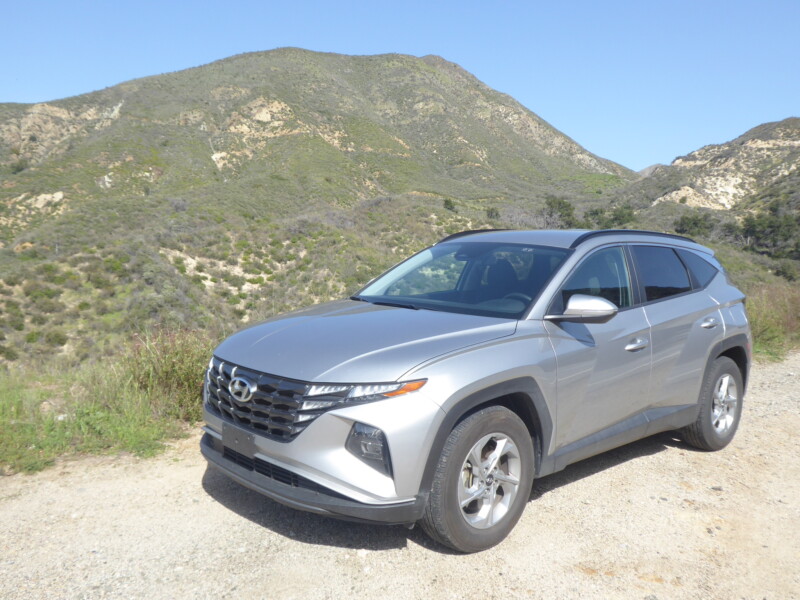


The Tucson is Hyundai’s biggest selling car, well over 6 million of them having been built since its launch in 2004. Those sales are spread across the world, so the car is a strong performer in the sales charts both in Europe and North America, so it’s a car that Hyundai can’t afford to get wrong. When the first pictures of the fourth generation model appeared around the time of its launch in late 2020, some wondered if they had gone too far with the styling. Here was a car with a bold new look including headlights that appeared hidden until switched on. Doubts generally evaporated when people got the chance to see the car for themselves, and my own view, for what it is worth, is that the fourth generation Tucson brings a bit of visual interest to a class which generally lacks much in this regard. The rest of the new car was a considered evolution, as the third generation model, which had only been launched in early 2015, was generally regarded as one of the best in its class anyway. One subtlety of the new car is that Hyundai were offering it in two different lengths, with an elongated version for the American (and other) market, noting that customers there always seem to moan that any car is not big enough. It takes a keen eye to spot that this is the case in comparison with European market cars. The powertrain options are different, too. European market Tucsons are built in the Czech Republic, whereas the US market cars are made in America, at the firm’s plant in Montgomery, Alabama. The fourth generation Tucson went on sale in the US during 2021 as a 2022 model year car and has not really changed much since then. They’ve now started to appear in the US rental fleets in reasonable quantity, though at the time of this test in March 2024, it should be noted that there are still plenty of examples of the previous generation car on fleet. I expect they will disappear in the coming months. On a morning when there were lots of cars but not much variety in the choices available, I spotted a silver example of the fourth generation car parked up at Hertz’ LAX facility and elected to take it for the day to see what I thought of Hyundai’s latest offering on what is perhaps the most competitive market segment of all.


In the US market, Hyundai sell this generation Tucson either with a conventional petrol engine or as a Hybrid. My test car was the former. All pure petrol Tucson have the same 2.5 litre 4 cylinder unt that puts out 187 bhp and generates 178 lb/ft of torque. All are coupled to a standard eight speed automatic transmission and all-wheel drive is an option, not fitted to my car. SEL models and above have keyless starting. First impressions are that the engine is OK, but drive a bit further and you come to realise that it is not really quite powerful enough for the task in hand once hills are involved are sudden bursts of acceleration are needed. The Tucson laboured somewhat up hills, as the gearbox tried to hang on to a higher gear. Push the throttle harder and you find that it also hangs on to lower gears and this can make the car quite noisy. Quoted acceleration times are around the 9 seconds mark for the 0 – 60 dash which is among the slower times of its class. Once at speed, though the car is pleasingly quiet and impressively refined. It is also pretty economical. The trip computer told me all day that I was averaging around 40 mpg and this is the figure I am inclined to believe. When it came to filling the car up ready for return, I put in 10.2 gallons, having covered 324 miles, which works out at 31. 76 mpg US or 37.95 mpg Imperial. I suspect that like many a rental car it was nothing like as full as the gauge would have had me believe.


Whilst dynamically the Tucson is unlikely to trouble the Mazda CX-5, it scores pretty highly when compared to all its other rivals. The steering is decently weighted having some feel to it and yet still being light enough that manoeuvering the car at low speed was not a challenge. Set up more for comfort than sporting prowess, the Tucson does not really encourage you to corner quickly but the handling is nice and predictable and there is not much in the way of understeer. Grip levels are good. More importantly, perhaps, for the target market, the car rides nicely with supple suspension which does a good job at handling the various and often poor road surfaces of Southern California roads. The test car came on 235/65 R17 wheels. Posher trims bring with them larger wheels, of course. The brakes worked well, with no issues to report, and providing strong stopping power. There is an electronic handbrake as is the norm on just about all cars these days. Visibility is about par for the course, with a large windscreen and thin pillars upfront, and of course there is a rear-view camera to help out when backing up. The Tucson has a full complement of ADAS features. The Blind Spot Warning system is useful but I was less taken with the Lane Departure Warning which bonged me at repeatedly all day, often for no real reason.


Hyundai have made a real effort with the interior to lift from the standard of its rivals and have largely succeeded. There are far more soft touch plastics than hard ones and there is a chromed vent strip across the centre of the dash which looks good. In SEL trim you do still get a plastic moulded steering wheel but it was pleasant enough to hold. The instrument cluster follows contemporary convention, being ovoid in shape with the speed and rev counter functions at each end in semi-elliptic gauges, leaving the centre clear for trip computer displays. There are smaller conventional round fuel level and water temperature gauges. Twin column stalks also encompass the lights which have an auto function. The steering wheel hub contains buttons for the cruise control and audio repeaters. The centre of the dash contains the 8” colour touchscreen which has crisp graphics and is generally pretty responsive. There are buttons for the audio functions – on/off, volume and tuning but otherwise everything is on the screen. That does include XM Satellite radio but does not, in SEL trim, give you navigation. However there is wireless Apple Car Play and Android Auto, HD radio and Bluetooth. The audio system has six speakers and sound quality was perfectly acceptable. Lower in the centre of the dash are the dials for air conditioning. This is not of the automated climate control variety but at least there are separate controls, unlike the posher Tucson specs where the touchscreen takes over.


Seats in SEL trim are upholstered in cloth. There is electric adjustment only for the driver, who also gets lumbar support and seat heating. The front passenger does not fare so well, as even a height adjuster is not included. The steering column telescopes in/out as well as up/down. I was able to get the perfect driving position quite easily and found the seat comfortable. There is a feeling of space here with particularly generous headroom.


Thanks to a wheelbase which is 3” longer than in the European spec cars, the rear seats are very spacious, with good levels of legroom even if the front seats are set well back. You can vary the angle of the backrest and the floor is flat meaning that there is plenty of space for the legs of a middle seat occupant. Passengers here benefit from a drop-down central armrest with cup holders in the upper surface, their own air vents and USB ports as well as pockets on the back of the front seats and the doors.


Access to the boot is via an electrically assisted tailgate. That opens to reveal one of the largest cargo areas of the class, nice and regular in shape. There is a space saver under the floor and some room around it for a few odds and ends. Loading is easy as the floor is low. And flush with the base of the tailgate. The rear seat backrests are asymmetrically split and simply drop down to create a long and flat load platform. Inside the cabin things are pretty much as you get with every car these days: decently sized glovebox, pockets on the doors, a central armrest cubby and a recess in front of the gearlever, which should meet the needs for most people for places to put odds and ends.


The US market 2023 Hyundai Tucson comes in five trims: SE, SEL, XRT, N Line and Limited. Each is equipped with the same 2.5-liter four-cylinder engine and eight-speed automatic transmission. Front-wheel drive is standard across the lineup, while all-wheel drive is available. The base model SE comes standard with an 8-inch touch screen with wireless Apple CarPlay and Android Auto, an analog gauge cluster, HD radio, a six-speaker stereo, Bluetooth, two USB ports, remote keyless entry, cloth upholstery, manually adjustable front seats, split-folding rear seats, a manual rear liftgate and 17-inch alloy wheels. It’s also equipped with many driver-assistance features, including a rearview camera, blind-spot monitoring, rear cross-traffic alert, lane-departure warning, lane-keep assist, driver-attention monitoring, forward collision warning, pedestrian and cyclist detection, forward automatic emergency braking, adaptive cruise control and LED headlights with automatic high beams. The uplevel SEL adds heated front seats, a power-adjustable driver’s seat, air vents for back-seat passengers, proximity keyless entry, push-button start, a digital key, satellite radio, wireless device charging, two additional USB ports, roof rails and a hands-free power liftgate. Options when new included the Convenience package, which includes synthetic leather upholstery, a 10.25-inch digital gauge cluster, dual-zone automatic climate control, a sunroof, ambient interior lighting and 19-inch wheels. The rugged-looking XRT includes most of the SEL trim and Convenience package features, along with chunkier fender flares, side steps, a roof rack, a tow hitch receiver, navigation and a 10.25-inch touch screen with wired Apple CarPlay and Android Auto. The N Line swaps the XRT’s off-road styling for a sleeker appearance and adds genuine leather upholstery with cloth inserts, an eight-speaker Bose stereo and a panoramic sunroof. The luxury-oriented Limited adds genuine leather upholstery, ventilated front seats, a power-adjustable front passenger seat, heated rear seats, a heated steering wheel, rain-sensing windshield wipers, adaptive cruise control with lane centring, a surround-view camera system, a blind-spot camera, front and rear parking sensors and remote-controlled parking assist.


It is not hard to see why the Tucson has proved so popular. The new styling of the latest generation model is, to my eyes at least, quite pleasing without being overly fussy, the interior quality is high, the car is spacious for both people and luggage and equipment levels are good. Add in Hyundai’s generous warranty terms and you have a compelling ownership proposition that is only let down by the slightly lacklustre powertrain. Keen drivers would still be better entertained with a Mazda CX-5, but for everyone else, I can think of few other family-sized SUVs that do the job better. If you find one of these at the rental car counter, I suggest you take it!