

Ever since the down-sizing of cars across the US market that happened in the 1980s and 1990s, it is cars of this size, sometimes referred to these days as a “mid-size” that have proved the most popular for both American buyers and to be the doyens of the rental fleets. Ignoring the huge-selling pick-up trucks, in the 2000s and 2010s, the top part of the US Best Sellers list has been largely made up of cars of this type. And then came the ever-increasing tsunami of SUV and the Crossover models and gradually vehicles of this genre started winning over more and more customers. For a while, manufacturers persisted with both body styles as the family car sector was just too large to ignore even if sales were diminishing year on year. In most case, the sedan and the associated crossover shared much componentry and the same platform under the skin, so the developments costs associated with this extra market choice were justifiable. But in recent years, manufacturers have started to question this and, having already culled almost all the larger full-sized sedans from their ranges, one by one we have seen cars of this type reach the end of their model cycle with no replacement. Time was at the rental car counter when if you booked a car of this type there were offerings from all the volume brands and you could easily have had a choice of more than 10 different vehicles. Not any more. Mitsubishi were the first to go, but since the exit of the Galant we have lost the US market VW Passat, the Chrysler 200, the Mazda6 and Ford Fusion and the Subaru Legacy will go at the end of the 2024 model year. So with half the class gone and the Honda Accord generally not being bought in any quantity for the rental fleets, your choice really comes down to the long-time class sales leader, the Toyota Camry, the Korean duo of Hyundai Sonata and Kia K5, the all-American made and now quite venerable Chevrolet Malibu or the subject of this test, the Nissan Altima.


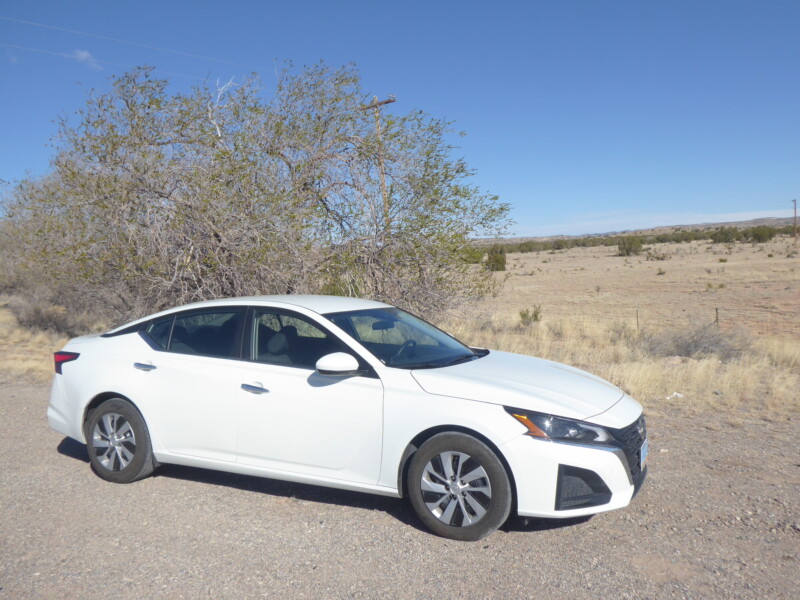
The latest US-built Nissan Altima debuted at the New York Auto Show in April 2018 with sales starting for the 2019 model year. It set the styling theme that was adopted on the smaller Sentra and Versa. All three of them have a family look which makes them quite hard to tell apart at a glance. Arguably the styling works at its best with the larger proportions of this conventionally styled three box sedan. Underneath the car was a considered evolution from its predecessor. I got to sample an example of this generation Altima, the sixth to bear the name, in April 2022 as one of a series of cars sampled in my Spring visit to Southern California. It struck as a thoroughly decent proposition but hardly an exciting one. With only the smallest of updates to the car since then, which introduced a new and slightly deeper grille and the addition of a few ADAS features for the 2023 model years, it was not a ca that featured on my “still to drive” list. However, when arriving at Hertz’ Albuquerque, NM, facility, I found that not only were the very few cars parked up at all, I was also only able to pick from the very small number of cars parked in the Presidents’ Circle area, and that meant a Nissan Altima, or a Nissan Altima or a Nissan Altima. Not only that all three of were the base S spec as opposed to the usual SV specs that Hertz source. So the only choice was colour – white or silver. Resigned to my fate for the evening, I picked a white one on New Mexico plates as it was in the least tatty condition. How would I find the car in 2024 and would the economies of the cheaper spec be all too apparent? Read on.


There are two engine options for the Altima, but almost all of them seemingly come with the base 2.5 litre four cylinder unit which generates 188 bhp, bang on the class average. The transmission, as has been the case for most Nissan models for some time now, is a CVT automatic. The engine has keyless starting, and apart from the vaguaries of that transmission seemingly having high revs initially and at low speed, the engine is generally smooth and refined. It might be class competitive on power, but that still does not make this a particularly rapid car. Acceleration is perfectly acceptable, of course, and the Altima is not going to embarrass you unduly at the traffic lights, but you will need to work it moderately hard when you get to steeper inclines and this where that CVT box is at its most frustrating, as it can lag a bit on what you have done with your right foot. The upside of all this is, is that just as with previous Altima models I have driven, there are impressive levels of economy. I drove a not inconsiderable 520 miles in the Altima, and only refuelled it as I was preparing to return it. It took 13 gallons which works out at 40 mpg US or 47.70 mpg Imperial. You would be unlikely to see such good figures from any non-hybridised rivals.


The rest of the driving experience is viceless but generally rather unremarkable. The steering is light and does not have that much in the way of feel. Handling is safe and predictable but it won’t have you seeking out the bendy roads. When you do, though, you will find that ultimately the Nissan will understeer but that grip levels are good. Base spec Altima models like this one come on 16” wheels and these ensure that the ride is quite smooth. The brakes did their job well. There is a foot-operated parking brake which is quite a rarity now in the era of electronic set-ups. Visibility is also about par for the course with the mandated rear-view camera helping when reversing and the Blind Spot Warning system proving useful especially when out on the freeway and in traffic.


By modern standards, some might think the interior looks a bit dated, whilst others will welcome the fact that there is a refreshing simplicity to the design which makes it all eminently usable. There are lots of plastics, of course, but they are mostly of decent quality and the S trim does not get the unconvincing inlays that you will find in higher spec versions. There is a plastic moulded steering wheel here. The instrument cluster is very much how things used to be: two large dials for the speedometer and rev counter with smaller gauges inset for fuel level and water temperature, all easy to read at a glance. There are two conventional column stalks, which also incorporate the lights, which have an Auto function. There are some very small buttons on the steering wheel boss for cruise control and audio repeater functions. The 2023 Altima has three different infotainment setups. There is a 7” touch screen found in the Altima S trim, and it seems somewhat dated by modern standards. It has low-resolution graphics and doesn’t support smartphone integration via Apple CarPlay or Android Auto. If you want either of those features, you’ll have to step up to a trim with one of the available 8-inch or 12.3-inch touch screens. These displays are much easier to use, and they benefit from simpler menus and sharper graphics. Responses are quick for the most part. Regardless of layout, the Altima has physical buttons and knobs for adjusting the basic audio and climate controls, which make it a breeze to change these settings on the go. And basic function is all you get, namely AM/FM audio and Bluetooth. Under this unit are the controls for the air conditioning and in the S trim this is not the automated climate control but one where you need to select the fan speed to get the required heating or cooling.


Seat upholstery is the generic sort of cloth that features in most volume cars these days. There’s nothing wrong with it, but it will not impress you much either. Seat adjustment is manual and further evidence of how to cut a few dollars from the price for the entry level model comes the fact that there is no height adjuster for the passenger. That said, the seat itself was comfortable, proving quite supportive, and the combination of the range of adjustment and a telescoping wheel meant that I was able to get a good driving position.


Rear seat space is generous, with ample legroom even when the front seats are set well back. The Altima is wide enough that you should be able to get three adults across the width of the car, though the centre console extends a long way back and does deprive of quite a lot of knee and leg room. There is a drop-down central armrest with cupholders in the upper surface and there are small bins on the doors but no seat-back map pockets.

There is no external release for the boot, but once opened, either from the key or by pulling a lever inside the cabin, you will find quite a generous amount of space and the opening is such as to make loading easy. There is no spare wheel and nor is there any space under the floor for any odds and ends. The rear seat backrests do fold down to give additional cargo length should it be needed. Inside the passenger compartment there is a modestly sized glovebox, a deep central armrest cubby, a recess in front of the gearlever and pockets on the doors which should provide ample options for the bits and pieces that always accumulate especially in a family car.

The 2023 Nissan Altima is available in five trims: S, SV, SR, SL and SR VC-Turbo. The first four are equipped with a 188 bhp engine, while the top SR VC-Turbo trim features a 248 bhp turbocharged engine. A continuously variable automatic transmission (CVT) and front-wheel drive are standard across the lineup. Notably, only the SV, SR and SL trims are available with all-wheel drive. The entry-level Altima S is equipped with cloth upholstery, manually adjustable front seats, split-folding rear seats, remote keyless entry, push-button start, remote start, 16-inch wheels, a 7-inch touch screen, an analog gauge cluster, HD Radio, a six-speaker stereo, Bluetooth and a USB port. Standard safety equipment includes a rearview camera, rear parking sensors, driver-attention monitoring, blind-spot monitoring, rear cross-traffic alert, forward and reverse collision warning, pedestrian detection, forward automatic emergency braking, lane-departure warning, a rear-seat alert and LED headlights with automatic high beams. Some of these features are part of the Nissan Safety Shield 360 suite. The Altima SV trim adds an 8-inch touch screen, Apple CarPlay, Android Auto, satellite radio, three additional USB ports, proximity keyless entry, a power-adjustable driver’s seat and 17-inch wheels. The Altima SR is available with either front- or all-wheel drive and comes with sporty touches including paddle shifters, dark exterior accents, a stiffer sport-tuned suspension and 19-inch wheels. The fully-loaded Altima SL is available with either FWD or AWD. It gains leather upholstery, a heated steering wheel, heated front seats with passenger-side power adjustments, dual-zone automatic climate control, a 12.3-inch touch screen, navigation, Wi-Fi, wireless Apple CarPlay, wireless device charging, a nine-speaker stereo, a moonroof, a surround-view camera system, lane-keep assist, adaptive cruise control and traffic-sign recognition. Many of these features were available in the SV and SR trims as part of a Premium package when the vehicle was new. The Altima SR VC-Turbo bundles features from the SR and SL and adds the 248 bhp turbo-four engine.


Even before the reduction in the number of rivals, the Altima has always done well, troubled for sales volume only by the Toyota Camry and Honda Accord which have consistently outsold it and that is still the case now. Whilst it no longer features in the Top 10 of US sales, it still finds plenty of buyers every year even beyond the large number that are in the rental fleets, and for good reason. Whilst not exciting, this is a thoroughly decent car. It is pleasant if unremarkable to drive, with impressive levels of economy, and is spacious and practical. The only real concern is the longevity, or rather lack of it, for the CVT transmission which is well documented but that it is a problem for a few years and probably a six figure mileage away. I think the S spec lacks a few of the features that buyers really come to expect, so you would probably be better off with at least the SV and indeed most of the rental fleet Altima models are in that slightly better equipped trim, but otherwise, this is not a bad choice. And if – as I found that evening in Albuquerque – it is more or less your only option at the rental car counter, then fear not, as this is a decent car. Just not a very exciting one, but then rental car staple sedans never were and probably never will be.