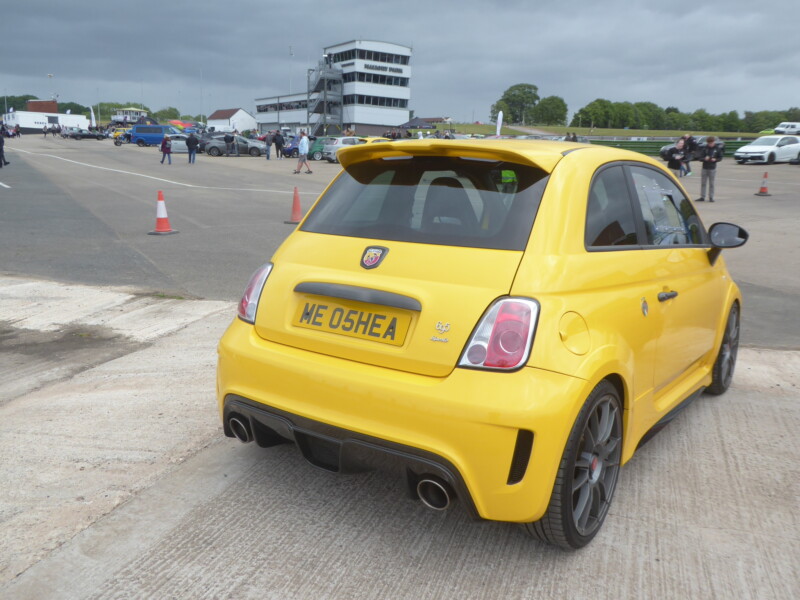
The 2024 Abarth Festival, known as Anniversario Abarth 75, as it marked the 75th birthday of the brand, was held at Mallory Park, combining a track day event with a static show and it proved hugely popular, with a vast turnout, despite the weather turning decidedly cold on us just a day after we had experienced warm June sunshine. It was so well received that it was not a hard decision to request the venue for the 2025 event. The date moved around a couple of times, as the circuit struggled to balance all their various events, but in the end we were offered the late may Bank Holiday, a little earlier in the year perhaps than might be ideal, but it did not clash with anything else significant in the Abarth or wider Italian car community world, so we decided to go for it.

Ticket sales started early in 2025. After an initial surge, they then slowed to a steady handful a week, which always looks very worrying to the organisers. Despite all appeals to people to buy early, and particular focus on trying to get the track day places sold, it was only in the last few days that the numbers really took off. Either a review of the weather forecast or simply that people are not organised enough to book early have to be the main factors here, but it does create some real financial anxieties and it is also hard to plan some of the details of the event when you don’t whether you’ve to 100 cars or 600. Including the track day cars and the heritage Abarths, we actually amassed around 700 cars and well over 900 tickets sold, which is a pleasing result for a one make event. There were representatives of at least 25 different Regional and Interest Groups, with some people travelling long distances to be able to attend.


SET UP TIME
As in 2024, the site very kindly have us access from late afternoon the day before the main event, which allowed for most of the set-up to be done. As well as erecting banners and signs, we were able to get some of the trader and dealer support content in place, but it was extremely windy, so putting flags up was left as a task for the morning. A number of people came down on site either to help or just to look, so there were plenty of cars here and there was a chance to photograph some of the without the challenge of crowds.


THE OVERNIGHT HOTEL
As many participants are travelling some distance, then they travel the day before and stay in a local hotel, and the one that was the most popular for this event, as was the case in 2024, was the Leonardo located just off junction 1 of the M69. This is a large hotel, and as a group we were far from the only guests, but there were plenty of Abarths in the car park, and I took advantage ot the opportunity to photograph some of them both in the morning, and also early the following morning.


HERITAGE ABARTHS
Unlike 2024 where a diary clash with a family wedding of one of the stalwarts of the Heritage Abarth scene precluded not just his attendance but that of several others, there were no such diary constraints this year, so there was a much bigger showing of these fabulous cars. Quite deliberately, they were parked up in the very centre of the paddock for everyone to enjoy and they certainly did create a lot of interest. They all took to the track in two sessions, either side of lunchtime (these cars are hard work to drive, so 2 x 15 minutes is infinitely preferable to a 30 minute slot).
Of all the performance-oriented models created by Karl Abarth, later known as Carlo Abarth, perhaps the 695 esse esse is the best representation of the scorpion-branded firm’s collaboration with Fiat. Around 1,000 Fiat Abarth 695 SS were produced and only 150 are believed to remain. Abarth introduced its 695 SS version in 1966, after the previous presentation back in 1964. The rear-engine, rear-wheel-drive layout Fiat 500 was the basis of the project. When compared to the production version of the 500, aesthetically the 695 was virtually identical except for the logo, badge on the radiator grille and the coat of arms on both sides of the car. The 695 SS was the only version to feature flared arches and the need to raise the engine cover for extra stability and cooling. Like all Abarths, the differences are found in the mechanical upgrades that helped to increase its top speed to around 140 km/h (87 mph). The OHV 2 valves per cylinder inline-two engine, exhaust pipe, head and valve-springs were upgraded and specially designed pistons and camshaft fitted. It had an equal square bore and stroke ratio of 76 mm × 76 mm for a total displacement of 689.5 cc and the original single Solex 34PBIC carburettor was increased in size with a compression ratio of 9.8:1 developing 38 PS (37 bhp) at 5200 rpm and 57 Nm (42 lb/ft) of torque at 4000 rpm.


Seen often at Italian car gatherings, especially in the South East is Carlo Cacciavelli’s car. Although this amazing machine has the form of a classic Nuova 500, don’t be too taken in by that. The car is actually built on a chassis that has its origins in the Abarth Osella 2000SP sports racing car, with double wishbone suspension and disc brakes front and rear. Sitting in the back is a fuel injected 1.5 litre Alfa Romeo “boxer” engine of the type originally found in the front of the Alfa Romeo ‘Sud, Sprint 33 and even the Nissan Arna GTi. It is coupled to an Alfa 5-speed gearbox. Carlo’s coachwork company built the special extra wide body, which is all steel. The car was first registered in the UK on the 28th July 2000 and it has been seen at a great variety of events ever since. It never fails to pull the crowds wherever it is taken.

Abarth produced several tuned versions of the Fiat 850 Berlina, Coupé, and Spider, with ever-increasing displacements. These belonged to the OT series of Abarth cars—standing for Omologata Turismo or “touring homologated”, which also included two-seater sports racing cars. The Fiat-Abarth OT 850, as seen here, was Abarth’s first 850 derivative, introduced in July 1964. Its Tipo 201 engine was the regular saloon’s 847 cc inline-four brought from 34 bhp to 44 bhp. The top speed went up accordingly from 75 mph (120 kn/h) to 81 mph (130 km/h). The OT 850 could be distinguished from the standard Fiat model by its Abarth badging, an asymmetric front ornament with the Abarth shield on the right hand side and the “Fiat Abarth” script on a red field on the left, and wheels with cooling slots. From October of the same year it became available in two guises: OT 850 Oltre 130 (“Over 130”), almost unchanged from the initial model, and OT 850 Oltre 150, with a 52 bhp engine, front disc brakes and a 150 km/h (93 mph) top speed. In October 1964, Abarth added the Fiat-Abarth OT 1000. With engine displacement increased to 982 cc, it produced 60 bhp and 58 lb·ft of torque. The front brakes were changed to discs. Coupe and Spider models would follow from 1965, initially with the same 982cc engine, but it was not long before 1300, 1600 and then 2 litre engines were inserted in the car.


Abarth made a name for itself by tuning small, rear-engined Fiat models, but it also worked with other car manufacturers, including Simca. The fact that Fiat still owned part of Simca at the turn of the 1960s facilitated the collaboration. Henri Theodore Pigozzi, the man who helped Fiat create Simca and ran it for decades, allegedly contacted Abarth in the months leading up to the 1000’s release to ask for two high-performance variants of the car. The first one needed to be a hotter version of the regular-production model. The second one was a coupe based on the production car, but fitted with a racing-specific body, and upgraded with a wide array of mechanical modifications. The Simca-Abarth 1150’s promising career was cut short when Chrysler began buying into Simca and Pigozzi quit. However, Abarth received a shipment of bare 1000 chassis to turn into race cars. After experimenting with a 1.0-litre engine, Abarth adopted a 1.3-litre that delivered 128 hp thanks in part to a pair of big Weber carburettors. The four shifted through a Simca-sourced four-speed manual transmission, but clients could order an Abarth-designed six-speed manual at an extra cost. Abarth entered four 1300 GTs in the 1962 edition of the 24 Hours of Le Mans. One car finished 14th; the other three dropped out of the race. The model fared better in 1963, when it stunningly earned 90 first-place finishes at a wide variety of events, including the 12 Hours of Sebring. This car belongs to Tony Castle-Miller himself. Sadly, a couple of mechanical issues meant that its time on the track here was limited.


In 1971 the Fiat 124 Spider was prepared for the World Rally Championship when Abarth became involved with its production and development. Abarth designer Ing. Colucci was responsible for getting the 124 Spider into Group 4 rally trim. Over this period the Abarth Spider was relatively successful with wins at the 1972 Hessen Rally, Acropolis Rally, 1973 Polish Rally, 19th on the 1973 RAC rally and seventh to mostly the Alpine Renaults on the 1973 Monte Carlo Rally. The Spider continued to perform with first, second and third in the 1974 eighth Portuguese TAP Rally, sixth in the 1974 1000 Lakes, fourth in the 1975 Monte Carlo Rally and also with Markku Alén driving the spider to third place. By 1976 the days of 124 rallying were numbered due to the appearance of the Fiat-Abarth 131. The Fiat Abarth 124 Rally is a street legal rally version of the 124 Sport Spider sold to the masses, known also as “124 Abarth Stradale”, introduced in November 1972. Its main purpose was to receive FIA homologation in the special grand touring cars (group 4) racing class, and replace the 1.6-litre Fiat Sport Spider rally cars which were presently being campaigned. At the time 124 had already won the 1972 European Rally Championship at the hands of Raffaele Pinto and Gino Macaluso. The 124 Rally was added to the Sport Spider range, which included the 1600 and 1800 models; the first 500 examples produced were earmarked for the domestic Italian market. Amongst the most notable modifications over the standard spider there were independent rear suspension, engine upgrades, lightweight body panels, and a rigid hard top. In place of the usual rear solid axle, there is independent suspension from lower wishbones, the original trailing arms, an upper strut and an anti-roll bar. At the front a radius rod on each side was added to the standard double wishbones. The Abarth-tuned type 132 AC 4.000 1.8-litre, twin-cam engine was brought from the standard 118 to 128 PS DIN (126 hp) by replacing the standard twin-choke carburettor with double vertical twin-choke Weber 44 IDFs, and by fitting an Abarth exhaust with a dual exit exhaust. The 9.8:1 compression ratio was left unchanged. The transmission is the all-synchronised five-speed optional on the other Sport Spider models, and brakes are discs on all four corners. Despite the 20 kg (44 lb) four-point roll bar fitted, kerb weight is 938 kg (2,068 lb), roughly 25 kg (55 lb) less than the regular 1.8-litre Sport Spider. Engine bonnet, boot lid and the fixed hard top are fibreglass, painted matt black, the rear window is perspex and the doors aluminium. Front and rear bumpers were deleted and replaced by simple rubber bumperettes. A single matte black wing mirror was fitted. Matte black wheel arch extensions house 185/70 VR 13 Pirelli CN 36 tyres on 5.5 J × 13″ four-spoke alloy wheels. Inside centre console, rear occasional seats, and glovebox lid were eliminated; while new features were anodised aluminium dashboard trim, a small three-spoke leather-covered Abarth steering wheel, and Recaro corduroy-and-leather bucket seats as an extra-cost option. The car carries Fiat badging front and rear, Abarth badges and “Fiat Abarth” scripts on the front wings, and Abarth wheel centre caps. Only three paint colours were available: Corsa red, white, and light blue.


There was one of the Lombardi Grand Prix-based Abarth models here. Although many have now seen them a number of times in the past couple of years, they remain a car that few can identify with any confidence. It was based on the Lombardi Grand Prix, you most have probably never heard of that, either! The Lombardi Grand Prix was a small, rear-engined sports car, based on Fiat 850 underpinnings, developed by the Carrozzeria Francis Lombardi with an in-house design by Giuseppe Rinaldi. It was first shown in March 1968, at the Geneva Motor Show. The design had a Kammback rear and a very low nose with flip-up headlights, and a large single windshield wiper. The headlights were electrically powered. The bodywork was all steel, except the rear panel. The design was originally shown as a prototype based on the front-wheel drive Autobianchi A112, and was adapted by Lombardi for the 850 sedan’s floorpan. At the 1969 Turin Show, a targa version was also shown; called the “Monza”, this open model has a rollover bar. At least two were built but it is unknown whether any were sold. The original Lombardi Grand Prix had the regular 843 cc Fiat 850 engine with 37 PS at 5000 rpm, coupled to a four-speed gearbox. Low drag resistance and weight (630 kg or 1,390 lb) meant that this was supposedly enough for a top speed of 99 mph. Later production models had the 850 Special engine, with 47 PS at 6400 rpm – in a period German test the maximum speed of the more powerful variant was 95.6 mph. Luggage space is limited, with very little space next to the spare wheel up front and with a tiny area behind the seats. In case the electric wind-up mechanism for the headlights should fail, there is also a mechanical lever underneath the bonnet. The single round tail lights are Fiat 850 Coupé units. The front suspension consists of a transverse leaf spring on the bottom and A-arms on top, while the rear received coil sprung semi-trailing arms. The Lombardi Grand Prix was built in two series: early models used the regular, metal engine cover from the Fiat 850 while the Series II has a louvred unit in black metal. The door windows are also different, being of a three-piece design (one on top, two lower pieces of which one could be slid open) while later cars have a more conventional layout with a vent window up front and a single piece which, however, could only be rolled halfway down. A Cypriot casino owner and millionaire had also shown interest in the Lombardi Grand Prix around the time of its introduction. Frixos Demetriou intended to market the car in the United Kingdom and began planning for an order of 1000 cars. After his death in a British Army tank accident in Cyprus, this project came to a sudden halt. Only ten cars were imported into the UK, with the remaining parts languishing in storage in Turin. A few unsold cars were re-exported to Cyprus in 1969 to avoid pending customs bills. The story gets more complex than that. The tiny OTAS company (Officina Trasformazioni Automobili Sportive, or “Sports car conversion shop”) was founded in 1969 and was a collaboration between Francis Lombardi and Franco Giannini – the son of Domenico Giannini of Giannini Automobili – allowing for a more powerful, Giannini-engined Grand Prix model to be marketed abroad. The resulting OTAS Grand Prix has a tuned, 982 cc twin-cam “Tigre” engine. In Italy, this model was sold as the “Giannini 1000 Grand Prix” (beginning in 1969). In a very convoluted operation, Francis Lombardi sold engineless cars to Giannini, while Giannini sold their engines to OTAS for sale outside of Italy. Responding to interest in the important North American market, OTAS also sold the Grand Prix in the United States and in Canada as the “OTAS Grand Prix 820cc”, to give the tiny car its full name. Going on sale in 1970 it was fitted with the same down-sleeved 817 cc version of the inline-four engine as used in federalised Fiat 850s – all to sneak under 50 cubic inches, thereby avoiding the need to carry emissions controls equipment. Sixty-five of these cars were brought to North America, or perhaps as many as a hundred. Fiat 850 chassis numbers were retained for the OTAS 820. Importer John Rich of Glendale, California, also offered tune-up kits directly and Siata International in New Jersey imported nine of the bigger Tigre-engined cars before the strictures of the EPA put a halt to such activities. This was the first car to have US sales curtailed by the EPA. The OTAS was sold until 1971, when the company shut its doors following homologation troubles. The car never sold particularly well, being expensive considering its performance and with a tendency to overheat. Along with other tuners (such as Giannini), Carlo Abarth also had a look at the Grand Prix. Abarth’s version, first seen at the 1968 Paris Motor Show, received a tuned version of the larger 903 cc engine from the recently introduced Fiat 850 Sport Coupé/Sport Spider. The resulting variant has a claimed 52 PS, providing performance more suitable to the sporting bodystyle and name. For better cooling than the original Lombardi and OTAS, Abarth mounted the cooler up front, in the air stream. In 1970 Abarth showed the considerably more powerful “Abarth 1300 Scorpione”, which was to be Abarth’s last independently developed car. Equipped with a version of the Fiat 124s 1.2 litre engine, bored out by 2.5 mm for a total of 1280 cc, this model has 75 PS and only moderately more weight, ranging from 680 to 750 kg (1,500 to 1,650 lb) depending on the source. In a 1970 road test by Auto, Motor und Sport, the Scorpione reached 109.1 mph, close to the claimed 112 mph. There is also mention of a 982 cc Abarth 1000 OT-engined version of the Scorpione. The Scorpione had a special Abarth-made bell housing, to allow matching the 124 engine to the four-speed 850 gearbox. After Abarth was taken over by Fiat in 1971, the Scorpione was quickly cancelled.


Completing the line-up was Gill Hague’s fabulous Strada 130 TC, the final major variant to be added to the Strada range when it appeared in 1984. It was based on the 125 TC (which had not been sold in the UK) and was powered by a 1,995 cc engine with power output increased to 130 PS. This was achieved by replacing the single Weber carb used in the 125 TC with twin Solex/Weber carburettors on a side-draught manifold, and via improved cam profiles. The 130 TC had a top speed of 195 km/h (121 mph) and accelerated from 0 to100 km/h (62 mph) in 7.8 seconds. It was fitted with Recaro bucket seats in Britain and it remained the only 1980s European hot hatch to continue to use carburettors instead of fuel injection. Ignition timing was controlled electronically. Although appearing outwardly similar to the restyled 105 TC with its lower door and wheelarch trims, the 130 TC could be distinguished by its polished four-spoke alloy wheels (continued from the earlier 125 TC), aerodynamic perspex front door wind deflectors, and lower hatchback spoiler. The powerful twin-cam was mated to a close ratio five-speed ZF manual gearbox and had superior performance to its contemporary rivals, which included the Volkswagen Golf GTI, Ford Escort XR3i, Vauxhall Astra GTE and the MG Maestro. In its day, it was faster than all of them, but it found relatively few buyers.


MODERN ABARTHS
The main change we wanted to make from the 2024 event was to try get all the cars inside the circuit. There is ample space, but the challenge is that the only access is across the track, so once the event would be ready for track action, then cars would be either marooned outside or now parked up inside. I did wonder if we would be able to get everyone across before 9:15am, and it was indeed a bit intense, but we managed it! I briefed the marshalls on where each Group would park, and hoped they would be able to figure it out, as I took up position to welcome everyone on site. When we closed off the access across the track, I went to have a look. Cars were not parked where I had intended, but everyone was in, and every Group had their own space so I really did care that the initial plan had proved too hard to interpret! There were colourful displays wherever you looked, with examples of just about Abarth version produced since the brand relaunch in 2007.
500 FAMILY
The vast majority of cars here were the 500-based models which have been on sale now since the end of 2008, following a launch at the Paris Show that year. Since that time there have been a number of detailed changes to the standard cars and a lot of limited editions. Those who really know the marque can spot most of them, but some are so subtle that unless there is a badge you can see, you will not ne quite sure which version you are looking at. It used to be relatively easy, when the model was first launched, as there was only one version as shipped ex works called the 500. It had a 135 bhp 1.4 litre turbo-charged engine coupled to a five speed manual gearbox, with 16″ alloys as standard, and the option of 17″ wheels, and a colour palette comprising of two whites (BossaNova White, the standard colour, or the pearlescent Funk White), Red (Pasadoble), Pale Grey (Campovolo) or Black. If you wanted more power – 160 bhp – then you could order an Esseesse kit, which came in a large wooden crate, containing new wheels, springs, an ECU upgrade, the Monza exhaust system and badging. It was dealer fitted and could be applied at any time within the first 12 months or 10,000 miles from registration. Needless to say, it proved popular. As were many of the optional extras, with stickers for the sides, a large scorpion for the bonnet and even a chequered pattern for the roof among the personalisation options offered. Several of the original style of cars were here.


Whilst a sliding glass sunroof (Skydome in Fiat/Abarth parlance) was an option from inception, fans of open air motoring had to wait until Geneva 2010 for the launch of the 500C models, with a roll-back roof which provided the best of open-topped motoring and yet still with the rigidity of the regular body style. The C bodystyle has been offered ever since, and has sold steadily, though in relatively small numbers relative to the fixed roof car.


For the first few months these cars only came with the robotised manual gearbox, which limited the appeal in the eyes of some, but they also introduced us to the “bi-colore”, a series of two tone cars, with upper and lower halves of the body painted in different colours. It took us a while to get used to this, as no other production road cars had been painted like this for some time, but now this is seen as yet another of those marque defining attributes, and (perhaps with the exception of the rarely seen Rally Beige and Officina Red combination that would come for 2014) in the eyes of many this distinctive look enhances the appeal of the cars still further.


in 2007/8, the 500 Abarth Assetto Corse was released, a Works-prepared race car limited to just 49 examples worldwide, stripped back in the factory for a 180kg weight reduction and all in left-hand drive. With the advent of a well-prepared road car came a race series, the Trofeo Race Series to be exact, under the umbrella of the BTCC TOCA. It’s powered by a Punto EsseEsse 1.4-litre 16V producing 200bhp with peak torque standing at 300Nm at 3,000rpm from its Garrett GT 1446 fixed geometry turbocharger and mated to a M32 6-speed manual gearbox. The suspension has a McPherson layout at the front, bespoke racing shock absorbers with co-axial spring and adjustable height, rear inter-connected arms and electric power steering with race tuning. Retardation was courtesy of Brembo radial four-piston front calipers, 305mm x 28mm ventilated front discs, 264mm x 11mm rear discs and high performance pads. The reinforced cage was welded to a bodyshell that sported a front splitter and rear spoiler, whilst the driving position was shifted slightly to the centre and the car sat four square on forged aluminium wheels. BS Marsons own a number of these cars and brought them along, keeping them out on the track most of the day. To see one is rare, to see several these days is almost unprecedented!


Having used the legendary 695 badging from the 1960s on the Tributo cars, at the 2012 Geneva Show, Abarth dusted off the 595 name that had been used on the less powerful of the Nuova 500 based cars of the same generation, and created two new versions which we should think of as Series 2 cars, the 595 Turismo and Competizione, both of which could be bought in either closed or open top C guise, with either the 5 speed manual or robotised automated gearshifts. Both models had the 160 bhp engine as standard. Effectively they were a replacement for the Esseesse kit, and it meant that the cars were produced complete at the factory, rather than needing the dealer to undertake the upgrade (and the associated paperwork), though Abarth did not withdraw the Esseesse kits from the market for some while. Turismo, as the name suggests was aimed slightly less extreme in intent, featuring standard leather upholstery, upgraded dampers and climate control, Xenon headlights and Alutex interior details. The sportier Abarth 595 Competizione replaced the leather seats with Sabelt cloth sport seats and Alutex with aluminium, while adding p-cross-drilled brakes and the Record Monza dual-mode exhaust.


Some new colours were introduced, and very soon one of those, Record Grey, frequently combined with a tan interior became one of the most popular choices. There were several examples of this popular colour here and there is no denying that this combination suits the Abarth shape very well. Record Grey remained an option for 10 years before disappearing from the colour chart.


There have been many different paint colours offered during the life of the 500/595 family, some lasting only for a couple of years, others being offered for much longer than that. One of the rarest colours is called Rally Beige, and Ben Au acquired a car in this colour, because it is so rare, a couple of years and it was one of the range of Abarths he brought along. It was the only one at the event in this paint colour.

Seen by most as the ultimate model, there was the 695 Biposto. First shown at the 2014 Geneva Show, this 2 seater (that’s what Biposto means in Italian) is nothing other than a road legal version of the 695 Assetto Corse Racing car, a vehicle which has its own race series in Europe. Although the car is road legal, it was envisaged that the majority of people who buy one of these cars will use it on the track and quite frequently. So it was conceived accordingly. That means upgrades to all the important bits – engine, brakes, suspension, gearbox – and some fairly drastic measures to save weight which resulted in a car which generates 190 bhp and 199 lb/ft or 250 Nm of torque with a kerb weight of just 997kg. That’s enough to give a 0 – 60 time that is under 6 seconds, and a top speed of 143 mph. Those are supercar figures produced by a city car. There’s more to it than that, though, as the changes that go to make a Biposto are extensive, and they have been well thought through, so this is a long-way from being a hastily conceived or tuned up special. Ignoring the limited edition cars which arrived during 2015, the “regular” Biposto is only offered in Matt Performance Grey paint, and the car is visually distinctive, with a new front bumper, rear diffuser, wider arches, new skirts and bigger roof spoiler. Although the engine is still the same 1.4 T-jet that features in the lesser 500 and 595 cars, it has been reworked here, with a new Garrett turbocharger, larger intercooler, altered fuel rail and an Akrapovic exhaust system. Buyers can choose between the standard five speed gearbox or an optional race-bred dog-ring unit mated to a mechanical limited slip diff. The standard car’s MacPherson strut and torsion beam suspension has been reworked, too, with altered springs, wider tracks adjustable ride height and dampers with more resilient bushings, using Extreme Shox technology shock absorbers. The brakes are upgraded in line with the extra power, featuring 305mm Brembo discs and four pot calipers up front and 240mm discs with single pot calipers at the rear. The wheels are lightened 18″ OZ and attached via a titanium hub, shod with bespoke 215/35 Goodyear tyres. In the interest of weight saving, a number of standard trim items are removed, including the regular door trims, air conditioning, the rear seats and some of the sound deadening material. Even the standard air vents have been changed so they are covered by a simple mesh. In their place is plenty of polished carbon fibre, a titanium strut brace, racing seats and harness, as well as special trim features such as new pedals, tread plates and a race inspired digital display on the dash where the radio usually sits. Although the Matt Performance Grey car is probably the one you think of when someone says “Biposto”, there were other versions, with a very rare red being a car that is only seen occasionally and the Record Edition being the version you more often see now. There were just 133 of these made, all painted in Modena Yellow, at the time an exclusive Biposto colour.


Without question, the rarest modern Abarth at the event was this one Nick Harper’s 695 Biposto Officine. Just 99 were made, in 2015/6 and initially they were sold to Ferrari dealers to use as courtesy cars much as the earlier Ferrari Dealer Edition car had been and this time there was a clause prohibiting sale for at least 6 months. No-one is quite sure how many of these are in the UK, but we think probably fewer than 10. They are all numbered and Nick’s car is number 009. Ben Au owns car number 010. but that is currently in Hong Kong. It is known 10 Rosso Officine examples were available in Japan, possibly 30 examples went to Italy, possibly 10 examples to Germany and possibly 8 examples to Switzerland. Just 2 examples were sold and delivered to Australia. Car #1 was an Italian car, now living in Manila, Philippines. And #99 is a UK car. When they were deemed ready for sale, Rosso Officine models sold for around £45,000 in the UK, marking them out as the pinnacle of Bipostos. These cars were all painted in the same shade of Rosso Officina and were mechanically the same as the slightly more numerous Biposto and the Biposto Record. Abarth focused on the two key goals of weight reduction and engine performance. Out went the rear seats, air-conditioning, audio system, door cards, posh headlamps, fog lights et al. In came a Poggipolini tubular titanium roll-cage, cargo nets, 695 Biposto-specific Sabelt seats, Brembo brakes, 18in OZ alloys with bespoke 215/35 Goodyears, Extreme Shox adjustable shock absorbers, an Akrapovic exhaust system, a wider track and a 1.4-litre turbo powerplant lifted pretty much piecemeal from a Formula 4 single-seater. The Garrett turbocharged 1368cc unit spits out a feisty 187bhp at 5500rpm (the company claiming a 139hp-per-litre ‘record for this category’) and 184lb ft of torque at 3000rpm, dropping 0-62mph acceleration one tenth below the targeted 6.0 second mark and offering a top speed of 143 mph.


After a few near misses, this was perhaps the first occasion where we were able to get all three Biposto variants parked up next to each other. Not surprisingly, this really attracted the photographers.


Rumours started to circulate towards the end of 2014 that Abarth were going to upgrade the Competizione model, so as better to bridge the gap between the Turismo and the 190 bhp 695 Biposto that had been added to the range earlier in the year. It was Geneva 2015 when the result was finally shown to an expectant fan base. Most exciting news was that thanks to a bigger Garrett Turbo, the engine had been tweaked to 180 bhp, and with reduced CO2 emissions. A standard spec that included Koni Dampers, Brembo brakes, Xenon lights, Sabelt seats, Climate Control, parking sensors as well as other refinements that had been added like the TFT instrument display all proved very compelling, so not long after the first cars reached the UK in June of 2015, I found temptation too hard to resist, and as is well documented here, swapped my 2010 car for one of these. At the time I ordered it, Cordolo Red, a tri-coat pearlescent paint which shimmers in bright sunlight looked set to become one of the most popular colours of the lot, even though it is a cost option. Indeed, the Launch Edition models were all offered either in this colour or Scorpion Black, with black wheels. Surprisingly, the colour was not carried over to the Series 4 cars.

What is known as the Series 4 version of the familiar 595 reached the markets in the middle of 2016. After rumours had circulated all winter following the launch of the facelifted Fiat 500 last year, Abarth finally unveiled the Series 4 at the end of May 2016. Initially, we were told that the cars would not be available in the UK until September, but that came forward somewhat, with dealers all receiving demo cars in June, and the first customers taking delivery in July. Three regular production versions of both the closed car and the open-topped C were initially available, all badged 595, and called Custom, Turismo and Competizione, as before, though numerous limited edition models have since appeared and in most case disappeared. The most significant changes with the Series 4 are visual, with a couple of new colours, including the much asked for Modena Yellow and a different red, called Abarth Red, which replaces both the non-metallic Officina and – slightly surprisingly – the tri-coat pearlescent Cordolo Red. as well as styling changes front and rear. The jury is still out on these, with many, me included, remaining to be convinced. At the front, the new air intake does apparently allow around 15 – 20 % more air in and out, which will be welcome, as these cars do generate quite a lot of heat under the bonnet. Competizione models for the UK retain the old style headlights, as they have Xenon lights as standard, whereas the Custom and Turismo cars have reshaped units. At the back, there are new light clusters and a new rear bumper and diffuser. Inside, the most notable change is the replacement of the Blue & Me system with a more modern uConnect Audio set up, which brings a new colour screen to the dash. Mechanically, there is an additional 5 bhp on the Custom (now 145) and Turismo (now 165 bhp) and the option of a Limited Slip Diff for the Competizione, which is likely to prove a popular option. Details of the interior trim have changed, with a filled-in glovebox like the US market cars have always had, and electric windows switches that are like the US ones, as well as a part Alcantara trim to the steering wheel in Competizione cars. These cars have now been on offer for around eight years and with it Abarth sales rose considerably so it was no surprise that they were particularly well represented here.


A limited edition model, the 695 XSR was created in recognition of the fact that for the third year running, in 2017 Abarth was to be the Official Sponsor and Official Car Supplier of the Yamaha Factory Racing Team, competing in the 2017 FIM MotoGP World Championship. In the wake of the Abarth 595 Yamaha Factory Racing and the 695 biposto Yamaha Factory Racing Edition, the 695 XSR Yamaha Limited Edition special series is available exclusively with a Pista Grey livery: only 695 sedans and 695 convertibles will be made. The new car was created to celebrate the Yamaha XSR900 Abarth, which is the first exclusive motorcycle to spring from the collaboration between the two brands and which sports the same grey livery with red trim as the 695 XSR, as well as sharing many of its features. The special series makes extensive use of carbon fibre to demonstrate its affinity with the front fairing, front mudguard and saddle cover of the two-wheel Yamaha. The Abarth 695 XSR and the Yamaha XSR900 Abarth also share Akrapovič ultralight exhaust developed in the racing world to boost the personality, sound and performance of both vehicles. On the Abarth car, the carbon fibre tailpipes enhance the looks and technology of the exhaust system. The XSR logo on the tailgate distinguishes the Abarth 695 XSR, while an aluminium badge identifies the sequential number of 695 units for each body type. Other carbon fibre details, in addition to the mirror caps and Akrapovič tailpipes, are available as optional equipment, such as dashboard fascia, pedal covers, gear knob and kick plate. The car uses the 1.4 T-Jet engine delivering 165 bhp. Equipment on this special series includes Koni rear suspension and Eibach springs, 17” Supersport alloy rims with Matt Black finish, Satin Chrome accents on handles and badge supports, red details on bumpers and mirrors, red brake callipers and a braking system with perforated discs. This version can be customised even further using the tuning kit to increase the power to 180 HP, improve handling by fitting a Koni front suspension with FSD (Frequency Selective Damping) valve and make braking even prompter with 305x28mm perforated and self-ventilating Brembo floating front discs with high-performance Ferodo HP 1000/1 front brake pads. It also features the new UconnectTM 7″ HD LIVE system integrated with Apple CarPlay allows iPhone users to access contents such as Apple Maps, Messages, telephone calls, Apple Music, also with Siri voice assistance.

More recently, Abarth have produced the 695 Rivale, a celebration of Fiat’s partnership with Riva, which has already seen a special Riva version of the 500,. Described as being “the most sophisticated Abarth ever”, it is available either as a hatch or a cabriolet, with both of them featuring a two-tone Riva Sera Blue and Shark Grey paintwork. The Rivale is adorned with an aquamarine double stripe, satin chrome finish on the door handles and satin chrome moulding on the tailgate, various aesthetic elements inspired by the Riva 56 Rivale yachts and ‘695 Rivale’ logos, joined by Brembo Brakes, Koni suspension, and 17-inch Supersport alloy wheels. Enhancing the nautical theme the new 695 Rivale features either a carbon fibre or mahogany dashboard, black mats with blue inserts, blue leather seats and door panels, carbon fibre kick plates, special steering wheel wrapped in blue and black leather and with a mahogany badge, blue leather instrument panel cover, and mahogany gear lever knob and kick plate. These are joined by the standard Uconnect infotainment with a 7-inch display, which is compatible with Android Auto and Apple CarPlay, and there is also a hand-written numbered plate that can be customised with the mane of the customer’s yacht on request. Powering the 695 Rivale is the same 1.4-litre turbocharged engine that makes 180PS (177hp) and 184lb/ft of torque, that features in the 595 Competizione, allowing it to go from rest to 100km/h (62mph) in 6.7 seconds and up to a top speed of 225km/h (140mph). This is a regular model in the range, but confusingly, there is also the Abarth 695 Rivale 175 Anniversary, created to celebrate 175 years of the Riva brand. Just 350 of these were produced, half of them the hatch and the other half cabriolets. These featured 17-inch alloy wheels with a special pattern, celebratory badge on the outside, hand-crafted details such as the two-tone colour – blue and black hand-stitched leather seats with a celebratory logo stitched onto the headrest, carbon dashboard silk screen printed with special logo, numbered plate. Standard Rivale cars arrived in the UK in April 2018, and quite a few have been sold. They always attract lots of interest when they do appear.


A top of the range 595 Esseesse model was added in early 2019. These cars have only sold in quite small numbers, so you don’t see them that often, but there were some here. The majority of these cars seem to be Campovolo Grey, though it was available in other colours as well. The most obvious change externally is the adoption of the neat white painted 17inch multi-spoke alloy wheels that are an Esseesse trademark, while elsewhere it gets the same recently reprofiled bumpers as the standard 595. Inside, there’s a pair of bespoke figure-hugging Sabelt high-backed seats with a carbonfibre shell and some natty red stitching, while carbonfibre trim also covers the pedals and the dashboard. Under the bonnet is the familiar 178bhp turbocharged 1.4-litre engine, but here it breathes in through a BMC filter and exhales from a switchable carbonfibre-tipped Akrapovič twin exit exhaust. There’s no more power than the old Competizione, but the Esseesse gets that model’s Brembo callipers for its 305mm front discs, plus a limited-slip differential. The suspension is largely carried over, including Koni’s frequency selective dampers. All this comes at a price though, and so this has remained a relatively rare sighting compared to the Competizione which many still feel offers rather better value for money.

The 695 Anniversario was launched at the brand’s 70th anniversary celebrations in Milan in October 2019, and deliveries of which started around the turn of the year. The Anniversario is in a choice of 5 colours: White, Black, Podium Blue, Grey and 1958 Green, and there were examples of some but not all of these here, including a couple of cars in the 1958 Green which was selected to evoke memories of the 1958 record-breaking 500, though I can advise that the two shades of green are quite different, the older car being much lighter. Online verdicts of the new car at launch were not entirely positive, with many challenging the appearance, others the spec and yet more the price (£29,995 in the UK), but in the metal, it looks far better than those first web pictures portrayed, and there is no doubt that the 1949 buyers of the car are getting something quite distinctive, with the Campovolo Grey accents around the wheelarches and lower body skirts. What they aren’t getting is more than 180 bhp, as it would seem that to get Euro 6d compliance from the T-Jet engine, 180 bhp is the limit. But the Abarth 695 70° Anniversario does have an ace up its sleeve. Look at the back and you’ll notice a rather large roof-mounted spoiler serving as the special edition’s party piece. Manually adjustable in literally a dozen of positions, the spoiler was developed in the wind tunnel to achieve maximum aero efficiency regardless of speed. Its inclination varies from 0 to 60 degrees and helps increase aerodynamic load by 42 kilograms when the car is travelling at speeds of 124 mph (200 km/h) provided the spoiler is at its maximum inclination. Abarth has done the maths and it claims the new aero component will reduce steering corrections by as much as 40% based on the testing they’ve done at FCA’s wind tunnel in the Orbassano municipality located southwest of Turin. Power is provided by the familiar 1.4-litre turbocharged engine with 180 hp and 250 Nm (184 lb-ft) of torque, good enough for a sprint from 0 to 62 mph (100 km/h) in 6.7 seconds before topping out at 140 mph (225 km/h) if the spoiler is in the 0° position. Those 17-inch SuperSport wheels are paired to a Brembo braking system with four-piston aluminium calipers finished in red, hugging the 305-mm front and 240-mm rear self-ventilated discs. Rounding off the changes on the outside is the newly developed Record Monza exhaust with active valve for a better soundtrack. Abarth also spruced up the cabin a bit where the body-hugging seats are exclusive to this special edition, just like the individually numbered plaque reminding you this isn’t an ordinary 695. Onboard tech includes support for both Apple CarPlay and Android Auto, DAB digital radio and a navigation system for that seven-inch touchscreen display. Additional standard equipment includes automatic climate control, daytime running lights, LED fog lights, unique mats, and the Abarth telemetry system if you plan on taking the hot hatch to the track.


Abarth announced two limited edition models in the autumn of 2020 and one of these was here, the 595 Scorpioneoro. Another model which takes its inspiration from a history which few in the Uk will be familiar with, there will be just 2000 units of this distinctive model available globally. The 595 Scorpioneoro was born to continue the legacy of the famous A112 Abarth “Gold Ring” of 1979, better known as the A112 Abarth “Targa Oro”, of which only 150 models produced and, as with the new Abarth 595 Scorpioneoro, what made it so special were its stylistic details. These details included black livery, gold-coloured decorative line contouring the bodywork and the alloy wheels, also painted in the distinctive gold colour. This car is liveried in the same way, marked out by its black livery, decorative gold bodywork lining and gold-painted alloy wheels. It also boasts a matt black chessboard roof and grey finish on the door handles and mirror caps. And to mirror the ‘Gold Scorpion’ name, the car is adorned with gold scorpions on the bonnet and the wheel centres. Inside the cabin of this new exciting new model, you’ll be greeted with a black dashboard which is home to the new gold finished 500 logo. Leather detailing on the seats introduces the original “scorpionflage”. The seats are further embellished with dedicated stitching and personalised headrests with the word “Scorpioneoro”, the Italian flag and Abarth embroidered on them. An additional touch of exclusivity comes from the numbered, gold coloured plaque, available solely on this model. The Scorpioneoro also comes with Abarth’s top-of-the-range seven-inch touchscreen infotainment system, complete with Apple CarPlay and Android Auto, as well as a Beats Audio sound system. Mechanically, there is nothing new, as the car has the 165 bhp version of the familiar T-Jet engine and the other features you get in the regular production Trofeo cars.


This is the Abarth 695 Tributo 131 Rally, and as you may have guessed from the name it pays homage to the fantastically-boxy Abarth 131 Rally. It was launched to mark 40 years since the 131 Rally’s last official race, and that is absolutely a car worth celebrating. In the late 1970s and early 80s, the 131 won three WRC manufacturer titles and two drivers’ championships. It looked ridiculously cool while doing so too. The 695 Tributo is perhaps slightly less cool, with no more power than the standard 178bhp 695 and the same 1.4-litre turbo engine. There’s the same Koni front and rear shocks too, plus Brembo brakes and the adjustable ‘Spoiler ad Assetto Variabile’ that was first shown on the 695 Esseesse. The Tributo 131 Rally was limited to just 695 examples though, with each one costing a fairly hefty £32,325. For that you’ll also get a Record Monza Sovrapposto exhaust, diamond-cut 17-inch alloys and three-layer Blue Rally paint. There’s also plenty of 131 Rally silhouettes to let everyone inside and out know that you’ve bought a very special version of the special Fiat 500. There was a long interval between announcement and the cars hitting the UK, and I’ve only ever seen a couple of them at events, so these look like they are going to be among the rarer of the many special editions of the 500-based car.


Many Abarth owners spend a lot of time and money on modifying their cars. Some focus on looks, whilst others are interested in what they can do mechanically to add more power, or other mechanical modifications. There were a number of duly modified cars here, all of which attract lots of attention from everyone present. Whilst some of the changes are not entirely to my taste (I can be something of a purist at times!, there can be no doubting the care and attention (and in many cases money) that has gone into their creation).


Dave Quinn brought along his 2015 595 Competizione, a car he has had since new and which he still declares is the “best” Abarth of all the many he has owned. In the best of Le Mans traditions, he applied some unique body decals just for this event.


PUNTO
Of course, the rebirth of the modern Abarth started with the Punto, but with a relatively short production life and limited numbers produced the cars is quite a rare sighting in the UK. Around 750 of them came to the UK but some of these are no longer with us and it is believed that around 600 remain. The Punto Collective were enthusiastic supporters of the event and had an impressive of cars among the other Clubs and there were also a number more Punto models in the centre of the track as the owners had been camping the night before the event and left their cars in situ.
The Abarth Grande Punto debuted at the 2007 Frankfurt IAA Show, going on sale in the UK in late summer of 2008. Offering 155 bhp from its 1.4 litre T-Jet engine, coupled to a six speed gearbox, and riding on 45 profile 17″ alloys, the standard car got rave reviews from the journalists when they first tried it, and they were even more impressed by the changes wrought by the optional Esseesse kit. This increased power to 177 bhp, brought 18″ OZ lower profile wheels, whilst new springs lowered the ride height by 15-20mm, and high-performance front brake pads and cross-drilled front disc brakes helped the car to stop more quickly. The most distinctive feature of the car were the white alloy wheels, though, as owners found, keeping these clean is not a job for the uncommitted, and many have a second set of wheels that they use for grubbier conditions. Despite the positive press at launch, the car entered a very competitive sector of the market, and the combination of being relatively unknown, a limited number of dealers and the existence of established rivals from Renault and others meant that this always remained a left-field choice. The owners loved them, though, and they still do. The oldest cars have now had their 10th birthdays, and some have amassed relatively big mileages, but they are still a car for the cognoscenti.


The Punto Evo was launched at the 2010 Geneva Show, with the cars reaching UK buyers in the summer of that year, and it incorporated many of the changes which had been seen a few months earlier on the associated Fiat models, the visual alterations being the most obvious, with the car taking on the nose of the associated Fiat, but adapted to make it distinctively Abarth, new rear lights and new badging. There was more to it than this, though, as under the bonnet, the T-Jet unit was swapped for the 1.4 litre Multi-Air, coupled to a 6 speed gearbox, which meant that the car now had 165 bhp at its disposal. Eventually, Abarth offered an Esseesse kit for these cars, though these are exceedingly rare. Part of the Punto Evo family is the SuperSport, usually identified by the distinctive black bonnet, though not all cars feature it. Just 199 of the SuperSport versions were built, of which around 120 are registered on UK roads. These cars had many of the options from the Punto Evo included as standard. Power came from the 1.4-litre MultiAir turbo engine, tuned to produce 178bhp and 199lb ft of torque, up from 165 of the standard Punto Evo, giving the SuperSport a 0-62 time of 7.5 seconds and a top speed of over 132mph. To help put the power down, the SuperSport was fitted with wider 18″ wheels and optional Koni FSD dampers. Standard equipment included the Blue&Me infotainment system with steering wheel controls, automatic climate control and a popular option was the ‘Abarth Corsa by Sabelt’ sports leather seats. The SuperSport was available in the same colours as the regular Punto Evo, which means white, grey, black and red.


124 SPIDER
Completing the different models from the modern Abarth catalogue were a number of examples of the 124 Spider. Eagerly awaited, the 124 Spider went on sale in September 2016. A quick reminder as to what this car is: The Abarth 124 Spider was developed in parallel with the Fiat model. It does cost a lot more, and there are those who think you don’t get enough extra for your money, but those who have driven it will tell you otherwise. You certainly get more power. The 1.4 MultiAir turbo unit jumps up from 138bhp to 168bhp, while torque also increases by a modest 10Nm to 250Nm, which gives it a 0-62mph time of 6.8 seconds, which is half a second quicker than the 2.0-litre Mazda MX-5. The top speed is 143mph. It weighs just 1060kg meaning a power-to-weight ratio of 158bhp-per-tonne, and with the new Record Monza exhaust system it sounds great even at idle. The Abarth version gets a stiffer suspension setup than the regular Fiat 124 Spider, with Bilstein dampers and beefed-up anti-roll bars. Bigger Brembo brakes also feature, with aluminium calipers. It can be had with a six-speed manual or six-speed automatic transmission with paddles, and the latter gets a Sport mode for quicker shifts. Many of the UK cars sport the ‘Heritage Look’ pack, which is a no-cost option. It brings a matt black bonnet and bootlid, plus red exterior trim detailing and has proved popular. The £29,565 starting price gets you standard equipment such as cruise control, climate control, Bluetooth, a DAB radio and satnav, plus Alcantara black and red (or pure black) seat trim. The automatic gearbox is a £2,035 extra, while an optional visibility pack brings LED DRLs, auto lights and wipers and rear parking sensors. Production ceased in 2019 and around 1800 examples came to the UK, so this will always be a rare car. You might not have though so on the evidence of this event, though. As well as plenty of the standard car, there were a number of examples of the GT.


We were very clear in the promotional material for the event that the modern Fiat 124 Spider would be welcome as well, as some of the Abarth 124 Spider owners see more affinity with the Fiat stablemate than they do with the rest of the Abarth community, and extending the invite is one way we repeatedly try to bridge any gap that might exist in the minds of some owners. There were only a couple of the Fiat badged cars here. The Fiat 124 Spider (Type 348) is a front-engine, rear-drive, two-passenger roadster manufactured by Mazda for FCA, having debuted at the 2015 LA Auto Show for model year 2016. Largely based on the fourth generation Mazda MX-5 Miata roadster, and manufactured alongside the MX-5 at Mazda’s Hiroshima plant, the 124 shares its platform, mechanicals, interior and top mechanism with the MX-5 — it is distinguished by an FCA engineered and manufactured turbocharged Multiair engine, uniquely tuned shock absorbers, unique exterior styling and slightly increased length and cargo capacity over the MX-5. In May 2012, Mazda and Alfa Romeo — at the time a subsidiary of the Fiat Group, now Stellantis — announced a joint venture to manufacture a common rear wheel drive platform. The companies would “develop two differentiated, distinctly styled, iconic and brand specific, lightweight roadsters featuring rear wheel drive”, with the two variants offering proprietary engines unique to each brand. In December 2014, FCA’s Sergio Marchionne determined Alfa Romeos would be manufactured only in Italy, saying “some things belong to a place. Alfa belongs to Italy,” adding “I remain committed to that architecture, with our powertrain. I’m not sure it will be with Alfa. But it will be with one of our brands.” At the time, Alfa Romeos were manufactured only in Italy, while Fiats were manufactured in Italy, but also globally — from Tychy, Poland, to Toluca, Mexico. With their prior agreement in place — for FCA to market a roadster based on the MX-5 to be manufactured by Mazda at its Hiroshima factory — FCA conceived of marketing a Fiat badged variant in lieu of the Alfa Romeo variant. In August 2016, FCA formally announced the Fiat 124 Spider based on the Mazda ND platform. In December 2016, the Detroit News said “in partnering with Mazda’s MX-5 Miata to resurrect the classic Fiat 124 Spider, Fiat Chrysler not only gained a halo sports car for its struggling Italian brand, but likely saved the most celebrated small sports car of the past 25 years (the MX-5)” — citing the markedly increased cost of developing a new car at the time and “the costliest wave of government regulation since the 1970s.” The 124 Spider was powered by Fiat’s 1.4 litre MultiAir turbocharged inline-four, producing 140 PS (138 bhp) and 240 Nm (177 lb/ft) of torque in European specification—and 160 bhp and 184 lb/ft (249 Nm) of torque in North American specification. The 124 manual transmission is from the third generation MX-5’s six speed transmission to cope with the turbo’s torque. Multiair is a hydraulically actuated variable valve timing (VVT) engine technology enabling “cylinder by cylinder, stroke by stroke” control of intake air directly via a gasoline engine’s inlet valves. Developed by Fiat Powertrain Technologies, the technology bypasses a primary engine inefficiency: pumping losses caused by restriction of the intake passage by the throttle plate, used to regulate air feeding the cylinders. At the 124’s debut, Fiat marketed a 124 Spider Anniversary edition, with 124 units carrying the designation—to commemorate the 50th anniversary of original 124 Sport Spider. Including features of the 124 Spider Lusso Plus trim, the edition also includes chromed mirrors, red ‘124’ badge on the front grille, interior numbered plaque, red exterior and black leather interior. In January 2019, FCA announced the Fiat 124 Spider was to be withdrawn from the market in the United Kingdom with immediate effect. The Abarth 124 Spider continued to be sold, but this too was withdrawn from the UK market in April 2019. On December 23, 2020, Stellantis announced the 124 Spider and 500 were to be withdrawn from their North American model lineup after the 2020 model year and would not return for 2021, as is the situation with 500L. These models were expected to sell into 2021 until stock depletion.

THE ELECTRIC ERA
And so to the future, which, whether we like it or not (and many clearly don’t like it and continually voice strong opinions to this effect) is all-electric. Some time back, Abarth told us that production of the 500-based cars would cease at the end of 2024 and from then on, this would be an all-electric performance brand. And that is what has happened. There are now two different models in the range. The first to appear was the Abarth 500e Scorpionissima, which made its official debut on 22 November 2022, featuring unique scorpion-badged alloy wheels. Initially, it was initially released in a Scorpionissima edition limited to 1,949 examples. Scorpionissima models were available in a choice of Acid Green or Poison Blue colours, bearing unique side graphics and wheels. The first deliveries were scheduled for June 2023. It has a single electric traction motor that produces 114 kW (153 hp) and 235 Nm (173 lb/ft), an increase of 26.7 kW (35.8 hp) and 15 Nm (11 lb/ft) over the standard motor, and accelerates from 0 to 100 km/h (62 mph) in 7 seconds. The enhancements in power and torque output are derived from improved inverter and battery wiring, and a reduction in the final-drive ratio. The Abarth also swaps the rear drum brakes on the New 500 for discs. Three driving modes are offered: Turismo, Scorpion Street, and Scorpion Track; output power and torque are limited to 100 kW (130 hp) and 220 Nm (160 lb/ft) in Turismo. Scorpion Street maximizes regenerative braking, simulating the engine braking effect of a conventional car equipped with a manual transmission, while Scorpion Track sacrifices range for performance. In manufacturer testing at Balocco, the Abarth 500e is able to complete laps 1 second quicker than the Abarth 695. Total weight is 1,410 kg (3,110 lb), including the 295 kg (650 lb) battery. Charging hardware is carried over from the regular New 500 equipped with the larger battery, at rates up to 85 kW. The Abarth 500e has a battery with a capacity of 42.2 kWh (gross) and 37.3 kWh (net), giving the vehicle a claimed range of 264 km (164 mi) under the WLTP driving cycle with the standard 17-inch wheels; equipping the 18-inch wheels reduces range to 253 km (157 mi). Real-world mixed driving with 18-inch wheels indicated an actual range of 212 km (132 mi), with consumption of 3.4 mi/kWh. Launch cars were offered in a choice of two vibrant colours – Poison Blue and Acid Green – but there is a wider choice available now including Black, Red and White.


The second model in the all-electric range is the 600e and sales of this started a few weeks before this event, so we had hoped to be able to get support from Abarth UK as part of their launch plans. It did not quite work out as well as when the 500e was launched at our 2023 event, but there were a number of 600e models here, presented by the sponsoring dealer, BS Marsons, and some more cars that Abarth UK had sent down for people to test drive.


NOT ABARTHS
Yes, there were a few. Tickets were available to anyone who wanted to come, but this year we had very few members of the public come along. So the “Non Abarths” that were here were generally cars belonging to people well known in the community.
Alfa Romeo Giulia Racing Edition: At the 2019 Geneva Motor Show the Alfa Romeo Racing limited edition was introduced, which celebrates Alfa Romeo’s legendary racing history and the entry of a new Italian driver in Formula 1 competition: Antonio Giovinazzi joining the “Alfa Romeo Racing” team together with the 2007 F1 World Champion Kimi Räikkönen. This special edition has exclusive paintwork, as a tribute to the Alfa Romeo Racing C38 Formula 1 car. It has also some stylistic details like some carbon fibre aerodynamic parts and an Akrapovič titanium exhaust system. The weight was reduced by about 28 kilograms (62 lb) from the standard Quadrifoglio, followed by a technical tune-up by Alfa Romeo engineers that has resulted more torque and power, which now amounts to 520 PS/513 bhp.


Fiat Uno Turbo (modified): Fiat launched the Uno, the Tipo 146, in January 1983, just one day before the equally iconic Peugeot 205, to replace the elderly Fiat 127. Both were huge sellers, and deservedly so too, but it was the Fiat that sold in greater quantity, with over 8 million examples produced. It was Italy’s best selling car, and by some margin, throughout its 10 year production life, though you might find that hard to believe now, as they were are not a common sight even in Italy. The 127 had revolutionised the supermini market on its launch more than 10 years earlier, and the Uno followed the same format, but brought uptodate. Designed by Giorgetto Giugiaro’s ItalDesign company, its tall, square body utilising a Kamm tail achieved a low drag coefficient of 0.34 won it much praise for interior space and fuel economy as well as its excellent ride and handling, and was widely regarded as the most innovative small car in Europe at the time of its launch. It incorporated many packaging lessons learnt from Giugiaro’s 1978 Lancia Megagamma concept car (the first modern people carrier / MPV / mini-van) but miniaturised. Its tall car / high seating packaging is imitated by every small car today. It reversed the trend for lower and lower built cars. It showed that not just low sleek cars could be aerodynamic, but small, roomy, boxy well packaged cars could be too. There was a lot of activity in the supermini class in 1983, as the Uno hit the UK market a couple of months before the Peugeot 205 – another small European car which became the benchmark for this market sector, enjoying a long production life and strong sales, and just after General Motors launched its new Opel Corsa/Vauxhall Nova. Within a few months of its launch it had gained two new major competitors in the shape of the restyled Ford Fiesta and Nissan’s new Micra. UK sales began in June 1983, and more than 20,000 were sold in its first full year and peaking at more than 40,000 sales in 1988, making it one of the UK’s most popular imported cars during the 1980s. In December 1983, it was European Car of the Year for 1984, finishing narrowly ahead of the Peugeot 205. Initially, the Uno was offered with the 0.9 litre (903 cc) 100-series OHV, 1.1 litre (1116 cc) and 1.3 litre (1301 cc) 128-series SOHC petrol engines and transmissions carried over from the 127. The Uno’s badging was not by the commonly used measurement of engine size but by metric horsepower: 45, 55, 60, 70, or 75. The Uno was available as either a three- or five-door hatchback. It also featured ergonomic “pod” switchgear clusters each side of the main instrument binnacle, (that could be operated without removing the driver’s hands from the steering wheel), although indicators remained on a stalk; an unusual arrangement similar to that used by Citroën. The Uno had MacPherson strut independent front suspension and twist-beam rear suspension with telescopic dampers and coil springs. From 1985, the 1.0 litre (999 cc) SOHC Fully Integrated Robotised Engine (FIRE) powerplant was offered, replacing the 0.9 litre unit. This was a lighter engine, built with fewer parts, and gave improved performance and economy. The most luxurious version, the single-point injected 75 SX i.e., had remote door locks, integrated front foglamps, and the oval exhaust tip also used on the Turbo. In April 1985 the hot hatch version of the first series Uno – the Uno Turbo i.e. – was launched as a three-door only derivative. It competed with the likes of the Ford Fiesta XR2, MG Metro Turbo and Peugeot 205 GTI. The Uno was replaced by the Punto in late 1993, although production for some markets continued for some time after that. The car seen here belongs to Ruud King and he has modified it a lot, including fitting an Abarth engine so there is a lot more power than any factory Uno Turbo ever produced.


Fiat Cinquecento Sporting: The Cinquecento, Tipo 170 in Fiat development parlance, was launched in December 1991, to replace the Fiat 126. It was the first Fiat model to be solely manufactured in the FSM plant in Tychy, Poland, which had been sold to Fiat by the Polish state, and where production of the Polish variant of the Fiat 126, the Polski Fiat 126p, was still running. It took 18 months before the new city car reached the UK, and its success proved that there was a market for very small cars after all, even though Renault had concluded that there was not sufficient demand for their Twingo which appeared around the same time. The Fiat sold well, and it was not long before it had a number of market rivals, such as the Ford Ka, Seat Arosa and Volkswagen Lupo. The smallest engine, intended for sale in Poland only, was a 704 cc OHV two-cylinder unit, delivering 31 bhp, an engine which was inherited from the 126p BIS. For the front-wheel drive Cinquecento, it underwent a major refurbishment (although the engine still employed a carburettor), which resulted, among other changes, in the crankshaft revolving in the opposite direction than in the 126p BIS! The bigger engine was the 903 cc 40 PS version of the veteran Fiat 100 OHV four-cylinder engine, which saw service in many small Fiat models, starting with the Fiat 850, and dating back to the initial 633 cc unit as introduced in the 1955 Fiat 600. It was fitted with single point fuel injection and was the base engine in most markets. Due to fiscal limitations, the displacement of this unit was limited to 899 cc in 1993, with a slight reduction of output, now producing 39 PS. In 1994, Fiat introduced the Cinquecento Sporting, featuring the 1108 cc SOHC FIRE 54 PS engine from the entry-level Punto of the same era, mated to a close-ratio 5 speed gearbox. Other additions were a drop in standard ride height, front anti-roll bar, 13″ alloy wheels, plus colour-coded bumpers and mirrors. The interior saw a tachometer added, along with sports seats, red seatbelts and a leather steering wheel and gear knob. It is the Sporting model which gave birth to a rallying trophy and a Group A Kit-Car version, and the Sporting is the version you see most often these days, and indeed, that was the variant seen here. Production of the Cinquecento ended in early 1998, when it was replaced by the Seicento.


Fiat Punto GT: Follow on to the Uno was the Punto, first appearing in 1993 and proving an immediate hit. Internally codenamed Project 176, the Punto was announced in September 1993 as a replacement for the ageing Fiat Uno and launched in the end of 1993 or the beginning of 1994, depending on the market. The Fiat Punto was voted European Car of the Year for 1995, defeating rival Volkswagen Polo by only 78 points. The Punto was designed by Giorgetto Giugiaro and was available as a three-door or five door hatchback, a two-door cabriolet and a three-door panel van. As with the majority of the new Fiat group models, suspension was all independent, composed of MacPherson struts at the front and trailing arms at the rear. Entry level in the Punto range were the 1.1 and 1.2 L petrol engines and the 1.7 diesel engine. The 1.2 engine’s actual capacity is 1242 cc, available in three versions. The first, was fitted in the Punto ELX 75 and produced 75 hp at 6000 rpm while the second, fitted to Punto ELX 85 produced 86 hp at 6000 rpm. The third was a 60 hp engine which eventually replaced the 1.1 54 hp engine. A Sporting model was also available with a 1.6 8v updated 128 SOHC engine, producing 88 hp, later replaced in 1997 by the 1.2 16v FIRE engine used in the 85 ELX, and a power drop to 86 hp. The top of the range model was the 136 PS 1.4 GT, using an evolution of the turbocharged 128 SOHC engine originally found in the Fiat Uno Turbo Mk II – capable of running over 200 km/h (120 mph) and reaching 100 km/h (62 mph) in 7.9 seconds, which came fitted with a five speed manual gearbox. During the years the GT was made in three different “series” with power 136 PS (1993–1995),133 PS (1995–1997) and 130 PS (1997–1999).


Fiat Punto HGT: The second generation Punto codenamed Project 188, was launched in September 1999 at the Frankfurt Motor Show. The styling was all-new while retaining the original Punto’s distinctive shape and design, while the chassis and interior were completely overhauled, with a new torsion beam rear suspension. The new Punto also became the first Fiat in decades to carry the original round Fiat badge, to celebrate Fiat’s centenary. At the launch event of the hatchback, the Fiat Wish concept car was also presented, which was hardtop convertible version of the Fiat Punto, very similar in styling with the Peugeot 206 CC. The model was conceived by Pininfarina to celebrate the centenary of Fiat. The 1.1 and 1.4 engines were discontinued due to emissions issues and the entry level models had only a 1.2 petrol unit, with either 8 or 16 valves, giving 60 hp and 80 hp respectively, or a 1.9L diesel, with common rail injection and turbocharger or naturally aspired with mechanical injection. Two sporty versions were offered. The 1.2 16 valve Sporting model with a six-speed manual, and the 1.8 HGT which could reach almost 130 mph (210 km/h). The 1.2 16V model also has a Speedgear CVT equipped variant (with a sequential manual shift mode consisting of six gears, seven for the Sporting model). The 1.8 HGT accelerates from 0 to 60 in 8.0 seconds. It was considered a big improvement in handling over the Punto GT. The HGT was also available (in limited numbers) as an “HGT Abarth” which added deeper bumpers, rear spoiler, side skirts, new alloy wheels, and interior trim. The HGT Abarth had no technical improvements over the regular HGT. The second generation Punto has also adopted the Dualdrive electric power steering and came with two operation modes, using an electric motor, rather than a hydraulic pump driven by the engine. This resulted in reduced fuel consumption and less environmental impact. It has a fuel economy of 5.6 l/100 km (50 mpg), urban and 3.9 l/100 km (72 mpg), extra urban for the 1.9 diesel. The 1.8 petrol does 8.8 l/100 km (32 mpg), urban and 5.3 l/100 km (53 mpg), extra urban. At the beginning of 2003, Fiat celebrated the rollout of the 5,000,000th production Punto. During the same year, the second generation facelift brought further revisions to the platform, including extensive changes to the exterior styling and engines, partly due to changes in pedestrian safety regulations. The round Fiat badge, found only on the bonnet of second-generation models, was introduced on the tailgate of the second generation facelift. On 1 June 2005, Fiat produced the 6,000,000th Punto at the Melfi plant. Engine changes included a new 1.4 L 16v engine, alongside the staple 1.2 and 1.2 L 16v variants, and the introduction of two HGT versions, the 1.9 L MultiJet diesel engine and the 1.8 L 16v petrol engine, which could reach almost 130 mph (210 km/h) continued over from the pre-facelift version. There was an introduction also of the 1.3 L common rail diesel MultiJet engine. Despite the launch of the slightly larger Grande Punto at the end of 2005, the second generation Punto remained in production, marketed as the Punto Classic, and has been sold in many emerging markets in addition to the newer versions. It was launched for the first time in Chile in 2007. It ended production in Italy in November 2010.


Fiat Stilo Abarth: Representing Fiat’s family sized cars was this 3 door Stilo. Developed as the Tipo 192, this C-segment mode was launched in November 2001, at the Bologna Motor Show, to replace the Fiat Bravo/Brava, with the Stilo MultiWagon following in 2002, a successor to the Bravo and Brava hatches and the Marea Weekend. Originally, its petrol engines were the 1242 cc DOHC 16 valve engine also powering the Punto and Lancia Ypsilon with an output of 80 PS combined with a 6 speed manual gearbox, a 103 PS, 1.6 litre with a 5 or 6 speed manual gearbox, a 133 PS 1.8 litre with a 5 speed manual gearbox and a 170 PS 5 cylinder, 2.4 litre engine combined with Fiat’s Selespeed 5 speed semi-automatic gearbox, similar to the gearbox used on the Alfa Romeo 147 and Alfa Romeo 156. An 8 valve, 1.9 JTD unit with 80 PS, 100 PS, 116 PS, 120 PS or 16 valve 140 PS and 150 PS diesel unit were/are also available. The Stilo’s styling received mixed reviews, with many journalists and enthusiasts criticising it as being too bland and too German-looking (somewhat ironically as the styling of the preceding Bravo and Brava had been criticised for being too “Italian”). Critics also attacked the car’s excessive weight and its semi-independent rear torsion beam suspension / twist-beam rear suspension, (like a previous generation Volkswagen Golf), which was seen as a step backwards from the acclaimed fully independent rear suspension used in the Bravo/Brava, and which resulted in handling many found uninspired and uninvolving. Although the Bravo/Brava IRS was prone to suspension bush wear. The engine range, particularly the 1.2 litre petrol, was also criticised for being underpowered. The car’s fuel economy was also seen as poor for its class, a result of the car’s heavy weight and the transmission, which used very long gear ratios. Another point of criticism was the Selespeed gearbox, which was seen as too slow in its reactions and particularly inappropriate for the high-powered Abarth version. In the UK, different trim levels available were: Active, Active Aircon, Blue, Dynamic, Sporting, Abarth, GT, Prestigio, Xbox limited edition, Michael Schumacher and the Schumacher GP, with general modifications by British car specialists, Prodrive. Sales were sluggish from the start, and only got worse. As the model range aged, the range of available options was reduced. The Stilo was originally offered in some markets with a radar guided cruise control option; it included sensors in the front bumper and rear of the car to adjust the speed of the car according to other vehicles’ speed. This was soon dropped as it became apparent that other interferences were creating undesired results for the driver. A keyless entry, named ‘Easy Go’, push button start, similar in function to Citroen’s, Mercedes’ and BMW MINI’s systems, was also an available option. For 2006, the Stilo was updated with a new front grille, different seat fabric, a relocation of the electric mirror controls from the window control console to just behind the gear stick. The entry models also had the centre arm-rest removed (which when in the downward position prevented comfortable use of the handbrake as in the Audi A3) and the deletion of the rear air vent. The model was replaced in 2007 by the new Bravo, another sales disappointment. There is some interest in the stylish 3 door models these days, with Schumacher cars like this one the most commonly seen, but the 5 doors have sunk almost without trace.

Fiat 500


PRIZES


Lunchtime saw the presentation of a number of prizes. No-one knew what the categories were going to be, which added to the surprise, although it became almost a running joke that as winners were called out, few of them were actually around the stage to hear they had won. Many of the prizes were donated by our event sponsors, and they had the difficult job of picking winners. The choice of a couple of awards fell to me, and I can honestly say that this was more or less mission impossible, as every car and every Club deserved to win. Auto Finesse had kindly supplied a number of large buckets of their products, and their Car of the Day was awarded to Michael Dobson, whose 595 is always immaculately turned out for road and track. TMC MotorSport had two prizes to give out: the first went to the Furthest Travelled, with an enthusiast from Israel scooping this (No, he had not driven here!); and after some discussion, their Tuning Pick of the Show Trophy went to Ebony Smyth-Watson with her fabulous dark green 595 that had been attracting lots of attention all day. Jamie McKee of Scuderia Turin picked Ruud King’s bright blue Uno Turbo, now with an Abarth engine in it which makes it very rapid as the car is so light, for his Best Modified Abarth award. BS Marsons had three prizes to give out. From the Heritage cars they picked a wonderful Fiat 595SS and for their Modern Abarth choice they selected Gill Hague’s Strada 130TC, a car she has had from new. Gill said that although she’s had the car for nearly 39 years, she’s never won an award with it, so was absolutely delighted. Their final award, for their Car of the Show, went to Georgina Taylor’s car, very distinctive with its pale lilac wrap, and well known to many in the community. That left me with the decision of finding “Best Presented”. Having seen Ben Waite, owner of a distinctive bright blue Punto Evo, spend two hours crouched down cleaning his white wheels, helped by Amelia, his girl friend, it seemed only right that he should get this prize as his car is always well turned out.


The Best Club Stand – where quality and variety were the criteria, rather than numbers – went to the Abarth Club East Midlands. Among the 31 cars they had were everything from an array of 500 and 595s, Puntos and 124s, to Ruud’s Uno Turbo and both a 500e and 600e. Brodan Moseley and Martin Jobson, running this group since the start of the year, have worked hard to build momentum and this impressive display was the result.


That left the award for “best represented”, and once again the Abarth Club West Midlands smashed it. With over 60 cars, they had more than twice the number of anyone else. When the Club President, Lilian Griffiths and known affectionately as “Gangsta Gran” records a video telling people to come to the event, which she did, you know that they are serious about their Abarths and about making sure no-one misses out.

One final award remained: the newly instigated “Stalwart of the Abarth Community”. There could only be one winner, really, and anyone who knows Dave Quinn will surely agree with our decision. Dave has owned more than a dozen Abarths in the last 15 years, and he supports just about every event there is, often driving hundreds of miles to do so. He lives in the “Church of Abarth” up in Yorkshire and his hospitality there is legendary. If anyone encapsulates the spirit of owning an Abarth and the passion for the brand, it is surely him.
TRACK ACTION
As well as all the static displays, this was also a full-on track day. Organised for us by Paul West of Track Day Solutions, anyone, with or without experience, was able to book up and pay for either a half day or full day on track. As in 2024, this proved popular but not a complete sell out. We needed to sell most of the places just to make the finances add up, but clearly the fewer other cars on track at a time, the better for the drivers. Most felt we got the balance about right. Several of the track drivers very generously offered up passenger rides to those who wanted to experience the track but did not feel confident to do so as a driver. Everyone who did this seemed to come back with a big smile on their face!


THE PARADE LAP
The promise to all attendees was that once the afternoon track session had finished, then everyone would be able to take to the track on a parade lap or two. Needless to say, just about everyone who was left at the end of the afternoon wanted to do this, and it took quite some time to get all the cars lined up read to go on track. We had so many cars that with cars running in pairs across the track, the front of the parade actually met the back, which rather limited us to a single lap of the track and it really was at parade speed. Even so, the spectacle of several hundred Abarths on the circuit seemed a fitting end to what had been a wonderful day.


This is the fifth Abarth Festival, and by all accounts (not just my rather biased opinion as the co-organiser) this was the best one yet. There are always things that one could do differently and “better”, but as show of the passion for the Scorpion brand and something to give a lot of people some really great memories, then this one definitely hit the spot. The challenge now is how we keep this momentum or exceed it in 2026.