Re:Fuel is now well established as the pre-eminent drop-in location for car and bike enthusiasts in Devon. Situated just a few minutes off junction 28 of th3 M5, the site here comprises a sizeable farm shop and café area with plenty of car parking, much in the same style as the better known Caffeine & Machine and countless other such destinations which have sprung up around the country in recent times. Like most of these, the team here have a number of themed events to try to draw in extra custom and which they also hope will be a draw for the relevant Car Clubs who have a ready made event with minimal organisation on their part. With the exception of the supremely popular New Year’s Day event, no tickets are required, people can just turn up, which of course means not even the venue knows what cars or even how many are coming. Among the popular themes held at Re:Fuel is one for Italian Cars, and I’ve attended a few of these in the past. The last time was in early 2024 when despite the fact it was a very sunny day, it was also exceedingly cold and so not that many people braved the winter weather. When I spotted an event for the first weekend in June, I hoped that cold would not be a factor and that the turnout would be much greater. Whilst the first of these hypotheses proved true the second one really did not, and although cars – Italian and otherwise – did arrive during the morning, the site was a long way from full and so in pure numbers terms, this event could be characterised as something of a disappointment. However there were a few nice and rare cars here, and several of the attendees were people I know so there was ample time for catching up with them which meant I did not feel that I had been short-changed. Here is what I saw:
ITALIAN CARS
ABARTH
Surprisingly, there were only a couple of Abarths here, both of them from the 500-based family. These went on sale at the end of 2008, following a launch at the Paris Show that year. Since that time there have been a number of detailed changes to the standard cars and a lot of limited editions. Those who really know the marque can spot most of them, but some are so subtle that unless there is a badge you can see, you will not be quite sure which version you are looking at. It used to be relatively easy, when the model was first launched, as there was only one version as shipped ex works called the 500. It had a 135 bhp 1.4 litre turbo-charged engine coupled to a five speed manual gearbox, with 16″ alloys as standard, and the option of 17″ wheels, and a colour palette comprising of two whites (BossaNova White, the standard colour, or the pearlescent Funk White), Red (Pasadoble), Pale Grey (Campovolo) or Black. If you wanted more power – 160 bhp – then you could order an Esseesse kit, which came in a large wooden crate, containing new wheels, springs, an ECU upgrade, the Monza exhaust system and badging. It was dealer fitted and could be applied at any time within the first 12 months or 10,000 miles from registration. Needless to say, it proved popular. As were many of the optional extras, with stickers for the sides, a large scorpion for the bonnet and even a chequered pattern for the roof among the personalisation options offered.


What is known as the Series 4 version of the familiar 595 reached the markets in the middle of 2016. After rumours had circulated all winter following the launch of the facelifted Fiat 500 last year, Abarth finally unveiled the Series 4 at the end of May 2016. Initially, we were told that the cars would not be available in the UK until September, but that came forward somewhat, with dealers all receiving demo cars in June, and the first customers taking delivery in July. Three regular production versions of both the closed car and the open-topped C were initially available, all badged 595, and called Custom, Turismo and Competizione, as before, though numerous limited edition models have since appeared and in most case disappeared. The most significant changes with the Series 4 are visual, with a couple of new colours, including the much asked for Modena Yellow and a different red, called Abarth Red, which replaces both the non-metallic Officina and – slightly surprisingly – the tri-coat pearlescent Cordolo Red. as well as styling changes front and rear. The jury is still out on these, with many, me included, remaining to be convinced. At the front, the new air intake does apparently allow around 15 – 20 % more air in and out, which will be welcome, as these cars do generate quite a lot of heat under the bonnet. Competizione models for the UK retain the old style headlights, as they have Xenon lights as standard, whereas the Custom and Turismo cars have reshaped units. At the back, there are new light clusters and a new rear bumper and diffuser. Inside, the most notable change is the replacement of the Blue & Me system with a more modern uConnect Audio set up, which brings a new colour screen to the dash. Mechanically, there is an additional 5 bhp on the Custom (now 145) and Turismo (now 165 bhp) and the option of a Limited Slip Diff for the Competizione, which is likely to prove a popular option. Details of the interior trim have changed, with a filled-in glovebox like the US market cars have always had, and electric windows switches that are like the US ones, as well as a part Alcantara trim to the steering wheel in Competizione cars. These cars were on offer for over eight years so it was no surprise that they were particularly well represented here.


ALFA ROMEO
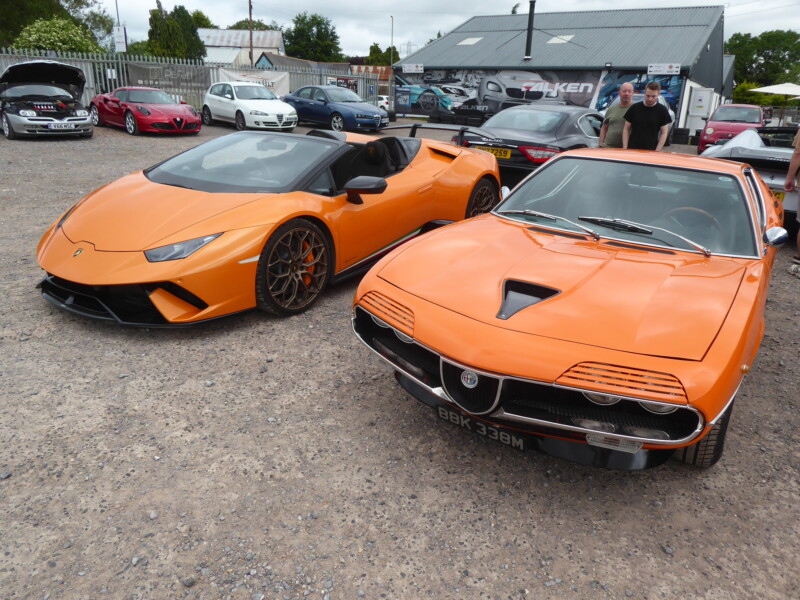
During the 1950s, Alfa had undergone a fairly fundamental transformation from producing cars designed for racing or very high-end sports touring road machines, in small quantities, to being a manufacturer of more affordable cars, albeit with a sporting bias to their dynamics. But the desire to produce something exclusive and expensive was not completely lost, and indeed it was re-manifest in the next Alfa to be seen here, the very lovely Montreal. First seen as a concept car in 1967 at Expo 67, the car was initially displayed without any model name, but the public took to calling it the Montreal. It was a 2+2 coupe using the 1.6-litre engine of the Alfa Romeo Giulia TI and the short wheelbase chassis of the Alfa Romeo Giulia Sprint GT, with a body designed by Marcello Gandini at Bertone. One of the two concept cars built for Expo 67 is displayed in the Alfa Romeo Historical Museum in Arese, Italy, while the other is in museum storage. Reaction to the concept was sufficiently encouraging that Alfa decided to put the car into production. The result, the Tipo 105.64, was shown at the 1970 Geneva Motor Show and was quite different from the original, using a 2593 cc 90° dry-sump lubricated V8 engine with SPICA (Società Pompe Iniezione Cassani & Affini) fuel injection that produced around 200 PS (197 hp), coupled to a five-speed ZF manual gearbox and a limited-slip differential. This engine was derived from the 2-litre V8 used in the 33 Stradale and in the Tipo 33 sports prototype racer; its redline was set at 7,000 rpm, unheard of for a V8 at that time. The chassis and running gear of the production Montreal were taken from the Giulia GTV coupé and comprised double wishbone suspension with coil springs and dampers at the front and a live axle with limited slip differential at the rear.Since the concept car was already unofficially known as The Montreal, Alfa Romeo kept the model name in production. Stylistically, the most eye catching feature was the car’s front end with four headlamps partly covered by unusual “grilles”, that retract when the lights are switched on. Another stylistic element is the NACA duct on the bonnet. The duct is actually blocked off since its purpose is not to draw air into the engine, but to optically hide the power bulge. The slats behind the doors contain the cabin vents, but apart from that only serve cosmetic purposes. Paolo Martin is credited for the prototype instrument cluster. The Montreal was more expensive to buy than the Jaguar E-Type or the Porsche 911. When launched in the UK it was priced at £5,077, rising to £5,549 in August 1972 and to £6,999 by mid-1976. Production was split between the Alfa Romeo plant in Arese and Carrozzeria Bertone’s plants in Caselle and Grugliasco outside Turin. Alfa Romeo produced the chassis and engine and mechanicals and sent the chassis to Caselle where Bertone fitted the body. After body fitment, the car was sent to Grugliasco to be degreased, partly zinc coated, manually spray painted and have the interior fitted. Finally, the car was returned to Arese to have the engine and mechanicals installed. It is worth noting that because of this production method, there is not necessarily any correspondence between chassis number, engine number and production date. The Montreal remained generally unchanged until it was discontinued in 1977. By then, production had long ceased already as Alfa were struggling to sell their remaining stock. The total number built was around 3900. None of them were sold in Montreal, Quebec since Alfa did not develop a North American version to meet the emission control requirements in the United States & Canada. The car was both complex and unreliable which meant that many cars deteriorated to a point where they were uneconomic to restore. That position has changed in the last couple of years, thankfully, with the market deciding that the car deserves better, and prices have risen to you whereas a good one would have been yours for £20,000 only a couple of years ago, you would now likely have to pay more than double that.


The 916 Series cars were conceived to replace two very different models in the Alfa range. First of these was the open topped 105 Series Spider which had been in production since 1966 and by the 1990s was long overdue a replacement. Alfa decided to combine a follow on to the Alfetta GTV, long out of production, with a new Spider model, and first work started in the late 1980s. The task was handed to Pininfarina, and Enrico Fumia’s initial renderings were produced in September 1987, with the first clay models to complete 1:1 scale model made in July 1988. Fumia produced something rather special. Clearly an Italian design, with the Alfa Romeo grille with dual round headlights, recalling the Audi-based Pininfarina Quartz, another design produced by Enrico Fumia back in 1981, the proposal was for a car that was low-slung, wedge-shaped with a low nose and high kicked up tail. The back of the car is “cut-off” with a “Kamm tail” giving improved aerodynamics. The Spider would share these traits with the GTV except that the rear is rounded, and would feature a folding soft-top with five hoop frame, which would completely disappear from sight under a flush fitting cover. An electric folding mechanism would be fitted as an option. Details included a one-piece rear lamp/foglamp/indicator strip across the rear of the body, the minor instruments in the centre console angled towards the driver. The exterior design was finished in July 1988. After Vittorio Ghidella, Fiat’s CEO, accepted the design, Alfa Romeo Centro Stile under Walter de Silva was made responsible for the completion of the detail work and also for the design of the interiors, as Pininfarina’s proposal was not accepted. The Spider and GTV were to be based on the then-current Fiat Group platform, called Tipo Due, in this case a heavily modified version with an all new multilink rear suspension. The front suspension and drivetrain was based on the 1992 Alfa Romeo 155 saloon. Chief engineer at that time was Bruno Cena. Drag coefficient was 0.33 for the GTV and 0.38 for the Spider. Production began in late 1993 with four cars, all 3.0 V6 Spiders, assembled at the Alfa Romeo Arese Plant in Milan. In early 1994 the first GTV was produced, with 2.0 Twin Spark engine. The first premiere was then held at the Paris Motor Show in 1994. The GTV and Spider were officially launched at the Geneva Motor Show in March 1995 and sales began the same year. The cars were well received. At launch, many journalists commented that Alfa had improved overall build quality considerably and that it came very close to equalling its German rivals. I can vouch for that, as I owned an early GTV for eighteen months, and it was a well built and reliable car. In 1997 a new engine, a 24-valve 3.0 litre V6, was available for the GTV along with bigger, 12.0 inch brakes and red four-pot calipers from Brembo. The console knobs were changed from round central to rectangle ones and to a three-spoke steering wheel. Some versions were upgraded with different front bumper mesh to bring the wind noise down to 74 dBA. In May 1998 the cars were revamped for the first time, creating the Phase 2 models. Most of the alterations were inside. The interior was changed with new centre console, painted letters on skirt seals, changed controls and switches arrangement and different instrument cluster. Outside, the main changes included chrome frame around the grille and colour-coded side skirts and bumpers. A new engine was introduced, the 142 hp 1.8 Twin Spark, and others were changed: the 2.0 Twin Spark was updated with a modular intake manifold with different length intakes and a different plastic cover. Power output of the 2.0 TS was raised to 153 hp. Engines changed engine management units and have a nomenclature of CF2. The dashboard was available in two new colours in addition to the standard black: Red Style and Blue Style, and with it new colour-coded upholstery and carpets. The 3.0 24V got a six-speed manual gearbox as standard and the 2.0 V6 TB engine was now also available for the Spider. August 2000 saw the revamp of engines to comply with new emission regulations, Euro3. The new engines were slightly detuned, and have a new identification code: CF3. 3.0 V6 12V was discontinued for the Spider and replaced with 24V Euro3 version from the GTV. 2.0 V6 Turbo and 1.8 T.Spark were discontinued as they did not comply with Euro3 emissions. By the 2001-2002 model year, only 2 engines were left, the 2.0 Twin.Spark and 3.0 V6 24V, until the Phase 3 engine range arrived. The Arese plant, where the cars had been built, was closing and, in October 2000, the production of GTV/Spider was transferred to Pininfarina Plant in San Giorgio Canavese in Turin. In 2003 there was another and final revamp, creating the Phase 3, also designed in Pininfarina but not by Enrico Fumia. The main changes were focused on the front with new 147-style grille and different front bumpers with offset numberplate holder. Change to the interior was minimal with different centre console and upholstery pattern and colours available. Instrument illumination colour was changed from green to red. Main specification change is an ASR traction control, not available for 2.0 TS Base model. New engines were introduced: 163 bhp 2.0 JTS with direct petrol injection and 237 hp 3.2 V6 24V allowing a 158 mph top speed. Production ceased in late 2004, though some cars were still available for purchase till 2006. A total of 80,747 cars were made, and sales of the GTV and Spider were roughly equal. More V6 engined GTVs than Spiders were made, but in 2.0 guise, it was the other way round with the open model proving marginally more popular.


The 166 may have failed to hit the jackpot, but the next Alfa certainly did. This was the 147, launched at the 2000 Turin Motor Show as a replacement for the 145 and 146 hatchbacks, and based on the running gear of the larger 156 saloon. Designed by Walter de’Silva and Wolfgang Egger, the 147 received considerable praise for its styling on launch, later it was awarded with some styling awards. It was available initially with 1.6, 2.0, petrol engines and a 1.9-litre diesel engine. A sequential, paddle operated ‘Selespeed’ transmission was available from launch. Two trim levels were available, Turismo and Lusso. The 147 was the first Alfa Romeo to feature dual-zone climate control and electronic traction control. Although some thought the car had lost of some of the Alfa magic, it was well received and was awarded the Car of the Year trophy a few weeks after launch. The entire 147 range was revamped in 2004, with the exterior styling changed considerably to be more reminiscent of the new 159 and Brera models, and Alfa Romeo Visconti concept car, most notably for its more aggressive look, with a new front grille, new headlights, new rear lights and the interior was updated on all models besides the GTA version. A new more powerful diesel engine arrived and suspension was also tweaked. In 2006, the 147 1.9 JTD Q2 version was launched, which featured a front Torsen limited slip differential. Alfa Romeo presented a new limited edition 147 called Ducati Corse at the 2007 Bologna Motor Show. The car came equipped with a 170 PS (68 hp) JTD diesel engine and Q2, a front Torsen limited slip differential. The 147 was in production for ten years, making it one of the oldest small family cars on sale in Europe at the time of its replacement by the Alfa Romeo Giulietta in late May 2010. In total around 580,000 cars were made.

Replacement for the much loved 156 was the 159. The Alfa Romeo 159 had a troubled development, being designed in the midst of the Fiat-General Motors joint venture which was terminated in 2005. Originally, the 159 was intended to use GM’s Epsilon platform; however, late during its development it was changed to the GM/Fiat Premium platform. The Premium platform was more refined and expensive, being intended for E-segment executive cars such as an Alfa Romeo 166 successor but that never materialised, so Alfa Romeo attempted to recoup some of the platform development costs with the 159. General Motors originally planned Cadillac, Buick and Saab models for this platform but ending up discarded them over cost concerns. Unfortunately, the 159’s late transition to what was fundamentally made as an E-segment platform resulted in the 159 having excessive weight, a problem shared by its sisters, the Alfa Romeo Brera coupe and Spider convertible. The 159 was designed by Giorgetto Giugiaro in collaboration with the Centro Stile Alfa Romeo. The nose featured a traditional Alfa Romeo V-shaped grille and bonnet, and cylindrical head light clusters. Similar to its coupé counterpart, front of the car was influenced by the Giugiaro designed 2002 Brera Concept. Several exterior design cues were intended to make the car appear larger, supposedly to appeal to potential buyers in the United States; however, the 159 was never exported to that region. The interior featured styling treatments familiar from earlier cars, including the 156, such as deeply recessed instruments which are angled towards the driver. Alfa Romeo intended for the 159 to compete more directly with BMW, Mercedes-Benz and Audi by using higher quality interior materials; however, it has been said that Alfa Romeo misjudged their brand’s positioning relative to the more well-known German luxury automakers. Several levels of trim were available, depending on market. Four trim levels: Progression, Distinctive, Exclusive and Turismo Internazionale (TI) featured across Europe. In the UK there were three levels of trim: Turismo, Lusso and Turismo Internazionale (TI). A Sportwagon variant was introduced at the Geneva Motor Show in 2006. The 159’s size made it considerably more comfortable than the 156 due to its larger, roomy interior. However, the considerable growth in dimensions deterred many 156 owners from considering the 159 as a direct replacement model, and something seemed to be lost in the character of the new car. Initially offered with a choice of 1.9 and 2,2 litre 4 cylinder and 3.2 litre V6 petrol engines and 1.9 and 2.4 litre diesel units, and an optional four wheel drive system. An automatic gearbox option for the 2.4 JTDM diesel model was also launched in late 2006, and later extended to other versions. In 2007 a four-wheel drive diesel model was released and the 2.4-litre diesel engines’ power output increased to 210 hp, with a newly reintroduced TI trim level also available as an option. For model year 2008 the mechanics and interiors of the 159 were further developed. The 3.2 litre V6 model was offered in front wheel drive configuration, achieving a top speed of 160 mph. All model variants came with Alfa’s electronic “Q2” limited slip differential. As a result of newly introduced aluminium components, a 45 kilograms (99 lb) weight reduction was achieved. For 2009, Alfa introduced a new turbocharged petrol engine badged as “TBi”. This 1742 cc unit had direct injection and variable valve timing in both inlet and exhaust cams. This new engine had 200 PS (197 hp) and would eventually replace the GM-derived 2.2 and 1.9 JTS units.In 2010, all petrol engines except for the 1750 TBi were retired, ending the use of General Motors-based engines in the 159. The only remaining diesel engines were the 136 PS and 170 PS 2.0 JTDm engines. In 2011, the 159 was powered only by diesel engines. In the UK, Alfa Romeo stopped taking orders for the 159 on 8 July 2011. Production for all markets ceased at the end of 2011, after 240,000 had been built.


Rather than replacing the 916 Series GTV with a single model, Alfa elected to produce two successors., The more commodious of the two, the GT, was the first to appear, making its debut in March 2003 at the Geneva Motor Show, finally going on sale in early 2004. It was built at the Pomigliano plant, alongside the 147 and 159. The GT was based on the Alfa 156 platform, which was also used for the 147, providing the 2-door coupé with genuine five-passenger capacity. It was styled by Bertone. Most mechanicals were taken directly from the 156/147 using the same double wishbone front suspension and MacPherson rear setup. The interior was derived from the smaller hatchback 147 and shared many common parts. The GT shared the same dash layout and functions, the climate control system as well as having a similar electrical system. Some exterior parts were taken from 147 with the same bonnet, wing mirrors and front wings (from 147 GTA). The engine range included both a 1.8 TS, and 2.0 JTS petrol engine, a 1.9 MultiJet turbodiesel, and a top-of-the-range 240 bhp 3.2 V6 petrol. There were few changes during the GT’s production life. In 2006 Alfa introduced a 1.9 JTD Q2 version with a limited slip differential, and also added a new trim level called Black Line. In 2008 Alfa introduced the cloverleaf model as a limited edition complete with new trim levels, lowered suspension, body kit, 18 inch alloy wheels and was only available in the colours black, Alfa red, or blue. with 1.8 and 2.0 litre petrol engines as well as the 1.9 litre Multijet turbo diesel. The GT was acclaimed for its attractive styling and purposeful good looks, in 2004 being voted the world’s most beautiful coupe in the annual ‘World’s Most Beautiful Automobile’ (L’Automobile più Bella del Mondo) awards. The car sold reasonably well, with 80,832 units being produced before the model was deleted in 2010.


Visually similar to the 159 models at the front, the Brera and Spider boasted unique styling from the A pillars rearwards. They were offered with the same range of engines as the 159, and thanks to that strong, but rather heavy platform on which they were built, even the 3.2 litre V6 cars were more Grand Tourer than rapid sports car. Pininfarina was responsible for both models. The Brera was first to market, in 2005, with the Spider following in 2006. Production of both ceased in late 2010, by which time 12,488 units of the Spider and 21,786 units of the Brera had been built. It will be very surprising if these do not attain classic status, and the consequent rise in values, though that has not happened yet.


The Alfa Romeo MiTo (Type 955) is a front-wheel drive, three-door supermini designed by Centro Stile Alfa Romeo and presented in 2008 at Castello Sforzesco in Milan with an international introduction at the British Motor Show in 2008. The new car was provisionally named the “Junior”. In November 2007, Alfa Romeo launched a European public naming competition; the winner from each country to win an Alfa Romeo Spider or an Alfa Romeo mountain bike. The winning name was “Furiosa”, which scored well in Italy, France, United Kingdom and Germany, but not in Spain. In 2008, Alfa Romeo announced “MiTo” as the official name, a portmanteau of Milano (Milan) & Torino (Turin), because it was designed in the former and was assembled in the latter. The name is also a play on the Italian word “mito”, meaning “myth” or “legend”. The MiTo is front-wheel drive, with a system allowing the driver to choose three driving settings: Dynamic, Normal, and All-Weather. The system, marketed as “Alfa DNA,” tunes the behaviour of the engine, brakes, steering, suspension and gearbox. The MiTo also features LED tail lights and 250-litre (8.8 cu ft) of luggage space. The MiTo also features a Q2 electronic differential on the front wheels, which is active with the DNA switch in Dynamic position, and allows for faster and tighter cornering without loss of traction. In 2010 a new transmission for the MiTo was unveiled at the 2010 Geneva Motor Show, the six-speed TCT which is produced by Fiat Powertrain Technologies in Verrone (TCT Dual Dry Clutch Transmission). Magneti Marelli delivers the control system which integrates BorgWarner’s hydraulic actuation module into its own power and transmission control units. It can handle torque inputs of up to 350 N⋅m (258 lbf⋅ft) In Geneva was also unveiled Blue&Me–TomTom, this new system integrates TomTom navigation to the Blue&Me infotelematic system. At its launch the MiTo featured low-displacement turbocharged petrol and diesel engines. Also, a power limited 78 bhp naturally aspirated engine variant is produced to meet the new Italian legislation for young people. MiTo got new electro-hydraulic valve control system Multiair engines from September 2009. MultiAir engines will increase power (up to 10%) and torque (up to 15%), as well as a considerable reduction in consumption levels (up to 10%) and CO2 emissions (up to 10%), of particulates (up to 40%) and NOx (up to 60%). This new engine is available with 104 bhp,133 bhp and 168 bhp power ratings. All multiair versions have start-stop system as standard. In October 2009 was unveiled a dual fuel MiTo version, this version can run with LPG (Liquefied petroleum gas) or petrol, with this engine MiTo has range of 1,200 km (750 miles). The LPG version is made in collaboration with Landi Renzo. In Summer 2010 Alfa introduced the Dual Dry Clutch Transmission called Alfa TCT ( i.e. Twin Clutch Transmission ). From model year 2011 the start-stop system came as standard on all versions. At the 2011 Frankfurt Motor Show, AR introduced two new engines for the MiTo – The 0.9 L I2 TwinAir and a new low emission 85 PS version of the 1.3 JTD diesel engine. The Quadrifoglio Verde (green four-leaf clover) has traditionally been the highest line of Alfa Romeo models. The car (see Alfa Romeo in motorsport article for the history of this emblem) version of Mito was presented at the 2009 Frankfurt Motor Show. The QV version has the new 1.4 litres (1,368 cc) Turbo Multiair inline-four engine 168 bhp at 5500 rpm and 250 Nm (184 lb/ft) of torque at 2500 rpm, with newly engineered suspension, steering and new six-speed C635 gearbox developed by Fiat Powertrain Technologies (FPT). Its specific output of 124 PS per litre was highest in its segment at that time. The new multiair technology allows fuel consumption of 6 l/100 km (47 mpg) in EU combined driving and CO2 emissions of 139 g/km. QV had bigger 305 mm front brake discs and exclusive 18″ alloy wheels as standard and Sabelt carbon fibre backed bucket seats as an option. From 2014 QV was now available with TCT robotised gearbox which brought down the 0–100 km/h time to 7.3 s. With the 2016 facelift, the QV was renamed as the Veloce. For model year 2014, the MiTo got a new 105 PS 0.9 L Turbo TwinAir engine, new chrome-plated grille, new Anthracite grey colour and new burnished front light clusters. The car interior was also updated with new upholsteries, three new dashboards looks, as well as the new Uconnect 5.0 infotainment systems. The engine range now consists two turbo diesel engines (the updated E5+ 85 PS 1.3 L JTDM and the 120 PS 1.6 L JTDM) and five petrol engines: the 70 PS 1.4, the 78 PS 1.4, the 135 PS 1.4 MultiAir Turbo (with manual or Alfa TCT Dual Dry Clutch Transmission) and the 170 PS 1.4 MultiAir Turbo. The range has also 120 HP 1.4 LPG Turbo option. Debuting at the 2016 2016 Geneva Motor Show, the revised Mito featured a facelifted front fascia with a new updated brand logo and new lettering. Trim line up was changed to Mito, Super and Veloce. A new body colour and new rims designs also became available. The previous MiTo QV became the Mito Veloce, available with 170 PS engine and TCT transmission. The MiTo was marketed across a single generation from 2008 to 2018, sharing the Fiat Small platform with the Fiat Grande Punto. Production reached 293,428 at FCA’s Mirafiori plant.


Replacing the 147, the Alfa Romeo Giulietta (Type 940) is a five door hatchback positioned as a sporty and luxury car. Production started near the end of 2009 and the model was introduced at the March 2010 Geneva Motor Show. The Giulietta was placed second in the 2011 European Car of the Year awards. The platform used in the Fiat Group’s Compact, successor of the C-platform (base for Fiat Stilo, Fiat Bravo and Lancia Delta). Practically this was an all-new modular platform, only the central front part coming from the previous C-platform, but that part is modified also. Fiat Group used around 100 million euros to developing it. Mistakenly the journalists called the C-Evo platform, but Fiat never called on this name. It has a longer wheelbase, shorter overhangs and an advanced new type of MacPherson strut front suspension and multi-link rear suspension. Depending on the market and trim level, 16, 17, or 18-inch wheels are available. Available tire sizes are 205/55 R16, 225/45 R17, and 225/40 R18. The wheels use a 5-hole pattern with a 110 mm bolt circle. The length of the Giulietta is around 4.3 metres (14 ft). Only a five-door body is available for sale. In a viability plan forwarded to the US Government in February 2009, Chrysler (a partner of Alfa Romeo parent company Fiat) reported that the 147 replacement would come to market as the Milano and that it could be built in the USA. However, as of early 2010 Fiat was instead planning to concentrate on bringing larger models to the US, such as the Giulia. At the 2013 Frankfurt International Motor Show Alfa Romeo presented an updated Giulietta. Trim changes include a new Uconnect infotainment system with 5″ or 6.5″ Radionav touchscreen, a new front grille, a chrome-plated frame for the fog lights, a new and more supportive seat design, new wheels (16, 17 and 18-inch), as well as new exterior colours: Moonlight Pearl, Anodizzato Blue and Bronze. A new diesel engine variant has also arrived, the two-litre JTDM 2, developing 150 PS (148 bhp) and 380 Nm (280 lb/ft). In the 2014 range, all engines comply with Euro 5+ (Euro 6-ready) emission standards. Debuting at 2016 Geneva Motor Show, New Giulietta with facelifted front resembling Giulia and with new updated brand logo and new lettering. Trim line up will be changed to Giulietta, Giulietta Super and Giulietta Veloce. New body colour, new rims designs. Previous Giulietta QV will now be changed into sporty Veloce trim available with 240 PS (237 bhp) engine and TCT transmission. Also debuting was a new 1.6 JTDm 120 PS (118 bhp) TCT diesel engine. For 2019, the Giulietta had updated engines, all Euro 6 D: a 1.4-litre 120 PS turbo petrol, a 1.6-litre 120 PS Multijet with manual or Alfa TCT automatic transmission, and a 2.0-litre 170 PS Multijet with Alfa TCT. The top of the range model was a version with 1,742 cc turbocharged TBi engine rated 235 PS (232 bhp), lowered ride height (15 mm (0.6 in) at the front and 10 mm (0.4 in) at the rear), 18-inch Spoke design alloy wheels with dark titanium finish and 225/40 R18 tyres plus 18-inch 5 hole design alloy wheels as an option; an enhanced braking system (330 mm (13.0 in) front, 278 mm (10.9 in) rear) with calipers painted Alfa red; dark tinted windows, sports kick plates, cloverleaf badges, leather and microfibre seats plus sports leather seats as an option; dark brushed aluminium dashboard. 1750 is an engine size which has its roots in Alfa Romeo’s history, with 1.75 L engines being used to power some of Alfa Romeo’s first cars. The UK version was originally marketed as the Giulietta Cloverleaf, then Quadrifoglio Verde through ’14-’15 before finally being renamed to the Veloce in 2016 until the end of production. At the 2014 Geneva Motor Show, Alfa Romeo introduced a new Quadrifoglio Verde, it has new 1,742 cc Turbo direct injection aluminium-block Inline-four engine now upgraded to 240 PS (237 bhp) at 5750 rpm and 340 Nm (251 lb/ft) at 2000 rpm of torque and Alfa TCT 6-speed twin dry clutch transmission borrowed from the Alfa Romeo 4C. With new engine the Giulietta’s flagship can exceed 240 km/h (149 mph) and accelerate from 0 to 100 km/h (62 mph) in only 6.0 seconds. This new facelifted version was premiered with a limited ‘Launch Edition’, recognizable by the black-finish on the sills all round. Available in new matt Grigio Magnesio Opaco along with Rosso Alfa and Rosso Competizione. Each car has its own numbered plaque. Around 700 units were made. Between 2010 and 2019, production reached over 400,000. In 2020, Alfa Romeo announced that they were going to axe the Giulietta and production ended on 22 December 2020 spanning 10 years of sales from a period of 2010 to 2020. In total 469,067 examples were produced until 2020.

The Alfa Romeo 4C is a two-seater, rear-wheel drive coupé with technology and materials derived from the Alfa Romeo 8C Competizione, with a 1750 cc turbo petrol engine with direct injection, the “Alfa TCT” twin dry clutch transmission, and the Alfa DNA dynamic control selector. The 4C concept version was unveiled in the 81st Geneva Motor Show in March 2011, followed by the Mille Miglia 2011 parade, Goodwood Festival of Speed 2011,2011 Frankfurt Motor Show. It was displayed for the first time outside in Concorso d’Eleganza Villa d’Este in 2012. Compared to the production version, it is very similar, with the biggest differences being front lights, side vents and mirrors. The Alfa Romeo 4C Concept was voted the ‘Most Beautiful Concept Car of the Year’ award by the readers of German magazine Auto Bild, and won the Auto Bild Design Award 2011. It was awarded the “Design Award for Concept Cars & Prototypes” by referendum of the public in Villa d’Este. The production car was unveiled at the 2013 Geneva Motor Show, followed by 2013 Essen ‘Techno Classica’, Goodwood Festival of Speed 2013, Moscow Raceway, 2013 Frankfurt Motor Show. The bare ‘4C000’ chassis was also shown at the 2013 Geneva Motor Show. Ordering of European models began in October 2013 at Alfa Romeo dealerships in Europe. As part of the Alfa Romeo 4C launch, Alfa Romeo Style Centre and Compagnia Ducale designed a 4C IFD (Innovative Frame Design) Bicycle, inspired by the Alfa Romeo 4C coupé. The vehicle went on sale in December 2013 and marketed in Europe, Asia and America. Production of the 4C began May 2013 at Maserati’s plant in Modena, with an expected production of up to 2500 units per year. It was the first mass-produced Alfa Romeo model to be sold in the US market since 1995 when the 164 sedan stopped being sold in the US. Production of the Alfa Romeo 4C was originally estimated to be over 1000 units per year, with an upper limit of 3500 units per year, depending on the quantity of carbon fibre chassis that can be built by the supplier Adler Plastic.Within the 3,500-unit quota, 1,000 units are earmarked for Europe. Delivery of the European Alfa Romeo 4C Launch Edition took place at Balocco (Vercelli, Italy) Test Centre. In 2018, the 4C coupe was discontinued for the North American market. The 4C Spider, however continued to be sold there for model year 2019 and model year 2020. In other markets, such as Australia and Japan, both the coupe and Spider continued. In late 2020, a new tribute-edition named the 4C Spider 33 Stradale Tributo was announced. The car was designed by Centro Stile Alfa Romeo (Style Centre) and developed by Alfa Romeo. The chassis is composed of a central carbon fibre tub, with aluminium subframes front and rear. The carbon fibre tub is produced by TTA (Tecno Tessile Adler) in Airola, as a joint venture between Adler Plastic and Lavorazione Materiali Compositi. The carbon fibre components that make up the chassis are cut using CNC technology. The entire carbon-fibre monocoque chassis (“tub”) of the car weighs 143 pounds (65 kg). Front and rear aluminium subframes combine with the tub, roof reinforcements and engine mounting to comprise the 4C chassis giving the vehicle a total chassis weight of 236 lb (107 kg) and a total vehicle curb weight of just 2,465 lb (1,118 kg). The 4C has a single carbon fibre body, similar to the body of many supercars. The outer body is made of a composite material (SMC for Sheet Moulding Compound) which is 20% lighter than steel. The stability is comparable to steel and better than aluminium. The 4C employs double wishbone suspensions at the front and MacPherson struts at the rear. The resultant weight distribution is 38% on the front and 62% on the rear axle. Wheels and tyres have different diameters and widths front and rear: 205/45 R17 front and 235/40 R18 back as standard, with optional 205/40 R18 and 235/35 R19. Both wheel options come equipped with Pirelli P Zero tyres. The 4C uses vented disc brakes on all wheels; Brembo 305 millimetres (12.0 in) on the front and 292 millimetres (11.5 in) on the rear. The car can stop from 100 km/h (62 mph) in 36 metres. To save weight and increase steering feel, the 4C has no power steering. Its centre of gravity height, at 40 centimetres (16 in) off the ground, is 7 centimetres (2.8 in) lower than that of the Lotus Elise. The 4C uses a new all-aluminium 1,742 cc inline 4 cylinder turbocharged engine producing 240 PS at 6000 rpm. The engine has been designed for minimum weight. The engine’s combined fuel consumption 6.8 l/100 km (42 mpg‑imp; 35 mpg‑US). 0–62 mph (0–100 km/h) acceleration is achieved in 4.5 seconds and the top speed is 258 km/h (160 mph), the power-to-weight-ratio being just 0.267 hp/kg (8.22 lb/hp) A journalist from Quattroruote car magazine demonstrated how the 4C accelerates from 0–100 km/h (0–62 mph) faster than 4.5 seconds. In race mode, with left foot on the brake pedal, if you pull the right shift paddle the engine will rev to 3500 rpm, but if you also pull the left paddle the engine will rev to 6000 rpm and 0–100 km/h (0–62 mph) time will go down to 4.2 seconds. Italian car magazine Quattroruote published the lap time of 4C around Nürburgring. It lapped the ring in 8:04. The 4C is equipped with a six speed Alfa TCT Dual Dry Clutch Transmission, and can be operated via gearshift paddles on the steering wheel. It also has an Alfa ‘DNA’ dynamic control selector which controls the behaviour of engine, brakes, throttle response, suspension and gearbox. In addition to the modes already seen in Giulietta, the 4C has a new “Race” mode. The U.S. version of the 4C was introduced in the 2014 New York International Auto Show with the first 100 4C’s being shipped to the U.S. early July, with a total of 850 being shipped by the end of 2014. The U.S. model includes extra bracing and strengthening required to meet U.S. crash regulations (including aluminium inserts in the carbon fibre chassis), resulting in 100 kg (220 lb) of weight increase. This version also has new headlamps similar to those seen before in the 4C Spider version. In 2018, the 4C coupe was discontinued for the North American market due to US DOT NHTSA FMVSS 226 Ejection Mitigation. The regulation called for a progressive compliance date based on volume and, due to low volume, the 4C was allowed to continue until the last compliance date of 9/1/2017, thus all 2018 4C coupes in North America have build dates of 8/2017 or earlier. The 4C Spider, however continued to be sold in North America for model year 2019 and model year 2020. The Spider version of the 4C was previewed showing a pre-production prototype at the 2014 Geneva Motor Show. Sharing its engine with the Coupé version, the 4C Spider has different external parts such as the headlights, exhaust and engine hood, as well as a different roof section that features a removable roof panel. The North American spec 4C reflects a weight difference of only 22 lb (10 kg) (2,465 lbs vs. 2,487 lbs) for the Spider variant. Top speed is quoted at 257 km/h (160 mph) and acceleration from 0 to 100 km/h (62 mph) at 4.5 seconds. The 4C Launch Edition was a limited and numbered edition, unveiled at the vehicle’s launch at the 2013 Geneva Motor Show. The vehicle came in a choice of four paint colours (Rosso Alfa, Rosso Competizione tri-coat, Madreperla White tri-coat or Carrara White matte). 500 examples were reserved for Europe/ROW, 500 for North America, 88 for Australia (Rosso Alfa and Madreperla White only), 200 to Japan and 100 for the Middle East. Note that the original press release cited 500 for North America, 400 Europe, and 100 ROW; however, the plaques on actual cars suggest that more were built and are the numbers referenced above. Distinguishing features of the Launch Edition were carbon fiber trim (including headlight housings, spoiler and door mirror caps), rear aluminium extractor with dark finishing, Bi-LED headlights, dark painted 18-inch front and 19-inch rear alloy wheels, additional air intakes on the front fascia, red brake calipers, racing exhaust system, BMC air cleaner, specific calibration for shock absorbers and rear anti-roll bar, leather/fabric sports seats with parts in Alcantara and a numbered plaque. Alfa Red coloured cars got matching red stitching on the steering wheel, handbrake, mats, handles and sports seats. In Europe the vehicle went on sale for 60,000 euros including VAT. The 4C Competizione is a limited edition version of the 4C introduced in the 2018 Geneva Motor Show, finished in matte Vesuvio Grey, with carbon details on the roof, rear spoiler, mirror caps, side air vents and headlight moulding. The run reportedly consisted of 108 units. The Japanese market received 25 units, and 10 units were assigned to Australia. The US-market received no Competizione editions. The car had a very mixed reaction. The UK press hated it at launch, but owners generally disagreed and loved it. A total of 9117 were built before production ceased in 2020.

Not surprisingly, Alfa’s well-received and now quite long-lived Giulia model was also represented here.


FERRARI
Parked out at the front when I arrived was this mildly modified 458 Italia. An all new design, the 458 Italia was first officially unveiled at the 2009 Frankfurt Motor Show. Once more, Ferrari advised that the model incorporated technologies developed from the company’s experience in Formula 1. The body computer system was developed by Magneti Marelli Automotive Lighting. The 458 came with a 4,499 cc V8 engine of the “Ferrari/Maserati” F136 engine family, producing 570 PS ( 562 hp) at 9,000 rpm and 540 N·m (398 lb/ft) at 6,000 rpm with 80% torque available at 3,250 rpm. The engine featured direct fuel injection, a first for Ferrari mid-engine setups in its road cars. The only transmission available was a dual-clutch 7-speed Getrag gearbox, in a different state of tune shared with the Mercedes-Benz SLS AMG. There was no traditional manual option, making this the fourth road-car after the Enzo, Challenge Stradale and 430 Scuderia not to be offered with Ferrari’s classic gated manual. The car’s suspension featured double wishbones at the front and a multi-link setup at the rear, coupled with E-Diff and F1-Trac traction control systems, designed to improve the car’s cornering and longitudinal acceleration by 32% when compared with its predecessors. The brakes included a prefill function whereby the pistons in the calipers move the pads into contact with the discs on lift off to minimise delay in the brakes being applied. This combined with the ABS and standard Carbon Ceramic brakes caused a reduction in stopping distance from 100–0 km/h (62-0 mph) to 32.5 metres. Ferrari’s official 0–100 km/h (62 mph) acceleration time was quoted as 2.9–3.0 seconds with a top speed of 340 km/h (210 mph). In keeping with Ferrari tradition the body was designed by Pininfarina under the leadership of Donato Coco, the Ferrari design director. The interior design of Ferrari 458 Italia was designed by Bertrand Rapatel, a French automobile designer. The car’s exterior styling and features were designed for aerodynamic efficiency, producing a downforce of 140 kg (309 lb) at 200 km/h. In particular, the front grille features deformable winglets that lower at high speeds, in order to offer reduced drag. The car’s interior was designed using input from former Ferrari Formula 1 driver Michael Schumacher; in a layout common to racing cars, the new steering wheel incorporates many controls normally located on the dashboard or on stalks, such as turning signals or high beams. At launch the car was widely praised as being pretty much near perfect in every regard. It did lack a fresh air version, though, but that was addressed with the launch of the 458 Spider at the 2011 Frankfurt Motor Show. This convertible variant of the 458 Italia featured an aluminium retractable hardtop which, according to Ferrari, weighs 25 kilograms (55 lb) less than a soft roof such as the one found on the Ferrari F430 Spider, and can be opened in 14 seconds The engine cover was redesigned to accommodate the retractable roof system. It had the same 0–100 km/h time as the hard-top but a lower top speed of 199 mph. It quickly became the better seller of the two versions.


The Ferrari 296 (Type F171)is a sports car built since 2022 by the Italian company Ferrari. The 296 is a two-seater, offered as a GTB coupé and a GTS folding hard-top convertible. It is a plug-in hybrid with a rear mid-engine, rear-wheel-drive layout and its power train combines a twin-turbocharged 120-degree block-angle V6 with an electric drive fitted in between the engine and gearbox. The 296 can be driven in electric-only mode for short distances, to comply with use in urban zero-emission zones. Unveiled on 24 June 2021, the 296 is Ferrari’s first stock model with 6-cylinders other than the Dino 206 GT, 246 GT and 246 GTS cars produced by Ferrari but sold under the Dino marque. Its power pack puts out a combined 830 PS, giving the 296 a power-to-weight ratio of 560 hp/ton. The 296 GTB was presented as the first “real Ferrari with just six cylinders on it” on 24 June 2021. Previously, such models were both designed and built by Ferrari, but marketed as a new, entry-level Dino brand, below Ferrari’s exclusively V12-model policy, until 1974. The new car went on sale in 2022. The 296 in the model name reprises the original Dino’s naming scheme, indicating the engine’s displacement and the number of cylinders. GTB stands for Gran Turismo Berlinetta. It remains a current model.


The Ferrari 12Cilindri (Type F167; “dodici cilindri”, (Italian for 12 Cylinders); named for its engine) is a two-seater front-engine, rear-wheel-drive grand tourer produced by the Italian sports car manufacturer Ferrari. It was unveiled at Miami Beach on May 3, 2024, to coincide with the 70th anniversary of Ferrari in the American market. The 12Cilindri was awarded the Car Design Award by ADI in 2025. The 12Cilindri has a 6,496 cc F140 V12 engine, the same used in the Ferrari 812 Competizione, and generates a power output of 830 PS (819 bhp) at 9,250 rpm and 678 Nm (500 lb/ft) of torque at 7,250 rpm. The 12Cilindri has 21-inch wheels at the front and the rear. The tires are either Michelin Pilot Sport S5 or Goodyear Eagle F1 Supersport. The brakes are (398mm/front) and (360mm/rear) and are operated by a “brake-by-wire” electronical command. The car has 4-wheel steering. The car includes a mix of active and passive aerodynamics to improve drag coefficient values over the 812 Superfast. On the rear, the car has a spoiler to improve downforce at high speed. The side of the spoiler can tilt up to 10° at 60 km/h (38 mph) to act as aero brake and generating 50 kg of downforce at high speeds. Ferrari claims a 0–100 km/h (0–62 mph) in 2.9 seconds, a 0–200 km/h (0–124 mph) in 7.9 seconds, and a top speed of 340 km/h (211 mph). The design is a tribute of the Ferrari 365 GTB/4 Daytona with the black band on the hood that cannot be removed or changed to a different colour. The interior is inspired by the Purosangue and the 296 GTB and is the first GT-segment Ferrari to lack an analog gauge. There are both closed roof Coupe and open-topped Spider versions available.


FIAT
Introduced at the 1980 Geneva Show, the Panda (Tipo 141) was designed as a cheap, easy to use and maintain, no-frills utility vehicle, positioned in Fiat’s range between the 126 and 127. It can be seen as a then-modern approach to the same niche which the Citroën 2CV and Renault 4 were designed to serve. The first Panda was designed by Giorgetto Giugiaro of Italdesign. In an interview to Turinese newspaper La Stampa published in February 1980, Giugiaro likened the Panda to a pair of jeans, because of its practicality and simplicity, and he has often said that this is his favourite of all the cars he designed. Mechanically the first Pandas borrowed heavily from the Fiat parts bin. Engines and transmissions came from the Fiat 127 and, in certain territories, the air-cooled 652 cc two-cylinder powerplant from the Fiat 126. The plan for a mechanically simple car was also evident in the rear suspension, which used a solid axle suspended on leaf springs. Later versions of the car added various mechanical improvements but this spirit of robust simplicity was adhered to throughout the life of the model. Many design features reflect the Panda’s utilitarian practicality. Examples include a seven-position adjustable rear seat which could be folded flat to make an improvised bed, or folded into a V shape to support awkward loads, or easily and quickly removed altogether to increase the overall load space. The first Pandas also featured removable, washable seat covers, door trims and dashboard cover, and all the glass panels were flat making them cheap to produce, easy to replace and interchangeable between left and right door. Much like its earlier French counterparts the Panda could be specified with a two piece roll forward canvas roof. At launch two models were available: the Panda 30, powered by a longitudinally-mounted air cooled 652 cc straight-two-cylinder engine derived from the 126, or the Panda 45, with a transversely-mounted water cooled 903 cc four-cylinder from the 127. As a consequence of the different drivetrain layout the 45 had the radiator grille to the right side, the 30 to the left. In September 1982 Fiat added another engine to the line-up: the Panda 34 used an 843 cc water-cooled unit, derived from that in the 850. It was originally reserved for export to France, Belgium, Germany, and the Netherlands. Fiat launched the Panda 45 Super at the Paris Motor Show later in 1982, with previous specification models continuing as the “Comfort” trim. The Super offered numerous improvements, most significant being the availability of a five-speed gearbox as well as improved trim. There were minor styling changes to the Super including the introduction of Fiat’s new black plastic “corporate” grille with five diagonal silver bars. The earlier grille design (metal with slots on the left for ventilation) continued on the Comfort models until the next major revision of the line-up. A 30 Super was added to the range in February 1983, offering the Super trim combined with the smaller engine. The Panda 4×4 was launched in June 1983, it was powered by a 965 cc engine with 48 bhp derived from that in the Autobianchi A112. Known simply as the Panda 4×4, this model was the first small, transverse-engined production car to have a 4WD system. The system itself was manually selectable, with an ultra-low first gear. Under normal (on-road) conditions starting was from second, with the fifth gear having the same ratio as fourth in the normal Panda. Austrian company Steyr-Puch supplied the entire drivetrain (clutch, gearbox, power take-off, three-piece propshaft, rear live axle including differential and brakes) to the plant at Termini Imerese where it was fitted to the reinforced bodyshell. Minor revisions in November 1984 saw the range renamed “L”, “CL”, and “S”. Specifications and detailing were modified across the range including the adoption of the Fiat corporate grille across all versions. Mechanically, however, the cars remained largely unchanged. In January 1986, the Panda received a substantial overhaul and a series of significant mechanical improvements. Most of these changes resulted in the majority of parts being changed and redesigned, making many of the pre-facelift and post-facelift Panda parts incompatible between models. The 652 cc air-cooled 2-cyl engine was replaced by a 769 cc (34 bhp) water-cooled 4-cyl unit, and the 903/965cc by a 999cc (45 bhp, 50 bhp in the 4×4) unit. Both new engines were from Fiat’s new FIRE family of 4-cylinder water-cooled powerplants with a single overhead camshaft. The rear suspension was also upgraded, the solid axle with leaf springs being replaced by a more modern dependent suspension system using a non-straight rigid axle (known as the ‘Omega’ axle) with a central mounting and coil springs (first seen on the Lancia Y10, which used the same platform). The 4×4 retained the old leaf sprung live axle set-up, presumably to avoid having to redesign the entire 4WD system. Improvements were also made to the interior and the structure. The body was strengthened and fully galvanised on later models, virtually eliminating the earlier car’s strong tendency to rust. The rear panel design was also revamped to include flared arches that mirrored those of the front wings, replacing the un-sculpted style seen on earlier models, and the doors received a slight redesign with the earlier car’s quarter light windows being removed and replaced by a full width roll-down window. The bottom seam of the facelifted model’s doors unfortunately retained much the earlier car’s susceptibility to rust. In ascending order of specification and cost, the revised range was as follows: 750L, 750CL, 750S, 1000CL, 1000S, 4×4. April 1986 saw the introduction of a 1,301 cc diesel engine with 37 bhp (a detuned 127/Uno unit). Fitted as standard with a five-speed gearbox it was only available in the basic “L” trim. A van variant of the Panda was also introduced, with both petrol and diesel engines. The van was basically a standard Panda without rear seats. The rear windows were replaced with plastic blanking panels and a small (always black) steel extension with side hinged doors was fitted instead of the usual hatchback tailgate. Neither the van nor the diesel were available in right hand drive markets. In 1987, a new entry-level model badged “Panda Young” was added to the range. This was essentially an L spec car with a 769 cc OHV engine based on the old 903 cc push-rod FIAT 100 engine and producing the same 34 bhp as the more sophisticated 769 cc FIRE unit. The Panda 4×4 Sisley limited edition was also released; this was based on the standard 4×4, but came with metallic paint, inclinometer, white painted wheels, roof rack, headlamp washers, bonnet scoop, “Sisley” badging and trim. Although originally limited to the production of only 500, in 1989 the Sisley model became a permanent model due to its popularity. In 1991, a facelift was introduced. This entailed a new front grille with a smaller five-bar corporate badge, plus revisions to trim and specifications across the range. New arrivals included the ‘Selecta’, which had a continuously variable transmission with an electromagnetic clutch. This advanced transmission was available either with the normal 999 cc FIRE engine (revised with single-point fuel injection and a catalytic converter) or an all new 1108 cc FIRE unit, fitted with electronic fuel injection and a three-way catalytic converter and producing 51 bhp. The new CLX trim also featured a five-speed gearbox as standard. The range now comprised the 750 Young (769 cc ohv), 750 and 750 CLX (both 769 cc FIRE sohc), 900 Dance (903 cc ohv), 1000 Shopping, CLX, CL Selecta and S (all with 999 cc sohc, available with or without SPI and catalytic converter depending on the market), 1100 CL Selecta (1108 cc sohc with SPI and cat) and the 4×4 Trekking (999 cc, again available with and without a cat depending on the market). The Elettra concluded the range. In 1992, the 1108 cc engine, complete with SPI and catalytic converter, replaced the 999 cc unit in the 4×4 (with 50 bhp) and also in 1992 an 899 cc (with injection and catalyst) became available, in the ‘Cafe’ special edition. This was a reduced capacity 903 cc unit, designed to meet tax requirements in some markets. From 1996 onwards, the Panda was gradually phased out across Europe, due to tightening emissions and safety legislation. The car remained in production in Italy until May 2003. Its total production run of 23 years makes the Panda one of Europe’s longest-lived small cars. Over 4,5 million were built and the car is still popular in Italy.


The second generation Panda, codenamed Tipo 169, first appeared in 2003. In its development phase, the new Panda was originally intended to be called “Gingo”. However, this name was considered to be too similar to the Renault Twingo, so Fiat decided to continue with the Panda name, although it has almost no direct engineering link to the original 1980 car. Successor to the Fiat Seicento, the new model also effectively replaced the old Panda after 23 years of production, although the Seicento itself proved still popular and remained in production. Like the Seicento, the Panda was manufactured only in Tychy, Poland, by Fiat Auto Poland. The high-bodied Panda took clear styling cues from mini MPVs and mini SUVs, especially the second generation Fiat Multipla. Its long high positioned vertical tail lights are in particular reminiscent of much larger cars (especially estate cars) from the likes of Volvo, although Fiat started using smaller versions of this style of lights on the 1994 Italdesign Giugiaro Fiat Punto. The Panda won the European Car of the Year award in 2004. The financially troubled Fiat needed the new Panda to be a success, and indeed it was, selling half a million units by October 2005. It sold particularly well in Italy (over half of the cars produced were sold in Italy), being seen as closer to a spiritual successor to the Fiat 500 than a replacement for either the Seicento or the old Panda. Fiat expanded the range with diesel and 4X4 versions, and the decided to add a sporting model. It is widely believed that this sporting version was going to be the car to reintroduce the Abarth brand, but a last minute declaration (unbroken for now, but rumours suggest it may well be rescinded) that Abarth models do not have 4 or 5 doors meant that it was branded the 100HP instead. The Panda 100 HP was launched in 2004, a few months after the debut of the second generation Panda, and it was the sporty model in the range, with its 1.4-litre 16-valve FIRE petrol engine tuned to develop 100 PS (99 bhp) through a six-speed manual transmission. It differs from other Pandas by being equipped with 4-wheel disc brakes, tinted windows, and sports styled front and rear bumpers. The Panda 100 HP features a unique suspension setup with modified springs, dampers, bushes and compliance giving a considerably firmer ride. Performance was far livelier than the other models in the range, with 0–100 km/h acceleration in 9.5 secs and a maximum speed of 185 km/h (115 mph), fuel consumption at 6.5 L/100 km (43.5 mpg) in the EU combined cycle and 154 g/km of CO2 emissions. It was available in black, white, red, metallic blue, and metallic grey while a “Pandamonium Pack” which added red disc brakes, decals and colour-coded wing mirrors was an optional extra. Due to tightening emissions regulations, Fiat halted all Panda 100HP production in July 2010


LAMBORGHINI
The Lamborghini Huracán (Spanish for “hurricane”; [uɾaˈkan]) is a sports car replacing the previous V10 offering, the Gallardo. The Huracán was revealed online in December 2013, making its worldwide debut at the 2014 Geneva Auto Show, and was released in the market in the second quarter of 2014. The Huracán’s name (huracán being the Spanish word for hurricane) is inspired by a Spanish fighting bull. Historic Spanish fighting bulls have traditionally provided the names of most Lamborghini car models. Huracán was a bull known for its courage that fought in 1879. The Huracán maintains the 5.2-litre naturally aspirated Audi/Lamborghini V10 engine with an additional 0.2 litres, compared to the Gallardo, tuned to generate a maximum power output of 602 bhp/610 PS. To ensure its balance and performance, the car is mid-engined. The engine has both direct fuel injection and multi-point fuel injection. It combines the benefits of both of these systems; it is the first time this combination is used in a V10 engine. To increase its efficiency, the Huracán’s engine also includes a start-stop system. The firing order of the engine is 1, 6, 5, 10, 2, 7, 3, 8, 4, 9. This is printed on a metal plate on the top of the engine, as with all other Lamborghini models. The drag coefficient of Cd=0.39 was undisclosed until 2021. The LP 610-4 designation comes from the car having 610 PS and four-wheel drive, while LP stands for “Longitudinale Posteriore”, which refers to the longitudinal mid-rear engine position. Changes from the Gallardo include full LED illumination, a 12.3 inch full-colour TFT instrument panel, fine napa leather and Alcantara interior upholstery, redesigned dashboard and central tunnel, Iniezione Diretta Stratificata (IDS, essentially an adapted version of parent Audi’s Fuel Stratified Injection) direct and indirect gasoline injections, engine Stop & Start technology, EU6 emissions regulation compliance, Lamborghini Doppia Frizione (LDF) 7-speed dual-clutch transmission with 3 modes (STRADA, SPORT and CORSA), 20-inch wheels, carbon-ceramic braking system, optional Lamborghini Dynamic Steering variable steering system and MagneRide electromagnetic damper control. The main competitors of the Huracán include the McLaren 650S (as well as the 720S), the Audi R8, the Ferrari 458 Speciale and the 488 GTB. Extra options that increase the price of the car include interior enhancements, special paint schemes, improved suspension, and a lifting system, as well as multiple components optionally available in carbon fibre, rather than aluminium. The convertible variant of the Huracán LP 610-4 was revealed at the Frankfurt Motor Show on 14 September 2015. The 5.2-litre naturally-aspirated V10 engine is the same as the coupé and generates a maximum power output of 602 bhp/610 PS. Acceleration from 0 to 100 km/h (62 mph) takes 3.4 seconds and the top speed is 323 km/h (201 mph). It has the same 7-speed Lamborghini Doppia Frizione (LDF) dual-clutch transmission as that of the coupé. The Spyder has a dry weight of 1,542 kg (3,400 lb) which is 120 kg (265 lb) more than the coupé due to chassis reinforcing components. The Spyder has a CO2 emission of about 280 g/km. Unveiled at the 2016 Geneva Motor Show, the Huracán LP 580-2 is a lower cost derivative of the Huracán LP 610-4 that differs mostly in having the 5.2 L V10 engine detuned to 572 bhp/580 PS and 533 Nm (393 lb/ft) of torque along with having a rear wheel drive drivetrain instead of the all-wheel drive drivetrain found in the standard Huracán. Lamborghini claims the car will accelerate from 0–100 km/h (0–62 mph) in 3.4 seconds and 0–200 km/h (0–124 mph) in 10.1 seconds. The top speed is claimed to be as high as 320 km/h (199 mph). It also features slight visual differences to the standard variant of the car – with a different front fascia and larger air vents at the rear of the car for improved brake cooling. The seven-speed dual-clutch transmission is the same as used in the standard LP 610–4. The base level LP 580-2 costs US$201,100, about US$40,000 less than the base level LP 610–4. A convertible variant of the Huracán LP 580-2 was unveiled at the Los Angeles Auto Show on 16 November 2016. The 5.2-litre naturally-aspirated V10 engine is the same as in the coupé, and generates a maximum power output of 572 bhp/580 PS. 0 to 100 km/h (62 mph) takes 3.6 seconds and the top speed is 320 km/h (199 mph). A track oriented variant of the Huracán, called the Performante, was unveiled at the 2017 Geneva Motor Show. The Performante underwent various exterior changes with the most noticeable being the front and rear bumpers. Carbon fibre is used for the bumpers and the side skirts. An adjustable carbon fibre rear wing has been added to increase downforce. The position of the exhaust has also been changed, and is now just a bit above the rear diffuser. The interior also underwent noticeable changes, now sporting new seats and a new digital speedometer (similar to that of the Aventador SV’s speedometer). The Performante’s 5.2-litre V10 has been tuned to have a power output of 631 bhp/640 PS at 8,000 rpm and 601 Nm (443 lb/ft) of torque at 6,500 rpm. The weight has also decreased by 40 kg (88 lb), courtesy of the forged aluminium and forged carbon fibre body components (first used in the construction of the Sesto Elemento). All the new aero components on the car have active aerodynamic capability and help keep the car stable at high speeds. The Performante is capable of accelerating from 0–100 km/h (0–62 mph) in 2.9 seconds, 0–200 km/h (0–124 mph) in 8.9 seconds. It also has a theoretical top speed of 325 km/h (200 mph). The car has been stiffened by 10% with new springs, roll bars, and radial axial arm bushings. The magnetorheological suspension has been reworked to give a driver a serious track experience. The Lamborghini Dynamic Steering has been re-calibrated. The Performante utilises Lamborghini’s new ALA (Aerodinamica Lamborghini Attiva) system, which is said to be 80% lighter than regular sports car hydraulic systems. According to Lamborghini, ALA is also said to provide 750% more downforce than the standard Huracán. The Lamborghini Huracán Performante Spyder was unveiled at the 2018 Geneva Motor Show. It takes much of the styling inspiration from the coupé and the outgoing LP 610-4 Spyder. The Spyder is identical to the coupé from performance and technological standpoint, but the acceleration time from 0–60 mph has risen by one-tenth of a second and stands at 3.1 seconds while the 0–200 km/h (0–124 mph) has risen by four-tenths of a second and stands at 9.3 seconds. Due to the loss of the roof, the Spyder weighs 125 kg (276 lb) more than the coupé due to chassis reinforcing components. Top speed remains the same as well and stands at 325 km/h (202 mph). Deliveries of the Spyder began in the fourth quarter of 2018. The Huracán received a mid-cycle update in 2019, now being called the Huracán Evo. It now shares its engine and some of the technology with the Performante variant. The updated version of the Huracán has a more aggressive design language, the new front bumper has integrated aeroblades for improved downforce along with the rear styling inspired by the Performante variant, having the same rear diffuser, exhaust pipe position and radiators. A new ducktail spoiler improves downforce by 5 times as compared to the outgoing model. The engine is shared with the Performante and generates 631 bhp/640 PS at 8,000 rpm and 601 Nm (443 lb/ft) of torque at 6,500 rpm. The exhaust system is more refined and has titanium intake valves. This allows the car to achieve a 0–60 mph) acceleration time of 2.9 seconds, 0–200 km/h (0–124 mph) acceleration time of 9 seconds and a top speed of 325 km/h (202 mph). The car has a braking distance from 100–0 km/h (62–0 mph) of 104 ft (32 m). The Huracán Evo has a rear-wheel steering system for improved handling and a torque vectoring system. A new central processing unit controls the various functions of the car and monitors various settings. The control system is controlled by the new infotainment system (via an 8.4 inch touchscreen) dubbed the Lamborghini Dinamica Veicolo Integrata which has integrated both Apple CarPlay and Android Auto. The infotainment system predicts the driving modes by a feed forward logic. The feed forward logic works by sensors monitoring the lateral, longitudinal and vertical accelerations, as well as roll, pitch and yaw rate to predict the best possible driving mode for the driver. The magnetorheological suspension is also revised and now uses electromagnetic current to adjust the suspension system in accordance with the driving mode. The transmission system from the outgoing model is retained which transfers power to all four wheels. A new Ego mode allows the driver to change driving settings to their own preference. The Huracán Evo Spyder was introduced online in February 2019. The Spyder has the same enhancements as the coupé but is 100 kg (220 lb) heavier due to the addition of chassis reinforcement components owing to the loss of the roof. The car has the same canvas folding soft top as the outgoing model which takes 17 seconds for operation and is operable at speeds up to 50 km/h (31 mph). The Spyder can accelerate to 100 km/h (62 mph) in 3.1 seconds from a standstill, to 200 km/h (124 mph) in 9.3 seconds and can attain a top speed of 325 km/h (202 mph). A rear-wheel drive variant of the Evo debuted in January 2020, replacing the LP 580–2. The front splitter has been reshaped and generates more airflow, which is directed to the revised diffuser. Unique to the RWD model is P-TCS (Performance Traction Control System) that ensures that torque is not cut off abruptly; Lamborghini claims this increases oversteer by 30 percent compared to the LP 580–2. The engine is detuned and is now rated at 602 bhp/610 PS. Due to the detuned engine, the car is slower than the standard Huracán Evo accelerating to 100 km/h (62 mph) in 3.3 seconds while having the same top speed. The car also receives a unique paint option, Giallo Belenus, along with a matching interior upholstered in leather and microsuede. A convertible version of the rear-wheel drive variant of the Evo was showcased in May 2020, replacing the LP 580-2 Spyder. Like the Coupé variant, the convertible has a power output of 602 bhp/610 PS. The convertible has a 0– 60 mph acceleration time of 3.5 seconds and has a claimed top speed of 323 km/h (201 mph). Unveiled on April 12, 2022, The Huracán Tecnica sits between the EVO RWD and the track-focused STO. It is 6.1 cm (2.4 in) longer than the EVO, but is the same height and width. It uses the naturally-aspirated V10 engine from the STO and has a top speed of 325 km/h (202 mph) and an acceleration time of 0–100 km/h (0–62 mph) in 3.2 seconds. According to Lamborghini, the Tecnica’s aerodynamic changes increase downforce 35 percent and reduce drag by 20 percent compared to the EVO. Production ceased at the end of 2024.


MASERATI
After producing BiTurbo based cars for 17 years, Maserati replaced their entire range with a new model in July 1998, the 3200 GT. This very elegant 2+2 grand tourer was styled by Italdesign, whose founder and head Giorgetto Giugiaro had previously designed, among others, the Ghibli, Bora and Merak. The interior design was commissioned to Enrico Fumia. Its name honoured the Maserati 3500 GT, the Trident’s first series production grand tourer. Sold mainly in Europe, the 3200 GT was powered by the twin-turbo, 32-valve, dual overhead cam 3.2-litre V8 engine featured in the Quattroporte Evoluzione, set up to develop 370 PS (365 hp). The car was praised for its styling, with the distinctive array of tail-lights, consisting of LEDs, arranged in the shape of boomerang being particularly worthy of comment. The outer layer of the ‘boomerang’ provided the brake light, with the inner layer providing the directional indicator. The car was also reviewed quite well by the press when they got to drive it in early 1999, though it was clear that they expected more power and excitement. That came after 4,795 cars had been produced, in 2001, with the launch of the 4200 models. Officially called the Coupé and joined by an open-topped Spyder (Tipo M138 in Maserati speak), these models had larger 4.2 litre engines and had been engineered so the cars could be sold in America, marking the return to that market for Maserati after an 11 year gap. There were some detailed styling changes, most notable of which were the replacement of the boomerang rear lights with conventional rectangular units. Few felt that this was an improvement. The cars proved popular, though, selling strongly up until 2007 when they were replaced by the next generation of Maserati. Minor changes were made to the model during its six year production, but more significant was the launch at the 2004 Geneva Show of the GranSport which sported aerodynamic body cladding, a chrome mesh grille, carbon fibre interior trim, and special 19-inch wheels. It used the Skyhook active suspension, with a 0.4 inch lower ride height, and the Cambiocorsa transmission recalibrated for quicker shifts. The exhaust was specially tuned to “growl” on start-up and full throttle. The GranSport was powered by the same 4244 cc, 90° V8 petrol engine used on the Coupé and Spyder, but developing 400 PS (395 hp) at 7000 rpm due primarily to a different exhaust system and improvements on the intake manifolds and valve seats. A six-speed paddle shift transmission came as standard. The GranSport has a claimed top speed of 180 mph (290 km/h) and a 0–62 mph (0–100 km/h) time of 4.8 seconds.

The Maserati GranTurismo and GranCabrio (Tipo M145) are a series of a grand tourers produced from 2007 to 2019. They succeeded the 2-door V8 grand tourers offered by the company, the Maserati Coupé, and Spyder. The GranTurismo set a record for the most quickly developed car in the auto industry, going from design to production stage in just nine months. The reason being that Ferrari, after selling off Maserati to the Fiat Chrysler Group, took the designs of the proposed replacement of the Maserati Coupé and after some modifications, launched it as the Ferrari California. Unveiled at the 2007 Geneva Motor Show, the GranTurismo has a drag coefficient of 0.33. The model was initially equipped with a 4.2-litre V8 engine developed in conjunction with Ferrari. The engine generates a maximum power output of 405 PS and is equipped with a 6-speed ZF automatic transmission. The 2+2 body was derived from the Maserati M139 platform, also shared with the Maserati Quattroporte V, with double-wishbone front suspension and a multilink rear suspension. The grand tourer emphasises comfort in harmony with speed and driver-enjoyment. The better equipped S variant was unveiled at the 2008 Geneva Motor Show and features the enlarged 4.7-litre V8 engine shared with the Alfa Romeo 8C Competizione, rated at 440 PS at 7,000 rpm and 490 Nm (361 lb/ft) of torque at 4,750 rpm. At the time of its introduction, it was the most powerful road-legal Maserati offered for sale (excluding the homologation special MC12). The engine is mated to the 6-speed automated manual shared with the Ferrari F430. With the transaxle layout weight distribution improved to 47% front and 53% rear. The standard suspension set-up is fixed-setting steel dampers, with the Skyhook adaptive suspension available as an option along with a new exhaust system, and upgraded Brembo brakes. The seats were also offered with various leather and Alcantara trim options. The upgrades were made to make the car more powerful and more appealing to the buyers while increasing performance, with acceleration from 0–100 km/h (0–62 mph) happening in 4.9 seconds and a maximum speed of 295 km/h (183 mph). Aside from the power upgrades, the car featured new side skirts, unique 20-inch wheels unavailable on the standard car, a small boot lip spoiler, and black headlight clusters in place of the original silver. The variant was available in the North American market only for MY2009 with only 300 units offered for sale. The GranTurismo MC is the racing version of the GranTurismo S developed to compete in the FIA GT4 European Cup and is based on the Maserati MC concept. The car included a 6-point racing harness, 120 litre fuel tank, 380 mm (15.0 in) front and 326 mm (12.8 in) rear brake discs with 6-piston calipers at the front and 4-piston calipers at the rear, 18-inch racing wheels with 305/645/18 front and 305/680/18 rear tyres, carbon fibre bodywork and lexan windows throughout along with a race interior. All the weight-saving measures lower the weight to about 3,000 lb (1,361 kg). The car shares the 4.7-litre V8 engine from the GranTurismo S but is tuned to generate a maximum power output of 450 PS along with the 6-speed automated manual transmission. The GranTurismo MC was unveiled at the Paul Ricard Circuit in France. It went on sale in October, 2009 through the Maserati Corse programme. 15 GranTurismo MC racecars were developed, homologated for the European Cup and National Endurance Series, one of which was taken to be raced by GT motorsport organization Cool Victory in Dubai in January, 2010. Introduced in 2008, the GranTurismo MC Sport Line is a customisation programme based on the GranTurismo MC concept. Changes include front and rear carbon-fibre spoilers, carbon-fibre mirror housings and door handles, 20-inch wheels, carbon-fibre interior (steering wheel rim, paddle shifters, instrument panel, dashboard, door panels), stiffer springs, shock absorbers and anti-roll bars with custom Maserati Stability Programme software and 10 mm (0.4 in) lower height than GranTurismo S. The programme was initially offered for the GranTurismo S only, with the product line expanded to all GranTurismo variants and eventually all Maserati vehicles in 2009. Replacing both the GranTurismo S and S Automatic, the Granturismo Sport was unveiled in March 2012 at the Geneva Motor Show. The revised 4.7L engine is rated at 460 PS. The Sport features a unique MC Stradale-inspired front fascia, new headlights and new, sportier steering wheel and seats. The ZF six-speed automatic gearbox is now standard, while the six-speed automated manual transaxle is available as an option. The latter has steering column-mounted paddle-shifters, a feature that’s optional with the automatic gearbox. New redesigned front bumper and air splitter lowers drag coefficient from Cd=0.33 to 0.32. In September 2010, Maserati announced plans to unveil a new version of the GranTurismo – the MC Stradale – at the 2010 Paris Motor Show. The strictly two-seat MC Stradale is more powerful than the GranTurismo at 450 PS, friction reduction accounts for the increase, says Maserati, due to the strategic use of “diamond-like coating”, an antifriction technology derived from Formula 1, on wear parts such as the cams and followers. It is also 110 kg lighter (1,670 kg dry weight) from the GranTurismo, and more aerodynamic than any previous GranTurismo model – all with the same fuel consumption as the regular GranTurismo. In addition to two air intakes in the bonnet, the MC Stradale also receives a new front splitter and rear air dam for better aerodynamics, downforce, and improved cooling of carbon-ceramic brakes and engine. The body modifications make the car 48 mm (2 in) longer. The MC Race Shift 6-speed robotised manual gearbox (which shares its electronics and some of its hardware from the Ferrari 599 GTO) usually operates in an “auto” mode, but the driver can switch this to ‘sport’ or ‘race’ (shifting happening in 60 milliseconds in ‘race’ mode), which affects gearbox operations, suspension, traction control, and even the sound of the engine. The MC Stradale is the first GranTurismo to break the 300 km/h (186 mph) barrier, with a claimed top speed of 303 km/h (188 mph). The push for the Maserati GranTurismo MC Stradale came from existing Maserati customers who wanted a road-legal super sports car that looked and felt like the GT4, GTD, and Trofeo race cars. It has been confirmed by the Maserati head office that only 497 units of 2-seater MC Stradales were built in total from 2011 to 2013 in the world, Europe: 225 units, China: 45 units, Hong Kong: 12, Taiwan: 23 units, Japan: 33 units, Oceania: 15 units and 144 units in other countries. US market MC’s do not have the “Stradale” part of the name, and they are sold with a fully automatic six-speed transmission rather than the one available in the rest of the world. US market cars also do not come with carbon fibre lightweight seats like the rest of the world. The MC Stradale’s suspension is 8% stiffer and the car rides slightly lower than the GranTurismo S following feedback from racing drivers who appreciated the better grip and intuitive driving feel of the lower profile. Pirelli has custom-designed extra-wide 20-inch P Zero Corsa tyres to fit new flow-formed alloy wheels. The Brembo braking system with carbon-ceramic discs weighs around 60% less than the traditional system with steel discs. The front is equipped with 380 x 34 mm ventilated discs, operated by a 6 piston caliper. The rear discs measure 360 x 32 mm with four-piston calipers. The stopping distance is 33 m at 100 km/h (62 mph) with an average deceleration of 1.2g. At the 2013 Geneva Motor Show, an update to the GranTurismo MC Stradale was unveiled. It features an updated 4.7 litre V8 engine rated at 460 PS at 7,000 rpm and 520 Nm (384 lb/ft) of torque at 4,750 rpm, as well as the MC Race Shift 6-speed robotized manual gearbox which shifts in 60 milliseconds in ‘race’ mode. The top speed is 303 km/h (188 mph). All models were built at the historic factory in viale Ciro Menotti in Modena. A total of 28,805 GranTurismos and 11,715 units of the convertible were produced. The final production example of the GranTurismo, called Zéda, was presented painted in a gradient of blue, black and white colours.

Also here was my Grecale.


NON-ITALIAN CARS
There were plenty of non Italian cars here, too, most of which respectfully parked away from the themed cars though some site visitors seemed either not to notice or to care where they parked. Most of them were everyday cars, still common sights on our roads but there were a few which stood out as a bit rare or unusual.
SUBARU
Subaru debuted the turbocharged WRX performance variant of the third generation series alongside the mainstream naturally aspirated models on 2 April 2007. For this generation, most markets adopted the abbreviated name “WRX”, although the Japanese, North American and UK markets retained the full “Subaru Impreza WRX” title. The 2.5-litre EJ255 engine is largely unchanged internally. The main change is the airflow efficiency of the heads. Changes in the engine compartment consist primarily of a fourth generation Legacy GT style intake manifold and intercooler. The TD04 turbo remains from the previous generation, however it has been adjusted to fit the new intake design. Power output consists of 227 bhp and 320 Nm (236 lb/ft) from its 2.5-litre engine. It was offered in either a five-speed manual, or 4 speed automatic. The five-speed manual transmission was changed to the same found in the fourth-generation Legacy GT. The rear limited slip differential has been discarded in exchange for the new VDC (Vehicle Dynamics Control) system. The weight of the car also has been reduced and gives the WRX a 0 to 100 km/h (0 to 62 mph) time of 5.8 seconds. In contrast, curb weight of the standard Impreza model is around 27.2 kg (60 lb) heavier. For the US market, the WRX was offered in “base”, Premium, and Limited trim levels. In Australia, the WRX is available as a sedan or hatchback. An optional premium package adds the satellite navigation with DVD player and 7-inch screen, leather upholstery and a sunroof. In response to criticism that the third generation WRX suspension is too soft, and needing to keep on par with rival car companies new releases, Subaru issued several changes in 2008 for the 2009 model year, known in the UK as the WRX-S. The EJ255 engine received an output boost to 265 bhp and 331 Nm (244 lb/ft) of torque by swapping the previous TD04 turbocharger to an IHI VF52. This led to the car now achieving a 0–60 mph time of 4.7 seconds, as tested by Car and Driver. In addition, the updated model received altered springs/struts, sway bars, and Dunlop summer tires to improve handling. Exterior cosmetic changes included the 2008 WRX Premium aero package, STi spoiler (Hatchback only), updated grill with WRX badge, and darker Gunmetal colored wheels as standard equipment. Interior changes consisted of aluminium pedals, silver trim around the shifter, red stitching on the shift boot and seats, and a red WRX logo embroidered on the driver and passenger seat. Further changes in 2010 (for the 2011 model year) saw the WRX gain the wide-body shell from the STI, as well as the addition of quad muffler tips with diffuser. The new model gains 15 kg (33 lb). Firmer rear sub-frame bushings and wider 17-inch wheels contribute to improved traction.

SUZUKI
The Cappuccino was a tiny Japanese sports car that found a small niche when offered to UK buyers. Designed to meet the Kei car specifications for lower tax and insurance in Japan, this tiny front mid-engined machine weighed just 725 kg and took its power from a turbocharged, three-cylinder, 12 valve 657 cc DOHC engine which generated 63 bhp. Its dimensions also conformed to Kei car regulations on length and width, being 3,295 mm (129.7 in) long and 1,395 mm (54.9 in) wide. Three removable roof panels meant that the car can be used as a closed coupé; T-top; targa; or, on retraction of the rear window and roll bar, a full convertible. Roof panels stowed in the boot, taking almost all the luggage space), and the rear window/rollcage assembly retracts into the body behind the seats. Unlike many convertibles of the time, the rear window is glass and wraparound, with demisting elements. Production began in 1991 and ceased in 1997. Suzuki UK decided that they wanted to sell the car, and it took 18 months of negotiation and technical co-operation between the Suzuki Motor Corporation and Suzuki GB to get the Cappuccino type approved and homologated for the UK market, with 23 adaptations to the Japanese Cappuccino. Finally, in October 1992 the Cappuccino had its first public viewing outside Japan, at the British International Motor Show. At the show, the Cappuccino won two prestigious IBCAM Design awards: “best sportscar under £20,000” and “best car of the show”. In October 1993 the Cappuccino was officially launched in the UK with a price of £11,995. Due to the car’s initial success in Japan, and the tight import quota of Japanese products to the UK, the original allocation of 1,500 cars was cut to 1,182. Such limited quantities dictated a streamlined colour choice: red and silver in the ratio 80:20. Between 1993–95 a total of 1,110 cars were registered in the UK, with the balance sold to other Suzuki distributors across Europe: Germany, France, the Netherlands and Sweden.

TVR
TVR’s next model took something of a retro look, the S Series which was announced at the 1986 British International Motor Show, initially as a concept. Due to a massive positive response, the car went into production in less than 12 months, with 250 pre-manufacture orders. This was Peter Wheeler’s first major development since buying the company from Martin Lilley, and the turning point in TVR’s fortunes, which had struggled with the “Wedge” based cars that had been introduced in 1980 to replace the long running M Series models. With styling which looked more like these popular M Series cars, the first S Series cars used Ford’s Cologne V6 in 2.8 litre 160 hp and for the later S2 to S4 had the later 2.9 litre 170 hp unit. TVR made frequent updates to the cars, moving from those retrospectively called the S1 to S2 and later S3 and S4 in short succession. The S3 and S4 received longer doors, although some late S2’s were also thus equipped. Vehicle models ending with “C” were used to denote vehicles which were fitted with a catalytic converter. Only the S3 and S4 were fitted with catalysts. The Cat was only introduced to the UK in August 1992, at “K” registration, but catalysed cars were produced before that, intended for export to markets with tighter emissions standards. Just as they had done with the “wedges”, TVR found more excitement by putting the Rover V8 engine under the bonnet of the car in lieu of the Ford unit, though the two models were offered in parallel. The V8S used a 4.0 litre fuel-injected Rover V8 engine, with gas-flowed cylinder heads, higher lift camshaft, compression ratio upped to 10:5:1, revised manifold, new chip for the engine management system and a limited slip differential. The result was 240 bhp at 5250 rpm and 270 lb/ft of torque at 3000 rpm. The V8S had a number of cosmetic differences over the V6. The bonnet had a large hump – created to house the Italian specification supercharger but carried over to all V8S models. The V8S had a small vent facing the windscreen, whereas S1 to S3 models face forward. Very late S3 and S4 models had no hump at all. As with all TVR’s there is no specific point in time when they changed styles, probably when they ran out! The suspension track was slightly wider on the V8S achieved with revised wishbones at the front and revised trailing arms at the rear. Disc brakes are fitted all round. The standard specification of the V8S included ½ hide leather interior, walnut trim, mohair hood, OZ alloy wheels, driving lamps, electric windows and door mirrors. 0-60 mph could be achieved in 4.9 seconds and 0-100 mph in 12.9 seconds. It was faster than an Aston Martin Virage, a Ferrari Testarossa, Lotus Esprit Turbo SE and Porsche Carrera 2 the supercars of the early 1990s. Between 1986 and 1994 2,604 S Series cars were made; 410 of these were of the V8S variety.

VOLKSWAGEN
This Polo Estate is one of those cars which I still think of as being pretty new, but the reality is that it is actually more than a quarter of a century old. The saloon and estate versions of the Polo Mark III, which debuted in 1995, were essentially rebadged version of the SEAT Córdoba, which were launched early in 1994. They were referred to internally by Volkswagen as the Typ 6KV, and shared body panels with the SEAT model rather than the Polo hatchback models, with some cosmetic alterations such as new rear and front bumpers and headlights. The Volkswagen Caddy 9K van also shares the same platform and front-end styling as the 6KV models.


Maybe June has different but equal challenges as January for a busy event in Devon, as this was a nice but disappointingly small representation of Italian cars. For sure there are plenty of other events going on, and many will no doubt worry about the M5 on a Saturday morning (me included, and indeed, I did have problems getting home), so whilst this remains a pleasant place to visit and by going a distance from most other events I attend, there are some cars that are unlikely to be seen elsewhere, it does mean that I will need to consider carefully whether the events here are ones to prioritise or whether to select something else. If you live south and west of Re:Fuel, though, I have no doubt that this venue is a welcome addition to the more limited set of choices for car and bike enthusiasts who want a convenient drop-in location with good quality and reasonably priced food and drink.