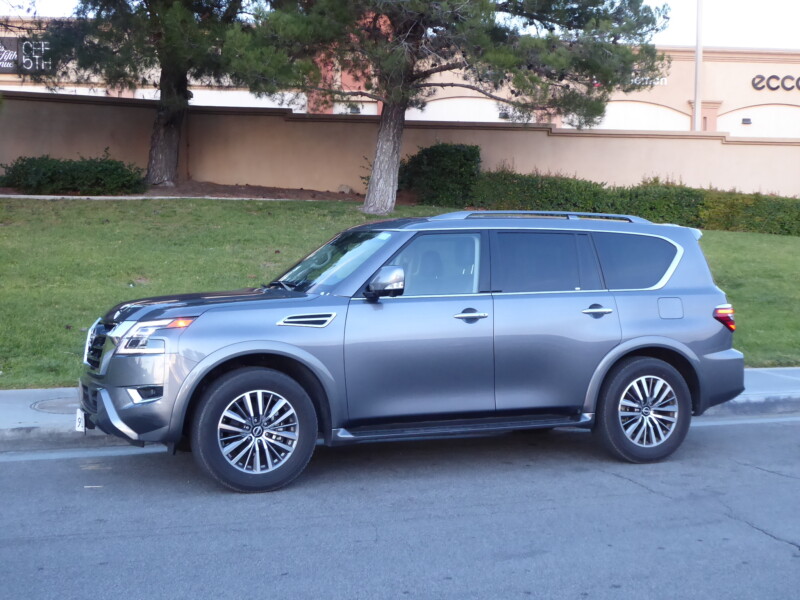


Nissan launched the first Armada – initially called Pathfinder Armada – in April 2003. A close relative of the long-running Patrol, a model which had grown ever-larger with each generation, following the evolution of its closest rival, the Toyota LandCruiser, the Armada was conceived specifically for the American market, to offer a vast three-row SUV to compete with the likes of the Chevrolet Tahoe and GMC Yukon as well as the Ford Expedition. Like these models, it was derived from a full-sized truck, in Nissan’s case, the American-built Titan which meant it was a body-on-frame design – great for towing capacity but not so good for refinement. At the time, its rivals were all conceived in the same way, as were many of the slightly smaller SUVs of the period, including Nissan’s own Pathfinder. That first generation Armada had a long production life, running through to the 2015 model year. Nissan showed us the second generation Armada at the 2016 Chicago Auto Show and the surprise here was that visually it looked almost exactly the same as the up-market Infiniti QX80. As the Armada and QX80 can be described as large-size, low volume but high profit vehicles, and in the case of the Armada only sold in the US and Canada and the Middle East, Nissan too the decision that to cut costs, they would base both these vehicles off the global Nissan Patrol platform, which would give them greater economies of scale. Mechanically, the new Armada and the Patrol were very similar, so the cost difference is largely accounted for in trim and equipment. The new model boasted a significant power increase over its predecessor and a seven speed transmission promised to improve economy, and there was more in the way of standard equipment, but in essence the formula for the new Armada had not changed. December 2020 saw the mid-cycle update, with the sort of visual changes that require more than a second glance to spot, an extra 10 bhp and some new trim and equipment. Despite having been on sale since 2017, I’d not driven a second generation Armada until now, but when all the large vehicles came back to the rental car companies after the Thanksgiving Holiday, Hertz at LAX was awash with massive SUVs, so I found this one parked up in the President’s Circle area. I did not even have to ask for it, let alone pay an upgrade fee, so I took, interested to see what I thought of such a behemoth.


All versions of the Armada come with the same 5.6 litre V8 engine which now puts out 400 bhp and 413 lb/ft of torque. There is a glorious rumble when you fire up which you only get from engines of this configuration. Once warmed up, though, much of the sound lessens and you don’t hear a lot from it once underway. There is a seven speed automatic gearbox and this is well matched to the engine, so gearchanges are very smooth and quite hard to discern. Whilst you would not describe the Armada as fast – the sheer weight of the thing and its frontal area conspire against it – it is definitely fast enough and in fact the on paper figures suggest that this is a little brisker than its rivals. Acceleration is strong and the Nissan easily keeps up with the flow. At a steady motorway cruising speed, it is very quiet. The fact that the engine is spinning at less than 2000 rpm when doing 80 mph shows how unstressed the engine is. Sadly, that does not translate into particularly good fuel economy, though. After 100 miles, I was able to put 4.8 gallons in, taking advantage of a cheap fuel source where I was. On return I put in more fuel, so the total test distance of 320 miles had burned through 15.3 gallons, computing to 20.9 mpg US or 24.98 mpg Imperial. Quote figures suggest that all the Armada’s rivals will do better.


This is a big and heavy car and whilst it is not hard to drive, with light steering that means that even manoeuvering and parking are easy, you do need to remember its mass and where that mass is when out on the road. The centre of gravity is relatively high and you do get that slightly top heavy feeling sometimes, so it is prudent not to corner with the same zeal as you would in a family-sized hatchback. The steering has not got much feel and you will have to turn the wheel more than you expect. There was ample grip and body roll was more or less kept in check at least at the speeds I was doing. The Armada came on sizeable 275/60 R20 wheels. The ride quality seemed quite variable. Sometimes it was quite floaty and soft but there were other occasions when you really could feel some of the bumps in the road surface. I had no occasion to put the brakes to the ultimate test but in normal motoring they worked just fine. There is a foot-operated parking brake. All-round visibility whilst en route is generally good as you sit that much higher than even most other SUVs. The surround-view camera system that comes on SL and Platinum models helps a lot when parking, as without it judging just how far out the front is would be quite difficult.


Open the door and look inside and the first impression of the dash is that there is a lot going on but study it a little harder and it is actually not too overwhelming. Materials quality here is decent with plenty of leather and there are matt wood inlays and it all feels quite light and airy thanks to the massive sunroof. You also get a nice leather-wrapped steering wheel. The instrument cluster is relatively simple with two large dials for the speedometer and rev counter with small gauges for fuel level and water temperature inset. Many of the fittings around the wheel will be familiar from other Nissan products. There are two column stalks which include auto lights. There are a lot of buttons on the steering wheel hub for cruise control and audio repeater as well as trip computer display selections. The 12.3” colour touchscreen is mounted high in the centre of the dash and has clear graphics. Functions here include a 13 speaker audio system, including XM Satellite radio as well as navigation, wireless Apple Car Play and wired Android Auto. There are some welcome buttons in the centre console to help with selection of the various offered functions. Below the screen are the buttons for the automated tri-zone climate control. There is also provision for wireless charging.


The Armada really is massive and so I was grateful for the fact that there are running boards which really help when getting in and out. I certainly needed them. Seat upholstery in the SL spec of the test car is genuine leather and there is plenty of adjustment on offer, 10 ways for the driver and 8 for the front passenger. The seats also have heating elements. There is a two position memory which you will need as the seat powers back to aid entry and egress when the ignition is turned off. The seats themselves are big and whilst this does help with the feeling of space, which is very evident, they are perhaps intended for people who are larger than me, so they felt a bit too flat for me. The steering column has electric adjustment both in/out as well as up/down, so getting a comfortable driving position was easy.


There is very generous space for those in the second row. A bench seat is standard with captain’s chairs available as an option on upper spec models. Massive amounts of head room, as well as ample leg room even with the front seats set well back and a nice flat floor so even the middle seat occupant has plenty of place for their legs and knees all mean that this is as spacious as you would hope for such a large car. There is a drop-down central armrest and there are map pockets on the back of the front seats as well as door bins and separate climate control from the front occupants. To gain access to the third row, the second row seats tilt and tip forward. Even so, you need to be moderately agile to climb through the space and install yourself. There is not quite as much space here as you might imagine, a little less than you will find in the GM rivals but more than in the Toyota Sequoia. Occupants here will want to raise the headrest which otherwise drops down over the seat backrests but when erect they definitely impede rear visibility. The seats here are asymmetrically split though you might struggle to make two adults comfortable on the larger portion of the seat. There are cup holders moulded into the side trims.


There is electrical assistance for the tailgate, which really is needed as it is vast and heavy. Even though this is a massive machine, with the third row of seats erect, the boot space is surprisingly small. There is a small under floor cubby area. Once you start folding seats down, though, you begin to get a vast load area. Even with just the third row down, there is lots of luggage capacity and a nice long flat load bay. Fold the second row down as well and it really would be quite a challenge to fill it. Inside the cabin there is decent provision for odds and ends. The glove box is a reasonable size and there are some door pockets as well as a central armrest cubby though interestingly this opens from the rear suggesting it is more intended for rear seat occupants.


The 2023 Nissan Armada is available in four trims: S, SV, SL and Platinum. All come with a 400-horsepower V8 engine, a seven-speed automatic transmission and rear-wheel drive. Four-wheel drive is available in all trims. A second-row bench seat is standard in all models, and second-row captain’s chairs are available in the SL and Platinum trims. Armada S standard features include cloth upholstery, a 10-way power-adjustable driver’s seat, an eight-way power-adjustable front passenger seat, a leather-wrapped and power tilt-and-telescoping steering wheel, a 12.3-inch touch screen, a 7-inch driver information display, wireless Apple CarPlay, wired Android Auto, navigation, satellite radio, HD Radio, a Wi-Fi hot spot, four USB ports, a four-speaker audio system, Bluetooth, dual-zone automatic climate control, push-button start and proximity keyless entry. Standard driver-assistance features include a rearview camera, forward and reverse collision warning, forward and reverse automatic emergency braking, pedestrian detection, lane-departure warning, lane-keep assist, adaptive cruise control, blind-spot monitoring, rear cross-traffic alert, automatic high-beam headlights, driver-attention monitoring, a rear-seat alert and front and rear parking sensors. The SV gains synthetic leather upholstery, heated front seats, wireless device charging, Amazon Alexa, a six-speaker audio system, remote start, an auto-dimming rearview mirror, a universal garage door opener, LED fog lights and a trailer brake controller. The SL trim gets genuine leather upholstery, driver’s seat memory settings, a heated steering wheel, a 13-speaker Bose audio system, a 120-volt household-style power outlet, a moonroof, a power liftgate and a surround-view camera system. A trim-exclusive Midnight Edition package is available. It adds blacked-out interior and exterior styling elements. Some Armada SLs will have second-row captain’s chairs instead of the standard bench seat. The top-tier Platinum trim gains quilted leather upholstery, ventilated front seats, heated second-row outboard seats, power-folding third-row seats, a second-row dual-screen entertainment system, an additional USB port, a rear-camera mirror, rain-sensing windshield wipers, traffic-sign recognition and 22-inch wheels.


The Armada is now the oldest car in its class and rumours suggest that a new generation model is not far away. Whilst it is beaten on available tech -and to an extent the gratuitous complexity that comes with it – it is not hard to see the appeal which keeps the sales buoyant. There’s plenty of space here for five people and a lot of luggage or for seven and rather a lot less and a generous towing capacity and the burble of that V8 has an appeal all of its own. Where the Armada really scores over its rivals is on value, as it is notably cheaper than the Tahoe/Yukon, Expedition, Sequoia and Jeep Wagoneer that constitute its rivals. Of course at the rental car counter that is not the case, as these models all appear in the same category and so are going to cost the same. I’ve not tried many of the rivals in their latest form, but suspect that given a choice, I would probably go for the Jeep. But if only the Nissan was available, and I truly wanted a leviathan this big then the Armada is not a bad alternative. Just be grateful for the fact that in the US, fuel is still relatively cheap as you are going to plenty of it.