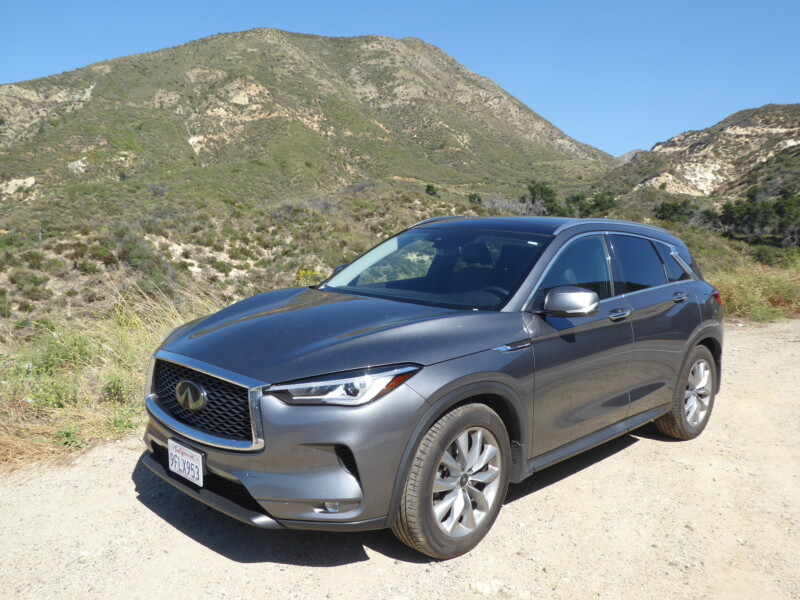


It was in the very late 1980s when the four largest Japanese brands all concluded that the best way of trying to break into the still growing premium market was with a different branding from the ones they were using for their volume business. Honda simply used the new Acura name for larger and more costly cars than the Civic and Accords which had proved so successful in America, but never launched the brand in Europe. Mazda never really found the right answer with Amati and Xedos both being used and quickly fading out, but the new brands of both Toyota and Nissan proved more successful. It was not long before a clear distinction between their two new brands, Lexus and Infiniti respectively, started to emerge. Having given the S Class Mercedes a bloody nose with their LS400 model, Lexus focused on luxury, gradually filling out a range of four door saloons and two door coupes, and adding their first SUV with the RX series in 2005, whilst Infiniti positioned themselves as having a more sporty touch to their luxury. By the early 2000s, Infiniti had a class-leading saloon called the G35 which drive very much like a four door saloon version of the 350Z, and was an impressive rival for cars like the 3 series and the C Class, and their first SUV, the FX35 pulled off the same trick, with interesting styling and a decent among of space and again a great driving experience. Such was the acclaim of these models that the brand decided to try to sell their cars in Europe, something Lexus had been doing from the outset but with only limited success. Alas, Infiniti got it all wrong. Their initial offerings in Europe all had large petrol engines at the time when a diesel was essential for market success, and with a very limited number of dealers, sales just never took off. An attempt to sell a volume car, the Q30 and QX30 hatches, that shared much with the contemporary Mercedes GLA was not a success and after a few years, the brand gave up the unequal struggle in Europe. But Infiniti remained committed to the US, where larger cars – and the top of the range is the gargantuan QX80 that sells so well in the Middle East – are what the market wants, but as they replaced their cars during the 2010s, the new ones all seem to lack something: a classic case of the older car being preferable. I certainly thought that about their mid-sized saloon, now called Q50 under their new naming scheme that came in from 2014, and whilst the 3-row QX60 (as the car that started out as the JX37 had become) was a decent enough product, it did not really stand out in a highly competitive class. That left the ageing FX70 which whilst good at launch in 2009 had simply not evolved and was allowed to fade away without replacement and the slightly smaller QX50. A second generation of this car was launched in late 2017, as a 2019 model year car. It did not really stand out styling wise, unlike its predecessor, but by all accounts this new car was decent to drive and nicely finished, and it is significantly cheaper than most of its rivals. Needless to say, I wanted to try one. For some reason, the previous QX50 had never been in the rental fleets when new, and it was only in the post-Covid chip supply era when Hertz acquired a few examples which had given me the chance to try it, so I did wonder if they would actually buy any of the new ones. Gradually, the marque which had been the most represented in their premium rental car classes seemed to just vanish from the fleet, with any examples lingering simply being old and high mileage cars. However, in 2023, I noticed that finally a few of these second generation QX50 models were on fleet, so I guessed I might get the chance to try one after all. And that chance came on the penultimate day of my September 2023 trip when I found one, which turned out to be a 2021 model, parked up on site at the Hertz LAX facility available to rent.


Like a significant number of cars these days, this second generation QX50 was previewed by some concepts. The first of these was the QX Sport Inspiration Concept. This was unveiled at the 2016 Beijing Motor Show, and this was followed by another display at the 2016 Paris Motor Show. It was painted grey and had 22-inch wheels in bronze, brown leather interior upholstery, a 2.0-litre inline-four variable compression engine with compression ratio between 8:1 and 14:1). At its next appearance at the 2016 Los Angeles Auto Show it had been revised with a black and white interior upholstery. In 2017 the car had evolved into what was being called the QX50 Concept. This had the same engine and it was clear that there was going to be a production model soon thereafter. That arrived at the 2017 Los Angeles Show late in the year, still sporting that variable compression engine. Unlike the old model which traded ultimate space inside for sporty looks and with a rorty 3.5 litre V6 engine and rear wheel drive which made it genuinely good to drive, this one has boxier styling and is built on a front wheel drive platform, and the V6 is gone, with all models powered by a 4 cylinder engine and a CVT transmission. So all you really choose now is the trim and whether you want all-wheel drive or not. The car would be built in the joint Nissan and Mercedes plant in Aguascalientes, Mexico and sales started early in 2018, as a 2019 model year car. It has changed little since, though for 2022 the fashionable coupe version, known as the QX55, was added to the range. Sales have been modest. This generation of the QX50 offers more space inside than its predecessor and there is more equipment, especially the safety and ADAS kit. Additional trim levels and an upgrade to the list of standard features are the only changes which have been made since. Would that be enough for this car to appeal to me in late 2023?


There is push button starting for the QX50. Sadly, the days of hearing a rorty noise from a V6 that also sees service in the Z sports car of the day are gone, as these days you get a 2.0 litre turbo four to power the car and it has that technically interesting variable compression ratio engine. It generates a decent 268 bhp, but somehow it just does not quite feel the same as the Infiniti EX and FX models of fifteen years ago. This turbo four is generally smooth and refined and although it is connected to a CVT transmission, this is one of the better ones, so you get strong acceleration from just about any point in the rev range though for the Infiniti to feel really urgent you will have to put your foot down reasonably hard. Overall noise levels, especially on the freeway are pleasingly low. The one demerit of that 3.5 V6 engine was thirst and the hope was that the turbo 4 would improve things. It has, but not by much. I covered 270 miles and the QX50 needed 10.3 gallons to fill it, which works out at 26.21mpg US or 30.4 mpg Imperial.


The less sporty feeling persists with the other driving attributes. It all felt a bit anaemic to drive though nothing is seriously awry. The steering is light and does not have much feel, which at least makes the QX50 quite easy to manoeuvre. It grips the road well and handles just fine, but there’s no feeling of sportiness here. The ride is quite well judged being neither too firm nor soft and squashy. The test car came on 235/55 R19 wheels. The brakes were good, though thankfully I did not have to put them to the ultimate test. Visibility is about par for the course these days, but at least the rear-view camera makes parking up easy and the ADAS features help (as well as annoy in equal measure).


Previous generation Infiniti models tended to impress with their interior design and quality, with a style all of their own that looked that bit different from the norm and actually quite classy. This one has some of those traits but it feels a bit more “mainstream premium” in approach these days. There’s no doubting the quality of the materials used which look good and feel nice to the touch. There is extensive use made of leather on the dash and the doors and this material wraps the steering wheel, which did feel nice to hold. There are mottle grey metal-effect inlays which look a lot better than what you get in many premium models these days. The dash itself is quite conventional. The instrument cluster contains two large dials for speedometer and rev counter with smaller fuel level and water temperature gauges inset. There are two column stalks with lights operated from a rotary dial o the dash to the left of the wheel. The corporate set of buttons are used for audio repeater and cruise control on the steering wheel boss. The centre of the dash contains not one, but two screens, both relatively small at 8” and 7” respectively. The upper one is used for the audio system. The lower for everything else, such as apps and car settings as well as climate control displays and this one has buttons to either side where you make selections. There is still a control wheel in the centre console for menu selections on the upper screen which does make it easier to use. Standard features include Android Auto, Apple CarPlay, a six-speaker stereo, Bluetooth, four USB ports and XM satellite radio. You have to pick one of the posher trims to get standard navigation, though.


The passenger cabin feels nice and airy thanks to a large glass sunroof. Seats are trimmed in this Luxe version in an artificial leather that many will believe is the real thing. They are electrically adjusted, even including the lumbar support and there is plenty of movement, so everyone should be able to get the driving position they want. I found the seat itself was a bit over-padded and so not quite as comfortable as it looked. The headrests are canted forward at quite an angle. I can see that for some people this could prove quite uncomfortable, but they presented no problems to me. The front seats are heated.


Space in the rear of the QX50 is good, and as the rear seats are on sliders and the backrest angles are adjustable, you can trade some extra legroom for a little luggage space, if you want. Even with the front seats set well back, there should be ample space for even quite tall occupants here, and they will also not want for headroom. The centre console unit is quite bulky and comes well back, so a middle seat occupant will need to splay their legs to either side of this. There is a drop-down central armrest with cupholders in the upper surface and occupants here get map pockets on the back of the front seats, bins on the doors and have both a USB and an MP3 port.


The tailgate is electrically assisted. The boot is a decent size. It is quite long, but it tapers off to the sides behind the wheel arches. There is more space in an underfloor cubby area and of course the rear seat backrests are asymmetrically split and simply drop down to create a much longer load area, though this is not flat, as it slopes upwards. Inside the passenger compartment provision for odds and ends seems pretty decent at first glance but the reality is that most of the places provided are quite small. There is a modestly sized glovebox, long but narrow pockets on the doors and a central armrest cubby as well as a recess in front of the rather small upholders under the base of the central part of the dashboard.


The 2021 Infiniti QX50 comes in five trims: Pure, Luxe, Essential, Sensory and Autograph. All trims feature a 268 bhp engine teamed with a continuously variable automatic transmission (CVT). Front-wheel drive is standard, and all-wheel drive is available. The base Pure trim comes with an 8-inch upper touch screen, a 7-inch lower touch screen, Android Auto, Apple CarPlay, a six-speaker stereo, Bluetooth, four USB ports and satellite radio. This trim also comes standard with remote keyless entry, push-button start, synthetic leather upholstery and eight-way power-adjustable front seats. The list of standard driver-assistance features includes rear parking sensors, forward collision warning, pedestrian detection, forward automatic emergency braking, lane-departure warning, blind-spot monitoring, rear cross-traffic alert, and automatic high-beam headlights. The Luxe trim gains heated front seats, remote start, a panoramic moonroof, LED fog lights, adaptive cruise control and the ProPilot Assist partially automated driving system. The Essential trim adds navigation, front parking sensors and a surround-view parking camera system. It’s available with genuine leather upholstery and memory settings for the driver’s seat, mirrors and steering wheel. The Sensory trim adds genuine leather upholstery, a heated steering wheel and a 16-speaker Bose premium audio system. It’s available with rear passenger sunshades and tri-zone automatic climate control. The range-topping Autograph trim adds a hands-free liftgate and tri-zone automatic climate control.


The QX50 is like worryingly many cars these days: there’s no reason to dislike it but equally, there’s nothing that really stands out and certainly no flair. And for that reason, perhaps, it is has become a bit of a market also-ran, the model that most people forgot. You just don’t see many of them out on the road. If you were to select one, you’d probably be quite happy with your choice, but if you were expecting the sort of “Z car feel clothed in an SUV body” that epitomised the first generation of Infiniti SUVs, then prepare for disappointment, as this car has been blandified a long way from that. So it is not hard to see why sales are low, as if people want a luxury SUV that does not have a German badge on it, in America, then Lexus is the first place they seem to turn. Volvo and Alfa Romeo have cars in this class which I would pick over both of them, but they struggle in American showrooms, too and of course there are plenty of very capable rivals with a less prestigious badge such as the Mazda CX-5 and Honda CR-V. A solid effort, then, but no class leader. What a shame.