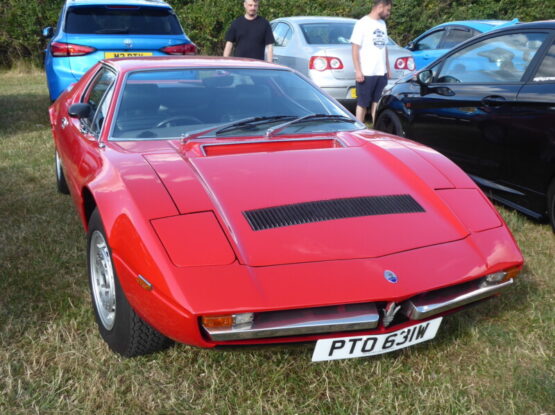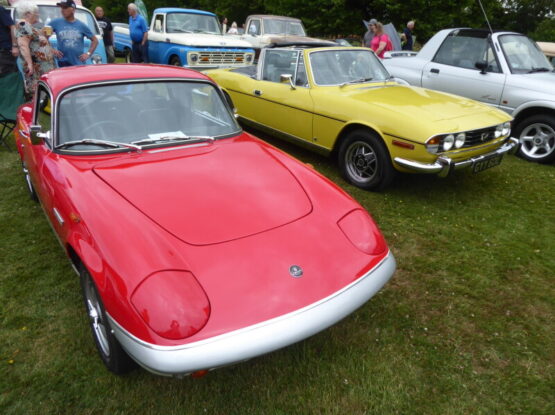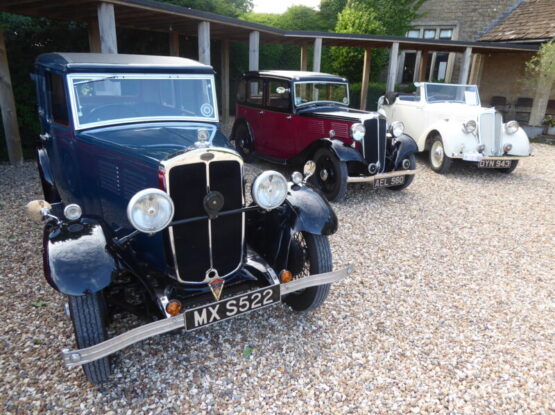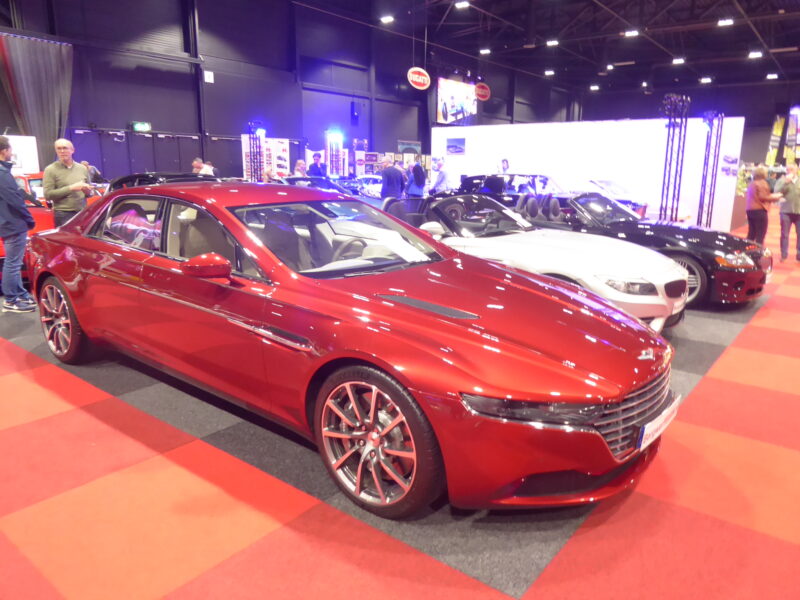
As well as being the first of the large indoor classic car shows of the calendar year, the Interclassics Maastricht is the largest event of its type in the Benelux countries. First held in 1994, and interrupted just by Covid lockdown in 2021, the 2025 edition marks 30 years of the show. The Interclassics brand has evolved during the course of those 30 years, with a spin-off show now being held in Brussels late in the year and the size of the event is now a lot larger than those early editions apparently were. In recent times it has filled several large halls at the exhibition centre just outside the Dutch town of Maastricht. I’ve been once before, in 2019, attracted by a special display celebrating the 70th anniversary of Abarth. I found an event with a very diverse collection of displays from Car Clubs and Dealers, and a location which is easy to access, just off the motorway from Brussels where I had been staying. So when a trip to the Brussels Motor Show was being discussed, it seemed to be too good an opportunity not to miss in adding an extra day to come and see this 30th edition of Interclassics Maastricht. There was a lot to see, so we were there from more or less show opening time until the doors were closed and the venue needed us all to exit. Here are the highlights of the event.

30th ANNIVERSARY SPECIAL DISPLAY
The event traditionally has at least one special theme with a special display in the largest of the exhibition halls. This year the organisers decided that the theme should be the 30th Anniversary of the Event itself. That clearly opened up all sorts of possibilities for cars to showcase in the display area, and they compiled a list of 100 possible cars from a wide variety of manufacturers, and dates and asked the public to vote. These are the cars that made into this display area:
AC Cobra 289: There are so many replica and recreation examples of the Cobra that it is tempting to assume that whenever you see one, that is what it is. Occasionally, of course, the car before you is actually one of the original ones from the 1960s and that is the case with this fabulous Cobra 289. Like many British manufacturers, AC Cars had been using the Bristol straight-6 engine in its small-volume production, including its AC Ace two-seater roadster. This had a hand-built body with a steel tube frame, and aluminium body panels that were made using English wheeling machines. The engine was a pre-World War II design by BMW which by the 1960s was considered dated. In 1961 Bristol decided to cease production of its engine. In September 1961, American retired race car driver and automotive designer Carroll Shelby wrote to AC asking if they would build him a car modified to accept a V8 engine. Bristol engines for the AC Ace two-seater sports car had recently been discontinued so AC agreed, provided a suitable engine could be found. Shelby went to Chevrolet to see if they would provide him with engines, but not wanting to add competition to the Corvette they said no. However, Ford wanted a car that could compete with the Corvette and they happened to have a brand new engine which could be used in this endeavor: the Windsor 3.6-litre (221 cu in) engine – a new lightweight, thin-wall cast small-block V8. Ford provided Shelby with two engines. In January 1962 mechanics at AC Cars in Thames Ditton, Surrey designed the “AC Ace 3.6” prototype with chassis number CSX2000. AC had already made most of the modifications needed for the small-block V8 when they installed the 2.553-litre (156 cu in) inline 6 Ford Zephyr engine, including the extensive rework of the AC Ace’s front end bodywork. The only modification of the front end of the first Cobra from that of the “AC Ace 2.6” was the steering box, which had to be moved outward to clear the wider V8 engine. The most important modification was the fitting of a stronger rear differential to handle the increased engine power. A Salisbury 4HU unit with inboard disc brakes to reduce unsprung weight was chosen instead of the old E.N.V. unit. It was the same unit used on the Jaguar E-Type. After testing and modification, the engine and transmission were removed and the chassis was air-freighted to Shelby in Los Angeles on 2 February 1962, By this time the small-block’s displacement was increased to 4.7 L (289 cu in). Shelby’s team paired this engine along with a transmission into CSX2000, in less than eight hours at Dean Moon’s shop in Santa Fe Springs, California, and began road-testing. A few changes were made to the production version: The inboard brakes were moved outboard to reduce cost; the fuel tank filler was relocated from the fender to the cenre of the trunk; the trunk lid had to be shortened to accommodate this change. AC exported completed, painted, and trimmed cars (less engine and gearbox) to Shelby who then finished the cars in his workshop in Los Angeles by installing the engine and gearbox and correcting any bodywork flaws caused by the car’s passage by sea. A small number of cars were also completed on the East Coast of the US by Ed Hugus in Pennsylvania, including the first production car; CSX2001. The first 75 Cobra Mk1 models (including the prototype) were fitted with the 4.3 L (260 cu in). The remaining 51 Mk1 models were fitted with a larger version of the Windsor Ford engine, the 4.7-litre (289 cu in) V8. In late 1962, Alan Turner, AC’s chief engineer completed a major design change of the car’s front end to accommodate rack and pinion steering while still using transverse leaf spring suspension (with the leaf spring doubling as the upper suspension link). The new car entered production in early 1963 and was designated Mark II. The steering rack was borrowed from the MGB while the new steering column came from the VW Beetle. About 528 Mark II Cobras were produced from 1963 to the summer of 1965 (the last US-bound Mark II was produced in November 1964). In 1963 to keep production focused on producing cars for Shelby American Inc., the Ruddspeed Ace was discontinued. To supply cars to the European market, AC began to market and sell the Cobra in Europe. Advertisements from the time state that the Cobra was designed to meet the requirements of Shelby American Inc. Shelby experimented with a larger Ford FE engine, of 6.4 L (390 cu in) in chassis number CSX2196. Unfortunately, the car was not able to receive the development it needed, as resources were aimed at taking the crown from Ferrari in the GT class. Ken Miles drove and raced the FE-powered Mark II at Sebring and pronounced the car virtually undrivable, naming it “The Turd”. It failed to finish with the engine expiring due to damper failure. CSX2196 was revised for the showdown at Nassau which allowed a more relaxed class division of racing. This allowed the Cobras to run with a prototype Ford GT40, GM Grand Sport Corvettes and a Lola Mk6. An aluminium 6.4-litre (390 cu in) engine was used. By the end of the first lap, the Cobra had a lead of the length of the start-finish straight. However, the car failed to finish due to brake problems. A new chassis was required, developed, and designated Mark III. The new car was designed in cooperation with Ford in Detroit. A new chassis was built using 101.6 mm (4 in) main chassis tubes, up from 76.2 mm (3 in) and coil spring suspension all around (an especially significant change up front, where the previously-used transverse leaf spring had done double duty as the top link). The new car also had wide fenders and a larger radiator opening. It was powered by the “side oiler” Ford 7.0 L (427 cu in) FE engine equipped with a single 4-barrel 780 CFM Holley carburetor rated at 425 bhp at 6000 rpm and 651 N⋅m (480 lb⋅ft) at 3700 rpm of torque, which provided a top speed of 264 km/h (164 mph) in the standard model. The more powerful tune of 485 bhp with a top speed of 298 km/h (185 mph) in the semi-competition (S/C) model. Cobra Mark III production began on 1 January 1965; two prototypes had been sent to the United States in October 1964. Cars were sent to the US as unpainted rolling chassis, and they were finished in Shelby’s workshop. Unfortunately, The MK III missed homologation for the 1965 racing season and was not raced by the Shelby team. Only 56 of the 100 planned cars were produced. Of those, 31 unsold competition models were detuned and fitted with windscreens for street use. Called S/C for semi-competition, an original example can currently sell for US$1.5 million, making it one of the most valuable Cobra variants. Some Cobra 427s were actually fitted with Ford’s 7-litre (428 cu in) engine, a long stroke, smaller bore, lower cost engine, intended for road use rather than racing. The AC Cobra was a financial failure that led Ford and Carroll Shelby to discontinue importing cars from England in 1967. AC Cars kept producing the coil-spring AC Roadster with narrow fenders and a small block Ford 289. It was built and sold in Europe until late 1969.


Alfa Romeo 6C 2500:


Alfa Romeo Giulietta TZ: The original TZ, currently sometimes referenced as TZ1 to differ from later TZ2 was presented at the 1962 Turin Auto Show as a replacement for the SZ It featured a 1,570 cc twin cam engine and other mechanical components shared with the Alfa Romeo Giulia and carried a 105 series chassis number, but was a purpose built sports racing car, with a tubular spaceframe chassis built in the province of Perugia by SAI Ambrosini and the light all-aluminium bodywork was made by Zagato, final assembly was made Delta of Udine, with Carlo Chiti initially on board as a consultant before becoming the project leader. The firm soon changed its name to Auto-Delta and relocated to its current site in Settimo Milanese, on the outskirts of Milan, not far from the Alfa Romeo Portello Plant. It has disc brakes and independent suspension. The result was a lightweight coupé of only 650 kilograms (1,430 lb) and top speed of 134 mph (216 km/h). The TZ was built both for street and racing trim, with the latest racing versions producing up to 160 bhp. Alfa’s twin-spark cylinder head, as also used in their GTA, contributed to the speed of the TZ; the standard Giulia alloy block with wet steel liners was installed at an angle under the hood of the TZ to improve airflow. Aiding the TZ in its quest for performance was the treatment of the rear bodywork. Incorporating the research of Dr. Wunibald Kamm, the TZ used a style called coda tronca in Italian, meaning “short tail.”, otherwise known as the Kamm tail. The principle is that unless an aircraft-like extended tail is incorporated, which is not practical for an automobile, there is little, if any, increase in drag and a marked decrease in lift or even some downforce by simply chopping off a portion of the tail. Zagato had previously proved the success of this tail treatment in their coda tronca Sprint Zagato sports-racing cars, and it was a natural evolution to adapt this to the Giulia TZ. The car debuted at the 1963 FISA Monza Cup, where TZs took the first four places in the prototype category. At the beginning of 1964 the TZ was homologated (100 units were needed for homologation) to the Gran Turismo category. After homologation it started to take more class wins in Europe and North-America. Of the first TZ, 112 units were built between 1963 and 1965. Only built as limited amount these TZ models are quite collectibles nowadays, listed price around 150,000-200,000 US dollars. A new version of TZ was introduced at the Turin Auto Show in 1964 in the Zagato stand


Aston Martin DB3: The Aston Martin DB3 and later DB3S were sports racing cars built in the 1950s. Although they used some DB2 parts, they were quite different, being designed especially for racing. The original modifications were done by ex-Auto Union engineer, Eberan von Eberhorst, though others handled the later DB3S work. The DB3 was introduced in 1951 with a 133 hp 2.6 litre Lagonda straight-6 engine from the DB2 Vantage. The car was unsuccessful, so a larger 2.9 litre engine, producing 163 hp, was introduced in June 1952. The car was placed 2nd, 3rd, and 4th at Silverstone May 1952 (in 2.6 litre form) that year behind a Jaguar C-Type. The cars were forced out of Le Mans, but did claim the 9-hour race at Goodwood. In 1953 a DB3 driven by Parnell/Abecassis placed 2nd at the Sebring 12 Hours, the opening race in the World Sports Car Championship, behind a Cunningham CR4 and then at the second round at the Mille Miglia, Reg Parnell drove a DB3 to 5th place, the highest position ever reached by a British sports car in the Italian classic. The car was then replaced as Astons front line car by the DB3S. In total 10 DB3s were made between 1951 and 1953, with chassis numbers from DB3/1 to DB3/10. Cars 1 to 5 being used as works cars and cars 6 to 10 being sold as customer cars. Several Aston Martin DB3s have received coupé style bodies over the years. The DB3S was a lighter version of the car, introduced in 1953. It was somewhat more successful, and was produced until 1956. Originally two ‘works’ coupé versions were also built.


Aston Martin DB5: Although not the first in the DB series, this is undoubtedly the best-known, and needs little in the way of an introduction, as this model is famous for being the most recognised cinematic James Bond car, first appearing in the James Bond film Goldfinger The DB5 was a follow-on to the DB4, designed by the Italian coachbuilder Carrozzeria Touring Superleggera. Released in 1963, it was an evolution of the final series of DB4. The principal differences between the DB4 Series V and the DB5 are the all-aluminium engine, enlarged from 3.7 L to 4.0 L; a new robust ZF five-speed transmission (except for some of the very first DB5s); and three SU carburettors. This engine, producing 282 bhp, which propelled the car to 145 mph, available on the Vantage (high powered) version of the DB4 since March 1962, became the standard Aston Martin power unit with the launch in September 1963 of the DB5. Standard equipment on the DB5 included reclining seats, wool pile carpets, electric windows, twin fuel tanks, chrome wire wheels, oil cooler, magnesium-alloy body built to superleggera patent technique, full leather trim in the cabin and even a fire extinguisher. All models have two doors and are of a 2+2 configuration. Like the DB4, the DB5 used a live rear axle At the beginning, the original four-speed manual (with optional overdrive) was standard fitment, but it was soon dropped in favour of the ZF five-speed. A three-speed Borg-Warner DG automatic transmission was available as well. The automatic option was then changed to the Borg-Warner Model 8 shortly before the DB6 replaced the DB5. The high-performance DB5 Vantage was introduced in 1964 featuring three Weber twin-choke 45DCOE side-draft carburettors and revised camshaft profiles, delivering greater top-end performance at the expense of overall flexibility, especially as legendary Webers are renowned as ‘full-throttle’ devices. This engine produced 315 hp. Only 65 DB5 Vantage coupés were built. Just 123 convertible DB5s were produced (also with bodies by Touring), though they did not use the typical “Volante” name until 1965. The convertible model was offered from 1963 through to 1965. Originally only 19 of the 123 DB5 Convertibles made were left-hand drive. 12 cars were originally fitted with a factory Vantage engine, and at least one further convertible was subsequently factory fitted with a DB6 specification Vantage engine. A rare factory option (actually fitted by Works Service prior to customer delivery) was a steel removable hard top. From October 1965 to October 1966, Aston Martin used the last 37 of the Aston Martin DB5 chassis’ to make another convertible model. These 37 cars were known as “Short Chassis” Volantes and were the first Aston Martins to hold the “Volante” name. Although calling it a “Short Chassis” is a bit of a misnomer as the “short” comes from comparing it to the subsequent DB6, which has a longer chassis. When compared to the DB5, it is not “short” but rather the same size, however these cars differ to the DB5 convertible models as they feature DB6 split front and rear bumpers and rear TR4 lights, as also used on the DB6.


BMW 507: One of the rarest BMW models of all times is the 507. Originally intended to be exported to the US at the rate of thousands a year, it never achieved that lofty goal and almost bankrupted the company. The 507 was conceived by U.S. automobile importer Max Hoffman who, in 1954, persuaded the BMW management to produce a roadster version of the BMW 501 and BMW 502 saloons to fill the gap between the expensive Mercedes-Benz 300SL and the cheap and underpowered Triumph and MG sports cars. BMW engineer Fritz Fiedler was assigned to design the rolling chassis, using existing components wherever possible. Early body designs by Ernst Loof were rejected by Hoffman, who found them to be unappealing. In November 1954, at Hoffman’s insistence, BMW contracted designer Albrecht von Goertz to design the BMW 503 and the 507. The production car was launched in late 1955. Thirty-four Series I 507s were built in 1956 and early 1957. These cars had welded aluminium fuel tanks of 110 litres capacity behind the rear seats. These large tanks limited both boot space and passenger space, and gave off the smell of fuel inside the car when the hood was erected or the hardtop was in place. Series II and later 507s had fuel tanks of 66 litres capacity under the boot, shaped around a space for the spare tyre to fit. The 507 frame was a shortened 503 frame, the wheelbase having been reduced from 111.6 in to 98 in. Overall length was 190.4 in, and overall height was 49.5 in. Curb weight was about 1,330 kilograms (2,930 lb). The body was almost entirely hand-formed of aluminium, and no two models were exactly the same. 11 cars were sold with an optional hand-fabricated removable hardtop. Because of the car-to-car differences, each hardtop fits only the car for which it was made. Front suspension was parallel double wishbones, with torsion bar springs and an anti-roll bar. Rear suspension had a live axle, also sprung by torsion bars, and located by a Panhard rod and a central, transverse A-arm to control acceleration and braking forces. Brakes were Alfin drum brakes of 11.2 in diameter, and power brakes were optional. Late-model 507s had front Girling disc brakes. The engine was BMW’s aluminium alloy OHV V8, of 3,168 cc with pushrod-operated overhead valves. It had two Zenith 32NDIX two-barrel carburettors, a chain-driven oil pump, high-lift cams, a different spark advance curve, polished combustion chamber surfaces, and a compression ratio of 7.8:1,yielding 150 hp at 5,000 rpm. It was mated to a close ratio four-speed manual transmission. The standard rear-end ratio was 3.70:1, but ratios of 3.42:1 and 3.90:1 were optional. A contemporary road test of a 507 with the standard 3.70:1 final drive was reported in Motor Revue, stating a 0–100 km/h (0-62 mph) acceleration time of 11.1 seconds and a top speed of 122 mph. The 507 made its debut at the Waldorf-Astoria Hotel in New York in the summer of 1955. Production began in November 1956. Max Hoffman intended the 507 to sell for about US$5,000, which he believed would allow a production run of 5,000 units a year. Instead, high production costs pushed the price in Germany to DM 26,500 (later 29,950), driving the U.S. price initially to $9,000 and ultimately $10,500. Despite attracting celebrity buyers including Elvis Presley (who owned two), Hans Stuck and Georg “Schorsch” Meier, the car never once reached more than 10% of the sales volumes achieved by its Stuttgart rival, the Mercedes-Benz 300SL. Intended to revive BMW’s sporting image, the 507 instead took BMW to the edge of bankruptcy—the company’s losses for 1959 were DM 15 million. The company lost money on each 507 built, and production was terminated in late 1959. Only 252 were built, plus two prototypes. Fortunately for the company, an infusion of capital from Herbert Quandt and the launch of new, cheaper models (the BMW 700 and later the ‘New Class’ 1500) helped the company recover. The 507 remains a milestone model for its attractive styling. 202 507s are known to survive, a tribute to the car’s appeal. Bernie Ecclestone’s 507 fetched £430,238 at an auction in London in October 2007. By 2009 the prices for 507s had reached €900,000. At the Amelia Island Concours in March, 2014 a 507 sold at auction for $2.4 million. Several notable personalities have owned 507s. In 1959, while stationed in Germany on duty with the US Army, legendary American entertainer Elvis Presley bought a white 507. Presley’s car, no. 70079, had earlier been used as a press demonstrator by BMW and raced by Hans Stuck. It was imported into the United States in 1960 and was bought by Alabama disc jockey Tommy Charles, who had it extensively modified, including having the engine replaced with a Chevrolet V8. In July 2014, BMW Group announced that Presley’s car will be on display for a short period at the BMW Museum in Munich, before being entirely restored by its Classic department. Elvis reportedly gave another 507, no. 70192, to Ursula Andress, who starred in Fun in Acapulco with him in 1963. Andress’s husband, John Derek, had the car customised, including having the engine replaced with a Ford 289 V8. Andress sold the car to George Barris. The car was restored with a correct drivetrain by a later owner. When the car arrived at McDougall’s Carrera Automotive it had also been repainted black. Being that the original engine was lost to time 2 503 V8’s were located along with the dual carburettor intake from a 507. Both engines were made into a running engine with BMW AG making a new engine gasket kit including head gaskets at a cost of US$25,000. It was also returned to its original blue colour. It was sold at auction in 1997 for US$350,000 and at another auction in 2011 for US$1,072,500. John Surtees was given a 507 by Count Agusta for winning the 1956 500cc World Motorcycle Championship on a MV Agusta. Surtees worked with Dunlop to develop disc brakes for the front wheels of the 507, and his 507 eventually had disc brakes on all four wheels.


Bugatti Type 35: Many would tell you that this is THE classic Bugatti, the Type 35 and there was a nice example here. The Type 35 was phenomenally successful, winning over 1,000 races in its time. It took the Grand Prix World Championship in 1926 after winning 351 races and setting 47 records in the two prior years. At its height, Type 35s averaged 14 race wins per week. Bugatti won the Targa Florio for five consecutive years, from 1925 through 1929, with the Type 35. The original model, introduced at the Grand Prix of Lyon on August 3, 1924, used an evolution of the 3-valve 1991 cc overhead cam straight-8 engine first seen on the Type 29. Bore was 60 mm and stroke was 88 mm as on many previous Bugatti models. 96 examples were produced. This new powerplant featured five main bearings with an unusual ball bearing system. This allowed the engine to rev to 6000 rpm, and 90 hp was reliably produced. Solid axles with leaf springs were used front and rear, and drum brakes at back, operated by cables, were specified. Alloy wheels were a novelty, as was the hollow front axle for reduced unsprung weight. A second feature of the Type 35 that was to become a Bugatti trademark was passing the springs through the front axle rather than simply U-bolting them together as was done on their earlier cars. A less expensive version of the Type 35 appeared in May, 1925. The factory’s Type 35A name was ignored by the public, who nicknamed it “Tecla” after a famous maker of imitation jewellery. The Tecla’s engine used three plain bearings, smaller valves, and coil ignition like the Type 30. While this decreased maintenance requirements, it also reduced output. 139 of the Type 35As were sold. The Type 35C featured a Roots supercharger, despite Ettore Bugatti’s disdain for forced induction. Output was nearly 128 hp with a single Zenith carburettor. Type 35Cs won the French Grand Prix at Saint-Gaudens in 1928, and at Pau in 1930. Fifty examples left the factory. The final version of the Type 35 series was the Type 35B of 1927. Originally named Type 35TC, it shared the 2.3 litre engine of the Type 35T but added a large supercharger like the Type 35C. Output was 138 hp, and 45 examples were made. A British Racing Green Type 35B driven by William Grover-Williams won the 1929 French Grand Prix at Le Mans.


Ferrari 250 GT California: The Ferrari 250 GT California Spyder was designed by Sergio Scaglietti, who adapted the styling of the 250 GT Pinin Farina, and was produced by Carrozzeria Scaglietti. The model gained considerable recognition after its appearance in the 1986 film Ferris Bueller’s Day Off. The 250 GT California Spyder is a convertible version of the contemporary Berlinetta. It is powered by the traditional Ferrari V12 engine and was produced in approximately 100 units, nearly equally split between long wheel-bases (LWB) versions from 1957 to 1960 and short wheelbase (SWB) versions from 1960 to 1963. The growing American interest in European auto racing and the popularity of smaller sports cars led to a significant increase in sales of European sports car manufacturers in the United States. This trend prompted Ferrari, along with other European manufacturers, to consider developing models tailored specifically for the American market. The success of convertible sports cars, especially in California, led to interest from American dealers such as Jon von Neumann and Luigi Chinetti to advocate for Ferrari to produce a sporty convertible designed for American consumers. They identified a demand for a more aggressive convertible, a market segment not sufficiently addressed by the luxurious 250 GT Cabriolet Pinin Farina. In an interview, Chinetti explains “that in Italy it was difficult for the company to seriously consider a convertible as a sports car”. Initially, Enzo Ferrari was hesitant to produce the California model, as the popular 250 GT Cabriolet Pinin Farina was already in the lineup. However, had he rejected Chinetti and Neumann’s proposal, it is likely they would have converted the 250 GT Berlinetta “Tour de France” or SWB into a spider with Scaglietti’s assistance, a practice they later employed in 1967 with some Ferrari 275 GTB/4 models. The 250 GT California Spyder was created to appeal to American consumers, particularly those in California, as reflected in its name. This model effectively combined race car performance with custom specifications, sustaining interest in the car over the years. The prototype was introduced in 1957, and series production commenced in the second quarter of 1958. At the 1960 Geneva International Motor Show, the 250 GT California Spyder transitioned from the long chassis of the Ferrari 250 GT Berlinetta “Tour de France”, which had a wheelbase of 2.60 meters, to a short chassis version with a reduced wheelbase of 2.40 meters. This change aimed to enhance the car’s performance, particularly its cornering capabilities. The design of the California, noted for its influence in automotive styling, was created by Sergio Scaglietti. Aesthetically, it closely resembles the luxurious Ferrari 250 GT Cabriolet Pinin Farina Series I, produced in the same year, but the California Spyder is characterized by a more slender profile. Its fluid body lines extend from the front lights to the curves of the wings, complemented by an aggressive “shark mouth” grille. Based on the berlinetta, the California Spyder retains many of its aesthetic features, including the distinctive “hip recess” in front of the rear wheels. The windshield slope is more pronounced due to its convertible design. In 1960, the adoption of the short chassis from the 250 GT Berlinetta SWB resulted in more compact proportions that enhanced the muscular silhouette of the California. The two versions of the California (SWB and LWB) can be distinguished by the design of the air intake on the hood, which supplies air to the carburettors; the SWB version features a half-recessed intake. The 250 GT California Spyder was hand-built by Carrozzeria Scaglietti at its workshop in Modena, a common practice for most Ferrari competition models of that era. Although Pinin Farina was known for its body designs, it was unable to produce the California Spyder due to other commitments. In contrast to the Pinin Farina Cabriolet, Scaglietti chose Marchal headlights, which were enclosed in plexiglass, with fog lights integrated into the grille. Buyers of the California Spyder had the option to select projecting headlights; however, Italian regulations required the use of non-fairing headlights. Additionally, Scaglietti did not include a designated area for a license plate, necessitating that owners find their solutions to comply with local regulations. The interior of the 250 GT California Spyder, while similar in finish to that of the 250 GT Cabriolet Pinin Farina I, is characterized by a minimalist design that prioritizes functionality over luxury, resulting in a simpler and more utilitarian appearance. The dashboard features seven circular dials, including the tachometer and the rev counter, providing essential information about engine operation. In the long wheelbase (LWB) version, these dials are positioned behind a three-spoke Nardi steering wheel, crafted from wood and aluminum. In contrast, the short wheelbase (SWB) version displays the dials in a linear arrangement on the dashboard. The Ferrari 250 GT California Spyder shares its chassis and drivetrain with the 250 GT “Tour de France.” It features an independent suspension with superimposed triangles and coil springs at the front, while the rear is equipped with a rigid axle, suspended by leaf springs and guided by four push struts and link shocks. In 1960, telescopic shock absorbers replaced the Houdaille torsion bars at the front. The chassis underwent detailed evolution alongside that of the “Tour de France” berlinetta and, in May 1960, adopted a significant wheelbase change introduced on the 250 GT Berlinetta SWB. This adjustment reduced the wheelbase to 2,400 mm, allowing for wider tracks and lower ground clearance. The tubular chassis supports bodywork primarily made of steel, with aluminium doors. This design results in a weight approximately 100 kilograms heavier than that of the Berlinetta, a difference attributed to the need for structural reinforcement in the convertible design. While the car’s weight is slightly over one ton, exact figures may vary among sources. Braking was initially provided by drum brakes until October 1959, when the 250 GT California Spyder was upgraded to Dunlop disc brakes. The Ferrari 250 GT California Spyder is powered by the traditional Ferrari “Colombo” 12-cylinder V-engine (Type 168), constructed from light alloy and featuring two overhead camshafts with two valves per cylinder. This engine, named after its designer, Gioacchino Colombo, has been utilized across the entire 250 series since 1952. Configured at a 60° angle, the engine has a displacement of 2,953 cm³, with a bore and stroke of 73 mm × 58.8 mm. It is equipped with three Weber double-barrel carburettors, initially 36 millimeters in size, increasing to 42 millimeters from 1960 onward. The engine initially produced 240 hp at 7,000 rpm for the long wheelbase (LWB) version, which was subsequently upgraded to 280 hp with the introduction of the short wheelbase (SWB) version, owing to new cylinder heads and larger valves. It is paired with a 4-speed gearbox, known for its docility, availability, and reliability. In 1960, spark plugs were relocated outside the V configuration, similar to the 250 Testa Rossa, to facilitate maintenance. Additionally, an overdrive was incorporated into the gearbox. The front air intake is typically supplemented by two side vents featuring three polished aluminum slots, located behind the front wheels, which assist in engine ventilation. Although the Ferrari 250 GT California Spyder was not specifically designed for competition, many models participated in endurance races. It won the 12 Hours of Sebring in 1959, driven by Richie Ginther and Howard Hively, and again in 1960 with Giorgio Scarlatti, Fabrizio Serena, and Carlo Abate. Additionally, a California Spyder from the North American Racing Team, driven by Bob Grossman and Fernand Tavano, secured fifth place in the 1959 24 Hours of Le Mans. Some California Spyders were also equipped with the engine from the “Competizione” berlinettes, the sportier versions of the series. The 250 GT California Spyder is often noted for its aesthetic appeal among Ferrari models and cabriolets in automotive history. It is also one of the most valuable cars; on May 18, 2008, television host Chris Evans purchased a model previously owned by actor James Coburn for a record price of €7,040,000 at the “Ferrari Legends and Passions” auction organized by Sotheby’s. On February 6, 2015, a short chassis version of the 250 GT California, previously owned by Roger Baillon and lost to history for nearly 30 years, was sold at the Artcurial auction during the Retromobile show for €14,200,000 (excluding auction fees).

Ferrari 250 GT SWB: The 1959 250 GT Berlinetta SWB used a short (2,400 mm (94.5 in)) wheelbase for better handling. Of the 176 examples built, both steel and aluminium bodies were used in various road (“lusso”) and racing trims. Engine output ranged from 240 PS to 280 PS. Development of the 250 GT SWB Berlinetta was handled by Giotto Bizzarrini, Carlo Chiti, and young Mauro Forghieri, the same team that later produced the 250 GTO. Disc brakes were a first on a Ferrari GT, and the combination of low weight, high power, and well-sorted suspension made it competitive. It was unveiled at the Paris Motor Show in October and quickly began selling and racing. The SWB Berlinetta won Ferrari the GT class of the 1961 Constructor’s Championship. Also won 1960, 1961 and 1962 Tour de France Automobile before giving ground to the GTO’s.


Ford GT40


Ford Mustang Eleanor


Jaguar D Type: Successor to the C Type was the D Type. Although it shared many of its mechanical components with the C-Type, including the basic straight-6 XK engine design, initially of 3.4 litres and later enlarged to 3.8 litres in the late fifties, the structure of the car was radically different. The innovative monocoque construction brought aviation industry technology to competition car design, together with an aeronautical understanding of aerodynamic efficiency. The structural design, revolutionary at the time, applied aeronautical technology. The “tub”, or cockpit section, was of monocoque construction, mostly comprising sheets of aluminium alloy. Its elliptical shape and comparatively small cross-section provided torsional rigidity and reduced drag. To the front bulkhead was attached an aluminium tubing subframe for the engine, steering assembly, and front suspension. Rear suspension and final drive were mounted to the rear bulkhead. Fuel was carried in the tail and the designers followed aviation practice by specifying a deformable Marston Aviation Division bag in place of a conventional tank. The aerodynamic bodywork was largely the work of Malcolm Sayer, who had joined Jaguar following a stint with the Bristol Aeroplane Company during the Second World War and later worked on the C-Type. For the D-Type, he insisted on a minimal frontal area. To reduce the XK engine’s height, Jaguar’s chief engineer, William Haynes, and former Bentley engineer, Walter Hassan, developed dry sump lubrication, and it has been said that the car’s frontal area was also a consideration in canting the engine at 8½° from the vertical (which necessitated the offset bonnet bulge). Philip Porter, in his book Jaguar Sports Racing Cars, says that “[a] more likely reason was to provide extra space for the ram pipes feeding the three twin-choke Weber carburettors.” Reducing underbody drag contributed to the car’s high top speed; for the long Mulsanne Straight at Le Mans, a fin was mounted behind the driver for aerodynamic stability. For the 1955 season, factory cars were fitted with a longer nose, which lengthened the car by 7½ inches and further increased maximum speed; and the headrest fairing and aerodynamic fin were combined as a single unit that smoothed the aerodynamics and saved weight. Mechanically, many features were shared with the outgoing C-Type. Its front and rear suspension and innovative all-round disc brakes were retained, as was the XK engine. Apart from the new lubrication system, the engine was further revised as development progressed during the D-Type’s competition life. Notably in 1955 larger valves were introduced, together with asymmetrical cylinder heads to accommodate them. Jaguar D-Types fielded by a team under the leadership of Jaguar’s racing manager Lofty England were expected to perform well in their debut at the 1954 24 Hours of Le Mans race. In the event, the cars were hampered by fuel starvation caused by problems with the fuel filters, necessitating pit stops for their removal, after which the entry driven by Duncan Hamilton and Tony Rolt speeded up to finish less than a lap behind the winning Ferrari. The D-Type’s aerodynamic superiority is evident from its maximum speed of 172.8 mph on the Mulsanne Straight compared with the 4.9 litre Ferrari’s 160.1 mph. For 1955 the cars were modified with long-nose bodywork and engines uprated with larger valves. At Le Mans, they proved competitive with the Mercedes-Benz 300 SLRs, which had been expected to win. Mike Hawthorn’s D-Type had a narrow lead over Juan Manuel Fangio’s Mercedes when another Mercedes team car was involved in the most catastrophic accident in motorsport history.Driver Pierre Levegh and more than 80 spectators lost their lives, while many more were injured. Mercedes withdrew from the race. Jaguar opted to continue, and the D-Type driven by Hawthorn and Ivor Bueb went on to win. Mercedes withdrew from motorsport at the end of the 1955 season, and Jaguar again entered Le Mans in 1956. Although only one of the three factory-entered cars finished, in sixth place, the race was won by a D-Type entered by the small Edinburgh-based team Ecurie Ecosse and driven by Ron Flockhart and Ninian Sanderson, beating works teams from Aston Martin and Scuderia Ferrari. In America, the Cunningham team raced several D-Types. In 1955, for example, a 1954 works car on loan to Cunningham won the Sebring 12 Hours in the hands of Mike Hawthorn and Phil Walters, and in May 1956 the team’s entries for Maryland’s Cumberland national championship sports car race included four D-Types in Cunningham’s white and blue racing colours. Driven by John Fitch, John Gordon Benett, Sherwood Johnston and team owner Briggs Cunningham, they finished fourth, fifth, seventh and eighth, respectively. Although Jaguar withdrew from motorsport at the end of the 1956 season, 1957 proved to be the D-Type’s most successful year. Jaguar D-Types took five of the top six places at Le Mans; Ecurie Ecosse, with considerable support from Jaguar, and a 3.8-litre engine, again took the win, and also second place. This was the best result in the D-Type’s racing history. Rules for the 1958 Le Mans race limited engine sizes to three litres for sports racing cars, which ended the domination of the D-Type with its 3.8-litre XK engine. Jaguar developed a three-litre version to power D-Types in the 1958, 1959 and 1960 Le Mans races but it was unreliable, and by 1960 it no longer produced sufficient power to be competitive. The D-Type’s success waned as support from Jaguar decreased and the cars from rival manufacturers became more competitive. Although it continued to be one of the cars to beat in club racing and national events, the D-Type never again achieved a podium finish at Le Mans. By the early 1960s it was obsolete. Total D-Type production is thought to have included 18 factory team cars, 53 customer cars, and 16 XKSS versions. A 1955 car was sold at Sothebys in 2016 for £19,8 million, making it the most valuable British car ever.

Lancia Stratos: A Bertone-designed concept car called the Lancia Stratos Zero was shown to the public in 1970, but shares little but the name and mid-engined layout with the Stratos HF version. A new car called the New Stratos was announced in 2010 which was heavily influenced by the design of the original Stratos, but was based on a Ferrari chassis and engine. Bertone had no previous business with Lancia, who were traditionally linked with Pininfarina, and he wanted to come into conversation with them. Bertone knew that Lancia was looking for a replacement for the ageing Fulvia for use in rally sports and so he designed an eye-catcher to show to Lancia. Bertone used the running gear of the Fulvia Coupé of one of his personal friends and built a running showpiece around it. When Bertone himself appeared at the Lancia factory gates with the Stratos Zero he passed underneath the barrier and got great applause from the Lancia workers. After that a co-operation between Lancia and Bertone was formed to develop a new rally car based on ideas of Bertone’s designer Marcello Gandini who already had designed the Lamborghini Miura and Countach. Lancia presented the Bertone-designed Lancia Stratos HF prototype at the 1971 Turin Motor Show, a year after the announcement of the Stratos Zero concept car. The prototype Stratos HF (Chassis 1240) was fluorescent red in colour and featured a distinctive crescent-shaped-wrap-around windshield providing maximum forward visibility with almost no rear visibility. The prototype had three different engines in its early development life: the Lancia Fulvia engine, the Lancia Beta engine and finally for the 1971 public announcement, the mid-mounted Dino Ferrari V6 producing 190 hp. The use of the Dino V6 was planned right from the beginning of the project, but Enzo Ferrari was reluctant to sign off the use of this engine in a car he saw as a competitor to his own Dino V6. After the production of the Dino car had ended the “Commendatore” (a popular nickname for Enzo Ferrari) agreed on delivering the engines for the Stratos, and Lancia then suddenly received 500 units. The Stratos was a very successful rally car during the 1970s and early 1980s. It started a new era in rallying as it was the first car designed from scratch for this kind of competition. The three leading men behind the entire rallying project were Lancia team manager Cesare Fiorio, British racer/engineer Mike Parkes and factory rally driver Sandro Munari with Bertone’s Designer Marcello Gandini taking a very personal interest in designing and producing the bodywork. Lancia did extensive testing with the Stratos and raced the car in several racing events where Group 5 prototypes were allowed during the 1972 and 1973 seasons. Production of the 500 cars required for homologation in Group 4 commenced in 1973 and the Stratos was homologated for the 1974 World Rally Championship season. The Ferrari Dino V6 engine was phased out in 1974, but 500 engines among the last built were delivered to Lancia. Production ended in 1975 when it was thought that only 492 were made (for the 1976 season, the Group 4 production requirement was reduced to 400 in 24 months. Manufacturer of the car was Bertone in Turin, with final assembly by Lancia at the Chivasso plant. Powered by the Dino 2.4 litreV6 engine that was also fitted to the rallying versions, but in a lower state of tune, it resulted in a power output of 190 hp, giving the road car a 0–100 km/h time of 6.8 seconds, and a top speed of 232 km/h (144 mph). The Stratos weighed between 900 and 950 kilograms, depending on configuration. Power output was around 275 hp for the original 12 valve version and 320 hp for the 24 valve version. Beginning with the 1978 season the 24 valve heads were banned from competition by a change to the FIA rules. Even with this perceived power deficit the Stratos was the car to beat in competition and when it did not suffer an accident or premature transmission failure (of the latter there were many) it had great chances to win. Despite the fact that the Stratos was never intended to be a race car, there were two Group 5 racing cars built with 560 hp, using a single KKK turbocharger. The car won the 1974, 1975 and 1976 championship titles in the hands of Sandro Munari and Björn Waldegård, and might have gone on to win more had not internal politics within the Fiat group placed rallying responsibility on the Fiat 131 Abarths. As well as victories on the 1975, 1976 and 1977 Monte Carlo Rally, all courtesy of Munari, the Stratos won the event with the private Chardonnet Team as late as 1979. Without support from Fiat, and despite new regulations that restricted engine power, the car would remain a serious competitor and proved able to beat works cars in several occasions when entered by an experienced private team with a talented driver. The last victory of the Stratos was in 1981, at the Tour de Corse Automobile, another World Rally Championship event, with a victory by longtime Stratos privateer Bernard Darniche. When the Fiat group favoured the Fiat 131 for rallying Lancia also built two Group 5 turbocharged ‘silhouette’ Stratos for closed-track endurance racing. These cars failed against the Porsche 935s on closed tracks but proved successful in hybrid events. While they failed in the Tour de France Automobile, one of these cars won the 1976 Giro d’Italia Automobilistico, an Italian counterpart of the Tour de France Automobile. One of the cars was destroyed in Zeltweg, when it caught fire due to overheating problems. The last surviving car would win the Giro d’Italia event again before it was shipped to Japan to compete in the Fuji Speedway based Formula Silhouette series, which was never raced. The car would then be sold and reside in the Matsuda Collection before then being sold to the renowned collector of Stratos’, Christian Hrabalek, a car designer and the founder of Fenomenon Ltd, who has the largest Lancia Stratos Collection in the world, 11 unique Lancia Stratos cars, including the fluorescent red 1971 factory prototype and the 1977 Safari Rally car. His interest in the car led to the development of the Fenomenon Stratos in 2005. The Stratos also gained limited success in 24 Hours of Le Mans, with a car, driven by Christine Dacremont and Lella Lombardi, finishing 20th in 1976


Lotus Type 87: The Lotus 87 was a Formula One racing car used by Team Lotus in the second part of the 1981 Formula One season and in the first race of the 1982 season. Design and development. The car, driven by Italian Elio de Angelis and future world champion Nigel Mansell, was another step in Lotus’ development of ground effect cars. Its predecessor, the Lotus 81 had proven to suffer from a chassis that was not rigid enough, compared to the dominant Williams FW07. Lotus therefore introduced a new chassis, built out of carbon fibre and reinforced by kevlar sheets, since the team felt carbon fibre alone would not be sufficient to provide the chassis with the stability needed. As the John Barnard-designed McLaren MP4/1 would prove, this was a miscalculation. The chassis was originally planned for the ambitious twin-chassis Lotus 88, but after the car was outlawed, it was hastily rebuilt to become the more conservative 87. The car was not competitive enough to fight for victories, even though the drivers did manage to get some points. When the new turbo charged engines of Renault and Ferrari became more reliable, the car proved to be yet still too heavy and was replaced by a lighter 87B specification for the opening round of 1982. It was subsequently replaced altogether by the Lotus 91, which proved more competitive, recording a podium in its first outing in Brazil.


Maserati A6GCS 53 Spider: Throughout its illustrious history, Maserati has built several notable competition models, but few can compare to the low-volume, hand-built sports cars the company manufactured during the 1950s. Among this splendid output, one model in particular stands out for its exquisite coachwork, advanced engineering, and competition success—the beguiling A6GCS/53. The genesis of the A6GCS can be traced to the racing doldrums of World War II, when Ernesto Maserati conceived of a new race car powered by a naturally aspirated 2.0-liter single overhead-cam inline six-cylinder engine. The model was to be named A6G, with the “A” honoring his late brother Alfieri, and the “G” denoting a cast iron (ghisa) block. By the late 1940s, the A6G 1500 had assumed the mantle of a civilized road car, while the subsequent A6GCS and A6GCM respectively embodied sports car and grand prix racing iterations. Despite continuing with the original ghisa nomenclature, the engine was developed into an aluminium variant that ideally lowered weight for racing applications. In 1952, Maserati hired the famed ex-Ferrari engineer Gioacchino Colombo and tasked him with making the A6GCS a more consistent winner. Colombo revised the engine dimensions to a larger bore and shorter stroke, favourable for higher revving, while integrating dual camshafts, larger valves, and twin-plug ignition. He also discarded the first-series sports chassis in favour of the monoposto (single-seat) chassis, which was duly widened for two seats. The resulting A6GCS/53 was produced in a smattering of 52 examples over the next two years, 48 of which were clothed in voluptuous spyder coachwork pounded from aluminium into a design by Medardo Fantuzzi. The new model was very successful in competition, taking a class win at the 1953 Mille Miglia, 2nd and 3rd overall at the 1953 Targa Florio, 2nd at the 12 Hours of Pescara, and overall wins at circuits such as Caserta, Avellino, and the Giro dell’Umbria. During these triumphs, the A6GCS/53 was piloted by many of the era’s most famous racing drivers, including Juan Manuel Fangio, Roy Salvadori, and the Marquis de Portago. Prized for its torque-happy delivery and nimble handling, the A6GCS/53 set a new standard for a free-revving 2.0-litre competition car, and the model has since evolved into one of today’s most collectable 1950s sports racers, offering delightful driving characteristics and sublimely sculpted aesthetics.


Mercedes-Benz 300SL: Known under development as the W198, the first iteration of the SL-Class grand tourer was the fastest production car of its day. Introduced in 1954 as a two-seat coupé with distinctive gull-wing doors, it was later offered as an open roadster. Built by Daimler-Benz AG, the direct fuel injected production model was based on the company’s highly successful yet somewhat less powerful carburettor overhead cam straight 6 1952 racer, the W194. The idea of a toned-down Grand Prix car tailored to affluent performance enthusiasts in the booming post-war American market was suggested by Max Hoffman. Mercedes accepted the gamble and the new 300 SL – 300 for its 3.0 litre engine displacement and SL for Sport Leicht (Sport Light) – was introduced at the 1954 New York Auto Show rather than the Frankfurt or Geneva gatherings company models made their usual debuts. Immediately successful and today iconic, the 300 SL stood alone with its distinctive doors, first-ever production fuel injection, and world’s fastest top speed. Even with the upward opening doors, the 300 SL had an unusually high sill, making entry and exit from the car’s cockpit problematic. A steering wheel with a tilt-away column was added to improve driver access. The 300 SL’s main body was steel, with aluminium bonnet, doors and boot lid. It could also be ordered with an 80 kg (180 lb) saving all-aluminium outer skin at tremendous added cost; just 29 were made. Like the W194, the 300 SL borrowed its 3.0 litre overhead cam straight-6 from the regular four-door 300 (W186 “Adenauer”) luxury tourer introduced in 1951. Featuring an innovative diagonal aluminium head that allowed for larger intake and exhaust valves, it was canted to the right at forty-five-degrees to fit under the SL’s considerably lower bonnet line. In place of the W194’s triple two-barrel Solex carburettors, a groundbreaking Bosch mechanical direct fuel injection was installed, boosting power almost 25% over the Grand Prix car’s. Derived from the DB 601 V12 used on the Messerschmitt Bf 109E fighter of World War II, it raised output from 175 hp to 215 hp, almost double that of the original Type 300 sedan’s 115 hp. An optional, even more powerful version, with radical camshaft developed 240 hp @ 6100 rpm and a maximum torque of 217 lb/ft @ 4800 rpm, but was rough for city use. The result was a top speed of up to 260 km/h (160 mph) depending on gear ratio and drag, making the 300 SL the fastest production car of its time. However, unlike today’s electrically powered fuel injection systems, the 300 SL’s mechanical fuel pump would continue to inject gasoline into the engine during the interval between shutting off the ignition and the engine’s coming to a stop; this unburned gasoline washed lubricating oil from the cylinder walls, which not only left them unprotected in affected areas during start-up but would dilute the engine’s entire oil supply if the car was not driven hard or long enough to reach a sufficient temperature to evaporate the fuel out of the oil. Exacerbating the problem was the engine’s large racing-oriented oil cooler and enormous 10 litre oil capacity, which virtually guaranteed the oil would not get hot enough. In practice, many owners would block off airflow through the oil cooler and stick rigidly to the appropriately low 1,000 mile recommended oil change interval. An auxiliary fuel pump provided additional fuel for extended high speed operation or cold starts; overuse would also lead to dilution of the oil., Clutch operation was initially very heavy, remedied by an improved clutch arm helper spring which reduced pedal force. From March 1963 to the end of production later that year, a light alloy crankcase was used on a total of 209 vehicles. Aerodynamics played an important role in the car’s speed, with Mercedes-Benz engineers placing horizontal “eyebrows” over the wheel openings to reduce drag. Unlike many cars of the 1950s, steering was relatively precise and the four-wheel independent suspension allowed for a reasonably comfortable ride and markedly better overall handling. However, the rear swing axle, jointed only at the differential, not at the wheels themselves, could be treacherous at high speeds or on imperfect roads due to extreme changes in camber. The enormous fuel tank capacity also caused a considerable difference in handling depending on the quantity of fuel on board. More than 80% of the vehicle’s total production of approximately 1400 units were sold in the US, making the Gullwing the first Mercedes-Benz widely successful outside its home market and thoroughly validating Hoffman’s prediction. The 300 SL is credited with changing the company’s image in America from a manufacturer of solid but staid luxury automobiles to one capable of rendering high-performance sports cars. It should be noted initial sales were sluggish due to many things, of which the price was one. Initial prices were about $6,400, a new Chevrolet Bel-Air could be purchased for $1,700 in the same year. Then there were few mechanics, even at the dealers, who understood the fuel injection system enough to do repairs. Nonetheless, 1400 were built by 1957, at which point Mercedes introduced a roadster version which was broadly similar, but with conventional doors. It was produced until 1963, and achieved sales of 1858 units.


Porsche 911


Rolls Royce Silver Cloud 1 Drophead: First introduced in 1955, it was, with its later iterations the Cloud II and III, to prove the core of Rolls-Royce production until the arrival of the monocoque Silver Shadow in 1966. Construction of all Cloud models was body-on-frame, which allowed a number of creative coach-builders to work their magic, but over the course of its eleven years of production the vast majority were built with the standard Pressed Steel shell. The Silver Cloud II was notable for introducing a new engine, the essence of which is still used by Bentley today. The Silver Cloud III was the final version and deliveries to customers commenced in mid 1963. External dimensions were slightly altered with a one and a half inch reduction in grille height and by necessity, a slightly more sloping bonnet, but the most distinctive difference was the grouping of the headlights in a four headlamp unit which was sufficiently attractive to be carried over to the new Shadow. The car’s weight was reduced by over 100kg, and performance was improved by fitting 2″ SU carburettors and increasing the compression ratio to 9:1. One of the respected coach-builders who created something different on the Cloud III chassis was H.J.Mulliner (later Mulliner Park Ward), who offered a supremely elegant two door Drophead Coupe. These cars are now very sought after and are few and far between.


Talbot Lago T26C: The Talbot-Lago T26C was a single-seater racing car designed and developed by French manufacturer Talbot-Lago. It featured a box section chassis, an unsupercharged 4,483 cc capacity 93 mm × 110 mm (3.66 in × 4.33 in) straight-six engine and a four speed Wilson preselector gearbox. The chassis and gearbox were derived from the company’s 1930s racing cars and were similar to those used on their post-war road cars. For the 1950 Formula One season a version with a more powerful engine was introduced, with revised carburation and twin spark plugs. These variants are known as T26C-DA (for Double Allume, i.e. twin plug). The T26C made its racing debut in the 1948 Monaco Grand Prix, finishing second in the hands of Louis Chiron. Grand Prix victories were achieved the following year with Louis Rosier winning the 1949 Belgian Grand Prix and Louis Chiron winning the 1949 French Grand Prix. A modified version, the T26C-GS (for Grand Sport), fitted with two-seater bodywork, cycle wings and lights, won the 1950 24 Hours of Le Mans driven by Louis Rosier and Jean-Louis Rosier. Doug Whiteford won the 1952 and 1953 Australian Grand Prix driving a Talbot-Lago T26C.


Veritas was a West German post World War II sports and race car company, located in the village of Hausen am Andelsbach, near Sigmaringen, Baden-Württemberg. It later moved to Meßkirch and Muggensturm and finally to the Nürburgring. The company was founded by Ernst Loof, Georg Meier and Lorenz Dietrich who initially re-built and tuned pre-war BMW 328 cars using components supplied by the customer, turning them into BMW-Veritas cars. The first car was used in 1947 by Karl Kling to win at Hockenheim and subsequently become the 1947 German 2-litre champion. After only a few cars were made, following an objection from BMW, the cars became simply known as Veritas. The first Veritas to be made for normal road use were made in 1949 with the launch of the Komet coupé which was little more than a Veritas RS made street legal. It was followed by the more civilised 2+2 Saturn coupé and Scorpion cabriolet, both being styled by Ben Bowden. The company moved to larger premises in Muggensturm in 1949 but they were badly undercapitalised. New cars were designed using a 1998 cc engine designed Eric Zipprich and built by Heinkel. Over 200 orders were received for the new car but there was not enough money to buy the components and production came to a halt in 1950. The company continued in operation until 1952 by making new bodies for Panhard cars. Ernst Loof moved to the Nürburgring in 1950 where he rented the old Auto Union workshops and set up a new company Automobilwerke Ernst Loof GmbH and started a new range of Veritas cars with the Heinkel manufactured engine and saloon or cabriolet coachwork by Spohn. Money quickly ran out however and the final bodies were fitted with Ford or Opel engines. The number of cars made at the Nürburgring is estimated to be between 6 and 20.


ABARTH
There is a complex history to the rest of the 600-based Abarths, starting with the 850TC, which actually predates the better known 595/695 cars. Officially known as the Fiat-Abarth 850TC Berlina (Turismo Competizione, or “touring competition”), it was introduced towards the end of 1960, using Fiat 600 bodywork with some modifications, most notably a boxlike structure ahead of the front bumper which held the engine’s oil cooler. The rear wings were usually blistered, to accommodate larger wheels. The engine is a four-cylinder model based on a Fiat unit, with 847 cc capacity and 51 hp. Overall length is 3,090 mm (122 in), overall width is 1,400 mm (55 in), height is 1,380 mm (54 in), wheelbase is 2,000 mm (80 in), and its front and rear track are 1,160 mm (46 in). The fuel tank holds 5.9 imperial gallons, and its empty weight was 793 kg (1,748 lb). The 850TC remained in the price lists until 1966. In 1962 the 850TC Nürburgring was introduced, with 55 PS at 6500 rpm. The name was intended to celebrate the class victory of an Abarth 850TC at the 1961 Nürburgring 500 km race. There followed the 850TC/SS with two more horsepower; this was renamed the 850TC Nürburgring Corsa towards the end of the year. Between 1962 and 1971 the 850cc and 1000cc class cars won hundreds of races all over the World and were commonly called “Giant Killers” due to their superior performance over much larger cars, culminating in a famous dispute with SCCA authorities in the USA when Alfred Cosentino (FAZA) was banned from running his 1970 Fiat Abarth Berlina Corsa 1000 TCR “Radiale” engine because his car was faster (mainly in wet conditions) to many V8 Mustangs, AMC AMX’s and Chev Camaro’s etc.The SCCA authorities dictated FAZA and Cosentino be forced to use an early design engine a non “Radiale” engine from 1962 model in his cars but still achieved 51 Victories from 53 races. The most victories in SCCA racing history, thereby cementing the superiority of the Fiat Abarth Berlina Corsa over larger and more powerful cars.


In 1971 the Fiat 124 Spider was prepared for the World Rally Championship when Abarth became involved with its production and development. Abarth designer Ing. Colucci was responsible for getting the 124 Spider into Group 4 rally trim. Over this period the Abarth Spider was relatively successful with wins at the 1972 Hessen Rally, Acropolis Rally, 1973 Polish Rally, 19th on the 1973 RAC rally and seventh to mostly the Alpine Renaults on the 1973 Monte Carlo Rally. The Spider continued to perform with first, second and third in the 1974 eighth Portuguese TAP Rally, sixth in the 1974 1000 Lakes, fourth in the 1975 Monte Carlo Rally and also with Markku Alén driving the spider to third place. By 1976 the days of 124 rallying were numbered due to the appearance of the Fiat-Abarth 131. The Fiat Abarth 124 Rally is a street legal rally version of the 124 Sport Spider sold to the masses, known also as “124 Abarth Stradale”, introduced in November 1972. Its main purpose was to receive FIA homologation in the special grand touring cars (group 4) racing class, and replace the 1.6-litre Fiat Sport Spider rally cars which were presently being campaigned. At the time 124 had already won the 1972 European Rally Championship at the hands of Raffaele Pinto and Gino Macaluso. The 124 Rally was added to the Sport Spider range, which included the 1600 and 1800 models; the first 500 examples produced were earmarked for the domestic Italian market. Amongst the most notable modifications over the standard spider there were independent rear suspension, engine upgrades, lightweight body panels, and a rigid hard top. In place of the usual rear solid axle, there is independent suspension from lower wishbones, the original trailing arms, an upper strut and an anti-roll bar. At the front a radius rod on each side was added to the standard double wishbones. The Abarth-tuned type 132 AC 4.000 1.8-litre, twin-cam engine was brought from the standard 118 to 128 PS DIN (126 hp) by replacing the standard twin-choke carburettor with double vertical twin-choke Weber 44 IDFs, and by fitting an Abarth exhaust with a dual exit exhaust. The 9.8:1 compression ratio was left unchanged. The transmission is the all-synchronised five-speed optional on the other Sport Spider models, and brakes are discs on all four corners. Despite the 20 kg (44 lb) four-point roll bar fitted, kerb weight is 938 kg (2,068 lb), roughly 25 kg (55 lb) less than the regular 1.8-litre Sport Spider. Engine bonnet, boot lid and the fixed hard top are fibreglass, painted matt black, the rear window is perspex and the doors aluminium. Front and rear bumpers were deleted and replaced by simple rubber bumperettes. A single matte black wing mirror was fitted. Matte black wheel arch extensions house 185/70 VR 13 Pirelli CN 36 tyres on 5.5 J × 13″ four-spoke alloy wheels. Inside centre console, rear occasional seats, and glovebox lid were eliminated; while new features were anodised aluminium dashboard trim, a small three-spoke leather-covered Abarth steering wheel, and Recaro corduroy-and-leather bucket seats as an extra-cost option. The car carries Fiat badging front and rear, Abarth badges and “Fiat Abarth” scripts on the front wings, and Abarth wheel centre caps. Only three paint colours were available: Corsa red, white, and light blue.

ALFA ROMEO
In the mid-1920s, Alfa’s RL was considered too large and heavy, so a new development began. The 2-litre formula that had led to Alfa Romeo winning the Automobile World Championship in 1925, changed to 1.5-litre for the 1926 season. The 6C 1500 was introduced in 1925 at the Milan Motor Show and production started in 1927, with the P2 Grand Prix car as starting point. Engine capacity was now 1487 cc, against the P2’s 1987 cc, while supercharging was dropped. The first versions were bodied by James Young and Touring. In 1928, a 6C Sport was released, with a dual overhead camshafts engine. Its sport version won many races, including the 1928 Mille Miglia. Total production was 3000 (200 with DOHC engine). Ten copies of a supercharged (compressore) Super Sport variant were also made. The more powerful 6C 1750 was introduced in 1929 in Rome. The car had a top speed of 95 mph, a chassis designed to flex and undulate over wavy surfaces, as well as sensitive geared-up steering. It was produced in six series between 1929 and 1933. The base model had a single overhead cam; Super Sport and Gran Sport versions had double overhead cam engines. Again, a supercharger was available. Most of the cars were sold as rolling chassis and bodied by coachbuilders such as Zagato, and Touring. Additionally, there were 3 examples built with James Young bodywork. In 1929, the 6C 1750 won every major racing event it was entered, including the Grands Prix of Belgium, Spain, Tunis and Monza, as well as the Mille Miglia was won with Giuseppe Campari and Giulio Ramponi, the Brooklands Double Twelve and the Ulster TT was won also, in 1930 it won again the Mille Miglia and Spa 24 Hours. Total production was 2635.

In 1938, at the Geneva International Motor Show, this exact Alfa Romeo 6C 2300 B Pescara Worblaufen Cabriolet was presented at the Alfa official Romeo stand. Simultaneously, at the stand of “Carrosserie Worblaufen Fr. Ramseier & Co.”, the 6C 2300 B Lungo, the second Alfa Romeo Worblaufen Cabriolet, could be admired. Both were absolutely unique, handcrafted rarities! Based on the drivable and motorized Alfa Romeo chassis, the bodies developed and manufactured by “Carrosserie Worblaufen” were undertaken. At that time, it was common practice for coachbuilders and manufacturers to produce their exclusive creations on commission. The “Carrosserie Worblaufen” manufactory, with up to 40 employees, designed a modern and incredibly aerodynamic convertible design for its time, was what showcased to visitors of the aforementioned motor show with these two breathtakingly beautiful and elegant convertibles. The innovative technology of the Alfa Romeo 6C 2300 was a milestone in the history of the automobile, as it was among the first European vehicles with independent suspension. The 6-cylinder engine, introduced in 1934, in series with 2’309 cc, consists of a cast iron monoblock and an aluminum alloy cylinder head. The valves are in V-arrangement in the cylinder head are actuated by means of two overhead camshafts, driven and controlled by a chain mechanism. This engine remained on offer at Alfa Romeo until 1952. In conjunction with a four-speed transmission, with a shift knob at the central tunnel, this convertible was a sporty vehicle. The drum brakes on the four wheels were hydraulically actuated and no longer via linkage as with the 6C 1750. This convertible by Carrosserie Worblaufen was commissioned by the first owner and exhibited at the Geneva Motor Show at the Alfa Romeo stand in 1938. Historical documents show that this vehicle from the salon on 23. February 1938 was delivered to the customer. The following year, the proud owner took part in the Concours d’Elegance in what was then Czechoslovakia with this Alfa Romeo 6C 2300 B Pescara Worblaufen Cabriolet and won first place. The further owner history is also largely known and well documented. In 1983, the vehicle was commissioned by the new owner with a total restoration in Switzerland and the extensive work was completed in 1986. Koni Lutziger was able to purchase this course in 1991 from this owner friend with him and thus brought together the advertising campaigns Alfa Romeo “Siblings” of the 1938 Automobile Salon. Due to other priorities, this advertising was sold to Italy in 1993 to a well-known vintage car collector. After his death, this vehicle was bought back from the estate in 2015 and so the two “siblings” could be reunited. In a perfect beauty, this unique piece is an irresistible collector’s item, which is an absolutely unique offer and is an unbelievable sensation, especially in combination with the second “Worblauf” Alfa Romeo from the Geneva Motor Show from 1938.


Final evolution of the Alfa Romeo 6C was the 2500 which was announced in 1938. The 2500 had an enlarged engine compared to the predecessor models, with this Vittorio Jano designed double overhead cam engine available with either one or three Weber carburettors. The triple carburettor version was used in the top of line SS (Super Sport) version. The 2443 cc engine was mounted in a steel ladder frame chassis, which was offered with three wheelbase lengths: 3,250 mm (128.0 in) on the Turismo, 3,000 mm (118.1 in) on the Sport and 2,700 mm (106.3 in) on the Super Sport. Although it was clear that World War II was coming and car development would be stopped, Alfa did continue to produce a few hundred 6C 2500s were built from 1940 to 1945 before resuming production, Postwar. The first new Alfa in his period was the 1946 6C 2500 Freccia d’Oro (Golden Arrow), of which 680 were built through 1951, with bodies by Alfa. Various coachbuilders made their own versions of the 2500, including Pinin Farina and Ghia putting their mark on the short-chassis Super Sport once production had restarted in 1945. Carrozzeria Touring’s take proved the most resolved and popular among sporting drivers, thanks in large part to its lightweight Superleggera body construction, with the second series of cars—boasting more pronounced flared wheel arches—accounting for around 120 examples. The last 6C was produced in 1952, when it was replaced by the 1900.


Following the 1900 family, Alfa’s next new model range would be cheaper and aimed at capturing some of the market from middle class buyers. Known as Giulietta, the 750 and later 101 Series were a series of family-sized cars made from 1954 to 1965, and Alfa Romeo’s first, successful, foray into the 1.3-litre class. The first to be introduced was the Giulietta Sprint 2+2 coupé which was premiered at the 1954 Turin Motor Show. Designed by Franco Scaglione at Bertone, it was produced at the coachbuilder’s Grugliasco plant, near Turin. A year later, at the Turin Motor Show in April 1955, the Sprint was joined by the 4-door saloon Berlina. In mid 1955, the open two-seat Giulietta Spider, featuring convertible bodywork by Pininfarina arrived. The Giulietta used unibody construction and a front-engine, rear-wheel-drive layout. Front suspension was by control arms, with coaxial coil springs and hydraulic dampers. At the rear there was a solid axle on coil springs and hydraulic dampers. The axle was located by a longitudinal link on each side, and by a wishbone-shaped arm linking the top of the aluminium differential housing to the chassis. All Giuliettas (save for the last SZ examples) had hydraulic drum brakes on all four corners. The Giulietta used an Alfa Romeo Twin Cam straight-four of 1290 cc, with an aluminium alloy engine block and cast iron inserted sleeves. Bore and stroke measured 74.0 mm and 75.0 mm. The aluminium alloy cylinder head was of a crossflow design and featured hemispherical combustion chambers. The double overhead camshafts were driven by two timing chains, and acted on two valves per cylinder, angled 80°. In 1957 a more powerful Berlina version, called Giulietta T.I. (Turismo Internazionale) was presented with minor cosmetic changes to the bonnet, the dial lights and rear lamps. Carrozzeria Colli also made the Giulietta station wagon variant called Giulietta Promiscua. Ninety-one examples of this version were built. Carrozzeria Boneschi also made a few station wagon examples called Weekendina. A new version of the Giulietta Berlina debuted at the Frankfurt Motor Show in 1959. Mechanical changes were limited to shifting the fuel pump from the cylinder head to a lower position below the distributor, and moving the previously exposed fuel filler cap from the tail to the right rear wing, under a flap. The bodywork showed a revised front end, with more rounded wings, recessed head lights, and new grilles with chrome frames and two horizontal bars. The rear also showed changes, with new larger tail lights on vestigial fins, which replaced the earlier rounded rear wings. The interior was much more organised and upholstered in new cloth material; the redesigned dashboard included a strip speedometer flanked by two round bezels, that on the T.I. housed a tachometer and oil and water temperature gauges. The T.I. also received a front side repeater mounted in a small spear, unlike the Normale which kept the earlier small round lamp with no decorations. During 1959 the type designation for all models was changed from 750 and 753 to 101. In February 1961 the 100,001st Giulietta rolled out of the Portello factory, with a celebration sponsored by Italian actress Giulietta Masina. In Autumn 1961 the Giulietta was updated a second time. Both Normale and T.I. had revised engines and new exhaust systems; output rose to 61 bhp and 73 bhp. With this new engine the car could reach a speed of almost 100mph. At the front of the car square mesh side grilles were now pieced together with the centre shield, and at the rear there were larger tail lights. Inside the T.I. had individual instead of bench seats, with storage nets on the seatbacks. June 1962 saw the introduction of the Alfa Romeo Giulia, which would eventually replace the Giulietta. As until 1964 the Giulia only had a larger 1.6-litre engine, production of the standard Berlina ended with 1963, whilst the T.I. continued for a full year more. A last T.I. was completed in 1965. The Giulietta sport models had a different fate: Sprint, Sprint Speciale and Spider were fitted with the new 1.6-litre engine, received some updates and continued to be sold under the Giulia name until they were replaced by all-new Giulia-based models during 1965. These days., the Berlina is the model you see the least often. A few of the model are used in historic racing where the car takes on the might of those with far larger engines. A total of 177,690 Giuliettas were made, the great majority in Berlina saloon, Sprint coupé or Spider roadster body styles


There were also examples of some of the rarer Giulietta models here. This is the Giulietta Sprint Speciale, the earlier version of a car which was produced between 1957 and 1965, latterly with Giulia badging. Just 1,366 examples were made. The first cars were fitted with the 1,290cc Giulietta engine and then in 1963 this was replaced by the more powerful 1,570cc Giulia unit. The SS, or Sprint Speciale series was never intended to be a volume car and it was considerably more expensive than the other models in the Giulietta and Giulia ranges. It certainly looked special, with streamlined bodywork which bore a marked resemblance to some of the marque’s earlier competition designs, particularly the famous Disco Volante sports-racer, not to mention the BAT 9 show car. With an all-up weight of under 950kgs, a five-speed gearbox and an output of 112bhp (in Giulia form) these were excellent road cars and were equally used in competition. They don’t come up for sale very often, and needless to say, the price tag is not small when they do.

The 2600, or 106 Series, were an evolution of the model first seen in 1958 as a replacement for the 1900, and called the 2000 and known internally as the 102 Series. This was the time when Alfa was still in transition from being a maker of exclusive coachbuilt and racing cars to one that offered volume production models. The 102 Series were never likely to be big sellers, in a world that was still recovering economically from the ravages of the Second World War, but the range was an important flagship, nonetheless. The 2000 models ran for 4 years, from 1958 to 1962, at which point they were updated, taking on the name of 106 Series, with minor styling changes being accompanied by a larger 2600cc engine under the bonnet. As with the 2000 models, the new 2600 cars were sold in Berlina (Saloon), Sprint (Coupe) and Spider (Convertible) versions, along with a dramatically styled SZ Coupe from Italian styling house Zagato and a rebodied Berlina from OSI, all of them with an inline twin overhead cam six cylinder engine of 2.6 litres, the last Alfas to offer this configuration. Just 6999 of the Sprint models were made and 2255 Spiders, very few of which were sold new in the UK where they were exceedingly expensive thanks to the dreaded Import Duty which made them much more costly than an E Type. Many of the parts were unique to these cars, so owning one now is far harder than the more plentiful 4 cylinder Alfas of the era. Whilst the rather square styling of the Berlina, which won it relatively few friends when new and not a lot more in recent times means that there are few of these versions to be seen, the Sprint and Spider models do appear from time to time, and market interest in the cars is now starting to accelerate, with values rise accordingly.

First of the all-new Giulia models to appear was the Berlina, launched in 1962. The styling was quite straight forward, but great attention was paid to detail. The engine bay, cabin and boot were all square shaped. But the grille, the rooflines and details on the bonnet and boot made for an integrated design from bumper to bumper. Thanks to Alfa Romeo using a wind tunnel during its development, the Giulia was very aerodynamic with a drag coefficient of Cd=0.34, which was particularly low for a saloon of the era and not a bad figure even for cars of today. Couple that with the fact that Alfa Romeo was one of the first manufacturers to put a powerful engine in a light-weight car (it weighed about 1,000 kilograms) and thanks to an array of light alloy twin overhead camshaft four-cylinder engine, similar to that of the earlier Giulietta models range, the car had a lively performance which bettered that of many sports cars of the day. The Tipo 105.14 was the first model, with a 1,570 cc Twin Cam engine with single down-draft carburettor generating 91 hp at 6500 rpm. The “TI” nomenclature referred to a class of Italian saloon car racing known as “Turismo Internazionale”, and had previously been applied to higher-performance versions of the 1900 and Giulietta saloons in the 1950s. However, for the Giulia saloon, the Ti was at first the only version available, and later, with the introduction of the TI Super and Super, the TI became the base version for the 1,600 cc engine class. The steering column gearchange (the only one in the Giulia range) was replaced with a floor change for 1964 (Tipo 105.08). Right hand drive cars, available from 1964, only ever had a floor change (Tipo 105.09). Brakes were by drums all around at first. Discs were introduced later, first at the front, and later all around. A brake servo was not fitted at first, but was introduced in later cars. The steering wheel featured the only horn ring ever in the Giulia range. The dashboard with a strip speedo is a notable feature, as is the steering wheel with a horn ring. The Giulia TI was phased out in 1968 and re-introduced as the austerity model 1600 S. Tipo 105.16 was a special racing model introduced in 1963. Quadrifoglio Verde stickers on the front wings were a distinguishing feature. Only 501 were made for homologation and today it is very rare and desirable. The 1,570 cc engine was fitted with two double-choke horizontal Weber 45DCOE carburettors for 110 hp at 6500 rpm. The body was lightened and a floor gearchange was fitted as standard, as were alloy wheels of very similar appearance to the standard steel ones of the TI. The TI’s instrument cluster with its strip speedometer was replaced with a three-instrument binnacle comprising speedometer, tachometer and a multi-gauge instrument (fuel, water temperature, oil temperature and pressure) – these instruments were similar to those fitted to the contemporary Giulia Sprint and Sprint Speciale coupes and Spider convertibles. The steering wheel was a three-spoke item with centre hornpush, also similar to that of the more sporting models. Braking was by discs all around, although the first cars used drums and early disc models lacked a servo which was introduced later. The police cars seen in The Italian Job were of this type. Tipo 105.06 was an austerity model made from 1964 to 1970 with a 1,290 cc single-carburettor engine for 77 hp at 6000 rpm. Four-speed gearbox with floor change fitted as standard (the 1300 was the only Giulia model not fitted with a five-speed gearbox). Though the engine was given a 105 series type number, it was basically the engine from the 101 series Giulietta Ti. This model appears not to have been exported to many markets outside Italy, if at all. Braking was by discs all around, without a servo at first, later with a servo. Tipo 105.26 was introduced in 1965. It transferred the technology from the racing TI Super to a road car, to make the most successful Giulia saloon. 1,570 cc engine with two double-choke Weber 40DCOE carburettors for a milder, but torquier tune than the TI Super – 97 hp at 5500 rpm. There was a new dashboard with two large round instruments (speedo and tacho) and clock, a sportier steering wheel with three aluminium spokes and centre horn push, similar to that of the Ti Super, later changed for one with the horn pushes in the spokes. All-around disc brakes with servo were fitted as standard from the outset. The serpent crest of the Sforza family appears in a badge on the C-pillar and is a distinguishing feature of the Super. For 1968, there was a suspension update, including revised geometry and a rear anti-roll bar. The wheels were changed in size from 5J x 15 to 5J x 14, and tyres from 155/15 to 165/14. For 1970, updates included dual-circuit brakes, centre-mounted handbrake lever to replace under-dash “umbrella handle”, larger external doorhandles, and top-hinged pedals (the latter in left hand drive models only; right hand drive continued with bottom-hinged pedals to the end of production). In 1972, Tipo 105.26 was rationalised into the Giulia 1.3 – Giulia 1.6 range. Tipo 105.39 built from 1965 to 1972. Right hand drive model replaced in 1970 by the 1300 Super. 1,290 cc engine with single down-draft carburettor for 81 hp at 6000 rpm. Unlike the re-deployed 101-series Giulietta engine of the austerity-model 1300, the 1300 ti motor was a 105 series engine, basically that of the sportier GT1300 Junior coupe with different camshaft timing (but the same camshafts) and induction system. Five-speed gearbox. Three-spoke bakelite steering wheel with plastic horn push covering the centre and spokes. Dashboard initially with strip speedo like that of the TI. For 1968, updates included a dashboard based on that of the Super, but with a simpler instrument binnacle, still featuring two large round instruments (speedo and tacho) and a separate fuel gauge, and the same suspension, wheel and tire updates applied to the Giulia Super in the same year. For 1970, updates included dual-circuit brakes, centre handbrake, larger external doorhandles and top-hinged pedals (on left hand drive cars only), again as applied to the Super for that year. Tipo 105.85 was basically a Giulia TI re-introduced in 1968 as a lower-level model to come between the 1300 and 1300 ti on one hand, and the Super on the other. It had a re-interpretation of the 1,570 cc single-carburettor engine for 94 hp at 5500 rpm and similar trim to the 1300 ti. Replaced in 1970 by the 1300 Super which offered similar performance in a lower tax bracket. The last cars from 1970 featured the top-hinged pedals, centre handbrake and dual-circuit brakes as for the Super and 1300 ti. Tipo 115.09 was introduced in 1970. It was basically a 1300 ti fitted with the engine from the GT 1300 Junior coupe that featured two double-choke horizontal carburettors; the engine actually had the GT 1300 Junior type number. This model was rationalised into the Giulia Super 1.3 – Giulia Super 1.6 range in 1972. In 1972 a rationalisation of the Giulia range saw the Super 1300 (Tipo 115.09) and the Super (Tipo 105.26) re-released as the Super 1.3 and Super 1.6. The two models featured the same equipment, interior and exterior trim, differing only in engine size and final drive ratio. The 1300 ti was dropped. A small Alfa Romeo badge on the C-pillar is a distinguishing feature, as are hubcaps with exposed wheel nuts. In December 1972 Alfa-Romeo South Africa released the 1600 Rallye. This locally developed more powerful 1600 cc version of the 1300 Super used the 1300’s single-headlight body shell. The car was largely ready for competition and was only planned to be built in limited numbers, and was fitted with racing-style rear-view mirrors, rally lamps, fully adjustable seats, and a limited-slip differential. Claimed power was 125 hp. The Giulia Super range was re-released in 1974 as the Nuova Super range, including the Giulia Nuova Super 1300 and 1600 This featured a new black plastic front grille and a flat boot lid without the characteristic centre spine. Otherwise the cars differed little from their Giulia Super predecessors and bore the same Tipo numbers with an S suffix. A Nuova Super fitted with a Perkins 1,760 cc diesel with 54 hp at 4000 rpm, was the firm’s first attempt at diesel power. The same Perkins diesel was used also in Alfa Romeo F12 van. The diesel version was slow, 138 km/h (86 mph), and the engine somehow unsuitable for a sport sedan so it was not big seller, only around 6500 examples were made in 1976 and the car was not sold in the UK. Production of the Giulia ceased in 1977. There are relatively few of these cars in the UK, and many of these are left hand drive models which have been re-imported relatively recently, or have been converted for historic racing, so it was good to see a nice road-going model here.


There were a number of examples of the 105 Series Coupe, with 1750 GTV and 2000 GTV and some earlier cars here. There’s a complex history to this much-loved classic. The first car was called the Alfa Romeo Giulia Sprint GT, and was revealed at a press event held at the then newly opened Arese plant on 9 September 1963, and displayed later the same month at the Frankfurt Motor Show. In its original form the Bertone body is known as scalino (step) or “step front”, because of the leading edge of the engine compartment lid which sat 1/4 an inch above the nose of the car. The Giulia Sprint GT can be distinguished from the later models by a number of features including: Exterior badging: Alfa Romeo logo on the front grille, a chrome script reading “Giulia Sprint GT” on the boot lid, and rectangular “Disegno di Bertone” badges aft of the front wheel arches; flat, chrome grille in plain, wide rectangular mesh without additional chrome bars; single-piece chrome bumpers; no overriders. Inside the cabin the padded vinyl dashboard was characterised by a concave horizontal fascia, finished in grey anti-glare crackle-effect paint. Four round instruments were inset in the fascia in front of the driver. The steering wheel was non-dished, with three aluminium spokes, a thin bakelite rim and a centre horn button. Vinyl-covered seats with cloth centres and a fully carpeted floor were standard, while leather upholstery was an extra-cost option. After initially marketing it as a four-seater, Alfa Romeo soon changed its definition of the car to a more realistic 2+2. The Giulia Sprint GT was fitted with the 1,570 cc version of Alfa Romeo’s all-aluminium twin cam inline four (78 mm bore × 82 mm stroke), which had first debuted on the 1962 Giulia Berlina. Breathing through two twin-choke Weber 40 DCOE 4 carburettors, on the Sprint GT this engine produced 105 hp at 6,000 rpm. Like all subsequent models, the Sprint GT was equipped with an all-synchromesh 5-speed manual transmission. The braking system comprised four Dunlop disc brakes and a vacuum servo. The rear brakes featured an unusual arrangement with the slave cylinders mounted on the axle tubes, operating the calipers by a system of levers and cranks. According to Alfa Romeo the car could reach a top speed of “over 180 km/h (112 mph)”. In total 21,902 Giulia Sprint GT were produced from 1963 to 1965, when the model was superceded by the Giulia Sprint GT Veloce. Of these 2,274 were right hand drive: 1,354 cars fully finished in Arese, and 920 shipped in complete knock-down kit form for foreign assembly. For 1966, the Giulia Sprint GT was replaced by the Alfa Romeo Giulia Sprint GT Veloce, which was very similar but featuring a number of improvements: a revised engine—slightly more powerful and with more torque—better interior fittings and changes to the exterior trim. Alongside the brand new 1750 Spider Veloce which shared its updated engine the Sprint GT Veloce was introduced at the 36th Geneva Motor Show in March 1966, and then tested by the international specialist press in Gardone on the Garda Lake. Production had began in 1965 and ended in 1968. The Giulia Sprint GT Veloce can be most easily distinguished from other models by the following features: badging as per Giulia Sprint GT, with the addition of round enamel badges on the C-pillar—a green Quadrifoglio (four-leaf clover) on an ivory background—and a chrome “Veloce” script on the tail panel; black mesh grille with three horizontal chrome bars; the grille heart has 7 bars instead of 6; stainless steel bumpers, as opposed to the chromed mild steel bumpers on the Giulia Sprint GT. The bumpers are the same shape, but are made in two pieces (front) and three pieces (rear) with small covers hiding the joining rivets. Inside the main changes from the Giulia Sprint GT were imitation wood dashboard fascia instead of the previous anti-glare grey finish, front seats revised to a mild “bucket” design, and a dished three aluminium spoke steering wheel, with a black rim and horn buttons through the spokes. The Veloce’s type 00536 engine, identical to the Spider 1600 Duetto’s, featured modifications compared to the Giulia Sprint GT’s type 00502—such as larger diameter exhaust valves. As a result it produced 108 hp at 6,000 rpm, an increase of 3 hp over the previous model, and significantly more torque. The top speed now exceeded 185 km/h (115 mph). Early Giulia Sprint GT Veloces featured the same Dunlop disc brake system as the Giulia Sprint GT, while later cars substituted ATE disc brakes as pioneered on the GT 1300 Junior in 1966. The ATE brakes featured an handbrake system entirely separate from the pedal brakes, using drum brakes incorporated in the rear disc castings. Though the Sprint GT Veloce’s replacement—the 1750 GT Veloce—was introduced in 1967, production continued throughout the year and thirty final cars were completed in 1968. By then total Giulia Sprint GT Veloce production amounted to 14,240 examples. 1,407 of these were right hand drive cars, and 332 right hand drive complete knock-down kits. The Alfa Romeo 1750 GT Veloce (also known as 1750 GTV) appeared in 1967 along with the 1750 Berlina sedan and 1750 Spider. The same type of engine was used to power all three versions; this rationalisation was a first for Alfa Romeo. The 1750 GTV replaced the Giulia Sprint GT Veloce and introduced many updates and modifications. Most significantly, the engine capacity was increased to 1779 cc displacement. Peak power from the engine was increased to 120 hp at 5500 rpm. The stroke was lengthened from 82 to 88.5 mm over the 1600 engine, and a reduced rev limit from 7000 rpm to 6000 rpm. Maximum torque was increased to 137 lb·ft at 3000 rpm. A higher ratio final drive was fitted (10/41 instead of 9/41) but the same gearbox ratios were retained. The result was that, on paper, the car had only slightly improved performance compared to the Giulia Sprint GT Veloce, but on the road it was much more flexible to drive and it was easier to maintain higher average speeds for fast touring. For the United States market, the 1779 cc engine was fitted with a fuel injection system made by Alfa Romeo subsidiary SPICA, to meet emission control laws that were coming into effect at the time. Fuel injection was also featured on Canadian market cars after 1971. Carburettors were retained for other markets. The chassis was also significantly modified. Tyre size went to 165/14 from 155/15 and wheel size to 5 1/2J x 14 instead of 5J x 15, giving a wider section and slightly smaller rolling diameter. The suspension geometry was also revised, and an anti-roll bar was fitted to the rear suspension. ATE disc brakes were fitted from the outset, but with bigger front discs and calipers than the ones fitted to GT 1300 Juniors and late Giulia Sprint GT Veloces. The changes resulted in significant improvements to the handling and braking, which once again made it easier for the driver to maintain high average speeds for fast touring. The 1750 GTV also departed significantly from the earlier cars externally. New nose styling eliminated the “stepped” bonnet of the Giulia Sprint GT, GTC, GTA and early GT 1300 Juniors and incorporated four headlamps. For the 1971 model year, United States market 1750 GTV’s also featured larger rear light clusters (there were no 1970 model year Alfas on the US market). Besides the chrome “1750” badge on the bootlid, there was also a round Alfa Romeo badge. Similar Quadrofoglio badges to those on the Giulia Sprint GT Veloce were fitted on C pillars, but the Quadrofoglio was coloured gold instead of green. The car also adopted the higher rear wheelarches first seen on the GT 1300 Junior. The interior was also much modified over that of earlier cars. There was a new dashboard with large speedometer and tachometer instruments in twin binnacles closer to the driver’s line of sight. The instruments were mounted at a more conventional angle, avoiding the reflections caused by the upward angled flat dash of earlier cars. Conversely, auxiliary instruments were moved to angled bezels in the centre console, further from the driver’s line of sight than before. The new seats introduced adjustable headrests which merged with the top of the seat when fully down. The window winder levers, the door release levers and the quarterlight vent knobs were also restyled. The remote release for the boot lid, located on the inside of the door opening on the B-post just under the door lock striker, was moved from the right hand side of the car to the left hand side. The location of this item was always independent of whether the car was left hand drive or right hand drive. Early (Series 1) 1750 GTV’s featured the same bumpers as the Giulia Sprint GT Veloce, with the front bumper modified to mount the indicator / sidelight units on the top of its corners, or under the bumper on US market cars. The Series 2 1750 GTV of 1970 introduced other mechanical changes, including a dual circuit braking system (split front and rear, with separate servos). The brake and clutch pedals on left hand drive cars were also of an improved pendant design, instead of the earlier floor-hinged type. On right hand drive cars the floor-hinged pedals were retained, as there was no space for the pedal box behind the carburettors. Externally, the series 2 1750 GTV is identified by new, slimmer bumpers with front and rear overriders. The combined front indicator and sidelight units were now mounted to the front panel instead of the front bumper, except again on the 1971-72 US/Canadian market cars. The interior was slightly modified, with the seats retaining the same basic outline but following a simpler design. 44,269 1750 GTVs were made before their replacement came along. That car was the 2000GTV. Introduced in 1971, together with the 2000 Berlina sedan and 2000 Spider, the 2 litre cars were replacements for the 1750 range. The engine displacement was increased to 1962 cc. The North American market cars had fuel injection, but everyone else retained carburettors. Officially, both versions generated the same power, 130 hp at 5500 rpm. The interior trim was changed, with the most notable differences being the introduction of a separate instrument cluster, instead of the gauges installed in the dash panel in earlier cars. Externally the 2000 GTV is most easily distinguished by its grille with horizontal chrome bars, featuring protruding blocks forming the familiar Alfa heart in outline, smaller hubcaps with exposed wheel nuts, optional aluminium alloy wheels of the same size as the standard 5. 1/2J × 14 steel items, styled to the “turbina” design first seen on the alloy wheels of the Alfa Romeo Montreal, and the larger rear light clusters first fitted to United States market 1750 GTV’s were standard for all markets. From 1974 on, the 105 Series coupé models were rationalised and these external features became common to post-1974 GT 1300 Junior and GT 1600 Junior models, with only few distinguishing features marking the difference between models. 37,459 2000 GTVs were made before production ended and these days they are very sought after with prices having sky-rocketed in recent years.


The original 1966 Spider shape was the result of a number of Pininfarina design studies, concept cars showing traits incorporated in the final production design. The first one was the Alfa Romeo Superflow, a concept car built upon the chassis of a retired 6C 3000 CM racing car and first show at the 1956 Turin Motor Show. Despite being an aerodynamic coupé with prominent fins on the rear, and a futuristic all-plexiglas greenhouse and front wings, the Superflow already shown the overall body shape of the future Spider and the scallops on the sides. In the following years the Superflow was updated three times into three more different concept cars, namely a Superflow II coupé, then an open-top spider and finally another Superflow IV coupé. The most significant in the Spider’s design history was the second, the open-top Alfa Romeo Spider Super Sport, shown at the 1959 Geneva Motor Show. It did without the rear fins of the Superflow and Superflow II, showing for the first time the rounded cuttlebone-shaped tail and tail light configuration of the Spider. Last of the Spider’s forerunner was the Alfa Romeo Giulietta SS Spider Aerodinamica, which premiered at the 1961 Turin Motor Show, and was based on the Giulietta Sprint Speciale. Very close to the shape of the production car, its main design differences were at the front, due to hideaway headlamps. Despite the almost final design being ready in 1961, the continuing success of existing models and the economic challenges facing Italy at the time meant that the first pre-launch production Spiders began to emerge from the Pininfarina production line only at the end of 1965. The Spider was launched at the 36th Geneva Motor Show in March 1966, together with the Giulia Sprint GT Veloce at an event organised in Gardone Riviera. With its boat tailed styling, it quickly found favour, even before taking a starring role in the film “The Graduate”. The original 1600cc engine was replaced by a more powerful 1750cc unit at the same time as the change was made to the rest of the range, and the car continued like this until 1970, when the first significant change to the exterior styling was introduced on the 1750 Spider Veloce, with the original’s distinctive elongated round tail changed to a more conventional cut-off tail, called the “Kamm tail”, as well as improving the luggage space. Numerous other small changes took place both inside and out, such as a slightly different grille, new doorhandles, a more raked windscreen, top-hinged pedals and improved interior trim. 1971 saw the Spider Veloce get a new, larger powerplant—a 1962 cc, 132 hp unit—and consequently the name was changed from 1750 Spider Veloce to 2000 Spider Veloce. The 1600 Spider restarted production a year later as the Spider 1600 Junior, and was visually identical to the 1300. 1974 saw the introduction of the rare, factory request, Spider-Targa. Based upon the Spider, it featured a Porsche style solid rear window and lift out roof panels, all made out of black GRP type material. Less than 2,000 models of such type were ever made and was the only part solid roof Spider until the introduction of the factory crafted hard top. The 1300 and 2000 cars were modified in 1974 and 1975 respectively to include two small seats behind the front seats, becoming a “two plus two” four seater. The 1300 model was discontinued in 1977. Also, between 1974 and 1976, the early-style stainless-steel bumpers were discontinued and replaced with black, rubber-clad units to meet increasingly stringent North American crash requirements. 4,557 examples of the 1300 Junior were made and 4,848 of the 1600 Junior as well as 16,320 2000 Spider Veloces and 22,059 of 2000 Spider Veloce US version. There were also 4,027 1750 Spider Veloces produced

The Series 3 Spider was previewed in North America for the 1982 model year with the introduction of 2.0 litre Bosch electronic fuel injection to replace the SPICA mechanical injection. The Spider underwent a major styling revamp in 1983, which saw the introduction of black rubber front and rear bumpers. The front bumper incorporated the grille and a small soft rubber spoiler was added to the trunk lid. The change altered the exterior appearance of the car considerably and was not universally praised by enthusiasts. Various other minor mechanical and aesthetic modifications were also made, and the 1600 car (never available in North America) dropped the “Junior” name. The Quadrifoglio Verde (Green Cloverleaf) model was introduced in 1986, with many aesthetic tweaks, including sideskirts, mirrors, new front and rear spoilers, hard rubber boot mounted spoilers with integral 3rd stoplight, unique 15″ alloys and optional removable hardtop. Different interior trim included blood red carpets and grey leather seats with red stitching. The QV was offered in only 3 colours: red, silver and black. It was otherwise mechanically identical to the standard Spider Veloce model, with a 1962 cc double overhead cam, four-cylinder engine (twin two-barrel carburettors in Europe; North American models retained the Bosch L-Jetronic fuel injection introduced for the 1982 model year except that the VVT mechanism was now L-Jet activated) and five-speed manual transmission. The interior was revised with a new centre console, lower dash panels (to meet U.S. regulations) and a single monopod gauge cluster (with electronic gauges). For the North American market a model dubbed the Graduate was added in tribute to the car’s famous appearance in the 1967 film, The Graduate, starring Dustin Hoffman. The Graduate was intended as a less expensive “entry-level” Alfa. While it had the same engine and transmission as the Quadrifoglio and Veloce, it lacked the alloy wheels and luxury features of the other two models. The Graduate model had manual windows, basic vinyl seats, a vinyl top, and steel wheels as standard. Air conditioning and a dealer-installed radio were the only options. It first appeared in 1985 in North America and continued until 1990. Minor changes occurred from 1986 to 89, including new paint colours, a centre high mount stop lamp midway through 1986 for North American models, a move away from the fade-prone brown carpet and new turn signal levers. Some 1988 models featured automatic seatbelts that extended from a large device between the front seats.

Looking very different from the rest of the Giulia range was a rather special Coupe, designed by Zagato. First seen in public at the Turin Motor Show of 1969, the GT 1300 Junior Zagato was a limited production two seater coupe with aerodynamic bodywork penned by Ercole Spada while he was at renowned Milanese styling house Zagato Based on the floorpan, driveline and suspension of the 1300 Spider, the Junior Zagato had a floorpan shortened behind the rear wheels to fit the bodyshell. the model evoked the earlier, race-oriented Giulietta Sprint Zagatos which featured aluminium bodywork and had a very active competition history. However, the Junior Zagato featured a steel bodyshell with an aluminium bonnet and, on early cars, aluminium doorskins. The Junior Zagato was not specifically intended for racing and did not see much use in competition. In total 1,108 units were constructed, with the last being built in 1972 although the records suggest that a further 2 cars were built in 1974. In 1972 the 1600 Zagato came out of which 402 units were produced. In this case the floorpan was unaltered from the 1600 Spider, so that the normal fueltank could be left in place. As a consequence, the 1600 Zagato is approximately 100 mm (3.9 in) longer than the 1300 model. This can be seen at the back were the sloping roofline runs further back and the backpanel is different and lower. The lower part of the rear bumper features a bulge to make room for the spare wheel. The 1600 Zagato has numerous other differences when compared to the 1300 Junior Zagato.so if you ever see two side by side, and were a real expert, you could probably tell them apart easily. The last 1600 Zagato was produced in 1973 and the cars were sold until 1975. This is definitely a “marmite” car, with some people loving the rather bold styling and others finding to just odd for their tastes. I am in the former category.


During the 1950s, Alfa had undergone a fairly fundamental transformation from producing cars designed for racing or very high-end sports touring road machines, in small quantities, to being a manufacturer of more affordable cars, albeit with a sporting bias to their dynamics. But the desire to produce something exclusive and expensive was not completely lost, and indeed it was re-manifest in the next Alfa to be seen here, the very lovely Montreal. First seen as a concept car in 1967 at Expo 67, the car was initially displayed without any model name, but the public took to calling it the Montreal. It was a 2+2 coupe using the 1.6-litre engine of the Alfa Romeo Giulia TI and the short wheelbase chassis of the Alfa Romeo Giulia Sprint GT, with a body designed by Marcello Gandini at Bertone. One of the two concept cars built for Expo 67 is displayed in the Alfa Romeo Historical Museum in Arese, Italy, while the other is in museum storage. Reaction to the concept was sufficiently encouraging that Alfa decided to put the car into production. The result, the Tipo 105.64, was shown at the 1970 Geneva Motor Show and was quite different from the original, using a 2593 cc 90° dry-sump lubricated V8 engine with SPICA (Società Pompe Iniezione Cassani & Affini) fuel injection that produced around 200 PS (197 hp), coupled to a five-speed ZF manual gearbox and a limited-slip differential. This engine was derived from the 2-litre V8 used in the 33 Stradale and in the Tipo 33 sports prototype racer; its redline was set at 7,000 rpm, unheard of for a V8 at that time. The chassis and running gear of the production Montreal were taken from the Giulia GTV coupé and comprised double wishbone suspension with coil springs and dampers at the front and a live axle with limited slip differential at the rear.Since the concept car was already unofficially known as The Montreal, Alfa Romeo kept the model name in production. Stylistically, the most eye catching feature was the car’s front end with four headlamps partly covered by unusual “grilles”, that retract when the lights are switched on. Another stylistic element is the NACA duct on the bonnet. The duct is actually blocked off since its purpose is not to draw air into the engine, but to optically hide the power bulge. The slats behind the doors contain the cabin vents, but apart from that only serve cosmetic purposes. Paolo Martin is credited for the prototype instrument cluster. The Montreal was more expensive to buy than the Jaguar E-Type or the Porsche 911. When launched in the UK it was priced at £5,077, rising to £5,549 in August 1972 and to £6,999 by mid-1976. Production was split between the Alfa Romeo plant in Arese and Carrozzeria Bertone’s plants in Caselle and Grugliasco outside Turin. Alfa Romeo produced the chassis and engine and mechanicals and sent the chassis to Caselle where Bertone fitted the body. After body fitment, the car was sent to Grugliasco to be degreased, partly zinc coated, manually spray painted and have the interior fitted. Finally, the car was returned to Arese to have the engine and mechanicals installed. It is worth noting that because of this production method, there is not necessarily any correspondence between chassis number, engine number and production date. The Montreal remained generally unchanged until it was discontinued in 1977. By then, production had long ceased already as Alfa were struggling to sell their remaining stock. The total number built was around 3900. None of them were sold in Montreal, Quebec since Alfa did not develop a North American version to meet the emission control requirements in the United States & Canada. The car was both complex and unreliable which meant that many cars deteriorated to a point where they were uneconomic to restore. That position has changed in the last couple of years, thankfully, with the market deciding that the car deserves better, and prices have risen to you whereas a good one would have been yours for £20,000 only a couple of years ago, you would now likely have to pay more than double that.


Taking its name from the successful Formula One car of 1951, the Type 159, was the Alfetta, and there were several of these to be seen here. The 116 Series Alfetta was launched in 1972, equipped with a 1.8-litre four-cylinder. It was a three-box, four-door saloon (Berlina in Italian) with seating for five designed in-house by Centro Stile Alfa Romeo; the front end was characterised by twin equally sized headlamps connected to a central narrow Alfa Romeo shield by three chrome bars, while the tail lights were formed by three square elements. At the 1975 Brussels Motor Show Alfa Romeo introduced the 1,594 cc 08 PS Alfetta 1.6 base model, easily recognizable by its single, larger round front headlights. Meanwhile, the 1.8-litre Alfetta was rebadged Alfetta 1.8 and a few months later mildly restyled, further set apart from the 1.6 by a new grille with a wider central shield and horizontal chrome bars. Engines in both models were Alfa Romeo Twin Cams, with two overhead camshafts, 8-valves and two double-barrel carburettors. Two years later the 1.6 was upgraded to the exterior and interior features of the 1.8. In 1977 a 2.0-litre model was added. Launched at the March Geneva Motor Show, the Alfetta 2000 replaced the long running 115 Series Alfa Romeo 2000. This range-topping Alfetta was 10.5 cm (4.1 in) longer than the others, owing to a redesigned front end with square headlights and larger bumpers with polyurethane inserts; the rectangular tail light clusters and C-pillar vents were also different. Inside there were a new dashboard, steering wheel and upholstery materials. Just a year later, in July 1978, the two-litre model was updated becoming the Alfetta 2000 L. Engine output rose from 122 PS to 130 PS; inside, the upholstery was changed again and dashboard trim went from brushed aluminium to simulated wood. The 2000 received fuel injection in 1979. A turbodiesel version was introduced in late 1979, the Alfetta Turbo D, whose engine was supplied by VM Motori. Apart from a boot lid badge, the Turbo D was equipped and finished like the top-of-the-line 2000 L both outside and inside. Therefore, it received a tachometer—very unusual in diesels of this era, but no standard power steering, in spite of the additional 100 kg (220 lb) burden over the front axle. The turbodiesel, a first on an Alfa Romeo’s passenger car, was of 2.0 litres and produced 82 PS. The Alfetta Turbo D was sold mostly in Italy and in France, as well as a few other continental European markets where the tax structure suited this model. It was never offered in the UK. In 1981 Alfa Romeo developed in collaboration with the University of Genoa a semi-experimental Alfetta version, fitted with a modular variable displacement engine and an electronic engine control unit. Called Alfetta CEM (Controllo Elettronico del Motore, or Electronic Engine Management), it was shown at the Frankfurt Motor Show. The 130 PS 2.0-litre modular engine featured fuel injection and ignition systems governed by an engine control unit, which could shut off two of four cylinders as needed in order to reduce fuel consumption. An initial batch of ten examples were assigned to taxi drivers in Milan, to verify operation and performance in real-world situations. According to Alfa Romeo during these tests cylinder deactivation was found to reduce fuel consumption by 12% in comparison to a CEM fuel-injected engine without variable displacement, and almost by 25% in comparison to the regular production carburetted 2.0-litre. After the first trial, in 1983 a small series of 1000 examples was put on sale, offered to selected clients; 991 examples were produced. Despite this second experimental phase, the project had no further developments. In November 1981 the updated “Alfetta ’82” range was launched, comprising 1.6, 1.8, 2.0 and 2.0 Turbo Diesel models. All variants adopted the bodyshell and interior of the 2.0-litre models; standard equipment became richer. All Alfettas had black plastic rubbing strips, side sill mouldings, tail light surround and hubcaps; the 2000 sported a satin silver grille and a simulated mahogany steering wheel rim. July 1982 saw the introduction of the range topping Alfetta Quadrifoglio Oro (meaning Gold Cloverleaf, a trim designation already used on the Alfasud), which took the place of the discontinued 2000 L. The Quadrifoglio Oro was powered by a 128 PS version of the usual 1962 cc engine, equipped with the SPICA mechanical fuel injection used on US-spec Alfettas; standard equipment included several digital and power-assisted accessories like a trip computer, check control panel and electrically adjustable seats. Visually the Quadrifoglio Oro was distinguished by twin round headlights, concave alloy wheels, and was only available in metallic grey or brown with brown interior plastics and specific beige velour upholstery. In March 1983 the Alfetta received its last facelift; the exterior was modernised with newly designed bumpers (integrating a front spoiler and extending to the wheel openings), a new grille, lower body plastic cladding, silver hubcaps and, at the rear, a full width grey plastic fascia supporting rectangular tail lights with ribbed lenses and the number plate. The C-pillar ventilation outlets were moved to each side of the rear screen. Inside there were a redesigned dashboard and instrumentation, new door panels and the check control panel from the Quadrifoglio Oro on all models. Top of the range models adopted an overhead console, which extended for the full length of the roof and housed three reading spot lamps, a central ceiling light, and controls for the electric windows. Alongside the facelift two models were introduced: the 2.4 Turbo Diesel, replacing the previous 2.0-litre, and a renewed Quadrifoglio Oro, equipped with electronic fuel injection. Thanks to the Bosch Motronic integrated electronic fuel injection and ignition the QO had the same 130 PS output of the carburetted 2.0, while developing more torque and being more fuel efficient. In April 1984 the successor of the Alfetta debuted, the larger Alfa Romeo 90. At the end of the year the Alfetta Berlina went out of production, after nearly 450,000 had been made over a 12-year production period.


As was still the practice in the 1970s, Alfa followed up the launch of the Alfetta Berlina with a very pretty coupe. Styled by Giugiaro, this car, initially called the GT, and premiered in the autumn of 1974, looked completely unlike the saloon on which it was based. The first cars had 1.8 litre four cylinder engines and there was one of those on show. In 1976 the range was expanded both up and down with a 1.6 and a 2.0 model, the latter adopting the legendary GTV name. A rare SE model from this period was part of the display, complete with period vinyl roof (look closely), and although the pain does appear a bit like a lot of older Alfa reds, having gone rather pink, this was the actual shade when the car was new. In 1981, with the 2.5 litre V6 engine that had been developed for the ill-fated Alfa 6 luxury saloon available, Alfa was able to create a true rival for the 2.8 litre Capri with the GTV6. A facelift modernised the look of the car with plastic bumpers front and rear and a new interior looked rather better as well as being more ergonomically logical. There was a good mix of the earlier chrome bumpered and later plastic bumpered models, the last with 2.0 and 2.5 GTV6 versions both represented. There was also a car sporting 3.0 badging and right hand drive. This is a South African car. From 1974 South African Alfetta’s were manufactured at Alfa Romeo’s own Brits plant. South Africa was one of two markets to have a turbocharged GTV6, with a Garrett turbocharger and a NACA intake. An estimated 750 were assembled before all production ceased in 1986. The South African range included a 3.0 litre GTV-6, predating the international debut of the factory’s 3.0 litre engine in 1987 (for the Alfa 75). and 212 of these were built in South Africa for racing homologation. The last 6 GTV-6 3.0’s were fuel injected. To this day, the GTV-6 remains the quintessential Alfa Romeo for South Africans.


Slotting into the range below the Alfetta was the 116 series Giulietta, and there was just one of these cars, a late model. This Giulietta was introduced in November 1977 and while it took its name from the original Giulietta of 1954 to 1965, it was a new design based on the Alfa Romeo Alfetta chassis (including its rear mounted transaxle). While it was a conventional three-box saloon/sedan body style, a defining point of difference was at the rear, where there was a short boot, and a small aerodynamic spoiler, integrated into the body. The Giulietta was only offered in saloon form, but there were several estate/station wagon conversions made. First out was Moretti, whose conversion appeared in the first half of 1978. At launch, two models were available: Giulietta 1.3, with an oversquare 95 PS 1357 cc engine, and Giulietta 1.6, with a 109 PS 1570 cc engine, both Alfa Romeo Twin Cam inline-fours fed by two twin-choke carburettors. In April 1979, just under two years later, Giulietta 1.8 with a 122 PS 1,779 cc engine was added, and in May of the following year the Giulietta Super with a 2-litre engine (1,962 cc, 130 PS appeared. In summer of 1981, the Giulietta received a minor facelift, externally and internally, while the engines remained the same. The car got plastic protection around the lower body, while interior modifications included a new steering wheel and new seats. The instrument panel and the centre armrest were also modified. The Autodelta-produced Giulietta 2.0 Turbo Autodelta (175 PS) was introduced at the 1982 Paris motor show. This special version had a turbocharged 1,962 cc engine. The production Giulietta Turbodelta version had 170 PS and a KKK turbocharger coupled with two double-barrel Weber carburettors. All turbo versions were black with red interior; only 361 were produced. In the same year, the Giulietta 2.0 Ti and turbodiesel (VM) 1995 cc version with 82 PS were also introduced, going on sale in early 1983. In 1982, Alfetta and Giulietta turbodiesels achieved seven world speed records over 5/10/25/50 thousand kilometres and 5/10/25 thousand miles at Nardò (Lecce). While one of the quickest diesels in its category at the time, the Giulietta was rather costly and suffered from a very forward weight distribution (56.9 per cent over the front wheels). In late 1983, the “84” Giulietta (Series 3) was presented, with minor differences in appearance, bumpers were redesigned and the dashboard was significantly re-designed, the instruments changed slightly and the rear seat in some versions changed its form. Mechanically it was basically the same, with minor modifications to the brake booster and inlet manifold on some versions. The largest market for the Giulietta was South Africa, where a very successful TV advertising campaign by Alfa Romeo produced good sales between 1981 and 1984. Central to this campaign was emphasis of the Giulietta’s new ‘aerodynamic’ line, which was carried over to the 75, and then the 33. The Giulietta was the ‘last hurrah’ for Alfa in South Africa before the appearance of the 164 and 156 models in the 1990s. In 1985, after around 380,000 Giuliettas had been built, it was replaced by the Alfa Romeo 75, which used much of the Alfetta/Giulietta underpinnings.


It was more than 10 years after the Montreal had ceased production before Alfa offered another high-end and costly Coupe model, and the result, seen for the first time in 1989, could hardly have been more different than its forebear. That car had been praised for its looks, whereas this one, the SZ, and cruelly nicknamed “Il Mostro”, was almost wilfully, well, “different”. First seen at the 1989 Geneva Show, the car was also first shown simply as a concept, called the ES-30, for Experimental Sports car 3 litre. It was produced by Zagato. Robert Opron of the Fiat design studio was responsible for the initial sketches while Antonio Castellana was largely responsible for the final styling details and interior. Only the ‘Z’ logo of Zagato was kept. The car possessed unusual headlights positioned in a trio on each side – a styling used more subtly on later Alfa Romeos in the 2000s. Mechanically and engine-wise, the car was based on the Alfa 75, production being carried out by Zagato at Terrazzano di Rho near the Alfa factory in Arese. The thermoplastic injection moulded composite body panels were produced by Italian company Carplast and French company Stratime Cappelo Systems. The suspension was taken from the Alfa 75 Group A/IMSA car, and modified by Giorgio Pianta, engineer and team manager of the Lancia and Fiat rally works team. A hydraulic damper system was made by Koni. The SZ was originally equipped with Pirelli P Zero tyres (front 205/55 ZR 16, rear 225/50 ZR 16) and is able to sustain over 1.1 G in cornering, some drivers have measured a cornering force of 1.4 G, which remains an excellent performance figure. Low volume production got underway late in 1989, and over the next three years, 1036 were built, slightly more than planned. With the exception of a black car made for Zagato, all of them were red. Subsequently a convertible version, the RZ (for Roadster Zagato), was produced from 1992 until December 1994. Although almost identical to look at the two cars had completely different body panels save for the front wings and boot. The RZ had a revised bumper and door sills to give better ground clearance and the bonnet no longer featured the aggressive ridges. Three colours were available as standard: black, yellow and red, with black and yellow being the more popular choices. Yellow and red cars got a black leather interior and black cars burgundy. Although the interior layout was almost unchanged from the SZ, the RZ had a painted central console that swept up between the seats to conceal the convertible roof storage area. 350 units were planned but production was halted after 252 units when the Zagato factory producing the cars for Alfa Romeo went in to receivership, a further 32 cars were then completed under the control of the receivers before production finished at 284 units. Of those final three were painted silver with burgundy interior and another pearlescent white.

When it came to replacing the 33, Alfa decided that they needed not just a five door hatch, but a three door as well, just as had been offered with the AlfaSud. The three door model, the Alfa Romeo 145 (Tipo 930A) was first to appear, making its debut on static display at the April 1994 Turin Motor Show and then at the Paris Motor Show in July. A simultaneous European commercial launch was planned for 9 September, but it was delayed until October. It was only in April 1992 that work had begun on a second car, the 146 or Tipo 930B, derived from and to be sold alongside the 145; with its more traditionally Alfa Romeo style it was aimed at a different clientele, that of the outgoing Alfa Romeo 33. The 146 premiéred in November 1994 at the Bologna Motor Show and went on sale in May 1995. The two cars shared design plans and interior components from the B-pillar forwards, but with very different looking rear ends. Based, as they were, on the Fiat Group’s Tipo Due (Type Two) platform, the 145 and 146 had a unibody structure, front MacPherson strut and rear trailing arm suspensions. A peculiarity of these cars is that they were designed to be fitted with both longitudinal engines (the older Boxers) and with transverse engines (the diesels and the Twin Spark). The former were mounted in the same configuration as on the 33 or Alfasud, that is longitudinally overhanging the front axle with the gearbox towards the cabin; the latter in the conventional transverse position with the gearbox to the left side. All engines were coupled to 5-speed manual transmissions. Steering was rack and pinion, with standard hydraulic power assistance. At launch the engine line-up for both cars comprised a 1.9-litre inline-four turbo diesel and the boxer petrol engines from the 33, in 1.3 8-valve, 1.6 8-valve and range topping 1.7 16-valve flat four forms. Depending on the market, the engines were available in either or both base and better equipped L (for “Lusso”) trim levels; L trim standard equipment was richer on larger engined cars. Flagship sport models with the two-litre 16-valve Twin Spark inline-four engine from the Alfa Romeo 155 arrived a year after the début: the 145 Quadrifoglio and 146 ti. Each of the two-litre versions had a unique trim level; both included richer standard equipment than L trims, like ABS, leather-wrapped steering wheel and shifter knob and available Recaro sport seats. The 145 Quadrifoglio (145 Cloverleaf in the UK), launched at the September 1995 Frankfurt Motor Show and on sale from October,had deep body-colour side skirts with “green cloverleaf” badges and 5-hole alloy wheels. The 146 ti went on sale in February 1996. It came with painted side skirts, a boot spoiler and 12-hole alloy wheels. Two-litre cars were equipped with stiffer suspension, uprated all-disk braking system, ABS, wider, lower-profile tires and ‘quick-rack’ direct steering (also seen on the 155, GTV and Spider) which improved responsiveness, but also compromised the turning circle. The sporty suspension set-up was harsher than many others in its category at the time, but this was in line with the Fiat Group’s marketing of Alfa Romeo as a sporting brand and it is said to have resulted in class leading handling. From January 1997 all the boxer engines were phased out in favour of 1.4, 1.6 and 1.8 versions of the Twin Spark 16-valve engine.1.8-litre cars adopted the sport chassis, steering and brakes of the Quadrifoglio/ti, and also offered some of their optional equipment such as the sport seats. At the same time the interior was updated: a new air conditioning system, a redesigned dashboard an upholstered insert were fitted. Outside changes were minor: new wheel covers and alloy wheels and a wider choice of paint colours. In late 1997 Alfa Romeo introduced the Junior, a trim level targeted at young buyers that combined the sport styling and chassis setup of the range topping models with the affordable entry-level 1.4 powertrain, later with 1.6 engine too. Based on the 1.4 L, Junior cars were distinguished by the Quadrifoglio’s side skirts with “Junior” badges, specific 15 inch alloy wheels, and by the stainless steel exhaust tip (as well as, on the 146, the boot spoiler) from the ti. A year later 1.8 and 2.0 Twin Spark engines received the updates first introduced on the Alfa Romeo 156; thanks to variable length intake manifolds the two powertrains gained 4-5 PS and reached peak torque at engine speeds some 500 rpm lower. At the Geneva Motor Show in March 1999 Alfa Romeo introduced the restyled ’99 line-up for both models. The new common rail direct injection 1.9 JTD turbo diesel replaced the 1.9 TD. The main changes outside were new, body-colour bumpers with round fog lights and narrow protection strips; the interior got new upholstery and detail trim changes such as chrome vent surrounds. Optional side airbags complemented the already available passenger and standard driver airbags. The Junior trim level was discontinued, in favour of “pack sport” option package that included side skirts, rear spoiler, alloy wheels, leather-wrapped steering wheel and sport seats, all standard features on the two-litre models. A second “pack lusso” package offered leather steering wheel, velour upholstery and mahogany wood trim. In September of the next year, at the Paris Motor Show the all-new Alfa Romeo 147 was presented Eventually, in 2000, the 145/146 cars were superseded by the all-new 147, which was a far bigger commercial success, with its acclaimed styling front end and improved quality. Still, many enthusiasts feel that it lost a little of the special feel and Alfa Romeo that the 145 had. 221,037 145s and 233,295 146s were built, There are depressingly few survivors of either model in the UK,

The 156 GTA cars were launched at the Frankfurt Motor Show in September 2001. Named after the Alfa Romeo GTA from the 1960s, the letters GTA meaning Gran Turismo Alleggerita (English: lightened Grand Tourer). 2,973 berlinas and 1,678 Sportwagons were built until the GTA production stopped in October 2005 as the 156 gave way to the Alfa Romeo 159. The GTA came with the 3.2 litre Bussone V6 engine (The big Busso, so called after legendary Ferrari engineer Giuseppe Busso), the largest capacity version of the much loved V6 engine. With a 93 mm bore and a 78 mm stroke giving it a capacity of 3,179 cc, it generated 250 PS (247 hp) and 220 lb/ft of torque. After market Alfa Romeo specialist Autodelta produced performance versions up to 3.7 litres and 400 PS. The European Touring Car Championship winning 156 GTA was however running a 2.0 litre 4-cylinder 300 PS engine due to class regulations. The GTA variants were equipped with either a six-speed manual transmission or six-speed Selespeed (paddles in steering wheel, hydraulically operated robotised) gearbox, had a lowered and stiffened suspension, a distinctive body kit, wider rear arches and leather interior. The suspension was specifically made for the GTA by Fiat Research Centre and Fiat Auto Design and Development Department. Steering was also made faster, only 1.7 turns from lock to lock compared to 2.1 in normal models. The GTA had also larger brakes (Brembo), with 12″ front discs and 10.8″ at the rear. The front discs were later upgraded to 13 ” to cope with the performance potential. Even though the name suggests a light car, the GTA isn’t any lighter than other 156s, as it was actually 91 kilograms (201 lb) heavier than the 2.5 litre V6 engined version. The GTA did not get the Giugiaro designed facelift introduced to the 156 in 2002, but continued with the acclaimed Walter de Silva design to the very end of production.

Although I am sure there are those who would beg to differ, my contention is that car styling in the twentyfirst century has gone through a period which will not be viewed particularly positively in years to come, with a myriad of forgettable designs and more recently plenty which in trying to be distinctive are just downright ugly. There have been a few high points, though, and top of that list for me must be the Alfa 8C Competizione, a lone example of which was to be seen here. As well as the looks, this car also has noise on its side, with a sound track which must rate as one of the best of recent times. So that is two boxes ticket for me. The press saw it rather differently, and were rather critical of the car when it was new, but for me, finding plenty to fault with the way the car drove. First seen as a concept car at the Frankfurt Motor Show in 2003, the concept was conceived as a reminder for people who were perhaps slightly disillusioned with contemporary Alfa products that the company could still style something as striking in the 21st century as it had been able to do in the 1950s and 1960s. Public reaction was very positive, but Fiat Group Execs were very focused on Ferrari and Maserati and they were not entirely convinced that a car like this was appropriate as it could encroach on those brands’ territory. It was only in 2006, with new management in place that it is decided that a limited production run of just 500 cars would give the once proud marque something of a boost. Announcement of the production version, visually little different from the 2003 concept car was made at the 2006 Paris Show, and it was soon evident that Alfa could have sold far more than 500 cars To turn the concept into reality, Alfa used a shortened Maserati Quattroporte platform with a central steel section, subframes front and rear and main outer panels that were all made from carbon fibre, with the result that the complete car weighed 300 kg less than the GranTurismo. Final assembly was carried out by Maserati, with the cars being built between 2007 and 2010. Competiziones (Coupes) first, and then 500 Spiders. Just 40 of the Competizione models came to the UK. Most of them were sent to the US, so this car is exceptionally rare and is much sought after by collectors. They were fearsomely expensive when new, listing for around £150,000, but prices have never dipped far below this, so anyone who bought one, should they ever feel the need to sell it, is not going to lose money on the car.


ALPINA
The Alpina B2 is based on the 1976 BMW 5 Series (E12) 528i. The car featured a bored-out 230 hp 3.0-liter straight-six fitted with three double barrel carburettors. Only eleven B2 were built before the introduction of the B7. The Alpina B7 Turbo is also based on the BMW 5 Series (E12) 528i like its predecessor the B2. From 1978 to 1982 it featured a B7 engine with 296 bhp at 6,000 rpm and 462 Nm (341 lb/ft) at 3,000 rpm. In 1981, Alpina introduced the B7 S Turbo with 326 bhp at 5,800 rpm and 500 Nm (369 lb/ft) at 3,000 rpm. Only sixty B7 S Turbos were produced.


There were three different Alpina models based on the E28, the B7S Turbo and the B9 and B10 Saloons. The B9 came first, launching in November 1981, a few months after the debut of the standard E28, featuring a 3.5 litre inline 6 cylinder engine. When this unit was updated in 1985, the model designation changed to B10. 577 of these cars were made. In standard form, the BMW 3.5 litre engine delivered 218 bhp, but after the special Alpina treatment, this was upped to 245 bhp. Other changes included new springs, gas-filled dampers, uprated discs and 16″ Alpina wheels on the outside, and a leather steering wheel, Alpina upholstery and Recaro seats on the inside. The second generation B7 Turbo arrived in April 1984 and just like the E12 based B7S Turbo cars which had been built between November 1981 and May 1982, this was the fastest 4 door saloon in the world, and this latest one took performance to new levels. Using the BMW 3.5 litre engine again, as it now had a higher compression than before, boost was not quite as great as it had been, at 0.7 bar, but that and the other detailed changes Alpina made were enough to give the new B7 Turbo an output of 300 bhp and 320 bhp in the catalyst equipped models, along with 509 Nm of torque, resulting in a top speed of 265 – 270 km/h, and a 0- 100 km/h time of either 4.8 or 6.1 seconds depending on which test source you believe. The gearbox was a Getrag 5 speed manual unit that had been developed for the 745i. Uprated Bilstein suspension was fitted, with height adjustable rear dampers and the car had what for the time were huge wheels, 205/55 16″ at the front and 225/55 at the rear. Inside the car was much like the B7 Turbo but with a black roof lining. Alpina made 236 non cat and 42 catalyst cars before “production” ended in the summer of 1987.


The BMW Alpina B7 was introduced in 1978 as a variant of the E24 BMW 6 Series. This coupe is powered by a modified M30 inline six engine paired to a manual transmission, featuring a turbocharger that delivers up to 300hp. It was one of the first examples of a high performance turbocharged grand tourer and the 330hp B7S Turbo Coupé, launched in 1981, took this concept to the extreme. The BMW Alpina B7 E24 was produced until 1988.


ALVIS

AMPHICAR
The Amphicar Model 770 is an amphibious automobile, the first such vehicle mass-produced for sale to the public, starting in 1961. The German vehicle was designed by Hans Trippel and manufactured by the Quandt Group at Lübeck and at Berlin-Borsigwalde, and used Triumph Herald components under its glassfibre body. The name is a portmanteau of “amphibious” and “car”, and it truly could be drive on the road, and then by pulling a lever, converted into a boat. Compared to most boats or cars, its performance was modest, and it was expensive, so it is no surprised that only 4000 were produced by 1965. Most of them were sold in the USA, and most of them have rusted away as once they got wet, well, you can imagine what that did to the metalwork. Nevertheless, it is still among the most successful amphibious civilian autos of all time, and still often prized and preserved as a novelty collectible automobile. This one was in splendid condition.

ARNOLT
In the automotive industry, S.H. Arnolt Inc. of Chicago and Warsaw, Indiana, sold four different manufacturer’s cars with Bertone bodies during the period 1953 to 1968. Stanley H. “Wacky” Arnolt was a Chicago industrialist, who began importing foreign cars in the 1950s to the United States. Though sold as American cars, the cars were true hybrids, with British mechanicals, Italian bodywork, and U.S. sales and distribution, as well as in some cases final assembly and body work. S.H. Arnolt Inc. was a licensed automobile manufacturer in the State of Illinois. A fortuitous meeting with Bertone at the Turin Auto Show in 1952 resulted in four collaborative efforts between Arnolt and Bertone, involving running gear and engines from the British car manufacturers MG, Aston Martin, Bentley, and Bristol. Having faced issues with the first three of these, Arnolt then negotiated with Bristol Cars Ltd in the UK for the purchase of 200 of their 404-series chassis and the 1971 cc, six-cylinder 130 hp engines from the earlier 403 model. Arnolt needed to find a new chassis source to meet his obligation to Bertone, in whom he had invested heavily, after MG proved unable to fill the original order for 200 cars. The chassis Bristol supplied were sent to Carrozzeria Bertone where they received a highly aerodynamic body with a flowing design that allowed the minimal hood height to clear the cars’ three single barrel Solex 32 carburetors. The bodies were designed by Bertone’s new designer/aerodynamicist, Franco Scaglione (soon to be famous as the designer of the Alfa Romeo B.A.T. concept cars). The very tall Bristol engine created problems for designing a sleek-looking sports car. Franco Scaglione handled these with particular genius – first by incorporating a hood scoop to lower the surrounding sheet metal, and then by incorporating sharply creased fender lines out over the wheels to draw the eye’s attention away from the unusually tall peak in the hood. A few design changes were requested by S.H. Arnolt. Arnolt created a racing team for the Sebring 12-hour race, and in 1955, at their first attempt, the special lightweight cars finished first, second and fourth in the Sports 2000 class, winning the Team Trophy, a feat which was replicated in 1956 and 1960. The following year they took second and third in class. In 1957 the team withdrew after Bob Goldich’s fatal accident on the first lap of his first stint in the car co-driven by Wacky Arnolt, while a privately entered Arnolt Bristol finished fifth in class. 1960 brought a final class win, finishing 1st, 2nd and 3rd in class, and placing 14th, 22d and 39th overall. The cars were available in four body styles: competition—a stripped road racer; bolide—a slightly better-appointed road racer; deluxe—a better-appointed version of the bolide (side windows and convertible top, instruments mounted in a housing in front of the driver, glove box set in the dash); and coupé, with pop-up headlights. At least one open car was subsequently fitted with a removable hardtop by S.H. Arnolt. Prices as per a 1956 factory letter were $3995 for the competition model, $4245 for the bolide, $4995 for the deluxe and $5995 for the coupé. Factory options for the Arnolt-Bristol included a front sway bar, remote shifter, 11-inch Alfin drum brakes, convertible top, bumpers, Borrani KO steel wheels (nine sets were sold, and one car was sold with Borrani wire wheels) and several different rear end gear ratios. A special racing fuel tank was installed in some of the race cars but was never offered for sale to the public. Late in 1959 and 60, the 12-inch bell-shaped Bristol drum setup was offered, and in 1961 Bristol front disc brakes were offered to retro fit to the Arnolt-Bristol. The majority of the cars had steel bodies, with aluminum trunk and hood. The cars came with an owner’s manual, spares manual and shop workbook, as well as a spare wheel and tire and complete tool kit. Additional items such as Arnolt key fobs, neck ties, ice buckets and Arnolt logo head scarves were available from the company. A wide variety of promotional literature, including brochures and postcards, was also produced. All of the cars were originally sold with Bristol BS1 MkII six-cylinder engines; some have subsequently been fitted with other engines. All Arnolt-Bristols were built between January 14, 1953, and December 12, 1959. The majority were built in 1954 and 1959. A total of 142 cars were produced, of which 12 were written off after a factory fire. The fire-damaged cars were used as a source of spares by Arnolt in later years. The total production included six coupés, and two aluminum alloy-bodied cars. One of the cars was originally right hand drive: the rest were all left hand drive. One of the cars never received a body, and was used as a rolling chassis for auto shows. This chassis is still in the possession of the Arnolt family. Approximately 85 of the cars are still known to be extant, in conditions that vary from needing complete restoration to concours quality. Despite the racing successes, the cars did not sell well. Some of the cars did not sell until after 1960, and the last car to be sold, fitted with four headlights, remained unsold until 1968.

ASTON MARTIN
By the mid 1960s, Aston Martin’s customers had been clamouring for an eight-cylinder car, so Aston Martin designed a larger car. The engine was not ready, however, so in 1967 the company released the DBS with the straight-six Vantage engine from the DB6. Two years later, Tadek Marek’s V8 was ready, and Aston released the DBS V8. Though the body and name was shared with the six-cylinder DBS, the V8 sold for much more. The body was a modern reinterpretation of the traditional Aston Martin look, with a squared-off grille and four headlights (though some consider the styling derivative of the early Ford Mustang). Distinguishing features of the V8 model are the larger front air dam and lack of wire wheels, though some six-cylinder DBS cars also used the V8’s alloy wheels. The tail lights were taken from the Hillman Hunter. A road test report of the time noted that the car had gained 250 lb in weight with the fitting of the V8 in place of the previously used six-cylinder unit, despite the manufacturer’s assurance that the engine weighed only 30 lb more than the older straight-six. Other contributions to the weight gain included heavier ventilated brake discs, air conditioning, fatter tyres, a new and stronger ZF gearbox as well as some extra bodywork beneath the front bumper. Marek’s V8 engine displaced 5,340 cc and used Bosch fuel injection. Output was not officially released, but estimates centre around 315 hp. The DBS V8 could hit 60 mph in 5.9 seconds and had a top speed of nearly 160 mph. 402 DBS V8s were built. In April 1972, the DBS V8 became just the Aston Martin V8 as the six-cylinder DBS was dropped, leaving just this car and the six-cylinder Vantage in production. The V8 became known as the AM V8, a model retroactively referred to as the Series 2 V8 to separate it from later models. Visual differences included twin quartz headlights and a mesh grille, a front design which was to last until the end of production in 1989. AM V8 cars, produced from May 1972 through July 1973, used a similar engine to the DBS V8, albeit with Bosch fuel injection rather than the earlier carburettors. Just 288 Series 2 cars were built. Although David Brown had left the company, he had overseen development of this model. The first 34 cars still carried leftover “DBS V8” badging. The car switched back to Weber carburettors for the Series 3 in 1973, ostensibly to help the car pass new stricter emissions standards in California but most likely because Aston Martin was unable to make the Bosch fuel injection system work correctly. These cars are distinguished by a taller bonnet scoop to accommodate four twin-choke (two-barrel) Weber carbs. The car produced 310 hp and could reach 60 mph in 6.1 seconds with an automatic transmission or 5.7 with a manual. Performance suffered with emissions regulations, falling to 288 hp in 1976. The next year, a more powerful “Stage 1” engine with new camshafts and exhaust brought it up to 305 hp. Production of Series 3 cars lasted from 1973 through October 1978, but was halted for all of 1975. 967 examples were produced in this time. While earlier V8 cars have louvers cut into the little panel mounted beneath the rear windshield, the Series 3 and later cars instead have a small lip at the bottom of this panel, just ahead of the leading edge of the bootlid. The “Oscar India” specification was introduced in October 1978 at the Birmingham International Motor Show. Visually, the former scoop on the bonnet gave way to a closed “power bulge”, while a spoiler was integrated into the tail. Most Oscar India cars were equipped with a Chrysler “Torqueflite” three-speed automatic transmission, with wood trim fitted for the first time since the DB2/4 of the 1950s. Just 352 Oscar India models were built from 1978 through 1985. The power of the now de-smogged engines kept dropping on American market cars, down to a low of 245 hp in the early eighties. The convertible “Volante” was introduced in June 1978, but featured the Series 4 bonnet a few months before the coupé received the Oscar India update. The Volante Series 1 weighs 70 kg (155 lb) more than the coupé, due to the necessity of reinforcing the frame. US market cars received much larger bumpers beginning with the 1980 model year, adding weight and somewhat marring the car’s lines. Owners of US-specified cars often modify them to have the slimmer European bumpers. By 1981, the success of the Volante meant that the coupé model was only built on individual demand. The fuel-injected Series 5 cars were introduced in January 1986 at the New York International Auto Show. The compact Weber/Marelli system no longer needed the space of the previous carburettors, so the bonnet bulge was virtually eliminated. 405 Series 5 cars were built before production ceased in 1989. The Volante Series 2 received the same changes; 216 were built.

Aston Martin was facing financial pressure in the mid-1970s and needed something to bring in some much-needed funds. Traditionally Aston Martin had worked on 2+2 sports cars but the Lagonda was a four-door saloon. As soon as it was introduced, it attracted hundreds of deposits and boosted Aston Martin’s cash reserves. The 1976 wedge-shaped styling contrasted sharply with other cars of its day. After the production of seven Series 1 cars, the Lagonda was designed from the ground up in 1976 by William Towns as an extreme interpretation of the classic 1970s “folded paper” style. It was an unconventional design practice for the company. With famous contemporaries like the Lamborghini Countach, Lotus Esprit, and DMC DeLorean, the Lagonda is frequently named among the most striking wedge-shaped designs. The Lagonda combined striking styling with a premium leather interior and (for the day), advanced instrumentation. Coupled to a Chrysler three-speed “TorqueFlite” automatic transmission, its four-cam carburettorV8 provided poor fuel economy, affected little by the change to fuel injection in the Series 3. Throughout the history of the marque, the hand-built Lagonda was amongst the most expensive luxury saloons in the world. The only other production cars to approach its price were the Rolls-Royce Silver Spirit/Silver Spur and the Bentley Mulsanne. The Lagonda was the first production car to use a digital instrument panel. The development cost for the electronics alone on the Lagonda came to four times as much as the budget for the whole car. The Series 3 used cathode ray tubes for the instrumentation, which proved even less reliable than the original model’s light-emitting diode (LED) display. It was named by Bloomberg Businessweek as one of the 50 ugliest cars of the last 50 years[8] and Time magazine included it in its “50 Worst Cars of All Time”, describing it as a mechanical “catastrophe” with electronics that would be impressive if they ever worked. A number of iterations of the Lagonda were produced: the original Series 1 and the wedge-shaped Series 2, 3, and 4. A total of 645 cars were produced in its 12-year production run. The 1st Series Lagonda was essentially just a four-door version of the Aston Martin V8. The wedge-shaped Lagonda V8 saloon was launched in 1976 at the London Motor Show and was a total contrast to the 1974 model, sharing little but the engine. Deliveries of the Lagonda did not commence until 1979. Series 2 cars were originally fitted with digital LCD dashboards and touch button controls but these features were abandoned in 1980. The Lagonda retailed at £49,933 in 1980, significantly more than a Ferrari 400 or Maserati Kyalami but less than a Rolls-Royce Corniche. The car commenced sales in the US from 1982 with minor regulatory amendments to the front bumper and airdam. The Series 3 was produced for only one year with 75 units manufactured. All had fuel injected engines. Cathode ray tube instrumentation was later changed to a vacuum fluorescent display system and shared exterior styling with the Series 2. The Series 4 was launched at the Geneva Motor Show in March 1987, having been extensively restyled by the car’s original designer William Towns. Sharp edges were rounded off and the pop-up headlights were replaced with three headlights on each side of the grille. The side swage line (or character line) was removed and 16-inch wheels were introduced. With production of around one car per week, 105 cars were manufactured through January 1990. 72 of the Series 4 cars were built with left-hand drive.


The Aston Martin V12 Vanquish was designed by Ian Callum and bore a large resemblance to the production DB7 Vantage. However, the car had a strong influence from the Project Vantage Concept prototype which debuted with a V12 engine at the North American International Auto Show in January 1998. As underneath the car featured a strong aluminium/carbon composite construction, bonded chassis with a 5,935 cc V12 engine. It was available in 2+0 and 2+2 seating configurations. The 48-valve 60° engine produces 460 bhp and 400 lb⋅ft of torque. It is controlled by a drive-by-wire throttle and a six-speed Electrohydraulic manual transmission. The standard Vanquish model had 14.0 inch drilled and ventilated disc brakes with four-pot calipers, ABS, with electronic brake distribution. Its appearance in the 2002 James Bond film Die Another Day earned the V12 Vanquish the number three spot on the list of Best Film Cars Ever, behind the Minis from The Italian Job, and DB5 from Goldfinger & Thunderball. The car also appears in the video games Need For Speed: Hot Pursuit 2, James Bond 007: Nightfire, and James Bond 007: Everything or Nothing. The Vanquish S debuted at the 2004 Paris Auto Show, with increased horsepower and performance and slight styling revisions. The engine displacement remained at 5,935 cc with power increased from 460 to 520 bhp. Visual changes included new wheels, a slightly different nose shape, a new raised bootlid with a larger integrated spoiler incorporating the third high level brake light (in the rear window on the original Vanquish), a Vanquish S badge on the bootlid (the original Vanquish had no rear model designation) and the addition of a small front splitter (although this was mainly done for aerodynamic reasons). As part of its improvements, the Vanquish S featured a slightly improved coefficient of drag of 0.32 (from 0.33), with help from a redesigned splitter and boot lid. Its front and rear track were 1,524 mm (60.0 inches) and 1,529 mm (60.2 inches), respectively. It also incorporated the features of a 2004 option package, the Sports Dynamic Pack, which incorporated sportier suspension, steering, and brake features. This model was sold for the 2005 (alongside the base Vanquish) and 2006 (as a stand-alone) model years in the United States with only minor running changes; it was not sold in the United States for 2007. The Vanquish S featured larger brakes than the V12 Vanquish; 14.9 in front discs with six-pot calipers and 13.0 inches rear discs. The end of the Vanquish’s production run was celebrated with the Vanquish S Ultimate Edition. Aston Martin announced that the last 50 cars built would have a new ‘Ultimate Black’ exterior colour, upgraded interior, and personalised sill plaques. 1086 Vanquish S were built. With a 200+ MPH top speed, the Vanquish S was (as measured by top speed capability) the fastest Aston Martin ever until the Vantage V12 S was introduced in May 2013. Vanquish production ended on 19 July 2007, coinciding with the closing of the company’s Newport Pagnell factory after 49 years of operation.

Perhaps the star of the whole event for me was this Lagonda Taraf. The Lagonda Taraf is a full-size luxury car that was produced in 2015 and 2016 by the British carmaker Aston Martin under its Lagonda marque. Designed by Marek Reichman and considered “the finest of fast cars” by Aston Martin, the vehicle is based upon the vertical–horizontal platform, which it shares with the DB9 and Rapide. The Taraf debuted in Dubai in 2014, with manufacture commencing in the subsequent year at the facility in Gaydon, Warwickshire. Initially intended for sale exclusively in the Middle Eastern market with a limited run of 100 units, Aston Martin later expanded the car’s availability to several other countries and ultimately built 120. The Taraf has a 0–100 km/h (0–62 mph) acceleration time of 4.4 seconds and a maximum speed of 314 km/h (195 mph). The car features Aston Martin’s 5.9-litre engine and an eight-speed automatic transmission manufactured by ZF Friedrichshafen. At its launch, the Taraf was the most expensive saloon in the world, priced at over US$1 million. Car critics and reviewers mostly appreciated its handling ability but criticised its steep price. The Lagonda brand was established in 1906 by the businessman Wilbur Gunn. The 1935 Le Mans 24 Hour race was won with a Lagonda M45R driven by John Stuart Hindmarsh and Luis Fontés. When the Lagonda Rapide V12 launched in 1939, it was the most expensive car in the United States. In 1947, the entrepreneur and industrialist David Brown acquired both Lagonda and Aston Martin. In 1961, Lagonda introduced the Rapide, the company’s earliest four-door automobile. Its production ended in 1966 after fifty-five units had been manufactured. In 1974, Aston Martin introduced its second four-door model, the Lagonda, which was produced until 1990, when 645 units had been made. The Aston Martin Rapide was revealed in 2009 at the International Motor Show Germany. In the same year, Aston Martin chose to revive the Lagonda brand to explore various market segments and commemorate Lagonda’s centenary. The development of the Taraf began in February 2014 at Aston Martin’s design studio in Gaydon, Warwickshire, under the codename “Project Comet”. The name “Taraf” means “ultimate luxury” in the Arabic language. The project was carried out by Aston Martin’s Q division, which specialises in creating bespoke cars and customising existing models to meet customer specifications. The design studio completed the final full-sized model within eight months of the initial studio sketches. Marek Reichman credited the swift execution to the lessons learned from producing the One-77, which took two years to progress from design to completion. As part of its extensive testing programme, Aston Martin took a nearly production-ready Taraf model to Oman, where it underwent approximately 14,000 miles (23,000 km) of testing for more than four weeks. Most of the test was to assess how the Lagonda’s components—primarily the air conditioning system and interior trims—handled the extreme heat, with temperatures ranging from 30 to 50 °C (86 to 122 °F). During the test, Aston Martin reported that the car was already performing “beyond expectations”. The Taraf debuted in Dubai in November 2014. The official manufacture began in the subsequent year at the facility in Gaydon, Warwickshire, with Aston Martin stating that 100 cars would be built exclusively for the Middle Eastern market. However, the chief executive officer of Aston Martin Andy Palmer expanded the potential markets for the car to include Europe, the United States, Singapore and South Africa. He also had the total production goal increased to 200 units. In April 2016, the car was called the most expensive four-door saloon in the world, priced at over US$1 million. The manufacture of the Taraf ceased at the end of 2016; 120 units were ultimately built. Considered “the finest of fast cars” by Aston Martin, the Taraf’s “vertical/horizontal” platform—which it shares with the DB9 and Rapide—extensively incorporates aluminium. Instead of the Rapide’s pressed aluminium body, the Taraf features a lightweight carbon fibre exterior; consequently, despite the latter’s larger size, both cars are of similar weight. The Taraf incorporates anti-roll bars, adaptive dampers, and a double wishbone suspension system supported by coil springs. The interior of the vehicle incorporated elements from other Aston Martin models, including console-mounted push-button transmission controls, an advanced infotainment system, a 1,000-watt Bang & Olufsen BeoSound audio system, and leather upholstery. Buyers could choose from various trims, including wood and carbon fibre. The car’s extended wheelbase provided enhanced legroom for the rear-seat passengers. The Taraf features Aston Martin’s 5.9-litre V12 engine, which generates a power output of 547 PS (540 hp) at 6,650 revolutions per minute (rpm) and a torque output of 630 Nm (465 lb/ft) at 5,500 rpm. The Taraf has a 0–100 km/h (0–62 mph) acceleration time of 4.4 seconds and a maximum speed of 314 km/h (195 mph). The engine was assembled at Ford’s bespoke engine facility in Niehl, Cologne, Germany. The Taraf is a four-door luxury saloon car with a rear-wheel drive layout and front engine placement. The vehicle features an eight-speed Touchtronic III automatic transmission developed by ZF Friedrichshafen.


The latest and still current Aston Martin Vantage was unveiled on 21 November 2017 with production starting in June 2018, replacing the previous model which had been in production for 12 years. It introduced a new styling direction but this was not universally well received and the car had a hefty price increase over its predecessor. Muted press enthusiasm did not help and sales have been disappointing. Aston Martin have continued to develop the model with a number of new versions introduced, to try to improve demand. The Vantage AMR is a track-focused variant of the Vantage. The main highlight of the model is the replacement of the ZF 8-speed automatic transmission with a dog-leg Graziano Trasmissioni 7-speed manual transmission previously used on the V12 Vantage S. The AMR also comes with a driver-selectable AMSHIFT system which controls the throttle during gear shifting. A new limited-slip differential ensures linear delivery of power. The power-band of the engine is wider and the unit is designed to deliver 625 Nm (461 lb/ft) of torque from 2,000 rpm to 5,000 rpm. The use of a manual transmission and carbon-ceramic brakes reduce the weight by 95 kg (209 lb). New adaptive dampers with the section of Sport, Sport + and Track modes improve handling. Performance figures include a 0–97 km/h (60 mph) acceleration time of 3.9 seconds, half a second more than the standard Vantage while the top speed remains the same as the standard model. Visual changes include 20-inch forged wheels as available on the Rapide AMR, new carbon fibre side vents and cooling vents present on the hood a sports exhaust system with quad tailpipes and racing bucket seats. Production of the AMR will be limited to 200 units worldwide. Available exterior colours for the AMR include Sabiro Blue, Pnyx Black, China Grey and White Stone. The final 59 cars will be finished in a Sterling Green exterior colour with Lime accents and will pay homage to the 1959 24 Hours of LeMans victory of Aston Martin. Once the production of the AMR ceases, the 7-speed manual transmission will become available on the standard Vantage. The vehicle went on sale in May 2019, with delivery set to begin in Q4 2019. Revealed in February 2020, the Vantage Roadster is a convertible version of the V8 Coupe with a fabric roof. The roof claimed to be the fastest of any automotive automatic convertible system, takes 6.7 seconds to lower and 6.8 seconds to raise and can be operated at speeds of up to 50 km/h (31 mph). The Vantage Roadster has a dry weight of 1,628 kg (3,589 lb). The F1 Edition is a version of the V8 Coupe and V8 Roadster commemorating Aston Martin’s return to Formula One after 61 years. The car features a fixed rear wing at the back, increased engine power to 535 PS (528 bhp), a top speed of 314 km/h (195 mph), new 21-inch wheel rims, and a 0–100 km/h (0–62 mph) acceleration time of 3.5 seconds. The car is available in three colours: Aston Martin Racing Green, Jet Black, and Lunar White. A convertible version called the Roadster is also available. Delivery began in May 2021.

AUBURN
The Auburn Speedster is an American car, manufactured by the Auburn Automobile Company of Auburn, Indiana, and manufactured in Union City, Indiana. A total of 887 cars were manufactured between 1928 and 1936, across 3 series (1928-1930 with “eight” and “big eight” engines, 8 cylinder 1931-1933, 12 cylinder 1932-1934, and the dramatic, iconic 1935-36 Supercharged 8). The first two series were designed by stylist Alan Leamy. The Auburn 851 Speedster of 1935 was styled by designer Gordon Buehrig, who also was responsible for the Cord Model 810. Al Jenkins broke 70 American speed records in the 1935 car. In 1924 Auburn output was down to six cars a day, Errett Lobban Cord—a successful automobile salesman—took over the distressed company, and brought in James Crawford to design and develop a new range of vehicles. Other companies had already produced cars with ‘boat tail” styling (Peerless, Packard, Hudson) but Auburn wanted to have an image leader in the segment. The Speedster had a fixed windshield, but no side windows, no interior door release, an optional roof, a cockpit for only two in an aerodynamic body. The “Speedster 851”, which would be the final production model of the manufacturer, was introduced in 1934 with bodywork by Gordon Buehrig that was ingeniously constructed and cost-effectively built. With sandwiched front and rear fenders, a backswept radiator, and external side-threaded exhaust pipes, the 851 Speedster is the iconic Auburn “Hollywood car.” Its flat-head straight-eight engine was powerful, reliable and of a strong and solid design. The sweeping body lines concealed some innovative and advanced technical features, such as the Columbia dual-ratio rear axle,[2] that was achieved by interposing an epicyclic gear train between the axle and the crown wheel. When it was engaged, the final drive ratio became a “fast” 4.5:1. It was disengaged by moving a steering-wheel mounted lever and dipping the clutch, whereupon the ratio became a more leisurely 3:1. The three-speed synchromesh gearbox along with that dual ratio axle gave a six-speed transmission. The 852, introduced in 1936, was identical but for the “852” badge on the radiator grille. The final year of production was 1937, when Auburn ceased car production altogether. A total of 143 supercharged 851/852SC boat tail speedsters were made.

AUDI
The third generation Audi 100 launched in September 1982 with aerodynamic styling, contrasting the boxy styling of its predecessor, and offering a much improved drag coefficient, 0.30 on base model. The aerodynamic C3 bodywork featured pin-mounted flush windows, offering a key reduction in aerodynamic drag. Altogether, the aerodynamic body increased the fuel efficiency and top speed versus other cars of similar engine size. The C3 introduced Audi’s proprietary restraint system, marketed as procon-ten. Two-door models were no longer offered, and the Audi 100 Avant was now positioned as a station wagon rather than a hatchback – the Avant designation would be used for all Audi station wagons from that point forward. The Avant featured an available extra folding third row seat — not available in conjunction with ABS-brakes as the brake control unit sat in the same space. The 200, launched in 1983 continued as the upmarket variant with several versions of the 2.2 L turbo 5-cylinder available in different markets over its life ranging in power outputs from 165 PS MC engine, through the 200 PS versions to the final 220 PS 20-valve 3B engine available from 1991. The 1983 Audi 200 Turbo had a top speed of 139 mph (224 km/h). The MC turbo engine was available in the 100 as well for some markets. In January 1988 the Audi 100 received a minor facelift, including flush fitting door handles. The 1991 200 20V featured flared (vs. flat) front and rounded rear wheel arches to accommodate wider wheel and tyre combinations to be fitted to 20V models. U.S. magazine articles of the period reported 0-60 times of the 20-valve Audi 200 under 7 seconds, with 1/4 mile times in the mid to upper 15 second mark. The Audi 100 also featured a 2.5 L straight-five direct injection turbo-diesel (TDI) model with 120 PS introduced in January 1990 (engine code 1T). This was the first model to wear the TDI label. It had a brief career in the C3, being replaced in December of that year when the C4 arrived.


The Audi Coupé (B2, Typ 81/85) was produced from 1980 to 1988, as a less expensive version of its turbocharged, permanent four-wheel drive Audi Quattro without turbocharger(s) or four wheel drive. Later, quattro was added as an option (Typ 85). Typ 81 was the internal model code for front-wheel drive Audi Coupés. The Coupé, first displayed at the Paris Salon 1980, featured a similar body shape to the Quattro, but without the knife-edged fender flares of the more expensive car. Mechanically, the biggest changes from the Quattro to the Coupé were the use of a naturally aspirated 1.9-litre carburettor petrol engine, 2.0-litre, 2.1-, 2.2-, or 2.3-litre fuel injected inline five-cylinder engine and a front-wheel drive drivetrain. Some lesser Coupés were also fitted with a 1.8-litre inline four-cylinder engine, injected or carburetted, and for the very first year of production a 1.6-litre “YN” 75 PS engine was available. The short-lived 1.6 was the only Coupé not to be fitted with a black rear spoiler. The Coupé was available as just plain “Coupé” or GL (four-cylinders only), “Coupé GT”, and “Coupé quattro” (without the GT tag). From 1986 until the end of production in late 1988, the Coupé GT was also available with the 110–112 PS 1.8-litre PV/DZ inline-four best known from the Golf GTi. For the last model year, the new 2,309 cc “NG” five cylinder was available, offering 136 PS at 5,600 rpm. This engine became available during 1987 for the last of the Audi Coupés sold in the US, where it produced 130 hp at 5,700 rpm as opposed to the 110 hp at 5,500 rpm available from the 2.2-litre five which had been used since the facelift for model year 1985. The Coupé had originally gone on sale in the US late in model year 1981 with the 100 hp 2,144 cc five-cylinder also used in the 5000 (Audi 100). The updated Coupé, introduced after the German industrial holidays in the autumn of 1984, was given new, slightly sloped radiator grille and headlights, a large wrap-around bumper with integrated spotlights and turn signals, plastic sill covers, and the large rear spoiler from the Audi Quattro. These changes brought the drag coefficient down to 0.36. A new dashboard was also introduced, as was a new interior. GL and standard versions were cancelled for model year 1987 and all FWD Coupés were from then referred to as “Coupé GT”. For the 1986 model year, the Coupés (as with all Audis) were available with more catalysed engine options. Also, the entire B2 range (Audi 80/90/Coupé) received stainless steel exhausts (for European markets at least). Also in September 1984, Audi made available the option of the quattro permanent four-wheel drive system to produce the Audi Coupé quattro, a model which was rarer than the turbocharged Quattro model. While most common with the 2.2-litre engine (also 2.3 for the last year, introduced 1987 for the US), in some markets the 1.8-litre four-cylinder models (90 and 112 PS engines) were also available with four-wheel drive. The Coupé and Coupé quattro models appear almost identical from the outside except for a few minor “quattro” specifics. While the GT had “COUPE GT” on the rear side windows, the CQ had the “quattro” decal as used on the Ur-Quattro. Similarly at the rear, the badging was “GT” and “quattro” respectively. The quattro versions also used the Ur-Quattro rear windscreen with “quattro” written into the heater elements (very obviously so on a cold and frosty morning), and the front grille was also adorned with the “quattro” badge from the Ur-Q. Inside, the cabin was identical except that the centre console received a differential lock switch, and LED bargraph displays in place of the GT’s three analogue-style gauges. Some Coupé quattros were distinguished by a body-coloured rear spoiler. Mechanically, the Coupé quattro depended on a combination of components from the GT and the Audi 80 quattro. The quattro permanent four-wheel drive drivetrain was almost identical to that used on the Ur-Quattro – the main differences being the use of the Coupé GT front struts, smaller 256 mm (10 in) diameter front brake disks, and lower ratios in the gearbox and rear differential. The damper and spring rates were also different from the Ur-Q. It was thus largely identical to the Audi 90 quattro and the North American Audi 4000 quattro. Wheels were 6.0Jx14″, with steel or aluminium alloy rims dependent on the market. 7.0Jx15″ Ronals, almost identical to the Ur-Quattro wheels, were also available. The CQ/90Q/4000Q also received their own exhaust manifold and downpipe. From September 1980 to September 1987, 174,687 Typ 81 Coupés were built. Quattro production ran from late 1984 to 1988, and was in the total region of 8,000 cars.


The original Audi C5 RS 6 Quattro (Typ 4B) was the top-of-the-line user of the Volkswagen Group C5 platform (1997–2004), and was initially available as a five-door five-seat Avant – Audi’s name for an estate or station wagon. A four-door five-seat saloon/sedan followed shortly after the launch of the Avant. Derived from the Audi C5 S6 (itself derived from the Audi C5 A6), the RS 6 also shares the aluminium structure from the firewall and forward with the C5 A6s with V8 engines (A6 4.2 V8 Quattro, S6 saloon/Avant). It was manufactured from July 2002 through to September 2004. Official performance figures for the Avant, whilst consuming the recommended high octane 98 RON “Super Plus” unleaded petrol indicate the 0-100 kilometres per hour (62.1 mph) dash would be completed in 4.6 seconds (s), reaching 200 km/h (124.3 mph) in 17.8 seconds (17.6 s for the saloon). Official figures state an electronically limited top speed of 250 km/h (155.3 mph), although most “RS” owners report that the speed limiter is rather liberal on all RS cars, with genuine ‘limited’ top speeds of 270 km/h (167.8 mph) being possible to achieve. Using a lower octane-rated petrol, such as the standard 95 RON “Premium” unleaded will reduce the engine power output, and have logical reduction in performance. Luggage capacity, measured according to the VDA block method in the Avant ranges from 455 litres (16.07 cu ft), to 1,590 litres (56.15 cu ft) with the rear seats folded down. For the saloon, the boot holds 424 litres (14.97 cu ft). For the C5 RS 6 powertrain detail, the engine is an all-aluminium alloy 4,172 cubic centimetres (254.6 cu in) twin-turbocharged (‘biturbo’), double overhead camshaft, 5 valve per cylinder version of Audi’s 4.2-litre 90° V8 petrol engine (parts code prefix: 077, identification code: BCY), developed and manufactured in Germany and the UK by quattro GmbH and Cosworth Technology (now known as MAHLE Powertrain). With the addition of the two turbochargers (one per cylinder bank), the power output of the V8 engine increased to 450 PS (444 bhp) at 5,700 to 6,400 rpm, and 560 Nm (413 lbf⋅ft) of torque. The combination of the 4.2-litre V8, variable inlet valve timing, and twin turbochargers give the RS 6 an exceptionally wide power band, with peak torque available from 1,950 to 5,600 rpm. Further detail includes fully sequential electronic multi-point fuel injection with intake manifold fuel injectors, mapped direct ignition system with solid-state high voltage distribution using eight individual single-spark ignition coils and NGK longlife spark plugs, and three knock sensors. Engine management uses a Bosch Motronic ME 7.1.1 engine control unit, which controls all functions of the engine operation; including fuel delivery, ignition system, valve timing, emissions control systems, and torque reduction control—the latter operating in conjunction with the Bosch ESP 5.7 Electronic Stability Programme, as part of the “Anti Slip Regulation” (ASR) traction control system. The engine is compliant with the European Union Euro3 (EU3) standard, and includes two close-coupled primary catalytic converters (CATs), two underfloor main CATs, and four heated oxygen sensors which manage the cylinder bank selective lambda control. This results in a CO2 emissions rating of 350 g/km for the Avant and saloon in standard configuration. It has an electronically controlled five-speed ZF 5HP24A tiptronic automatic transmission (parts code prefix: 01L, identification code: GAG) (gear ratios—1st: 3.571, 2nd: 2.200, 3rd: 1.505, 4th: 1.000, 5th: 0.804), with lock-up torque converter in all forward gears. It has “hill-detection” capability, and despite many press articles stating that the gearbox was programmed to “blip” the throttle for downshifting gear changes, no UK owners have ever found this feature to be present. The transmission control unit ECU incorporates “fuzzy logic” with its “Dynamic Shift Programme” (DSP), with the shift pattern adapting to suit individual driving styles. ‘Tiptronic’ manual control can be achieved with either the floor-mounted gear shift lever or the steering wheel-mounted ‘paddles’. The RS 6 was only available with Audi’s Torsen-based Quattro permanent four-wheel drive, utilising the Torsen T-2 dynamic ‘automatic torque biasing’ (ATB) centre differential (diff), a modified unit which was being used in the 6.0-litre W12-powered Audi D3 A8. The torque from the engine is first routed from the gearbox output shaft to the Torsen centre diff, and then automatically divided and apportioned between the front and rear axles.

AUSTIN HEALEY
Donald Healey had been producing a range of expensive sports cars from the 1940s, cars such as the Silverstone, the Abbott and the Farnham. For the 1952 London Motor Show, he produced a new design, which was called the Healey Hundred, based on Austin A90 mechanicals, which he intended to produce in-house at his small car company in Warwick. It was one of the stars of the 1952 Show, and it so impressed Leonard Lord, the Managing Director of Austin, who was looking for a replacement to the unsuccessful A90. that Lord struck a deal with Healey on the spot, to build it in quantity. Bodies made by Jensen Motors would be given Austin mechanical components at Austin’s Longbridge factory. The car was renamed the Austin-Healey 100, in reference to the fact that the car had a top speed of 100 mph. Production got under way in 1953, with Austin-Healey 100s being finished at Austin’s Longbridge plant alongside the A90 and based on fully trimmed and painted body/chassis units produced by Jensen in West Bromwich—in an arrangement the two companies previously had explored with the Austin A40 Sports. By early 1956, production was running at 200 cars a month, 150 of which were being sold in California. Between 1953 and 1956, 14,634 Austin-Healey 100s were produced, the vast majority of them, as was the case for most cars in this post war era, going for export. The car was replaced by an updated model in 1956, called the 100-6. It had a longer wheelbase, redesigned bodywork with an oval shaped grille, a fixed windscreen and two occasional seats added (which in 1958 became an option with the introduction of the two-seat BN6 produced in parallel with the 2+2 BN4), and the engine was replaced by one based on the six-cylinder BMC C-Series engine. In 1959, the engine capacity was increased from 2.6 to 2.9 litres and the car renamed the Austin-Healey 3000. Both 2-seat and 2+2 variants were offered. It continued in this form until production ceased in late 1967. The Big Healey, as the car became known after the 1958 launch of the much smaller Austin-Healey Sprite, is a popular classic now. You come across the 3000 models more frequently than the 100s, as they accounted for more than 60% of all Big Healey production

Known officially as the Sprite, it was announced to the press in Monte Carlo by the British Motor Corporation on 20 May 1958, just before that year’s Monaco Grand Prix. It was intended to be a low-cost model that “a chap could keep in his bike shed”, yet be the successor to the sporting versions of the pre-war Austin Seven. The Sprite was designed by the Donald Healey Motor Company, with production being undertaken at the MG factory at Abingdon. It first went on sale at a price of £669, using a tuned version of the Austin A-Series engine and as many other components from existing cars as possible to keep costs down. It was produced for a little over 3 years before being replaced by a Mark 2 version, which was then joined by a badge-engineered MG version, the Midget, reviving a model name used by MG from the late 1920s through to the mid 1950s. Enthusiasts often refer to Sprites and the later Midgets collectively as “Spridgets.” The first Sprite quickly became affectionately known as the “frogeye” in the UK and the “bugeye” in the US, because its headlights were prominently mounted on top of the bonnet, inboard of the front wings. The car’s designers had intended that the headlights could be retracted, with the lenses facing skyward when not in use; a similar arrangement was used many years later on the Porsche 928. But cost cutting by BMC led to the flip-up mechanism being deleted, therefore the headlights were simply fixed in a permanently upright position, giving the car its most distinctive feature. The body was styled by Gerry Coker, with subsequent alterations by Les Ireland following Coker’s emigration to the US in 1957. The car’s distinctive frontal styling bore a strong resemblance to the defunct American 1951 Crosley Super Sport. The problem of providing a rigid structure to an open-topped sports car was resolved by Barry Bilbie, Healey’s chassis designer, who adapted the idea provided by the Jaguar D-type, with rear suspension forces routed through the bodyshell’s floor pan. The Sprite’s chassis design was the world’s first volume-production sports car to use unitary construction, where the sheet metal body panels (apart from the bonnet) take many of the structural stresses. The original metal gauge (thickness of steel) of the rear structure specified by Bilbie was reduced by the Austin Design Office during prototype build, however during testing at MIRA (Motor Industry Research Association) distortion and deformation of the rear structure occurred and the original specification was reinstated. The two front chassis legs projecting forward from the passenger compartment mean the shell is not a full monocoque. The front sheet-metal assembly, including the bonnet (hood) and wings, was a one-piece unit, hinged from the back, that swung up to allow access to the engine compartment. The 43 bhp, 948 cc OHV engine (coded 9CC) was derived from the Austin A35 and Morris Minor 1000 models, also BMC products, but upgraded with twin 11⁄8 inch SU carburettors which gave it 43 hp at 5200 rpm and 52 lb/ft at 3300 rpm. When tested by “The Motor” magazine in 1958. It had a top speed of 82.9 mph and could accelerate from 0-60 mph in 20.5 seconds. Fuel consumption of 43 mpg was recorded. The rack and pinion steering was derived from the Morris Minor 1000 and the front suspension from the Austin A35. The front suspension was a coil spring and wishbone arrangement, with the arm of the Armstrong lever shock absorber serving as the top suspension link. The rear axle was both located and sprung by quarter-elliptic leaf springs, again with lever-arm shock absorbers and top links. There were no exterior door handles; the driver and passenger were required to reach inside to open the door. There was also no boot lid, owing to the need to retain as much structural integrity as possible, and access to the spare wheel and luggage compartment was achieved by tilting the seat-backs forward and reaching under the rear deck, a process likened to potholing by many owners, but which resulted in a large space available to store soft baggage. The BMC Competition Department entered Austin Healey Sprites in major international races and rallies, their first major success coming when John Sprinzel and Willy Cave won their class on the 1958 Alpine Rally. Private competitors also competed with much success in Sprites. Because of its affordability and practicality, the Austin Healey Sprite was developed into a formidable competition car, assuming many variants by John Sprinzel, Speedwell and WSM. The Sebring Sprite became the most iconic of the racing breed of Austin Healey Sprites. Many owners use their Austin Healey Sprites in competition today, sixty years after its introduction. 48,987 “frogeye” Sprites were made and the car remains popular to this day.

AUTOBIANCHI
The Bianchina cars were the first Autobianchi models to be produced. Based on the Fiat 500, they were available in various configurations: Berlina (saloon), Cabriolet, Trasformabile (convertible), Panoramica (station wagon), and Furgoncino (van). The car was presented to the public on 16 September 1957 at the Museum of Science and Technology in Milan. Initially, the car was equipped with the smallest Fiat engine, air-cooled 479 cc producing 15 PS. In 1959, the engine power was increased to 17 PS and in 1960, the cabriolet version was launched. In the same year, the Trasformabile, whose engine cylinder capacity was increased to 499 cc (18 hp), was made available in a Special version with bicolour paint and an engine enhanced to 21 PS. The Trasformabile featured fixed B-pillar and partial roof, as the rest of the opening was covered with foldable fabric hood. Cabriolet version had no B-pillar. Also this was the only version to feature suicide doors. In 1962, the Trasformabile was replaced by a four-seat saloon. The engine and chassis were the same as in the Trasformabile. In 1965, a minor facelift was made. In France, the models were sold under different names: the Berlina became the Lutèce, the Familiare the Texane, and the Trasformabile was marketed as the Eden Roc. Production ceased in 1970.


The Autobianchi A112 was a supermini, developed using a shrunken version of the contemporary Fiat 128’s platform and whose mechanicals subsequently underpinned the Fiat 127. It was introduced in November 1969, as a replacement for the Bianchina and Primula, and was built until 1986, when it made way for the more modern Autobianchi Y10 (branded in most export markets as the Lancia Y10). Over 1.2 million A112s were produced in Autobianchi’s Milan factory. The A112 was available only with a 3-door body. It was offered with the OHV engine of 903 cc from the Fiat 850 capable of attaining 42 PS. The Autobianchi represented the first appearance of this engine in a front-engine, front-wheel drive configuration which would later become familiar to a wider range of drivers in the top selling Fiat 127 and its derivatives. Claimed power increased to 47 PS in 1971, but without any mechanical changes having taken place. The A112 reached a very particular market; by 1984 female buyers represented 35% of A112 owners and about a third were in the 18-24 age range. In September 1971 the A112 E (“E” for Elegant, which also became its name after the 1973 facelift) was introduced. This featured improved seats, higher grade trimming and equipment, as well as a five-speed gearbox later in life. The mechanics were originally identical to the regular version, now referred to as the Normale, but from 1975 until 1977 the Normale’ received a less powerful engine. A performance edition “Abarth” was introduced too. In March 1973 the A112 received a makeover. The grille was new, with a larger mesh, and the bumpers were now of rubber with chrome insert (although the Normale retained the old metal bumpers with rubber strips). A new style of alloys were also available, and the seats and dashboard underwent some changes. The Abarth received a new chess pattern upholstery. In 1975 the third series arrived. The insides in the rear were recontoured, so that the car now became a five-seater (instead of four). The easiest way to spot a third series is that it received new, much larger vents on the C-pillars, as well as redesigned taillights – with integrated reversing lights on the Elegant and Abarth. The Abarth also received a new larger 1050 cc engine (“70HP”), while the Normale’s output dropped to 42 PS in July 1975. All engines were still pushrod units, derived from the old tipo 100 engine first introduced in the Fiat 600. In 1976, due to new emissions standards, the Elegant lost two horsepower, now down to 45 PS. Third series Normales still received metal bumpers, but from now on they were painted black (instead of being chromed) and no longer had a rubber strip. This was the last model to have the diamond shaped turn signals on the front fenders, with later models receiving more orthodox rectangular ones. In November 1977 the “Nuova A112” (new A112) was introduced: The most obvious difference is a slightly taller roof, with a marked edge around the sides. This improved interior habitability considerably. Autobianchi also at this time modified the upmarket version branded as the “A112 Elegant” with an engine enlarged to 965 cc, now promising 48 PS and improved torque. Later, there were also “A112 Elite” and “A112 LX” versions which received even more comfortable equipment. The 903 cc engine of the lesser A112 Normale remained unchanged. In July 1979 the car underwent another styling modification, receiving large black plastic cladding on the rear, surrounding new taillights, and new side trim and bumpers. The grille was also new, and there was black plastic wheelarches to link all of the plastic parts together. The extractor vents behind the rear side windows were also larger, of black plastic, and wrapped around the pillar. In terms of transmissions, a five-speed transmission now became available on certain models. The fifth gear was an overgear, while the ratios of the four lower speeds and the final gearing remained unchanged. The front turn signals were moved from the front of the fenders to a spot just in front of the leading edge of the doors, while a small badge denoting the trim level appeared in the turn signal’s old place. The Normale now became the Junior, and the Elite version was added, a notch above the Elegant in the lineup. There were some very light modifications to the interior. A large, rollback canvas sunroof became available on the Junior, and a rear window wiper became optional across the range. Aside from the new transmission there were no notable mechanical changes. Power outputs remained at 42, 48, and 70 PS. The Abarth also received the new five-speed gearbox, as well as new alloy wheels and foglights as standard. A lot of the plastic excesses of the fifth series were reversed for the sixth series, which was introduced in the autumn of 1982. New smoother bumpers, removal of the wheelarch trim, and a less heavy grille treatment brought back some of the original elegance of the A112, while the interior was also completely renovated. Another new version arrived, the top-of-the-line LX, which featured tinted windows, velvet seat trimming, power windows, metallic paintwork, and a digital clock amongst other creature comforts. Mechanically, the LX was identical to the Elite, with the five-speed transmission and 965 cc engine. The Elegant version was discontinued, with the Elite taking its position in the lineup. The sixth series also received new body-coloured vents on the C-pillar, and the front corner lights were incorporated into the top of the bumper. The seventh series, presented in 1984, only saw minor changes, largely remaining the same as the sixth. The taillights were again redesigned and were now joined by a reflective strip. The rear license plate was relocated to the bumper and the dashboard received modifications, more noticeable in the better equipped Elite and LX versions. The Abarth received standard front foglights, which were optional on the other versions. The Abarth also has red seatbelts. While the Junior retained small hubcaps, and the Abarth received alloys, the rest of the range now received full-face hubcaps. The front corner lights were now white, instead of orange as before. The engines remained as before, all models except the lowest-priced Junior now used five-speed transmissions. By this time, only France, Italy and Israel still used the “Autobianchi” badge; all others had switched to calling the car a Lancia. At the time of the seventh series introduction, a total of 1,115,000 A112s had been built. As the new Autobianchi Y10 was introduced in 1985, the A112 range was cut down considerably, with only the Junior remaining on sale as a low-priced alternative. It was no longer called Junior, however, now being marketed simply as the “Autobianchi A112”. Other than the name change, there were no design changes to the car. Production continued into 1986, at which point 1,254,178 Autobianchi A112s had been built. The most interesting version was the A112 Abarth, introduced in September 1971 at the same time as the Elegant. It was prepared by the motorsports division of the Fiat Group, at first with a 982 cc engine, obtained by increasing the stroke, coupled to a sportive exhaust, a twin carburettor, and a different camshaft. In 1975, displacement was increased to 1,050 cc, while power climbed from 58 HP to 70 HP at 6600 rpm, for a weight of only 700 kg (1,540 lb). The two engines were offered in parallel until production of the smaller unit ended in late 1976. The 1975 model was also the first A112 to use a 5-speed manual gearbox. These changes turned the A112 into a nervous machine, much admired by young performance enthusiasts. The car was entered in various rallying events throughout Europe and even spawned a one-make trophy: the Campionato A112 Abarth spanned eight editions, from 1977 to 1984, and adopted contemporary Group 1 rules, which meant nearly-stock cars. Some famous Italian rally drivers, including Attilio Bettega, Fabrizio Tabaton and Gianfranco Cunico, were among the winners of the championship. The increasing popularity of the A112 in historic rallies and hillclimbs led to the reintroduction of a one-make trophy, called Trofeo A112 Abarth, in 2010. Abarths have often led hard lives, having been preferred by young owners with aggressive driving styles!

Final car to bear the Autobianchi name was the Y10, which was launched in 1985 as a replacement for the long running Autobianchi A112. It retained the Autobianchi badging in some European markets, but in the UK where that brand had never been sold, it was a Lancia. A boutique city car, it created a small market niche all of its own long before the world had become obsessed with “premium” at every point of the market. When first launched, the top model of the range was the Turbo, which was a slightly raw pocket rocket created by the simple expedient of strapping a small IHI turbo on the 1050cc engine, resulting in a car with 85 bhp at its disposal. When the Y10 was facelifted in 1989, the Turbo was gone, replaced by the GTie, which is the version seen here. The new unit, a naturally aspirated 1301cc engine of 1301 cc and Multi Point fuel injection was derived from the previous 1050, and although not quite as potent, with maximum power of 78 hp at 5750 rpm and a maximum torque of 100 Nm at 3250 rpm was still able to propel the car to 178 km/h and to accelerate from 0 to 100 km/h in 11.5 seconds. It also delivered more comfort and a smoother drive than the rather raucous turbo version, which made the GT a much more “usable” and “all-rounder” of a GT. As was common with sports models at the time, the GT i.e. is characterised by red border that frames the front grille, by an adhesive strip, with the mark of identification, which runs through the lower edge of the side, by original hub caps (optional alloy wheels) and chrome tailpipe. It was the lesser models which achieved most of the sales, of course. Over 850,000 Y10s were made between 1985 and 1992.


BAC
Briggs Automotive Company (BAC) was founded by brothers Neill (Director of Product Development) and Ian Briggs (design director) in 2009. The Briggs brothers consulted for car brands including Mercedes, Porsche, Bentley and Ford on design and engineering projects, until they decided to expand their creative potential with a product from scratch. The result was the BAC Mono, a lightweight, single-seater, open-top, road-legal sports car. The first BAC Mono was produced in 2011 and made its inaugural public appearance at the Retro Classics show in Stuttgart, Germany. The first iteration of the BAC Mono was originally powered by a Ford Duratec 2.3-litre four-cylinder naturally aspirated petrol engine, heavily modified by Cosworth, to produce 280 bhp at 7,700 rpm. It is mounted longitudinally and mated to an electronically controlled, paddle-shift, six-speed sequential Hewland transmission with a limited-slip differential. The Mono weighs 540 kg (1,190 lb), resulting in a power-to-weight ratio of 518 bhp per tonne. It delivered performance figures of 0–62 mph (0–100 km/h) in 2.8 seconds and a top speed of 170 mph (274 km/h). BAC aimed for an equal weight distribution, 48/52 front/rear, and as low of a centre of gravity as possible when designing the Mono. The car was constructed in carbon fibre with a tubular steel driver safety cell, complete with an FIA-compliant rollover protection system – similar in concept to a DTM race car. The rose-jointed, aero-profiled pushrod suspension featured adjustable dampers that can be altered based on driving on either the road or track. The Mono’s design is said to be inspired by a science fiction aesthetic and also the robot in Bjork’s music video for the song “All Is Full of Love”. In 2015, the Cosworth engine was replaced by a 2.5-litre Mountune Racing unit developing 305 bhp at 8,000 rpm. There were a number of further improvements under the skin to optimise performance, while wider chassis allowed for more room for the driver in the cockpit. The 2015 model year BAC Mono weighed 580 kg, resulting in a power-to-weight ratio of 525 bhp per tonne.

BENTLEY
Bentley replaced the 3 Litre with a more powerful car by increasing its engine displacement to 4.5 litres. As before, Bentley supplied an engine and chassis and it was up to the buyer to arrange for their new chassis to be fitted with one of a number of body styles, most of which were saloons or tourers. Very few have survived with their four-seater coachwork intact. WO Bentley had found that success in motorsport was great publicity for the brand, and he was particularly attracted to the 2 Hours of Le Mans endurance race, the inaugural running of which took place 26–27 May 1923, attracting many drivers, mostly French. There were two foreign competitors in the first race, Frank Clement and Canadian John Duff, the latter winning the 1924 competition in his personal car, a Bentley 3 Litre. This success helped Bentley sell cars, but was not repeated, so after two years without success, Bentley convened a group of wealthy British men, “united by their love of insouciance, elegant tailoring, and a need for speed,” to renew Bentley’s success. Both drivers and mechanics, these men, later nicknamed the “Bentley Boys”, drove Bentley automobiles to victory in several races between 1927 and 1931, including four consecutive wins at the 24 Hours of Le Mans, and forged the brands reputation. It was within this context that, in 1927, Bentley developed the Bentley 4½ Litre. Two cylinders were removed from the 6½ Litre model, reducing the displacement to 4.4 litres. At the time, the 3 Litre and the 6½ Litre were already available, but the 3 Litre was an outdated, under-powered model and the 6½ Litre’s image was tarnished by poor tyre performance. Sir Henry “Tim” Birkin, described as “the greatest British driver of his day” by W. O. Bentley, was one of the Bentley Boys. He refused to adhere strictly to Bentley’s assertion that increasing displacement is always preferable to forced induction. Birkin, aided by a former Bentley mechanic, decided to produce a series of five supercharged models for the competition at the 24 Hours of Le Mans; thus the 4½ litre Blower Bentley was born. The first supercharged Bentley had been a 3-litre FR5189 which had been supercharged at the Cricklewood factory in the winter of 1926/7. The Bentley Blower No.1 was officially presented in 1929 at the British International Motor Show at Olympia, London. The 55 copies were built to comply with 24 Hours of Le Mans regulations. Birkin arranged for the construction of the supercharged cars having received approval from Bentley chairman and majority shareholder Woolf Barnato and financing from wealthy horse racing enthusiast Dorothy Paget. Development and construction of the supercharged Bentleys was done in a workshop in Welwyn by Amherst Villiers, who also provided the superchargers. W.O. Bentley was hostile to forced induction and believed that “to supercharge a Bentley engine was to pervert its design and corrupt its performance.” However, having lost control of the company he founded to Barnato, he could not halt Birkin’s project. Although the Bentley 4½ Litre was heavy, weighing 1,625 kg (3,583 lb), and spacious, with a length of 172 in and a wheelbase of 130.0 in, it remained well-balanced and steered nimbly. The manual transmission, however, required skill, as its four gears were unsynchronised. The robustness of the 4½ Litre’s latticed chassis, made of steel and reinforced with ties, was needed to support the heavy cast iron inline-four engine. The engine was “resolutely modern” for the time. The displacement was 4,398 cc. Two SU carburettors and dual ignition with Bosch magnetos were fitted. The engine produced 110 hp for the touring model and 130 hp for the racing model. The engine speed was limited to 4,000 rpm. A single overhead camshaft actuated four valves per cylinder, inclined at 30 degrees. This was a technically advanced design at a time where most cars used only two valves per cylinder. The camshaft was driven by bevel gears on a vertical shaft at the front of the engine, as on the 3 Litre engine. The essential difference between the Bentley 4½ Litre and the Blower was the addition of a Roots-type supercharger to the Blower engine by engineer Amherst Villiers, who had also produced the supercharger. W. O. Bentley, as chief engineer of the company he had founded, refused to allow the engine to be modified to incorporate the supercharger. As a result, the supercharger was placed at the end of the crankshaft, in front of the radiator. This gave the Blower Bentley an easily recognisable appearance and also increased the car’s understeer due to the additional weight at the front. A guard protected the two carburettors located at the compressor intake. Similar protection was used, both in the 4½ Litre and the Blower, for the fuel tank at the rear, because a flying stone punctured the 3 Litre of Frank Clement and John Duff during the first 24 Hours of Le Mans, which contributed to their defeat. The crankshaft, pistons and lubrication system were special to the Blower engine. It produced 175 hp at 3,500 rpm for the touring model and 240 hp at 4,200 rpm for the racing version, which was more power than the Bentley 6½ Litre developed. Between 1927 and 1931 the Bentley 4½ Litre competed in several competitions, primarily the 24 Hours of Le Mans. The first was the Old Mother Gun at the 1927 24 Hours of Le Mans, driven as a prototype before production. Favoured to win, it instead crashed and did not finish. Its performance was sufficient for Bentley to decide to start production and deliver the first models the same year. Far from being the most powerful in the competitions, the 4½ Litre of Woolf Barnato and Bernard Rubin, raced neck and neck against Charles Weymann’s Stutz Blackhawk DV16, setting a new record average speed of 69 mph; Tim Birkin and Jean Chassagne finished fifth. The next year, three 4½ Litres finished second, third, and fourth behind another Bentley, the Speed Six, which possessed two more cylinders.The naturally aspirated 4½ Litre was noted for its good reliability. The supercharged models were not; the two Blower models entered in the 1930 24 Hours of Le Mans by Dorothy Paget, one of which was co-driven by Tim Birkin, did not complete the race. In 1930, Birkin finished second in the French Grand Prix at the Circuit de Pau behind a Bugatti Type 35. Ettore Bugatti, annoyed by the performance of Bentley, called the 4½ Litre the “fastest lorry in the world.” The Type 35 is much lighter and consumes much less petrol. Blower Bentleys consume 4 litres per minute at full speed. In November 1931, after selling 720 copies of the 4½ Litre – 655 naturally aspirated and 55 supercharged – in three different models (Tourer, Drophead Coupé and Sporting Four Seater, Bentley was forced to sell his company to Rolls-Royce for £125,175, a victim of the recession that hit Europe following the Wall Street Crash of 1929.

Also present here was what are sometimes referred to as the “Derby” Bentley. These were produced after the acquisition of Bentley by Rolls-Royce, in 1934, at which point the focus of the brand shifted to the production of large and elegant tourers. The cars retained the famous curved radiator shape based on earlier Bentley models, but in all meaningful respects they were clearly Rolls-Royces. Although disappointing some traditional customers, they were well received by many others and even W.O. Bentley himself was reported as saying that he would “rather own this Bentley than any other car produced under that name.” The Rolls-Royce Engineer in charge of the development project, Ernest Hives (later Lord Hives), underlined the Rolls-Royce modus operandi in a memo addressed to company staff “our recommendation is that we should make the car as good as we know how and then charge accordingly.” At a time when the Ford 8 could be purchased new for £100, an early Bentley 3½ Litre cost around £1,500 (equivalent to £6400 vs. £96,000 today), putting it beyond the reach of all but the wealthiest consumers. Despite not being a car of remarkable outright performance, the car’s unique blend of style and grace proved popular with the inter-war elite and it was advertised under the legend the silent sports car. Over 70% of the cars built between 1933 and 1939 were said to have still been in existence 70 years later. Although chassis production ceased in 1939, a number of cars were still being bodied and delivered during 1940. The last few were delivered and first registered in 1941. The 3.5 litre came first. Based on an experimental Rolls-Royce project “Peregrine” which was to have had a supercharged 2¾ litre engine, the 3½ Litre was finally fitted with a less adventurous engine developed from Rolls’ straight-6 fitted to the Rolls-Royce 20/25. The Bentley variant featured a higher compression ratio, sportier camshaft profile and two SU carburettors on a crossflow cylinder head. Actual power output was roughly 110 bhp at 4500 rpm, allowing the car to reach 90 mph. The engine displaced 3669 cc with a 3¼ in (82.5 mm) bore and 4½ in (114.3 mm) stroke. A 4-speed manual transmission with synchromesh on 3rd and 4th, 4-wheel leaf spring suspension, and 4-wheel servo-assisted mechanical brakes were all common with other Rolls-Royce models. The chassis was manufactured from nickel steel, and featured a “double-dropped” layout to gain vertical space for the axles and thus keep the profiles of the cars low. The strong chassis needed no diagonal cross-bracing, and was very light in comparison to the chassis built by its contemporary competitors, weighing in at 2,510 pounds (1,140 kg) in driveable form ready for delivery to the customer’s chosen coachbuilder. 1177 of the 3½ Litre cars were built, with about half of them being bodied by Park Ward, with the remainder “dressed” by other coachbuilders like Barker, Carlton, Freestone & Webb, Gurney Nutting, Hooper, Mann Egerton, Mulliner (both Arthur and H J), Rippon, Thrupp & Maberly, James Young, Vanden Plas and Windovers in England; Figoni et Falaschi, Kellner, Saoutchik and Vanvooren in Paris; and smaller concerns elsewhere in UK and Europe. Beginning in March, 1936, a 4¼ Litre version of the car was offered as replacement for the 3½ Litre, in order to offset the increasing weight of coachwork and maintain the car’s sporting image in the face of stiff competition. The engine was bored to 3½ in (88.9 mm) for a total of 4257cc. From 1938 the MR and MX series cars featured Marles steering and an overdrive gearbox. The model was replaced in 1939 by the MkV, but some cars were still finished and delivered during 1940-1941. 1234 4¼ Litre cars were built, with Park Ward remaining the most popular coachbuilder. Many cars were bodied in steel rather than the previous, more expensive, aluminium over ash frame construction.

The Bentley Azure is a four-seater convertible grand tourer produced by Bentley Motors. The first version debuted in 1995 on the Bentley Continental R platform and was made until 2003. After a three-year break, a completely new version debuted in 2006 and was produced until 2010. It was powered by a significantly updated engine and based on the newer Arnage platform. The name was taken from earlier Robert Jankel sportier 2-door conversions that evolved into the Continental R. The Azure debuted in March 1995 at the Geneva Motor Show on the platform of the Continental R model, which had been originally launched in 1991. Production only crept to a start, with a mere nine examples finished in the first year – in 1996, after full production had started, no less than 251 cars were finished. Pininfarina assisted in the two-year process of turning the Continental R into a full four-seater convertible, and also built the shell and soft-top at their factory in Italy, largely from parts sourced in the UK. Final assembly was then carried out at Crewe. A roll-bar was never considered, which necessitated extensive reinforcing of the chassis. At 210 in (5,340 mm) in length and 2,608 kg (5,750 lb) in weight, the Azure often surprised onlookers with its size and bulk, intended to both convey a sense of “presence” and allow for comfortable seating of four adult passengers. Power came from the company’s stalwart 6.75-litre V8, featuring a single, intercooled Garrett turbocharger and rated in the region of 365 PS – Rolls-Royce and Bentley did not yet give official power numbers at the time of the Azure’s introduction. By the time production began in earnest, a new engine management system from Zytek meant a slight power increase to 390 PS at 4,000 rpm and 750 Nm (553 lb/ft) of torque at 2,000 rpm; power was routed to the rear wheels via a modified, General Motors sourced, four-speed 4L80-E automatic transmission. With a 0-100 km/h (62 mph) acceleration time of 6.5 seconds and a top speed of 241 km/h (150 mph), the Azure was very fast for a car of its size, weight and poor aerodynamic profile. Owing to the limited space and workforce at Bentley’s Crewe factory, the Azure’s electrically powered convertible top made from thick fabric was designed and manufactured by Pininfarina, which significantly added to the vehicle’s cost. New in 1995, the Azure was priced at £215,167 – £22,590 more than the Continental R on which it was based. From 1999 until the end of production, the Azure was also available in “Mulliner” trim, which added special bespoke trim and additional equipment and allowed the buyer the option for further customisation during the build-process; pricing varied by car, as equipment could be significantly different from one to the next depending on customer requests. Just like its Rolls-Royce counterpart, towards the end of its production, it also had a final edition, called “Final series performance”, created from 2002 to 2003, only 62 were made. The Last RHD sold being Chassis no. CH01228 while the very last Azure was retained at the Crewe plant.


Limited to a production run of just 18 cars, the Batur is the latest coachbuilt vehicle to be created by Mulliner. While the roofless Bacalar features a barchetta-style body, offering an elemental, open-air driving experience, the Batur is a sleek hard-top coupé, characterised by a new, minimalist design language that will define the Bentley style in the forthcoming electric car era. The incredible performance of the Batur, however, is driven by much more than its rapier-like silhouette. Beneath its gleaming bonnet lies the most powerful expression ever of the 6.0 litre, twin-turbocharged Bentley W12 engine. As the age of the petrol-powered grand tourer nears its conclusion, the Batur stands as an incredible celebration of this iconic powertrain. Like every coachbuilt car Mulliner creates, the Batur offers a level of luxury that only Mulliner can achieve, thanks to a veritable showcase of cutting-edge techniques and materials. In short, the Batur is more than just a car. It is a thrilling vision of Bentley’s future. It costs in excess of £1.6 million. I have to say, I remain rather underwhelmed.

Also here were examples of the very latest Continental GT Speed and the equivalent open-topped GTC.


BIZZARRINI
Giotto Bizzarrini was a pivotal figure in 1960s sports car engineering. In 1963 he started to make cars under his own name. This 1967 Bizzarrini GT Strada 5300 is an example of the sports car produced by Bizzarrini from 1964 to 1968. Sold as an exceptionally low slung 2-seat coupe, roadster, and track-tuned “Corsa” racer, it proved to be Bizzarrini’s most successful model. Designed by ex-Ferrari chief engineer Giotto Bizzarrini in 1963, the Strada was launched by his company in 1964. It was similar in concept to the Iso Grifo, also designed by Bizzarrini, and even used the Grifo name while in the planning stage, as well as the welded unibody platform of the Iso Rivolta 300. The Strada – which adopted a Front mid-engine, rear-wheel-drive layout – was powered by a 327 Chevrolet small-block engine displacing 5,358 cc and rated at 365 hp to 385 Nm (284 lb⋅ft) of torque in the road legal version and 400 hp in the Corsa. The car could accelerate 0–100 km/h (62 mph) in less than 7 seconds, and attained a top speed of 280 km/h (174 mph). In later models, the 5,358 cc engine was replaced by a larger 7,000 cc unit, fitted with a Holley carburettor. Dunlop four-wheel disc brakes, a BorgWarner T-10 four-speed manual transmission, de Dion tube rear suspension, and limited slip differential were also used. The Giorgetto Giugiaro influenced Bertone styled aluminium body, was striking in its day and still regarded in the 21st century as “gorgeous” and an “absolute masterpiece”. Three spyder versions were also built, including a prototype which was a full convertible and two production versions which featured removable T-tops. In 1965, a Bizzarrini Grifo won its class at Le Mans and finished ninth overall. A total of 133 examples were produced from 1964 through 1968, no two of them identical. No-one is quite sure how many of the cars remain. What is known is that there are plans to return to small scale production with the Bizzarrini 5300GT Revival Corsa 24/65. The newly formed company owns a substantial archive, but even so building a limited series of these cars is complex and intensive. The project is being overseen by CEO Christopher Sheppard, also a Director of Aston Martin Works Ltd and the intent is to produce cars that meet FIA Specifications for international historic racing. As well as examining the car that the company owns, they have also been able to examine others including the class winner at the 1965 le Mans 24 Hr race. It is intended that this car will form the basis of the 24 new cars that will be produced and although the majority will be engineered for Appendix K FIA regulations, it is known that some prospective owners will want to use their car on the road, too.


BMW
The BMW 327 is a medium-sized touring coupé produced between 1937 and 1941, and again produced after 1945. It sat on a shortened version of the BMW 326 chassis. The first 327, launched in 1937, was a cabriolet. In 1938, this was joined by a fixed head coupé version. The car was shorter and lower than its sedan counterpart, but shared the famous BMW grill and a streamlined form representative of the more progressive designs of the 1930s. Mechanically, the car utilised the hydraulic brake control, gear box, clutch and front suspension system first seen on the BMW 326, along with the live axle used on the BMW 320 and BMW 328. The BMW M78 straight-6 engine was used. The advertised top speed was 125 km/h (78 mph). A higher-powered model, the 327/28, was offered with the M328 engine. 569 of these high-powered 327/28 cars were built up to 1940. Among some enthusiasts, the 327 has subsequently been overshadowed by its more uncompromising sibling, the 80 PS BMW 328 which appeared in April 1936. In its day, however, the 327 was the bigger seller, with 1,396 base engined versions built between 1937 and 1941, and significant further production after 1945.


Also from the pre-war period was this 328, a sports car made between 1936 and 1940, with the body design credited to Peter Szymanowski, who became BMW chief of design after World War II (although technically the car was designed by Fritz Fiedler). It had a 1971cc straight 6 OHV engine and 3 solec carburettors which gave it an output of 79 bhp at 5000 rpm, and a top speed of 150 km/h, making this relatively light car ideal for motorsport. The 328 was introduced at the Eifelrennen race at the Nürburgring in 1936, where Ernst Henne drove it to win the 2.0 litre class. The 328 had more than 100 class wins in 1937, including the RAC Tourist Trophy, the Österreichische Alpenfahrt, and the La Turbie hillclimb. In 1938, the 328 won its class at Le Mans, the RAC Tourist Trophy, the Alpine Rally, and the Mille Miglia. The 328 won the RAC Rally in 1939 and came in fifth overall and first in class in the 1939 24 Hours of Le Mans. The car continued its competition career after the war, with Frank Pratt winning the 1948 Australian Grand Prix driving a 328.

The BMW 501 was a luxury car manufactured by BMW from 1952 to 1958. Introduced at the first Frankfurt Motor Show in 1951, the 501 was the first BMW model to be manufactured and sold after the Second World War, and the first BMW automobile actually built in Bavaria. The 501 and its derivatives, including the V8 powered BMW 502, were nicknamed “Baroque Angels” for their graceful if dated styling by the German public. The BMW 502 was the first postwar German car to be manufactured with a V8 engine. While the 501 and 502 model numbers were discontinued in 1958, variations of the model, with the same platform and body, were continued until 1963. BMW’s World War II-era satellite motor car factory in Eisenach fell in the post-war Soviet occupation zone in the newly created Communist GDR. Manufacturing of pre-war BMW models was restarted postwar in late 1945 by the Soviet created entity Sowjetische AG Maschinenbau Awtowelo. Despite not being made by BMW AG, these cars bore the BMW logo and were being sold as BMWs. Meanwhile, BMW AG in Bavaria restarted manufacture on a much smaller scale, beginning with pots and pans and eventually moving up to household hardware and bicycles. Eventually, with permission from the U.S. authorities and funding from the banks under which BMW had been put into receivership, it began manufacturing motorcycles in 1948. To end Awtowelo’s continued trademark infringement, the Eisenach branch of BMW was legally dissolved effective 28 September 1949 and severed as of 11 October. To avoid illegally using BMW’s name and logo, Awtowelo simply renamed the concern EMW (Eisenacher Motorenwerk, Eisenach Motors’ Work) in 1952, retained all the tooling and equipment, and replaced the blue in the BMW logo to red. Kurt Donath, technical director of BMW and general manager of the Milbertshofen factory, was soliciting manufacturers, including Ford and Simca, to produce their vehicles under licence. In particular, Donath was looking to produce old products under licence, so that he could buy tooling along with the licence. While Donath was trying to find a car to build under licence, chief engineer Alfred Böning developed a prototype for a small economy car powered by a motorcycle engine. Called the BMW 331, the prototype used a 600 cc motorcycle engine, a four-speed gearbox, and a live rear axle. The body was designed by Peter Szymanowski and resembled a BMW 327 in miniature. The BMW 331 was proposed for production to the management, where it was vetoed by sales director Hanns Grewenig. Grewenig, a banker and former Opel plant manager, believed that BMW’s small production capacity was best suited to luxury cars with high profit margins, similar to the cars BMW made just before the war. To this end, he had Böning and his team create the car that would become the 501. The 501 was an all-new platform, with a perimeter frame, double A-arm front suspension with torsion bar springs, and a live axle with torsion bar springs at the rear. The steering mechanism was similar to a rack and pinion system except that the rack was semi-circular instead of straight. The 501 was powered by the 2 L straight-6 OHV M337 engine, a development of the BMW M78 used in the pre-war BMW 326. The four-speed gearbox was not bolted to the engine, but was a separate shaft-driven unit mounted between the second and third crossmembers. While the remote gearbox placement led to a complicated linkage to the column-mounted shifter, resulting in vague shifter action, it also improved legroom for the front passengers. The body was designed in house by Peter Szymanowski. After seeing the prototype, BMW’s management commissioned Pininfarina to build an alternative. The Pininfarina prototype was thought to be too similar to his design for the Alfa Romeo 1900 saloon, so BMW stayed with Szymanowski’s design. The steel body was far heavier than Szymanowski had calculated it to be, resulting in the completed car having a dry weight of 1,430 kilograms (3,150 lb). Performance suffered as a result, with a top speed of 135 km/h (84 mph) and acceleration to 100 km/h (62 mph) taking 27 seconds, both of which compared unfavourably with the six-cylinder Mercedes-Benz 220. One innovation was the attention paid to passive safety. The car featured a robust chassis providing above average side impact protection, an unusually short steering column with the steering gear set well back from the front of the car, and a fuel tank placed in a carefully protected location above the rear axle in order to minimize fire risk in the event of an accident. The 501 was introduced to the public in April 1951 at the Frankfurt Motor Show, as was its less expensive, production-ready rival, the Mercedes-Benz 220. The 501 made an impression on the public with its solid engineering and its extravagance. Its list price of more than fifteen thousand Deutsche Mark was about four times the average yearly salary in Germany at the time. The public nicknamed the 501 “Barockengel” (Baroque Angel) in reference to the curved, flowing style of the body, which was reminiscent of the Baroque era. Development issues delayed the start of production until late 1952, and even then BMW still did not have equipment for pressing body panels in operation. The first 2,045 four-door saloon bodies were built by Karosserie Baur and were shipped from Baur in Stuttgart to BMW’s factory in Munich for assembly. The thousandth 501 was completed on 1 September 1953. The 501 and derivatives built at BMW were four-door saloons. Coupe and convertible versions were available as custom orders from Baur or Autenrieth. A road test of the 501 in March 1953 by Auto- und Motorrad-Welt reported better than average wind resistance, as well as good ride quality and an effective heating system. The fuel consumption was reported to be 10.3 L/100 km (27 mpg‑imp; 23 mpg‑US). The 501A was released in 1954 as a replacement for the original 501 with similar trim and equipment, but which sold for DM14,180, a price reduction of more than eight hundred Deutsche Mark from the original 501. The 501B was a decontented version that sold for DM500 less than the 501A. Both the 501A and 501B used a revised M337 engine. The engine and the model designation were altered again in the spring of 1955. The 501A and 501 B were replaced by the 501/3, with an updated M337 engine. The 501/3 was introduced alongside the 501 V8, which featured a detuned version of the 2.6-litre V8 introduced in the 502 the previous year. The 501/3 and 501 V8 were continued until 1958, when the six-cylinder engine and the 501 model designation were discontinued

The BMW 3200 CS was a sports touring car manufactured between January 1962 and September 1965. It was designed by Bertone and was introduced at the 1961 Frankfurt Motor Show. More than five hundred were built. In 1960, Helmut Werner Bonsch, BMW’s marketing manager, discovered that the Pininfarina body for the Lancia Flaminia coupe would fit on the chassis of the BMW 3200L sedan without major modification. He proposed to BMW’s management to commission Pininfarina to build Flaminia coupe bodies with BMW grilles in order to create a successor to the 503, which had been discontinued in 1959. After deliberation, the management rejected Bonsch’s proposal and instead ordered chief engineer Fritz Fiedler to commission Bertone to design and manufacture a coupe body for the 3200S. This used a perimeter frame, a 3,168 cc twin-carburettor version of the BMW OHV V8 engine, delivering 160 bhp, a four speed manual gear box, a live rear axle, disc brakes on the front wheels, and torsion bar springs at all four wheels. The 3200 CS was introduced at the 1961 Frankfurt Motor Show alongside the BMW 1500. While the 1500 represented a completely new direction for BMW, the 3200 CS was based on the chassis of a car introduced at the Frankfurt show ten years earlier. One 3200 CS convertible was built by BMW for their major shareholder, Herbert Quandt. The 3200 CS was the end of an era. It was the last of BMW’s early postwar luxury cars. As such, it was the last BMW automobile to have pushrod-operated engine valves, a perimeter frame, or a solid rear axle. Stylistically, however, the 3200 CS gave a view of what was to come. The low beltline, tall greenhouse and thin pillars of the 3200 CS became a template for BMW’s later coupes, including the 2000 C and CS coupes based on the New Class sedans, and the E9 “New Six” coupes. Both BMW cars introduced at the 1961 Frankfurt show, the 3200 CS and the 1500, featured what became known as the Hofmeister kink, but sales started only in 1962 and it was the 3200 CS, sold from February 1962, which was the first BMW offered for sale incorporating this styling cue. The 3200 CS was built from January 1962 to September 1965. Sources differ concerning numbers produced.


During the 1950s, the BMW line-up consisted of luxury cars with displacements of two litres or greater, economy cars powered by motorcycle engines, and motorcycles. With their luxury cars becoming increasingly outdated and unprofitable and their motorcycles and economy cars becoming less attractive to an increasingly affluent society, BMW needed a car in the 1.5 to 2 litre class to become competitive. Prototypes powered by a 1.6 L engine based on one bank of the BMW OHV V8 engine were built and evaluated without a convincing result. In 1960, Herbert and Harald Quandt invested heavily in BMW, and gained a controlling interest in the company. That year, the “Neue Klasse” project was begun. Led overall by Fritz Fiedler, the project had Eberhard Wolff in charge of chassis design, Wilhelm Hofmeister in charge of styling and body engineering, and Alex von Falkenhausen in charge of engine design. The team was to produce a new car with a new engine, which BMW had not done since the 303 in 1933. The prototype was introduced in September 1961 at the Frankfurt Motor Show as the BMW 1500 four-door saloon, alongside the BMW 3200 CS, the last BMW with the OHV V8. The term New Class referred to the 1.5–2–litre class from which BMW had been absent since World War II. Introduced in September 1961 at the Frankfurt Motor Show, the BMW 1500 entered regular production in October 1962 and was manufactured until December 1964. The M10 4-cylinder engine used oversquare dimensions of 82 mm bore and 71 mm stroke produced 80 hp in the BMW 1500. Contemporary reports praised the all-round visibility and the commanding driving position while recording that it was necessary to lean forward a little to engage first and third gears due to the long travel distance of the gear lever. The large 40 cm tall luggage compartment was also commended. The 1500 could accelerate to 100 km/h (62 mph) in approximately 15 seconds. The performance was at the time considered lively in view of the engine size, and although the engine needed to be worked hard in order to achieve rapid progress, it ran smoothly even at speeds above 6,000 rpm. The firm suspension and correspondingly harsh ride surprised those conditioned by the BMW 501 to anticipate a more comfort-oriented suspension setup. Notable problems that developed with the 1500 included separation of the semi-trailing arm mounts from the body, rear axle failure, and gearbox problems. These were resolved in later versions of the New Class sedan. The 1500 was replaced in 1964 by the 1600, but it was still made available in markets where capacities greater than 1500 cc incurred higher tax rates. Introduced in September 1963, the BMW 1800 was the second member of the New Class family. This model had an M10 engine with a 84 mm bore and 80 mm stroke, giving a displacement of 1,773 cc. It produced 90 hp at 5,250 rpm and 130 Nm (96 lb/ft) at 3,000 rpm. The 1800 TI (Turismo Internazionale) model featured components developed for the 1800 by the tuning company Alpina. The upgrades included dual Solex PHH side-draft carburettors and higher-compression pistons for 110 hp at 5,800 rpm and 136 Nm (100 lb/ft) at 4,000 rpm. A homologation special, the 1800 TI/SA, was introduced in 1964. The TI/SA’s engine had dual Weber DCOE-45 carburettors and a 10.5:1 compression ratio. This engine produced 130 hp at 6,100 rpm and 144 Nm (106 lb/ft) at 5,250 rpm. The TI/SA also had a Getrag five-speed gearbox, stronger anti-roll bars, and larger-diameter brake discs than the TI. 200 examples of the TI/SA were built and were only sold to licensed racing and sports drivers. An automatic transmission option was introduced in 1966 and in 1967 the 1800 was generally updated along with the 2000. The updates included interior changes (a modernized dashboard design and simpler door panels) as well as styling changes to the front grilles. In 1968 the 1,773 cc engine used in the 1800 was replaced by an engine with the 89 mm bore of the 2.0 L engine and the original 71 mm (2.8 in) stroke, which resulted in a displacement of 1,766 cc and a stroke/bore ratio of 0.798:1 (compared with the previous 1800 engine’s ratio of 0.952:1) The 1600, introduced as the replacement to the 1500 in 1964, used the 84 mm bore of the 1800 with the 1500s 71 mm stroke, resulting in a displacement of 1,573 cc, a power output of 83 hp at 5,500 rpm and 113 Nm (83 lb/ft) at 3,000 rpm. The 1600 was produced until early 1971. The engines from the 2000C and 2000CS coupes were used in the 4-door sedan body for the 2000 and 2000TI models. The 2000 sedan, released in 1965, used the 101 bhp engine from the 2000 C. The 2000TI sedan, released in 1966, used the 121 hp engine from the 2000 CS with twin Solex PHH side-draft carburettors. Intended as an upscale version of the 1800, the 2000 featured distinct wide taillights, more exterior trim, and unique rectangular headlights. The American market 2000 sedans could not have the rectangular headlights due to government regulations. A different grille with four individual round headlights, similar to the design that BMW later used in the 2500 sedan, was offered in the US. The 2000TI retained the ‘1800’ taillights and headlights. A more luxurious 2000TI-lux (later “tilux”) featured the sporty TI engine with a more high-grade interior and accessories, including a wood dashboard and optional leather seats. In 1969, BMW introduced the 2000tii (‘touring international, injected’), BMW’s first fuel-injected model, featuring Kugelfischer mechanical fuel injection. The 2000tii produced 130 hp at 5,800 rpm and 178 Nm (131 lb/ft) at 4,500 rpm. 1,952 2000tii cars were built of this final New Class sedan model.


The BMW New Six (also known as the BMW E3) is a line of mid-size luxury sedans and grand tourer coupés produced by the German automaker BMW from 1968 to 1977. All models used the then-new M30 straight-6 engine. It marked BMW’s return to the full-size luxury sedan market after a hiatus of 5 years and was introduced as a response to growing market segment dominated by Mercedes-Benz. It was important in establishing BMW’s reputation as a maker of sporting luxury sedans. The BMW New Six coupés (better known as the BMW E9) are built on a shortened version of the E3 platform. The E9 coupés share engines, transmissions, some suspension and many other features with the E3 sedans. After a long hiatus, BMW decided to develop a six-cylinder car in the early 1960s. Work on what was to become the E3 commenced in 1965. The engine was based on the existing M10 inline 4s, sharing their overall layout, though not merely adding two cylinders. The design team was led by Wilhelm Hofmeister, with some detail work executed by Italy’s Bertone and Michelotti studios. A goal was to offer more passenger space and comfort than the earlier, somewhat smaller New Class saloons had. The new sedan was noticeably a “driver’s car”, focusing on the front-seat occupants, and the smaller E9 coupé was more of a 2+2 than a full four-seater. A new feature was the twin headlights, set into the grille, a design which was to define BMW styling for decades. Early mockups of the E3 featured broad rectangular single headlamps with rounded corners, but these never went into production – perhaps as a result of the lukewarm reception of the similarly designed 2000 CS. The new car also required a new welding plant at BMW’s Munich site. In spite of the car’s all-new construction it only cost 70 million D-mark to develop. This was less than half of what one might have expected at the time. Models were given names denoting their engine sizes, and suffixes to indicate the long-wheelbase (L) and fuel injection (i) available on later cars. The coupés were all named CS, followed by i (for fuel injection models) or L (for light-weight models, which also had fuel injection and higher power). The two initial models, introduced in 1968 and sold through 1977, were the 2.5 L 2500 and 2.8 L 2800. The airy, large greenhouse design was roomier than BMW’s existing range and appeared rather large overall, in spite of being no more than 1 cm (0.4 in) longer than Mercedes’ midrange sedans, which were generally considered to compete in a lower class than the new E3. They were large six-cylinder cars with fully independent suspension and four wheel disc brakes that handled well and impressed contemporary reviewers. Road & Track called the later Bavaria “delightful” and “superb”, concluding that it was “one of the world’s best buys”. Aside from the larger engine, the 2800 also had bigger tyres and a somewhat sportier suspension, as well as various creature comforts such as a heated rear window, a full tool set, Boge Nivomat self-levelling rear suspension, and a smattering more external chrome. The dual-carbureted 3-litre 3.0 S was introduced in 1971, being a more powerful and expensive model than the 2800; a fuel-injected version was also made. Also produced were long-wheelbase L models (3.0L, 3.3Li, etc.), whose sharp handling was a stark contrast to the large Mercedes-Benz models of the time. Langley Motors in Thames Ditton UK also produced an estate (tourer) version. Surprisingly, considering their respective marketing profiles, the 3.0 Si sedan was faster than the 3.0 coupé; which was a heavier car by 50 kg, with the same drivetrain. In the UK, some 3-litre cars were used by the police in the 1970s, with the infamous ad “It takes one to catch one”. Thames Valley Police bought a 3.0 Si in 1972, followed by Derbyshire Constabulary the same year and the West Mercia Police in 1974. The West Mercia Police’s car was in an unusual livery called “truck yellow”. Following the success of the 3.0 Si, many police forces in the UK began purchasing BMW cars, next one being the 5 Series (E12) in late 1970s. The body was surprisingly light for its size, weighing less than the smaller E9 coupé. Vision is also good, with narrow pillars and no less than 2.5 m2 (27 sq ft) of overall glass area. At the end of 1973 the new, larger 3.3 L was presented, going on sale in January 1974. It had the longer wheelbase and a bigger engine, although the power was no more than that of the 3.0 Si. Instead, more torque meant to provide a more luxurious rather than BMW’s usual sporting feel. This engine was updated to fuel injection in June 1975, with a few more horsepower. Subsequent to the introduction of a 3.2 liter version of this engine in the 1976 BMW 633CSi, this slightly smaller model found its way into the 3.3 Li as well. The E3 Sedan was in production from 1968–1978, with a total of circa 190,000 cars produced. Of these, 71,804 were of the US-only “Bavaria” model. A total of 221,991 sedans and coupés were built.


The 1600-2, as the first “02 Series” BMW was designated, was an entry-level BMW, and was smaller, less expensive, and less well-appointed than the New Class Sedan on which it was based. BMW’s design director Wilhelm Hofmeister assigned the two-door project to staff designers Georg Bertram and Manfred Rennen. The 9.1 in shorter length and wheelbase and lighter weight of the two-door sedan made it more suitable than the original New Class sedan for sporting applications. As a result, the two door sedan became the basis of the sporting 02 Series. The 1600-2 (the “-2” meaning “2-door”) made its debut at the Geneva Show in March 1966 and was sold until 1975, with the designation being simplified to “1602” in 1971. The 1.6 litre M10 engine produced 84 hp at 5,700 rpm and 96 lb·ft. A high performance version, the 1600 TI, was introduced in September 1967. With a compression ratio of 9.5:1 and the dual Solex PHH side-draft carburettor system from the 1800 TI, the 1600 TI produced 110 hp at 6,000 rpm. Also introduced in September 1967 was a limited-production cabriolet, which would be produced by Baur from 1967 through 1971. A hatchback 1600 Touring model was introduced in 1971 but was discontinued in 1972. It was what came next which was more significant. Helmut Werner Bönsch, BMW’s director of product planning, and Alex von Falkenhausen, designer of the M10 engine, each had a two litre engine installed in a 1600-2 for their respective personal use. When they realised they had both made the same modification to their own cars, they prepared a joint proposal to BMW’s board to manufacture a two litre version of the 1600-2. At the same time, American importer Max Hoffman was asking BMW for a sporting version of the 02 series that could be sold in the United States. As per the larger coupe and 4-door saloon models, the 2.0 engine was sold in two states of tune: the base single-carburettor 2002 producing 101 hp and the dual-carburettor high compression 2002 ti producing 119 hp.In 1971, the Baur cabriolet was switched from the 1.6 litre engine to the 2.0 litre engine to become the 2002 cabriolet, the Touring hatchback version of the 02 Series became available with all engine sizes available in the 02 Series at the time and the 2002 tii was introduced as the replacement for the 2002 ti. The 2002 tii used the fuel-injected 130 hp engine from the 2000 tii, which resulted in a top speed of 185 km/h (115 mph). A 2002 tii Touring model was available throughout the run of the tii engine and the Touring body, both of which ended production in 1974. The 2002 Turbo was launched at the 1973 Frankfurt Motor Show. This was BMW’s first turbocharged production car and the first turbocharged car since General Motors’ brief offerings in the early 1960s. It produced 170 hp. The 2002 Turbo used the 2002 tii engine with a KKK turbocharger and a compression ratio of 6.9:1 in order to prevent engine knocking. Kugelfischer mechanical fuel injection was used, with a sliding throttle plate instead of the usual throttle butterfly. The 2002 Turbo was introduced just before the 1973 oil crisis, therefore only 1,672 were built. The 1802 was introduced in 1971 and was available with either the original 2-door sedan body or the 3-door Touring hatchback introduced that year. Production of the Touring model continued until 1974, with the 1802 sedan ending production the following year. The 1502, an economy model with an engine displacement of 1573 cc was introduced in 1975. This engine had a lower compression ratio of 8.0:1, therefore standard-octane petrol could be used. While the rest of the 02 Series was replaced in 1975 by the E21 3 Series, the 1502 was continued until 1977.


BMW E21 is the first generation of the BMW 3 Series compact executive car, produced by from 1975 to 1981. Most E21s were sold as 2-door compact sedans, however a Baur cabriolet was also available. Under the direction of its 51% percent shareholder, Herbert Quandt, BMW decided upon a replacement for their aging 02 Series. Paul Bracq, Director of Design at BMW from 1970 to 1974, is credited with setting the design direction of the E21. In July 1975, BMW’s Board of Management first presented this new model series in the Munich Olympic Stadium for public appraisal. The frontal view of the new car was dominated by the BMW trademark kidney grille standing out clearly from the radiator cover. The styling of the new car bore a resemblance to the BMW E12 5 Series. The wedge shape of the two-door model was distinctive, extending all the way to the unusually high rear end. In response to criticism of the tail design, a black plastic trim panel between the tail lights was added. Like many other BMW models, the C-pillar of the E21 features a Hofmeister kink. The cockpit design of the E21 marked the introduction of a new design concept, with the centre console and central dashboard area angled towards the driver. This feature has become part of BMW’s interior design philosophy for many years. As a sign of passive safety, all edges and control elements within the interior were rounded off and padded. The suspension incorporated rack and pinion steering and MacPherson strut suspension at the front, and semi-trailing arm type independent suspension at the rear. The rear suspension design causes camber changes, which can introduce “snap oversteer” at the handling limits, and the car was castigated repeatedly for this (now, of course, the press would shout in joy about such an attribute! The power assisted brakes were discs on the front wheels, while the rear wheels had drum brakes. Initially, a Getrag four-speed manual was the standard transmission fitment. Five-speed overdrive Getrag gearboxes were fitted as standard in 1980, but close ratio ‘sport’ gearboxes were available at the car’s release as an option. Alternatively, purchasers could opt for the ZF 3 HP-22 three-speed automatic transmission. At the E21’s release, three models were available: with 316 (1.6-litre), 318 (1.8-litre) and 320 (2.0-litre) versions of the BMW M10 4-cylinder engine. To differentiate between models, the 320 model came with dual headlights, while the 316 and 318 had single headlights. The fuel-injected 320i was introduced at the end of 1975. It featured the M10 4-cylinder engine with Bosch K-Jetronic fuel injection, and a limited slip differential was available as an option. At the 1977 International Auto Show in Frankfurt, BMW unveiled its new variants of the E21, featuring the new straight-6 M20 engines (which were initially called “M60”). BMW had invested DM 110 million the M20 engine series. The 4-cylinder 320 model was replaced with the 320/6, featuring a 2.0 version of the M20 engine. The 323i model was introduced, featuring 2.3 litre with 141 hp, which gave the 323i a top speed of 200 km/h (124 mph). The braking system was also upgraded, with the 323i featuring disc brakes on all wheels. Options include power steering, a 5-speed close-ratio ‘dogleg’ sport gearbox, and 25% limited slip differential. For the 1980 model year, the four-cylinder models were upgraded: the 1.8 litre carburetted M10 unit was revised to produce 89 hp and entered the market in the updated 316, while a fuel-injected version of the 1.8 litre M10 was introduced in the 318i model (which replaced the carburetted 318 as the mid-range model). The 320is model (USA only) was released in 1980 using a 1.8 litre version of the M10. The “S Package” featured Recaro sport seats, a modified dash with no air conditioning (A/C could be added by the dealer), upgraded suspension components that included a rear anti-roll bar and a larger front anti-roll bar, a 5-speed transmission and limited-slip differential, cross-spoke alloy wheels, an upgraded tool kit, a dual operation manual sunroof, an AM/FM Blaupunkt radio with cassette player, fog lights, a 3-spoke leather-wrapped steering wheel and leather shift knob, a front air dam, a “delete” of the alphanumeric 320i markers on the rear boot lid and a limited colour palate of white, silver or black. Just 2,500 320is were produced. In 1981, the economy model 315 was introduced as a reaction to the second “oil crisis” in late 1979. More spartan than the other E21 models, it was the last E21 to be built and shared production with the E30.


The first car to bear the 6 Series nomenclature was the E24, which was launched in 1976, as a replacement for the E9 model 3.0 CS and CSL coupés first produced in 1965. The 3.0 CS was almost changed by adding a few centimeters in height to make it easier for customers to get into the car. However, Bob Lutz rebelled against the decision and rough drafted an alternative version that soon became the 6 series. Production started in March 1976 with two models: the 630 CS and 633 CSi. Originally the bodies were manufactured by Karmann, but production was later taken in-house to BMW. In July 1978 a more powerful variant, the 635 CSi, was introduced that featured as standard a special close-ratio 5-speed gearbox and a single piece black rear spoiler. The bigger bore and shorter stroke facilitated max 218 hp at 5200rpm and a better torque curve. For the first year, the 635 CSi was offered in three colours (Polaris, Henna Red, Graphite), and could also be spotted by the front air dam that did not have attached fog lights. These simple cosmetic changes reportedly worked to reduce uplift on the car at high speeds by almost 15% over the non-spoiler body shape. This early model shared suspension components with the inaugural BMW 5-series, the E12. In 1979 the carburettor 630 CS was replaced with the 628 CSi with its fuel injected 2.8 litre engine taken from the BMW 528i. In 1980 the 635 CSi gained the central locking system that is also controlled from the boot. Also, the E24 body style converted from L-jetronic injection to a Bosch Motronic DME. In 1982 (Europe) and 1983 (US), the E24 changed slightly in appearance, with an improved interior and slightly modified exterior. At the same time, the 635 CSi received a new engine, a slightly smaller-bored and longer-stroked 3430 cc six to replace the former 3453 cc engine and became available with a wide-ratio 5-speed manual or an automatic. This slight change was in fact a major change as pre-1982 cars were based on the E12 5-series chassis; after mid-1982, E24s shared the improved E28 5-series chassis. The only parts that remained the same were some of the exterior body panels. E24s produced after June 1987 came with new, ellipsoid headlamps which projects beam more directly onto road surface (newly introduced E32 7-series also sporting them). The sleeker European bumpers were also discontinued. Previous cars had either a European-standard bumper or a larger, reinforced bumper to meet the US standard requiring bumpers to withstand impact at 5 mph without damage to safety-related components. 1989 was the last year for the E24 with production stopping in April. The E24 was supplanted by the considerably heavier, more complex, and more exclusive 8 Series. BMW Motorsport introduced the M 635 CSi in Europe at the Frankfurt Motor Show in 1983. It is essentially an E24 powered by the powerplant of the BMW M1 – the M88 with 286 PS). Most of the cars were equipped with special metric 415 mm diameter wheels requiring Michelin TRX tyres. A catalysed, lower compression ratio version of the car with the S38 engine (260 PS ) was introduced in the U.S. in 1987. All M6 cars came standard with a 25% rear limited slip differential. U.S. models included additional comforts that were usually optional on models sold in Europe such as Nappa leather power seats and a dedicated rear A/C unit with a centre beverage chiller. 4,088 M635CSi cars were built between 1983 and 1988 with 1,767 U.S. M6 built. Seen here was a rather nice M635 CSi.


Something of a rarity these days is this example of the first generation 7 series, E23 in BMW speak. These were produced between 1977 and 1986. It was built in a 4-door sedan body style with 6-cylinder engines, to replace the BMW ‘New Six’ (E3) sedans. From 1983 until 1986, a turbocharged 6-cylinder engine was available. The E23 introduced many electronic features for the first time in a BMW, including an on-board computer, service interval indicator, a “check control panel” (warning lights to indicate system faults to the driver), a dictaphone and complex climate control systems. It was also the first BMW to offer an anti-lock braking system (ABS), a driver’s airbag (optional, starting in April 1985 and a new design of front suspension. The initial styling concepts were developed under BMW Design Director Paul Bracq, with Manfred Rennen contributing with the exterior styling. All models were powered by a straight-six petrol engine, with the majority of cars using the BMW M30 engine. Most engines were fuel-injected, however the 728 and 730 models of 1978–1979 used a Solex four-barrel carburettor. The fuel-injected models initially used the Bosch L-Jetronic system, until the 1979 732i, which was the first BMW to use the Bosch Motronic fuel-injection system. The 1983 model year facelift (produced from September 1982) included styling changes to the front of the car: wider and more angular ‘kidney’ grilles, valance/spoiler, bumper bars, etc. Inside the car, the dashboard and instrument panels were also updated. The rear suspension was updated and the 735i engine changed from the M90 to the M30B34. 1984 saw the arrival of the optional 4-speed automatic transmission (replacing the 3-speed unit previously offered), wood trim replacing the plastic above the glove compartment and on the ashtray and electrically adjustable power seats. Michelin TRX tyres (requiring special metric wheels) became available as an option on the 5-speed manual models. In 1986, the E23 was replaced by the E32 7 Series, however, the E23 models (called L7) remained on sale in the United States until 1987. 285,029 cars were built.


Produced initially purely as a homologation special, the car achieved far greater levels of interest than ever imagined, and the rest, as they say, is history. Based on the 1986 model year E30 3 Series, the car was initially available with the 2 door body and was later offered as a convertible bodies. The E30 M3 used the BMW S14 engine. The first iteration of the road car engine produced 195 PS with a catalytic converter and 200 PS without a catalytic converter in September 1989 power was increased to 215 PS with a catalytic converter. The “Evolution” model (also called “EVO2”) produced 220 PS. Other Evolution model changes included larger wheels (16 X 7.5 inches), thinner rear and side window glass, a lighter bootlid, a deeper front splitter and additional rear spoiler. Later the “Sport Evolution” model production run of 600 (sometimes referred as “EVO3”) increased engine displacement to 2.5 litres and produced 238 PS. Sport Evolution models have enlarged front bumper openings and an adjustable multi-position front splitter and rear wing. Brake cooling ducts were installed in place of front foglights. An additional 786 convertibles were also produced. The E30 M3 differed from the rest of the E30 line-up in many other ways. Although using the same basic unit-body shell as the standard E30, the M3 was equipped with 12 different and unique body panels for the purposes of improving aerodynamics, as well as “box flared” wheel-arches in the front and rear to accommodate a wider track with wider and taller wheels and tyres. The only exterior body panels the standard model 3 Series and the M3 shared were the bonnet, roof panel, sunroof, and door panels. The E30 M3 differed from the standard E30 by having a 5×120 wheel bolt pattern. The E30 M3 had increased caster angle through major front suspension changes. The M3 had specific solid rubber offset control arm bushings. It used aluminium control arms and the front strut tubes were changed to a design similar (bolt on kingpins and swaybar mounted to strut tube) to the E28 5 Series. This included carrying over the 5 series front wheel bearings and brake caliper bolt spacing. The rear suspension was a carry over from the E30. The E30 M3 had special front and rear brake calipers and rotors. It also has a special brake master cylinder. The E30 M3 had one of two Getrag 265 5-speed gearboxes. US models received an overdrive transmission while European models were outfitted with a dogleg version, with first gear being down and to the left, and fifth gear being a direct 1:1 ratio. Rear differentials installed included a 4.10:1 final-drive ratio for US models. European versions were equipped with a 3.15:1 final drive ratio. All versions were clutch-type limited-slip differentials with 25% lockup. To keep the car competitive in racing following year-to-year homologation rules changes, homologation specials were produced. These include the Evo 1, Evo 2, and Sport Evolution, some of which featured less weight, improved aerodynamics, taller front wheel arches (Sport Evolution; to further facilitate 18-inch wheels in DTM), brake ducting, and more power. Other limited-production models (based on evolution models but featuring special paintwork and/or unique interior schemes commemorating championship wins) include the Europa, Ravaglia, Cecotto, and Europameister. Production of the original E30 M3 ended in early 1992.


The first example of the Z1 was released by BMW to the press in 1986 and later officially presented at the 1987 Frankfurt Motor Show. Initial demand was so fierce that BMW had 5,000 orders before production began. The Z1 was designed over a three-year period by an in-house division of BMW Forschung und Technik GmbH. The development of the Z1 is attributed to Ulrich Bez and his team at BMW Technik GmbH. The BMW Z1 was used to develop and debut several technologies. Z1 designer Harm Lagaay mentioned that Z1 production helped generate patents for BMW’s high-intensity discharge lamp, integrated roll-bar, door mechanism, and underbody tray. Both the engine and the five-speed manual transmission were sourced from the E30 325i. The 2.5 litre 12-valve SOHC straight-six engine sits tilted 20 degrees to the right to accommodate the low bonnet line. The engine produces 168 hp at 5,800 rpm and 164 lb·ft of torque in its original form. The rear suspension, called the Z Axle, was specially designed for the Z1 and this was one of the first BMWs to feature a multi-link design. In the 1990s, the Z Axle would be used on a variety of BMW Group vehicles, including the E36, 3 series, and the R40 Rover 75. The chassis was specially designed for the Z1 and featured a number of innovative features: removable body panels, continuously zinc welded seams, a composite undertray, and the unusual dropped doors. Parts of the car (including the engine, gearbox, and front suspension) were borrowed from the BMW E30 325i and 325Ix, but most of the Z1’s components are unique to the model, and that had the consequence of making it expensive. The body was made from plastic and could be removed completely from the chassis. The side panels and doors are made of General Electric’s XENOY thermoplastic. The hood, trunk, and roof cover are GRP components made by Seger + Hoffman AG. The car is painted in a special flexible lacquer finish developed jointly by AKZO Coatings and BMW Technik GmbH. During the Z1s launch, BMW suggested that owners purchase an additional set of body panels and change the colour of the car from time to time. The car could actually be driven with all of the panels completely removed, similar to the Pontiac Fiero. BMW noted that the body could be completely replaced in 40 minutes, although Z1 owners have reported that this may be optimistic. The entire vehicle was designed with aerodynamics in mind. Specifically, the entire undertray is completely flat and the exhaust and rear valance were designed as integral aerodynamic components to decrease turbulence and rear lift. The front end reportedly induces a high-pressure zone just forward of the front wheels to increase front-wheel traction. The Z1 has a drag coefficient of 0.36 Cd with the top up or 0.43 Cd with it down. The doors retract vertically down into the car’s body instead of swinging outward or upward. The Kaiser Darrin was the first car to have retractable doors; they slid forward into the front wings. The inspiration for these doors came from more traditional roadsters which often feature removable metal or cloth doors. Because removable doors did not fit within BMW’s design goals, the retractable doors were installed instead. The body with its high sills, offers crash protection independent of the doors, the vehicle may be legally and safely driven with the doors up or down, although this is not legal in the U.S. The windows may be operated independently of the doors, although they do retract automatically if the door is lowered. Both the window and door are driven by electric motors through toothed rubber belts and may be moved manually in an emergency. It took a while to get the Z1 into production, by which time demand had dropped considerably, perhaps due to reduced demand from speculators. In the end, BMW only produced 8,000 Z1 models. 6,443 of these were sold in BMW’s native German market. The country to receive the second-greatest number of Z1s, Italy, received less than 7% of the total sold domestically. BMW was reportedly unable to build more than 10 to 20 Z1 vehicles each day. None were initially sold in North America, although examples have been independently imported since the car’s launch. More than half of all Z1 vehicles (specifically, 4,091) were produced for the 1990 model year. Seventy-eight Z1 vehicles were reportedly used as test mules, although most were later sold without a warranty and, presumably, at a lower price. The Z1 was available in six exterior colours and four interior colours. Most (6,177) were red, black, or green with a dark grey interior. Light yellow exterior (fun-gelb in German or fun yellow in English, with 33 examples made and cars with a red interior (38 examples made) are the rarest Z1 colours. The colours swimming pool blue and oh-so-orange were reserved for the car’s designers, Bez and Lagaay. Reportedly, some 1,101 Z1 vehicles were delivered without a factory radio installed. In these vehicles, BMW AG installed an aftermarket Sony radio in its place. None of the Z1 vehicles were sold with air conditioning. The vehicle’s dashboard is very small and there was no room for both heat and cooling units. Some Z1 vehicles were converted using BMW E30 parts to have air conditioning, but reportedly the heater elements had to be removed. Although prices did drop from the new car cost of around £40,000, these have never been cheap cars to buy, and these days values are increasing again.


The E34 generation of the M5 was produced from September 1988 to August 1995. Powered by the S38 straight-six engine, an evolution of the previous generation’s straight-six, the E34 was initially produced in a saloon body style, with a second LHD Touring (estate/wagon) version following in 1992. Production of M5 models began with the painted bodyshell of an E34 5 Series at the BMW Dingolfing plant. The shells were then transported to BMW M GmbH in Garching, where the car was assembled by hand over a period of two weeks.[20][21] Only the South African M5 was entirely assembled at the Rosslyn, South Africa assembly plant from complete knock-down kits supplied from Garching, Germany. The M5 Touring, which was BMW M Division’s first estate as well as the last hand-built M car, saw 891 units produced. Total production of the E34 M5 was 12,254 units, of which 8,344 were 3.6-litre and 3,910 were 3.8-litre. In the North American market, only the 3.6-litre version was sold (model years 1991–1993). Cosmetic changes to the exterior from the standard E34 included unique front and rear bumpers and side rocker panels, contributing to a drag coefficient of 0.32 (from 0.30), while interior updates included a unique gearshift surround, different trunk lining with storage partitions and rear headrests. The second-generation M5 was introduced with the S38B36 engine, which generated 315 PS at 6,900 rpm and 360 Nm (266 lb/ft) of torque at 4,750 rpm, touting a factory 0-60 mph acceleration time of 6.3 seconds. Top speed was electronically limited to 250 km/h (155 mph). In late 1991, the engine was upgraded to the 3.8-litre S38B38, with exception to North America and South Africa, which continued with the 3.6-litre engine due to emission laws. Power increased to 340 PS, leading to a factory 0-60 mph acceleration time of 5.9 seconds, and the ignition changed to a distributor-less system with each cylinder having an individual coil. BMW also used a dual-mass flywheel in place of the single in the 3.6-litre version for a smoother idle and throttle input at the expense of response. The standard self-leveling suspension (SLS) system, which maintained a constant ride height in the rear, was replaced with Electronic Damper Control (EDCIII+), an electronically controlled and hydraulically regulated system that can switch between comfort “P” setting and a more track-oriented “S” setting. A 6-speed Getrag 420G manual transmission was introduced in 1994. The next generation model arrived in early 1998.

Originally presented as a concept, the Z07, a styling exercise intended to evoke and celebrate the 1956-’59 BMW 507 and to celebrate the millennium change, the car was a sensation at the ’97 Tokyo Auto Show and its overwhelming popularity spurred BMW’s decision to produce a limited production model. Fortunately, the Z07 had been designed with production in mind. As a result, practical and regulatory considerations necessitated very few changes for the production model. Nevertheless, the windscreen of the Z8 was extended upward, and a larger front airdam was fitted. Both changes were implemented to provide aerodynamic stability and a reasonably placid cockpit environment. The four-spoke steering wheel of the concept car was replaced by a three spoke design. The hardtop was changed from a double-bubble form with a tapering faring to a single dome with a truncated convex backside. The concept’s exotic driver’s side helmet fairing was eliminated to allow easy operation of the power soft top. Despite these changes, the Z8 remained extremely faithful to the concept car. The side-mounted indicators were integrated into the side vents in a fashion that rendered them invisible until activated. The vintage simplicity of the interior was preserved by hiding the modern equipment under retracting panels. Complex compound curves were preserved through the use of an expensive MIG-welded aluminium space frame. The Z8 even retained the concept’s five-spoke wheel design, albeit without the race-style centre lug nut. The Z8’s spaceframe was produced in the Dingolfing Plant and the car hand-finished in Munich. It had an all-aluminium chassis and body and used a 4941 cc 32-valve V8, that developed 400 hp and 370 lb/ft (500 Nm) torque. This engine, known internally as the S62, was built by the BMW Motorsport subsidiary and was shared with the E39 M5. The engine was located behind the front axle in order to provide the car with 50/50 weight distribution. The factory claimed a 0–100 km/h (0–62 mph) time of 4.7 seconds; Although it could outperform a Ferrari 360 Modena in several respects, as with most BMW products, its top speed was electronically limited to 155 mph (250 km/h). The Z8 used neon exterior lighting, the tail lights and indicators are powered by neon tubes that offer quicker activation than standard lightbulbs and expected to last for the life of the vehicle. The Z8’s head and tail lights were done by Vipin Madhani. Every Z8 was shipped with a colour-matching metal hardtop. Unlike many accessory hardtops, which are provided for practical rather than stylistic considerations, the Z8 hardtop was designed from the outset to complement the lines of the roadster. In order to promote the Z8 to collectors and reinforce media speculation about the Z8’s “instant classic” potential, BMW promised that a 50-year stockpile of spare parts would be maintained in order to support the Z8 fleet. Due to the limited volume of Z8 production, all elements of the car were constructed or finished by hand, thereby compounding the importance of ongoing manufacturer support for the type. The price point and production process allowed BMW to offer custom options to interested buyers. A significant number of Z8s with non-standard paint and interior treatments were produced over the course of the four-year production run by BMW Individual. 5,703 Z8s were built.


The Z4 has been offered in three different generations, of which this is the first, consisting of the BMW E85 (roadster version) and BMW E86 (coupe version) sports cars. The E85/E86 generation was produced from 2002 to 2008. The E85/E86 replaced the Z3 and is the third model in the BMW Z Series. Initial models were in the roadster (E85) body style, with the coupé (E86) body style being added in 2006. As per the Z3, the E85/E86 was manufactured solely in Greer, South Carolina. The E85 was designed by Danish BMW-designer Anders Warming from mid-1998 to the summer of 1999. The coupe models were designed by Tomasz Sycha. The E85 designs were frozen on March 1, 2000. The Z4 was introduced at the Paris Motor Show in 2002, and North American models went on sale in November of the same year (as the 2003 model year). European sales began in March 2003. The Z4 Roadster was launched in 2002 with the 2.5i and 3.0i six-cylinder models. Transmission choices were a five-speed manual, six-speed manual, five-speed automatic and a six-speed SMG-II automated manual transmission. A four-cylinder model, the Z4 2.0i Roadster, was introduced for the European market in May 2005. The drag coefficient is maximum of Cd=0.35. BMW unveiled a concept coupé version of the Z4 at the 2005 Frankfurt Motor Show The design of the Z4 and Z4 coupé has variously been ascribed to Anders Warming, Chris Bangle, the controversial former BMW Head of Design, and Adrian van Hooydonk, former BMW chief designer, and BMW designer Tomasz Sycha. The design was approved in Summer of 2004 and frozen in December 2004. The company announced in 2005 that the two-door coupé would be available for production including the return of the M Coupé. The production car was introduced at the New York Auto Show in April 2006 and was available for sale in late May 2006. Thanks to its hatch design, the Z4 Coupé offers 10.1 cu ft (0.29 m3) of trunk space, compared with 8.5 cu ft (0.24 m3) for the roadster. The Coupe’s fixed roof increases torsional rigidity, resulting in a stiffness of 32,000 N⋅m (24,000 lb⋅ft) per degree of body twist on the coupe (compared to 14,500 N⋅m (10,700 lb⋅ft) per degree on the roadster), which improves turn-in and overall handling response. The roof has a “double-bubble” contour which serves as an aerodynamic aid and offers more headroom than the roadster with the soft top closed. The Coupé has a sleek fastback rear window that slopes down to an integrated spoiler which is shaped to deliver downforce to the rear axle at high-speed. The model range for the Coupé was more limited than the roadster, and consisted of the six-cylinder 3.0si and Z4 M model only. Transmission choices were a 6-speed manual and a 6-speed automatic with shift paddles mounted on the steering column. In February 2009, the BMW Z4 (E89) began production as the successor to the E85/E86.

There were a number of more recent M model BMWs here, too.


BUGATTI
The Type 13 was the first real Bugatti car. The Bugatti automobile had been prototyped as the Type 10 in Ettore Bugatti’s basement in 1908 and 1909 while he was chief engineer at Deutz Gasmotoren Fabrik in Cologne, Germany. The Type 10 used a monobloc straight-four engine of Ettore’s own design. it was an overhead cam unit with 2 valves per cylinder, highly advanced for the time. A very-undersquare design, it had a 60 mm bore and 100 mm stroke for a total of 1131 cc. This was attached to an open roadster body with solid axles front and rear. Leaf springs suspended the front with no suspension at all in the rear. Cables operated rear drum brakes. On ending his contract with Deutz, Ettore loaded his family into the Type 10 and headed to the Alsace region, then still part of the German Empire looking for a factory to begin producing cars of his own. After World War I, Alsace became a part of France again, of course. The prototype car was preserved and nicknamed “la baignoire” (“the bathtub”) by the staff at Molsheim in later years due to its shape. Ettore restored it in 1939 and repainted it an orange-red colour, earning it a new nickname, “le homard” (“the lobster”). It was moved to Bordeaux for the duration of World War II and remained there for decades before falling into private ownership. Today, the car is in California in the hands of a private collector. Upon starting operations at his new factory in Molsheim, Bugatti refined his light shaft-driven car into the Type 13 racer. This included boring the engine out to 65 mm for a total of 1368 cc. A major advance was the 4-valve head Bugatti designed — one of the first of its type ever conceived. Power output with dual Zenith Carburettors reached 30 hp at 4500 rpm, more than adequate for the 660 lb (300 kg) car. Leaf springs were now fitted all around, and the car rode on a roughly 79 in wheelbase. The new company produced five examples in 1910, and entered the French Grand Prix at Le Mans in 1911. The tiny Bugatti looked out of place at the race, but calmly took second place after seven hours of racing. World War I caused production to halt in the disputed region. Ettore took two completed Type 13 cars with him to Milan for the duration of the war, leaving the parts for three more buried near the factory. After the war, Bugatti returned, unearthed the parts, and prepared five Type 13s for racing. By the time production of the model ceased in 1920, 435 examples had been produced and the model had also formed the basis of the later Types 15, 17, 22, and 23. Most of the road cars used an 8-valve engine, though five Type 13 racers had 16-valve heads, one of the first ever produced. The road cars became known as “pur-sang” (“thoroughbred”) in keeping with Ettore Bugatti’s feelings for his designs. The car was brought back after World War I with multi-valve engines to bring fame to the marque at Brescia, which is why the model is often referred to as a Brescia Bugatti. The production “Brescia Tourer” also brought in much-needed cash.


Many would tell you that this is THE classic Bugatti, the Type 35 and there was a nice example here. The Type 35 was phenomenally successful, winning over 1,000 races in its time. It took the Grand Prix World Championship in 1926 after winning 351 races and setting 47 records in the two prior years. At its height, Type 35s averaged 14 race wins per week. Bugatti won the Targa Florio for five consecutive years, from 1925 through 1929, with the Type 35. The original model, introduced at the Grand Prix of Lyon on August 3, 1924, used an evolution of the 3-valve 1991 cc overhead cam straight-8 engine first seen on the Type 29. Bore was 60 mm and stroke was 88 mm as on many previous Bugatti models. 96 examples were produced. This new powerplant featured five main bearings with an unusual ball bearing system. This allowed the engine to rev to 6000 rpm, and 90 hp was reliably produced. Solid axles with leaf springs were used front and rear, and drum brakes at back, operated by cables, were specified. Alloy wheels were a novelty, as was the hollow front axle for reduced unsprung weight. A second feature of the Type 35 that was to become a Bugatti trademark was passing the springs through the front axle rather than simply U-bolting them together as was done on their earlier cars. A less expensive version of the Type 35 appeared in May, 1925. The factory’s Type 35A name was ignored by the public, who nicknamed it “Tecla” after a famous maker of imitation jewellery. The Tecla’s engine used three plain bearings, smaller valves, and coil ignition like the Type 30. While this decreased maintenance requirements, it also reduced output. 139 of the Type 35As were sold. The Type 35C featured a Roots supercharger, despite Ettore Bugatti’s disdain for forced induction. Output was nearly 128 hp with a single Zenith carburettor. Type 35Cs won the French Grand Prix at Saint-Gaudens in 1928, and at Pau in 1930. Fifty examples left the factory. The final version of the Type 35 series was the Type 35B of 1927. Originally named Type 35TC, it shared the 2.3 litre engine of the Type 35T but added a large supercharger like the Type 35C. Output was 138 hp, and 45 examples were made. A British Racing Green Type 35B driven by William Grover-Williams won the 1929 French Grand Prix at Le Mans.


Introduced in 1926, the Type 40 succeeded the earlier Brescia models. It featured a reliable 1.5-liter, four-cylinder engine with a single overhead camshaft and three valves per cylinder, producing around 45 horsepower. Approximately 780 examples of the Type 40 were built, making it a popular choice among customers. The Grand Sport bodywork, as seen in the image, was a factory option that echoed the design of Bugatti’s successful Grand Prix racing cars but offered a more spacious four-seater cabin.


BUICK
Starting with 1936, the Buick Special Series 40 model range represented the marque’s entry level full-size automobile. The ’36 was a very successful year for Buick and also marked the first time of using names rather than the simple serial numbers which had been in use before. The first Specials rode on a 118 in (3.0 m) wheelbase, but for the next model year this was increased to 122 in (3.10 m) as all Buicks grew for that year. The eight cylinder engine was also new, and was now of 248 cu in (4.1 L) rather than 233 cu in (3.8 L). The Special (and all other Buicks as well) underwent a full restyling for 1939, with a more enclosed nose and a wider grille. The wheelbase was also two inches shorter. For 1940, there was the usual restyle and the wheelbase increased by an inch. This was also the only model year that a four-door convertible Special (“Sport Phaeton”) was offered, although only 552 were built. Prices started at US$795 for the Business Coupe to US$925 for either the 4-door Touring Sedan or 2-door Convertible. For 1941 the bodywork was again all new, with the front fenders now very closely integrated into the cars overall design. The Estate Wagon migrated from being a Super into the Special lineup. A fastback was offered in Century and 40 Special trim as a four-door touring sedan and two-door business coupe and the 46S sedanette. Also new was the 40-A series (the regular Special now being the 40-B), a version on a three inches shorter wheelbase which shared its body with the 1941 Oldsmobile Series 70. These two series, with a restyle reminiscent of the 1939 Y-Job, continued into the abbreviated 1942 model year. Production ended on 4 February 1942. This is a 1939 car.


BURTON
The Göbel brothers of the Netherlands established Duckhunt Company in 1993. Dimitri Göbel is the engineering genius, and Iwan Göbel has the business expertise. This company specialized in servicing Citroën 2CVs. With their passion for car design and technology, combined with their love of the 2CV, Dimitri designed the car of his dreams – the Burton. This car has beautiful lines, careful attention to detail, and the highest quality fit and finishes, all the while using reliable, easily available Citroën 2CV components. The Burton offers superior performance and comfort. Production began in 2000. Compared to a 2CV, the Burton carries 1/3 less weight making acceleration, road holding, and braking even better. Luggage space in the Burton is large. The success of this vehicle led to the company being renamed in 2002 to Burton Car Company.


CADILLAC
The Cadillac Series 62 Eldorado joined the Oldsmobile 98 Fiesta, and Buick Roadmaster Skylark as top-of-the-line, limited-production specialty convertibles introduced in 1953 by General Motors to promote its design leadership. A special-bodied, low-production convertible (532 units in total), it was the production version of the 1952 El Dorado “Golden Anniversary” concept car. Along with borrowing bumper bullets from the 1951 GM Le Sabre show car, it featured a full assortment of deluxe accessories and introduced the wraparound windshield and a cut-down beltline from Cadillac’s standard production models. The expansive frontal glass and distinctive dip in the sheet metal at the bottom of the side windows (featured on one or both of GM’s other 1953 specialty convertibles) were especially beloved by General Motors’ styling chief Harley Earl and subsequently widely copied by other marques. Available in four unique colours; Aztec Red, Alpine White, Azure Blue and Artisan Ochre. Convertible tops were available in either black or white Orlon. AC was an option at US$620, as were wire wheels for US$325. The car carried no special badging other than a gold-colored “Eldorado” nameplate in the centre of the dash. A hard tonneau cover, flush with the rear deck, hid the convertible top when stored. Although technically a subseries of the Cadillac Series 62 based on the regular Series 62 convertible and sharing its engine, it was nearly twice as expensive at US$7,750 as the all-new Packard Caribbean convertible. The 220.8 inches (5,610 mm) long, 80.1 inches (2,030 mm) wide vehicle came with such standard features as windshield washers, a signal seeking radio, power windows, and a heater. Only 532 were produced, comprising just 0.5% of Cadillac’s 1953 sales


The 1959 Cadillac is remembered for its huge sharp tailfins with dual bullet tail lights, two distinctive rooflines and roof pillar configurations, new jewel-like grille patterns and matching deck lid beauty panels. In 1959 the Series 62 had become the Series 6200. De Villes and 2-door Eldorados were moved from the Series 62 to their own series, the Series 6300 and Series 6400 respectively, though they all, including the 4-door Eldorado Brougham (which was moved from the Series 70 to Series 6900), shared the same 130 in wheelbase. New mechanical items were a “scientifically engineered” drainage system and new shock absorbers. All Eldorados were characterised by a three-deck, jewelled, rear grille insert, but other trim and equipment features varied. The Seville and Biarritz models had the Eldorado name spelled out behind the front wheel opening and featured broad, full-length body sill highlights that curved over the rear fender profile and back along the upper beltline region. Engine output was an even 345 hp from the 390 cu in (6.4 litre) engine. Standard equipment included power brakes, power steering, automatic transmission, back-up lamps, two-speed wipers, wheel discs, outside rearview mirror, vanity mirror, oil filter, power windows, six way power seats, heater, fog lamps, remote control deck lid, radio and antenna with rear speaker, power vent windows, air suspension, electric door locks and license frames. The Eldorado Brougham also came with air conditioning, automatic headlight dimmer, and a cruise control standard on the Seville and Biarritz trim lines. For 1960, the year that this Fleetwood Eldorado was made, the styling was toned down a little. General changes included a full-width grille, the elimination of pointed front bumper guards, increased restraint in the application of chrome trim, lower tailfins with oval shaped nacelles and front fender mounted directional indicator lamps. External variations on the Seville two-door hardtop and Biarritz convertible took the form of bright body sill highlights that extended across the lower edge of fender skirts and Eldorado lettering on the sides of the front fenders, just behind the headlamps. Standard equipment included power brakes, power steering, automatic transmission, dual back-up lamps, windshield wipers, two-speed wipers, wheel discs, outside rearview mirror, vanity mirror, oil filter, power windows, six-way power seats, heater, fog lamps, Eldorado engine, remote control trunk lock, radio with antenna and rear speaker, power vent windows, air suspension, electric door locks, license frames, and five whitewall tyres. Technical highlights were finned rear drums and an X-frame construction. Interiors were done in Chadwick cloth or optional Cambray cloth and leather combinations. The last Eldorado Seville was built in 1960.

The Eldorado was radically redesigned for 1967 as a front-wheel drive hardtop coupe, becoming Cadillac’s entry in the era’s burgeoning personal luxury car market. Promoted as a “personal” Cadillac, it shared the E-body with the second-generation Buick Riviera and the first-generation Oldsmobile Toronado, which had been introduced the previous year. To enhance its distinctiveness, Cadillac adapted the Toronado’s front-wheel drive unified powerplant package, mating a Cadillac 429 V8 to a Turbo-Hydramatic 425 automatic transmission. Front disc brakes were optional, and new standard safety equipment included an energy absorbing steering column and generously padded instrument panel. The 1967 Eldorado was a great departure from previous generations, which shared styling with Cadillac’s De Ville and Series 62. GM styling chief Bill Mitchell chose angular, crisp styling for the Eldorado, setting it apart from more streamlined Riviera and Toronado. The rear end design was inspired by the GM-X Stiletto concept car. It was the first and only Cadillac model with the headlamps concealed behind moveable covers; this feature was for two years only (1967 and 1968). Rear passenger windows retracted sideways into the C-pillar instead of down into the side body panel. The Eldorado achieved 0-60 mph (0–97 km/h) acceleration in less than nine seconds, and a top speed of 120 mph (190 km/h). Roadability and neutral handling were highly praised by contemporary reviews, and sales were excellent despite high list prices. Its sales of 17,930 units, nearly three times the previous Eldorado high, helped give Cadillac its best year ever. In 1968, the 429 V8 was replaced by the new 472 (7.7 L) V8 with SAE gross 375 hp and 525 lb/ft (712 Nm) of torque. Despite the larger and more powerful engine, acceleration did not improve due to the reduction in final drive ratio from 3.21 to 3.07. Fuel consumption was 10 mpg (23.5 l/100 km) city and 13 mpg (18 l/100 km) highway. The hood was extended 4.5 inches longer in the rear as to conceal the windshield wipers. The previously optional front disc brakes became standard. The bumper-mounted front turn signal indicators and parking lights were repositioned to the fenders, replacing the end caps. The red side running lamps without retroreflective markers were attached to the rear fenders. The external rear view mirrors were enlarged and became rectangle-shaped with fixed housing and moveable mirror. Sales set another record at 24,528, with Eldorado accounting for nearly 11% of all Cadillac models sold. In 1969, the concealed headlamps were eliminated due to the new federal safety regulations stipulating that the headlamp covers must operate within a specific period of time when entering tunnels or darkened buildings (i.e. parking garages). Side impact protection beams were installed inside the doors. The dashboard and instrument cluster were redesigned: the dash cowl became more pronounced and contained all of the controls, driver’s side vents, and instrument clusters. On the passenger side, the vents were moved to the single horizontal rosewood veneer panel. The instrument clusters had a thin wood veneer panel where the warning lights are located. For 1970, the wood veneer was expanded to cover most of the instrument clusters. In 1970, the Eldorado featured the new Cadillac 500 V8 (8.2 L) V8 engine, putting out SAE gross 400 hp and 550 lb/ft (746 Nm). It was exclusive to the Eldorado until 1975, when it became the standard engine option for all Cadillac models except the Seville. The power sunroof by ASC and rear “Trackmaster” anti-lock braking system were offered as extra-cost options. Styling changes for 1970 included a new grille with scripted “Eldorado” and rectangular “8.2 LITRE” badges, and new taillamp bezels that eliminated the protruding “chrome fins”. The side running lamps included retroreflective markers, amber in the front and red in the rear.

CHEVROLET
The Chevrolet Fleetmaster is an automobile which was produced by Chevrolet in the United States for the 1946, 1947 and 1948 model years. The Fleetmaster series included the Fleetline sub-series which was offered only in 2-door and 4-door “fastback” bodystyles. The Series DK Fleetmaster was introduced as the top trim level model in the 1946 Chevrolet range, along with the lower level Series DJ Chevrolet Stylemaster. The Fleetmaster, which replaced the “prewar” Chevrolet Special Deluxe, was powered by a 216.5 cu in (3.5 L) Straight-six engine driving through a 3-speed manual transmission. It was offered in 2-door Town Sedan, 4-door Sport Sedan, 2-door Sports Coupe, 2-door Convertible and 4-door Station Wagon models. A Fleetline sub-series was available as the 2-door Aero Sedan and 4-door Sport Master Sedan, both of which featured “fastback” styling and additional triple mouldings on all fenders. The 1947 Series 2100 EK Fleetmaster was little changed from its predecessor, the most notable visual difference being a new radiator grille with a more horizontal theme. The 1948 Series 2100 FK Fleetmaster was again little changed from the previous year. There were no significant body alterations, however the radiator grille featured a vertical centre bar. For the 1949 model year the Fleetmaster was replaced by the 2100 GK Series Chevrolet Deluxe, offered in Styleline and Fleetline sub-series. The Chevrolet Fleetmaster was also produced by Holden in Australia. As Holden had carried over the body tooling from its 1940 models, the Australian sedan differed from its US counterpart in having a different body with rear-hinged back doors and a larger trunk. The grilles fitted to the Australian models were the same as those used on the US models. Australian Fleetmasters were produced in 1946, 1947 and 1948 models. General Motors Continental Antwerp plant assembled several Fleetmasters between 1946 and 1948. Taxi fleets purchased large numbers of them.


The first generation of Corvette was introduced late in the 1953 model year. Originally designed as a show car for the 1953 Motorama display at the New York Auto Show, it generated enough interest to induce GM to make a production version to sell to the public. First production was on June 30, 1953. This generation was often referred to as the “solid-axle” models (the independent rear suspension was not introduced until the second generation).Three hundred hand-built polo white Corvette convertibles were produced for the 1953 model year. The 1954 model year vehicles could be ordered in Pennant Blue, Sportsman Red, Black, or Polo White. 3,640 were built, and sold slowly. The 1955 model offered a 265 cu in (4.34 litre) V8 engine as an option. With a large inventory of unsold 1954 models, GM limited production to 700 for 1955. With the new V8, the 0-60 mph time improved by 1.5 seconds. A new body was introduced for the 1956 model featuring a new “face” and side coves; the taillamp fins were also gone. An optional fuel injection system was made available in the middle of the 1957 model year. It was one of the first mass-produced engines in history to reach 1 bhp per cubic inch (16.4 cc) and Chevrolet’s advertising agency used a “one hp per cubic inch” slogan for advertising the 283 bhp 283 cu in (4.64 litre) Small-Block engine. Other options included power windows (1956), hydraulically operated power convertible top (1956), heavy duty brakes and suspension (1957), and four speed manual transmission (late 1957). Delco Radio transistorised signal-seeking “hybrid” car radio, which used both vacuum tubes and transistors in its radio’s circuitry (1956 option). The 1958 Corvette received a body and interior freshening which included a longer front end with quad headlamps, bumper exiting exhaust tips, a new steering wheel, and a dashboard with all gauges mounted directly in front of the driver. Exclusive to the 1958 model were bonnet louvres and twin trunk spears. The 1959–60 model years had few changes except a decreased amount of body chrome and more powerful engine offerings. In 1961, the rear of the car was completely redesigned with the addition of a “duck tail” with four round lights. The light treatment would continue for all following model year Corvettes until 2014. In 1962, the Chevrolet 283 cu in (4.64 litre) Small-Block was enlarged to 327 cu in (5.36 litre). In standard form it produced 250 bhp. For an extra 12% over list price, the fuel-injected version produced 360 bhp, making it the fastest of the C1 generation. 1962 was also the last year for the wrap around windshield, solid rear axle, and convertible-only body style. The boot lid and exposed headlamps did not reappear for many decades.

This is a 1957 Bel Air. The story of these cars starts in 1955, when Chevrolet replaced the entire range of cars, producing what are sometimes referred to as the “Tri-Five” range, which would live for three years. Revolutionary in their day, they spawned a cult following that exists in clubs, website and even entire businesses that exclusively cater to the enthusiasts of the Tri Five automobiles. All featured a front-engine, rear-wheel-drive layout. 1955-1957 were watershed years for Chevrolet, who spent a million dollars in 1956 alone for retooling, in order to make their less expensive Bel Air models look more like a Cadillac, culminating in 1957 with their most extravagant tailfins and Cadillac inspired bumper guards. In 1955, Americans purchased 7.1 million new automobiles, including 1.7 million Chevrolets, giving the company fully 44% of the low-price market and surpassing Ford in total unit sales by 250,000. The Bel Air was an instant hit with consumers, with Base One-Fifty models starting under $1600 and featuring a six cylinder engine. The introduction of the new optional 170 hp 265ci V8, coupled with the Powerglide automatic transmission quickly earned the model the nickname “The Hot One”. In the first year of production, the oil filter was considered an option, although not having it led to significantly shorter engine life. With three basic model lines of 150, 210 and Bel Air and a range of body styles from 2 and 4 door Sedans to Coupes, Convertibles and Wagons, there were as many as 19 different Tri-five models available. The 1956 cars saw minor changes to the grille, trim and other accessories. It meant huge gains in sales for Chevrolet, who sold 104,849 Bel Air models, due in part to the new V8 engine introduced a year before. By this time, their 265cid V8 had gained popularity with hot rodders who found the engine easy to modify for horsepower gains. This wasn’t lost on Chevrolet’s engineers, who managed to up the horsepower in 1956 from 170 hp to 225 hp with optional add-ons. The average two door Bel Air in 1956 sold for $2100, which was considered a good value at the time. Prices ranging from $1665 for the 150 sedan with six cylinder engine to $2443 for the V8 equipped convertible, with Nomad models running slightly higher. Bigger changes came for 1957, including the large tailfins, “twin rocket” bonnet design, even more chrome, tri-colour paint and a choice from no less than seven different V8 engines. While in 1957, Ford outsold Chevrolet for the first time in a great while, years later the used 1957 Chevrolets would sell for hundreds more than their Ford counterparts. As the horsepower race continued, Chevrolet introduced a new version of their small block, with 283 cubic inches of displacement and 245 hp. They also introduced a limited number of Rochester fuel injected 283 engines that produced 283 hp, the first production engine to achieve 1 hp per cubic inch. For all intent and purposes, this made the 1957 Bel Air a “hot rod”, right off the production line. It was available with manual transmission only. The base 265cid engine saw an increase from 170 to 185 hp as well. While not as popular as the previous year’s offering, Chevrolet still managed to sell 1.5 million cars in 1957.

As part of a GM economy move, the 1959 Chevrolet Impala was redesigned to share bodyshells with lower-end Buicks, Oldsmobiles, and Pontiacs. Using a new X-frame chassis, the roof line was 3 inches lower, bodies were 2 inches wider, the wheelbase was 1-1/2 inches longer, and curb weight increased. Flattened tailfins protruded outward, rather than upward. The taillights were a large “teardrop” design at each side, and two slim-wide, non-functional front air intake scoops were added just above the grille. The Impala became a separate series, adding a four-door hardtop and four-door sedan to the two-door Sport Coupe and convertible and a five-door station wagon. Sport Coupes featured a shortened roof line and wrap-over back window. The standard engine was an I6, while the base V8 was the carryover 283 cu in (4.6 L), at 185 hp. Optional were a 283 cu in with 290 hp and 348 cu in (5.7 L) V8 up to 335 hp. Standard were front and rear armrests, an electric clock, dual sliding sun visors, and crank-operated front vent windows. A contoured hooded instrument panel held deep-set gauges. A six-way power seat was a new option, as was “Speedminder,” which allowed the driver to set a needle at a specific speed, which triggered a buzzer when exceeded. The 1960 Impala models reinstated three round taillights on each side, and a white band running along the rear fenders. Seven versions of the 283-cu in and 348-cu in V8s were offered: the carbureted 283 Turbo-Fire could have either 170 or 230 hp. The 348 was available in 250 to 320 hp with a 350 hp Special Super Turbo-Thrust with triple two-barrel carburettors, 11.25:1 compression ratio, and dual exhausts. Fuel injection was no longer an option on full-size Chevrolets. New to the options list was cruise control. Production was 490,000 units.


The C2 generation Corvette was launched in 1963. This model introduced us to the name Sting Ray. It continued with fibreglass body panels, and overall, was smaller than the first generation. The car was designed by Larry Shinoda with major inspiration from a previous concept design called the “Q Corvette,” which was created by Peter Brock and Chuck Pohlmann under the styling direction of Bill Mitchell. Earlier, Mitchell had sponsored a car known as the “Mitchell Sting Ray” in 1959 because Chevrolet no longer participated in factory racing. This vehicle had the largest impact on the styling of this generation, although it had no top and did not give away what the final version of the C2 would look like. The third inspiration was a Mako Shark Mitchell had caught while deep-sea fishing. Production started for the 1963 model year and ended in 1967. The 1963 model was the first year for a Corvette coupé and it featured a distinctive tapering rear deck (a feature that later reappeared on the 1971 “Boattail” Buick Riviera) with, for 1963 only, a split rear window. The Sting Ray featured hidden headlamps, non-functional bonnet vents, and an independent rear suspension. Corvette chief engineer Zora Arkus-Duntov never liked the split rear window because it blocked rear vision, but Mitchell thought it to be a key part of the entire design. Maximum power for 1963 was 360 bhp, raised to 375 bhp in 1964. Options included electronic ignition, the breakerless magnetic pulse-triggered Delcotronic first offered on some 1963 Pontiac models. On 1964 models the decorative bonnet vents were eliminated and Duntov, the Corvette’s chief engineer, got his way with the split rear window changed to a full width window. Four-wheel disc brakes were introduced in 1965, as was a “big block” engine option: the 396 cu in (6.49 litre) V8. Side exhaust pipes were also optionally available in 1965, and continued to be offered through 1967. The introduction of the 425 bhp 396 cu in big block in 1965 spelled the beginning of the end for the Rochester fuel injection system. The 396 cu in option cost $292.70 while the fuel injected 327 cu in (5.36 litre) engine cost $538.00. Few people could justify spending $245.00 more for 50 bhp less, even though FI could deliver over 20 mpg on the highway and would keep delivering fuel despite high G-loading in corners taken at racing speeds. Another rare ’63 and ’64 option was the Z06 competition package, which offered stiffer suspension, bigger, multi-segment lined brakes with finned drums and more, only a couple hundred coupes and ONE convertible were factory-equipped this way in 1963. With only 771 fuel-injected cars built in 1965, Chevrolet discontinued the option at the end of the ’65 production, having introduced a less-expensive big block 396 engine rated at 425 hp in the middle of the production year and selling over 2,000 in just a few months. For 1966, Chevrolet introduced an even larger 427 cu in 7 litre Big Block version. Other options available on the C2 included the Wonderbar auto-tuning AM radio, AM-FM radio (mid-1963), air conditioning (late-1963), a telescopic steering wheel (1965), and headrests (1966). The Sting Ray’s independent rear suspension was successfully adapted for the new-for-1965 Chevrolet Corvair, which solved the quirky handling problems of that unique rear-engine compact. 1967 was the final year for the C2 generation. The 1967 model featured restyled bumper vents, less ornamentation, and back-up lamps which were on the inboard in 1966 were now rectangular and centrally located. The first use of all four taillights in red started in 1961 and was continued thru the C-2 line-up except for the 1966. The 1967 and subsequent models continuing on all Corvettes since. 1967 had the first L88 engine option which was rated at 430 bhp, but unofficial estimates place the actual output at 560 bhp or more. Only twenty such engines were installed at the factory. From 1967 (to 1969), the Holley triple two-barrel carburettor, or Tri-Power, was available on the 427 L89 (a $368 option, on top of the cost for the high-performance 427). Despite these changes, sales slipped over 15%, to 22,940 – 8,504 coupes and 14,436 convertibles.


CITROEN
It is hard to imagine just how revolutionary this car must have seemed when it was unveiled at the Paris Show in 1955. 18 years in secret development as the successor to the Traction Avant, the DS 19 stole the show, and within 15 minutes of opening, 743 orders were taken. By the end of the first day, that number had risen to 12,000. Contemporary journalists said the DS pushed the envelope in the ride vs. handling compromise possible in a motor vehicle. To a France still deep in reconstruction after the devastation of World War II, and also building its identity in the post-colonial world, the DS was a symbol of French ingenuity. It also posited the nation’s relevance in the Space Age, during the global race for technology of the Cold War. Structuralist philosopher Roland Barthes, in an essay about the car, said that it looked as if it had “fallen from the sky”. An American advertisement summarised this selling point: “It takes a special person to drive a special car”. Because they were owned by the technologically aggressive tyre manufacturer Michelin, Citroën had designed their cars around the technically superior radial tyre since 1948, and the DS was no exception. The car featured a novel hydropneumatic suspension including an automatic levelling system and variable ground clearance, developed in-house by Paul Magès. This suspension allowed the DS to travel quickly on the poor road surfaces common in France. In addition, the vehicle had power steering and a semi-automatic transmission (the transmission required no clutch pedal, but gears still had to be shifted by hand though the shift lever controlled a powered hydraulic shift mechanism in place of a mechanical linkage, and a fibreglass roof which lowered the centre of gravity and so reduced weight transfer. Inboard front brakes (as well as independent suspension) reduced unsprung weight. Different front and rear track widths and tyre sizes reduced the unequal tyre loading, which is well known to promote understeer, typical of front-engined and front-wheel drive cars. As with all French cars, the DS design was affected by the tax horsepower system, which effectively mandated very small engines. Unlike the Traction Avant predecessor, there was no top-of-range model with a powerful six-cylinder engine. Citroën had planned an air-cooled flat-6 engine for the car, but did not have the funds to put the prototype engine into production. The 1955 DS19 was 65% more expensive than the car it replaced, the Citroën Traction Avant. This did impact potential sales in a country still recovering economically from World War II, so a cheaper submodel, the Citroën ID, was introduced in 1957. The ID shared the DS’s body but was less powerful and luxurious. Although it shared the engine capacity of the DS engine (at this stage 1,911 cc), the ID provided a maximum power output of only 69 hp compared to the 75 hp claimed for the DS19. Power outputs were further differentiated in 1961 when the DS19 acquired a Weber-32 twin bodied carburettor, and the increasing availability of higher octane fuel enabled the manufacturer to increase the compression ratio from 7.5:1 to 8.5:1. A new DS19 now came with a promised 83 hp of power. The ID19 was also more traditional mechanically: it had no power steering and had conventional transmission and clutch instead of the DS’s hydraulically controlled set-up. Initially the basic ID19 was sold on the French market with a price saving of more than 25% against the DS, although the differential was reduced at the end of 1961 when the manufacturer quietly withdrew the entry level ID19 “Normale” from sale. An estate version was introduced in 1958. It was known by various names in different markets: Break in France, Safari and Estate in the UK, Wagon in the US, and Citroën Australia used the terms Safari and Station-Wagon. It had a steel roof to support the standard roof rack. ‘Familiales’ had a rear seat mounted further back in the cabin, with three folding seats between the front and rear squabs. The standard Break had two side-facing seats in the main load area at the back. During the 20 year production life, improvements were made on an ongoing basis. In September 1962, the DS was restyled with a more aerodynamically efficient nose, better ventilation and other improvements. It retained the open two headlamp appearance, but was available with an optional set of driving lights mounted on the front bumpers. A more luxurious Pallas trim came in for 1965. Named after the Greek goddess Pallas, this included comfort features such as better noise insulation, a more luxurious (and optional leather) upholstery and external trim embellishments. The cars were complex, and not always totally reliable, One of the issues that emerged during long term use was addressed with a change which came in for 1967. The original hydropneumatic system used a vegetable oil liquide hydraulique végétal (LHV), similar to that used in other cars at the time, but later switched to a synthetic fluid liquide hydraulique synthétique (LHS). Both of these had the disadvantage that they are hygroscopic, as is the case with most brake fluids. Disuse allows water to enter the hydraulic components causing deterioration and expensive maintenance work. The difficulty with hygroscopic hydraulic fluid was exacerbated in the DS/ID due to the extreme rise and fall in the fluid level in the reservoir, which went from nearly full to nearly empty when the suspension extended to maximum height and the six accumulators in the system filled with fluid. With every “inhalation” of fresh moisture- (and dust-) laden air, the fluid absorbed more water. For the 1967 model year, Citroën introduced a new mineral oil-based fluid liquide hydraulique minéral (LHM). This fluid was much less harsh on the system. LHM remained in use within Citroën until the Xantia was discontinued in 2001. LHM required completely different materials for the seals. Using either fluid in the incorrect system would completely destroy the hydraulic seals very quickly. To help avoid this problem, Citroën added a bright green dye to the LHM fluid and also painted all hydraulic elements bright green. The former LHS parts were painted black. All models, including the Safari and ID, were upgraded at the same time. The hydraulic fluid changed to the technically superior LHM (Liquide Hydraulique Minéral) in all markets except the US and Canada, where the change did not take place until January 1969, due to local regulations. Rarest and most collectable of all DS variants, a convertible was offered from 1958 until 1973. The Cabriolet d’Usine (factory convertible) were built by French carrossier Henri Chapron, for the Citroën dealer network. It was an expensive car, so only 1,365 were sold. These DS convertibles used a special frame which was reinforced on the sidemembers and rear suspension swingarm bearing box, similar to, but not identical to the Break/Safari frame.


Henri Chapron’s interpretations of the Citroën DS and ID were quite different from the regular production versions. Chapron added fins to the rear wing tops of Citroëns as early as 1965 and launched his own version of an upmarket DS at the Porte de Versailles Salon de l’Auto in October 1964 using the name ‘Majesty’. Its purpose was to satisfy the few customers who considered the upmarket DS Prestige insufficiently exclusive, although that too was built by Chapron for Citroën. The Majesty featured a higher and more angular roofline compared to the factory DS, similar to the ‘Concorde’ coach, affording increased headroom for the rear passengers and greater interior space. This limited edition model was produced up to 1969 with just 27 examples being built in total. Only the last three were equipped with the new-for-1969 front end that incorporated directional headlights.


Sales of the 2CV were reinvigorated by the 1974 oil crisis. The 2CV after this time became as much a youth lifestyle statement as a basic functional form of transport. This renewed popularity was encouraged by the Citroën “Raid” intercontinental endurance rallies of the 1970s where customers could participate by buying a new 2CV, fitted with a “P.O.” kit (Pays d’Outre-mer—overseas countries), to cope with thousands of miles of very poor or off-road routes. Because of new emission standards, in 1975 power was reduced from 28 hp to 25 hp. The round headlights were replaced by square ones, adjustable in height. A new plastic grille was fitted. In July 1975, a base model called the 2CV Spécial was introduced with the 435 cc engine. Between 1975 and 1990 under the name of AZKB “2CV Spécial” a drastically reduced trim basic version was sold, at first only in yellow and with an untreated black roof. Slimmer bumpers with stick-on tape rather than plastic strips and no overriders were fitted. It also had the earlier round headlights, last fitted in 1974. In order to keep the price as low as possible, Citroën removed the third side window, the ashtray, and virtually all trim from the car, while that which remained was greatly simplified, such as simple vinyl-clad door cards and exposed door catches rather than the plastic moulded trims found on the 2CV Club. Other 2CVs shared their instruments with the Dyane and H-Van but the Spécial had a much smaller square speedometer also incorporating the fuel gauge, originally fitted to the 2CV in the mid-1960s and then discontinued. The model also had a revised (and cheaper-to-make) plastic version of the 1960s two-spoke steering wheel instead of the one-spoke item from the Dyane, as found on the Club. From the 1978 Paris Motor Show the Spécial regained third side windows, and was available in red and white; beginning in mid-1979 the 602 cc engine was installed.[58] In June 1981 the Spécial E arrived; this model had a standard centrifugal clutch and particularly low urban fuel consumption. By 1980 the boost to 2CV sales across Europe delivered by the 1973 Energy Crisis had begun to wear off and there was a whole new generation of superminis and economy cars available from European and Japanese manufacturers. Citroën itself now had the Visa available. Peak annual production for 2CVs was reached in 1974 (163,143 cars) but by 1980 this had dropped to 89,994 and by 1983 would stand at just 59,673. Nonetheless the car remained profitable for PSA to produce on account of its tooling and set-up costs being amortised many years before and it could share major parts with more popular or profitable models such as the Visa and Acadiane. As part of this rationalisation in 1981 the Spécial was fitted as standard with the 602 cc engine, although the 435 cc version remained available to special order in some European countries until stocks were used up. Also in 1981 a yellow 2CV6 was driven by James Bond (Roger Moore) in the 1981 film For Your Eyes Only. The car in the film was fitted with the flat-4 engine from a Citroën GS which more than doubled the power. In one scene the ultra light 2CV tips over and is quickly righted by hand. Citroën launched a special edition 2CV “007” to coincide with the film; it was fitted with the standard engine and painted yellow with “007” on the front doors and fake bullet hole stickers. In 1982 all 2CV models got inboard front disc brakes, which also used LHM fluid instead of conventional brake fluid—the same as was found in the larger Citroën models with hydropneumatic suspension. In late 1986 Citroën introduced the Visa’s replacement, the AX. This was widely regarded as a superior car to the Visa and took many of the remaining 2CV sales in France following its introduction. From 1986 to 1987 2CV production fell by 20 per cent to just 43,255 cars. Of that total over 12,500 went to West Germany and 7212 went to the UK. France was now the third-largest market for 2CVs, taking 7045 cars that year. It was estimated that Citroën was now selling the 2CV at a loss in the French market, but that it was still profitable in other European countries. The peak of 2CV sales in the United Kingdom would be reached in 1986, thanks to the introduction of the popular Dolly special edition (see below)—7520 new 2CVs were registered in Britain that year. This year saw the discontinuation of the Club, which was by then the only 2CV model to retain the rectangular headlamps. This left the Spécial as the only regular 2CV model, alongside the more fashion-orientated Dolly, Charleston and the other special editions. In 1988, production ended in France after 40 years. The factory at Levallois-Perret had been the global centre for 2CV production since 1948 but was outdated, inefficient and widely criticised for its poor working conditions. The last French-built 2CV was made on February 25. In recognition of the event, the last 2CV built at Levallois was a basic Spécial in a non-standard grey colour—the same shade as worn by the very first 2CVs. Production of the 2CV would continue at the smaller-capacity but more modern Mangualde plant in Portugal. In 1989 the first European emission standards were introduced voluntarily by a number of European nations, ahead of the legal deadline of July 1992. This meant that the 2CV was withdrawn from sale in Austria, Denmark, Italy, Spain, Sweden, Switzerland and The Netherlands—the latter one of the car’s largest remaining markets. That year the three leading markets for the 2CV were West Germany (7866), France (5231) and the UK (3200). The last 2CV was built at Mangualde on 27 July 1990—it was a specially-prepared Charleston model. Only 42,365 2CVs were built in Portugal in the two years following the end of French production. Portuguese-built cars, especially those from when production was winding down, have a reputation in the UK for being much less well made and more prone to corrosion than those made in France. According to Citroën, the Portuguese plant was more up-to-date than the one in Levallois near Paris, and Portuguese 2CV manufacturing was to higher quality standards. As of October 2016, 3,025 remained in service in the UK.


The 4 × 4 2CV Sahara appeared in December 1960. This had an additional engine-transmission unit in the rear, mounted the other way around and driving the rear wheels. For the second engine there was a separate push-button starter and choke. With a gear stick between the front seats, both transmissions were operated simultaneously. For the two engines, there were separate petrol tanks under the front seats. The filler neck sat in the front doors. Both engines (and hence axles) could be operated independently. The spare wheel was mounted on the bonnet. The car had ample off-road capability, but at twice the price of the standard 2CV. 694 were produced until 1968 and one more in 1971. Many were used by the Swiss Post as a delivery vehicle. Today they are highly collectable.


You really don’t see the Dyane very often these days, so it was quite a surprise to find two of them here. Launched on its home market in August 1967, it was, of course, a development of the Citroën 2CV, and was intended as an answer to the increasingly popular Renault 4, which after its introduction in 1961 had affected 2CV sales. The Renault 4 incorporated many ideas copied from the Citroën Traction Avant, but on a smaller scale. Like the Renault 4, the Dyane was designed from the outset as a hatchback with some other styling differences, such as conventional round headlamps set into the front wings with a squared stainless steel trim ring – as opposed to the old-fashioned separate units found on the 2CV – and stainless steel wheel embellishments as standard. It was often asserted that the Dyane was intended to replace the 2CV, and although this had been the original idea, by the time the car was launched it was positioned to fill a small niche between the manufacturer’s 2CV and Ami models. The 2CV had been developed and, in 1948, launched at a time of austerity and low wages. More than twenty years later, with the much more modern Renault 4 selling strongly against the Citroën offerings, it was thought that buyers must be ready for a less aggressively basic approach. During the years since 1948 production technology had become more streamlined, as auto-industry wages grew ahead of the overall growth in the French economy, and production of the 2CV was, by the standard of more recent models, a very labour-intensive process. At the time of the Dyane’s development, the Citroën design department was busy on updates of the key DS and Ami models: design of the Dyane was therefore initially subcontracted to the Panhard design department, Panhard’s non-military business having in 1965 been absorbed into Citroën’s car business. The Panhard team under Louis Bioner (who had designed every Panhard model introduced between the late 1920s and the mid 1960s) produced a proposal that at a detailed level proved controversial with Citroën’s design chief, Robert Opron: the car was significantly reworked ahead of launch. The Dyane’s Panhard associations are also reflected in its name, Panhard having registered a copyright on the name Dyane along with Dyna, Dynavia and Dynamic. At launch the car was offered with two levels of equipment and trim: The Basic “Luxe” and the slightly better equipped “Confort”. The “Confort” version was differentiated from the outside through the inclusion of hub-caps on the wheels. The spare wheel and jack were mounted in a special cradle under the bonnet rather than both simply being placed loose on the floor of the luggage area at the back. The interior of the “Confort” was slightly less basic, with plastic moulded door panels rather than flat, vinyl covered hardboard. The steering wheel was less “rustic” than that which the less expensive “Luxe” version of the Dyane shared with the Citroën 2CV. The extra 615 francs in the 1967 domestic market listed price for the Dyane “Confort” represented a supplement of just over 10% when compared to the list price for the more basic “Luxe”. As with the 2CV, the engine was air-cooled, with a hemispherical combustion chamber and flat-topped pistons. and for the first five months only the 2CV’s 425cc engine was fitted. The “Dyane 6” was announced at the Brussels Motor Show in January 1968, fitted with the Ami’s 602cc M4 engine. This came with an advertised maximum output of 28 bhp, supporting a claimed top speed of 71 mph, which was a useful improvement over the 21 bhp of power and the claimed top speed of 100 km/h (62 mph) with which the Dyane had been launched. The 602cc engined Dyane did not replace the original 425cc engined car. However, two months later, in March 1968, the 425cc unit was replaced, in a car now described as the “Dyane 4”, by an improved 435cc engine providing 26 bhp. The extra power came from changes including not merely the slightly claimed cylinder dimensions, as well as an extra 2 mm of carburettor diameter and a raised compression ratio. Although there was a price to be paid in terms of higher fuel consumption, the listed top speed went up to 105 km/h (66 mph) and acceleration was measurably less anæmic. In September 1968 the M4 was replaced by an improved 602cc engine featuring higher compression pistons and forced induction from the engine fan giving slightly more power. As with the 2CV and Ami, cooling air was ducted straight to the heater, giving excellent demisting and heating. Mechanical contact-breakers were mounted at the front of the camshaft and located behind the cooling fan. The Fan was mounted on a tapered shaft and secured with a bolt at the bottom of a deep tube (the top of which engaged the starter handle). As the location of the points was not obvious to the uninformed, there were often neglected. The Coil fired both cylinders simultaneously (wasting one spark) and the spark plug wear was faster than it ought to have been; 6000 miles was not uncommon for a spark plug. Cylinder heads were held on with three studs and barrels slipped over the pistons. No cylinder-head gasket was used, and since the wings unbolted in a few minutes, it was possible to remove the cylinder heads and barrels, change the pistons or piston-rings and reassemble the top end very quickly, using only a few tools. The Dyane was based on the same platform chassis as the 2CV, sharing its advanced independent front to rear interconnected suspension. This comprised a central springing unit, running fore-and-aft in a tube on each side; each suspension arm on that side was linked to the spring, by a tie-rod and a ‘knife-edge’ pivot-pin. Early cars did not have conventional shock absorbers. The squeak you hear from most 2CVs and Dyanes as they go by over bumps is due to lack of lubrication either inside the spring tubes or to the ‘knife-edges’. The front hubs kingpins need to be greased every 600 miles. Since this is often overlooked, the king-pins can be prone to wear, although some movement is acceptable. During the Dyane’s first full year of production, supported by the interest and marketing activity generated by new-car launch, 98,769 Dyanes were produced which meant that it was indeed produced, even at this stage, in greater volumes than the 2CV with just 57,473 cars produced. In 1969 the Dyane was again produced at a higher rate, this time with 95,434 units as against 72,044 for the older car. However, the 2CV refused to die, and with 121,096 2CVs produced in 1970, the older car was back in front. The Dyane soldiered on, with French production rates remaining more than respectable, for more than another decade. However, the Dyane’s annual volumes would never again beat those of the 2CV and the car was deleted in 1980, several years before its older brother ended production. Few further changes were made, though from 1969, the Dyane 6 did gain a third side window, and a new grille was fitted from 1976. Minor trim updates were made, but the car remained resolutely utilitarian, and even the limited edition models such as the Code D’Azur of 1978 could not get away from the fact, not that enthusiastic owners really wanted anything else. 1,443,583 examples were made, but survival rates are low, and this car is far rarer than the 2CV.


Final version of these small air-cooled Citroens was a rather splendid Acadiane Van. This was derived from the Dyane and only available in left-hand drive, produced from 1977 to 1987. Production totalled 253,393 before being replaced by the Visa-based C15. Why Acadiane? Well, as Citroën had already used the prefix AK for its light commercials, so it was an obvious pun to name the AK Dyane “Acadiane”. There was no connection beyond the pun with the French-speaking region of Louisiana that is home to Cajun (Acadiane) cooking. The Acadiane differed from the Dyane on which it was based in having heavier-duty suspension, a slightly altered chassis and a rear-brake limiter whose action was dependent on the load. The Acadiane was also fitted with wind-down windows in the driver’s and passenger’s doors. The Dyane car had horizontally-sliding windows. The payload was approximately 500 kg (1,100 lb), but handling was impaired when fully loaded. The Acadiane was available in commercial (two-seater) form or as a “Mixte”, with sliding rear windows and a removable rear bench seat. Citroën and many other manufacturers continue to this day (Berlingo et al.) with the option of rear seats in a vehicle clearly designed as a commercial. The Mixte version also had a passenger sun visor, missing in the more basic commercial version. In line with many Citroën light commercials, the roof of the rear bodywork was corrugated to add extra rigidity at little cost. The Acadiane cruised on the flat comfortably and economically at 55 mph. Top gear in the four-speed box was usually referred to as overdrive. This had been so since the earliest days of the 2CV. In most circumstances it was best used as such. Progress could be maintained in top, but further acceleration was unlikely. As the motor thrived on revs, third made a perfectly good gear to get up to 80 km/h.

There were several examples of the uber-cool Méhari here. Much like the way the 1959 Mini became the 1964 Mini Moke, this small Citroen was based on an existing model, in this case, the 2CV/Dyane. 144,953 Méharis were built between the car’s French launch in May 1968 and 1988 when production ceased. A méhari is a type of fast-running dromedary camel, which can be used for racing or transport. A méhariste was a French Armée d’Afrique and Army of the Levant cavalryman that used these camels. The Méhari was based on the Citroën Dyane 6, and had a body made of ABS plastic with a soft-top. It also employed the 602 cc flat twin engine shared with the 2CV6 and Citroën Ami and because the standard Méhari weighed just 535 kg (1,179 lb), performance was respectable though very far from brisk. The vehicle also had the interconnected fully independent long-travel 2CV suspension used by all of the Citroën ‘A-Series’ vehicles. The colour was integrated into the ABS plastic material in production, and as a utilitarian vehicle, the options chart was quite limited. Only the Vert Montana remained in the catalogue for all the 18 years of production. Except for Azur blue, the official names of colours all refer to desert regions. Ultraviolet rays from the Sun impact the colourfastness of ABS plastic, so unrestored cars have a faded appearance. New bodies for restorations are only supplied in white colour, and now require painting on top of a specialist primer. A four-wheel drive version of the Méhari was produced from 1980 to 1983 and had excellent off-road qualities, due to the lightness of the vehicle. Unlike the earlier four wheel drive 2CV Sahara, which had two engines, this car only had one. Only 1300 were produced and so these cars are now both rare and highly sought after. The Méhari was sold in the United States in 1969 and 1970, where the vehicle was classified as a truck. As trucks had far more lenient National Highway Traffic Safety Administration safety standards than passenger cars in the US, the Méhari did not have seat belts. The Mehari did have limited sales success. Budget Rent-A-Car bought a number of them and offered them as rentals in Hawaii. Hearst Castle, in San Simeon, California, used them as groundskeeper cars. The cars had some differences from those sold elsewhere, with an altered front panel with larger 7″ sealed-beam headlamps being the most obvious.

There were lots of Ami models here. This was a four-door, front-wheel drive supermini (B-segment), made from 1961 to 1978. At times it was the best-selling new car model in France. The Ami was offered in saloon and break (estate) body styles over two generations, the Ami 6 and the Ami 8. The Citroën Ami had its formal French launch on 25 April 1961, four months ahead of the August introduction of the widely anticipated Renault 4. Both the Renault 4 and the Citroën Ami responded to a perceived market need for a vehicle slightly larger and less rustic than the 2CV. The Ami is a rebodied 2CV with certain mechanical upgrades (particularly a larger engine than the 1950s 2CV), to compensate for the added weight. At launch all the cars were powered by an air cooled 602 cc two-cylinder flat engine which would also be offered at extra cost in the 2CV from 1970. The platform chassis and suspension is similar to the 2CV, being independent all round using leading and trailing arms and coil springs interconnected front to rear. The Ami’s seats were easily removable. Sales pitches of the Ami included photographs of the seats being used as picnic chairs. The Ami and the Ford Taunus P3 were the first cars with rectangular or lozenge-shaped (non-round) headlights. This technical innovation was developed by lighting manufacturers Hella (Taunus) and Cibie (Ami). Soon this innovation found its way to the exclusive coach built Maserati 5000 GT. At the time, it was an unquestioned article of faith that headlights were round, and in the United States, it was the law, so these new headlights were illegal there until 1975. Ten years later this had inspired European automakers to come up with various non-round headlamp shapes. The car went on sale in France in April 1961, though Citroën implemented some simple upgrades in time for the Paris Motor Show only six months later. The most visible change involved the replacement of the fixed windows on the rear doors with two-part horizontal sliding windows, similar to those already fitted on the front doors. Sales initially were not as good as those of the older 2CV; the Ami’s first full year of production was 1962, during which only 85,358 of the cars were sold, while the thirteen-year-old 2CV managed 144,759 sales during the same period. Although the Ami had a modern body, it shared the aggressively minimalist underpinnings of the older car, and this made it hard to justify a starting price for the Ami which, at the end of 1961, was 35% higher. The 1961 Ami 6 sedan is distinguished by an unusual reverse-raked notchback rear window, similar in style to the 1959 Ford Anglia 105E. A Break (estate) model joined the range in the autumn of 1964. The later Ami 8 saloon, launched in March 1969 has a fastback rear window. It was redesigned by the French car design and bodywork company, Heuliez. Most notable changes were the front part and bonnet and the sloping, rather than inverted, rear window on the saloon. The estate version of the Ami 8 had a similar general appearance to that of the Ami 6 although the later car’s taillights were integrated into the rear wings. The Ami Super was a flat-4 variant powered by the engine of the GS and produced between 1973 and 1976. At the launch of the GS, its original flat four-cylinder air-cooled 1015 cc 55 bhp DIN engine was considered to be underpowered. With surplus engines available, Citroën decided to fit the engine into the Ami 8 in January 1973. The car, which became the Ami Super, then easily reached 140 km / h. From the outside, it had a new front grille with six additional vents underneath. On the sides of the front wing there was a badge marked 1015 in reference to the new engine. The body is the same as the Ami 8 apart from changes to inner front wings, bonnet, front panel and bumper mountings. The chassis was also modified from the standard Ami 8 with alterations made to accommodate the 1015 cc engine. Other changes included thicker wire in the suspension springs, to give a tauter ride and front anti-roll bars. Rear anti-roll bars were fitted from 1974 onwards until the end of Ami Super Production in 1976. The Ami Super and Ami 8 Break (Estate) were fitted with 135 15 ZX Michelin tyres as standard while the Ami 8 Berline retained the Michelin 125 15 X although 135 15’s could be ordered as an option. Also on the Ami Super headlamps with built in Quartz iodine fog lights were offered as an option, other options included heated rear screens. Inside, the gear change is floor mounted, in place of the dashboard mounted gear lever of the Ami 6 and 8 and to accommodate this the hand brake of the Super curves up instead of down. The speedometer was also specific to the Ami Super differing slightly to allow higher speed numbers to be shown. The Ami Super was offered in the same three trim levels as the Ami 8, Luxe, Confort and Club on Saloon and Luxe and Confort on Break (estate) versions. These trim differences were fairly minor with Luxe models having bench front and rear seats and vinyl floor matting. Confort trim offered reclining front seats in place of the front bench. The Club models can be considered the Pallas of the Ami range featured sound proofing pads on the floor and bulkhead, carpet including boot lining, stainless steel trim on the window frames and side rubbing strips on the doors and rear wings. Club trim was only available up to the end of the 1973 model year, after that point Ami 8 and Ami super were only available in Luxe and Confort specification. From 1974 Ami Super models were revamped to feature a double line graphic along the exterior of the body sides, either in black or silver depending on body colour, with slotted wheels and double line detailing on the hubcaps. The rear window also featured a graphic in white proclaiming “Ami Super 1015cm³” As the Ami Super looked very much like an Ami 8, and could surprise many by demonstrating its dramatic performance advantage compared to the Ami 8 (55 hp compared to 32 hp). Quoted by Autocar magazine in the UK as a “Q car par excellence” sadly in France its 5CV tax rating made little sense in a small car and as a result sales were low compared to the Ami 8. In the UK however where no such tax penalties existed the Ami Super attracted healthy sales although is now a rare sight due to poor corrosion resistance, a feature suffered by many vehicles of this era. The Ami Super production reached close to 42,000 in sedan and station wagon by February 1976. The Ami 8 continued until early 1979 and reached in the region of 722,000 production, a significant percentage of the total of 1,840,396 of all Ami models.

Among the coachbuilders who favoured the high-end SM was Henri Chapron, the chap responsible for the elusive Mylord cabriolet, of which it is believed only six were built. The drop-top SM was elegantly styled and luxuriously equipped – the body was strengthened, a boot was added and a hood was created to cover the four-seated interior. Its price wasn’t so attractive, though. At 130,000 Francs (in 1971!), it was double the price of the standard SM and dangerously close to that of the Ferrari Daytona. Perhaps inevitably, Citroën didn’t take up the project and experts believe that only six were produced, one of which was later destroyed in a fire. As a result, genuine Mylord cabriolets are, according to Artcurial, ‘impossible’ to find.


Although it was perhaps not as radical a product as the DS, which it replaced had been, this was still something of a futuristic looking car when it was revealed in 1974. Indeed, it is considered by some enthusiasts as the last “real Citroën” before Peugeot took control of the company in 1976, and as history has now shown, is, it was to be the final successful model of the “big Citroën” era, which began in 1934, as Citroën sold nearly 1.2 million CXs during its 16 years of production. The CX’s flowing lines and sharp Kamm tail were designed by auto stylist Robert Opron, resembling its precursor the GS. Citroën had been using a Wind tunnel for many years, and the CX was designed to perform well in aerodynamic drag, with a low coefficient of drag (Cd in English; CX in French) of 0.36. Despite its fastback lines, the model was never sold as a hatchback, even though many of its rivals adopted this during the 1970s, and Citroen thus modified their own GS late in its life. Mechanically, the car was one of the most modern of its time, combining Citroën’s unique hydro-pneumatic integral self-levelling suspension, speed-adjustable DIRAVI power steering (first introduced on the Citroën SM), and a uniquely effective interior design that did away with steering column stalks, allowing the driver to reach all controls while both hands remained on the steering wheel. The CX suspension’s ability to soak up large undulations and yet damp out rough surfaces was extraordinary, with a consistent ride quality, empty, or fully laden. The suspension was attached to sub frames that were fitted to the body through flexible mountings, to improve even more the ride quality and to reduce road noise. “Car” magazine described the sensation of driving a CX as hovering over road irregularities, much like a ship traversing above the ocean floor. This suspension was used under license by Rolls-Royce on the Silver Shadow. The Mercedes-Benz 450SEL 6.9 was not built under license, but copied the Hydropneumatic suspension principles after the less effective Mercedes-Benz 600 Air suspension installation. The CX was conceived to be a rotary-engined car—with several negative consequences. The CX engine bay is small because rotary engines are compact, but the Comotor three-rotor rotary engine was not economical and the entire rotary project was scrapped the year the CX was introduced, and Citroen went bankrupt in 1974, partly due to a series of investments like Comotor that didn’t result in profitable products. Production versions of the CX were always powered by a modest inline 4 cylinder engine, transversely mounted. This saved space and allowed the CX to be 8″ shorter than the DS. At launch in 1974, the CX was rushed to market, with some teething troubles. Some very early models did not have power steering which made the car difficult and heavy to drive – the CX carries 70% of its weight over the front wheels. Initially there was a choice between three differently powered versions. The “Normale” CX car came with a 1985 cc version of the four cylinder engine from the predecessor model with a claimed maximum output of 102 PS, which was slightly more than had been available from the engine when fitted in the DS. The “Economique” version of the car (reflecting the continuing impact of the 1973 oil price shock) came with the same engine as the “Normale”, but the gear ratios were changed, along with the final drive ratio, giving rise to a 7 km/h (4 mph) reduction in top speed in return for usefully improved fuel economy. More performance came from the “CX 2200”, fitted with a 2175 cc version of the engine and a twin carburettor, resulting in a claimed maximum output of 112 PS. This was rather less than was available in the top spec DS23 EFi which featured a relatively powerful 141 PS fuel-injected 2.3-litre engine. The later 2200 improved on this, and eventually the same 2347 cc unit as used in the DS) arrived, originally only in the long wheel-base Prestige, but a regular CX 2400 arrived at the 1976 Paris Salon, to replace the CX 2200. By this time, Citroen had added a capacious Estate model to the range, called Safari, and a 2.2 litre Diesel powered model – important even in the mid 1970s in France – was also offered. Despite the challenging finances of Citroën at the time of launch, the CX was entered in numerous rally driving events, like Tour du Senegal and Paris-Dakar, winning 5 events outright. Most notable among these was in the 17,500 mile 1977 London–Sydney Marathon road race in which Paddy Hopkirk, driving a CX 2400 sponsored by Citroën’s Australian concessionaire, staged a come-from-behind sprint to obtain third place. The CX was initially a huge success in Europe, more than 132,000 being produced in 1978. It found customers beyond the loyal Citroën DS customer base and brought the technology of the advanced, but somewhat impractical, Citroën SM to the masses. Evolution of the car after this was gradual. More power came in 1977, with the CX GTi which received a modern Bosch L-Jetronic injection system, generating 128 PS, and there was a standard five speed gearbox, and in early 1978, the diesel engine was enlarged to 2.,5 litres. A five speed gearbox was available. A very mild facelift in 1979 saw the Douvrin 2 litre engines that were used in the rival Renault R20 fitted under the bonnet to create the CX Reflex and Athena. In 1981, factory rustproofing and a fully automatic transmission to replace the former semi-automatic gearbox were added. In 1984, the addition of a turbo to the 2.5 litre diesel engine made the CX Turbo-D 2.5 the fastest diesel sedan in the world, able to reach speeds up to 195 km/h (121 mph). In 1985, the GTi Turbo, with a top speed of over 220 km/h (137 mph), finally gave the CX the powerful engine that finally used the full capabilities of the chassis. A facelift later that year was an attempt to keep the car in the public eye, but its sales had peaked long ago, back in 1978, and better trim, a revised interior and new plastic bumpers were not going to help a 10 year old design in the face of stiff market competition. Just 35,000 units were produced in 1986 and 1987. There were few further changes for the rest of the CX’s life, with its successor, the XM appearing in early 1989. Production of the Estate models continued until 1991, by which time 1,170,645 CXs had been sold. There are far fewer survivors than there are of the DS family.

DAF
The DAF 66 is a small family car produced by the Dutch company DAF from September 1972 to 1976. It was the successor of the DAF 55 and was itself superseded by the reworked Volvo 66. The DAF 66 was the last four-cylinder car to feature the DAF name. Aside from a cosmetic update, the redesign featured several changes, especially a major redesign of the rear axle, suspension, and drive. The 1108 cc Renault engines were reworked to have lower emissions, changing power to 53 PS for the normal models, and 60 PS for the 1100 Marathon. The rear suspension and Variomatic was completely redesigned, learning from DAF’s experience in Formula Three racing. The Variomatic was much more robust and now incorporated a differential for smoother low speed maneuvering. The unpredictable swing axle rear suspension of the 44 and 55 was changed to a leaf sprung De Dion tube axle, which greatly improved handling and comfort. Cheaper models now featured drum brakes all around, whilst higher spec models retained the 55’s front disk brake setup. The complete front clip was restyled with a full-width grille, giving a boxier appearance. The rear featured narrower rear lights. The 66 was launched as a wide model range, incorporating a 2-door saloon, a 3-door estate and a 2-door 2+2 coupe. At introduction the customer could choose from ‘De Luxe’ (official type designation 6622 for sedans, 6632 for combis, featuring drum brakes and vinyl seats), ‘Super Luxe’ (Front disks and reclining cloth seats, type 6623 for sedans, 6624 for coupes, 6633 for combis) and ‘Marathon’ (Extra power and wider wheels, type 6625 for sedans, 6626 for coupes, 6627 for combis) trim levels. In 1973 the ‘1300 Marathon’ replaced the original, 1.1-litre Marathon (type 6645 for sedans, 6646 for coupes, 6647 for combis). It featured a 1289 cc, 57 PS version of the Renault C-series inline-four engine which was used in all 66s. The 1300 Marathon was distinguishable from its lesser brethren by the foglights mounted in the grille. The interior featured a centre console with room for fitting extra gauges and high backed cloth sports seats. The less torquey but more powerful 1108 cc Marathon engine remained available as an option on all models. In total 146,297 DAF 66s were built.


DELAHAYE
The Delahaye Type 175 is a coachbuilt luxury automobile manufactured by French automaker Delahaye. Production build numbers were formally recorded from early 1948 to mid 1951, validating that 107 cars were built in the mechanically cloned three wheelbase series comprising the Types 175/175S, 178 and 180. This run of 4.5-litre chassis was offered in a variety of body-styles, exclusively built by coachbuilders. Delahaye did not have its own coachbuilding capability. The Type 165, a 4.5-litre, V12 engined, grand-touring car, elevated Delahaye’s prewar prestige but could not economically be sustained. The Type 165 was replaced by the 4.5-litre Type 175 in early 1948. Managing Director Charles Weiffenbach had planned to debut the Type 175 at the October 1939 Paris Auto Salon. The Paris Salon was where Delahaye received most of its purchase-orders, but the venue was cancelled without notice due to the impending German invasion. The shareholders had decided that a simpler, practical, 4.5-litre engine – one litre larger than the Type 135, but familiar to Delahaye’s workers – accompanied by a new, state-of-the-art chassis was to supersede the Type 165, and replace the Types 134, 135, 138 and 148L by 1940. That, however, did not occur as France was plunged into war in early June 1940. The prototype evolved beyond its initial 1939 guise and was finally presented to the shareholders for production approval in March 1944. The four-wheel independent suspension was a first for Delahaye, and it was the first Delahaye to be built exclusively in left-hand drive. Testing of the untried and unproven mechanicals was not yet possible, due to the ongoing German occupation of Paris and the factory. The introduction had to await the belated return of the Paris Auto Salon, in October 1946. The new model would have been state-of-the-art modern, had it debuted in 1939. It was less so, eight years later, yet, it was one of the few new lines there. After the war, the Types 135 and 148L had to be re-introduced, to generate cashflow. The company’s Delage D6-70 model continued as it was before the war, but the straight-eight engined Delage D8-120 was discontinued. Delahaye’s directors could not allow its large displacement Delage to compete against the Types 175, 178 and 180. Development was set back by the unexpected death of chief design-engineer Jean Francois in April 1944. Delahaye had nobody qualified to assume his role. His absence resulted in extended delays, causing Delahaye to resort to trial-and-error experimentation while still building pre-war designs to generate revenue.[citation needed] Six pre-production chassis were completed by 1946; five of them were given chassis numbers 90001; 91001; 91002; 92001, and 92002. The incompletely assembled show chassis seen at the Paris Auto Salon to represent the optional Type 175S was not numbered. The first three chassis Type 175 units, and the final two (prefixed ‘920’) were of the somewhat longer 178 type. There was no pre-series Type 180 chassis. The six were built sequentially and were not precisely replicated. Each had alterations made for improved manufacturing and profitability. The unique entity the directors approved in March 1944, predated the six pre-production units by about two years. That time was required for experiments and testing, from September 1944, until November 1945. Of the 51 cars built on the short, 2.95-meter wheelbase Type 175 chassis, 12 cars reportedly exist, most being the optional variant with three Solex 40-AiP carburetors, and chromed Rudge-Whitworth wire wheels. Those were the only factory options, limited to the Type 175S; but exceptions were made. Of the 38 Type 178s built on the median length, 3.15-meter wheelbase chassis, 7 are recorded as surviving. And, of the 18 long, 3.35-metre wheelbase Type 180 chassis, 6 survive. After having spent four years of World War II building railroad rolling stock parts for German trains, Delahaye was then included in deputy director General Paul-Marie Pons’ 1945 plan Pons for French industry and engineering. This was a five-year program to rebuild French industry, and source incoming capital for French companies. The plan designated Delahaye to build sports and luxury cars for the export market, to generate foreign currency. Over 80 percent of the company’s automobile chassis were exported to France’s colonies, including in Africa and Asia. In consideration of the expense of producing the complicated, unreliable, impractical V-12 used in the four Type 145 sports-racers; and, the Type 155 monoposto (all five V12 racecars were made exclusively for Lucy O’Reilly Schell for her team Écurie Bleue), as well as the four Type 165 grand-touring cars, V12 production ended in late 1938, with twelve sets of engine parts made, resulting in those nine cars. The V-12 was replaced by a new, conventional, less complex, inline, overhead-valve, six-cylinder engine of the same 4.5-liter engine displacement. The show-chassis debuted in optionally equipped Type 175S form, with a partially built body by Letourneur et Marchand, introducing Delahaye’s new postwar “face”. It was one of the few new machines at the first postwar Paris Auto Salon, in October 1946. It garnered considerable attention, and Delahaye’s first model to be manufactured exclusively in left-hand-drive. The chassis was neither fully developed nor adequately tested by October 1946, before parts were put into production in late November 1947. Problems with the Dubonnet front suspension soon became apparent. Disgruntled owners experienced parts failures, and sustained accidental damages. Delahaye was obliged to buy back an undisclosed number of defective cars, at great expense to the company, to defuse litigation and curtail negative publicity. The mechanically and structurally unchanged show-chassis reappeared on Delahaye’s stand in 1947, 1948, and 1949 for the final time, each year with minor additions made to freshen the partial forward coachwork. The extended delivery delay, into early 1948, instead of 1946, was due to chief design-engineer Jean Francois’ unanticipated death, in April 1944. Delahaye had nobody qualified to take his place. The production build number list verified that 51 Type 175 chassis were built (815001 to 815051), including the Type 175S Show-chassis, that was cycled back into production, after the October 1949 show. It likely went into the tail-end of Type 175S production. While not a success in the marketplace, a Type 175S won the 1951 Monte Carlo Rally, This car (815042) finished twelfth in the Carrera Panamericana, while a second Motto-bodied 175S coupe (815051) was disqualified on a technicality. The optional 175S had three Solex 40AiP carburettors and Rudge wire-spoked wheels, but was otherwise identical to the standard Type 175, with a short, 2.95-metre wheelbase. The other two longer wheelbased versions were the Types 178 and 180, with a single Solex carburetor, and stamped steel wheels. The standard 175 had a reported 140 horsepower, with 161 hp for the 175S. The Production Build List confirms there were 38 of the 3.15-metre wheelbase Type 178 chassis; and, 18 of the 3.35-meter Type 180, built and 180 (333.5 cm) mainly for heads of state, dignitaries, corporate executives, and the like. Two Chapron armoured Type 180 limousines were built for the leaders of the French Communist Party in 1948. A prototype “Delage D180” was also developed on this basis, but was not put into production. Delahaye focused its Delage production on the D6-70 model. Total production of three-chassis series, including the prototype, and the show-chassis, was 107 automobiles. (substantiated by Club Delahaye president Jean-Paul Tissot, from archived company records). The rear-wheel drive Type 175, 178 and 180 chassis is considerably more sophisticated than its Type 135 predecessor. The independent front suspension had horizontally pivoting cylindrical housings that contained a coil-spring and hydraulic shock absorber immersed in an oil-bath Dubonnet. The rear was by de Dion, with semi-elliptical springs. Brakes were dual system hydraulic by Lockheed. The brake-drums were deeply finned cast-iron, actuated by dual master cylinders with a balance-bar. The custom bodies of these cars were often much too heavy for what the chassis had originally been engineered for. In dry conditions, they were fast cars, but wet-weather handling was unpredictable. Another culprit was inferior quality of high-tensile-strength steel in the early postwar era. The specified grade was depleted by the war, and what little was produced was allocated by the French government, which did not prioritize luxury carmakers. The Types 175, 178 and 180 ceased production in 1951. Although Delahaye managed to introduce the Type 235 in 1951, it was only an updated variation of the Type 135. Delahaye and Delage combined production dropped from 511 in 1949 to 41 in 1952 and 36 in 1953. In desperation to salvage the company after the devastating 1953 fire, Managing Director Weiffenbach tried to amalgamate with various French automakers, to no avail. He eventually orchestrated a Delahaye shareholder-approved merger, as the minority partner, with Hotchkiss. Delahaye (and Delage) closed down for good on December 31, 1954. Hotchkiss in turn merged with weapons manufacturers Brandt in 1956. The car seen here was once the property of Sir Elton John.


De TOMASO
Older of the different De Tomaso models here was a Mangusta, the replacement for the Vallelunga model, on which its chassis was based. The word “mangusta” is Italian for “mongoose”, an animal that can kill cobras. It was rumored that the car was so named in retaliation to a failed deal between De Tomaso and Carroll Shelby. Alejandro de Tomaso offered to help Carroll Shelby to build a new CanAm race car at the end of 1964 when Shelby found that the Shelby Cobra would not be able to compete there. DeTomaso was planning to develop a new 7.0-litre V8 engine for racing so he saw this as a perfect opportunity. Shelby agreed to finance the project and also sent a SCCA approved design team headed by Peter Brock to Italy in order to handle the design work. De Tomaso had conflicts on the design of the car. He also failed to deliver the agreed 5 race cars within the deadline for the 1965 CanAm season. This caused Shelby to eventually back out of the project and join the development team of the Ford GT40. Peter Brock and his team were able to finish the car according to their will. De Tomaso engaged Carroziera Ghia to finalise the design of the car which was being developed under the project name of P70. The single completed car was displayed at the 1965 Turin Motor Show as the Ghia De Tomaso Sport 5000. De Tomaso then modified the steel backbone chassis of the P70 and it became the basis for the Mangusta, which was designed by Giorgetto Giugiaro at Ghia. The Mangusta entered production in 1967, at the same time De Tomaso had purchased Ghia. The initial cars are claimed to have a more powerful Ford HiPo 289 engine; the later cars all had Ford 302 engines. The Mangusta was imported into the United States via a federal waiver which applied to the car due to its small production numbers. The waiver exempted the car from safety regulations which were in affect in the time as the Mangusta came without seat belts and had headlights far lower than what the federal regulations allowed. When this exemption expired, the front of the car was redesigned in order to accommodate two pop-up headlamps instead of the quad round headlamps present earlier. These new headlamps functioned through a crude lever-and-cable arrangement, which fed into the cabin. An estimated 50 cars were produced in this configuration. One car was built with a Chevrolet engine for General Motors-Vice President, Bill Mitchell. There are reported to be approximately 250 of the 401 cars left in existence, according to the three available registries. The Mangusta was designed by Giorgetto Giugiaro, whose main highlight is a centre-hinged, two-section hood that opened akin to gullwing doors. The European version was fitted with a mid-mounted 306 bhp Ford 289 V8 engine, driven through a 5-speed ZF transaxle; in North America a 230 bhp Ford 302 V8 was used. The Ford 289 engine was later replaced by the Ford 302 engine in the European version as well. All round disc brakes and independent suspension, rack and pinion steering, air conditioning, and power windows were fitted, ahead of other manufacturers at the time. Journalist Paul Frère claimed he achieved a top speed of 250 km/h (155 mph) in the Mangusta. The Mangusta was relatively inexpensive for the time, but with a 32/68 front/rear weight distribution and a less than solid chassis suffered from stability problems and poor handling. The car’s cabin was also cramped and it had extremely low ground clearance. Production ceased when the car was replaced by the Pantera. 401 cars in total were built, about 150 were made for Europe, while the remainder were made for North America.


Designed by American Tom Tjaarda, and unlike the Mangusta, which employed a steel backbone chassis, the Pantera was a steel monocoque design, the first instance of De Tomaso using this construction technique. The Pantera logo included a version of Argentina’s flag turned on its side with a T-shaped symbol that was the brand used by De Tomaso’s Argentinian cattle ranching ancestors. The car made its public debut in Modena in March 1970 and was presented at the 1970 New York Motor Show a few weeks later. Approximately a year later the first production Panteras were sold, and production was increased to three per day. The curious slat-backed seats which had attracted comment at the New York Show were replaced by more conventional body-hugging sports-car seats in the production cars: leg-room was generous but the pedals were off-set and headroom was insufficient for drivers above approximately 6 ft. Reflecting its makers’ transatlantic ambitions, the Pantera came with an abundance of standard features which appeared exotic in Europe, such as electric windows, air conditioning and even “doors that buzz when … open”. By the time the Pantera reached production, the interior was in most respects well sorted, although resting an arm on the central console could lead to inadvertently activating the poorly located cigarette lighter. The first 1971 Panteras were powered by a Ford 351 cu in (5.8 litre) V8 engine that produced a severely underrated 330 hp. Stock dynos over the years proved that power was more along the lines of about 380 hp. The high torque provided by the Ford engine reduced the need for excessive gear changing at low speeds: this made the car much less demanding to drive in urban conditions than many of the locally built competitor products. The ZF transaxle used in the Mangusta was also used for the Pantera: a passenger in an early Pantera recorded that the mechanical noises emanating from the transaxle were more intrusive than the well restrained engine noise. Power-assisted four-wheel disc brakes and rack and pinion steering were all standard equipment on the Pantera. The 1971 Pantera could accelerate to 60 mph in 5.5 seconds. In the summer of 1971, a visitor to the De Tomaso plant at Modena identified two different types of Pantera awaiting shipment, being respectively the European and American versions. From outside, the principal differences were the larger tail lamps on the cars destined for America, along with addition of corner marker lamps. The visitor was impressed by the large number of cars awaiting shipment; but in reality, spending the best part of a year under dust covers in a series of large hangars probably did nothing for the cash-flow of the business or the condition of some of the cars by the time they crossed the Atlantic. Late in 1971, Ford began importing Panteras for the American market to be sold through its Lincoln Mercury dealers. The first 75 cars were simply European imports and are known for their “push-button” door handles and hand-built Carrozzeria Vignale bodies. A total of 1,007 Panteras reached the United States that first year. These cars were poorly built, and several Panteras broke down during testing on Ford’s test track. Early crash testing at UCLA showed that safety cage engineering was not very well understood in the 1970s. Rust-proofing was minimal on these early cars, and the quality of fit and finish was poor, with large amounts of body solder being used to cover body panel flaws. Notably, Elvis Presley once fired a gun at his Pantera after it would not start. An L model (“Lusso”) was added in 1972 and a GTS version in 1974, but it was not enough and Ford ended their importation to the US in 1975, having sold around 5,500 cars. De Tomaso continued to build the car in ever-escalating forms of performance and luxury for almost two decades for sale in the rest of the world. A small number of Panteras were imported to the US by grey market importers in the 1980s, notably Panteramerica and AmeriSport. After 1974, Ford US discontinued the Cleveland 351 engine, but production continued in Australia until 1982. De Tomaso started sourcing their V8s from Australia once the American supplies dried up. These engines were tuned in Switzerland and were available with a range of outputs up to 360 PS. The chassis was completely revised in 1980, beginning with chassis number 9000. From May 1980 the lineup included the GT5, which had bonded and riveted-on fibreglass wheelarch extensions and from November 1984 the GT5S model which had blended arches and a distinctive wide-body look. The GT5 also incorporated better brakes, a more luxurious interior, much larger wheels and tires and the fibreglass body kit also included an air dam and side skirts. Production of the wide body GT5 (and similarly equipped narrow body GTS models) continued until 1985, when the GT5-S replaced the GT5. Although the factory has not made its records available, an analysis based on Vehicle Identification Numbers by the Pantera Owners Club of America (POCA) late model (9000 series) registrar has shown that fewer than 252 GT5 Panteras were likely to have been built. The GT5-S featured single piece flared steel fenders instead of the GT5’s riveted-on fibreglass flares, and a smaller steel front air dam. The ‘S’ in the GT5-S name stood for “steel”. Otherwise the GT5-S was largely identical to the GT5. The POCA 9000 series registrar’s VIN analysis indicates that fewer than 183 GT5-S Panteras were built. Concurrent GTS production continued, on a custom order and very limited basis, until the late 1980s. The car continued to use a Ford V8 engine, although in 1988, when the supply of Ford 351 Cleveland engines from Australia ran out, De Tomaso began installing Ford 351 Windsor engines in the Pantera instead. For 1990 the 351 was changed to the Ford 302 cu in (4942 cc, commonly called a “5.0”). Incorporating a Marcello Gandini facelift, suspension redesign, partial chassis redesign and the new, smaller engine, the Pantera 90 Si model was introduced in 1990. Only 38 90 Si models were sold before the Pantera was finally phased out in 1993 to make way for the radical, carbon-fibre-bodied Guarà. Some say 41 were built (with the last one not finished until 1996), of which four were targa models. The targas were converted by Pavesi directly off the production lines. In all, about 7,200 Panteras were built.


DONKERWOORT


FACEL VEGA
The Facel “Vega” was launched at the 1954 Paris Salon, although the first prototype had been completed in October 1953. Originally the model name was “Vega”, but they gradually became “Facel Vega” with “FV” followed by a number indicating the iteration. By 1956, the cars were called FVS (for Facel Vega Sport) in the United States. The 1954 versions of the Facel were fitted with a DeSoto Firedome (Chrysler) 4.5 litre Hemi V8 engine, paired with either Chrysler’s two-speed Powerflite automatic transmission or, at extra cost, a four-speed manual made by Pont-à-Mousson. At this stage, the 180 hp FV was capable of a top speed from 172 to 193 km/h (107 to 120 mph), depending on which rear axle ratio was installed. The chassis, designed by Lance Macklin, was tubular framed, featuring coil springs and double wishbones at the front, with a leaf-sprung live rear axle. The styling, by Daninos himself, was somewhat American and perhaps a bit heavy, with rudimentary tail fins. The body was an expanded version of the earlier, Facel-bodied Simca/Ford Comète. An abundance of stainless steel brightwork was fitted. The dashboard was aircraft-inspired, and one of the first to feature a middle console over the gearbox.[citation needed] On FV and FV1 models, the dashboard was entirely upholstered in leather. The rear seats folded flat to provide a luggage platform and additional access to the boot.[4] In 1955 the engine capacity increased to 4.8 litres and 200 hp (147 kW) (FV1). The FV1 was also 12 cm (4.7 in) longer than the original design47 of these early FVs were built in 1954 and 1955. Seven were convertibles, but as these suffered from rigidity troubles all but a handful of the rest of the large two-door Facels were pillarless coupés. Introduced in October 1955, the FV2 featured a panoramic (aka wrap-around) windshield. The trompe-l’œil dashboard was metal, hand painted to look like burled wood by Marcel Bigot, the head of Facel’s paint department. Referred to as the FVS in the United States, the car featured the same 4.8-litre engine as in the FV1, albeit now offering 250 hp. During 1956, the 5.4-litre FV2B appeared, with 285 hp and substantial added torque. One single FV2 convertible was built and exhibited at the company’s stand at the 1955 Paris Salon, while two FV2B convertibles were built in 1956 for customers in the United States. One FV3 convertible was also finished, in spite of Daninos’ reluctance to offer the bodystyle due to its lack of rigidity. The FVS was also offered with a three-speed automatic, and front disc brakes were available from 1958. At some point a reworked, more harmonious front end was introduced for the FV3 model, featuring what looked like twin stacked headlights but what were actually headlamps on top and auxiliaries beneath. Plymouth’s Polyspheric 4.5-litre “277 Power Pack” engine replaced the DeSoto Hemi unit; maximum power was down to 200 hp. Power steering and power brakes were both standard as of 1957. As Plymouth replaced the 277 engine with the bigger-bore 301 for the 1957 model year, Facel did the same and called the resulting model the FV3B. In addition to the new 253 hp engine, the FV3B also received new, slightly longer and wider bodywork on cars built after the first batch of twelve cars had been completed in March 1957. For 1958, the engine grew to 5.8 litres (FV4) and 325 hp, although the earlier 4.5 and a 4.9 (FV3/FV3B) were still listed as available and the three models were built alongside each other. In total, 357 FVs and FVSs were built. A four-door version, called the Excellence, was added to the lineup in 1958, but was even more rarefied than the two-door version. For 1959, the Facel Vega HK500 was introduced. Essentially, it was just a renamed, upgraded FVS. Equipped at first with the 335 hp (246 kW) 5.8-litre V8 from the FVS, the HK500 soon received a 360 hp 6.3 litre Chrysler V8, giving it a top speed of 147 mph (237 km/h). It could accelerate from 0-60 mph (97 km/h) in 8.5 seconds.[8] Initially, disc brakes were optional, becoming standard in April, 1960. The Facel Vega II replaced the HK500 in 1962, after 489 had been built. One was a specially made convertible. Total FV/HK production was 842, or 846.

The Facel Vega ‘Facel II’ is a grand touring car produced by French automaker Facel Vega between the years 1962 and 1964. By 1962, the Paris-based company was facing bankruptcy. The Facel II was to be the company’s last attempt to create a luxury GT car in the French tradition. Jean Daninos, president, said of the Facel II, “The HK500 was the most interesting car we ever made but the Facel II was by far the best. It was totally ‘elegant’ .” The Facel S.A. company advertised the Facel II as “Le Coupé 4-places le plus rapide du Monde” (‘The Fastest 4-seater Coupé in the World’). Sports Car Graphic described it as a “luxurious brute”.[ Bernard Cahier, a race-driver who tested the car in 1962, said of an early version (without the later limited-slip differential) that “the huge output of the Chrysler engine made it easy to spin wheels at light throttle pressure”. The Facel II was introduced at the 1961 Paris Motor Show, and was powered by a Chrysler 6.3 litre (383 cu.in.) ‘Typhoon’ engine which produced 355 hp if equipped with a TorqueFlite automatic-gearbox, or 390 hp with a manual transmission. Using Chrysler’s three-speed automatic gearbox, the 6.3-litre Facel II could reach a top speed of over 217 km/h (135 mph). With a French Pont-a-Mousson four-speed manual gearbox the full-four-seater 6.3 litre Facel II could reach over 240 km/h (150 mph) and out-accelerate two-seat GTs such as the Aston Martin DB4, Ferrari 250 GT and ‘gull-wing’ Mercedes-Benz 300SL, to 60 mph and all except the Ferrari to 160 km/h (100 mph). Dunlop disc brakes were fitted on all four wheels and Hydrosteer power steering, leather seats, electric windows and radio aerial all became standard during the production run, with Armstrong Selecta-Ride shock-absorbers adjustable from the dash while driving fitted to the right-hand-drive British models. The curvaceous wrap-round dash was in fact metal but meticulously painted to look like wood. Many of the controls were airplane inspired. The later models were fitted with the even more powerful 6.7 litre (413 cu.in.) Chrysler RB “wedge” engine and were faster still. Like its predecessor, the Facel Vega HK500, the Facel II was a heavy vehicle, weighing 1,880 kg (4,145 lb) (37 cwt) ‘dry’ and well over two tons with four passengers and a full petrol tank. There may have been some question about its ride and rear suspension – it used suspension virtually unchanged from the previous HK500 – but certainly none about its speed or glamour.


The Facel Vega Facel III was a short-lived French luxury sports car (1963-1964) by Facel, intended as a simpler, more accessible model replacing the problematic Facellia, using a reliable Volvo B18 engine. Built in low numbers (around 1,100), it featured classic styling but struggled financially, with Facel’s overall luxury car business ending in 1964 due to high costs and competition, despite the Facel III being their highest-production model.


FERRARI
The Ferrari 166 MM (“Mille Miglia”) was a pivotal early Ferrari sports-racing car from 1948, famous for its lightweight Touring Barchetta body, V12 engine, and major wins like the 1949 24 Hours of Le Mans, establishing Ferrari’s racing legacy with its “little boat” design and proving Maranello’s dominance in endurance racing. It was a significant step up from the 125, featuring a 2-liter engine and setting the stage for future Ferrari road cars with its blend of speed, beauty, and innovation, including a special Berlinetta version. “MM” stands for Mille Miglia, celebrating its competition success. “Barchetta” (little boat) was the press’s nickname for its distinctive open-top, hull-like body by Touring of Milan. The cars had a 1995cc Colombo V12 engine, designed to run on commercial fuel, producing around 103 bhp. There was a lightweight tubular frame with Touring’s Superleggera construction for lightness and rigidity. The car won the 1949 24 Hours of Le Mans (Luigi Chinetti), Mille Miglia, and Spa 24 Hours, putting Ferrari on the map. It also established the Barchetta as a new body style and provided the blueprint for future Ferrari sports cars, including the 166 Inter road cars and the Berlinetta Le Mans coupe. 47 cars were built.


Last of the 250 series cars was the 250 GT/L Lusso. The Lusso, as it tends to be called, was only made in 1963 and 1964 having first been seen as a prototype at the 1962 Paris Motor Show. The production version, which was released a few months later differed only in minor detail. The new model was a way for Ferrari to fill a void left between the sporty 250 GT SWB and the luxurious 250 GTE 2+2. It met the demands of the 1960s as indeed, fans of sporting driving of the time became as fond of civilised designs, that is, comfortable and spacious, as they were of radical sports cars. Ferrari did not skimp on details in the Lusso, which shows on the scales; weight ranged from 1,020 to 1,310 kg (2,250 to 2,890 lb). The 250 GT Lusso, which was not intended to compete in sports car racing, though it did appear in a few events such as the Targa Florio and Tour de France in 1964 and 65. Keeping in line with the Ferrari “tradition” of that time, the 250 GT Lusso was designed by the Turinese coachbuilder Pininfarina, and bodied by Carrozzeria Scaglietti. Although the interior was more spacious than that of the 250 GT, the 250 GT Lusso remained a two-seat GT coupe, unlike the 250 GTE. 351 examples were made before being replaced by the Ferrari 275 GTB. Values in recent years have rocketed and nice examples of these are now going for over a million pounds


The 330 GT 2 + 2 was first seen at the Brussels Show in January 1964. This was much more than a re-engined 250, however, with a sharper nose and tail, quad headlights, and a wide grille. The wheelbase was 50 mm (2.0 in) longer, but Koni adjustable shock absorbers improved handling. A dual-circuit Dunlop braking system was used with discs all around, though it separated brakes front to back rather than diagonally as on modern systems. When leaving the factory the 330 GT originally fitted Pirelli Cinturato 205VR15 tyres (CN72). The 1965 Series II version featured a five-speed gearbox instead of the overdrive four-speed of the prior year. Other changes included the switch back to a dual-light instead of quad-light front clip, alloy wheels, and the addition of optional air conditioning and power steering. Prior to the introduction of the ‘Series II’ 330 GTs, a series of 125 ‘interim’ cars were produced, with the quad-headlight external configuration of the Series I cars, but with the five-speed transmission and ‘suspended’ foot pedals of the ‘Series II’ cars. 625 Series I (including 125 ‘interim’ cars) and 455 Series II 330 GT 2+2 cars had been built when the car was replaced by the 365 GT 2+2 in 1967. Production of the smaller 330 GTC and GTS models overlapped with the GT 2+2 for more than a year.


First seen at the 1968 Paris Motor Show, the 365 GTB/4 was the last of the classic front engined V12 Ferrari models. Almost immediately the 365 GTB/4 gained its ‘Daytona’ moniker from Ferrari’s 1-2-3 result in the 1967 24-hour race of the same name. The Daytona’s engine and handling certainly didn’t undermine its racing nomenclature. The 4.4-litre, 4-cam V12 produced an astonishing 352bhp and, despite its 1,633kg bulk, the Daytona was billed as the fastest road car in the world. Not only was 174mph more than brisk, but crucially, it was faster than the Miura. The 5-speed gearbox was mounted at the rear for a more optimal weight distribution, and helped give the Daytona its predictable handling and solid road-holding. Like so many Ferraris of the period, the Daytona’s beautiful bodywork was designed by Pininfarina with the car built by Scaglietti. The delicate front was cleanly cut with both pop-up and Plexiglas headlight varieties. The rear slope was suggestively rakish and a Kamm tail provided further clues as to the performance of the car. The wheel arch flares, although elegant in proportion, are the only real overt notion that this car has significant pace, until you drive one! A number of them had their roof removed in the 1980s when people wanted the far rarer GTS Spider version, but values of the cars are such now that I would hope no-one would even contemplate such an act of sacrilege again!


Still seen by many as the most beautiful Ferrari ever built was the 246 GT Dino and this time there was just one example here. The Ferrari Dino was created to honour Alfredo ‘Dino’ Ferrari, Enzo Ferrari’s only legitimate son, who sadly died of muscular dystrophy in 1956. Unlike any previous road-going Ferrari, the Dino utilised a V6 engine, the Tipo 156, which Alfredo himself had helped develop and strongly advocated during his working life. Following continued motor racing success and in order to homologate Ferrari’s 1966 Formula Two campaign, a new line of mid-engined production V6 coupés with Fiat running gear went on sale in 1967 in two litre 206 GT form. However, in 1969 a larger 2.4 litre Dino was introduced, named the 246 GT or GTS in the case of the Spider. Only 3,913 definitive Dinos were built before the introduction of the completely restyled V8 engined 308 in 1973. The voluptuous bodywork of the 246, which many regard as the prettiest ever to grace a road-going Ferrari, was designed by Pininfarina and built by Scaglietti. It clothed a tubular chassis which carried wishbone independent suspension at each corner. The compact four-cam, 190bhp. engine was mounted transversely above the five-speed gearbox and just ahead of the rear axle, allowing for both a comfortable cockpit and some usable boot space.


The Ferrari 365 GTC/4, a 2+2 grand tourer, was only produced by Ferrari from 1971 to 1972. It was based on the chassis of the Ferrari 365 GTB/4 “Daytona”. In the very short two-year production run 505 examples of the GTC/4 were produced. Its chassis and drivetrain, however, were carried over mostly unaltered (apart from a wheelbase stretch to provide more satisfying rear seat room) on its successor, the 1972 365 GT4 2+2. The GTC/4’s coupé bodywork by Pininfarina enclosed two front and two rear seats, as on the 365 GT 2+2 it replaced directly. However, the rear seats were small and the slanting rear window limited rear headroom, so it can also be seen to trace to the two-seat 365 GTC that had been discontinued in 1970. With its wedge shape, fastback silhouette, sharp creases and hidden headlamps the GTC/4’s styling clearly reflects the 365 GTB/4 “Daytona” it was based on. Power steering, electric windows and air conditioning were standard. The cabin was upholstered in mixed leather and tartan fabric, unique to this model and unusual for a Ferrari, with full leather upholstery an option. The 365 GTC/4 shared the chassis and engine block as the 365 GTB/4 Daytona, riding on the same wheelbase and suspension. Many changes were made to make it a more comfortable grand tourer than its two-seat predecessor and sibling. These included softer spring rate and a hydraulic power steering. The chassis was a tubular spaceframe, mated to a steel body with aluminium doors and bonnets; as was customary in this period, the bodies were made and finished by Pininfarina in Turin, then sent to Ferrari in Modena for the assembly. The suspension system used transverse A-arms, coil springs coaxial with the shock absorbers (double at the rear), and anti-roll bars on all four corners. Wheels were cast magnesium on Rudge knock-off hubs, while Borrani wire wheels were optional; the braking system used vented discs front and rear. The engine was a Tipo F 101 AC 000 Colombo V12, displacing 4,390 cc. Engine block and cylinder heads were aluminium alloy, with cast iron pressed-in sleeves; chain-driven two overhead camshafts per bank (four in total, as noted by the “4” in the model designation) commanded two valves per cylinder. The V12 was detuned to 340 PS (335 bhp) from the Daytona, to provide a more tractable response suited to a GT-oriented Ferrari. In place of the Daytona’s downdraft setup, six twin-choke side-draft Weber carburetors were used, whose lower profile made possible the car’s lower and sloping bonnet line. The 5-speed all-synchronised manual transmission was bolted to the engine, another difference from the Daytona which used a transaxle. However the set back placement of the engine and transmission still allowed the car to achieve a near perfect 51:49 weight distribution. The gearbox was rigidly connected to the alloy housing of the rear differential through a torque tube.

The 400 was an evolution of the 365 GT4 2+2, which was first seen at the 1976 Paris Motor Show. It proved quite controversial, as this was the first Ferrari to be offered with an automatic gearbox, a Borg Warner 3-speed unit, though a five speed manual was also offered. The 365’s V12 engine had been stroked to a displacement of 4.8 litres and given six 38 DCOE 110-111 Webers, and now produced 340 PS. 0-60 mph took 7.1 seconds. Other changes compared to the 365 GT4 included five-stud wheels to replace the knock-off hubs (Borrani wheels weren’t offered anymore), a revised interior, the addition of a lip to the front spoiler, and double circular tail light assemblies instead of triple. A total of 502 examples were produced, 355 of which were Automatics and 147 GTs before a further upgrade in 1979 which saw the addition of fuel injection. It was replaced by the visually similar 412i in 1985. which had a larger 5 litre engine. Production of this version ran for 4 years, meaning that by the time the model was deleted from the range, this elegant Pininfarina design had been produced for 17 years, the longest run of any Ferrari bodystyle ever. It was some years before another 4 seater V12 Ferrari would join the range, the 456 GT in 1994

Top of the Ferrari range from the mid 70s for 10 years was the Berlinetta Boxer, object of many a small child’s intense desire, as I can attest from my own childhood! Production of the Berlinetta Boxer was a major step for Enzo Ferrari. He felt that a mid-engined road car would be too difficult for his buyers to handle, and it took many years for his engineers to convince him to adopt the layout. This attitude began to change as the marque lost its racing dominance in the late 1950s to mid-engined competitors. The mid-engined 6- and 8-cylinder Dino racing cars were the result, and Ferrari later allowed for the production Dino road cars to use the layout as well. The company also moved its V12 engines to the rear with its P and LM racing cars, but the Daytona was launched with its engine in front. It was not until 1970 that a mid-engined 12-cylinder road car would appear. The first “Boxer” was the 365 GT4 BB shown at the 1971 Turin Motor Show. Designed to rival the Lamborghini Miura and the newly developed Lamborghini Countach, it was finally released for sale in 1973 at the Paris Motor Show. 387 were built, of which 88 were right-hand drive (of which 58 were for the UK market), making it the rarest of all Berlinetta Boxers. The Pininfarina-designed body followed the P6 show car with popup headlights. Though it shared its numerical designation with the Daytona, the Boxer was radically different. It was a mid-engined car like the Dino, and the now flat-12 engine was mounted longitudinally rather than transversely. Although referred to as a Boxer, the 180° V12 was not a true boxer engine, but rather a flat engine. It had 380 hp, slightly more than the Daytona. The 365 GT4 BB was updated as the BB 512 in 1976, resurrecting the name of the earlier Ferrari 512 racer. The name 512 referred to the car’s 5 litre, 12 cylinder engine; a deviation from Ferrari’s established practice of naming 12-cylinder road cars (as the 365 BB) after their cylinder displacement. The engine was enlarged to 4943.04 cc, with an increased compression ratio of 9.2:1. Power was slightly down to 360 hp, while a dual plate clutch handled the added torque and eased the pedal effort. Dry sump lubrication prevented oil starvation in hard cornering. The chassis remained unaltered, but wider rear tyres (in place of the 365’s equally sized on all four corners) meant the rear track grew 63 mm. External differentiators included a new chin spoiler upfront, incorporated in the bumper. A NACA duct on the side provided cooling for the exhaust system. At the rear there were now twin tail lights and exhaust pipes each side, instead of triple units as on the 365 GT4 BB. 929 BB 512 models were produced. The Bosch K-Jetronic CIS fuel injected BB 512i introduced in 1981 was the last of the series. The fuel injected motor produced cleaner emissions and offered a better balance of performance and daily-driver temperament. External differentiators from the BB 512 besides badging include a change to metric sized wheels and the Michelin TRX metric tyre system, small white running lights in the nose, and red rear fog lamps outboard of the exhaust pipes in the rear valance. 1,007 BB 512i models were produced.


The 308 GTB was launched at the Paris Motor Show in 1975 as a direct replacement for the Dino 246. Designed by Pininfarina with sweeping curves and aggressive lines, the 308 has gone on to become one of the most recognised Ferraris of all time. Fitted with a 2.9 litre DOHC V8 engine fed by four Webber 40DCNF Carburettors, the power output of 255bhp was sufficient to propel the 308 from 0 to 60mph in 6.5 seconds and on to a top speed of 159 mph. Tougher emissions standards in the 1980s challenged Ferrari more than many other marques. In 1980, fuel injection was adopted for the first time on the 308 GTB and GTS models, and power dropped quite noticeably fro 240 bhp to 214bhp. Two years later, at the 1982 Paris Motor Show, Ferrari launched the 308 quattrovalvole, in GTB and GTS form. The main change from the 308 GTBi/GTSi it succeeded were the 4-valves per cylinder—hence its name, which pushed output back up to 240 hp restoring some of the performance lost to the emission control equipment. The new model could be recognised by the addition of a slim louvred panel in the front lid to aid radiator exhaust air exit, power operated mirrors carrying a small enamel Ferrari badge, a redesigned radiator grille with rectangular driving lights on each side, and rectangular (in place of round) side repeaters. The interior also received some minor updates, such as a satin black three spoke steering wheel with triangular centre; cloth seat centres became available as an option to the standard full leather. Available included metallic paint, a deep front spoiler, air conditioning, wider wheels, 16-inch Speedline wheels with Pirelli P7 tyres, and a satin black roof aerofoil (standard on Japanese market models). Apart from the 32-valve cylinder heads, the V8 engine was essentially of the same design as that used in the 308 GTSi model. The gear and final drive ratios were altered to suit the revised characteristics of the four valves per cylinder engine. One other significant benefit of the QV four valve heads was the replacement of the non-QV models sodium valves which have been known to fail at the joint between the head and the stem. Bosch K-Jetronic fuel injection and Marelli Digiplex electronic ignition were carried over from the GTBi/GTSi. The car was produced in this form until the launch of the 328 models in the autumn of 1985 which had larger 3.2 litre engines and a number of styling changes. 308 GTB models are becoming increasingly sought after, with prices rising steadily and quite steeply.


Object of many a poster on a young enthusiast’s bedroom wall when the car was new was the Testarossa and there was a nice example here. A replacement for the BB512i, the final iteration of Ferrari’s first ever mid-engined road car, the Testarossa was launched at the Paris Show in October 1984. The Pininfarina-designed car was produced until 1991, with the same basic design then going through two model revisions, with the 512 TR and later F512 M which were produced from 1992 to 1996 before the model was replaced by the front-engined 550 Maranello. Almost 10,000 Testarossas, 512 TRs, and F512 Ms were produced, making it one of the most-produced Ferrari models, despite its high price and exotic design. The Testarossa followed the same concept as the BB512, but was intended to fix some of the criticisms of the earlier car, such as a cabin that got increasingly hot from the indoor plumbing that ran between the front-mounted radiator and the midships-mounted engine and a lack of luggage space. This resulted in a car that was larger, and at 1,976 millimetres (78 in) wide the Testarossa was half a foot wider than the Boxer and immediately condemned for being too wide, though these days it does not appear anything like as wide as it did when new. This resulted in an increased wheelbase that stretched about 2.5 in to 100 in which was used to accommodate luggage in a carpeted storage space under the front forward-opening lid. The increase in length created extra storage space behind the seats in the cabin. Headroom was also increased with a roofline half an inch taller than the Boxer. The design came from Pininfarina with a team of designers led by design chief Leonardo Fioravanti, the designer of many contemporary Ferraris. The design was originated by Nicosia, but the guidance of Fioravanti was equally important. Being a trained aerodynamicist, Fioravanti applied his know-how to set the aerodynamics layout of the car. This meant the large side intakes were not only a statement of style but actually functional – they drew clean air to cool the side radiators and then went upward and left the car through the ventilation holes located at the engine lid and the tail. As a result, the Testarossa did not need a rear spoiler like Lamborghini’s Countach yet produced zero lift at its rear axle. The aerodynamic drag coefficient of 0.36 was also significantly better than the Lamborghini’s 0.42. Pininfarina’s body was a departure from the curvaceous boxer—one which caused some controversy. The side strakes sometimes referred to as “cheese graters” or “egg slicers,” that spanned from the doors to the rear wings were needed for rules in several countries outlawing large openings on cars. The Testarossa had twin radiators in the back with the engine instead of a single radiator up-front. In conjunction the strakes provided cool air to the rear-mounted side radiators, thus keeping the engine from overheating. The strakes also made the Testarossa wider at the rear than in the front, thus increasing stability and handling. One last unique addition to the new design was a single high mounted rear view mirror on the driver’s side. On US based cars, the mirror was lowered to a more normal placement in 1987 and quickly joined by a passenger side rear view mirror for the driver to be able to make safe easy lane changes. Like its predecessor, the Testarossa used double wishbone front and rear suspension systems. Ferrari improved traction by adding 10-inch-wide alloy rear wheels. The Testarossa drivetrain was also an evolution of the BB 512i. Its engine used near identical displacement and compression ratio, but unlike the BB 512i had four-valve cylinder heads that were finished in red. The capacity was 4,943 cc, in a flat-12 engine mid mounted. Each cylinder had four valves, lubricated via a dry sump system, and a compression ratio of 9.20:1. These combined to provide a maximum torque of 361 lb/ft at 4500 rpm and a maximum power of 390 hp at 6300 rpm. That was enough to allow the Testarossa to accelerate from 0–60 mph in 5.2 seconds and on to 100 mph. The original Testarossa was re-engineered for 1992 and released as the 512 TR, at the Los Angeles Auto Show, effectively as a completely new car, with an improved weight distribution of 41% front: 59% rear.


Introduced at the 1985 Frankfurt Show alongside the Mondial 3.2 series, the Ferrari 328 GTB and GTS (Type F106) were the successors to the Ferrari 308 GTB and GTS which had first been seen in October 1975. While mechanically still based on the 308 GTB and GTS respectively, small modifications were made to the body style and engine, most notably an increase in engine displacement to 3185 cc for increased power and torque output. As had been the case for a generation of the smaller Ferraris, the model name referred to the total cubic capacity of the engine, 3.2 litres, and 8 for the number of cylinders. Essentially the new model was a revised and updated version of the 308 GTS, which had survived for eight years without any radical change to the overall shape, albeit with various changes to the 3-litre engine. The 328 model presented a softening of the wedge profile of its predecessor, with a redesigned nose that had a more rounded shape, which was complemented by similar treatment to the tail valance panel. The revised nose and tail sections featured body colour bumpers integral with the valance panels, which reflected the work done concurrently to present the Mondial 3.2 models, with which they also shared a similar radiator grille and front light assembly layout. Thus all the eight-cylinder cars in the range shared fairly unified front and rear aspects, providing a homogeneous family image. The exhaust air louvres behind the retractable headlight pods on the 308 series disappeared, coupled with an increase in the size of the front lid radiator exhaust air louvre, which had been introduced on the 308 Quattrovalvole models, whilst a new style and position of exterior door catch was also provided. The interior trim also had a thorough overhaul, with new designs for the seat panel upholstery and stitching, revised door panels and pulls, together with more modern switchgear, which complemented the external updating details. Optional equipment available was air conditioning, metallic paint, Pirelli P7 tyres, a leather dashboard, leather headlining to the removable roof panel plus rear window surround, and a rear aerofoil (standard on Japanese market models). In the middle of 1988 ABS brakes were made available as an option, which necessitated a redesign of the suspension geometry to provide negative offset. This in turn meant that the road wheel design was changed to accommodate this feature. The original flat spoke “star” wheels became a convex design, in the style as fitted to the 3.2 Mondial models, whether ABS was fitted or not. The main European market 328 GTS models had a tubular chassis with a factory type reference F 106 MS 100. Disc brakes, with independent suspension via wishbones, coil springs, and hydraulic shock absorbers, were provided all round, with front and rear anti roll bars. There were various world market models, each having slight differences, with right and left hand drive available. The V8 engine was essentially of the same design as that used in the 308 Quattrovalvole model, with an increase in capacity to 3185 cc. The engine retained the Bosch K-Jetronic fuel injection system of its predecessor, but was fitted with a Marelli MED 806 A electronic ignition system, to produce a claimed power output of 270 bhp at 7000 rpm. As with the preceding 308 models the engine was mounted in unit with the all synchromesh five-speed manual transmission assembly, which was below, and to the rear of the engine’s sump. The 328 GTS continued in production for four years, until replaced by the 348 ts model in the autumn of 1989, during which time 6068 examples were produced, GTS production outnumbering the GTB (1344 produced) version almost five to one.


Launched in 1987, the F40 was the successor to the 288 GTO. It was designed to celebrate Ferrari’s 40th anniversary and was the last Ferrari automobile personally approved by Enzo Ferrari. At the time it was Ferrari’s fastest, most powerful, and most expensive car for sale. As soon as the 288 GTO was launched, Ferrari started the development of an evolution model, intended to compete against the Porsche 959 in FIA Group B. However, when the FIA brought an end to the Group B category for the 1986 season, Enzo Ferrari was left with five 288 GTO Evoluzione development cars, and no series in which to campaign them. Enzo’s desire to leave a legacy in his final supercar allowed the Evoluzione program to be further developed to produce a car exclusively for road use. In response to the quite simple, but very expensive car with relatively little out of the ordinary being called a “cynical money-making exercise” aimed at speculators, a figure from the Ferrari marketing department was quoted as saying “We wanted it to be very fast, sporting in the extreme and Spartan,” “Customers had been saying our cars were becoming too plush and comfortable.” “The F40 is for the most enthusiastic of our owners who want nothing but sheer performance. It isn’t a laboratory for the future, as the 959 is. It is not Star Wars. And it wasn’t created because Porsche built the 959. It would have happened anyway.” Power came from an enlarged, 2936 cc version of the GTO’s twin IHI turbocharged V8 developing 478 bhp. The F40 did without a catalytic converter until 1990 when US regulations made them a requirement for emissions control reasons. The flanking exhaust pipes guide exhaust gases from each bank of cylinders while the central pipe guides gases released from the wastegate of the turbochargers. Engines with catalytic converters bear F120D code. The suspension was similar to the GTO’s double wishbone setup, though many parts were upgraded and settings were changed; the unusually low ground clearance prompted Ferrari to include the ability to raise the vehicle’s ground clearance when necessary. The body was an entirely new design by Pininfarina featuring panels made of Kevlar, carbon fibre, and aluminium for strength and low weight, and intense aerodynamic testing was employed. Weight was further minimised through the use of a plastic windscreen and windows. The cars did have air conditioning, but had no sound system, door handles, glove box, leather trim, carpets, or door panels. The first 50 cars produced had sliding Lexan windows, while later cars were fitted with wind down windows. The F40 was designed with aerodynamics in mind. For speed the car relied more on its shape than its power. Frontal area was reduced, and airflow greatly smoothed, but stability rather than terminal velocity was a primary concern. So too was cooling as the forced induction engine generated a great deal of heat. In consequence, the car was somewhat like an open-wheel racing car with a body. It had a partial undertray to smooth airflow beneath the radiator, front section, and the cabin, and a second one with diffusers behind the motor, but the engine bay was not sealed. Nonetheless, the F40 had an impressively low Cd of 0.34 with lift controlled by its spoilers and wing. The factory never intended to race the F40, but the car saw competition as early as 1989 when it debuted in the Laguna Seca Raceway round of the IMSA, appearing in the GTO category, with a LM evolution model driven by Jean Alesi, finishing third to the two faster space-framed four wheel drive Audi 90 and beating a host of other factory backed spaceframe specials that dominated the races. Despite lack of factory backing, the car would soon have another successful season there under a host of guest drivers such as Jean-Pierre Jabouille, Jacques Laffite and Hurley Haywood taking a total of three second places and one third. It would later be a popular choice by privateers to compete in numerous domestic GT series. Although the original plan was to build just 400 cars, such was the demand that in the end, 1311 were built over a 4 year period.


With styling that had a close link to the Testarossa, the next V8 Ferrari to be launched, in 1989, was the 348, as a replacement for the 328 GTB/GTS models, and there were several examples of this model here. At launch, the 348 series were not that enthusiastically received by the press who found much to complain about. The 348’s styling differed from previous models with straked side air intakes and rectangular taillights resembling the Testarossa. Launched in two models, a coupe badged 348 tb (Trasversale Berlinetta) and targa roofed 348 ts (Targa), these were soon joined by a fully open car, the 348 Spider. All featured a normally aspirated 3.4-litre version of the quad-cam, four-valve-per-cylinder V8 engine. As with its predecessors, the model number was derived from this configuration, with the first two digits being the displacement and the third being the number of cylinders. The engine, which produced 300 hp was mounted longitudinally and coupled to a transverse manual gearbox, like the Mondial t with which the 348 shared many components. This was a significant change for Ferrari, with most previous small Ferraris using a transverse engine with longitudinal transmission. The “T” in the model name 348 tb and ts refers to the transverse position of the gearbox. The 348 was fitted with dual-computer engine management using twin Bosch Motronic ECUs, double-redundant anti-lock brakes, and self-diagnosing air conditioning and heating systems. Late versions (1993 and beyond) have Japanese-made starter motors and Nippondenso power generators to improve reliability, as well as the battery located within the front left fender for better weight distribution. Similar to the Testarossa but departing from the BB 512 and 308/328, the oil and coolant radiators were relocated from the nose to the sides, widening the waist of the car substantially, but making the cabin much easier to cool since hoses routing warm water no longer ran underneath the cabin as in the older front-radiator cars. This also had the side effect of making the doors very wide. The 348 was equipped with a dry-sump oil system to prevent oil starvation at high speeds and during hard cornering. The oil level can only be accurately checked on the dipstick when the motor is running due to this setup. The 348 was fitted with adjustable ride-height suspension and a removable rear sub-frame to speed up the removal of the engine for maintenance. Despite trenchant criticism of the car, especially its handling, 2,895 examples of the 348 tb and 4,230 of the 348 ts were produced.

It was with the 360 Modena that sales of Ferrari models really took off, with unprecedented volumes of the car being sold. The 360 Modena was launched in 1999, named after the town of Modena, the birthplace of Enzo Ferrari. A major innovation in this all new model came from Ferrari’s partnership with Alcoa which resulted in an entirely new all-aluminium space-frame chassis that was 40% stiffer than the F355 which had utilised steel. The design was 28% lighter despite a 10% increase in overall dimensions. Along with a lightweight frame the new Pininfarina body styling deviated from traditions of the previous decade’s sharp angles and flip-up headlights. The new V8 engine, common to all versions, was of 3.6 litre capacity with a flat plane crankshaft, titanium connecting rods and generates 400 bhp Despite what looks like on paper modest gains in reality the power to weight ratio was significantly improved on over the F355, this was due to the combination of both a lighter car and more power. The 0 to 100 km/h acceleration performance improved from 4.6 to 4.3 seconds. The first model to be rolled out was the 360 Modena, available as a manual, or an F1 electrohydraulic manual. Next up was an open car. The 360 was designed with a Spider variant in mind; since removing the roof of a coupe reduces the torsional rigidity, the 360 was built for strength in other areas. Ferrari designers strengthened the sills, stiffened the front of the floorpan and redesigned the windscreen frame. The rear bulkhead had to be stiffened to cut out engine noise from the cabin. The convertible’s necessary dynamic rigidity is provided by additional side reinforcements and a cross brace in front of the engine. Passenger safety is ensured by a strengthened windscreen frame and roll bars. The 360 Spider displays a curvilinear waistline. The fairings imply the start of a roof, and stable roll bars are embedded in these elevations. Due to use of light aluminium construction throughout, the Spider weighs in only 60 kg heavier than the coupé. As with the Modena version, its 3.6 litre V8 with 400 bhp is on display under a glass cover. The engine — confined in space by the convertible’s top’s storage area — acquires additional air supply through especially large side grills. The intake manifolds were moved toward the center of the engine between the air supply conduits in the Spider engine compartment, as opposed to lying apart as with the Modena. In terms of performance, the 0-60 mph time was slightly slower at 4.4 seconds due to the slight weight increase, and the top speed was reduced from 189 to 180 mph. Despite the car’s mid-mounted V8 engine, the electrically operated top is able to stow into the compartment when not in use. The convertible top was available in black, blue, grey and beige. The transformation from a closed top to an open-air convertible is a two-stage folding-action that has been dubbed “a stunning 20 second mechanical symphony”. The interior of the Spider is identical to that of the coupé


The Ferrari 612 Scaglietti, a 2+2 coupé grand tourer, was produced between 2004 and 2010. The 612 Scaglietti was designed to replace the smaller 456 M; its larger size makes it a true 4 seater with adequate space in the rear seats for adults. The 612 was Ferrari’s second all-aluminium vehicle, the first being the 360 Modena. Its space frame, developed with Alcoa, was made from extrusions and castings of the material, and the aluminium body is welded on. The chassis of the 612 forms the basis of the later 599 GTB model. The 612 Scaglietti shared its engine with the Ferrari 575 Superamerica. The Scaglietti had a top speed of 320 km/h (198.8 mph) and a 0–100 km/h acceleration time of 4.2 seconds. It came with a either a 6-speed manual or the 6-speed F1A semi-automatic paddle shift system, a much refined version of the F1 system in the 360. The model was replaced by the Ferrari FF in 2011.


The Ferrari FF (FF meaning “Ferrari Four”, for four seats and four-wheel drive, the Type F151) is a grand tourer presented by Ferrari on March 1, 2011 at the Geneva Motor Show as a successor to the 612 Scaglietti and is Ferrari’s first production four-wheel drive model. The body style has been described as a shooting-brake, a type of sporting hatchback/estate car with two doors. With a top speed of f 335 km/h (208 mph) and it accelerates from 0 to 100 km/h (62 mph) in 3.7 seconds, Ferrari stated that the FF was the world’s fastest four-seat automobile upon its release to the public. At the time of its reveal, the Ferrari FF had the largest road-going Ferrari engine ever produced: an F140 EB 6,262 cc naturally aspirated direct injected 65° V12, which produced 660 PS (485 kW; 651 hp) at 8,000 rpm and 683 N⋅m (504 lb⋅ft) of torque at 6000 rpm. The FF is equipped with a 7-speed dual-clutch transmission and paddle shift system similar to the California, the 458 Italia, and the Ferrari F12berlinetta. The new four-wheel drive system, engineered and patented by Ferrari, is called 4RM: it is around 50% lighter than a conventional system, and provides power intelligently to each of the four wheels as needed. It functions only when the manettino dial on the steering wheel is in the “comfort” or “snow” positions, leaving the car most often in the traditional rear wheel drive layout. Ferrari’s first use of 4RM was in a prototype created in the end of the 80s, called 408 4RM (abbreviation of “4.0 litre, 8 cylinder, 4 Ruote Motrici”, meaning “four-wheel drive”). This system is based around a second, simple, gearbox (gears and other components built by Carraro Engineering), taking power from the front of the engine. This gearbox (designated “power take off unit”, or PTU) has only two forward gears (2nd and 4th) plus reverse (with gear ratios 6% taller than the corresponding ratios in the main gearbox), so the system is only active in 1st to 4th gears. The connection between this gearbox and each front wheel is via independent Haldex-type clutches, without a differential. Due to the difference in ratios “the clutches continually slip” and only transmit, at most, 20% of the engine’s torque. A detailed description of the system (based on a conversation with Roberto Fedeli, Ferrari’s technical director) has been published. The FF shares the design language of contemporary Ferraris, including the pulled-back headlights of the 458 Italia, and the twin circular taillights seen on the 458 as well as the 599 GTB Fiorano. Designed under the direction of Lowie Vermeersch, former Design Director at Pininfarina, and Flavio Manzoni, Ferrari’s Styling Centre, work on the shooting brake concept initially started following the creation of the Sintesi show car of 2007. Distinctive styling elements inclubde a large egg-crate grille, defined side skirts, and four exhaust tips. The shooting brake configuration is a departure from the conventional wedge shape of modern Ferraris, and the FF has been likened to the similarly-shaped 1962 Ferrari 250 GT SWB Drogo race car. The combination of hatchback-like shooting-brake design and collapsible rear seats gives the Ferrari FF a boot capacity of between 16 and 28 cu ft. Luxury is the main element of the interior and the use of Leather is incorporated throughout, just like the predecessors of the FF. Creature comforts like premium air conditioning, GPS navigation system, carpeting and sound system are also used. An updated version. called the GTC4 Lusso was launched in 2016 by which 2291 examples had been built.

Latest in the line of special versions of Ferrari’s V8 models, the 488 Pista was launched at the 2018 Geneva Show but it has taken until now before UK customers have got their hands on the cars they ordered all that time ago. Compared to the regular Ferrari 488 GTB, the 488 Pista is 90 kg lighter at 1280kg dry, features a 20 percent improved aerodynamic efficiency and makes 49hp more from its twin-turbo V8 that now produces 711hp (720PS). These are some stunning specs to be honest, especially when you consider just how good the car it’s based upon is. Ferrari claims a 0-62mph (100km/h) in 2.85 seconds, 0-124mph (200km/h) in 7.6 seconds and a top speed of over 211mph (340km/h). Ferrari has opted to call the new special series sports car “Pista”, which is Italian for ‘track’, joining a celebrated lineup of hardcore models that includes the Challenge Stradale, the 430 Scuderia and the 458 Speciale. The whole bodywork has been reshaped, with the designers using innovations such as the S-Duct at the front and the unique edges of the front bumper and side sills that guide the air flow in -apparently- all the right places. The 3.9-litre V8 engine is essentially the same unit found in the Challenge race car and features specific valves and springs, a new cam profile, strengthened pistons and cylinder heads shorter inlet ducts, radiators with an inverted rake, a larger intercooler and more. It’s also 18kg lighter than the standard engine. For the first time ever in a Ferrari, the new 488 Pista can be fitted with a set of optional single-piece carbon-fibre wheels that are around 40 percent lighter than the GTB’s standard rims. A new generation of Ferrari’s Side Slip Control System is also present (SSC 6.0) because who doesn’t like to slide around a Ferrari with some help from the gods of Maranello. The 488 Pista is not a limited production model and was offered alongside the regular 488 GTB until it went out of production.

Final Ferrari here was the Purosangue, the brand’s first true SUV, and a car which has clearly proved popular as waiting lists for delivery stretch out several years.


FIAT
Known for being the car which really put Italy on wheels, the Topolino was one of the smallest cars in the world at the time of its production. Launched in 1937, three versions were produced until 1955, all with only minor mechanical and cosmetic changes. It was equipped with a 569 cc four-cylinder, side-valve, water-cooled engine mounted in front of the front axle, which meant that it was a full-scale car rather than a cyclecar. The radiator was located behind the engine which made possible a lowered aerodynamic nose profile at a time when competitors had a flat, nearly vertical grille. The shape of the car’s front allowed exceptional forward visibility. The rear suspension initially used quarter-elliptic rear springs, but buyers frequently squeezed four or five people into the nominally two-seater car, and in later models the chassis was extended at the rear to allow for more robust semi-elliptic springs. With horsepower of about 13 bhp, its top speed was about 53 mph and it could achieve about 48 mpg. The target price given when the car was planned was 5,000 lire. In the event the price at launch was 9,750 lire, though the decade was one of falling prices in several part of Europe and later in the 1930s the Topolino was sold for about 8,900 lire. Despite being more expensive than first envisioned, the car was competitively priced and nearly 520,000 were sold. Nowadays the car seen here is known as the 500A, and this shares its body with the later 500 Model B, but the later car had more power, a heady 16 hp. It was made between 1948 and 1949. The Model A was offered as a 2-door coupé, 2-door cabriolet and a 2-door van, while the Model B also introduced a 3-door estate under the name 500 B Giardinetta (“estate car”). The 500 Model C was introduced in 1949 with a restyled body and the same engine as Model B, and was offered in 2-door coupé, 2-door cabriolet, 3-door estate and 2-door van versions. In 1952, the Giardinetta was renamed the Belvedere (“A turret or other raised structure offering a pleasant view of the surrounding area”, referring to its sunroof). The Model C was produced until 1955.

This one-off vehicle is a 1938 Ogna Fiat 750 Giannini “Etceterini” barchetta, a small, custom-bodied sports racer. It was built by Domenico Ogna around a 1938 Fiat Topolino chassis. The engine was prepared by Giannini for the 750 cc racing class. The car has had multiple body designs over the years, with this specific aluminum body added in 1954. It is a former Mille Miglia racer and eligible for the historic event today.

Following the success of the 500 and 600 models, Fiat introduced a slightly larger and more expensive variant, the 850 in 1964. The regular 2 door saloon was soon joined in the range by other models and they are the ones you see more often these days, not that they are exactly common now. The 850 Coupe, early and later versions of which were to be seen here was seen for the first time at the 1965 Geneva Show. As was generally the case at the time, the body looked completely different from the saloon on which it was based, but underneath it shared the same mechanicals including the the original 843 cc engine producing 47 hp, which gave it a maximum speed of 84 mph. A Spider model was launched at the same time. In order to separate the sportier variants, equipment levels were raised, with both models getting sport seats, a sport steering wheel and round speedometer; The Spider even received a completely rearranged instrument panel. The front drum brakes were replaced with disc brakes, although drum brakes remained on the rear wheels. In 1968, Fiat revised both the Spider and Coupé and gave them a stronger engine with 903 cc and 52 hp. They were called Sport Spider and Sport Coupé. The Sport Spider body stayed essentially the same, but with a restyled front, whereas the Coupe gained twin headlights at the front and a revised tail with a slight lip on the trailing edge of the engine cover. Despite its popularity, the Coupe was the first model to cease production, being deleted in 1971.


The first 124 Spider made its debut at the Turin Show in 1966, and continued in production until the mid 1980s, bearing the badge of its desginer, Pininfarina, in later years when it remained popular in the American market. Early cars had 1400 and 1600cc engines, and these were gradually enlarged first 1800cc and then 2 litre, with fuel injection being added for more power and emissions compliance during the 1970s. Fiat spotted the potential of the car for more than just boulevard cruising, though, so in November 1972 they announced the Fiat Abarth 124 Rally, an overtly sporting version. Its main purpose was to receive FIA homologation in the special grand touring cars (Group 4) racing class, and replaced the 1.6-litre Fiat Sport Spider rally car which had been campaigned. At the time, the 124 had already won the 1972 European Rally Championship at the hands of Raffaele Pinto and Gino Macaluso. The 124 Rally was added to the Sport Spider range, which included the 1600 and 1800 models; the first 500 examples produced were earmarked for the domestic Italian market. Amongst the most notable modifications over the standard spider there were independent rear suspension, engine upgrades, lightweight body panels, and a fixed hard top. In place of the usual rear solid axle, there was a Chapman-type McPherson strut independent suspension, supplemented by a longitudinal torque arm. At the front a radius rod on each side was added to the standard double wishbones. The Abarth-tuned type 132 AC 4.000 1.8-litre, twin-cam engine was brought from the standard 118 to 128 PS DIN by replacing the standard twin-choke carburettor with double vertical twin-choke Weber 44 IDF ones, and by fitting an Abarth exhaust with a dual exit exhaust The 9.8:1 compression ratio was left unchanged. The transmission was the all-synchronised 5-speed optional on the other Sport Spider models, and brakes were discs on all four corners. Despite the 20 kg (44 lb) 4-point roll bar fitted, kerb weight was 938 kg (2,068 lb), roughly 25 kg (55 lb) less than the regular 1.8-litre Sport Spider. The bonnet, boot lid and the fixed hard top were fibreglass, painted matt black, the rear window was perspex and the doors aluminium. Front and rear bumpers were deleted and replaced by simple rubber bumperettes. A single matte black wing mirror was fitted. Matte black wheel arch extensions housed 185/70 VR 13 Pirelli CN 36 tyres on 5.5 J × 13″ 4-spoke alloy wheels. Inside, the centre console, rear occasional seats, and glovebox lid were eliminated; while new features were anodised aluminium dashboard trim, a small three-spoke leather-covered Abarth steering wheel, and Recaro corduroy-and-leather bucket seats as an extra-cost option. The car carried Fiat badging front and rear, Abarth badges and “Fiat Abarth” scripts on the front wings, and Abarth wheel centre caps. Only three paint colours were available: Corsa red, white, and light blue.


Among my favourite cars of all time are the Fiat Dino Coupe and Spider and the Coupe was here, as this is a Bertone design. They came about because of Enzo Ferrari’s need to homologate a V6 engine for Formula 2 racing cars. In 1965 the Commission Sportive Internationale de la FIA had drawn up new rules, to be enacted for the 1967 season. F2 engines were required to have no more than six cylinders, and to be derived from a production engine, from a road car homologated in the GT class and produced in at least 500 examples within 12 months. Since a small manufacturer like Ferrari did not possess the production capacity to reach such quotas, an agreement was signed with Fiat and made public on 1 March 1965: Fiat would produce the 500 engines needed for the homologation, to be installed in a yet unspecified GT car. The Fiat Dino was introduced as a 2-seater Spider at the Turin Motor Show in October 1966; a 2+2 Coupé version, built on a 270 mm (10.6 in) longer wheelbase, bowed a few months later at the Geneva Motor Show in March 1967. The two bodies showed very different lines, as they had been designed and were manufactured for Fiat by two different coachbuilders: the Spider by Pininfarina, and the Coupé by Bertone—where it had been sketched out by Giorgetto Giugiaro. Curiously the Spider type approval identified it as a 2+1 seater. The Spider had poorer interior trim than the Coupé, below par for its class: the dashboard was covered in vinyl, the metal-spoke steering wheel had a plastic rim, and the interior switchgear was derived from cheaper Fiat models. After a few months this issue was addressed, and Spiders produced after February 1967 had a wood-rimmed steering wheel as well as a wood trim on the dashboard like the sister Coupé car had since the beginning. Option lists for both models were limited to radio, metallic paint, leather upholstery, and for the Spider a vinyl-covered hardtop with roll-bar style stainless steel trim. The car was offered with an all-aluminium DOHC 2.0 litre V6, coupled to a 5-speed manual transmission. The same 2.0-litre engine was used in mid-engined, Ferrari-built Dino 206 GT, which was introduced in pre-production form at the 1967 Turin Motor Show and went on sale in 1968. Fiat quoted 160 PS (158 hp) for the Fiat Dino, while in 1967 Ferrari—presenting the first prototype of the Dino 206 GT—claimed 180 hp despite both engines were made by Fiat workers in Turin on the same production line, without any discrimination as to their destination. Jean-Pierre Gabriel in “Les Ferraris de Turin” notes that, “La declaration de Ferrari ne reposait sur aucun fondament technique”—Ferrari’s statement had no technical basis. The real reason for this difference was a mistake in between quotes made in SAE and BHP power output. In 1969, both Ferrari and Fiat introduced new 2.4-litre Dino models. The Fiat Dino 2400 premiered in October 1969 at the Turin Motor show; besides the larger engine, another notable improvements was independent rear suspension. The V6 now put out 180 PS, and used a cast iron instead of the previous light alloy engine block; the same engine was installed on the Dino 246 GT, Ferrari’s evolution of the 206. Whereas the original Dino was equipped with a rigid axle suspended by leaf springs and 4 shock absorbers, 2.4-litre cars used a coil-sprung independent rear suspension with 2 shock absorbers derived from the Fiat 130. Rather than engine power and absolute speed, the most important consequence of the larger displacement was a marked increase in torque, available at lower engine speeds; the Dino 2400 had much better pickup, and it was found more usable, even in city traffic. Other modifications went on to improve the car’s drivability and safety: larger diameter clutch, new dogleg ZF gearbox with revised gear ratios, wider section 205/70VR -14 tyres, and up-sized brake discs and callipers. Cosmetic changes were comparatively minor. Both models were now badged “Dino 2400”. On the coupé the previous silver honeycomb grille with the round Fiat logo on its centre had been replaced by a new black grille and a bonnet badge. A host of details were changed from chrome to matte black, namely part of the wheels, the vents on the front wings and the cabin ventilation outlets—the latter moved from next the side windows to the rear window. At the rear there were different tail lights. The spider also sported a new grille with two horizontal chrome bars, 5-bolts instead of knock-off wheels, as well as a new bumpers with rubber strips. Inside only the coupé received an entirely redesigned dashboard and new cloth seats, with optional leather seat upholstery; front seat headrests were standard on the coupé and optional on the spider. Spider and coupé bodies were produced respectively by Pininfarina and Bertone. 2.0-litre and early 2.4-litre cars were assembled by Fiat in Rivalta di Torino. Starting from December 1969 the Fiat Dino was assembled in Maranello on Ferrari’s production line, alongside the 246 GT. Between 1966 and 1969 there were 3,670 2.0-litre coupés and 1,163 2.0-litre spiders made; with only 420 built, the 2400 Spider is the rarest of the Fiat’s Dinos. Of the total 7,803 Fiat Dino produced, 74% were the popular coupés and only 26% were spiders. Spiders are worth big money now – good ones are over £100k – which means that the car is way beyond my means, but every time I see one, I go weak at the knees. To my eyes, it is one of the best looking cars ever made.

The 126 arrived in the autumn of 1972 and was produced alongside the 500, which stayed in production until 1976. The 126 used much of the same mechanical underpinnings and layout as its Fiat 500 rear-engined predecessor with which it shared its wheelbase, but featured an all new bodyshell resembling a scaled-down Fiat 127, also enhancing safety. Engine capacity was increased from 594 cc to 652 cc at the end of 1977 when the cylinder bore was increased from 73.5 to 77 mm. Claimed power output was unchanged at 23 PS, but torque was increased from 39 N·m (29 lb/ft) to 43 Nm (32 lb/ft). A slightly less basic DeVille version arrived at the same time, identified by its large black plastic bumpers and side rubbing strips. A subsequent increase in engine size to 704 cc occurred with the introduction of the 126 Bis in 1987. This had 26 PS, and a water cooled engine, as well as a rear hatchback. Initially the car was produced in Italy in the plants of Cassino and Termini Imerese, with 1,352,912 of the cars made in Italy, but from 1979, production was concentrated solely in Poland, where the car had been manufactured by FSM since 1973 as the Polski Fiat 126p. Even after the introduction of the 126 Bis the original model continued to be produced for the Polish market. The car was also produced under licence by Zastava in Yugoslavia. Western European sales ceased in 1991, ready for the launch of the Cinquecento, but the car continued to be made for the Polish market. In 1994, the 126p received another facelift, and some parts from the Fiat Cinquecento, this version was named 126 EL. The 126 ELX introduced a catalytic converter. Despite clever marketing, the 126 never achieved the popularity of the 500, with the total number produced being: 1,352,912 in Italy, 3,318,674 in Poland, 2,069 in Austria, and an unknown number in Yugoslavia.

Introduced at the 1980 Geneva Show, the Panda (Tipo 141) was designed as a cheap, easy to use and maintain, no-frills utility vehicle, positioned in Fiat’s range between the 126 and 127. It can be seen as a then-modern approach to the same niche which the Citroën 2CV and Renault 4 were designed to serve. The first Panda was designed by Giorgetto Giugiaro of Italdesign. In an interview to Turinese newspaper La Stampa published in February 1980, Giugiaro likened the Panda to a pair of jeans, because of its practicality and simplicity, and he has often said that this is his favourite of all the cars he designed. Mechanically the first Pandas borrowed heavily from the Fiat parts bin. Engines and transmissions came from the Fiat 127 and, in certain territories, the air-cooled 652 cc two-cylinder powerplant from the Fiat 126. The plan for a mechanically simple car was also evident in the rear suspension, which used a solid axle suspended on leaf springs. Later versions of the car added various mechanical improvements but this spirit of robust simplicity was adhered to throughout the life of the model. Many design features reflect the Panda’s utilitarian practicality. Examples include a seven-position adjustable rear seat which could be folded flat to make an improvised bed, or folded into a V shape to support awkward loads, or easily and quickly removed altogether to increase the overall load space. The first Pandas also featured removable, washable seat covers, door trims and dashboard cover, and all the glass panels were flat making them cheap to produce, easy to replace and interchangeable between left and right door. Much like its earlier French counterparts the Panda could be specified with a two piece roll forward canvas roof. At launch two models were available: the Panda 30, powered by a longitudinally-mounted air cooled 652 cc straight-two-cylinder engine derived from the 126, or the Panda 45, with a transversely-mounted water cooled 903 cc four-cylinder from the 127. As a consequence of the different drivetrain layout the 45 had the radiator grille to the right side, the 30 to the left. In September 1982 Fiat added another engine to the line-up: the Panda 34 used an 843 cc water-cooled unit, derived from that in the 850. It was originally reserved for export to France, Belgium, Germany, and the Netherlands. Fiat launched the Panda 45 Super at the Paris Motor Show later in 1982, with previous specification models continuing as the “Comfort” trim. The Super offered numerous improvements, most significant being the availability of a five-speed gearbox as well as improved trim. There were minor styling changes to the Super including the introduction of Fiat’s new black plastic “corporate” grille with five diagonal silver bars. The earlier grille design (metal with slots on the left for ventilation) continued on the Comfort models until the next major revision of the line-up. A 30 Super was added to the range in February 1983, offering the Super trim combined with the smaller engine. The Panda 4×4 was launched in June 1983, it was powered by a 965 cc engine with 48 bhp derived from that in the Autobianchi A112. Known simply as the Panda 4×4, this model was the first small, transverse-engined production car to have a 4WD system. The system itself was manually selectable, with an ultra-low first gear. Under normal (on-road) conditions starting was from second, with the fifth gear having the same ratio as fourth in the normal Panda. Austrian company Steyr-Puch supplied the entire drivetrain (clutch, gearbox, power take-off, three-piece propshaft, rear live axle including differential and brakes) to the plant at Termini Imerese where it was fitted to the reinforced bodyshell. Minor revisions in November 1984 saw the range renamed “L”, “CL”, and “S”. Specifications and detailing were modified across the range including the adoption of the Fiat corporate grille across all versions. Mechanically, however, the cars remained largely unchanged. In January 1986, the Panda received a substantial overhaul and a series of significant mechanical improvements. Most of these changes resulted in the majority of parts being changed and redesigned, making many of the pre-facelift and post-facelift Panda parts incompatible between models. The 652 cc air-cooled 2-cyl engine was replaced by a 769 cc (34 bhp) water-cooled 4-cyl unit, and the 903/965cc by a 999cc (45 bhp, 50 bhp in the 4×4) unit. Both new engines were from Fiat’s new FIRE family of 4-cylinder water-cooled powerplants with a single overhead camshaft. The rear suspension was also upgraded, the solid axle with leaf springs being replaced by a more modern dependent suspension system using a non-straight rigid axle (known as the ‘Omega’ axle) with a central mounting and coil springs (first seen on the Lancia Y10, which used the same platform). The 4×4 retained the old leaf sprung live axle set-up, presumably to avoid having to redesign the entire 4WD system. Improvements were also made to the interior and the structure. The body was strengthened and fully galvanised on later models, virtually eliminating the earlier car’s strong tendency to rust. The rear panel design was also revamped to include flared arches that mirrored those of the front wings, replacing the un-sculpted style seen on earlier models, and the doors received a slight redesign with the earlier car’s quarter light windows being removed and replaced by a full width roll-down window. The bottom seam of the facelifted model’s doors unfortunately retained much the earlier car’s susceptibility to rust. In ascending order of specification and cost, the revised range was as follows: 750L, 750CL, 750S, 1000CL, 1000S, 4×4. April 1986 saw the introduction of a 1,301 cc diesel engine with 37 bhp (a detuned 127/Uno unit). Fitted as standard with a five-speed gearbox it was only available in the basic “L” trim. A van variant of the Panda was also introduced, with both petrol and diesel engines. The van was basically a standard Panda without rear seats. The rear windows were replaced with plastic blanking panels and a small (always black) steel extension with side hinged doors was fitted instead of the usual hatchback tailgate. Neither the van nor the diesel were available in right hand drive markets. In 1987, a new entry-level model badged “Panda Young” was added to the range. This was essentially an L spec car with a 769 cc OHV engine based on the old 903 cc push-rod FIAT 100 engine and producing the same 34 bhp as the more sophisticated 769 cc FIRE unit. The Panda 4×4 Sisley limited edition was also released; this was based on the standard 4×4, but came with metallic paint, inclinometer, white painted wheels, roof rack, headlamp washers, bonnet scoop, “Sisley” badging and trim. Although originally limited to the production of only 500, in 1989 the Sisley model became a permanent model due to its popularity. In 1991, a facelift was introduced. This entailed a new front grille with a smaller five-bar corporate badge, plus revisions to trim and specifications across the range. New arrivals included the ‘Selecta’, which had a continuously variable transmission with an electromagnetic clutch. This advanced transmission was available either with the normal 999 cc FIRE engine (revised with single-point fuel injection and a catalytic converter) or an all new 1108 cc FIRE unit, fitted with electronic fuel injection and a three-way catalytic converter and producing 51 bhp. The new CLX trim also featured a five-speed gearbox as standard. The range now comprised the 750 Young (769 cc ohv), 750 and 750 CLX (both 769 cc FIRE sohc), 900 Dance (903 cc ohv), 1000 Shopping, CLX, CL Selecta and S (all with 999 cc sohc, available with or without SPI and catalytic converter depending on the market), 1100 CL Selecta (1108 cc sohc with SPI and cat) and the 4×4 Trekking (999 cc, again available with and without a cat depending on the market). The Elettra concluded the range. In 1992, the 1108 cc engine, complete with SPI and catalytic converter, replaced the 999 cc unit in the 4×4 (with 50 bhp) and also in 1992 an 899 cc (with injection and catalyst) became available, in the ‘Cafe’ special edition. This was a reduced capacity 903 cc unit, designed to meet tax requirements in some markets. From 1996 onwards, the Panda was gradually phased out across Europe, due to tightening emissions and safety legislation. The car remained in production in Italy until May 2003. Its total production run of 23 years makes the Panda one of Europe’s longest-lived small cars. Over 4,5 million were built and the car is still popular in Italy.

FISKER
The Fisker Karma was revealed at the 2008 North American International Auto Show in Detroit. It was the first car from Fisker Automotive, a then new auto maker based in Anaheim, California, founded on September 5, 2007. Production began in July 2011, and the first two deliveries took place in the United States on July 26, 2011. In October 2011 the first Karma delivered in the UK was auctioned to benefit Pratham UK and raised a bid of £140,000 (around US$220,000). At the 2009 Detroit Auto Show, Fisker showed a short wheelbase convertible version called Fisker Sunset, with the intent of series production. At the 2011 Frankfurt Motor Show, Fisker showed a Sports Wagon version of the Karma called the Fisker Surf. Aside from the modified rear end, the Surf also received a three-dimensional honeycomb grille. According to Fisker, this bodystyle had been planned from the beginning of design work on the Karma. In August 2012 Fisker announced that the Sunset and the Surf were both on hold, as the company had decided to focus on the planned mid-sized Atlantic sedan. Following the sale to Chinese company Wanxiang of assets, designs, rights to a plug-hybrid powertrain, and a manufacturing facility in Delaware, the new owners in September 2016 commenced production under the name Karma Automotive. After several announcements by Wanxiang Group that they would reintroduce an upgraded version of the Fisker Karma, it was renamed the Karma Revero and launched with booking scheduled then too. The Karma is a range-extended electric vehicle or series hybrid driven by a pair of 120 kW (161 hp) electric motors that receive power from a 20.1 kWh lithium ion battery supplied by A123 Systems and/or an engine powered generator. The battery pack runs down the center of the car, between the pairs of left-hand and right-hand seats, preventing a rear bench and seating four rather than five passengers. Once the battery is depleted, or when the driver activates the “Sport” paddle on the steering wheel, the front-mounted 260 hp, 2.0-liter Ecotec four-cylinder direct-injection turbocharged gasoline engine powers a generator that sends electricity directly to the drive motors. The engine is sourced from General Motors. The battery can also be charged from the grid, making the vehicle a type of plug-in hybrid electric vehicle (PHEV). The Karma’s engine is mated with a generator to provide an electrical connection to the motors and also recharge the batteries, and as such the electric motors are the only mechanical driving force connected to the wheels. However, in all-electric mode, the Karma is around half as efficient as the Chevrolet Volt. The Karma’s curb weight is 5,300 lb (2,400 kg). The Karma includes as standard a solar paneled roof manufactured by Asola Advanced and Automotive Solar Systems GmbH, a Quantum Technologies affiliate, to aid the cabin climate control system. The solar roof is capable of generating a half kilowatt-hour a day and was estimated to provide up to 4 to 5 miles (6.4–8.0 km) of additional range a week assuming continuously sunny days; however, the solar panels as delivered only recharge the 12-volt lead-acid accessory battery. The base model of the Karma features an “eco-friendly interior”, including salvaged/reclaimed lumber. Optional leather seating is available, but it will use much more of the cow hide than would customarily be found on luxury models; hides with scratches and other marks (which should not affect functionality) will be used. The EcoChic version featured a natural fabric interior with an ultrasuede dash, as part of Fisker’s ecological “animal-free” offering and with real leaf fossils embedded in door and central console glass inserts. The Karma has a warning sound system designed to alert pedestrians of its presence. The warning sound is emitted automatically and activated only when the car is traveling in all-electric mode at less than 25 mph (40 km/h). The Karma’s two electric motors produce 201 bhp (204 PS) each for a quoted total of 403 hp (301 kW; 409 PS) and 1,300 Nm (959 lb/ft) of torque. The Karma features a 125 mph (201 km/h) top speed and is capable of reaching 60 mph from a standstill in 5.9 seconds in Sport Mode according to Fisker. Fisker Automotive and Valmet Automotive reached agreement in 2008 to manufacture the Karma in Uusikaupunki, Finland, with the final assembly contract signed by both parties on November 13, 2008. In 2008 Fisker Automotive began accepting pre-orders in the United States, and Europe and initially scheduled sales of its Karma PHEV by the fourth quarter of 2009 in the United States, and starting in 2010 in Europe. In 2009 Henrik Fisker reported 1,300 orders for the Karma. Henrik Fisker showed the first production model Karma at the 2010 Paris Motor Show. In July 2011, Fisker stated that it had received 3,000 pre-orders and that the plug-in hybrid was sold out until early 2012. After rescheduling the Karma market launch to September 2010, and missing its target to build 70 to 100 test cars in 2010, production began in July 2011, and the two first deliveries took place in the United States during the same month. The Valmet plant in Finland began production with five cars a week. By December 2011 the production rate was 25 units a day. Production was suspended in November 2012 due to financial difficulties, with about 2,450 Karmas built since 2011. As a result of flash floods caused by Hurricane Sandy in October 2012, 16 Karmas caught fire and another 330 units were lost when an entire shipment from Europe was flooded while being parked at Port Newark–Elizabeth Marine Terminal. Deliveries to retail customers in the U.S. began in November 2011. In the United States the first vehicles were sold for US$95,900 for the basic model, and US$109,850 for the top model. In December 2011 prices were raised to US$102,000 for the base EcoStandard model, and US$116,000 for the top model, the EcoChic. Over 2,000 Karmas were delivered to customers in North America and Europe through December 2012, of which, around 200 were delivered in 2011 and approximately 1,800 in 2012. About 1,600 units were sold in the United States through December 2013.[15] A total of 533 units were sold in Europe through December 2014. The Netherlands was the top selling European market for the Karma, with 166 units sold through June 2013.[53][54] A total of 55 Karmas were sold in Switzerland through June 2013, 52 in Belgium through November 2012, and 44 in France through December 2014.


FORD
The Mark I Ford Escort was introduced in the UK at the end of 1967, making its show debut at Brussels Motor Show in January 1968, replacing the successful, long-running Anglia. The car was presented in continental Europe as a product of Ford’s European operation. Escort production commenced at the Halewood plant in England during the closing months of 1967, and for left hand drive markets during September 1968 at the Ford plant in Genk. Initially the continental Escorts differed slightly from the UK built ones under the skin. The front suspension and steering gear were differently configured and the brakes were fitted with dual hydraulic circuits; also the wheels fitted on the Genk-built Escorts had wider rims. At the beginning of 1970, continental European production transferred to a new plant on the edge of Saarlouis, West Germany. The Escort was a commercial success in several parts of western Europe, but nowhere more than in the UK, where the national best seller of the 1960s, BMC’s Austin/Morris 1100 was beginning to show its age while Ford’s own Cortina had grown, both in dimensions and in price, beyond the market niche at which it had originally been pitched. In June 1974, six years into the car’s UK introduction, Ford announced the completion of the two millionth Ford Escort, a milestone hitherto unmatched by any Ford model outside the US. It was also stated that 60% of the two million Escorts had been built in Britain. In West Germany cars were built at a slower rate of around 150,000 cars per year, slumping to 78,604 in 1974 which was the last year for the Escort Mark I. Many of the German built Escorts were exported, notably to Benelux and Italy; from the West German domestic market perspective the car was cramped and uncomfortable when compared with the well-established and comparably priced Opel Kadett, and it was technically primitive when set against the successful imported Fiat 128 and Renault 12. Subsequent generations of the Escort made up some of the ground foregone by the original model, but in Europe’s largest auto-market the Escort sales volumes always came in well behind those of the General Motors Kadett and its Astra successor. The Escort had conventional rear-wheel drive and a four-speed manual gearbox, or three-speed automatic transmission. The suspension consisted of MacPherson strut front suspension and a simple live axle mounted on leaf springs. The Escort was the first small Ford to use rack-and-pinion steering. The Mark I featured contemporary styling cues in tune with its time: a subtle Detroit-inspired “Coke bottle” waistline and the “dogbone” shaped front grille – arguably the car’s main stylistic feature. Similar Coke bottle styling featured in the larger Cortina Mark III (also built in West Germany as the Taunus) launched in 1970. Initially, the Escort was sold as a two-door saloon (with circular front headlights and rubber flooring on the “De Luxe” model). The “Super” model featured rectangular headlights, carpets, a cigar lighter and a water temperature gauge. A two-door estate was introduced at the end of March 1968 which, with the back seat folded down, provided a 40% increase in maximum load space over the old Anglia 105E estate, according to the manufacturer. The estate featured the same engine options as the saloon, but it also included a larger, 7 1⁄2-inch-diameter clutch, stiffer rear springs and in most configurations slightly larger brake drums or discs than the saloon. A panel van appeared in April 1968 and the 4-door saloon (a bodystyle the Anglia was never available in for UK market) in 1969. Underneath the bonnet was the Kent Crossflow engine in 1.1 and 1.3 litre versions. A 940 cc engine was also available in some export markets such as Italy and France. This tiny engine remained popular in Italy, where it was carried over for the Escort Mark II, but in France it was discontinued during 1972. There was a 1300GT performance version, with a tuned 1.3 L Crossflow (OHV) engine with a Weber carburettor and uprated suspension. This version featured additional instrumentation with a tachometer, battery charge indicator, and oil pressure gauge. The same tuned 1.3 L engine was also used in a variation sold as the Escort Sport, that used the flared front wings from the AVO range of cars, but featured trim from the more basic models. Later, an “executive” version of the Escort was produced known as the “1300E”. This featured the same 13″ road wheels and flared wings of the Sport, but was trimmed in an upmarket, for that time, fashion with wood trim on the dashboard and door cappings. A higher performance version for rallies and racing was available, the Escort Twin Cam, built for Group 2 international rallying. It had an engine with a Lotus-made eight-valve twin camshaft head fitted to the 1.5 L non-crossflow block, which had a bigger bore than usual to give a capacity of 1,557 cc. This engine had originally been developed for the Lotus Elan. Production of the Twin Cam, which was originally produced at Halewood, was phased out as the Cosworth-engined RS1600 (RS denoting Rallye Sport) production began. The most famous edition of the Twin Cam was raced on behalf of Ford by Alan Mann Racing in the British Saloon Car Championship in 1968 and 1969, sporting a full Formula 2 Ford FVC 16-valve engine producing over 200 hp. The Escort, driven by Australian driver Frank Gardner went on to comfortably win the 1968 championship. The Mark I Escorts became successful as a rally car, and they eventually went on to become one of the most successful rally cars of all time. The Ford works team was practically unbeatable in the late 1960s / early 1970s, and arguably the Escort’s greatest victory was in the 1970 London to Mexico World Cup Rally, co-driven by Finnish legend Hannu Mikkola and Swedish co-driver Gunnar Palm. This gave rise to the Escort Mexico (1598cc “crossflow”-engined) special edition road versions in honour of the rally car. Introduced in November 1970, 10,352 Mexico Mark I’s were built. In addition to the Mexico, the RS1600 was developed with 1,601 cc Cosworth BDA which used a Crossflow block with a 16-valve Cosworth cylinder head, named for “Belt Drive A Series”. Both the Mexico and RS1600 were built at Ford’s Advanced Vehicle Operations (AVO) facility located at the Aveley Plant in South Essex. As well as higher performance engines and sports suspension, these models featured strengthened bodyshells utilising seam welding in places of spot welding, making them more suitable for competition. After updating the factory team cars with a larger 1701 cc Cosworth BDB engine in 1972 and then with fuel injected BDC, Ford also produced an RS2000 model as an alternative to the somewhat temperamental RS1600, featuring a 2.0 litre Pinto (OHC) engine. This also clocked up some rally and racing victories; and pre-empted the hot hatch market as a desirable but affordable performance road car. Like the Mexico and RS1600, this car was produced at the Aveley plant.


Production of the Capri began on 14 December 1968 in Ford’s Dagenham plant in the UK and on 16 December 1968 at the Cologne plant in West Germany, before its unveiling in January 1969 at the Brussels Motor Show, and sales starting the following month. The intention was to reproduce in Europe the success Ford had had with the North American Ford Mustang; to produce a European pony car. It was mechanically based on the Cortina and built in Europe at the Dagenham and Halewood plants in the United Kingdom, the Genk plant in Belgium, and the Saarlouis and Cologne plants in Germany. The car was named Colt during its development stage, but Ford was unable to use the name, as it was trademarked by Mitsubishi. Although a fastback coupé, Ford wanted the Capri Mk I to be affordable for a broad spectrum of potential buyers. To help achieve that, it was available with a variety of engines. The British and German factories produced different line-ups. The continental model used the Ford Taunus V4 engine in 1.3, 1.5 and 1.7 litre displacements, while the British versions were powered by the Ford Kent straight-four in 1.3 and 1.6 litre forms. The Ford Essex V4 engine 2.0 litre (British built) and Cologne V6 2.0 litre (German built) served as initial range-toppers. At the end of the year, new sports versions were added: the 2300 GT in Germany, using a double-barrel carburettor with 125 PS, and in September 1969 the 3000 GT in the UK, with the Essex V6, capable of 138 hp. Under the new body, the running gear was very similar to the 1966 Cortina. The rear suspension employed a live axle supported on leaf springs with short radius rods. MacPherson struts were featured at the front in combination with rack and pinion steering which employed a steering column that would collapse in response to a collision. The initial reception of the car was broadly favourable. The range continued to be broadened, with another 3.0 variant, the Capri 3000E introduced from the British plant in March 1970, offering “more luxurious interior trim”. Sales in other global markets got underway with the Capri reaching Australia in May 1969 and in April 1970 it was released in the North American and South African markets. These versions all used the underpowered Kent 1.6 engine although a Pinto straight-four 2.0 litre replaced it in some markets in 1971. The Capri proved highly successful, with 400,000 cars sold in its first two years. Ford revised it in 1972. It received new and more comfortable suspension, enlarged tail-lights and new seats. Larger headlamps with separate indicators were also fitted, with quad headlamps now featured on the 3000GXL model. The Kent engines were replaced by the Ford Pinto engine and the previously UK-only 3000 GT joined the German line-up. In the UK the 2.0 litre V4 remained in use. In 1973, the Capri saw the highest sales total it would ever attain, at 233,000 vehicles: the 1,000,000th Capri, an RS 2600, was completed on 29 August. A replacement model, the Capri II was launched in February 1974. About 500 Capris were converted by specialist Basil Green Motors to run the 302 Ford Windsor V8 engine. These models were known as the Capri Perana and were very successful in local touring car events, winning the 1970 South African championship and, in a different format, the 1971 championship as well.

A sporting version of Ford’s front wheel drive Escort was announced at the same time as the “cooking” 1.1, 1.,3 and 1,6 litre cars in October 1980. This was the XR3, and it came initially with a carb fed 1.6 litre engine generating 105 bhp and had a four speed gearbox. Fuel injection finally arrived in October 1982 (creating the XR3i), eight months behind the limited edition (8,659 examples), racetrack-influenced RS 1600i. The Cologne-developed RS received a more powerful engine with 115 PS, thanks to computerised ignition and a modified head as well as the fuel injection. For 1983, the XR3i was upgraded to 115bhp thanks to the use of fuel injection and a five speed transmission had been standardised. Both variants proved very popular, getting a significant percentage of Escort sales and also as a slightly more affordable alternative to a Golf GTi. For those for whom the performance was not quite enough, Ford had an answer, withe the RS Turbo. This 132 PS car was shown in October 1984, as a top of the range car, offering more power than the big-selling XR3i and the limited production RS1600i. Going on sale in the spring of 1985, it proved to be somewhat of a disappointment, with the chassis coming in for severe criticism. The RS Turbo Series 1 was only marketed in a few European nations as production was limited to 5,000 examples, all in white. They were well equipped, with the alloy wheels from the limited production RS 1600i, Recaro seats, and a limited slip differential. One car only was finished in black; it was built especially for Lady Diana. Ford facelifted the entire Escort range in January 1986, and a few months later, a revised Series 2 RS Turbo emerged, which adopted the styling changes of the less potent models, and the new dashboard, as well as undergoing a mechanical revision and the addition of more equipment including anti-lock brakes. The Series 2 cars were available in a wider range of colours.

The Ford Escort RS Cosworth is a sports derivative and rally homologation special of the fifth generation European Ford Escort. It was designed to qualify as a Group A car for the World Rally Championship, in which it competed between 1993 and 1998. It was available as a road car from 1992–96 in very limited numbers. Ford developed the car around the chassis and mechanicals of its spiritual predecessor, the Sierra Cosworth to accommodate the larger Cosworth engine and transmission, whilst clothing it in Escort body panels to make it resemble the standard car. Designed under the guidance of Rod Mansfield and John Wheeler of Ford’s SVO department, the styling was carried out during 1989, a year before the standard Escort was launched, by Stephen Harper at MGA Developments in Coventry. The spoiler was added by Frank Stephenson, who originally proposed a three-deck piece. The body tooling was created by coachbuilders Karmann at their facility in Rheine, Germany, where the cars were manufactured. Changes were made to the engine management system and a new turbocharger was fitted. Permanent four wheel drive with a 34/66% front/rear split came courtesy of an uprated five speed gearbox as used in the Sierra Cosworth. Recaro sports seats came as a standard fitment. Later production models were available without the oversize tail spoiler although by far the majority were still ordered with it. Like its Sierra predecessor, they are commonly nicknamed “Cossie” by enthusiasts. The car’s top speed was 150 mph, which rivalled lower-end supercars including the Audi Quattro, BMW M3, Nissan 300ZX and Toyota Supra, and comfortably outperformed traditional “hot hatchbacks” like the Volkswagen Golf GTI. It was much faster than the 126 mph which the Escort RS2000 and earlier Escort RS Turbo were capable of. Two versions were produced. The initial 2,500 units were “homologation specials” used to get the FIA accreditation for entry into the World Rally Championship. They were fitted with a Garrett T3/T04B turbocharger. Among these initial units, a handful were badged as Motorsport versions, these lacked certain refinements such as a sunroof and sound deadening. The initial cars included features that, although they made the Cosworth a more effective car, did not enhance it as a road vehicle, and once the rules were satisfied Ford attempted to make the car less temperamental and easier to drive under normal conditions. The second generation, starting production from late 1994, were fitted with a Garrett T25 turbocharger, a smaller unit which reduced turbo lag and increased usability in everyday driving situations. With these later models, the ‘whale tail’ spoiler became a delete option. . The Escort Cosworth was a rare car, with 7,145 vehicles produced from the start of production on 19 February 1992 until the last car rolled out of the factory on 12 January 1996.


This is a 1922 Ford Model T Racer, also known as the “Hudkins Motor Special”. It was built by the Hudkins Motor Company, a Ford dealership founded in 1916 in Salina, Kansas. It features an all-steel boattail speedster model body. The car has been raced in numerous historic events, including the Rolex Monterey Motorsports Reunion. It is powered by an inline 4-cylinder engine.

This is a 1930 Ford Model A ‘Ballard Special’ Speedster. Built by Tobias Ballard of the Model A Revival Company, it is a custom, retro-vintage racing car. It features a lightweight, handmade aluminum body. The car is unique for having twin Ford Model A engines linked together inline, totalling 7.2 litres. Despite its racing appearance, it is registered for road use.

This is a 1951 Ford Custom, a popular classic sometimes referred to as the “Shoebox Ford”, because of its square styling. The Ford Custom was produced by Ford in the United States, Canada and Australia in certain years from 1949 to 1981. For the 1949 model year, the Custom nameplate was used for the top trim level in Ford’s automobile range. It was part of Ford’s first complete redesign of their cars post-WW2. In 1950, it had a 114-inch wheelbase and 196.8-inch overall length. For 1950 the name was changed to Custom Deluxe and then to Customline for 1952 when it moved to the midrange position between the new Mainline and Crestline models.


Drawing on inspiration from the mid-engined Ford Mustang I concept vehicle, Lee Iacocca ordered development of a new “small car” to vice-president of design at Ford, Eugene Bordinat. Bordinat tasked Ford’s three design studios (Ford, Lincoln-Mercury, and Advanced Design) to create proposals for the new vehicle. The design teams had been given five goals for the design of the Mustang: It would seat four, have bucket seats and a floor mounted shifter, weigh no more than 2,500 pounds (1,100 kg) and be no more than 180 inches (4,572 mm) in length, sell for less than $2,500, and have multiple power, comfort, and luxury options. The Lincoln–Mercury design studio ultimately produced the winning design in the intramural contest, under Project Design Chief Joe Oros and his team of L. David Ash, Gale Halderman, and John Foster. Development of the Mustang was completed in a record 18 months from September 1962 to March 1964. and Iacocca himself championed the project as Ford Division general manager. The styling is often credited to one person, and that is not accurate, as this was very much a team effort, it has been reported by those involved. To decrease developmental costs, the Mustang used chassis, suspension, and drivetrain components derived from the Ford Falcon and Fairlane. It used a unitised platform-type frame from the 1964 Falcon, and welded box-section side rails, including welded crossmembers. Although hardtop Mustangs accounted for the highest sales, durability problems with the new frame led to the engineering of a convertible first, which ensured adequate stiffness. Overall length of the Mustang and Falcon was identical, although the Mustang’s wheelbase was slightly shorter. With an overall width of 68.2 in (1,732 mm), it was 2.4 in (61 mm) narrower, yet the wheel track was nearly identical. Shipping weight, approximately 2,570 lb (1,166 kg) with the straight six-cylinder engine, was also similar to the Falcon. A fully equipped V8 model weighed approximately 3,000 lb (1,361 kg). Although most of the mechanical parts were from the Falcon, the Mustang’s body was completely different; sporting a shorter wheelbase, wider track, lower seating position and lower overall height. An industry first, the “torque box” was an innovative structural system that greatly stiffened the Mustang’s construction and helped contribute to better handling. The car was launched in 17th April 1964, as a hardtop and a convertible, with the fastback version following in August. It was an instant sensation, with demand massively exceeding supply. Since it was introduced four months before the normal start of the 1965 production year and manufactured alongside 1964 Ford Falcons and 1964 Mercury Comets, the earliest Mustangs are widely referred to as the 1964½ model. Nevertheless, all “1964½” cars were given 1965 U.S. standard VINs at the time of production, and – with limited exception to the earliest of promotional materials – were marketed by Ford as 1965 models. The low-end model hardtop used a “U-code” 170 cu in (2.8 litre) straight-6 engine borrowed from the Falcon, as well as a three-speed manual transmission and retailed for US$2,368. Standard equipment for the early 1965 Mustangs included black front seat belts, a glove box light, and a padded dash board. Production began in March 1964 and official introduction following on April 17 at the 1964 World’s Fair. V8 models got a badge on the front fender that spelled out the engine’s cubic inch displacement (“260” or “289”) over a wide “V.” This emblem was identical to the one on the 1964 Fairlane. Several changes to the Mustang occurred at the start of the “normal” 1965 model year in August 1964, about four months after its introduction. These cars are known as “late 65’s”. The engine lineup was changed, with a 200 cu in (3.3 litre) “T-code” engine that produced 120 hp. Production of the Fairlane’s “F-code” 260 cu in (4.3 litre) engine ceased when the 1964 model year ended. It was replaced with a new 200 hp “C-code” 289 cu in (4.7 litre) engine with a two-barrel carburettor as the base V8. An “A-code” 225 hp four-barrel carburettor version was next in line, followed by the unchanged “Hi-Po” “K-code” 271 hp 289. The DC electrical generator was replaced by a new AC alternator on all Fords (a way to distinguish a 1964 from a 1965 is to see if the alternator light on the dash says “GEN” or “ALT”). The Mustang GT version was introduced as the “GT Equipment Package” and included a V8 engine (most often the 225 hp 289), grille-mounted fog lamps, rocker panel stripes, and disc brakes. In the interior the GT option added a different instrument panel that included a speedometer, fuel gauge, temp. gauge, oil pressure gauge and ammeter in five round dials (the gauges were not marked with numbers, however.) A four-barrel carburettor engine was now available with any body style. Additionally, reverse lights were an option added to the car from August 1964 production. In 1965, the Shelby Mustang was born, it was available only in newly introduced fastback body version with its swept-back rear glass and distinctive ventilation louvres. The standard interior features of the 1965 Mustang included adjustable driver and passenger bucket seats, an AM radio, and a floor mounted shifter in a variety of colour options. Ford added additional interior options during the 1965 model year. The Interior Decor Group was popularly known as “Pony Interior” due to the addition of embossed running ponies on the seat fronts, and also included integral armrests, woodgrain appliqué accents, and a round gauge cluster that would replace the standard Falcon instrumentation. Also available were sun visors, a (mechanical) remote-operated mirror, a floor console, and a bench seat. Ford later offered an under-dash air-conditioning unit, and discontinued the vinyl with cloth insert seat option, offered only in early 1965 models. One option designed strictly for fun was the Rally-Pac. Introduced in 1963 after Ford’s success at that year’s Monte Carlo Rally and available on other Ford and Mercury compacts and intermediates, the Rally-Pac was a combination clock and tachometer mounted to the steering column. It was available as a factory ordered item for US$69.30. Installed by a dealer, the Rally-Pac cost US$75.95.A 14″ rim option was available for Rally-pac and GT350R vehicles widening front and rear track to 57.5″. Reproductions are presently available from any number of Mustang restoration parts sources. A compass, rear seat belts, A/C, and back-up lights were also optional. The 1966 Mustang debuted with moderate trim changes including a new grille, side ornamentation, wheel covers and filler cap. Ford’s new C-4 “cruise-o-matic” three-speed auto transmission became available for the 225 hp V8. The 289 “HiPo” K-code engine was also offered with a c4 transmission, but it had stronger internals and can be identified by the outer casing of the servo which is marked with a ‘C’. The long duration solid-lifter camshaft that allowed the high revving 289 to make the horsepower it was known for, was not friendly for a low stall speed automatic torque converter. The “HiPo” could be spotted very easily by the 1-inch-thick vibration damper, (as compared to 1/2 inch on the 225-hp version) and the absence of a vacuum advance unit on the dual point distributor. With the valve covers off, there is a large letter “K” stamped between the valve springs, along with screw in studs (vs. a pressed in stud for other 289s) for the adjustable rocker arms. A large number of new paint and interior color options, an AM/eight-track sound system, and one of the first AM/FM mono automobile radios were also offered. It also removed the Falcon instrument cluster; the previously optional features, including the round gauges and padded sun visors, became standard equipment. The Mustang would be the best-selling convertible in 1966, with 72,119 sold, beating the number two Impala by almost 2:1. The 1965 and 1966 Mustangs are differentiated by variations in the exterior, despite similar design. These variations include the emblem on the quarter-panels behind the doors. From August 1964 production, the emblem was a single vertical piece of chrome, while for 1966 models the emblem was smaller in height and had three horizontal bars extending from the design, resembling an “E”. The front intake grilles and ornaments were also different. The 1965 front grille used a “honeycomb” pattern, while the 1966 version was a “slotted” style. While both model years used the “Horse and Corral” emblem on the grille, the 1965 had four bars extending from each side of the corral, while on the 1966, these bars were removed. The 1966 model year saw introduction of ‘High Country Special’ limited edition, 333 of them were sold in Colorado, Wyoming, and Nebraska. When Ford wanted to introduce the Mustang in Germany, they discovered that Krupp company had already registered the name for a truck. The German company offered to sell the rights for US$10,000. Ford refused and removed Mustang badges from exported units, instead naming the cars as T-5 (a pre-production Mustang project name) for the German market until 1979 when Krupp copyrights expired. In 1965, Harry Ferguson Research purchased 3 Mustang notchbacks and converted them to 4×4 in an attempt to sell potential clients on their FF AWD system. A similar system was used in the Ferguson P99 Formula One car, and would go on to be featured in the Jensen FF, widely considered the first AWD passenger car. As in the Jensen FF, the AWD Mustangs also featured an ABS braking system, long before such a feature was commonplace. Ford Australia organised the importation and conversion of 1966 Mustang to right-hand-drive for the Australian market. This coincided with the launch of new XR Falcon for 1966, which was marketed as “Mustang-bred Falcon”. To set the official conversion apart from the cottage industry, the RHD Mustangs were called “Ford Australia Delivered Mustang” and had compliance plates similar to XR Falcon. About 209 were imported to Australia with 48 units were converted in 1965 while the further 161 were done in 1966. The 1967 model year Mustang was the first redesign of the original model. Ford’s designers began drawing up a larger version even as the original was achieving sales success, and while “Iacocca later complained about the Mustang’s growth, he did oversee the redesign for 1967 .” The major mechanical feature was to allow the installation of a big-block V8 engine. The overall size, interior and cargo space were increased. Exterior trim changes included concave taillights, side scoop (1967 model) and chrome (1968 model) side ornamentation, square rear-view mirrors, and usual yearly wheel and gas cap changes. The high-performance 289 option was placed behind the newer 335 hp 6.4 litre FE engine from the Ford Thunderbird, which was equipped with a four-barrel carburettor. During the mid-1968 model year, a drag racer for the street could be ordered with the optional 428 cu in (7.0 litre) Cobra Jet engine which was officially rated at 335 hp. All of these Mustangs were issued R codes on their VIN’s. The 1967 Deluxe Interior was revised, discontinuing the embossed running horse motif on the seat backs (the source for the “pony interior” nickname) in favor of a new deluxe interior package, which included special colour options, brushed aluminium (from August 1966 production) or woodgrain dash trim, seat buttons, and special door panels. The hardtop also included upholstered quarter trim panels, a carryover from the 1965-66 deluxe interior. The 1967 hardtop also had the chrome quarter trim caps, carried over from 1965-66, but these were painted to match the interior in 1968 models. The 1967 deluxe interior included stainless steel-trimmed seat back shells, similar to those in the Thunderbird. These were dropped at the end of the 1967 model year, and were not included in the woodgrain-trimmed 1968 interior. The deluxe steering wheel, which had been included in the deluxe interior for the 1965-66, became optional, and could also be ordered with the standard interior. The 1968 models that were produced from January 1968 were also the first model year to incorporate three-point lap and shoulder belts (which had previously been optional, in 1967-68 models) as opposed to the standard lap belts. The air-conditioning option was fully integrated into the dash, the speakers and stereo were upgraded, and unique center and overhead consoles were options. The fastback model offered the option of a rear fold-down seat, and the convertible was available with folding glass windows. Gone was the Rally-Pac, since the new instrument cluster had provisions for an optional tachometer and clock. Its size and shape also precluded the installation of the accessory atop the steering column. The convenience group with four warning lights for low fuel, seat belt reminder, parking brake not released, and door ajar were added to the instrument panel, or, if one ordered the optional console and A/C, the lights were mounted on the console. Changes for the 1968 model increased safety with a two-spoke energy-absorbing steering wheel, along with newly introduced shoulder belts. Other changes included front and rear side markers, “FORD” lettering removed from hood, rearview mirror moved from frame to windscreen, a 302 cu in (4.9 litre) V8 engine was now available, and C-Stripe graphics were added. The California Special Mustang, or GT/CS, was visually based on the Shelby model and was only sold in Western states. Its sister, the ‘High Country Special’, was sold in Denver, Colorado. While the GT/CS was only available as a coupe, the ‘High Country Special’ model was available in fastback and convertible configurations during the 1966 and 1967 model years, and as a coupe for 1968. The 1968 Ford Mustang GT Fastback reached iconic status after it was featured in the 1968 film Bullitt, starring Steve McQueen. In the film, McQueen drove a modified 1968 Mustang GT 2+2 Fastback chasing a Dodge Charger through the streets of San Francisco. There were further annual updates until the model’s replacement in 1973, but with each the car got steadily bigger and less overtly sporty. Sales reduced, too, suggesting that Ford were losing their way. Mustang II did not fix that, of course, but gradually, the legendary nameplate has returned to delivering the same sort of promise as those early and much loved cars were able to do.


ISO
This is an Isocarro 400, a small truck with a 400cc engine. The Isocarro and its variants were part of Iso’s broader strategy to offer a range of affordable, practical vehicles in the post-war era, alongside their more glamorous cars. Iso ceased making three-wheelers, including the Isocarro, around 1966 as the company shifted focus.

JAGUAR
Jaguar stunned the world with the XK120 that was the star of the Earls Court Motor Show in 1948. Seen in open two seater form, the car was a testbed and show car for the new Jaguar XK engine. The display car was the first prototype, chassis number 670001. It looked almost identical to the production cars except that the straight outer pillars of its windscreen would be curved on the production version. The roadster caused a sensation, which persuaded Jaguar founder and design boss William Lyons to put it into production. Beginning in 1948, the first 242 cars wore wood-framed open 2-seater bodies with aluminium panels. Production switched to the 112 lb heavier all-steel in early 1950. The “120” in the name referred to the aluminium car’s 120 mph top speed, which was faster with the windscreen removed. This made it the world’s fastest production car at the time of its launch. Indeed, on 30 May 1949, on the empty Ostend-Jabbeke motorway in Belgium, a prototype XK120 timed by the officials of the Royal Automobile Club of Belgium achieved an average of runs in opposing directions of 132.6 mph with the windscreen replaced by just one small aeroscreen and a catalogued alternative top gear ratio, and 135 mph with a passenger-side tonneau cover in place. In 1950 and 1951, at a banked oval track in France, XK120 roadsters averaged over 100 mph for 24 hours and over 130 mph for an hour, and in 1952 a fixed-head coupé took numerous world records for speed and distance when it averaged 100 mph for a week. Roadsters were also successful in racing and rallying. The first production roadster, chassis number 670003, was delivered to Clark Gable in 1949. The XK120 was ultimately available in two open versions, first as an open 2-seater described in the US market as the roadster (and designated OTS, for open two-seater, in America), and from 1953 as a drophead coupé (DHC); as well as a closed, or fixed head coupé (FHC) from 1951. A smaller-engined version with 2-litres and 4 cylinders, intended for the UK market, was cancelled prior to production.

The XK140, was the successor to the XK120, with a number of useful changes and upgrades over the earlier car which included more interior space, improved brakes, rack and pinion steering, increased suspension travel, and telescopic shock absorbers instead of the older lever arm design. The XK140 was introduced in late 1954 and sold as a 1955 model. Exterior changes that distinguished it from the XK120 included more substantial front and rear bumpers with overriders, and flashing turn signals (operated by a switch on the dash) above the front bumper. The grille remained the same size but became a one-piece cast unit with fewer, and broader, vertical bar, making it easy to tell an XK140 apart from an XK120. The Jaguar badge was incorporated into the grille surround. A chrome trim strip ran along the centre of the bonnet and boot lid. An emblem on the boot lid contained the words “Winner Le Mans 1951–3”. The interior was made more comfortable for taller drivers by moving the engine, firewall and dash forward to give 3 inches more legroom. Two 6-volt batteries, one in each front wing were fitted to the Fixed Head Coupe, but Drop Heads and the Open Two Seater had a single 12-volt battery. This was installed in the front wing on the passenger side (e.g. In the left wing on right hand drive cars and in the right wing on left hand drive). The XK140 was powered by the Jaguar XK engine with the Special Equipment modifications from the XK120, which raised the specified power by 10 bhp to 190 bhp gross at 5500 rpm, as standard. The C-Type cylinder head, carried over from the XK120 catalogue, and producing 210 bhp ross at 5750 rpm, was optional equipment. When fitted with the C-type head, 2-inch sand-cast H8 carburettors, heavier torsion bars and twin exhaust pipes, the car was designated XK140 SE in the UK and XK140 MC in North America. In 1956 the XK140 became the first Jaguar sports car to be offered with automatic transmission. As with the XK120, wire wheels and dual exhausts were options, and most XK140s imported into the United States had wire wheels. Cars with the standard disc wheels had spats (fender skirts) over the rear wheel opening. When leaving the factory it originally fitted either 6.00 × 16 inch crossply tyres or you could specify 185VR16 Pirelli Cinturato CA67 as a radial option on either 16 × 5K½ solid wheels or 16 × 5K (special equipment) wire wheels. The Roadster (designated OTS – Open Two Seater – in America) had a light canvas top that folded out of sight behind the seats. The interior was trimmed in leather and leatherette, including the dash. Like the XK120 Roadster, the XK140 version had removable canvas and plastic side curtains on light alloy barchetta-type doors, and a tonneau cover. The door tops and scuttle panel were cut back by two inches compared to the XK120, to allow a more modern positioning of the steering wheel. The angle of the front face of the doors (A-Post) was changed from 45 degrees to 90 degrees, to make access easier. The Drophead Coupé (DHC) had a bulkier lined canvas top that lowered onto the body behind the seats, a fixed windscreen integral with the body (the Roadster’s screen was removable), wind-up side windows, and a small rear seat. It also had a walnut-veneered dashboard and door cappings. The Fixed Head Coupé (FHC) shared the DHC’s interior trim and rear seat. The prototype Fixed Head Coupe retained the XK120 Fixed Head roof-profile, with the front wings and doors the same as the Drophead. In production, the roof was lengthened with the screen being placed further forward, shorter front wings, and longer doors. This resulted in more interior space, and more legroom. The XK140 was replaced by the XK150 in March 1957.


There was another example of the D Type here.

The Series 1 E Type was introduced, initially for export only, in March 1961. The domestic market launch came four months later in July 1961. The cars at this time used the triple SU carburetted 3.8-litre six-cylinder Jaguar XK6 engine from the XK150S. Earlier built cars utilised external bonnet latches which required a tool to open and had a flat floor design. These cars are rare and more valuable. After that, the floors were dished to provide more leg room and the twin bonnet latches moved to inside the car. The 3.8-litre engine was increased to 4,235 cc in October 1964. The 4.2-litre engine produced the same power as the 3.8-litre (265 bhp) and same top speed (150 mph), but increased torque approximately 10% from 240 to 283 lb/ft. Acceleration remained pretty much the same and 0 to 60 mph times were around 6.4 seconds for both engines, but maximum power was now reached at 5,400 rpm instead of 5,500 rpm on the 3.8-litre. That all meant better throttle response for drivers that did not want to shift down gears. The 4.2-litre’s block was completely redesigned, made longer to accommodate 5 mm (0.20 in) larger bores, and the crankshaft modified to use newer bearings. Other engine upgrades included a new alternator/generator and an electric cooling fan for the radiator. Autocar road tested a UK spec E-Type 4.2 fixed head coupé in May 1965. The maximum speed was 153 mph, the 0–60 mph time was 7.6 seconds and the 1⁄4 mile from a standing start took 15.1 seconds. They summarised it as “In its 4.2 guise the E-Type is a fast car (the fastest we have ever tested) and offers just about the easiest way to travel quickly by road.”. Motor magazine road tested a UK spec E-Type 4.2 fixed head coupé in Oct 1964. The maximum speed was 150 mph, the 0–60 mph time was 7 seconds and the 1⁄4 mile time was 14.9 seconds. They summarised it as “The new 4.2 supersedes the early 3.8 as the fastest car Motor has tested. The absurd ease which 100 mph can be exceeded in a 1⁄4 mile never failed to astonish. 3,000 miles (4,828 km) of testing confirms that this is still one of the world’s outstanding cars”. All E-Types featured independent coil spring rear suspension designed and developed by R J Knight with torsion bar front ends, and four wheel disc brakes, in-board at the rear, all were power-assisted. The Coventry engineers spared nothing with regards to high automotive technology in braking. Like several British car builders of the middle and late 1950s, the four-wheel disc brakes were also used in that era by Austin-Healey, MG, putting the British far ahead of Ferrari, Maserati, Alfa Romeo, Porsche, and Mercedes-Benz. Even Lanchester tried an abortive attempt to use copper disc brakes in 1902. Jaguar was one of the first vehicle manufacturers to equip production cars with 4 wheel disc brakes as standard from the XK150 in 1958. The Series 1 (except for late 1967 models) can be recognised by glass-covered headlights (up to 1967), small “mouth” opening at the front, signal lights and tail-lights above bumpers and exhaust tips under the number plate in the rear. 3.8-litre cars have leather-upholstered bucket seats, an aluminium-trimmed centre instrument panel and console (changed to vinyl and leather in 1963), and a Moss four-speed gearbox that lacks synchromesh for first gear (“Moss box”) on all except very last cars. 4.2-litre cars have more comfortable seats, improved brakes and electrical systems, and, obviously, an all-synchromesh Jaguar designed four-speed gearbox. 4.2-litre cars also have a badge on the boot proclaiming “Jaguar 4.2 Litre E-Type” (3.8 cars have a simple “Jaguar” badge). Optional extras included chrome spoked wheels and a detachable hard top for the OTS. When leaving the factory the car was originally fitted with Dunlop 6.40 × 15-inch RS5 tyres on 15 × 5K wire wheels (with the rear fitting 15 × 5K½ wheels supplied with 6.50 X15 Dunlop Racing R5 tyres in mind of competition). Later Series One cars were fitted with Dunlop 185 – 15 SP41 or 185 VR 15 Pirelli Cinturato as radial ply tyres. A 2+2 version of the fastback coupé was added in 1966. The 2+2 offered the option of an automatic transmission. The body is 9 in (229 mm) longer and the roof angles are different. The roadster and the non 2+2 FHC (Fixed Head Coupé) remained as two-seaters. Less widely known, right at the end of Series 1 production, but prior to the transitional “Series 1½” referred to below, a small number of Series 1 cars were produced with open headlights. These Series 1 cars had their headlights modified by removing the covers and altering the scoops they sit in, but these Series 1 headlights differ in several respects from those later used in the Series 1½ (or 1.5), the main being they are shorter at 143 mm from the Series 1½ at 160 mm. Production dates on these machines vary but in right-hand drive form production has been verified as late as July 1968. They are not “rare” in the sense of the build of the twelve lightweights, but they are certainly uncommon; they were not produced until January 1967 and given the foregoing information that they were produced as late as July 1968, it appears that there must have been an overlap with the Series 1.5 production, which began in August 1967 as model year 1968 models. These calendar year/model year Series 1 E-Types are identical to other 4.2-litre Series 1 examples in every respect except for the open headlights; all other component areas, including the exterior, the interior, and the engine compartment are the same, with the same three SU carburettors, polished aluminium cam covers, center dash toggle switches, etc. Following the Series 1 there was a transitional series of cars built in 1967–68 as model year 1968 cars, unofficially called “Series 1½.” Due to American pressure the new features were not just open headlights, but also different switches (black rocker switches as opposed to the Series 1 toggle switches), de-tuning for emissions (using two Zenith-Stromberg carburettors instead of the original three SUs) for US models, ribbed cam covers painted black except for the top brushed aluminium ribbing, bonnet frames on the OTS that have two bows, and other changes. Series 1½ cars also have twin cooling fans and adjustable seat backs. The biggest change between 1961–1967 Series 1 E-Types and the 1968 Series 1.5 was the reduction in the number of carburettors from 3 to just 2 (North America), resulting in a loss in horsepower. Series 2 features were gradually introduced into the Series 1, creating the unofficial Series 1½ cars, but always with the Series 1 body style. A United States federal safety law affecting 1968 model year cars sold in the US was the reason for the lack of headlight covers and change in dash switch design in the “Series 1.5” of 1968. An often overlooked change, one that is often “modified back” to the older style, is the wheel knock-off “nut.” US safety law for 1968 models also forbade the winged-spinner knockoff, and any 1968 model year sold in the US (or earlier German delivery cars) should have a hexagonal knockoff nut, to be hammered on and off with the assistance of a special “socket” included with the car from the factory. This hexagonal nut carried on into the later Series 2 and 3. The engine configuration of the US Series 1.5s was the same as is found in the Series 2. An open 3.8-litre car, actually the first such production car to be completed, was tested by the British magazine Motor in 1961 and had a top speed of 149.1 mph and could accelerate from 0 to 60 mph in 7.1 seconds. A fuel consumption of 21.3 mpg was recorded. The test car cost £2,097 including taxes.The cars submitted for road test by the motoring journals of the time (1961) such as Motor, Autocar and Autosport magazines were prepared by the Jaguar works. This work entailed engine balancing and subtle tuning work such as gas-flowing checking the cylinder heads but otherwise production built engines. Both of the well-known 1961 road test cars: the E-Type coupé Reg. No. 9600 HP and E-Type Convertible Reg. No. 77 RW, were fitted with Dunlop Racing Tyres on test, which had a larger rolling diameter and lower drag coefficient. This goes some way to explaining the 150 mph (240 km/h) maximum speeds that were obtained under ideal test conditions. The maximum safe rev limit for standard 6-cylinder 3.8-litre E-Type engines is 5,500 rpm. The later 4.2-Litre units had a red marking on the rev counter from just 5,000 rpm. Both 3.8 test cars may have approached 6,000 rpm in top gear when on road test, depending on final drive ratio. Production numbers were as follows: 15,490 of the 3.8s, 17,320 of the 4.2s and 10,930 of the 2+2s. And by body style there were 15,442 of the FHC, 17,378 of the OTS and 5,500 of the 2+2, making a total of 38,419 of the Series 1 car.


The E-Type Series 3 was introduced in 1971, with a new 5.3 L Jaguar V12 engine, uprated brakes and standard power steering. Optionally an automatic transmission, wire wheels and air conditioning were available. The V12 was equipped with four Zenith carburettors, and as introduced produced a claimed 272 bhp, more torque, and a 0–60 mph acceleration of less than seven seconds. The short wheelbase FHC body style was discontinued, with the Series 3 available only as a convertible and 2+2 coupé. The newly used longer wheelbase now offered significantly more room in all directions. The Series 3 is easily identifiable by the large cross-slatted front grille, flared wheel arches, wider tyres, four exhaust tips and a badge on the rear that proclaims it to be a V12. The first published road test of the series 3 was in Jaguar Driver, the club magazine of the Jaguar Drivers’ Club, the only owners club to be officially sanctioned by Sir William Lyons and Jaguar themselves. The road test of a car provided by Jaguar was published ahead of all the national and international magazines. Cars for the US market were fitted with large projecting rubber bumper over-riders (in 1973 these were on front, in 1974 both front and rear) to meet local 5 mph impact regulations, but those on European models were considerably smaller. US models also have side indicator repeats on the front wings. There were also a very limited number of six-cylinder Series 3 E-Types built. These were featured in the initial sales procedure but the lack of demand stopped their production. The V12 Open Two Seater and V12 2+2 were factory fitted with Dunlop E70VR − 15-inch tyres on 15 × 6K wire or solid wheels. The final production E-Type OTS Roadster was built in June 1974. Total production was 15,290.

Although some of the older cars lived for a few months more, whilst production ramped up, the Jaguar XJ6 and Daimler Sovereign cars that were launched in 1968 were intended to replace all the saloon cars. Offered initially with a choice of 2.8 and 4.2 litre XK engines, these cars wowed the press and the public just as much as many of their predecessors had done, both for their excellence and the fact that they were priced well below their competitors. It was not long before there was a long waiting list. As if this was not enough, the new V12 engine which had first been seen in the Series 3 Jaguar E Type was slotted under the bonnet of the cars in Spring 1972, creating one of the fastest and most refined saloons available in the world. At the time, the fact that it would only average around 11 mpg was not an issue, but within 18 months, and the onset of the Yom Kippur war and the resultant fuel crisis of late 1973, suddenly these cars – desirable as they were – became rather harder to sell. A Series 2 model was launched in the autumn of 1973, with new front end styling and bumper height set to meet the requirements of the critical US market.

Successor to the E Type was the XJ-S, launched in September 1975, and to a not universally approving public. This was a very different sort of sporting Jaguar, more boulevard cruiser than sports car, even though the car had plenty of appeal with its smooth V12 engine which gave it genuine 150 mph performance. Press reports were favourable, but a thirsty V12 and a car with inconsistent build quality and styling that not everyone warmed to meant that sales were slow, and they got slower as the decade passed, leading questions to be asked as to whether the car should continue. As well as sorting the saloon models, Jaguar’s Chairman, John Egan, put in place a program to improve the XJ-S as well, which also benefitted from the HE engine in early 1981. A Cabrio model and the option of the new 3.6 litre 6 cylinder engine from 1984 widened the sales appeal, and the volumes of cars being bought started to go up. A fully open Convertible, launched in 1988 was the model many had been waiting for, and by this time, although the design was over 10 years old, it was now brimming with appeal to many. 1991 saw an extensive facelift which changed the styling details as well as incorporating the latest mechanical changes from the Jaguar parts bin, making the XJS (the hyphen had been dropped from the name in 1990) a truly desirable car. Seen here were both pre- and post-facelift models as well as one of the rare TWR-converted XJR-S cars. These were made between 1988 and 1993 by the newly formed JaguarSport, a separate company owned in a ratio of 50:50 by Jaguar and TWR Group Limited specialising in developing high performance Jaguar sports cars. The car had a distinctive body kit, special alloy wheels, a unique suspension system utilising modified coil springs and Bilstein shocks, a luxurious interior with Connolly Autolux leather along with walnut wood trim, and handling improvements. The first 100 of these cars were named “Celebration Le Mans” to commemorate Jaguar’s 1988 win at the 24 Hours of Le Mans and were only sold in the UK. Between 1988 and 1989, a total of 326 XJR-S cars were produced with the 5.3 litres engine with a power output of 318 bhp. After September 1989, the displacement of the engine was increased to 5,993 cc and it was now equipped with Zytek fuel injection and engine management system. This was different from the standard 6.0-litre engine used in the late XJS models and was unique to this model. The power output was raised to 334 bhp at 5,250 rpm and 495 Nm (365 lb/ft) of torque at 3,650 rpm due to a higher compression ratio of 11.0:1, a new forgedsteel crankshaft, increased bore and forged alloy pistons. A modified air intake system and a low loss dual exhaust system was also standard on the model. The engine was mated to the 3-speed GM400 automatic transmission utilising a recalibrated valve body and had faster shift times. The car was equipped with Dunlop D40 M2 tyres for better grip. These modifications resulted in a top speed of 260 km/h (160 mph). A total of 787 coupés and 50 convertible XJR-S were built for the world market.


As is well known, the XJ220 was developed from a V12-engined 4-wheel drive concept car designed by an informal group of Jaguar employees working in their spare time. The group wished to create a modern version of the successful Jaguar 24 Hours of Le Mans racing cars of the 1950s and ’60s that could be entered into FIA Group B competitions. The XJ220 made use of engineering work undertaken for Jaguar’s then current racing car family. The initial XJ220 concept car was unveiled to the public at the 1988 British International Motor Show. Its positive reception prompted Jaguar to put the car into production; some 1500 deposits of £50,000 each were taken, and deliveries were planned for 1992. Engineering requirements resulted in significant changes to the specification of the XJ220, most notably replacement of the Jaguar V12 engine by a turbocharged V6 engine. The changes to the specification and a collapse in the price of collectible cars brought about by the early 1990s recession resulted in many buyers choosing not to exercise their purchase options. A total of just 271 cars were produced by the time production ended, each with a retail price of £470,000 in 1992. The production XJ220 used a 3.5-litre twin turbocharged engine, which was given the designation Jaguar/TWR JV6. This engine, which replaced the Jaguar V12 engine featured in the concept car, was a heavily redesigned and significantly altered version of the Austin Rover V64V V6 engine. The decision to change the engine was based on engine weight and dimensions, as well as to environmental emission considerations. Use of the shorter V6 engine design allowed the wheelbase of the XJ220 to be shortened and its weight to be reduced; the V12 engine was definitively ruled out when it was determined it would have difficulty in meeting emissions legislation whilst producing the required power and torque. TWR purchased the rights to the V64V engine from Austin Rover in 1989 and developed a completely new turbocharged engine, codenamed JV6, under the auspices of Allan Scott, with proportions roughly similar to the V64V, and suitable for Sportcar racing. TWR redesigned all parts of the engine, increasing the displacement to 3.5 litres, and adding two Garrett TO3 turbochargers. The JV6 engine would first be used in the JaguarSport XJR-10 and XJR-11 racing cars; its compact dimensions and low weight made it an ideal candidate for the XJ220. The engine had a 90° bank angle, four valves per cylinder and belt-driven double overhead camshafts. It shares a number of design features with the Cosworth DFV Formula One engine. The V64V engine chosen had a short but successful career as a purpose-designed racing car engine. It was designed by Cosworth engine designer David Wood for Austin Rover Group’s Metro derived Group B rally car, the MG Metro 6R4. The redesign work necessary to create the Jaguar/TWR JV6 engine was undertaken by Andrew Barnes, TWR’s Powertrain Manager, and also involved Swiss engine builder Max Heidegger who had designed and built the race engines used in the XJR-10 and XJR-11 racing cars. The XJ220’s engine had a bore and stroke of 94 mm × 84 mm, dry sump lubrication, Zytek multi point fuel injection with dual injectors and Zytek electronic engine management. The engine was manufactured with an aluminium cylinder block, aluminium cylinder heads with steel connecting rods and crankshaft, and in the standard state of tune, it produced a maximum power of 550 PS at 7200 rpm and torque of 475 lb·ft at 4500 rpm. The XJ220 can accelerate from 0–60 miles per hour in 3.6 seconds and reach a top speed of 213 miles per hour. The exhaust system had two catalytic converters, which reduced the power output of the engine. During testing at the Nardò Ring in Italy the XJ220, driven by 1990 Le Mans Winner Martin Brundle achieved a top speed of 217.1 miles per hour when the catalytic converters were disconnected and the rev limiter was increased to 7,900rpm; owing to the circular nature of the track, a speed of 217 mph is equivalent to 223 mph on a straight, level road. The V64V engine had the additional benefit of being very economical for such a powerful petrol engine, it was capable of achieving 32 mpg, in contrast, the smallest-engined Jaguar saloon of the time, the Jaguar XJ6 4.0 could only achieve around 24 mpg. Four-wheel drive was decided against early in the development process, for a number of reasons. It was thought rear-wheel drive would be adequate in the majority of situations, that the additional complexity of the four-wheel drive system would hinder the development process and potentially be problematic for the customer. FF Developments were contracted to provide the gearbox/transaxle assembly, modifying their four-wheel drive transaxle assembly from the XJ220 concept into a pure rear-wheel drive design for the production car. A five-speed gearbox is fitted; a six-speed gearbox was considered but deemed unnecessary, as the torque characteristics of the engine made a sixth gear redundant. The transaxle featured a viscous coupling limited slip differential to improve traction. The transmission system featured triple-cone synchromeshing on first and second gears to handle rapid starts, whilst remaining relatively easy for the driver to engage and providing positive feel. The exterior retained the aluminium body panels of the XJ220 concept, but for the production vehicles, Abbey Panels of Coventry were contracted to provide the exterior panels. The scissor doors were dropped for the production model, and significant redesign work was carried out on the design when the wheelbase and overall length of the car was altered. Geoff Lawson, Design Director at Jaguar took a greater interest in the car and insisted the design had to be seen to be a Jaguar if it was to be successful in promoting the company. Keith Helfet returned to undertake the necessary redesign work mandated by the change in the wheelbase, which was reduced by 200 mm. The turbocharged engine required larger air intakes to feed the two intercoolers. Situated between the doors and the rear wheels, the air intakes were larger on the production version of the XJ220 than on the concept car. A number of small design changes for the body were tested in the wind tunnel; the final version had a drag coefficient of 0.36 with downforce of 3,000 lb at 200 mph. The XJ220 was one of the first production cars to intentionally use underbody airflow and the venturi effect to generate downforce. The rear lights used on the production XJ220 were taken from the Rover 200. The production model utilised the same Alcan bonded honeycomb aluminium structure vehicle technology (ASVT) as the concept car for the chassis. The chassis design featured two box section rails which acted as the suspension mounting points and would provide an energy absorbing structure in the event of a frontal impact, these were successfully tested at speeds up to 30 mph, an integral roll cage formed part of the chassis and monocoque, providing additional structural rigidity for the car and allowing the XJ220 to easily pass stringent crash testing. The rear-wheel steering was dropped from the production car to save weight and reduce complexity, as was the height adjustable suspension and active aerodynamic technology. The suspension fitted to the production model consisted of front and rear independent suspension, double unequal length wishbones, inboard coil springs and anti-roll bars, with Bilstein gas-filled dampers. The suspension was designed in accordance with the FIA Group C specifications. The braking system was designed by AP Racing and featured ventilated and cross-drilled discs of 13 in diameter at the front and 11.8 in diameter at the rear. The calipers are four pot aluminium units. JaguarSport designed the handbrake, which are separate calipers acting on the rear brake discs. Feedback from enthusiasts and racing drivers resulted in the decision to drop the anti-lock braking system from the production car. The braking system was installed without a servo, but a number of owners found the brakes to be difficult to judge when cold and subsequently requested a servo to be fitted. Rack and pinion steering was fitted, with 2.5 turns lock to lock; no power assistance was fitted. The Bridgestone Expedia S.01 asymmetric uni-directional tyres were specially developed for the XJ220 and had to be rateable to a top speed in excess of 220 mph, carry a doubling of load with the exceptionally high downforce at speed and maintain a compliant and comfortable ride. Rally alloy wheel specialists Speedline Corse designed the alloy wheels, these are both wider and have a larger diameter on the rear wheels; 17 inches wheels are fitted to the front and 18 inches are fitted at the rear, with 255/55 ZR17 tyres at the front and 345/35 ZR18 tyres at the rear. The interior was designed for two passengers and trimmed in leather. Leather trimmed sports seats are fitted together with electric windows and electrically adjustable heated mirrors. The dashboard unusually curves round and carries onto the drivers door, with a secondary instrument binnacle containing four analogue gauges, including a clock and voltmeter fitted on the front of the drivers door. Air conditioning and green tinted glazing was also fitted. The luggage space consists of a small boot directly behind and above the rear portion of the engine, also trimmed in leather. The car was assembled in a purpose-built factory at Wykham Mill, Bloxham near Banbury. HRH The Princess of Wales officially opened the factory and unveiled the first production XJ220 in October 1991. The JV6 engines used in the Jaguar racing cars were produced by Swiss engineer Max Heidegger, but delivering the number of engines required for the XJ220 program was considered beyond his capacity. TWR formed a division, TWR Road Engines, to manage the design, development, construction and testing of the engines for the production cars. The JV6 engine used in the XJ220 featured little commonality with the engines Heidegger built for use in the XJR racing cars, being specifically engineered to meet performance and in particular, the European emissions requirements, which the race engines didn’t have to meet. FF Developments, in addition to their design work on the gearbox and rear axle assembly were given responsibility for their manufacture. The aluminium chassis components and body panels were manufactured and assembled at Abbey Panels factory in Coventry, before the body in white was delivered to the assembly plant at Bloxham. The car, including chassis and body components, consists of approximately 3000 unique parts. The first customer delivery occurred in June 1992, and production rates averaged one car per day. The last XJ220 rolled off the production line in April 1994; the factory was then transferred to Aston Martin and used for the assembly of the Aston Martin DB7 until 2004.


JEEP
The Jeep Wagoneer is a luxury 4×4 produced and marketed under the Jeep brand from the 1963 to 1991 model years. Introduced as the replacement for the Jeep Station Wagon, the Wagoneer was the first Jeep model line completely distinct from the Jeep CJ. Designed as a truck-based station wagon, the model line became a progenitor of the modern sport-utility vehicle (SUV). Designed under contract by industrial designer Brooks Stevens, the exterior of the Wagoneer was styled by engineer Dave Nutting. Sharing the Jeep SJ chassis (full-size Jeep) with the Jeep Gladiator/J-Series, the Wagoneer also shared its underpinnings with the introductory Jeep Cherokee. In 1966, Jeep introduced the high-content Super Wagoneer, upgrading the model line with features from higher-priced sedans. Though the trim was short-lived, the Wagoneer became upgraded in content and features throughout the 1970s. For 1984, the Jeep Grand Wagoneer was introduced (to distinguish the SJ from the smaller XJ Wagoneer), becoming its flagship trim. Through its 29-year production under a single generation (the third longest in U.S. automotive history), the Wagoneer underwent only nominal changes to its body structure and appearance. The model line was produced by Jeep through its ownership by Kaiser Jeep, AMC, and Chrysler. With competition from the “big three” automakers advancing on Jeep’s four-wheel-drive market, Willys management decided that a new and more advanced vehicle was needed. Conceived in the early 1960s while Willys-Overland Motors was owned by Kaiser Jeep Corporation, the Wagoneer replaced the original Willys Jeep Station Wagon, originally introduced in July 1946 and produced until the 1964 model year. It was introduced in November 1962 for the 1963 model year as a successor to the Willys Jeep Station Wagon that had been built since 1946. Although sharing a pickup truck chassis (like its predecessor), the Wagoneer had a sophisticated station wagon body design, that was more carlike than any other 4×4 on the market. Compared with offerings from GM, Ford, International Harvester, Toyota, Nissan and Land Rover — which were producing utilitarian work-oriented vehicles with spartan truck-like interiors — the Wagoneer’s luxury set it apart. Together with the Gladiator, the revolutionary Wagoneer SJ platform included an advanced overhead cam straight-six engine, and offered features unheard of at the time in any other mainstream 4WD vehicle, such as independent front suspension, power steering, automatic transmission, a factory radio, and optional air conditioning. Like its long-lived predecessor, the new 1963 Wagoneer took shape under an industrial designer Brooks Stevens, while Willys’ engineering staff handled the technical development. To appeal to mainstream consumers, the Wagoneer received a relatively low stance and car-like manners. The lower entry height was accomplished with a transfer case and a compact running gear design. Suspension tuning gave it a good ride, but because it was developed as a truck, it could haul and tow as needed. Development took three years and cost around US$20 million. At its introduction, the Jeep Wagoneer had no direct competition. For comparison, it took another eight years for Land Rover’s Range Rover to start in only a two-door body style. It took until 1981 for the four-door 4×4 to be developed and Range Rover sales in the United States began in 1987. In early 1970, AMC acquired Kaiser Jeep Corporation and began refining and upgrading the range. American Motors improved manufacturing efficiency and lowered costs by incorporating shared components such as engines. Reducing noise, vibration, and harshness improved the Wagoneer driving experience. Chrysler bought out American Motors Corporation on March 2, 1987. At the time, AMC was already working on designing a replacement for the antiquated SJ platform. Chrysler had other priorities, and although the Jeep J-Series pickups that shared the SJ platform and directly competed with Chrysler’s Dodge Ram pickups were discontinued in 1988, Chrysler left the Grand Wagoneer largely untouched over its first few years overseeing Jeep production, and even continued to build the model with the carbureted AMC V8 instead of its own (arguably, more modern) fuel-injected V8. Year-to-year changes were minimal. At the time of Chrysler’s purchase, customer demand for the Grand Wagoneer continued to be steady, and it was a very profitable model generating approximately five to six thousand dollars on each unit. The 1989–1991 model years are considered the “best of the breed” because of many improvements. These include upgraded wood siding and modernized aluminium alloy wheels that lost their gold-coloured inlays in favour of gunmetal grey metallic. Chrysler also introduced an electrocoat primer for better rust-proofing and all exterior colours were now applied in a two-stage base-clearcoat system. In 1988, Jeep’s first full year under Chrysler, a total of 14,117 Grand Wagoneers were produced. Many improvements were made for the 1989–1991 model year series, including a quality replacement for the earlier, leak-prone air conditioning compressor, the addition of the visually identifiable rear wiper/washer assembly, as well as a general improvement in fit and finish. An interior overhead console, taken from Chrysler’s popular minivans, was also added. This functional console featured much brighter map lights, an outside temperature sensor and compass, a storage compartment for sunglasses as well as an infrared remote-controlled keyless entry system. The last three model years also featured several new exterior paint colours and the tan interior colour was replaced with a lighter colour that Jeep called “sand.” The “new” exterior colours included a hunter green metallic that was only available in the 1991 model year and is the paint colour of the 1991 Grand Wagoneer in the Chrysler Museum, as well as the colour of the very last Grand Wagoneer ever made. The Wagoneer enjoyed one of the longest production runs of any Jeep product. Despite its combined fuel economy of only 11 mpg, its powerful 5.9 litre V8 engine and high towing capacity, and the fact that unlike most competitive full-size SUVs of the era it had four doors, made the Grand Wagoneer popular among its many repeat buyers through the 1960s, 70s, and 80s. By 1991, it was the longest-running domestically produced vehicle (29 years) on the same platform. As a result of the 1990 oil price shock, gasoline prices in the United States rose 11 percent in less than a year. Sales of the gas-guzzling Grand Wagoneer plummeted from over 10,000 units in 1989 to 6,449 in 1990. Slow sales continued during the Gulf War and only 4253 Grand Wagoneers were produced in the 1991 model year. In addition to its poor fuel economy, the antiquated SJ platform would have required extensive re-engineering to comply with new Federal Motor Vehicle Safety Standards that would apply to all light trucks and sport utility vehicles sold in the United States by the mid-1990s. As a result, on February 27, 1991, Chrysler announced that it was ending production of the Grand Wagoneer, leaving the Jeep line without a full-size SUV. Buyers of 1991 Grand Wagoneers sold after that date had the option of having a gold “Final Edition Jeep Grand Wagoneer” badge on the dashboard. The last SJ Grand Wagoneer produced rolled out of Chrysler’s Toledo Assembly Plant on June 21, 1991. Even before Chrysler assembled the final SJ Grand Wagoneer, there were specialized companies that were refurbishing and restoring them. Grand Wagoneers that are in top condition seem not to decrease in value. The 1989–1991 model years are considered “the best of the breed and still have a loyal following among a select group.” Later model, low mileage, rust-free Grand Wagoneers have become highly collectible with some pristine examples selling for more than their original sticker price over three decades after they rolled off the assembly line. In 2013, the 1963–1991 models were in a list of eight SUVs that have become collectibles and, depending on the condition, desirable items at car auctions.


JENSEN
With the demise of the Austin-Healey 3000, Donald Healey opened discussions with Jensen Motors, who had built the bodies for Healey’s Austin-Healey cars. The largest Austin Healey Car Dealer in the US, Kjell Qvale was also keen to find a replacement to the Austin-Healey 3000 then became a major shareholder of Jensen, making Donald Healey the chairman. The Jensen-Healey was designed in a joint venture by Donald Healey, his son Geoffrey, and Jensen Motors. Hugo Poole did the styling of the body, the front and back of which were later modified by William Towns to take advantage of the low profile engine and to allow cars for the U.S. market to be fitted with bumpers to meet increasing US regulations. The unitary body understructure was designed by Barry Bilbie, who had been responsible for the Austin-Healey 100, 100-6 and 3000 as well as the Sprite. It was designed to be cheap to repair, with bolt-on panels, to reduce insurance premiums. Launched in 1972 as a fast luxurious and competent convertible sports car, it was positioned in the market between the Triumph TR6 and the Jaguar E-Type. The 50/50 weight balance due to the all alloy Lotus engine led to universal praise as having excellent handling. It all looked very promising, but it was the engine which was the car’s undoing. Various engines had been tried out in the prototype stage including Vauxhall, Ford and BMW units. The Vauxhall 2.3 litre engine met United States emission requirements but did not meet the power target of 130 hp. A German Ford V6 was considered but industrial action crippled supply. BMW could not supply an engine in the volumes needed. Colin Chapman of Lotus offered, and Jensen accepted his company’s new 1973 cc Lotus 907 engine, a two-litre, dual overhead cam, 16 valve all-alloy powerplant. This multi-valve engine is the first to be mass-produced on an assembly line. This setup put out approximately 144 bhp, topping out at 119 mph and accelerating from zero to 60 mph in 8.1 seconds. The problem was that it was a brand new engine, and Lotus were effectively using Jensen-Healey to complete the development. There were numerous issues early on, which meant that warranty claims rocketed and then sales stalled, so whilst this soon became the best selling Jensen of all time, it also helped seal the fate of the company. In total 10,503 (10 prototypes, 3,347 Mk.1 and 7,146 Mk.2) were produced by Jensen Motors Ltd. A related fastback, the Jensen GT, was introduced in 1975. Values are surprisingly low these days, which is a shame, as the problems are long since ironed out, and the resulting car looks good and goes well.

The remainder of the cars – alphabetically from K to Z – are in a Part II report which should be read in conjunction with thos one to give a complete picture of the event.